EP4083124B1 - Verfahren zur herstellung zellulärer polyolefin-basierter kunststoffpartikel - Google Patents
Verfahren zur herstellung zellulärer polyolefin-basierter kunststoffpartikel Download PDFInfo
- Publication number
- EP4083124B1 EP4083124B1 EP21171657.6A EP21171657A EP4083124B1 EP 4083124 B1 EP4083124 B1 EP 4083124B1 EP 21171657 A EP21171657 A EP 21171657A EP 4083124 B1 EP4083124 B1 EP 4083124B1
- Authority
- EP
- European Patent Office
- Prior art keywords
- particles
- plastic material
- blowing agent
- polyolefin
- cellular
- Prior art date
- Legal status (The legal status is an assumption and is not a legal conclusion. Google has not performed a legal analysis and makes no representation as to the accuracy of the status listed.)
- Active
Links
Images

Classifications
-
- C—CHEMISTRY; METALLURGY
- C08—ORGANIC MACROMOLECULAR COMPOUNDS; THEIR PREPARATION OR CHEMICAL WORKING-UP; COMPOSITIONS BASED THEREON
- C08J—WORKING-UP; GENERAL PROCESSES OF COMPOUNDING; AFTER-TREATMENT NOT COVERED BY SUBCLASSES C08B, C08C, C08F, C08G or C08H
- C08J9/00—Working-up of macromolecular substances to porous or cellular articles or materials; After-treatment thereof
- C08J9/16—Making expandable particles
- C08J9/18—Making expandable particles by impregnating polymer particles with the blowing agent
-
- B—PERFORMING OPERATIONS; TRANSPORTING
- B29—WORKING OF PLASTICS; WORKING OF SUBSTANCES IN A PLASTIC STATE IN GENERAL
- B29C—SHAPING OR JOINING OF PLASTICS; SHAPING OF MATERIAL IN A PLASTIC STATE, NOT OTHERWISE PROVIDED FOR; AFTER-TREATMENT OF THE SHAPED PRODUCTS, e.g. REPAIRING
- B29C44/00—Shaping by internal pressure generated in the material, e.g. swelling or foaming ; Producing porous or cellular expanded plastics articles
- B29C44/34—Auxiliary operations
- B29C44/3442—Mixing, kneading or conveying the foamable material
- B29C44/3446—Feeding the blowing agent
- B29C44/3453—Feeding the blowing agent to solid plastic material
-
- B—PERFORMING OPERATIONS; TRANSPORTING
- B29—WORKING OF PLASTICS; WORKING OF SUBSTANCES IN A PLASTIC STATE IN GENERAL
- B29C—SHAPING OR JOINING OF PLASTICS; SHAPING OF MATERIAL IN A PLASTIC STATE, NOT OTHERWISE PROVIDED FOR; AFTER-TREATMENT OF THE SHAPED PRODUCTS, e.g. REPAIRING
- B29C44/00—Shaping by internal pressure generated in the material, e.g. swelling or foaming ; Producing porous or cellular expanded plastics articles
- B29C44/34—Auxiliary operations
- B29C44/3461—Making or treating expandable particles
-
- C—CHEMISTRY; METALLURGY
- C08—ORGANIC MACROMOLECULAR COMPOUNDS; THEIR PREPARATION OR CHEMICAL WORKING-UP; COMPOSITIONS BASED THEREON
- C08J—WORKING-UP; GENERAL PROCESSES OF COMPOUNDING; AFTER-TREATMENT NOT COVERED BY SUBCLASSES C08B, C08C, C08F, C08G or C08H
- C08J9/00—Working-up of macromolecular substances to porous or cellular articles or materials; After-treatment thereof
- C08J9/04—Working-up of macromolecular substances to porous or cellular articles or materials; After-treatment thereof using blowing gases generated by a previously added blowing agent
- C08J9/12—Working-up of macromolecular substances to porous or cellular articles or materials; After-treatment thereof using blowing gases generated by a previously added blowing agent by a physical blowing agent
-
- C—CHEMISTRY; METALLURGY
- C08—ORGANIC MACROMOLECULAR COMPOUNDS; THEIR PREPARATION OR CHEMICAL WORKING-UP; COMPOSITIONS BASED THEREON
- C08J—WORKING-UP; GENERAL PROCESSES OF COMPOUNDING; AFTER-TREATMENT NOT COVERED BY SUBCLASSES C08B, C08C, C08F, C08G or C08H
- C08J9/00—Working-up of macromolecular substances to porous or cellular articles or materials; After-treatment thereof
- C08J9/22—After-treatment of expandable particles; Forming foamed products
- C08J9/228—Forming foamed products
-
- B—PERFORMING OPERATIONS; TRANSPORTING
- B29—WORKING OF PLASTICS; WORKING OF SUBSTANCES IN A PLASTIC STATE IN GENERAL
- B29C—SHAPING OR JOINING OF PLASTICS; SHAPING OF MATERIAL IN A PLASTIC STATE, NOT OTHERWISE PROVIDED FOR; AFTER-TREATMENT OF THE SHAPED PRODUCTS, e.g. REPAIRING
- B29C35/00—Heating, cooling or curing, e.g. crosslinking or vulcanising; Apparatus therefor
- B29C35/02—Heating or curing, e.g. crosslinking or vulcanizing during moulding, e.g. in a mould
- B29C35/08—Heating or curing, e.g. crosslinking or vulcanizing during moulding, e.g. in a mould by wave energy or particle radiation
- B29C35/0805—Heating or curing, e.g. crosslinking or vulcanizing during moulding, e.g. in a mould by wave energy or particle radiation using electromagnetic radiation
- B29C2035/0822—Heating or curing, e.g. crosslinking or vulcanizing during moulding, e.g. in a mould by wave energy or particle radiation using electromagnetic radiation using IR radiation
-
- C—CHEMISTRY; METALLURGY
- C08—ORGANIC MACROMOLECULAR COMPOUNDS; THEIR PREPARATION OR CHEMICAL WORKING-UP; COMPOSITIONS BASED THEREON
- C08J—WORKING-UP; GENERAL PROCESSES OF COMPOUNDING; AFTER-TREATMENT NOT COVERED BY SUBCLASSES C08B, C08C, C08F, C08G or C08H
- C08J2201/00—Foams characterised by the foaming process
- C08J2201/02—Foams characterised by the foaming process characterised by mechanical pre- or post-treatments
- C08J2201/03—Extrusion of the foamable blend
-
- C—CHEMISTRY; METALLURGY
- C08—ORGANIC MACROMOLECULAR COMPOUNDS; THEIR PREPARATION OR CHEMICAL WORKING-UP; COMPOSITIONS BASED THEREON
- C08J—WORKING-UP; GENERAL PROCESSES OF COMPOUNDING; AFTER-TREATMENT NOT COVERED BY SUBCLASSES C08B, C08C, C08F, C08G or C08H
- C08J2201/00—Foams characterised by the foaming process
- C08J2201/02—Foams characterised by the foaming process characterised by mechanical pre- or post-treatments
- C08J2201/032—Impregnation of a formed object with a gas
-
- C—CHEMISTRY; METALLURGY
- C08—ORGANIC MACROMOLECULAR COMPOUNDS; THEIR PREPARATION OR CHEMICAL WORKING-UP; COMPOSITIONS BASED THEREON
- C08J—WORKING-UP; GENERAL PROCESSES OF COMPOUNDING; AFTER-TREATMENT NOT COVERED BY SUBCLASSES C08B, C08C, C08F, C08G or C08H
- C08J2201/00—Foams characterised by the foaming process
- C08J2201/02—Foams characterised by the foaming process characterised by mechanical pre- or post-treatments
- C08J2201/034—Post-expanding of foam beads or sheets
-
- C—CHEMISTRY; METALLURGY
- C08—ORGANIC MACROMOLECULAR COMPOUNDS; THEIR PREPARATION OR CHEMICAL WORKING-UP; COMPOSITIONS BASED THEREON
- C08J—WORKING-UP; GENERAL PROCESSES OF COMPOUNDING; AFTER-TREATMENT NOT COVERED BY SUBCLASSES C08B, C08C, C08F, C08G or C08H
- C08J2203/00—Foams characterized by the expanding agent
- C08J2203/06—CO2, N2 or noble gases
-
- C—CHEMISTRY; METALLURGY
- C08—ORGANIC MACROMOLECULAR COMPOUNDS; THEIR PREPARATION OR CHEMICAL WORKING-UP; COMPOSITIONS BASED THEREON
- C08J—WORKING-UP; GENERAL PROCESSES OF COMPOUNDING; AFTER-TREATMENT NOT COVERED BY SUBCLASSES C08B, C08C, C08F, C08G or C08H
- C08J2203/00—Foams characterized by the expanding agent
- C08J2203/12—Organic compounds only containing carbon, hydrogen and oxygen atoms, e.g. ketone or alcohol
-
- C—CHEMISTRY; METALLURGY
- C08—ORGANIC MACROMOLECULAR COMPOUNDS; THEIR PREPARATION OR CHEMICAL WORKING-UP; COMPOSITIONS BASED THEREON
- C08J—WORKING-UP; GENERAL PROCESSES OF COMPOUNDING; AFTER-TREATMENT NOT COVERED BY SUBCLASSES C08B, C08C, C08F, C08G or C08H
- C08J2323/00—Characterised by the use of homopolymers or copolymers of unsaturated aliphatic hydrocarbons having only one carbon-to-carbon double bond; Derivatives of such polymers
- C08J2323/02—Characterised by the use of homopolymers or copolymers of unsaturated aliphatic hydrocarbons having only one carbon-to-carbon double bond; Derivatives of such polymers not modified by chemical after treatment
- C08J2323/04—Homopolymers or copolymers of ethene
- C08J2323/06—Polyethene
-
- C—CHEMISTRY; METALLURGY
- C08—ORGANIC MACROMOLECULAR COMPOUNDS; THEIR PREPARATION OR CHEMICAL WORKING-UP; COMPOSITIONS BASED THEREON
- C08J—WORKING-UP; GENERAL PROCESSES OF COMPOUNDING; AFTER-TREATMENT NOT COVERED BY SUBCLASSES C08B, C08C, C08F, C08G or C08H
- C08J2323/00—Characterised by the use of homopolymers or copolymers of unsaturated aliphatic hydrocarbons having only one carbon-to-carbon double bond; Derivatives of such polymers
- C08J2323/02—Characterised by the use of homopolymers or copolymers of unsaturated aliphatic hydrocarbons having only one carbon-to-carbon double bond; Derivatives of such polymers not modified by chemical after treatment
- C08J2323/04—Homopolymers or copolymers of ethene
- C08J2323/08—Copolymers of ethene
-
- C—CHEMISTRY; METALLURGY
- C08—ORGANIC MACROMOLECULAR COMPOUNDS; THEIR PREPARATION OR CHEMICAL WORKING-UP; COMPOSITIONS BASED THEREON
- C08J—WORKING-UP; GENERAL PROCESSES OF COMPOUNDING; AFTER-TREATMENT NOT COVERED BY SUBCLASSES C08B, C08C, C08F, C08G or C08H
- C08J2323/00—Characterised by the use of homopolymers or copolymers of unsaturated aliphatic hydrocarbons having only one carbon-to-carbon double bond; Derivatives of such polymers
- C08J2323/02—Characterised by the use of homopolymers or copolymers of unsaturated aliphatic hydrocarbons having only one carbon-to-carbon double bond; Derivatives of such polymers not modified by chemical after treatment
- C08J2323/10—Homopolymers or copolymers of propene
- C08J2323/12—Polypropene
-
- C—CHEMISTRY; METALLURGY
- C08—ORGANIC MACROMOLECULAR COMPOUNDS; THEIR PREPARATION OR CHEMICAL WORKING-UP; COMPOSITIONS BASED THEREON
- C08J—WORKING-UP; GENERAL PROCESSES OF COMPOUNDING; AFTER-TREATMENT NOT COVERED BY SUBCLASSES C08B, C08C, C08F, C08G or C08H
- C08J2323/00—Characterised by the use of homopolymers or copolymers of unsaturated aliphatic hydrocarbons having only one carbon-to-carbon double bond; Derivatives of such polymers
- C08J2323/02—Characterised by the use of homopolymers or copolymers of unsaturated aliphatic hydrocarbons having only one carbon-to-carbon double bond; Derivatives of such polymers not modified by chemical after treatment
- C08J2323/10—Homopolymers or copolymers of propene
- C08J2323/14—Copolymers of propene
-
- C—CHEMISTRY; METALLURGY
- C08—ORGANIC MACROMOLECULAR COMPOUNDS; THEIR PREPARATION OR CHEMICAL WORKING-UP; COMPOSITIONS BASED THEREON
- C08J—WORKING-UP; GENERAL PROCESSES OF COMPOUNDING; AFTER-TREATMENT NOT COVERED BY SUBCLASSES C08B, C08C, C08F, C08G or C08H
- C08J2323/00—Characterised by the use of homopolymers or copolymers of unsaturated aliphatic hydrocarbons having only one carbon-to-carbon double bond; Derivatives of such polymers
- C08J2323/02—Characterised by the use of homopolymers or copolymers of unsaturated aliphatic hydrocarbons having only one carbon-to-carbon double bond; Derivatives of such polymers not modified by chemical after treatment
- C08J2323/16—Ethene-propene or ethene-propene-diene copolymers
Definitions
- the invention relates to a process for producing cellular polyolefin-based plastic particles.
- Processes for producing cellular polyolefin-based plastic particles, which are further processed, in particular, for producing particle foam moldings, are basically known from the prior art.
- Known methods for producing cellular polyolefin-based plastic particles are based on a two-stage process which, in a first stage, involves melting a thermoplastic polyolefin-based plastic material in an extruder and loading the thermoplastic polyolefin-based plastic material melt thus produced within the extruder with a blowing agent and, in a second stage, granulating or comminuting the thermoplastic polyolefin-based plastic material emerging from the extruder in strand form and expanding or expanded due to the blowing agent.
- the blowing agent is dissolved in the thermoplastic melt due to the pressure and temperature conditions prevailing in the extruder.
- the pressure drop causes the polyolefin-based plastic material to expand as the blowing agent is transferred into the gas phase.
- US 2010/024085 A1 discloses a process for producing pre-expanded polypropylene particles.
- US 2005/0059747 A1 discloses a method for processing expandable polymer particles.
- the present invention is based on the object of specifying a process for the production of cellular polyolefin-based plastic particles which is improved compared to the process and which also enables the production of cellular Polyolefin-based plastic particles, in particular with specifically adjustable properties for subsequent processing into particle foam moldings and their application and usage properties.
- a first aspect of the invention relates to a process for producing cellular polyolefin-based plastic particles; the process described herein is therefore generally used for producing cellular polyolefin-based plastic particles.
- the polyolefin-based plastic particles that can be produced or are produced according to the process are therefore polyolefin-based plastic particles that have a cellular structure at least in part, typically completely.
- the cellular polyolefin-based plastic particles can also have a certain (further) expansion capacity, in particular due to a certain blowing agent content—be it a residue from the described process or one subsequently introduced in a separate process step.
- the cellular polyolefin-based plastic particles that can be produced or are produced according to the process can therefore be expandable and/or (mechanically) compressible or compressible due to their cellular structure.
- the cellular polyolefin-based plastic particles produced or manufactured according to the process can in all cases be referred to or considered as "foam particles" or "foamed beads.”
- the process can also be referred to or considered as a process for radiation-based modification, i.e., in particular for post-expansion or further expansion, of pre-expanded polyolefin-based plastic particles.
- the radiation-based modification serves, in particular, for the targeted radiation-based influencing of the cellular properties and thus the cellular structure of corresponding pre-expanded polyolefin-based plastic particles, which, as mentioned, is understood to mean post-expansion or further expansion.
- the cellular polyolefin-based plastic particles which can be produced or are produced according to the process and are also referred to as "plastic particles” or “cellular plastic particles", can be processed into a particle foam molding in one or more independent subsequent processes. Further processing of the cellular plastic particles into a particle foam molded part can be carried out using steam or superheated steam (steam-based) or without the use of steam or superheated steam (non-steam-based or dry).
- a plastic material is provided in the form of pre-expanded polyolefin-based plastic material particles.
- the pre-expanded polyolefin-based plastic material particles provided according to the method also referred to below as “pre-expanded plastic material particles,” can optionally also be referred to as “pre-expanded plastic particles.”
- the plastic material to be considered the starting material which is therefore a polyolefin-based particle foam material, and thus already a cellular polyolefin-based plastic material, is provided in the first step of the method in the form of pre-expanded plastic material particles.
- the provided pre-expanded plastic material is thus in particulate form, i.e., in particular, in bulk material or bulk form.
- at least one measure for providing a particulate, i.e., in particular, in bulk material or bulk form, pre-expanded plastic material in the form of corresponding pre-expanded plastic material particles is generally carried out.
- the density of the pre-expanded plastic material particles provided in the first step of the process is typically below 1 g/cm 3 , in particular in a range between 0.05 and 1.5 g/cm 3 , due to the cellular structure, which results in the pre-expanded properties of the pre-expanded plastic material particles provided; the matrix of the pre-expanded plastic material particles provided thus has a porous or cellular structure.
- the matrix of the pre-expanded plastic material particles may optionally contain at least one additive or material, such as elongated, spherical, or platelet-shaped fillers.
- the density may, depending on the concentration, be above 1. g/cm 3.
- Corresponding additives or materials may themselves be present or act in a cellular manner.
- the first step of the method can be carried out, optionally at least partially automated, by means of a supply device configured for the continuous or discontinuous supply of a corresponding plastic material in the form of pre-expanded plastic material particles.
- a corresponding supply device can be, for example, a conveyor device by means of which the pre-expanded plastic material particles to be processed into corresponding cellular plastic particles can be conveyed to or into a loading device that carries out the second step of the method.
- a corresponding conveyor device can be designed, for example, as a belt conveyor device or a flow conveyor device or comprise such a device.
- the conveying of the pre-expanded plastic material particles to or into a loading device that carries out the second step of the method can thus include receiving the pre-expanded plastic material particles in a conveying flow; the pre-expanded plastic material particles can thus be conveyed by means of a conveying flow to or into a loading device that carries out the second step of the method.
- the pre-expanded plastic material particles are loaded with a blowing agent at least under the influence of pressure.
- the pre-expanded plastic material particles are then loaded with a blowing agent at least under the influence of pressure - depending on the material, a specific (elevated) temperature may also be applied in addition to a specific pressure.
- at least one measure for loading the pre-expanded plastic material particles with a blowing agent is generally carried out at least under the influence of pressure, i.e. at least pressurized.
- the second step of the process typically involves an enrichment of the blowing agent in the respective pre-expanded plastic material particles.
- the enrichment of the blowing agent in the respective pre-expanded plastic material particles can, in particular depending on the chemical configuration of the pre-expanded plastic material particles, the blowing agent, and any additives or additives contained therein materials, as well as depending on the pressure and temperature conditions, which, as mentioned, are also typically material-dependent, for example, resulting from or through absorption and/or dissolution processes of the blowing agent in the respective pre-expanded plastic material particles.
- an enrichment or accumulation of the blowing agent can also occur within the cell spaces defined by the cellular structure; thus, the internal volume of a respective pre-expanded plastic material defined by the cell spaces can be used as a receiving space for the absorption of blowing agent in the second step of the process.
- the pressure level in the second step of the process is typically selected, particularly depending on the material, so that the cellular structure of the pre-expanded plastic material particles is not damaged.
- the pressure level in the second step of the process is selected so that the cellular structure of the pre-expanded plastic material particles is not undesirably damaged due to pressure, i.e., plastically deformed or even completely collapsed.
- the effective difference between external loading and intracellular pressure is particularly important.
- the pressure rise rate i.e., the rate at which the external pressure is increased from an initial level to a target level in the second step.
- the pressure rise rate ranges between 0.001 bar per minute and 1000 bar per minute. In particular between 0.01 bar per minute and 1000 bar per minute, further in particular between 0.1 bar and 1000 bar per minute, further in particular between 1 bar and 1000 bar per minute, further in particular between 2, 3, 4, 5, 6, 7, 8, 9 or 10 bar and 1000 bar per minute, further in particular between 15, 20, 25, 30, 35, 40, 45, 50, 55, 60, 65, 70, 75, 89, 85, 90, 95 or 100 bar per minute and 1000 bar per minute, further in particular between 125, 150, 175, 200, 225, 250, 275, 300, 325, 350, 375, 400, 425, 450, 475, 500, 525, 550, 575, 600, 625, 650, 675, 700, 735, 750, 775, 800, 825, 850, 875, 900
- Gases such as carbon dioxide or a mixture containing carbon dioxide and/or nitrogen, such as air, can be used as blowing agents.
- any flammable or non-flammable organic gases i.e., in particular, butane or pentane; or inert gases, such as noble gases, i.e., in particular, helium, neon, argon; or nitrogen, or mixtures thereof, can be used.
- the term "blowing agent" can therefore also encompass a mixture of chemically and/or physically different blowing agents.
- the selection of the blowing agent is typically made taking into account its absorption capacity in the pre-expanded plastic material particles, thus taking into account the chemical and/or physical configuration or composition of the pre-expanded plastic material particles. If the pre-expanded plastic material particles contain additives or materials, the properties, such as the chemical and/or physical configuration of the additives or materials, can also be considered when selecting the blowing agent.
- the second step of the method can be carried out, optionally at least partially automated, by means of a loading device configured to load the pre-expanded plastic material particles with a propellant at least under the influence of pressure or to carry out a corresponding loading process.
- a corresponding loading device can be designed, for example, as an autoclave device, i.e., generally as a pressure vessel device comprising a pressure or process chamber, which can be optionally temperature-controlled.
- a corresponding loading device can further comprise a temperature control device configured to temperature-control a corresponding pressure or process chamber.
- a corresponding loading device can in all cases comprise a hardware and/or software-implemented control and/or regulation unit configured to control and/or regulate, i.e., generally to adjust, certain dynamic and/or static pressure and/or temperature parameters within a corresponding pressure or process chamber.
- the pre-expanded plastic material particles loaded with blowing agent are expanded to produce cellular plastic particles under the influence of temperature, ie in particular increased Temperature.
- the pre-expanded plastic material particles loaded with blowing agent are typically exposed to elevated temperature, i.e., generally thermal energy, which leads to outgassing and/or expansion of the blowing agent contained in the pre-expanded plastic material particles. This typically occurs dry, i.e., without external influence of fluids such as steam or water.
- the outgassing of the blowing agent in the cells and matrix regions of the thermally softened or softened pre-expanded plastic material particles causes renewed or further expansion of the plastic material particles, which, after cooling or "freezing," leads to the formation of plastic particles with a permanent cellular structure, possibly modified compared to the starting material, for example, with regard to cell number and/or shape and/or size, and thus to the formation of the cellular plastic particles to be produced.
- at least one measure is generally carried out to outgas or expand the blowing agent contained in the cells and matrix regions of the pre-expanded plastic material particles, which soften or soften at least due to the influence of temperature and thus at least thermally, to produce cellular plastic particles.
- the cellular structure formed in this way, or the further expansion state realized thereby is permanently "frozen” or fixed by the temperature reduction of the subsequently produced cellular plastic particles, i.e., by their cooling, e.g., in the environment.
- outgassing or desorption processes occur within the respective pre-expanded plastic material particles loaded with blowing agent and typically thermally softened.
- the outgassing or desorption processes of the blowing agent represent an essential prerequisite for the cell growth processes and, where appropriate, cell formation processes within the respective plastic material particles required for the production of cellular plastic particles.
- the cellular plastic particles to be produced according to the process are formed from the pre-expanded plastic material particles loaded with blowing agent and typically thermally softened after the second step of the process in the third step of the process, particularly due to corresponding outgassing or desorption processes.
- the cellular plastic particles to be produced or produced according to the process have a lower density than the pre-expanded plastic particles, so that the process, as also mentioned, serves to produce cellular plastic particles of lower density and can therefore also be referred to or regarded as a process for radiation-based modification, i.e. in particular for radiation-based post-expansion or further expansion, of pre-expanded plastic particles.
- the process allows the production of cellular plastic particles with a cell size in a range between 0.5 and 250 ⁇ m.
- the method described herein makes it possible to produce cellular plastic particles with a (mean) cell size below 250 ⁇ m, in particular below 240 ⁇ m, further in particular below 230 ⁇ m, further in particular below 220 ⁇ m, further in particular below 210 ⁇ m, further in particular below 200 ⁇ m, further in particular below 190 ⁇ m, further in particular below 180 ⁇ m, further in particular below 170 ⁇ m, further in particular below 160 ⁇ m, further in particular below 150 ⁇ m, further in particular below 140 ⁇ m, further in particular below 130 ⁇ m, further in particular below 120 ⁇ m, further in particular below 110 ⁇ m, further in particular below 100 ⁇ m, further in particular below 90 ⁇ m, further in particular below 80 ⁇ m, further in particular below 70 ⁇ m, further in particular below 60 ⁇ m, further in particular below 50 ⁇ m, further in particular below 45 ⁇ m, further in particular below 40 ⁇ m, further in particular below 35 ⁇ m, further in particular below 30 ⁇ m, further in such
- the third step of the method can be carried out, optionally at least partially automated, by means of an expansion device which is designed for radiation-based expansion of the blowing agent for producing cellular plastic particles, at least under the influence of temperature, to carry out a corresponding radiation-based expansion process.
- a corresponding expansion device is typically designed as a radiation-based heating device, i.e. generally as a temperature control device comprising a temperature control or process chamber which is at least temperature-controlled or temperature-controlled by radiation.
- a corresponding temperature control device can further comprise a conveying device which is designed for conveying the plastic material particles to be expanded along a conveying path through a corresponding temperature control or process chamber.
- a corresponding expansion device can in all cases have a hardware and/or software-implemented control and/or regulation unit which is configured for controlling and/or regulating, i.e. generally for adjusting, certain dynamic and/or static conveying and/or temperature and/or radiation parameters within a corresponding temperature control or process chamber.
- the third step of the process can optionally be carried out continuously, which is advantageous compared to the batch-based autoclave-based processes mentioned above.
- the density of the cellular plastic particles produced in the third step of the process is typically significantly lower than the initial density of the pre-expanded plastic material particles provided in the first step, which determines the cellular properties of the plastic particles produced or manufactured according to the process.
- the bulk density of the cellular plastic particles produced in the third step of the process is correspondingly significantly lower than the bulk density of the pre-expanded plastic material particles provided in the first step of the process.
- the cellular plastic particles produced in the third step of the process are typically further expandable or post-expandable; this can be an essential property for the described, in particular steam-based or non-steam-based, further processing of the cellular plastic particles for the production of particle foam moldings.
- the process is therefore distinguished from known processes by a special dynamic process control, which requires the softening required for expansion, but, in contrast to an extrusion process, does not require the complete melting of a pre-expanded plastic material loaded with a blowing agent and thus does not require the pressure- and temperature-intensive loading of a plastic melt with a blowing agent.
- the dynamic process control i.e. in particular the rapid (volume) heating thus possible - in contrast to convective and conductive energy transport
- This is especially important for steam-based post-foaming, as is the case with steam-based post-foaming, which is also important for good energy efficiency and the significantly finer cell morphology mentioned below (due to the lack of time for cell fusion).
- the process therefore involves a comparatively (significantly) simplified plant and process engineering effort for its implementation, as pre-expanded plastic material particles are loaded with a blowing agent, and corresponding blowing agent-loaded plastic material particles can be converted into cellular plastic particles, at least under the influence of temperature, and in particular under the influence of temperature and pressure.
- the properties of the cellular plastic particles produced or manufactured according to the process are improved, which results from the easily adjustable and very well controllable process conditions during the loading in the second step of the process and during the expansion in the third step of the process.
- the process enables a continuous expansion process of corresponding pre-expanded plastic particles loaded with blowing agent, which does not require subsequent drying due to the lack of use of hot steam.
- the process thus enables a significantly expanded process window that can be precisely adjusted or controlled for each plastic material, which in principle makes it possible to produce cellular plastic particles with desired properties from any (thermoplastic) pre-expanded plastic material particles.
- Loading the pre-expanded plastic material particles with the blowing agent or a blowing agent can, for example, B., in particular depending on the chemical composition of the pre-expanded plastic material particles and/or the blowing agent, at a pressure in a range between 1 and 200 bar, in particular in a range between 1 and 190 bar, further in particular in a range between 1 and 180 bar, further in particular in a range between 1 and 170 bar, further in particular in a range between 1 and 160 bar, further in particular in a range between 1 and 150 bar, further in particular in a range between 1 and 140 bar, further in particular in a range between 1 and 130 bar, further in particular in a range between 1 and 120 bar, further in particular in a range between 1 and 110 bar, further in particular in a range between 1 and 100 bar, further in particular in a range between 1 and 90 bar, further in particular in a range between 1 and 80 bar, further in particular in a range
- Loading the pre-expanded plastic material particles with the blowing agent or a blowing agent can, for example, B., in particular depending on the chemical composition of the pre-expanded plastic material particles and/or the blowing agent, at a temperature in a range between 0 and 250°C, further in particular in a range between 0 and 240°C, further in particular in a range between 0 and 230°C, further in particular in a range between 0 and 220°C, further in particular in a range between 0 and 210°C, further in particular in a range between 0 and 200°C, further in particular in a range between 0 and 190°C, further in particular in a range between 0 and 180°C, further in particular in a range between 0 and 170°C, further in particular in a range between 0 and 160°C, further in particular in a range between 0 and 150°C, further in particular in a range between 0 and 140°C, further in particular in a range between
- Loading the pre-expanded plastic material particles with the blowing agent or a blowing agent can, for example, B., in particular depending on the chemical composition of the pre-expanded plastic material particles and/or the blowing agent, for a period of time in a range between 0.1 and 1000 h, in particular in a range between 0.1 and 950 h, further in particular in a range between 0.1 and 900 h, further in particular in a range between 0.1 and 850 h, further in particular in a range between 0.1 and 800 h, further in particular in a range between 0.1 and 750 h, further in particular in a range between 0.1 and 700 h, further in particular in a range between 0.1 and 650 h, further in particular in a range between 0.1 and 600 h, further in particular in a range between 0.1 and 550 h, further in particular in a range between 0.1 and 500 h, further in particular in a range between 0.1 and 450 h, further in particular in a
- time periods mentioned above refer in particular to the pressure or temperature exposure of the plastic material particles within a pressure or process chamber of a corresponding loading device during the execution of the second step of the process. All intermediate values not explicitly listed here are also conceivable.
- the expansion of the blowing agent-loaded plastic material particles to produce the cellular plastic particles under the influence of temperature can be carried out, for example, at normal pressure, i.e., an ambient pressure of approximately 1 bar.
- a special pressure level such as an overpressure or underpressure level, is therefore possible, but not absolutely necessary, for expanding the blowing agent-loaded pre-expanded plastic material particles to produce the cellular plastic particles, which fundamentally simplifies the expansion process.
- the expansion of the blowing agent-loaded plastic material particles to produce the cellular plastic particles under the influence of temperature can, for example, B., in particular depending on the chemical composition of the plastic particle material loaded with blowing agent and/or the blowing agent, at a temperature in a range between 20 and 300°C, in particular in a range between 20 and 290°C, further in particular in a range between 20 and 280°C, further in particular in a range between 20 and 270°, further in particular in a range between 20 and 260°C, further in particular in a range between 20 and 250°C, further in particular in a range between 20 and 240°C, further in particular in a range between 20 and 230°C, further in particular in a range between 20 and 220°C, further in particular in a range between 20 and 210°C, further in particular in a range between 20 and 200°C, further in particular in a range between 20 and 190°C, further in particular in a range between 20 and 180°C, further in particular in a range
- the aforementioned temperatures can refer in particular to an inlet temperature when the pre-expanded plastic material particles loaded with blowing agent enter a corresponding expansion device and/or to an outlet temperature when the cellular plastic particles exit a corresponding expansion device.
- Corresponding inlet and outlet temperatures can be the same, similar, or different.
- the aforementioned temperatures can refer to a temperature when the pre-expanded plastic particle material loaded with blowing agent enters a corresponding expansion or temperature control device (inlet temperature), thus to an initial region of a corresponding conveyor device, and/or to an outlet temperature when the plastic particles exit a corresponding expansion or temperature control device (outlet temperature), thus to an end region of a corresponding conveyor device.
- inlet temperature a temperature when the pre-expanded plastic particle material loaded with blowing agent enters a corresponding expansion or temperature control device
- outlet temperature when the plastic particles exit a corresponding expansion or temperature control device
- the inlet temperature is lower than the outlet temperature.
- the expansion of the pre-expanded plastic material particles loaded with blowing agent under the influence of temperature is carried out by irradiating the pre-expanded plastic material particles loaded with blowing agent with infrared radiation.
- infrared radiation with wavelengths in a range between 1 and 15 ⁇ m, in particular between 1.4 and 8 ⁇ m, more particularly between 1.4 and 3 ⁇ m, comes into consideration.
- the wavelengths of the infrared radiation are typically selected depending on the material.
- the tempering, i.e. in particular the heating, of the pre-expanded plastic material particles loaded with blowing agent can be carried out very specifically, in particular depending on the material, by selecting and/or adjusting the properties of the high-energy radiation used, i.e.
- Infrared radiation has proven particularly suitable in this regard, as it enables targeted and, in conjunction with a conveying device, highly controllable volume heating of the pre-expanded plastic particles loaded with blowing agent, a controllable softening process, and thus—this is essential for adjusting the properties of the cellular plastic particles to be produced—a controllable expansion process.
- the expansion of the plastic material particles loaded with blowing agent takes place under the influence of temperature by irradiating the pre-expanded plastic material particles loaded with a blowing agent with high-energy thermal radiation, namely infrared radiation, wherein the plastic material particles loaded with blowing agent are conveyed on at least one conveyor line defined by a conveyor device, in particular continuously, along at least one radiation generating device generating corresponding high-energy radiation, i.e. infrared radiation.
- a corresponding radiation generating device can in particular be designed as an infrared oven, in particular an infrared continuous oven, or comprise such an oven.
- a corresponding infrared oven can comprise one or more infrared radiators arranged or formed along a corresponding conveyor line.
- Corresponding infrared radiators can, for example, have a possibly variable radiated power in a range between 1 and 500 kW, more particularly in a range between 1 and 450 kW, more particularly in a range between 1 and 400 kW, more particularly in a range between 1 and 350 kW, more particularly in a range between 1 and 250 kW, more particularly in a range between 1 and 200 kW, more particularly in a range between 1 and 150 kW, more particularly in a range between 1 and 100 kW, more particularly in a range between 1 and 50 kW.
- 1 kW 2, 3, 4, 5, 6, 7, 8, 9 or 10 kW can also be used as the lower limit. All intermediate values not explicitly listed here are also conceivable.
- the above-mentioned performances can refer in particular to the area performance per m2 . Studies have shown that area performances between 5 and 100 kW/ m2 , in particular, yielded good results. Variable radiators or variable radiator (area) performances can create different temperature zones, which also provides a parameter for influencing the expansion process.
- the produced cellular plastic particles can be cooled under the influence of a temperature (particularly lower than that of the previous expansion process), as indicated above.
- the cooling which preferably takes place rapidly, can "freeze" the cellular structure of the cellular plastic particles present after the expansion process. In this way, any undesirable further, integral, or even local expansion of the plastic particles after the expansion process can be specifically prevented, for example, in order to maintain a cellular structure of the plastic particles that may be desired after the expansion process.
- Cooling can, in particular, take place from a process temperature above a reference temperature (in particular, room temperature can be used as the reference temperature) to a cooling temperature below the process or reference temperature, in particular room temperature. Therefore, separate temperature control devices for cooling the plastic particles are not absolutely necessary, but it may be sufficient if the plastic particles are cooled to room temperature after the expansion process or are stored at room temperature.
- a pre-expanded plastic particle material containing at least one, in particular functional, additive for example a fiber material and/or a dye and/or a nucleating substance and/or a substance, such as additives for adjusting a melt viscosity, such as chain extenders, or for increasing the absorption coefficient, such as graphite, carbon black, etc., for the targeted influencing or controlling of the softening behavior of the plastic particle material loaded with blowing agent, can be provided or used.
- pre-expanded plastic particle material containing at least one additive from the group: antioxidant, UV stabilizer, antistatic additive, flow or non-stick additive, flame retardant additive, pigment, dye, and mixtures of the aforementioned can be provided or used.
- An antioxidant can, for example, have a proportion in a range between 0 and 2.5 wt.%, in particular between 0 and 1 wt.%; a UV stabilizer, such as amine- or nickel-based UV stabilizers, can, for example, have a proportion between 0 and 5 wt.%, in particular between 0 and 2.5 wt.% (for amine- or nickel-based UV stabilizers, in particular a proportion between 0 and 5 wt.%, more particularly between 0 and 2.5 wt.%) applies.
- a UV stabilizer such as amine- or nickel-based UV stabilizers
- an antistatic additive has a proportion of between 0 and 5 wt.%, in particular between 0 and 1 wt.% and 2.5 wt.%; a flow or non-stick additive has a proportion of between 0 and 5 wt.%, in particular between 0 and 2.5 wt.%; an antiblocking additive has a proportion of between 0 and 5 wt.%, in particular between 0 and 2.5 wt.%; a nucleating additive has a proportion of between 0 and 5 wt.%, in particular between 0 and 2.5 wt.%; and a flame retardant additive has a proportion of between 0 and 65 wt.%, in particular between 0 and 20 wt.%, more particularly between 0 and 5 wt.%, more particularly between 0 and 2.5 wt.%.
- Pigments or dyes, such as carbon black, can (each) have a proportion of between 0 and 15 wt.%.
- compounded and pre-expanded plastic material particles can also be loaded with blowing agents and expanded using this process, resulting in cellular plastic particles with special properties.
- tailor-made plastic particles can be produced for specific applications or areas of use.
- the additives or materials can be incorporated into the pre-expanded plastic material particles during their production.
- Corresponding cellular plastic particles or particle foam moldings manufactured from them can be characterized on the one hand by a special density due to their cellular structure and on the other hand by special mechanical properties in particular due to mechanical connections between neighboring cells within respective cellular plastic particles and/or between respective neighboring cellular plastic particles that arise during processing. During subsequent processing to form particle foam moldings, these special mechanical properties can be used locally or integrally or even modified. The same applies - fundamentally independent of their chemical composition - to non-fibrous or non-fibrous additives or materials, such as spherical or flaky organic and/or inorganic additives or materials.
- the electrical and/or thermal properties of the plastic particles can also be specifically influenced by appropriate additives or materials.
- plastic particles with special electrical and/or thermally conductive properties can be produced, for example, by using electrically and/or thermally conductive additives or materials, such as metal and/or soot particles, etc.
- concentration of corresponding additives or materials can, in principle, be freely selected, although typically dependent on the material. Therefore, it is stated merely by way of example that pre-expanded plastic material particles can be provided or used with one (or more) additive(s) or material(s) in a (respective) concentration between 0.01 wt.%, this applies in particular to chemically active additives, and 60 wt.%, this applies in particular to fibrous additives. As indicated, the concentration typically depends on the specific chemical and/or physical properties of the additives or materials, or their combination.
- thermoplastic material can be provided or used as starting material in the process can. It should therefore be understood that, according to the process, pre-expanded polyolefin-based plastic material particles from the group consisting of polypropylene, polypropylene blends, polyethylene, polyethylene blends, polyethylene-polypropylene blends, copolymers of ethylene and at least one other olefinic monomer, copolymer of propylene and at least one other olefinic monomer, and/or mixtures of the aforementioned are provided or used. Blends or mixtures of different thermoplastic polyolefin-based plastic materials can therefore also be used; modified polyolefin (mPO) is mentioned merely as an example in this context.
- mPO modified polyolefin
- polyolefin-based blends which contain at least two (poly)olefinic components that differ in at least one chemical and/or physical parameter and/or parameter relating to the molecular configuration, these can in principle be present in any desired proportionate composition, with the respective proportions adding up to 100%.
- a first component can have any weight fraction between 1 and 99% by weight
- a second component can have any weight fraction between 99 and 1% by weight, with the respective proportions adding up to 100% by weight.
- proportions below 1% by weight and above 99% by weight are also conceivable.
- a copolymer of propylene and at least one other olefinic component can be used, with the proportion of the at least one olefinic monomer being in a range between 0.5 and 50 wt. %, in particular a range between 1 and 10 wt.
- a corresponding olefinic monomer can be, in addition to ethylene/propylene, butene, hexene, octene, etc. The same applies to a copolymer of ethylene and at least one other olefinic component.
- Corresponding copolymers can have a melting temperature in a range between 100 and 140°C, in particular between 120 and 140°C, more particularly above 140°C.
- Copolymer A a first copolymer of propylene and at least one olefinic component with a melting temperature above 140°C
- copolymer B another copolymer of propylene and at least one olefinic component with a melting temperature between 120 and 140°C
- the proportion of copolymer B based on the total mixture, can be in a range between 0.1 and 50 wt.%, in particular in a range between 0.1 and 25 wt.%.
- the proportion of copolymer A is correspondingly such that the proportions add up to 100 wt.%.
- all plastic materials used may contain one or more additives, such as fibers. All plastic materials used may be recycled or contain a proportion of recycled materials.
- the properties of the cellular plastic particles of lower density that can be produced or are produced according to the process can be influenced in particular by the process conditions during the loading process and the expansion process.
- cellular plastic particles with a uniformly or irregularly distributed cellular structure can be produced using this process.
- the properties, i.e., in particular the distribution of the cellular structure, within the respective cellular plastic particles can be influenced not only by material-specific parameters but also by pressure, temperature, and time during loading or expansion, as well as by the conveying or residence times or conditions between the individual process steps.
- the process allows the production of cellular plastic particles with a cell size in a range between 0.5 and 250 ⁇ m.
- the blowing agent-loaded plastic material particles were expanded by, in particular, continuously or discontinuously conveying the pre-expanded plastic material particles loaded with blowing agent through an infrared continuous furnace comprising several infrared radiators, i.e. by conveying the plastic material particles along a conveying or tempering section with a length of approx. 5 m formed by a plurality of tempering elements in the form of infrared radiators with a total radiator output of approx. 20 kW.
- the temperature of the conveyor belt at the inlet to the conveyor section was approx. 85°C
- the temperature of the conveyor belt at the outlet of the conveyor or tempering section was approx. 160°C.
- the conveying speed was approx. 450 mm/s.
- the cellular plastic particles produced in this way had a bulk density of approximately 35 g/l.
- the second device may comprise a conveying device, in particular a combined conveying and tempering device.
- a corresponding combined conveying and tempering device is designed as or comprises an infrared continuous furnace comprising one or more infrared radiators.
- the second device may further be associated with a relaxation device, such as a relaxation chamber, in which the produced cellular plastic particles are exposed (relaxed) for a defined period of time under defined chemical and/or physical conditions, i.e., in particular, a defined temperature ratio.
- a relaxation device such as a relaxation chamber, in which the produced cellular plastic particles are exposed (relaxed) for a defined period of time under defined chemical and/or physical conditions, i.e., in particular, a defined temperature ratio.
- a corresponding relaxation device may, for example, be designed as or comprise a decompression device.
- the device further comprises the or a conveying device by means of which the produced cellular plastic particles are conveyed continuously or discontinuously through a corresponding relaxation space.
- the device may further comprise suitable handling devices for handling the pre-expanded plastic material particles for their provision and/or for removing the produced cellular plastic particles.
- suitable handling devices may also be designed as or comprise conveying devices. Conveying devices suitable for conveying bulk material, such as pneumatic conveying devices configured to create a conveying flow, are particularly suitable.
- the device can basically comprise a conveying device by means of which the pre-expanded plastic material particles or, furthermore, the cellular plastic particles can be conveyed continuously or discontinuously through the individual devices of the device.
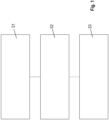
- Fig. 1 shows a flowchart illustrating a method according to an embodiment.
- the process is a process for producing cellular plastic particles; the process therefore serves to produce cellular plastic particles.
- the plastic particles that can be produced or manufactured according to the process and have a lower density compared to the starting material are therefore plastic particles that have a cellular structure at least in part, or possibly completely.
- the plastic particles can also have a certain (further) expansion capacity, in particular due to a certain blowing agent content - be it a residue from the described process or one subsequently introduced in a separate process step.
- the cellular plastic particles that can be produced or manufactured according to the process can therefore be expandable and/or (mechanically) compressible or compressible.
- the cellular plastic particles with a lower density produced or manufactured using this process can be further processed into a particle foam molded part in one or more separate downstream processes.
- the plastic particles can be further processed into a particle foam molded part using steam or superheated steam (steam-based) or without the use of steam or superheated steam (non-steam-based or dry).
- a plastic material is provided in the form of pre-expanded plastic material particles.
- the provided pre-expanded plastic material particles can optionally also be referred to as "pre-expanded plastic particles.”
- the pre-expanded plastic material particles which are to be regarded as the starting material and are typically thermoplastic plastic material particles, are thus provided in the first step of the method.
- the provided starting material is thus in particulate form, i.e. in particular in bulk material-like or bulk-shaped.
- the first step therefore, generally at least one measure for providing a particulate, i.e.
- thermoplastic plastic material in the form of corresponding pre-expanded plastic material particles is carried out.
- the density of the pre-expanded plastic material particles provided in the first step of the process is typically below 1 g/cm 3 , in particular in a range between 0.05 and 1.5 g/cm 3 , due to the cellular structure, which results in the pre-expanded properties of the pre-expanded plastic material particles provided; the matrix of the pre-expanded plastic material particles provided thus has a porous or cellular structure.
- the matrix of the pre-expanded plastic material particles may optionally contain at least one additive or material, such as elongated, spherical, or platelet-shaped fillers.
- the density may even exceed 1 g/ cm3 , depending on the concentration.
- additives or materials may themselves be present or act in a cellular manner.
- the first step S1 of the method can be carried out, if necessary at least partially automated or partially automated, by means of a Fig. 2 purely schematically illustrated supply device 2, which is designed for the continuous or discontinuous supply of corresponding pre-expanded plastic material particles.
- a corresponding supply device 2 can, for example, be a conveying device by means of which the pre-expanded plastic material particles to be processed into corresponding cellular plastic particles can be conveyed to or into a loading device 3 carrying out the second step of the method.
- a corresponding conveying device can, for example, be designed as or comprise a belt conveyor or flow conveyor.
- the conveying of the pre-expanded plastic material particles to or into a loading device 3 carrying out the second step of the method can thus include receiving the pre-expanded plastic material particles in a conveying flow; the pre-expanded plastic material particles can thus be conveyed by means of a conveying flow to or into a loading device 3 carrying out the second step of the method.
- a second step S2 of the method the pre-expanded plastic material particles are loaded with a blowing agent at least under the influence of pressure.
- the pre-expanded plastic material particles are thus loaded with a blowing agent at least under the influence of pressure - depending on the material, a certain (elevated) temperature can also be applied in addition to a certain pressure.
- at least one measure for loading the pre-expanded plastic material particles with a blowing agent is generally carried out at least under the influence of pressure, i.e. at least pressurized. Phenomenologically, an enrichment of the blowing agent in the respective pre-expanded plastic material particles typically occurs in the second step of the method.
- the enrichment of the blowing agent in the respective pre-expanded plastic material particles can, in particular depending on the chemical configuration of the pre-expanded plastic material particles, the blowing agent and any additives or materials contained therein, as well as depending on the pressure and temperature conditions, which, as mentioned, are typically also material-dependent, for example, result from or through absorption and/or dissolution processes of the blowing agent in the respective pre-expanded plastic material particles.
- an enrichment or accumulation of the blowing agent can also occur within the cell spaces defined by the cellular structure; thus, the internal volume of a respective pre-expanded plastic material defined by the cell spaces be used as a receiving space for the intake of propellant in the second step of the process.
- the pressure level and the pressure increase rate in the second step of the process are, in particular depending on the material, typically selected so that the cellular structure of the pre-expanded plastic material particles is not damaged; in particular, the pressure level and the pressure increase rate in the second step of the process are selected so that the cellular structure of the pre-expanded plastic material particles does not undergo plastic deformation and even collapse due to pressure (effective difference between external loading and intracellular pressure).
- Gases such as carbon dioxide or a mixture containing carbon dioxide and/or nitrogen, such as air, can be used as blowing agents.
- any flammable or non-flammable organic gases i.e., in particular, butane or pentane; or inert gases, such as noble gases, i.e., in particular, helium, neon, argon; or nitrogen, or mixtures thereof, can be used.
- the term "blowing agent" can therefore also encompass a mixture of chemically and/or physically different blowing agents.
- the selection of the blowing agent is typically made taking into account its absorption capacity in the pre-expanded plastic material particles, thus taking into account the chemical and/or physical configuration or composition of the pre-expanded plastic material particles. If the pre-expanded plastic material particles contain additives or materials, the properties, such as the chemical and/or physical configuration of the additives or materials, can also be considered when selecting the blowing agent.
- the second step S2 of the method can, if necessary at least partially automated or partially automated, can be carried out by means of a Fig. 2 purely schematically illustrated loading device 3, which is designed to load the pre-expanded plastic material particles with a propellant at least under the influence of pressure or to carry out a corresponding loading process.
- a corresponding loading device 3 can be designed, for example, as an autoclave device, i.e., generally as a pressure vessel device 3.1 comprising a pressure or process chamber. or comprise such a device.
- a corresponding loading device 3 can further comprise a temperature control device 3.2, which is configured to control the temperature of a corresponding pressure or process chamber.
- a corresponding loading device can in all cases comprise a hardware and/or software-implemented control and/or regulation unit 3.3, which is configured to control and/or regulate, i.e., generally to adjust, certain dynamic and/or static pressure and/or temperature parameters within the pressure or process chamber.
- the pre-expanded plastic material particles loaded with blowing agent are expanded to produce cellular plastic particles under the influence of temperature, ie in particular elevated temperature.
- the pre-expanded plastic material particles loaded with blowing agent are thus typically exposed to elevated temperature, i.e., generally thermal energy, in the third step of the process, which leads to outgassing and/or expansion of the blowing agent contained in the pre-expanded plastic material particles.
- the outgassing of the blowing agent in the cells and matrix regions of the thermally softened or softened pre-expanded plastic material particles causes a renewed or further expansion of the plastic material particles, which, after cooling or "freezing," leads to the formation of plastic particles with a permanent cellular structure, possibly modified compared to the starting material, for example with regard to cell number, cell shape, and/or cell size, and thus to the formation of the cellular plastic particles to be produced.
- the third step of the process therefore, generally at least one measure is taken for outgassing or expanding the blowing agent contained in the pre-expanded plastic material particles, which are softened or softened at least by the influence of temperature and thus at least thermally. Propellant for the production of cellular plastic particles.
- the third step of the process in particular due to the outgassing or desorption of the propellant from the cells and the matrix regions of the softening or softened pre-expanded plastic material particles, a possibly further cell growth and possibly renewed cell formation with subsequent cell growth within the pre-expanded plastic material particles take place, which leads to the cellular plastic particles to be produced.
- the cell formation if such occurs, is based Typically, this is achieved by the aforementioned desorption of the blowing agent at nucleation points in the plastic material particles, which soften or are softened by the influence of temperature, while cell growth is typically based on an overpressure-induced expansion of the blowing agent in already formed or existing cells.
- the cellular structure formed in this way, or the further expansion state realized thereby is permanently "frozen” or fixed by the temperature reduction of the subsequently produced cellular plastic particles, i.e., by their cooling, e.g., in the environment.
- a corresponding expansion device 4 has a conveyor device 4.31 which is configured to convey the plastic material particles loaded with blowing agent along corresponding tempering devices 4.1
- the aforementioned temperatures can refer to a temperature upon entry of the pre-expanded plastic particle material loaded with blowing agent into a corresponding expansion or tempering device 4.1 (inlet temperature), thus to an initial region of a corresponding conveyor device 4.3, and/or to an outlet temperature upon exit of the plastic particles from a corresponding expansion or tempering device 4 (outlet temperature), thus to an end region of a corresponding conveyor device.
- inlet temperature is lower than the outlet temperature.
- the tempering, i.e. in particular the heating, of the pre-expanded plastic material particles loaded with blowing agent can, particularly depending on the material, be carried out in a targeted manner by selecting and/or adjusting the properties of high-energy radiation, i.e. in particular its wavelength, without risking undesirable melting or melting during the expansion process of the pre-expanded plastic material particles loaded with blowing agent, i.e. insufficient stability of the softened plastic material particles, in the case of a softening of the pre-expanded plastic material particles loaded with blowing agent that accompanies heating of the same.
- Infrared radiation has been shown in studies to be particularly suitable for this purpose, as it enables targeted and, in conjunction with a conveying device, very easily controllable volume heating of the pre-expanded plastic material particles loaded with blowing agent, a controllable softening process and thus - this is essential for adjusting the properties of the cellular plastic particles to be produced - a controllable expansion process.
- the expansion of the plastic material particles loaded with blowing agent takes place under the influence of temperature by irradiating the pre-expanded plastic material particles loaded with a blowing agent with high-energy thermal radiation, namely infrared radiation, wherein the plastic material particles loaded with blowing agent are conveyed on at least one conveyor line defined by a conveyor device 4.3, in particular continuously, along at least one radiation generating device 4.4 generating corresponding high-energy radiation, i.e. infrared radiation.
- a corresponding radiation generating device 4.4 can in particular be designed as an infrared oven, in particular an infrared continuous oven, or comprise such.
- a corresponding infrared oven can comprise one or more infrared radiators arranged or formed along a corresponding conveyor line.
- Corresponding infrared radiators can, for example, have a radiation output, which can be variable if necessary, in a range between 1 and 500 kW.
- the above-mentioned outputs can relate in particular to area output per m2 . In particular, area outputs between 5 and 100 kW/ m2 can be used.
- Different temperature zones can be created by variable radiators or variable radiator (area) power, which also provides a parameter for influencing the expansion process.
- the produced cellular plastic particles can be cooled under the influence of a temperature (particularly lower than that of the previous expansion process), as indicated above.
- This cooling which preferably takes place rapidly, can "freeze" the cellular structure of the cellular plastic particles present after the expansion process.
- any further, integral, or even local expansion of the plastic particles, which may be undesired after the expansion process can be specifically prevented, for example, in order to maintain a cellular structure of the plastic particles that may be desired after the expansion process.
- Cooling can, in particular, be carried out from a process temperature above a reference temperature, in particular room temperature can be used as a reference temperature, to a temperature below the process temperature. Cooling can take place at a temperature below the reference temperature, particularly room temperature. Therefore, separate temperature control devices for cooling the plastic particles are not absolutely necessary; it may be sufficient for the plastic particles to be cooled to room temperature after the expansion process or to be stored at room temperature.
- a pre-expanded plastic particle material containing at least one, in particular functional, additive or material for example a fiber material or material and/or a dye or material and/or a nucleating substance or material and/or a substance or material for specifically influencing or controlling the softening behavior of the plastic material particles loaded with blowing agent.
- compounded pre-expanded plastic material particles can also be loaded with blowing agent and expanded, resulting in cellular plastic particles with special properties.
- tailor-made plastic particles can be produced for specific applications or areas of use through a targeted selection and concentration of appropriate additives or materials.
- the additives or materials can have been incorporated into the pre-expanded plastic material particles during production.
- fiber materials can be organic or inorganic fiber materials, for example, aramid, glass, carbon, or natural fibers—can be used to achieve special material properties for further processing of the cellular plastic particles produced or manufactured according to the process, or of a particle foam molded part produced from the cellular plastic particles produced or manufactured according to the process.
- Such cellular plastic particles, or particle foam molded parts produced from them can be characterized, on the one hand, by a special density due to their cellular structure, and, on the other hand, by special mechanical properties, particularly due to mechanical connections between adjacent cells within respective cellular plastic particles and/or between respective adjacent cellular plastic particles, which arise during processing.
- special mechanical properties can be utilized locally or integrally, or even modified. The same applies—in principle, regardless of their chemical composition—to non-fibrous or non-fibrous additives or materials, such as spherical or platelet-like organic and/or inorganic additives or materials.
- the electrical and/or thermal properties of the plastic particles can also be specifically influenced by appropriate additives or materials.
- plastic particles with special electrical and/or thermally conductive properties can be produced, for example, by using electrically and/or thermally conductive additives or materials, such as metal and/or soot particles, etc.
- concentration of corresponding additives or materials can, in principle, be freely selected, although typically dependent on the material. Therefore, it is stated merely by way of example that pre-expanded plastic material particles can be provided or used with one (or more) additive(s) or material(s) in a (respective) concentration between 0.01 wt.%, this applies in particular to chemically active additives, and 60 wt.%, this applies in particular to fibrous additives. As indicated, the concentration typically depends on the specific chemical and/or physical properties of the additives.
- any polyolefin-based plastic material can be provided or used as a starting material according to the process.
- plastic material particles from the group consisting of polypropylene, polypropylene blends, polyethylene, polyethylene blends, polyethylene-polypropylene blends, copolymers of ethylene and at least one other olefinic monomer, copolymers of propylene and at least one other olefinic monomer, and/or mixtures of the aforementioned can be provided or used according to the process.
- polystyrene-based blends which have at least two different chemical and/or physical parameters
- the polymer contains (poly)olefinic components that differ in terms of parameters relating to the molecular configuration, these components can in principle be present in any desired proportion, with the respective proportions adding up to 100%.
- a first component can have any weight fraction between 1 and 99% by weight
- a second component can have any weight fraction between 99 and 1% by weight, with the respective proportions adding up to 100% by weight.
- proportions below 1% by weight and above 99% by weight are also conceivable.
- cellular plastic particles with a uniformly or irregularly distributed cellular structure can be produced.
- the properties, i.e., in particular the distribution of the cellular structure, within the respective cellular plastic particles can thus be influenced not only by material-specific parameters but also by pressure, temperature, and time during loading or expansion, as well as by the conveying times or conditions between the individual process steps S1 - S3.
- the respective cellular plastic particles may have a different number, shape, and/or size of cells in an edge region than in a core region.
- graded cellular plastic particles can be produced that exhibit a specific range of properties due to the different distribution of cell number, cell shape, and/or cell size.
- graded cellular plastic particles can exhibit different cellular properties in an (outer) edge region than in an (inner) core region, for example, similar to core-shell particles.
- the embodiment shown of a device 1 for carrying out the method comprises the aforementioned supply device 2, the loading device 3, which can generally be referred to as the first device, which is designed to load the pre-expanded thermoplastic with a blowing agent under the influence of pressure, and the expansion device 4, which can generally be referred to as the second device, which is designed to expand the blowing agent for producing cellular plastic particles under the influence of temperature.
- the supply device 2 can comprise a suitable handling device for handling the pre-expanded plastic material particles for their supply.
- the device 1 can comprise, although not shown, a handling device 5 downstream of the expansion device 4 for removing the produced cellular plastic particles.
- corresponding handling devices can be designed as or comprise conveyor devices. Conveyor devices suitable for conveying bulk material, such as pneumatic conveyor devices configured to create a conveying flow, are particularly suitable.
- the second device can comprise a conveying device, in particular a combined conveying and tempering device.
- a corresponding combined conveying and tempering device can be designed, for example, as a continuous furnace, in particular as an infrared continuous furnace comprising one or more infrared radiators, or can comprise at least one such furnace.
- the second device may further be associated with a relaxation device (not shown), such as a relaxation chamber, in which the produced cellular plastic particles are exposed to defined chemical and/or physical conditions, ie, in particular, a defined temperature ratio, for a defined period of time.
- a relaxation device such as a relaxation chamber, in which the produced cellular plastic particles are exposed to defined chemical and/or physical conditions, ie, in particular, a defined temperature ratio, for a defined period of time.
- a corresponding relaxation device may, for example, be designed as or comprise a decompression device.
- the device 1 comprises a conveying device by means of which the pre-expanded plastic material particles or, furthermore, the cellular plastic particles are conveyed continuously or discontinuously through the individual devices 2 - 4.
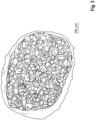
- Fig. 3 shows a schematic diagram of a cellular plastic particle produced according to the process according to one embodiment in a sectional view. Specifically, this is a section of a microscopic image of a foam bead made of pre-expanded polypropylene (EPP) with an initial bulk density of approximately 75 g/l, and a cellular plastic particle produced according to the process with a reduced bulk density of approximately 17 g/l.
- EPP pre-expanded polypropylene
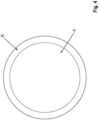
- Fig. 4 shows a schematic diagram of a cellular plastic particle produced according to the method according to an exemplary embodiment.
- the schematic diagram shows a cellular plastic particle with locally different cell properties and thus a graded cellular plastic particle.
- the cellular plastic particle has an unevenly distributed cellular structure, as the plastic particle has a different, namely a higher, number of cells in an edge region R than in a core region K.
- the dashed inner line indicates that the transitions between the edge region R and the core region K can be continuous.
- the edge region R can, if necessary, be locally distinct to varying degrees.
Landscapes
- Chemical & Material Sciences (AREA)
- Engineering & Computer Science (AREA)
- Materials Engineering (AREA)
- Health & Medical Sciences (AREA)
- Chemical Kinetics & Catalysis (AREA)
- Medicinal Chemistry (AREA)
- Polymers & Plastics (AREA)
- Organic Chemistry (AREA)
- Manufacture Of Porous Articles, And Recovery And Treatment Of Waste Products (AREA)
- Processing And Handling Of Plastics And Other Materials For Molding In General (AREA)
Priority Applications (10)
| Application Number | Priority Date | Filing Date | Title |
|---|---|---|---|
| HUE21171657A HUE071339T2 (hu) | 2021-04-30 | 2021-04-30 | Eljárás cellás poliolefin-alapú mûanyagrészecskék elõállítására |
| EP21171657.6A EP4083124B1 (de) | 2021-04-30 | 2021-04-30 | Verfahren zur herstellung zellulärer polyolefin-basierter kunststoffpartikel |
| EP25163235.2A EP4545268A3 (de) | 2021-04-30 | 2021-04-30 | Verfahren zur herstellung zellulärer polyolefin-basierter kunststoffpartikel |
| PL21171657.6T PL4083124T3 (pl) | 2021-04-30 | 2021-04-30 | Sposób wytwarzania komórkowych cząstek tworzywa sztucznego na bazie poliolefin |
| ES21171657T ES3027857T3 (en) | 2021-04-30 | 2021-04-30 | Method for producing cellular polyolefin-based plastic particles |
| JP2023566754A JP2024527181A (ja) | 2021-04-30 | 2022-04-27 | ポリオレフィン系樹脂発泡粒子の製造方法 |
| KR1020237040935A KR20240013130A (ko) | 2021-04-30 | 2022-04-27 | 셀룰러 폴리올레핀계 플라스틱 입자의 제조 방법 |
| PCT/EP2022/061256 WO2022229286A1 (de) | 2021-04-30 | 2022-04-27 | Verfahren zur herstellung zellulärer polyolefin-basierter kunststoffpartikel |
| US18/558,025 US20240209171A1 (en) | 2021-04-30 | 2022-04-27 | Method for producing cellular polyolefin-based plastic particles |
| CN202280042111.1A CN117480204A (zh) | 2021-04-30 | 2022-04-27 | 用于生产蜂窝状聚烯烃基塑料颗粒的方法 |
Applications Claiming Priority (1)
| Application Number | Priority Date | Filing Date | Title |
|---|---|---|---|
| EP21171657.6A EP4083124B1 (de) | 2021-04-30 | 2021-04-30 | Verfahren zur herstellung zellulärer polyolefin-basierter kunststoffpartikel |
Related Child Applications (1)
| Application Number | Title | Priority Date | Filing Date |
|---|---|---|---|
| EP25163235.2A Division EP4545268A3 (de) | 2021-04-30 | 2021-04-30 | Verfahren zur herstellung zellulärer polyolefin-basierter kunststoffpartikel |
Publications (3)
| Publication Number | Publication Date |
|---|---|
| EP4083124A1 EP4083124A1 (de) | 2022-11-02 |
| EP4083124B1 true EP4083124B1 (de) | 2025-03-19 |
| EP4083124C0 EP4083124C0 (de) | 2025-03-19 |
Family
ID=75746533
Family Applications (2)
| Application Number | Title | Priority Date | Filing Date |
|---|---|---|---|
| EP21171657.6A Active EP4083124B1 (de) | 2021-04-30 | 2021-04-30 | Verfahren zur herstellung zellulärer polyolefin-basierter kunststoffpartikel |
| EP25163235.2A Pending EP4545268A3 (de) | 2021-04-30 | 2021-04-30 | Verfahren zur herstellung zellulärer polyolefin-basierter kunststoffpartikel |
Family Applications After (1)
| Application Number | Title | Priority Date | Filing Date |
|---|---|---|---|
| EP25163235.2A Pending EP4545268A3 (de) | 2021-04-30 | 2021-04-30 | Verfahren zur herstellung zellulärer polyolefin-basierter kunststoffpartikel |
Country Status (9)
| Country | Link |
|---|---|
| US (1) | US20240209171A1 (pl) |
| EP (2) | EP4083124B1 (pl) |
| JP (1) | JP2024527181A (pl) |
| KR (1) | KR20240013130A (pl) |
| CN (1) | CN117480204A (pl) |
| ES (1) | ES3027857T3 (pl) |
| HU (1) | HUE071339T2 (pl) |
| PL (1) | PL4083124T3 (pl) |
| WO (1) | WO2022229286A1 (pl) |
Families Citing this family (3)
| Publication number | Priority date | Publication date | Assignee | Title |
|---|---|---|---|---|
| DE102021111247A1 (de) * | 2021-04-30 | 2022-11-03 | Fox Velution Gmbh | Verfahren zur Herstellung zellulärer Kunststoffpartikel |
| EP4209436B1 (en) * | 2022-01-10 | 2024-05-22 | FOX Velution GmbH | Apparatus for conveying polymer particles |
| EP4209263A1 (en) * | 2022-01-10 | 2023-07-12 | JSP International SARL | Apparatus for conveying polyolefin particles |
Family Cites Families (2)
| Publication number | Priority date | Publication date | Assignee | Title |
|---|---|---|---|---|
| JP2007503324A (ja) * | 2003-08-15 | 2007-02-22 | ノバ・ケミカルズ(インターナシヨナル)・エス・アー | 発泡性ポリマー粒子およびその発泡物品を加工する方法 |
| US8063177B2 (en) * | 2007-10-11 | 2011-11-22 | Kaneka Corporation | Pre-expanded polypropylene resin particle, and method for production thereof |
-
2021
- 2021-04-30 EP EP21171657.6A patent/EP4083124B1/de active Active
- 2021-04-30 HU HUE21171657A patent/HUE071339T2/hu unknown
- 2021-04-30 EP EP25163235.2A patent/EP4545268A3/de active Pending
- 2021-04-30 ES ES21171657T patent/ES3027857T3/es active Active
- 2021-04-30 PL PL21171657.6T patent/PL4083124T3/pl unknown
-
2022
- 2022-04-27 KR KR1020237040935A patent/KR20240013130A/ko active Pending
- 2022-04-27 JP JP2023566754A patent/JP2024527181A/ja active Pending
- 2022-04-27 WO PCT/EP2022/061256 patent/WO2022229286A1/de not_active Ceased
- 2022-04-27 US US18/558,025 patent/US20240209171A1/en active Pending
- 2022-04-27 CN CN202280042111.1A patent/CN117480204A/zh active Pending
Also Published As
| Publication number | Publication date |
|---|---|
| EP4545268A2 (de) | 2025-04-30 |
| EP4083124A1 (de) | 2022-11-02 |
| US20240209171A1 (en) | 2024-06-27 |
| ES3027857T3 (en) | 2025-06-17 |
| CN117480204A (zh) | 2024-01-30 |
| KR20240013130A (ko) | 2024-01-30 |
| EP4083124C0 (de) | 2025-03-19 |
| PL4083124T3 (pl) | 2025-08-04 |
| JP2024527181A (ja) | 2024-07-22 |
| EP4545268A3 (de) | 2025-07-30 |
| HUE071339T2 (hu) | 2025-08-28 |
| WO2022229286A1 (de) | 2022-11-03 |
Similar Documents
| Publication | Publication Date | Title |
|---|---|---|
| EP4083124B1 (de) | Verfahren zur herstellung zellulärer polyolefin-basierter kunststoffpartikel | |
| DE69721232T2 (de) | Verfahren zur schnellen herstellung von extrudierten geschlossenzelligen schäumen niedriger dichte aus polypropylen | |
| DE3851490T2 (de) | Polyolefinschäume mit offenen und/oder geschlossenen Poren aus Polyolefinen mit ultrahohem Molekulargewicht, Verfahren zu ihrer Herstellung und Anwendung. | |
| DE102021111249A1 (de) | Verfahren zur Herstellung zellulärer Kunststoffpartikel | |
| EP0411437B1 (de) | Verfahren zur Herstellung von expandierbarem Granulat und Schaumstoffen daraus | |
| DE102014216992A1 (de) | Expandierte Polymerpellets | |
| DE2455504A1 (de) | Biaxial orientierter polyvinylalkoholfilm und verfahren zu seiner herstellung | |
| DE10358801A1 (de) | Partikelschaumformteile aus expandierbaren Styrolpolymeren und Mischungen mit thermoplastischen Polymeren | |
| DE102021111247A1 (de) | Verfahren zur Herstellung zellulärer Kunststoffpartikel | |
| EP2452968A1 (de) | Verfahren zur Herstellung von expandierbaren thermoplastischen Partikeln mit Verbesserter Expandierbarkeit | |
| EP3233992B1 (de) | Verfahren zur herstellung von expandierbaren polymilchsäure-haltigen granulaten | |
| EP2948286B1 (de) | Verfahren zur herstellung eines schaumprodukts sowie vorrichtung hierfür | |
| EP3838974A1 (de) | Einsatz von lignin als hauptbestandteil für extrudierten und expandierten biopolymerschaum | |
| DE3921108C1 (pl) | ||
| DE60124187T2 (de) | Verfahren zur Herstellung von vorexpandierten Teilchen aus Polyolefinharz | |
| EP1694487B1 (de) | Verfahren zur Herstellung von expandierbare Styrolpolymergranulate | |
| DE102016008041B4 (de) | Verfahren zur Herstellung eines Polypropylen-Schaumkörpers | |
| DE10226202A1 (de) | Herstellung von PP-Schaumpartikeln | |
| EP1088023A1 (de) | Verfahren zur herstellung von geschäumten kunststoffblöcken auf polyolefinbasis | |
| EP1144491A2 (de) | Expandierte polypropylen-partikel | |
| DE112004002167B4 (de) | Expandierbare Styrolpolymergranulate | |
| EP3730543B1 (de) | Verfahren zur herstellung von expandierbaren oder zumindest teilweise expandierten polymerpartikeln auf der basis von polylactid und danach hergestellte polymerpartikel | |
| EP1290073A1 (de) | Verfahren zur herstellung geschäumter bauteile vermischt mit pflanzlichem trägermaterial | |
| DE102011110613B4 (de) | Verfahren zur Herstellung einer extrudierten Schaumbahn sowie nach diesem Verfahren hergestellte Schaumware | |
| DE102025107745A1 (de) | Verfahren zur Herstellung von expandierten Granulaten |
Legal Events
| Date | Code | Title | Description |
|---|---|---|---|
| PUAI | Public reference made under article 153(3) epc to a published international application that has entered the european phase |
Free format text: ORIGINAL CODE: 0009012 |
|
| STAA | Information on the status of an ep patent application or granted ep patent |
Free format text: STATUS: THE APPLICATION HAS BEEN PUBLISHED |
|
| AK | Designated contracting states |
Kind code of ref document: A1 Designated state(s): AL AT BE BG CH CY CZ DE DK EE ES FI FR GB GR HR HU IE IS IT LI LT LU LV MC MK MT NL NO PL PT RO RS SE SI SK SM TR |
|
| STAA | Information on the status of an ep patent application or granted ep patent |
Free format text: STATUS: REQUEST FOR EXAMINATION WAS MADE |
|
| 17P | Request for examination filed |
Effective date: 20230429 |
|
| RBV | Designated contracting states (corrected) |
Designated state(s): AL AT BE BG CH CY CZ DE DK EE ES FI FR GB GR HR HU IE IS IT LI LT LU LV MC MK MT NL NO PL PT RO RS SE SI SK SM TR |
|
| P01 | Opt-out of the competence of the unified patent court (upc) registered |
Effective date: 20230524 |
|
| STAA | Information on the status of an ep patent application or granted ep patent |
Free format text: STATUS: EXAMINATION IS IN PROGRESS |
|
| 17Q | First examination report despatched |
Effective date: 20241217 |
|
| GRAP | Despatch of communication of intention to grant a patent |
Free format text: ORIGINAL CODE: EPIDOSNIGR1 |
|
| STAA | Information on the status of an ep patent application or granted ep patent |
Free format text: STATUS: GRANT OF PATENT IS INTENDED |
|
| GRAS | Grant fee paid |
Free format text: ORIGINAL CODE: EPIDOSNIGR3 |
|
| GRAA | (expected) grant |
Free format text: ORIGINAL CODE: 0009210 |
|
| STAA | Information on the status of an ep patent application or granted ep patent |
Free format text: STATUS: THE PATENT HAS BEEN GRANTED |
|
| INTG | Intention to grant announced |
Effective date: 20250130 |
|
| AK | Designated contracting states |
Kind code of ref document: B1 Designated state(s): AL AT BE BG CH CY CZ DE DK EE ES FI FR GB GR HR HU IE IS IT LI LT LU LV MC MK MT NL NO PL PT RO RS SE SI SK SM TR |
|
| REG | Reference to a national code |
Ref country code: GB Ref legal event code: FG4D Free format text: NOT ENGLISH |
|
| REG | Reference to a national code |
Ref country code: CH Ref legal event code: EP |
|
| REG | Reference to a national code |
Ref country code: DE Ref legal event code: R096 Ref document number: 502021006952 Country of ref document: DE |
|
| REG | Reference to a national code |
Ref country code: IE Ref legal event code: FG4D Free format text: LANGUAGE OF EP DOCUMENT: GERMAN |
|
| U01 | Request for unitary effect filed |
Effective date: 20250415 |
|
| U07 | Unitary effect registered |
Designated state(s): AT BE BG DE DK EE FI FR IT LT LU LV MT NL PT RO SE SI Effective date: 20250423 |
|
| P04 | Withdrawal of opt-out of the competence of the unified patent court (upc) registered |
Free format text: CASE NUMBER: APP_18704/2025 Effective date: 20250416 |
|
| U20 | Renewal fee for the european patent with unitary effect paid |
Year of fee payment: 5 Effective date: 20250423 |
|
| REG | Reference to a national code |
Ref country code: ES Ref legal event code: FG2A Ref document number: 3027857 Country of ref document: ES Kind code of ref document: T3 Effective date: 20250617 |
|
| PG25 | Lapsed in a contracting state [announced via postgrant information from national office to epo] |
Ref country code: RS Free format text: LAPSE BECAUSE OF FAILURE TO SUBMIT A TRANSLATION OF THE DESCRIPTION OR TO PAY THE FEE WITHIN THE PRESCRIBED TIME-LIMIT Effective date: 20250619 |
|
| PGFP | Annual fee paid to national office [announced via postgrant information from national office to epo] |
Ref country code: GB Payment date: 20250424 Year of fee payment: 5 Ref country code: ES Payment date: 20250506 Year of fee payment: 5 |
|
| PG25 | Lapsed in a contracting state [announced via postgrant information from national office to epo] |
Ref country code: NO Free format text: LAPSE BECAUSE OF FAILURE TO SUBMIT A TRANSLATION OF THE DESCRIPTION OR TO PAY THE FEE WITHIN THE PRESCRIBED TIME-LIMIT Effective date: 20250619 |
|
| PG25 | Lapsed in a contracting state [announced via postgrant information from national office to epo] |
Ref country code: HR Free format text: LAPSE BECAUSE OF FAILURE TO SUBMIT A TRANSLATION OF THE DESCRIPTION OR TO PAY THE FEE WITHIN THE PRESCRIBED TIME-LIMIT Effective date: 20250319 |
|
| PG25 | Lapsed in a contracting state [announced via postgrant information from national office to epo] |
Ref country code: GR Free format text: LAPSE BECAUSE OF FAILURE TO SUBMIT A TRANSLATION OF THE DESCRIPTION OR TO PAY THE FEE WITHIN THE PRESCRIBED TIME-LIMIT Effective date: 20250620 |
|
| PGFP | Annual fee paid to national office [announced via postgrant information from national office to epo] |
Ref country code: SK Payment date: 20250512 Year of fee payment: 5 Ref country code: TR Payment date: 20250611 Year of fee payment: 5 |
|
| PGFP | Annual fee paid to national office [announced via postgrant information from national office to epo] |
Ref country code: CZ Payment date: 20250424 Year of fee payment: 5 |
|
| REG | Reference to a national code |
Ref country code: SK Ref legal event code: T3 Ref document number: E 46483 Country of ref document: SK |
|
| REG | Reference to a national code |
Ref country code: HU Ref legal event code: AG4A Ref document number: E071339 Country of ref document: HU |
|
| PG25 | Lapsed in a contracting state [announced via postgrant information from national office to epo] |
Ref country code: SM Free format text: LAPSE BECAUSE OF FAILURE TO SUBMIT A TRANSLATION OF THE DESCRIPTION OR TO PAY THE FEE WITHIN THE PRESCRIBED TIME-LIMIT Effective date: 20250319 |
|
| PGFP | Annual fee paid to national office [announced via postgrant information from national office to epo] |
Ref country code: PL Payment date: 20250508 Year of fee payment: 5 |
|
| PGFP | Annual fee paid to national office [announced via postgrant information from national office to epo] |
Ref country code: HU Payment date: 20250616 Year of fee payment: 5 |
|
| PG25 | Lapsed in a contracting state [announced via postgrant information from national office to epo] |
Ref country code: IS Free format text: LAPSE BECAUSE OF FAILURE TO SUBMIT A TRANSLATION OF THE DESCRIPTION OR TO PAY THE FEE WITHIN THE PRESCRIBED TIME-LIMIT Effective date: 20250719 |
|
| REG | Reference to a national code |
Ref country code: CH Ref legal event code: H13 Free format text: ST27 STATUS EVENT CODE: U-0-0-H10-H13 (AS PROVIDED BY THE NATIONAL OFFICE) Effective date: 20251125 |
|
| PG25 | Lapsed in a contracting state [announced via postgrant information from national office to epo] |
Ref country code: MC Free format text: LAPSE BECAUSE OF FAILURE TO SUBMIT A TRANSLATION OF THE DESCRIPTION OR TO PAY THE FEE WITHIN THE PRESCRIBED TIME-LIMIT Effective date: 20250319 |
|
| PG25 | Lapsed in a contracting state [announced via postgrant information from national office to epo] |
Ref country code: CH Free format text: LAPSE BECAUSE OF NON-PAYMENT OF DUE FEES Effective date: 20250430 |
|
| PLBE | No opposition filed within time limit |
Free format text: ORIGINAL CODE: 0009261 |
|
| STAA | Information on the status of an ep patent application or granted ep patent |
Free format text: STATUS: NO OPPOSITION FILED WITHIN TIME LIMIT |
|
| REG | Reference to a national code |
Ref country code: CH Ref legal event code: L10 Free format text: ST27 STATUS EVENT CODE: U-0-0-L10-L00 (AS PROVIDED BY THE NATIONAL OFFICE) Effective date: 20260128 |