EP4082994A1 - Cubic boron nitride sintered body and method for producing same - Google Patents
Cubic boron nitride sintered body and method for producing same Download PDFInfo
- Publication number
- EP4082994A1 EP4082994A1 EP19957568.9A EP19957568A EP4082994A1 EP 4082994 A1 EP4082994 A1 EP 4082994A1 EP 19957568 A EP19957568 A EP 19957568A EP 4082994 A1 EP4082994 A1 EP 4082994A1
- Authority
- EP
- European Patent Office
- Prior art keywords
- boron nitride
- group
- temperature
- cubic boron
- gpa
- Prior art date
- Legal status (The legal status is an assumption and is not a legal conclusion. Google has not performed a legal analysis and makes no representation as to the accuracy of the status listed.)
- Pending
Links
- PZNSFCLAULLKQX-UHFFFAOYSA-N Boron nitride Chemical compound N#B PZNSFCLAULLKQX-UHFFFAOYSA-N 0.000 title claims abstract description 242
- 229910052582 BN Inorganic materials 0.000 title claims abstract description 218
- 238000004519 manufacturing process Methods 0.000 title claims description 33
- 239000000463 material Substances 0.000 claims abstract description 163
- 239000011230 binding agent Substances 0.000 claims abstract description 82
- 238000010438 heat treatment Methods 0.000 claims description 58
- 238000000034 method Methods 0.000 claims description 53
- 239000000843 powder Substances 0.000 claims description 52
- 229910052984 zinc sulfide Inorganic materials 0.000 claims description 46
- 229910052782 aluminium Inorganic materials 0.000 claims description 39
- 150000001875 compounds Chemical class 0.000 claims description 35
- PXHVJJICTQNCMI-UHFFFAOYSA-N Nickel Chemical compound [Ni] PXHVJJICTQNCMI-UHFFFAOYSA-N 0.000 claims description 29
- IJGRMHOSHXDMSA-UHFFFAOYSA-N Atomic nitrogen Chemical compound N#N IJGRMHOSHXDMSA-UHFFFAOYSA-N 0.000 claims description 18
- 229910052799 carbon Inorganic materials 0.000 claims description 17
- 230000000737 periodic effect Effects 0.000 claims description 16
- XUIMIQQOPSSXEZ-UHFFFAOYSA-N Silicon Chemical compound [Si] XUIMIQQOPSSXEZ-UHFFFAOYSA-N 0.000 claims description 15
- XAGFODPZIPBFFR-UHFFFAOYSA-N aluminium Chemical compound [Al] XAGFODPZIPBFFR-UHFFFAOYSA-N 0.000 claims description 15
- 229910017052 cobalt Inorganic materials 0.000 claims description 15
- 239000010941 cobalt Substances 0.000 claims description 15
- 229910021480 group 4 element Inorganic materials 0.000 claims description 15
- 229910021478 group 5 element Inorganic materials 0.000 claims description 15
- 229910021476 group 6 element Inorganic materials 0.000 claims description 15
- 229910052759 nickel Inorganic materials 0.000 claims description 15
- 229910052710 silicon Inorganic materials 0.000 claims description 15
- 239000010703 silicon Substances 0.000 claims description 15
- GUTLYIVDDKVIGB-UHFFFAOYSA-N cobalt atom Chemical compound [Co] GUTLYIVDDKVIGB-UHFFFAOYSA-N 0.000 claims description 14
- 239000006104 solid solution Substances 0.000 claims description 14
- 239000000126 substance Substances 0.000 claims description 14
- OKTJSMMVPCPJKN-UHFFFAOYSA-N Carbon Chemical compound [C] OKTJSMMVPCPJKN-UHFFFAOYSA-N 0.000 claims description 13
- 229910045601 alloy Inorganic materials 0.000 claims description 13
- 239000000956 alloy Substances 0.000 claims description 13
- 229910000765 intermetallic Inorganic materials 0.000 claims description 12
- QVGXLLKOCUKJST-UHFFFAOYSA-N atomic oxygen Chemical compound [O] QVGXLLKOCUKJST-UHFFFAOYSA-N 0.000 claims description 9
- 229910052757 nitrogen Inorganic materials 0.000 claims description 9
- 229910052760 oxygen Inorganic materials 0.000 claims description 9
- 239000001301 oxygen Substances 0.000 claims description 9
- ZOXJGFHDIHLPTG-UHFFFAOYSA-N Boron Chemical compound [B] ZOXJGFHDIHLPTG-UHFFFAOYSA-N 0.000 claims description 7
- 229910052796 boron Inorganic materials 0.000 claims description 7
- 229910052698 phosphorus Inorganic materials 0.000 claims description 7
- MTPVUVINMAGMJL-UHFFFAOYSA-N trimethyl(1,1,2,2,2-pentafluoroethyl)silane Chemical compound C[Si](C)(C)C(F)(F)C(F)(F)F MTPVUVINMAGMJL-UHFFFAOYSA-N 0.000 description 52
- 239000000203 mixture Substances 0.000 description 32
- 238000005520 cutting process Methods 0.000 description 30
- 239000010936 titanium Substances 0.000 description 30
- 229910052719 titanium Inorganic materials 0.000 description 26
- TWNQGVIAIRXVLR-UHFFFAOYSA-N oxo(oxoalumanyloxy)alumane Chemical compound O=[Al]O[Al]=O TWNQGVIAIRXVLR-UHFFFAOYSA-N 0.000 description 25
- JXOOCQBAIRXOGG-UHFFFAOYSA-N [B].[B].[B].[B].[B].[B].[B].[B].[B].[B].[B].[B].[Al] Chemical compound [B].[B].[B].[B].[B].[B].[B].[B].[B].[B].[B].[B].[Al] JXOOCQBAIRXOGG-UHFFFAOYSA-N 0.000 description 23
- 229910001018 Cast iron Inorganic materials 0.000 description 22
- 238000012545 processing Methods 0.000 description 18
- 238000005259 measurement Methods 0.000 description 14
- -1 hafnium nitride Chemical class 0.000 description 13
- 238000002360 preparation method Methods 0.000 description 12
- 239000012535 impurity Substances 0.000 description 10
- 229910052751 metal Inorganic materials 0.000 description 10
- 239000002184 metal Substances 0.000 description 10
- 230000007547 defect Effects 0.000 description 9
- NRTOMJZYCJJWKI-UHFFFAOYSA-N Titanium nitride Chemical compound [Ti]#N NRTOMJZYCJJWKI-UHFFFAOYSA-N 0.000 description 8
- 230000003197 catalytic effect Effects 0.000 description 8
- 238000009792 diffusion process Methods 0.000 description 8
- 238000005245 sintering Methods 0.000 description 8
- 238000012360 testing method Methods 0.000 description 8
- 238000002441 X-ray diffraction Methods 0.000 description 7
- 238000010586 diagram Methods 0.000 description 7
- 239000002994 raw material Substances 0.000 description 7
- 230000007704 transition Effects 0.000 description 7
- 230000000052 comparative effect Effects 0.000 description 6
- 239000002253 acid Substances 0.000 description 5
- 229910052735 hafnium Inorganic materials 0.000 description 5
- 239000010955 niobium Substances 0.000 description 5
- ZOKXTWBITQBERF-UHFFFAOYSA-N Molybdenum Chemical compound [Mo] ZOKXTWBITQBERF-UHFFFAOYSA-N 0.000 description 4
- RTAQQCXQSZGOHL-UHFFFAOYSA-N Titanium Chemical compound [Ti] RTAQQCXQSZGOHL-UHFFFAOYSA-N 0.000 description 4
- 238000004458 analytical method Methods 0.000 description 4
- 239000011651 chromium Substances 0.000 description 4
- 239000013078 crystal Substances 0.000 description 4
- 239000010439 graphite Substances 0.000 description 4
- 229910002804 graphite Inorganic materials 0.000 description 4
- 238000000227 grinding Methods 0.000 description 4
- 238000002156 mixing Methods 0.000 description 4
- 229910052750 molybdenum Inorganic materials 0.000 description 4
- 239000011733 molybdenum Substances 0.000 description 4
- 229910021280 Co3C Inorganic materials 0.000 description 3
- 229910001141 Ductile iron Inorganic materials 0.000 description 3
- QCWXUUIWCKQGHC-UHFFFAOYSA-N Zirconium Chemical compound [Zr] QCWXUUIWCKQGHC-UHFFFAOYSA-N 0.000 description 3
- 238000013019 agitation Methods 0.000 description 3
- 239000003054 catalyst Substances 0.000 description 3
- 229910052804 chromium Inorganic materials 0.000 description 3
- VNTLIPZTSJSULJ-UHFFFAOYSA-N chromium molybdenum Chemical compound [Cr].[Mo] VNTLIPZTSJSULJ-UHFFFAOYSA-N 0.000 description 3
- 230000000694 effects Effects 0.000 description 3
- 238000004993 emission spectroscopy Methods 0.000 description 3
- 238000011156 evaluation Methods 0.000 description 3
- VBJZVLUMGGDVMO-UHFFFAOYSA-N hafnium atom Chemical compound [Hf] VBJZVLUMGGDVMO-UHFFFAOYSA-N 0.000 description 3
- 238000009616 inductively coupled plasma Methods 0.000 description 3
- 239000011777 magnesium Substances 0.000 description 3
- 229910052758 niobium Inorganic materials 0.000 description 3
- 229910052715 tantalum Inorganic materials 0.000 description 3
- PMTRSEDNJGMXLN-UHFFFAOYSA-N titanium zirconium Chemical compound [Ti].[Zr] PMTRSEDNJGMXLN-UHFFFAOYSA-N 0.000 description 3
- 229910052726 zirconium Inorganic materials 0.000 description 3
- INZDTEICWPZYJM-UHFFFAOYSA-N 1-(chloromethyl)-4-[4-(chloromethyl)phenyl]benzene Chemical compound C1=CC(CCl)=CC=C1C1=CC=C(CCl)C=C1 INZDTEICWPZYJM-UHFFFAOYSA-N 0.000 description 2
- CSCPPACGZOOCGX-UHFFFAOYSA-N Acetone Chemical compound CC(C)=O CSCPPACGZOOCGX-UHFFFAOYSA-N 0.000 description 2
- VYZAMTAEIAYCRO-UHFFFAOYSA-N Chromium Chemical compound [Cr] VYZAMTAEIAYCRO-UHFFFAOYSA-N 0.000 description 2
- LFQSCWFLJHTTHZ-UHFFFAOYSA-N Ethanol Chemical compound CCO LFQSCWFLJHTTHZ-UHFFFAOYSA-N 0.000 description 2
- KRHYYFGTRYWZRS-UHFFFAOYSA-N Fluorane Chemical compound F KRHYYFGTRYWZRS-UHFFFAOYSA-N 0.000 description 2
- XEEYBQQBJWHFJM-UHFFFAOYSA-N Iron Chemical compound [Fe] XEEYBQQBJWHFJM-UHFFFAOYSA-N 0.000 description 2
- 229910052581 Si3N4 Inorganic materials 0.000 description 2
- VYPSYNLAJGMNEJ-UHFFFAOYSA-N Silicium dioxide Chemical compound O=[Si]=O VYPSYNLAJGMNEJ-UHFFFAOYSA-N 0.000 description 2
- 229910000831 Steel Inorganic materials 0.000 description 2
- 229910026551 ZrC Inorganic materials 0.000 description 2
- WRSVIZQEENMKOC-UHFFFAOYSA-N [B].[Co].[Co].[Co] Chemical compound [B].[Co].[Co].[Co] WRSVIZQEENMKOC-UHFFFAOYSA-N 0.000 description 2
- OTCHGXYCWNXDOA-UHFFFAOYSA-N [C].[Zr] Chemical compound [C].[Zr] OTCHGXYCWNXDOA-UHFFFAOYSA-N 0.000 description 2
- 125000004429 atom Chemical group 0.000 description 2
- CXOWYMLTGOFURZ-UHFFFAOYSA-N azanylidynechromium Chemical compound [Cr]#N CXOWYMLTGOFURZ-UHFFFAOYSA-N 0.000 description 2
- QDWJUBJKEHXSMT-UHFFFAOYSA-N boranylidynenickel Chemical compound [Ni]#B QDWJUBJKEHXSMT-UHFFFAOYSA-N 0.000 description 2
- VDZMENNHPJNJPP-UHFFFAOYSA-N boranylidyneniobium Chemical compound [Nb]#B VDZMENNHPJNJPP-UHFFFAOYSA-N 0.000 description 2
- XTDAIYZKROTZLD-UHFFFAOYSA-N boranylidynetantalum Chemical compound [Ta]#B XTDAIYZKROTZLD-UHFFFAOYSA-N 0.000 description 2
- 238000004364 calculation method Methods 0.000 description 2
- 239000002775 capsule Substances 0.000 description 2
- UFGZSIPAQKLCGR-UHFFFAOYSA-N chromium carbide Chemical compound [Cr]#C[Cr]C#[Cr] UFGZSIPAQKLCGR-UHFFFAOYSA-N 0.000 description 2
- UMUXBDSQTCDPJZ-UHFFFAOYSA-N chromium titanium Chemical compound [Ti].[Cr] UMUXBDSQTCDPJZ-UHFFFAOYSA-N 0.000 description 2
- 238000000921 elemental analysis Methods 0.000 description 2
- 239000007789 gas Substances 0.000 description 2
- WHJFNYXPKGDKBB-UHFFFAOYSA-N hafnium;methane Chemical compound C.[Hf] WHJFNYXPKGDKBB-UHFFFAOYSA-N 0.000 description 2
- 239000013067 intermediate product Substances 0.000 description 2
- 235000000396 iron Nutrition 0.000 description 2
- 238000012886 linear function Methods 0.000 description 2
- 239000011572 manganese Substances 0.000 description 2
- UNASZPQZIFZUSI-UHFFFAOYSA-N methylidyneniobium Chemical compound [Nb]#C UNASZPQZIFZUSI-UHFFFAOYSA-N 0.000 description 2
- NFFIWVVINABMKP-UHFFFAOYSA-N methylidynetantalum Chemical compound [Ta]#C NFFIWVVINABMKP-UHFFFAOYSA-N 0.000 description 2
- 229910000480 nickel oxide Inorganic materials 0.000 description 2
- GUCVJGMIXFAOAE-UHFFFAOYSA-N niobium atom Chemical compound [Nb] GUCVJGMIXFAOAE-UHFFFAOYSA-N 0.000 description 2
- RJSRQTFBFAJJIL-UHFFFAOYSA-N niobium titanium Chemical compound [Ti].[Nb] RJSRQTFBFAJJIL-UHFFFAOYSA-N 0.000 description 2
- 239000012299 nitrogen atmosphere Substances 0.000 description 2
- RVTZCBVAJQQJTK-UHFFFAOYSA-N oxygen(2-);zirconium(4+) Chemical compound [O-2].[O-2].[Zr+4] RVTZCBVAJQQJTK-UHFFFAOYSA-N 0.000 description 2
- 238000010587 phase diagram Methods 0.000 description 2
- 238000010298 pulverizing process Methods 0.000 description 2
- 238000000746 purification Methods 0.000 description 2
- 238000000550 scanning electron microscopy energy dispersive X-ray spectroscopy Methods 0.000 description 2
- HQVNEWCFYHHQES-UHFFFAOYSA-N silicon nitride Chemical compound N12[Si]34N5[Si]62N3[Si]51N64 HQVNEWCFYHHQES-UHFFFAOYSA-N 0.000 description 2
- 229910052814 silicon oxide Inorganic materials 0.000 description 2
- 239000002904 solvent Substances 0.000 description 2
- 239000010959 steel Substances 0.000 description 2
- 239000000758 substrate Substances 0.000 description 2
- 230000005469 synchrotron radiation Effects 0.000 description 2
- 229910003468 tantalcarbide Inorganic materials 0.000 description 2
- GUVRBAGPIYLISA-UHFFFAOYSA-N tantalum atom Chemical compound [Ta] GUVRBAGPIYLISA-UHFFFAOYSA-N 0.000 description 2
- VSSLEOGOUUKTNN-UHFFFAOYSA-N tantalum titanium Chemical compound [Ti].[Ta] VSSLEOGOUUKTNN-UHFFFAOYSA-N 0.000 description 2
- 229910003470 tongbaite Inorganic materials 0.000 description 2
- WFKWXMTUELFFGS-UHFFFAOYSA-N tungsten Chemical compound [W] WFKWXMTUELFFGS-UHFFFAOYSA-N 0.000 description 2
- 229910052721 tungsten Inorganic materials 0.000 description 2
- 239000010937 tungsten Substances 0.000 description 2
- LEONUFNNVUYDNQ-UHFFFAOYSA-N vanadium atom Chemical compound [V] LEONUFNNVUYDNQ-UHFFFAOYSA-N 0.000 description 2
- 229910001928 zirconium oxide Inorganic materials 0.000 description 2
- OFEAOSSMQHGXMM-UHFFFAOYSA-N 12007-10-2 Chemical compound [W].[W]=[B] OFEAOSSMQHGXMM-UHFFFAOYSA-N 0.000 description 1
- PIGFYZPCRLYGLF-UHFFFAOYSA-N Aluminum nitride Chemical compound [Al]#N PIGFYZPCRLYGLF-UHFFFAOYSA-N 0.000 description 1
- OYPRJOBELJOOCE-UHFFFAOYSA-N Calcium Chemical compound [Ca] OYPRJOBELJOOCE-UHFFFAOYSA-N 0.000 description 1
- 229910000975 Carbon steel Inorganic materials 0.000 description 1
- 229910020639 Co-Al Inorganic materials 0.000 description 1
- RYGMFSIKBFXOCR-UHFFFAOYSA-N Copper Chemical compound [Cu] RYGMFSIKBFXOCR-UHFFFAOYSA-N 0.000 description 1
- 229910020675 Co—Al Inorganic materials 0.000 description 1
- 229910001060 Gray iron Inorganic materials 0.000 description 1
- 229910025794 LaB6 Inorganic materials 0.000 description 1
- WHXSMMKQMYFTQS-UHFFFAOYSA-N Lithium Chemical compound [Li] WHXSMMKQMYFTQS-UHFFFAOYSA-N 0.000 description 1
- FYYHWMGAXLPEAU-UHFFFAOYSA-N Magnesium Chemical compound [Mg] FYYHWMGAXLPEAU-UHFFFAOYSA-N 0.000 description 1
- PWHULOQIROXLJO-UHFFFAOYSA-N Manganese Chemical compound [Mn] PWHULOQIROXLJO-UHFFFAOYSA-N 0.000 description 1
- GRYLNZFGIOXLOG-UHFFFAOYSA-N Nitric acid Chemical compound O[N+]([O-])=O GRYLNZFGIOXLOG-UHFFFAOYSA-N 0.000 description 1
- 229910003564 SiAlON Inorganic materials 0.000 description 1
- 229910004688 Ti-V Inorganic materials 0.000 description 1
- 229910009594 Ti2AlN Inorganic materials 0.000 description 1
- 229910021330 Ti3Al Inorganic materials 0.000 description 1
- GWEVSGVZZGPLCZ-UHFFFAOYSA-N Titan oxide Chemical compound O=[Ti]=O GWEVSGVZZGPLCZ-UHFFFAOYSA-N 0.000 description 1
- 229910011214 Ti—Mo Inorganic materials 0.000 description 1
- 229910010968 Ti—V Inorganic materials 0.000 description 1
- 229910001315 Tool steel Inorganic materials 0.000 description 1
- LRTTZMZPZHBOPO-UHFFFAOYSA-N [B].[B].[Hf] Chemical compound [B].[B].[Hf] LRTTZMZPZHBOPO-UHFFFAOYSA-N 0.000 description 1
- HAWOWGSQUYVHKC-UHFFFAOYSA-N [Hf].[Mo] Chemical compound [Hf].[Mo] HAWOWGSQUYVHKC-UHFFFAOYSA-N 0.000 description 1
- AUTWRGZQAIMMQA-UHFFFAOYSA-N [Hf].[Nb] Chemical compound [Hf].[Nb] AUTWRGZQAIMMQA-UHFFFAOYSA-N 0.000 description 1
- VSTCOQVDTHKMFV-UHFFFAOYSA-N [Ti].[Hf] Chemical compound [Ti].[Hf] VSTCOQVDTHKMFV-UHFFFAOYSA-N 0.000 description 1
- WFISYBKOIKMYLZ-UHFFFAOYSA-N [V].[Cr] Chemical compound [V].[Cr] WFISYBKOIKMYLZ-UHFFFAOYSA-N 0.000 description 1
- GNBSAMIOGXVJIJ-UHFFFAOYSA-N [V].[Ta] Chemical compound [V].[Ta] GNBSAMIOGXVJIJ-UHFFFAOYSA-N 0.000 description 1
- DIVGJYVPMOCBKD-UHFFFAOYSA-N [V].[Zr] Chemical compound [V].[Zr] DIVGJYVPMOCBKD-UHFFFAOYSA-N 0.000 description 1
- SWCGXFPZSCXOFO-UHFFFAOYSA-N [Zr].[Mo] Chemical compound [Zr].[Mo] SWCGXFPZSCXOFO-UHFFFAOYSA-N 0.000 description 1
- QBXVTOWCLDDBIC-UHFFFAOYSA-N [Zr].[Ta] Chemical compound [Zr].[Ta] QBXVTOWCLDDBIC-UHFFFAOYSA-N 0.000 description 1
- 238000007605 air drying Methods 0.000 description 1
- 229910052783 alkali metal Inorganic materials 0.000 description 1
- 150000001340 alkali metals Chemical class 0.000 description 1
- 229910052784 alkaline earth metal Inorganic materials 0.000 description 1
- 150000001342 alkaline earth metals Chemical class 0.000 description 1
- UQZIWOQVLUASCR-UHFFFAOYSA-N alumane;titanium Chemical compound [AlH3].[Ti] UQZIWOQVLUASCR-UHFFFAOYSA-N 0.000 description 1
- DJPURDPSZFLWGC-UHFFFAOYSA-N alumanylidyneborane Chemical compound [Al]#B DJPURDPSZFLWGC-UHFFFAOYSA-N 0.000 description 1
- 238000013459 approach Methods 0.000 description 1
- GPBUGPUPKAGMDK-UHFFFAOYSA-N azanylidynemolybdenum Chemical compound [Mo]#N GPBUGPUPKAGMDK-UHFFFAOYSA-N 0.000 description 1
- CFJRGWXELQQLSA-UHFFFAOYSA-N azanylidyneniobium Chemical compound [Nb]#N CFJRGWXELQQLSA-UHFFFAOYSA-N 0.000 description 1
- IVHJCRXBQPGLOV-UHFFFAOYSA-N azanylidynetungsten Chemical compound [W]#N IVHJCRXBQPGLOV-UHFFFAOYSA-N 0.000 description 1
- SKKMWRVAJNPLFY-UHFFFAOYSA-N azanylidynevanadium Chemical compound [V]#N SKKMWRVAJNPLFY-UHFFFAOYSA-N 0.000 description 1
- 229910052788 barium Inorganic materials 0.000 description 1
- DSAJWYNOEDNPEQ-UHFFFAOYSA-N barium atom Chemical compound [Ba] DSAJWYNOEDNPEQ-UHFFFAOYSA-N 0.000 description 1
- 229910052790 beryllium Inorganic materials 0.000 description 1
- ATBAMAFKBVZNFJ-UHFFFAOYSA-N beryllium atom Chemical compound [Be] ATBAMAFKBVZNFJ-UHFFFAOYSA-N 0.000 description 1
- LGLOITKZTDVGOE-UHFFFAOYSA-N boranylidynemolybdenum Chemical compound [Mo]#B LGLOITKZTDVGOE-UHFFFAOYSA-N 0.000 description 1
- LAROCDZIZGIQGR-UHFFFAOYSA-N boron;vanadium Chemical compound B#[V]#B LAROCDZIZGIQGR-UHFFFAOYSA-N 0.000 description 1
- 229910052791 calcium Inorganic materials 0.000 description 1
- 239000011575 calcium Substances 0.000 description 1
- 239000010962 carbon steel Substances 0.000 description 1
- 230000015556 catabolic process Effects 0.000 description 1
- 238000006243 chemical reaction Methods 0.000 description 1
- SEGDSKBQYPCVFK-UHFFFAOYSA-N chromium hafnium Chemical compound [Cr][Hf] SEGDSKBQYPCVFK-UHFFFAOYSA-N 0.000 description 1
- QVZNQFNKKMMPFH-UHFFFAOYSA-N chromium niobium Chemical compound [Cr].[Nb] QVZNQFNKKMMPFH-UHFFFAOYSA-N 0.000 description 1
- HBCZDZWFGVSUDJ-UHFFFAOYSA-N chromium tantalum Chemical compound [Cr].[Ta] HBCZDZWFGVSUDJ-UHFFFAOYSA-N 0.000 description 1
- JUVGUSVNTPYZJL-UHFFFAOYSA-N chromium zirconium Chemical compound [Cr].[Zr] JUVGUSVNTPYZJL-UHFFFAOYSA-N 0.000 description 1
- NUEWEVRJMWXXFB-UHFFFAOYSA-N chromium(iii) boride Chemical compound [Cr]=[B] NUEWEVRJMWXXFB-UHFFFAOYSA-N 0.000 description 1
- 239000011248 coating agent Substances 0.000 description 1
- 238000000576 coating method Methods 0.000 description 1
- JPNWDVUTVSTKMV-UHFFFAOYSA-N cobalt tungsten Chemical compound [Co].[W] JPNWDVUTVSTKMV-UHFFFAOYSA-N 0.000 description 1
- IVMYJDGYRUAWML-UHFFFAOYSA-N cobalt(ii) oxide Chemical compound [Co]=O IVMYJDGYRUAWML-UHFFFAOYSA-N 0.000 description 1
- 239000002826 coolant Substances 0.000 description 1
- 229910052802 copper Inorganic materials 0.000 description 1
- 239000010949 copper Substances 0.000 description 1
- 238000006731 degradation reaction Methods 0.000 description 1
- QDOXWKRWXJOMAK-UHFFFAOYSA-N dichromium trioxide Chemical compound O=[Cr]O[Cr]=O QDOXWKRWXJOMAK-UHFFFAOYSA-N 0.000 description 1
- GNTDGMZSJNCJKK-UHFFFAOYSA-N divanadium pentaoxide Chemical compound O=[V](=O)O[V](=O)=O GNTDGMZSJNCJKK-UHFFFAOYSA-N 0.000 description 1
- 101150031883 gpa-15 gene Proteins 0.000 description 1
- QKQUUVZIDLJZIJ-UHFFFAOYSA-N hafnium tantalum Chemical compound [Hf].[Ta] QKQUUVZIDLJZIJ-UHFFFAOYSA-N 0.000 description 1
- UHOTUEJTVWSSKI-UHFFFAOYSA-N hafnium vanadium Chemical compound [V].[V].[Hf] UHOTUEJTVWSSKI-UHFFFAOYSA-N 0.000 description 1
- CJNBYAVZURUTKZ-UHFFFAOYSA-N hafnium(iv) oxide Chemical compound O=[Hf]=O CJNBYAVZURUTKZ-UHFFFAOYSA-N 0.000 description 1
- 238000002017 high-resolution X-ray diffraction Methods 0.000 description 1
- 229910052739 hydrogen Inorganic materials 0.000 description 1
- 239000001257 hydrogen Substances 0.000 description 1
- 125000004435 hydrogen atom Chemical class [H]* 0.000 description 1
- 230000001771 impaired effect Effects 0.000 description 1
- 238000010884 ion-beam technique Methods 0.000 description 1
- 229910052742 iron Inorganic materials 0.000 description 1
- 229910052744 lithium Inorganic materials 0.000 description 1
- 238000003754 machining Methods 0.000 description 1
- 229910052749 magnesium Inorganic materials 0.000 description 1
- 229910052748 manganese Inorganic materials 0.000 description 1
- CNEOGBIICRAWOH-UHFFFAOYSA-N methane;molybdenum Chemical compound C.[Mo] CNEOGBIICRAWOH-UHFFFAOYSA-N 0.000 description 1
- FXNGWBDIVIGISM-UHFFFAOYSA-N methylidynechromium Chemical group [Cr]#[C] FXNGWBDIVIGISM-UHFFFAOYSA-N 0.000 description 1
- 238000003801 milling Methods 0.000 description 1
- 238000012986 modification Methods 0.000 description 1
- 230000004048 modification Effects 0.000 description 1
- DTSBBUTWIOVIBV-UHFFFAOYSA-N molybdenum niobium Chemical compound [Nb].[Mo] DTSBBUTWIOVIBV-UHFFFAOYSA-N 0.000 description 1
- JZLMRQMUNCKZTP-UHFFFAOYSA-N molybdenum tantalum Chemical compound [Mo].[Ta] JZLMRQMUNCKZTP-UHFFFAOYSA-N 0.000 description 1
- ZPZCREMGFMRIRR-UHFFFAOYSA-N molybdenum titanium Chemical compound [Ti].[Mo] ZPZCREMGFMRIRR-UHFFFAOYSA-N 0.000 description 1
- JKQOBWVOAYFWKG-UHFFFAOYSA-N molybdenum trioxide Chemical compound O=[Mo](=O)=O JKQOBWVOAYFWKG-UHFFFAOYSA-N 0.000 description 1
- WUJISAYEUPRJOG-UHFFFAOYSA-N molybdenum vanadium Chemical compound [V].[Mo] WUJISAYEUPRJOG-UHFFFAOYSA-N 0.000 description 1
- RHDUVDHGVHBHCL-UHFFFAOYSA-N niobium tantalum Chemical compound [Nb].[Ta] RHDUVDHGVHBHCL-UHFFFAOYSA-N 0.000 description 1
- ABLLXXOPOBEPIU-UHFFFAOYSA-N niobium vanadium Chemical compound [V].[Nb] ABLLXXOPOBEPIU-UHFFFAOYSA-N 0.000 description 1
- GFUGMBIZUXZOAF-UHFFFAOYSA-N niobium zirconium Chemical compound [Zr].[Nb] GFUGMBIZUXZOAF-UHFFFAOYSA-N 0.000 description 1
- URLJKFSTXLNXLG-UHFFFAOYSA-N niobium(5+);oxygen(2-) Chemical compound [O-2].[O-2].[O-2].[O-2].[O-2].[Nb+5].[Nb+5] URLJKFSTXLNXLG-UHFFFAOYSA-N 0.000 description 1
- 229910017604 nitric acid Inorganic materials 0.000 description 1
- 150000004767 nitrides Chemical class 0.000 description 1
- TVMXDCGIABBOFY-UHFFFAOYSA-N octane Chemical compound CCCCCCCC TVMXDCGIABBOFY-UHFFFAOYSA-N 0.000 description 1
- GNRSAWUEBMWBQH-UHFFFAOYSA-N oxonickel Chemical compound [Ni]=O GNRSAWUEBMWBQH-UHFFFAOYSA-N 0.000 description 1
- BPUBBGLMJRNUCC-UHFFFAOYSA-N oxygen(2-);tantalum(5+) Chemical compound [O-2].[O-2].[O-2].[O-2].[O-2].[Ta+5].[Ta+5] BPUBBGLMJRNUCC-UHFFFAOYSA-N 0.000 description 1
- 230000005855 radiation Effects 0.000 description 1
- 230000009257 reactivity Effects 0.000 description 1
- 229910052702 rhenium Inorganic materials 0.000 description 1
- WUAPFZMCVAUBPE-UHFFFAOYSA-N rhenium atom Chemical compound [Re] WUAPFZMCVAUBPE-UHFFFAOYSA-N 0.000 description 1
- 238000001004 secondary ion mass spectrometry Methods 0.000 description 1
- VSZWPYCFIRKVQL-UHFFFAOYSA-N selanylidenegallium;selenium Chemical compound [Se].[Se]=[Ga].[Se]=[Ga] VSZWPYCFIRKVQL-UHFFFAOYSA-N 0.000 description 1
- HBMJWWWQQXIZIP-UHFFFAOYSA-N silicon carbide Chemical compound [Si+]#[C-] HBMJWWWQQXIZIP-UHFFFAOYSA-N 0.000 description 1
- 230000000087 stabilizing effect Effects 0.000 description 1
- 239000004575 stone Substances 0.000 description 1
- 229910052712 strontium Inorganic materials 0.000 description 1
- CIOAGBVUUVVLOB-UHFFFAOYSA-N strontium atom Chemical compound [Sr] CIOAGBVUUVVLOB-UHFFFAOYSA-N 0.000 description 1
- MZLGASXMSKOWSE-UHFFFAOYSA-N tantalum nitride Chemical compound [Ta]#N MZLGASXMSKOWSE-UHFFFAOYSA-N 0.000 description 1
- GFNGCDBZVSLSFT-UHFFFAOYSA-N titanium vanadium Chemical compound [Ti].[V] GFNGCDBZVSLSFT-UHFFFAOYSA-N 0.000 description 1
- UONOETXJSWQNOL-UHFFFAOYSA-N tungsten carbide Chemical compound [W+]#[C-] UONOETXJSWQNOL-UHFFFAOYSA-N 0.000 description 1
- ZNOKGRXACCSDPY-UHFFFAOYSA-N tungsten trioxide Chemical compound O=[W](=O)=O ZNOKGRXACCSDPY-UHFFFAOYSA-N 0.000 description 1
- 229910052720 vanadium Inorganic materials 0.000 description 1
- 239000010455 vermiculite Substances 0.000 description 1
- 229910052902 vermiculite Inorganic materials 0.000 description 1
- 235000019354 vermiculite Nutrition 0.000 description 1
- 238000002424 x-ray crystallography Methods 0.000 description 1
- ZVWKZXLXHLZXLS-UHFFFAOYSA-N zirconium nitride Chemical compound [Zr]#N ZVWKZXLXHLZXLS-UHFFFAOYSA-N 0.000 description 1
Images


Classifications
-
- C—CHEMISTRY; METALLURGY
- C22—METALLURGY; FERROUS OR NON-FERROUS ALLOYS; TREATMENT OF ALLOYS OR NON-FERROUS METALS
- C22C—ALLOYS
- C22C29/00—Alloys based on carbides, oxides, nitrides, borides, or silicides, e.g. cermets, or other metal compounds, e.g. oxynitrides, sulfides
- C22C29/16—Alloys based on carbides, oxides, nitrides, borides, or silicides, e.g. cermets, or other metal compounds, e.g. oxynitrides, sulfides based on nitrides
-
- B—PERFORMING OPERATIONS; TRANSPORTING
- B22—CASTING; POWDER METALLURGY
- B22F—WORKING METALLIC POWDER; MANUFACTURE OF ARTICLES FROM METALLIC POWDER; MAKING METALLIC POWDER; APPARATUS OR DEVICES SPECIALLY ADAPTED FOR METALLIC POWDER
- B22F3/00—Manufacture of workpieces or articles from metallic powder characterised by the manner of compacting or sintering; Apparatus specially adapted therefor ; Presses and furnaces
- B22F3/12—Both compacting and sintering
- B22F3/14—Both compacting and sintering simultaneously
-
- C—CHEMISTRY; METALLURGY
- C04—CEMENTS; CONCRETE; ARTIFICIAL STONE; CERAMICS; REFRACTORIES
- C04B—LIME, MAGNESIA; SLAG; CEMENTS; COMPOSITIONS THEREOF, e.g. MORTARS, CONCRETE OR LIKE BUILDING MATERIALS; ARTIFICIAL STONE; CERAMICS; REFRACTORIES; TREATMENT OF NATURAL STONE
- C04B35/00—Shaped ceramic products characterised by their composition; Ceramics compositions; Processing powders of inorganic compounds preparatory to the manufacturing of ceramic products
- C04B35/515—Shaped ceramic products characterised by their composition; Ceramics compositions; Processing powders of inorganic compounds preparatory to the manufacturing of ceramic products based on non-oxide ceramics
- C04B35/58—Shaped ceramic products characterised by their composition; Ceramics compositions; Processing powders of inorganic compounds preparatory to the manufacturing of ceramic products based on non-oxide ceramics based on borides, nitrides, i.e. nitrides, oxynitrides, carbonitrides or oxycarbonitrides or silicides
- C04B35/583—Shaped ceramic products characterised by their composition; Ceramics compositions; Processing powders of inorganic compounds preparatory to the manufacturing of ceramic products based on non-oxide ceramics based on borides, nitrides, i.e. nitrides, oxynitrides, carbonitrides or oxycarbonitrides or silicides based on boron nitride
- C04B35/5831—Shaped ceramic products characterised by their composition; Ceramics compositions; Processing powders of inorganic compounds preparatory to the manufacturing of ceramic products based on non-oxide ceramics based on borides, nitrides, i.e. nitrides, oxynitrides, carbonitrides or oxycarbonitrides or silicides based on boron nitride based on cubic boron nitrides or Wurtzitic boron nitrides, including crystal structure transformation of powder
-
- C—CHEMISTRY; METALLURGY
- C04—CEMENTS; CONCRETE; ARTIFICIAL STONE; CERAMICS; REFRACTORIES
- C04B—LIME, MAGNESIA; SLAG; CEMENTS; COMPOSITIONS THEREOF, e.g. MORTARS, CONCRETE OR LIKE BUILDING MATERIALS; ARTIFICIAL STONE; CERAMICS; REFRACTORIES; TREATMENT OF NATURAL STONE
- C04B35/00—Shaped ceramic products characterised by their composition; Ceramics compositions; Processing powders of inorganic compounds preparatory to the manufacturing of ceramic products
- C04B35/622—Forming processes; Processing powders of inorganic compounds preparatory to the manufacturing of ceramic products
-
- C—CHEMISTRY; METALLURGY
- C04—CEMENTS; CONCRETE; ARTIFICIAL STONE; CERAMICS; REFRACTORIES
- C04B—LIME, MAGNESIA; SLAG; CEMENTS; COMPOSITIONS THEREOF, e.g. MORTARS, CONCRETE OR LIKE BUILDING MATERIALS; ARTIFICIAL STONE; CERAMICS; REFRACTORIES; TREATMENT OF NATURAL STONE
- C04B35/00—Shaped ceramic products characterised by their composition; Ceramics compositions; Processing powders of inorganic compounds preparatory to the manufacturing of ceramic products
- C04B35/622—Forming processes; Processing powders of inorganic compounds preparatory to the manufacturing of ceramic products
- C04B35/626—Preparing or treating the powders individually or as batches ; preparing or treating macroscopic reinforcing agents for ceramic products, e.g. fibres; mechanical aspects section B
- C04B35/62605—Treating the starting powders individually or as mixtures
- C04B35/6261—Milling
- C04B35/6262—Milling of calcined, sintered clinker or ceramics
-
- C—CHEMISTRY; METALLURGY
- C04—CEMENTS; CONCRETE; ARTIFICIAL STONE; CERAMICS; REFRACTORIES
- C04B—LIME, MAGNESIA; SLAG; CEMENTS; COMPOSITIONS THEREOF, e.g. MORTARS, CONCRETE OR LIKE BUILDING MATERIALS; ARTIFICIAL STONE; CERAMICS; REFRACTORIES; TREATMENT OF NATURAL STONE
- C04B35/00—Shaped ceramic products characterised by their composition; Ceramics compositions; Processing powders of inorganic compounds preparatory to the manufacturing of ceramic products
- C04B35/622—Forming processes; Processing powders of inorganic compounds preparatory to the manufacturing of ceramic products
- C04B35/626—Preparing or treating the powders individually or as batches ; preparing or treating macroscopic reinforcing agents for ceramic products, e.g. fibres; mechanical aspects section B
- C04B35/62605—Treating the starting powders individually or as mixtures
- C04B35/62645—Thermal treatment of powders or mixtures thereof other than sintering
- C04B35/62675—Thermal treatment of powders or mixtures thereof other than sintering characterised by the treatment temperature
-
- C—CHEMISTRY; METALLURGY
- C04—CEMENTS; CONCRETE; ARTIFICIAL STONE; CERAMICS; REFRACTORIES
- C04B—LIME, MAGNESIA; SLAG; CEMENTS; COMPOSITIONS THEREOF, e.g. MORTARS, CONCRETE OR LIKE BUILDING MATERIALS; ARTIFICIAL STONE; CERAMICS; REFRACTORIES; TREATMENT OF NATURAL STONE
- C04B35/00—Shaped ceramic products characterised by their composition; Ceramics compositions; Processing powders of inorganic compounds preparatory to the manufacturing of ceramic products
- C04B35/622—Forming processes; Processing powders of inorganic compounds preparatory to the manufacturing of ceramic products
- C04B35/626—Preparing or treating the powders individually or as batches ; preparing or treating macroscopic reinforcing agents for ceramic products, e.g. fibres; mechanical aspects section B
- C04B35/62605—Treating the starting powders individually or as mixtures
- C04B35/62645—Thermal treatment of powders or mixtures thereof other than sintering
- C04B35/6268—Thermal treatment of powders or mixtures thereof other than sintering characterised by the applied pressure or type of atmosphere, e.g. in vacuum, hydrogen or a specific oxygen pressure
-
- C—CHEMISTRY; METALLURGY
- C04—CEMENTS; CONCRETE; ARTIFICIAL STONE; CERAMICS; REFRACTORIES
- C04B—LIME, MAGNESIA; SLAG; CEMENTS; COMPOSITIONS THEREOF, e.g. MORTARS, CONCRETE OR LIKE BUILDING MATERIALS; ARTIFICIAL STONE; CERAMICS; REFRACTORIES; TREATMENT OF NATURAL STONE
- C04B35/00—Shaped ceramic products characterised by their composition; Ceramics compositions; Processing powders of inorganic compounds preparatory to the manufacturing of ceramic products
- C04B35/622—Forming processes; Processing powders of inorganic compounds preparatory to the manufacturing of ceramic products
- C04B35/626—Preparing or treating the powders individually or as batches ; preparing or treating macroscopic reinforcing agents for ceramic products, e.g. fibres; mechanical aspects section B
- C04B35/62605—Treating the starting powders individually or as mixtures
- C04B35/62685—Treating the starting powders individually or as mixtures characterised by the order of addition of constituents or additives
-
- C—CHEMISTRY; METALLURGY
- C04—CEMENTS; CONCRETE; ARTIFICIAL STONE; CERAMICS; REFRACTORIES
- C04B—LIME, MAGNESIA; SLAG; CEMENTS; COMPOSITIONS THEREOF, e.g. MORTARS, CONCRETE OR LIKE BUILDING MATERIALS; ARTIFICIAL STONE; CERAMICS; REFRACTORIES; TREATMENT OF NATURAL STONE
- C04B35/00—Shaped ceramic products characterised by their composition; Ceramics compositions; Processing powders of inorganic compounds preparatory to the manufacturing of ceramic products
- C04B35/622—Forming processes; Processing powders of inorganic compounds preparatory to the manufacturing of ceramic products
- C04B35/626—Preparing or treating the powders individually or as batches ; preparing or treating macroscopic reinforcing agents for ceramic products, e.g. fibres; mechanical aspects section B
- C04B35/63—Preparing or treating the powders individually or as batches ; preparing or treating macroscopic reinforcing agents for ceramic products, e.g. fibres; mechanical aspects section B using additives specially adapted for forming the products, e.g.. binder binders
- C04B35/6303—Inorganic additives
-
- C—CHEMISTRY; METALLURGY
- C04—CEMENTS; CONCRETE; ARTIFICIAL STONE; CERAMICS; REFRACTORIES
- C04B—LIME, MAGNESIA; SLAG; CEMENTS; COMPOSITIONS THEREOF, e.g. MORTARS, CONCRETE OR LIKE BUILDING MATERIALS; ARTIFICIAL STONE; CERAMICS; REFRACTORIES; TREATMENT OF NATURAL STONE
- C04B35/00—Shaped ceramic products characterised by their composition; Ceramics compositions; Processing powders of inorganic compounds preparatory to the manufacturing of ceramic products
- C04B35/622—Forming processes; Processing powders of inorganic compounds preparatory to the manufacturing of ceramic products
- C04B35/64—Burning or sintering processes
- C04B35/645—Pressure sintering
-
- B—PERFORMING OPERATIONS; TRANSPORTING
- B22—CASTING; POWDER METALLURGY
- B22F—WORKING METALLIC POWDER; MANUFACTURE OF ARTICLES FROM METALLIC POWDER; MAKING METALLIC POWDER; APPARATUS OR DEVICES SPECIALLY ADAPTED FOR METALLIC POWDER
- B22F5/00—Manufacture of workpieces or articles from metallic powder characterised by the special shape of the product
- B22F2005/001—Cutting tools, earth boring or grinding tool other than table ware
-
- B—PERFORMING OPERATIONS; TRANSPORTING
- B22—CASTING; POWDER METALLURGY
- B22F—WORKING METALLIC POWDER; MANUFACTURE OF ARTICLES FROM METALLIC POWDER; MAKING METALLIC POWDER; APPARATUS OR DEVICES SPECIALLY ADAPTED FOR METALLIC POWDER
- B22F2302/00—Metal Compound, non-Metallic compound or non-metal composition of the powder or its coating
- B22F2302/20—Nitride
-
- B—PERFORMING OPERATIONS; TRANSPORTING
- B22—CASTING; POWDER METALLURGY
- B22F—WORKING METALLIC POWDER; MANUFACTURE OF ARTICLES FROM METALLIC POWDER; MAKING METALLIC POWDER; APPARATUS OR DEVICES SPECIALLY ADAPTED FOR METALLIC POWDER
- B22F2998/00—Supplementary information concerning processes or compositions relating to powder metallurgy
- B22F2998/10—Processes characterised by the sequence of their steps
-
- C—CHEMISTRY; METALLURGY
- C04—CEMENTS; CONCRETE; ARTIFICIAL STONE; CERAMICS; REFRACTORIES
- C04B—LIME, MAGNESIA; SLAG; CEMENTS; COMPOSITIONS THEREOF, e.g. MORTARS, CONCRETE OR LIKE BUILDING MATERIALS; ARTIFICIAL STONE; CERAMICS; REFRACTORIES; TREATMENT OF NATURAL STONE
- C04B2235/00—Aspects relating to ceramic starting mixtures or sintered ceramic products
- C04B2235/60—Aspects relating to the preparation, properties or mechanical treatment of green bodies or pre-forms
- C04B2235/604—Pressing at temperatures other than sintering temperatures
-
- C—CHEMISTRY; METALLURGY
- C04—CEMENTS; CONCRETE; ARTIFICIAL STONE; CERAMICS; REFRACTORIES
- C04B—LIME, MAGNESIA; SLAG; CEMENTS; COMPOSITIONS THEREOF, e.g. MORTARS, CONCRETE OR LIKE BUILDING MATERIALS; ARTIFICIAL STONE; CERAMICS; REFRACTORIES; TREATMENT OF NATURAL STONE
- C04B2235/00—Aspects relating to ceramic starting mixtures or sintered ceramic products
- C04B2235/70—Aspects relating to sintered or melt-casted ceramic products
- C04B2235/74—Physical characteristics
- C04B2235/76—Crystal structural characteristics, e.g. symmetry
-
- C—CHEMISTRY; METALLURGY
- C04—CEMENTS; CONCRETE; ARTIFICIAL STONE; CERAMICS; REFRACTORIES
- C04B—LIME, MAGNESIA; SLAG; CEMENTS; COMPOSITIONS THEREOF, e.g. MORTARS, CONCRETE OR LIKE BUILDING MATERIALS; ARTIFICIAL STONE; CERAMICS; REFRACTORIES; TREATMENT OF NATURAL STONE
- C04B2235/00—Aspects relating to ceramic starting mixtures or sintered ceramic products
- C04B2235/70—Aspects relating to sintered or melt-casted ceramic products
- C04B2235/74—Physical characteristics
- C04B2235/77—Density
-
- C—CHEMISTRY; METALLURGY
- C22—METALLURGY; FERROUS OR NON-FERROUS ALLOYS; TREATMENT OF ALLOYS OR NON-FERROUS METALS
- C22C—ALLOYS
- C22C26/00—Alloys containing diamond or cubic or wurtzitic boron nitride, fullerenes or carbon nanotubes
- C22C2026/003—Cubic boron nitrides only
-
- C—CHEMISTRY; METALLURGY
- C22—METALLURGY; FERROUS OR NON-FERROUS ALLOYS; TREATMENT OF ALLOYS OR NON-FERROUS METALS
- C22C—ALLOYS
- C22C26/00—Alloys containing diamond or cubic or wurtzitic boron nitride, fullerenes or carbon nanotubes
Definitions
- the present disclosure relates to a cubic boron nitride sintered material and a method for manufacturing the same.
- Cubic boron nitride (hereinafter also referred to as "cBN”) has significantly high hardness, and is also excellent in thermal stability and chemical stability, and accordingly, used for cutting tools and wear resistant tools.
- Patent Literature 1 discloses a sintered material obtained by sintering cubic boron nitride grains with a binder phase. Patent Literature 1 discloses that wear resistance and fracture resistance are successfully improved by adjusting the composition of the binder phase.
- Japanese Patent Laying-Open No. 2005-187260 (PTL 2) and WO 2005/066381 (PTL 3) disclose that a cubic boron nitride sintered material obtained by sintering cBN grains with a binder phase (hereinafter also referred to as "cBN sintered material”) is successfully improved in wear resistance and fracture resistance by adjusting the amount of a catalytic element in the cBN grains.
- Japanese Patent Laying-Open Nos. 2015-202980 (PTL 4) and 2015-202981 (PTL 5) disclose mixing hexagonal boron nitride (hereinafter also referred to as "hBN”) powder and binder powder and sintering the mixture at super high temperature under super high pressure to obtain a cBN sintered material.
- the cBN sintered material contains a small amount of wurtzite boron nitride (hereinafter referred to as "wBN”) and includes cBN grains of high strength, and is thus improved in wear resistance and fracture resistance.
- the presently disclosed cubic boron nitride sintered material comprises:
- the presently disclosed method for manufacturing a cubic boron nitride sintered material is a method for manufacturing the cubic boron nitride sintered material describes above, and the method comprising:
- Flake graphite cast iron (hereinafter, also referred to as "grey cast iron”) has been generally used as a cast iron material.
- FC300 or the like having a higher tensile strength than FC200 tends to be used.
- a ratio of using vermiculite cast iron and spheroidal graphite cast iron having higher strength than flake graphite cast iron is also increasing.
- FCD600 and FCD700 having higher tensile strength than FCD450 tend to be used.
- an object of the present invention is to provide a cubic boron nitride sintered material that, when used as a material for a tool, allows the tool to have a long life even when it is used for high efficiency processing of a high-strength cast iron material.
- the cubic boron nitride sintered material allows the tool to have a long life even when it is used for high efficiency processing of a high-strength cast iron material.
- the present inventors have observed how a tool using a conventional cubic boron nitride sintered material is damaged when it is used in high efficiency processing of a high-strength cast iron material, and studied why the tool is damaged.
- the cubic boron nitride sintered material has insufficient thermal conductivity, and when the tool is used for high-efficiency processing of a high-strength cast iron material, in particular, the temperature of and in a vicinity of a point of the tool in contact with the workpiece increases, which facilitates flank wear.
- the present inventors have conducted more detailed studies on factors affecting the thermal conductivity of the cubic boron nitride sintered material. As a result, the present inventors have found that the dislocation density of the cubic boron nitride grains affects the thermal conductivity of the cubic boron nitride sintered material and is closely related to the tool's life.
- a compound or the like when a compound or the like is represented by a chemical formula in the present specification describing the presently disclosed cubic boron nitride sintered material and method for manufacturing the same without specifying any specific atomic ratio, it includes any conventionally known atomic ratio and is not necessarily limited to what falls within a stoichiometric range.
- the ratio of the number of atoms constituting TiC includes any conventionally known atomic ratio.
- a cubic boron nitride sintered material is a cubic boron nitride sintered material comprising 40% by volume or more and 96% by volume or less of cubic boron nitride grains and 4% by volume or more and 60% by volume or less of a binder phase, and the cubic boron nitride grains have a dislocation density of less than 1 ⁇ 10 15 /m 2 .
- the cubic boron nitride sintered material allows the tool to have a long life even when it is used for high efficiency processing of a high-strength cast iron material, in particular.
- a reason for this is inferred as indicated by items (i) and (ii) below:
- the workpiece is not limited thereto.
- the workpiece include chromium molybdenum steel (SCM415), carbon steel for machine structure (S50C), high carbon chromium bearing steel (SUJ2, SUJ4), and alloy tool steel (SKD11).
- the presently disclosed cubic boron nitride sintered material includes 40% by volume or more and 96% by volume or less of cubic boron nitride grains and 4% by volume or more and 60% by volume or less of a binder phase. Note that the cBN sintered material may contain inevitable impurities resulting from raw materials, manufacturing conditions, and the like.
- the cBN sintered material preferably contains cBN grains at a ratio with a lower limit of 40% by volume or more, more preferably 45% by volume or more.
- the cBN sintered material preferably contains cBN grains at the ratio with an upper limit of 96% by volume or less, more preferably 90% by volume or less.
- the cBN sintered material preferably contains cBN grains at a ratio of 40% by volume or more and 96% by volume or less, more preferably 45% by volume or more and 90% by volume or less.
- the cBN sintered material preferably contains a binder phase at a ratio with a lower limit of 4% by volume or more, more preferably 10% by volume or more.
- the cBN sintered material preferably contains the binder phase at the ratio with an upper limit of 60% by volume or less, more preferably 55% by volume or less.
- the cBN sintered material contains the binder phase at a ratio of 4% by volume or more and 60% by volume or less, preferably 10% by volume or more and 55% by volume or less.
- the cBN sintered material's cBN grain content ratio (vol%) and binder phase content ratio (vol%) can be confirmed by subjecting the cBN sintered material to structural observation, elemental analysis, and the like by using an energy dispersive X-ray analyzer (EDX) (Octan Elect EDS system) accompanying a scanning electron microscope (SEM) ("JSM-7800F” (trade name) manufactured by JEOL Ltd.) (hereinafter also referred to as an "SEM-EDX").
- EDX energy dispersive X-ray analyzer
- SEM scanning electron microscope
- the cBN sintered material is cut at a desired part to prepare a sample including a cross section of the cBN sintered material.
- the cross section can be prepared using a focused ion beam device, a cross section polisher, or the like.
- the cross section is observed with an SEM with a magnification of 5,000 times to obtain a backscattered electron image.
- a region where cBN grains are present will be a black region and a region where the binder phase is present will be a gray region or a white region.
- the backscattered electron image is binarized using image analysis software ("WinROOF" by Mitani Corporation).
- WinROOF image analysis software
- an areal ratio of pixels that are attributed to a dark field in the area of the field of view for measurement i.e., pixels attributed to cBN grains
- the calculated areal ratio can be regarded as a value in % by volume, and a cBN grain content ratio (vol %) can thus be obtained.
- an areal ratio of pixels that are attributed to a bright field in the area of the field of view for measurement i.e., pixels attributed to the binder phase
- a binder phase content ratio vol%)
- the presently disclosed cubic boron nitride sintered material may contain inevitable impurities in a range in which an effect of the present disclosure is exhibited.
- the inevitable impurities can for example be hydrogen, oxygen, and carbon.
- the inevitable impurities are preferably contained in an amount of 0.1% by mass or less.
- the content of the inevitable impurities can be measured through secondary ion mass spectrometry (SIMS).
- the presently disclosed cubic boron nitride sintered material includes cubic boron nitride grains having a dislocation density of less than 1 ⁇ 10 15 /m 2 .
- the cubic boron nitride grains are higher in thermal conductivity than conventional cubic boron nitride grains. Accordingly, the cubic boron nitride sintered material including the cubic boron nitride grains is also enhanced in thermal conductivity.
- the cubic boron nitride grains have a dislocation density with an upper limit of less than 1 ⁇ 10 15 /m 2 , preferably 9.0 ⁇ 10 14 /m 2 or less, more preferably 8.0 ⁇ 10 14 /m 2 or less. While the dislocation density's lower limit is not particularly limited, it is 1 ⁇ 10 14 /m 2 or more from the viewpoint of manufacture.
- the cubic boron nitride grains' dislocation density is measured in a large-scale synchrotron radiation facility (e.g., SPring-8 (located in Hyogo Prefecture)). Specifically, it is measured in the following method.
- the binder phase completely dissolves in the fluoronitric acid, and the cBN grains remain alone.
- the cBN grains are introduced into a 0.3 mm ⁇ capillary manufactured by TOHO for X-ray crystallography ("Mark Tube” (trademark) manufactured by TOHO) and thus prepared as a sealed-off specimen.
- the specimen was subjected to X-ray diffraction measurement under the following conditions, and a line profile of a diffraction peak from each orientation plane of cubic boron nitride's major orientations which are (111), (200), (220), (311), (400) and (531) is obtained.
- a line profile obtained from the above X-ray diffraction measurement will be a profile including both a true broadening attributed to a physical quantity such as the sample's inhomogeneous strain and a broadening attributed to the equipment.
- a component attributed to the equipment is removed from the measured line profile to obtain a true line profile.
- the true line profile is obtained by fitting the obtained line profile and the line profile that is attributed to the equipment by a pseudo Voigt function, and subtracting the line profile attributed to the equipment.
- LaB 6 was used as a standard sample for removing a broadening of a diffracted wave attributed to the equipment. When significantly collimated radiation is used, a broadening of a diffracted wave attributed to the equipment may be regarded as zero.
- the obtained true line profile is analyzed using the modified Williamson-Hall method and the modified Warren-Averbach method to calculate dislocation density.
- the modified Williamson-Hall method and the modified Warren-Averbach method are known line profile analysis methods used for determining dislocation density.
- C in the above expression (I) is represented by the following expression (II):
- C C h 00 1 ⁇ q h 2 k 2 + h 2 l 2 + k 2 l 2 / h 2 + k 2 + l 2 2
- a contrast factor C h00 for screw dislocation and that for edge dislocation and a coefficient q for each contrast factor are obtained by using the computing code ANIZC, with a slip system of ⁇ 110> ⁇ 111 ⁇ , and elastic stiffness C 11 , C 12 and C 44 of 8.44 GPa, 1.9 GPa, and 4.83 GPa, respectively.
- Contrast factor C h00 is 0.203 for screw dislocation and 0.212 for edge dislocation.
- the coefficient q for the contrast factor is 1.65 for screw dislocation and 0.58 for edge dislocation. Note that screw dislocation's ratio is fixed to 0.5 and edge dislocation's ratio is fixed to 0.5.
- the presently disclosed cBN sintered material comprises a binder phase that includes:
- the binder phase has a lower reactivity with iron than cBN, and thus plays a role of suppressing chemical wear and thermal wear in cutting of a high-strength cast iron material. That is, the cBN sintered material with a binder phase contained therein enhances wear resistance in high-efficiency processing of a high-strength cast iron material.
- the group 4 element of the periodic table includes titanium (Ti), zirconium (Zr) and hafnium (Hf) for example.
- the group 5 element of the periodic table includes vanadium (V), niobium (Nb) and tantalum (Ta) for example.
- the group 6 element of the periodic table includes chromium (Cr), molybdenum (Mo) and tungsten (W) for example.
- the group 4 element, the group 5 element, the group 6 element, aluminum, silicon, cobalt, and nickel are also referred to as a "first metal element.”
- Examples of the alloy of the first metal element include Ti-Zr, Ti-Hf, Ti-V, Ti-Nb, Ti-Ta, Ti-Cr, and Ti-Mo.
- Examples of the intermetallic compound of the first metal element include TiCr 2 , Ti 3 Al and Co-Al.
- Examples of the compound including the first metal element and nitrogen include titanium nitride (TiN), zirconium nitride (ZrN), hafnium nitride (HfN), vanadium nitride (VN), niobium nitride (NbN), tantalum nitride (TaN), chromium nitride (Cr 2 N), molybdenum nitride (MoN), tungsten nitride (WN), aluminum nitride (AlN), silicon nitride (Si 3 N 4 ), cobalt nitride (CoN), nickel nitride (NiN), titanium zirconium nitride (TiZrN), titanium hafnium nitride (TiHfN), titanium vanadium nitride (TiVN), titanium niobium nitride (CoN), nickel nitride (NiN
- Examples of the compound including the first metal element and carbon include titanium carbide (TiC), zirconium carbide (ZrC), hafnium carbide (HfC), vanadium carbide (VC), niobium carbide (NbC), tantalum carbide (TaC), chromium carbide (Cr 3 C 2 ), molybdenum carbide (MoC), tungsten carbide (WC), silicon carbide (SiC), and tungsten-cobalt carbide (W 2 Co 3 C).
- TiC titanium carbide
- ZrC zirconium carbide
- HfC hafnium carbide
- VC vanadium carbide
- NbC vanadium carbide
- TaC tantalum carbide
- Cr 3 C 2 chromium carbide
- MoC molybdenum carbide
- WC tungsten carbide
- SiC silicon carbide
- W 2 Co 3 C tungsten-cobalt carbide
- Examples of the compound including the first metal element and boron include titanium boride (TiB 2 ), zirconium boride (ZrB 2 ), hafnium boride (HfB 2 ), vanadium boride (VB 2 ), niobium boride (NbB 2 ), tantalum boride (TaB 2 ), chromium boride (CrB), molybdenum boride (MoB), tungsten boride (WB), aluminum boride (AlB 2 ), cobalt boride (Co 2 B), and nickel boride (Ni 2 B).
- Examples of the compound including the first metal element and oxygen include titanium oxide (TiO 2 ), zirconium oxide (ZrO 2 ), hafnium oxide (HfO 2 ), vanadium oxide (V 2 O 5 ), niobium oxide (Nb 2 O 5 ), tantalum oxide (Ta 2 O 5 ), chromium oxide (Cr 2 O 3 ), molybdenum oxide (MoO 3 ), tungsten oxide (WO 3 ), aluminum oxide (Al 2 O 3 ), silicon oxide (SiO 2 ), cobalt oxide (CoO), and nickel oxide (NiO).
- titanium oxide TiO 2
- zirconium oxide ZrO 2
- hafnium oxide HfO 2
- vanadium oxide V 2 O 5
- niobium oxide Nb 2 O 5
- tantalum oxide Ta 2 O 5
- Cr 2 O 3 chromium oxide
- MoO 3 molybdenum oxide
- WO 3 tungsten oxide
- Al 2 O 3 aluminum oxide
- Examples of the compound including the first metal element, carbon and nitrogen i.e., a carbonitride
- examples of the compound including the first metal element, carbon and nitrogen include titanium carbonitride (TiCN), zirconium carbonitride (ZrCN), hafnium carbonitride (HfCN), titanium niobium carbonitride (TiNbCN), titanium zirconium carbonitride (TiZrCN), titanium tantalum carbonitride (TiTaCN), titanium hafnium carbonitride (TiHfCN), and titanium chromium carbonitride (TiCrCN).
- Examples of the compound including the first metal element, oxygen, and nitrogen i.e., an oxynitride
- an oxynitride examples include titanium oxynitride (TiON), zirconium oxynitride (ZrON), hafnium oxynitride (HfON), vanadium oxynitride (VON), niobium oxynitride (NbON), tantalum oxynitride (TaON), chromium oxynitride (CrON), molybdenum oxynitride (MoON), tungsten oxynitride (WON), aluminum oxynitride (AlON), and silicon oxynitride (SiAlON).
- the solid solution derived from the compound means a state in which two or more types of these compounds are dissolved in each other's crystal structure, and means an interstitial solid solution, a substitutional solid solution or the like.
- the above compound may be one type of compound or two or more types of compounds in combination.
- the total content of the compound and the solid solution derived from the compound in the binder phase is measured in the RIR (Reference Intensity Ratio) method through XRD.
- the binder phase may include a component other than the above compound.
- Examples of an element constituting the other component can include manganese (Mn) and rhenium (Re).
- composition of the binder phase included in the cBN sintered material can be determined through XRD (X-ray diffraction).
- the presently disclosed cubic boron nitride sintered material is suitably applied to cutting tools, wear resistant tools, grinding tools, and the like.
- the cutting, wear resistant and grinding tools using the presently disclosed cubic boron nitride sintered material may entirely be composed of the cubic boron nitride sintered material or may only have a portion (e.g., a cutting edge for a cutting tool) composed of the cubic boron nitride sintered material. Furthermore, a coating film may be formed on a surface of each tool.
- the cutting tool can include drills, end mills, indexable cutting inserts for drills, indexable cutting inserts for end mills, indexable cutting inserts for milling, indexable cutting inserts for turning, metal saws, gear cutting tools, reamers, taps, and the like.
- the wear resistant tool can include dies, scribers, scribing wheels, and dressers, and the like.
- the grinding tool can include grinding stone and the like.
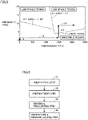
- Fig. 1 is a pressure-temperature phase diagram of boron nitride.
- Figs. 2 and 3 are diagrams for illustrating a method for manufacturing a cubic boron nitride sintered material according to an embodiment of the present disclosure.
- Fig. 4 is a diagram for illustrating an example of a method for manufacturing a cubic boron nitride sintered material, as conventional.
- Fig. 5 is a diagram for illustrating an example of a method for manufacturing a cubic boron nitride sintered material as a reference.
- Fig. 6 is a flowchart of a method for manufacturing a cubic boron nitride sintered material according to an embodiment of the present disclosure.
- the method for manufacturing a cubic boron nitride sintered material according to the present embodiment is a method for manufacturing a cubic boron nitride sintered material according to the first embodiment, and the method comprises: preparing hexagonal boron nitride powder (hereinafter also referred to as "hBN powder”) and binder powder (hereinafter also referred to as "the preparation step” and denoted in Fig.
- hBN powder hexagonal boron nitride powder
- binder powder hereinafter also referred to as “the preparation step” and denoted in Fig.
- the method for manufacturing a cubic boron nitride sintered material according to the present embodiment may further comprise, before the heating and pressurizing step, pressurizing the hexagonal boron nitride powder to a pressure of 0.5 GPa or more and 6 GPa or less at a temperature held in a range of - 50°C or higher and 100°C or lower (hereinafter also referred to as "the pretreatment step" and denoted in Fig. 6 by S2).
- the method for manufacturing a cubic boron nitride sintered material according to the present embodiment may further comprise, after the heating and pressurizing step, holding the cubic boron nitride sintered material that is obtained through the heating and pressurizing step at a temperature of 1900°C or higher and 2400°C or lower and a pressure of 8 GPa or more for 10 minutes or longer (hereinafter also referred to as "the temperature and pressure holding step" and denoted in Fig. 6 by S4).
- boron nitride has three phases of hexagonal boron nitride that is a stable phase at normal temperature and normal pressure, cubic boron nitride that is a stable phase at high temperature and high pressure, and wurtzite boron nitride that is a metastable phase during transition from hexagonal boron nitride to cubic boron nitride.
- a boundary between the phases can be represented by a linear function.
- the temperature and pressure in the stable region of each phase can be represented by a linear function.
- the temperature and pressure in the stable region of wurtzite boron nitride are defined as a temperature and a pressure that simultaneously satisfy Formulae 1 and 2: P ⁇ ⁇ 0.0037 T + 11.301 and P ⁇ ⁇ 0.085 T + 117 , where T represents temperature in °C and P represents pressure in GPa.
- the temperature and pressure in the stable region of hexagonal boron nitride are defined as a temperature and a pressure that simultaneously satisfy Formulae A and B indicated below or simultaneously satisfy Formulae C and D indicated below: P ⁇ ⁇ 0.0037 T + 11.301 and P ⁇ ⁇ 0.085 T + 117 ; or P ⁇ 0.0027 T + 0.3333 and P ⁇ ⁇ 0.085 T + 117 , where T represents temperature in °C and P represents pressure in GPa.
- the temperature and pressure in the stable region of cubic boron nitride are defined as a temperature and a pressure that simultaneously satisfy Formulae D and E: P ⁇ ⁇ 0.085 T + 117 and P ⁇ 0.0027 T + 0.3333 , where T represents temperature in °C and P represents pressure in GPa.
- hexagonal boron nitride powder and binder powder are heated to a temperature of 1900°C or higher and 2400°C or lower and pressurized to a pressure of 8 GPa or larger through a temperature and a pressure in the stable region of wurtzite boron nitride. This temperature and pressure allow an obtained cubic boron nitride to exhibit excellent tool performance.
- a starting temperature and a starting pressure normal temperature and normal pressure
- the pressure is raised to a pressure in the stable region of cubic boron nitride (e.g., 10 GPa or larger) (as indicated in Fig. 4 by an arrow E1)
- the temperature is raised to a temperature in the stable region of cubic boron nitride (e.g., 1900°C or higher) (as indicated in Fig. 4 by an arrow E2).
- the route in Fig. 4 has conventionally been employed as heating and pressurizing are each performed once and can thus be performed through a simply controlled operation.
- the route in Fig. 4 enters the stable region of wurtzite boron nitride at less than 600°C, so that atomic diffusion is less likely to occur, and the phase transition from hexagonal boron nitride to wurtzite boron nitride is mainly non-diffusive phase transition. Therefore, the obtained cubic boron nitride sintered material is likely to have lattice defects and coarse grains. Therefore, this cubic boron nitride is subject to sudden fracture during a working process and hence tends to provide a shorter tool life.
- phase transition temperature may be raised to facilitate atomic diffusion.
- a starting temperature and a starting pressure normal temperature and normal pressure
- the temperature and the pressure are raised to a temperature and a pressure in the stable region of cubic boron nitride (e.g., 1500°C and 9 GPa), respectively, (as indicated in Fig. 5 by arrows F1, F2 and F3) without passing through the stable region of wurtzite boron nitride, and subsequently, the temperature is further raised (for example to 2100°C) (as indicated in Fig. 5 by an arrow F4).
- a starting temperature and a starting pressure normal temperature and normal pressure
- the temperature and the pressure are raised to a temperature and a pressure in the stable region of cubic boron nitride (e.g., 1500°C and 9 GPa), respectively, (as indicated in Fig. 5 by arrows F1, F2 and F3) without passing through the stable region of wurtzite boron n
- hexagonal boron nitride undergoes a direct phase transition to cubic boron nitride.
- hexagonal boron nitride and cubic boron nitride have significantly different crystal structures, and lattice defects easily occur during the phase transition. Therefore, the cubic boron nitride tends to provide shorter tool life.
- hexagonal boron nitride having a crystal structure significantly different from that of cubic boron nitride is transformed into cubic boron nitride by less than 98.5% by volume. Therefore, when the obtained cubic boron nitride sintered material is used to form a tool, the tool presents impaired performance.
- Hexagonal boron nitride powder (hereinafter also referred to as hBN powder) and binder phase powder are prepared as a raw material for the cubic boron nitride sintered material.
- the hexagonal boron nitride powder has a purity (or contains hexagonal boron nitride at a ratio) preferably of 98.5% or more, more preferably 99% or more, most preferably 100%. While the grain size of the hexagonal boron nitride powder is not particularly limited, it may for example be 0.1 ⁇ m or more and 10 ⁇ m or less.
- the binder powder is a powdery raw material for the binder phase included in the cBN sintered material.
- the binder powder can be powder including at least one selected from the group consisting of a simple substance selected from the group consisting of a group 4 element, a group 5 element and a group 6 element of the periodic table, aluminum, silicon, cobalt and nickel, an alloy thereof, and an intermetallic compound thereof.
- each binder powder is weighed to have a prescribed blending ratio.
- the binder powder is agitated and pulverized. While the binder powder is agitated and pulverized in any method, agitation and pulverization using a medium such as a ball, jet mill agitation and pulverization, and the like are preferable from the viewpoint of efficient and homogeneous agitation.
- the binder powder may be agitated and pulverized in a wet manner or a dry manner.
- the hBN powder and binder powder prepared as described above are mixed together by wet ball mill-mixing using ethanol, acetone or the like as a solvent to prepare a powdery mixture.
- the hexagonal boron nitride powder and the binder powder are mixed at a ratio adjusted so that a finally obtained cubic boron nitride sintered material has cubic boron nitride grains at a ratio of 40% by volume or more and 96% by volume or less.
- the solvent is removed by air-drying after the mixing. Subsequently, a heat treatment is performed to volatilize impurities such as moisture adsorbed on the surface of the powdery mixture and thus clean the surface of the powdery mixture.
- an ultra-high pressure and temperature generator is used to pressurize the powdery mixture to a pressure of 0.5 GPa or more and 6 GPa or less while maintaining a temperature range of - 50°C or higher and 100°C or lower (as indicated in Fig. 2 by arrow A1 and in Fig. 3 by arrow B1).
- the pretreatment step can reduce gaps in the hexagonal boron nitride powder and expel unnecessary gas present in the powdery mixture out of the system. This can prevent degradation in quality attributed to a chemical reaction otherwise caused between the gas and the powdery mixture.
- the pretreatment step can increase the powdery mixture in density to such an extent that further pressurizing does not substantially vary an external shape.
- the heating and pressurizing step can be performed in this state, which allows reliable manufacture.
- the pretreatment step is performed preferably at a temperature held in a range of - 50°C or higher and 100°C or lower, more preferably 0°C or higher and 50°C or lower.
- the pretreatment step is performed with ultimate pressure preferably of 0.5 GPa or more and 5 GPa or less, more preferably 1 GPa or more and 3 GPa or less.
- the pretreatment step is an optional step. Therefore, the heating and pressurizing step described below can be performed after the preparation step without performing the pretreatment step.
- the powdery mixture is heated to a temperature of 1900°C or higher and 2400°C or lower and pressurized to a pressure of 8 GPa or larger through a temperature and a pressure in the stable region of wurtzite boron nitride (as indicated in Fig. 2 by arrows A2, A3 and A4 and in Fig. 3 by arrows B2, B3 and B4).
- the heating and pressurizing step is performed along a route entering the stable region of wurtzite boron nitride at a temperature of 600°C or higher.
- a temperature at which a route enters the stable region of wurtzite boron nitride means a temperature at which the route first reaches the stable region of wurtzite boron nitride.
- the hexagonal boron nitride powder having undergone the pretreatment step is heated from the ultimate temperature reached at the end of the pretreatment step to a temperature of 1900°C or higher and 2400°C or lower and pressurized from the ultimate pressure reached at the end of the pretreatment step to a pressure of 8 GPa or larger through a temperature and a pressure in the stable region of wurtzite boron nitride.
- the heating and pressurizing step in this case is also performed along a route entering the stable region of wurtzite boron nitride at a temperature of 600°C or higher.
- the heating and pressurizing step is performed along a route entering the stable region of wurtzite boron nitride at a temperature of 600°C or higher.
- hexagonal boron nitride powder is transformed into wurtzite boron nitride in an environment where atomic diffusion easily occurs, and thereafter transformed into cubic boron nitride.
- the obtained cubic boron nitride sintered material has reduced lattice defects and is thus enhanced in strength and toughness. Therefore, a tool using the cubic boron nitride sintered material can have a long tool life even in high-efficiency processing of a high-strength cast iron material.
- the heating and pressurizing step is performed along a route entering the stable region of wurtzite boron nitride at a temperature preferably of 600°C or higher, more preferably 1200°C or higher.
- a temperature preferably of 600°C or higher, more preferably 1200°C or higher.
- the entry temperature can have an upper limit value for example of 1500°C or lower.
- ultimate pressure is 8 GPa or more. While the upper limit of the ultimate pressure is not particularly limited, it can for example be 15 GPa or less.
- the pressure is preferably increased to 10 GPa or more.
- the heating and pressurizing step can be held at a temperature and a pressure in the stable region of wurtzite boron nitride for example for 5 minutes or longer and 60 minutes or shorter.
- heating and pressurizing step when the routes shown in Figs. 2 and 3 are followed, heating is initially performed followed by pressurizing followed by further heating.
- the heating and pressurizing may be done in any method following a route entering the stable region of wurtzite boron nitride at 600°C or higher. For example, heating and pressurizing may be performed simultaneously.
- a cubic boron nitride sintered material can be obtained by heating and pressurizing hexagonal boron nitride powder.
- the step of holding the cubic boron nitride sintered material that is obtained through the heating and pressurizing step at a temperature of 1900°C or higher and 2400°C or lower (hereinafter also referred to as “the sintering temperature”) and a pressure of 8 GPa or larger (hereinafter also referred to as “the sintering pressure”) for 10 minutes or longer can be performed.
- a cubic boron nitride sintered material thus obtained contains cubic boron nitride at an increased ratio and can thus achieve a longer tool life.
- the sintering temperature in the temperature and pressure holding step is preferably 1900°C or higher and 2400°C or lower, more preferably 2100°C or higher and 2300°C or lower.
- the sintering pressure in the temperature and pressure holding step is preferably 8 GPa or more and 15 GPa or less, more preferably 9 GPa or more and 12 GPa or less.
- the sintering time in the temperature and pressure holding step is preferably 10 minutes or longer and 60 minutes or shorter, more preferably 10 minutes or longer and 30 minutes or shorter.
- the route in Fig. 2 enters the stable region of wurtzite boron nitride at a temperature of about 1200°C.
- hexagonal boron nitride powder is transformed into wurtzite boron nitride in an environment where atomic diffusion significantly easily occurs.
- the wurtzite boron nitride has few lattice defects and a significantly low dislocation density.
- the wurtzite boron nitride is further heated and thus transformed into a cubic boron nitride sintered material. Therefore, the obtained cubic boron nitride sintered material has a significantly low dislocation density.
- the route in Fig. 3 enters the stable region of wurtzite boron nitride at a temperature of about 600°C.
- the hexagonal boron nitride powder is transformed into wurtzite boron nitride in an environment where atomic diffusion occurs.
- the wurtzite boron nitride has few lattice defects and hence a low dislocation density.
- the wurtzite boron nitride is further heated and thus transformed into a cubic boron nitride sintered material. Therefore, the obtained cubic boron nitride sintered material has a low dislocation density.
- the former has a lower dislocation density than the latter. This is because it is believed that the route in Fig. 2 enters the stable region of wurtzite boron nitride at a higher temperature and thus facilitates atom diffusion.
- Hexagonal boron nitride powder (referred to as "hBN” in Tables 1 and 2) having an average grain diameter of 10 ⁇ m, and binder powder having compositions indicated at the "binder powder” column of the "preparation step” column in Tables 1 and 2 were prepared.
- binder powder having compositions indicated at the "binder powder” column of the "preparation step” column in Tables 1 and 2 were prepared.
- TiC, Ti, and Al were prepared as the binder powder.
- the hexagonal boron nitride powder and the binder powder were mixed at ratios adjusted so that a finally obtained cubic boron nitride sintered material had cubic boron nitride grains at ratios indicated in the "cBN grains (vol %)" column of the "cubic boron nitride sintered material” column in Tables 1 and 2.
- the hexagonal boron nitride powder and the binder powder were mixed for 5 hours using a ball mill. A powdery mixture was thus obtained.
- the powdery mixture underwent a heat treatment at a temperature of 2050°C in a nitrogen atmosphere to remove impurities (i.e., a high-temperature purification treatment).
- the powdery mixture was introduced into a capsule made of molybdenum, and pressurized to a pressure of 5 GPa (indicated at the "1 st pressure applied” column of the "pretreatment step” column in Tables 1 and 2) at 25°C (room temperature, indicated at the "1 st temperature” column of the “pretreatment step” column in Tables 1 and 2) using an ultra-high pressure and ultra-high temperature generator.
- Samples 1 to 26 were each heated until the ultra high-pressure and ultra high-temperature generator internally reached a temperature indicated at the "2nd temperature (wBN entry temperature)" column of the “heating and pressurizing step” column in Tables 1 and 2. While doing so, the ultra high-pressure and ultra high-temperature generator had an internal pressure held at a pressure indicated at the "1st pressured applied” column of the "pretreatment step” column in Tables 1 and 2.
- the ultra high-pressure and ultra high-temperature generator had the internal pressure increased to a pressure indicated at the "2nd pressure applied" column of the "heating and pressuring step” column in Tables 1 and 2.
- the ultra high-pressure and ultra high-temperature generator's internal temperature and pressure were changed from those in the stable region of hexagonal boron nitride to those in the stable region of wurtzite boron nitride.
- the heating and pressurizing step was performed along a route entering the stable region of wurtzite boron nitride at a temperature indicated at the "2nd temperature (wBN entry temperature)" column of the "heating and pressurizing step” column in Tables 1 and 2.
- the ultra-high pressure and ultra-high temperature generator's internal temperature was raised to a temperature indicated at the "3rd temperature” column of the "temperature and pressure holding step” column in Tables 1 and 2. While doing so, the ultra-high pressure and ultra-high temperature generator's internal pressure was held at a pressure indicated at the "2nd pressure applied" column of the "heating and pressurizing step” column in Tables 1 and 2.
- Sample 27 was pressurized to a pressure indicated at the "2nd pressure applied" column of the "heating and pressurizing step” column in Table 2 (i.e., 10 GPa) while the first temperature in the pretreatment step (i.e., 25°C) was maintained. During this time, the ultra high-pressure and ultra high-temperature generator's internal temperature and pressure were changed from those in the stable region of hexagonal boron nitride to those in the stable region of wurtzite boron nitride.
- the heating and pressurizing step was performed along a route entering the stable region of wurtzite boron nitride at a temperature indicated at the "2nd temperature (wBN entry temperature)" column of the “heating and pressurizing step” column in Table 2 (i.e., 25°C).
- the ultra-high pressure and ultra-high temperature generator's internal temperature was raised to a temperature indicated at the "3rd temperature” column of the "temperature and pressure holding step” column in Table 2 (i.e., 2200°C). While doing so, the ultra-high pressure and ultra-high temperature generator's internal pressure was held at a pressure indicated at the "2nd pressure applied" column of the "heating and pressurizing step” column in Table 2 (i.e., 10 GPa).
- Cubic boron nitride sintered materials for samples 1 to 27 were each obtained by holding the intermediate product for a period of time indicated at the "holding time” column of the "temperature and pressure holding step” column in Tables 1 and 2 at a temperature and a pressure indicated at the "3rd temperature” and “3rd pressure” columns of the "temperature and pressure holding step” column in Tables 1 and 2.
- the preparation step and the pretreatment step were performed in the same manner as for sample 4.
- the ultra-high pressure and ultra-high temperature generator's internal temperature and pressure were increased to those indicated at the "3rd temperature” and “3rd pressure” columns of the "temperature and pressure holding step” column in Table 2 without passing through the wBN stable region, and held at the increased temperature and pressure to obtain a cubic boron nitride sintered material for sample 28.
- composition of the binder phase in the cBN sintered material was determined through XRD. A result is shown at the "binder phase composition” column of the "cubic boron nitride sintered material” column in Tables 1 and 2.
- the cBN sintered material of each sample thus produced was used to produce a cutting tool (substrate's shape: CNGA120408, cutting-edge treatment: T01215). Using this, a cutting test was performed under cutting conditions indicated below. The following cutting conditions are for high-speed continuous processing of ductile cast iron, and correspond to high-efficiency processing of high-strength cast iron.
- the cBN sintered materials of Samples 2 to 7 and 9 to 25 correspond to examples.
- the cBN sintered material of sample 1 contains cBN grains at a ratio of less than 40% by volume and corresponds to a comparative example.
- the cBN sintered material of sample 8 contains cBN grains at a ratio exceeding 96% by volume and the cBN grains have a dislocation density of 1 ⁇ 10 15 /m 2 or more, and corresponds to a comparative example.
- the cBN sintered materials of samples 26 to 28 contain cBN grains having a dislocation density of 1 ⁇ 10 15 /m 2 and correspond to comparative examples.
- sample 1 does have cBN grains with a small dislocation density, the grains are contained at an excessively low ratio of 35% by volume, which provides insufficient hardness, and it is thus inferred that the tool is fracturable.
- Sample 8 contains cBN grains at a high ratio so that the grains' dislocation density becomes high, and it is thus inferred that fracture is more likely to occur.
- the heating and pressurizing step was performed along a route entering the wBN stable region at a low temperature, and cBN grains had an increased dislocation density, resulting in reduced tool life.
- cBN grains had an increased dislocation density, resulting in reduced tool life.
- atomic diffusion does not easily occur, which is believed to provide increased dislocation density.
- Sample 28 did not pass through the wBN stable region in the manufacturing process, and thus had cBN grains with an increased dislocation density and provided a reduced tool life. While sample 28 was transformed from hBN directly into cBN in the manufacturing process, hBN and cBN have significantly different crystal structures, and when it undergoes phase transition, lattice defects easily occur, and it is thus believed that an increased dislocation density is provided.
- Sample 4 is the same cBN sintered material as sample 4 of test example 1 described above.
- Cubic boron nitride powder (referred to as "cBN” in Table 3) having an average grain diameter of 2 ⁇ m, and binder powder having a composition indicated at the "binder powder” column of the “preparation step” column in Table 3 were prepared.
- the prepared cBN powder was what had been produced in a known method using a catalyst.
- cubic boron nitride powder is produced by treating hexagonal boron nitride and a catalyst at high temperature and high pressure that are a condition for thermally stabilizing cBN.
- a catalyst an alkali metal element (lithium), an alkaline earth metal element (magnesium, calcium, strontium, beryllium, barium) or the like is generally used. Therefore, the obtained cubic boron nitride powder includes a catalytic element.
- the cubic boron nitride powder and the binder powder were mixed at a ratio adjusted so that a finally obtained cubic boron nitride sintered material had cubic boron nitride grains at a ratio indicated in the "cBN grains (vol %)" column of the "cubic boron nitride sintered material” column in Table 3.
- the cubic boron nitride powder and the binder powder were mixed for 5 hours using a ball mill. A powdery mixture was thus obtained.
- the powdery mixture underwent a heat treatment at a temperature of 2050°C in a nitrogen atmosphere to remove impurities (i.e., a high-temperature purification treatment).
- the powdery mixture was introduced into a capsule made of molybdenum, and pressurized to a pressure of 5 GPa (indicated at the "1 st pressure applied” column of the "pretreatment step” column in Table 3) at 25°C (room temperature, indicated at the "1st temperature” column of the “pretreatment step” column in Table 3) using an ultra-high pressure and ultra-high temperature generator.
- the powdery mixture was pressurized to 6 GPa (indicated at the "2nd pressure applied" column of the "heating and pressuring step” column in Table 3).
- the ultra high-pressure and ultra high-temperature generator's internal temperature and pressure were changed from those in the stable region of hexagonal boron nitride to those in the stable region of wurtzite boron nitride.
- the heating and pressurizing step was performed along a route entering the stable region of wurtzite boron nitride at 25°C (indicated at the "2nd temperature (wBN entry temperature)" column of the "heating and pressurizing step” column in Table 3).
- the ultra-high pressure and ultra-high temperature generator's internal temperature was raised to 1400°C (indicated at the "3rd temperature” column of the “temperature and pressure holding step” column in Table 3). While doing so, the ultra-high pressure and ultra-high temperature generator's internal pressure was held at 6 GPa (indicated at the "2nd pressure applied" column of the "heating and pressurizing step” column in Table 3).
- a cubic boron nitride sintered material for sample 29 was obtained by holding the intermediate product in the ultra-high pressure and ultra-high temperature generator with its internal temperature and pressure at 1400°C and 6 GPa, respectively, for 30 minutes (indicated at the "holding time” column of the "temperature and pressure holding step” column in Table 3).
- a cubic boron nitride sintered material was produced in the same method as sample 4 except that as a raw material powder, hBN powder was replaced with inversely transformed hexagonal boron nitride powder (hereinafter also referred to as "inversely transformed hBN powder") produced in the following procedure.
- the inversely transformed hBN powder was prepared by subjecting the cubic boron nitride powder prepared for sample 29 to a heat treatment at 1600°C to inversely transform cBN to hBN.
- composition of cBN sintered material composition of binder phase, and dislocation density of cBN grains
- the produced cBN sintered materials have each been confirmed regarding the composition of the cBN sintered material, the composition of the binder phase, and the dislocation density of the cBN grains. How they were specifically measured will not be described as it is identical to a method described in an embodiment for implementing the present invention, as has been described above. A result is shown in Table 3.
- the produced cBN sintered materials each had its cBN grains' catalytic element content measured through high-frequency inductively coupled plasma emission spectrometry (ICP emission spectroscopy), using equipment "ICPS-8100" (trademark) manufactured by Shimadzu Corporation. Specifically, the catalytic element content was measured in the following procedure.
- the cubic boron nitride sintered material was introduced into and sealed in a container and therein immersed in fluoronitric acid for 48 hours to dissolve the binder phase in the fluoronitric acid.
- the cubic boron nitride grains remaining in the fluoronitric acid were subjected to high frequency inductively coupled plasma emission spectrometry to measure each catalytic element's content.
- the cBN sintered material of each sample produced was used to produce a cutting tool (substrate's shape: CNGA120408, cutting-edge treatment: T01215). Using this, a cutting test was performed under the same cutting conditions as test example 1. The cutting conditions are for high-speed continuous processing of ductile cast iron, and correspond to high-efficiency processing of high-strength cast iron. A result is indicated at the "tool life” column in Table 3. Table 3 sample Nos.
- the cBN sintered materials of samples 4 and 30 correspond to examples.
- the cBN sintered material of sample 29 includes cBN grains having a dislocation density of 1 ⁇ 10 15 /m 2 and corresponds to a comparative example.
Landscapes
- Chemical & Material Sciences (AREA)
- Engineering & Computer Science (AREA)
- Ceramic Engineering (AREA)
- Manufacturing & Machinery (AREA)
- Materials Engineering (AREA)
- Organic Chemistry (AREA)
- Structural Engineering (AREA)
- Inorganic Chemistry (AREA)
- Mechanical Engineering (AREA)
- Crystallography & Structural Chemistry (AREA)
- Metallurgy (AREA)
- Physics & Mathematics (AREA)
- Thermal Sciences (AREA)
- Ceramic Products (AREA)
- Cutting Tools, Boring Holders, And Turrets (AREA)
Abstract
Description
- The present disclosure relates to a cubic boron nitride sintered material and a method for manufacturing the same.
- Cubic boron nitride (hereinafter also referred to as "cBN") has significantly high hardness, and is also excellent in thermal stability and chemical stability, and accordingly, used for cutting tools and wear resistant tools.
-
WO 2012/053375 (PTL 1) discloses a sintered material obtained by sintering cubic boron nitride grains with a binder phase.Patent Literature 1 discloses that wear resistance and fracture resistance are successfully improved by adjusting the composition of the binder phase. -
Japanese Patent Laying-Open No. 2005-187260 WO 2005/066381 (PTL 3) disclose that a cubic boron nitride sintered material obtained by sintering cBN grains with a binder phase (hereinafter also referred to as "cBN sintered material") is successfully improved in wear resistance and fracture resistance by adjusting the amount of a catalytic element in the cBN grains. -
Japanese Patent Laying-Open Nos. 2015-202980 2015-202981 -
- PTL 1:
WO 2012/053375 - PTL 2:
Japanese Patent Laying-Open No. 2005-187260 - PTL 3:
WO 2005/066381 - PTL 4:
Japanese Patent Laying-open No. 2015-202980 - PTL 5:
Japanese Patent Laying-open No. 2015-202981 - The presently disclosed cubic boron nitride sintered material comprises:
- 40% by volume or more and 96% by volume or less of cubic boron nitride grains; and 4% by volume or more and 60% by volume or less of a binder phase,
- the cubic boron nitride grains having a dislocation density of less than 1 × 10¹⁵/m2.
- The presently disclosed method for manufacturing a cubic boron nitride sintered material is a method for manufacturing the cubic boron nitride sintered material describes above, and the method comprising:
- preparing hexagonal boron nitride powder and binder powder; and
- heating and pressurizing the hexagonal boron nitride powder and the binder powder to a temperature of 1900°C or higher and 2400°C or lower and to a pressure of 8 GPa or larger through a temperature and a pressure in a stable region of wurtzite boron nitride,
- the stable region of wurtzite boron nitride simultaneously
satisfying Formulae 1 and 2:

- the heating and pressurizing step being performed along a route entering the stable region of wurtzite boron nitride at a temperature of 600°C or higher.
-
-
Fig. 1 is a pressure-temperature phase diagram of boron nitride. -
Fig. 2 is a diagram for illustrating a method for manufacturing a polycrystalline cubic boron nitride (a pattern A) according to an embodiment of the present disclosure. -
Fig. 3 is a diagram for illustrating a method for manufacturing a polycrystalline cubic boron nitride (a pattern B) according to another embodiment of the present disclosure. -
Fig. 4 is a diagram for illustrating an example of a method for manufacturing a polycrystalline cubic boron nitride, as conventional. -
Fig. 5 is a diagram for illustrating an example of a method for manufacturing a polycrystalline cubic boron nitride as a reference. -
Fig. 6 is a flowchart of a method for manufacturing a cubic boron nitride sintered material according to an embodiment of the present disclosure. - In recent years, in the automobile industry, cast iron materials that are thin and still have high strength have been increasingly used to provide automobiles achieving both high performance and light weight.
- Flake graphite cast iron (hereinafter, also referred to as "grey cast iron") has been generally used as a cast iron material. In recent years, among flake graphite cast irons, FC300 or the like having a higher tensile strength than FC200 tends to be used. Furthermore, a ratio of using vermiculite cast iron and spheroidal graphite cast iron having higher strength than flake graphite cast iron is also increasing. Furthermore, among spheroidal graphite cast irons, FCD600 and FCD700 having higher tensile strength than FCD450 tend to be used.
- In addition to these changes of materials, a tendency to demand high efficiency machining in order to improve productivity is also accelerated. In other words, there is a need for a tool that can have a long tool life even when it is used for high efficiency processing of a high-strength cast iron material.
- Therefore, an object of the present invention is to provide a cubic boron nitride sintered material that, when used as a material for a tool, allows the tool to have a long life even when it is used for high efficiency processing of a high-strength cast iron material.
- When the presently disclosed cubic boron nitride sintered material is used as a material for a tool, the cubic boron nitride sintered material allows the tool to have a long life even when it is used for high efficiency processing of a high-strength cast iron material.
- Initially, embodiments of the present disclosure will be enumerated and specifically described.
- (1) The presently disclosed cubic boron nitride sintered material comprises: 40% by volume or more and 96% by volume or less of cubic boron nitride grains; and 4% by volume or more and 60% by volume or less of a binder phase,
the cubic boron nitride grains having a dislocation density of less than 1 × 10¹⁵/m2.
When the presently disclosed cubic boron nitride sintered material is used as a material for a tool, the cubic boron nitride sintered material allows the tool to have a long life even when it is used for high efficiency processing of a high-strength cast iron material. - (2) The binder phase preferably includes:
- at least one selected from the group consisting of: a simple substance selected from the group consisting of a group 4 element, a
group 5 element and a group 6 element of the periodic table, aluminum, silicon, cobalt and nickel; an alloy thereof; and an intermetallic compound thereof; - at least one selected from the group consisting of: a compound consisting of at least one element selected from the group consisting of a group 4 element, a
group 5 element and a group 6 element of the periodic table, aluminum, silicon, cobalt and nickel, and at least one element selected from the group consisting of nitrogen, carbon, boron and oxygen; and a solid solution derived from the compound; or - at least one selected from the group consisting of a simple substance selected from the group consisting of a group 4 element, a
group 5 element and a group 6 element of the periodic table, aluminum, silicon, cobalt and nickel, an alloy thereof, and an intermetallic compound thereof; and at least one selected from the group consisting of a compound consisting of at least one element selected from the group consisting of a group 4 element, agroup 5 element and a group 6 element of the periodic table, aluminum, silicon, cobalt and nickel and at least one element selected from the group consisting of nitrogen, carbon, boron and oxygen, and a solid solution derived from the compound.
- at least one selected from the group consisting of: a simple substance selected from the group consisting of a group 4 element, a
- (3) The presently disclosed method for manufacturing a cubic boron nitride sintered material is a method for manufacturing the cubic boron nitride sintered material described above, and the method comprises:
- preparing hexagonal boron nitride powder and binder powder; and
- heating and pressurizing the hexagonal boron nitride powder and the binder powder to a temperature of 1900°C or higher and 2400°C or lower and to a pressure of 8 GPa or larger through a temperature and a pressure in a stable region of wurtzite boron nitride,
- the stable region of wurtzite boron nitride simultaneously satisfying
Formulae 1 and 2:

- the heating and pressurizing step being performed along a route entering the stable region of wurtzite boron nitride at a temperature of 600°C or higher.
- This can provide a cubic boron nitride sintered material that, when used as a material for a tool, allows the tool to have a long life even when it is used for high efficiency processing of a high-strength cast iron material.
- Initially the present inventors have observed how a tool using a conventional cubic boron nitride sintered material is damaged when it is used in high efficiency processing of a high-strength cast iron material, and studied why the tool is damaged. As a result, the present inventors have found that the cubic boron nitride sintered material has insufficient thermal conductivity, and when the tool is used for high-efficiency processing of a high-strength cast iron material, in particular, the temperature of and in a vicinity of a point of the tool in contact with the workpiece increases, which facilitates flank wear.
- The present inventors have conducted more detailed studies on factors affecting the thermal conductivity of the cubic boron nitride sintered material. As a result, the present inventors have found that the dislocation density of the cubic boron nitride grains affects the thermal conductivity of the cubic boron nitride sintered material and is closely related to the tool's life.
- As a result of intensive studies based on the above findings, the present inventors have completed the presently disclosed cubic boron nitride sintered material and method for manufacturing the same.
- Hereinafter, when a compound or the like is represented by a chemical formula in the present specification describing the presently disclosed cubic boron nitride sintered material and method for manufacturing the same without specifying any specific atomic ratio, it includes any conventionally known atomic ratio and is not necessarily limited to what falls within a stoichiometric range. For example, for "TiC," the ratio of the number of atoms constituting TiC includes any conventionally known atomic ratio.
- A cubic boron nitride sintered material according to one embodiment of the present disclosure is a cubic boron nitride sintered material comprising 40% by volume or more and 96% by volume or less of cubic boron nitride grains and 4% by volume or more and 60% by volume or less of a binder phase, and the cubic boron nitride grains have a dislocation density of less than 1 × 10¹⁵/m2.
- When the presently disclosed cubic boron nitride sintered material is used as a material for a tool, the cubic boron nitride sintered material allows the tool to have a long life even when it is used for high efficiency processing of a high-strength cast iron material, in particular. A reason for this is inferred as indicated by items (i) and (ii) below:
- (i) The presently disclosed cubic boron nitride sintered material includes 40% by volume or more and 96% by volume or less of cBN grains high in hardness, strength and toughness. For this reason, it is inferred that the cubic boron nitride sintered material has excellent wear resistance and excellent fracture resistance, and hence allows an extended tool life.
- (ii) In the presently disclosed cubic boron nitride sintered material, the cubic boron nitride grains have a dislocation density of less than 1 × 10¹⁵/m2. The cubic boron nitride grains are enhanced in thermal conductivity. Accordingly, the cubic boron nitride sintered material including the cubic boron nitride grains is also enhanced in thermal conductivity. Therefore, even when a tool using the cubic boron nitride sintered material is used for high-efficiency processing of a high-strength cast iron material, the temperature of and in a vicinity of a point of the tool in contact with the workpiece is not easily increased, which suppresses crater wear and it is thus inferred that an extended tool life is provided.
- While in the above description the tool using the presently disclosed cubic boron nitride sintered material has a long tool life in high-efficiency processing of a high-strength cast iron material, the workpiece is not limited thereto. Examples of the workpiece include chromium molybdenum steel (SCM415), carbon steel for machine structure (S50C), high carbon chromium bearing steel (SUJ2, SUJ4), and alloy tool steel (SKD11).
- The presently disclosed cubic boron nitride sintered material includes 40% by volume or more and 96% by volume or less of cubic boron nitride grains and 4% by volume or more and 60% by volume or less of a binder phase. Note that the cBN sintered material may contain inevitable impurities resulting from raw materials, manufacturing conditions, and the like.
- The cBN sintered material preferably contains cBN grains at a ratio with a lower limit of 40% by volume or more, more preferably 45% by volume or more. The cBN sintered material preferably contains cBN grains at the ratio with an upper limit of 96% by volume or less, more preferably 90% by volume or less. The cBN sintered material preferably contains cBN grains at a ratio of 40% by volume or more and 96% by volume or less, more preferably 45% by volume or more and 90% by volume or less.
- The cBN sintered material preferably contains a binder phase at a ratio with a lower limit of 4% by volume or more, more preferably 10% by volume or more. The cBN sintered material preferably contains the binder phase at the ratio with an upper limit of 60% by volume or less, more preferably 55% by volume or less. The cBN sintered material contains the binder phase at a ratio of 4% by volume or more and 60% by volume or less, preferably 10% by volume or more and 55% by volume or less.
- The cBN sintered material's cBN grain content ratio (vol%) and binder phase content ratio (vol%) can be confirmed by subjecting the cBN sintered material to structural observation, elemental analysis, and the like by using an energy dispersive X-ray analyzer (EDX) (Octan Elect EDS system) accompanying a scanning electron microscope (SEM) ("JSM-7800F" (trade name) manufactured by JEOL Ltd.) (hereinafter also referred to as an "SEM-EDX"). The content ratios are specifically measured in the following method.
- Initially, the cBN sintered material is cut at a desired part to prepare a sample including a cross section of the cBN sintered material. The cross section can be prepared using a focused ion beam device, a cross section polisher, or the like. Subsequently, the cross section is observed with an SEM with a magnification of 5,000 times to obtain a backscattered electron image. In the backscattered electron image, a region where cBN grains are present will be a black region and a region where the binder phase is present will be a gray region or a white region.
- Subsequently, the backscattered electron image is binarized using image analysis software ("WinROOF" by Mitani Corporation). From the binarized image, an areal ratio of pixels that are attributed to a dark field in the area of the field of view for measurement (i.e., pixels attributed to cBN grains) is calculated. The calculated areal ratio can be regarded as a value in % by volume, and a cBN grain content ratio (vol %) can thus be obtained.
- From the binarized image, an areal ratio of pixels that are attributed to a bright field in the area of the field of view for measurement (i.e., pixels attributed to the binder phase) can be calculated to obtain a binder phase content ratio (vol%) .
- As measured by the applicant, it has been confirmed that, for measurement of the cBN sintered material's cBN grain content ratio (vol%) and binder phase content ratio (vol%) in the same sample, while a location where a field of view for measurement is selected is changed and calculation is thus performed for a plurality of times, measurement results are obtained without substantial variation and thus there is no arbitrariness even with a field of view set, as desired, for measurement.
- The fact that the pixels attributed to the dark field are attributed to cBN grains can be confirmed by subjecting the cBN sintered material to elemental analysis with SEM-EDX.
- The presently disclosed cubic boron nitride sintered material may contain inevitable impurities in a range in which an effect of the present disclosure is exhibited. The inevitable impurities can for example be hydrogen, oxygen, and carbon. When the cubic boron nitride sintered material includes inevitable impurities, the inevitable impurities are preferably contained in an amount of 0.1% by mass or less. The content of the inevitable impurities can be measured through secondary ion mass spectrometry (SIMS).
- The presently disclosed cubic boron nitride sintered material includes cubic boron nitride grains having a dislocation density of less than 1 × 10¹⁵/m2. The cubic boron nitride grains are higher in thermal conductivity than conventional cubic boron nitride grains. Accordingly, the cubic boron nitride sintered material including the cubic boron nitride grains is also enhanced in thermal conductivity. Therefore, even when a tool using the cubic boron nitride sintered material is used for high-efficiency processing of a high-strength cast iron material, the temperature of and in a vicinity of a point of the tool in contact with the workpiece is not easily increased, which suppresses flank wear and it is thus inferred that an extended tool life is provided.
- The cubic boron nitride grains have a dislocation density with an upper limit of less than 1 × 10¹⁵/m2, preferably 9.0 × 10¹⁴/m2 or less, more preferably 8.0 × 10¹⁴/m2 or less. While the dislocation density's lower limit is not particularly limited, it is 1 × 10¹⁴/m2 or more from the viewpoint of manufacture.
- As described herein, the cubic boron nitride grains' dislocation density is measured in a large-scale synchrotron radiation facility (e.g., SPring-8 (located in Hyogo Prefecture)). Specifically, it is measured in the following method.
- Initially, a sample of the cubic boron nitride sintered material is introduced into a container and sealed therein, and in the container the sample is immersed in fluoronitric acid (hydrofluoric acid: nitric acid = 5:5, which is a ratio in volume), at 140°C for 48 hours. As a result, the binder phase completely dissolves in the fluoronitric acid, and the cBN grains remain alone. The cBN grains are introduced into a 0.3 mmϕ capillary manufactured by TOHO for X-ray crystallography ("Mark Tube" (trademark) manufactured by TOHO) and thus prepared as a sealed-off specimen.
- The specimen was subjected to X-ray diffraction measurement under the following conditions, and a line profile of a diffraction peak from each orientation plane of cubic boron nitride's major orientations which are (111), (200), (220), (311), (400) and (531) is obtained.
-
- X-ray source: synchrotron radiation
- Condition for equipment: detector MYTHEN
- Energy: 18 keV (wavelength: 0.6888 angstrom)
- Camera length: 573 mm
- Measurement peak: six peaks from cubic boron nitride's (111), (200), (220), (311), (400), and (531). When it is difficult to obtain a profile depending on texture and orientation, the peak for that Miller index is excluded.
- Measuring condition: there are 9 or more measurement points set in the full width at half maximum corresponding to each measurement peak. Peak top intensity is set to 2000 counts or more. Peak tail is also used in the analysis, and accordingly, the measurement range is set to about 10 times the full width at half maximum.
- A line profile obtained from the above X-ray diffraction measurement will be a profile including both a true broadening attributed to a physical quantity such as the sample's inhomogeneous strain and a broadening attributed to the equipment. In order to determine inhomogeneous strain and crystallite size, a component attributed to the equipment is removed from the measured line profile to obtain a true line profile. The true line profile is obtained by fitting the obtained line profile and the line profile that is attributed to the equipment by a pseudo Voigt function, and subtracting the line profile attributed to the equipment. LaB6 was used as a standard sample for removing a broadening of a diffracted wave attributed to the equipment. When significantly collimated radiation is used, a broadening of a diffracted wave attributed to the equipment may be regarded as zero.
- The obtained true line profile is analyzed using the modified Williamson-Hall method and the modified Warren-Averbach method to calculate dislocation density. The modified Williamson-Hall method and the modified Warren-Averbach method are known line profile analysis methods used for determining dislocation density.
- The modified Williamson-Hall method's expression is represented by the following expression (I):

where ΔK represents a half width of a line profile, D represents a crystallite size, M represents a dislocation parameter, b represents a Burgers vector, p represents dislocation density, K represents a scattering vector, O (K2C) represents a higher-order term of K2C, and C represents an average contrast factor. - C in the above expression (I) is represented by the following expression (II):

- In the above expression (II), a contrast factor Ch00 for screw dislocation and that for edge dislocation and a coefficient q for each contrast factor are obtained by using the computing code ANIZC, with a slip system of <110> {111}, and elastic stiffness C11, C12 and C44 of 8.44 GPa, 1.9 GPa, and 4.83 GPa, respectively. Contrast factor Ch00 is 0.203 for screw dislocation and 0.212 for edge dislocation. The coefficient q for the contrast factor is 1.65 for screw dislocation and 0.58 for edge dislocation. Note that screw dislocation's ratio is fixed to 0.5 and edge dislocation's ratio is fixed to 0.5.
- Furthermore, between dislocation and inhomogeneous strain, a relationship represented by an expression (III) is established using contrast factor C, as below:

- By the relationship of the above expression (III) and the Warren-Averbach expression, the following expression (IV) can be presented, and as the modified Warren-Averbach method, dislocation density ρ and a crystallite size can be determined.

- For details of the modified Williamson-Hall method and the modified Warren-Averbach method, see T. Ungar and A. Borbely, "The effect of dislocation contrast on x-ray line broadening: A new approach to line profile analysis," Appl. Phys. Lett., vol.69, no.21, p.3173, 1996, and T. Ungar, S. Ott, P. Sanders, A. Borbely, J. Weertman, "Dislocations, grain size and planar faults in nanostructured copper determined by high resolution X-ray diffraction and a new procedure of peak profile analysis," Acta Mater., vol.46, no.10, pp.3693-3699, 1998.
- As measured by the applicant, it has been confirmed that, for measurement of the cBN grains' dislocation density in the same sample, while a location where a measurement range is selected is changed and calculation is thus performed for a plurality of times, measurement results are obtained without substantial variation and there is no arbitrariness even with a field of view set, as desired, for measurement.
- The presently disclosed cBN sintered material comprises a binder phase that includes:
- at least one selected from the group consisting of a simple substance selected from the group consisting of a group 4 element, a
group 5 element and a group 6 element of the periodic table, aluminum, silicon, cobalt and nickel (hereinafter also referred to as "the group A"), an alloy thereof, and an intermetallic compound thereof; - at least one selected from the group consisting of: a compound consisting of at least one element selected from the group consisting of a group 4 element, a
group 5 element and a group 6 element of the periodic table, aluminum, silicon, cobalt and nickel (or the group A) and at least one element selected from the group consisting of nitrogen, carbon, boron and oxygen (hereinafter also referred to as "the group B"); and a solid solution derived from the compound; or - at least one selected from the group consisting of a simple substance selected from the group consisting of a group 4 element, a
group 5 element and a group 6 element of the periodic table, aluminum, silicon, cobalt and nickel (or the group A), an alloy thereof, and an intermetallic compound thereof; and at least one selected from the group consisting of a compound consisting of at least one element selected from the group consisting of a group 4 element, agroup 5 element and a group 6 element of the periodic table, aluminum, silicon, cobalt and nickel (or the group A) and at least one element selected from the group consisting of nitrogen, carbon, boron and oxygen (or the group B), and a solid solution derived from the compound. That is, the binder phase can be in any of the following forms (a) to (f):- (a) The binder phase consists of at least one of a simple substance, an alloy, and an intermetallic compound of the group A.
- (b) The binder phase includes at least one of a simple substance, an alloy, and an intermetallic compound of the group A.
- (c) The binder phase consists of at least one selected from the group consisting of a compound consisting of at least one element selected from the group A and at least one element selected from the group B, and a solid solution derived from the compound.
- (d) The binder phase includes at least one selected from the group consisting of a compound consisting of at least one element selected from the group A and at least one element selected from the group B, and a solid solution derived from the compound.
- (e) The binder phase consists of at least one selected from the group consisting of at least one of a simple substance, an alloy, and an intermetallic compound of the group A, and a compound consisting of at least one element selected from the group A and at least one element selected from the group B and a solid solution derived from the compound.
- (f) The binder phase includes at least one selected from the group consisting of at least one of a simple substance, an alloy, and an intermetallic compound of the group A, and a compound consisting of at least one element selected from the group A and at least one element selected from the group B and a solid solution derived from the compound.
- The binder phase has a lower reactivity with iron than cBN, and thus plays a role of suppressing chemical wear and thermal wear in cutting of a high-strength cast iron material. That is, the cBN sintered material with a binder phase contained therein enhances wear resistance in high-efficiency processing of a high-strength cast iron material.
- The group 4 element of the periodic table includes titanium (Ti), zirconium (Zr) and hafnium (Hf) for example. The
group 5 element of the periodic table includes vanadium (V), niobium (Nb) and tantalum (Ta) for example. The group 6 element of the periodic table includes chromium (Cr), molybdenum (Mo) and tungsten (W) for example. Hereinafter, the group 4 element, thegroup 5 element, the group 6 element, aluminum, silicon, cobalt, and nickel are also referred to as a "first metal element." - Examples of the alloy of the first metal element include Ti-Zr, Ti-Hf, Ti-V, Ti-Nb, Ti-Ta, Ti-Cr, and Ti-Mo. Examples of the intermetallic compound of the first metal element include TiCr2, Ti3Al and Co-Al.
- Examples of the compound including the first metal element and nitrogen (i.e., a nitride) include titanium nitride (TiN), zirconium nitride (ZrN), hafnium nitride (HfN), vanadium nitride (VN), niobium nitride (NbN), tantalum nitride (TaN), chromium nitride (Cr2N), molybdenum nitride (MoN), tungsten nitride (WN), aluminum nitride (AlN), silicon nitride (Si3N4), cobalt nitride (CoN), nickel nitride (NiN), titanium zirconium nitride (TiZrN), titanium hafnium nitride (TiHfN), titanium vanadium nitride (TiVN), titanium niobium nitride (TiNbN), titanium tantalum nitride (TiTaN), titanium chromium nitride (TiCrN), titanium molybdenum nitride (TiMoN), titanium tungsten nitride (TiWN), titanium aluminum nitride (TiAIN, Ti2AlN, Ti3AlN), zirconium hafnium nitride (ZrHfN), zirconium vanadium nitride (ZrVN), zirconium niobium nitride (ZrNbN), zirconium tantalum nitride (ZrTaN), zirconium chromium nitride (ZrCrN), zirconium molybdenum nitride (ZrMoN), zirconium tungsten nitride (ZrWN), hafnium vanadium nitride (HfVN), hafnium niobium nitride (HfNbN), hafnium tantalum nitride (HfTaN), hafnium chromium nitride (HfCrN), hafnium molybdenum nitride (HfMoN), hafnium tungsten nitride (HfN), vanadium niobium nitride (VNbN), vanadium tantalum nitride (VTaN), vanadium chromium nitride (VCrN), vanadium molybdenum nitride (VMoN), vanadium tungsten nitride (VWN), niobium tantalum nitride (NbTaN), niobium chromium nitride (NbCrN), niobium molybdenum nitride (NbMoN), niobium tungsten nitride (NbWN), tantalum chromium nitride (TaCrN), tantalum molybdenum nitride (TaMoN), tantalum tungsten nitride (TaWN), chromium molybdenum nitride (CrMoN), chromium tungsten nitride (CrWN), and molybdenum chromium nitride (MoWN).
- Examples of the compound including the first metal element and carbon (i.e. a carbide) include titanium carbide (TiC), zirconium carbide (ZrC), hafnium carbide (HfC), vanadium carbide (VC), niobium carbide (NbC), tantalum carbide (TaC), chromium carbide (Cr3C2), molybdenum carbide (MoC), tungsten carbide (WC), silicon carbide (SiC), and tungsten-cobalt carbide (W2Co3C).
- Examples of the compound including the first metal element and boron (i.e., a boride) include titanium boride (TiB2), zirconium boride (ZrB2), hafnium boride (HfB2), vanadium boride (VB2), niobium boride (NbB2), tantalum boride (TaB2), chromium boride (CrB), molybdenum boride (MoB), tungsten boride (WB), aluminum boride (AlB2), cobalt boride (Co2B), and nickel boride (Ni2B).
- Examples of the compound including the first metal element and oxygen (i.e., an oxide) include titanium oxide (TiO2), zirconium oxide (ZrO2), hafnium oxide (HfO2), vanadium oxide (V2O5), niobium oxide (Nb2O5), tantalum oxide (Ta2O5), chromium oxide (Cr2O3), molybdenum oxide (MoO3), tungsten oxide (WO3), aluminum oxide (Al2O3), silicon oxide (SiO2), cobalt oxide (CoO), and nickel oxide (NiO).
- Examples of the compound including the first metal element, carbon and nitrogen (i.e., a carbonitride) include titanium carbonitride (TiCN), zirconium carbonitride (ZrCN), hafnium carbonitride (HfCN), titanium niobium carbonitride (TiNbCN), titanium zirconium carbonitride (TiZrCN), titanium tantalum carbonitride (TiTaCN), titanium hafnium carbonitride (TiHfCN), and titanium chromium carbonitride (TiCrCN).
- Examples of the compound including the first metal element, oxygen, and nitrogen (i.e., an oxynitride) include titanium oxynitride (TiON), zirconium oxynitride (ZrON), hafnium oxynitride (HfON), vanadium oxynitride (VON), niobium oxynitride (NbON), tantalum oxynitride (TaON), chromium oxynitride (CrON), molybdenum oxynitride (MoON), tungsten oxynitride (WON), aluminum oxynitride (AlON), and silicon oxynitride (SiAlON).
- The solid solution derived from the compound means a state in which two or more types of these compounds are dissolved in each other's crystal structure, and means an interstitial solid solution, a substitutional solid solution or the like.
- The above compound may be one type of compound or two or more types of compounds in combination.
- The total content of the compound and the solid solution derived from the compound in the binder phase is measured in the RIR (Reference Intensity Ratio) method through XRD.
- The binder phase may include a component other than the above compound. Examples of an element constituting the other component can include manganese (Mn) and rhenium (Re).
- The composition of the binder phase included in the cBN sintered material can be determined through XRD (X-ray diffraction).
- The presently disclosed cubic boron nitride sintered material is suitably applied to cutting tools, wear resistant tools, grinding tools, and the like.
- The cutting, wear resistant and grinding tools using the presently disclosed cubic boron nitride sintered material may entirely be composed of the cubic boron nitride sintered material or may only have a portion (e.g., a cutting edge for a cutting tool) composed of the cubic boron nitride sintered material. Furthermore, a coating film may be formed on a surface of each tool.
- The cutting tool can include drills, end mills, indexable cutting inserts for drills, indexable cutting inserts for end mills, indexable cutting inserts for milling, indexable cutting inserts for turning, metal saws, gear cutting tools, reamers, taps, and the like.
- The wear resistant tool can include dies, scribers, scribing wheels, and dressers, and the like. The grinding tool can include grinding stone and the like.
- A method for manufacturing a cubic boron nitride sintered material according to an embodiment of the present disclosure will be described with reference to
Figs. 1 to 5 .Fig. 1 is a pressure-temperature phase diagram of boron nitride.Figs. 2 and3 are diagrams for illustrating a method for manufacturing a cubic boron nitride sintered material according to an embodiment of the present disclosure.Fig. 4 is a diagram for illustrating an example of a method for manufacturing a cubic boron nitride sintered material, as conventional.Fig. 5 is a diagram for illustrating an example of a method for manufacturing a cubic boron nitride sintered material as a reference.Fig. 6 is a flowchart of a method for manufacturing a cubic boron nitride sintered material according to an embodiment of the present disclosure. - The method for manufacturing a cubic boron nitride sintered material according to the present embodiment is a method for manufacturing a cubic boron nitride sintered material according to the first embodiment, and the method comprises: preparing hexagonal boron nitride powder (hereinafter also referred to as "hBN powder") and binder powder (hereinafter also referred to as "the preparation step" and denoted in
Fig. 6 by S1); and heating and pressurizing the hexagonal boron nitride powder and the binder powder to a temperature of 1900°C or higher and 2400°C or lower and to a pressure of 8 GPa or larger through a temperature and a pressure in a stable region of wurtzite boron nitride (hereinafter also referred to as "the heating and pressurizing step" and denoted inFig. 6 by S3), - the stable region of wurtzite boron nitride simultaneously
satisfying Formulae 1 and 2:

- the heating and pressurizing step being performed along a route entering the stable region of wurtzite boron nitride at a temperature of 600°C or higher.
- The method for manufacturing a cubic boron nitride sintered material according to the present embodiment may further comprise, before the heating and pressurizing step, pressurizing the hexagonal boron nitride powder to a pressure of 0.5 GPa or more and 6 GPa or less at a temperature held in a range of - 50°C or higher and 100°C or lower (hereinafter also referred to as "the pretreatment step" and denoted in
Fig. 6 by S2). - The method for manufacturing a cubic boron nitride sintered material according to the present embodiment may further comprise, after the heating and pressurizing step, holding the cubic boron nitride sintered material that is obtained through the heating and pressurizing step at a temperature of 1900°C or higher and 2400°C or lower and a pressure of 8 GPa or more for 10 minutes or longer (hereinafter also referred to as "the temperature and pressure holding step" and denoted in
Fig. 6 by S4). - First, before specifically describing the method for manufacturing a cubic boron nitride sintered material according to the present embodiment, a method for manufacturing a cubic boron nitride sintered material, as conventional, and a method for manufacturing a cubic boron nitride sintered material as a reference will be described for better understanding.
- As shown in
Fig. 1 , boron nitride has three phases of hexagonal boron nitride that is a stable phase at normal temperature and normal pressure, cubic boron nitride that is a stable phase at high temperature and high pressure, and wurtzite boron nitride that is a metastable phase during transition from hexagonal boron nitride to cubic boron nitride. - A boundary between the phases can be represented by a linear function. In the present specification, it is assumed that the temperature and pressure in the stable region of each phase can be represented by a linear function.
- In the present specification, the temperature and pressure in the stable region of wurtzite boron nitride (shown in
Fig. 1 as a "wBN stable region") are defined as a temperature and a pressure that simultaneously satisfyFormulae 1 and 2:

- In the present specification, the temperature and pressure in the stable region of hexagonal boron nitride (shown in
Fig. 1 as an "hBN stable region") are defined as a temperature and a pressure that simultaneously satisfy Formulae A and B indicated below or simultaneously satisfy Formulae C and D indicated below:


- In the present specification, the temperature and pressure in the stable region of cubic boron nitride (indicated in
Fig. 1 as a "cBN stable region") are defined as a temperature and a pressure that simultaneously satisfy Formulae D and E:

- In the method according to the present embodiment, hexagonal boron nitride powder and binder powder are heated to a temperature of 1900°C or higher and 2400°C or lower and pressurized to a pressure of 8 GPa or larger through a temperature and a pressure in the stable region of wurtzite boron nitride. This temperature and pressure allow an obtained cubic boron nitride to exhibit excellent tool performance.
- Conventionally, as a route for temperature and pressure to cause hexagonal boron nitride to reach a temperature (1900°C or higher and 2400°C or lower) and a pressure (8 GPa or larger) in the stable region of cubic boron nitride that can provide cubic boron nitride allowing a tool to exhibit excellent performance, a route shown in
Fig. 4 has been studied (hereinafter also referred to as "the route inFig. 4 "). - Along the route in
Fig. 4 , from a starting temperature and a starting pressure (normal temperature and normal pressure), the pressure is raised to a pressure in the stable region of cubic boron nitride (e.g., 10 GPa or larger) (as indicated inFig. 4 by an arrow E1), and subsequently, the temperature is raised to a temperature in the stable region of cubic boron nitride (e.g., 1900°C or higher) (as indicated inFig. 4 by an arrow E2). The route inFig. 4 has conventionally been employed as heating and pressurizing are each performed once and can thus be performed through a simply controlled operation. - However, when the route in
Fig. 4 is followed, the route enters the stable region of wurtzite boron nitride at less than 600°C, so that atomic diffusion is less likely to occur, and the phase transition from hexagonal boron nitride to wurtzite boron nitride is mainly non-diffusive phase transition. Therefore, the obtained cubic boron nitride sintered material is likely to have lattice defects and coarse grains. Therefore, this cubic boron nitride is subject to sudden fracture during a working process and hence tends to provide a shorter tool life. - In contrast, phase transition temperature may be raised to facilitate atomic diffusion. For example, when the route shown in
Fig. 5 is followed, from a starting temperature and a starting pressure (normal temperature and normal pressure), the temperature and the pressure are raised to a temperature and a pressure in the stable region of cubic boron nitride (e.g., 1500°C and 9 GPa), respectively, (as indicated inFig. 5 by arrows F1, F2 and F3) without passing through the stable region of wurtzite boron nitride, and subsequently, the temperature is further raised (for example to 2100°C) (as indicated inFig. 5 by an arrow F4). - When the route of
Fig. 5 is followed, hexagonal boron nitride undergoes a direct phase transition to cubic boron nitride. However, hexagonal boron nitride and cubic boron nitride have significantly different crystal structures, and lattice defects easily occur during the phase transition. Therefore, the cubic boron nitride tends to provide shorter tool life. Further, hexagonal boron nitride having a crystal structure significantly different from that of cubic boron nitride is transformed into cubic boron nitride by less than 98.5% by volume. Therefore, when the obtained cubic boron nitride sintered material is used to form a tool, the tool presents impaired performance. - As described above, when conventionally studied temperature and pressure routes are followed, it is difficult to suppress generation of lattice defects, and a cubic boron nitride sintered material providing an excellent tool life cannot be manufactured. Under these circumstances, the present inventors have diligently studied pressure and temperature routes, and as a result, found that treating hexagonal boron nitride and binder powder at a temperature and a pressure as specified in the above heating and pressurizing step can provide a cubic boron nitride sintered material with suppressed lattice defects and providing a tool with a long life even when the tool is used in high-efficiency processing of a high-strength cast iron material. The steps of the method according to the present embodiment will now be described below more specifically with reference to
Figs. 2 and3 . - Hexagonal boron nitride powder (hereinafter also referred to as hBN powder) and binder phase powder are prepared as a raw material for the cubic boron nitride sintered material. The hexagonal boron nitride powder has a purity (or contains hexagonal boron nitride at a ratio) preferably of 98.5% or more, more preferably 99% or more, most preferably 100%. While the grain size of the hexagonal boron nitride powder is not particularly limited, it may for example be 0.1 µm or more and 10 µm or less.
- The binder powder is a powdery raw material for the binder phase included in the cBN sintered material. The binder powder can be powder including at least one selected from the group consisting of a simple substance selected from the group consisting of a group 4 element, a
group 5 element and a group 6 element of the periodic table, aluminum, silicon, cobalt and nickel, an alloy thereof, and an intermetallic compound thereof. When two or more types of binder powder are used, each binder powder is weighed to have a prescribed blending ratio. - Subsequently, the binder powder is agitated and pulverized. While the binder powder is agitated and pulverized in any method, agitation and pulverization using a medium such as a ball, jet mill agitation and pulverization, and the like are preferable from the viewpoint of efficient and homogeneous agitation. The binder powder may be agitated and pulverized in a wet manner or a dry manner.
- The hBN powder and binder powder prepared as described above are mixed together by wet ball mill-mixing using ethanol, acetone or the like as a solvent to prepare a powdery mixture. The hexagonal boron nitride powder and the binder powder are mixed at a ratio adjusted so that a finally obtained cubic boron nitride sintered material has cubic boron nitride grains at a ratio of 40% by volume or more and 96% by volume or less. The solvent is removed by air-drying after the mixing. Subsequently, a heat treatment is performed to volatilize impurities such as moisture adsorbed on the surface of the powdery mixture and thus clean the surface of the powdery mixture.
- Subsequently, an ultra-high pressure and temperature generator is used to pressurize the powdery mixture to a pressure of 0.5 GPa or more and 6 GPa or less while maintaining a temperature range of - 50°C or higher and 100°C or lower (as indicated in
Fig. 2 by arrow A1 and inFig. 3 by arrow B1). - The pretreatment step can reduce gaps in the hexagonal boron nitride powder and expel unnecessary gas present in the powdery mixture out of the system. This can prevent degradation in quality attributed to a chemical reaction otherwise caused between the gas and the powdery mixture.
- The pretreatment step can increase the powdery mixture in density to such an extent that further pressurizing does not substantially vary an external shape. The heating and pressurizing step can be performed in this state, which allows reliable manufacture.
- The pretreatment step is performed preferably at a temperature held in a range of - 50°C or higher and 100°C or lower, more preferably 0°C or higher and 50°C or lower. The pretreatment step is performed with ultimate pressure preferably of 0.5 GPa or more and 5 GPa or less, more preferably 1 GPa or more and 3 GPa or less.
- In the method for manufacturing a cubic boron nitride sintered material according to the present embodiment, the pretreatment step is an optional step. Therefore, the heating and pressurizing step described below can be performed after the preparation step without performing the pretreatment step.
- Subsequently, the powdery mixture is heated to a temperature of 1900°C or higher and 2400°C or lower and pressurized to a pressure of 8 GPa or larger through a temperature and a pressure in the stable region of wurtzite boron nitride (as indicated in
Fig. 2 by arrows A2, A3 and A4 and inFig. 3 by arrows B2, B3 and B4). The heating and pressurizing step is performed along a route entering the stable region of wurtzite boron nitride at a temperature of 600°C or higher. - In the present specification, a temperature at which a route enters the stable region of wurtzite boron nitride means a temperature at which the route first reaches the stable region of wurtzite boron nitride. In
Fig. 2 , the entry temperature is a temperature at an intersection of the arrow A3 and the line of P = - 0.0037T + 11.301 (i.e., about 1200°C), and inFig. 3 , it is a temperature at an intersection of the arrow B3 and the line of P = - 0.0037T + 11.301 (i.e., about 600°C). - When the pretreatment step is performed, then, the hexagonal boron nitride powder having undergone the pretreatment step is heated from the ultimate temperature reached at the end of the pretreatment step to a temperature of 1900°C or higher and 2400°C or lower and pressurized from the ultimate pressure reached at the end of the pretreatment step to a pressure of 8 GPa or larger through a temperature and a pressure in the stable region of wurtzite boron nitride. The heating and pressurizing step in this case is also performed along a route entering the stable region of wurtzite boron nitride at a temperature of 600°C or higher.
- The heating and pressurizing step is performed along a route entering the stable region of wurtzite boron nitride at a temperature of 600°C or higher. According to this, hexagonal boron nitride powder is transformed into wurtzite boron nitride in an environment where atomic diffusion easily occurs, and thereafter transformed into cubic boron nitride. As a result, the obtained cubic boron nitride sintered material has reduced lattice defects and is thus enhanced in strength and toughness. Therefore, a tool using the cubic boron nitride sintered material can have a long tool life even in high-efficiency processing of a high-strength cast iron material.
- The heating and pressurizing step is performed along a route entering the stable region of wurtzite boron nitride at a temperature preferably of 600°C or higher, more preferably 1200°C or higher. For higher entry temperature, atomic diffusion more easily occurs, and lattice defects tend to decrease. The entry temperature can have an upper limit value for example of 1500°C or lower.
- In the heating and pressurizing step, ultimate pressure is 8 GPa or more. While the upper limit of the ultimate pressure is not particularly limited, it can for example be 15 GPa or less. In the heating and pressurizing step, after the heating and pressurizing route has entered the stable region of wurtzite boron nitride, the pressure is preferably increased to 10 GPa or more.
- The heating and pressurizing step can be held at a temperature and a pressure in the stable region of wurtzite boron nitride for example for 5 minutes or longer and 60 minutes or shorter.
- In the heating and pressurizing step, when the routes shown in
Figs. 2 and3 are followed, heating is initially performed followed by pressurizing followed by further heating. However, this is not exclusive. The heating and pressurizing may be done in any method following a route entering the stable region of wurtzite boron nitride at 600°C or higher. For example, heating and pressurizing may be performed simultaneously. - Thus, a cubic boron nitride sintered material can be obtained by heating and pressurizing hexagonal boron nitride powder.
- After the above heating and pressurizing step, the step of holding the cubic boron nitride sintered material that is obtained through the heating and pressurizing step at a temperature of 1900°C or higher and 2400°C or lower (hereinafter also referred to as "the sintering temperature") and a pressure of 8 GPa or larger (hereinafter also referred to as "the sintering pressure") for 10 minutes or longer can be performed. A cubic boron nitride sintered material thus obtained contains cubic boron nitride at an increased ratio and can thus achieve a longer tool life.
- The sintering temperature in the temperature and pressure holding step is preferably 1900°C or higher and 2400°C or lower, more preferably 2100°C or higher and 2300°C or lower. The sintering pressure in the temperature and pressure holding step is preferably 8 GPa or more and 15 GPa or less, more preferably 9 GPa or more and 12 GPa or less. The sintering time in the temperature and pressure holding step is preferably 10 minutes or longer and 60 minutes or shorter, more preferably 10 minutes or longer and 30 minutes or shorter.
- When the route in
Fig. 2 is followed, the route enters the stable region of wurtzite boron nitride at a temperature of about 1200°C. According to this, hexagonal boron nitride powder is transformed into wurtzite boron nitride in an environment where atomic diffusion significantly easily occurs. For this reason, the wurtzite boron nitride has few lattice defects and a significantly low dislocation density. Thereafter, the wurtzite boron nitride is further heated and thus transformed into a cubic boron nitride sintered material. Therefore, the obtained cubic boron nitride sintered material has a significantly low dislocation density. - When the route in
Fig. 3 is followed, the route enters the stable region of wurtzite boron nitride at a temperature of about 600°C. According to this, the hexagonal boron nitride powder is transformed into wurtzite boron nitride in an environment where atomic diffusion occurs. For this reason, the wurtzite boron nitride has few lattice defects and hence a low dislocation density. Thereafter, the wurtzite boron nitride is further heated and thus transformed into a cubic boron nitride sintered material. Therefore, the obtained cubic boron nitride sintered material has a low dislocation density. - When the cubic boron nitride sintered material obtained through the route in
Fig. 2 is compared with the cubic boron nitride sintered material obtained through the route inFig. 3 , the former has a lower dislocation density than the latter. This is because it is believed that the route inFig. 2 enters the stable region of wurtzite boron nitride at a higher temperature and thus facilitates atom diffusion. - The present embodiment will be described more specifically with reference to examples. Note, however, the present embodiment is not limited to these examples.
- Hexagonal boron nitride powder (referred to as "hBN" in Tables 1 and 2) having an average grain diameter of 10 µm, and binder powder having compositions indicated at the "binder powder" column of the "preparation step" column in Tables 1 and 2 were prepared. For example, for
sample 1, TiC, Ti, and Al were prepared as the binder powder. - The hexagonal boron nitride powder and the binder powder were mixed at ratios adjusted so that a finally obtained cubic boron nitride sintered material had cubic boron nitride grains at ratios indicated in the "cBN grains (vol %)" column of the "cubic boron nitride sintered material" column in Tables 1 and 2.
- The hexagonal boron nitride powder and the binder powder were mixed for 5 hours using a ball mill. A powdery mixture was thus obtained. The powdery mixture underwent a heat treatment at a temperature of 2050°C in a nitrogen atmosphere to remove impurities (i.e., a high-temperature purification treatment).
- The powdery mixture was introduced into a capsule made of molybdenum, and pressurized to a pressure of 5 GPa (indicated at the "1 st pressure applied" column of the "pretreatment step" column in Tables 1 and 2) at 25°C (room temperature, indicated at the "1 st temperature" column of the "pretreatment step" column in Tables 1 and 2) using an ultra-high pressure and ultra-high temperature generator.
-
Samples 1 to 26 were each heated until the ultra high-pressure and ultra high-temperature generator internally reached a temperature indicated at the "2nd temperature (wBN entry temperature)" column of the "heating and pressurizing step" column in Tables 1 and 2. While doing so, the ultra high-pressure and ultra high-temperature generator had an internal pressure held at a pressure indicated at the "1st pressured applied" column of the "pretreatment step" column in Tables 1 and 2. - Subsequently, the ultra high-pressure and ultra high-temperature generator had the internal pressure increased to a pressure indicated at the "2nd pressure applied" column of the "heating and pressuring step" column in Tables 1 and 2. During this time, the ultra high-pressure and ultra high-temperature generator's internal temperature and pressure were changed from those in the stable region of hexagonal boron nitride to those in the stable region of wurtzite boron nitride. The heating and pressurizing step was performed along a route entering the stable region of wurtzite boron nitride at a temperature indicated at the "2nd temperature (wBN entry temperature)" column of the "heating and pressurizing step" column in Tables 1 and 2.
- Subsequently, the ultra-high pressure and ultra-high temperature generator's internal temperature was raised to a temperature indicated at the "3rd temperature" column of the "temperature and pressure holding step" column in Tables 1 and 2. While doing so, the ultra-high pressure and ultra-high temperature generator's internal pressure was held at a pressure indicated at the "2nd pressure applied" column of the "heating and pressurizing step" column in Tables 1 and 2.
- Sample 27 was pressurized to a pressure indicated at the "2nd pressure applied" column of the "heating and pressurizing step" column in Table 2 (i.e., 10 GPa) while the first temperature in the pretreatment step (i.e., 25°C) was maintained. During this time, the ultra high-pressure and ultra high-temperature generator's internal temperature and pressure were changed from those in the stable region of hexagonal boron nitride to those in the stable region of wurtzite boron nitride. The heating and pressurizing step was performed along a route entering the stable region of wurtzite boron nitride at a temperature indicated at the "2nd temperature (wBN entry temperature)" column of the "heating and pressurizing step" column in Table 2 (i.e., 25°C).
- Subsequently, the ultra-high pressure and ultra-high temperature generator's internal temperature was raised to a temperature indicated at the "3rd temperature" column of the "temperature and pressure holding step" column in Table 2 (i.e., 2200°C). While doing so, the ultra-high pressure and ultra-high temperature generator's internal pressure was held at a pressure indicated at the "2nd pressure applied" column of the "heating and pressurizing step" column in Table 2 (i.e., 10 GPa).
- Cubic boron nitride sintered materials for
samples 1 to 27 were each obtained by holding the intermediate product for a period of time indicated at the "holding time" column of the "temperature and pressure holding step" column in Tables 1 and 2 at a temperature and a pressure indicated at the "3rd temperature" and "3rd pressure" columns of the "temperature and pressure holding step" column in Tables 1 and 2. - The preparation step and the pretreatment step were performed in the same manner as for sample 4. After the pretreatment step, the ultra-high pressure and ultra-high temperature generator's internal temperature and pressure were increased to those indicated at the "3rd temperature" and "3rd pressure" columns of the "temperature and pressure holding step" column in Table 2 without passing through the wBN stable region, and held at the increased temperature and pressure to obtain a cubic boron nitride sintered material for sample 28.
- The volumetric ratio between the cBN grains and the binder phase in the cBN sintered material was measured. How it was specifically measured will not be described as it is identical to that described in an embodiment for implementing the present invention, as has been described above. A result is shown at the "cBN grains (vol %)" and "binder phase (vol %)" columns of the "cubic boron nitride sintered material" column in Tables 1 and 2.
- The composition of the binder phase in the cBN sintered material was determined through XRD. A result is shown at the "binder phase composition" column of the "cubic boron nitride sintered material" column in Tables 1 and 2.
- The dislocation density of the cBN grains in the cBN sintered material was measured. How it was specifically measured will not be described as it is identical to that described in an embodiment for implementing the present invention, as has been described above. A result is shown at the "cBN grain dislocation density (/m2)" column of the "cubic boron nitride sintered material" column in Tables 1 and 2.
- The cBN sintered material of each sample thus produced was used to produce a cutting tool (substrate's shape: CNGA120408, cutting-edge treatment: T01215). Using this, a cutting test was performed under cutting conditions indicated below. The following cutting conditions are for high-speed continuous processing of ductile cast iron, and correspond to high-efficiency processing of high-strength cast iron.
- workpiece: FCD700 (cutting an exterior of a round bar having a hardness of 250 HB and a circumference provided with a V-groove)
- cutting speed Vc = 500 m/min.
- feed rate f = 0.25 mm/rev.
- cutting depth ap = 0.25 mm
- coolant: WET
- cutting method: continuous end face cutting
- evaluation method: Cutting edge was observed every one minute of cutting time, and a cutting time when the size of chipping reached 0.1 mm or more was defined as tool life. A result is indicated at the "tool life (min.)" column in Tables 1 and 2.
- The cBN sintered materials of
Samples 2 to 7 and 9 to 25 correspond to examples. - The cBN sintered material of
sample 1 contains cBN grains at a ratio of less than 40% by volume and corresponds to a comparative example. The cBN sintered material of sample 8 contains cBN grains at a ratio exceeding 96% by volume and the cBN grains have a dislocation density of 1 × 10¹⁵/m2 or more, and corresponds to a comparative example. The cBN sintered materials of samples 26 to 28 contain cBN grains having a dislocation density of 1 × 10¹⁵/m2 and correspond to comparative examples. - It has been confirmed that tools using the cBN sintered materials of
samples 2 to 7 and samples 9 to 25 corresponding to the examples have a longer tool life than those using the cBN sintered materials ofsamples 1, 8 and 26 to 28 corresponding to the comparative examples. This is presumably becausesamples 2 to 7 and samples 9 to 25 corresponding to the examples have been improved in thermal conductivity and thus allow a tool to have a rake face enhanced in fracture resistance. - While
sample 1 does have cBN grains with a small dislocation density, the grains are contained at an excessively low ratio of 35% by volume, which provides insufficient hardness, and it is thus inferred that the tool is fracturable. - Sample 8 contains cBN grains at a high ratio so that the grains' dislocation density becomes high, and it is thus inferred that fracture is more likely to occur.
- From samples 9 to 22, it has been confirmed that a tool using a cBN sintered material including a binder of a type as shown in Tables 1 and 2 also has a long tool life.
- When samples 4, 24, and 25 are compared, it has been confirmed that when the heating and pressurizing step is performed along a route entering the wBN stable region at a higher temperature, cBN grains have a smaller dislocation density, and the tool tends to have an extended life.
- For samples 26 and 27, the heating and pressurizing step was performed along a route entering the wBN stable region at a low temperature, and cBN grains had an increased dislocation density, resulting in reduced tool life. For samples 26 and 27, in the heating and pressurizing step when hBN is transformed into wBN, atomic diffusion does not easily occur, which is believed to provide increased dislocation density.
- Sample 28 did not pass through the wBN stable region in the manufacturing process, and thus had cBN grains with an increased dislocation density and provided a reduced tool life. While sample 28 was transformed from hBN directly into cBN in the manufacturing process, hBN and cBN have significantly different crystal structures, and when it undergoes phase transition, lattice defects easily occur, and it is thus believed that an increased dislocation density is provided.
- Sample 4 is the same cBN sintered material as sample 4 of test example 1 described above.
- Cubic boron nitride powder (referred to as "cBN" in Table 3) having an average grain diameter of 2 µm, and binder powder having a composition indicated at the "binder powder" column of the "preparation step" column in Table 3 were prepared. The prepared cBN powder was what had been produced in a known method using a catalyst.
- It is known that cubic boron nitride powder is produced by treating hexagonal boron nitride and a catalyst at high temperature and high pressure that are a condition for thermally stabilizing cBN. As the catalyst, an alkali metal element (lithium), an alkaline earth metal element (magnesium, calcium, strontium, beryllium, barium) or the like is generally used. Therefore, the obtained cubic boron nitride powder includes a catalytic element.
- The cubic boron nitride powder and the binder powder were mixed at a ratio adjusted so that a finally obtained cubic boron nitride sintered material had cubic boron nitride grains at a ratio indicated in the "cBN grains (vol %)" column of the "cubic boron nitride sintered material" column in Table 3.
- The cubic boron nitride powder and the binder powder were mixed for 5 hours using a ball mill. A powdery mixture was thus obtained. The powdery mixture underwent a heat treatment at a temperature of 2050°C in a nitrogen atmosphere to remove impurities (i.e., a high-temperature purification treatment).
- The powdery mixture was introduced into a capsule made of molybdenum, and pressurized to a pressure of 5 GPa (indicated at the "1 st pressure applied" column of the "pretreatment step" column in Table 3) at 25°C (room temperature, indicated at the "1st temperature" column of the "pretreatment step" column in Table 3) using an ultra-high pressure and ultra-high temperature generator.
- Subsequently, while the ultra high-pressure and ultra high-temperature generator's internal temperature was maintained at 25°C, the powdery mixture was pressurized to 6 GPa (indicated at the "2nd pressure applied" column of the "heating and pressuring step" column in Table 3). During this time, the ultra high-pressure and ultra high-temperature generator's internal temperature and pressure were changed from those in the stable region of hexagonal boron nitride to those in the stable region of wurtzite boron nitride. The heating and pressurizing step was performed along a route entering the stable region of wurtzite boron nitride at 25°C (indicated at the "2nd temperature (wBN entry temperature)" column of the "heating and pressurizing step" column in Table 3).
- Subsequently, the ultra-high pressure and ultra-high temperature generator's internal temperature was raised to 1400°C (indicated at the "3rd temperature" column of the "temperature and pressure holding step" column in Table 3). While doing so, the ultra-high pressure and ultra-high temperature generator's internal pressure was held at 6 GPa (indicated at the "2nd pressure applied" column of the "heating and pressurizing step" column in Table 3).
- A cubic boron nitride sintered material for sample 29 was obtained by holding the intermediate product in the ultra-high pressure and ultra-high temperature generator with its internal temperature and pressure at 1400°C and 6 GPa, respectively, for 30 minutes (indicated at the "holding time" column of the "temperature and pressure holding step" column in Table 3).
- For sample 30, a cubic boron nitride sintered material was produced in the same method as sample 4 except that as a raw material powder, hBN powder was replaced with inversely transformed hexagonal boron nitride powder (hereinafter also referred to as "inversely transformed hBN powder") produced in the following procedure. The inversely transformed hBN powder was prepared by subjecting the cubic boron nitride powder prepared for sample 29 to a heat treatment at 1600°C to inversely transform cBN to hBN.
- The produced cBN sintered materials have each been confirmed regarding the composition of the cBN sintered material, the composition of the binder phase, and the dislocation density of the cBN grains. How they were specifically measured will not be described as it is identical to a method described in an embodiment for implementing the present invention, as has been described above. A result is shown in Table 3.
- The produced cBN sintered materials each had its cBN grains' catalytic element content measured through high-frequency inductively coupled plasma emission spectrometry (ICP emission spectroscopy), using equipment "ICPS-8100" (trademark) manufactured by Shimadzu Corporation. Specifically, the catalytic element content was measured in the following procedure.
- Initially, the cubic boron nitride sintered material was introduced into and sealed in a container and therein immersed in fluoronitric acid for 48 hours to dissolve the binder phase in the fluoronitric acid. The cubic boron nitride grains remaining in the fluoronitric acid were subjected to high frequency inductively coupled plasma emission spectrometry to measure each catalytic element's content.
- The cBN sintered material of each sample produced was used to produce a cutting tool (substrate's shape: CNGA120408, cutting-edge treatment: T01215). Using this, a cutting test was performed under the same cutting conditions as test example 1. The cutting conditions are for high-speed continuous processing of ductile cast iron, and correspond to high-efficiency processing of high-strength cast iron. A result is indicated at the "tool life" column in Table 3.
Table 3 sample Nos. preparation step pretreatment step heating & pressurizing step temperature & pressure holding step cubic boron nitride sintered material tool life (min.) raw material powder binder powder 1st pressure applied 1st temperature 2nd temperature (wBN entry temperature) 2nd pressure applied 3rd temperature 3rd pressure holding time cBN grain (vol%) binder (vol%) binder phase composition cBN grain dislocation density (/m2) catalytic element content (wt%) 4 hBN TiC, Ti, Al 5 GPa 25°C 1200° C 10 GPa 2200° C 10 GPa 30 min. 60 40 TiC, TiB2(AlB2), Al2O3 5.4 × 10¹⁴ not detected 13 29 cBN TiC, Ti, Al 5 GPa 25°C 25°C 6 GPa 1400°C 6 GPa 30 min. 60 40 TiC, TiB2(AlB2), Al2O3 2.6 × 10¹⁷ Li:0.025, Mg:0.015 6 30 transformed hBN TiC, Ti, Al 5 GPa 25°C 1200° C 10 GPa 2200° C 10 GPa 30 min. 60 40 TiC, TiB2(AlB2), Al2O3 5.8 × 10¹⁴ Li:0.019, Mg:0.010 12 - The cBN sintered materials of samples 4 and 30 correspond to examples.
- The cBN sintered material of sample 29 includes cBN grains having a dislocation density of 1 × 10¹⁵/m2 and corresponds to a comparative example.
- It has been confirmed that tools using the cBN sintered materials of samples 4 and 30 corresponding to examples have a longer tool life than that using the cBN sintered material of sample 29 corresponding to a comparative example. This is presumably because samples 4 and 30 corresponding to examples have been improved in thermal conductivity and thus allow the tools to have a rake face enhanced in fracture resistance.
- From sample 30, it has been confirmed that a cBN sintered material including a small amount of a catalytic element also has excellent tool performance.
- While embodiments and examples of the present disclosure have been described as above, it is also planned from the beginning that the configurations of the above-described embodiments and examples are appropriately combined and variously modified.
- The embodiments and examples disclosed herein are illustrative in any respect and should not be construed as being restrictive. The scope of the present invention is shown not by the above-described embodiments and examples but by the claims, and is intended to include all modifications within the scope and meaning equivalent to the claims.
| sample Nos. | preparation step | pretreatement step | heating & pressurizing step | temperature & pressure holding step | cubic boron nitride sintered material | tool life (min.) | |||||||||
| raw material powder | binder powder | 1st pressure applied | 1st temperature | 2nd temperature (wBN entry temperature) | 2nd pressure applied | 3rd temperature | 3rd pressure | holding time | cBN grain (vol%) | binder phase (vol%) | binder phase composition | cBN grain dislocation density (/m2) | |||
| 1 | hBN | TiC, Ti, | 5 GPa | 25°C | 1200° | 10 GPa | 2200° | 10 GPa | 30 min. | 35 | 65 | TiC, TiB2(AlB2), Al2O3 | 4.9 × 10¹⁴ | 6 | |
| 2 | hBN | TiC, Ti, | 5 GPa | 25°C | 1200° | 10 GPa | 2200° | 10 GPa | 30 min. | 40 | 60 | TiC, TiB2(AlB2), Al2O3 | 5.0 × 10¹⁴ | 10 | |
| 3 | hBN | TiC, Ti, | 5 GPa | 25°C | 1200° | 10 GPa | 2200° | 10 GPa | 30 min. | 45 | 55 | TiC, TiB2(AlB2), Al2O3 | 5.0 × 10¹⁴ | 13 | |
| 4 | hBN | TiC, Ti, | 5 GPa | 25°C | 1200° | 10 GPa | 2200° | 10 GPa | 30 min. | 60 | 40 | TiC, TiB2(AlB2), Al2O3 | 5.0 × 10¹⁴ | 15 | |
| 5 | hBN | TiC, Ti, | 5 GPa | 25°C | 1200° | 10 GPa | 2200° | 10 GPa | 30 min. | 80 | 20 | TiC, TiB2(AlB2), Al2O3 | 5.2 × 10¹⁴ | 12 | |
| 6 | hBN | TiC, Ti, | 5 GPa | 25°C | 1200° | 10 GPa | 2200° | 10 GPa | 30 min. | 90 | 10 | TiC, TiB2(AlB2), Al2O3 | 5.3 × 10¹⁴ | 11 | |
| 7 | hBN | TiC, Ti, | 5 GPa | 25°C | 1200° | 10 GPa | 2200° | 10 GPa | 30 min. | 96 | 4 | TiC, TiB2(AlB2), Al2O3 | 5.2 × 10¹⁴ | 10 | |
| 8 | hBN | TiC, Ti, | 5 GPa | 25°C | 1200° | 10 GPa | 2200° | 10 GPa | 30 min. | 98 | 2 | TiC, TiB2(AlB2), Al2O3 | 5.4 × 10¹⁵ | 7 | |
| 9 | | TiC | 5 GPa | 25°C | 1200° | 10 GPa | 2200° | 10 GPa | 30 min. | 60 | 40 | TiC | 5.2 × 10¹⁴ | 12 | |
| 10 | hBN | TiC, | 5 GPa | 25°C | 1200° | 10 GPa | 2200° | 10 GPa | 30 min. | 60 | 40 | TiC, TiB2 | 5.3 × 10¹⁴ | 12 | |
| 11 | hBN | TiN, Ti, | 5 GPa | 25°C | 1200° | 10 GPa | 2200° | 10 GPa | 30 min. | 60 | 40 | TiN, TiB2(AlB2), Al2O3 | 5.3 × 10¹⁴ | 12 | |
| 12 | hBN | TiC, TiN, Ti, | 5 GPa | 25°C | 1200° | 10 GPa | 2200° | 10 GPa | 30 min. | 60 | 40 | TiC, TiN, TiB2(AlB2), Al2O3 | 5.2 × 10¹⁴ | 12 | |
| 13 | | WC | 5 GPa | 25°C | 1200° | 10 GPa | 2200° | 10 GPa | 30 min. | 60 | 40 | WC | 5.5 × 10¹⁴ | 11 | |
| 14 | hBN | WC, | 5 GPa | 25°C | 1200° | 10 GPa | 2200° | 10 GPa | 30 min. | 60 | 40 | W2Co2C6, CoWB | 5.3 × 10¹⁴ | 11 | |
| 15 | hBN | WC, Co, | 5 GPa | 25°C | 1200° | 10 GPa | 2200° | 10 GPa | 30 min. | 60 | 40 | W3Co3C, W2Co21B6, AlB2, Al2O3 | 5.6 × 10¹⁴ | 11 | |
| 16 | | TiC | 5 GPa | 25°C | 1200° | 10 GPa | 2200° | 10 GPa | 30 min. | 90 | 10 | TiC | 5.4 × 10¹⁴ | 10 | |
| sample Nos. | preparation step | pretreatment step | heating & pressurizing step | temperature & pressure holding step | cubic boron nitride sintered material | tool life (min.) | |||||||||
| raw material powder | binder powder | 1st pressure applied | 1st temperature | 2nd temperature (wBN entry temperature) | 2nd pressure applied | 3rd temperature | 3rd pressure | holding time | cBN grain (vol%) | phase (vol%) | binder phase composition | cBN grain dislocation density(/m2) | |||
| 17 | hBN | TiC, | 5 GPa | 25°C | 1200° | 10 GPa | 2200° | 10 GPa | 30 min. | 90 | 10 | TiC, TiB2 | 5.3 × 10¹⁴ | 10 | |
| 18 | hBN | TiC, Ti, | 5 GPa | 25°C | 1200° | 10 GPa | 2200° | 10 GPa | 30 min. | 90 | 10 | TiN, TiB2(AlB2), Al2O3 | 5.5 × 10¹⁴ | 10 | |
| 19 | hBN | TiC, TiN, Ti, | 5 GPa | 25°C | 1200° | 10 GPa | 2200° | 10 GPa | 30 min. | 90 | 10 | TiC, TiN, TiB2(AlB2), Al2O3 | 5.4 × 10¹⁴ | 10 | |
| 20 | | WC | 5 GPa | 25°C | 1200° | 10 GPa | 2200° | 10 GPa | 30 min. | 90 | 10 | WC | 5.5 × 10¹⁴ | 11 | |
| 21 | hBN | WC, | 5 GPa | 25°C | 1200° | 10 GPa | 2200° | 10 GPa | 30 min. | 90 | 10 | W2Co2C6, CoWB | 5.4 × 10¹⁴ | 11 | |
| 22 | hBN | WC, Co, | 5 GPa | 25°C | 1200° | 10 GPa | 2200° | 10 GPa | 30 min. | 90 | 10 | W3Co3C, W2Co21B6, AlB2, Al2O3 | 5.4 × 10¹⁴ | 11 | |
| 23 | hBN | TiC, Ti, | 5 GPa | 25°C | 1200° | 10 GPa | 2200° | 10 | 15 min. | 60 | 40 | TiC, TiB2(AlB2), Al2O3 | 2.5 × 10¹⁴ | 17 | |
| 24 | hBN | TiC, Ti, | 5 GPa | 25°C | 900° | 10 GPa | 2200° | 10 GPa | 30 min. | 60 | 40 | TiC, TiB2(AlB2), Al2O3 | 8.0 × 10¹⁴ | 14 | |
| 25 | hBN | TiC, Ti, | 5 GPa | 25°C | 600° | 10 GPa | 2200° | 10 GPa | 30 min. | 60 | 40 | TiC, TiB2(AlB2), Al2O3 | 9.9 × 10¹⁴ | 12 | |
| 26 | hBN | TiC, Ti, | 5 GPa | 25°C | 300° | 10 GPa | 2200° | 10 GPa | 30 min. | 60 | 40 | TiC, TiB2(AlB2), Al2O3 | 8.3 × 10¹⁵ | 7 | |
| 27 | hBN | TiC, Ti, | 5 GPa | 25°C | 25° | 10 GPa | 2200° | 10 GPa | 30 min. | 60 | 40 | TiC, TiB2(AlB2), Al2O3 | 1.1 × 10¹⁷ | 6 | |
| 28 | hBN | TiC, Ti, | 5 GPa | 25°C | not via | 10 GPa | 2200° | 10 GPa | 30 min. | 60 | 40 | TiC, TiB2(AlB2), Al2O3 | 1.9 × 10¹⁷ | 6 | |
Claims (3)
- A cubic boron nitride sintered material comprising 40% by volume or more and 96% by volume or less of cubic boron nitride grains and 4% by volume or more and 60% by volume or less of a binder phase,
the cubic boron nitride grains having a dislocation density of less than 1 × 10¹⁵/m2. - The cubic boron nitride sintered material according to claim 1, wherein the binder phase includes:- at least one selected from the group consisting of: a simple substance selected from the group consisting of a group 4 element, a group 5 element and a group 6 element of the periodic table, aluminum, silicon, cobalt and nickel; an alloy thereof; and an intermetallic compound thereof;- at least one selected from the group consisting of: a compound consisting of at least one element selected from the group consisting of a group 4 element, a group 5 element and a group 6 element of the periodic table, aluminum, silicon, cobalt and nickel, and at least one element selected from the group consisting of nitrogen, carbon, boron and oxygen; and a solid solution derived from the compound; or- at least one selected from the group consisting of a simple substance selected from the group consisting of a group 4 element, a group 5 element and a group 6 element of the periodic table, aluminum, silicon, cobalt and nickel, an alloy thereof, and an intermetallic compound thereof; and at least one selected from the group consisting of a compound consisting of at least one element selected from the group consisting of a group 4 element, a group 5 element and a group 6 element of the periodic table, aluminum, silicon, cobalt and nickel and at least one element selected from the group consisting of nitrogen, carbon, boron and oxygen, and a solid solution derived from the compound.
- A method for manufacturing a cubic boron nitride sintered material according to claim 1 or 2, comprising:preparing hexagonal boron nitride powder and binder powder; andheating and pressurizing the hexagonal boron nitride powder and the binder powder to a temperature of 1900°C or higher and 2400°C or lower and a pressure of 8 GPa or larger through a temperature and a pressure in a stable region of wurtzite boron nitride,the stable region of wurtzite boron nitride simultaneously satisfying Formulae 1 and 2:

 the heating and pressurizing step being performed along a route entering the stable region of wurtzite boron nitride at a temperature of 600°C or higher.
Applications Claiming Priority (1)
| Application Number | Priority Date | Filing Date | Title |
|---|---|---|---|
| PCT/JP2019/051547 WO2021131051A1 (en) | 2019-12-27 | 2019-12-27 | Cubic boron nitride sintered body and method for producing same |
Publications (2)
| Publication Number | Publication Date |
|---|---|
| EP4082994A1 true EP4082994A1 (en) | 2022-11-02 |
| EP4082994A4 EP4082994A4 (en) | 2023-01-04 |
Family
ID=76545594
Family Applications (1)
| Application Number | Title | Priority Date | Filing Date |
|---|---|---|---|
| EP19957568.9A Pending EP4082994A4 (en) | 2019-12-27 | 2019-12-27 | CUBIC BORON NITRIDE DISINTER BODY AND METHOD OF MAKING THE SAME |
Country Status (6)
| Country | Link |
|---|---|
| US (1) | US11434550B2 (en) |
| EP (1) | EP4082994A4 (en) |
| JP (1) | JP6940110B1 (en) |
| KR (1) | KR102729395B1 (en) |
| CN (2) | CN119430954A (en) |
| WO (1) | WO2021131051A1 (en) |
Families Citing this family (2)
| Publication number | Priority date | Publication date | Assignee | Title |
|---|---|---|---|---|
| CN116334431B (en) * | 2023-03-24 | 2024-09-24 | 中国有色桂林矿产地质研究院有限公司 | A cubic boron nitride composite material and preparation method thereof |
| WO2025139896A1 (en) * | 2023-12-26 | 2025-07-03 | 厦门虹鹭钨钼工业有限公司 | Tungsten alloy wire, preparation method therefor and use thereof in semiconductor material cutting |
Family Cites Families (17)
| Publication number | Priority date | Publication date | Assignee | Title |
|---|---|---|---|---|
| SE399053B (en) * | 1972-12-18 | 1978-01-30 | Inst Materialovedenia Akademii | METHOD OF MANUFACTURING POLYCRISTALLINE BORNITRID |
| JPS5834429B2 (en) * | 1978-08-31 | 1983-07-26 | 日本碍子株式会社 | Manufacturing method of boron nitride sintered body |
| US4361543A (en) * | 1982-04-27 | 1982-11-30 | Zhdanovich Gennady M | Process for producing polycrystals of cubic boron nitride |
| JP2523452B2 (en) * | 1987-12-25 | 1996-08-07 | 東芝タンガロイ株式会社 | High strength cubic boron nitride sintered body |
| JP2005066381A (en) | 2003-08-22 | 2005-03-17 | Kobelco Eco-Solutions Co Ltd | Organic wastewater treatment method and treatment equipment |
| JP4160898B2 (en) | 2003-12-25 | 2008-10-08 | 住友電工ハードメタル株式会社 | High strength and high thermal conductivity cubic boron nitride sintered body |
| CN100425721C (en) | 2004-01-08 | 2008-10-15 | 住友电工硬质合金株式会社 | cubic boron nitride sintered body |
| JP5532771B2 (en) * | 2009-03-16 | 2014-06-25 | 富士ゼロックス株式会社 | Toner container, developing device, and image forming apparatus |
| JP2012053375A (en) | 2010-09-03 | 2012-03-15 | Sanwa Denki Kogyo Co Ltd | Multilink optical connector |
| EP2631026B1 (en) | 2010-10-19 | 2017-05-03 | Sumitomo Electric Hardmetal Corp. | Tool comprising sintered cubic boron nitride |
| JP6256169B2 (en) | 2014-04-14 | 2018-01-10 | 住友電気工業株式会社 | Cubic boron nitride composite sintered body, method for producing the same, cutting tool, wear-resistant tool, and grinding tool |
| JP6291986B2 (en) | 2014-04-14 | 2018-03-14 | 住友電気工業株式会社 | Cubic boron nitride composite sintered body, method for producing the same, cutting tool, wear-resistant tool, and grinding tool |
| JP6291995B2 (en) * | 2014-04-18 | 2018-03-14 | 住友電気工業株式会社 | Cubic boron nitride polycrystal, cutting tool, wear-resistant tool, grinding tool, and method for producing cubic boron nitride polycrystal |
| JP6447205B2 (en) * | 2015-02-09 | 2019-01-09 | 住友電気工業株式会社 | Cubic boron nitride polycrystal, cutting tool, wear-resistant tool, grinding tool, and method for producing cubic boron nitride polycrystal |
| CN109534826B (en) * | 2019-01-11 | 2021-08-13 | 南方科技大学 | Screw dislocation type cubic boron nitride and preparation method thereof, cutting tool and drill bit |
| CN114845972A (en) * | 2019-12-16 | 2022-08-02 | 住友电气工业株式会社 | Cubic boron nitride sintered body |
| US20210246076A1 (en) * | 2019-12-16 | 2021-08-12 | Sumitomo Electric Hardmetal Corp. | Cubic boron nitride sintered material |
-
2019
- 2019-12-27 CN CN202411687746.4A patent/CN119430954A/en active Pending
- 2019-12-27 US US16/967,572 patent/US11434550B2/en active Active
- 2019-12-27 KR KR1020227014181A patent/KR102729395B1/en active Active
- 2019-12-27 EP EP19957568.9A patent/EP4082994A4/en active Pending
- 2019-12-27 CN CN201980103060.7A patent/CN114845973B/en active Active
- 2019-12-27 WO PCT/JP2019/051547 patent/WO2021131051A1/en not_active Ceased
- 2019-12-27 JP JP2020521471A patent/JP6940110B1/en active Active
Also Published As
| Publication number | Publication date |
|---|---|
| EP4082994A4 (en) | 2023-01-04 |
| JP6940110B1 (en) | 2021-09-22 |
| KR102729395B1 (en) | 2024-11-14 |
| WO2021131051A1 (en) | 2021-07-01 |
| US20210198772A1 (en) | 2021-07-01 |
| CN114845973B (en) | 2025-04-25 |
| CN114845973A (en) | 2022-08-02 |
| US11434550B2 (en) | 2022-09-06 |
| CN119430954A (en) | 2025-02-14 |
| JPWO2021131051A1 (en) | 2021-12-23 |
| KR20220074911A (en) | 2022-06-03 |
Similar Documents
| Publication | Publication Date | Title |
|---|---|---|
| EP4079705B1 (en) | Cubic boron nitride sintered material | |
| KR102738191B1 (en) | Cubic boron nitride sintered body | |
| EP4079706B1 (en) | Cubic boron nitride sintered material | |
| US11434550B2 (en) | Cubic boron nitride sintered material and method for manufacturing the same | |
| EP4079703B1 (en) | Cubic boron nitride sintered material | |
| EP4001242B1 (en) | Cubic boron nitride sintered body | |
| EP4424655A1 (en) | Cubic boron nitride sintered body | |
| EP4234135A1 (en) | Diamond sintered body, and tool comprising diamond sintered body | |
| EP4234738A1 (en) | Diamond sintered body and tool provided with diamond sintered body |
Legal Events
| Date | Code | Title | Description |
|---|---|---|---|
| STAA | Information on the status of an ep patent application or granted ep patent |
Free format text: STATUS: THE INTERNATIONAL PUBLICATION HAS BEEN MADE |
|
| PUAI | Public reference made under article 153(3) epc to a published international application that has entered the european phase |
Free format text: ORIGINAL CODE: 0009012 |
|
| STAA | Information on the status of an ep patent application or granted ep patent |
Free format text: STATUS: REQUEST FOR EXAMINATION WAS MADE |
|
| 17P | Request for examination filed |
Effective date: 20220429 |
|
| AK | Designated contracting states |
Kind code of ref document: A1 Designated state(s): AL AT BE BG CH CY CZ DE DK EE ES FI FR GB GR HR HU IE IS IT LI LT LU LV MC MK MT NL NO PL PT RO RS SE SI SK SM TR |
|
| REG | Reference to a national code |
Ref country code: DE Ref legal event code: R079 Free format text: PREVIOUS MAIN CLASS: C04B0035583500 Ipc: B22F0003140000 |
|
| A4 | Supplementary search report drawn up and despatched |
Effective date: 20221207 |
|
| RIC1 | Information provided on ipc code assigned before grant |
Ipc: C22C 26/00 20060101ALN20221201BHEP Ipc: B22F 5/00 20060101ALI20221201BHEP Ipc: C04B 35/5831 20060101ALI20221201BHEP Ipc: C04B 35/5835 20060101ALI20221201BHEP Ipc: B22F 3/14 20060101AFI20221201BHEP |
|
| DAV | Request for validation of the european patent (deleted) | ||
| DAX | Request for extension of the european patent (deleted) |