EP4082827B1 - A seat rail system for a vehicle and a vehicle comprising a seat rail system - Google Patents
A seat rail system for a vehicle and a vehicle comprising a seat rail system Download PDFInfo
- Publication number
- EP4082827B1 EP4082827B1 EP21171051.2A EP21171051A EP4082827B1 EP 4082827 B1 EP4082827 B1 EP 4082827B1 EP 21171051 A EP21171051 A EP 21171051A EP 4082827 B1 EP4082827 B1 EP 4082827B1
- Authority
- EP
- European Patent Office
- Prior art keywords
- flange
- section
- rail
- vehicle
- load member
- Prior art date
- Legal status (The legal status is an assumption and is not a legal conclusion. Google has not performed a legal analysis and makes no representation as to the accuracy of the status listed.)
- Active
Links
Images



Classifications
-
- B—PERFORMING OPERATIONS; TRANSPORTING
- B60—VEHICLES IN GENERAL
- B60N—SEATS SPECIALLY ADAPTED FOR VEHICLES; VEHICLE PASSENGER ACCOMMODATION NOT OTHERWISE PROVIDED FOR
- B60N2/00—Seats specially adapted for vehicles; Arrangement or mounting of seats in vehicles
- B60N2/02—Seats specially adapted for vehicles; Arrangement or mounting of seats in vehicles the seat or part thereof being movable, e.g. adjustable
- B60N2/04—Seats specially adapted for vehicles; Arrangement or mounting of seats in vehicles the seat or part thereof being movable, e.g. adjustable the whole seat being movable
- B60N2/06—Seats specially adapted for vehicles; Arrangement or mounting of seats in vehicles the seat or part thereof being movable, e.g. adjustable the whole seat being movable slidable
- B60N2/07—Slide construction
- B60N2/0702—Slide construction characterised by its cross-section
- B60N2/0715—C or U-shaped
-
- B—PERFORMING OPERATIONS; TRANSPORTING
- B60—VEHICLES IN GENERAL
- B60N—SEATS SPECIALLY ADAPTED FOR VEHICLES; VEHICLE PASSENGER ACCOMMODATION NOT OTHERWISE PROVIDED FOR
- B60N2/00—Seats specially adapted for vehicles; Arrangement or mounting of seats in vehicles
- B60N2/005—Arrangement or mounting of seats in vehicles, e.g. dismountable auxiliary seats
- B60N2/015—Attaching seats directly to vehicle chassis
- B60N2/01508—Attaching seats directly to vehicle chassis using quick release attachments
- B60N2/01516—Attaching seats directly to vehicle chassis using quick release attachments with locking mechanisms
- B60N2/01558—Attaching seats directly to vehicle chassis using quick release attachments with locking mechanisms with key and slot
- B60N2/01575—Attaching seats directly to vehicle chassis using quick release attachments with locking mechanisms with key and slot key sliding inside the vehicle floor or rail
-
- B—PERFORMING OPERATIONS; TRANSPORTING
- B60—VEHICLES IN GENERAL
- B60N—SEATS SPECIALLY ADAPTED FOR VEHICLES; VEHICLE PASSENGER ACCOMMODATION NOT OTHERWISE PROVIDED FOR
- B60N2/00—Seats specially adapted for vehicles; Arrangement or mounting of seats in vehicles
- B60N2/02—Seats specially adapted for vehicles; Arrangement or mounting of seats in vehicles the seat or part thereof being movable, e.g. adjustable
- B60N2/04—Seats specially adapted for vehicles; Arrangement or mounting of seats in vehicles the seat or part thereof being movable, e.g. adjustable the whole seat being movable
- B60N2/06—Seats specially adapted for vehicles; Arrangement or mounting of seats in vehicles the seat or part thereof being movable, e.g. adjustable the whole seat being movable slidable
- B60N2/07—Slide construction
- B60N2/0722—Constructive details
- B60N2/073—Reinforcement members preventing slide dislocation
-
- B—PERFORMING OPERATIONS; TRANSPORTING
- B60—VEHICLES IN GENERAL
- B60N—SEATS SPECIALLY ADAPTED FOR VEHICLES; VEHICLE PASSENGER ACCOMMODATION NOT OTHERWISE PROVIDED FOR
- B60N2/00—Seats specially adapted for vehicles; Arrangement or mounting of seats in vehicles
- B60N2/24—Seats specially adapted for vehicles; Arrangement or mounting of seats in vehicles for particular purposes or particular vehicles
- B60N2/42—Seats specially adapted for vehicles; Arrangement or mounting of seats in vehicles for particular purposes or particular vehicles the seat constructed to protect the occupant from the effect of abnormal g-forces, e.g. crash or safety seats
- B60N2/427—Seats or parts thereof displaced during a crash
- B60N2/42709—Seats or parts thereof displaced during a crash involving residual deformation or fracture of the structure
-
- B—PERFORMING OPERATIONS; TRANSPORTING
- B60—VEHICLES IN GENERAL
- B60N—SEATS SPECIALLY ADAPTED FOR VEHICLES; VEHICLE PASSENGER ACCOMMODATION NOT OTHERWISE PROVIDED FOR
- B60N2/00—Seats specially adapted for vehicles; Arrangement or mounting of seats in vehicles
- B60N2/02—Seats specially adapted for vehicles; Arrangement or mounting of seats in vehicles the seat or part thereof being movable, e.g. adjustable
- B60N2/04—Seats specially adapted for vehicles; Arrangement or mounting of seats in vehicles the seat or part thereof being movable, e.g. adjustable the whole seat being movable
- B60N2/06—Seats specially adapted for vehicles; Arrangement or mounting of seats in vehicles the seat or part thereof being movable, e.g. adjustable the whole seat being movable slidable
- B60N2/07—Slide construction
- B60N2/0722—Constructive details
- B60N2/0732—Attachment of seat frame to the slide, e.g. eyelets
Definitions
- the present invention relates to a seat rail system for vehicles.
- the seat rail system comprises an upper rail and a stationary lower rail attached to a floor structure of the vehicle.
- the upper rail is configured for being attached to a vehicle seat and the upper rail is movably arranged in relation to the lower rail in a longitudinal vehicle direction.
- the invention further relates to a vehicle comprising a seat rail system.
- Vehicle seats are commonly arranged with a seat rail system for a mechanical sliding connection between the vehicle seat and a floor structure of the vehicle.
- Conventional seat rail systems comprise a pair of two interconnected rails that are linearly slidable relative to each other, where a lower rail is stationary attached to the floor structure and an upper rail is fastened to the vehicle seat.
- the vehicle seat is adjustable in a longitudinal vehicle direction for a convenient positioning of the vehicle seat.
- Traditional seat rail systems commonly have complex load paths from the floor structure to the vehicle seat, which is negative when the seat rail system is exerted to forces in a vehicle impact event. The complex load paths are resulting in heavy and costly constructions of the seat rail systems to achieve desired performance. This is especially of concern if the vehicles are equipped with vehicle seats having integral seat belt systems only connected to the vehicle seats, where all impact forces need to be absorbed by the vehicle seat construction.
- Patent publication WO 2018/011053 A1 discloses a longitudinal adjuster for a vehicle seat, comprising at least one rail pair, which is formed from a first seat rail and a second seat rail.
- the seat rails of the seat rail pair can be slid relative to each other in a longitudinal direction and engage around each other, forming an inner channel.
- a reinforcing profiled element is fastened to the second seat rail and arranged in the inner channel.
- Patent publication US 2004/0124683 A1 discloses a seat slide device with an upper and a lower rail, where a lock plate is placed in an elongated enclosed space between the upper and lower rails.
- Patent publication FR 2728203 A1 discloses a discloses a slide device for motor vehicle seats with an upper and a lower rail, where a supporting plate is arranged in connection to the lower rail between the upper rail and the lower rail.
- An object of the present invention is to provide a seat rail system for vehicles and a vehicle comprising a seat rail system, where the previously mentioned problems are avoided. This object is at least partly achieved by the features of independent claim 1.
- the invention concerns a seat rail system for a vehicle.
- the seat rail system comprises an upper rail and a stationary lower rail attached to a floor structure of the vehicle.
- the upper rail is configured for being attached to a vehicle seat and the upper rail is movably arranged in relation to the lower rail in a longitudinal vehicle direction.
- the upper rail comprises a first side section and a second side section. A cavity is formed between the first side section and the second side section in a lower portion.
- the lower rail comprises a first lateral side element arranged in connection to and in an overlapping relationship to the first side section, and a second lateral side element arranged in connection to and in an overlapping relationship to the second side section.
- the load path from the floor structure to the upper rail via the load member is preventing large deformations of the rails through the anchoring of the upper rail to the floor structure via the load member, and through the blocking of the lateral movements by the lateral side elements.
- the simple and efficient construction of the seat rail system with the load member and the lateral side elements is providing a straight symmetrical load path all the way from the floor structure to the vehicle seat via the upper rail, allowing a compact construction of the system with low height and low weight at a low cost.
- the seat rail system has the ability to absorb loads efficiently in the vehicle impact event for increased safety of the vehicle occupants.
- the lower portion of the upper rail has a bell-shaped cross-sectional configuration forming the cavity between the first side section and the second side section.
- the cavity is configured for embracing the upper part.
- the cavity is arranged around the upper part of the load member for a simple and robust connection between the lower portion and the load member.
- the cavity is further allowing a longitudinal displacement of the upper rail in relation to the lower rail in normal operating conditions for positioning the vehicle seat, without any interaction between the load member and the lower portion.
- the upper part of the load member has an upper T-shaped cross-sectional configuration with a laterally extending upper flange.
- the upper flange comprises a first flange section and a second flange section laterally extending on opposite sides of a web section.
- the first side section comprises a lateral inwardly projecting first flange and the second side section comprises a lateral inwardly projecting second flange.
- the first flange is arranged below the first flange section and configured for being in engagement with the first flange section in the vehicle impact event.
- the second flange is arranged below the second flange section and configured for being in engagement with the second flange section in the vehicle impact event.
- the first flange is extending inwards towards the load member from the first side section with an upwards inclined configuration.
- the second flange is extending inwards towards the load member from the second side section with an upwards inclined configuration.
- the upwards inclined configurations of the first flange and the second flange are securing a strong attachment to the load member.
- the first flange section is extending outwards towards the first side section from the web section with a downwards inclined configuration.
- the second flange section is extending outwards towards the second side section from the web section with a downwards inclined configuration.
- the downwards inclined configurations of the first flange section and the second flange section are securing a strong attachment to the first flange and the second flange of the upper rail.
- the first flange section has an extension parallel to, or essentially parallel to, the extension of the first flange in an unloaded state.
- the second flange section has an extension parallel to, or essentially parallel to, the extension of the second flange in the unloaded state.
- the parallel extensions are securing a robust and efficient engagement between the parts when the upper rail is displaced from the unloaded state to a loaded state in the vehicle impact event.
- the lower rail comprises a lower section.
- the one or more lower parts of the load member are extending through the lower section.
- the first lateral side element and the second lateral side element are extending upwards from the lower section on opposite sides of the load member.
- the load member can be connected to the lower rail for forming a strong construction.
- the load member is with this configuration forming a part of the lower rail that is simplifying the assembling of the system.
- the extension of the lateral side elements on opposite side of the load member is enabling a compact and robust construction of the system.
- the one or more lower parts of the load member are extending through corresponding openings of the floor structure.
- the extension of the lower parts through the openings is securing a firm engagement between the load member and the floor structure in the vehicle impact event.
- the openings are further simplifying the mounting of the lower rail to the floor structure.
- a cavity 7 is formed between the first side section 8a and the second side section 8b in a lower portion 1a of the upper rail 1, as shown in for example figures 4a-b and 5a-b .
- the lower portion 1a of the upper rail 1 suitably has a bell-shaped cross-sectional configuration, or a bell-shape like cross-sectional configuration.
- the first side section 8a comprises a lateral inwardly projecting first flange 9a and the second side section 8b comprises a lateral inwardly projecting second flange 9b.
- the first flange 9a and the second flange 9b are forming a lower end 11 of the lower portion 1a.
- the first side section 8a and the second side section 8b are together with the first flange 9a and the second flange 9b forming the cavity 7.
- the cavity 7 of the upper rail 1 is configured for embracing the upper part 5a with the upper flange 6a of the load member 5.
- the first flange 9a and the second flange 9b are arranged below the upper flange 6a, and with this configuration, the first flange 9a and the second flange 9b are extending in inwards directions towards the load member 5.
- the first side section 8a and the second side section 8b are together with the first flange 9a and the second flange 9b forming the cavity 7, which is embracing the upper flange 6a of the load member 5.
- the load member 5 is configured for being directly in engagement with the floor structure 3 and the lower portion 1a in a vehicle impact event for establishing a load path from the floor structure 3 to the upper rail 1 via the load member 5.
- a vehicle impact event is meant any situation where the vehicle V is exposed to impact forces, such as when the vehicle V is hitting an object or an object is hitting the vehicle V.
- Typical vehicle impact events are when the vehicle V is involved in a crash situation or collision, for example with another vehicle, or if the vehicle V leaves a roadway in a run-off-road collision or similar event. If the vehicle V is involved in a collision, impact forces will act on the vehicle seat 4 and the seat rail system S.
- the strength of the seat rail system S is critical when a pulling force F PULL is acting on the upper rail 1, such as in the vehicle impact events described above.
- the pulling force F PULL is illustrated with an arrow in figures 4b and 5b , indicating that a part of the upper rail 1 is pulled in a direction upwards away from the second rail 2.
- the load member 5 has the function to directly engage the floor structure 3 and directly engage the upper rail 1. In this way, the floor structure 3 is connected to the upper rail 1 via the load member 5 for establishing the load path from the floor structure 3 to the upper rail 1 via the load member 5.
- the first flange section 13a has an extension parallel to, or essentially parallel to, the extension of the first flange 9a in the unloaded state S U .
- the second flange section 13b has an extension parallel to, or essentially parallel to, the extension of the second flange 9b in the unloaded state S U .
- the parallel extensions are simplifying secure interaction between the respective flange sections and the first and second flanges.
- the second lateral side element 2c is arranged in connection to and in an overlapping relationship to the second side section 8b in the vertical vehicle direction D V , as shown in for example figures 4a and 5a .
- the first lateral side element 2b With the overlapping configuration between the first lateral side element 2b and the first side section 8a in the vertical direction D V , the first lateral side element 2b is configured for blocking lateral movement of the first side section 8a upon deformation of the upper rail 1 in the vehicle impact event, as shown in figures 4b and 5b .
- the lower rail 2 is after insertion into the wide sections 16b pushed in a direction towards the narrow sections 16a, as indicated with arrows in figure 6b .
- the lower flanges 6b will be positioned below the floor structure 3 into a final mounting position, as shown in figure 6c .
- the lower rail 2 is prevented from being displaced in an upwards direction due to engagement between the lower flanges 6b and the lower surface 3b of the floor structure 3, as understood from figures 4b and 5b .
- the second rail 2 may be further attached to the floor structure 3 via the non-illustrated fastening brackets, as described above.
- the upper rail 1 and the vehicle seat 4 may be mounted to the lower rail 2.
- the seat rail system S further comprises laterally extending bearing structures 10, as shown in for example figures 3 , 4a-b and 5a-b .
- the bearing structures 10 are attached to the upper rail 1, and the bearing structures 10 are extending laterally in opposite directions from the upper rail 1.
- the bearing structures 10 may be arranged pairwise on opposite sides of the upper rail.
- the bearing structures 10 are configured for movably engaging the lower rail 2 and for providing a low-friction engagement between the upper rail 1 and the lower rail 2.
- the bearing structures 10 comprise bearings 10a, and the bearings 10a are suitably connected to the upper rail 1 via extending shaft structures 10b or similar arrangements for lateral positioning of the bearings 10a in relation to the lower rail 2.
- the lower rail 2 comprises two bearing surfaces 12 laterally arranged on opposite sides of the load member 5, as shown in for example figures 4a-b and 5a-b .
- the bearings 10a and the bearing surfaces 12 are configured for interacting with each other when the upper rail 1 is displaced in relation to the lower rail 2.
- the first rail 1 comprises two pairs of bearing structures 10 arranged for interacting with the bearing surfaces 12.
- the bearings 10a may for example be roller bearings and the roller bearings may be provided with wheel elements or similar structures for rolling interaction with the bearing surfaces 12 upon longitudinal displacement of the upper rail 1 in relation to the lower rail 2.
- the bearings 10a may alternatively be sliding bearings for sliding interaction with the bearing surfaces 12 upon longitudinal displacement of the upper rail 1 in relation to the lower rail 2. Other types of bearings may also be used depending on the construction and design of the system.
- the bearing structures 10 are as illustrated in figures 4a-b and 5a-b positioned above the lower end 11 of the lower portion 1a of the upper rail 1 for a compact and robust construction of the system.
- the first lateral side element 2b is blocking the lateral movement of the first side section 8a upon deformation of the first side section 8a.
- the second lateral side element 2c is blocking lateral movement of the second side section 8b upon deformation of the second side section 8b. The blocked lateral movements are thus preventing large deformations of the respective side sections for a strong connection of the upper rail 1 to the floor structure 3.
- the first side section 8a is upon deformation brought into contact with the first lateral side element 2b in a first contact area A C1 in the vehicle impact event for blocking the lateral movement
- the second side section 8b is upon deformation brought into contact with the second lateral side element 2c in a second contact area A C2 in the vehicle impact event for blocking the lateral movement.
- the blocking of the lateral movements of the first side section 8a and the second side section 8b in combination with the engagement of the load member 5 with the floor structure 3 and the upper rail 1 is securing a straight symmetrical load path all the way from the floor structure 3 to the vehicle seat 4 via the upper rail 1.
- the established load path in the vehicle impact event from the floor structure 3 to the upper rail 1 via the load member 5, is through the engagement of the load member 5 following the centre line C of the seat rail system S from the floor structure 3 to the upper rail 1.
Landscapes
- Engineering & Computer Science (AREA)
- Aviation & Aerospace Engineering (AREA)
- Transportation (AREA)
- Mechanical Engineering (AREA)
- Seats For Vehicles (AREA)
Description
- The present invention relates to a seat rail system for vehicles. The seat rail system comprises an upper rail and a stationary lower rail attached to a floor structure of the vehicle. The upper rail is configured for being attached to a vehicle seat and the upper rail is movably arranged in relation to the lower rail in a longitudinal vehicle direction. The invention further relates to a vehicle comprising a seat rail system.
- Vehicle seats are commonly arranged with a seat rail system for a mechanical sliding connection between the vehicle seat and a floor structure of the vehicle. Conventional seat rail systems comprise a pair of two interconnected rails that are linearly slidable relative to each other, where a lower rail is stationary attached to the floor structure and an upper rail is fastened to the vehicle seat. With the seat rail systems, the vehicle seat is adjustable in a longitudinal vehicle direction for a convenient positioning of the vehicle seat. Traditional seat rail systems commonly have complex load paths from the floor structure to the vehicle seat, which is negative when the seat rail system is exerted to forces in a vehicle impact event. The complex load paths are resulting in heavy and costly constructions of the seat rail systems to achieve desired performance. This is especially of concern if the vehicles are equipped with vehicle seats having integral seat belt systems only connected to the vehicle seats, where all impact forces need to be absorbed by the vehicle seat construction.
- There is thus a need for an improved seat rail system having the ability to absorb load in vehicle impact events efficiently for improved safety of vehicle occupants, where the seat rail system is fulfilling legal requirements, is lightweight in construction, and is having a low cost design.
- Patent publication
WO 2018/011053 A1 discloses a longitudinal adjuster for a vehicle seat, comprising at least one rail pair, which is formed from a first seat rail and a second seat rail. The seat rails of the seat rail pair can be slid relative to each other in a longitudinal direction and engage around each other, forming an inner channel. A reinforcing profiled element is fastened to the second seat rail and arranged in the inner channel. - Patent publication
US 2004/0124683 A1 discloses a seat slide device with an upper and a lower rail, where a lock plate is placed in an elongated enclosed space between the upper and lower rails. - Patent publication
FR 2728203 A1 - An object of the present invention is to provide a seat rail system for vehicles and a vehicle comprising a seat rail system, where the previously mentioned problems are avoided. This object is at least partly achieved by the features of
independent claim 1. - The dependent claims contain further developments of the seat rail system.
- The invention concerns a seat rail system for a vehicle. The seat rail system comprises an upper rail and a stationary lower rail attached to a floor structure of the vehicle. The upper rail is configured for being attached to a vehicle seat and the upper rail is movably arranged in relation to the lower rail in a longitudinal vehicle direction. The upper rail comprises a first side section and a second side section. A cavity is formed between the first side section and the second side section in a lower portion. The lower rail comprises a first lateral side element arranged in connection to and in an overlapping relationship to the first side section, and a second lateral side element arranged in connection to and in an overlapping relationship to the second side section. The seat rail system further comprises an elongated load member attached to the lower rail, where an upper part of the load member is extending into the cavity. One or more lower parts of the load member are connected to the floor structure. The first lateral side element is configured for blocking lateral movement of the first side section and the second lateral side element is configured for blocking lateral movement of the second side section upon deformation of the upper rail in a vehicle impact event. One or more lower parts of the load member are extending through the floor structure. The load member is configured for being directly in engagement with the floor structure and the lower portion in the vehicle impact event for establishing a load path from the floor structure to the upper rail via the load member.
- Advantages with these features are that the load path from the floor structure to the upper rail via the load member is preventing large deformations of the rails through the anchoring of the upper rail to the floor structure via the load member, and through the blocking of the lateral movements by the lateral side elements. The simple and efficient construction of the seat rail system with the load member and the lateral side elements is providing a straight symmetrical load path all the way from the floor structure to the vehicle seat via the upper rail, allowing a compact construction of the system with low height and low weight at a low cost. Through the interaction between the floor structure and the upper rail via the load member, forces are efficiently built up in the system in the vehicle impact event for a high system stiffness that is preventing large deformations, where the ability of the system to absorb loads in the vehicle impact event efficiently is increasing the safety of vehicle occupants. With the load member connected to both the floor structure and to the lower portion, the seat rail system has the ability to absorb loads efficiently in the vehicle impact event for increased safety of the vehicle occupants.
- According to another preferred aspect, the lower portion of the upper rail has a bell-shaped cross-sectional configuration forming the cavity between the first side section and the second side section. The cavity is configured for embracing the upper part. The cavity is arranged around the upper part of the load member for a simple and robust connection between the lower portion and the load member. The cavity is further allowing a longitudinal displacement of the upper rail in relation to the lower rail in normal operating conditions for positioning the vehicle seat, without any interaction between the load member and the lower portion.
- According to a preferred aspect, the upper part of the load member has an upper T-shaped cross-sectional configuration with a laterally extending upper flange. The upper flange comprises a first flange section and a second flange section laterally extending on opposite sides of a web section. The first side section comprises a lateral inwardly projecting first flange and the second side section comprises a lateral inwardly projecting second flange. The first flange is arranged below the first flange section and configured for being in engagement with the first flange section in the vehicle impact event. The second flange is arranged below the second flange section and configured for being in engagement with the second flange section in the vehicle impact event. The upper flange with the first flange section and the second flange section is configured for being in engagement with the first flange and the second flange of the lower portion of the upper rail in the vehicle impact event. The upper flange is efficiently engaging the lower portion of the upper rail in the vehicle impact event for a secure and strong connection between the load member and the upper rail. The secure connection is preventing that the upper rail is separated from the lower rail in the vehicle impact event.
- According to another preferred aspect, the first flange is extending inwards towards the load member from the first side section with an upwards inclined configuration. The second flange is extending inwards towards the load member from the second side section with an upwards inclined configuration. The upwards inclined configurations of the first flange and the second flange are securing a strong attachment to the load member.
- According to a further preferred aspect, the first flange section is extending outwards towards the first side section from the web section with a downwards inclined configuration. The second flange section is extending outwards towards the second side section from the web section with a downwards inclined configuration. The downwards inclined configurations of the first flange section and the second flange section are securing a strong attachment to the first flange and the second flange of the upper rail.
- According to a preferred aspect, the first flange section has an extension parallel to, or essentially parallel to, the extension of the first flange in an unloaded state. The second flange section has an extension parallel to, or essentially parallel to, the extension of the second flange in the unloaded state. The parallel extensions are securing a robust and efficient engagement between the parts when the upper rail is displaced from the unloaded state to a loaded state in the vehicle impact event.
- According to another preferred aspect, the lower rail comprises a lower section. The one or more lower parts of the load member are extending through the lower section. The first lateral side element and the second lateral side element are extending upwards from the lower section on opposite sides of the load member. In this way, the load member can be connected to the lower rail for forming a strong construction. The load member is with this configuration forming a part of the lower rail that is simplifying the assembling of the system. The extension of the lateral side elements on opposite side of the load member is enabling a compact and robust construction of the system.
- According to a further preferred aspect, the first lateral side element is extending from the lower section towards the load member with an inwards inclined configuration. The second lateral side element is extending from the lower section towards the load member with an inwards inclined configuration. The inwards inclined configurations of the lateral side elements are providing an increased system strength.
- According to preferred aspect, the one or more lower parts of the load member are extending through corresponding openings of the floor structure. The extension of the lower parts through the openings is securing a firm engagement between the load member and the floor structure in the vehicle impact event. The openings are further simplifying the mounting of the lower rail to the floor structure.
- According to another preferred aspect, the one or more lower parts of the load member are configured for being in engagement with a lower surface of the floor structure in the vehicle impact event. The lower surface is absorbing the forces occurring in the vehicle impact event, and the floor structure is of a strong and robust construction. The engagement of the lower parts and the floor structure is securing that the lower rail is not separated from the floor structure in the vehicle impact event.
- According to a further preferred aspect, the one or more lower parts of the load member have lower T-shaped cross-sectional configurations with a laterally extending lower flange. The lower flange is configured for being in engagement with the floor structure in the vehicle impact event. The lower flange is efficiently engaging the floor structure in the vehicle impact event for a secure and strong connection between the load member and the floor structure. The secure connection through the lower flange is preventing that the lower rail is separated from the floor structure in the vehicle impact event.
- According to a preferred aspect, the seat rail system further comprises laterally extending bearing structures, where the bearing structures are attached to the upper rail and extending in opposite directions from the upper rail. The bearing structures are configured for movably engaging the lower rail. The bearing structures are providing a low-friction movable engagement between the upper rail and the lower rail. The bearing structures comprise bearings, and the lower rail comprises bearing surfaces laterally arranged on opposite sides of the load member. The bearings and the bearing surfaces are configured for interacting with each other when the upper rail is displaced in relation to the lower rail. The bearings may for example be roller bearings and the roller bearings may be provided with wheel elements or similar structures for rolling interaction with the bearing surfaces upon longitudinal displacement of the upper rail in relation to the lower rail. The bearings may alternatively be sliding bearings for sliding interaction with the bearing surfaces upon longitudinal displacement of the upper rail in relation to the lower rail.
- According to preferred aspect, the floor structure is an integrated structural part of a body-in-white structure of the vehicle. With the integrated floor structure, a strong construction of the system is achieved for efficiently absorbing loads in the vehicle impact event.
- The invention further concerns a vehicle comprising the seat rail system.
- The invention will be described in detail in the following, with reference to the attached drawings, in which
- Fig. 1
- shows schematically, in a side view, a vehicle with a seat rail system having an upper rail attached to a vehicle seat and a lower rail attached to a floor structure,
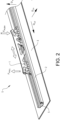
- Fig. 2
- shows schematically, in a perspective view from above, the seat rail system,
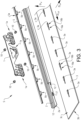
- Fig. 3
- shows schematically, in an exploded perspective view, the seat rail system,
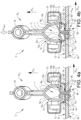
- Fig. 4a-b
- show schematically, in cross-sectional front views, the seat rail system in an unloaded state and in a loaded state,
- Fig. 5a-b
- show schematically, in cross-sectional front views, the seat rail system in an unloaded state and in a loaded state, according to an alternative embodiment,
- Fig. 6a-c
- show schematically, in perspective views from above, the lower rail of the seat rail system in different mounting positions in relation to the floor structure,
- Fig. 7
- shows schematically, in a perspective view from below, the lower rail of the seat rail system and the floor structure, and
- Fig. 8
- shows schematically, in a perspective view from above, the seat rail system with a drive mechanism.
- Various aspects of the invention will hereinafter be described in conjunction with the appended drawings to illustrate and not to limit the invention, wherein like designations denote like elements, and variations of the described aspects are not restricted to the specifically shown embodiments, but are applicable on other variations of the invention, as long as the resulting seat rail system belongs to the scope which is defined by the appended claims.
-
Figure 1 schematically shows a vehicle V with a seat rail system S. The seat rail system S comprises anupper rail 1 and a stationarylower rail 2 having an extension in a longitudinal vehicle direction DLO, as illustrated infigures 1-3 ,4a-b ,5a-b , and8 . Thelower rail 2 is attached to afloor structure 3 of the vehicle V, and theupper rail 1 is attached to avehicle seat 4. Theupper rail 1 is movably arranged in relation to thelower rail 2 in the longitudinal vehicle direction DLO, as indicated with the double arrow infigure 2 , for a convenient adjustment and positioning of thevehicle seat 4 in relation to thefloor structure 3. A lower base surface of thelower rail 2 is positioned in connection to anupper surface 3c of thefloor structure 3. The seat rail system S may be provided with suitable vehicle seat positioning and locking arrangements for positioning of theupper rail 1 in relation to thelower rail 2. Thefloor structure 3 is forming part of the seat rail system S, as will be further described below. Usually, two parallel seat rail systems S are used for holding onevehicle seat 4. Infigure 1 , the seat rail system S is illustrated in connection to afront vehicle seat 4, but the seat rail system S may be used also for other adjustable vehicle seats. - A lateral vehicle direction DLA is defined as a direction perpendicular to the longitudinal vehicle direction DLO. The expressions upper, lower, upwards, and downwards, used in this context are referring to directions in relation to the seat rail system S when installed in the vehicle V in the position illustrated in
figure 1 , and refers to positions or relative positioning in a vertical vehicle direction DV. - The
floor structure 3 is suitably an integrated structural part of a body-in-white structure of the vehicle V having an extension in the longitudinal vehicle direction DLO and lateral vehicle direction DLO, or essentially in the longitudinal vehicle direction DLO and lateral vehicle direction DLO, as indicated in for examplefigure 2 . With a body-in-white structure of the vehicle V is meant a car body construction in which the car body's sheet metal components have been welded together, where any moving parts, the motor or engine, the chassis or the chassis sub-assemblies, and the trim have not yet been added to the car body construction. By attaching thelower rail 2 to thefloor structure 3 integrated in the body-in-white structure of the vehicle V, a secure attachment of thelower rail 2 is accomplished. Non-illustrated additional fastening brackets or similar arrangements may for example be used for the attachment of thelower rail 2 to thefloor structure 3, where screw fasteners or similar fastening devices can be used for a firm and secure attachment of thelower rail 2 to thefloor structure 3 via the fastening brackets. - The
upper rail 1 has an elongated shape and comprises afirst side section 8a and asecond side section 8b, as shown infigures 4a-b and5a-b . The side sections are suitably joined to each other with appropriate fastening means. Thefirst side section 8a and thesecond side section 8b may be formed as sheet structures that are forming theupper rail 1 when attached to each other, for example by welding. Theupper rail 1 may thus be made of the two joined sheet structures, and thefirst side section 8a and thesecond side section 8b constitute lateral sides of theupper rail 1. - A cavity 7 is formed between the
first side section 8a and thesecond side section 8b in alower portion 1a of theupper rail 1, as shown in for examplefigures 4a-b and5a-b . Thelower portion 1a of theupper rail 1 suitably has a bell-shaped cross-sectional configuration, or a bell-shape like cross-sectional configuration. Thefirst side section 8a comprises a lateral inwardly projectingfirst flange 9a and thesecond side section 8b comprises a lateral inwardly projectingsecond flange 9b. Thefirst flange 9a and thesecond flange 9b are forming alower end 11 of thelower portion 1a. Thefirst side section 8a and thesecond side section 8b are together with thefirst flange 9a and thesecond flange 9b forming the cavity 7. - The
upper rail 1 is further provided withupper fastening portions 18 for attaching thevehicle seat 4 to theupper rail 1, as shown in for examplefigures 4a-b and5a-b . Thefastening portions 18 may be arranged as openings that suitably are provided with threads for receiving a threaded fastening element for attaching thevehicle seat 4 to the upper rail. Thevehicle seat 4 may be arranged with brackets or similar structures for the attachment to theupper rail 1 and engagement with the fastening element. - The stationary
lower rail 2 has an extension in the longitudinal vehicle direction DLO when attached to thefloor structure 3 of the vehicle V, as illustrated in for examplefigure 2 . The seat rail system S further comprises anelongated load member 5 attached to thelower rail 2, as shown in for examplefigures 3 ,4a-b ,5a-b , and7 . Theload member 5 comprises anupper part 5a and one or morelower parts 5b. In the illustrated embodiment theupper part 5a is extending along the length of theload member 5, and a plurality oflower parts 5b are arranged in connection to theupper part 5a in a spaced apart configuration, as understood from for examplefigure 3 . Theupper part 5a of theload member 5 has an upper T-shaped cross-sectional configuration with a laterally extending upper flange 6a, as shown infigures 4a-b and5a-b . The one or morelower parts 5b of theload member 5 have lower T-shaped cross-sectional configurations with a laterally extendinglower flange 6b, as shown infigures 4a-b ,5a-b , and7 . Aweb section 5c of theload member 5 is connecting the upper flange 6a and thelower flange 6b. With a T-shaped cross-sectional configuration is meant a cross-sectional shape having a T-shape, or a shape similar to a T-shape such as the double hook like configuration shown infigures 4a-b and5a-b . The cross-sectional configuration of theload member 5 where theupper part 5a and thelower parts 5b correspond to each other is similar to an I-beam structure, or similar to an I-beam like structure, as shown infigures 4a-b and5a-b . - As shown in
figures 3 and7 , alower section 2a of thelower rail 2 is arranged with aplurality rail openings 17 arranged for receiving the plurality oflower parts 5b. Thelower parts 5b are suitably positioned through correspondingrail openings 17 when mounting theload member 5 to thelower rail 2, and thereafter thelower parts 5b could be bent into the lower T-shaped cross-sectional configurations, as understood fromfigure 7 . In this way, one or morelower parts 5b of theload member 5 are extending through thelower section 2a of thelower rail 2. Theload member 5 and thelower rail 2 are made of suitable materials having high strength, as for example high-strength steel, polymers, composite materials, or other suitable materials or combinations of materials. Theload member 5 is attached to thelower rail 2 with suitable fastening means, such as for example welds, glue, rivets, or screw fasteners. - In the illustrated embodiment, the
load member 5 comprises two joined material sections 5:1,5:2 forming the upper and lower T-shaped cross-sectional configurations with theweb section 5c in-between. The material sections 5:1,5:2 each at least partly has a U-shape, or U-shape like, cross-sectional configuration, as shown infigures 4a-b and5a-b . This construction with the two joined material sections may simplify the mounting or assembling of theload member 5 to thelower rail 2, since each of the sections can be positioned into therail openings 17 and thereafter attached to each other and to thelower rail 2. Also with this configuration, the one or morelower parts 5b of theload member 5 are extending through thelower section 2a. - The cavity 7 of the
upper rail 1 is configured for embracing theupper part 5a with the upper flange 6a of theload member 5. As shown infigures 4a-b and5a-b , thefirst flange 9a and thesecond flange 9b are arranged below the upper flange 6a, and with this configuration, thefirst flange 9a and thesecond flange 9b are extending in inwards directions towards theload member 5. Thefirst side section 8a and thesecond side section 8b are together with thefirst flange 9a and thesecond flange 9b forming the cavity 7, which is embracing the upper flange 6a of theload member 5. - Thus, in an assembled state of the seat rail system S, as shown in for example
figures 4a-b and5a-b , theupper part 5a of theload member 5 is extending into the cavity 7 in thelower portion 1a of theupper rail 1. - As understood from for example
figure 3 , thelower portion 1a of theupper rail 1 may be sectioned into more than one structural part for receiving theupper part 5a of theload member 5. In the illustrated embodiment, theupper rail 1 is arranged with three sections that together are forming thelower portion 1a, and theupper part 5a of theload member 5 is extending into all three sections forming thelower portion 1a. The three sections forming thelower portion 1a are all embracing the upper flange 6a of theload member 5. - The
load member 5 is configured for being directly in engagement with thefloor structure 3 and thelower portion 1a in a vehicle impact event for establishing a load path from thefloor structure 3 to theupper rail 1 via theload member 5. With a vehicle impact event is meant any situation where the vehicle V is exposed to impact forces, such as when the vehicle V is hitting an object or an object is hitting the vehicle V. Typical vehicle impact events are when the vehicle V is involved in a crash situation or collision, for example with another vehicle, or if the vehicle V leaves a roadway in a run-off-road collision or similar event. If the vehicle V is involved in a collision, impact forces will act on thevehicle seat 4 and the seat rail system S. - In a head-on collision, or in a collision where the front end of the vehicle V runs into an object, the front part of the
upper rail 1 is pushed downwards towards thesecond rail 2 by a pushing force FPUSH and the rear part of theupper rail 1 is pulled in a direction upwards away from thesecond rail 2 by the pulling force FPULL, due to the forces acting on thevehicle seat 4 causing a rotational movement. In a rear-end collision, or in a collision where the rear end of the vehicle V runs into an object, the front part of theupper rail 1 is pulled in a direction upwards away from thesecond rail 2 by a pulling force FPULL and the rear part of theupper rail 1 is pushed downwards towards thesecond rail 2 by a pushing force FPUSH, due to the forces acting on thevehicle seat 4 causing a rotational movement. The pushing force FPUSH and the pulling force FPULL are schematically illustrated infigure 2 . - The strength of the seat rail system S is critical when a pulling force FPULL is acting on the
upper rail 1, such as in the vehicle impact events described above. The pulling force FPULL is illustrated with an arrow infigures 4b and5b , indicating that a part of theupper rail 1 is pulled in a direction upwards away from thesecond rail 2. When the pulling force FPULL is acting on a part of the seat rail system S, theload member 5 has the function to directly engage thefloor structure 3 and directly engage theupper rail 1. In this way, thefloor structure 3 is connected to theupper rail 1 via theload member 5 for establishing the load path from thefloor structure 3 to theupper rail 1 via theload member 5. Theload member 5 is establishing a strong and robust construction of the seat rail system S that is preventing large and unwanted deformations of the rails. With the system configuration, theload member 5 is directly in engagement with both thefloor structure 3 and thelower portion 1a in the vehicle impact event. The established load path in the vehicle impact event from thefloor structure 3 to theupper rail 1 via theload member 5, is through the engagement of theload member 5 following a centre line C of seat rail system S from thefloor structure 3 to the upper rail for establishing a short load path compared to traditional systems, as indicated infigures 4b and5b . - The upper flange 6a comprises a
first flange section 13a and asecond flange section 13b. Thefirst flange section 13a and thesecond flange section 13b are extending laterally on opposite sides of theweb section 5c, as shown infigures 4a-b and5a-b . In the assembled state of the seat rail system S, thefirst flange 9a is arranged below thefirst flange section 13a and thesecond flange 9b is arranged below thesecond flange section 13b. Thefirst flange 9a is configured for being in engagement with thefirst flange section 13a in the vehicle impact event, and thesecond flange 9b is configured for being in engagement with thesecond flange section 13b in the vehicle impact event, as will be further described below in connection tofigures 4b and5b . In the illustrated embodiment, thefirst flange 9a is extending inwards towards theload member 5 from thefirst side section 8a with an upwards inclined configuration, and thesecond flange 9b is extending inwards towards theload member 5 from thesecond side section 8b with an upwards inclined configuration. Thefirst flange section 13a is extending outwards towards thefirst side section 8a from theweb section 5c with a downwards inclined configuration, and thesecond flange section 13b is extending outwards towards thesecond side section 8b from theweb section 5c with a downwards inclined configuration. - In
figures 4a and5a , the seat rail system S is illustrated in an unloaded state SU, and the seat rail system S is in the unloaded state used in normal operating conditions, such as when a user is seated in thevehicle seat 4, or when adjusting thevehicle seat 4. Infigures 4b and5b , the seat rail system S is illustrated in a loaded state SL, and the loaded state is occurring in the vehicle impact event when a pulling force FPULL is acting on parts of the seat rail system S, as will be further described below. - As shown in the embodiments illustrated in
figures 4a and5a , thefirst flange section 13a has an extension parallel to, or essentially parallel to, the extension of thefirst flange 9a in the unloaded state SU. Thesecond flange section 13b has an extension parallel to, or essentially parallel to, the extension of thesecond flange 9b in the unloaded state SU. The parallel extensions are simplifying secure interaction between the respective flange sections and the first and second flanges. - More specifically, the upper flange 6a is configured for being in engagement with the
lower portion 1a of theupper rail 1 in the vehicle impact event. Thefirst flange 9a is engaging thefirst flange section 13a in the vehicle impact event, and thesecond flange 9b is engaging thesecond flange section 13b in the vehicle impact event for a strong connection between theupper rail 1 and theload member 5. In this way, thefirst flange 9a and thesecond flange 9b are configured for being in engagement with the upper flange 6a. As understood fromfigures 4b and5b , the parts involved are arranged as hook-like elements that are interacting with each other in the vehicle impact event, preventing that theupper rail 1 is separated from thelower rail 2 due to the connection of theload member 5 to thelower portion 1a. In the vehicle impact event, theupper rail 1 is pulled a small distance upwards away from thelower rail 2 due to minimal play between parts involved. As shown infigures 4a and5a , there is a small play between the upper flange 6a and the respectivefirst flange 9a and thesecond flange 9b in normal operating conditions, which is allowing the movement of theupper rail 1 in relation to thelower rail 2 in the longitudinal vehicle direction DLO for the positioning of thevehicle seat 4 relative to thefloor structure 3. - In a similar way, the one or more
lower parts 5b of theload member 5 are configured for being in engagement with thelower surface 3b of thefloor structure 3 in the vehicle impact event. Thelower flange 6b is engaging thelower surface 3b of thefloor structure 3 in the vehicle impact event for a strong connection between thefloor structure 3 and theload member 5. As understood fromfigures 4b and5b , thelower flange 6b is interacting with thefloor structure 3 preventing that thelower rail 2 is separated from thefloor structure 3. As shown infigures 4a-b and5a-b , thelower flanges 6b of thelower parts 5b are arranged as hook-like elements that are interacting with thefloor structure 3 in the vehicle impact event, preventing that thelower rail 2 is separated from thefloor structure 3 due to the connection of theload member 5 to thefloor structure 3. In the vehicle impact event, thelower rail 2 may be pulled a small distance upwards away from the floor structure due to a small play between thelower flange 6b and thelower surface 3b of thefloor structure 3. The small play between the lower flange 6a and thelower surface 3b of thefloor structure 3 in normal operating conditions is allowing mounting of thelower rail 2 to thefloor structure 3, as described below. - As illustrated in
figures 4a-b and5a-b , thelower rail 2 comprises a firstlateral side element 2b and a secondlateral side element 2c. The firstlateral side element 2b and the secondlateral side element 2c are each extending in an upwards direction from thelower section 2a of the lower rail. The firstlateral side element 2b and the secondlateral side element 2c are extending from thelower section 2a on opposite sides of theload member 5. The firstlateral side element 2b is arranged in connection to and in an overlapping relationship to thefirst side section 8a in the vertical vehicle direction DV, as shown in for examplefigures 4a and5a . The secondlateral side element 2c is arranged in connection to and in an overlapping relationship to thesecond side section 8b in the vertical vehicle direction DV, as shown in for examplefigures 4a and5a . With the overlapping configuration between the firstlateral side element 2b and thefirst side section 8a in the vertical direction DV, the firstlateral side element 2b is configured for blocking lateral movement of thefirst side section 8a upon deformation of theupper rail 1 in the vehicle impact event, as shown infigures 4b and5b . With the overlapping configuration between the secondlateral side element 2c and thesecond side section 8b in the vertical direction DV, the secondlateral side element 2c is configured for blocking lateral movement of thesecond side section 8b upon deformation of theupper rail 1 in the vehicle impact event, as shown infigures 4b and5b . - In the embodiment illustrated in
figures 4a-b , the firstlateral side element 2b is extending from thelower section 2a in a direction parallel to, or essentially parallel to the vertical vehicle direction DV, and the secondlateral side element 2c is extending from thelower section 2a in a direction parallel to, or essentially parallel to the vertical vehicle direction DV. In the alternative embodiment illustrated infigures 5a-b , the firstlateral side element 2b is extending upwards from thelower section 2a towards theload member 5 with an inwards inclined configuration, and the secondlateral side element 2c is extending upwards from thelower section 2a towards theload member 5 with an inwards inclined configuration. This alternative design may be used for an increased system strength. In the embodiments illustrated infigures 4a-b and5a-b the lateral side elements are arranged as side walls of thelower rail 2. It should however be understood that the lateral side elements may have other suitable designs and configurations, such as for example other types of continuous or discrete elements forming part of thelower rail 2, and arranged in the overlapping configuration for blocking lateral movement of the respective side sections. - As shown in
figures 4a-b and5a-b , the one or morelower parts 5b of theload member 5 are extending throughcorresponding openings 3a of thefloor structure 3. In this way, the one or morelower parts 5b of theload member 5 are connected to thefloor structure 3. The positions of theopenings 3a are coinciding with the spacing of thelower parts 5b along theload member 5, as understood fromfigures 3 and7 . Theopenings 3a have narrowing configurations, and theopenings 3a are tapering in the longitudinal vehicle direction DLO. Suitable narrowing shapes are for example keyhole like shapes as illustrated infigure 3 . However, any suitable narrowing shape may be used. Theopenings 3a in the illustrated embodiment are provided withnarrow sections 16a andwide sections 16b. - The
wide sections 16b of theopenings 3a have suitable sizes for receiving thelower parts 5b, and thelower parts 5b with thelower flange 6b are inserted into thewide sections 16b when mounting thelower rail 2 with theload member 5 to thefloor structure 3, as illustrated infigure 6a . Thelower parts 5a are entering thewide sections 16b in a downwards movement of thelower rail 2, as indicated with arrows infigure 6a . When inserted into theopenings 3a, thelower parts 5b are extending through thefloor structure 3 and thelower flanges 6b are positioned below thefloor structure 3, as illustrated infigure 6b . To complete the mounting of thelower rail 2 to thefloor structure 3, thelower rail 2 is after insertion into thewide sections 16b pushed in a direction towards thenarrow sections 16a, as indicated with arrows infigure 6b . By pushing thelower rail 2 in the direction towards thenarrow sections 16a, thelower flanges 6b will be positioned below thefloor structure 3 into a final mounting position, as shown infigure 6c . When thelower flanges 6b are positioned below thefloor structure 3 within thenarrow sections 16a, thelower rail 2 is prevented from being displaced in an upwards direction due to engagement between thelower flanges 6b and thelower surface 3b of thefloor structure 3, as understood fromfigures 4b and5b . Thesecond rail 2 may be further attached to thefloor structure 3 via the non-illustrated fastening brackets, as described above. When thelower rail 2 is attached to thefloor structure 3, theupper rail 1 and thevehicle seat 4 may be mounted to thelower rail 2. - The seat rail system S further comprises laterally extending bearing
structures 10, as shown in for examplefigures 3 ,4a-b and5a-b . The bearingstructures 10 are attached to theupper rail 1, and the bearingstructures 10 are extending laterally in opposite directions from theupper rail 1. The bearingstructures 10 may be arranged pairwise on opposite sides of the upper rail. The bearingstructures 10 are configured for movably engaging thelower rail 2 and for providing a low-friction engagement between theupper rail 1 and thelower rail 2. The bearingstructures 10 comprisebearings 10a, and thebearings 10a are suitably connected to theupper rail 1 via extendingshaft structures 10b or similar arrangements for lateral positioning of thebearings 10a in relation to thelower rail 2. - The
lower rail 2 comprises two bearingsurfaces 12 laterally arranged on opposite sides of theload member 5, as shown in for examplefigures 4a-b and5a-b . Thebearings 10a and the bearing surfaces 12 are configured for interacting with each other when theupper rail 1 is displaced in relation to thelower rail 2. In the embodiment illustrated infigure 3 , thefirst rail 1 comprises two pairs of bearingstructures 10 arranged for interacting with the bearing surfaces 12. However, any suitable number of bearingstructures 10 may be used. Thebearings 10a may for example be roller bearings and the roller bearings may be provided with wheel elements or similar structures for rolling interaction with the bearing surfaces 12 upon longitudinal displacement of theupper rail 1 in relation to thelower rail 2. Thebearings 10a may alternatively be sliding bearings for sliding interaction with the bearing surfaces 12 upon longitudinal displacement of theupper rail 1 in relation to thelower rail 2. Other types of bearings may also be used depending on the construction and design of the system. The bearingstructures 10 are as illustrated infigures 4a-b and5a-b positioned above thelower end 11 of thelower portion 1a of theupper rail 1 for a compact and robust construction of the system. - As illustrated in
figure 8 , the seat rail system S may further be provided with adrive mechanism 19 for positioning theupper rail 1 in relation to thelower rail 2. The drive mechanism may comprise anelectric motor 19a and be configured as a worm drive mechanism. The worm drive mechanism may comprise an elongated threadedrod 19b connected to thelower rail 2 that is interacting with aworm gear 19c arranged on theupper rail 1. It should be understood that thedrive mechanism 19 could have other suitable constructions, such as for example a linear actuator or ball screw mechanism. - In the vehicle event when a pulling force FPULL is acting on at least a part of the
upper rail 1, the part of theupper rail 1 is displaced in an upwards direction and moved from the unloaded state SU to the loaded state SL, as shown infigures 4a-b and5a-b . Upon displacement of theupper rail 1 in the upwards direction in the vehicle impact event, thefirst flange 9a is engaging thefirst flange section 13a, and thesecond flange 9b is engaging thesecond flange section 13b for a strong connection between theupper rail 1 and theload member 5. The engagement of the first and second flanges with the respective flange sections is displacing theload member 5 upwards, wherein thelower flange 6b is engaging thelower surface 3b of thefloor structure 3 in the vehicle impact event for a strong connection between thefloor structure 3 and theload member 5. The engagement of the first and second flanges with the respective flange sections is further deforming thefirst side section 8a and thesecond side section 8b, and the deformation is displacing thefirst side section 8a and thesecond side section 8b laterally outwards away from theload member 5, as understood fromfigures 4b and5b . However, with the overlapping configuration between the firstlateral side element 2b and thefirst side section 8a in the vertical direction DV, the firstlateral side element 2b is blocking the lateral movement of thefirst side section 8a upon deformation of thefirst side section 8a. With the overlapping configuration between the secondlateral side element 2c and thesecond side section 8b in the vertical direction DV, the secondlateral side element 2c is blocking lateral movement of thesecond side section 8b upon deformation of thesecond side section 8b. The blocked lateral movements are thus preventing large deformations of the respective side sections for a strong connection of theupper rail 1 to thefloor structure 3. As shown infigures 4b and5b , thefirst side section 8a is upon deformation brought into contact with the firstlateral side element 2b in a first contact area AC1 in the vehicle impact event for blocking the lateral movement, and thesecond side section 8b is upon deformation brought into contact with the secondlateral side element 2c in a second contact area AC2 in the vehicle impact event for blocking the lateral movement. The blocking of the lateral movements of thefirst side section 8a and thesecond side section 8b in combination with the engagement of theload member 5 with thefloor structure 3 and theupper rail 1 is securing a straight symmetrical load path all the way from thefloor structure 3 to thevehicle seat 4 via theupper rail 1. The established load path in the vehicle impact event from thefloor structure 3 to theupper rail 1 via theload member 5, is through the engagement of theload member 5 following the centre line C of the seat rail system S from thefloor structure 3 to theupper rail 1. - It will be appreciated that the above description is merely exemplary in nature and is not intended to limit the present invention, its application or uses. While specific examples have been described in the specification and illustrated in the drawings, it will be understood by those of ordinary skill in the art that various changes may be made and equivalents may be substituted for elements thereof without departing from the scope of the present invention as defined in the claims. Furthermore, modifications may be made to adapt a particular situation or material to the teachings of the present invention without departing from the scope thereof, which is defined by the appended claims.
- Therefore, it is intended that the present invention not be limited to the particular examples illustrated by the drawings and described in the specification as the best mode presently contemplated for carrying out the teachings of the present invention, but that the scope of the present invention will include any embodiments falling within the appended claims. Reference signs mentioned in the claims should not be seen as limiting the extent of the matter protected by the claims, and their sole function is to make claims easier to understand.
-
- 1:
- Upper rail
- 1a:
- Lower portion
- 2:
- Lower rail
- 2a:
- Lower section
- 2b:
- First lateral side element
- 2c:
- Second lateral side element
- 3:
- Floor structure
- 3a:
- Opening
- 3b:
- Lower surface
- 3c:
- Upper surface
- 4:
- Vehicle seat
- 5:
- Load member
- 5a:
- Upper part
- 5b:
- Lower part
- 5c:
- Web section
- 6a:
- Upper flange
- 6b:
- Lower flange
- 7:
- Cavity
- 8a:
- First side section
- 8b:
- Second side section
- 9a:
- First flange
- 9b:
- Second flange
- 10:
- Bearing structure
- 10a:
- Bearing
- 10b:
- Shaft structures
- 11:
- Lower end
- 12:
- Bearing surface
- 13a:
- First flange section
- 13b:
- Second flange section
- 16a:
- Narrow section
- 16b:
- Wide section
- 17:
- Rail opening
- 18:
- Fastening portions
- 19:
- Drive mechanism
- 19a:
- Electric motor
- 19b:
- Threaded rod
- 19c:
- Worm gear
- AC1:
- First contact area
- AC2:
- Second contact area
- C:
- Centre line
- DLA:
- Lateral vehicle direction
- DLO:
- Longitudinal vehicle direction
- DV:
- Vertical vehicle direction
- FPULL:
- Pulling force
- FPUSH:
- Pushing force
- S:
- Seat rail system
- SL:
- Loaded state
- SU:
- Unloaded state
- V:
- Vehicle
Claims (14)
- A seat rail system (S) for a vehicle (V), wherein the seat rail system (S) comprises an upper rail (1) and a stationary lower rail (2) adapted to be attached to a floor structure (3) of the vehicle (V), wherein the upper rail (1) is configured for being attached to a vehicle seat (4), wherein the upper rail (1) is movably arranged in relation to the lower rail (2) in a longitudinal vehicle direction (DLO), wherein the upper rail (1) comprises a first side section (8a) and a second side section (8b), wherein a cavity (7) is formed between the first side section (8a) and the second side section (8b) in a lower portion (1a), wherein the lower rail (2) comprises a first lateral side element (2b) arranged in connection to and in an overlapping relationship to the first side section (8a) and a second lateral side element (2c) arranged in connection to and in an overlapping relationship to the second side section (8b), wherein the seat rail system (S) further comprises an elongated load member (5) attached to the lower rail (2), wherein an upper part (5a) of the load member (5) is extending into the cavity (7),wherein when the lower rail (2) is attached to the floor structure (3), one or more lower parts (5b) of the load member (5) are connected to the floor structure (3), and wherein the first lateral side element (2b) is configured for blocking lateral movement of the first side section (8a) and the second lateral side element (2c) is configured for blocking lateral movement of the second side section (8b) upon deformation of the upper rail (1) in a vehicle impact event,characterized in that one or more lower parts (5b) of the load member (5) are extending through the floor structure (3), wherein the load member (5) is configured for being directly in engagement with the floor structure (3) and the lower portion (1a) in the vehicle impact event for establishing a load path from the floor structure (3) to the upper rail (1) via the load member (5).
- The seat rail system (S) according to claim 1,
characterized in that the lower portion (1a) of the upper rail (1) has a bell-shaped cross-sectional configuration forming the cavity (7) between the first side section (8a) and the second side section (8b), wherein the cavity (7) is configured for embracing the upper part (5a). - The seat rail system (S) according to claim 1 or 2,
characterized in that the upper part (5a) of the load member (5) has an upper T-shaped cross-sectional configuration with a laterally extending upper flange (6a), wherein the upper flange (6a) comprises a first flange section (13a) and a second flange section (13b) laterally extending on opposite sides of a web section (5c), wherein the first side section (8a) comprises a lateral inwardly projecting first flange (9a) and the second side section (8b) comprises a lateral inwardly projecting second flange (9b), wherein the first flange (9a) is arranged below the first flange section (13a) and configured for being in engagement with the first flange section (13a) in the vehicle impact event, wherein the second flange (9b) is arranged below the second flange section (13b) and configured for being in engagement with the second flange section (13b) in the vehicle impact event. - The seat rail system (S) according to claim 3,
characterized in that the first flange (9a) is extending inwards towards the load member (5) from the first side section (8a) with an upwards inclined configuration, and wherein the second flange (9b) is extending inwards towards the load member (5) from the second side section (8b) with an upwards inclined configuration. - The seat rail system (S) according to claim 3 or 4,
characterized in that the first flange section (13a) is extending outwards towards the first side section (8a) from the web section (5c) with a downwards inclined configuration, wherein the second flange section (13b) is extending outwards towards the second side section (8b) from the web section (5c) with a downwards inclined configuration. - The seat rail system (S) according to any of claims 3 to 5,
characterized in that the first flange section (13a) has an extension parallel to, or essentially parallel to, the extension of the first flange (9a) in an unloaded state (SU), and wherein the second flange section (13b) has an extension parallel to, or essentially parallel to, the extension of the second flange (9b) in the unloaded state (SU). - The seat rail system (S) according to any preceding claim,
characterized in that the lower rail (2) comprises a lower section (2a), wherein the one or more lower parts (5b) of the load member (5) are extending through the lower section (2a), wherein the first lateral side element (2b) and the second lateral side element (2c) are extending upwards from the lower section (2a) on opposite sides of the load member (5). - The seat rail system (S) according to claim 7,
characterized in that the first lateral side element (2b) is extending from the lower section (2a) towards the load member (5) with an inwards inclined configuration, and wherein the second lateral side element (2c) is extending from the lower section (2a) towards the load member (5) with an inwards inclined configuration. - The seat rail system (S) according to any preceding claim,
characterized in that the one or more lower parts (5b) of the load member (5) are adapted to extend through corresponding openings (3a) of the floor structure (3). - The seat rail system (S) according to any preceding claim,
characterized in that the one or more lower parts (5b) of the load member (5) are configured for being in engagement with a lower surface (3b) of the floor structure (3) in the vehicle impact event. - The seat rail system (S) according to any preceding claim,
characterized in that the one or more lower parts (5b) of the load member (5) have lower T-shaped cross-sectional configurations with a laterally extending lower flange (6b), wherein the lower flange (6b) is configured for being in engagement with the floor structure (3) in the vehicle impact event. - The seat rail system (S) according to any preceding claim,
characterized in that the seat rail system (S) further comprises laterally extending bearing structures (10), wherein the bearing structures (10) are attached to the upper rail (1) and extending in opposite directions from the upper rail (1), wherein the bearing structures (10) are configured for movably engaging the lower rail (2). - A vehicle (V) comprising the seat rail system (S) according to any of claims 1-12.
- The vehicle (V) according to claim 13, characterized in that the floor structure (3) is an integrated structural part of a body-in-white structure of the vehicle (V).
Priority Applications (4)
| Application Number | Priority Date | Filing Date | Title |
|---|---|---|---|
| EP21171051.2A EP4082827B1 (en) | 2021-04-28 | 2021-04-28 | A seat rail system for a vehicle and a vehicle comprising a seat rail system |
| PCT/CN2022/086609 WO2022228124A1 (en) | 2021-04-28 | 2022-04-13 | A seat rail system for a vehicle and a vehicle comprising a seat rail system |
| CN202280030767.1A CN117222545A (en) | 2021-04-28 | 2022-04-13 | Seat track systems for vehicles and vehicles including seat track systems |
| US18/378,464 US12202386B2 (en) | 2021-04-28 | 2023-10-10 | Seat rail system for a vehicle and a vehicle comprising a seat rail system |
Applications Claiming Priority (1)
| Application Number | Priority Date | Filing Date | Title |
|---|---|---|---|
| EP21171051.2A EP4082827B1 (en) | 2021-04-28 | 2021-04-28 | A seat rail system for a vehicle and a vehicle comprising a seat rail system |
Publications (2)
| Publication Number | Publication Date |
|---|---|
| EP4082827A1 EP4082827A1 (en) | 2022-11-02 |
| EP4082827B1 true EP4082827B1 (en) | 2025-07-09 |
Family
ID=75746150
Family Applications (1)
| Application Number | Title | Priority Date | Filing Date |
|---|---|---|---|
| EP21171051.2A Active EP4082827B1 (en) | 2021-04-28 | 2021-04-28 | A seat rail system for a vehicle and a vehicle comprising a seat rail system |
Country Status (4)
| Country | Link |
|---|---|
| US (1) | US12202386B2 (en) |
| EP (1) | EP4082827B1 (en) |
| CN (1) | CN117222545A (en) |
| WO (1) | WO2022228124A1 (en) |
Families Citing this family (3)
| Publication number | Priority date | Publication date | Assignee | Title |
|---|---|---|---|---|
| DE102020108799B3 (en) * | 2020-03-30 | 2021-07-22 | Bayerische Motoren Werke Aktiengesellschaft | Pair of seat rails for longitudinal adjustment of a vehicle seat |
| EP4082826B1 (en) * | 2021-04-28 | 2024-03-20 | Ningbo Geely Automobile Research & Development Co., Ltd. | A seat rail system for a vehicle and a vehicle comprising a seat rail system |
| EP4082828B1 (en) * | 2021-04-28 | 2024-07-10 | Ningbo Geely Automobile Research & Development Co., Ltd. | A seat rail system for a vehicle, a vehicle comprising a seat rail system, and a method for assembling parts of a seat rail system |
Citations (2)
| Publication number | Priority date | Publication date | Assignee | Title |
|---|---|---|---|---|
| FR2728203A1 (en) * | 1994-12-19 | 1996-06-21 | Faure Bertrand Equipements Sa | Seat slide for motor vehicle |
| US20040124683A1 (en) * | 2002-12-20 | 2004-07-01 | Fuji Kiko Co., Ltd. | Seat slide device |
Family Cites Families (23)
| Publication number | Priority date | Publication date | Assignee | Title |
|---|---|---|---|---|
| JP3114326B2 (en) | 1992-02-14 | 2000-12-04 | アイシン精機株式会社 | Vehicle seat slide device |
| FR2761939B1 (en) * | 1997-04-15 | 1999-06-25 | Faure Bertrand Equipements Sa | SLIDE FOR MOTOR VEHICLE SEATS |
| DE10210555B4 (en) * | 2002-03-09 | 2005-12-22 | Keiper Gmbh & Co.Kg | Longitudinal adjuster for a vehicle seat |
| WO2003093053A1 (en) * | 2002-05-03 | 2003-11-13 | Intier Automotive Inc. | Internal reinforcement bracket for a seat track assembly |
| JP4691342B2 (en) * | 2004-09-16 | 2011-06-01 | 岐阜車体工業株式会社 | Lock mechanism in seat track slide device |
| FR2891776B1 (en) | 2005-10-10 | 2009-04-24 | Faurecia Sieges Automobile | SLIDER FOR VEHICLE SEAT AND VEHICLE SEAT PROVIDED WITH SUCH A SLIDER |
| FR2899523B1 (en) | 2006-04-10 | 2008-06-27 | Faurecia Sieges Automobile | SYSTEM COMPRISING A MOTOR VEHICLE SEAT SLIDE AND A BODY FOR FIXING THE SAME, AND METHOD OF MANUFACTURING THE SAME |
| JP5239332B2 (en) | 2007-12-27 | 2013-07-17 | アイシン精機株式会社 | Vehicle seat slide device |
| DE102010036091A1 (en) * | 2010-09-01 | 2012-03-01 | Recaro Aircraft Seating Gmbh & Co. Kg | Seat attachment device for fastening a vehicle seat and vehicle seat with such a seat attachment device |
| JP5467602B2 (en) * | 2010-09-15 | 2014-04-09 | アイシン精機株式会社 | Vehicle seat slide device |
| JP2013023039A (en) * | 2011-07-19 | 2013-02-04 | Aisin Seiki Co Ltd | Seat slide device |
| JP2014169044A (en) * | 2013-03-05 | 2014-09-18 | Shiroki Corp | Slide rail device for vehicle |
| JP6140546B2 (en) * | 2013-06-20 | 2017-05-31 | トヨタ紡織株式会社 | Slide rail device for vehicle seat |
| DE102016217843B3 (en) * | 2016-07-14 | 2017-12-07 | Adient Luxembourg Holding S.à.r.l. | Longitudinal adjuster and vehicle seat |
| US10919415B2 (en) * | 2016-07-14 | 2021-02-16 | Adient Luxembourg Holding S.Á R.L. | Longitudinal adjuster and vehicle seat |
| JP6676006B2 (en) * | 2016-10-14 | 2020-04-08 | トヨタ車体精工株式会社 | Seat slide device |
| JP7219639B2 (en) * | 2019-03-04 | 2023-02-08 | トヨタ車体精工株式会社 | seat slide device |
| CN110901478B (en) * | 2018-09-14 | 2023-01-03 | 丰田车体精工株式会社 | Seat sliding device |
| CN111717087A (en) | 2019-03-21 | 2020-09-29 | 丰田车体精工株式会社 | Seat sliding device |
| JP6985330B2 (en) * | 2019-05-15 | 2021-12-22 | 矢崎総業株式会社 | Slide device and light emitting device for slide device |
| EP3789238B1 (en) * | 2019-09-04 | 2022-12-07 | Ningbo Geely Automobile Research & Development Co. Ltd. | An energy absorbing mounting structure |
| KR102365399B1 (en) * | 2020-08-03 | 2022-02-21 | 현대트랜시스 주식회사 | Device for preventing rotation of vehicle seat rail |
| EP4082826B1 (en) * | 2021-04-28 | 2024-03-20 | Ningbo Geely Automobile Research & Development Co., Ltd. | A seat rail system for a vehicle and a vehicle comprising a seat rail system |
-
2021
- 2021-04-28 EP EP21171051.2A patent/EP4082827B1/en active Active
-
2022
- 2022-04-13 CN CN202280030767.1A patent/CN117222545A/en active Pending
- 2022-04-13 WO PCT/CN2022/086609 patent/WO2022228124A1/en not_active Ceased
-
2023
- 2023-10-10 US US18/378,464 patent/US12202386B2/en active Active
Patent Citations (2)
| Publication number | Priority date | Publication date | Assignee | Title |
|---|---|---|---|---|
| FR2728203A1 (en) * | 1994-12-19 | 1996-06-21 | Faure Bertrand Equipements Sa | Seat slide for motor vehicle |
| US20040124683A1 (en) * | 2002-12-20 | 2004-07-01 | Fuji Kiko Co., Ltd. | Seat slide device |
Also Published As
| Publication number | Publication date |
|---|---|
| US20240042902A1 (en) | 2024-02-08 |
| CN117222545A (en) | 2023-12-12 |
| WO2022228124A1 (en) | 2022-11-03 |
| US12202386B2 (en) | 2025-01-21 |
| EP4082827A1 (en) | 2022-11-02 |
Similar Documents
| Publication | Publication Date | Title |
|---|---|---|
| US12202386B2 (en) | Seat rail system for a vehicle and a vehicle comprising a seat rail system | |
| US20240034206A1 (en) | Seat rail system for a vehicle and a vehicle comprising a seat rail system | |
| US20220274513A1 (en) | Energy absorbing mounting structure | |
| US4068887A (en) | Seat mountings | |
| US7066515B2 (en) | Deformable component carrier | |
| JP2788120B2 (en) | Integrated upper rail for power seat adjuster | |
| JPH04252744A (en) | Power seat slide device | |
| JPH0575057U (en) | Shock absorption type steering column device | |
| US20070013182A1 (en) | Energy absorbing support for a vehicle steering assembly | |
| US20240034207A1 (en) | A seat rail system for a vehicle and a vehicle comprising a seat rail system | |
| EP4082828B1 (en) | A seat rail system for a vehicle, a vehicle comprising a seat rail system, and a method for assembling parts of a seat rail system | |
| EP0735958A1 (en) | Manual adjuster for a vehicle seat | |
| EP4324691A1 (en) | A seat system for a vehicle and a vehicle comprising a seat system | |
| EP0696250B1 (en) | Vehicle seat adjuster | |
| US8146877B2 (en) | Runner for a motor vehicle seat, and a method of manufacturing such a runner | |
| JP3565530B2 (en) | Slide rails for vehicle seats | |
| JPH0712155Y2 (en) | Power seat slide device | |
| JPH08295250A (en) | Shock absorption type steering device | |
| JPH04113229U (en) | power seat sliding device | |
| JPH04135861U (en) | Vehicle seat sliding device |
Legal Events
| Date | Code | Title | Description |
|---|---|---|---|
| PUAI | Public reference made under article 153(3) epc to a published international application that has entered the european phase |
Free format text: ORIGINAL CODE: 0009012 |
|
| STAA | Information on the status of an ep patent application or granted ep patent |
Free format text: STATUS: REQUEST FOR EXAMINATION WAS MADE |
|
| 17P | Request for examination filed |
Effective date: 20210428 |
|
| AK | Designated contracting states |
Kind code of ref document: A1 Designated state(s): AL AT BE BG CH CY CZ DE DK EE ES FI FR GB GR HR HU IE IS IT LI LT LU LV MC MK MT NL NO PL PT RO RS SE SI SK SM TR |
|
| STAA | Information on the status of an ep patent application or granted ep patent |
Free format text: STATUS: EXAMINATION IS IN PROGRESS |
|
| 17Q | First examination report despatched |
Effective date: 20231002 |
|
| REG | Reference to a national code |
Ref legal event code: R079 Ipc: B60N0002015000 Ref country code: DE Ref legal event code: R079 Ref document number: 602021033643 Country of ref document: DE Free format text: PREVIOUS MAIN CLASS: B60N0002070000 Ipc: B60N0002015000 |
|
| GRAP | Despatch of communication of intention to grant a patent |
Free format text: ORIGINAL CODE: EPIDOSNIGR1 |
|
| STAA | Information on the status of an ep patent application or granted ep patent |
Free format text: STATUS: GRANT OF PATENT IS INTENDED |
|
| RIC1 | Information provided on ipc code assigned before grant |
Ipc: B60N 2/07 20060101ALI20250122BHEP Ipc: B60N 2/015 20060101AFI20250122BHEP |
|
| INTG | Intention to grant announced |
Effective date: 20250206 |
|
| GRAS | Grant fee paid |
Free format text: ORIGINAL CODE: EPIDOSNIGR3 |
|
| GRAA | (expected) grant |
Free format text: ORIGINAL CODE: 0009210 |
|
| STAA | Information on the status of an ep patent application or granted ep patent |
Free format text: STATUS: THE PATENT HAS BEEN GRANTED |
|
| AK | Designated contracting states |
Kind code of ref document: B1 Designated state(s): AL AT BE BG CH CY CZ DE DK EE ES FI FR GB GR HR HU IE IS IT LI LT LU LV MC MK MT NL NO PL PT RO RS SE SI SK SM TR |
|
| REG | Reference to a national code |
Ref country code: GB Ref legal event code: FG4D |
|
| REG | Reference to a national code |
Ref country code: CH Ref legal event code: EP |
|
| REG | Reference to a national code |
Ref country code: IE Ref legal event code: FG4D |
|
| REG | Reference to a national code |
Ref country code: DE Ref legal event code: R096 Ref document number: 602021033643 Country of ref document: DE |
|
| REG | Reference to a national code |
Ref country code: NL Ref legal event code: MP Effective date: 20250709 |
|
| PG25 | Lapsed in a contracting state [announced via postgrant information from national office to epo] |
Ref country code: PT Free format text: LAPSE BECAUSE OF FAILURE TO SUBMIT A TRANSLATION OF THE DESCRIPTION OR TO PAY THE FEE WITHIN THE PRESCRIBED TIME-LIMIT Effective date: 20251110 |
|
| PG25 | Lapsed in a contracting state [announced via postgrant information from national office to epo] |
Ref country code: NL Free format text: LAPSE BECAUSE OF FAILURE TO SUBMIT A TRANSLATION OF THE DESCRIPTION OR TO PAY THE FEE WITHIN THE PRESCRIBED TIME-LIMIT Effective date: 20250709 |
|
| REG | Reference to a national code |
Ref country code: AT Ref legal event code: MK05 Ref document number: 1811578 Country of ref document: AT Kind code of ref document: T Effective date: 20250709 |
|
| PG25 | Lapsed in a contracting state [announced via postgrant information from national office to epo] |
Ref country code: IS Free format text: LAPSE BECAUSE OF FAILURE TO SUBMIT A TRANSLATION OF THE DESCRIPTION OR TO PAY THE FEE WITHIN THE PRESCRIBED TIME-LIMIT Effective date: 20251109 |
|
| PG25 | Lapsed in a contracting state [announced via postgrant information from national office to epo] |
Ref country code: NO Free format text: LAPSE BECAUSE OF FAILURE TO SUBMIT A TRANSLATION OF THE DESCRIPTION OR TO PAY THE FEE WITHIN THE PRESCRIBED TIME-LIMIT Effective date: 20251009 |
|
| REG | Reference to a national code |
Ref country code: LT Ref legal event code: MG9D |
|
| PG25 | Lapsed in a contracting state [announced via postgrant information from national office to epo] |
Ref country code: AT Free format text: LAPSE BECAUSE OF FAILURE TO SUBMIT A TRANSLATION OF THE DESCRIPTION OR TO PAY THE FEE WITHIN THE PRESCRIBED TIME-LIMIT Effective date: 20250709 |
|
| PG25 | Lapsed in a contracting state [announced via postgrant information from national office to epo] |
Ref country code: FI Free format text: LAPSE BECAUSE OF FAILURE TO SUBMIT A TRANSLATION OF THE DESCRIPTION OR TO PAY THE FEE WITHIN THE PRESCRIBED TIME-LIMIT Effective date: 20250709 |
|
| PG25 | Lapsed in a contracting state [announced via postgrant information from national office to epo] |
Ref country code: HR Free format text: LAPSE BECAUSE OF FAILURE TO SUBMIT A TRANSLATION OF THE DESCRIPTION OR TO PAY THE FEE WITHIN THE PRESCRIBED TIME-LIMIT Effective date: 20250709 |
|
| PG25 | Lapsed in a contracting state [announced via postgrant information from national office to epo] |
Ref country code: SE Free format text: LAPSE BECAUSE OF FAILURE TO SUBMIT A TRANSLATION OF THE DESCRIPTION OR TO PAY THE FEE WITHIN THE PRESCRIBED TIME-LIMIT Effective date: 20250709 |
|
| PG25 | Lapsed in a contracting state [announced via postgrant information from national office to epo] |
Ref country code: LV Free format text: LAPSE BECAUSE OF FAILURE TO SUBMIT A TRANSLATION OF THE DESCRIPTION OR TO PAY THE FEE WITHIN THE PRESCRIBED TIME-LIMIT Effective date: 20250709 |
|
| PG25 | Lapsed in a contracting state [announced via postgrant information from national office to epo] |
Ref country code: BG Free format text: LAPSE BECAUSE OF FAILURE TO SUBMIT A TRANSLATION OF THE DESCRIPTION OR TO PAY THE FEE WITHIN THE PRESCRIBED TIME-LIMIT Effective date: 20250709 Ref country code: PL Free format text: LAPSE BECAUSE OF FAILURE TO SUBMIT A TRANSLATION OF THE DESCRIPTION OR TO PAY THE FEE WITHIN THE PRESCRIBED TIME-LIMIT Effective date: 20250709 |
|
| PG25 | Lapsed in a contracting state [announced via postgrant information from national office to epo] |
Ref country code: RS Free format text: LAPSE BECAUSE OF FAILURE TO SUBMIT A TRANSLATION OF THE DESCRIPTION OR TO PAY THE FEE WITHIN THE PRESCRIBED TIME-LIMIT Effective date: 20251009 |
|
| PG25 | Lapsed in a contracting state [announced via postgrant information from national office to epo] |
Ref country code: ES Free format text: LAPSE BECAUSE OF FAILURE TO SUBMIT A TRANSLATION OF THE DESCRIPTION OR TO PAY THE FEE WITHIN THE PRESCRIBED TIME-LIMIT Effective date: 20250709 |
|
| PG25 | Lapsed in a contracting state [announced via postgrant information from national office to epo] |
Ref country code: SM Free format text: LAPSE BECAUSE OF FAILURE TO SUBMIT A TRANSLATION OF THE DESCRIPTION OR TO PAY THE FEE WITHIN THE PRESCRIBED TIME-LIMIT Effective date: 20250709 |
|
| PGFP | Annual fee paid to national office [announced via postgrant information from national office to epo] |
Ref country code: GB Payment date: 20260312 Year of fee payment: 6 |
|
| PG25 | Lapsed in a contracting state [announced via postgrant information from national office to epo] |
Ref country code: DK Free format text: LAPSE BECAUSE OF FAILURE TO SUBMIT A TRANSLATION OF THE DESCRIPTION OR TO PAY THE FEE WITHIN THE PRESCRIBED TIME-LIMIT Effective date: 20250709 |
|
| PG25 | Lapsed in a contracting state [announced via postgrant information from national office to epo] |
Ref country code: IT Free format text: LAPSE BECAUSE OF FAILURE TO SUBMIT A TRANSLATION OF THE DESCRIPTION OR TO PAY THE FEE WITHIN THE PRESCRIBED TIME-LIMIT Effective date: 20250709 |
|
| PGFP | Annual fee paid to national office [announced via postgrant information from national office to epo] |
Ref country code: FR Payment date: 20260309 Year of fee payment: 6 |
|
| PG25 | Lapsed in a contracting state [announced via postgrant information from national office to epo] |
Ref country code: CZ Free format text: LAPSE BECAUSE OF FAILURE TO SUBMIT A TRANSLATION OF THE DESCRIPTION OR TO PAY THE FEE WITHIN THE PRESCRIBED TIME-LIMIT Effective date: 20250709 |
|
| PG25 | Lapsed in a contracting state [announced via postgrant information from national office to epo] |
Ref country code: SK Free format text: LAPSE BECAUSE OF FAILURE TO SUBMIT A TRANSLATION OF THE DESCRIPTION OR TO PAY THE FEE WITHIN THE PRESCRIBED TIME-LIMIT Effective date: 20250709 Ref country code: EE Free format text: LAPSE BECAUSE OF FAILURE TO SUBMIT A TRANSLATION OF THE DESCRIPTION OR TO PAY THE FEE WITHIN THE PRESCRIBED TIME-LIMIT Effective date: 20250709 |