EP4081390B1 - Abdeckstruktur und verfahren zum herstellen einer abdeckstruktur - Google Patents
Abdeckstruktur und verfahren zum herstellen einer abdeckstruktur Download PDFInfo
- Publication number
- EP4081390B1 EP4081390B1 EP21703607.8A EP21703607A EP4081390B1 EP 4081390 B1 EP4081390 B1 EP 4081390B1 EP 21703607 A EP21703607 A EP 21703607A EP 4081390 B1 EP4081390 B1 EP 4081390B1
- Authority
- EP
- European Patent Office
- Prior art keywords
- smc
- fire protection
- adhesive
- protection coating
- base body
- Prior art date
- Legal status (The legal status is an assumption and is not a legal conclusion. Google has not performed a legal analysis and makes no representation as to the accuracy of the status listed.)
- Active
Links
Images

Classifications
-
- B—PERFORMING OPERATIONS; TRANSPORTING
- B32—LAYERED PRODUCTS
- B32B—LAYERED PRODUCTS, i.e. PRODUCTS BUILT-UP OF STRATA OF FLAT OR NON-FLAT, e.g. CELLULAR OR HONEYCOMB, FORM
- B32B37/00—Methods or apparatus for laminating, e.g. by curing or by ultrasonic bonding
- B32B37/10—Methods or apparatus for laminating, e.g. by curing or by ultrasonic bonding characterised by the pressing technique, e.g. using action of vacuum or fluid pressure
-
- B—PERFORMING OPERATIONS; TRANSPORTING
- B29—WORKING OF PLASTICS; WORKING OF SUBSTANCES IN A PLASTIC STATE IN GENERAL
- B29C—SHAPING OR JOINING OF PLASTICS; SHAPING OF MATERIAL IN A PLASTIC STATE, NOT OTHERWISE PROVIDED FOR; AFTER-TREATMENT OF THE SHAPED PRODUCTS, e.g. REPAIRING
- B29C70/00—Shaping composites, i.e. plastics material comprising reinforcements, fillers or preformed parts, e.g. inserts
- B29C70/04—Shaping composites, i.e. plastics material comprising reinforcements, fillers or preformed parts, e.g. inserts comprising reinforcements only, e.g. self-reinforcing plastics
- B29C70/28—Shaping operations therefor
- B29C70/40—Shaping or impregnating by compression not applied
- B29C70/42—Shaping or impregnating by compression not applied for producing articles of definite length, i.e. discrete articles
- B29C70/46—Shaping or impregnating by compression not applied for producing articles of definite length, i.e. discrete articles using matched moulds, e.g. for deforming sheet moulding compounds [SMC] or prepregs
- B29C70/465—Shaping or impregnating by compression not applied for producing articles of definite length, i.e. discrete articles using matched moulds, e.g. for deforming sheet moulding compounds [SMC] or prepregs and impregnating by melting a solid material, e.g. sheets, powders of fibres
-
- B—PERFORMING OPERATIONS; TRANSPORTING
- B29—WORKING OF PLASTICS; WORKING OF SUBSTANCES IN A PLASTIC STATE IN GENERAL
- B29C—SHAPING OR JOINING OF PLASTICS; SHAPING OF MATERIAL IN A PLASTIC STATE, NOT OTHERWISE PROVIDED FOR; AFTER-TREATMENT OF THE SHAPED PRODUCTS, e.g. REPAIRING
- B29C70/00—Shaping composites, i.e. plastics material comprising reinforcements, fillers or preformed parts, e.g. inserts
- B29C70/04—Shaping composites, i.e. plastics material comprising reinforcements, fillers or preformed parts, e.g. inserts comprising reinforcements only, e.g. self-reinforcing plastics
- B29C70/06—Fibrous reinforcements only
- B29C70/10—Fibrous reinforcements only characterised by the structure of fibrous reinforcements, e.g. hollow fibres
- B29C70/16—Fibrous reinforcements only characterised by the structure of fibrous reinforcements, e.g. hollow fibres using fibres of substantial or continuous length
- B29C70/18—Fibrous reinforcements only characterised by the structure of fibrous reinforcements, e.g. hollow fibres using fibres of substantial or continuous length in the form of a mat, e.g. sheet moulding compound [SMC]
-
- B—PERFORMING OPERATIONS; TRANSPORTING
- B29—WORKING OF PLASTICS; WORKING OF SUBSTANCES IN A PLASTIC STATE IN GENERAL
- B29C—SHAPING OR JOINING OF PLASTICS; SHAPING OF MATERIAL IN A PLASTIC STATE, NOT OTHERWISE PROVIDED FOR; AFTER-TREATMENT OF THE SHAPED PRODUCTS, e.g. REPAIRING
- B29C70/00—Shaping composites, i.e. plastics material comprising reinforcements, fillers or preformed parts, e.g. inserts
- B29C70/68—Shaping composites, i.e. plastics material comprising reinforcements, fillers or preformed parts, e.g. inserts by incorporating or moulding on preformed parts, e.g. inserts or layers, e.g. foam blocks
- B29C70/84—Shaping composites, i.e. plastics material comprising reinforcements, fillers or preformed parts, e.g. inserts by incorporating or moulding on preformed parts, e.g. inserts or layers, e.g. foam blocks by moulding material on preformed parts to be joined
-
- B—PERFORMING OPERATIONS; TRANSPORTING
- B29—WORKING OF PLASTICS; WORKING OF SUBSTANCES IN A PLASTIC STATE IN GENERAL
- B29C—SHAPING OR JOINING OF PLASTICS; SHAPING OF MATERIAL IN A PLASTIC STATE, NOT OTHERWISE PROVIDED FOR; AFTER-TREATMENT OF THE SHAPED PRODUCTS, e.g. REPAIRING
- B29C70/00—Shaping composites, i.e. plastics material comprising reinforcements, fillers or preformed parts, e.g. inserts
- B29C70/88—Shaping composites, i.e. plastics material comprising reinforcements, fillers or preformed parts, e.g. inserts characterised primarily by possessing specific properties, e.g. electrically conductive or locally reinforced
- B29C70/882—Shaping composites, i.e. plastics material comprising reinforcements, fillers or preformed parts, e.g. inserts characterised primarily by possessing specific properties, e.g. electrically conductive or locally reinforced partly or totally electrically conductive, e.g. for EMI shielding
-
- B—PERFORMING OPERATIONS; TRANSPORTING
- B32—LAYERED PRODUCTS
- B32B—LAYERED PRODUCTS, i.e. PRODUCTS BUILT-UP OF STRATA OF FLAT OR NON-FLAT, e.g. CELLULAR OR HONEYCOMB, FORM
- B32B1/00—Layered products having a non-planar shape
-
- B—PERFORMING OPERATIONS; TRANSPORTING
- B32—LAYERED PRODUCTS
- B32B—LAYERED PRODUCTS, i.e. PRODUCTS BUILT-UP OF STRATA OF FLAT OR NON-FLAT, e.g. CELLULAR OR HONEYCOMB, FORM
- B32B3/00—Layered products comprising a layer with external or internal discontinuities or unevennesses, or a layer of non-planar shape; Layered products comprising a layer having particular features of form
- B32B3/10—Layered products comprising a layer with external or internal discontinuities or unevennesses, or a layer of non-planar shape; Layered products comprising a layer having particular features of form characterised by a discontinuous layer, i.e. formed of separate pieces of material
- B32B3/14—Layered products comprising a layer with external or internal discontinuities or unevennesses, or a layer of non-planar shape; Layered products comprising a layer having particular features of form characterised by a discontinuous layer, i.e. formed of separate pieces of material characterised by a face layer formed of separate pieces of material which are juxtaposed side-by-side
-
- B—PERFORMING OPERATIONS; TRANSPORTING
- B32—LAYERED PRODUCTS
- B32B—LAYERED PRODUCTS, i.e. PRODUCTS BUILT-UP OF STRATA OF FLAT OR NON-FLAT, e.g. CELLULAR OR HONEYCOMB, FORM
- B32B5/00—Layered products characterised by the non- homogeneity or physical structure, i.e. comprising a fibrous, filamentary, particulate or foam layer; Layered products characterised by having a layer differing constitutionally or physically in different parts
- B32B5/02—Layered products characterised by the non- homogeneity or physical structure, i.e. comprising a fibrous, filamentary, particulate or foam layer; Layered products characterised by having a layer differing constitutionally or physically in different parts characterised by structural features of a fibrous or filamentary layer
- B32B5/022—Non-woven fabric
-
- B—PERFORMING OPERATIONS; TRANSPORTING
- B32—LAYERED PRODUCTS
- B32B—LAYERED PRODUCTS, i.e. PRODUCTS BUILT-UP OF STRATA OF FLAT OR NON-FLAT, e.g. CELLULAR OR HONEYCOMB, FORM
- B32B7/00—Layered products characterised by the relation between layers; Layered products characterised by the relative orientation of features between layers, or by the relative values of a measurable parameter between layers, i.e. products comprising layers having different physical, chemical or physicochemical properties; Layered products characterised by the interconnection of layers
- B32B7/04—Interconnection of layers
- B32B7/12—Interconnection of layers using interposed adhesives or interposed materials with bonding properties
-
- B—PERFORMING OPERATIONS; TRANSPORTING
- B32—LAYERED PRODUCTS
- B32B—LAYERED PRODUCTS, i.e. PRODUCTS BUILT-UP OF STRATA OF FLAT OR NON-FLAT, e.g. CELLULAR OR HONEYCOMB, FORM
- B32B9/00—Layered products comprising a layer of a particular substance not covered by groups B32B11/00 - B32B29/00
- B32B9/002—Layered products comprising a layer of a particular substance not covered by groups B32B11/00 - B32B29/00 comprising natural stone or artificial stone
-
- B—PERFORMING OPERATIONS; TRANSPORTING
- B32—LAYERED PRODUCTS
- B32B—LAYERED PRODUCTS, i.e. PRODUCTS BUILT-UP OF STRATA OF FLAT OR NON-FLAT, e.g. CELLULAR OR HONEYCOMB, FORM
- B32B9/00—Layered products comprising a layer of a particular substance not covered by groups B32B11/00 - B32B29/00
- B32B9/04—Layered products comprising a layer of a particular substance not covered by groups B32B11/00 - B32B29/00 comprising such particular substance as the main or only constituent of a layer, which is next to another layer of the same or of a different material
- B32B9/047—Layered products comprising a layer of a particular substance not covered by groups B32B11/00 - B32B29/00 comprising such particular substance as the main or only constituent of a layer, which is next to another layer of the same or of a different material made of fibres or filaments
-
- H—ELECTRICITY
- H01—ELECTRIC ELEMENTS
- H01M—PROCESSES OR MEANS, e.g. BATTERIES, FOR THE DIRECT CONVERSION OF CHEMICAL ENERGY INTO ELECTRICAL ENERGY
- H01M50/00—Constructional details or processes of manufacture of the non-active parts of electrochemical cells other than fuel cells, e.g. hybrid cells
- H01M50/10—Primary casings; Jackets or wrappings
- H01M50/147—Lids or covers
- H01M50/155—Lids or covers characterised by the material
- H01M50/164—Lids or covers characterised by the material having a layered structure
-
- H—ELECTRICITY
- H01—ELECTRIC ELEMENTS
- H01M—PROCESSES OR MEANS, e.g. BATTERIES, FOR THE DIRECT CONVERSION OF CHEMICAL ENERGY INTO ELECTRICAL ENERGY
- H01M50/00—Constructional details or processes of manufacture of the non-active parts of electrochemical cells other than fuel cells, e.g. hybrid cells
- H01M50/20—Mountings; Secondary casings or frames; Racks, modules or packs; Suspension devices; Shock absorbers; Transport or carrying devices; Holders
- H01M50/233—Mountings; Secondary casings or frames; Racks, modules or packs; Suspension devices; Shock absorbers; Transport or carrying devices; Holders characterised by physical properties of casings or racks, e.g. dimensions
- H01M50/24—Mountings; Secondary casings or frames; Racks, modules or packs; Suspension devices; Shock absorbers; Transport or carrying devices; Holders characterised by physical properties of casings or racks, e.g. dimensions adapted for protecting batteries from their environment, e.g. from corrosion
-
- H—ELECTRICITY
- H01—ELECTRIC ELEMENTS
- H01M—PROCESSES OR MEANS, e.g. BATTERIES, FOR THE DIRECT CONVERSION OF CHEMICAL ENERGY INTO ELECTRICAL ENERGY
- H01M50/00—Constructional details or processes of manufacture of the non-active parts of electrochemical cells other than fuel cells, e.g. hybrid cells
- H01M50/20—Mountings; Secondary casings or frames; Racks, modules or packs; Suspension devices; Shock absorbers; Transport or carrying devices; Holders
- H01M50/249—Mountings; Secondary casings or frames; Racks, modules or packs; Suspension devices; Shock absorbers; Transport or carrying devices; Holders specially adapted for aircraft or vehicles, e.g. cars or trains
-
- H—ELECTRICITY
- H01—ELECTRIC ELEMENTS
- H01M—PROCESSES OR MEANS, e.g. BATTERIES, FOR THE DIRECT CONVERSION OF CHEMICAL ENERGY INTO ELECTRICAL ENERGY
- H01M50/00—Constructional details or processes of manufacture of the non-active parts of electrochemical cells other than fuel cells, e.g. hybrid cells
- H01M50/20—Mountings; Secondary casings or frames; Racks, modules or packs; Suspension devices; Shock absorbers; Transport or carrying devices; Holders
- H01M50/271—Lids or covers for the racks or secondary casings
- H01M50/273—Lids or covers for the racks or secondary casings characterised by the material
- H01M50/276—Inorganic material
-
- H—ELECTRICITY
- H01—ELECTRIC ELEMENTS
- H01M—PROCESSES OR MEANS, e.g. BATTERIES, FOR THE DIRECT CONVERSION OF CHEMICAL ENERGY INTO ELECTRICAL ENERGY
- H01M50/00—Constructional details or processes of manufacture of the non-active parts of electrochemical cells other than fuel cells, e.g. hybrid cells
- H01M50/20—Mountings; Secondary casings or frames; Racks, modules or packs; Suspension devices; Shock absorbers; Transport or carrying devices; Holders
- H01M50/271—Lids or covers for the racks or secondary casings
- H01M50/273—Lids or covers for the racks or secondary casings characterised by the material
- H01M50/278—Organic material
-
- H—ELECTRICITY
- H01—ELECTRIC ELEMENTS
- H01M—PROCESSES OR MEANS, e.g. BATTERIES, FOR THE DIRECT CONVERSION OF CHEMICAL ENERGY INTO ELECTRICAL ENERGY
- H01M50/00—Constructional details or processes of manufacture of the non-active parts of electrochemical cells other than fuel cells, e.g. hybrid cells
- H01M50/20—Mountings; Secondary casings or frames; Racks, modules or packs; Suspension devices; Shock absorbers; Transport or carrying devices; Holders
- H01M50/271—Lids or covers for the racks or secondary casings
- H01M50/273—Lids or covers for the racks or secondary casings characterised by the material
- H01M50/282—Lids or covers for the racks or secondary casings characterised by the material having a layered structure
-
- B—PERFORMING OPERATIONS; TRANSPORTING
- B29—WORKING OF PLASTICS; WORKING OF SUBSTANCES IN A PLASTIC STATE IN GENERAL
- B29K—INDEXING SCHEME ASSOCIATED WITH SUBCLASSES B29B, B29C OR B29D, RELATING TO MOULDING MATERIALS OR TO MATERIALS FOR MOULDS, REINFORCEMENTS, FILLERS OR PREFORMED PARTS, e.g. INSERTS
- B29K2105/00—Condition, form or state of moulded material or of the material to be shaped
- B29K2105/06—Condition, form or state of moulded material or of the material to be shaped containing reinforcements, fillers or inserts
- B29K2105/08—Condition, form or state of moulded material or of the material to be shaped containing reinforcements, fillers or inserts of continuous length, e.g. cords, rovings, mats, fabrics, strands or yarns
- B29K2105/0854—Condition, form or state of moulded material or of the material to be shaped containing reinforcements, fillers or inserts of continuous length, e.g. cords, rovings, mats, fabrics, strands or yarns in the form of a non-woven mat
- B29K2105/0863—SMC, i.e. sheet moulding compound
-
- B—PERFORMING OPERATIONS; TRANSPORTING
- B29—WORKING OF PLASTICS; WORKING OF SUBSTANCES IN A PLASTIC STATE IN GENERAL
- B29K—INDEXING SCHEME ASSOCIATED WITH SUBCLASSES B29B, B29C OR B29D, RELATING TO MOULDING MATERIALS OR TO MATERIALS FOR MOULDS, REINFORCEMENTS, FILLERS OR PREFORMED PARTS, e.g. INSERTS
- B29K2995/00—Properties of moulding materials, reinforcements, fillers, preformed parts or moulds
- B29K2995/0012—Properties of moulding materials, reinforcements, fillers, preformed parts or moulds having particular thermal properties
- B29K2995/0016—Non-flammable or resistant to heat
-
- B—PERFORMING OPERATIONS; TRANSPORTING
- B32—LAYERED PRODUCTS
- B32B—LAYERED PRODUCTS, i.e. PRODUCTS BUILT-UP OF STRATA OF FLAT OR NON-FLAT, e.g. CELLULAR OR HONEYCOMB, FORM
- B32B15/00—Layered products comprising a layer of metal
- B32B15/14—Layered products comprising a layer of metal next to a fibrous or filamentary layer
-
- B—PERFORMING OPERATIONS; TRANSPORTING
- B32—LAYERED PRODUCTS
- B32B—LAYERED PRODUCTS, i.e. PRODUCTS BUILT-UP OF STRATA OF FLAT OR NON-FLAT, e.g. CELLULAR OR HONEYCOMB, FORM
- B32B15/00—Layered products comprising a layer of metal
- B32B15/20—Layered products comprising a layer of metal comprising aluminium or copper
-
- B—PERFORMING OPERATIONS; TRANSPORTING
- B32—LAYERED PRODUCTS
- B32B—LAYERED PRODUCTS, i.e. PRODUCTS BUILT-UP OF STRATA OF FLAT OR NON-FLAT, e.g. CELLULAR OR HONEYCOMB, FORM
- B32B19/00—Layered products comprising a layer of natural mineral fibres or particles, e.g. asbestos, mica
- B32B19/06—Layered products comprising a layer of natural mineral fibres or particles, e.g. asbestos, mica next to a fibrous or filamentary layer
-
- B—PERFORMING OPERATIONS; TRANSPORTING
- B32—LAYERED PRODUCTS
- B32B—LAYERED PRODUCTS, i.e. PRODUCTS BUILT-UP OF STRATA OF FLAT OR NON-FLAT, e.g. CELLULAR OR HONEYCOMB, FORM
- B32B2250/00—Layers arrangement
- B32B2250/02—2 layers
-
- B—PERFORMING OPERATIONS; TRANSPORTING
- B32—LAYERED PRODUCTS
- B32B—LAYERED PRODUCTS, i.e. PRODUCTS BUILT-UP OF STRATA OF FLAT OR NON-FLAT, e.g. CELLULAR OR HONEYCOMB, FORM
- B32B2250/00—Layers arrangement
- B32B2250/03—3 layers
-
- B—PERFORMING OPERATIONS; TRANSPORTING
- B32—LAYERED PRODUCTS
- B32B—LAYERED PRODUCTS, i.e. PRODUCTS BUILT-UP OF STRATA OF FLAT OR NON-FLAT, e.g. CELLULAR OR HONEYCOMB, FORM
- B32B2250/00—Layers arrangement
- B32B2250/44—Number of layers variable across the laminate
-
- B—PERFORMING OPERATIONS; TRANSPORTING
- B32—LAYERED PRODUCTS
- B32B—LAYERED PRODUCTS, i.e. PRODUCTS BUILT-UP OF STRATA OF FLAT OR NON-FLAT, e.g. CELLULAR OR HONEYCOMB, FORM
- B32B2260/00—Layered product comprising an impregnated, embedded, or bonded layer wherein the layer comprises an impregnation, embedding, or binder material
- B32B2260/02—Composition of the impregnated, bonded or embedded layer
- B32B2260/021—Fibrous or filamentary layer
-
- B—PERFORMING OPERATIONS; TRANSPORTING
- B32—LAYERED PRODUCTS
- B32B—LAYERED PRODUCTS, i.e. PRODUCTS BUILT-UP OF STRATA OF FLAT OR NON-FLAT, e.g. CELLULAR OR HONEYCOMB, FORM
- B32B2260/00—Layered product comprising an impregnated, embedded, or bonded layer wherein the layer comprises an impregnation, embedding, or binder material
- B32B2260/04—Impregnation, embedding, or binder material
- B32B2260/046—Synthetic resin
-
- B—PERFORMING OPERATIONS; TRANSPORTING
- B32—LAYERED PRODUCTS
- B32B—LAYERED PRODUCTS, i.e. PRODUCTS BUILT-UP OF STRATA OF FLAT OR NON-FLAT, e.g. CELLULAR OR HONEYCOMB, FORM
- B32B2307/00—Properties of the layers or laminate
- B32B2307/20—Properties of the layers or laminate having particular electrical or magnetic properties, e.g. piezoelectric
- B32B2307/212—Electromagnetic interference shielding
-
- B—PERFORMING OPERATIONS; TRANSPORTING
- B32—LAYERED PRODUCTS
- B32B—LAYERED PRODUCTS, i.e. PRODUCTS BUILT-UP OF STRATA OF FLAT OR NON-FLAT, e.g. CELLULAR OR HONEYCOMB, FORM
- B32B2307/00—Properties of the layers or laminate
- B32B2307/30—Properties of the layers or laminate having particular thermal properties
- B32B2307/306—Resistant to heat
- B32B2307/3065—Flame resistant or retardant, fire resistant or retardant
-
- B—PERFORMING OPERATIONS; TRANSPORTING
- B32—LAYERED PRODUCTS
- B32B—LAYERED PRODUCTS, i.e. PRODUCTS BUILT-UP OF STRATA OF FLAT OR NON-FLAT, e.g. CELLULAR OR HONEYCOMB, FORM
- B32B2307/00—Properties of the layers or laminate
- B32B2307/70—Other properties
- B32B2307/738—Thermoformability
-
- B—PERFORMING OPERATIONS; TRANSPORTING
- B32—LAYERED PRODUCTS
- B32B—LAYERED PRODUCTS, i.e. PRODUCTS BUILT-UP OF STRATA OF FLAT OR NON-FLAT, e.g. CELLULAR OR HONEYCOMB, FORM
- B32B2311/00—Metals, their alloys or their compounds
- B32B2311/24—Aluminium
-
- B—PERFORMING OPERATIONS; TRANSPORTING
- B32—LAYERED PRODUCTS
- B32B—LAYERED PRODUCTS, i.e. PRODUCTS BUILT-UP OF STRATA OF FLAT OR NON-FLAT, e.g. CELLULAR OR HONEYCOMB, FORM
- B32B2315/00—Other materials containing non-metallic inorganic compounds not provided for in groups B32B2311/00 - B32B2313/04
- B32B2315/10—Mica
-
- B—PERFORMING OPERATIONS; TRANSPORTING
- B32—LAYERED PRODUCTS
- B32B—LAYERED PRODUCTS, i.e. PRODUCTS BUILT-UP OF STRATA OF FLAT OR NON-FLAT, e.g. CELLULAR OR HONEYCOMB, FORM
- B32B2435/00—Closures, end caps, stoppers
-
- B—PERFORMING OPERATIONS; TRANSPORTING
- B32—LAYERED PRODUCTS
- B32B—LAYERED PRODUCTS, i.e. PRODUCTS BUILT-UP OF STRATA OF FLAT OR NON-FLAT, e.g. CELLULAR OR HONEYCOMB, FORM
- B32B2457/00—Electrical equipment
- B32B2457/10—Batteries
-
- B—PERFORMING OPERATIONS; TRANSPORTING
- B32—LAYERED PRODUCTS
- B32B—LAYERED PRODUCTS, i.e. PRODUCTS BUILT-UP OF STRATA OF FLAT OR NON-FLAT, e.g. CELLULAR OR HONEYCOMB, FORM
- B32B2605/00—Vehicles
- B32B2605/08—Cars
-
- B—PERFORMING OPERATIONS; TRANSPORTING
- B32—LAYERED PRODUCTS
- B32B—LAYERED PRODUCTS, i.e. PRODUCTS BUILT-UP OF STRATA OF FLAT OR NON-FLAT, e.g. CELLULAR OR HONEYCOMB, FORM
- B32B3/00—Layered products comprising a layer with external or internal discontinuities or unevennesses, or a layer of non-planar shape; Layered products comprising a layer having particular features of form
- B32B3/26—Layered products comprising a layer with external or internal discontinuities or unevennesses, or a layer of non-planar shape; Layered products comprising a layer having particular features of form characterised by a particular shape of the outline of the cross-section of a continuous layer; characterised by a layer with cavities or internal voids ; characterised by an apertured layer
- B32B3/30—Layered products comprising a layer with external or internal discontinuities or unevennesses, or a layer of non-planar shape; Layered products comprising a layer having particular features of form characterised by a particular shape of the outline of the cross-section of a continuous layer; characterised by a layer with cavities or internal voids ; characterised by an apertured layer characterised by a layer formed with recesses or projections, e.g. hollows, grooves, protuberances, ribs
-
- B—PERFORMING OPERATIONS; TRANSPORTING
- B32—LAYERED PRODUCTS
- B32B—LAYERED PRODUCTS, i.e. PRODUCTS BUILT-UP OF STRATA OF FLAT OR NON-FLAT, e.g. CELLULAR OR HONEYCOMB, FORM
- B32B5/00—Layered products characterised by the non- homogeneity or physical structure, i.e. comprising a fibrous, filamentary, particulate or foam layer; Layered products characterised by having a layer differing constitutionally or physically in different parts
- B32B5/02—Layered products characterised by the non- homogeneity or physical structure, i.e. comprising a fibrous, filamentary, particulate or foam layer; Layered products characterised by having a layer differing constitutionally or physically in different parts characterised by structural features of a fibrous or filamentary layer
-
- H—ELECTRICITY
- H01—ELECTRIC ELEMENTS
- H01M—PROCESSES OR MEANS, e.g. BATTERIES, FOR THE DIRECT CONVERSION OF CHEMICAL ENERGY INTO ELECTRICAL ENERGY
- H01M2220/00—Batteries for particular applications
- H01M2220/20—Batteries in motive systems, e.g. vehicle, ship, plane
-
- Y—GENERAL TAGGING OF NEW TECHNOLOGICAL DEVELOPMENTS; GENERAL TAGGING OF CROSS-SECTIONAL TECHNOLOGIES SPANNING OVER SEVERAL SECTIONS OF THE IPC; TECHNICAL SUBJECTS COVERED BY FORMER USPC CROSS-REFERENCE ART COLLECTIONS [XRACs] AND DIGESTS
- Y02—TECHNOLOGIES OR APPLICATIONS FOR MITIGATION OR ADAPTATION AGAINST CLIMATE CHANGE
- Y02E—REDUCTION OF GREENHOUSE GAS [GHG] EMISSIONS, RELATED TO ENERGY GENERATION, TRANSMISSION OR DISTRIBUTION
- Y02E60/00—Enabling technologies; Technologies with a potential or indirect contribution to GHG emissions mitigation
- Y02E60/10—Energy storage using batteries
Definitions
- the invention relates to a method for producing a cover structure, in particular for a battery.
- the batteries are usually housed in a type of battery box, through which the actual battery is protected from the road by means of an underrun guard.
- the part of the battery support structure facing the body/vehicle cabin is covered by a cover structure. This must be designed in such a way that in the event of a battery fire it can withstand the heat generated for a certain period of time, for example five minutes, so that the fire does not spread to the vehicle cabin and other vehicle components.
- Such a battery box also called battery housing
- a battery housing is formed with a housing cover that is designed according to the outer contour of a battery cell and a housing base that is attached to the hood-shaped housing cover.
- this battery housing is made of a flame-retardant plastic.
- cover structures used as battery box lids are manufactured as sheet-molded compound base bodies (SMC base bodies) and the required fire protection is then achieved by subsequently gluing on a fire protection layer, for example mica or micanite plates. It is also known to attach an electromagnetic compatibility layer (EMC layer) to the top of the SMC base body.
- SMC base bodies sheet-molded compound base bodies
- EMC layer electromagnetic compatibility layer
- the invention is based on the object of creating a cover structure which satisfies the fire protection requirements on the one hand and the EMC requirements on the other, and which can be produced with reduced effort.
- the invention is also based on the object of creating a method for producing such a cover structure.
- the cover structure disclosed is designed in particular for use as a battery box wall, preferably as a battery cover for an electric vehicle.
- This cover structure has a sheet-molded compound base body (SMC base body). At least one molded part and/or at least one flat plate is provided as a fire protection layer.
- EMC electromagnetic compatibility
- the cover structure is designed with an electromagnetic compatibility layer (EMC layer).
- EMC layer electromagnetic compatibility layer
- the production of the cover structure is particularly simple if at least one molded part of the fire protection layer and the EMC layer designed according to a geometry of the SMC base body are bonded to the base body.
- the SMC base body and the EMC layer and the fire protection coating are bonded together using a reactive hot melt adhesive system.
- Physically setting adhesives thermoplastics
- chemically setting adhesives thermosets
- another adhesive can be used, for example a powder adhesive or other adhesives, which are preferably applied in advance to the components or to at least one component of an adhesive pairing and then activated by placing them in the adhesive press in order to carry out the bonding.
- the layer provided with the adhesive can be covered before placing it in the adhesive press in order to prevent dirt from sticking or accidental bonding.
- the adhesive it is also possible for the adhesive to be applied immediately before the components are placed in the gluing press.
- the EMC layer is applied to the side of the SMC base body facing away from the fire protection coating.
- the fire protection coating is at the bottom and the EMC layer is at the top.
- the fire protection coating is essentially formed from at least one mica plate or micanite plate and/or from at least one mica molded part or micanite molded part.
- the fire protection coating is preferably composed of a plurality of such plates.
- the EMC layer is designed as an aluminum foil or aluminum lamination, which partially, largely or completely covers the SMC base body.
- a self-centering mechanism can be provided, which is formed by a curvature of the EMC layer and a matching curvature of the SMC base body.
- the bonding press suitable for producing a cover structure as described above has an upper tool and a lower tool, the forming surfaces of which are adapted to the large-area cover structure to be bonded.
- the fire protection coating and the EMC layer are bonded together to the SMC base body in one operation. This is done in a bonding press into which the SMC base body, the fire protection coating and the EMC layer (formed aluminum foil or lamination) are inserted. Finally, by closing the tool halves (upper tool/lower tool), the SMC base body is pressed and bonded to the cover structure with the fire protection coating and the EMC layer.
- the fire protection coating is first positioned and fixed on the lower tool. After the fire protection coating has been applied, the SMC base body is positioned in the adhesive press. The EMC layer is then applied.
- the fire protection coating has a molded part, then the lower tool has a corresponding molding surface.
- the at least one molded part forming the fire protection coating is first pre-fixed to the underside of the SMC base body outside the adhesive press.
- the SMC base body with the pre-fixed fire protection coating can then be placed on the lower tool of the adhesive press, so that the first two steps of the method according to the invention take place simultaneously.
- the EMC layer is placed on the top side of the SMC base body.
- the fire protection coating is placed outside the gluing press on the SMC base body with its underside facing upwards and pre-fixed there.
- the SMC base body with the pre-fixed fire protection coating can then be turned over before it is placed on the lower tool of the gluing press.
- Production time can be saved if pressing and bonding is carried out promptly after demolding the SMC base body from an SMC pressing tool or promptly after applying the adhesive or promptly after pre-fixing the fire protection coating.
- the distance between the SMC pressing tool and the bonding press is a maximum of 10 meters, preferably a maximum of 5 meters.
- the SMC base body, the EMC layer and the fire protection coating can be bonded together using a reactive hot-melt adhesive system.
- Physically setting adhesives thermoplastics
- chemically setting adhesives thermosets
- other adhesives can also be used.
- Figure 1 shows the basic structure of a gluing press 1 with an upper tool 2 and a lower tool 4, which in the illustration according to Figure 1 have moved apart.
- Forming surfaces 6 are formed on the lower tool 4 (and correspondingly also in the upper tool 2) which, when closed, press and bond three components 32, 12, 36 of a covering structure 38.
- the covering structure 38 serves as the battery cover of an electric vehicle.
- the mold surfaces 6 are designed as a 3D surface according to the geometry of this cover structure 38.
- the mold surface 6 of the lower tool 4 curves in the direction shown in Figure 1 right-hand area upwards, towards the upper tool 2, so that a bulge 8 is formed.
- a corresponding bulge (not shown) is provided in the upper part of the tool 2, so that when the gluing press 1 is closed, a hood is glued which, in the assembled state, covers a component of the electric vehicle, for example a tank or the like.
- the fire protection coating 12 is made up of several parts from mica plates 12a, 12b, 12c, which are first placed on the mold surface 6.
- the mica plate 12c covers the bulge 8 forming the hood.
- the mica plates 12a, 12b, 12c are designed according to the contour of the mold surfaces 6 or the cover structure 38 to be molded.
- the two mica plates 12a, 12b are spaced apart from the mica plate 12c.
- the adhesive is applied to the mica plates 12a, 12b, 12c and to the EMC layer 36 using a spray gun.
- the adhesive is preferably applied by a robot using a spin spray application.
- the SMC base body 32 is inserted into the adhesive press 1, which consists for example of a fiber mat, a fiber fleece or the like, which is surrounded by a plastic matrix, for example a polyester or vinyl ester resin.
- the SMC blank thus formed was melted in an SMC pressing tool heated to a forming/melting temperature before the method according to the invention was used, so that the SMC blank could be formed into the predetermined geometry of the SMC base body 32 and retained this 3D geometry after curing/demolding.
- the mica plates 12a, 12b, 12c are first pre-fixed to the underside of the SMC base body 32 outside the adhesive press using adhesive strips. In order to be able to attach them easily, the mica plates 12a, 12b, 12c are placed outside the adhesive press 1 on the SMC base body 32 with its underside facing upwards (in the installed position). The SMC base body 32 is then with the pre-fixed mica plates 12a, 12b, 12c turned over and placed on the lower tool 4 of the gluing press 1.
- coated mica plates 12a, 12b, 12c are positioned and fixed on the lower tool 4.
- the SMC base body 32 is coated on the large surface facing away from the fire protection coating 12 (in Figure 1 above) the EMC layer 36 is glued on.
- this EMC layer 36 is formed from an aluminum foil/lamination which was formed in a forming tool according to the 3D geometry of the SMC base body 32 before the application of the method according to the invention.
- a self-centering mechanism is provided, which in the embodiment shown is formed by a curvature of the EMC layer 36 and a matching curvature of the SMC base body 32.
- the curvature dips into the curvature in a form-fitting manner, resulting in a (pre-)positioning of the two parts relative to one another.
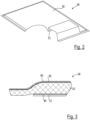
- the SMC base body 32 is finally pressed and bonded to the fire protection coating 12 on the one hand and to the EMC layer 36 on the other hand by means of a reactive hot melt adhesive system and the adhesive press 1, so that after this operation the cover structure 38 is produced according to Figure 2 which is provided with the EMC layer 36 towards the vehicle cabin of the electric vehicle and with the fire protection coating 12 towards the battery.
- Figure 3 shows the layer structure of the finished bonded cover structure 38 with the above (view from Figure 3 ) lying EMC layer 36, which is connected to the SMC base body 32 via adhesive of an adhesive joint 40. This is connected to the mica plates 12a, 12b, 12c via adhesive of another adhesive joint 40. Physically setting adhesives (thermoplastics) and chemically setting adhesives (thermosets) can be used. This allows a homogeneous layer structure of the Cover structure 38, which is optimized with regard to EMC issues, fire resistance and mechanical strength.
- cover structures 38 that are dimensionally stable and meet fire protection regulations, even for large battery capacities, and that can have an area of significantly more than 1 m2 .
- a covering structure 38 is disclosed, the SMC base body 32 of which is simultaneously pressed and bonded to two further layers 12, 36 in an adhesive press 1.
Landscapes
- Chemical & Material Sciences (AREA)
- Engineering & Computer Science (AREA)
- Electrochemistry (AREA)
- General Chemical & Material Sciences (AREA)
- Chemical Kinetics & Catalysis (AREA)
- Mechanical Engineering (AREA)
- Composite Materials (AREA)
- Textile Engineering (AREA)
- Physics & Mathematics (AREA)
- Fluid Mechanics (AREA)
- Aviation & Aerospace Engineering (AREA)
- Ceramic Engineering (AREA)
- Inorganic Chemistry (AREA)
- Laminated Bodies (AREA)
- Body Structure For Vehicles (AREA)
Description
- Die Erfindung betrifft ein Verfahren zum Herstellen einer Abdeckstruktur, insbesondere für eine Batterie.
- Seit einigen Jahren besteht ein Trend dahingehend, Verbrennungsmotoren durch Elektromotoren zu ersetzen. Ein Problem dabei ist die Bereitstellung von hinreichender Batteriekapazität. Insbesondere bei mit Elektromotoren ausgeführten Kraftfahrzeugen müssen zur Gewährleistung einer zufriedenstellenden Reichweite Batterien mit großer Kapazität eingebaut werden. Diese werden häufig am Unterboden des Fahrzeugs befestigt und müssen dementsprechend gegen äußere Einflüsse geschützt werden. Derartige mit einem Unterfahrschutz ausgeführte Batterietragstrukturen sind beispielsweise in der
DE 10 2011 005 403 A1 und derWO 2018/149762 A1 offenbart. - Dabei werden in der Regel die Batterien in einer Art Batteriekasten aufgenommen, über die die eigentliche Batterie zur Fahrbahn hin mittels eines Unterfahrschutzes geschützt ist. Der zur Karosserie/Fahrzeugkabine hinweisende Teil der Batterietragstruktur ist über eine Abdeckstruktur abgedeckt. Diese muss so ausgebildet sein, dass sie bei einem Brand der Batterie für eine bestimmte Zeit, beispielsweise fünf Minuten der Wärmeentwicklung standhalten, so dass ein Übergreifen auf die Fahrzeugkabine und sonstige Fahrzeugkomponenten verzögert wird.
- Ein derartiger Batteriekasten, auch Batteriegehäuse genannt, ist in der Druckschrift
DE 10 2010 043 899 A1 beschrieben. Bei dieser Lösung ist ein Batteriegehäuse mit einem Gehäusedeckel, der entsprechend einer Außenkontur einer Batteriezelle ausgebildet ist und einem Gehäuseboden ausgebildet, der an den haubenförmigen Gehäusedeckel angesetzt ist. Dieses Batteriegehäuse ist bei der bekannten Lösung aus einem schwer entzündlichen Kunststoff gefertigt. - Eine derartige Lösung hält einer längeren Wärmeentwicklung nicht stand.
- In dem Dokument
DE 10 2013 220 778 A1 ist ebenfalls ein aus Kunststoff gefertigtes Batteriegehäuse beschrieben, das die gleichen Nachteile wie die oben genannte Batteriegehäusestruktur aufweist. - In der gattungsfremden Druckschrift
DE 10 2009 050 787 A1 ist ein aus Kunststoff bestehendes Flugzeugbauteil beschrieben, das zur Verbesserung des Brandverhaltens mit einer glimmerhaltigen Sperrschicht ausgeführt ist.CN 106 450 083 A offenbart ein Verfahren zur Herstellung eines Batteriekastendeckels. - Bekannt sind Lösungen, bei denen die beispielsweise als Batteriekastendeckel dienenden Abdeckstrukturen als Sheet-Moulded-Compound-Grundkörper (SMC-Grundkörper) gefertigt werden und der erforderliche Brandschutz dann durch nachträgliches Aufkleben einer Brandschutzschicht, beispielsweise von Glimmer- bzw. Mikanitplatten erzielt wird. Weiterhin ist es bekannt eine Elektromagnetische-Verträglichkeits-Schicht (EMV-Schicht) an der Oberseite des SMC- Grundkörpers anzubringen.
- Diese Vorgehensweise bedarf eines erheblichen fertigungstechnischen Aufwandes.
- Demgegenüber liegt der Erfindung die Aufgabe zu Grunde, eine Abdeckstruktur zu schaffen, die zum einen den brandschutztechnischen Anforderungen und zum anderen den EMV-Anforderungen genügt, und die sich dabei mit verringertem Aufwand herstellen lässt. Der Erfindung liegt des Weiteren die Aufgabe zu Grunde, ein Verfahren zur Herstellung einer derartigen Abdeckstruktur zu schaffen.
- Diese Aufgabe wird im Hinblick auf das Verfahren durch die Merkmalskombination des Anspruches 1 gelöst.
- Vorteilhafte Weiterbildungen der Erfindung sind Gegenstand der Unteransprüche.
- Die offenbarte Abdeckstruktur ist insbesondere zur Verwendung als einer Batteriekastenwandung, vorzugsweise als eine Batterieabdeckung für ein Elektrofahrzeug ausgelegt. Diese Abdeckstruktur hat einen Sheet-Moulded-Compound-Grundkörper (SMC-Grundkörper). Als Brandschutzschicht ist mindestens ein Formteil und/oder mindestens eine ebene Platte vorgesehen. Zur Verbesserung der elektromagnetischen Verträglichkeit (EMV) und somit vorzugsweise zur Abschirmung gegenüber anderen Antriebs- und Steuerungs-/Regelelementen des Fahrzeugs ist die Abdeckstruktur mit einer Elektromagnetischen-Verträglichkeitsschicht (EMV-Schicht) ausgeführt. Die Herstellung der Abdeckstruktur ist besonders einfach, da die Brandschutzschicht und die EMV-Schicht mit dem Grundkörper verklebt sind. Durch die einheitliche Verklebung der drei genannten Bauteile in einem Arbeitsgang in einer Klebepresse sind Synergien nutzbar.
- Die Herstellung der Abdeckstruktur ist besonders einfach, wenn das mindestens eine Formteil der Brandschutzschicht und die entsprechend einer Geometrie des SMC-Grundkörpers ausgeführte EMV-Schicht mit dem Grundkörper verklebt sind.
- Es wird besonders bevorzugt, wenn der SMC-Grundkörper und die EMV-Schicht und die Brandschutzbeschichtung mittels eines reaktiven Hotmelt-Klebesystems miteinander verklebt sind. Dabei sind physikalisch abbindende Klebstoffe (Thermoplaste) und chemisch abbindende Klebstoffe (Duroplaste) möglich. Damit ist eine besonders haltbare und resistente Abdeckstruktur geschaffen.
- Selbstverständlich kann anstelle eines derartigen Hotmelt-Klebers auch ein anderer Kleber, beispielsweise ein Pulverklebstoff oder sonstige Klebstoffe verwendet werden, die vorzugsweise vorab auf den Bauteilen bzw. auf zumindest einem Bauteil einer Klebepaarung appliziert werden und dann durch Einlegen in die Klebepresse aktiviert werden, um die Verklebung durchzuführen. Wie erläutert, kann vor dem Einlegen in die Klebepresse die mit dem Klebstoff versehene Schicht abgedeckt werden, um ein Anhaften von Verschmutzungen oder ein unbeabsichtigtes Verkleben zu vermeiden.
- Prinzipiell ist es jedoch auch möglich, dass der Klebstoff erst unmittelbar vor Einlegen der Bauteile in die Klebepresse aufgetragen wird.
- Insbesondere bei Automotive-Anwendungen wird es bevorzugt, wenn die EMV-Schicht auf der von der Brandschutzbeschichtung abgewandten Seite des SMC-Grundkörpers aufgebracht ist. Insbesondere ist in der Einbaulage der Abdeckstruktur im Fahrzeug die Brandschutzbeschichtung unten und die EMV-Schicht oben.
- Es wird bevorzugt, wenn die Brandschutzbeschichtung im Wesentlichen aus mindestens einer Glimmerplatte oder Mikanitplatte und/oder aus mindestens einem Glimmerformteil oder Mikanitformteil gebildet ist. Dabei wird die Brandschutzbeschichtung vorzugsweise aus einer Vielzahl derartiger Platten zusammengesetzt.
- Bei einem besonders einfach aufgebauten Ausführungsbeispiel ist die EMV-Schicht als Aluminiumfolie oder Aluminiumkaschierung ausgeführt, die den SMC-Grundkörper teilweise oder weitgehend oder vollständig überdeckt.
- Um die Positionierung der EMV-Schicht relativ zum SMC-Grundkörper zu erleichtern, kann eine Selbstzentrierung vorgesehen sein, die von einer Einwölbung der EMV-Schicht und einer dazu passenden Auswölbung des SMC-Grundkörpers gebildet ist.
- Die für die Herstellung einer vorbeschriebenen Abdeckstruktur geeignete Klebepresse hat ein Oberwerkzeug und ein Unterwerkzeug, deren Formflächen an die Großflächen zu verklebenden Abdeckstruktur angepasst sind.
- Gemäß dem erfindungsgemäßen Verfahren werden die Brandschutzbeschichtung und die EMV-Schicht gemeinsam in einem Arbeitsgang mit dem SCM-Grundkörper verklebt. Dies erfolgt in einer Klebepresse, in die der SMC-Grundkörper, die Brandschutzbeschichtung und die EMV-Schicht (umgeformte Aluminiumfolie oder -kaschierung) eingelegt werden. Abschließend wird durch Schließen der Werkzeughälften (Oberwerkzeug/Unterwerkzeug) der SMC-Grundkörper mit der Brandschutzbeschichtung und mit der EMV-Schicht zu der Abdeckstruktur verpresst und verklebt.
- Bei einer für eine Serienfertigung geeigneten Weiterbildung des Verfahrens wird zuerst die Brandschutzbeschichtung auf dem Unterwerkzeug positioniert und fixiert. Nach diesem Einlegen der Brandschutzbeschichtung wird der SMC-Grundkörper in der Klebepresse positioniert. Danach wird die EMV-Schicht eingelegt.
- Wenn die Brandschutzbeschichtung ein Formteil aufweist, dann hat das Unterwerkzeug eine entsprechende Formfläche.
- Bei einer anderen Weiterbildung des Verfahrens wird das zumindest eine die Brandschutzbeschichtung ausbildende Formteil außerhalb der Klebepresse zunächst an der Unterseite des SMC-Grundkörpers vorfixiert. Dann kann der SMC-Grundkörper mit der vorfixierten Brandschutzbeschichtung auf das Unterwerkzeug der Klebepresse gelegt werden, so dass die beiden erstgenannten Schritte des erfindungsgemäßen Verfahrens gleichzeitig erfolgen. Schließlich wird die EMV-Schicht auf die Oberseite des SMC-Grundkörpers aufgelegt.
- Um die Vorfixierung - z.B. in Form von Klebestreifen - einfach anbringen zu können wird es besonders bevorzugt, wenn außerhalb der Klebepresse die Brandschutzbeschichtung auf den mit seiner Unterseite nach oben weisenden SMC-Grundkörper aufgelegt wird und dort vorfixiert wird. Dann kann der SMC-Grundkörper mit der vorfixierten Brandschutzbeschichtung umgedreht werden, bevor es auf das Unterwerkzeug der Klebepresse gelegt wird.
- Fertigungszeit lässt sich sparen, wenn das Verpressen und Verkleben zeitnah nach dem Entformen des SMC-Grundkörpers aus einem SMC-Presswerkzeug oder zeitnah nach dem Aufbringen des Klebstoffs oder zeitnah nach dem Vorfixieren der Brandschutzbeschichtung erfolgt.
- Fertigungszeit und Tragarbeit lassen sich sparen, wenn das Verpressen und Verkleben räumlich nah an oder benachbart zu dem SMC-Presswerkzeug, in dem der SMC-Grundkörpers geformt wurde, erfolgt. Z.B. beträgt der Abstand zwischen dem SMC-Presswerkzeug und der Klebepresse maximal 10 Meter, vorzugsweise maximal 5 Meter.
- Auch mit Bezug zum erfindungsgemäßen Verfahren können der SMC-Grundkörper, die EMV-Schicht und die Brandschutzbeschichtung mittels eines reaktiven Hot-melt-Klebesystems miteinander verklebt werden. Dabei sind physikalisch abbindende Klebstoffe (Thermoplaste) und chemisch abbindende Klebstoffe (Duroplaste) möglich. Damit wird eine besonders haltbare und resistente Abdeckstruktur geschaffen. Wie ausgeführt, können auch andere Klebstoffe verwendet werden.
- Ein bevorzugtes Ausführungsbeispiel der Erfindung wird im Folgenden anhand schematischer Zeichnungen näher erläutert. Es zeigen:
-
Figur 1 die erfindungsgemäße Abdeckstruktur vor dem Verpressen und Verkleben in einer Klebepresse in einer Explosionsdarstellung; -
Figur 2 einen Großteil der erfindungsgemäß verklebten und verpressten Abdeckstruktur ausFigur 1 in einer perspektivischen Darstellung; und -
Figur 3 einen Ausschnitt eines Querschnitts durch eine Abdeckstruktur ausFigur 2 . -
Figur 1 zeigt den prinzipiellen Aufbau einer Klebepresse 1 mit einem Oberwerkzeug 2 und einem Unterwerkzeug 4, die in der Darstellung gemäßFigur 1 auseinandergefahren sind. An dem Unterwerkzeug 4 (und entsprechend auch im Oberwerkzeug 2) sind Formflächen 6 ausgebildet, die im geschlossenem Zustand drei Komponenten 32, 12, 36 einer Abdeckstruktur 38, verpressen und verkleben. Die Abdeckstruktur 38 dient beim gezeigten Ausführungsbeispiel als Batteriedeckel eines Elektrofahrzeugs. - Die Formflächen 6 sind entsprechend der Geometrie dieser Abdeckstruktur 38 als 3D-Fläche ausgebildet. Beim dargestellten Ausführungsbeispiel wölbt sich die Formfläche 6 des Unterwerkzeugs 4 in dem in
Figur 1 rechten Bereich nach oben, hin zum Oberwerkzeug 2 aus, so dass eine Auswölbung 8 ausgebildet ist. Im Werkzeugoberteil 2 ist eine entsprechende (nicht gezeigte) Einwölbung vorgesehen, so dass beim Schließen der Klebepresse 1 eine Hutze verklebt wird, die im montierten Zustand eine Komponente des Elektrofahrzeugs, beispielsweise einen Tank oder dergleichen überdeckt. - In die geöffnete Klebepresse 1 wird ein SMC-Grundkörper 32 sowie eine Brandschutzbeschichtung 12 und eine EMV-Schicht 36 eingelegt. Beim dargestellten Ausführungsbeispiel ist die Brandschutzbeschichtung 12 mehrteilig aus Glimmerplatten 12a, 12b, 12c ausgebildet, die zunächst auf die Formfläche 6 aufgelegt werden. Die Glimmerplatte 12c überdeckt dabei die die Hutze ausbildende Auswölbung 8. Die Glimmerplatten 12a, 12b, 12c sind entsprechend der Kontur der Formflächen 6 bzw. der auszuformenden Abdeckstruktur 38 ausgebildet. Die beiden Glimmerplatten 12a, 12b, haben einen Abstand zur Glimmerplatte 12c. Die Glimmerplatten 12a, 12b, 12c decken im verbauten Zustand der Abdeckstruktur 38 die bei einer Hitzeentwicklung gefährdeten Bereiche der Abdeckstruktur 38 und die darüber liegenden Bauteile des Elektrofahrzeugs ab.
- Zunächst wird mittels Sprühpistole der Klebstoff auf die Glimmerplatten 12a, 12b, 12c und auf die EMV-Schicht 36 aufgebracht.
- In einer Serienfertigung erfolgt der Klebstoffauftrag vorzugsweise mittels eines Roboters im Spinnsprühauftrag.
- Nach dem Einlegen der Glimmerplatten 12a, 12b, 12c wird der SMC-Grundkörper 32 in die Klebepresse 1 eingelegt, der beispielsweise aus einer Fasermatte, einem Faserflies oder dergleichen besteht, die bzw. das von einer Kunststoffmatrix, beispielsweise einem Polyester- oder Vinylesterharz, umgeben ist. Der so gebildete SMC-Rohling wurde vor der Anwendung des erfindungsgemäßen Verfahrens in einem auf eine Umform-/Schmelztemperatur erwärmten SMC-Presswerkzeug aufgeschmolzen, so dass der SMC-Rohling in die vorbestimmte Geometrie des SMC-Grundkörpers 32 umgeformt werden konnte und nach dem Aushärten/Entformen diese 3D-Geometrie beibehalten hat.
- Alternativ werden die Glimmerplatten 12a, 12b, 12c außerhalb der Klebepresse zunächst an der Unterseite des SMC-Grundkörpers 32 mittels Klebestreifen vorfixiert. Um diese einfach anbringen zu können, werden die Glimmerplatten 12a, 12b, 12c außerhalb der Klebepresse 1 auf den mit seiner (in verbauter Lage) Unterseite nach oben weisenden SMC-Grundkörper 32 aufgelegt. Dann wird der SMC-Grundkörper 32 mit den vorfixierten Glimmerplatten 12a, 12b, 12c umgedreht und auf das Unterwerkzeug 4 der Klebepresse 1 gelegt.
- In der Serienfertigung werden die beschichteten Glimmerplatten 12a, 12b, 12c auf dem Unterwerkzeug 4 positioniert und fixiert.
- Zur Verbesserung der elektromagnetischen Verträglichkeit (EMV) wird auf den SMC-Grundkörper 32 auf der von der Brandschutzbeschichtung 12 abgewandten Großfläche (in
Figur 1 oben) die EMV-Schicht 36 aufgeklebt. Beim dargestellten Ausführungsbeispiel ist diese EMV-Schicht 36 aus einer Aluminiumfolie/-kaschierung gebildet, die vor der Anwendung des erfindungsgemäßen Verfahrens in einem Umformwerkzeug entsprechend der 3D-Geometrie des SMC-Grundkörpers 32 geformt wurde. - Um die Positionierung der EMV-Schicht 36 relativ zum SMC-Grundkörper 32 zu erleichtern, ist eine Selbstzentrierung vorgesehen, die beim dargestellten Ausführungsbeispiel von einer Einwölbung der EMV-Schicht 36 und einer dazu passenden Auswölbung des SMC-Grundkörpers 32 gebildet ist. Wenn die EMV-Schicht 36 auf den SMC-Grundkörper 32 abgesenkt wird, tauch die Auswölbung in die Einwölbung formschlüssig ein, wodurch sich eine (Vor)positionierung der beiden Teile zueinander ergibt.
- In einem einzigen Arbeitsgang wird schließlich der SMC-Grundkörper 32 einerseits mit der Brandschutzbeschichtung 12 und andererseits mit der EMV-Schicht 36 mittels eines reaktiven Hotmelt-Klebesystems und der Klebepresse 1 verpresst und verklebt, so dass nach diesem Arbeitsgang die Abdeckstruktur 38 gemäß
Figur 2 ausgebildet ist, die zur Fahrzeugkabine des Elektrofahrzeugs hin mit der EMV-Schicht 36 und zur Batterie hin mit der Brandschutzbeschichtung 12 versehen ist. -
Figur 3 zeigt den Schichtaufbau der fertig verklebten Abdeckstruktur 38 mit der oben (Ansicht nachFigur 3 ) liegenden EMV-Schicht 36, die über Klebstoff einer Klebefuge 40 flächig mit dem SMC-Grundkörper 32 verbunden ist. Dieser ist über Klebstoff einer weiteren Klebefuge 40 mit den Glimmerplatten 12a, 12b, 12c verbunden. Dabei können physikalisch abbindende Klebstoffe (Thermoplaste) und chemisch abbindende Klebstoffe (Duroplaste) verwendet werden. Somit ist ein homogener Schichtaufbau der Abdeckstruktur 38 gewährleistet, der im Hinblick auf die EMV-Problematik, die Brandschutzbeständigkeit und die mechanische Festigkeit optimiert ist. - Auf diese Weise lassen sich auch für große Batteriekapazitäten geeignete formstabile und Brandschutzvorschriften genügende Abdeckstrukturen 38 herstellen, die eine Fläche von deutlich mehr als 1 m2 aufweisen können.
- Offenbart ist eine Abdeckstruktur 38, deren SMC-Grundkörper 32 mit zwei weiteren Schichten 12, 36 in einer Klebepresse 1 gleichzeitig verpresst und verklebt wird.
-
- 1
- Klebepresse
- 2
- Oberwerkzeug
- 4
- Unterwerkzeug
- 6
- Formfläche
- 8
- Auswölbung
- 12
- Brandschutzbeschichtung
- 12a
- Glimmerplatte
- 12b
- Glimmerplatte
- 12c
- Glimmerplatte
- 32
- SMC-Grundkörper
- 36
- EMV-Schicht
- 38
- Abdeckstruktur
- 40
- Klebefuge
Claims (7)
- Verfahren zum Herstellen einer Abdeckstruktur (38) insbesondere für eine Batterie eines Elektrofahrzeugs mit den Schritten:- Einlegen einer Brandschutzbeschichtung (12) in eine Klebepresse (1),- Einlegen eines SMC-Grundkörpers (32) in die Klebepresse (1),- Einlegen einer EMV-Schicht (36) in die Klebepresse (1), und- Verkleben des SMC-Grundkörpers (32) mit der Brandschutzbeschichtung (12) und der EMV-Schicht (36) mittels der Klebepresse (1).
- Verfahren nach Anspruch 1, wobei die genannten Schritte in der genannten Reihenfolge erfolgen.
- Verfahren nach Anspruch 1, wobei zunächst eine Vorfixierung der Brandschutzbeschichtung (12) an dem SMC-Grundkörper (32) erfolgt.
- Verfahren nach einem der Ansprüche 1 bis 3, wobei der SMC-Grundkörper (32) und die EMV-Schicht (36) und die Brandschutzbeschichtung (12) mittels eines auf zumindest ein Bauteil einer Klebepaarung applizierten Klebstoffs, wie einen Pulverklebstoff oder mittels eines reaktiven Hotmelt-Klebesystems miteinander verklebt werden.
- Verfahren nach Anspruch 4, wobei der Klebstoff an der Klebepresse (1) oder im zeitlichen Abstand vor der Verklebung in der Klebepresse (1) aufgebracht wird.
- Verfahren nach einem der Ansprüche 1 bis 5, wobei das Verpressen zeitnah nach dem Entformen des SMC-Grundkörpers (32) aus einem SMC-Presswerkzeug oder zeitnah nach dem Aufbringen des Klebstoffs oder zeitnah nach dem Vorfixieren der Brandschutzbeschichtung (12) erfolgt.
- Verfahren nach einem der Ansprüche 1 bis 6, wobei das Verpressen räumlich nah an oder benachbart zu einem SMC-Presswerkzeug, in dem der SMC-Grundkörpers (32) geformt wurde, erfolgt.
Applications Claiming Priority (5)
| Application Number | Priority Date | Filing Date | Title |
|---|---|---|---|
| DE102020102790 | 2020-02-04 | ||
| DE102020107676 | 2020-03-19 | ||
| DE102020109259 | 2020-04-02 | ||
| DE102020116305.3A DE102020116305A1 (de) | 2020-02-04 | 2020-06-19 | Abdeckstruktur und Verfahren zum Herstellen einer Abdeckstruktur |
| PCT/EP2021/051677 WO2021156095A1 (de) | 2020-02-04 | 2021-01-26 | Abdeckstruktur und verfahren zum herstellen einer abdeckstruktur |
Publications (3)
| Publication Number | Publication Date |
|---|---|
| EP4081390A1 EP4081390A1 (de) | 2022-11-02 |
| EP4081390B1 true EP4081390B1 (de) | 2024-06-26 |
| EP4081390C0 EP4081390C0 (de) | 2024-06-26 |
Family
ID=76853517
Family Applications (1)
| Application Number | Title | Priority Date | Filing Date |
|---|---|---|---|
| EP21703607.8A Active EP4081390B1 (de) | 2020-02-04 | 2021-01-26 | Abdeckstruktur und verfahren zum herstellen einer abdeckstruktur |
Country Status (5)
| Country | Link |
|---|---|
| US (1) | US11993064B2 (de) |
| EP (1) | EP4081390B1 (de) |
| CN (1) | CN114981071A (de) |
| DE (1) | DE102020116305A1 (de) |
| WO (1) | WO2021156095A1 (de) |
Families Citing this family (7)
| Publication number | Priority date | Publication date | Assignee | Title |
|---|---|---|---|---|
| DE102021203985A1 (de) * | 2021-04-21 | 2022-10-27 | Elringklinger Ag | Bauteil und Verfahren zur Herstellung eines Bauteils |
| DE102021131284A1 (de) | 2021-11-29 | 2023-06-01 | Georg Fritzmeier - GmbH & Co. KG | Abdeckstruktur sowie Verfahren und Vorformwerkzeug zum Herstellen einer Abdeckstruktur |
| DE102021133796A1 (de) | 2021-12-20 | 2023-06-22 | Audi Aktiengesellschaft | Brandschutzhalbzeug für ein Kunststoffbauteil, insbesondere Unterfahrschutz, eines Kraftfahrzeugs, Herstellungsverfahren und Kraftfahrzeug |
| KR20240051051A (ko) | 2022-10-11 | 2024-04-19 | 쿠일리츠 홀딩 게엠베하 | 복합 시스템을 구비한 방화 장치, 복합 시스템 및 방화 장치를 구비한 배터리 팩 |
| US20250260121A1 (en) * | 2024-02-13 | 2025-08-14 | GM Global Technology Operations LLC | Thermal runaway mitigation battery module |
| WO2025244230A1 (ko) * | 2024-05-22 | 2025-11-27 | 주식회사 예선테크 | 화염 차단과 내화 성능이 우수한 박형 전기차 배터리용 내화 시트 및 이의 제조 방법 |
| WO2025244231A1 (ko) * | 2024-05-22 | 2025-11-27 | 주식회사 예선테크 | 화염 차단과 내화 성능이 우수한 고점착성 전기차 배터리용 내화 시트 및 이의 제조 방법 |
Family Cites Families (11)
| Publication number | Priority date | Publication date | Assignee | Title |
|---|---|---|---|---|
| JPH0655467B2 (ja) | 1990-07-24 | 1994-07-27 | 三島製紙株式会社 | 電気絶縁層を有する耐熱難燃導電シートおよびその製造法 |
| EP2033849A1 (de) | 2007-08-30 | 2009-03-11 | Peguform Gmbh | Kunststoffformteil zur Aufnahme einer Fahrzeugbatterie |
| DE102009050787A1 (de) | 2009-10-27 | 2011-05-05 | Airbus Operations Gmbh | Verwendung von anorganischen Partikeln zur Herstellung einer Sperrschicht auf Flugzeugkomponenten |
| KR20120044853A (ko) | 2010-10-28 | 2012-05-08 | 현대자동차주식회사 | 플라스틱 복합재를 이용한 전기자동차용 배터리팩 케이스 어셈블리 |
| DE102010043899A1 (de) | 2010-11-15 | 2012-05-16 | Behr Gmbh & Co. Kg | Batteriegehäuse zur Aufnahme zumindest einer Batteriezelle |
| DE102013220778A1 (de) | 2013-10-15 | 2015-04-16 | Robert Bosch Gmbh | Batteriegehäuse, Batterie und Verfahren zum Herstellen eines Batteriegehäuses |
| DE102015101242A1 (de) | 2015-01-28 | 2016-07-28 | Mitras Composites Systems GmbH | Verfahren zum Inmouldlabeling für SMC-Pressteile |
| CN106450083A (zh) * | 2016-09-29 | 2017-02-22 | 常州普莱德新能源电池科技有限公司 | 一种smc电箱 |
| CN115312943B (zh) | 2017-02-17 | 2024-07-30 | 慕贝尔碳纤维技术有限公司 | 电池结构和保护器 |
| DE102018115503A1 (de) | 2018-06-27 | 2020-01-02 | Carl Freudenberg Kg | Zusammensetzung zur Abschirmung elektromagnetischer Strahlung |
| DE102019118092A1 (de) | 2019-07-04 | 2021-01-07 | Carl Freudenberg Kg | Verfahren zur Herstellung eines gegenüber elektromagnetischer Strahlung abgeschirmten Bauteils |
-
2020
- 2020-06-19 DE DE102020116305.3A patent/DE102020116305A1/de not_active Ceased
-
2021
- 2021-01-26 EP EP21703607.8A patent/EP4081390B1/de active Active
- 2021-01-26 CN CN202180009848.9A patent/CN114981071A/zh active Pending
- 2021-01-26 WO PCT/EP2021/051677 patent/WO2021156095A1/de not_active Ceased
- 2021-01-26 US US17/797,347 patent/US11993064B2/en active Active
Also Published As
| Publication number | Publication date |
|---|---|
| WO2021156095A1 (de) | 2021-08-12 |
| EP4081390A1 (de) | 2022-11-02 |
| US20230057297A1 (en) | 2023-02-23 |
| CN114981071A (zh) | 2022-08-30 |
| US11993064B2 (en) | 2024-05-28 |
| DE102020116305A1 (de) | 2021-08-05 |
| EP4081390C0 (de) | 2024-06-26 |
Similar Documents
| Publication | Publication Date | Title |
|---|---|---|
| EP4081390B1 (de) | Abdeckstruktur und verfahren zum herstellen einer abdeckstruktur | |
| EP4081389B1 (de) | Abdeckstruktur und smc-werkzeug sowie verfahren zum herstellen einer derartigen abdeckstruktur | |
| EP3532365B1 (de) | Karosserieteil und verfahren zum herstellen eines karosserieteils | |
| DE4019744C2 (de) | Vorrichtung zum Reparieren von Bauteilen aus Kunststoff, insbesondere aus Faserverbundwerkstoffen | |
| DE69822483T3 (de) | Lasttragendes fahrzeugdach und verfahren zu seiner herstellung | |
| EP2726308A1 (de) | Aussenmodul mit einer aussenbeplankung für eine modular aufgebaute gehäusekomponente sowie die modular aufgebaute gehäusekomponente selbst und verfahren zur herstellung des aussenmoduls | |
| EP3019320A2 (de) | Verfahren zur herstellung eines strukturbauteils für kraftfahrzeuge aus einem organoblech | |
| WO2015000743A1 (de) | Verfahren zum herstellen eines gehäuses mit einer schirmung vor elektrischer und/oder magnetischer strahlung und gehäuse mit schirmung vor elektrischer und/oder magnetischer strahlung | |
| EP1838511B1 (de) | Verfahren zur herstellung eines verbundformteiles aus kunststoff und dessen verwendung | |
| DE19705511C2 (de) | Hitzeschild für Bauteile aus thermoplastischem Kunststoff | |
| DE102017122670A1 (de) | Verfahren und Presswerkzeug zur Herstellung eines Hybridbauteils sowie Hybridbauteil | |
| EP1658148B1 (de) | Verfahren zum umformen von blechen | |
| EP3802289B1 (de) | Klappe für ein kraftfahrzeug und kraftfahrzeug | |
| EP0636517B1 (de) | Herstellverfahren für ein Doppelblech-Karosserieteil mit Dämmschicht | |
| DE102005056460A1 (de) | Verfahren zum Herstellen eines Hybridbauteils | |
| DE102016012691A1 (de) | Mehrschichtiges Strukturbauteil, Verfahren zu dessen Herstellung und Verwendungen dafür | |
| DE102008035054A1 (de) | Solarkollektor und dessen Herstellungsverfahren | |
| DE102010020308A1 (de) | Karosseriebauteil mit einem Schichtaufbau und dessen Herstellungsverfahren | |
| DE102010001559A1 (de) | Herstellungsverfahren für ein Verkleidungsteil eines Fahrzeugs, entsprechende Vorrichtung sowie Verkleidungsteil | |
| DE102008006040A1 (de) | Verfahren zur Herstellung einer Leichtbauplatte und Leichtbauplatte | |
| EP1889776B1 (de) | Verfahren zum Verstärken einer offenen Hohlprofilstruktur eines Bauteils, insbesondere eines Kfz-Bauteils aus Metall | |
| EP1351818A2 (de) | Mehrschichtiger formkörper mit lokal begrenzten verstärkungselementen | |
| EP2323827A1 (de) | Verfahren zur herstellung eines fahrzeug-verkleidungsteils sowie verkleidungsteil | |
| DE102019134888A1 (de) | Herstellungsverfahren eines Faserverbundbauteils mit einer Schutzbeschichtung | |
| DE102017220228A1 (de) | Verfahren zur Herstellung eines Hybridbauteils aus pressgehärtetem Blech und faserverstärktem Kunststoff, sowie hiermit hergestelltes Hybridbauteil |
Legal Events
| Date | Code | Title | Description |
|---|---|---|---|
| STAA | Information on the status of an ep patent application or granted ep patent |
Free format text: STATUS: UNKNOWN |
|
| STAA | Information on the status of an ep patent application or granted ep patent |
Free format text: STATUS: THE INTERNATIONAL PUBLICATION HAS BEEN MADE |
|
| PUAI | Public reference made under article 153(3) epc to a published international application that has entered the european phase |
Free format text: ORIGINAL CODE: 0009012 |
|
| STAA | Information on the status of an ep patent application or granted ep patent |
Free format text: STATUS: REQUEST FOR EXAMINATION WAS MADE |
|
| 17P | Request for examination filed |
Effective date: 20220726 |
|
| AK | Designated contracting states |
Kind code of ref document: A1 Designated state(s): AL AT BE BG CH CY CZ DE DK EE ES FI FR GB GR HR HU IE IS IT LI LT LU LV MC MK MT NL NO PL PT RO RS SE SI SK SM TR |
|
| DAV | Request for validation of the european patent (deleted) | ||
| DAX | Request for extension of the european patent (deleted) | ||
| GRAP | Despatch of communication of intention to grant a patent |
Free format text: ORIGINAL CODE: EPIDOSNIGR1 |
|
| STAA | Information on the status of an ep patent application or granted ep patent |
Free format text: STATUS: GRANT OF PATENT IS INTENDED |
|
| RIC1 | Information provided on ipc code assigned before grant |
Ipc: B32B 9/00 20060101ALI20231219BHEP Ipc: H01M 50/249 20210101ALI20231219BHEP Ipc: H01M 50/278 20210101ALI20231219BHEP Ipc: H01M 50/282 20210101ALI20231219BHEP Ipc: B29C 70/18 20060101ALI20231219BHEP Ipc: B29C 70/84 20060101ALI20231219BHEP Ipc: B29C 70/88 20060101ALI20231219BHEP Ipc: B29C 70/46 20060101AFI20231219BHEP |
|
| INTG | Intention to grant announced |
Effective date: 20240122 |
|
| GRAS | Grant fee paid |
Free format text: ORIGINAL CODE: EPIDOSNIGR3 |
|
| GRAA | (expected) grant |
Free format text: ORIGINAL CODE: 0009210 |
|
| STAA | Information on the status of an ep patent application or granted ep patent |
Free format text: STATUS: THE PATENT HAS BEEN GRANTED |
|
| GRAT | Correction requested after decision to grant or after decision to maintain patent in amended form |
Free format text: ORIGINAL CODE: EPIDOSNCDEC |
|
| AK | Designated contracting states |
Kind code of ref document: B1 Designated state(s): AL AT BE BG CH CY CZ DE DK EE ES FI FR GB GR HR HU IE IS IT LI LT LU LV MC MK MT NL NO PL PT RO RS SE SI SK SM TR |
|
| REG | Reference to a national code |
Ref country code: GB Ref legal event code: FG4D Free format text: NOT ENGLISH |
|
| REG | Reference to a national code |
Ref country code: CH Ref legal event code: EP |
|
| REG | Reference to a national code |
Ref country code: CH Ref legal event code: PK Free format text: BERICHTIGUNGEN |
|
| REG | Reference to a national code |
Ref country code: DE Ref legal event code: R096 Ref document number: 502021004115 Country of ref document: DE |
|
| RIN2 | Information on inventor provided after grant (corrected) |
Inventor name: FRAUNHOFER, STEPHAN |
|
| U01 | Request for unitary effect filed |
Effective date: 20240717 |
|
| U07 | Unitary effect registered |
Designated state(s): AT BE BG DE DK EE FI FR IT LT LU LV MT NL PT SE SI Effective date: 20240730 |
|
| PG25 | Lapsed in a contracting state [announced via postgrant information from national office to epo] |
Ref country code: HR Free format text: LAPSE BECAUSE OF FAILURE TO SUBMIT A TRANSLATION OF THE DESCRIPTION OR TO PAY THE FEE WITHIN THE PRESCRIBED TIME-LIMIT Effective date: 20240626 |
|
| PG25 | Lapsed in a contracting state [announced via postgrant information from national office to epo] |
Ref country code: GR Free format text: LAPSE BECAUSE OF FAILURE TO SUBMIT A TRANSLATION OF THE DESCRIPTION OR TO PAY THE FEE WITHIN THE PRESCRIBED TIME-LIMIT Effective date: 20240927 |
|
| PG25 | Lapsed in a contracting state [announced via postgrant information from national office to epo] |
Ref country code: NO Free format text: LAPSE BECAUSE OF FAILURE TO SUBMIT A TRANSLATION OF THE DESCRIPTION OR TO PAY THE FEE WITHIN THE PRESCRIBED TIME-LIMIT Effective date: 20240926 Ref country code: HR Free format text: LAPSE BECAUSE OF FAILURE TO SUBMIT A TRANSLATION OF THE DESCRIPTION OR TO PAY THE FEE WITHIN THE PRESCRIBED TIME-LIMIT Effective date: 20240626 Ref country code: GR Free format text: LAPSE BECAUSE OF FAILURE TO SUBMIT A TRANSLATION OF THE DESCRIPTION OR TO PAY THE FEE WITHIN THE PRESCRIBED TIME-LIMIT Effective date: 20240927 Ref country code: RS Free format text: LAPSE BECAUSE OF FAILURE TO SUBMIT A TRANSLATION OF THE DESCRIPTION OR TO PAY THE FEE WITHIN THE PRESCRIBED TIME-LIMIT Effective date: 20240926 |
|
| PG25 | Lapsed in a contracting state [announced via postgrant information from national office to epo] |
Ref country code: PL Free format text: LAPSE BECAUSE OF FAILURE TO SUBMIT A TRANSLATION OF THE DESCRIPTION OR TO PAY THE FEE WITHIN THE PRESCRIBED TIME-LIMIT Effective date: 20240626 |
|
| PG25 | Lapsed in a contracting state [announced via postgrant information from national office to epo] |
Ref country code: IS Free format text: LAPSE BECAUSE OF FAILURE TO SUBMIT A TRANSLATION OF THE DESCRIPTION OR TO PAY THE FEE WITHIN THE PRESCRIBED TIME-LIMIT Effective date: 20241026 |
|
| PG25 | Lapsed in a contracting state [announced via postgrant information from national office to epo] |
Ref country code: RO Free format text: LAPSE BECAUSE OF FAILURE TO SUBMIT A TRANSLATION OF THE DESCRIPTION OR TO PAY THE FEE WITHIN THE PRESCRIBED TIME-LIMIT Effective date: 20240626 Ref country code: SK Free format text: LAPSE BECAUSE OF FAILURE TO SUBMIT A TRANSLATION OF THE DESCRIPTION OR TO PAY THE FEE WITHIN THE PRESCRIBED TIME-LIMIT Effective date: 20240626 |
|
| PG25 | Lapsed in a contracting state [announced via postgrant information from national office to epo] |
Ref country code: ES Free format text: LAPSE BECAUSE OF FAILURE TO SUBMIT A TRANSLATION OF THE DESCRIPTION OR TO PAY THE FEE WITHIN THE PRESCRIBED TIME-LIMIT Effective date: 20240626 Ref country code: SM Free format text: LAPSE BECAUSE OF FAILURE TO SUBMIT A TRANSLATION OF THE DESCRIPTION OR TO PAY THE FEE WITHIN THE PRESCRIBED TIME-LIMIT Effective date: 20240626 |
|
| PG25 | Lapsed in a contracting state [announced via postgrant information from national office to epo] |
Ref country code: SM Free format text: LAPSE BECAUSE OF FAILURE TO SUBMIT A TRANSLATION OF THE DESCRIPTION OR TO PAY THE FEE WITHIN THE PRESCRIBED TIME-LIMIT Effective date: 20240626 Ref country code: SK Free format text: LAPSE BECAUSE OF FAILURE TO SUBMIT A TRANSLATION OF THE DESCRIPTION OR TO PAY THE FEE WITHIN THE PRESCRIBED TIME-LIMIT Effective date: 20240626 Ref country code: RO Free format text: LAPSE BECAUSE OF FAILURE TO SUBMIT A TRANSLATION OF THE DESCRIPTION OR TO PAY THE FEE WITHIN THE PRESCRIBED TIME-LIMIT Effective date: 20240626 Ref country code: PL Free format text: LAPSE BECAUSE OF FAILURE TO SUBMIT A TRANSLATION OF THE DESCRIPTION OR TO PAY THE FEE WITHIN THE PRESCRIBED TIME-LIMIT Effective date: 20240626 Ref country code: IS Free format text: LAPSE BECAUSE OF FAILURE TO SUBMIT A TRANSLATION OF THE DESCRIPTION OR TO PAY THE FEE WITHIN THE PRESCRIBED TIME-LIMIT Effective date: 20241026 Ref country code: ES Free format text: LAPSE BECAUSE OF FAILURE TO SUBMIT A TRANSLATION OF THE DESCRIPTION OR TO PAY THE FEE WITHIN THE PRESCRIBED TIME-LIMIT Effective date: 20240626 |
|
| U20 | Renewal fee for the european patent with unitary effect paid |
Year of fee payment: 5 Effective date: 20250113 |
|
| PLBE | No opposition filed within time limit |
Free format text: ORIGINAL CODE: 0009261 |
|
| STAA | Information on the status of an ep patent application or granted ep patent |
Free format text: STATUS: NO OPPOSITION FILED WITHIN TIME LIMIT |
|
| 26N | No opposition filed |
Effective date: 20250327 |
|
| REG | Reference to a national code |
Ref country code: CH Ref legal event code: PL |
|
| PG25 | Lapsed in a contracting state [announced via postgrant information from national office to epo] |
Ref country code: MC Free format text: LAPSE BECAUSE OF FAILURE TO SUBMIT A TRANSLATION OF THE DESCRIPTION OR TO PAY THE FEE WITHIN THE PRESCRIBED TIME-LIMIT Effective date: 20240626 |
|
| GBPC | Gb: european patent ceased through non-payment of renewal fee |
Effective date: 20250126 |
|
| PG25 | Lapsed in a contracting state [announced via postgrant information from national office to epo] |
Ref country code: GB Free format text: LAPSE BECAUSE OF NON-PAYMENT OF DUE FEES Effective date: 20250126 |
|
| PG25 | Lapsed in a contracting state [announced via postgrant information from national office to epo] |
Ref country code: CH Free format text: LAPSE BECAUSE OF NON-PAYMENT OF DUE FEES Effective date: 20250131 |
|
| PG25 | Lapsed in a contracting state [announced via postgrant information from national office to epo] |
Ref country code: IE Free format text: LAPSE BECAUSE OF NON-PAYMENT OF DUE FEES Effective date: 20250126 |
|
| U20 | Renewal fee for the european patent with unitary effect paid |
Year of fee payment: 6 Effective date: 20260109 |
|
| PGFP | Annual fee paid to national office [announced via postgrant information from national office to epo] |
Ref country code: CZ Payment date: 20260113 Year of fee payment: 6 |