EP4081102B1 - Unobtrusive symptoms monitoring for allergic asthma patients - Google Patents
Unobtrusive symptoms monitoring for allergic asthma patients Download PDFInfo
- Publication number
- EP4081102B1 EP4081102B1 EP20839038.5A EP20839038A EP4081102B1 EP 4081102 B1 EP4081102 B1 EP 4081102B1 EP 20839038 A EP20839038 A EP 20839038A EP 4081102 B1 EP4081102 B1 EP 4081102B1
- Authority
- EP
- European Patent Office
- Prior art keywords
- patient
- event
- risk score
- sneeze
- signal
- Prior art date
- Legal status (The legal status is an assumption and is not a legal conclusion. Google has not performed a legal analysis and makes no representation as to the accuracy of the status listed.)
- Active
Links
Images


Classifications
-
- A—HUMAN NECESSITIES
- A61—MEDICAL OR VETERINARY SCIENCE; HYGIENE
- A61B—DIAGNOSIS; SURGERY; IDENTIFICATION
- A61B5/00—Measuring for diagnostic purposes; Identification of persons
- A61B5/02—Detecting, measuring or recording for evaluating the cardiovascular system, e.g. pulse, heart rate, blood pressure or blood flow
- A61B5/0205—Simultaneously evaluating both cardiovascular conditions and different types of body conditions, e.g. heart and respiratory condition
- A61B5/02055—Simultaneously evaluating both cardiovascular condition and temperature
-
- A—HUMAN NECESSITIES
- A61—MEDICAL OR VETERINARY SCIENCE; HYGIENE
- A61B—DIAGNOSIS; SURGERY; IDENTIFICATION
- A61B5/00—Measuring for diagnostic purposes; Identification of persons
- A61B5/02—Detecting, measuring or recording for evaluating the cardiovascular system, e.g. pulse, heart rate, blood pressure or blood flow
- A61B5/024—Measuring pulse rate or heart rate
- A61B5/02405—Determining heart rate variability
-
- A—HUMAN NECESSITIES
- A61—MEDICAL OR VETERINARY SCIENCE; HYGIENE
- A61B—DIAGNOSIS; SURGERY; IDENTIFICATION
- A61B5/00—Measuring for diagnostic purposes; Identification of persons
- A61B5/02—Detecting, measuring or recording for evaluating the cardiovascular system, e.g. pulse, heart rate, blood pressure or blood flow
- A61B5/026—Measuring blood flow
- A61B5/0295—Measuring blood flow using plethysmography, i.e. measuring the variations in the volume of a body part as modified by the circulation of blood therethrough, e.g. impedance plethysmography
-
- A—HUMAN NECESSITIES
- A61—MEDICAL OR VETERINARY SCIENCE; HYGIENE
- A61B—DIAGNOSIS; SURGERY; IDENTIFICATION
- A61B5/00—Measuring for diagnostic purposes; Identification of persons
- A61B5/48—Other medical applications
- A61B5/4842—Monitoring progression or stage of a disease
-
- A—HUMAN NECESSITIES
- A61—MEDICAL OR VETERINARY SCIENCE; HYGIENE
- A61B—DIAGNOSIS; SURGERY; IDENTIFICATION
- A61B5/00—Measuring for diagnostic purposes; Identification of persons
- A61B5/68—Arrangements of detecting, measuring or recording means, e.g. sensors, in relation to patient
- A61B5/6801—Arrangements of detecting, measuring or recording means, e.g. sensors, in relation to patient specially adapted to be attached to or worn on the body surface
- A61B5/6802—Sensor mounted on worn items
- A61B5/681—Wristwatch-type devices
-
- A—HUMAN NECESSITIES
- A61—MEDICAL OR VETERINARY SCIENCE; HYGIENE
- A61B—DIAGNOSIS; SURGERY; IDENTIFICATION
- A61B5/00—Measuring for diagnostic purposes; Identification of persons
- A61B5/68—Arrangements of detecting, measuring or recording means, e.g. sensors, in relation to patient
- A61B5/6801—Arrangements of detecting, measuring or recording means, e.g. sensors, in relation to patient specially adapted to be attached to or worn on the body surface
- A61B5/6813—Specially adapted to be attached to a specific body part
- A61B5/6824—Arm or wrist
-
- A—HUMAN NECESSITIES
- A61—MEDICAL OR VETERINARY SCIENCE; HYGIENE
- A61B—DIAGNOSIS; SURGERY; IDENTIFICATION
- A61B5/00—Measuring for diagnostic purposes; Identification of persons
- A61B5/68—Arrangements of detecting, measuring or recording means, e.g. sensors, in relation to patient
- A61B5/6801—Arrangements of detecting, measuring or recording means, e.g. sensors, in relation to patient specially adapted to be attached to or worn on the body surface
- A61B5/6844—Monitoring or controlling distance between sensor and tissue
-
- A—HUMAN NECESSITIES
- A61—MEDICAL OR VETERINARY SCIENCE; HYGIENE
- A61B—DIAGNOSIS; SURGERY; IDENTIFICATION
- A61B5/00—Measuring for diagnostic purposes; Identification of persons
- A61B5/72—Signal processing specially adapted for physiological signals or for diagnostic purposes
- A61B5/7235—Details of waveform analysis
- A61B5/7264—Classification of physiological signals or data, e.g. using neural networks, statistical classifiers, expert systems or fuzzy systems
- A61B5/7267—Classification of physiological signals or data, e.g. using neural networks, statistical classifiers, expert systems or fuzzy systems involving training the classification device
-
- A—HUMAN NECESSITIES
- A61—MEDICAL OR VETERINARY SCIENCE; HYGIENE
- A61B—DIAGNOSIS; SURGERY; IDENTIFICATION
- A61B5/00—Measuring for diagnostic purposes; Identification of persons
- A61B5/72—Signal processing specially adapted for physiological signals or for diagnostic purposes
- A61B5/7271—Specific aspects of physiological measurement analysis
- A61B5/7275—Determining trends in physiological measurement data; Predicting development of a medical condition based on physiological measurements, e.g. determining a risk factor
-
- G—PHYSICS
- G16—INFORMATION AND COMMUNICATION TECHNOLOGY [ICT] SPECIALLY ADAPTED FOR SPECIFIC APPLICATION FIELDS
- G16H—HEALTHCARE INFORMATICS, i.e. INFORMATION AND COMMUNICATION TECHNOLOGY [ICT] SPECIALLY ADAPTED FOR THE HANDLING OR PROCESSING OF MEDICAL OR HEALTHCARE DATA
- G16H50/00—ICT specially adapted for medical diagnosis, medical simulation or medical data mining; ICT specially adapted for detecting, monitoring or modelling epidemics or pandemics
- G16H50/20—ICT specially adapted for medical diagnosis, medical simulation or medical data mining; ICT specially adapted for detecting, monitoring or modelling epidemics or pandemics for computer-aided diagnosis, e.g. based on medical expert systems
-
- G—PHYSICS
- G16—INFORMATION AND COMMUNICATION TECHNOLOGY [ICT] SPECIALLY ADAPTED FOR SPECIFIC APPLICATION FIELDS
- G16H—HEALTHCARE INFORMATICS, i.e. INFORMATION AND COMMUNICATION TECHNOLOGY [ICT] SPECIALLY ADAPTED FOR THE HANDLING OR PROCESSING OF MEDICAL OR HEALTHCARE DATA
- G16H50/00—ICT specially adapted for medical diagnosis, medical simulation or medical data mining; ICT specially adapted for detecting, monitoring or modelling epidemics or pandemics
- G16H50/30—ICT specially adapted for medical diagnosis, medical simulation or medical data mining; ICT specially adapted for detecting, monitoring or modelling epidemics or pandemics for calculating health indices; for individual health risk assessment
-
- A—HUMAN NECESSITIES
- A61—MEDICAL OR VETERINARY SCIENCE; HYGIENE
- A61B—DIAGNOSIS; SURGERY; IDENTIFICATION
- A61B2560/00—Constructional details of operational features of apparatus; Accessories for medical measuring apparatus
- A61B2560/02—Operational features
- A61B2560/0242—Operational features adapted to measure environmental factors, e.g. temperature, pollution
- A61B2560/0247—Operational features adapted to measure environmental factors, e.g. temperature, pollution for compensation or correction of the measured physiological value
-
- A—HUMAN NECESSITIES
- A61—MEDICAL OR VETERINARY SCIENCE; HYGIENE
- A61B—DIAGNOSIS; SURGERY; IDENTIFICATION
- A61B2562/00—Details of sensors; Constructional details of sensor housings or probes; Accessories for sensors
- A61B2562/02—Details of sensors specially adapted for in-vivo measurements
- A61B2562/0219—Inertial sensors, e.g. accelerometers, gyroscopes, tilt switches
-
- A—HUMAN NECESSITIES
- A61—MEDICAL OR VETERINARY SCIENCE; HYGIENE
- A61B—DIAGNOSIS; SURGERY; IDENTIFICATION
- A61B5/00—Measuring for diagnostic purposes; Identification of persons
- A61B5/02—Detecting, measuring or recording for evaluating the cardiovascular system, e.g. pulse, heart rate, blood pressure or blood flow
- A61B5/02028—Determining haemodynamic parameters not otherwise provided for, e.g. cardiac contractility or left ventricular ejection fraction
-
- A—HUMAN NECESSITIES
- A61—MEDICAL OR VETERINARY SCIENCE; HYGIENE
- A61B—DIAGNOSIS; SURGERY; IDENTIFICATION
- A61B5/00—Measuring for diagnostic purposes; Identification of persons
- A61B5/02—Detecting, measuring or recording for evaluating the cardiovascular system, e.g. pulse, heart rate, blood pressure or blood flow
- A61B5/021—Measuring pressure in heart or blood vessels
-
- A—HUMAN NECESSITIES
- A61—MEDICAL OR VETERINARY SCIENCE; HYGIENE
- A61B—DIAGNOSIS; SURGERY; IDENTIFICATION
- A61B5/00—Measuring for diagnostic purposes; Identification of persons
- A61B5/02—Detecting, measuring or recording for evaluating the cardiovascular system, e.g. pulse, heart rate, blood pressure or blood flow
- A61B5/024—Measuring pulse rate or heart rate
- A61B5/02416—Measuring pulse rate or heart rate using photoplethysmograph signals, e.g. generated by infrared radiation
-
- A—HUMAN NECESSITIES
- A61—MEDICAL OR VETERINARY SCIENCE; HYGIENE
- A61B—DIAGNOSIS; SURGERY; IDENTIFICATION
- A61B5/00—Measuring for diagnostic purposes; Identification of persons
- A61B5/08—Measuring devices for evaluating the respiratory organs
- A61B5/0823—Detecting or evaluating cough events
-
- A—HUMAN NECESSITIES
- A61—MEDICAL OR VETERINARY SCIENCE; HYGIENE
- A61B—DIAGNOSIS; SURGERY; IDENTIFICATION
- A61B5/00—Measuring for diagnostic purposes; Identification of persons
- A61B5/41—Detecting, measuring or recording for evaluating the immune or lymphatic systems
- A61B5/411—Detecting or monitoring allergy or intolerance reactions to an allergenic agent or substance
Definitions
- the present invention relates to a system for providing an exacerbation risk score for a respiratory disease of a patient.
- the condition of patients with a respiratory disease like asthma can rapidly exacerbate in the presence of a cold or a flu as well as when prompted by an allergic reaction.
- the described embodiments similarly pertain to the system for providing an exacerbation risk score for a respiratory disease of a patient. Synergetic effects may arise from different combinations of the embodiments although they might not be described in detail.
- a system for providing an exacerbation risk score for a respiratory disease of a patient comprising a measurement unit configured for measuring a heart signal and/or a blood circulation signal of a patient and configured for providing corresponding measurement data.
- the system comprises a detection unit configured for receiving the measurement data and for detecting a cough event and/or a sneeze event of the patient in the measurement data.
- the system comprises a calculation unit configured for calculating an exacerbation risk score for a respiratory disease of the patient based on the detected cough event and/or the detected sneeze event and an interface unit configured for providing the exacerbation risk score to the patient and/or to a physician.
- the system determines the patient risk of exacerbation of a respiratory disease by monitoring symptoms such as coughing and sneezing signaling an onset of contagion and/or an allergy.
- the symptoms like coughing and sneezing are derived from a measurement of a heart signal and/or a blood circulation signal. These can be unobtrusively measured with a measurement unit attached to the body of the patient.
- the cough event and/or the sneeze event can be an indicator of an upcoming infection or allergy.
- a detection unit is configured for receiving measurement data corresponding to the heart signal and/or the blood circulation signal form the measurement unit and for detecting a cough event and/or a sneeze event in the measurement data.
- a calculation unit calculates an exacerbation risk score indicating the risk for a deterioration of the respiratory disease of the patient based on the detected cough and/or sneeze events.
- the exacerbation risk score can be used to update an existing value of an exacerbation risk score acquired in a previous measurement.
- An interface unit is configured for providing the exacerbation risk score to the patient.
- the exacerbation risk score can be provided to a care person if the patient, which may be a physician or the parents in case the patient is a child.
- the blood circulation signal comprises at least on of: blood pressure, blood volume, and blood flow.
- the blood circulation signal comprises a blood pressure, a blood volume, or a blood flow.
- the heart signal can correspond to the frequency or the amplitude of the heart beats.
- the measurement unit is a wearable unit such as a bracelet comprising a first sensor for measuring the heart signal and/or the blood circulation signal.
- the measurement unit can be a wearable device like a bracelet or a wristband comprising a sensor. It can be worn around the wrist of the patient, or it can be fixed to another part of the body of the patient. Wristbands measuring vital signs of a patient are acceptable to the patient and provide an unobtrusive way for measuring the heart signal and a blood circulation signal of the patient both during daytime and during nighttime.
- the first sensor is a photoplethysmographic sensor.
- the sensor of the measurement unit can be a photoplethysmographic sensor.
- This sensor can comprise a light source to illuminate a part of the body of the patient, preferably the skin, and a photodetector, which measures the light reflected from the skin.
- the reflected light is influenced by the amount of blood circulating in the skin. Changes of the amount of blood in the skin can be due to a heartbeat or a change of the blood pressure, for example.
- the respiratory disease is asthma or chronic obstructive pulmonary disease.
- the respiratory disease of the patient can be asthma or chronic obstructive pulmonary disease. Further, an exacerbation risk score for any other disease can be provided, which can deteriorated in the presence of, for example, an allergic reaction or a contagion like a flu or a cold.
- the detection unit is configured for detecting the cough event by analyzing an inter-beat interval of the heart signal.
- the detection unit can rely on changes in the inter-beat interval of the heart signal to detect a cough event.
- the inter-beat interval can be defined as the time elapsing between two subsequent systolic phases of the heart signal, i.e. the time between two heartbeats.
- the detection unit is configured for detecting the cough event by a fluctuation of the length of the inter-beat interval over a plurality of heartbeats.
- the cough detection algorithm of the detection unit can rely on the observation that during a cough event the heart sinus of the heart signal measured with a photoplethysmographic sensor can be significantly disrupted. Therefore, the inter-beat interval is significantly fluctuating as well, and can be used for determining a cough event.
- the cough detection algorithm can ensure that the detected changes in the heart sinus are due to a cough event and not to other artefacts such as a relative movement of the photodetector or the light generating source of the sensor with respect to the skin.
- the cough detection algorithm can make use of a patient specific reference inter-beat interval learned by the detection unit at rest of the patient. This reference inter-beat interval can be learned by the detection unit at system initialization, or during run time by adding an accelerometer to the system to identify a patient resting state while measuring the reference inter-beat interval.
- the detection unit can monitor that a good contact of the sensor to the skin is ensured. A skin-sensor contact can be maintained and a quality check can be performed and tracked by means of a quality indicator.
- the detection unit is configured for detecting the sneeze event by analyzing a heart rate of the heart signal and a blood pressure of the blood circulation signal.
- the detection unit can rely on a change in the heart rate of the heart signal and a change of the blood pressure of the blood circulation signal to detect a sneeze event.
- the heart rate can be defined as the number of heartbeats per time unit.
- the blood pressure can also be derived from a blood volume or a blood flow flowing through the skin of the patient.
- the detection unit is configured for detecting the sneeze event by a decreasing heart rate in temporal correlation with an increasing blood pressure.
- the algorithm for sneeze detection can rely on the physiologic reaction of the body of the patient that when the patient sneezes, the intrathoracic pressure in the body can momentarily increase. This can decrease the blood flow back to the heart. The heart compensates for this by changing its regular heartbeat momentarily to adjust. Sneeze events detection can be performed by correlating an abrupt decrease of the heart rate and a rise in the blood pressure.
- the system is configured for storing a record of exacerbation risk score values of the patient and for providing the record to the patient and/or to the physician.
- a record of exacerbation risk scores can be stored and a trend of the risk scores can be provided. Further, the system can provide a signal to the patient, in case the exacerbation risk score is updated, specifically if the exacerbation risk score is increased with respect to a precedent measurement of the exacerbation risk score.
- the system comprises a second sensor configured for detecting skin contact, temperature, and/or acceleration.
- This second sensor can be used for verification of the detected signals from the heart and the blood circuit.
- the skin contact sensor can detect whether the first sensor has a good contact to the skin, thereby ensuring that only measurement data are used for cough and sneeze detection, when the first sensor has good contact to the skin and provides reliable measurement data.
- the temperature sensor can be used to measure the temperature of the skin, and thus a contact of the first and second sensors to the skin can be monitored.
- An acceleration sensor can be used to verify detected cough events and sneeze events, as cough and sneeze events have an influence to the motion of the body.
- the patient can use their hand to cover the mouth, which results in a characteristic acceleration signal of the acceleration sensor, which can be used to verify the occurrence of a cough or sneeze event.
- the calculation unit comprises an artificial intelligence module configured for being trained with data from a plurality of patients in order to predict the exacerbation risk score.
- the exacerbation risk score can be calculated based on a frequency of the detected cough and sneeze events.
- the increase or decrease of the score value can be done based on learning on population data.
- the data concerning the occurrence of cough and sneeze events of the patient collected as described above can be combined with other data that indicate exacerbations and potentially severity of the respiratory disease. For example, patients with connected reliever inhalers will take their reliever inhaler one or more times in case of an exacerbation and the number of repetitions and a corresponding frequency is an indicating of the severity of the exacerbation. Emergency room visits or hospital admissions and the related physician evaluation can indicate a severity of the exacerbation.
- Taking the data from a subset of the population where there is additional data on exacerbations allows the system as according to the invention to use machine learning methods to train a model to predict exacerbation risk based on the detected cough and sneeze events.
- This machine learning training can ensure that the patterns that indicate oncoming exacerbations are separated from isolated coughs/sneezes.
- the calculation of an exacerbation risk score can be applied to the every patient of a complete population.
- the exacerbation risk score can also be personalized based on the individual situation of the patient.
- a computer program element which, when executed on a processing unit, instructs the processing unit to cause the system defined above to perform a method for providing an exacerbation risk score for a respiratory disease of a patient, the method comprising the steps of:measuring a heart signal and/or a blood circulation signal of a patient and providing corresponding measurement data; detecting a cough event and/or a sneeze event of the patient based on the measurement data, wherein the cough event is detected by analyzing an inter-beat interval of the heart signal, and/or wherein the sneeze event is detected by analyzing a heart rate of the heart signal and a blood pressure of the blood circulation signal;calculating an exacerbation risk score for a respiratory disease of the patient based on the detected cough event and/or the detected sneeze event; and providing the exacerbation risk score to the patient and/or to a physician.
- a processing unit configured for executing the computer program element according to the preceding aspect of the invention.
- the processing unit can be, for example, a processor of a communication device like a telephone, a smartphone, a tablet, a smart watch, bracelet, or smart glasses.
- the processing unit can also be distributed over one or more different devices, such that a part of the computer program element can be executed on the communication device, and another part, for example, on a server.
- the bracelet can be communicationally connected to the communication device, and an application installed on the communication device can be configured for performing the steps of the method according to the invention.
- the invention in a gist, relates to a system for providing an exacerbation risk score for a respiratory disease of a patient.
- the system measures a heart signal and/or a blood circulation signal of a patient and detects cough events and sneeze events in the measurement data.
- the cough events and sneeze events are indicative for an onset of a contagion and/or an allergy, which can rapidly exacerbate a respiratory disease of the patient.
- the system is configured for providing unobtrusively an exacerbation risk score to the patient and/or to a physician.
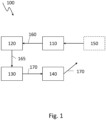
- Fig. 1 shows a schematic set-up of a system 100 for providing an exacerbation risk score 170 for a respiratory disease of a patient 150 according to a first embodiment of the invention.
- a measurement unit 110 measures a heart signal and/or a blood circulation signal of a patient 150.
- Measurement data 160 corresponding to the heart signal and/or the blood circulation signal are provided and received by the detection unit 120.
- the detection unit 120 is configured for detecting a cough event and/or a sneeze event 165 of the patient 150 in the measurement data 160.
- the calculation unit 130 is configured for calculating an exacerbation risk score 170 for the respiratory disease of the patient. This exacerbation risk score 170 is provided by the interface unit 140 to the patient 150 and/or to a physician.
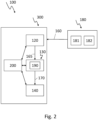
- Fig. 2 shows a schematic set-up of a system 100 for providing an exacerbation risk score 170 for a respiratory disease of a patient 150 according to a second embodiment of the invention.
- the measurement unit 110 is a wearable device 180 comprising a first sensor 181 and a second sensor 182.
- the first sensor 181 is configured for measuring the heart signal and/or the blood circulation signal of the patient 150.
- the second sensor 182 is configured for measuring the skin contact and thus provides data regarding the reliability of the data measured by the first sensor 181.
- the measurement data 160 are transmitted to a communication device 300 like a smartphone, a tablet, a smartwatch, smart glasses, etc.
- the wearable device 180 can be, for example, the smartwatch, or the wearable device 180 can comprise the detection unit 120, the calculation unit 130 and the interface unit 140.
- the communication device comprises in this embodiment of the invention the detection unit 120 for receiving the measurement data 160 and for detection a cough event and/or a sneeze event 165. These are provided to the calculation unit 130, which can comprise an artificial intelligence module 190 trained for providing the exacerbation risk score 170.
- the exacerbation risk score 170 is provided by the interface unit 140 to the patient 150 and/or top a physician.
- a processing unit 200 can be communicationally connected to the detection unit 120, the calculation unit 130 and the interface unit 140, and can be configured for controlling the detection unit 120, the calculation unit 130 and the interface unit 140 and for executing the steps of the method according to the invention.
- Fig. 3 shows a schematic set-up of a system 100 for providing an exacerbation risk score 170 for a respiratory disease of a patient 150 according to a third embodiment of the invention.
- a wearable unit 180 is attached to the wrist of a patient 150.
- the wearable unit 180 can be communicationally connected to a communication device 300, for example by a wireless connection like WLAN or Bluetooth.
- Fig. 4 shows the heart signal of a patient 150 measured by the measurement unit 110 during a cough event 165 of the patient 150.
- the amplitude A of a signal measured by the measurement unit 110 shows usually in case of no cough events and/or sneeze events a regular, sinus-like waveform measured over time t.
- a cough event 165 is detected due to a disruption of the regular waveform with a significantly fluctuating inter-beat interval.
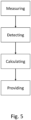
- Fig. 5 shows a block diagram of a method for providing an exacerbation risk score 170 for a respiratory disease of a patient 150 according to an embodiment not part of the invention.
- the method comprises a first step of measuring a heart signal and/or a blood circulation signal of a patient and providing corresponding measurement data 160. This step is followed by a second step of detecting a cough event and/or a sneeze event 165 of the patient 150 based on the measurement data 160.
- the third step comprises calculating an exacerbation risk score 170 for a respiratory disease of the patient 150 based on the detected cough event and/or the detected sneeze event 165.
- the exacerbation risk score 170 is provided to the patient 150 and/or to a physician.
Landscapes
- Health & Medical Sciences (AREA)
- Life Sciences & Earth Sciences (AREA)
- Engineering & Computer Science (AREA)
- Public Health (AREA)
- Medical Informatics (AREA)
- Biomedical Technology (AREA)
- Physics & Mathematics (AREA)
- Pathology (AREA)
- General Health & Medical Sciences (AREA)
- Animal Behavior & Ethology (AREA)
- Heart & Thoracic Surgery (AREA)
- Molecular Biology (AREA)
- Surgery (AREA)
- Veterinary Medicine (AREA)
- Biophysics (AREA)
- Physiology (AREA)
- Cardiology (AREA)
- Artificial Intelligence (AREA)
- Pulmonology (AREA)
- Signal Processing (AREA)
- Psychiatry (AREA)
- Computer Vision & Pattern Recognition (AREA)
- Evolutionary Computation (AREA)
- Mathematical Physics (AREA)
- Fuzzy Systems (AREA)
- Data Mining & Analysis (AREA)
- Databases & Information Systems (AREA)
- Epidemiology (AREA)
- Primary Health Care (AREA)
- Hematology (AREA)
- Measurement Of The Respiration, Hearing Ability, Form, And Blood Characteristics Of Living Organisms (AREA)
- Measuring And Recording Apparatus For Diagnosis (AREA)
- Measuring Pulse, Heart Rate, Blood Pressure Or Blood Flow (AREA)
Applications Claiming Priority (3)
| Application Number | Priority Date | Filing Date | Title |
|---|---|---|---|
| CN2019128293 | 2019-12-25 | ||
| EP20152921.1A EP3854299A1 (en) | 2020-01-21 | 2020-01-21 | Unobtrusive symptoms monitoring for allergic asthma patients |
| PCT/EP2020/087589 WO2021130206A1 (en) | 2019-12-25 | 2020-12-22 | Unobtrusive symptoms monitoring for allergic asthma patients |
Publications (2)
| Publication Number | Publication Date |
|---|---|
| EP4081102A1 EP4081102A1 (en) | 2022-11-02 |
| EP4081102B1 true EP4081102B1 (en) | 2024-11-13 |
Family
ID=74175825
Family Applications (1)
| Application Number | Title | Priority Date | Filing Date |
|---|---|---|---|
| EP20839038.5A Active EP4081102B1 (en) | 2019-12-25 | 2020-12-22 | Unobtrusive symptoms monitoring for allergic asthma patients |
Country Status (5)
| Country | Link |
|---|---|
| US (1) | US12076161B2 (enExample) |
| EP (1) | EP4081102B1 (enExample) |
| JP (1) | JP7584002B2 (enExample) |
| CN (1) | CN114901130B (enExample) |
| WO (1) | WO2021130206A1 (enExample) |
Families Citing this family (3)
| Publication number | Priority date | Publication date | Assignee | Title |
|---|---|---|---|---|
| US12076161B2 (en) * | 2019-12-25 | 2024-09-03 | Koninklijke Philips N.V. | Unobtrusive symptoms monitoring for allergic asthma patients |
| CN116491912B (zh) * | 2022-01-18 | 2026-09-11 | 华为技术有限公司 | 呼吸道疾病的预警装置、方法及终端设备 |
| JP2026085459A (ja) * | 2024-11-13 | 2026-05-25 | 国立大学法人 鹿児島大学 | 呼吸器疾患評価装置および呼吸器疾患評価方法 |
Family Cites Families (27)
| Publication number | Priority date | Publication date | Assignee | Title |
|---|---|---|---|---|
| WO2006002338A2 (en) * | 2004-06-24 | 2006-01-05 | Vivometrics, Inc. | Systems and methods for monitoring cough |
| US20060195035A1 (en) * | 2005-02-28 | 2006-08-31 | Dehchuan Sun | Non-invasive radial artery blood pressure waveform measuring apparatus system and uses thereof |
| CN1903117A (zh) | 2005-07-27 | 2007-01-31 | 孙德铨 | 非侵入性桡动脉血压波型量测系统及其应用 |
| JP4901309B2 (ja) * | 2006-05-31 | 2012-03-21 | 株式会社デンソー | 生体状態検出装置、制御装置、及び脈波センサ装着装置 |
| JP2008173280A (ja) * | 2007-01-18 | 2008-07-31 | Konica Minolta Medical & Graphic Inc | 咳検出システム |
| US20080243016A1 (en) | 2007-03-28 | 2008-10-02 | Cardiac Pacemakers, Inc. | Pulmonary Artery Pressure Signals And Methods of Using |
| EP2701131A2 (en) | 2008-05-12 | 2014-02-26 | Earlysense Ltd. | Monitoring, predicting and treating clinical episodes |
| JP5781926B2 (ja) * | 2008-06-17 | 2015-09-24 | コーニンクレッカ フィリップス エヌ ヴェ | 音声分類器とマイクロホンを用いる音響患者モニタリング |
| US9526429B2 (en) * | 2009-02-06 | 2016-12-27 | Resmed Sensor Technologies Limited | Apparatus, system and method for chronic disease monitoring |
| US8655441B2 (en) | 2009-04-16 | 2014-02-18 | Massachusetts Institute Of Technology | Methods and apparatus for monitoring patients and delivering therapeutic stimuli |
| EP3178387A1 (en) * | 2009-06-26 | 2017-06-14 | Gambro Lundia AB | Devices, a computer program product and a method for data extraction |
| CN103826682B (zh) * | 2011-09-22 | 2017-10-17 | 皇家飞利浦有限公司 | 补充气体递送和监测系统 |
| CN104717995B (zh) * | 2012-10-10 | 2017-12-29 | 皇家飞利浦有限公司 | 利用在面罩装置处的压力传感器的自适应患者回路补偿 |
| CN106163462A (zh) * | 2014-01-22 | 2016-11-23 | 恩坦蒂有限公司 | 用于打鼾检测和校正的方法和系统 |
| WO2016018906A1 (en) * | 2014-07-28 | 2016-02-04 | S & V Siu Associates, Llc | Method and apparatus for assessing respiratory distress |
| SG10201902151UA (en) | 2014-09-11 | 2019-04-29 | Berg Llc | Bayesian causal relationship network models for healthcare diagnosis and treatment based on patient data |
| CN108135534B (zh) | 2015-08-26 | 2022-04-05 | 瑞思迈传感器技术有限公司 | 监测和管理慢性疾病的系统与方法 |
| CN109475304B (zh) * | 2016-07-14 | 2022-07-29 | 皇家飞利浦有限公司 | 用于监测哮喘症状的系统和方法 |
| RU2653809C1 (ru) * | 2017-05-18 | 2018-05-14 | Федеральное государственное бюджетное образовательное учреждение высшего образования "Ярославский государственный медицинский университет" Министерства здравоохранения Российской Федерации | Способ дифференциальной диагностики затяжного кашля инфекционного и аллергического генеза при респираторных заболеваниях верхних дыхательных путей у детей от 2 до 17 лет |
| US11832970B2 (en) * | 2017-07-26 | 2023-12-05 | Cardiac Pacemakers, Inc. | Worsening heart failure stratification |
| WO2019096714A1 (en) * | 2017-11-17 | 2019-05-23 | Koninklijke Philips N.V. | Cough detection in a respiratory support system |
| US11690559B2 (en) * | 2017-12-06 | 2023-07-04 | Cardiac Pacemakers, Inc. | Method and apparatus for monitoring respiratory distress based on autonomic imbalance |
| CN108852317A (zh) * | 2018-07-17 | 2018-11-23 | 深圳乐测物联网科技有限公司 | 一种咳嗽的监测方法和健康监测装置 |
| US20210030276A1 (en) * | 2019-07-29 | 2021-02-04 | DawnLight Technologies Inc. | Remote Health Monitoring Systems and Method |
| CN111166336B (zh) * | 2019-11-22 | 2023-02-17 | 智纤至康(上海)智能科技有限公司 | 检测和监测咳嗽的装置及方法 |
| EP3838137A1 (en) * | 2019-12-19 | 2021-06-23 | Koninklijke Philips N.V. | Automated and objective symptom severity score |
| US12076161B2 (en) * | 2019-12-25 | 2024-09-03 | Koninklijke Philips N.V. | Unobtrusive symptoms monitoring for allergic asthma patients |
-
2020
- 2020-12-21 US US17/129,275 patent/US12076161B2/en active Active
- 2020-12-22 EP EP20839038.5A patent/EP4081102B1/en active Active
- 2020-12-22 WO PCT/EP2020/087589 patent/WO2021130206A1/en not_active Ceased
- 2020-12-22 CN CN202080090432.XA patent/CN114901130B/zh active Active
- 2020-12-22 JP JP2022532703A patent/JP7584002B2/ja active Active
Also Published As
| Publication number | Publication date |
|---|---|
| JP2023507912A (ja) | 2023-02-28 |
| JP7584002B2 (ja) | 2024-11-15 |
| US20210196194A1 (en) | 2021-07-01 |
| EP4081102A1 (en) | 2022-11-02 |
| CN114901130B (zh) | 2025-07-18 |
| WO2021130206A1 (en) | 2021-07-01 |
| US12076161B2 (en) | 2024-09-03 |
| CN114901130A (zh) | 2022-08-12 |
Similar Documents
| Publication | Publication Date | Title |
|---|---|---|
| JP6799536B2 (ja) | 加速度計を用いるウェアラブル痛みモニタ | |
| US9396643B2 (en) | Biometric authentication | |
| EP2395911B1 (en) | Detecting sleep disorders using heart activity | |
| US20170325717A1 (en) | Apparatus and method for assessing the severity of chronic obstructive pulmonary disease, copd, in a subject | |
| US20150164351A1 (en) | Calculating pulse transit time from chest vibrations | |
| WO2019217368A1 (en) | System for monitoring and providing alerts of a fall risk by predicting risk of experiencing symptoms related to abnormal blood pressure(s) and/or heart rate | |
| US12076161B2 (en) | Unobtrusive symptoms monitoring for allergic asthma patients | |
| BR112013029597A2 (pt) | "sistema e método de determinação de sono e estágios de sono de uma pessoa " | |
| KR20210104814A (ko) | 피험자 인식 정보를 이용한 혈압 모니터링 시스템 및 방법 | |
| EP3376947B1 (en) | Systems and methods for adaptable presentation of sensor data | |
| KR20190100657A (ko) | 환자 모니터링용 웨어러블 장치 및 이를 이용한 모니터링 방법 | |
| KR102556663B1 (ko) | 생체신호 모니터링 시스템 및 방법 | |
| EP3854299A1 (en) | Unobtrusive symptoms monitoring for allergic asthma patients | |
| WO2016137698A1 (en) | Calculating pulse transit time from chest vibrations | |
| JP6716888B2 (ja) | 呼吸解析装置、呼吸解析方法及びプログラム | |
| US20240164718A1 (en) | Method and system for on/off wearing detection of an accelerometer-based wearable device | |
| JP2026522916A (ja) | 脳震盪からの回復を判定する方法 | |
| BR102024002538A2 (pt) | Método e sistema híbrido para detecção de sonolência em múltiplos cenários e método para processamento de dados usando dados históricos e em tempo real em dispositivos vestíveis |
Legal Events
| Date | Code | Title | Description |
|---|---|---|---|
| STAA | Information on the status of an ep patent application or granted ep patent |
Free format text: STATUS: UNKNOWN |
|
| STAA | Information on the status of an ep patent application or granted ep patent |
Free format text: STATUS: THE INTERNATIONAL PUBLICATION HAS BEEN MADE |
|
| PUAI | Public reference made under article 153(3) epc to a published international application that has entered the european phase |
Free format text: ORIGINAL CODE: 0009012 |
|
| STAA | Information on the status of an ep patent application or granted ep patent |
Free format text: STATUS: REQUEST FOR EXAMINATION WAS MADE |
|
| 17P | Request for examination filed |
Effective date: 20220725 |
|
| AK | Designated contracting states |
Kind code of ref document: A1 Designated state(s): AL AT BE BG CH CY CZ DE DK EE ES FI FR GB GR HR HU IE IS IT LI LT LU LV MC MK MT NL NO PL PT RO RS SE SI SK SM TR |
|
| DAV | Request for validation of the european patent (deleted) | ||
| DAX | Request for extension of the european patent (deleted) | ||
| GRAP | Despatch of communication of intention to grant a patent |
Free format text: ORIGINAL CODE: EPIDOSNIGR1 |
|
| STAA | Information on the status of an ep patent application or granted ep patent |
Free format text: STATUS: GRANT OF PATENT IS INTENDED |
|
| INTG | Intention to grant announced |
Effective date: 20240611 |
|
| GRAS | Grant fee paid |
Free format text: ORIGINAL CODE: EPIDOSNIGR3 |
|
| GRAA | (expected) grant |
Free format text: ORIGINAL CODE: 0009210 |
|
| STAA | Information on the status of an ep patent application or granted ep patent |
Free format text: STATUS: THE PATENT HAS BEEN GRANTED |
|
| AK | Designated contracting states |
Kind code of ref document: B1 Designated state(s): AL AT BE BG CH CY CZ DE DK EE ES FI FR GB GR HR HU IE IS IT LI LT LU LV MC MK MT NL NO PL PT RO RS SE SI SK SM TR |
|
| REG | Reference to a national code |
Ref country code: GB Ref legal event code: FG4D |
|
| REG | Reference to a national code |
Ref country code: CH Ref legal event code: EP |
|
| REG | Reference to a national code |
Ref country code: IE Ref legal event code: FG4D |
|
| REG | Reference to a national code |
Ref country code: DE Ref legal event code: R096 Ref document number: 602020041431 Country of ref document: DE |
|
| REG | Reference to a national code |
Ref country code: LT Ref legal event code: MG9D |
|
| REG | Reference to a national code |
Ref country code: NL Ref legal event code: MP Effective date: 20241113 |
|
| PG25 | Lapsed in a contracting state [announced via postgrant information from national office to epo] |
Ref country code: PT Free format text: LAPSE BECAUSE OF FAILURE TO SUBMIT A TRANSLATION OF THE DESCRIPTION OR TO PAY THE FEE WITHIN THE PRESCRIBED TIME-LIMIT Effective date: 20250313 Ref country code: IS Free format text: LAPSE BECAUSE OF FAILURE TO SUBMIT A TRANSLATION OF THE DESCRIPTION OR TO PAY THE FEE WITHIN THE PRESCRIBED TIME-LIMIT Effective date: 20250313 Ref country code: HR Free format text: LAPSE BECAUSE OF FAILURE TO SUBMIT A TRANSLATION OF THE DESCRIPTION OR TO PAY THE FEE WITHIN THE PRESCRIBED TIME-LIMIT Effective date: 20241113 |
|
| PG25 | Lapsed in a contracting state [announced via postgrant information from national office to epo] |
Ref country code: FI Free format text: LAPSE BECAUSE OF FAILURE TO SUBMIT A TRANSLATION OF THE DESCRIPTION OR TO PAY THE FEE WITHIN THE PRESCRIBED TIME-LIMIT Effective date: 20241113 Ref country code: NL Free format text: LAPSE BECAUSE OF FAILURE TO SUBMIT A TRANSLATION OF THE DESCRIPTION OR TO PAY THE FEE WITHIN THE PRESCRIBED TIME-LIMIT Effective date: 20241113 |
|
| REG | Reference to a national code |
Ref country code: AT Ref legal event code: MK05 Ref document number: 1740987 Country of ref document: AT Kind code of ref document: T Effective date: 20241113 |
|
| PG25 | Lapsed in a contracting state [announced via postgrant information from national office to epo] |
Ref country code: BG Free format text: LAPSE BECAUSE OF FAILURE TO SUBMIT A TRANSLATION OF THE DESCRIPTION OR TO PAY THE FEE WITHIN THE PRESCRIBED TIME-LIMIT Effective date: 20241113 |
|
| PG25 | Lapsed in a contracting state [announced via postgrant information from national office to epo] |
Ref country code: ES Free format text: LAPSE BECAUSE OF FAILURE TO SUBMIT A TRANSLATION OF THE DESCRIPTION OR TO PAY THE FEE WITHIN THE PRESCRIBED TIME-LIMIT Effective date: 20241113 |
|
| PG25 | Lapsed in a contracting state [announced via postgrant information from national office to epo] |
Ref country code: NO Free format text: LAPSE BECAUSE OF FAILURE TO SUBMIT A TRANSLATION OF THE DESCRIPTION OR TO PAY THE FEE WITHIN THE PRESCRIBED TIME-LIMIT Effective date: 20250213 |
|
| PG25 | Lapsed in a contracting state [announced via postgrant information from national office to epo] |
Ref country code: GR Free format text: LAPSE BECAUSE OF FAILURE TO SUBMIT A TRANSLATION OF THE DESCRIPTION OR TO PAY THE FEE WITHIN THE PRESCRIBED TIME-LIMIT Effective date: 20250214 Ref country code: LV Free format text: LAPSE BECAUSE OF FAILURE TO SUBMIT A TRANSLATION OF THE DESCRIPTION OR TO PAY THE FEE WITHIN THE PRESCRIBED TIME-LIMIT Effective date: 20241113 Ref country code: AT Free format text: LAPSE BECAUSE OF FAILURE TO SUBMIT A TRANSLATION OF THE DESCRIPTION OR TO PAY THE FEE WITHIN THE PRESCRIBED TIME-LIMIT Effective date: 20241113 |
|
| PG25 | Lapsed in a contracting state [announced via postgrant information from national office to epo] |
Ref country code: PL Free format text: LAPSE BECAUSE OF FAILURE TO SUBMIT A TRANSLATION OF THE DESCRIPTION OR TO PAY THE FEE WITHIN THE PRESCRIBED TIME-LIMIT Effective date: 20241113 |
|
| PG25 | Lapsed in a contracting state [announced via postgrant information from national office to epo] |
Ref country code: RS Free format text: LAPSE BECAUSE OF FAILURE TO SUBMIT A TRANSLATION OF THE DESCRIPTION OR TO PAY THE FEE WITHIN THE PRESCRIBED TIME-LIMIT Effective date: 20250213 |
|
| PG25 | Lapsed in a contracting state [announced via postgrant information from national office to epo] |
Ref country code: SM Free format text: LAPSE BECAUSE OF FAILURE TO SUBMIT A TRANSLATION OF THE DESCRIPTION OR TO PAY THE FEE WITHIN THE PRESCRIBED TIME-LIMIT Effective date: 20241113 |
|
| PG25 | Lapsed in a contracting state [announced via postgrant information from national office to epo] |
Ref country code: DK Free format text: LAPSE BECAUSE OF FAILURE TO SUBMIT A TRANSLATION OF THE DESCRIPTION OR TO PAY THE FEE WITHIN THE PRESCRIBED TIME-LIMIT Effective date: 20241113 |
|
| PG25 | Lapsed in a contracting state [announced via postgrant information from national office to epo] |
Ref country code: EE Free format text: LAPSE BECAUSE OF FAILURE TO SUBMIT A TRANSLATION OF THE DESCRIPTION OR TO PAY THE FEE WITHIN THE PRESCRIBED TIME-LIMIT Effective date: 20241113 |
|
| PG25 | Lapsed in a contracting state [announced via postgrant information from national office to epo] |
Ref country code: RO Free format text: LAPSE BECAUSE OF FAILURE TO SUBMIT A TRANSLATION OF THE DESCRIPTION OR TO PAY THE FEE WITHIN THE PRESCRIBED TIME-LIMIT Effective date: 20241113 |
|
| PG25 | Lapsed in a contracting state [announced via postgrant information from national office to epo] |
Ref country code: SK Free format text: LAPSE BECAUSE OF FAILURE TO SUBMIT A TRANSLATION OF THE DESCRIPTION OR TO PAY THE FEE WITHIN THE PRESCRIBED TIME-LIMIT Effective date: 20241113 |
|
| PG25 | Lapsed in a contracting state [announced via postgrant information from national office to epo] |
Ref country code: CZ Free format text: LAPSE BECAUSE OF FAILURE TO SUBMIT A TRANSLATION OF THE DESCRIPTION OR TO PAY THE FEE WITHIN THE PRESCRIBED TIME-LIMIT Effective date: 20241113 |
|
| PG25 | Lapsed in a contracting state [announced via postgrant information from national office to epo] |
Ref country code: IT Free format text: LAPSE BECAUSE OF FAILURE TO SUBMIT A TRANSLATION OF THE DESCRIPTION OR TO PAY THE FEE WITHIN THE PRESCRIBED TIME-LIMIT Effective date: 20241113 |
|
| REG | Reference to a national code |
Ref country code: CH Ref legal event code: PL |
|
| REG | Reference to a national code |
Ref country code: DE Ref legal event code: R097 Ref document number: 602020041431 Country of ref document: DE |
|
| PG25 | Lapsed in a contracting state [announced via postgrant information from national office to epo] |
Ref country code: LU Free format text: LAPSE BECAUSE OF NON-PAYMENT OF DUE FEES Effective date: 20241222 |
|
| PG25 | Lapsed in a contracting state [announced via postgrant information from national office to epo] |
Ref country code: SE Free format text: LAPSE BECAUSE OF FAILURE TO SUBMIT A TRANSLATION OF THE DESCRIPTION OR TO PAY THE FEE WITHIN THE PRESCRIBED TIME-LIMIT Effective date: 20241113 |
|
| PG25 | Lapsed in a contracting state [announced via postgrant information from national office to epo] |
Ref country code: MC Free format text: LAPSE BECAUSE OF FAILURE TO SUBMIT A TRANSLATION OF THE DESCRIPTION OR TO PAY THE FEE WITHIN THE PRESCRIBED TIME-LIMIT Effective date: 20241113 |
|
| PLBE | No opposition filed within time limit |
Free format text: ORIGINAL CODE: 0009261 |
|
| STAA | Information on the status of an ep patent application or granted ep patent |
Free format text: STATUS: NO OPPOSITION FILED WITHIN TIME LIMIT |
|
| REG | Reference to a national code |
Ref country code: BE Ref legal event code: MM Effective date: 20241231 |
|
| PG25 | Lapsed in a contracting state [announced via postgrant information from national office to epo] |
Ref country code: BE Free format text: LAPSE BECAUSE OF NON-PAYMENT OF DUE FEES Effective date: 20241231 |
|
| PG25 | Lapsed in a contracting state [announced via postgrant information from national office to epo] |
Ref country code: FR Free format text: LAPSE BECAUSE OF NON-PAYMENT OF DUE FEES Effective date: 20250113 |
|
| PG25 | Lapsed in a contracting state [announced via postgrant information from national office to epo] |
Ref country code: CH Free format text: LAPSE BECAUSE OF NON-PAYMENT OF DUE FEES Effective date: 20241231 |
|
| 26N | No opposition filed |
Effective date: 20250814 |
|
| PG25 | Lapsed in a contracting state [announced via postgrant information from national office to epo] |
Ref country code: IE Free format text: LAPSE BECAUSE OF NON-PAYMENT OF DUE FEES Effective date: 20241222 |
|
| GBPC | Gb: european patent ceased through non-payment of renewal fee |
Effective date: 20250213 |
|
| PG25 | Lapsed in a contracting state [announced via postgrant information from national office to epo] |
Ref country code: GB Free format text: LAPSE BECAUSE OF NON-PAYMENT OF DUE FEES Effective date: 20250213 |
|
| PGFP | Annual fee paid to national office [announced via postgrant information from national office to epo] |
Ref country code: DE Payment date: 20251229 Year of fee payment: 6 |
|
| PG25 | Lapsed in a contracting state [announced via postgrant information from national office to epo] |
Ref country code: CY Free format text: LAPSE BECAUSE OF FAILURE TO SUBMIT A TRANSLATION OF THE DESCRIPTION OR TO PAY THE FEE WITHIN THE PRESCRIBED TIME-LIMIT Effective date: 20241113 |
|
| PG25 | Lapsed in a contracting state [announced via postgrant information from national office to epo] |
Ref country code: TR Free format text: LAPSE BECAUSE OF FAILURE TO SUBMIT A TRANSLATION OF THE DESCRIPTION OR TO PAY THE FEE WITHIN THE PRESCRIBED TIME-LIMIT Effective date: 20241113 |
|
| PG25 | Lapsed in a contracting state [announced via postgrant information from national office to epo] |
Ref country code: HU Free format text: LAPSE BECAUSE OF FAILURE TO SUBMIT A TRANSLATION OF THE DESCRIPTION OR TO PAY THE FEE WITHIN THE PRESCRIBED TIME-LIMIT; INVALID AB INITIO Effective date: 20201222 |
|
| PG25 | Lapsed in a contracting state [announced via postgrant information from national office to epo] |
Ref country code: SI Free format text: LAPSE BECAUSE OF FAILURE TO SUBMIT A TRANSLATION OF THE DESCRIPTION OR TO PAY THE FEE WITHIN THE PRESCRIBED TIME-LIMIT Effective date: 20241113 |
|
| PG25 | Lapsed in a contracting state [announced via postgrant information from national office to epo] |
Ref country code: LT Free format text: LAPSE BECAUSE OF FAILURE TO SUBMIT A TRANSLATION OF THE DESCRIPTION OR TO PAY THE FEE WITHIN THE PRESCRIBED TIME-LIMIT Effective date: 20241113 |