EP4080593A1 - Phasenwechselschaltervorrichtung und herstellungsverfahren dafür - Google Patents
Phasenwechselschaltervorrichtung und herstellungsverfahren dafür Download PDFInfo
- Publication number
- EP4080593A1 EP4080593A1 EP21169832.9A EP21169832A EP4080593A1 EP 4080593 A1 EP4080593 A1 EP 4080593A1 EP 21169832 A EP21169832 A EP 21169832A EP 4080593 A1 EP4080593 A1 EP 4080593A1
- Authority
- EP
- European Patent Office
- Prior art keywords
- substrate
- electrically conducting
- phase change
- conducting layer
- switch
- Prior art date
- Legal status (The legal status is an assumption and is not a legal conclusion. Google has not performed a legal analysis and makes no representation as to the accuracy of the status listed.)
- Withdrawn
Links
- 230000008859 change Effects 0.000 title claims abstract description 36
- 238000000034 method Methods 0.000 title claims description 23
- 238000004519 manufacturing process Methods 0.000 title claims description 21
- 239000000758 substrate Substances 0.000 claims abstract description 106
- 229910052751 metal Inorganic materials 0.000 claims abstract description 18
- 239000002184 metal Substances 0.000 claims abstract description 18
- 239000004065 semiconductor Substances 0.000 claims abstract description 16
- 239000002019 doping agent Substances 0.000 claims abstract description 4
- 239000012782 phase change material Substances 0.000 claims description 75
- XUIMIQQOPSSXEZ-UHFFFAOYSA-N Silicon Chemical compound [Si] XUIMIQQOPSSXEZ-UHFFFAOYSA-N 0.000 description 9
- 229910052710 silicon Inorganic materials 0.000 description 9
- 239000010703 silicon Substances 0.000 description 9
- 239000000463 material Substances 0.000 description 7
- 239000003989 dielectric material Substances 0.000 description 5
- 238000010438 heat treatment Methods 0.000 description 5
- 230000008569 process Effects 0.000 description 5
- 238000012545 processing Methods 0.000 description 5
- 239000000969 carrier Substances 0.000 description 4
- 238000012546 transfer Methods 0.000 description 4
- 230000008878 coupling Effects 0.000 description 3
- 238000010168 coupling process Methods 0.000 description 3
- 238000005859 coupling reaction Methods 0.000 description 3
- 150000002739 metals Chemical class 0.000 description 3
- 238000013459 approach Methods 0.000 description 2
- 230000004888 barrier function Effects 0.000 description 2
- 239000003990 capacitor Substances 0.000 description 2
- 238000001816 cooling Methods 0.000 description 2
- 238000002425 crystallisation Methods 0.000 description 2
- 230000008025 crystallization Effects 0.000 description 2
- 238000000151 deposition Methods 0.000 description 2
- 239000011521 glass Substances 0.000 description 2
- 239000000155 melt Substances 0.000 description 2
- 238000000059 patterning Methods 0.000 description 2
- 229910021420 polycrystalline silicon Inorganic materials 0.000 description 2
- WFKWXMTUELFFGS-UHFFFAOYSA-N tungsten Chemical compound [W] WFKWXMTUELFFGS-UHFFFAOYSA-N 0.000 description 2
- 229910052721 tungsten Inorganic materials 0.000 description 2
- 239000010937 tungsten Substances 0.000 description 2
- OKTJSMMVPCPJKN-UHFFFAOYSA-N Carbon Chemical compound [C] OKTJSMMVPCPJKN-UHFFFAOYSA-N 0.000 description 1
- RYGMFSIKBFXOCR-UHFFFAOYSA-N Copper Chemical compound [Cu] RYGMFSIKBFXOCR-UHFFFAOYSA-N 0.000 description 1
- 229910052581 Si3N4 Inorganic materials 0.000 description 1
- VYPSYNLAJGMNEJ-UHFFFAOYSA-N Silicium dioxide Chemical compound O=[Si]=O VYPSYNLAJGMNEJ-UHFFFAOYSA-N 0.000 description 1
- 230000006978 adaptation Effects 0.000 description 1
- 229910052799 carbon Inorganic materials 0.000 description 1
- 230000015556 catabolic process Effects 0.000 description 1
- 239000004020 conductor Substances 0.000 description 1
- 229910052802 copper Inorganic materials 0.000 description 1
- 239000010949 copper Substances 0.000 description 1
- PMHQVHHXPFUNSP-UHFFFAOYSA-M copper(1+);methylsulfanylmethane;bromide Chemical compound Br[Cu].CSC PMHQVHHXPFUNSP-UHFFFAOYSA-M 0.000 description 1
- 238000006731 degradation reaction Methods 0.000 description 1
- 230000001419 dependent effect Effects 0.000 description 1
- 230000008021 deposition Effects 0.000 description 1
- 238000013461 design Methods 0.000 description 1
- 229910003460 diamond Inorganic materials 0.000 description 1
- 239000010432 diamond Substances 0.000 description 1
- 238000005516 engineering process Methods 0.000 description 1
- -1 for example Substances 0.000 description 1
- GPMBECJIPQBCKI-UHFFFAOYSA-N germanium telluride Chemical compound [Te]=[Ge]=[Te] GPMBECJIPQBCKI-UHFFFAOYSA-N 0.000 description 1
- 230000010354 integration Effects 0.000 description 1
- 239000000203 mixture Substances 0.000 description 1
- 238000010295 mobile communication Methods 0.000 description 1
- HQVNEWCFYHHQES-UHFFFAOYSA-N silicon nitride Chemical compound N12[Si]34N5[Si]62N3[Si]51N64 HQVNEWCFYHHQES-UHFFFAOYSA-N 0.000 description 1
- 229910052814 silicon oxide Inorganic materials 0.000 description 1
Images



Classifications
-
- H—ELECTRICITY
- H10—SEMICONDUCTOR DEVICES; ELECTRIC SOLID-STATE DEVICES NOT OTHERWISE PROVIDED FOR
- H10N—ELECTRIC SOLID-STATE DEVICES NOT OTHERWISE PROVIDED FOR
- H10N70/00—Solid-state devices having no potential barriers, and specially adapted for rectifying, amplifying, oscillating or switching
- H10N70/011—Manufacture or treatment of multistable switching devices
-
- H—ELECTRICITY
- H10—SEMICONDUCTOR DEVICES; ELECTRIC SOLID-STATE DEVICES NOT OTHERWISE PROVIDED FOR
- H10N—ELECTRIC SOLID-STATE DEVICES NOT OTHERWISE PROVIDED FOR
- H10N70/00—Solid-state devices having no potential barriers, and specially adapted for rectifying, amplifying, oscillating or switching
- H10N70/20—Multistable switching devices, e.g. memristors
- H10N70/231—Multistable switching devices, e.g. memristors based on solid-state phase change, e.g. between amorphous and crystalline phases, Ovshinsky effect
-
- H—ELECTRICITY
- H10—SEMICONDUCTOR DEVICES; ELECTRIC SOLID-STATE DEVICES NOT OTHERWISE PROVIDED FOR
- H10N—ELECTRIC SOLID-STATE DEVICES NOT OTHERWISE PROVIDED FOR
- H10N70/00—Solid-state devices having no potential barriers, and specially adapted for rectifying, amplifying, oscillating or switching
- H10N70/801—Constructional details of multistable switching devices
-
- H—ELECTRICITY
- H10—SEMICONDUCTOR DEVICES; ELECTRIC SOLID-STATE DEVICES NOT OTHERWISE PROVIDED FOR
- H10N—ELECTRIC SOLID-STATE DEVICES NOT OTHERWISE PROVIDED FOR
- H10N70/00—Solid-state devices having no potential barriers, and specially adapted for rectifying, amplifying, oscillating or switching
- H10N70/801—Constructional details of multistable switching devices
- H10N70/821—Device geometry
- H10N70/823—Device geometry adapted for essentially horizontal current flow, e.g. bridge type devices
-
- H—ELECTRICITY
- H10—SEMICONDUCTOR DEVICES; ELECTRIC SOLID-STATE DEVICES NOT OTHERWISE PROVIDED FOR
- H10N—ELECTRIC SOLID-STATE DEVICES NOT OTHERWISE PROVIDED FOR
- H10N70/00—Solid-state devices having no potential barriers, and specially adapted for rectifying, amplifying, oscillating or switching
- H10N70/801—Constructional details of multistable switching devices
- H10N70/861—Thermal details
-
- H—ELECTRICITY
- H10—SEMICONDUCTOR DEVICES; ELECTRIC SOLID-STATE DEVICES NOT OTHERWISE PROVIDED FOR
- H10N—ELECTRIC SOLID-STATE DEVICES NOT OTHERWISE PROVIDED FOR
- H10N70/00—Solid-state devices having no potential barriers, and specially adapted for rectifying, amplifying, oscillating or switching
- H10N70/801—Constructional details of multistable switching devices
- H10N70/861—Thermal details
- H10N70/8613—Heating or cooling means other than resistive heating electrodes, e.g. heater in parallel
-
- H—ELECTRICITY
- H10—SEMICONDUCTOR DEVICES; ELECTRIC SOLID-STATE DEVICES NOT OTHERWISE PROVIDED FOR
- H10N—ELECTRIC SOLID-STATE DEVICES NOT OTHERWISE PROVIDED FOR
- H10N79/00—Integrated devices, or assemblies of multiple devices, comprising at least one solid-state element covered by group H10N70/00
-
- H—ELECTRICITY
- H10—SEMICONDUCTOR DEVICES; ELECTRIC SOLID-STATE DEVICES NOT OTHERWISE PROVIDED FOR
- H10N—ELECTRIC SOLID-STATE DEVICES NOT OTHERWISE PROVIDED FOR
- H10N70/00—Solid-state devices having no potential barriers, and specially adapted for rectifying, amplifying, oscillating or switching
- H10N70/801—Constructional details of multistable switching devices
- H10N70/881—Switching materials
- H10N70/882—Compounds of sulfur, selenium or tellurium, e.g. chalcogenides
- H10N70/8828—Tellurides, e.g. GeSbTe
Definitions
- the present application relates to switch devices and methods for manufacturing switch devices.
- phase change switches are considered as promising candidates for switching RF signals.
- phase change switches use a phase change material (PCM) which typically exhibits a higher electric conductivity in a crystalline phase state than in an amorphous phase state.
- a heater is employed heating the phase change material causing crystallization.
- This switching on is also referred to as a set operation of the switching device.
- the heater is actuated in such a way that the temperature of the phase change material is above its crystallization temperature, typically about 250°C, but below the melt temperature of typically in a range of 600°C to 900°C, for example.
- the length of the heating pulse caused by the heater is chosen such that any amorphous region present in the PCM can regrow into the crystalline phase state.
- the heater When switching off the switching device, also referred to as reset operation, the heater is actuated in such a way that the temperature of the PCM is raised above the melt temperature (for example above about 600°C to 900°C), followed by rapid cooldown which freezes the phase change material into an amorphous state.
- the above-mentioned rapid cooldown is typically achieved by placing the heater and PCM close to a substrate used, which may be a silicon substrate.
- a substrate used which may be a silicon substrate.
- Such a silicon substrate has good heat conduction properties and therefore assists the cooldown.
- the close proximity of the phase change switch to the substrate may also cause noise from free carriers or traps in the substrate to influence the behavior of the switch, which may for example lead to a degradation of linearity and generation of higher harmonic signals in radio frequency applications.
- An alternative approach for cooling is the use of a layer of dielectric material with high thermal conductivity which is essentially electrically isolating (low electrical conductivity). While materials with such properties are known, for example diamond like carbon, aluminum nitride and the like, thermal restrictions in semiconductor processing usually do not allow deposition of these materials with sufficiently high quality, especially when integrating phase change switches with other passive or active devices on a silicon substrate.
- a switch device as defined in claim 1 and a method as defined in claim 14 are provided.
- the dependent claims define further embodiments.
- a switch device comprising:
- a method for manufacturing a switch device comprising:
- additional features may be provided, for example features used in conventional switch devices using phase change materials.
- embodiments described herein relate to providing an electrically conducting layer between a phase change switch and a substrate, and other components and features, like control circuitry for controlling a heater, radio frequency (RF) circuitry using the switch device and the like may be implemented in a conventional manner.
- additional components may be integrated with the described switch devices on the same substrate, but may also be provided separately for example, on one or more separate chip dies, which in some implementations then may be combined with a switch device in a common package.
- manufacturing implementations like providing phase change material on a substrate like a silicon substrate to implement a phase change switch, providing phase change material in a trench in a silicon substrate for manufacturing the switch device and the like may be performed in any conventional manner.
- phase change switch A switch based on a phase change material (PCM) will be referred to as a phase change switch or short PCM switch herein.
- phase change switches may be set to a crystalline phase state or an amorphous phase change, thus changing the resistance of the phase change material and therefore of the switch by several orders of magnitude.
- an onresistance of a switch in a range of 1 to 100 ⁇ may be achieved, whereas an off-resistance may be several orders of magnitude higher, for example at least in the kilo ohm range.
- FIG. 1 illustrates a switch device according to an embodiment.
- substrate 10 may be an undoped silicon substrate or other semiconductor substrate, but is not limited thereto.
- substrate 10 may for example be a glass substrate or a doped silicon substrate.
- electrically conducting layer 11 is provided above substrate 10, an electrically conducting layer 11 is provided.
- Electrically conducting layer 11 refers to a layer having a high electric conductivity corresponding to low electric resistivity, for example a resistivity of 10m ⁇ cm or less.
- a semiconductor material like polycrystalline silicon with a dopant concentration of at least 10 19 /cm 3 may be used.
- metals for example copper or tungsten may be used for the electrically conducting layer.
- electrically conducting layer 11 may be a continuous layer, but also may be a patterned layer, discontinuous layer, include several sub-layers, be a layer with varying thickness, etc.
- phase change switch 12 usually includes a heater and a phase change material and may be operated as described above.
- a suitable phase change material is for example germanium telluride.
- the heater may be made of a material like polycrystalline silicon or tungsten.
- the heater is then controlled by a controller (not shown in Fig 1 ) in a conventional manner to change the state of the phase change material.
- the phase change switch may be used to switch radio frequency (RF) signals.
- RF radio frequency
- Radio frequency refers to signals having a frequency of at least 1 MHz, for example above 100 MHz, for example in the gigahertz (GHz) range.
- phase change switch 12 may be used in antenna tuning applications to selectively couple tuning elements like capacitors or inductors to an antenna.
- Electrically conducting layer 11 in embodiments serves two functions: on the one hand, it serves to transport heat away from PCM switch 12, to enable a rapid cooling after heating. In some embodiments, heat may be transported away from PCM switch 12 to the sides of the arrangements shown in Fig 1 . For example, heat may be conducted laterally towards bond pads or the like. In other embodiments, additionally or alternatively, heat may be transported from PCM switch 12 to substrate 10 via electrically conducting layer 11. In this sense, electrically conducting layer 11 may be referred to as a heat pipe. It should be noted that electrically conducting materials like metals or highly doped semiconductors generally also exhibit a high heat conductivity and thus may serve to transport heat effectively.
- electrically conducting layer 11 serves as a radio frequency shielding, shielding PCM switch 12 from substrate 10 and possible from further layers between electrically conducting layer 11 and substrate 10.
- This radio frequency shielding may contribute to increasing a linearity of the switch device of Fig. 1 , as for example an influence of free carriers or traps in substrate 10 on the behavior of PCM switch 12 is at least significantly reduced, if not suppressed entirely. This may lead to relaxed requirements regarding substrate 10.
- silicon substrates or other semiconductor substrates with as low doping as possible may be used to reduce free carriers
- higher doped semiconductor substrates which may be cheaper, or other kinds of substrate like glass substrates may be used.
- active or passive elements may be provided on substrate 10 between substrate 10 and electrically conducting layer 11, without greatly affecting the behavior of PCM switch 12.
- substrate properties like free carriers, noise, resistivity and thermal conductivity have no or little relevance with the electrically conducting layer 11 being provided.
- Electrically conducting layer 11 may be provided essentially in a standard back end of line (BEOL) semiconductor process and is therefore comparatively easy to manufacture with standard semiconductor technology.
- the electrically conducting layer 11 may also block light, in particular infrared light, generated by a heater of phase change switch 12. Such light otherwise could be absorbed by substrate 10, which may lead to noise or nonlinearities for PCM switch 12 or other devices manufactured on substrate 10.
- Fig. 1 shows a basic configuration of some embodiments. Within this basic configuration, many variations are possible, as will now be explained with reference to Figs. 5 to 7 . The explanations for Fig. 1 , however, are also applicable to Figs. 2 to 7 and will therefore not be repeated for every figure.
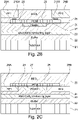
- Figs. 2A to 2D show cross-sectional views of switch devices according to some embodiments.
- the embodiments of Figs. 2B to 2D are variations of the embodiment of Fig. 2A .
- the differences of the embodiments of Figs. 2B to 2D with respect to Fig. 2A will be described, without repeating the description for the parts which remain the same.
- the switch device of Fig. 2A is provided on a substrate 21, which may correspond to substrate 10 of Fig. 1 and to which the same considerations apply.
- a dielectric buffer layer 22 is provided, for example made of silicon oxide, silicon nitride or any other dielectric conventionally used in semiconductor device processing. In other embodiments, buffer layer 22 may be omitted.
- an electrically conducting layer 23 is provided, which may correspond to electrically conducting layer 11 of Fig. 1 , and the corresponding explanations apply also to electrically conducting layer 23 of Fig. 2A .
- Buffer layer 24 provides a non-electrically conductive barrier between electrically conducting layer 23 and the actual PCM switch.
- the PCM switch includes a phase change material 26 provided on buffer layer 24 and a heater 27 provided on phase change material 26. Heater 27 and phase change material 26 are separated by a barrier layer 28, for example a dielectric layer.
- Contact elements 29A and 29B for coupling for example to a radio frequency (RF) device to receive/transmit/switch signals RF1, RF2 are provided, which are electrically coupled to phase change material 26 via vertical interconnects (VIAs) 210A, 210B, respectively.
- Contact elements 29A, 29B may for example include leads, strip lines, RF wiring or signal lines.
- Contact elements 29A, 29B as well as vertical interconnects 210A, 210B may be formed in a conventional back end of line (BEOL) process, within one or more BEOL dielectric layers 25.
- Heater 27 may be contacted by further contact elements (not shown), which for example may be arranged on both sides of the cross-section shown in Fig. 2B in a direction perpendicular to the cross-section shown.
- Fig. 2B the arrangement of phase change material 26 and heater 27 is exchanged compared to Fig. 2A , i.e. the heater is provided between phase change material 26 and electrically conducting layer 23 as shown in Fig. 2B , whereas in Fig. 2A phase change material 26 is arranged between heater 27 and electrically conducting layer 23.
- the embodiment of Fig. 2B corresponds to the embodiment of Fig. 2A .
- contact elements 29A, 29B are arranged in buffer layer 24 to contact phase change material 26 from "below", i.e. on a side of phase change material 26 facing substrate 21, whereas in Figs. 2A and 2B , contact elements 29A, 29B contact phase change material 26 on a side of phase change material 26 facing away from substrate 21, i.e. from “above”.
- terms like "above” and “below” are to be understood as relative to the substrate (i.e. the substrate is at the "bottom” of the arrangement) for easy explanation, but is not to be construed as implying any necessary orientation of the complete device in space.
- the switch devices shown may be incorporated in any orientation desired for a particular application.
- Figs. 2A to 2C offer different advantages and may be selected depending on implementations.
- the heat flow from heater 27 to electrically conducting layer 23 is through phase change material 26, which may allow for a more efficient heating in some embodiments.
- a capacitive coupling between heater 27 and the radio frequency signals RF1, RF2 may be reduced.
- Fig. 2C may offer advantages in terms of manufacturing complexity in standard semiconductor manufacturing processes.
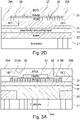
- Fig. 2D shows a cross-section of a further embodiment, which essentially has the arrangement of heater and PCM as in Fig. 2A (phase change material 26 between heater 27 and substrate 21) and the contacting of phase change material 26 by contact elements 29A, 29B from “below” as in Fig. 2C .
- phase change material 26 may ease manufacturing complexity as in Fig. 2C , and the arrangement of phase change material 26 between heater 27 and electrically conducting layer 23 may increase heating efficiency in some implementations.
- Figs. 3A to 6 the arrangement of heater 27, phase change material 26 and contact elements 29A, 29B as in Fig. 2A is used.
- the configuration shown in Figs. 2B, 2C or 2D may be equally used.
- these embodiments are variations of the embodiment of Fig. 2A , and again like elements bear the same reference numerals and will not be described again in detail. Instead, only the variations to the embodiment of Fig. 2A will be described.
- the electrically conducting layer is designed to provide a heat transfer to substrate 21.
- the electrically conducting layer includes a continuous portion 30 and a thickened portion 30A extending below phase change material 26 to substrate 21 as shown. Thickened portion 30A may be contact substrate 21 or may be separated from substrate 21 by a thin portion of buffer 22. In this way, in some implementations, heat may be transported to substrate 21 more efficiently by facilitating a vertical heat transfer towards substrate 21 through electrically conducting layer 30, 30A.
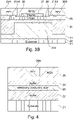
- Fig. 3B shows a similar arrangement. However, here, a continuous portion 31 is arranged close to substrate 21 (separated from substrate 21 through buffer 22 in Fig. 3B , but may also contact substrate 21 directly), with a thickened portion 31A being provided extending from continuous portion 31 towards phase change material 26. Also here, a vertical heat transfer from phase change material 26 to substrate 21 may be facilitated.
- Figs. 3A and 3B correspond to the embodiment of Fig. 2A .
- the electrically conducting layer together with the contact terminals 29A, 29B may essentially form a microstripline design. This is illustrated in Fig. 4 , which shows a cross-sectional view of an embodiment through contact element 29A in a direction perpendicular to the view of Fig. 2A .
- a microstripline for conducting radio frequency signals is then essentially formed by coupling electrically conducting layer 23 to ground.
- This microstripline may be designed to have a defined impedance, for example to provide a 50 ⁇ impedance wiring.
- the electrically conducting layer is shown as a continuous layer. In other embodiments, patterned layers may be used. This will be explained with reference to Figs. 5A to 5D .
- Fig. 5A is a cross-section of a switch device according to a further embodiment.
- the electrically conducting layer consists of vertical columns 51 and a horizontal portion 52.
- Vertical columns 51 similar to portions 30A, 31A of Figs. 3A and 3B , may facilitate vertical heat transfer towards substrate 21.
- Other patterned electrically conductive layers are also possible. Examples are shown in Figs. 5B to 5D , each showing a plan view of an example electrically conducting layer.
- Fig. 5B shows an electrically conducting layer 53 having a slotted pattern
- Figs. 5C shows an electrically conducting layer 54 having holes
- Fig. 5D shows an electrically conducting layer 55 having pillars or columns.
- the pattern may be selected based on various criteria like overall impedance, thermal properties (heat conduction) or electrical properties. Furthermore, additionally or alternatively, the pattern may be made based on processing requirements. For example, for metal layer often a certain filling is desirable, i.e. a certain amount to which metal is present in a particular metal layer in processing, or may involve so-called "cheesing", which correspond to small rectangular cut outs in a continuous metal layer. Such process requirements may be taken into account in the pattern used for the electrically conducting layer.
- the electrically conducting layer may include several sub-layers, which may be patterned or unpatterned.
- FIG. 6 shows a cross-section of a switch device according to a further embodiment.
- the electrically conducting layer includes a first sub-layer 60, which is essentially continuous, and a second sub-layer 61, which is provided essentially below phase change material 26.
- Each sub-layer 60 or 61 may be patterned.
- more than two sub-layers may be provided.
- the number and possible patterning of sub-layers may also be selected based on the criteria mentioned above, i.e. thermal properties, electrical shielding and process requirements.
- a switch device may be provided by manufacturing parts thereof and on two different substrates and then bonding the two parts.
- the electrically conducting layer may be used for bonding, in particular in case of a metal layer.
- An example is shown in Fig. 7 , including sub figures 7A to 7D .
- Fig. 7A shows a first part of a device including a PCM switch.
- the first part 70 is provided on a substrate 72.
- a buffer 73 is provided, for example, based on a dielectric material.
- the PCM switch arrangement already discussed including phase change material 26, heater 27, layer 28, contact elements 29A, 29B, vertical interconnects 210A, 210B within a BEOL layer(s) 25 are provided.
- a further buffer layer 74 followed by a metal shield layer 75 is provided.
- a second device part 71 is illustrated in Fig. 7B .
- Second device part 71 is provided on a second substrate 76.
- Second substrate 76 may for example be a silicon substrate on which devices 78 are formed using standard CMOS processes.
- Devices 28 may extend into substrate 76 and may for example include transistors, diodes and MOS capacitors. Other devices and other substrates for forming semiconductor devices may also be used.
- Devices 78 are then contacted using back end of line processing by forming for example vertical interconnects 79 and a wiring 77 within dielectric material 710.
- a metal shield layer 711 is provided on top of dielectric material 710.
- second part 71 may be a device provided by any standard device manufacturing process.
- Devices 79 may be active devices, passive devices or mixture of both kinds of devices.
- First part 70 and second part 71 are then bonded together at their respective metal layers 75, 711 as shown in Fig. 7C .
- Bonding methods like ZIBoND, DBI bond or hybrid bonding may be used.
- Metal layers 75, 711 may cover at least the PCM switch device, with overhang on the sides, but may be discontinuous in some embodiments on chip level e.g. to allow for electrical connections.
- At least substrate 72 is removed to arrive at device 712 shown in Fig. 7D .
- Electrically conducting layer 75, 711 resulting from the bonding of metal shields layers 75 and 711 shields the PCM switch from wiring 77 and devices 78 and therefore enables integration of the device together with a PCM switch.
- heater and PCM material and contact elements 29A, 29B is similar to Fig. 2A , whereas for manufacturing (see Fig. 7A ) it is similar to Fig. 2C .
- Other configurations shown in Figs. 2A to 2D may also be employed.
- metal shields 75, 711 may be patterned as explained with reference to Fig. 5 , or may include thickened portions or several layers as explained with reference to Figs. 3 and 6 , respectively.
- Fig. 8 is a flowchart illustrating a method for manufacturing a switch device according to an embodiment.
- the method of Fig. 8 may be used to manufacture any of the switch devices discussed with reference to Figs. 1 to 7 and will be explained referring to these switch devices, but may also be used to manufacture other switch devices.
- the method includes providing a substrate, for example, substrate 10, substrate 21 or substrate 76 discussed previously.
- the method comprises providing an electrically conducting layer on the substrate, for example any of the electrically conducting layers discussed previously.
- the method comprises providing a PCM switch on the electrically conducting layer, as discussed previously.
- the acts at 81 and 82 may be performed by depositing on the substrate provided at 80, or, for example to manufacture switch device 712 in Fig. 7D , may involve wafer bonding, where the electrically conducting layer and the PCM switch are provided first on a further substrate and then bonded to the substrate provided at 80.
- intermediate layers like buffer layers may be provided, and additional elements like contact elements, wiring, further devices (see Fig. 7 ) etc. may be additionally provided.
Landscapes
- Engineering & Computer Science (AREA)
- Manufacturing & Machinery (AREA)
- Semiconductor Integrated Circuits (AREA)
Priority Applications (1)
| Application Number | Priority Date | Filing Date | Title |
|---|---|---|---|
| EP21169832.9A EP4080593A1 (de) | 2021-04-22 | 2021-04-22 | Phasenwechselschaltervorrichtung und herstellungsverfahren dafür |
Applications Claiming Priority (1)
| Application Number | Priority Date | Filing Date | Title |
|---|---|---|---|
| EP21169832.9A EP4080593A1 (de) | 2021-04-22 | 2021-04-22 | Phasenwechselschaltervorrichtung und herstellungsverfahren dafür |
Publications (1)
| Publication Number | Publication Date |
|---|---|
| EP4080593A1 true EP4080593A1 (de) | 2022-10-26 |
Family
ID=75639768
Family Applications (1)
| Application Number | Title | Priority Date | Filing Date |
|---|---|---|---|
| EP21169832.9A Withdrawn EP4080593A1 (de) | 2021-04-22 | 2021-04-22 | Phasenwechselschaltervorrichtung und herstellungsverfahren dafür |
Country Status (1)
| Country | Link |
|---|---|
| EP (1) | EP4080593A1 (de) |
Cited By (2)
| Publication number | Priority date | Publication date | Assignee | Title |
|---|---|---|---|---|
| WO2024129760A1 (en) * | 2022-12-15 | 2024-06-20 | Murata Manufacturing Co., Ltd. | 3-d ic structures including standalone pcm switch layers |
| EP4572592A1 (de) * | 2023-12-11 | 2025-06-18 | Infineon Technologies AG | Vorrichtung mit phasenwechsel-schaltvorrichtung und verfahren zu ihrer herstellung |
Citations (5)
| Publication number | Priority date | Publication date | Assignee | Title |
|---|---|---|---|---|
| US20140264230A1 (en) * | 2013-03-14 | 2014-09-18 | Northrop Grumman Systems Corporation | Phase change material switch and method of making the same |
| US20170365427A1 (en) * | 2016-06-21 | 2017-12-21 | Northrop Grumman Systems Corporation | Pcm switch and method of making the same |
| US10529922B1 (en) * | 2018-08-14 | 2020-01-07 | Newport Fab, Llc | Substrates and heat spreaders for heat management and RF isolation in integrated semiconductor devices having phase-change material (PCM) radio frequency (RF) switches |
| US10566321B1 (en) * | 2018-08-14 | 2020-02-18 | Newport Fab, Llc | Wafer-to-wafer and die-to-wafer bonding of phase-change material (PCM) switches with integrated circuits and bonded two-die devices |
| US20200058851A1 (en) * | 2018-08-14 | 2020-02-20 | Newport Fab, Llc Dba Jazz Semiconductor | Semiconductor Devices Having Phase-Change Material (PCM) Radio Frequency (RF) Switches and Integrated Passive Devices |
-
2021
- 2021-04-22 EP EP21169832.9A patent/EP4080593A1/de not_active Withdrawn
Patent Citations (5)
| Publication number | Priority date | Publication date | Assignee | Title |
|---|---|---|---|---|
| US20140264230A1 (en) * | 2013-03-14 | 2014-09-18 | Northrop Grumman Systems Corporation | Phase change material switch and method of making the same |
| US20170365427A1 (en) * | 2016-06-21 | 2017-12-21 | Northrop Grumman Systems Corporation | Pcm switch and method of making the same |
| US10529922B1 (en) * | 2018-08-14 | 2020-01-07 | Newport Fab, Llc | Substrates and heat spreaders for heat management and RF isolation in integrated semiconductor devices having phase-change material (PCM) radio frequency (RF) switches |
| US10566321B1 (en) * | 2018-08-14 | 2020-02-18 | Newport Fab, Llc | Wafer-to-wafer and die-to-wafer bonding of phase-change material (PCM) switches with integrated circuits and bonded two-die devices |
| US20200058851A1 (en) * | 2018-08-14 | 2020-02-20 | Newport Fab, Llc Dba Jazz Semiconductor | Semiconductor Devices Having Phase-Change Material (PCM) Radio Frequency (RF) Switches and Integrated Passive Devices |
Cited By (2)
| Publication number | Priority date | Publication date | Assignee | Title |
|---|---|---|---|---|
| WO2024129760A1 (en) * | 2022-12-15 | 2024-06-20 | Murata Manufacturing Co., Ltd. | 3-d ic structures including standalone pcm switch layers |
| EP4572592A1 (de) * | 2023-12-11 | 2025-06-18 | Infineon Technologies AG | Vorrichtung mit phasenwechsel-schaltvorrichtung und verfahren zu ihrer herstellung |
Similar Documents
| Publication | Publication Date | Title |
|---|---|---|
| US9647209B2 (en) | Integrated phase change switch | |
| US8946904B2 (en) | Substrate vias for heat removal from semiconductor die | |
| US8624323B2 (en) | BEOL structures incorporating active devices and mechanical strength | |
| US6756683B2 (en) | High-frequency semiconductor device including a semiconductor chip | |
| US9653586B2 (en) | Amplifier device comprising enhanced thermal transfer and structural features | |
| WO2010085458A1 (en) | Electrical contacts for cmos devices and iii-v devices formed on a silicon substrate | |
| US20200044064A1 (en) | Gate Contact Structure for a Semiconductor Device | |
| US6177716B1 (en) | Low loss capacitor structure | |
| EP4080593A1 (de) | Phasenwechselschaltervorrichtung und herstellungsverfahren dafür | |
| KR20230150209A (ko) | 상 변화 재료 스위치 디바이스 및 관련 방법들 | |
| US10784179B2 (en) | Semiconductor device and method for fabricating the same | |
| US12274076B2 (en) | Integrated circuit, method for manufacturing an integrated circuit, wafer and method for manufacturing a wafer | |
| US20120146214A1 (en) | Semiconductor device with vias and flip-chip | |
| CN111816710A (zh) | 半导体装置 | |
| US20240276897A1 (en) | Phase change material switch with efficient heat spreader and methods for forming the same | |
| US11963466B2 (en) | Switch device and method for manufacturing a switch device | |
| US20250255199A1 (en) | Phase Change Material Switch Device and Related Method | |
| WO2024129760A1 (en) | 3-d ic structures including standalone pcm switch layers | |
| US20250194444A1 (en) | Device Including a Phase Change Switch Device and Method for Providing the Same | |
| JP5738322B2 (ja) | 高い電流許容能力を有するラテラル半導体構成エレメント用のスケーラビリティを有する構造 | |
| US20230389451A1 (en) | Phase Change Switch Fabricated with Front End of the Line Process | |
| US20260007080A1 (en) | Phase change material radio-frequency (rf) switch having a reduced dielectric constant around a heater element and method for forming the same | |
| DE112023005207T5 (de) | 3-D-IC-Strukturen mit unabhängigen PCM-Schaltschichten | |
| KR20190035453A (ko) | 반도체 장치 및 이의 제조 방법 |
Legal Events
| Date | Code | Title | Description |
|---|---|---|---|
| PUAI | Public reference made under article 153(3) epc to a published international application that has entered the european phase |
Free format text: ORIGINAL CODE: 0009012 |
|
| STAA | Information on the status of an ep patent application or granted ep patent |
Free format text: STATUS: THE APPLICATION HAS BEEN PUBLISHED |
|
| AK | Designated contracting states |
Kind code of ref document: A1 Designated state(s): AL AT BE BG CH CY CZ DE DK EE ES FI FR GB GR HR HU IE IS IT LI LT LU LV MC MK MT NL NO PL PT RO RS SE SI SK SM TR |
|
| STAA | Information on the status of an ep patent application or granted ep patent |
Free format text: STATUS: THE APPLICATION IS DEEMED TO BE WITHDRAWN |
|
| 18D | Application deemed to be withdrawn |
Effective date: 20230427 |