EP4079963A1 - Method for producing pulp fiber for carboxylated cellulose nanofibrillation use, and pulp fiber for carboxylated cellulose nanofibrillation use - Google Patents
Method for producing pulp fiber for carboxylated cellulose nanofibrillation use, and pulp fiber for carboxylated cellulose nanofibrillation use Download PDFInfo
- Publication number
- EP4079963A1 EP4079963A1 EP20916677.6A EP20916677A EP4079963A1 EP 4079963 A1 EP4079963 A1 EP 4079963A1 EP 20916677 A EP20916677 A EP 20916677A EP 4079963 A1 EP4079963 A1 EP 4079963A1
- Authority
- EP
- European Patent Office
- Prior art keywords
- pulp fiber
- nanofibrillation
- fiber
- carboxylated
- carboxyl group
- Prior art date
- Legal status (The legal status is an assumption and is not a legal conclusion. Google has not performed a legal analysis and makes no representation as to the accuracy of the status listed.)
- Pending
Links
Images

Classifications
-
- D—TEXTILES; PAPER
- D21—PAPER-MAKING; PRODUCTION OF CELLULOSE
- D21H—PULP COMPOSITIONS; PREPARATION THEREOF NOT COVERED BY SUBCLASSES D21C OR D21D; IMPREGNATING OR COATING OF PAPER; TREATMENT OF FINISHED PAPER NOT COVERED BY CLASS B31 OR SUBCLASS D21G; PAPER NOT OTHERWISE PROVIDED FOR
- D21H11/00—Pulp or paper, comprising cellulose or lignocellulose fibres of natural origin only
- D21H11/16—Pulp or paper, comprising cellulose or lignocellulose fibres of natural origin only modified by a particular after-treatment
- D21H11/20—Chemically or biochemically modified fibres
-
- C—CHEMISTRY; METALLURGY
- C08—ORGANIC MACROMOLECULAR COMPOUNDS; THEIR PREPARATION OR CHEMICAL WORKING-UP; COMPOSITIONS BASED THEREON
- C08B—POLYSACCHARIDES; DERIVATIVES THEREOF
- C08B15/00—Preparation of other cellulose derivatives or modified cellulose, e.g. complexes
- C08B15/02—Oxycellulose; Hydrocellulose; Cellulosehydrate, e.g. microcrystalline cellulose
- C08B15/04—Carboxycellulose, e.g. prepared by oxidation with nitrogen dioxide
-
- D—TEXTILES; PAPER
- D21—PAPER-MAKING; PRODUCTION OF CELLULOSE
- D21C—PRODUCTION OF CELLULOSE BY REMOVING NON-CELLULOSE SUBSTANCES FROM CELLULOSE-CONTAINING MATERIALS; REGENERATION OF PULPING LIQUORS; APPARATUS THEREFOR
- D21C5/00—Other processes for obtaining cellulose, e.g. cooking cotton linters ; Processes characterised by the choice of cellulose-containing starting materials
- D21C5/02—Working-up waste paper
-
- D—TEXTILES; PAPER
- D21—PAPER-MAKING; PRODUCTION OF CELLULOSE
- D21C—PRODUCTION OF CELLULOSE BY REMOVING NON-CELLULOSE SUBSTANCES FROM CELLULOSE-CONTAINING MATERIALS; REGENERATION OF PULPING LIQUORS; APPARATUS THEREFOR
- D21C9/00—After-treatment of cellulose pulp, e.g. of wood pulp, or cotton linters ; Treatment of dilute or dewatered pulp or process improvement taking place after obtaining the raw cellulosic material and not provided for elsewhere
- D21C9/001—Modification of pulp properties
- D21C9/002—Modification of pulp properties by chemical means; preparation of dewatered pulp, e.g. in sheet or bulk form, containing special additives
- D21C9/005—Modification of pulp properties by chemical means; preparation of dewatered pulp, e.g. in sheet or bulk form, containing special additives organic compounds
-
- D—TEXTILES; PAPER
- D21—PAPER-MAKING; PRODUCTION OF CELLULOSE
- D21H—PULP COMPOSITIONS; PREPARATION THEREOF NOT COVERED BY SUBCLASSES D21C OR D21D; IMPREGNATING OR COATING OF PAPER; TREATMENT OF FINISHED PAPER NOT COVERED BY CLASS B31 OR SUBCLASS D21G; PAPER NOT OTHERWISE PROVIDED FOR
- D21H11/00—Pulp or paper, comprising cellulose or lignocellulose fibres of natural origin only
- D21H11/16—Pulp or paper, comprising cellulose or lignocellulose fibres of natural origin only modified by a particular after-treatment
- D21H11/18—Highly hydrated, swollen or fibrillatable fibres
-
- Y—GENERAL TAGGING OF NEW TECHNOLOGICAL DEVELOPMENTS; GENERAL TAGGING OF CROSS-SECTIONAL TECHNOLOGIES SPANNING OVER SEVERAL SECTIONS OF THE IPC; TECHNICAL SUBJECTS COVERED BY FORMER USPC CROSS-REFERENCE ART COLLECTIONS [XRACs] AND DIGESTS
- Y02—TECHNOLOGIES OR APPLICATIONS FOR MITIGATION OR ADAPTATION AGAINST CLIMATE CHANGE
- Y02W—CLIMATE CHANGE MITIGATION TECHNOLOGIES RELATED TO WASTEWATER TREATMENT OR WASTE MANAGEMENT
- Y02W30/00—Technologies for solid waste management
- Y02W30/50—Reuse, recycling or recovery technologies
- Y02W30/64—Paper recycling
Definitions
- the present disclosure relates to a method of producing a pulp fiber for carboxylated cellulose nanofibrillation use, and a pulp fiber for carboxylated cellulose nanofibrillation use.
- Patent Literature 1 discloses a method of producing a cellulose nanofiber including a step (A) of preparing pulp obtained by carrying out kraft pulping after a hydrolysis treatment, a step (B) of preparing oxidized cellulose by oxidizing the pulp in water using an oxidizing agent in the presence of (1) an N-oxyl compound (for example, 2,2,6,6-tetramethylpiperidin-1-oxyradical, TEMPO) and (2) a compound selected from the group consisting of a bromide, an iodide, or a mixture thereof, and a step (C) of producing a cellulose nanofiber by defibrillating and dispersing the oxidized cellulose.
- the production method is considered to enable the provision of a cellulose nanofiber dispersion liquid having a low viscosity and excellent fluidity
- Patent Literature 2 describes a method of producing a chemically-modified pulp-dried solid substance including a step of drying a mixture of a chemically-modified pulp obtained by chemically modifying a cellulose raw material and a liquid medium at 20°C to 80°C. According to Patent Literature 2, it is considered that the above-described chemically-modified pulp-dried solid substance enables the production of CNF having excellent dispersibility.
- Patent Literature 2 describes a method in which an N-oxyl compound (2,2,6,6-tetramethylpiperidin-1-oxyradical, TEMPO) is used as an example of a carboxylation method of a cellulose raw material.
- paragraph [0024] of Patent Literature 2 describes, as "other examples" of the carboxylation method of a cellulose raw material, a treatment carried out at a concentration of ozone of 50 to 250 g/m 3 for 1 to 360 minutes.
- Patent Literature 2 describes that, in order to efficiently progress the oxidation of cellulose in the above-described other example, the pH of a reaction liquid needs to be maintained at approximately 8 to 12 and preferably 10 to 11 by adding an alkaline solution such as an aqueous solution of sodium hydroxide.
- Patent Literature 1 when CNF is produced using TEMPO, the degree of polymerization and viscosity of the CNF to be formed become high, and the handling properties of the CNF are poor, and thus an additional step is required to decrease the viscosity of the CNF. Therefore, the method described in Patent Literature 1 enables the production of CNF having excellent handling properties, meanwhile, the steps are troublesome, and there is room for improvement. In addition, in Patent Literature 1, in a case where TEMPO is used to carboxylate a cellulose raw material, there is a possibility that TEMPO may remain in CNF to be produced, which poses a risk from the safety and psychological viewpoint.
- an aspect of the present disclosure is to provide a method of producing a pulp fiber for carboxylated cellulose nanofibrillation use capable of forming a carboxylated cellulose nanofiber having an excellent balance between handling properties and physical properties.
- the inventors of the present disclosure found a method of producing a pulp fiber for carboxylated cellulose nanofibrillation use, the method comprising a fiber formation step of forming a pulp fiber for carboxylated cellulose nanofibrillation use from a wood pulp fiber by feeding an ozone-containing gas to a treatment liquid having the wood pulp fiber immersed therein and having a pH of 6.5 or less in a manner such that a CT value that is a product of a concentration of ozone in the ozone-containing gas and a treatment time becomes more than 6,000 ppm ⁇ minute.
- the method of the present disclosure enables the production of a pulp fiber for carboxylated cellulose nanofibrillation use capable of forming a carboxylated cellulose nanofiber having an excellent balance between handling properties and physical properties.
- the present disclosure relates to the following aspects.
- a method of producing a pulp fiber for carboxylated cellulose nanofibrillation use comprising: a fiber formation step of forming a pulp fiber for carboxylated cellulose nanofibrillation use from a wood pulp fiber by feeding an ozone-containing gas to a treatment liquid having the wood pulp fiber immersed therein and having a pH of 6.5 or less in a manner such that a CT value that is a product of a concentration of ozone in the ozone-containing gas and a treatment time becomes more than 6,000 ppm ⁇ minute.
- a carboxylated CNF-converting pulp fiber is formed from the wood pulp fiber in the treatment liquid having a predetermined pH under a predetermined ozone condition in the fiber formation step, a -CH 2 OH group at the position 6 of cellulose configuring the wood pulp fiber can be oxidized to a carboxyl group while a decrease in the degree of polymerization of the cellulose is suppressed. Therefore, in the above-described method, a carboxylated CNF-converting pulp fiber capable of forming carboxylated CNF having an excellent balance between handling properties and physical properties can be produced.
- the treatment liquid contains citric acid at a predetermined concentration, it is easy to hold the pH of the treatment liquid within a predetermined range, and the above-described method enables the production of a carboxylated CNF-converting pulp fiber capable of forming carboxylated CNF having an excellent balance between handling properties and physical properties.
- a degree of polymerization-carboxyl group amount index (I 60 ) represented by a product of a degree of polymerization (DP 60 ) and an amount of a carboxyl group (C 60 ) (mmol/g) of the pulp fiber for carboxylated cellulose nanofibrillation use satisfies a requirement of 58 ⁇ I 60 .
- the degree of polymerization-carboxyl group amount index (I 60 ) has a predetermined value, that is, a predetermined degree of polymerization and a predetermined amount of a carboxyl group. Therefore, the above-described method enables the production of a carboxylated CNF-converting pulp fiber capable of forming carboxylated CNF having an excellent balance between handling properties and physical properties.
- a degree of polymerization-carboxyl group amount index (I 120 ) represented by a product of a degree of polymerization (DP 120 ) and an amount of a carboxyl group (C 120 ) (mmol/g) of the pulp fiber for carboxylated cellulose nanofibrillation use satisfies a requirement of 46 ⁇ I 120 .
- the degree of polymerization-carboxyl group amount index (I 120 ) has a predetermined value, that is, a predetermined degree of polymerization and a predetermined amount of a carboxyl group. Therefore, the above-described method enables the production of a carboxylated CNF-converting pulp fiber capable of forming carboxylated CNF having an excellent balance between handling properties and physical properties.
- a wood pulp fiber for example, a softwood pulp fiber contains approximately 10 to approximately 25 mass% of hemicellulose in addition to approximately 50 to approximately 60 mass% of cellulose. Hemicellulose is abundant in the cell wall of plants. In a case where a softwood pulp fiber is used as, for example, a carboxylated CNF-converting pulp fiber, there is a case where hemicellulose present in the softwood pulp fiber remains in the carboxylated CNF-converting pulp fiber and the remaining hemicellulose impairs the function of carboxylated CNF.
- the carboxylated CNF-converting pulp fiber since the carboxylated CNF-converting pulp fiber has a predetermined hemicellulose content, it becomes easy to produce carboxylated CNF from the carboxylated CNF-converting pulp fiber.
- a wood pulp fiber for example, a softwood pulp fiber contains approximately 20 to approximately 30 mass% of lignin.
- a softwood pulp fiber is used as, for example, a carboxylated CNF-converting pulp fiber
- lignin present in the softwood pulp fiber remains in the carboxylated CNF-converting pulp fiber and the remaining lignin impairs the function of carboxylated CNF.
- the carboxylated CNF-converting pulp fiber since the carboxylated CNF-converting pulp fiber has a predetermined lignin content, it becomes easy to produce carboxylated CNF from the carboxylated CNF-converting pulp fiber.
- the wood pulp fiber is derived from a used sanitary article, in a case where the treatment liquid contains a superabsorbent polymer while the ozone-containing gas cleans, sterilizes, bleaches, and the like pulp fibers contained in the used sanitary article in the fiber formation step, a carboxylated CNF-converting pulp fiber can be produced while the superabsorbent polymer is decomposed.
- the wood pulp fiber contains the superabsorbent polymer
- a carboxylated CNF-converting pulp fiber can be produced while the ozone-containing gas decomposes the superabsorbent polymer.
- the method according to Aspect 10 further comprising, before the fiber formation step, an inactivation step of inactivating the superabsorbent polymer.
- the plurality of superabsorbent polymers and the plurality of wood pulp fibers form a coupling structure due to the facts that (i) the superabsorbent polymers swell as the superabsorbent polymers absorb a liquid such as a bodily fluid and engulf the wood pulp fibers, (ii) the swollen superabsorbent polymers cause gel blocking or the like while engulfing the wood pulp fibers, and the like.
- ozone in the ozone-containing gas is capable of removing the superabsorbent polymer configuring the coupling structure, and the ozone in the ozone-containing gas is capable of acting on the pulp fiber configuring the coupling structure and producing a carboxylated CNF-converting pulp fiber.
- I degree of polymerization-carboxyl group amount index represented by a product of a degree of polymerization (DP) and an amount of a carboxyl group (C) (mmol/g) of the pulp fiber for carboxylated cellulose nanofibrillation use satisfies a requirement of 46 ⁇ I.
- the carboxylated CNF-converting pulp fiber has a predetermined value of the degree of polymerization-carboxyl group amount index (I). Therefore, the pulp fiber for carboxylated cellulose nanofibrillation use is capable of forming carboxylated CNF having an excellent balance between handling properties and physical properties.
- the carboxylated CNF-converting pulp fiber does not contain a nitroxyl radical species, for example, TEMPO (2,2,6,6-tetramethylpiperidine 1-oxyl), an oxide thereof, and a reduced product thereof and is thus preferable from the safety viewpoint.
- TEMPO 2,2,6,6-tetramethylpiperidine 1-oxyl
- the method of producing a pulp fiber for carboxylated cellulose nanofibrillation use and the pulp fiber for carboxylated cellulose nanofibrillation use of the present disclosure includes the following step.
- the pulp fiber for carboxylated cellulose nanofibrillation use is referred to as “the carboxylated CNF-converting pulp fiber”
- the method of producing a pulp fiber for carboxylated cellulose nanofibrillation use is referred to as “the method of producing a carboxylated CNF-converting pulp fiber”
- the production method of the present disclosure or the like.
- the method of producing a carboxylated CNF-converting pulp fiber of the present disclosure can further include the following step before the fiber formation step.
- An inactivation step of inactivating the superabsorbent polymer hereinafter, simply referred to as "the inactivation step"
- an ozone-containing gas is fed to a treatment liquid having a wood pulp fiber immersed therein and having a pH of 6.5 or less.
- the wood pulp fiber is not particularly limited, and examples thereof include softwood pulp fibers and hardwood pulp fibers. It should be noted that the wood pulp fiber may be a virgin pulp fiber, a recycled pulp fiber, or a pulp fiber derived from a used sanitary article.
- the treatment liquid has a pH of 6.5 or less, preferably has a pH of 5.0 or less, more preferably has a pH of 4.0 or less, and even more preferably has a pH of 2.5 or less.
- the above-described pH means a pH at 20°C.
- the treatment liquid achieves the above-described pH by containing an acid.
- the above-described acid include organic acids and inorganic acids.
- the organic acids include citric acid, tartaric acid, glycolic acid, malic acid, succinic acid, acetic acid, ascorbic acid, and the like.
- the inorganic acids include a sulfuric acid, a hydrochloric acid, and a nitric acid, and the sulfuric acid is preferable from the viewpoint of not containing chlorine, the cost, or the like.
- the acid is preferably an acid has a smaller acid dissociation constant (pKa, in water) than the acid dissociation constant (pKa, in water) of the carboxyl group (the carboxyl group at the position 6 of cellulose).
- the acid has a plurality of acid groups
- the acid is a dibasic acid or a tribasic acid
- the largest acid dissociation constant (pKa, in water) among the acid dissociation constants (pKa, in water) of the acid is smaller than the acid dissociation constant (pK a , in water) of the carboxyl group (the carboxyl group at the position 6 of cellulose). This is from the viewpoint of the efficiency of the acid.
- the acid dissociation constant (pK a , in water) values described in Handbook on Electrochemistry edited by the Electrochemical Society of Japan can be adopted. According to Handbook on Electrochemistry, the acid dissociation constants (pK a , in water, 25°C) of main compounds are as described below.
- the acid dissociation constants (pK a , in water) of acids that are not described in Handbook on Electrochemistry can be obtained by measurement.
- Examples of an instrument capable of measuring the acid dissociation constants (pK a , in water) include a compound property evaluation and analysis system, T3 manufactured by Sirius Analytical Instruments Ltd.
- the treatment liquid contains citric acid as the acid
- the treatment liquid contains citric acid at a concentration of preferably 3.0 to 10.0 mass%, more preferably 3.5 to 8.0 mass%, and even more preferably 4.0 to 6.0 mass%. This makes it easy to produce a carboxylated CNF-converting pulp fiber capable of forming carboxylated CNF having an excellent balance between handling properties and physical properties.
- the sizes of bubbles in the ozone-containing gas are not particularly limited, and, for example, bubbles are fed to the treatment liquid as small bubbles (for example, microbubbles or nanobubbles).
- the feeding of the ozone-containing gas to the treatment liquid having a predetermined pH makes it possible for ozone to oxidize the -CH 2 OH group at the position 6 of cellulose to a carboxyl group and to decrease the degree of polymerization of the carboxylated CNF to a predetermined range.
- the ozone-containing gas is fed to the treatment liquid in a manner such that the CT value, which is the product of the concentration of ozone in the ozone-containing gas and the treatment time, becomes more than 6,000 ppm-min, preferably 8,000 ppm-min or more, more preferably 9,000 ppm-min or more, even more preferably 10,000 ppm-min or more, and far even more preferably 12,000 ppm ⁇ min or more.
- the ozone-containing gas is fed to the treatment liquid in a manner such that the CT value, which is the product of the concentration of ozone in the ozone-containing gas and the treatment time, becomes preferably 40,000 ppm ⁇ min or less, more preferably 30,000 ppm ⁇ min or less, and even more preferably 24,000 ppm ⁇ min or less.
- the concentration of ozone in the ozone-containing gas is preferably 40 to 200 ppm (g/m 3 ), more preferably 80 to 200 ppm (g/m 3 ), and even more preferably 100 to 200 ppm (g/m 3 ).
- concentration of ozone in the ozone-containing gas can be measured with, for example, an ultraviolet absorption type ozone concentration meter (for example, manufactured by EcoDesign, Inc.: ozone monitor OZM-5000G).
- the concentration of ozone in the treatment liquid is preferably 1 to 50 ppm (g/m 3 ), more preferably 2 to 40 ppm (g/m 3 ), and even more preferably 3 to 30 ppm (g/m 3 ).
- the concentration of ozone in the treatment liquid is measured by the following method.
- the temperature of the treatment liquid is not particularly limited and may be, for example, room temperature (25°C) or may be higher than room temperature (25°C).
- the treatment time is preferably 30 minutes to 210 minutes, more preferably 45 minutes to 180 minutes, and even more preferably 60 minutes to 120 minutes. This makes it easy to efficiently produce a carboxylated CNF-converting pulp fiber having a degree of polymerization and an amount of a carboxyl group within predetermined ranges.
- the degree of polymerization of the carboxylated CNF-converting pulp fiber after n minutes from the initiation of the fiber formation step is indicated by DP n
- the amount of a carboxyl group is indicated by Cn (mmol/g)
- the degree of polymerization-carboxyl group amount index represented by the product of the degree of polymerization (DP n ) and the amount of a carboxyl group (C n ) of the carboxylated CNF-converting pulp fiber is indicated by In
- the degree of polymerization-carboxyl group amount index (In) is preferably within the following range.
- the degree of polymerization-carboxyl group amount index (I 60 ) is preferably 58 or more, more preferably 60 or more, even more preferably 61 or more, and far even more preferably 62 or more.
- the degree of polymerization-carboxyl group amount index (I 60 ) is preferably 200 or less, more preferably 150 or less, even more preferably 100 or less, and far even more preferably 80 or less. This makes it easy to produce a carboxylated CNF-converting pulp fiber capable of forming carboxylated CNF having an excellent balance between handling properties and physical properties.
- the degree of polymerization-carboxyl group amount index (I 120 ) is preferably 46 or more, more preferably 49 or more, even more preferably 52 or more, and far even more preferably 54 or more.
- the degree of polymerization-carboxyl group amount index (I 120 ) is preferably 200 or less, more preferably 150 or less, even more preferably 100 or less, and far even more preferably 80 or less. This makes it easy to produce a carboxylated CNF-converting pulp fiber capable of forming carboxylated CNF having an excellent balance between handling properties and physical properties.
- the amount of a carboxyl group (C n ) (mmol/g) of the carboxylated CNF-converting pulp fiber after n minutes from the initiation of the fiber formation step is measured as described below.
- the pH is measured using a pHashion pH meter, C-62 manufactured by As One Corporation.
- the electrical conductivity is measured using a portable electrical conductivity meter (CM-31P type) manufactured by DKK-TOA Corporation.
- the degree of polymerization (DP n ) of the carboxylated CNF-converting pulp fiber after n minutes from the initiation of the fiber formation step is measured as described below.
- the carboxylated CNF-converting pulp fiber formed by the fiber formation step has a hemicellulose content of preferably less than 8.0 mass%, preferably 7.0 mass% or less, more preferably 6.5 mass% or less, and even more preferably 6.0 mass% or less. This makes it easy to produce carboxylated CNF from the carboxylated CNF-converting pulp fiber. It should be noted that the lower limit of the hemicellulose content of the carboxylated CNF-converting pulp fiber is 0.0 mass%.
- the carboxylated CNF-converting pulp fiber formed by the fiber formation step has a lignin content of preferably 0.10 mass% or less, more preferably 0.08 mass% or less, and even more preferably 0.06 mass% or less. This makes it easy to produce carboxylated CNF from the carboxylated CNF-converting pulp fiber. It should be noted that the lower limit of the lignin content of the carboxylated CNF-converting pulp fiber is 0.00 mass%.
- the carboxylated CNF-converting pulp fiber has a cellulose content of preferably 87.0 mass% or more, more preferably 90 mass% or more, and even more preferably 93 mass% or more. This makes it easy to produce carboxylated CNF from the carboxylated CNF-converting pulp fiber. It should be noted that the upper limit of the cellulose content of the carboxylated CNF-converting pulp fiber is 100.0 mass%.
- the cellulose content, the hemicellulose content, and the lignin content in the carboxylated CNF-converting pulp fiber can be measured according to a well-known detergent analysis method.
- the wood pulp fiber in the fiber formation step can be derived from a used sanitary article (for example, a paper diaper, a urine collecting pad, a sanitary napkin, a bed sheet, or a pet sheet).
- a used sanitary article for example, a paper diaper, a urine collecting pad, a sanitary napkin, a bed sheet, or a pet sheet.
- the used sanitary article can contain a superabsorbent polymer for holding a liquid such as a bodily fluid.
- a superabsorbent polymer for holding a liquid such as a bodily fluid.
- the wood pulp fiber recovered from the used sanitary article contains the superabsorbent polymer that has absorbed a liquid in many cases.
- the above-described superabsorbent polymer is not particularly limited and includes those well-known in the art, and examples thereof include starch-based, cellulose-based, and synthetic polymer-based superabsorbent polymers.
- examples of the starch-based or cellulose-based superabsorbent polymer include starch-acrylic acid (salt) graft copolymers, saponified products of starch-acrylonitrile copolymers, and crosslinked products of sodium carboxymethylcellulose.
- Examples of the synthetic polymer-based superabsorbent polymers include polyacrylate-based, polysulfonate-based, anhydrous maleate-based, polyacrylamide-based, polyvinyl alcohol-based, polyethylene oxide-based, polyaspartate-based, polyglutamate-based, polyalginate-based, starch-based, and cellulose-based superabsorbent polymers (SAP), and polyacrylate-based (particularly, sodium polyacrylate-based) superabsorbent polymers are preferable.
- SAP cellulose-based superabsorbent polymers
- the ozone-containing gas is capable of oxidizing and decomposing the superabsorbent polymer, solubilizing the superabsorbent polymer in the treatment liquid, and remove the superabsorbent polymer.
- the production method of the present disclosure preferably further includes an inactivation step of inactivating the superabsorbent polymer before the fiber formation step.
- the fiber formation step can be carried out with reference to Japanese Unexamined Patent Publication No. 2019-007119 .
- the inactivation step a step that is used in the related art can be adopted as it is, and the superabsorbent polymer can be inactivated by, for example, adding an inactivating agent.
- the inactivating agent include acids (for example, inorganic acids and organic acids), lime, calcium chloride, magnesium sulfate, magnesium chloride, aluminum sulfate, aluminum chloride, and the like. It should be noted that examples of the inorganic acids and the organic acids include those described above.
- the acid is preferable because it does not leave ash content in the pulp fibers.
- the pH for inactivation is preferably 2.5 or less and more preferably 1.3 to 2.4. This is from the viewpoint of the inactivation of water-absorbent polymers, the protection of facilities, the sterilization of the carboxylated CNF-converting pulp fiber, and the like.
- the temperature of the treatment liquid in the inactivation step is not particularly limited as long as the inactivation of the superabsorbent polymer proceeds.
- the temperature may be room temperature or higher than room temperature, and is, for example, 15°C to 30°C.
- the inactivation step time is not particularly limited as long as the superabsorbent polymer is inactivated and dehydrated, and the inactivation step time is, for example, 2 to 60 minutes and preferably 5 to 30 minutes.
- the inactivating agent is preferably an acid, for example, citric acid. This is because, in the fiber formation step, the adjustment of the pH becomes unnecessary or the adjustment of the pH becomes easy.
- the degree of polymerization of the carboxylated CNF-converting pulp fiber is indicated by DP
- the amount of a carboxyl group is indicated by C (mmol/g)
- the degree of polymerization- carboxyl group amount index represented by the product of the degree of polymerization (DP) and the amount of a carboxyl group (C) of the carboxylated CNF-converting pulp fiber is indicated by I
- the degree of polymerization- carboxyl group amount index (I) is within the following range.
- the degree of polymerization-carboxyl group amount index (I) is preferably 42 or more, more preferably 46 or more, even more preferably 52 or more, far even more preferably 54 or more, far even more preferably 56 or more, far even more preferably 58 or more, far even more preferably 60 or more, far even more preferably 61 or more, and far even more preferably 62 or more.
- the degree of polymerization-carboxyl group amount index (I) is preferably 200 or less, more preferably 150 or less, even more preferably 100 or less, far even more preferably 80 or less, and far even more preferably 70 or less. This makes it easy for the carboxylated CNF-converting pulp fiber to form carboxylated CNF having an excellent balance between handling properties and physical properties.
- the amount of a carboxyl group (C) (mmol/g) is within a range of preferably 0.11 to 0.60 mmol/g, more preferably 0.15 to 0.50 mmol/g, and even more preferably 0.17 to 0.45 mmol/g. This makes it easy to form carboxylated CNF having an excellent balance between handling properties and physical properties.
- the carboxyl group may not be neutralized, that is, may be in a -COOH state, or may be neutralized to form a salt, for example, a sodium salt (-COONa), a potassium salt (-COOK), a lithium salt (-COOLi), or the like.
- the carboxyl group is preferably not neutralized, that is, in a -COOH state. This makes it possible to easily produce, for example, a fiber composite reinforcing material containing carboxylated CNF and a resin. In a case where the carboxyl group is neutralized, there is a case where mixing with the resin becomes difficult.
- the carboxylated CNF-converting pulp fiber of the present disclosure is useful as a carboxylated CNF precursor.
- the carboxylated CNF-converting pulp fiber of the present disclosure can be stored as a carboxylated CNF precursor, be pulverized as necessary by a well-known pulverizing method such as a ball mill, and be used to easily produce carboxylated CNF.
- a precursor is not present and needs to be stored as carboxylated CNF, but it is well known that it is redispersion of dried CNF in water or the like is difficult. Examples
- a softwood pulp fiber (virgin pulp fiber) was immersed in a container filled with 60 kg of deionized water as a treatment liquid, and a fiber formation step was carried out at a concentration of citric acid in the treatment liquid, a concentration of ozone in an ozone-containing gas, and a treatment time, which will be described below, thereby forming a carboxylated CNF-converting pulp fiber.
- the ozone-containing gas was fed to the treatment liquid as nanobubbles.
- the degree of polymerization, the amount of a carboxyl group, and the degree of polymerization-carboxyl group amount index at a treatment time of 0 minutes are the degree of polymerization, the amount of the carboxyl group, and the degree of polymerization- carboxyl group amount index of the softwood pulp fiber before the fiber formation step was carried out.
- the relationship between the treatment time and the amount of the carboxyl group in the carboxylated CNF-converting pulp fiber is shown in Table 1 and FIG. 1
- the relationship between the treatment time and the degree of polymerization is shown in Table 2 and FIG. 2
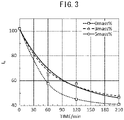
- the relationship between the treatment time and the degree of polymerization- carboxyl group amount index (I n ) is shown in Table 3 and FIG. 3 .
- the pHs of the treatment liquid were 6.9, 1.8, and 1.6, respectively.
- a softwood pulp fiber (virgin pulp fiber) was immersed in a container filled with 60 kg of deionized water as a treatment liquid, and a fiber formation step was carried out at a concentration of citric acid in the treatment liquid, a concentration of ozone in an ozone-containing gas, and a treatment time, which will be described below, thereby forming a carboxylated CNF-converting pulp fiber.
- the ozone-containing gas was fed to the treatment liquid as nanobubbles.
- the degree of polymerization, the amount of a carboxyl group, and the degree of polymerization ⁇ carboxyl group amount index at a treatment time of 0 minutes are the degree of polymerization, the amount of the carboxyl group, and the degree of polymerization- carboxyl group amount index of the softwood pulp fiber before the fiber formation step was carried out.
- the crystallinity of the carboxylated CNF-converting pulp fiber was measured using a wide-angle X-ray diffractometer RINT2500HL manufactured by Rigaku Corporation. Measurement conditions, an X-ray diffraction profile, and an X-ray diffraction standard data collection are as described below. ⁇ Measurement conditions>
Landscapes
- Chemical & Material Sciences (AREA)
- Life Sciences & Earth Sciences (AREA)
- Chemical Kinetics & Catalysis (AREA)
- Biochemistry (AREA)
- Engineering & Computer Science (AREA)
- Materials Engineering (AREA)
- Health & Medical Sciences (AREA)
- Medicinal Chemistry (AREA)
- Polymers & Plastics (AREA)
- Organic Chemistry (AREA)
- General Chemical & Material Sciences (AREA)
- Wood Science & Technology (AREA)
- Paper (AREA)
- Absorbent Articles And Supports Therefor (AREA)
- Polysaccharides And Polysaccharide Derivatives (AREA)
Abstract
Description
- The present disclosure relates to a method of producing a pulp fiber for carboxylated cellulose nanofibrillation use, and a pulp fiber for carboxylated cellulose nanofibrillation use.
- Studies are underway to produce a cellulose nanofiber (hereinafter, abbreviated as "CNF" in some cases)-converting pulp fiber and CNF from a pulp fiber. For example, Patent Literature 1 discloses a method of producing a cellulose nanofiber including a step (A) of preparing pulp obtained by carrying out kraft pulping after a hydrolysis treatment, a step (B) of preparing oxidized cellulose by oxidizing the pulp in water using an oxidizing agent in the presence of (1) an N-oxyl compound (for example, 2,2,6,6-tetramethylpiperidin-1-oxyradical, TEMPO) and (2) a compound selected from the group consisting of a bromide, an iodide, or a mixture thereof, and a step (C) of producing a cellulose nanofiber by defibrillating and dispersing the oxidized cellulose. According to Patent Literature 1, the production method is considered to enable the provision of a cellulose nanofiber dispersion liquid having a low viscosity and excellent fluidity even at a high concentration.
- In addition, Patent Literature 2 describes a method of producing a chemically-modified pulp-dried solid substance including a step of drying a mixture of a chemically-modified pulp obtained by chemically modifying a cellulose raw material and a liquid medium at 20°C to 80°C. According to Patent Literature 2, it is considered that the above-described chemically-modified pulp-dried solid substance enables the production of CNF having excellent dispersibility.
- Paragraph [0016] of Patent Literature 2 describes a method in which an N-oxyl compound (2,2,6,6-tetramethylpiperidin-1-oxyradical, TEMPO) is used as an example of a carboxylation method of a cellulose raw material. In addition, paragraph [0024] of Patent Literature 2 describes, as "other examples" of the carboxylation method of a cellulose raw material, a treatment carried out at a concentration of ozone of 50 to 250 g/m3 for 1 to 360 minutes.
- In addition, paragraph [0021] of Patent Literature 2 describes that, in order to efficiently progress the oxidation of cellulose in the above-described other example, the pH of a reaction liquid needs to be maintained at approximately 8 to 12 and preferably 10 to 11 by adding an alkaline solution such as an aqueous solution of sodium hydroxide.
-
- Patent Literature 1: PTC International Publication No.
WO 2013/047218 - Patent Literature 2:
Japanese Unexamined Patent Publication No. 2018-95761 - In Patent Literature 1, when CNF is produced using TEMPO, the degree of polymerization and viscosity of the CNF to be formed become high, and the handling properties of the CNF are poor, and thus an additional step is required to decrease the viscosity of the CNF. Therefore, the method described in Patent Literature 1 enables the production of CNF having excellent handling properties, meanwhile, the steps are troublesome, and there is room for improvement. In addition, in Patent Literature 1, in a case where TEMPO is used to carboxylate a cellulose raw material, there is a possibility that TEMPO may remain in CNF to be produced, which poses a risk from the safety and psychological viewpoint.
- As a result of additional tests on the "other examples" of Patent Literature 2, the inventors of the present application found that, due to the introduction of a carboxyl group into the cellulose raw material, the degree of polymerization (molecular weight) of the cellulose raw material significantly decreases, and, while carboxylated CNF to be formed has excellent handling properties, there is a possibility that there may be a risk in physical properties. Therefore, an aspect of the present disclosure is to provide a method of producing a pulp fiber for carboxylated cellulose nanofibrillation use capable of forming a carboxylated cellulose nanofiber having an excellent balance between handling properties and physical properties.
- The inventors of the present disclosure found a method of producing a pulp fiber for carboxylated cellulose nanofibrillation use, the method comprising a fiber formation step of forming a pulp fiber for carboxylated cellulose nanofibrillation use from a wood pulp fiber by feeding an ozone-containing gas to a treatment liquid having the wood pulp fiber immersed therein and having a pH of 6.5 or less in a manner such that a CT value that is a product of a concentration of ozone in the ozone-containing gas and a treatment time becomes more than 6,000 ppm·minute.
- The method of the present disclosure enables the production of a pulp fiber for carboxylated cellulose nanofibrillation use capable of forming a carboxylated cellulose nanofiber having an excellent balance between handling properties and physical properties.
-
-
FIG. 1 is an explanatory diagram for illustrating an example. -
FIG. 2 is an explanatory diagram for illustrating an example. -
FIG. 3 is an explanatory diagram for illustrating an example. - Specifically, the present disclosure relates to the following aspects.
- A method of producing a pulp fiber for carboxylated cellulose nanofibrillation use, the method comprising:
a fiber formation step of forming a pulp fiber for carboxylated cellulose nanofibrillation use from a wood pulp fiber by feeding an ozone-containing gas to a treatment liquid having the wood pulp fiber immersed therein and having a pH of 6.5 or less in a manner such that a CT value that is a product of a concentration of ozone in the ozone-containing gas and a treatment time becomes more than 6,000 ppm·minute. - In the above-described method, since a carboxylated CNF-converting pulp fiber is formed from the wood pulp fiber in the treatment liquid having a predetermined pH under a predetermined ozone condition in the fiber formation step, a -CH2OH group at the position 6 of cellulose configuring the wood pulp fiber can be oxidized to a carboxyl group while a decrease in the degree of polymerization of the cellulose is suppressed. Therefore, in the above-described method, a carboxylated CNF-converting pulp fiber capable of forming carboxylated CNF having an excellent balance between handling properties and physical properties can be produced.
- The method according to Aspect 1, wherein the treatment liquid contains an acid. In the above-described method, since the treatment liquid contains an acid, it is easy to hold the pH of the treatment liquid within a predetermined range, and the above-described method enables the production of a carboxylated CNF-converting pulp fiber capable of forming carboxylated CNF having an excellent balance between handling properties and physical properties.
- The method according to Aspect 2, wherein the acid is citric acid. In the above-described method, since the acid is citric acid, it is easy to hold the pH of the treatment liquid within a predetermined range, and the above-described method enables the production of a carboxylated CNF-converting pulp fiber capable of forming carboxylated CNF having an excellent balance between handling properties and physical properties.
- The method according to Aspect 3, wherein the treatment liquid contains the citric acid at a concentration of 3.0 to 10.0 mass%.
- In the above-described method, since the treatment liquid contains citric acid at a predetermined concentration, it is easy to hold the pH of the treatment liquid within a predetermined range, and the above-described method enables the production of a carboxylated CNF-converting pulp fiber capable of forming carboxylated CNF having an excellent balance between handling properties and physical properties.
- The method according to any one of Aspects 1 to 4, wherein, after 60 minutes from initiation of the fiber formation step, a degree of polymerization-carboxyl group amount index (I60) represented by a product of a degree of polymerization (DP60) and an amount of a carboxyl group (C60) (mmol/g) of the pulp fiber for carboxylated cellulose nanofibrillation use satisfies a requirement of 58 ≤ I60.
- In the above-described method, after 60 minutes from the initiation of the fiber formation step, the degree of polymerization-carboxyl group amount index (I60) has a predetermined value, that is, a predetermined degree of polymerization and a predetermined amount of a carboxyl group. Therefore, the above-described method enables the production of a carboxylated CNF-converting pulp fiber capable of forming carboxylated CNF having an excellent balance between handling properties and physical properties.
- The method according to any one of Aspects 1 to 5, wherein, after 120 minutes from initiation of the fiber formation step, a degree of polymerization-carboxyl group amount index (I120) represented by a product of a degree of polymerization (DP120) and an amount of a carboxyl group (C120) (mmol/g) of the pulp fiber for carboxylated cellulose nanofibrillation use satisfies a requirement of 46 ≤ I120.
- In the above-described method, after 120 minutes from the initiation of the fiber formation step, the degree of polymerization-carboxyl group amount index (I120) has a predetermined value, that is, a predetermined degree of polymerization and a predetermined amount of a carboxyl group. Therefore, the above-described method enables the production of a carboxylated CNF-converting pulp fiber capable of forming carboxylated CNF having an excellent balance between handling properties and physical properties.
- The method according to any one of Aspects 1 to 6, wherein the pulp fiber for carboxylated cellulose nanofibrillation use has a hemicellulose content of less than 8.0 mass%.
- It is known that a wood pulp fiber, for example, a softwood pulp fiber contains approximately 10 to approximately 25 mass% of hemicellulose in addition to approximately 50 to approximately 60 mass% of cellulose. Hemicellulose is abundant in the cell wall of plants. In a case where a softwood pulp fiber is used as, for example, a carboxylated CNF-converting pulp fiber, there is a case where hemicellulose present in the softwood pulp fiber remains in the carboxylated CNF-converting pulp fiber and the remaining hemicellulose impairs the function of carboxylated CNF.
- In the above-described method, since the carboxylated CNF-converting pulp fiber has a predetermined hemicellulose content, it becomes easy to produce carboxylated CNF from the carboxylated CNF-converting pulp fiber.
- The method according to any one of Aspects 1 to 7, wherein the pulp fiber for carboxylated cellulose nanofibrillation use has a lignin content of 0.10 mass% or less.
- It is known that a wood pulp fiber, for example, a softwood pulp fiber contains approximately 20 to approximately 30 mass% of lignin. In a case where a softwood pulp fiber is used as, for example, a carboxylated CNF-converting pulp fiber, there is a case where lignin present in the softwood pulp fiber remains in the carboxylated CNF-converting pulp fiber and the remaining lignin impairs the function of carboxylated CNF.
- In the above-described method, since the carboxylated CNF-converting pulp fiber has a predetermined lignin content, it becomes easy to produce carboxylated CNF from the carboxylated CNF-converting pulp fiber.
- The method according to any one of Aspects 1 to 8, wherein the wood pulp fiber is derived from a used sanitary article.
- In the above-described method, since the wood pulp fiber is derived from a used sanitary article, in a case where the treatment liquid contains a superabsorbent polymer while the ozone-containing gas cleans, sterilizes, bleaches, and the like pulp fibers contained in the used sanitary article in the fiber formation step, a carboxylated CNF-converting pulp fiber can be produced while the superabsorbent polymer is decomposed.
- The method according to Aspect 9, wherein the used sanitary article further contains a superabsorbent polymer, and the wood pulp fiber contains the superabsorbent polymer.
- In the above-described method, since the wood pulp fiber contains the superabsorbent polymer, in the fiber formation step, a carboxylated CNF-converting pulp fiber can be produced while the ozone-containing gas decomposes the superabsorbent polymer.
- The method according to Aspect 10, further comprising, before the fiber formation step, an inactivation step of inactivating the superabsorbent polymer.
- In used sanitary articles, there are many cases where, in an absorbent body containing wood pulp fibers and superabsorbent polymers, the plurality of superabsorbent polymers and the plurality of wood pulp fibers form a coupling structure due to the facts that (i) the superabsorbent polymers swell as the superabsorbent polymers absorb a liquid such as a bodily fluid and engulf the wood pulp fibers, (ii) the swollen superabsorbent polymers cause gel blocking or the like while engulfing the wood pulp fibers, and the like.
- In the above-described method, since the predetermined inactivation step is included before the fiber formation step, even in a case where a liquid such as excrement held by the superabsorbent polymer is discharged in advance and the superabsorbent polymer and the wood pulp fiber form a coupling structure before the fiber formation step, ozone in the ozone-containing gas is capable of removing the superabsorbent polymer configuring the coupling structure, and the ozone in the ozone-containing gas is capable of acting on the pulp fiber configuring the coupling structure and producing a carboxylated CNF-converting pulp fiber.
- The method according to Aspect 11, wherein, in the inactivation step, the superabsorbent polymer is inactivated by adding an acid.
- In the above-described method, since the superabsorbent polymer is inactivated by adding an acid in the inactivation step, it becomes easy to adjust the pH of the treatment liquid to a predetermined range in the next fiber formation step.
- The method according to any one of Aspects 10 to 12, wherein, in the fiber formation step, the superabsorbent polymer is decomposed using the ozone-containing gas and solubilized in the treatment liquid.
- In the above-described method, since the superabsorbent polymer is decomposed using the ozone-containing gas and solubilized in the treatment liquid in the fiber formation step, a carboxylated CNF-converting pulp fiber containing a small amount of an impurity can be produced.
- A pulp fiber for carboxylated cellulose nanofibrillation use formed from a wood pulp fiber, wherein a degree of polymerization-carboxyl group amount index (I) represented by a product of a degree of polymerization (DP) and an amount of a carboxyl group (C) (mmol/g) of the pulp fiber for carboxylated cellulose nanofibrillation use satisfies a requirement of 46 ≤ I.
- The carboxylated CNF-converting pulp fiber has a predetermined value of the degree of polymerization-carboxyl group amount index (I). Therefore, the pulp fiber for carboxylated cellulose nanofibrillation use is capable of forming carboxylated CNF having an excellent balance between handling properties and physical properties.
- The pulp fiber for carboxylated cellulose nanofibrillation use according to Aspect 14, wherein the amount of the carboxyl group (C) (mmol/g) is within a range of 0.11 to 0.60 mmol/g. Since the carboxylated CNF-converting pulp fiber has a predetermined amount of the carboxyl group, carboxylated CNF having an excellent balance between handling properties and physical properties can be formed.
- The pulp fiber for carboxylated cellulose nanofibrillation use according to Aspect 14 or 15, wherein a nitroxyl radical species, an oxide thereof, and a reduced product thereof are not contained. The carboxylated CNF-converting pulp fiber does not contain a nitroxyl radical species, for example, TEMPO (2,2,6,6-tetramethylpiperidine 1-oxyl), an oxide thereof, and a reduced product thereof and is thus preferable from the safety viewpoint.
- Hereinafter, the method of producing a pulp fiber for carboxylated cellulose nanofibrillation use and the pulp fiber for carboxylated cellulose nanofibrillation use of the present disclosure will be described in detail. The method of producing a pulp fiber for carboxylated cellulose nanofibrillation use of the present disclosure includes the following step. A fiber formation step of forming a pulp fiber for carboxylated cellulose nanofibrillation use from a wood pulp fiber by feeding an ozone-containing gas to a treatment liquid having the wood pulp fiber immersed therein and having a pH of 6.5 or less in a manner such that a CT value that is the product of the concentration of ozone in the ozone-containing gas and the treatment time becomes more than 6,000 ppm·minute (hereinafter, simply referred to as "the fiber formation step" in some cases)
- It should be noted that, hereinafter, there will be cases where "the pulp fiber for carboxylated cellulose nanofibrillation use" is referred to as "the carboxylated CNF-converting pulp fiber", and there will be cases where "the method of producing a pulp fiber for carboxylated cellulose nanofibrillation use" is referred to as "the method of producing a carboxylated CNF-converting pulp fiber", "the production method of the present disclosure", or the like.
- In a case where the wood pulp fiber contains a superabsorbent polymer, the method of producing a carboxylated CNF-converting pulp fiber of the present disclosure can further include the following step before the fiber formation step. An inactivation step of inactivating the superabsorbent polymer (hereinafter, simply referred to as "the inactivation step")
- In the fiber formation step, an ozone-containing gas is fed to a treatment liquid having a wood pulp fiber immersed therein and having a pH of 6.5 or less. The wood pulp fiber is not particularly limited, and examples thereof include softwood pulp fibers and hardwood pulp fibers. It should be noted that the wood pulp fiber may be a virgin pulp fiber, a recycled pulp fiber, or a pulp fiber derived from a used sanitary article.
- The treatment liquid has a pH of 6.5 or less, preferably has a pH of 5.0 or less, more preferably has a pH of 4.0 or less, and even more preferably has a pH of 2.5 or less. This makes it easy to produce a carboxylated CNF-converting pulp fiber capable of forming carboxylated CNF having an excellent balance between handling properties and physical properties. It should be noted that the above-described pH means a pH at 20°C.
- It is preferable that the treatment liquid achieves the above-described pH by containing an acid. Examples of the above-described acid include organic acids and inorganic acids. Examples of the organic acids include citric acid, tartaric acid, glycolic acid, malic acid, succinic acid, acetic acid, ascorbic acid, and the like. Examples of the inorganic acids include a sulfuric acid, a hydrochloric acid, and a nitric acid, and the sulfuric acid is preferable from the viewpoint of not containing chlorine, the cost, or the like.
- As described below, in the carboxylated CNF-converting pulp fiber and the carboxylated CNF, a state where a carboxyl group is not neutralized is preferably adopted, and, in order for that, the acid is preferably an acid has a smaller acid dissociation constant (pKa, in water) than the acid dissociation constant (pKa, in water) of the carboxyl group (the carboxyl group at the position 6 of cellulose).
- It should be noted that, in a case where the acid has a plurality of acid groups, for example, in a case where the acid is a dibasic acid or a tribasic acid, it is preferable that the largest acid dissociation constant (pKa, in water) among the acid dissociation constants (pKa, in water) of the acid is smaller than the acid dissociation constant (pKa, in water) of the carboxyl group (the carboxyl group at the position 6 of cellulose). This is from the viewpoint of the efficiency of the acid.
- In the present specification, as the acid dissociation constant (pKa, in water), values described in Handbook on Electrochemistry edited by the Electrochemical Society of Japan can be adopted. According to Handbook on Electrochemistry, the acid dissociation constants (pKa, in water, 25°C) of main compounds are as described below.
-
- Tartaric acid: 2.99 (pKa1), 4.44 (pKa2)
- malic acid: 3.24 (pKa1), 4.71 (pKa2)
- citric acid: 2.87 (pKa1), 4.35 (pKa2), 5.69 (pKa3)
- The acid dissociation constants (pKa, in water) of acids that are not described in Handbook on Electrochemistry can be obtained by measurement. Examples of an instrument capable of measuring the acid dissociation constants (pKa, in water) include a compound property evaluation and analysis system, T3 manufactured by Sirius Analytical Instruments Ltd.
- In a case where the treatment liquid contains citric acid as the acid, the treatment liquid contains citric acid at a concentration of preferably 3.0 to 10.0 mass%, more preferably 3.5 to 8.0 mass%, and even more preferably 4.0 to 6.0 mass%. This makes it easy to produce a carboxylated CNF-converting pulp fiber capable of forming carboxylated CNF having an excellent balance between handling properties and physical properties.
- The sizes of bubbles in the ozone-containing gas are not particularly limited, and, for example, bubbles are fed to the treatment liquid as small bubbles (for example, microbubbles or nanobubbles). The feeding of the ozone-containing gas to the treatment liquid having a predetermined pH makes it possible for ozone to oxidize the -CH2OH group at the position 6 of cellulose to a carboxyl group and to decrease the degree of polymerization of the carboxylated CNF to a predetermined range.
- The ozone-containing gas is fed to the treatment liquid in a manner such that the CT value, which is the product of the concentration of ozone in the ozone-containing gas and the treatment time, becomes more than 6,000 ppm-min, preferably 8,000 ppm-min or more, more preferably 9,000 ppm-min or more, even more preferably 10,000 ppm-min or more, and far even more preferably 12,000 ppm·min or more. In addition, the ozone-containing gas is fed to the treatment liquid in a manner such that the CT value, which is the product of the concentration of ozone in the ozone-containing gas and the treatment time, becomes preferably 40,000 ppm·min or less, more preferably 30,000 ppm·min or less, and even more preferably 24,000 ppm·min or less. This makes it easy to produce a carboxylated CNF-converting pulp fiber having a degree of polymerization and an amount of a carboxyl group with predetermined ranges and capable of forming carboxylated CNF having an excellent balance between handling properties and physical properties.
- The concentration of ozone in the ozone-containing gas is preferably 40 to 200 ppm (g/m3), more preferably 80 to 200 ppm (g/m3), and even more preferably 100 to 200 ppm (g/m3). This makes it easy to produce a carboxylated CNF-converting pulp fiber capable of forming carboxylated CNF having an excellent balance between handling properties and physical properties. It should be noted that the concentration of ozone in the ozone-containing gas can be measured with, for example, an ultraviolet absorption type ozone concentration meter (for example, manufactured by EcoDesign, Inc.: ozone monitor OZM-5000G).
- It should be noted that the concentration of ozone in the treatment liquid is preferably 1 to 50 ppm (g/m3), more preferably 2 to 40 ppm (g/m3), and even more preferably 3 to 30 ppm (g/m3).
- The concentration of ozone in the treatment liquid is measured by the following method.
- (1) 85 mL of a treatment liquid in which ozone is dissolved is put into a 100 mL graduated cylinder containing approximately 0.15 g of potassium iodide and 5 mL of a 10% citric acid solution and reacted.
- (2) The treatment liquid after the reaction is moved to a 200 mL Erlenmeyer flask, a starch solution is added into the Erlenmeyer flask to color the treatment liquid in purple, then, the treatment liquid is titrated with 0.01 mol/L sodium thiosulfate under stirring until the treatment liquid turns colorless, and the addition amount a (mL) is recorded.
- (3) The concentration of ozone in the aqueous solution is calculated using the following equation. The concentration (mass ppm) of ozone in the treatment liquid is calculated by the following equation:

- In the fiber formation step, the temperature of the treatment liquid is not particularly limited and may be, for example, room temperature (25°C) or may be higher than room temperature (25°C). In addition, in the fiber formation step, the treatment time is preferably 30 minutes to 210 minutes, more preferably 45 minutes to 180 minutes, and even more preferably 60 minutes to 120 minutes. This makes it easy to efficiently produce a carboxylated CNF-converting pulp fiber having a degree of polymerization and an amount of a carboxyl group within predetermined ranges.
- In a case where the degree of polymerization of the carboxylated CNF-converting pulp fiber after n minutes from the initiation of the fiber formation step is indicated by DPn, the amount of a carboxyl group is indicated by Cn (mmol/g), and the degree of polymerization-carboxyl group amount index represented by the product of the degree of polymerization (DPn) and the amount of a carboxyl group (Cn) of the carboxylated CNF-converting pulp fiber is indicated by In, the degree of polymerization-carboxyl group amount index (In) is preferably within the following range.
- In the fiber formation step, after 60 minutes from the initiation of the fiber formation step (n=60), the degree of polymerization-carboxyl group amount index (I60) is preferably 58 or more, more preferably 60 or more, even more preferably 61 or more, and far even more preferably 62 or more. In addition, in the fiber formation step, after 60 minutes from the initiation of the fiber formation step, the degree of polymerization-carboxyl group amount index (I60) is preferably 200 or less, more preferably 150 or less, even more preferably 100 or less, and far even more preferably 80 or less. This makes it easy to produce a carboxylated CNF-converting pulp fiber capable of forming carboxylated CNF having an excellent balance between handling properties and physical properties.
- In the fiber formation step, after 120 minutes from the initiation of the fiber formation step, the degree of polymerization-carboxyl group amount index (I120) is preferably 46 or more, more preferably 49 or more, even more preferably 52 or more, and far even more preferably 54 or more. In addition, in the fiber formation step, after 120 minutes from the initiation of the fiber formation step, the degree of polymerization-carboxyl group amount index (I120) is preferably 200 or less, more preferably 150 or less, even more preferably 100 or less, and far even more preferably 80 or less. This makes it easy to produce a carboxylated CNF-converting pulp fiber capable of forming carboxylated CNF having an excellent balance between handling properties and physical properties.
- In the present specification, the amount of a carboxyl group (Cn) (mmol/g) of the carboxylated CNF-converting pulp fiber after n minutes from the initiation of the fiber formation step is measured as described below.
- (1) After n minutes from the initiation of the fiber formation step, the carboxylated CNF-converting pulp fiber is collected.
- (2) Approximately 0.4 g of the carboxylated CNF-converting pulp fiber is added to a container to which 170 mL of distilled water has been added, and the carboxylated CNF-converting pulp fiber is dispersed.
- (3) 10 mL of 0.01M NaCl is added to the container.
- (4) 0.1M HCl is added to the container, and the pH is adjusted to 2.8.
- (5) 0.05M NaOH is added to the container at a rate of 0.1 mL/min to 0.2 mL/min until the pH becomes 11, and the electrical conductivity of the contents in the container is monitored.
- (6) The addition amount of 0.05M NaOH is plotted along the X-axis, the electrical conductivity is plotted along the Y-axis, and an addition amount of 0.05M NaOH at a point where the electrical conductivity becomes constant (V) (mL) is obtained.
- (7) The carboxylated CNF-converting pulp fiber is recovered by filtration, and the absolute dry mass (m(g)) thereof is measured.
- (8) The amount of a carboxyl group content (Cn) (mmol/g) of the carboxylated CNF-converting pulp fiber is calculated by the following equation:

- It should be noted that the pH is measured using a pHashion pH meter, C-62 manufactured by As One Corporation. In addition, the electrical conductivity is measured using a portable electrical conductivity meter (CM-31P type) manufactured by DKK-TOA Corporation.
- In addition, in the present specification, the degree of polymerization (DPn) of the carboxylated CNF-converting pulp fiber after n minutes from the initiation of the fiber formation step is measured as described below.
- (1) After n minutes from the initiation of the fiber formation step, the carboxylated CNF-converting pulp fiber is collected.
- (2) The viscosity ratio ηr (= η/η0) is measured according to "6.4.1 Viscosity ratio" of "Cellulose in dilute solutions - Determination of limiting viscosity number - Method in cupri-ethylene-diamine (CED) solution" specified in JIS 8215:1998.
- (3) The degree of polymerization (DPn) is calculated using the following equation.
- Specific viscosity:

- Intrinsic viscosity:

- Degree of polymerization:

- Specific viscosity:
- It should be noted that the above-described equation is based on the description on page 101 of Wood Science Experiment Manual (edited by the Japan Wood Research Society, Buneido Publishing Co., Ltd., 2000), and c means the cellulose concentration (g/mL).
- In the present disclosure, the carboxylated CNF-converting pulp fiber formed by the fiber formation step has a hemicellulose content of preferably less than 8.0 mass%, preferably 7.0 mass% or less, more preferably 6.5 mass% or less, and even more preferably 6.0 mass% or less. This makes it easy to produce carboxylated CNF from the carboxylated CNF-converting pulp fiber. It should be noted that the lower limit of the hemicellulose content of the carboxylated CNF-converting pulp fiber is 0.0 mass%.
- In the present disclosure, the carboxylated CNF-converting pulp fiber formed by the fiber formation step has a lignin content of preferably 0.10 mass% or less, more preferably 0.08 mass% or less, and even more preferably 0.06 mass% or less. This makes it easy to produce carboxylated CNF from the carboxylated CNF-converting pulp fiber. It should be noted that the lower limit of the lignin content of the carboxylated CNF-converting pulp fiber is 0.00 mass%.
- In the present disclosure, the carboxylated CNF-converting pulp fiber has a cellulose content of preferably 87.0 mass% or more, more preferably 90 mass% or more, and even more preferably 93 mass% or more. This makes it easy to produce carboxylated CNF from the carboxylated CNF-converting pulp fiber. It should be noted that the upper limit of the cellulose content of the carboxylated CNF-converting pulp fiber is 100.0 mass%.
- In the present disclosure, the cellulose content, the hemicellulose content, and the lignin content in the carboxylated CNF-converting pulp fiber can be measured according to a well-known detergent analysis method.
- As described above, in the production method of the present disclosure, the wood pulp fiber in the fiber formation step can be derived from a used sanitary article (for example, a paper diaper, a urine collecting pad, a sanitary napkin, a bed sheet, or a pet sheet). This makes it possible to collectively sterilize, bleach, deodorize, and the like the wood pulp fiber to which a bodily fluid or the like is attached with the ozone-containing gas in the fiber formation step.
- In addition, the used sanitary article can contain a superabsorbent polymer for holding a liquid such as a bodily fluid. For example, in a case where the used sanitary article includes a wood pulp fiber and a superabsorbent polymer in the absorbent body, the wood pulp fiber recovered from the used sanitary article contains the superabsorbent polymer that has absorbed a liquid in many cases.
- The above-described superabsorbent polymer is not particularly limited and includes those well-known in the art, and examples thereof include starch-based, cellulose-based, and synthetic polymer-based superabsorbent polymers. Examples of the starch-based or cellulose-based superabsorbent polymer include starch-acrylic acid (salt) graft copolymers, saponified products of starch-acrylonitrile copolymers, and crosslinked products of sodium carboxymethylcellulose. Examples of the synthetic polymer-based superabsorbent polymers include polyacrylate-based, polysulfonate-based, anhydrous maleate-based, polyacrylamide-based, polyvinyl alcohol-based, polyethylene oxide-based, polyaspartate-based, polyglutamate-based, polyalginate-based, starch-based, and cellulose-based superabsorbent polymers (SAP), and polyacrylate-based (particularly, sodium polyacrylate-based) superabsorbent polymers are preferable.
- There are many cases where a plurality of superabsorbent polymers and a plurality of wood pulp fibers form a coupling structure due to the facts that the superabsorbent polymers swell as the superabsorbent polymers absorb a liquid such as a bodily fluid and engulf the wood pulp fibers, the swollen superabsorbent polymers cause gel blocking or the like while engulfing the wood pulp fibers, and the like. Due to that, it is common that a superabsorbent polymer is contained as the above-described coupling structure in a wood pulp fiber derived from a used sanitary article.
- In the fiber formation step, even in a case where the wood pulp fiber contains the superabsorbent polymer as, for example, a coupling structure, the ozone-containing gas is capable of oxidizing and decomposing the superabsorbent polymer, solubilizing the superabsorbent polymer in the treatment liquid, and remove the superabsorbent polymer.
- In a case where the wood pulp fiber contains the superabsorbent polymer, the production method of the present disclosure preferably further includes an inactivation step of inactivating the superabsorbent polymer before the fiber formation step. In the production method of the present disclosure, in a case where the wood pulp fiber is derived from a used sanitary article, when it is necessary to decompose the superabsorbent polymer with the ozone-containing gas, the fiber formation step can be carried out with reference to
Japanese Unexamined Patent Publication No. 2019-007119 - As the inactivation step, a step that is used in the related art can be adopted as it is, and the superabsorbent polymer can be inactivated by, for example, adding an inactivating agent. Examples of the inactivating agent include acids (for example, inorganic acids and organic acids), lime, calcium chloride, magnesium sulfate, magnesium chloride, aluminum sulfate, aluminum chloride, and the like. It should be noted that examples of the inorganic acids and the organic acids include those described above.
- The acid is preferable because it does not leave ash content in the pulp fibers. In a case where an acid is used as the inactivating agent, the pH for inactivation is preferably 2.5 or less and more preferably 1.3 to 2.4. This is from the viewpoint of the inactivation of water-absorbent polymers, the protection of facilities, the sterilization of the carboxylated CNF-converting pulp fiber, and the like.
- The temperature of the treatment liquid in the inactivation step is not particularly limited as long as the inactivation of the superabsorbent polymer proceeds. The temperature may be room temperature or higher than room temperature, and is, for example, 15°C to 30°C. In addition, the inactivation step time is not particularly limited as long as the superabsorbent polymer is inactivated and dehydrated, and the inactivation step time is, for example, 2 to 60 minutes and preferably 5 to 30 minutes.
- In the inactivation step, the inactivating agent is preferably an acid, for example, citric acid. This is because, in the fiber formation step, the adjustment of the pH becomes unnecessary or the adjustment of the pH becomes easy.
- In the carboxylated CNF-converting pulp fiber obtained by the production method of the present disclosure and the carboxylated CNF-converting pulp fiber of the present disclosure, it is preferable that, in a case where the degree of polymerization of the carboxylated CNF-converting pulp fiber is indicated by DP, the amount of a carboxyl group is indicated by C (mmol/g), and the degree of polymerization- carboxyl group amount index represented by the product of the degree of polymerization (DP) and the amount of a carboxyl group (C) of the carboxylated CNF-converting pulp fiber is indicated by I, the degree of polymerization- carboxyl group amount index (I) is within the following range.
- The degree of polymerization-carboxyl group amount index (I) is preferably 42 or more, more preferably 46 or more, even more preferably 52 or more, far even more preferably 54 or more, far even more preferably 56 or more, far even more preferably 58 or more, far even more preferably 60 or more, far even more preferably 61 or more, and far even more preferably 62 or more. In addition, the degree of polymerization-carboxyl group amount index (I) is preferably 200 or less, more preferably 150 or less, even more preferably 100 or less, far even more preferably 80 or less, and far even more preferably 70 or less. This makes it easy for the carboxylated CNF-converting pulp fiber to form carboxylated CNF having an excellent balance between handling properties and physical properties.
- In the carboxylated CNF-converting pulp fiber of the present disclosure, the amount of a carboxyl group (C) (mmol/g) is within a range of preferably 0.11 to 0.60 mmol/g, more preferably 0.15 to 0.50 mmol/g, and even more preferably 0.17 to 0.45 mmol/g. This makes it easy to form carboxylated CNF having an excellent balance between handling properties and physical properties.
- In the carboxylated CNF-converting pulp fiber of the present disclosure, the carboxyl group may not be neutralized, that is, may be in a -COOH state, or may be neutralized to form a salt, for example, a sodium salt (-COONa), a potassium salt (-COOK), a lithium salt (-COOLi), or the like.
- The carboxyl group is preferably not neutralized, that is, in a -COOH state. This makes it possible to easily produce, for example, a fiber composite reinforcing material containing carboxylated CNF and a resin. In a case where the carboxyl group is neutralized, there is a case where mixing with the resin becomes difficult.
- The carboxylated CNF-converting pulp fiber of the present disclosure is useful as a carboxylated CNF precursor. For example, the carboxylated CNF-converting pulp fiber of the present disclosure can be stored as a carboxylated CNF precursor, be pulverized as necessary by a well-known pulverizing method such as a ball mill, and be used to easily produce carboxylated CNF. For example, in a method of producing carboxylated CNF using a TEMPO catalyst, a precursor is not present and needs to be stored as carboxylated CNF, but it is well known that it is redispersion of dried CNF in water or the like is difficult. Examples
- Hereinafter, the present disclosure will be described with reference to examples, but the present disclosure is not limited to these examples.
- Approximately 600 g of a softwood pulp fiber (virgin pulp fiber) was immersed in a container filled with 60 kg of deionized water as a treatment liquid, and a fiber formation step was carried out at a concentration of citric acid in the treatment liquid, a concentration of ozone in an ozone-containing gas, and a treatment time, which will be described below, thereby forming a carboxylated CNF-converting pulp fiber. It should be noted that the ozone-containing gas was fed to the treatment liquid as nanobubbles.
- It should be noted that the degree of polymerization, the amount of a carboxyl group, and the degree of polymerization-carboxyl group amount index at a treatment time of 0 minutes are the degree of polymerization, the amount of the carboxyl group, and the degree of polymerization- carboxyl group amount index of the softwood pulp fiber before the fiber formation step was carried out. Concentration of citric acid: 0 mass%, 3 mass%, 5 mass%
- Concentration of ozone in ozone-containing gas: 200 ppm
- Treatment time: 0 min, 60 min, 120 min, 210 min
- The relationship between the treatment time and the amount of the carboxyl group in the carboxylated CNF-converting pulp fiber is shown in Table 1 and
FIG. 1 , the relationship between the treatment time and the degree of polymerization is shown in Table 2 andFIG. 2 , and the relationship between the treatment time and the degree of polymerization- carboxyl group amount index (In) is shown in Table 3 andFIG. 3 . It should be noted that, at concentrations of citric acid of 0 mass%, 3 mass%, and 5 mass%, the pHs of the treatment liquid were 6.9, 1.8, and 1.6, respectively. -
Table 1 Concentration of citric acid Amount of carboxyl group: Cn (mmol/g) 0 minutes 60 minutes 120 minutes 210 minutes 0 mass% 0.086 0.101 0.142 0.176 3 mass% 0.086 0.128 0.165 0.227 5 mass% 0.086 0.142 0.220 0.250 -
Table 2 Concentration of citric acid Degree of polymerization: DP n0 minutes 60 minutes 120 minutes 210 minutes 0 mass% 1191 574 319 234 3 mass% 1191 508 355 211 5 mass% 1191 468 260 185 -
Table 3 Concentration of citric acid Degree of polymerization- carboxyl group amount index: In 0 minutes 60 minutes 120 minutes 210 minutes 0 mass% 101.9 57.7 45.3 41.1 3 mass% 101.9 64.8 58.5 47.8 5 mass% 101.9 66.4 57.3 46.4 - From Tables 1 to 3 and
FIGS. 1 to 3 , it is found that, in a case where the concentrations of citric acid are 3 mass% and 5 mass%, the degree of polymerization-carboxyl group amount index (In) of the carboxylated CNF-converting pulp fiber is high compared with a case where the concentration of citric acid is 0 mass%. Therefore, it is found that, in a case where citric acid is added, in the softwood pulp fiber, the -CH2OH group at the position 6 of cellulose can be efficiently oxidized to a carboxyl group while suppressing a decrease in the degree of polymerization to a predetermined range. - As a result of adding water to a total of 4 kinds of carboxylated CNF-converting pulp fibers at concentrations of citric acid of 3 mass% and 5 mass% and treatment times of 60 minutes and 120 minutes, respectively, and pulverizing the carboxylated CNF-converting pulp fibers using a ball mill, which is a well-known pulverizing method, it was confirmed that carboxylated CNF was easily formed due to the viscosity of the solution after pulverization, the properties of the pulverized products after drying, and the like.
- Approximately 600 g of a softwood pulp fiber (virgin pulp fiber) was immersed in a container filled with 60 kg of deionized water as a treatment liquid, and a fiber formation step was carried out at a concentration of citric acid in the treatment liquid, a concentration of ozone in an ozone-containing gas, and a treatment time, which will be described below, thereby forming a carboxylated CNF-converting pulp fiber. It should be noted that the ozone-containing gas was fed to the treatment liquid as nanobubbles.
- It should be noted that the degree of polymerization, the amount of a carboxyl group, and the degree of polymerization·carboxyl group amount index at a treatment time of 0 minutes are the degree of polymerization, the amount of the carboxyl group, and the degree of polymerization- carboxyl group amount index of the softwood pulp fiber before the fiber formation step was carried out. Concentration of citric acid: 1 mass%
- Concentration of ozone in ozone-containing gas: 200 ppm
- Treatment time: 0 min, 30 min, 210 min, 420 min
- The crystallinity of the carboxylated CNF-converting pulp fiber was measured using a wide-angle X-ray diffractometer RINT2500HL manufactured by Rigaku Corporation. Measurement conditions, an X-ray diffraction profile, and an X-ray diffraction standard data collection are as described below. <Measurement conditions>
- X-ray source: Cu
- X-ray output: 50 kV-250 mA
- Optical system: Concentrated beam with monochrometer
- Slit: DS 0.5 deg + 10 mmH
- SS 0.5 deg
- RS 0.15
- Scanning axis: 2θ/θ
- Scanning method: Continuous scanning
- Scanning range: 5 ≤ 2θ ≤ 70 deg
- Scanning rate: 0.5 deg/min
- Sampling: 0.02 deg
-
- Vertical axis: Diffraction intensity (cps)
- Horizontal axis: Diffraction angle (deg)
- Diffraction conditions: 2dsin θ = nλ
- d: Space of lattice plane (nm)
- θ: Diffraction angle (deg)
- n: Reflection order
- λ: X-ray wavelength (0.15406 nm)
- The results are shown in Table 4.
-
Table 4 Treatment time Integral intensity (a.u.) Crystallinity (%) Crystalline Amorphous 0 minutes 690170 801231 46.3 30 minutes 698886 806794 46.4 210 minutes 1009999 942171 51.7 420 minutes 1041066 1018044 50.6 - Measurement of the carboxylated CNF-converting pulp fiber with an FT-IR3100FT-IR/600UMA manufactured by Varian confirmed that the amount of carboxyl groups in the carboxylated CNF-converting pulp fiber increased with the increase of the treatment time.
Claims (16)
- A method of producing a pulp fiber for carboxylated cellulose nanofibrillation use, the method comprising:
a fiber formation step of forming a pulp fiber for carboxylated cellulose nanofibrillation use from a wood pulp fiber by feeding an ozone-containing gas to a treatment liquid having the wood pulp fiber immersed therein and having a pH of 6.5 or less in a manner such that a CT value that is a product of a concentration of ozone in the ozone-containing gas and a treatment time becomes more than 6,000 ppm·minute. - The method according to claim 1,
wherein the treatment liquid contains an acid. - The method according to claim 2,
wherein the acid is citric acid. - The method according to claim 3,
wherein the treatment liquid contains the citric acid at a concentration of 3.0 to 10.0 mass%. - The method according to any one of claims 1 to 4,
wherein, after 60 minutes from initiation of the fiber formation step, a degree of polymerization-carboxyl group amount index (I60) represented by a product of a degree of polymerization (DP60) and an amount of a carboxyl group (C60) (mmol/g) of the pulp fiber for carboxylated cellulose nanofibrillation use satisfies a requirement of
- The method according to any one of claims 1 to 5,
wherein, after 120 minutes from initiation of the fiber formation step, a degree of polymerization·carboxyl group amount index (I120) represented by a product of a degree of polymerization (DP120) and an amount of a carboxyl group (C120) (mmol/g) of the pulp fiber for carboxylated cellulose nanofibrillation use satisfies a requirement of
- The method according to any one of claims 1 to 6,
wherein the pulp fiber for carboxylated cellulose nanofibrillation use has a hemicellulose content of less than 8.0 mass%. - The method according to any one of claims 1 to 7,
wherein the pulp fiber for carboxylated cellulose nanofibrillation use has a lignin content of 0.10 mass% or less. - The method according to any one of claims 1 to 8,
wherein the wood pulp fiber is derived from a used sanitary article. - The method according to claim 9,
wherein the used sanitary article further contains a superabsorbent polymer, and the wood pulp fiber contains the superabsorbent polymer. - The method according to claim 10, further comprising, before the fiber formation step:
an inactivation step of inactivating the superabsorbent polymer. - The method according to claim 11,
wherein, in the inactivation step, the superabsorbent polymer is inactivated by adding an acid. - The method according to any one of claims 10 to 12,
wherein, in the fiber formation step, the superabsorbent polymer is decomposed using the ozone-containing gas and solubilized in the treatment liquid. - A pulp fiber for carboxylated cellulose nanofibrillation use formed from a wood pulp fiber,
wherein a degree of polymerization·carboxyl group amount index (I) represented by a product of a degree of polymerization (DP) and an amount of a carboxyl group (C) (mmol/g) of the pulp fiber for carboxylated cellulose nanofibrillation use satisfies a requirement of
- The pulp fiber for carboxylated cellulose nanofibrillation use according to claim 14,
wherein the amount of the carboxyl group (C) (mmol/g) is within a range of 0.11 to 0.60 mmol/g. - The pulp fiber for carboxylated cellulose nanofibrillation use according to claim 14 or 15,
wherein a nitroxyl radical species, an oxide thereof, and a reduced product thereof are not contained.
Applications Claiming Priority (2)
| Application Number | Priority Date | Filing Date | Title |
|---|---|---|---|
| JP2020015469A JP7458802B2 (en) | 2020-01-31 | 2020-01-31 | Method for producing pulp fibers for carboxylated cellulose nanofibers, and pulp fibers for carboxylated cellulose nanofibers |
| PCT/JP2020/042526 WO2021152958A1 (en) | 2020-01-31 | 2020-11-13 | Method for producing pulp fiber for carboxylated cellulose nanofibrillation use, and pulp fiber for carboxylated cellulose nanofibrillation use |
Publications (2)
| Publication Number | Publication Date |
|---|---|
| EP4079963A1 true EP4079963A1 (en) | 2022-10-26 |
| EP4079963A4 EP4079963A4 (en) | 2023-06-21 |
Family
ID=77079013
Family Applications (1)
| Application Number | Title | Priority Date | Filing Date |
|---|---|---|---|
| EP20916677.6A Pending EP4079963A4 (en) | 2020-01-31 | 2020-11-13 | PULP FIBERS FOR CONVERTING INTO CARBOXYLATED CELLULOSE NANOFIBERS, AND METHOD FOR MAKING THE SAME |
Country Status (4)
| Country | Link |
|---|---|
| EP (1) | EP4079963A4 (en) |
| JP (2) | JP7458802B2 (en) |
| CN (1) | CN115038837B (en) |
| WO (1) | WO2021152958A1 (en) |
Families Citing this family (2)
| Publication number | Priority date | Publication date | Assignee | Title |
|---|---|---|---|---|
| CN117003899A (en) * | 2023-06-27 | 2023-11-07 | 浙江中医药大学 | Preparation method and application of polycarboxyl modified cellulose |
| CN118580379B (en) * | 2024-06-27 | 2025-12-09 | 华南理工大学 | Double carboxylation nanometer Process for the preparation of cellulose |
Family Cites Families (18)
| Publication number | Priority date | Publication date | Assignee | Title |
|---|---|---|---|---|
| DE69133244T2 (en) * | 1990-10-29 | 2004-05-06 | Knowaste L.L.C. | Treatment of a superabsorbent polymer |
| US6238516B1 (en) * | 1991-02-14 | 2001-05-29 | Dana L. Watson | System and method for cleaning, processing, and recycling materials |
| WO2009069641A1 (en) | 2007-11-26 | 2009-06-04 | The University Of Tokyo | Cellulose nanofiber and process for production thereof, and cellulose nanofiber dispersion |
| JP5440276B2 (en) | 2010-03-09 | 2014-03-12 | 凸版印刷株式会社 | Method for producing cellulose nanofiber, cellulose nanofiber, and cellulose nanofiber dispersion |
| JP2011184648A (en) * | 2010-03-11 | 2011-09-22 | Toppan Printing Co Ltd | Production method for idized cellulose |
| JP6003080B2 (en) | 2011-02-21 | 2016-10-05 | 三菱化学株式会社 | Cellulose fiber and method for producing cellulose fiber |
| WO2013047218A1 (en) | 2011-09-30 | 2013-04-04 | 日本製紙株式会社 | Method for producing cellulose nanofibers |
| JP5857881B2 (en) | 2012-05-24 | 2016-02-10 | 王子ホールディングス株式会社 | Fine fibrous cellulose and method for producing the same, non-woven fabric |
| WO2013176102A1 (en) | 2012-05-24 | 2013-11-28 | 王子ホールディングス株式会社 | Fine fibrous cellulose, method for producing same, fine fibrous cellulose dispersion, and non-woven fabric |
| JP6015232B2 (en) | 2012-08-23 | 2016-10-26 | 日本製紙株式会社 | Method for producing oxidized cellulose and cellulose nanofiber |
| WO2015107995A1 (en) * | 2014-01-17 | 2015-07-23 | 日本製紙株式会社 | Dry solid of anion-modified cellulose nanofiber and method for producing same |
| JP6199243B2 (en) * | 2014-06-12 | 2017-09-20 | ユニ・チャーム株式会社 | Method for producing recycled pulp from used sanitary products |
| JP7170380B2 (en) | 2016-12-15 | 2022-11-14 | 日本製紙株式会社 | Process for producing chemically modified pulp dry solids |
| JP6523376B2 (en) | 2017-06-28 | 2019-05-29 | ユニ・チャーム株式会社 | Method for producing recycled fiber and recycled fiber |
| JP6669694B2 (en) | 2017-06-28 | 2020-03-18 | ユニ・チャーム株式会社 | Method for producing pulp fiber for forming cellulose nanofiber, and pulp fiber for forming cellulose nanofiber |
| CN108178802B (en) | 2018-03-02 | 2020-04-10 | 广西大学 | Preparation method of oxidized cellulose nanofibrils based on nitric acid and hydrogen peroxide |
| CN113227490B (en) | 2018-12-31 | 2023-10-27 | 尤妮佳股份有限公司 | Method for producing pulp fiber raw material, and pulp fiber raw material as cellulose raw material |
| CN111206449A (en) | 2020-01-16 | 2020-05-29 | 天津科技大学 | A method for preparing cellulose nanofibers by pretreating plant fibers by oxidation method |
-
2020
- 2020-01-31 JP JP2020015469A patent/JP7458802B2/en active Active
- 2020-11-13 CN CN202080094992.2A patent/CN115038837B/en active Active
- 2020-11-13 EP EP20916677.6A patent/EP4079963A4/en active Pending
- 2020-11-13 WO PCT/JP2020/042526 patent/WO2021152958A1/en not_active Ceased
-
2024
- 2024-03-19 JP JP2024043426A patent/JP7818639B2/en active Active
Also Published As
| Publication number | Publication date |
|---|---|
| JP7818639B2 (en) | 2026-02-20 |
| CN115038837B (en) | 2023-11-10 |
| CN115038837A (en) | 2022-09-09 |
| JP7458802B2 (en) | 2024-04-01 |
| JP2021123807A (en) | 2021-08-30 |
| WO2021152958A1 (en) | 2021-08-05 |
| JP2024060102A (en) | 2024-05-01 |
| EP4079963A4 (en) | 2023-06-21 |
Similar Documents
| Publication | Publication Date | Title |
|---|---|---|
| EP3831856A1 (en) | Oxidized cellulose, method for producing oxidized cellulose and nano-cellulose, and nano-cellulose dispersion | |
| JP7818639B2 (en) | Method for producing pulp fibers for use in producing carboxylated cellulose nanofibers, and pulp fibers for use in producing carboxylated cellulose nanofibers | |
| US11713360B2 (en) | Method for producing cellulose nanofibers | |
| EP2415821B1 (en) | Process for producing cellulose gel dispersion | |
| JP6293780B2 (en) | Method for catalytic oxidation of cellulose and method for producing cellulose product | |
| JP2009161613A (en) | Method for oxidizing cellulose, oxidation catalyst for cellulose, and method for producing cellulose nano-fiber | |
| EP3409692B1 (en) | Anionically-modified cellulose nanofiber dispersion liquid and production method therefor | |
| CN105579474A (en) | Method for catalytic oxidation of cellulose and method for manufacturing cellulose products | |
| JP2014520182A (en) | Method for catalytic oxidation of cellulose and method for producing cellulose product | |
| KR20160033149A (en) | A method of producing oxidized or microfibrillated cellulose | |
| EP3375933A1 (en) | Method for dehydrating dispersion of chemically modified pulp | |
| JP7283874B2 (en) | Oxidized cellulose nanofibers and oxidized cellulose nanofiber dispersions | |
| Zhao et al. | Activation behavior of 4-AcNH-TEMPO by ClO2 for selective oxidation of cellulose in DMAc/LiCl system | |
| EP4488444A1 (en) | Method for producing recycled pulp fiber | |
| WO2012132663A1 (en) | Method for producing cellulose nanofibers | |
| Lu et al. | TEMPO-mediated oxidation of bacterial cellulose in buffer solution | |
| Zhan | Structural Characterization of Nanocellulose-Based Composite Materials and Their Water Purification Applications | |
| EP4596586A1 (en) | Cellulose nanofiber, and aqueous dispersion composition containing same | |
| EP4166714A1 (en) | Method for producing cleaned recycled pulp fibers from used sanitary materials | |
| US20260062526A1 (en) | Cellulose nanofiber, and aqueous dispersion composition containing same | |
| JP2013256623A (en) | Method for producing polyuronic acid or its salt |
Legal Events
| Date | Code | Title | Description |
|---|---|---|---|
| STAA | Information on the status of an ep patent application or granted ep patent |
Free format text: STATUS: THE INTERNATIONAL PUBLICATION HAS BEEN MADE |
|
| PUAI | Public reference made under article 153(3) epc to a published international application that has entered the european phase |
Free format text: ORIGINAL CODE: 0009012 |
|
| STAA | Information on the status of an ep patent application or granted ep patent |
Free format text: STATUS: REQUEST FOR EXAMINATION WAS MADE |
|
| 17P | Request for examination filed |
Effective date: 20220721 |
|
| AK | Designated contracting states |
Kind code of ref document: A1 Designated state(s): AL AT BE BG CH CY CZ DE DK EE ES FI FR GB GR HR HU IE IS IT LI LT LU LV MC MK MT NL NO PL PT RO RS SE SI SK SM TR |
|
| DAV | Request for validation of the european patent (deleted) | ||
| DAX | Request for extension of the european patent (deleted) | ||
| REG | Reference to a national code |
Ref country code: DE Ref legal event code: R079 Free format text: PREVIOUS MAIN CLASS: D21H0011200000 Ipc: D21C0009000000 |
|
| A4 | Supplementary search report drawn up and despatched |
Effective date: 20230522 |
|
| RIC1 | Information provided on ipc code assigned before grant |
Ipc: D21C 5/02 20060101ALI20230515BHEP Ipc: C08B 15/04 20060101ALI20230515BHEP Ipc: A61F 13/551 20060101ALI20230515BHEP Ipc: D21H 11/20 20060101ALI20230515BHEP Ipc: D21C 9/00 20060101AFI20230515BHEP |
|
| STAA | Information on the status of an ep patent application or granted ep patent |
Free format text: STATUS: EXAMINATION IS IN PROGRESS |
|
| 17Q | First examination report despatched |
Effective date: 20250617 |