EP4079022B1 - Interferenzen signale und deren quellen erkennen und beheben - Google Patents
Interferenzen signale und deren quellen erkennen und beheben Download PDFInfo
- Publication number
- EP4079022B1 EP4079022B1 EP20839479.1A EP20839479A EP4079022B1 EP 4079022 B1 EP4079022 B1 EP 4079022B1 EP 20839479 A EP20839479 A EP 20839479A EP 4079022 B1 EP4079022 B1 EP 4079022B1
- Authority
- EP
- European Patent Office
- Prior art keywords
- iot
- scan
- frequency
- iot sensor
- given
- Prior art date
- Legal status (The legal status is an assumption and is not a legal conclusion. Google has not performed a legal analysis and makes no representation as to the accuracy of the status listed.)
- Active
Links
Images


Classifications
-
- H—ELECTRICITY
- H04—ELECTRIC COMMUNICATION TECHNIQUE
- H04W—WIRELESS COMMUNICATION NETWORKS
- H04W16/00—Network planning, e.g. coverage or traffic planning tools; Network deployment, e.g. resource partitioning or cells structures
- H04W16/02—Resource partitioning among network components, e.g. reuse partitioning
- H04W16/10—Dynamic resource partitioning
-
- H—ELECTRICITY
- H03—ELECTRONIC CIRCUITRY
- H03G—CONTROL OF AMPLIFICATION
- H03G3/00—Gain control in amplifiers or frequency changers
- H03G3/20—Automatic control
-
- H—ELECTRICITY
- H04—ELECTRIC COMMUNICATION TECHNIQUE
- H04B—TRANSMISSION
- H04B1/00—Details of transmission systems, not covered by a single one of groups H04B3/00 - H04B13/00; Details of transmission systems not characterised by the medium used for transmission
- H04B1/005—Details of transmission systems, not covered by a single one of groups H04B3/00 - H04B13/00; Details of transmission systems not characterised by the medium used for transmission adapting radio receivers, transmitters andtransceivers for operation on two or more bands, i.e. frequency ranges
-
- H—ELECTRICITY
- H04—ELECTRIC COMMUNICATION TECHNIQUE
- H04B—TRANSMISSION
- H04B1/00—Details of transmission systems, not covered by a single one of groups H04B3/00 - H04B13/00; Details of transmission systems not characterised by the medium used for transmission
- H04B1/06—Receivers
- H04B1/10—Means associated with receiver for limiting or suppressing noise or interference
-
- H—ELECTRICITY
- H04—ELECTRIC COMMUNICATION TECHNIQUE
- H04B—TRANSMISSION
- H04B1/00—Details of transmission systems, not covered by a single one of groups H04B3/00 - H04B13/00; Details of transmission systems not characterised by the medium used for transmission
- H04B1/06—Receivers
- H04B1/10—Means associated with receiver for limiting or suppressing noise or interference
- H04B1/1027—Means associated with receiver for limiting or suppressing noise or interference assessing signal quality or detecting noise/interference for the received signal
-
- H—ELECTRICITY
- H04—ELECTRIC COMMUNICATION TECHNIQUE
- H04B—TRANSMISSION
- H04B1/00—Details of transmission systems, not covered by a single one of groups H04B3/00 - H04B13/00; Details of transmission systems not characterised by the medium used for transmission
- H04B1/06—Receivers
- H04B1/10—Means associated with receiver for limiting or suppressing noise or interference
- H04B1/1027—Means associated with receiver for limiting or suppressing noise or interference assessing signal quality or detecting noise/interference for the received signal
- H04B1/1036—Means associated with receiver for limiting or suppressing noise or interference assessing signal quality or detecting noise/interference for the received signal with automatic suppression of narrow band noise or interference, e.g. by using tuneable notch filters
-
- H—ELECTRICITY
- H04—ELECTRIC COMMUNICATION TECHNIQUE
- H04B—TRANSMISSION
- H04B17/00—Monitoring; Testing
- H04B17/20—Monitoring; Testing of receivers
- H04B17/21—Monitoring; Testing of receivers for calibration; for correcting measurements
- H04B17/22—Monitoring; Testing of receivers for calibration; for correcting measurements for calibration of the receiver components
-
- H—ELECTRICITY
- H04—ELECTRIC COMMUNICATION TECHNIQUE
- H04B—TRANSMISSION
- H04B17/00—Monitoring; Testing
- H04B17/20—Monitoring; Testing of receivers
- H04B17/27—Monitoring; Testing of receivers for locating or positioning the transmitter
-
- H—ELECTRICITY
- H04—ELECTRIC COMMUNICATION TECHNIQUE
- H04B—TRANSMISSION
- H04B17/00—Monitoring; Testing
- H04B17/30—Monitoring; Testing of propagation channels
- H04B17/309—Measuring or estimating channel quality parameters
- H04B17/318—Received signal strength
-
- H—ELECTRICITY
- H04—ELECTRIC COMMUNICATION TECHNIQUE
- H04B—TRANSMISSION
- H04B17/00—Monitoring; Testing
- H04B17/30—Monitoring; Testing of propagation channels
- H04B17/309—Measuring or estimating channel quality parameters
- H04B17/345—Interference values
-
- H—ELECTRICITY
- H04—ELECTRIC COMMUNICATION TECHNIQUE
- H04L—TRANSMISSION OF DIGITAL INFORMATION, e.g. TELEGRAPHIC COMMUNICATION
- H04L67/00—Network arrangements or protocols for supporting network services or applications
- H04L67/01—Protocols
- H04L67/12—Protocols specially adapted for proprietary or special-purpose networking environments, e.g. medical networks, sensor networks, networks in vehicles or remote metering networks
-
- G—PHYSICS
- G01—MEASURING; TESTING
- G01S—RADIO DIRECTION-FINDING; RADIO NAVIGATION; DETERMINING DISTANCE OR VELOCITY BY USE OF RADIO WAVES; LOCATING OR PRESENCE-DETECTING BY USE OF THE REFLECTION OR RERADIATION OF RADIO WAVES; ANALOGOUS ARRANGEMENTS USING OTHER WAVES
- G01S5/00—Position-fixing by co-ordinating two or more direction or position line determinations; Position-fixing by co-ordinating two or more distance determinations
- G01S5/02—Position-fixing by co-ordinating two or more direction or position line determinations; Position-fixing by co-ordinating two or more distance determinations using radio waves
- G01S5/04—Position of source determined by a plurality of spaced direction-finders
-
- G—PHYSICS
- G01—MEASURING; TESTING
- G01S—RADIO DIRECTION-FINDING; RADIO NAVIGATION; DETERMINING DISTANCE OR VELOCITY BY USE OF RADIO WAVES; LOCATING OR PRESENCE-DETECTING BY USE OF THE REFLECTION OR RERADIATION OF RADIO WAVES; ANALOGOUS ARRANGEMENTS USING OTHER WAVES
- G01S5/00—Position-fixing by co-ordinating two or more direction or position line determinations; Position-fixing by co-ordinating two or more distance determinations
- G01S5/02—Position-fixing by co-ordinating two or more direction or position line determinations; Position-fixing by co-ordinating two or more distance determinations using radio waves
- G01S5/06—Position of source determined by co-ordinating a plurality of position lines defined by path-difference measurements
Definitions
- the technology described herein generally relates to devices, systems, and processes for identifying a source of an interfering signal.
- the technology described herein also generally relates to devices, systems, and processes for remediating an interfering signal.
- the technology described herein also generally relates to devices, systems and processes identifying a source of an interfering signal to a wireline, wireless, and/or hybrid wireline and wireless communications system.
- the technology described herein also generally relates to devices, systems and processes identifying a location at which a signal is degraded, for example, by an undesired egress of electrical energy, in a wireline system.
- the technology described herein also generally relates to devices, systems and processes identifying a source of an interfering signal, wherein the interfering signal interferes with radio frequency (RF ) signals used in conjunction with an Internet-of-Things ( IoT ) implementation and/or other implementations.
- RF radio frequency
- one or more degradations of communications signals communicated using such system may arise.
- a wireline system an egress of electrical energy provided in a communications signal may occur due to a short, a signal tapping, or otherwise.
- an egress node may arise from RF shielding, RF interference, or the like.
- Such RF shielding and the like commonly results in a temporary and/or permanent shunting or redirecting of received RF energy to another node, such as to a ground node, and/or a diminishing of an effective output power of an RF signal.
- an " egress node" is a location at which a given communications signal is temporarily, permanently, or otherwise unintentionally or intentionally diminished, degraded, reduced in power, or otherwise undesirably effected along a communications link arising between one or more sending nodes and one or more receiving nodes and with respect to one or more communications signals.
- a point of egress into a communications signal, on a given communications link may also function as a point of ingress onto the communications link and, sometimes, into the communications signals communicated thereby.
- An egress node may function as an insertion node at which unintended signals and/or energy may be inserted into a given communications link and/or communications signal.
- unintended signals may be intentional, unintentional, nefarious, non-nefarious, random, constant, intermittent or otherwise. It is commonly appreciated and known that governmental regulations, privacy considerations, and other technical and business considerations often aim to prevent the insertion of unintended signals onto communications links and/or into communications signals.
- a communications signal may be subject to one or more interferences, a source of such interference being referred to herein as an " interfering node .”
- Interference may arise naturally (for example, by lightning, solar storms, and otherwise), unintentionally (for example, by power lines and transformers, consumer electronic devices, microwaves, lighting fixtures, and otherwise), and intentionally (such as, by RF signal transmitters, such as digital and analog TV transmissions, Wi-Fi devices, consumer electronic devices configured to emit RF signals, and otherwise). Interference may arise for any or no purpose.
- a person having ordinary skill in the art is aware and familiar with the too numerous to list and characteristics of interfering nodes and potential types and sources of RF signal interference.
- An egress node and/or an interfering node may give rise to, provide, contribute to, be a source or a sink of, or otherwise give rise to an egress, insertion, or interfering of RF energy relative to a desired given communications signal.
- the egress, insertion, and/or interference of RF energy into and/or from a given communications signal is individually, interchangeably, and collectively referred to herein as the providing of an " interfering signal " and resulting in a " signal interference.
- Such signal interference may result in a given communications signal being unacceptable for its intended use, such as having insufficient power, having a decreased signal to noise ratio, containing unintended signals, or otherwise.
- Signal interference may render some or all of a given communications signal inoperable and/or incapable of fulfilling a purpose thereof.
- Signal interference may arise continually, temporarily, intermittently, randomly, or otherwise.
- Signal interference may arise, in whole or in part, from a single source or from multiple sources.
- a source of an interfering signal may be an egress node and/or an interfering node and is referred to commonly as a " signal interference source ("SIS ").
- An interfering signal may be emitted, inserted or egressed over any frequency range and/or frequency ranges, at any power level, at any time, and any other conditions.
- Signal interference may arise non-nefariously, such as from a signal that is emitted by a licensed entity or an entity otherwise permitted to emit radio frequency signals. Signal interference may arise accidentally, such as an RF signal that arises due to a malfunction, mis-tuning, or other condition present, at a given time, with respect to a given signal source. Signal interference may arise intentionally, such as an RF signal that is emitted in order to degrade or interfere with another RF signal.
- an identification of an interfering signal and a SIS is often desired for any of the above reasons and other reasons.
- device, systems and processes for identifying an interfering signal and/or an SIS often involve dispatching of a technician.
- Such technician may commonly seek to identify a location of an interference by use of signal meters and other known signal detection and measurement devices.
- Such common approaches are often ineffective for various reasons. For example, the technician may not be present when an interfering signal occurs, identification of an interfering signal source may be difficult, and otherwise.
- European patent application EP 3001717 describes solutions for interference detection.
- a frequency band is scanned for transmissions of a transmission system.
- One or more parameters are determined from the obtained scanning results. At least one determined parameter is compared to a threshold value. On the basis of the comparison it is determined that an unknown transmission exists on a given frequency band.
- One or more transmission systems are determined which may be the cause of the unknown transmission. At least part of the given frequency band is scanned for transmissions of the determined one or more transmission system; and on the basis of the scanning the system causing the unknown transmission is determined. Information related to the system and transmission parameters of the unknown transmission are decoded.
- the various embodiments of the present disclosure describe devices, systems, and processes for detecting an interfering signal and identifying a signal interference source.
- One or more of the various embodiments also relate to processes for remediating, in whole or in part, an interfering signal.
- One or more of the various embodiments described herein also generally relate to devices, systems and processes identifying a source of an interfering signal, wherein the interfering signal interferes with RF signals used in conjunction with an IoT implementation.
- the various embodiments described herein are directed to devices, systems, and processes for detecting an interfering signal, identifying a source of such interfering signal and remediating the interfering signal.
- One or more of the various embodiments described herein also generally relate to devices, systems and processes identifying a location at which a communications signal is degraded, for example, by an undesired egress of electrical energy, in a wireline system at an egress node.
- One or more of the various embodiments described herein also generally relate to devices, systems and processes identifying a source of an interfering signal, wherein the interfering signal interferes with RF signals used in conjunction with IoT implementations.
- a signal interference source may be active and/or inactive continually, randomly, predictably, at various times, under various conditions, intermittently, or otherwise.
- a signal interference source may emit or degrade signals at constant, intermittent, varying and/or other signal strengths, frequencies, bands, bandwidths, and otherwise. Detection and identification of such interfering signals may be addressed by at least one embodiment of the present disclosure by using one or more IoT sensors to search, detect and/or sense an interfering signal and properties thereof.
- one or more IoT sensors are configured for use in detecting interfering signal(s) and identifying a SIS. It is to be appreciated that for at least one embodiment of the present disclosure, a given IoT sensor may also, and/or alternatively, be used for detecting other, non-interfering signals.
- an IoT sensor primarily configured as a water meter gauge may be used, for at least one embodiment, to monitor a power level of a cellular service, such as a 5G service and may be configured to detect, identify and report, to a frequency controller, measured characteristics for such 5G service on an as desired, emergency, periodic, or other basis.
- one or more IoT sensors may be communicatively coupled to one or more " IoT controllers. " As described herein, an IoT controller may be configured to control one or more IoT sensors using commonly available and/or later arising IoT sensor control technologies. In accordance with the various embodiments of the present disclosure, an IoT controller may be configured to facilitate use of one or more IoT sensors for interfering signal detection and SIS identification.
- an IoT controller may be communicatively coupled to a " frequency controller .”
- a frequency controller may be configured to develop and initiate one or more scan plans (as described below).
- the frequency controller may develop and initiate such scan plan(s) based upon inputs received from one or more frequency managers and/or one or more IoT controllers.
- the frequency controller communicatively couples one or more IoT controllers with a frequency manager.
- a frequency controller may be communicatively coupled to a " frequency manager. " As described herein, a frequency manager, may be configured to maintain and manage a long-term state of a communications system. For at least one embodiment, a frequency manager may be configured to provide and perform complex, and/or data intensive computational activities. For at least one embodiment, a frequency manager may be configured to develop one or more frequency monitoring campaigns (as further described below).
- the frequency manager as described herein, is the entity, process, server or system responsible for managing use of one or more RF frequencies.
- IoT controllers may be provided "in the field” so as to be within a desired communications range of one or more IoT sensors with respect to which the IoT controller provides one or more control signals.
- Frequency controllers and frequency managers may be hosted on remote servers, such as those which are "Cloud” based.
- “Cloud” based, cloud computing, and the like refers to on-demand use of computing, data storage and/or other technology resources without requiring an active management of such resources.
- a Cloud may be private (limited to certain users and/or uses), public (available for many users and/or uses), hybrid, or otherwise. It is to be appreciated that the frequency controller and/or the frequency manager may use Cloud resources to provide economies of scale, as needed for any given data storage, computational, artificial intelligence, machine learning, or other technological tasks.
- the various elements of a given system including the IoT sensor(s), IoT controller(s), frequency controller(s) and frequency manager may be communicatively coupled by use of Cloud devices, such as those provided using the Internet or otherwise, other communications technologies, or otherwise.
- a frequency controller may include a frequency manager or may be used separate with a frequency manager. Accordingly, reference herein to capabilities, characteristics, operations or otherwise provided or performed by a frequency controller or a frequency manager may also be applied, in one or more embodiments, to one or more of a frequency controller, a frequency manager and/or a combination of a frequency manager and a frequency controller.
- SIS signal interference source
- multiple IoT controllers 104 may be used in a given embodiment and that multiple IoT links 103 may be used to communicatively couple one or more IoT sensors 102 with one or more IoT controllers 104.
- the IoT controllers 104 may be communicatively coupled to a frequency controller 107, by use of one or more control links 109.
- the frequency controller(s) 107 may be communicatively coupled to a frequency manager 101 by one or more management links 111.
- One or more of the capabilities provided by the frequency controllers 107 and frequency manager 101 may be facilitated by Cloud based servers, stand-alone servers, or otherwise.
- the IoT sensors 102 may be communicatively coupled to one or more data servers 114 by one or more data links 115a-n.
- the data servers 115a-n may also be Cloud based or otherwise provided.
- the data servers 115a-n may be provided in conjunction with one or more of the frequency manager 101 and/or a frequency controller 107.
- an IoT sensor 102 may be utilized for any desired primary function.
- primary functions include wind, moisture, vibration, atmospheric pressure, ultra-violet light exposure, sunlight intensity, and otherwise.
- the IoT links 103a-n, control links 109a-n, management links 111, and data links 115a-n may utilize any desired presently available and/or later arising communications frequencies, topologies, devices, systems, and technologies to facilitate communication of data between two or more of the IoT sensors 102, IoT controller(s) 104, frequency controller(s) 107, frequency manager(s) (101), and data server(s) 114.
- an IoT sensor 102 may be utilized to perform its primary function and one or more signal interference detection, identification and/or other functions at the same time as its primary function is being performed, when the primary function is not being performed, or otherwise.
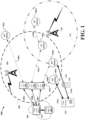
- the one or more IoT sensors 102a-n may reside within or outside of a range of one or more interfering nodes, such as a first signal interference source 106 emitting a first interfering signal 108, or a second signal interference source 110 emitting a second interfering signal 112.
- a first signal interference source 106 emitting a first interfering signal 108
- a second signal interference source 110 emitting a second interfering signal 112.
- the first interfering signal 108 and the second interfering signal 112 are depicted in FIG. 1 as being emitted in 360 degrees patterns.
- An interfering signal may be emitted in-band or out-of-band with a desired measured signal. When in-band, the interfering signal may directly interfere with one or more IoT links 103 and/or data links 115.
- the interfering signal When out-of-band, the interfering signal may have a form of energy in a RF band that is adjacent to a measured signal, yet, within one or more bands measurable by the AGC. It is to be appreciated that an AGC may be driven into saturation by energy received in one or more adjacent RF bands. Accordingly, the various embodiments of the present disclosure are intended to cover both in-band, out-of-band and other interfering signals. It is to be appreciated that other signal patterns may be utilized by a signal interference source and the frequencies, bandwidth, properties and other characteristics of an interfering signal may vary, as desired for any given implementation of an embodiment of the present disclosure.
- the first interfering signal 108 and the second interfering signal 110 may influence or interfere with operations of one or more of the IoT sensors 102a-n, one or more of the IoT links 103a-n, one or more control links 109a-n, one or more data links 115a-n, and/or otherwise interfere with one or more of the frequency bands managed by a frequency manager 101.
- a building 116, tree (not shown), geographic feature, or other structure may function as an egress node 118.
- egress node 118 may physically and/or functionally impede, degrade, or otherwise interfere with one or more communication links between and/or operations of one or more IoT sensor(s) 102, IoT controller(s) 104, frequency controller(s) 107, frequency manager(s) 101 and/or data server(s) 114.
- egress node 118 degrades a second data link 115b between a second IoT sensor 102b and a data server 116.
- a first signal interference source 106 may be active and emitting the first interfering signal 108.
- the frequency manager 101, frequency controller 107 and IoT controller 104 may be configured to utilize the first IoT sensor 102a, continually and/or at one or more first sampling times, to detect the first interfering signal 108.
- the frequency manager 101, frequency controller 107 and/or IoT controller 104 may be configured to "wake-up" an IoT sensor 102 at any time. For example, on an immediate, real-time, scheduled, unscheduled, or any other basis.
- one or more of the frequency manager 101, frequency controller 107 and/or IoT controller 104 may be configured to instruct an IoT sensor 102 to halt performance of a currently active primary function and to commence with performing one or more signal interference functions. Resumption of the primary function may occur at any desired time, as specified by one or more of the frequency manager 101, frequency controller 107 and/or IoT controller 104 communicatively coupled to the given IoT sensor 102.
- a single IoT controller 104 As shown in FIGs. 2A-2C , 3 , 4 and 5 and for purposes of illustrative simplicity only, a single IoT controller 104, a single frequency controller 107 and a single frequency manager 101 are depicted. As discussed above, the various embodiments are not so limited. It is to be appreciated that any number of such elements may be used in a given embodiment of the present disclosure.
- an IoT sensor 102 such as the first IoT sensor 102a, may be configured to measure a signal strength and/or other signal properties and/or characteristics of the first interfering signal 108.
- a continually active, bi-directional or unidirectional communications link may be established between the IoT controller 104 and the first IoT sensor 102a to facilitate reporting of a first scan data provided by the IoT sensor 102a.
- a continually active, bi-directional communications link may be established between an IoT controller 104 and a frequency controller 107.
- one or more of the communications links may be active for any given period of time, configured to simplex, duplex or other communications, or otherwise configured, as so desired for a given embodiment.
- an IoT sensor 102 may be configured to report first scan data, and any other data, using one or more communications signals, one or more repeated communications signals, one or more different communications signals, or otherwise.
- An IoT sensor 102 may be configured to repeatedly, intermittently, or other transmit a given data set until an acknowledgement message or the like is received from each of one or more intended recipients of a given communications signals such as, but not limited to, an IoT controller 104.
- a frequency manager 101, frequency controller 107 and IoT controller 104 may be configured to utilize the first IoT sensor 102a to use intelligent-selective scanning.
- intelligent-elective scanning one or more predetermined and/or pre-set frequencies may be designated for scanning. Such frequencies may be "offensive frequencies" - frequencies designated as known interfering frequencies based upon historical data collected from one or more previous campaigns and results arising from such previous campaigns. It is to be appreciated that such use of intelligent-selective scanning may arise, for at least one embodiment, to determine whether previous remedies are effective and/or whether a previously detected interferer is complying with one or more restrictions placed upon them by contract, court order, technical considerations, or otherwise.
- the frequency manager 101 may specify a campaign and a frequency controller 107 may accordingly therewith initiate a scan plan that instructs one or more IoT controllers 104 to configure and utilize one or more second IoT sensors, such as second IoT sensor 102b, as desired, to detect the first interfering signal 108.
- the first interfering signal 108 may be continually or otherwise present.
- the second IoT sensor 102b may be used to detect and/or determine a signal strength and/or other signal properties and/or characteristics of the first interfering signal 108.
- the frequency manager/frequency controller/IoT controller 101/107/104 may be configured to utilize the second IoT sensor 102b at the same or different times as it uses the first IoT sensor 102a or any other IoT sensor 102. As shown by the dashed line depicted for the second IoT link 103b, a periodically active, bi-directional or unidirectional communications link may be respectively established between two or more of the second IoT sensor 102b, IoT controller 104, frequency controller 107 and frequency manager 101to facilitate reporting of a second scan data generated by the second IoT sensor 102b. The second scan data may be responsive to a detected first interfering signal 108 and may identify one or more characteristics of the first interfering signal 108.
- the frequency manager/frequency controller/IoT controller 101/107/104 may be configured to utilize each of the second IoT sensor 102b and a third IoT sensor 102c.
- the IoT sensors 102b/c may be used at one or more second or third sampling times and in order to detect the first interfering signal 108.
- Respective second scan data and third scan data generated by the IoT sensors 102b/c and pertaining to the first interfering signal 108 may include signal strength, frequency, periodicity (if any), and/or other signal properties and/or characteristics thereof.
- the second scan data and third scan data may include the same or different data.
- the frequency manager/frequency controller/IoT controller 101/107/104 may be configured to utilize the second IoT sensor 102b and/or the third IoT sensor 102c at the same or different times as it uses the first IoT sensor 102a or any other IoT sensor 102.
- a periodically active, bi-directional or unidirectional communications link may be respectively established between two or more of the second IoT sensor 102b, IoT controller(s) 104, frequency controller(s) 107 and frequency manager(s) 101to facilitate reporting of the second data arising during use of the second IoT sensor 102b for interfering signal detection, identification and other purposes.
- a continually active, bi-directional or unidirectional communications link may be respectively established between two or more of the third IoT sensor 102c, IoT controller(s) 104, frequency controller(s) 107 and frequency manager(s) 101 to facilitate reporting of a third scan data arising during use of the third IoT sensor 102c for interfering signal detection, identification and other purposes.
- one or more combinations of IoT controller(s) 104, frequency controller(s) 107 and/or frequency manager(s) 101 may use respectively detected signal strengths and/or other reported characteristics of the first interfering signal 108 and known triangulation calculations to determine a location of the first signal interference source 106, the nature thereof and other information.
- Such interfering signal data may also and/or alternatively be used for different purposes, such as determining periodicity of emissions, frequencies used, bandwidth used, transmitting power and other characteristics of the first interfering signal 108 and/or the first signal interference source 106.
- Such determinations may be used by one or more IoT controllers 104, frequency controllers 107 and/or frequency managers 101 for any purpose, such as to specify when a given IoT sensor 102 is active, inactive, transmitting, powered to receive signals or otherwise.
- the frequency managers/frequency controllers/IoT controllers101/107/104 may be configured to utilize one or more of the second IoT sensor 102b, the third IoT sensor 102c, and a fourth IoT sensor 102d.
- the IoT sensors 102b/c/d may be used at one or more second/third or fourth sampling times and in order to detect presence, signal strength and/or other properties and characteristics of a second interfering signal 108.
- the respective sampling times may arise concurrently or non-concurrently, overlap, or otherwise.
- the respective sampling times may be preset for each IoT sensor 102 or variably set, for example as specified by the frequency manager 101 (per a campaign plan), as instructed by a frequency controller 107 (per a scan plan) and as controlled by an IoT controller 104, or otherwise. It is to be appreciated that the detected presence, signal strength and other properties and characteristics of any reported scan data may vary by IoT sensor type, IoT sensor location, IoT sensor capabilities, and other factors.
- the frequency managers/frequency controllers/IoT controller(s) 101/107/104 may be configured to utilize the second IoT sensor 102b, the third IoT sensor 102c, and/or the fourth IoT sensor 102d for interfering signal detection and the like at the same or different times that they, collectively, use any other IoT sensor, such as the first IoT sensor 102a.
- each of the IoT links 103 may be continually active, bi-directional or unidirectional communications link.
- one or more IoT links 103 may be established between the IoT controller(s)104 and the respective IoT sensors directly, as shown by the second IoT link 103b and the third IoT link 103c, or indirectly, as shown by the fourth IoT link 103d which communicatively couples the fourth IoT sensor 102d to the frequency controller 104 via the third IoT sensor 103c and the third IoT link 103c.
- Any desired configuration of IoT links 103 may be used. Non-limiting examples of such configurations include peer-to-peer networks, mesh networks, and otherwise.
- the fourth IoT link 103d may be used to facilitate reporting of the fourth scan data arising during use of the fourth IoT sensor 102d for interfering signal detection, identification and other purposes.
- the frequency manager(s)/frequency controller(s)/IoT controller(s) 101/107/104 may be configured to utilize one or more IoT sensors 102 to detect an intermittently occurring interfering signal, such as a third interfering signal 120 that is emitted by a third signal interference source 118.
- the frequency managers/frequency controllers/IoT controller(s) 101/107/104 may be further configured to accordingly develop a campaign, scan plan, and activate the second IoT sensor 102b to facilitate further detection and/or monitoring of the first interfering signal 108 - such first interfering signal 108 may be emitted at the same time as the intermittent third interfering signal 120.
- Activation of the second IoT sensor 102b is illustrated in FIG.
- FIG. 4 by the use of a diagonal fill pattern.
- Activation of the first IoT sensor 102a for detection of the third interfering signal 120 is illustrated in FIG. 4 by use of solid fill.
- the various elements of system 100 may be configured to operate such that the detected presence, signal strength and other properties or characteristics of two or more interfering signals may be determined adaptively, dynamically, or otherwise.
- a fourth signal interference source 122 is depicted as being a non-stationary, active source that provides a fourth interfering signal 124.
- a current position of the fourth signal interference source 122 and the fourth interfering signal 124 may vary over time, such as from a first time T1 to a second time T2 .
- the characteristics and properties of the fourth interfering signal 124 may also vary over time, such as having different transmission powers, frequencies, or otherwise. These detected properties of the fourth interfering signal 124 may vary over time and based on a given IoT sensor 102 utilized.
- detected properties of the fourth interfering signal 124 may be different for the first IoT sensor 102a versus those detected and determined by the second IoT sensor 102b.
- Doppler and other signal processing techniques and technologies may be used as the fourth signal interference source 122 travels.
- one or more of the second IoT sensor 102b, an IoT controller 104, a frequency controller 107 and/or a frequency manager 101 may use Doppler techniques to determine a direction of travel (towards or away from the sensor) of the fourth signal interference source 122.
- advanced signal processing techniques by a given system 100 component is illustrated by use of the horizontal fill lines for the second IoT sensor 102b versus the sold fill shading used for the first IoT sensor 102a, where the first IoT sensor 102a is not using such advanced signal processing techniques. It is to be appreciated that any form of advanced signal processing techniques may be performed, as desired, by an IoT sensor 102, IoT controller 104, frequency controller 107, and/or frequency manager 101 or otherwise. For at least one embodiment, a given computational task is performed at the system 100 device most capable of performing such computational tasks efficiently. It is to be appreciated, that for certain simple computational tasks, an IoT sensor 102 may be suitably configured to so perform.
- an IoT controller 104 and/or a frequency controller 107 may be configured to perform such tasks.
- a frequency manager 101 may be tasked. It is also to be appreciated that the allocation of a given task, or element thereof, to one or more system components will vary with a given devices computational, processing, data storage/retrieval, communications and other capabilities. Accordingly, the various embodiments of the present disclosure are not to be limited to any given system 100 device performing any given computational task, data storage task, or otherwise.
- multiple IoT sensors 102 may be used to provide to the frequency manager(s)/frequency controller(s)/IoT controller(s) 101/107/104 substantially similar or different scan data results.
- detected signal strengths for the fourth interfering signal 120 may be substantially similar for both the third IoT sensor 102c and the fourth IoT sensor 102d at a given time, such as at time T2.
- respective detected signal strengths by these IoT sensors 102c/102d may vary at times both preceding and after time T2.
- Such scan data results may be used to determine a direction of travel, speed and other characteristics of a given interfering signal and a signal interference source (SIS), such as those of the fourth interfering signal 124 and the fourth signal interference source 122.
- SIS signal interference source
- Such scan data may be used by the frequency manager/frequency controller 101/104 for any desired purpose.
- Scan data may be provided, in any desired form, format, or otherwise, in one more scan result reports that are communicated from a given IoT sensor 102 to, respectively, one or more given IoT controllers 104, frequency controllers 107 and frequency managers 101.
- various embodiments of the present disclosure may include use of one or more systems configured such that one or more IoT sensors 102 are operated to detect and, when so detected, report to one or more IoT controllers 104 and indirectly to one or more frequency controllers 107 and/or frequency managers 101 data useful for determining one or more of a location of a given signal interference source (SIS) and/or one or more properties and characteristics of a detected interfering signal.
- the frequency manager(s)/frequency controller(s)/IoT controller(s) 101/107/104 may be configured to use one or more IoT sensors 102 and on any desired basis for any given campaign and scan plan.
- a given IoT sensor 102 may be configured for use in interfering signal detection during down-times for that given IoT sensor 102, such as times when the IoT sensor 102 would otherwise not be sensing, processing and/or communicating sensed data to a data server 116.
- a frequency manager/frequency controller/IoT controller 101/107/104 may be configured to dynamically adjust when an IoT sensor performs operations consistent with one or more campaigns and scan plans and for any given embodiments of the present disclosure.
- an IoT sensor 102 may be configured into a "light-sleep" whereby it automatically powers-up when a signal having certain characteristics and/or properties (herein, " triggering characteristics ") is detected or otherwise present. Such triggering characteristics may be preset, dynamically determined, specified by a frequency manager/frequency controller/IoT controller 101/107/104, determined by a given IoT sensor 102 itself, or otherwise.
- an IoT sensor 102 may include a hardware processor 602 (hereinafter, the "processor"), a storage module 604, a power module 606, a communications module 608, and a sensor module 610.
- the communications module 608 may be further configured to include at least one transponder 608A and at least one automatic gain controller ( AGC ) 608B.
- AGC automatic gain controller
- the communications module 608 may also be communicatively coupled to one or more internal and/or external antennas 614.
- the antenna 614 may be static, beam forming, dynamic, or otherwise configured.
- the antenna 614 may be configured to track a moving signal interference source, such as the fourth signal interference source 118 shown in FIG. 5 .
- the communications module 608 may also be configured to facilitate communicative coupling of a given IoT sensor 102 or, when configured as a relay, two or more IoT sensors with one or more IoT controllers 104 and a data server 116.
- IoT links 103, data links 116 and/or other communications links may be supported by the communications module and components thereof.
- One or more of the communications links may include use of the Cloud, a local area network, a wide area network, the Internet, or other communications mediums.
- One or more servers, Cloud based or otherwise, may also be used to facilitate communication of data between an IoT sensor 102 and an IoT controller 104.
- the antenna 614, transponder 608A and/or other known and commonly arising elements of a communications module 608 for an IoT sensor 102 may be configured to support a range of downstream frequencies and listen for signals present across such range of downstream frequencies.
- an AGC 608B may be used to determine a strength of the detected signal. Such detected signal strength may be communicated as scan data to an IoT controller 104 over an IoT link 103.
- the value generated by an AGC 608B (herein, the " detected value "), in response to a detected interfering signal, is inversely proportional to the energy received in the detected frequency.
- the detected interfering signal may arise over any single frequency, a range of frequencies, a band of frequencies or otherwise and is herein referred to commonly as arising over a " frequency band .”
- the AGC 608B may be used for normal IoT sensor 102 communication operations while and/or when being used or not used to detect an interfering signal.
- the frequency band of the interfering signal may be identified, for example, based on scan data collected by one or more IoT sensors 102 and/or other data, by a frequency manager101. Such identification may be based upon any factor, such as a detected anomaly in a given IoT service, in a given wireless communications service, or other frequency range and/or communications service managed by a given frequency manager 101.
- the frequency band may vary over any given period, for example, such that a range of frequencies are scanned. Such range of frequencies scanned may be specified by the frequency manager 101, per a campaign, and implemented by a frequency controller 107, IoT controller 104 and IoT sensor 102, as per a given scan plan.
- Data resulting from such campaign and scan plan may be stored, as one or more data sets, in the storage module 604 or elsewhere.
- Computer instructions (as defined below) for executing one or more scans, performing interfering signal detection, reporting limits and other principles of operation for one or more IoT sensors 102 may also be provided by a frequency controller 107 and/or IoT controller 104 and communicated to one or more of the IoT sensors 102.
- the processor 602 may include one or more physical (as compared to logical) components configured for data processing operations.
- the processor 602 may include one or more hardware processors, such as 32-bit and 64-bit central processing units, multi-core ARM based processors, microprocessors, microcontrollers, and otherwise.
- the data processing operations executed by the processor 602 may include one or more non-transient computer executable instructions.
- the non-transient computer executable instructions may include instructions for executing one or more applications, engines, and/or processes configured to perform computer executable operations (hereafter, " computer instructions ") .
- the hardware and software technologies provided by the processor 602 and the computer instructions may arise in any desired computing configuration including, but not limited to, local, remote, distributed, blade, virtual, or other configurations and/or systems configured for use in support of the one or more embodiments of the present disclosure.
- the computer instructions may be stored and/or provided in the storage device 604, provided with the processor 602 itself, such as in cache or read only memory, as firmware, accessible from a remote source, or otherwise.
- the processor 602 may be separated into one or more logical processing elements that execute computer instructions to facilitate the various features and functions of the IoT sensor device 102, as so configured in accordance with one or more embodiments of the present disclosure.
- the storage device 604 may be configured to store one or more data sets. Such data sets may be generated based upon actual use of a given IoT sensor 102 or other data provided to or generated by an IoT sensor 102. Such data sets may be provided during an initial set-up and/or initial use of a given IoT sensor 102, may be generated during use of an IoT sensor 102, or otherwise generated/provided and saved in the storage device 604. For at least one embodiment, an IoT sensor 102 may be configured for use with any currently known and/or future arising local, remote, Cloud and/or combinations thereof of one or more storage devices including.
- the processor 602 may be configured to execute computer instructions for instantiating an interference detection widget 602A.
- the interference detection widget 602A may be configured to instruct the IoT sensor 102 to perform one or more of the above described and below described interfering signal detection, SIS location, and/or remediation processes.
- the interference detection widget 602A may also be configured to instruct the communications module 608 when and how (e.g., at what transmission power, frequency, or otherwise) to communicate a scan result report and scan data to an IoT controller 104 and, when desired, in sequence to one or more of a frequency controller 107 and a frequency manager 101.
- an interference detection widget 602A may be instantiated using a local processor, such as on provided with a given IoT sensor 102, a remote processor such as a Cloud based processor, a dedicated processors such as one provided by a frequency manager 101, a frequency controller 107, an IoT controller 104, a data server 114, a combination of any of the foregoing, or otherwise.
- a local processor such as on provided with a given IoT sensor 102
- a remote processor such as a Cloud based processor
- a dedicated processors such as one provided by a frequency manager 101, a frequency controller 107, an IoT controller 104, a data server 114, a combination of any of the foregoing, or otherwise.
- an IoT sensor 102 may be configured to instantiate an interference detection widget 602A locally, remotely and/or in combination thereof and using any currently known and/or future arising local, remote, Cloud, and/or combinations thereof of one or more processing devices.
- an IoT controller /104 is any device capable of communicating, directly or indirectly, instructions and/or data by and between one or more IoT sensors 102 for the purpose of facilitating the detection of an interfering signal, identification of an SIS, and/or remediation of an interfering.
- each of a frequency manager 101, frequency controller 107, and IoT controller 104 includes a hardware processor, a data storage component, a communications module, and other common components of servers and is configured to execute computer instructions facilitating at least the operations described herein.
- a process for facilitating the detecting of an interfering signal begins with a frequency manager 101 requesting a monitoring campaign ( Operation 700 ).
- Fig. 7 covers best the claimed invention.
- the frequency manager 101 requests one or more frequency controllers 104 to initiate a scanning campaign.
- the request for a scanning campaign may be a for single scan, multiple scans, repeat scans, period scans, or as otherwise desired.
- a request for a scanning campaign may be triggered automatically, such as when a given RF band is demonstrating decreased performance characteristics, or otherwise.
- a scan campaign then may continue with an IoTcontroller 102 initiating a scan.
- the scan may be initiated for one or more frequencies or frequency bands, may be initiated over any desired time period, and under any desired conditions.
- the scan may be initiated for any desired purpose, such as preventive maintenance, in response to a detected system anomaly, or otherwise.
- a scan is conducted by one or more controllers 104, using one or more IoT sensors 102, as directed by a frequency controller 107, pursuant to a given scan plan, and in furtherance of a campaign, as specified by a frequency manager 101.
- the scan includes a single scan over a desired first frequency band.
- multiple scans over one or more frequency bands may be performed. Repeat scans over varying or the same time intervals, permutations of the foregoing, combinations of the foregoing, and otherwise may be used. Any desired scanning process may be used in accordance with an embodiment of the present disclosure.
- one or more the frequency controllers 107 periodically reviews scan results (if any) to determine whether one or more interfering signals have been detected in the one or more first frequency bands, each such detection being identified herein as a " response condition ", and whether further action (herein, a " response condition action ") is to be performed. It is to be appreciated that for a given scan campaign, a frequency controller 107 may use two or more IoT controllers 104, which are communicatively coupled to and use two or more IoT sensors 102 for any desired scanning. During normal operations, a response condition action may be specified by a frequency controller 107 in conjunction with a frequency manager 101.
- an IoT controller 104 and/or frequency controller 107 may specify a response condition action.
- consultations with and/or instructions from a frequency manager 101 are not required to specify a response condition action during emergency or anomalous operating conditions.
- Detections of other events or conditions may also occur during any given scan, a description of such other conditions are beyond the scope of the present disclosure but an embodiment of the present disclosure may be configured to scan, detect and respond to one or more response conditions and/or other conditions. If no response condition action is determined, the process may continue with further scanning, as per Operation 702, the process may be terminated or suspended (not shown in FIG. 7 ), or may proceed otherwise, as desired for a given embodiment of the present disclosure.
- the process continues with an identification of two or more IoT sensors 102 and/or other devices that further the response condition action.
- identification of IoT sensor(s) 102 is performed by a frequency controller 107.
- other devices include, but are not limited to, WIFI configured devices, neutral host gateways, small cell sites, and other devices.
- IoT sensors 102 and other devices are commonly referred to each as an " available IoT sensor .”
- a frequency controller 107 may be configured to utilize an IoT sensor database or other database to identify one or more available IoT sensors 102.
- a frequency controller 107 may instruct one or more IoT controllers 104 to initiate a query process, such as by broadcasting an "available?" message to one or more IoT sensors 102 within a geographic area of a given response condition.
- a response to such query by one or more IoT sensors 102 may be used by the frequency controller 107 to identify such responding IoT sensor(s) as being an available IoT sensor.
- the process may include the frequency controller 107 selecting one or more of the available IoT sensors 102, each of such selected IoT sensors 104 being identified herein for purposes of explanation only as a " selected IoT sensor. " More specifically, the frequency controller 107 may be configured to identify and select from the available IoT sensor(s) 102 those one or more IoT sensor(s) 102 that support a scan plan of the one or more first frequency bands, where the one or more first frequency bands may contain, permanently, intermittently, or otherwise, one or more interfering signals giving rise to the given response condition.
- a scan plan is developed by the frequency controller(s) 107.
- a scan plan may be developed solely by a frequency controller 107 and/or in conjunction with inputs provided by a frequency manager 101, another frequency controller 107, one or more IoT controllers 104, or combinations thereof.
- the scan plan may take any form and may include scanning for any desired frequency bands, including but not limited to the first frequency band and/or frequencies adjacent to those frequencies giving rise to the given response condition.
- Operations 708-710 may occur iteratively with IoT sensors 102 being selected and the scan plan being developed in view of available IoT sensors 102, the response condition, a response condition action desired, a campaign specified by a frequency manager 101, and other factors. It is to be appreciated that a response condition action desired may also be iteratively determined and a scan plan ultimately developed based upon available IoT sensor 102 characteristics, location, and other considerations. Such other considerations may include a given IoT sensor's availability.
- a scan plan may be developed that avoids using an IoT sensor 102, in support of a response condition action, during those time periods during which the given IoT sensor 102 is tasked with performing other operations, such as a scheduled, emergency, or unscheduled activity.
- a scan plan may be developed that avoids using a specific capability of an IoT sensor 102, in support of a response action, that would require use of that specific capability for other uses, such as a scheduled activity, while using other capabilities of the given IoT sensor 102.
- a use of a given IoT sensor 102 in support of a response condition action may be specified in a scan plan to use only certain frequency bands and during certain time periods.
- a use of a given IoT sensor 102 per a scan plan may include configuring the IoT sensor 102 such that the use of the IoT sensor 102 has a desired priority, with priorities for other activities (not in support of the scan plan) having greater priority taking precedence.
- a scan plan may specify the configuring of a use of a given IoT sensor 102 in view of and/or in consideration of other scan plans that may exist with respect to that given IoT sensor 102 and/or with respect to other IoT sensor 102 considerations. Accordingly, it is to be appreciated that for one or more embodiments of the present disclosure, numerous variables and considerations may be considered in developing a scan plan and one size does not fit all.
- the scan plan is initiated. It is to be appreciated that the desired time for initiating a scan plan can be at any time including, but not limited to, immediately, or at some future time. While not shown in FIG. 7 , it is to be appreciated that the initiation of a scan plan and subsequent execution of one or more scan plan operations may occur more than once, such as repeatedly, continually, while a response condition exists, within a time period after cessation and/or suspension of a response condition, or otherwise.
- one or more scan plan activities may be executed; scan plan activities may arise serially, concurrently, randomly, repeatedly, intermittently, or otherwise, as specified by a given scan plan. Such one or more scan plan activities may arise with respect to one or more selected IoT sensors 102.
- the frequency controller 107 is responsible for executed a given scan plan and, accordingly, instructs one or more IoT controllers 104 to suitably control one or more IoT sensors 102.
- control of IoT sensors 102 may include controlling active/inactive times, frequencies scanned, and otherwise.
- one scan plan activity may include redirecting data, communications links, or other RF signals associated with one or more frequencies used to support normal operations that are coincident with, adjacent to, share harmonics with, or otherwise have signal properties and/or characteristics common with and/or relevant to those of the one or more interfering signals giving rise to the response condition to which a given then response condition action is directed.
- a scan plan may include a steering sensor data, scan data or other data away from use of an anomalous frequency data to another non-anomalous frequency, where an anomalous frequency is a frequency band impacted, in whole or in part, by an interfering signal.
- traffic may be steered from a 700 MHz frequency band to another distinct frequency band such as an 800 MHz frequency band, and vice versa, when problems on one of the frequency bands arises but is not present on the other frequency band.
- one scan plan activity may include suspending use of a given frequency, channel, communications link, or otherwise.
- a scan plan activity may include turning off (ceasing emissions from) those 700 MHZ transmitters within a given area with respect to which the given response condition may arise. It is to be appreciated that by turning off such transmitters, an operator or other entity associated with the given response condition action may facilitate further detection (if possible) of one or more interfering signals and identification of a SIS.
- the SIS may or may not be within the control of a given operator of the frequency manager 101, frequency controller 107, IoT controller 104 and/or IoT sensors 102 used for the given scan plan.
- another scan plan activity may include configuring one or more selected IoT sensor(s) 102 in support of the determined scan plan.
- a configuring of the one or more selected IoT sensors 102 may include the frequency controller 107 communicating a set of standard commands and/or instructions to the selected IoT sensors 102, via one or more IoT controllers 104, herein a "standard scan command.
- a standard scan command may: be unique to each of the selected IoT sensors 102; be common to two or more of the selected IoT sensors 102; include computer instructions; include data for use with the scan plan; configure a selected IoT sensor 102 to scan one or more specified frequency bands; configure a selected IoT sensor 102 to execute a scan at one or more specified times; specify a minimum scanning; specify a maximum scanning frequency; specify one or more bandwidths and/or bandwidth increments to be scanned; specify sampling periods, intervals and/or durations; and otherwise.
- a scan command may instruct an IoT sensor 102 to scan from 700 MHz to 750 MHz, in bandwidth increments of 500 kHz and identify any coarse energy peaks arising therein.
- a " coarse energy peak" is defined herein as an increase of more than 50% (fifty percent) in a then arising received signal strength for a given frequency over an average signal strength for such given frequency, wherein the average signal strength is computed over a pre-determined time interval.
- the pre-determined time interval is a period of time necessary to communicate a data packet of a given size between a sender and a recipient using the first frequency band. It is to be appreciated that the pre-determined time interval may vary, from embodiment to embodiment, based upon packet size, frequency utilized, modulation and other communications signal transmission processes used.
- a configuring of the one or more selected IoT sensors 102 may include a frequency controller 107 communicating a set of iterative commands and/or instructions to the selected IoT sensors 102, via one or more IoT controllers 104, herein an " iterative scan command .”
- an iterative scan command may include one or more computer instructions which configure an IoT sensor 102 to perform one or more of the Operations shown in FIG. 8 .
- an IoT sensor 102 when configured to execute an iterative scan command, may be further configured to identify one or more coarse energy peaks by widely scanning across all or a part of the first frequency band.
- an IoT sensor 102 may be configured to use a first scan width, such as a scan width of 500 kHz across an entire 700 MHz band.
- an IoT sensor 102 may be configured to conduct a first narrow scan, using a first narrower scan width, across those one or more frequency bands associated with one or more identified coarse energy peaks detected per Operation 800 (such frequency range herein being identified as a "first narrower frequency band ").
- the first narrower scan width may use 100 kHz of frequency surrounding one or more of the detected coarse energy peak(s).
- Such a first narrower scan may be centered about a given detected coarse energy peak, offset from a given coarse energy peak, or otherwise configured.
- the first narrow scan may return a more precise identification, in the first frequency band, of the one or more detected coarse energy peaks, such more precise identification being referred to herein as a " first narrow coarse energy peak. "
- an IoT sensor 102 may be configured to conduct a second narrow scan, using a second narrower scan width, across those one or more frequency ranges associated with one or more identified coarse energy peaks determined using the first narrower scan per Operation 802.
- an IoT sensor 102 may be configured to scan 10 kHz of frequency surrounding each of the first narrow scan bands for one or more of the detected coarse energy peaks.
- Such second narrower scan may be centered about a given detected coarse energy peak, offset from a given coarse energy peak, or otherwise configured.
- the second narrow scan may return an even more precise identification, in the first frequency band, of the interfering signals, such more precise identification being referred to herein as a " second narrow coarse energy peak.
- third, fourth or other narrower scans may be specified by a frequency controller 107 in a scan plan and used to identify one or more edges of an interfering signal.
- such narrower scans may facilitate detection of one or more edges of an interfering signal within two scans of a given frequency range.
- successively narrower scans may facilitate detection of one or more edges of an interfering signal within a given number of scans of two or more course energy peaks.
- a number of course energy peaks detected for a given interfering signal, as per Operation 800 may be determinative of a number of narrower scans to be utilized.
- an IoT sensor 102 may be configured to utilize two (2) narrower scans for each course energy peak detected per Operation 800.
- iterative scanning may facilitate detection of an interfering signal in an energy efficient manner. For example, if a given IoT sensor 102 is configured, using a standard scanning plan, to scan an entire 100 MHz spectrum, ten thousand (10,000) scans are needed. In contrast and when using an iterative scan plan, an IoT sensor 102 may identify coarse 500 kHz energy peaks of an interfering signal using two-hundred (200) scans, 100 kHz edges for each coarse energy peak in ten (10) scans, and 10 kHz narrower edges in an additional ten (10 scans).
- edges of a given interfering signal may be found using an iterative scan plan in two-hundred and twenty (220) scans of a given frequency band. Accordingly, use of an iterative scan plan may result in identification of an interfering signal many times faster, and in some cases fifty (50) times faster, than use of a standard scan plan. It is to be appreciated that a corresponding decrease in energy utilized to perform a scan may also be realized from use of an iterative scan plan.
- an IoT sensor 102 may be configured to execute an iterative scan plan independently and/or remotely as based upon one or more commands received from the frequency controller 107 communicatively coupled, via an IoT controller 104, to the IoT sensor 102. It is to be appreciated that remote instruction of an iterative scan plan may result in additional reductions in number of scans utilized, energy utilized, and otherwise as one or more of such remote instructions may be generated by the frequency controller 107 based upon results obtained from one or more second IoT sensors 102. Artificial intelligence, machine learning and other data analytics processes may be applied to reduce the number of scan and energy utilized by an array of IoT sensors 102 and in accordance with a given implementation of a response condition action.
- a configuring of the one or more selected IoT sensors 102 may include the frequency controller 107 communicating, via an IoT controller 104, one or more antenna commands to one or more of the selected IoT sensors 102.
- Antenna commands may be used for IoT sensors 102 that have a configurable and/or directional antenna.
- a given antenna may be configured to conduct one or more standard scan plans and/or iterative scan plans in one or more quadrants accessible by the configurable and/or directional antenna.
- each IoT sensor 102 designated for use per a given scan plan may be designated by a number or otherwise. IoT sensor numbers may be correspondingly incremented, per Operation 715, until scan times for each IoT sensor 102 designated for a given scan plan are determined. For another embodiment, scan times for each IoT sensor 102 designated for use in a given scan plan may be monitored in parallel for their designated scan times.
- multiple scan times may be designated for a given IoT sensor 102 and monitoring for such scan times may be performed by the IoT sensor 102 and/or the frequency controller 107 or IoT controller 104.
- the process proceeds accordingly with the monitoring device activating the given scanning operations.
- a scan plan may include use of a standard scan plan, an iterative scan plan, a scan plan that includes one or more antenna commands, combinations of the foregoing, and otherwise.
- a given activation of scan may include multiple scans, antenna movements, and otherwise.
- each activated IoT sensor 102 generates a " scan result report.
- the scan result report may be reported, respectively, to a given IoT controller 104, a frequency controller 107 and a frequency manager 101, to another IoT sensor 102 for compilation, forwarding, further analysis or otherwise, to a network based server, or otherwise reported.
- a reporting scheme may be designated for a given campaign and a given scan plan. A default reporting scheme may be used.
- a reporting scheme may vary from IoT sensor 102 to IoT sensor 102 and/or by campaign and/or scan plan then being implemented.
- a scan result report may include scan data regarding scan parameters and/or detected elements of an interfering signal (assuming a detection then so occurs) and/or the SIS generating the interfering signal.
- Such scan data may include, but is not limited to, low frequency and high frequency edges of a detected interfering signal, measurement bandwidth utilized for the given scan to acquire the scan data, power levels detected in the interfering signal, characteristics of any power elements of a detected interfering signals (such as, but not limited to, whether a fixed or varying power is detected, periodicity of any varying signal, power level across steps of a given bandwidth, and otherwise), direction of scan (when available), whether a standard scan plan, an iterative scan plan and/or an antenna sweep scan plan was executed, and any other data, scan settings, or other information relevant to a given implementation of an embodiment of the present disclosure.
- one or more of the frequency manager 101 specifying the campaign and/or the frequency controller 107 executing the scan plan receives the scan result report(s).
- One or more frequency managers 101 and/or frequency controllers 107 may receive the scan result reports.
- a given scan plan may involve the use of multiple IoT sensors 102 that may be respectively communicatively coupled to the same and/or different IoT controllers 104, that are communicatively coupled to one or more frequency controllers 107 executing a scan plan in accordance with a campaign initiated by a frequency manager 101.
- one or more frequency managers 101, frequency controllers 107, IoT controllers 104, and IoT sensors 102 may be used in a given embodiment with a central or designated frequency manager 101 performing centralized scan data collection and analysis operations.
- the scan data provided in the received one or more scan result reports, for a given scan plan may be recorded in a database or storage device, such as storage module 604.
- the scan data is analyzed by one or more frequency managers 101 using one or more algorithms, (such as matching algorithms, statistical algorithms, or otherwise), machine learning techniques, artificial intelligence processes, or otherwise.
- the scan data is analyzed to identify one or more second frequency bands identified in one or more scan result reports common to one or more of the first frequency bands.
- the one or more second frequency bands indicative of the presence of an interfering signal in the one or more first frequency bands.
- the analysis of the scan data may include one or more sub-processes, as shown by Operations 726A and 726B.
- one or more IoT sensors 102 may be designated as an " activated loT sensor " for a given scan plan. Such designation may occur pursuant to a scan plan developed by a frequency controller 107 and activation of such IoT sensor may occur based upon commands communicated from the frequency controller 107 to the IoT sensor 104, via an IoT controller 104. For at least one embodiment, such designation may be based upon results obtained from prior scan plans, an identification of one or more interfering signals by other IoT sensors 102, capabilities of a given IoT sensor 102, characteristics of the detected interfering signal, and otherwise.
- SIS location identifying operations may include comparing power levels reported in two or more scan result reports to identify relative distances of two or more activated IoT sensors 102 to a given SIS. It is to be appreciated that often an activated IoT sensor 102 reporting a highest received power for a given interfering signal will by closest in a direct line of sight distance to the SIS emitting the given interfering signal. Similar relationships may arise with respect to second, third, and other reported interfering signal received strengths, as reported by other activated IoT sensors 102.
- a frequency manager 101 will know, from a scan result report or other data provided in a database, a location of an activated IoT sensor 102 when the interfering signal is detected - as reported in a given set of scan data. Using known triangulation techniques, a frequency manager 101 may determine an approximate, if not precise, location for a given SIS emitting the interfering signal. It is to be appreciated that with four or more activated IoT sensors 102 providing scan data with respect to a given interfering signal, a precise latitude and longitude for the corresponding SIS may be determinable.
- known circular range estimating techniques may be used, where overlapping regions of each circle indicate, with ever greater precision, a potential area for the location of a given SIS.
- a location of a given IoT sensor 102 may be used in estimating a location of a SIS.
- varying attenuation factors may be used in comparing received signal strengths for interfering signals based upon IoT sensor 102 location, with an inside locate IoT sensor 102 having a higher attenuation factor and an outside located IoT sensor 102 having a lower attenuation factor.
- Such attenuation factors may have an inverse relationship with a given received signal strength for an interfering signal.
- An attenuation factor used for a given IoT sensor 102 may be determined based upon testing, based on results reported in scan result reports, based upon statistical analysis, based upon a designated location of a given IoT sensor 102, combinations of any of the foregoing, or otherwise.
- ray tracing data may be used by a frequency manager 101 to identify a given SIS. For example, if four (4) IoT sensors 102 have line of site to a given SIS and one IoT sensor 102 is receiving multipath energy, a frequency manager 101 may use the scan data to detect that condition and use ray tracing techniques to identify a location of an SIS. It is to be appreciated that an identification of a location of an SIS may be accomplished with any acceptable error range. Such acceptable error range may vary by embodiment and implementation of any given embodiment.
- a mobile IoT sensor 102 may be provided in a drone, a vehicle, or otherwise.
- Directional antennas may be used with a mobile IoT sensor 102, as desired for a given embodiment.
- Use of a drone, vehicle or otherwise as a mobile IoT sensor 102 may be configured such that such use for purposes herein does not interfere with other primary operations of such drone, such as delivery, photography, surveillance, or otherwise.
- a location and/or other information for a given SIS may be stored in the database.
- the database may be periodically updated with any available information regarding an SIS.
- Such data may be obtained from any of the data, processes and/or results obtained using one or more Operations of FIG. 7 , from external sources, or otherwise.
- detection operations for a given interfering signal and identification of a location and/or other information for the interfering signal emitting SIS may be deemed complete for that given time period and for a given scan plan. Additional analysis operations may be performed later if desired or otherwise specified in a scan plan. Accordingly, Operations may resume at Operation 712 or otherwise, as illustrated by the dashed line connecting Operations 732 and 712.
- remediation operations may be performed.
- One or more such remediation operations are illustrated in FIG. 9 and FIG. 10 for at least one embodiment of the present disclosure.
- a remediation operation may include a frequency manager 101 calculating changes in a given interfering signal at an IoT sensor 102 and/or at a geographic boundary if changes, such as power gain/reduction, are made to a SIS. Accordingly, it is to be appreciated that other forms of remediation operations may be performed and that the various embodiments of the present disclosure are not limited to the remediation operations described herein.
- a determination of the quiescent noise level may be accomplished iteratively, with various known transmitters being powered up or down, at various times. Further, the quiescent noise level may be determined over two or more frequency bands and in accordance with any desired number and/or types of modulation schemes, frequency use schemes, or otherwise. Thus, the determining of a quiescent noise level may involve numerous measurements, numerous samples, statistical analysis of the same, may be frequency band specific, and may involve other known signal processing and characterization type operations. For at least one embodiment, any known or later arising technique for determining a quiescent noise level for a given IoT sensor 102 may be used.
- a remediation operation may include taking one or more AGC 608B power level measurements when the known interfering signal is present but while the frequency manager 101, frequency controller 107, IoT controller104, other IoT sensors 102, or other known devices are not communicating with the given IoT sensor 102.
- a transponder 608A may be configured to utilize any desired communications technology. Non-limiting examples of such communications technologies include LoRaWAN ® , NB-IOT, SigFox, and similar presently available and/or later arising technologies.
- a minimum value output by an AGC 608B represents a worst case headroom in the AGC 608B for any LoRaWAN or similar communications signals.
- a remediation operation may include taking one or more AGC 608B power level measurements when a combined signal is received and the combined signal includes energy from the known interfering signal and energy from an actively transmitting frequency manager 101, frequency controller 107, IoT controller 104, other IoT sensors 102, or other known devices.
- a minimum value output by an AGC 608B represents a worst case power level of the combined signals.
- a remediation operation may include determining whether the AGC 608B is at a maximum value or another pre-determined value when both the interfering signal is present and the frequency manager 101, frequency controller 107, IoT controller 104, other IoT sensors 102, or other known devices are actively communicating with the given IoT sensor 102. If “yes,” the process may proceed to Operation 908. If “no,” the process may proceed to Operation 910.
- a remediation operation may include reducing one or more gain settings for the AGC 608B.
- An amount of such reduction may be specified by the frequency manager 101, the frequency controller 107, the IoT controller 104, the IoT sensor 102 itself, or other known devices.
- Reductions of the gain settings may occur iteratively, step-wise, in one step, or otherwise. Reductions may occur until any desired level for the AGC 608B is reached. Such level may be pre-determined or determined on a then occurring basis.
- a remediation operation may include taking one or more AGC 608B power level measurements when the known interfering signal is not present and while the frequency manager 101, frequency controller 107, IoT controller 104, another IoT sensor 102, or other known device is transmitting a communication signal to the given IoT sensor 102.
- minimum and maximum AGC 608B power level measurements detected during Operation 910 represent a range of AGC values the IoT sensor 102 may expect to detect when the frequency manager 101, frequency controller 107, IoT controller 104, another IoT sensor 102, or other known device is actively transmitting signals to the IoT sensor 102.
- additional remediation operations may be performed based upon detected AGC levels. These additional remedial operations are identified herein as Operations 912 - 926. One or more of such additional remediation operations may be performed in conjunction with one or more of Operations 902 - 910.
- an additional remediation operation may include determining whether the AGC 608B level is at saturation. If “no”, then no additional remediation operations are performed and the process may end per Operation 928. If “yes,” the additional remediation operations may proceed with Operation 914.
- an additional remediation operation may include determining a ratio of when the IoT sensor's transponder is receiving signals from the frequency manager 101, frequency controller 107, IoT controller 104, other IoT sensors 102, or other known devices and whether the received signal strength ratio is greater than a first threshold "X.”
- "X" is a pre-determined value.
- X 75% (seventy-five percent). If “yes,” the process may proceed to Operation 916. If “no,” the process may proceed to Operation 920.
- an additional remediation operation may include determining if the power level measurements taken during Operation 904 indicate that the AGC 608B is saturated. If “yes”, the process may proceed to Operation 918. If “no”, the process may proceed to Operation 920.
- an additional remediation operation may include one or more of reducing the output power of the communications signals sent from a frequency manager 101, frequency controller 107, IoT controller 104, another IoT sensor 102, or other known device to a given IoT sensor's transponder, shielding the IoT sensor 102 from the interfering signal, moving the IoT sensor 102 away from the SIS for the given interfering signal, or other actions which diminish the amount of RF signal energy received by the transponder for that given IoT sensor 102.
- the process may proceed to Operation 928.
- an additional remediation operation may include determining if the power level measurements taken during Operation 910 for the maximum values are met. If “yes”, the process may proceed to Operation 918. If “no”, the process may proceed to Operation 926.
- an additional remediation operation may include determining that the on/off ratio for transponder for the given IoT sensor 102is less than the second threshold " Y .” Accordingly, the process may proceed to Operation 926.
- a remedial operation may include calibrating a given IoT sensor 102 and mapping one or more AGC 608B values of such given IoT sensor 102 to one or more energy levels. It is to be appreciated that such calibration and mapping operations may be performed by a frequency manager 101, in a laboratory, manufacturing or other controlled environment setting, in the field, or otherwise.
- a given AGC 608B value for example, 90% (ninety percent)
- a given IoT sensor 102 may be associated with a given spreading factor (for example, an SF 10 factor) and correlated to a given signal strength (for example, -40 dBm).
- a range of AGC values can be calibrated and stored in a database.
- a second quiescent AGC value may be gathered.
- the second quiescent AGC value may represent energy received by a given IoT sensor 102 from all other transmitters, besides a given frequency manager 101, frequency controller 107, IoT controller 104, other IoT sensors 102 and/or other known devices.
- a transmitter in the SIS may be activated and the value of the AGC in the IoT sensor 102 receiving the interfering signal from the SIS may be measured.
- a difference between the results obtained per Operation 1002 and Operation 1004 may be calculated and represents the power received by the IoT sensor 102 from the given SIS.
- readings from multiple IoT sensors 102 near a geographic boundary for a given interfering signal may be obtained, for example using per Operations 1000-1006, and the energy being transmitted by the given SIS may be extrapolated.
- the energy transmitted by the given SIS, as determined per Operation 1008, may be used to adjust one or more AGC levels in one or more IoT sensors 102. Such adjustments may be accomplished using one or more of Operations 914-926 or otherwise. The second series of remedial operations is then complete.
- top and bottom are used for description and ease of reference purposes only and are not intended to be limiting to any orientation or configuration of any elements or sequences of operations for the various embodiments of the present disclosure.
- the terms “coupled”, “connected” or otherwise are not intended to limit such interactions and communication of signals between two or more devices, systems, components or otherwise to direct interactions; indirect couplings and connections may also occur.
- the terms “and” and “or” are not intended to be used in a limiting or expansive nature and cover any possible range of combinations of elements and operations of an embodiment of the present disclosure.
Landscapes
- Engineering & Computer Science (AREA)
- Computer Networks & Wireless Communication (AREA)
- Signal Processing (AREA)
- Physics & Mathematics (AREA)
- Electromagnetism (AREA)
- Quality & Reliability (AREA)
- Health & Medical Sciences (AREA)
- Computing Systems (AREA)
- General Health & Medical Sciences (AREA)
- Medical Informatics (AREA)
- Mobile Radio Communication Systems (AREA)
- Noise Elimination (AREA)
Claims (15)
- Verfahren zum Erkennen eines Störsignals, das Folgendes beinhaltet:Durchführen eines Scans (702) von einem oder mehreren Frequenzbändern nach einem Störsignal, um mindestens ein Scanergebnis zu erhalten;Feststellen (704) aus dem mindestens einen Scanergebnis, dass eine Antwortbedingung erkannt wurde;Identifizieren eines ersten Frequenzbandes, das der erkannten Antwortbedingung entspricht;Feststellen, auf der Basis von mindestens einer Charakteristik des Störsignals, dass eine Antwortbedingungsaktion durchzuführen ist;wobei die durchzuführende Antwortbedingungsaktion Folgendes beinhaltet:Identifizieren (706) eines verfügbaren ersten IOT-(Internet-of-Things)-Sensors;Auswählen (708) des verfügbaren ersten IoT-Sensors;Entwickeln eines Scanplans (710);Anweisen des ersten IoT-Sensors, den Scanplan zu initiieren;Empfangen (722) erster Scandaten von dem ersten IoT-Sensor;Analysieren (726) der ersten Scandaten, um ein zweites Frequenzband zu identifizieren;
wobei das zweite Frequenzband für das Störsignal indikativ ist, das von einer Signalstörquelle erzeugt wird und innerhalb des ersten Frequenzbandes entsteht; undSchätzen (726B), auf der Basis von mindestens den ersten Scandaten, eines Ortes für die Signalstörquelle, SIS. - Verfahren nach Anspruch 1,
wobei das Verfahren mittels eines Frequenzmanagers, einer Frequenzsteuerung und einer IoT-Steuerung durchgeführt wird. - Verfahren nach Anspruch 2,
wobei das erste Frequenzband mindestens eine Frequenz umfasst, die vom ersten IoT-Sensor zur Kommunikation mit der IoT-Steuerung benutzt wird. - Verfahren nach Anspruch 1,
wobei das Identifizieren des ersten IoT-Sensors ferner mindestens eines beinhaltet von:Zugreifen auf eine IoT-Sensordatenbank, um den ersten IoT-Sensor zu identifizieren; undInitiieren eines Abfrage- und Antwortverfahrens, um den ersten IoT-Sensor zu identifizieren. - Verfahren nach Anspruch 4,
wobei sich der erste IoT-Sensor innerhalb eines gegebenen geografischen Gebiets befindet. - Verfahren nach Anspruch 4,
wobei der erste IoT-Sensor den Scanplan durch Scannen des ersten Frequenzbandes während mindestens einer ersten Zeitperiode initiiert. - Verfahren nach Anspruch 6,
wobei der Scanplan ein Scannen von mindestens einem Frequenzband neben dem ersten Frequenzband beinhaltet. - Verfahren nach Anspruch 5,
wobei der Scan ein Scannen des ersten Frequenzbandes ausschließt, wenn der erste IoT-Sensor zur Durchführung einer anderen Aktivität vorgesehen ist. - Verfahren nach Anspruch 1,
wobei die ersten Scandaten in einem Scanergebnisbericht empfangen werden, der vom ersten IoT-Sensor erzeugt wird und auf mehreren Scans des ersten Frequenzbandes durch den ersten IoT-Sensor basiert. - Verfahren nach Anspruch 1,
wobei der Scanplan entwickelt wird, um ein Störsignal zu erkennen, das intermittierend innerhalb des ersten Frequenzbandes entsteht. - Verfahren nach Anspruch 1,
wobei der Scanplan mindestens einen nichtflüchtigen Computerbefehl enthält, der den ersten IoT-Sensor anweist, einen Standardscanplan oder einen iterativen Scanplan und einen Antennenbefehl auszuführen. - Verfahren nach Anspruch 11,wobei der iterative Scanplan den ersten IoT-Sensor anweist, mindestens einen nichtflüchtigen Computerbefehl auszuführen, der Operationen umfasst zum:
Scannen des ersten Frequenzbands, mit einer ersten Scanbreite, über das erste Frequenzband, um eine innerhalb des ersten Frequenzbands entstehende grobe Energiespitze zu erkennen; undwenn die grobe Energiespitze detektiert wird,Durchführen eines ersten schmalen Scans eines ersten Frequenzbandes um die detektierte grobe Energiespitze, um eine erste schmale grobe Energiespitze zu identifizieren; undDurchführen eines zweiten schmalen Scans um die erste schmale grobe Energiespitze, um eine zweite schmale grobe Energiespitze zu identifizieren. - Verfahren nach Anspruch 12,wobei der erste schmale Scan eine erste schmale Scanbreite verwendet, die ein Fünftel der ersten Scanbreite beträgt und auf die erkannte grobe Energiespitze zentriert ist; undwobei der zweite schmale Scan eine zweite Scanbreite verwendet, die ein Fünftel der ersten schmalen Scanbreite beträgt und auf der ersten schmalen groben Energiespitze zentriert ist.
- Verfahren nach einem vorherigen Anspruch, das ferner das Identifizieren eines oder mehrerer zusätzlicher verfügbarer IoT-Sensoren und das Auswählen mindestens des ersten IoT-Sensors aus dem Satz von verfügbaren IoT-Sensoren beinhaltet.
- Gerät, das zum Erkennen eines Störsignals konfiguriert ist und Folgendes umfasst:einen Prozessor; undein Kommunikationsmodul;wobei der Prozessor zum Ausführen mindestens eines nichtflüchtigen Computerbefehls konfiguriert ist, um das Verfahren nach einem vorherigen Anspruch durchzuführen.
Priority Applications (1)
| Application Number | Priority Date | Filing Date | Title |
|---|---|---|---|
| EP24216272.5A EP4496240A3 (de) | 2019-12-18 | 2020-12-15 | Erkennung und sanierung von störsignalen und quellen |
Applications Claiming Priority (2)
| Application Number | Priority Date | Filing Date | Title |
|---|---|---|---|
| US16/718,324 US11201682B2 (en) | 2019-12-18 | 2019-12-18 | Devices, systems and processes for detecting and remediating interfence signals and identifying signal interference sources |
| PCT/US2020/065016 WO2021126803A1 (en) | 2019-12-18 | 2020-12-15 | Detecting and remediating interference signals and sources |
Related Child Applications (1)
| Application Number | Title | Priority Date | Filing Date |
|---|---|---|---|
| EP24216272.5A Division EP4496240A3 (de) | 2019-12-18 | 2020-12-15 | Erkennung und sanierung von störsignalen und quellen |
Publications (2)
| Publication Number | Publication Date |
|---|---|
| EP4079022A1 EP4079022A1 (de) | 2022-10-26 |
| EP4079022B1 true EP4079022B1 (de) | 2024-12-25 |
Family
ID=74181336
Family Applications (2)
| Application Number | Title | Priority Date | Filing Date |
|---|---|---|---|
| EP20839479.1A Active EP4079022B1 (de) | 2019-12-18 | 2020-12-15 | Interferenzen signale und deren quellen erkennen und beheben |
| EP24216272.5A Pending EP4496240A3 (de) | 2019-12-18 | 2020-12-15 | Erkennung und sanierung von störsignalen und quellen |
Family Applications After (1)
| Application Number | Title | Priority Date | Filing Date |
|---|---|---|---|
| EP24216272.5A Pending EP4496240A3 (de) | 2019-12-18 | 2020-12-15 | Erkennung und sanierung von störsignalen und quellen |
Country Status (3)
| Country | Link |
|---|---|
| US (4) | US11201682B2 (de) |
| EP (2) | EP4079022B1 (de) |
| WO (1) | WO2021126803A1 (de) |
Families Citing this family (25)
| Publication number | Priority date | Publication date | Assignee | Title |
|---|---|---|---|---|
| US11030618B1 (en) | 2016-09-30 | 2021-06-08 | Winkk, Inc. | Authentication and personal data sharing for partner services using out-of-band optical mark recognition |
| US11637694B2 (en) | 2018-07-16 | 2023-04-25 | Winkk, Inc. | Secret material exchange and authentication cryptography operations |
| KR102607793B1 (ko) * | 2019-01-24 | 2023-11-30 | 삼성전자주식회사 | 카메라 모듈에 접지 노드를 연결하기 위한 전자 장치 및 방법 |
| US11936787B2 (en) | 2019-12-10 | 2024-03-19 | Winkk, Inc. | User identification proofing using a combination of user responses to system turing tests using biometric methods |
| US12132763B2 (en) | 2019-12-10 | 2024-10-29 | Winkk, Inc. | Bus for aggregated trust framework |
| US12073378B2 (en) | 2019-12-10 | 2024-08-27 | Winkk, Inc. | Method and apparatus for electronic transactions using personal computing devices and proxy services |
| US12341790B2 (en) | 2019-12-10 | 2025-06-24 | Winkk, Inc. | Device behavior analytics |
| US11574045B2 (en) | 2019-12-10 | 2023-02-07 | Winkk, Inc. | Automated ID proofing using a random multitude of real-time behavioral biometric samplings |
| US11328042B2 (en) | 2019-12-10 | 2022-05-10 | Winkk, Inc. | Automated transparent login without saved credentials or passwords |
| US11657140B2 (en) | 2019-12-10 | 2023-05-23 | Winkk, Inc. | Device handoff identification proofing using behavioral analytics |
| US11928193B2 (en) | 2019-12-10 | 2024-03-12 | Winkk, Inc. | Multi-factor authentication using behavior and machine learning |
| US12335399B2 (en) | 2019-12-10 | 2025-06-17 | Winkk, Inc. | User as a password |
| US11588794B2 (en) | 2019-12-10 | 2023-02-21 | Winkk, Inc. | Method and apparatus for secure application framework and platform |
| US11652815B2 (en) | 2019-12-10 | 2023-05-16 | Winkk, Inc. | Security platform architecture |
| US11553337B2 (en) | 2019-12-10 | 2023-01-10 | Winkk, Inc. | Method and apparatus for encryption key exchange with enhanced security through opti-encryption channel |
| US12153678B2 (en) | 2019-12-10 | 2024-11-26 | Winkk, Inc. | Analytics with shared traits |
| US12143419B2 (en) | 2019-12-10 | 2024-11-12 | Winkk, Inc. | Aggregated trust framework |
| US11201682B2 (en) | 2019-12-18 | 2021-12-14 | Dish Wireless L.L.C. | Devices, systems and processes for detecting and remediating interfence signals and identifying signal interference sources |
| US11599828B2 (en) * | 2020-02-27 | 2023-03-07 | Microsoft Technology Licensing, Llc | Management and operation of loosely coupled internet of things devices |
| CN113453268B (zh) * | 2020-03-26 | 2023-06-02 | 华为技术有限公司 | 空间复用的方法、装置、计算机可读存储介质和芯片 |
| US11843943B2 (en) | 2021-06-04 | 2023-12-12 | Winkk, Inc. | Dynamic key exchange for moving target |
| US12095751B2 (en) * | 2021-06-04 | 2024-09-17 | Winkk, Inc. | Encryption for one-way data stream |
| CN114023055B (zh) * | 2021-11-17 | 2023-01-24 | 成都千嘉科技有限公司 | 一种基于无线抄表集中器的干扰探测方法 |
| CN114449565A (zh) * | 2022-04-11 | 2022-05-06 | 希诺麦田技术(深圳)有限公司 | 网络解调异常测试方法、装置、设备 |
| US12445305B2 (en) | 2022-09-21 | 2025-10-14 | Winkk, Inc. | Authentication process |
Citations (2)
| Publication number | Priority date | Publication date | Assignee | Title |
|---|---|---|---|---|
| US20140269374A1 (en) * | 2013-03-15 | 2014-09-18 | Isco International, Llc | Method and appartus for signal interference processing |
| EP3001717B1 (de) * | 2014-09-29 | 2020-11-04 | Keysight Technologies Singapore (Sales) Pte.Ltd. | Störungsdetektion |
Family Cites Families (11)
| Publication number | Priority date | Publication date | Assignee | Title |
|---|---|---|---|---|
| US6807405B1 (en) * | 1999-04-28 | 2004-10-19 | Isco International, Inc. | Method and a device for maintaining the performance quality of a code-division multiple access system in the presence of narrow band interference |
| CN101686088A (zh) * | 2008-09-24 | 2010-03-31 | 珠海扬智电子有限公司 | 电磁干扰评估方法 |
| EP2391023B1 (de) * | 2010-05-31 | 2012-11-21 | ST-Ericsson SA | Störungserkennung in einem drahtlosen Empfänger |
| US10575338B2 (en) * | 2016-02-04 | 2020-02-25 | Samsung Electronics Co., Ltd. | Method and apparatus for UE signal transmission in 5G cellular communications |
| US20170280399A1 (en) * | 2016-03-24 | 2017-09-28 | Qualcomm Incorporated | Managing Radio Frequency Spectrum Usage By A Wireless Network Node |
| US9628124B1 (en) * | 2016-08-17 | 2017-04-18 | Intel Corporation | Sensor signals interference mitigation method and apparatus |
| US10412663B2 (en) * | 2017-03-21 | 2019-09-10 | Ademco Inc. | Systems and methods for detecting and avoiding radio interference in a wireless sensor network |
| US10075813B1 (en) * | 2017-10-31 | 2018-09-11 | Tionesta, Llc | Method and system for monitoring a mobile asset |
| US10512094B2 (en) * | 2017-12-28 | 2019-12-17 | Intel Corporation | Assessment and mitigation of radio frequency interference of networked devices |
| US10720947B1 (en) * | 2019-10-02 | 2020-07-21 | Qualcomm Incorporated | Dynamic spur mitigation for wireless systems |
| US11201682B2 (en) | 2019-12-18 | 2021-12-14 | Dish Wireless L.L.C. | Devices, systems and processes for detecting and remediating interfence signals and identifying signal interference sources |
-
2019
- 2019-12-18 US US16/718,324 patent/US11201682B2/en active Active
-
2020
- 2020-12-15 EP EP20839479.1A patent/EP4079022B1/de active Active
- 2020-12-15 WO PCT/US2020/065016 patent/WO2021126803A1/en not_active Ceased
- 2020-12-15 EP EP24216272.5A patent/EP4496240A3/de active Pending
-
2021
- 2021-11-17 US US17/455,329 patent/US11888542B2/en active Active
-
2023
- 2023-12-19 US US18/545,490 patent/US12212377B2/en active Active
-
2025
- 2025-01-09 US US19/014,815 patent/US20250150182A1/en active Pending
Patent Citations (2)
| Publication number | Priority date | Publication date | Assignee | Title |
|---|---|---|---|---|
| US20140269374A1 (en) * | 2013-03-15 | 2014-09-18 | Isco International, Llc | Method and appartus for signal interference processing |
| EP3001717B1 (de) * | 2014-09-29 | 2020-11-04 | Keysight Technologies Singapore (Sales) Pte.Ltd. | Störungsdetektion |
Also Published As
| Publication number | Publication date |
|---|---|
| US20210194608A1 (en) | 2021-06-24 |
| US11888542B2 (en) | 2024-01-30 |
| US20220149961A1 (en) | 2022-05-12 |
| EP4496240A3 (de) | 2025-04-02 |
| US20240121020A1 (en) | 2024-04-11 |
| US12212377B2 (en) | 2025-01-28 |
| WO2021126803A1 (en) | 2021-06-24 |
| US20250150182A1 (en) | 2025-05-08 |
| US11201682B2 (en) | 2021-12-14 |
| EP4079022A1 (de) | 2022-10-26 |
| EP4496240A2 (de) | 2025-01-22 |
Similar Documents
| Publication | Publication Date | Title |
|---|---|---|
| EP4079022B1 (de) | Interferenzen signale und deren quellen erkennen und beheben | |
| EP3469565B1 (de) | Betrieb eines bewegungsdetektionskanals in einem drahtloskommunikationsnetz | |
| US9167457B2 (en) | Measuring and displaying wireless network quality | |
| US11430323B2 (en) | Detecting device interfering with security device | |
| US20070155329A1 (en) | Detection of radio frequency interference in wireless communication systems | |
| US11051386B2 (en) | Distributed intelligent network-based lighting system | |
| US20220349984A1 (en) | Low power radar in radio communication terminal | |
| US12313728B2 (en) | Changing transmission and/or reception characteristics for detecting events other than human presence | |
| US20190277641A1 (en) | Method and localization system for setting up or updating an environment map | |
| JP2018513447A (ja) | センサ装置の動作方法及びセンサ装置 | |
| EP3571773A1 (de) | Antennensystem | |
| US20210160698A1 (en) | Methods and apparatus for monitoring contested spectrum and/or responding to the detection of an incumbent user | |
| EP2511785B1 (de) | Vorrichtungen, Verfahren und Systeme zur Belegungserkennung | |
| JP2020031459A (ja) | 電子装置、測定装置及び方法 | |
| CN108761473A (zh) | 空调器的房间大小检测方法、空调器和计算机存储介质 | |
| KR101516180B1 (ko) | 기지국 감시 장치 | |
| JP5840962B2 (ja) | 通信不良区間判定システム | |
| JP2022534325A (ja) | 照明デバイス | |
| US11356871B2 (en) | Methods and systems for spectrum license management | |
| WO2025045896A1 (en) | Determining a configuration for a reconfigurable intelligent surface based on measurements by mobile devices | |
| WO2026011799A1 (zh) | 干扰源定位方法、装置、存储介质及程序产品 | |
| CN120457358A (zh) | 在联合通信和感测系统中用于感测一个或多个对象的节点选择 | |
| Stefanski | Characterization of radiowave propagation in indoor industrial environments |
Legal Events
| Date | Code | Title | Description |
|---|---|---|---|
| STAA | Information on the status of an ep patent application or granted ep patent |
Free format text: STATUS: UNKNOWN |
|
| STAA | Information on the status of an ep patent application or granted ep patent |
Free format text: STATUS: THE INTERNATIONAL PUBLICATION HAS BEEN MADE |
|
| PUAI | Public reference made under article 153(3) epc to a published international application that has entered the european phase |
Free format text: ORIGINAL CODE: 0009012 |
|
| STAA | Information on the status of an ep patent application or granted ep patent |
Free format text: STATUS: REQUEST FOR EXAMINATION WAS MADE |
|
| 17P | Request for examination filed |
Effective date: 20220705 |
|
| AK | Designated contracting states |
Kind code of ref document: A1 Designated state(s): AL AT BE BG CH CY CZ DE DK EE ES FI FR GB GR HR HU IE IS IT LI LT LU LV MC MK MT NL NO PL PT RO RS SE SI SK SM TR |
|
| DAV | Request for validation of the european patent (deleted) | ||
| DAX | Request for extension of the european patent (deleted) | ||
| P01 | Opt-out of the competence of the unified patent court (upc) registered |
Effective date: 20230526 |
|
| STAA | Information on the status of an ep patent application or granted ep patent |
Free format text: STATUS: EXAMINATION IS IN PROGRESS |
|
| GRAP | Despatch of communication of intention to grant a patent |
Free format text: ORIGINAL CODE: EPIDOSNIGR1 |
|
| STAA | Information on the status of an ep patent application or granted ep patent |
Free format text: STATUS: GRANT OF PATENT IS INTENDED |
|
| RIC1 | Information provided on ipc code assigned before grant |
Ipc: G01S 5/06 20060101ALN20240209BHEP Ipc: G01S 5/04 20060101ALN20240209BHEP Ipc: H04B 17/345 20150101ALI20240209BHEP Ipc: H04B 17/27 20150101ALI20240209BHEP Ipc: H04B 1/10 20060101ALI20240209BHEP Ipc: H04B 1/00 20060101ALI20240209BHEP Ipc: H04W 16/10 20090101AFI20240209BHEP |
|
| 17Q | First examination report despatched |
Effective date: 20240228 |
|
| RIC1 | Information provided on ipc code assigned before grant |
Ipc: G01S 5/06 20060101ALN20240229BHEP Ipc: G01S 5/04 20060101ALN20240229BHEP Ipc: H04B 17/345 20150101ALI20240229BHEP Ipc: H04B 17/27 20150101ALI20240229BHEP Ipc: H04B 1/10 20060101ALI20240229BHEP Ipc: H04B 1/00 20060101ALI20240229BHEP Ipc: H04W 16/10 20090101AFI20240229BHEP |
|
| RIC1 | Information provided on ipc code assigned before grant |
Ipc: G01S 5/06 20060101ALN20240304BHEP Ipc: G01S 5/04 20060101ALN20240304BHEP Ipc: H04B 17/345 20150101ALI20240304BHEP Ipc: H04B 17/27 20150101ALI20240304BHEP Ipc: H04B 1/10 20060101ALI20240304BHEP Ipc: H04B 1/00 20060101ALI20240304BHEP Ipc: H04W 16/10 20090101AFI20240304BHEP |
|
| INTG | Intention to grant announced |
Effective date: 20240320 |
|
| GRAJ | Information related to disapproval of communication of intention to grant by the applicant or resumption of examination proceedings by the epo deleted |
Free format text: ORIGINAL CODE: EPIDOSDIGR1 |
|
| STAA | Information on the status of an ep patent application or granted ep patent |
Free format text: STATUS: EXAMINATION IS IN PROGRESS |
|
| GRAP | Despatch of communication of intention to grant a patent |
Free format text: ORIGINAL CODE: EPIDOSNIGR1 |
|
| STAA | Information on the status of an ep patent application or granted ep patent |
Free format text: STATUS: GRANT OF PATENT IS INTENDED |
|
| INTC | Intention to grant announced (deleted) | ||
| RIC1 | Information provided on ipc code assigned before grant |
Ipc: G01S 5/06 20060101ALN20240703BHEP Ipc: G01S 5/04 20060101ALN20240703BHEP Ipc: H04B 17/345 20150101ALI20240703BHEP Ipc: H04B 17/27 20150101ALI20240703BHEP Ipc: H04B 1/10 20060101ALI20240703BHEP Ipc: H04B 1/00 20060101ALI20240703BHEP Ipc: H04W 16/10 20090101AFI20240703BHEP |
|
| INTG | Intention to grant announced |
Effective date: 20240711 |
|
| GRAS | Grant fee paid |
Free format text: ORIGINAL CODE: EPIDOSNIGR3 |
|
| GRAA | (expected) grant |
Free format text: ORIGINAL CODE: 0009210 |
|
| STAA | Information on the status of an ep patent application or granted ep patent |
Free format text: STATUS: THE PATENT HAS BEEN GRANTED |
|
| AK | Designated contracting states |
Kind code of ref document: B1 Designated state(s): AL AT BE BG CH CY CZ DE DK EE ES FI FR GB GR HR HU IE IS IT LI LT LU LV MC MK MT NL NO PL PT RO RS SE SI SK SM TR |
|
| REG | Reference to a national code |
Ref country code: GB Ref legal event code: FG4D |
|
| REG | Reference to a national code |
Ref country code: CH Ref legal event code: EP |
|
| REG | Reference to a national code |
Ref country code: DE Ref legal event code: R096 Ref document number: 602020043791 Country of ref document: DE |
|
| REG | Reference to a national code |
Ref country code: IE Ref legal event code: FG4D |
|
| REG | Reference to a national code |
Ref country code: LT Ref legal event code: MG9D |
|
| PG25 | Lapsed in a contracting state [announced via postgrant information from national office to epo] |
Ref country code: HR Free format text: LAPSE BECAUSE OF FAILURE TO SUBMIT A TRANSLATION OF THE DESCRIPTION OR TO PAY THE FEE WITHIN THE PRESCRIBED TIME-LIMIT Effective date: 20241225 |
|
| PG25 | Lapsed in a contracting state [announced via postgrant information from national office to epo] |
Ref country code: FI Free format text: LAPSE BECAUSE OF FAILURE TO SUBMIT A TRANSLATION OF THE DESCRIPTION OR TO PAY THE FEE WITHIN THE PRESCRIBED TIME-LIMIT Effective date: 20241225 |
|
| PG25 | Lapsed in a contracting state [announced via postgrant information from national office to epo] |
Ref country code: BG Free format text: LAPSE BECAUSE OF FAILURE TO SUBMIT A TRANSLATION OF THE DESCRIPTION OR TO PAY THE FEE WITHIN THE PRESCRIBED TIME-LIMIT Effective date: 20241225 |
|
| PG25 | Lapsed in a contracting state [announced via postgrant information from national office to epo] |
Ref country code: NO Free format text: LAPSE BECAUSE OF FAILURE TO SUBMIT A TRANSLATION OF THE DESCRIPTION OR TO PAY THE FEE WITHIN THE PRESCRIBED TIME-LIMIT Effective date: 20250325 |
|
| PG25 | Lapsed in a contracting state [announced via postgrant information from national office to epo] |
Ref country code: GR Free format text: LAPSE BECAUSE OF FAILURE TO SUBMIT A TRANSLATION OF THE DESCRIPTION OR TO PAY THE FEE WITHIN THE PRESCRIBED TIME-LIMIT Effective date: 20250326 Ref country code: LV Free format text: LAPSE BECAUSE OF FAILURE TO SUBMIT A TRANSLATION OF THE DESCRIPTION OR TO PAY THE FEE WITHIN THE PRESCRIBED TIME-LIMIT Effective date: 20241225 |
|
| PG25 | Lapsed in a contracting state [announced via postgrant information from national office to epo] |
Ref country code: RS Free format text: LAPSE BECAUSE OF FAILURE TO SUBMIT A TRANSLATION OF THE DESCRIPTION OR TO PAY THE FEE WITHIN THE PRESCRIBED TIME-LIMIT Effective date: 20250325 |
|
| REG | Reference to a national code |
Ref country code: NL Ref legal event code: MP Effective date: 20241225 |
|
| PG25 | Lapsed in a contracting state [announced via postgrant information from national office to epo] |
Ref country code: NL Free format text: LAPSE BECAUSE OF FAILURE TO SUBMIT A TRANSLATION OF THE DESCRIPTION OR TO PAY THE FEE WITHIN THE PRESCRIBED TIME-LIMIT Effective date: 20241225 |
|
| REG | Reference to a national code |
Ref country code: AT Ref legal event code: MK05 Ref document number: 1755192 Country of ref document: AT Kind code of ref document: T Effective date: 20241225 |
|
| PG25 | Lapsed in a contracting state [announced via postgrant information from national office to epo] |
Ref country code: SM Free format text: LAPSE BECAUSE OF FAILURE TO SUBMIT A TRANSLATION OF THE DESCRIPTION OR TO PAY THE FEE WITHIN THE PRESCRIBED TIME-LIMIT Effective date: 20241225 |
|
| PG25 | Lapsed in a contracting state [announced via postgrant information from national office to epo] |
Ref country code: PL Free format text: LAPSE BECAUSE OF FAILURE TO SUBMIT A TRANSLATION OF THE DESCRIPTION OR TO PAY THE FEE WITHIN THE PRESCRIBED TIME-LIMIT Effective date: 20241225 |
|
| PG25 | Lapsed in a contracting state [announced via postgrant information from national office to epo] |
Ref country code: ES Free format text: LAPSE BECAUSE OF FAILURE TO SUBMIT A TRANSLATION OF THE DESCRIPTION OR TO PAY THE FEE WITHIN THE PRESCRIBED TIME-LIMIT Effective date: 20241225 |
|
| PG25 | Lapsed in a contracting state [announced via postgrant information from national office to epo] |
Ref country code: IS Free format text: LAPSE BECAUSE OF FAILURE TO SUBMIT A TRANSLATION OF THE DESCRIPTION OR TO PAY THE FEE WITHIN THE PRESCRIBED TIME-LIMIT Effective date: 20250425 |
|
| PG25 | Lapsed in a contracting state [announced via postgrant information from national office to epo] |
Ref country code: PT Free format text: LAPSE BECAUSE OF FAILURE TO SUBMIT A TRANSLATION OF THE DESCRIPTION OR TO PAY THE FEE WITHIN THE PRESCRIBED TIME-LIMIT Effective date: 20250428 |
|
| PG25 | Lapsed in a contracting state [announced via postgrant information from national office to epo] |
Ref country code: EE Free format text: LAPSE BECAUSE OF FAILURE TO SUBMIT A TRANSLATION OF THE DESCRIPTION OR TO PAY THE FEE WITHIN THE PRESCRIBED TIME-LIMIT Effective date: 20241225 |
|
| PG25 | Lapsed in a contracting state [announced via postgrant information from national office to epo] |
Ref country code: AT Free format text: LAPSE BECAUSE OF FAILURE TO SUBMIT A TRANSLATION OF THE DESCRIPTION OR TO PAY THE FEE WITHIN THE PRESCRIBED TIME-LIMIT Effective date: 20241225 Ref country code: RO Free format text: LAPSE BECAUSE OF FAILURE TO SUBMIT A TRANSLATION OF THE DESCRIPTION OR TO PAY THE FEE WITHIN THE PRESCRIBED TIME-LIMIT Effective date: 20241225 |
|
| PG25 | Lapsed in a contracting state [announced via postgrant information from national office to epo] |
Ref country code: SK Free format text: LAPSE BECAUSE OF FAILURE TO SUBMIT A TRANSLATION OF THE DESCRIPTION OR TO PAY THE FEE WITHIN THE PRESCRIBED TIME-LIMIT Effective date: 20241225 |
|
| PG25 | Lapsed in a contracting state [announced via postgrant information from national office to epo] |
Ref country code: CZ Free format text: LAPSE BECAUSE OF FAILURE TO SUBMIT A TRANSLATION OF THE DESCRIPTION OR TO PAY THE FEE WITHIN THE PRESCRIBED TIME-LIMIT Effective date: 20241225 |
|
| PG25 | Lapsed in a contracting state [announced via postgrant information from national office to epo] |
Ref country code: IT Free format text: LAPSE BECAUSE OF FAILURE TO SUBMIT A TRANSLATION OF THE DESCRIPTION OR TO PAY THE FEE WITHIN THE PRESCRIBED TIME-LIMIT Effective date: 20241225 |
|
| PG25 | Lapsed in a contracting state [announced via postgrant information from national office to epo] |
Ref country code: SE Free format text: LAPSE BECAUSE OF FAILURE TO SUBMIT A TRANSLATION OF THE DESCRIPTION OR TO PAY THE FEE WITHIN THE PRESCRIBED TIME-LIMIT Effective date: 20241225 |
|
| REG | Reference to a national code |
Ref country code: DE Ref legal event code: R097 Ref document number: 602020043791 Country of ref document: DE |
|
| PG25 | Lapsed in a contracting state [announced via postgrant information from national office to epo] |
Ref country code: DK Free format text: LAPSE BECAUSE OF FAILURE TO SUBMIT A TRANSLATION OF THE DESCRIPTION OR TO PAY THE FEE WITHIN THE PRESCRIBED TIME-LIMIT Effective date: 20241225 |
|
| PLBE | No opposition filed within time limit |
Free format text: ORIGINAL CODE: 0009261 |
|
| STAA | Information on the status of an ep patent application or granted ep patent |
Free format text: STATUS: NO OPPOSITION FILED WITHIN TIME LIMIT |
|
| 26N | No opposition filed |
Effective date: 20250926 |
|
| REG | Reference to a national code |
Ref country code: GB Ref legal event code: 732E Free format text: REGISTERED BETWEEN 20251120 AND 20251126 |
|
| PGFP | Annual fee paid to national office [announced via postgrant information from national office to epo] |
Ref country code: GB Payment date: 20251219 Year of fee payment: 6 |
|
| PGFP | Annual fee paid to national office [announced via postgrant information from national office to epo] |
Ref country code: FR Payment date: 20251223 Year of fee payment: 6 |