EP4078248B1 - Kontaktlinse mit lichtempfindlichem chromophor und verpackung dafür - Google Patents
Kontaktlinse mit lichtempfindlichem chromophor und verpackung dafür Download PDFInfo
- Publication number
- EP4078248B1 EP4078248B1 EP20821416.3A EP20821416A EP4078248B1 EP 4078248 B1 EP4078248 B1 EP 4078248B1 EP 20821416 A EP20821416 A EP 20821416A EP 4078248 B1 EP4078248 B1 EP 4078248B1
- Authority
- EP
- European Patent Office
- Prior art keywords
- contact lens
- percent
- package
- lens
- chromophore
- Prior art date
- Legal status (The legal status is an assumption and is not a legal conclusion. Google has not performed a legal analysis and makes no representation as to the accuracy of the status listed.)
- Active
Links
Images




Classifications
-
- G—PHYSICS
- G02—OPTICS
- G02B—OPTICAL ELEMENTS, SYSTEMS OR APPARATUS
- G02B1/00—Optical elements characterised by the material of which they are made; Optical coatings for optical elements
- G02B1/04—Optical elements characterised by the material of which they are made; Optical coatings for optical elements made of organic materials, e.g. plastics
- G02B1/041—Lenses
- G02B1/043—Contact lenses
-
- G—PHYSICS
- G02—OPTICS
- G02C—SPECTACLES; SUNGLASSES OR GOGGLES INSOFAR AS THEY HAVE THE SAME FEATURES AS SPECTACLES; CONTACT LENSES
- G02C7/00—Optical parts
- G02C7/10—Filters, e.g. for facilitating adaptation of the eyes to the dark; Sunglasses
- G02C7/102—Photochromic filters
-
- A—HUMAN NECESSITIES
- A45—HAND OR TRAVELLING ARTICLES
- A45C—PURSES; LUGGAGE; HAND CARRIED BAGS
- A45C11/00—Receptacles for purposes not provided for in groups A45C1/00-A45C9/00
- A45C11/005—Contact lens cases
-
- C—CHEMISTRY; METALLURGY
- C09—DYES; PAINTS; POLISHES; NATURAL RESINS; ADHESIVES; COMPOSITIONS NOT OTHERWISE PROVIDED FOR; APPLICATIONS OF MATERIALS NOT OTHERWISE PROVIDED FOR
- C09B—ORGANIC DYES OR CLOSELY-RELATED COMPOUNDS FOR PRODUCING DYES, e.g. PIGMENTS; MORDANTS; LAKES
- C09B62/00—Reactive dyes, i.e. dyes which form covalent bonds with the substrates or which polymerise with themselves
-
- C—CHEMISTRY; METALLURGY
- C08—ORGANIC MACROMOLECULAR COMPOUNDS; THEIR PREPARATION OR CHEMICAL WORKING-UP; COMPOSITIONS BASED THEREON
- C08L—COMPOSITIONS OF MACROMOLECULAR COMPOUNDS
- C08L2666/00—Composition of polymers characterized by a further compound in the blend, being organic macromolecular compounds, natural resins, waxes or and bituminous materials, non-macromolecular organic substances, inorganic substances or characterized by their function in the composition
- C08L2666/66—Substances characterised by their function in the composition
- C08L2666/70—Organic dyes or pigments; Optical brightening agents
Definitions
- the invention relates to a contact lens system that includes a contact lens containing a photosensitive chromophore and a surrounding package for protecting the chromophore from photodegradation.
- High energy light from the sun such as UV light and high-energy visible light
- UV light and high-energy visible light is known to be responsible for cellular damage. While most of the radiation below 280 nm in wavelength is absorbed by the earth's atmosphere, photons possessing wavelengths ranging between 280 and 400 nm have been associated with several ocular disorders including corneal degenerative changes, and age-related cataract and macular degeneration.
- the human cornea absorbs some radiation up to 320 nm in wavelength (30% transmission) ( Kolozsvari et al., Investigative Ophthalmology & Visual Science, July 2002, Vol. 43(7), pp. 2165-2168 ; Hoover, Applied Optics, February 1986, Vol. 25(3), pp. 359-368 ), but is inefficient in protecting the back of the eye from radiation ranging from 320 to 400 nm in wavelength.
- UV radiation wavelength at 380 nm The current Class I UV absorbing criteria defined by the American Optometric Association require > 99% of the radiation between 280 and 315 nm (UV B) and > 90% of the 316 to 380 nm (UV A) radiation to be absorbed by the contact lens. While the criteria effectively address protection of the cornea ( ⁇ 1% UV B transmittance), there is little attention paid to the lower energy UV radiation (> 380 ⁇ 400 nm) associated with retinal damage ( Ham, W.T, Mueller, H. A., Sliney, D. H. Nature 1976; 260(5547): 153-5 ) or to high energy visible radiation.
- High energy visible (HEV) radiation may cause visual discomfort or circadian rhythm disruption.
- HEV High energy visible
- computer and electronic device screens, flat screen televisions, energy efficient lights, and LED lights are known to generate HEV light. Prolonged exposure to such sources of HEV light may cause eye strain.
- viewing HEV light emitting devices at night is postulated to disrupt the natural circadian rhythm leading, for example, to inadequate sleep.
- Reducing the amount of HEV light absorbed by the eye is a desirable goal in the ophthalmic field. It is sometimes the case, however, that chromophores that absorb HEV light and are otherwise desirable for use as HEV light filters in contact lenses nevertheless suffer from a sensitivity to ambient light, which results in their photodegradation. This photosensitivity can manifest itself in a number of undesirable ways, which may include yellowing or discoloration of the lens, and/or degradation over time of the chromophore's ability to absorb the HEV wavelengths for which it was originally selected. Thus, shelf life, cosmetic appeal, and performance of a contact lens can all be negatively impacted when a chromophore in the lens is photosensitive.
- US2018356558A1 describes a method and a lens detection station for detecting the presence or absence of an ophthalmic lens capable of absorbing UV-light, in particular a contact lens, in a receptacle.
- the invention relates to a contact lens system comprising a contact lens containing a photosensitive chromophore and a package for protecting the photosensitive chromophore from photodegradation.
- the package used in the contact lens system of the invention at least partially blocks the wavelengths of light that could otherwise photodegrade the chromophore.
- the package therefore is capable of stabilizing the photosensitive chromophore against photodegradation.
- a package according to the invention while protecting the chromophore, may transmit light of other wavelengths, thus allowing the contents of the package to be visible, for instance to the naked eye and/or to testing equipment that is used during the lens production process.
- a further advantage of the invention is that the level of protection afforded by the package can be modulated by changing the amount of light that it blocks. This allows a manufacturer to specifically control the shelf life of its products. Products that do not require long shelf life could be contained in packages that only partially block the light that would otherwise degrade the chromophore. On the other hand, if longer shelf life is desired, a package that provides greater blocking may be used.
- the invention provides a contact lens system.
- the contact lens system comprises: a contact lens containing a photosensitive chromophore, the photosensitive chromophore having at least one active wavelength (defined below) between 250 and 400 nanometers and at least one active wavelength between 400 and 450 nanometers; and a package surrounding the contact lens, the package having a light transmittance of no more than 80 percent at each active wavelength.
- the term "individual” includes humans and vertebrates.
- optical surface includes the surface and glandular epithelia of the cornea, conjunctiva, lacrimal gland, accessory lacrimal glands, nasolacrimal duct and meibomian gland, and their apical and basal matrices, puncta and adjacent or related structures, including eyelids linked as a functional system by both continuity of epithelia, by innervation, and the endocrine and immune systems.
- contact lens refers to an ophthalmic device that can be placed on the cornea of an individual's eye.
- the contact lens may provide corrective, cosmetic, or therapeutic benefit, including wound healing, the delivery of drugs or nutraceuticals, diagnostic evaluation or monitoring, ultraviolet light absorbing, visible light or glare reduction, or any combination thereof.
- a contact lens can be of any appropriate material known in the art and can be a soft lens, a hard lens, or a hybrid lens containing at least two distinct portions with different physical, mechanical, or optical properties, such as modulus, water content, light transmission, or combinations thereof.
- the contact lenses of the invention may be comprised of silicone hydrogels or conventional hydrogels.
- Silicone hydrogels typically contain at least one hydrophilic monomer and at least one silicone-containing component that are covalently bound to one another in the cured device.
- Target macromolecule means the macromolecule being synthesized from the reactive monomer mixture comprising monomers, macromers, prepolymers, cross-linkers, initiators, additives, diluents, and the like.
- polymerizable compound means a compound containing one or more polymerizable groups.
- the term encompasses, for instance, monomers, macromers, oligomers, prepolymers, cross-linkers, and the like.
- Polymerizable groups are groups that can undergo chain growth polymerization, such as free radical and/or cationic polymerization, for example a carbon-carbon double bond which can polymerize when subjected to radical polymerization initiation conditions.
- free radical polymerizable groups include (meth)acrylates, styrenes, vinyl ethers, (meth)acrylamides, N-vinyllactams, N-vinylamides, O-vinylcarbamates, O-vinylcarbonates, and other vinyl groups.
- the free radical polymerizable groups comprise (meth)acrylate, (meth)acrylamide, N-vinyl lactam, N-vinylamide, and styryl functional groups, and mixtures of any of the foregoing. More preferably, the free radical polymerizable groups comprise (meth)acrylates, (meth)acrylamides, and mixtures thereof.
- the polymerizable group may be unsubstituted or substituted. For instance, the nitrogen atom in (meth)acrylamide may be bonded to a hydrogen, or the hydrogen may be replaced with alkyl or cycloalkyl (which themselves may be further substituted).
- Any type of free radical polymerization may be used including but not limited to bulk, solution, suspension, and emulsion as well as any of the controlled radical polymerization methods such as stable free radical polymerization, nitroxide-mediated living polymerization, atom transfer radical polymerization, reversible addition fragmentation chain transfer polymerization, organotellurium mediated living radical polymerization, and the like.
- a “monomer” is a mono-functional molecule which can undergo chain growth polymerization, and in particular, free radical polymerization, thereby creating a repeating unit in the chemical structure of the target macromolecule. Some monomers have di-functional impurities that can act as cross-linking agents.
- a “hydrophilic monomer” is also a monomer which yields a clear single phase solution when mixed with deionized water at 25°C at a concentration of 5 weight percent.
- a “hydrophilic component” is a monomer, macromer, prepolymer, initiator, cross-linker, additive, or polymer which yields a clear single phase solution when mixed with deionized water at 25°C at a concentration of 5 weight percent.
- a “hydrophobic component” is a monomer, macromer, prepolymer, initiator, cross-linker, additive, or polymer which is slightly soluble or insoluble in deionized water at 25°C.
- a “macromolecule” is an organic compound having a number average molecular weight of greater than 1500, and may be reactive or non-reactive.
- a "silicone-containing component” is a monomer, macromer, prepolymer, cross-linker, initiator, additive, or polymer in the reactive mixture with at least one silicon-oxygen bond, typically in the form of siloxy groups, siloxane groups, carbosiloxane groups, and mixtures thereof.
- silicone-containing components which are useful in this invention may be found in U.S. Patent Nos. 3,808,178 , 4,120,570 , 4,136,250 , 4,153,641 , 4,740,533 , 5,034,461 , 5,070,215 , 5,244,981 , 5,314,960 , 5,331,067 , 5,371,147 , 5,760,100 , 5,849,811 , 5,962,548 , 5,965,631 , 5,998,498 , 6,367,929 , 6,822,016 , 6,943,203 , 6,951,894 , 7,052,131 , 7,247,692 , 7,396,890 , 7,461,937 , 7,468,398 , 7,538,146 , 7,553,880 , 7,572,841 , 7,666,921 , 7,691,916 , 7,786,185 , 7,825,170 , 7,915,323 , 7,994,356
- a "polymer” is a target macromolecule composed of the repeating units of the monomers used during polymerization.
- a “repeating unit” is the smallest group of atoms in a polymer that corresponds to the polymerization of a specific monomer or macromer.
- an “initiator” is a molecule that can decompose into radicals which can subsequently react with a monomer to initiate a free radical polymerization reaction.
- a thermal initiator decomposes at a certain rate depending on the temperature; typical examples are azo compounds such as 1,1'-azobisisobutyronitrile and 4,4'-azobis(4-cyanovaleric acid), peroxides such as benzoyl peroxide, tert-butyl peroxide, tert-butyl hydroperoxide, tert-butyl peroxybenzoate, dicumyl peroxide, and lauroyl peroxide, peracids such as peracetic acid and potassium persulfate as well as various redox systems.
- a photo-initiator decomposes by a photochemical process; typical examples are derivatives of benzil, benzoin, acetophenone, benzophenone, camphorquinone, and mixtures thereof as well as various monoacyl and bisacyl phosphine oxides and combinations thereof.
- a "cross-linking agent” is a di-functional or multi-functional monomer or macromer which can undergo free radical polymerization at two or more locations on the molecule, thereby creating branch points and a polymeric network.
- Common examples are ethylene glycol dimethacrylate, tetraethylene glycol dimethacrylate, trimethylolpropane trimethacrylate, methylene bisacrylamide, triallyl cyanurate, and the like.
- a "prepolymer” is a reaction product of monomers which contains remaining polymerizable groups capable of undergoing further reaction to form a polymer.
- a “polymeric network” is a cross-linked macromolecule that may swell but cannot dissolve in solvents.
- “Hydrogels” are polymeric networks that swell in water or aqueous solutions, typically absorbing at least 10 weight percent water.
- “Silicone hydrogels” are hydrogels that are made from at least one silicone-containing component with at least one hydrophilic component. Hydrophilic components may also include non-reactive polymers.
- Conventional hydrogels may include additives such as polyvinyl pyrrolidone, and comonomers including phosphoryl choline, methacrylic acid and the like.
- Commercially available conventional hydrogels include, but are not limited to, etafilcon, genfilcon, hilafilcon, lenefilcon, nesofilcon, omafilcon, polymacon, and vifilcon, including all of their variants.
- Silicone hydrogels refer to polymeric networks made from at least one hydrophilic component and at least one silicone-containing component.
- suitable families of hydrophilic components that may be present in the reactive mixture include (meth)acrylates, styrenes, vinyl ethers, (meth)acrylamides, N-vinyl lactams, N-vinyl amides, N-vinyl imides, N-vinyl ureas, O-vinyl carbamates, O-vinyl carbonates, other hydrophilic vinyl compounds, and mixtures thereof. Silicone-containing components are well known and have been extensively described in the patent literature.
- the silicone-containing component may comprise at least one polymerizable group (e.g., a (meth)acrylate, a styryl, a vinyl ether, a (meth)acrylamide, an N-vinyl lactam, an N-vinylamide, an O-vinylcarbamate, an O-vinylcarbonate, a vinyl group, or mixtures of the foregoing), at least one siloxane group, and one or more linking groups (which may be a bond) connecting the polymerizable group(s) to the siloxane group(s).
- the silicone-containing components may, for instance, contain from 1 to 220 siloxane repeat units.
- the silicone-containing component may also contain at least one fluorine atom.
- Silicone hydrogel lenses may contain a coating, and the coating may be the same or different material from the substrate.
- silicone hydrogels examples include acquafilcon, asmofilcon, balafilcon, comfilcon, delefilcon, enfilcon, fanfilcon, formofilcon, galyfilcon, lotrafilcon, narafilcon, riofilcon, samfilcon, senofilcon, somofilcon, and stenfilcon, including all of their variants, as well as silicone hydrogels as prepared in US Patent Nos.
- An “interpenetrating polymeric network” comprises two or more networks which are at least partially interlaced on the molecular scale but not covalently bonded to each other and which cannot be separated without braking chemical bonds.
- a “semi-interpenetrating polymeric network” comprises one or more networks and one or more polymers characterized by some mixing on the molecular level between at least one network and at least one polymer. A mixture of different polymers is a "polymer blend.”
- a semi-interpenetrating network is technically a polymer blend, but in some cases, the polymers are so entangled that they cannot be readily removed.
- Reactive components are the polymerizable compounds (such as monomers, macromers, oligomers, prepolymers, and cross-linkers) in the reactive mixture (defined below), as well as any other components in the reactive mixture which are intended to substantially remain in the resultant polymeric network after polymerization and all work-up steps (such as extraction steps) and packaging steps have been completed. Reactive components may be retained in the polymeric network by covalent bonding, hydrogen bonding, electrostatic interactions, the formation of interpenetrating polymeric networks, or any other means.
- Reactive components Components that are intended to release from the polymeric network once it is in use are still considered “reactive components.”
- pharmaceutical or nutraceutical components in a contact lens which are intended to be released during wear are considered “reactive components.”
- Components that are intended to be removed from the polymeric network during the manufacturing process are not “reactive components.”
- reactive mixture and “reactive monomer mixture” refer to the mixture of components which are mixed together and, when subjected to polymerization conditions, result in formation of a polymeric network (such as conventional or silicone hydrogels) as well as contact lenses made therefrom.
- the reactive mixture may comprise reactive components such as monomers, macromers, prepolymers, cross-linkers, and initiators, additives such as wetting agents, polymers, dyes, light absorbing compounds such as UV absorbers and/or HEV absorbers, pigments, photochromic compounds, pharmaceutical compounds, and/or nutraceutical compounds, any of which may be polymerizable or non-polymerizable but are capable of being retained within the resulting contact lens.
- the reactive mixture may also contain other components which are intended to be removed from the device prior to its use, such as diluents. It will be appreciated that a wide range of additives may be added based upon the contact lens which is made and its intended use. Concentrations of components of the reactive mixture are expressed as weight percentages of all reactive components in the reactive mixture, therefore excluding diluents. When diluents are used, their concentrations are expressed as weight percentages based upon the amount of all components in the reactive mixture (including the diluent).
- silicon hydrogel contact lens refers to a hydrogel contact lens that is made from at least one silicone-containing compound. Silicone hydrogel contact lenses generally have increased oxygen permeability compared to conventional hydrogels. Silicone hydrogel contact lenses use both their water and polymer content to transmit oxygen to the eye.
- multi-functional refers to a component having two or more polymerizable groups.
- mono-functional refers to a component having one polymerizable group.
- halogen or halo indicate fluorine, chlorine, bromine, and iodine.
- alkyl examples include 1, 2, or 3 groups independently selected from hydroxy, amino, amido, oxa, carboxy, alkyl carboxy, carbonyl, alkoxy, thioalkyl, carbamate, carbonate, halogen, phenyl, benzyl, and combinations thereof.
- Alkylene means a divalent alkyl group, such as - CH 2 -, -CH 2 CH 2 -, -CH 2 CH 2 CH 2 -, -CH 2 CH(CH 3 )CH 2 -, and -CH 2 CH 2 CH 2 CH 2 -.
- Haloalkyl refers to an alkyl group as defined above substituted with one or more halogen atoms, where each halogen is independently F, Cl, Br or I. A preferred halogen is F. Preferred haloalkyl groups contain 1-6 carbons, more preferably 1-4 carbons, and still more preferably 1-2 carbons. "Haloalkyl” includes perhaloalkyl groups, such as -CF 3 - or -CF 2 CF 3 -. “Haloalkylene” means a divalent haloalkyl group, such as -CH 2 CF 2 -.
- Cycloalkyl refers to an optionally substituted cyclic hydrocarbon containing the indicated number of ring carbon atoms. If no number is indicated, then cycloalkyl may contain 3 to 12 ring carbon atoms. Preferred are C 3 -C 8 cycloalkyl groups, C 3 -C 7 cycloalkyl, more preferably C 4 -C 7 cycloalkyl, and still more preferably C 5 -C 6 cycloalkyl. Examples of cycloalkyl include cyclopropyl, cyclobutyl, cyclopentyl, cyclohexyl, cycloheptyl and cyclooctyl.
- substituents on cycloalkyl include 1, 2, or 3 groups independently selected from alkyl, hydroxy, amino, amido, oxa, carbonyl, alkoxy, thioalkyl, amido, carbamate, carbonate, halo, phenyl, benzyl, and combinations thereof.
- Cycloalkylene means a divalent cycloalkyl group, such as 1,2-cyclohexylene, 1,3- cyclohexylene, or 1,4- cyclohexylene.
- Heterocycloalkyl refers to a cycloalkyl ring or ring system as defined above in which at least one ring carbon has been replaced with a heteroatom selected from nitrogen, oxygen, and sulfur.
- the heterocycloalkyl ring is optionally fused to or otherwise attached to other heterocycloalkyl rings and/or non-aromatic hydrocarbon rings and/or phenyl rings.
- Preferred heterocycloalkyl groups have from 5 to 7 members. More preferred heterocycloalkyl groups have 5 or 6 members.
- Heterocycloalkylene means a divalent heterocycloalkyl group.
- Aryl refers to an optionally substituted aromatic hydrocarbon ring system containing at least one aromatic ring.
- the aryl group contains the indicated number of ring carbon atoms. If no number is indicated, then aryl may contain 6 to 14 ring carbon atoms.
- the aromatic ring may optionally be fused or otherwise attached to other aromatic hydrocarbon rings or non-aromatic hydrocarbon rings. Examples of aryl groups include phenyl, naphthyl, and biphenyl. Preferred examples of aryl groups include phenyl.
- substituents on aryl include 1, 2, or 3 groups independently selected from alkyl, hydroxy, amino, amido, oxa, carboxy, alkyl carboxy, carbonyl, alkoxy, thioalkyl, carbamate, carbonate, halo, phenyl, benzyl, and combinations thereof.
- “Arylene” means a divalent aryl group, for example 1,2-phenylene, 1,3-phenylene, or 1,4-phenylene.
- Heteroaryl refers to an aryl ring or ring system, as defined above, in which at least one ring carbon atom has been replaced with a heteroatom selected from nitrogen, oxygen, and sulfur.
- the heteroaryl ring may be fused or otherwise attached to one or more heteroaryl rings, aromatic or nonaromatic hydrocarbon rings or heterocycloalkyl rings. Examples of heteroaryl groups include pyridyl, furyl, and thienyl.
- Heteroarylene means a divalent heteroaryl group.
- Alkoxy refers to an alkyl group attached to the parent molecular moiety through an oxygen bridge. Examples of alkoxy groups include, for instance, methoxy, ethoxy, propoxy and isopropoxy.
- Thioalkyl means an alkyl group attached to the parent molecule through a sulfur bridge. Examples of thioalkyl groups include, for instance, methylthio, ethylthio, n-propylthio and iso-propylthio.
- Aryloxy refers to an aryl group attached to a parent molecular moiety through an oxygen bridge. Examples include phenoxy.
- Cyclic alkoxy means a cycloalkyl group attached to the parent moiety through an oxygen bridge.
- siloxanyl refers to a structure having at least one Si-O-Si bond.
- siloxanyl group means a group having at least one Si-O-Si group (i.e. a siloxane group)
- siloxanyl compound means a compound having at least one Si-O-Si group.
- Siloxanyl encompasses monomeric (e.g., Si-O-Si) as well as oligomeric/polymeric structures (e.g., -[Si-O] n -, where n is 2 or more). Each silicon atom in the siloxanyl group is substituted with independently selected R A groups (where R A is as defined in formula A options (b)-(i)) to complete their valence.
- silyl refers to a structure of formula R 3 Si- and "siloxy” refers to a structure of formula R 3 Si-O-, where each R in silyl or siloxy is independently selected from trimethylsiloxy, Ci-Cs alkyl (preferably C 1 -C 3 alkyl, more preferably ethyl or methyl), and C 3 -C 8 cycloalkyl.
- Alkyleneoxy refers to groups of the general formula -(alkylene-O) p - or -(O-alkylene) p -, wherein alkylene is as defined above, and p is from 1 to 200, or from 1 to 100, or from 1 to 50, or from 1 to 25, or from 1 to 20, or from 1 to 10, wherein each alkylene is independently optionally substituted with one or more groups independently selected from hydroxyl, halo (e.g., fluoro), amino, amido, ether, carbonyl, carboxyl, and combinations thereof. If p is greater than 1, then each alkylene may be the same or different and the alkyleneoxy may be in block or random configuration.
- alkyleneoxy forms a terminal group in a molecule
- the terminal end of the alkyleneoxy may, for instance, be a hydroxy or alkoxy (e.g., HO-[CH 2 CH 2 O] p - or CH 3 O-[CH 2 CH 2 O] p -).
- alkyleneoxy include polyethyleneoxy, polypropyleneoxy, polybutyleneoxy, and poly(ethyleneoxy-co-propyleneoxy).
- Oxaalkylene refers to an alkylene group as defined above where one or more non-adjacent CH 2 groups have been substituted with an oxygen atom, such as -CH 2 CH 2 OCH(CH 3 )CH 2 -.
- Thiaalkylene refers to an alkylene group as defined above where one or more non-adjacent CH 2 groups have been substituted with a sulfur atom, such as -CH 2 CH 2 SCH(CH 3 )CH 2 -.
- linking group refers to a moiety that links a polymerizable group to the parent molecule.
- the linking group may be any moiety that is compatible with the compound of which it is a part, and that does not undesirably interfere with the polymerization of the compound, is stable under the polymerization conditions as well as the conditions for the processing and storage of the final product.
- the linking group may be a bond, or it may comprise one or more alkylene, haloalkylene, amide, amine, alkyleneamine, carbamate, ester (-CO 2 -), arylene, heteroarylene, cycloalkylene, heterocycloalkylene, alkyleneoxy, oxaalkylene, thiaalkylene, haloalkyleneoxy (alkyleneoxy substituted with one or more halo groups, e.g., - OCF 2 -, -OCF 2 CF 2 -, -OCF 2 CH 2 -), siloxanyl, alkylenesiloxanyl, or combinations thereof.
- the linking group may optionally be substituted with 1 or more substituent groups.
- Suitable substituent groups may include those independently selected from alkyl, halo (e.g., fluoro), hydroxyl, HO-alkyleneoxy, MeO-alkyleneoxy, siloxanyl, siloxy, siloxy-alkyleneoxy-, siloxy-alkylene-alkyleneoxy- (where more than one alkyleneoxy groups may be present and wherein each methylene in alkylene and alkyleneoxy is independently optionally substituted with hydroxyl), ether, amine, carbonyl, carbamate, and combinations thereof.
- the linking group may also be substituted with a polymerizable group, such as (meth)acrylate (in addition to the polymerizable group to which the linking group is linked).
- Preferred linking groups include Ci-Cs alkylene (preferably C 2 -C 6 alkylene) and Ci-Cs oxaalkylene (preferably C 2 -C 6 oxaalkylene), each of which is optionally substituted with 1 or 2 groups independently selected from hydroxyl and siloxy.
- Preferred linking groups also include carboxylate, amide, Ci-Cs alkylene-carboxylate-Ci-Cs alkylene, or Ci-Cs alkylene-amide-Ci-Cs alkylene.
- light absorbing compound refers to a chemical material that absorbs light within the visible spectrum (e.g., in the 380 to 780 nm range).
- a “high energy radiation absorber,” “UV/HEV absorber,” or “high energy light absorbing compound” is a chemical material that absorbs various wavelengths of ultraviolet light, high energy visible light, or both. A material's ability to absorb certain wavelengths of light can be determined by measuring its UV Nis transmission or absorbance spectrum.
- high energy visible light absorbing refers to contact lenses that limit transmission of one or more wavelengths of high energy visible light through the lens, for instance in the range of 400 to 450 nm.
- a material's ability to absorb certain wavelengths of light can be determined by measuring its UV/Vis transmission spectrum. Materials that exhibit no absorption at a particular wavelength will exhibit substantially 100 percent transmission at that wavelength. Conversely, materials that completely absorb at a particular wavelength will exhibit substantially 0 % transmission at that wavelength.
- the amount of a contact lens's transmission is indicated as a percentage across a particular wavelength range, it is to be understood that the contact lens exhibits the percent transmission at all wavelengths across that range.
- reference to an "average transmission” may be calculated as the average of the percent transmission in 1 nm increments over the identified range.
- photosensitive means that a contact lens containing a chromophore (preferably an HEV light absorbing chromophore) exhibits photodegradation as demonstrated by a change in average transmission of at least 2 percent over a wavelength range of 400 to 450 nm.
- a chromophore preferably an HEV light absorbing chromophore
- a preferred method of light exposure is that described by the International Conference on Harmonisation (ICH) of Technical Requirements for Registration of Pharmaceuticals for Human Use guideline, Q1B Photostability Testing of New Drug Substances and Products, published on November 1996.
- the exposure is conducted under the ICH Photostability Guideline using an Option 2 light source with an estimated illuminance exposure of 1.5192 x 10 6 Lux hours (168.8 hours exposure time) and an estimated ultraviolet irradiation exposure of 259.4 Watt hours/m 2 (16.2 hours exposure time), preferably in a photostability chamber that is controlled at 25 °C/Amb RH.
- the UV Nis spectrum of the sample is collected and compared to the spectrum of a sample that has been protected from exposure.
- contact lenses containing photosensitive chromophores according to the invention after exposure to light under ICH guideline Q1B conditions (sometimes shortened herein to " ICH guideline Q1B” or “Q1B conditions") as described above, exhibit at least a 2 percent, or at least a 5 percent, or at least a 7 percent, or at least a 10 percent, change in their average transmission over a wavelength range of 400 to 450 nm. Such changes may be calculated as the absolute value of the difference between the average transmission (over the indicated wavelength range) with and without the light exposure.
- a photosensitive chromophore according to the invention is preferably not photochromic (photochromic materials generally reversibly darken upon exposure to specific intensities and wavelengths of light).
- photostabilize means that a contact lens containing a photosensitive chromophore, as described herein, is protected against photodegradation such that it exhibits less change in average transmission over the wavelength range of 400 to 450 nm, following exposure under ICH guideline Q1B conditions as described above, than would be exhibited in the absence of the protection.
- active wavelength means a wavelength in the material's UV/Vis spectrum where the percent transmittance is 85 percent or less at that wavelength.
- primary package refers to a package directly containing a contact lens for use by a lens wearer.
- a primary package may, for instance, be a vial or it may be a blister package that includes a shell or base portion sealed with a laminated foil or cover.
- a primary package may contain one contact lens in a small amount of a packaging solution.
- a "secondary package” is typically the outer package in which the primary package is housed. It may, for instance, be a carton. A secondary package differs from a primary package in that the secondary package does not directly contact the contact lens packaging solution. A secondary package may typically contain multiple primary packages, although secondary packages that contain one primary package are also contemplated.
- ratios, percentages, parts, and the like are by weight.
- numeric ranges for instance as in “from 2 to 10" or “between 2 and 10” are inclusive of the numbers defining the range (e.g., 2 and 10).
- the invention provides a contact lens system comprising: a contact lens containing a photosensitive chromophore, the photosensitive chromophore having at least one active wavelength between 250 and 400 nanometers and at least one active wavelength between 400 and 450 nanometers; and a package surrounding the contact lens, the package having a transmittance of no more than 80 percent at each active wavelength.
- any type of contact lens may be used in the contact lens system of the invention, including soft contact lenses, hard contact lenses, rigid gas permeable (RGP) contact lenses, and hybrid contact lenses.
- the contact lens is a soft hydrogel contact lens (either conventional hydrogel or silicone hydrogel).
- the contact lens contains a photosensitive chromophore that has at least one active wavelength (as defined above) between 250 and 400 nanometers and at least one active wavelength between 400 and 450 nm.
- the at least one active wavelength between 400 and 450 nm includes at least one an active wavelength between 400 and 425 nm, or between 400 and 420 nm, or between 400 and 415 nm, or between 400 and 410 nm. More preferably, at least one active wavelength between 400 and 450 nm is between 400 and 410 nm.
- the transmittance at all wavelengths across the 400 to 410 nm range is 50 percent or less, or 30 percent or less, or 20 percent or less, or 18 percent or less, or 15 percent or less.
- Contact lenses containing photosensitive chromophores may generally be prepared by the free radical polymerization of a reactive mixture containing one or more monomers suitable for making the contact lens (also referred to herein as device forming monomers or hydrogel forming monomers), and optional components.
- the reactive mixture may include the photosensitive chromophore as either a polymerizable monomer, thus resulting in its covalent incorporation in the lens, or it may be present as a non-polymerizable additive.
- Other methods of incorporating the photosensitive chromophore in the lens may be used including, for example, by applying the chromophore as part of a coating on the lens (in this case, the chromophore may be polymerizable or non-polymerizable).
- the photosensitive chromophore is introduced as a polymerizable monomer in the reactive mixture.
- Such polymerizable chromophores typically include a polymerizable substituent that allows the monomer to be covalently integrated in the contact lens.
- Any photosensitive chromophore that meets the photosensitivity and active wavelength requirements of the invention may be used.
- Exemplary compounds include alkoxy aniline derivatives containing a polymerizable group, such as those described in co-pending U.S. patent application serial number 16/398,722, filed April 30, 2019 .
- a specific example of such compounds is: 2-(4-acetyl-3-amino-2,6-dimethoxyphenoxy)ethyl methacrylate.
- photosensitive chromophores include, for instance, tetrahydronapthalenyl derivatives, such as those described in U.S. patent application serial number 16/548,204, filed August 22, 2019 .
- a specific example of such compounds is 2-((1-amino-8-oxo-5,6,7,8-tetrahydronaphthalen-2-yl)oxy)ethyl methacrylate.
- the reactive mixture for forming the contact lens contains one or more device forming monomers (and optionally the photosensitive chromophore if being incorporated at this stage).
- suitable device forming monomers for soft contact lenses include one or more of: hydrophilic components, hydrophobic components, and/or silicone-containing components.
- the reactive mixture may contain other materials including, but not limited to, wetting agents such as polyamides, crosslinking agents, UV absorbing compounds, and further components such as diluents and initiators.
- hydrophilic monomers examples include (meth)acrylates, styrenes, vinyl ethers, (meth)acrylamides, N-vinyl lactams, N-vinyl amides, N-vinyl imides, N-vinyl ureas, O-vinyl carbamates, O-vinyl carbonates, other hydrophilic vinyl compounds, and mixtures thereof.
- Non-limiting examples of hydrophilic (meth)acrylate and (meth)acrylamide monomers include: acrylamide, N-isopropyl acrylamide, N,N-dimethylaminopropyl (meth)acrylamide, N,N-dimethyl acrylamide (DMA), 2-hydroxyethyl methacrylate (HEMA), 2-hydroxypropyl (meth)acrylate, 3-hydroxypropyl (meth)acrylate, 2,3-dihydroxypropyl (meth)acrylate, 2-hydroxybutyl (meth)acrylate, 3-hydroxybutyl (meth)acrylate, 4-hydroxybutyl (meth)acrylate, N-(2-hydroxyethyl) (meth)acrylamide, N,N-bis(2-hydroxyethyl) (meth)acrylamide, N-(2-hydroxypropyl) (meth)acrylamide, N,N-bis(2-hydroxypropyl) (meth)acrylamide, N-(3-hydroxypropyl) (meth)acrylamide, N
- Hydrophilic monomers may also be ionic, including anionic, cationic, zwitterions, betaines, and mixtures thereof.
- charged monomers include (meth)acrylic acid, N-[(ethenyloxy)carbonyl]- ⁇ -alanine (VINAL), 3-acrylamidopropanoic acid (ACA1), 5-acrylamidopentanoic acid (ACA2), 3-acrylamido-3-methylbutanoic acid (AMBA), 2-(methacryloyloxy)ethyl trimethylammonium chloride (Q Salt or METAC), 2-acrylamido-2-methylpropane sulfonic acid (AMPS), 1-propanaminium, N-(2-carboxyethyl)-N,N-dimethyl-3-[(1-oxo-2-propen-1-yl)amino]-, inner salt (CBT), 1-propanaminium, N,N-dimethyl-N-[3-[(1-oxo
- Non-limiting examples of hydrophilic N-vinyl lactam and N-vinyl amide monomers include: N-vinyl pyrrolidone (NVP), N-vinyl-2-piperidone, N-vinyl-2-caprolactam, N-vinyl-3-methyl-2-caprolactam, N-vinyl-3-methyl-2-piperidone, N-vinyl-4-methyl-2-piperidone, N-vinyl-4-methyl-2-caprolactam, N-vinyl-3-ethyl-2- pyrrolidone, N-vinyl-4,5-dimethyl-2-pyrrolidone, N-vinyl acetamide (NVA), N-vinyl-N-methylacetamide (VMA), N-vinyl-N-ethyl acetamide, N-vinyl-N-ethyl formamide, N-vinyl formamide, N-vinyl-N-methylpropionamide, N-vinyl-N-methyl
- Non-limiting examples of hydrophilic O-vinyl carbamates and O-vinyl carbonates monomers include N-2-hydroxyethyl vinyl carbamate and N-carboxy- ⁇ -alanine N-vinyl ester. Further examples of hydrophilic vinyl carbonate or vinyl carbamate monomers are disclosed in U.S. Patent No. 5,070,215 . Hydrophilic oxazolone monomers are disclosed in U.S. Patent No. 4,910,277 .
- hydrophilic vinyl compounds include ethylene glycol vinyl ether (EGVE), di(ethylene glycol) vinyl ether (DEGVE), allyl alcohol, and 2-ethyl oxazoline.
- the hydrophilic monomers may also be macromers or prepolymers of linear or branched poly(ethylene glycol), polypropylene glycol), or statistically random or block copolymers of ethylene oxide and propylene oxide, having polymerizable moieties such as (meth)acrylates, styrenes, vinyl ethers, (meth)acrylamides, N-vinylamides, and the like.
- the macromers of these polyethers have one polymerizable group; the prepolymers may have two or more polymerizable groups.
- the preferred hydrophilic monomers of the present invention are DMA, NVP, HEMA, VMA, NVA, and mixtures thereof.
- Preferred hydrophilic monomers include mixtures of DMA and HEMA.
- Other suitable hydrophilic monomers will be apparent to one skilled in the art.
- the amount of the hydrophilic monomer present in the reactive monomer mixture may be selected based upon the desired characteristics of the resulting hydrogel, including water content, clarity, wettability, protein uptake, and the like. Wettability may be measured by contact angle, and desirable contact angles are less than about 100°, less than about 80°, and less than about 60°.
- the hydrophilic monomer may be present in an amount in the range of, for instance, about 0.1 to about 100 weight percent, alternatively in the range of about 1 to about 80 weight percent, alternatively about 5 to about 65 weight percent, alternatively in the range of about 40 to about 60 weight percent, or alternatively about 55 to about 60 weight percent, based on the total weight of the reactive components in the reactive monomer mixture.
- Silicone-containing components that may be present in the reactive mixture typically comprise one or more polymerizable compounds, where each compound independently comprises at least one polymerizable group, at least one siloxane group, and one or more linking groups connecting the polymerizable group(s) to the siloxane group(s).
- the silicone-containing components may, for instance, contain from 1 to 220 siloxane repeat units, such as the groups defined below.
- the silicone-containing component may also contain at least one fluorine atom.
- the silicone-containing component may comprise: one or more polymerizable groups as defined above; one or more optionally repeating siloxane units; and one or more linking groups connecting the polymerizable groups to the siloxane units.
- the silicone-containing component may comprise: one or more polymerizable groups that are independently a (meth)acrylate, a styryl, a vinyl ether, a (meth)acrylamide, an N-vinyl lactam, an N-vinylamide, an O-vinylcarbamate, an O-vinylcarbonate, a vinyl group, or mixtures of the foregoing; one or more optionally repeating siloxane units; and one or more linking groups connecting the polymerizable groups to the siloxane units.
- the silicone-containing component may comprise: one or more polymerizable groups that are independently a (meth)acrylate, a (meth)acrylamide, an N-vinyl lactam, an N-vinylamide, a styryl, or mixtures of the foregoing; one or more optionally repeating siloxane units; and one or more linking groups connecting the polymerizable groups to the siloxane units.
- the silicone-containing component may comprise: one or more polymerizable groups that are independently a (meth)acrylate, a (meth)acrylamide, or mixtures of the foregoing; one or more optionally repeating siloxane units; and one or more linking groups connecting the polymerizable groups to the siloxane units.
- the silicone-containing component may comprise one or more polymerizable compounds of Formula A: wherein:
- three R A may each comprise a polymerizable group, alternatively two R A may each comprise a polymerizable group, or alternatively one R A may comprise a polymerizable group.
- silicone-containing components suitable for use in the invention include, but are not limited to, compounds listed in Table A. Where the compounds in Table A contain polysiloxane groups, the number of SiO repeat units in such compounds, unless otherwise indicated, is preferably from 3 to 100, more preferably from 3 to 40, or still more preferably from 3 to 20.
- j2 where applicable is preferably from 1 to 100, more preferably from 3 to 40, or still more preferably from 3 to 15.
- the sum of j1 and j2 is preferably from 2 to 100, more preferably from 3 to 40, or still more preferably from 3 to 15.
- suitable mixtures may include, but are not limited to: a mixture of mono-(2-hydroxy-3-methacryloxypropyloxy)-propyl terminated mono-n-butyl terminated polydimethylsiloxane (OH-mPDMS) having different molecular weights, such as a mixture of OH-mPDMS containing 4 and 15 SiO repeat units; a mixture of OH-mPDMS with different molecular weights (e.g., containing 4 and 15 repeat SiO repeat units) together with a silicone based crosslinker, such as bis-3-acryloxy-2-hydroxypropyloxypropyl polydimethylsiloxane (ac-PDMS); a mixture of 2-hydroxy-3-[3-methyl-3,3-di(trimethylsiloxy)silylpropoxy]-propyl methacrylate (SiMAA) and mono-methacryloxypropyl terminated mono-n-butyl terminated polyd
- Silicone-containing components for use in the invention may have an average molecular weight of from about 400 to about 4000 daltons.
- the silicone containing component(s) may be present in amounts up to about 95 weight %, or from about 10 to about 80 weight %, or from about 20 to about 70 weight %, based upon all reactive components of the reactive mixture (excluding diluents).
- the reactive mixture may include at least one polyamide as a wetting agent.
- polyamide refers to polymers and copolymers comprising repeating units containing amide groups.
- the polyamide may comprise cyclic amide groups, acyclic amide groups and combinations thereof and may be any polyamide known to those of skill in the art.
- Acyclic polyamides comprise pendant acyclic amide groups and are capable of association with hydroxyl groups.
- Cyclic polyamides comprise cyclic amide groups and are capable of association with hydroxyl groups.
- Suitable acyclic polyamides include polymers and copolymers comprising repeating units of Formulae G1 and G2: wherein X is a direct bond, -(CO)-, or -(CONHR 44 )-, wherein R 44 is a Ci to C 3 alkyl group; R 40 is selected from H, straight or branched, substituted or unsubstituted Ci to C 4 alkyl groups; R 41 is selected from H, straight or branched, substituted or unsubstituted Ci to C 4 alkyl groups, amino groups having up to two carbon atoms, amide groups having up to four carbon atoms, and alkoxy groups having up to two carbon groups; R 42 is selected from H, straight or branched, substituted or unsubstituted Ci to C 4 alkyl groups; or methyl, ethoxy, hydroxyethyl, and hydroxymethyl; R 43 is selected from H, straight or branched, substituted or unsubstituted Ci to C 4 alkyl groups
- substituted alkyl groups include alkyl groups substituted with an amine, amide, ether, hydroxyl, carbonyl or carboxy groups or combinations thereof.
- R 40 and R 41 may be independently selected from H, substituted or unsubstituted Ci to C 2 alkyl groups.
- X may be a direct bond, and R 40 and R 41 may be independently selected from H, substituted or unsubstituted Ci to C 2 alkyl groups.
- R 42 and R 43 can be independently selected from H, substituted or unsubstituted Ci to C 2 alkyl groups, methyl, ethoxy, hydroxyethyl, and hydroxymethyl.
- the acyclic polyamides of the present invention may comprise a majority of the repeating units of Formula LV or Formula LVI, or the acyclic polyamides can comprise at least 50 mole percent of the repeating unit of Formula G or Formula G1, including at least 70 mole percent, and at least 80 mole percent.
- repeating units of Formula G and Formula G1 include repeating units derived from N-vinyl-N-methylacetamide, N-vinylacetamide, N-vinyl-N-methylpropionamide, N-vinyl-N-methyl-2-methylpropionamide, N-vinyl-2-methylpropionamide, N-vinyl-N,N'-dimethylurea, N, N-dimethylacrylamide, methacrylamide, and acyclic amides of Formulae G2 and G3:
- Suitable cyclic amides that can be used to form the cyclic polyamides of include ⁇ -lactam, ⁇ -lactam, ⁇ -lactam, ⁇ -lactam, and ⁇ -lactam.
- suitable cyclic polyamides include polymers and copolymers comprising repeating units of Formula G4: wherein Ras is a hydrogen atom or methyl group; wherein f is a number from 1 to 10; wherein X is a direct bond, -(CO)-, or -(CONHR 46 )-, wherein R 46 is a Ci to C 3 alkyl group.
- f may be 8 or less, including 7, 6, 5, 4, 3, 2, or 1.
- f may be 6 or less, including 5, 4, 3, 2, or 1. In Formula G4, f may be from 2 to 8, including 2, 3, 4, 5, 6, 7, or 8. In Formula LIX, f may be 2 or 3. When X is a direct bond, f may be 2. In such instances, the cyclic polyamide may be polyvinylpyrrolidone (PVP).
- PVP polyvinylpyrrolidone
- the cyclic polyamides of the present invention may comprise 50 mole percent or more of the repeating unit of Formula G4, or the cyclic polyamides can comprise at least 50 mole percent of the repeating unit of Formula G4, including at least 70 mole percent, and at least 80 mole percent.
- the polyamides may also be copolymers comprising repeating units of both cyclic and acyclic amides. Additional repeating units may be formed from monomers selected from hydroxyalkyl(meth)acrylates, alkyl(meth)acrylates, other hydrophilic monomers and siloxane substituted (meth)acrylates. Any of the monomers listed as suitable hydrophilic monomers may be used as co-monomers to form the additional repeating units.
- additional monomers which may be used to form polyamides include 2-hydroxyethyl (meth)acrylate, vinyl acetate, acrylonitrile, hydroxypropyl (meth)acrylate, methyl (meth)acrylate and hydroxybutyl (meth)acrylate, dihydroxypropyl (meth)acrylate, polyethylene glycol mono(meth)acrylate, and the like and mixtures thereof. Ionic monomers may also be included.
- ionic monomers include (meth)acrylic acid, N-[(ethenyloxy)carbonyl]- ⁇ -alanine (VINAL, CAS #148969-96-4 ), 3-acrylamidopropanoic acid (ACA1), 5-acrylamidopentanoic acid (ACA2), 3-acrylamido-3-methylbutanoic acid (AMBA), 2-(methacryloyloxy)ethyl trimethylammonium chloride (Q Salt or METAC), 2-acrylamido-2-methylpropane sulfonic acid (AMPS), 1-propanaminium, N-(2-carboxyethyl)-N,N-dimethyl-3-[(1-oxo-2-propen-1-yl)amino]-, inner salt (CBT, carboxybetaine; CAS 79704-35-1 ), 1-propanaminium, N,N-dimethyl-N-[3-[(1-oxo-2-propen-1-yl)
- the reactive monomer mixture may comprise both an acyclic polyamide and a cyclic polyamide or copolymers thereof.
- the acyclic polyamide can be any of those acyclic polyamides described herein or copolymers thereof, and the cyclic polyamide can be any of those cyclic polyamides described herein or copolymers thereof.
- the polyamide may be selected from the group polyvinylpyrrolidone (PVP), polyvinylmethyacetamide (PVMA), polydimethylacrylamide (PDMA), polyvinylacetamide (PNVA), poly(hydroxyethyl(meth)acrylamide), polyacrylamide, and copolymers and mixtures thereof.
- the polyamide may be a mixture of PVP (e.g., PVP K90) and PVMA (e.g., having a M w of about 570 KDa).
- the total amount of all polyamides in the reactive mixture may be in the range of between 1 weight percent and about 35 weight percent, including in the range of about 1 weight percent to about 15 weight percent, and in the range of about 5 weight percent to about 15 weight percent, in all cases, based on the total weight of the reactive components of the reactive monomer mixture.
- the polyamide when used with a silicone hydrogel, the polyamide functions as an internal wetting agent.
- the polyamides of the present invention may be non-polymerizable, and in this case, are incorporated into the silicone hydrogels as semi-interpenetrating networks. The polyamides are entrapped or physically retained within the silicone hydrogels.
- the polyamides of the present invention may be polymerizable, for example as polyamide macromers or prepolymers, and in this case, are covalently incorporated into the silicone hydrogels. Mixtures of polymerizable and non-polymerizable polyamides may also be used.
- the polyamides When the polyamides are incorporated into the reactive monomer mixture they may have a weight average molecular weight of at least 100,000 daltons; greater than about 150,000; between about 150,000 to about 2,000,000 daltons; between about 300,000 to about 1,800,000 daltons. Higher molecular weight polyamides may be used if they are compatible with the reactive monomer mixture.
- cross-linking agents also referred to as cross-linking monomers, multi-functional macromers, and prepolymers
- the cross-linking agents may be selected from bifunctional crosslinkers, trifunctional crosslinkers, tetrafunctional crosslinkers, and mixtures thereof, including silicone-containing and non-silicone containing cross-linking agents.
- Non-silicone-containing cross-linking agents include ethylene glycol dimethacrylate (EGDMA), tetraethylene glycol dimethacrylate (TEGDMA), trimethylolpropane trimethacrylate (TMPTMA), triallyl cyanurate (TAC), glycerol trimethacrylate, methacryloxyethyl vinylcarbonate (HEMAVc), allylmethacrylate, methylene bisacrylamide (MBA), and polyethylene glycol dimethacrylate wherein the polyethylene glycol has a molecular weight up to about 5000 Daltons.
- cross-linking agents are used in the usual amounts, e.g., from about 0.000415 to about 0.0156 mole per 100 grams of reactive Formulas in the reactive mixture.
- hydrophilic monomers and/or the silicone-containing components are multifunctional by molecular design or because of impurities, the addition of a cross-linking agent to the reactive mixture is optional.
- hydrophilic monomers and macromers which can act as the cross-linking agents and when present do not require the addition of an additional cross-linking agent to the reactive mixture include (meth)acrylate and (meth)acrylamide endcapped polyethers.
- Other cross-linking agents will be known to one skilled in the art and may be used to make the silicone hydrogel of the present invention.
- Multifunctional silicone-containing components including macromers, cross-linking agents, and prepolymers, may also be included to further increase the modulus and retain tensile strength.
- the silicone containing cross-linking agents may be used alone or in combination with other cross-linking agents.
- An example of a silicone containing component which can act as a cross-linking agent and, when present, does not require the addition of a crosslinking monomer to the reactive mixture includes ⁇ , ⁇ -bismethacryloxypropyl polydimethylsiloxane.
- Another example is bis-3-acryloxy-2-hydroxypropyloxypropyl polydimethylsiloxane (ac-PDMS).
- Cross-linking agents that have rigid chemical structures and polymerizable groups that undergo free radical polymerization may also be used.
- suitable rigid structures include cross-linking agents comprising phenyl and benzyl ring, such are 1,4-phenylene diacrylate, 1,4-phenylene dimethacrylate, 2,2-bis(4-methacryloxyphenyl)-propane, 2,2-bis[4-(2-acryloxyethoxy)phenyl]propane, 2,2-bis[4-(2-hydroxy-3-methacryloxypropoxy)-phenyl]propane, and 4-vinylbenzyl methacrylate, and combinations thereof.
- Rigid crosslinking agents may be included in amounts between about 0.5 and about 15, or 2-10, 3-7 based upon the total weight of all of the reactive components.
- the physical and mechanical properties of the silicone hydrogels of the present invention may be optimized for a particular use by adjusting the components in the reactive mixture.
- the reactive mixture may contain additional components such as, but not limited to, diluents, initiators, UV absorbers, visible light absorbers, photochromic compounds, pharmaceuticals, nutraceuticals, antimicrobial substances, tints, pigments, copolymerizable dyes, non-polymerizable dyes, release agents, and combinations thereof.
- the reactive mixture may contain a compound that imparts UV absorption properties to the lens.
- UV absorbing compounds are known in the art, and fall into several classes which include, but are not limited to, benzophenones, benzotriazoles, triazines, substituted acrylonitriles, salicylic acid derivatives, benzoic acid derivatives, cinnamic acid derivatives, chalcone derivatives, dypnone derivatives, crotonic acid derivatives, or any mixtures thereof.
- a preferred class of UV absorbing compound is benzotriazoles, such as Norbloc (2-(2'-hydroxy-5-methacrylyloxyethylphenyl)-2H-benzotriazole).
- Classes of suitable diluents for silicone hydrogel reactive mixtures include alcohols having 2 to 20 carbon atoms, amides having 10 to 20 carbon atoms derived from primary amines and carboxylic acids having 8 to 20 carbon atoms.
- the diluents may be primary, secondary, and tertiary alcohols.
- Suitable diluents are known in the art.
- suitable diluents are disclosed in WO 03/022321 and US 6020445 .
- Classes of suitable diluents for silicone hydrogel reactive mixtures include alcohols having 2 to 20 carbons, amides having 10 to 20 carbon atoms derived from primary amines, and carboxylic acids having 8 to 20 carbon atoms.
- Primary and tertiary alcohols may be used.
- Preferred classes include alcohols having 5 to 20 carbons and carboxylic acids having 10 to 20 carbon atoms.
- diluents which may be used include 1-ethoxy-2-propanol, diisopropylaminoethanol, isopropanol, 3,7-dimethyl-3-octanol, 1-decanol, 1-dodecanol, 1-octanol, 1-pentanol, 2-pentanol, 1-hexanol, 2-hexanol, 2-octanol, 3-methyl-3-pentanol, tert-amyl alcohol, tert-butanol, 2-butanol, 1-butanol, 2-methyl-2-pentanol, 2-propanol, 1-propanol, ethanol, 2-ethyl-1-butanol, (3-acetoxy-2-hydroxypropyloxy)-propylbis(trimethylsiloxy) methylsilane, 1-tert-butoxy-2-propanol, 3,3-dimethyl-2-butanol, tert-butoxyethanol,
- Preferred diluents include 3,7-dimethyl-3-octanol, 1-dodecanol, 1-decanol, 1-octanol, 1-pentanol, 1-hexanol, 2-hexanol, 2-octanol, 3-methyl-3-pentanol, 2-pentanol, t-amyl alcohol, tert-butanol, 2-butanol, 1-butanol, 2-methyl-2-pentanol, 2-ethyl-1-butanol, ethanol, 3,3-dimethyl-2-butanol, 2-octyl-1-dodecanol, decanoic acid, octanoic acid, dodecanoic acid, mixtures thereof and the like.
- More preferred diluents include 3,7-dimethyl-3-octanol, 1-dodecanol, 1-decanol, 1-octanol, 1-pentanol, 1-hexanol, 2-hexanol, 2-octanol, 1-dodecanol, 3-methyl-3-pentanol, 1-pentanol, 2-pentanol, t-amyl alcohol, tert-butanol, 2-butanol, 1-butanol, 2-methyl-2-pentanol, 2-ethyl-1-butanol, 3,3-dimethyl-2-butanol, 2-octyl-1-dodecanol, mixtures thereof and the like.
- a diluent is present, generally there are no particular restrictions with respect to the amount of diluent present.
- the diluent may be present in an amount in the range of about 2 to about 70 weight percent, including in the range of about 5 to about 50 weight percent, and in the range of about 15 to about 40 weight percent, based on the total weight of the reactive mixtures (including reactive and nonreactive Formulas). Mixtures of diluents may be used.
- a polymerization initiator may be used in the reactive mixture.
- the polymerization initiator may include, for instance, at least one of lauroyl peroxide, benzoyl peroxide, iso- propyl percarbonate, azobisisobutyronitrile, and the like, that generate free radicals at moderately elevated temperatures, and photoinitiator systems such as aromatic alpha-hydroxy ketones, alkoxyoxybenzoins, acetophenones, acylphosphine oxides, bisacylphosphine oxides, and a tertiary amine plus a diketone, mixtures thereof and the like.
- Photoinitiators are 1-hydroxycyclohexyl phenyl ketone, 2-hydroxy-2-methyl-1-phenyl-propan-1-one, bis(2,6-dimethoxybenzoyl)-2,4-4-trimethylpentyl phosphine oxide (DMBAPO), bis(2,4,6-trimethylbenzoyl)-phenyl phosphine oxide (Irgacure 819), 2,4,6-trimethylbenzyldiphenyl phosphine oxide and 2,4,6-trimethylbenzoyl diphenylphosphine oxide, benzoin methyl ester and a combination of cam- phorquinone and ethyl 4-(N,N-dimethylamino)benzoate.
- DMBAPO bis(2,6-dimethoxybenzoyl)-2,4-4-trimethylpentyl phosphine oxide
- Irgacure 819 bis(2,4,6-trimethylbenzoyl)-phenyl
- visible light initiator systems include Irgacure ® 819, Irgacure ® 1700, Irgacure ® 1800, Irgacure ® 819, Irgacure ® 1850 and Goalin ® TPO initiator.
- UV photoinitiators include Darocur ® 1173 and Darocur ® 2959. These and other photoinitiators which may be used are disclosed in Volume III, Photoinitiators for Free Radical Cationic & Anionic Photopolymerization, 2nd Edition by J. V. Crivello & K. Dietliker; edited by G.
- the initiator is used in the reactive mixture in effective amounts to initiate photopolymerization of the reactive mixture, e.g., from about 0.1 to about 2 parts by weight per 100 parts of reactive monomer mixture.
- Polymerization of the reactive mixture can be initiated using the appropriate choice of heat or visible or ultraviolet light or other means depending on the polymerization initiator used. Alternatively, initiation can be conducted using e-beam without a photoinitiator.
- the preferred initiators are bisacylphosphine oxides, such as bis(2,4,6-tri-methylbenzoyl)-phenyl phosphine oxide (Irgacure ® 819) or a combination of 1-hydroxycyclohexyl phenyl ketone and bis(2,6-dimethoxybenzoyl)-2,4-4-trimethylpentyl phosphine oxide (DMBAPO).
- bisacylphosphine oxides such as bis(2,4,6-tri-methylbenzoyl)-phenyl phosphine oxide (Irgacure ® 819) or a combination of 1-hydroxycyclohexyl phenyl ketone and bis(2,6-dimethoxybenzoyl)-2,4-4-trimethylpentyl phosphine oxide (DMBAPO).
- Contact lenses containing the photosensitive chromophore of the invention preferably limit the transmission of HEV light.
- a contact lens containing a photosensitive chromophore may, for instance, transmit: from 0 percent to 70 percent of light across a wavelength range of 400 to 409 nm.
- the transmission of the contact lens across 400 to 409 nm may be at least 1 percent, or at least 2 percent, or at least 3 percent.
- the transmission of the contact lens at 400 to 409 nm may be 60 percent or less, or 50 percent or less, or 40 percent or less, or 30 percent or less, or 25 percent or less.
- the contact lens containing the photosensitive chromophore may transmit from 10 percent to 95 percent of light across a wavelength range of 410 to 424 nm.
- the transmission of the contact lens at 410 to 424 nm may be at least 30 percent.
- the transmission of the contact lens across 410 to 424 nm may be up to 85 percent, or up to 75 percent.
- the contact lens containing the photosensitive chromophore may transmit at least 40 percent of light across a wavelength range of 425 to 449 nm.
- the transmission of the contact lens across 425 to 449 nm may be at least 50 percent.
- the contact lens containing the photosensitive chromophore may transmit at least 80 percent of light across a wavelength of 450 to 800 nm.
- the transmission of the contact lens across 450 to 800 nm may be at least 90 percent.
- the contact lens containing the photosensitive chromophore may transmit 45 percent or less of light across a wavelength range of 280 to 399 nm.
- the transmission of the contact lens across 280 to 399 nm may be 35 percent or less, or 25 percent or less, or 20 percent or less, or 10 percent or less, or 5 percent or less.
- the transmission in the UV range of the spectrum may be achieved by the inclusion of a UV filtering compound in the lens, for instance a benzotriazole compound such as Norbloc.
- the photosensitive chromophore in the contact lens is non-photochromic.
- the contact lens system of the invention also includes a package surrounding the contact lens.
- the package has a transmittance of no more than 80 percent at each active wavelength exhibited by the photosensitive chromophore.
- the package may be a primary package or a secondary package.
- the package for use in the lens system of the invention protects the photosensitive chromophore in the contact lens from photodegradation.
- the protection afforded by the package may be complete (thus the photosensitive chromophore exhibits no, or very limited, photodegradation while in the package), or it may be partial (the photosensitive chromophore may partially photodegrade, but not to the same extent as would occur in the absence of the package).
- the contact lens containing the photosensitive chromophore is photostabilized by the package.
- the package of the invention protects the photosensitive chromophore by at least partially blocking light at every active wavelength of the photosensitive chromophore.
- the blocking by the package may be described in terms of the percent transmittance of the package at the active wavelength.
- the package of the invention has a percent transmittance of no more than 80 percent, or alternatively no more than 50 percent, at each active wavelength.
- the package's percent transmittance at each active wavelength is equal to or less than the photosensitive chromophore's percent transmittance at the same active wavelength.
- the package may contain its own light absorbing compound.
- the light absorbing compound may, for instance, have the same chemical structure of chromophore as the photosensitive chromophore of the contact lens.
- the package utilizes a chromophore that is less photosensitive than the chromophore of the contact lens.
- An exemplary class of chromophoric compounds for use in the package include thioxanthene derivatives, such as described in pre-grant publication number US20190271798 .
- a specific example of such light absorbing compounds is: 2-(2-cyano-2-(9H-thioxanthen-9-ylidene)acetamido)ethyl methacrylate.
- the light absorbing compound may be incorporated in the package in a number of ways, for instance by copolymerizing or compounding it with the other materials used to make the package, or including it in a coating that is applied to one or both surfaces of the package.
- the reactive mixtures may be formed by any of the methods known in the art, such as shaking or stirring, and used to form polymeric articles or devices by known methods.
- the reactive components are mixed together either with or without a diluent to form the reactive mixture.
- contact lenses may be prepared by mixing reactive components, and, optionally, diluent(s), with a polymerization initiator and curing by appropriate conditions to form a product that can be subsequently formed into the appropriate shape by lathing, cutting, and the like.
- the reactive mixture may be placed in a mold and subsequently cured into the appropriate article.
- a method of making a molded contact lens may comprise: preparing a reactive monomer mixture; transferring the reactive monomer mixture onto a first mold; placing a second mold on top the first mold filled with the reactive monomer mixture; and curing the reactive monomer mixture by free radical copolymerization to form the hydrogel in the shape of a contact lens.
- the reactive mixture may be cured via any known process for molding the reactive mixture in the production of contact lenses, including spincasting and static casting. Spincasting methods are disclosed in U.S. Patents Nos. 3,408,429 and 3,660,545 , and static casting methods are disclosed in U.S. Patents Nos. 4,113,224 and 4,197,266 .
- the contact lenses of this invention may be formed by the direct molding of the hydrogels, which is economical, and enables precise control over the final shape of the hydrated lens. For this method, the reactive mixture is placed in a mold having the shape of the final desired hydrogel and the reactive mixture is subjected to conditions whereby the monomers polymerize, thereby producing a polymer in the approximate shape of the final desired product.
- the lens may be subjected to extraction to remove unreacted components and release the lens from the lens mold.
- the extraction may be done using conventional extraction fluids, such organic solvents, such as alcohols or may be extracted using aqueous solutions.
- Aqueous solutions are solutions which comprise water.
- the aqueous solutions of the present invention may comprise at least about 20 weight percent water, or at least about 50 weight percent water, or at least about 70 weight percent water, or at least about 95 weight percent water.
- Aqueous solutions may also include additional water soluble Formulas such as inorganic salts or release agents, wetting agents, slip agents, pharmaceutical and nutraceutical Formulas, combinations thereof and the like.
- Release agents are compounds or mixtures of compounds which, when combined with water, decrease the time required to release a contact lens from a mold, as compared to the time required to release such a lens using an aqueous solution that does not comprise the release agent.
- the aqueous solutions may not require special handling, such as purification, recycling or special disposal procedures.
- Extraction may be accomplished, for example, via immersion of the lens in an aqueous solution or exposing the lens to a flow of an aqueous solution. Extraction may also include, for example, one or more of: heating the aqueous solution; stirring the aqueous solution; increasing the level of release aid in the aqueous solution to a level sufficient to cause release of the lens; mechanical or ultrasonic agitation of the lens; and incorporating at least one leaching or extraction aid in the aqueous solution to a level sufficient to facilitate adequate removal of unreacted components from the lens.
- the foregoing may be conducted in batch or continuous processes, with or without the addition of heat, agitation or both.
- the lens mold part to which a lens is adhered can be vibrated or caused to move back and forth within an aqueous solution.
- Other methods may include ultrasonic waves through the aqueous solution.
- the lens may be placed and sealed in a primary package by known methods.
- the lenses may be sterilized by known means such as, but not limited to, autoclaving.
- the finished lens in its primary package may then be placed in a secondary package.
- a group of lenses in primary packages may be placed in the same secondary package.
- preferred contact lenses are soft hydrogel contact lenses.
- the transmission wavelengths and percentages described herein may be measured on various thicknesses of lenses using known methodologies.
- a preferred center thickness for measuring transmission spectra in a soft contact lens may be from 70 to 100 microns.
- the transmission measurement may be made through the center of the lens using, for instance, a 4 nm instrument slit width.
- the invention provides a contact lens system comprising a contact lens that contains a photosensitive chromophore and a package surrounding the contact lens.
- the package at least partially blocks the wavelengths of light that could otherwise photodegrade the chromophore.
- the package therefore is capable of stabilizing the photosensitive chromophore against photodegradation.
- the package while protecting the chromophore, may transmit light of other wavelengths, thus allowing the contents of the package to be visible, for instance to the naked eye and/or to testing equipment that is used during the lens production process.
- a further advantage of the invention is that the level of protection afforded by the package can be modulated by changing the amount of light that it blocks. This allows a manufacturer to better control or modulate the shelf life of its products. Products that do not require long shelf life could be contained in a package that only partially blocks the light that could otherwise photodegrade the chromophore. On the other hand, if longer shelf life is desired, a package that provides greater blocking of the wavelengths that could otherwise photodegrade the chromophore may be used. Longer shelf life may result, for instance, in reduced product waste.
- the use of the package in the invention protects the contact lens containing the photosensitive chromophore such that, following exposure to light under ICH guideline Q1B, the lens exhibits exhibit less than 40 percent, or 35 percent or less, or 30 percent or less, or 10 percent or less, or 7 percent or less, or 5 percent or less, or 2 percent or less, or 0.5 percent or less, change in its average transmission over a wavelength range of 400 to 450 nm.
- Such changes may be calculated as the absolute value of the difference between the average transmission (over the 400 to 450 nm wavelength range) of a lens protected from light exposure versus a lens exposed under the ICH guideline Q1B.
- Contact lenses according to the invention may also exhibit the following properties. All values are prefaced by "about,” and the devices may have any combination of the listed properties. The properties may be determined by methods known to those skilled in the art, for instance as described in United States pre-grant publication US20180037690 .
- Test contact lenses based on senofilcon A were prepared by polymerization/molding of a reactive mixture containing, in addition to other device forming monomers and additives, 2 weight percent, based on the total of all reactive components in the reactive mixture, of 2-(4-acetyl-3-amino-2,6-dimethoxyphenoxy)ethyl methacrylate.
- the resulting test lenses were released from the lens molds at room temperature in 70:30 isopropyl alcohol: water and hydrated in 70:30 isopropyl alcohol: water, before transfer into a standard borate buffer packing solution.
- Test lenses were then autoclaved for 30 minutes in packing solution before long term storage in heat-sealed contact lens blisters with standard packing solution.
- the light transmittance of contact lenses were characterized using a Cary 6000 Agilent Technologies UV-VIS-NIR spectrometer. Standard borate buffer packing solution is filtered to remove any particles that may negatively impact spectra collection. Lenses were mounted in a lens holder with an aperture dimension of approximately 6 mm x 12 mm before the assembly was inserted into quartz spectrophotometer cuvette, 45 mm x 12.2 mm with a 10 mm path length. A matching assembly is prepared for the reference cell without a contact lens in the lens holder. A UV Nis spectrum of an Example 1 test lens is shown in FIG. 1 .
- Extended exposure of a lens containing the chromophore described above to light demonstrates its photosensitivity.
- senofilcon A type lenses containing 2 weight percent of 2-(4-acetyl-3-amino-2,6-dimethoxyphenoxy)ethyl methacrylate (these lenses, unlike the test lenses of FIG. 1 , also contained a UV absorbing compound) were tested.
- the lenses may be prepared as described in U.S. patent application serial number 16/398,722 .
- the lenses were packaged in a clear blister pack, and then subjected to ICH guideline Q1B conditions described above. These were compared to lenses not exposed to Q1B light conditions.
- the UV-Visible transmission spectra are shown in FIG. 2 .
- FIG. 2 reveals the photosensitivity of the lenses after the light exposure. As can be seen, the ability of the lenses to maintain their high energy visible light filtering properties undesirably changed with the exposure.
- the average transmissions of the unexposed lens and the Q1B exposed lens over a 400-450 nm range were, respectively, about 53 percent and about 64 percent.
- the contact lens of FIG. 2 therefore exhibits an about 11 percent change in its average transmission over a wavelength range of 400 to 450 nm after exposure to light under ICH guideline Q1B conditions.
- LAC1 2-(2-cyano-2-(9H-thioxanthen-9-ylidene)acetamido)ethyl methacrylate
- LAC1 a solution of 2 mM of LAC1 was prepared by adding the appropriate weighed powder to propylene glycol as solvent; the glass bottle was rolled overnight to completely dissolve the LAC1. A volume of 30 milliliters was required for each experimental test concentration of LAC 1: 2 mM, 0.5 mM, and 0.1 mM solutions were prepared by serial dilution. Solutions were protected from light, prior to usage.
- Glass petri dish sets (60 x 15 mm and 100 x 10 mm) were purchased from Avantor; however, only the bottom dishes were used for the experiment.
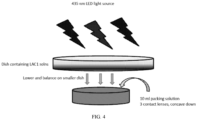
- a smaller 60 x 15 mm dish for housing test contact lenses was covered with aluminum foil (Reynolds Consumer Products, LLC), with the foil covering the lip of the dish.
- the bottom 100 x 10 mm dishes were used as the reservoirs for the LAC1 solutions and were to be balanced on the smaller dish. This stacked assembly therefore allows light to pass through the dishes containing the LAC1 solutions but not through the sides of the smaller dish containing the test lenses.
- the dish is then illuminated with 435 nm LED as the light source.
- a schematic of the assembly is shown in FIG. 4 .
- a platform was positioned 7.5 inches from the LED panel.
- the LED intensity was adjusted to have an average of 20 mW/cm 2 across the platform.
- the assemblies with the four test solutions were organized on the platform, and the LEDs were illuminated for a total of 52 hours at room temperature. It should be noted that the lighting conditions of this example are more intense than the Q1B conditions discussed above and result in a faster and/or more pronounced effect on the photosensitive chromophore.
- FIG. 5 includes the spectral curve of an unexposed test lens.
- curve 1 is the reference blank.
- Curve 2 is an unexposed test lens.
- Curve 3 is a test lens exposed through a 2 mM LAC1 solution overlay.
- Curve 4 is a test lens exposed through a 0.5 mM LAC1 solution overlay.
- Curve 5 is a test lens exposed through a 0.1 mM LAC1 solution overlay.
- curve 6 is a test lens exposed through a 0 mM LAC1 solution overlay (i.e., propylene glycol solvent only).
- the LAC1 compound which at least partially blocks the transmission of light at all of the wavelengths absorbed by the photosensitive chromophore of the test lens, protects the compound from photodegradation.
- the data suggests that increased protection may be afforded by further increasing the level of blocking provided by the LAC1 compound (e.g., by increasing its concentration).
- Test contact lenses based on senofilcon A were prepared by polymerization/molding of a reactive mixture containing, in addition to other device forming monomers and additives, 2 weight percent, based on the total of all reactive components in the reactive mixture, of 2-((1-amino-8-oxo-5,6,7,8-tetrahydronaphthalen-2-yl)oxy)ethyl methacrylate.
- the resulting test lenses were released from the lens molds at room temperature in 70:30 isopropyl alcohol: water and hydrated in 70:30 isopropyl alcohol: water, before transfer into a standard borate buffer packing solution. Test lenses were then autoclaved for 30 minutes in packing solution before long term storage in heat-sealed contact lens blisters with standard packing solution.
- the light transmittance of contact lenses was characterized using a Cary 6000 Agilent Technologies UV-VIS-NIR spectrometer. Standard borate buffer packing solution is filtered to remove any particles that may negatively impact spectra collection. Lenses were mounted in a lens holder with an aperture dimension of approximately 6 mm x 12 mm before the assembly was inserted into quartz spectrophotometer cuvette, 45 mm x 12.2 mm with a 10 mm path length. A matching assembly is prepared for the reference cell without a contact lens in the lens holder. A UV/Vis spectrum of an Example 3 test lens is shown in FIG. 6 .
- LAC1 2-(2-cyano-2-(9H-thioxanthen-9-ylidene)acetamido)ethyl methacrylate
- LAC1 a solution of 2 mM of LAC1 was prepared by adding the appropriate weighed powder to propylene glycol as solvent; the glass bottle was rolled overnight to completely dissolve the LAC1. A volume of 30 milliliters was required for each experimental test concentration of LAC 1: 2 mM, 0.5 mM, and 0.1 mM solutions were prepared by serial dilution. Solutions were protected from light, prior to usage.
- a platform was positioned 7.5 inches from the LED panel.
- the LED intensity was adjusted to have an average of 20 mW/cm 2 across the platform.
- the assemblies with the four test solutions were organized on the platform, and the LEDs were illuminated for a total of 5 hours at room temperature.
- FIG. 7 includes the spectral curve of an unexposed test lens.
- test method light intensity of 20 mW/cm 2 may have been too high for the more photosensitive compound 2-((1-amino-8-oxo-5,6,7,8-tetrahydronaphthalen-2-yl)oxy)ethyl methacrylate which in turn may have affected the test method's sensitivity.
- the LAC1 compound which at least partially blocks the transmission of light at all of the wavelengths absorbed by the photosensitive chromophore of the test lens of Example 3, protects the compound from photodegradation.
- the data suggests that the 2 mM LAC1 solution provides sufficient protection to preserve the average transmission level between 400 and 450 nanometers as the unexposed test lens.
Landscapes
- Physics & Mathematics (AREA)
- Health & Medical Sciences (AREA)
- Ophthalmology & Optometry (AREA)
- General Physics & Mathematics (AREA)
- Optics & Photonics (AREA)
- General Health & Medical Sciences (AREA)
- Chemical & Material Sciences (AREA)
- Organic Chemistry (AREA)
- Eyeglasses (AREA)
- Optical Filters (AREA)
Claims (10)
- Kontaktlinsensystem, umfassend:eine Kontaktlinse, die einen lichtempfindlichen Chromophor enthält, wobei der lichtempfindliche Chromophor mindestens eine aktive Wellenlänge zwischen 250 und 400 Nanometer und mindestens eine aktive Wellenlänge zwischen 400 und 450 Nanometer aufweist; undeine Verpackung, die die Kontaktlinse umgibt, wobei die Verpackung eine Lichtdurchlässigkeit von nicht mehr als 80 Prozent bei jeder aktiven Wellenlänge aufweist, wobei der Begriff "aktive Wellenlänge" eine Wellenlänge im UV/Vis-Spektrum des Materials bedeutet, bei der die prozentuale Durchlässigkeit 85 Prozent oder weniger bei dieser Wellenlänge beträgt.
- Kontaktlinsensystem nach Anspruch 1, wobei die Durchlässigkeit der Verpackung bei jeder aktiven Wellenlänge gleich oder kleiner als die Durchlässigkeit des lichtempfindlichen Chromophors ist.
- Kontaktlinsensystem nach einem der Ansprüche 1 bis 2, wobei die Kontaktlinse, die den lichtempfindlichen Chromophor enthält, über einen Wellenlängenbereich von 400 bis 409 nm 0 Prozent bis 70 Prozent durchlässt.
- Kontaktlinsensystem nach einem der Ansprüche 1 bis 3, wobei die Kontaktlinse, die den lichtempfindlichen Chromophor enthält, über einen Wellenlängenbereich von 410 bis 424 nm 10 Prozent bis 95 Prozent durchlässt; über einen Wellenlängenbereich von 425 bis 449 nm mindestens 40 Prozent durchlässt und über eine Wellenlänge von 450 bis 800 nm mindestens 80 Prozent durchlässt.
- Kontaktlinsensystem nach einem der Ansprüche 1 bis 4, wobei die Kontaktlinse, die den lichtempfindlichen Chromophor enthält, über einen Wellenlängenbereich von 280 bis 399 nm 45 Prozent oder weniger durchlässt.
- Kontaktlinsensystem nach einem der Ansprüche 1 bis 5, wobei der lichtempfindliche Chromophor nicht photochrom ist.
- Kontaktlinsensystem nach einem der Ansprüche 1 bis 6, wobei es sich bei der Verpackung um eine Primärverpackung handelt.
- Kontaktlinsensystem nach einem der Ansprüche 1 bis 6, wobei es sich bei der Verpackung um eine Sekundärverpackung handelt.
- Kontaktlinsensystem nach einem der Ansprüche 1 bis 8, wobei die Kontaktlinse, die den lichtempfindlichen Chromophor enthält, nach Belichtung unter den Bedingungen der ICH-Richtlinie Q1B eine Änderung von mindestens 2 Prozent in seiner durchschnittlichen Durchlässigkeit über einen Wellenlängenbereich von 400 bis 450 nm zeigt.
- Kontaktlinse nach einem der Ansprüche 1 bis 9, wobei der lichtempfindliche Chromophor ein Alkoxyanilinderivat mit einer polymerisierbaren Gruppe oder ein Tetrahydronaphthalinylderivat mit einer polymerisierbaren Gruppe umfasst.
Priority Applications (1)
| Application Number | Priority Date | Filing Date | Title |
|---|---|---|---|
| EP23209213.0A EP4411429A1 (de) | 2019-12-19 | 2020-12-04 | Kontaktlinse mit photoempfindlichem chromophor und verpackung dafür |
Applications Claiming Priority (3)
| Application Number | Priority Date | Filing Date | Title |
|---|---|---|---|
| US201962950577P | 2019-12-19 | 2019-12-19 | |
| US16/952,841 US11360240B2 (en) | 2019-12-19 | 2020-11-19 | Contact lens containing photosensitive chromophore and package therefor |
| PCT/IB2020/061498 WO2021124001A1 (en) | 2019-12-19 | 2020-12-04 | Contact lens containing photosensitive chromophore and package therefor |
Related Child Applications (2)
| Application Number | Title | Priority Date | Filing Date |
|---|---|---|---|
| EP23209213.0A Division-Into EP4411429A1 (de) | 2019-12-19 | 2020-12-04 | Kontaktlinse mit photoempfindlichem chromophor und verpackung dafür |
| EP23209213.0A Division EP4411429A1 (de) | 2019-12-19 | 2020-12-04 | Kontaktlinse mit photoempfindlichem chromophor und verpackung dafür |
Publications (3)
| Publication Number | Publication Date |
|---|---|
| EP4078248A1 EP4078248A1 (de) | 2022-10-26 |
| EP4078248B1 true EP4078248B1 (de) | 2023-11-15 |
| EP4078248B9 EP4078248B9 (de) | 2024-08-21 |
Family
ID=76438040
Family Applications (2)
| Application Number | Title | Priority Date | Filing Date |
|---|---|---|---|
| EP23209213.0A Withdrawn EP4411429A1 (de) | 2019-12-19 | 2020-12-04 | Kontaktlinse mit photoempfindlichem chromophor und verpackung dafür |
| EP20821416.3A Active EP4078248B9 (de) | 2019-12-19 | 2020-12-04 | Kontaktlinse mit lichtempfindlichem chromophor und verpackung dafür |
Family Applications Before (1)
| Application Number | Title | Priority Date | Filing Date |
|---|---|---|---|
| EP23209213.0A Withdrawn EP4411429A1 (de) | 2019-12-19 | 2020-12-04 | Kontaktlinse mit photoempfindlichem chromophor und verpackung dafür |
Country Status (8)
| Country | Link |
|---|---|
| US (1) | US11360240B2 (de) |
| EP (2) | EP4411429A1 (de) |
| JP (1) | JP7693557B2 (de) |
| KR (1) | KR102838430B1 (de) |
| CN (1) | CN113874781B (de) |
| AU (1) | AU2020410299A1 (de) |
| TW (1) | TW202138475A (de) |
| WO (1) | WO2021124001A1 (de) |
Families Citing this family (2)
| Publication number | Priority date | Publication date | Assignee | Title |
|---|---|---|---|---|
| US11493668B2 (en) | 2018-09-26 | 2022-11-08 | Johnson & Johnson Vision Care, Inc. | Polymerizable absorbers of UV and high energy visible light |
| US12517282B2 (en) * | 2021-12-20 | 2026-01-06 | Johnson & Johnson Vision Care, Inc. | Contact lenses containing light absorbing regions and methods for their preparation |
Family Cites Families (92)
| Publication number | Priority date | Publication date | Assignee | Title |
|---|---|---|---|---|
| NL285986A (de) | 1961-12-27 | |||
| NL128305C (de) | 1963-09-11 | |||
| US3808178A (en) | 1972-06-16 | 1974-04-30 | Polycon Laboratories | Oxygen-permeable contact lens composition,methods and article of manufacture |
| US4113224A (en) | 1975-04-08 | 1978-09-12 | Bausch & Lomb Incorporated | Apparatus for forming optical lenses |
| US4197266A (en) | 1974-05-06 | 1980-04-08 | Bausch & Lomb Incorporated | Method for forming optical lenses |
| US4120570A (en) | 1976-06-22 | 1978-10-17 | Syntex (U.S.A.) Inc. | Method for correcting visual defects, compositions and articles of manufacture useful therein |
| US4136250A (en) | 1977-07-20 | 1979-01-23 | Ciba-Geigy Corporation | Polysiloxane hydrogels |
| US4153641A (en) | 1977-07-25 | 1979-05-08 | Bausch & Lomb Incorporated | Polysiloxane composition and contact lens |
| US4495313A (en) | 1981-04-30 | 1985-01-22 | Mia Lens Production A/S | Preparation of hydrogel for soft contact lens with water displaceable boric acid ester |
| US4436887A (en) | 1981-11-12 | 1984-03-13 | Bausch & Lomb Incorporated | N-Vinyl lactam based biomedical devices |
| DE3174584D1 (en) | 1981-11-27 | 1986-06-12 | Tsuetaki George F | Polymers primarily for contact lenses, and contact lenses made from them |
| ZA855083B (en) | 1984-07-05 | 1987-03-25 | Du Pont | Acrylic star polymers |
| US4740533A (en) | 1987-07-28 | 1988-04-26 | Ciba-Geigy Corporation | Wettable, flexible, oxygen permeable, substantially non-swellable contact lens containing block copolymer polysiloxane-polyoxyalkylene backbone units, and use thereof |
| US5006622A (en) | 1987-04-02 | 1991-04-09 | Bausch & Lomb Incorporated | Polymer compositions for contact lenses |
| US5236969A (en) | 1987-04-02 | 1993-08-17 | Bausch & Lomb Incorporated | Polymer compositions for contact lenses |
| US5270418A (en) | 1987-04-02 | 1993-12-14 | Bausch & Lomb Incorporated | Polymer compositions for contact lenses |
| US5194544A (en) * | 1987-10-15 | 1993-03-16 | University Of Florida | UV absorbing vinyl monomers and polymers and ocular implants prepared therefrom |
| US4910277A (en) | 1988-02-09 | 1990-03-20 | Bambury Ronald E | Hydrophilic oxygen permeable polymers |
| US4889664A (en) | 1988-11-25 | 1989-12-26 | Vistakon, Inc. | Method of forming shaped hydrogel articles including contact lenses |
| US5039459A (en) | 1988-11-25 | 1991-08-13 | Johnson & Johnson Vision Products, Inc. | Method of forming shaped hydrogel articles including contact lenses |
| US5070215A (en) | 1989-05-02 | 1991-12-03 | Bausch & Lomb Incorporated | Novel vinyl carbonate and vinyl carbamate contact lens material monomers |
| US5034461A (en) | 1989-06-07 | 1991-07-23 | Bausch & Lomb Incorporated | Novel prepolymers useful in biomedical devices |
| US5244981A (en) | 1990-04-10 | 1993-09-14 | Permeable Technologies, Inc. | Silicone-containing contact lens polymers, oxygen permeable contact lenses and methods for making these lenses and treating patients with visual impairment |
| US5314960A (en) | 1990-04-10 | 1994-05-24 | Permeable Technologies, Inc. | Silicone-containing polymers, oxygen permeable hydrophilic contact lenses and methods for making these lenses and treating patients with visual impairment |
| US5371147A (en) | 1990-10-11 | 1994-12-06 | Permeable Technologies, Inc. | Silicone-containing acrylic star polymers, block copolymers and macromonomers |
| GB9023498D0 (en) | 1990-10-29 | 1990-12-12 | Biocompatibles Ltd | Soft contact lens material |
| US5298533A (en) | 1992-12-02 | 1994-03-29 | Bausch & Lomb Incorporated | Polymer compositions for contact lenses |
| US7468398B2 (en) | 1994-09-06 | 2008-12-23 | Ciba Vision Corporation | Extended wear ophthalmic lens |
| US5760100B1 (en) | 1994-09-06 | 2000-11-14 | Ciba Vision Corp | Extended wear ophthalmic lens |
| TW585882B (en) | 1995-04-04 | 2004-05-01 | Novartis Ag | A method of using a contact lens as an extended wear lens and a method of screening an ophthalmic lens for utility as an extended-wear lens |
| US5824719A (en) | 1995-06-07 | 1998-10-20 | Bausch & Lomb Incorporated | Polymer compositions for contact lenses |
| US6020445A (en) | 1997-10-09 | 2000-02-01 | Johnson & Johnson Vision Products, Inc. | Silicone hydrogel polymers |
| US5998498A (en) | 1998-03-02 | 1999-12-07 | Johnson & Johnson Vision Products, Inc. | Soft contact lenses |
| US6943203B2 (en) | 1998-03-02 | 2005-09-13 | Johnson & Johnson Vision Care, Inc. | Soft contact lenses |
| US6367929B1 (en) | 1998-03-02 | 2002-04-09 | Johnson & Johnson Vision Care, Inc. | Hydrogel with internal wetting agent |
| US7052131B2 (en) | 2001-09-10 | 2006-05-30 | J&J Vision Care, Inc. | Biomedical devices containing internal wetting agents |
| US7461937B2 (en) | 2001-09-10 | 2008-12-09 | Johnson & Johnson Vision Care, Inc. | Soft contact lenses displaying superior on-eye comfort |
| US6822016B2 (en) | 2001-09-10 | 2004-11-23 | Johnson & Johnson Vision Care, Inc. | Biomedical devices containing internal wetting agents |
| US6849671B2 (en) | 1998-03-02 | 2005-02-01 | Johnson & Johnson Vision Care, Inc. | Contact lenses |
| US5962548A (en) | 1998-03-02 | 1999-10-05 | Johnson & Johnson Vision Products, Inc. | Silicone hydrogel polymers |
| US6087415A (en) | 1998-06-11 | 2000-07-11 | Johnson & Johnson Vision Care, Inc. | Biomedical devices with hydrophilic coatings |
| WO2000035980A1 (en) | 1998-12-11 | 2000-06-22 | Biocompatibles Limited | Crosslinked polymers and refractive devices formed therefrom |
| ATE441132T1 (de) | 1999-12-16 | 2009-09-15 | Asahikasei Aime Co Ltd | Zum tragen über lange zeiträume geeignete weiche kontaktlinsen |
| US7368072B2 (en) * | 2001-12-10 | 2008-05-06 | Ppg Industries Ohio, Inc. | Photochromic contact lenses and methods of manufacturing |
| US7214809B2 (en) | 2004-02-11 | 2007-05-08 | Johnson & Johnson Vision Care, Inc. | (Meth)acrylamide monomers containing hydroxy and silicone functionalities |
| US7786185B2 (en) | 2004-03-05 | 2010-08-31 | Johnson & Johnson Vision Care, Inc. | Wettable hydrogels comprising acyclic polyamides |
| US20050205451A1 (en) | 2004-03-18 | 2005-09-22 | Brown-Skrobot Susan K | Contact lens packages |
| CN1938011A (zh) * | 2004-03-30 | 2007-03-28 | 日本乐敦制药株式会社 | 含有曲尼司特的药物产品 |
| US7473738B2 (en) | 2004-09-30 | 2009-01-06 | Johnson & Johnson Vision Care, Inc. | Lactam polymer derivatives |
| US7249848B2 (en) | 2004-09-30 | 2007-07-31 | Johnson & Johnson Vision Care, Inc. | Wettable hydrogels comprising reactive, hydrophilic, polymeric internal wetting agents |
| US7247692B2 (en) | 2004-09-30 | 2007-07-24 | Johnson & Johnson Vision Care, Inc. | Biomedical devices containing amphiphilic block copolymers |
| US9297928B2 (en) | 2004-11-22 | 2016-03-29 | Johnson & Johnson Vision Care, Inc. | Ophthalmic compositions comprising polyether substituted polymers |
| US7572841B2 (en) | 2006-06-15 | 2009-08-11 | Coopervision International Holding Company, Lp | Wettable silicone hydrogel contact lenses and related compositions and methods |
| US8459445B2 (en) * | 2006-07-21 | 2013-06-11 | Menicon, Co., Ltd. | Colored contact lens primary packaging |
| CN101495010A (zh) * | 2006-07-26 | 2009-07-29 | 美你康株式会社 | 将接触透镜提供给消费者的系统和方法 |
| US7838698B2 (en) | 2006-09-29 | 2010-11-23 | Johnson & Johnson Vision Care, Inc. | Hydrolysis-resistant silicone compounds |
| US8507577B2 (en) | 2006-10-31 | 2013-08-13 | Johnson & Johnson Vision Care, Inc. | Process for forming clear, wettable silicone hydrogel articles |
| GB0623299D0 (en) | 2006-11-22 | 2007-01-03 | Sauflon Cl Ltd | Contact lens |
| WO2008095778A1 (en) | 2007-02-06 | 2008-08-14 | Basell Polyolefine Gmbh | Flexible and/or rigid photochromic items for packaging items sensitive to light |
| JP5390409B2 (ja) | 2007-03-05 | 2014-01-15 | ベンズ リサーチ アンド ディベロップメント コーポレーション | 天然発色団およびその誘導体を含む光フィルター |
| US7934830B2 (en) | 2007-12-03 | 2011-05-03 | Bausch & Lomb Incorporated | High water content silicone hydrogels |
| US8138290B2 (en) | 2008-01-25 | 2012-03-20 | Bausch & Lomb Incorporated | High water content ophthalmic devices |
| US8470906B2 (en) | 2008-09-30 | 2013-06-25 | Johnson & Johnson Vision Care, Inc. | Ionic silicone hydrogels having improved hydrolytic stability |
| NZ592674A (en) | 2008-12-18 | 2012-08-31 | Novartis Ag | Method for making silicone hydrogel contact lenses |
| AU2010229849B2 (en) * | 2009-03-25 | 2015-06-11 | High Performance Optics, Inc. | Photochromic ophthalmic systems that selectively filter specific blue light wavelengths |
| PL2452212T3 (pl) | 2009-07-09 | 2015-08-31 | Bausch & Lomb | Monoetylenowo nienasycone zdolne do polimeryzacji grupy zawierające monomery polikarboksylanów |
| US7994356B2 (en) | 2009-07-09 | 2011-08-09 | Bausch & Lomb Incorporated | Mono ethylenically unsaturated polycarbosiloxane monomers |
| US7915323B2 (en) | 2009-07-09 | 2011-03-29 | Bausch & Lamb Incorporated | Mono ethylenically unsaturated polycarbosiloxane monomers |
| JP2011052157A (ja) * | 2009-09-03 | 2011-03-17 | Kaneka Corp | アクリル系樹脂組成物およびその蛍光黄緑フィルム |
| GB0917806D0 (en) | 2009-10-12 | 2009-11-25 | Sauflon Cl Ltd | Fluorinated silicone hydrogels |
| WO2012118680A1 (en) | 2011-02-28 | 2012-09-07 | Coopervision International Holding Company, Lp | Silicone hydrogel contact lenses |
| KR101736534B1 (ko) | 2011-02-28 | 2017-05-16 | 쿠퍼비젼 인터내셔날 홀딩 캄파니, 엘피 | 습윤성 실리콘 히드로겔 콘택트 렌즈 |
| US9170349B2 (en) | 2011-05-04 | 2015-10-27 | Johnson & Johnson Vision Care, Inc. | Medical devices having homogeneous charge density and methods for making same |
| SG189576A1 (en) * | 2011-10-18 | 2013-05-31 | Menicon Singapore Pte Ltd | Packaging for disposable soft contact lenses having pre-formed multi-layer structural laminate |
| GB201119363D0 (en) | 2011-11-10 | 2011-12-21 | Vertellus Specialities Inc | Polymerisable material |
| US9125808B2 (en) | 2011-12-23 | 2015-09-08 | Johnson & Johnson Vision Care, Inc. | Ionic silicone hydrogels |
| US8937111B2 (en) | 2011-12-23 | 2015-01-20 | Johnson & Johnson Vision Care, Inc. | Silicone hydrogels comprising desirable water content and oxygen permeability |
| US8937110B2 (en) | 2011-12-23 | 2015-01-20 | Johnson & Johnson Vision Care, Inc. | Silicone hydrogels having a structure formed via controlled reaction kinetics |
| US9140825B2 (en) | 2011-12-23 | 2015-09-22 | Johnson & Johnson Vision Care, Inc. | Ionic silicone hydrogels |
| US9156934B2 (en) | 2011-12-23 | 2015-10-13 | Johnson & Johnson Vision Care, Inc. | Silicone hydrogels comprising n-vinyl amides and hydroxyalkyl (meth)acrylates or (meth)acrylamides |
| US8940812B2 (en) | 2012-01-17 | 2015-01-27 | Johnson & Johnson Vision Care, Inc. | Silicone polymers comprising sulfonic acid groups |
| US9297929B2 (en) | 2012-05-25 | 2016-03-29 | Johnson & Johnson Vision Care, Inc. | Contact lenses comprising water soluble N-(2 hydroxyalkyl) (meth)acrylamide polymers or copolymers |
| US9244196B2 (en) | 2012-05-25 | 2016-01-26 | Johnson & Johnson Vision Care, Inc. | Polymers and nanogel materials and methods for making and using the same |
| CN105228923B (zh) | 2013-05-20 | 2018-03-30 | 藤森工业株式会社 | 遮光片和容器 |
| CA2932158A1 (en) * | 2013-12-20 | 2015-06-25 | The Procter & Gamble Company | Stable liquid medication containing diphenhydramine |
| US11021558B2 (en) | 2016-08-05 | 2021-06-01 | Johnson & Johnson Vision Care, Inc. | Polymer compositions containing grafted polymeric networks and processes for their preparation and use |
| US20180356558A1 (en) | 2017-06-08 | 2018-12-13 | Novartis Ag | Method for detecting the presence or absence of an ophthalmic lens within a receptacle |
| US10935695B2 (en) | 2018-03-02 | 2021-03-02 | Johnson & Johnson Vision Care, Inc. | Polymerizable absorbers of UV and high energy visible light |
| US11072137B2 (en) * | 2018-10-15 | 2021-07-27 | Argos Vision Inc. | Methods of forming contact lenses to reduce the transmittance of light |
| US11628998B2 (en) | 2018-12-13 | 2023-04-18 | Johnson & Johnson Vision Care, Inc. | Ultraviolet light inhibiting contact lens package |
| US20210018661A1 (en) | 2019-07-17 | 2021-01-21 | Johnson & Johnson Vision Care, Inc. | UV Light Management Package and Protective Cover |
| US20210015227A1 (en) | 2019-07-17 | 2021-01-21 | Johnson & Johnson Vision Care, Inc. | UV Light Management Package and Protective Cover |
-
2020
- 2020-11-19 US US16/952,841 patent/US11360240B2/en active Active
- 2020-12-04 EP EP23209213.0A patent/EP4411429A1/de not_active Withdrawn
- 2020-12-04 EP EP20821416.3A patent/EP4078248B9/de active Active
- 2020-12-04 WO PCT/IB2020/061498 patent/WO2021124001A1/en not_active Ceased
- 2020-12-04 JP JP2021569916A patent/JP7693557B2/ja active Active
- 2020-12-04 CN CN202080037981.0A patent/CN113874781B/zh active Active
- 2020-12-04 AU AU2020410299A patent/AU2020410299A1/en not_active Abandoned
- 2020-12-04 KR KR1020217038723A patent/KR102838430B1/ko active Active
- 2020-12-17 TW TW109144660A patent/TW202138475A/zh unknown
Also Published As
| Publication number | Publication date |
|---|---|
| US11360240B2 (en) | 2022-06-14 |
| AU2020410299A1 (en) | 2021-11-18 |
| JP7693557B2 (ja) | 2025-06-17 |
| TW202138475A (zh) | 2021-10-16 |
| EP4078248B9 (de) | 2024-08-21 |
| CN113874781B (zh) | 2024-12-31 |
| CN113874781A (zh) | 2021-12-31 |
| KR102838430B1 (ko) | 2025-07-28 |
| EP4411429A1 (de) | 2024-08-07 |
| KR20220115858A (ko) | 2022-08-19 |
| EP4078248A1 (de) | 2022-10-26 |
| JP2023506668A (ja) | 2023-02-20 |
| US20210190992A1 (en) | 2021-06-24 |
| WO2021124001A1 (en) | 2021-06-24 |
Similar Documents
| Publication | Publication Date | Title |
|---|---|---|
| US12497379B2 (en) | Photostable mimics of macular pigment | |
| US11820899B2 (en) | Polymerizable absorbers of UV and high energy visible light | |
| EP3645517B1 (de) | Polymerisierbare benzotriazol abkömmlinge als blocker von hochenergetischem licht | |
| US12481173B2 (en) | Multifocal contact lens displaying improved vision attributes | |
| US10526296B2 (en) | Hydroxyphenyl naphthotriazoles as polymerizable blockers of high energy light | |
| EP4022368B1 (de) | Kontaktlinse mit verbesserten seheigenschaften | |
| US12054499B2 (en) | Transition metal complexes as visible light absorbers | |
| EP4078248B1 (de) | Kontaktlinse mit lichtempfindlichem chromophor und verpackung dafür | |
| RU2832160C1 (ru) | Контактная линза, содержащая фоточувствительный хромофор, и упаковка для нее | |
| HK40080739B (en) | Contact lens containing photosensitive chromophore and package therefor | |
| HK40080739A (en) | Contact lens containing photosensitive chromophore and package therefor | |
| US20240228466A1 (en) | Transition metal complexes as visible light absorbers | |
| HK40064731A (en) | Contact lens containing photosensitive chromophore and package therefor | |
| HK40064731B (zh) | 包含光敏发色团的接触镜片及其包装 |
Legal Events
| Date | Code | Title | Description |
|---|---|---|---|
| STAA | Information on the status of an ep patent application or granted ep patent |
Free format text: STATUS: UNKNOWN |
|
| STAA | Information on the status of an ep patent application or granted ep patent |
Free format text: STATUS: THE INTERNATIONAL PUBLICATION HAS BEEN MADE |
|
| PUAI | Public reference made under article 153(3) epc to a published international application that has entered the european phase |
Free format text: ORIGINAL CODE: 0009012 |
|
| STAA | Information on the status of an ep patent application or granted ep patent |
Free format text: STATUS: REQUEST FOR EXAMINATION WAS MADE |
|
| 17P | Request for examination filed |
Effective date: 20211102 |
|
| AK | Designated contracting states |
Kind code of ref document: A1 Designated state(s): AL AT BE BG CH CY CZ DE DK EE ES FI FR GB GR HR HU IE IS IT LI LT LU LV MC MK MT NL NO PL PT RO RS SE SI SK SM TR |
|
| DAV | Request for validation of the european patent (deleted) | ||
| DAX | Request for extension of the european patent (deleted) | ||
| REG | Reference to a national code |
Ref country code: HK Ref legal event code: DE Ref document number: 40080739 Country of ref document: HK |
|
| GRAP | Despatch of communication of intention to grant a patent |
Free format text: ORIGINAL CODE: EPIDOSNIGR1 |
|
| STAA | Information on the status of an ep patent application or granted ep patent |
Free format text: STATUS: GRANT OF PATENT IS INTENDED |
|
| INTG | Intention to grant announced |
Effective date: 20230524 |
|
| P01 | Opt-out of the competence of the unified patent court (upc) registered |
Effective date: 20230521 |
|
| GRAS | Grant fee paid |
Free format text: ORIGINAL CODE: EPIDOSNIGR3 |
|
| GRAA | (expected) grant |
Free format text: ORIGINAL CODE: 0009210 |
|
| STAA | Information on the status of an ep patent application or granted ep patent |
Free format text: STATUS: THE PATENT HAS BEEN GRANTED |
|
| AK | Designated contracting states |
Kind code of ref document: B1 Designated state(s): AL AT BE BG CH CY CZ DE DK EE ES FI FR GB GR HR HU IE IS IT LI LT LU LV MC MK MT NL NO PL PT RO RS SE SI SK SM TR |
|
| REG | Reference to a national code |
Ref country code: CH Ref legal event code: EP Ref country code: GB Ref legal event code: FG4D |
|
| REG | Reference to a national code |
Ref country code: DE Ref legal event code: R096 Ref document number: 602020021227 Country of ref document: DE |
|
| REG | Reference to a national code |
Ref country code: IE Ref legal event code: FG4D |
|
| REG | Reference to a national code |
Ref country code: LT Ref legal event code: MG9D |
|
| REG | Reference to a national code |
Ref country code: NL Ref legal event code: MP Effective date: 20231115 |
|
| PG25 | Lapsed in a contracting state [announced via postgrant information from national office to epo] |
Ref country code: GR Free format text: LAPSE BECAUSE OF FAILURE TO SUBMIT A TRANSLATION OF THE DESCRIPTION OR TO PAY THE FEE WITHIN THE PRESCRIBED TIME-LIMIT Effective date: 20240216 |
|
| PG25 | Lapsed in a contracting state [announced via postgrant information from national office to epo] |
Ref country code: IS Free format text: LAPSE BECAUSE OF FAILURE TO SUBMIT A TRANSLATION OF THE DESCRIPTION OR TO PAY THE FEE WITHIN THE PRESCRIBED TIME-LIMIT Effective date: 20240315 |
|
| PG25 | Lapsed in a contracting state [announced via postgrant information from national office to epo] |
Ref country code: LT Free format text: LAPSE BECAUSE OF FAILURE TO SUBMIT A TRANSLATION OF THE DESCRIPTION OR TO PAY THE FEE WITHIN THE PRESCRIBED TIME-LIMIT Effective date: 20231115 |
|
| REG | Reference to a national code |
Ref country code: AT Ref legal event code: MK05 Ref document number: 1632277 Country of ref document: AT Kind code of ref document: T Effective date: 20231115 |
|
| PG25 | Lapsed in a contracting state [announced via postgrant information from national office to epo] |
Ref country code: NL Free format text: LAPSE BECAUSE OF FAILURE TO SUBMIT A TRANSLATION OF THE DESCRIPTION OR TO PAY THE FEE WITHIN THE PRESCRIBED TIME-LIMIT Effective date: 20231115 |
|
| PG25 | Lapsed in a contracting state [announced via postgrant information from national office to epo] |
Ref country code: AT Free format text: LAPSE BECAUSE OF FAILURE TO SUBMIT A TRANSLATION OF THE DESCRIPTION OR TO PAY THE FEE WITHIN THE PRESCRIBED TIME-LIMIT Effective date: 20231115 |
|
| PG25 | Lapsed in a contracting state [announced via postgrant information from national office to epo] |
Ref country code: ES Free format text: LAPSE BECAUSE OF FAILURE TO SUBMIT A TRANSLATION OF THE DESCRIPTION OR TO PAY THE FEE WITHIN THE PRESCRIBED TIME-LIMIT Effective date: 20231115 |
|
| PG25 | Lapsed in a contracting state [announced via postgrant information from national office to epo] |
Ref country code: NL Free format text: LAPSE BECAUSE OF FAILURE TO SUBMIT A TRANSLATION OF THE DESCRIPTION OR TO PAY THE FEE WITHIN THE PRESCRIBED TIME-LIMIT Effective date: 20231115 Ref country code: LT Free format text: LAPSE BECAUSE OF FAILURE TO SUBMIT A TRANSLATION OF THE DESCRIPTION OR TO PAY THE FEE WITHIN THE PRESCRIBED TIME-LIMIT Effective date: 20231115 Ref country code: IS Free format text: LAPSE BECAUSE OF FAILURE TO SUBMIT A TRANSLATION OF THE DESCRIPTION OR TO PAY THE FEE WITHIN THE PRESCRIBED TIME-LIMIT Effective date: 20240315 Ref country code: GR Free format text: LAPSE BECAUSE OF FAILURE TO SUBMIT A TRANSLATION OF THE DESCRIPTION OR TO PAY THE FEE WITHIN THE PRESCRIBED TIME-LIMIT Effective date: 20240216 Ref country code: ES Free format text: LAPSE BECAUSE OF FAILURE TO SUBMIT A TRANSLATION OF THE DESCRIPTION OR TO PAY THE FEE WITHIN THE PRESCRIBED TIME-LIMIT Effective date: 20231115 Ref country code: BG Free format text: LAPSE BECAUSE OF FAILURE TO SUBMIT A TRANSLATION OF THE DESCRIPTION OR TO PAY THE FEE WITHIN THE PRESCRIBED TIME-LIMIT Effective date: 20240215 Ref country code: AT Free format text: LAPSE BECAUSE OF FAILURE TO SUBMIT A TRANSLATION OF THE DESCRIPTION OR TO PAY THE FEE WITHIN THE PRESCRIBED TIME-LIMIT Effective date: 20231115 Ref country code: PT Free format text: LAPSE BECAUSE OF FAILURE TO SUBMIT A TRANSLATION OF THE DESCRIPTION OR TO PAY THE FEE WITHIN THE PRESCRIBED TIME-LIMIT Effective date: 20240315 |
|
| PG25 | Lapsed in a contracting state [announced via postgrant information from national office to epo] |
Ref country code: SE Free format text: LAPSE BECAUSE OF FAILURE TO SUBMIT A TRANSLATION OF THE DESCRIPTION OR TO PAY THE FEE WITHIN THE PRESCRIBED TIME-LIMIT Effective date: 20231115 Ref country code: RS Free format text: LAPSE BECAUSE OF FAILURE TO SUBMIT A TRANSLATION OF THE DESCRIPTION OR TO PAY THE FEE WITHIN THE PRESCRIBED TIME-LIMIT Effective date: 20231115 Ref country code: PL Free format text: LAPSE BECAUSE OF FAILURE TO SUBMIT A TRANSLATION OF THE DESCRIPTION OR TO PAY THE FEE WITHIN THE PRESCRIBED TIME-LIMIT Effective date: 20231115 Ref country code: NO Free format text: LAPSE BECAUSE OF FAILURE TO SUBMIT A TRANSLATION OF THE DESCRIPTION OR TO PAY THE FEE WITHIN THE PRESCRIBED TIME-LIMIT Effective date: 20240215 Ref country code: LV Free format text: LAPSE BECAUSE OF FAILURE TO SUBMIT A TRANSLATION OF THE DESCRIPTION OR TO PAY THE FEE WITHIN THE PRESCRIBED TIME-LIMIT Effective date: 20231115 Ref country code: HR Free format text: LAPSE BECAUSE OF FAILURE TO SUBMIT A TRANSLATION OF THE DESCRIPTION OR TO PAY THE FEE WITHIN THE PRESCRIBED TIME-LIMIT Effective date: 20231115 |
|
| PG25 | Lapsed in a contracting state [announced via postgrant information from national office to epo] |
Ref country code: DK Free format text: LAPSE BECAUSE OF FAILURE TO SUBMIT A TRANSLATION OF THE DESCRIPTION OR TO PAY THE FEE WITHIN THE PRESCRIBED TIME-LIMIT Effective date: 20231115 |
|
| PG25 | Lapsed in a contracting state [announced via postgrant information from national office to epo] |
Ref country code: CZ Free format text: LAPSE BECAUSE OF FAILURE TO SUBMIT A TRANSLATION OF THE DESCRIPTION OR TO PAY THE FEE WITHIN THE PRESCRIBED TIME-LIMIT Effective date: 20231115 |
|
| PG25 | Lapsed in a contracting state [announced via postgrant information from national office to epo] |
Ref country code: SK Free format text: LAPSE BECAUSE OF FAILURE TO SUBMIT A TRANSLATION OF THE DESCRIPTION OR TO PAY THE FEE WITHIN THE PRESCRIBED TIME-LIMIT Effective date: 20231115 |
|
| PG25 | Lapsed in a contracting state [announced via postgrant information from national office to epo] |
Ref country code: SM Free format text: LAPSE BECAUSE OF FAILURE TO SUBMIT A TRANSLATION OF THE DESCRIPTION OR TO PAY THE FEE WITHIN THE PRESCRIBED TIME-LIMIT Effective date: 20231115 Ref country code: SK Free format text: LAPSE BECAUSE OF FAILURE TO SUBMIT A TRANSLATION OF THE DESCRIPTION OR TO PAY THE FEE WITHIN THE PRESCRIBED TIME-LIMIT Effective date: 20231115 Ref country code: RO Free format text: LAPSE BECAUSE OF FAILURE TO SUBMIT A TRANSLATION OF THE DESCRIPTION OR TO PAY THE FEE WITHIN THE PRESCRIBED TIME-LIMIT Effective date: 20231115 Ref country code: IT Free format text: LAPSE BECAUSE OF NON-PAYMENT OF DUE FEES Effective date: 20231204 Ref country code: EE Free format text: LAPSE BECAUSE OF FAILURE TO SUBMIT A TRANSLATION OF THE DESCRIPTION OR TO PAY THE FEE WITHIN THE PRESCRIBED TIME-LIMIT Effective date: 20231115 Ref country code: DK Free format text: LAPSE BECAUSE OF FAILURE TO SUBMIT A TRANSLATION OF THE DESCRIPTION OR TO PAY THE FEE WITHIN THE PRESCRIBED TIME-LIMIT Effective date: 20231115 Ref country code: CZ Free format text: LAPSE BECAUSE OF FAILURE TO SUBMIT A TRANSLATION OF THE DESCRIPTION OR TO PAY THE FEE WITHIN THE PRESCRIBED TIME-LIMIT Effective date: 20231115 |
|
| REG | Reference to a national code |
Ref country code: CH Ref legal event code: PL Ref country code: CH Ref legal event code: PK Free format text: BERICHTIGUNG B9 |
|
| REG | Reference to a national code |
Ref country code: DE Ref legal event code: R097 Ref document number: 602020021227 Country of ref document: DE |
|
| PG25 | Lapsed in a contracting state [announced via postgrant information from national office to epo] |
Ref country code: LU Free format text: LAPSE BECAUSE OF NON-PAYMENT OF DUE FEES Effective date: 20231204 |
|
| PG25 | Lapsed in a contracting state [announced via postgrant information from national office to epo] |
Ref country code: MC Free format text: LAPSE BECAUSE OF FAILURE TO SUBMIT A TRANSLATION OF THE DESCRIPTION OR TO PAY THE FEE WITHIN THE PRESCRIBED TIME-LIMIT Effective date: 20231115 |
|
| REG | Reference to a national code |
Ref country code: BE Ref legal event code: MM Effective date: 20231231 |
|
| PG25 | Lapsed in a contracting state [announced via postgrant information from national office to epo] |
Ref country code: MC Free format text: LAPSE BECAUSE OF FAILURE TO SUBMIT A TRANSLATION OF THE DESCRIPTION OR TO PAY THE FEE WITHIN THE PRESCRIBED TIME-LIMIT Effective date: 20231115 Ref country code: LU Free format text: LAPSE BECAUSE OF NON-PAYMENT OF DUE FEES Effective date: 20231204 |
|
| PLBE | No opposition filed within time limit |
Free format text: ORIGINAL CODE: 0009261 |
|
| STAA | Information on the status of an ep patent application or granted ep patent |
Free format text: STATUS: NO OPPOSITION FILED WITHIN TIME LIMIT |
|
| PG25 | Lapsed in a contracting state [announced via postgrant information from national office to epo] |
Ref country code: BE Free format text: LAPSE BECAUSE OF NON-PAYMENT OF DUE FEES Effective date: 20231231 |
|
| PG25 | Lapsed in a contracting state [announced via postgrant information from national office to epo] |
Ref country code: CH Free format text: LAPSE BECAUSE OF NON-PAYMENT OF DUE FEES Effective date: 20231231 |
|
| 26N | No opposition filed |
Effective date: 20240819 |
|
| PG25 | Lapsed in a contracting state [announced via postgrant information from national office to epo] |
Ref country code: SI Free format text: LAPSE BECAUSE OF FAILURE TO SUBMIT A TRANSLATION OF THE DESCRIPTION OR TO PAY THE FEE WITHIN THE PRESCRIBED TIME-LIMIT Effective date: 20231115 |
|
| PG25 | Lapsed in a contracting state [announced via postgrant information from national office to epo] |
Ref country code: SI Free format text: LAPSE BECAUSE OF FAILURE TO SUBMIT A TRANSLATION OF THE DESCRIPTION OR TO PAY THE FEE WITHIN THE PRESCRIBED TIME-LIMIT Effective date: 20231115 Ref country code: CH Free format text: LAPSE BECAUSE OF NON-PAYMENT OF DUE FEES Effective date: 20231231 Ref country code: BE Free format text: LAPSE BECAUSE OF NON-PAYMENT OF DUE FEES Effective date: 20231231 |
|
| PG25 | Lapsed in a contracting state [announced via postgrant information from national office to epo] |
Ref country code: IT Free format text: LAPSE BECAUSE OF NON-PAYMENT OF DUE FEES Effective date: 20231204 |
|
| PGRI | Patent reinstated in contracting state [announced from national office to epo] |
Ref country code: IT Effective date: 20240102 |
|
| PG25 | Lapsed in a contracting state [announced via postgrant information from national office to epo] |
Ref country code: IT Free format text: LAPSE BECAUSE OF NON-PAYMENT OF DUE FEES Effective date: 20231204 |
|
| PGRI | Patent reinstated in contracting state [announced from national office to epo] |
Ref country code: IT Effective date: 20240102 |
|
| PG25 | Lapsed in a contracting state [announced via postgrant information from national office to epo] |
Ref country code: FI Free format text: LAPSE BECAUSE OF FAILURE TO SUBMIT A TRANSLATION OF THE DESCRIPTION OR TO PAY THE FEE WITHIN THE PRESCRIBED TIME-LIMIT Effective date: 20231115 |
|
| PG25 | Lapsed in a contracting state [announced via postgrant information from national office to epo] |
Ref country code: CY Free format text: LAPSE BECAUSE OF FAILURE TO SUBMIT A TRANSLATION OF THE DESCRIPTION OR TO PAY THE FEE WITHIN THE PRESCRIBED TIME-LIMIT; INVALID AB INITIO Effective date: 20201204 |
|
| PG25 | Lapsed in a contracting state [announced via postgrant information from national office to epo] |
Ref country code: HU Free format text: LAPSE BECAUSE OF FAILURE TO SUBMIT A TRANSLATION OF THE DESCRIPTION OR TO PAY THE FEE WITHIN THE PRESCRIBED TIME-LIMIT; INVALID AB INITIO Effective date: 20201204 |
|
| PG25 | Lapsed in a contracting state [announced via postgrant information from national office to epo] |
Ref country code: TR Free format text: LAPSE BECAUSE OF FAILURE TO SUBMIT A TRANSLATION OF THE DESCRIPTION OR TO PAY THE FEE WITHIN THE PRESCRIBED TIME-LIMIT Effective date: 20231115 |
|
| PGFP | Annual fee paid to national office [announced via postgrant information from national office to epo] |
Ref country code: DE Payment date: 20251028 Year of fee payment: 6 |
|
| PGFP | Annual fee paid to national office [announced via postgrant information from national office to epo] |
Ref country code: GB Payment date: 20251030 Year of fee payment: 6 |
|
| PGFP | Annual fee paid to national office [announced via postgrant information from national office to epo] |
Ref country code: IT Payment date: 20251121 Year of fee payment: 6 |
|
| PGFP | Annual fee paid to national office [announced via postgrant information from national office to epo] |
Ref country code: FR Payment date: 20251110 Year of fee payment: 6 |
|
| PGFP | Annual fee paid to national office [announced via postgrant information from national office to epo] |
Ref country code: IE Payment date: 20251111 Year of fee payment: 6 |