EP4076993B1 - Bande de roulement de pneumatique pour vehicule lourd comprenant des protuberances anti-bruit et chasse-pierres - Google Patents
Bande de roulement de pneumatique pour vehicule lourd comprenant des protuberances anti-bruit et chasse-pierres Download PDFInfo
- Publication number
- EP4076993B1 EP4076993B1 EP20845175.7A EP20845175A EP4076993B1 EP 4076993 B1 EP4076993 B1 EP 4076993B1 EP 20845175 A EP20845175 A EP 20845175A EP 4076993 B1 EP4076993 B1 EP 4076993B1
- Authority
- EP
- European Patent Office
- Prior art keywords
- tread
- groove
- longitudinal groove
- longitudinal
- over
- Prior art date
- Legal status (The legal status is an assumption and is not a legal conclusion. Google has not performed a legal analysis and makes no representation as to the accuracy of the status listed.)
- Active
Links
Images


Classifications
-
- B—PERFORMING OPERATIONS; TRANSPORTING
- B60—VEHICLES IN GENERAL
- B60C—VEHICLE TYRES; TYRE INFLATION; TYRE CHANGING; CONNECTING VALVES TO INFLATABLE ELASTIC BODIES IN GENERAL; DEVICES OR ARRANGEMENTS RELATED TO TYRES
- B60C11/00—Tyre tread bands; Tread patterns; Anti-skid inserts
- B60C11/03—Tread patterns
- B60C11/13—Tread patterns characterised by the groove cross-section, e.g. for buttressing or preventing stone-trapping
- B60C11/1307—Tread patterns characterised by the groove cross-section, e.g. for buttressing or preventing stone-trapping with special features of the groove walls
-
- B—PERFORMING OPERATIONS; TRANSPORTING
- B60—VEHICLES IN GENERAL
- B60C—VEHICLE TYRES; TYRE INFLATION; TYRE CHANGING; CONNECTING VALVES TO INFLATABLE ELASTIC BODIES IN GENERAL; DEVICES OR ARRANGEMENTS RELATED TO TYRES
- B60C11/00—Tyre tread bands; Tread patterns; Anti-skid inserts
- B60C11/03—Tread patterns
- B60C11/0306—Patterns comprising block rows or discontinuous ribs
- B60C11/0309—Patterns comprising block rows or discontinuous ribs further characterised by the groove cross-section
-
- B—PERFORMING OPERATIONS; TRANSPORTING
- B60—VEHICLES IN GENERAL
- B60C—VEHICLE TYRES; TYRE INFLATION; TYRE CHANGING; CONNECTING VALVES TO INFLATABLE ELASTIC BODIES IN GENERAL; DEVICES OR ARRANGEMENTS RELATED TO TYRES
- B60C11/00—Tyre tread bands; Tread patterns; Anti-skid inserts
- B60C11/03—Tread patterns
- B60C11/13—Tread patterns characterised by the groove cross-section, e.g. for buttressing or preventing stone-trapping
- B60C11/1307—Tread patterns characterised by the groove cross-section, e.g. for buttressing or preventing stone-trapping with special features of the groove walls
- B60C11/1323—Tread patterns characterised by the groove cross-section, e.g. for buttressing or preventing stone-trapping with special features of the groove walls asymmetric
-
- B—PERFORMING OPERATIONS; TRANSPORTING
- B60—VEHICLES IN GENERAL
- B60C—VEHICLE TYRES; TYRE INFLATION; TYRE CHANGING; CONNECTING VALVES TO INFLATABLE ELASTIC BODIES IN GENERAL; DEVICES OR ARRANGEMENTS RELATED TO TYRES
- B60C11/00—Tyre tread bands; Tread patterns; Anti-skid inserts
- B60C11/03—Tread patterns
- B60C11/13—Tread patterns characterised by the groove cross-section, e.g. for buttressing or preventing stone-trapping
- B60C11/1353—Tread patterns characterised by the groove cross-section, e.g. for buttressing or preventing stone-trapping with special features of the groove bottom
-
- B—PERFORMING OPERATIONS; TRANSPORTING
- B60—VEHICLES IN GENERAL
- B60C—VEHICLE TYRES; TYRE INFLATION; TYRE CHANGING; CONNECTING VALVES TO INFLATABLE ELASTIC BODIES IN GENERAL; DEVICES OR ARRANGEMENTS RELATED TO TYRES
- B60C11/00—Tyre tread bands; Tread patterns; Anti-skid inserts
- B60C11/03—Tread patterns
- B60C11/13—Tread patterns characterised by the groove cross-section, e.g. for buttressing or preventing stone-trapping
- B60C11/1307—Tread patterns characterised by the groove cross-section, e.g. for buttressing or preventing stone-trapping with special features of the groove walls
- B60C2011/1338—Tread patterns characterised by the groove cross-section, e.g. for buttressing or preventing stone-trapping with special features of the groove walls comprising protrusions
-
- B—PERFORMING OPERATIONS; TRANSPORTING
- B60—VEHICLES IN GENERAL
- B60C—VEHICLE TYRES; TYRE INFLATION; TYRE CHANGING; CONNECTING VALVES TO INFLATABLE ELASTIC BODIES IN GENERAL; DEVICES OR ARRANGEMENTS RELATED TO TYRES
- B60C11/00—Tyre tread bands; Tread patterns; Anti-skid inserts
- B60C11/03—Tread patterns
- B60C11/13—Tread patterns characterised by the groove cross-section, e.g. for buttressing or preventing stone-trapping
- B60C11/1353—Tread patterns characterised by the groove cross-section, e.g. for buttressing or preventing stone-trapping with special features of the groove bottom
- B60C2011/1361—Tread patterns characterised by the groove cross-section, e.g. for buttressing or preventing stone-trapping with special features of the groove bottom with protrusions extending from the groove bottom
-
- B—PERFORMING OPERATIONS; TRANSPORTING
- B60—VEHICLES IN GENERAL
- B60C—VEHICLE TYRES; TYRE INFLATION; TYRE CHANGING; CONNECTING VALVES TO INFLATABLE ELASTIC BODIES IN GENERAL; DEVICES OR ARRANGEMENTS RELATED TO TYRES
- B60C2200/00—Tyres specially adapted for particular applications
- B60C2200/06—Tyres specially adapted for particular applications for heavy duty vehicles
-
- B—PERFORMING OPERATIONS; TRANSPORTING
- B60—VEHICLES IN GENERAL
- B60C—VEHICLE TYRES; TYRE INFLATION; TYRE CHANGING; CONNECTING VALVES TO INFLATABLE ELASTIC BODIES IN GENERAL; DEVICES OR ARRANGEMENTS RELATED TO TYRES
- B60C2200/00—Tyres specially adapted for particular applications
- B60C2200/06—Tyres specially adapted for particular applications for heavy duty vehicles
- B60C2200/065—Tyres specially adapted for particular applications for heavy duty vehicles for construction vehicles
Definitions
- the present invention relates to a tire tread for a heavy vehicle, intended to carry heavy loads and to roll on stony ground or on tarred ground, and, more particularly, a tire tread for a civil engineering vehicle of the mobile crane type, intended to move from one site to another to lift heavy loads.
- a tread comprises at least one rubber-based material and is intended to constitute the peripheral portion of a tire and to be worn when its rolling surface comes into contact with a ground.
- a tread can be defined by three dimensions: a thickness, in a radial direction, a width, in a transverse direction, and a length, in a longitudinal direction.
- the transverse direction is also called the axial direction, because it is parallel to the tire's axis of rotation
- the longitudinal direction is also called the circumferential direction, because it is tangent to the tire's circumference according to the tire's rolling direction.
- the raised elements are generally blocks.
- a block is a volume of rubber material delimited by a contact face, contained in the tread surface, by a bottom surface and by lateral faces connecting the contact face to the bottom surface.
- These blocks can be arranged so as to constitute longitudinal rows of blocks, these rows being separated in pairs by longitudinal hollows, also called longitudinal grooves or more simply grooves.
- a longitudinal hollow has a mean line that is not necessarily rectilinear having in each point a tangent forming an angle between 0° and 45° with the longitudinal direction.
- the blocks are most often separated in pairs by transverse hollows.
- a transverse hollow has a mean line that is not necessarily rectilinear and has at each point a tangent forming an angle between 0° and 45° with the transverse direction.
- the longitudinal and transverse hollows respectively form a network of cutouts separating the blocks.
- the tread integrated into the tire, is most often characterized geometrically by a transverse width W T , in the transverse direction, and a radial thickness H T , in a radial direction.
- the transverse width W T is defined as the transverse width of the contact surface of the tread of the new tire with a smooth ground, such as a tarred ground, when the tire is subjected to nominal pressure and load conditions recommended, for example, by the standard of the "European Tyre and Rim Technical Organization" or ETRTO (European Tyre and Wheel Technical Organization).
- the radial thickness H T is defined, by convention, as the maximum radial depth measured in the voids, corresponding to the maximum radial block height. In the case of a tire for a civil engineering vehicle such as a mobile crane, and by way of example, the transverse width W T is at least equal to 300 mm and the radial thickness H T is at least equal to 20 mm, or even 25 mm.
- the usual driving conditions for a tire for a heavy vehicle such as a mobile crane are generally mixed, both off-road, on stony ground, and on-road, on tarmac ground.
- the inventors set themselves the objective of improving, for a tire tread for a heavy vehicle for mixed off-road and on-road use, both its ability to not retain stones in its grooves, during off-road use, and its ability to dampen the noise it generates, during on-road use.
- the tread according to the invention essentially comprises, in at least one longitudinal groove, a longitudinal distribution of protuberances, each protuberance, backed by one or other of the side walls of the groove, having a dual function of noise barrier and stone guard.
- a noise barrier contributes to the damping of airborne sound waves propagating in the longitudinal groove, when the tire is rolling on tarmac.
- a stone guard has the function of promoting the ejection of stones retained in the hollows, when the tire is rolling on stony ground, and of preventing the stones from damaging the bottom of the groove.
- the protuberances are backed by one or other of the side walls, and two consecutive protuberances, in the longitudinal direction, not necessarily backed by the same side wall, are spaced by a pitch P, the longitudinal distance between said two protuberances.
- each protuberance comprises a first radially inner portion, resting both on the groove bottom and on a side wall and ensuring the stone chaser function, and a second radially outer portion, resting both on the radially outer part of the first portion and on the same side wall and ensuring the anti-noise function.
- the first, respectively second, portion of the protuberance is geometrically characterized by a height H1, respectively H2, in a radial direction, by a width W1, respectively W2, in the transverse direction, and a thickness T1, respectively T2, in the longitudinal direction.
- the heights, widths and thicknesses are average values measured in the corresponding directions.
- any protuberance of the longitudinal groove extends radially outwards from the groove bottom over a height H' at least equal to 0.9 times the depth H of the groove.
- the height H' of the protuberance is the sum of the respective heights H1 and H2 of the first and second portions, and corresponds to an average total height of the protuberance, which may be variable in the transverse and/or longitudinal directions.
- the depth H of the groove is the maximum depth measured between the rolling surface and the most radially inner point of the groove bottom, in the longitudinal mean plane of the longitudinal groove.
- a protuberance height H' at least equal to 0.9 times the depth H of the longitudinal groove aims to guarantee the presence of the protuberance over almost the entire depth of the groove, for good noise barrier effectiveness.
- the second portion must have a height H2 at least equal to 60% and at most equal to 90% of the total height H' of the protuberance. Below 60%, the height H2 is insufficient to guarantee a flexibility of the second portion suitable for damping sound waves. Above 90%, the height H1 of the first portion becomes less than 10% of the height H', which is insufficient to ensure protection of the groove bottom.
- the second portion must have a width W2 at least equal to 25% of the width W of the groove. From 25%, the first portion is sufficiently wide, therefore sufficiently obstructs the longitudinal groove to play its role as a noise barrier.
- the thickness T2 of the second portion must remain less than 3 mm on the one hand, and a third of the thickness T1 of the first portion on the other hand. Beyond a thickness equal to 3 mm, the second portion becomes too rigid, and therefore insufficiently deformable with regard to noise damping.
- This deformability can also be interesting, with regard to the stone-push function, since a flexible second portion does not block the mobility of the stones in the longitudinal groove and therefore does not hinder their possible ejection.
- it is advantageous for the thickness T2 of the second portion to be much less than the thickness T1 of the first portion: a third of the thickness T1 has been estimated as a relevant maximum limit.
- the width W1 of the first portion must be at least equal to 50% of the width W of the longitudinal furrow, to guarantee a good transverse covering of the furrow bottom by the protuberance and, consequently, its protective effect with respect to the stones trapped in the longitudinal furrow.
- the thickness T1 of the first portion must be at least equal to its height H1, to ensure good longitudinal coverage of the furrow bottom by the protuberance and, consequently, its protective effect with respect to stones trapped in the longitudinal furrow.
- the protuberances of the longitudinal groove are alternately backed against one or the other of the side walls.
- This alternating positioning of the protuberances on one and the other of the walls means that two consecutive protuberances are not backed against the same wall, but in contact with walls facing each other.
- This alternation guarantees an almost complete closure of the longitudinal groove, by covering the protuberances positioned on facing walls, and therefore an almost total barrier to the propagation of sound waves.
- the protuberances of the longitudinal groove are spaced two by two by a pitch P at most equal to 0.1 times the length L of the tread. Knowing that, when the tire is subjected to nominal load and pressure conditions, the contact area of the tread with the ground has a longitudinal length of the order of 0.1 times the length L of the tread, this condition implies the presence of at least two protuberances in the contact area closing the longitudinal groove in the contact area and thus avoiding the formation of a pipe, between the tread and the ground, likely to generate noise. It should be noted that the pitch P between two consecutive protuberances is not necessarily constant.
- any protuberance of the longitudinal groove extends radially outwards from the bottom of the groove over a height H' equal to the depth H of the groove, which guarantees the presence of an anti-noise barrier over the entire depth of the longitudinal groove, hence optimum noise damping.
- the second portion extends longitudinally over a thickness T2 at least equal to 1 mm. Below a thickness of 1 mm, the noise barrier becomes insufficiently mechanically robust.
- the second portion extends towards the inside of the longitudinal groove from a side wall over a width W2 at most equal to 0.75 times the width W of the longitudinal groove. Beyond a width equal to 75% of the width of the longitudinal groove, the noise barrier becomes insufficiently mechanically robust.
- the first portion extends longitudinally over a thickness T1 at most equal to 4 times the height H1.
- This condition makes it possible to limit the thickness, i.e. the longitudinal dimension of the first portion, and therefore its volume relative to the volume of the longitudinal furrow. This makes it possible to limit the reduction in the available hollow volume and, consequently, the capacity of the furrow to store or drain water or mud possibly present on the ground.
- the first portion comprises lateral faces forming, with the transverse direction, an angle at most equal to 45°.
- the first portion has a pyramid shape whose inclined lateral faces facilitate the mobility of the stones in the longitudinal groove, and therefore their ejection outside the tread, during the rolling of the tire.
- any intersection of the longitudinal groove and a transverse groove is provided with a protuberance.
- any intersection between the longitudinal groove and a transverse groove is a preferential zone for trapping stones. Consequently, it is advantageous to place a protuberance at this intersection which is particularly sensitive to the retention of stones.
- the first portion extends towards the inside of the longitudinal groove from a side wall over a width W1 at most equal to 2 times the width W of the longitudinal groove. Under these conditions, the first portion covers both the bottom of the longitudinal groove and a portion of the bottom of the transverse groove, and therefore protects these two areas.
- the invention also relates to a tire for a heavy vehicle, preferably a heavy civil engineering vehicle of the mobile crane type, comprising a tread according to any one of the embodiments previously described.
- the tread 1 of a tire for a heavy vehicle intended for coming into contact with a ground via a rolling surface 2, comprises cutouts 3 delimiting rubber blocks 4 extending from a bottom surface 5 in a radial direction ZZ'.
- the cutouts 3 of the tread 1 are either longitudinal grooves 6 or transverse hollows 8.
- each longitudinal grooves 6 each delimited by two side walls 61 facing each other connected to each other by a groove bottom 62, and extending over the entire length L of the tread 1 in a longitudinal direction XX', two of them, positioned in a central portion of the tread 1, each comprise a longitudinal distribution of protuberances 7 alternately leaning against one and the other of the side walls 61, two consecutive protuberances positioned respectively on two side walls 61 facing each other being spaced apart by a pitch P.
- the pitch P is variable because said protuberances 7 are exclusively positioned, in the embodiment shown, at the intersection of a groove longitudinal 6 and a transverse hollow 8. Only the central longitudinal grooves are provided with protuberances 7, because the central portion is subjected to the highest contact pressures and is therefore the most sensitive to stone retention.
- FIG. 2A is a perspective view of a protuberance 7 of a longitudinal groove 6 of a tread according to the invention.
- the protuberance 7 of the longitudinal groove 6 comprises a first portion 71, extending radially outward from the groove bottom 62 positioned on the bottom surface 5, and resting on the side wall 61, and a second portion 72, extending radially outward from the first portion 71 and resting on the side wall 61.
- the first radially inner portion 71 provides the stone guard function
- the second radially outer portion 72 provides the anti-noise function.
- FIG. 2B is a cross-sectional view of a protuberance 7 of a longitudinal groove 6 of a tread according to the invention.
- the protuberance 7 of the longitudinal groove 6 extends radially, in the direction ZZ', outwards from the groove bottom 62 over a height H' at least equal to 0.9 times the depth H of the groove 6.
- the first portion 71 extends radially, in the direction ZZ', outwards from the groove bottom 62 over a height H1, and transversely, in the direction YY', towards the inside of the longitudinal groove 6 from a side wall 61 over a width W1.
- second portion 72 extends radially, in the direction ZZ', outwards from the first portion 71 over a height H2 and transversely, in the direction YY', towards the inside of the longitudinal groove 6 from a side wall 61 over a width W2.
- H' H1+H2
- W2> 0.25*W
- W1> 0.5*W.
- FIG. 2C is a top view of a protuberance 7 of a longitudinal groove 6 of a tread according to the invention.
- the first portion 71 extends transversely, in the direction YY', towards the inside of the longitudinal groove 6 from a side wall 61 over a width W1 and longitudinally, in the direction XX', over a thickness T1.
- the second portion 72 extends transversely, in the direction YY', towards the inside of the longitudinal groove 6 from a side wall 61 over a width W2 and longitudinally, in the direction XX', over a thickness T2.
- W2> 0.25*W
- T2 ⁇ min (3 mm; 1/3*T1)
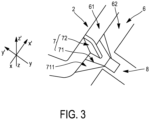
- FIG 3 is a perspective view of a protuberance 7 positioned at the intersection of a longitudinal groove 6 and a transverse hollow 8 according to a preferred embodiment of the invention.
- the first portion 71 comprises lateral faces 711 forming, with the transverse direction YY', an angle at most equal to 45°.
- the first portion 71 has a pyramid shape whose inclined lateral faces 711 facilitate the mobility of stones in the longitudinal groove, and therefore their ejection outside the tread, during rolling of the tire.
- the second anti-noise portion 72 has the same characteristics as previously.
- the inventors have more particularly studied this invention for a tire of size 445/95R25 intended to be mounted on a mobile crane.
- a tire According to the ETRTO standard, such a tire must be capable of carrying a load equal to 6700 kg, when inflated to a pressure equal to 9 bars.
- the inventors compared, in the tire size 445/95R25, a tire comprising a tread having a sculpture with anti-noise protrusions and stone guards, in accordance with the invention, and a reference tire comprising a tread having a sculpture identical to that of the invention but without anti-noise protrusions and stone guards.
- Table 1 below shows the characteristics of an anti-noise and stone-guard protrusion of the tread according to the invention: ⁇ b>[Table 1] ⁇ /b> Features of a noise-reducing and stone-repellent tread protrusion Values Depth H of the furrow 21 mm Width W of the furrow 18 mm Height H' of the protuberance 21 mm Height H2 of the second portion of protuberance (anti-noise) 13 mm Width W2 of the second portion of protuberance (anti-noise) 6 mm Thickness T2 of the second portion of protuberance (anti-noise) 1 mm Height H1 of the first portion of protuberance (stone chase) 8 mm Width W1 of the first portion of protuberance (stone chase) 18 mm Thickness T1 of the first portion of protuberance (stone chase) 24 mm
- the tire of the example studied has an external diameter equal to 1471 mm, which corresponds to a developed tread length L equal to 4621 mm.
- the tread comprises, in each of its two central longitudinal grooves and over its entire length L, 112 anti-noise and stone guard protuberances alternately positioned on the walls opposite the longitudinal groove, constituting 56 pairs of protuberances forming 56 anti-noise barriers.
- the contact area of its tread contains, for a given longitudinal groove, 3 pairs of protuberances, each forming an anti-noise barrier extending over almost the entire width of the longitudinal groove.
- the tire according to the invention generated 3 dB (A) lower external noise, in a coast-by type external noise test. Furthermore, a rolling test on a ground covered with calibrated stones showed that the tread of a tire according to the invention retained much fewer stones than that of the reference tire, without any stone blockage at the protuberances.
- the tread according to the invention developed for a conventional tire subjected to inflation pressure, can also be used for a non-pneumatic tire.
Landscapes
- Engineering & Computer Science (AREA)
- Mechanical Engineering (AREA)
- Tires In General (AREA)
Description
- La présente invention a pour objet une bande de roulement de pneumatique pour véhicule lourd, destiné à porter de lourdes charges et à rouler sur des sols pierreux ou sur des sols goudronnés, et, plus particulièrement, une bande de roulement de pneumatique pour un véhicule de génie civil de type grue mobile, destiné à se déplacer d'un chantier à un autre pour faire du levage de charges lourdes.
- Une bande de roulement comprend au moins un matériau à base de caoutchouc et est destinée à constituer la partie périphérique d'un pneumatique et à être usée lors de l'entrée en contact de sa surface de roulement avec un sol.
- Une bande de roulement peut être définie par trois dimensions : une épaisseur, selon une direction radiale, une largeur, selon une direction transversale, et une longueur, selon une direction longitudinale. Lorsqu'une bande de roulement est intégrée au pneumatique, la direction transversale est également appelée direction axiale, car elle est parallèle à l'axe de rotation du pneumatique, et la direction longitudinale est également appelée direction circonférentielle, car elle est tangente à la circonférence du pneumatique selon la direction de roulage du pneumatique.
- Pour garantir en particulier une performance satisfaisante en adhérence longitudinale, sous couple moteur et sous couple freineur, et en adhérence transversale, il est nécessaire de former, dans la bande de roulement, une sculpture qui est un système plus ou moins complexe de découpures, ou creux, séparant des éléments en relief par rapport à une surface de fond.
- Dans le cas d'une bande de roulement de pneumatique pour véhicule lourd de génie civil, les éléments en relief sont généralement des blocs. Un bloc est un volume de matière caoutchouteuse délimité par une face de contact, contenue dans la surface de roulement, par une surface de fond et par des faces latérales reliant la face de contact à la surface de fond. Ces blocs peuvent être arrangés de façon à constituer des rangées longitudinales de blocs, ces rangées étant deux à deux séparées par des creux longitudinaux, appelés également sillons longitudinaux ou plus simplement sillons. Un creux longitudinal a une ligne moyenne non nécessairement rectiligne ayant en chaque point une tangente formant avec la direction longitudinale un angle compris entre 0° et 45°. En outre, au sein d'une même rangée longitudinale de blocs, les blocs sont le plus souvent deux à deux séparés par des creux transversaux. Un creux transversal a une ligne moyenne non nécessairement rectiligne ayant en chaque point une tangente formant avec la direction transversale un angle compris entre 0° et 45°. Ainsi les creux respectivement longitudinaux et transversaux forment un réseau de découpures séparant les blocs.
- La bande de roulement, intégrée au pneumatique, est le plus souvent caractérisée géométriquement par une largeur transversale WT, selon la direction transversale, et une épaisseur radiale HT, selon une direction radiale. La largeur transversale WT est définie comme la largeur transversale de la surface de contact de la bande de roulement du pneumatique neuf avec un sol lisse, tel qu'un sol goudronné, lorsque le pneumatique est soumis à des conditions de pression et de charge nominales recommandées, par exemple, par la norme de la « European Tyre and Rim Technical Organization » ou E.T.R.T.O. (Organisation technique européenne du pneumatique et de la roue). L'épaisseur radiale HT est définie, par convention, comme la profondeur radiale maximale mesurée dans les creux, correspondant à la hauteur radiale de bloc maximale. Dans le cas d'un pneumatique pour véhicule de génie civil de type grue mobile, et à titre d'exemple, la largeur transversale WT est au moins égale à 300 mm et l'épaisseur radiale HT est au moins égale à 20 mm, voire 25 mm.
- Les conditions usuelles de roulage d'un pneumatique pour véhicule lourd de type grue mobile sont généralement mixtes, à la fois hors la route, sur des sols pierreux, et sur route, sur des sols goudronnés.
- Lorsque le pneumatique roule sur un sol pierreux, sa bande de roulement est susceptible de retenir des pierres dans ses creux longitudinaux et transversaux, et en particulier au niveau des zones d'intersection entre un creux longitudinal et un creux transversal. Ces pierres retenues par les creux de la bande de roulement sont alors susceptibles de créer des perforations de la bande de roulement, pouvant entrainer un endommagement de l'armature de sommet du pneumatique, radialement intérieure à la bande de roulement, et, à terme, une rupture de ladite armature de sommet rendant le pneumatique inutilisable. Des dispositifs d'éjection des pierres, sous la forme de protubérances de forme et de taille adaptées, ont été décrits dans les documents
EP 3178669 ,WO 0132448 WO 2009082394 . - Lorsque le pneumatique roule sur un sol goudronné, à plus grande vitesse, sa bande de roulement est susceptible de générer un bruit, en particulier en raison de la présence de creux longitudinaux dans lesquels se propagent des ondes sonores aériennes. Des dispositifs d'amortissement de ces ondes sonores, appelés usuellement dispositifs anti-bruit, souvent sous la forme d'obstacles souples formant une barrière au moins partielle dans les creux longitudinaux, ont été décrits dans les documents
WO 2013171172 etWO 2012001031 . - Les inventeurs se sont donnés pour objectif d'améliorer, pour une bande de roulement de pneumatique pour véhicule lourd à usage mixte hors la route et sur route, à la fois sa capacité à ne pas retenir des pierres dans ses creux, lors d'un usage hors la route, et sa capacité à amortir le bruit qu'elle génère, lors d'un usage sur route.
- Cet objectif a été atteint par une bande de roulement de pneumatique pour véhicule lourd, destinée à entrer en contact avec un sol par l'intermédiaire d'une surface de roulement et comprenant des découpures délimitant des blocs en caoutchouc s'étendant à partir d'une surface de fond selon une direction radiale,
- au moins une découpure étant un sillon longitudinal, délimité par deux parois latérales en vis-à-vis raccordées entre elles par un fond de sillon, et s'étendant sur toute la longueur L de la bande de roulement selon une direction longitudinale,
- tout sillon longitudinal ayant une profondeur H, mesurée entre la surface de roulement et le fond de sillon selon une direction radiale, et une largeur W, mesurée entre les deux parois latérales dans la surface de roulement selon une direction transversale,
- au moins un sillon longitudinal comprenant une distribution longitudinale de protubérances adossées à l'une ou l'autre des parois latérales, deux protubérances consécutives, non nécessairement adossées à la même paroi latérale, étant espacées d'un pas P,
- toute protubérance du sillon longitudinal s'étendant radialement vers l'extérieur à partir du fond de sillon sur une hauteur H' au moins égale à 0.9 fois la profondeur H du sillon
- et toute protubérance du sillon longitudinal comprenant une première portion, s'étendant radialement vers l'extérieur à partir du fond de sillon sur une hauteur H1, transversalement vers l'intérieur du sillon longitudinal à partir d'une paroi latérale sur une largeur W1 et longitudinalement sur une épaisseur T1, et une deuxième portion, s'étendant radialement vers l'extérieur à partir de la première portion sur une hauteur H2, transversalement vers l'intérieur du sillon longitudinal à partir d'une paroi latérale sur une largeur W2 et longitudinalement sur une épaisseur T2, de telle sorte que les relations suivantes sont vérifiées :





- La bande de roulement selon l'invention comprend de façon essentielle, dans au moins un sillon longitudinal, une distribution longitudinale de protubérances, chaque protubérance, adossée à l'une ou l'autre des parois latérales du sillon, ayant une double fonction de barrière anti-bruit et de chasse-pierres. Une barrière anti-bruit contribue à l'amortissement des ondes sonores aériennes se propageant dans le sillon longitudinal, lors du roulage du pneumatique sur un sol goudronné. Un chasse-pierres a pour fonction de favoriser l'éjection des pierres retenues dans les creux, lors du roulage du pneumatique sur un sol pierreux, et d'empêcher l'agression du fond de sillon par celles-ci. Les protubérances sont adossées à l'une ou l'autre des parois latérales, et deux protubérances consécutives, selon la direction longitudinale, non nécessairement adossées à la même paroi latérale, sont espacées d'un pas P, distance longitudinale entre lesdites deux protubérances.
- Pour assurer cette double fonction, chaque protubérance comprend une première portion radialement intérieure, s'appuyant à la fois sur le fond de sillon et sur une paroi latérale et assurant la fonction de chasse-pierres, et une deuxième portion radialement extérieure, s'appuyant à la fois sur la partie radialement extérieure de la première portion et sur la même paroi latérale et assurant la fonction anti-bruit.
- Toutes les caractéristiques géométriques décrites ci-après sont mesurées sur une bande de roulement de pneumatique à l'état neuf.
- La première, respectivement deuxième, portion de la protubérance est géométriquement caractérisée par une hauteur H1, respectivement H2, selon une direction radiale, par une largeur W1, respectivement W2, selon la direction transversale, et une épaisseur T1, respectivement T2, selon la direction longitudinale. Les hauteurs, les largeurs et les épaisseurs sont des valeurs moyennes mesurées selon les directions correspondantes.
- Selon une première caractéristique essentielle, toute protubérance du sillon longitudinal s'étend radialement vers l'extérieur à partir du fond de sillon sur une hauteur H' au moins égale à 0.9 fois la profondeur H du sillon. La hauteur H' de la protubérance est la somme des hauteurs H1 et H2 respectives de la première et de la deuxième portion, et correspond à une hauteur totale moyenne de la protubérance, celle-ci pouvant être variable dans les directions transversale et/ou longitudinale. La profondeur H du sillon est la profondeur maximale mesurée entre la surface de roulement et le point le plus radialement intérieur du fond de sillon, dans le plan moyen longitudinal du sillon longitudinal. Une hauteur H' de protubérance au moins égale à 0.9 fois la profondeur H du sillon longitudinal vise à garantir la présence de la protubérance sur la quasi-totalité de la profondeur du sillon, pour une bonne efficacité de barrière anti-bruit.
- Une deuxième caractéristique essentielle est exprimée par l'inégalité 0.6*H'<=H2<=0.9*H'. En d'autres termes, la deuxième portion doit avoir une hauteur H2 au moins égale à 60% et au plus égale à 90% de la hauteur totale H' de la protubérance. En dessous de 60%, la hauteur H2 est insuffisante pour garantir une souplesse de la deuxième portion adaptée à l'amortissement des ondes sonores. Au-dessus de 90%, la hauteur H1 de la première portion devient inférieure à 10% de la hauteur H', ce qui est insuffisant pour assurer la protection du fond de sillon.
- Une troisième caractéristique essentielle est exprimée par l'inégalité W2>=0.25*W. En d'autres termes, la deuxième portion doit avoir une largeur W2 au moins égale à 25% de la largeur W du sillon. A partir de 25%, la première portion est suffisamment large, donc obstrue suffisamment le sillon longitudinal pour jouer son rôle de barrière anti-bruit.
- Une quatrième caractéristique essentielle est exprimée par l'inégalité T2<=min (3 mm; 1/3*T1). Autrement dit, l'épaisseur T2 de la deuxième portion doit rester inférieure d'une part à 3 mm, et d'autre part au tiers de l'épaisseur T1 de la première portion. Au-delà d'une épaisseur égale à 3 mm, la deuxième portion devient trop rigide, donc insuffisamment déformable vis-à-vis de l'amortissement du bruit. Cette déformabilité peut également être intéressante, vis-à-vis de la fonction chasse-pierres, puisqu'une deuxième portion souple ne bloque pas la mobilité des pierres dans le sillon longitudinal et donc ne contrarie pas leur éjection éventuelle. De plus, pour garantir un ancrage robuste de la deuxième portion sur la première portion, il est avantageux que l'épaisseur T2 de la deuxième portion soit très inférieure à l'épaisseur T1 de la première portion : un tiers de l'épaisseur T1 a été estimée comme une borne maximale pertinente.
- Selon une cinquième caractéristique essentielle, l'inégalité W1>=0.5*W doit être vérifiée. La largeur W1 de la première portion doit être au moins égale à 50% de la largeur W du sillon longitudinal, pour garantir un bon recouvrement transversal du fond de sillon par la protubérance et, par conséquent, son effet de protection vis-à-vis des pierres emprisonnées dans le sillon longitudinal.
- La sixième et dernière caractéristique essentielle de l'invention est exprimée par l'inégalité T1>=H1. L'épaisseur T1 de la première portion doit être au moins égale à sa hauteur H1, pour garantir un bon recouvrement longitudinal du fond de sillon par la protubérance et, par conséquent, son effet de protection vis-à-vis des pierres emprisonnées dans le sillon longitudinal.
- Ainsi la combinaison des caractéristiques essentielles précédemment décrites permet à des protubérances étagées, telles que décrites dans l'invention, d'assurer efficacement leur double fonction de barrière anti-bruit et de chasse-pierres.
- Selon un mode de réalisation préféré, les protubérances du sillon longitudinal sont alternativement adossées à l'une ou l'autre des parois latérales. Ce positionnement alterné des protubérances sur l'une et l'autre des parois signifie que deux protubérances consécutives ne sont pas adossées à la même paroi, mais en contact avec des parois en vis-à-vis. Cette alternance garantit une fermeture quasi-complète du sillon longitudinal, par recouvrement des protubérances positionnées sur des parois en vis-à-vis, et donc une barrière quasi-totale vis-à-vis de la propagation des ondes sonores.
- Avantageusement, les protubérances du sillon longitudinal sont deux à deux espacées d'un pas P au plus égal à 0.1 fois la longueur L de la bande de roulement. Sachant que, lorsque le pneumatique est soumis à des conditions de charge et de pression nominales, l'aire de contact de la bande de roulement avec le sol a une longueur longitudinale de l'ordre de 0.1 fois la longueur L de la bande de roulement, cette condition implique la présence d'au moins deux protubérances dans l'aire de contact fermant le sillon longitudinal dans l'aire de contact et évitant ainsi la formation d'un tuyau, entre la bande de roulement et le sol, susceptible de générer du bruit. Il est à noter que le pas P entre deux protubérances consécutives n'est pas nécessairement constant.
- Préférentiellement toute protubérance du sillon longitudinal s'étend radialement vers l'extérieur à partir du fond de sillon sur une hauteur H' égale à la profondeur H du sillon, ce qui garantit la présence d'une barrière anti-bruit sur toute la profondeur du sillon longitudinal, d'où un amortissement optimum du bruit.
- Avantageusement la deuxième portion s'étend longitudinalement sur une épaisseur T2 au moins égale à 1 mm. En dessous d'une épaisseur de 1 mm, la barrière anti-bruit devient insuffisamment robuste mécaniquement.
- Encore avantageusement la deuxième portion s'étend vers l'intérieur du sillon longitudinal à partir d'une paroi latérale sur une largeur W2 au plus égale à 0.75 fois la largeur W du sillon longitudinal. Au-delà d'une largeur égale à 75% de la largeur du sillon longitudinal, la barrière anti-bruit devient insuffisamment robuste mécaniquement.
- Avantageusement la première portion s'étend longitudinalement sur une épaisseur T1 au plus égale à 4 fois la hauteur H1. Cette condition permet de limiter l'épaisseur, c'est-à-dire la dimension longitudinale de la première portion, et donc son volume par rapport au volume du sillon longitudinal. Ceci permet de limiter la réduction du volume de creux disponible et, par conséquent, la capacité du sillon à stocker ou drainer l'eau ou la boue éventuellement présente sur le sol.
- Selon un mode de réalisation préféré, la première portion comprend des faces latérales formant, avec la direction transversale, un angle au plus égal à 45°. Dans ce cas, la première portion a une forme de pyramide dont les faces latérales inclinées facilitent la mobilité des pierres dans le sillon longitudinal, et donc leur éjection à l'extérieur de la bande de roulement, au cours du roulage du pneumatique.
- Dans le cas particulier d'un sillon longitudinal comprenant au moins une intersection avec une rainure transversale, toute intersection du sillon longitudinal et d'une rainure transversale est pourvue d'une protubérance. En effet, toute intersection entre le sillon longitudinale et une rainure transversale est une zone préférentielle pour le piégeage des pierres. Par conséquent il est avantageux de placer une protubérance à cette intersection particulièrement sensible à la rétention des pierres.
- Dans une variante avantageuse du mode de réalisation précédent, la première portion s'étend vers l'intérieur du sillon longitudinal à partir d'une paroi latérale sur une largeur W1 au plus égale à 2 fois la largeur W du sillon longitudinal. Dans ces conditions, la première portion recouvre à la fois le fond du sillon longitudinal et une partie du fond de la rainure transversale, et protège donc ces deux zones.
- L'invention a également pour objet un pneumatique pour véhicule lourd, de préférence un véhicule lourd de génie civil de type grue mobile, comprenant une bande de roulement selon l'un quelconque des modes de réalisation précédemment décrits.
- Les caractéristiques de l'invention sont illustrées par les
figures 1 ,2A, 2B, 2C et3 schématiques et non représentées à l'échelle: -
Figure 1 : Vue de dessus d'une portion de bande de roulement selon l'invention, -
Figure 2A : Vue en perspective d'une protubérance d'un sillon longitudinal de bande de roulement selon l'invention, -
Figure 2B : Vue en coupe transversale d'une protubérance d'un sillon longitudinal de bande de roulement selon l'invention, -
Figure 2C : Vue de dessus d'une protubérance d'un sillon longitudinal de bande de roulement selon l'invention, -
Figure 3 : Vue en perspective d'une protubérance positionnée à l'intersection d'un sillon longitudinal et d'un creux transversal selon un mode de réalisation préféré de l'invention. - La
figure 1 est une vue de dessus d'une portion de bande de roulement 1 selon l'invention. La bande de roulement 1 de pneumatique pour véhicule lourd, destinée à entrer en contact avec un sol par l'intermédiaire d'une surface de roulement 2, comprend des découpures 3 délimitant des blocs 4 en caoutchouc s'étendant à partir d'une surface de fond 5 selon une direction radiale ZZ'. Les découpures 3 de la bande de roulement 1 sont soit des sillons longitudinaux 6, soit des creux transversaux 8. Dans le mode de réalisation représenté, sur les quatre sillons longitudinaux 6, délimités chacun par deux parois latérales 61 en vis-à-vis raccordées entre elles par un fond de sillon 62, et s'étendant sur toute la longueur L de la bande de roulement 1 selon une direction longitudinale XX', deux d'entre eux, positionnés dans une portion centrale de la bande de roulement 1, comprennent chacun une distribution longitudinale de protubérances 7 adossées alternativement à l'une et l'autre des parois latérales 61, deux protubérances consécutives positionnées respectivement sur deux parois latérales 61 en vis-à-vis étant espacées d'un pas P. Le pas P est variable car lesdites protubérances 7 sont exclusivement positionnées, dans le mode de réalisation représenté, à l'intersection d'un sillon longitudinal 6 et d'un creux transversal 8. Seuls les sillons longitudinaux centraux sont pourvus de protubérances 7, car la portion centrale est soumise aux plus fortes pressions de contact et est donc la plus sensible à la rétention de pierres. - La
figure 2A est une vue en perspective d'une protubérance 7 d'un sillon longitudinal 6 de bande de roulement selon l'invention. La protubérance 7 du sillon longitudinal 6 comprend une première portion 71, s'étendant radialement vers l'extérieur à partir du fond de sillon 62 positionné sur la surface de fond 5, et s'appuyant sur la paroi latérale 61, et une deuxième portion 72, s'étendant radialement vers l'extérieur à partir de la première portion 71 et s'appuyant sur la paroi latérale 61. La première portion 71 radialement intérieure assure la fonction de chasse-pierres, et la deuxième portion 72 radialement extérieure assure la fonction anti-bruit. - La
figure 2B est une vue en coupe transversale d'une protubérance 7 d'un sillon longitudinal 6 de bande de roulement selon l'invention. La protubérance 7 du sillon longitudinal 6 s'étend radialement, selon la direction ZZ', vers l'extérieur à partir du fond de sillon 62 sur une hauteur H' au moins égale à 0.9 fois la profondeur H du sillon 6. La première portion 71 s'étend radialement, selon la direction ZZ', vers l'extérieur à partir du fond de sillon 62 sur une hauteur H1, et transversalement, selon la direction YY', vers l'intérieur du sillon longitudinal 6 à partir d'une paroi latérale 61 sur une largeur W1. La deuxième portion 72 s'étend radialement, selon la direction ZZ', vers l'extérieur à partir de la première portion 71 sur une hauteur H2 et transversalement, selon la direction YY', vers l'intérieur du sillon longitudinal 6 à partir d'une paroi latérale 61 sur une largeur W2. Selon l'invention, les relations suivantes entre les caractéristiques géométriques précédemment décrites sont vérifiées : H'=H1+H2, 0.6*H'<=H2<=0.9*H', W2>=0.25*W et W1>=0.5*W. - La
figure 2C est une vue de dessus d'une protubérance 7 d'un sillon longitudinal 6 de bande de roulement selon l'invention. La première portion 71 s'étend transversalement, selon la direction YY', vers l'intérieur du sillon longitudinal 6 à partir d'une paroi latérale 61 sur une largeur W1 et longitudinalement, selon la direction XX', sur une épaisseur T1. La deuxième portion 72 s'étend transversalement, selon la direction YY', vers l'intérieur du sillon longitudinal 6 à partir d'une paroi latérale 61 sur une largeur W2 et longitudinalement, selon la direction XX', sur une épaisseur T2. Selon l'invention, les relations suivantes entre les caractéristiques géométriques précédemment décrites sont vérifiées : W2>=0.25*W, T2<=min (3 mm ; 1/3*T1), W1>=0.5*W et T1>=H1. - La
figure 3 est une vue en perspective d'une protubérance 7 positionnée à l'intersection d'un sillon longitudinal 6 et d'un creux transversal 8 selon un mode de réalisation préféré de l'invention. La première portion 71 comprend des faces latérales 711 formant, avec la direction transversale YY', un angle au plus égal à 45°. La première portion 71 a une forme de pyramide dont les faces latérales inclinées 711 facilitent la mobilité des pierres dans le sillon longitudinal, et donc leur éjection à l'extérieur de la bande de roulement, au cours du roulage du pneumatique. La deuxième portion 72 anti-bruit a les mêmes caractéristiques que précédemment. - Les inventeurs ont plus particulièrement étudié cette invention pour un pneumatique de dimension 445/95R25 destiné à être monté sur une grue mobile. Selon la norme ETRTO, un tel pneumatique doit être capable de porter une charge égale à 6700 kg, lorsqu'il est gonflé à une pression égale à 9 bars.
- Les inventeurs ont comparé, dans la dimension de pneumatique 445/95R25, un pneumatique comprenant une bande de roulement ayant une sculpture avec des protubérances anti-bruit et chasse-pierres, conformément à l'invention, et un pneumatique de référence comprenant une bande de roulement ayant une sculpture identique à celle de l'invention mais sans protubérances anti-bruit et chasse-pierres.
- Le tableau 1 ci-dessous présente les caractéristiques d'une protubérance anti-bruit et chasse-pierres de la bande de roulement selon l'invention :
[Tableau 1] Caractéristiques d'une protubérance anti-bruit et chasse-pierres de la bande de roulement Valeurs Profondeur H du sillon 21 mm Largeur W du sillon 18 mm Hauteur H' de la protubérance 21 mm Hauteur H2 de la deuxième portion de protubérance (anti-bruit) 13 mm Largeur W2 de la deuxième portion de protubérance (anti-bruit) 6 mm Epaisseur T2 de la deuxième portion de protubérance (anti-bruit) 1 mm Hauteur H1 de la première portion de protubérance (chasse-pierres) 8 mm Largeur W1 de la première portion de protubérance (chasse-pierres) 18 mm Epaisseur T1 de la première portion de protubérance (chasse-pierres) 24 mm - Le pneumatique de l'exemple étudié a un diamètre extérieur égal à 1471 mm, ce qui correspond à une longueur développée L de bande de roulement égale à 4621 mm. La bande de roulement comprend, dans chacun de ses deux sillons longitudinaux centraux et sur toute sa longueur L, 112 protubérances anti-bruit et chasse-pierres alternativement positionnées sur les parois en vis-à-vis du sillon longitudinal, constituant 56 paires de protubérances formant 56 barrières anti-bruit. Lorsque ce pneumatique est gonflé à une pression égale à 9 bars et soumis à une charge égale à 6700 kg, l'aire de contact de sa bande de roulement contient, pour un sillon longitudinal donné, 3 paires de protubérances, formant chacune une barrière anti-bruit s'étendant sur la quasi-totalité de la largeur du sillon longitudinal.
- Par rapport au pneumatique de référence, le pneu conforme à l'invention a généré un bruit extérieur inférieur de 3 dB (A), sur un test de bruit externe de type « coast-by ». Par ailleurs, un test de roulage sur un sol recouvert de pierres calibrées a montré que la bande de roulement d'un pneumatique conforme à l'invention retenait beaucoup moins de pierres que celle du pneumatique de référence, sans blocage de pierres au niveau des protubérances.
- La bande de roulement selon l'invention, développée pour un pneumatique usuel soumis à une pression de gonflage, peut également être utilisée pour un bandage non pneumatique.
Claims (11)
- Bande de roulement (1) de pneumatique pour véhicule lourd, destinée à entrer en contact avec un sol par l'intermédiaire d'une surface de roulement (2) et comprenant des découpures (3) délimitant des blocs (4) en caoutchouc s'étendant à partir d'une surface de fond (5) selon une direction radiale (ZZ'),- au moins une découpure (3) étant un sillon longitudinal (6), délimité par deux parois latérales (61) en vis-à-vis raccordées entre elles par un fond de sillon (62), et s'étendant sur toute la longueur L de la bande de roulement (1) selon une direction longitudinale (XX'),- tout sillon longitudinal (6) ayant une profondeur H, mesurée entre la surface de roulement (2) et le fond de sillon (62) selon une direction radiale (ZZ'), et une largeur W, mesurée entre les deux parois latérales (61) dans la surface de roulement (2) selon une direction transversale (YY'),- au moins un sillon longitudinal (6) comprenant une distribution longitudinale de protubérances (7) adossées à l'une ou l'autre des parois latérales (6), deux protubérances (7) consécutives, non nécessairement adossées à la même paroi latérale (61), étant espacées d'un pas P,caractérisée en ce que toute protubérance (7) du sillon longitudinal (6) s'étend radialement vers l'extérieur à partir du fond de sillon (62) sur une hauteur H' au moins égale à 0.9 fois la profondeur H du sillon (6) et en ce que toute protubérance (7) du sillon longitudinal (6) comprend une première portion (71), s'étendant radialement vers l'extérieur à partir du fond de sillon (62) sur une hauteur H1, transversalement vers l'intérieur du sillon longitudinal (6) à partir d'une paroi latérale (61) sur une largeur W1 et longitudinalement sur une épaisseur T1, et une deuxième portion (72), s'étendant radialement vers l'extérieur à partir de la première portion (71) sur une hauteur H2, transversalement vers l'intérieur du sillon longitudinal (6) à partir d'une paroi latérale (61) sur une largeur W2 et longitudinalement sur une épaisseur T2, de telle sorte que les relations suivantes sont vérifiées :


- Bande de roulement (1) selon la revendication 1, dans laquelle les protubérances (7) du sillon longitudinal (6) sont alternativement adossées à l'une ou l'autre des parois latérales (61).
- Bande de roulement (1) selon l'une des revendications 1 ou 2, dans laquelle les protubérances (7) du sillon longitudinal (6) sont deux à deux espacées d'un pas P au plus égal à 0.1 fois la longueur L de la bande de roulement (2).
- Bande de roulement (1) selon l'une quelconque des revendications 1 à 3, dans laquelle toute protubérance (7) du sillon longitudinal (6) s'étend radialement vers l'extérieur à partir du fond de sillon (62) sur une hauteur H' égale à la profondeur H du sillon (6).
- Bande de roulement (1) selon l'une quelconque des revendications 1 à 4, dans laquelle la deuxième portion (72) s'étend longitudinalement sur une épaisseur T2 au moins égale à 1 mm.
- Bande de roulement (1) selon l'une quelconque des revendications 1 à 5, dans laquelle la deuxième portion (72) s'étend vers l'intérieur du sillon longitudinal (6) à partir d'une paroi latérale (61) sur une largeur W2 au plus égale à 0.75 fois la largeur W du sillon longitudinal (6).
- Bande de roulement (1) selon l'une quelconque des revendications 1 à 6, dans laquelle la première portion (71) s'étend longitudinalement sur une épaisseur T1 au plus égale à 4 fois la hauteur H1.
- Bande de roulement (1) selon l'une quelconque des revendications 1 à 7, dans laquelle la première portion (71) comprend des faces latérales (711) formant, avec la direction transversale (YY'), un angle au plus égal à 45°.
- Bande de roulement (1) selon l'une quelconque des revendications 1 à 8, le sillon longitudinal (6) comprenant au moins une intersection avec une rainure transversale (8), dans laquelle toute intersection du sillon longitudinal (6) et d'une rainure transversale (8) est pourvue d'une protubérance (7).
- Bande de roulement (1) selon la revendication 9, dans laquelle la première portion (71) s'étend vers l'intérieur du sillon longitudinal (6) à partir d'une paroi latérale (61) sur une largeur W1 au plus égale à 2 fois la largeur W du sillon longitudinal (6).
- Pneumatique pour véhicule lourd, de préférence un véhicule lourd de génie civil de type grue mobile, comprenant une bande de roulement (1) selon l'une quelconque des revendications 1 à 10.
Applications Claiming Priority (2)
| Application Number | Priority Date | Filing Date | Title |
|---|---|---|---|
| FR1914861A FR3105096B1 (fr) | 2019-12-19 | 2019-12-19 | Bande de roulement de pneumatique pour véhicule lourd comprenant des protubérances anti-bruit et chasse-pierres |
| PCT/FR2020/052386 WO2021123580A1 (fr) | 2019-12-19 | 2020-12-11 | Bande de roulement de pneumatique pour vehicule lourd comprenant des protuberances anti-bruit et chasse-pierres |
Publications (2)
| Publication Number | Publication Date |
|---|---|
| EP4076993A1 EP4076993A1 (fr) | 2022-10-26 |
| EP4076993B1 true EP4076993B1 (fr) | 2024-11-20 |
Family
ID=70008747
Family Applications (1)
| Application Number | Title | Priority Date | Filing Date |
|---|---|---|---|
| EP20845175.7A Active EP4076993B1 (fr) | 2019-12-19 | 2020-12-11 | Bande de roulement de pneumatique pour vehicule lourd comprenant des protuberances anti-bruit et chasse-pierres |
Country Status (6)
| Country | Link |
|---|---|
| US (1) | US12304251B2 (fr) |
| EP (1) | EP4076993B1 (fr) |
| CN (1) | CN114829162B (fr) |
| AU (1) | AU2020410054A1 (fr) |
| FR (1) | FR3105096B1 (fr) |
| WO (1) | WO2021123580A1 (fr) |
Families Citing this family (1)
| Publication number | Priority date | Publication date | Assignee | Title |
|---|---|---|---|---|
| EP4620702A1 (fr) * | 2024-03-20 | 2025-09-24 | Continental Reifen Deutschland GmbH | Pneu de véhicule utilitaire |
Family Cites Families (13)
| Publication number | Priority date | Publication date | Assignee | Title |
|---|---|---|---|---|
| FR2800326A1 (fr) | 1999-10-29 | 2001-05-04 | Michelin Soc Tech | Sculpture de bande de roulement pour pneumatique de vehicule a forte capacite de charge |
| JP2003165310A (ja) * | 2001-11-30 | 2003-06-10 | Bridgestone Corp | 空気入りタイヤ |
| WO2003053722A1 (fr) * | 2001-12-21 | 2003-07-03 | Sumitomo Rubber Industries, Ltd. | Pneu super-resistant |
| DE102007016930A1 (de) | 2007-04-05 | 2008-10-09 | Continental Aktiengesellschaft | Fahrzeugluftreifen |
| US8776847B2 (en) | 2007-12-21 | 2014-07-15 | Michelin Recherche Et Technique S.A. | Mechanisms for ejecting objects from a tire tread |
| WO2009084666A1 (fr) * | 2007-12-28 | 2009-07-09 | Bridgestone Corporation | Pneumatique |
| FR2961744B1 (fr) | 2010-06-29 | 2012-08-03 | Michelin Soc Tech | Bande de roulement a bruit de roulage reduit |
| JP5640517B2 (ja) * | 2010-07-16 | 2014-12-17 | 横浜ゴム株式会社 | 空気入りタイヤ |
| CN202006702U (zh) | 2011-04-08 | 2011-10-12 | 厦门正新海燕轮胎有限公司 | 充气轮胎胎面防夹石结构 |
| FR2990644B1 (fr) | 2012-05-18 | 2014-05-09 | Michelin & Cie | Dispositif anti bruit ameliore pour pneu. |
| FR3008352B1 (fr) * | 2013-07-09 | 2017-01-13 | Michelin & Cie | Bande de roulement pour poids lourd a bruit reduit |
| JP6186260B2 (ja) | 2013-12-06 | 2017-08-23 | 東洋ゴム工業株式会社 | 空気入りタイヤ |
| US20170157990A1 (en) | 2015-12-08 | 2017-06-08 | The Goodyear Tire & Rubber Company | Pneumatic tire |
-
2019
- 2019-12-19 FR FR1914861A patent/FR3105096B1/fr active Active
-
2020
- 2020-12-11 CN CN202080087637.2A patent/CN114829162B/zh active Active
- 2020-12-11 EP EP20845175.7A patent/EP4076993B1/fr active Active
- 2020-12-11 US US17/786,933 patent/US12304251B2/en active Active
- 2020-12-11 WO PCT/FR2020/052386 patent/WO2021123580A1/fr not_active Ceased
- 2020-12-11 AU AU2020410054A patent/AU2020410054A1/en active Pending
Also Published As
| Publication number | Publication date |
|---|---|
| CN114829162A (zh) | 2022-07-29 |
| US12304251B2 (en) | 2025-05-20 |
| US20230028931A1 (en) | 2023-01-26 |
| FR3105096B1 (fr) | 2022-11-25 |
| WO2021123580A1 (fr) | 2021-06-24 |
| EP4076993A1 (fr) | 2022-10-26 |
| AU2020410054A1 (en) | 2022-06-16 |
| CN114829162B (zh) | 2023-09-08 |
| FR3105096A1 (fr) | 2021-06-25 |
Similar Documents
| Publication | Publication Date | Title |
|---|---|---|
| WO2022129729A1 (fr) | Bande de roulement de pneumatique pour un véhicule lourd à robustesse améliorée | |
| EP4319989B1 (fr) | Pneumatique pour véhicule agricole à usage mixte | |
| EP4263239A1 (fr) | Bande de roulement de pneumatique pour un véhicule lourd à robustesse améliorée | |
| FR3035821A1 (fr) | Bande de roulement comportant un bloc presentant une pluralite de decoupures | |
| EP3386774B1 (fr) | Bande de roulement de pneumatique pour vehicule lourd de type genie civil | |
| EP4076993B1 (fr) | Bande de roulement de pneumatique pour vehicule lourd comprenant des protuberances anti-bruit et chasse-pierres | |
| CA1302212C (fr) | Pneumatique a armature de carcasse radiale, ayant au moins une paroi laterale pourvue d'une nervure protectrice | |
| FR3099414A1 (fr) | Bande de roulement de pneumatique pour véhicule poids lourd | |
| EP3969295B1 (fr) | Bande de roulement de pneumatique pour vehicule lourd de type genie civil | |
| EP4164899B1 (fr) | Bande de roulement de pneumatique pour un véhicule poids lourd avec une résistance aux agressions améliorée | |
| FR3035822A1 (fr) | Bande de roulement comportant un bloc presentant une pluralite de decoupures | |
| EP3390079B1 (fr) | Pneumatique presentant des proprietes d'usure ameliorees | |
| EP3999360B1 (fr) | Bande de roulement de pneumatique pour vehicule lourd de genie civil | |
| EP4232303A1 (fr) | Bande de roulement de pneumatique pour véhicule poids lourd à robustesse améliorée | |
| FR3146424A1 (fr) | Bande de roulement de pneumatique pour véhicule lourd comprenant des protubérances anti-bruit et chasse-pierres | |
| EP4347279B1 (fr) | Pneumatique pour un véhicule poids lourd à usage mixte à faible bruit de roulage | |
| EP3802156B1 (fr) | Bande de roulement de pneumatique pour vehicule lourd de type génie civil comprenant des incisions de ventilation | |
| WO2025082834A1 (fr) | Pneumatique pour véhicule poids lourd avec une bande de roulement à usure améliorée | |
| WO2023194096A1 (fr) | Pneumatique comportant une bande de roulement recreusable | |
| FR3136697A1 (fr) | Pneumatique pour un véhicule poids lourd à adhérence améliorée | |
| FR3140577A1 (fr) | Pneumatique pour un véhicule lourd à usage hors-la-route comprenant des flancs protégés contre les agressions | |
| WO2023186694A1 (fr) | Pneumatique pour un véhicule poids lourd à faible bruit de roulement | |
| WO2020120870A2 (fr) | Pneumatique pour vehicule de genie civil comprenant une armature de protection a pavage bidimensionnel | |
| FR3089876A1 (fr) | Pneumatique pour véhicule de Génie Civil comprenant une armature de protection à pavage bidimensionnel |
Legal Events
| Date | Code | Title | Description |
|---|---|---|---|
| STAA | Information on the status of an ep patent application or granted ep patent |
Free format text: STATUS: UNKNOWN |
|
| STAA | Information on the status of an ep patent application or granted ep patent |
Free format text: STATUS: THE INTERNATIONAL PUBLICATION HAS BEEN MADE |
|
| PUAI | Public reference made under article 153(3) epc to a published international application that has entered the european phase |
Free format text: ORIGINAL CODE: 0009012 |
|
| STAA | Information on the status of an ep patent application or granted ep patent |
Free format text: STATUS: REQUEST FOR EXAMINATION WAS MADE |
|
| 17P | Request for examination filed |
Effective date: 20220719 |
|
| AK | Designated contracting states |
Kind code of ref document: A1 Designated state(s): AL AT BE BG CH CY CZ DE DK EE ES FI FR GB GR HR HU IE IS IT LI LT LU LV MC MK MT NL NO PL PT RO RS SE SI SK SM TR |
|
| DAV | Request for validation of the european patent (deleted) | ||
| DAX | Request for extension of the european patent (deleted) | ||
| STAA | Information on the status of an ep patent application or granted ep patent |
Free format text: STATUS: EXAMINATION IS IN PROGRESS |
|
| 17Q | First examination report despatched |
Effective date: 20230810 |
|
| GRAP | Despatch of communication of intention to grant a patent |
Free format text: ORIGINAL CODE: EPIDOSNIGR1 |
|
| STAA | Information on the status of an ep patent application or granted ep patent |
Free format text: STATUS: GRANT OF PATENT IS INTENDED |
|
| INTG | Intention to grant announced |
Effective date: 20240617 |
|
| GRAS | Grant fee paid |
Free format text: ORIGINAL CODE: EPIDOSNIGR3 |
|
| GRAA | (expected) grant |
Free format text: ORIGINAL CODE: 0009210 |
|
| STAA | Information on the status of an ep patent application or granted ep patent |
Free format text: STATUS: THE PATENT HAS BEEN GRANTED |
|
| AK | Designated contracting states |
Kind code of ref document: B1 Designated state(s): AL AT BE BG CH CY CZ DE DK EE ES FI FR GB GR HR HU IE IS IT LI LT LU LV MC MK MT NL NO PL PT RO RS SE SI SK SM TR |
|
| REG | Reference to a national code |
Ref country code: GB Ref legal event code: FG4D Free format text: NOT ENGLISH |
|
| REG | Reference to a national code |
Ref country code: CH Ref legal event code: EP |
|
| REG | Reference to a national code |
Ref country code: DE Ref legal event code: R096 Ref document number: 602020041807 Country of ref document: DE |
|
| REG | Reference to a national code |
Ref country code: IE Ref legal event code: FG4D Free format text: LANGUAGE OF EP DOCUMENT: FRENCH |
|
| REG | Reference to a national code |
Ref country code: LT Ref legal event code: MG9D |
|
| REG | Reference to a national code |
Ref country code: NL Ref legal event code: MP Effective date: 20241120 |
|
| PG25 | Lapsed in a contracting state [announced via postgrant information from national office to epo] |
Ref country code: IS Free format text: LAPSE BECAUSE OF FAILURE TO SUBMIT A TRANSLATION OF THE DESCRIPTION OR TO PAY THE FEE WITHIN THE PRESCRIBED TIME-LIMIT Effective date: 20250320 Ref country code: HR Free format text: LAPSE BECAUSE OF FAILURE TO SUBMIT A TRANSLATION OF THE DESCRIPTION OR TO PAY THE FEE WITHIN THE PRESCRIBED TIME-LIMIT Effective date: 20241120 Ref country code: PT Free format text: LAPSE BECAUSE OF FAILURE TO SUBMIT A TRANSLATION OF THE DESCRIPTION OR TO PAY THE FEE WITHIN THE PRESCRIBED TIME-LIMIT Effective date: 20250320 |
|
| PG25 | Lapsed in a contracting state [announced via postgrant information from national office to epo] |
Ref country code: FI Free format text: LAPSE BECAUSE OF FAILURE TO SUBMIT A TRANSLATION OF THE DESCRIPTION OR TO PAY THE FEE WITHIN THE PRESCRIBED TIME-LIMIT Effective date: 20241120 Ref country code: NL Free format text: LAPSE BECAUSE OF FAILURE TO SUBMIT A TRANSLATION OF THE DESCRIPTION OR TO PAY THE FEE WITHIN THE PRESCRIBED TIME-LIMIT Effective date: 20241120 |
|
| REG | Reference to a national code |
Ref country code: AT Ref legal event code: MK05 Ref document number: 1743262 Country of ref document: AT Kind code of ref document: T Effective date: 20241120 |
|
| PG25 | Lapsed in a contracting state [announced via postgrant information from national office to epo] |
Ref country code: BG Free format text: LAPSE BECAUSE OF FAILURE TO SUBMIT A TRANSLATION OF THE DESCRIPTION OR TO PAY THE FEE WITHIN THE PRESCRIBED TIME-LIMIT Effective date: 20241120 |
|
| PG25 | Lapsed in a contracting state [announced via postgrant information from national office to epo] |
Ref country code: ES Free format text: LAPSE BECAUSE OF FAILURE TO SUBMIT A TRANSLATION OF THE DESCRIPTION OR TO PAY THE FEE WITHIN THE PRESCRIBED TIME-LIMIT Effective date: 20241120 |
|
| PG25 | Lapsed in a contracting state [announced via postgrant information from national office to epo] |
Ref country code: NO Free format text: LAPSE BECAUSE OF FAILURE TO SUBMIT A TRANSLATION OF THE DESCRIPTION OR TO PAY THE FEE WITHIN THE PRESCRIBED TIME-LIMIT Effective date: 20250220 |
|
| PG25 | Lapsed in a contracting state [announced via postgrant information from national office to epo] |
Ref country code: LV Free format text: LAPSE BECAUSE OF FAILURE TO SUBMIT A TRANSLATION OF THE DESCRIPTION OR TO PAY THE FEE WITHIN THE PRESCRIBED TIME-LIMIT Effective date: 20241120 Ref country code: AT Free format text: LAPSE BECAUSE OF FAILURE TO SUBMIT A TRANSLATION OF THE DESCRIPTION OR TO PAY THE FEE WITHIN THE PRESCRIBED TIME-LIMIT Effective date: 20241120 Ref country code: GR Free format text: LAPSE BECAUSE OF FAILURE TO SUBMIT A TRANSLATION OF THE DESCRIPTION OR TO PAY THE FEE WITHIN THE PRESCRIBED TIME-LIMIT Effective date: 20250221 |
|
| PG25 | Lapsed in a contracting state [announced via postgrant information from national office to epo] |
Ref country code: PL Free format text: LAPSE BECAUSE OF FAILURE TO SUBMIT A TRANSLATION OF THE DESCRIPTION OR TO PAY THE FEE WITHIN THE PRESCRIBED TIME-LIMIT Effective date: 20241120 |
|
| PG25 | Lapsed in a contracting state [announced via postgrant information from national office to epo] |
Ref country code: RS Free format text: LAPSE BECAUSE OF FAILURE TO SUBMIT A TRANSLATION OF THE DESCRIPTION OR TO PAY THE FEE WITHIN THE PRESCRIBED TIME-LIMIT Effective date: 20250220 |
|
| PG25 | Lapsed in a contracting state [announced via postgrant information from national office to epo] |
Ref country code: SM Free format text: LAPSE BECAUSE OF FAILURE TO SUBMIT A TRANSLATION OF THE DESCRIPTION OR TO PAY THE FEE WITHIN THE PRESCRIBED TIME-LIMIT Effective date: 20241120 |
|
| PG25 | Lapsed in a contracting state [announced via postgrant information from national office to epo] |
Ref country code: DK Free format text: LAPSE BECAUSE OF FAILURE TO SUBMIT A TRANSLATION OF THE DESCRIPTION OR TO PAY THE FEE WITHIN THE PRESCRIBED TIME-LIMIT Effective date: 20241120 |
|
| PG25 | Lapsed in a contracting state [announced via postgrant information from national office to epo] |
Ref country code: EE Free format text: LAPSE BECAUSE OF FAILURE TO SUBMIT A TRANSLATION OF THE DESCRIPTION OR TO PAY THE FEE WITHIN THE PRESCRIBED TIME-LIMIT Effective date: 20241120 |
|
| PG25 | Lapsed in a contracting state [announced via postgrant information from national office to epo] |
Ref country code: RO Free format text: LAPSE BECAUSE OF FAILURE TO SUBMIT A TRANSLATION OF THE DESCRIPTION OR TO PAY THE FEE WITHIN THE PRESCRIBED TIME-LIMIT Effective date: 20241120 |
|
| PG25 | Lapsed in a contracting state [announced via postgrant information from national office to epo] |
Ref country code: SK Free format text: LAPSE BECAUSE OF FAILURE TO SUBMIT A TRANSLATION OF THE DESCRIPTION OR TO PAY THE FEE WITHIN THE PRESCRIBED TIME-LIMIT Effective date: 20241120 |
|
| PG25 | Lapsed in a contracting state [announced via postgrant information from national office to epo] |
Ref country code: CZ Free format text: LAPSE BECAUSE OF FAILURE TO SUBMIT A TRANSLATION OF THE DESCRIPTION OR TO PAY THE FEE WITHIN THE PRESCRIBED TIME-LIMIT Effective date: 20241120 |
|
| PG25 | Lapsed in a contracting state [announced via postgrant information from national office to epo] |
Ref country code: IT Free format text: LAPSE BECAUSE OF FAILURE TO SUBMIT A TRANSLATION OF THE DESCRIPTION OR TO PAY THE FEE WITHIN THE PRESCRIBED TIME-LIMIT Effective date: 20241120 |
|
| REG | Reference to a national code |
Ref country code: CH Ref legal event code: PL |
|
| PG25 | Lapsed in a contracting state [announced via postgrant information from national office to epo] |
Ref country code: LU Free format text: LAPSE BECAUSE OF NON-PAYMENT OF DUE FEES Effective date: 20241211 |
|
| REG | Reference to a national code |
Ref country code: DE Ref legal event code: R097 Ref document number: 602020041807 Country of ref document: DE |
|
| PG25 | Lapsed in a contracting state [announced via postgrant information from national office to epo] |
Ref country code: SE Free format text: LAPSE BECAUSE OF FAILURE TO SUBMIT A TRANSLATION OF THE DESCRIPTION OR TO PAY THE FEE WITHIN THE PRESCRIBED TIME-LIMIT Effective date: 20241120 |
|
| PG25 | Lapsed in a contracting state [announced via postgrant information from national office to epo] |
Ref country code: MC Free format text: LAPSE BECAUSE OF FAILURE TO SUBMIT A TRANSLATION OF THE DESCRIPTION OR TO PAY THE FEE WITHIN THE PRESCRIBED TIME-LIMIT Effective date: 20241120 |
|
| PLBE | No opposition filed within time limit |
Free format text: ORIGINAL CODE: 0009261 |
|
| STAA | Information on the status of an ep patent application or granted ep patent |
Free format text: STATUS: NO OPPOSITION FILED WITHIN TIME LIMIT |
|
| REG | Reference to a national code |
Ref country code: BE Ref legal event code: MM Effective date: 20241231 |
|
| PG25 | Lapsed in a contracting state [announced via postgrant information from national office to epo] |
Ref country code: BE Free format text: LAPSE BECAUSE OF NON-PAYMENT OF DUE FEES Effective date: 20241231 |
|
| PG25 | Lapsed in a contracting state [announced via postgrant information from national office to epo] |
Ref country code: CH Free format text: LAPSE BECAUSE OF NON-PAYMENT OF DUE FEES Effective date: 20241231 |
|
| 26N | No opposition filed |
Effective date: 20250821 |
|
| PG25 | Lapsed in a contracting state [announced via postgrant information from national office to epo] |
Ref country code: IE Free format text: LAPSE BECAUSE OF NON-PAYMENT OF DUE FEES Effective date: 20241211 |
|
| GBPC | Gb: european patent ceased through non-payment of renewal fee |
Effective date: 20250220 |
|
| PGFP | Annual fee paid to national office [announced via postgrant information from national office to epo] |
Ref country code: DE Payment date: 20251211 Year of fee payment: 6 |
|
| PG25 | Lapsed in a contracting state [announced via postgrant information from national office to epo] |
Ref country code: GB Free format text: LAPSE BECAUSE OF NON-PAYMENT OF DUE FEES Effective date: 20250220 |
|
| PGFP | Annual fee paid to national office [announced via postgrant information from national office to epo] |
Ref country code: FR Payment date: 20251229 Year of fee payment: 6 |