EP4076749B1 - Electroacoustic device - Google Patents
Electroacoustic device Download PDFInfo
- Publication number
- EP4076749B1 EP4076749B1 EP20829568.3A EP20829568A EP4076749B1 EP 4076749 B1 EP4076749 B1 EP 4076749B1 EP 20829568 A EP20829568 A EP 20829568A EP 4076749 B1 EP4076749 B1 EP 4076749B1
- Authority
- EP
- European Patent Office
- Prior art keywords
- group
- electrodes
- substrate
- electrode
- track
- Prior art date
- Legal status (The legal status is an assumption and is not a legal conclusion. Google has not performed a legal analysis and makes no representation as to the accuracy of the status listed.)
- Active
Links
Images




Classifications
-
- B—PERFORMING OPERATIONS; TRANSPORTING
- B01—PHYSICAL OR CHEMICAL PROCESSES OR APPARATUS IN GENERAL
- B01L—CHEMICAL OR PHYSICAL LABORATORY APPARATUS FOR GENERAL USE
- B01L3/00—Containers or dishes for laboratory use, e.g. laboratory glassware; Droppers
- B01L3/50—Containers for the purpose of retaining a material to be analysed, e.g. test tubes
- B01L3/502—Containers for the purpose of retaining a material to be analysed, e.g. test tubes with fluid transport, e.g. in multi-compartment structures
- B01L3/5027—Containers for the purpose of retaining a material to be analysed, e.g. test tubes with fluid transport, e.g. in multi-compartment structures by integrated microfluidic structures, i.e. dimensions of channels and chambers are such that surface tension forces are important, e.g. lab-on-a-chip
- B01L3/502761—Containers for the purpose of retaining a material to be analysed, e.g. test tubes with fluid transport, e.g. in multi-compartment structures by integrated microfluidic structures, i.e. dimensions of channels and chambers are such that surface tension forces are important, e.g. lab-on-a-chip specially adapted for handling suspended solids or molecules independently from the bulk fluid flow, e.g. for trapping or sorting beads or physically stretching molecules
-
- B—PERFORMING OPERATIONS; TRANSPORTING
- B01—PHYSICAL OR CHEMICAL PROCESSES OR APPARATUS IN GENERAL
- B01L—CHEMICAL OR PHYSICAL LABORATORY APPARATUS FOR GENERAL USE
- B01L99/00—Subject matter not provided for in other groups of this subclass
-
- B—PERFORMING OPERATIONS; TRANSPORTING
- B06—GENERATING OR TRANSMITTING MECHANICAL VIBRATIONS IN GENERAL
- B06B—METHODS OR APPARATUS FOR GENERATING OR TRANSMITTING MECHANICAL VIBRATIONS OF INFRASONIC, SONIC, OR ULTRASONIC FREQUENCY, e.g. FOR PERFORMING MECHANICAL WORK IN GENERAL
- B06B1/00—Methods or apparatus for generating mechanical vibrations of infrasonic, sonic, or ultrasonic frequency
- B06B1/02—Methods or apparatus for generating mechanical vibrations of infrasonic, sonic, or ultrasonic frequency making use of electrical energy
- B06B1/0207—Driving circuits
- B06B1/0223—Driving circuits for generating signals continuous in time
- B06B1/0269—Driving circuits for generating signals continuous in time for generating multiple frequencies
- B06B1/0276—Driving circuits for generating signals continuous in time for generating multiple frequencies with simultaneous generation, e.g. with modulation, harmonics
-
- B—PERFORMING OPERATIONS; TRANSPORTING
- B06—GENERATING OR TRANSMITTING MECHANICAL VIBRATIONS IN GENERAL
- B06B—METHODS OR APPARATUS FOR GENERATING OR TRANSMITTING MECHANICAL VIBRATIONS OF INFRASONIC, SONIC, OR ULTRASONIC FREQUENCY, e.g. FOR PERFORMING MECHANICAL WORK IN GENERAL
- B06B1/00—Methods or apparatus for generating mechanical vibrations of infrasonic, sonic, or ultrasonic frequency
- B06B1/02—Methods or apparatus for generating mechanical vibrations of infrasonic, sonic, or ultrasonic frequency making use of electrical energy
- B06B1/06—Methods or apparatus for generating mechanical vibrations of infrasonic, sonic, or ultrasonic frequency making use of electrical energy operating with piezoelectric effect or with electrostriction
- B06B1/0644—Methods or apparatus for generating mechanical vibrations of infrasonic, sonic, or ultrasonic frequency making use of electrical energy operating with piezoelectric effect or with electrostriction using a single piezoelectric element
- B06B1/0651—Methods or apparatus for generating mechanical vibrations of infrasonic, sonic, or ultrasonic frequency making use of electrical energy operating with piezoelectric effect or with electrostriction using a single piezoelectric element of circular shape
-
- B—PERFORMING OPERATIONS; TRANSPORTING
- B06—GENERATING OR TRANSMITTING MECHANICAL VIBRATIONS IN GENERAL
- B06B—METHODS OR APPARATUS FOR GENERATING OR TRANSMITTING MECHANICAL VIBRATIONS OF INFRASONIC, SONIC, OR ULTRASONIC FREQUENCY, e.g. FOR PERFORMING MECHANICAL WORK IN GENERAL
- B06B1/00—Methods or apparatus for generating mechanical vibrations of infrasonic, sonic, or ultrasonic frequency
- B06B1/02—Methods or apparatus for generating mechanical vibrations of infrasonic, sonic, or ultrasonic frequency making use of electrical energy
- B06B1/06—Methods or apparatus for generating mechanical vibrations of infrasonic, sonic, or ultrasonic frequency making use of electrical energy operating with piezoelectric effect or with electrostriction
- B06B1/0644—Methods or apparatus for generating mechanical vibrations of infrasonic, sonic, or ultrasonic frequency making use of electrical energy operating with piezoelectric effect or with electrostriction using a single piezoelectric element
- B06B1/0662—Methods or apparatus for generating mechanical vibrations of infrasonic, sonic, or ultrasonic frequency making use of electrical energy operating with piezoelectric effect or with electrostriction using a single piezoelectric element with an electrode on the sensitive surface
-
- B—PERFORMING OPERATIONS; TRANSPORTING
- B01—PHYSICAL OR CHEMICAL PROCESSES OR APPARATUS IN GENERAL
- B01L—CHEMICAL OR PHYSICAL LABORATORY APPARATUS FOR GENERAL USE
- B01L2200/00—Solutions for specific problems relating to chemical or physical laboratory apparatus
- B01L2200/06—Fluid handling related problems
- B01L2200/0647—Handling flowable solids, e.g. microscopic beads, cells, particles
- B01L2200/0663—Stretching or orienting elongated molecules or particles
-
- B—PERFORMING OPERATIONS; TRANSPORTING
- B01—PHYSICAL OR CHEMICAL PROCESSES OR APPARATUS IN GENERAL
- B01L—CHEMICAL OR PHYSICAL LABORATORY APPARATUS FOR GENERAL USE
- B01L2200/00—Solutions for specific problems relating to chemical or physical laboratory apparatus
- B01L2200/06—Fluid handling related problems
- B01L2200/0647—Handling flowable solids, e.g. microscopic beads, cells, particles
- B01L2200/0668—Trapping microscopic beads
-
- B—PERFORMING OPERATIONS; TRANSPORTING
- B01—PHYSICAL OR CHEMICAL PROCESSES OR APPARATUS IN GENERAL
- B01L—CHEMICAL OR PHYSICAL LABORATORY APPARATUS FOR GENERAL USE
- B01L2300/00—Additional constructional details
- B01L2300/06—Auxiliary integrated devices, integrated components
- B01L2300/0627—Sensor or part of a sensor is integrated
- B01L2300/0645—Electrodes
-
- B—PERFORMING OPERATIONS; TRANSPORTING
- B01—PHYSICAL OR CHEMICAL PROCESSES OR APPARATUS IN GENERAL
- B01L—CHEMICAL OR PHYSICAL LABORATORY APPARATUS FOR GENERAL USE
- B01L2300/00—Additional constructional details
- B01L2300/08—Geometry, shape and general structure
- B01L2300/0832—Geometry, shape and general structure cylindrical, tube shaped
-
- B—PERFORMING OPERATIONS; TRANSPORTING
- B01—PHYSICAL OR CHEMICAL PROCESSES OR APPARATUS IN GENERAL
- B01L—CHEMICAL OR PHYSICAL LABORATORY APPARATUS FOR GENERAL USE
- B01L2400/00—Moving or stopping fluids
- B01L2400/04—Moving fluids with specific forces or mechanical means
- B01L2400/0403—Moving fluids with specific forces or mechanical means specific forces
- B01L2400/0433—Moving fluids with specific forces or mechanical means specific forces vibrational forces
- B01L2400/0439—Moving fluids with specific forces or mechanical means specific forces vibrational forces ultrasonic vibrations, vibrating piezo elements
-
- H—ELECTRICITY
- H03—ELECTRONIC CIRCUITRY
- H03H—IMPEDANCE NETWORKS, e.g. RESONANT CIRCUITS; RESONATORS
- H03H9/00—Networks comprising electromechanical or electro-acoustic elements; Electromechanical resonators
- H03H9/02—Details
- H03H9/125—Driving means, e.g. electrodes, coils
- H03H9/145—Driving means, e.g. electrodes, coils for networks using surface acoustic waves
- H03H9/14544—Transducers of particular shape or position
- H03H9/14561—Arched, curved or ring shaped transducers
-
- H—ELECTRICITY
- H10—SEMICONDUCTOR DEVICES; ELECTRIC SOLID-STATE DEVICES NOT OTHERWISE PROVIDED FOR
- H10N—ELECTRIC SOLID-STATE DEVICES NOT OTHERWISE PROVIDED FOR
- H10N30/00—Piezoelectric or electrostrictive devices
- H10N30/80—Constructional details
- H10N30/87—Electrodes or interconnections, e.g. leads or terminals
Definitions
- the present invention relates to electroacoustic devices notably for manipulating objects which size is less than 10 -2 m, immersed in a fluid, notably liquid, medium and in particular being denser and/or more rigid than the fluid medium.
- the selective manipulation of nano-sized and micro-sized objects is a complex operation in various technical domains, such as cellular biology, microfluidic, nano- and micro-sized system assembly.
- Manipulation might be performed using a tool, for instance tweezers or a micropipette.
- the object is then manipulated through displacement of the tool.
- Such a manipulating method which is generally named "direct contact” method, is not desirable, in particular when the object is soft, or tacky, or even brittle. Furthermore, it can alter the manipulated object.
- the introduction of the tool in a system wherein the object is located can modify the properties of the system. For instance, in case the object is submitted to an electromagnetic field, introducing the tool might create a disturbance of said field. It can also introduce some pollution.
- the system is a biological medium comprising cells, the cell behavior can be modified by the introduction of the tool.
- dielectrophoresis depends on the object polarizability and requires installing electrodes in the vicinity of the object to be manipulated.
- Magnetophoresis requires grafting of markers onto the object.
- Optophoresis can be used with or without grafting but is limited to very small forces by the significant heating and photo-toxicity inherent to this method.
- standing wave acoustophoresis which consists in implementing surface acoustic waves (SAW) generated in a substrate for manipulating an object lying or overlapping the substrate.
- SAW surface acoustic waves
- Examples of such a method are presented in US 7,878,063 8B1 , WO 2013/116311 A1 , WO 2015/134831 , the article “ Fast acoustic tweezer for the two-dimensional manipulation of individual particles in microfluidic channels", S.B.Q. Tran, P. Marmottant and P.
- All the known standing wave acoustophoresis methods consist in generating standing acoustic waves for manipulating objects.
- the selectivity of these methods is limited.
- all objects do move toward either the nodes or anti-nodes of the waves.
- the standing wave acoustophoresis methods do not allow the selective manipulation of an object independently from its neighbours.
- WO 2017/157426 A1 teaches a device comprising a substrate and which is configured for generating a swirling surface acoustic wave, hereafter referred as a "SSAW", that propagates in the substrate.
- a support can be acoustically coupled on the substrate and a liquid medium comprising a dense and/or rigid object can be disposed onto the support.
- the SSAW generated in the substrate is transmitted to the support and propagates therein as an acoustical vortex or a degenerated acoustical vortex in the bulk of the support.
- the object which is submitted to the radiation pressure of the vortex is therefore entrapped and can be manipulated.
- one drawback of the electroacoustic device of WO 2017/157426 A1 is that when an object is displaced by translation through the entrapping of either by the, optionally degenerated, acoustical vortex, translation comes along with rotation of the object. The rotation cannot be decoupled from the translation and thus cannot be controlled. This rotation can be detrimental since fluid forces linked to the combination of the translation and rotation of the object can result in detrapping of the object. Moreover, for some applications it is necessary to control the orientation of an object, which cannot be achieved with the device described in WO 2017/157426 A1 .
- WO 2019/081521 A1 describes an electroacoustic device comprising a body with a piezoelectric part, a hot electrode to be electrically powered and a ground electrode to be electrically grounded, the hot electrode and the ground electrode being arranged on the piezoelectric part such as to define a wave transducer.
- WO 2007/069574 A1 describes a high-frequency circuit element with good isolation characteristics.
- the invention relates to an electroacoustic device for generating at least one acoustic wave, the device comprising a piezoelectric substrate and first and second groups of electrodes arranged on the substrate, each electrode of the first and second groups comprising a track,
- the electric signals in the first and second groups of electrodes When electrically powered, the electric signals in the first and second groups of electrodes generate stress in the piezoelectric substrate. The resulting deformation of the substrate comes together with the development of acoustic waves.
- the interaction of the first group of electrodes with the substrate generates an acoustic wave which phase rotates in a direction around the spiral axis whereas the interaction of the second group of electrodes with the substrate generates an acoustic wave which phase rotates in an opposite direction along the spiral axis.
- the first group of electrodes, the second group of electrodes respectively and the substrate define a first, respectively a second wave transducer.
- the wave shape which results from the interaction of the waves generated by both the first and second group of electrodes, can be adapted during manipulation of the object such as to control, and notably to prevent from, the rotation and its related undesired effect described here above.
- orienting the object and/or translating the object while blocking rotation of the object can be performed easily.
- the number of turn of the first and second groups of electrodes is adjusted so that when they are driven by the same electrical signal, the intensity and/or the torque applied on the trapped object differ by less than 10%.
- the intensity and/or the torque applied on the trapped object differ by less than 10%.
- an acoustic wave is considered to have a frequency ranging between 1 MHz and 10000 MHz.
- the electroacoustic device can further present one or more of the following optional features, considered alone or as a combination.
- Each electrode of the first group can comprise a contact brush, arranged on the substrate, which is connected to the corresponding track of the electrode of the first group.
- the contact brushes are aimed to supply electric power to the tracks to which they are connected, by being connected for instance to a power supply apparatus.
- each contact brush of one of the electrodes of the first group can further be connected to the track of a corresponding electrode of the second group.
- each electrode of the second group can comprise a contact brush, arranged on the substrate, which is connected with the corresponding track of the electrode of the second group.
- the tracks of the electrodes of the first group can be arranged remotely from the contact brushes of the electrodes of the second group.
- the contact brushes of the electrodes of the first group can be different from the contact brushes of the electrodes of the second group.
- the track of each electrode of the first group can be in contact with the track of the corresponding electrode of the second group.
- the track of each electrode of the second group can be in contact by one of its ends with one of the corresponding contact brush of the electrode of the second group and by one of its opposite ends with the track of the corresponding electrode of the first group.
- the track of one of the electrodes of the second group can be partially superimposed on the contact brush of one of the electrodes of the first group and/or the track of one of the electrodes of the first group can be partially superimposed on the contact brush of one of the electrodes of the second group.
- the tracks of the electrodes of the first group can spiral in an anti-clockwise direction and the tracks of the electrodes of the second group can spiral in a clockwise direction.
- the tracks of the electrodes of the first group can spiral in a clockwise direction and the tracks of the electrodes of the second group can spiral in an anti-clockwise direction.
- the substrate can comprise a piezoelectric part and a dielectric layer covering the piezoelectric part and acoustically coupled with the piezoelectric part.
- the dielectric layer can be intended to protect the piezoelectric part.
- the dielectric layer can be made of silica.
- the thickness of the dielectric layer preferably ranges between 0.1 ⁇ m and 200 ⁇ m.
- Two portions of the contact brush of one of the electrodes of the second group, respectively first group, can be provided on the face of the dielectric layer which is opposite to the face of the dielectric layer which faces the piezoelectric part.
- the two portions can be arranged on either side of the track of one of the electrodes of the first group, respectively the second group, said track being provided on the same side of the dielectric layer.
- the two portions are connected the one with the other with a third portion of the contact brush which is burried in a tunnel formed in the dielectric layer.
- the tunnel is such that a portion of the silica layer is provided in between the track of the electrode of the first, respectively second group of electrodes, and the third portion.
- a portion of the dielectric layer can be sandwiched in between a portion of the contact brush of one of the electrodes of the first group, and another portion of the dielectric layer can be sandwiched in between the contact brush of one of the electrodes of the first group and a portion of the track of one of the electrodes of the second group, and/or a portion of the dielectric layer can be sandwiched in between a portion of the contact brush of one of the electrodes of the second group, and another portion of the dielectric layer can be sandwiched in between the contact brush of one of the electrodes of the second group and a portion of the track of one of the electrodes of the first group.
- a portion of the contact brush of one of the electrodes of the first group, respectively of the second group, can be provided on a face of the dielectric layer and another portion of said contact brush can be provided on the opposite face, the portions of said contact brush being bridged the one with the other through a window arranged in the dielectric layer.
- At least one of the electrodes of the first group, and notably each electrode of the first group can comprise at least one track, and/or at least one of the electrodes of the second group, and notably each electrode of the second group, can comprise at least one track.
- each electrode of the first group can comprise a single track which can notably comprise multiple coils.
- the track of one of the electrodes of the first group, notably the track of each electrode of the first group, and/or the track of electrodes of the second group, notably the track of each electrode of the second group, can comprise several coils spiralling around the spiral axis. Increasing the number of coils improves the focalization and increases the trapping force.
- the electrode of the first group can comprise a radially inner coil surrounding entirely the spiral axis, and/or the electrode of the second group can comprise a radially inner coil surrounding entirely the spiral axis.
- each electrode of the first group can comprise at least two tracks, even at least four, even more at least six tracks.
- Each electrode of the second group can comprise at least two tracks, even at least four, even more at least six tracks.
- Each electrode of the first group can comprise the same number of tracks and/or each electrode of the second group can comprise the same number of tracks.
- the tracks of one of the electrodes can be all connected to the contact brush of the electrode.
- the first group of electrodes can comprise at least two electrodes. It can comprise at least three, or even at least four electrodes. Each electrode of the first group can be intended to be powered with an electric signal which is different, and more especially out of phase, from the electric signal which is aimed to be applied to the other electrodes of the first group.
- the first group of electrodes consists of two electrodes.
- the second group of electrodes can comprise at least two electrodes. It can comprise at least three, or even at least four electrodes. Each electrode of the second group can be intended to be powered with an electric signal which is different, and more especially out of phase, from the electric signal which is aimed to be applied to the other electrodes of the second group.
- the second group of electrodes consists of two electrodes.
- the first group of electrodes consists of two electrodes and the second group of electrodes consists of two electrodes.
- the first group of electrodes and the second groups of electrodes can define an ensemble of interdigitated electrodes.
- each electrode of the first and second groups comprises several tracks which are interdigitated the one with another's.
- the first group of electrodes is provided radially inner to the second group of electrodes.
- the track of one of the electrodes of the first group can be arranged between two tracks of another of the electrodes of the first group.
- the track of one of the electrodes of the second group can be arranged between two tracks of another of the electrodes of the second group.
- the tracks of one of the electrodes of the first group and the tracks of another of the electrodes of the first group can be arranged radially in an alternative manner and preferably in an adjacent manner, around the spiral axis.
- the tracks of one of the electrodes of the second group and the tracks of another of the electrodes of the second group can be arranged radially in an alternative manner and preferably in an adjacent manner, around the spiral axis.
- the tracks of at least one, even at least two electrodes of the second group can be arranged between the tracks of one of the electrodes of the first group and the tracks of another electrode of the second group.
- the tracks of one of the electrodes of the first group can be radially arranged inside the tracks of one of the electrodes of the second group, or vice versa.
- the radial step between two radially consecutive tracks of one of the electrodes of the first group and/or the radial step between two radially consecutive tracks of one of the electrodes of the second group can be constant.
- the radial step between two radially consecutive coils of the track of one of the electrodes of the first group and/or the radial step between two radially consecutive coils of the track of one of the electrodes of the second group can be constant.
- the radial step between two radially consecutive tracks of one of the electrodes of the first group and/or the radial step between two radially consecutive tracks of one of the electrodes of the second group can decrease radially from the spiral axis.
- the radial step between two radially consecutive coils of the track of one of the electrodes of the first group and/or the radial step between two radially consecutive coils of the track of one of the electrodes of the second group can decrease radially from the spiral axis.
- the radial decrease rate of the radial step between two radially consecutive tracks of one of the electrodes of the first group and the decrease rate of the radial step between two radially consecutive tracks of one of the electrodes of the second group can be different.
- the "radial decrease rate" of the radial step corresponds to the mathematical derivative of the radial step with respect to one predetermined radial direction.
- the first and second wave transducers can thus present different resonance frequency.
- the electrodes of the first group and/or the electrodes of the second group can be arranged on a same face of the substrate.
- the electrodes of the first group can be provided on a first face on the substrate and the electrodes of the second groups can be provided on a second face of the substrate which is opposite to the first face.
- the track of one of the electrodes of the first group can be provided on a first face on the substrate and the track of another of the electrodes of the first group can be provided on a second face of the substrate which is opposite to the first face.
- the track of one of the electrodes of the second group can be provided on a first face on the substrate and the track of another of the electrodes of the second group can be provided on a second face of the substrate which is opposite to the first face.
- the track of one of the electrodes of the first group notably the track of each electrode of the first group, and/or the track of one of the electrodes of the second group, notably the track of each electrode of the second group, can extend angularly around the spiral axis with an angle greater than 90°, notably greater than 180°, preferably greater than 270°, even greater than 300°.
- the device can be configured for generating a swirling surface acoustic wave propagating in the substrate.
- the swirling surface acoustic wave can present a fundamental wavelength ⁇ ranging between 10 -7 m and 10 -3 m.
- the swirling surface acoustic wave can be a generalized Lamb wave or preferably a generalized Rayleigh wave.
- the device can comprise a support, as described herein, acoustically coupled with the substrate, the device being further configured for the swirling surface acoustic wave is transmitted to the support and propagates therein as an, optionally degenerated, acoustic vortex.
- a swirling surface acoustic wave is a wave that propagates spinning around a phase singularity wherein destructive interferences lead to cancellation of the wave amplitude.
- a swirling SAW can propagate in an isotropic substrate and/or in an anisotropic substrate, as described in WO 2017/157426 A1 .
- the first transducer can be configured for generating a first SSAW and the second transducer can be configured for generating a second SSAW.
- the fundamental wavelengths of the SSAW generated by the first and second transducers can be equal. In some other embodiments, they can be different.
- the first wave transducer can present a resonance frequency which is different from the second wave transducer.
- the frequency of the electric signal(s) to be applied to the first and to the second group of electrodes one can easily control the rotation of the object when it is submitted to the acoustic wave generated by the device.
- the radial step between two radially consecutive tracks of one of the electrodes of the first group and/or radial step between two radially consecutive tracks of one of the electrodes of the second group can be constant.
- the radial step between two radially consecutive coils of the track of one of the electrodes of the first group and/or radial step between two radially consecutive coils of the track of one of the electrodes of the second group can be constant.
- the radial step between two radially consecutive coils of the track of one of the electrodes of the first group and radial step between two radially consecutive coils of the track of one of the electrodes of the second group can be constant and different.
- Said radial step ( ⁇ ) can be comprised between 0.48 ⁇ and 0.52 ⁇ , preferably equal to ⁇ /2, ⁇ being the fundamental wavelength of the swirling ultrasonic surface wave generated by the first wave transducer, respectively the second transducer.
- the device is configured for generating a focused acoustic vortex.
- the device can be configured for the focused acoustic vortex to propagate in the support.
- the device comprises a support, as described herein, acoustically coupled with the substrate, the focused acoustic vortex propagating in the support.
- the focused acoustic vortex propagates in a fluid, notably a liquid, medium when the fluid medium is acoustically coupled with the device.
- the electroacoustic device is not configured to synthesize a surface acoustic wave propagating in the piezoelectric substrate as compared to the vortex depicted in WO 2017/157426 A1 .
- the electroacoustic device is such that the focalized acoustic vortex secondary rings magnitude decreases faster radially than the cylindrical acoustic vortex or degenerated acoustic vortex generated by the device of WO 2017/157426 A1 .
- an object when an object is entrapped in the zone of lowest acoustic intensity of the focalized acoustic vortex, it can be manipulated along a direction parallel to the spiral axis.
- the force applied to the object by implementing the electroacoustic device of the invention can be greater than with the device taught in WO 2017/157426 A1 , since the energy is focalized in three dimensions.
- the liquid medium can be aqueous, for instance water. It can be a saline based medium, adapted for maintaining the physical integrity of a biological material.
- the distance between two radially consecutive tracks of one of the electrodes of the first group decreases radially from the spiral axis and/or the distance between two radially consecutive tracks of one of the electrodes of the second group decreasing radially from the spiral axis.
- the distance between two radially consecutive coils of the track of one of the electrodes of the first group decreases radially from the spiral axis and/or the distance between two radially consecutive coils of the track of one of the electrodes of the second group decreasing radially from the spiral axis.
- the fundamental wavelength of the acoustic vortex generated by the device in the fluid medium can range between 100 nm and 10 mm.
- the electrodes of the first group can comprise hot electrodes intended to be powered and ground electrodes intended to be grounded.
- the hot electrodes and the ground electrodes of the first group, respectively of the second group can be arranged alternatively along a radial direction.
- the first group of electrodes can comprise a first hot electrode and a second hot electrode which are intended to be powered with different electric signals, for instance out of phase the ones with the others.
- the device can comprise a first ground electrode, respectively a second ground electrode, intended to be grounded.
- the first group of electrodes, respectively the second group of electrodes can be arranged on one side of the substrate and the second group of electrodes, respectively the first group of electrodes can be arranged on an opposite side of the substrate.
- the first ground electrode, respectively the second ground electrode can be arranged in between two adjacent first hot electrodes and second hot electrodes of the first group, respectively second group.
- the first ground electrode, respectively the second ground electrode can be a coating superimposed with the first hot electrode and the second hot electrode of the first group, respectively of the second group.
- the first ground electrode, respectively the second ground electrode can comprise a track spiralling around the spiral axis, and which can overlap the track of the first hot electrode and/or the track of the second hot electrode of the first group, respectively of the second group.
- the first and second ground electrodes can be provided on the same face of the substrate. They can share a same contact brush or can be connected to a same contact brush.
- the first ground electrode can be the second ground electrode and vice versa.
- the first ground electrode can be provided on a face of the substrate opposite to the face on which the electrodes of the second group are arranged and/or the second ground electrode can be provided on a face of the substrate opposite to the face on which the electrodes of the first group are arranged.
- the width of at least one hot electrode of the first group, respectively of the second group can radially vary from the spiral axis.
- the amplitude of the focalized ultrasonic vortex can thus be modified.
- the width of a radially inner track of said hot electrode can be greater than the width of an adjacent radially outer track.
- the ground electrode and/or the hot electrode can be coated with an electrically isolating material, preferably in the form of a quarter wavelength layer.
- a quarter wavelength layer enhances the transmission of the acoustic wave.
- the device can comprise a stack comprising in succession the piezoelectric substrate, the support and optionally at least one other support stacked onto the support.
- the following method can be implemented, comprising the successive steps of:
- h( ⁇ , ⁇ ) 1 and A is identity matrix, the Gouy phase being ⁇ /2 and can be discarded since it is a constant that has no influence of the level set ⁇ 0 (R).
- ⁇ 0 is a constant.
- the electrodes of the first group and/or the electrodes of the second group and, if appropriate, the first and/or second ground electrodes can be made from a metallic material, notably chosen among gold, silver, aluminium and their mixtures. Aluminium is preferred for applications at frequency higher than 100 MHz. Gold and/or silver are preferred when a good conductivity is required.
- the electrodes of the first group and/or the electrodes of the second group can be deposited onto the substrate by photolithography.
- a layer of a material comprising chromium or titanium might be deposited onto the substrate before depositing the electrodes in order to improve the adherence of the electrodes on the substrate.
- the substrate can be a plate having a thickness greater or equal than 500 ⁇ m.
- the substrate can comprise or consist in a piezoelectric part.
- the piezoelectric part can be made of an anisotropic material, preferably chosen among lithium niobiate, lithium titanate, quartz, zinc oxide, aluminum nitride, lead titano-zircanate, and their mixtures.
- the substrate can be at least partially made of a non-opaque, preferably a transparent material.
- the substrate can be mounted rotatable on a pivot around a rotation axis.
- the device can comprise a support acoustically coupled with the substrate.
- the support can overlap the first group and second group of electrodes and the substrate.
- the support can be made at least partially of a non-opaque and preferably transparent material.
- the support can be made of a non-piezoelectric material.
- the support can be made of an isotropic material with respect to the propagation of an ultrasonic wave.
- the support can comprise a material chosen among a glass and a polymer, in particular a thermoplastic, most preferably polymethylmethacrylate (PMMA).
- a polymer in particular a thermoplastic, most preferably polymethylmethacrylate (PMMA).
- PMMA polymethylmethacrylate
- the support can be made of glass.
- the support can be stationary relative to the substrate. For instance, it is glued to the substrate.
- the device can comprise a layer made of a coupling medium sandwiched in between the substrate and the support.
- the coupling medium is for instance an optical adhesive, such as NOA61 of Norland Product.
- the first group of electrodes and/or the second group of electrodes can be sandwiched in between the substrate and the support.
- the electroacoustic device can comprise a base, preferably made of a non-piezoelectric material, which is disposed on the support and/or the substrate.
- the base can be made at least partially of a non-opaque, preferably a transparent material, notably made of glass.
- the base can be in the form of a layer deposited onto the substrate and/or the support.
- the substrate and/or the support can be part of an objective of a microscope or can be part of a device configured to be fixed to an objective of a microscope.
- the device can comprise an organ configured for displacing the support relatively to the transducer, preferably by translation along anyone of two axis both perpendicular, and parallel to the substrate.
- the device can be disk shaped.
- the device can comprise a visual marking located in the central zone of the substrate, for instance made of the same material as the first and second tracks.
- the device can be connected to a power supply apparatus.
- the connectors of the first group, and if appropriate of the connectors of the second group are connected to the power supply apparatus.
- the power supply apparatus can be configured for electrically powering the electrodes of the first and second groups respectively such as to generate acoustic waves, notably having each a fundamental frequency ranging between 100 KHz and 10 GHz, in the piezoelectric substrate.
- the invention also relates to a process, according to one of its aspects, for manipulating an object embedded in a fluid, notably liquid, medium, comprising the following steps of:
- the invention also relates, according to another of its aspects, to a process comprising the following steps of:
- the vortical flow can promote mixing of the fluid medium.
- the object has preferably a size which is less than 10 -2 m.
- the object is preferably dense and/or more rigid than the fluid medium.
- the object can be a biological material.
- the biological material can be mobile in the fluid medium, in the absence of acoustic wave. It can comprise one or more cells. For example, it is a ciliated microorganism, a spermatozoid or an oocyte.
- the object is label free.
- The, optionally degenerated, acoustic vortex or the focused acoustic vortex respectively can be generated by electrically supplying at least one of the electrodes of the first group, respectively of the second group, with a master signal and at least another one of the electrodes of the first group, respectively of the second group, with a slave signal.
- the first and second wave transducers can have different resonance frequencies, and the generation of the optionally degenerated, acoustic vortex or of the focused acoustic vortex can comprise the supply of at least one set of master and slave electric signals adapted for exciting the first and second wave transducers with a frequency ranging between the resonance frequencies of the first and second wave transducers.
- the amplitude of the first master signal and/or of the first slave signal supplied to the corresponding electrodes of the first group, and the amplitude of the second master signal and/or of the second slave signal supplied to the corresponding electrodes of the second group, respectively, can be different.
- the frequencies of the first master signal and/or of the first slave signal supplied to the corresponding electrodes of the first group, and the frequencies of the second master signal and/or of the second slave signal supplied to the corresponding electrodes of the second group, respectively, can be different.
- the amplitudes and/or the frequencies of the signals supplied to the first and second group of electrodes By controlling the amplitudes and/or the frequencies of the signals supplied to the first and second group of electrodes, one can control the relative effects of the first and second wave transducers, for instance such as to prevent the rotation of an object entrapped by the acoustic wave.
- the step of manipulating the object can comprise:
- the step of manipulating the object can comprise immobilizing the object, notably in the variant wherein the object is a biological material mobile in the fluid medium in the absence of acoustic wave, for instance a ciliated microorganism or a spermatozoid.
- the frequency of the master signal and/or of the slave signal supplied to the corresponding electrodes of the first group, and the frequency of the master signal and/or of the slave signal supplied to the corresponding electrodes of the second group can range between the resonance frequency of the first wave transducer and resonance frequency of the second wave transducer.
- the master and slave signals supplied to the first and second groups of electrodes can comprise wave packets.
- the duration of a wave packet of the master signals supplied to the first and second groups of electrodes can be different, and/or the duration of a wave packet of the slave signals supplied to the first and second groups of electrodes can be different.
- the supply of master and slave signals to the first group of electrodes can alternate in time with the supply of master and slave signals to the second group of electrodes.
- the electrodes of the first group are supplied with a wave packet, the electrodes of second group can be off, and vice-versa.
- the manipulation step can comprise at least one of :
- the amplitude and/or frequencies and/or duration of wave packets of the master signal and/or of the slave signals can be adapted to supress, notably completely, the rotation of the object around the spiral axis while enabling the translation of the object.
- the invention also relates to the use of the electroacoustic device of the invention for generating an optionally degenerated, acoustic vortex or a focalized ultrasonic vortex.
- the focalized ultrasonic vortex can be isotropic or anisotropic. In particular, it can be spherical.
- a "radial" direction is perpendicular to the spiral axis.
- a "radial" plane comprises both the spiral axis and one radial direction.
- a "transverse" plane is perpendicular to the spiral axis.
- a "radially inner” part is closer to the spiral axis than a "radially outer” part along a radial direction.
- a "coil" of a spiral is a part of a spiral which extends angularly around the spiral axis of an angle of at least 360°.
- the "thickness" of a part is measured along a direction parallel to the spiral axis.
- a second electrode "adjacent" to a first electrode is the electrode which radial distance from the first electrode is the lowest.
- a first electrode provided on a face of the piezoelectric substrate can be adjacent to a second electrode provided on the opposite face of the piezoelectric part.
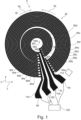
- FIG. 1 illustrates an electroacoustic device 5 according to the invention.
- the device comprises a substrate 10 and first 15 and second 20 groups of electrodes arranged on a face of the substrate.
- the substrate comprises a part 25 made of a piezoelectric material and a dielectric layer 30 made of silica which contacts and overlaps the part. It is shaped as a plate parallel to a plane defined by directions X and Y.
- the substrate has for instance a thickness e s equal to 120 ⁇ m, and presents an upper face 35 and a lower face 40. It is for instance made of LiBNO 3 Y-cut at 35°.
- the two groups of electrodes are provided on the upper face of the substrate. In a variant, they can be arranged on opposite faces of the substrate.
- the first group of electrodes and the substrate defines a first wave transducer 45 and the second group of electrodes and the substrate defines a second wave transducer 50.
- Each electrode 60, 65, 70, 75 of the first and second groups comprises several tracks 80 a-f , 85 a-f , 90 a-d , 95 a-d .
- Each track spirals around a same spiral axis Z which is normal to the plate.
- the tracks 90, 95 of the electrodes of the first group spiral around a same spiral axis Z along a first winding direction, as indicated by curved arrow Wi, and the tracks 80, 85 of the electrodes 60,65 of the second group spiralling around said spiral axis along a second winding direction, as indicated by curved arrow W 2 , which is opposite to the first winding direction Wi.
- the tracks 90, 95 of the electrodes of the first group spiral in an anti-clockwise direction whereas the tracks 80, 85 of the electrodes of the second group spiral in a clockwise direction.
- the spiral axis Z is perpendicular to the substrate upper face which supports the first and second groups of electrodes.
- the tracks 90,95 of the electrodes 70,75 of the first group are provided radially inner from the tracks 80, 85 of the electrodes 60, 65 of the second group.
- each track has a width w d , measured along a radial direction r d , which is less, for instance at least 10 times less, even at least 100 times less, than the length of the track, the length being measured along the first, respectively second winding direction.
- the first group consists in first 70 and second 75 electrodes, each comprising one contact brush 100, 105 and four tracks 90 a-d , 95 a-d
- the second group consists in two electrodes 60, 65, each comprising two contact brushes 110, 115 and six tracks 80 a-f , 85 a-f .
- Such a number of tracks is nevertheless not limitative and can be adapted depending on the desired shape of the wave front to generate.
- Each track of each electrode of the first and second group extends around the spiral axis with an angle greater than 300°, from the contact brush it is in contact with.
- the tracks of the first electrode and the tracks of the second electrode of the first group, respectively the second group, are arranged in an alternating manner, radially from the spiral axis.
- the tracks of the electrodes of the first group are at a distance of the contact brushes of the electrodes of the second group and vice-versa. Moreover, the tracks of the first electrode of the first group are at a distance from the tracks of the second electrode of the first group, and the tracks of the first electrode of the second group are at a distance from the tracks of the second electrode of the second group.
- each of the four contact brushes is connected to a power supply apparatus 120 which is aimed at providing to every electrode a specific electric signal, at it will be explained in more detail here below.
- the radial step ⁇ r between two consecutive tracks of each of the electrodes of the first and second group is constant, and the device is adapted to generate a SSAW.
- the radial step is defined by the radial distance between the radially inner edge of a coil or of a track and the radially inner edge of the consecutive coil of track.
- the device comprises a support 130 which is acoustically coupled to the substrate.
- the electrodes are arranged between the support and the substrate.
- the support is acoustically coupled to the piezoelectric part by means of a layer of a coupling medium 135, for instance optical adhesive NOA61 of Portland Product.
- the device further comprises a base 132 disposed on the upper face of the support.
- the base is a plate made of borosilicate glass of thickness e a of 150 ⁇ m. It can be moved in at least two directions transverse to the spiral axis.
- An interface liquid 133 of thickness less than 10 ⁇ m is provided between the base and the support, such as to acoustically couple the base with the support and such that the base can be displaced relatively to the support without damaging the support.
- a sound absorber 140 made for instance of PDMS is provided on the base, which defines a cavity 145 containing a fluid medium 150, preferably a liquid medium.
- An object 155 is embedded in the fluid medium.
- a SSAW is generated by the device and propagates at the surface of the substrate. It is transmitted in the bulk of support, but the swirling SAW degenerates at the interface between the substrate and the support in an acoustic vortex or in a degenerated acoustic vortex propagating in the bulk of the support and in the liquid medium, as illustrated by arrow Vx.
- the radiation pressure associated with the vortex concentrates in a volume represented by the dashed square 168, which is located perpendicularly to the substrate and substantially aligned with the spiral axis Z.
- the object 155 when located in the vicinity of said volume represented by the dashed square 168, also named "3D trap", if having a size comparable to the wavelength of the swirling SAW, is submitted to attraction forces which aims at entrapping said object in the 3D trap.
- the object By displacing the base relatively to the support, the object can be brought close to the spiral axis. It can then be manipulated and notably be entrapped along the spiral axis.
- the tracks of the electrodes can be disposed on a face of the substrate which is opposite to the face regarding the support.
- the swirling wave can be either a Lamb wave or a bulk wave.
- the device illustrated on figures 1 and 2 is electrically supplied by the power supply apparatus 120.
- Power supplying can be performed in the following ways.
- the power supply apparatus can deliver one of the electrodes of the first group, respectively of the second group, with a master electric signal and the other electrode of the first group, respectively of the second group, with a slave electric signal which is out of phase with the master electric signal.
- the amplitudes of the master electric signal and of the slave electric signal supplied to the first group of electrodes, respectively to the second group of electrodes are equal.
- the frequencies of the master electric signal and of the slave electric signal supplied to the first group of electrodes, respectively to the second group of electrodes are equal.
- the amplitude A of the master electric signal 160, respectively to the slave electric signal 165, supplied to the first group of electrodes is different from the amplitude A of the master electric signal 170, respectively to the slave electric signal 175, supplied to the second group of electrodes.
- the frequency of the master electric signal, respectively of the slave electric signal, supplied to the first group of electrodes is different from the frequency of the master electric signal, respectively of the slave electric signal, supplied to the second group of electrodes.
- the frequency of the master electric signal, respectively of the slave electric signal, supplied to the first group of electrodes and the frequency of the master electric signal, respectively of the slave electric signal, supplied to the second group of electrodes are both ranging between the resonance frequency of the first wave transducer 45 and the resonance frequency of the second wave transducer 50.
- the frequencies of the master and slave electric signals supplied to the first and second group of electrodes are equal.
- the amplitudes of the master and slave electric signals supplied to the first and second group of electrodes are equal.
- a man skilled in the art knows how to determine the resonance frequency of a wave transducer, either by computation or by appropriate measurement techniques.
- Having wave transducers presenting both different resonant frequencies can be achieved notably by the radial step between two consecutives tracks of one of the electrodes of the first group, or the radial step between two consecutive coils of the track of one of the electrodes of the first group, being different from the radial step between two consecutives tracks of one of the electrodes of the second group, or the radial step between two consecutive coils of the track of one of the electrodes of the second group.
- the master and slave signals supplied to the first, respectively second, group of electrodes can be provided as wave packet.
- the electrodes of the second group are off, no electric signal being supplied to them.
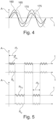
- the supply of the electric signal can be alternating between supplying the first group of electrodes with wave packets, the electrodes of the second group being off, then followed by supplying the second group with master Pm 2 and slave Ps 2 wave packets, and the electrodes of the first group being off, and so on.
- wave packets can be supplied to the second group of electrodes as soon as the supply of wave packets to the first group of electrodes to the first packet has ended, and vice versa, as illustrated on figure 5 .
- the duration ⁇ t 1 , respectively ⁇ t 2 between supplying two consecutive wave packets to the first, respectively second group of electrodes can be lower than the hydrodynamic reaction time of the object.
- the hydrodynamic reaction time can be easily determined by a skilled worker from the size of the object and the viscosity of the fluid medium which embeds the object.
- the sum ⁇ t 1 + ⁇ t 2 of the duration of the wave packet supplied to the first group of electrodes and of the duration of the wave packet supplied to the second group of electrodes is lower than the hydrodynamic reaction time of the object.
- the example illustrated on figure 1 is notably characterized by consecutive tracks of the electrodes of the first, respectively second, group being separated by a constant radial step.
- the tracks of the electrodes of the first, respectively second, group are arranged on the substrate such that the radial step ⁇ r 1 , respectively ⁇ r 2 between two successive tracks decreases radially from the spiral axis, along a radial direction r d .
- the radial decrease ⁇ 1 , ⁇ 2 of the radial step can be different between the two groups of electrodes.
- the tracks of the first and second groups of electrodes each draw a line along a polar coordinate R( ⁇ ), being obtained by solving the equation (i) described here above.
- the first and second groups each comprise two hot electrodes 60, 65, 70, 75 provided on the face of the device which faces the support.
- the hot electrodes of each group are supplied with out of phase electric signals.
- the device comprises a ground electrode 190, arranged on the lower face 40 of the substrate.
- the ground electrode is connected to a ground socket of the power supply apparatus. It overlaps both the first and second grounds electrodes.
- the first and second wave transducers When powering the hot electrodes (not represented for clarity reasons), the first and second wave transducers are deformed by volume ultrasonic waves propagating substantially along a direction parallel to the spiral axis, in the piezoelectric substrate.
- the wave transducers transmit the volume ultrasonic waves to the bulk of the support wherein they define a focalized ultrasonic vortex Fv which focal locus (wherein the acoustic intensity is the lowest) is located in the cavity 145.
- Fv focalized ultrasonic vortex
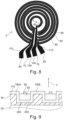
- the device illustrated on figure 8 differs from the device illustrated on figure 1 by the fact that the tracks of the electrodes of the first and second groups are interdigitated the one with another.
- a group of two tracks of different polarity of the second group of electrodes are arranged radially between two different groups of tracks of different polarity of the first group of electrodes and vice versa.
- the rings intensity of the two counter rotating vortices synthesized by the first and second group of electrodes can be more similar, which is desirable when equilibrating the master electrical signals to control the speed of rotation of the object.
- the arrangement on the substrate of the contact brushes 100, 105 and tracks 90, 95 of the electrodes of the first group prevents any continuous extension of the contact brushes 110, 115 of the electrodes of the second group along a substantially radial direction such as to connect the corresponding tracks.
- the contact brush 110 of one of the electrodes of the second group is provided on a face of the piezoelectric part 25.
- Two portions 190 a-b of the contact brush are provided on top of the dielectric layer 30 from either side of one track 95 of the electrode 75 of the first group.
- the two portions 190 a-b are connected with respective tracks 80 of the electrode 60 of the second group.
- the two portions 190 a-b are connected the one with the other by a buried portion 200 which follows a track defined by a tunnel 205 formed in the dielectric layer.
- the buried portion is provided at a distance from one track of the first electrode, by a portion of the dielectric layer.
- the manufacture of the buried portion of the dielectric layer can be performed by selective etching of the silica dielectric layer followed by deposition of an alloy or a metal such as to form the respective portions of the contact brush.
- Figure 10 shows another example of the device 5 according to the invention. It comprises first and second groups of electrodes.
- the first 15 group of electrodes is arranged radially inner to the second group 20 of electrodes.
- the first group of electrodes comprise two electrodes 90, 95 each consisting in a single track comprising five coils.
- the second group of electrodes comprises two electrodes 80, 85 each comprising a single track comprising seven coils.
- Each electrode of the second group of electrodes comprises a single track and a contact brush 110, 115, the track being connected to the contact brush by one its end 205, 210. Further, the track of each electrode of the second group is connected by its opposite end 215, 220 to the track of one of the electrodes of the first group.
- the track of one of the electrodes of the first group and the track of one of the electrodes of the second group are connected together to the contact brush of the electrode of the second group and the track of the other electrode of the first group and the track of the other electrode of the second group are connected together to the contact brush of the electrode of the first group.
- the width w d1 of the track of each electrode of the first group is different from the width w d2 of the track of the corresponding electrode of the second group to which the electrode of the first group is connected.
- the rotation of the object which is submitted to the acoustic wave generated by the device can be controlled, and notably prevented.
- Figure 12 aims at illustrating the resolution of equations (i) to (vii), in the case the vortex Fv propagates in the support from the hot track towards the focal locus 2 over a distance z (N) along axis Z.
- the vortex Fv comprises 3D lines along which the phase is constant, named equi-phase lines. For instance, along an equi-phase line 99, the phase of the vortex is the same at points 250a to 250c.
- the projection, along the line 260 that joins the focal locus 2 and points 250a to 250c, of equi-phase line is a plane line which is set by parameter R( ⁇ ) expressed from the center C on the surface where the tracks are provided.
- the device according to the invention improves the efficiency of manipulating an object embedded in a fluid medium, by controlling its rotation when the object is entrapped. It further improves the selectivity, when manipulating a specific object among a population of objects.
Landscapes
- Chemical & Material Sciences (AREA)
- Health & Medical Sciences (AREA)
- Mechanical Engineering (AREA)
- Engineering & Computer Science (AREA)
- Clinical Laboratory Science (AREA)
- Chemical Kinetics & Catalysis (AREA)
- Analytical Chemistry (AREA)
- General Health & Medical Sciences (AREA)
- Hematology (AREA)
- Physics & Mathematics (AREA)
- Dispersion Chemistry (AREA)
- Fluid Mechanics (AREA)
- Transducers For Ultrasonic Waves (AREA)
- Physical Or Chemical Processes And Apparatus (AREA)
- Piezo-Electric Transducers For Audible Bands (AREA)
- Apparatuses For Generation Of Mechanical Vibrations (AREA)
Applications Claiming Priority (2)
| Application Number | Priority Date | Filing Date | Title |
|---|---|---|---|
| EP19306682 | 2019-12-18 | ||
| PCT/EP2020/086031 WO2021122479A1 (en) | 2019-12-18 | 2020-12-14 | Electroacoustic device |
Publications (2)
| Publication Number | Publication Date |
|---|---|
| EP4076749A1 EP4076749A1 (en) | 2022-10-26 |
| EP4076749B1 true EP4076749B1 (en) | 2024-06-26 |
Family
ID=69185192
Family Applications (1)
| Application Number | Title | Priority Date | Filing Date |
|---|---|---|---|
| EP20829568.3A Active EP4076749B1 (en) | 2019-12-18 | 2020-12-14 | Electroacoustic device |
Country Status (6)
| Country | Link |
|---|---|
| US (1) | US12533671B2 (https=) |
| EP (1) | EP4076749B1 (https=) |
| JP (1) | JP7809256B2 (https=) |
| ES (1) | ES2988054T3 (https=) |
| TW (1) | TW202142317A (https=) |
| WO (1) | WO2021122479A1 (https=) |
Families Citing this family (3)
| Publication number | Priority date | Publication date | Assignee | Title |
|---|---|---|---|---|
| US12057823B2 (en) * | 2021-05-07 | 2024-08-06 | Murata Manufacturing Co., Ltd. | Transversely-excited film bulk acoustic resonator with concentric interdigitated transducer fingers |
| CN114543980B (zh) * | 2022-02-07 | 2023-01-13 | 北京理工大学 | 基于近场轨道角动量转换的声波相位调制及声场重构方法 |
| US20240113063A1 (en) * | 2022-09-30 | 2024-04-04 | Texas Instruments Incorporated | Radiator layers for ultrasonic transducers |
Family Cites Families (21)
| Publication number | Priority date | Publication date | Assignee | Title |
|---|---|---|---|---|
| US3609416A (en) | 1970-08-12 | 1971-09-28 | Univ Northwestern | Microacoustic surface-wave transducer |
| US4011747A (en) | 1975-06-20 | 1977-03-15 | The Board Of Trustees Of The Leland Stanford University | Method and apparatus for acoustic scanning using waves scattered by an acoustic grating |
| US4453242A (en) | 1982-07-13 | 1984-06-05 | Rca Corporation | Surface acoustic wave cutterhead for disc recording having a circular transducer |
| US4697195A (en) | 1985-09-16 | 1987-09-29 | Xerox Corporation | Nozzleless liquid droplet ejectors |
| US5400788A (en) | 1989-05-16 | 1995-03-28 | Hewlett-Packard | Apparatus that generates acoustic signals at discrete multiple frequencies and that couples acoustic signals into a cladded-core acoustic waveguide |
| CN1921301B (zh) * | 2005-08-26 | 2010-09-29 | 鸿富锦精密工业(深圳)有限公司 | 表面声波元件 |
| JP2009055073A (ja) * | 2005-12-12 | 2009-03-12 | Sanyo Electric Co Ltd | 高周波回路素子 |
| US8018010B2 (en) | 2007-04-20 | 2011-09-13 | The George Washington University | Circular surface acoustic wave (SAW) devices, processes for making them, and methods of use |
| US7878063B1 (en) | 2007-07-24 | 2011-02-01 | University Of South Florida | Simultaneous sample manipulation and sensing using surface acoustic waves |
| ES2448426T3 (es) | 2007-10-12 | 2014-03-13 | Pronota Nv | Uso de aptámeros en proteómica |
| US20100140185A1 (en) | 2008-12-05 | 2010-06-10 | John Hill | Wastewater treatment |
| JP4760931B2 (ja) | 2009-03-02 | 2011-08-31 | 株式会社デンソー | 弾性表面波素子 |
| GB0914762D0 (en) | 2009-08-24 | 2009-09-30 | Univ Glasgow | Fluidics apparatus and fluidics substrate |
| WO2011033277A2 (en) | 2009-09-21 | 2011-03-24 | University Of Dundee | Apparatus and method for the manipulation of objects using ultrasound |
| JP2015512766A (ja) | 2012-01-31 | 2015-04-30 | ザ・ペン・ステート・リサーチ・ファンデーション | 可変定常的表面弾性波を用いたマイクロ流体操作及び粒子の分類 |
| JP6025982B2 (ja) | 2012-08-01 | 2016-11-16 | ザ・ペン・ステート・リサーチ・ファンデーション | 粒子および細胞の高効率分離およびマニピュレーション |
| WO2015134831A1 (en) | 2014-03-07 | 2015-09-11 | The Penn State Research Foundation | Acoustic control apparatus, process, and fabrication thereof |
| ES2841528T3 (es) | 2016-03-15 | 2021-07-08 | Centre Nat Rech Scient | Pinzas acústicas |
| EP3463660A1 (en) | 2016-05-24 | 2019-04-10 | Centre National De La Recherche Scientifique | Acoustic tweezers |
| CA3079358A1 (en) | 2017-10-25 | 2019-05-02 | Universite De Lille | Acoustic tweezers |
| SG10202010409TA (en) * | 2019-11-06 | 2021-06-29 | Univ Singapore Technology & Design | Microfluidic device and method of manipulating particles in a fluid sample based on an acoustic travelling wave using microfluidic device |
-
2020
- 2020-12-14 US US17/787,205 patent/US12533671B2/en active Active
- 2020-12-14 EP EP20829568.3A patent/EP4076749B1/en active Active
- 2020-12-14 JP JP2022537365A patent/JP7809256B2/ja active Active
- 2020-12-14 ES ES20829568T patent/ES2988054T3/es active Active
- 2020-12-14 WO PCT/EP2020/086031 patent/WO2021122479A1/en not_active Ceased
- 2020-12-18 TW TW109144869A patent/TW202142317A/zh unknown
Also Published As
| Publication number | Publication date |
|---|---|
| EP4076749A1 (en) | 2022-10-26 |
| US12533671B2 (en) | 2026-01-27 |
| ES2988054T3 (es) | 2024-11-19 |
| US20230021489A1 (en) | 2023-01-26 |
| JP2023511246A (ja) | 2023-03-17 |
| JP7809256B2 (ja) | 2026-02-02 |
| WO2021122479A1 (en) | 2021-06-24 |
| TW202142317A (zh) | 2021-11-16 |
Similar Documents
| Publication | Publication Date | Title |
|---|---|---|
| EP3700669B1 (en) | Acoustic tweezers | |
| US12179192B2 (en) | Acoustic tweezers | |
| EP4076749B1 (en) | Electroacoustic device | |
| US20200316586A1 (en) | Acoustic tweezers | |
| JP4964387B2 (ja) | 少量の物質を操作する装置及び方法 | |
| JP4559705B2 (ja) | 微量液体を混合するための混合方法、混合装置 | |
| WO2011138722A1 (en) | Resonantly amplified shear waves | |
| Li et al. | Phononic-crystal-enabled dynamic manipulation of microparticles and cells in an acoustofluidic channel | |
| JP2006519685A (ja) | ミクロキャビティでの少量液体の混合方法と装置 | |
| Aghakhani et al. | Flexural wave-based soft attractor walls for trapping microparticles and cells | |
| Açıkgöz et al. | Assessment of silicon, glass, FR4, PDMS and PMMA as a chip material for acoustic particle/cell manipulation in microfluidics | |
| WO2024227349A1 (zh) | 一种非接触式旋转装置及一种调制件制备方法 | |
| JP4469974B2 (ja) | 微量液体分取装置及び微量液体分取方法 | |
| Sayed Ahmed | Ultrasound Wave Patterning for Spatiotemporal Control of Acoustic Power Transfer: Pathways from Transmission to Reception | |
| Vuille-dit-Bille et al. | On-chip particle levitation and micromanipulation using bulk acoustic waves | |
| JPH01101482A (ja) | 液中超音波トランスデューサ |
Legal Events
| Date | Code | Title | Description |
|---|---|---|---|
| STAA | Information on the status of an ep patent application or granted ep patent |
Free format text: STATUS: UNKNOWN |
|
| STAA | Information on the status of an ep patent application or granted ep patent |
Free format text: STATUS: THE INTERNATIONAL PUBLICATION HAS BEEN MADE |
|
| PUAI | Public reference made under article 153(3) epc to a published international application that has entered the european phase |
Free format text: ORIGINAL CODE: 0009012 |
|
| STAA | Information on the status of an ep patent application or granted ep patent |
Free format text: STATUS: REQUEST FOR EXAMINATION WAS MADE |
|
| 17P | Request for examination filed |
Effective date: 20220617 |
|
| AK | Designated contracting states |
Kind code of ref document: A1 Designated state(s): AL AT BE BG CH CY CZ DE DK EE ES FI FR GB GR HR HU IE IS IT LI LT LU LV MC MK MT NL NO PL PT RO RS SE SI SK SM TR |
|
| DAV | Request for validation of the european patent (deleted) | ||
| DAX | Request for extension of the european patent (deleted) | ||
| STAA | Information on the status of an ep patent application or granted ep patent |
Free format text: STATUS: EXAMINATION IS IN PROGRESS |
|
| 17Q | First examination report despatched |
Effective date: 20230426 |
|
| GRAP | Despatch of communication of intention to grant a patent |
Free format text: ORIGINAL CODE: EPIDOSNIGR1 |
|
| STAA | Information on the status of an ep patent application or granted ep patent |
Free format text: STATUS: GRANT OF PATENT IS INTENDED |
|
| INTG | Intention to grant announced |
Effective date: 20240416 |
|
| GRAS | Grant fee paid |
Free format text: ORIGINAL CODE: EPIDOSNIGR3 |
|
| GRAA | (expected) grant |
Free format text: ORIGINAL CODE: 0009210 |
|
| STAA | Information on the status of an ep patent application or granted ep patent |
Free format text: STATUS: THE PATENT HAS BEEN GRANTED |
|
| AK | Designated contracting states |
Kind code of ref document: B1 Designated state(s): AL AT BE BG CH CY CZ DE DK EE ES FI FR GB GR HR HU IE IS IT LI LT LU LV MC MK MT NL NO PL PT RO RS SE SI SK SM TR |
|
| REG | Reference to a national code |
Ref country code: GB Ref legal event code: FG4D |
|
| REG | Reference to a national code |
Ref country code: CH Ref legal event code: EP |
|
| REG | Reference to a national code |
Ref country code: DE Ref legal event code: R096 Ref document number: 602020033107 Country of ref document: DE |
|
| P01 | Opt-out of the competence of the unified patent court (upc) registered |
Free format text: CASE NUMBER: APP_43885/2024 Effective date: 20240726 |
|
| PG25 | Lapsed in a contracting state [announced via postgrant information from national office to epo] |
Ref country code: BG Free format text: LAPSE BECAUSE OF FAILURE TO SUBMIT A TRANSLATION OF THE DESCRIPTION OR TO PAY THE FEE WITHIN THE PRESCRIBED TIME-LIMIT Effective date: 20240626 |
|
| PG25 | Lapsed in a contracting state [announced via postgrant information from national office to epo] |
Ref country code: HR Free format text: LAPSE BECAUSE OF FAILURE TO SUBMIT A TRANSLATION OF THE DESCRIPTION OR TO PAY THE FEE WITHIN THE PRESCRIBED TIME-LIMIT Effective date: 20240626 Ref country code: FI Free format text: LAPSE BECAUSE OF FAILURE TO SUBMIT A TRANSLATION OF THE DESCRIPTION OR TO PAY THE FEE WITHIN THE PRESCRIBED TIME-LIMIT Effective date: 20240626 |
|
| REG | Reference to a national code |
Ref country code: LT Ref legal event code: MG9D |
|
| PG25 | Lapsed in a contracting state [announced via postgrant information from national office to epo] |
Ref country code: GR Free format text: LAPSE BECAUSE OF FAILURE TO SUBMIT A TRANSLATION OF THE DESCRIPTION OR TO PAY THE FEE WITHIN THE PRESCRIBED TIME-LIMIT Effective date: 20240927 |
|
| PG25 | Lapsed in a contracting state [announced via postgrant information from national office to epo] |
Ref country code: LV Free format text: LAPSE BECAUSE OF FAILURE TO SUBMIT A TRANSLATION OF THE DESCRIPTION OR TO PAY THE FEE WITHIN THE PRESCRIBED TIME-LIMIT Effective date: 20240626 |
|
| REG | Reference to a national code |
Ref country code: NL Ref legal event code: MP Effective date: 20240626 |
|
| PG25 | Lapsed in a contracting state [announced via postgrant information from national office to epo] |
Ref country code: NO Free format text: LAPSE BECAUSE OF FAILURE TO SUBMIT A TRANSLATION OF THE DESCRIPTION OR TO PAY THE FEE WITHIN THE PRESCRIBED TIME-LIMIT Effective date: 20240926 Ref country code: LV Free format text: LAPSE BECAUSE OF FAILURE TO SUBMIT A TRANSLATION OF THE DESCRIPTION OR TO PAY THE FEE WITHIN THE PRESCRIBED TIME-LIMIT Effective date: 20240626 Ref country code: HR Free format text: LAPSE BECAUSE OF FAILURE TO SUBMIT A TRANSLATION OF THE DESCRIPTION OR TO PAY THE FEE WITHIN THE PRESCRIBED TIME-LIMIT Effective date: 20240626 Ref country code: GR Free format text: LAPSE BECAUSE OF FAILURE TO SUBMIT A TRANSLATION OF THE DESCRIPTION OR TO PAY THE FEE WITHIN THE PRESCRIBED TIME-LIMIT Effective date: 20240927 Ref country code: FI Free format text: LAPSE BECAUSE OF FAILURE TO SUBMIT A TRANSLATION OF THE DESCRIPTION OR TO PAY THE FEE WITHIN THE PRESCRIBED TIME-LIMIT Effective date: 20240626 Ref country code: BG Free format text: LAPSE BECAUSE OF FAILURE TO SUBMIT A TRANSLATION OF THE DESCRIPTION OR TO PAY THE FEE WITHIN THE PRESCRIBED TIME-LIMIT Effective date: 20240626 Ref country code: RS Free format text: LAPSE BECAUSE OF FAILURE TO SUBMIT A TRANSLATION OF THE DESCRIPTION OR TO PAY THE FEE WITHIN THE PRESCRIBED TIME-LIMIT Effective date: 20240926 |
|
| PG25 | Lapsed in a contracting state [announced via postgrant information from national office to epo] |
Ref country code: NL Free format text: LAPSE BECAUSE OF FAILURE TO SUBMIT A TRANSLATION OF THE DESCRIPTION OR TO PAY THE FEE WITHIN THE PRESCRIBED TIME-LIMIT Effective date: 20240626 |
|
| REG | Reference to a national code |
Ref country code: AT Ref legal event code: MK05 Ref document number: 1697266 Country of ref document: AT Kind code of ref document: T Effective date: 20240626 |
|
| REG | Reference to a national code |
Ref country code: ES Ref legal event code: FG2A Ref document number: 2988054 Country of ref document: ES Kind code of ref document: T3 Effective date: 20241119 |
|
| PG25 | Lapsed in a contracting state [announced via postgrant information from national office to epo] |
Ref country code: NL Free format text: LAPSE BECAUSE OF FAILURE TO SUBMIT A TRANSLATION OF THE DESCRIPTION OR TO PAY THE FEE WITHIN THE PRESCRIBED TIME-LIMIT Effective date: 20240626 |
|
| PG25 | Lapsed in a contracting state [announced via postgrant information from national office to epo] |
Ref country code: PT Free format text: LAPSE BECAUSE OF FAILURE TO SUBMIT A TRANSLATION OF THE DESCRIPTION OR TO PAY THE FEE WITHIN THE PRESCRIBED TIME-LIMIT Effective date: 20241028 |
|
| PG25 | Lapsed in a contracting state [announced via postgrant information from national office to epo] |
Ref country code: PT Free format text: LAPSE BECAUSE OF FAILURE TO SUBMIT A TRANSLATION OF THE DESCRIPTION OR TO PAY THE FEE WITHIN THE PRESCRIBED TIME-LIMIT Effective date: 20241028 |
|
| PG25 | Lapsed in a contracting state [announced via postgrant information from national office to epo] |
Ref country code: PL Free format text: LAPSE BECAUSE OF FAILURE TO SUBMIT A TRANSLATION OF THE DESCRIPTION OR TO PAY THE FEE WITHIN THE PRESCRIBED TIME-LIMIT Effective date: 20240626 |
|
| PG25 | Lapsed in a contracting state [announced via postgrant information from national office to epo] |
Ref country code: EE Free format text: LAPSE BECAUSE OF FAILURE TO SUBMIT A TRANSLATION OF THE DESCRIPTION OR TO PAY THE FEE WITHIN THE PRESCRIBED TIME-LIMIT Effective date: 20240626 |
|
| PG25 | Lapsed in a contracting state [announced via postgrant information from national office to epo] |
Ref country code: AT Free format text: LAPSE BECAUSE OF FAILURE TO SUBMIT A TRANSLATION OF THE DESCRIPTION OR TO PAY THE FEE WITHIN THE PRESCRIBED TIME-LIMIT Effective date: 20240626 Ref country code: IS Free format text: LAPSE BECAUSE OF FAILURE TO SUBMIT A TRANSLATION OF THE DESCRIPTION OR TO PAY THE FEE WITHIN THE PRESCRIBED TIME-LIMIT Effective date: 20241026 |
|
| PG25 | Lapsed in a contracting state [announced via postgrant information from national office to epo] |
Ref country code: CZ Free format text: LAPSE BECAUSE OF FAILURE TO SUBMIT A TRANSLATION OF THE DESCRIPTION OR TO PAY THE FEE WITHIN THE PRESCRIBED TIME-LIMIT Effective date: 20240626 |
|
| PG25 | Lapsed in a contracting state [announced via postgrant information from national office to epo] |
Ref country code: RO Free format text: LAPSE BECAUSE OF FAILURE TO SUBMIT A TRANSLATION OF THE DESCRIPTION OR TO PAY THE FEE WITHIN THE PRESCRIBED TIME-LIMIT Effective date: 20240626 Ref country code: SK Free format text: LAPSE BECAUSE OF FAILURE TO SUBMIT A TRANSLATION OF THE DESCRIPTION OR TO PAY THE FEE WITHIN THE PRESCRIBED TIME-LIMIT Effective date: 20240626 |
|
| PG25 | Lapsed in a contracting state [announced via postgrant information from national office to epo] |
Ref country code: SM Free format text: LAPSE BECAUSE OF FAILURE TO SUBMIT A TRANSLATION OF THE DESCRIPTION OR TO PAY THE FEE WITHIN THE PRESCRIBED TIME-LIMIT Effective date: 20240626 |
|
| PG25 | Lapsed in a contracting state [announced via postgrant information from national office to epo] |
Ref country code: SM Free format text: LAPSE BECAUSE OF FAILURE TO SUBMIT A TRANSLATION OF THE DESCRIPTION OR TO PAY THE FEE WITHIN THE PRESCRIBED TIME-LIMIT Effective date: 20240626 Ref country code: SK Free format text: LAPSE BECAUSE OF FAILURE TO SUBMIT A TRANSLATION OF THE DESCRIPTION OR TO PAY THE FEE WITHIN THE PRESCRIBED TIME-LIMIT Effective date: 20240626 Ref country code: RO Free format text: LAPSE BECAUSE OF FAILURE TO SUBMIT A TRANSLATION OF THE DESCRIPTION OR TO PAY THE FEE WITHIN THE PRESCRIBED TIME-LIMIT Effective date: 20240626 Ref country code: PL Free format text: LAPSE BECAUSE OF FAILURE TO SUBMIT A TRANSLATION OF THE DESCRIPTION OR TO PAY THE FEE WITHIN THE PRESCRIBED TIME-LIMIT Effective date: 20240626 Ref country code: IS Free format text: LAPSE BECAUSE OF FAILURE TO SUBMIT A TRANSLATION OF THE DESCRIPTION OR TO PAY THE FEE WITHIN THE PRESCRIBED TIME-LIMIT Effective date: 20241026 Ref country code: EE Free format text: LAPSE BECAUSE OF FAILURE TO SUBMIT A TRANSLATION OF THE DESCRIPTION OR TO PAY THE FEE WITHIN THE PRESCRIBED TIME-LIMIT Effective date: 20240626 Ref country code: CZ Free format text: LAPSE BECAUSE OF FAILURE TO SUBMIT A TRANSLATION OF THE DESCRIPTION OR TO PAY THE FEE WITHIN THE PRESCRIBED TIME-LIMIT Effective date: 20240626 Ref country code: AT Free format text: LAPSE BECAUSE OF FAILURE TO SUBMIT A TRANSLATION OF THE DESCRIPTION OR TO PAY THE FEE WITHIN THE PRESCRIBED TIME-LIMIT Effective date: 20240626 |
|
| REG | Reference to a national code |
Ref country code: DE Ref legal event code: R097 Ref document number: 602020033107 Country of ref document: DE |
|
| PG25 | Lapsed in a contracting state [announced via postgrant information from national office to epo] |
Ref country code: DK Free format text: LAPSE BECAUSE OF FAILURE TO SUBMIT A TRANSLATION OF THE DESCRIPTION OR TO PAY THE FEE WITHIN THE PRESCRIBED TIME-LIMIT Effective date: 20240626 |
|
| PLBE | No opposition filed within time limit |
Free format text: ORIGINAL CODE: 0009261 |
|
| STAA | Information on the status of an ep patent application or granted ep patent |
Free format text: STATUS: NO OPPOSITION FILED WITHIN TIME LIMIT |
|
| 26N | No opposition filed |
Effective date: 20250327 |
|
| PG25 | Lapsed in a contracting state [announced via postgrant information from national office to epo] |
Ref country code: MC Free format text: LAPSE BECAUSE OF FAILURE TO SUBMIT A TRANSLATION OF THE DESCRIPTION OR TO PAY THE FEE WITHIN THE PRESCRIBED TIME-LIMIT Effective date: 20240626 |
|
| REG | Reference to a national code |
Ref country code: CH Ref legal event code: PL |
|
| PG25 | Lapsed in a contracting state [announced via postgrant information from national office to epo] |
Ref country code: LU Free format text: LAPSE BECAUSE OF NON-PAYMENT OF DUE FEES Effective date: 20241214 |
|
| PG25 | Lapsed in a contracting state [announced via postgrant information from national office to epo] |
Ref country code: SE Free format text: LAPSE BECAUSE OF FAILURE TO SUBMIT A TRANSLATION OF THE DESCRIPTION OR TO PAY THE FEE WITHIN THE PRESCRIBED TIME-LIMIT Effective date: 20240626 |
|
| REG | Reference to a national code |
Ref country code: BE Ref legal event code: MM Effective date: 20241231 |
|
| PG25 | Lapsed in a contracting state [announced via postgrant information from national office to epo] |
Ref country code: BE Free format text: LAPSE BECAUSE OF NON-PAYMENT OF DUE FEES Effective date: 20241231 |
|
| PG25 | Lapsed in a contracting state [announced via postgrant information from national office to epo] |
Ref country code: CH Free format text: LAPSE BECAUSE OF NON-PAYMENT OF DUE FEES Effective date: 20241231 |
|
| PG25 | Lapsed in a contracting state [announced via postgrant information from national office to epo] |
Ref country code: IE Free format text: LAPSE BECAUSE OF NON-PAYMENT OF DUE FEES Effective date: 20241214 |
|
| PGFP | Annual fee paid to national office [announced via postgrant information from national office to epo] |
Ref country code: GB Payment date: 20251229 Year of fee payment: 6 |
|
| PGFP | Annual fee paid to national office [announced via postgrant information from national office to epo] |
Ref country code: FR Payment date: 20251230 Year of fee payment: 6 |
|
| PGFP | Annual fee paid to national office [announced via postgrant information from national office to epo] |
Ref country code: ES Payment date: 20260203 Year of fee payment: 6 |
|
| PGFP | Annual fee paid to national office [announced via postgrant information from national office to epo] |
Ref country code: DE Payment date: 20260127 Year of fee payment: 6 |
|
| PGFP | Annual fee paid to national office [announced via postgrant information from national office to epo] |
Ref country code: IT Payment date: 20251224 Year of fee payment: 6 |