EP4076290B1 - Kollektor und prozessor für knochenfragmente - Google Patents
Kollektor und prozessor für knochenfragmente Download PDFInfo
- Publication number
- EP4076290B1 EP4076290B1 EP20828331.7A EP20828331A EP4076290B1 EP 4076290 B1 EP4076290 B1 EP 4076290B1 EP 20828331 A EP20828331 A EP 20828331A EP 4076290 B1 EP4076290 B1 EP 4076290B1
- Authority
- EP
- European Patent Office
- Prior art keywords
- filter element
- piston
- sidewall
- composition
- plunger
- Prior art date
- Legal status (The legal status is an assumption and is not a legal conclusion. Google has not performed a legal analysis and makes no representation as to the accuracy of the status listed.)
- Active
Links
Images













Classifications
-
- A—HUMAN NECESSITIES
- A61—MEDICAL OR VETERINARY SCIENCE; HYGIENE
- A61F—FILTERS IMPLANTABLE INTO BLOOD VESSELS; PROSTHESES; DEVICES PROVIDING PATENCY TO, OR PREVENTING COLLAPSING OF, TUBULAR STRUCTURES OF THE BODY, e.g. STENTS; ORTHOPAEDIC, NURSING OR CONTRACEPTIVE DEVICES; FOMENTATION; TREATMENT OR PROTECTION OF EYES OR EARS; BANDAGES, DRESSINGS OR ABSORBENT PADS; FIRST-AID KITS
- A61F2/00—Filters implantable into blood vessels; Prostheses, i.e. artificial substitutes or replacements for parts of the body; Appliances for connecting them with the body; Devices providing patency to, or preventing collapsing of, tubular structures of the body, e.g. stents
- A61F2/02—Prostheses implantable into the body
- A61F2/30—Joints
- A61F2/46—Special tools for implanting artificial joints
- A61F2/4644—Preparation of bone graft, bone plugs or bone dowels, e.g. grinding or milling bone material
-
- A—HUMAN NECESSITIES
- A61—MEDICAL OR VETERINARY SCIENCE; HYGIENE
- A61M—DEVICES FOR INTRODUCING MEDIA INTO, OR ONTO, THE BODY; DEVICES FOR TRANSDUCING BODY MEDIA OR FOR TAKING MEDIA FROM THE BODY; DEVICES FOR PRODUCING OR ENDING SLEEP OR STUPOR
- A61M1/00—Suction or pumping devices for medical purposes; Devices for carrying-off, for treatment of, or for carrying-over, body-liquids; Drainage systems
- A61M1/60—Containers for suction drainage, adapted to be used with an external suction source
- A61M1/63—Containers for suction drainage, adapted to be used with an external suction source with means for emptying the suction container, e.g. by interrupting suction
-
- A—HUMAN NECESSITIES
- A61—MEDICAL OR VETERINARY SCIENCE; HYGIENE
- A61M—DEVICES FOR INTRODUCING MEDIA INTO, OR ONTO, THE BODY; DEVICES FOR TRANSDUCING BODY MEDIA OR FOR TAKING MEDIA FROM THE BODY; DEVICES FOR PRODUCING OR ENDING SLEEP OR STUPOR
- A61M1/00—Suction or pumping devices for medical purposes; Devices for carrying-off, for treatment of, or for carrying-over, body-liquids; Drainage systems
- A61M1/71—Suction drainage systems
- A61M1/79—Filters for solid matter
-
- A—HUMAN NECESSITIES
- A61—MEDICAL OR VETERINARY SCIENCE; HYGIENE
- A61B—DIAGNOSIS; SURGERY; IDENTIFICATION
- A61B17/00—Surgical instruments, devices or methods
- A61B17/16—Instruments for performing osteoclasis; Drills or chisels for bones; Trepans
- A61B17/1635—Instruments for performing osteoclasis; Drills or chisels for bones; Trepans for grafts, harvesting or transplants
-
- A—HUMAN NECESSITIES
- A61—MEDICAL OR VETERINARY SCIENCE; HYGIENE
- A61F—FILTERS IMPLANTABLE INTO BLOOD VESSELS; PROSTHESES; DEVICES PROVIDING PATENCY TO, OR PREVENTING COLLAPSING OF, TUBULAR STRUCTURES OF THE BODY, e.g. STENTS; ORTHOPAEDIC, NURSING OR CONTRACEPTIVE DEVICES; FOMENTATION; TREATMENT OR PROTECTION OF EYES OR EARS; BANDAGES, DRESSINGS OR ABSORBENT PADS; FIRST-AID KITS
- A61F2/00—Filters implantable into blood vessels; Prostheses, i.e. artificial substitutes or replacements for parts of the body; Appliances for connecting them with the body; Devices providing patency to, or preventing collapsing of, tubular structures of the body, e.g. stents
- A61F2/02—Prostheses implantable into the body
- A61F2/30—Joints
- A61F2/46—Special tools for implanting artificial joints
- A61F2/4644—Preparation of bone graft, bone plugs or bone dowels, e.g. grinding or milling bone material
- A61F2002/4649—Bone graft or bone dowel harvest sites
-
- A—HUMAN NECESSITIES
- A61—MEDICAL OR VETERINARY SCIENCE; HYGIENE
- A61F—FILTERS IMPLANTABLE INTO BLOOD VESSELS; PROSTHESES; DEVICES PROVIDING PATENCY TO, OR PREVENTING COLLAPSING OF, TUBULAR STRUCTURES OF THE BODY, e.g. STENTS; ORTHOPAEDIC, NURSING OR CONTRACEPTIVE DEVICES; FOMENTATION; TREATMENT OR PROTECTION OF EYES OR EARS; BANDAGES, DRESSINGS OR ABSORBENT PADS; FIRST-AID KITS
- A61F2/00—Filters implantable into blood vessels; Prostheses, i.e. artificial substitutes or replacements for parts of the body; Appliances for connecting them with the body; Devices providing patency to, or preventing collapsing of, tubular structures of the body, e.g. stents
- A61F2/02—Prostheses implantable into the body
- A61F2/30—Joints
- A61F2/46—Special tools for implanting artificial joints
- A61F2002/4685—Special tools for implanting artificial joints by means of vacuum
-
- A—HUMAN NECESSITIES
- A61—MEDICAL OR VETERINARY SCIENCE; HYGIENE
- A61M—DEVICES FOR INTRODUCING MEDIA INTO, OR ONTO, THE BODY; DEVICES FOR TRANSDUCING BODY MEDIA OR FOR TAKING MEDIA FROM THE BODY; DEVICES FOR PRODUCING OR ENDING SLEEP OR STUPOR
- A61M2210/00—Anatomical parts of the body
- A61M2210/02—Bones
Definitions
- bone graft Conventional medical and surgical procedures routinely involve the use of systems and tools which allow surgeons to remove bone. Such systems often generate bone fragments (in many instances with a drill). Once removed, the bone fragments, collectively referred to as bone graft, can be used for reimplantation. In fact, the bone graft is particularly useful in various surgical procedures because it can be used to bridge gaps between bone segments and act as a scaffold for bone growth and subsequent bone fusion.
- bone fragments are, as a matter of course, necessarily generated, harvested, and used as bone graft all in the same procedure.
- spinal procedures e.g. spinal fusion
- joint reconstruction and revision procedures require the drilling and removal of various bone, and the subsequent use of bone graft.
- the bone fragments may be intentionally harvested, sometimes from bones in another area of the body, for use in the procedure that requires bone graft.
- bone graft comprising bone from another patient, a cadaver, or even synthetic bone material can be used.
- Bone graft comprising natural bone, especially bone harvested from a patient for use on the same patient (typically referred to as auto-graft or autologous bone) is preferred by surgeons because of its osteoconductive, osteoinductive, and osteogenic properties and seen as the gold standard for bone fusion surgeries.
- a selective filtering collection and delivery system for collecting and delivering autogenous bone to and from a surgical site is known from US 2003/130594 A1 .
- the selective filtering collection device includes a suction nozzle, suction nozzle assembly and a vacuum source. Disposed in parallel between the suction nozzle assembly and the vacuum source are a removable filter cartridge and a filter bypass tube. A switch on the suction nozzle assembly may be actuated to provide suction to the suction nozzle through either the bypass tube or through the filter cartridge.
- suction is applied through the filter cartridge, autogenous bone is collected on a filter medium within the cartridge. Additionally, the cartridge may be removed and directly placed into a delivery device.
- the delivery device includes a ratchet system that actuates a plunger base to accurately extrude the bone material from the filter cartridge into the desired surgical location.
- the bone-harvesting device may include a cannula and a bone receptacle in communication with the cannula, wherein the cannula includes a cutting surface positioned at or adjacent the distal end, the cutting surface is oriented at an angle, the angle being greater than 90 degrees relative to the longitudinal axis of the cannula, and the harvested bone is adapted to move from a position adjacent to the cutting surface through the cannula into the bone receptacle.
- the cutting surface of the cannula may be positioned at or adjacent the distal end, and positioned at least in part radially outward of the outer face of the cannula.
- the cannula may include a cutting surface positioned at or adjacent the distal end and an occluding geometry that partially occludes the distal end of the cannula adjacent the cutting surface.
- a suction port may be provided in communication with the bone receptacle.
- a device for collecting and processing bone fragments is defined in claim 1.
- Optional features are defined in the dependent claims.
- the device 10 may also be referred to as a "bone dust collector,” a “bone fragment collector”, or "a bone collecting device.”
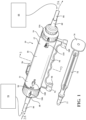
- the device 10 of the subject disclosure is configured to collect and process bone fragments in connection with various types of medical and/or surgical procedures. More specifically, the device 10 is configured to process and collect a composition 38 comprising bone fragments and other components (“the composition") from a patient.
- the composition is shown throughout the Figures as 38.
- the composition 38 is intended to be broadly construed to encompass all bone components regardless of their form, e.g. bone, tissues such as stem and progenitor cells, etc.
- the terms “bone fragments”, “bone dust”, and “the composition”, can be used interchangeably and share the broad construction set forth for the composition 38.
- the composition 38 is typically used to form bone graft.
- the composition 38 will include bone fragments, an irrigation solution, such as saline or water, blood, and one or more soft tissue fragments.
- the subject disclosure further provides a system, for use in collecting and processing bone fragments.
- the system includes a surgical tool 54 configured to harvest the composition 38 and shaped to couple with an intake tube 84.
- the surgical tool 54 is also configured to generate, e.g. grind, cut, shave, or abrade, bone to yield bone fragments.
- the system includes the surgical tool 54 which is configured to both generate bone fragments and harvest, i.e., aspirate, the composition 38.
- the system may also include the intake tube 84 through which the composition 38 is conveyed from the surgical tool 54 to the device 10 for collecting and processing bone fragments.
- the composition 38 is aspirated from the patient using the surgical tool 54, which causes the aspirated composition 38 to be collected in the device 10.
- the vacuum source 64 is in communication with the surgical tool 54 through the device 10 and one or more tubes.
- the device 10 includes an inlet cap 48, a housing 12 having a filter element 22 disposed therein, and an outlet cap 60.
- the outlet cap 60 is proximally coupled to the device 10, and a vacuum source 64 is coupled to the outlet cap 60 via an outlet tube 86.
- the outlet cap 60 is in fluid communication with the housing 12 and thus carries a vacuum airflow which aspirates the composition 38 from the patient and causes the subsequent collection of the composition 38 in the device 10.
- the inlet cap 48 is distally coupled to the device 10, and a surgical tool 54, e.g. a cutting device, is connected to the inlet cap 48 via an intake tube 84.
- the surgical tool 54 generates and subsequently aspirates the composition 38.
- the system may include a dedicated handheld aspirator in conjunction with a surgical tool 54, e.g. a cutting tool.
- the surgical tool 54 illustrated in Figure 1 is the aspirator, which will aspirate the composition from the surgical site, and the cutting tool (not separately shown) is used to separately generate the composition 38 from the patient.
- the inlet cap 48 is in fluid communication with the device 10 and receives the composition 38, which is subsequently deposited/injected into, and collected in a collection chamber 36 which is partially defined by the filter element 22.
- the inlet and outlet caps 48, 60 can be removed from the housing 12 and/or filter element 22 and the composition 38 can be harvested for use as bone graft.
- a plunger 78 can then be coupled to the piston 42 and force can be applied to the piston 42 via the plunger 78 to move the piston 42 from a first position 45 to a second position 46 and discharge the composition 38 collected in the collection chamber 36, i.e., the composition 38 can be harvested.
- the inlet cap 48 and the outlet cap 60 are configured to be coupled to one another and can thus be coupled together to restore vacuum airflow to the surgical tool 54.
- the collection chamber has a total volume of from about 5 to about 30, alternatively about 8 to about 25, alternatively from about 10 to about 20, cm 3 .
- Such collection chamber volumes allow for collection of an appropriate amount of composition 38, and also facilitate user friendly operation (handling) and harvesting (harvesting with minimal force) of the device 10.
- all values and ranges of values including and between those described above are hereby expressly contemplated for use herein.
- the device of this example includes the housing 12 and the filter element 22 at least partially disposed therein.
- the housing 12 includes a distal end 14, a proximal end 16, and an outer wall 18 having an outer surface 19 and an inner surface 20 extending between the distal and proximal ends 14, 16.
- the distal end 14 is generally closer to the patient, and the proximal end 16 is generally further from the patient, and proximal to the vacuum source 64.
- the housing 12 is cylindrical in shape and defines a volume.
- the housing 12 (and the filter element 22 for that matter) need not be cylindrical - and can thus have a cross-sectional profile other than circular, e.g. can have ovular, elliptical, or polygonal cross-sectional profile.
- the housing 12 is typically open-ended, unless the inlet and outlet caps 48, 60 are coupled to the respective distal and proximal ends 14, 16.
- the filter element 22 is partially disposed within the volume. In other words, at least a portion of the filter element 22 is positioned within the lumen of the housing 12.
- the filter element 22 includes a first end 24, a second end 26, and a sidewall 28 joining the first and second ends 24, 26.
- the first end 24 is positioned closer to the distal end 14 of the housing 12 than the second end 26, and the second end 26 is positioned closer to the proximal end 16 of the housing 12 than the first end 24.
- the filter element 22 is open-ended on both the first and second ends 24, 26.
- the filter element 22 is coupled to or secured within the housing 12 via a "snap fit" configuration.
- a "snap fit" configuration is illustrated wherein the first end 24 of the outer peripheral surface 32 of the sidewall 28 of the filter element 22 includes two posts 90 located opposite one another, while the outer wall 18 of the housing 12 includes two corresponding holes 91 into which the two posts 90 are snap fit or secured.
- the first end 24 of the outer peripheral surface 32 of the sidewall 28 of the filter element 22 includes a collar 82 extending radially around the distal end 14 of the housing 12 for alignment and sealing purposes.
- many different mechanisms can be used to couple the filter element 22 to the housing 12, and this is just one non-limiting example.
- a collar 82 can be utilized to secure the filter element 22 into the housing 12.
- the collar 82 is L-shaped and has an inner surface that includes a groove extending radially, and the outer wall of the housing 12 includes a corresponding rib extending radially.
- the collar 82 may be integral with the housing 12, the filter element 22, or may be a stand-alone component that joins the housing 12 to the filter element 22.
- the housing 12 and the filter element 22 can be sealed mechanically (as described above, interference fit, etc.) or with the use of an elastomeric (e.g. silicone rubber) sealing member.
- an elastomeric sealing member e.g. silicone rubber
- One example of use of the elastomeric sealing member would be the use of a groove and/or a flange (on the housing 12 and/or the filter element 22) in combination with an O-ring which sits between the housing 12 and the filter element 22.
- the housing 12, the filter element 22, the inlet cap 48, and/or the outlet cap 60 are sealed via the elastomeric (e.g. silicone rubber) sealing member(s).
- elastomeric sealing member e.g. silicone rubber
- One example of use of the elastomeric sealing member would be the use of a groove and/or a flange (on the housing 12 and/or the filter element 22) in combination with an O-ring which sits between the housing 12 and the filter element 22.
- Another example would be the use of the sealing member on the interior surface of the outlet cap 60 so that the outlet cap 60 has a robust seal when engaged with the device 10 and also a robust seal when engaged with the inlet cap 48 (when used to restore vacuum as described herein).
- the sidewall 28 of the filter element 22 defines an inner peripheral surface 30 and an outer peripheral surface 32 and has a plurality of apertures 34 therein.
- the sidewall 28 of the filter element 22 at least partially defines the collection chamber 36 for collection of the composition 38.
- the outer peripheral surface 32 of the sidewall 28 and the inner surface 20 of the outer wall 18 of the housing 12 are spaced apart from one another to define an exterior radial volume 40.
- the apertures 34 may take any suitable form, such as perforations, slots, etc.
- the outer peripheral surface 32 of the sidewall 28 may include one or more ribs 88 extending longitudinally from the first end 24 toward the second end 26 of the filter element 22.
- the ribs 88 which abut the inner surface 20 of the outer wall 18 of the housing 12 function to strengthen the outer wall 18 and maintain the exterior radial volume 40.
- the ribs 88 can be continuous or discontinuous. Discontinuous ribs 88 may also be referred to as fins.
- the example of Figures 3, 4 , and 5A includes tri-tipped ribs 88. In some examples, where the ribs 88 are continuous, the ribs 88 provide separate fluid channels within the exterior radial volume 40.
- the ribs 88 may be formed on the inner surface 20 of the housing 12 and can be just as previously described.
- the sidewall 28 of the filter element 22 also includes at least one bypass hole 70 in fluid communication with the exterior radial volume 40.
- at least one bypass hole 70 is larger than or has a larger diameter or area than the plurality of apertures 34 in the sidewall 28 of the filter element 22.
- This at least one bypass hole 70 is positioned so that when the inlet cap 48 is removed, vacuum airflow can be maintained since a fluid communication path can be established through the at least on bypass hole 70, into the exterior radial volume 40 (the volume between the outer peripheral surface 32 of the filter element 22 and the inner surface 20 of the outer wall 18 of the housing 12) and out of the outlet cap 60, without overly drying out the composition 38. It is useful, in certain configurations, to prevent the moisture content of the composition 38 from being lowered too much as maintaining sufficient moisture content has shown to be beneficial for cell viability.
- the filter element 22 is partially within the volume defined by the housing 12. Further, within the filter element 22 is the partially-defined collection chamber 36 (a defined sub-volume) and between the filter element 22 and the housing 12 lies the exterior radial volume 40 (another defined volume).
- the composition 38 typically follows a primary communication path through the inlet cap 48 and into the collection chamber 36, wherein excess fluid is drawn through the plurality of apertures 34, into the exterior radial volume 40, and out of the outlet cap 60. It should be appreciated that, once the composition 38 is drawn into the collection chamber 36 of the filter element 22, filtrate is drawn through the plurality of apertures 34 in the sidewall 28 of the filter element 22, and out of the outlet cap 60.
- the filter element 22 functions as a filter to further remove filtrate (liquid) components from the composition 38 and thus change the composition 38.
- the components and properties of the composition 38 e.g. irrigation solution, blood, excess soft tissue, etc.
- the amount of time the composition 38 spends in the filter element 22, the surface area and patterning of the plurality of apertures 34, and the strength of the vacuum all impact the physical characteristics of the "plug" of composition 38 which is formed in the filter element 22.
- the plurality of apertures 34 collectively open from about 0.5 to about 25, alternatively from about 0.6 to about 10, alternatively from about 0.6 to about 5, alternatively from about 0.7 to about 2, alternatively from about 0.8 to about 1.2, % of a total surface area of the inner peripheral surface 30 of the sidewall 28 of the filter element 22 to optimize hydration (prevent dehydration or excess-hydration) of the composition 38 collected in the collection chamber 36.
- the plurality of apertures 34 are uniformly spaced about the sidewall 28 of the filter element 22.
- the plurality of apertures 34 are patterned in groups or lines to optimize the hydration of the composition 38 collected in the collection chamber 36.
- the apertures can be circular and have a diameter of from about 0.2 to about 2.00, alternatively from about 0.4 to about 1.5, alternatively from about 0.6 to about 1.2, mm.
- the outer peripheral surface 32 of the sidewall 28 may include from about 40 to about 200, alternatively from 80 to about 140, alternatively from about 100 to about 120 apertures 34.
- the apertures can have shapes other than round as well, e.g. ovular, elliptical, or polygonal shape. In various non-limiting examples, all values and ranges of values including and between those described in the paragraph above are hereby expressly contemplated for use herein.
- the plurality of apertures 34 are patterned in lines to optimize the hydration of the composition 38 collected in the collection chamber 36.
- Figure 4 shows the plurality of apertures 34 arranged in a pattern of diagonal or helical lines in the sidewall 28 of the filter element 22.
- the plurality of apertures 34 could be arranged in a pattern of perpendicular lines (not shown in the drawings) in the sidewall 28 of the filter element 22.
- each line can have from about 2-12, alternatively from about 2-4 holes therein.
- the plurality of apertures 34 (e.g. lines) can be dispersed relatively evenly across, e.g. spread out on the filter element 22, or dispersed as to progressively increase or decrease longitudinally from the first end 24 toward the second end 26 of the filter element 22.
- a piston 42 is moveably disposed within the filter element 22.
- the piston 42 includes a piston element 43, which pushes the plug of the composition 38 out of the collection chamber 36, and a plunger mount 44 opposite the piston element 43 and outside of the collection chamber 36, which cooperates with a corresponding attachment element 77 on the plunger 78 to connect thereto.
- the plunger mount 44 and the corresponding attachment element 77 are shaped to snap fit with one another.
- the plunger mount 44 and the corresponding attachment element 77 are shaped in any way suitable to releasably couple to one another.
- the piston 42 is movable between a first position 45 and a second position 46.
- the piston 42 In the first position 45, the piston 42 at least partially defines the collection chamber 36.
- the piston 42 in conjunction with the sidewall 28 of the filter element 22 defines the end and sidewalls of the collection chamber 36 when the piston 42 is in the first position 45.
- the piston 42 functions as a movable end wall of the collection chamber 36.
- the piston 42 In the first position 45, the piston 42 is located proximate to the second end 26 of the filter element 22, and the volume defined by the collection chamber 36 is at a maximum.
- the piston 42 In the second position 46, the piston 42 may be located proximate the first end 24 of the filter element 22, and the volume defined by the collection chamber 36 is at a minimum.
- a flange extends radially about the inner peripheral surface 30 of the sidewall 28 of the filter element 22 at its second end 26 such that the piston 42 abuts the flange when the piston 42 is in the first position 45.
- the piston 42 is profiled such that it includes a radial protrusion that abuts the second end 26 of the sidewall 28 of the filter element 22 which has a tapered portion 80 that is tapered radially inward.
- the tapered portion 80 allows more space in the exterior radial volume 40 at the proximal end of the device 10 for debris (e.g.
- the tapered portion 80 allows for a generous lead into the piston 42 when it is in the first position 45 or being assembled into the device 10 so that the piston 42 can be it seated correctly into the filter element 22 and does not get hung up as it can with as flange.
- the piston 42 includes a front face (radial protrusion) which provides a flat, round surface slideablly engaged in the collection chamber 36 to push the composition 38 therethrough.
- the second radial protrusion acts to provide a second barrier for the composition 38 and stabilizes the piston 42 and plunger 78 thereon as they are pushed through the collection chamber 36 to discharge the composition 38.
- additional distal protrusions (behind the first two protrusions), extending radially around the piston 42 and are used to distally secure the piston 42 within the device 10 during shipping and handling. Such protrusions may extend beyond the clearance radius.
- the inlet cap 48 is configured (or shaped) to be releasably coupled to either the distal end 14 of the housing 12 or the first end 24 of the filter element 22. In the examples shown throughout the Figures, the inlet cap 48 is releasably coupled to the first end 24 of the filter element 22. However, it should be appreciated that, in various alternative examples, the inlet cap 48 could be releasably coupled to (or configured to be releasably coupled to) the distal end 14 of the housing 12.
- the inlet cap 48 includes a body 50, an intake port 52 extending from the body 50 and configured to be coupled to the surgical tool 54, and a spout 56 extending from the body 50 opposite the intake port 52.
- the spout 56 includes an injection port 58 extending beyond the first end 24 of the filter element 22 and into the collection chamber 36 of the filter element 22.
- the inlet cap 48 is configured to receive the composition 38.
- the intake port 52 is typically connected to the surgical tool 54 via the intake tube 84. The composition is drawn through the surgical tool 54, through the intake tube 84, and into the intake port 52 of the inlet cap 48. The composition 38 moves through the body 50 of the inlet cap 48, through the spout 56, and out of the injection port 58 and into the collection chamber 36.
- the injection port 58 of the spout 56 extends into the collection chamber 36 at the first end 24 of the filter element 22, and in some examples, into the collection chamber 36 at the first end 24 of the filter element 22 such that the injection port is located proximally (or past) where the apertures 34 are first located on the sidewall 28 of the filter element 22.
- the spout 56 extends into the collection chamber 36 at the first end 24 of the filter element 22 such that the injection port is located distally (or before) where the apertures 34 are first located on the sidewall 28 of the filter element 22.
- the spout 56 (and a first collar 67 either on the spout 56 or on a vacuum spacer 66) ensures that the composition 38 is delivered into the filter element 22, and also results in a minimal amount of the composition 38 falling out of the device 10 when the inlet cap 48 is removed.
- the spout 56 helps to project the composition 38 into the filter element 22 towards the piston 42.
- the spout 56 also helps with the stopping of the vacuum airflow when full. Once the end of the spout 56 is backed up with the composition 38, the flow gradually reduces to below acceptable levels.
- the outlet cap 60 is configured (or shaped) to be releasably coupled to either the proximal end 16 of the housing 12 or the second end 26 of the filter element 22. In the examples shown throughout the Figures, the outlet cap 60 is releasably coupled to the proximal end 16 of the housing 12. However, it should be appreciated that, in various alternative examples, the outlet cap 60 could be releasably coupled to the second end 26 of the filter element 22. Further, the outlet cap 60 includes a vacuum port 62 configured to be coupled to a vacuum source 64. Typically, the vacuum port 62 is connected to the vacuum source 64 via the outlet tube 86. As such, the outlet cap 60 is in fluid communication with the device 10.
- the inlet cap 48 includes the body 50, the intake port 52 extending from the body 50, and a spout 56 extending from the body 50 opposite the intake port 52.
- the inlet cap 48 cooperates with the vacuum spacer 66 which is positioned around the outer periphery of the spout 56.
- the spout 56 is like a finger and the vacuum spacer 66 is like a ring that fits on the finger.
- an exterior radial surface of the spout 56 is shaped to cooperate with an interior radial surface of the vacuum spacer 66.
- the vacuum spacer 66 includes the two collars 67, 68.
- the first collar 67 extends radially around the spout 56 and abuts an inner peripheral surface of the inlet cap 48 when the inlet cap 48 is coupled to the distal end 14 of the housing 12 or the first end 24 of the filter element 22.
- the second collar 68 extends radially around the spout 56 towards, but does not abut, the inner peripheral surface 30 of the of the sidewall 28 of the filter element 22 when the inlet cap 48 is coupled to the distal end 14 of the housing 12 or the first end 24 of the filter element 22.
- the inlet cap 48 and spout 56 is molded as one piece and the vacuum spacer 66 including the collars 67, 68 is molded as another piece and then coupled (e.g. press fit, ultrasonically welded, or adhesively bonded (e.g. glued)) to a collar on the spout 56.
- This design creates an airtight join and simplifies the molding and assembly of the inlet cap 48. That is, the vacuum spacer 66 allows for efficient molding of the inlet cap 48 and efficient assembly of the device 10.
- the first collar 67 partially defines the collection chamber 36 and functions to prevent the device 10 from collecting any of the composition 38 substantially distal the injection port 58, which minimizes loss of the composition 38 and makes removal of the inlet cap 48 a neater process.
- the device 10 may also include a second collar 68 spaced apart from the first collar 67 and located closer to the intake port 52 than the first collar 67.
- the second collar 68 extends radially around the injection port 58 towards, but does not abut, the inner peripheral surface 30 of the of the sidewall 28 of the filter element 22.
- the second collar 68 helps (1) align the inlet cap 48 and the outlet cap 60 when coupled to one another and (2) supports the collar 67 during coupling of the inlet cap 48 and the outlet cap 60 and also once the inlet cap 48 and the outlet cap 60 are coupled.
- the second collar 68 may also help ensure that the device 10 ceases vacuum once the collection chamber 36 of the filter element 22 is filled with the composition 38, prevents the composition 38 from seeping between the collars 67, 68 and into a secondary fluid communication path once the composition 38 fills the collection chamber 36 of the filter element 22 thus preventing loss of the collected composition 38 through the at least one bypass hole 70 when the inlet cap 48 is connected to the filter element 22.
- the secondary fluid communication path runs through at least one bypass hole 70, between the inner surface 20 of the housing 12 and the outer peripheral surface 32 of the filter element 22 and into the exterior radial volume 40, and out of the outlet cap 60.
- the at least one bypass hole 70 is located on the sidewall 28 of the filter element 22 such that, when the inlet cap 48 is coupled to the filter element 22, the at least one bypass hole 70 is located between the first and second collars 67, 68 of the vacuum spacer 66.
- the at least one bypass hole 70 (in the example of Figure 2A plurality of bypass holes 70) between the collars 67, 68 allows for vacuum airflow to be re-established when the inlet cap 48 is removed from the device 10 filled with the composition 38. That is, the at least one bypass hole 70 provides the secondary fluid communication path once the collection chamber 36 of the filter element 22 of the device is full and the inlet cap is removed.
- the secondary fluid communication path between the outer peripheral surface 32 of the filter element 22 and the inner surface 20 of the housing 12 is routed around the composition 38 collected in the collection chamber 36 of the filter element 22 to ensure that the composition 38 collected in the collection chamber 36 of the filter element 22 is not overly dried when the inlet cap 48 is removed from the device 10 and the outlet cap 60 is still drawing vacuum.
- a further benefit of the at least one bypass hole 70 is that any liquids accumulated between the housing 12 and the filter element 22 can be easily drained from the device 10 through the outlet cap 60 with vacuum airflow which is reestablished through the secondary fluid communication path.
- this device 10 do not include a vacuum spacer 66, just the two collars 67, 68.
- the first collar 67 extends from and radially around the spout 56 and abuts an inner peripheral surface of the inlet cap 48 when the inlet cap 48 is coupled to the distal end 14 of the housing 12 or the first end 24 of the filter element 22 and the second collar 68 extends from and radially around the spout 56 towards, but does not abut, the inner peripheral surface 30 of the of the sidewall 28 of the filter element 22 when the inlet cap 48 is coupled to the distal end 14 of the housing 12 or the first end 24 of the filter element 22.
- Figures 10A and B and 11A and B illustrate two different examples of the device 10 that does not include the vacuum spacer 66, just the two collars 67, 68.
- Figures 10 A and B illustrate an example of the device 210 having an inlet cap 248 that that does not include the vacuum spacer 66 and that ceases to allow vacuum air flow once the collection chamber 236 is filled with the composition 38.
- Figures 11 A and B illustrates an example of the device 310 having an inlet cap 348 that does not include the vacuum spacer 66 and that allows for the overflow of the composition 38 and maintains vacuum airflow when the collection chamber 336 fills up with the composition 38.
- the device 210 illustrated includes the inlet cap 248.
- the inlet cap may include the first collar 267 extending radially around the spout 256 and abutting the inner peripheral surface 230 of the sidewall 228 of the filter element 222 when the inlet cap 248 is coupled to the distal end 214 of the housing 212 or the first end 224 of the filter element 222.
- This first collar 267 partially defines the collection chamber 236 and functions to prevent the device 10 from collecting any of the composition 38 substantially distal the exit of an injection port 258, which minimizes loss of the composition 38 and makes removal of the inlet cap 248 a neater process.
- the device 210 may also include the second collar 268 spaced apart from the first collar 267 and located closer to the intake port 252 than the first collar 267.
- the second collar 268 also extends radially around the spout 256 and abuts the inner peripheral surface 230 of the sidewall 228 of the filter element 222 when the inlet cap 248 is coupled to the distal end 214 of the housing 212 or the first end 224 of the filter element 222.
- the at least one bypass hole 270 is located on the sidewall 228 of the filter element 222 such that, when the inlet cap 248 is coupled to the filter element 222, the at least one bypass hole 270 is located between the first and second collars 267, 268 of the spout 256.
- the at least one bypass hole 270 located on the sidewall 228 of the filter element 222 is different than a plurality of apertures 234 also found on the sidewall 228 of the filter element 222. As such, the at least one bypass hole 270 does not function until the inlet cap 248 is decoupled and the ceases to allow vacuum air flow once the collection chamber 236 is filled with the composition 38.
- the device 310 illustrated includes the inlet cap 348 having the first and second collars 367, 368 which extend radially around the spout 356 and abut the inner peripheral surface 330 of the sidewall 328 of the filter element 322 when the inlet cap 348 is coupled to the distal end 314 of the housing 312.
- the at least one bypass hole 370 is located on the sidewall 328 of the filter element 322 such that, when the inlet cap 348 is coupled to the filter element 322, the at least one bypass hole 370 is located between the first and second collars 367, 368 of the spout 352.
- the at least one bypass hole 370 located on the sidewall 328 of the filter element 322 is different than a plurality of apertures 334 also found on the sidewall 328 of the filter element 322.
- the injection port 358 of the spout 356 includes at least one corresponding bypass hole 372, wherein the corresponding bypass hole 372 is located between the first and second collars 367, 368 of the spout 356 and thus in communication with the at least one bypass hole 370 located on the sidewall 328 of the filter element 322 when the inlet cap 348 is coupled to the filter element 322 such that a secondary fluid communication path is provided.
- the overflow fluid path runs through wherein the corresponding bypass hole 372, between the first and second collars 367, 368, the at least one bypass hole 370, through the corresponding at least one bypass hole 372, into the exterior radial volume 340, and out of the outlet cap 360 and thus provides an over flow path for the composition 38 and maintains vacuum airflow when the filter element 322 fills up with the composition 38.
- the inlet cap 348 is designed to maintain vacuum airflow once the collection chamber 336 is filled with the composition 38.
- the device 10 includes a vacuum spacer 66 some examples can include a vacuum spacer which includes a third bypass hole to allow the device 10 to maintain vacuum airflow once the collection chamber 36 is filled with the composition 38.
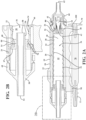
- Figure 3 is a cross-sectional view of the device 10 of Figure 1 along 3-3.
- Figure 4 is an isolated cross-sectional view of the filter element 22 having a sidewall 28 which is tapered such that a diameter of the collection chamber 36 and cross-sectional area of the collection chamber 36 in a longitudinal direction of the filter element 22 increases as the sidewall 28 extends from the second end 26 towards the first end 24 of the filter element 22. Still referring to Figure 4 , both the tapering of the sidewall 28, and the decrease in the diameter and cross-sectional area of the collection chamber 36 is shown. For example, the diameter 76a of the collection chamber 36 at the second end 26 of the filter element 22 is less than the diameter 76b of the collection chamber 36 at the first end 24 of the filter element 22.
- the tapering is accomplished via decreasing thickness of the sidewall 28 as it extends form the second end 26 to the first end 24 of the filter element 22.
- force required to move the piston 42 from the first position 45 to the second position 46 when the collection chamber 36 is filled with the composition 38 is minimized. That is, the tapered sidewall 28 facilitates the discharge of the composition 38 from the collection chamber 36 of the filter element 22.
- the increasing cross-sectional area makes the movement of the piston 42 from the first position 45 to the second position 46 easy, such that less force needs to be applied through the plunger 78 and jamming of the device 10 does not occur.
- the device optimizes the hydration of the "plug" of the composition 38 in the collection chamber 36 which also makes discharge easier because the composition 38 does not flow around or enter into a gap between the face of the piston 42 and the sidewall 28 of the filter element 22, where the gap in size increases as the piston 42 moves from the first position 45 to the second position 46.
- the composition 38 is hydrated sufficiently, making the effective size of the bone fragments large enough in at least one dimension such that the composition 38 does not flow around or enter into a gap between the face of the piston 42 and the sidewall 28 of the filter element 22, where the gap in size increases as the piston 42 moves from the first position 45 to the second position 46.
- the cross-sectional area of the piston 42 and/or cross-sectional of the filter element 22 may be adjusted such that the size of the gap is small enough to prevent bone fragments from moving therethrough.
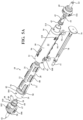
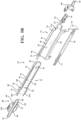
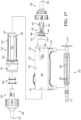
- Figure 5A is an exploded perspective view of the device 10 of Figure 1 and Figure 5B is an exploded cross-sectional view of the device 10 of Figure 5A .
- Figure 5B also illustrates the tapered sidewall 28 of the filter element 22 of the example of Figure 1 .
- the device 10 includes a plunger 78 configured to be releasably coupled to the piston 42 to move the piston 42 between the first and second positions 45, 46.
- the plunger 78 includes the corresponding attachment element 77 and also a press pad 79.
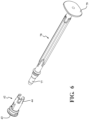
- Figure 6 an isolated perspective view of a plunger 78 and a piston 42 of the device of Figure 1 , which are configured to be releasably coupled via a "snap fit" to one another, are illustrated.
- the corresponding attachment element 77 of the plunger 78 and a piston attachment element of the plunger mount 44 are shaped to releasably couple to one another via various interfaces including, but not limited to, a threadable interface, such as with a bayonet joint, a "snap fit" interface, etc.
- a plunger 178 and a piston 142 which are configured to be threadably coupled to one another is illustrated.
- a corresponding attachment element 177 of the plunger 178 and a plunger mount 144 of the piston 142 are threaded.
- the press pad 179 of the plunger 178 can be pressed to move the piston 142 such that the front face 143 pushes a plug of the composition 38 out of the device 10.
- the plunger 78 can be coupled to the piston 42. Force can be applied to the plunger 78 to move the piston 42 from the first position 45 to the second position 46 to discharge the composition 38 from the collection chamber 36 of the filter element 22.
- the plunger 78 can also be used to move the piston 42 back to the first position 45, i.e., retract the position, and then be decoupled from the piston 42. Once the plunger 78 is decoupled from the piston 42, the caps 48, 60 can be removed and the process can be repeated to harvest and discharge more of the composition 38.
- the inlet cap 48 and the outlet cap 60 are configured to be coupled to one another such that after the composition 38 is acquired through the intake port 52 and collected in the collection chamber 36 and the inlet cap 48 and the outlet cap 60 have been removed from the filter element 22 and/or the housing 12 to harvest the composition 38, the inlet cap 48 and the outlet cap 60 can be coupled to one another to restore vacuum airflow to the surgical tool 54.
- Figures 8A and 8B and 9A and 9B illustrate the coupling of the inlet cap 48 and the outlet cap 60.
- the vacuum spacer 66 includes the first and second collars 67, 68, as well as a J-notch post 110.
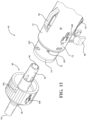
- the inlet cap 48 and the outlet cap 60 can be coupled by inserting the J-notch post 110 of the vacuum spacer 66 on the spout 56 of the inlet cap 48 into a J-notch 112 of the outlet cap 60 and rotating the inlet cap 48 to releasably couple the inlet cap 48 to the outlet cap 60, an indicium 116 on the outlet cap 60 and the indicium 106 on the inlet cap 48 line-up to indicate that the outlet cap 60 and the inlet cap 48 are fully engaged.
- the vacuum spacer 66 ensures that when the inlet and outlet caps 48, 60 are coupled to one another to restore vacuum airflow there is a seal between the inlet and outlet caps 48, 60 to prevent the accumulation of fluid therebetween, while the spout 56 provides a bridging lumen between the inlet and outlet caps 48, 60.
- the inlet cap 48 (the body 50 and/or the spout 56) may also include the first collar 67, the second collar 68, and/or a J-notch post 110.
- the first and second collars 67, 68 could extend radially around the spout 56 and the J-notch post 110 could also be located on the spout 56 or body 50.
- the inlet cap 48 and the outlet cap 60 are configured (or shaped) to be releasablly coupled to the filter element 22 and/or the housing 12.
- the inlet and outlet caps 48, 60 can be coupled to the device 10 via mechanical know in the art (e.g. snap fit, J-notch, and other mechanical couplings.
- the inlet cap 48 is releasably coupled to the first end 24 of the filter element 22.
- a J-notch post 104 on the first end of the filter element 22 cooperates with a J-notch 102 on the inlet cap 48 to couple the inlet cap 48 to the device 10.
- an indicium 106 on the inlet cap 48 lines-up with an indicium 108 on the housing 12 to indicate that the inlet cap 48 is fully engaged with the device 10.
- FIG. 13 an example of the device 10 with an alternative inlet cap 48 is releasably coupled to the first end 24 of the filter element 22.
- a "tear drop" shaped J-notch post 105 on the first end 24 of the filter element 22 is shown.
- the J-notch post 105 provides more contact with the J-notch 102 and more robust engagement/coupling between the inlet cap 48 and the filter element 22.
- the device includes J-notch posts of various cross-sectional profiles e.g. round, ovular, elliptical, polygonal, or tear-drop shaped as shown in Figure 13 .
- a friction button 103 on the first end 24 of the filter element 22 is shown.
- the friction button 103 sits at a mouth of the J-notch 102 to prevent the inlet cap 48 from moving, thereby ensuring that the inlet cap 48 maintains full engagement with the device 10 (i.e. is not loosened during shipping and collection).
- the "tear drop" shaped J-notch post 105 on the first end 24 of the filter element 22 is also effective at keeping the inlet cap 48 coupled tightly to the filter element 22 during shipping and collection.
- the outlet cap 60 is releasablly coupled to the proximal end 16 of the housing 12.
- the outlet cap 60 has the J-notch 112 therein and the proximal end of the outer wall 18 of the housing 12 has a J-notch post 114 thereon.
- the indicium 116 on the outlet cap 60 and an indicium 118 on the housing 12 line-up to indicate that the outlet cap 60 and the housing 12 are fully engaged.
- a method of collecting and processing bone fragments with the device 10 is also disclosed herein.
- the method utilizes various examples of the device 10 as described above and includes the steps of: providing the device 10; acquiring the composition 38 through the inlet cap 48; collecting the composition 38 in the filter element 22; decoupling the inlet cap 48 from the housing 12 or the filter element 22; decoupling the outlet cap 60 from the housing 12; applying a force in a first direction to move the piston 42 from the first position 45 to the second position 46 to discharge the composition 38 from the filter element 22; and applying a force in a second direction so that the device 10 can be used to harvest more of the composition 38.
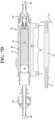
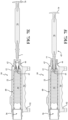
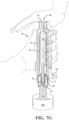
- Figures 7A-7G illustrate various steps which may be included in the method of collecting and processing bone fragments with the device 10.
- Figures 7A-7C provide a cross-sectional view of the device 10 of Figure 1 during the step of acquiring the composition 38 through the inlet cap 48.
- Figure 7A a cross-sectional view of the device of Figure 1 which illustrates the onset of collection of the composition 38.
- the composition 38 has started to collect in the collection chamber 36 of the device.
- Figure 7C illustrates the final stages of collection wherein the collection chamber 36 is just about full of the composition 38 comprising bone fragments.
- Figure 7D is a cross-sectional view of the device 10 of Figure 7C which illustrates the decoupled inlet cap 48, the filter element 22 within the housing 12 filled with the composition 38 now filtered, the outlet cap 60 coupled to the housing 12, and the decoupled plunger 78 which will be subsequently connected to the piston 42 so that force can be applied to the plunger 78 to move the piston 42 from the first position 45 to the second position 46 to discharge the composition 38 from the device 10.
- the step of decoupling the inlet cap 48 from the filter element 22 has occurred, and the step of decoupling the outlet cap 60 from the housing 12 will subsequently occur so that the piston 42 can be moved from the first position 45 to the second position 46 to discharge the composition 38 from the device 10.
- the method further includes the step of coupling the plunger 78 to the piston 42 such that force can be applied to the piston 42 via the plunger 78 to move the piston 42 from the first position 45 to the second position 46 and discharge the composition 38 collected in the collection chamber 36 of the filter element 22 and into a container 120.
- Figure 7E is a cross-sectional view of the device of Figure 7D with a decoupled inlet cap 48 to provide access so that the decoupled plunger 78 can be connected to the piston 42 and force can be applied to the plunger 78 to move the piston 42 from the first position 45 to the second position 46 to discharge the composition 38 from the device 10.
- the method further includes the step of decoupling the plunger 78 from the piston 42.
- the method may also include the steps of coupling the inlet cap 48 to the housing 12 or the filter element 22 and coupling the outlet cap 60 to the housing 12.
- the steps of acquiring, collecting, decoupling the inlet cap 48, decoupling the outlet cap 60, and applying a force in a first direction to move the piston 42 from the first position 45 to the second position 46 to discharge the composition 38 from the filter element 22 are repeated at least once so that additional amounts of the composition 38 can be harvested with the device 10.
- the method may further include the step of coupling the inlet cap 48 and the outlet cap 60 to one another to restore vacuum airflow to the surgical tool 54 subsequent to the steps of acquiring, collecting, decoupling the inlet cap 48, and decoupling the outlet cap 60.
- the device 10 includes the housing 12 having: (1) a piston rack 92; (2) a grip 94; and (3) a clip mount 96 (e.g. for a drape clip).
- the piston rack 92 is configured to hold the plunger 78 while not in use.
- the piston rack 92 includes a first and a second clamp 98, 100, which are configured to mechanically engage the plunger 78.
- the clamp(s) may be configured in a C-shape.
- Figure 7C illustrates the plunger 78 engaged in the piston rack 92
- Figure 7D illustrates the plunger 78 disengaged from the piston rack 92.
- the clamps may take the form of any suitable coupler configured to engage the plunger 78 while the piston 42 is not in use.
- the plunger 78 of the exemplary device of Figure 1 configured to releasably couple to the housing 12 of the device 10.
- the plunger 78 is shown decoupled from the device 10.
- the plunger 78 is shown mounted to the device 10 via the piston rack 92 located on the outer surface 19 of the outer wall 18 of the housing 12 which is shaped to cooperate with and releasably engage the plunger 78.
- the outer wall 18 of the housing 12 includes the plunger rack 92 comprising one or more features (in the example of Figure 1 , two features) which are shaped to releasably engage the plunger 78.
- the user can simply remove the plunger 78 from the piston rack 92 and couple the plunger 78 to the piston 42 so that the composition 38 can be discharged from the collection chamber 36 of the device 10 and ultimately harvested.
- the grip 94 when the plunger 78 is disengaged, and for use and coupled to the piston 42 so that force can be applied to the piston 42 via the plunger 78 to move the piston 42 from a first position 45 to a second position 46 and discharge the composition 38 collected in the collection chamber 36, the grip is 94 is disposed on the outer wall 18 of the housing 12, the grip 94 can be used. That is, when the force is being applied to plunger 78 to move the piston 42 from a first position 45 to a second position 46 and discharge the composition 38, a user can robustly secure the housing 12 with one hand on the grip 94, and actuate or apply force to the plunger 78 with their other hand to move the piston 42 and harvest the composition 38.
- the grip 94 e.g. with and without finger indents, comprising various "grip friendly" materials such as elastomers and foams are contemplated herein.
- the grip 94 facilitates user-friendly two-handed operation of the device 10, where a first hand is placed around the grip 94 and the other hand engages the plunger 78.
- the device can also include a grip 94.
- the grip may be part of the piston rack 92 or may be stand alone and located on the outer wall 18 of the housing 12.
- the grip 94 provides the user with improved control of the device 10 during the harvesting of the composition 38.
- the grip 94 which is part of the piston rack 92 in this example, is exposed so that when the piston 42 is coupled to the plunger 78 and force is applied to the plunger 78, the user can utilize the grip 94 to better hold the device 10 during the application of force to the plunger 78 and the ensuing discharge of the composition 38 from the collection chamber 36 of the device 10.
- the device may include a clip mount 96.
- a drape clip includes a clip which is configured to be releasably coupled to various surfaces, and fabrics in the operating room can be used with the clip mount 96.
- a spring-loaded V-drape clip is utilized; however, various other clip configurations known in the art can be used in lieu of the spring-loaded V-clip illustrated.
- the device 10 can be conveniently stored (mounted) and easily located and accessed.
- Figure 4 is an isolated perspective view of the filter element 22 of the device 10 of Figure 1 .
- the plurality of apertures 34 are patterned in diagonal lines in the sidewall 28 of the filter element 22 to optimize the hydration of the composition 38 collected in the collection chamber 36.
- the plurality of apertures 34 (e.g. lines) are dispersed relatively evenly across, e.g. spread out on the filter element 22.
- the outer peripheral surface 32 of the sidewall 28 includes two tri-tipped ribs 88 extending longitudinally from the first end 24 toward the second end 26 of the filter element 22.
- the device 10 of Figure 1 includes the inlet cap 48 with the J-notch 102 (a first rotational coupler) therein, and the outer peripheral surface 32 of sidewall 28 of the first end 24 of the filter element 22 has the J-notch post 104 (second rotational coupler) thereon.
- the inlet cap 48 has a female configuration
- the first end 24 of the filter element 22 has a male configuration.
- the J-notch post 104 (second rotational coupler) of the first end 24 of the filter element 22 is inserted and rotated into the J-notch 102 (first rotational coupler) of the inlet cap 48 to releasably couple the filter element 22 to the inlet cap 48, the indicium 106 on the inlet cap 48 and the indicium 108 on the housing 12 line-up to indicate that the inlet cap 48 and the housing 12 are fully engaged (i.e., are sufficiently rotated relative to one another such that the two are fully engaged).
- the inlet cap 48 of this example cooperates with the vacuum spacer 66, which also has the J-notch post 110 thereon.
- the device 10 includes the outlet cap 60 with the J-notch 112 therein, and the proximal end of the outer wall 18 of the housing 12 has the J-notch post 114 thereon.
- the outlet cap 60 has a female configuration, and the proximal end 16 of the housing 12 has a male configuration.
- the J-notch post 114 of the proximal end of the outer wall 18 of the housing 12 is inserted and rotated into the J-notch 112 of the outlet cap 60 to releasably couple the housing 12 to the outlet cap 60, the indicium 116 on the outlet cap 60 and the indicium 118 on the housing 12 line-up to indicate that the outlet cap 60 and the housing 12 are fully engaged.
- the J-notch and j-notch posts shown throughout this disclosure may have other suitable geometries that are coupled of facilitating rotational coupling between the caps 48, 60 and the housing 12, and between the caps 48, 60 themselves.
- any form of rotational coupler may be used interchangeably with the various j-notch and post configurations described above, so long as one of the components has a male rotational coupler configuration and the other component has a female rotational coupler configuration. Frictional engagement between the inlet and outlet caps 48, 60 and the housing 12, and between the inlet and outlet caps 48, 60 themselves is also contemplated.
- the device 510 includes a housing 512, a filter element 522, an inlet cap 548, and an outlet cap 560.
- the device 510 includes the housing 512, which includes a distal end 514, a proximal end 516, and an outer wall 518 extending between the distal and proximal ends 514, 516.
- the outer wall 518 has an outer surface 519 and an inner surface 520.
- the inlet cap 548 is shown releasably coupled to the distal end 514 of the housing 512 and/or a first end 524 of the filter element 522.
- the inlet cap 548 includes an intake port 552 configured to be coupled to a surgical tool and receive the composition comprising bone fragments, the filter element 522 collects the composition comprising bone fragments, and the outlet cap 560 is releasably coupled to the proximal end 516 of the housing 512 and includes a vacuum port 562 configured to be coupled to a vacuum source.
- a vacuum spacer 566 is shown separate from the inlet cap 548. The vacuum spacer 566 facilitates airtight connection of the inlet cap 548 to the device 510 and its separate fabrication simplifies molding and assembly of the inlet cap 548.
- the filter element 522 is at least partially disposed within the housing 512.
- the filter element 522 within the housing 512 of the device 510 is illustrated in phantom.
- the filter element 522 is shown partially disposed within the housing 512.
- the filter element 522 has the first end 524 and the second end 526, which are joined by a sidewall 528.
- the first end 524 is positioned closer to the distal end 514 of the housing 512 than the second end 526.
- the sidewall 528 has a plurality of filter apertures 534 and defines an inner peripheral surface 530 and an outer peripheral surface 532.
- the inner peripheral surface 530 of the sidewall 528 at least partially defines a collection chamber 536 for collection of a composition comprising bone fragments.
- the outer peripheral surface 532 of the sidewall 528 and the inner surface 520 of the outer wall 518 are spaced apart from one another to define an exterior radial volume 540.
- the composition typically follows a primary communication path through the inlet cap 548 and into the collection chamber 536, wherein excess fluid is drawn through the plurality of filter apertures 534, into the exterior radial volume 540, and out of the outlet cap 560.
- the composition is drawn into the collection chamber 536 of the filter element 522 and filtrate is drawn through a primary fluid communication path and out of the outlet cap 560.
- the sidewall 528 also has a proximal portion 535 adjacent the second end 526 which defines at least one drain aperture 555.
- the proximal portion 535 of the sidewall 528 of the filter element 522 is tapered radially inward.
- the device 510 of this example also includes a piston 542, part of which can be seen through a window portion 515 in the sidewall 528 of the device 510 in Figure 14 .
- the piston 542 includes a piston element 543 having a front face 545 and a back surface 547, a radial protrusion 580, and a plunger mount 544 opposite the piston element 543.
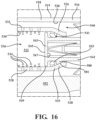
- the piston 542 is moveably disposed within the filter element 522. More specifically, the piston 542 is movable between a first and a second position. In the first position, the front face 545 of the piston element 543 at least partially defines the collection chamber 536 and the back surface 547, the plunger mount 544, and the inner peripheral surface 530 of the proximal portion 535 of the sidewall 528 define an interior radial volume 541. Further, in the first position, the front face 545 is within the filter element 522 and spaced distally relative to the second end 526 of the filter element 522 and the at least one drain aperture 555 places the exterior radial volume 540 and the interior radial volume 541 in fluid communication.
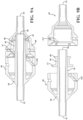
- Figure 18 shows an isolated view of the piston 542 disposed in the filter element 522 in the first position
- Figure 19 shows a cross-sectional view of the piston 542 and the filter element 522 of claim
- Figure 20 shows an exploded view of the piston 542 and the filter element 522 of claim 18.
- the composition is acquired through the inlet cap 548 and collected in the collection chamber 536.
- the plurality of filter apertures 534 and exterior radial volume 540 provides the primary fluid communication path with the vacuum source.
- a supplementary fluid communication path with the vacuum source runs around a perimeter of the piston element 543, through the interior radial volume 541, out the at least one drain aperture 555, and into the exterior radial volume.
- the radial protrusion 580 of the filter element 522 has a top surface 581 that is tapered radially inward.
- the top surface 581 of the radial protrusion 580 abuts the inner peripheral surface 530 of the proximal portion 535 of the filter element 522, which is also tapered radially inward.
- the radial protrusion 580 abuts the inner peripheral surface 530 of the proximal portion 535 of the filter element 522 when the piston 542 is in the first position.
- the piston element 543 of the piston 542 is spaced radially inwardly from the inner peripheral surface 530 of the sidewall 528 of the filter element 522 to define a radial drain gap 549.
- the radial drain gap 549 is a distance from the inner diameter of the filter element 522 to an outer diameter of the front face 545 of the piston element 543.
- the radial drain gap 549 is from 0.5 to 1, from 0.1 to 0.85, from 0.1 to 0.6, or from 0.14 to 0.54, mm when the piston 542 is in the first position.
- all gap width values and ranges of values including and between those described in the paragraph above are hereby expressly contemplated for use herein.
- the at least one drain aperture 555 on the proximal portion 535 of the sidewall 528 of the filter element 522 opens from 5 to 55 or from 5 to 25, % of a total surface area of an exterior peripheral surface of the proximal portion 535 of the sidewall 528.
- all surface area values and ranges of values including and between those described in the paragraph above are hereby expressly contemplated for use herein.
- the proximal portion 535 of the sidewall 528 of the filter element 522 has from 2 to 10, from 2 to 8, or from 2 to 6 drain apertures 555.
- the filter element 522 shown in Figures 17-20 has 4 drain apertures 555.
- the drain apertures 555 can have various shapes, e.g. ovular, elliptical, or polygonal shape. In a typical example the at least one drain aperture 555 is elliptical in shape, e.g. round. When more than one drain aperture 555 is included on the sidewall 528, the drain apertures 555 can have different shapes.
- each of the at least one drain apertures 555 can have a diameter of from 0.1 to 4.5, or from 1.5 to 3.5, or from 2.8 to 3.2, mm.
- a diameter of each of the plurality of filter apertures 534 is from 0.1 to 2.5, from 0.75 to 1.25, or from 0.84 to 1.14, mm.
- all diameter values and ranges of values including and between those described in the paragraph above are hereby expressly contemplated for use herein.
- Each of the at least one drain apertures 555 typically has a larger size than each of the plurality of filter apertures 534.
- each of the at least one drain aperture 555 has a drain aperture 555 diameter at least two times larger than a filter aperture diameter of each of the filter apertures 534 in the sidewall 528 of the filter element 522.
- the at least one drain aperture 555 (1) prevents collection of filtrate in the interior radial volume 541 and (2) provides improved filtration and drainage.
- the supplementary fluid communication path runs through the radial drain gap 549, into the interior radial volume 541, out of the at least one drain apertures 555, into the exterior radial volume 540, and out of the outlet cap 560. That is, during use, the composition is drawn into the collection chamber 536 of the filter element 522 and filtrate is drawn through a supplementary fluid communication path and out of the outlet cap 560. As such, it provides an alternative fluid passage to the primary fluid communication path.
- the radial drain gap 549 is particularly effective because it provides drainage continuously along the inner peripheral surface 530 of the sidewall 528 of the filter element 522.
- the continuous profile of the radial drain gap 549 and the larger size of the at least one drain aperture 555 make the supplementary fluid communication path surprisingly effective.
- the device 510 includes a plunger 578 configured to be releasably coupled to the piston 542 to move the piston 542 between the first and second positions. That is, upon removal of the inlet cap 548 and the outlet cap 560, the plunger 578 can be coupled to the piston 542, and force can be applied to the piston 542 to move the piston 542 from the first position to the second position to discharge composition from the filter element 522.
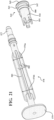
- the plunger 578 includes a corresponding attachment element 577, a press pad 579, and a body 583 extending therebetween.
- the press pad 579 of this disclosure could also be described as a handle and can be broadly interpreted as a surface to which force can be applied to the plunger 578 to move the piston 542 from the first position to the second position.
- the plunger mount 544 of the piston 542 includes an attachment element 551 that is shaped to releasably couple to the corresponding attachment element 577 of the plunger 578 to couple the plunger 578 to the piston 542.
- the body 583 of the plunger 578 is tapered such that a diameter of the body 583 increases as the body 583 extends from the corresponding attachment element 577 towards the press pad 579. Still referring to Figure 21 , in some examples, the body 583 is tapered such that a diameter of the body 583 increases as the body 583 extends from the corresponding attachment element 577 towards the press pad 579. Further, the body 583 of the plunger 578 includes a plurality of ribs 585. The ribs 585 reduce the plastic content and the cost while having an I-beam like strengthening effect on the plunger 578. In the example of Figure 14 , the body 583 includes 4 tapered ribs 585.
- This tapering provides an interference fit which slows down the plunger 578 as it progresses through an opening at the second end 526 of the filter element 522 as the piston 542 is driven from the first position to the second position to eject composition/bone fragments collected in a controlled manner.
- the body 583 having a tapered profile prevents the plunger 578 and the piston 542 from violently shooting through the collection chamber 536 of the filter element 522 and out of the housing 512 of the device 510, which minimizes potential for the disconnection of the piston 542 and plunger 578 and/or an uncontrolled ejection of the composition collected out of the device 510. It should be appreciated that this plunger 578, with its tapered body 583, can be employed with any of the example devices described herein.
- the increase of diameter of the body 583 of the plunger 578 as the body 583 extends from the corresponding attachment element 577 towards the press pad 579 is illustrated.
- the diameter 576a of the body 583 proximal the press pad 579 is larger than the diameter 576b of the body 583 proximal the corresponding attachment element 577.
- the tapering is accomplished via decreasing a width of the ribs 524 as they extend from the press pad 579 to the corresponding attachment element 577. It should be appreciated that the tapering can be consistent or inconsistent, e.g. with steps. In such examples, force that is required to be applied to the plunger 578 to move the piston 542 progressively increases as a plunger 578 is used to move the piston 542 between the first and second positions.
- the outer wall 518 of the housing 512 of the device 510 has the window portion 515 which allows light to pass therethrough.
- the window portion 515 is typically located closer to the proximal end 516 of the housing 512 than to the distal end 514 of the housing 512.
- the window portion 515 is transparent.
- various examples of the device 510 may utilize the window portion 515 which is translucent, e.g. offers limited visibility.
- the window portion 515 is transparent. As such, the internal components of the device 510 are visible through the window portion 515.
- the outer wall 518 includes a remaining portion in addition to and different than the window portion 515. In such examples, the remaining portion is translucent or opaque.
- the piston 542 is at least partially visible through the window portion 515 in the outer wall 518 of the housing 512.
- the attachment element 551 of the plunger mount 544 of the piston 542 is visible through the window portion 515.
- the plunger 578 can be coupled to the piston 542 while being viewed through the window portion 515.
- the visible engagement is user friendly and facilitates the proper and efficient use of the device 510.
- the attachment element 551 of the piston 542 is shaped to snap fit couple to the corresponding attachment element 577 of the plunger 578 to couple the plunger 578 to the piston 542.
- the attachment element 551 of the piston 542 is shaped to threadedly couple to the corresponding attachment element 577 of the plunger 578 to couple the plunger 578 to the piston 542.
- the attachment element 551 of the piston 542 has a visual identifier and at least a portion of the corresponding attachment element 577 of the plunger 578 has a corresponding visual identifier that produce a visual association between the attachment element 551 of the piston 542, which is visible through the window portion 515 in the first position and the corresponding attachment element 577 of the plunger 578.
- the visual identifier can be corresponding indicia or even a matching color. The visual identifier and the corresponding visual identifier promote the insertion of the plunger 578 into the proximal end 516 of the housing 512, to further facilitate the proper and efficient use of the device 510.
- the visual identifier of the attachment element 551 of the piston 542 is a color
- the corresponding visual identifier of the corresponding attachment element 577 of the plunger 578 is the color
- remaining components of the bone dust collector are collectively colored to maintain the visual association between the attachment element 551 of the piston 542 and the corresponding attachment element 577 of the plunger 578.
- the visual identifier is a color represented by the stippling (dotted fill) of the plunger 578 and the piston 542. That is, in the example shown, the plunger 578 and the piston 542 are the same color as represented by the stippling, e.g. orange.
- a sterile bone collection device 511 and packaging system 700 is also disclosed.
- the sterile device 511 is just as described in the examples above but is sterilized.
- the sterile device 511 includes a housing 512 including the distal end 514, the proximal end 516, and the outer wall 518 having a plunger rack 592 thereon.
- the plunger 578 is engaged in the plunger rack 592
- the inlet cap 548 comprising the intake port 552 is releasably coupled to the distal end 514 of the housing 512
- the intake tube 584 is connected to the intake port 552
- the outlet cap 560 is releasably coupled to the proximal end 516 of the housing 512.
- This assembled configuration is user friendly and allows a user to quickly understand the sterile device 511 and its assembly and dis-assembly, which is required to use the plunger 578.
- the sterile device 511 is removed from the packaging system 700 with the intake tube 584 attached to the proper end (i.e. the inlet cap 548) of the sterile device 511.
- the sterile device 511 can be removed from the packaging system 700 and used immediately. That is, the sterile device 511 can be removed from the packaging system 700 and a surgical tool can be immediately attached and used. Handling of the sterile device 511 prior to surgery is minimized and efficient use during surgery is facilitated.
- the packaging system 700 includes an inner blister pack 702.
- the inner blister pack 702 includes an inner shell 704 that defines a sterile interior space 706 and that is configured to house the sterile device 511.
- the inner shell 704 includes a shell floor 708 and a shell sidewall 710 having the inner surface 712, an outer surface 714, and an ovular profile.
- the inner surface 712 of the shell sidewall 710 defines the sterile interior space 706 and houses the sterile device 511.
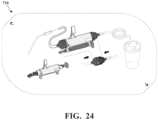
- the sterile device 511 is housed in the sterile interior space 706 with the intake tube 584 wrapped radially thereabout having an ovular circumferential profile that corresponds with the ovular profile of the shell sidewall 710.
- a holding band 718 configured to hold the sterile device 511 with the intake tube 584 wrapped radially thereabout together is included in the packaging system 700.
- an inner sealing film 716 cooperates with the inner shell 704 to seal the sterile device 511 within the inner blister pack 702.
- the inner sealing film 716 can have instruction graphics displayed thereon so that when a user opens the inner blister pack, presumably in a sterile zone, a user can refer to a sterile set of instructions for use.
- An inner sealing film 716 with instruction graphics displayed thereon is included in the appendix filed herewith.
- the sterile zone is a specific area in an operating room that is considered sterile and free of microorganisms. Maintaining the sterile zone is not an easy task because there are many chances for a breach in sterility during setup, operation, and post-operation.
- the sterile device 511 including directions for use, can be utilized in a sterile and efficient manner right in the sterile zone of the operating room.
- the inner blister pack 702 with the directions thereon and the sterile device 511 therein can be conveniently positioned in the sterile zone on patient support apparatus or elsewhere before surgery.
- the packaging system 700 may also include an outer blister pack 720.
- the outer blister pack 720 includes a barrier shell 722 that defines a sterile chamber 724 and that is configured to house the inner blister pack 702.
- a barrier sealing film 726 cooperates with the barrier shell 722 to seal the inner blister pack 702 within the outer blister pack 720.
- the barrier shell 722 includes a barrier floor 728 and a barrier sidewall 730 having an exterior surface 732 and an interior surface 734.
- the packaging system 700 may also include a packaging label 742.
- the barrier sidewall 730 includes one or more tabs 736 projecting radially inwardly from the barrier sidewall 730 into the sterile chamber 724 which cooperate with the outer surface 714 of the shell sidewall 710 of the inner shell 704 to secure the inner blister pack 702 in the sterile chamber 724 of the outer blister pack 720.
- the one or more tabs 736 can have a contact surface 738 which is shaped to releasably couple with a corresponding contact surface 740 on the outer surface of the shell sidewall 710.
- two of the tabs 736 have a ridged contact surface 738 which cooperates with a corresponding ridged contact surface 740 on the outer surface 714 of the shell sidewall 710 to secure the inner blister pack 702 within the sterile chamber 724 of the outer blister pack 720.
- Figure 26 is a perspective view of the packaging system 700 with the sterile bone collection device 511 therein.
Landscapes
- Health & Medical Sciences (AREA)
- Heart & Thoracic Surgery (AREA)
- Public Health (AREA)
- Vascular Medicine (AREA)
- Engineering & Computer Science (AREA)
- Biomedical Technology (AREA)
- Veterinary Medicine (AREA)
- Life Sciences & Earth Sciences (AREA)
- Animal Behavior & Ethology (AREA)
- General Health & Medical Sciences (AREA)
- Orthopedic Medicine & Surgery (AREA)
- Transplantation (AREA)
- Hematology (AREA)
- Anesthesiology (AREA)
- Physical Education & Sports Medicine (AREA)
- Cardiology (AREA)
- Oral & Maxillofacial Surgery (AREA)
- Prostheses (AREA)
- Filtering Of Dispersed Particles In Gases (AREA)
Claims (10)
- Vorrichtung (510) zum Sammeln und Verarbeiten von Knochenfragmenten, wobei die Vorrichtung (510) umfasst:ein Gehäuse (512) mit einem distalen Ende (514), einem proximalen Ende (516) und einer Außenwand (518), die eine Innenfläche (520) aufweist, die sich zwischen dem distalen und dem proximalen Ende (514, 516) erstreckt;ein Filterelement (522), das zumindest teilweise innerhalb des Gehäuses (512) angeordnet ist, wobei das Filterelement (522) aufweist:ein erstes Ende (524);ein zweites Ende (526), wobei das erste Ende (524) näher an dem distalen Ende (514) des Gehäuses (512) angeordnet ist als das zweite Ende (526); undeine Seitenwand (528), die das erste Ende (524) und das zweite Ende (526) verbindet, wobei die Seitenwand (528) eine innere Umfangsfläche (530) und eine äußere Umfangsfläche (532) definiert, wobei die Seitenwand (528) eine Vielzahl von Filteröffnungen (534) darin aufweist, wobei die innere Umfangsfläche (530) der Seitenwand (528) zumindest teilweise eine Sammelkammer (536) zum Sammeln einer Knochenfragmente umfassenden Zusammensetzung definiert und die äußere Umfangsfläche (532) der Seitenwand (528) und die Innenfläche (520) der Außenwand (518) voneinander beabstandet sind, um ein äußeres Radialvolumen (540) zu definieren;einen Kolben (542) mit:einem Kolbenelement (543), das eine Vorderfläche (545) und eine Rückfläche (547) aufweist,wobei der Kolben (542) beweglich innerhalb des Filterelements (522) angeordnet und zwischen einer ersten und einer zweiten Position beweglich ist, wobei in der ersten Position:
die Vorderseite (545) des Kolbenelements (543) zumindest teilweise die Sammelkammer (536) definiert;eine Einlasskappe (548), die lösbar mit dem distalen Ende (514) des Gehäuses (512) und/oder dem ersten Ende (524) des Filterelements (522) gekoppelt ist, wobei die Einlasskappe (548) eine Einlassöffnung (552) aufweist, die ausgebildet ist, um mit einem chirurgischen Werkzeug (54) gekoppelt zu werden und die die Knochenfragmente umfassende Zusammensetzung aufzunehmen; undeine Auslasskappe (560), die eine Vakuumöffnung (562) aufweist, die ausgebildet ist, um mit einer Vakuumquelle (64) gekoppelt zu werden;wobei die Zusammensetzung durch die Einlasskappe (548) aufgenommen und in der Sammelkammer (536) gesammelt wird und während des Sammelns das äußere radiale Volumen (540) einen primären Fluidverbindungsweg mit der Vakuumquelle (64) bereitstellt;dadurch gekennzeichnet, dassdas Filterelement (522) ferner einen proximalen Abschnitt (535) aufweist, der an das zweite Ende (526) angrenzt und mindestens eine Ablauföffnung (555) definiert;der Kolben (542) ferner eine Stößellagerung (544) aufweist, die dem Kolbenelement (543) gegenüberliegt und einen radialen Vorsprung (580) aufweist;wobei die Rückfläche (547), die Stößellagerung (544) und die innere Umfangsfläche (530) des proximalen Abschnitts (535) der Seitenwand (528) ein inneres Radialvolumen (541) definieren; und die Vorderfläche (545) sich innerhalb des Filterelements (522) befindet und distal relativ zu dem zweiten Ende (526) des Filterelements (522) beabstandet ist;wobei die mindestens eine Ablauföffnung (555) das äußere Radialvolumen (540) und das innere Radialvolumen (541) in Fluidverbindung bringt und das innere Radialvolumen (541) während des Sammelns einen zusätzlichen Fluidverbindungsweg durch die mindestens eine Ablauföffnung (555) bereitstellt; undwobei die Auslasskappe (560) lösbar mit dem proximalen Ende (516) des Gehäuses (512) gekoppelt ist. - Vorrichtung (510) nach Anspruch 1, wobei der proximale Abschnitt (535) des Filterelements (522) radial nach innen verjüngt ist.
- Vorrichtung (510) nach Anspruch 2, wobei der radiale Vorsprung (580) eine obere Fläche (581) aufweist, die sich radial nach innen verjüngt, so dass die obere Fläche (581) an der inneren Umfangsfläche (530) des proximalen Abschnitts (535) des Filterelements (522) anliegt, die ebenfalls radial nach innen verjüngt ist, wenn sich der Kolben (542) in der ersten Position befindet.
- Vorrichtung (510) nach einem der vorhergehenden Ansprüche, wobei das Kolbenelement (543) des Kolbens (542) von der inneren Umfangsfläche (530) der Seitenwand (528) des Filterelements (522) radial nach innen beabstandet ist, um einen radialen Ablaufspalt (549) zu bilden.
- Vorrichtung (510) nach Anspruch 4, wobei der radiale Ablaufspalt (549) zwischen 0,05 und 1 mm beträgt, wenn sich der Kolben (542) in der ersten Position befindet.
- Vorrichtung (510) nach einem der vorhergehenden Ansprüche, wobei die mindestens eine Ablauföffnung (555) an dem proximalen Abschnitt (535) der Seitenwand (528) des Filterelements (522) 5 bis 55 % einer Gesamtoberfläche einer äußeren Umfangsfläche des proximalen Abschnitts (535) der Seitenwand (528) öffnet.
- Vorrichtung (510) nach einem der vorhergehenden Ansprüche, wobei die mindestens eine Ablauföffnung (555) ferner als 2 bis 10 Ablauföffnungen definiert ist.
- Vorrichtung (510) nach einem der vorhergehenden Ansprüche, wobei die mindestens eine Ablauföffnung (510) elliptisch ist und einen Durchmesser von 0,1 bis 4,5 mm aufweist.
- Vorrichtung (510) nach einem der vorhergehenden Ansprüche, wobei die mindestens eine Ablauföffnung (555) einen Ablauföffnungsdurchmesser aufweist, der mindestens zweimal größer ist als ein Filteröffnungsdurchmesser von mindestens einer der Vielzahl von Öffnungen (534) in der Seitenwand (528) des Filterelements (522).
- Vorrichtung (510) nach einem der vorhergehenden Ansprüche, ferner umfassend einen Stößel (578), der ausgebildet ist, um lösbar mit dem Kolben (542) gekoppelt zu werden, um den Kolben (542) zwischen der ersten und der zweiten Position zu bewegen, wobei der Stößel (578) ein entsprechendes Befestigungselement (551), ein Druckkissen (579) und einen sich dazwischen erstreckenden, sich verjüngenden Körper (583) umfasst, wobei der Körper (583) derart verjüngt ist, dass ein Durchmesser des Körpers (583) zunimmt, wenn sich der Körper (583) von dem entsprechenden Befestigungselement (551) zu dem Druckkissen (579) hin erstreckt.
Priority Applications (1)
| Application Number | Priority Date | Filing Date | Title |
|---|---|---|---|
| EP24189344.5A EP4424337B1 (de) | 2019-12-18 | 2020-12-15 | Kollektor und prozessor für knochenfragmente |
Applications Claiming Priority (2)
| Application Number | Priority Date | Filing Date | Title |
|---|---|---|---|
| US201962949863P | 2019-12-18 | 2019-12-18 | |
| PCT/IB2020/061983 WO2021124117A1 (en) | 2019-12-18 | 2020-12-15 | Bone fragment collector and processor |
Related Child Applications (1)
| Application Number | Title | Priority Date | Filing Date |
|---|---|---|---|
| EP24189344.5A Division EP4424337B1 (de) | 2019-12-18 | 2020-12-15 | Kollektor und prozessor für knochenfragmente |
Publications (2)
| Publication Number | Publication Date |
|---|---|
| EP4076290A1 EP4076290A1 (de) | 2022-10-26 |
| EP4076290B1 true EP4076290B1 (de) | 2024-07-31 |
Family
ID=73856223
Family Applications (2)
| Application Number | Title | Priority Date | Filing Date |
|---|---|---|---|
| EP24189344.5A Active EP4424337B1 (de) | 2019-12-18 | 2020-12-15 | Kollektor und prozessor für knochenfragmente |
| EP20828331.7A Active EP4076290B1 (de) | 2019-12-18 | 2020-12-15 | Kollektor und prozessor für knochenfragmente |
Family Applications Before (1)
| Application Number | Title | Priority Date | Filing Date |
|---|---|---|---|
| EP24189344.5A Active EP4424337B1 (de) | 2019-12-18 | 2020-12-15 | Kollektor und prozessor für knochenfragmente |
Country Status (3)
| Country | Link |
|---|---|
| US (1) | US12274629B2 (de) |
| EP (2) | EP4424337B1 (de) |
| WO (1) | WO2021124117A1 (de) |
Families Citing this family (2)
| Publication number | Priority date | Publication date | Assignee | Title |
|---|---|---|---|---|
| USD1091815S1 (en) * | 2019-12-18 | 2025-09-02 | Stryker European Operations Limited | Bone dust collector |
| USD1066563S1 (en) * | 2023-01-03 | 2025-03-11 | Brent Speak | Water collection apparatus |
Family Cites Families (261)
| Publication number | Priority date | Publication date | Assignee | Title |
|---|---|---|---|---|
| US2884029A (en) | 1959-04-28 | Saw blade scraper for meat and bone saws | ||
| US1199350A (en) | 1913-05-14 | 1916-09-26 | Collin Valve Company | Strainer. |
| US2959797A (en) | 1957-09-16 | 1960-11-15 | Albert L Harman | Meat cleaner |
| US2864411A (en) | 1957-12-13 | 1958-12-16 | Southern Saw Service Inc | Band saw blade for use with power driven band saws for cutting meat |
| US2978001A (en) | 1958-08-29 | 1961-04-04 | Forrest B Whisler | Meat cutting band saw with blade cleaner |
| US3081770A (en) | 1960-09-21 | 1963-03-19 | John M Hunter | Surgical instrument |
| US3061856A (en) | 1961-02-28 | 1962-11-06 | Czapar Frank | Fat and bone dust remover |
| US3401684A (en) | 1965-12-16 | 1968-09-17 | Weck & Co Edward | Biopsy capsules |
| FR1570426A (de) | 1967-04-14 | 1969-06-13 | ||
| US3561429A (en) | 1968-05-23 | 1971-02-09 | Eversharp Inc | Instrument for obtaining a biopsy specimen |
| US3623607A (en) | 1969-07-28 | 1971-11-30 | Gulf Oil Corp | Filter assembly |
| US3672576A (en) | 1970-04-14 | 1972-06-27 | Lenard J Crosby | Butcher{40 s pneumatic bone dust vacuum cleaner |
| US3699604A (en) | 1971-03-22 | 1972-10-24 | Vulcan Corp | Butchers{40 {11 bone dust scraper |
| BE787102A (fr) | 1971-08-10 | 1973-02-02 | Arendale Donald L | Machine automatique pour le traitement des |
| US3785380A (en) | 1972-02-22 | 1974-01-15 | R Brumfield | Filtering blood sucker |
| US3813775A (en) | 1972-05-17 | 1974-06-04 | R Fitzgerald | Meat cleaner and conditioner |
| US3815604A (en) | 1972-06-19 | 1974-06-11 | Malley C O | Apparatus for intraocular surgery |
| DK132690C (da) | 1973-06-15 | 1976-06-21 | H Gram | Aspirationscurette |
| US3890712A (en) | 1973-08-29 | 1975-06-24 | Oscar Lopez | Saliva ejector |
| US3889657A (en) | 1974-02-12 | 1975-06-17 | Gomco Surgical Mfg Co | Uterine aspirating curette |
| US3955234A (en) | 1974-10-16 | 1976-05-11 | Roefaro Thomas A | Tool for dressing meat |
| US4083706A (en) | 1974-10-25 | 1978-04-11 | Wiley Corless W | Sterile trap accessory for use with surgical aspirator |
| US4008502A (en) | 1974-12-20 | 1977-02-22 | Hobart Corporation | Meat gripping and moving cylinder and mount therefor |
| US4199840A (en) | 1975-04-09 | 1980-04-29 | Hobart Corporation | Scraper blade structure for meat cleaning machine |
| US4018686A (en) | 1975-07-10 | 1977-04-19 | Nupro Company | Fluid strainer element |
| US4062781A (en) | 1976-06-04 | 1977-12-13 | Whatman Reeve Angel Limited | Disposable filter with interchangeable end elements |
| US4141142A (en) | 1977-05-16 | 1979-02-27 | Ralph Karubian | Carcass splitting band-saw |
| JPS5658469A (en) | 1979-10-19 | 1981-05-21 | Yoshinari Masuyama | Molding method of glucomannan flour |
| US4314560A (en) | 1979-11-28 | 1982-02-09 | Helfgott Maxwell A | Powered handpiece for endophthalmic surgery |
| US4428748A (en) | 1980-04-09 | 1984-01-31 | Peyman Gholam A | Combined ultrasonic emulsifier and mechanical cutter for surgery |
| US4449271A (en) | 1982-10-15 | 1984-05-22 | Ralph Karubian | Carcass saw |
| US4997434A (en) | 1983-02-16 | 1991-03-05 | Seedhom Bahaa B | Prosthetic ligaments and instruments for use in the surgical replacement of ligaments |
| GB8318483D0 (en) | 1983-07-08 | 1983-08-10 | Zimmer Deloro Surgical Ltd | Skeletal implants |
| US4685472A (en) | 1984-01-23 | 1987-08-11 | Rudolph Muto | Specimen collector |
| US4678459A (en) | 1984-07-23 | 1987-07-07 | E-Z-Em, Inc. | Irrigating, cutting and aspirating system for percutaneous surgery |
| US4922902A (en) | 1986-05-19 | 1990-05-08 | Valleylab, Inc. | Method for removing cellular material with endoscopic ultrasonic aspirator |
| US4701259A (en) | 1986-03-27 | 1987-10-20 | Rosedale Products, Inc. | Fluid filter with filter retainer |
| US4753634A (en) | 1986-10-31 | 1988-06-28 | Johnson Gerald W | Fat collection syringe |
| GB8706958D0 (en) | 1987-03-24 | 1987-04-29 | Brooke G M | Surgical suction tip |
| US5290445A (en) | 1988-05-27 | 1994-03-01 | Pall Corporation | Filtering apparatus |
| BE1002350A3 (fr) | 1988-08-02 | 1991-01-08 | Dury Georges Emile Ladislas | Implant. |
| US5669394A (en) | 1989-02-06 | 1997-09-23 | The Board Of Regents Of The Univ. Of Oklahoma | Biosample aspirator |
| US5494044A (en) | 1989-05-10 | 1996-02-27 | Amnitec A/S | Method for taking a sample of amniotic fluid |
| DK235589D0 (da) | 1989-05-12 | 1989-05-12 | Wolff & Kaaber | Fremgangsmaade og indretning til blanding af en fast og en flydende komponent |
| US5176628A (en) | 1989-10-27 | 1993-01-05 | Alcon Surgical, Inc. | Vitreous cutter |
| US5335671A (en) | 1989-11-06 | 1994-08-09 | Mectra Labs, Inc. | Tissue removal assembly with provision for an electro-cautery device |
| US5409013A (en) | 1989-11-06 | 1995-04-25 | Mectra Labs, Inc. | Tissue removal assembly |
| US5256160A (en) | 1989-11-06 | 1993-10-26 | Mectra Labs, Inc. | Medical device valving mechanism |
| US5152744A (en) | 1990-02-07 | 1992-10-06 | Smith & Nephew Dyonics | Surgical instrument |
| US5040542A (en) | 1990-03-05 | 1991-08-20 | Norman Gray | Bone biopsy needle |
| US5092891A (en) | 1990-03-08 | 1992-03-03 | Kummer Frederick J | Cement plug for the medullary canal of a bone and coacting tool for installing same |
| US5085659A (en) | 1990-11-21 | 1992-02-04 | Everest Medical Corporation | Biopsy device with bipolar coagulation capability |
| US5171313A (en) | 1991-05-08 | 1992-12-15 | Othy, Inc. | Tool driver |
| GB9124423D0 (en) | 1991-11-16 | 1992-01-08 | Strover Angus E | Surgical tool |
| US5192439A (en) | 1992-02-03 | 1993-03-09 | Electromedics, Inc. | Blood collection reservoir and filter device |
| US5314406A (en) | 1992-10-09 | 1994-05-24 | Symbiosis Corporation | Endoscopic electrosurgical suction-irrigation instrument |
| US5354268A (en) | 1992-11-04 | 1994-10-11 | Medical Instrument Development Laboratories, Inc. | Methods and apparatus for control of vacuum and pressure for surgical procedures |
| GB9307321D0 (en) | 1993-04-07 | 1993-06-02 | Knight Scient Ltd | Method of separating particles from a filter |
| US5392790A (en) | 1993-04-30 | 1995-02-28 | Ryder International Corporation | Instrument for obtaining bore type tissue sampling |
| US5512045A (en) | 1993-12-22 | 1996-04-30 | Gurchumelidze; Teimuraz P. | Surgical decompression and irrigation apparatus and method |
| US5498259A (en) | 1994-03-31 | 1996-03-12 | The Regents Of The University Of California | Method for fusing bone |
| SE511575C2 (sv) | 1994-09-20 | 1999-10-25 | Bladhs Medical Ab | Sätt och anordning för uppsamling av benvävnadsfragment |
| US5542918A (en) | 1995-01-06 | 1996-08-06 | Zimmer, Inc. | Vacuum driven fluid pump for an aspiration/irrigation instrument |
| US5554111A (en) | 1995-03-16 | 1996-09-10 | Mayo Foundation For Medical Education & Research | Bone cleaning and drying system |
| US5685838A (en) | 1995-04-17 | 1997-11-11 | Xomed-Treace, Inc. | Sinus debrider apparatus |
| US5766134A (en) | 1995-07-18 | 1998-06-16 | Atrion Medical Products, Inc. | Autogenous bone specimen collector |
| US5630939A (en) | 1995-09-15 | 1997-05-20 | Imtec Corporation | Filter assembly device for use in surgical aspirated suction |
| US5569178A (en) | 1995-10-20 | 1996-10-29 | Henley; Julian L. | Power assisted suction lipectomy device |
| US5954961A (en) | 1995-11-01 | 1999-09-21 | Carchidi; Joseph E. | Bone particle collection apparatus and method |
| US6113569A (en) | 1995-12-21 | 2000-09-05 | Very Inventive Physicians | Reciprocating liposuction device |
| US5669923A (en) | 1996-01-24 | 1997-09-23 | Gordon; Mark G. | Anterior capsulotomy device and procedure |
| US5695513A (en) | 1996-03-01 | 1997-12-09 | Metagen, Llc | Flexible cutting tool and methods for its use |
| US6258111B1 (en) | 1997-10-03 | 2001-07-10 | Scieran Technologies, Inc. | Apparatus and method for performing ophthalmic procedures |
| US5913857A (en) | 1996-08-29 | 1999-06-22 | Ethicon End0-Surgery, Inc. | Methods and devices for collection of soft tissue |
| US6039748A (en) | 1997-08-05 | 2000-03-21 | Femrx, Inc. | Disposable laparoscopic morcellator |
| US6276115B1 (en) | 1998-01-30 | 2001-08-21 | Lee Kramer | Method of cutting and packaging formed loin cuts |
| US5989116A (en) | 1998-02-03 | 1999-11-23 | Swift & Company, Inc. | High-speed bone-in loin slicer |
| US6013079A (en) | 1998-09-01 | 2000-01-11 | Salam; Abdul | Aerosolized bone dust and body fluids extraction system for a bone cutting saw |
| US6077215A (en) | 1998-10-08 | 2000-06-20 | Implex Gmbh Spezialhorgerate | Method for coupling an electromechanical transducer of an implantable hearing aid or tinnitus masker to a middle ear ossicle |
| EP1002817B1 (de) | 1998-11-17 | 2004-04-28 | Showa Denko K.K. | Photohärtbare Zusammensetzung |
| US6022354A (en) | 1998-12-04 | 2000-02-08 | Mercuri; Gregory M. | Bone harvesting collection and delivery system |
| US7189206B2 (en) | 2003-02-24 | 2007-03-13 | Senorx, Inc. | Biopsy device with inner cutter |
| US6168411B1 (en) | 1999-03-18 | 2001-01-02 | Dynisco Extrusion, Inc. | Polymer filtration method and apparatus |
| US6299763B1 (en) * | 1999-04-09 | 2001-10-09 | Arthur Ashman | Autogenous bone and cell filter trap |
| US6276936B1 (en) | 1999-09-30 | 2001-08-21 | Michael Forster | Dental separator for solids from a solids/liquid mixture |
| US6183254B1 (en) | 1999-08-04 | 2001-02-06 | East Coast Medical And Dental Devices, Inc. | Dental strainer unit for an aspirator |
| WO2001019429A1 (en) | 1999-09-17 | 2001-03-22 | Nuvasive, Inc. | Bone slurry recovery |
| US6368324B1 (en) | 1999-09-24 | 2002-04-09 | Medtronic Xomed, Inc. | Powered surgical handpiece assemblies and handpiece adapter assemblies |
| US6638238B1 (en) | 1999-12-09 | 2003-10-28 | The Regents Of The University Of California | Liposuction cannula device and method |
| US6406454B1 (en) | 2000-03-14 | 2002-06-18 | Mohammed Ali Hajianpour | Surgical suction probe system with an easily cleaned internal filter |
| US6908455B2 (en) | 2000-03-14 | 2005-06-21 | Mohammed Ali Hajianpour | Surgical suction probe system with an easily cleaned internal filter |
| US6213985B1 (en) | 2000-06-06 | 2001-04-10 | Bracco Diagnostics, Inc. | Tapered syringe barrel with tapered plunger |
| WO2001097949A1 (en) | 2000-06-23 | 2001-12-27 | Pall Corporation | Filter assemblies |
| US6641582B1 (en) | 2000-07-06 | 2003-11-04 | Sulzer Spine-Tech Inc. | Bone preparation instruments and methods |
| US6712773B1 (en) | 2000-09-11 | 2004-03-30 | Tyco Healthcare Group Lp | Biopsy system |
| US6758824B1 (en) | 2000-11-06 | 2004-07-06 | Suros Surgical Systems, Inc. | Biopsy apparatus |
| US7175336B2 (en) * | 2001-01-26 | 2007-02-13 | Depuy Acromed, Inc. | Graft delivery system |
| US6382976B1 (en) | 2001-02-05 | 2002-05-07 | Sulzer Dental Inc. | Dental implant having round bottom with fluid directing channels |
| EP1378209B1 (de) | 2001-03-06 | 2010-05-19 | Atsushi Takahashi | Gerät zum sammeln von autogenem knochenmaterial |
| US6989031B2 (en) | 2001-04-02 | 2006-01-24 | Sdgi Holdings, Inc. | Hemi-interbody spinal implant manufactured from a major long bone ring or a bone composite |
| US6749636B2 (en) | 2001-04-02 | 2004-06-15 | Gary K. Michelson | Contoured spinal fusion implants made of bone or a bone composite material |
| AU2002338239B2 (en) | 2001-04-02 | 2005-12-22 | Warsaw Orthopedic, Inc. | Contoured spinal fusion implants |
| US6872184B2 (en) | 2001-05-25 | 2005-03-29 | James Kevin Brannon | Tissue collection apparatus |
| US6746451B2 (en) | 2001-06-01 | 2004-06-08 | Lance M. Middleton | Tissue cavitation device and method |
| US6723102B2 (en) | 2001-06-14 | 2004-04-20 | Alexandria Research Technologies, Llc | Apparatus and method for minimally invasive total joint replacement |
| US6875166B2 (en) | 2001-09-06 | 2005-04-05 | St. Croix Medical, Inc. | Method for creating a coupling between a device and an ear structure in an implantable hearing assistance device |
| US6592513B1 (en) | 2001-09-06 | 2003-07-15 | St. Croix Medical, Inc. | Method for creating a coupling between a device and an ear structure in an implantable hearing assistance device |
| US7204810B2 (en) * | 2002-01-02 | 2007-04-17 | Sdgi Holdings, Inc. | Autogenous bone collection and delivery system |
| CA2467800C (en) | 2002-02-12 | 2009-04-21 | Alexandria Research Technologies, Llc | Apparatus and method for minimally invasive total joint replacement |
| US6595371B1 (en) | 2002-02-28 | 2003-07-22 | Arvin Technologies, Inc. | Fluid filter assembly |
| AU2003208202A1 (en) * | 2002-03-07 | 2003-09-16 | Robert P. Carmichael | Bone chip harvesting trap |
| US7285117B2 (en) | 2002-03-15 | 2007-10-23 | Boston Scientific Scimed, Inc. | Medical device control systems |
| US7244263B2 (en) | 2002-04-09 | 2007-07-17 | Stryker Corporation | Surgical instrument |
| US20040034339A1 (en) | 2002-08-16 | 2004-02-19 | The Regents Of The University Of California | Device for improved visualization of operative sites during surgery |
| US20040092992A1 (en) | 2002-10-23 | 2004-05-13 | Kenneth Adams | Disposable battery powered rotary tissue cutting instruments and methods therefor |
| US7351210B2 (en) | 2002-12-11 | 2008-04-01 | Ethicon-Endo-Surgery, Inc. | Biopsy device with piston advance |
| WO2004071554A2 (en) | 2003-02-11 | 2004-08-26 | Dilip Tapadiya | Wound irrigation equipment |
| US20040167529A1 (en) | 2003-02-24 | 2004-08-26 | Six-O, Ltd. | Device and method for collecting surgical material |
| ITBS20030027A1 (it) | 2003-03-13 | 2004-09-14 | Physioplant S R L | Dispositivo di filtraggio con by-pass. |
| US7033359B2 (en) | 2003-04-21 | 2006-04-25 | Moshe Meller | Rotary apparatus for grafting and collecting bone |
| EP1633233A4 (de) | 2003-05-30 | 2010-07-07 | Innerspace Medical Inc | System und verfahren für den intrakranialen zugang und überwachung |
| WO2005023325A1 (ja) | 2003-08-27 | 2005-03-17 | Pentax Corporation | 微細骨粉を含浸させた生体適合性材料からなる構造体及びその製造方法 |
| WO2005079947A2 (en) | 2004-02-19 | 2005-09-01 | Stryker Instruments | Manifold and filter assembly with filter basket |
| US7195617B2 (en) | 2004-03-03 | 2007-03-27 | Six-O, Ltd. | Device for collecting surgical material |
| US20050209610A1 (en) | 2004-03-03 | 2005-09-22 | Scimed Life Systems, Inc. | Radially adjustable tissue removal device |
| US8784421B2 (en) | 2004-03-03 | 2014-07-22 | Boston Scientific Scimed, Inc. | Apparatus and methods for removing vertebral bone and disc tissue |
| US20050261692A1 (en) | 2004-05-21 | 2005-11-24 | Scimed Life Systems, Inc. | Articulating tissue removal probe and methods of using the same |
| US8328810B2 (en) | 2004-06-17 | 2012-12-11 | Boston Scientific Scimed, Inc. | Slidable sheaths for tissue removal devices |
| DE102004031674B3 (de) | 2004-06-30 | 2005-08-04 | Erbe Elektromedizin Gmbh | Medizinische Pumpe |
| US20060052760A1 (en) | 2004-08-20 | 2006-03-09 | Ulrich Batzdorf | Bone dust accumulator |
| US20060056270A1 (en) | 2004-09-13 | 2006-03-16 | George Lee | Suction set structure for bone surgery |
| US9247952B2 (en) | 2004-10-15 | 2016-02-02 | Amendia, Inc. | Devices and methods for tissue access |
| US7682378B2 (en) | 2004-11-10 | 2010-03-23 | Dfine, Inc. | Bone treatment systems and methods for introducing an abrading structure to abrade bone |
| US20060100706A1 (en) | 2004-11-10 | 2006-05-11 | Shadduck John H | Stent systems and methods for spine treatment |
| US7621917B2 (en) | 2004-11-17 | 2009-11-24 | Anthogyr | Bone recovery device |
| US8562607B2 (en) | 2004-11-19 | 2013-10-22 | Dfine, Inc. | Bone treatment systems and methods |
| US7615053B2 (en) | 2004-12-06 | 2009-11-10 | Aeolin, Llc | Surgical rongeur |
| WO2006066160A1 (en) | 2004-12-14 | 2006-06-22 | Hydrocision, Inc. | Liquid jet surgical instrument |
| US7517321B2 (en) | 2005-01-31 | 2009-04-14 | C. R. Bard, Inc. | Quick cycle biopsy system |
| WO2006102555A2 (en) | 2005-03-22 | 2006-09-28 | Lesinski S George | Implanting a therapeutic appliance into the cochlea |
| US7789872B2 (en) | 2005-03-23 | 2010-09-07 | Shippert Ronald D | Tissue transplantation method and apparatus |
| US20090304764A1 (en) | 2005-06-01 | 2009-12-10 | Ulrich Breckwoldt | Bone Regeneration Element for Stabilising Artificial Tooth Roots |
| FR2887762B1 (fr) | 2005-06-29 | 2007-10-12 | Ldr Medical Soc Par Actions Si | Instrumentation d'insertion de prothese de disque intervertebral entre des vertebres |
| US7867173B2 (en) | 2005-08-05 | 2011-01-11 | Devicor Medical Products, Inc. | Biopsy device with replaceable probe and incorporating vibration insertion assist and static vacuum source sample stacking retrieval |
| US7828748B2 (en) | 2005-08-05 | 2010-11-09 | Devicor Medical Products, Inc. | Vacuum syringe assisted biopsy device |
| US20070055259A1 (en) | 2005-08-17 | 2007-03-08 | Norton Britt K | Apparatus and methods for removal of intervertebral disc tissues |
| US8221316B2 (en) | 2005-08-30 | 2012-07-17 | Degould Michael D | Suction retraction instrument for surgery |
| DE102005045012A1 (de) | 2005-09-21 | 2007-04-05 | Hydac Filtertechnik Gmbh | Filtervorrichtung |
| US8016846B2 (en) | 2005-10-27 | 2011-09-13 | Medtronic Xomed, Inc. | Micro-resecting and evoked potential monitoring system and method |
| US8043291B2 (en) | 2005-11-23 | 2011-10-25 | Joseph Accordino | Bone graft harvest device |
| US20070162062A1 (en) | 2005-12-08 | 2007-07-12 | Norton Britt K | Reciprocating apparatus and methods for removal of intervertebral disc tissues |
| CN101370534B (zh) * | 2005-12-14 | 2012-03-07 | 史赛克公司 | 医疗/手术废物收集和处理系统 |
| US7615037B2 (en) | 2005-12-14 | 2009-11-10 | Stryker Corporation | Removable inlet manifold for a medical/surgical waste collection system, the manifold including a driver for actuating a valve integral with the waste collection system |
| WO2007083850A1 (en) | 2006-01-17 | 2007-07-26 | Essel Nano Co., Ltd. | Apparatus for manufacturing sarira with ashes of man or a pet animal |
| US20070233131A1 (en) | 2006-02-28 | 2007-10-04 | Vermillion Technologies, Llc | Apparatus and method of creating an intervertebral cavity with a vibrating cutter |
| US7971728B2 (en) | 2006-02-28 | 2011-07-05 | The Anspach Effort, Inc | Bone fragment collector |
| ITRE20060030A1 (it) | 2006-03-02 | 2007-09-03 | Cgm Spa | Strumento chirurgico per raschiare e raccogliere particelle di osso |
| US7806834B2 (en) | 2006-03-07 | 2010-10-05 | Devicor Medical Products, Inc. | Device for minimally invasive internal tissue removal |
| US7758556B2 (en) | 2006-03-23 | 2010-07-20 | Perez-Cruet Miguelangelo J | Device for collecting bone material during a surgical procedure |
| US7465278B2 (en) | 2006-03-29 | 2008-12-16 | Ethicon Endo-Surgery, Inc. | Device for minimally invasive internal tissue removal |
| US20070270771A1 (en) | 2006-04-24 | 2007-11-22 | Ralph James D | Autologous bone harvest during osteotomy and bone drilling procedures |
| US7682360B2 (en) | 2006-12-07 | 2010-03-23 | Tyco Healthcare Group Lp | Bipolar tissue debrider and method |
| US9345457B2 (en) | 2006-12-13 | 2016-05-24 | Devicor Medical Products, Inc. | Presentation of biopsy sample by biopsy device |
| US8529570B2 (en) | 2006-12-15 | 2013-09-10 | The Adelman Research Ltd | Technique and device for laminar osteotomy and laminoplasty |
| US20080221605A1 (en) | 2007-01-26 | 2008-09-11 | Laurimed Llc | Cutting device positioned via control wire to perform selective discectomy |
| US8523866B2 (en) | 2007-02-09 | 2013-09-03 | Christopher G. Sidebotham | Modular tapered hollow reamer for medical applications |
| US8357163B2 (en) | 2007-02-09 | 2013-01-22 | Sidebotham Christopher G | Low cost modular tapered and spherical hollow reamers for medical applications |
| US8403931B2 (en) | 2007-02-09 | 2013-03-26 | Christopher G. Sidebotham | Modular tapered hollow reamer for medical applications |
| US8535316B2 (en) | 2007-02-09 | 2013-09-17 | Randall J. Lewis | Hollow reamer for medical applications |
| US8556897B2 (en) | 2007-02-09 | 2013-10-15 | Christopher G. Sidebotham | Modular spherical hollow reamer assembly for medical applications |
| US8449545B2 (en) | 2007-02-09 | 2013-05-28 | Christopher G. Sidebotham | Low cost modular tapered hollow reamer for medical applications |
| US8518043B2 (en) | 2007-02-09 | 2013-08-27 | Christopher G. Sidebotham | Modular spherical hollow reamer assembly for medical applications |
| EP2139400B1 (de) | 2007-03-30 | 2011-01-12 | Smith & Nephew, Inc. | Gewebeentnahme |
| US8308746B2 (en) | 2007-04-12 | 2012-11-13 | Applied Medical Resources Corporation | Method and apparatus for tissue morcellation |
| US8353911B2 (en) | 2007-05-21 | 2013-01-15 | Aoi Medical, Inc. | Extendable cutting member |
| US8070689B2 (en) | 2007-06-08 | 2011-12-06 | Laurane Medical | Perforating trocar |
| GB0716464D0 (en) | 2007-08-23 | 2007-10-03 | Smith & Nephew | Medical device and method |
| JP2011505550A (ja) | 2007-11-20 | 2011-02-24 | スリーエム イノベイティブ プロパティズ カンパニー | 試料を調製及び収集するためのシステム及び方法 |
| GB0725263D0 (en) | 2007-12-27 | 2008-02-06 | Depuy Int Ltd | Instrument for removing tissue |
| US7854706B2 (en) | 2007-12-27 | 2010-12-21 | Devicor Medical Products, Inc. | Clutch and valving system for tetherless biopsy device |
| US20090220914A1 (en) | 2008-02-28 | 2009-09-03 | Dental- Li Uri Consulting 2007 Ltd. | Dental implant and a method of implantation thereof |
| US8167883B2 (en) | 2008-03-20 | 2012-05-01 | Zafer Termanini | Oscillating bone chipper |
| TR200802738A2 (tr) | 2008-04-18 | 2010-03-22 | Eren Orhan | Pratik ve güvenli bir iğne biopsi tertibatı. |
| US20090280452A1 (en) | 2008-05-09 | 2009-11-12 | Garfinkel Leonard M | Sinus bur having an edge without sharp points |
| US20100057217A1 (en) | 2008-09-02 | 2010-03-04 | Zimmer Gmbh | Plug for covering screw holes in prosthetic implants |
| US8257357B2 (en) | 2008-09-23 | 2012-09-04 | Edwin Burton Hatch | Combination of a motor driven oscillating orthopedic reshaping and resurfacing tool and a surface-matching sheet metal prosthesis |
| US8382844B2 (en) | 2008-10-14 | 2013-02-26 | King Saud University | Preservation and restoration of cranial bone flaps |
| US8162850B2 (en) | 2008-12-16 | 2012-04-24 | Devicor Medical Products, Inc. | Hand actuated tetherless biopsy device with scissors grip |
| EP2210568B1 (de) | 2009-01-27 | 2018-08-29 | Intra-Lock International Inc. | Selbstschneidendes Implantat |
| US9848927B2 (en) | 2009-01-27 | 2017-12-26 | Intra-Lock International, Inc. | Self-clearing self-cutting implant |
| US20130273500A1 (en) | 2009-02-02 | 2013-10-17 | Thierry Giorno | Dental Implant and Method for Rapid Integration |
| US8100874B1 (en) | 2009-05-22 | 2012-01-24 | Donnell Mark Jordan | Tissue refining device |
| US8366694B1 (en) | 2009-05-22 | 2013-02-05 | Donnell Mark Jordan | Tissue refining device |
| US9693843B2 (en) | 2009-05-22 | 2017-07-04 | Howard Cohen | Strainer/filter unit for an aspirating filtration system and method thereof |
| US20110112515A1 (en) | 2009-11-06 | 2011-05-12 | Stiehl James B | Actuated self unplugging surgical sucker wand |
| US20130123721A1 (en) | 2009-11-06 | 2013-05-16 | Stiehl Technologies, Llc | Actuated self unplugging surgical sucker wand |
| US8790321B2 (en) | 2010-04-21 | 2014-07-29 | Genesis Medical Devices, LLC | Apparatus, system, and method for harvesting improved bone graft material with reamer-irrigator-aspirator (RIA) device |
| US8485986B2 (en) | 2010-06-08 | 2013-07-16 | Merit Medical Systems, Inc. | Biopsy collection device and related methods |
| US8685052B2 (en) | 2010-06-30 | 2014-04-01 | Laurimed, Llc | Devices and methods for cutting tissue |
| IN2013CN00091A (de) | 2010-06-30 | 2015-07-03 | Laurimed Llc | |
| DE202010010802U1 (de) | 2010-07-29 | 2011-11-02 | DüRR DENTAL AG | Feststoffabscheider |
| WO2012061489A1 (en) | 2010-11-02 | 2012-05-10 | Thompson Mis | Bone collection system |
| WO2012068062A1 (en) | 2010-11-15 | 2012-05-24 | Synthes Usa, Llc | Graft collection and containment system for bone defects |
| KR101183829B1 (ko) | 2011-01-05 | 2012-09-19 | 전북대학교산학협력단 | 일체형 버 핸드피스 및 일체형 버 핸드피스 구동 장치 |
| US8887770B1 (en) | 2011-03-17 | 2014-11-18 | Ronald D. Shippert | Vessel fill control method and apparatus |
| US10039621B2 (en) | 2011-03-23 | 2018-08-07 | Huwais IP Holding LLC | Autografting osteotome |
| US9326778B2 (en) | 2011-03-23 | 2016-05-03 | Huwais IP Holding LLC | Autografting osteotome |
| US8845605B2 (en) | 2011-05-08 | 2014-09-30 | H & M Innovations, Llc | Collection and filtration via suction of biological material during surgical procedure |
| US8920393B2 (en) | 2011-05-08 | 2014-12-30 | H & M Innovations, Llc | Autologous surgical bone collection and filtration |
| DE102011076868A1 (de) | 2011-06-01 | 2012-12-06 | Paul Hartmann Ag | Vorrichtung zur Bereitstellung von Unterdruck zur Unterdruckbehandlung von Wunden mit einer Halte- oder Trageinrichtung |
| KR101338388B1 (ko) | 2011-06-28 | 2013-12-06 | 박성규 | 먼지 및 악취 제거 시스템 및 그 제거 방법 |
| CA2842292C (en) | 2011-07-18 | 2018-10-02 | Truminim International Corporation | Percutaneous methods for spinal stenosis and foraminal stenosis |
| JP6301832B2 (ja) | 2011-08-04 | 2018-03-28 | アムジエン・インコーポレーテツド | 骨間隙欠陥を処置する方法 |
| KR101266187B1 (ko) | 2011-09-09 | 2013-05-21 | 변태희 | 임플란트 시술용 템플릿 제작방법 및 이에 사용되는 슬리브 위치고정장치 |
| US9089801B1 (en) | 2011-11-08 | 2015-07-28 | Denali Medical Concepts, Llc | Manifold and strainer assembly |
| US9867914B2 (en) | 2012-01-10 | 2018-01-16 | Buffalo Filter Llc | Fluid filtration device and system |
| WO2013104682A1 (en) | 2012-01-11 | 2013-07-18 | Materialise N.V. | Implant placement guide |
| US10863993B2 (en) | 2012-01-13 | 2020-12-15 | Christopher G. Sidebotham | System and method for preparing prosthetic hip implantation |
| US20130211321A1 (en) | 2012-02-10 | 2013-08-15 | Laurimed, Llc | Devices and methods for resecting soft tissue |
| US9770289B2 (en) | 2012-02-10 | 2017-09-26 | Myromed, Llc | Vacuum powered rotary devices and methods |
| USD690814S1 (en) | 2012-04-16 | 2013-10-01 | H & M Innovations, Llc | Handgrip |
| USD690813S1 (en) | 2012-04-16 | 2013-10-01 | H & M Innovations, Llc | Container |
| IN2014KN02620A (de) * | 2012-04-30 | 2015-05-08 | Univ Johns Hopkins | |
| US8721595B2 (en) | 2012-05-11 | 2014-05-13 | Stiehl Technologies, Llc | Surgical suction wand |
| US20160008007A1 (en) | 2012-07-17 | 2016-01-14 | Truminim, LLC | Percutaneous system and methods for enhanced epidural access for spine surgery |
| US9034044B2 (en) | 2012-09-13 | 2015-05-19 | H & M Innovations, Llc | Bone infusion apparatus and methods for interbody grafts |
| US10548651B2 (en) | 2013-03-15 | 2020-02-04 | Nicholas Poulos | Self-drilling, self-tapping bone screw |
| WO2014210350A1 (en) | 2013-06-26 | 2014-12-31 | Buffalo Filter Llc | Method and system for vacuum suction |
| US20150038973A1 (en) | 2013-08-02 | 2015-02-05 | Osteomed Llc | Methods and Devices for Implementing an Improved Rongeur |
| US8932358B1 (en) | 2013-10-07 | 2015-01-13 | Daniel Nehls | Anterior intervertebral spacer and integrated plate assembly and methods of use |
| US9504454B2 (en) | 2013-11-19 | 2016-11-29 | King Abdulaziz University | Transoral repair of choanal atresia |
| EP2884767A1 (de) | 2013-12-16 | 2015-06-17 | Oticon Medical A/S | Vorrichtung zur Installation eines Implantat für ein knochenverankertes Hörgerät |
| US8815099B1 (en) | 2014-01-21 | 2014-08-26 | Laurimed, Llc | Devices and methods for filtering and/or collecting tissue |
| GB2523827A (en) | 2014-03-07 | 2015-09-09 | Nobel Biocare Services Ag | Dental implant |
| GB2523828A (en) | 2014-03-07 | 2015-09-09 | Nobel Biocare Services Ag | Dental implant |
| US9833297B2 (en) | 2014-04-04 | 2017-12-05 | H & M Innovations, Llc | Collecting and harvesting cut bone from rongeur |
| US9833246B2 (en) | 2014-04-04 | 2017-12-05 | H & M Innovations, Llc | Collecting and harvesting cut bone from kerrison rongeur |
| WO2015154060A2 (en) | 2014-04-04 | 2015-10-08 | H & M Innovations, Llc | Collecting and harvesting cut bone from kerrison rongeur |
| CN103892930B (zh) | 2014-04-18 | 2017-04-05 | 南宁越洋科技有限公司 | 氧化锆陶瓷熔附生物活性玻璃陶瓷人工骨粉的牙种植体 |
| US20150335785A1 (en) | 2014-05-20 | 2015-11-26 | Reed Ayers | Constructs containing bone tissue and methods for making the same |
| US9925068B2 (en) | 2014-05-30 | 2018-03-27 | Treace Medical Concepts, Inc. | Bone harvester and bone marrow removal system and method |
| EP3171796A1 (de) | 2014-07-24 | 2017-05-31 | Osteomedix Inc. | Vorrichtung und system zur anatomischen probenahme |
| CN111298525B (zh) | 2014-08-01 | 2022-03-18 | 唐纳森公司 | 过滤介质、褶状介质包、滤芯及制造方法 |
| US9730798B2 (en) | 2014-09-08 | 2017-08-15 | Kirk L. Wendelburg | Femoral stem and post system for hip prosthesis |
| WO2016168673A1 (en) | 2015-04-15 | 2016-10-20 | Trustees Of Boston University | Retractable endoscopic suction tube |
| US10610242B2 (en) | 2015-05-08 | 2020-04-07 | Fortus Medical, Inc. | Bone fragment and tissue harvesting system |
| US9358327B1 (en) | 2015-05-28 | 2016-06-07 | Mark Louis Venturi | Adipose tissue separation device and methods |
| US9795723B2 (en) | 2015-06-22 | 2017-10-24 | 5X Surgical, Llc | Manifold for medical waste collection device |
| US9750265B1 (en) | 2015-07-30 | 2017-09-05 | Zee Company, Inc. | Carcass finish cabinet with spray arbors and methods thereof |
| WO2017029546A2 (en) | 2015-08-18 | 2017-02-23 | Incipio Devices Sa | Offset reamer driver |
| EP3362124B1 (de) | 2015-10-15 | 2022-01-05 | Buffalo Filter LLC | Flüssigkeitsfiltriervorrichtung und system |
| US10058393B2 (en) | 2015-10-21 | 2018-08-28 | P Tech, Llc | Systems and methods for navigation and visualization |
| GB201519630D0 (en) | 2015-11-06 | 2015-12-23 | Embody Orthopaedic Ltd | Rotary cutter for preparing the femur bone for a resurfacing hip implant |
| US10085816B2 (en) | 2016-05-11 | 2018-10-02 | H & M Innovations, Llc | Collecting and harvesting cut bone from kerrison rongeur |
| US10543093B2 (en) | 2016-05-26 | 2020-01-28 | Dmitry Arbuck | Methods and tools for treating bone pain |
| BR112019002894B1 (pt) | 2016-08-12 | 2023-01-10 | Tobra Medical, Inc | Conjunto de coleta cirúrgica e método para reunir e comprimir material coletado |
| US10610273B2 (en) | 2016-11-07 | 2020-04-07 | In2Bones Usa, Llc | Bone plate with transverse screw |
| WO2019033259A1 (zh) | 2017-08-15 | 2019-02-21 | 佛山市安齿生物科技有限公司 | 一种有护套的取骨装置 |
| US12263100B2 (en) | 2018-04-16 | 2025-04-01 | Stryker Corporation | Bone fragment collector and processor |
| CN112334080B (zh) * | 2018-06-13 | 2024-08-16 | 史赛克欧洲运营有限公司 | 骨屑收集装置和处理装置 |
| CA3012795C (en) | 2018-07-30 | 2020-05-26 | Ruslan MOLCHANOV | Bone dust trap |
-
2020
- 2020-12-15 EP EP24189344.5A patent/EP4424337B1/de active Active
- 2020-12-15 EP EP20828331.7A patent/EP4076290B1/de active Active
- 2020-12-15 US US17/757,512 patent/US12274629B2/en active Active
- 2020-12-15 WO PCT/IB2020/061983 patent/WO2021124117A1/en not_active Ceased
Also Published As
| Publication number | Publication date |
|---|---|
| US12274629B2 (en) | 2025-04-15 |
| US20230018045A1 (en) | 2023-01-19 |
| EP4424337A3 (de) | 2024-09-25 |
| EP4424337B1 (de) | 2025-10-01 |
| WO2021124117A1 (en) | 2021-06-24 |
| EP4076290A1 (de) | 2022-10-26 |
| EP4424337A2 (de) | 2024-09-04 |
Similar Documents
| Publication | Publication Date | Title |
|---|---|---|
| US12208194B2 (en) | Bone fragment collector and processor | |
| US20170202579A1 (en) | Anatomical specimen collection device and system | |
| US5779649A (en) | Surgical suction wand with filter | |
| US6299763B1 (en) | Autogenous bone and cell filter trap | |
| US8202493B2 (en) | Autologous tissue harvesting and irrigation device | |
| US11090414B2 (en) | Removable inlet manifold for a medical waste collection system | |
| JP5357039B2 (ja) | 調整可能な周術期細胞回収システム及び方法並びにそのための使い捨てのユニット | |
| EP4076290B1 (de) | Kollektor und prozessor für knochenfragmente | |
| US9056158B2 (en) | Manifold and strainer assembly | |
| CN112957546A (zh) | 包括用于从流体流收集组织样本的多个收集盘的样本盒 | |
| CN109646729B (zh) | 带分离器的可调控多通道冲洗吸引器 | |
| EP3806921B1 (de) | Knochenstaubfänger | |
| KR102435762B1 (ko) | 연골분리용 필터 어셈블리 | |
| US20240009376A1 (en) | Wound fluid collection canister with integrated irrigation fluid pump head | |
| RU2669859C1 (ru) | Фильтр для сбора биологического материала при эндовитреальных операциях |
Legal Events
| Date | Code | Title | Description |
|---|---|---|---|
| STAA | Information on the status of an ep patent application or granted ep patent |
Free format text: STATUS: UNKNOWN |
|
| STAA | Information on the status of an ep patent application or granted ep patent |
Free format text: STATUS: THE INTERNATIONAL PUBLICATION HAS BEEN MADE |
|
| PUAI | Public reference made under article 153(3) epc to a published international application that has entered the european phase |
Free format text: ORIGINAL CODE: 0009012 |
|
| STAA | Information on the status of an ep patent application or granted ep patent |
Free format text: STATUS: REQUEST FOR EXAMINATION WAS MADE |
|
| 17P | Request for examination filed |
Effective date: 20220708 |
|
| AK | Designated contracting states |
Kind code of ref document: A1 Designated state(s): AL AT BE BG CH CY CZ DE DK EE ES FI FR GB GR HR HU IE IS IT LI LT LU LV MC MK MT NL NO PL PT RO RS SE SI SK SM TR |
|
| DAV | Request for validation of the european patent (deleted) | ||
| DAX | Request for extension of the european patent (deleted) | ||
| GRAP | Despatch of communication of intention to grant a patent |
Free format text: ORIGINAL CODE: EPIDOSNIGR1 |
|
| STAA | Information on the status of an ep patent application or granted ep patent |
Free format text: STATUS: GRANT OF PATENT IS INTENDED |
|
| INTG | Intention to grant announced |
Effective date: 20240305 |
|
| GRAS | Grant fee paid |
Free format text: ORIGINAL CODE: EPIDOSNIGR3 |
|
| GRAA | (expected) grant |
Free format text: ORIGINAL CODE: 0009210 |
|
| STAA | Information on the status of an ep patent application or granted ep patent |
Free format text: STATUS: THE PATENT HAS BEEN GRANTED |
|
| AK | Designated contracting states |
Kind code of ref document: B1 Designated state(s): AL AT BE BG CH CY CZ DE DK EE ES FI FR GB GR HR HU IE IS IT LI LT LU LV MC MK MT NL NO PL PT RO RS SE SI SK SM TR |
|
| P01 | Opt-out of the competence of the unified patent court (upc) registered |
Free format text: CASE NUMBER: APP_37822/2024 Effective date: 20240625 |
|
| REG | Reference to a national code |
Ref country code: CH Ref legal event code: EP Ref country code: GB Ref legal event code: FG4D |
|
| REG | Reference to a national code |
Ref country code: DE Ref legal event code: R096 Ref document number: 602020035000 Country of ref document: DE |
|
| REG | Reference to a national code |
Ref country code: IE Ref legal event code: FG4D |
|
| REG | Reference to a national code |
Ref country code: NL Ref legal event code: FP |
|
| REG | Reference to a national code |
Ref country code: LT Ref legal event code: MG9D |
|
| PG25 | Lapsed in a contracting state [announced via postgrant information from national office to epo] |
Ref country code: PT Free format text: LAPSE BECAUSE OF FAILURE TO SUBMIT A TRANSLATION OF THE DESCRIPTION OR TO PAY THE FEE WITHIN THE PRESCRIBED TIME-LIMIT Effective date: 20241202 |
|
| REG | Reference to a national code |
Ref country code: AT Ref legal event code: MK05 Ref document number: 1707794 Country of ref document: AT Kind code of ref document: T Effective date: 20240731 |
|
| PG25 | Lapsed in a contracting state [announced via postgrant information from national office to epo] |
Ref country code: PT Free format text: LAPSE BECAUSE OF FAILURE TO SUBMIT A TRANSLATION OF THE DESCRIPTION OR TO PAY THE FEE WITHIN THE PRESCRIBED TIME-LIMIT Effective date: 20241202 |
|
| PGFP | Annual fee paid to national office [announced via postgrant information from national office to epo] |
Ref country code: DE Payment date: 20241023 Year of fee payment: 5 |
|
| PG25 | Lapsed in a contracting state [announced via postgrant information from national office to epo] |
Ref country code: NO Free format text: LAPSE BECAUSE OF FAILURE TO SUBMIT A TRANSLATION OF THE DESCRIPTION OR TO PAY THE FEE WITHIN THE PRESCRIBED TIME-LIMIT Effective date: 20241031 |
|
| PG25 | Lapsed in a contracting state [announced via postgrant information from national office to epo] |
Ref country code: FI Free format text: LAPSE BECAUSE OF FAILURE TO SUBMIT A TRANSLATION OF THE DESCRIPTION OR TO PAY THE FEE WITHIN THE PRESCRIBED TIME-LIMIT Effective date: 20240731 Ref country code: PL Free format text: LAPSE BECAUSE OF FAILURE TO SUBMIT A TRANSLATION OF THE DESCRIPTION OR TO PAY THE FEE WITHIN THE PRESCRIBED TIME-LIMIT Effective date: 20240731 Ref country code: GR Free format text: LAPSE BECAUSE OF FAILURE TO SUBMIT A TRANSLATION OF THE DESCRIPTION OR TO PAY THE FEE WITHIN THE PRESCRIBED TIME-LIMIT Effective date: 20241101 |
|
| PGFP | Annual fee paid to national office [announced via postgrant information from national office to epo] |
Ref country code: GB Payment date: 20241001 Year of fee payment: 5 |
|
| PG25 | Lapsed in a contracting state [announced via postgrant information from national office to epo] |
Ref country code: BG Free format text: LAPSE BECAUSE OF FAILURE TO SUBMIT A TRANSLATION OF THE DESCRIPTION OR TO PAY THE FEE WITHIN THE PRESCRIBED TIME-LIMIT Effective date: 20240731 |
|
| PG25 | Lapsed in a contracting state [announced via postgrant information from national office to epo] |
Ref country code: LV Free format text: LAPSE BECAUSE OF FAILURE TO SUBMIT A TRANSLATION OF THE DESCRIPTION OR TO PAY THE FEE WITHIN THE PRESCRIBED TIME-LIMIT Effective date: 20240731 |
|
| PG25 | Lapsed in a contracting state [announced via postgrant information from national office to epo] |
Ref country code: AT Free format text: LAPSE BECAUSE OF FAILURE TO SUBMIT A TRANSLATION OF THE DESCRIPTION OR TO PAY THE FEE WITHIN THE PRESCRIBED TIME-LIMIT Effective date: 20240731 Ref country code: IS Free format text: LAPSE BECAUSE OF FAILURE TO SUBMIT A TRANSLATION OF THE DESCRIPTION OR TO PAY THE FEE WITHIN THE PRESCRIBED TIME-LIMIT Effective date: 20241130 |
|
| PGFP | Annual fee paid to national office [announced via postgrant information from national office to epo] |
Ref country code: FR Payment date: 20241008 Year of fee payment: 5 |
|
| PG25 | Lapsed in a contracting state [announced via postgrant information from national office to epo] |
Ref country code: HR Free format text: LAPSE BECAUSE OF FAILURE TO SUBMIT A TRANSLATION OF THE DESCRIPTION OR TO PAY THE FEE WITHIN THE PRESCRIBED TIME-LIMIT Effective date: 20240731 |
|
| PGFP | Annual fee paid to national office [announced via postgrant information from national office to epo] |
Ref country code: IE Payment date: 20241001 Year of fee payment: 5 |
|
| PG25 | Lapsed in a contracting state [announced via postgrant information from national office to epo] |
Ref country code: RS Free format text: LAPSE BECAUSE OF FAILURE TO SUBMIT A TRANSLATION OF THE DESCRIPTION OR TO PAY THE FEE WITHIN THE PRESCRIBED TIME-LIMIT Effective date: 20241031 Ref country code: ES Free format text: LAPSE BECAUSE OF FAILURE TO SUBMIT A TRANSLATION OF THE DESCRIPTION OR TO PAY THE FEE WITHIN THE PRESCRIBED TIME-LIMIT Effective date: 20240731 |
|
| PG25 | Lapsed in a contracting state [announced via postgrant information from national office to epo] |
Ref country code: RS Free format text: LAPSE BECAUSE OF FAILURE TO SUBMIT A TRANSLATION OF THE DESCRIPTION OR TO PAY THE FEE WITHIN THE PRESCRIBED TIME-LIMIT Effective date: 20241031 Ref country code: PL Free format text: LAPSE BECAUSE OF FAILURE TO SUBMIT A TRANSLATION OF THE DESCRIPTION OR TO PAY THE FEE WITHIN THE PRESCRIBED TIME-LIMIT Effective date: 20240731 Ref country code: NO Free format text: LAPSE BECAUSE OF FAILURE TO SUBMIT A TRANSLATION OF THE DESCRIPTION OR TO PAY THE FEE WITHIN THE PRESCRIBED TIME-LIMIT Effective date: 20241031 Ref country code: LV Free format text: LAPSE BECAUSE OF FAILURE TO SUBMIT A TRANSLATION OF THE DESCRIPTION OR TO PAY THE FEE WITHIN THE PRESCRIBED TIME-LIMIT Effective date: 20240731 Ref country code: IS Free format text: LAPSE BECAUSE OF FAILURE TO SUBMIT A TRANSLATION OF THE DESCRIPTION OR TO PAY THE FEE WITHIN THE PRESCRIBED TIME-LIMIT Effective date: 20241130 Ref country code: HR Free format text: LAPSE BECAUSE OF FAILURE TO SUBMIT A TRANSLATION OF THE DESCRIPTION OR TO PAY THE FEE WITHIN THE PRESCRIBED TIME-LIMIT Effective date: 20240731 Ref country code: GR Free format text: LAPSE BECAUSE OF FAILURE TO SUBMIT A TRANSLATION OF THE DESCRIPTION OR TO PAY THE FEE WITHIN THE PRESCRIBED TIME-LIMIT Effective date: 20241101 Ref country code: FI Free format text: LAPSE BECAUSE OF FAILURE TO SUBMIT A TRANSLATION OF THE DESCRIPTION OR TO PAY THE FEE WITHIN THE PRESCRIBED TIME-LIMIT Effective date: 20240731 Ref country code: ES Free format text: LAPSE BECAUSE OF FAILURE TO SUBMIT A TRANSLATION OF THE DESCRIPTION OR TO PAY THE FEE WITHIN THE PRESCRIBED TIME-LIMIT Effective date: 20240731 Ref country code: BG Free format text: LAPSE BECAUSE OF FAILURE TO SUBMIT A TRANSLATION OF THE DESCRIPTION OR TO PAY THE FEE WITHIN THE PRESCRIBED TIME-LIMIT Effective date: 20240731 Ref country code: AT Free format text: LAPSE BECAUSE OF FAILURE TO SUBMIT A TRANSLATION OF THE DESCRIPTION OR TO PAY THE FEE WITHIN THE PRESCRIBED TIME-LIMIT Effective date: 20240731 |
|
| PG25 | Lapsed in a contracting state [announced via postgrant information from national office to epo] |
Ref country code: DK Free format text: LAPSE BECAUSE OF FAILURE TO SUBMIT A TRANSLATION OF THE DESCRIPTION OR TO PAY THE FEE WITHIN THE PRESCRIBED TIME-LIMIT Effective date: 20240731 Ref country code: RO Free format text: LAPSE BECAUSE OF FAILURE TO SUBMIT A TRANSLATION OF THE DESCRIPTION OR TO PAY THE FEE WITHIN THE PRESCRIBED TIME-LIMIT Effective date: 20240731 Ref country code: SM Free format text: LAPSE BECAUSE OF FAILURE TO SUBMIT A TRANSLATION OF THE DESCRIPTION OR TO PAY THE FEE WITHIN THE PRESCRIBED TIME-LIMIT Effective date: 20240731 |
|
| PG25 | Lapsed in a contracting state [announced via postgrant information from national office to epo] |
Ref country code: EE Free format text: LAPSE BECAUSE OF FAILURE TO SUBMIT A TRANSLATION OF THE DESCRIPTION OR TO PAY THE FEE WITHIN THE PRESCRIBED TIME-LIMIT Effective date: 20240731 |
|
| PG25 | Lapsed in a contracting state [announced via postgrant information from national office to epo] |
Ref country code: CZ Free format text: LAPSE BECAUSE OF FAILURE TO SUBMIT A TRANSLATION OF THE DESCRIPTION OR TO PAY THE FEE WITHIN THE PRESCRIBED TIME-LIMIT Effective date: 20240731 |
|
| PG25 | Lapsed in a contracting state [announced via postgrant information from national office to epo] |
Ref country code: IT Free format text: LAPSE BECAUSE OF FAILURE TO SUBMIT A TRANSLATION OF THE DESCRIPTION OR TO PAY THE FEE WITHIN THE PRESCRIBED TIME-LIMIT Effective date: 20240731 Ref country code: SK Free format text: LAPSE BECAUSE OF FAILURE TO SUBMIT A TRANSLATION OF THE DESCRIPTION OR TO PAY THE FEE WITHIN THE PRESCRIBED TIME-LIMIT Effective date: 20240731 |
|
| REG | Reference to a national code |
Ref country code: DE Ref legal event code: R097 Ref document number: 602020035000 Country of ref document: DE |
|
| PLBE | No opposition filed within time limit |
Free format text: ORIGINAL CODE: 0009261 |
|
| STAA | Information on the status of an ep patent application or granted ep patent |
Free format text: STATUS: NO OPPOSITION FILED WITHIN TIME LIMIT |
|
| PG25 | Lapsed in a contracting state [announced via postgrant information from national office to epo] |
Ref country code: MC Free format text: LAPSE BECAUSE OF FAILURE TO SUBMIT A TRANSLATION OF THE DESCRIPTION OR TO PAY THE FEE WITHIN THE PRESCRIBED TIME-LIMIT Effective date: 20240731 |
|
| 26N | No opposition filed |
Effective date: 20250501 |
|
| REG | Reference to a national code |
Ref country code: CH Ref legal event code: PL |
|
| PG25 | Lapsed in a contracting state [announced via postgrant information from national office to epo] |
Ref country code: LU Free format text: LAPSE BECAUSE OF NON-PAYMENT OF DUE FEES Effective date: 20241215 |
|
| PG25 | Lapsed in a contracting state [announced via postgrant information from national office to epo] |
Ref country code: SE Free format text: LAPSE BECAUSE OF FAILURE TO SUBMIT A TRANSLATION OF THE DESCRIPTION OR TO PAY THE FEE WITHIN THE PRESCRIBED TIME-LIMIT Effective date: 20240731 |
|
| REG | Reference to a national code |
Ref country code: BE Ref legal event code: MM Effective date: 20241231 |
|
| PG25 | Lapsed in a contracting state [announced via postgrant information from national office to epo] |
Ref country code: BE Free format text: LAPSE BECAUSE OF NON-PAYMENT OF DUE FEES Effective date: 20241231 |
|
| PG25 | Lapsed in a contracting state [announced via postgrant information from national office to epo] |
Ref country code: CH Free format text: LAPSE BECAUSE OF NON-PAYMENT OF DUE FEES Effective date: 20241231 |
|
| PGFP | Annual fee paid to national office [announced via postgrant information from national office to epo] |
Ref country code: NL Payment date: 20251003 Year of fee payment: 6 |