EP4074999A1 - Sliding member and method for producing same - Google Patents
Sliding member and method for producing same Download PDFInfo
- Publication number
- EP4074999A1 EP4074999A1 EP20898697.6A EP20898697A EP4074999A1 EP 4074999 A1 EP4074999 A1 EP 4074999A1 EP 20898697 A EP20898697 A EP 20898697A EP 4074999 A1 EP4074999 A1 EP 4074999A1
- Authority
- EP
- European Patent Office
- Prior art keywords
- sliding member
- outer layer
- frequency
- fluorine resin
- waviness
- Prior art date
- Legal status (The legal status is an assumption and is not a legal conclusion. Google has not performed a legal analysis and makes no representation as to the accuracy of the status listed.)
- Granted
Links
Images
Classifications
-
- B—PERFORMING OPERATIONS; TRANSPORTING
- B32—LAYERED PRODUCTS
- B32B—LAYERED PRODUCTS, i.e. PRODUCTS BUILT-UP OF STRATA OF FLAT OR NON-FLAT, e.g. CELLULAR OR HONEYCOMB, FORM
- B32B27/00—Layered products comprising a layer of synthetic resin
-
- F—MECHANICAL ENGINEERING; LIGHTING; HEATING; WEAPONS; BLASTING
- F16—ENGINEERING ELEMENTS AND UNITS; GENERAL MEASURES FOR PRODUCING AND MAINTAINING EFFECTIVE FUNCTIONING OF MACHINES OR INSTALLATIONS; THERMAL INSULATION IN GENERAL
- F16C—SHAFTS; FLEXIBLE SHAFTS; ELEMENTS OR CRANKSHAFT MECHANISMS; ROTARY BODIES OTHER THAN GEARING ELEMENTS; BEARINGS
- F16C33/00—Parts of bearings; Special methods for making bearings or parts thereof
- F16C33/02—Parts of sliding-contact bearings
- F16C33/04—Brasses; Bushes; Linings
- F16C33/06—Sliding surface mainly made of metal
- F16C33/12—Structural composition; Use of special materials or surface treatments, e.g. for rust-proofing
- F16C33/122—Multilayer structures of sleeves, washers or liners
- F16C33/125—Details of bearing layers, i.e. the lining
-
- B—PERFORMING OPERATIONS; TRANSPORTING
- B32—LAYERED PRODUCTS
- B32B—LAYERED PRODUCTS, i.e. PRODUCTS BUILT-UP OF STRATA OF FLAT OR NON-FLAT, e.g. CELLULAR OR HONEYCOMB, FORM
- B32B15/00—Layered products comprising a layer of metal
- B32B15/04—Layered products comprising a layer of metal comprising metal as the main or only constituent of a layer, which is next to another layer of the same or of a different material
- B32B15/08—Layered products comprising a layer of metal comprising metal as the main or only constituent of a layer, which is next to another layer of the same or of a different material of synthetic resin
- B32B15/085—Layered products comprising a layer of metal comprising metal as the main or only constituent of a layer, which is next to another layer of the same or of a different material of synthetic resin comprising polyolefins
-
- B—PERFORMING OPERATIONS; TRANSPORTING
- B32—LAYERED PRODUCTS
- B32B—LAYERED PRODUCTS, i.e. PRODUCTS BUILT-UP OF STRATA OF FLAT OR NON-FLAT, e.g. CELLULAR OR HONEYCOMB, FORM
- B32B15/00—Layered products comprising a layer of metal
- B32B15/18—Layered products comprising a layer of metal comprising iron or steel
-
- B—PERFORMING OPERATIONS; TRANSPORTING
- B32—LAYERED PRODUCTS
- B32B—LAYERED PRODUCTS, i.e. PRODUCTS BUILT-UP OF STRATA OF FLAT OR NON-FLAT, e.g. CELLULAR OR HONEYCOMB, FORM
- B32B27/00—Layered products comprising a layer of synthetic resin
- B32B27/06—Layered products comprising a layer of synthetic resin as the main or only constituent of a layer, which is next to another layer of the same or of a different material
-
- B—PERFORMING OPERATIONS; TRANSPORTING
- B32—LAYERED PRODUCTS
- B32B—LAYERED PRODUCTS, i.e. PRODUCTS BUILT-UP OF STRATA OF FLAT OR NON-FLAT, e.g. CELLULAR OR HONEYCOMB, FORM
- B32B27/00—Layered products comprising a layer of synthetic resin
- B32B27/06—Layered products comprising a layer of synthetic resin as the main or only constituent of a layer, which is next to another layer of the same or of a different material
- B32B27/08—Layered products comprising a layer of synthetic resin as the main or only constituent of a layer, which is next to another layer of the same or of a different material of synthetic resin
-
- B—PERFORMING OPERATIONS; TRANSPORTING
- B32—LAYERED PRODUCTS
- B32B—LAYERED PRODUCTS, i.e. PRODUCTS BUILT-UP OF STRATA OF FLAT OR NON-FLAT, e.g. CELLULAR OR HONEYCOMB, FORM
- B32B27/00—Layered products comprising a layer of synthetic resin
- B32B27/16—Layered products comprising a layer of synthetic resin specially treated, e.g. irradiated
-
- B—PERFORMING OPERATIONS; TRANSPORTING
- B32—LAYERED PRODUCTS
- B32B—LAYERED PRODUCTS, i.e. PRODUCTS BUILT-UP OF STRATA OF FLAT OR NON-FLAT, e.g. CELLULAR OR HONEYCOMB, FORM
- B32B27/00—Layered products comprising a layer of synthetic resin
- B32B27/32—Layered products comprising a layer of synthetic resin comprising polyolefins
- B32B27/322—Layered products comprising a layer of synthetic resin comprising polyolefins comprising halogenated polyolefins, e.g. PTFE
-
- B—PERFORMING OPERATIONS; TRANSPORTING
- B32—LAYERED PRODUCTS
- B32B—LAYERED PRODUCTS, i.e. PRODUCTS BUILT-UP OF STRATA OF FLAT OR NON-FLAT, e.g. CELLULAR OR HONEYCOMB, FORM
- B32B33/00—Layered products characterised by particular properties or particular surface features, e.g. particular surface coatings; Layered products designed for particular purposes not covered by another single class
-
- C—CHEMISTRY; METALLURGY
- C08—ORGANIC MACROMOLECULAR COMPOUNDS; THEIR PREPARATION OR CHEMICAL WORKING-UP; COMPOSITIONS BASED THEREON
- C08J—WORKING-UP; GENERAL PROCESSES OF COMPOUNDING; AFTER-TREATMENT NOT COVERED BY SUBCLASSES C08B, C08C, C08F, C08G or C08H
- C08J5/00—Manufacture of articles or shaped materials containing macromolecular substances
- C08J5/18—Manufacture of films or sheets
-
- C—CHEMISTRY; METALLURGY
- C09—DYES; PAINTS; POLISHES; NATURAL RESINS; ADHESIVES; COMPOSITIONS NOT OTHERWISE PROVIDED FOR; APPLICATIONS OF MATERIALS NOT OTHERWISE PROVIDED FOR
- C09D—COATING COMPOSITIONS, e.g. PAINTS, VARNISHES OR LACQUERS; FILLING PASTES; CHEMICAL PAINT OR INK REMOVERS; INKS; CORRECTING FLUIDS; WOODSTAINS; PASTES OR SOLIDS FOR COLOURING OR PRINTING; USE OF MATERIALS THEREFOR
- C09D127/00—Coating compositions based on homopolymers or copolymers of compounds having one or more unsaturated aliphatic radicals, each having only one carbon-to-carbon double bond, and at least one being terminated by a halogen; Coating compositions based on derivatives of such polymers
- C09D127/02—Coating compositions based on homopolymers or copolymers of compounds having one or more unsaturated aliphatic radicals, each having only one carbon-to-carbon double bond, and at least one being terminated by a halogen; Coating compositions based on derivatives of such polymers not modified by chemical after-treatment
- C09D127/12—Coating compositions based on homopolymers or copolymers of compounds having one or more unsaturated aliphatic radicals, each having only one carbon-to-carbon double bond, and at least one being terminated by a halogen; Coating compositions based on derivatives of such polymers not modified by chemical after-treatment containing fluorine atoms
- C09D127/18—Homopolymers or copolymers of tetrafluoroethene
-
- C—CHEMISTRY; METALLURGY
- C09—DYES; PAINTS; POLISHES; NATURAL RESINS; ADHESIVES; COMPOSITIONS NOT OTHERWISE PROVIDED FOR; APPLICATIONS OF MATERIALS NOT OTHERWISE PROVIDED FOR
- C09D—COATING COMPOSITIONS, e.g. PAINTS, VARNISHES OR LACQUERS; FILLING PASTES; CHEMICAL PAINT OR INK REMOVERS; INKS; CORRECTING FLUIDS; WOODSTAINS; PASTES OR SOLIDS FOR COLOURING OR PRINTING; USE OF MATERIALS THEREFOR
- C09D201/00—Coating compositions based on unspecified macromolecular compounds
- C09D201/02—Coating compositions based on unspecified macromolecular compounds characterised by the presence of specified groups, e.g. terminal or pendant functional groups
- C09D201/04—Coating compositions based on unspecified macromolecular compounds characterised by the presence of specified groups, e.g. terminal or pendant functional groups containing halogen atoms
-
- F—MECHANICAL ENGINEERING; LIGHTING; HEATING; WEAPONS; BLASTING
- F16—ENGINEERING ELEMENTS AND UNITS; GENERAL MEASURES FOR PRODUCING AND MAINTAINING EFFECTIVE FUNCTIONING OF MACHINES OR INSTALLATIONS; THERMAL INSULATION IN GENERAL
- F16C—SHAFTS; FLEXIBLE SHAFTS; ELEMENTS OR CRANKSHAFT MECHANISMS; ROTARY BODIES OTHER THAN GEARING ELEMENTS; BEARINGS
- F16C17/00—Sliding-contact bearings for exclusively rotary movement
- F16C17/02—Sliding-contact bearings for exclusively rotary movement for radial load only
-
- F—MECHANICAL ENGINEERING; LIGHTING; HEATING; WEAPONS; BLASTING
- F16—ENGINEERING ELEMENTS AND UNITS; GENERAL MEASURES FOR PRODUCING AND MAINTAINING EFFECTIVE FUNCTIONING OF MACHINES OR INSTALLATIONS; THERMAL INSULATION IN GENERAL
- F16C—SHAFTS; FLEXIBLE SHAFTS; ELEMENTS OR CRANKSHAFT MECHANISMS; ROTARY BODIES OTHER THAN GEARING ELEMENTS; BEARINGS
- F16C33/00—Parts of bearings; Special methods for making bearings or parts thereof
- F16C33/02—Parts of sliding-contact bearings
- F16C33/04—Brasses; Bushes; Linings
- F16C33/06—Sliding surface mainly made of metal
- F16C33/12—Structural composition; Use of special materials or surface treatments, e.g. for rust-proofing
- F16C33/122—Multilayer structures of sleeves, washers or liners
- F16C33/124—Details of overlays
-
- F—MECHANICAL ENGINEERING; LIGHTING; HEATING; WEAPONS; BLASTING
- F16—ENGINEERING ELEMENTS AND UNITS; GENERAL MEASURES FOR PRODUCING AND MAINTAINING EFFECTIVE FUNCTIONING OF MACHINES OR INSTALLATIONS; THERMAL INSULATION IN GENERAL
- F16C—SHAFTS; FLEXIBLE SHAFTS; ELEMENTS OR CRANKSHAFT MECHANISMS; ROTARY BODIES OTHER THAN GEARING ELEMENTS; BEARINGS
- F16C33/00—Parts of bearings; Special methods for making bearings or parts thereof
- F16C33/02—Parts of sliding-contact bearings
- F16C33/04—Brasses; Bushes; Linings
- F16C33/06—Sliding surface mainly made of metal
- F16C33/14—Special methods of manufacture; Running-in
-
- F—MECHANICAL ENGINEERING; LIGHTING; HEATING; WEAPONS; BLASTING
- F16—ENGINEERING ELEMENTS AND UNITS; GENERAL MEASURES FOR PRODUCING AND MAINTAINING EFFECTIVE FUNCTIONING OF MACHINES OR INSTALLATIONS; THERMAL INSULATION IN GENERAL
- F16C—SHAFTS; FLEXIBLE SHAFTS; ELEMENTS OR CRANKSHAFT MECHANISMS; ROTARY BODIES OTHER THAN GEARING ELEMENTS; BEARINGS
- F16C33/00—Parts of bearings; Special methods for making bearings or parts thereof
- F16C33/02—Parts of sliding-contact bearings
- F16C33/04—Brasses; Bushes; Linings
- F16C33/20—Sliding surface consisting mainly of plastics
- F16C33/203—Multilayer structures, e.g. sleeves comprising a plastic lining
- F16C33/205—Multilayer structures, e.g. sleeves comprising a plastic lining with two layers
-
- F—MECHANICAL ENGINEERING; LIGHTING; HEATING; WEAPONS; BLASTING
- F16—ENGINEERING ELEMENTS AND UNITS; GENERAL MEASURES FOR PRODUCING AND MAINTAINING EFFECTIVE FUNCTIONING OF MACHINES OR INSTALLATIONS; THERMAL INSULATION IN GENERAL
- F16C—SHAFTS; FLEXIBLE SHAFTS; ELEMENTS OR CRANKSHAFT MECHANISMS; ROTARY BODIES OTHER THAN GEARING ELEMENTS; BEARINGS
- F16C33/00—Parts of bearings; Special methods for making bearings or parts thereof
- F16C33/02—Parts of sliding-contact bearings
- F16C33/04—Brasses; Bushes; Linings
- F16C33/20—Sliding surface consisting mainly of plastics
- F16C33/208—Methods of manufacture, e.g. shaping, applying coatings
-
- B—PERFORMING OPERATIONS; TRANSPORTING
- B32—LAYERED PRODUCTS
- B32B—LAYERED PRODUCTS, i.e. PRODUCTS BUILT-UP OF STRATA OF FLAT OR NON-FLAT, e.g. CELLULAR OR HONEYCOMB, FORM
- B32B2250/00—Layers arrangement
- B32B2250/02—2 layers
-
- B—PERFORMING OPERATIONS; TRANSPORTING
- B32—LAYERED PRODUCTS
- B32B—LAYERED PRODUCTS, i.e. PRODUCTS BUILT-UP OF STRATA OF FLAT OR NON-FLAT, e.g. CELLULAR OR HONEYCOMB, FORM
- B32B2307/00—Properties of the layers or laminate
- B32B2307/50—Properties of the layers or laminate having particular mechanical properties
- B32B2307/538—Roughness
-
- B—PERFORMING OPERATIONS; TRANSPORTING
- B32—LAYERED PRODUCTS
- B32B—LAYERED PRODUCTS, i.e. PRODUCTS BUILT-UP OF STRATA OF FLAT OR NON-FLAT, e.g. CELLULAR OR HONEYCOMB, FORM
- B32B2307/00—Properties of the layers or laminate
- B32B2307/70—Other properties
- B32B2307/732—Dimensional properties
-
- B—PERFORMING OPERATIONS; TRANSPORTING
- B32—LAYERED PRODUCTS
- B32B—LAYERED PRODUCTS, i.e. PRODUCTS BUILT-UP OF STRATA OF FLAT OR NON-FLAT, e.g. CELLULAR OR HONEYCOMB, FORM
- B32B2307/00—Properties of the layers or laminate
- B32B2307/70—Other properties
- B32B2307/746—Slipping, anti-blocking, low friction
-
- B—PERFORMING OPERATIONS; TRANSPORTING
- B32—LAYERED PRODUCTS
- B32B—LAYERED PRODUCTS, i.e. PRODUCTS BUILT-UP OF STRATA OF FLAT OR NON-FLAT, e.g. CELLULAR OR HONEYCOMB, FORM
- B32B2605/00—Vehicles
- B32B2605/08—Cars
-
- C—CHEMISTRY; METALLURGY
- C08—ORGANIC MACROMOLECULAR COMPOUNDS; THEIR PREPARATION OR CHEMICAL WORKING-UP; COMPOSITIONS BASED THEREON
- C08J—WORKING-UP; GENERAL PROCESSES OF COMPOUNDING; AFTER-TREATMENT NOT COVERED BY SUBCLASSES C08B, C08C, C08F, C08G or C08H
- C08J2300/00—Characterised by the use of unspecified polymers
- C08J2300/10—Polymers characterised by the presence of specified groups, e.g. terminal or pendant functional groups
- C08J2300/102—Polymers characterised by the presence of specified groups, e.g. terminal or pendant functional groups containing halogen atoms
-
- C—CHEMISTRY; METALLURGY
- C08—ORGANIC MACROMOLECULAR COMPOUNDS; THEIR PREPARATION OR CHEMICAL WORKING-UP; COMPOSITIONS BASED THEREON
- C08J—WORKING-UP; GENERAL PROCESSES OF COMPOUNDING; AFTER-TREATMENT NOT COVERED BY SUBCLASSES C08B, C08C, C08F, C08G or C08H
- C08J2327/00—Characterised by the use of homopolymers or copolymers of compounds having one or more unsaturated aliphatic radicals, each having only one carbon-to-carbon double bond, and at least one being terminated by a halogen; Derivatives of such polymers
- C08J2327/02—Characterised by the use of homopolymers or copolymers of compounds having one or more unsaturated aliphatic radicals, each having only one carbon-to-carbon double bond, and at least one being terminated by a halogen; Derivatives of such polymers not modified by chemical after-treatment
- C08J2327/12—Characterised by the use of homopolymers or copolymers of compounds having one or more unsaturated aliphatic radicals, each having only one carbon-to-carbon double bond, and at least one being terminated by a halogen; Derivatives of such polymers not modified by chemical after-treatment containing fluorine atoms
- C08J2327/18—Homopolymers or copolymers of tetrafluoroethylene
-
- F—MECHANICAL ENGINEERING; LIGHTING; HEATING; WEAPONS; BLASTING
- F16—ENGINEERING ELEMENTS AND UNITS; GENERAL MEASURES FOR PRODUCING AND MAINTAINING EFFECTIVE FUNCTIONING OF MACHINES OR INSTALLATIONS; THERMAL INSULATION IN GENERAL
- F16C—SHAFTS; FLEXIBLE SHAFTS; ELEMENTS OR CRANKSHAFT MECHANISMS; ROTARY BODIES OTHER THAN GEARING ELEMENTS; BEARINGS
- F16C17/00—Sliding-contact bearings for exclusively rotary movement
-
- F—MECHANICAL ENGINEERING; LIGHTING; HEATING; WEAPONS; BLASTING
- F16—ENGINEERING ELEMENTS AND UNITS; GENERAL MEASURES FOR PRODUCING AND MAINTAINING EFFECTIVE FUNCTIONING OF MACHINES OR INSTALLATIONS; THERMAL INSULATION IN GENERAL
- F16C—SHAFTS; FLEXIBLE SHAFTS; ELEMENTS OR CRANKSHAFT MECHANISMS; ROTARY BODIES OTHER THAN GEARING ELEMENTS; BEARINGS
- F16C2208/00—Plastics; Synthetic resins, e.g. rubbers
- F16C2208/20—Thermoplastic resins
- F16C2208/30—Fluoropolymers
-
- F—MECHANICAL ENGINEERING; LIGHTING; HEATING; WEAPONS; BLASTING
- F16—ENGINEERING ELEMENTS AND UNITS; GENERAL MEASURES FOR PRODUCING AND MAINTAINING EFFECTIVE FUNCTIONING OF MACHINES OR INSTALLATIONS; THERMAL INSULATION IN GENERAL
- F16C—SHAFTS; FLEXIBLE SHAFTS; ELEMENTS OR CRANKSHAFT MECHANISMS; ROTARY BODIES OTHER THAN GEARING ELEMENTS; BEARINGS
- F16C2223/00—Surface treatments; Hardening; Coating
- F16C2223/30—Coating surfaces
- F16C2223/32—Coating surfaces by attaching pre-existing layers, e.g. resin sheets or foils by adhesion to a substrate; Laminating
-
- F—MECHANICAL ENGINEERING; LIGHTING; HEATING; WEAPONS; BLASTING
- F16—ENGINEERING ELEMENTS AND UNITS; GENERAL MEASURES FOR PRODUCING AND MAINTAINING EFFECTIVE FUNCTIONING OF MACHINES OR INSTALLATIONS; THERMAL INSULATION IN GENERAL
- F16C—SHAFTS; FLEXIBLE SHAFTS; ELEMENTS OR CRANKSHAFT MECHANISMS; ROTARY BODIES OTHER THAN GEARING ELEMENTS; BEARINGS
- F16C2360/00—Engines or pumps
-
- F—MECHANICAL ENGINEERING; LIGHTING; HEATING; WEAPONS; BLASTING
- F16—ENGINEERING ELEMENTS AND UNITS; GENERAL MEASURES FOR PRODUCING AND MAINTAINING EFFECTIVE FUNCTIONING OF MACHINES OR INSTALLATIONS; THERMAL INSULATION IN GENERAL
- F16C—SHAFTS; FLEXIBLE SHAFTS; ELEMENTS OR CRANKSHAFT MECHANISMS; ROTARY BODIES OTHER THAN GEARING ELEMENTS; BEARINGS
- F16C33/00—Parts of bearings; Special methods for making bearings or parts thereof
- F16C33/02—Parts of sliding-contact bearings
- F16C33/04—Brasses; Bushes; Linings
- F16C33/06—Sliding surface mainly made of metal
- F16C33/10—Construction relative to lubrication
- F16C33/1025—Construction relative to lubrication with liquid, e.g. oil, as lubricant
- F16C33/106—Details of distribution or circulation inside the bearings, e.g. details of the bearing surfaces to affect flow or pressure of the liquid
Definitions
- the present disclosure relates to a sliding member and a method for producing the same.
- a sliding member of a product used in oil such as an oil pump for feeding engine oil under pressure to various locations such as an engine interior in an internal combustion engine is required to have low adhesiveness, wear resistance, and heat resistance in oil.
- Crosslinked fluorine resin has been studied as a coating agent for a rotor that is a sliding portion of such an oil pump.
- PATENT LITERATURE 1 Japanese Laid-Open Patent Publication No. 2011-208802
- a sliding member includes: a sliding member body containing a metal as a main component; and an outer layer laminated directly on a surface of the sliding member body and containing a crosslinked fluorine resin as a main component, and an arithmetic average roughness Ra1 of a surface having a waveform obtained by extracting a frequency component of a region having waviness having a frequency of not lower than 0.1 ⁇ m and not higher than 100.0 ⁇ m on a surface of the outer layer through fast Fourier transform processing, and performing inverse Fourier transform processing on data of a frequency component of a region having waviness having a frequency of not lower than 0.1 ⁇ m and not higher than 10.0 ⁇ m out of the extracted frequency component, is not greater than 0.035 ⁇ m.
- a method for producing a sliding member includes: a step of laminating an outer layer containing a fluorine resin as a main component, directly on a surface of a sliding member body containing a metal as a main component; and a step of irradiating the outer layer with ionizing radiation, and an arithmetic average roughness Ra1 of a surface having a waveform obtained by extracting a frequency component of a region having waviness having a frequency of not lower than 0.1 ⁇ m and not higher than 100.0 ⁇ m on a surface of the outer layer through fast Fourier transform processing, and performing inverse Fourier transform processing on data of a frequency component of a region having waviness having a frequency of not lower than 0.1 ⁇ m and not higher than 10.0 ⁇ m out of the extracted frequency component, is not greater than 0.05 ⁇ m.
- the contact angle of oil decreases due to the unevenness remaining on the surface of the outer layer which contains the crosslinked fluorine resin as a main component, and as a result, the oil repellency of the sliding member of the oil pump to the oil may decrease. Furthermore, if the oil repellency of the sliding member decreases, it is difficult to reduce the torque of the sliding member in the oil. On the other hand, if the grit size to be used is increased and excessive polishing is performed, the surface texture of the outer layer containing the crosslinked fluorine resin as a main component becomes smooth, thereby improving the oil repellency to some extent. However, the production efficiency may decrease due to increased processing time.
- the present disclosure has been made based on the above-described circumstances, and an object of the present disclosure is to provide a sliding member having excellent oil repellency and torque reduction effect.
- the sliding member according to an aspect of the present disclosure has excellent oil repellency and torque reduction effect.
- a sliding member includes: a sliding member body containing a metal as a main component; and an outer layer laminated directly on a surface of the sliding member body and containing a crosslinked fluorine resin as a main component, and an arithmetic average roughness Ra1 of a surface having a waveform obtained by extracting a frequency component of a region having waviness having a frequency of not lower than 0.1 ⁇ m and not higher than 100.0 ⁇ m on a surface of the outer layer through fast Fourier transform processing, and performing inverse Fourier transform processing on data of a frequency component of a region having waviness having a frequency of not lower than 0.1 ⁇ m and not higher than 10.0 ⁇ m out of the extracted frequency component, is not greater than 0.035 ⁇ m.
- both the arithmetic average roughness Ra1 of the surface having the waveform and the arithmetic average roughness of the entire surface of the crosslinked fluorine resin coating film influence oil repellency and reduction of torque in oil.
- the contribution of the arithmetic average roughness Ra1 of the surface having the waveform is dominant and the value of the arithmetic average roughness Ra1 of the surface having the waveform is low, even when the value of the arithmetic average roughness of the entire surface of the crosslinked fluorine resin coating film is high, a sufficient effect is achieved.
- the oil repellency and the torque reduction effect in the oil tend to be larger when both of the values of the arithmetic average roughness Ra1 of the surface having the waveform and the arithmetic average roughness of the entire surface of the crosslinked fluorine resin coating film are lower.
- the accuracy of the film thickness of the outer layer, containing the crosslinked fluorine resin as a main component, of the sliding member to be used in the oil refers to a film thickness deviation of large waviness of several millimeters to several tens of millimeters (low frequency waviness).
- a fine roughness component (hereinafter, also referred to as high frequency waviness) having a frequency of 0.1 ⁇ m to several tens of micrometers which exists on a surface having large waviness of several millimeters to several tens of millimeters (hereinafter, also referred to as low frequency waviness) actually involves the oil repellency of the outer layer containing the crosslinked fluorine resin as a main component.
- the accuracy of the film thickness is corrected, that is, the above low frequency waviness is removed, the high frequency waviness is increased and the oil repellency is decreased.
- the present inventor has found that in the outer layer, containing the crosslinked fluorine resin as a main component, of the sliding member to be used in the oil, it is necessary to control a fine roughness component (high frequency waviness) having a frequency of 0.1 ⁇ m to several tens of micrometers which exists on the surface having low frequency waviness while leaving the low frequency waviness on the surface of the outer layer containing the crosslinked fluorine resin as a main component.
- a fine roughness component high frequency waviness
- the sliding member has excellent oil repellency and torque reduction effect when the arithmetic average roughness Ra1 of a surface having a waveform (hereinafter, also referred to as "arithmetic average roughness Ra1 of a high frequency surface") obtained by extracting a frequency component of a region having waviness having a frequency of not lower than 0.1 ⁇ m and not higher than 100.0 ⁇ m on the surface of the outer layer through fast Fourier transform processing, and performing inverse Fourier transform processing on data of a frequency component of a region having waviness having a frequency of not lower than 0.1 ⁇ m and not higher than 10.0 ⁇ m out of the extracted frequency component, is not greater than 0.035 ⁇ m.
- the arithmetic average roughness Ra1 defines the unevenness in a very fine region when viewed from the entire sliding surface, but is inferred to influence the affinity between the crosslinked fluorine resin and the oil. Therefore, it is considered that since the surface area is smaller when Ra1 is lower, it is difficult for the crosslinked fluorine resin and the oil to interact with each other, so that the torque is reduced.
- the "waviness” refers to waveform data regarding waviness based on information regarding the unevenness of a sample surface obtained by using a confocal laser scanning microscope.
- the "main component” refers to a component having the highest content ratio in terms of mass, for example, a component having a content of not less than 60% by mass.
- the arithmetic average roughness Ra1 of the surface having the waveform is preferably not greater than 0.025 ⁇ m.
- the oil repellency and the torque reduction effect can be further enhanced.
- the outer layer preferably has an average thickness of not less than 0.1 ⁇ m and not greater than 70.0 ⁇ m.
- the sliding member can improve the scratch resistance when foreign matter is bitten thereinto, while having good elasticity.
- the sliding member can be used as a sliding material that can withstand long-term use.
- the "average thickness” means the average value of thicknesses measured at any ten points.
- the outer layer is a coating layer or is composed of a film.
- the outer layer is a coating layer or is composed of a film, it is easy to control the roughness of the surface of the outer layer and the accuracy of the average thickness of the outer layer.
- the "average thickness” means the average value of thicknesses measured at any ten points.
- the sliding member may be used in an oil pump. Since the sliding member has excellent oil repellency, when the sliding member is used as a sliding member for an oil pump in which the surface on which the outer layer is laminated is a sliding surface, a frictional force applied to the sliding surface is reduced, so that it is possible to provide a sliding member for an oil pump having an excellent torque reduction effect.
- a method for producing a sliding member includes: a step of laminating an outer layer containing a fluorine resin as a main component, directly on a surface of a sliding member body containing a metal as a main component; and a step of irradiating the outer layer with ionizing radiation, and an arithmetic average roughness Ra1 of a surface having a waveform obtained by extracting a frequency component of a region having waviness having a frequency of not lower than 0.1 ⁇ m and not higher than 100.0 ⁇ m on a surface of the outer layer through fast Fourier transform processing, and performing inverse Fourier transform processing on data of a frequency component of a region having waviness having a frequency of not lower than 0.1 ⁇ m and not higher than 10.0 ⁇ m out of the extracted frequency component, is not greater than 0.05 ⁇ m.
- a fine roughness component (high frequency waviness) having a frequency of 0.1 ⁇ m to several tens of micrometers which exists on the surface having low frequency waviness which is large waviness of several millimeters to several tens of millimeters, actually involves the oil repellency of the outer layer containing the crosslinked fluorine resin as a main component.
- the accuracy of the film thickness is corrected, that is, the above low frequency waviness is removed, the high frequency waviness is increased and the oil repellency is decreased.
- the method for producing the sliding member in the outer layer, containing the crosslinked fluorine resin as a main component, of the sliding member to be used in oil, it is necessary to control a fine roughness component (high frequency waviness) having a frequency of 0.1 ⁇ m to several tens of micrometers which exists on the surface having low frequency waviness while leaving the low frequency waviness on the surface of the outer layer.
- a fine roughness component high frequency waviness
- the need for the above polishing is eliminated by the step of laminating the outer layer in which the high frequency surface has an arithmetic average roughness Ra1 of not greater than 0.035 ⁇ m.
- the sliding member obtained by the method for producing the sliding member has excellent oil repellency and torque reduction effect, since the arithmetic average roughness Ra1 of the high frequency surface obtained by extracting a frequency component of a region having waviness having a frequency of not lower than 0.1 ⁇ m and not higher than 100.0 ⁇ m on the surface of the outer layer through fast Fourier transform processing, and performing inverse Fourier transform processing of data of a frequency component of a region having waviness having a frequency of not lower than 0.1 ⁇ m and not higher than 10.0 ⁇ m out of the extracted frequency component, is not greater than 0.035 ⁇ m. Therefore, with the method for producing the sliding member, it is possible to easily and reliably produce a sliding member having excellent oil repellency and torque reduction effect.
- the laminating step is preferably performed by electrostatic coating using a paint containing a fluorine resin as a main component, by dip coating using a paint containing a fluorine resin as a main component, or by thermocompression bonding of a film containing a fluorine resin as a main component to the sliding member body.
- the laminating step by using electrostatic coating, dip coating, or thermocompression bonding of a film to the sliding member body, the arithmetic average roughness Ra1 of the high frequency surface obtained by extracting a frequency component of a region having waviness having a frequency of not lower than 0.1 ⁇ m and not higher than 100.0 ⁇ m on the surface of the outer layer through fast Fourier transform processing, and performing inverse Fourier transform processing on data of a frequency component of a region having waviness having a frequency of not lower than 0.1 ⁇ m and not higher than 10.0 ⁇ m out of the extracted frequency component, can be more reliably controlled to be in a range of not greater than 0.035 ⁇ m.
- a sliding member having excellent oil repellency and torque reduction effect can be efficiently produced without the need for a conventionally-performed step of polishing the surface of a crosslinked fluorine resin layer.
- a sliding member according to an embodiment of the present disclosure includes a sliding member body containing a metal as a main component, and an outer layer laminated directly on a surface of the sliding member body and containing a crosslinked fluorine resin as a main component.
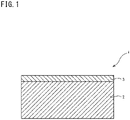
- FIG. 1 is a schematic cross-sectional view showing a sliding member 1 according to an embodiment of the present disclosure.
- the sliding member 1 in FIG. 1 has a plate shape.
- the sliding member 1 includes a plate-shaped sliding member body 2 having a one-side front surface (in FIG. 1 , the upper surface of the sliding member body 2) and an other-side back surface (in FIG. 1 , the lower surface of the sliding member body 2), and an outer layer 3 laminated directly on the one-side front surface of the sliding member body 2.
- the sliding member body 2 contains a metal as a main component.
- the metal include iron alloys such as stainless steel, nickel, aluminum, aluminum alloys, copper, and copper alloys.
- the metal among them, stainless steel or nickel is preferable since these metals have excellent malleability and heat resistance.
- the metal one of the metals may be used alone, or two or more of the metals may be used in combination.
- the shape of the sliding member body 2 is not particularly limited and can be appropriately changed according to the intended use.
- the shape is not limited to a plate shape, a cylindrical shape, a conical shape, an elliptical cone shape, a pyramidal shape, a gourd shape, an elliptical column shape, and a prism shape, and the shapes of various sliding parts such as a rotor can be adopted.
- the average thickness of the sliding member body 2 is not particularly limited and can be appropriately changed according to the intended use.
- the sliding surface of the sliding member body 2 does not have to be flat, and a pattern of grooves, dimples (recesses) or the like may be formed on the surface.
- the sliding member body 2 may have a through hole.
- the outer layer 3 is laminated directly on the surface of the sliding member body 2 and contains a crosslinked fluorine resin as a main component. Since the outer layer 3 contains the crosslinked fluorine resin as a main component, the outer layer 3 has excellent wear resistance.
- the outer layer 3 does not have to be laminated on the entire surface of the sliding member body 2, and may be laminated on at least the sliding surface of the sliding member body 2.
- the outer layer 3 may be laminated directly only on a part of the one-side front surface of the sliding member body 2, or may be laminated directly on the one-side front surface and the other-side back surface of the sliding member body 2.
- the outer layer may be laminated directly on the entirety of the outer peripheral surface of the sliding member body, or may be laminated directly only on a part of the outer peripheral surface of the sliding member body.
- the outer layer is a coating layer or is composed of a film.
- the outer layer is composed of a coating layer or a film, it is easy to control the roughness of the surface of the outer layer and the accuracy of the average thickness of the outer layer.
- the crosslinked fluorine resin is obtained by irradiating a fluorine resin with ionizing radiation.
- the "fluorine resin” refers to a resin obtained by substituting at least one hydrogen atom bonded to a carbon atom constituting the polymerization unit of a polymer chain with a fluorine atom or an organic group having a fluorine atom (hereinafter, also referred to as "fluorine atom-containing group").
- the fluorine atom-containing group is a group obtained by substituting at least one hydrogen atom in a linear or branched organic group with a fluorine atom, and examples of the fluorine atom-containing group include fluoroalkyl groups, fluoroalkoxy groups, and fluoropolyether groups.
- fluorine resin examples include polytetrafluoroethylene (PTFE), tetrafluoroethylene-perfluoroalkoxyethylene copolymer (PFA), tetrafluoroethylene-hexafluoropropylene copolymer (FEP), polyvinylidene fluoride (PVDF), tetrafluoroethylene-ethylene copolymer (ETFE), polychlorotrifluoroethylene (PCTFE), chlorotrifluoroethylene-ethylene copolymer (ECTFE), polyvinylfluoride (PVF), fluoroolefin-vinyl ether copolymer, vinylidene fluoride-ethylene tetrafluoride copolymer, and vinylidene fluoride-propylene hexafluoride copolymer.
- PTFE polytetrafluoroethylene
- PFA tetrafluoroethylene-perfluoroalkoxyethylene copolymer
- FEP tetrafluor
- fluorine resin among them, PTFE, PFA, and FEP are preferable, PFA and PTFE are more preferable, and from the viewpoint of wear resistance, chemical resistance, and heat resistance, PTFE is further preferable.
- fluorine resin one of the fluorine resins may be used alone, or two or more of the fluorine resins may be used in combination.
- the fluorine resin may contain a structural unit derived from another copolymerizable monomer as long as the effects of the present disclosure are not impaired.
- PTFE may contain a structural unit such as perfluoro(alkyl vinyl ether), hexafluoropropylene, (perfluoroalkyl)ethylene, and chlorotrifluoroethylene.
- the upper limit of the content ratio of the structural unit derived from the other copolymerizable monomer is, for example, 3% by mole with respect to all the structural units constituting the fluorine resin.
- the lower limit of the content of the crosslinked fluorine resin in the outer layer 3 is preferably 60% by mass, more preferably 85% by mass, and further preferably 98% by mass. In addition, the content of the crosslinked fluorine resin may be 100% by mass. If the content of the crosslinked fluorine resin is lower than the lower limit, the oil repellency of the sliding member 1 may be insufficient.
- the sliding member has excellent oil repellency and torque reduction effect.
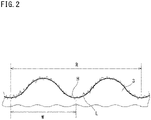
- FIG. 2 is a schematic diagram showing the surface of the outer layer 3 of the sliding member 1 according to the first embodiment.
- the specific measurement procedure for the arithmetic average roughness Ra1 of the high frequency surface will be described with reference to FIG.2 .
- "W" indicates frequency.
- the upper limit of an arithmetic average roughness Ra2 of the surface of the outer layer is 1.0 ⁇ m and more preferably 0.5 ⁇ m.
- the sliding member has further improved oil repellency and torque reduction effect.
- the arithmetic average roughness Ra2 of the surface of the outer layer one-dimensional waveform data of the surface of the outer layer over 100 ⁇ m is acquired using a confocal laser scanning microscope, and the arithmetic average roughness Ra2 of the surface of the outer layer is measured using the one-dimensional waveform data.
- the lower limit of the average thickness of the outer layer 3 is preferably 0.1 ⁇ m and more preferably 5 ⁇ m. Meanwhile, the upper limit of the average thickness is preferably 70.0 ⁇ m and more preferably 50.0 ⁇ m. If the average thickness is less than 0.1 ⁇ m, the scratch resistance when foreign matter is bitten may decrease. On the other hand, if the average thickness exceeds 70.0 ⁇ m, the elasticity of the sliding member 1 may decrease.
- the sliding member 1 is suitable for use as a sliding member for applications where contact with oil occurs, such as an oil pump and a compressor.
- the sliding member is suitable as a rotating body, and may be used in an oil pump. Since the sliding member has excellent oil repellency, when the sliding member is used as a sliding member for an oil pump in which the surface on which the outer layer is laminated is a sliding surface, a frictional force applied to the sliding surface is reduced, so that it is possible to provide a sliding member for an oil pump having an excellent torque reduction effect.
- a method for producing the sliding member includes a step of laminating an outer layer containing a fluorine resin as a main component, directly on a surface of a sliding member body containing a metal as a main component, and a step of irradiating the outer layer with ionizing radiation.
- an outer layer containing a fluorine resin as a main component is laminated directly on a surface of a sliding member body containing a metal as a main component.
- the laminating step is preferably performed by electrostatic coating using a paint containing a fluorine resin as a main component, by dip coating using a paint containing a fluorine resin as a main component, or by thermocompression bonding of a film containing a fluorine resin as a main component to the sliding member body.
- the laminating step by using electrostatic coating, dip coating, or thermocompression bonding of a film to the sliding member body, the arithmetic average roughness Ra1 of the high frequency waviness surface obtained by extracting a frequency component of a region having waviness having a frequency of not lower than 0.1 ⁇ m and not higher than 100.0 ⁇ m on the surface of the outer layer through fast Fourier transform processing, and performing inverse Fourier transform processing on data of a frequency component of a region having waviness having a frequency of not lower than 0.1 ⁇ m and not higher than 10.0 ⁇ m out of the extracted frequency component, can be more reliably controlled to be in a range of not greater than 0.035 ⁇ m.
- a sliding member having excellent oil repellency and torque reduction effect can be more efficiently produced without the need for a conventionally-performed step of polishing the surface of a crosslinked fluorine resin layer.
- a paint obtained by dispersing or dissolving a fluorine resin composition in a solvent is applied as the paint containing a fluorine resin as a main component, to the outer peripheral surface of the sliding member body.
- a mixed solution of water and an emulsifier, water and an alcohol, water and acetone, water, an alcohol, and acetone, or the like, which allows the fluorine resin to be efficiently dispersed therein, can be used.
- the lower limit of the solid content concentration of the paint is preferably 5% by mass, more preferably 25% by mass, and further preferably 40% by mass.
- the upper limit of the solid content concentration of the paint is preferably 60% by mass, more preferably 50% by mass, and further preferably 45% by mass.
- the lower limit of the viscosity of the paint is preferably 100 cP and more preferably 180 cP.
- the upper limit of the viscosity of the paint is preferably 800 cP and more preferably 400 cP.
- the viscosity of the paint is set to be in the above range, the coatability can be improved, and as a result, a coating film having few coating defects can be easily and reliably formed.
- the "viscosity” refers to a value measured according to JIS-K5600-2-2: 1999 "Testing methods for paints - Part 2: Characteristics and stability of paints - Section 2: Viscosity".
- the lower limit of the heating temperature of the film is preferably the melting point of the fluorine resin - 20°C, and more preferably the melting point.
- the upper limit of the heating temperature is preferably the melting point of the fluorine resin + 60°C, and more preferably the melting point + 30°C. If the heating temperature is less than the lower limit, the adhesion between the film and the sliding member body may be insufficient.
- the heating temperature exceeds the upper limit, the releasability from a mold with which compression bonding is performed deteriorates, and the fluorine resin is peeled off and transferred to the mold, so that the compression bonding surface does not become smooth in some cases.
- the upper limit of the pressure for pressing is preferably 50 MPa and more preferably 10 MPa.
- the lower limit of the pressure is preferably 10 kPa and more preferably 100 kPa. If the pressure is less than the lower limit, the adhesion between the film and the sliding member body may be insufficient. On the other hand, if the pressure exceeds the upper limit, the sliding member body or a pressing jig may be broken, or the facility cost may increase.
- the heating and pressing time can be, for example, not shorter than 5 minutes and not longer than 2 hours.
- the pressing time can be shortened by performing compression bonding using a high frequency welding machine while applying high frequency waves.
- the sliding member body is placed in a heating furnace and heated therein to bake the fluorine resin.
- the heating temperature when baking the fluorine resin layer can be, for example, not lower than 350°C and not higher than 450°C.
- the heating time when baking the coating film can be, for example, not shorter than 10 minutes and not longer than 60 minutes.
- the outer layer does not have to be laminated on the entire surface of the sliding member body, and may be laminated on at least the sliding surface of the sliding member body.
- the outer layer is irradiated with ionizing radiation.
- the fluorine resin can be crosslinked by the irradiating step.
- the outer layer is irradiated with ionizing radiation under a low oxygen atmosphere and at a temperature equal to or higher than the melting point of the fluorine resin.
- This step is preferably performed before the laminating step. By performing this step before the laminating step as described above, deterioration of the sliding member body due to irradiation with ionizing radiation can be suppressed.
- the heating temperature at the time of irradiation with ionizing radiation is, for example, not lower than 270°C when the fluorine resin is FEP (melting point: 270°C), not lower than 327°C when the fluorine resin is PTFE (melting point: 327°C), and not lower than 310°C when fluorine resin is PFA (melting point: not lower than 304°C and not higher than 310°C).
- the lower limit of the heating temperature is preferably a temperature higher than the melting point by 5°C and more preferably a temperature higher than the melting point by 10°C.
- the upper limit of the heating temperature is preferably a temperature higher than the melting point by 50°C and more preferably a temperature higher than the melting point by 30°C.
- the heating temperature can be appropriately changed according to the type of the fluorine resin, and the lower limit thereof is preferably 320°C and more preferably 330°C.
- the upper limit of the heating temperature is preferably 480°C and more preferably 350°C.
- the "melting point of the resin” refers to the melting point peak temperature measured by using a differential scanning calorimeter (DSC) according to JIS-K7121: 2012 "Testing Methods for Transition Temperatures of Plastics”.
- the upper limit of the oxygen concentration under the low oxygen atmosphere is preferably 100 ppm, more preferably 10 ppm, and further preferably 5 ppm. If the oxygen concentration exceeds the upper limit, the fluorine resin may be decomposed by irradiation with ionizing radiation.
- the ionizing radiation examples include ⁇ -rays, electron beams, X-rays, neutron rays, and high-energy ion rays, and electron beams are preferable.
- the lower limit of the irradiation dose of the ionizing radiation is preferably 10 kGy, more preferably 70 kGy, and further preferably 200 kGy.
- the upper limit of the irradiation dose is preferably 2,000 kGy, more preferably 1,200 kGy, and further preferably 400 kGy. If the irradiation dose is lower than the lower limit, the crosslinking reaction of the fluorine resin may not proceed sufficiently.
- the irradiation dose exceeds the upper limit, the main chain of the fluorine resin may be cleaved. Therefore, by setting the irradiation dose to be in the above range, it is possible to cause the crosslinking to sufficiently proceed while suppressing cleavage of the main chain of the fluorine resin.
- the acceleration voltage can be, for example, not less than 800 kV and not greater than 1,500 kV.
- the method for producing the sliding member in the outer layer, containing the crosslinked fluorine resin as a main component, of the sliding member to be used in oil, it is possible to control a fine roughness component (high frequency waviness) having a frequency of 0.1 ⁇ m to several tens of micrometers which exists on the surface having low frequency waviness while leaving the low frequency waviness on the surface of the outer layer.
- the need for the above polishing is eliminated by the step of laminating the outer layer in which the surface having the waveform has an arithmetic average roughness Ra1 of not greater than 0.035 ⁇ m.
- the sliding member obtained by the method for producing the sliding member has excellent oil repellency and torque reduction effect, since the arithmetic average roughness Ra1 of the surface having the waveform obtained by extracting a frequency component of a region having waviness having a frequency of not lower than 0.1 ⁇ m and not higher than 100.0 ⁇ m on the surface of the outer layer through fast Fourier transform processing, and performing inverse Fourier transform processing of data of a frequency component of a region having waviness having a frequency of not lower than 0.1 ⁇ m and not higher than 10.0 ⁇ m out of the extracted frequency component, is not greater than 0.035 ⁇ m. Therefore, with the method for producing the sliding member, it is possible to easily and reliably produce a sliding member having excellent oil repellency and torque reduction effect.
- a sliding member No. 1 having only a sliding member body was obtained in the same manner as the other test examples, except that an outer layer was not laminated on a sliding member body containing a metal as a main component.
- PFA powder ("MJ-103" of Chemours-Mitsui Fluoroproducts Co., Ltd., particle size: 30 ⁇ m) was coated on a stainless steel plate having an average thickness of 1 mm as a sliding member body. Next, the PFA was baked at 350°C for 20 minutes, and then, as the irradiating step described above, the PFA was heated to 330°C under a low oxygen atmosphere having an oxygen concentration of 5 volume ppm or less, and irradiated with electron beams from the outer surface side of the stainless steel plate by using an electron beam accelerator (manufactured by Nissin Electric Co., Ltd.). As the irradiation conditions, the acceleration voltage was set to 1000 kV, and the irradiation dose was set to 300 kGy.
- a one-side front surface of the crosslinked PTFE film was roughened by using sandpaper having a grit size of #400 ("Waterproof Paper” manufactured by Noritake Coated Abrasive Co., Ltd.) to adjust the surface roughness of the outer layer.
- a PTFE film was obtained.
- a fluorine resin film containing PTFE as a main component ("VALFLON Sheet" of VALQUA, LTD., average thickness 100 ⁇ m) on a stainless steel plate having an average thickness of 1 mm as a sliding member body was irradiated with electron beams at an acceleration voltage of 1000 kV and an irradiation dose of 300 kGy to place the obtained crosslinked PTFE on the stainless steel plate having an average thickness of 1 mm, and the crosslinked PTFE was heated at 350°C for 1 hour using a nitrogen furnace while being pressed at 100 kPa, to obtain a sliding member having the crosslinked PTFE laminated thereon.
- PTFE powder (“AD2CRER” manufactured by DAIKIN INDUSTRIES, LTD.) was electrostatically spray-coated on the earthed stainless steel plate having a thickness of 1 mm, a width of 50 mm, and a length of 80 mm and separated from the machine by 25 cm, at a coating voltage of 15 Kv (negative) and a discharge rate of about 0.03 g/min.
- the PTFE coating film was baked by heating at 380°C for 30 minutes in a thermostat bath to fuse the PTFE coating film to the stainless steel plate, thereby forming a fluorine resin layer.
- a laminate in which a fluorine resin layer having an average total thickness of 30 ⁇ m was laminated on the stainless steel plate was obtained. Then, the laminate was irradiated with electron beams under the same conditions as for No. 2.
- a stainless steel plate having an average thickness of 1 mm as a sliding member body was dipped in a paint containing PTFE as a main component, and pulled up at a speed of 5 mm/sec to be coated with the paint.
- the solid content concentration of the paint was 43% by mass, the viscosity of the paint was 500 cP, and "EK-3700C21R" manufactured by DAIKIN INDUSTRIES, LTD. was used as the paint.
- the PTFE coating film was baked by heating at 380°C for 30 minutes to fuse the PTFE coating film to the stainless steel plate, thereby forming a fluorine resin layer.
- a laminate in which a fluorine resin layer having an average total thickness of 30 ⁇ m was laminated on the stainless steel plate was obtained. Then, the laminate was irradiated with electron beams under the same conditions as for No. 2.
- the sliding members No. 1 to No. 11 were evaluated for arithmetic average roughness Ra1 of high frequency waviness surface, oil repellency, torque, and clearance.
- one-dimensional waveform data of the surface was obtained over 100 ⁇ m in a high accuracy and high definition mode using KEYENCE VK-X1000 microscope with a 150X lens, and the arithmetic average roughness Ra1 of the high frequency waviness surface was measured through fast Fourier transform processing and inverse Fourier transform processing on the one-dimensional waveform data.
- the arithmetic average roughnesses Ra1 of the high frequency waviness surfaces of the sliding members No. 1 to No. 11 were evaluated at the following three scales, and the sliding members evaluated as A or B were determined to be acceptable.
- the arithmetic average roughness Ra2 of the outer layer surface was measured based on the following procedure.
- One-dimensional waveform data of the outer layer surface was obtained over 100 ⁇ m in a high accuracy and high definition mode using KEYENCE VK-X1000 microscope with a 150X lens, and then the arithmetic average roughness Ra2 of the outer layer surface was measured using the one-dimensional waveform data.
- the sliding members No. 1 to No. 11 were evaluated for oil repellency according to the following procedure. 0.02 g of transmission oil was spread on the surface of the outer layer of each of the sliding members No. 1 to No. 11 with a brush in a circle having a diameter of about 10 mm. Then, the time (seconds) until the shape of an oil droplet became stable on the surface of the outer layer of the sliding member was measured. The shorter the time is, the better the oil repellency is.
- the oil repellency of the sliding members No. 1 to No. 11 was evaluated at the following three scales, and the sliding members evaluated as A or B were determined to be acceptable.
- torque [cN m] was measured according to the following procedure.
- An oil pump was produced using an oil pump rotor, for an oil pump, having the same configuration as in each example or comparative example, and a clearance [ ⁇ m] that is the distance between a casing and the oil pump rotor was measured according to the following procedure.
- the maximum clearance is 40 ⁇ m.
- the clearance is better when the clearance is more uniform and the range thereof is narrower.
- the oil repellency of sliding members No. 1 to No. 11 was evaluated in the following three stages, and the sliding members evaluated as A or B were determined to be acceptable.
- Table 1 shows the evaluation results of the wear test, the friction test, and the surface roughness for the sliding members No. 1 to No. 11. "-" in table 1 indicates not having the corresponding configuration.
- Test No. Outer layer Evaluation Outer layer configuration Form Laminating method Arithmetic average roughness Ra1 [ ⁇ m] of high frequency waviness surface of outer layer Arithmetic average roughness Ra2 [ ⁇ m] of outer layer surface Oil repellency [seconds] Torque [cN ⁇ m] Clearance 1 - - - - - No oil repellency 7.0 C 2 Crosslinked PFA Coating layer Powder coated and normally polished product C 0.102 0.343 C 11 2.0 C 3 Crosslinked PFA Coating layer Powder coated and precisely polished product C 0.042 0.190 C 8 1.5 B 4 Crosslinked PTFE Film Thermocompression bonding B 0.029 0.317 B 6 1.2 A 5 Crosslinked PTFE Film Thermocompression bonding A 0.019 0.091 A 2 0.7 A 6 Crosslinked PTFE Coating layer Electro
- the sliding member has excellent oil repellency and torque reduction effect.
- the arithmetic average roughness Ra1 of the surface having the waveform obtained by extracting a frequency component of a region having waviness having a frequency of not lower than 0.1 ⁇ m and not higher than 100.0 ⁇ m on the surface of the outer layer through fast Fourier transform processing, and performing inverse Fourier transform processing on data of a frequency component of a region having waviness having a frequency of not lower than 0.1 ⁇ m and not higher than 10.0 ⁇ m out of the extracted frequency component, can be reliably controlled to be in a range of not greater than 0.035 ⁇ m.
Landscapes
- Engineering & Computer Science (AREA)
- General Engineering & Computer Science (AREA)
- Chemical & Material Sciences (AREA)
- Mechanical Engineering (AREA)
- Materials Engineering (AREA)
- Organic Chemistry (AREA)
- Life Sciences & Earth Sciences (AREA)
- Wood Science & Technology (AREA)
- Manufacturing & Machinery (AREA)
- Health & Medical Sciences (AREA)
- Chemical Kinetics & Catalysis (AREA)
- Medicinal Chemistry (AREA)
- Polymers & Plastics (AREA)
- Laminated Bodies (AREA)
- Sliding-Contact Bearings (AREA)
- Application Of Or Painting With Fluid Materials (AREA)
Abstract
Description
- The present disclosure relates to a sliding member and a method for producing the same.
- A sliding member of a product used in oil such as an oil pump for feeding engine oil under pressure to various locations such as an engine interior in an internal combustion engine is required to have low adhesiveness, wear resistance, and heat resistance in oil. Crosslinked fluorine resin has been studied as a coating agent for a rotor that is a sliding portion of such an oil pump.
- For example, coating a base material, composed of a sliding member body, with a fluorine resin irradiated with ionizing radiation has been proposed (see PATENT LITERATURE 1).
- PATENT LITERATURE 1:
Japanese Laid-Open Patent Publication No. 2011-208802 - A sliding member according to an aspect of the present disclosure includes: a sliding member body containing a metal as a main component; and an outer layer laminated directly on a surface of the sliding member body and containing a crosslinked fluorine resin as a main component, and an arithmetic average roughness Ra1 of a surface having a waveform obtained by extracting a frequency component of a region having waviness having a frequency of not lower than 0.1 µm and not higher than 100.0 µm on a surface of the outer layer through fast Fourier transform processing, and performing inverse Fourier transform processing on data of a frequency component of a region having waviness having a frequency of not lower than 0.1 µm and not higher than 10.0 µm out of the extracted frequency component, is not greater than 0.035 µm.
- Moreover, a method for producing a sliding member according to another aspect of the present disclosure includes: a step of laminating an outer layer containing a fluorine resin as a main component, directly on a surface of a sliding member body containing a metal as a main component; and a step of irradiating the outer layer with ionizing radiation, and an arithmetic average roughness Ra1 of a surface having a waveform obtained by extracting a frequency component of a region having waviness having a frequency of not lower than 0.1 µm and not higher than 100.0 µm on a surface of the outer layer through fast Fourier transform processing, and performing inverse Fourier transform processing on data of a frequency component of a region having waviness having a frequency of not lower than 0.1 µm and not higher than 10.0 µm out of the extracted frequency component, is not greater than 0.05 µm.
-
-
FIG. 1 is a schematic transverse cross-sectional view showing a sliding member according to a first embodiment. -
FIG. 2 is a schematic diagram showing a surface of an outer layer of the sliding member according to the first embodiment. - For an oil pump, it is important to manage the clearance between components such as a rotor that is a sliding member, but it is difficult to control the accuracy of the film thickness of an outer layer that contains a crosslinked fluorine resin as a main component and that is an outer layer of the sliding member. As in
PATENT LITERATURE 1, in a coating method using a fluorine resin paint, since the accuracy of the film thickness is not sufficient, polishing is performed after an outer layer containing a crosslinked fluorine resin as a main component is formed. In this polishing, in order to set the accuracy of the film thickness of the outer layer, which contains the crosslinked fluorine resin as a main component, to be in a sufficient range, it is necessary to carefully perform polishing using polishing materials from a coarse grit size to a fine grit size of #3000 grit level. - When trying to improve the accuracy of the film thickness by light polishing, the contact angle of oil decreases due to the unevenness remaining on the surface of the outer layer which contains the crosslinked fluorine resin as a main component, and as a result, the oil repellency of the sliding member of the oil pump to the oil may decrease. Furthermore, if the oil repellency of the sliding member decreases, it is difficult to reduce the torque of the sliding member in the oil. On the other hand, if the grit size to be used is increased and excessive polishing is performed, the surface texture of the outer layer containing the crosslinked fluorine resin as a main component becomes smooth, thereby improving the oil repellency to some extent. However, the production efficiency may decrease due to increased processing time.
- The present disclosure has been made based on the above-described circumstances, and an object of the present disclosure is to provide a sliding member having excellent oil repellency and torque reduction effect.
- The sliding member according to an aspect of the present disclosure has excellent oil repellency and torque reduction effect.
- First, embodiments of the present disclosure will be listed and described.
- A sliding member according to an aspect of the present disclosure includes: a sliding member body containing a metal as a main component; and an outer layer laminated directly on a surface of the sliding member body and containing a crosslinked fluorine resin as a main component, and an arithmetic average roughness Ra1 of a surface having a waveform obtained by extracting a frequency component of a region having waviness having a frequency of not lower than 0.1 µm and not higher than 100.0 µm on a surface of the outer layer through fast Fourier transform processing, and performing inverse Fourier transform processing on data of a frequency component of a region having waviness having a frequency of not lower than 0.1 µm and not higher than 10.0 µm out of the extracted frequency component, is not greater than 0.035 µm.
- As a result of intensive studies for the above problem, the present inventor has obtained the following finding. Both the arithmetic average roughness Ra1 of the surface having the waveform and the arithmetic average roughness of the entire surface of the crosslinked fluorine resin coating film influence oil repellency and reduction of torque in oil. However, if the contribution of the arithmetic average roughness Ra1 of the surface having the waveform is dominant and the value of the arithmetic average roughness Ra1 of the surface having the waveform is low, even when the value of the arithmetic average roughness of the entire surface of the crosslinked fluorine resin coating film is high, a sufficient effect is achieved. As a preferable embodiment, it is found that the oil repellency and the torque reduction effect in the oil tend to be larger when both of the values of the arithmetic average roughness Ra1 of the surface having the waveform and the arithmetic average roughness of the entire surface of the crosslinked fluorine resin coating film are lower. Generally, the accuracy of the film thickness of the outer layer, containing the crosslinked fluorine resin as a main component, of the sliding member to be used in the oil refers to a film thickness deviation of large waviness of several millimeters to several tens of millimeters (low frequency waviness). However, it is found that a fine roughness component (hereinafter, also referred to as high frequency waviness) having a frequency of 0.1 µm to several tens of micrometers which exists on a surface having large waviness of several millimeters to several tens of millimeters (hereinafter, also referred to as low frequency waviness) actually involves the oil repellency of the outer layer containing the crosslinked fluorine resin as a main component. On the other hand, it is found that when, by polishing, the accuracy of the film thickness is corrected, that is, the above low frequency waviness is removed, the high frequency waviness is increased and the oil repellency is decreased. As a result of the above, the present inventor has found that in the outer layer, containing the crosslinked fluorine resin as a main component, of the sliding member to be used in the oil, it is necessary to control a fine roughness component (high frequency waviness) having a frequency of 0.1 µm to several tens of micrometers which exists on the surface having low frequency waviness while leaving the low frequency waviness on the surface of the outer layer containing the crosslinked fluorine resin as a main component. As described above, the sliding member has excellent oil repellency and torque reduction effect when the arithmetic average roughness Ra1 of a surface having a waveform (hereinafter, also referred to as "arithmetic average roughness Ra1 of a high frequency surface") obtained by extracting a frequency component of a region having waviness having a frequency of not lower than 0.1 µm and not higher than 100.0 µm on the surface of the outer layer through fast Fourier transform processing, and performing inverse Fourier transform processing on data of a frequency component of a region having waviness having a frequency of not lower than 0.1 µm and not higher than 10.0 µm out of the extracted frequency component, is not greater than 0.035 µm. As the mechanism by which the arithmetic average roughness Ra1 of the surface having the waveform reduces the oil repellency and the torque during sliding, the influence of the surface is considered. The arithmetic average roughness Ra1 defines the unevenness in a very fine region when viewed from the entire sliding surface, but is inferred to influence the affinity between the crosslinked fluorine resin and the oil. Therefore, it is considered that since the surface area is smaller when Ra1 is lower, it is difficult for the crosslinked fluorine resin and the oil to interact with each other, so that the torque is reduced.
- Here, the "waviness" refers to waveform data regarding waviness based on information regarding the unevenness of a sample surface obtained by using a confocal laser scanning microscope. The "main component" refers to a component having the highest content ratio in terms of mass, for example, a component having a content of not less than 60% by mass.
- In the sliding member, the arithmetic average roughness Ra1 of the surface having the waveform is preferably not greater than 0.025 µm. When the arithmetic average roughness Ra1 of the surface having the waveform is not greater than 0.025 µm as described above, the oil repellency and the torque reduction effect can be further enhanced.
- In the sliding member, the outer layer preferably has an average thickness of not less than 0.1 µm and not greater than 70.0 µm. When the average thickness of the outer layer is in the above range, the sliding member can improve the scratch resistance when foreign matter is bitten thereinto, while having good elasticity. As a result, the sliding member can be used as a sliding material that can withstand long-term use. Here, the "average thickness" means the average value of thicknesses measured at any ten points.
- Preferably, the outer layer is a coating layer or is composed of a film. When the outer layer is a coating layer or is composed of a film, it is easy to control the roughness of the surface of the outer layer and the accuracy of the average thickness of the outer layer. Here, the "average thickness" means the average value of thicknesses measured at any ten points.
- The sliding member may be used in an oil pump. Since the sliding member has excellent oil repellency, when the sliding member is used as a sliding member for an oil pump in which the surface on which the outer layer is laminated is a sliding surface, a frictional force applied to the sliding surface is reduced, so that it is possible to provide a sliding member for an oil pump having an excellent torque reduction effect.
- Moreover, a method for producing a sliding member according to another aspect of the present disclosure includes: a step of laminating an outer layer containing a fluorine resin as a main component, directly on a surface of a sliding member body containing a metal as a main component; and a step of irradiating the outer layer with ionizing radiation, and an arithmetic average roughness Ra1 of a surface having a waveform obtained by extracting a frequency component of a region having waviness having a frequency of not lower than 0.1 µm and not higher than 100.0 µm on a surface of the outer layer through fast Fourier transform processing, and performing inverse Fourier transform processing on data of a frequency component of a region having waviness having a frequency of not lower than 0.1 µm and not higher than 10.0 µm out of the extracted frequency component, is not greater than 0.05 µm.
- As described above, a fine roughness component (high frequency waviness) having a frequency of 0.1 µm to several tens of micrometers which exists on the surface having low frequency waviness which is large waviness of several millimeters to several tens of millimeters, actually involves the oil repellency of the outer layer containing the crosslinked fluorine resin as a main component. On the other hand, when, by polishing, the accuracy of the film thickness is corrected, that is, the above low frequency waviness is removed, the high frequency waviness is increased and the oil repellency is decreased. Therefore, in the method for producing the sliding member, in the outer layer, containing the crosslinked fluorine resin as a main component, of the sliding member to be used in oil, it is necessary to control a fine roughness component (high frequency waviness) having a frequency of 0.1 µm to several tens of micrometers which exists on the surface having low frequency waviness while leaving the low frequency waviness on the surface of the outer layer. In the method for producing the sliding member, the need for the above polishing is eliminated by the step of laminating the outer layer in which the high frequency surface has an arithmetic average roughness Ra1 of not greater than 0.035 µm. The sliding member obtained by the method for producing the sliding member has excellent oil repellency and torque reduction effect, since the arithmetic average roughness Ra1 of the high frequency surface obtained by extracting a frequency component of a region having waviness having a frequency of not lower than 0.1 µm and not higher than 100.0 µm on the surface of the outer layer through fast Fourier transform processing, and performing inverse Fourier transform processing of data of a frequency component of a region having waviness having a frequency of not lower than 0.1 µm and not higher than 10.0 µm out of the extracted frequency component, is not greater than 0.035 µm. Therefore, with the method for producing the sliding member, it is possible to easily and reliably produce a sliding member having excellent oil repellency and torque reduction effect.
- In the method for producing a sliding member, the laminating step is preferably performed by electrostatic coating using a paint containing a fluorine resin as a main component, by dip coating using a paint containing a fluorine resin as a main component, or by thermocompression bonding of a film containing a fluorine resin as a main component to the sliding member body. In the laminating step, by using electrostatic coating, dip coating, or thermocompression bonding of a film to the sliding member body, the arithmetic average roughness Ra1 of the high frequency surface obtained by extracting a frequency component of a region having waviness having a frequency of not lower than 0.1 µm and not higher than 100.0 µm on the surface of the outer layer through fast Fourier transform processing, and performing inverse Fourier transform processing on data of a frequency component of a region having waviness having a frequency of not lower than 0.1 µm and not higher than 10.0 µm out of the extracted frequency component, can be more reliably controlled to be in a range of not greater than 0.035 µm. In addition, a sliding member having excellent oil repellency and torque reduction effect can be efficiently produced without the need for a conventionally-performed step of polishing the surface of a crosslinked fluorine resin layer.
- Hereinafter, a sliding member according to an embodiment of the present disclosure will be described in detail with reference to the drawings.
- A sliding member according to an embodiment of the present disclosure includes a sliding member body containing a metal as a main component, and an outer layer laminated directly on a surface of the sliding member body and containing a crosslinked fluorine resin as a main component.
FIG. 1 is a schematic cross-sectional view showing a slidingmember 1 according to an embodiment of the present disclosure. The slidingmember 1 inFIG. 1 has a plate shape. The slidingmember 1 includes a plate-shaped slidingmember body 2 having a one-side front surface (inFIG. 1 , the upper surface of the sliding member body 2) and an other-side back surface (inFIG. 1 , the lower surface of the sliding member body 2), and anouter layer 3 laminated directly on the one-side front surface of the slidingmember body 2. - The sliding
member body 2 contains a metal as a main component. Examples of the metal include iron alloys such as stainless steel, nickel, aluminum, aluminum alloys, copper, and copper alloys. As the metal, among them, stainless steel or nickel is preferable since these metals have excellent malleability and heat resistance. As the metal, one of the metals may be used alone, or two or more of the metals may be used in combination. - The shape of the sliding
member body 2 is not particularly limited and can be appropriately changed according to the intended use. For example, the shape is not limited to a plate shape, a cylindrical shape, a conical shape, an elliptical cone shape, a pyramidal shape, a gourd shape, an elliptical column shape, and a prism shape, and the shapes of various sliding parts such as a rotor can be adopted. - The average thickness of the sliding
member body 2 is not particularly limited and can be appropriately changed according to the intended use. In addition, the sliding surface of the slidingmember body 2 does not have to be flat, and a pattern of grooves, dimples (recesses) or the like may be formed on the surface. Moreover, the slidingmember body 2 may have a through hole. - The
outer layer 3 is laminated directly on the surface of the slidingmember body 2 and contains a crosslinked fluorine resin as a main component. Since theouter layer 3 contains the crosslinked fluorine resin as a main component, theouter layer 3 has excellent wear resistance. - The
outer layer 3 does not have to be laminated on the entire surface of the slidingmember body 2, and may be laminated on at least the sliding surface of the slidingmember body 2. For example, in the case where the slidingmember body 2 has a plate shape as shown inFIG. 1 , theouter layer 3 may be laminated directly only on a part of the one-side front surface of the slidingmember body 2, or may be laminated directly on the one-side front surface and the other-side back surface of the slidingmember body 2. Furthermore, in the case where the sliding member body has a cylindrical shape, the outer layer may be laminated directly on the entirety of the outer peripheral surface of the sliding member body, or may be laminated directly only on a part of the outer peripheral surface of the sliding member body. - Preferably, the outer layer is a coating layer or is composed of a film. When the outer layer is composed of a coating layer or a film, it is easy to control the roughness of the surface of the outer layer and the accuracy of the average thickness of the outer layer.
- The crosslinked fluorine resin is obtained by irradiating a fluorine resin with ionizing radiation. Here, the "fluorine resin" refers to a resin obtained by substituting at least one hydrogen atom bonded to a carbon atom constituting the polymerization unit of a polymer chain with a fluorine atom or an organic group having a fluorine atom (hereinafter, also referred to as "fluorine atom-containing group"). The fluorine atom-containing group is a group obtained by substituting at least one hydrogen atom in a linear or branched organic group with a fluorine atom, and examples of the fluorine atom-containing group include fluoroalkyl groups, fluoroalkoxy groups, and fluoropolyether groups.
- Examples of the fluorine resin include polytetrafluoroethylene (PTFE), tetrafluoroethylene-perfluoroalkoxyethylene copolymer (PFA), tetrafluoroethylene-hexafluoropropylene copolymer (FEP), polyvinylidene fluoride (PVDF), tetrafluoroethylene-ethylene copolymer (ETFE), polychlorotrifluoroethylene (PCTFE), chlorotrifluoroethylene-ethylene copolymer (ECTFE), polyvinylfluoride (PVF), fluoroolefin-vinyl ether copolymer, vinylidene fluoride-ethylene tetrafluoride copolymer, and vinylidene fluoride-propylene hexafluoride copolymer. As the fluorine resin, among them, PTFE, PFA, and FEP are preferable, PFA and PTFE are more preferable, and from the viewpoint of wear resistance, chemical resistance, and heat resistance, PTFE is further preferable. As the fluorine resin, one of the fluorine resins may be used alone, or two or more of the fluorine resins may be used in combination.
- The fluorine resin may contain a structural unit derived from another copolymerizable monomer as long as the effects of the present disclosure are not impaired. For example, PTFE may contain a structural unit such as perfluoro(alkyl vinyl ether), hexafluoropropylene, (perfluoroalkyl)ethylene, and chlorotrifluoroethylene. The upper limit of the content ratio of the structural unit derived from the other copolymerizable monomer is, for example, 3% by mole with respect to all the structural units constituting the fluorine resin.
- The lower limit of the content of the crosslinked fluorine resin in the
outer layer 3 is preferably 60% by mass, more preferably 85% by mass, and further preferably 98% by mass. In addition, the content of the crosslinked fluorine resin may be 100% by mass. If the content of the crosslinked fluorine resin is lower than the lower limit, the oil repellency of the slidingmember 1 may be insufficient. - The upper limit of an arithmetic average roughness Ra1 of a high frequency surface obtained by extracting a frequency component of a region (low frequency waviness) having waviness having a frequency of not lower than 0.1 µm and not higher than 100.0 µm on the surface of the outer layer through fast Fourier transform processing, and performing inverse Fourier transform processing on data of a frequency component of a region (high frequency waviness) having waviness having a frequency of not lower than 0.1 µm and not higher than 10.0 µm out of the extracted frequency component, is 0.035 µm and more preferably 0.025 µm. When the arithmetic average roughness Ra1 of the high frequency surface is in the above range, the sliding member has excellent oil repellency and torque reduction effect.
-
FIG. 2 is a schematic diagram showing the surface of theouter layer 3 of the slidingmember 1 according to the first embodiment. The specific measurement procedure for the arithmetic average roughness Ra1 of the high frequency surface will be described with reference toFIG.2 . InFIG. 2 , "W" indicates frequency. - (1) First, a frequency component of a region having waviness having a frequency of not lower than 0.1 µm and not higher than 100.0 µm on the surface of the
outer layer 3 as a sample is extracted through fast Fourier transform processing. Specifically, a frequency component of a region having waviness having a frequency of not lower than 0.1 µm and not higher than 100.0 µm (low frequency waviness: L inFIG. 2 ) is extracted by performing fast Fourier transform processing on data at 2000 plot points every 0.05 µm with a range between any two points (R inFIG. 2 ) at an interval of 100 µm on the surface of theouter layer 3 as an evaluation range, using a confocal laser scanning microscope. - (2) A waveform is generated by synthesizing data of a frequency component of a region having waviness having a frequency of not lower than 0.1 µm and not higher than 10.0 µm (high frequency waviness: H in
FIG. 2 ) out of the extracted frequency component through inverse Fourier transform processing. - (3) The arithmetic average roughness Ra1 of a surface having the generated waveform is obtained.
- The upper limit of an arithmetic average roughness Ra2 of the surface of the outer layer is 1.0 µm and more preferably 0.5 µm. When the arithmetic average roughness Ra2 of the surface of the outer layer is in the above range, the sliding member has further improved oil repellency and torque reduction effect. As for the arithmetic average roughness Ra2 of the surface of the outer layer, one-dimensional waveform data of the surface of the outer layer over 100 µm is acquired using a confocal laser scanning microscope, and the arithmetic average roughness Ra2 of the surface of the outer layer is measured using the one-dimensional waveform data.
- The lower limit of the average thickness of the
outer layer 3 is preferably 0.1 µm and more preferably 5 µm. Meanwhile, the upper limit of the average thickness is preferably 70.0 µm and more preferably 50.0 µm. If the average thickness is less than 0.1 µm, the scratch resistance when foreign matter is bitten may decrease. On the other hand, if the average thickness exceeds 70.0 µm, the elasticity of the slidingmember 1 may decrease. - This sliding member has excellent oil repellency and torque reduction effect. Therefore, the sliding
member 1 is suitable for use as a sliding member for applications where contact with oil occurs, such as an oil pump and a compressor. In particular, the sliding member is suitable as a rotating body, and may be used in an oil pump. Since the sliding member has excellent oil repellency, when the sliding member is used as a sliding member for an oil pump in which the surface on which the outer layer is laminated is a sliding surface, a frictional force applied to the sliding surface is reduced, so that it is possible to provide a sliding member for an oil pump having an excellent torque reduction effect. - A method for producing the sliding member includes a step of laminating an outer layer containing a fluorine resin as a main component, directly on a surface of a sliding member body containing a metal as a main component, and a step of irradiating the outer layer with ionizing radiation.
- In this step, an outer layer containing a fluorine resin as a main component is laminated directly on a surface of a sliding member body containing a metal as a main component.
- The laminating step is preferably performed by electrostatic coating using a paint containing a fluorine resin as a main component, by dip coating using a paint containing a fluorine resin as a main component, or by thermocompression bonding of a film containing a fluorine resin as a main component to the sliding member body. As described above, in order to improve the oil repellency and the torque reduction effect of the outer layer, containing the crosslinked fluorine resin as a main component, of the sliding member to be used in oil, it is necessary to control a fine roughness component (high frequency waviness) having a frequency of 0.1 µm to several tens of micrometers which exists on a surface having low frequency waviness while leaving the low frequency waviness on the surface of the outer layer. In the laminating step, by using electrostatic coating, dip coating, or thermocompression bonding of a film to the sliding member body, the arithmetic average roughness Ra1 of the high frequency waviness surface obtained by extracting a frequency component of a region having waviness having a frequency of not lower than 0.1 µm and not higher than 100.0 µm on the surface of the outer layer through fast Fourier transform processing, and performing inverse Fourier transform processing on data of a frequency component of a region having waviness having a frequency of not lower than 0.1 µm and not higher than 10.0 µm out of the extracted frequency component, can be more reliably controlled to be in a range of not greater than 0.035 µm. In addition, a sliding member having excellent oil repellency and torque reduction effect can be more efficiently produced without the need for a conventionally-performed step of polishing the surface of a crosslinked fluorine resin layer.
- In the case of performing electrostatic coating using a paint containing a fluorine resin as a main component or dip coating using a paint containing a fluorine resin as a main component, a paint obtained by dispersing or dissolving a fluorine resin composition in a solvent is applied as the paint containing a fluorine resin as a main component, to the outer peripheral surface of the sliding member body. As the solvent, a mixed solution of water and an emulsifier, water and an alcohol, water and acetone, water, an alcohol, and acetone, or the like, which allows the fluorine resin to be efficiently dispersed therein, can be used.
- The lower limit of the solid content concentration of the paint is preferably 5% by mass, more preferably 25% by mass, and further preferably 40% by mass. Meanwhile, the upper limit of the solid content concentration of the paint is preferably 60% by mass, more preferably 50% by mass, and further preferably 45% by mass. When the solid content concentration of the paint is set to be in the above range, the coatability can be improved, and as a result, a coating film having few coating defects can be easily and reliably formed.
- The lower limit of the viscosity of the paint is preferably 100 cP and more preferably 180 cP. Meanwhile, the upper limit of the viscosity of the paint is preferably 800 cP and more preferably 400 cP. When the viscosity of the paint is set to be in the above range, the coatability can be improved, and as a result, a coating film having few coating defects can be easily and reliably formed. Here, the "viscosity" refers to a value measured according to JIS-K5600-2-2: 1999 "Testing methods for paints - Part 2: Characteristics and stability of paints - Section 2: Viscosity".
- In the case of performing thermocompression bonding of a film to the sliding member body in the above laminating step, the lower limit of the heating temperature of the film is preferably the melting point of the fluorine resin - 20°C, and more preferably the melting point. Meanwhile, the upper limit of the heating temperature is preferably the melting point of the fluorine resin + 60°C, and more preferably the melting point + 30°C. If the heating temperature is less than the lower limit, the adhesion between the film and the sliding member body may be insufficient. On the other hand, if the heating temperature exceeds the upper limit, the releasability from a mold with which compression bonding is performed deteriorates, and the fluorine resin is peeled off and transferred to the mold, so that the compression bonding surface does not become smooth in some cases.
- In the case of performing thermocompression bonding of a film to the sliding member body, the upper limit of the pressure for pressing is preferably 50 MPa and more preferably 10 MPa. Meanwhile, the lower limit of the pressure is preferably 10 kPa and more preferably 100 kPa. If the pressure is less than the lower limit, the adhesion between the film and the sliding member body may be insufficient. On the other hand, if the pressure exceeds the upper limit, the sliding member body or a pressing jig may be broken, or the facility cost may increase.
- In the case of performing thermocompression bonding of a film to the sliding member body, the heating and pressing time can be, for example, not shorter than 5 minutes and not longer than 2 hours. In addition, the pressing time can be shortened by performing compression bonding using a high frequency welding machine while applying high frequency waves.
- After the above electrostatic coating, dip coating, or thermocompression bonding of a film is performed, the sliding member body is placed in a heating furnace and heated therein to bake the fluorine resin. By the baking, the solvent in the paint can be vaporized. The heating temperature when baking the fluorine resin layer can be, for example, not lower than 350°C and not higher than 450°C. In addition, the heating time when baking the coating film can be, for example, not shorter than 10 minutes and not longer than 60 minutes. When the heating temperature and the heating time are set to be in the above ranges, it is possible to form a film having excellent denseness while suppressing decomposition of the fluorine resin. Then, the sintered layer is cooled, whereby the outer layer is laminated on the surface of the sliding member body.
- As described above, the outer layer does not have to be laminated on the entire surface of the sliding member body, and may be laminated on at least the sliding surface of the sliding member body.
- In this step, the outer layer is irradiated with ionizing radiation. The fluorine resin can be crosslinked by the irradiating step. In this step, the outer layer is irradiated with ionizing radiation under a low oxygen atmosphere and at a temperature equal to or higher than the melting point of the fluorine resin. This step is preferably performed before the laminating step. By performing this step before the laminating step as described above, deterioration of the sliding member body due to irradiation with ionizing radiation can be suppressed.
- The heating temperature at the time of irradiation with ionizing radiation is, for example, not lower than 270°C when the fluorine resin is FEP (melting point: 270°C), not lower than 327°C when the fluorine resin is PTFE (melting point: 327°C), and not lower than 310°C when fluorine resin is PFA (melting point: not lower than 304°C and not higher than 310°C).
- The lower limit of the heating temperature is preferably a temperature higher than the melting point by 5°C and more preferably a temperature higher than the melting point by 10°C. Meanwhile, the upper limit of the heating temperature is preferably a temperature higher than the melting point by 50°C and more preferably a temperature higher than the melting point by 30°C. In addition, specifically, the heating temperature can be appropriately changed according to the type of the fluorine resin, and the lower limit thereof is preferably 320°C and more preferably 330°C. Meanwhile, the upper limit of the heating temperature is preferably 480°C and more preferably 350°C. By irradiation with ionizing radiation at the above heating temperature, it is possible to promote crosslinking between molecules while suppressing cleavage of the main chain of the fluorine resin. When the heating temperature exceeds the upper limit, the fluorine resin may be decomposed. Here, the "melting point of the resin" refers to the melting point peak temperature measured by using a differential scanning calorimeter (DSC) according to JIS-K7121: 2012 "Testing Methods for Transition Temperatures of Plastics".
- The upper limit of the oxygen concentration under the low oxygen atmosphere is preferably 100 ppm, more preferably 10 ppm, and further preferably 5 ppm. If the oxygen concentration exceeds the upper limit, the fluorine resin may be decomposed by irradiation with ionizing radiation.
- Examples of the ionizing radiation include γ-rays, electron beams, X-rays, neutron rays, and high-energy ion rays, and electron beams are preferable. In addition, the lower limit of the irradiation dose of the ionizing radiation is preferably 10 kGy, more preferably 70 kGy, and further preferably 200 kGy. Meanwhile, the upper limit of the irradiation dose is preferably 2,000 kGy, more preferably 1,200 kGy, and further preferably 400 kGy. If the irradiation dose is lower than the lower limit, the crosslinking reaction of the fluorine resin may not proceed sufficiently. On the other hand, if the irradiation dose exceeds the upper limit, the main chain of the fluorine resin may be cleaved. Therefore, by setting the irradiation dose to be in the above range, it is possible to cause the crosslinking to sufficiently proceed while suppressing cleavage of the main chain of the fluorine resin. The acceleration voltage can be, for example, not less than 800 kV and not greater than 1,500 kV.
- In the method for producing the sliding member, in the outer layer, containing the crosslinked fluorine resin as a main component, of the sliding member to be used in oil, it is possible to control a fine roughness component (high frequency waviness) having a frequency of 0.1 µm to several tens of micrometers which exists on the surface having low frequency waviness while leaving the low frequency waviness on the surface of the outer layer. In the method for producing the sliding member, the need for the above polishing is eliminated by the step of laminating the outer layer in which the surface having the waveform has an arithmetic average roughness Ra1 of not greater than 0.035 µm. The sliding member obtained by the method for producing the sliding member has excellent oil repellency and torque reduction effect, since the arithmetic average roughness Ra1 of the surface having the waveform obtained by extracting a frequency component of a region having waviness having a frequency of not lower than 0.1 µm and not higher than 100.0 µm on the surface of the outer layer through fast Fourier transform processing, and performing inverse Fourier transform processing of data of a frequency component of a region having waviness having a frequency of not lower than 0.1 µm and not higher than 10.0 µm out of the extracted frequency component, is not greater than 0.035 µm. Therefore, with the method for producing the sliding member, it is possible to easily and reliably produce a sliding member having excellent oil repellency and torque reduction effect.
- The embodiments disclosed herein are illustrative in all aspects and should not be recognized as being restrictive. The scope of the present disclosure is not limited to the configuration of the above embodiment, but is defined by the scope of the claims and is intended to include meaning equivalent to the scope of the claims and all modifications within the scope.
- Hereinafter, the present invention will be more specifically described by means of examples, but the present invention is not limited to the examples below.
- A sliding member No. 1 having only a sliding member body was obtained in the same manner as the other test examples, except that an outer layer was not laminated on a sliding member body containing a metal as a main component.
- PFA powder ("MJ-103" of Chemours-Mitsui Fluoroproducts Co., Ltd., particle size: 30 µm) was coated on a stainless steel plate having an average thickness of 1 mm as a sliding member body. Next, the PFA was baked at 350°C for 20 minutes, and then, as the irradiating step described above, the PFA was heated to 330°C under a low oxygen atmosphere having an oxygen concentration of 5 volume ppm or less, and irradiated with electron beams from the outer surface side of the stainless steel plate by using an electron beam accelerator (manufactured by Nissin Electric Co., Ltd.). As the irradiation conditions, the acceleration voltage was set to 1000 kV, and the irradiation dose was set to 300 kGy.
- A one-side front surface of the crosslinked PTFE film was roughened by using sandpaper having a grit size of #400 ("Waterproof Paper" manufactured by Noritake Coated Abrasive Co., Ltd.) to adjust the surface roughness of the outer layer. A PTFE film was obtained.
- A fluorine resin film containing PTFE as a main component ("VALFLON Sheet" of VALQUA, LTD., average thickness 100 µm) on a stainless steel plate having an average thickness of 1 mm as a sliding member body was irradiated with electron beams at an acceleration voltage of 1000 kV and an irradiation dose of 300 kGy to place the obtained crosslinked PTFE on the stainless steel plate having an average thickness of 1 mm, and the crosslinked PTFE was heated at 350°C for 1 hour using a nitrogen furnace while being pressed at 100 kPa, to obtain a sliding member having the crosslinked PTFE laminated thereon.
- Using an electrostatic coating machine (PDR-12 model manufactured by Nagase Techno Engineering Co., Ltd.) for a one-side front surface of a stainless steel plate having an average thickness of 1000 µm, PTFE powder ("AD2CRER" manufactured by DAIKIN INDUSTRIES, LTD.) was electrostatically spray-coated on the earthed stainless steel plate having a thickness of 1 mm, a width of 50 mm, and a length of 80 mm and separated from the machine by 25 cm, at a coating voltage of 15 Kv (negative) and a discharge rate of about 0.03 g/min. Next, the PTFE coating film was baked by heating at 380°C for 30 minutes in a thermostat bath to fuse the PTFE coating film to the stainless steel plate, thereby forming a fluorine resin layer. A laminate in which a fluorine resin layer having an average total thickness of 30 µm was laminated on the stainless steel plate was obtained. Then, the laminate was irradiated with electron beams under the same conditions as for No. 2.
- A stainless steel plate having an average thickness of 1 mm as a sliding member body was dipped in a paint containing PTFE as a main component, and pulled up at a speed of 5 mm/sec to be coated with the paint. The solid content concentration of the paint was 43% by mass, the viscosity of the paint was 500 cP, and "EK-3700C21R" manufactured by DAIKIN INDUSTRIES, LTD. was used as the paint. Then, the PTFE coating film was baked by heating at 380°C for 30 minutes to fuse the PTFE coating film to the stainless steel plate, thereby forming a fluorine resin layer. A laminate in which a fluorine resin layer having an average total thickness of 30 µm was laminated on the stainless steel plate was obtained. Then, the laminate was irradiated with electron beams under the same conditions as for No. 2.
- Next, the sliding members No. 1 to No. 11 were evaluated for arithmetic average roughness Ra1 of high frequency waviness surface, oil repellency, torque, and clearance.
- As for the arithmetic average roughness Ra1 of a high frequency waviness surface, one-dimensional waveform data of the surface was obtained over 100 µm in a high accuracy and high definition mode using KEYENCE VK-X1000 microscope with a 150X lens, and the arithmetic average roughness Ra1 of the high frequency waviness surface was measured through fast Fourier transform processing and inverse Fourier transform processing on the one-dimensional waveform data.
- The arithmetic average roughnesses Ra1 of the high frequency waviness surfaces of the sliding members No. 1 to No. 11 were evaluated at the following three scales, and the sliding members evaluated as A or B were determined to be acceptable.
- A: Ra1 is not greater than 0.04.
- B: Ra1 is greater than 0.04 and not greater than 0.06.
- C: Ra1 is greater than 0.06.
- The arithmetic average roughness Ra2 of the outer layer surface was measured based on the following procedure.
- One-dimensional waveform data of the outer layer surface was obtained over 100 µm in a high accuracy and high definition mode using KEYENCE VK-X1000 microscope with a 150X lens, and then the arithmetic average roughness Ra2 of the outer layer surface was measured using the one-dimensional waveform data.
- The sliding members No. 1 to No. 11 were evaluated for oil repellency according to the following procedure. 0.02 g of transmission oil was spread on the surface of the outer layer of each of the sliding members No. 1 to No. 11 with a brush in a circle having a diameter of about 10 mm. Then, the time (seconds) until the shape of an oil droplet became stable on the surface of the outer layer of the sliding member was measured. The shorter the time is, the better the oil repellency is. The oil repellency of the sliding members No. 1 to No. 11 was evaluated at the following three scales, and the sliding members evaluated as A or B were determined to be acceptable.
- A: 3 seconds or shorter
- B: 6 seconds or shorter
- C: 8 seconds or longer (equivalent to conventional products)
- For a sliding member for an oil pump, torque [cN m] was measured according to the following procedure.
- The oil pomp of a commercially available car, Honda VEZEL, was disassembled, and an oil pump rotor coated with a crosslinked fluorine was placed on a casing with the casing located below the oil pump rotor, and was fixed such that the shaft of the oil pump rotor was vertically directed upward. 0.01 g of transmission oil was weighed, added between the casing and the oil pump rotor, and spread over the entire circumference by manually rotating the rotor by 5 turns. Then, TOHNICHI torque driver FTD5CN-S model was connected to the shaft of the oil pump rotor, and rotated at a speed of 10 rpm, and the torque was measured when the oil pump rotor was rotated by one turn through the torque driver.
- An oil pump was produced using an oil pump rotor, for an oil pump, having the same configuration as in each example or comparative example, and a clearance [µm] that is the distance between a casing and the oil pump rotor was measured according to the following procedure. The maximum clearance is 40 µm. The clearance is better when the clearance is more uniform and the range thereof is narrower. The oil repellency of sliding members No. 1 to No. 11 was evaluated in the following three stages, and the sliding members evaluated as A or B were determined to be acceptable.
- A: Clearance is in a range of not greater than 10 µm.
- B: Clearance is in a range of greater than 10 µm and not greater than 20 µm.
- C: Clearance is in a range of greater than 20 µm and not greater than 40 µm.
- Table 1 shows the evaluation results of the wear test, the friction test, and the surface roughness for the sliding members No. 1 to No. 11. "-" in table 1 indicates not having the corresponding configuration.
[Table 1] Test No. Outer layer Evaluation Outer layer configuration Form Laminating method Arithmetic average roughness Ra1 [µm] of high frequency waviness surface of outer layer Arithmetic average roughness Ra2 [µm] of outer layer surface Oil repellency [seconds] Torque [cN·m] Clearance 1 - - - - - No oil repellency 7.0 C 2 Crosslinked PFA Coating layer Powder coated and normally polished product C 0.102 0.343 C 11 2.0 C 3 Crosslinked PFA Coating layer Powder coated and precisely polished product C 0.042 0.190 C 8 1.5 B 4 Crosslinked PTFE Film Thermocompression bonding B 0.029 0.317 B 6 1.2 A 5 Crosslinked PTFE Film Thermocompression bonding A 0.019 0.091 A 2 0.7 A 6 Crosslinked PTFE Coating layer Electrostatic coating A 0.024 0.170 A 3 0.8 A 7 Crosslinked PTFE Coating layer Dip coating A 0.011 0.035 A 3 0.8 A 8 Crosslinked PFA Coating layer Powder coated and precisely polished product C 0.051 0.413 C 9 1.5 C 9 Crosslinked PTFE Film Thermocompression bonding B 0.028 0.221 B 6 1.2 A 10 Crosslinked PTFE Film Thermocompression bonding A 0.021 0.131 A 2 0.7 A 11 Crosslinked PTFE Coating layer Electrostatic coating B 0.034 0.289 B 6 1.2 A - As shown in Table 1, for the sliding members No. 4 to No. 7 and No. 9 to No. 11 in each of which the arithmetic average roughness Ra1 of the surface having the waveform obtained through fast Fourier transform processing and inverse Fourier transform processing on the region having waviness having a frequency of not lower than 0.1 µm and not higher than 10.0 µm on the surface of the outer layer is not greater than 0.035 µm, good results were obtained in all of oil repellency, torque, and clearance. In particular, the sliding members No. 5 to No. 7 and No. 10 in each of which the arithmetic average roughness Ra1 of the surface having the waveform is not greater than 0.025 µm were excellent in these evaluations. On the other hand, the sliding members No. 2, No. 3, and No. 8 in each of which the arithmetic average roughness Ra1 of the surface having the waveform exceeds 0.035 µm were inferior in each of oil repellency, torque, and clearance even though the arithmetic average roughness Ra of the entire surface of the outer layer was in a relatively small range of not greater than 0.5 µm, since the arithmetic average roughness Ra1 of the high frequency surface exceeded 0.035 µm.
- From the above, it is shown that the sliding member has excellent oil repellency and torque reduction effect.
- Moreover, from the results of the sliding members No. 4 to No. 7 and No. 9 to No. 11, it is shown that, in the method for producing a sliding member, by using electrostatic coating, dip coating, or thermocompression bonding of a film to the sliding member body in the laminating step, the arithmetic average roughness Ra1 of the surface having the waveform obtained by extracting a frequency component of a region having waviness having a frequency of not lower than 0.1 µm and not higher than 100.0 µm on the surface of the outer layer through fast Fourier transform processing, and performing inverse Fourier transform processing on data of a frequency component of a region having waviness having a frequency of not lower than 0.1 µm and not higher than 10.0 µm out of the extracted frequency component, can be reliably controlled to be in a range of not greater than 0.035 µm.
-
- 1
- sliding member
- 2
- sliding member body
- 3
- outer layer
- H
- high frequency waviness
- L
- low frequency waviness
- R
- evaluation range
- W
- frequency
Claims (7)
- A sliding member comprising:a sliding member body containing a metal as a main component; andan outer layer laminated directly on a surface of the sliding member body and containing a crosslinked fluorine resin as a main component, whereinan arithmetic average roughness Ra1 of a surface having a waveform obtained by extracting a frequency component of a region having waviness having a frequency of not lower than 0.1 µm and not higher than 100.0 µm on a surface of the outer layer through fast Fourier transform processing, and performing inverse Fourier transform processing on data of a frequency component of a region having waviness having a frequency of not lower than 0.1 µm and not higher than 10.0 µm out of the extracted frequency component, is not greater than 0.035 µm.
- The sliding member according to claim 1, wherein the arithmetic average roughness Ra1 of the surface having the waveform is not greater than 0.025 µm.
- The sliding member according to claim 1 or 2, wherein the outer layer has an average thickness of not less than 0.1 µm and not greater than 70.0 µm.
- The sliding member according to any one of claims 1 to 3, wherein the outer layer is a coating layer or is composed of a film.
- The sliding member according to any one of claims 1 to 4, wherein the sliding member is used in an oil pump.
- A method for producing a sliding member comprising:a step of laminating an outer layer containing a fluorine resin as a main component, directly on a surface of a sliding member body containing a metal as a main component; anda step of irradiating the outer layer with ionizing radiation, whereinan arithmetic average roughness Ra1 of a surface having a waveform obtained by extracting a frequency component of a region having waviness having a frequency of not lower than 0.1 µm and not higher than 100.0 µm on a surface of the outer layer through fast Fourier transform processing, and performing inverse Fourier transform processing on data of a frequency component of a region having waviness having a frequency of not lower than 0.1 µm and not higher than 10.0 µm out of the extracted frequency component, is not greater than 0.05 µm.
- The method for producing a sliding member according to claim 6, wherein the laminating step is performed by electrostatic coating using a paint containing a fluorine resin as a main component, by dip coating using a paint containing a fluorine resin as a main component, or by thermocompression bonding of a film containing a fluorine resin as a main component to the sliding member body.
Applications Claiming Priority (2)
| Application Number | Priority Date | Filing Date | Title |
|---|---|---|---|
| JP2019224925 | 2019-12-12 | ||
| PCT/JP2020/028337 WO2021117287A1 (en) | 2019-12-12 | 2020-07-21 | Sliding member and method for producing same |
Publications (3)
| Publication Number | Publication Date |
|---|---|
| EP4074999A1 true EP4074999A1 (en) | 2022-10-19 |
| EP4074999A4 EP4074999A4 (en) | 2022-12-28 |
| EP4074999B1 EP4074999B1 (en) | 2025-12-31 |
Family
ID=76329736
Family Applications (1)
| Application Number | Title | Priority Date | Filing Date |
|---|---|---|---|
| EP20898697.6A Active EP4074999B1 (en) | 2019-12-12 | 2020-07-21 | SLIDING ELEMENT AND METHOD FOR PRODUCING THE SAME |
Country Status (5)
| Country | Link |
|---|---|
| US (1) | US12110924B2 (en) |
| EP (1) | EP4074999B1 (en) |
| JP (1) | JP7409395B2 (en) |
| CN (1) | CN114502371B (en) |
| WO (1) | WO2021117287A1 (en) |
Cited By (1)
| Publication number | Priority date | Publication date | Assignee | Title |
|---|---|---|---|---|
| EP4711634A1 (en) * | 2024-09-12 | 2026-03-18 | Miba Gleitlager Austria GmbH | Sliding element with coating |
Family Cites Families (13)
| Publication number | Priority date | Publication date | Assignee | Title |
|---|---|---|---|---|
| JPH07111321B2 (en) * | 1990-02-28 | 1995-11-29 | 日本航空電子工業株式会社 | Surface roughness evaluation method and device |
| JP3885800B2 (en) * | 2004-01-15 | 2007-02-28 | ダイキン工業株式会社 | Sliding member and manufacturing method thereof |
| JP2011208802A (en) | 2010-03-09 | 2011-10-20 | Sumitomo Electric Fine Polymer Inc | Sliding member |
| JP5625548B2 (en) * | 2010-06-30 | 2014-11-19 | 大日本印刷株式会社 | Decorative sheet manufacturing method, decorative sheet and decorative molded product using the same |
| JP2013222899A (en) * | 2012-04-18 | 2013-10-28 | Sumitomo Electric Fine Polymer Inc | Fluororesin substrate and manufacturing method thereof |
| JP2014046673A (en) | 2012-09-04 | 2014-03-17 | Sumitomo Electric Fine Polymer Inc | Slide member |
| EP3103830A4 (en) * | 2014-02-03 | 2017-11-08 | NTN Corporation | Sliding member, rolling axle bearing, and holder |
| JP2016120704A (en) * | 2014-12-25 | 2016-07-07 | トヨタ自動車株式会社 | Slide member and method for producing the same |
| DE112016002179T5 (en) * | 2015-05-14 | 2018-01-25 | Sumitomo Electric Fine Polymer, Inc. | Adhesive reinforcing layer, sliding member and method for producing an adhesive reinforcing layer |
| CN108026973B (en) * | 2015-08-03 | 2020-06-16 | Ntn株式会社 | Sliding member, rolling bearing, and retainer |
| JP6560107B2 (en) | 2015-11-20 | 2019-08-14 | トヨタ自動車株式会社 | Sliding member |
| JP6943352B2 (en) | 2017-04-07 | 2021-09-29 | 住友電工ファインポリマー株式会社 | Sliding member and manufacturing method of sliding member |
| KR102628572B1 (en) * | 2017-05-18 | 2024-01-23 | 에이지씨 가부시키가이샤 | Method for producing fluororesin films and laminates, and heat press laminates |
-
2020
- 2020-07-21 US US17/774,355 patent/US12110924B2/en active Active
- 2020-07-21 JP JP2021563744A patent/JP7409395B2/en active Active
- 2020-07-21 EP EP20898697.6A patent/EP4074999B1/en active Active
- 2020-07-21 CN CN202080069750.8A patent/CN114502371B/en active Active
- 2020-07-21 WO PCT/JP2020/028337 patent/WO2021117287A1/en not_active Ceased
Cited By (1)
| Publication number | Priority date | Publication date | Assignee | Title |
|---|---|---|---|---|
| EP4711634A1 (en) * | 2024-09-12 | 2026-03-18 | Miba Gleitlager Austria GmbH | Sliding element with coating |
Also Published As
| Publication number | Publication date |
|---|---|
| US20220403877A1 (en) | 2022-12-22 |
| US12110924B2 (en) | 2024-10-08 |
| JP7409395B2 (en) | 2024-01-09 |
| WO2021117287A1 (en) | 2021-06-17 |
| JPWO2021117287A1 (en) | 2021-06-17 |
| EP4074999A4 (en) | 2022-12-28 |
| EP4074999B1 (en) | 2025-12-31 |
| CN114502371B (en) | 2023-09-26 |
| CN114502371A (en) | 2022-05-13 |
Similar Documents
| Publication | Publication Date | Title |
|---|---|---|
| US9776289B2 (en) | Fluorocarbon resin composite, cookware, cooker, roller for office automation equipment, belt for office automation equipment, and method for producing them | |
| EP2623780B1 (en) | Swash plate of swash plate compressor and swash plate compressor | |
| KR102868483B1 (en) | A sliding bearing and a method for preparing the same | |
| JP2014046673A (en) | Slide member | |
| US20150307800A1 (en) | Sliding member | |
| KR101185835B1 (en) | A surface modification method of fluoropolymers by electron beam irradiation and the fabrication of superhydrophobic surfaces using the same | |
| JP2017032094A (en) | Foil bearing | |
| CN108026973A (en) | sliding component, rolling bearing and retainer | |
| EP4074999B1 (en) | SLIDING ELEMENT AND METHOD FOR PRODUCING THE SAME | |
| WO2023248962A1 (en) | Sliding member | |
| JP2011074938A (en) | Sliding component and method of manufacturing the same | |
| JP2011208802A (en) | Sliding member | |
| JP6041159B2 (en) | Resin releasability jig | |
| JP2004323593A (en) | Method for modifying fluororesin powder and fluororesin powder | |
| JP6934745B2 (en) | Sliding parts and manufacturing method of sliding parts | |
| JP2015067645A (en) | Mixed resin composition, mixed resin molding, and mixed resin coated material | |
| JP6690101B2 (en) | Method for manufacturing fluororesin coated body | |
| EP2899296A1 (en) | Surface-treated aluminum material and method for producing same | |
| JP7639467B2 (en) | Method for producing polytetrafluoroethylene molded body, method for producing polytetrafluoroethylene film, and method for producing laminate | |
| JP2014227899A (en) | Oil pump | |
| JP2002114939A (en) | Coating material for sliding use and method coating the same | |
| JP2018194007A (en) | Oil pump | |
| WO2024106490A1 (en) | Sliding member and method for producing sliding member | |
| CN120712528A (en) | Molded body | |
| JP2017109327A (en) | Molded body and method for manufacturing the same |
Legal Events
| Date | Code | Title | Description |
|---|---|---|---|
| STAA | Information on the status of an ep patent application or granted ep patent |
Free format text: STATUS: THE INTERNATIONAL PUBLICATION HAS BEEN MADE |
|
| PUAI | Public reference made under article 153(3) epc to a published international application that has entered the european phase |
Free format text: ORIGINAL CODE: 0009012 |
|
| STAA | Information on the status of an ep patent application or granted ep patent |
Free format text: STATUS: REQUEST FOR EXAMINATION WAS MADE |
|
| 17P | Request for examination filed |
Effective date: 20220330 |
|
| AK | Designated contracting states |
Kind code of ref document: A1 Designated state(s): AL AT BE BG CH CY CZ DE DK EE ES FI FR GB GR HR HU IE IS IT LI LT LU LV MC MK MT NL NO PL PT RO RS SE SI SK SM TR |
|
| A4 | Supplementary search report drawn up and despatched |
Effective date: 20221128 |
|
| RIC1 | Information provided on ipc code assigned before grant |
Ipc: C09D 127/18 20060101ALI20221122BHEP Ipc: F16C 33/10 20060101ALI20221122BHEP Ipc: F16C 33/14 20060101ALI20221122BHEP Ipc: F16C 33/12 20060101ALI20221122BHEP Ipc: C08J 7/00 20060101ALI20221122BHEP Ipc: C08J 5/16 20060101ALI20221122BHEP Ipc: F16C 33/20 20060101AFI20221122BHEP |
|
| DAV | Request for validation of the european patent (deleted) | ||
| DAX | Request for extension of the european patent (deleted) | ||
| STAA | Information on the status of an ep patent application or granted ep patent |
Free format text: STATUS: EXAMINATION IS IN PROGRESS |
|
| 17Q | First examination report despatched |
Effective date: 20230816 |
|
| REG | Reference to a national code |
Ref country code: DE Free format text: PREVIOUS MAIN CLASS: F16C0033200000 Ref country code: DE Ref legal event code: R079 Ref document number: 602020064965 Country of ref document: DE Free format text: PREVIOUS MAIN CLASS: F16C0033200000 Ipc: B32B0015085000 |
|
| GRAP | Despatch of communication of intention to grant a patent |
Free format text: ORIGINAL CODE: EPIDOSNIGR1 |
|
| STAA | Information on the status of an ep patent application or granted ep patent |
Free format text: STATUS: GRANT OF PATENT IS INTENDED |
|
| RIC1 | Information provided on ipc code assigned before grant |
Ipc: B32B 15/085 20060101AFI20250725BHEP Ipc: B32B 15/18 20060101ALI20250725BHEP Ipc: B32B 27/16 20060101ALI20250725BHEP Ipc: B32B 27/32 20060101ALI20250725BHEP Ipc: F16C 17/00 20060101ALI20250725BHEP Ipc: F16C 33/20 20060101ALI20250725BHEP Ipc: F16C 33/14 20060101ALI20250725BHEP Ipc: F16C 33/12 20060101ALI20250725BHEP Ipc: F16C 33/10 20060101ALI20250725BHEP Ipc: C09D 127/18 20060101ALI20250725BHEP |
|
| INTG | Intention to grant announced |
Effective date: 20250811 |
|
| GRAS | Grant fee paid |
Free format text: ORIGINAL CODE: EPIDOSNIGR3 |
|
| P01 | Opt-out of the competence of the unified patent court (upc) registered |
Free format text: CASE NUMBER: UPC_APP_0010790_4074999/2025 Effective date: 20251022 |
|
| GRAA | (expected) grant |
Free format text: ORIGINAL CODE: 0009210 |
|
| STAA | Information on the status of an ep patent application or granted ep patent |
Free format text: STATUS: THE PATENT HAS BEEN GRANTED |
|
| AK | Designated contracting states |
Kind code of ref document: B1 Designated state(s): AL AT BE BG CH CY CZ DE DK EE ES FI FR GB GR HR HU IE IS IT LI LT LU LV MC MK MT NL NO PL PT RO RS SE SI SK SM TR |
|
| REG | Reference to a national code |
Ref country code: CH Ref legal event code: F10 Free format text: ST27 STATUS EVENT CODE: U-0-0-F10-F00 (AS PROVIDED BY THE NATIONAL OFFICE) Effective date: 20251231 Ref country code: GB Ref legal event code: FG4D |
|
| REG | Reference to a national code |
Ref country code: DE Ref legal event code: R096 Ref document number: 602020064965 Country of ref document: DE |
|
| REG | Reference to a national code |
Ref country code: IE Ref legal event code: FG4D |
|
| REG | Reference to a national code |
Ref country code: LT Ref legal event code: MG9D |
|
| PG25 | Lapsed in a contracting state [announced via postgrant information from national office to epo] |
Ref country code: NO Free format text: LAPSE BECAUSE OF FAILURE TO SUBMIT A TRANSLATION OF THE DESCRIPTION OR TO PAY THE FEE WITHIN THE PRESCRIBED TIME-LIMIT Effective date: 20260331 |
|
| PG25 | Lapsed in a contracting state [announced via postgrant information from national office to epo] |
Ref country code: HR Free format text: LAPSE BECAUSE OF FAILURE TO SUBMIT A TRANSLATION OF THE DESCRIPTION OR TO PAY THE FEE WITHIN THE PRESCRIBED TIME-LIMIT Effective date: 20251231 Ref country code: FI Free format text: LAPSE BECAUSE OF FAILURE TO SUBMIT A TRANSLATION OF THE DESCRIPTION OR TO PAY THE FEE WITHIN THE PRESCRIBED TIME-LIMIT Effective date: 20251231 |
|
| PG25 | Lapsed in a contracting state [announced via postgrant information from national office to epo] |
Ref country code: RS Free format text: LAPSE BECAUSE OF FAILURE TO SUBMIT A TRANSLATION OF THE DESCRIPTION OR TO PAY THE FEE WITHIN THE PRESCRIBED TIME-LIMIT Effective date: 20260331 |
|
| PG25 | Lapsed in a contracting state [announced via postgrant information from national office to epo] |
Ref country code: LV Free format text: LAPSE BECAUSE OF FAILURE TO SUBMIT A TRANSLATION OF THE DESCRIPTION OR TO PAY THE FEE WITHIN THE PRESCRIBED TIME-LIMIT Effective date: 20251231 |
|
| PG25 | Lapsed in a contracting state [announced via postgrant information from national office to epo] |
Ref country code: BG Free format text: LAPSE BECAUSE OF FAILURE TO SUBMIT A TRANSLATION OF THE DESCRIPTION OR TO PAY THE FEE WITHIN THE PRESCRIBED TIME-LIMIT Effective date: 20251231 |
|
| REG | Reference to a national code |
Ref country code: NL Ref legal event code: MP Effective date: 20251231 |
|
| REG | Reference to a national code |
Ref country code: AT Ref legal event code: MK05 Ref document number: 1872802 Country of ref document: AT Kind code of ref document: T Effective date: 20251231 |
|
| PG25 | Lapsed in a contracting state [announced via postgrant information from national office to epo] |
Ref country code: NL Free format text: LAPSE BECAUSE OF FAILURE TO SUBMIT A TRANSLATION OF THE DESCRIPTION OR TO PAY THE FEE WITHIN THE PRESCRIBED TIME-LIMIT Effective date: 20251231 |
|
| PG25 | Lapsed in a contracting state [announced via postgrant information from national office to epo] |
Ref country code: LT Free format text: LAPSE BECAUSE OF FAILURE TO SUBMIT A TRANSLATION OF THE DESCRIPTION OR TO PAY THE FEE WITHIN THE PRESCRIBED TIME-LIMIT Effective date: 20251231 |
|
| PG25 | Lapsed in a contracting state [announced via postgrant information from national office to epo] |
Ref country code: SM Free format text: LAPSE BECAUSE OF FAILURE TO SUBMIT A TRANSLATION OF THE DESCRIPTION OR TO PAY THE FEE WITHIN THE PRESCRIBED TIME-LIMIT Effective date: 20251231 |
|
| PG25 | Lapsed in a contracting state [announced via postgrant information from national office to epo] |
Ref country code: ES Free format text: LAPSE BECAUSE OF FAILURE TO SUBMIT A TRANSLATION OF THE DESCRIPTION OR TO PAY THE FEE WITHIN THE PRESCRIBED TIME-LIMIT Effective date: 20251231 |
|
| PG25 | Lapsed in a contracting state [announced via postgrant information from national office to epo] |
Ref country code: PL Free format text: LAPSE BECAUSE OF FAILURE TO SUBMIT A TRANSLATION OF THE DESCRIPTION OR TO PAY THE FEE WITHIN THE PRESCRIBED TIME-LIMIT Effective date: 20251231 |
|
| PG25 | Lapsed in a contracting state [announced via postgrant information from national office to epo] |
Ref country code: IT Free format text: LAPSE BECAUSE OF FAILURE TO SUBMIT A TRANSLATION OF THE DESCRIPTION OR TO PAY THE FEE WITHIN THE PRESCRIBED TIME-LIMIT Effective date: 20251231 |
|
| PG25 | Lapsed in a contracting state [announced via postgrant information from national office to epo] |
Ref country code: AT Free format text: LAPSE BECAUSE OF FAILURE TO SUBMIT A TRANSLATION OF THE DESCRIPTION OR TO PAY THE FEE WITHIN THE PRESCRIBED TIME-LIMIT Effective date: 20251231 |
|
| PG25 | Lapsed in a contracting state [announced via postgrant information from national office to epo] |
Ref country code: EE Free format text: LAPSE BECAUSE OF FAILURE TO SUBMIT A TRANSLATION OF THE DESCRIPTION OR TO PAY THE FEE WITHIN THE PRESCRIBED TIME-LIMIT Effective date: 20251231 |
|
| PG25 | Lapsed in a contracting state [announced via postgrant information from national office to epo] |
Ref country code: PT Free format text: LAPSE BECAUSE OF FAILURE TO SUBMIT A TRANSLATION OF THE DESCRIPTION OR TO PAY THE FEE WITHIN THE PRESCRIBED TIME-LIMIT Effective date: 20260430 Ref country code: IS Free format text: LAPSE BECAUSE OF FAILURE TO SUBMIT A TRANSLATION OF THE DESCRIPTION OR TO PAY THE FEE WITHIN THE PRESCRIBED TIME-LIMIT Effective date: 20260430 |
|
| PG25 | Lapsed in a contracting state [announced via postgrant information from national office to epo] |
Ref country code: CZ Free format text: LAPSE BECAUSE OF FAILURE TO SUBMIT A TRANSLATION OF THE DESCRIPTION OR TO PAY THE FEE WITHIN THE PRESCRIBED TIME-LIMIT Effective date: 20251231 |
|
| PG25 | Lapsed in a contracting state [announced via postgrant information from national office to epo] |
Ref country code: SK Free format text: LAPSE BECAUSE OF FAILURE TO SUBMIT A TRANSLATION OF THE DESCRIPTION OR TO PAY THE FEE WITHIN THE PRESCRIBED TIME-LIMIT Effective date: 20251231 |
|
| PG25 | Lapsed in a contracting state [announced via postgrant information from national office to epo] |
Ref country code: SE Free format text: LAPSE BECAUSE OF FAILURE TO SUBMIT A TRANSLATION OF THE DESCRIPTION OR TO PAY THE FEE WITHIN THE PRESCRIBED TIME-LIMIT Effective date: 20251231 |