EP4073922B1 - Architecture mutualisee pour le pilotage d'actionneurs electromecaniques - Google Patents
Architecture mutualisee pour le pilotage d'actionneurs electromecaniques Download PDFInfo
- Publication number
- EP4073922B1 EP4073922B1 EP20828535.3A EP20828535A EP4073922B1 EP 4073922 B1 EP4073922 B1 EP 4073922B1 EP 20828535 A EP20828535 A EP 20828535A EP 4073922 B1 EP4073922 B1 EP 4073922B1
- Authority
- EP
- European Patent Office
- Prior art keywords
- speed
- electromechanical
- chain according
- actuation chain
- movement
- Prior art date
- Legal status (The legal status is an assumption and is not a legal conclusion. Google has not performed a legal analysis and makes no representation as to the accuracy of the status listed.)
- Active
Links
Images
Classifications
-
- B—PERFORMING OPERATIONS; TRANSPORTING
- B60—VEHICLES IN GENERAL
- B60R—VEHICLES, VEHICLE FITTINGS, OR VEHICLE PARTS, NOT OTHERWISE PROVIDED FOR
- B60R16/00—Electric or fluid circuits specially adapted for vehicles and not otherwise provided for; Arrangement of elements of electric or fluid circuits specially adapted for vehicles and not otherwise provided for
- B60R16/02—Electric or fluid circuits specially adapted for vehicles and not otherwise provided for; Arrangement of elements of electric or fluid circuits specially adapted for vehicles and not otherwise provided for electric constitutive elements
- B60R16/03—Electric or fluid circuits specially adapted for vehicles and not otherwise provided for; Arrangement of elements of electric or fluid circuits specially adapted for vehicles and not otherwise provided for electric constitutive elements for supply of electrical power to vehicle subsystems or for
-
- H—ELECTRICITY
- H02—GENERATION; CONVERSION OR DISTRIBUTION OF ELECTRIC POWER
- H02P—CONTROL OR REGULATION OF ELECTRIC MOTORS, ELECTRIC GENERATORS OR DYNAMO-ELECTRIC CONVERTERS; CONTROLLING TRANSFORMERS, REACTORS OR CHOKE COILS
- H02P5/00—Arrangements specially adapted for regulating or controlling the speed or torque of two or more electric motors
- H02P5/46—Arrangements specially adapted for regulating or controlling the speed or torque of two or more electric motors for speed regulation of two or more dynamo-electric motors in relation to one another
- H02P5/48—Arrangements specially adapted for regulating or controlling the speed or torque of two or more electric motors for speed regulation of two or more dynamo-electric motors in relation to one another by comparing mechanical values representing the speeds
- H02P5/49—Arrangements specially adapted for regulating or controlling the speed or torque of two or more electric motors for speed regulation of two or more dynamo-electric motors in relation to one another by comparing mechanical values representing the speeds by intermittently closing or opening electrical contacts
-
- H—ELECTRICITY
- H02—GENERATION; CONVERSION OR DISTRIBUTION OF ELECTRIC POWER
- H02P—CONTROL OR REGULATION OF ELECTRIC MOTORS, ELECTRIC GENERATORS OR DYNAMO-ELECTRIC CONVERTERS; CONTROLLING TRANSFORMERS, REACTORS OR CHOKE COILS
- H02P6/00—Arrangements for controlling synchronous motors or other dynamo-electric motors using electronic commutation dependent on the rotor position; Electronic commutators therefor
- H02P6/04—Arrangements for controlling or regulating the speed or torque of more than one motor
-
- F—MECHANICAL ENGINEERING; LIGHTING; HEATING; WEAPONS; BLASTING
- F02—COMBUSTION ENGINES; HOT-GAS OR COMBUSTION-PRODUCT ENGINE PLANTS
- F02C—GAS-TURBINE PLANTS; AIR INTAKES FOR JET-PROPULSION PLANTS; CONTROLLING FUEL SUPPLY IN AIR-BREATHING JET-PROPULSION PLANTS
- F02C9/00—Controlling gas-turbine plants; Controlling fuel supply in air- breathing jet-propulsion plants
- F02C9/16—Control of working fluid flow
- F02C9/18—Control of working fluid flow by bleeding, bypassing or acting on variable working fluid interconnections between turbines or compressors or their stages
-
- F—MECHANICAL ENGINEERING; LIGHTING; HEATING; WEAPONS; BLASTING
- F02—COMBUSTION ENGINES; HOT-GAS OR COMBUSTION-PRODUCT ENGINE PLANTS
- F02C—GAS-TURBINE PLANTS; AIR INTAKES FOR JET-PROPULSION PLANTS; CONTROLLING FUEL SUPPLY IN AIR-BREATHING JET-PROPULSION PLANTS
- F02C9/00—Controlling gas-turbine plants; Controlling fuel supply in air- breathing jet-propulsion plants
- F02C9/16—Control of working fluid flow
- F02C9/20—Control of working fluid flow by throttling; by adjusting vanes
-
- F—MECHANICAL ENGINEERING; LIGHTING; HEATING; WEAPONS; BLASTING
- F05—INDEXING SCHEMES RELATING TO ENGINES OR PUMPS IN VARIOUS SUBCLASSES OF CLASSES F01-F04
- F05D—INDEXING SCHEME FOR ASPECTS RELATING TO NON-POSITIVE-DISPLACEMENT MACHINES OR ENGINES, GAS-TURBINES OR JET-PROPULSION PLANTS
- F05D2220/00—Application
- F05D2220/30—Application in turbines
- F05D2220/32—Application in turbines in gas turbines
- F05D2220/323—Application in turbines in gas turbines for aircraft propulsion, e.g. jet engines
-
- F—MECHANICAL ENGINEERING; LIGHTING; HEATING; WEAPONS; BLASTING
- F05—INDEXING SCHEMES RELATING TO ENGINES OR PUMPS IN VARIOUS SUBCLASSES OF CLASSES F01-F04
- F05D—INDEXING SCHEME FOR ASPECTS RELATING TO NON-POSITIVE-DISPLACEMENT MACHINES OR ENGINES, GAS-TURBINES OR JET-PROPULSION PLANTS
- F05D2260/00—Function
- F05D2260/60—Fluid transfer
- F05D2260/606—Bypassing the fluid
-
- F—MECHANICAL ENGINEERING; LIGHTING; HEATING; WEAPONS; BLASTING
- F05—INDEXING SCHEMES RELATING TO ENGINES OR PUMPS IN VARIOUS SUBCLASSES OF CLASSES F01-F04
- F05D—INDEXING SCHEME FOR ASPECTS RELATING TO NON-POSITIVE-DISPLACEMENT MACHINES OR ENGINES, GAS-TURBINES OR JET-PROPULSION PLANTS
- F05D2270/00—Control
- F05D2270/60—Control system actuates means
- F05D2270/62—Electrical actuators
Definitions
- the present invention relates to the general field of the electrification of aeronautical turbomachines.
- EP 2 942 679 A2 discloses a system for controlling and operating a parallel motor controller architecture.
- DE 10 2011 082965 A1 discloses a technique for operating a communications network in a motor vehicle to form a vehicle control system.
- moving parts or loads such as variable geometries of the turbomachine, which include in particular the variable bleed valves or discharge doors VBV (for Variable Bleed Valve) or pumps, can be controlled via an electromechanical type actuation chain to replace the current hydraulic control system comprising a mechanical synchronization consisting as is known of a ring and a set of rods and levers (also called bell cranks).
- the principle of this actuation chain consists of using an electromechanical actuator for each moving load or for a reduced number of moving loads. This type of architecture is called distributed type.
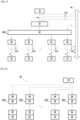
- This distributed architecture is composed of an electromechanical actuation chain 20 ensuring the control of the position, in open or closed loop depending on the desired type of control, of mobile loads 22 via the electromechanical actuators 30 from a control unit of the turbomachine 24, for example an EEC (for Electronic Engine Controller).
- This architecture is made possible by the use of power electronics (controller 26 and converter 28).
- this electromechanical actuation chain requires having a converter 26 and a controller 28 opposite each actuator 30.
- the main aim of the present invention is therefore to overcome such a drawback by proposing a new architecture for controlling mobile loads making it possible to optimize the overall mass/volume balance of the electromechanical actuation chain while guaranteeing acceptable availability of the aeronautical turbomachine.
- an electromechanical actuation chain for controlling the movement of mobile loads of an aeronautical turbomachine from a control unit, one or more of said mobile loads being actuated by an electromechanical actuator, characterized in that, to control said movement, it further comprises a single Ethernet controller with deterministic control ensuring via an Ethernet bus the control of a set of converters acting selectively on said electromechanical actuators, the speed of transfer of information that the Ethernet protocol allows being sufficiently fast to be considered instantaneous with respect to the movement of the mobile load.
- said electromechanical actuator is a permanent magnet synchronous motor, an asynchronous motor, a stepper motor or a variable reluctance motor, coupled or not to a linear or rotary mechanical transmission.
- said converter is a chopper or an inverter.
- said Ethernet controller is configured to manage as many current, speed and position loops as there are electromechanical actuators.
- the speed of transfer of information at the level of the current and speed loops, respectively the current and position loops is at least one hundred times greater than that of the position loop, respectively the speed loop, controlling the movement of the moving load.
- the speed of information transfer at the current loops corresponds to a transfer time of less than 15 microseconds, typically 10 microseconds.
- the speed of transfer of information at the loop level, of position or speed, controlling the movement of the mobile load corresponds to a transfer time of the order of 15 milliseconds.
- said mobile loads may be variable discharge valves whose movement is controlled by a position loop, pumps whose movement is controlled by a speed loop or any other similar member whose movement is controlled by a position or speed loop.
- the present invention also relates to an aeronautical turbomachine comprising an electromechanical actuation chain for controlling the movement of mobile loads as mentioned above.
- the invention consists in proposing a shared control architecture for regulating the electromechanical actuators of an aeronautical turbomachine.
- the electromechanical actuation chain 10 for controlling the movement of aeronautical mobile loads 22 from a control unit 24, one or more of these mobile loads 22 (for example variable discharge doors or valves (VBV) or other variable geometries such as pumps) being actuated by an electromechanical actuator 30, comprises according to the invention a single Ethernet controller 32 ensuring via an Ethernet bus 34 the control of a set of converters 36 (the number of which is at most equal to the number of actuators) acting selectively on the electromechanical actuators 30.
- the controller 30 delivers a setpoint return (typically a position, in this case Pm, or a speed) to the control unit 24 which then returns a position (Pc) or speed command to it.
- This command uses a fast deterministic communication protocol to enable the control loops of each electromechanical actuator 30 to be managed in parallel.
- deterministic we mean that, for any information, we predict the precise duration that its transmission by the Ethernet controller will take.
- Control loops are typically current loops i, speed loops V and position loops P.
- the main loop is the position loop, the speed and current loops being then considered as secondary loops.
- the main loop is the speed loop, the position and current loops being then considered as secondary loops.
- the deterministic Ethernet controller can be a dedicated component (for example integrating speed and current loops for vector modulation type regulation) or a microprocessor equipped with an Ethernet communication protocol.
- the speed of transfer of information at the level of these two current and speed loops (in the case of a position instruction) or current and position (in the case of a speed instruction) that the Ethernet protocol allows is sufficiently fast (transfer time ⁇ 15 ⁇ s and typically ⁇ 10 ⁇ s) to be considered instantaneous at the level of the control loop (position or speed) whose transfer speed is at least a hundred times higher and advantageously approximately a thousand times higher (i.e. a transfer time of the order of 15 ms).
- the converters 36 are for example single-phase choppers or three-phase inverters (or even hexaphase for redundancies at the actuator level) delivering an alternating voltage from a direct voltage (typically from a 270V DC Bus) and which, when they are identical in number to those of the actuators, are advantageously mechanically integrated within these actuators.
- a direct voltage typically from a 270V DC Bus
- the actuator is integrated into each VBV gate (in the so-called "Booster" zone) and there are therefore as many actuators as there are VBV gates.
- This actuator is preferably a permanent magnet synchronous motor (however a variable reluctance motor, a stepper motor or an asynchronous motor is also possible) which can be coupled to a mechanical transmission, linear (of the roller or ball screw type for example) or rotary, integral with the load to be driven.
- a permanent magnet synchronous motor (however a variable reluctance motor, a stepper motor or an asynchronous motor is also possible) which can be coupled to a mechanical transmission, linear (of the roller or ball screw type for example) or rotary, integral with the load to be driven.
Landscapes
- Engineering & Computer Science (AREA)
- Power Engineering (AREA)
- Chemical & Material Sciences (AREA)
- Combustion & Propulsion (AREA)
- Mechanical Engineering (AREA)
- Physics & Mathematics (AREA)
- Fluid Mechanics (AREA)
- General Engineering & Computer Science (AREA)
- Control Of Multiple Motors (AREA)
- Transmission Devices (AREA)
- Programmable Controllers (AREA)
- Small-Scale Networks (AREA)
Description
- La présente invention se rapporte au domaine général de l'électrification des turbomachines aéronautiques.
-
EP 2 942 679 A2 divulgue un système pour la commande et le fonctionnement d'une architecture de contrôleur de moteurs parallèle.DE 10 2011 082965 A1 divulgue une technique d'exploitation d'un réseau de communication dans un véhicule automobile pour former un système de contrôle du véhicule. - Dans ce cadre, des organes ou charges mobiles comme des géométries variables de la turbomachine, qui comprennent notamment les portes ou vannes de décharge variable VBV (pour Variable Bleed Valve) ou encore des pompes, peuvent être pilotées via une chaîne d'actionnement de type électromécanique en remplacement du système actuel de pilotage hydraulique comportant une synchronisation mécanique constituée comme il est connu d'un anneau et d'un ensemble de biellettes et de leviers (aussi appelés guignols). Le principe de cette chaîne d'actionnement consiste à utiliser un actionneur électromécanique pour chaque charge mobile ou pour un nombre réduit de charges mobiles. Ce type d'architecture est dit de type distribué.
- Cette architecture distribuée, illustrée à la
figure 2 , est composée d'une chaîne d'actionnement électromécanique 20 assurant la commande de la position, en boucle ouverte ou fermée selon le type de pilotage désiré, de charges mobiles 22 via les actionneurs électromécaniques 30 depuis une unité de commande de la turbomachine 24, par exemple un EEC (pour Electronic Engine Controller). Cette architecture est rendue possible par l'utilisation d'électronique de puissance (contrôleur 26 et convertisseur 28). Toutefois, cette chaîne d'actionnement électromécanique impose d'avoir en face de chaque actionneur 30 un convertisseur 26 et un contrôleur 28. - Toutefois, le pilotage de charges mobiles, comme par exemple les portes VBV, suppose de multiplier le nombre d'actionneurs impliqués, dans la mesure où un actionneur est alloué à chaque porte VBV ou à un nombre réduit de portes VBV, par exemple deux à quatre portes. Ceci entraîne donc la multiplication de l'électronique de puissance avec comme conséquence, au vu de la criticité des systèmes actionnés, un manque de fiabilité et de robustesse vis-à-vis de l'environnement conduisant à une redondance systématique des contrôleurs dans cette architecture distribuée.
- Or, dans le domaine aéronautique, cette redondance systématique des contrôleurs rend l'intégration de l'électronique de puissance impossible du fait de l'augmentation considérable du bilan masse/volume.
- La présente invention a donc pour but principal de pallier un tel inconvénient en proposant une nouvelle architecture de commande de charges mobiles permettant d'optimiser le bilan masse/volume global de la chaîne d'actionnement électromécanique tout en garantissant une disponibilité de la turbomachine aéronautique acceptable.
- Ce but est atteint par une chaîne d'actionnement électromécanique pour le pilotage du déplacement de charges mobiles d'un turbomachine aéronautique depuis une unité de commande, une ou plusieurs desdites charges mobiles étant actionnées par un actionneur électromécanique, caractérisée en ce que, pour commander ledit déplacement, elle comporte en outre un unique contrôleur Ethernet à commande déterministe assurant via un bus Ethernet le contrôle d'un ensemble de convertisseurs agissant sélectivement sur lesdits actionneurs électromécaniques, la vitesse de transfert des informations que permet le protocole Ethernet étant suffisamment rapide pour être considérée comme instantanée par rapport au déplacement de la charge mobile.
- Ainsi en réduisant de manière significative le nombre de contrôleurs de la chaîne d'actionnement électromécanique et par l'introduction d'un protocole de communication ultrarapide on évite la redondance des contrôleurs de l'état de l'art. De préférence, ledit actionneur électromécanique est un moteur synchrone à aimant permanent, un moteur asynchrone, un moteur pas à pas ou un moteur à réluctance variable, couplé ou non à une transmission mécanique linéaire ou rotative. Avantageusement, ledit convertisseur est un hacheur ou un onduleur.
- De préférence, ledit contrôleur Ethernet est configuré pour gérer autant de boucles de courant, de vitesse et de position que d'actionneurs électromécaniques. Avantageusement, la vitesse de transfert des informations au niveau des boucles de courant et de vitesse, respectivement des boucles de courant et de position, est au moins cent fois supérieure à celle de la boucle de position, respectivement de la boucle de vitesse, pilotant le déplacement de la charge mobile.
- De préférence, la vitesse de transfert des informations au niveau des boucles de courant correspond à un temps de transfert inférieur à 15 microsecondes, typiquement 10 microsecondes.
- Avantageusement, la vitesse de transfert des informations au niveau de la boucle, de position ou de vitesse, pilotant le déplacement de la charge mobile correspond à un temps de transfert de l'ordre de 15 millisecondes.
- Selon le mode de réalisation envisagée, lesdites charges mobiles peuvent être des vannes de décharge variable dont le déplacement est piloté par une boucle de position, des pompes dont le déplacement est piloté par une boucle de vitesse ou tout autre organe analogue dont le déplacement est piloté par une boucle de position ou de vitesse.
- La présente invention concerne également une turbomachine aéronautique comportant une chaîne d'actionnement électromécanique pour la commande du déplacement de charges mobiles telle que précitée.
- D'autres caractéristiques et avantages de la présente invention ressortiront de la description faite ci-dessous, en référence aux dessins annexés qui en illustrent un exemple de réalisation dépourvu de tout caractère limitatif et sur les lesquels :
- [
Fig. 1] figure 1 illustre un schéma de principe d'une nouvelle architecture d'électronique de puissance d'une chaine d'actionnement électromécanique de charges mobiles selon l'invention, et - [
Fig. 2 ] lafigure 2 montre un schéma de principe d'une architecture conventionnelle d'électronique de puissance d'une chaine d'actionnement électromécanique de charges mobiles. - L'invention consiste à proposer une architecture de contrôle mutualisée pour la régulation des actionneurs électromécaniques d'une turbomachine aéronautique.
- Pour ce faire, la chaîne d'actionnement électromécanique 10 pour la commande du déplacement de charges mobiles aéronautiques 22 depuis une unité de commande 24, une ou plusieurs de ces charges mobiles 22 (par exemple des portes ou vannes de décharge variable (VBV) ou d'autres géométries variables telles que des pompes) étant actionnées par un actionneur électromécanique 30, comporte selon l'invention un unique contrôleur Ethernet 32 assurant via un bus Ethernet 34 le contrôle d'un ensemble de convertisseurs 36 (dont le nombre est au plus égal au nombre d'actionneurs) agissant sélectivement sur les actionneurs électromécaniques 30. Pour permettre le pilotage de la charge mobile 22, le contrôleur 30 délivre un retour de consigne (typiquement une position, en l'espèce Pm, ou une vitesse) à l'unité de commande 24 qui lui retourne alors une commande de position (Pc) ou de vitesse. Cette commande utilise un protocole de communication rapide de type déterministe pour permettre de gérer en parallèle les boucles de contrôle de chaque actionneur électromécanique 30. Par déterministe, on entend que, pour toute information, on prévoit la durée précise que prendra son émission par le contrôleur Ethernet.
- Les boucles de contrôle sont typiquement des boucles de courant i, de vitesse V et de position P. Lorsque le déplacement de la charge mobile est commandé en position (cas des portes VBV illustré), la boucle principale est la boucle de position, les boucles de vitesse et de courant étant alors considérées comme des boucles secondaires. Par contre, lorsque le déplacement de la charge mobile est commandé en vitesse (cas de pompes par exemple), la boucle principale est la boucle de vitesse, les boucles de position et de courant étant alors considérées comme des boucles secondaires.
- Le contrôleur Ethernet déterministe peut être un composant dédié (par exemple intégrant des boucles de vitesse et de courant pour une régulation de type modulation vectorielle) ou un microprocesseur pourvu d'un protocole de communication Ethernet.
- La vitesse de transfert des informations au niveau de ces deux boucles de courant et de vitesse (en cas de consigne de position) ou de courant et de position (en cas de consigne de vitesse) que permet le protocole Ethernet est suffisamment rapide (temps de transfert <15 µs et typiquement <10 µs) pour être considérée comme instantanée au niveau de la boucle de commande (position ou vitesse) dont la vitesse de transfert est au moins cent fois supérieure et avantageusement environ mille fois supérieure (soit un temps de transfert de l'ordre de 15 ms).
- Les convertisseurs 36 sont par exemple des hacheurs monophasés ou des onduleurs triphasés (voire hexaphasés pour les redondances au niveau des actionneurs) délivrant une tension alternative à partir d'une tension continue (typiquement issue d'un Bus DC 270V) et qui, lorsqu'ils sont en nombre identique à ceux des actionneurs, sont avantageusement intégrés mécaniquement au sein de ces actionneurs. Lorsque la charge mobile est une porte VBV, l'actionneur est intégré dans chaque porte VBV (dans la zone dite « Booster ») et il y a donc autant d'actionneurs que de portes VBV. Cet actionneur est préférentiellement un moteur synchrone à aimant permanent (toutefois un moteur à réluctance variable, un moteur pas à pas ou un moteur asynchrone est aussi envisageable) qui peut être couplé à une transmission mécanique, linéaire (de type vis à rouleau ou à bille par exemple) ou rotative, solidaire de la charge à entrainer.
Claims (10)
- Chaîne d'actionnement électromécanique pour le pilotage du déplacement de charges mobiles (22) d'une turbomachine aéronautique depuis une unité de commande (24), une ou plusieurs desdites charges mobiles étant actionnées par un actionneur électromécanique (30), caractérisée en ce que, pour commander ledit déplacement, elle comporte en outre un unique contrôleur Ethernet à commande déterministe (32) assurant via un bus Ethernet (34) le contrôle d'un ensemble de convertisseurs (36) agissant sélectivement sur lesdits actionneurs électromécaniques, la vitesse de transfert des informations que permet le protocole Ethernet étant suffisamment rapide pour être considérée comme instantanée par rapport au déplacement de la charge mobile.
- Chaîne d'actionnement électromécanique selon la revendication 1, caractérisée en ce que ledit actionneur électromécanique est un moteur synchrone à aimant permanent, un moteur asynchrone, un moteur à réluctance variable ou un moteur pas à pas, couplé ou non à une transmission mécanique linéaire ou rotative.
- Chaîne d'actionnement électromécanique selon la revendication 1 ou la revendication 2, caractérisée en ce que ledit convertisseur est un hacheur ou un onduleur.
- Chaîne d'actionnement électromécanique selon l'une quelconque des revendications 1 à 3, caractérisée en ce que ledit contrôleur Ethernet déterministe est configuré pour gérer autant de boucles de courant, de vitesse et de position que d'actionneurs électromécaniques.
- Chaîne d'actionnement électromécanique selon la revendication 4, caractérisée en ce que la vitesse de transfert des informations au niveau des boucles de courant et de vitesse, respectivement des boucles de courant et de position, est au moins cent fois supérieure à celle de la boucle de position, respectivement de la boucle de vitesse, pilotant le déplacement de la charge mobile.
- Chaîne d'actionnement électromécanique selon la revendication 5, caractérisée en ce que la vitesse de transfert des informations au niveau des boucles de courant correspond à un temps de transfert inférieur à 15 microsecondes, typiquement 10 microsecondes.
- Chaîne d'actionnement électromécanique selon la revendication 5, caractérisée en ce que la vitesse de transfert des informations au niveau de la boucle, de position ou de vitesse, pilotant le déplacement de la charge mobile correspond à un temps de transfert de l'ordre de 15 millisecondes.
- Chaîne d'actionnement électromécanique selon l'une quelconque des revendications 1 à 7, caractérisée en ce que lesdites charges mobiles sont des vannes de décharge variables dont le déplacement est piloté par une boucle de position.
- Chaîne d'actionnement électromécanique selon l'une quelconque des revendications 1 à 7, caractérisée en ce que lesdites charges mobiles sont des pompes dont le déplacement est piloté par une boucle de vitesse.
- Turbomachine aéronautique comportant une chaîne d'actionnement électromécanique selon l'une quelconque des revendications 1 à 9.
Applications Claiming Priority (2)
| Application Number | Priority Date | Filing Date | Title |
|---|---|---|---|
| FR1913944A FR3104345B1 (fr) | 2019-12-09 | 2019-12-09 | Architecture mutualisée pour le pilotage d’actionneurs électromécaniques |
| PCT/FR2020/052233 WO2021116558A1 (fr) | 2019-12-09 | 2020-12-01 | Architecture mutualisee pour le pilotage d'actionneurs electromecaniques |
Publications (2)
| Publication Number | Publication Date |
|---|---|
| EP4073922A1 EP4073922A1 (fr) | 2022-10-19 |
| EP4073922B1 true EP4073922B1 (fr) | 2025-03-05 |
Family
ID=69811173
Family Applications (1)
| Application Number | Title | Priority Date | Filing Date |
|---|---|---|---|
| EP20828535.3A Active EP4073922B1 (fr) | 2019-12-09 | 2020-12-01 | Architecture mutualisee pour le pilotage d'actionneurs electromecaniques |
Country Status (5)
| Country | Link |
|---|---|
| US (1) | US12123360B2 (fr) |
| EP (1) | EP4073922B1 (fr) |
| CN (1) | CN114846738A (fr) |
| FR (1) | FR3104345B1 (fr) |
| WO (1) | WO2021116558A1 (fr) |
Families Citing this family (1)
| Publication number | Priority date | Publication date | Assignee | Title |
|---|---|---|---|---|
| FR3125180A1 (fr) * | 2021-07-06 | 2023-01-13 | Safran Aircraft Engines | Chaîne d’actionnement électromécanique pour le pilotage du déplacement de charges mobiles d’une turbomachine aéronautique |
Family Cites Families (8)
| Publication number | Priority date | Publication date | Assignee | Title |
|---|---|---|---|---|
| US8385339B1 (en) * | 2010-04-21 | 2013-02-26 | The Boeing Company | Transmitting and receiving messages |
| DE102011082965A1 (de) * | 2011-09-19 | 2013-01-24 | Siemens Aktiengesellschaft | Verfahren zum Betreiben einer Netzwerkanordnung und Netzwerkanordnung |
| US9209721B2 (en) * | 2014-04-29 | 2015-12-08 | The Boeing Company | Systems and methods for the control and operation of a parallel motor controller architecture |
| CN204028691U (zh) * | 2014-06-27 | 2014-12-17 | 中航商用航空发动机有限责任公司 | 航空发动机硬件在回路试验系统 |
| WO2018118070A1 (fr) * | 2016-12-22 | 2018-06-28 | Kitty Hawk Corporation | Système de commande répartie de vol |
| US10906634B2 (en) * | 2018-01-22 | 2021-02-02 | Hamilton Sunstrand Corporation | Electric vehicle management architecture |
| CN210422780U (zh) * | 2019-06-04 | 2020-04-28 | 上海睿瑞航空设备科技有限公司 | 一种微小型航空涡轮发动机高空燃油供油系统 |
| FR3110137B1 (fr) * | 2020-05-12 | 2022-06-17 | Safran Landing Systems | Architecture distribuée de système de freinage pour aéronef |
-
2019
- 2019-12-09 FR FR1913944A patent/FR3104345B1/fr active Active
-
2020
- 2020-12-01 WO PCT/FR2020/052233 patent/WO2021116558A1/fr not_active Ceased
- 2020-12-01 US US17/756,970 patent/US12123360B2/en active Active
- 2020-12-01 CN CN202080085392.XA patent/CN114846738A/zh active Pending
- 2020-12-01 EP EP20828535.3A patent/EP4073922B1/fr active Active
Also Published As
| Publication number | Publication date |
|---|---|
| FR3104345B1 (fr) | 2021-12-03 |
| EP4073922A1 (fr) | 2022-10-19 |
| CN114846738A (zh) | 2022-08-02 |
| US20230014208A1 (en) | 2023-01-19 |
| US12123360B2 (en) | 2024-10-22 |
| WO2021116558A1 (fr) | 2021-06-17 |
| FR3104345A1 (fr) | 2021-06-11 |
Similar Documents
| Publication | Publication Date | Title |
|---|---|---|
| EP2205848B1 (fr) | Systeme de controle et procede de controle | |
| EP3956218B1 (fr) | Système propulsif hybride et procédé de contrôle d'un tel système | |
| CA2963694C (fr) | Architecture d'un systeme propulsif d'un helicoptere comprenant un turbomoteur hybride et un systeme de reactivation de ce turbomoteur hybride | |
| EP2293429B1 (fr) | Dispositif sécurisé de surveillance et de commande pour actionneur de pilotage d'un aéronef | |
| EP1849225B1 (fr) | Alimentation électrique d'équipements d'un moteur d'avion à turbine à gaz | |
| CA2933357C (fr) | Procede de commande automatique du regime de fonctionnement d'un turbomoteur d'un helicoptere, dispositif de commande correspondant et helicoptere equipe d'un tel dispositif | |
| EP1926194A1 (fr) | Alimentation d'un aéronef en énergie électrique | |
| CA2853195A1 (fr) | Procede et systeme de regulation de puissance en cas de defaillance d'au moins un moteur d'aeronef | |
| EP4073922B1 (fr) | Architecture mutualisee pour le pilotage d'actionneurs electromecaniques | |
| WO2009034245A1 (fr) | Procédé et système de système de commande d'au moins un actionneur de capots d'un inverseur de poussée pour turboréacteur | |
| FR3019220A1 (fr) | Procede de redemarrage alternatif d'un turbomoteur en veille d'un helicoptere et architecture multi-moteur permettant la mise en œuvre d'un tel procede | |
| EP3510253B1 (fr) | Dispositif de pilotage des volets d'entrée d'air via un actionneur piézoélectrique multicouche | |
| EP3909860A1 (fr) | Systeme de confirmation de coupure d'un moteur d'aeronef | |
| EP3504556A1 (fr) | Procede de test integre du fonctionnement electrique de l'inversion de poussee d'un turboreacteur d'un aeronef, et systeme associe. | |
| FR3104347A1 (fr) | Architecture parallélisée pour le pilotage d’actionneurs électromécaniques | |
| FR3104346A1 (fr) | Architecture distribuée pour le pilotage d’actionneurs électromécaniques | |
| FR3138116A1 (fr) | Aéronef comportant au moins deux turbomoteurs et un dispositif configuré pour être relié à un des turbomoteurs et procédé de contrôle d’un tel aéronef | |
| FR2946018A1 (fr) | Dispositif pour compenser la perte de poussee d'un moteur d'aeronef et systeme de communication entre lesdits moteurs et un calculateur comportant ledit dispositif. | |
| EP4103830B1 (fr) | Procédé et système de commande d'un inverseur de poussée d'un aéronef | |
| FR2963948A1 (fr) | Systeme de commande distribue pour turbomachine | |
| FR3125180A1 (fr) | Chaîne d’actionnement électromécanique pour le pilotage du déplacement de charges mobiles d’une turbomachine aéronautique | |
| WO2023275454A1 (fr) | Procede de controle d'une architecture energetique d'un systeme propulsif hybride | |
| EP4183993A1 (fr) | Procédé de gestion des quantités de puissance prélevées sur des unités de puissance des ensembles de propulsion d'un aéronef | |
| FR3149296A1 (fr) | Système d'actionnement et de freinage d'un système avionique | |
| FR3062420A1 (fr) | Dispositif d'entrainement d'une pompe a carburant pour turbomachine |
Legal Events
| Date | Code | Title | Description |
|---|---|---|---|
| STAA | Information on the status of an ep patent application or granted ep patent |
Free format text: STATUS: UNKNOWN |
|
| STAA | Information on the status of an ep patent application or granted ep patent |
Free format text: STATUS: THE INTERNATIONAL PUBLICATION HAS BEEN MADE |
|
| PUAI | Public reference made under article 153(3) epc to a published international application that has entered the european phase |
Free format text: ORIGINAL CODE: 0009012 |
|
| STAA | Information on the status of an ep patent application or granted ep patent |
Free format text: STATUS: REQUEST FOR EXAMINATION WAS MADE |
|
| 17P | Request for examination filed |
Effective date: 20220630 |
|
| AK | Designated contracting states |
Kind code of ref document: A1 Designated state(s): AL AT BE BG CH CY CZ DE DK EE ES FI FR GB GR HR HU IE IS IT LI LT LU LV MC MK MT NL NO PL PT RO RS SE SI SK SM TR |
|
| DAV | Request for validation of the european patent (deleted) | ||
| DAX | Request for extension of the european patent (deleted) | ||
| GRAP | Despatch of communication of intention to grant a patent |
Free format text: ORIGINAL CODE: EPIDOSNIGR1 |
|
| STAA | Information on the status of an ep patent application or granted ep patent |
Free format text: STATUS: GRANT OF PATENT IS INTENDED |
|
| INTG | Intention to grant announced |
Effective date: 20240923 |
|
| GRAS | Grant fee paid |
Free format text: ORIGINAL CODE: EPIDOSNIGR3 |
|
| GRAA | (expected) grant |
Free format text: ORIGINAL CODE: 0009210 |
|
| STAA | Information on the status of an ep patent application or granted ep patent |
Free format text: STATUS: THE PATENT HAS BEEN GRANTED |
|
| AK | Designated contracting states |
Kind code of ref document: B1 Designated state(s): AL AT BE BG CH CY CZ DE DK EE ES FI FR GB GR HR HU IE IS IT LI LT LU LV MC MK MT NL NO PL PT RO RS SE SI SK SM TR |
|
| REG | Reference to a national code |
Ref country code: GB Ref legal event code: FG4D Free format text: NOT ENGLISH |
|
| REG | Reference to a national code |
Ref country code: CH Ref legal event code: EP |
|
| REG | Reference to a national code |
Ref country code: IE Ref legal event code: FG4D Free format text: LANGUAGE OF EP DOCUMENT: FRENCH |
|
| REG | Reference to a national code |
Ref country code: DE Ref legal event code: R096 Ref document number: 602020047334 Country of ref document: DE |
|
| PG25 | Lapsed in a contracting state [announced via postgrant information from national office to epo] |
Ref country code: RS Free format text: LAPSE BECAUSE OF FAILURE TO SUBMIT A TRANSLATION OF THE DESCRIPTION OR TO PAY THE FEE WITHIN THE PRESCRIBED TIME-LIMIT Effective date: 20250605 |
|
| PG25 | Lapsed in a contracting state [announced via postgrant information from national office to epo] |
Ref country code: FI Free format text: LAPSE BECAUSE OF FAILURE TO SUBMIT A TRANSLATION OF THE DESCRIPTION OR TO PAY THE FEE WITHIN THE PRESCRIBED TIME-LIMIT Effective date: 20250305 |
|
| REG | Reference to a national code |
Ref country code: NL Ref legal event code: MP Effective date: 20250305 |
|
| PG25 | Lapsed in a contracting state [announced via postgrant information from national office to epo] |
Ref country code: ES Free format text: LAPSE BECAUSE OF FAILURE TO SUBMIT A TRANSLATION OF THE DESCRIPTION OR TO PAY THE FEE WITHIN THE PRESCRIBED TIME-LIMIT Effective date: 20250305 |
|
| REG | Reference to a national code |
Ref country code: LT Ref legal event code: MG9D |
|
| PG25 | Lapsed in a contracting state [announced via postgrant information from national office to epo] |
Ref country code: NO Free format text: LAPSE BECAUSE OF FAILURE TO SUBMIT A TRANSLATION OF THE DESCRIPTION OR TO PAY THE FEE WITHIN THE PRESCRIBED TIME-LIMIT Effective date: 20250605 |
|
| PG25 | Lapsed in a contracting state [announced via postgrant information from national office to epo] |
Ref country code: HR Free format text: LAPSE BECAUSE OF FAILURE TO SUBMIT A TRANSLATION OF THE DESCRIPTION OR TO PAY THE FEE WITHIN THE PRESCRIBED TIME-LIMIT Effective date: 20250305 |
|
| PG25 | Lapsed in a contracting state [announced via postgrant information from national office to epo] |
Ref country code: LV Free format text: LAPSE BECAUSE OF FAILURE TO SUBMIT A TRANSLATION OF THE DESCRIPTION OR TO PAY THE FEE WITHIN THE PRESCRIBED TIME-LIMIT Effective date: 20250305 |
|
| PG25 | Lapsed in a contracting state [announced via postgrant information from national office to epo] |
Ref country code: BG Free format text: LAPSE BECAUSE OF FAILURE TO SUBMIT A TRANSLATION OF THE DESCRIPTION OR TO PAY THE FEE WITHIN THE PRESCRIBED TIME-LIMIT Effective date: 20250305 Ref country code: GR Free format text: LAPSE BECAUSE OF FAILURE TO SUBMIT A TRANSLATION OF THE DESCRIPTION OR TO PAY THE FEE WITHIN THE PRESCRIBED TIME-LIMIT Effective date: 20250606 |
|
| REG | Reference to a national code |
Ref country code: AT Ref legal event code: MK05 Ref document number: 1773880 Country of ref document: AT Kind code of ref document: T Effective date: 20250305 |
|
| PG25 | Lapsed in a contracting state [announced via postgrant information from national office to epo] |
Ref country code: NL Free format text: LAPSE BECAUSE OF FAILURE TO SUBMIT A TRANSLATION OF THE DESCRIPTION OR TO PAY THE FEE WITHIN THE PRESCRIBED TIME-LIMIT Effective date: 20250305 |
|
| PG25 | Lapsed in a contracting state [announced via postgrant information from national office to epo] |
Ref country code: SE Free format text: LAPSE BECAUSE OF FAILURE TO SUBMIT A TRANSLATION OF THE DESCRIPTION OR TO PAY THE FEE WITHIN THE PRESCRIBED TIME-LIMIT Effective date: 20250305 |
|
| PG25 | Lapsed in a contracting state [announced via postgrant information from national office to epo] |
Ref country code: SM Free format text: LAPSE BECAUSE OF FAILURE TO SUBMIT A TRANSLATION OF THE DESCRIPTION OR TO PAY THE FEE WITHIN THE PRESCRIBED TIME-LIMIT Effective date: 20250305 |
|
| PG25 | Lapsed in a contracting state [announced via postgrant information from national office to epo] |
Ref country code: PT Free format text: LAPSE BECAUSE OF FAILURE TO SUBMIT A TRANSLATION OF THE DESCRIPTION OR TO PAY THE FEE WITHIN THE PRESCRIBED TIME-LIMIT Effective date: 20250707 |
|
| PG25 | Lapsed in a contracting state [announced via postgrant information from national office to epo] |
Ref country code: IT Free format text: LAPSE BECAUSE OF FAILURE TO SUBMIT A TRANSLATION OF THE DESCRIPTION OR TO PAY THE FEE WITHIN THE PRESCRIBED TIME-LIMIT Effective date: 20250305 Ref country code: PL Free format text: LAPSE BECAUSE OF FAILURE TO SUBMIT A TRANSLATION OF THE DESCRIPTION OR TO PAY THE FEE WITHIN THE PRESCRIBED TIME-LIMIT Effective date: 20250305 |
|
| PG25 | Lapsed in a contracting state [announced via postgrant information from national office to epo] |
Ref country code: AT Free format text: LAPSE BECAUSE OF FAILURE TO SUBMIT A TRANSLATION OF THE DESCRIPTION OR TO PAY THE FEE WITHIN THE PRESCRIBED TIME-LIMIT Effective date: 20250305 |
|
| PG25 | Lapsed in a contracting state [announced via postgrant information from national office to epo] |
Ref country code: CZ Free format text: LAPSE BECAUSE OF FAILURE TO SUBMIT A TRANSLATION OF THE DESCRIPTION OR TO PAY THE FEE WITHIN THE PRESCRIBED TIME-LIMIT Effective date: 20250305 Ref country code: EE Free format text: LAPSE BECAUSE OF FAILURE TO SUBMIT A TRANSLATION OF THE DESCRIPTION OR TO PAY THE FEE WITHIN THE PRESCRIBED TIME-LIMIT Effective date: 20250305 |
|
| PG25 | Lapsed in a contracting state [announced via postgrant information from national office to epo] |
Ref country code: RO Free format text: LAPSE BECAUSE OF FAILURE TO SUBMIT A TRANSLATION OF THE DESCRIPTION OR TO PAY THE FEE WITHIN THE PRESCRIBED TIME-LIMIT Effective date: 20250305 |
|
| PG25 | Lapsed in a contracting state [announced via postgrant information from national office to epo] |
Ref country code: SK Free format text: LAPSE BECAUSE OF FAILURE TO SUBMIT A TRANSLATION OF THE DESCRIPTION OR TO PAY THE FEE WITHIN THE PRESCRIBED TIME-LIMIT Effective date: 20250305 |
|
| PG25 | Lapsed in a contracting state [announced via postgrant information from national office to epo] |
Ref country code: IS Free format text: LAPSE BECAUSE OF FAILURE TO SUBMIT A TRANSLATION OF THE DESCRIPTION OR TO PAY THE FEE WITHIN THE PRESCRIBED TIME-LIMIT Effective date: 20250705 |
|
| REG | Reference to a national code |
Ref country code: DE Ref legal event code: R097 Ref document number: 602020047334 Country of ref document: DE |
|
| PGFP | Annual fee paid to national office [announced via postgrant information from national office to epo] |
Ref country code: GB Payment date: 20251229 Year of fee payment: 6 |
|
| PLBE | No opposition filed within time limit |
Free format text: ORIGINAL CODE: 0009261 |
|
| STAA | Information on the status of an ep patent application or granted ep patent |
Free format text: STATUS: NO OPPOSITION FILED WITHIN TIME LIMIT |
|
| PG25 | Lapsed in a contracting state [announced via postgrant information from national office to epo] |
Ref country code: DK Free format text: LAPSE BECAUSE OF FAILURE TO SUBMIT A TRANSLATION OF THE DESCRIPTION OR TO PAY THE FEE WITHIN THE PRESCRIBED TIME-LIMIT Effective date: 20250305 |
|
| REG | Reference to a national code |
Ref country code: CH Ref legal event code: L10 Free format text: ST27 STATUS EVENT CODE: U-0-0-L10-L00 (AS PROVIDED BY THE NATIONAL OFFICE) Effective date: 20260114 |
|
| PGFP | Annual fee paid to national office [announced via postgrant information from national office to epo] |
Ref country code: FR Payment date: 20251222 Year of fee payment: 6 |
|
| 26N | No opposition filed |
Effective date: 20251208 |
|
| PGFP | Annual fee paid to national office [announced via postgrant information from national office to epo] |
Ref country code: DE Payment date: 20251222 Year of fee payment: 6 |