EP4071882B1 - Battery pack including fire suppression means - Google Patents
Battery pack including fire suppression means Download PDFInfo
- Publication number
- EP4071882B1 EP4071882B1 EP21805241.3A EP21805241A EP4071882B1 EP 4071882 B1 EP4071882 B1 EP 4071882B1 EP 21805241 A EP21805241 A EP 21805241A EP 4071882 B1 EP4071882 B1 EP 4071882B1
- Authority
- EP
- European Patent Office
- Prior art keywords
- battery pack
- fire extinguishing
- battery
- energy
- discharging means
- Prior art date
- Legal status (The legal status is an assumption and is not a legal conclusion. Google has not performed a legal analysis and makes no representation as to the accuracy of the status listed.)
- Active
Links
Images

Classifications
-
- H—ELECTRICITY
- H01—ELECTRIC ELEMENTS
- H01M—PROCESSES OR MEANS, e.g. BATTERIES, FOR THE DIRECT CONVERSION OF CHEMICAL ENERGY INTO ELECTRICAL ENERGY
- H01M10/00—Secondary cells; Manufacture thereof
- H01M10/42—Methods or arrangements for servicing or maintenance of secondary cells or secondary half-cells
- H01M10/425—Structural combination with electronic components, e.g. electronic circuits integrated to the outside of the casing
- H01M10/4257—Smart batteries, e.g. electronic circuits inside the housing of the cells or batteries
-
- H—ELECTRICITY
- H01—ELECTRIC ELEMENTS
- H01M—PROCESSES OR MEANS, e.g. BATTERIES, FOR THE DIRECT CONVERSION OF CHEMICAL ENERGY INTO ELECTRICAL ENERGY
- H01M50/00—Constructional details or processes of manufacture of the non-active parts of electrochemical cells other than fuel cells, e.g. hybrid cells
- H01M50/20—Mountings; Secondary casings or frames; Racks, modules or packs; Suspension devices; Shock absorbers; Transport or carrying devices; Holders
- H01M50/204—Racks, modules or packs for multiple batteries or multiple cells
-
- A—HUMAN NECESSITIES
- A62—LIFE-SAVING; FIRE-FIGHTING
- A62C—FIRE-FIGHTING
- A62C3/00—Fire prevention, containment or extinguishing specially adapted for particular objects or places
- A62C3/16—Fire prevention, containment or extinguishing specially adapted for particular objects or places in electrical installations, e.g. cableways
-
- A—HUMAN NECESSITIES
- A62—LIFE-SAVING; FIRE-FIGHTING
- A62C—FIRE-FIGHTING
- A62C35/00—Permanently-installed equipment
- A62C35/02—Permanently-installed equipment with containers for delivering the extinguishing substance
- A62C35/10—Containers destroyed or opened by flames or heat
-
- A—HUMAN NECESSITIES
- A62—LIFE-SAVING; FIRE-FIGHTING
- A62D—CHEMICAL MEANS FOR EXTINGUISHING FIRES OR FOR COMBATING OR PROTECTING AGAINST HARMFUL CHEMICAL AGENTS; CHEMICAL MATERIALS FOR USE IN BREATHING APPARATUS
- A62D1/00—Fire-extinguishing compositions; Use of chemical substances in extinguishing fires
- A62D1/0028—Liquid extinguishing substances
- A62D1/005—Dispersions; Emulsions
-
- H—ELECTRICITY
- H01—ELECTRIC ELEMENTS
- H01M—PROCESSES OR MEANS, e.g. BATTERIES, FOR THE DIRECT CONVERSION OF CHEMICAL ENERGY INTO ELECTRICAL ENERGY
- H01M10/00—Secondary cells; Manufacture thereof
- H01M10/42—Methods or arrangements for servicing or maintenance of secondary cells or secondary half-cells
- H01M10/425—Structural combination with electronic components, e.g. electronic circuits integrated to the outside of the casing
-
- H—ELECTRICITY
- H01—ELECTRIC ELEMENTS
- H01M—PROCESSES OR MEANS, e.g. BATTERIES, FOR THE DIRECT CONVERSION OF CHEMICAL ENERGY INTO ELECTRICAL ENERGY
- H01M10/00—Secondary cells; Manufacture thereof
- H01M10/42—Methods or arrangements for servicing or maintenance of secondary cells or secondary half-cells
- H01M10/44—Methods for charging or discharging
- H01M10/441—Methods for charging or discharging for several batteries or cells simultaneously or sequentially
-
- H—ELECTRICITY
- H01—ELECTRIC ELEMENTS
- H01M—PROCESSES OR MEANS, e.g. BATTERIES, FOR THE DIRECT CONVERSION OF CHEMICAL ENERGY INTO ELECTRICAL ENERGY
- H01M10/00—Secondary cells; Manufacture thereof
- H01M10/60—Heating or cooling; Temperature control
- H01M10/61—Types of temperature control
- H01M10/613—Cooling or keeping cold
-
- H—ELECTRICITY
- H01—ELECTRIC ELEMENTS
- H01M—PROCESSES OR MEANS, e.g. BATTERIES, FOR THE DIRECT CONVERSION OF CHEMICAL ENERGY INTO ELECTRICAL ENERGY
- H01M10/00—Secondary cells; Manufacture thereof
- H01M10/60—Heating or cooling; Temperature control
- H01M10/62—Heating or cooling; Temperature control specially adapted for specific applications
- H01M10/625—Vehicles
-
- H—ELECTRICITY
- H01—ELECTRIC ELEMENTS
- H01M—PROCESSES OR MEANS, e.g. BATTERIES, FOR THE DIRECT CONVERSION OF CHEMICAL ENERGY INTO ELECTRICAL ENERGY
- H01M10/00—Secondary cells; Manufacture thereof
- H01M10/60—Heating or cooling; Temperature control
- H01M10/62—Heating or cooling; Temperature control specially adapted for specific applications
- H01M10/627—Stationary installations, e.g. power plant buffering or backup power supplies
-
- H—ELECTRICITY
- H01—ELECTRIC ELEMENTS
- H01M—PROCESSES OR MEANS, e.g. BATTERIES, FOR THE DIRECT CONVERSION OF CHEMICAL ENERGY INTO ELECTRICAL ENERGY
- H01M10/00—Secondary cells; Manufacture thereof
- H01M10/60—Heating or cooling; Temperature control
- H01M10/63—Control systems
-
- H—ELECTRICITY
- H01—ELECTRIC ELEMENTS
- H01M—PROCESSES OR MEANS, e.g. BATTERIES, FOR THE DIRECT CONVERSION OF CHEMICAL ENERGY INTO ELECTRICAL ENERGY
- H01M50/00—Constructional details or processes of manufacture of the non-active parts of electrochemical cells other than fuel cells, e.g. hybrid cells
- H01M50/20—Mountings; Secondary casings or frames; Racks, modules or packs; Suspension devices; Shock absorbers; Transport or carrying devices; Holders
- H01M50/204—Racks, modules or packs for multiple batteries or multiple cells
- H01M50/207—Racks, modules or packs for multiple batteries or multiple cells characterised by their shape
-
- H—ELECTRICITY
- H01—ELECTRIC ELEMENTS
- H01M—PROCESSES OR MEANS, e.g. BATTERIES, FOR THE DIRECT CONVERSION OF CHEMICAL ENERGY INTO ELECTRICAL ENERGY
- H01M50/00—Constructional details or processes of manufacture of the non-active parts of electrochemical cells other than fuel cells, e.g. hybrid cells
- H01M50/20—Mountings; Secondary casings or frames; Racks, modules or packs; Suspension devices; Shock absorbers; Transport or carrying devices; Holders
- H01M50/233—Mountings; Secondary casings or frames; Racks, modules or packs; Suspension devices; Shock absorbers; Transport or carrying devices; Holders characterised by physical properties of casings or racks, e.g. dimensions
- H01M50/24—Mountings; Secondary casings or frames; Racks, modules or packs; Suspension devices; Shock absorbers; Transport or carrying devices; Holders characterised by physical properties of casings or racks, e.g. dimensions adapted for protecting batteries from their environment, e.g. from corrosion
-
- H—ELECTRICITY
- H01—ELECTRIC ELEMENTS
- H01M—PROCESSES OR MEANS, e.g. BATTERIES, FOR THE DIRECT CONVERSION OF CHEMICAL ENERGY INTO ELECTRICAL ENERGY
- H01M50/00—Constructional details or processes of manufacture of the non-active parts of electrochemical cells other than fuel cells, e.g. hybrid cells
- H01M50/50—Current conducting connections for cells or batteries
- H01M50/572—Means for preventing undesired use or discharge
- H01M50/574—Devices or arrangements for the interruption of current
- H01M50/581—Devices or arrangements for the interruption of current in response to temperature
-
- A—HUMAN NECESSITIES
- A62—LIFE-SAVING; FIRE-FIGHTING
- A62D—CHEMICAL MEANS FOR EXTINGUISHING FIRES OR FOR COMBATING OR PROTECTING AGAINST HARMFUL CHEMICAL AGENTS; CHEMICAL MATERIALS FOR USE IN BREATHING APPARATUS
- A62D1/00—Fire-extinguishing compositions; Use of chemical substances in extinguishing fires
- A62D1/0071—Foams
-
- H—ELECTRICITY
- H01—ELECTRIC ELEMENTS
- H01M—PROCESSES OR MEANS, e.g. BATTERIES, FOR THE DIRECT CONVERSION OF CHEMICAL ENERGY INTO ELECTRICAL ENERGY
- H01M10/00—Secondary cells; Manufacture thereof
- H01M10/42—Methods or arrangements for servicing or maintenance of secondary cells or secondary half-cells
- H01M10/425—Structural combination with electronic components, e.g. electronic circuits integrated to the outside of the casing
- H01M2010/4271—Battery management systems including electronic circuits, e.g. control of current or voltage to keep battery in healthy state, cell balancing
-
- H—ELECTRICITY
- H01—ELECTRIC ELEMENTS
- H01M—PROCESSES OR MEANS, e.g. BATTERIES, FOR THE DIRECT CONVERSION OF CHEMICAL ENERGY INTO ELECTRICAL ENERGY
- H01M2200/00—Safety devices for primary or secondary batteries
-
- H—ELECTRICITY
- H01—ELECTRIC ELEMENTS
- H01M—PROCESSES OR MEANS, e.g. BATTERIES, FOR THE DIRECT CONVERSION OF CHEMICAL ENERGY INTO ELECTRICAL ENERGY
- H01M2200/00—Safety devices for primary or secondary batteries
- H01M2200/10—Temperature sensitive devices
-
- H—ELECTRICITY
- H01—ELECTRIC ELEMENTS
- H01M—PROCESSES OR MEANS, e.g. BATTERIES, FOR THE DIRECT CONVERSION OF CHEMICAL ENERGY INTO ELECTRICAL ENERGY
- H01M2200/00—Safety devices for primary or secondary batteries
- H01M2200/10—Temperature sensitive devices
- H01M2200/108—Normal resistors
-
- H—ELECTRICITY
- H01—ELECTRIC ELEMENTS
- H01M—PROCESSES OR MEANS, e.g. BATTERIES, FOR THE DIRECT CONVERSION OF CHEMICAL ENERGY INTO ELECTRICAL ENERGY
- H01M2220/00—Batteries for particular applications
- H01M2220/10—Batteries in stationary systems, e.g. emergency power source in plant
-
- H—ELECTRICITY
- H01—ELECTRIC ELEMENTS
- H01M—PROCESSES OR MEANS, e.g. BATTERIES, FOR THE DIRECT CONVERSION OF CHEMICAL ENERGY INTO ELECTRICAL ENERGY
- H01M2220/00—Batteries for particular applications
- H01M2220/20—Batteries in motive systems, e.g. vehicle, ship, plane
-
- H—ELECTRICITY
- H01—ELECTRIC ELEMENTS
- H01M—PROCESSES OR MEANS, e.g. BATTERIES, FOR THE DIRECT CONVERSION OF CHEMICAL ENERGY INTO ELECTRICAL ENERGY
- H01M50/00—Constructional details or processes of manufacture of the non-active parts of electrochemical cells other than fuel cells, e.g. hybrid cells
- H01M50/20—Mountings; Secondary casings or frames; Racks, modules or packs; Suspension devices; Shock absorbers; Transport or carrying devices; Holders
- H01M50/249—Mountings; Secondary casings or frames; Racks, modules or packs; Suspension devices; Shock absorbers; Transport or carrying devices; Holders specially adapted for aircraft or vehicles, e.g. cars or trains
-
- H—ELECTRICITY
- H01—ELECTRIC ELEMENTS
- H01M—PROCESSES OR MEANS, e.g. BATTERIES, FOR THE DIRECT CONVERSION OF CHEMICAL ENERGY INTO ELECTRICAL ENERGY
- H01M50/00—Constructional details or processes of manufacture of the non-active parts of electrochemical cells other than fuel cells, e.g. hybrid cells
- H01M50/20—Mountings; Secondary casings or frames; Racks, modules or packs; Suspension devices; Shock absorbers; Transport or carrying devices; Holders
- H01M50/251—Mountings; Secondary casings or frames; Racks, modules or packs; Suspension devices; Shock absorbers; Transport or carrying devices; Holders specially adapted for stationary devices, e.g. power plant buffering or backup power supplies
-
- Y—GENERAL TAGGING OF NEW TECHNOLOGICAL DEVELOPMENTS; GENERAL TAGGING OF CROSS-SECTIONAL TECHNOLOGIES SPANNING OVER SEVERAL SECTIONS OF THE IPC; TECHNICAL SUBJECTS COVERED BY FORMER USPC CROSS-REFERENCE ART COLLECTIONS [XRACs] AND DIGESTS
- Y02—TECHNOLOGIES OR APPLICATIONS FOR MITIGATION OR ADAPTATION AGAINST CLIMATE CHANGE
- Y02E—REDUCTION OF GREENHOUSE GAS [GHG] EMISSIONS, RELATED TO ENERGY GENERATION, TRANSMISSION OR DISTRIBUTION
- Y02E60/00—Enabling technologies; Technologies with a potential or indirect contribution to GHG emissions mitigation
- Y02E60/10—Energy storage using batteries
Definitions
- the present invention relates to a battery pack including an energy discharging means and a fire extinguishing means, whereby stability of the battery pack is improved.
- secondary batteries which are energy sources substituting for fossil fuels causing air pollution, have been applied to an electric vehicle (EV), a hybrid electric vehicle (HEV), a plug-in hybrid electric vehicle (P-HEV), and an energy storage system (ESS).
- EV electric vehicle
- HEV hybrid electric vehicle
- P-HEV plug-in hybrid electric vehicle
- ESS energy storage system
- the energy storage system is a system that stores a large amount of excess power in a battery in order to use the stored power when needed.
- the energy storage system serves to uniformly maintain quality of power in connection with new and renewable energy generation and to increase efficiency in use of power by storing power at the time when the amount of use of power is small and using the stored power when the demand for power is high.
- the ESS may mainly be classified as a grid system ESS, an uninterruptible power supply (UPS), or an ESS for domestic use.
- UPS uninterruptible power supply
- a lithium ion battery a lithium polymer battery, a nickel-cadmium battery, a nickel-hydride battery, and a nickel-zinc battery as secondary batteries that are widely used at present.
- the operating voltage of a unit secondary battery cell i.e. a unit battery cell, is about 2.0V to 5.0V.
- a plurality of battery cells may be connected to each other in series to constitute a cell module assembly.
- cell module assemblies may be connected to each other in series or in parallel to constitute a battery module depending on required output voltage or charge and discharge capacities.
- a battery pack is manufactured using at least one battery module by adding an additional component.
- a lithium secondary battery Since a lithium secondary battery has a danger of explosion and fire outbreak due to heat generation, however, one of the important problems is to secure safety thereof. If no appropriate measures are initially taken when an abnormal phenomenon occurs, the temperature of the secondary battery abruptly increases due to heat generation, and thermal runaway occurs due to such an abrupt increase in temperature, whereby the secondary battery may explode, and the heat propagates to another secondary battery adjacent thereto, and therefore a battery pack may greatly damaged. Methods of cooling or thermally insulating the lithium secondary battery in the battery pack may be used to secure safety of the batter pack. However, there is a problem in that it is not possible to dissipate thermal energy generated in the lithium secondary battery, which has high energy density, when an abnormal phenomenon occurs only by using such methods.
- Document JP 2020 017517 discloses systems and methods for operating a lithium ion battery high voltage distribution system architecture of known type.
- the present invention has been made in view of the above problems, and it is an object of the present invention to provide a battery pack having an energy discharging means and a fire extinguishing means provided therein.
- a battery pack according to the present invention to accomplish the above object is a battery pack as defined in the appended claims.
- a device according to the present invention includes at least one battery pack according to the present invention.
- a battery pack according to the present invention has an advantage in that an energy discharging means and a fire extinguishing means are included such that, when an abnormal phenomenon, such as heat generation or fire outbreak, occurs in a specific battery cell in the battery pack, energy of the battery cell is rapidly discharged and the fire is suppressed, whereby it is possible to inhibit a thermal runaway phenomenon from propagating to a battery cell adjacent thereto.
- an abnormal phenomenon such as heat generation or fire outbreak
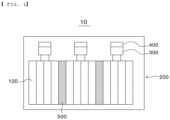
- FIG. 1 is a schematic view of a battery pack including an energy discharging means and a fire extinguishing means according to a first preferred embodiment of the present invention.
- the battery pack 10 is configured such that a plurality of battery cells 100 is received in a battery pack case 200 in a state of being divided into two or more sections.
- a partition wall 500 configured to partition the sections from each other is located between the respective sections.
- a heat insulation plate configured to perform heat insulation between the sections or a heat dissipation plate or a cooling plate configured to discharge heat generated from the battery cell 100 to the outside may be used as the partition wall 500, as needed.
- the energy discharging means 300 and the fire extinguishing means 400 are provided in each section, in which a plurality of battery cells 100 is received.
- the energy discharging means 300 serves to, when an abnormal heat generation phenomenon occurs in a specific battery cell 100 of the battery pack 10, discharge energy of the battery cell 100 as thermal energy, thereby inhibiting a thermal runaway phenomenon due to abnormal heat generation, thus improving safety of the battery pack 10.
- the fire extinguishing means 400 is disposed adjacent to the energy discharging means 300, and the temperature of the fire extinguishing means reaches an operating temperature using thermal energy discharged by the energy discharging means 300 when an abnormal heat generation phenomenon occurs, whereby it is possible to rapidly extinguish flames in the battery pack 10.
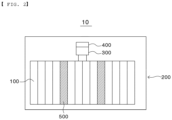
- FIG. 2 is a schematic view of a battery pack including an energy discharging means and a fire extinguishing means according to a second preferred embodiment of the present invention.
- the battery pack 10 of FIG. 2 is identical to the battery pack 10 of FIG. 1 except that the energy discharging means 300 and the fire extinguishing means 400 are only provided in a middle section, among a plurality of divided sections, compared to the battery pack 10 of FIG. 1 .
- the energy discharging means 300 includes a resistor 310 having high electrical resistance and an operating switch 320 configured to turn on/off electrical connection with battery cells 100 in a specific section.
- the resistor 310 may be selected from well-known resistors, as long as the electrical resistance of the resistor is capable of rapidly discharging energy of the battery cell 100 as thermal energy and the thermal energy is capable of providing temperature at which the fire extinguishing means 400 located adjacent thereto is operated.
- the operating switch 320 may be provided in only one direction of a circuit, as shown in (a) of FIG. 3 , or may be provided in both directions of a circuit, as shown in (b) of FIG. 3 .
- the operating switch 320 which is off while the battery pack 10 is normally operated, is turned on, whereby the battery cell 100 and the resistor 310 are electrically connected to each other.
- electrical energy of the battery cell 100 is discharged as thermal energy by the resistor 310, which has high electrical resistance, and therefore it is possible to inhibit the abnormal heat generation phenomenon from propagating to battery cells 100 adjacent thereto.
- the battery pack 10 may further include a controller (not shown) in order to perform overall management of the battery pack 10 and to control operation of the energy discharging means 300 when an abnormal heat generation phenomenon occurs.
- a controller not shown
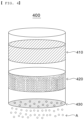
- the fire extinguishing means 400 may be a solid aerosol fire extinguishing device including a fire extinguishing chemical 410, a cooling portion 420, and a nozzle 430.
- the solid aerosol fire extinguishing device is a fire extinguishing system that interrupts chain reaction of combustion through a negative catalyst effect in which radicals of aerosol generated when a solid compound including special ingredients is burned react with active radicals, such as O, H, and OH, around a fire, in order to interrupt chain reaction, thereby suppressing the fire.
- aerosol which is a fire extinguishing material
- the generated aerosol is cooled to an appropriate temperature harmless to human bodies or facilities while passing through the cooling portion 420, the cooled aerosol is sprayed as aerosol particles A through the nozzle 430, and the sprayed aerosol suppresses a fire through the negative catalyst effect described above.
- any of various well-known fire extinguishing chemicals may be used as the fire extinguishing chemical 410 of the fire extinguishing means 400.
- an aerosol foaming compound (AFC) which is in a solid state at lower than an operating temperature and which is sprayed in the form of aerosol at the operating temperature or higher, is preferably used.
- At least one of potassium nitrate, strontium nitrate, and magnesium nitrate is included as a main ingredient of the AFC. Since decomposition and combustion temperatures vary depending on ingredients of the AFC, it is necessary to set the size and specifications of the resistor to be applied to the energy discharging means 300 in consideration of the operating temperature of the AFC.
- the operating temperature may have various temperature ranges depending on ingredients included in the AFC.
- a temperature range of 300 to 1100°C is preferable in consideration of the kind of the AFC and the resistor 310 that are generally used.
- the battery pack including the energy discharging means 300 and the fire extinguishing means 400 according to the present invention may be applied to an electric vehicle (EV), a hybrid electric vehicle (HEV), a plug-in hybrid electric vehicle (P-HEV), or an energy storage system (ESS).
- EV electric vehicle
- HEV hybrid electric vehicle
- P-HEV plug-in hybrid electric vehicle
- ESS energy storage system
Landscapes
- Chemical & Material Sciences (AREA)
- Chemical Kinetics & Catalysis (AREA)
- General Chemical & Material Sciences (AREA)
- Electrochemistry (AREA)
- Engineering & Computer Science (AREA)
- Manufacturing & Machinery (AREA)
- Business, Economics & Management (AREA)
- Emergency Management (AREA)
- Health & Medical Sciences (AREA)
- Public Health (AREA)
- Microelectronics & Electronic Packaging (AREA)
- Automation & Control Theory (AREA)
- Dispersion Chemistry (AREA)
- Battery Mounting, Suspending (AREA)
- Protection Of Static Devices (AREA)
- Charge And Discharge Circuits For Batteries Or The Like (AREA)
- Secondary Cells (AREA)
Description
- This application claims the benefit of priority to
Korean Patent Application No. 2020-0057035 filed on May 13, 2020 - The present invention relates to a battery pack including an energy discharging means and a fire extinguishing means, whereby stability of the battery pack is improved.
- With technological development of mobile devices, such as smartphones, laptop computers, and digital cameras, and an increase in demand therefor, research on secondary batteries, which are capable of being charged and discharged, has been actively conducted. In addition, secondary batteries, which are energy sources substituting for fossil fuels causing air pollution, have been applied to an electric vehicle (EV), a hybrid electric vehicle (HEV), a plug-in hybrid electric vehicle (P-HEV), and an energy storage system (ESS).
- The energy storage system (ESS) is a system that stores a large amount of excess power in a battery in order to use the stored power when needed. The energy storage system serves to uniformly maintain quality of power in connection with new and renewable energy generation and to increase efficiency in use of power by storing power at the time when the amount of use of power is small and using the stored power when the demand for power is high. The ESS may mainly be classified as a grid system ESS, an uninterruptible power supply (UPS), or an ESS for domestic use.
- There are a lithium ion battery, a lithium polymer battery, a nickel-cadmium battery, a nickel-hydride battery, and a nickel-zinc battery as secondary batteries that are widely used at present. The operating voltage of a unit secondary battery cell, i.e. a unit battery cell, is about 2.0V to 5.0V. In the case in which output voltage higher than the above operating voltage is required, therefore, a plurality of battery cells may be connected to each other in series to constitute a cell module assembly. In addition, cell module assemblies may be connected to each other in series or in parallel to constitute a battery module depending on required output voltage or charge and discharge capacities. In general, a battery pack is manufactured using at least one battery module by adding an additional component.
- Since a lithium secondary battery has a danger of explosion and fire outbreak due to heat generation, however, one of the important problems is to secure safety thereof. If no appropriate measures are initially taken when an abnormal phenomenon occurs, the temperature of the secondary battery abruptly increases due to heat generation, and thermal runaway occurs due to such an abrupt increase in temperature, whereby the secondary battery may explode, and the heat propagates to another secondary battery adjacent thereto, and therefore a battery pack may greatly damaged. Methods of cooling or thermally insulating the lithium secondary battery in the battery pack may be used to secure safety of the batter pack. However, there is a problem in that it is not possible to dissipate thermal energy generated in the lithium secondary battery, which has high energy density, when an abnormal phenomenon occurs only by using such methods.
- Document
US 2010/0026242 discloses a known method and an arrangement for discharging an energy storage system for electrical energy. - Document
JP 2020 017517 - The present invention has been made in view of the above problems, and it is an object of the present invention to provide a battery pack having an energy discharging means and a fire extinguishing means provided therein.
- A battery pack according to the present invention to accomplish the above object is a battery pack as defined in the appended claims.
- In addition, a device according to the present invention includes at least one battery pack according to the present invention.
- A battery pack according to the present invention has an advantage in that an energy discharging means and a fire extinguishing means are included such that, when an abnormal phenomenon, such as heat generation or fire outbreak, occurs in a specific battery cell in the battery pack, energy of the battery cell is rapidly discharged and the fire is suppressed, whereby it is possible to inhibit a thermal runaway phenomenon from propagating to a battery cell adjacent thereto.
- In addition, the battery pack according to the present invention has an advantage in that the fire extinguishing means is operated using thermal energy generated from the energy discharging means when the abnormal phenomenon occurs, whereby no separate device configured to operate the fire extinguishing means is necessary.
-
-
FIG. 1 is a schematic view showing a battery pack according to an embodiment of the present invention. -
FIG. 2 is a schematic view showing a battery pack according to another embodiment of the present invention. -
FIG. 3 is a schematic view showing an energy discharging means of the present invention. -
FIG. 4 is a schematic view showing a fire extinguishing means of the present invention. - In the present application, it should be understood that the terms "comprises," "has," "includes," etc. specify the presence of stated features, numbers, steps, operations, elements, components, or combinations thereof, but do not preclude the presence or addition of one or more other features, numbers, steps, operations, elements, components, or combinations thereof.
- In addition, the same reference numbers will be used throughout the drawings to refer to parts that perform similar functions or operations. In the case in which one part is said to be connected to another part in the specification, not only may the one part be directly connected to the other part, but also, the one part may be indirectly connected to the other part via a further part. In addition, that a certain element is included does not mean that other elements are excluded, but means that such elements may be further included unless mentioned otherwise.
- Hereinafter, a battery pack according to the present invention will be described with reference to the accompanying drawings.
-
FIG. 1 is a schematic view of a battery pack including an energy discharging means and a fire extinguishing means according to a first preferred embodiment of the present invention. - When describing the
battery pack 10 with reference toFIG. 1 , thebattery pack 10 according to the present invention is configured such that a plurality ofbattery cells 100 is received in abattery pack case 200 in a state of being divided into two or more sections. Apartition wall 500 configured to partition the sections from each other is located between the respective sections. A heat insulation plate configured to perform heat insulation between the sections or a heat dissipation plate or a cooling plate configured to discharge heat generated from thebattery cell 100 to the outside may be used as thepartition wall 500, as needed. - Meanwhile, as shown in
FIG. 1 , the energy discharging means 300 and the fire extinguishing means 400 are provided in each section, in which a plurality ofbattery cells 100 is received. - Here, the energy discharging means 300 serves to, when an abnormal heat generation phenomenon occurs in a
specific battery cell 100 of thebattery pack 10, discharge energy of thebattery cell 100 as thermal energy, thereby inhibiting a thermal runaway phenomenon due to abnormal heat generation, thus improving safety of thebattery pack 10. - In addition, the fire extinguishing means 400 is disposed adjacent to the energy discharging means 300, and the temperature of the fire extinguishing means reaches an operating temperature using thermal energy discharged by the energy discharging means 300 when an abnormal heat generation phenomenon occurs, whereby it is possible to rapidly extinguish flames in the
battery pack 10. -
FIG. 2 is a schematic view of a battery pack including an energy discharging means and a fire extinguishing means according to a second preferred embodiment of the present invention. - The
battery pack 10 ofFIG. 2 is identical to thebattery pack 10 ofFIG. 1 except that the energy discharging means 300 and the fire extinguishing means 400 are only provided in a middle section, among a plurality of divided sections, compared to thebattery pack 10 ofFIG. 1 . - Meanwhile, when describing the energy discharging means 300 in detail with reference to
FIG. 3 , the energy discharging means 300 includes aresistor 310 having high electrical resistance and anoperating switch 320 configured to turn on/off electrical connection withbattery cells 100 in a specific section. - The
resistor 310 may be selected from well-known resistors, as long as the electrical resistance of the resistor is capable of rapidly discharging energy of thebattery cell 100 as thermal energy and the thermal energy is capable of providing temperature at which the fire extinguishing means 400 located adjacent thereto is operated. - In addition, the
operating switch 320 may be provided in only one direction of a circuit, as shown in (a) ofFIG. 3 , or may be provided in both directions of a circuit, as shown in (b) ofFIG. 3 . - In the energy discharging means 300 described above, when an abnormal heat generation phenomenon occurs, the
operating switch 320, which is off while thebattery pack 10 is normally operated, is turned on, whereby thebattery cell 100 and theresistor 310 are electrically connected to each other. As a result, electrical energy of thebattery cell 100 is discharged as thermal energy by theresistor 310, which has high electrical resistance, and therefore it is possible to inhibit the abnormal heat generation phenomenon from propagating tobattery cells 100 adjacent thereto. - In addition, the
battery pack 10 may further include a controller (not shown) in order to perform overall management of thebattery pack 10 and to control operation of the energy discharging means 300 when an abnormal heat generation phenomenon occurs. - When describing the fire extinguishing means 400 with reference to
FIG. 4 , the fire extinguishing means 400 may be a solid aerosol fire extinguishing device including afire extinguishing chemical 410, acooling portion 420, and anozzle 430. - Here, the solid aerosol fire extinguishing device is a fire extinguishing system that interrupts chain reaction of combustion through a negative catalyst effect in which radicals of aerosol generated when a solid compound including special ingredients is burned react with active radicals, such as O, H, and OH, around a fire, in order to interrupt chain reaction, thereby suppressing the fire.
- Specifically, when the
fire extinguishing chemical 410 is burned at an operating temperature or higher, aerosol, which is a fire extinguishing material, is generated, the generated aerosol is cooled to an appropriate temperature harmless to human bodies or facilities while passing through thecooling portion 420, the cooled aerosol is sprayed as aerosol particles A through thenozzle 430, and the sprayed aerosol suppresses a fire through the negative catalyst effect described above. - Any of various well-known fire extinguishing chemicals may be used as the fire extinguishing chemical 410 of the fire extinguishing means 400. In particular, an aerosol foaming compound (AFC), which is in a solid state at lower than an operating temperature and which is sprayed in the form of aerosol at the operating temperature or higher, is preferably used.
- It is preferable for at least one of potassium nitrate, strontium nitrate, and magnesium nitrate to be included as a main ingredient of the AFC. Since decomposition and combustion temperatures vary depending on ingredients of the AFC, it is necessary to set the size and specifications of the resistor to be applied to the energy discharging means 300 in consideration of the operating temperature of the AFC.
- The operating temperature may have various temperature ranges depending on ingredients included in the AFC. In particular, a temperature range of 300 to 1100°C is preferable in consideration of the kind of the AFC and the
resistor 310 that are generally used. - In addition, the battery pack including the energy discharging means 300 and the fire extinguishing means 400 according to the present invention may be applied to an electric vehicle (EV), a hybrid electric vehicle (HEV), a plug-in hybrid electric vehicle (P-HEV), or an energy storage system (ESS).
- Although the specific details of the present invention have been described in detail, those skilled in the art will appreciate that the detailed description thereof discloses only preferred embodiments of the present invention and thus does not limit the scope of the present invention. Accordingly, those skilled in the art will appreciate that various changes and modifications are possible, without departing from the category and the technical idea of the present invention, and it will be obvious that such changes and modifications fall within the scope of the appended claims.
-
- 10: Battery pack
- 100: Battery cell
- 200: Case
- 300: Energy discharging means
- 310: Resistor
- 320: Operating switch
- 400: Fire extinguishing means
- 410: Fire extinguishing chemical
- 420: Cooling portion
- 430: Nozzle
- A: Aerosol particles
- 500: Partition wall
Claims (10)
- A battery pack (10) comprising a means configured to, when an abnormal phenomenon, such as fire outbreak or heat generation, occurs in a battery cell (100), prevent fire or heat from propagating to another battery cell (100) adjacent thereto, the battery pack (10) comprising:a plurality of battery cells (100);a case (200) configured to receive the plurality of battery cells (100);an energy discharging means (300) configured to discharge energy of the battery pack (10) when the abnormal phenomenon occurs; anda fire extinguishing means (400) configured to discharge aerosol at an operating temperature or higher in order to extinguish flames generated in the battery pack (10),wherein the energy discharging means (300) comprises a resistor (310) having an electrical resistance and an operating switch (320); andwherein the fire extinguishing means (400) is disposed adjacent to the resistor (310) and a temperature of the fire extinguishing means (400) reaches the operating temperature using thermal energy generated from the resistor (310) when the abnormal phenomenon occurs.
- The battery pack (10) according to claim 1, wherein the plurality of battery cells (100) is received in the battery pack (10) divided into two or more sections.
- The battery pack (10) according to claim 2, wherein the energy discharging means (300) is installed in only one of the two or more sections.
- The battery pack (10) according to claim 2, wherein the energy discharging means (300) is installed in each of the two or more sections.
- The battery pack (10) according to claim 1, further comprising a controller configured to perform overall management of the battery pack (10) and to control operation of the energy discharging means (300).
- The battery pack (10) according to claim 1, wherein the fire extinguishing means (400) comprises a fire extinguishing chemical (410), a cooling portion (420), and a nozzle (430).
- The battery pack (10) according to claim 6, wherein the fire extinguishing chemical (410) is an aerosol foaming compound (AFC) configured to be in a solid state at lower than the operating temperature and to be sprayed in aerosol form at higher than the operating temperature.
- The battery pack (10) according to claim 7, wherein the AFC comprises at least one of potassium nitrate, strontium nitrate, and magnesium nitrate.
- The battery pack (10) according to claim 1, wherein the energy discharging means (300) and the fire extinguishing means (400) are located in the case (200).
- A device comprising the battery pack (10) according to any one of claims 1 to 9.
Applications Claiming Priority (2)
| Application Number | Priority Date | Filing Date | Title |
|---|---|---|---|
| KR1020200057035A KR102901907B1 (en) | 2020-05-13 | 2020-05-13 | Battery pack containing fire suppression means |
| PCT/KR2021/005229 WO2021230528A1 (en) | 2020-05-13 | 2021-04-26 | Battery pack including fire suppression means |
Publications (3)
| Publication Number | Publication Date |
|---|---|
| EP4071882A1 EP4071882A1 (en) | 2022-10-12 |
| EP4071882A4 EP4071882A4 (en) | 2024-07-17 |
| EP4071882B1 true EP4071882B1 (en) | 2025-05-28 |
Family
ID=78525208
Family Applications (1)
| Application Number | Title | Priority Date | Filing Date |
|---|---|---|---|
| EP21805241.3A Active EP4071882B1 (en) | 2020-05-13 | 2021-04-26 | Battery pack including fire suppression means |
Country Status (10)
| Country | Link |
|---|---|
| US (2) | US20230030011A1 (en) |
| EP (1) | EP4071882B1 (en) |
| JP (1) | JP7446661B2 (en) |
| KR (1) | KR102901907B1 (en) |
| CN (1) | CN114930607B (en) |
| AU (1) | AU2021270127B2 (en) |
| ES (1) | ES3034265T3 (en) |
| HU (1) | HUE071689T2 (en) |
| PL (1) | PL4071882T3 (en) |
| WO (1) | WO2021230528A1 (en) |
Families Citing this family (12)
| Publication number | Priority date | Publication date | Assignee | Title |
|---|---|---|---|---|
| US12237479B2 (en) * | 2021-11-01 | 2025-02-25 | Dell Products L.P. | Electric battery cell discharge firewall |
| AU2022422086A1 (en) * | 2021-12-23 | 2024-05-16 | Lg Energy Solution, Ltd. | Battery pack with improved safety |
| CN222546475U (en) * | 2021-12-24 | 2025-02-28 | 株式会社Lg新能源 | Battery pack with improved safety and energy storage system including the battery pack |
| EP4718574A2 (en) * | 2021-12-27 | 2026-04-01 | LG Energy Solution, Ltd. | Battery pack with improved safety |
| US11872423B2 (en) | 2022-03-04 | 2024-01-16 | Ford Global Technologies, Llc | Battery thermal suppression systems |
| JP2023146688A (en) * | 2022-03-29 | 2023-10-12 | 凸版印刷株式会社 | battery pack |
| KR20230163648A (en) * | 2022-05-24 | 2023-12-01 | 주식회사 엘지에너지솔루션 | Battery pack |
| KR20240024695A (en) * | 2022-08-17 | 2024-02-26 | 주식회사 엘지에너지솔루션 | Battery fire extinguishing device and operating method thereof |
| KR102865908B1 (en) | 2022-09-07 | 2025-09-30 | (주) 상일이엔지 | A secondary battery cell cartridge for a vehicle having a fire spread prevention structure, a module case for a secondary battery module for a vehicle, a secondary battery module for a vehicle and a secondary battery pack |
| KR102556634B1 (en) | 2023-01-05 | 2023-07-17 | 신동기 | Thermal runaway fire extinguishing bursting disc device mounted on the battery pack |
| KR20240141453A (en) * | 2023-03-20 | 2024-09-27 | 주식회사 엘지에너지솔루션 | Battery pack |
| SE547632C2 (en) * | 2024-01-31 | 2025-09-30 | Maus Sweden AB | Self-extinguishing battery pack |
Family Cites Families (21)
| Publication number | Priority date | Publication date | Assignee | Title |
|---|---|---|---|---|
| KR100906249B1 (en) * | 2006-09-11 | 2009-07-07 | 주식회사 엘지화학 | Control method of battery system for improving safety |
| WO2008079062A1 (en) * | 2006-12-22 | 2008-07-03 | Volvo Technology Corporation | Method and arrangement for discharging an energy storage system for electrical energy |
| CN100435892C (en) * | 2007-07-10 | 2008-11-26 | 陕西坚瑞化工有限责任公司 | Fire extinguishing aerosol composition suitable for use for common electric equipment |
| EP2416439B1 (en) * | 2009-04-01 | 2015-07-29 | LG Chem, Ltd. | Battery module having excellent heat dissipation ability and battery pack employed with the same |
| WO2010114299A2 (en) * | 2009-04-01 | 2010-10-07 | 주식회사 엘지화학 | Medium or large sized battery module having improved safety |
| JP5821652B2 (en) | 2012-01-20 | 2015-11-24 | 株式会社Gsユアサ | Storage element module |
| JP2014036714A (en) * | 2012-08-13 | 2014-02-27 | Hochiki Corp | Fire-extinguishing system for electric vehicle |
| JP2014075906A (en) * | 2012-10-04 | 2014-04-24 | Hochiki Corp | Power storage device |
| JP6078332B2 (en) | 2012-12-25 | 2017-02-08 | デクセリアルズ株式会社 | Protection element, battery module |
| JP6189603B2 (en) * | 2013-02-19 | 2017-08-30 | ホーチキ株式会社 | Fire extinguisher |
| JP6179719B2 (en) | 2013-10-28 | 2017-08-16 | 三菱自動車工業株式会社 | Battery device |
| JP6231876B2 (en) * | 2013-12-27 | 2017-11-15 | 日本工機株式会社 | Aerosol fire extinguishing device for moving body and aerosol fire extinguishing agent used therefor |
| JP6443882B2 (en) | 2015-03-13 | 2018-12-26 | 株式会社ダイセル | Aerosol fire extinguisher composition. |
| JP6586524B2 (en) | 2016-06-10 | 2019-10-02 | ヤマトプロテック株式会社 | Electrochemical equipment using aerosol fire extinguishing device |
| KR101706717B1 (en) * | 2016-11-04 | 2017-03-09 | 주식회사 아하정보통신 | Fire preventing device for battery pack of energy storage system |
| FI127757B (en) | 2017-09-22 | 2019-02-15 | Konecranes Global Oy | Lift carriage of a crane |
| KR101949151B1 (en) * | 2018-05-17 | 2019-02-18 | 주식회사 창성에이스산업 | Aerosol Fire Extinguishing Apparatus For Battery Operated Smoke Sensing |
| JP2019205487A (en) * | 2018-05-28 | 2019-12-05 | 京セラドキュメントソリューションズ株式会社 | Power supply unit |
| US11621441B2 (en) * | 2018-07-27 | 2023-04-04 | The Boeing Company | Li-Ion battery high voltage distribution system architecture |
| KR102064416B1 (en) * | 2019-05-24 | 2020-01-09 | 주식회사 창성에이스산업 | Lithium-Based Battery Fire Extinguishing Agent And Method Of Extinguishing A fire In A Lithium-Based Battery Using The Same |
| CN210120216U (en) * | 2019-09-17 | 2020-02-28 | 深圳市比克动力电池有限公司 | Secondary battery capable of quickly cooling and preventing thermal runaway |
-
2020
- 2020-05-13 KR KR1020200057035A patent/KR102901907B1/en active Active
-
2021
- 2021-04-26 ES ES21805241T patent/ES3034265T3/en active Active
- 2021-04-26 HU HUE21805241A patent/HUE071689T2/en unknown
- 2021-04-26 AU AU2021270127A patent/AU2021270127B2/en active Active
- 2021-04-26 PL PL21805241.3T patent/PL4071882T3/en unknown
- 2021-04-26 EP EP21805241.3A patent/EP4071882B1/en active Active
- 2021-04-26 WO PCT/KR2021/005229 patent/WO2021230528A1/en not_active Ceased
- 2021-04-26 JP JP2022542261A patent/JP7446661B2/en active Active
- 2021-04-26 US US17/791,739 patent/US20230030011A1/en active Pending
- 2021-04-26 CN CN202180008748.4A patent/CN114930607B/en active Active
-
2024
- 2024-12-12 US US18/978,645 patent/US20250226502A1/en active Pending
Also Published As
| Publication number | Publication date |
|---|---|
| US20250226502A1 (en) | 2025-07-10 |
| WO2021230528A1 (en) | 2021-11-18 |
| CN114930607B (en) | 2025-09-02 |
| EP4071882A4 (en) | 2024-07-17 |
| JP7446661B2 (en) | 2024-03-11 |
| US20230030011A1 (en) | 2023-02-02 |
| AU2021270127A1 (en) | 2022-07-28 |
| ES3034265T3 (en) | 2025-08-14 |
| CN114930607A (en) | 2022-08-19 |
| JP2023510532A (en) | 2023-03-14 |
| HUE071689T2 (en) | 2025-09-28 |
| KR20210141806A (en) | 2021-11-23 |
| EP4071882A1 (en) | 2022-10-12 |
| AU2021270127B2 (en) | 2026-03-12 |
| PL4071882T3 (en) | 2025-08-18 |
| KR102901907B1 (en) | 2025-12-19 |
Similar Documents
| Publication | Publication Date | Title |
|---|---|---|
| EP4071882B1 (en) | Battery pack including fire suppression means | |
| US20250079629A1 (en) | Battery module, and battery rack and power storage device comprising battery module | |
| US20240194977A1 (en) | Battery module, and battery rack and energy storage system including the same | |
| EP3731336A1 (en) | Battery module, battery rack comprising battery module, and power storage device comprising battery rack | |
| US20220247049A1 (en) | Battery module, battery rack comprising such battery module, and power storage device | |
| JP7842255B2 (en) | Batteries and power consumption devices | |
| US11862821B2 (en) | Battery pack and power storage device | |
| US20250329868A1 (en) | Battery module | |
| CN113994530A (en) | Battery module, and battery pack and power storage device including the same | |
| EP4395039A2 (en) | Battery module with a fire-extinguishing sheet | |
| EP4531180A1 (en) | Battery system with improved thermal runaway handling | |
| CN115398732B (en) | Energy Module | |
| WO2025227663A1 (en) | Battery cell, battery pack, electrical apparatus, and energy storage apparatus | |
| WO2024042537A1 (en) | A battery pack |
Legal Events
| Date | Code | Title | Description |
|---|---|---|---|
| STAA | Information on the status of an ep patent application or granted ep patent |
Free format text: STATUS: THE INTERNATIONAL PUBLICATION HAS BEEN MADE |
|
| PUAI | Public reference made under article 153(3) epc to a published international application that has entered the european phase |
Free format text: ORIGINAL CODE: 0009012 |
|
| STAA | Information on the status of an ep patent application or granted ep patent |
Free format text: STATUS: REQUEST FOR EXAMINATION WAS MADE |
|
| 17P | Request for examination filed |
Effective date: 20220706 |
|
| AK | Designated contracting states |
Kind code of ref document: A1 Designated state(s): AL AT BE BG CH CY CZ DE DK EE ES FI FR GB GR HR HU IE IS IT LI LT LU LV MC MK MT NL NO PL PT RO RS SE SI SK SM TR |
|
| DAV | Request for validation of the european patent (deleted) | ||
| DAX | Request for extension of the european patent (deleted) | ||
| A4 | Supplementary search report drawn up and despatched |
Effective date: 20240612 |
|
| RIC1 | Information provided on ipc code assigned before grant |
Ipc: H01M 50/204 20210101ALI20240607BHEP Ipc: H01M 10/44 20060101ALI20240607BHEP Ipc: A62D 1/02 20060101ALI20240607BHEP Ipc: A62C 35/10 20060101ALI20240607BHEP Ipc: A62D 1/00 20060101ALI20240607BHEP Ipc: A62C 3/16 20060101ALI20240607BHEP Ipc: H01M 10/627 20140101ALI20240607BHEP Ipc: H01M 10/625 20140101ALI20240607BHEP Ipc: H01M 10/63 20140101ALI20240607BHEP Ipc: H01M 10/613 20140101ALI20240607BHEP Ipc: H01M 50/24 20210101ALI20240607BHEP Ipc: H01M 10/42 20060101AFI20240607BHEP |
|
| GRAP | Despatch of communication of intention to grant a patent |
Free format text: ORIGINAL CODE: EPIDOSNIGR1 |
|
| STAA | Information on the status of an ep patent application or granted ep patent |
Free format text: STATUS: GRANT OF PATENT IS INTENDED |
|
| INTG | Intention to grant announced |
Effective date: 20241219 |
|
| P01 | Opt-out of the competence of the unified patent court (upc) registered |
Free format text: CASE NUMBER: APP_582/2025 Effective date: 20250107 |
|
| GRAS | Grant fee paid |
Free format text: ORIGINAL CODE: EPIDOSNIGR3 |
|
| GRAA | (expected) grant |
Free format text: ORIGINAL CODE: 0009210 |
|
| STAA | Information on the status of an ep patent application or granted ep patent |
Free format text: STATUS: THE PATENT HAS BEEN GRANTED |
|
| AK | Designated contracting states |
Kind code of ref document: B1 Designated state(s): AL AT BE BG CH CY CZ DE DK EE ES FI FR GB GR HR HU IE IS IT LI LT LU LV MC MK MT NL NO PL PT RO RS SE SI SK SM TR |
|
| REG | Reference to a national code |
Ref country code: GB Ref legal event code: FG4D |
|
| REG | Reference to a national code |
Ref country code: CH Ref legal event code: EP |
|
| REG | Reference to a national code |
Ref country code: IE Ref legal event code: FG4D Ref country code: DE Ref legal event code: R096 Ref document number: 602021031488 Country of ref document: DE |
|
| REG | Reference to a national code |
Ref country code: SE Ref legal event code: TRGR |
|
| REG | Reference to a national code |
Ref country code: ES Ref legal event code: FG2A Ref document number: 3034265 Country of ref document: ES Kind code of ref document: T3 Effective date: 20250814 |
|
| REG | Reference to a national code |
Ref country code: HU Ref legal event code: AG4A Ref document number: E071689 Country of ref document: HU |
|
| REG | Reference to a national code |
Ref country code: NL Ref legal event code: MP Effective date: 20250528 |
|
| PG25 | Lapsed in a contracting state [announced via postgrant information from national office to epo] |
Ref country code: FI Free format text: LAPSE BECAUSE OF FAILURE TO SUBMIT A TRANSLATION OF THE DESCRIPTION OR TO PAY THE FEE WITHIN THE PRESCRIBED TIME-LIMIT Effective date: 20250528 |
|
| REG | Reference to a national code |
Ref country code: LT Ref legal event code: MG9D |
|
| PG25 | Lapsed in a contracting state [announced via postgrant information from national office to epo] |
Ref country code: NO Free format text: LAPSE BECAUSE OF FAILURE TO SUBMIT A TRANSLATION OF THE DESCRIPTION OR TO PAY THE FEE WITHIN THE PRESCRIBED TIME-LIMIT Effective date: 20250828 Ref country code: GR Free format text: LAPSE BECAUSE OF FAILURE TO SUBMIT A TRANSLATION OF THE DESCRIPTION OR TO PAY THE FEE WITHIN THE PRESCRIBED TIME-LIMIT Effective date: 20250829 |
|
| PG25 | Lapsed in a contracting state [announced via postgrant information from national office to epo] |
Ref country code: NL Free format text: LAPSE BECAUSE OF FAILURE TO SUBMIT A TRANSLATION OF THE DESCRIPTION OR TO PAY THE FEE WITHIN THE PRESCRIBED TIME-LIMIT Effective date: 20250528 |
|
| PG25 | Lapsed in a contracting state [announced via postgrant information from national office to epo] |
Ref country code: BG Free format text: LAPSE BECAUSE OF FAILURE TO SUBMIT A TRANSLATION OF THE DESCRIPTION OR TO PAY THE FEE WITHIN THE PRESCRIBED TIME-LIMIT Effective date: 20250528 |
|
| PG25 | Lapsed in a contracting state [announced via postgrant information from national office to epo] |
Ref country code: HR Free format text: LAPSE BECAUSE OF FAILURE TO SUBMIT A TRANSLATION OF THE DESCRIPTION OR TO PAY THE FEE WITHIN THE PRESCRIBED TIME-LIMIT Effective date: 20250528 |
|
| PG25 | Lapsed in a contracting state [announced via postgrant information from national office to epo] |
Ref country code: RS Free format text: LAPSE BECAUSE OF FAILURE TO SUBMIT A TRANSLATION OF THE DESCRIPTION OR TO PAY THE FEE WITHIN THE PRESCRIBED TIME-LIMIT Effective date: 20250828 |
|
| PG25 | Lapsed in a contracting state [announced via postgrant information from national office to epo] |
Ref country code: IS Free format text: LAPSE BECAUSE OF FAILURE TO SUBMIT A TRANSLATION OF THE DESCRIPTION OR TO PAY THE FEE WITHIN THE PRESCRIBED TIME-LIMIT Effective date: 20250928 |
|
| PG25 | Lapsed in a contracting state [announced via postgrant information from national office to epo] |
Ref country code: LV Free format text: LAPSE BECAUSE OF FAILURE TO SUBMIT A TRANSLATION OF THE DESCRIPTION OR TO PAY THE FEE WITHIN THE PRESCRIBED TIME-LIMIT Effective date: 20250528 |
|
| REG | Reference to a national code |
Ref country code: AT Ref legal event code: MK05 Ref document number: 1799183 Country of ref document: AT Kind code of ref document: T Effective date: 20250528 |
|
| PG25 | Lapsed in a contracting state [announced via postgrant information from national office to epo] |
Ref country code: DK Free format text: LAPSE BECAUSE OF FAILURE TO SUBMIT A TRANSLATION OF THE DESCRIPTION OR TO PAY THE FEE WITHIN THE PRESCRIBED TIME-LIMIT Effective date: 20250528 Ref country code: AT Free format text: LAPSE BECAUSE OF FAILURE TO SUBMIT A TRANSLATION OF THE DESCRIPTION OR TO PAY THE FEE WITHIN THE PRESCRIBED TIME-LIMIT Effective date: 20250528 Ref country code: SM Free format text: LAPSE BECAUSE OF FAILURE TO SUBMIT A TRANSLATION OF THE DESCRIPTION OR TO PAY THE FEE WITHIN THE PRESCRIBED TIME-LIMIT Effective date: 20250528 |
|
| PG25 | Lapsed in a contracting state [announced via postgrant information from national office to epo] |
Ref country code: CZ Free format text: LAPSE BECAUSE OF FAILURE TO SUBMIT A TRANSLATION OF THE DESCRIPTION OR TO PAY THE FEE WITHIN THE PRESCRIBED TIME-LIMIT Effective date: 20250528 |
|
| PG25 | Lapsed in a contracting state [announced via postgrant information from national office to epo] |
Ref country code: EE Free format text: LAPSE BECAUSE OF FAILURE TO SUBMIT A TRANSLATION OF THE DESCRIPTION OR TO PAY THE FEE WITHIN THE PRESCRIBED TIME-LIMIT Effective date: 20250528 |
|
| PG25 | Lapsed in a contracting state [announced via postgrant information from national office to epo] |
Ref country code: SK Free format text: LAPSE BECAUSE OF FAILURE TO SUBMIT A TRANSLATION OF THE DESCRIPTION OR TO PAY THE FEE WITHIN THE PRESCRIBED TIME-LIMIT Effective date: 20250528 |
|
| PG25 | Lapsed in a contracting state [announced via postgrant information from national office to epo] |
Ref country code: IT Free format text: LAPSE BECAUSE OF FAILURE TO SUBMIT A TRANSLATION OF THE DESCRIPTION OR TO PAY THE FEE WITHIN THE PRESCRIBED TIME-LIMIT Effective date: 20250528 |
|
| REG | Reference to a national code |
Ref country code: DE Ref legal event code: R097 Ref document number: 602021031488 Country of ref document: DE |
|
| PLBE | No opposition filed within time limit |
Free format text: ORIGINAL CODE: 0009261 |
|
| STAA | Information on the status of an ep patent application or granted ep patent |
Free format text: STATUS: NO OPPOSITION FILED WITHIN TIME LIMIT |
|
| PGFP | Annual fee paid to national office [announced via postgrant information from national office to epo] |
Ref country code: SE Payment date: 20260323 Year of fee payment: 6 |
|
| PGFP | Annual fee paid to national office [announced via postgrant information from national office to epo] |
Ref country code: GB Payment date: 20260324 Year of fee payment: 6 |
|
| REG | Reference to a national code |
Ref country code: CH Ref legal event code: L10 Free format text: ST27 STATUS EVENT CODE: U-0-0-L10-L00 (AS PROVIDED BY THE NATIONAL OFFICE) Effective date: 20260409 |
|
| PGFP | Annual fee paid to national office [announced via postgrant information from national office to epo] |
Ref country code: BE Payment date: 20260323 Year of fee payment: 6 |
|
| PGFP | Annual fee paid to national office [announced via postgrant information from national office to epo] |
Ref country code: FR Payment date: 20260323 Year of fee payment: 6 |
|
| PGFP | Annual fee paid to national office [announced via postgrant information from national office to epo] |
Ref country code: PL Payment date: 20260325 Year of fee payment: 6 |