EP4071272A1 - Surface modification method of mg-al-ca based alloy - Google Patents
Surface modification method of mg-al-ca based alloy Download PDFInfo
- Publication number
- EP4071272A1 EP4071272A1 EP21204425.9A EP21204425A EP4071272A1 EP 4071272 A1 EP4071272 A1 EP 4071272A1 EP 21204425 A EP21204425 A EP 21204425A EP 4071272 A1 EP4071272 A1 EP 4071272A1
- Authority
- EP
- European Patent Office
- Prior art keywords
- equal
- based alloy
- less
- surface modification
- modification method
- Prior art date
- Legal status (The legal status is an assumption and is not a legal conclusion. Google has not performed a legal analysis and makes no representation as to the accuracy of the status listed.)
- Granted
Links
Images


Classifications
-
- C—CHEMISTRY; METALLURGY
- C22—METALLURGY; FERROUS OR NON-FERROUS ALLOYS; TREATMENT OF ALLOYS OR NON-FERROUS METALS
- C22C—ALLOYS
- C22C23/00—Alloys based on magnesium
- C22C23/02—Alloys based on magnesium with aluminium as the next major constituent
-
- C—CHEMISTRY; METALLURGY
- C23—COATING METALLIC MATERIAL; COATING MATERIAL WITH METALLIC MATERIAL; CHEMICAL SURFACE TREATMENT; DIFFUSION TREATMENT OF METALLIC MATERIAL; COATING BY VACUUM EVAPORATION, BY SPUTTERING, BY ION IMPLANTATION OR BY CHEMICAL VAPOUR DEPOSITION, IN GENERAL; INHIBITING CORROSION OF METALLIC MATERIAL OR INCRUSTATION IN GENERAL
- C23C—COATING METALLIC MATERIAL; COATING MATERIAL WITH METALLIC MATERIAL; SURFACE TREATMENT OF METALLIC MATERIAL BY DIFFUSION INTO THE SURFACE, BY CHEMICAL CONVERSION OR SUBSTITUTION; COATING BY VACUUM EVAPORATION, BY SPUTTERING, BY ION IMPLANTATION OR BY CHEMICAL VAPOUR DEPOSITION, IN GENERAL
- C23C22/00—Chemical surface treatment of metallic material by reaction of the surface with a reactive liquid, leaving reaction products of surface material in the coating, e.g. conversion coatings, passivation of metals
- C23C22/05—Chemical surface treatment of metallic material by reaction of the surface with a reactive liquid, leaving reaction products of surface material in the coating, e.g. conversion coatings, passivation of metals using aqueous solutions
- C23C22/60—Chemical surface treatment of metallic material by reaction of the surface with a reactive liquid, leaving reaction products of surface material in the coating, e.g. conversion coatings, passivation of metals using aqueous solutions using alkaline aqueous solutions with pH greater than 8
-
- C—CHEMISTRY; METALLURGY
- C23—COATING METALLIC MATERIAL; COATING MATERIAL WITH METALLIC MATERIAL; CHEMICAL SURFACE TREATMENT; DIFFUSION TREATMENT OF METALLIC MATERIAL; COATING BY VACUUM EVAPORATION, BY SPUTTERING, BY ION IMPLANTATION OR BY CHEMICAL VAPOUR DEPOSITION, IN GENERAL; INHIBITING CORROSION OF METALLIC MATERIAL OR INCRUSTATION IN GENERAL
- C23C—COATING METALLIC MATERIAL; COATING MATERIAL WITH METALLIC MATERIAL; SURFACE TREATMENT OF METALLIC MATERIAL BY DIFFUSION INTO THE SURFACE, BY CHEMICAL CONVERSION OR SUBSTITUTION; COATING BY VACUUM EVAPORATION, BY SPUTTERING, BY ION IMPLANTATION OR BY CHEMICAL VAPOUR DEPOSITION, IN GENERAL
- C23C22/00—Chemical surface treatment of metallic material by reaction of the surface with a reactive liquid, leaving reaction products of surface material in the coating, e.g. conversion coatings, passivation of metals
- C23C22/05—Chemical surface treatment of metallic material by reaction of the surface with a reactive liquid, leaving reaction products of surface material in the coating, e.g. conversion coatings, passivation of metals using aqueous solutions
- C23C22/60—Chemical surface treatment of metallic material by reaction of the surface with a reactive liquid, leaving reaction products of surface material in the coating, e.g. conversion coatings, passivation of metals using aqueous solutions using alkaline aqueous solutions with pH greater than 8
- C23C22/66—Treatment of aluminium or alloys based thereon
-
- C—CHEMISTRY; METALLURGY
- C23—COATING METALLIC MATERIAL; COATING MATERIAL WITH METALLIC MATERIAL; CHEMICAL SURFACE TREATMENT; DIFFUSION TREATMENT OF METALLIC MATERIAL; COATING BY VACUUM EVAPORATION, BY SPUTTERING, BY ION IMPLANTATION OR BY CHEMICAL VAPOUR DEPOSITION, IN GENERAL; INHIBITING CORROSION OF METALLIC MATERIAL OR INCRUSTATION IN GENERAL
- C23C—COATING METALLIC MATERIAL; COATING MATERIAL WITH METALLIC MATERIAL; SURFACE TREATMENT OF METALLIC MATERIAL BY DIFFUSION INTO THE SURFACE, BY CHEMICAL CONVERSION OR SUBSTITUTION; COATING BY VACUUM EVAPORATION, BY SPUTTERING, BY ION IMPLANTATION OR BY CHEMICAL VAPOUR DEPOSITION, IN GENERAL
- C23C22/00—Chemical surface treatment of metallic material by reaction of the surface with a reactive liquid, leaving reaction products of surface material in the coating, e.g. conversion coatings, passivation of metals
- C23C22/82—After-treatment
Definitions
- the present disclosure relates to a surface modification method of an Mg-Al-Ca based alloy.
- a magnesium (Mg) alloy is lightweight and has high strength but has lower corrosion resistance than an aluminum (Al) alloy or the like. Thus, the magnesium alloy needs to be used after surface treatment and coating are applied thereto.
- a typical surface treatment method uses chemical conversion treatment and anodization treatment.
- the chemical conversion treatment causes a chemical treatment agent to act on the surface of a metal material to be treated, so as to chemically form an oxide film.
- the anodization treatment uses a metal material to be treated as an anode to carry current in a special electrolysis solution, so as to electrochemically produce an oxide film.
- Japanese Patent Application Laid-Open No. 2008-291310 is an example of the related art.
- a chemical liquid of hexavalent chromium or the like is used as a chemical treatment agent. Since hexavalent chromium has a high environmental load, there is a social demand for refraining from the use thereof. Furthermore, since a chemical liquid is used, there are problems of maintenance cost and disposal cost of the chemical liquid.
- Japanese Patent Application Laid-Open No. 2008-291310 discloses a technique to form an oxide film without using hexavalent chromium.
- magnesium alone (having 99.9% purity) is subjected to alkali treatment and then irradiated with laser to form a dense oxide film.
- the present disclosure has been made in view of the above problems and intends to provide a surface modification method of an Mg-Al-Ca based alloy that enables formation of an oxide film without damaging a base material.
- the surface modification method of an Mg-Al-Ca based alloy of the present disclosure employs the following measures.
- the present disclosure provides a surface modification method of an Mg-Al-Ca based alloy.
- the surface modification method includes: immersing an Mg-Al-Ca based alloy in an alkali solution; and irradiating a surface of the Mg-Al-Ca based alloy immersed in the alkali solution with a laser light at a power density that is less than or equal to 60 W/mm 2 and a heat input amount that is less than or equal to 5 mJ.
- the immersion in the alkali solution causes an Mg(OH) 2 film to be formed on the surface of the Mg-Al-Ca based alloy.
- Mg(OH) 2 film is irradiated with laser, a dehydration reaction occurs. This modifies the Mg(OH) 2 film to be a homogeneous and dense MgO film.
- the engraving depth does not exceed the thickness of the Mg(OH) 2 film. It is therefore possible to form an oxide film (MgO film) without damaging a base material. This can improve the corrosion resistance.
- a surface modification method of an Mg-Al-Ca based alloy according to the present embodiment includes an alkali treatment step and a laser light irradiation step.
- An Mg-Al-Ca based alloy is immersed in an alkali solution for a predetermined time. This causes an Mg(OH) 2 film to be formed on the surface of the Mg-Al-Ca based alloy.
- the Mg-Al-Ca based alloy on which the Mg(OH) 2 film is formed is taken out from the alkali solution.
- the alkali solution contains at least one of magnesium hydroxide (Mg(OH) 2 ), sodium chloride (NaCl), magnesium chloride (MgCl 2 ), and sodium hydroxide (NaOH).
- Mg(OH) 2 magnesium hydroxide
- NaCl sodium chloride
- MgCl 2 magnesium chloride
- NaOH sodium hydroxide
- 0.001 g or greater and 0.012 g or less of Mg(OH) 2 may be contained as a chemical component in terms of mass in 1 litter of water.
- 0.001 g or greater and 300 g or less of NaCl may be contained as a chemical component in terms of mass in 1 litter of water.
- 0 g or greater and 400 g or less of MgCl 2 may be contained as a chemical component in terms of mass in 1 litter of water.
- 0 g greater and 500 g or less of NaOH may be contained as a chemical component in terms of mass in 1 litter of water.
- the immersion time is longer than or equal to 10 minutes and shorter than or equal to 120 minutes, preferably, longer than or equal to 30 minutes and shorter than or equal to 60 minutes.
- an Mg(OH) 2 film having a thickness of more than 1 ⁇ m may be formed. Even when immersion is performed for more than 120 minutes, it is not possible to expect a significant increase in the thickness of Mg(OH) 2 film.
- the Mg-Al-Ca based alloy has a composition that contains Ca of a atom% and Al of b atom%, with the remaining part made of Mg.
- the symbols "a” and "b” meet Equations (1) to (3) below. 3 ⁇ a ⁇ 7 4.5 ⁇ b ⁇ 12 preferably , 8 ⁇ b ⁇ 12 1.2 ⁇ b / a ⁇ 3.0
- the Mg-Al-Ca based alloy may contain Mn of k atom%.
- the symbol "k” meets Equation (4) below.
- Mn is an element that improves at least one of corrosion resistance and incombustibility. 0 ⁇ k ⁇ 0.3 preferably , 0.01 ⁇ k ⁇ 0.05
- (Mg, Al) 2 Ca of c volume% be contained in the Mg-Al-Ca based alloy.
- the symbol "c” meets Equation (5) below.
- (Mg, Al) 2 Ca is dispersed in the alloy. 10 ⁇ c ⁇ 35 preferably , 10 ⁇ c ⁇ 30
- the Mg-Al-Ca based alloy may contain Si of x atom%.
- the symbol "x" meets Equation (6) below. 0.05 ⁇ x ⁇ 0.3 preferably , 0.05 ⁇ x ⁇ 0.1
- the Mg-Al-Ca based alloy may contain Zn, a rare earth element (Y, La, Ce, Pr, Nd, Sm, Gd, Tb, Dy, Ho, Er, Tm, Yb), and an inevitable impurity. It is preferable that Zn content be greater than or equal to 0.001 atom% and less than or equal to 3 atom%. It is preferable that rare earth element content be greater than or equal to 0.1 atom% and less than or equal to 5 atom%.
- the Mg-Al-Ca based alloy on which the alkali treatment has been performed is irradiated with laser light by using a laser processing apparatus.
- the laser light is emitted under conditions where the power density is less than or equal to 60 W/mm 2 and the heat input amount is less than or equal to 5 mJ.
- the heat input amount is preferably greater than or equal to 0.3 mJ and less than or equal to 4 mJ, more preferably greater than or equal to 1 mJ and less than or equal to 4 mJ.
- the laser processing apparatus may be, for example, MD-X1500 by KEYENCE CORPORATION having the maximum output of 25 W( ⁇ 60 ⁇ m), the wavelength of 1064 nm (in YG laser light), the pulse width of about 500 ns to 1000 ns, the frequency of 1 kHz to 400 kHz, the maximum scanning rate of 12 m/s, and the processing area of 125 mm ⁇ 125 mm ⁇ 42 mm.
- the power density may be adjusted to be a desired value by controlling the laser average output and/or the laser beam diameter.
- the heat input amount may be adjusted to be a desired value by controlling the laser average output, the laser scanning rate, the frequency, and the laser beam diameter.
- the laser light be emitted under conditions where the laser average output is greater than or equal to 0.01 W/mm 2 and less than or equal to 2 W/mm 2 , the frequency is higher than or equal to 1 kHz and lower than or equal to 500 kHz, the laser scanning rate is greater than or equal to 100 mm/s and less than or equal to 850 mm/s, and the laser beam diameter is greater than or equal to 0.1 mm and less than or equal to 0.5 mm.
- the entire surface of the Mg(OH) 2 film formed on the surface of the Mg-Al-Ca based alloy be irradiated with the laser light exhaustively.
- the surface is scanned with the laser light (L) in the X direction from one end (lower left corner on the sheet) to the opposite end (lower right corner on the sheet) of the Mg-Al-Ca based alloy 1.
- the laser light is shifted in the Y direction (to upper side on the sheet), and the surface is scanned in the X direction from the opposite end to the one end. This is repeated to irradiate the entire surface of the Mg(OH) 2 film with the laser light.
- a laser beam overlapping rate (X) be greater than or equal to 0.9% and less than or equal to 0.99%. It is preferable that a laser beam overlapping rate (Y) be greater than or equal to 0.87% and less than or equal to 0.97%.
- the Mg(OH) 2 film When irradiated with the laser light, the Mg(OH) 2 film is modified to an MgO film due to a dehydration reaction.
- the thickness of the formed MgO film is 0.1 ⁇ m to 1 ⁇ m.
- the MgO film contains 90% or greater of Mg as a cation or is an oxide containing Al, An, Mn, and/or a rare earth element in some cases.
- surface modification was performed on a test plate of the Mg-Al-Ca based alloy.
- the thickness of the Mg(OH) 2 film formed on the surface of the test plate immersed in the alkali solution for a predetermined time was about 0.1 ⁇ m to 1 ⁇ m.
- Table 1 illustrates test conditions and results (engraving depths) obtained by observing the surface of the test plate by using a confocal optical microscope.
- Test No. Immersion time Laser irrad ia tion Engravin g depth Output (average) Beam diam eter (average) Frequency Scanning rate Beam overlapping rate X Beam overlapping rate Y Power density Heat input amount min W mm kHz mm/s W/mm 2 mJ ⁇ m 1 10 11 0.05 200 25 0.995 0.8 1401 22 30 2 10 11 0.05 200 50 0.995 0.8 1401 11 20 3 10 11 0.1 50 500 0.9 0.87 350 2 8 4 10 11 0.2 50 850 0.915 0.925 87.5 3 3 5 60 2 0.1 50 500 0.9 0.87 63.7 0.4 1.5 6 60 2 0.1 50 500 0.9 0.87 63.7 0.4 1.5 6 60 2 0.1 50 500 0.9 0.87 63.7 0.4 1 7 60 2 0.2 50 850 0.915 0.925 15.9 0.5 0 8
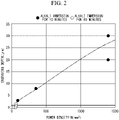
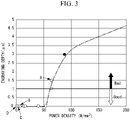
- Fig. 2 and Fig. 3 illustrate the relationship between the power density and the engraving depth.
- Fig. 3 is an enlarged view of Fig. 2 .
- the horizontal axis represents the power density (W/mm 2 )
- the vertical axis represents the engraving depth ( ⁇ m)
- each white circle plot represents a test plate for alkali immersion time of 60 minutes
- each black circle plot represents a test plate for alkali immersion time of 10 minutes.
- Fig. 2 indicates a trend that, as the power density becomes larger, the engraving depth also becomes larger. Moreover, Fig. 2 suggests that there is a conversion point at which the engraving depth increases sharply in a region of a low power density.
- Fig. 3 shows an enlarged view of the region of a low power density.
- the engraving depth is 0 ⁇ m when the power density is below 53.2 W/mm 2 (test No. 8)
- some of the engraving depths exceed 1 ⁇ m when the power density is 63.7 W/mm 2 (test Nos. 5, 6).
- the engraving depth can be less than or equal to 1 ⁇ m.
- the Mg(OH) 2 film having a thickness of about 30 ⁇ m is formed.
- an Mg-Al-Ca based alloy is immersed in the alkali solution, it has been confirmed that the thickness of the Mg(OH) 2 film formed on the surface is about 1 ⁇ m.
- the base material is not damaged.
- the power density is less than or equal to 60 W/mm 2 , it is possible to form an oxide film (MgO film) without damaging the base material and improve corrosion resistance.
- Test plates of test No. 16 to No. 19 described above were immersed in 1 mass% of NaCl aqueous solution for 168 hours, and then the corrosion rates were calculated.
- Fig. 4 illustrates the relationship between the heat input amount and the corrosion rate, where the corrosion rate of the test plate (Mg-Al-Ca based alloy) on which no surface modification is performed is one.
- the horizontal axis represents the corrosion rate ratio (a.u.), and the vertical axis represents the heat input amount (mJ).
- Fig. 4 it is confirmed that, in irradiation of laser light, when the heat input amount exceeds 5 mJ, the test plate is more likely to be corroded than before the surface modification is performed.
- the heat input amount is greater than or equal to 0.3 mJ and less than or equal to 4 mJ, preferably, greater than or equal to 1 mJ and less than or equal to 4 mJ, the corrosion resistance of the test plate is improved due to surface modification.
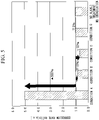
- Fig. 5 illustrates corrosion resistance evaluation results of test No. 16 to No. 19 (conditions A to D).
- the vertical axis represents the corrosion rate ratio (a.u.).
- a test plate on which no surface modification is performed is used as a reference.
- the corrosion rate was increased by about 500% compared to a test plate whose surface was not modified.
- the corrosion rates were reduced compared to a test plate whose surface was not modified.
- the reduction rates in conditions B, C, and D were 18%, 32%, and 2%, respectively.
- an Mg-Al-Ca based alloy is immersed in an alkali solution, and the surface of the Mg-Al-Ca based alloy immersed in the alkali solution is irradiated with laser light at a power density that is less than or equal to 60 W/mm 2 and a heat input amount that is less than or equal to 5 mJ.
- the immersion in the alkali solution causes an Mg(OH) 2 film to be formed on the surface of the Mg-Al-Ca based alloy.
- Mg(OH) 2 film is irradiated with laser, a dehydration reaction occurs. This modifies the Mg(OH) 2 film to be a homogeneous and dense MgO film.
- an oxide film (MgO film) can be formed with the engraving depth not exceeding the thickness of the Mg(OH) 2 film. Accordingly, it is possible to improve corrosion resistance without damaging a base material.
- the heat input amount is preferably greater than or equal to 0.3 mJ and less than or equal to 4 mJ, more preferably greater than or equal to 1 mJ and less than or equal to 4 mJ.
- Corrosion resistance can be more reliably improved when the heat input amount is within the range described above.
- the power density be less than or equal to 53.2 W/mm 2 .
- the power density be less than or equal to 15.9 W/mm 2 .
- the power density be greater than or equal to 3.3 W/mm 2 .
- the immersion time may be longer than or equal to 10 minutes and shorter than or equal to 120 minutes.
- an Mg(OH) 2 film having a thickness of more than 1 ⁇ m can be formed. Even when the immersion is performed for more than 120 minutes, the effect of a significant increase in the thickness of the Mg(OH) 2 film is not expected.
Landscapes
- Chemical & Material Sciences (AREA)
- Engineering & Computer Science (AREA)
- Materials Engineering (AREA)
- Mechanical Engineering (AREA)
- Metallurgy (AREA)
- Organic Chemistry (AREA)
- General Chemical & Material Sciences (AREA)
- Chemical Kinetics & Catalysis (AREA)
- Other Surface Treatments For Metallic Materials (AREA)
- Chemical Treatment Of Metals (AREA)
Abstract
Description
- The present disclosure relates to a surface modification method of an Mg-Al-Ca based alloy.
- A magnesium (Mg) alloy is lightweight and has high strength but has lower corrosion resistance than an aluminum (Al) alloy or the like. Thus, the magnesium alloy needs to be used after surface treatment and coating are applied thereto.
- A typical surface treatment method uses chemical conversion treatment and anodization treatment. The chemical conversion treatment causes a chemical treatment agent to act on the surface of a metal material to be treated, so as to chemically form an oxide film. The anodization treatment uses a metal material to be treated as an anode to carry current in a special electrolysis solution, so as to electrochemically produce an oxide film.
-
Japanese Patent Application Laid-Open No. 2008-291310 - In the chemical conversion treatment, a chemical liquid of hexavalent chromium or the like is used as a chemical treatment agent. Since hexavalent chromium has a high environmental load, there is a social demand for refraining from the use thereof. Furthermore, since a chemical liquid is used, there are problems of maintenance cost and disposal cost of the chemical liquid.
-
Japanese Patent Application Laid-Open No. 2008-291310 Japanese Patent Application Laid-Open No. 2008-291310 - However, according to studies by the present inventors, it has been found that, when a metal material to be treated is replaced with an Mg-Al-Ca based alloy and an oxide film is formed by the method disclosed in
Japanese Patent Application Laid-Open No. 2008-291310 - The present disclosure has been made in view of the above problems and intends to provide a surface modification method of an Mg-Al-Ca based alloy that enables formation of an oxide film without damaging a base material.
- To solve the above problems, the surface modification method of an Mg-Al-Ca based alloy of the present disclosure employs the following measures.
- The present disclosure provides a surface modification method of an Mg-Al-Ca based alloy. The surface modification method includes: immersing an Mg-Al-Ca based alloy in an alkali solution; and irradiating a surface of the Mg-Al-Ca based alloy immersed in the alkali solution with a laser light at a power density that is less than or equal to 60 W/mm2 and a heat input amount that is less than or equal to 5 mJ.
- The immersion in the alkali solution causes an Mg(OH)2 film to be formed on the surface of the Mg-Al-Ca based alloy. When the Mg(OH)2 film is irradiated with laser, a dehydration reaction occurs. This modifies the Mg(OH)2 film to be a homogeneous and dense MgO film.
- As long as laser light irradiation is performed under conditions where the power density and the heat input amount are within the range described above, the engraving depth does not exceed the thickness of the Mg(OH)2 film. It is therefore possible to form an oxide film (MgO film) without damaging a base material. This can improve the corrosion resistance.
-
-
Fig. 1 illustrates a laser scanning method as an example. -
Fig. 2 is a diagram illustrating a relationship between a power density and an engraving depth. -
Fig. 3 is an enlarged view ofFig. 2 . -
Fig. 4 is a diagram illustrating a relationship between a heat input amount and a corrosion rate. -
Fig. 5 is a diagram illustrating corrosion resistance evaluation results. - One embodiment of a surface modification method of an Mg-Al-Ca based alloy according to the present invention will be described below with reference to the drawings.
- A surface modification method of an Mg-Al-Ca based alloy according to the present embodiment includes an alkali treatment step and a laser light irradiation step.
- An Mg-Al-Ca based alloy is immersed in an alkali solution for a predetermined time. This causes an Mg(OH)2 film to be formed on the surface of the Mg-Al-Ca based alloy.
- After the predetermined time of immersion, the Mg-Al-Ca based alloy on which the Mg(OH)2 film is formed is taken out from the alkali solution.
- The alkali solution contains at least one of magnesium hydroxide (Mg(OH)2), sodium chloride (NaCl), magnesium chloride (MgCl2), and sodium hydroxide (NaOH).
- In the alkali solution, 0.001 g or greater and 0.012 g or less of Mg(OH)2 may be contained as a chemical component in terms of mass in 1 litter of water. In the alkali solution, 0.001 g or greater and 300 g or less of NaCl may be contained as a chemical component in terms of mass in 1 litter of water. In the alkali solution, 0 g or greater and 400 g or less of MgCl2 may be contained as a chemical component in terms of mass in 1 litter of water. In the alkali solution, 0 g greater and 500 g or less of NaOH may be contained as a chemical component in terms of mass in 1 litter of water.
- The immersion time is longer than or equal to 10 minutes and shorter than or equal to 120 minutes, preferably, longer than or equal to 30 minutes and shorter than or equal to 60 minutes. When the immersion time is longer than or equal to 10 minutes, an Mg(OH)2 film having a thickness of more than 1 µm may be formed. Even when immersion is performed for more than 120 minutes, it is not possible to expect a significant increase in the thickness of Mg(OH)2 film.
- The Mg-Al-Ca based alloy has a composition that contains Ca of a atom% and Al of b atom%, with the remaining part made of Mg. The symbols "a" and "b" meet Equations (1) to (3) below.


- The Mg-Al-Ca based alloy may contain Mn of k atom%. The symbol "k" meets Equation (4) below. Mn is an element that improves at least one of corrosion resistance and incombustibility.

- Even a small addition amount of Mn may improve corrosion resistance, while an increased addition amount of Mn causes a reduction in the ductility. To achieve both good corrosion resistance and ductility, it is desirable to suppress addition amount of Mn.
- It is preferable that (Mg, Al)2Ca of c volume% be contained in the Mg-Al-Ca based alloy. The symbol "c" meets Equation (5) below. (Mg, Al)2Ca is dispersed in the alloy.

- The Mg-Al-Ca based alloy may contain Si of x atom%. The symbol "x" meets Equation (6) below.

- Inclusion of Si in the range described above can improve the ductility. If the ductility is reduced due to addition of Mn, the ductility can be improved by addition of Si.
- The Mg-Al-Ca based alloy may contain Zn, a rare earth element (Y, La, Ce, Pr, Nd, Sm, Gd, Tb, Dy, Ho, Er, Tm, Yb), and an inevitable impurity. It is preferable that Zn content be greater than or equal to 0.001 atom% and less than or equal to 3 atom%. It is preferable that rare earth element content be greater than or equal to 0.1 atom% and less than or equal to 5 atom%.
- The Mg-Al-Ca based alloy on which the alkali treatment has been performed is irradiated with laser light by using a laser processing apparatus. The laser light is emitted under conditions where the power density is less than or equal to 60 W/mm2 and the heat input amount is less than or equal to 5 mJ. The heat input amount is preferably greater than or equal to 0.3 mJ and less than or equal to 4 mJ, more preferably greater than or equal to 1 mJ and less than or equal to 4 mJ.
- The laser processing apparatus may be, for example, MD-X1500 by KEYENCE CORPORATION having the maximum output of 25 W(φ60 µm), the wavelength of 1064 nm (in YG laser light), the pulse width of about 500 ns to 1000 ns, the frequency of 1 kHz to 400 kHz, the maximum scanning rate of 12 m/s, and the processing area of 125 mm × 125 mm × 42 mm.
- The power density may be adjusted to be a desired value by controlling the laser average output and/or the laser beam diameter.
- The heat input amount may be adjusted to be a desired value by controlling the laser average output, the laser scanning rate, the frequency, and the laser beam diameter.
- It is preferable that the laser light be emitted under conditions where the laser average output is greater than or equal to 0.01 W/mm2 and less than or equal to 2 W/mm2, the frequency is higher than or equal to 1 kHz and lower than or equal to 500 kHz, the laser scanning rate is greater than or equal to 100 mm/s and less than or equal to 850 mm/s, and the laser beam diameter is greater than or equal to 0.1 mm and less than or equal to 0.5 mm.
- It is preferable that the entire surface of the Mg(OH)2 film formed on the surface of the Mg-Al-Ca based alloy be irradiated with the laser light exhaustively. For example, as illustrated in
Fig. 1 , the surface is scanned with the laser light (L) in the X direction from one end (lower left corner on the sheet) to the opposite end (lower right corner on the sheet) of the Mg-Al-Ca basedalloy 1. After reaching the opposite end, the laser light is shifted in the Y direction (to upper side on the sheet), and the surface is scanned in the X direction from the opposite end to the one end. This is repeated to irradiate the entire surface of the Mg(OH)2 film with the laser light. - It is preferable that a laser beam overlapping rate (X) be greater than or equal to 0.9% and less than or equal to 0.99%. It is preferable that a laser beam overlapping rate (Y) be greater than or equal to 0.87% and less than or equal to 0.97%.
- When irradiated with the laser light, the Mg(OH)2 film is modified to an MgO film due to a dehydration reaction. The thickness of the formed MgO film is 0.1 µm to 1 µm.
- The MgO film contains 90% or greater of Mg as a cation or is an oxide containing Al, An, Mn, and/or a rare earth element in some cases.
- According to the embodiment described above, surface modification was performed on a test plate of the Mg-Al-Ca based alloy.
- Test plate: Mg-10Al-5Ca-0.05Mn
- Alkali solution: an aqueous solution containing Mg(OH)2: 0.012 g as a chemical component in terms of mass in 1 litter of water
- The thickness of the Mg(OH)2 film formed on the surface of the test plate immersed in the alkali solution for a predetermined time was about 0.1 µm to 1 µm.
- Table 1 illustrates test conditions and results (engraving depths) obtained by observing the surface of the test plate by using a confocal optical microscope.
[Table 1] Test No. Immersion time Laser irrad ia tion Engravin g depth Output (average) Beam diam eter (average) Frequency Scanning rate Beam overlapping rate X Beam overlapping rate Y Power density Heat input amount min W mm kHz mm/s W/mm2 mJ µm 1 10 11 0.05 200 25 0.995 0.8 1401 22 30 2 10 11 0.05 200 50 0.995 0.8 1401 11 20 3 10 11 0.1 50 500 0.9 0.87 350 2 8 4 10 11 0.2 50 850 0.915 0.925 87.5 3 3 5 60 2 0.1 50 500 0.9 0.87 63.7 0.4 1.5 6 60 2 0.1 50 500 0.9 0.87 63.7 0.4 1 7 60 2 0.2 50 850 0.915 0.925 15.9 0.5 0 8 60 1.7 0.1 50 500 0.9 0.87 53.2 0.3 0 9 60 1.7 0.2 50 850 0.915 0.925 13.3 0.4 0 10 60 1.7 0.3 50 850 0.94 0.96 5.9 0.6 0 11 60 1.7 0.5 50 850 0.97 0.97 2.1 1 0 12 60 1.7 0.5 50 850 0.97 0.97 2.1 0.1 0 -
Fig. 2 andFig. 3 illustrate the relationship between the power density and the engraving depth.Fig. 3 is an enlarged view ofFig. 2 . InFig. 2 andFig. 3 , the horizontal axis represents the power density (W/mm2), the vertical axis represents the engraving depth (µm), each white circle plot represents a test plate for alkali immersion time of 60 minutes, and each black circle plot represents a test plate for alkali immersion time of 10 minutes. -
Fig. 2 indicates a trend that, as the power density becomes larger, the engraving depth also becomes larger. Moreover,Fig. 2 suggests that there is a conversion point at which the engraving depth increases sharply in a region of a low power density. -
Fig. 3 shows an enlarged view of the region of a low power density. With reference toFig. 3 , it is found that, while the engraving depth is 0 µm when the power density is below 53.2 W/mm2 (test No. 8), some of the engraving depths exceed 1 µm when the power density is 63.7 W/mm2 (test Nos. 5, 6). According toFig. 3 , as long as the power density is less than or equal to 60 W/mm2, the engraving depth can be less than or equal to 1 µm. - According to the result obtained by intensive studies by the present inventors, when magnesium alone is immersed in the alkali solution, the Mg(OH)2 film having a thickness of about 30 µm is formed. On the other hand, when an Mg-Al-Ca based alloy is immersed in the alkali solution, it has been confirmed that the thickness of the Mg(OH)2 film formed on the surface is about 1 µm.
- As long as the engraving depth due to the laser light does not exceed the thickness of the Mg(OH)2 film, the base material is not damaged. Thus, when the power density is less than or equal to 60 W/mm2, it is possible to form an oxide film (MgO film) without damaging the base material and improve corrosion resistance.
- Test plates of test No. 16 to No. 19 described above were immersed in 1 mass% of NaCl aqueous solution for 168 hours, and then the corrosion rates were calculated.
- Calculation of the corrosion rate was performed by using Equation (1) below.

- Cr:
- corrosion rate (mm/year)
- ΔW:
- weight difference before and after the test (g)
- r:
- density of the test plate (g/cm-3)
- A:
- initial surface area of the test plate (cm2)
- t:
- immersion time (hr)
-
Fig. 4 illustrates the relationship between the heat input amount and the corrosion rate, where the corrosion rate of the test plate (Mg-Al-Ca based alloy) on which no surface modification is performed is one. InFig. 4 , the horizontal axis represents the corrosion rate ratio (a.u.), and the vertical axis represents the heat input amount (mJ). - According to
Fig. 4 , it is confirmed that, in irradiation of laser light, when the heat input amount exceeds 5 mJ, the test plate is more likely to be corroded than before the surface modification is performed. When the heat input amount is greater than or equal to 0.3 mJ and less than or equal to 4 mJ, preferably, greater than or equal to 1 mJ and less than or equal to 4 mJ, the corrosion resistance of the test plate is improved due to surface modification. -
Fig. 5 illustrates corrosion resistance evaluation results of test No. 16 to No. 19 (conditions A to D). InFig. 5 , the vertical axis represents the corrosion rate ratio (a.u.). For the corrosion rate ratio, a test plate on which no surface modification is performed (no alkali treatment and no irradiation) is used as a reference. - According to
Fig. 5 , in the condition A, the corrosion rate was increased by about 500% compared to a test plate whose surface was not modified. On the other hand, in the conditions B, C, and D, the corrosion rates were reduced compared to a test plate whose surface was not modified. The reduction rates in conditions B, C, and D were 18%, 32%, and 2%, respectively. - According to Table 1, in condition A, while the heat input amount is less than or equal to 5 mJ, the power density exceeds 60 W/mm2. On the other hand, in conditions B, C, and D, each of the heat input amount is less than or equal to 5 mJ, and each of the power density is less than or equal to 60 W/mm2. From these results, it was suggested that it is important not only to set the heat input amount to be less than or equal to 5 mJ but also to set the power density to be less than or equal to 60 W/mm2 for improvement of corrosion resistance of an Mg-Al-Ca based alloy.
- The surface modification method of an Mg-Al-Ca based alloy described in the above embodiment is understood as described below, for example.
- In the surface modification method of an Mg-Al-Ca based alloy according to the present disclosure, an Mg-Al-Ca based alloy is immersed in an alkali solution, and the surface of the Mg-Al-Ca based alloy immersed in the alkali solution is irradiated with laser light at a power density that is less than or equal to 60 W/mm2 and a heat input amount that is less than or equal to 5 mJ.
- The immersion in the alkali solution causes an Mg(OH)2 film to be formed on the surface of the Mg-Al-Ca based alloy. When the Mg(OH)2 film is irradiated with laser, a dehydration reaction occurs. This modifies the Mg(OH)2 film to be a homogeneous and dense MgO film.
- Since the power density and the heat input amount are defined in the range described above, an oxide film (MgO film) can be formed with the engraving depth not exceeding the thickness of the Mg(OH)2 film. Accordingly, it is possible to improve corrosion resistance without damaging a base material.
- In the disclosure described above, the heat input amount is preferably greater than or equal to 0.3 mJ and less than or equal to 4 mJ, more preferably greater than or equal to 1 mJ and less than or equal to 4 mJ.
- Corrosion resistance can be more reliably improved when the heat input amount is within the range described above.
- In the disclosure described above, it is preferable that the power density be less than or equal to 53.2 W/mm2.
- This enables the engraving depth of 0 µm.
- In the disclosure described above, it is preferable that the power density be less than or equal to 15.9 W/mm2.
- This can reduce the corrosion rate compared to a case where no surface modification is performed.
- In the disclosure described above, it is more preferable that the power density be greater than or equal to 3.3 W/mm2.
- This can further increase the reduction amount of the corrosion rate compared to a case where no surface modification is performed.
- In the disclosure described above, the immersion time may be longer than or equal to 10 minutes and shorter than or equal to 120 minutes.
- When the immersion is performed for 10 minutes or longer, an Mg(OH)2 film having a thickness of more than 1 µm can be formed. Even when the immersion is performed for more than 120 minutes, the effect of a significant increase in the thickness of the Mg(OH)2 film is not expected.
-
- 1
- Mg-Al-Ca based alloy
Claims (6)
- A surface modification method of an Mg-Al-Ca based alloy, the surface modification method comprising:immersing an Mg-Al-Ca based alloy in an alkali solution; andirradiating a surface of the Mg-Al-Ca based alloy immersed in the alkali solution with laser light at a power density that is less than or equal to 60 W/mm2 and a heat input amount that is less than or equal to 5 mJ.
- The surface modification method of an Mg-Al-Ca based alloy according to claim 1, wherein the heat input amount is greater than or equal to 0.3 mJ and less than or equal to 4 mJ.
- The surface modification method of an Mg-Al-Ca based alloy according to claim 2, wherein the power density is less than or equal to 53.2 W/mm2.
- The surface modification method of an Mg-Al-Ca based alloy according to claim 2, wherein the power density is less than or equal to 15.9 W/mm2.
- The surface modification method of an Mg-Al-Ca based alloy according to claim 2, wherein the power density is greater than or equal to 3.3 W/mm2.
- The surface modification method of an Mg-Al-Ca based alloy according to any one of claims 1 to 5, wherein time of the immersing is longer than or equal to 10 minutes and shorter than or equal to 120 minutes.
Applications Claiming Priority (1)
| Application Number | Priority Date | Filing Date | Title |
|---|---|---|---|
| JP2021066468A JP7235254B2 (en) | 2021-04-09 | 2021-04-09 | Method for modifying surface of Mg-Al-Ca alloy |
Publications (2)
| Publication Number | Publication Date |
|---|---|
| EP4071272A1 true EP4071272A1 (en) | 2022-10-12 |
| EP4071272B1 EP4071272B1 (en) | 2025-12-10 |
Family
ID=78621643
Family Applications (1)
| Application Number | Title | Priority Date | Filing Date |
|---|---|---|---|
| EP21204425.9A Active EP4071272B1 (en) | 2021-04-09 | 2021-10-25 | Surface modification method of mg-al-ca based alloy |
Country Status (2)
| Country | Link |
|---|---|
| EP (1) | EP4071272B1 (en) |
| JP (1) | JP7235254B2 (en) |
Citations (2)
| Publication number | Priority date | Publication date | Assignee | Title |
|---|---|---|---|---|
| JP2008291310A (en) | 2007-05-24 | 2008-12-04 | Kumamoto Univ | Method for producing magnesium material |
| US20160369378A1 (en) * | 2013-10-23 | 2016-12-22 | National University Corporation Kumamoto University | Magnesium alloy and method of manufacturing same |
Family Cites Families (4)
| Publication number | Priority date | Publication date | Assignee | Title |
|---|---|---|---|---|
| JP5360481B2 (en) * | 2009-07-03 | 2013-12-04 | 日産自動車株式会社 | Magnesium alloy parts |
| JP5595874B2 (en) * | 2010-11-04 | 2014-09-24 | 三井金属鉱業株式会社 | Magnesium alloy surface treatment method |
| CN106676352B (en) * | 2016-12-06 | 2019-05-24 | 湖南大学 | The low cost and high performance high Ca/Al ratio Mg-XAl-YCa-ZZn alloy of one kind and preparation method |
| CN108677039B (en) * | 2018-04-04 | 2020-01-07 | 南通昂申金属材料有限公司 | Magnesium-aluminum alloy for laser surface treatment |
-
2021
- 2021-04-09 JP JP2021066468A patent/JP7235254B2/en active Active
- 2021-10-25 EP EP21204425.9A patent/EP4071272B1/en active Active
Patent Citations (2)
| Publication number | Priority date | Publication date | Assignee | Title |
|---|---|---|---|---|
| JP2008291310A (en) | 2007-05-24 | 2008-12-04 | Kumamoto Univ | Method for producing magnesium material |
| US20160369378A1 (en) * | 2013-10-23 | 2016-12-22 | National University Corporation Kumamoto University | Magnesium alloy and method of manufacturing same |
Non-Patent Citations (2)
| Title |
|---|
| SHUNSUKE YAGI ET AL: "Surface modification of ACM522 magnesium alloy by plasma electrolytic oxidation in phosphate electrolyte", CORROSION SCIENCE, OXFORD, GB, vol. 57, 27 December 2011 (2011-12-27), pages 74 - 80, XP028458283, ISSN: 0010-938X, [retrieved on 20120104], DOI: 10.1016/J.CORSCI.2011.12.032 * |
| SPIEKERMANN P: "Alloys - a special problem of patent law", NONPUBLISHED ENGLISH TRANSLATION OF DOCUMENT, 31 December 1993 (1993-12-31), pages 1 - 20, XP002184689 * |
Also Published As
| Publication number | Publication date |
|---|---|
| EP4071272B1 (en) | 2025-12-10 |
| JP7235254B2 (en) | 2023-03-08 |
| JP2022161559A (en) | 2022-10-21 |
Similar Documents
| Publication | Publication Date | Title |
|---|---|---|
| Cheng et al. | Plasma electrolytic oxidation of an Al-Cu-Li alloy in alkaline aluminate electrolytes: A competition between growth and dissolution for the initial ultra-thin films | |
| Larsen et al. | Effect of excess silicon and small copper content on intergranular corrosion of 6000-series aluminum alloys | |
| Serdechnova et al. | PEO coatings with active protection based on in-situ formed LDH-nanocontainers | |
| KR101195458B1 (en) | Method for treating the surface of metal | |
| Matykina et al. | AC PEO of aluminium with porous alumina precursor films | |
| RU2556171C1 (en) | Aluminium alloy sheet and its manufacturing method | |
| DE69717182T2 (en) | An excimer laser | |
| EP3608428A1 (en) | Oriented silicon steel with low core loss and manufacturing method therefor | |
| EP0978573B1 (en) | Process for producing an aluminium support for a lithographic printing plate | |
| EP4071272B1 (en) | Surface modification method of mg-al-ca based alloy | |
| Li et al. | Corrosion resistance of magnesium alloy surfaces substantially upgraded by gradient energy irradiation of femtosecond lasers | |
| Díaz et al. | Effect of substrate microstructure on corrosion resistance of cast and forged anodised 6082 Al alloy | |
| Nisancioglu et al. | Improving the corrosion resistance of aluminum alloys by cathodic polarization in aqueous media | |
| JP2008291310A (en) | Method for producing magnesium material | |
| DE102018211108A1 (en) | Method for modifying and then forming a surface coating on a metallic component | |
| Rastegari et al. | Comparative analysis of unipolar and bipolar plasma electrolytic oxidation coatings on Al− Mg laminated macro composites | |
| DE69303525T2 (en) | Process for producing a film by chemical conversion | |
| EP2463399A1 (en) | Magnesium components with improved corrosion resistance | |
| Masahashi et al. | Microstructures and mechanical properties of anodic oxides on TiNbSn implant alloys | |
| TWI233452B (en) | Refined aluminum foil for electrolytic capacitors | |
| DE69214288T2 (en) | Treatment of aluminum foil | |
| KR101840567B1 (en) | Preparing method of colored coating layer for aluminum oxide with excellent corrosion resistance for military Using Plasma Electrolytic Oxidation | |
| EP1775752A2 (en) | Etching process for manufacturing an electron exit window | |
| Rojas et al. | Development and characterisation of an Zr-based electrolyte for the formation of an Al2O3/ZrO2 composite coating through plasma electrolytic oxidation | |
| KR101709602B1 (en) | Method of Aluminium Coating Layer with Anti-oxidation Using Micro arc Electrolytic Oxidation |
Legal Events
| Date | Code | Title | Description |
|---|---|---|---|
| PUAI | Public reference made under article 153(3) epc to a published international application that has entered the european phase |
Free format text: ORIGINAL CODE: 0009012 |
|
| STAA | Information on the status of an ep patent application or granted ep patent |
Free format text: STATUS: THE APPLICATION HAS BEEN PUBLISHED |
|
| AK | Designated contracting states |
Kind code of ref document: A1 Designated state(s): AL AT BE BG CH CY CZ DE DK EE ES FI FR GB GR HR HU IE IS IT LI LT LU LV MC MK MT NL NO PL PT RO RS SE SI SK SM TR |
|
| STAA | Information on the status of an ep patent application or granted ep patent |
Free format text: STATUS: REQUEST FOR EXAMINATION WAS MADE |
|
| 17P | Request for examination filed |
Effective date: 20221108 |
|
| RBV | Designated contracting states (corrected) |
Designated state(s): AL AT BE BG CH CY CZ DE DK EE ES FI FR GB GR HR HU IE IS IT LI LT LU LV MC MK MT NL NO PL PT RO RS SE SI SK SM TR |
|
| GRAP | Despatch of communication of intention to grant a patent |
Free format text: ORIGINAL CODE: EPIDOSNIGR1 |
|
| STAA | Information on the status of an ep patent application or granted ep patent |
Free format text: STATUS: GRANT OF PATENT IS INTENDED |
|
| RIC1 | Information provided on ipc code assigned before grant |
Ipc: C23C 22/60 20060101AFI20250704BHEP Ipc: C23C 22/66 20060101ALI20250704BHEP Ipc: C23C 22/82 20060101ALI20250704BHEP Ipc: C22C 23/02 20060101ALI20250704BHEP |
|
| INTG | Intention to grant announced |
Effective date: 20250724 |
|
| GRAS | Grant fee paid |
Free format text: ORIGINAL CODE: EPIDOSNIGR3 |
|
| GRAA | (expected) grant |
Free format text: ORIGINAL CODE: 0009210 |
|
| STAA | Information on the status of an ep patent application or granted ep patent |
Free format text: STATUS: THE PATENT HAS BEEN GRANTED |
|
| AK | Designated contracting states |
Kind code of ref document: B1 Designated state(s): AL AT BE BG CH CY CZ DE DK EE ES FI FR GB GR HR HU IE IS IT LI LT LU LV MC MK MT NL NO PL PT RO RS SE SI SK SM TR |
|
| REG | Reference to a national code |
Ref country code: CH Ref legal event code: F10 Free format text: ST27 STATUS EVENT CODE: U-0-0-F10-F00 (AS PROVIDED BY THE NATIONAL OFFICE) Effective date: 20251210 Ref country code: GB Ref legal event code: FG4D |
|
| REG | Reference to a national code |
Ref country code: DE Ref legal event code: R096 Ref document number: 602021044018 Country of ref document: DE Ref country code: IE Ref legal event code: FG4D |
|
| PG25 | Lapsed in a contracting state [announced via postgrant information from national office to epo] |
Ref country code: ES Free format text: LAPSE BECAUSE OF FAILURE TO SUBMIT A TRANSLATION OF THE DESCRIPTION OR TO PAY THE FEE WITHIN THE PRESCRIBED TIME-LIMIT Effective date: 20251210 |
|
| REG | Reference to a national code |
Ref country code: LT Ref legal event code: MG9D |
|
| PG25 | Lapsed in a contracting state [announced via postgrant information from national office to epo] |
Ref country code: NO Free format text: LAPSE BECAUSE OF FAILURE TO SUBMIT A TRANSLATION OF THE DESCRIPTION OR TO PAY THE FEE WITHIN THE PRESCRIBED TIME-LIMIT Effective date: 20260310 |
|
| PG25 | Lapsed in a contracting state [announced via postgrant information from national office to epo] |
Ref country code: FI Free format text: LAPSE BECAUSE OF FAILURE TO SUBMIT A TRANSLATION OF THE DESCRIPTION OR TO PAY THE FEE WITHIN THE PRESCRIBED TIME-LIMIT Effective date: 20251210 Ref country code: HR Free format text: LAPSE BECAUSE OF FAILURE TO SUBMIT A TRANSLATION OF THE DESCRIPTION OR TO PAY THE FEE WITHIN THE PRESCRIBED TIME-LIMIT Effective date: 20251210 |
|
| REG | Reference to a national code |
Ref country code: NL Ref legal event code: MP Effective date: 20251210 |
|
| PG25 | Lapsed in a contracting state [announced via postgrant information from national office to epo] |
Ref country code: RS Free format text: LAPSE BECAUSE OF FAILURE TO SUBMIT A TRANSLATION OF THE DESCRIPTION OR TO PAY THE FEE WITHIN THE PRESCRIBED TIME-LIMIT Effective date: 20260310 |
|
| PG25 | Lapsed in a contracting state [announced via postgrant information from national office to epo] |
Ref country code: LV Free format text: LAPSE BECAUSE OF FAILURE TO SUBMIT A TRANSLATION OF THE DESCRIPTION OR TO PAY THE FEE WITHIN THE PRESCRIBED TIME-LIMIT Effective date: 20251210 |
|
| PG25 | Lapsed in a contracting state [announced via postgrant information from national office to epo] |
Ref country code: BG Free format text: LAPSE BECAUSE OF FAILURE TO SUBMIT A TRANSLATION OF THE DESCRIPTION OR TO PAY THE FEE WITHIN THE PRESCRIBED TIME-LIMIT Effective date: 20251210 |