EP4071258A1 - Manufacturing method of aircraft member - Google Patents
Manufacturing method of aircraft member Download PDFInfo
- Publication number
- EP4071258A1 EP4071258A1 EP21209865.1A EP21209865A EP4071258A1 EP 4071258 A1 EP4071258 A1 EP 4071258A1 EP 21209865 A EP21209865 A EP 21209865A EP 4071258 A1 EP4071258 A1 EP 4071258A1
- Authority
- EP
- European Patent Office
- Prior art keywords
- extrusion
- equal
- manufacturing
- billet
- atom
- Prior art date
- Legal status (The legal status is an assumption and is not a legal conclusion. Google has not performed a legal analysis and makes no representation as to the accuracy of the status listed.)
- Granted
Links
Images


Classifications
-
- C—CHEMISTRY; METALLURGY
- C22—METALLURGY; FERROUS OR NON-FERROUS ALLOYS; TREATMENT OF ALLOYS OR NON-FERROUS METALS
- C22C—ALLOYS
- C22C23/00—Alloys based on magnesium
- C22C23/02—Alloys based on magnesium with aluminium as the next major constituent
-
- C—CHEMISTRY; METALLURGY
- C22—METALLURGY; FERROUS OR NON-FERROUS ALLOYS; TREATMENT OF ALLOYS OR NON-FERROUS METALS
- C22F—CHANGING THE PHYSICAL STRUCTURE OF NON-FERROUS METALS AND NON-FERROUS ALLOYS
- C22F1/00—Changing the physical structure of non-ferrous metals or alloys by heat treatment or by hot or cold working
- C22F1/06—Changing the physical structure of non-ferrous metals or alloys by heat treatment or by hot or cold working of magnesium or alloys based thereon
Definitions
- the present disclosure relates to a manufacturing method of an aircraft member, in particular, a manufacturing method of a secondary structure member of an aircraft.
- the magnesium alloy needs substantially the same manufacturing cost as an aluminum alloy and has specific strength greater than or equal to the aluminum alloy (see Japanese Patent Laid-Open No. 2008-536013 , Japanese Patent Laid-Open No. 2010-209452 ).
- a magnesium alloy is an active metal and thus requires anti-corrosion treatment.
- Japanese Patent Laid-Open No. 2008-536013 a non-chromate conversion coating is formed on the surface of the magnesium alloy to improve corrosion resistance.
- Japanese Patent Laid-Open No. 2010-209452 discloses a magnesium alloy member having high corrosion resistance that does not require anti-corrosion treatment by defining the number and the size of fine precipitates containing both Mg and Al that are present in a surface layer region.
- Japanese Patent Application Laid-Open No. 2008-536013 and Japanese Patent Application Laid-Open No. 2010-209452 are examples of the related art.
- a material applied to an aircraft member is required to balance strength (tensile strength) and ductility (elongation).
- Magnesium alloys have lower strength than aluminum alloys. Thus, it is required to improve the strength, but the strength of magnesium alloy is in a trade-off relationship with ductility, and it is difficult to balance the strength and the ductility.
- a magnesium alloy member is manufactured by using a billet casted by using an ingot made of a magnesium alloy.
- the crystal grain diameter and the microstructure of a magnesium alloy are varied depending on processing conditions, and then the strength and the ductility of magnesium alloy are varied.
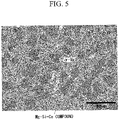
- Fig. 5 illustrates a metallographic structure photograph of an Mg-Al-Ca-Si based alloy as an example. As illustrated in Fig. 5 , ⁇ -Mg (Al, Ca being dissolved into a solid solution), an Mg-Si-Ca compound, an (Mg, Al) 2 Ca compound (C36), and the like are included in the metallographic structure.
- Fig. 6 illustrates a metallographic structure photograph of an Mg-Si-Ca compound.
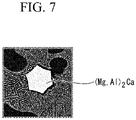
- Fig. 7 illustrates a metallographic structure photograph of an (Mg, Al) 2 Ca compound.
- the present disclosure has been made in view of the above problems and intends to provide a manufacturing method that enables stable acquisition of a magnesium alloy member having both good strength and ductility regardless of a billet size.
- the manufacturing method of an aircraft member of the present disclosure employs the following measures.
- the present disclosure provides a manufacturing method of an aircraft member to perform extrusion processing by using an Mg-Al-Ca based alloy containing (Mg, Al) 2 Ca compound
- the manufacturing method of an aircraft member includes: selecting a billet of an Mg-Al-Ca based alloy containing Al: greater than or equal to 6 atom% and less than or equal to 8 atom% and Ca: greater than or equal to 3 atom% and less than or equal to 4 atom% with respect to the whole amount; and extruding the billet under a condition where a temperature of the billet is maintained to be lower than a melting temperature of the (Mg, Al) 2 Ca.
- a billet whose Al content and Ca content are within the above range is used, and extrusion processing conditions are optimized, so that an aircraft member having both good strength and ductility can be obtained more stably than in the conventional methods. Further, according to the manufacturing method of the present disclosure, an aircraft member that meets required incombustibility can be obtained.
- a manufacturing method according to the present disclosure is suitable for manufacturing a secondary structure member for an aircraft.
- the secondary structure member is a member installed in a primary structure member such as a stringer.
- the secondary structure member is a clip, a bracket, a metal fitting used for fastening pipes, a seat frame, or the like.
- the secondary structure member is not loaded as heavily as the primary structure member.
- an aircraft member is extruded by using an Mg-Al-Ca based alloy billet including an (Mg, Al) 2 Ca compound (hereinafter, (Mg, Al) 2 Ca).
- the extrusion processing is performed under a condition where the billet temperature is maintained to be lower than a melting temperature of the (Mg, Al) 2 Ca compound.
- (Mg, Al) 2 Ca is dispersed in a metallographic structure.
- the above Mg-Al-Ca based alloy (billet) is a casting manufactured by melt casting.
- the cooling rate during billet casting is lower than or equal to 1000 K/sec, preferably, lower than or equal to 100 K/sec.
- the diameter of the billet is greater than or equal to 29 mm and less than or equal to 180 mm.
- the diameter of the billet may be greater than or equal to 69 mm.
- an Mg-Al-Ca based alloy containing Al of greater than or equal to 6 atom% and less than or equal to 8 atom% and Ca of greater than or equal to 3 atom% and less than or equal to 4 atom% with respect to the whole amount is selected.
- the Mg-Al-Ca based alloy may contain Mn of greater than 0 atom% and less than or equal to 0.3 atom%, preferably, greater than or equal to 0.01 and less than or equal to 0.05.
- the remaining part of the Mg-Al-Ca based alloy (billet) is made of Mg. This not only means that the whole remaining part is made of Mg but also indicates that the remaining part may include impurities or other elements to the extent that does not affect the alloy characteristics.
- the Mg-Al-Ca based alloy does not contain Si. This not only means that the Si content is 0 atom% but also indicates that Si may be unavoidably contained (for example, less than or equal to 0.1 atom%).
- the above Mg-Al-Ca based alloy (billet) contains an (Mg, Al) 2 Ca compound.
- (Mg, Al) 2 Ca may be contained by preferably greater than or equal to 10 volume% and less than or equal to 35 volume%, more preferably, greater than or equal to 10 volume% and less than or equal to 30 volume%.
- the melting temperature of (Mg, Al) 2 Ca is 490 degrees Celsius.
- the melting temperature is derived from a phase diagram.
- the billet temperature during extrusion processing may be maintained to be lower than the melting temperature by setting an extrusion temperature and an extrusion exit rate.
- the "extrusion exit rate” is a rate at which a material is extruded from an extrusion mold (die) during extrusion molding.
- a extrusion ratio may be higher than or equal to 10 and lower than or equal to 80.
- the cross section of the extruded material may be an L-shape, a T-shape, or a Z-shape, for example.
- the billet of the Mg-Al-Ca based alloy may be heat-treated at a temperature higher than or equal to 400 degrees Celsius and lower than or equal to 500 degrees Celsius for a period longer than or equal to one hour and shorter than or equal to six hours before extrusion processing.
- the processing temperature is preferably higher than or equal to 450 degrees Celsius and lower than or equal to 500 degrees Celsius. More desirably, the processing time is made shorter, which is about one hour.
- Billets were extruded under predetermined conditions, and the tensile strength (FTY) and the ductility (elongation/EL) of the obtained extruded material were measured.
- FTY tensile strength
- EL ductility
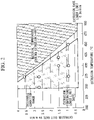
- Fig. 1 and Table 1 illustrate measurement results.
- the horizontal axis (x-axis) represents an extrusion temperature (degrees Celsius)
- the vertical axis (y-axis) represents an extrusion exit rate Ve (m/min)
- a circle (O) plot x: 375 degrees Celsius, y: 3.6 m/min
- a circle plot x: 450 degrees Celsius, y: 0.9 m/min.
- a colored portion on the right side of the above-described straight line in the sheet is a region of conditions where the material temperature during extrusion (billet temperature) exceeds 490 degrees Celsius.
- Table 1 Extrusion material No. Extrusion condition Tensile strength (MPa) Ductility (%) Extrusion temperature (°C) Extrusion exit rate (m/min) 1 350 2.7 290 5.6 2 375 3.6 281 6.0 3 2.7 283 6.2 4 0.9 310 3.5 5 400 1.5 294 5.3 6 0.9 294 4.7 7 420 1.5 280 5.5 8 425 2.7 264 1.6 9 450 0.9 270 7.1
- the extruded material (a cross (X) plot /extruded material No. 8) extruded under a condition where the billet temperature exceeds 490 degrees Celsius (the billet being melted) had tensile strength of 264 MPa and ductility of 1.6%.
- all the extruded materials (circle plots /extruded materials No. 1 to 7, 9) extruded under a condition of a billet temperature at which no melting occurs (the temperature being maintained to be lower than the billet melting temperature) had tensile strength greater than or equal to 270 MPa and ductility greater than or equal to 3%.
- Fig. 2 illustrates a range of preferable extrusion processing conditions suggested from the result of Fig. 1 .
- the horizontal axis (x-axis) represents an extrusion temperature (degrees Celsius)
- the vertical axis (y-axis) represents an extrusion exit rate Ve (m/min)
- a long dashed double-short dashed line represents a preferable range
- a shaded portion between the solid line and the long dashed double-short dashed line is a region that represents a more preferable range.
- a colored portion on the right side of the above-described straight line in the sheet is a region of conditions where the material temperature during extru
- the extrusion temperature is higher than or equal to 350 degrees Celsius, and the extrusion exit rate is higher than or equal to 0.3 m/min.
- the extrusion temperature is lower than 350 degrees Celsius, the fluidity of the billet is deteriorated, which makes extrusion difficult.
- the extrusion exit rate is lower than 0.3 m/min, it becomes difficult to perform rate control of the extrusion apparatus.
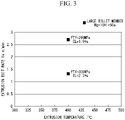
- Fig. 3 and Table 2 illustrate results obtained by measuring the tensile strength (FTY) and the ductility (elongation/EL) of extruded materials obtained by performing extrusion processing by using billets whose Al and Ca contents are larger than values of the range defined in the present embodiment.
- Extruded materials No. 12 to 23 were heated by using a heater, and the temperatures at the time of ignition were measured. The extrusion ratio during extrusion processing was 15. The measurement results are illustrated in Table 3.
- Table 3 Extruded material No. Billet ( ⁇ 69mm) Composition Extrusion condition Ignition temperature (°C) Extrusion temperature (°C) Extrusion exit rate (m/min) Measurement result Average 12 Mg-8Al-4Ca-0.015Mn 375 3.6 1033 1038 13 1062 14 1020 15 Mg-8Al-4Ca-0.015Mn 450 0.9 1036 1039 16 1049 17 1032 18 Mg-6Al-3Ca 400 0.9 1080 1077 19 1075 20 1077 21 Mg-6Al-3Ca-0.05Mn 400 0.9 1017 1061 22 1082 23 1085 Reference : Elektron 43 845 869 865 898
- salt water 5% NaCl
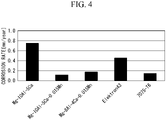
- Fig. 4 illustrates results of the corrosion test.
- the vertical axis represents a corrosion rate (mm/year), and a bar of each test piece represents an average value.
- the corrosion rate (average) of Mg-10Al-5Ca was 0.75 mm/year.
- the corrosion rate (average) of Mg-10Al-5Ca-0.015Mn was 0.125 mm/year. Accordingly, it was confirmed that the presence of Mn affects the corrosion rate.
- the corrosion rate (average) of Mg-8Al-4Ca-0.015Mn containing Mn was also low such as 0.175 mm/year.
- the corrosion rate (average) of Elektron 43 was 0.425 mm/year. It was confirmed that the Mg-Al-Ca based alloy containing Mn has a lower corrosion rate than Elektron 43.
- the corrosion rate (average) of 7075-T6 was 0.15 mm/year. It was confirmed that the Mg-Al-Ca based alloy containing Mn has the same corrosion rate as 7075-T6.
- a refrigerant, a design method of the same, and a freezing machine filled with the refrigerant described in the above embodiment are understood as follows, for example.
- the present disclosure relates to a manufacturing method of an aircraft member to perform extrusion processing by using an Mg-Al-Ca based alloy containing (Mg, Al) 2 Ca.
- a billet of an Mg-Al-Ca based alloy containing Al: greater than or equal to 6 atom% and less than or equal to 8 atom% and Ca: greater than or equal to 3 atom% and less than or equal to 4 atom% with respect to the whole amount is selected, and the billet is extruded under a condition where the temperature of the billet is maintained to be lower than a melting temperature of the (Mg, Al) 2 Ca.
- the melting temperature of (Mg, Al) 2 Ca is 490 degrees Celsius.
- the Mg-Al-Ca based alloy described above has less specific gravity than an aluminum alloy used in a conventional aircraft field. Therefore, the weight can be reduced by 10% or more as compared to an aluminum alloy member by processing such an Mg-Al-Ca based alloy into an aircraft member.
- (Mg, Al) 2 Ca that is a C36 type compound is a hard compound.
- (Mg, Al) 2 Ca is dispersed in a metallographic structure, high strength and relatively large ductility can be obtained.
- the degree of dispersion of (Mg, Al) 2 Ca may be greater than or equal to 1 piece/ ⁇ m 2 . It is preferable that (Mg, Al) 2 Ca be fine (for example, less than or equal to 2 ⁇ m).
- Addition of Ca can improve the incombustibility and the mechanical property of the extruded material (aircraft member). If the Ca content is excessively high, this makes it difficult to obtain a solidified state of the magnesium alloy, and extrusion processing becomes difficult. If the Ca content is excessively low, it is not possible to obtain sufficient incombustibility.
- Addition of Al can improve the mechanical property and the corrosion resistance of the extruded material. If the Al content is excessively high, it is not possible to obtain sufficient strength. If the Al content is excessively low, it is not possible to obtain sufficient ductility.
- Increased contents of Al and Ca contained in an Mg-Al-Ca based alloy may become a factor of coarsening (Mg, Al) 2 Ca in a metallographic structure. If the (Mg, Al) 2 Ca is coarsened, the ductility of the extruded material is likely to be reduced. With the contents of Al and Ca being within the range described above, this may result in an extruded material having desired ductility.
- the condition is set by an extrusion temperature and an extrusion exit rate, and with respect to a straight line connecting a first plot (x: 375 degrees Celsius, y: 3.6 m/min) to a second plot (x: 450 degrees Celsius, y: 0.9 m/min) in a graph of the x-y coordinate system where the x-axis represents the extrusion temperature (degrees Celsius) and the y-axis represents the extrusion exit rate (m/min), the extrusion temperature and the extrusion exit rate may be selected from values on the straight line or a range in which x and y are smaller than values on the straight line.
- the temperature of the billet can be maintained to be lower than the melting temperature of the (Mg, Al) 2 Ca during extrusion processing. Coordinates of the first plot and the second plot are obtained by actual measurement, which are highly reliable. Therefore, an extruded material having both good tensile strength and ductility can be more stably manufactured than in the conventional materials.
- the extrusion temperature in the condition be higher than or equal to 350 degrees Celsius. If the extrusion temperature is excessively low, the fluidity of the billet is reduced, which makes the extrusion difficult.
- the extrusion exit rate in the condition be higher than or equal to 0.3 m/min.
- the Mg-Al-Ca based alloy may contain Mn of greater than 0 atom% and less than or equal to 0.3 atom%.
- Mn has an effect of improving the corrosion resistance even with a small amount.
- the ductility of the extruded material is reduced in accordance with an increase in the addition amount.
Landscapes
- Chemical & Material Sciences (AREA)
- Engineering & Computer Science (AREA)
- Materials Engineering (AREA)
- Mechanical Engineering (AREA)
- Metallurgy (AREA)
- Organic Chemistry (AREA)
- Physics & Mathematics (AREA)
- Thermal Sciences (AREA)
- Crystallography & Structural Chemistry (AREA)
- Extrusion Of Metal (AREA)
Abstract
Description
- The present disclosure relates to a manufacturing method of an aircraft member, in particular, a manufacturing method of a secondary structure member of an aircraft.
- Due to a recent demand for improvement of fuel efficiency, there is a growing need in civil aircrafts to reduce the weight of an airframe. While an aluminum alloy is used for main structure members (fuselage outer plates or the like) of conventional civil aircrafts, increase of strength of an aluminum alloy member has reached its limit, which requires a raw material having much higher specific strength.
- In such a situation, composite materials have been applied to the airframe main structure in recent years. However, this requires high manufacturing cost, long manufacturing lead time, high assembly cost, or the like.
- To solve these problems, research of a magnesium alloy is in progress. The magnesium alloy needs substantially the same manufacturing cost as an aluminum alloy and has specific strength greater than or equal to the aluminum alloy (see
Japanese Patent Laid-Open No. 2008-536013 Japanese Patent Laid-Open No. 2010-209452 - A magnesium alloy is an active metal and thus requires anti-corrosion treatment. In
Japanese Patent Laid-Open No. 2008-536013 Japanese Patent Laid-Open No. 2010-209452 -
Japanese Patent Application Laid-Open No. 2008-536013 Japanese Patent Application Laid-Open No. 2010-209452 - In addition to corrosion resistance, a material applied to an aircraft member is required to balance strength (tensile strength) and ductility (elongation). Magnesium alloys have lower strength than aluminum alloys. Thus, it is required to improve the strength, but the strength of magnesium alloy is in a trade-off relationship with ductility, and it is difficult to balance the strength and the ductility.
- Further, to apply a magnesium alloy to an aircraft member, it is required to improve incombustibility to increase an ignition temperature.
- As disclosed in
Japanese Patent Laid-Open No. 2010-209452 - Use of a somewhat large billet is desirable for manufacturing of a large-sized aircraft member. However, the larger diameter of the billet is more likely to cause an uneven quality as a whole billet. Such unevenness in quality may become a factor that affects strength and ductility of the magnesium alloy member.
- The crystal grain diameter and the microstructure of a magnesium alloy are varied depending on processing conditions, and then the strength and the ductility of magnesium alloy are varied.
-
Fig. 5 illustrates a metallographic structure photograph of an Mg-Al-Ca-Si based alloy as an example. As illustrated inFig. 5 , α-Mg (Al, Ca being dissolved into a solid solution), an Mg-Si-Ca compound, an (Mg, Al)2Ca compound (C36), and the like are included in the metallographic structure.Fig. 6 illustrates a metallographic structure photograph of an Mg-Si-Ca compound.Fig. 7 illustrates a metallographic structure photograph of an (Mg, Al)2Ca compound. - According to studies by the present inventors, it has been found that, when an intermetallic compound such as an Mg-Si-Ca compound and an (Mg, Al)2 Ca compound is coarsened, the ductility tends to decrease. When the billet is larger, an (Mg, Al)2 Ca compound is more likely to be coarsened.
- In a small billet, addition of Si to a magnesium alloy may improve the ductility. However, according to studies by the present inventors, it has been found that ductility decreases in a somewhat large billet.
- The present disclosure has been made in view of the above problems and intends to provide a manufacturing method that enables stable acquisition of a magnesium alloy member having both good strength and ductility regardless of a billet size.
- To solve the above problems, the manufacturing method of an aircraft member of the present disclosure employs the following measures.
- The present disclosure provides a manufacturing method of an aircraft member to perform extrusion processing by using an Mg-Al-Ca based alloy containing (Mg, Al)2Ca compound, and the manufacturing method of an aircraft member includes: selecting a billet of an Mg-Al-Ca based alloy containing Al: greater than or equal to 6 atom% and less than or equal to 8 atom% and Ca: greater than or equal to 3 atom% and less than or equal to 4 atom% with respect to the whole amount; and extruding the billet under a condition where a temperature of the billet is maintained to be lower than a melting temperature of the (Mg, Al)2Ca.
- According to the manufacturing method of the present disclosure, a billet whose Al content and Ca content are within the above range is used, and extrusion processing conditions are optimized, so that an aircraft member having both good strength and ductility can be obtained more stably than in the conventional methods. Further, according to the manufacturing method of the present disclosure, an aircraft member that meets required incombustibility can be obtained.
-
-
Fig. 1 is a diagram illustrating a relationship of extrusion conditions, tensile strength (FTY), and ductility (elongation/EL). -
Fig. 2 is a diagram illustrating a range of preferable extrusion processing conditions. -
Fig. 3 is a diagram illustrating a relationship of contents of Al and Ca, extrusion conditions, tensile strength (FTY), and ductility (elongation/EL). -
Fig. 4 is a diagram illustrating a result of a corrosion test. -
Fig. 5 is a metallographic structure photograph of an Mg-Al-Ca-Si based alloy as one example. -
Fig. 6 is a metallographic structure photograph of an Mg-Si-Ca compound. -
Fig. 7 is a metallographic structure photograph of an (Mg, Al)2Ca compound. - A manufacturing method according to the present disclosure is suitable for manufacturing a secondary structure member for an aircraft. The secondary structure member is a member installed in a primary structure member such as a stringer. The secondary structure member is a clip, a bracket, a metal fitting used for fastening pipes, a seat frame, or the like. The secondary structure member is not loaded as heavily as the primary structure member.
- One embodiment of a manufacturing method of an aircraft member according to the present disclosure will be described below with reference to the drawings.
- In the present embodiment, an aircraft member is extruded by using an Mg-Al-Ca based alloy billet including an (Mg, Al)2Ca compound (hereinafter, (Mg, Al)2Ca). The extrusion processing is performed under a condition where the billet temperature is maintained to be lower than a melting temperature of the (Mg, Al)2Ca compound. In the extruded aircraft member (extruded material), (Mg, Al)2Ca is dispersed in a metallographic structure.
- The above Mg-Al-Ca based alloy (billet) is a casting manufactured by melt casting. The cooling rate during billet casting is lower than or equal to 1000 K/sec, preferably, lower than or equal to 100 K/sec.
- The diameter of the billet is greater than or equal to 29 mm and less than or equal to 180 mm. The diameter of the billet may be greater than or equal to 69 mm.
- For the billet, an Mg-Al-Ca based alloy containing Al of greater than or equal to 6 atom% and less than or equal to 8 atom% and Ca of greater than or equal to 3 atom% and less than or equal to 4 atom% with respect to the whole amount is selected.
- The Mg-Al-Ca based alloy (billet) may contain Mn of greater than 0 atom% and less than or equal to 0.3 atom%, preferably, greater than or equal to 0.01 and less than or equal to 0.05.
- The remaining part of the Mg-Al-Ca based alloy (billet) is made of Mg. This not only means that the whole remaining part is made of Mg but also indicates that the remaining part may include impurities or other elements to the extent that does not affect the alloy characteristics.
- The Mg-Al-Ca based alloy (billet) does not contain Si. This not only means that the Si content is 0 atom% but also indicates that Si may be unavoidably contained (for example, less than or equal to 0.1 atom%).
- The above Mg-Al-Ca based alloy (billet) contains an (Mg, Al)2Ca compound. In the Mg-Al-Ca based alloy, (Mg, Al)2Ca may be contained by preferably greater than or equal to 10 volume% and less than or equal to 35 volume%, more preferably, greater than or equal to 10 volume% and less than or equal to 30 volume%.
- The melting temperature of (Mg, Al)2Ca is 490 degrees Celsius. The melting temperature is derived from a phase diagram.
- The billet temperature during extrusion processing may be maintained to be lower than the melting temperature by setting an extrusion temperature and an extrusion exit rate. The "extrusion exit rate" is a rate at which a material is extruded from an extrusion mold (die) during extrusion molding.
- A extrusion ratio may be higher than or equal to 10 and lower than or equal to 80.
- The cross section of the extruded material may be an L-shape, a T-shape, or a Z-shape, for example.
- The billet of the Mg-Al-Ca based alloy may be heat-treated at a temperature higher than or equal to 400 degrees Celsius and lower than or equal to 500 degrees Celsius for a period longer than or equal to one hour and shorter than or equal to six hours before extrusion processing. The processing temperature is preferably higher than or equal to 450 degrees Celsius and lower than or equal to 500 degrees Celsius. More desirably, the processing time is made shorter, which is about one hour.
- Billets were extruded under predetermined conditions, and the tensile strength (FTY) and the ductility (elongation/EL) of the obtained extruded material were measured.
- An Mg-Al-Ca based alloy (Φ69 mm) containing Al: 8 atom%, Ca: 4 atom%, and Mn: 0.015 atom% was used for the billet. The extrusion ratio was 15.
-
Fig. 1 and Table 1 illustrate measurement results. InFig. 1 , the horizontal axis (x-axis) represents an extrusion temperature (degrees Celsius), the vertical axis (y-axis) represents an extrusion exit rate Ve (m/min), and a solid line is a straight line (y = -0.036x + 17.1) that connects a circle (O) plot (x: 375 degrees Celsius, y: 3.6 m/min) to a circle plot (x: 450 degrees Celsius, y: 0.9 m/min). In the graph of the x-y coordinate system ofFig. 1 , a colored portion on the right side of the above-described straight line in the sheet is a region of conditions where the material temperature during extrusion (billet temperature) exceeds 490 degrees Celsius.Table 1 Extrusion material No. Extrusion condition Tensile strength (MPa) Ductility (%) Extrusion temperature (°C) Extrusion exit rate (m/min) 1 350 2.7 290 5.6 2 375 3.6 281 6.0 3 2.7 283 6.2 4 0.9 310 3.5 5 400 1.5 294 5.3 6 0.9 294 4.7 7 420 1.5 280 5.5 8 425 2.7 264 1.6 9 450 0.9 270 7.1 - According to
Fig. 1 and Table 1, the extruded material (a cross (X) plot /extruded material No. 8) extruded under a condition where the billet temperature exceeds 490 degrees Celsius (the billet being melted) had tensile strength of 264 MPa and ductility of 1.6%. On the other hand, all the extruded materials (circle plots /extruded materials No. 1 to 7, 9) extruded under a condition of a billet temperature at which no melting occurs (the temperature being maintained to be lower than the billet melting temperature) had tensile strength greater than or equal to 270 MPa and ductility greater than or equal to 3%. - It was suggested from the above results that an extruded material having both good tensile strength and ductility can be obtained when extrusion processing is performed under conditions (an extrusion temperature and an extrusion exit rate) where the billet is not melted.
-
Fig. 2 illustrates a range of preferable extrusion processing conditions suggested from the result ofFig. 1 . InFig. 2 , the horizontal axis (x-axis) represents an extrusion temperature (degrees Celsius), the vertical axis (y-axis) represents an extrusion exit rate Ve (m/min), a solid line is a straight line (y = -0.036x + 17.1) connecting a circle plot (x: 375 degrees Celsius, y: 3.6 m/min) to a circle plot (x: 450 degrees Celsius, y: 0.9 m/min), a long dashed double-short dashed line represents a preferable range, and a shaded portion between the solid line and the long dashed double-short dashed line is a region that represents a more preferable range. In the graph of the x-y coordinate system ofFig. 2 , a colored portion on the right side of the above-described straight line in the sheet is a region of conditions where the material temperature during extrusion (billet temperature) exceeds 490 degrees Celsius. - With respect to a straight line connecting a first plot (x: 375 degrees Celsius, y: 3.6 m/min) to a second plot (x: 450 degrees Celsius, y: 0.9 m/min) in a graph of the x-y coordinate system where the x-axis represents the extrusion temperature (degrees Celsius) and the y-axis represents the extrusion exit rate (m/min), it is preferable to select an extrusion temperature and an extrusion exit rate from values on the straight line or a range in which x and y are smaller than values on the straight line.
- It is practical that the extrusion temperature is higher than or equal to 350 degrees Celsius, and the extrusion exit rate is higher than or equal to 0.3 m/min. When the extrusion temperature is lower than 350 degrees Celsius, the fluidity of the billet is deteriorated, which makes extrusion difficult. When the extrusion exit rate is lower than 0.3 m/min, it becomes difficult to perform rate control of the extrusion apparatus.
- Given the restriction in the performance of the extrusion apparatus, it is preferable to select an extrusion temperature and an extrusion exit rate from a range (including values on the straight line) surrounded by three straight lines of Equation (1) to Equation (3).


- According to
Fig. 2 , it was confirmed that, as long as the extrusion exit rate is within a range that is higher than or equal to 0.9 m/min and lower than or equal to 3.6 m/min, an extruded material having both good tensile strength and ductility can be more reliably obtained. Accordingly, it is more desirable to select the extrusion temperature and the extrusion exit rate from a range (including values on the straight line) surrounded by four straight lines of Equation (1) to Equation (4).


- As a reference,
Fig. 3 and Table 2 illustrate results obtained by measuring the tensile strength (FTY) and the ductility (elongation/EL) of extruded materials obtained by performing extrusion processing by using billets whose Al and Ca contents are larger than values of the range defined in the present embodiment. - An Mg-Al-Ca based alloy (Φ69mm) containing Al: 10 atom%, Ca: 5 atom%, and Mn: 0.05 atom% was used for the billet. The extrusion ratio was 15.
Table 2 Extrusion material No. Extrusion condition Tensile strength (MPa) Ductility (%) Extrusion temperature (°C) Extrusion exit rate (m/min) 10 400 2.7 299 1.9 11 1.4 309 2.3 - It was confirmed that, in an extruded material obtained by using billets whose Al and Ca are out of the range of the embodiment described above, there is a case where the ductility is significantly reduced even when the extrusion processing condition is within the range disclosed above.
- It was suggested from the above results that it is required to select a billet of an Mg-Al-Ca based alloy containing Al: greater than or equal to 6 atom% and less than or equal to 8 atom% and Ca: greater than or equal to 3 atom% and less than or equal to 4 atom% with respect to the whole amount.
- Extruded materials No. 12 to 23 were heated by using a heater, and the temperatures at the time of ignition were measured. The extrusion ratio during extrusion processing was 15. The measurement results are illustrated in Table 3.
Table 3 Extruded material No. Billet (ϕ69mm) Composition Extrusion condition Ignition temperature (°C) Extrusion temperature (°C) Extrusion exit rate (m/min) Measurement result Average 12 Mg-8Al-4Ca-0.015 Mn 375 3.6 1033 1038 13 1062 14 1020 15 Mg-8Al-4Ca-0.015 Mn 450 0.9 1036 1039 16 1049 17 1032 18 Mg-6Al- 3Ca 400 0.9 1080 1077 19 1075 20 1077 21 Mg-6Al-3Ca-0.05 Mn 400 0.9 1017 1061 22 1082 23 1085 Reference : Elektron 43 845 869 865 898 - All the ignition temperatures of the extruded materials No. 12 to 23 were higher than or equal to 1000 degrees Celsius. On the other hand, the ignition temperature of a commercially available magnesium alloy (Elektron 43) was lower than 900 degrees Celsius. From these results, it is suggested that an extruded material (an aircraft member) having greater incombustibility than conventional materials can be manufactured by the method according to the embodiment described above.
- Billets were extruded under predetermined conditions, and a corrosion test was performed on the obtained extruded materials (test plates, n = 3) in accordance with a method compliant with ATSM B117. More specifically, a rectangular-shaped test plate was leaned internally on a chamber and was continuously sprayed with salt water (5% NaCl) for 96 hours, a weight change of the test plate before and after being sprayed was measured, and a reduction in thickness (a corrosion rate with time) was calculated.
- As a billet (Φ69 mm), Mg-10Al-5Ca, Mg-10Al-5Ca-0.015Mn, Mg-8Al-4Ca-0.015Mn, Elektron 43 (commercially available magnesium alloy), and 7075-T6 (commercially available aluminum alloy) were used. The extrusion ratio was 15.
-
Fig. 4 illustrates results of the corrosion test. InFig. 4 , the vertical axis represents a corrosion rate (mm/year), and a bar of each test piece represents an average value. - The corrosion rate (average) of Mg-10Al-5Ca was 0.75 mm/year. On the other hand, the corrosion rate (average) of Mg-10Al-5Ca-0.015Mn was 0.125 mm/year. Accordingly, it was confirmed that the presence of Mn affects the corrosion rate. Similarly, the corrosion rate (average) of Mg-8Al-4Ca-0.015Mn containing Mn was also low such as 0.175 mm/year.
- The corrosion rate (average) of Elektron 43 was 0.425 mm/year. It was confirmed that the Mg-Al-Ca based alloy containing Mn has a lower corrosion rate than Elektron 43.
- The corrosion rate (average) of 7075-T6 was 0.15 mm/year. It was confirmed that the Mg-Al-Ca based alloy containing Mn has the same corrosion rate as 7075-T6.
- A refrigerant, a design method of the same, and a freezing machine filled with the refrigerant described in the above embodiment are understood as follows, for example.
- The present disclosure relates to a manufacturing method of an aircraft member to perform extrusion processing by using an Mg-Al-Ca based alloy containing (Mg, Al)2Ca. In the present disclosure, a billet of an Mg-Al-Ca based alloy containing Al: greater than or equal to 6 atom% and less than or equal to 8 atom% and Ca: greater than or equal to 3 atom% and less than or equal to 4 atom% with respect to the whole amount is selected, and the billet is extruded under a condition where the temperature of the billet is maintained to be lower than a melting temperature of the (Mg, Al)2Ca. The melting temperature of (Mg, Al)2Ca is 490 degrees Celsius.
- The Mg-Al-Ca based alloy described above has less specific gravity than an aluminum alloy used in a conventional aircraft field. Therefore, the weight can be reduced by 10% or more as compared to an aluminum alloy member by processing such an Mg-Al-Ca based alloy into an aircraft member.
- According to intensive studies by the present inventors, it has been found that elongation (ductility) is reduced due to start of melting of (Mg, Al)2Ca in performing extrusion processing by using an Mg-Al-Ca based alloy containing (Mg, Al)2Ca.
- In the disclosure described above, when the extrusion processing is performed under a condition where (Mg, Al)2Ca is not melted, a reduction in the ductility due to melting of (Mg, Al)2Ca can be prevented.
- (Mg, Al)2Ca that is a C36 type compound is a hard compound. When (Mg, Al)2Ca is dispersed in a metallographic structure, high strength and relatively large ductility can be obtained. The degree of dispersion of (Mg, Al)2Ca may be greater than or equal to 1 piece/µm2. It is preferable that (Mg, Al)2Ca be fine (for example, less than or equal to 2 µm).
- Addition of Ca can improve the incombustibility and the mechanical property of the extruded material (aircraft member). If the Ca content is excessively high, this makes it difficult to obtain a solidified state of the magnesium alloy, and extrusion processing becomes difficult. If the Ca content is excessively low, it is not possible to obtain sufficient incombustibility.
- Addition of Al can improve the mechanical property and the corrosion resistance of the extruded material. If the Al content is excessively high, it is not possible to obtain sufficient strength. If the Al content is excessively low, it is not possible to obtain sufficient ductility.
- Increased contents of Al and Ca contained in an Mg-Al-Ca based alloy may become a factor of coarsening (Mg, Al)2Ca in a metallographic structure. If the (Mg, Al)2Ca is coarsened, the ductility of the extruded material is likely to be reduced. With the contents of Al and Ca being within the range described above, this may result in an extruded material having desired ductility.
- In one aspect of the disclosure described above, the condition is set by an extrusion temperature and an extrusion exit rate, and with respect to a straight line connecting a first plot (x: 375 degrees Celsius, y: 3.6 m/min) to a second plot (x: 450 degrees Celsius, y: 0.9 m/min) in a graph of the x-y coordinate system where the x-axis represents the extrusion temperature (degrees Celsius) and the y-axis represents the extrusion exit rate (m/min), the extrusion temperature and the extrusion exit rate may be selected from values on the straight line or a range in which x and y are smaller than values on the straight line.
- In one aspect of the disclosure described above, the straight line is expressed by Equation (1): y = -0.036x + 17.1.
- According to intensive studies by the present inventors, when the extrusion temperature and the extrusion exit rate are selected from the range described above, the temperature of the billet can be maintained to be lower than the melting temperature of the (Mg, Al)2Ca during extrusion processing. Coordinates of the first plot and the second plot are obtained by actual measurement, which are highly reliable. Therefore, an extruded material having both good tensile strength and ductility can be more stably manufactured than in the conventional materials.
- In one aspect of the disclosure described above, it is desirable that the extrusion temperature in the condition be higher than or equal to 350 degrees Celsius. If the extrusion temperature is excessively low, the fluidity of the billet is reduced, which makes the extrusion difficult.
- Given the performance of the extrusion apparatus, in one aspect of the disclosure described above, it is desirable that the extrusion exit rate in the condition be higher than or equal to 0.3 m/min.
- In one aspect of the disclosure described above, the extrusion temperature and the extrusion exit rate may be selected from a range surrounded by three straight lines of Equation (1), Equation (2): x = 350, and Equation (3): y = 0.3.
- In one aspect of the disclosure described above, the extrusion temperature and the extrusion exit rate may be selected from a range surrounded by four straight lines of Equation (1), Equation (2): x =350, Equation (3'): y = 0.9, and Equation (4): y = 3.6.
- According to intensive studies by the present inventors, it is possible to more reliably obtain an extruded material having both good tensile strength and ductility by performing extrusion processing with values of x and y that are smaller than values on the straight line of (1): y = - 0.036x + 17.1, at an extrusion temperature that is higher than or equal to 350 degrees Celsius, and at an extrusion exit rate that is higher than or equal to 0.9 m/min and lower than or equal to 3.6 m/min.
- In one aspect of the disclosure described above, the Mg-Al-Ca based alloy may contain Mn of greater than 0 atom% and less than or equal to 0.3 atom%.
- Mn has an effect of improving the corrosion resistance even with a small amount. On the other hand, the ductility of the extruded material is reduced in accordance with an increase in the addition amount. To balance good corrosion resistance and ductility, it is desirable to suppress the addition amount of Mn .
Claims (8)
- A manufacturing method of an aircraft member to perform extrusion processing by using an Mg-Al-Ca based alloy containing (Mg, Al)2Ca compound, the manufacturing method comprising:selecting a billet of an Mg-Al-Ca based alloy containing Al: greater than or equal to 6 atom% and less than or equal to 8 atom% and Ca: greater than or equal to 3 atom% and less than or equal to 4 atom% with respect to the whole amount; andextruding the billet under a condition where a temperature of the billet is maintained to be lower than a melting temperature of the (Mg, Al)2Ca.
- The manufacturing method of an aircraft member according to claim 1,wherein the condition is set by an extrusion temperature and an extrusion exit rate, andwherein with respect to a straight line connecting a first plot (x: 375 degrees Celsius, y: 3.6 m/min) to a second plot (x: 450 degrees Celsius, y: 0.9 m/min) in a graph of an x-y coordinate system where an x-axis represents the extrusion temperature (degrees Celsius) and a y-axis represents the extrusion exit rate (m/min), the extrusion temperature and the extrusion exit rate are selected from values on the straight line or a range in which x and y are smaller than values on the straight line.
- The manufacturing method of an aircraft member according to claim 2, wherein the extrusion temperature in the condition is higher than or equal to 350 degrees Celsius.
- The manufacturing method of an aircraft member according to claim 2 or claim 3, wherein the extrusion exit rate in the condition is higher than or equal to 0.3 m/min.
- The manufacturing method of an aircraft member according to claim 2, wherein the straight line is expressed by Equation (1): y = -0.036x + 17.1.
- The manufacturing method of an aircraft member according to claim 5,
wherein the extrusion temperature and the extrusion exit rate are selected from a range surrounded by three straight lines of the Equation (1), Equation (2): x = 350, and Equation (3): y = 0.3. - The manufacturing method of an aircraft member according to claim 6,
wherein the extrusion temperature and the extrusion exit rate are selected from a range surrounded by four straight lines of the Equation (1), Equation (2): x = 350, Equation (3'): y = 0.9, and Equation (4): y = 3.6. - The manufacturing method of an aircraft member according to any one of claims 1 to 7, wherein the Mg-Al-Ca based alloy contains Mn of greater than 0 atom% and less than or equal to 0.3 atom%.
Applications Claiming Priority (1)
| Application Number | Priority Date | Filing Date | Title |
|---|---|---|---|
| JP2021066471A JP7356116B2 (en) | 2021-04-09 | 2021-04-09 | Method of manufacturing aircraft parts |
Publications (2)
| Publication Number | Publication Date |
|---|---|
| EP4071258A1 true EP4071258A1 (en) | 2022-10-12 |
| EP4071258B1 EP4071258B1 (en) | 2024-01-17 |
Family
ID=78770455
Family Applications (1)
| Application Number | Title | Priority Date | Filing Date |
|---|---|---|---|
| EP21209865.1A Active EP4071258B1 (en) | 2021-04-09 | 2021-11-23 | Manufacturing method of aircraft member |
Country Status (2)
| Country | Link |
|---|---|
| EP (1) | EP4071258B1 (en) |
| JP (1) | JP7356116B2 (en) |
Citations (5)
| Publication number | Priority date | Publication date | Assignee | Title |
|---|---|---|---|---|
| JP2008536013A (en) | 2005-04-14 | 2008-09-04 | ヒェメタル ゲゼルシャフト ミット ベシュレンクテル ハフツング | Method for forming visible non-chromate conversion coatings on magnesium and magnesium alloys |
| JP2010209452A (en) | 2009-03-12 | 2010-09-24 | Sumitomo Electric Ind Ltd | Magnesium alloy member |
| US20160369378A1 (en) * | 2013-10-23 | 2016-12-22 | National University Corporation Kumamoto University | Magnesium alloy and method of manufacturing same |
| WO2021070905A1 (en) * | 2019-10-11 | 2021-04-15 | 三菱重工業株式会社 | Method for producing aircraft member |
| WO2021157748A1 (en) * | 2020-02-07 | 2021-08-12 | 国立大学法人 熊本大学 | Magnesium alloy and production method thereof |
Family Cites Families (8)
| Publication number | Priority date | Publication date | Assignee | Title |
|---|---|---|---|---|
| JP3030338B1 (en) * | 1998-10-05 | 2000-04-10 | 工業技術院長 | Method for producing high-strength flame-retardant magnesium alloy |
| JP4539572B2 (en) * | 2006-01-27 | 2010-09-08 | 株式会社豊田中央研究所 | Magnesium alloys and castings for casting |
| JP2009119511A (en) * | 2007-11-16 | 2009-06-04 | Sankyo Tateyama Aluminium Inc | Manufacturing method of al-added magnesium alloy extruded tube |
| JP5289904B2 (en) * | 2008-11-18 | 2013-09-11 | 三協立山株式会社 | Method for producing extruded magnesium alloy profile |
| JP2010242146A (en) * | 2009-04-03 | 2010-10-28 | Toyota Central R&D Labs Inc | Magnesium alloy and magnesium alloy member |
| JP2012097309A (en) * | 2010-10-29 | 2012-05-24 | Sanden Corp | Magnesium alloy member, compressor for air conditioner, and method for manufacturing magnesium alloy member |
| JP6452042B2 (en) * | 2015-03-13 | 2019-01-16 | 三協立山株式会社 | Method for producing magnesium alloy |
| JP6667764B2 (en) * | 2015-09-24 | 2020-03-18 | 国立大学法人富山大学 | Magnesium alloy and forged product using the same |
-
2021
- 2021-04-09 JP JP2021066471A patent/JP7356116B2/en active Active
- 2021-11-23 EP EP21209865.1A patent/EP4071258B1/en active Active
Patent Citations (5)
| Publication number | Priority date | Publication date | Assignee | Title |
|---|---|---|---|---|
| JP2008536013A (en) | 2005-04-14 | 2008-09-04 | ヒェメタル ゲゼルシャフト ミット ベシュレンクテル ハフツング | Method for forming visible non-chromate conversion coatings on magnesium and magnesium alloys |
| JP2010209452A (en) | 2009-03-12 | 2010-09-24 | Sumitomo Electric Ind Ltd | Magnesium alloy member |
| US20160369378A1 (en) * | 2013-10-23 | 2016-12-22 | National University Corporation Kumamoto University | Magnesium alloy and method of manufacturing same |
| WO2021070905A1 (en) * | 2019-10-11 | 2021-04-15 | 三菱重工業株式会社 | Method for producing aircraft member |
| WO2021157748A1 (en) * | 2020-02-07 | 2021-08-12 | 国立大学法人 熊本大学 | Magnesium alloy and production method thereof |
Also Published As
| Publication number | Publication date |
|---|---|
| JP2022161560A (en) | 2022-10-21 |
| JP7356116B2 (en) | 2023-10-04 |
| EP4071258B1 (en) | 2024-01-17 |
Similar Documents
| Publication | Publication Date | Title |
|---|---|---|
| EP3859045B1 (en) | Highly corrosion-resistant plated steel sheet having excellent plating adhesion and resistance to liquid metal embrittlement | |
| EP3733918B1 (en) | Zinc alloy plated steel material having excellent corrosion resistance after being processed and method for manufacturing same | |
| EP2431121B2 (en) | High-strength aluminum alloy brazing sheet, and method of manufacturing such sheet | |
| EP2578344B1 (en) | Method for producing aluminum alloy heat exchanger | |
| EP2811042B1 (en) | ALUMINiUM ALLOY forged MATERIAL AND METHOD FOR manufacturING the SAME | |
| EP2127782B9 (en) | Aluminum alloy casting material, method for production of the aluminum alloy casting material, aluminum alloy material, and method for production of aluminum alloy material | |
| EP2695959B2 (en) | Method for the Production of an Aluminum Alloy Sheet that Exhibits Excellent Surface Quality After Anodizing | |
| US9822432B2 (en) | Magnesium alloy with excellent ignition resistance and mechanical properties, and method of manufacturing the same | |
| EP2738273B1 (en) | Aluminum alloy sheet and method for manufacturing same | |
| EP2492365A2 (en) | Flame retardant magnesium alloy with excellent mechanical properties, and preparation method thereof | |
| EP3208356B1 (en) | Magnesium alloy, magnesium alloy plate, magnesium alloy member, and method for producing magnesium alloy | |
| EP3276019B1 (en) | Magnesium-lithium alloy, rolled material formed from magnesium-lithium alloy, and processed article containing magnesium-lithium alloy as starting material | |
| EP2453031B1 (en) | Magnesium alloy plate | |
| CN102959109B (en) | Aluminum alloy plate for forming | |
| KR20230027312A (en) | High strength 6xxx series aluminum alloys and methods of making the same | |
| EP3399060A1 (en) | Magnesium alloy having excellent mechanical properties and corrosion resistance, and method for manufacturing same | |
| EP2791378B1 (en) | Aluminium fin alloy and method of making the same | |
| EP3488025B1 (en) | Method for providing a zn-al-mg coating | |
| JP7566121B1 (en) | Aluminum alloy extrusions | |
| KR102178806B1 (en) | Magnesium alloy sheet and method for manufacturing the same | |
| EP3561098A1 (en) | Magnesium alloy sheet and manufacturing method thereof | |
| EP4071258B1 (en) | Manufacturing method of aircraft member | |
| CN111575554A (en) | Production method of high-strength wear-resistant aluminum alloy | |
| US20230340653A1 (en) | Method of manufacturing aircraft member | |
| EP3205734A1 (en) | Superplastic-forming aluminium alloy plate and production method therefor |
Legal Events
| Date | Code | Title | Description |
|---|---|---|---|
| PUAI | Public reference made under article 153(3) epc to a published international application that has entered the european phase |
Free format text: ORIGINAL CODE: 0009012 |
|
| STAA | Information on the status of an ep patent application or granted ep patent |
Free format text: STATUS: THE APPLICATION HAS BEEN PUBLISHED |
|
| AK | Designated contracting states |
Kind code of ref document: A1 Designated state(s): AL AT BE BG CH CY CZ DE DK EE ES FI FR GB GR HR HU IE IS IT LI LT LU LV MC MK MT NL NO PL PT RO RS SE SI SK SM TR |
|
| STAA | Information on the status of an ep patent application or granted ep patent |
Free format text: STATUS: REQUEST FOR EXAMINATION WAS MADE |
|
| 17P | Request for examination filed |
Effective date: 20221007 |
|
| RBV | Designated contracting states (corrected) |
Designated state(s): AL AT BE BG CH CY CZ DE DK EE ES FI FR GB GR HR HU IE IS IT LI LT LU LV MC MK MT NL NO PL PT RO RS SE SI SK SM TR |
|
| GRAP | Despatch of communication of intention to grant a patent |
Free format text: ORIGINAL CODE: EPIDOSNIGR1 |
|
| STAA | Information on the status of an ep patent application or granted ep patent |
Free format text: STATUS: GRANT OF PATENT IS INTENDED |
|
| INTG | Intention to grant announced |
Effective date: 20230731 |
|
| GRAS | Grant fee paid |
Free format text: ORIGINAL CODE: EPIDOSNIGR3 |
|
| GRAA | (expected) grant |
Free format text: ORIGINAL CODE: 0009210 |
|
| STAA | Information on the status of an ep patent application or granted ep patent |
Free format text: STATUS: THE PATENT HAS BEEN GRANTED |
|
| AK | Designated contracting states |
Kind code of ref document: B1 Designated state(s): AL AT BE BG CH CY CZ DE DK EE ES FI FR GB GR HR HU IE IS IT LI LT LU LV MC MK MT NL NO PL PT RO RS SE SI SK SM TR |
|
| REG | Reference to a national code |
Ref country code: GB Ref legal event code: FG4D |
|
| REG | Reference to a national code |
Ref country code: DE Ref legal event code: R096 Ref document number: 602021008704 Country of ref document: DE |
|
| REG | Reference to a national code |
Ref country code: CH Ref legal event code: EP |
|
| REG | Reference to a national code |
Ref country code: IE Ref legal event code: FG4D |
|
| REG | Reference to a national code |
Ref country code: LT Ref legal event code: MG9D |
|
| REG | Reference to a national code |
Ref country code: NL Ref legal event code: MP Effective date: 20240117 |
|
| REG | Reference to a national code |
Ref country code: AT Ref legal event code: MK05 Ref document number: 1650563 Country of ref document: AT Kind code of ref document: T Effective date: 20240117 |
|
| PG25 | Lapsed in a contracting state [announced via postgrant information from national office to epo] |
Ref country code: NL Free format text: LAPSE BECAUSE OF FAILURE TO SUBMIT A TRANSLATION OF THE DESCRIPTION OR TO PAY THE FEE WITHIN THE PRESCRIBED TIME-LIMIT Effective date: 20240117 |
|
| PG25 | Lapsed in a contracting state [announced via postgrant information from national office to epo] |
Ref country code: NL Free format text: LAPSE BECAUSE OF FAILURE TO SUBMIT A TRANSLATION OF THE DESCRIPTION OR TO PAY THE FEE WITHIN THE PRESCRIBED TIME-LIMIT Effective date: 20240117 |
|
| PG25 | Lapsed in a contracting state [announced via postgrant information from national office to epo] |
Ref country code: IS Free format text: LAPSE BECAUSE OF FAILURE TO SUBMIT A TRANSLATION OF THE DESCRIPTION OR TO PAY THE FEE WITHIN THE PRESCRIBED TIME-LIMIT Effective date: 20240517 |
|
| PG25 | Lapsed in a contracting state [announced via postgrant information from national office to epo] |
Ref country code: LT Free format text: LAPSE BECAUSE OF FAILURE TO SUBMIT A TRANSLATION OF THE DESCRIPTION OR TO PAY THE FEE WITHIN THE PRESCRIBED TIME-LIMIT Effective date: 20240117 |
|
| PG25 | Lapsed in a contracting state [announced via postgrant information from national office to epo] |
Ref country code: GR Free format text: LAPSE BECAUSE OF FAILURE TO SUBMIT A TRANSLATION OF THE DESCRIPTION OR TO PAY THE FEE WITHIN THE PRESCRIBED TIME-LIMIT Effective date: 20240418 |
|
| PG25 | Lapsed in a contracting state [announced via postgrant information from national office to epo] |
Ref country code: RS Free format text: LAPSE BECAUSE OF FAILURE TO SUBMIT A TRANSLATION OF THE DESCRIPTION OR TO PAY THE FEE WITHIN THE PRESCRIBED TIME-LIMIT Effective date: 20240417 Ref country code: HR Free format text: LAPSE BECAUSE OF FAILURE TO SUBMIT A TRANSLATION OF THE DESCRIPTION OR TO PAY THE FEE WITHIN THE PRESCRIBED TIME-LIMIT Effective date: 20240117 |
|
| PG25 | Lapsed in a contracting state [announced via postgrant information from national office to epo] |
Ref country code: ES Free format text: LAPSE BECAUSE OF FAILURE TO SUBMIT A TRANSLATION OF THE DESCRIPTION OR TO PAY THE FEE WITHIN THE PRESCRIBED TIME-LIMIT Effective date: 20240117 |
|
| PG25 | Lapsed in a contracting state [announced via postgrant information from national office to epo] |
Ref country code: AT Free format text: LAPSE BECAUSE OF FAILURE TO SUBMIT A TRANSLATION OF THE DESCRIPTION OR TO PAY THE FEE WITHIN THE PRESCRIBED TIME-LIMIT Effective date: 20240117 |
|
| PG25 | Lapsed in a contracting state [announced via postgrant information from national office to epo] |
Ref country code: RS Free format text: LAPSE BECAUSE OF FAILURE TO SUBMIT A TRANSLATION OF THE DESCRIPTION OR TO PAY THE FEE WITHIN THE PRESCRIBED TIME-LIMIT Effective date: 20240417 Ref country code: NO Free format text: LAPSE BECAUSE OF FAILURE TO SUBMIT A TRANSLATION OF THE DESCRIPTION OR TO PAY THE FEE WITHIN THE PRESCRIBED TIME-LIMIT Effective date: 20240417 Ref country code: LT Free format text: LAPSE BECAUSE OF FAILURE TO SUBMIT A TRANSLATION OF THE DESCRIPTION OR TO PAY THE FEE WITHIN THE PRESCRIBED TIME-LIMIT Effective date: 20240117 Ref country code: IS Free format text: LAPSE BECAUSE OF FAILURE TO SUBMIT A TRANSLATION OF THE DESCRIPTION OR TO PAY THE FEE WITHIN THE PRESCRIBED TIME-LIMIT Effective date: 20240517 Ref country code: HR Free format text: LAPSE BECAUSE OF FAILURE TO SUBMIT A TRANSLATION OF THE DESCRIPTION OR TO PAY THE FEE WITHIN THE PRESCRIBED TIME-LIMIT Effective date: 20240117 Ref country code: GR Free format text: LAPSE BECAUSE OF FAILURE TO SUBMIT A TRANSLATION OF THE DESCRIPTION OR TO PAY THE FEE WITHIN THE PRESCRIBED TIME-LIMIT Effective date: 20240418 Ref country code: FI Free format text: LAPSE BECAUSE OF FAILURE TO SUBMIT A TRANSLATION OF THE DESCRIPTION OR TO PAY THE FEE WITHIN THE PRESCRIBED TIME-LIMIT Effective date: 20240117 Ref country code: ES Free format text: LAPSE BECAUSE OF FAILURE TO SUBMIT A TRANSLATION OF THE DESCRIPTION OR TO PAY THE FEE WITHIN THE PRESCRIBED TIME-LIMIT Effective date: 20240117 Ref country code: BG Free format text: LAPSE BECAUSE OF FAILURE TO SUBMIT A TRANSLATION OF THE DESCRIPTION OR TO PAY THE FEE WITHIN THE PRESCRIBED TIME-LIMIT Effective date: 20240117 Ref country code: AT Free format text: LAPSE BECAUSE OF FAILURE TO SUBMIT A TRANSLATION OF THE DESCRIPTION OR TO PAY THE FEE WITHIN THE PRESCRIBED TIME-LIMIT Effective date: 20240117 |
|
| PG25 | Lapsed in a contracting state [announced via postgrant information from national office to epo] |
Ref country code: PT Free format text: LAPSE BECAUSE OF FAILURE TO SUBMIT A TRANSLATION OF THE DESCRIPTION OR TO PAY THE FEE WITHIN THE PRESCRIBED TIME-LIMIT Effective date: 20240517 Ref country code: PL Free format text: LAPSE BECAUSE OF FAILURE TO SUBMIT A TRANSLATION OF THE DESCRIPTION OR TO PAY THE FEE WITHIN THE PRESCRIBED TIME-LIMIT Effective date: 20240117 |
|
| PG25 | Lapsed in a contracting state [announced via postgrant information from national office to epo] |
Ref country code: SE Free format text: LAPSE BECAUSE OF FAILURE TO SUBMIT A TRANSLATION OF THE DESCRIPTION OR TO PAY THE FEE WITHIN THE PRESCRIBED TIME-LIMIT Effective date: 20240117 Ref country code: PT Free format text: LAPSE BECAUSE OF FAILURE TO SUBMIT A TRANSLATION OF THE DESCRIPTION OR TO PAY THE FEE WITHIN THE PRESCRIBED TIME-LIMIT Effective date: 20240517 Ref country code: PL Free format text: LAPSE BECAUSE OF FAILURE TO SUBMIT A TRANSLATION OF THE DESCRIPTION OR TO PAY THE FEE WITHIN THE PRESCRIBED TIME-LIMIT Effective date: 20240117 Ref country code: LV Free format text: LAPSE BECAUSE OF FAILURE TO SUBMIT A TRANSLATION OF THE DESCRIPTION OR TO PAY THE FEE WITHIN THE PRESCRIBED TIME-LIMIT Effective date: 20240117 |
|
| PG25 | Lapsed in a contracting state [announced via postgrant information from national office to epo] |
Ref country code: DK Free format text: LAPSE BECAUSE OF FAILURE TO SUBMIT A TRANSLATION OF THE DESCRIPTION OR TO PAY THE FEE WITHIN THE PRESCRIBED TIME-LIMIT Effective date: 20240117 |
|
| PG25 | Lapsed in a contracting state [announced via postgrant information from national office to epo] |
Ref country code: SM Free format text: LAPSE BECAUSE OF FAILURE TO SUBMIT A TRANSLATION OF THE DESCRIPTION OR TO PAY THE FEE WITHIN THE PRESCRIBED TIME-LIMIT Effective date: 20240117 |
|
| REG | Reference to a national code |
Ref country code: DE Ref legal event code: R097 Ref document number: 602021008704 Country of ref document: DE |
|
| PG25 | Lapsed in a contracting state [announced via postgrant information from national office to epo] |
Ref country code: CZ Free format text: LAPSE BECAUSE OF FAILURE TO SUBMIT A TRANSLATION OF THE DESCRIPTION OR TO PAY THE FEE WITHIN THE PRESCRIBED TIME-LIMIT Effective date: 20240117 Ref country code: EE Free format text: LAPSE BECAUSE OF FAILURE TO SUBMIT A TRANSLATION OF THE DESCRIPTION OR TO PAY THE FEE WITHIN THE PRESCRIBED TIME-LIMIT Effective date: 20240117 |
|
| PG25 | Lapsed in a contracting state [announced via postgrant information from national office to epo] |
Ref country code: SK Free format text: LAPSE BECAUSE OF FAILURE TO SUBMIT A TRANSLATION OF THE DESCRIPTION OR TO PAY THE FEE WITHIN THE PRESCRIBED TIME-LIMIT Effective date: 20240117 |
|
| PG25 | Lapsed in a contracting state [announced via postgrant information from national office to epo] |
Ref country code: SM Free format text: LAPSE BECAUSE OF FAILURE TO SUBMIT A TRANSLATION OF THE DESCRIPTION OR TO PAY THE FEE WITHIN THE PRESCRIBED TIME-LIMIT Effective date: 20240117 Ref country code: SK Free format text: LAPSE BECAUSE OF FAILURE TO SUBMIT A TRANSLATION OF THE DESCRIPTION OR TO PAY THE FEE WITHIN THE PRESCRIBED TIME-LIMIT Effective date: 20240117 Ref country code: RO Free format text: LAPSE BECAUSE OF FAILURE TO SUBMIT A TRANSLATION OF THE DESCRIPTION OR TO PAY THE FEE WITHIN THE PRESCRIBED TIME-LIMIT Effective date: 20240117 Ref country code: EE Free format text: LAPSE BECAUSE OF FAILURE TO SUBMIT A TRANSLATION OF THE DESCRIPTION OR TO PAY THE FEE WITHIN THE PRESCRIBED TIME-LIMIT Effective date: 20240117 Ref country code: DK Free format text: LAPSE BECAUSE OF FAILURE TO SUBMIT A TRANSLATION OF THE DESCRIPTION OR TO PAY THE FEE WITHIN THE PRESCRIBED TIME-LIMIT Effective date: 20240117 Ref country code: CZ Free format text: LAPSE BECAUSE OF FAILURE TO SUBMIT A TRANSLATION OF THE DESCRIPTION OR TO PAY THE FEE WITHIN THE PRESCRIBED TIME-LIMIT Effective date: 20240117 |
|
| PLBE | No opposition filed within time limit |
Free format text: ORIGINAL CODE: 0009261 |
|
| STAA | Information on the status of an ep patent application or granted ep patent |
Free format text: STATUS: NO OPPOSITION FILED WITHIN TIME LIMIT |
|
| PG25 | Lapsed in a contracting state [announced via postgrant information from national office to epo] |
Ref country code: IT Free format text: LAPSE BECAUSE OF FAILURE TO SUBMIT A TRANSLATION OF THE DESCRIPTION OR TO PAY THE FEE WITHIN THE PRESCRIBED TIME-LIMIT Effective date: 20240117 |
|
| 26N | No opposition filed |
Effective date: 20241018 |
|
| PG25 | Lapsed in a contracting state [announced via postgrant information from national office to epo] |
Ref country code: IT Free format text: LAPSE BECAUSE OF FAILURE TO SUBMIT A TRANSLATION OF THE DESCRIPTION OR TO PAY THE FEE WITHIN THE PRESCRIBED TIME-LIMIT Effective date: 20240117 |
|
| PG25 | Lapsed in a contracting state [announced via postgrant information from national office to epo] |
Ref country code: SI Free format text: LAPSE BECAUSE OF FAILURE TO SUBMIT A TRANSLATION OF THE DESCRIPTION OR TO PAY THE FEE WITHIN THE PRESCRIBED TIME-LIMIT Effective date: 20240117 |
|
| REG | Reference to a national code |
Ref country code: DE Ref legal event code: R119 Ref document number: 602021008704 Country of ref document: DE |
|
| REG | Reference to a national code |
Ref country code: CH Ref legal event code: PL |
|
| PG25 | Lapsed in a contracting state [announced via postgrant information from national office to epo] |
Ref country code: MC Free format text: LAPSE BECAUSE OF FAILURE TO SUBMIT A TRANSLATION OF THE DESCRIPTION OR TO PAY THE FEE WITHIN THE PRESCRIBED TIME-LIMIT Effective date: 20240117 |
|
| PG25 | Lapsed in a contracting state [announced via postgrant information from national office to epo] |
Ref country code: LU Free format text: LAPSE BECAUSE OF NON-PAYMENT OF DUE FEES Effective date: 20241123 |
|
| REG | Reference to a national code |
Ref country code: CH Ref legal event code: PL |
|
| PG25 | Lapsed in a contracting state [announced via postgrant information from national office to epo] |
Ref country code: CH Free format text: LAPSE BECAUSE OF NON-PAYMENT OF DUE FEES Effective date: 20241130 |
|
| REG | Reference to a national code |
Ref country code: BE Ref legal event code: MM Effective date: 20241130 |
|
| PG25 | Lapsed in a contracting state [announced via postgrant information from national office to epo] |
Ref country code: DE Free format text: LAPSE BECAUSE OF NON-PAYMENT OF DUE FEES Effective date: 20250603 |
|
| PG25 | Lapsed in a contracting state [announced via postgrant information from national office to epo] |
Ref country code: BE Free format text: LAPSE BECAUSE OF NON-PAYMENT OF DUE FEES Effective date: 20241130 |
|
| PGFP | Annual fee paid to national office [announced via postgrant information from national office to epo] |
Ref country code: FR Payment date: 20250930 Year of fee payment: 5 |
|
| PG25 | Lapsed in a contracting state [announced via postgrant information from national office to epo] |
Ref country code: IE Free format text: LAPSE BECAUSE OF NON-PAYMENT OF DUE FEES Effective date: 20241123 |
|
| PG25 | Lapsed in a contracting state [announced via postgrant information from national office to epo] |
Ref country code: HU Free format text: LAPSE BECAUSE OF FAILURE TO SUBMIT A TRANSLATION OF THE DESCRIPTION OR TO PAY THE FEE WITHIN THE PRESCRIBED TIME-LIMIT; INVALID AB INITIO Effective date: 20211123 |
|
| PG25 | Lapsed in a contracting state [announced via postgrant information from national office to epo] |
Ref country code: CY Free format text: LAPSE BECAUSE OF FAILURE TO SUBMIT A TRANSLATION OF THE DESCRIPTION OR TO PAY THE FEE WITHIN THE PRESCRIBED TIME-LIMIT; INVALID AB INITIO Effective date: 20211123 |