EP4071163A1 - Nucleic acid complex and pharmaceutical composition containing same - Google Patents
Nucleic acid complex and pharmaceutical composition containing same Download PDFInfo
- Publication number
- EP4071163A1 EP4071163A1 EP21747841.1A EP21747841A EP4071163A1 EP 4071163 A1 EP4071163 A1 EP 4071163A1 EP 21747841 A EP21747841 A EP 21747841A EP 4071163 A1 EP4071163 A1 EP 4071163A1
- Authority
- EP
- European Patent Office
- Prior art keywords
- nucleic acid
- compound
- mmol
- acid complex
- oligonucleotide
- Prior art date
- Legal status (The legal status is an assumption and is not a legal conclusion. Google has not performed a legal analysis and makes no representation as to the accuracy of the status listed.)
- Pending
Links
- 150000007523 nucleic acids Chemical class 0.000 title claims abstract description 193
- 108020004707 nucleic acids Proteins 0.000 title claims abstract description 192
- 102000039446 nucleic acids Human genes 0.000 title claims abstract description 192
- 239000008194 pharmaceutical composition Substances 0.000 title claims description 15
- 108091034117 Oligonucleotide Proteins 0.000 claims abstract description 68
- 150000003839 salts Chemical class 0.000 claims abstract description 50
- 239000003446 ligand Substances 0.000 claims abstract description 34
- MBLBDJOUHNCFQT-UHFFFAOYSA-N N-acetyl-D-galactosamine Natural products CC(=O)NC(C=O)C(O)C(O)C(O)CO MBLBDJOUHNCFQT-UHFFFAOYSA-N 0.000 claims abstract description 24
- WQZGKKKJIJFFOK-QTVWNMPRSA-N D-mannopyranose Chemical compound OC[C@H]1OC(O)[C@@H](O)[C@@H](O)[C@@H]1O WQZGKKKJIJFFOK-QTVWNMPRSA-N 0.000 claims abstract description 23
- OVRNDRQMDRJTHS-KEWYIRBNSA-N N-acetyl-D-galactosamine Chemical compound CC(=O)N[C@H]1C(O)O[C@H](CO)[C@H](O)[C@@H]1O OVRNDRQMDRJTHS-KEWYIRBNSA-N 0.000 claims abstract description 22
- 210000004027 cell Anatomy 0.000 claims description 46
- 210000004185 liver Anatomy 0.000 claims description 16
- 210000004738 parenchymal cell Anatomy 0.000 claims description 12
- 210000002540 macrophage Anatomy 0.000 claims description 8
- 108090000623 proteins and genes Proteins 0.000 claims description 8
- 210000004443 dendritic cell Anatomy 0.000 claims description 7
- 150000001875 compounds Chemical class 0.000 description 97
- ZMXDDKWLCZADIW-UHFFFAOYSA-N N,N-Dimethylformamide Chemical compound CN(C)C=O ZMXDDKWLCZADIW-UHFFFAOYSA-N 0.000 description 95
- 239000000243 solution Substances 0.000 description 85
- XEKOWRVHYACXOJ-UHFFFAOYSA-N Ethyl acetate Chemical compound CCOC(C)=O XEKOWRVHYACXOJ-UHFFFAOYSA-N 0.000 description 77
- 239000000203 mixture Substances 0.000 description 70
- 230000015572 biosynthetic process Effects 0.000 description 69
- 238000003786 synthesis reaction Methods 0.000 description 67
- IAZDPXIOMUYVGZ-WFGJKAKNSA-N Dimethyl sulfoxide Chemical compound [2H]C([2H])([2H])S(=O)C([2H])([2H])[2H] IAZDPXIOMUYVGZ-WFGJKAKNSA-N 0.000 description 66
- JGFZNNIVVJXRND-UHFFFAOYSA-N N,N-Diisopropylethylamine (DIPEA) Chemical compound CCN(C(C)C)C(C)C JGFZNNIVVJXRND-UHFFFAOYSA-N 0.000 description 62
- OKKJLVBELUTLKV-UHFFFAOYSA-N Methanol Chemical compound OC OKKJLVBELUTLKV-UHFFFAOYSA-N 0.000 description 54
- 238000005160 1H NMR spectroscopy Methods 0.000 description 53
- 239000011541 reaction mixture Substances 0.000 description 51
- YMWUJEATGCHHMB-UHFFFAOYSA-N Dichloromethane Chemical compound ClCCl YMWUJEATGCHHMB-UHFFFAOYSA-N 0.000 description 49
- 235000019439 ethyl acetate Nutrition 0.000 description 34
- 125000003729 nucleotide group Chemical group 0.000 description 34
- VYPSYNLAJGMNEJ-UHFFFAOYSA-N Silicium dioxide Chemical compound O=[Si]=O VYPSYNLAJGMNEJ-UHFFFAOYSA-N 0.000 description 27
- UIIMBOGNXHQVGW-UHFFFAOYSA-M Sodium bicarbonate Chemical compound [Na+].OC([O-])=O UIIMBOGNXHQVGW-UHFFFAOYSA-M 0.000 description 27
- 239000002773 nucleotide Substances 0.000 description 27
- 238000004895 liquid chromatography mass spectrometry Methods 0.000 description 26
- XLYOFNOQVPJJNP-UHFFFAOYSA-N water Substances O XLYOFNOQVPJJNP-UHFFFAOYSA-N 0.000 description 26
- 239000000706 filtrate Substances 0.000 description 25
- HEDRZPFGACZZDS-MICDWDOJSA-N Trichloro(2H)methane Chemical compound [2H]C(Cl)(Cl)Cl HEDRZPFGACZZDS-MICDWDOJSA-N 0.000 description 24
- 239000012044 organic layer Substances 0.000 description 24
- 239000012267 brine Substances 0.000 description 22
- 239000012299 nitrogen atmosphere Substances 0.000 description 22
- HPALAKNZSZLMCH-UHFFFAOYSA-M sodium;chloride;hydrate Chemical compound O.[Na+].[Cl-] HPALAKNZSZLMCH-UHFFFAOYSA-M 0.000 description 22
- IJGRMHOSHXDMSA-UHFFFAOYSA-N Atomic nitrogen Chemical compound N#N IJGRMHOSHXDMSA-UHFFFAOYSA-N 0.000 description 21
- ZMANZCXQSJIPKH-UHFFFAOYSA-N Triethylamine Chemical compound CCN(CC)CC ZMANZCXQSJIPKH-UHFFFAOYSA-N 0.000 description 18
- 239000011347 resin Substances 0.000 description 18
- 229920005989 resin Polymers 0.000 description 18
- 125000005647 linker group Chemical group 0.000 description 17
- LMDZBCPBFSXMTL-UHFFFAOYSA-N 1-Ethyl-3-(3-dimethylaminopropyl)carbodiimide Substances CCN=C=NCCCN(C)C LMDZBCPBFSXMTL-UHFFFAOYSA-N 0.000 description 16
- FPQQSJJWHUJYPU-UHFFFAOYSA-N 3-(dimethylamino)propyliminomethylidene-ethylazanium;chloride Chemical compound Cl.CCN=C=NCCCN(C)C FPQQSJJWHUJYPU-UHFFFAOYSA-N 0.000 description 16
- 239000003814 drug Substances 0.000 description 16
- 239000001257 hydrogen Substances 0.000 description 16
- 229910052739 hydrogen Inorganic materials 0.000 description 16
- LFQSCWFLJHTTHZ-UHFFFAOYSA-N Ethanol Chemical compound CCO LFQSCWFLJHTTHZ-UHFFFAOYSA-N 0.000 description 15
- UFHFLCQGNIYNRP-UHFFFAOYSA-N Hydrogen Chemical compound [H][H] UFHFLCQGNIYNRP-UHFFFAOYSA-N 0.000 description 15
- NPZTUJOABDZTLV-UHFFFAOYSA-N hydroxybenzotriazole Substances O=C1C=CC=C2NNN=C12 NPZTUJOABDZTLV-UHFFFAOYSA-N 0.000 description 15
- UKVIEHSSVKSQBA-UHFFFAOYSA-N methane;palladium Chemical compound C.[Pd] UKVIEHSSVKSQBA-UHFFFAOYSA-N 0.000 description 15
- IAZDPXIOMUYVGZ-UHFFFAOYSA-N Dimethylsulphoxide Chemical compound CS(C)=O IAZDPXIOMUYVGZ-UHFFFAOYSA-N 0.000 description 14
- NQRYJNQNLNOLGT-UHFFFAOYSA-N Piperidine Chemical class C1CCNCC1 NQRYJNQNLNOLGT-UHFFFAOYSA-N 0.000 description 14
- PMZURENOXWZQFD-UHFFFAOYSA-L Sodium Sulfate Chemical compound [Na+].[Na+].[O-]S([O-])(=O)=O PMZURENOXWZQFD-UHFFFAOYSA-L 0.000 description 14
- 238000000605 extraction Methods 0.000 description 14
- 238000012360 testing method Methods 0.000 description 14
- DTQVDTLACAAQTR-UHFFFAOYSA-N trifluoroacetic acid Substances OC(=O)C(F)(F)F DTQVDTLACAAQTR-UHFFFAOYSA-N 0.000 description 14
- 239000012298 atmosphere Substances 0.000 description 13
- 238000000034 method Methods 0.000 description 13
- 238000002953 preparative HPLC Methods 0.000 description 13
- 239000000047 product Substances 0.000 description 13
- 235000017557 sodium bicarbonate Nutrition 0.000 description 13
- 229910000030 sodium bicarbonate Inorganic materials 0.000 description 13
- 229940079593 drug Drugs 0.000 description 12
- 229920006395 saturated elastomer Polymers 0.000 description 12
- 229910052757 nitrogen Inorganic materials 0.000 description 10
- 238000000746 purification Methods 0.000 description 10
- JIAARYAFYJHUJI-UHFFFAOYSA-L zinc dichloride Chemical compound [Cl-].[Cl-].[Zn+2] JIAARYAFYJHUJI-UHFFFAOYSA-L 0.000 description 9
- OTKXCALUHMPIGM-FQEVSTJZSA-N (2s)-2-(9h-fluoren-9-ylmethoxycarbonylamino)-5-[(2-methylpropan-2-yl)oxy]-5-oxopentanoic acid Chemical compound C1=CC=C2C(COC(=O)N[C@@H](CCC(=O)OC(C)(C)C)C(O)=O)C3=CC=CC=C3C2=C1 OTKXCALUHMPIGM-FQEVSTJZSA-N 0.000 description 8
- WQDUMFSSJAZKTM-UHFFFAOYSA-N Sodium methoxide Chemical compound [Na+].[O-]C WQDUMFSSJAZKTM-UHFFFAOYSA-N 0.000 description 8
- 239000002253 acid Substances 0.000 description 8
- 230000000692 anti-sense effect Effects 0.000 description 8
- 238000004440 column chromatography Methods 0.000 description 8
- 238000011156 evaluation Methods 0.000 description 8
- 108020004999 messenger RNA Proteins 0.000 description 8
- WBHQBSYUUJJSRZ-UHFFFAOYSA-M sodium bisulfate Chemical compound [Na+].OS([O-])(=O)=O WBHQBSYUUJJSRZ-UHFFFAOYSA-M 0.000 description 8
- 229910000342 sodium bisulfate Inorganic materials 0.000 description 8
- VCQURUZYYSOUHP-UHFFFAOYSA-N (2,3,4,5,6-pentafluorophenyl) 2,2,2-trifluoroacetate Chemical compound FC1=C(F)C(F)=C(OC(=O)C(F)(F)F)C(F)=C1F VCQURUZYYSOUHP-UHFFFAOYSA-N 0.000 description 7
- GOPWHXPXSPIIQZ-FQEVSTJZSA-N (4s)-4-(9h-fluoren-9-ylmethoxycarbonylamino)-5-[(2-methylpropan-2-yl)oxy]-5-oxopentanoic acid Chemical compound C1=CC=C2C(COC(=O)N[C@@H](CCC(O)=O)C(=O)OC(C)(C)C)C3=CC=CC=C3C2=C1 GOPWHXPXSPIIQZ-FQEVSTJZSA-N 0.000 description 7
- 108091032973 (ribonucleotides)n+m Proteins 0.000 description 7
- WSLDOOZREJYCGB-UHFFFAOYSA-N 1,2-Dichloroethane Chemical compound ClCCCl WSLDOOZREJYCGB-UHFFFAOYSA-N 0.000 description 7
- 101000785944 Homo sapiens Asialoglycoprotein receptor 1 Proteins 0.000 description 7
- 108020004459 Small interfering RNA Proteins 0.000 description 7
- 102000015736 beta 2-Microglobulin Human genes 0.000 description 7
- 108010081355 beta 2-Microglobulin Proteins 0.000 description 7
- 230000005587 bubbling Effects 0.000 description 7
- 229940126540 compound 41 Drugs 0.000 description 7
- 239000012043 crude product Substances 0.000 description 7
- 230000000694 effects Effects 0.000 description 7
- RENRQMCACQEWFC-UGKGYDQZSA-N lnp023 Chemical compound C1([C@H]2N(CC=3C=4C=CNC=4C(C)=CC=3OC)CC[C@@H](C2)OCC)=CC=C(C(O)=O)C=C1 RENRQMCACQEWFC-UGKGYDQZSA-N 0.000 description 7
- GHYOCDFICYLMRF-UTIIJYGPSA-N (2S,3R)-N-[(2S)-3-(cyclopenten-1-yl)-1-[(2R)-2-methyloxiran-2-yl]-1-oxopropan-2-yl]-3-hydroxy-3-(4-methoxyphenyl)-2-[[(2S)-2-[(2-morpholin-4-ylacetyl)amino]propanoyl]amino]propanamide Chemical compound C1(=CCCC1)C[C@@H](C(=O)[C@@]1(OC1)C)NC([C@H]([C@@H](C1=CC=C(C=C1)OC)O)NC([C@H](C)NC(CN1CCOCC1)=O)=O)=O GHYOCDFICYLMRF-UTIIJYGPSA-N 0.000 description 6
- QTBSBXVTEAMEQO-UHFFFAOYSA-N Acetic acid Chemical compound CC(O)=O QTBSBXVTEAMEQO-UHFFFAOYSA-N 0.000 description 6
- XKRFYHLGVUSROY-UHFFFAOYSA-N Argon Chemical compound [Ar] XKRFYHLGVUSROY-UHFFFAOYSA-N 0.000 description 6
- RTZKZFJDLAIYFH-UHFFFAOYSA-N Diethyl ether Chemical compound CCOCC RTZKZFJDLAIYFH-UHFFFAOYSA-N 0.000 description 6
- VEXZGXHMUGYJMC-UHFFFAOYSA-N Hydrochloric acid Chemical compound Cl VEXZGXHMUGYJMC-UHFFFAOYSA-N 0.000 description 6
- BZLVMXJERCGZMT-UHFFFAOYSA-N Methyl tert-butyl ether Chemical compound COC(C)(C)C BZLVMXJERCGZMT-UHFFFAOYSA-N 0.000 description 6
- SMNRFWMNPDABKZ-WVALLCKVSA-N [[(2R,3S,4R,5S)-5-(2,6-dioxo-3H-pyridin-3-yl)-3,4-dihydroxyoxolan-2-yl]methoxy-hydroxyphosphoryl] [[[(2R,3S,4S,5R,6R)-4-fluoro-3,5-dihydroxy-6-(hydroxymethyl)oxan-2-yl]oxy-hydroxyphosphoryl]oxy-hydroxyphosphoryl] hydrogen phosphate Chemical compound OC[C@H]1O[C@H](OP(O)(=O)OP(O)(=O)OP(O)(=O)OP(O)(=O)OC[C@H]2O[C@H]([C@H](O)[C@@H]2O)C2C=CC(=O)NC2=O)[C@H](O)[C@@H](F)[C@@H]1O SMNRFWMNPDABKZ-WVALLCKVSA-N 0.000 description 6
- 125000004429 atom Chemical group 0.000 description 6
- 229940125797 compound 12 Drugs 0.000 description 6
- OKKJLVBELUTLKV-VMNATFBRSA-N methanol-d1 Chemical compound [2H]OC OKKJLVBELUTLKV-VMNATFBRSA-N 0.000 description 6
- 238000010898 silica gel chromatography Methods 0.000 description 6
- 239000000126 substance Substances 0.000 description 6
- UAOUIVVJBYDFKD-XKCDOFEDSA-N (1R,9R,10S,11R,12R,15S,18S,21R)-10,11,21-trihydroxy-8,8-dimethyl-14-methylidene-4-(prop-2-enylamino)-20-oxa-5-thia-3-azahexacyclo[9.7.2.112,15.01,9.02,6.012,18]henicosa-2(6),3-dien-13-one Chemical compound C([C@@H]1[C@@H](O)[C@@]23C(C1=C)=O)C[C@H]2[C@]12C(N=C(NCC=C)S4)=C4CC(C)(C)[C@H]1[C@H](O)[C@]3(O)OC2 UAOUIVVJBYDFKD-XKCDOFEDSA-N 0.000 description 5
- GOPWHXPXSPIIQZ-HXUWFJFHSA-N (4r)-4-(9h-fluoren-9-ylmethoxycarbonylamino)-5-[(2-methylpropan-2-yl)oxy]-5-oxopentanoic acid Chemical compound C1=CC=C2C(COC(=O)N[C@H](CCC(O)=O)C(=O)OC(C)(C)C)C3=CC=CC=C3C2=C1 GOPWHXPXSPIIQZ-HXUWFJFHSA-N 0.000 description 5
- RYHBNJHYFVUHQT-UHFFFAOYSA-N 1,4-Dioxane Chemical compound C1COCCO1 RYHBNJHYFVUHQT-UHFFFAOYSA-N 0.000 description 5
- PYRKKGOKRMZEIT-UHFFFAOYSA-N 2-[6-(2-cyclopropylethoxy)-9-(2-hydroxy-2-methylpropyl)-1h-phenanthro[9,10-d]imidazol-2-yl]-5-fluorobenzene-1,3-dicarbonitrile Chemical compound C1=C2C3=CC(CC(C)(O)C)=CC=C3C=3NC(C=4C(=CC(F)=CC=4C#N)C#N)=NC=3C2=CC=C1OCCC1CC1 PYRKKGOKRMZEIT-UHFFFAOYSA-N 0.000 description 5
- 102000005427 Asialoglycoprotein Receptor Human genes 0.000 description 5
- 102100026292 Asialoglycoprotein receptor 1 Human genes 0.000 description 5
- 108020004414 DNA Proteins 0.000 description 5
- 108010006523 asialoglycoprotein receptor Proteins 0.000 description 5
- IXCSERBJSXMMFS-UHFFFAOYSA-N hydrogen chloride Substances Cl.Cl IXCSERBJSXMMFS-UHFFFAOYSA-N 0.000 description 5
- 229910000041 hydrogen chloride Inorganic materials 0.000 description 5
- -1 inorganic acid salts Chemical class 0.000 description 5
- 230000004048 modification Effects 0.000 description 5
- 238000012986 modification Methods 0.000 description 5
- 229920000642 polymer Polymers 0.000 description 5
- 239000011592 zinc chloride Substances 0.000 description 5
- IWZSHWBGHQBIML-ZGGLMWTQSA-N (3S,8S,10R,13S,14S,17S)-17-isoquinolin-7-yl-N,N,10,13-tetramethyl-2,3,4,7,8,9,11,12,14,15,16,17-dodecahydro-1H-cyclopenta[a]phenanthren-3-amine Chemical compound CN(C)[C@H]1CC[C@]2(C)C3CC[C@@]4(C)[C@@H](CC[C@@H]4c4ccc5ccncc5c4)[C@@H]3CC=C2C1 IWZSHWBGHQBIML-ZGGLMWTQSA-N 0.000 description 4
- ONBQEOIKXPHGMB-VBSBHUPXSA-N 1-[2-[(2s,3r,4s,5r)-3,4-dihydroxy-5-(hydroxymethyl)oxolan-2-yl]oxy-4,6-dihydroxyphenyl]-3-(4-hydroxyphenyl)propan-1-one Chemical compound O[C@@H]1[C@H](O)[C@@H](CO)O[C@H]1OC1=CC(O)=CC(O)=C1C(=O)CCC1=CC=C(O)C=C1 ONBQEOIKXPHGMB-VBSBHUPXSA-N 0.000 description 4
- UNILWMWFPHPYOR-KXEYIPSPSA-M 1-[6-[2-[3-[3-[3-[2-[2-[3-[[2-[2-[[(2r)-1-[[2-[[(2r)-1-[3-[2-[2-[3-[[2-(2-amino-2-oxoethoxy)acetyl]amino]propoxy]ethoxy]ethoxy]propylamino]-3-hydroxy-1-oxopropan-2-yl]amino]-2-oxoethyl]amino]-3-[(2r)-2,3-di(hexadecanoyloxy)propyl]sulfanyl-1-oxopropan-2-yl Chemical compound O=C1C(SCCC(=O)NCCCOCCOCCOCCCNC(=O)COCC(=O)N[C@@H](CSC[C@@H](COC(=O)CCCCCCCCCCCCCCC)OC(=O)CCCCCCCCCCCCCCC)C(=O)NCC(=O)N[C@H](CO)C(=O)NCCCOCCOCCOCCCNC(=O)COCC(N)=O)CC(=O)N1CCNC(=O)CCCCCN\1C2=CC=C(S([O-])(=O)=O)C=C2CC/1=C/C=C/C=C/C1=[N+](CC)C2=CC=C(S([O-])(=O)=O)C=C2C1 UNILWMWFPHPYOR-KXEYIPSPSA-M 0.000 description 4
- QBWKPGNFQQJGFY-QLFBSQMISA-N 3-[(1r)-1-[(2r,6s)-2,6-dimethylmorpholin-4-yl]ethyl]-n-[6-methyl-3-(1h-pyrazol-4-yl)imidazo[1,2-a]pyrazin-8-yl]-1,2-thiazol-5-amine Chemical compound N1([C@H](C)C2=NSC(NC=3C4=NC=C(N4C=C(C)N=3)C3=CNN=C3)=C2)C[C@H](C)O[C@H](C)C1 QBWKPGNFQQJGFY-QLFBSQMISA-N 0.000 description 4
- XDTMQSROBMDMFD-UHFFFAOYSA-N Cyclohexane Chemical compound C1CCCCC1 XDTMQSROBMDMFD-UHFFFAOYSA-N 0.000 description 4
- 241000699666 Mus <mouse, genus> Species 0.000 description 4
- OFBQJSOFQDEBGM-UHFFFAOYSA-N Pentane Chemical compound CCCCC OFBQJSOFQDEBGM-UHFFFAOYSA-N 0.000 description 4
- 108091081021 Sense strand Proteins 0.000 description 4
- JMOQYRXPJQMWRQ-UHFFFAOYSA-N benzyl n-(6-hydroxyhexyl)carbamate Chemical compound OCCCCCCNC(=O)OCC1=CC=CC=C1 JMOQYRXPJQMWRQ-UHFFFAOYSA-N 0.000 description 4
- 230000027455 binding Effects 0.000 description 4
- 229940126142 compound 16 Drugs 0.000 description 4
- 229940125846 compound 25 Drugs 0.000 description 4
- 230000002209 hydrophobic effect Effects 0.000 description 4
- 238000000338 in vitro Methods 0.000 description 4
- 210000001865 kupffer cell Anatomy 0.000 description 4
- 239000010410 layer Substances 0.000 description 4
- KWGKDLIKAYFUFQ-UHFFFAOYSA-M lithium chloride Chemical compound [Li+].[Cl-] KWGKDLIKAYFUFQ-UHFFFAOYSA-M 0.000 description 4
- 238000004519 manufacturing process Methods 0.000 description 4
- 238000001840 matrix-assisted laser desorption--ionisation time-of-flight mass spectrometry Methods 0.000 description 4
- IOMMMLWIABWRKL-WUTDNEBXSA-N nazartinib Chemical compound C1N(C(=O)/C=C/CN(C)C)CCCC[C@H]1N1C2=C(Cl)C=CC=C2N=C1NC(=O)C1=CC=NC(C)=C1 IOMMMLWIABWRKL-WUTDNEBXSA-N 0.000 description 4
- 239000000523 sample Substances 0.000 description 4
- 235000005074 zinc chloride Nutrition 0.000 description 4
- ASGMFNBUXDJWJJ-JLCFBVMHSA-N (1R,3R)-3-[[3-bromo-1-[4-(5-methyl-1,3,4-thiadiazol-2-yl)phenyl]pyrazolo[3,4-d]pyrimidin-6-yl]amino]-N,1-dimethylcyclopentane-1-carboxamide Chemical compound BrC1=NN(C2=NC(=NC=C21)N[C@H]1C[C@@](CC1)(C(=O)NC)C)C1=CC=C(C=C1)C=1SC(=NN=1)C ASGMFNBUXDJWJJ-JLCFBVMHSA-N 0.000 description 3
- AOSZTAHDEDLTLQ-AZKQZHLXSA-N (1S,2S,4R,8S,9S,11S,12R,13S,19S)-6-[(3-chlorophenyl)methyl]-12,19-difluoro-11-hydroxy-8-(2-hydroxyacetyl)-9,13-dimethyl-6-azapentacyclo[10.8.0.02,9.04,8.013,18]icosa-14,17-dien-16-one Chemical compound C([C@@H]1C[C@H]2[C@H]3[C@]([C@]4(C=CC(=O)C=C4[C@@H](F)C3)C)(F)[C@@H](O)C[C@@]2([C@@]1(C1)C(=O)CO)C)N1CC1=CC=CC(Cl)=C1 AOSZTAHDEDLTLQ-AZKQZHLXSA-N 0.000 description 3
- IUSARDYWEPUTPN-OZBXUNDUSA-N (2r)-n-[(2s,3r)-4-[[(4s)-6-(2,2-dimethylpropyl)spiro[3,4-dihydropyrano[2,3-b]pyridine-2,1'-cyclobutane]-4-yl]amino]-3-hydroxy-1-[3-(1,3-thiazol-2-yl)phenyl]butan-2-yl]-2-methoxypropanamide Chemical compound C([C@H](NC(=O)[C@@H](C)OC)[C@H](O)CN[C@@H]1C2=CC(CC(C)(C)C)=CN=C2OC2(CCC2)C1)C(C=1)=CC=CC=1C1=NC=CS1 IUSARDYWEPUTPN-OZBXUNDUSA-N 0.000 description 3
- WWTBZEKOSBFBEM-SPWPXUSOSA-N (2s)-2-[[2-benzyl-3-[hydroxy-[(1r)-2-phenyl-1-(phenylmethoxycarbonylamino)ethyl]phosphoryl]propanoyl]amino]-3-(1h-indol-3-yl)propanoic acid Chemical compound N([C@@H](CC=1C2=CC=CC=C2NC=1)C(=O)O)C(=O)C(CP(O)(=O)[C@H](CC=1C=CC=CC=1)NC(=O)OCC=1C=CC=CC=1)CC1=CC=CC=C1 WWTBZEKOSBFBEM-SPWPXUSOSA-N 0.000 description 3
- STBLNCCBQMHSRC-BATDWUPUSA-N (2s)-n-[(3s,4s)-5-acetyl-7-cyano-4-methyl-1-[(2-methylnaphthalen-1-yl)methyl]-2-oxo-3,4-dihydro-1,5-benzodiazepin-3-yl]-2-(methylamino)propanamide Chemical compound O=C1[C@@H](NC(=O)[C@H](C)NC)[C@H](C)N(C(C)=O)C2=CC(C#N)=CC=C2N1CC1=C(C)C=CC2=CC=CC=C12 STBLNCCBQMHSRC-BATDWUPUSA-N 0.000 description 3
- QFLWZFQWSBQYPS-AWRAUJHKSA-N (3S)-3-[[(2S)-2-[[(2S)-2-[5-[(3aS,6aR)-2-oxo-1,3,3a,4,6,6a-hexahydrothieno[3,4-d]imidazol-4-yl]pentanoylamino]-3-methylbutanoyl]amino]-3-(4-hydroxyphenyl)propanoyl]amino]-4-[1-bis(4-chlorophenoxy)phosphorylbutylamino]-4-oxobutanoic acid Chemical compound CCCC(NC(=O)[C@H](CC(O)=O)NC(=O)[C@H](Cc1ccc(O)cc1)NC(=O)[C@@H](NC(=O)CCCCC1SC[C@@H]2NC(=O)N[C@H]12)C(C)C)P(=O)(Oc1ccc(Cl)cc1)Oc1ccc(Cl)cc1 QFLWZFQWSBQYPS-AWRAUJHKSA-N 0.000 description 3
- UDQTXCHQKHIQMH-KYGLGHNPSA-N (3ar,5s,6s,7r,7ar)-5-(difluoromethyl)-2-(ethylamino)-5,6,7,7a-tetrahydro-3ah-pyrano[3,2-d][1,3]thiazole-6,7-diol Chemical compound S1C(NCC)=N[C@H]2[C@@H]1O[C@H](C(F)F)[C@@H](O)[C@@H]2O UDQTXCHQKHIQMH-KYGLGHNPSA-N 0.000 description 3
- HUWSZNZAROKDRZ-RRLWZMAJSA-N (3r,4r)-3-azaniumyl-5-[[(2s,3r)-1-[(2s)-2,3-dicarboxypyrrolidin-1-yl]-3-methyl-1-oxopentan-2-yl]amino]-5-oxo-4-sulfanylpentane-1-sulfonate Chemical compound OS(=O)(=O)CC[C@@H](N)[C@@H](S)C(=O)N[C@@H]([C@H](C)CC)C(=O)N1CCC(C(O)=O)[C@H]1C(O)=O HUWSZNZAROKDRZ-RRLWZMAJSA-N 0.000 description 3
- YQOLEILXOBUDMU-KRWDZBQOSA-N (4R)-5-[(6-bromo-3-methyl-2-pyrrolidin-1-ylquinoline-4-carbonyl)amino]-4-(2-chlorophenyl)pentanoic acid Chemical compound CC1=C(C2=C(C=CC(=C2)Br)N=C1N3CCCC3)C(=O)NC[C@H](CCC(=O)O)C4=CC=CC=C4Cl YQOLEILXOBUDMU-KRWDZBQOSA-N 0.000 description 3
- 125000003088 (fluoren-9-ylmethoxy)carbonyl group Chemical group 0.000 description 3
- KQZLRWGGWXJPOS-NLFPWZOASA-N 1-[(1R)-1-(2,4-dichlorophenyl)ethyl]-6-[(4S,5R)-4-[(2S)-2-(hydroxymethyl)pyrrolidin-1-yl]-5-methylcyclohexen-1-yl]pyrazolo[3,4-b]pyrazine-3-carbonitrile Chemical compound ClC1=C(C=CC(=C1)Cl)[C@@H](C)N1N=C(C=2C1=NC(=CN=2)C1=CC[C@@H]([C@@H](C1)C)N1[C@@H](CCC1)CO)C#N KQZLRWGGWXJPOS-NLFPWZOASA-N 0.000 description 3
- WZZBNLYBHUDSHF-DHLKQENFSA-N 1-[(3s,4s)-4-[8-(2-chloro-4-pyrimidin-2-yloxyphenyl)-7-fluoro-2-methylimidazo[4,5-c]quinolin-1-yl]-3-fluoropiperidin-1-yl]-2-hydroxyethanone Chemical compound CC1=NC2=CN=C3C=C(F)C(C=4C(=CC(OC=5N=CC=CN=5)=CC=4)Cl)=CC3=C2N1[C@H]1CCN(C(=O)CO)C[C@@H]1F WZZBNLYBHUDSHF-DHLKQENFSA-N 0.000 description 3
- YSUIQYOGTINQIN-UZFYAQMZSA-N 2-amino-9-[(1S,6R,8R,9S,10R,15R,17R,18R)-8-(6-aminopurin-9-yl)-9,18-difluoro-3,12-dihydroxy-3,12-bis(sulfanylidene)-2,4,7,11,13,16-hexaoxa-3lambda5,12lambda5-diphosphatricyclo[13.2.1.06,10]octadecan-17-yl]-1H-purin-6-one Chemical compound NC1=NC2=C(N=CN2[C@@H]2O[C@@H]3COP(S)(=O)O[C@@H]4[C@@H](COP(S)(=O)O[C@@H]2[C@@H]3F)O[C@H]([C@H]4F)N2C=NC3=C2N=CN=C3N)C(=O)N1 YSUIQYOGTINQIN-UZFYAQMZSA-N 0.000 description 3
- TVTJUIAKQFIXCE-HUKYDQBMSA-N 2-amino-9-[(2R,3S,4S,5R)-4-fluoro-3-hydroxy-5-(hydroxymethyl)oxolan-2-yl]-7-prop-2-ynyl-1H-purine-6,8-dione Chemical compound NC=1NC(C=2N(C(N(C=2N=1)[C@@H]1O[C@@H]([C@H]([C@H]1O)F)CO)=O)CC#C)=O TVTJUIAKQFIXCE-HUKYDQBMSA-N 0.000 description 3
- BGAJNPLDJJBRHK-UHFFFAOYSA-N 3-[2-[5-(3-chloro-4-propan-2-yloxyphenyl)-1,3,4-thiadiazol-2-yl]-3-methyl-6,7-dihydro-4h-pyrazolo[4,3-c]pyridin-5-yl]propanoic acid Chemical compound C1=C(Cl)C(OC(C)C)=CC=C1C1=NN=C(N2C(=C3CN(CCC(O)=O)CCC3=N2)C)S1 BGAJNPLDJJBRHK-UHFFFAOYSA-N 0.000 description 3
- 229940126657 Compound 17 Drugs 0.000 description 3
- 229940126639 Compound 33 Drugs 0.000 description 3
- 229940127007 Compound 39 Drugs 0.000 description 3
- 108010031099 Mannose Receptor Proteins 0.000 description 3
- OPFJDXRVMFKJJO-ZHHKINOHSA-N N-{[3-(2-benzamido-4-methyl-1,3-thiazol-5-yl)-pyrazol-5-yl]carbonyl}-G-dR-G-dD-dD-dD-NH2 Chemical compound S1C(C=2NN=C(C=2)C(=O)NCC(=O)N[C@H](CCCN=C(N)N)C(=O)NCC(=O)N[C@H](CC(O)=O)C(=O)N[C@H](CC(O)=O)C(=O)N[C@H](CC(O)=O)C(N)=O)=C(C)N=C1NC(=O)C1=CC=CC=C1 OPFJDXRVMFKJJO-ZHHKINOHSA-N 0.000 description 3
- 229910019142 PO4 Inorganic materials 0.000 description 3
- 108091028664 Ribonucleotide Proteins 0.000 description 3
- PNUZDKCDAWUEGK-CYZMBNFOSA-N Sitafloxacin Chemical compound C([C@H]1N)N(C=2C(=C3C(C(C(C(O)=O)=CN3[C@H]3[C@H](C3)F)=O)=CC=2F)Cl)CC11CC1 PNUZDKCDAWUEGK-CYZMBNFOSA-N 0.000 description 3
- PSLUFJFHTBIXMW-WYEYVKMPSA-N [(3r,4ar,5s,6s,6as,10s,10ar,10bs)-3-ethenyl-10,10b-dihydroxy-3,4a,7,7,10a-pentamethyl-1-oxo-6-(2-pyridin-2-ylethylcarbamoyloxy)-5,6,6a,8,9,10-hexahydro-2h-benzo[f]chromen-5-yl] acetate Chemical compound O([C@@H]1[C@@H]([C@]2(O[C@](C)(CC(=O)[C@]2(O)[C@@]2(C)[C@@H](O)CCC(C)(C)[C@@H]21)C=C)C)OC(=O)C)C(=O)NCCC1=CC=CC=N1 PSLUFJFHTBIXMW-WYEYVKMPSA-N 0.000 description 3
- 229910052786 argon Inorganic materials 0.000 description 3
- 239000002585 base Substances 0.000 description 3
- KGNDCEVUMONOKF-UGPLYTSKSA-N benzyl n-[(2r)-1-[(2s,4r)-2-[[(2s)-6-amino-1-(1,3-benzoxazol-2-yl)-1,1-dihydroxyhexan-2-yl]carbamoyl]-4-[(4-methylphenyl)methoxy]pyrrolidin-1-yl]-1-oxo-4-phenylbutan-2-yl]carbamate Chemical compound C1=CC(C)=CC=C1CO[C@H]1CN(C(=O)[C@@H](CCC=2C=CC=CC=2)NC(=O)OCC=2C=CC=CC=2)[C@H](C(=O)N[C@@H](CCCCN)C(O)(O)C=2OC3=CC=CC=C3N=2)C1 KGNDCEVUMONOKF-UGPLYTSKSA-N 0.000 description 3
- 229910021538 borax Inorganic materials 0.000 description 3
- 239000000872 buffer Substances 0.000 description 3
- 229940125810 compound 20 Drugs 0.000 description 3
- 229940126086 compound 21 Drugs 0.000 description 3
- 229940126208 compound 22 Drugs 0.000 description 3
- 229940125833 compound 23 Drugs 0.000 description 3
- 229940125851 compound 27 Drugs 0.000 description 3
- 229940125877 compound 31 Drugs 0.000 description 3
- 229940125878 compound 36 Drugs 0.000 description 3
- 229940125807 compound 37 Drugs 0.000 description 3
- 229940127573 compound 38 Drugs 0.000 description 3
- 229940125936 compound 42 Drugs 0.000 description 3
- 229940125844 compound 46 Drugs 0.000 description 3
- 239000005547 deoxyribonucleotide Substances 0.000 description 3
- 125000002637 deoxyribonucleotide group Chemical group 0.000 description 3
- 201000010099 disease Diseases 0.000 description 3
- 208000037265 diseases, disorders, signs and symptoms Diseases 0.000 description 3
- UQGFMSUEHSUPRD-UHFFFAOYSA-N disodium;3,7-dioxido-2,4,6,8,9-pentaoxa-1,3,5,7-tetraborabicyclo[3.3.1]nonane Chemical compound [Na+].[Na+].O1B([O-])OB2OB([O-])OB1O2 UQGFMSUEHSUPRD-UHFFFAOYSA-N 0.000 description 3
- 239000003937 drug carrier Substances 0.000 description 3
- 230000037440 gene silencing effect Effects 0.000 description 3
- JAXFJECJQZDFJS-XHEPKHHKSA-N gtpl8555 Chemical compound OC(=O)C[C@H](N)C(=O)N[C@@H](CCC(O)=O)C(=O)N[C@@H](C(C)C)C(=O)N[C@@H](C(C)C)C(=O)N1CCC[C@@H]1C(=O)N[C@H](B1O[C@@]2(C)[C@H]3C[C@H](C3(C)C)C[C@H]2O1)CCC1=CC=C(F)C=C1 JAXFJECJQZDFJS-XHEPKHHKSA-N 0.000 description 3
- 238000004128 high performance liquid chromatography Methods 0.000 description 3
- 125000000325 methylidene group Chemical group [H]C([H])=* 0.000 description 3
- 239000002679 microRNA Substances 0.000 description 3
- NCNJHAHPOUUEQX-LDVROUIZSA-N n-[(2s,3r)-3-hydroxy-1-phenyl-4-[[(1r)-1-phenylethyl]amino]butan-2-yl]-4-(4-methylpiperazine-1-carbonyl)benzamide Chemical compound C([C@@H]([C@H](O)CN[C@H](C)C=1C=CC=CC=1)NC(=O)C=1C=CC(=CC=1)C(=O)N1CCN(C)CC1)C1=CC=CC=C1 NCNJHAHPOUUEQX-LDVROUIZSA-N 0.000 description 3
- PIDFDZJZLOTZTM-KHVQSSSXSA-N ombitasvir Chemical compound COC(=O)N[C@@H](C(C)C)C(=O)N1CCC[C@H]1C(=O)NC1=CC=C([C@H]2N([C@@H](CC2)C=2C=CC(NC(=O)[C@H]3N(CCC3)C(=O)[C@@H](NC(=O)OC)C(C)C)=CC=2)C=2C=CC(=CC=2)C(C)(C)C)C=C1 PIDFDZJZLOTZTM-KHVQSSSXSA-N 0.000 description 3
- 230000003287 optical effect Effects 0.000 description 3
- 239000003208 petroleum Substances 0.000 description 3
- NBIIXXVUZAFLBC-UHFFFAOYSA-K phosphate Chemical compound [O-]P([O-])([O-])=O NBIIXXVUZAFLBC-UHFFFAOYSA-K 0.000 description 3
- 239000010452 phosphate Substances 0.000 description 3
- 125000002467 phosphate group Chemical group [H]OP(=O)(O[H])O[*] 0.000 description 3
- 102000005962 receptors Human genes 0.000 description 3
- 108020003175 receptors Proteins 0.000 description 3
- 230000001105 regulatory effect Effects 0.000 description 3
- 239000002336 ribonucleotide Substances 0.000 description 3
- 125000002652 ribonucleotide group Chemical group 0.000 description 3
- 239000004328 sodium tetraborate Substances 0.000 description 3
- 235000010339 sodium tetraborate Nutrition 0.000 description 3
- 239000002904 solvent Substances 0.000 description 3
- 125000001424 substituent group Chemical group 0.000 description 3
- 238000006467 substitution reaction Methods 0.000 description 3
- ABJSOROVZZKJGI-OCYUSGCXSA-N (1r,2r,4r)-2-(4-bromophenyl)-n-[(4-chlorophenyl)-(2-fluoropyridin-4-yl)methyl]-4-morpholin-4-ylcyclohexane-1-carboxamide Chemical compound C1=NC(F)=CC(C(NC(=O)[C@H]2[C@@H](C[C@@H](CC2)N2CCOCC2)C=2C=CC(Br)=CC=2)C=2C=CC(Cl)=CC=2)=C1 ABJSOROVZZKJGI-OCYUSGCXSA-N 0.000 description 2
- SZUVGFMDDVSKSI-WIFOCOSTSA-N (1s,2s,3s,5r)-1-(carboxymethyl)-3,5-bis[(4-phenoxyphenyl)methyl-propylcarbamoyl]cyclopentane-1,2-dicarboxylic acid Chemical compound O=C([C@@H]1[C@@H]([C@](CC(O)=O)([C@H](C(=O)N(CCC)CC=2C=CC(OC=3C=CC=CC=3)=CC=2)C1)C(O)=O)C(O)=O)N(CCC)CC(C=C1)=CC=C1OC1=CC=CC=C1 SZUVGFMDDVSKSI-WIFOCOSTSA-N 0.000 description 2
- YEDUAINPPJYDJZ-UHFFFAOYSA-N 2-hydroxybenzothiazole Chemical compound C1=CC=C2SC(O)=NC2=C1 YEDUAINPPJYDJZ-UHFFFAOYSA-N 0.000 description 2
- GOPWHXPXSPIIQZ-UHFFFAOYSA-N 4-(9h-fluoren-9-ylmethoxycarbonylamino)-5-[(2-methylpropan-2-yl)oxy]-5-oxopentanoic acid Chemical compound C1=CC=C2C(COC(=O)NC(CCC(O)=O)C(=O)OC(C)(C)C)C3=CC=CC=C3C2=C1 GOPWHXPXSPIIQZ-UHFFFAOYSA-N 0.000 description 2
- VHUUQVKOLVNVRT-UHFFFAOYSA-N Ammonium hydroxide Chemical compound [NH4+].[OH-] VHUUQVKOLVNVRT-UHFFFAOYSA-N 0.000 description 2
- 238000011725 BALB/c mouse Methods 0.000 description 2
- KZMGYPLQYOPHEL-UHFFFAOYSA-N Boron trifluoride etherate Chemical compound FB(F)F.CCOCC KZMGYPLQYOPHEL-UHFFFAOYSA-N 0.000 description 2
- OKTJSMMVPCPJKN-UHFFFAOYSA-N Carbon Chemical compound [C] OKTJSMMVPCPJKN-UHFFFAOYSA-N 0.000 description 2
- 108090000994 Catalytic RNA Proteins 0.000 description 2
- 102000053642 Catalytic RNA Human genes 0.000 description 2
- DHMQDGOQFOQNFH-UHFFFAOYSA-N Glycine Chemical class NCC(O)=O DHMQDGOQFOQNFH-UHFFFAOYSA-N 0.000 description 2
- 101000576894 Homo sapiens Macrophage mannose receptor 1 Proteins 0.000 description 2
- YNAVUWVOSKDBBP-UHFFFAOYSA-N Morpholine Chemical class C1COCCN1 YNAVUWVOSKDBBP-UHFFFAOYSA-N 0.000 description 2
- 101710163270 Nuclease Proteins 0.000 description 2
- PYMYPHUHKUWMLA-LMVFSUKVSA-N Ribose Natural products OC[C@@H](O)[C@@H](O)[C@@H](O)C=O PYMYPHUHKUWMLA-LMVFSUKVSA-N 0.000 description 2
- FAPWRFPIFSIZLT-UHFFFAOYSA-M Sodium chloride Chemical compound [Na+].[Cl-] FAPWRFPIFSIZLT-UHFFFAOYSA-M 0.000 description 2
- DRUIESSIVFYOMK-UHFFFAOYSA-N Trichloroacetonitrile Chemical compound ClC(Cl)(Cl)C#N DRUIESSIVFYOMK-UHFFFAOYSA-N 0.000 description 2
- ISAKRJDGNUQOIC-UHFFFAOYSA-N Uracil Chemical compound O=C1C=CNC(=O)N1 ISAKRJDGNUQOIC-UHFFFAOYSA-N 0.000 description 2
- JLCPHMBAVCMARE-UHFFFAOYSA-N [3-[[3-[[3-[[3-[[3-[[3-[[3-[[3-[[3-[[3-[[3-[[5-(2-amino-6-oxo-1H-purin-9-yl)-3-[[3-[[3-[[3-[[3-[[3-[[5-(2-amino-6-oxo-1H-purin-9-yl)-3-[[5-(2-amino-6-oxo-1H-purin-9-yl)-3-hydroxyoxolan-2-yl]methoxy-hydroxyphosphoryl]oxyoxolan-2-yl]methoxy-hydroxyphosphoryl]oxy-5-(5-methyl-2,4-dioxopyrimidin-1-yl)oxolan-2-yl]methoxy-hydroxyphosphoryl]oxy-5-(6-aminopurin-9-yl)oxolan-2-yl]methoxy-hydroxyphosphoryl]oxy-5-(6-aminopurin-9-yl)oxolan-2-yl]methoxy-hydroxyphosphoryl]oxy-5-(6-aminopurin-9-yl)oxolan-2-yl]methoxy-hydroxyphosphoryl]oxy-5-(6-aminopurin-9-yl)oxolan-2-yl]methoxy-hydroxyphosphoryl]oxyoxolan-2-yl]methoxy-hydroxyphosphoryl]oxy-5-(5-methyl-2,4-dioxopyrimidin-1-yl)oxolan-2-yl]methoxy-hydroxyphosphoryl]oxy-5-(4-amino-2-oxopyrimidin-1-yl)oxolan-2-yl]methoxy-hydroxyphosphoryl]oxy-5-(5-methyl-2,4-dioxopyrimidin-1-yl)oxolan-2-yl]methoxy-hydroxyphosphoryl]oxy-5-(5-methyl-2,4-dioxopyrimidin-1-yl)oxolan-2-yl]methoxy-hydroxyphosphoryl]oxy-5-(6-aminopurin-9-yl)oxolan-2-yl]methoxy-hydroxyphosphoryl]oxy-5-(6-aminopurin-9-yl)oxolan-2-yl]methoxy-hydroxyphosphoryl]oxy-5-(4-amino-2-oxopyrimidin-1-yl)oxolan-2-yl]methoxy-hydroxyphosphoryl]oxy-5-(4-amino-2-oxopyrimidin-1-yl)oxolan-2-yl]methoxy-hydroxyphosphoryl]oxy-5-(4-amino-2-oxopyrimidin-1-yl)oxolan-2-yl]methoxy-hydroxyphosphoryl]oxy-5-(6-aminopurin-9-yl)oxolan-2-yl]methoxy-hydroxyphosphoryl]oxy-5-(4-amino-2-oxopyrimidin-1-yl)oxolan-2-yl]methyl [5-(6-aminopurin-9-yl)-2-(hydroxymethyl)oxolan-3-yl] hydrogen phosphate Polymers Cc1cn(C2CC(OP(O)(=O)OCC3OC(CC3OP(O)(=O)OCC3OC(CC3O)n3cnc4c3nc(N)[nH]c4=O)n3cnc4c3nc(N)[nH]c4=O)C(COP(O)(=O)OC3CC(OC3COP(O)(=O)OC3CC(OC3COP(O)(=O)OC3CC(OC3COP(O)(=O)OC3CC(OC3COP(O)(=O)OC3CC(OC3COP(O)(=O)OC3CC(OC3COP(O)(=O)OC3CC(OC3COP(O)(=O)OC3CC(OC3COP(O)(=O)OC3CC(OC3COP(O)(=O)OC3CC(OC3COP(O)(=O)OC3CC(OC3COP(O)(=O)OC3CC(OC3COP(O)(=O)OC3CC(OC3COP(O)(=O)OC3CC(OC3COP(O)(=O)OC3CC(OC3COP(O)(=O)OC3CC(OC3COP(O)(=O)OC3CC(OC3CO)n3cnc4c(N)ncnc34)n3ccc(N)nc3=O)n3cnc4c(N)ncnc34)n3ccc(N)nc3=O)n3ccc(N)nc3=O)n3ccc(N)nc3=O)n3cnc4c(N)ncnc34)n3cnc4c(N)ncnc34)n3cc(C)c(=O)[nH]c3=O)n3cc(C)c(=O)[nH]c3=O)n3ccc(N)nc3=O)n3cc(C)c(=O)[nH]c3=O)n3cnc4c3nc(N)[nH]c4=O)n3cnc4c(N)ncnc34)n3cnc4c(N)ncnc34)n3cnc4c(N)ncnc34)n3cnc4c(N)ncnc34)O2)c(=O)[nH]c1=O JLCPHMBAVCMARE-UHFFFAOYSA-N 0.000 description 2
- WREOTYWODABZMH-DTZQCDIJSA-N [[(2r,3s,4r,5r)-3,4-dihydroxy-5-[2-oxo-4-(2-phenylethoxyamino)pyrimidin-1-yl]oxolan-2-yl]methoxy-hydroxyphosphoryl] phosphono hydrogen phosphate Chemical compound O[C@@H]1[C@H](O)[C@@H](COP(O)(=O)OP(O)(=O)OP(O)(O)=O)O[C@H]1N(C=C\1)C(=O)NC/1=N\OCCC1=CC=CC=C1 WREOTYWODABZMH-DTZQCDIJSA-N 0.000 description 2
- YFHNDHXQDJQEEE-UHFFFAOYSA-N acetic acid;hydrazine Chemical compound NN.CC(O)=O YFHNDHXQDJQEEE-UHFFFAOYSA-N 0.000 description 2
- 125000000217 alkyl group Chemical group 0.000 description 2
- 125000002947 alkylene group Chemical group 0.000 description 2
- HMFHBZSHGGEWLO-UHFFFAOYSA-N alpha-D-Furanose-Ribose Natural products OCC1OC(O)C(O)C1O HMFHBZSHGGEWLO-UHFFFAOYSA-N 0.000 description 2
- 150000001412 amines Chemical class 0.000 description 2
- 230000006229 amino acid addition Effects 0.000 description 2
- QGZKDVFQNNGYKY-UHFFFAOYSA-N ammonia Natural products N QGZKDVFQNNGYKY-UHFFFAOYSA-N 0.000 description 2
- 150000003863 ammonium salts Chemical class 0.000 description 2
- 238000004458 analytical method Methods 0.000 description 2
- 239000012300 argon atmosphere Substances 0.000 description 2
- XRWSZZJLZRKHHD-WVWIJVSJSA-N asunaprevir Chemical compound O=C([C@@H]1C[C@H](CN1C(=O)[C@@H](NC(=O)OC(C)(C)C)C(C)(C)C)OC1=NC=C(C2=CC=C(Cl)C=C21)OC)N[C@]1(C(=O)NS(=O)(=O)C2CC2)C[C@H]1C=C XRWSZZJLZRKHHD-WVWIJVSJSA-N 0.000 description 2
- 125000001584 benzyloxycarbonyl group Chemical group C(=O)(OCC1=CC=CC=C1)* 0.000 description 2
- FJDQFPXHSGXQBY-UHFFFAOYSA-L caesium carbonate Chemical compound [Cs+].[Cs+].[O-]C([O-])=O FJDQFPXHSGXQBY-UHFFFAOYSA-L 0.000 description 2
- 229910052799 carbon Inorganic materials 0.000 description 2
- 125000004432 carbon atom Chemical group C* 0.000 description 2
- 239000000460 chlorine Substances 0.000 description 2
- 229910052801 chlorine Inorganic materials 0.000 description 2
- HVYWMOMLDIMFJA-DPAQBDIFSA-N cholesterol Chemical compound C1C=C2C[C@@H](O)CC[C@]2(C)[C@@H]2[C@@H]1[C@@H]1CC[C@H]([C@H](C)CCCC(C)C)[C@@]1(C)CC2 HVYWMOMLDIMFJA-DPAQBDIFSA-N 0.000 description 2
- 239000011248 coating agent Substances 0.000 description 2
- 238000000576 coating method Methods 0.000 description 2
- 229940125773 compound 10 Drugs 0.000 description 2
- 229940126543 compound 14 Drugs 0.000 description 2
- 229940125758 compound 15 Drugs 0.000 description 2
- 229940125782 compound 2 Drugs 0.000 description 2
- 229940125961 compound 24 Drugs 0.000 description 2
- 229940126214 compound 3 Drugs 0.000 description 2
- 229940125898 compound 5 Drugs 0.000 description 2
- 238000007796 conventional method Methods 0.000 description 2
- XCEBOJWFQSQZKR-UHFFFAOYSA-N dbco-nhs Chemical compound C1C2=CC=CC=C2C#CC2=CC=CC=C2N1C(=O)CCC(=O)ON1C(=O)CCC1=O XCEBOJWFQSQZKR-UHFFFAOYSA-N 0.000 description 2
- 238000001704 evaporation Methods 0.000 description 2
- 230000008020 evaporation Effects 0.000 description 2
- 238000000799 fluorescence microscopy Methods 0.000 description 2
- 229910052731 fluorine Inorganic materials 0.000 description 2
- 238000002523 gelfiltration Methods 0.000 description 2
- 102000006602 glyceraldehyde-3-phosphate dehydrogenase Human genes 0.000 description 2
- 108020004445 glyceraldehyde-3-phosphate dehydrogenase Proteins 0.000 description 2
- 102000051237 human ASGR1 Human genes 0.000 description 2
- 102000043961 human MRC1 Human genes 0.000 description 2
- 238000011534 incubation Methods 0.000 description 2
- ZLVXBBHTMQJRSX-VMGNSXQWSA-N jdtic Chemical compound C1([C@]2(C)CCN(C[C@@H]2C)C[C@H](C(C)C)NC(=O)[C@@H]2NCC3=CC(O)=CC=C3C2)=CC=CC(O)=C1 ZLVXBBHTMQJRSX-VMGNSXQWSA-N 0.000 description 2
- 229910052751 metal Inorganic materials 0.000 description 2
- 239000002184 metal Chemical class 0.000 description 2
- 108091070501 miRNA Proteins 0.000 description 2
- 229910052760 oxygen Inorganic materials 0.000 description 2
- 230000035699 permeability Effects 0.000 description 2
- 238000005191 phase separation Methods 0.000 description 2
- 238000002360 preparation method Methods 0.000 description 2
- 108091092562 ribozyme Proteins 0.000 description 2
- 239000000741 silica gel Substances 0.000 description 2
- 229910002027 silica gel Inorganic materials 0.000 description 2
- 229960001866 silicon dioxide Drugs 0.000 description 2
- 239000011780 sodium chloride Substances 0.000 description 2
- 229910052938 sodium sulfate Inorganic materials 0.000 description 2
- 235000011152 sodium sulphate Nutrition 0.000 description 2
- 239000007787 solid Substances 0.000 description 2
- 125000000999 tert-butyl group Chemical group [H]C([H])([H])C(*)(C([H])([H])[H])C([H])([H])[H] 0.000 description 2
- RWQNBRDOKXIBIV-UHFFFAOYSA-N thymine Chemical compound CC1=CNC(=O)NC1=O RWQNBRDOKXIBIV-UHFFFAOYSA-N 0.000 description 2
- VZCYOOQTPOCHFL-UHFFFAOYSA-N trans-butenedioic acid Natural products OC(=O)C=CC(O)=O VZCYOOQTPOCHFL-UHFFFAOYSA-N 0.000 description 2
- GETQZCLCWQTVFV-UHFFFAOYSA-N trimethylamine Chemical compound CN(C)C GETQZCLCWQTVFV-UHFFFAOYSA-N 0.000 description 2
- OTKXCALUHMPIGM-HXUWFJFHSA-N (2r)-2-(9h-fluoren-9-ylmethoxycarbonylamino)-5-[(2-methylpropan-2-yl)oxy]-5-oxopentanoic acid Chemical compound C1=CC=C2C(COC(=O)N[C@H](CCC(=O)OC(C)(C)C)C(O)=O)C3=CC=CC=C3C2=C1 OTKXCALUHMPIGM-HXUWFJFHSA-N 0.000 description 1
- QGKMIGUHVLGJBR-UHFFFAOYSA-M (4z)-1-(3-methylbutyl)-4-[[1-(3-methylbutyl)quinolin-1-ium-4-yl]methylidene]quinoline;iodide Chemical compound [I-].C12=CC=CC=C2N(CCC(C)C)C=CC1=CC1=CC=[N+](CCC(C)C)C2=CC=CC=C12 QGKMIGUHVLGJBR-UHFFFAOYSA-M 0.000 description 1
- UVNPEUJXKZFWSJ-LMTQTHQJSA-N (R)-N-[(4S)-8-[6-amino-5-[(3,3-difluoro-2-oxo-1H-pyrrolo[2,3-b]pyridin-4-yl)sulfanyl]pyrazin-2-yl]-2-oxa-8-azaspiro[4.5]decan-4-yl]-2-methylpropane-2-sulfinamide Chemical compound CC(C)(C)[S@@](=O)N[C@@H]1COCC11CCN(CC1)c1cnc(Sc2ccnc3NC(=O)C(F)(F)c23)c(N)n1 UVNPEUJXKZFWSJ-LMTQTHQJSA-N 0.000 description 1
- ASOKPJOREAFHNY-UHFFFAOYSA-N 1-Hydroxybenzotriazole Chemical compound C1=CC=C2N(O)N=NC2=C1 ASOKPJOREAFHNY-UHFFFAOYSA-N 0.000 description 1
- JFLSOKIMYBSASW-UHFFFAOYSA-N 1-chloro-2-[chloro(diphenyl)methyl]benzene Chemical compound ClC1=CC=CC=C1C(Cl)(C=1C=CC=CC=1)C1=CC=CC=C1 JFLSOKIMYBSASW-UHFFFAOYSA-N 0.000 description 1
- MSWZFWKMSRAUBD-GASJEMHNSA-N 2-amino-2-deoxy-D-galactopyranose Chemical compound N[C@H]1C(O)O[C@H](CO)[C@H](O)[C@@H]1O MSWZFWKMSRAUBD-GASJEMHNSA-N 0.000 description 1
- VKIGAWAEXPTIOL-UHFFFAOYSA-N 2-hydroxyhexanenitrile Chemical compound CCCCC(O)C#N VKIGAWAEXPTIOL-UHFFFAOYSA-N 0.000 description 1
- WDBQJSCPCGTAFG-QHCPKHFHSA-N 4,4-difluoro-N-[(1S)-3-[4-(3-methyl-5-propan-2-yl-1,2,4-triazol-4-yl)piperidin-1-yl]-1-pyridin-3-ylpropyl]cyclohexane-1-carboxamide Chemical compound FC1(CCC(CC1)C(=O)N[C@@H](CCN1CCC(CC1)N1C(=NN=C1C)C(C)C)C=1C=NC=CC=1)F WDBQJSCPCGTAFG-QHCPKHFHSA-N 0.000 description 1
- BWGRDBSNKQABCB-UHFFFAOYSA-N 4,4-difluoro-N-[3-[3-(3-methyl-5-propan-2-yl-1,2,4-triazol-4-yl)-8-azabicyclo[3.2.1]octan-8-yl]-1-thiophen-2-ylpropyl]cyclohexane-1-carboxamide Chemical compound CC(C)C1=NN=C(C)N1C1CC2CCC(C1)N2CCC(NC(=O)C1CCC(F)(F)CC1)C1=CC=CS1 BWGRDBSNKQABCB-UHFFFAOYSA-N 0.000 description 1
- LRSASMSXMSNRBT-UHFFFAOYSA-N 5-methylcytosine Chemical compound CC1=CNC(=O)N=C1N LRSASMSXMSNRBT-UHFFFAOYSA-N 0.000 description 1
- WRSDJJXJDSEUSQ-UHFFFAOYSA-N 5-oxo-5-phenylmethoxypentanoic acid Chemical compound OC(=O)CCCC(=O)OCC1=CC=CC=C1 WRSDJJXJDSEUSQ-UHFFFAOYSA-N 0.000 description 1
- QTBSBXVTEAMEQO-UHFFFAOYSA-M Acetate Chemical compound CC([O-])=O QTBSBXVTEAMEQO-UHFFFAOYSA-M 0.000 description 1
- QGZKDVFQNNGYKY-UHFFFAOYSA-O Ammonium Chemical class [NH4+] QGZKDVFQNNGYKY-UHFFFAOYSA-O 0.000 description 1
- 108091023037 Aptamer Proteins 0.000 description 1
- ZAMOUSCENKQFHK-UHFFFAOYSA-N Chlorine atom Chemical compound [Cl] ZAMOUSCENKQFHK-UHFFFAOYSA-N 0.000 description 1
- KRKNYBCHXYNGOX-UHFFFAOYSA-K Citrate Chemical compound [O-]C(=O)CC(O)(CC([O-])=O)C([O-])=O KRKNYBCHXYNGOX-UHFFFAOYSA-K 0.000 description 1
- HMFHBZSHGGEWLO-SOOFDHNKSA-N D-ribofuranose Chemical compound OC[C@H]1OC(O)[C@H](O)[C@@H]1O HMFHBZSHGGEWLO-SOOFDHNKSA-N 0.000 description 1
- 108091030081 DNA N(4)-methylcytosine Proteins 0.000 description 1
- FEWJPZIEWOKRBE-JCYAYHJZSA-N Dextrotartaric acid Chemical compound OC(=O)[C@H](O)[C@@H](O)C(O)=O FEWJPZIEWOKRBE-JCYAYHJZSA-N 0.000 description 1
- 102000004190 Enzymes Human genes 0.000 description 1
- 108090000790 Enzymes Proteins 0.000 description 1
- PXGOKWXKJXAPGV-UHFFFAOYSA-N Fluorine Chemical compound FF PXGOKWXKJXAPGV-UHFFFAOYSA-N 0.000 description 1
- VZCYOOQTPOCHFL-OWOJBTEDSA-N Fumaric acid Chemical compound OC(=O)\C=C\C(O)=O VZCYOOQTPOCHFL-OWOJBTEDSA-N 0.000 description 1
- WHUUTDBJXJRKMK-UHFFFAOYSA-N Glutamic acid Chemical class OC(=O)C(N)CCC(O)=O WHUUTDBJXJRKMK-UHFFFAOYSA-N 0.000 description 1
- 239000004471 Glycine Chemical class 0.000 description 1
- 241000282412 Homo Species 0.000 description 1
- CPELXLSAUQHCOX-UHFFFAOYSA-N Hydrogen bromide Chemical compound Br CPELXLSAUQHCOX-UHFFFAOYSA-N 0.000 description 1
- CKLJMWTZIZZHCS-REOHCLBHSA-N L-aspartic acid Chemical class OC(=O)[C@@H](N)CC(O)=O CKLJMWTZIZZHCS-REOHCLBHSA-N 0.000 description 1
- WHUUTDBJXJRKMK-VKHMYHEASA-N L-glutamic acid Chemical class OC(=O)[C@@H](N)CCC(O)=O WHUUTDBJXJRKMK-VKHMYHEASA-N 0.000 description 1
- KDXKERNSBIXSRK-YFKPBYRVSA-N L-lysine Chemical class NCCCC[C@H](N)C(O)=O KDXKERNSBIXSRK-YFKPBYRVSA-N 0.000 description 1
- COLNVLDHVKWLRT-QMMMGPOBSA-N L-phenylalanine Chemical class OC(=O)[C@@H](N)CC1=CC=CC=C1 COLNVLDHVKWLRT-QMMMGPOBSA-N 0.000 description 1
- 108010001831 LDL receptors Proteins 0.000 description 1
- 102000000853 LDL receptors Human genes 0.000 description 1
- JVTAAEKCZFNVCJ-UHFFFAOYSA-M Lactate Chemical compound CC(O)C([O-])=O JVTAAEKCZFNVCJ-UHFFFAOYSA-M 0.000 description 1
- 108010061306 Lipoprotein Receptors Proteins 0.000 description 1
- 102000011965 Lipoprotein Receptors Human genes 0.000 description 1
- 108090001030 Lipoproteins Proteins 0.000 description 1
- 102000004895 Lipoproteins Human genes 0.000 description 1
- KDXKERNSBIXSRK-UHFFFAOYSA-N Lysine Natural products NCCCCC(N)C(O)=O KDXKERNSBIXSRK-UHFFFAOYSA-N 0.000 description 1
- 239000004472 Lysine Substances 0.000 description 1
- 241000124008 Mammalia Species 0.000 description 1
- AFVFQIVMOAPDHO-UHFFFAOYSA-N Methanesulfonic acid Chemical compound CS(O)(=O)=O AFVFQIVMOAPDHO-UHFFFAOYSA-N 0.000 description 1
- 241000699670 Mus sp. Species 0.000 description 1
- OVRNDRQMDRJTHS-CBQIKETKSA-N N-Acetyl-D-Galactosamine Chemical compound CC(=O)N[C@H]1[C@@H](O)O[C@H](CO)[C@H](O)[C@@H]1O OVRNDRQMDRJTHS-CBQIKETKSA-N 0.000 description 1
- LFZAGIJXANFPFN-UHFFFAOYSA-N N-[3-[4-(3-methyl-5-propan-2-yl-1,2,4-triazol-4-yl)piperidin-1-yl]-1-thiophen-2-ylpropyl]acetamide Chemical compound C(C)(C)C1=NN=C(N1C1CCN(CC1)CCC(C=1SC=CC=1)NC(C)=O)C LFZAGIJXANFPFN-UHFFFAOYSA-N 0.000 description 1
- 229910002651 NO3 Inorganic materials 0.000 description 1
- NHNBFGGVMKEFGY-UHFFFAOYSA-N Nitrate Chemical compound [O-][N+]([O-])=O NHNBFGGVMKEFGY-UHFFFAOYSA-N 0.000 description 1
- 108091028043 Nucleic acid sequence Proteins 0.000 description 1
- 229930040373 Paraformaldehyde Natural products 0.000 description 1
- 102000004160 Phosphoric Monoester Hydrolases Human genes 0.000 description 1
- 108090000608 Phosphoric Monoester Hydrolases Proteins 0.000 description 1
- OAICVXFJPJFONN-UHFFFAOYSA-N Phosphorus Chemical compound [P] OAICVXFJPJFONN-UHFFFAOYSA-N 0.000 description 1
- 238000011529 RT qPCR Methods 0.000 description 1
- 108091005487 SCARB1 Proteins 0.000 description 1
- QAOWNCQODCNURD-UHFFFAOYSA-L Sulfate Chemical compound [O-]S([O-])(=O)=O QAOWNCQODCNURD-UHFFFAOYSA-L 0.000 description 1
- NINIDFKCEFEMDL-UHFFFAOYSA-N Sulfur Chemical compound [S] NINIDFKCEFEMDL-UHFFFAOYSA-N 0.000 description 1
- 235000010724 Wisteria floribunda Nutrition 0.000 description 1
- LNUFLCYMSVYYNW-ZPJMAFJPSA-N [(2r,3r,4s,5r,6r)-2-[(2r,3r,4s,5r,6r)-6-[(2r,3r,4s,5r,6r)-6-[(2r,3r,4s,5r,6r)-6-[[(3s,5s,8r,9s,10s,13r,14s,17r)-10,13-dimethyl-17-[(2r)-6-methylheptan-2-yl]-2,3,4,5,6,7,8,9,11,12,14,15,16,17-tetradecahydro-1h-cyclopenta[a]phenanthren-3-yl]oxy]-4,5-disulfo Chemical compound O([C@@H]1[C@@H](COS(O)(=O)=O)O[C@@H]([C@@H]([C@H]1OS(O)(=O)=O)OS(O)(=O)=O)O[C@@H]1[C@@H](COS(O)(=O)=O)O[C@@H]([C@@H]([C@H]1OS(O)(=O)=O)OS(O)(=O)=O)O[C@@H]1[C@@H](COS(O)(=O)=O)O[C@H]([C@@H]([C@H]1OS(O)(=O)=O)OS(O)(=O)=O)O[C@@H]1C[C@@H]2CC[C@H]3[C@@H]4CC[C@@H]([C@]4(CC[C@@H]3[C@@]2(C)CC1)C)[C@H](C)CCCC(C)C)[C@H]1O[C@H](COS(O)(=O)=O)[C@@H](OS(O)(=O)=O)[C@H](OS(O)(=O)=O)[C@H]1OS(O)(=O)=O LNUFLCYMSVYYNW-ZPJMAFJPSA-N 0.000 description 1
- LPTITAGPBXDDGR-OWYFMNJBSA-N [(2r,3r,4s,5s,6r)-3,4,5,6-tetraacetyloxyoxan-2-yl]methyl acetate Chemical compound CC(=O)OC[C@H]1O[C@H](OC(C)=O)[C@@H](OC(C)=O)[C@@H](OC(C)=O)[C@@H]1OC(C)=O LPTITAGPBXDDGR-OWYFMNJBSA-N 0.000 description 1
- LPTITAGPBXDDGR-RBGFHDKUSA-N [(2r,3r,4s,5s,6s)-3,4,5,6-tetraacetyloxyoxan-2-yl]methyl acetate Chemical compound CC(=O)OC[C@H]1O[C@@H](OC(C)=O)[C@@H](OC(C)=O)[C@@H](OC(C)=O)[C@@H]1OC(C)=O LPTITAGPBXDDGR-RBGFHDKUSA-N 0.000 description 1
- DJXJTSGHFMVUCG-AXFHLTTASA-N [(2s,4s,5r)-2,5-diacetyloxyoxan-4-yl] acetate Chemical compound CC(=O)O[C@H]1C[C@H](OC(C)=O)[C@H](OC(C)=O)CO1 DJXJTSGHFMVUCG-AXFHLTTASA-N 0.000 description 1
- 230000009471 action Effects 0.000 description 1
- 229910052783 alkali metal Inorganic materials 0.000 description 1
- 229910052784 alkaline earth metal Inorganic materials 0.000 description 1
- AZDRQVAHHNSJOQ-UHFFFAOYSA-N alumane Chemical class [AlH3] AZDRQVAHHNSJOQ-UHFFFAOYSA-N 0.000 description 1
- 150000008064 anhydrides Chemical class 0.000 description 1
- 229940125644 antibody drug Drugs 0.000 description 1
- 125000003118 aryl group Chemical group 0.000 description 1
- 235000003704 aspartic acid Nutrition 0.000 description 1
- QVGXLLKOCUKJST-UHFFFAOYSA-N atomic oxygen Chemical compound [O] QVGXLLKOCUKJST-UHFFFAOYSA-N 0.000 description 1
- SRSXLGNVWSONIS-UHFFFAOYSA-M benzenesulfonate Chemical compound [O-]S(=O)(=O)C1=CC=CC=C1 SRSXLGNVWSONIS-UHFFFAOYSA-M 0.000 description 1
- 229940077388 benzenesulfonate Drugs 0.000 description 1
- WPYMKLBDIGXBTP-UHFFFAOYSA-N benzoic acid Chemical compound OC(=O)C1=CC=CC=C1 WPYMKLBDIGXBTP-UHFFFAOYSA-N 0.000 description 1
- MSWZFWKMSRAUBD-UHFFFAOYSA-N beta-D-galactosamine Natural products NC1C(O)OC(CO)C(O)C1O MSWZFWKMSRAUBD-UHFFFAOYSA-N 0.000 description 1
- OQFSQFPPLPISGP-UHFFFAOYSA-N beta-carboxyaspartic acid Chemical class OC(=O)C(N)C(C(O)=O)C(O)=O OQFSQFPPLPISGP-UHFFFAOYSA-N 0.000 description 1
- 239000008280 blood Substances 0.000 description 1
- 210000004369 blood Anatomy 0.000 description 1
- 230000037396 body weight Effects 0.000 description 1
- 229910052794 bromium Inorganic materials 0.000 description 1
- 229910000024 caesium carbonate Inorganic materials 0.000 description 1
- 159000000007 calcium salts Chemical class 0.000 description 1
- 210000000170 cell membrane Anatomy 0.000 description 1
- 230000004700 cellular uptake Effects 0.000 description 1
- 238000001311 chemical methods and process Methods 0.000 description 1
- 239000003153 chemical reaction reagent Substances 0.000 description 1
- 239000003795 chemical substances by application Substances 0.000 description 1
- 235000012000 cholesterol Nutrition 0.000 description 1
- 238000004587 chromatography analysis Methods 0.000 description 1
- 230000000295 complement effect Effects 0.000 description 1
- 229940125904 compound 1 Drugs 0.000 description 1
- 230000008878 coupling Effects 0.000 description 1
- 238000010168 coupling process Methods 0.000 description 1
- 238000005859 coupling reaction Methods 0.000 description 1
- 239000013078 crystal Substances 0.000 description 1
- 238000000354 decomposition reaction Methods 0.000 description 1
- 239000011928 denatured alcohol Substances 0.000 description 1
- 238000013461 design Methods 0.000 description 1
- FHHZOYXKOICLGH-UHFFFAOYSA-N dichloromethane;ethanol Chemical compound CCO.ClCCl FHHZOYXKOICLGH-UHFFFAOYSA-N 0.000 description 1
- 235000014113 dietary fatty acids Nutrition 0.000 description 1
- IJKVHSBPTUYDLN-UHFFFAOYSA-N dihydroxy(oxo)silane Chemical compound O[Si](O)=O IJKVHSBPTUYDLN-UHFFFAOYSA-N 0.000 description 1
- 229910001873 dinitrogen Inorganic materials 0.000 description 1
- 239000002552 dosage form Substances 0.000 description 1
- 231100000673 dose–response relationship Toxicity 0.000 description 1
- 238000007876 drug discovery Methods 0.000 description 1
- 239000000975 dye Substances 0.000 description 1
- 238000000132 electrospray ionisation Methods 0.000 description 1
- 238000002330 electrospray ionisation mass spectrometry Methods 0.000 description 1
- 238000005516 engineering process Methods 0.000 description 1
- 230000002708 enhancing effect Effects 0.000 description 1
- 230000002255 enzymatic effect Effects 0.000 description 1
- 125000001301 ethoxy group Chemical group [H]C([H])([H])C([H])([H])O* 0.000 description 1
- 230000005284 excitation Effects 0.000 description 1
- 229930195729 fatty acid Natural products 0.000 description 1
- 239000000194 fatty acid Substances 0.000 description 1
- 150000004665 fatty acids Chemical class 0.000 description 1
- 238000001914 filtration Methods 0.000 description 1
- 239000007850 fluorescent dye Substances 0.000 description 1
- 239000011737 fluorine Substances 0.000 description 1
- 238000004817 gas chromatography Methods 0.000 description 1
- 239000004220 glutamic acid Chemical class 0.000 description 1
- 235000013922 glutamic acid Nutrition 0.000 description 1
- 108010064060 high density lipoprotein receptors Proteins 0.000 description 1
- 102000054823 high-density lipoprotein particle receptor activity proteins Human genes 0.000 description 1
- 150000004677 hydrates Chemical class 0.000 description 1
- 150000002431 hydrogen Chemical class 0.000 description 1
- 230000006872 improvement Effects 0.000 description 1
- 238000001727 in vivo Methods 0.000 description 1
- 238000002347 injection Methods 0.000 description 1
- 239000007924 injection Substances 0.000 description 1
- PNDPGZBMCMUPRI-UHFFFAOYSA-N iodine Chemical compound II PNDPGZBMCMUPRI-UHFFFAOYSA-N 0.000 description 1
- 229910052740 iodine Inorganic materials 0.000 description 1
- 159000000003 magnesium salts Chemical class 0.000 description 1
- VZCYOOQTPOCHFL-UPHRSURJSA-N maleic acid Chemical compound OC(=O)\C=C/C(O)=O VZCYOOQTPOCHFL-UPHRSURJSA-N 0.000 description 1
- 210000004962 mammalian cell Anatomy 0.000 description 1
- 125000000311 mannosyl group Chemical group C1([C@@H](O)[C@@H](O)[C@H](O)[C@H](O1)CO)* 0.000 description 1
- 238000004949 mass spectrometry Methods 0.000 description 1
- 238000005259 measurement Methods 0.000 description 1
- 125000000956 methoxy group Chemical group [H]C([H])([H])O* 0.000 description 1
- 238000002156 mixing Methods 0.000 description 1
- 239000002808 molecular sieve Substances 0.000 description 1
- 238000000655 nuclear magnetic resonance spectrum Methods 0.000 description 1
- QIQXTHQIDYTFRH-UHFFFAOYSA-N octadecanoic acid Chemical compound CCCCCCCCCCCCCCCCCC(O)=O QIQXTHQIDYTFRH-UHFFFAOYSA-N 0.000 description 1
- 239000001301 oxygen Substances 0.000 description 1
- 125000004430 oxygen atom Chemical group O* 0.000 description 1
- 229920002866 paraformaldehyde Polymers 0.000 description 1
- 239000000546 pharmaceutical excipient Substances 0.000 description 1
- 230000000144 pharmacologic effect Effects 0.000 description 1
- COLNVLDHVKWLRT-UHFFFAOYSA-N phenylalanine Chemical class OC(=O)C(N)CC1=CC=CC=C1 COLNVLDHVKWLRT-UHFFFAOYSA-N 0.000 description 1
- 235000008729 phenylalanine Nutrition 0.000 description 1
- UYWQUFXKFGHYNT-UHFFFAOYSA-N phenylmethyl ester of formic acid Natural products O=COCC1=CC=CC=C1 UYWQUFXKFGHYNT-UHFFFAOYSA-N 0.000 description 1
- 229910052698 phosphorus Inorganic materials 0.000 description 1
- 239000011574 phosphorus Substances 0.000 description 1
- 239000004033 plastic Substances 0.000 description 1
- XAEFZNCEHLXOMS-UHFFFAOYSA-M potassium benzoate Chemical compound [K+].[O-]C(=O)C1=CC=CC=C1 XAEFZNCEHLXOMS-UHFFFAOYSA-M 0.000 description 1
- 238000001953 recrystallisation Methods 0.000 description 1
- 238000011160 research Methods 0.000 description 1
- 238000004007 reversed phase HPLC Methods 0.000 description 1
- 238000012552 review Methods 0.000 description 1
- 125000000548 ribosyl group Chemical group C1([C@H](O)[C@H](O)[C@H](O1)CO)* 0.000 description 1
- 238000000926 separation method Methods 0.000 description 1
- 239000000377 silicon dioxide Substances 0.000 description 1
- 150000003384 small molecules Chemical class 0.000 description 1
- URGAHOPLAPQHLN-UHFFFAOYSA-N sodium aluminosilicate Chemical compound [Na+].[Al+3].[O-][Si]([O-])=O.[O-][Si]([O-])=O URGAHOPLAPQHLN-UHFFFAOYSA-N 0.000 description 1
- 159000000000 sodium salts Chemical class 0.000 description 1
- 239000012453 solvate Substances 0.000 description 1
- 230000009870 specific binding Effects 0.000 description 1
- KDYFGRWQOYBRFD-UHFFFAOYSA-L succinate(2-) Chemical compound [O-]C(=O)CCC([O-])=O KDYFGRWQOYBRFD-UHFFFAOYSA-L 0.000 description 1
- 239000011593 sulfur Substances 0.000 description 1
- 229910052717 sulfur Inorganic materials 0.000 description 1
- 208000024891 symptom Diseases 0.000 description 1
- 238000001308 synthesis method Methods 0.000 description 1
- 230000008685 targeting Effects 0.000 description 1
- 229940095064 tartrate Drugs 0.000 description 1
- QEMXHQIAXOOASZ-UHFFFAOYSA-N tetramethylammonium Chemical class C[N+](C)(C)C QEMXHQIAXOOASZ-UHFFFAOYSA-N 0.000 description 1
- CZDYPVPMEAXLPK-UHFFFAOYSA-N tetramethylsilane Chemical compound C[Si](C)(C)C CZDYPVPMEAXLPK-UHFFFAOYSA-N 0.000 description 1
- 238000004809 thin layer chromatography Methods 0.000 description 1
- RYYWUUFWQRZTIU-UHFFFAOYSA-K thiophosphate Chemical compound [O-]P([O-])([O-])=S RYYWUUFWQRZTIU-UHFFFAOYSA-K 0.000 description 1
- 229940113082 thymine Drugs 0.000 description 1
- JOXIMZWYDAKGHI-UHFFFAOYSA-N toluene-4-sulfonic acid Chemical compound CC1=CC=C(S(O)(=O)=O)C=C1 JOXIMZWYDAKGHI-UHFFFAOYSA-N 0.000 description 1
- FTVLMFQEYACZNP-UHFFFAOYSA-N trimethylsilyl trifluoromethanesulfonate Chemical compound C[Si](C)(C)OS(=O)(=O)C(F)(F)F FTVLMFQEYACZNP-UHFFFAOYSA-N 0.000 description 1
- 229940035893 uracil Drugs 0.000 description 1
- 238000012800 visualization Methods 0.000 description 1
- 150000003751 zinc Chemical class 0.000 description 1
Classifications
-
- C—CHEMISTRY; METALLURGY
- C12—BIOCHEMISTRY; BEER; SPIRITS; WINE; VINEGAR; MICROBIOLOGY; ENZYMOLOGY; MUTATION OR GENETIC ENGINEERING
- C12N—MICROORGANISMS OR ENZYMES; COMPOSITIONS THEREOF; PROPAGATING, PRESERVING, OR MAINTAINING MICROORGANISMS; MUTATION OR GENETIC ENGINEERING; CULTURE MEDIA
- C12N15/00—Mutation or genetic engineering; DNA or RNA concerning genetic engineering, vectors, e.g. plasmids, or their isolation, preparation or purification; Use of hosts therefor
- C12N15/09—Recombinant DNA-technology
- C12N15/11—DNA or RNA fragments; Modified forms thereof; Non-coding nucleic acids having a biological activity
- C12N15/113—Non-coding nucleic acids modulating the expression of genes, e.g. antisense oligonucleotides; Antisense DNA or RNA; Triplex- forming oligonucleotides; Catalytic nucleic acids, e.g. ribozymes; Nucleic acids used in co-suppression or gene silencing
-
- A—HUMAN NECESSITIES
- A61—MEDICAL OR VETERINARY SCIENCE; HYGIENE
- A61K—PREPARATIONS FOR MEDICAL, DENTAL OR TOILETRY PURPOSES
- A61K47/00—Medicinal preparations characterised by the non-active ingredients used, e.g. carriers or inert additives; Targeting or modifying agents chemically bound to the active ingredient
- A61K47/50—Medicinal preparations characterised by the non-active ingredients used, e.g. carriers or inert additives; Targeting or modifying agents chemically bound to the active ingredient the non-active ingredient being chemically bound to the active ingredient, e.g. polymer-drug conjugates
- A61K47/51—Medicinal preparations characterised by the non-active ingredients used, e.g. carriers or inert additives; Targeting or modifying agents chemically bound to the active ingredient the non-active ingredient being chemically bound to the active ingredient, e.g. polymer-drug conjugates the non-active ingredient being a modifying agent
- A61K47/54—Medicinal preparations characterised by the non-active ingredients used, e.g. carriers or inert additives; Targeting or modifying agents chemically bound to the active ingredient the non-active ingredient being chemically bound to the active ingredient, e.g. polymer-drug conjugates the non-active ingredient being a modifying agent the modifying agent being an organic compound
- A61K47/549—Sugars, nucleosides, nucleotides or nucleic acids
-
- C—CHEMISTRY; METALLURGY
- C12—BIOCHEMISTRY; BEER; SPIRITS; WINE; VINEGAR; MICROBIOLOGY; ENZYMOLOGY; MUTATION OR GENETIC ENGINEERING
- C12N—MICROORGANISMS OR ENZYMES; COMPOSITIONS THEREOF; PROPAGATING, PRESERVING, OR MAINTAINING MICROORGANISMS; MUTATION OR GENETIC ENGINEERING; CULTURE MEDIA
- C12N15/00—Mutation or genetic engineering; DNA or RNA concerning genetic engineering, vectors, e.g. plasmids, or their isolation, preparation or purification; Use of hosts therefor
- C12N15/09—Recombinant DNA-technology
- C12N15/11—DNA or RNA fragments; Modified forms thereof; Non-coding nucleic acids having a biological activity
- C12N15/111—General methods applicable to biologically active non-coding nucleic acids
-
- C—CHEMISTRY; METALLURGY
- C12—BIOCHEMISTRY; BEER; SPIRITS; WINE; VINEGAR; MICROBIOLOGY; ENZYMOLOGY; MUTATION OR GENETIC ENGINEERING
- C12N—MICROORGANISMS OR ENZYMES; COMPOSITIONS THEREOF; PROPAGATING, PRESERVING, OR MAINTAINING MICROORGANISMS; MUTATION OR GENETIC ENGINEERING; CULTURE MEDIA
- C12N2310/00—Structure or type of the nucleic acid
- C12N2310/10—Type of nucleic acid
- C12N2310/11—Antisense
-
- C—CHEMISTRY; METALLURGY
- C12—BIOCHEMISTRY; BEER; SPIRITS; WINE; VINEGAR; MICROBIOLOGY; ENZYMOLOGY; MUTATION OR GENETIC ENGINEERING
- C12N—MICROORGANISMS OR ENZYMES; COMPOSITIONS THEREOF; PROPAGATING, PRESERVING, OR MAINTAINING MICROORGANISMS; MUTATION OR GENETIC ENGINEERING; CULTURE MEDIA
- C12N2310/00—Structure or type of the nucleic acid
- C12N2310/10—Type of nucleic acid
- C12N2310/14—Type of nucleic acid interfering nucleic acids [NA]
-
- C—CHEMISTRY; METALLURGY
- C12—BIOCHEMISTRY; BEER; SPIRITS; WINE; VINEGAR; MICROBIOLOGY; ENZYMOLOGY; MUTATION OR GENETIC ENGINEERING
- C12N—MICROORGANISMS OR ENZYMES; COMPOSITIONS THEREOF; PROPAGATING, PRESERVING, OR MAINTAINING MICROORGANISMS; MUTATION OR GENETIC ENGINEERING; CULTURE MEDIA
- C12N2310/00—Structure or type of the nucleic acid
- C12N2310/30—Chemical structure
- C12N2310/31—Chemical structure of the backbone
- C12N2310/315—Phosphorothioates
-
- C—CHEMISTRY; METALLURGY
- C12—BIOCHEMISTRY; BEER; SPIRITS; WINE; VINEGAR; MICROBIOLOGY; ENZYMOLOGY; MUTATION OR GENETIC ENGINEERING
- C12N—MICROORGANISMS OR ENZYMES; COMPOSITIONS THEREOF; PROPAGATING, PRESERVING, OR MAINTAINING MICROORGANISMS; MUTATION OR GENETIC ENGINEERING; CULTURE MEDIA
- C12N2310/00—Structure or type of the nucleic acid
- C12N2310/30—Chemical structure
- C12N2310/35—Nature of the modification
- C12N2310/351—Conjugate
Definitions
- the present invention relates to a nucleic acid complex, a pharmaceutical composition comprising the nucleic acid complex, and others.
- nucleic acid drugs are, for example, antisense drugs, decoy nucleic acids, ribozymes, aptamers, siRNA, miRNA, and messenger RNA (mRNA).
- nucleic acid drugs which act on mRNA, are expected to be promising for clinical application to diseases previously considered to be intractable because of their high versatility that allows all kinds of genes in cells to be regulated.
- nucleic acid drugs are expected to be promising as next-generation drugs following small molecules and antibody drugs.
- nucleic acid drugs suffer from a problem of difficulty in delivering into cells, which are sites of action for nucleic acid drugs, because of, for example, the relatively large size of nucleic acid drugs, significantly low cell membrane permeability due to negative charges in the phosphate backbone, and decomposition of siRNA by nucleases in the blood (Non Patent Literature 1).
- nucleic acid complexes conjuggated nucleic acids formed of a target ligand and a nucleic acid have been reported as one of delivery means.
- the target ligand include a form that binds to a receptor expressed on cell surfaces.
- GalNAc N-acetyl-D-galactosamine
- ASGPR asialoglycoprotein receptor
- a mannose conjugate and a mannosylated nucleic acid complex have been reported as drug carriers for delivery to the mannose receptor (CD206), which is highly expressed on immunocytes such as macrophages and dendritic cells (Patent Literature 4).
- a nucleic acid drug is modified with a liposoluble compound such as cholesterol and fatty acid to enhance the affinity with lipoproteins and the like in the plasma, thereby achieving delivery to cells expressing the corresponding lipoprotein receptors (LDL receptor, HDL receptor, scavenger receptor SRB1) (Non Patent Literature 3).
- the present inventors diligently studied to solve the problem, and eventually found a nucleic acid complex that is taken up in a cell-selective manner.
- the present invention relates to [1] to [27] in the following.
- the nucleic acid complex according to the present invention is selectively taken up by cells expressing the mannose receptor or ASGPR.
- the nucleic acid complex according to the present invention has a potential to cure various associated diseases through administration of a pharmaceutical composition comprising the nucleic acid complex according to the present invention to mammals (including humans).
- the structural formula occasionally represents a certain isomer for convenience, but the scope of the compound is not limited to the illustration of the formula for convenience, and includes all the structurally acceptable isomers including geometric isomers, optical isomers, rotamers, stereoisomers, and tautomers, and isomer mixtures, and the compound may be any one isomer or a mixture containing the isomers at any ratio. Accordingly, while optical isomers and a racemate may exist for a compound in the present specification, for example, the compound is not limited to any of them, and may be the racemate, or any of the optically active forms, or a mixture containing the optically active forms at any ratio.
- crystalline polymorphs may exist for a compound in the present specification, the compound is not limited to any of them, similarly, and may be a single substance of any of the crystal forms or a mixture thereof, and the scope of a compound in the present specification includes its amorphous forms, and the scope of a compound in the present specification encompasses its anhydride and solvates (in particular, hydrates).
- the scope of a compound in the present specification also includes isotope-labeled forms of the compound.
- An isotope-labeled compound is the same as the original compound except that one or more atoms have been replaced with atoms each having an atomic mass or mass number differing from the atomic mass or mass number typically found in the natural world.
- Isotopes that can be incorporated in a compound in the present specification are isotopes of hydrogen, carbon, nitrogen, oxygen, fluorine, phosphorus, sulfur, iodine, and chlorine, and examples thereof include 2 H, 3 H, 11 C, 14 C, 15 N, 18 O, 18 F, and 35 S.
- the "pharmaceutically acceptable salt” in the present specification is not limited as long as the pharmaceutically acceptable salt is formed by salt formation with a compound, and specific examples thereof include acid addition salts, metal salts, ammonium salts, organic amine addition salts, and amino acid addition salts.
- acid addition salts include inorganic acid salts such as hydrochloride, hydrobromide, sulfate, nitrate, and phosphate, and organic acid salts such as acetate, succinate, fumarate, maleate, tartrate, citrate, lactate, stearate, benzoate, methanesulfonate, p-toluenesulfonate, and benzenesulfonate.
- inorganic acid salts such as hydrochloride, hydrobromide, sulfate, nitrate, and phosphate
- organic acid salts such as acetate, succinate, fumarate, maleate, tartrate, citrate, lactate, stearate, benzoate, methanesulfonate, p-toluenesulfonate, and benzenesulfonate.
- metal salts include alkali metal salts such as sodium salt and potassium salt, alkali earth metal salts such as magnesium salt and calcium salt, aluminum salt, and zinc salt.
- ammonium salts include salts of ammonium, tetramethylammonium, and the like.
- organic amine addition salts include addition salts of morpholine, piperidine, and the like.
- amino acid addition salts include addition salts of lysine, glycine, phenylalanine, aspartic acid, glutamic acid, and the like.
- a compound in the present specification is obtained as a free form, the compound can be converted into a state in which a salt that the compound may be forming or a hydrate thereof in accordance with a conventional method.
- a compound in the present specification is obtained as a salt or hydrate
- the salt or hydrate can be converted into the free form in accordance with a conventional method.
- Various isomers e.g., geometric isomers, optical isomers, rotamers, stereoisomers, tautomers
- a common separation means such as recrystallization, diastereomeric salt formation, enzymatic resolution, and various kinds of chromatography (e.g., thin-layer chromatography, column chromatography, gas chromatography, high-performance liquid chromatography).
- the pharmaceutical composition according to the present invention can be produced by sufficiently mixing a pharmaceutically acceptable excipient with the nucleic acid complex or a pharmaceutically acceptable salt thereof.
- the pharmaceutical composition according to the present invention can be produced in accordance with a known method such as a method described in General Rules for Preparations, The Japanese Pharmacopeia, Seventeenth Editi on.
- composition according to the present invention can be administered to a patient in a proper manner according to the dosage form.
- the dose of the nucleic acid complex according to the present invention depends on the degree of the symptoms, the age, sex, and body weight, the mode of administration and the type of the salt, the specific type of the disease, and so on, and a daily dose of approximately 30 ⁇ g to 10 g, preferably 100 ⁇ g to 1 g, in the case of oral administration, or a daily dose of approximately 1 ⁇ g to 1 g, preferably 100 ⁇ g to 300 mg, in the case of administration by injection, in terms of oligonucleotide is typically administered to an adult at once, or separately in several portions.
- the nucleic acid complex according to the present invention is a nucleic acid complex comprising a sugar ligand bound to an oligonucleotide via a linker, wherein the sugar ligand has O-, N-, or C-linked, preferably O-linked mannose or GalNAc. That is, the nucleic acid complex according to the present invention has the structure (sugar ligand)-(linker)-(oligonucleotide).
- the nucleic acid complex comprises two or more sugar moieties, preferably three or four sugar moieties. In an embodiment, the nucleic acid complex comprises at least three mannose moieties or at least three GalNAc moieties, and the nucleic acid complex can be delivered to macrophages or liver parenchymal cells as the target.
- the mannose receptor is highly expressed on cells highly expressing CD206, for example, specific cells including macrophages and dendritic cells.
- Mannose conjugates and mannosylated drug carriers exhibit high binding affinity with CD206, and are successfully used to deliver drug molecules such as oligonucleotides to cells including macrophages and dendritic cells.
- ASGPR is highly expressed on specific cells including liver parenchymal cells.
- GalNAc conjugates and GalNAc-conjugated drug carriers exhibit high binding affinity with ASGPR, and are successfully used to deliver drug molecules such as oligonucleotides to cells including liver parenchymal cells.
- sugar ligand refers to a group derived from a sugar capable of binding to a receptor expressed on target cells
- one of preferred modes of the sugar ligand in the nucleic acid complex according to the present invention may be, for example, the following structure.
- Each wavy line indicates a bond to the linker.
- nucleic acid drug refers to nucleotides for use as an antisense drug, a decoy nucleic acid, a ribozyme, siRNA, miRNA, anti-miRNA, mRNA, or the like.
- the oligonucleotide may be a single-stranded or double-stranded oligonucleotide.
- the linker and the oligonucleotide in the nucleic acid complex according to the present invention may be bound together, for example, at a nucleotide of the oligonucleotide, and are bound together, for example, at the 3' end or 5' end of the oligonucleotide. If the oligonucleotide is double-stranded, it is preferable that the linker be bound to the 3' end or 5' end of the sense strand constituting the double-stranded nucleic acid; however, the binding is not limited to the mentioned one.
- the number of linkers to which the oligonucleotide in the nucleic acid complex is bound is not limited to one, and may be two or more.
- inclusion of a specific base in an overhang or inclusion of a modified nucleotide or nucleotide substitute in a single-stranded overhang is acceptable for enhancing the stability.
- the oligonucleotide constituting the nucleic acid complex according to the present invention may be in any shape as long as the oligonucleotide has an ability to regulate expression of a target gene when being introduced into mammalian cells, and single-stranded oligonucleotide or double-stranded oligonucleotide is preferably used.
- the oligonucleotide may be any molecule as long as the oligonucleotide is a polymer of nucleotides or molecules having functions comparable to those of nucleotide, and examples thereof include DNA, which is a polymer of deoxyribonucleotides, RNA, which is a polymer of ribonucleotides, and chimeric nucleic acid, which is a polymer of DNA and RNA.
- the DNA, RNA, and chimeric nucleic acid may be each a nucleotide polymer in which at least one nucleotide such as deoxyribonucleotide and ribonucleotide is substituted with a molecule having functions comparable to those of nucleotide.
- Uracil (U) in RNA is uniquely interpreted as thymine (T) in DNA.
- nucleotide derivatives obtained by modifying nucleotide examples include nucleotide derivatives obtained by modifying nucleotide, and a molecule or the like obtained by modifying deoxyribonucleotide or ribonucleotide, for example, to enhance or stabilize the nuclease resistance, increase the affinity with the complementary nucleic acid, or increase the cell permeability as compared with DNA and RNA, or for visualization, is preferably used.
- nucleotide derivatives include nucleotide in which at least one of the sugar moieties, the phosphodiester bond, and the base has been modified, such as nucleotide with the sugar moiety modified, nucleotide with the phosphodiester bond modified, and nucleotide with the base modified.
- the nucleotide with the sugar moiety modified may be any nucleotide as long as the nucleotide is modified or substituted with any substituent or substituted with any atom partially or wholly in the chemical structure of the sugar of the nucleotide, and 2'-modified nucleotide is preferably used.
- Examples of the 2'-modified nucleotide include 2'-modified nucleotide in which the 2'-OH group of the ribose is substituted with a substituent selected from the group consisting of OR, R, R'OR, SH, SR, NH 2 , NHR, NR 2 , N 3 , CN, F, Cl, Br, and I (R is an alkyl or aryl, preferably an alkyl having one to six carbon atoms, and R' is an alkylene, preferably an alkylene having one to six carbon atoms), and preferred examples of the 2'- modification include substitution with F, substitution with a methoxy group, and substitution with an ethoxy group. Also acceptable is 2'-modified nucleotide in which the oxygen atom at the 2' position and the carbon at the 4' position in the ribose are crosslinked via methylene, that is, locked nucleic acid.
- the nucleotide with the phosphodiester bond modified may be any nucleotide as long as the nucleotide is modified or substituted with any substituent or substituted with any atom partially or wholly in the chemical structure of the phosphodiester bond of the nucleotide, and examples thereof include nucleotide in which the phosphodiester bond is substituted with a phosphorothioate bond, nucleotide in which the phosphodiester bond is substituted with a phosphorodithioate bond, nucleotide in which the phosphodiester bond is substituted with an alkylphosphonate bond, and nucleotide in which the phosphodiester bond is substituted with a phosphoramidate bond, and a preferred example is nucleotide in which the phosphodiester bond is substituted with a phosphorothioate bond.
- oligonucleotide encompasses oligonucleotide in which some or all of the atoms in the molecule are substituted with an atom of different mass number (isotope).
- the oligonucleotide in the nucleic acid complex according to the present invention regulates expression of a target gene in cells.
- the oligonucleotide in the nucleic acid complex of the present invention binds to a ligand via a linker (also referred to as a linker-ligand).
- linker in the present invention, any linker that can be used for nucleic acid complexes can be used.
- any of the structures disclosed in WO 2009/073809 , WO 2013/075035 , and WO 2015/105083 can be employed as the linker structure.
- the linker comprises at least one cleavable linking group.
- cleavable linking group refers to a group that is sufficiently stable outside of cells, but is cleaved upon the entry to a target cell and releases the moiety to which the linker is bound.
- a phosphate-based cleavable linking group is cleaved by an agent that decomposes or hydrolyzes a phosphate group.
- An example in which a phosphate group is cleaved in cells is an enzyme such as phosphatase.
- a preferred embodiment of the phosphate-based linking group is -O-P(O)(OH)-O- or O-P(S)(OH)-O-.
- linker is any one of the following structures, wherein X and Y, independently at each occurrence, X represents CH 2 or O, and Y represents a sugar ligand, respectively, Z represents a group containing oligonucleotide, and n is an integer of 1 to 8:
- the nucleic acid complex according to the present invention can be produced with any method described in production examples below, and the effects of the compound can be confirmed with methods described in Test Examples below. However, those are only examples, and the present invention is not limited to specific examples below in any case, and may be modified without departing from the scope of the present invention. Examples in the present invention can be produced by using synthetic chemistry techniques known to those skilled in the art.
- Root temperature in Examples and production examples below refers to approximately 10°C to approximately 35°C in normal cases. Unless otherwise specified, % indicates percent by weight or volume.
- silica gel column chromatography Silica Gel 60 (70 to 230 mesh, or 230 to 400 mesh ASTM) manufactured by Merck KGaA, PSQ60B manufactured by FUJI SILYSIA CHEMICAL LTD., or a prepacked column (column: Hi-Flash (TM) Column (Silicagel) manufactured by YAMAZEN CORPORATION, or a Biotage (TM) SNAP Ultra Silica Cartridge manufactured by Biotage) was used as the silica gel.
- TM Hi-Flash
- TM Biotage
- production can be performed with methods known to those skilled in the art.
- reaction mixture was diluted with DCM and filtered, and the filtrate was then washed with saturated aqueous sodium hydrogen carbonate solution, water, and saline, dried over anhydrous sodium sulfate, filtered, and then concentrated under reduced pressure.
- the residue was purified by silica gel column chromatography (50:1 to 20:1 petroleum ether/EtOAc) to afford compound 4 (7.50 g).
- 6-azidehexanoic acid compound 7 (118 mg, 0.75 mmol), DIPEA (258 mg, 2.00 mmol), HBTU (270 mg, 712 ⁇ mol), and DMF (3 mL) were added, and the resultant was stirred at 25° for 1 hour.
- DIPEA 258 mg, 2.00 mmol
- HBTU 270 mg, 712 ⁇ mol
- DMF 3 mL
- 6-azidehexanoic acid (compound 7) (118 mg, 750 ⁇ mol), HBTU (360 mg, 950 ⁇ mol), and DIPEA (258 mg, 2.00 mmol) were added thereto, and the resultant was stirred for 1 hour. Thereto, 90% TFA/10% DCM was added, and the resultant was stirred at room temperature for 2 hours. The reaction mixture was filtered, and concentrated under reduced pressure to afford compound 16 (200 mg).
- Synthesis of SEQ-1 and SEQ-2 was outsourced to Gene Design Inc. Sodium tetraborate buffer at pH 8.5 (final concentration: 40 mM) was added to SEQ-2 (1.3 ⁇ mol), DBCO-NHS ester ( CAS No. 1353016-71-3 , 60 ⁇ mol) dissolved in DMSO was added thereto, and the resultant was stirred at room temperature for 15 minutes. After adding water to the reaction mixture, gel filtration purification was performed with a PD-10 column (GE Healthcare). Further, purification and concentration were performed with an Amicon Ultra 3K (Millipore) to afford a crude product (SEQ-3).
- sequence of the nucleic acid (5'-3') used in Examples shown here is A(F) ⁇ G(M) ⁇ G(F)A(M)C(F)U(M)G(F)G(M)U(F)C(M)U(F)U(M)C(F)U (M)A(F)U(M)A(F)U(M) ⁇ C(F) ⁇ U(M), wherein capital alphabets represent RNA, (M) indicates 2'-O-methylated RNA, (F) indicates 2'-fluoroRNA, and ⁇ indicates phosphorothioate linkage.
- the cyanine dye Cy3 (excitation wavelength: 555 nm, fluorescence wavelength: 570 nm), which is a fluorescent dye, is bound to the 5' end of each oligonucleotide.
- SEQ-1, 2 and the nucleic acid complexes synthesized in Examples shown here were subjected to measurement of molecular weight by MALDI-TOF-MS, and Table 1 shows the results.
- the nucleic acid complexes synthesized in Examples were each introduced into human CD206-expressing Lenti-X 293T cells (Clontech Laboratories, Inc.) with a method shown below, and the uptakes of them were evaluated.
- Human CD206-expressing Lenti-X 293T cells (Clontech Laboratories, Inc.) were seeded in a 96-well PDL-coating plate (Coming Incorporated) at 2 ⁇ 10 4 cells/100 ⁇ L/well, and cultured in a 5% CO 2 incubator at 37°C for 2 days.
- SEQ-1 or any one of the nucleic acid complexes synthesized was added to reach a final concentration of 100 nmol/L, and incubation was performed in a 5% CO 2 incubator at 37°C for 2 hours. Thereto, 4% paraformaldehyde/PBS (Wako Pure Chemical Industries, Ltd.) containing 10 ⁇ g/mL Hoechst (Life Technologies) was added, and the cells were fixed at normal temperature for 30 minutes, and washed four times with PBS. Fluorescence imaging analysis was performed with an IN Cell Analyzer 2200 (GE Healthcare), wherein Cy3 fluorescence intensity in each well was corrected with the number of nuclei, and the average Cy3 fluorescence intensity per cell was calculated.
- IN Cell Analyzer 2200 GE Healthcare
- the fluorescence intensity in the well with addition of SEQ-1 which is a nucleic acid without modification with a sugar ligand, was defined as 1, and fluorescence intensity in each well with addition of any one of the nucleic acid complexes was calculated as a relative value.
- Table 2 shows the results. It was revealed from the results that, as compared with SEQ-1, which contained no sugar ligand, nucleic acid complex 6, which had GalNAc, was not effectively taken up by CD206-expressing cells, whereas nucleic acid complexes 1 to 5, nucleic acid complexes having mannose, were effectively taken up by CD206-expressing cells.
- SEQ-1 SEQ-1
- nucleic acid complex 6 which had GalNAc
- nucleic acid complexes 1 to 5 nucleic acid complexes having mannose
- the nucleic acid complexes synthesized in Examples were each introduced into human ASGR1-expressing Lenti-X293T cells (Clontech Laboratories, Inc.) with a method shown below, and the uptake activity for them was evaluated.
- Human ASGR1-expressing Lenti-X293T cells (Clontech Laboratories, Inc.) were seeded in a 96-well PDL-coating plate (Corning Incorporated) at 2 ⁇ 10 4 cells/100 ⁇ L/well, and cultured in a 5% CO 2 incubator at 37°C for 1 day or 2 days.
- SEQ-1 or any one of the nucleic acid complexes synthesized was added to reach a final concentration of 100 nmol/L, and incubation was performed in a 5% CO 2 incubator at 37°C for 2 hours. Subsequent fluorescence imaging analysis was performed with the same method as in Test Example 1.
- Table 3 shows the results. It was revealed from the results that, as compared with SEQ-1, which contained no sugar ligand, nucleic acid complexes 1 to 5, which had mannose, were not effectively taken up by ASGR1-expressing cells, whereas nucleic acid complexes 6 to 8, which had GalNAc, were effectively taken up by ASGR1-expressing cells.
- SEQ-1 SEQ-1
- the liver was perfused and liver parenchymal cells and Kupffer cells were separated through a flow cytometer, and fluorescence intensity was measured.
- the fluorescence intensity for the group with administration of SEQ-1 was defined as 1, and fluorescence intensity for each group with administration of any one of the nucleic acid complexes was calculated as a relative value.
- Table 4 shows the results. It was revealed from the results that, as compared with SEQ-1, which contained no sugar ligand, nucleic acid complex 3, which had mannose, was efficiently taken up by mouse Kupffer cells, which have been reported to be CD206-positive, and nucleic acid complex 6, which had GalNAc, was efficiently taken up by mouse liver parenchymal cells, which have been reported to be ASGR1-positive.
- SEQ-1 Nucleic acid complex 3 6
- Ligand - Mannose GalNAc Valency - 3 3 3 Liver parenchymal cells 1 1.6 5.3 Kupffer cells 1 2.2 0.7
- Anhydrous zinc chloride (3.65 g, 26.8 mmol) was weighed in a 250-mL three-necked flask under argon. The flask was dried under reduced pressure at 110°C for 1 hour, and then allowed to cool under reduced pressure overnight.
- Zinc chloride (0.466 g, 3.42 mmol) put in a 50-mL three-necked flask was dried under reduced pressure at 110°C for 95 minutes, and allowed to cool under reduced pressure overnight. The flask was purged with nitrogen, and a solution of compound 38 (1.00 g, 2.57 mmol) and compound 48b (0.97 g, 3.42 mmol) in DCE (10 mL) was added thereto. The mixture was heated in a nitrogen atmosphere at 70°C (external temperature) for 3 hours. The mixture was allowed to cool, and diluted with ethyl acetate (20 mL)/saturated aqueous sodium hydrogen carbonate solution (10 mL).
- Zinc chloride (210 mg, 1.54 mmol) put in a 50-mL three-necked flask was dried under reduced pressure at 110°C for 75 minutes, and allowed to cool under reduced pressure overnight. The flask was purged with nitrogen, and a solution of compound 38 (450.2 mg, 1.16 mmol) and compound 48c (503.4 mg, 1.54 mmol) in DCE (5 mL) was added thereto. The mixture was heated in an argon atmosphere at 70°C (external temperature) for 3 hours. The mixture was allowed to cool, and diluted with ethyl acetate (10 mL)/saturated aqueous sodium hydrogen carbonate solution (5 mL).
- Table 6 shows the sequences and molecular weights of the nucleic acid complexes.
- Compound Sequence (5'-3') Theoretical molecular weight Found Nucleic acid complex 9 siB2M-s-Compound 28 8728.6 8729.2 Nucleic acid complex 10 siB2M-s-Compound 44 8297.1 8299.8 Nucleic acid complex 11 Compound 44-siB2M-s 8297.1 8297.2 Nucleic acid complex 12 siB2M-s ⁇ -Compound 44 8313.2 8311.0
- si-RNAs targeting B2M were prepared.
- Table 7 shows the sense strands and antisense strands of the si-RNAs.
- siRNA Sense strand Antisense strand siRNA-1 siB2M-s siB2M-as siRNA-2 (Nucleic acid complex 13) Nucleic acid complex 9 siB2M-as siRNA-3 (Nucleic acid complex 14) Nucleic acid complex 10 siB2M-as siRNA-4 (Nucleic acid complex 15) Nucleic acid complex 11 siB2M-as siRNA-5 (Nucleic acid complex 16) Nucleic acid complex 12 siB2M-as
- the nucleic acid complexes (si-RNA) prepared in Examples 13 to 16 were each subcutaneously administered to BALB/c mice (three mice per group) at 1.0 mg/kg or 5.0 mg/kg, and the liver was collected 7 days after the administration.
- the mRNA expression levels of liver B2M and GAPDH (glyceraldehyde-3-phosphate dehydrogenase) as an internal control were measured through qPCR with use of a TaqMan Probe (Applied Biosystems).
- the B2M mRNA expression level in the mouse liver for the untreated group (Control) was defined as 100%, and the B2M mRNA expression levels (relative values) for the groups with administration of any one of the nucleic acid complexes were calculated. Table 8 shows the results.
- siRNA-2, siRNA-3, siRNA-4, and siRNA-5 exhibited dose-dependent gene silencing effect. While almost no gene silencing effect was found for siRNA-1, which contained no sugar ligand, even at 5.0 mg/kg, the siRNAs containing a sugar ligand exhibited high gene silencing effect even at 1.0 mg/kg.
- Nucleic acid complexes were prepared with the same method as in Examples 9 to 11, except that Gapmer-type LNA antisense having a 3-10-3 motif (ASO; ISIS-549148) was used as a nucleic acid and compound 44, 47, or 53a was used.
- Table 10 shows the sequences and molecular weights of the nucleic acid complexes.
- Compound Sequence (5'-3') Theoretical molecular weight Found Nucleic acid complex 17
- Compound 44-ASO_3'Cy3 7569.9 7586.8 Nucleic acid complex 18
- Compound 47-ASO_3'Cy3 7446.7 7463.5 Nucleic acid complex 19
- nucleic acid complexes 17 to 19 were carried out in the same manner as in Test Example 1.
- Test Example 5 the fluorescence intensity in a well with addition of ASO_3'Cy3, which is a nucleic acid without modification with a sugar ligand, was defined as 1, and fluorescence intensity in each well with addition of any one of the nucleic acid complexes was calculated as a relative value.
- Table 11 shows the results. It was revealed from the results that, as compared with ASO_3'Cy3, which is a nucleic acid containing no sugar ligand, nucleic acid complexes 17 and 19, which had GalNAc, were not effectively taken up by CD206-expressing cells, whereas nucleic acid complex 18, which had mannose, was effectively taken up by CD206-expressing cells.
- ASO_3'Cy3 Nucleic acid complex 17 18 19
- nucleic acid complexes 17 to 19 were carried out in the same manner as in Test Example 2.
- Test Example 6 the fluorescence intensity in a well with addition of ASO_3'Cy3, which is a nucleic acid without modification with a sugar ligand, was defined as 1, and fluorescence intensity in each well with addition of any one of the nucleic acid complexes was calculated as a relative value.
- Table 12 shows the results. It was revealed from the results that, as compared with ASO_3'Cy3, which is a nucleic acid without modification with a sugar ligand, nucleic acid complex 18, which had mannose, was not effectively taken up by ASGR1-expressing cells, whereas nucleic acid complexes 17 and 19, which had GalNAc, were effectively taken up by ASGR1-expressing cells.
- ASO_3'Cy3 1.0
- ASO_3'Cy3 1.0
Landscapes
- Health & Medical Sciences (AREA)
- Life Sciences & Earth Sciences (AREA)
- Engineering & Computer Science (AREA)
- Genetics & Genomics (AREA)
- Biomedical Technology (AREA)
- Chemical & Material Sciences (AREA)
- Molecular Biology (AREA)
- Bioinformatics & Cheminformatics (AREA)
- Biotechnology (AREA)
- Organic Chemistry (AREA)
- Zoology (AREA)
- Wood Science & Technology (AREA)
- General Engineering & Computer Science (AREA)
- Biochemistry (AREA)
- General Health & Medical Sciences (AREA)
- Microbiology (AREA)
- Physics & Mathematics (AREA)
- Biophysics (AREA)
- Plant Pathology (AREA)
- Medicinal Chemistry (AREA)
- Pharmacology & Pharmacy (AREA)
- Epidemiology (AREA)
- Veterinary Medicine (AREA)
- Public Health (AREA)
- Animal Behavior & Ethology (AREA)
- Pharmaceuticals Containing Other Organic And Inorganic Compounds (AREA)
- Saccharide Compounds (AREA)
Abstract
Description
- The present invention relates to a nucleic acid complex, a pharmaceutical composition comprising the nucleic acid complex, and others.
- Known as nucleic acid drugs are, for example, antisense drugs, decoy nucleic acids, ribozymes, aptamers, siRNA, miRNA, and messenger RNA (mRNA). Among them, nucleic acid drugs, which act on mRNA, are expected to be promising for clinical application to diseases previously considered to be intractable because of their high versatility that allows all kinds of genes in cells to be regulated. In other words, nucleic acid drugs are expected to be promising as next-generation drugs following small molecules and antibody drugs. However, nucleic acid drugs suffer from a problem of difficulty in delivering into cells, which are sites of action for nucleic acid drugs, because of, for example, the relatively large size of nucleic acid drugs, significantly low cell membrane permeability due to negative charges in the phosphate backbone, and decomposition of siRNA by nucleases in the blood (Non Patent Literature 1).
- For the problem, a method of applying a delivery means to nucleic acid drugs is employed as a solution. Nucleic acid complexes (conjugated nucleic acids) formed of a target ligand and a nucleic acid have been reported as one of delivery means. Examples of the target ligand include a form that binds to a receptor expressed on cell surfaces. For example, several nucleic acid complexes have been reported, the nucleic acid complexes using N-acetyl-D-galactosamine (GalNAc) or the like as a ligand for the asialoglycoprotein receptor (ASGPR), which is highly expressed on liver parenchymal cells (Patent Literature 1, Patent Literature 2, Patent Literature 3, Non Patent Literature 2). In addition, a mannose conjugate and a mannosylated nucleic acid complex have been reported as drug carriers for delivery to the mannose receptor (CD206), which is highly expressed on immunocytes such as macrophages and dendritic cells (Patent Literature 4). Further, it has been reported that a nucleic acid drug is modified with a liposoluble compound such as cholesterol and fatty acid to enhance the affinity with lipoproteins and the like in the plasma, thereby achieving delivery to cells expressing the corresponding lipoprotein receptors (LDL receptor, HDL receptor, scavenger receptor SRB1) (Non Patent Literature 3).
-
- Patent Literature 1:
WO 2009/073809 - Patent Literature 2:
WO 2014/179620 - Patent Literature 3:
WO 2016/100401 - Patent Literature 4:
WO 2018/004004 -
- Non Patent Literature 1: Nature Reviews Drug Discovery. 8, 129-138 (2009).
- Non Patent Literature 2: J. Am. Chem. Soc. 2014,136,16958-16961.
- Non Patent Literature 3: Nucleic Acids Research, 2019, Vol.47, No.3, 1082-1096.
- While many target ligands and nucleic acid complexes comprising a ligand have been previously proposed, sufficiently satisfactory ones in terms of improvement of specific binding to receptors and enhancement of cellular uptake of a nucleic acid drug have not been found yet in the current situation.
- The present inventors diligently studied to solve the problem, and eventually found a nucleic acid complex that is taken up in a cell-selective manner. Specifically, the present invention relates to [1] to [27] in the following.
- [1] A nucleic acid complex represented by the formula (I):

- Y is a sugar ligand having mannose or GalNAc;
- n is an integer of 1 to 8; and
- Z is a group containing an oligonucleotide,
- or a pharmaceutically acceptable salt thereof.
- [2] A nucleic acid complex represented by the formula (II):

- Z is a group containing an oligonucleotide,
- or a pharmaceutically acceptable salt thereof.
- [3] A nucleic acid complex represented by the formula (III):

or a pharmaceutically acceptable salt thereof. - [4] A nucleic acid complex represented by the formula (IV):

or a pharmaceutically acceptable salt thereof. - [5] A nucleic acid complex represented by the formula (V):

or a pharmaceutically acceptable salt thereof. - [6] A nucleic acid complex represented by the formula (VI):

or a pharmaceutically acceptable salt thereof. - [7] A nucleic acid complex represented by the formula (VII):

or a pharmaceutically acceptable salt thereof. - [8] A nucleic acid complex represented by the formula (VIII):

or a pharmaceutically acceptable salt thereof. - [9] A nucleic acid complex represented by the formula (IX):

or a pharmaceutically acceptable salt thereof. - [10] A nucleic acid complex represented by the formula (X):
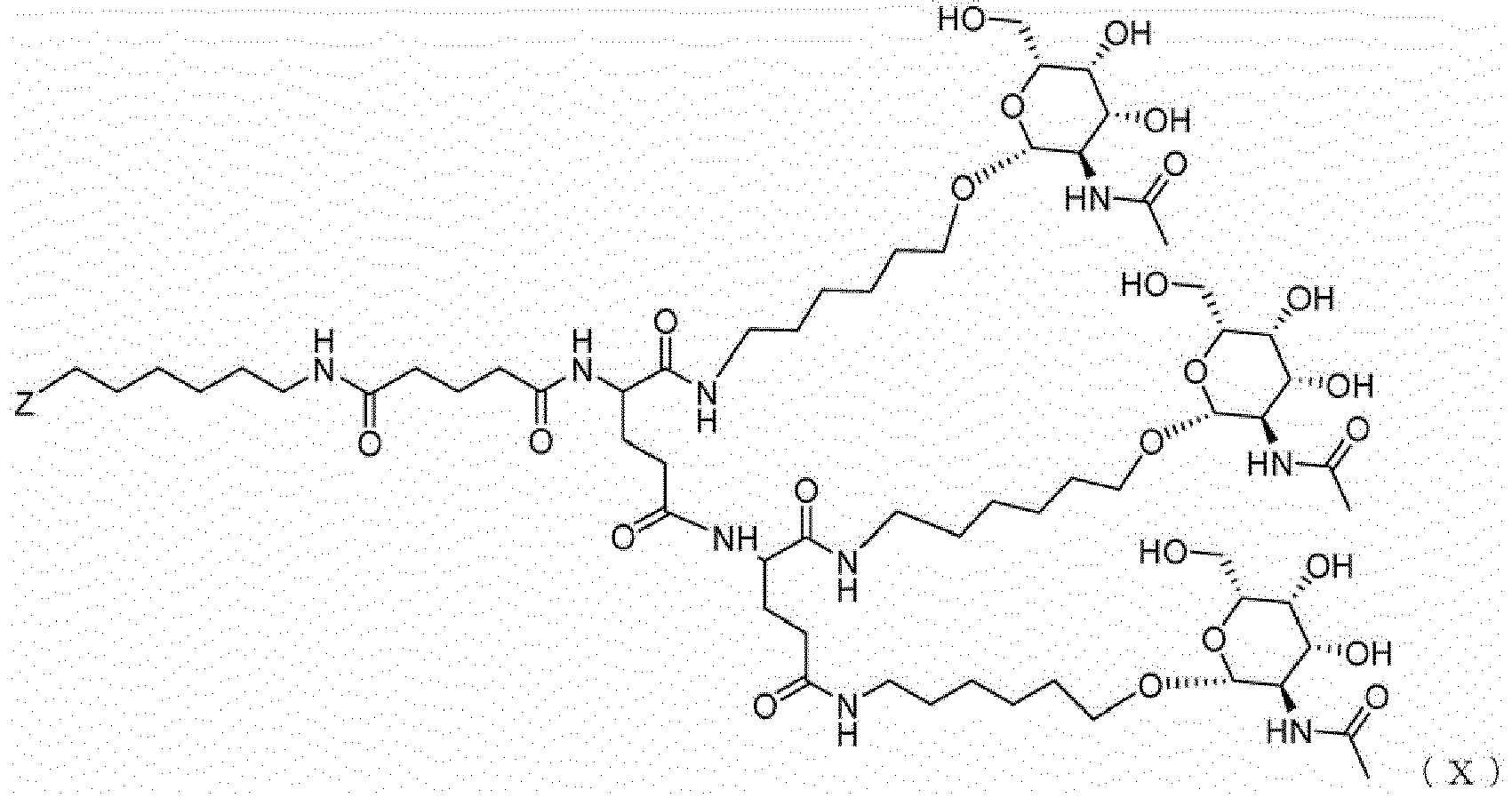
or a pharmaceutically acceptable salt thereof. - [11] A nucleic acid complex represented by the formula (XI):

or a pharmaceutically acceptable salt thereof. - [12] A nucleic acid complex represented by the formula (XII):

or a pharmaceutically acceptable salt thereof. - [13] A nucleic acid complex represented by the formula (XIII):

or a pharmaceutically acceptable salt thereof. - [14] A nucleic acid complex represented by the formula (XIV):

or a pharmaceutically acceptable salt thereof. - [15] The nucleic acid complex according to any one of [1] to [14], wherein the oligonucleotide is single-stranded.
- [16] The nucleic acid complex according to [15], wherein the oligonucleotide is bound via the 3' end.
- [17] The nucleic acid complex according to [15], wherein the oligonucleotide is bound via the 5' end.
- [18] The nucleic acid complex according to any one of [1] to [14], wherein the oligonucleotide is double-stranded.
- [19] The nucleic acid complex according to [18], wherein the oligonucleotide is bound via the 3' end of one strand.
- [20] The nucleic acid complex according to [18], wherein the oligonucleotide is bound via the 5' end of one strand.
- [21] A pharmaceutical composition comprising the nucleic acid complex according to any one of [1] to [20].
- [22] The pharmaceutical composition according to [21], wherein the pharmaceutical composition regulates expression of a target gene in a cell.
- [23] The pharmaceutical composition according to [22], wherein the cell is a dendritic cell, a macrophage, or a liver parenchymal cell.
- [24] The nucleic acid complex according to any one of [1] to [20], for use in a method for regulating expression of a target gene in a cell.
- [25] The nucleic acid complex according to [24], wherein the cell is a dendritic cell, a macrophage, or a liver parenchymal cell.
- [26] A method for regulating expression of a target gene in a cell of a subject, comprising:
administering the nucleic acid complex according to any one of [1] to[20] or the pharmaceutical composition according to [21] to the subject. - [27] The method according to [26], wherein the cell is a dendritic cell, a macrophage, or a liver parenchymal cell.
- As demonstrated in pharmacological tests shown later, the nucleic acid complex according to the present invention is selectively taken up by cells expressing the mannose receptor or ASGPR. The nucleic acid complex according to the present invention has a potential to cure various associated diseases through administration of a pharmaceutical composition comprising the nucleic acid complex according to the present invention to mammals (including humans).
- Now, the contents of the present invention will be described in detail.
- For a compound in the present specification, the structural formula occasionally represents a certain isomer for convenience, but the scope of the compound is not limited to the illustration of the formula for convenience, and includes all the structurally acceptable isomers including geometric isomers, optical isomers, rotamers, stereoisomers, and tautomers, and isomer mixtures, and the compound may be any one isomer or a mixture containing the isomers at any ratio. Accordingly, while optical isomers and a racemate may exist for a compound in the present specification, for example, the compound is not limited to any of them, and may be the racemate, or any of the optically active forms, or a mixture containing the optically active forms at any ratio.
- While crystalline polymorphs may exist for a compound in the present specification, the compound is not limited to any of them, similarly, and may be a single substance of any of the crystal forms or a mixture thereof, and the scope of a compound in the present specification includes its amorphous forms, and the scope of a compound in the present specification encompasses its anhydride and solvates (in particular, hydrates).
- The scope of a compound in the present specification also includes isotope-labeled forms of the compound. An isotope-labeled compound is the same as the original compound except that one or more atoms have been replaced with atoms each having an atomic mass or mass number differing from the atomic mass or mass number typically found in the natural world. Isotopes that can be incorporated in a compound in the present specification are isotopes of hydrogen, carbon, nitrogen, oxygen, fluorine, phosphorus, sulfur, iodine, and chlorine, and examples thereof include 2H, 3H, 11C, 14C, 15N, 18O, 18F, and 35S.
- The "pharmaceutically acceptable salt" in the present specification is not limited as long as the pharmaceutically acceptable salt is formed by salt formation with a compound, and specific examples thereof include acid addition salts, metal salts, ammonium salts, organic amine addition salts, and amino acid addition salts.
- Preferred examples of acid addition salts include inorganic acid salts such as hydrochloride, hydrobromide, sulfate, nitrate, and phosphate, and organic acid salts such as acetate, succinate, fumarate, maleate, tartrate, citrate, lactate, stearate, benzoate, methanesulfonate, p-toluenesulfonate, and benzenesulfonate.
- Preferred examples of metal salts include alkali metal salts such as sodium salt and potassium salt, alkali earth metal salts such as magnesium salt and calcium salt, aluminum salt, and zinc salt.
- Preferred examples of ammonium salts include salts of ammonium, tetramethylammonium, and the like.
- Preferred examples of organic amine addition salts include addition salts of morpholine, piperidine, and the like.
- Preferred examples of amino acid addition salts include addition salts of lysine, glycine, phenylalanine, aspartic acid, glutamic acid, and the like.
- If a compound in the present specification is obtained as a free form, the compound can be converted into a state in which a salt that the compound may be forming or a hydrate thereof in accordance with a conventional method.
- If a compound in the present specification is obtained as a salt or hydrate, the salt or hydrate can be converted into the free form in accordance with a conventional method.
- Various isomers (e.g., geometric isomers, optical isomers, rotamers, stereoisomers, tautomers) obtained for a compound in the present specification can be purified and isolated by using a common separation means such as recrystallization, diastereomeric salt formation, enzymatic resolution, and various kinds of chromatography (e.g., thin-layer chromatography, column chromatography, gas chromatography, high-performance liquid chromatography).
- The pharmaceutical composition according to the present invention can be produced by sufficiently mixing a pharmaceutically acceptable excipient with the nucleic acid complex or a pharmaceutically acceptable salt thereof. The pharmaceutical composition according to the present invention can be produced in accordance with a known method such as a method described in General Rules for Preparations, The Japanese Pharmacopeia, Seventeenth Edition.
- The pharmaceutical composition according to the present invention can be administered to a patient in a proper manner according to the dosage form.
- The dose of the nucleic acid complex according to the present invention depends on the degree of the symptoms, the age, sex, and body weight, the mode of administration and the type of the salt, the specific type of the disease, and so on, and a daily dose of approximately 30 µg to 10 g, preferably 100 µg to 1 g, in the case of oral administration, or a daily dose of approximately 1 µg to 1 g, preferably 100 µg to 300 mg, in the case of administration by injection, in terms of oligonucleotide is typically administered to an adult at once, or separately in several portions.
- The nucleic acid complex according to the present invention is a nucleic acid complex comprising a sugar ligand bound to an oligonucleotide via a linker, wherein the sugar ligand has O-, N-, or C-linked, preferably O-linked mannose or GalNAc. That is, the nucleic acid complex according to the present invention has the structure (sugar ligand)-(linker)-(oligonucleotide).
- In an embodiment, the nucleic acid complex comprises two or more sugar moieties, preferably three or four sugar moieties. In an embodiment, the nucleic acid complex comprises at least three mannose moieties or at least three GalNAc moieties, and the nucleic acid complex can be delivered to macrophages or liver parenchymal cells as the target.
- The mannose receptor is highly expressed on cells highly expressing CD206, for example, specific cells including macrophages and dendritic cells. Mannose conjugates and mannosylated drug carriers exhibit high binding affinity with CD206, and are successfully used to deliver drug molecules such as oligonucleotides to cells including macrophages and dendritic cells.
- ASGPR is highly expressed on specific cells including liver parenchymal cells. GalNAc conjugates and GalNAc-conjugated drug carriers exhibit high binding affinity with ASGPR, and are successfully used to deliver drug molecules such as oligonucleotides to cells including liver parenchymal cells.
- The term sugar ligand refers to a group derived from a sugar capable of binding to a receptor expressed on target cells, and one of preferred modes of the sugar ligand in the nucleic acid complex according to the present invention may be, for example, the following structure. Each wavy line indicates a bond to the linker.


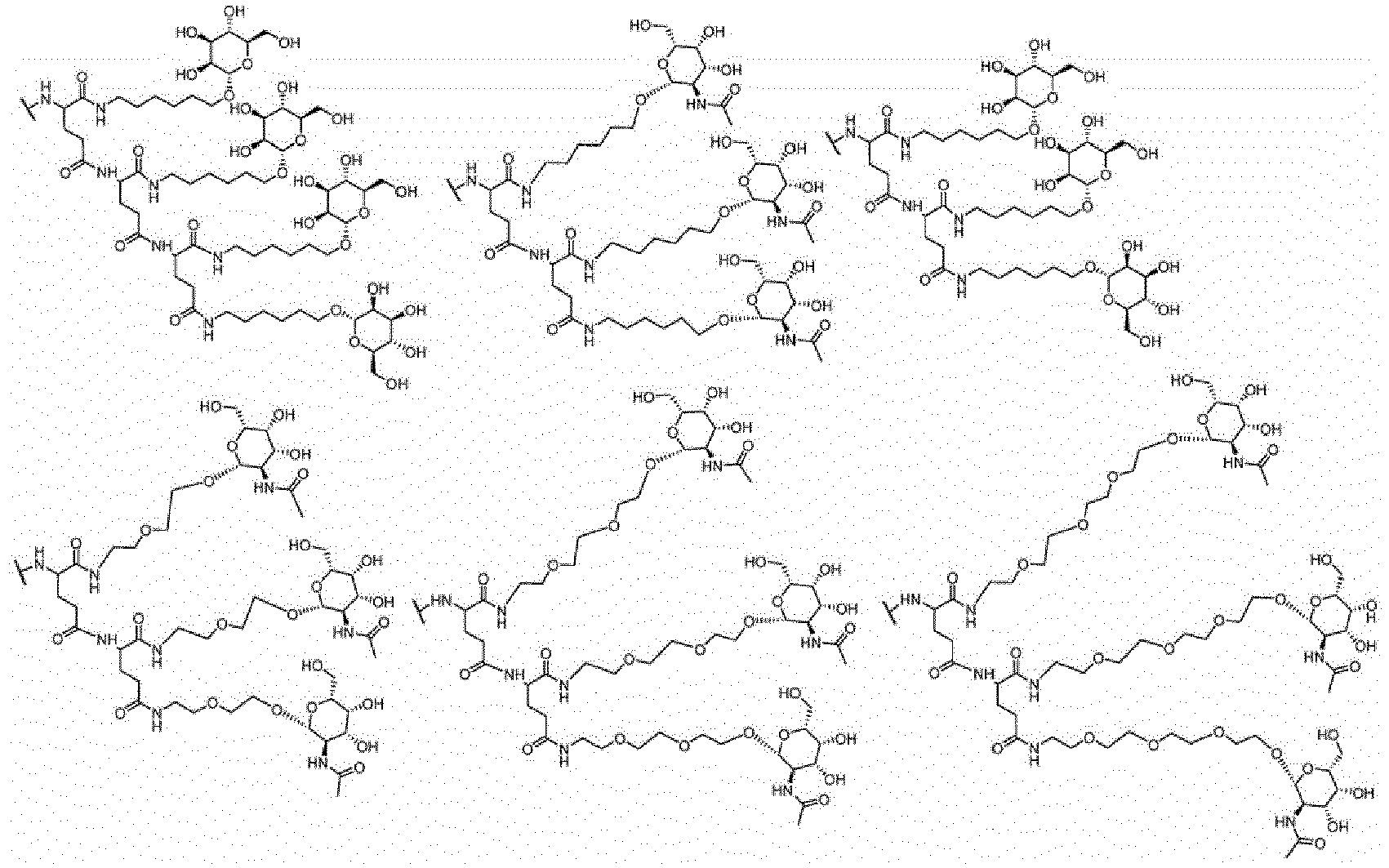
- For the oligonucleotide in the nucleic acid complex according to the present invention, any oligonucleotide known to be applicable as a nucleic acid drug can be used. Herein, the term nucleic acid drug refers to nucleotides for use as an antisense drug, a decoy nucleic acid, a ribozyme, siRNA, miRNA, anti-miRNA, mRNA, or the like.
- The oligonucleotide may be a single-stranded or double-stranded oligonucleotide.
- The linker and the oligonucleotide in the nucleic acid complex according to the present invention may be bound together, for example, at a nucleotide of the oligonucleotide, and are bound together, for example, at the 3' end or 5' end of the oligonucleotide. If the oligonucleotide is double-stranded, it is preferable that the linker be bound to the 3' end or 5' end of the sense strand constituting the double-stranded nucleic acid; however, the binding is not limited to the mentioned one.
- The number of linkers to which the oligonucleotide in the nucleic acid complex is bound is not limited to one, and may be two or more.
- In some embodiments, for example, inclusion of a specific base in an overhang or inclusion of a modified nucleotide or nucleotide substitute in a single-stranded overhang (e.g., a 5' overhang or a 3' overhang, or both of them) is acceptable for enhancing the stability.
- The oligonucleotide constituting the nucleic acid complex according to the present invention may be in any shape as long as the oligonucleotide has an ability to regulate expression of a target gene when being introduced into mammalian cells, and single-stranded oligonucleotide or double-stranded oligonucleotide is preferably used.
- The oligonucleotide may be any molecule as long as the oligonucleotide is a polymer of nucleotides or molecules having functions comparable to those of nucleotide, and examples thereof include DNA, which is a polymer of deoxyribonucleotides, RNA, which is a polymer of ribonucleotides, and chimeric nucleic acid, which is a polymer of DNA and RNA. The DNA, RNA, and chimeric nucleic acid may be each a nucleotide polymer in which at least one nucleotide such as deoxyribonucleotide and ribonucleotide is substituted with a molecule having functions comparable to those of nucleotide. Uracil (U) in RNA is uniquely interpreted as thymine (T) in DNA.
- Examples of the molecules having functions comparable to those of nucleotide include nucleotide derivatives obtained by modifying nucleotide, and a molecule or the like obtained by modifying deoxyribonucleotide or ribonucleotide, for example, to enhance or stabilize the nuclease resistance, increase the affinity with the complementary nucleic acid, or increase the cell permeability as compared with DNA and RNA, or for visualization, is preferably used.
- Examples of the nucleotide derivatives include nucleotide in which at least one of the sugar moieties, the phosphodiester bond, and the base has been modified, such as nucleotide with the sugar moiety modified, nucleotide with the phosphodiester bond modified, and nucleotide with the base modified.
- The nucleotide with the sugar moiety modified may be any nucleotide as long as the nucleotide is modified or substituted with any substituent or substituted with any atom partially or wholly in the chemical structure of the sugar of the nucleotide, and 2'-modified nucleotide is preferably used.
- Examples of the 2'-modified nucleotide include 2'-modified nucleotide in which the 2'-OH group of the ribose is substituted with a substituent selected from the group consisting of OR, R, R'OR, SH, SR, NH2, NHR, NR2, N3, CN, F, Cl, Br, and I (R is an alkyl or aryl, preferably an alkyl having one to six carbon atoms, and R' is an alkylene, preferably an alkylene having one to six carbon atoms), and preferred examples of the 2'- modification include substitution with F, substitution with a methoxy group, and substitution with an ethoxy group. Also acceptable is 2'-modified nucleotide in which the oxygen atom at the 2' position and the carbon at the 4' position in the ribose are crosslinked via methylene, that is, locked nucleic acid.
- The nucleotide with the phosphodiester bond modified may be any nucleotide as long as the nucleotide is modified or substituted with any substituent or substituted with any atom partially or wholly in the chemical structure of the phosphodiester bond of the nucleotide, and examples thereof include nucleotide in which the phosphodiester bond is substituted with a phosphorothioate bond, nucleotide in which the phosphodiester bond is substituted with a phosphorodithioate bond, nucleotide in which the phosphodiester bond is substituted with an alkylphosphonate bond, and nucleotide in which the phosphodiester bond is substituted with a phosphoramidate bond, and a preferred example is nucleotide in which the phosphodiester bond is substituted with a phosphorothioate bond.
- The scope of the oligonucleotide encompasses oligonucleotide in which some or all of the atoms in the molecule are substituted with an atom of different mass number (isotope).
- In a mode, the oligonucleotide in the nucleic acid complex according to the present invention regulates expression of a target gene in cells.
- In a mode, the oligonucleotide in the nucleic acid complex of the present invention binds to a ligand via a linker (also referred to as a linker-ligand).
- For the "linker" in the present invention, any linker that can be used for nucleic acid complexes can be used.
- For example, any of the structures disclosed in
WO 2009/073809 ,WO 2013/075035 , andWO 2015/105083 can be employed as the linker structure. - In an embodiment, the linker comprises at least one cleavable linking group.
- The term cleavable linking group refers to a group that is sufficiently stable outside of cells, but is cleaved upon the entry to a target cell and releases the moiety to which the linker is bound.
- For example, a phosphate-based cleavable linking group is cleaved by an agent that decomposes or hydrolyzes a phosphate group. An example in which a phosphate group is cleaved in cells is an enzyme such as phosphatase. A preferred embodiment of the phosphate-based linking group is -O-P(O)(OH)-O- or O-P(S)(OH)-O-.
- An embodiment of the linker is any one of the following structures, wherein X and Y, independently at each occurrence, X represents CH2 or O, and Y represents a sugar ligand, respectively, Z represents a group containing oligonucleotide, and n is an integer of 1 to 8:


- The nucleic acid complex according to the present invention can be produced with any method described in production examples below, and the effects of the compound can be confirmed with methods described in Test Examples below. However, those are only examples, and the present invention is not limited to specific examples below in any case, and may be modified without departing from the scope of the present invention. Examples in the present invention can be produced by using synthetic chemistry techniques known to those skilled in the art.
- Abbreviations used herein are conventional ones well known to those skilled in the art. In the present specification, the following abbreviations are used.
- Cbz: benzyloxycarbonyl
- CTC: 2-chlorotrityl chloride
- DCE: 1,2-dichloroethane
- DCM: dichloromethane
- DIPEA: N,N-diisopropylethylamine
- DMF: N,N-dimethylformamide
- DMSO: dimethyl sulfoxide
- EDCI: 1-ethyl-3-(3-dimethylaminopropyl)carbodiimide hydrochloride
- EtOAc: ethyl acetate
- ESI: electrospray ionization
- Fmoc: 9-fluorenylmethyloxycarbonyl
- HBTU: 1-[bis(dimethylamino)methylene]-1H-benzotriazolium 3-oxide hexafluorophosphate
- HOBT: 1-hydroxybenzotriazole
- IMS: industrial methylated spirit
- MALDI-TOF-MS: matrix-assisted laser desorption ionization time-of-flight mass spectrometry
- MeOH: methanol
- MTBE: methyl tert-butyl ether
- NaOMe: sodium methoxide
- TFA: trifluoroacetic acid
- 1H-NMR: proton nuclear magnetic resonance spectrometry
- MS: mass spectrometry
- HPLC: high-performance liquid chromatography
- "Room temperature" in Examples and production examples below refers to approximately 10°C to approximately 35°C in normal cases. Unless otherwise specified, % indicates percent by weight or volume.
- Chemical shifts in proton nuclear magnetic resonance spectra were recorded in δ units (ppm) with respect to tetramethylsilane, and coupling constants were recorded in Hertz (Hz). Patterns are s: singlet, d: doublet, t: triplet, q: quartet, quin: quintet, m: multiplet, br: broad, and br.s: broad singlet.
- In silica gel column chromatography, Silica Gel 60 (70 to 230 mesh, or 230 to 400 mesh ASTM) manufactured by Merck KGaA, PSQ60B manufactured by FUJI SILYSIA CHEMICAL LTD., or a prepacked column (column: Hi-Flash (TM) Column (Silicagel) manufactured by YAMAZEN CORPORATION, or a Biotage (TM) SNAP Ultra Silica Cartridge manufactured by Biotage) was used as the silica gel.
- For names of compounds, except common reagents, those displayed in "E-Notebook" version 12 or 13 (PerkinElmer, Inc.) or "MarvinSketch" version 16 (Chemaxon Ltd.) were used.
- With reference to the following production examples, production can be performed with methods known to those skilled in the art.
-

-

- To hydrazine acetate (5.19 g, 56.4 mmol), DMF (200 mL) was added, and the reaction mixture was stirred at 55°C and then cooled to 15°C, to which 1-O,2-O,3-O,4-O,6-O-pentaacetyl-β-D-mannopyranose (compound 1) (20.0 g, 51.2 mmol) was added, and the resultant was stirred at 15°C for 16 hours. The reaction mixture was added to water, and extraction was performed with EtOAc. The organic layer combined was washed with brine, dried over anhydrous sodium sulfate, filtered, and then concentrated under reduced pressure to afford compound 2 (14.3 g).
1H-NMR (400 MHz, CDCl3) δ (ppm): 1.97-2.00 (m, 3H), 2.03 (s, 3H), 2.08 (s, 3H), 2.14 (s, 3H), 4.11-4.15 (m, 1H), 4.16-4.32 (m, 3H), 5.14-5.34 (m, 3H), 5.37-5.45 (m, 1H). -

- To DCM (50 mL), compound 2 (5.00 g, 14.4 mmol), 2,2,2-trichloroacetonitrile (20.7 g, 143 mmol), and Cs2CO3 (5.14 g, 15.8 mmol) were added, and the resultant was stirred at 25°C for 2 hours. The reaction mixture was filtered, and the filtrate was concentrated under reduced pressure. The residue was purified by silica gel column chromatography (50:1 to 20:1 petroleum ether/EtOAc) to afford compound 3 (2.70 g).
1H-NMR (400 MHz, CDCl3) δ (ppm): 2.01 (s, 3H), 2.04 (s, 2H), 2.08 (d, J=6.8Hz, 6H), 2.20 (s, 3H), 4.15-4.22 (m, 2H), 4.24-4.32 (m, 1H), 5.37-5.42 (m, 2H), 5.46-5.49 (m, 1H), 6.28 (d, J=1.8Hz, 1H), 8.79 (s, 1H). -

- To DCM (140 mL), compound 3 (14.0 g, 28.4 mmol), 6-(Cbz-amino)-1-hexanol (8.57 g, 34.1 mmol), and molecular sieves 4A (10.0 g) were added, and the resultant was stirred at 0°C for 30 minutes. Subsequently, trimethylsilyl trifluoromethanesulfonate (6.32 g, 28.4 mmol) was added dropwise to the reaction mixture at -65°C, and the reaction mixture was stirred at 25°C for 16 hours. The reaction mixture was diluted with DCM and filtered, and the filtrate was then washed with saturated aqueous sodium hydrogen carbonate solution, water, and saline, dried over anhydrous sodium sulfate, filtered, and then concentrated under reduced pressure. The residue was purified by silica gel column chromatography (50:1 to 20:1 petroleum ether/EtOAc) to afford compound 4 (7.50 g).
-

- Compound 4 (7.50 g, 12.9 mmol) was dissolved in MeOH (300 mL), and NaOMe (2.79 g, 51.6 mmol) was added thereto and reacted at room temperature for 3 hours. The reaction mixture was partially concentrated and poured into cold water, to which acetic acid was added until pH = 5 was reached, and the resulting crude form was purified by silica gel column chromatography (50:1 to 20:1 DCMZMeOH) to afford compound 5 (3.90 g).
1H-NMR (400 MHz, CDCl3) δ (ppm): 1.26-1.63 (m, 8H) , 3.14 (d, J=6.3Hz, 2H), 3.34 (d, J=8.8Hz, 1H), 3.54-3.74(m, 2H) , 3.80-4.01 (m, 4H), 4.78 (s, 1H), 5.01-5.12 (m, 2H), 5.16-5.47 (m, 6H), 7.28-7.41 (m, 5H). -

- To dried 10% palladium-carbon (0.40 g), MeOH (40 mL) and compound 5 (3.90 g, 9.43 mmol) were added, and the resultant was stirred at 25°C under hydrogen pressure (50 psi) for 3 hours. The reaction mixture was filtered, and concentrated under reduced pressure to afford compound 6 (1.50 g).
1H-NMR (400 MHz, MeOD) δ (ppm): 1.38-1.49 (m, 4H), 1.61 (dquin, J=13.3, 6.9, 6.9, 6.9, 6.9Hz, 4H), 2.73-2.88 (m, 2H), 3.31 (dt, J=3.3, 1.6Hz, 1H), 3.43 (dt, J=9.7, 6.1Hz, 1H), 3.48-3.89 (m, 8H). -

- To a solution of 6-azidehexanoic acid (compound 7) (50.2 mg, 319 µmol) and compound 6 (268 mg, 959 µmol) in DMF (3 mL), HOBt (129 mg, 959 µmol), DIPEA (248 mg, 1.92 mmol), and EDCI (183 mg, 959 µmol) were added, and the resultant was stirred at 25°C for 3 hours. The reaction mixture was purified by preparative HPLC (TFA condition) to afford compound 8 (20.1 mg).
1H-NMR (400 MHz, DMSO-d6) δ (ppm): 1.24-1.54 (m, 14H) 2.04 (t, J=7.40Hz, 2H) 3.00 (q, J=6.53Hz, 2H) 3.23-3.40 (m, 12H) 3.55-3.66 (m, 2H) 4.57 (s, 1H) 7.75 (br s, 1H) -

-

- To a mixture containing CTC resin (0.50 g, 0.50 mmol, 1.00 mmol/g) and 5-tert-butyl N-[(9H-fluoren-9-ylmethoxy)carbonyl]-glutamate (compound 9) (212 mg, 0.50 mmol), DCM (30 mL) and DIPEA (258 mg, 2.00 mmol) were added, and the reaction mixture was stirred for 2 hours. MeOH (0.2 mL) was added to the reaction mixture, which was stirred for 30 minutes. To the reaction mixture, 6-azidehexanoic acid (compound 7) (118 mg, 0.75 mmol), DIPEA (258 mg, 2.00 mmol), HBTU (270 mg, 712 µmol), and DMF (3 mL) were added, and the resultant was stirred at 25° for 1 hour. To the reaction mixture, 90% TFA/10% DCM was added, and the resultant was stirred for 2 hours. Reaction mixture was filtered, and the filtrate was concentrated under reduced pressure to afford compound 10 (110 mg).
-

- To a solution of compound 10 (50.0 mg, 174 µmol) and compound 6 (292 mg, 1.05 mmol) in DMF (3 mL), HOBt (141 mg, 1.05 mmol), DIPEA (270 mg, 2.10 mmol), and EDCI (200 mg, 1.05 mmol) were added. The reaction mixture was stirred at 25°C for 16 hours. Purification was performed by preparative HPLC (TFA condition) to afford compound 11 (18.1 mg).
1H-NMR (400 MHz, DMSO-d6) δ (ppm):
1.16-1.56 (m, 24H), 1.62-1.73 (m, 1H), 1.76-1.87 (m, 1H), 2.00-2.07 (m, 2H), 2.09-2.15 (m, 2H), 2.95-3.07 (m, 4H), 3.22-3.41 (m, 18H), 3.65 (br s, 6H), 4.10-4.19 (m, 1H), 4.57 (d, J=1.00Hz, 2H), 7.74-7.93 (m, 3H). -

- To CTC resin (1.00 g, 1.00 mmol, 1.00 mmol/g) and 5-tert-butyl N-[(9H-fluoren-9-ylmethoxy)carbonyl]-glutamate (compound 9) (511 mg, 1.20 mmol), DCM (20 mL) and DIPEA (516 mg, 4.00 mmol) were added, and the reaction mixture was stirred for 2 hours while bubbling with N2 was performed. MeOH (1 mL) was added to the reaction mixture, which was stirred for 30 minutes. A solution of 20% piperidine in DMF (30 mL) was added to the reaction mixture, which was stirred for 30 minutes, and the resin was washed with DMF, a solution of 1-tert-butyl N-[(9H-fluoren-9-ylmethoxy)carbonyl]-glutamate (N-Fmoc-glutamic acid-1-tert-butyl ester) (851 mg, 2.00 mmol), HBTU (720 mg, 1.90 mmol), and DIPEA (516 mg, 4.00 mmol) inDMF (5 mL) was added thereto, and the resultant was stirred at 25°C for 1 hour. A solution of 20% piperidine in DMF (30 mL) was added thereto, the resultant was stirred for 30 minutes, and the resin was washed with DMF. Subsequently, a solution of 6-azidehexanoic acid (compound 7) (0.30 g, 1.91 mmol), HBTU (720 mg, 1.90 mmol), and DIPEA (516 mg, 4.00 mmol) in DMF (5 mL) was added thereto, the resultant was stirred at 25°C for 1 hour, and the resin was washed with DMF, washed with MeOH, and dried under reduced pressure. To the resulting residue (0.60 g), 50% TFA/50% DCM was added, the resultant was stirred for 2 hours, and the reaction mixture was concentrated under reduced pressure to afford compound 12 (240 mg).
-

- Synthesis of compound 13 was performed in accordance with the synthesis method for compound 12 with use of Azido-PEG8-acid (CAS No. 1214319-92-2) in place of 6-azidehexanoic acid to afford compound 13 (350 mg).
1H-NMR (400 MHz, CDCl3) δ (ppm):
2.01 (s, 2H), 2.18 (s, 2H), 2.32-2.63 (m, 6H), 3.40 (t, J=5.0Hz, 2H), 3.54-3.71 (m, 32H), 4.49 (s, 2H), 7.67-8.03 (m, 2H). -

- To a solution of compound 12 (0.20 g, 481 µmol) and compound 7 (1.08 g, 3.85 mmol) in DMF (0.5 mL), DIPEA (996 mg, 7.70 mmol), HOBt (520 mg, 3.85 mmol), and EDCI (738 mg, 3.85 mmol) were added. The reaction mixture was stirred at 25°C for 16 hours, and purified by preparative HPLC (TFA condition) to afford compound 14 (103 mg).
1H-NMR (400 MHz, MeOD) δ (ppm):
1.26-1.72 (m, 32H), 1.82-1.97 (m, 2H), 2.03-2.13 (m, 2H), 2.22-2.41 (m, 6H), 3.14-3.24 (m, 6H), 3.37-3.47 (m, 3H), 3.49-3.55 (m, 3H), 3.60 (t, J=9.5Hz, 3H), 3.65-3.86 (m, 15H), 4.22-4.42 (m, 2H), 4.73 (s, 3H). -

- To a solution of compound 13 (0.20 g, 275 µmol) and compound 7 (616 mg, 2.20 mmol) in DMF (0.5 mL), DIPEA (570 mg, 4.41 mmol), HOBT (298 mg, 2.20 mmol), and EDCI (423 mg, 2.20 mmol) were added, and the reaction mixture was stirred at 25°C for 16 hours. The reaction mixture was purified by preparative HPLC (TFA condition) to afford compound 15 (127 mg).
1H-NMR (400 MHz, MeOD) δ (ppm):
1.23-1.68 (m, 24H), 1.78-1.95 (m, 2H), 2.04-2.19 (m, 2H), 2.23-2.31 (m, 2H), 2.33-2.42 (m, 2H), 2.48-2.60 (m, 2H), 3.10-3.26 (m, 6H), 3.35-3.46 (m, 5H), 3.48-3.56 (m, 3H), 3.57-3.84 (m, 50H), 4.23-4.41 (m, 2H), 4.73 (s, 3H). -

-

- To CTC resin (0.50 mmol, 0.50 g, 1.00 mmol/g) and 5-tert-butyl N-[(9H-fluoren-9-ylmethoxy)carbonyl]-glutamate (compound 9) (212 mg, 0.50 mmol), DCM (30 mL) and DIPEA (258 mg, 2.00 mmol) were added. The reaction mixture was stirred for 2 hours, MeOH (0.2 mL) was then added thereto, and the resultant was stirred for 30 minutes. To the reaction mixture, a solution of HBTU (360 mg, 950 µmol) and DIPEA (258 mg, 2.00 mmol) in DMF (3 mL) and 1-tert-butyl N-[(9H-fluoren-9-ylmethoxy)carbonyl]-glutamate (N-Fmoc-glutamic acid-1-tert-butyl ester) (425 mg, 1.00 mmol) were added, the resultant was stirred at 25°C for 1 hour, and a solution of 1-tert-butyl N-[(9H-fluoren-9-ylmethoxy)carbonyl]-glutamate (N-Fmoc-glutamic acid-1-tert-butyl ester) (425 mg, 1.00 mmol), HBTU (360 mg, 950 µmol), and DIPEA (258 mg, 2.00 mmol) in DMF (3 mL) was added at 25°C over 1 hour. Next, 6-azidehexanoic acid (compound 7) (118 mg, 750 µmol), HBTU (360 mg, 950 µmol), and DIPEA (258 mg, 2.00 mmol) were added thereto, and the resultant was stirred for 1 hour. Thereto, 90% TFA/10% DCM was added, and the resultant was stirred at room temperature for 2 hours. The reaction mixture was filtered, and concentrated under reduced pressure to afford compound 16 (200 mg).
-

- To a solution of compound 16 (50.0 mg, 91.8 µmol) and compound 7 (256 mg, 918 µmol) in DMF (3 mL), HOBt (124 mg, 918 µmol), DIPEA (237 mg, 1.84 mmol), and EDCI (176 mg, 918 µmol) were added, and the reaction mixture was stirred at 25°C for 16 hours. The reaction mixture was purified by preparative HPLC (TFA condition) to afford compound 17 (18.2 mg).
1H-NMR (400 MHz, DMSO-d6) δ (ppm):
1.19-1.56 (m, 40H), 1.66 (br s, 3H), 1.83 (br s, 3H), 2.00-2.15 (m, 7H), 2.94-3.05 (m, 8H), 3.29 (br d, J=5.02Hz, 24H), 3.52-3.71 (m, 24H), 4.13 (br s, 3H), 4.57 (s, 4H), 7.74-7.99 (m, 7H). -

-

- To a mixture of galactosamine pentaacetate compound 18 (12.0 g, 30.8 mmol), 6-(Cbz-amino)-1-hexanol (10.3 g, 41.1 mmol), and ZnCl2 (5.60 g, 41.1 mmol) (dried under reduced pressure at 110°C for 1 hour before use), DCE (120 mL) was added, and the reaction mixture was stirred at 70°C for 3 hours. The reaction mixture was diluted with EtOAc and aqueous sodium hydrogen carbonate solution, and the mixture was stirred for 10 minutes, filtered through a Celite (Registered Trademark), and washed with EtOAc. The filtrate was washed with water and saline. The aqueous layer was subjected to extraction with EtOAc, and the organic layer was dried over sodium sulfate, filtered, and then concentrated under reduced pressure, and the resulting residue was purified by silica gel column chromatography (2:1 petroleum ether/EtOAc) to afford compound 19 (14.0 g).
1H-NMR (400 MHz, CDCl3) δ (ppm): 1.35 (d, J=3.8Hz, 4H), 1.45-1.66 (m, 4H), 1.77 (s, 2H), 1.94 (s, 3H),2.00 (s, 3H), 2.05 (s, 3H), 2.14 (s, 3H), 3.20 (qq, J=13.4, 6.8Hz, 2H), 3.48 (dt, J=9.6, 6.5Hz, 1H), 3.79-4.03 (m, 3H), 4.08-4.19 (m, 2H), 4.65 (d, J=8.3Hz, 1H), 4.90 (s, 1H), 5.04-5.17 (m, 2H), 5.26 (dd, J=11.2, 3.1Hz, 1H), 5.30 (s, 1H), 5.34 (d, J=2.8Hz, 1H), 5.94 (d, J=8.8Hz, 1H), 7.28-7.42 (m, 5H). -

- To compound 19 (7.50 g, 12.9 mmol), MeOH (300 mL) and NaOMe (2.79 g, 51.7 mmol) were added, and the resultant was stirred at room temperature for 3 hours. The reaction mixture was partially concentrated and poured into cold water, to which acetic acid was added until pH = 5 was reached. Next, the resulting crude product was purified by silica gel column chromatography (50:0 to 50:1 DCM/MeOH) to afford compound 20 (4.00 g).
1H-NMR (400 MHz, MeOD) δ (ppm): 1.19-1.35 (m, 4H), 1.40-1.56 (m, 4H), 1.93 (s, 2H), 3.06 (t, J=7.0Hz, 2H), 3.27 (dt, J=3.3, 1.6Hz, 1H), 3.31 (s, 1H), 3.37-3.49 (m, 2H), 3.55 (dd, J=10.8, 3.3Hz, 1H), 3.65-3.76 (m, 2H), 3.78-3.94 (m, 3H), 4.31 (d, J=8.5Hz, 1H), 5.02 (s, 2H), 7.17-7.44 (m, 5H). -

- To dried 10% palladium-carbon (240 mg), MeOH (25 mL) and compound 20 (2.40 g, 5.28 mmol) were added in an argon atmosphere, and the resultant was stirred under hydrogen pressure (50 psi) at 25°C for 3 hours. The reaction mixture was filtered, and the filtrate was concentrated under reduced pressure to afford compound 21 (0.66 g).
1H-NMR (400 MHz, MeOD) δ (ppm): 1.30-1.44 (m, 4H), 1.52-1.66 (m, 4H), 1.98 (s, 3H), 2.76-2.90 (m, 2H), 3.31 (dt, J=3.3, 1.6Hz, 2H), 3.44-3.51 (m, 2H), 3.58 (dd, J=10.8, 3.3Hz, 1H), 3.73-3.78 (m, 2H), 3.82-3.95 (m, 3H), 4.34 (d, J=8.5Hz, 1H). -

- To compound 19 (202 mg, 0.35 mmol), ethanol (6 mL) and 10% palladium-carbon (50% wet product, 42 mg) were added, and the resultant was stirred in a hydrogen atmosphere at room temperature for 3 hours. The reaction mixture was filtered through a Celite (Registered Trademark), and washed with ethanol. The filtrate was concentrated under reduced pressure to afford compound 22 (159 mg).
1H-NMR (600 MHz, DMSO-d6) δ (ppm): 0.64 (br s, 1H) 1.27 (br s, 5H) 1.33-1.52 (m, 4H) 1.67 (br s, 1H) 1.80 (s, 3H) 2.61 (br t, J=6.88Hz, 2H) 3.40-3.60 (m, 5H) 3.58-3.77 (m, 4H) 4.23 (br d, J=8.25Hz, 1H) 4.31-4.97 (m, 5H) 7.53-7.71 (m, 1H); MS (ESI+): m/z 321 [M+H]+. -

- To a solution of compound 12 (602 mg, 1.88 mmol) and compound 21 (601 mg, 1.88 mmol) in DMF (0.5 mL), DIPEA (485 mg, 3.76 mmol), HOBt (254 mg, 1.88 mmol), and EDCI (360 mg, 1.88 mmol) were added, and the reaction mixture was stirred at 25°C for 16 hours. The residue was purified by preparative HPLC (TFA condition) to afford compound 23 (104 mg).
1H-NMR (400 MHz, MeOD) δ (ppm): 1.29-1.70 (m, 32H), 1.82-2.01 (m, 11H), 2.08 (s, 2H), 2.22-2.38 (m, 8H), 3.18 (d, J=6.3Hz, 6H), 3.42-3.52 (m, 6H), 3.60 (d, J=10.5Hz, 3H), 3.71-3.95 (m, 14H), 4.28 (s, 1H), 4.36 (d, J=8.3Hz, 3H). -

- Compound 24 was obtained in the same manner as in Synthesis of Compound 23 with use of compound 16 in place of compound 12.
1H-NMR (600 MHz, DMSO-d6) δ (ppm): 1.15-1.59 (m, 44H) 1.68 (br d, J=9.90Hz, 3H) 1.79 (s, 12H) 1.82-1.92 (m, 5H) 1.97-2.22 (m, 9H) 3.02 (br d, J=5.50Hz, 10H) 3.32-3.58 (m, 19H) 3.61-3.72 (m, 13H) 4.06-4.27 (m, 8H) 4.43 (br s, 4H) 4.46-4.59 (m, 9H) 7.59 (br d, J=8.80Hz, 4H) 7.74 (br s, 1H) 7.83 (br s, 3H) 7.89 (br s, 3H); MS (ESI+): m/z 1754 [M+H]+. -

-

- To a mixture containing CTC resin (1.33 mmol/g, 0.375 g, 0.50 mmol) and compound 9 (212 mg, 0.50 mmol), DCM(30 mL) was added, DIPEA (0.35 mL, 2.00 mmol) was added dropwise thereto, and the reaction mixture was stirred for 2 hours. MeOH (0.2 mL, 4.94 mmol) was added to the reaction mixture, which was stirred for 35 minutes. To the reaction mixture, a solution of 20% piperidine in DMF (15 mL) was added, and the resultant was stirred for 30 minutes. The reaction mixture was filtered, and the resulting solid was washed with DMF. Subsequently, 1-tert-butyl N-[(9H-fluoren-9-ylmethoxy)carbonyl]-D-glutamate (N-Fmoc-D-glutamic acid-1-tert-butyl ester) (213 mg, 0.499 mmol), 1-tert-butyl N-[(9H-fluoren-9-ylmethoxy)carbonyl]-L-glutamate (N-Fmoc-L-glutamic acid-1-tert-butyl ester) (213 mg, 0.499 mmol), HBTU (360 mg, 0.949 mmol), DMF (3 mL), and DIPEA (0.35 mL, 2.00 mmol) were added thereto, and the reaction mixture was stirred for 1 hour while bubbling with nitrogen was performed. A solution of 20% piperidine in DMF (15 mL) was added thereto, and the resultant was stirred for 30 minutes. Then, the resin was washed with DMF. Subsequently, 1-tert-butyl N-[(9H-fluoren-9-ylmethoxy)carbonyl]-D-glutamate (N-Fmoc-D-glutamic acid-1-tert-butyl ester) (213 mg, 0.499 mmol), 1-tert-butyl N-[(9H-fluoren-9-ylmethoxy)carbonyl]-L-glutamate (N-Fmoc-L-glutamic acid-1-tert-butyl ester) (213 mg, 0.499 mmol), HBTU (360 mg, 0.949 mmol), and DMF (3 mL) were added thereto, and DIPEA (0.35 mL, 2.00 mmol) was slowly added dropwise thereto. The reaction mixture was stirred for 80 minutes while bubbling with nitrogen was performed. Then, the resin was washed with DMF, washed with MeOH, and dried under reduced pressure. To the resulting residue, 50% TFA/50% DCM was added, the resultant was stirred for 2 hours and filtered, and the filtrate was then concentrated under reduced pressure to afford compound 25 (307.3 mg).
MS (ESI) M/Z: 610 [M+H]+
1H-NMR (600 MHz, DMSO-d6) δ (ppm):
1.77 (m, 5H), 1.94 (m, 3H), 2.12-2.23 (m, 6H), 2.26 (m, 2H), 2.38 (br t, J=7.34Hz, 2H), 4.13-4.21 (m, 3H), 5.09 (s, 2H), 7.30-7.40 (m, 5H), 8.05-8.15 (m, 3H). -

- To a solution of compound 22 (154 mg, 0.344 mmol) and compound 25 (21.0 mg, 0.034 mmol) in DMF (2 mL), HOBt (52.8 mg, 0.344 mmol), DIPEA (0.12 mL, 0.689 mmol), and EDCI (66.0 mg, 0.344 mmol) were added. The reaction mixture was stirred at room temperature for 18 hours, and water, EtOAc, and a small amount of methanol were added thereto for extraction, and the organic layer was dried over sodium sulfate. The resultant was filtered, and then concentrated under reduced pressure. The residue was purified by preparative HPLC to afford compound 26 (16.7 mg).
MS (ESI) M/Z: 1162 [M+2H]+
1H-NMR (600 MHz, DMSO-d6) δ (ppm):
1.23 (br s, 16H), 1.31-1.41 (m, 8H), 1.41-1.48 (m, 8H), 1.60-1.73 (m, 4H), 1.77 (s, 12H), 1.78-1.87 (m, 4H), 1.89 (s, 12H), 1.99 (s, 12H), 2.01-2.07 (m, 2H), 2.10 (s, 12H), 2.11-2.21 (m, 6H), 2.33-2.37 (m, 2H), 2.95-3.07 (m, 8H), 3.37-3.43 (m, 4H), 3.65-3.72 (m, 4H), 3.82-3.90 (m, 4H), 3.98-4.05 (m, 12H), 4.09-4.20 (m, 3H), 4.48 (d, J=8.44Hz, 4H), 4.97 (dd, J=11.19, 3.12Hz, 4H), 5.08 (s, 2H), 5.21 (d, J=3.30Hz, 4H), 7.30-7.39 (m, 5H), 7.80 (m, 8H), 7.86-7.95 (m, 3H). -

- To a solution of compound 26 (19.0 mg, 8.18 µmol) in ethanol (3 mL), 10% palladium-carbon (50% wet product) (5.3 mg) was added. The reaction mixture was stirred in a hydrogen atmosphere at room temperature for 3 hours. The reaction mixture was filtered through a Celite (Registered Trademark), and washed with ethanol. The filtrate was concentrated under reduced pressure to afford compound 27 (19.6 mg).
1H-NMR (600 MHz, DMSO-d6) δ (ppm):
1.24 (br s, 22H), 1.30-1.40 (m, 8H), 1.45 (br s, 8H), 1.61-1.74 (m, 4H), 1.77 (s, 12H), 1.80-1.87 (m, 2H), 1.89 (s, 12H), 1.99 (s, 12H), 2.01-2.07 (m, 2H), 2.10 (s, 12H), 2.12-2.25 (m, 4H), 2.93-3.06 (m, 8H), 3.36-3.46 (m, 4H), 3.64-3.72 (m, 4H), 3.82-3.91 (m, 4H), 3.98-4.20 (m, 16H), 4.50 (br d, J=8.07Hz, 4H), 4.94-5.02 (m, 4H), 5.21 (d, J=2.93Hz, 4H) 7.73-8.03 (m, 11H). -

- To a solution of compound 27 (17.4 mg, 7.79 µmol) in DMF (2 mL), triethylamine (8.7 µL, 62 µmol) and pentafluorophenyl trifluoroacetate (5.4 µL, 31 µmol) were added in a nitrogen atmosphere, and the reaction mixture was stirred at room temperature for 1.5 hours. Water was added to the reaction mixture, and extraction was performed with EtOAc. The organic layer was washed with saturated sodium hydrogen carbonate, sodium hydrogen sulfate, and brine. After concentration under reduced pressure, the residue was triturated with pentane, collected through filtration, and dried at 40°C under reduced pressure to afford compound 28 (11.72 mg).
MS (ESI) M/Z: 1200 [M+2H]+
1H-NMR (600 MHz, DMSO-d6) δ (ppm):
1.24 (br s, 20H), 1.31-1.40 (m, 8H), 1.41-1.49 (m, 8H), 1.61-1.72 (m, 2H), 1.77 (s, 12H), 1.79-1.86 (m, 2H), 1.89 (s, 12H), 1.99 (s, 12H), 2.01-2.07 (m, 2H), 2.10 (s, 12H), 2.12-2.21 (m, 4H), 2.25-2.31 (m, 2H), 2.80 (br t, J=7.34Hz, 2H), 2.95-3.08 (m, 8H), 3.37-3.43 (m, 4H), 3.65-3.72 (m, 4H), 3.82-3.90 (m, 4H), 3.97-4.06 (m, 12H), 4.10-4.22 (m, 3H), 4.48 (d, J=8.44Hz, 4H), 4.97 (dd, J=11.00, 2.93Hz, 4H), 5.21 (d, J=2.93Hz, 4H), 7.70-7.86 (m, 8H), 7.86-8.01 (m, 3H). - Synthesis of SEQ-1 and SEQ-2 was outsourced to Gene Design Inc. Sodium tetraborate buffer at pH 8.5 (final concentration: 40 mM) was added to SEQ-2 (1.3 µmol), DBCO-NHS ester (CAS No. 1353016-71-3, 60 µmol) dissolved in DMSO was added thereto, and the resultant was stirred at room temperature for 15 minutes. After adding water to the reaction mixture, gel filtration purification was performed with a PD-10 column (GE Healthcare). Further, purification and concentration were performed with an Amicon Ultra 3K (Millipore) to afford a crude product (SEQ-3). To the crude product (40 nmol), triethylammonium acetate at pH 7.0 (final concentration: 50 mM) was added, and compound 8, 11, 14, 15, 17, 23, or 24 (400 nmol) dissolved in water was added thereto respectively, and the resultant was stirred at room temperature for 15 minutes. The reaction mixture was subjected to gel filtration purification with a PD-10 column (GE Healthcare). Further, purification and concentration were performed with an Amicon Ultra 3K (Millipore), thus providing nucleic acid complexes, specifically, nucleic acid complexes 1 to 7 corresponding to compounds 8, 11, 14, 15, 17, 23, and 24, respectively.


-

-

-

-
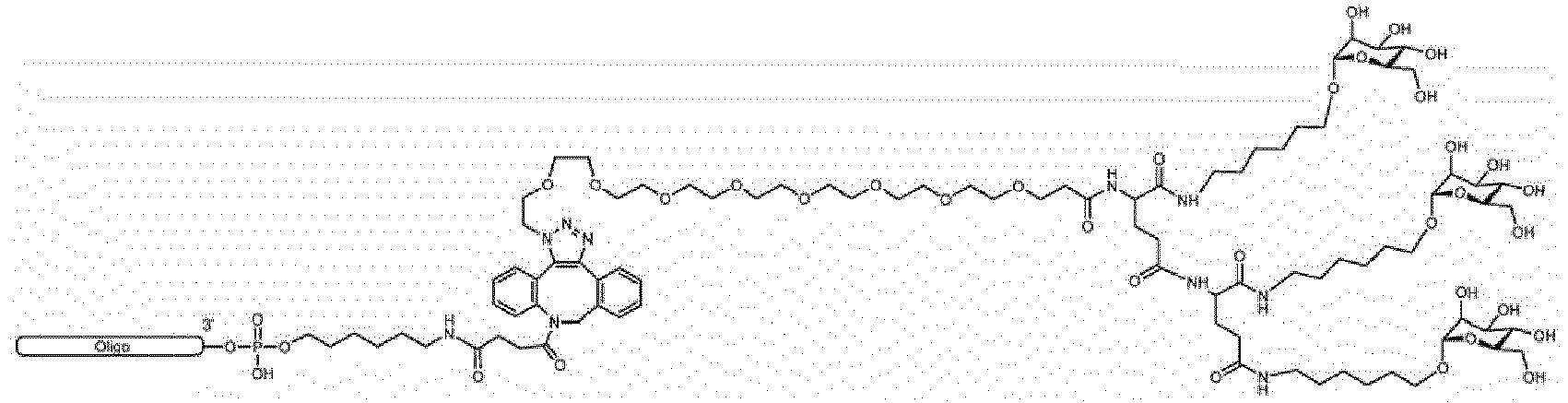
-

-

-

- To SEQ-2 (26.6 nmol), sodium tetraborate buffer at pH 8.5 and compound 28 (120 nmol) dissolved in DMSO were added, and the resultant was stirred at room temperature. After adding water to the reaction mixture, purification was performed with an Amicon Ultra 3K (Millipore). To the crude product obtained, 28% aqueous ammonia in a volume five times that of the crude product was added, and the resultant was left to stand at room temperature for 3 hours. After adding water to the reaction mixture, purification was performed with an Amicon Ultra 3K (Millipore). Further, purification was performed by reversed-phase HPLC to afford nucleic acid complex 8.
-

- The sequence of the nucleic acid (5'-3') used in Examples shown here is
A(F)^G(M)^G(F)A(M)C(F)U(M)G(F)G(M)U(F)C(M)U(F)U(F)U(M)C(F)U (M)A(F)U(M)A(F)U(M)^C(F)^U(M), wherein capital alphabets represent RNA, (M) indicates 2'-O-methylated RNA, (F) indicates 2'-fluoroRNA, and ^ indicates phosphorothioate linkage. The cyanine dye Cy3 (excitation wavelength: 555 nm, fluorescence wavelength: 570 nm), which is a fluorescent dye, is bound to the 5' end of each oligonucleotide. SEQ-1, 2 and the nucleic acid complexes synthesized in Examples shown here were subjected to measurement of molecular weight by MALDI-TOF-MS, and Table 1 shows the results.[Table 1] Compound Theoretical molecular weight Found m/z [M-H]- SEQ-1 7346.1 7345.5 SEQ-2 7525.3 7526.4 Nucleic acid complex 1 8231.1 8227.8 Nucleic acid complex 2 8621.5 8620.1 Nucleic acid complex 3 9011.9 9009.4 Nucleic acid complex 4 9322.3 9321.1 Nucleic acid complex 5 9402.4 9397.6 Nucleic acid complex 6 9135.1 9131.1 Nucleic acid complex 7 9236.2 9235.5 Nucleic acid complex 8 9566.6 9566.0 - The nucleic acid complexes synthesized in Examples were each introduced into human CD206-expressing Lenti-X 293T cells (Clontech Laboratories, Inc.) with a method shown below, and the uptakes of them were evaluated. Human CD206-expressing Lenti-X 293T cells (Clontech Laboratories, Inc.) were seeded in a 96-well PDL-coating plate (Coming Incorporated) at 2 × 10⁴ cells/100 µL/well, and cultured in a 5% CO2 incubator at 37°C for 2 days. SEQ-1 or any one of the nucleic acid complexes synthesized was added to reach a final concentration of 100 nmol/L, and incubation was performed in a 5% CO2 incubator at 37°C for 2 hours. Thereto, 4% paraformaldehyde/PBS (Wako Pure Chemical Industries, Ltd.) containing 10 µg/mL Hoechst (Life Technologies) was added, and the cells were fixed at normal temperature for 30 minutes, and washed four times with PBS. Fluorescence imaging analysis was performed with an IN Cell Analyzer 2200 (GE Healthcare), wherein Cy3 fluorescence intensity in each well was corrected with the number of nuclei, and the average Cy3 fluorescence intensity per cell was calculated. At that time, the fluorescence intensity in the well with addition of SEQ-1, which is a nucleic acid without modification with a sugar ligand, was defined as 1, and fluorescence intensity in each well with addition of any one of the nucleic acid complexes was calculated as a relative value.
- Table 2 shows the results. It was revealed from the results that, as compared with SEQ-1, which contained no sugar ligand, nucleic acid complex 6, which had GalNAc, was not effectively taken up by CD206-expressing cells, whereas nucleic acid complexes 1 to 5, nucleic acid complexes having mannose, were effectively taken up by CD206-expressing cells.
[Table 2] Specimen No. SEQ-1 Nucleic acid complex 1 2 3 4 5 6 Ligand - Mannose Mannose Mannose Mannose Mannose GalNAc Valency - 1 2 3 3 4 3 Relative value of fluorescence intensity (SEQ-1 = 1.0) 1 7.5 12.6 13.8 15 14.5 1.1 - The nucleic acid complexes synthesized in Examples were each introduced into human ASGR1-expressing Lenti-X293T cells (Clontech Laboratories, Inc.) with a method shown below, and the uptake activity for them was evaluated. Human ASGR1-expressing Lenti-X293T cells (Clontech Laboratories, Inc.) were seeded in a 96-well PDL-coating plate (Corning Incorporated) at 2 × 10⁴ cells/100 µL/well, and cultured in a 5% CO2 incubator at 37°C for 1 day or 2 days. SEQ-1 or any one of the nucleic acid complexes synthesized was added to reach a final concentration of 100 nmol/L, and incubation was performed in a 5% CO2 incubator at 37°C for 2 hours. Subsequent fluorescence imaging analysis was performed with the same method as in Test Example 1.
- Table 3 shows the results. It was revealed from the results that, as compared with SEQ-1, which contained no sugar ligand, nucleic acid complexes 1 to 5, which had mannose, were not effectively taken up by ASGR1-expressing cells, whereas nucleic acid complexes 6 to 8, which had GalNAc, were effectively taken up by ASGR1-expressing cells.
[Table 3] Specimen No. SEQ-1 Nucleic acid complex 1 2 3 4 5 6 7 8 Ligand - Mannose Mannose Mannose Mannose Mannose GalNAc GalNAc GalNAc Valency - 1 2 3 3 4 3 4 4 Relative value of fluorescence intensity (SEQ-1 = 1.0) 1 2.1 1.4 1.3 0.9 1.1 44.9 64.5 53.3 - SEQ-1, nucleic acid complex 3 and nucleic acid 6 were each subcutaneously administered to BALB/c mice (n = 3) at 1 mg/kg. Four hours after the administration, the liver was perfused and liver parenchymal cells and Kupffer cells were separated through a flow cytometer, and fluorescence intensity was measured. At that time, the fluorescence intensity for the group with administration of SEQ-1 was defined as 1, and fluorescence intensity for each group with administration of any one of the nucleic acid complexes was calculated as a relative value.
- Table 4 shows the results. It was revealed from the results that, as compared with SEQ-1, which contained no sugar ligand, nucleic acid complex 3, which had mannose, was efficiently taken up by mouse Kupffer cells, which have been reported to be CD206-positive, and nucleic acid complex 6, which had GalNAc, was efficiently taken up by mouse liver parenchymal cells, which have been reported to be ASGR1-positive.
[Table 4] Specimen No. SEQ-1 Nucleic acid complex 3 6 Ligand - Mannose GalNAc Valency - 3 3 Liver parenchymal cells 1 1.6 5.3 Kupffer cells 1 2.2 0.7 -

-

- A mixture of hydrazine acetate (1.29 g, 14.06 mmol) and DMF (50 mL) was heated at 50°C. Subsequently, this was cooled in a water bath at 15°C, and α-D-mannose pentaacetate (4.99 g, 12.8 mmol) was added thereto. The resulting solution was stirred in a water bath at 15 to 19°C for 16 hours. To the mixture, water and EtOAc were added for extraction, and the aqueous layer was further subjected to extraction with EtOAc. The organic layer combined was washed with brine, dried over anhydrous sodium sulfate, filtered, and concentrated under reduced pressure. The residue was purified by column chromatography using a Biotage Isolera (100 g KP-Sil, 20 to 100% EtOAc/cyclohexane) to afford compound 30 (4.19 g) as a 9:1 mixture of α and β diastereomers.
α isomer
1H NMR (600 MHz, CDCl3) δ ppm:
2.00 (s, 3H), 2.05 (s, 3H), 2.11 (s, 3H), 2.16 (s, 3H), 3.00 (d, J=4.03Hz, 1H), 4.15 (br d, J=10.64Hz, 1H), 4.22-4.28 (m, 2H), 5.23-5.33 (m, 3H), 5.43 (br dd, J=10.27, 3.30Hz, 1H) -

- To a solution of compound 30 (3.64 g, 10.5 mmol) in DCM (218 mL), trichloroacetonitrile (10.48 mL, 104.5 mmol) and then DBU (0.158 mL, 1.05 mmol) were added dropwise in a nitrogen atmosphere. The mixture was stirred in a nitrogen atmosphere at room temperature for 2.25 hours. Concentration was performed under reduced pressure, and the residue was purified by column chromatography using a Biotage Isolera (100 g KP-Sil, 0 to 50% EtOAc/cyclohexane) to afford compound 31 (4.567 g).
1H NMR (600 MHz, CDCl3) δ ppm:
2.01 (s, 3H), 2.07 (s, 3H), 2.08 (s, 3H), 2.20 (s, 3H), 4.14-4.23 (m, 2H), 4.28 (dd, J=12.47, 4.77Hz, 1H), 5.38-5.43 (m, 2H), 5.47 (br s, 1H), 6.28 (s, 1H), 8.79(s, 1H) -

- A solution of compound 31 (2.45 g, 4.96 mmol) and N-Cbz-6-amino-hexan-1-ol (1.87 g, 7.45 mmol) in DCM (90 mL) was cooled to 2°C (internal temperature), and boron trifluoride diethyl etherate (0.126 mL, 0.993 mmol) was added dropwise thereto in a nitrogen atmosphere. The resulting mixture was stirred at 2°C for 25 minutes, and then stirred at room temperature for 1 hour 20 minutes. To the mixture, saturated aqueous sodium hydrogen carbonate solution was added for extraction, and the aqueous layer was subjected to extraction with DCM. The organic layer combined was washed with brine, filtered through hydrophobic filter paper, and concentrated under reduced pressure. The residue was purified by column chromatography using a Biotage Isolera (100 g KP-Sil, 0 to 100% EtOAc/cyclohexane) to afford compound 33 (1.37 g).
1H NMR (600 MHz, CDCl3) δ ppm:
1.32-1.43 (m, 4H), 1.49-1.53 (m, 2H), 1.56-1.64 (m, 2H), 1.99 (s, 3H), 2.04 (s, 3H), 2.10 (s, 3H), 2.15 (s, 3H), 3.20 (q, J=6.72Hz, 2H), 3.40-3.48 (m, 1H), 3.64-3.71 (m, 1H), 3.97 (ddd, J=9.90, 5.32, 2.38Hz, 1H), 4.08-4.12 (m, 1H), 4.28 (dd, J=12.29, 5.32Hz, 1H), 4.79 (d, J=1.47Hz, 2H), 5.10 (s, 2H), 5.22 (dd, J=3.30, 1.83Hz, 1H), 5.28 (t, J=9.54Hz, 1H), 5.34 (dd, J=10.64, 3.67Hz, 1H), 7.29-7.33 (m, 1H), 7.36 (d, J=4.03Hz, 4H) -

- To a solution of compound 33 (1.35 g, 2.31 mmol) in IMS (38 mL), 10% palladium-carbon (0.293 g, 50% wet product) was added in a nitrogen atmosphere, and the resultant was stirred in a hydrogen atmosphere at room temperature for 1.5 hours. The mixture was filtered through a Celite (Registered Trademark), and washed with IMS. To the filtrate, 1,4-dioxane solution of 4 N hydrogen chloride (0.78 mL, 3.12 mmol) was added, and the resultant was concentrated under reduced pressure to afford compound 34 (1.06 g).
1H NMR (600 MHz, DMSO-d6) δ ppm: 1.30-1.37 (m, 4H), 1.51-1.61 (m, 4H), 1.94 (s, 3H), 2.03 (s, 6H), 2.11 (s, 3H), 2.72-2.80 (m, 2H), 3.42-3.50 (m, 1H), 3.63 (dt, J=9.72, 6.88Hz, 1H), 3.88-3.96 (m, 1H), 4.06 (dd, J=12.10, 2.57Hz, 1H), 4.15 (dd, J=12.29, 5.32Hz, 1H), 4.87 (s, 1H), 5.04-5.15 (m, 3H), 7.80 (br s, 3H) -

- To a solution of compound 34 (510 mg, 1.05 mmol) and compound 25 (128.4 mg, 0.21 mmol) in DMF (3 mL), HOBt (161 mg, 1.05 mmol) and EDCI (202 mg, 1.05 mmol) were sequentially added. The resulting mixture was stirred at room temperature for 10 minutes, and DIPEA (0.18 mL, 1.05 mmol) was then added thereto. The resulting solution was stirred at room temperature for 22 hours. A solution of compound 34 (505.9 mg, 1.04 mmol) inDMF (1.5 mL), HOBt (161 mg, 1.05 mmol), and EDCI (202 mg, 1.05 mmol) were additionally added, and DIPEA (0.18 mL, 1.05 mmol) was added after 10 minutes. The mixture was further stirred for 3 hours. The mixture was purified by preparative HPLC to afford compound 34 (46.3 mg).
1H NMR (600 MHz, DMSO-d6) δ ppm: - 1.21-1.45 (m, 24H), 1.49-1.59 (m, 8H), 1.61-1.89 (m, 8H), 1.93 (s, 12H), 2.01 (s, 24H), 2.10 (s, 12H), 2.07-2.23 (m, 8H), 2.33-2.37 (m, 2H), 2.96-3.08 (m, 7H), 3.41-3.48 (m, 4H), 3.57-3.65 (m, 4H), 3.88-3.94 (m, 4H), 4.05 (dd, J=12.10, 1.83Hz, 4H), 4.10-4.20 (m, 8H), 4.85 (s, 4H), 5.06-5.13 (m, 14H), 7.31-7.40 (m, 6H), 7.69-7.94 (m, 6H);
- LCMS (ESI+): m/z 1164.58 [M+2H]2+.
- Synthesis of Compound 36

- To a solution of compound 35 (40.7 mg, 0.02 mmol) in IMS (6 mL), 10% palladium-carbon (11.5 mg, 50% wet product) was added in a nitrogen atmosphere, and the resultant was stirred in a hydrogen atmosphere at room temperature for 2 hours. The mixture was filtered through a Celite (Registered Trademark), and washed with IMS. The filtrate combined was concentrated under reduced pressure to afford compound 36 (43.8 mg).
1H NMR (600 MHz, DMSO-d6) δ ppm:
1.20-1.44 (m, 24H), 1.51-1.60 (m, 8H), 1.61-1.88 (m, 8H), 1.93 (s, 12H), 2.02 (s, 12H), 2.02 (s, 12H), 2.10 (s, 12H), 2.12-2.27 (m, 10H), 2.96-3.08 (m, 7H), 3.41-3.48 (m, 4H), 3.58-3.65 (m, 4H), 3.88-3.94 (m, 4H), 4.04 (br d, J=10.27Hz, 4H), 4.09-4.29 (m, 8H), 4.85 (s, 4H), 5.04-5.14 (m, 12H), 7.71-8.01 (br m, 7H) -

- To a solution of compound 36 (32.8 mg, 0.015 mmol) in DMF (3 mL), trimethylamine (16.3 µL, 0.12 mmol) was added, and pentafluorophenyl trifluoroacetate (10.0 µL, 0.06 mmol) was then added dropwise, and the resulting mixture was stirred at room temperature for 1.25 hours. The reaction mixture was poured into water, brine was added thereto, and extraction was performed with EtOAc. The organic layer was washed sequentially with saturated aqueous sodium hydrogen carbonate solution, 1 M aqueous sodium hydrogen sulfate solution, and brine. The organic layer was dried over anhydrous sodium sulfate, filtered, and concentrated under reduced pressure. The residue was triturated with pentane. Subsequently, the solid was dried at 40°C under reduced pressure to afford compound 37 (36.7 mg).
1H NMR (600 MHz, DMSO-d6) δ ppm: - 1.20-1.47 (m, 24H), 1.51-1.61 (m, 8H), 1.62-1.91 (m, 8H), 1.93 (s, 12H), 2.01 (s, 24H), 2.10 (s, 12H), 2.12-2.33 (m, 8H), 2.80 (br t, J=6.79Hz, 2H), 2.96-3.09 (m, 7H), 3.41-3.50 (m, 4H), 3.58-3.65 (m, 4H), 3.91 (br s, 4H), 4.04 (br d, J=12.10Hz, 4H), 4.10-4.28 (m, 8H), 4.85 (br s, 4H), 5.06-5.15 (m, 12H), 7.68-8.03 (m, 7H);
- LCMS (ESI+): m/z 1202.46 [M+2H]2+.
-

-

- Anhydrous zinc chloride (3.65 g, 26.8 mmol) was weighed in a 250-mL three-necked flask under argon. The flask was dried under reduced pressure at 110°C for 1 hour, and then allowed to cool under reduced pressure overnight. Subsequently, the flask was filled with argon, and ((2S,3R,4R,5R,6R)-3-acetamide-6-(acetoxymethyl)tetrahydro-2H-pyran-2,4,5-triyltriacetate (7.85 g, 20.2 mmol), N-Cbz-6-amino-hexan-1-ol (6.74 g, 26.8 mmol), and DCE (85 mL) were added thereto. After the mixture was heated under argon at 70°C (external temperature) for 3 hours, the mixture was cooled, and then diluted with ethyl acetate and saturated aqueous sodium hydrogen carbonate solution. The mixture was stirred for 20 minutes, filtered through a Celite (Registered Trademark), and washed with ethyl acetate. The filtrate combined was partitioned, and the organic layer was washed with water and then with brine. The organic layer was dried over anhydrous sodium sulfate, filtered, and concentrated under reduced pressure. The residue was purified by column chromatography (330 g PuriFlash Si, 20 to 100% EtOAc/cyclohexane) using a CombiFlash to afford compound 39 (9.42 g).
1H NMR (400 MHz, CDCl3) δ ppm: - 1.30-1.43 (m, 4H), 1.45-1.65 (m, 4H), 1.94 (s, 3H), 2.00 (s, 3H), 2.05 (s, 3H), 2.13 (s, 3H), 3.12-3.29 (m, 2H), 3.48 (dt, J=9.63, 6.50Hz, 1H), 3.79-4.02 (m, 3H), 4.06-4.21 (m, 2H), 4.65 (br d, J=8.19Hz, 1H), 4.78-4.93 (m, 1H), 5.06-5.18 (m, 2H), 5.27 (dd, J=11.25, 3.06Hz, 1H), 5.34 (d, J=2.81Hz, 1H), 5.77 (br d, J=8.44Hz, 1H), 7.29-7.42 (m, 5H)
- LCMS (m/z 581 [M+H]+)
-

- To a solution of compound 39 (9.23 g, 15.9 mmol) in IMS (275 mL), dioxane solution of 4 M hydrogen chloride (5.17 mL, 20.7 mmol) and 10% palladium-carbon (1.895 g; 50% wet product) were added in a nitrogen atmosphere, and the resultant was stirred in a hydrogen atmosphere at room temperature for 2.5 hours. The mixture was filtered through a Celite (Registered Trademark), and washed with IMS. The filtrate was concentrated under reduced pressure to afford compound 40 (8.07 g).
1H NMR (400 MHz, DMSO-d6) δ ppm: - 1.22-1.35 (m, 4H), 1.39-1.62 (m, 4H), 1.78 (s, 3H), 1.89 (s, 3H), 2.00 (s, 3H), 2.10 (s, 3H), 2.69-2.82 (m, 2H), 3.41-3.47 (m, 2H), 3.64-3.77 (m, 1H), 3.81-3.93 (m, 1H), 3.95-4.12 (m, 2H), 4.49 (d, J=8.56Hz, 1H), 4.97 (dd, J=11.25, 3.42Hz, 1H), 5.22 (d, J=3.42Hz, 1H), 7.62-7.80 (m, 3H), 7.86 (d, J=9.29Hz, 1H)
- LCMS (m/z 447 [M+H]+)
-

- To a mixture of CTC resin (1.33 mmol/g, 1.31 g, 1.74 mmol), Fmoc-Glu(OtBu)-OH (0.370 g, 0.87 mmol), Fmoc-D-Glu(OtBu)-OH (0.370 g, 0.87 mmol), and DCM (105 mL) in a 250-mL Quickfit (Registered Trademark) Erlenmeyer flask, DIPEA (1.215 mL, 6.96 mmol) was added dropwise. The flask was plugged, equipped with a plate shaker, and shaken at 300 rpm for 2 hours. MeOH (0.7 mL, 17.3 mmol) was added thereto, and the mixture was further shaken for 35 minutes. The mixture was filtered through a 70-mL plastic phase separation cartridge, and treated with a solution of 20% piperidine in DMF (50 mL) for 30 minutes while bubbling with nitrogen was performed. The solution was discharged, and the resin was washed with DMF.
- To the resin in the cartridge, a solution of Fmoc-D-Glu-OtBu (0.740 g, 1.74 mmol), N-Fmoc-L-glutamic acid-1-t-butyl ester (0.740 g, 1.74 mmol), and HBTU (1.253 g, 3.30 mmol) in DMF (10 mL) was added, and DIPEA (1.22 mL, 6.96 mmol) was then added dropwise. The mixture was mixed for 1 hour while bubbling with nitrogen was performed. Subsequently, the solution was removed of the solvent under nitrogen gas flow, and the resin was treated with a solution of 20% piperidine in DMF (50 mL) for 35 minutes while bubbling with nitrogen was performed. The solution was discharged, and the resin was washed with DMF.
- To the residual resin in the cartridge, a solution of 1,5-pentanedioic acid monobenzyl ester (0.580 g, 2.61 mmol) and HBTU (1.253 g, 3.30 mmol) in DMF (10 mL) and then DIPEA (1.215 mL, 6.96 mmol) were added dropwise. The mixture was mixed for 80 minutes while bubbling with nitrogen was performed. The solution was discharged, and the resin was washed with DMF and then with MeOH. Subsequently, the resin was dried by suction. The resin was transferred into a test tube of 25 × 150 mm, dried under reduced pressure for 30 minutes, then treated with DCM (5 mL) and TFA (5 mL), and shaken with a plate shaker for 2 hours. Subsequently, the mixture was filtered through a phase separation cartridge, and washed with DCM. The filtrate was concentrated under reduced pressure to afford compound 41 (0.5859 g).
1H NMR (400 MHz, DMSO-d6) δ ppm: - 1.68-1.84 (m, 4H), 1.86-2.01 (m, 2H), 2.13-2.23 (m, 4H), 2.23-2.29 (m, 2H), 2.38 (t, J=7.52Hz, 2H), 4.11-4.22 (m, 2H), 5.09 (s, 2H), 7.29-7.42 (m, 5H), 8.06-8.17 (m, 2H)
- LCMS (m/z 481 [M+H]+)
-

- To a solution of compound 40 (4.06 g, 8.41 mmol) and compound 41 (0.5821 g, 1.21 mmol) in DMF (8 mL), HOBt (1.392 g, 9.09 mmol), EDCI (1.742 g, 9.09 mmol), and then DIPEA (1.587 mL, 9.09 mmol) were sequentially added. The mixture was stirred at room temperature for 20 hours. The mixture was purified by preparative HPLC to afford compound 42 (0.48 g).
1H NMR (600 MHz, DMSO-d6) δ ppm: - 1.23 (br s, 12H), 1.29-1.40 (m, 6H), 1.40-1.48 (m, 6H), 1.60-1.71 (m, 2H), 1.76 (s, 9H), 1.76-1.87 (m, 4H), 1.89 (s, 9H), 1.99 (s, 9H), 2.00-2.07 (m, 2H), 2.10 (s, 9H), 2.11-2.15 (m, 2H), 2.18 (br t, J=7.15Hz, 2H), 2.34-2.38 (m, 2H), 2.94-3.07 (m, 6H), 3.36-3.43 (m, 3H), 3.65-3.73 (m, 3H), 3.82-3.91 (m, 3H), 3.98-4.06 (m, 9H), 4.10-4.20 (m, 2H), 4.48 (d, J=8.44Hz, 3H), 4.97 (dd, J=11.19, 3.12Hz, 3H), 5.08 (s, 2H), 5.21 (d, J=3.30Hz, 3H), 7.30-7.39 (m, 5H), 7.71-7.76 (m, 1H), 7.77-7.85 (m, 5H), 7.87-7.93 (m, 2H)
- LCMS (m/z 1766 [M+H]+)
-

- To a solution of compound 42 (0.43 g, 0.243 mmol) in IMS (85 mL), 10% palladium-carbon (0.158 g, 0.074 mmol; 50% wet product) was added in a nitrogen atmosphere, and the resultant was stirred in a hydrogen atmosphere at room temperature for 2.75 hours. The mixture was filtered through a Celite (Registered Trademark), and washed with IMS. The filtrate was concentrated under reduced pressure, and the residue was dissolved in DCM/EtOH (2:1), filtered through a Celite (Registered Trademark), and washed with DCM-EtOH (2:1). The filtrate was concentrated under reduced pressure to afford compound 43 (0.4252 g).
1H NMR (600 MHz, DMSO-d6) δ ppm: - 1.18-1.29 (m, 12H), 1.31-1.41 (m, 6H), 1.41-1.49 (m, 6H), 1.62-1.75 (m, 4H), 1.77 (s, 9H), 1.81-1.87 (m, 2H), 1.89 (s, 9H), 1.99 (s, 9H), 2.01-2.08 (m, 2H),
2.10 (s, 9H), 2.12-2.24 (m, 6H), 2.95-3.07 (m, 6H), 3.37-3.45 (m, 3H), 3.66-3.73 (m, 3H), 3.82-3.92 (m, 3H), 3.98-4.06 (m, 9H), 4.09-4.20 (m, 2H), 4.49 (d, J=8.44Hz, 3H), 4.97 (dd, J=11.19, 2.38Hz, 3H), 5.21 (d, J=3.30Hz, 3H), 7.73-8.04 (m, 8H), 11.81-12.20 (m, 1H). - LCMS (m/z 1676 [M+H]+).
-

- To a solution of compound 43 (0.4239 g, 0.253 mmol) in DMF (50 mL), triethylamine (0.282 mL, 2.024 mmol) and then pentafluorophenyl trifluoroacetate (0.174 mL, 1.012 mmol) were added dropwise in a nitrogen atmosphere. The mixture was stirred at room temperature for 1 hour, and poured into water. Brine was added to the aqueous layer, and extraction was performed with EtOAc. The organic layer combined was washed sequentially with saturated aqueous sodium hydrogen carbonate solution, 1 M aqueous sodium hydrogen sulfate solution, and brine. The organic layer was dried over anhydrous sodium sulfate, filtered, and then concentrated under reduced pressure, and EtOAc was added to the resulting residue, which was washed with 1 M aqueous sodium hydrogen sulfate solution and then with brine. The organic layer was dried over anhydrous sodium sulfate, filtered, and concentrated under reduced pressure to afford compound 44 (0.4513 g).
1H NMR (600 MHz, DMSO-d6) δ ppm: - 1.24 (br s, 12H), 1.31-1.40 (m, 6H), 1.41-1.48 (m, 6H), 1.61-1.73 (m, 2H), 1.76 (s, 9H), 1.79-1.93 (m, 13H), 1.99 (s, 9H), 2.01-2.06 (m, 2H), 2.10 (s, 9H), 2.11-2.18 (m, 2H), 2.27 (br t, J=7.34Hz, 2H), 2.80 (t, J=6.97Hz, 2H), 2.96-3.07 (m, 6H), 3.37-3.43 (m, 3H), 3.69 (dt, J=9.63, 6.19Hz, 3H), 3.82-3.91 (m, 3H), 3.98-4.06 (m, 9H), 4.09-4.22 (m, 2H), 4.48 (d, J=8.44Hz, 3H), 4.97 (dd, J=11.37, 3.30Hz, 3H), 5.21 (d, J=3.30Hz, 3H), 7.73 (br t, J = 5.14Hz, 1H), 7.77-7.85 (m, 5H), 7.91 (br dd, J = 11.19, 7.89Hz, 1H), 7.98 (br d, J = 8.07Hz, 1H)
- LCMS (m/z 1843.56 [M+H]+)
-

-

- To a solution of compound 34 (1383 mg, 2.86 mmol) and compound 41 (183.1 mg, 0.381 mmol) in DMF (3.0 mL), HOBt (438 mg, 2.86 mmol), EDCI (548 mg, 2.86 mmol), and DIPEA (0.50 mL, 2.86 mmol) were sequentially added. The resulting mixture was stirred at room temperature for 24 hours. The mixture was purified by preparative HPLC to afford compound 45 (133.4 mg).
1H NMR (600 MHz, DMSO-d6) δ ppm: - 1.23-1.34 (m, 12H), 1.34-1.43 (m, 6H), 1.50-1.59 (m, 6H), 1.62-1.72 (m, 2H), 1.74-1.80 (m, 2H), 1.81-1.89 (m, 2H), 1.93 (s, 9H), 2.01 (s, 18H), 2.03-2.07 (m, 2H), 2.10 (s, 9H), 2.11-2.15 (m, 2H), 2.16-2.21 (m, 2H), 2.33-2.38 (m, 2H), 2.97-3.07 (m, 6H), 3.41-3.48 (m, 3H), 3.57-3.64 (m, 3H), 3.87-3.94 (m, 3H), 4.05 (dd, J=12.10, 2.57Hz, 3H), 4.10-4.19 (m, 5H), 4.85 (s, 3H), 5.0-5.13 (m, 11H), 7.29-7.39 (m, 5H), 7.71 (br t, J=4.95Hz, 1H), 7.76-7.84 (m, 2H), 7.85-7.91 (m, 2H)
- LCMS (m/z 1769 [M+H]+)
-

- To a solution of compound 45 (101.9 mg, 0.058 mmol) in IMS (20 mL), 10% palladium-carbon (37.4 mg; 50% wet product) was added in a nitrogen atmosphere. The mixture was stirred in a hydrogen atmosphere at room temperature for 2.5 hours. The mixture was filtered through a Celite (Registered Trademark), and then washed with IMS. The filtrate combined was concentrated under reduced pressure to afford compound 46 (95.9 mg).
1H NMR (600 MHz, DMSO-d6) δ ppm: - 1.28 (br s, 12H), 1.34-1.44 (m, 6H), 1.49-1.60 (m, 6H), 1.61-1.76 (m, 4H), 1.81-1.90 (m, 2H), 1.93 (s, 9H), 2.02 (s, 9H), 2.02 (s, 9H), 2.04-2.08 (m,2H), 2.10 (s, 9H), 2.12-2.23 (m, 6H), 2.96-3.07 (m, 6H), 3.40-3.48 (m, 3H), 3.57-3.65 (m, 3H), 3.86-3.94 (m, 3H), 4.05 (dd, J=12.10, 2.38Hz, 3H), 4.09-4.18 (m, 5H), 4.85 (s, 3H), 5.01-5.14 (m, 9H), 7.62-8.17 (m, 5H), 11.84-12.15 (m, 1H).
- LCMS (m/z 1679 [M+H]+).
-

- To a solution of compound 46 (94.6 mg, 0.056 mmol) in DMF (9 mL), triethylamine (62.8 µL, 0.451 mmol) was added in a nitrogen atmosphere, and pentafluorophenyl trifluoroacetate (38.7 µL, 0.225 mmol) was added dropwise. The resulting mixture was stirred at room temperature for 1 hour. The mixture was poured into water, brine was added thereto, and extraction was performed with EtOAc. The organic layer combined was washed sequentially with saturated aqueous sodium hydrogen carbonate solution, 1 M aqueous sodium hydrogen sulfate solution, and brine. The organic layer was dried over anhydrous sodium sulfate, filtered, and then concentrated under reduced pressure to afford compound 47 (109.0 mg).
1H NMR (600 MHz, DMSO-d6) δ ppm: - 1.23-1.33 (m, 12H), 1.34-1.43 (m, 6H), 1.50-1.60 (m, 6H), 1.62-1.77 (m, 2H), 1.80-1.91 (m, 4H), 1.93 (s, 9H), 2.01 (s, 18H), 2.03-2.07 (m, 2H), 2.10 (s, 9H), 2.12-2.20 (m, 2H), 2.25-2.30 (m, 2H), 2.77-2.82 (m, 2H), 2.96-3.08 (m, 6H), 3.41-3.48 (m, 3H), 3.53-3.68 (m, 3H), 3.86-3.95 (m, 3H), 4.00-4.07 (m, 3H), 4.10-4.23 (m, 5H), 4.85 (s, 3H) 5.04-5.13 (m, 9H), 7.71 (br t, J=5.32Hz, 1H), 7.78-7.85 (m, 2H), 7.89 (dd, J=12.84, 8.07Hz, 1H), 7.96 (d, J=8.07Hz, 1H)
- LCMS (m/z 1845.47 [M+H]+)
-

-

- Zinc chloride (285 mg, 2.09 mmol) put in a 50-mL three-necked flask was dried under reduced pressure at 110°C for 1 hour, and allowed to cool under reduced pressure overnight. The flask was purged with nitrogen, and a solution of compound 38 (611 mg, 1.57 mmol) and compound 48a (500 mg, 2.09 mmol) in DCE (5 mL) was added thereto. The mixture was heated in a nitrogen atmosphere at 70°C (external temperature) for 3 hours. The mixture was allowed to cool, and diluted with ethyl acetate (10 mL)/saturated aqueous sodium hydrogen carbonate solution (5 mL). The mixture was stirred for 10 minutes, filtered through a Celite (Registered Trademark), and washed with ethyl acetate. The filtrate combined was washed with water and brine. The organic layer was filtered through hydrophobic filter paper, and concentrated under reduced pressure. The residue was purified by column chromatography using a Biotage Isolera (50 g KP-Sil, 0 to 50% (3:1 EtOAc-IMS)/MTBE) to afford compound 49a (599.4 mg).
1H NMR (600 MHz, CDCl3) δ ppm: - 1.90 (s, 3H), 2.00 (s, 3H), 2.04 (s, 3H), 2.13 (s, 3H), 3.26-3.86 (m, 8H), 3.87-4.00 (m, 2H), 4.05-4.19 (m, 2H), 4.76 (br d, J=7.70Hz, 1H), 5.10-5.20 (m, 2H), 5.26 (br dd, J=6.60, 3.30Hz, 1H), 5.32 (br s, 1H), 5.43 (br s, 1H), 5.75 (br d, J=7.34Hz, 1H), 7.28-7.42 (m, 5H).
- LCMS (m/z 569 [M+H]+).
-

- To a solution of compound 49a (594.2 mg, 1.05 mmol) in IMS (18 mL), 1,4-dioxane solution of 4 M hydrogen chloride (0.34 mL, 1.36 mmol) and 10% palladium-carbon (50% wet product, 125 mg) were added in a nitrogen atmosphere. The mixture was stirred in a hydrogen atmosphere at room temperature for 2.5 hours. The mixture was filtered through a Celite (Registered Trademark), and washed with IMS. The filtrate combined was concentrated under reduced pressure to afford compound 50a (507.9 mg).
1H NMR (600 MHz, DMSO-d6) δ ppm: - 1.77-1.84 (m, 3H), 1.86-1.92 (m, 3H), 1.97-2.03 (m, 3H), 2.06-2.13 (m, 3H), 2.92-3.00 (m, 2H), 3.52-3.75 (m, 5H), 3.83 (ddd, J=11.28, 5.41, 3.85Hz, 1H), 3.86-3.93 (m, 1H), 3.95-4.17 (m, 3H), 4.57 (d, J=8.44Hz 1H), 4.99 (dd,J=11.19, 3.48Hz, 1H), 5.23 (d, J=3.67Hz, 1H), 7.81 (br s, 3H), 7.85-7.92 (m, 1H)
- LCMS (m/z 435 [M+H]+)
-

- To a solution of compound 50a (506.5 mg, 1.08 mmol) and compound 41 (68.9 mg, 0.14 mmol) in DMF (2.0 mL), HOBt (165 mg, 1.08 mmol), EDCI (206 mg, 1.08 mmol), and DIPEA (188 µL, 1.08 mmol) were sequentially added. The resulting mixture was stirred at room temperature for 20 hours. The mixture was purified by preparative HPLC to afford compound 51a (40.0 mg).
- 1H NMR (600 MHz, DMSO-d6) δ ppm 1.62-1.73 (m, 2H), 1.77 (s, 9H), 1.80-1.87 (m, 2H), 1.89 (s, 9H), 1.99 (s, 9H), 2.02-2.08 (m, 2H), 2.10 (s, 9H), 2.11-2.24 (m, 4H), 2.34-2.38 (m, 2H), 3.13-3.22 (m, 4H), 3.34-3.42 (m, 7H), 3.44-3.54 (m, 7H), 3.55-3.61 (m, 3H), 3.73-3.80 (m, 3H), 3.84-3.91 (m, 3H), 3.97-4.08 (m, 9H), 4.13-4.25 (m, 2H), 4.55 (dd, J=8.07, 3.67Hz, 3H), 4.99 (br d, J=11.00Hz, 3H), 5.07-5.10 (m, 2H), 5.22 (d, J=3.30Hz, 3H), 7.31-7.40 (m, 5H), 7.60-7.97 (m, 8H)
- LCMS (m/z 1730/1731 [M+H]+)
-
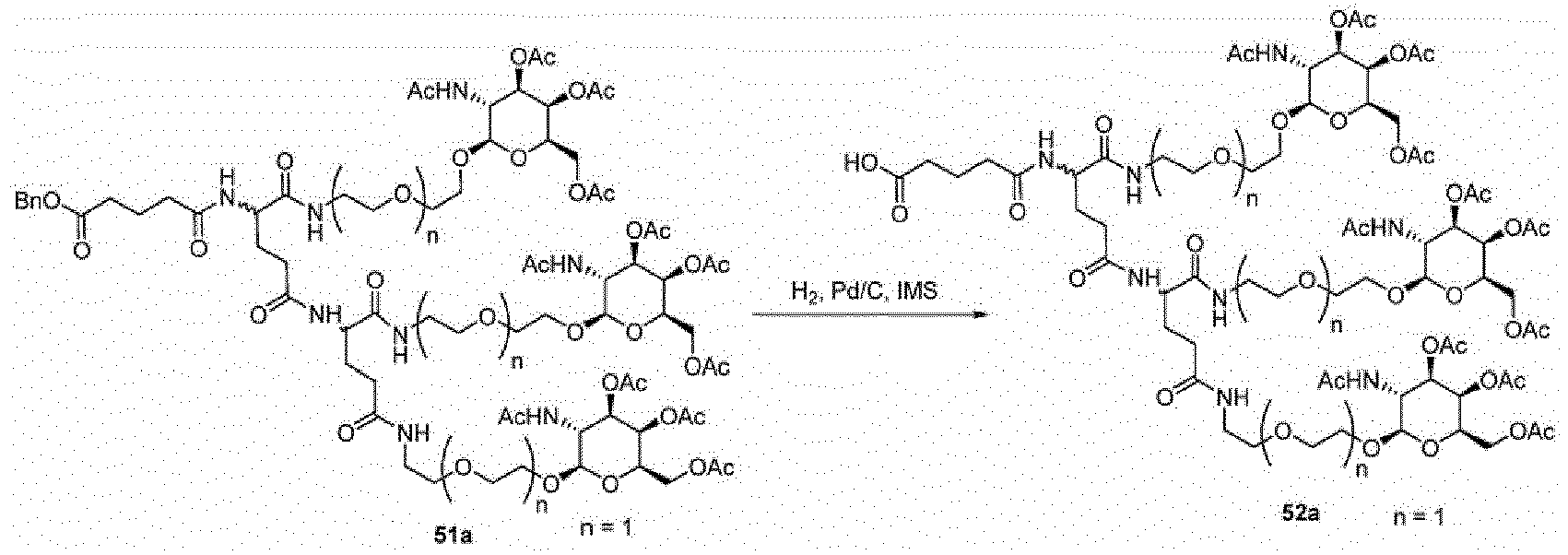
- To a solution of compound 51a (42.7 mg, 0.03 mmol) in IMS (8 mL), 10% palladium-carbon (50% wet product; 16.0 mg) was added in a nitrogen atmosphere. The mixture was stirred in a hydrogen atmosphere at room temperature for 2.5 hours. The mixture was filtered through a Celite (Registered Trademark), and washed with IMS. The filtrate was concentrated under reduced pressure to afford compound 52a (41.2 mg).
- 1H NMR (600 MHz, DMSO-d6) δ ppm 1.62-1.75 (m, 4H), 1.78 (s, 9H), 1.81-1.87 (m, 2H), 1.89 (s, 9H), 2.00 (s, 9H), 2.05-2.32 (m, 17H), 3.12-3.23 (m, 4H), 3.36-3.43 (m, 7H), 3.45-3.54 (m, 7H), 3.55-3.61 (m, 3H), 3.74-3.81 (m, 3H), 3.83-3.92 (m, 3H), 3.98-4.08 (m, 9H), 4.11-4.23 (m, 2H), 4.51-4.59 (m, 3H), 4.99 (br d, J=11.00Hz, 3H), 5.22 (d, J=3.30Hz, 3H), 7.62-8.04 (m, 8H)
- LCMS (m/z 1640/1641 [M+H]+)
-

- To a solution of compound 52a (41.6 mg, 0.03 mmol) in DMF (4 mL), triethylamine (28 µL, 0.20 mmol) and then pentafluorophenyl trifluoroacetate (17 µL, 0.10 mmol) were added dropwise in a nitrogen atmosphere. The resulting mixture was stirred at room temperature for 1.5 hours and poured into water, brine was added thereto, and extraction was performed with EtOAc. The organic layer combined was washed sequentially with saturated aqueous sodium hydrogen carbonate solution, 1 M aqueous sodium hydrogen sulfate solution, and brine. The organic layer was dried over anhydrous sodium sulfate, filtered, and concentrated under reduced pressure. The residue was transferred into a sample vial containing DCM/MeOH, the solvent was evaporated, and then dried under reduced pressure at 40°C for 2 hours to afford compound 52c (27.1 mg).
1H NMR (600 MHz, DMSO-d6) δ ppm: - 1.57-1.75 (m, 4H), 1.77 (s, 9H), 1.86-1.95 (m, 11H), 2.00 (s, 9H), 2.05-2.33 (m, 15H), 2.77-2.88 (m, 2H), 3.11-3.24 (m, 4H), 3.41-3.54 (m, 14H), 3.55-3.62 (m, 3H), 3.74-3.81 (m, 3H), 3.84-3.91 (m, 3H), 3.98-4.07 (m, 9H), 4.11-4.23 (m, 2H), 4.55 (br dd, J=8.07, 3.67Hz, 3H), 4.99 (br d, J=11.00Hz, 3H), 5.22 (d, J=3.30Hz, 3H), 7.65-8.04 (m, 8H)
- LCMS (m/z 1806.83 [M+H]+)
-
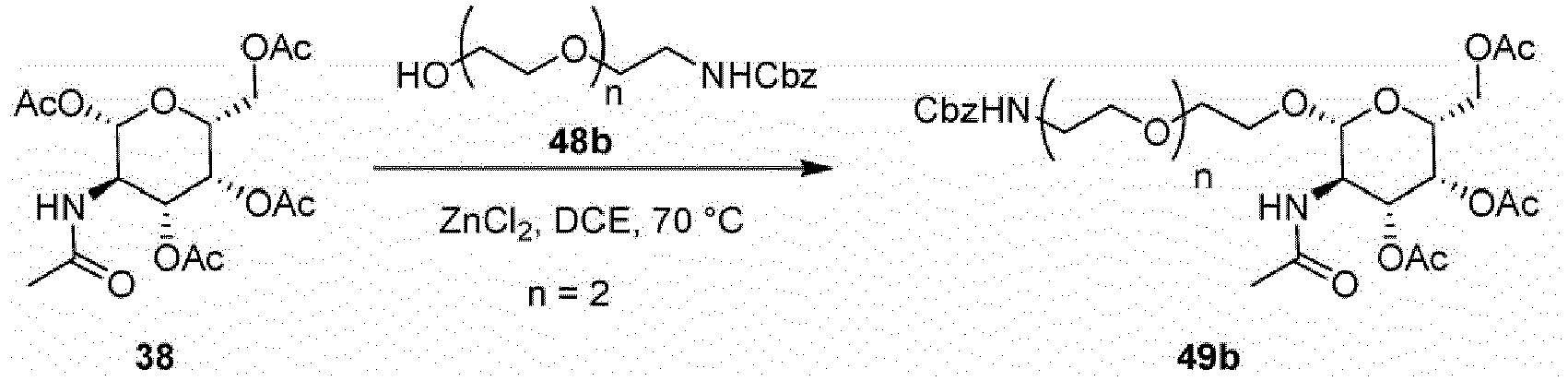
- Zinc chloride (0.466 g, 3.42 mmol) put in a 50-mL three-necked flask was dried under reduced pressure at 110°C for 95 minutes, and allowed to cool under reduced pressure overnight. The flask was purged with nitrogen, and a solution of compound 38 (1.00 g, 2.57 mmol) and compound 48b (0.97 g, 3.42 mmol) in DCE (10 mL) was added thereto. The mixture was heated in a nitrogen atmosphere at 70°C (external temperature) for 3 hours. The mixture was allowed to cool, and diluted with ethyl acetate (20 mL)/saturated aqueous sodium hydrogen carbonate solution (10 mL). The mixture was stirred for 15 minutes, filtered through a Celite (Registered Trademark), and washed with ethyl acetate. The filtrate was washed with water and brine. The organic layer was filtered through hydrophobic filter paper, and concentrated under reduced pressure. The residue was purified by column chromatography using a Biotage Isolera (100 g Sfar Duo Si, 0 to 50% (3:1 EtOAc-IMS)/MTBE) to afford compound 49b (1.14 g). 1H NMR (600 MHz, CDCl3) δppm:
- 1.92 (s, 3H), 1.98 (s, 3H), 2.03 (s, 3H), 2.14 (s, 3H), 3.32-3.50 (m, 2H), 3.53-3.73 (m, 8H), 3.77-3.94 (m, 3H), 4.02-4.22 (m, 3H), 4.74 (br d, J=8.44Hz, 1H), 5.03-5.08 (m, 1H), 5.11 (br s, 2H), 5.26 (br s, 1H), 5.40-5.53 (m, 1H), 6.11-6.21 (m, 1H), 7.30-7.40 (m, 5H).
- LCMS (m/z 613 [M+H]+).
-

- To a solution of compound 49b (1.14 g, 1.86 mmol) in IMS (32 mL), 1,4-dioxane solution of 4 M hydrogen chloride (0.60 mL, 2.42 mmol) and 10% palladium-carbon (50% wet product; 0.221 g) were added in a nitrogen atmosphere. The mixture was stirred in a hydrogen atmosphere at room temperature for 2.5 hours. The mixture was filtered through a Celite (Registered Trademark), and washed with IMS. The filtrate combined was concentrated under reduced pressure to afford compound 50b (0.97 g).
1H NMR (600 MHz, DMSO-d6) δ ppm 1.79 (s, 3H), 1.89 (s, 3H), 2.00 (s, 3H,) 2.11 (s, 3H), 2.94-3.02 (m, 2H), 3.50-3.62 (m, 9H), 3.77-3.84 (m, 1H), 3.86-3.94 (m, 1H), 3.98-4.10 (m, 3H), 4.54 (d, J=8.44Hz, 1H), 4.97 (dd, J=11.19, 3.48Hz, 1H), 5.22 (d, J=3.67Hz, 1H), 7.70-7.93 (m, 4H)
LCMS (m/z 479 [M+H]+) -

- To a solution of compound 50b (556 mg, 1.08 mmol) and compound 41 (74.1 mg, 0.15 mmol) in DMF (3 mL), HOBt (165 mg, 1.08 mmol), EDCI (207 mg, 1.08 mmol), and DIPEA (189 µL, 1.08 mmol) were sequentially added. The resulting mixture was stirred at room temperature for 19 hours. The mixture was purified by preparative HPLC to afford compound 51b (67.5 mg).
1H NMR (600 MHz, DMSO-d6) δ ppm 1.61-1.74 (m, 2H), 1.77 (s, 9H), 1.80-1.85 (m, 2H), 1.89 (s, 9H), 2.00 (s, 9H), 2.03-2.08 (m, 2H), 2.10 (s, 9H), 2.12-2.24 (m, 4H), 2.35-2.38 (m, 2H), 3.10-3.23 (m, 4H), 3.36-3.42 (m, 7H), 3.44-3.63 (m, 22H), 3.74-3.81 (m, 3H), 3.83-3.91 (m, 3H), 3.99-4.08 (m, 9H), 4.13-4.25 (m, 2H), 4.55 (d, J=8.44Hz, 3H), 4.95-5.00 (m, 3H), 5.09 (s, 2H), 5.21 (d, J=3.30Hz, 3H), 7.31-7.41 (m, 5H), 7.72-7.86 (m, 4H), 7.86-7.99 (m, 4H)
LCMS (m/z 1862/1863 [M+H]+) -

- To a solution of compound 51b (66.1 mg, 0.04 mmol) in IMS (13 mL), 10% palladium-carbon (50% wet product; 23.1 mg) was added in a nitrogen atmosphere. The mixture was stirred in a hydrogen atmosphere at room temperature for 2.5 hours. The mixture was filtered through a Celite (Registered Trademark), and washed with IMS. The filtrate combined was concentrated under reduced pressure to afford compound 52b (61.3 mg).
1H NMR (600 MHz, DMSO-d6) δ ppm 1.63-1.75 (m, 4H), 1.77 (s, 9H), 1.81-1.87 (m, 2H), 1.89 (s, 9H),2.00 (s, 9H), 2.03-2.24 (m, 17H), 3.09-3.23 (m, 4H), 3.35-3.43 (m, 7H), 3.44-3.64 (m, 22H), 3.74-3.81 (m, 3H), 3.84-3.91 (m, 3H), 3.98-4.07 (m, 9H), 4.10-4.24 (m, 2H), 4.56 (br d, J=8.80Hz, 3H), 4.98 (br d, J=11.00Hz, 3H), 5.22 (d, J=2.93Hz, 3H), 7.70-8.06 (m, 8H).
LCMS (m/z 1772/1773 [M+H]+) -

- To a solution of compound 52b (60.7 mg, 0.03 mmol) in DMF (6 mL), triethylamine (38 µL, 0.27 mmol) and then pentafluorophenyl trifluoroacetate (24 µL, 0.14 mmol) were added dropwise in a nitrogen atmosphere. The resulting mixture was stirred at room temperature for 77 minutes and poured into water, brine was added thereto, and extraction was performed with EtOAc. The organic layer combined was washed sequentially with saturated aqueous sodium hydrogen carbonate solution, 1 M aqueous sodium hydrogen sulfate solution, 4% aqueous lithium chloride solution, and brine. The organic layer was dried over anhydrous sodium sulfate, filtered, then concentrated, and dried under reduced pressure at 40°C for 4 hours to afford compound 53b (29.3 mg). 1H NMR (600 MHz, DMSO-d6) δ ppm:
- 1.62-1.75 (m, 2H), 1.77 (s, 9H), 1.85-1.95 (m, 13H), 2.00 (s, 9H), 2.10 (s, 9H), 2.12-2.33 (m, 6H), 2.78-2.86 (m, 2H), 3.12-3.24 (m, 4H), 3.35-3.44 (m, 7H), 3.45-3.64 (m, 22H), 3.75-3.81 (m, 3H), 3.83-3.92 (m, 3H), 3.99-4.06 (m, 9H), 4.12-4.26 (m, 2H), 4.55 (d, J=8.44Hz, 3H), 4.98 (dd, J=11.19, 2.02Hz, 3H), 5.21 (d, J=3.67Hz, 3H), 7.64-8.03 (m, 8H)
- LCMS (m/z 1939.01 [M+H]+)
-

- Zinc chloride (210 mg, 1.54 mmol) put in a 50-mL three-necked flask was dried under reduced pressure at 110°C for 75 minutes, and allowed to cool under reduced pressure overnight. The flask was purged with nitrogen, and a solution of compound 38 (450.2 mg, 1.16 mmol) and compound 48c (503.4 mg, 1.54 mmol) in DCE (5 mL) was added thereto. The mixture was heated in an argon atmosphere at 70°C (external temperature) for 3 hours. The mixture was allowed to cool, and diluted with ethyl acetate (10 mL)/saturated aqueous sodium hydrogen carbonate solution (5 mL). The mixture was stirred for 15 minutes, filtered through a Celite (Registered Trademark), and washed with ethyl acetate. The filtrate was washed with water and brine. The organic layer was filtered through hydrophobic filter paper, and concentrated under reduced pressure. The residue was purified by column chromatography using a Biotage Isolera (50 g Sfar Si, 0 to 50% (3:1 EtOAc-IMS)/MTBE) to afford compound 49c (469.0 mg).
1H NMR (600 MHz, CDCl3) δ ppm: - 1.95 (s, 3H), 1.96 (s, 3H), 2.04 (s, 3H), 2.15 (s, 3H), 3.39 (br d, J=4.77Hz, 2H), 3.52-3.72 (m, 12H), 3.79-3.94 (m, 3H), 4.09-4.14 (m, 1H), 4.14-4.18 (m, 1H), 4.18-4.25 (m, 1H), 4.77 (br d, J=8.44Hz, 1H), 4.98-5.06 (m, 1H), 5.10 (br s, 2H), 5.31 (br s, 1H), 5.34-5.45 (m, 1H), 6.29-6.39 (m, 1H), 7.29-7.33 (m, 1H), 7.36 (d, J=4.40Hz, 4H)
- LCMS (m/z 657 [M+H]+)
-

- To a solution of compound 49c (0.45 g, 0.69 mmol) in IMS (12 mL), 1,4-dioxane solution of 4 M hydrogen chloride (225 µL, 0.90 mmol) and 10% palladium-carbon (50% wet product; 0.083 g) were added in a nitrogen atmosphere. The mixture was stirred in a hydrogen atmosphere at room temperature for 2.5 hours. The mixture was filtered through a Celite (Registered Trademark), and washed with IMS. The filtrate was concentrated under reduced pressure to afford compound 50c (0.40 g).
1H NMR (600 MHz, DMSO-d6) δ ppm 1.78 (s, 3H), 1.89 (s, 3H), 2.00 (s, 3H), 2.11 (s, 3H), 2.94-3.01 (m, 2H), 3.48-3.62 (m, 13H), 3.76-3.82 (m, 1H), 3.85-3.93 (m, 1H), 3.99-4.08 (m, 3H), 4.55 (d, J=8.44Hz, 1H), 4.94-5.01 (m, 1H), 5.22 (d, J=3.67Hz, 1H), 7.75-7.88 (m, 4H)
LCMS (m/z 423 [M+H]+) -

- To a solution of compound 50c (379.8 mg, 0.679 mmol) and compound 41 (47.2 mg, 0.10 mmol) in DMF (2 mL), HOBt (104 mg, 0.68 mmol), EDCI (130 mg, 0.68 mmol), and DIPEA (119 µL, 0.68 mmol) were sequentially added. The resulting mixture was stirred at room temperature for 19 hours. The mixture was purified by preparative HPLC to afford compound 51c (53.8 mg).
1H NMR (600 MHz, DMSO-d6) δ ppm 1.61-1.73 (m, 2H), 1.77 (s, 9H), 1.79-1.85 (m, 2H), 1.89 (s, 9H), 2.00 (s, 9H), 2.03-2.08 (m, 2H), 2.10 (s, 9H), 2.12-2.22 (m, 4H), 2.33-2.37 (m, 2H), 3.07-3.23 (m, 4H), 3.34-3.42 (m, 7H), 3.43-3.55 (m, 30H), 3.55-3.62 (m, 4H), 3.75-3.81 (m, 3H), 3.85-3.92 (m, 3H), 3.99-4.07 (m, 9H), 4.13-4.24 (m, 2H), 4.56 (d, J=8.80Hz, 3H), 4.97 (dd, J=11.00, 3.30Hz, 3H), 5.06-5.11 (m, 2H), 5.21 (d, J=3.30Hz, 3H), 7.30-7.39 (m, 5H), 7.62-7.84 (m, 5H), 7.85-7.95 (m, 3H)
LCMS (m/z 1994/1995 [M+H]+) -

- To a solution of compound 51c (84 mg, 0.04 mmol) in IMS (17 mL), 10% palladium-carbon (50% wet product; 27.3 mg) was added in a nitrogen atmosphere. The mixture was stirred in a hydrogen atmosphere at room temperature for 2.5 hours. The mixture was filtered through a Celite (Registered Trademark), and washed with IMS. The filtrate was concentrated under reduced pressure to afford compound 52c (78.9 mg).
1H NMR (600 MHz, DMSO-d6) δ ppm 1.60-1.75 (m, 4H), 1.78 (s, 9H), 1.80-1.87 (m, 2H), 1.89 (s, 9H), 2.00 (s, 9H), 2.03-2.32 (m, 17H), 3.12-3.23 (m, 4H), 3.36-3.42 (m, 7H), 3.43-3.63 (m, 34H), 3.74-3.81 (m, 3H), 3.84-3.92 (m, 3H), 3.99-4.07 (m, 9H), 4.09-4.22 (m, 2H), 4.57 (br d, J=8.44Hz, 3H), 4.98 (dd, J=11.19, 3.12Hz, 3H), 5.21 (d, J=3.30Hz, 3H), 7.61-8.05 (m, 8H), 12.01 (br s, 1H)
LCMS (m/z 1904/1905 [M+H]+) -

- To a solution of compound 52c (77.3 mg, 0.04 mmol) in DMF (3 mL), triethylamine (45 µL, 0.33 mmol) and then pentafluorophenyl trifluoroacetate (27 µL, 0.16 mmol) were added dropwise in a nitrogen atmosphere. The resulting mixture was stirred at room temperature for 1.5 hours and poured into water, brine was added thereto, and extraction was then performed with EtOAc. The organic layer was washed sequentially with saturated aqueous sodium hydrogen carbonate solution, 1 M aqueous sodium hydrogen sulfate solution, and then brine. The organic layer was dried over anhydrous sodium sulfate, filtered, and then concentrated under reduced pressure. The residue was transferred into a sample vial containing DCM/MeOH, the solvent was evaporated, and the resultant was dried under reduced pressure at 40°C for 2 hours to afford a residue. This was dissolved in EtOAc (20 mL), washed with 4% aqueous lithium chloride solution (5 mL) and then with brine (5 mL), dried over anhydrous sodium sulfate, filtered, and then subjected to evaporation. The residue was transferred into a sample vial containing EtOAc, subjected to evaporation, and dried under reduced pressure at 40°C. DCM was added to the residue, the resultant was concentrated under reduced pressure, and the residue was dried under reduced pressure at 40°C for 4 hours to afford compound 53c (19.4 mg).
1H NMR (600 MHz, DMSO-d6) δ ppm: - 1.59-1.73 (m, 2H), 1.77 (s, 9H), 1.85-1.95 (m, 13H), 2.00 (s, 9H), 2.10 (s, 9H), 2.12-2.34 (m, 6H), 2.77-2.89 (m, 2H), 3.11-3.23 (m, 4H), 3.35-3.44 (m, 7H), 3.45-3.63 (m, 34H), 3.75-3.80 (m, 3H), 3.84-3.91 (m, 3H), 4.00-4.07 (m, 9H), 4.16-4.26 (m, 2H), 4.56 (d, J=8.80Hz, 3H), 4.97 (dd, J=11.37, 3.30Hz, 3H), 5.21 (d, J=3.67Hz, 3H), 7.62-8.03 (m, 8H).
- QC LCMS (m/z 1035.97 [M+2H]2+)
- To the sense strand (215 nmol) of B2M (β2-microglobulin)-targeting siRNA, sodium tetraborate buffer at pH 8.5 and compound 28 or 44 (1000 nmol) dissolved in DMSO were added, and the resultant was stirred at room temperature. After adding water to the reaction mixture, purification was performed with a Vivaspin 3K (Sartorius AG). To the crude product obtained, 28% aqueous ammonia in a volume five times that of the crude product was added, and the resultant was left to stand at room temperature for 2 hours. After adding water to the reaction mixture, purification was repeatedly performed with a Vivaspin 3K (Sartorius AG) to afford nucleic acid complexes 9 to 12. The molecular weights of the nucleic acid complexes synthesized in Examples shown here were determined by ESI-MS or MALDI-TOF-MS. Table 5 shows the sequences of the sense strands used, the sequence of the antisense strand, and their molecular weights.
[Table 5] Name of sequence Sequence (5'-3') Theoretical molecular weight Found siB2M-s 
6838.5 6838.9 siB2M-s_3'NH2 
7017.7 7018.5 siB2M-s_5'NH2 
7017.7 7018.9 siB2M-s^_3'NH2 
7033.7 7035.6 siB2M-as 
7633.1 7634.3 - Table 6 shows the sequences and molecular weights of the nucleic acid complexes.
[Table 6] Compound Sequence (5'-3') Theoretical molecular weight Found Nucleic acid complex 9 siB2M-s-Compound 28 8728.6 8729.2 Nucleic acid complex 10 siB2M-s-Compound 44 8297.1 8299.8 Nucleic acid complex 11 Compound 44-siB2M-s 8297.1 8297.2 Nucleic acid complex 12 siB2M-s^-Compound 44 8313.2 8311.0 -

-

-

-

- By adding the antisense strand (siB2M-as) to an equimolar amount of each of nucleic acid complexes 9 to 12, si-RNAs targeting B2M were prepared. Table 7 shows the sense strands and antisense strands of the si-RNAs.
[Table 7] siRNA Sense strand Antisense strand siRNA-1 siB2M-s siB2M-as siRNA-2 (Nucleic acid complex 13) Nucleic acid complex 9 siB2M-as siRNA-3 (Nucleic acid complex 14) Nucleic acid complex 10 siB2M-as siRNA-4 (Nucleic acid complex 15) Nucleic acid complex 11 siB2M-as siRNA-5 (Nucleic acid complex 16) Nucleic acid complex 12 siB2M-as - The nucleic acid complexes (si-RNA) prepared in Examples 13 to 16 were each subcutaneously administered to BALB/c mice (three mice per group) at 1.0 mg/kg or 5.0 mg/kg, and the liver was collected 7 days after the administration. The mRNA expression levels of liver B2M and GAPDH (glyceraldehyde-3-phosphate dehydrogenase) as an internal control were measured through qPCR with use of a TaqMan Probe (Applied Biosystems). The B2M mRNA expression level in the mouse liver for the untreated group (Control) was defined as 100%, and the B2M mRNA expression levels (relative values) for the groups with administration of any one of the nucleic acid complexes were calculated. Table 8 shows the results.
[Table 8] siRNA Dose (mg/kg) B2M mRNA expression level Untreated - 100% siRNA-1 5.0 98% siRNA-2 1.0 35% siRNA-3 1.0 21% siRNA-4 1.0 24% siRNA-5 1.0 24% siRNA-2 5.0 14% siRNA-3 5.0 16% siRNA-4 5.0 13% siRNA-5 5.0 13% - As is clear from the results shown in Table 8, siRNA-2, siRNA-3, siRNA-4, and siRNA-5 exhibited dose-dependent gene silencing effect. While almost no gene silencing effect was found for siRNA-1, which contained no sugar ligand, even at 5.0 mg/kg, the siRNAs containing a sugar ligand exhibited high gene silencing effect even at 1.0 mg/kg.
- Nucleic acid complexes were prepared with the same method as in Examples 9 to 11, except that Gapmer-type LNA antisense having a 3-10-3 motif (ASO; ISIS-549148) was used as a nucleic acid and compound 44, 47, or 53a was used. Table 9 shows the sequence of the sense strand used, the sequence of the antisense strand, and their molecular weights.
[Table 9] Name of sequence Sequence (5'-3') Theoretical molecular weight Found ASO_3'Cy3 
6109.4 6110.4 ASO_5'NH2_3'Cy3 
6288.5 6290.8 5(L):LNA 5-Methylcytosine, 5(x)= DNA 5-Methylcytosine - Table 10 shows the sequences and molecular weights of the nucleic acid complexes.
[Table 10] Compound Sequence (5'-3') Theoretical molecular weight Found Nucleic acid complex 17 Compound 44-ASO_3'Cy3 7569.9 7586.8 Nucleic acid complex 18 Compound 47-ASO_3'Cy3 7446.7 7463.5 Nucleic acid complex 19 Compound 53a-ASO_3'Cy3 7533.7 7549.2 -

-

-

- Evaluation of nucleic acid complexes 17 to 19 was carried out in the same manner as in Test Example 1. In Test Example 5, the fluorescence intensity in a well with addition of ASO_3'Cy3, which is a nucleic acid without modification with a sugar ligand, was defined as 1, and fluorescence intensity in each well with addition of any one of the nucleic acid complexes was calculated as a relative value.
- Table 11 shows the results. It was revealed from the results that, as compared with ASO_3'Cy3, which is a nucleic acid containing no sugar ligand, nucleic acid complexes 17 and 19, which had GalNAc, were not effectively taken up by CD206-expressing cells, whereas nucleic acid complex 18, which had mannose, was effectively taken up by CD206-expressing cells.
[Table 111 Specimen No. ASO_3'Cy3 Nucleic acid complex 17 18 19 Ligand - GalNAc Mannose GalNAc Relative value of fluorescence intensity (ASO 3'Cy3 = 1.0) 1.0 1.1 15.8 1.0 - Evaluation of nucleic acid complexes 17 to 19 was carried out in the same manner as in Test Example 2. In Test Example 6, the fluorescence intensity in a well with addition of ASO_3'Cy3, which is a nucleic acid without modification with a sugar ligand, was defined as 1, and fluorescence intensity in each well with addition of any one of the nucleic acid complexes was calculated as a relative value.
- Table 12 shows the results. It was revealed from the results that, as compared with ASO_3'Cy3, which is a nucleic acid without modification with a sugar ligand, nucleic acid complex 18, which had mannose, was not effectively taken up by ASGR1-expressing cells, whereas nucleic acid complexes 17 and 19, which had GalNAc, were effectively taken up by ASGR1-expressing cells.
[Table 12] Specimen No. ASO 3'Cy3 Nucleic acid complex 17 18 19 Ligand - GalNAc Mannose GalNAc Relative value of fluorescence intensity (ASO_3'Cy3 = 1.0) 1.0 24.6 0.6 10.7 
Claims (23)
- A nucleic acid complex represented by the formula (I):
 Y is a sugar ligand having mannose or GalNAc;n is an integer of 1 to 8; andZ is a group comprising an oligonucleotide,or a pharmaceutically acceptable salt thereof.
 - A nucleic acid complex represented by the formula (II):
 Z is a group comprising an oligonucleotide,or a pharmaceutically acceptable salt thereof.
 - A nucleic acid complex represented by the formula (III):

or a pharmaceutically acceptable salt thereof. - A nucleic acid complex represented by the formula (IV):

or a pharmaceutically acceptable salt thereof. - A nucleic acid complex represented by the formula (V):

or a pharmaceutically acceptable salt thereof. - A nucleic acid complex represented by the formula (VI):

or a pharmaceutically acceptable salt thereof. - A nucleic acid complex represented by the formula (VII):

or a pharmaceutically acceptable salt thereof. - A nucleic acid complex represented by the formula (VIII):

or a pharmaceutically acceptable salt thereof. - A nucleic acid complex represented by the formula (IX):

or a pharmaceutically acceptable salt thereof. - A nucleic acid complex represented by the formula (X):

or a pharmaceutically acceptable salt thereof. - A nucleic acid complex represented by the formula (XI):

or a pharmaceutically acceptable salt thereof. - A nucleic acid complex represented by the formula (XII):
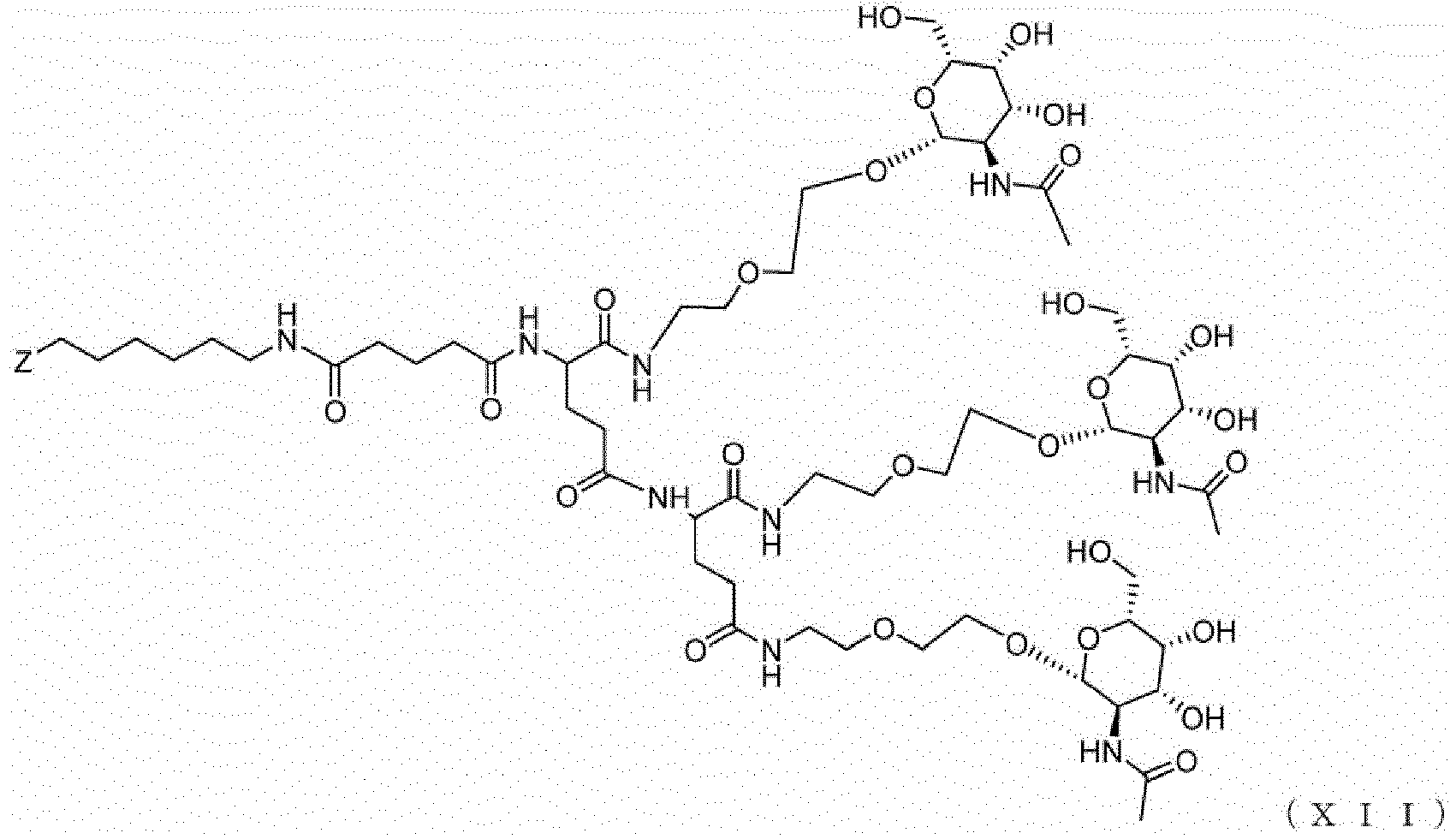
or a pharmaceutically acceptable salt thereof. - A nucleic acid complex represented by the formula (XIII):

or a pharmaceutically acceptable salt thereof. - A nucleic acid complex represented by the formula (XIV):

or a pharmaceutically acceptable salt thereof. - The nucleic acid complex according to any one of claims 1 to 14, wherein the oligonucleotide is single-stranded.
- The nucleic acid complex according to claim 15, wherein the oligonucleotide is bound via a 3' end.
- The nucleic acid complex according to claim 15, wherein the oligonucleotide is bound via a 5' end.
- The nucleic acid complex according to any one of claims 1 to 14, wherein the oligonucleotide is double-stranded.
- The nucleic acid complex according to claim 18, wherein the oligonucleotide is bound via a 3' end of one strand.
- The nucleic acid complex according to claim 18, wherein the oligonucleotide is bound via a 5' end of one strand.
- A pharmaceutical composition comprising the nucleic acid complex according to any one of claims 1 to 20.
- The pharmaceutical composition according to claim 21, wherein the pharmaceutical composition regulates expression of a target gene in a cell.
- The pharmaceutical composition according to claim 22, wherein the cell is a dendritic cell, a macrophage, or a liver parenchymal cell.
Applications Claiming Priority (2)
| Application Number | Priority Date | Filing Date | Title |
|---|---|---|---|
| JP2020013997 | 2020-01-30 | ||
| PCT/JP2021/003085 WO2021153687A1 (en) | 2020-01-30 | 2021-01-28 | Nucleic acid complex and pharmaceutical composition containing same |
Publications (2)
| Publication Number | Publication Date |
|---|---|
| EP4071163A1 true EP4071163A1 (en) | 2022-10-12 |
| EP4071163A4 EP4071163A4 (en) | 2024-03-20 |
Family
ID=77078383
Family Applications (1)
| Application Number | Title | Priority Date | Filing Date |
|---|---|---|---|
| EP21747841.1A Pending EP4071163A4 (en) | 2020-01-30 | 2021-01-28 | Nucleic acid complex and pharmaceutical composition containing same |
Country Status (6)
| Country | Link |
|---|---|
| US (1) | US20230151360A1 (en) |
| EP (1) | EP4071163A4 (en) |
| JP (1) | JP7681525B2 (en) |
| CN (1) | CN114929729B (en) |
| TW (1) | TWI877296B (en) |
| WO (1) | WO2021153687A1 (en) |
Cited By (2)
| Publication number | Priority date | Publication date | Assignee | Title |
|---|---|---|---|---|
| US20250032621A1 (en) * | 2023-06-29 | 2025-01-30 | SeeCure Taiwan Co., Ltd. | Drug conjugate, pharmaceutical composition and method of treating hepatitis |
| RU2853934C1 (en) * | 2023-06-29 | 2025-12-26 | СиКьюэ Тайвань Ко., Лтд. | Conjugate of medicinal agent, pharmaceutical composition, and method for treating hepatitis |
Family Cites Families (11)
| Publication number | Priority date | Publication date | Assignee | Title |
|---|---|---|---|---|
| CN102006890A (en) | 2007-12-04 | 2011-04-06 | 阿尔尼拉姆医药品有限公司 | Targeting lipids |
| WO2011100131A2 (en) * | 2010-01-28 | 2011-08-18 | Alnylam Pharmacuticals, Inc. | Monomers and oligonucleotides comprising cycloaddition adduct(s) |
| MY167390A (en) | 2011-11-18 | 2018-08-16 | Alnylam Pharmaceuticals Inc | Rnai agents, compositions and methods of use thereof for treating transthyretin (ttr) associated diseases |
| CA2921162A1 (en) * | 2013-05-01 | 2014-11-06 | Ionis Pharmaceuticals, Inc. | Conjugated antisense compounds and their use |
| US9943604B2 (en) * | 2013-09-20 | 2018-04-17 | Ionis Pharmaceuticals, Inc. | Targeted therapeutic nucleosides and their use |
| WO2015105083A1 (en) | 2014-01-07 | 2015-07-16 | 塩野義製薬株式会社 | Double-stranded oligonucleotide containing antisense oligonucleotide and sugar derivative |
| ES2747842T3 (en) | 2014-12-15 | 2020-03-11 | Dicerna Pharmaceuticals Inc | Ligand-modified double-stranded nucleic acids |
| EP3498724B1 (en) * | 2016-06-30 | 2023-06-21 | Kyowa Kirin Co., Ltd. | Nucleic acid complex |
| UY37565A (en) * | 2017-01-10 | 2018-07-31 | Arrowhead Pharmaceuticals Inc | IARN ALFA-1 ANTITRIPSIN AGENTS (AAT), COMPOSITIONS INCLUDING IARN AAT AGENTS AND METHODS OF USE |
| EP3573623B1 (en) * | 2017-01-30 | 2026-03-04 | Arrowhead Pharmaceuticals, Inc. | Compositions and methods for inhibition of factor xii gene expression |
| CA3057715A1 (en) * | 2017-04-04 | 2018-10-11 | Avidea Technologies, Inc. | Peptide-based vaccines, methods of manufacturing, and uses thereof for inducing an immune response |
-
2021
- 2021-01-28 EP EP21747841.1A patent/EP4071163A4/en active Pending
- 2021-01-28 JP JP2021574117A patent/JP7681525B2/en active Active
- 2021-01-28 US US17/791,343 patent/US20230151360A1/en active Pending
- 2021-01-28 CN CN202180008225.XA patent/CN114929729B/en active Active
- 2021-01-28 TW TW110103325A patent/TWI877296B/en active
- 2021-01-28 WO PCT/JP2021/003085 patent/WO2021153687A1/en not_active Ceased
Cited By (3)
| Publication number | Priority date | Publication date | Assignee | Title |
|---|---|---|---|---|
| US20250032621A1 (en) * | 2023-06-29 | 2025-01-30 | SeeCure Taiwan Co., Ltd. | Drug conjugate, pharmaceutical composition and method of treating hepatitis |
| RU2853934C1 (en) * | 2023-06-29 | 2025-12-26 | СиКьюэ Тайвань Ко., Лтд. | Conjugate of medicinal agent, pharmaceutical composition, and method for treating hepatitis |
| US12508320B2 (en) | 2023-06-29 | 2025-12-30 | SeeCure Taiwan Co., Ltd. | Drug conjugate, pharmaceutical composition and method of treating hepatitis |
Also Published As
| Publication number | Publication date |
|---|---|
| JPWO2021153687A1 (en) | 2021-08-05 |
| CN114929729B (en) | 2024-12-03 |
| US20230151360A1 (en) | 2023-05-18 |
| EP4071163A4 (en) | 2024-03-20 |
| WO2021153687A1 (en) | 2021-08-05 |
| TW202142260A (en) | 2021-11-16 |
| JP7681525B2 (en) | 2025-05-22 |
| TWI877296B (en) | 2025-03-21 |
| CN114929729A (en) | 2022-08-19 |
Similar Documents
| Publication | Publication Date | Title |
|---|---|---|
| CN111164091B (en) | Oligonucleotide compositions and methods of use thereof | |
| EP3409780B1 (en) | Nucleic acid complex | |
| CN112105625B (en) | Nucleotide precursors, nucleotide analogs and oligomeric compounds containing the same | |
| JP7842850B2 (en) | 1'-alkyl-modified ribose derivative and method of use | |
| EP3992291B1 (en) | Novel compound and application thereof | |
| TW201904587A (en) | Oligonucleotide compositions and methods of use thereof | |
| CN114728999A (en) | Oligonucleotides containing nucleotide analogs | |
| US10487103B2 (en) | Oligonucleotide derivative, oligonucleotide construct using the same, and methods for producing them | |
| EP3603648A1 (en) | Complex of nucleic acid medicine and multibranched lipid | |
| TW201909925A (en) | Nucleic acid complex | |
| US20250161461A1 (en) | Targeting ligand containing n-acetylgalactosamine | |
| EP3556764A1 (en) | Nucleoside derivative and use therefor | |
| EP4541893A1 (en) | Sirna molecule for regulating pcsk9 gene activity | |
| US20260049317A1 (en) | GalNAc Compound Containing Triazole Structure and Oligonucleotide Conjugate Thereof | |
| CN119768186A (en) | Lipid conjugates for delivery of therapeutic agents to CNS tissues | |
| JP2025066777A (en) | Nucleoside derivatives and their uses | |
| WO2024114776A1 (en) | Bicyclic abasic nucleic acid analogs and oligomeric compounds prepared therefrom | |
| JP7681525B2 (en) | Nucleic acid complex and pharmaceutical composition containing the same | |
| EP3888663A1 (en) | Nucleic acid complex | |
| US20260009029A1 (en) | Compound for inhibiting expression of lpa gene, pharmaceutical composition and use thereof | |
| EP4700125A2 (en) | Oligomeric nucleic acid, and preparation method therefore and use thereof | |
| TW202604540A (en) | Multivalent cargo-carrying complexes and uses thereof | |
| TW202517781A (en) | Metabolically stabilized carbohydrate targeting ligands for oligonucleotide conjugates | |
| HK40059056A (en) | Nucleic acid complex | |
| JP2025536748A (en) | Methods for synthesizing targeting ligand-conjugated nucleotide phosphoramidites |
Legal Events
| Date | Code | Title | Description |
|---|---|---|---|
| STAA | Information on the status of an ep patent application or granted ep patent |
Free format text: STATUS: THE INTERNATIONAL PUBLICATION HAS BEEN MADE |
|
| PUAI | Public reference made under article 153(3) epc to a published international application that has entered the european phase |
Free format text: ORIGINAL CODE: 0009012 |
|
| STAA | Information on the status of an ep patent application or granted ep patent |
Free format text: STATUS: REQUEST FOR EXAMINATION WAS MADE |
|
| 17P | Request for examination filed |
Effective date: 20220706 |
|
| AK | Designated contracting states |
Kind code of ref document: A1 Designated state(s): AL AT BE BG CH CY CZ DE DK EE ES FI FR GB GR HR HU IE IS IT LI LT LU LV MC MK MT NL NO PL PT RO RS SE SI SK SM TR |
|
| RAP3 | Party data changed (applicant data changed or rights of an application transferred) |
Owner name: EISAI R&D MANAGEMENT CO., LTD. |
|
| DAV | Request for validation of the european patent (deleted) | ||
| DAX | Request for extension of the european patent (deleted) | ||
| P01 | Opt-out of the competence of the unified patent court (upc) registered |
Effective date: 20230511 |
|
| REG | Reference to a national code |
Ref country code: DE Ref legal event code: R079 Free format text: PREVIOUS MAIN CLASS: C07K0009000000 Ipc: A61K0047540000 |
|
| A4 | Supplementary search report drawn up and despatched |
Effective date: 20240221 |
|
| RIC1 | Information provided on ipc code assigned before grant |
Ipc: C12N 15/113 20100101ALI20240215BHEP Ipc: C12N 15/11 20060101ALI20240215BHEP Ipc: C07K 9/00 20060101ALI20240215BHEP Ipc: A61K 31/7088 20060101ALI20240215BHEP Ipc: A61K 48/00 20060101ALI20240215BHEP Ipc: A61K 47/54 20170101AFI20240215BHEP |