EP4069800B1 - Feste polymerzusammensetzung, selbsttragende folie und lichtemittierende vorrichtung - Google Patents
Feste polymerzusammensetzung, selbsttragende folie und lichtemittierende vorrichtung Download PDFInfo
- Publication number
- EP4069800B1 EP4069800B1 EP21735990.0A EP21735990A EP4069800B1 EP 4069800 B1 EP4069800 B1 EP 4069800B1 EP 21735990 A EP21735990 A EP 21735990A EP 4069800 B1 EP4069800 B1 EP 4069800B1
- Authority
- EP
- European Patent Office
- Prior art keywords
- self
- crystals
- supporting film
- polymer composition
- solid polymer
- Prior art date
- Legal status (The legal status is an assumption and is not a legal conclusion. Google has not performed a legal analysis and makes no representation as to the accuracy of the status listed.)
- Active
Links
Images

Classifications
-
- C—CHEMISTRY; METALLURGY
- C09—DYES; PAINTS; POLISHES; NATURAL RESINS; ADHESIVES; COMPOSITIONS NOT OTHERWISE PROVIDED FOR; APPLICATIONS OF MATERIALS NOT OTHERWISE PROVIDED FOR
- C09K—MATERIALS FOR MISCELLANEOUS APPLICATIONS, NOT PROVIDED FOR ELSEWHERE
- C09K11/00—Luminescent materials, e.g. electroluminescent or chemiluminescent
- C09K11/02—Use of particular materials as binders, particle coatings or suspension media therefor
- C09K11/025—Use of particular materials as binders, particle coatings or suspension media therefor non-luminescent particle coatings or suspension media
-
- C—CHEMISTRY; METALLURGY
- C07—ORGANIC CHEMISTRY
- C07F—ACYCLIC, CARBOCYCLIC OR HETEROCYCLIC COMPOUNDS CONTAINING ELEMENTS OTHER THAN CARBON, HYDROGEN, HALOGEN, OXYGEN, NITROGEN, SULFUR, SELENIUM OR TELLURIUM
- C07F7/00—Compounds containing elements of Groups 4 or 14 of the Periodic Table
- C07F7/02—Silicon compounds
- C07F7/21—Cyclic compounds having at least one ring containing silicon, but no carbon in the ring
-
- C—CHEMISTRY; METALLURGY
- C07—ORGANIC CHEMISTRY
- C07F—ACYCLIC, CARBOCYCLIC OR HETEROCYCLIC COMPOUNDS CONTAINING ELEMENTS OTHER THAN CARBON, HYDROGEN, HALOGEN, OXYGEN, NITROGEN, SULFUR, SELENIUM OR TELLURIUM
- C07F7/00—Compounds containing elements of Groups 4 or 14 of the Periodic Table
- C07F7/24—Lead compounds
-
- C—CHEMISTRY; METALLURGY
- C08—ORGANIC MACROMOLECULAR COMPOUNDS; THEIR PREPARATION OR CHEMICAL WORKING-UP; COMPOSITIONS BASED THEREON
- C08F—MACROMOLECULAR COMPOUNDS OBTAINED BY REACTIONS ONLY INVOLVING CARBON-TO-CARBON UNSATURATED BONDS
- C08F122/00—Homopolymers of compounds having one or more unsaturated aliphatic radicals each having only one carbon-to-carbon double bond, and at least one being terminated by a carboxyl radical and containing at least one other carboxyl radical in the molecule; Salts, anhydrides, esters, amides, imides or nitriles thereof
- C08F122/10—Esters
-
- C—CHEMISTRY; METALLURGY
- C09—DYES; PAINTS; POLISHES; NATURAL RESINS; ADHESIVES; COMPOSITIONS NOT OTHERWISE PROVIDED FOR; APPLICATIONS OF MATERIALS NOT OTHERWISE PROVIDED FOR
- C09K—MATERIALS FOR MISCELLANEOUS APPLICATIONS, NOT PROVIDED FOR ELSEWHERE
- C09K11/00—Luminescent materials, e.g. electroluminescent or chemiluminescent
- C09K11/06—Luminescent materials, e.g. electroluminescent or chemiluminescent containing organic luminescent materials
-
- C—CHEMISTRY; METALLURGY
- C09—DYES; PAINTS; POLISHES; NATURAL RESINS; ADHESIVES; COMPOSITIONS NOT OTHERWISE PROVIDED FOR; APPLICATIONS OF MATERIALS NOT OTHERWISE PROVIDED FOR
- C09K—MATERIALS FOR MISCELLANEOUS APPLICATIONS, NOT PROVIDED FOR ELSEWHERE
- C09K11/00—Luminescent materials, e.g. electroluminescent or chemiluminescent
- C09K11/08—Luminescent materials, e.g. electroluminescent or chemiluminescent containing inorganic luminescent materials
- C09K11/56—Luminescent materials, e.g. electroluminescent or chemiluminescent containing inorganic luminescent materials containing sulfur
- C09K11/562—Chalcogenides
- C09K11/565—Chalcogenides with zinc cadmium
-
- C—CHEMISTRY; METALLURGY
- C09—DYES; PAINTS; POLISHES; NATURAL RESINS; ADHESIVES; COMPOSITIONS NOT OTHERWISE PROVIDED FOR; APPLICATIONS OF MATERIALS NOT OTHERWISE PROVIDED FOR
- C09K—MATERIALS FOR MISCELLANEOUS APPLICATIONS, NOT PROVIDED FOR ELSEWHERE
- C09K11/00—Luminescent materials, e.g. electroluminescent or chemiluminescent
- C09K11/08—Luminescent materials, e.g. electroluminescent or chemiluminescent containing inorganic luminescent materials
- C09K11/62—Luminescent materials, e.g. electroluminescent or chemiluminescent containing inorganic luminescent materials containing gallium, indium or thallium
- C09K11/621—Chalcogenides
- C09K11/623—Chalcogenides with zinc or cadmium
-
- C—CHEMISTRY; METALLURGY
- C09—DYES; PAINTS; POLISHES; NATURAL RESINS; ADHESIVES; COMPOSITIONS NOT OTHERWISE PROVIDED FOR; APPLICATIONS OF MATERIALS NOT OTHERWISE PROVIDED FOR
- C09K—MATERIALS FOR MISCELLANEOUS APPLICATIONS, NOT PROVIDED FOR ELSEWHERE
- C09K11/00—Luminescent materials, e.g. electroluminescent or chemiluminescent
- C09K11/08—Luminescent materials, e.g. electroluminescent or chemiluminescent containing inorganic luminescent materials
- C09K11/66—Luminescent materials, e.g. electroluminescent or chemiluminescent containing inorganic luminescent materials containing germanium, tin or lead
- C09K11/664—Halogenides
-
- C—CHEMISTRY; METALLURGY
- C09—DYES; PAINTS; POLISHES; NATURAL RESINS; ADHESIVES; COMPOSITIONS NOT OTHERWISE PROVIDED FOR; APPLICATIONS OF MATERIALS NOT OTHERWISE PROVIDED FOR
- C09K—MATERIALS FOR MISCELLANEOUS APPLICATIONS, NOT PROVIDED FOR ELSEWHERE
- C09K11/00—Luminescent materials, e.g. electroluminescent or chemiluminescent
- C09K11/08—Luminescent materials, e.g. electroluminescent or chemiluminescent containing inorganic luminescent materials
- C09K11/70—Luminescent materials, e.g. electroluminescent or chemiluminescent containing inorganic luminescent materials containing phosphorus
-
- C—CHEMISTRY; METALLURGY
- C09—DYES; PAINTS; POLISHES; NATURAL RESINS; ADHESIVES; COMPOSITIONS NOT OTHERWISE PROVIDED FOR; APPLICATIONS OF MATERIALS NOT OTHERWISE PROVIDED FOR
- C09K—MATERIALS FOR MISCELLANEOUS APPLICATIONS, NOT PROVIDED FOR ELSEWHERE
- C09K11/00—Luminescent materials, e.g. electroluminescent or chemiluminescent
- C09K11/08—Luminescent materials, e.g. electroluminescent or chemiluminescent containing inorganic luminescent materials
- C09K11/88—Luminescent materials, e.g. electroluminescent or chemiluminescent containing inorganic luminescent materials containing selenium, tellurium or unspecified chalcogen elements
- C09K11/881—Chalcogenides
- C09K11/883—Chalcogenides with zinc or cadmium
-
- C—CHEMISTRY; METALLURGY
- C09—DYES; PAINTS; POLISHES; NATURAL RESINS; ADHESIVES; COMPOSITIONS NOT OTHERWISE PROVIDED FOR; APPLICATIONS OF MATERIALS NOT OTHERWISE PROVIDED FOR
- C09K—MATERIALS FOR MISCELLANEOUS APPLICATIONS, NOT PROVIDED FOR ELSEWHERE
- C09K19/00—Liquid crystal materials
- C09K19/04—Liquid crystal materials characterised by the chemical structure of the liquid crystal components, e.g. by a specific unit
- C09K19/38—Polymers
- C09K19/3833—Polymers with mesogenic groups in the side chain
- C09K19/3838—Polyesters; Polyester derivatives
-
- H—ELECTRICITY
- H05—ELECTRIC TECHNIQUES NOT OTHERWISE PROVIDED FOR
- H05B—ELECTRIC HEATING; ELECTRIC LIGHT SOURCES NOT OTHERWISE PROVIDED FOR; CIRCUIT ARRANGEMENTS FOR ELECTRIC LIGHT SOURCES, IN GENERAL
- H05B33/00—Electroluminescent light sources
- H05B33/12—Light sources with substantially two-dimensional [2D] radiating surfaces
- H05B33/14—Light sources with substantially two-dimensional [2D] radiating surfaces characterised by the chemical or physical composition or the arrangement of the electroluminescent material, or by the simultaneous addition of the electroluminescent material in or onto the light source
-
- H—ELECTRICITY
- H05—ELECTRIC TECHNIQUES NOT OTHERWISE PROVIDED FOR
- H05B—ELECTRIC HEATING; ELECTRIC LIGHT SOURCES NOT OTHERWISE PROVIDED FOR; CIRCUIT ARRANGEMENTS FOR ELECTRIC LIGHT SOURCES, IN GENERAL
- H05B33/00—Electroluminescent light sources
- H05B33/12—Light sources with substantially two-dimensional [2D] radiating surfaces
- H05B33/20—Light sources with substantially two-dimensional [2D] radiating surfaces characterised by the chemical or physical composition or the arrangement of the material in which the electroluminescent material is embedded
Definitions
- the invention relates to a solid polymer composition, a self-supporting film comprising the solid-polymer composition, and a light emitting device comprising the solid polymer composition or the self-supporting film.
- LCD liquid crystal displays
- display components comprise luminescent crystal (quantum dot) based components.
- a backlight component of such a LCD might comprise a RGB backlight consisting of a red, a blue and a green light.
- RGB backlight consisting of a red, a blue and a green light.
- typically luminescent crystals (quantum dots) are used to produce the backlight colours of such a backlight component.
- Document US 2017/186922 A1 discloses an electronic device including a light source having a peak emission at a wavelength between about 440 nm to about 480 nm; and a photoconversion layer disposed on the light source.
- the photoconversion layer includes a first quantum dot which emits red light and a second quantum dot which emits green light.
- At least one of the first quantum dot and the second quantum dot has a perovskite crystal structure and includes a compound represented by Chemical Formula 1: AB'X 3+ ⁇ wherein A is a Group IA metal, NR 4 + , or a combination thereof, B' is a Group IVA metal, X is a halogen, BF 4 - , or a combination thereof, and ⁇ is 0 to 3.
- Document WO 2017/195062 A1 discloses devices and systems including a material including a halide perovskite and/or phosphor to produce and/or communicate using visible light, and the like.
- a luminescent component comprises a first film comprising a first solid polymer composition and a second film comprising a second solid polymer composition.
- the first solid polymer composition comprises first luminescent crystals.
- the second solid polymer composition comprises second luminescent crystals.
- the first luminescent crystals are of size between 3 nm and 3000 nm, and emit red light in response to excitation by light with a shorter wavelength.
- the second luminescent crystals are of size between 3 nm and 3000 nm, and emit green light in response to excitation by light with a shorter wavelength.
- Patent WO 2020/130592 A1 relates to a metal halide perovskite light emitting device and a method for manufacturing same.
- the metal halide perovskite light emitting device uses, as a light emitting layer, a perovskite film having a multidimensional crystal structure derived by a proton transfer reaction so that ion transfer is suppressed by a self-assembled shell and a surface defect is removed, thereby improving photoluminescence intensity, light emitting efficiency, and lifetime.
- a highly efficient light emitting device can be manufactured by injecting a fluorine-based material and a basic material into a PEDOT:PSS conductive polymer, which has been used as a hole injection layer, so as to adjust the acidity thereof and improve the work function of an interface, and by protecting an electrode vulnerable to acid by means of a chemically stable graphene barrier layer.
- the manufacturing of such components faces various challenges.
- One challenge is the embedding of the luminescent crystals into the component. Due to the different chemical properties of the luminescent crystals, there might be incompatibilities between the various embedded materials comprising the luminescent crystals or even between luminescent crystals embedded within the same material. Such incompatibilities might lead to degradation of the materials in the display components and therefore the lifetime of such a display might be affected.
- luminescent crystal based components often deal with challenges regarding stability and brightness, wherein a good stability and high display brightness of these components is difficult to achieve.
- the problem to be solved by the present invention is to overcome the disadvantages of the prior art.
- the present invention overcomes the disadvantages of the prior art in terms of stability and brightness.
- LC luminescent crystal
- quantum dots typically in the range of 2 - 10 nm
- nanocrystals typically in the range of 10 - 100 nm.
- LCs show, as the term indicates, luminescence.
- the term luminescent crystal includes both, single crystals and polycrystalline particles. In the latter case, one particle may be composed of several crystal domains (grains), connected by crystalline or amorphous phase boundaries.
- a luminescent crystal is a semiconducting material which exhibits a direct bandgap (typically in the range 1.1 - 3.8 eV, more typically 1.4 - 3.5 eV, even more typically 1.7 - 3.2 eV).
- the valence band electron Upon illumination with electromagnetic radiation equal or higher than the bandgap, the valence band electron is excited to the conduction band leaving an electron hole in the valence band.
- the formed exciton (electron-electron hole pair) then radiatively recombines in the form of photoluminescence, with maximum intensity centered around the LC bandgap value and exhibiting photoluminescence quantum yield of at least 1 %. In contact with external electron and electron hole sources LC could exhibit electroluminescence.
- QD quantum dot
- the term "quantum dot” is known and particularly relates to semiconductor nanocrystals, which have a diameter typically between 2 - 10 nm. In this range, the physical radius of the QD is smaller than the bulk excitation Bohr radius, causing quantum confinement effect to predominate.
- the electronic states of the QD, and therefore the bandgap are a function of the QD composition and physical size, i.e. the color of absorption/emission is linked with the QD size.
- the optical quality of the QDs sample is directly linked with their homogeneity (more monodisperse QDs will have smaller FWHM of the emission).
- Typical quan-turn dot compositions comprise Cadmium or Indium, for example in the form of Cadmium Selenide (CdSe) Indium Phosphide (InP) .
- core-shell crystals is known and particularly relates to quantum dots, typically having a CdSe core or InP core having an additional shell typically comprising Zinc Sulfide (ZnS), Zinc Selenide (ZnSe), Cadmium Sulfide (CdS) or combinations thereof.
- ZnS Zinc Sulfide
- ZnSe Zinc Selenide
- CdS Cadmium Sulfide
- core-shell quantum dot platelets is known and particularly relates to core-shell quantum dots having platelet structure.
- the aspect ratio of the platelets (longest : shortest direction) of all 3 orthogonal dimensions is 2 - 50, preferably 3 - 20, most preferably 4 - 15.
- perovskite crystals is known and particularly includes crystalline compounds of the perovskite structure.
- perovskite structures are known per se and described as cubic, pseudocubic, tetragonal or orthorhombic crystals of general formula M1M2X3, where M1 are cations of coordination number 12 (cuboctaeder) and M2 are cations of coordination number 6 (octaeder) and X are anions in cubic, pseudocubic, tetragonal or orthorhombic positions of the lattice.
- luminescent perovskite crystals are approximately isometric (such as spherical or cubic). Particles are considered approximately isometric, in case the aspect ratio (longest : shortest direction) of all 3 orthogonal dimensions is 1 - 2. Accordingly, an assembly of LCs preferably contains 50 - 100 % (n/n), preferably 66 - 100 % (n/n) much preferably 75 - 100 % (n/n) isometric nanocrystals.
- polymer is known and includes organic and inorganic synthetic materials comprising repeating units ("monomers").
- the term polymers includes homopolymers and co-polymers. Further, cross-linked polymers and non-cross-linked polymers are included. Depending on the context, the term polymer shall include its monomers and oligomers.
- Polymers include, by way of example, acrylate polymers, carbonate polymers, sulfone polymers, epoxy polymers, vinyl polymers, urethane polymers, imide polymers, ester polymers, furane polymers, melamine polymers, styrene polymers, norbornene polymers, silazane polymers, silicone polymers and cyclic olefin copolymers.
- Polymers may include, as conventional in the field, other materials such as polymerization initiators, stabilizers, fillers, solvents.
- Polymers may be further characterized by physical parameters, such as polarity, glass transition temperature Tg, Young's modulus and light transmittance.
- Transmittance typically, polymers used in the context of this invention are light transmissive for visible light, i.e. non-opaque for allowing light emitted by the luminescent crystals, and possible light of a light source used for exciting the luminescent crystals to pass. Light transmittance may be determinded by white light interferometry or UV-Vis spectrometry.
- Tg Glass transition temperature
- Polymers with high Tg are considered “hard”, while polymers with low Tg are considered “soft”.
- Tg is not a discrete thermodynamic transition, but a temperature range over which the mobility of the polymer chains increase significantly. The convention, however, is to report a single temperature defined as the mid-point of the temperature range, bounded by the tangents to the two flat regions of the heat flow curve of the DSC measurement.
- Tg may be determined according to DIN EN ISO 11357-2 or ASTM E1356 using DSC. This method is particularly suitable if the polymer is present in the form of bulk material. Alternatively, Tg may be deter-mined by measuring temperature-dependent micro- or nanohardness with micro- or nanoindentation according to ISO 14577-1 or ASTM E2546-15. This method is suited for luminescent components and lighting devices as disclosed herein. Suitable analytical equipment is available as MHT (Anton Paar), Hysitron TI Premier (Bruker) or Nano Indenter G200 (Keysight Technologies). Data obtained by temperature controlled micro- and nanoindentation can be converted to Tg. Typically, the plastic deformation work or Young's modulus or hardness is measured as a function of temperature and Tg is the temperature where these parameters change significantly.
- Young's modulus or Young modulus or Elasticity modulus is a mechanical property that measures the stiffness of a solid material. It defines the relationship between stress (force per unit area) and strain (proportional deformation) in a material in the linear elasticity regime of a uniaxial deformation.
- a first aspect of the invention refers to a solid polymer composition comprising green luminescent crystals, red luminescent crystals, and a polymer, all as defined in claim 1.
- the green luminescent crystals are perovskite crystals selected from compounds of formula (I): [M 1 A 1 ] a M 2 b X c (I), wherein:
- the green luminescent crystals are green luminescent perovskite crystals of formula (I'): FAPbBr 3 (I').
- formula (I) describes perovskite luminescent crystals, which, upon absorption of blue light, emit light of a wavelength in the green light spectrum between 500 nm and 550 nm, in particular centered around 527 nm.
- Red luminescent crystals are known, such crystals emit red light (630 nm +/- 30 nm) in response to excitation by light of a shorter wavelength.
- Suitable crystals are selected from the group of II-VI semiconductor compounds and from the group of III-V semiconductor compounds.
- the crystals are selected from compounds of formula (II) [M 3 M 3 '][YY'] (II), wherein:
- suitable crystals include binary compounds of formula (II-1), ternary compounds of formula (II-2) and (II-3) and quaternary compounds of formula (II-4) [M 3 ][Y] (II-1), wherein: M 3 and Y are as defined above, such as CdSe, InN, InP, InAs, and InSb; [M 3 M 3 '] [Y] (11-2), wherein: M 3 , M 3 ', Y are as defined above and M 3 , M 3' are present, such as InGaP; [M 3 ][YY'] (II-3), wherein: M 3 , Y.
- M 3 ,Y, Y' are as defined above and M 3 ,Y, Y' are present, such as InPN, InPAs, and InPSb; [M 3 M 3 '][YY'] (11-4), wherein: M 3 , M 3 ', Y, Y' are as defined above and M 3 , M 3 ', Y, Y' are present, such as InGaPN, InGaPAs, and InGaPSb.
- Suitable crystals may or may not be surrounded by a shell. Crystals surrounded by a shell are referred to as core-shell crystals. In such core-shell crystals, the compounds forming the core and the compounds forming the shell, differ.
- Suitable crystals may or may not be doped by a dopant metal.
- Suitable dopants are known in the field and typically have a concentration in the range of 1 mol% or less.
- the crystal size of the red luminescent crystals may vary over a broad range, but typically within 1 - 10 nm. Such crystals are referred as Quantum dots, thereby distinguishing from microcrystals.
- suitable ranges are 1-10 nm, preferably 3-8 nm.
- suitable ranges are 1-8 nm, preferably 2-4 nm.
- the luminescent crystals show a monodisperse size distribution.
- the term "monodisperse” refers to a population of quantum dots wherein at least about 60% of the population, preferably 75% to 90% of the population, or any integer or noninteger there between, falls within a specified particle size range.
- a population of monodispersed particles deviates less than 20% root-mean-square (rms) in diameter, more preferably less than 10% rms, and most preferably, less than 5% rms.
- Particle size and particle size distribution may be determined by microscopy.
- the morphology of the crystals may vary, platelet-type, cubic, spherical, multi-faceted.
- the red luminescent crystals are of core-shell type with the core as defined in claim 1 and the shell of formula (III): M 4 Z (III), wherein:
- the shell includes single shell and multishell structures.
- the red luminescent crystals comprise a core selected from the group consisting of InP and CdSe.
- the red luminescent crystals comprise a single shell selected from the group consisting of ZnS, ZnSe, ZnSeS and ZnTe. Specific examples include InP@ZnS, InP@ZnSe, InP@ZnSeS, InP@ZnSeS, InP@ZnSe@ZnS, CdSe@ZnS and CdSe@ZnSe, particularly InP@ZnSeS.
- the red luminescent crystals comprise a multishell selected from a combination of compounds selected from the group consisting of ZnS, ZnSe, ZnSeS and ZnTe.
- a multishell selected from a combination of compounds selected from the group consisting of ZnS, ZnSe, ZnSeS and ZnTe.
- Specific examples include InP/ZnSe/ZnS (multishell) and InP/ZnSeS/ZnS (multishell).
- the red luminescent crystals comprise a CdSe core which is alloyed/doped with Zn. This embodiment allows to reduce the amount of Cd per quantum dot.
- the concentration of M 2 is 100-1000 ppm preferably 300-1000 ppm, very preferably 500-1000 ppm and/or the concentration of M 3 + M 3 ' is 300-2'500 ppm, preferably 600-2'000 ppm, very preferably 1'200-1'700 ppm and/or the red core-shell quantum dots have a platelet structure.
- the concentration of M 3 + M 3 ' is > 300 ppm, preferably > 600 ppm, most preferably > 1'200 ppm and/or the red core-shell quantum dots have a platelet structure.
- the polymer has a molar ration of the sum of (oxygen + nitrogen) to carbon z, wherein z ⁇ 0.9, z ⁇ 0.75 in particular z ⁇ 0.4, in particular z ⁇ 0.3, in particular z ⁇ 0.25.
- the polymer comprises acrylate, very particular wherein the polymer comprises a cyclic aliphatic acrylate.
- the solid polymer comprises an acrylate selected from the list of isobornylacrylate ( CAS 5888-33-5 ), isobornylmethacrylate ( CAS 7534-94-3 ), dicyclopentanyl-acrylate ( CAS 79637-74-4 , FA-513AS (Hitachi Chemical, Japan)), dicyclopentanyl-methacrylate ( CAS 34759-34-7 , FA-513M (Hitachi Chemical, Japan)), 3,3,5-trimethyl cyclohexyl acrylate ( CAS 86178-38-3 ), 3,3,5-trimethyl cyclohexyl methacrylate( CAS 7779-31-9 ), 4-tert-butylcyclohexyl acrylate ( CAS 84100-23-2 ), 4-tert-Butylcyclohexyl methacrylate ( CAS 46729-07-1 ).
- the solid polymer is cross-linked.
- the solid polymer comprises a multi-functional acrylate.
- the solid polymer composition has a glass transition temperature T g of T g ⁇ 120°C, in particular of T g ⁇ 100°C, in particular of T g ⁇ 80°C, in particular of T g ⁇ 70°C .
- Each T g is measured according to DIN EN ISO 11357-2:2014-07 during the second heating cycle and applying a heating rate of 20K/min, starting at -90°C up to 250°C.
- the solid polymer composition comprises scattering particles selected from the group consisting of metal oxide particles and polymer particles, preferably selected from the group consisting of TiO 2 , ZrO 2 , Al 2 O 3 and organopolysiloxanes.
- the solid polymer is semicrystalline.
- the solid polymer has a melting temperature of ⁇ 140°C, preferably ⁇ 120°C, most preferably ⁇ 100°C
- a second aspect of the invention refers to a self-supporting film comprising the solid polymer composition according to the first aspect of the invention.
- the self-supporting film emits green and red light in response to excitation by light of a wavelength shorter than the emitted green light.
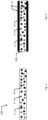
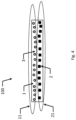
- the solid polymer composition is sandwiched between the two barrier layers.
- sandwich arrangement refers to an arrangement in a horizontal direction with a barrier layer, the polymer and another barrier layer.
- the two barrier layers of the sandwich structure can be made of the same barrier layer material or of different barrier layer materials.
- the technical effect of the barrier layers is to improve the stability of the luminescent perovskite crystals, in particular against oxygen or humidity.
- barrier layers are known in the field; typically comprising a material / a combination of materials with low water vapour transmission rate (WVTR) and / or low oxygen transmission rate (OTR) .
- WVTR water vapour transmission rate
- OTR low oxygen transmission rate
- Barrier layers or films preferably have a WVTR ⁇ 10 (g)/ (m ⁇ 2*day) at a temperature of 40°C / 90% r.h. and atmospheric pressure, more preferably less than 1 (g)/(m ⁇ 2*day), and most preferably less than 0.1 (g) / (m ⁇ 2*day) .
- the barrier film may be permeable for oxygen and has an OTR (oxygen transmission rate) > 0.1 (mL)/(m ⁇ 2*day) at a temperature of 23°C / 90% r.h. and atmospheric pressure, more preferably > 1 (mL)/(m ⁇ 2*day), most preferably > 10 (mL)/(m ⁇ 2*day).
- OTR oxygen transmission rate
- the barrier film has a thickness of > 0.3 mm, preferably > 1 mm, most preferably > 3 mm.
- the barrier film is transmissive for light, i.e. transmittance visible light > 80%, preferably > 85%, most preferably > 90%.
- Suitable barrier films may be present in the form of a single layer. Such barrier films are known in the field and contain glass, ceramics, metal oxides and polymers. Suitable polymers may be selected from the group consisting of polyvinylidene chlorides (PVdC), cyclic olefin copolymer (COC), ethylene vinyl alcohol (EVOH), high-density polyethylene (HDPE), and polypropylene (PP); suitable inorganic materials may be selected from the group consisting of metal oxides, SiOx, SixNy, AlOx. Most preferably, a polymer humidity barrier material contains a material selected from the group of PVdC and COC.
- PVdC polyvinylidene chlorides
- COC cyclic olefin copolymer
- EVOH ethylene vinyl alcohol
- HDPE high-density polyethylene
- PP polypropylene
- suitable inorganic materials may be selected from the group consisting of metal oxides, SiOx, SixNy, AlOx.
- a polymer oxygen barrier material contains a material selected from EVOH polymers.
- Suitable barrier films may be present in the form of multilayers.
- Such barrier films are known in the field and generally comprise a substrate, such as PET with a thickness in the range of 10 - 200 ⁇ m, and a thin inorganic layer comprising materials from the group of SiOx and AlOx or an organic layer based on liquid crystals which are embedded in a polymer matrix or an organic layer with a polymer having the desired barrier properties.
- Possible polymers for such organic layers com-prise for example PVdC, COC, EVOH.
- a further advantageous embodiment of the invention refers to a self-supporting film having a haze h 1 of 10 ⁇ h 1 ⁇ 80%, preferably 20 ⁇ h 1 ⁇ 70%, most preferably 30 ⁇ h 1 ⁇ 60%; and/or a concentration of M 2
- a concentration of M 3 +M 3 ' is > 30 mg/m 2 , preferably > 60 mg/m 2 , most preferably > 120 mg/m 2 .
- the self-supporting film has a haze h 2 of h 2 ⁇ 80%, preferably h 2 ⁇ 70%, very preferably h 2 ⁇ 60%.
- the self-supporting film has a haze h 2 of 10% ⁇ h 2 ⁇ 80%, preferably 20% ⁇ h 2 ⁇ 70%, very preferably 30% ⁇ h 2 ⁇ 60%.
- Transmission haze is the amount of light that is subject to Wide Angle Scattering, normally at an angle greater than 2.5° from normal incident direction (measured by ASTM D1003; e.g. with BYK Gardner haze meter) when passing a transparent material (the self-supporting film in this invention).
- the low haze of the self-supporting film has the technical effect that the luminescent perovskite crystals in the self-supporting film are more stable, in particular if they are exposed to a blue light source.
- the stability is a result of the reduced multiplex scattering of the blue light in the self-supporting film due to the lower haze.
- a further technical effect of the low haze is the fact that the lower haze leads to a higher display brightness, measured as "light conversion factor” (LCF) of the self-supporting film.
- the light conversion factor of the self-supporting film refers to the ratio between the green light intensity emitted in perpendicular direction from the self-supporting film and the blue light intensity extincted (e.g. by absorption, reflection or scattering) in a direction perpendicular of the self-supporting film.
- such a self-supporting film can have a thickness of typically 0.005 - 10 mm, more typically 0.05 - 3 mm, most typically 0.01 - 0.5 mm.
- the green luminescent crystals are arranged in a first region of the solid polymer composition and the red luminescent crystals are arranged in a second region of the solid polymer composition.
- first region and the second region are adapted to form layers adjacent to each other.
- first and the second region might be arranged spaced from each other.
- a third aspect of the invention refers to a light emitting device, in particular a liquid crystal display (LCD).
- LCD liquid crystal display
- the light emitting device comprises the solid polymer composition according to the first aspect of the invention.
- the light emitting device comprises the self-supporting film according to the second aspect of the invention.
- a further advantageous embodiment of the light emitting device comprises an array of more than one blue LED.
- the array of LEDs covers essentially the full liquid crystal display area.
- the diffusor plate is arranged between the array of the more than one blue LED and the self-supporting film.
- the one or more blue LEDs of the array are each adapted to switch between on and off with a frequency f of f ⁇ 150 Hz, preferably of f ⁇ 300 Hz, very preferably of f ⁇ 600 Hz.
- Example 1 Preparation of a self-supporting film with a polymer having a low glass transition temperature and low haze.
- Green perovskite luminescent crystals with composition formamidinium lead tribromide (FAPbBr 3 ) are synthesized in toluene as following: Formamidinium lead tribromide (FAP-bBr 3 ) was synthesized by milling PbBr 2 and FABr.
- the mixture was then dispersed by ball milling using yttrium stabilized zirconia beads with a diameter size of 200 ⁇ m at ambient conditions (if not otherwise defined, the atmospheric conditions for all experiments are: 35°C, 1 atm, in air) for a period of 1h yielding an ink with green luminescence.
- Film formation 0.1 g of the green ink was mixed with an UV curable monomer/crosslinker mixture (0.7 g FA-513AS, Hitachi Chemical, Japan / 0.3 g Miramer M240, Miwon, Korea) containing 1wt% photoinitiator Diphenyl(2,4,6-trimethylbenzoyl) phosphine oxide (TCI Europe, Netherlands) and 2 wt% polymeric scattering particles (Organopolysiloxane, ShinEtsu, KMP-590) and red luminescent crystals being isometric core-shell QDs having an InP core and a ZnS shell suspended in toluene in a speed mixer and the toluene was evaporated by vacuum ( ⁇ 0.01 mbar) at room temperature.
- UV curable monomer/crosslinker mixture 0.7 g FA-513AS, Hitachi Chemical, Japan / 0.3 g Miramer M240, Miwon, Korea
- the resulting mixture was then coated with 50 micron layer thickness on a 100 micron barrier film (supplier: I-components (Korea); Product: TBF-1007), then laminated with a second barrier film of the same type.
- the laminate structure was UV-cured for 60 s (UVAcube100 equipped with a mercury lamp and quartz filter, Hoenle, Germany).
- the concentration of Pb in the cured layer (without the barriers) was 500 ppm Pb and the Pb loading per area was 30 mg Pb/m 2 .
- the concentration of In in the cured layer (without the barriers) was 1300 ppm In and the In loading per area was 80 mg In/m 2 .
- the initial performance of the as obtained film showed a green emission wavelength of 526 nm with a FWHM of 22 nm and a red emission wavelength of 630 nm with a FWHM of 20 nm.
- the haze of the obtained film was 50% and the transmittance was 85% (measured with BYK Gardner haze meter).
- the glass transition temperature Tg of the UV-cured solid polymer composition was determined by DSC according to DIN EN ISO 11357-2:2014-07 with a starting temperature of -90°C and an end temperature of 250°C and a heating rate of 20 K/min in nitrogen atmosphere (20 ml/min).
- the purging gas was nitrogen (5.0) at 20 ml/min.
- the DSC system DSC 204 F1 Phoenix (Netzsch) was used.
- the T g was determined on the second heating cycle (the first heating from -90°C to 250°C showed overlaying effects besides the glass transition).
- the solid polymer composition was removed from the film by delaminating the barrier films.
- the measured Tg of the UV-cured resin composition was 75°C.
- the stability of the film was tested for 150 hours under blue LED light irradiation by placing the film into a light box with high blue intensity (supplier: Hoenle; model: LED CUBE 100 IC) with a blue flux on the film of 410 mW/cm 2 at a film temperature of 50°C. Furthermore the film was also tested for 150 hours in a climate chamber with 60°C and 90% relative humidity. The change of optical parameters after stability testing of the film for was measured with the same procedure as for measuring the initial performance (described above).
- the change of optical parameters were as following: test condition x-value (-) y-value (-) Luminanance (%) initial 0.25 0.20 100% 150h high flux (410 mW/cm 2 ) 0.24 0.19 95% 150h 60°C/90% r.H. 0.235 0.19 93%
- Comparative example 1 for example 1 Preparation of a self-supporting film with a polymer having a low glass transition temperature and high haze. The procedure was the same as in the previous procedure in example 1, except the following parameters were changed:
- the as-obtained self-supporting film showed similar optical properties and Tg as in example 1 but with a haze of 95%, a transmittance of 80% and an LCF of 41%.
- the concentration of Pb in the cured layer (without the barriers) was 250 ppm Pb and the Pb loading per area was 15 mg Pb/m 2 .
- the concentration of In in the cured layer (without the barriers) was 650 ppm In and the In loading per area was 40 mg In/m 2 .
- Comparative example 2 for example 1 Preparation of a self-supporting film with a polymer having a high glass transition temperature and low haze.
- the procedure was the same as in the procedure of example 1, except the acrylate monomer mixture (0.7 g FA-513AS, Hitachi Chemical, Japan / 0.3 g Miramer M240, Miwon, Korea) was replaced by the following acrylate monomer mixture:
- the as-obtained self-supporting film showed similar optical properties and haze as in example 1 but with a Tg of 140°C.
- the concentration of Pb and In in the cured layer (without the barriers) was the same as in example 1.
- Example 2 Preparation of a self-supporting film with a low haze and whereby the red core-shell quantum dots and the green perovskite crystals are spatially separated:
- the green perovskite QDs were used from example 1.
- Film formation 0.1 g of the green ink from example 1 was mixed with an UV curable monomer/crosslinker mixture (0.7 g FA-513AS, Hitachi Chemical, Japan / 0.3 g Miramer M240, Miwon, Korea) containing 1wt% photoinitiator Diphenyl(2,4,6-trimethylbenzoyl) phosphine oxide (TCI Europe, Netherlands) and 2 wt% polymeric scattering particles (Organopolysiloxane, ShinEtsu, KMP-590) in a speed mixer and the toluene was evaporated by vacuum ( ⁇ 0.01 mbar) at room temperature.
- an UV curable monomer/crosslinker mixture 0.7 g FA-513AS, Hitachi Chemical, Japan / 0.3 g Miramer M240, Miwon, Korea
- 1wt% photoinitiator Diphenyl(2,4,6-trimethylbenzoyl) phosphine oxide TCI Europe, Netherlands
- a red coating formulation was prepared by mixing the red core-shell quantum dots with InP core and ZnS shell from experiment 1 (suspended in toluene) with an UV curable monomer/crosslinker mixture (0.7 g FA-DCPA, Hitachi Chemical, Japan / 0.3 g Miramer M240, Miwon, Korea) containing 1wt% photoinitiator Diphenyl(2,4,6-trimethylbenzoyl) phosphine oxide (TCI Europe, Netherlands) and 2 wt% polymeric scattering particles (Organopolysiloxane, ShinEtsu, KMP-590) in a speed mixer and the toluene was evaporated by vacuum ( ⁇ 0.01 mbar) at room temperature.
- the resulting mixture was then coated with 50 micron layer thickness on the previously deposited green layer, then a second barrier film was laminated on top and the total sandwich structure was UV-cured for 60 s (UVAcube100 equipped with a mercury lamp and quartz filter, Hoenle, Germany).
- the final self-supporting film showed optical properties comparable to experiment 1.
- the concentration of Pb in the cured green layer (without the barriers) was 500 ppm Pb and the Pb loading per area was 30 mg Pb/m2.
- the concentration of In in the cured red layer (without the barriers) was 1300 ppm In and the In loading per area was 80 mg In/m 2 .
- the change of optical parameters were as following: test condition x-value (-) y-value (-) Luminanance (%) initial 0.25 0.20 100% 150h high flux (410 mW/cm 2 ) 0.24 0.19 95% 150h 60°C/90% r.H. 0.24 0.19 96%
- Example 3 Preparation of a self-supporting film as in example 1 but with red core-shell quantum dot platelets with a CdSe core and a ZnS shell.
- the concentration of Pb in the cured layer (without the barriers) was 500 ppm Pb and the Pb loading per area was 30 mg Pb/m 2 .
- the concentration of Cd in the cured layer (without the barriers) was 500 ppm Cd and the Cd loading per area was 30 mg Cd/m 2 .
- Example 4 Preparation of a self-supporting film as in example 2 but with red core-shell quantum dot platelets with a CdSe core and a ZnS shell.
Landscapes
- Chemical & Material Sciences (AREA)
- Organic Chemistry (AREA)
- Engineering & Computer Science (AREA)
- Materials Engineering (AREA)
- Inorganic Chemistry (AREA)
- Polymers & Plastics (AREA)
- Chemical Kinetics & Catalysis (AREA)
- Medicinal Chemistry (AREA)
- Health & Medical Sciences (AREA)
- Crystallography & Structural Chemistry (AREA)
- Luminescent Compositions (AREA)
- Optical Filters (AREA)
- Led Device Packages (AREA)
- Electroluminescent Light Sources (AREA)
- Manufacture Of Macromolecular Shaped Articles (AREA)
- Compositions Of Macromolecular Compounds (AREA)
Claims (21)
- Eine selbsttragende Folie, umfassend- grün lumineszierende Kristalle (1)- rot lumineszierende Kristalle (2), und- ein Polymer (3),wobei die grün lumineszierenden Kristalle (1) Perowskit-Kristalle sind, die aus Verbindungen der Formel (I) ausgewählt sind:
[M1A1]aM2 bXc (I),
wobei:A1 für ein oder mehrere organische Kationen, insbesondere Formamidinium (FA) steht,M1 für ein oder mehrere Alkalimetalle, insbesondere Cs steht,M2 für ein oder mehrere andere Metalle als M1, insbesondere für Pb, steht,X ein oder mehrere Anionen aus der Gruppe der Halogenide, Pseudohalogenide und Sulfide, insbesondere Br, darstellt,a für 1-4 steht,b für 1-2 steht,c für 3-9 steht, undwobei entweder M1, oder A1, oder M1 und A1 vorhanden sind, wobei die rot lumineszierenden Kristalle (2) Zinkblende- oder Wurzitkristalle, vorzugsweise Zinkblendekristalle, sind, ausgewählt aus Verbindungen der Formel (II)
[M3M3'][YY'] (II),
wobei:M3, M3' für Al, Ga, In, insbesondere In stehen undY, Y' für N, P, As, Sb, insbesondere für P, stehen undM3', Y' kann, muss aber nicht vorhanden sein,
oderM3, M3' für Zn, Cd, Be, insbesondere Cd, stehen undY, Y' für S, Se, Te, insbesondere Se, stehen undM3', Y' kann, muss aber nicht vorhanden sein, undwobei eine Konzentration von M2 5 - 200 mg/m2 , vorzugsweise 10 - 100 mg/m2 , sehr bevorzugt 20 - 80 mg/m2 beträgt. - Die selbsttragende Folie nach Anspruch 1, wobei die Konzentration von M3+M3' 30 - 250 mg/m2 , vorzugsweise 60 - 200 mg/m2 , sehr bevorzugt 120 - 170 mg/m2 beträgt.
- Die selbsttragende Folie nach einem der vorangehenden Ansprüche, mit
einer Trübung h1 von 10 ≤ h1 ≤ 80%, vorzugsweise 20 ≤ h1 ≤ 70%, sehr bevorzugt 30 ≤ h1 ≤ 60%. - Die selbsttragende Folie nach einem der vorangehenden Ansprüche, umfassend streuende Partikel, ausgewählt aus der Gruppe bestehend aus Metalloxidpartikeln und Polymerpartikeln, vorzugsweise ausgewählt aus der Gruppe bestehend aus TiO2 , ZrO2 , Al2O3 und Organopolysiloxanen.
- Die selbsttragende Folie nach einem der vorangehenden Ansprüche, wobei die feste Polymerzusammensetzung (100) zwischen zwei Barriereschichten (4) angeordnet ist.
- Die selbsttragende Folie nach einem der vorangehenden Ansprüche, wobei die grün lumineszierenden Kristalle (1) Perowskit-Kristalle der Formel (I') sind:
FAPbBr3 (I').
- Die selbsttragende Folie nach einem der vorangehenden Ansprüche, wobei die rot lumineszierenden Kristalle (2) vom Kern-Schale-Typ sind,wobei der Kern wie in Anspruch 1 definiert ist, Formel (II) undwobei die Schale Verbindungen der Formel (III) umfasst
M4Z (III),
wobei:M4 für Zn oder Cd, vorzugsweise Zn, steht undZ S, Se, Te, darstellt und wobeisich Verbindungen der Formel (III) und der Formel (II) unterscheiden. - Die selbsttragende Folie nach einem der vorangehenden Ansprüche, wobei die rot lumineszierenden Kristalle (2)einen Kern umfassen, der aus der Gruppe ausgewählt ist, die aus InP und CdSe besteht, undeine Schale oder eine Multischale umfassen, die aus der Gruppe bestehend aus ZnS, ZnSe, ZnSeS und ZnTe sowie Kombinationen davon aufweisen.
- Die selbsttragende Folie nach einem der vorangehenden Ansprüche, wobei das Polymer (3) ein Acrylat umfasst, insbesondere ein zyklisches aliphatisches Acrylat.
- Die selbsttragende Folie nach einem der vorangehenden Ansprüche, wobei die grün lumineszierenden Kristalle (1) in einem ersten Bereich (11) der selbsttragenden Folie und die rot lumineszierenden Kristalle (2) in einem zweiten Bereich (21) der selbsttragenden Folie angeordnet sind, insbesondere, wobei der erste Bereich (11) und der zweite Bereich (21) aneinander angrenzende Schichten bilden, wobei die Konzentration von M2 in einer gehärteten Schicht liegt.
- Eine feste Polymerzusammensetzung (100), umfassend- grün lumineszierende Kristalle (1),- rot lumineszierende Kristalle (2), und- ein Polymer (3),wobei die grün lumineszierenden Kristalle (1) Perowskit-Kristalle sind, die aus Verbindungen der Formel (I) ausgewählt sind:
[M1A1]aM2 bXc (I),
wobei:A1 für ein oder mehrere organische Kationen, insbesondere Formamidinium (FA) steht,M1 für ein oder mehrere Alkalimetalle, insbesondere Cs steht,M2 für ein oder mehrere andere Metalle als M1, insbesondere für Pb, steht,X ein oder mehrere Anionen aus der Gruppe der Halogenide, Pseudohalogenide und Sulfide, insbesondere Br, darstellt,a für 1-4 steht,b für 1-2 steht,c für 3-9 steht, undwobei entweder M1, oder A1, oder M1 und A1 vorhanden sind,wobei die rot lumineszierenden Kristalle (2) Zinkblende- oder Wurzitkristalle, vorzugsweise Zinkblendekristalle, sind, ausgewählt aus Verbindungen der Formel (II)
[M3M3'][YY'] (II),
wobei:M3, M3' für Al, Ga, In, insbesondere In stehen undY, Y' für N, P, As, Sb, insbesondere für P, stehen undM3', Y' kann, muss aber nicht vorhanden sein,
oderM3, M3' für Zn, Cd, Be, insbesondere Cd, stehen undY, Y' für S, Se, Te, insbesondere Se, stehen undM3', Y' kann, muss aber nicht vorhanden sein, undwobei eine Konzentration von M2 im Polymer 100 - 1000 ppm, vorzugsweise 300 - 1000 ppm, sehr bevorzugt 500 - 1000 ppm beträgt. - Die feste Polymerzusammensetzung (100) nach Anspruch 11, wobei die grün lumineszierenden Kristalle (1) Perowskit-Kristalle der Formel (I') sind:
FAPbBr3 (I').
- Die feste Polymerzusammensetzung (100) nach einem der Ansprüche 11 oder 12, wobei die rot lumineszierenden Kristalle (2) vom Kern-Schale-Typ sind,wobei der Kern wie in Anspruch 11 definiert ist. undwobei die Schale Verbindungen der Formel (III) umfasst
M4Z (III),
wobei:M4 für Zn oder Cd, vorzugsweise Zn, steht undZ für S, Se, Te, steht und wobeisich Verbindungen der Formel (III) und der Formel (II) unterscheiden. - Die feste Polymerzusammensetzung (100) nach einem der vorangehenden Ansprüche 11 bis 13, wobei die rot lumineszierenden Kristalle (2)einen Kern umfassen, der aus der Gruppe ausgewählt ist, die aus InP und CdSe besteht, undeine Schale oder eine Multischale aus der Gruppe bestehend aus ZnS, ZnSe, ZnSeS und ZnTe sowie Kombinationen davon aufweisen.
- Die feste Polymerzusammensetzung (100) nach einem der vorangehenden Ansprüche 11 bis 14, wobeidie Konzentration von M3 + M3' 300 - 2'500 ppm, vorzugsweise 600 - 2'000 ppm, sehr bevorzugt 1'200 - 1'700 ppm beträgt, und/oderdie roten Kern-Schale-Quantenpunkte eine Plättchenstruktur haben.
- Die feste Polymerzusammensetzung (100) nach einem der vorangehenden Ansprüche 11 bis 15, wobei das Polymer (3) ein molares Verhältnis der Summe von (Sauerstoff + Stickstoff) zu Kohlenstoff z aufweist, wobei z ≤ 0,9, z ≤ 0,75 insbesondere z ≤ 0,4, insbesondere z ≤ 0,3, insbesondere z ≤ 0,25.
- Die feste Polymerzusammensetzung (100) nach einem der vorangehenden Ansprüche 11 bis 16, wobei das Polymer (3) ein Acrylat umfasst, insbesondere wobei das Polymer ein zyklisches aliphatisches Acrylat umfasst.
- Die feste Polymerzusammensetzung (100) nach einem der vorangehenden Ansprüche 11 bis 17, wobei die feste Polymerzusammensetzung (100) eine Glasübergangstemperatur Tg von Tg ≤ 120°C, insbesondere von Tg ≤ 100°C, insbesondere von Tg ≤ 80°C, insbesondere von Tg ≤ 70°C aufweist.
- Die feste Polymerzusammensetzung (100) nach einem der vorangehenden Ansprüche 11 bis 18, wobei die feste Polymerzusammensetzung (100) streuende Teilchen umfasst, die aus der Gruppe ausgewählt sind, die aus Metalloxidteilchen und Polymerteilchen besteht, vorzugsweise ausgewählt aus der Gruppe, die aus TiO2, ZrO2, Al2O3 und Organopolysiloxanen besteht.
- Eine lichtemittierende Vorrichtung, insbesondere eine Flüssigkristallanzeige (LCD),umfassend die selbsttragende Folie nach einem der vorangehenden Ansprüche 1 bis 10
oderumfassend die feste Polymerzusammensetzung nach einem der vorangehenden Ansprüche 11 bis 19. - Die lichtemittierende Vorrichtung nach Anspruch 20, umfassend ein Array von mehr als einer blauen LED (6),wobei das LED-Array (6) im Wesentlichen die gesamte Flüssigkristallanzeigefläche (5) abdeckt, undwobei eine Diffusorplatte zwischen dem Array von mehr als einer blauen LED (6) und der selbsttragenden Folie angeordnet ist.
Applications Claiming Priority (2)
| Application Number | Priority Date | Filing Date | Title |
|---|---|---|---|
| EP20184584.9A EP3936585A1 (de) | 2020-07-07 | 2020-07-07 | Feste polymerzusammensetzung, selbsttragende folie und lichtemittierende vorrichtung |
| PCT/EP2021/068523 WO2022008451A1 (en) | 2020-07-07 | 2021-07-05 | A solid polymer composition, a self-supporting film and a light emitting device |
Publications (3)
| Publication Number | Publication Date |
|---|---|
| EP4069800A1 EP4069800A1 (de) | 2022-10-12 |
| EP4069800C0 EP4069800C0 (de) | 2024-07-24 |
| EP4069800B1 true EP4069800B1 (de) | 2024-07-24 |
Family
ID=71527590
Family Applications (2)
| Application Number | Title | Priority Date | Filing Date |
|---|---|---|---|
| EP20184584.9A Withdrawn EP3936585A1 (de) | 2020-05-22 | 2020-07-07 | Feste polymerzusammensetzung, selbsttragende folie und lichtemittierende vorrichtung |
| EP21735990.0A Active EP4069800B1 (de) | 2020-07-07 | 2021-07-05 | Feste polymerzusammensetzung, selbsttragende folie und lichtemittierende vorrichtung |
Family Applications Before (1)
| Application Number | Title | Priority Date | Filing Date |
|---|---|---|---|
| EP20184584.9A Withdrawn EP3936585A1 (de) | 2020-05-22 | 2020-07-07 | Feste polymerzusammensetzung, selbsttragende folie und lichtemittierende vorrichtung |
Country Status (7)
| Country | Link |
|---|---|
| US (1) | US12448565B2 (de) |
| EP (2) | EP3936585A1 (de) |
| JP (1) | JP7437492B2 (de) |
| KR (1) | KR102755689B1 (de) |
| CN (1) | CN114341311B (de) |
| TW (1) | TWI818279B (de) |
| WO (1) | WO2022008451A1 (de) |
Families Citing this family (5)
| Publication number | Priority date | Publication date | Assignee | Title |
|---|---|---|---|---|
| JP2023528245A (ja) * | 2020-05-22 | 2023-07-04 | アファンタマ アクチェンゲゼルシャフト | 発光コンポーネント、発光デバイス及びシート状材料 |
| JP2023119216A (ja) * | 2022-02-16 | 2023-08-28 | 三菱ケミカル株式会社 | 半導体ナノ粒子含有組成物、硬化物、カラーフィルタ、及び画像表示装置 |
| EP4180498B1 (de) * | 2022-06-15 | 2024-06-05 | Avantama AG | Farbumwandlungsfilm, der eine anorganische trennschicht umfasst |
| EP4321926B1 (de) | 2022-08-09 | 2024-09-18 | Avantama AG | Farbumwandlungsfilm mit ald-versiegelten kanten |
| EP4180499B1 (de) * | 2022-10-27 | 2024-09-25 | Avantama AG | Farbumwandlungsfilm mit trennschicht |
Family Cites Families (16)
| Publication number | Priority date | Publication date | Assignee | Title |
|---|---|---|---|---|
| JP5489276B2 (ja) | 2010-03-11 | 2014-05-14 | 日立マクセル株式会社 | 真偽判別媒体の製造方法 |
| JP2017087677A (ja) * | 2015-11-16 | 2017-05-25 | 株式会社ブリヂストン | タイヤの製造方法 |
| KR20180084040A (ko) * | 2015-11-20 | 2018-07-24 | 제이에스알 가부시끼가이샤 | 나노 입자 집합체 및 그의 제조 방법, 나노 입자 집합체 조성물, 파장 변환층, 그리고 리간드 |
| EP3184602B1 (de) * | 2015-12-23 | 2018-07-04 | Avantama AG | Lumineszierende komponente |
| US10775671B2 (en) | 2015-12-23 | 2020-09-15 | Avantama Ag | Display device |
| CN108603103B (zh) * | 2015-12-23 | 2021-09-03 | 凡泰姆股份公司 | 发光组件 |
| KR102653473B1 (ko) * | 2015-12-29 | 2024-04-01 | 삼성전자주식회사 | 양자점을 포함하는 전자 소자 |
| KR20190008885A (ko) * | 2016-05-13 | 2019-01-25 | 킹 압둘라 유니버시티 오브 사이언스 앤드 테크놀로지 | 다기능 조명, 데이터 장치 또는 조합 및 시스템 |
| EP3447108B1 (de) * | 2016-08-11 | 2020-07-15 | Avantama AG | Lumineszente kristalle und herstellung davon |
| CN108026445B (zh) * | 2016-08-11 | 2022-06-21 | 凡泰姆股份公司 | 发光晶体和其制造 |
| EP3282000A1 (de) * | 2016-08-11 | 2018-02-14 | Avantama AG | Feste polymerzusammensetzung |
| WO2018146561A1 (en) * | 2017-02-09 | 2018-08-16 | King Abdullah University Of Science And Technology | Light converting luminescent composite materials |
| EP3626782A4 (de) * | 2017-05-17 | 2021-03-10 | Sumitomo Chemical Company, Limited | Folie, herstellungsverfahren für eine zusammensetzung, herstellungsverfahren für ein gehärtetes produkt und verfahren zur herstellung der folie |
| JP6997564B2 (ja) | 2017-09-11 | 2022-01-17 | アイカ工業株式会社 | 注形成型用組成物 |
| KR102856875B1 (ko) | 2018-10-31 | 2025-09-09 | 스미또모 가가꾸 가부시키가이샤 | 경화성 조성물, 막, 적층체 및 표시 장치 |
| WO2020130592A1 (ko) * | 2018-12-17 | 2020-06-25 | 서울대학교산학협력단 | 금속 할라이드 페로브스카이트 발광소자 및 이의 제조방법 |
-
2020
- 2020-07-07 EP EP20184584.9A patent/EP3936585A1/de not_active Withdrawn
-
2021
- 2021-07-05 KR KR1020227008327A patent/KR102755689B1/ko active Active
- 2021-07-05 EP EP21735990.0A patent/EP4069800B1/de active Active
- 2021-07-05 JP JP2022519792A patent/JP7437492B2/ja active Active
- 2021-07-05 WO PCT/EP2021/068523 patent/WO2022008451A1/en not_active Ceased
- 2021-07-05 US US17/773,090 patent/US12448565B2/en active Active
- 2021-07-05 CN CN202180005246.6A patent/CN114341311B/zh active Active
- 2021-07-06 TW TW110124816A patent/TWI818279B/zh active
Also Published As
| Publication number | Publication date |
|---|---|
| KR102755689B1 (ko) | 2025-01-21 |
| EP3936585A1 (de) | 2022-01-12 |
| EP4069800C0 (de) | 2024-07-24 |
| CN114341311B (zh) | 2024-09-03 |
| WO2022008451A1 (en) | 2022-01-13 |
| TW202212533A (zh) | 2022-04-01 |
| TWI818279B (zh) | 2023-10-11 |
| US12448565B2 (en) | 2025-10-21 |
| US20240141229A1 (en) | 2024-05-02 |
| EP4069800A1 (de) | 2022-10-12 |
| CN114341311A (zh) | 2022-04-12 |
| KR20220047334A (ko) | 2022-04-15 |
| JP2022549949A (ja) | 2022-11-29 |
| JP7437492B2 (ja) | 2024-02-22 |
Similar Documents
| Publication | Publication Date | Title |
|---|---|---|
| EP4069800B1 (de) | Feste polymerzusammensetzung, selbsttragende folie und lichtemittierende vorrichtung | |
| JP2024096697A (ja) | 発光コンポーネント、発光デバイス及びシート状材料 | |
| EP4055115B1 (de) | Lichtemittierende komponente und lichtemittierende vorrichtung | |
| US11737337B1 (en) | Color conversion film with separation layer | |
| US12092845B2 (en) | Color conversion film comprising inorganic separation layer | |
| US20220396730A1 (en) | Solid polymer composition, a self-supporting film and a light emitting device | |
| EP3913033A1 (de) | Lichtemittierendes bauteil, lichtemittierende vorrichtung und bogenförmiges material | |
| TW202208595A (zh) | 發光組件、發光裝置及片狀材料 |
Legal Events
| Date | Code | Title | Description |
|---|---|---|---|
| STAA | Information on the status of an ep patent application or granted ep patent |
Free format text: STATUS: UNKNOWN |
|
| STAA | Information on the status of an ep patent application or granted ep patent |
Free format text: STATUS: THE INTERNATIONAL PUBLICATION HAS BEEN MADE |
|
| PUAI | Public reference made under article 153(3) epc to a published international application that has entered the european phase |
Free format text: ORIGINAL CODE: 0009012 |
|
| STAA | Information on the status of an ep patent application or granted ep patent |
Free format text: STATUS: REQUEST FOR EXAMINATION WAS MADE |
|
| 17P | Request for examination filed |
Effective date: 20220707 |
|
| AK | Designated contracting states |
Kind code of ref document: A1 Designated state(s): AL AT BE BG CH CY CZ DE DK EE ES FI FR GB GR HR HU IE IS IT LI LT LU LV MC MK MT NL NO PL PT RO RS SE SI SK SM TR |
|
| STAA | Information on the status of an ep patent application or granted ep patent |
Free format text: STATUS: EXAMINATION IS IN PROGRESS |
|
| 17Q | First examination report despatched |
Effective date: 20230523 |
|
| DAV | Request for validation of the european patent (deleted) | ||
| DAX | Request for extension of the european patent (deleted) | ||
| GRAP | Despatch of communication of intention to grant a patent |
Free format text: ORIGINAL CODE: EPIDOSNIGR1 |
|
| STAA | Information on the status of an ep patent application or granted ep patent |
Free format text: STATUS: GRANT OF PATENT IS INTENDED |
|
| INTG | Intention to grant announced |
Effective date: 20240311 |
|
| GRAS | Grant fee paid |
Free format text: ORIGINAL CODE: EPIDOSNIGR3 |
|
| GRAA | (expected) grant |
Free format text: ORIGINAL CODE: 0009210 |
|
| STAA | Information on the status of an ep patent application or granted ep patent |
Free format text: STATUS: THE PATENT HAS BEEN GRANTED |
|
| AK | Designated contracting states |
Kind code of ref document: B1 Designated state(s): AL AT BE BG CH CY CZ DE DK EE ES FI FR GB GR HR HU IE IS IT LI LT LU LV MC MK MT NL NO PL PT RO RS SE SI SK SM TR |
|
| REG | Reference to a national code |
Ref country code: GB Ref legal event code: FG4D |
|
| REG | Reference to a national code |
Ref country code: CH Ref legal event code: EP |
|
| REG | Reference to a national code |
Ref country code: DE Ref legal event code: R096 Ref document number: 602021016175 Country of ref document: DE |
|
| REG | Reference to a national code |
Ref country code: IE Ref legal event code: FG4D |
|
| U01 | Request for unitary effect filed |
Effective date: 20240724 |
|
| U07 | Unitary effect registered |
Designated state(s): AT BE BG DE DK EE FI FR IT LT LU LV MT NL PT SE SI Effective date: 20240805 |
|
| PG25 | Lapsed in a contracting state [announced via postgrant information from national office to epo] |
Ref country code: NO Free format text: LAPSE BECAUSE OF FAILURE TO SUBMIT A TRANSLATION OF THE DESCRIPTION OR TO PAY THE FEE WITHIN THE PRESCRIBED TIME-LIMIT Effective date: 20241024 |
|
| PG25 | Lapsed in a contracting state [announced via postgrant information from national office to epo] |
Ref country code: PL Free format text: LAPSE BECAUSE OF FAILURE TO SUBMIT A TRANSLATION OF THE DESCRIPTION OR TO PAY THE FEE WITHIN THE PRESCRIBED TIME-LIMIT Effective date: 20240724 Ref country code: GR Free format text: LAPSE BECAUSE OF FAILURE TO SUBMIT A TRANSLATION OF THE DESCRIPTION OR TO PAY THE FEE WITHIN THE PRESCRIBED TIME-LIMIT Effective date: 20241025 |
|
| PG25 | Lapsed in a contracting state [announced via postgrant information from national office to epo] |
Ref country code: IS Free format text: LAPSE BECAUSE OF FAILURE TO SUBMIT A TRANSLATION OF THE DESCRIPTION OR TO PAY THE FEE WITHIN THE PRESCRIBED TIME-LIMIT Effective date: 20241124 |
|
| PG25 | Lapsed in a contracting state [announced via postgrant information from national office to epo] |
Ref country code: HR Free format text: LAPSE BECAUSE OF FAILURE TO SUBMIT A TRANSLATION OF THE DESCRIPTION OR TO PAY THE FEE WITHIN THE PRESCRIBED TIME-LIMIT Effective date: 20240724 |
|
| PG25 | Lapsed in a contracting state [announced via postgrant information from national office to epo] |
Ref country code: ES Free format text: LAPSE BECAUSE OF FAILURE TO SUBMIT A TRANSLATION OF THE DESCRIPTION OR TO PAY THE FEE WITHIN THE PRESCRIBED TIME-LIMIT Effective date: 20240724 Ref country code: RS Free format text: LAPSE BECAUSE OF FAILURE TO SUBMIT A TRANSLATION OF THE DESCRIPTION OR TO PAY THE FEE WITHIN THE PRESCRIBED TIME-LIMIT Effective date: 20241024 |
|
| PG25 | Lapsed in a contracting state [announced via postgrant information from national office to epo] |
Ref country code: RS Free format text: LAPSE BECAUSE OF FAILURE TO SUBMIT A TRANSLATION OF THE DESCRIPTION OR TO PAY THE FEE WITHIN THE PRESCRIBED TIME-LIMIT Effective date: 20241024 Ref country code: PL Free format text: LAPSE BECAUSE OF FAILURE TO SUBMIT A TRANSLATION OF THE DESCRIPTION OR TO PAY THE FEE WITHIN THE PRESCRIBED TIME-LIMIT Effective date: 20240724 Ref country code: NO Free format text: LAPSE BECAUSE OF FAILURE TO SUBMIT A TRANSLATION OF THE DESCRIPTION OR TO PAY THE FEE WITHIN THE PRESCRIBED TIME-LIMIT Effective date: 20241024 Ref country code: IS Free format text: LAPSE BECAUSE OF FAILURE TO SUBMIT A TRANSLATION OF THE DESCRIPTION OR TO PAY THE FEE WITHIN THE PRESCRIBED TIME-LIMIT Effective date: 20241124 Ref country code: HR Free format text: LAPSE BECAUSE OF FAILURE TO SUBMIT A TRANSLATION OF THE DESCRIPTION OR TO PAY THE FEE WITHIN THE PRESCRIBED TIME-LIMIT Effective date: 20240724 Ref country code: GR Free format text: LAPSE BECAUSE OF FAILURE TO SUBMIT A TRANSLATION OF THE DESCRIPTION OR TO PAY THE FEE WITHIN THE PRESCRIBED TIME-LIMIT Effective date: 20241025 Ref country code: ES Free format text: LAPSE BECAUSE OF FAILURE TO SUBMIT A TRANSLATION OF THE DESCRIPTION OR TO PAY THE FEE WITHIN THE PRESCRIBED TIME-LIMIT Effective date: 20240724 |
|
| PG25 | Lapsed in a contracting state [announced via postgrant information from national office to epo] |
Ref country code: SM Free format text: LAPSE BECAUSE OF FAILURE TO SUBMIT A TRANSLATION OF THE DESCRIPTION OR TO PAY THE FEE WITHIN THE PRESCRIBED TIME-LIMIT Effective date: 20240724 Ref country code: RO Free format text: LAPSE BECAUSE OF FAILURE TO SUBMIT A TRANSLATION OF THE DESCRIPTION OR TO PAY THE FEE WITHIN THE PRESCRIBED TIME-LIMIT Effective date: 20240724 |
|
| PG25 | Lapsed in a contracting state [announced via postgrant information from national office to epo] |
Ref country code: CZ Free format text: LAPSE BECAUSE OF FAILURE TO SUBMIT A TRANSLATION OF THE DESCRIPTION OR TO PAY THE FEE WITHIN THE PRESCRIBED TIME-LIMIT Effective date: 20240724 |
|
| PG25 | Lapsed in a contracting state [announced via postgrant information from national office to epo] |
Ref country code: SK Free format text: LAPSE BECAUSE OF FAILURE TO SUBMIT A TRANSLATION OF THE DESCRIPTION OR TO PAY THE FEE WITHIN THE PRESCRIBED TIME-LIMIT Effective date: 20240724 |
|
| PLBE | No opposition filed within time limit |
Free format text: ORIGINAL CODE: 0009261 |
|
| STAA | Information on the status of an ep patent application or granted ep patent |
Free format text: STATUS: NO OPPOSITION FILED WITHIN TIME LIMIT |
|
| 26N | No opposition filed |
Effective date: 20250425 |
|
| U20 | Renewal fee for the european patent with unitary effect paid |
Year of fee payment: 5 Effective date: 20250528 |
|
| PGFP | Annual fee paid to national office [announced via postgrant information from national office to epo] |
Ref country code: GB Payment date: 20250724 Year of fee payment: 5 |
|
| PGFP | Annual fee paid to national office [announced via postgrant information from national office to epo] |
Ref country code: CH Payment date: 20250801 Year of fee payment: 5 |