EP4067897B1 - Analysegerät, analyseverfahren und analyseprogramm - Google Patents
Analysegerät, analyseverfahren und analyseprogramm Download PDFInfo
- Publication number
- EP4067897B1 EP4067897B1 EP22161035.5A EP22161035A EP4067897B1 EP 4067897 B1 EP4067897 B1 EP 4067897B1 EP 22161035 A EP22161035 A EP 22161035A EP 4067897 B1 EP4067897 B1 EP 4067897B1
- Authority
- EP
- European Patent Office
- Prior art keywords
- chromatographic data
- analysis
- data
- normality
- baseline portion
- Prior art date
- Legal status (The legal status is an assumption and is not a legal conclusion. Google has not performed a legal analysis and makes no representation as to the accuracy of the status listed.)
- Active
Links
Images


Classifications
-
- G—PHYSICS
- G01—MEASURING; TESTING
- G01N—INVESTIGATING OR ANALYSING MATERIALS BY DETERMINING THEIR CHEMICAL OR PHYSICAL PROPERTIES
- G01N30/00—Investigating or analysing materials by separation into components using adsorption, absorption or similar phenomena or using ion-exchange, e.g. chromatography or field flow fractionation
- G01N30/02—Column chromatography
- G01N30/86—Signal analysis
- G01N30/8624—Detection of slopes or peaks; baseline correction
- G01N30/8641—Baseline
-
- G—PHYSICS
- G01—MEASURING; TESTING
- G01N—INVESTIGATING OR ANALYSING MATERIALS BY DETERMINING THEIR CHEMICAL OR PHYSICAL PROPERTIES
- G01N30/00—Investigating or analysing materials by separation into components using adsorption, absorption or similar phenomena or using ion-exchange, e.g. chromatography or field flow fractionation
- G01N30/02—Column chromatography
- G01N30/86—Signal analysis
-
- G—PHYSICS
- G01—MEASURING; TESTING
- G01N—INVESTIGATING OR ANALYSING MATERIALS BY DETERMINING THEIR CHEMICAL OR PHYSICAL PROPERTIES
- G01N30/00—Investigating or analysing materials by separation into components using adsorption, absorption or similar phenomena or using ion-exchange, e.g. chromatography or field flow fractionation
- G01N30/02—Column chromatography
-
- G—PHYSICS
- G01—MEASURING; TESTING
- G01N—INVESTIGATING OR ANALYSING MATERIALS BY DETERMINING THEIR CHEMICAL OR PHYSICAL PROPERTIES
- G01N30/00—Investigating or analysing materials by separation into components using adsorption, absorption or similar phenomena or using ion-exchange, e.g. chromatography or field flow fractionation
- G01N30/02—Column chromatography
- G01N30/62—Detectors specially adapted therefor
-
- G—PHYSICS
- G01—MEASURING; TESTING
- G01N—INVESTIGATING OR ANALYSING MATERIALS BY DETERMINING THEIR CHEMICAL OR PHYSICAL PROPERTIES
- G01N30/00—Investigating or analysing materials by separation into components using adsorption, absorption or similar phenomena or using ion-exchange, e.g. chromatography or field flow fractionation
- G01N30/02—Column chromatography
- G01N30/62—Detectors specially adapted therefor
- G01N30/64—Electrical detectors
- G01N30/66—Thermal conductivity detectors
-
- G—PHYSICS
- G06—COMPUTING OR CALCULATING; COUNTING
- G06N—COMPUTING ARRANGEMENTS BASED ON SPECIFIC COMPUTATIONAL MODELS
- G06N20/00—Machine learning
-
- G—PHYSICS
- G01—MEASURING; TESTING
- G01N—INVESTIGATING OR ANALYSING MATERIALS BY DETERMINING THEIR CHEMICAL OR PHYSICAL PROPERTIES
- G01N30/00—Investigating or analysing materials by separation into components using adsorption, absorption or similar phenomena or using ion-exchange, e.g. chromatography or field flow fractionation
- G01N30/02—Column chromatography
- G01N2030/022—Column chromatography characterised by the kind of separation mechanism
- G01N2030/025—Gas chromatography
Definitions
- Exemplary embodiment disclosed herein relates to an analysis apparatus, an analysis method, and an analysis program.
- the gas chromatograph is a gas analyzer that divides multicomponent mixed gas and/or volatile liquid into single components so as to detect each of the divided components. Multi-components are able to be simultaneously measured without interference due to another component.
- a predetermined amount of a measurement sample is taken in a constant-temperature bath in which the temperature is controlled to be constant, and further is led into a column by a carrier gas.
- the multicomponent measurement sample is divided into single components in the column, and the divided components are eluted from the column one-by-one.
- the single component eluted from the column is converted into an electric signal by a detector so as to obtain a chromatogram. From peak areas of the obtained chromatogram (chromatographic data), concentrations of the components are individually calculated.
- TCD is a detector that uses difference between a thermal conductivity of a measurement component and a thermal conductivity of a carrier gas so as to extract an unbalanced voltage generated in a bridge circuit as a concentration signal.
- a gas chromatograph various detectors are employed depending on a measurement component, a concentration thereof, and a measurement condition. Among them, TCD is able to be inexpensively manufactured, and further is able to measure all components other than a carrier gas in principle.
- Non Patent Literature 1 " Gas chromatography lessons for beginner, fourth lesson, what is TCD detector?" [online], January 6, 2021, J-Science Lab Co., Ltd., [searched on January 26, 2021], Internet ⁇ URL:https://http://j-sl.com/feature/gas/study04>
- a TCD it is difficult to keep its sensitivity.
- the sensitivity of a TCD is comparatively low, and thus is not appropriate for measurement of a component having a low concentration. Therefore, it is necessary to detect deterioration in a TCD itself so as to prevent drop in the sensitivity of component measurement.
- WO 2019/203972 A1 discloses a method and system for evaluating performance of a chromatographic system having a detector operable to output signals which include, in certain embodiments, steps and components for receiving one or more blank run acceptance criteria, receiving from the detector a detector signal from a blank run, extracting attributes of the detector signal, comparing the extracted attributes against corresponding blank run acceptance criteria, and providing a decision relating to the viability of the chromatographic system based on results of the comparison.
- the present invention provides an analysis apparatus, in accordance with claim 1.
- the present invention also provides an analysis method, in accordance with claim 7 .
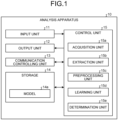
- FIG. 1 is a functional block diagram illustrating a functional configuration of an analysis apparatus according to an embodiment.
- an analysis apparatus 10 is realized by a general-purpose computer such as a personal computer and a workstation so as to include an input unit 11, an output unit 12, a communication controlling unit 13, a storage 14, and a control unit 15.
- the analysis apparatus 10 may include another function unit not limited to the illustrated function units.
- the input unit 11 is realized by using an input device such as a keyboard and a mouse so as to input various kinds of instruction information, such as start of processing, to the control unit 15 in response to an input operation of an operator.
- the output unit 12 is realize by a display such as a liquid crystal display, a printing device such as a printer, etc. For example, result of analysis processes to be mentioned later is displayed on the output unit 12.
- the communication controlling unit 13 is realized by a Network Interface Card (NIC) and the like so as to control communication between an external device and the control unit 15 via an electric communication network such as a Local Area Network (LAN) and the Internet.
- NIC Network Interface Card
- the communication controlling unit 13 controls communication between the control unit 15 and a management device that manages chromatographic data output from a target device of an analysis process and the like.
- the storage 14 is realized by a semiconductor memory element such as a Random Access Memory (RAM) and a flash memory, or a storage such as a hard disk and an optical disk. Processing programs for operating the analysis apparatus 10 and data to be used in execution in the processing programs are preliminarily stored, or are temporarily stored for each of the processes in the storage 14.
- the storage 14 stores therein a model 14a to be used in analysis processes to be mentioned later and result of the analysis processes.
- the storage 14 may be configured to communicate with the control unit 15 via the communication controlling unit 13.
- the control unit 15 is realized by using a Central Processing Unit (CPU) and the like so as to execute processing programs stored in the memory.
- the control unit 15 functions as an acquisition unit 15a, an extraction unit 15b, a preprocessing unit 15c, a learning unit 15d, and a determination unit 15e.
- all or a part of the above-mentioned function units may be implemented on different hardware devices.
- the learning unit 15d may be implemented on a learning device that is different from the determination unit 15e.
- the control unit 15 may include another function unit.
- the acquisition unit 15a acquires chromatographic data from an apparatus.
- the acquisition unit 15a acquires chromatographic data output from a target device of an analysis process via the input unit 11, or via the communication controlling unit 13 from the target device of the analysis process, a management device that manages chromatographic data output from the apparatus, or the like.
- the acquisition unit 15a acquires target normal chromatographic data of a TCD of an analysis process via the extraction unit 15b and the preprocessing unit 15c, which are to be mentioned later, and supplies the acquired data to processing of the learning unit 15d.
- the acquisition unit 15a supplies, to the learning unit 15d, 100 or more pieces from the beginning of chromatographic data after replacement with a normal TCD.
- the acquisition unit 15a acquires chromatographic data of a TCD in operation of an analysis target, and supplies, to processing of the determination unit 15e, the acquired data via the extraction unit 15b and the preprocessing unit 15c that are to be mentioned later. In this case, the acquisition unit 15a acquires pieces of chromatographic data having the number equal to that of the chromatographic data supplied to the learning unit 15d, and supplies the acquired data to the determination unit 15e.
- the acquisition unit 15a may store the acquired chromatographic data in the storage 14. Or the acquisition unit 15a may directly transmit the acquired chromatographic data to the extraction unit 15b in the latter part without storing the acquired data in the storage 14.
- the extraction unit 15b extracts a baseline portion (in other words, baseline portion of corresponding chromatographic data) from chromatographic data acquired from an apparatus.
- FIGS. 2, 3A, and 3B are diagrams illustrating processes to be executed by the analysis apparatus.
- chromatographic data of an apparatus are illustrated.
- chromatographic data of an apparatus include, in addition to a peak portion that is corresponding to detected components, a baseline portion whose change is much smaller than that in the peak portion.
- a baseline portion is a substantially-linear line.
- inclination occurs in the baseline as illustrated in FIG. 3A , or noise becomes large as illustrated in FIG. 3B .
- a baseline portion is measured so as to detect abnormality due to deterioration in an apparatus and the like.
- the preprocessing unit 15c extracts features of a baseline portion as preprocessing of the analysis process to be mentioned later. For example, the preprocessing unit 15c calculates, as features of the baseline portion, an average value, a maximum value, a minimum value, a difference between the maximum value and the minimum value, a variance value, and the like of the baseline portion.
- the learning unit 15d learns the model 14a that outputs an evaluation value reflecting a normality in an apparatus, while using chromatographic data acquired from the apparatus as input data. Specifically, the learning unit 15d generates, by learning, the model 14a that outputs an evaluation value reflecting a normality in the apparatus, while using features of a baseline portion of normal chromatographic data as teacher data.
- the learning unit 15d generates, by learning, the model 14a that outputs an evaluation value of the apparatus, while using features of a baseline portion which are extracted by the preprocessing unit 15c from normal chromatographic data as teacher data.
- the learning unit 15d stores the generated model 14a in the storage 14.
- the learning unit 15d may execute learning of the model 14a that outputs an evaluation value reflecting a normality in an apparatus, while using abnormal chromatographic data as teacher data in addition to normal chromatographic data or instead of normal chromatographic data.
- the model 14a is generated which outputs an evaluation value reflecting a normality in an apparatus with high accuracy.
- the determination unit 15e determines a normality in an apparatus on the basis of normal chromatographic data and features of a baseline portion in chromatographic data which are extracted from the extraction unit 15b. Specifically, the determination unit 15e determines a normality in an apparatus while using chromatographic data (in other words, chromatographic data of TCD in operation of analysis target) acquired from the apparatus as input data, further using normal chromatographic data as teacher data, and further using the model 14a learned by the learning unit 15d. For example, in a case where an evaluation value output from the model 14a is within a predetermined range of a threshold value, the determination unit 15e determines that an apparatus is normal.
- chromatographic data in other words, chromatographic data of TCD in operation of analysis target
- the determination unit 15e may determine a normality in an apparatus, while using chromatographic data acquired from the apparatus as input data, and further using the model 14a that is learned with the use of abnormal chromatographic data, in addition to normal chromatographic data or instead of normal chromatographic data, as teacher data.
- the determination unit 15e may use the model 14a that is learned by the above-mentioned learning unit 15d by using abnormal chromatographic data, in addition to normal chromatographic data or instead of normal chromatographic data, as teacher data.
- the determination unit 15e determines a normality in the apparatus on the basis of an inclination of a baseline portion and normal chromatographic data as features of the baseline portion. Or the determination unit 15e determines a normality in an apparatus on the basis of normal chromatographic data and intensity of noise in a baseline portion as features of the baseline portion.
- FIG. 4 is a diagram illustrating a process to be executed by the analysis apparatus.
- the model 14a is employed in which the determination unit 15e outputs, as features of a baseline portion, an evaluation value of a normality by using an average value and a difference between a maximum value and a minimum value, in other words, by using intensity of noise in the baseline portion.
- a lateral axis indicates time
- a vertical axis indicates an evaluation value (dimensionless) in analysis using artificial intelligence (AI).
- AI artificial intelligence
- the learning unit 15d generates, by learning, the model 14a that outputs an evaluation value of a normality by using an average value and a difference between a maximum value and a minimum value in a baseline portion of normal chromatographic data of an apparatus.
- the determination unit 15e inputs data on a baseline portion of chromatographic data of an apparatus in operation to the already-learned model 14a so as to obtain an evaluation value of an apparatus.
- an evaluation value indicating a normality is reduced over time.
- the determination unit 15e determines that an apparatus is abnormal.
- the analysis apparatus 10 is capable of detecting an abnormality due to time deterioration of an apparatus and the like, for example.
- the determination unit 15e may transmits alarm and the like to a manager of the apparatus. For example, in a case where the number of times and/or a frequency of determination of abnormality in the apparatus exceeds a predetermined threshold value, the determination unit 15e outputs alarm and/or an error display to a management device used by a manager.
- FIGS. 5 and 6 are flowcharts illustrating flows of processes according to the embodiment.
- An analysis process (analysis method) according to the present embodiment includes a learning process and a determination process.
- the learning process illustrated in FIG. 5 is started at a timing when a user including a manager and/or an operator orders a start of the learning process, for example.
- a start of the learning process is not limited to an order from a user, and may be automatically started by a program, for example.
- the acquisition unit 15a acquires normal chromatographic data of a target TCD of the analysis process (Step S1).
- the extraction unit 15b extracts a baseline portion from the acquired chromatographic data (Step S2).
- the preprocessing unit 15c extracts features of the baseline portion.
- the learning unit 15d uses, as teacher data, the features of the baseline portion which are extracted by the preprocessing unit 15c from the normal chromatographic data, and further generates, by learning, the model 14a for outputting an evaluation value of the apparatus (Step S3).
- the learning unit 15d stores the generated model 14a in the storage 14. Thus, a series of learning processes ends.
- the determination process illustrated in FIG. 6 is started at a timing when a user including a manager and/or an operator orders a start of the determination process, for example.
- a start of the determination process is not limited to an order from a user, and may be automatically started by a program, for example.
- the acquisition unit 15a acquires chromatographic data of a target TCD in operation of the analysis process (Step S11).
- the extraction unit 15b extracts a baseline portion from the acquired chromatographic data (Step S12).
- the preprocessing unit 15c extracts features of the baseline portion.
- the determination unit 15e determines, by using the already-learned model 14a, a normality in the apparatus while using, as input data, the features of the baseline portion extracted by the preprocessing unit 15c from the acquired chromatographic data (Step S13).
- the determination unit 15e outputs determination result to the output unit 12 (Step S14). For example, in a case where determining that a target device of the analysis process is abnormal, the determination unit 15e outputs alarm and/or an error message to a management device of the apparatus. Thus, a series of determination processes ends.
- the analysis apparatus 10 includes the extraction unit 15b and the determination unit 15e.
- the extraction unit 15b extracts a baseline portion from chromatographic data that is acquired from an apparatus.
- the determination unit 15e determines a normality in the apparatus based on normal chromatographic data and a feature of the baseline portion of the chromatographic data extracted by the extraction unit 15b.
- the analysis apparatus 10 is capable of detecting deterioration in the apparatus in operation in real time so as to deal with it.
- the determination unit 15e determines a normality in the apparatus based on the normal chromatographic data and an inclination of the baseline portion as a feature of the baseline portion. Or the determination unit 15e determines a normality in the apparatus based on the normal chromatographic data and an intensity of noise in the baseline portion as a feature of the baseline portion.
- the analysis apparatus 10 is capable of determining a normality in an apparatus with high accuracy.
- the determination unit 15e uses, as input data, the chromatographic data acquired from the apparatus to determine a normality in the apparatus by using a model on which learning is executed by using the normal chromatographic data as teacher data.
- the analysis apparatus 10 is capable of determining a normality in an apparatus with high accuracy.
- the determination unit 15e uses, as input data, the chromatographic data acquired from the apparatus to determine a normality in the apparatus by using the model 14a on which learning is executed by using, as teacher data, abnormal chromatographic data in addition to the normal chromatographic data or instead of the normal chromatographic data.
- the analysis apparatus 10 is capable of determining a normality in an apparatus with higher accuracy.
- the learning unit 15d uses, as input data, the chromatographic data acquired from the apparatus to learn the model 14a that outputs an evaluation value reflecting the normality in the apparatus.
- the analysis apparatus 10 is capable of generating the model 14a that outputs an evaluation value reflecting a normality in an apparatus with high accuracy, and further capable of determining a normality in the apparatus with high accuracy.
- FIGS. 7A to 7C are diagrams illustrating a practical embodiment.
- dust was intendedly intruded into a TCD so as to generate abnormality in a baseline portion.
- Air was sampled so as to oxidize a filament of the TCD by using oxygen included in the Air, and thus abnormality in a baseline portion was generated.
- Air was sampled at intervals of 300 seconds to generate peaks, and data were collected for 24 hours. In this case, chromatographic data in an abnormal state was obtained, which was illustrated in FIG. 3A .
- a column that was attached to the front of the TCD was processed such that filler of fine particles that were packed into the column leaked therefrom.
- chromatographic data in an abnormal state illustrated in FIG. 3B was obtained.
- Preprocessing was executed on each of the chromatographic data in a normal state and the chromatographic data in an abnormal state. Specifically, 288 pieces of data were acquired during 24 hours while using chromatographic data at intervals of 300 seconds as one piece of data. As illustrated in FIG. 7B , a baseline portion having a predetermined range of approximately 1 to 10 seconds (5 seconds in present practical embodiment) was extracted from each piece of the data, and a corresponding variance value was calculated. Note that the predetermined range was set to approximately 1 to 10 seconds because noise in a baseline portion was minute so as to prevent a case where an element other than noise was included therein when a time interval of data was longer than the above-mentioned time interval.
- FIG. 7C an evaluation value of chromatographic data in an abnormal state largely deviated from that in a normal state many times. For example, points illustrated in FIG. 7C whose evaluation values were lower than -0.5 were obtained by plotting the abnormal state illustrated in FIG. 3B , and many points illustrated in FIG. 7C whose evaluation values were approximately zero were obtained by plotting the normal state illustrated in FIG. 3B . As described above, when noise in a baseline portion was unstable, the analysis apparatus 10 was capable of detecting abnormality in an apparatus.
- the features of the baseline portion exemplified in the above-mentioned embodiment are merely examples, and further may be arbitrarily changed.
- various algorithms such as a neural network, deep learning, and a support vector machine may be employed for the model 14a generated by the learning unit 15d.
- the illustrated components of the apparatuses are functionally conceptual, and thus they are not to be physically configured as illustrated in the drawings. Specific forms of distribution and integration of the configuration elements of the illustrated devices are not limited to those illustrated in the drawings. All or some of the apparatuses can be configured by separating or integrating the apparatus functionally or physically in any unit, according to various types of loads, the status of use, etc.
- whole or an arbitrary part of processing function executed by each of the apparatuses is realized by a CPU and a program executed by the CPU, or is realized as hardware by wired logic.
- an analysis program may be executed in the cloud. The above-mentioned analysis program may execute a process for causing a computer to extract a baseline portion from chromatographic data acquired from an apparatus so as to determine a normality in the apparatus on the basis of normal chromatographic data and features of the extracted baseline portion of the chromatographic data.
- FIG. 8 is a diagram illustrating the hardware configuration example.
- the analysis apparatus 10 includes a communication device 10a, a Hard Disk Drive (HDD) 10b, a memory 10c, and a processor 10d.
- the units illustrated in FIG. 8 are connected to each other by bus.
- the communication device 10a is a network interface card and the like so as to communicate with another server.
- the HDD 10b stores therein programs and a database (DB) for causing the function illustrated in FIG. 1 to operate.
- DB database
- the processor 10d reads, from the HDD 10b and the like, a program for executing a process similar to the processing units illustrated in FIG. 1 , and expands the read program in the memory 10c so as to cause processes for executing functions having been explained with reference to FIG. 1 and the like to operate.
- the process executes function similar to the processing units included in the analysis apparatus 10.
- the processor 10d reads, from the HDD 10b and the like, a program having function similar to the acquisition unit 15a, the extraction unit 15b, the preprocessing unit 15c, the learning unit 15d, the determination unit 15e, and the like.
- the processor 10d executes the process for executing processes similar to the acquisition unit 15a, the extraction unit 15b, the preprocessing unit 15c, the learning unit 15d, the determination unit 15e, and the like.
- the analysis apparatus 10 reads and executes an analysis program so as to operate as the information processing device that executes the analysis method.
- the analysis apparatus 10 may be an information processing device such as a PC in which the analysis program is installed.
- the analysis apparatus 10 may reads the above-mentioned program from a recording medium by using a medium reading device, and further may execute the read program so as to realize function similar to the above-mentioned embodiment.
- the program according to the other embodiment is not limitedly executed by the analysis apparatus 10. For example, in a case where another computer or another server executes a program, and further in a case where these execute a program in cooperation with each other, the present disclosure may be similarly applied.
- the program is able to be delivered via a network such as the Internet.
- the program is recorded in a computer readable recording medium such as a hard disk, a flexible disk (FD), a CD-ROM, a Magneto-Optical disk (MO), and a Digital Versatile Disc (DVD), and is read out from the recording medium by a computer so as to be executed.
- a computer readable recording medium such as a hard disk, a flexible disk (FD), a CD-ROM, a Magneto-Optical disk (MO), and a Digital Versatile Disc (DVD)
Landscapes
- Physics & Mathematics (AREA)
- General Physics & Mathematics (AREA)
- Health & Medical Sciences (AREA)
- Life Sciences & Earth Sciences (AREA)
- Chemical & Material Sciences (AREA)
- Analytical Chemistry (AREA)
- Biochemistry (AREA)
- General Health & Medical Sciences (AREA)
- Immunology (AREA)
- Pathology (AREA)
- Engineering & Computer Science (AREA)
- Software Systems (AREA)
- Theoretical Computer Science (AREA)
- Artificial Intelligence (AREA)
- Computer Vision & Pattern Recognition (AREA)
- Data Mining & Analysis (AREA)
- Evolutionary Computation (AREA)
- Medical Informatics (AREA)
- Computing Systems (AREA)
- General Engineering & Computer Science (AREA)
- Mathematical Physics (AREA)
- Automatic Analysis And Handling Materials Therefor (AREA)
Claims (8)
- Analysegerät (10), umfassend:eine Extraktionseinheit (15a), die einen Basislinienabschnitt aus chromatographischen Daten extrahiert, die von einer Einrichtung erfasst werden; undeine Bestimmungseinheit (15e), die eine Normalität in der Einrichtung auf der Grundlage normaler chromatographischer Daten und eines Merkmals des Basislinienabschnitts der von der Extraktionseinheit (15a) extrahierten chromatographischen Daten bestimmt,wobei die Einrichtung ein Wärmeleitfähigkeitsdetektor, TCD, ist, der die Differenz zwischen einer Wärmeleitfähigkeit einer Messkomponente und einer Wärmeleitfähigkeit eines Trägergases verwendet, um eine in einer Brückenschaltung erzeugte unsymmetrische Spannung als ein Konzentrationssignal zu extrahieren.
- Analysegerät (10) nach Anspruch 1, wobei
die Bestimmungseinheit (15e) eine Normalität in der Einrichtung auf der Grundlage der normalen chromatographischen Daten und einer Neigung des Basislinienabschnitts als ein Merkmal des Basislinienabschnitts bestimmt. - Analysegerät (10) nach Anspruch 1, wobei
die Bestimmungseinheit (15e) eine Normalität in der Einrichtung auf der Grundlage der normalen chromatographischen Daten und einer Intensität eines Rauschens in dem Basislinienabschnitt als ein Merkmal des Basislinienabschnitts bestimmt. - Analysegerät (10) nach Anspruch 1, wobei
die Bestimmungseinheit (15e) als Eingangsdaten die von der Einrichtung erfassten chromatographischen Daten verwendet, um eine Normalität in der Einrichtung unter Verwendung eines Modells zu bestimmen, auf dem Lernen ausgeführt wird, indem die normalen chromatographischen Daten als Lehrerdaten verwendet werden. - Analysegerät (10) nach Anspruch 4, wobei
die Bestimmungseinheit (15e) als Eingangsdaten die von der Einrichtung erfassten chromatographischen Daten verwendet, um eine Normalität in der Einrichtung zu bestimmen, indem das Modell verwendet wird, auf dem Lernen ausgeführt wird, indem zusätzlich zu den normalen chromatographischen Daten oder anstelle der normalen chromatographischen Daten abnormale chromatographische Daten als Lehrerdaten verwendet werden. - Analysegerät (10) nach Anspruch 4, weiter umfassend:
eine Lerneinheit (15d), die als Eingangsdaten die von der Einrichtung erfassten chromatographischen Daten verwendet, um das Modell zu lernen, das einen die Normalität in der Einrichtung widerspiegelnden Bewertungswert ausgibt. - Analyseverfahren, umfassend:Extrahieren (S12) eines Basislinienabschnitts aus chromatographischen Daten, die von einer Einrichtung erfasst werden; undBestimmen (S13) einer Normalität in der Einrichtung auf der Grundlage von normalen chromatographischen Daten und einem Merkmal des Basislinienabschnitts der extrahierten chromatographischen Daten),wobei die Einrichtung ein Wärmeleitfähigkeitsdetektor, TCD, ist, der die Differenz zwischen einer Wärmeleitfähigkeit einer Messkomponente und einer Wärmeleitfähigkeit eines Trägergases verwendet, um eine in einer Brückenschaltung erzeugte unsymmetrische Spannung als ein Konzentrationssignal zu extrahieren.
- Analyseprogramm, das so konfiguriert ist, dass es einen Computer (10) veranlasst, auszuführen:Extrahieren (S12) eines Basislinienabschnitts aus chromatographischen Daten, die von einer Einrichtung erfasst werden; undBestimmen (S13) einer Normalität in der Einrichtung auf der Grundlage normaler chromatographischer Daten und eines Merkmals des Basislinienabschnitts der extrahierten chromatographischen Daten,wobei die Einrichtung ein Wärmeleitfähigkeitsdetektor, TCD, ist, der die Differenz zwischen einer Wärmeleitfähigkeit einer Messkomponente und einer Wärmeleitfähigkeit eines Trägergases verwendet, um eine in einer Brückenschaltung erzeugte unsymmetrische Spannung als ein Konzentrationssignal zu extrahieren.
Applications Claiming Priority (1)
| Application Number | Priority Date | Filing Date | Title |
|---|---|---|---|
| JP2021055020A JP7310848B2 (ja) | 2021-03-29 | 2021-03-29 | 解析装置、解析方法および解析プログラム |
Publications (2)
| Publication Number | Publication Date |
|---|---|
| EP4067897A1 EP4067897A1 (de) | 2022-10-05 |
| EP4067897B1 true EP4067897B1 (de) | 2025-03-05 |
Family
ID=80685369
Family Applications (1)
| Application Number | Title | Priority Date | Filing Date |
|---|---|---|---|
| EP22161035.5A Active EP4067897B1 (de) | 2021-03-29 | 2022-03-09 | Analysegerät, analyseverfahren und analyseprogramm |
Country Status (3)
| Country | Link |
|---|---|
| EP (1) | EP4067897B1 (de) |
| JP (1) | JP7310848B2 (de) |
| CN (1) | CN115144518B (de) |
Family Cites Families (12)
| Publication number | Priority date | Publication date | Assignee | Title |
|---|---|---|---|---|
| US4674323A (en) * | 1985-07-31 | 1987-06-23 | The Dow Chemical Company | Self-diagnostic gel permeation/size exclusion chromatograph |
| JPH07101208B2 (ja) * | 1990-08-02 | 1995-11-01 | 山武ハネウエル株式会社 | ガスクロマトグラフの自己診断方法 |
| JPH08500898A (ja) * | 1992-04-16 | 1996-01-30 | ザ ダウ ケミカル カンパニー | 複合データを解釈して異常な器機または処理挙動を検出する改良法 |
| JPH06341994A (ja) * | 1993-06-03 | 1994-12-13 | Hitachi Ltd | データ処理装置を備えた分析装置 |
| JP2004061199A (ja) * | 2002-07-26 | 2004-02-26 | Shimadzu Corp | 分光吸光度検出器 |
| DE20300701U1 (de) * | 2003-01-16 | 2003-03-20 | SLS MICRO TECHNOLOGY GmbH, 21079 Hamburg | Miniaturisierter Gaschromatograph und Injektor hierfür |
| US8511140B2 (en) * | 2005-10-25 | 2013-08-20 | Waters Technologies Corporation | Baseline modeling in chromatography |
| JP4687416B2 (ja) * | 2005-11-21 | 2011-05-25 | 株式会社島津製作所 | クロマトグラフ用データ処理装置 |
| CN102551811B (zh) * | 2010-12-30 | 2015-11-25 | 深圳迈瑞生物医疗电子股份有限公司 | 一种彩色血流增益调整的方法及装置 |
| JP6729455B2 (ja) * | 2017-03-15 | 2020-07-22 | 株式会社島津製作所 | 分析データ解析装置及び分析データ解析方法 |
| CN117607277A (zh) * | 2018-04-18 | 2024-02-27 | 安捷伦科技有限公司 | 色谱分析性能的空白运行分析 |
| JP7349872B2 (ja) * | 2018-10-11 | 2023-09-25 | Nissha株式会社 | 判定装置、判定方法、学習済みモデル及び分類器の製造方法 |
-
2021
- 2021-03-29 JP JP2021055020A patent/JP7310848B2/ja active Active
-
2022
- 2022-03-07 CN CN202210222498.0A patent/CN115144518B/zh active Active
- 2022-03-09 EP EP22161035.5A patent/EP4067897B1/de active Active
Also Published As
| Publication number | Publication date |
|---|---|
| JP2022152303A (ja) | 2022-10-12 |
| EP4067897A1 (de) | 2022-10-05 |
| JP7310848B2 (ja) | 2023-07-19 |
| CN115144518B (zh) | 2025-04-11 |
| CN115144518A (zh) | 2022-10-04 |
| US20220308023A1 (en) | 2022-09-29 |
Similar Documents
| Publication | Publication Date | Title |
|---|---|---|
| US8744813B2 (en) | Detection of anomalies in an aircraft engine | |
| US20160076970A1 (en) | Detecting apparatus, detection method, and program | |
| Zhou et al. | Differential feature based hierarchical PCA fault detection method for dynamic fault | |
| CN108369109B (zh) | 用于监控至少两个冗余传感器的方法 | |
| Goulding et al. | Fault detection in continuous processes using multivariate statistical methods | |
| US20180224809A1 (en) | Event analyzing device, event analyzing system, event analyzing method, and non-transitory computer readable storage medium | |
| Yoshida et al. | ARX and AFMM model-based on-line real-time data base diagnosis of sudden fault in AHU of VAV system | |
| US20200143292A1 (en) | Signature enhancement for deviation measurement-based classification of a detected anomaly in an industrial asset | |
| CN101802731A (zh) | 用于自动显示工业控制系统中的过程信息的系统和由计算机实施的方法 | |
| Harrou et al. | Amalgamation of anomaly-detection indices for enhanced process monitoring | |
| US20250315031A1 (en) | Anomaly Event Detector | |
| US20080167842A1 (en) | Method and system for detecting, analyzing and subsequently recognizing abnormal events | |
| Dix et al. | Measuring the robustness of ml models against data quality issues in industrial time series data | |
| EP4067897B1 (de) | Analysegerät, analyseverfahren und analyseprogramm | |
| Ji et al. | Incipient fault detection for dynamic processes with canonical variate residual statistics analysis | |
| CN115599037B (zh) | 一种基因检测实验室设备自动化监控方法 | |
| US12553870B2 (en) | Analysis apparatus, analysis method, and computer-readable recording medium for detecting deterioration in tcd | |
| JP2021060959A (ja) | 要因分析装置及び要因分析方法 | |
| JP7230371B2 (ja) | 異常検出装置、異常検出方法、異常検出プログラム及び異常検出システム | |
| Stork et al. | Distinguishing between process upsets and sensor malfunctions using sensor redundancy | |
| JP7281394B2 (ja) | 異常診断装置およびプログラム | |
| Galotto et al. | Data based tools for sensors continuous monitoring in industry applications | |
| Hinder et al. | A remark on concept drift for dependent data | |
| Alghassi | Generalized Anomaly Detection Algorithm Based on Time Series Statistical Features | |
| EP4276560B1 (de) | Anomaliezeichenerkennungssystem und anomaliezeichenerkennungsmodellerzeugungsverfahren |
Legal Events
| Date | Code | Title | Description |
|---|---|---|---|
| PUAI | Public reference made under article 153(3) epc to a published international application that has entered the european phase |
Free format text: ORIGINAL CODE: 0009012 |
|
| STAA | Information on the status of an ep patent application or granted ep patent |
Free format text: STATUS: THE APPLICATION HAS BEEN PUBLISHED |
|
| AK | Designated contracting states |
Kind code of ref document: A1 Designated state(s): AL AT BE BG CH CY CZ DE DK EE ES FI FR GB GR HR HU IE IS IT LI LT LU LV MC MK MT NL NO PL PT RO RS SE SI SK SM TR |
|
| STAA | Information on the status of an ep patent application or granted ep patent |
Free format text: STATUS: REQUEST FOR EXAMINATION WAS MADE |
|
| 17P | Request for examination filed |
Effective date: 20230321 |
|
| RBV | Designated contracting states (corrected) |
Designated state(s): AL AT BE BG CH CY CZ DE DK EE ES FI FR GB GR HR HU IE IS IT LI LT LU LV MC MK MT NL NO PL PT RO RS SE SI SK SM TR |
|
| P01 | Opt-out of the competence of the unified patent court (upc) registered |
Effective date: 20230606 |
|
| GRAP | Despatch of communication of intention to grant a patent |
Free format text: ORIGINAL CODE: EPIDOSNIGR1 |
|
| STAA | Information on the status of an ep patent application or granted ep patent |
Free format text: STATUS: GRANT OF PATENT IS INTENDED |
|
| INTG | Intention to grant announced |
Effective date: 20241104 |
|
| GRAS | Grant fee paid |
Free format text: ORIGINAL CODE: EPIDOSNIGR3 |
|
| GRAA | (expected) grant |
Free format text: ORIGINAL CODE: 0009210 |
|
| STAA | Information on the status of an ep patent application or granted ep patent |
Free format text: STATUS: THE PATENT HAS BEEN GRANTED |
|
| AK | Designated contracting states |
Kind code of ref document: B1 Designated state(s): AL AT BE BG CH CY CZ DE DK EE ES FI FR GB GR HR HU IE IS IT LI LT LU LV MC MK MT NL NO PL PT RO RS SE SI SK SM TR |
|
| REG | Reference to a national code |
Ref country code: GB Ref legal event code: FG4D |
|
| REG | Reference to a national code |
Ref country code: CH Ref legal event code: EP |
|
| REG | Reference to a national code |
Ref country code: IE Ref legal event code: FG4D |
|
| REG | Reference to a national code |
Ref country code: DE Ref legal event code: R096 Ref document number: 602022011286 Country of ref document: DE |
|
| PGFP | Annual fee paid to national office [announced via postgrant information from national office to epo] |
Ref country code: DE Payment date: 20250318 Year of fee payment: 4 |
|
| PGFP | Annual fee paid to national office [announced via postgrant information from national office to epo] |
Ref country code: AT Payment date: 20250417 Year of fee payment: 4 |
|
| PG25 | Lapsed in a contracting state [announced via postgrant information from national office to epo] |
Ref country code: RS Free format text: LAPSE BECAUSE OF FAILURE TO SUBMIT A TRANSLATION OF THE DESCRIPTION OR TO PAY THE FEE WITHIN THE PRESCRIBED TIME-LIMIT Effective date: 20250605 |
|
| PG25 | Lapsed in a contracting state [announced via postgrant information from national office to epo] |
Ref country code: FI Free format text: LAPSE BECAUSE OF FAILURE TO SUBMIT A TRANSLATION OF THE DESCRIPTION OR TO PAY THE FEE WITHIN THE PRESCRIBED TIME-LIMIT Effective date: 20250305 |
|
| REG | Reference to a national code |
Ref country code: NL Ref legal event code: MP Effective date: 20250305 |
|
| PG25 | Lapsed in a contracting state [announced via postgrant information from national office to epo] |
Ref country code: ES Free format text: LAPSE BECAUSE OF FAILURE TO SUBMIT A TRANSLATION OF THE DESCRIPTION OR TO PAY THE FEE WITHIN THE PRESCRIBED TIME-LIMIT Effective date: 20250305 |
|
| REG | Reference to a national code |
Ref country code: LT Ref legal event code: MG9D |
|
| PG25 | Lapsed in a contracting state [announced via postgrant information from national office to epo] |
Ref country code: NO Free format text: LAPSE BECAUSE OF FAILURE TO SUBMIT A TRANSLATION OF THE DESCRIPTION OR TO PAY THE FEE WITHIN THE PRESCRIBED TIME-LIMIT Effective date: 20250605 |
|
| PG25 | Lapsed in a contracting state [announced via postgrant information from national office to epo] |
Ref country code: HR Free format text: LAPSE BECAUSE OF FAILURE TO SUBMIT A TRANSLATION OF THE DESCRIPTION OR TO PAY THE FEE WITHIN THE PRESCRIBED TIME-LIMIT Effective date: 20250305 |
|
| PG25 | Lapsed in a contracting state [announced via postgrant information from national office to epo] |
Ref country code: LV Free format text: LAPSE BECAUSE OF FAILURE TO SUBMIT A TRANSLATION OF THE DESCRIPTION OR TO PAY THE FEE WITHIN THE PRESCRIBED TIME-LIMIT Effective date: 20250305 |
|
| PG25 | Lapsed in a contracting state [announced via postgrant information from national office to epo] |
Ref country code: GR Free format text: LAPSE BECAUSE OF FAILURE TO SUBMIT A TRANSLATION OF THE DESCRIPTION OR TO PAY THE FEE WITHIN THE PRESCRIBED TIME-LIMIT Effective date: 20250606 Ref country code: BG Free format text: LAPSE BECAUSE OF FAILURE TO SUBMIT A TRANSLATION OF THE DESCRIPTION OR TO PAY THE FEE WITHIN THE PRESCRIBED TIME-LIMIT Effective date: 20250305 |
|
| PG25 | Lapsed in a contracting state [announced via postgrant information from national office to epo] |
Ref country code: AT Free format text: LAPSE BECAUSE OF FAILURE TO SUBMIT A TRANSLATION OF THE DESCRIPTION OR TO PAY THE FEE WITHIN THE PRESCRIBED TIME-LIMIT Effective date: 20250305 |
|
| REG | Reference to a national code |
Ref country code: AT Ref legal event code: MK05 Ref document number: 1773337 Country of ref document: AT Kind code of ref document: T Effective date: 20250305 |
|
| PG25 | Lapsed in a contracting state [announced via postgrant information from national office to epo] |
Ref country code: NL Free format text: LAPSE BECAUSE OF FAILURE TO SUBMIT A TRANSLATION OF THE DESCRIPTION OR TO PAY THE FEE WITHIN THE PRESCRIBED TIME-LIMIT Effective date: 20250305 |
|
| PG25 | Lapsed in a contracting state [announced via postgrant information from national office to epo] |
Ref country code: SE Free format text: LAPSE BECAUSE OF FAILURE TO SUBMIT A TRANSLATION OF THE DESCRIPTION OR TO PAY THE FEE WITHIN THE PRESCRIBED TIME-LIMIT Effective date: 20250305 |
|
| PG25 | Lapsed in a contracting state [announced via postgrant information from national office to epo] |
Ref country code: SM Free format text: LAPSE BECAUSE OF FAILURE TO SUBMIT A TRANSLATION OF THE DESCRIPTION OR TO PAY THE FEE WITHIN THE PRESCRIBED TIME-LIMIT Effective date: 20250305 |
|
| PG25 | Lapsed in a contracting state [announced via postgrant information from national office to epo] |
Ref country code: PT Free format text: LAPSE BECAUSE OF FAILURE TO SUBMIT A TRANSLATION OF THE DESCRIPTION OR TO PAY THE FEE WITHIN THE PRESCRIBED TIME-LIMIT Effective date: 20250707 |
|
| PG25 | Lapsed in a contracting state [announced via postgrant information from national office to epo] |
Ref country code: PL Free format text: LAPSE BECAUSE OF FAILURE TO SUBMIT A TRANSLATION OF THE DESCRIPTION OR TO PAY THE FEE WITHIN THE PRESCRIBED TIME-LIMIT Effective date: 20250305 Ref country code: IT Free format text: LAPSE BECAUSE OF FAILURE TO SUBMIT A TRANSLATION OF THE DESCRIPTION OR TO PAY THE FEE WITHIN THE PRESCRIBED TIME-LIMIT Effective date: 20250305 |
|
| PG25 | Lapsed in a contracting state [announced via postgrant information from national office to epo] |
Ref country code: CZ Free format text: LAPSE BECAUSE OF FAILURE TO SUBMIT A TRANSLATION OF THE DESCRIPTION OR TO PAY THE FEE WITHIN THE PRESCRIBED TIME-LIMIT Effective date: 20250305 Ref country code: EE Free format text: LAPSE BECAUSE OF FAILURE TO SUBMIT A TRANSLATION OF THE DESCRIPTION OR TO PAY THE FEE WITHIN THE PRESCRIBED TIME-LIMIT Effective date: 20250305 |
|
| REG | Reference to a national code |
Ref country code: CH Ref legal event code: H13 Free format text: ST27 STATUS EVENT CODE: U-0-0-H10-H13 (AS PROVIDED BY THE NATIONAL OFFICE) Effective date: 20251023 |
|
| PG25 | Lapsed in a contracting state [announced via postgrant information from national office to epo] |
Ref country code: RO Free format text: LAPSE BECAUSE OF FAILURE TO SUBMIT A TRANSLATION OF THE DESCRIPTION OR TO PAY THE FEE WITHIN THE PRESCRIBED TIME-LIMIT Effective date: 20250305 |
|
| PG25 | Lapsed in a contracting state [announced via postgrant information from national office to epo] |
Ref country code: SK Free format text: LAPSE BECAUSE OF FAILURE TO SUBMIT A TRANSLATION OF THE DESCRIPTION OR TO PAY THE FEE WITHIN THE PRESCRIBED TIME-LIMIT Effective date: 20250305 |
|
| PG25 | Lapsed in a contracting state [announced via postgrant information from national office to epo] |
Ref country code: IS Free format text: LAPSE BECAUSE OF FAILURE TO SUBMIT A TRANSLATION OF THE DESCRIPTION OR TO PAY THE FEE WITHIN THE PRESCRIBED TIME-LIMIT Effective date: 20250705 |
|
| PG25 | Lapsed in a contracting state [announced via postgrant information from national office to epo] |
Ref country code: LU Free format text: LAPSE BECAUSE OF NON-PAYMENT OF DUE FEES Effective date: 20250309 |
|
| REG | Reference to a national code |
Ref country code: DE Ref legal event code: R097 Ref document number: 602022011286 Country of ref document: DE |
|
| REG | Reference to a national code |
Ref country code: BE Ref legal event code: MM Effective date: 20250331 |
|
| PG25 | Lapsed in a contracting state [announced via postgrant information from national office to epo] |
Ref country code: MC Free format text: LAPSE BECAUSE OF FAILURE TO SUBMIT A TRANSLATION OF THE DESCRIPTION OR TO PAY THE FEE WITHIN THE PRESCRIBED TIME-LIMIT Effective date: 20250305 |
|
| PLBE | No opposition filed within time limit |
Free format text: ORIGINAL CODE: 0009261 |
|
| STAA | Information on the status of an ep patent application or granted ep patent |
Free format text: STATUS: NO OPPOSITION FILED WITHIN TIME LIMIT |
|
| PG25 | Lapsed in a contracting state [announced via postgrant information from national office to epo] |
Ref country code: DK Free format text: LAPSE BECAUSE OF FAILURE TO SUBMIT A TRANSLATION OF THE DESCRIPTION OR TO PAY THE FEE WITHIN THE PRESCRIBED TIME-LIMIT Effective date: 20250305 |
|
| REG | Reference to a national code |
Ref country code: CH Ref legal event code: L10 Free format text: ST27 STATUS EVENT CODE: U-0-0-L10-L00 (AS PROVIDED BY THE NATIONAL OFFICE) Effective date: 20260114 |
|
| PG25 | Lapsed in a contracting state [announced via postgrant information from national office to epo] |
Ref country code: BE Free format text: LAPSE BECAUSE OF NON-PAYMENT OF DUE FEES Effective date: 20250331 |
|
| PG25 | Lapsed in a contracting state [announced via postgrant information from national office to epo] |
Ref country code: CH Free format text: LAPSE BECAUSE OF NON-PAYMENT OF DUE FEES Effective date: 20250331 |
|
| PG25 | Lapsed in a contracting state [announced via postgrant information from national office to epo] |
Ref country code: IE Free format text: LAPSE BECAUSE OF NON-PAYMENT OF DUE FEES Effective date: 20250309 |
|
| 26N | No opposition filed |
Effective date: 20251208 |