EP4065722B1 - Verfahren zur reinigung von produkten - Google Patents
Verfahren zur reinigung von produkten Download PDFInfo
- Publication number
- EP4065722B1 EP4065722B1 EP21767035.5A EP21767035A EP4065722B1 EP 4065722 B1 EP4065722 B1 EP 4065722B1 EP 21767035 A EP21767035 A EP 21767035A EP 4065722 B1 EP4065722 B1 EP 4065722B1
- Authority
- EP
- European Patent Office
- Prior art keywords
- distillation
- ethyl acetate
- ethanol
- thiol
- process stream
- Prior art date
- Legal status (The legal status is an assumption and is not a legal conclusion. Google has not performed a legal analysis and makes no representation as to the accuracy of the status listed.)
- Active
Links
Images


Classifications
-
- C—CHEMISTRY; METALLURGY
- C07—ORGANIC CHEMISTRY
- C07C—ACYCLIC OR CARBOCYCLIC COMPOUNDS
- C07C29/00—Preparation of compounds having hydroxy or O-metal groups bound to a carbon atom not belonging to a six-membered aromatic ring
- C07C29/74—Separation; Purification; Use of additives, e.g. for stabilisation
- C07C29/76—Separation; Purification; Use of additives, e.g. for stabilisation by physical treatment
- C07C29/80—Separation; Purification; Use of additives, e.g. for stabilisation by physical treatment by distillation
- C07C29/84—Separation; Purification; Use of additives, e.g. for stabilisation by physical treatment by distillation by extractive distillation
-
- C—CHEMISTRY; METALLURGY
- C07—ORGANIC CHEMISTRY
- C07C—ACYCLIC OR CARBOCYCLIC COMPOUNDS
- C07C29/00—Preparation of compounds having hydroxy or O-metal groups bound to a carbon atom not belonging to a six-membered aromatic ring
- C07C29/74—Separation; Purification; Use of additives, e.g. for stabilisation
-
- B—PERFORMING OPERATIONS; TRANSPORTING
- B01—PHYSICAL OR CHEMICAL PROCESSES OR APPARATUS IN GENERAL
- B01D—SEPARATION
- B01D15/00—Separating processes involving the treatment of liquids with solid sorbents; Apparatus therefor
- B01D15/08—Selective adsorption, e.g. chromatography
- B01D15/26—Selective adsorption, e.g. chromatography characterised by the separation mechanism
- B01D15/36—Selective adsorption, e.g. chromatography characterised by the separation mechanism involving ionic interaction, e.g. ion-exchange, ion-pair, ion-suppression or ion-exclusion
- B01D15/361—Ion-exchange
- B01D15/362—Cation-exchange
-
- B—PERFORMING OPERATIONS; TRANSPORTING
- B01—PHYSICAL OR CHEMICAL PROCESSES OR APPARATUS IN GENERAL
- B01D—SEPARATION
- B01D3/00—Distillation or related exchange processes in which liquids are contacted with gaseous media, e.g. stripping
- B01D3/001—Processes specially adapted for distillation or rectification of fermented solutions
- B01D3/002—Processes specially adapted for distillation or rectification of fermented solutions by continuous methods
-
- B—PERFORMING OPERATIONS; TRANSPORTING
- B01—PHYSICAL OR CHEMICAL PROCESSES OR APPARATUS IN GENERAL
- B01D—SEPARATION
- B01D3/00—Distillation or related exchange processes in which liquids are contacted with gaseous media, e.g. stripping
- B01D3/007—Energy recuperation; Heat pumps
-
- B—PERFORMING OPERATIONS; TRANSPORTING
- B01—PHYSICAL OR CHEMICAL PROCESSES OR APPARATUS IN GENERAL
- B01D—SEPARATION
- B01D3/00—Distillation or related exchange processes in which liquids are contacted with gaseous media, e.g. stripping
- B01D3/10—Vacuum distillation
-
- B—PERFORMING OPERATIONS; TRANSPORTING
- B01—PHYSICAL OR CHEMICAL PROCESSES OR APPARATUS IN GENERAL
- B01D—SEPARATION
- B01D3/00—Distillation or related exchange processes in which liquids are contacted with gaseous media, e.g. stripping
- B01D3/14—Fractional distillation or use of a fractionation or rectification column
- B01D3/143—Fractional distillation or use of a fractionation or rectification column by two or more of a fractionation, separation or rectification step
-
- B—PERFORMING OPERATIONS; TRANSPORTING
- B01—PHYSICAL OR CHEMICAL PROCESSES OR APPARATUS IN GENERAL
- B01D—SEPARATION
- B01D3/00—Distillation or related exchange processes in which liquids are contacted with gaseous media, e.g. stripping
- B01D3/14—Fractional distillation or use of a fractionation or rectification column
- B01D3/143—Fractional distillation or use of a fractionation or rectification column by two or more of a fractionation, separation or rectification step
- B01D3/145—One step being separation by permeation
-
- C—CHEMISTRY; METALLURGY
- C07—ORGANIC CHEMISTRY
- C07C—ACYCLIC OR CARBOCYCLIC COMPOUNDS
- C07C29/00—Preparation of compounds having hydroxy or O-metal groups bound to a carbon atom not belonging to a six-membered aromatic ring
- C07C29/74—Separation; Purification; Use of additives, e.g. for stabilisation
- C07C29/76—Separation; Purification; Use of additives, e.g. for stabilisation by physical treatment
-
- C—CHEMISTRY; METALLURGY
- C07—ORGANIC CHEMISTRY
- C07C—ACYCLIC OR CARBOCYCLIC COMPOUNDS
- C07C29/00—Preparation of compounds having hydroxy or O-metal groups bound to a carbon atom not belonging to a six-membered aromatic ring
- C07C29/74—Separation; Purification; Use of additives, e.g. for stabilisation
- C07C29/76—Separation; Purification; Use of additives, e.g. for stabilisation by physical treatment
- C07C29/80—Separation; Purification; Use of additives, e.g. for stabilisation by physical treatment by distillation
-
- C—CHEMISTRY; METALLURGY
- C07—ORGANIC CHEMISTRY
- C07C—ACYCLIC OR CARBOCYCLIC COMPOUNDS
- C07C29/00—Preparation of compounds having hydroxy or O-metal groups bound to a carbon atom not belonging to a six-membered aromatic ring
- C07C29/74—Separation; Purification; Use of additives, e.g. for stabilisation
- C07C29/88—Separation; Purification; Use of additives, e.g. for stabilisation by treatment giving rise to a chemical modification of at least one compound
-
- C—CHEMISTRY; METALLURGY
- C12—BIOCHEMISTRY; BEER; SPIRITS; WINE; VINEGAR; MICROBIOLOGY; ENZYMOLOGY; MUTATION OR GENETIC ENGINEERING
- C12P—FERMENTATION OR ENZYME-USING PROCESSES TO SYNTHESISE A DESIRED CHEMICAL COMPOUND OR COMPOSITION OR TO SEPARATE OPTICAL ISOMERS FROM A RACEMIC MIXTURE
- C12P7/00—Preparation of oxygen-containing organic compounds
- C12P7/02—Preparation of oxygen-containing organic compounds containing a hydroxy group
- C12P7/04—Preparation of oxygen-containing organic compounds containing a hydroxy group acyclic
- C12P7/06—Ethanol, i.e. non-beverage
-
- C—CHEMISTRY; METALLURGY
- C12—BIOCHEMISTRY; BEER; SPIRITS; WINE; VINEGAR; MICROBIOLOGY; ENZYMOLOGY; MUTATION OR GENETIC ENGINEERING
- C12P—FERMENTATION OR ENZYME-USING PROCESSES TO SYNTHESISE A DESIRED CHEMICAL COMPOUND OR COMPOSITION OR TO SEPARATE OPTICAL ISOMERS FROM A RACEMIC MIXTURE
- C12P7/00—Preparation of oxygen-containing organic compounds
- C12P7/02—Preparation of oxygen-containing organic compounds containing a hydroxy group
- C12P7/04—Preparation of oxygen-containing organic compounds containing a hydroxy group acyclic
- C12P7/06—Ethanol, i.e. non-beverage
- C12P7/065—Ethanol, i.e. non-beverage with microorganisms other than yeasts
-
- C—CHEMISTRY; METALLURGY
- C12—BIOCHEMISTRY; BEER; SPIRITS; WINE; VINEGAR; MICROBIOLOGY; ENZYMOLOGY; MUTATION OR GENETIC ENGINEERING
- C12P—FERMENTATION OR ENZYME-USING PROCESSES TO SYNTHESISE A DESIRED CHEMICAL COMPOUND OR COMPOSITION OR TO SEPARATE OPTICAL ISOMERS FROM A RACEMIC MIXTURE
- C12P7/00—Preparation of oxygen-containing organic compounds
- C12P7/02—Preparation of oxygen-containing organic compounds containing a hydroxy group
- C12P7/04—Preparation of oxygen-containing organic compounds containing a hydroxy group acyclic
- C12P7/06—Ethanol, i.e. non-beverage
- C12P7/08—Ethanol, i.e. non-beverage produced as by-product or from waste or cellulosic material substrate
-
- Y—GENERAL TAGGING OF NEW TECHNOLOGICAL DEVELOPMENTS; GENERAL TAGGING OF CROSS-SECTIONAL TECHNOLOGIES SPANNING OVER SEVERAL SECTIONS OF THE IPC; TECHNICAL SUBJECTS COVERED BY FORMER USPC CROSS-REFERENCE ART COLLECTIONS [XRACs] AND DIGESTS
- Y02—TECHNOLOGIES OR APPLICATIONS FOR MITIGATION OR ADAPTATION AGAINST CLIMATE CHANGE
- Y02E—REDUCTION OF GREENHOUSE GAS [GHG] EMISSIONS, RELATED TO ENERGY GENERATION, TRANSMISSION OR DISTRIBUTION
- Y02E50/00—Technologies for the production of fuel of non-fossil origin
- Y02E50/10—Biofuels, e.g. bio-diesel
-
- Y—GENERAL TAGGING OF NEW TECHNOLOGICAL DEVELOPMENTS; GENERAL TAGGING OF CROSS-SECTIONAL TECHNOLOGIES SPANNING OVER SEVERAL SECTIONS OF THE IPC; TECHNICAL SUBJECTS COVERED BY FORMER USPC CROSS-REFERENCE ART COLLECTIONS [XRACs] AND DIGESTS
- Y02—TECHNOLOGIES OR APPLICATIONS FOR MITIGATION OR ADAPTATION AGAINST CLIMATE CHANGE
- Y02E—REDUCTION OF GREENHOUSE GAS [GHG] EMISSIONS, RELATED TO ENERGY GENERATION, TRANSMISSION OR DISTRIBUTION
- Y02E50/00—Technologies for the production of fuel of non-fossil origin
- Y02E50/30—Fuel from waste, e.g. synthetic alcohol or diesel
Definitions
- This invention relates to a method for recovering and purifying one or more products from a fermentation broth.
- the invention relates to the use of two or more separations to recover and purify products, such as ethanol, from a fermentation broth, where the fermentation broth contains microbial biomass, ethanol, and isopropanol.
- Carbon dioxide (CO 2 ) accounts for about 76% of global greenhouse gas emissions from human activities, with methane (16%), nitrous oxide (6%), and fluorinated gases (2%) accounting for the balance (the United States Environmental Protection Agency).
- the majority of CO 2 comes from the burning of fossil fuels to produce energy, although industrial and forestry practices also emit CO 2 into the atmosphere.
- Reduction of greenhouse gas emissions, particularly CO 2 is critical to halting the progression of global warming and the accompanying shifts in climate and weather.
- catalytic processes such as the Fischer-Tropsch process
- gases containing carbon dioxide (CO 2 ), carbon monoxide (CO), and/or hydrogen (H 2 ), such as industrial waste gas or syngas may be used to convert gases containing carbon dioxide (CO 2 ), carbon monoxide (CO), and/or hydrogen (H 2 ), such as industrial waste gas or syngas.
- CO 2 carbon dioxide
- CO carbon monoxide
- H 2 hydrogen
- gas fermentation has emerged as an alternative platform for the biological fixation of such gases.
- C1-fixing microorganisms have been demonstrated to convert gases containing CO 2 , CO, and/or H 2 into products such as ethanol and isopropanol.
- by-products may be methanol, acetal, acetaldehyde, ethyl acetate, and possibly some sulfur containing compounds.
- one or more of these by-products may be required to be removed to be below specified levels.
- multiple separation steps may be required.
- An example of treatment of a fermentation broth is provided in US4511437 .
- the disclosure involves a method for recovering ethanol from a fermentation broth comprising microbial biomass, ethanol, methanol, ethyl acetate, at least one thiol, and at least one compound having 3 or more carbon atoms, the method comprising: separating at least microbial biomass from the fermentation broth to generate a process stream; removing, in any order, from the process stream: ethyl acetate by reacting ethyl acetate with a base compound followed by distillation; at least one thiol by adsorption or reaction to disulphide; methanol by distillation; compounds having 3 or more carbon atoms by distillation; and recovering ethanol by distillation; wherein the distillations may be conducted in a single column or two or more columns.
- the fermentation broth may further comprise at least one aldehyde and the method may further comprise removing the aldehyde, after removal of the microbial biomass to generate a process stream, by reducing to an alcohol.
- the reducing may be conducted using a reactive metal, amalgam, or a compound comprising a reactive metal.
- the reactive metal, amalgam, or compound may comprise zinc or aluminium.
- the reducing may be conducted by treatment with hydrazine.
- the aldehyde may be reduced to an alcohol as part of the step of removing ethyl acetate by reacting ethyl acetate with a base compound followed by distillation, see below.
- the method may be conducted where the steps of removing ethyl acetate by reacting ethyl acetate with a base compound followed by distillation and removing at least one thiol by adsorption or reaction to disulphide are performed prior to the steps of removing methanol by distillation and removing compounds having 3 or more carbon atoms by distillation.
- the fermentation broth may further comprise additional impurities and the method may further comprises treating the process stream with an adsorbent to remove the additional impurities.
- the adsorbent may be activated carbon, activated charcoal, or a strongly acidic cation exchange resin.
- the strongly acidic cation exchange resin may be Ag on a macro reticular polystyrene based ion exchange resin with strongly acidic sulfonic groups.
- Another embodiment of the disclosure is directed to a method for separating ethanol from a fermentation broth comprising microbial biomass, ethanol, methanol, ethyl acetate, at least one thiol, and at least one compound having 3 or more carbon atoms, the method comprising: separating at least microbial biomass from the fermentation broth to generate a process stream depleted in microbial biomass; removing ethyl acetate from the process stream by reacting ethyl acetate with a base compound followed by distillation to generate an ethyl acetate-depleted stream; removing at least one thiol from the ethyl-acetate depleted stream by adsorption or reaction to disulphide to generate a thiol-depleted stream; and separating methanol, ethanol, and compounds having 3 or more carbon atoms from the thiol-depleted stream by distillation which may be conducted in a single column in two or more columns.
- Another embodiment that is useful in the invention is related to an apparatus for separating ethanol from a fermentation broth comprising microbial biomass, ethanol, methanol, ethyl acetate, at least one thiol, and at least one compound having 3 or more carbon atoms
- the apparatus comprising: a first separation unit separating microbial biomass from the fermentation broth to generate a process stream comprising ethanol, methanol, ethyl acetate, at least one thiol, and at least one compound having 3 or more carbon atoms; a second separation unit removing, from the process stream, ethyl acetate by reacting ethyl acetate with a base compound followed by distillation; a third separation unit removing at least one thiol by adsorption or reaction to disulfide; and a distillation system to separate methanol, compounds having 3 or more carbon atoms and ethanol wherein the distillation system comprises a single column or two or more columns.
- the invention provides a method for recovering product from a fermentation broth comprising microbial biomass, product, by-products, and impurities.
- the method allows for purification of the product for uses that require high purity product.
- the product will be described herein as ethanol.
- the ethanol is produced in a gas fermentation system using a biological catalyst and exits one or more bioreactors as part of a fermentation broth.
- the fermentation broth comprises microbial biomass, ethanol, and by-products such as methanol, ethyl acetate, at least one thiol, at least one compound having 3 or more carbon atoms, and possibly impurities.
- the fermentation broth may further comprise acetaldehyde.
- the fermentation broth may further comprise at least one aldehyde.
- the fermentation broth may additionally comprise impurities.
- the substrate and/or C1-carbon source of the gas fermentation process may be a waste gas obtained as a byproduct of an industrial process or from another source, such as automobile exhaust fumes, biogas, or landfill gas or from electrolysis.
- the substrate and/or C1-carbon source may be syngas generated by pyrolysis, torrefaction, or gasification. In other words, waste material may be recycled by pyrolysis, torrefaction, or gasification to generate syngas which is used as the substrate and/or C1-carbon source.
- the industrial process is selected from ferrous metal products manufacturing, such as a steel mill manufacturing, non-ferrous products manufacturing, petroleum refining, electric power production, carbon black production, paper and pulp manufacturing, ammonia production, methanol production, coke manufacturing, or any combination thereof.
- the substrate and/or C1-carbon source may be captured from the industrial process before it is emitted into the atmosphere, using any known method.
- the substrate and/or C1-carbon source may be syngas, such as syngas obtained by gasification of coal, gasification of refinery residues, gasification of biomass, gasification of lignocellulosic material, black liquor gasification, gasification of municipal solid waste, gasification of industrial solid waste, gasification of sewerage, gasification of sludge from wastewater treatment, reforming of natural gas, reforming of biogas, reforming of landfill gas or any combination thereof.
- syngas such as syngas obtained by gasification of coal, gasification of refinery residues, gasification of biomass, gasification of lignocellulosic material, black liquor gasification, gasification of municipal solid waste, gasification of industrial solid waste, gasification of sewerage, gasification of sludge from wastewater treatment, reforming of natural gas, reforming of biogas, reforming of landfill gas or any combination thereof.
- the remainder of the fermentation broth comprises the microbial biomass which can be recycled to the bioreactors.
- the fermentation broth is typically an aqueous solution.
- the microbial biomass comprises at least one suitable microorganism used as the biocatalyst of the fermentation process.
- the microorganism may be selected from Escherichia coli, Saccharomyces cerevisiae, Clostridium acetobutylicum, Clostridium beijerinckii, Clostridium saccharbutyricum, Clostridium saccharoperbutylacetonicum, Clostridium butyricum, Clostridium diolis, Clostridium kluyveri, Clostridium pasterianium, Clostridium novyi, Clostridium difficile, Clostridium thermocellum, Clostridium cellulolyticum, Clostridium cellulovorans, Clostridium phytofermentans, Lactococcus lactis, Bacillus subtilis, Bacillus licheni
- the microorganism may be a C1-fixing bacterium selected from Acetobacterium woodii, Alkalibaculum bacchii, Blautia producta, Butyribacterium methylotrophicum, Clostridium aceticum, Clostridium autoethanogenum, Clostridium carboxidivorans, Clostridium coskatii, Clostridium drakei, Clostridium formicoaceticum, Clostridium ljungdahlii, Clostridium magnum, Clostridium ragsdalei, Clostridium scatologenes, Eubacterium limosum, Moorella thermautotrophica, Moorella thermoacetica, Oxobacter pfennigii, Sporomusa ovata, Sporomusa silvacetica, Sporomusa sphaeroides, and Thermoanaerobacter kiuvi.
- the microorganism is a member
- the microorganisms may be capable of producing a variety of different products.
- One or more products produced by the microorganisms may be a low boiling fermentation product.
- the product is ethanol, acetone, isopropanol, butanol, ketones, methyl ethyl ketone, acetone, 2-butanol, 1-propanol, methyl acetate, ethyl acetate, butanone, 1,3-butadiene, isoprene, isobutene, or any combination thereof.
- the method is optimized based upon the product being produced.
- the product produced in the bioreactor is ethanol and isopropanol.
- the method may be optimized such that ethanol and isopropanol can be effectively removed from the fermentation broth.
- the microorganism produces at least one by-product.
- the at least one by-product is acetic acid, lactic acid, acetone, 3-hydroxybutyrate, isobutanol, n-propanol, n-butanol, and/or 2,3-butanediol.
- the fermentation broth may be passed from a bioreactor to a vacuum distillation vessel where the fermentation broth is partially vaporized to produce a product enriched stream comprising ethanol, and a product depleted stream comprising microbial biomass.
- Vacuum distillation is described in detail in, for example, US 2018/0264375 .
- Extractive distillation is another known technique that may be used to separate a process stream depleted in microbial biomass from the fermentation broth.
- An extractive distillation agent works by interacting with a product to increase the relative volatility between the desired product and other components.
- an extractive distillation agent has a high affinity for the desired product and a low affinity for the by-products.
- a proper extractive distillation agent should not form an azeotrope with components and should be capable of being separated from the product by a subsequent separation technique such as distillation. Suitable potential extractive distillation agents are listed, for example, in US 2020/0255362 .
- a separator module adapted to receive fermentation broth from a bioreactor and to pass the broth through a filter to yield a retentate and a permeate.
- the permeate comprises at least the product and the retentate comprises the at least the microbial biomass of the fermentation broth, which may be recycled to the bioreactor.
- the filter may be a membrane, such as a cross-flow membrane or a hollow fiber membrane.
- the process stream separated from the fermentation broth and depleted in microbial biomass, comprises ethanol, methanol, ethyl acetate, at least one thiol, and at least one compound having 3 or more carbon atoms.
- the remainder of the fermentation broth may be recycled to the bioreactor, or maybe further treated and then recycled to the bioreactor.
- Ethanol for use in the fuel applications may not require a high degree of purity, but other applications of ethanol may require a high degree of purity to avoid unpleasant odor or flavors or concerns to human health.
- To produce the highest value ethanol by-products commonly generated and found with the ethanol in the process stream need to be removed.
- Distillation is a primary technique to separate the desired ethanol, but distillation alone is not sufficient to achieve the necessary purity levels due to the similar temperature-vapor pressure profiles of the desired ethanol and the undesired by-products. Furthermore, in some situations, azeotropes may form making distillation difficult. Multiple separation techniques in multiple separation steps need to be combined to achieve the desired level of purity of the product ethanol. It is advantageous for specific separation steps to be conducted in a particular order to achieve the desired result.
- the process stream now depleted in ethyl acetate, may then be treated with an adsorbent material to remove compounds containing sulfur such as a thiol.
- Sulfur containing compounds are known for imparting an unpleasant odor which makes the ethanol unsuitable for some high purity applications. Unpleasant odors may result from low levels of sulfur compounds, such as concentrations in the parts per billion range.
- Contacting the process stream comprising the at least one thiol with an adsorbent capable of adsorbing and thereby removing the thiol from the process stream will thereby remove the unpleasant odor from the stream as well.
- Suitable adsorbents include, for example, strongly acidic cation exchange resins.
- An example is a silver treated or impregnated neutralized strongly acidic ion exchange resin catalyst adsorbent.
- the resin may be a sulfonated styrene-divinyl benzene resin.
- Such synthetic resins are marketed under the name Amberlyst 15 from Rohm & Haas and LEWATIT SPC 118 from Bayer AG.
- a suitable adsorbent is marketed under the name Ag/Amberlyst-15 from Rohm & Haas.
- a suitable adsorbent is described in detail in US 4,760,204 .
- the treatment of the process stream may be operated in a continuous fashion, in a batch fashion, in a swing bed fashion, or in any other suitable mode of operation.
- the adsorbent may be arranged in a fixed bed, a moving bed, a fluidized, a simulated moving bed or in any other suitable arrangement.
- any mercaptans present could be oxidized using carbon to form disulfides in order to chemically convert the odorous mercaptans to non-odorous disulfides.
- the treatment to remove sulfur compounds may be conducted in air or may be conducted in an inert atmosphere.
- inert atmosphere include a nitrogen atmosphere and a helium atmosphere.
- An advantage of using an inert atmosphere is the avoidance of producing undesired acetaldehyde.
- the adsorbent vessels may be purged with inert gas such as nitrogen and may be continuously purged with nitrogen.
- the process stream now depleted in both ethyl acetate and thiol, is distilled to separate ethanol, methanol, and at least one compound having 3 or more carbon atoms.
- the distillation may be accomplished in one, two, or more distillation columns.
- a single distillation column may be used to separate the at least one compound having 3 or more carbon atoms as a bottoms stream from a methanol overhead stream and high purity ethanol side cut stream.
- a first column may separate methanol as an overhead and a bottoms column with ethanol and at least one compound having 3 or more carbon atoms.
- high purity ethanol is separated from the at least one compound having three or more carbon atoms.
- One or more of the distillations may be conducted in an inert atmosphere.
- One or more of the distillation columns may be an extractive distillation column and employing an extractive distillation agent.
- the fermentation process may produce fusel oils as a byproduct.
- the fermentation broth and the process stream depleted in microbial biomass may therefore further comprise fusel oils.
- Fusel oils may be removed from the process stream in the distillation step.
- the fusel oils are removed as a side-draw from at least one of the distillation columns.
- sulfur species may also be removed. Sulfur containing compounds that were not removed earlier in the process could be removed here.
- the fermentation broth and the process stream may further comprise acetaldehyde.
- the acetaldehyde is an undesired component of the process stream and may be removed so as not to contaminate the product ethanol and reduce the purity of the product ethanol. This separation step is optional and may depend upon the amount of acetaldehyde present in the process stream.
- Acetaldehyde is removed from the process stream using a metal to reduce the acetaldehyde to an acetate followed by distillation to remove the acetate.
- the acetate formed may be ethyl acetate. Therefore, the acetaldehyde may be removed in the same step as the removal of ethyl acetate.
- the fermentation broth and the process stream may further comprise an aldehyde.
- the aldehyde is an undesired component of the process stream and should be removed so as not to contaminate the product ethanol and reduce the purity of the product ethanol.
- the aldehyde may be reduced to an alcohol and then removed from the process stream.
- the reduction of the aldehyde may be accomplished using a reactive metal, amalgam or a compound comprising a reactive metal. Suitable metals, amalgams and compounds may comprise zinc or aluminium. Mixtures of different metals, amalgams and compounds may be used.
- the process stream may be treated with hydrazine to react with the aldehyde and form an alkane.
- the alcohol produced or the alkane produced may be removed in the distillation step(s) so that the ethanol is recovered at a high purity.
- the fermentation broth and the process stream may further comprise undesirable impurities.
- the process stream may be treated using an adsorbent to remove impurities. Suitable adsorbents include activated carbon, activated charcoal, and silver treated or impregnated neutralized strongly acidic ion exchange resin catalyst adsorbent such as that marketed under the name Ag/Amberlyst-15.
- the process stream may be treated to remove impurities at any point in the process. In one embodiment, the process stream is treated to remove impurities before other separation steps. In another embodiment, the process stream is treated to remove impurities in the same step as the removing at least one thiol.
- the separation steps may be performed in any order, but there are advantages to performing the steps in a certain order. It is advantageous to remove the ethyl acetate and the thiol from the process stream before the methanol and the compound having 3 or more carbon atoms. In one embodiment, the ethyl acetate is removed from the process stream first.
- the purified ethanol stream may be dried or dehydrated. Because ethanol forms azeotropes with water, simple distillation can dehydrate ethanol up to about 90 wt%, but removing the remaining water requires another technique. Such techniques are known, and suitable techniques include the use of membrane dehydration and adsorbent dehydration. Example membranes techniques include membrane vapor permeation or pervaporation modes. Multiple different membrane are commercially available for the dehydration of ethanol. Adsorption, and pressure swing absorption (PSA), are techniques known to produce anhydrous ethanol. Many zeolitic adsorbents are commercially available for use in PSA systems.
- FIG. 1 shows a process flow where microbial biomass is removed from fermentation broth 102 in step 104 to form a process stream depleted in microbial biomass.
- the process stream is passed to either sequence 108 or sequence 110 of separation step 112.
- sequence 108 of separation step 112 first ethyl acetate is removed by reacting ethyl acetate with a base compound followed by distillation in 109 and then at least one thiol is separated by adsorption or reaction to disulfide in 111.
- sequence 110 of separation step 112 first at least one thiol is separated by adsorption or reaction to disulfide in 113 and then ethyl acetate is removed by reacting ethyl acetate with a base compound followed by distillation in 114.
- the process stream is depleted in ethyl acetate and thiol and is passed to sequence 116 or sequence 118 of separation step 120.
- sequence 116 of separation step 120 first methanol is separated by distillation in 117 and then at least one compound having 3 or more carbon atoms is separated by distillation in 119.
- sequence 118 of separation step 120 first at least one compound having 3 or more carbon atoms is separated by distillation in 121 and then methanol is separated by distillation in 122. Ethanol is then recovered in step 122.
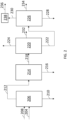
- FIG. 2 shows one embodiment of the disclosure where the separation steps are arranged in a particular order.
- a process stream that has already been separated from fermentation broth and comprises ethyl acetate, at least one thiol, methanol, at least one compound having 3 or more carbon atoms and ethanol is conducted in line 204 and introduced to vessel 206 where ethyl acetate is removed.
- Base such as sodium hydroxide, is introduced to vessel 206 in line 208. The base reacts with ethyl acetate to form sodium acetate which removed in line 210.
- the ethyl acetate-depleted process stream is passed from vessel 206 to vessel 214 via line 212.
- Vessel 214 houses an adsorbent capable of adsorbing at least one thiol.
- the process stream depleted in ethyl-acetate and thiol is passed from vessel 214 to vessel 220 in line 218.
- the thiol adsorbed by the adsorbent is desorbed in a desorption step and removed via line 216.
- Vessel 220 is a distillation column where methanol is removed as an overhead in line 224, and the bottoms in line 222 containing ethanol and at least one compound having 3 or more carbon atoms is passed to vessel 226.
- Optional side-draw 232 is also shown where fusel oils and/or sulfur containing compounds may be withdrawn.
- Vessel 226 is a distillation column where the at least one compound having 3 or more carbon atoms is removed in bottoms stream 228.
- Optional side-draw 234 is also shown where fusel oils and/or sulfur containing compounds may be withdrawn.
- Purified ethanol is removed in overhead line 230.
- purified ethanol in line 230 may be dried in ethanol dehydration unit 238 to provide purified dehydrated ethanol in line 236.
- Ethanol dehydration unit 238 may be a membrane system or a PSA.
- FIG. 3 Shows the portion of the embodiment of the generation of the fermentation broth and the separation and removal of microbial biomass to generate the microbial biomass depleted process stream.
- Industrial process or gasification unit 310 provides substrate in conduit 304 which is passed into bioreactor 300 where it is fermented using a microorganism to produce the target product such as ethanol.
- Fermentation broth 312 comprising microbial biomass, ethyl acetate, at least one thiol, methanol, at least one compound having 3 or more carbon atoms and ethanol is removed from bioreactor 300 and passed to separator 314 where microbial biomass is separated into line 316 and recycled to bioreactor 300.
Landscapes
- Chemical & Material Sciences (AREA)
- Organic Chemistry (AREA)
- Chemical Kinetics & Catalysis (AREA)
- Wood Science & Technology (AREA)
- Engineering & Computer Science (AREA)
- Life Sciences & Earth Sciences (AREA)
- Zoology (AREA)
- General Chemical & Material Sciences (AREA)
- Health & Medical Sciences (AREA)
- Microbiology (AREA)
- Biotechnology (AREA)
- Biochemistry (AREA)
- Bioinformatics & Cheminformatics (AREA)
- General Engineering & Computer Science (AREA)
- General Health & Medical Sciences (AREA)
- Genetics & Genomics (AREA)
- Analytical Chemistry (AREA)
- Preparation Of Compounds By Using Micro-Organisms (AREA)
- Organic Low-Molecular-Weight Compounds And Preparation Thereof (AREA)
- Separation Of Gases By Adsorption (AREA)
Claims (13)
- Verfahren zum Gewinnen von Ethanol aus einer Fermentationsbrühe (102), umfassend mikrobielle Biomasse, Ethanol, Methanol, Ethylacetat, mindestens ein Thiol und mindestens eine Verbindung mit 3 oder mehreren Kohlenstoffatomen, wobei das Verfahren Folgendes umfasst:a. Trennen (104) von mindestens einer mikrobiellen Biomasse von der Fermentationsbrühe, um einen Prozessstrom zu generieren, umfassend Ethanol, Methanol, Ethylacetat, mindestens ein Thiol und mindestens eine Verbindung mit 3 oder mehreren Kohlenstoffatomen;b. Entfernen, in jeglicher Reihenfolge aus dem Prozessstrom, von Folgendem:i. Ethylacetat durch Reagieren von Ethylacetat mit einer Basenverbindung, gefolgt von Destillation (109, 114);ii. mindestens einem Thiol durch Adsorption oder Reaktion auf Disulfid (111, 113);iii. Methanol durch Destillation (117, 122);iv. Verbindungen mit 3 oder mehreren Kohlenstoffatomen durch Destillation (119, 121); undc. Gewinnen von Ethanol durch Destillation (122), wobei die Destillationen in einer einzelnen Kolonne oder zwei oder mehreren Kolonnen durchgeführt werden können.
- Verfahren nach Anspruch 1, wobei die Fermentationsbrühe und der Prozessstrom ferner Acetaldehyd umfassen und das Verfahren ferner das Entfernen des Acetaldehyds aus dem Prozessstrom unter Verwendung eines Metalls umfasst, um das Acetaldehyd zu einem Acetat zu oxidieren, gefolgt von Destillation.
- Verfahren nach Anspruch 1, wobei die Fermentationsbrühe und der Prozessstrom ferner mindestens ein Aldehyd umfassen und das Verfahren ferner das Entfernen des Aldehyds in Schritt b. umfasst, durch Reduzieren des Aldehyds zu einem Alkohol oder Reagieren des Aldehyds, um ein Alkan zu bilden, wobei bevorzugt:(a) das Reduzieren zu einem Alkohol unter Verwendung eines reaktiven Metalls, Amalgams oder einer Verbindung durchgeführt wird, umfassend ein reaktives Metall, wobei bevorzugter das reaktive Metall, Amalgam oder die Verbindung Zink oder Aluminium umfasst;(b) das Reagieren, um ein Alkan zu bilden, durch Behandlung mit Hydrazin durchgeführt wird; oder(c) das Entfernen von mindestens einem Aldehyd Teil von Schritt b Teilschritt i ist.
- Verfahren nach Anspruch 1, wobei das Ethanol als Teil der Destillation von Schritt b Teilschritt iii. (117, 122) oder Schritt b Teilschritt iv. (119, 121) entfernt wird.
- Verfahren nach Anspruch 1, wobei in Schritt b Teilschritte i. und ii. (112) vor Teilschritten iii. und iv. (120) durchgeführt werden.
- Verfahren nach Anspruch 1, wobei die mindestens eine Destillation in einer inerten Atmosphäre durchgeführt wird.
- Verfahren nach Anspruch 1, wobei alle Destillationen in einer inerten Atmosphäre durchgeführt werden.
- Verfahren nach Anspruch 1, wobei das Entfernen von mindestens einem Thiol (111, 113) in Luft oder unter einer inerten Atmosphäre durchgeführt wird.
- Verfahren nach Anspruch 1, wobei die Adsorption (111, 113) ein stark saures Kationenaustauschharz einsetzt, wobei bevorzugt das stark saure Kationenaustauschharz Ag an einem auf makroretikulärem Polystyrol basierten Ionenaustauschharz mit stark sauen Sulfongruppen ist.
- Verfahren nach Anspruch 1, wobei die Fermentationsbrühe (102) und der Prozessstrom ferner Verunreinigungen umfassen und das Verfahren ferner das Behandeln des Prozessstrom mit einem Adsorptionsmittel umfasst, um Verunreinigungen zu entfernen, wobei bevorzugt das Adsorptionsmittel Aktivkohlenstoff, Aktivkohle oder ein stark saures Kationenaustauschharz ist, wobei bevorzugter das stark saure Kationenaustauschharz Ag an einem auf makroretikulärem Polystyrol basierten Ionenaustauschharz mit stark sauen Sulfongruppen ist.
- Verfahren nach Anspruch 1, ferner umfassend (1) Entfernen von Fuselöl durch Destillation in Schritt b iii. (117, 122), in Schritt c (122) oder sowohl in Schritt b iii. (117, 122) als auch Schritt c (122); (2) Entfernen von mindestens einer schwefelhaltigen Verbindung durch Destillation in Schritt b iii. (117, 122), in Schritt c (122) oder sowohl in Schritt b iii. (117, 122) als auch Schritt c (122); oder (3) Fermentieren eines Industrieabgases oder eines Synthesegases aus einem Vergasungsprozess (310) unter Verwendung eines Mikroorganismus, um die Fermentationsbrühe (102) zu generieren.
- Verfahren nach Anspruch 1, wobei das Verfahren Folgendes umfasst:a. Trennen (104) von mindestens einer mikrobiellen Biomasse von der Fermentationsbrühe (102), um einen Prozessstrom zu generieren, umfassend Ethanol, Methanol, Ethylacetat, mindestens ein Thiol und mindestens eine Verbindung mit 3 oder mehreren Kohlenstoffatomen;b. Entfernen von Ethylacetat aus dem Prozessstrom durch Reagieren von Ethylacetat mit einer Basenverbindung, gefolgt von Destillation (109), um einen Ethylacetat-erschöpften Strom zu generieren;c. Entfernen von mindestens einem Thiol aus dem Ethylacetat-erschöpften Strom durch Adsorption oder Reaktion auf Disulfid (111), um einen Thiol-erschöpften Strom zu generieren; undd. Trennen von Methanol, Ethanol und Verbindungen mit 3 oder mehreren Kohlenstoffatomen von dem Thiol-erschöpften Strom durch Destillation (120), wobei die Destillation in einer einzelnen Kolonne oder in zwei oder mehreren Kolonnen durchgeführt werden kann.
- Verfahren nach Anspruch 1, wobei das Verfahren Folgendes umfasst:a. Trennen (104) von mindestens mikrobieller Biomasse von der Fermentationsbrühe (102), um einen Prozessstrom zu generieren, umfassend Ethanol, Methanol, Ethylacetat, mindestens ein Thiol und mindestens eine Verbindung mit 3 oder mehreren Kohlenstoffatomen;b. Entfernen von mindestens einem Thiol aus dem Prozessstrom durch Adsorption oder Reaktion auf Disulfid (113), um einen Thiol-erschöpften Strom zu generieren;c. Entfernen von Ethylacetat aus dem Thiol-erschöpften Strom durch Reagieren von Ethylacetat mit einer Basenverbindung, gefolgt von Destillation (114), um einen Ethylacetat-erschöpften Strom zu generieren; undd. Trennen von Methanol, Ethanol und Verbindungen mit 3 oder mehreren Kohlenstoffatomen von dem Ethylacetat-erschöpften Strom durch Destillation (120), wobei die Destillation in einer einzelnen Kolonne oder in zwei oder mehreren Kolonnen durchgeführt werden kann.
Applications Claiming Priority (3)
| Application Number | Priority Date | Filing Date | Title |
|---|---|---|---|
| US202062988176P | 2020-03-11 | 2020-03-11 | |
| US17/183,204 US11731926B2 (en) | 2020-03-11 | 2021-02-23 | Process for purification of products |
| PCT/US2021/020796 WO2021183357A1 (en) | 2020-03-11 | 2021-03-04 | Process for purification of products |
Publications (4)
| Publication Number | Publication Date |
|---|---|
| EP4065722A1 EP4065722A1 (de) | 2022-10-05 |
| EP4065722A4 EP4065722A4 (de) | 2023-10-04 |
| EP4065722B1 true EP4065722B1 (de) | 2025-02-26 |
| EP4065722C0 EP4065722C0 (de) | 2025-02-26 |
Family
ID=77617421
Family Applications (1)
| Application Number | Title | Priority Date | Filing Date |
|---|---|---|---|
| EP21767035.5A Active EP4065722B1 (de) | 2020-03-11 | 2021-03-04 | Verfahren zur reinigung von produkten |
Country Status (13)
| Country | Link |
|---|---|
| US (1) | US12275691B2 (de) |
| EP (1) | EP4065722B1 (de) |
| JP (1) | JP7440643B2 (de) |
| KR (1) | KR102508039B1 (de) |
| CN (2) | CN216106703U (de) |
| AU (1) | AU2021234241B2 (de) |
| BR (1) | BR112022013249B1 (de) |
| CA (1) | CA3163619C (de) |
| ES (1) | ES3013885T3 (de) |
| MY (1) | MY193502A (de) |
| PH (1) | PH12022551637A1 (de) |
| TW (1) | TWI760140B (de) |
| ZA (1) | ZA202207332B (de) |
Families Citing this family (3)
| Publication number | Priority date | Publication date | Assignee | Title |
|---|---|---|---|---|
| WO2020163020A1 (en) | 2019-02-08 | 2020-08-13 | Lanzatech, Inc. | Process for recovering close boiling products |
| JP7440643B2 (ja) * | 2020-03-11 | 2024-02-28 | ランザテク,インコーポレイテッド | 生成物の精製プロセス |
| US20230113411A1 (en) * | 2021-10-13 | 2023-04-13 | Lanzatech, Inc. | Flexible product separation and recovery |
Family Cites Families (15)
| Publication number | Priority date | Publication date | Assignee | Title |
|---|---|---|---|---|
| DE3143734A1 (de) | 1981-11-04 | 1983-05-11 | Hoechst Ag, 6230 Frankfurt | Verfahren zur kontinuierlichen rektifikation eines alkohole enthaltenden fluessigkeitsgemisches" |
| US5800681A (en) | 1997-04-21 | 1998-09-01 | Berg; Lloyd | Separation of ethanol, isopropanol and water mixtures by extractive distillation |
| US20070284310A1 (en) * | 2006-06-12 | 2007-12-13 | Van Leeuwen Johannes | Method and system for purifying ethanol |
| CN102238990B (zh) * | 2008-10-03 | 2014-07-23 | 代谢探索者公司 | 使用降膜、刮膜、薄膜或短程蒸发器从发酵液纯化醇的方法 |
| US20100120104A1 (en) * | 2008-11-06 | 2010-05-13 | John Stuart Reed | Biological and chemical process utilizing chemoautotrophic microorganisms for the chemosythetic fixation of carbon dioxide and/or other inorganic carbon sources into organic compounds, and the generation of additional useful products |
| CN103221547B (zh) * | 2010-11-09 | 2015-12-09 | 绿源乙醇公司 | 用于从木质纤维素性生物质生产乙醇的连续方法 |
| CN102617281A (zh) | 2011-01-28 | 2012-08-01 | 株式会社大赛璐 | 从醇中除去硫化合物的方法 |
| US8927784B2 (en) * | 2011-04-26 | 2015-01-06 | Celanese International Corporation | Process to recover alcohol from an ethyl acetate residue stream |
| US8686200B2 (en) * | 2011-04-26 | 2014-04-01 | Celanese International Corporation | Process to recover alcohol from an acidic residue stream |
| CN110452934A (zh) * | 2012-05-23 | 2019-11-15 | 朗泽科技新西兰有限公司 | 发酵和模拟移动床过程 |
| NZ743055A (en) * | 2013-03-08 | 2020-03-27 | Xyleco Inc | Equipment protecting enclosures |
| AU2017214562B2 (en) * | 2016-02-04 | 2021-05-20 | Lanzatech Nz, Inc. | Low pressure separator having an internal divider and uses therefor |
| AU2018240178B2 (en) * | 2017-03-20 | 2023-10-05 | Lanzatech, Inc. | A process and system for product recovery and cell recycle |
| CN110760548A (zh) * | 2019-08-26 | 2020-02-07 | 王松 | 一种甘蔗生产乙醇的系统及方法 |
| JP7440643B2 (ja) * | 2020-03-11 | 2024-02-28 | ランザテク,インコーポレイテッド | 生成物の精製プロセス |
-
2021
- 2021-03-04 JP JP2022540828A patent/JP7440643B2/ja active Active
- 2021-03-04 AU AU2021234241A patent/AU2021234241B2/en active Active
- 2021-03-04 KR KR1020227022574A patent/KR102508039B1/ko active Active
- 2021-03-04 EP EP21767035.5A patent/EP4065722B1/de active Active
- 2021-03-04 BR BR112022013249-2A patent/BR112022013249B1/pt active IP Right Grant
- 2021-03-04 CA CA3163619A patent/CA3163619C/en active Active
- 2021-03-04 ES ES21767035T patent/ES3013885T3/es active Active
- 2021-03-04 MY MYPI2022003639A patent/MY193502A/en unknown
- 2021-03-04 PH PH1/2022/551637A patent/PH12022551637A1/en unknown
- 2021-03-10 CN CN202120506690.3U patent/CN216106703U/zh not_active Withdrawn - After Issue
- 2021-03-10 CN CN202110260178.XA patent/CN113387773B/zh active Active
- 2021-03-11 TW TW110108634A patent/TWI760140B/zh active
-
2022
- 2022-07-01 ZA ZA2022/07332A patent/ZA202207332B/en unknown
-
2023
- 2023-07-14 US US18/352,623 patent/US12275691B2/en active Active
Also Published As
| Publication number | Publication date |
|---|---|
| JP2023503181A (ja) | 2023-01-26 |
| TW202144314A (zh) | 2021-12-01 |
| BR112022013249A2 (pt) | 2022-09-06 |
| US20230357112A1 (en) | 2023-11-09 |
| CA3163619A1 (en) | 2021-09-16 |
| KR102508039B1 (ko) | 2023-03-08 |
| CN216106703U (zh) | 2022-03-22 |
| EP4065722A4 (de) | 2023-10-04 |
| PH12022551637A1 (en) | 2023-07-17 |
| CN113387773A (zh) | 2021-09-14 |
| EP4065722A1 (de) | 2022-10-05 |
| ZA202207332B (en) | 2024-11-27 |
| US12275691B2 (en) | 2025-04-15 |
| MY193502A (en) | 2022-10-17 |
| KR20220100091A (ko) | 2022-07-14 |
| AU2021234241A1 (en) | 2022-07-21 |
| AU2021234241B2 (en) | 2023-02-02 |
| EP4065722C0 (de) | 2025-02-26 |
| JP7440643B2 (ja) | 2024-02-28 |
| ES3013885T3 (en) | 2025-04-15 |
| CA3163619C (en) | 2023-04-11 |
| CN113387773B (zh) | 2023-11-28 |
| TWI760140B (zh) | 2022-04-01 |
| BR112022013249B1 (pt) | 2023-03-14 |
Similar Documents
| Publication | Publication Date | Title |
|---|---|---|
| US12275691B2 (en) | Process for purification of products | |
| US12312300B2 (en) | Process for recovering close boiling products | |
| KR101588052B1 (ko) | 발효액으로부터 부티르산을 추출하고 부티르산을 바이오연료로 화학적으로 전환하는 방법 | |
| WO2012026833A1 (en) | Process for producing ethanol and ethylene via fermentation | |
| US11731926B2 (en) | Process for purification of products | |
| US20240011166A1 (en) | Sustainable biomass production | |
| EA042329B1 (ru) | Способ очистки продуктов | |
| CA1192141A (en) | Concentration of organic chemicals from dilute aqueous solutions | |
| US20230113411A1 (en) | Flexible product separation and recovery | |
| EA045094B1 (ru) | Способ извлечения продуктов с близкими температурами кипения |
Legal Events
| Date | Code | Title | Description |
|---|---|---|---|
| STAA | Information on the status of an ep patent application or granted ep patent |
Free format text: STATUS: THE INTERNATIONAL PUBLICATION HAS BEEN MADE |
|
| PUAI | Public reference made under article 153(3) epc to a published international application that has entered the european phase |
Free format text: ORIGINAL CODE: 0009012 |
|
| STAA | Information on the status of an ep patent application or granted ep patent |
Free format text: STATUS: REQUEST FOR EXAMINATION WAS MADE |
|
| 17P | Request for examination filed |
Effective date: 20220701 |
|
| AK | Designated contracting states |
Kind code of ref document: A1 Designated state(s): AL AT BE BG CH CY CZ DE DK EE ES FI FR GB GR HR HU IE IS IT LI LT LU LV MC MK MT NL NO PL PT RO RS SE SI SK SM TR |
|
| DAV | Request for validation of the european patent (deleted) | ||
| DAX | Request for extension of the european patent (deleted) | ||
| A4 | Supplementary search report drawn up and despatched |
Effective date: 20230830 |
|
| RIC1 | Information provided on ipc code assigned before grant |
Ipc: C12M 1/00 20060101ALI20230825BHEP Ipc: C12P 7/06 20060101AFI20230825BHEP |
|
| GRAP | Despatch of communication of intention to grant a patent |
Free format text: ORIGINAL CODE: EPIDOSNIGR1 |
|
| STAA | Information on the status of an ep patent application or granted ep patent |
Free format text: STATUS: GRANT OF PATENT IS INTENDED |
|
| INTG | Intention to grant announced |
Effective date: 20240531 |
|
| GRAJ | Information related to disapproval of communication of intention to grant by the applicant or resumption of examination proceedings by the epo deleted |
Free format text: ORIGINAL CODE: EPIDOSDIGR1 |
|
| STAA | Information on the status of an ep patent application or granted ep patent |
Free format text: STATUS: REQUEST FOR EXAMINATION WAS MADE |
|
| GRAP | Despatch of communication of intention to grant a patent |
Free format text: ORIGINAL CODE: EPIDOSNIGR1 |
|
| STAA | Information on the status of an ep patent application or granted ep patent |
Free format text: STATUS: GRANT OF PATENT IS INTENDED |
|
| INTC | Intention to grant announced (deleted) | ||
| INTG | Intention to grant announced |
Effective date: 20240920 |
|
| GRAS | Grant fee paid |
Free format text: ORIGINAL CODE: EPIDOSNIGR3 |
|
| GRAA | (expected) grant |
Free format text: ORIGINAL CODE: 0009210 |
|
| STAA | Information on the status of an ep patent application or granted ep patent |
Free format text: STATUS: THE PATENT HAS BEEN GRANTED |
|
| AK | Designated contracting states |
Kind code of ref document: B1 Designated state(s): AL AT BE BG CH CY CZ DE DK EE ES FI FR GB GR HR HU IE IS IT LI LT LU LV MC MK MT NL NO PL PT RO RS SE SI SK SM TR |
|
| REG | Reference to a national code |
Ref country code: GB Ref legal event code: FG4D |
|
| REG | Reference to a national code |
Ref country code: CH Ref legal event code: EP |
|
| REG | Reference to a national code |
Ref country code: DE Ref legal event code: R096 Ref document number: 602021026826 Country of ref document: DE |
|
| REG | Reference to a national code |
Ref country code: IE Ref legal event code: FG4D |
|
| U01 | Request for unitary effect filed |
Effective date: 20250226 |
|
| U07 | Unitary effect registered |
Designated state(s): AT BE BG DE DK EE FI FR IT LT LU LV MT NL PT RO SE SI Effective date: 20250307 |
|
| REG | Reference to a national code |
Ref country code: ES Ref legal event code: FG2A Ref document number: 3013885 Country of ref document: ES Kind code of ref document: T3 Effective date: 20250415 |
|
| PGFP | Annual fee paid to national office [announced via postgrant information from national office to epo] |
Ref country code: NO Payment date: 20250319 Year of fee payment: 5 |
|
| PGFP | Annual fee paid to national office [announced via postgrant information from national office to epo] |
Ref country code: GB Payment date: 20250325 Year of fee payment: 5 |
|
| U20 | Renewal fee for the european patent with unitary effect paid |
Year of fee payment: 5 Effective date: 20250325 |
|
| PG25 | Lapsed in a contracting state [announced via postgrant information from national office to epo] |
Ref country code: RS Free format text: LAPSE BECAUSE OF FAILURE TO SUBMIT A TRANSLATION OF THE DESCRIPTION OR TO PAY THE FEE WITHIN THE PRESCRIBED TIME-LIMIT Effective date: 20250526 |
|
| PG25 | Lapsed in a contracting state [announced via postgrant information from national office to epo] |
Ref country code: PL Free format text: LAPSE BECAUSE OF FAILURE TO SUBMIT A TRANSLATION OF THE DESCRIPTION OR TO PAY THE FEE WITHIN THE PRESCRIBED TIME-LIMIT Effective date: 20250226 |
|
| PGFP | Annual fee paid to national office [announced via postgrant information from national office to epo] |
Ref country code: ES Payment date: 20250423 Year of fee payment: 5 |
|
| PG25 | Lapsed in a contracting state [announced via postgrant information from national office to epo] |
Ref country code: IS Free format text: LAPSE BECAUSE OF FAILURE TO SUBMIT A TRANSLATION OF THE DESCRIPTION OR TO PAY THE FEE WITHIN THE PRESCRIBED TIME-LIMIT Effective date: 20250626 |
|
| PG25 | Lapsed in a contracting state [announced via postgrant information from national office to epo] |
Ref country code: HR Free format text: LAPSE BECAUSE OF FAILURE TO SUBMIT A TRANSLATION OF THE DESCRIPTION OR TO PAY THE FEE WITHIN THE PRESCRIBED TIME-LIMIT Effective date: 20250226 |
|
| PG25 | Lapsed in a contracting state [announced via postgrant information from national office to epo] |
Ref country code: GR Free format text: LAPSE BECAUSE OF FAILURE TO SUBMIT A TRANSLATION OF THE DESCRIPTION OR TO PAY THE FEE WITHIN THE PRESCRIBED TIME-LIMIT Effective date: 20250527 |
|
| PGFP | Annual fee paid to national office [announced via postgrant information from national office to epo] |
Ref country code: TR Payment date: 20250403 Year of fee payment: 5 |
|
| PG25 | Lapsed in a contracting state [announced via postgrant information from national office to epo] |
Ref country code: SM Free format text: LAPSE BECAUSE OF FAILURE TO SUBMIT A TRANSLATION OF THE DESCRIPTION OR TO PAY THE FEE WITHIN THE PRESCRIBED TIME-LIMIT Effective date: 20250226 |
|
| PG25 | Lapsed in a contracting state [announced via postgrant information from national office to epo] |
Ref country code: CZ Free format text: LAPSE BECAUSE OF FAILURE TO SUBMIT A TRANSLATION OF THE DESCRIPTION OR TO PAY THE FEE WITHIN THE PRESCRIBED TIME-LIMIT Effective date: 20250226 |
|
| REG | Reference to a national code |
Ref country code: CH Ref legal event code: H13 Free format text: ST27 STATUS EVENT CODE: U-0-0-H10-H13 (AS PROVIDED BY THE NATIONAL OFFICE) Effective date: 20251023 |
|
| PG25 | Lapsed in a contracting state [announced via postgrant information from national office to epo] |
Ref country code: SK Free format text: LAPSE BECAUSE OF FAILURE TO SUBMIT A TRANSLATION OF THE DESCRIPTION OR TO PAY THE FEE WITHIN THE PRESCRIBED TIME-LIMIT Effective date: 20250226 |
|
| PG25 | Lapsed in a contracting state [announced via postgrant information from national office to epo] |
Ref country code: MC Free format text: LAPSE BECAUSE OF FAILURE TO SUBMIT A TRANSLATION OF THE DESCRIPTION OR TO PAY THE FEE WITHIN THE PRESCRIBED TIME-LIMIT Effective date: 20250226 |
|
| PLBE | No opposition filed within time limit |
Free format text: ORIGINAL CODE: 0009261 |
|
| STAA | Information on the status of an ep patent application or granted ep patent |
Free format text: STATUS: NO OPPOSITION FILED WITHIN TIME LIMIT |
|
| PG25 | Lapsed in a contracting state [announced via postgrant information from national office to epo] |
Ref country code: CH Free format text: LAPSE BECAUSE OF NON-PAYMENT OF DUE FEES Effective date: 20250331 |
|
| PG25 | Lapsed in a contracting state [announced via postgrant information from national office to epo] |
Ref country code: IE Free format text: LAPSE BECAUSE OF NON-PAYMENT OF DUE FEES Effective date: 20250304 |
|
| 26N | No opposition filed |
Effective date: 20251127 |