EP4064607A1 - Verschlüsselungsvorrichtung, entschlüsselungsvorrichtung, verschlüsselungsverfahren, entschlüsselungsverfahren, verschlüsselungsprogramm und entschlüsselungsprogramm - Google Patents
Verschlüsselungsvorrichtung, entschlüsselungsvorrichtung, verschlüsselungsverfahren, entschlüsselungsverfahren, verschlüsselungsprogramm und entschlüsselungsprogramm Download PDFInfo
- Publication number
- EP4064607A1 EP4064607A1 EP20917991.0A EP20917991A EP4064607A1 EP 4064607 A1 EP4064607 A1 EP 4064607A1 EP 20917991 A EP20917991 A EP 20917991A EP 4064607 A1 EP4064607 A1 EP 4064607A1
- Authority
- EP
- European Patent Office
- Prior art keywords
- value
- bit
- bits
- integer
- authenticator
- Prior art date
- Legal status (The legal status is an assumption and is not a legal conclusion. Google has not performed a legal analysis and makes no representation as to the accuracy of the status listed.)
- Granted
Links
Images








Classifications
-
- H—ELECTRICITY
- H04—ELECTRIC COMMUNICATION TECHNIQUE
- H04L—TRANSMISSION OF DIGITAL INFORMATION, e.g. TELEGRAPHIC COMMUNICATION
- H04L9/00—Cryptographic mechanisms or cryptographic arrangements for secret or secure communications; Network security protocols
- H04L9/06—Cryptographic mechanisms or cryptographic arrangements for secret or secure communications; Network security protocols the encryption apparatus using shift registers or memories for block-wise or stream coding, e.g. DES systems or RC4; Hash functions; Pseudorandom sequence generators
- H04L9/0618—Block ciphers, i.e. encrypting groups of characters of a plain text message using fixed encryption transformation
- H04L9/0637—Modes of operation, e.g. cipher block chaining [CBC], electronic codebook [ECB] or Galois/counter mode [GCM]
-
- H—ELECTRICITY
- H04—ELECTRIC COMMUNICATION TECHNIQUE
- H04L—TRANSMISSION OF DIGITAL INFORMATION, e.g. TELEGRAPHIC COMMUNICATION
- H04L9/00—Cryptographic mechanisms or cryptographic arrangements for secret or secure communications; Network security protocols
- H04L9/06—Cryptographic mechanisms or cryptographic arrangements for secret or secure communications; Network security protocols the encryption apparatus using shift registers or memories for block-wise or stream coding, e.g. DES systems or RC4; Hash functions; Pseudorandom sequence generators
- H04L9/0618—Block ciphers, i.e. encrypting groups of characters of a plain text message using fixed encryption transformation
Definitions
- the present invention relates to an authenticated cipher algorithm which uses a block cipher.
- An authenticated cipher algorithm is a cipher algorithm that realizes a confidentiality function and a tamper-detection function.
- an authenticated cipher algorithm is used, two parties can communicate with each other while concealing messages. Also, the recipient can check whether a sent message is tampered or not.
- the authenticated cipher algorithm includes two algorithms which are an encryption function Enc and a decryption function Dec.
- the encryption function Enc is a function that takes as input a private key K, a nonce N, open data A, and a plaintext M and outputs a ciphertext C and a tamper-detecting authenticator T.
- the nonce N a different value is used for each encryption, and the same value is not used unless the private key K is changed.
- the decryption function Dec takes as input the private key K, the nonce N, the open data A, the ciphertext C, and a tamper-detection authenticator T'. If the input value is not tampered, the decryption function Dec outputs the plaintext M. If the input value is tampered, the decryption function Dec outputs a value indicating that the input value is forged. The value indicating that the input value is forged will be expressed as ⁇ hereinafter.
- the private key K is shared by the sender Alice and the recipient Bob in advance.
- the sender Alice takes as input the private key K, the nonce N, the open data A, and the plaintext M, and calculates the ciphertext C and the tamper-detection authenticator T with using the encryption function Enc. Then, the sender Alice sends the nonce N, the open data A, the ciphertext C, and the tamper-detection authenticator T to the recipient Bob.
- the recipient Bob takes the private key K, the nonce N, the open data A, the ciphertext C, and the tamper-detection authenticator T, as input to the decryption function Dec. If none of the nonce N, the open data A, the ciphertext C, and the tamper-detection authenticator T is tampered, the decryption function Dec outputs the plaintext M.
- the open data A is a value that can be open to public.
- the open data A need not be necessarily used.
- the sender Alice uses, as the nonce N, a different value for each encryption, and does not use the same value.
- Confidentiality signifies security defining that a plaintext will not be revealed from a ciphertext.
- an attacker accesses either one of an authenticated cipher type encryption function Enc and an oracle which outputs a random number, and the attacker identifies which one he or she is accessing.
- a probability that the attacker identifies an accessing target correctly is referred to as an identification probability. The lower the identification probability, the higher the confidentiality security.
- Integrity signifies security defining that open data or a ciphertext cannot be tampered.
- an attacker access an encryption function Enc and decryption function Dec of an authenticated cipher type, and inputs forged open data, a forged ciphertext, and a forged authenticator to the decryption function Dec, aiming to pass a tamper check.
- a probability that the tamper check is passed is referred to as a forging probability. The lower the forging probability, the higher the integrity security.
- the Tweakable block cipher is constituted of an encryption function E and a decryption function D.
- the size b of each of the plaintext block M and the ciphertext block C is referred to as a block size.
- the encryption function E and decryption function D of the Tweakable block cipher are each turned into a b-bit permutation function by fixing the key K and the Tweak value TW.
- a secret value is used as the key K
- an open value is used as the Tweak value TW.
- a set of Tweak values will be referred to as TWset.
- a set of keys will be referred to as Kset. That is, the Tweak value TW is selected from TWset, and the key K is selected from Kset.
- Non-Patent Literatures 2 and 3 describe an algorithm of a specific Tweakable block cipher.
- Non-Patent Literature 2 describes examples of specific values of TWset, Kset, and the block size b of the Tweakable block cipher.
- SKINNY-128-384 described in Non-Patent Literature 2 is a Tweakable block cipher having a 128-bit block size and a Tweak value length and a key length that total to 384 bits.
- the encryption function Enc is constituted with using the encryption function E of the Tweakable block cipher
- the decryption function Dec is constituted with using the encryption function E or decryption function D of the Tweakable block cipher.
- the identification probability against these techniques is 0.
- the forging probability is q D /2 b for an access number time q D to the decryption function Dec of the authenticated cipher.
- Non-Patent Literature 1 Tetsu Iwata, Keisuke Ohashi, and Kazuhiko Minematsu. Breaking and Repairing GCM Security Proofs. CRYPTO 2012, Proceedings. pages 31-49. Lecture Notes in Computer Science volume 7417. Springer. 2012 .
- Non-Patent Literature 2 Christof Beierle, Jeremy Jean, Stefan Kolbl, Gregor Leander, Amir Moradi, Thomas Peyrin, Yu Sasaki, Pascal Sasdrich, and Siang Meng Sim.
- Non-Patent Literature 3 Jeremy Jean, Ivica Nikolic, and Thomas Peyrin. Tweaks and Keys for Block Ciphers: The TWEAKEY Framework.ASIACRYPT 2014, Proceedings, Part II. pages 274-288. Lecture Notes in Computer Science volume 8874. Springer. 2014 .
- Non-Patent Literature 4 Ted Krovetz and Phillip Rogaway. The Software Performance of Authenticated-Encryption Modes. FSE 2011. pages 306-327. Lecture Notes in Computer Science volume 6733. Springer. 2011 .
- Non-Patent Literature 5 Yusuke Naito and Takeshi Sugawara. Lightweight Authenticated Encryption Mode of Operation for Tweakable Block Ciphers. IACR Trans. Cryptogr. Hardw. Embed. Syst. 2020 volume 1. pages 66-94 .
- Non-Patent Literature 6 Tetsu Iwata, Mustafa Khairatti, Kazuhiko Minematsu, and Thomas Peyrin. Duel of the Titans: The Romulus and Remus Families of Lightweight AEAD Algorithms. IACR Cryptology ePrint Archive 2019/992 .
- Non-Patent Literatures 4 to 6 each of which uses a Tweakable block cipher, a b-bit value is updated by the decryption function Dec side likewise.
- collision of b-bit values is utilized, the integrity of the authenticated cipher is breached.
- Collision of b-bit values signifies that for two different inputs to an authenticated cipher, the same b-bit value is resulted.
- keys of the authenticated cipher are updated before the identification probability or forging probability becomes 1. Meanwhile, key update takes time and cost, and accordingly an authenticated cipher in which one key has a long life, that is, an updated frequency is low, is desirable.
- An authenticated cipher having a lower identification probability and a lower forging probability, that is, a higher bit security, can reduce the key update frequency more.
- An objective of the present disclosure is to make feasible an authenticated cipher having a high bit security.
- An encryption device includes:
- a b-bit value S 1 is updated with using an encryption function E, and an r-bit value is updated with using an output of the encryption function E.
- a configuration of updating a (b + r)-bit value can be employed, and a bit security of (b + r) bits can be achieved.
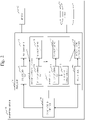
- a configuration of an encryption device 10 according to Embodiment 1 will be describe with referring to Fig. 1 .
- the encryption device 10 is provided with hardware devices which are a processor 11, a memory 12, a storage 13, and a communication interface 14.
- the processor 11 is connected to the other hardware devices via a signal line and controls the other hardware devices.
- the encryption device 10 is provided with an acquisition unit 21, a division unit 22, an open data processing unit 23, an encryption unit 24, an authenticator generation unit 25, and an output unit 26, as function constituent elements.
- the open data processing unit 23 is provided with an H1 calculation unit 231 and an H2 calculation unit 232.
- the encryption unit 24 is provided with an S1 calculation unit 241, an S2 calculation unit 242, and a ciphertext generation unit 243. Functions of the function constituent elements of the encryption device 10 are implemented by software.
- a program that implements the functions of the function constituent elements of the encryption device 10 is stored in the storage 13. This program is read into the memory 12 by the processor 11 and is run by the processor 11. The functions of the function constituent elements of the encryption device 10 are thus implemented.
- a configuration of a decryption device 30 according to Embodiment 1 will be described with referring to Fig. 2 .
- the decryption device 30 is provided with hardware devices which are a processor 31, a memory 32, a storage 33, and a communication interface 34.
- the processor 31 is connected to the other hardware devices via a signal line and controls the other hardware devices.
- the decryption device 30 is provided with an acquisition unit 41, a division unit 42, an open data processing unit 43, a decryption unit 44, an authenticator generation unit 45, and an output unit 46, as function constituent elements.
- the open data processing unit 43 is provided with an H1 calculation unit 431 and an H2 calculation unit 432.
- the decryption unit 44 is provided with an S1 calculation unit 441, an S2 calculation unit 442, and a plaintext generation unit 443. Functions of the function constituent elements of the decryption device 30 are implemented by software.
- a program that implements the functions of the function constituent elements of the decryption device 30 is stored in the storage 33. This program is read into the memory 32 by the processor 31 and is run by the processor 31. The functions of the function constituent elements of the decryption device 30 are thus implemented.
- the processors 11 and 31 are each an Integrated Circuit (IC) that performs processing. Specific examples of the processors 11 and 31 are a Central Processing Unit (CPU), a Digital Signal Processor (DSP), and a Graphics Processing Unit (GPU).
- CPU Central Processing Unit
- DSP Digital Signal Processor
- GPU Graphics Processing Unit
- the memories 12 and 32 are each a storage device that stores data temporarily. Specific examples of the memories 12 and 32 are a Static Random-Access Memory (SRAM) and a Dynamic Random-Access Memory (DRAM).
- SRAM Static Random-Access Memory
- DRAM Dynamic Random-Access Memory
- the storages 13 and 33 are each a storage device that keeps data.
- a specific example of the storages 13 and 33 is a Hard Disk Drive (HDD).
- the storages 13 and 33 may be each a portable storage medium such as a Secure Digital (SD) memory card, a CompactFlash (registered trademark, CF), a NAND flash, a flexible disk, an optical disk, a compact disk, a Blu-ray (registered trademark) Disc, and a Digital Versatile Disk (DVD).
- SD Secure Digital
- CF CompactFlash
- NAND flash NAND flash
- the communication interfaces 14 and 34 are each an interface to communicate with an external device. Specific examples of the communication interfaces 14 and 34 are an Ethernet (registered trademark) port, a Universal Serial Bus (USB) port, and a High-Definition Multimedia Interface (HDMI, registered trademark) port.
- Ethernet registered trademark
- USB Universal Serial Bus
- HDMI High-Definition Multimedia Interface
- An operation procedure of the encryption device 10 according to Embodiment 1 corresponds to an encryption method according to Embodiment 1.
- a program that implements the operations of the encryption device 10 according to Embodiment 1 corresponds to an encryption program according to Embodiment 1.
- An operation procedure of the decryption device 20 according to Embodiment 1 corresponds to a decryption method according to Embodiment 1.
- a program that implements the operations of the decryption device 20 according to Embodiment 1 corresponds to a decryption program according to Embodiment 1.
- a set of values of a nonce N is defined as Nset.
- a maximum block number of a plaintext M, a ciphertext C, and open data A is defined as L.
- a block number is a number of b-bit blocks formed by dividing a bit string of the plaintext M, the ciphertext C, or the open data A every b bits. Note that b bits is a block size in a Tweakable block cipher employed by the encryption device 10 and the decryption device 20.
- L is a minimum integer that is equal to or larger than L ⁇ /b.
- const is a fixed value being a certain value included in Nset. Note that const may be any value in Nset. It is defined that const1 is a b-bit fixed value and that const2 is an r-bit fixed value. Note that const 1 may be any b-bit value and that const2 may be any r-bit value. It is defined that r is an integer equal to or larger than 1.
- An operator of a per-bit exclusive OR is expressed as xor.
- xor An operator of a per-bit exclusive OR is expressed as xor.
- For a bit string X, a bit length of X is expressed as
- pad is a function that takes as input an input value having a bit length of b or less bits, bit-couples bits of values subsequent to the input value to generate a b-bit value, and outputs the generated b-bit value.
- pad(X), signifying an output from pad upon input of a value X having (b - 1) or less bits, is a value formed by bit-coupling 1 to follow the value X and then bit-coupling a bit string of 0 to follow 1 such that the bit length becomes b.
- pad(Y), signifying an output from pad upon input of a b-bit value Y, is Y.
- trunc[i] is a function that takes as input a b-bit value and outputs an i-bit value that is determined in advance, from among the inputted b bits.
- trunc[i] is a function that outputs a most-significant i bit from among the inputted b bits. Also, for example, trunc[i] is a function that outputs a least-significant i bit from among the inputted b bits.
- TW Nset x ⁇ 1, 2, ..., L ⁇ x ⁇ 1, 2, ..., 16 ⁇ .
- 1, 2, ..., L are different integer values. 1, 2, ..., L suffice as far as they are different integer values and are not limited to integer values 1, 2, ..., L.
- 1, 2, ..., 16 are different integer values. 1, 2, ..., 16 suffice as far as they are different integer values and are not limited to integer values 1, 2, ..., 16.
- TW is a t-bit space ⁇ 0, 1 ⁇ t , Nset ⁇ ⁇ 1, 2, ..., L ⁇ ⁇ ⁇ 1, 2, ..., 16 ⁇ suffices as far as it can be assigned to a t-bit space in 1 to 1 correspondence, and its assigning method is arbitrary.
- Nset ⁇ 0, 1 ⁇ n
- first n bits are used as Nset
- next log 2 L bits are used as ⁇ 1, 2, ..., L ⁇
- the last 4 bits are used as ⁇ 1, 2, ..., 16 ⁇
- Tweak value TW is expressed as (x, y, z) where x is a value selected from Nset, y is a value selected from ⁇ 1, 2, ..., L ⁇ , and z is a value selected from ⁇ 1, 2, ..., 16 ⁇ .
- the acquisition unit 21 acquires the open data A and the plaintext M. Specifically, the acquisition unit 21 acquires the open data A and the plaintext M which are inputted as a user operates an input device connected via the communication interface 14.
- the acquisition unit 21 acquires only the plaintext M.
- the division unit 22 divides the open data A acquired in step S11, every b bits from the beginning, thereby generating b-bit values A 1 , ..., A a - 1 and a value A a having 1 or more bits to b or less bits. Hence, when the values A 1 , ..., A a are bit-coupled, they form open data A.
- the division unit 22 also divides the plaintext M acquired in step S11, every bits from the beginning, thereby generating b-bit values M 1 , ..., M m-1 and a value M m having 1 or more bits to b or less bits. Hence, when the values M 1 , ..., M m are bit-coupled, they form a plaintext M.
- the division unit 22 only generates values M 1 , ..., M m .
- the open data processing unit 23 generates a value H 1 and a value H 2 by using the values A 1 , ..., A a generated in step S12. The open data process will be described later in detail.
- the encryption unit 24 generates a value S 1 (m) and a value S 2 (m), and a ciphertext C, by using the values M 1 , ..., M m generated in step S12 and the value H 1 and the value H 2 generated in step S13.
- the encryption process will be described later in detail.
- Step S15 Authenticator Generation Process
- the authenticator generation unit 25 generates a tamper-detection authenticator T by using the value S 1 (m) and the value S 2 (m) generated in step S14.
- the authenticator generation process will be described later in detail.
- the output unit 26 outputs the ciphertext C generated in step S 14 and the authenticator T generated in step S 15. Specifically, the output unit 26 transmits the ciphertext C and the authenticator T to the decryption device 30 via the communication interface 14.
- step S13 of Fig. 3 The open data process (step S13 of Fig. 3 ) according to Embodiment 1 will be described with referring to Figs. 4 and 5 .
- the open data processing unit 23 assigns a b-bit fixed value const1 to a value H 1 (0).
- the open data processing unit 23 also assigns an r-bit fixed value const2 to a value H 2 (0).
- the H1 calculation unit 231 generates a b-bit value pad(A a ) from the value A a with using the function pad.
- the H1 calculation unit 231 takes the key K, a Tweak value (const, a, 1), and a value A' a which is obtained by calculating an exclusive OR of the value pad(A a ) and a value H 1 (a - 1), as input to the encryption function E of the Tweakable block cipher, thereby calculating a value H 1 (a).
- the open data processing unit 23 assigns the fixed value const1 to the value H and the fixed value const2 to the value H 2 , in place of performing the processes illustrated in Figs. 4 and 5 .
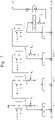
- step S14 of Fig. 3 The encryption process (step S14 of Fig. 3 ) according to Embodiment 1 will be described with referring to Figs. 6 and 7 .
- the encryption unit 24 assigns the b-bit value H 1 generated in step S133 of Fig. 4 to a value Mo.
- the encryption unit 24 also assigns the r-bit value H 2 generated in step S133 of Fig. 4 to a value S 2 (0).
- the encryption unit 24 assigns following values to a variable x in accordance with the open data A.
- the encryption unit 24 assigns 2 to the variable x.
- the encryption unit 24 assigns 7 to the variable x.
- the encryption unit 24 assigns 12 to the variable x,
- the S1 calculation unit 241 takes the key K, a Tweak value (N, m, x), and a value M m-1 , as input to the encryption function E, thereby calculating the value S 1 (m), and calculates a value C m from the value S 1 (m) and the value M m . Specifically, the S1 calculation unit 241 calculates an exclusive OR of the value M m and
- the S1 calculation unit 241 generates a b-bit value pad(C m ) from the value C m calculated in step S144, with using the function pad.
- step S15 of Fig. 3 The authentication process (step S15 of Fig. 3 ) according to Embodiment 1 will be described with referring to Figs. 8 and 9 .
- the authenticator generation unit 25 assigns following values to a variable y and a variable z in accordance with the open data A and the plaintext M.
- the authenticator generation unit 25 assigns 3 to the variable y and 4 to the variable z.
- the authenticator generation unit 25 assigns 5 to the variable y and 6 to the variable z.
- the authenticator generation unit 25 assigns 8 to the variable y and 9 to the variable z.
- the authenticator generation unit 25 assigns 10 to the variable y and 11 to the variable z.
- the authenticator generation unit 25 assigns 13 to the variable y and 14 to the variable z.
- the authenticator generation unit 25 assigns 15 to the variable y and 16 to the variable z.
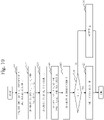
- the acquisition unit 41 acquires the open data A, the ciphertext, and an authenticator T'.
- the acquisition unit 41 acquires the open data A that has been inputted as a user operates an input device connected via the communication interface 34. Via the communication interface 34, the acquisition unit 41 also acquires the ciphertext C transmitted in step S16 of Fig. 3 and acquires, as the authenticator T', the authenticator T transmitted in step S16 of Fig. 3 .
- step S11 of Fig. 3 the acquisition unit 41 acquires only the ciphertext C and the authenticator T. If open data A is not inputted in step S11 of Fig. 3 , open data A is not inputted in step S21 either. On the other hand, if open data A is inputted in step S11 of Fig. 3 , open data A is also inputted in step S21.
- the division unit 42 divides the open data A acquired in step S21, every b bits from the beginning, thereby generating b-bit values A 1 , ..., A a - 1 and a value A a having 1 or more bits to b or less bits. Hence, when the values A 1 , ..., A a are bit-coupled, they form open data A.
- the division unit 42 also divides the ciphertext C acquired in step S21, every bits from the beginning, thereby generating b-bit values C 1 , ..., C m-1 and a value C m having 1 or more bits to b or less bits. Hence, when the values C 1 , ..., C m are bit-coupled, they form a plaintext C.
- the division unit 42 only generates values C 1 , ..., C m .
- the open data processing unit 43 generates a value H 1 and a value H 2 by using the values A 1 , ..., A a generated in step S22, as in step S13 of Fig. 3 . That is, the open data processing unit 43 generates the value H 1 and the value H 2 by the method described with referring to Figs. 4 and 5 .
- the decryption unit 44 generates a value S 1 (m) and a value S 2 (m), and a plaintext M, by using the values C 1 , ..., C m generated in step S22 and the value H 1 and the value H 2 generated in step S23.
- the decryption process will be described later in detail.
- Step 25 Authenticator Generation Process
- the authenticator generation unit 45 generates a tamper-detection authenticator T by using the value S 1 (m) and the value S 2 (m) generated in step S24, as in step S15 of Fig. 3 . That is, the authenticator generation unit 45 generates the authenticator T by the method described with referring to Figs. 8 and 9 .
- the authenticator generation unit 25 judges whether the authenticator T generated in step S25 and the authenticator T' generated in step S21 coincide with each other or not.
- the authenticator generation unit 25 judges that they are not tampered, and advances the process to step S27. If the authenticator T and the authenticator T' do not coincide, the authenticator generation unit 25 judges that they are tampered, and advances the process to step S28.
- the output unit 26 outputs the plaintext M generated in step S24. Specifically, the output unit 26 transmits the plaintext M to a user terminal or the like via the communication interface 14.
- the output unit 26 outputs a value ⁇ indicating that forging has been done.
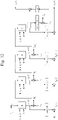
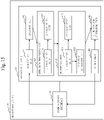
- step S24 of Fig. 10 The decryption process (step S24 of Fig. 10 ) according to Embodiment 1 will be described with referring to Figs. 11 and 12 .
- Processes from step S241 through step S242 are the same as processes S141 through step S142 of Fig. 6 . Also, a process of step S245 is the same as a process of step S145 of Fig. 6 .
- the S1 calculation unit 441 takes the key K, a Tweak value (N, m, x), and a value M m-1 , as input to the encryption function E, thereby calculating the value S 1 (m), as in step S144 of Fig. 6 .
- the S1 calculation unit 441 also calculates a value M m from the value S 1 (m) and the value C m .
- the S1 calculation unit 441 calculates an exclusive OR of the value C m and
- the encryption device 10 updates a b-bit value S 1 with using the encryption function E, and updates an r-bit value with using the output from the encryption function E.
- the decryption device 30 updates a (b + r)-bit value.
- the function constituent elements are implemented by software.
- Modification 2 may be possible in which the function constituent elements are implemented by hardware. Modification 2 will be described by focusing on its difference from Embodiment 1.
- the encryption device 10 When the function constituent elements are implemented by hardware, the encryption device 10 is provided with an electronic circuit 15, in place of the processor 11, the memory 12, and the storage 13.
- the electronic circuit 15 is a dedicated circuit that implements the functions of the function constituent elements and the functions of the memory 12 and storage 13.
- a configuration of a decryption device 30 according to Modification 2 will be described with referring to Fig. 15 .
- the encryption device 10 When the function constituent elements are implemented by hardware, the encryption device 10 is provided with an electronic circuit 35, in place of the processor 31, the memory 32, and the storage 33.
- the electronic circuit 35 is a dedicated circuit that implements the functions of the function constituent elements and the functions of the memory 32 and storage 33.
- the electronic circuit 15 or 35 a single circuit, a composite circuit, a programmed processor, a parallel-programmed processor, a logic IC, a Gate Array (GA), an Application Specific Integrated circuit (ASIC), and a Field-Programmable Gate Array (FPGA) will be considered.
- a single circuit, a composite circuit, a programmed processor, a parallel-programmed processor, a logic IC, a Gate Array (GA), an Application Specific Integrated circuit (ASIC), and a Field-Programmable Gate Array (FPGA) will be considered.
- the function constituent elements may be implemented by one electronic circuit 15 or 35.
- the function constituent elements may be implemented by a plurality of electronic circuits 15 or 35 by distribution.
- Modification 3 may be possible in which some of the function constituent elements are implemented by hardware and the remaining function constituent elements are implemented by software.
- the processors 11 and 31, the memories 12 and 32, the storages 13 and 33, and the electronic circuits 15 and 35 are referred to as processing circuitry. That is, the functions of the function constituent elements are implemented by processing circuitry.
Landscapes
- Engineering & Computer Science (AREA)
- Computer Security & Cryptography (AREA)
- Computer Networks & Wireless Communication (AREA)
- Signal Processing (AREA)
- Storage Device Security (AREA)
- Forklifts And Lifting Vehicles (AREA)
Applications Claiming Priority (1)
| Application Number | Priority Date | Filing Date | Title |
|---|---|---|---|
| PCT/JP2020/004526 WO2021157003A1 (ja) | 2020-02-06 | 2020-02-06 | 暗号化装置、復号装置、暗号化方法、復号方法、暗号化プログラム及び復号プログラム |
Publications (3)
| Publication Number | Publication Date |
|---|---|
| EP4064607A1 true EP4064607A1 (de) | 2022-09-28 |
| EP4064607A4 EP4064607A4 (de) | 2022-12-07 |
| EP4064607B1 EP4064607B1 (de) | 2023-10-18 |
Family
ID=77200820
Family Applications (1)
| Application Number | Title | Priority Date | Filing Date |
|---|---|---|---|
| EP20917991.0A Active EP4064607B1 (de) | 2020-02-06 | 2020-02-06 | Verschlüsselungsvorrichtung, entschlüsselungsvorrichtung, verschlüsselungsverfahren, entschlüsselungsverfahren, verschlüsselungsprogramm und entschlüsselungsprogramm |
Country Status (5)
| Country | Link |
|---|---|
| US (1) | US11876888B2 (de) |
| EP (1) | EP4064607B1 (de) |
| JP (1) | JP7012920B2 (de) |
| CN (1) | CN115039374B (de) |
| WO (1) | WO2021157003A1 (de) |
Families Citing this family (1)
| Publication number | Priority date | Publication date | Assignee | Title |
|---|---|---|---|---|
| US20250047464A1 (en) | 2021-11-25 | 2025-02-06 | Nec Corporation | Authenticated encryption apparatus, authenticated decryption apparatus, authenticated encryption system, method, and computer readable medium |
Family Cites Families (18)
| Publication number | Priority date | Publication date | Assignee | Title |
|---|---|---|---|---|
| JP2000286836A (ja) * | 1999-03-30 | 2000-10-13 | Fujitsu Ltd | 認証装置および記録媒体 |
| JP4752239B2 (ja) | 2000-03-09 | 2011-08-17 | 株式会社日立製作所 | 共通鍵暗号方法及び装置 |
| JP3864675B2 (ja) | 2000-03-09 | 2007-01-10 | 株式会社日立製作所 | 共通鍵暗号装置 |
| US7200227B2 (en) * | 2001-07-30 | 2007-04-03 | Phillip Rogaway | Method and apparatus for facilitating efficient authenticated encryption |
| US7725719B2 (en) * | 2005-11-08 | 2010-05-25 | International Business Machines Corporation | Method and system for generating ciphertext and message authentication codes utilizing shared hardware |
| WO2007105709A1 (ja) * | 2006-03-14 | 2007-09-20 | Nec Corporation | 情報処理システム、情報処理方法および情報処理プログラム |
| JP4810289B2 (ja) | 2006-04-17 | 2011-11-09 | ルネサスエレクトロニクス株式会社 | メッセージ認証子生成装置、メッセージ認証子検証装置、及びメッセージ認証システム |
| JP4758824B2 (ja) | 2006-05-23 | 2011-08-31 | 日本電信電話株式会社 | 暗号化装置、復号装置、暗号化方法、復号方法、それらの方法を用いたプログラム、および記録媒体 |
| WO2008018303A1 (en) | 2006-08-10 | 2008-02-14 | Nec Corporation | Adjusting function-equipped block encryption device, method, and program |
| US8577032B2 (en) | 2007-08-06 | 2013-11-05 | Nec Corporation | Common key block encryption device, common key block encryption method, and program |
| KR101612518B1 (ko) * | 2009-11-26 | 2016-04-15 | 삼성전자주식회사 | 병렬 처리 가능한 암복호화기 및 그것의 암복호 방법 |
| US20120314857A1 (en) * | 2010-02-24 | 2012-12-13 | Kazuhiko Minematsu | Block encryption device, block decryption device, block encryption method, block decryption method and program |
| JP5402832B2 (ja) | 2010-05-27 | 2014-01-29 | 株式会社Jvcケンウッド | 視点変換装置及び視点変換方法 |
| US10044499B2 (en) * | 2014-04-10 | 2018-08-07 | Fuji Electric Co., Ltd. | Information processing apparatus, program, and storage medium |
| JP6740902B2 (ja) * | 2014-08-20 | 2020-08-19 | 日本電気株式会社 | 認証暗号化方法、認証復号方法および情報処理装置 |
| WO2017056150A1 (ja) * | 2015-09-28 | 2017-04-06 | 三菱電機株式会社 | メッセージ認証子生成装置、メッセージ認証子生成方法及びメッセージ認証子生成プログラム |
| EP3584989B1 (de) * | 2018-06-18 | 2023-09-27 | Secure-IC SAS | Optimierbare blockchiffren zur sicheren datenverschlüsselung |
| CN110493202B (zh) * | 2019-07-29 | 2021-11-02 | 深圳壹账通智能科技有限公司 | 登录令牌的生成及验证方法、装置和服务器 |
-
2020
- 2020-02-06 EP EP20917991.0A patent/EP4064607B1/de active Active
- 2020-02-06 JP JP2021568934A patent/JP7012920B2/ja active Active
- 2020-02-06 CN CN202080094939.2A patent/CN115039374B/zh active Active
- 2020-02-06 WO PCT/JP2020/004526 patent/WO2021157003A1/ja not_active Ceased
-
2022
- 2022-06-15 US US17/841,080 patent/US11876888B2/en active Active
Also Published As
| Publication number | Publication date |
|---|---|
| JP7012920B2 (ja) | 2022-01-28 |
| WO2021157003A1 (ja) | 2021-08-12 |
| EP4064607B1 (de) | 2023-10-18 |
| US11876888B2 (en) | 2024-01-16 |
| CN115039374A (zh) | 2022-09-09 |
| CN115039374B (zh) | 2025-07-18 |
| US20220321322A1 (en) | 2022-10-06 |
| EP4064607A4 (de) | 2022-12-07 |
| JPWO2021157003A1 (de) | 2021-08-12 |
Similar Documents
| Publication | Publication Date | Title |
|---|---|---|
| EP3661115B1 (de) | Verschlüsselungsvorrichtung, entschlüsselungsvorrichtung, verschlüsselungsverfahren, entschlüsselungsverfahren, verschlüsselungsprogramm und entschlüsselungsprogramm | |
| US11349668B2 (en) | Encryption device and decryption device | |
| US20210157955A1 (en) | Bit decomposition secure computation apparatus, bit combining secure computation apparatus, method and program | |
| CN112640359B (zh) | 消息认证装置、消息认证方法及计算机可读取的存储介质 | |
| EP4064607B1 (de) | Verschlüsselungsvorrichtung, entschlüsselungsvorrichtung, verschlüsselungsverfahren, entschlüsselungsverfahren, verschlüsselungsprogramm und entschlüsselungsprogramm | |
| US12580732B2 (en) | Encryption device, decryption device, encryption method, decryption method, and computer readable medium | |
| US12328397B2 (en) | Memory processing apparatus, memory verification apparatus, memory updating apparatus, memory protection system, method, and computer readable medium | |
| TW201543862A (zh) | 密碼裝置、記憶系統、解碼裝置、密碼方法、解碼方法、密碼程式產品及解碼程式產品 | |
| JP6033504B1 (ja) | メッセージ認証子生成装置 | |
| US20260088985A1 (en) | Authenticated encryption device, authenticated encryption method, and computer readable medium | |
| US11177936B2 (en) | Message authenticator generation apparatus | |
| JP6830867B2 (ja) | 追加データ付き認証暗号システム、復号装置、追加データ付き認証暗号方法、およびプログラム | |
| WO2021152707A1 (ja) | 暗号システム、暗号化方法、復号方法及びプログラム | |
| JP7422953B2 (ja) | ハッシュ値計算装置、ハッシュ値計算方法及びハッシュ値計算プログラム | |
| JP6732698B2 (ja) | 追加データ付き認証暗号システム、暗号化装置、復号装置、追加データ付き認証暗号方法、およびプログラム | |
| CN117955636A (zh) | 一种高安全性的敏感数据存取方法和系统 | |
| JP2015025930A (ja) | 圧縮関数演算装置、圧縮関数演算方法及びプログラム |
Legal Events
| Date | Code | Title | Description |
|---|---|---|---|
| STAA | Information on the status of an ep patent application or granted ep patent |
Free format text: STATUS: THE INTERNATIONAL PUBLICATION HAS BEEN MADE |
|
| PUAI | Public reference made under article 153(3) epc to a published international application that has entered the european phase |
Free format text: ORIGINAL CODE: 0009012 |
|
| STAA | Information on the status of an ep patent application or granted ep patent |
Free format text: STATUS: REQUEST FOR EXAMINATION WAS MADE |
|
| 17P | Request for examination filed |
Effective date: 20220608 |
|
| AK | Designated contracting states |
Kind code of ref document: A1 Designated state(s): AL AT BE BG CH CY CZ DE DK EE ES FI FR GB GR HR HU IE IS IT LI LT LU LV MC MK MT NL NO PL PT RO RS SE SI SK SM TR |
|
| A4 | Supplementary search report drawn up and despatched |
Effective date: 20221109 |
|
| RIC1 | Information provided on ipc code assigned before grant |
Ipc: H04L 9/06 20060101AFI20221103BHEP |
|
| GRAP | Despatch of communication of intention to grant a patent |
Free format text: ORIGINAL CODE: EPIDOSNIGR1 |
|
| STAA | Information on the status of an ep patent application or granted ep patent |
Free format text: STATUS: GRANT OF PATENT IS INTENDED |
|
| DAV | Request for validation of the european patent (deleted) | ||
| DAX | Request for extension of the european patent (deleted) | ||
| RIC1 | Information provided on ipc code assigned before grant |
Ipc: H04L 9/06 20060101AFI20230406BHEP |
|
| INTG | Intention to grant announced |
Effective date: 20230502 |
|
| GRAS | Grant fee paid |
Free format text: ORIGINAL CODE: EPIDOSNIGR3 |
|
| GRAA | (expected) grant |
Free format text: ORIGINAL CODE: 0009210 |
|
| STAA | Information on the status of an ep patent application or granted ep patent |
Free format text: STATUS: THE PATENT HAS BEEN GRANTED |
|
| AK | Designated contracting states |
Kind code of ref document: B1 Designated state(s): AL AT BE BG CH CY CZ DE DK EE ES FI FR GB GR HR HU IE IS IT LI LT LU LV MC MK MT NL NO PL PT RO RS SE SI SK SM TR |
|
| REG | Reference to a national code |
Ref country code: GB Ref legal event code: FG4D |
|
| P01 | Opt-out of the competence of the unified patent court (upc) registered |
Effective date: 20230915 |
|
| REG | Reference to a national code |
Ref country code: CH Ref legal event code: EP |
|
| REG | Reference to a national code |
Ref country code: IE Ref legal event code: FG4D |
|
| REG | Reference to a national code |
Ref country code: DE Ref legal event code: R096 Ref document number: 602020019635 Country of ref document: DE |
|
| REG | Reference to a national code |
Ref country code: LT Ref legal event code: MG9D |
|
| REG | Reference to a national code |
Ref country code: NL Ref legal event code: MP Effective date: 20231018 |
|
| REG | Reference to a national code |
Ref country code: AT Ref legal event code: MK05 Ref document number: 1623460 Country of ref document: AT Kind code of ref document: T Effective date: 20231018 |
|
| PG25 | Lapsed in a contracting state [announced via postgrant information from national office to epo] |
Ref country code: NL Free format text: LAPSE BECAUSE OF FAILURE TO SUBMIT A TRANSLATION OF THE DESCRIPTION OR TO PAY THE FEE WITHIN THE PRESCRIBED TIME-LIMIT Effective date: 20231018 |
|
| PG25 | Lapsed in a contracting state [announced via postgrant information from national office to epo] |
Ref country code: GR Free format text: LAPSE BECAUSE OF FAILURE TO SUBMIT A TRANSLATION OF THE DESCRIPTION OR TO PAY THE FEE WITHIN THE PRESCRIBED TIME-LIMIT Effective date: 20240119 |
|
| PG25 | Lapsed in a contracting state [announced via postgrant information from national office to epo] |
Ref country code: IS Free format text: LAPSE BECAUSE OF FAILURE TO SUBMIT A TRANSLATION OF THE DESCRIPTION OR TO PAY THE FEE WITHIN THE PRESCRIBED TIME-LIMIT Effective date: 20240218 |
|
| PG25 | Lapsed in a contracting state [announced via postgrant information from national office to epo] |
Ref country code: LT Free format text: LAPSE BECAUSE OF FAILURE TO SUBMIT A TRANSLATION OF THE DESCRIPTION OR TO PAY THE FEE WITHIN THE PRESCRIBED TIME-LIMIT Effective date: 20231018 |
|
| PG25 | Lapsed in a contracting state [announced via postgrant information from national office to epo] |
Ref country code: AT Free format text: LAPSE BECAUSE OF FAILURE TO SUBMIT A TRANSLATION OF THE DESCRIPTION OR TO PAY THE FEE WITHIN THE PRESCRIBED TIME-LIMIT Effective date: 20231018 |
|
| PG25 | Lapsed in a contracting state [announced via postgrant information from national office to epo] |
Ref country code: ES Free format text: LAPSE BECAUSE OF FAILURE TO SUBMIT A TRANSLATION OF THE DESCRIPTION OR TO PAY THE FEE WITHIN THE PRESCRIBED TIME-LIMIT Effective date: 20231018 |
|
| PG25 | Lapsed in a contracting state [announced via postgrant information from national office to epo] |
Ref country code: LT Free format text: LAPSE BECAUSE OF FAILURE TO SUBMIT A TRANSLATION OF THE DESCRIPTION OR TO PAY THE FEE WITHIN THE PRESCRIBED TIME-LIMIT Effective date: 20231018 Ref country code: IS Free format text: LAPSE BECAUSE OF FAILURE TO SUBMIT A TRANSLATION OF THE DESCRIPTION OR TO PAY THE FEE WITHIN THE PRESCRIBED TIME-LIMIT Effective date: 20240218 Ref country code: GR Free format text: LAPSE BECAUSE OF FAILURE TO SUBMIT A TRANSLATION OF THE DESCRIPTION OR TO PAY THE FEE WITHIN THE PRESCRIBED TIME-LIMIT Effective date: 20240119 Ref country code: ES Free format text: LAPSE BECAUSE OF FAILURE TO SUBMIT A TRANSLATION OF THE DESCRIPTION OR TO PAY THE FEE WITHIN THE PRESCRIBED TIME-LIMIT Effective date: 20231018 Ref country code: BG Free format text: LAPSE BECAUSE OF FAILURE TO SUBMIT A TRANSLATION OF THE DESCRIPTION OR TO PAY THE FEE WITHIN THE PRESCRIBED TIME-LIMIT Effective date: 20240118 Ref country code: AT Free format text: LAPSE BECAUSE OF FAILURE TO SUBMIT A TRANSLATION OF THE DESCRIPTION OR TO PAY THE FEE WITHIN THE PRESCRIBED TIME-LIMIT Effective date: 20231018 Ref country code: PT Free format text: LAPSE BECAUSE OF FAILURE TO SUBMIT A TRANSLATION OF THE DESCRIPTION OR TO PAY THE FEE WITHIN THE PRESCRIBED TIME-LIMIT Effective date: 20240219 |
|
| PG25 | Lapsed in a contracting state [announced via postgrant information from national office to epo] |
Ref country code: SE Free format text: LAPSE BECAUSE OF FAILURE TO SUBMIT A TRANSLATION OF THE DESCRIPTION OR TO PAY THE FEE WITHIN THE PRESCRIBED TIME-LIMIT Effective date: 20231018 Ref country code: RS Free format text: LAPSE BECAUSE OF FAILURE TO SUBMIT A TRANSLATION OF THE DESCRIPTION OR TO PAY THE FEE WITHIN THE PRESCRIBED TIME-LIMIT Effective date: 20231018 Ref country code: PL Free format text: LAPSE BECAUSE OF FAILURE TO SUBMIT A TRANSLATION OF THE DESCRIPTION OR TO PAY THE FEE WITHIN THE PRESCRIBED TIME-LIMIT Effective date: 20231018 Ref country code: NO Free format text: LAPSE BECAUSE OF FAILURE TO SUBMIT A TRANSLATION OF THE DESCRIPTION OR TO PAY THE FEE WITHIN THE PRESCRIBED TIME-LIMIT Effective date: 20240118 Ref country code: LV Free format text: LAPSE BECAUSE OF FAILURE TO SUBMIT A TRANSLATION OF THE DESCRIPTION OR TO PAY THE FEE WITHIN THE PRESCRIBED TIME-LIMIT Effective date: 20231018 Ref country code: HR Free format text: LAPSE BECAUSE OF FAILURE TO SUBMIT A TRANSLATION OF THE DESCRIPTION OR TO PAY THE FEE WITHIN THE PRESCRIBED TIME-LIMIT Effective date: 20231018 |
|
| PG25 | Lapsed in a contracting state [announced via postgrant information from national office to epo] |
Ref country code: DK Free format text: LAPSE BECAUSE OF FAILURE TO SUBMIT A TRANSLATION OF THE DESCRIPTION OR TO PAY THE FEE WITHIN THE PRESCRIBED TIME-LIMIT Effective date: 20231018 |
|
| REG | Reference to a national code |
Ref country code: DE Ref legal event code: R097 Ref document number: 602020019635 Country of ref document: DE |
|
| PG25 | Lapsed in a contracting state [announced via postgrant information from national office to epo] |
Ref country code: CZ Free format text: LAPSE BECAUSE OF FAILURE TO SUBMIT A TRANSLATION OF THE DESCRIPTION OR TO PAY THE FEE WITHIN THE PRESCRIBED TIME-LIMIT Effective date: 20231018 |
|
| PG25 | Lapsed in a contracting state [announced via postgrant information from national office to epo] |
Ref country code: SK Free format text: LAPSE BECAUSE OF FAILURE TO SUBMIT A TRANSLATION OF THE DESCRIPTION OR TO PAY THE FEE WITHIN THE PRESCRIBED TIME-LIMIT Effective date: 20231018 |
|
| PG25 | Lapsed in a contracting state [announced via postgrant information from national office to epo] |
Ref country code: SM Free format text: LAPSE BECAUSE OF FAILURE TO SUBMIT A TRANSLATION OF THE DESCRIPTION OR TO PAY THE FEE WITHIN THE PRESCRIBED TIME-LIMIT Effective date: 20231018 Ref country code: SK Free format text: LAPSE BECAUSE OF FAILURE TO SUBMIT A TRANSLATION OF THE DESCRIPTION OR TO PAY THE FEE WITHIN THE PRESCRIBED TIME-LIMIT Effective date: 20231018 Ref country code: RO Free format text: LAPSE BECAUSE OF FAILURE TO SUBMIT A TRANSLATION OF THE DESCRIPTION OR TO PAY THE FEE WITHIN THE PRESCRIBED TIME-LIMIT Effective date: 20231018 Ref country code: IT Free format text: LAPSE BECAUSE OF FAILURE TO SUBMIT A TRANSLATION OF THE DESCRIPTION OR TO PAY THE FEE WITHIN THE PRESCRIBED TIME-LIMIT Effective date: 20231018 Ref country code: EE Free format text: LAPSE BECAUSE OF FAILURE TO SUBMIT A TRANSLATION OF THE DESCRIPTION OR TO PAY THE FEE WITHIN THE PRESCRIBED TIME-LIMIT Effective date: 20231018 Ref country code: DK Free format text: LAPSE BECAUSE OF FAILURE TO SUBMIT A TRANSLATION OF THE DESCRIPTION OR TO PAY THE FEE WITHIN THE PRESCRIBED TIME-LIMIT Effective date: 20231018 Ref country code: CZ Free format text: LAPSE BECAUSE OF FAILURE TO SUBMIT A TRANSLATION OF THE DESCRIPTION OR TO PAY THE FEE WITHIN THE PRESCRIBED TIME-LIMIT Effective date: 20231018 |
|
| PLBE | No opposition filed within time limit |
Free format text: ORIGINAL CODE: 0009261 |
|
| STAA | Information on the status of an ep patent application or granted ep patent |
Free format text: STATUS: NO OPPOSITION FILED WITHIN TIME LIMIT |
|
| 26N | No opposition filed |
Effective date: 20240719 |
|
| PG25 | Lapsed in a contracting state [announced via postgrant information from national office to epo] |
Ref country code: MC Free format text: LAPSE BECAUSE OF FAILURE TO SUBMIT A TRANSLATION OF THE DESCRIPTION OR TO PAY THE FEE WITHIN THE PRESCRIBED TIME-LIMIT Effective date: 20231018 |
|
| REG | Reference to a national code |
Ref country code: CH Ref legal event code: PL |
|
| PG25 | Lapsed in a contracting state [announced via postgrant information from national office to epo] |
Ref country code: LU Free format text: LAPSE BECAUSE OF NON-PAYMENT OF DUE FEES Effective date: 20240206 |
|
| PG25 | Lapsed in a contracting state [announced via postgrant information from national office to epo] |
Ref country code: CH Free format text: LAPSE BECAUSE OF NON-PAYMENT OF DUE FEES Effective date: 20240229 |
|
| PG25 | Lapsed in a contracting state [announced via postgrant information from national office to epo] |
Ref country code: SI Free format text: LAPSE BECAUSE OF FAILURE TO SUBMIT A TRANSLATION OF THE DESCRIPTION OR TO PAY THE FEE WITHIN THE PRESCRIBED TIME-LIMIT Effective date: 20231018 |
|
| PG25 | Lapsed in a contracting state [announced via postgrant information from national office to epo] |
Ref country code: SI Free format text: LAPSE BECAUSE OF FAILURE TO SUBMIT A TRANSLATION OF THE DESCRIPTION OR TO PAY THE FEE WITHIN THE PRESCRIBED TIME-LIMIT Effective date: 20231018 Ref country code: LU Free format text: LAPSE BECAUSE OF NON-PAYMENT OF DUE FEES Effective date: 20240206 Ref country code: CH Free format text: LAPSE BECAUSE OF NON-PAYMENT OF DUE FEES Effective date: 20240229 |
|
| REG | Reference to a national code |
Ref country code: BE Ref legal event code: MM Effective date: 20240229 |
|
| PG25 | Lapsed in a contracting state [announced via postgrant information from national office to epo] |
Ref country code: BE Free format text: LAPSE BECAUSE OF NON-PAYMENT OF DUE FEES Effective date: 20240229 |
|
| PGFP | Annual fee paid to national office [announced via postgrant information from national office to epo] |
Ref country code: GB Payment date: 20241227 Year of fee payment: 6 |
|
| PG25 | Lapsed in a contracting state [announced via postgrant information from national office to epo] |
Ref country code: FR Free format text: LAPSE BECAUSE OF NON-PAYMENT OF DUE FEES Effective date: 20240229 |
|
| PG25 | Lapsed in a contracting state [announced via postgrant information from national office to epo] |
Ref country code: IE Free format text: LAPSE BECAUSE OF NON-PAYMENT OF DUE FEES Effective date: 20240206 |
|
| PG25 | Lapsed in a contracting state [announced via postgrant information from national office to epo] |
Ref country code: IE Free format text: LAPSE BECAUSE OF NON-PAYMENT OF DUE FEES Effective date: 20240206 Ref country code: FR Free format text: LAPSE BECAUSE OF NON-PAYMENT OF DUE FEES Effective date: 20240229 Ref country code: BE Free format text: LAPSE BECAUSE OF NON-PAYMENT OF DUE FEES Effective date: 20240229 |
|
| PGFP | Annual fee paid to national office [announced via postgrant information from national office to epo] |
Ref country code: DE Payment date: 20241231 Year of fee payment: 6 |
|
| PG25 | Lapsed in a contracting state [announced via postgrant information from national office to epo] |
Ref country code: CY Free format text: LAPSE BECAUSE OF FAILURE TO SUBMIT A TRANSLATION OF THE DESCRIPTION OR TO PAY THE FEE WITHIN THE PRESCRIBED TIME-LIMIT; INVALID AB INITIO Effective date: 20200206 |
|
| PG25 | Lapsed in a contracting state [announced via postgrant information from national office to epo] |
Ref country code: HU Free format text: LAPSE BECAUSE OF FAILURE TO SUBMIT A TRANSLATION OF THE DESCRIPTION OR TO PAY THE FEE WITHIN THE PRESCRIBED TIME-LIMIT; INVALID AB INITIO Effective date: 20200206 |
|
| PG25 | Lapsed in a contracting state [announced via postgrant information from national office to epo] |
Ref country code: FI Free format text: LAPSE BECAUSE OF FAILURE TO SUBMIT A TRANSLATION OF THE DESCRIPTION OR TO PAY THE FEE WITHIN THE PRESCRIBED TIME-LIMIT Effective date: 20231019 |
|
| PG25 | Lapsed in a contracting state [announced via postgrant information from national office to epo] |
Ref country code: TR Free format text: LAPSE BECAUSE OF FAILURE TO SUBMIT A TRANSLATION OF THE DESCRIPTION OR TO PAY THE FEE WITHIN THE PRESCRIBED TIME-LIMIT Effective date: 20231018 |