EP4063185A1 - Hanger clamp for holding a conductive profile, rigid overhead catenary system and railtrack comprising such a hanger clamp - Google Patents
Hanger clamp for holding a conductive profile, rigid overhead catenary system and railtrack comprising such a hanger clamp Download PDFInfo
- Publication number
- EP4063185A1 EP4063185A1 EP21315051.9A EP21315051A EP4063185A1 EP 4063185 A1 EP4063185 A1 EP 4063185A1 EP 21315051 A EP21315051 A EP 21315051A EP 4063185 A1 EP4063185 A1 EP 4063185A1
- Authority
- EP
- European Patent Office
- Prior art keywords
- hanger clamp
- base plate
- hanger
- conductive
- railtrack
- Prior art date
- Legal status (The legal status is an assumption and is not a legal conclusion. Google has not performed a legal analysis and makes no representation as to the accuracy of the status listed.)
- Granted
Links
Images

Classifications
-
- B—PERFORMING OPERATIONS; TRANSPORTING
- B60—VEHICLES IN GENERAL
- B60M—POWER SUPPLY LINES, AND DEVICES ALONG RAILS, FOR ELECTRICALLY- PROPELLED VEHICLES
- B60M1/00—Power supply lines for contact with collector on vehicle
- B60M1/30—Power rails
- B60M1/307—Supports
-
- B—PERFORMING OPERATIONS; TRANSPORTING
- B60—VEHICLES IN GENERAL
- B60M—POWER SUPPLY LINES, AND DEVICES ALONG RAILS, FOR ELECTRICALLY- PROPELLED VEHICLES
- B60M1/00—Power supply lines for contact with collector on vehicle
- B60M1/12—Trolley lines; Accessories therefor
- B60M1/20—Arrangements for supporting or suspending trolley wires, e.g. from buildings
- B60M1/24—Clamps; Splicers; Anchor tips
-
- B—PERFORMING OPERATIONS; TRANSPORTING
- B60—VEHICLES IN GENERAL
- B60M—POWER SUPPLY LINES, AND DEVICES ALONG RAILS, FOR ELECTRICALLY- PROPELLED VEHICLES
- B60M1/00—Power supply lines for contact with collector on vehicle
- B60M1/30—Power rails
- B60M1/302—Power rails composite
Definitions
- the present invention relates to a hanger clamp for holding a conductive profile, to a rigid overhead catenary system and to a railtrack comprising such a hanger clamp.
- CMOS complementary metal-oxide-semiconductor
- a ROCS comprises a contact wire, usually made out of copper or one of its alloys, that is rigidly held by a conductive profile, also called busbar.
- Common busbars are made out of lightweight conductive metal, such as aluminum or one of its alloys. To ensure a good geometric alignment of the contact wire relatively to the rail track, each busbar holds the contact wire continuously and is held by hanger clamps.
- the hanger clamps are fixed to the infrastructure of the railtrack, for example to a ceiling of a tunnel section or to a steel cantilever linked to the trackside, so that the contact wire is hanging downwardly, the contact wire being arranged along a longitudinal direction parallel to the railtrack.
- the busbar and the hanger clamp are electrically connected together, to ensure that the same electric potential is present on the hanger clamp and on the busbar.
- the busbars are continuous and made from metal, the busbars show relatively high dimensional variations due to the temperature changes, caused for example by seasonal variations or by self-heating when an electric current flows through the ROCS.
- the busbar held by the hanger clamps is allowed to slide relatively to the hanger clamps along the longitudinal direction.
- CN-202782747-U describes, for example, a hanger clamp that comprises inserts made from carbon/graphite composite materials. Such inserts are costly to produce and remain relatively brittle, requiring regular maintenance.
- aspects of the invention pertains to a hanger clamp for holding a conductive profile of a rigid overhead catenary system belonging to a railtrack, the hanger clamp comprising:
- the inserts are both cheap to produce and resilient, thus improving the cost price and the durability of the hanger clamp.
- the conductive charge thanks to the conductive charge, the busbar held by the hanger clamp and the hanger clamp present the same electrical potential, which reduces the risk of electrical arc, while the synthetic polymer allows sliding of the busbar relatively to the hanger clamp in the longitudinal direction.
- such a hanger clamp may incorporate one or more of the following features, considered alone or according to any technically allowable combination:
- the invention also concerns rigid overhead catenary system, comprising a contact line held by a conductive profile, the conductive profile being held by hanger clamps, wherein at least one hanger clamp is as described here above.
- a railtrack comprising a track and a rigid overhead catenary system as described here above.
- Figure 1 represents a railtrack 2.
- the railtrack 2 comprises two rails, which are parallel to each other. Only one rail 20 is visible on figure 1 , and is supposed to be straight and horizontal.
- the railtrack 2 is configured to have a vehicle 4 running on the rails 20.
- the vehicle 4 is for example a rail electric vehicle, such as a train, a metro, or a tramway, and comprises wheels 40 that are powered by an electric motor.
- the electric motor is not shown.
- the vehicle 3 runs on tires, and the rails 20 are replaced by guideways.
- the railtrack 2 comprises a rigid overhead catenary system 100, also called ROCS 100 within the present description, configured to supply the vehicle 4 with electric energy.
- ROCS 100 rigid overhead catenary system 100
- the vehicle 4 comprises an electricity collection device 42, such as a pantograph, which comes into contact with the ROCS 100 to collect electrical energy.
- the electricity returns to the railtrack 2 through the wheels 40.
- the ROCS 100 is fixed relative to the rails 20, more precisely the ROCS is arranged above the rail 20 at a fixed height, so that the electricity collection device 42 works properly when the rail vehicle 4 moves.
- the ROCS 100 comprises a contact wire 110 and a busbar 120.
- the contact wire 110 is configured to be in contact with the electricity collection device 42 and is made from conductive metal, preferably from copper or copper alloy, to ensure a low electric resistance.
- the wire 110 forms a contact line for the ROCS 100.
- the contact wire 110 presents a cylindrical shape extending along a longitudinal axis A110, which is parallel to the rail 20.
- the contact wire 110 is held by the busbar 120, preferably continuously and rigidly held, so that the contact wire 110 does not flex when the current collection device 42 is pressing onto the contact wire 110.
- the busbar 120 is a conductive profile, which extends along a longitudinal axis A120, parallel to the longitudinal axis A110 of the wire 110.
- the busbar 120 is preferably made from a lightweight and conductive metal such as aluminum or an aluminum alloy.
- the busbar 120 is usually produced by extrusion.
- the ROCS 100 further comprises hanger clamps 200, which are for example fixed to a ceiling 22 of a tunnel section of the railtrack 2, above the rail 20. In other words, the ROCS 100 is suspended to the ceiling 22.
- the busbar 120 extends downwardly from the clamps 200, and the contact wire 110, held by the busbar 120, faces the ground.
- the ROCS 100 is attached to a beam belonging to a mast, the mast being arranged on the trackside and the beam extending above the rail 20.
- the longitudinal axis A120 is horizontal, and that the busbar 120 hangs vertically.
- the actual orientation of the busbar 120 may vary, for example in slope sections or in curve sections of the railtrack 2.
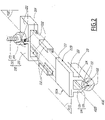
- the ROCS 100 is further detailed with reference to figure 2 .
- the contact wire 110 presents a globally round profile, with two slits 112 configured to cooperate with clamping tips of the busbar 120, as described later.
- the busbar 120 comprises a base plate 122, which is configured to cooperate with the hanger clamps 120.
- the base plate 122 has flat and elongated shape, that extends along a median plane P122 and that is arranged along the longitudinal axis A120 of the busbar 120.
- the medial plane P122 is supposed to be horizontal.
- the base plate 122 comprises two side edges 122A and 122B, which are parallel to a longitudinal plane P120, which is orthogonal to the median plane P122 and parallel to the longitudinal axis A120.
- the busbar 120 further comprises two holding arms 124.
- the holding arms 124 extend from the base plate 122 on the same side of the median plan P122, here from a downward side of the base 122.
- Each holding arm 124 comprises a main portion 126 and a clamping portion 128.
- the main portions 126 are parallel to the longitudinal plane P120.
- the two clamping portion 128 converge toward each other and comprise each a clamping tip 130, which cooperate with a respective slit 112 of the contact wire 110.
- the hanger clamp 200 comprises a connecting portion 210 and a clamping portion 220. Only a threaded portion 212 and a nut 214 of the connecting portion 210 are represented on figure 2 .
- the connecting portion 210 is configured to cooperate with an element of the railtrack 2, such as a beam or a tunnel ceiling, etc., in order to connect the clamping portion 220 to the railtrack 2, in particular in order to adjust the height of the clamping portion 220 above the railtrack 2.
- an element of the railtrack 2 such as a beam or a tunnel ceiling, etc.
- the clamping portion 220 is made of metallic lightweight material such as an aluminum alloy.
- the clamping portion 220 is configured to receive the base plate 122 of the busbar 120. In other words, the clamping portion 220 is configured to connect said base plate 122 to a fixed element of the railtrack 2.
- the clamping portion 220 When the base plate 122 is received in the clamping portion 220, the clamping portion 220 extends along a plane that is aligned with the median plane P122, and the clamping portion 220 has a cylindrical shape, with a rectangular cross section, extending along an axis that is parallel to the longitudinal axis A120.
- the clamping portion 220 comprises two jaws 222.
- the two jaws 222 have preferably the same shape and are reversibly assembled to each other with fixing organs 224, such as nuts and bolts.
- the two jaws 222 are arranged symmetrically from each other apart the longitudinal plane P120.
- Each jaw 222 has a cylindrical shape with a "U” profile extending along the longitudinal axis A120, the jaws 222 facing each other with the opening of the "U” being oriented toward the longitudinal plane P120.
- Each jaw 222 defines a reception volume V222, configured to receive a respective side edge 122A or 122B of the base plate 122.
- the hanger clamp 200 further comprises two inserts 230, each insert 230 being received within the reception volume V222 of a respective jaw 222.
- each insert 230 has a cylindrical shape with a "U" profile extending along the longitudinal axis A120 in the mounted configuration of the hanger clamp 200.
- the inserts 230 are sandwiched between the base plate 122 and the jaws 222, so that the base plate 122 does not contact directly the jaws 222.
- the inserts 230 are in contact with the base plate 122 without pressing on the surface of the base plate 122, so that translation movements of the base plate 122 relative to the hanger clamp 200 along any direction radial to the longitudinal axis A120 are prevented, while translation movements the base plate 122 relative to the hanger clamp 200 along the longitudinal axis A120 are allowed.
- the base plate 122 is just leaning on the inserts 230 without additional forces except the busbar 120 own weight.
- an air gap is arranged between the inserts 230 and the surface of the base plate 122. The air gap allows the free sliding of the busbar 120 relative to the clamping portion 220, and also the free orientation of the busbar 120 when the busbar 120 is curved, for example to follow curved tracks and for staggering.
- Each insert 230 is received within a respective reception volume V222 and is configured to be positioned between the corresponding jaw 222 and the base plate 122, while allowing sliding movements of the busbar 120 relative to the hanger clamp 200 along the longitudinal axis A120.
- the inserts 230 are mare from a material comprising synthetic polymer, that is selected for a low friction coefficient and high wear resistance, so that when the inserts 230 is in contact with a surface of the base plate 122, sliding movements of the busbar 120 relative to the hanger clamp 200 along the longitudinal axis A120 are allowed.
- Each insert 230 is also configured to conduct electricity between the base plate 122 and the clamping portion 220.
- Synthetic polymers used in railroad applications are usually electrically insulating.
- the material of the inserts 230 comprises a conductive charge, so that the material of the inserts 230 is conductive enough so the clamping portion 220 and the busbar 120 have the same electric potential.
- a charge is a mass of material, usually in the shape of fine powder or fibers, that is dispersed in a polymer material to reduce the cost and/or to adjust the properties of said polymer material, for example to adjust mechanical properties, density, thermal resistance, etc.
- the material of the inserts 230 has an electrical resistance lower than 10 k ⁇ - kilo-ohms -, preferably lower than 1.5 k ⁇ .
- the inserts 230 are configured to conduct electricity between the base plate 122 and the clamping portion 220.
- the conductive charge is preferably in the shape of fiber, to contribute also to the strength of the material of the inserts 230. More preferably, the conductive charge comprises carbon fibers, which are electrically conductive and contribute to improve the tensile strength of the polymer material.
- the polymer material of the inserts 230 is preferably a thermoplastic polymer. Compared to other types of polymers, such as thermosetting polymers, thermoplastic polymers show a better mechanical behavior in terms of wear resistance, toughness or thermal resistance.
- thermoplastic polymer for the material of the inserts 230 is polyamide.
- Raw materials comprising polyamide with carbon fibers added as a charge are, for example, commercially available from LATI Company under the brand name "LatiOhm”.
Landscapes
- Engineering & Computer Science (AREA)
- Mechanical Engineering (AREA)
- Current-Collector Devices For Electrically Propelled Vehicles (AREA)
- Clamps And Clips (AREA)
Abstract
Description
- The present invention relates to a hanger clamp for holding a conductive profile, to a rigid overhead catenary system and to a railtrack comprising such a hanger clamp.
- Known electric railroad vehicles, such as tramways or metros, are generally supplied with electric energy through a rigid overhead catenary system, also called ROCS in short. A ROCS comprises a contact wire, usually made out of copper or one of its alloys, that is rigidly held by a conductive profile, also called busbar. Common busbars are made out of lightweight conductive metal, such as aluminum or one of its alloys. To ensure a good geometric alignment of the contact wire relatively to the rail track, each busbar holds the contact wire continuously and is held by hanger clamps. The hanger clamps are fixed to the infrastructure of the railtrack, for example to a ceiling of a tunnel section or to a steel cantilever linked to the trackside, so that the contact wire is hanging downwardly, the contact wire being arranged along a longitudinal direction parallel to the railtrack.
- To avoid electric discharges between the busbar and the hanger clamp and/or the steel cantilever, the busbar and the hanger clamp are electrically connected together, to ensure that the same electric potential is present on the hanger clamp and on the busbar.
- In addition, since the busbars are continuous and made from metal, the busbars show relatively high dimensional variations due to the temperature changes, caused for example by seasonal variations or by self-heating when an electric current flows through the ROCS. To avoid local stress and/or deformations, the busbar held by the hanger clamps is allowed to slide relatively to the hanger clamps along the longitudinal direction.
- To cope with these two problems,
CN-202782747-U describes, for example, a hanger clamp that comprises inserts made from carbon/graphite composite materials. Such inserts are costly to produce and remain relatively brittle, requiring regular maintenance. - There is a need for an improved hanger clamp, with better durability.
- To this end, aspects of the invention pertains to a hanger clamp for holding a conductive profile of a rigid overhead catenary system belonging to a railtrack, the hanger clamp comprising:
- a clamping portion, preferentially made of an aluminum alloy, configured to receive a base plate of the conductive profile, the clamping portion extending along a median plane and along a longitudinal axis, which is parallel to the median plane,
- a connecting portion, configured to connect said base plate to a fixed element of the railtrack, such as a beam or a tunnel ceiling,
- Thanks to the invention, the inserts are both cheap to produce and resilient, thus improving the cost price and the durability of the hanger clamp. Thanks to the conductive charge, the busbar held by the hanger clamp and the hanger clamp present the same electrical potential, which reduces the risk of electrical arc, while the synthetic polymer allows sliding of the busbar relatively to the hanger clamp in the longitudinal direction.
- According to advantageous but optional aspects, such a hanger clamp may incorporate one or more of the following features, considered alone or according to any technically allowable combination:
- the jaws are arranged symmetrically from each other apart a longitudinal plane, the longitudinal plane being parallel to the longitudinal axis and orthogonal to the median plane.
- The synthetic polymer is a thermoplastic polymer.
- The conductive charge comprises fibers.
- The inserts are made from p'olyamide with carbon fibers.
- The invention also concerns rigid overhead catenary system, comprising a contact line held by a conductive profile, the conductive profile being held by hanger clamps, wherein at least one hanger clamp is as described here above.
- Other aspects of the invention concerns a railtrack, comprising a track and a rigid overhead catenary system as described here above.
- The invention will be better understood, and other advantages thereof will appear more clearly, in light of the following description of one embodiment of an hanger clamp, a rigid overhead catenary system and a railtrack according to the invention, this description being provided solely as a non-limiting example and done in reference to the appended drawings, in which:
-
figure 1 is a schematic side-view of a railtrack according to the invention, comprising a rigid overhead catenary system suspended by hanger clamps according to the invention, and -
figure 2 is a perspective exploded view, along arrow II, of the rigid overhead catenary system offigure 1 . -
Figure 1 represents arailtrack 2. Therailtrack 2 comprises two rails, which are parallel to each other. Only onerail 20 is visible onfigure 1 , and is supposed to be straight and horizontal. - The
railtrack 2 is configured to have a vehicle 4 running on therails 20. The vehicle 4 is for example a rail electric vehicle, such as a train, a metro, or a tramway, and compriseswheels 40 that are powered by an electric motor. The electric motor is not shown. Alternatively, the vehicle 3 runs on tires, and therails 20 are replaced by guideways. - The
railtrack 2 comprises a rigidoverhead catenary system 100, also called ROCS 100 within the present description, configured to supply the vehicle 4 with electric energy. - To this end, the vehicle 4 comprises an
electricity collection device 42, such as a pantograph, which comes into contact with the ROCS 100 to collect electrical energy. In the example illustrated onfigure 1 , the electricity returns to therailtrack 2 through thewheels 40. - The ROCS 100 is fixed relative to the
rails 20, more precisely the ROCS is arranged above therail 20 at a fixed height, so that theelectricity collection device 42 works properly when the rail vehicle 4 moves. - The ROCS 100 comprises a
contact wire 110 and abusbar 120. Thecontact wire 110 is configured to be in contact with theelectricity collection device 42 and is made from conductive metal, preferably from copper or copper alloy, to ensure a low electric resistance. Thewire 110 forms a contact line for theROCS 100. - The
contact wire 110 presents a cylindrical shape extending along a longitudinal axis A110, which is parallel to therail 20. Thecontact wire 110 is held by thebusbar 120, preferably continuously and rigidly held, so that thecontact wire 110 does not flex when thecurrent collection device 42 is pressing onto thecontact wire 110. - The
busbar 120 is a conductive profile, which extends along a longitudinal axis A120, parallel to the longitudinal axis A110 of thewire 110. Thebusbar 120 is preferably made from a lightweight and conductive metal such as aluminum or an aluminum alloy. Thebusbar 120 is usually produced by extrusion. - The ROCS 100 further comprises
hanger clamps 200, which are for example fixed to aceiling 22 of a tunnel section of therailtrack 2, above therail 20. In other words, the ROCS 100 is suspended to theceiling 22. - The
busbar 120 extends downwardly from theclamps 200, and thecontact wire 110, held by thebusbar 120, faces the ground. In a not shown alternative, theROCS 100 is attached to a beam belonging to a mast, the mast being arranged on the trackside and the beam extending above therail 20. - Within the scope of this description, it is assumed that the longitudinal axis A120 is horizontal, and that the
busbar 120 hangs vertically. Of course in reality the actual orientation of thebusbar 120 may vary, for example in slope sections or in curve sections of therailtrack 2. - The
ROCS 100 is further detailed with reference tofigure 2 . - The
contact wire 110 presents a globally round profile, with twoslits 112 configured to cooperate with clamping tips of thebusbar 120, as described later. - The
busbar 120 comprises abase plate 122, which is configured to cooperate with thehanger clamps 120. Thebase plate 122 has flat and elongated shape, that extends along a median plane P122 and that is arranged along the longitudinal axis A120 of thebusbar 120. The medial plane P122 is supposed to be horizontal. Thebase plate 122 comprises twoside edges - The
busbar 120 further comprises two holdingarms 124. The holdingarms 124 extend from thebase plate 122 on the same side of the median plan P122, here from a downward side of thebase 122. Eachholding arm 124 comprises amain portion 126 and aclamping portion 128. - In the illustrated example, the
main portions 126 are parallel to the longitudinal plane P120. The twoclamping portion 128 converge toward each other and comprise each aclamping tip 130, which cooperate with arespective slit 112 of thecontact wire 110. - The
hanger clamp 200 comprises a connectingportion 210 and a clampingportion 220. Only a threadedportion 212 and anut 214 of the connectingportion 210 are represented onfigure 2 . - The connecting
portion 210 is configured to cooperate with an element of therailtrack 2, such as a beam or a tunnel ceiling, etc., in order to connect the clampingportion 220 to therailtrack 2, in particular in order to adjust the height of the clampingportion 220 above therailtrack 2. - The clamping
portion 220 is made of metallic lightweight material such as an aluminum alloy. The clampingportion 220 is configured to receive thebase plate 122 of thebusbar 120. In other words, the clampingportion 220 is configured to connect saidbase plate 122 to a fixed element of therailtrack 2. - When the
base plate 122 is received in the clampingportion 220, the clampingportion 220 extends along a plane that is aligned with the median plane P122, and the clampingportion 220 has a cylindrical shape, with a rectangular cross section, extending along an axis that is parallel to the longitudinal axis A120. - The clamping
portion 220 comprises twojaws 222. The twojaws 222 have preferably the same shape and are reversibly assembled to each other with fixingorgans 224, such as nuts and bolts. - The two
jaws 222 are arranged symmetrically from each other apart the longitudinal plane P120. Eachjaw 222 has a cylindrical shape with a "U" profile extending along the longitudinal axis A120, thejaws 222 facing each other with the opening of the "U" being oriented toward the longitudinal plane P120. Eachjaw 222 defines a reception volume V222, configured to receive arespective side edge base plate 122. - The
hanger clamp 200 further comprises twoinserts 230, eachinsert 230 being received within the reception volume V222 of arespective jaw 222. In the illustrated example, eachinsert 230 has a cylindrical shape with a "U" profile extending along the longitudinal axis A120 in the mounted configuration of thehanger clamp 200. - When the
base plate 122 is received in the clampingportion 220, theinserts 230 are sandwiched between thebase plate 122 and thejaws 222, so that thebase plate 122 does not contact directly thejaws 222. Theinserts 230 are in contact with thebase plate 122 without pressing on the surface of thebase plate 122, so that translation movements of thebase plate 122 relative to thehanger clamp 200 along any direction radial to the longitudinal axis A120 are prevented, while translation movements thebase plate 122 relative to thehanger clamp 200 along the longitudinal axis A120 are allowed. - In other words, the
base plate 122 is just leaning on theinserts 230 without additional forces except thebusbar 120 own weight. Preferably, an air gap is arranged between theinserts 230 and the surface of thebase plate 122. The air gap allows the free sliding of thebusbar 120 relative to the clampingportion 220, and also the free orientation of thebusbar 120 when thebusbar 120 is curved, for example to follow curved tracks and for staggering. - Each
insert 230 is received within a respective reception volume V222 and is configured to be positioned between thecorresponding jaw 222 and thebase plate 122, while allowing sliding movements of thebusbar 120 relative to thehanger clamp 200 along the longitudinal axis A120. - The
inserts 230 are mare from a material comprising synthetic polymer, that is selected for a low friction coefficient and high wear resistance, so that when theinserts 230 is in contact with a surface of thebase plate 122, sliding movements of thebusbar 120 relative to thehanger clamp 200 along the longitudinal axis A120 are allowed. - Each
insert 230 is also configured to conduct electricity between thebase plate 122 and the clampingportion 220. Synthetic polymers used in railroad applications are usually electrically insulating. However, within the scope of the present invention, the material of theinserts 230 comprises a conductive charge, so that the material of theinserts 230 is conductive enough so the clampingportion 220 and thebusbar 120 have the same electric potential. - In the field of polymers, a charge is a mass of material, usually in the shape of fine powder or fibers, that is dispersed in a polymer material to reduce the cost and/or to adjust the properties of said polymer material, for example to adjust mechanical properties, density, thermal resistance, etc.
- Practically, the material of the
inserts 230 has an electrical resistance lower than 10 kΩ - kilo-ohms -, preferably lower than 1.5 kΩ. In other words, theinserts 230 are configured to conduct electricity between thebase plate 122 and the clampingportion 220. - The conductive charge is preferably in the shape of fiber, to contribute also to the strength of the material of the
inserts 230. More preferably, the conductive charge comprises carbon fibers, which are electrically conductive and contribute to improve the tensile strength of the polymer material. - The polymer material of the
inserts 230 is preferably a thermoplastic polymer. Compared to other types of polymers, such as thermosetting polymers, thermoplastic polymers show a better mechanical behavior in terms of wear resistance, toughness or thermal resistance. A good example of thermoplastic polymer for the material of theinserts 230 is polyamide. - Raw materials comprising polyamide with carbon fibers added as a charge are, for example, commercially available from LATI Company under the brand name "LatiOhm".
- The respective features of the different embodiments and variants of the hanger clamp considered in this description can be combined.
wherein the hanger clamp further comprises two inserts, each insert being received within a respective reception volume and being configured to be positioned between the corresponding jaw and the base plate while allowing sliding movements of the conductive profile relative to the hanger clamp along the longitudinal axis, each insert being also configured to conduct electricity between the base plate and the clamping portion.
According to the invention, the inserts are made from a material comprising a synthetic polymer and a conductive charge.
Claims (7)
- A hanger clamp (200) for holding a conductive profile (120) of a rigid overhead catenary system (100) belonging to a railtrack (2), the hanger clamp (200) comprising:- a clamping portion (220), preferentially made of an aluminum alloy, configured to receive a base plate (122) of the conductive profile (120), the clamping portion (220) extending along a median plane (P122) and along a longitudinal axis (A120), which is parallel to the median plane,- a connecting portion (210), configured to connect said base plate (122) to a fixed element of the railtrack (2), such as a beam or a tunnel ceiling (22),wherein the clamping portion (220) comprises two jaws (222), each jaw (222) having a U profile extending along the longitudinal axis (A120) and facing each other, each jaw defining a reception volume (V222) configured to receive a respective edge (122A, 122B) of the base plate (122),
wherein the hanger clamp (200) further comprises two inserts (230), each insert being received within a respective reception volume (V222) and being configured to be positioned between the corresponding jaw and the base plate while allowing sliding movements of the conductive profile (120) relative to the hanger clamp (200) along the longitudinal axis, each insert being also configured to conduct electricity between the base plate (122) and the clamping portion (220),
characterized in that the inserts (230) are made from a material comprising a synthetic polymer and a conductive charge. - The hanger clamp (200) according to claim 1, wherein the jaws (222) are arranged symmetrically from each other apart a longitudinal plane (P120), the longitudinal plane being parallel to the longitudinal axis (A120) and orthogonal to the median plane (P122).
- The hanger clamp (200) according to claim 1 or 2, wherein the synthetic polymer is a thermoplastic polymer.
- The hanger clamp (200) according to any one of claims 1 to 3, wherein the conductive charge comprises fibers.
- The hanger clamp (200) according to any one of claims 1 to 4, wherein the inserts are made from polyamide with carbon fibers.
- A rigid overhead catenary system (100), comprising a contact line (110) held by a conductive profile (120), the conductive profile (120) being held by hanger clamps (200), wherein at least one of the hanger clamps (200) is according to any one of the preceding claims.
- A railtrack (2), comprising a track (20) and a rigid overhead catenary system (100) according to the preceding claim.
Priority Applications (2)
| Application Number | Priority Date | Filing Date | Title |
|---|---|---|---|
| ES21315051T ES3012391T3 (en) | 2021-03-24 | 2021-03-24 | Hanger clamp for holding a conductive profile, rigid overhead catenary system and railtrack comprising such a hanger clamp |
| EP21315051.9A EP4063185B1 (en) | 2021-03-24 | 2021-03-24 | Hanger clamp for holding a conductive profile, rigid overhead catenary system and railtrack comprising such a hanger clamp |
Applications Claiming Priority (1)
| Application Number | Priority Date | Filing Date | Title |
|---|---|---|---|
| EP21315051.9A EP4063185B1 (en) | 2021-03-24 | 2021-03-24 | Hanger clamp for holding a conductive profile, rigid overhead catenary system and railtrack comprising such a hanger clamp |
Publications (2)
| Publication Number | Publication Date |
|---|---|
| EP4063185A1 true EP4063185A1 (en) | 2022-09-28 |
| EP4063185B1 EP4063185B1 (en) | 2024-11-13 |
Family
ID=75639847
Family Applications (1)
| Application Number | Title | Priority Date | Filing Date |
|---|---|---|---|
| EP21315051.9A Active EP4063185B1 (en) | 2021-03-24 | 2021-03-24 | Hanger clamp for holding a conductive profile, rigid overhead catenary system and railtrack comprising such a hanger clamp |
Country Status (2)
| Country | Link |
|---|---|
| EP (1) | EP4063185B1 (en) |
| ES (1) | ES3012391T3 (en) |
Citations (5)
| Publication number | Priority date | Publication date | Assignee | Title |
|---|---|---|---|---|
| DE102010033451A1 (en) * | 2010-08-05 | 2012-02-09 | Furrer + Frey Ag | Busbar configuration |
| CN102785590A (en) * | 2012-08-28 | 2012-11-21 | 浙江旺隆轨道交通设备有限公司 | Bolt-free busbar elastic wire clamp |
| CN202782747U (en) | 2012-08-28 | 2013-03-13 | 浙江旺隆轨道交通设备有限公司 | Boltless busbar elastic cable clamp |
| KR20170043437A (en) * | 2015-10-13 | 2017-04-21 | 엘에스전선 주식회사 | Expansion joint |
| EP3102458B1 (en) * | 2014-02-05 | 2018-06-06 | Rail Power Systems GmbH | Fixing device for a conductor rail and conductor rail system |
-
2021
- 2021-03-24 EP EP21315051.9A patent/EP4063185B1/en active Active
- 2021-03-24 ES ES21315051T patent/ES3012391T3/en active Active
Patent Citations (5)
| Publication number | Priority date | Publication date | Assignee | Title |
|---|---|---|---|---|
| DE102010033451A1 (en) * | 2010-08-05 | 2012-02-09 | Furrer + Frey Ag | Busbar configuration |
| CN102785590A (en) * | 2012-08-28 | 2012-11-21 | 浙江旺隆轨道交通设备有限公司 | Bolt-free busbar elastic wire clamp |
| CN202782747U (en) | 2012-08-28 | 2013-03-13 | 浙江旺隆轨道交通设备有限公司 | Boltless busbar elastic cable clamp |
| EP3102458B1 (en) * | 2014-02-05 | 2018-06-06 | Rail Power Systems GmbH | Fixing device for a conductor rail and conductor rail system |
| KR20170043437A (en) * | 2015-10-13 | 2017-04-21 | 엘에스전선 주식회사 | Expansion joint |
Non-Patent Citations (1)
| Title |
|---|
| ANONYMOUS: "Polytetrafluoroethylene (PTFE)", WIKIPEDIA, 1 January 2021 (2021-01-01), XP055785677, Retrieved from the Internet <URL:https://en.wikipedia.org/wiki/Polytetrafluoroethylene> [retrieved on 20210315] * |
Also Published As
| Publication number | Publication date |
|---|---|
| EP4063185B1 (en) | 2024-11-13 |
| ES3012391T3 (en) | 2025-04-09 |
Similar Documents
| Publication | Publication Date | Title |
|---|---|---|
| KR101902361B1 (en) | Section insulator for rigid trolley line | |
| KR101746285B1 (en) | support clamp for conductor rail | |
| US9845025B2 (en) | Rigid T-rail conductor system | |
| EP4063185B1 (en) | Hanger clamp for holding a conductive profile, rigid overhead catenary system and railtrack comprising such a hanger clamp | |
| CN115742884B (en) | Rigid suspension contact net system based on spring and damping electric brush | |
| EP4194260B1 (en) | Busbar for holding a contact wire, rigid overhead catenary system and railtrack comprising such a busbar | |
| US4250982A (en) | Section insulator for catenary systems | |
| US4187934A (en) | Section insulator for catenary systems | |
| KR101910230B1 (en) | connecting structure of rigid bar | |
| KR20130087778A (en) | Expansion joint | |
| EP0000980A1 (en) | Carbon current collecting contactor and pantograph assembly | |
| KR20170058766A (en) | double-tension rigid bar and connecting structure of the same | |
| US1336503A (en) | Catenary suspension system for electric railways | |
| US4363939A (en) | Electrical supply line for the supply or current to railway vehicles | |
| KR101264312B1 (en) | Ac/dc section insulator having a row structure | |
| EP3922508B1 (en) | Insulating support assembly for a catenary adapted for powering an electrical vehicle, notably a tram or a trolleybus, and related catenary | |
| KR101269230B1 (en) | Railroad Challenge Rail Equipment | |
| KR20170039432A (en) | rigid bar | |
| US1055782A (en) | Overhead-line structure for electric railways. | |
| KR101246930B1 (en) | Third rail current collector for light rail transit | |
| RU2296065C1 (en) | Sliding clamp of aerial crossing | |
| US791082A (en) | Trolley-wire hanger. | |
| US1157392A (en) | Trolley-conductor. | |
| US1014071A (en) | Current-collector for electric cranes. | |
| US1144620A (en) | Overhead line construction. |
Legal Events
| Date | Code | Title | Description |
|---|---|---|---|
| PUAI | Public reference made under article 153(3) epc to a published international application that has entered the european phase |
Free format text: ORIGINAL CODE: 0009012 |
|
| STAA | Information on the status of an ep patent application or granted ep patent |
Free format text: STATUS: THE APPLICATION HAS BEEN PUBLISHED |
|
| STAA | Information on the status of an ep patent application or granted ep patent |
Free format text: STATUS: REQUEST FOR EXAMINATION WAS MADE |
|
| AK | Designated contracting states |
Kind code of ref document: A1 Designated state(s): AL AT BE BG CH CY CZ DE DK EE ES FI FR GB GR HR HU IE IS IT LI LT LU LV MC MK MT NL NO PL PT RO RS SE SI SK SM TR |
|
| 17P | Request for examination filed |
Effective date: 20220906 |
|
| RBV | Designated contracting states (corrected) |
Designated state(s): AL AT BE BG CH CY CZ DE DK EE ES FI FR GB GR HR HU IE IS IT LI LT LU LV MC MK MT NL NO PL PT RO RS SE SI SK SM TR |
|
| P01 | Opt-out of the competence of the unified patent court (upc) registered |
Effective date: 20230823 |
|
| RAP1 | Party data changed (applicant data changed or rights of an application transferred) |
Owner name: ALSTOM HOLDINGS |
|
| GRAP | Despatch of communication of intention to grant a patent |
Free format text: ORIGINAL CODE: EPIDOSNIGR1 |
|
| STAA | Information on the status of an ep patent application or granted ep patent |
Free format text: STATUS: GRANT OF PATENT IS INTENDED |
|
| INTG | Intention to grant announced |
Effective date: 20240621 |
|
| GRAS | Grant fee paid |
Free format text: ORIGINAL CODE: EPIDOSNIGR3 |
|
| GRAA | (expected) grant |
Free format text: ORIGINAL CODE: 0009210 |
|
| STAA | Information on the status of an ep patent application or granted ep patent |
Free format text: STATUS: THE PATENT HAS BEEN GRANTED |
|
| AK | Designated contracting states |
Kind code of ref document: B1 Designated state(s): AL AT BE BG CH CY CZ DE DK EE ES FI FR GB GR HR HU IE IS IT LI LT LU LV MC MK MT NL NO PL PT RO RS SE SI SK SM TR |
|
| REG | Reference to a national code |
Ref country code: GB Ref legal event code: FG4D |
|
| REG | Reference to a national code |
Ref country code: CH Ref legal event code: EP |
|
| REG | Reference to a national code |
Ref country code: IE Ref legal event code: FG4D |
|
| REG | Reference to a national code |
Ref country code: DE Ref legal event code: R096 Ref document number: 602021021742 Country of ref document: DE |
|
| REG | Reference to a national code |
Ref country code: GR Ref legal event code: EP Ref document number: 20250400092 Country of ref document: GR Effective date: 20250211 |
|
| REG | Reference to a national code |
Ref country code: LT Ref legal event code: MG9D |
|
| REG | Reference to a national code |
Ref country code: NL Ref legal event code: MP Effective date: 20241113 |
|
| REG | Reference to a national code |
Ref country code: ES Ref legal event code: FG2A Ref document number: 3012391 Country of ref document: ES Kind code of ref document: T3 Effective date: 20250409 |
|
| PG25 | Lapsed in a contracting state [announced via postgrant information from national office to epo] |
Ref country code: PT Free format text: LAPSE BECAUSE OF FAILURE TO SUBMIT A TRANSLATION OF THE DESCRIPTION OR TO PAY THE FEE WITHIN THE PRESCRIBED TIME-LIMIT Effective date: 20250313 Ref country code: IS Free format text: LAPSE BECAUSE OF FAILURE TO SUBMIT A TRANSLATION OF THE DESCRIPTION OR TO PAY THE FEE WITHIN THE PRESCRIBED TIME-LIMIT Effective date: 20250313 Ref country code: HR Free format text: LAPSE BECAUSE OF FAILURE TO SUBMIT A TRANSLATION OF THE DESCRIPTION OR TO PAY THE FEE WITHIN THE PRESCRIBED TIME-LIMIT Effective date: 20241113 |
|
| PG25 | Lapsed in a contracting state [announced via postgrant information from national office to epo] |
Ref country code: NL Free format text: LAPSE BECAUSE OF FAILURE TO SUBMIT A TRANSLATION OF THE DESCRIPTION OR TO PAY THE FEE WITHIN THE PRESCRIBED TIME-LIMIT Effective date: 20241113 Ref country code: FI Free format text: LAPSE BECAUSE OF FAILURE TO SUBMIT A TRANSLATION OF THE DESCRIPTION OR TO PAY THE FEE WITHIN THE PRESCRIBED TIME-LIMIT Effective date: 20241113 |
|
| REG | Reference to a national code |
Ref country code: AT Ref legal event code: MK05 Ref document number: 1741456 Country of ref document: AT Kind code of ref document: T Effective date: 20241113 |
|
| PG25 | Lapsed in a contracting state [announced via postgrant information from national office to epo] |
Ref country code: BG Free format text: LAPSE BECAUSE OF FAILURE TO SUBMIT A TRANSLATION OF THE DESCRIPTION OR TO PAY THE FEE WITHIN THE PRESCRIBED TIME-LIMIT Effective date: 20241113 |
|
| PG25 | Lapsed in a contracting state [announced via postgrant information from national office to epo] |
Ref country code: LV Free format text: LAPSE BECAUSE OF FAILURE TO SUBMIT A TRANSLATION OF THE DESCRIPTION OR TO PAY THE FEE WITHIN THE PRESCRIBED TIME-LIMIT Effective date: 20241113 Ref country code: AT Free format text: LAPSE BECAUSE OF FAILURE TO SUBMIT A TRANSLATION OF THE DESCRIPTION OR TO PAY THE FEE WITHIN THE PRESCRIBED TIME-LIMIT Effective date: 20241113 |
|
| PG25 | Lapsed in a contracting state [announced via postgrant information from national office to epo] |
Ref country code: PL Free format text: LAPSE BECAUSE OF FAILURE TO SUBMIT A TRANSLATION OF THE DESCRIPTION OR TO PAY THE FEE WITHIN THE PRESCRIBED TIME-LIMIT Effective date: 20241113 |
|
| PG25 | Lapsed in a contracting state [announced via postgrant information from national office to epo] |
Ref country code: RS Free format text: LAPSE BECAUSE OF FAILURE TO SUBMIT A TRANSLATION OF THE DESCRIPTION OR TO PAY THE FEE WITHIN THE PRESCRIBED TIME-LIMIT Effective date: 20250213 |
|
| PG25 | Lapsed in a contracting state [announced via postgrant information from national office to epo] |
Ref country code: SM Free format text: LAPSE BECAUSE OF FAILURE TO SUBMIT A TRANSLATION OF THE DESCRIPTION OR TO PAY THE FEE WITHIN THE PRESCRIBED TIME-LIMIT Effective date: 20241113 |
|
| PG25 | Lapsed in a contracting state [announced via postgrant information from national office to epo] |
Ref country code: DK Free format text: LAPSE BECAUSE OF FAILURE TO SUBMIT A TRANSLATION OF THE DESCRIPTION OR TO PAY THE FEE WITHIN THE PRESCRIBED TIME-LIMIT Effective date: 20241113 |
|
| PGFP | Annual fee paid to national office [announced via postgrant information from national office to epo] |
Ref country code: ES Payment date: 20250429 Year of fee payment: 5 |
|
| PG25 | Lapsed in a contracting state [announced via postgrant information from national office to epo] |
Ref country code: EE Free format text: LAPSE BECAUSE OF FAILURE TO SUBMIT A TRANSLATION OF THE DESCRIPTION OR TO PAY THE FEE WITHIN THE PRESCRIBED TIME-LIMIT Effective date: 20241113 |
|
| PGFP | Annual fee paid to national office [announced via postgrant information from national office to epo] |
Ref country code: CH Payment date: 20250401 Year of fee payment: 5 |
|
| PG25 | Lapsed in a contracting state [announced via postgrant information from national office to epo] |
Ref country code: RO Free format text: LAPSE BECAUSE OF FAILURE TO SUBMIT A TRANSLATION OF THE DESCRIPTION OR TO PAY THE FEE WITHIN THE PRESCRIBED TIME-LIMIT Effective date: 20241113 |
|
| PG25 | Lapsed in a contracting state [announced via postgrant information from national office to epo] |
Ref country code: SK Free format text: LAPSE BECAUSE OF FAILURE TO SUBMIT A TRANSLATION OF THE DESCRIPTION OR TO PAY THE FEE WITHIN THE PRESCRIBED TIME-LIMIT Effective date: 20241113 |
|
| PG25 | Lapsed in a contracting state [announced via postgrant information from national office to epo] |
Ref country code: CZ Free format text: LAPSE BECAUSE OF FAILURE TO SUBMIT A TRANSLATION OF THE DESCRIPTION OR TO PAY THE FEE WITHIN THE PRESCRIBED TIME-LIMIT Effective date: 20241113 |
|
| PG25 | Lapsed in a contracting state [announced via postgrant information from national office to epo] |
Ref country code: IT Free format text: LAPSE BECAUSE OF FAILURE TO SUBMIT A TRANSLATION OF THE DESCRIPTION OR TO PAY THE FEE WITHIN THE PRESCRIBED TIME-LIMIT Effective date: 20241113 |
|
| REG | Reference to a national code |
Ref country code: DE Ref legal event code: R097 Ref document number: 602021021742 Country of ref document: DE |
|
| PG25 | Lapsed in a contracting state [announced via postgrant information from national office to epo] |
Ref country code: SE Free format text: LAPSE BECAUSE OF FAILURE TO SUBMIT A TRANSLATION OF THE DESCRIPTION OR TO PAY THE FEE WITHIN THE PRESCRIBED TIME-LIMIT Effective date: 20241113 |
|
| PLBE | No opposition filed within time limit |
Free format text: ORIGINAL CODE: 0009261 |
|
| STAA | Information on the status of an ep patent application or granted ep patent |
Free format text: STATUS: NO OPPOSITION FILED WITHIN TIME LIMIT |
|
| REG | Reference to a national code |
Ref country code: DE Ref legal event code: R119 Ref document number: 602021021742 Country of ref document: DE |
|
| PG25 | Lapsed in a contracting state [announced via postgrant information from national office to epo] |
Ref country code: MC Free format text: LAPSE BECAUSE OF FAILURE TO SUBMIT A TRANSLATION OF THE DESCRIPTION OR TO PAY THE FEE WITHIN THE PRESCRIBED TIME-LIMIT Effective date: 20241113 |
|
| 26N | No opposition filed |
Effective date: 20250814 |
|
| PG25 | Lapsed in a contracting state [announced via postgrant information from national office to epo] |
Ref country code: LU Free format text: LAPSE BECAUSE OF NON-PAYMENT OF DUE FEES Effective date: 20250324 |
|
| REG | Reference to a national code |
Ref country code: BE Ref legal event code: MM Effective date: 20250331 |
|
| PG25 | Lapsed in a contracting state [announced via postgrant information from national office to epo] |
Ref country code: DE Free format text: LAPSE BECAUSE OF NON-PAYMENT OF DUE FEES Effective date: 20251001 |
|
| PG25 | Lapsed in a contracting state [announced via postgrant information from national office to epo] |
Ref country code: BE Free format text: LAPSE BECAUSE OF NON-PAYMENT OF DUE FEES Effective date: 20250331 |
|
| PG25 | Lapsed in a contracting state [announced via postgrant information from national office to epo] |
Ref country code: IE Free format text: LAPSE BECAUSE OF NON-PAYMENT OF DUE FEES Effective date: 20250324 |
|
| REG | Reference to a national code |
Ref country code: CH Ref legal event code: U11 Free format text: ST27 STATUS EVENT CODE: U-0-0-U10-U11 (AS PROVIDED BY THE NATIONAL OFFICE) Effective date: 20260401 |
|
| PGFP | Annual fee paid to national office [announced via postgrant information from national office to epo] |
Ref country code: GB Payment date: 20260324 Year of fee payment: 6 |
|
| PGFP | Annual fee paid to national office [announced via postgrant information from national office to epo] |
Ref country code: NO Payment date: 20260323 Year of fee payment: 6 |
|
| PGFP | Annual fee paid to national office [announced via postgrant information from national office to epo] |
Ref country code: FR Payment date: 20260323 Year of fee payment: 6 |
|
| PGFP | Annual fee paid to national office [announced via postgrant information from national office to epo] |
Ref country code: GR Payment date: 20260320 Year of fee payment: 6 |