EP4060705B1 - Steckbarer trennschalter - Google Patents
Steckbarer trennschalter Download PDFInfo
- Publication number
- EP4060705B1 EP4060705B1 EP20887787.8A EP20887787A EP4060705B1 EP 4060705 B1 EP4060705 B1 EP 4060705B1 EP 20887787 A EP20887787 A EP 20887787A EP 4060705 B1 EP4060705 B1 EP 4060705B1
- Authority
- EP
- European Patent Office
- Prior art keywords
- circuit breaker
- plug
- contact
- lock catch
- wire
- Prior art date
- Legal status (The legal status is an assumption and is not a legal conclusion. Google has not performed a legal analysis and makes no representation as to the accuracy of the status listed.)
- Active
Links
Images






Classifications
-
- H—ELECTRICITY
- H01—ELECTRIC ELEMENTS
- H01H—ELECTRIC SWITCHES; RELAYS; SELECTORS; EMERGENCY PROTECTIVE DEVICES
- H01H71/00—Details of the protective switches or relays covered by groups H01H73/00 - H01H83/00
- H01H71/04—Means for indicating condition of the switching device
-
- H—ELECTRICITY
- H01—ELECTRIC ELEMENTS
- H01H—ELECTRIC SWITCHES; RELAYS; SELECTORS; EMERGENCY PROTECTIVE DEVICES
- H01H71/00—Details of the protective switches or relays covered by groups H01H73/00 - H01H83/00
- H01H71/02—Housings; Casings; Bases; Mountings
- H01H71/0207—Mounting or assembling the different parts of the circuit breaker
-
- H—ELECTRICITY
- H01—ELECTRIC ELEMENTS
- H01H—ELECTRIC SWITCHES; RELAYS; SELECTORS; EMERGENCY PROTECTIVE DEVICES
- H01H71/00—Details of the protective switches or relays covered by groups H01H73/00 - H01H83/00
- H01H71/10—Operating or release mechanisms
- H01H71/12—Automatic release mechanisms with or without manual release
- H01H71/40—Combined electrothermal and electromagnetic mechanisms
-
- H—ELECTRICITY
- H01—ELECTRIC ELEMENTS
- H01H—ELECTRIC SWITCHES; RELAYS; SELECTORS; EMERGENCY PROTECTIVE DEVICES
- H01H71/00—Details of the protective switches or relays covered by groups H01H73/00 - H01H83/00
- H01H71/10—Operating or release mechanisms
- H01H71/50—Manual reset mechanisms which may be also used for manual release
- H01H71/58—Manual reset mechanisms which may be also used for manual release actuated by push-button, pull-knob, or slide
-
- H—ELECTRICITY
- H01—ELECTRIC ELEMENTS
- H01H—ELECTRIC SWITCHES; RELAYS; SELECTORS; EMERGENCY PROTECTIVE DEVICES
- H01H73/00—Protective overload circuit-breaking switches in which excess current opens the contacts by automatic release of mechanical energy stored by previous operation of a hand reset mechanism
- H01H73/02—Details
- H01H73/06—Housings; Casings; Bases; Mountings
- H01H73/08—Plug-in housings
-
- H—ELECTRICITY
- H01—ELECTRIC ELEMENTS
- H01H—ELECTRIC SWITCHES; RELAYS; SELECTORS; EMERGENCY PROTECTIVE DEVICES
- H01H71/00—Details of the protective switches or relays covered by groups H01H73/00 - H01H83/00
- H01H71/04—Means for indicating condition of the switching device
- H01H2071/046—Means for indicating condition of the switching device exclusively by position of operating part, e.g. with additional labels or marks but no other movable indicators
-
- H—ELECTRICITY
- H01—ELECTRIC ELEMENTS
- H01H—ELECTRIC SWITCHES; RELAYS; SELECTORS; EMERGENCY PROTECTIVE DEVICES
- H01H3/00—Mechanisms for operating contacts
- H01H3/32—Driving mechanisms, i.e. for transmitting driving force to the contacts
- H01H3/46—Driving mechanisms, i.e. for transmitting driving force to the contacts using rod or lever linkage, e.g. toggle
-
- H—ELECTRICITY
- H01—ELECTRIC ELEMENTS
- H01H—ELECTRIC SWITCHES; RELAYS; SELECTORS; EMERGENCY PROTECTIVE DEVICES
- H01H71/00—Details of the protective switches or relays covered by groups H01H73/00 - H01H83/00
- H01H71/08—Terminals; Connections
-
- H—ELECTRICITY
- H01—ELECTRIC ELEMENTS
- H01H—ELECTRIC SWITCHES; RELAYS; SELECTORS; EMERGENCY PROTECTIVE DEVICES
- H01H71/00—Details of the protective switches or relays covered by groups H01H73/00 - H01H83/00
- H01H71/10—Operating or release mechanisms
- H01H71/12—Automatic release mechanisms with or without manual release
- H01H71/14—Electrothermal mechanisms
- H01H71/16—Electrothermal mechanisms with bimetal element
-
- H—ELECTRICITY
- H01—ELECTRIC ELEMENTS
- H01H—ELECTRIC SWITCHES; RELAYS; SELECTORS; EMERGENCY PROTECTIVE DEVICES
- H01H71/00—Details of the protective switches or relays covered by groups H01H73/00 - H01H83/00
- H01H71/10—Operating or release mechanisms
- H01H71/12—Automatic release mechanisms with or without manual release
- H01H71/24—Electromagnetic mechanisms
- H01H71/2463—Electromagnetic mechanisms with plunger type armatures
-
- H—ELECTRICITY
- H01—ELECTRIC ELEMENTS
- H01H—ELECTRIC SWITCHES; RELAYS; SELECTORS; EMERGENCY PROTECTIVE DEVICES
- H01H71/00—Details of the protective switches or relays covered by groups H01H73/00 - H01H83/00
- H01H71/10—Operating or release mechanisms
- H01H71/50—Manual reset mechanisms which may be also used for manual release
- H01H71/505—Latching devices between operating and release mechanism
-
- H—ELECTRICITY
- H01—ELECTRIC ELEMENTS
- H01H—ELECTRIC SWITCHES; RELAYS; SELECTORS; EMERGENCY PROTECTIVE DEVICES
- H01H71/00—Details of the protective switches or relays covered by groups H01H73/00 - H01H83/00
- H01H71/74—Means for adjusting the conditions under which the device will function to provide protection
- H01H71/7427—Adjusting only the electrothermal mechanism
-
- H—ELECTRICITY
- H01—ELECTRIC ELEMENTS
- H01H—ELECTRIC SWITCHES; RELAYS; SELECTORS; EMERGENCY PROTECTIVE DEVICES
- H01H9/00—Details of switching devices, not covered by groups H01H1/00 - H01H7/00
- H01H9/08—Arrangements to facilitate replacement of a switch, e.g. cartridge housing
-
- H—ELECTRICITY
- H01—ELECTRIC ELEMENTS
- H01H—ELECTRIC SWITCHES; RELAYS; SELECTORS; EMERGENCY PROTECTIVE DEVICES
- H01H9/00—Details of switching devices, not covered by groups H01H1/00 - H01H7/00
- H01H9/30—Means for extinguishing or preventing arc between current-carrying parts
- H01H9/34—Stationary parts for restricting or subdividing the arc, e.g. barrier plate
- H01H9/36—Metal parts
- H01H9/362—Mounting of plates in arc chamber
Definitions
- the present invention relates to the field of low-voltage electrical appliances, in particular to a plug-in circuit breaker.
- 1U acts as one unit of work for a standard rack case whose height is about 44.45mm.
- 1U unit of work With the rapid development of communication technology, continuous miniaturization are required for the components inside a rack case to meet the installation size requirements of 1U unit of work, so as to increase the density of components in the rack case to save the overall volume of a communication device.
- the existing common small circuit breakers have the heights usually ranging from 80mm to 90mm, as well as the space for the inlet and outlet end of wiring required to occupy a height of 3U, restricting the development of miniaturizing communication cabinets.
- the outlet end of the common small circuit breaker is positioned inside the rack case, not facilitating wiring for users.
- an auxiliary signal function is added to the common small circuit breaker, the necessity to add auxiliary contact terminals or other similar functional accessories to the side of the circuit breaker increases the costs of use, occupies more installation space, not facilitating the development of miniaturizing communication cabinets.
- the Chinese patent CN 209 544 266 U discloses a miniature circuit breaker, wherein the short-circuit protecting mechanism 6 and the over-load protecting mechanism 9 are two independent structures to each other, the short-circuit protecting mechanism 6 is arranged shoulder by shoulder with the arc-distinguishing mechanism 7 and comprises a direct-acting magnetic release, the over-load protecting mechanism 9 is arranged shoulder by shoulder with the operating mechanism 5 and comprises a dual metal piece.
- the present invention is defined in the appended set of claims, and aims to overcome the defects of the prior art and provides a plug-in circuit breaker with compact structure and small volume.
- the protecting mechanism actuates the operating mechanism to trip off, then the plug-in circuit breaker trips and the operating mechanism enters an unlocking state, pulling the operating button to move it toward a break-contact position actuates the operating mechanism to return to the locking state, thus the plug-in circuit breaker enters a break-contact state; or in the case that the plug-in circuit breaker is in the make-contact state, while a short-circuit fault and an overload fault occurs, the protecting mechanism actuates the operating mechanism to act, so that the plug-in circuit breaker enters the break-contact state, after clearing the fault, pressing the operating button to move it toward the make-contact position actuates the operating mechanism to act, thus the plug-in circuit breaker enters the make-contact state.
- the operating mechanism further includes an U-shaped connecting rod, an operating handle, a contact supporting rod, a lock catch-resetting spring and a main tension spring;
- the operating handle is pivotally arranged on the circuit breaker housing, one end of the operating handle is drivingly connected with the operating button by the U-shaped connecting rod, and the other end of the operating handle is rotatably connected with one end of the contact supporting rod, the other end of which is provided with the movable contact
- the jump buckle has one end pivotally arranged on the circuit breaker housing, and the middle part connected with the end of the contact supporting rod provided with the movable contact by the main tension spring
- the lock catch has the middle part rotatably arranged, one end connected with the lock catch-resetting spring, and the other end is locked and matched with the other end of the jump buckle and drivingly cooperated with the protecting mechanism.
- the jump buckle has an U-shaped structure, including a first jump buckle arm and a second jump buckle arm arranged opposite to each other, and the bottom of the U-shaped structure of the jump buckle is configured to adjoin the end of the operating handle connected with the contact supporting rod, the first jump buckle arm has one end pivotally arranged, and the other end connected with one end of the second jump buckle arm, and the other end of the second jump buckle arm is locked and matched with the lock catch.
- the operating mechanism further includes a jump buckle-resetting spring
- the jump buckle-resetting spring has one end connected with the circuit breaker housing, and other end connected with the jump buckle, when the plug-in circuit breaker is in the make-contact state, while a short-circuit fault and an overload fault occurs, the protecting mechanism actuates the lock catch to release the interlock with the jump buckle, then the plug-in circuit breaker trips, and the jump buckle-resetting spring actuates the jump buckle to be relocked with the lock catch, meanwhile the plug-in circuit breaker enters the break-contact state.
- the contact supporting rod has an arch structure in its entirety, one end provided with a supporting rod rotation shaft rotatably connected with the operating handle, and the other end provided with the movable contact
- the movable contact includes a movable contact plate connected with the contact supporting rod and a movable contact point arranged at one end of the movable contact plate, and the other end of the movable contact plate is connected with the main tension spring;
- the middle of the contact supporting rod is also provided with a arc isolating plate, when the plug-in circuit breaker is in the break-contact state, the arc isolating plate enters between the movable contact and the stationary contact, in the make-contact state, the arc isolating plate moves out between the movable contact and the stationary contact.
- the operating mechanism further includes a linkage member having a linkage rod and a linkage shaft arranged at one end of the linkage rod, the linkage shaft has two ends respectively pivoted on the circuit breaker housing and the middle provided with a polygonal hole in its axial direction, and the side of the linkage rod opposite to the jump buckle is provided with a linkage member activated stand, the second jump buckle arm is provided with a linkage member activating stand that is drivingly cooperated with the linkage member activated stand;
- the plug-in circuit breaker includes a plurality of protective poles, the linkage shafts of which are connected with each other by linkage member connecting shafts, and the linkage member connecting shafts fit with the polygonal hole of each linkage member, respectively, when a certain protective pole trips, the linkage member activating stand of the jump buckle of the protective pole drives the linkage rod to swing by the linkage member activated stand, thus the linkage rod drives the linkage shaft to rotate, so as to drive the linkage rods of other protective poles to swing,
- the magnetic yoke is arranged on one side of the lock catch, and the dual metal piece is arranged at the middle of the magnetic yoke and positioned between the magnetic yoke and the lock catch, having one end fixedly arranged and electrically connected with the first wire-outlet terminal, and the other end drivingly cooperated with the lock catch and electrically connected with the movable contact.
- the lock catch has the middle rotatably arranged on one end of the magnetic yoke, one end connected with the circuit breaker housing by the lock catch-resetting spring, and the other end arranged opposite to the magnetic yoke, the dual metal piece has the fixed end electrically connected with the first wire-outlet terminal by the first electroconductive plate, the other end electrically connected with the contact supporting rod through a soft connection, and the stationary contact is electrically connected with the first wire-inlet terminal.
- the cross section of the magnetic yoke has a shaped structure, and one end of the magnetic yoke is provided with two yoke supporting arms arranged opposite to each other, on which there is a yoke limiting groove arranged;
- the lock catch includes a lock catch-resetting end, a lock catch supporting arm, a lock catch body, a lock catch hole and a lock catch activated end, the lock catch-resetting end, the lock catch body and the lock catch activated end are connected with each other in sequence
- the lock catch-supporting arm is arranged on both sides of the connection between the lock catch-resetting end and the lock catch body
- the lock catch activated end has a L-shaped structure, one end crookedly connected with the lock catch body, and the other end drivingly cooperated with the dual metal piece, two lock catch-supporting arms are respectively arranged inside two yoke limiting grooves, the lock catch body is arranged opposite to the magnetic yoke, the lock catch hole is arranged on the lock catch body and
- the plug-in circuit breaker further includes a locking mechanism that has a first locking member, one end of which is slidably arranged inside the circuit breaker housing, and the other end of which is a first protrusion protruding outside the circuit breaker housing.
- the housing of the circuit breaker assembling position presses the first protrusion, so that the first locking member moves in its entirety to the inside of the circuit breaker housing.
- the first protrusion protrudes outside the circuit breaker housing and is in limit fit with the housing of the circuit breaker assembling position.
- the locking mechanism further includes a second locking member, the middle of which is rotatably arranged, one end of which is drivingly cooperated with an operating button, and the other end of which is drivingly cooperated with the first locking member.
- the second locking member further includes a second protrusion, which is arranged at one end of the fit between the second locking member and the first locking member.
- the operating button When the plug-in circuit breaker is in a make-contact state, the operating button actuates the second locking member to rotate, so that the second protrusion protrudes outside the circuit breaker housing. When the plug-in circuit breaker is in a break-contact state, the operating button actuates the second locking member to rotate, so that the second protrusion moves into the circuit breaker housing.
- one end of the operating button inserted inside the circuit breaker housing is a button inner end, and the other end of the operating button protruding outside the circuit breaker housing is a button outer end; an indicator slot is arranged inside the operating button, an indicating hole is arranged on the button outer end, and the indicating hole communicates with one end of the indicator slot;
- the plug-in circuit breaker further includes an indicating member slidably inserted in said indicator slot, one end of the indicating member is provided with a make-contact indicating surface and a break-contact indicating surface both respectively fitting with the indicating hole; when the plug-in circuit breaker is in the break-contact state, the break-contact indicating surface is arranged opposite to the indicating hole, thus during pressing the operating button to move it toward the make-contact position, the indicating member moves in its entirety inside the indicator slot, after the plug-in circuit breaker enters the make-contact state, the make-contact indicating surface is arranged opposite to the indicating hole, thus during pulling the operating button to move it toward the
- an indicator tracking shaft is arranged on the indicating member, an indicator tracking groove is arranged on the circuit breaker housing, the indicator tracking groove is an oblique tracking groove, the indicator tracking shaft is slidably arranged in the indicator tracking groove; when pressing/pulling the operating button, the indicator tracking groove drives the indicating member to move in its entirety in the indicator slot by the indicator tracking shaft, so that the make-contact indicating surface /break-contact indicating surface is arranged opposite to the indicating hole;
- the operating button further includes an indicator sliding groove respectively arranged on a pair of side walls of the indicator slot, the extension direction of the indicator sliding groove is perpendicular to the movement direction of the operating button;
- the indicating member further includes two indicator sliding stands respectively arranged on a pair of side surfaces thereof, the indicator sliding stand is slidably arranged in the indicator sliding groove.
- the protecting mechanism is arranged between the first wire-outlet terminal and the arc extinguishing system and positioned on one side of the operating mechanism, and the arrangement of its protective pole is more compact, so it significantly reduces the volume of the plug-in circuit breaker and facilitates saving the internal space of communication cabinets in keeping with the development trend of miniaturizing communication cabinets.
- the protecting mechanism has a simple structure, and the lock catch is directly actuated by the magnetic yoke, so it not only ensures the functions of short-circuit protection and overload protection, but also significantly reduces the space occupied by it, facilitating decreasing the volume of the plug-in circuit breaker.
- plug-in circuit breaker according to the present invention as follows in combination with the examples shown in FIGs.1-30 .
- the plug-in circuit breaker of the present invention is not limited to the description of the following embodiments.
- the plug-in circuit breaker of the present invention includes a circuit breaker housing and at least one protective pole, wherein the circuit breaker housing includes at least one protective pole-mounting cavity fitting with the protective pole by one-to-one, each protective pole includes the operating button 1d, the operating mechanism 3 arranged inside the protective pole-mounting cavity and drivingly connected with the operating button 1d, the protecting mechanism 4 drivingly cooperated with the operating mechanism 3, the arc extinguishing system 5, the first wire-inlet terminal 110, the first wire-outlet terminal 11, the movable contact 61 connected with the operating mechanism 3, and the stationary contact 62 fitting with the movable contact 61.
- the plug-in circuit breaker of the present invention can be configured to be a single-pole circuit breaker (a circuit breaker only having one protective pole), or a two-pole circuit breaker with one protective pole, or a two-pole circuit breaker with two protective poles, or a three-pole circuit breaker with three protective poles, or a four-pole circuit breaker with three protective poles, or a four-pole circuit breaker with four protective poles.
- one end of the operating button 1d is inserted into the circuit breaker housing, said operating button 1d and said first wire-outlet terminal 11 are arranged at one end of the circuit breaker housing, and said first wire-inlet terminal 110 is arranged and at the other end of the circuit breaker housing.
- the arc extinguishing system 5 is arranged in the middle of the protective pole-mounting cavity and positioned on one side of the first wire-inlet terminal 110, the operating mechanism 3 is arranged between the operating button 1d and the arc extinguishing system 5, and the protecting mechanism 4 is arranged between the first wire-outlet terminal 11 and the arc extinguishing system 5 and positioned on one side of the operating mechanism 3.
- the arrangement of its protective pole is more compact, so it significantly reduces the volume of the plug-in circuit breaker and facilitates saving the internal space of communication cabinets in keeping with the development trend of miniaturizing communication cabinets.
- the protecting mechanism 4 and the operating mechanism 3 are arranged side by side in the width direction of the circuit breaker housing, about 1/4 of which is occupied by the protecting mechanism 4, and about 1/4 of which is occupied by the operating mechanism 3; and the arc extinguishing system 5 is arranged below the protecting mechanism 4 and the operating mechanism 3, occupying about 3/5 of the width of the circuit breaker housing.
- the plug-in circuit breaker when the plug-in circuit breaker is in a make-contact state, and the operating mechanism 3 is in a locking state, thus a short-circuit fault or an overload fault occurs, at this time the protecting mechanism 4 actuates the operating mechanism 3 to trip off, then the plug-in circuit breaker trips and the operating mechanism 3 enters an unlocking state (as shown in FIG.7 ), pulling the operating button 1d to move it toward the break-contact position actuates the operating mechanism 3 to return to the locking state, thus the plug-in circuit breaker enters the break-contact state (as shown in FIG.5 ).
- the operating mechanism 3 includes the U-shaped connecting rod 35,the operating handle 30, the contact supporting rod 31, the jump buckle 32, the lock catch 36, the lock catch-resetting spring 37 and the main tension spring 33.
- the operating handle 30 is pivotally arranged on the circuit breaker housing. One end of the operating handle 30 is drivingly connected with the operating button 1d by the U-shaped connecting rod 35, and the other end of the operating handle 30 is rotatably connected with one end of the contact supporting rod 31, the other end of which is provided with the movable contact 61.
- the jump buckle 32 has one end pivotally arranged on the circuit breaker housing, and the middle part connected with the end of the contact supporting rod 31 provided with the movable contact 61 by the main tension spring 33.
- the lock catch 36 has the middle part rotatably arranged, one end connected with the lock catch-resetting spring 37, and the other end is locked and matched with the other end of the jump buckle 32 and drivingly cooperated with the protecting mechanism 4. Further, one end of the lock catch 36 is connected with the circuit breaker housing by the lock catch-resetting spring 37.
- the protecting mechanism 4 actuates the operating mechanism 3 to act, so that the plug-in circuit breaker enters the break-contact state (as shown in FIG. 9 ), after clearing the fault, pressing the operating button 1d to move it toward the make-contact position actuates the operating mechanism 3 to act, then the plug-in circuit breaker enters the make-contact state.
- the operating mechanism 3 includes the U-shaped connecting rod 35, the operating handle 30, the contact supporting rod 31, the jump buckle 32, the lock catch 36, the lock catch-resetting spring 37, the main tension spring 33 and the jump buckle-resetting spring 38.
- the operating handle 30 is pivotally arranged on the circuit breaker housing. One end of the operating handle 30 is drivingly connected with the operating button 1d by the U-shaped connecting rod 35, and the other end of the operating handle 30 is rotatably connected with one end of the contact supporting rod 31, the other end of which is provided with the movable contact 61.
- the jump buckle 32 has one end pivotally arranged on the circuit breaker housing, and the middle part connected with the end of the contact supporting rod 31 provided with the movable contact 61 by the main tension spring 33.
- the lock catch 36 has the middle part rotatably arranged, one end connected with the circuit breaker housing by the lock catch-resetting spring 37, and the other end is locked and matched with the other end of the jump buckle 32 and drivingly cooperated with the protecting mechanism 4.
- the jump buckle-resetting spring 38 has one end connected with the circuit breaker housing, and other end connected with the jump buckle 32.
- the protecting mechanism 4 actuates the lock catch 36 to release the interlock with the jump buckle 32, then the plug-in circuit breaker trips, and the jump buckle-resetting spring 38 actuates the jump buckle 32 to be relocked with the lock catch 36, meanwhile the plug-in circuit breaker enters the break-contact state.
- the protecting mechanism 4 includes the magnetic yoke 40 and the dual metal piece 42.
- the magnetic yoke 40 is arranged on one side of the lock catch 36
- the dual metal piece 42 is arranged at the middle of the magnetic yoke 40 and positioned between the magnetic yoke 40 and the lock catch 3, having one end fixedly arranged and electrically connected with the first wire-outlet terminal 11, and the other end drivingly cooperated with the lock catch 36 and electrically connected with the movable contact 61.
- the plug-in circuit breaker is in the make-contact state, thus a short-circuit fault occurs, at this time the lock catch 36 is attracted to swing toward the magnetic yoke 40, releasing the interlock with the jump buckle 32.
- the protecting mechanism 4 of the present invention has both functions of short-circuit protection and overload protection, and a simple and compact structure, and can effectively reduce the required assembly space during reliably performing protection function, facilitating the development trend of miniaturizing the plug-in circuit breaker.
- the plug-in circuit breaker of the present invention further includes at least two auxiliary signal terminals that are connected to external circuits in a plug-in and plug-out mode. While the movable contact 61 is electrically connected to the first wire-outlet terminal 11, the stationary contact 62 is electrically connected to the first wire-inlet terminal 110. Each auxiliary signal terminal is electrically connected to the first wire-outlet terminal 11, and a signal processing element is connected in series between at least one auxiliary signal terminal and the first wire-outlet terminal 11. Further, the signal processing element includes at least one diode.
- the plug-in circuit breaker of the present invention further includes the second wire-inlet terminal 100 arranged side by side with the first wire-inlet terminal 110 at one end of the circuit breaker housing, and the second wire-outlet terminal 10 arranged side by side with the first wire-outlet terminal 11 at the other end of the plug-in circuit breaker, and the two auxiliary signal terminals are arranged side by side between the first wire-inlet terminal 110 and the second wire-inlet terminal 100.
- the auxiliary signal terminals make use of the movable/stationary contact to generate auxiliary signals, saving the space and costs on the installation of auxiliary contacts or similar accessories, facilitating simplifying the structure of the circuit breaker in keeping with the trend of miniaturizing plug-in circuit breakers, and output signals form the auxiliary signal terminals can be employed to judge the make-contact/break-contact state of the plug-in circuit breaker, such as realizing remote monitoring.
- one end of the operating button 1d inserted inside the circuit breaker housing is a button inner end, and the other end of the operating button 1d protruding outside the circuit breaker housing is a button outer end.
- An indicator slot is arranged inside the operating button 1d, the indicating hole 12d is arranged on the button outer end, and the indicating hole 12d communicates with one end of the indicator slot.
- the plug-in circuit breaker further includes the indicating member 7, one end of which is provided with the make-contact indicating surface 70 and the break-contact indicating surface 71 both respectively fitting with the indicating hole 12d.
- the break-contact indicating surface 71 When the plug-in circuit breaker is in the break-contact state, the break-contact indicating surface 71 is arranged opposite to the indicating hole 12d, thus during pressing the operating button 1d to move it toward the make-contact position, the indicating member 7 moves in its entirety inside the indicator slot. After the plug-in circuit breaker enters the make-contact state, the make-contact indicating surface 70 is arranged opposite to the indicating hole 12d, thus during pulling the operating button 1d to move it toward the break-contact position, the indicating member 7 moves in its entirety inside the indicator slot. After the plug-in circuit breaker enters the break-contact state, the break-contact indicating surface 71 is arranged opposite to the indicating hole 12d.
- the movement direction of the operating button 1d is perpendicular to the movement direction of the indicating member 7 within the indicator slot.
- the operating button 1d further includes the indicator sliding groove 100d respectively arranged on a pair of side walls of the indicator slot, and the extension direction of the indicator sliding groove 100d is perpendicular to the movement direction of the operating button 1d.
- the indicating member 7 further includes two indicator sliding stands 72 respectively arranged on a pair of side surfaces thereof, and the indicator sliding stand 72 is slidably arranged in the indicator sliding groove 100d.
- the indicating member 7 further includes the indicator tracking shaft 75 arranged at the other end of the indicating member 7.
- An indicator tracking groove is arranged on the circuit breaker housing, and the indicator tracking shaft 75 is slidably arranged in the indicator tracking groove.
- the indicator tracking groove drives the indicating member 7 to move in its entirety in the indicator slot by the indicator tracking shaft 75, so that the make-contact indicating surface 70/break-contact indicating surface 71 is arranged opposite to the indicating hole 12d.
- the indicating member 7 is inserted into the indicator slot arranged inside the operating button 1d with less occupied space, facilitating the design of miniaturizing the circuit breaker.
- the make-contact indicating surface 70 and the break-contact indicating surface 71 of the indicating member 7 are arranged opposite to the indicating hole 12d, respectively, so that users can intuitively observe through the indicating hole 12d to quickly judge the make-contact/break-contact state of the circuit breaker.
- the indicating member moves in its entirety in the indicator slot, so as to switch between the make-contact indicating surface and the break-contact indicating surface both displayed in the indicating hole, so the indicating member acts more accurately with minor error, thus the make-contact indicating surface or the break-contact indicating surface completely covers the indicating hole, avoiding both the make-contact indicating surface and the break-contact indicating surface from being displayed inside the indicating hole at the same time and resulting in occurrence of misjudgment by users, and facilitating improving the user's electrical safety.
- the indicator sliding groove 100d fits with the indicator sliding stand 72 to limit the movement path of the indicating member 7 and ensure the reliability of indication results.
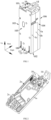
- FIGs.1-4 there is an embodiment of the plug-in circuit breaker of the present invention.
- the plug-in circuit breaker of the present invention includes a circuit breaker housing and at least one protective pole, wherein the circuit breaker housing includes at least one protective pole-mounting cavity fitting with the protective pole by one-to-one, each protective pole includes the operating button 1d, the operating mechanism 3 arranged inside the protective pole-mounting cavity and drivingly connected with the operating button 1d, the protecting mechanism 4 drivingly cooperated with the operating mechanism 3, the arc extinguishing system 5, the first wire-inlet terminal 110, the first wire-outlet terminal 11, the movable contact 61 connected with the operating mechanism 3, and the stationary contact 62 fitting with the movable contact 61.
- One end of the operating button 1d is inserted into the circuit breaker housing, at one end of which the operating button 1d and the first wire-outlet terminal 11 are both arranged, and at the other end of which the first wire-inlet terminal 110 is arranged.
- the arc extinguishing system 5 is arranged in the middle of the protective pole-mounting cavity and positioned on one side of the first wire-inlet terminal 110, the operating mechanism 3 is arranged between the operating button 1d and the arc extinguishing system 5, and the protecting mechanism 4 is arranged between the first wire-outlet terminal 11 and the arc extinguishing system 5 and positioned on one side of the operating mechanism 3.
- the plug-in circuit breaker of the present invention is a two-pole circuit breaker, including a protective pole and a neutral pole, wherein the protective pole is a L pole, and the neutral pole is a N pole.
- the plug-in circuit breaker also includes a circuit breaker housing composed of the front cover 1c, the base 1b and the rear cover 1a, wherein the front cover 1c and the base 1b define the protective pole mounting cavity fitting with the protective pole by one-to-one, and the base 1b and the rear cover 1a define the neutral pole mounting cavity fitting with the neutral pole.
- the circuit breaker housing includes the upper side 101, the lower side 102, the front side 105, the rear side 106, the left side 103 and the right side 104.
- the lower end of the operating button 1d is inserted in the circuit breaker housing, the operating button 1d and the first wire-outlet terminal 11 are arranged on the upper end of the circuit breaker housing, the first wire-inlet terminal 110 is arranged on the lower end of the circuit breaker housing, the arc extinguishing system 5 is arranged in the middle of the protective pole mounting cavity and positioned on the upper side of the first wire-inlet terminal 110, the operating mechanism 3 is arranged between the operating button 1d and the arc extinguishing system 5, the protecting mechanism 4 is arranged between the first wire-outlet terminal 11 and the arc extinguishing system 5 and positioned on the left side of the operating mechanism 3.
- the neutral pole further includes the second wire-inlet terminal 100 arranged with the first wire-inlet terminal 110 side by side on lower end of the circuit breaker housing, and the second wire-outlet terminal 10 arranged with the first wire-outlet terminal 11 side by side on the upper end of the circuit breaker housing, and the second wire-inlet terminal 100 is electrically connected with the second wire-outlet terminal 10 through the second electroconductive plate 2a.
- the first wire-inlet terminal 110 and the second wire-inlet terminal 100 are arranged on the right and left parts of the lower end of the circuit breaker housing, respectively; the first wire-outlet terminal 11 and the second wire-outlet terminal 10 are both arranged on the left side of the operating button 1d.
- the first wire-inlet terminal 110 and the second wire-inlet terminal 100 both include the first elastic elements 2c, each of which includes a first reed connecting plate and two first reed clamping plates arranged opposite to each other, which are crookedly connected with the two ends of the first reed connecting plate respectively, and each first reed clamping plate has a " ⁇ " structure, thus the two first reed clamping plates are integrally formed into an X-shaped structure.
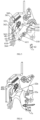
- FIGs 3-7 there is the first embodiment of the operating mechanism 3 in the plug-in circuit breaker of the present invention.
- the operating mechanism 3 of the first embodiment includes the U-shaped connecting rod 35,the operating handle 30, the contact supporting rod 31, the jump buckle 32, the lock catch 36, the lock catch-resetting spring 37 and the main tension spring 33.
- the operating handle 30 is pivotally arranged on the circuit breaker housing. One end of the operating handle 30 is drivingly connected with the operating button 1d by the U-shaped connecting rod 35, and the other end of the operating handle 30 is rotatably connected with one end of the contact supporting rod 31, the other end of which is provided with the movable contact 61.
- the jump buckle 32 has one end pivotally arranged on the circuit breaker housing, and the middle part connected with the end of the contact supporting rod 31 provided with the movable contact 61 by the main tension spring 33.
- the arc isolating plate 34 When the plug-in circuit breaker is in the break-contact state, the arc isolating plate 34 enters between the movable contact 61 and the stationary contact 62, in the make-contact state, the arc isolating plate 34 moves out between the movable contact 61 and the stationary contact 62.
- the contact supporting rod 31 further includes the linkage member 44 having the linkage rod 440 and the linkage shaft 441 arranged at one end of the linkage rod 440.
- the linkage shaft 440 has two ends respectively pivoted on the circuit breaker housing and the middle provided with the polygonal hole 4410 in its axial direction, and the side of the linkage rod 440 opposite to the jump buckle 32 is provided with the linkage member activated stand 442.
- the second jump buckle arm 32b is provided with the linkage member activating stand 322 that is drivingly cooperated with the linkage member activated stand 442.
- the plug-in circuit breaker includes a plurality of protective poles, the linkage shafts 441 of which are connected with each other by linkage member connecting shafts, and the linkage member connecting shafts fit with the polygonal hole 4410 of each linkage member 44, respectively.
- the linkage member activating stand 322 of the jump buckle 32 of the protective pole drives the linkage rod 440 to swing by the linkage member activated stand 442, thus the linkage rod 440 drives the linkage shaft 441 to rotate, and the linkage shaft 441 drives the linkage rods 440 of other protective poles to swing by the linkage member connecting shaft, knocking the lock catch 36 of each protective pole, respectively, so as to make each protective pole trip synchronously.
- the linkage members 44 of each protective pole can be connected with each other by one linkage member connecting shaft, or two adjacent protective poles are connected with each other by one linkage member connecting shaft.
- the jump buckle 32 and the contact supporting rod 31 are both arranged below the operating handle 30, and the operating handle 30 has the upper end connected to the operating button 1d by the U-shaped connecting rod 35, the middle pivotally arranged on the circuit breaker housing, and the lower end rotatably connected with the supporting rod rotation shaft 311 on the upper end of the contact supporting rod 31.
- the jump buckle 32 has an U-shaped structure with its opening facing downward, and includes the second jump buckle arm 32b and the first jump buckle arm 32a respectively arranged on the left and right sides of the jump buckle 32.
- the first jump buckle arm 32a has the upper end pivotally arranged on the circuit breaker housing, and the upper end connected to the upper end of the second jump buckle arm 32b, and the lower end of the second jump buckle arm 32b is locked with with the lock catch 36.
- the middle of the jump buckle 32 is connected with the upper end of the movable contact plate 610 of the contact supporting rod 31 by the main tension spring 33.
- the contact supporting rod 31 has the upper end stacked on the front side of the middle of the jump buckle 32, and the lower end provided with the movable contact 61 including the movable contact plate 610, and the movable contact plate 610 has the right side of the lower end provided with the movable contact point 611, and the upper end connected to the lower end of the main tension spring 33.
- the arc isolating plate 34 has the left end rotatably connected with the lower end of the contact supporting rod 3, and the right end fitting with the movable contact 61 and the stationary contact 62, extends between the movable contact 61 and the stationary contact 62 in the break-contact state, and moves out between the movable contact 61 and the stationary contact 62 in the make-contact state.
- the contact supporting rod 31 is provided with the rod-barrier limit groove, when the contact supporting rod 31 drives the movable contact 61 and the stationary contact 62 to be in the break/make-contact state, the rod-barrier limit groove drives the arc isolating plate 34 to extend into and out of the space between the movable contact and the stationary contact and limits the swing scope of the right end of the arc isolating plate 34.
- the lock catch 36 is arranged on the left side of the jump buckle 32, and has the middle part pivotally arranged, the upper end connected to the circuit breaker housing by the lock catch-resetting spring 37, and the lower end interlocked with the lower end of the second jump buckle arm 32b of the jump buckle 32.
- the linkage member 44 is arranged between the lock catch 36 and the jump buckle 32, and the linkage rod 440 has the upper end pivoted by the linkage shaft 441, and the middle part positioned on the right side below the linkage shaft 441 and provided with the linkage member activated stand 442.
- the left side of the upper end of the second jump buckle arm 32b is provided with the linkage member activating stand 322 drivingly cooperated with the linkage member activated stand 442.
- the operating handle 30 is pivotally arranged on the circuit breaker housing by the operating handle mounting shaft 14. Further, both ends of the operating handle mounting shaft 14 are pivotally connected to the front cover 1c and the base 1b, respectively.
- the operating handle 30 further includes a handle-connection hole fitting with the U-shaped connecting rod 35, a handle-support hole fitting with the supporting rod rotation shaft 311 of the contact supporting rod 31, and a handle shaft hole fitting with the operating handle mounting shaft 14.
- the shape of the operating handle 30 is approximately a triangle, at three vertices of which there are the handle-connection hole, the handle shaft hole and the handle-support hole respectively arranged.
- the lower end of the first jump buckle arm 32a of the jump buckle 32 is pivotally arranged on the circuit breaker housing by the jump buckle mounting shaft 15. Further, the two ends of the jump buckle mounting shaft 15 are pivotally connected to the front cover 1c and the base 1b, respectively.
- the middle of the jump buckle 32 is provided with the jump buckle-spring connection hole 320 connected with one end of the main tension spring 33, and the upper end of the movable contact plate 610 is provided with the movable contact plate-spring connection hole 310.
- the lower end of the second jump buckle arm 32b has a wedge-shaped structure, and the lower end of the jump buckle 36 is provided with the lock catch hole 363 interlocked with the lower end of the second jump buckle arm 32b.
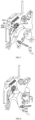
- FIGs.8-9 there is the second embodiment of the operating mechanism 3 in the plug-in circuit breaker of the present invention.
- the operating mechanism 3 of the second embodiment is different from that of the first embodiment in that it further includes the jump buckle-resetting spring 38, one end of which is connected with the circuit breaker housing, and the other end of which is connected with the jump buckle 32.
- the protecting mechanism 4 actuates the lock catch 36 to release the coupling with the jump buckle 32, then the plug-in circuit breaker trips, and the jump buckle-resetting spring 38 actuates the jump buckle 32 to rotate, so that the jump buckle 32 is recoupled with the lock catch 36, meanwhile the plug-in circuit breaker enters the break-contact state.
- the jump buckle-resetting spring 38 is a torsion spring encircling the jump buckle-resetting spring shaft 380 positioned on one side of the first jump buckle arm 32a, and the two ends of the jump buckle-resetting spring shaft 380 are fixed on the circuit breaker housing, respectively.
- the middle of the first jump buckle arm 32a is provided with the jump buckle-resetting protrusion 323, and the jump buckle-resetting spring 38 has one end connected with the circuit breaker housing, and the other end connected with the jump buckle 32.
- the jump buckle-resetting spring 38 enables the jump buckle 32 to rotate clockwise by the jump buckle-resetting protrusion 323 until the lower end of the second jump buckle arm 32b is relocked with the lock catch 36 again.
- FIGs.3-9 there is an embodiment of the protecting mechanism 4 in the plug-in circuit breaker of the present invention.
- the protecting mechanism 4 includes the magnetic yoke 40 and the dual metal piece 42.
- the magnetic yoke 40 is arranged on one side of the lock catch 36
- the dual metal piece 42 is arranged at the middle of the magnetic yoke 40 and positioned between the magnetic yoke 40 and the lock catch 3, having one end fixedly arranged and electrically connected with the first wire-outlet terminal 11, and the other end drivingly cooperated with the lock catch 36 and electrically connected with the movable contact 61.
- the dual metal piece 42 is arranged at the middle of the magnetic yoke 40 and positioned between the magnetic yoke 40 and the lock catch 36, and the lock catch 36 has the upper end fixedly arranged, the middle part rotatably arranged, and the lower end arranged opposite to the magnetic yoke 40, drivingly cooperated with the dual metal piece 42 and interlocked with the jump buckle 32.
- the lock catch 36 has the middle rotatably arranged on one end of the magnetic yoke 40, one end connected with the circuit breaker housing by the lock catch-resetting spring 37, and the other end arranged opposite to the magnetic yoke 40.
- the dual metal piece 42 has the fixed end electrically connected with the first wire-outlet terminal 11 by the first electroconductive plate 2b (see FIG.3 ), the other end electrically connected with the contact supporting rod 31 through the soft connection 63, and the stationary contact 62 is electrically connected with the first wire-inlet terminal 110.
- the protection mechanism 4 also includes an adjustment screw which is in limit fit with the circuit breaker housing, and which has one end threadedly engaged with the end of the first electroconductive plate 2b connected with the dual metal piece 42, so as to adjust the position of the dual metal piece 42, and furthermore the tripping threshold or parameter of the dual metal piece 42.
- the lock catch 36 has the middle rotatably arranged on the upper end of the magnetic yoke 40, the upper end connected with the circuit breaker housing by the lock catch-resetting spring 37, and the lower end arranged opposite to the magnetic yoke 40.
- the dual metal piece 42 has the upper end electrically connected with the first wire-outlet terminal 11 by the first electroconductive plate 2b, and the lower end electrically connected with the contact supporting rod 31 through the soft connection 63, and the stationary contact 62 is electrically connected with the first wire-inlet terminal 110.
- the first electroconductive plate 2b is electrically connected with the contact supporting rod 31 through a second soft connection, adding a circuit extending from the second electroconductive plate 2b to the contact supporting rod. Therefore, when a short-circuit fault occurs in a plug-in circuit breaker specified with a large ampere rated current, the current flowing in the dual metal piece is reduced, avoiding the occurrence of the failure of the dual metal piece from being overheated due to an excessive current.
- the cross section of the magnetic yoke 40 has a shaped structure, and one end of the magnetic yoke 40 is provided with two yoke supporting arms 400 arranged opposite to each other (see FIG.6 ), on which there is the yoke limiting groove 401 arranged.
- the lock catch 36 includes the lock catch-resetting end 360, the lock catch supporting arm 361, the lock catch body 362, the lock catch hole 363 and the lock catch activated end 364 (see FIG. 5 ), and the lock catch-resetting end 360, the lock catch body 362 and the lock catch activated end 364 are connected with each other in sequence.
- the lock catch-supporting arm 361 is arranged on both sides of the connection between the lock catch-resetting end 360 and the lock catch body 362, and the lock catch activated end 364 has a L-shaped structure, one end crookedly connected with the lock catch body 362, and the other end drivingly cooperated with the dual metal piece 42.
- the two lock catch-supporting arms 361 are respectively arranged inside two yoke limiting grooves 401, the lock catch body 362 is arranged opposite to the magnetic yoke 400, and the lock catch hole 363 is arranged on the lock catch body 362 and interlocked with the jump buckle 32.
- the lock catch body 362 has the upper end crookedly connected with the lock catch-resetting end 360, and the lower end crookedly connected with the lock catch activated end 364. While the lock catch-resetting end 360 bends to the right, the lock catch activated end 364 bends to the left, and the lock catch hole 363 is arranged in the middle of the lock catch body 362 to fit with the magnetic yoke 40.
- FIGs.3-4 there is an embodiment of the arc extinguishing system 5 in the plug-in circuit breaker of the present invention.
- the arc extinguishing system 5 includes the arc extinguishing chamber 50, and the movable contact arcing plate 51 and the stationary contact arcing plate 52 respectively arranged on both sides of the arc extinguishing chamber 50.
- the movable contact arcing plate 51 fits with the movable contact 61 and is electrically connected with the first wire-outlet terminal 11, and the stationary contact arcing plate 52 has one end provided with the stationary contact 62, and the other end electrically connected with the first wire-inlet terminal 110.
- the movable contact arcing plate 51 and the stationary contact arcing plate 52 are respectively arranged on the left and right sides of the arc extinguishing chamber 50, and the movable contact arcing plate 51 is electrically connected with the first wire-outlet terminal 11 and has the upper end fitting with the movable contact 61.
- the stationary contact arcing plate 52 has the upper end provided with the stationary contact 62, and the lower end electrically connected with the first wire-inlet terminal 110, and the upper end of the movable contact arcing plate 51 and the upper end of the stationary contact arcing plate 52 bend to each other.
- the plug-in circuit breaker of the present invention further includes at least two auxiliary signal terminals that are connected to external circuits in a plug-in and plug-out mode.
- Each auxiliary signal terminal is electrically connected to the first wire-outlet terminal 11, and a signal processing element is connected in series between at least one auxiliary signal terminal and the first wire-outlet terminal 11.
- the signal processing element includes at least one diode.
- a signal processing element is connected in series between each auxiliary signal terminal and the first wire-outlet terminal 11, or a signal processing element is connected in series between one auxiliary signal terminal and the first wire-outlet terminal 11, and a signal processing element is not connected in series between another auxiliary signal terminal and the first wire-outlet terminal 11.
- the plug-in circuit breaker of the present invention preferably adopts the latter method, so that the plug-in circuit breaker can output a DC signal through one auxiliary signal terminal and output an AC signal through another auxiliary signal terminal, so as to strengthen the adaptability of the plug-in circuit breaker and ensure to meet the requirements of different application environments.
- the signal processing element is not limited to diodes, may be other elements capable of converting an AC signal into a DC signal.
- the signal processing element can also be simply added with functions according to user needs.
- the plug-in circuit breaker of the present invention includes two auxiliary signal terminals that are connected to the external circuit in a plug-in and plug-out mode, which are the first auxiliary signal terminal 12 and the second auxiliary signal terminal 13 respectively, and each auxiliary signal terminal is electrically connected with the first wire-outlet terminal 11 by the movable contact arcing plate 51, and one diode is connected in series between the second auxiliary signal terminal 13 and the movable contact arcing plate 51. Further, as shown in FIGs.
- the first wire-inlet terminal 110, the second wire-inlet terminal 100, the first auxiliary signal terminal 12 and the second auxiliary signal terminal 13 are all arranged on the lower end of the plug-in circuit breaker, the first auxiliary signal terminal 12 and the second auxiliary signal terminal 13 are arranged side by side between the first wire-inlet terminal 110 and the second wire-inlet terminal 100.
- the auxiliary signal terminal can be connected to a circuit structure such as an external control circuit board, so as to realize for example remote monitoring.
- each auxiliary signal terminal includes the second elastic elements 2d, each of which includes a second reed connecting plate and two second reed clamping plates arranged opposite to each other, which are crookedly connected with the two ends of the second reed connecting plate respectively, and each second reed clamping plate has a " ⁇ " structure, thus the two second reed clamping plates are integrally formed into an X-shaped structure.
- the plug-in circuit breaker of the present invention further includes the air exhaust opening 16, and a first exhaust passage is also provided in the protective pole mounting cavity.
- the first exhaust passage has one end communicating with the air vent of the arc extinguishing chamber 50 of the arc extinguishing system 5, and the other end communicating with the external environment through the air exhaust opening 16.
- the air exhaust opening 16 is arranged on the lower end surface of the circuit breaker housing and positioned between the second auxiliary signal terminal 13 and the first wire-inlet terminal 110 .
- one end of the operating button 1d inserted inside the circuit breaker housing is a button inner end, and the other end of the operating button 1d protruding outside the circuit breaker housing is a button outer end.
- An indicator slot is arranged inside the operating button 1d, the indicating hole 12d is arranged on the button outer end, and the indicating hole 12d communicates with one end of the indicator slot.
- the plug-in circuit breaker further includes the indicating member 7 slidably inserted into the indicator slot, one end of the indicating member 7 is provided with the make-contact indicating surface 70 and the break-contact indicating surface 71 both respectively fitting with the indicating hole 12d.
- the break-contact indicating surface 71 When the plug-in circuit breaker is in the break-contact state, the break-contact indicating surface 71 is arranged opposite to the indicating hole 12d, thus during pressing the operating button 1d to move it toward the make-contact position, the indicating member 7 moves in its entirety inside the indicator slot. After the plug-in circuit breaker enters the make-contact state, the make-contact indicating surface 70 is arranged opposite to the indicating hole 12d, thus during pulling the operating button 1d to move it toward the break-contact position, the indicating member 7 moves in its entirety inside the indicator slot. After the plug-in circuit breaker enters the break-contact state, the break-contact indicating surface 71 is arranged opposite to the indicating hole 12d.
- the movement direction of the operating button 1d is perpendicular to the movement direction of the indicating member 7 within the indicator slot.
- the operating button 1d further includes the indicator sliding groove 100d respectively arranged on a pair of side walls of the indicator slot, and the extension direction of the indicator sliding groove 100d is perpendicular to the movement direction of the operating button 1d.
- the indicating member 7 further includes two indicator sliding stands 72 respectively arranged on a pair of side surfaces thereof, and the indicator sliding stand 72 is slidably arranged in the indicator sliding groove100d to restrict the movement path of the indicating member 7 inside the indicator sliding groove 100d.
- the indicating member 7 further includes the indicator tracking shaft 75 arranged at the other end of the indicating member 7.
- an indicator tracking groove is arranged on the circuit breaker housing, and the indicator tracking shaft 75 is slidably arranged in the indicator tracking groove.
- the indicator tracking groove drives the indicating member 7 to move in its entirety in the indicator slot by the indicator tracking shaft 75, so that the make-contact indicating surface 70/break-contact indicating surface 71 is arranged opposite to the indicating hole 12d.
- the indicator tracking groove is an inclined tracking groove, which may be slantingly arranged in a straight line or in an arc.
- a actuating protrusion can be provided on the circuit breaker housing, so that the indicating member moves horizontally with respect to the operating button 1d by means of the fit between the inclined actuating surface and the actuating protrusion, when the operating button 1d is pressed/pulled.
- the indicator tracking groove is an inclined tracking groove, which is formed by means of the fit between two inclined half-grooves arranged opposite to each other on the circuit breaker housing.
- the indicator tracking shaft 75 When the plug-in circuit breaker is in the break-contact state, the indicator tracking shaft 75 is positioned at one end of the indicator tracking groove, which is the first tracking groove end; when the plug-in circuit breaker is in the make-contact state, the indicator tracking shaft 75 is positioned at the other end of the indicator tracking groove, which is the second tracking groove end.
- the first tracking groove end is closer to the button outer end of the operating button 1d than the second tracking groove end.
- make-contact indicating surface 70 and the break-contact indicating surface 71 may be different from each other in color, for example, the make-contact indicating surface is green, but the break-contact indicating surface is red; or the make-contact indicating surface 70 and the break-contact indicating surface 71 may be different from each other in characters or symbol identification, for example, the make-contact indicating surface 70 has the word " make-contact " or the symbol "
- the operating button 1d has the upper end as the button outer end, and the lower end as the button inner end, and the end face of the button outer end is provided with the indicating hole 12d, which is connected with the upper end of the indicator slot.
- the make-contact indicating surface 70 and the break-contact indicating surface 71 are arranged side by side at the upper end of the indicating member 7, the two indicator sliding stands 72 are arranged on both sides of the middle of the indicating member 7, and the indicator tracking shaft 75 is arranged at the lower end of the indicating member 7.
- the indicator tracking groove is formed by means of the fit between two inclined half grooves, one inclined half groove is arranged on the rear cover 1a, being the first half groove 10a, and the other inclined half groove is arranged on the base 1b, being the second half groove 10b.
- the upper right end of the indicator tracking groove is the first tracking groove end, and the lower left end is the second tracking groove end.
- the operating button 1d when the plug-in circuit breaker is in the break-contact state, thus the operating button 1d is pressed down (the operating button 1d moves toward the make-contact position), as the operating button 1d moves linearly, and the indicator tracking groove is inclined from the upper right to the lower left, therefore the indicator tracking groove actuates the indicating member 7 to move laterally by the indicator tracking shaft 75 (the indicating member 7 moves in its entirety in the indicator slot), so as to switch from the configuration of the break-contact indicating surface 71 opposite to the indicating hole 12d to the configuration of the make-contact indicating surface 70 opposite to the indicating hole 12d.
- the operating button 1d When the plug-in circuit breaker is in the make-contact state, the operating button 1d is pulled upward, thus the indicating member 7 goes through the process opposite to above-mentioned process.
- the plug-in circuit breaker of the present invention further includes a locking mechanism, wherein the locking mechanism includes the second locking member 8 pivotally arranged in the middle, the second locking member 8 includes the locking member upper end and the locking member lower end respectively arranged at both ends thereof, and the locking member lower end is provided with the second protrusion 82.
- the locking mechanism includes the second locking member 8 pivotally arranged in the middle, the second locking member 8 includes the locking member upper end and the locking member lower end respectively arranged at both ends thereof, and the locking member lower end is provided with the second protrusion 82.
- the operating button 1d When the plug-in circuit breaker is in the make-contact state, the operating button 1d actuates the second locking member 8 to rotate by the locking member lower end, so that the second protrusion 82 protrudes outside the circuit breaker housing; when the plug-in circuit breaker is in the break-contact state, the operating button 1d actuates the second locking member 8 to rotate by the locking member upper end, so that the second protrusion 82 moves into the circuit breaker housing.
- the indicating member 7 further includes the indicator horizontal arm 74 arranged at one end thereof.
- the second locking member 8 further includes the second locking member activated portion 81 arranged at the locking member upper end, and the operating button 1d are drivingly cooperated with the second locking member activated portion 81 by the indicator horizontal arm 74 to drive the second locking member 8 to rotate, so that the second protrusion 82 moves into the circuit breaker housing. Further, as shown in FIGs.11, 12 and 17 , the second locking member 8 further includes the second locking member activated protrusion 83 arranged at the locking member lower end, and the second locking member activated protrusion 83 protrudes in the reverse direction of the second protrusion 82.
- the indicator horizontal arm 74 is positioned on one side of the second locking member activated protrusion 83 and in limit fit with it, so as to keep the second protrusion 82 protruding outside the circuit breaker housing.
- the indicator horizontal arm 74 is arranged on the lower end of the indicating member 7 and connected with the right angle thereof, and protrudes to the left
- the second locking member activated portion 81 is arranged on the upper end of the second locking member 8 and connected with the right angle thereof, and protrudes to the right.
- the second protrusion 82 (In FIG.18 , the second protrusion 82 is screened by the first locking member 9) and the second locking member activated protrusion 83 are both arranged on the lower end of the second locking member 8 and protrude to the left and right sides of the second locking member 8 respectively, and the indicator horizontal arm 74 is positioned on the lower side of the second locking member activated portion 81 and drivingly cooperated with it.
- the operating button 1d actuates the second locking member 8 to rotate counterclockwise by means of the fit between the indicator horizontal arm 74 and the second locking member activated portion 81, so that the second protrusion 82 moves into the circuit breaker housing.
- the operating button 1d moves down, and the indicator horizontal arm 74 abuts against the second locking member activated protrusion 83, so that the second locking member 8 rotates counterclockwise, thus the second protrusion 82 protrudes outside the circuit breaker housing.
- the indicator horizontal arm 74 is positioned on the left side of the second locking member activated protrusion 83 and in limit fit with it, the second protrusion 82 keeps protruding outside the circuit breaker housing.
- the indicator horizontal arm 74 of the indicating member 7 keeps the second protrusion 82 of the second locking member 8 protruding outside the circuit breaker housing, preventing the circuit breaker from being installed under the make-contact state and occurrence of electric shock, and facilitating improving the user's electricity safety.
- the actuation of the second locking member 8 is not only limited to the actuation under the indicator horizontal arm 74, a structure similar to the indicator horizontal arm 74 is but also arranged on the lower end of operating button 1d to actuate the second locking member 8.
- the locking mechanism further includes the first locking member 9, which has one end slidably arranged inside the circuit breaker housing, and the other end being the first protrusion 90 protruding outside the circuit breaker housing.
- the housing of the circuit breaker assembling position presses the first protrusion 90, so that the first locking member 9 moves in its entirety to the inside of the circuit breaker housing.
- the first protrusion 90 protrudes outside the circuit breaker housing and is in limit fit with the housing of the circuit breaker assembling position.
- the first locking member 9 is in limit fit with the housing of the circuit breaker assembling position, ensuring the assembly reliability of the plug-in circuit breaker, preventing the plug-in circuit breaker from being pulled out by mistake under the make-contact state, and improving the user's electricity safety.
- the locking member lower end of the second locking member 8 is drivingly cooperated with the first locking member 9.
- pulling the operating button actuates the first locking member 9 to move in its entirety toward the inside of the circuit breaker housing by the second locking member 8, so as to release the limit fit between the first protrusion 90 and the housing of the circuit breaker assembling position.
- the first sliding end 90 a further includes the first activated protrusion 91 and the second activated protrusion 94.
- the second locking member 8 further includes the second locking member body 84 pivotally arranged in the middle, the second locking member activated portion 81 of the second locking member 8 is crookedly connected with one end of the second locking member body 84, and the other end of the second locking member body 84 is provided with the second protrusion 82 and drivingly cooperated with the second activated protrusion 94.
- the second locking member activated portion 81 and the second protrusion 82 protrude toward the both sides of the second locking member body 84, respectively, and the second protrusion 82 is drivingly cooperated with the first activated protrusion 91.
- first locking member 9 can exclude the first activated protrusion 91 or the second activated protrusion 94, thus retain either of the two to fit with the second locking member 8. Of course, such improvement will abate the stability and reliability of the action of the first locking member 9.
- the first locking member 9 further includes the first sliding end 90a slidably arranged inside the circuit breaker housing, wherein the first sliding end 90a has one side connected with the first protrusion 90, and the other side connected with the circuit breaker housing by the first locking member resetting spring 9a applying a force to the first locking member 9 to keep the first protrusion 90 protruding outside the circuit breaker housing.
- the upper end of the second locking member activating portion 84 is crookedly connected with the second locking member activated portion 81 (connected at a right angle or approximately at a right angle), the second protrusion 82 is arranged on the edge of one side edge of the lower end of the second locking member body 84, and the lower end of the second locking member activating portion 84 and the second protrusion 82 are arranged on the right sides of the second activated protrusion 94 and the first activated protrusion 91, respectively.
- the circuit breaker housing is provided with the first opening 11 a fitting with the first protrusion 90 and the second protrusion 82.
- the first opening 11a is arranged on the right side of the circuit breaker housing, and the first protrusion 90 and the second protrusion 82 protrude outside the circuit breaker housing through the first opening 11a, respectively.
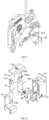
- FIGs.11-18 there is an embodiment of the locking mechanism in the plug-in circuit breaker of the present invention.
- the locking mechanism includes the first locking member 9, the second locking member 8 and the indicating member 7.
- the indicating member 7 has one end inserted into the operating button 1d, and the other end drivingly cooperated with the second locking member 8, and the second locking member 8 has the middle pivotally arranged, and one end drivingly cooperated with the first locking member 9.
- the first locking member 9 further includes the first sliding end 90a and the first protrusion 90 respectively arranged both end thereof, wherein the first sliding end 90a has one side connected with the first protrusion 90, and the other side connected with the circuit breaker housing by the first locking member resetting spring 9a.
- the first sliding end 90a includes the spring-limiting groove 92 arranged on one side thereof, and a spring-limiting protrusion is also arranged in the middle of the spring-limiting groove 92.
- One end of the first locking member resetting spring 9a is inserted into the spring-limiting groove 92, and encircles the spring-limiting protrusion.
- the first sliding end 90a is provided with the first tracking groove 93 fitting with the first sliding track on the circuit breaker housing to define a sliding path of the first sliding end 90a.
- the first sliding end 90a further includes the first activated protrusion 91 and the second activated protrusion 94, wherein the first activated protrusion 91 and the first tracking groove 93 are respectively arranged at both ends of the first sliding end 90a, and the second activated protrusion 94 are arranged on the upper side of the first sliding end 90a and positioned between the first activated protrusion 91 and the first tracking groove 93.
- the second locking member 8 includes the second locking member activated portion 81, the second locking member body 84, the second locking member activated protrusion 83, the second locking member activated protrusion 83 and the second protrusions 82.
- the second locking member body 84 has the middle part pivotally arranged on the circuit breaker housing by the second locking member mounting shaft 80, one end crookedly connected with the second locking member activated portion 81, and the other end provided with the second locking member activated protrusion 83 and the second protrusions 82.
- the second locking member activated portion 81 and the second protrusion 82 protrude toward both sides of the second locking member body 84, respectively, and the second locking member activated portion 81 and the second locking member activated protrusion 83 both protrude on the identical side of the second locking member body 84.
- the second locking member 8 includes a locking member upper end and a locking member lower end respectively arranged on the upper and lower ends thereof, and the second locking member activated portion 81 is crookedly connected with the second locking member body 84 (connected at a right angle or approximately at a right angle) to form the locking member upper end; the second locking member activated protrusion 83 and the second protrusions 82 are both arranged on the lower end of the second locking member body 84, thus the second protrusion 82 and the lower end of the second locking member body 84 form the locking member lower end.
- the middle of the second locking member body 84 is provided with the second locking member mounting shaft 80, both ends of which are pivotally connected to the circuit breaker housing, respectively.
- the lower end of the second locking member body 84 is drivingly cooperated with the second activated protrusion 94, and the second locking member activated protrusion 83 is arranged at the edge of one side of the lower end of the second locking member body 84(as shown in FIG. 10 , the second locking member activated protrusion 83 is arranged at the edge of the left side of the lower end of the second locking member body 84).
- the second protrusion 82 protrudes below the lower end of the second locking member body 84 and is connected with the second locking member activated protrusion 83 (As shown in FIG.
- the second locking member activated portion 81 and the second locking member body 84 integrally form a L-shaped structure
- the second locking member activated protrusion 83 and the second protrusion 82 are an integral plate structure, and positioned in their entirety on the left side of the above-mentioned L-shaped structure, and the upper end is the second locking member activated protrusion 83 connected with the lower end of the second locking member body 84, and the lower end is the second protrusion 82 protruding below the lower end of the second locking member body 84.
- the second locking member activated portion 81 and the second protrusion 82 protrude toward both sides of the second locking member body 84, respectively, the second locking member activated portion 81 and the second locking member activated protrusion 83 protrude toward the identical side of the second locking member body 84, and the second protrusion 82 is drivingly cooperated with the first activated protrusion 91.
- the indicating member 7 includes the indicator body 7-0, the indicator horizontal arm 74, the indicator tracking shaft 75, the indicator sliding stand 72, the make-contact indicating surface 70 and the break-contact indicating surface 71.
- the indicator horizontal arm 74 is arranged on one end of the indicator body 7-0 and crookedly connected with the indicator body 7-0, the make-contact indicating surface 70 and the break-contact indicating surface 71 are arranged side by side on the other end of the indicator body 7-0, two indicator sliding stands 72 are respectively arranged on both sides of the middle part of the indicator body 7-0.
- the indicating member 7 further includes the indicator vertical arm 73, wherein the indicator vertical arm 73 and the indicator horizontal arm 74 are arranged on the identical end of the indicator body 70, both have a L-shaped structure in their entirety, thus the indicator vertical arm 73 helps to improve the structural strength of the indicator horizontal arm 74.
- the make-contact indicating surface 70 and the break-contact indicating surface 71 are arranged side by side on the upper end surface of the indicator body 7-0.
- the indicator horizontal arm 74, the indicator tracking shaft 75 and the indicator vertical arm 73 are all arranged on the lower end surface of the indicator body 7-0.
- the indicator horizontal arm 74 and the indicator vertical arm 73 are arranged on the identical side of the indicator body 7-0 in a L-shaped structure as a whole, and the indicator tracking shaft 75 is arranged on the other side of the indicator body 7-0.
- Two indicator sliding stands 72 are respectively arranged on the middle parts of both sides of the indicator body 7-0, and both positioned between the break-contact indicating surface 71 and the indicator horizontal arm 74.
- the circuit breaker housing is provided with an indicator tracking groove fitting with the indicator tracking shaft 75.
- the indicator tracking groove is obliquely arranged as an tracking groove inclined from the upper right end to the lower left end.
- the indicator tracking groove includes a first vertical groove, an inclined groove and a second vertical groove, wherein the lower end of the first vertical groove is connected with the upper right end of the inclined groove, the upper end of the second vertical groove is connected with the lower left end of the inclined groove, and the lower end of the first vertical groove is higher than the upper end of the second vertical groove.
- the indicator tracking groove is composed of two inclined half-grooves fitting with each other, in particular, one inclined half-groove is arranged on the rear cover 1a, and the other inclined half-groove is arranged on the base 1b.
- the operating button 1d includes the button body 10d and the button cap arranged at one end of the button body 10d, wherein the middle of the button cap is provided with the indicating hole 12d, the middle of the other end of the button body 10d is provided with the indicator slot, two side walls of the indicator slot are respectively provided with one indicator groove 100d.
- the operating button 1d further includes the button connecting stand 11d rotatably connected to one end of the U-shaped connecting rod 35.
- the operating button 1d actuates the second locking member 8 to rotate clockwise through the fit between the indicator horizontal arm 74 of the indicating member 7 and the second locking member activated portion 81 of the second locking member 8, thus the second protrusion 82 of the second locking member 8 is moved inside the circuit breaker housing, in this state (break-contact), the plug-in circuit breaker can be installed into the circuit breaker assembling position (eg, a cabinet).
- the operating button 1d drives the indicator horizontal arm 74 to move down, thus the indicator horizontal arm 74 drives the second locking member 8 to rotate counterclockwise by the second locking member activated protrusion 83, so that the second protrusion 82 protrudes outside the circuit breaker housing, in this state (make-contact), the second protrusion 82 protrudes outside the circuit breaker housing.
- the second locking member activated protrusion 83 is confined by the indicator horizontal arm 74, the second protrusion 82 cannot be pressed into the circuit breaker housing, so when the plug-in circuit breaker is in the make-contact state, it cannot be assembled to the circuit breaker assembling position.
- the indicating member 7 When the plug-in circuit breaker is switched between the break-contact state and the make-contact state, due to the fit between the indicator tracking shaft 75 and the indicator tracking groove, the indicating member 7 will also move back and forth in the indicator slot of the operating button 1d.
- the make-contact indicating surface 70 when the plug-in circuit breaker is in the make-contact state, the make-contact indicating surface 70 is opposite to the indicating hole 12d (preferably, the indicator tracking shaft 75 is positioned at the connection between the second vertical groove and the inclined groove); when the plug-in circuit breaker is in the break-contact state, the break-contact indicating surface 70 is opposite to the indicating hole 12d (preferably, at this time, the indicator tracking shaft 75 is positioned at the connection between the first vertical groove and the inclined groove, and if the operating button 1d is continuously pulled, the indicator tracking shaft 75 slides along the first vertical groove to the second locking member 8, so as to actuate the first locking member 9 to release the limit fit with the housing of the circuit breaker assembling position).
- the present invention also relates to a connecting terminal.
- FIGs.19-24 there is an embodiment of the connecting terminal of the present invention.
- the connecting terminal of the present invention includes the connecting screw 2e, the wire-clamping piece 2g, the nut piece 2f and the connecting board 2j; the connecting screw 2e and the nut piece 2f are threadedly connected with each other; the wire-clamping piece 2g is arranged between the nut piece 2f and the nut of the connecting screw, and obliquely arranged with respect to the connecting board 2j, which is fixedly arranged.
- the wire-clamping piece 2g has one end confined, and the other end configured to from a space for connecting wires with respect to the connecting board 2j.
- the nut piece 2f actuates the end of the wire-clamping piece 2g fitting with the connecting board 2j to rise, so as to press the wires between the wire-clamping piece 2g and the connecting board 2j.
- the nut piece 2f is in limit fit with the terminal assembling cavity receiving the connecting terminal, preventing the nut piece 2f from rotating and enabling it to move in axial direction of the connecting screw 2e, thus during screwing the connecting screw 2e, the nut piece 2f reciprocates in the axial direction of the connecting screw 2e.
- the wire-clamping piece 2g has the left end confined, the right end arranged opposite to and fitting with the connecting board 2j, the wire-clamping piece 2g is gradually inclined downward from the left end to the right end with its left end higher than its right end.
- the connecting screw 2e moving up the nut piece 2f in axial direction of the connecting screw 2e, the nut piece 2f actuates the right end of the wire-clamping piece 2g to gradually rise, so as to press wires between the wire-clamping piece 2g and the connecting board 2j.
- the connecting screw 2e when required to remove the wires, the connecting screw 2e needs to be screwed, so that the nut piece 2f moves down in axial direction of the connecting screw 2e, thus reducing the pressure between the wire-clamping piece 2g and the wires helps to better remove the wires.
- one side of the connecting board 2j facing the wire-clamping piece 2g is provided with a plurality of lateral grooves or lateral ribs arranged side by side, and the extension direction of the lateral grooves or lateral ribs is perpendicular to the insertion direction of the wires.
- the pressure applied by the wire-clamping piece 2g on the wires between the wire-clamping piece 2g and the connecting board 2j mainly includes the pressure generated by the deformation of the wire-clamping piece 2g itself and the pressure applied by the nut piece 2f on the wires via the wire-clamping piece 2g.
- the existing connecting terminal that only hinges on the wire-clamping piece 2g to press the wire such connecting wires is more reliable.
- the nut piece 2f may not be in limit fit with the terminal assembling cavity receiving the connecting terminal, only hinging on the friction force generated by the contact between the nut piece 2f and the wire-clamping piece 2g, so as to limit the rotation of the nut piece 2f with the connecting screw 2e.
- the nut piece 2f is a special-shaped part with its gravity center positioned at one end of the nut piece 2f not coinciding with the axis of the connecting screw 2e, an eccentric force is generated to restrict the nut piece 2f from rotating with the connecting screw 2e.
- the nut piece 2f and the connection screw 2e may also be fixedly connected (instead of thread connection) with each other, and the connecting screw 2e is in thread fit with the housing of the terminal assembling cavity.
- the connecting screw 2e is actuated to move, equally actuating the wire-clamping piece 2g.
- FIGs.19-21 there is the first embodiment of the connecting terminal of the present invention.
- the connecting terminal of the present invention includes the connecting screw 2e, the wire-clamping piece 2g, the nut piece 2f, the connecting board 2j, the clamping piece-mounting shaft 2h and the clamping piece-resetting spring 2i; the connecting screw 2e and the nut piece 2f are threadedly connected with each other; the nut piece 2f is in limit fit with the terminal assembling cavity receiving the connecting terminal, preventing the nut piece 2f from rotating, thus during screwing the connecting screw 2e, the nut piece 2f reciprocates in the axial direction of the connecting screw 2e; the wire-clamping piece 2g is arranged between the nut piece 2f and the nut of the connecting screw, and obliquely arranged with respect to the connecting board 2j, which is fixedly arranged.
- the wire-clamping piece 2g has one end provided with the clamping piece shaft sleeve 20g, and the other end arranged opposite to and fitting with the connecting board 2j.
- the clamping piece shaft sleeve 20g encircles the clamping piece-mounting shaft 2h, both ends of which are respectively fixed on the cavity wall of the terminal assembling cavity.
- the clamping piece-resetting spring 2i encircles the clamping piece-mounting shaft 2h, and has one end connected with the cavity wall of the terminal assembling cavity, and other end connected with the wire-clamping piece 2g.
- the clamping piece-resetting spring 2i can actuate the turnup end of the wire-clamping piece 2g to fall while the nut piece 2f moves down, improving the efficiency and convenience of wire removal.
- the wire-clamping piece 2g has the left end provided with the clamping piece shaft sleeve 20g, and the right end arranged opposite to and fitting with the connecting board 2j, the wire-clamping piece 2g is gradually inclined downward from the left end to the right end with its left end higher than its right end.
- the gap between the right end of the wire-clamping piece 2g and the connecting board 2j is the largest, thus wires can be inserted between the wire-clamping piece 2g and the connecting board 2j, then screwing the connecting screw 2e enables the nut piece 2f to moves up in axial direction of the connecting screw 2e.
- the wire-clamping piece 2g includes the wire-clamping piece sleeve 20g, the first connecting portion 21g and the first wire-clamping portion 22g, wherein the first connecting portion 21g has one end connected with the wire-clamping piece sleeve 20g, and the other end crookedly connected with one end of the first wire-clamping portion 22g, and the other end of the first wire-clamping portion 22g fits with the connecting board 2j.
- the first connecting portion 21g has the left end connected with the wire-clamping piece sleeve 20g, and the right end crookedly connected with the left end of the first wire-clamping portion 22g, and the right end of the first wire-clamping portion 22g is arranged opposite to and fits with the connecting board 2j.
- the wire-clamping piece 2g has a L-shaped structure as a whole, the width of the first wire-clamping portion 22g is greater than the width of the first connecting portion 21g, and the length of the wire-clamping piece sleeve 20g is equal to the width of the first connecting portion 21g.
- the connecting screw 2e is arranged at the notch of the L-shaped structure of the wire-clamping piece 2g.
- the nut piece 2f includes the first nut portion 20f threadedly connected with the connecting screw 2e, and the second nut portion 21f crookedly connected with one end of the first nut portion 20f, wherein the first nut portion 20f is arranged opposite to and fits with the first connecting portion 21g, and the second nut portion 21f is arranged opposite to and fits with the first wire-clamping portion 22g.
- the second nut portion 21f is contiguously connected with the first wire-clamping portion 22g (both are substantially parallel to each other), and the right end of the first nut portion 20f is contiguously connected with the right end of the first connecting portion 21g.
- the second nut portion 21f actuates the first wire-clamping portion 22g to gradually rise, meanwhile the second nut portion 21f is gradually separated from the first wire-clamping portion 22g, then coordinating the first nut portion 20f with the first connecting portion 21g actuates the first wire-clamping portion 22g to continue to rise.
- the included angle ⁇ between the first connecting portion 21g and the first wire-clamping portion 22g is greater than the included angle ⁇ between the first nut portion 20f and the second nut portion 21f.
- FIGs.22-24 there is the second embodiment of the connecting terminal of the present invention.
- the connecting terminal of the present invention includes the connecting screw 2e, the wire-clamping piece 2g, the nut piece 2f and the connecting board 2j; the connecting screw 2e and the nut piece 2f are threadedly connected with each other; the nut piece 2f is in limit fit with the terminal assembling cavity receiving the connecting terminal, preventing the nut piece 2f from rotating, thus during screwing the connecting screw 2e, the nut piece 2f reciprocates in the axial direction of the connecting screw 2e; the wire-clamping piece 2g is arranged between the nut piece 2f and the nut of the connecting screw, and obliquely arranged with respect to the connecting board 2j, which is fixedly arranged.
- the wire-clamping piece 2g has one end confined, and the other end arranged opposite to and fitting with the connecting board 2j.
- the nut piece 2f actuates the end of the wire-clamping piece 2g fitting with the connecting board 2j to rise, so as to press the wires between the wire-clamping piece 2g and the connecting board 2j.
- the wire-clamping piece 2g includes the first wire-clamping portion 200g, the second wire-clamping portion 210g and the third wire-clamping portion 220g.
- the first wire-clamping portion 200g encircles the connecting screw 2e through the first opening arranged on it.
- the second wire-clamping portion 210g is provided with the second opening, through which the second wire-clamping portion 210g encircles the connecting screw 2e.
- One end of the first wire-clamping portion 200g is crookedly connected with one end of the second wire-clamping portion 210g; the other end of the second wire-clamping portion 210g is crookedly connected with one end of the third wire-clamping portion 220g; the other end of the third wire-clamping portion 220g fits with the connecting board 2j; the second wire-clamping portion 210g and the third wire-clamping portion 220g are integrally arranged obliquely with respect to the connecting board 2j.
- the nut piece 2f includes the first nut portion 20f threadedly connected with the connecting screw 2e, and the second nut portion 21f crookedly connected with one end of the first nut portion 20f, wherein the first nut portion 20f is arranged opposite to and fits with the second wire-clamping portion 210g, and the second nut portion 21f is arranged opposite to and fits with the third wire-clamping portion 220g.
- connection between the first wire-clamping portion 200g and the second wire-clamping portion 210g is an arc structure, and the included angle ⁇ 1 between the second wire-clamping portion 210g and the third wire-clamping portion 220g is greater than the included angle ⁇ between the first nut portion 20f and the second nut portion 21f.
- the first wire-clamping portion 200g and the second wire-clamping portion 210g are sequentially arranged between the nut of the connecting screw 2e and the nut piece 2f.
- the left end of the third wire-clamping portion 220g is crookedly connected with the right end of the second wire-clamping portion 210g, and the right end of the third wire-clamping portion 220g is arranged opposite to and fits with the connecting board 2j.
- FIGs.25-30 there is another embodiment of the connecting terminal of the present invention.
- the connecting terminal of the present invention includes the connecting screw 2e, the wire-clamping piece 2g, the clamping piece-mounting shaft 2h, the nut piece 2f and the connecting board 2j; the connecting screw 2e and the nut piece 2f are threadedly connected with each other; the wire-clamping piece 2g includes the upper wire-clamping piece 2g1 and the lower wire-clamping piece 2g2 arranged opposite to each other; the upper wire-clamping piece 2g1 and the lower wire-clamping piece 2g2 are obliquely arranged with respect to the connecting board 2j; the connection between one end of the upper wire-clamping piece 2g1 and one end of the lower wire-clamping piece 2g2 encircles the clamping piece-mounting shaft 2h; the free end of the upper wire-clamping piece 2g1 and the free end of the lower wire-clamping piece 2g2 are both arranged opposite to and fits with the connecting board 2j.
- the nut piece 2f actuates the end of the wire-clamping piece 2g fitting with the connecting board 2j to rise, so as to press the wires between the wire-clamping piece 2g and the connecting board 2j.
- the wire-clamping piece 2g is in limit fit with the connecting screw 2e to prevent the connecting screw 2e from moving away from the connecting board 2j.
- the nut piece 2f is limited to prevent itself from rotating, and screwing the connecting screw 2e actuates the nut piece 2f to move back and forth in the axial direction of the connecting screw 2e.
- the right end of the upper wire-clamping portion 2g10 and the right end of the lower wire-clamping portion 2g20 are arranged opposite to and fit with the connecting board 2j, respectively, the right end of the lower wire-clamping portion 2g20 protrudes from the right end of the upper wire-clamping portion 2g10 in the direction (to the right side) of the connecting board 2j, and the left end of the lower wire-clamping portion 2g20 protrudes from the left end of the upper wire-clamping portion 2g10 in the direction (to the left side) of the connecting board 2j.
- the connecting screw 2e is arranged between the clamping piece-mounting shaft 2h and the upper wire-clamping portion 2g10 (and is positioned between the clamping piece-mounting shaft 2h and the lower wire-clamping portion 2g20).
- the connecting screw 2e is screwed to move upwards the nut piece 2f, meanwhile the rights end of the lower wire-clamping portion 2g20 and the upper wire-clamping portion 2g10 are actuated to rise to press the wires.
- the lower wire-clamping portion 2g20 can press the wires tightly, and if the outer diameter of the wires is large, the lower wire-clamping portion 2g20 in coordination with the upper wire-clamping portion 2g10 can press the wires tightly, thereby improving the connection reliability of the connecting terminal of the invention, and enabling the connecting terminal to be suitable for the connection operation of the wires with various external diameters.
- the lower wire-clamping piece 2g2 further includes the disconnecting elastic piece 2g22 arranged at the middle of the lower wire-clamping portion 2g20, the disconnecting elastic piece 2g22 has one end connected with the lower wire-clamping portion 2g20, and the other end arranged opposite to and fitting with the upper wire-clamping portion 2g10.
- the included angle ⁇ between the disconnecting elastic piece 2g22 and the lower wire-clamping portion 2g20 is less than 90°.
- the connecting screw 2e is screwed to move downwards the nut piece 2f, thus the disconnecting elastic piece 2g22 can provide an elastic force to release the wires from the lower wire-clamping portion 2g20, thereby improving the convenience and efficiency of disconnection.
- the connecting terminal of the present invention further includes two fixing plates 2k arranged opposite to each other, between which the connecting screw 2e, the nut piece 2f, the wire-clamping piece 2g and the connecting board 2j are all arranged, and which confine the nut piece 2f, preventing the nut piece 2f from rotating, and the two ends of the clamping piece-mounting shaft 2h are connected with the two fixing plates 2k, respectively.
- the fixing plate 2k is provided with the nut sliding groove 2k1
- each end of the nut piece 2f is provided with one nut sliding stand 22f, which is slidably arranged inside the two nut sliding grooves 2k1, respectively.
- two ends of the clamping piece-mounting shaft 2h are respectively connected with the upper portions of one end of two fixing plates 2k, in particular, the two ends of the clamping piece-mounting shaft 2h are respectively connected with the upper left corner of the two fixing plates 2k.
- the connecting board 2j is arranged between the other ends of the two fixing plates 2k, in particular, and two ends of the connecting board 2j are respectively connected with the right ends of the two fixing plates 2k.
- the wire-clamping piece 2g has one end connected with the clamping piece-mounting shaft 2h, and the other end arranged opposite to and fitting with the connecting board 2j, and the wire-clamping piece 2g is inclined downwards from one end connected with the clamping piece-mounting shaft 2h to the other end, in particular the wire-clamping piece 2g is gradually inclined downwards from the left end to the right end.
- the wire-clamping piece 2g is integrally formed into a L-shaped structure, and the connecting screw 2e is arranged at the notch of the L-shaped structure of the wire-clamping piece 2g and in threaded fit with the nut piece 2f arranged under the wire-clamping piece 2g, in particular, the connecting screw 2e is arranged on the front side of the upper connecting portion 2g11 (the lower connecting portion 2g21) and positioned at the left side of the upper wire-clamping portion 2g10 (the lower wire-clamping portion 2g20).
- one side of the connecting board 2j facing the wire-clamping piece 2g is provided with a plurality of lateral grooves or lateral ribs arranged side by side, and the extension direction of the lateral grooves or lateral ribs is perpendicular to the insertion direction of the wires.
- the connecting terminal of the present invention is suitable to the plug-in circuit breaker of the present invention
- the first wire-outlet terminal 11 and the second wire-outlet terminal 10 of the plug-in circuit breaker can employ the connecting terminal of the present invention, thereby improving connection efficiency and connection reliability.
- the circuit breaker housing is further provided with an auxiliary disconnecting hole, each wire-outlet terminal correspondingly fits with one auxiliary disconnecting hole, and the auxiliary disconnecting hole is arranged on one side of the connecting screw 2e and opposite to the wire-clamping piece 2g.
- the auxiliary disconnecting hole is arranged opposite to one end of the wire-clamping piece 2g fitting with the connecting board 2j.
Landscapes
- Physics & Mathematics (AREA)
- Electromagnetism (AREA)
- Breakers (AREA)
- Emergency Protection Circuit Devices (AREA)
Claims (12)
- Einsteck-Schaltkreisunterbrecher, welcher ein Schaltkreisunterbrecher-Gehäuse und mindestens einen Schutzpol aufweist, wobei das besagte Schaltkreisunterbrecher-Gehäuse mit mindestens einer Schutzpol-Montagekavität versehen ist, wobei jeder Schutzpol die Betätigungstaste (1d), einen Betätigungsmechanismus (3), welcher innerhalb der besagten Schutzpol-Montagekavität angeordnet ist und welcher mit der besagten Betätigungstaste (1d) antriebsverbunden ist, einen Schutzmechanismus (4), welcher mit dem besagten Betätigungsmechanismus (3) antriebszusammenarbeitet, ein Lichtbogen-Löschsystem (5), einen ersten Kabeleinlassanschluss (110), einen ersten Kabelauslassanschluss (11), einen bewegbaren Kontakt (61), welcher mit dem besagten Betätigungsmechanismus (3) verbunden ist, und einen stationären Kontakt (62), welcher mit dem bewegbaren Kontakt (61) zusammenpasst, aufweist;wobei ein Ende der besagten Betätigungstaste (1d) in das Schaltkreisunterbrecher-Gehäuse eingeführt ist, wobei an einem Ende davon die besagte Betätigungstaste (1d) und der besagte erste Kabelauslassanschluss (11) beide angeordnet sind, und wobei an dem anderem Ende davon der besagte erste Kabeleinlassanschluss (110) angeordnet ist, wobei das besagte Lichtbogen-Löschsystem (5) in der Mitte der besagten Schutzpol-Montagekavität angeordnet ist, wobei der besagte Betätigungsmechanismus (3) zwischen der besagten Betätigungstaste (1d) und dem besagten Lichtbogen-Löschsystem (5) angeordnet ist, und wobei der besagte Schutzmechanismus (4) zwischen dem besagten ersten Kabelauslassanschluss (11) und dem besagten Lichtbogen-Löschsystem (5) angeordnet und auf einer Seite des besagten Betätigungsmechanismus (3) angeordnet ist;wobei, in dem Fall, dass der Einsteck-Schaltkreisunterbrecher in einem Kontakt-Herstellen-Zustand ist und der besagte Betätigungsmechanismus (3) in einem Verriegelungszustand ist, während ein Kurzschlussfehler und ein Überlastfehler auftritt, der besagte Schutzmechanismus (4) den besagten Betätigungsmechanismus (3) betätigt, um auszulösen; der besagte Schutzmechanismus (4) ein Magnetjoch (40) und ein Dualmetallstück (42) aufweist und der besagte Betätigungsmechanismus (3) ein Springverschlussteil (32) und ein Verriegelungsfangstück (36) aufweist; wenn ein Kurzschlussfehler auftritt, das besagte Verriegelungsfangstück (36) angezogen wird, um in Richtung des besagten Magnetjochs (40) zu schwingen, was die Verriegelung mit dem besagten Springverschlussteil (32) löst; wenn ein Überlastungsfehler auftritt, das besagte Dualmetallstück (42) sich biegt und das besagte Verriegelungsfangstück (36) betätigt, um in Richtung des besagten Magnetjochs (40) zu schwingen, was die Verriegelung mit dem besagten Springverschlussteil (32) löst.
- Einsteck-Schaltkreisunterbrecher gemäß Anspruch 1, wobei, in dem Fall, dass der Einsteck-Schaltkreisunterbrecher in dem Kontakt-Herstellen-Zustand ist und der besagte Betätigungsmechanismus (3) in dem Verriegelungszustand ist, während ein Kurzschlussfehler und ein Überlastfehler auftritt, der besagte Schutzmechanismus (4) den Betätigungsmechanismus (3) betätigt, um auszulösen, dann der Einsteck-Schaltkreisunterbrecher auslöst und der besagte Betätigungsmechanismus (3) in einen Entriegelungszustand eintritt, wobei ein Ziehen der besagten Betätigungstaste (1d), um sie in Richtung einer Kontakt-Unterbrechen-Position zu bewegen, den besagten Betätigungsmechanismus (3) betätigt, um in den Verriegelungszustand zurückzukehren, wodurch der Einsteck-Schaltkreisunterbrecher in einen Kontakt-Unterbrechung-Zustand eintritt;
oder, in dem Fall, dass der Einsteck-Schaltkreisunterbrecher in dem Kontakt-Herstellen-Zustand ist, während ein Kurzschlussfehler und ein Überlastfehler auftritt, der besagte Schutzmechanismus (4) den besagten Betätigungsmechanismus (3) betätigt, um zu arbeiten, so dass der Einsteck-Schaltkreisunterbrecher in den Kontakt-Unterbrechung-Zustand eintritt, wobei, nach dem Beseitigen des Fehlers, ein Drücken der besagten Betätigungstaste (1d), um sie in Richtung der Kontakt-Herstellen-Position zu bewegen, den besagten Betätigungsmechanismus (3) betätigt, um zu arbeiten, wodurch der Einsteck-Schaltkreisunterbrecher in den Kontakt-Herstellen-Zustand eintritt. - Einsteck-Schaltkreisunterbrecher gemäß Anspruch 1 oder 2, wobei der besagte Betätigungsmechanismus (3) ferner eine U-förmige Verbindungsstange (35), ein Betätigungsdrückelement (30), eine Kontakthaltestange (31), eine Verriegelungsfangstück-Rückstellfeder (37) und eine Hauptspannungsfeder (33) aufweist;
wobei das besagte Betätigungsdrückelement (30) schwenkbar an dem Schaltkreisunterbrecher-Gehäuse angeordnet ist, wobei ein Ende des besagten Betätigungsdrückelements (30) mit der besagten Betätigungstaste (1d) mittels der besagten U-förmigen Verbindungsstange (35) antriebsverbunden ist und das andere Ende des besagten Betätigungsdrückelements (30) mit einem Ende der besagten Kontakthaltestange (31) drehbar verbunden ist, dessen anderes Ende mit dem besagten bewegbaren Kontakt (61) versehen ist, wobei das besagte Springverschlussteil (32) ein Ende, welches schwenkbar an dem Schaltkreisunterbrecher-Gehäuse angeordnet ist, und den mittleren Teil, welcher mit dem Ende der besagten Kontakthaltestange (31), welche mit dem besagten bewegbaren Kontakt (61) versehen ist, mittels der besagten Hauptspannungsfeder (33) verbunden ist, wobei das besagte Verriegelungsfangstück (36) den mittleren Teil, welcher drehbar angeordnet ist, ein Ende, welches mit der besagten Verriegelungsfangstück-Rückstellfeder (37) verbunden ist, hat und das andere Ende mit dem anderen Ende des besagten Springverschlussteils (32) verriegelt und abgestimmt ist und mit dem besagten Schutzmechanismus (4) antriebszusammenarbeitet. - Einsteck-Schaltkreisunterbrecher gemäß Anspruch 3, wobei das besagte Springverschlussteil (32) eine U-förmige Struktur hat, welche einen ersten Springverschlussteil-Arm (32a) und einen zweiten Springverschlussteil-Arm (32b) aufweist, welche gegenüberliegend zu einander angeordnet sind, und der Boden der U-förmigen Struktur des besagten Springverschlussteils (32) eingerichtet ist, um an das Ende des besagten Betätigungsdrückelements (30), welches mit der besagten Kontakthaltestange (31) verbunden ist, anzuschließen, wobei der erste Springverschlussteil-Arm (32a) ein Ende, welches schwenkbar angeordnet ist, und das andere Ende, welches mit einem Ende des besagten zweiten Springverschlussteil-Arms (32b) verbunden ist, hat und das andere Ende des besagten zweiten Springverschlussteil-Arms (32b) mit dem besagten Verriegelungsfangstück (36) verriegelt und abgestimmt ist.
- Einsteck-Schaltkreisunterbrecher gemäß Anspruch 4, wobei der besagte Betätigungsmechanismus (3) ferner eine Springverschlussteil-Rückstellfeder (38) aufweist, wobei die besagte Springverschlussteil-Rückstellfeder (38) ein Ende, welches mit dem Schaltkreisunterbrecher-Gehäuse verbunden ist, und ein anderes Ende, welches mit dem besagten Springverschlussteil (32) verbunden ist, hat, wobei, wenn der Einsteck-Schaltkreisunterbrecher in dem Kontakt-Herstellen-Zustand ist, während ein Kurzschlussfehler und ein Überlastfehler auftritt, der besagte Schutzmechanismus (4) das besagte Verriegelungsfangstück (36) betätigt, um die Verriegelung mit dem besagten Springverschlussteil (32) zu lösen, dann der Einsteck-Schaltkreisunterbrecher auslöst und die besagte Springverschlussteil-Rückstellfeder (38) das besagte Springverschlussteil (32) betätigt, um mit dem besagten Verriegelungsfangstück (36) wieder verriegelt zu sein, während der Einsteck-Schaltkreisunterbrecher in den Kontakt-Unterbrechung-Zustand eintritt.
- Einsteck-Schaltkreisunterbrecher gemäß Anspruch 3, wobei die besagte Kontakthaltestange (31) eine Bogenstruktur in ihrer Gesamtheit hat, wobei ein Ende mit einer Haltestange-Drehwelle (311) versehen ist, welche mit dem besagten Betätigungsdrückelement (30) drehbar verbunden ist, und wobei das andere Ende mit dem besagten bewegbaren Kontakt (61) versehen ist, wobei der besagte bewegbare Kontakt (61) eine bewegbare Kontaktplatte (610), welche mit der besagten Kontakthaltestange (31) verbunden ist, und einen bewegbaren Kontaktpunkt (611), welcher an einem Ende der besagten bewegbaren Kontaktplatte (610) angeordnet ist, aufweist, und wobei das andere Ende der besagten bewegbaren Kontaktplatte (610) mit der besagten Hauptspannungsfeder (33) verbunden ist; wobei die Mitte der besagten Kontakthaltestange (31) auch mit einer Lichtbogen-Isolierplatte (34) versehen ist, wobei, wenn der Einsteck-Schaltkreisunterbrecher in dem Kontakt-Unterbrechung-Zustand ist, die besagte Lichtbogen-Isolierplatte (34) zwischen den besagten bewegbaren Kontakt (61) und den besagten stationären Kontakt (62) eintritt, wobei, in dem Kontakt-Herstellen-Zustand, die besagte Lichtbogen-Isolierplatte (34) sich zwischen dem besagten bewegbaren Kontakt (61) und dem besagten stationären Kontakt (62) herausbewegt.
- Einsteck-Schaltkreisunterbrecher gemäß Anspruch 4, wobei der besagte Betätigungsmechanismus (3) ferner ein Verbindungselement (44) aufweist, welches eine Verbindungsstange (440) und eine Verbindungswelle (441), welche an einem Ende der besagten Verbindungsstange (440) angeordnet ist, hat, wobei die besagte Verbindungswelle (441) zwei Enden, welche jeweilig an dem Schaltkreisunterbrecher-Gehäuse drehbar gelagert sind, und die Mitte, welche mit einem polygonalen Loch (4410) in ihrer axialen Richtung versehen ist, hat und die Seite der besagten Verbindungsstange (440), welche dem besagten Springverschlussteil (32) gegenüberliegt, mit einer Verbindungselement-Aktiviert-Stütze (442) versehen ist, wobei der besagte zweite Springverschlussteil-Arm (32b) mit einer Verbindungselement-Aktivierung-Stütze (322) versehen ist, welche mit der besagten Verbindungselement-Aktiviert-Stütze (442) antriebszusammenarbeitet;
wobei der Einsteck-Schaltkreisunterbrecher eine Mehrzahl von Schutzpolen aufweist, deren Verbindungswellen (441) miteinander mittels Verbindungselement-Verbindungswellen verbunden sind, und die Verbindungselement-Verbindungswellen jeweilig mit dem besagten polygonalen Loch (4410) jedes Verbindungselements (44) zusammenpassen, wobei, wenn ein bestimmter Schutzpol auslöst, die Verbindungselement-Aktivierung-Stütze (322) des Springverschlussteils (32) des Schutzpols die besagte Verbindungsstange (440) antreibt, um mittels der besagten Verbindungselement-Aktiviert-Stütze (442) zu schwingen, wodurch die besagte Verbindungsstange (440) die besagte Verbindungswelle (441) antreibt, um sich zu drehen, um die Verbindungsstangen (440) anderer Schutzpole anzutreiben, um zu schwingen, welche in zugeordneter Weise an das besagte Verriegelungsfangstück (36) jedes Schutzpols schlagen, so dass jeder Schutzpol synchron auslöst. - Einsteck-Schaltkreisunterbrecher gemäß Anspruch 3, wobei das besagte Magnetjoch (40) auf einer Seite des besagten Verriegelungsfangstücks (36) angeordnet ist und das besagte Dualmetallstück (42) in der Mitte des besagten Magnetjochs (40) angeordnet und zwischen dem besagten Magnetjoch (40) und dem besagten Verriegelungsfangstück (3) angeordnet ist sowie ein Ende, welches fest angeordnet und mit dem besagten ersten Kabelauslassanschluss (11) elektrisch verbunden ist, und das andere Ende, welches mit dem besagten Verriegelungsfangstück (36) antriebszusammenarbeitet und mit dem besagten bewegbaren Kontakt (61) elektrisch verbunden ist, hat.
- Einsteck-Schaltkreisunterbrecher gemäß Anspruch 8, wobei das besagte Verriegelungsfangstück (36) die Mitte, welche drehbar an einem Ende des besagten Magnetjochs (40) angeordnet ist, ein Ende, welches mit dem Schaltkreisunterbrecher-Gehäuse mittels der besagten Verriegelungsfangstück-Rückstellfeder (37) verbunden ist, und das andere Ende, welches gegenüberliegend zu dem besagten Magnetjoch (40) angeordnet ist, hat, wobei das besagte Dualmetallstück (42) das feste Ende, welches mit dem besagten ersten Kabelauslassanschluss (11) mittels der besagten ersten elektrisch leitfähigen Platte (2b) elektrisch verbunden ist, das andere Ende, welches mit der besagten Kontakthaltestange (31) durch eine weiche Verbindung (63) elektrisch verbunden ist, hat und der besagte stationäre Kontakt (62) mit dem besagten ersten Kabeleinlassanschluss (110) elektrisch verbunden ist.
- Einsteck-Schaltkreisunterbrecher gemäß Anspruch 8, wobei der Querschnitt des Magnetjochs (40) eine-förmige Struktur hat und ein Ende des besagten Magnetjochs (40) mit zwei Joch-Haltearmen (400) versehen ist, welche gegenüberliegend zu einander angeordnet sind und an welchen eine Joch-Begrenzungsnut (401) angeordnet ist; wobei das besagte Verriegelungsfangstück (36) ein Verriegelungsfangstück-Rückstellende (360), einen Verriegelungsfangstück-Haltearm (361), einen Verriegelungsfangstück-Körper (362), ein Verriegelungsfangstück-Loch (363) und ein Verriegelungsfangstück-Aktiviert-Ende (364) aufweist, wobei das besagte Verriegelungsfangstück-Rückstellende (360), der besagte Verriegelungsfangstück-Körper (362) und das besagte Verriegelungsfangstück-Aktiviert-Ende (364) der Reihe nach miteinander verbunden sind, wobei der besagte Verriegelungsfangstück-Haltearm (361) auf beiden Seiten der Verbindung zwischen dem besagten Verriegelungsfangstück-Rückstellende (360) und dem besagten Verriegelungsfangstück-Körper (362) angeordnet ist, wobei das Verriegelungsfangstück-Aktiviert-Ende (364) eine L-förmige Struktur hat, wobei ein Ende mit dem besagten Verriegelungsfangstück-Körper (362) gekrümmt verbunden ist und das andere Ende mit dem besagten Dualmetallstück (42) antriebszusammenarbeitet, wobei zwei Verriegelungsfangstück-Haltearme (361) in zugeordneter Weise innerhalb von zwei Joch-Begrenzungsnuten (401) angeordnet sind, wobei der besagte Verriegelungsfangstück-Körper (362) gegenüber dem besagten Magnetjoch (400) angeordnet ist, wobei das besagte Verriegelungsfangstück-Loch (363) an dem besagten Verriegelungsfangstück-Körper (362) angeordnet und mit dem besagten Springverschlussteil (32) verriegelt und abgestimmt ist.

- Einsteck-Schaltkreisunterbrecher gemäß Anspruch 1, wobei ein Ende der besagten Betätigungstaste (1d), welches innerhalb des Schalkreisunterbrecher-Gehäuses eingesetzt ist, ein Taste-Innenende ist und das andere Ende der besagten Betätigungstaste (1d), welches außerhalb des Schalkreisunterbrecher-Gehäuses vorsteht, ein Taste-Außenende ist; ein Anzeigeschlitz innerhalb der besagten Betätigungstaste (1d) angeordnet ist, ein anzeigendes Loch (12d) an dem besagten Taste-Außenende angeordnet ist und das besagte anzeigende Loch (12d) mit einem Ende des besagten Anzeigeschlitzes kommuniziert; der Einsteck-Schaltkreisunterbrecher ferner ein anzeigendes Element (7) aufweist, welches verschiebbar in den besagten Anzeigeschlitz eingesetzt ist, wobei ein Ende des anzeigenden Elements (7) mit einer Kontakt-Herstellen-anzeigenden Fläche (70) und einer Kontakt-Unterbrechunganzeigenden Fläche (71) versehen ist, welche beide jeweilig mit dem besagten anzeigenden Loch (12d) zusammenpassen;
wenn der Einsteck-Schaltkreisunterbrecher in dem Kontakt-Unterbrechung-Zustand ist, die besagte Kontakt-Unterbrechung-anzeigende Fläche (71) gegenüber dem besagten anzeigenden Loch (12d) angeordnet ist, wodurch, während des Drückens der besagten Betätigungstaste (1d), um sie in Richtung der Kontakt-Herstellen-Position zu bewegen, das anzeigende Element (7) sich in seiner Gesamtheit innerhalb des besagten Anzeigeschlitzes bewegt, und, nachdem der Einsteck-Schaltkreisunterbrecher in den Kontakt-Herstellen-Zustand eintritt, die besagte Kontakt-Herstellen-anzeigende Fläche (70) gegenüber dem besagten anzeigenden Loch (12d) angeordnet ist, wodurch, während des Ziehens der besagten Betätigungstaste (1d), um sie in Richtung der Kontakt-Unterbrechung-Position zu bewegen, das besagte anzeigende Element (7) sich in seiner Gesamtheit innerhalb des besagten Anzeigeschlitzes bewegt, und, nachdem der Einsteck-Schaltkreisunterbrecher in den Kontakt-Unterbrechung-Zustand eintritt, die besagte Kontakt-Unterbrechung-anzeigende Fläche (71) gegenüber dem besagten anzeigenden Loch (12d) angeordnet ist. - Einsteck-Schaltkreisunterbrecher gemäß Anspruch 11, wobei eine Anzeigefolgewelle (75) an dem besagten anzeigenden Element (7) angeordnet ist, wobei eine Anzeigefolgenut an dem Schaltkreisunterbrecher-Gehäuse angeordnet ist, wobei die besagte Anzeigefolgenut eine schräge Folgenut ist, wobei die besagte Anzeigefolgewelle (75) verschiebbar in der Anzeigefolgenut angeordnet ist; beim Drücken/Ziehen der besagten Betätigungstaste (1d) die besagte Anzeigefolgenut das besagte anzeigende Element (7) antreibt, um sich in seiner Gesamtheit in dem besagten Anzeigeschlitz mittels der besagten Anzeigefolgewelle (75) zu bewegen, so dass die besagte Kontakt-Herstellen-anzeigende Fläche (70)/Kontakt-Unterbrechung-anzeigende Fläche (71) gegenüber dem besagten anzeigenden Loch (12d) angeordnet ist; die besagte Betätigungstaste (1d) ferner eine Anzeigeverschiebenut (100d) aufweist, die jeweilig an einem Paar Seitenwände des besagten Anzeigeschlitzes angeordnet ist, wobei die Erstreckungsrichtung der besagten Anzeigeverschiebenut (100d) senkrecht zur Bewegungsrichtung der besagten Betätigungstaste (1d) ist; das besagte anzeigende Element (7) ferner zwei Anzeigeverschiebestützen (72) aufweist, die in zugeordneter Weise an einem Paar Seitenflächen davon angeordnet sind, wobei die besagte Anzeigeverschiebestütze (72) verschiebbar in der besagten Anzeigeverschiebenut (100d) angeordnet ist.
Applications Claiming Priority (2)
| Application Number | Priority Date | Filing Date | Title |
|---|---|---|---|
| CN201911121722.1A CN111477503B (zh) | 2019-11-15 | 2019-11-15 | 插入式断路器 |
| PCT/CN2020/128873 WO2021093874A1 (zh) | 2019-11-15 | 2020-11-14 | 插入式断路器 |
Publications (4)
| Publication Number | Publication Date |
|---|---|
| EP4060705A1 EP4060705A1 (de) | 2022-09-21 |
| EP4060705A4 EP4060705A4 (de) | 2023-11-22 |
| EP4060705C0 EP4060705C0 (de) | 2025-02-19 |
| EP4060705B1 true EP4060705B1 (de) | 2025-02-19 |
Family
ID=71744887
Family Applications (1)
| Application Number | Title | Priority Date | Filing Date |
|---|---|---|---|
| EP20887787.8A Active EP4060705B1 (de) | 2019-11-15 | 2020-11-14 | Steckbarer trennschalter |
Country Status (5)
| Country | Link |
|---|---|
| EP (1) | EP4060705B1 (de) |
| CN (1) | CN111477503B (de) |
| AU (1) | AU2020381661B2 (de) |
| BR (1) | BR112022009330A2 (de) |
| WO (1) | WO2021093874A1 (de) |
Families Citing this family (27)
| Publication number | Priority date | Publication date | Assignee | Title |
|---|---|---|---|---|
| CN111477503B (zh) * | 2019-11-15 | 2025-02-25 | 浙江正泰电器股份有限公司 | 插入式断路器 |
| CN111863560A (zh) * | 2020-08-06 | 2020-10-30 | 上海瑞忒尔电气技术有限公司 | 一种插拔式断路器 |
| CN111834177A (zh) * | 2020-08-14 | 2020-10-27 | 上海瑞忒尔电气技术有限公司 | 一种插拔式断路器 |
| CN112151319B (zh) * | 2020-09-07 | 2024-08-06 | 浙江正泰电器股份有限公司 | 断路器 |
| CN112201542B (zh) * | 2020-09-07 | 2025-05-13 | 浙江正泰电器股份有限公司 | 断路器 |
| CN112151318B (zh) * | 2020-09-07 | 2026-02-10 | 浙江正泰电器股份有限公司 | 断路器 |
| CN112151317B (zh) * | 2020-09-07 | 2025-02-18 | 浙江正泰电器股份有限公司 | 断路器 |
| CN114203488B (zh) * | 2020-09-17 | 2025-09-09 | 浙江天正电气股份有限公司 | 一种保护电器的防倒插结构 |
| CN112289648B (zh) * | 2020-10-19 | 2024-12-10 | 浙江正泰电器股份有限公司 | 一种电子式剩余电流动作断路器 |
| CN114843145A (zh) * | 2021-02-02 | 2022-08-02 | 天津首瑞智能电气有限公司 | 一种断路器 |
| CN112750667A (zh) * | 2021-03-03 | 2021-05-04 | 北京明日电器设备有限责任公司 | 一种插入式断路器 |
| CN112768308A (zh) * | 2021-03-03 | 2021-05-07 | 北京明日电器设备有限责任公司 | 一种插入式断路器的手柄动作机构 |
| CN115692109A (zh) * | 2021-07-26 | 2023-02-03 | 上海良信电器股份有限公司 | 一种断路器 |
| CN116072480A (zh) * | 2021-10-29 | 2023-05-05 | 上海良信电器股份有限公司 | 操作机构及断路器 |
| CN114093693B (zh) * | 2021-12-06 | 2023-07-25 | 珠海优特电力科技股份有限公司 | 空气开关的进线闭锁结构以及空气开关组件 |
| CN116266520B (zh) * | 2021-12-17 | 2025-09-16 | 上海良信电器股份有限公司 | 一种脱扣机构及断路器 |
| CN114220711B (zh) * | 2021-12-20 | 2024-09-13 | 浙江西屋电气股份有限公司 | 一种断路器及使用方法 |
| CN117276012A (zh) * | 2022-06-15 | 2023-12-22 | 上海正泰智能科技有限公司 | 模块化多极断路器 |
| EP4539084A1 (de) * | 2023-10-13 | 2025-04-16 | Huawei Digital Power Technologies Co., Ltd. | Schutzschalter und elektrische leistungsvorrichtung |
| CN119833362A (zh) * | 2023-10-13 | 2025-04-15 | 华为数字能源技术有限公司 | 一种断路器以及电力设备 |
| CN118116777B (zh) * | 2024-03-05 | 2024-09-03 | 浙江东亚电子有限公司 | 一种紧凑型高密度智能断路器 |
| CN118398446B (zh) * | 2024-04-30 | 2025-07-22 | 上海正泰智能科技有限公司 | 断路器 |
| CN118315246B (zh) * | 2024-05-14 | 2024-09-13 | 裕明电气有限公司 | 一种断路器触头系统及其断路器 |
| CN121171844A (zh) * | 2024-06-19 | 2025-12-19 | 上海正泰智能科技有限公司 | 断路器操作机构 |
| CN121171841A (zh) * | 2024-06-19 | 2025-12-19 | 上海正泰智能科技有限公司 | 断路器 |
| CN118762970B (zh) * | 2024-09-05 | 2025-03-11 | 乾友科技有限公司 | 一种智能断路器 |
| CN120809553B (zh) * | 2025-09-11 | 2025-11-25 | 慈溪市鸣鹤兴华电器有限公司 | 一种电路过载保护器 |
Family Cites Families (9)
| Publication number | Priority date | Publication date | Assignee | Title |
|---|---|---|---|---|
| JP5231834B2 (ja) * | 2008-02-21 | 2013-07-10 | パナソニックエコソリューションズ電路株式会社 | 回路遮断器 |
| CN106710972B (zh) * | 2015-07-16 | 2018-11-02 | 上海良信电器股份有限公司 | 断路器 |
| CN207624637U (zh) * | 2017-10-26 | 2018-07-17 | 上海良信电器股份有限公司 | 一种插入式小型断路器 |
| CN208077897U (zh) * | 2017-12-12 | 2018-11-09 | 上海电科电器科技有限公司 | 漏电保护断路器 |
| CN209544266U (zh) * | 2018-12-28 | 2019-10-25 | 浙江正泰电器股份有限公司 | 小型断路器 |
| CN109637907B (zh) * | 2018-12-28 | 2024-05-14 | 浙江正泰电器股份有限公司 | 小型断路器 |
| CN110400727B (zh) * | 2019-08-01 | 2025-02-25 | 浙江正泰电器股份有限公司 | 断路器 |
| CN111477503B (zh) * | 2019-11-15 | 2025-02-25 | 浙江正泰电器股份有限公司 | 插入式断路器 |
| CN211208346U (zh) * | 2019-11-15 | 2020-08-07 | 浙江正泰电器股份有限公司 | 插入式断路器 |
-
2019
- 2019-11-15 CN CN201911121722.1A patent/CN111477503B/zh active Active
-
2020
- 2020-11-14 AU AU2020381661A patent/AU2020381661B2/en active Active
- 2020-11-14 WO PCT/CN2020/128873 patent/WO2021093874A1/zh not_active Ceased
- 2020-11-14 BR BR112022009330A patent/BR112022009330A2/pt unknown
- 2020-11-14 EP EP20887787.8A patent/EP4060705B1/de active Active
Also Published As
| Publication number | Publication date |
|---|---|
| EP4060705A1 (de) | 2022-09-21 |
| BR112022009330A2 (pt) | 2022-08-09 |
| EP4060705C0 (de) | 2025-02-19 |
| AU2020381661A1 (en) | 2022-05-26 |
| EP4060705A4 (de) | 2023-11-22 |
| WO2021093874A1 (zh) | 2021-05-20 |
| CN111477503B (zh) | 2025-02-25 |
| AU2020381661B2 (en) | 2023-07-13 |
| CN111477503A (zh) | 2020-07-31 |
Similar Documents
| Publication | Publication Date | Title |
|---|---|---|
| EP4060705B1 (de) | Steckbarer trennschalter | |
| EP4060706B1 (de) | Steckbarer leistungsschalter | |
| CN111477504B (zh) | 插入式断路器 | |
| KR102628378B1 (ko) | 소형차단기 | |
| KR102628339B1 (ko) | 소형 차단기 | |
| CN111489932B (zh) | 接线端子及插入式断路器 | |
| CN109786186B (zh) | 小型断路器 | |
| CN109599303B (zh) | 小型断路器 | |
| KR102628381B1 (ko) | 소형차단기 | |
| CN211208346U (zh) | 插入式断路器 | |
| KR102628345B1 (ko) | 소형차단기 | |
| CN102709131A (zh) | 双机构超小1p+n漏电断路器 | |
| CN211350547U (zh) | 一种插入式小型断路器 | |
| CN211208362U (zh) | 插入式断路器 | |
| CN211350520U (zh) | 接线端子及插入式断路器 | |
| CN112820592B (zh) | 接线端子及插入式断路器 | |
| CN211350497U (zh) | 插入式断路器 | |
| CN211350515U (zh) | 插入式断路器 | |
| CN211208363U (zh) | 接线端子及插入式断路器 | |
| CN113192800B (zh) | 一种小型智能断路器 | |
| CN113972099B (zh) | 一种紧凑型重合闸断路器 | |
| CN108899259A (zh) | 漏电保护断路器 | |
| WO2025260893A1 (zh) | 断路器 |
Legal Events
| Date | Code | Title | Description |
|---|---|---|---|
| STAA | Information on the status of an ep patent application or granted ep patent |
Free format text: STATUS: THE INTERNATIONAL PUBLICATION HAS BEEN MADE |
|
| PUAI | Public reference made under article 153(3) epc to a published international application that has entered the european phase |
Free format text: ORIGINAL CODE: 0009012 |
|
| STAA | Information on the status of an ep patent application or granted ep patent |
Free format text: STATUS: REQUEST FOR EXAMINATION WAS MADE |
|
| 17P | Request for examination filed |
Effective date: 20220504 |
|
| AK | Designated contracting states |
Kind code of ref document: A1 Designated state(s): AL AT BE BG CH CY CZ DE DK EE ES FI FR GB GR HR HU IE IS IT LI LT LU LV MC MK MT NL NO PL PT RO RS SE SI SK SM TR |
|
| DAV | Request for validation of the european patent (deleted) | ||
| DAX | Request for extension of the european patent (deleted) | ||
| A4 | Supplementary search report drawn up and despatched |
Effective date: 20231023 |
|
| RIC1 | Information provided on ipc code assigned before grant |
Ipc: H01H 71/02 20060101AFI20231017BHEP |
|
| GRAP | Despatch of communication of intention to grant a patent |
Free format text: ORIGINAL CODE: EPIDOSNIGR1 |
|
| STAA | Information on the status of an ep patent application or granted ep patent |
Free format text: STATUS: GRANT OF PATENT IS INTENDED |
|
| INTG | Intention to grant announced |
Effective date: 20240910 |
|
| GRAS | Grant fee paid |
Free format text: ORIGINAL CODE: EPIDOSNIGR3 |
|
| GRAA | (expected) grant |
Free format text: ORIGINAL CODE: 0009210 |
|
| STAA | Information on the status of an ep patent application or granted ep patent |
Free format text: STATUS: THE PATENT HAS BEEN GRANTED |
|
| AK | Designated contracting states |
Kind code of ref document: B1 Designated state(s): AL AT BE BG CH CY CZ DE DK EE ES FI FR GB GR HR HU IE IS IT LI LT LU LV MC MK MT NL NO PL PT RO RS SE SI SK SM TR |
|
| REG | Reference to a national code |
Ref country code: GB Ref legal event code: FG4D |
|
| REG | Reference to a national code |
Ref country code: CH Ref legal event code: EP |
|
| REG | Reference to a national code |
Ref country code: IE Ref legal event code: FG4D |
|
| REG | Reference to a national code |
Ref country code: DE Ref legal event code: R096 Ref document number: 602020046539 Country of ref document: DE |
|
| U01 | Request for unitary effect filed |
Effective date: 20250318 |
|
| U07 | Unitary effect registered |
Designated state(s): AT BE BG DE DK EE FI FR IT LT LU LV MT NL PT RO SE SI Effective date: 20250324 |
|
| PG25 | Lapsed in a contracting state [announced via postgrant information from national office to epo] |
Ref country code: RS Free format text: LAPSE BECAUSE OF FAILURE TO SUBMIT A TRANSLATION OF THE DESCRIPTION OR TO PAY THE FEE WITHIN THE PRESCRIBED TIME-LIMIT Effective date: 20250519 |
|
| PG25 | Lapsed in a contracting state [announced via postgrant information from national office to epo] |
Ref country code: PL Free format text: LAPSE BECAUSE OF FAILURE TO SUBMIT A TRANSLATION OF THE DESCRIPTION OR TO PAY THE FEE WITHIN THE PRESCRIBED TIME-LIMIT Effective date: 20250219 |
|
| PG25 | Lapsed in a contracting state [announced via postgrant information from national office to epo] |
Ref country code: ES Free format text: LAPSE BECAUSE OF FAILURE TO SUBMIT A TRANSLATION OF THE DESCRIPTION OR TO PAY THE FEE WITHIN THE PRESCRIBED TIME-LIMIT Effective date: 20250219 |
|
| PG25 | Lapsed in a contracting state [announced via postgrant information from national office to epo] |
Ref country code: NO Free format text: LAPSE BECAUSE OF FAILURE TO SUBMIT A TRANSLATION OF THE DESCRIPTION OR TO PAY THE FEE WITHIN THE PRESCRIBED TIME-LIMIT Effective date: 20250519 Ref country code: IS Free format text: LAPSE BECAUSE OF FAILURE TO SUBMIT A TRANSLATION OF THE DESCRIPTION OR TO PAY THE FEE WITHIN THE PRESCRIBED TIME-LIMIT Effective date: 20250619 |
|
| PG25 | Lapsed in a contracting state [announced via postgrant information from national office to epo] |
Ref country code: HR Free format text: LAPSE BECAUSE OF FAILURE TO SUBMIT A TRANSLATION OF THE DESCRIPTION OR TO PAY THE FEE WITHIN THE PRESCRIBED TIME-LIMIT Effective date: 20250219 |
|
| PG25 | Lapsed in a contracting state [announced via postgrant information from national office to epo] |
Ref country code: GR Free format text: LAPSE BECAUSE OF FAILURE TO SUBMIT A TRANSLATION OF THE DESCRIPTION OR TO PAY THE FEE WITHIN THE PRESCRIBED TIME-LIMIT Effective date: 20250520 |
|
| PG25 | Lapsed in a contracting state [announced via postgrant information from national office to epo] |
Ref country code: SM Free format text: LAPSE BECAUSE OF FAILURE TO SUBMIT A TRANSLATION OF THE DESCRIPTION OR TO PAY THE FEE WITHIN THE PRESCRIBED TIME-LIMIT Effective date: 20250219 |
|
| PG25 | Lapsed in a contracting state [announced via postgrant information from national office to epo] |
Ref country code: CZ Free format text: LAPSE BECAUSE OF FAILURE TO SUBMIT A TRANSLATION OF THE DESCRIPTION OR TO PAY THE FEE WITHIN THE PRESCRIBED TIME-LIMIT Effective date: 20250219 |
|
| PG25 | Lapsed in a contracting state [announced via postgrant information from national office to epo] |
Ref country code: SK Free format text: LAPSE BECAUSE OF FAILURE TO SUBMIT A TRANSLATION OF THE DESCRIPTION OR TO PAY THE FEE WITHIN THE PRESCRIBED TIME-LIMIT Effective date: 20250219 |
|
| U20 | Renewal fee for the european patent with unitary effect paid |
Year of fee payment: 6 Effective date: 20251027 |
|
| PLBE | No opposition filed within time limit |
Free format text: ORIGINAL CODE: 0009261 |
|
| STAA | Information on the status of an ep patent application or granted ep patent |
Free format text: STATUS: NO OPPOSITION FILED WITHIN TIME LIMIT |
|
| 26N | No opposition filed |
Effective date: 20251120 |