EP4059914A1 - Bisphosphitliganden auf basis von benzpinakol und 1,3-propandiol - Google Patents
Bisphosphitliganden auf basis von benzpinakol und 1,3-propandiol Download PDFInfo
- Publication number
- EP4059914A1 EP4059914A1 EP21163483.7A EP21163483A EP4059914A1 EP 4059914 A1 EP4059914 A1 EP 4059914A1 EP 21163483 A EP21163483 A EP 21163483A EP 4059914 A1 EP4059914 A1 EP 4059914A1
- Authority
- EP
- European Patent Office
- Prior art keywords
- alkyl
- compound according
- butene
- compound
- acac
- Prior art date
- Legal status (The legal status is an assumption and is not a legal conclusion. Google has not performed a legal analysis and makes no representation as to the accuracy of the status listed.)
- Withdrawn
Links
- 239000003446 ligand Substances 0.000 title abstract description 9
- DNIAPMSPPWPWGF-VKHMYHEASA-N (+)-propylene glycol Chemical compound C[C@H](O)CO DNIAPMSPPWPWGF-VKHMYHEASA-N 0.000 title abstract description 3
- MFEWNFVBWPABCX-UHFFFAOYSA-N 1,1,2,2-tetraphenylethane-1,2-diol Chemical compound C=1C=CC=CC=1C(C(O)(C=1C=CC=CC=1)C=1C=CC=CC=1)(O)C1=CC=CC=C1 MFEWNFVBWPABCX-UHFFFAOYSA-N 0.000 title abstract description 3
- YPFDHNVEDLHUCE-UHFFFAOYSA-N 1,3-propanediol Substances OCCCO YPFDHNVEDLHUCE-UHFFFAOYSA-N 0.000 title abstract description 3
- 229920000166 polytrimethylene carbonate Polymers 0.000 title abstract description 3
- 150000001875 compounds Chemical class 0.000 claims description 26
- 238000000034 method Methods 0.000 claims description 22
- 239000004912 1,5-cyclooctadiene Substances 0.000 claims description 9
- CUJRVFIICFDLGR-UHFFFAOYSA-N acetylacetonate Chemical compound CC(=O)[CH-]C(C)=O CUJRVFIICFDLGR-UHFFFAOYSA-N 0.000 claims description 6
- 150000001336 alkenes Chemical class 0.000 claims description 6
- 239000000203 mixture Substances 0.000 claims description 6
- 229910052703 rhodium Inorganic materials 0.000 claims description 6
- QMMOXUPEWRXHJS-UHFFFAOYSA-N pentene-2 Natural products CCC=CC QMMOXUPEWRXHJS-UHFFFAOYSA-N 0.000 claims description 5
- 239000011541 reaction mixture Substances 0.000 claims description 5
- VXNZUUAINFGPBY-UHFFFAOYSA-N 1-Butene Chemical compound CCC=C VXNZUUAINFGPBY-UHFFFAOYSA-N 0.000 claims description 4
- KWKAKUADMBZCLK-UHFFFAOYSA-N 1-octene Chemical compound CCCCCCC=C KWKAKUADMBZCLK-UHFFFAOYSA-N 0.000 claims description 4
- WGLLSSPDPJPLOR-UHFFFAOYSA-N 2,3-dimethylbut-2-ene Chemical group CC(C)=C(C)C WGLLSSPDPJPLOR-UHFFFAOYSA-N 0.000 claims description 4
- BKOOMYPCSUNDGP-UHFFFAOYSA-N 2-methylbut-2-ene Chemical compound CC=C(C)C BKOOMYPCSUNDGP-UHFFFAOYSA-N 0.000 claims description 4
- KAKZBPTYRLMSJV-UHFFFAOYSA-N Butadiene Chemical compound C=CC=C KAKZBPTYRLMSJV-UHFFFAOYSA-N 0.000 claims description 4
- VQTUBCCKSQIDNK-UHFFFAOYSA-N Isobutene Chemical compound CC(C)=C VQTUBCCKSQIDNK-UHFFFAOYSA-N 0.000 claims description 4
- QQONPFPTGQHPMA-UHFFFAOYSA-N Propene Chemical compound CC=C QQONPFPTGQHPMA-UHFFFAOYSA-N 0.000 claims description 4
- 125000003118 aryl group Chemical group 0.000 claims description 4
- ZGEGCLOFRBLKSE-UHFFFAOYSA-N methylene hexane Natural products CCCCCC=C ZGEGCLOFRBLKSE-UHFFFAOYSA-N 0.000 claims description 4
- JRZJOMJEPLMPRA-UHFFFAOYSA-N olefin Natural products CCCCCCCC=C JRZJOMJEPLMPRA-UHFFFAOYSA-N 0.000 claims description 4
- YWAKXRMUMFPDSH-UHFFFAOYSA-N pentene Chemical compound CCCC=C YWAKXRMUMFPDSH-UHFFFAOYSA-N 0.000 claims description 4
- 239000000126 substance Substances 0.000 claims description 4
- POILWHVDKZOXJZ-ONEGZZNKSA-M (E)-4-oxopent-2-en-2-olate Chemical compound C\C([O-])=C/C(C)=O POILWHVDKZOXJZ-ONEGZZNKSA-M 0.000 claims description 3
- QMMOXUPEWRXHJS-HWKANZROSA-N (e)-pent-2-ene Chemical compound CC\C=C\C QMMOXUPEWRXHJS-HWKANZROSA-N 0.000 claims description 3
- VYXHVRARDIDEHS-UHFFFAOYSA-N 1,5-cyclooctadiene Chemical compound C1CC=CCCC=C1 VYXHVRARDIDEHS-UHFFFAOYSA-N 0.000 claims description 3
- 125000002485 formyl group Chemical class [H]C(*)=O 0.000 claims description 3
- 238000010438 heat treatment Methods 0.000 claims description 3
- LIKMAJRDDDTEIG-UHFFFAOYSA-N 1-hexene Chemical compound CCCCC=C LIKMAJRDDDTEIG-UHFFFAOYSA-N 0.000 claims description 2
- MHNNAWXXUZQSNM-UHFFFAOYSA-N 2-methylbut-1-ene Chemical compound CCC(C)=C MHNNAWXXUZQSNM-UHFFFAOYSA-N 0.000 claims description 2
- ILPBINAXDRFYPL-UHFFFAOYSA-N 2-octene Chemical compound CCCCCC=CC ILPBINAXDRFYPL-UHFFFAOYSA-N 0.000 claims description 2
- YHQXBTXEYZIYOV-UHFFFAOYSA-N 3-methylbut-1-ene Chemical compound CC(C)C=C YHQXBTXEYZIYOV-UHFFFAOYSA-N 0.000 claims description 2
- VGGSQFUCUMXWEO-UHFFFAOYSA-N Ethene Chemical compound C=C VGGSQFUCUMXWEO-UHFFFAOYSA-N 0.000 claims description 2
- GGRQQHADVSXBQN-FGSKAQBVSA-N carbon monoxide;(z)-4-hydroxypent-3-en-2-one;rhodium Chemical compound [Rh].[O+]#[C-].[O+]#[C-].C\C(O)=C\C(C)=O GGRQQHADVSXBQN-FGSKAQBVSA-N 0.000 claims description 2
- IAQRGUVFOMOMEM-ARJAWSKDSA-N cis-but-2-ene Chemical compound C\C=C/C IAQRGUVFOMOMEM-ARJAWSKDSA-N 0.000 claims description 2
- TVMXDCGIABBOFY-UHFFFAOYSA-N n-Octanol Natural products CCCCCCCC TVMXDCGIABBOFY-UHFFFAOYSA-N 0.000 claims description 2
- IAQRGUVFOMOMEM-ONEGZZNKSA-N trans-but-2-ene Chemical compound C\C=C\C IAQRGUVFOMOMEM-ONEGZZNKSA-N 0.000 claims description 2
- 238000007037 hydroformylation reaction Methods 0.000 abstract description 5
- YXFVVABEGXRONW-UHFFFAOYSA-N Toluene Chemical compound CC1=CC=CC=C1 YXFVVABEGXRONW-UHFFFAOYSA-N 0.000 description 21
- 239000010948 rhodium Substances 0.000 description 7
- XKRFYHLGVUSROY-UHFFFAOYSA-N Argon Chemical compound [Ar] XKRFYHLGVUSROY-UHFFFAOYSA-N 0.000 description 6
- ZMANZCXQSJIPKH-UHFFFAOYSA-N Triethylamine Chemical compound CCN(CC)CC ZMANZCXQSJIPKH-UHFFFAOYSA-N 0.000 description 6
- 238000006243 chemical reaction Methods 0.000 description 4
- 229910052786 argon Inorganic materials 0.000 description 3
- 239000011734 sodium Substances 0.000 description 3
- 125000004178 (C1-C4) alkyl group Chemical group 0.000 description 2
- SBASJKRKHJBMPP-UHFFFAOYSA-N CC(C)(C)C(C=C1C(C)(C)C)=CC(C(C=C(C(C)(C)C)C=C2C(C)(C)C)=C2OP(OC2(C3=CC=CC=C3)C3=CC=CC=C3)OC2(C2=CC=CC=C2)C2=CC=CC=C2)=C1OP(Cl)Cl Chemical compound CC(C)(C)C(C=C1C(C)(C)C)=CC(C(C=C(C(C)(C)C)C=C2C(C)(C)C)=C2OP(OC2(C3=CC=CC=C3)C3=CC=CC=C3)OC2(C2=CC=CC=C2)C2=CC=CC=C2)=C1OP(Cl)Cl SBASJKRKHJBMPP-UHFFFAOYSA-N 0.000 description 2
- IMNFDUFMRHMDMM-UHFFFAOYSA-N N-Heptane Chemical compound CCCCCCC IMNFDUFMRHMDMM-UHFFFAOYSA-N 0.000 description 2
- OFBQJSOFQDEBGM-UHFFFAOYSA-N Pentane Chemical compound CCCCC OFBQJSOFQDEBGM-UHFFFAOYSA-N 0.000 description 2
- 230000015572 biosynthetic process Effects 0.000 description 2
- 125000004432 carbon atom Chemical group C* 0.000 description 2
- 239000011203 carbon fibre reinforced carbon Substances 0.000 description 2
- 239000012018 catalyst precursor Substances 0.000 description 2
- 239000000706 filtrate Substances 0.000 description 2
- 239000007787 solid Substances 0.000 description 2
- 239000002904 solvent Substances 0.000 description 2
- 238000003756 stirring Methods 0.000 description 2
- 238000003786 synthesis reaction Methods 0.000 description 2
- QMMOXUPEWRXHJS-HYXAFXHYSA-N (z)-pent-2-ene Chemical compound CC\C=C/C QMMOXUPEWRXHJS-HYXAFXHYSA-N 0.000 description 1
- BPBDZXFJDMJLIB-UHFFFAOYSA-N 2-phenylpropane-1,3-diol Chemical compound OCC(CO)C1=CC=CC=C1 BPBDZXFJDMJLIB-UHFFFAOYSA-N 0.000 description 1
- DGAQECJNVWCQMB-PUAWFVPOSA-M Ilexoside XXIX Chemical compound C[C@@H]1CC[C@@]2(CC[C@@]3(C(=CC[C@H]4[C@]3(CC[C@@H]5[C@@]4(CC[C@@H](C5(C)C)OS(=O)(=O)[O-])C)C)[C@@H]2[C@]1(C)O)C)C(=O)O[C@H]6[C@@H]([C@H]([C@@H]([C@H](O6)CO)O)O)O.[Na+] DGAQECJNVWCQMB-PUAWFVPOSA-M 0.000 description 1
- 125000000217 alkyl group Chemical group 0.000 description 1
- 239000012300 argon atmosphere Substances 0.000 description 1
- QVGXLLKOCUKJST-UHFFFAOYSA-N atomic oxygen Chemical compound [O] QVGXLLKOCUKJST-UHFFFAOYSA-N 0.000 description 1
- 238000006555 catalytic reaction Methods 0.000 description 1
- 239000003795 chemical substances by application Substances 0.000 description 1
- 238000000921 elemental analysis Methods 0.000 description 1
- 238000002474 experimental method Methods 0.000 description 1
- 125000000524 functional group Chemical group 0.000 description 1
- 239000007789 gas Substances 0.000 description 1
- 238000004817 gas chromatography Methods 0.000 description 1
- 238000005259 measurement Methods 0.000 description 1
- 125000002950 monocyclic group Chemical group 0.000 description 1
- 239000001301 oxygen Substances 0.000 description 1
- 229910052760 oxygen Inorganic materials 0.000 description 1
- 125000001997 phenyl group Chemical group [H]C1=C([H])C([H])=C(*)C([H])=C1[H] 0.000 description 1
- 239000000376 reactant Substances 0.000 description 1
- 230000035484 reaction time Effects 0.000 description 1
- MHOVAHRLVXNVSD-UHFFFAOYSA-N rhodium atom Chemical compound [Rh] MHOVAHRLVXNVSD-UHFFFAOYSA-N 0.000 description 1
- 229910052708 sodium Inorganic materials 0.000 description 1
- 239000007858 starting material Substances 0.000 description 1
- 239000000758 substrate Substances 0.000 description 1
Classifications
-
- C—CHEMISTRY; METALLURGY
- C07—ORGANIC CHEMISTRY
- C07F—ACYCLIC, CARBOCYCLIC OR HETEROCYCLIC COMPOUNDS CONTAINING ELEMENTS OTHER THAN CARBON, HYDROGEN, HALOGEN, OXYGEN, NITROGEN, SULFUR, SELENIUM OR TELLURIUM
- C07F9/00—Compounds containing elements of Groups 5 or 15 of the Periodic Table
- C07F9/02—Phosphorus compounds
- C07F9/547—Heterocyclic compounds, e.g. containing phosphorus as a ring hetero atom
- C07F9/6564—Heterocyclic compounds, e.g. containing phosphorus as a ring hetero atom having phosphorus atoms, with or without nitrogen, oxygen, sulfur, selenium or tellurium atoms, as ring hetero atoms
- C07F9/6571—Heterocyclic compounds, e.g. containing phosphorus as a ring hetero atom having phosphorus atoms, with or without nitrogen, oxygen, sulfur, selenium or tellurium atoms, as ring hetero atoms having phosphorus and oxygen atoms as the only ring hetero atoms
- C07F9/6574—Esters of oxyacids of phosphorus
- C07F9/65746—Esters of oxyacids of phosphorus the molecule containing more than one cyclic phosphorus atom
-
- C—CHEMISTRY; METALLURGY
- C07—ORGANIC CHEMISTRY
- C07F—ACYCLIC, CARBOCYCLIC OR HETEROCYCLIC COMPOUNDS CONTAINING ELEMENTS OTHER THAN CARBON, HYDROGEN, HALOGEN, OXYGEN, NITROGEN, SULFUR, SELENIUM OR TELLURIUM
- C07F9/00—Compounds containing elements of Groups 5 or 15 of the Periodic Table
- C07F9/02—Phosphorus compounds
- C07F9/547—Heterocyclic compounds, e.g. containing phosphorus as a ring hetero atom
- C07F9/6564—Heterocyclic compounds, e.g. containing phosphorus as a ring hetero atom having phosphorus atoms, with or without nitrogen, oxygen, sulfur, selenium or tellurium atoms, as ring hetero atoms
- C07F9/6571—Heterocyclic compounds, e.g. containing phosphorus as a ring hetero atom having phosphorus atoms, with or without nitrogen, oxygen, sulfur, selenium or tellurium atoms, as ring hetero atoms having phosphorus and oxygen atoms as the only ring hetero atoms
- C07F9/6574—Esters of oxyacids of phosphorus
- C07F9/65742—Esters of oxyacids of phosphorus non-condensed with carbocyclic rings or heterocyclic rings or ring systems
-
- B—PERFORMING OPERATIONS; TRANSPORTING
- B01—PHYSICAL OR CHEMICAL PROCESSES OR APPARATUS IN GENERAL
- B01J—CHEMICAL OR PHYSICAL PROCESSES, e.g. CATALYSIS OR COLLOID CHEMISTRY; THEIR RELEVANT APPARATUS
- B01J31/00—Catalysts comprising hydrides, coordination complexes or organic compounds
- B01J31/16—Catalysts comprising hydrides, coordination complexes or organic compounds containing coordination complexes
- B01J31/18—Catalysts comprising hydrides, coordination complexes or organic compounds containing coordination complexes containing nitrogen, phosphorus, arsenic or antimony as complexing atoms, e.g. in pyridine ligands, or in resonance therewith, e.g. in isocyanide ligands C=N-R or as complexed central atoms
- B01J31/1845—Catalysts comprising hydrides, coordination complexes or organic compounds containing coordination complexes containing nitrogen, phosphorus, arsenic or antimony as complexing atoms, e.g. in pyridine ligands, or in resonance therewith, e.g. in isocyanide ligands C=N-R or as complexed central atoms the ligands containing phosphorus
- B01J31/185—Phosphites ((RO)3P), their isomeric phosphonates (R(RO)2P=O) and RO-substitution derivatives thereof
-
- C—CHEMISTRY; METALLURGY
- C07—ORGANIC CHEMISTRY
- C07C—ACYCLIC OR CARBOCYCLIC COMPOUNDS
- C07C45/00—Preparation of compounds having >C = O groups bound only to carbon or hydrogen atoms; Preparation of chelates of such compounds
- C07C45/49—Preparation of compounds having >C = O groups bound only to carbon or hydrogen atoms; Preparation of chelates of such compounds by reaction with carbon monoxide
- C07C45/50—Preparation of compounds having >C = O groups bound only to carbon or hydrogen atoms; Preparation of chelates of such compounds by reaction with carbon monoxide by oxo-reactions
-
- C—CHEMISTRY; METALLURGY
- C07—ORGANIC CHEMISTRY
- C07C—ACYCLIC OR CARBOCYCLIC COMPOUNDS
- C07C45/00—Preparation of compounds having >C = O groups bound only to carbon or hydrogen atoms; Preparation of chelates of such compounds
- C07C45/49—Preparation of compounds having >C = O groups bound only to carbon or hydrogen atoms; Preparation of chelates of such compounds by reaction with carbon monoxide
- C07C45/50—Preparation of compounds having >C = O groups bound only to carbon or hydrogen atoms; Preparation of chelates of such compounds by reaction with carbon monoxide by oxo-reactions
- C07C45/505—Asymmetric hydroformylation
-
- B—PERFORMING OPERATIONS; TRANSPORTING
- B01—PHYSICAL OR CHEMICAL PROCESSES OR APPARATUS IN GENERAL
- B01J—CHEMICAL OR PHYSICAL PROCESSES, e.g. CATALYSIS OR COLLOID CHEMISTRY; THEIR RELEVANT APPARATUS
- B01J2231/00—Catalytic reactions performed with catalysts classified in B01J31/00
- B01J2231/30—Addition reactions at carbon centres, i.e. to either C-C or C-X multiple bonds
- B01J2231/32—Addition reactions to C=C or C-C triple bonds
- B01J2231/321—Hydroformylation, metalformylation, carbonylation or hydroaminomethylation
-
- B—PERFORMING OPERATIONS; TRANSPORTING
- B01—PHYSICAL OR CHEMICAL PROCESSES OR APPARATUS IN GENERAL
- B01J—CHEMICAL OR PHYSICAL PROCESSES, e.g. CATALYSIS OR COLLOID CHEMISTRY; THEIR RELEVANT APPARATUS
- B01J2531/00—Additional information regarding catalytic systems classified in B01J31/00
- B01J2531/80—Complexes comprising metals of Group VIII as the central metal
- B01J2531/82—Metals of the platinum group
- B01J2531/822—Rhodium
-
- C—CHEMISTRY; METALLURGY
- C07—ORGANIC CHEMISTRY
- C07F—ACYCLIC, CARBOCYCLIC OR HETEROCYCLIC COMPOUNDS CONTAINING ELEMENTS OTHER THAN CARBON, HYDROGEN, HALOGEN, OXYGEN, NITROGEN, SULFUR, SELENIUM OR TELLURIUM
- C07F15/00—Compounds containing elements of Groups 8, 9, 10 or 18 of the Periodic Table
- C07F15/0006—Compounds containing elements of Groups 8, 9, 10 or 18 of the Periodic Table compounds of the platinum group
- C07F15/0073—Rhodium compounds
Definitions
- the present invention relates to bisphosphite ligands based on benzpinacol and 1,3-propanediol and their use in hydroformylation.
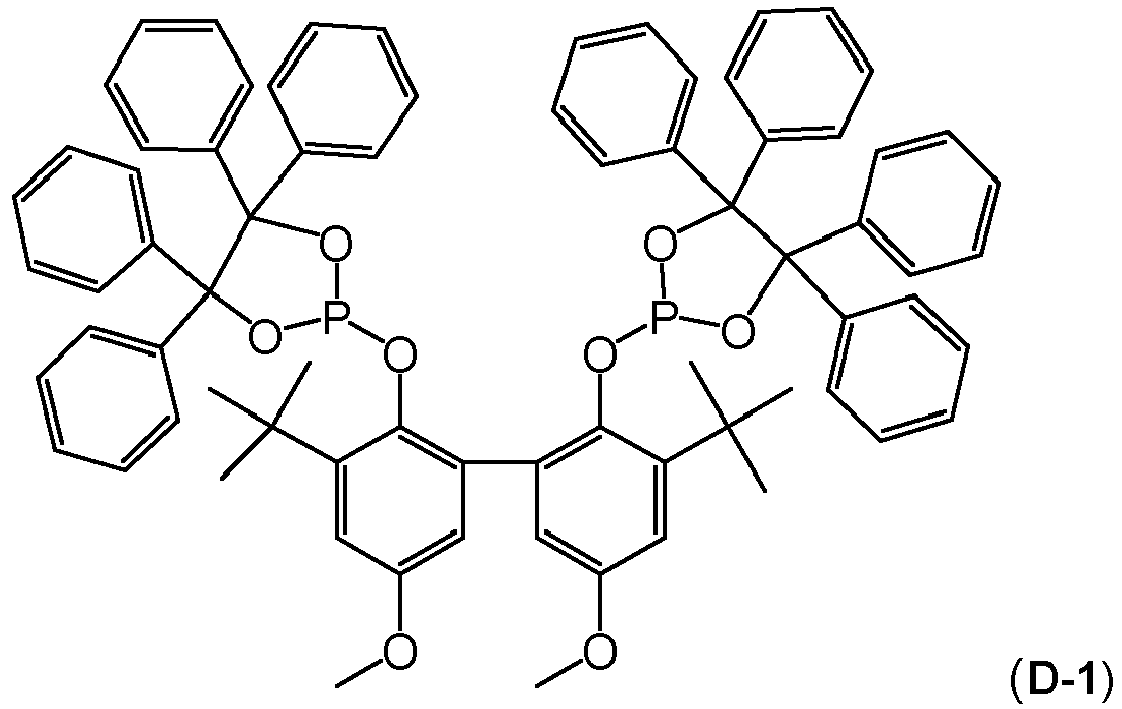
- WO 2008/071508 A1 describes a process for hydroformylation using bisphosphite ligands. Among other things, the use of the ligand (D-1) is described.
- the technical problem on which the present invention was based is the provision of new compounds which, compared with the compounds known from the prior art, give an increased yield in the hydroformylation of olefins.
- R 1 , R 2 , R 3 , R 4 , R 5 , R 6 , R 7 , R 8 , R 9 , R 10 are each independently selected from: - H, -(C 1 -C 12 )-alkyl, -O-(C 1 -C 12 )alkyl, -(C 6 -C 12 )aryl.
- -(C 1 -C 12 )-alkyl or -O-(C 1 -C 12 )-alkyl includes straight-chain and branched alkyl groups having 1 to 12 carbon atoms. These are preferably -(C 1 -C 8 )-alkyl groups or -O-(C 1 -C 8 )-alkyl groups, particularly preferably -(C 1 -C 4 )-alkyl groups or -O-( C 1 -C 4 ) alkyl groups.
- (C 6 -C 12 )-aryl encompasses mono- or polycyclic aromatic hydrocarbon radicals having 6 to 12 carbon atoms. It is preferably -(C 6 )-aryl, ie phenyl.
- R 7 and R 10 are -(C 1 -C 12 )alkyl.
- R 7 and R 10 are - ter Bu.
- R 8 , R 9 are selected from: -(C 1 -C 12 )alkyl, -O-(C 1 -C 12 )alkyl.
- R 8 and R 9 are -OCH 3 or - ter Bu.
- R 8 and R 9 are -OCH 3 .
- R 1 , R 2 , R 3 , R 4 , R 5 , R 6 are selected from -H, -(C 1 -C 12 )alkyl, -(C 6 -C 12 )aryl.
- R 1 , R 2 , R 5 , R 6 are -H.
- R 3 , R 4 are selected from -H, -CH 3 , -phenyl.
- the compound has one of structures (1) or (2):
- connection In addition to the connection itself, a method is also claimed in which the connection is used.
- Process steps a), b) and c) can be carried out in any order.
- CO is usually added after the reactants in steps a) and b) have been introduced.
- CO can also be used in several steps are supplied, so that, for example, a part of the CO is first supplied, then heated and then another part of the CO is supplied.
- the ethylenically unsaturated compounds used as starting materials in the process according to the invention contain one or more carbon-carbon double bonds. These compounds are also referred to below as olefins for the sake of simplicity.
- the double bonds can be terminal or internal.
- the ethylenically unsaturated compound comprises no further functional groups apart from carbon-carbon double bonds.
- the ethylenically unsaturated compound is selected from: ethene, propene, 1-butene, cis- and/or trans-2-butene, isobutene, 1,3-butadiene, 1-pentene, cis- and/or or trans-2-pentene, 2-methyl-1-butene, 3-methyl-1-butene, 2-methyl-2-butene, hexene, tetramethylethylene, heptene, 1-octene, 2-octene, di-n-butene , or mixtures thereof.
- CO is fed in in process step c) at a pressure in the range from 1 to 6 MPa (10 to 60 bar).
- reaction mixture in process step d) is heated to a temperature in the range from 80.degree. C. to 160.degree.
- the hydroformylation was carried out in a 200 ml autoclave from Premex Reactor AG, Lengau, Switzerland, equipped with constant pressure, gas flow measurement, gassing stirrer and pressure pipette.
- the toluene used as a solvent was dissolved in a Pure Solv. MD-7 system cleaned and stored under argon.
- the olefin cis/trans-2-pentene (Aldrich) used as substrate was refluxed over sodium and distilled under argon.
Landscapes
- Chemical & Material Sciences (AREA)
- Organic Chemistry (AREA)
- Chemical Kinetics & Catalysis (AREA)
- Biochemistry (AREA)
- General Health & Medical Sciences (AREA)
- Molecular Biology (AREA)
- Health & Medical Sciences (AREA)
- Life Sciences & Earth Sciences (AREA)
- Inorganic Chemistry (AREA)
- Engineering & Computer Science (AREA)
- Materials Engineering (AREA)
- Organic Low-Molecular-Weight Compounds And Preparation Thereof (AREA)
- Polyesters Or Polycarbonates (AREA)
- Low-Molecular Organic Synthesis Reactions Using Catalysts (AREA)
Abstract
Bisphosphitliganden auf Basis von Benzpinakol und 1,3-Propandiol, sowie deren Verwendung in der Hydroformylierung.
Description
- Die vorliegende Erfindung betrifft Bisphosphitliganden auf Basis von Benzpinakol und 1,3-Propandiol, sowie deren Verwendung in der Hydroformylierung.
- In
WO 2008/071508 A1 wird ein Verfahren zur Hydroformylierung unter Einsatz von Bisphosphitliganden beschrieben. Unter anderem wird der Einsatz des Liganden (D-1) beschrieben.
- Die technische Aufgabe, welche der vorliegenden Erfindung zugrunde lag, ist die Bereitstellung neuer Verbindungen, welche gegenüber dem aus dem Stand der Technik bekannten Verbindungen bei der Hydroformylierung von Olefinen eine gesteigerte Ausbeute liefern.
- Diese Aufgabe wird gelöst durch eine Verbindung nach Anspruch 1.
- Verbindung gemäß Formel (I):

R1, R2, R3, R4, R5, R6, R7, R8, R9, R10 jeweils unabhängig voneinander ausgewählt sind aus: - H, -(C1-C12)-Alkyl, -O-(C1-C12)-Alkyl, -(C6-C12)-Aryl. - Der Begriff -(C1-C12)-Alkyl bzw. -O-(C1-C12)-Alkyl umfasst geradkettige und verzweigte Alkylgruppen mit 1 bis 12 Kohlenstoffatomen. Vorzugsweise handelt es sich dabei um -(C1-C8)-Alkylgruppen bzw. -O-(C1-C8)-Alkylgruppen, besonders bevorzugt um -(C1-C4)-Alkylgruppen bzw. -O-(C1-C4)-Alkylgruppen.
- Der Begriff (C6-C12)-Aryl umfasst mono- oder polycyclische aromatische Kohlenwasserstoffreste mit 6 bis 12 Kohlenstoffatomen. Vorzugsweise handelt es sich dabei um -(C6)-Aryl, also Phenyl.
- In einer Ausführungsform stehen R7 und R10 für -(C1-C12)-Alkyl.
- In einer Ausführungsform stehen R7 und R10 für - ter Bu.
- In einer Ausführungsform sind R8, R9 ausgewählt aus: -(C1-C12)-Alkyl, -O-(C1-C12)-Alkyl.
- In einer Ausführungsform stehen R8 und R9 für -OCH3 oder- ter Bu.
- In einer Ausführungsform stehen R8 und R9 für -OCH3.
- In einer Ausführungsform sind R1, R2, R3, R4, R5, R6 ausgewählt aus -H, -(C1-C12)-Alkyl, -(C6-C12)-Aryl.
- In einer Ausführungsform stehen R1, R2, R5, R6 für-H.
- In einer Ausführungsform sind R3, R4 ausgewählt aus -H, -CH3, -Phenyl.
- In einer Ausführungsform weist die Verbindung eine der Strukturen (1) oder (2) auf:

- Neben der Verbindung an sich, wird auch ein Verfahren beansprucht, in welchen die Verbindung zum Einsatz kommt.
- Verfahren umfassend die Verfahrensschritte:
- a) Vorlegen einer ethylenisch ungesättigten Verbindung;
- b) Zugabe einer wie zuvor beschriebenen Verbindung
und einer Substanz, welche Rh umfasst; - c) Zuführen von H2 und CO,
- d) Erwärmen des Reaktionsgemisches aus a) bis c), wobei die ethylenisch ungesättigten Verbindung zu einem Aldehyd umgesetzt wird.
- Hierbei können die Verfahrensschritte a), b) und c) in beliebiger Reihenfolge erfolgen. Üblicherweise erfolgt die Zugabe von CO jedoch, nachdem die Reaktionspartner in den Schritten a) und b) vorgelegt wurden. Darüber hinaus kann CO auch in mehreren Schritten zugeführt werden, so dass beispielsweise zunächst ein Teil des CO zugeführt, dann erwärmt und anschließend ein weiterer Teil CO zugeführt wird.
- Die in dem erfindungsgemäßen Verfahren als Edukt eingesetzten ethylenisch ungesättigten Verbindungen enthalten eine oder mehrere Kohlenstoff-Kohlenstoff-Doppelbindungen. Diese Verbindungen werden auch im Folgenden zur Vereinfachung als Olefine bezeichnet. Die Doppelbindungen können terminal oder intern sein.
- In einer Variante des Verfahrens umfasst die ethylenisch ungesättigte Verbindung keine weiteren funktionellen Gruppen außer Kohlenstoff-Kohlenstoff-Doppelbindungen.
- In einer Variante des Verfahrens ist die ethylenisch ungesättigte Verbindung ausgewählt aus: Ethen, Propen, 1-Buten, cis- und/oder trans-2-Buten, iso-Buten, 1,3-Butadien, 1-Penten, cis- und/oder trans-2-Penten, 2-Methyl-1-buten, 3-Methyl-1-buten, 2-Methyl-2-buten, Hexen, Tetramethylethylen, Hepten, 1-Octen, 2-Octen, Di-n-Buten, oder Mischungen davon.
- In einer Variante des Verfahrens ist die Substanz, welche Rh umfasst, ausgewählt aus: Rh(acac)(CO)2, [(acac)Rh(COD)] (Umicore, acac = Acetylacetonat-Anion; COD = 1,5-Cyclooctadien), Rh4CO12.
- In einer Variante des Verfahrens erfolgt das Zuführen von CO in Verfahrensschritt c) mit einem Druck in dem Bereich von 1 bis 6 MPa (10 bis 60 bar).
- In einer Variante des Verfahrens erfolgt das Erwärmen des Reaktionsgemisches in Verfahrensschritt d) auf eine Temperatur in dem Bereich von 80 °C bis 160 °C.
- Im Folgenden soll die Erfindung anhand von Ausführungsbeispielen näher erläutert werden.
-

- Zu einer Lösung von 4,4,5,5-Tetraphenyl-2-((3,3',5,5'-tetra-tert-butyl-2'-((dichlorophosphaneyl)oxy)-[1,1'-biphenyl]-2-yl)oxy)-1,3,2-dioxaphospholan (0,4361 g; 0,5108 mmol) in 5 ml Toluol wird bei Raumtemperatur tropfenweise eine Mischung von 2-Phenylpropan-1,3-diol (0,0777 g; 0,5108 mmol) und Triethylamin (0,28 ml) in 2 ml Toluol gegeben. Man rührt über Nacht, filtriert und engt das Filtrat im Vakuum zur Trockne ein. Der erhaltene Feststoff wird 2h bei 60°C/ 0,1mbar getrocknet anschließend 1 h mit 4 ml Heptan verrührt. Ausbeute: 0,37 g (0,396 mmol; 77%).
- ESI-TOF HRMS: m/z=933,3684; [M++H], ber. m/z=933,3679 und m/z=955,3489; [M++Na], ber. m/z=955,3499.
31P-NMR (CD2Cl2): δ 116,3 (d, J PP=17 Hz); 123,0 (d, J PP=19 Hz); 145,3 (d, J PP=17 Hz); 145,3 (d, J PP=19Hz) ppm. 2 Isomere.
1H-NMR (CD2Cl2): δ 1,07+1,12 (2s, 9H); 1,33+1,37 (2s, 9H); 3,54+3,57 (2s, 6H); 2,94-4,60 (m, 5H); 3,60+3,64 (2s, 6H); 6,58 (m, 2H); 6,78-7,33 (m, 27H) ppm. -
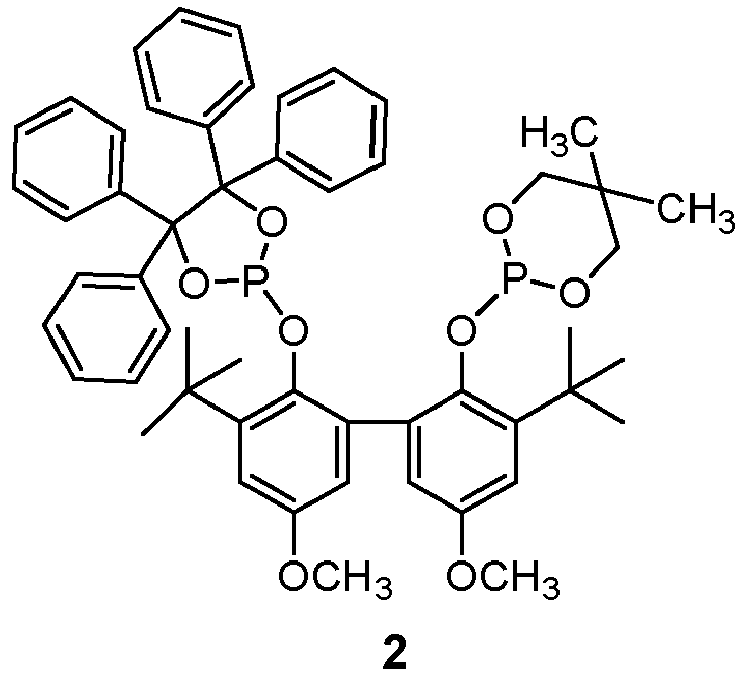
- Zu einer Lösung von 4,4,5,5-Tetraphenyl-2-((3,3',5,5'-tetra-tert-butyl-2'-((dichlorophosphaneyl)oxy)-[1,1'-biphenyl]-2-yl)oxy)-1,3,2-dioxaphospholan (0,445 g; 0,5212 mmol) in 5 ml Toluol wird bei Raumtemperatur tropfenweise eine Mischung von von 2,2'-Dimethylpropan-1,3-diol (0,0543 g; 0,5212 mmol) und Triethylamin (0,29 ml) in 2 ml Toluol gegeben. Man rührt über Nacht, filtriert und engt das Filtrat im Vakuum zur Trockne ein. Der erhaltene Feststoff wird 2h bei 60°C/ 0,1mbar getrocknet. Ausbeute: 0,410 g (0,463 mmol, 89%).
- Elementaranalyse (ber. für C53H58O8P2=884,98 g/Mol): C = 71,97 (71,93); H = 6,96 (6,61); P = 7,02 (7,00).
- ESI-TOF HRMS: m/z=907,3514; [M++Na], ber. m/z=907,3499.
31P-NMR (CD2Cl2): δ 116,6 (d, J PP=19 Hz); 145,6 (d, J PP=19 Hz) ppm.
1H-NMR (CD2Cl2): δ 0,75 (s; 3H); 1,20 (s; 3H); 1,27 (s; 9H); 1,47 (s; 9H); 2,98 (m; 1H); 3,38 (s; 1H); 3,74 (s; 3H); 3,81 (s; 3H); 3,97 (m, 1H); 4,20 (m, 1H); 6,74 (m, 2H); 6,95-7,20 (m; 18H); 7,31 (m, 2H); 7,43 (m, 2H) ppm. - Die Hydroformylierung wurde in einem mit Druckkonstanthaltung, Gasflussmessung, Begasungsrührer und Druckpipette ausgestatteten 200 ml-Autoklaven der Fa. Premex Reactor AG, Lengau, Schweiz, durchgeführt. Zur Minimierung eines Einflusses von Feuchtigkeit und Sauerstoff wurde das als Solvens benutzte Toluol in einem Pure Solv. MD-7 System gereinigt und unter Argon aufbewahrt. Das als Substrat eingesetzten Olefin cis/trans-2-Penten (Aldrich) wurden über Natrium am Rückfluss erhitzt und unter Argon destilliert. Im Autoklaven wurden unter Argonatmosphäre Lösungen der Katalysatorvorstufe und des Liganden, jeweils in Toluol, gemischt. Als Katalysatorvorstufe kam [(acac)Rh(COD)] (Umicore, acac=Acetylacetonat-Anion; COD = 1,5-Cyclooctadien), zum Einsatz. Der Autoklav wurde bei 12 bar für den Enddruck von 20 bar unter Rühren (1500 U/min) aufgeheizt. Nach Erreichen der Reaktionstemperatur wurde das Olefin mit einem in der Druckpipette eingestellten Überdruck in den Autoklaven gepresst. Die Reaktion wurde bei konstantem Druck (Nachdruckregler der Fa. Bronkhorst, NL) über 4h geführt. Der Autoklav wurde nach Ablauf der Reaktionszeit auf Zimmertemperatur abgekühlt, unter Rühren entspannt und mit Argon gespült. Jeweils 1 ml der Reaktionsmischungen wurden unmittelbar nach Abschalten des Rührers entnommen, mit 10 ml Pentan verdünnt und gaschromatographisch analysiert: HP 5890 Series II plus, PONA, 50 m x 0,2 mm x 0,5 µm.
- Die Reaktion wurde mit den erfindungsgemäßen Verbindungen (1) und (2), sowie mit dem Vergleichsliganden (D-1) durchgeführt.
- Reaktionsbedingungen:
Olefin: 2-Penten, Solvens: Toluol, Masseanteil Rhodium: 100 ppm, p: 20 bar, T: 120 °C, t: 4 h, Verhältnis Rh : Ligand = 1 : 2. - Die Ergebnisse sind in der nachfolgenden Tabelle zusammengestellt:
Ligand Ausbeute Aldehyd [%] 1* 78 2* 74 D-1 14 *erfindungsgemäße Verbindung - Wie die Versuchsergebnisse zeigen, wird die Aufgabe durch die erfindungsgemäßen Verbindungen gelöst.
Claims (13)
- Verbindung gemäß Formel (I):

R1, R2, R3, R4, R5, R6, R7, R8, R9, R10 jeweils unabhängig voneinander ausgewählt sind aus: - H, -(C1-C12)-Alkyl, -O-(C1-C12)-Alkyl, -(C6-C12)-Aryl. - Verbindung nach Anspruch 1,
wobei R7 und R10 für -(C1-C12)-Alkyl stehen. - Verbindung nach einem der Ansprüche 1 oder 2,
wobei R7 und R10 für - ter Bu stehen. - Verbindung nach einem der Ansprüche 1 bis 3,
wobei R8, R9 ausgewählt sind aus: -(C1-C12)-Alkyl, -O-(C1-C12)-Alkyl. - Verbindung nach einem der Ansprüche 1 bis 4,
wobei R8 und R9 für -OCH3 oder- ter Bu stehen. - Verbindung nach einem der Ansprüche 1 bis 5,
wobei R1, R2, R3, R4, R5, R6 ausgewählt sind aus -H, -(C1-C12)-Alkyl, -(C6-C12)-Aryl. - Verbindung nach einem der Ansprüche 1 bis 6,
wobei R1, R2, R5, R6 für -H stehen. - Verbindung nach einem der Ansprüche 1 bis 7,
wobei die Verbindung eine der Strukturen (1) oder (2) aufweist:
- Verfahren umfassend die Verfahrensschritte:a) Vorlegen einer ethylenisch ungesättigten Verbindung;b) Zugabe einer Verbindung gemäß einem der Ansprüche 1 bis 8 und einer Substanz, welche Rh umfasst;c) Zuführen von H2 und CO,d) Erwärmen des Reaktionsgemisches aus a) bis c), wobei das Olefin zu einem Aldehyd umgesetzt wird.
- Verfahren nach Anspruch 9,
wobei die ethylenisch ungesättigte Verbindung in Verfahrensschritt a) ausgewählt ist aus: Ethen, Propen, 1-Buten, cis- und/oder trans-2-Buten, iso-Buten, 1,3-Butadien, 1-Penten, cis- und/oder trans-2-Penten, 2-Methyl-1-buten, 3-Methyl-1-buten, 2-Methyl-2-buten, Hexen, Tetramethylethylen, Hepten, 1-Octen, 2-Octen, Di-n-Buten, oder Mischungen davon. - Verfahren nach einem der Ansprüche 9 oder 10,
wobei die Substanz, welche Rh umfasst, ausgewählt ist aus: Rh(acac)(CO)2, [(acac)Rh(COD)] (Umicore, acac = Acetylacetonat-Anion; COD = 1,5-Cyclooctadien), Rh4CO12. - Verfahren nach einem der Ansprüche 9 bis 11,
wobei das Zuführen von CO in Verfahrensschritt c) mit einem Druck in dem Bereich von 1 bis 6 MPa (10 bis 60 bar) erfolgt. - Verfahren nach einem der Ansprüche 9 bis 12,
wobei das Erwärmen des Reaktionsgemisches in Verfahrensschritt d) auf eine Temperatur in dem Bereich von 80 °C bis 160 °C erfolgt.
Priority Applications (6)
| Application Number | Priority Date | Filing Date | Title |
|---|---|---|---|
| EP21163483.7A EP4059914A1 (de) | 2021-03-18 | 2021-03-18 | Bisphosphitliganden auf basis von benzpinakol und 1,3-propandiol |
| JP2022035475A JP2022145580A (ja) | 2021-03-18 | 2022-03-08 | ベンゾピナコールと1,3-プロパンジオールとをベースとするビスホスファイトリガンド |
| TW111109369A TW202302617A (zh) | 2021-03-18 | 2022-03-15 | 醇及1,3-丙二醇的雙亞磷酸酯配位基 |
| US17/696,125 US20220306661A1 (en) | 2021-03-18 | 2022-03-16 | Bisphosphite ligands based on benzopinacol and 1,3-propanediol |
| KR1020220033270A KR20220130614A (ko) | 2021-03-18 | 2022-03-17 | 벤조피나콜 및 1,3-프로판디올을 기재로 하는 비스포스파이트 리간드 |
| CN202210274230.1A CN115109092A (zh) | 2021-03-18 | 2022-03-18 | 基于苯频哪醇和1,3-丙二醇的双亚磷酸酯配体 |
Applications Claiming Priority (1)
| Application Number | Priority Date | Filing Date | Title |
|---|---|---|---|
| EP21163483.7A EP4059914A1 (de) | 2021-03-18 | 2021-03-18 | Bisphosphitliganden auf basis von benzpinakol und 1,3-propandiol |
Publications (1)
| Publication Number | Publication Date |
|---|---|
| EP4059914A1 true EP4059914A1 (de) | 2022-09-21 |
Family
ID=75108247
Family Applications (1)
| Application Number | Title | Priority Date | Filing Date |
|---|---|---|---|
| EP21163483.7A Withdrawn EP4059914A1 (de) | 2021-03-18 | 2021-03-18 | Bisphosphitliganden auf basis von benzpinakol und 1,3-propandiol |
Country Status (6)
| Country | Link |
|---|---|
| US (1) | US20220306661A1 (de) |
| EP (1) | EP4059914A1 (de) |
| JP (1) | JP2022145580A (de) |
| KR (1) | KR20220130614A (de) |
| CN (1) | CN115109092A (de) |
| TW (1) | TW202302617A (de) |
Cited By (1)
| Publication number | Priority date | Publication date | Assignee | Title |
|---|---|---|---|---|
| EP4393933A1 (de) * | 2022-12-27 | 2024-07-03 | Evonik Operations GmbH | Bisphosphite mit dioxaphosphinan-rest |
Families Citing this family (2)
| Publication number | Priority date | Publication date | Assignee | Title |
|---|---|---|---|---|
| ES2954534T3 (es) * | 2021-03-18 | 2023-11-23 | Evonik Oxeno Gmbh & Co Kg | Ligandos de bisfosfito a base de benzopinacol |
| ES2965390T3 (es) * | 2021-03-18 | 2024-04-15 | Evonik Oxeno Gmbh & Co Kg | Ligandos de bisfosfito a base de benzopinacol con un componente de ala abierto |
Citations (1)
| Publication number | Priority date | Publication date | Assignee | Title |
|---|---|---|---|---|
| DE102006058682A1 (de) * | 2006-12-13 | 2008-06-19 | Evonik Oxeno Gmbh | Bisphosphitliganden für die übergangsmetallkatalysierte Hydroformylierung |
Family Cites Families (1)
| Publication number | Priority date | Publication date | Assignee | Title |
|---|---|---|---|---|
| DE4026406A1 (de) * | 1990-08-21 | 1992-02-27 | Basf Ag | Rhodiumhydroformylierungskatalysatoren mit bis-phosphit-liganden |
-
2021
- 2021-03-18 EP EP21163483.7A patent/EP4059914A1/de not_active Withdrawn
-
2022
- 2022-03-08 JP JP2022035475A patent/JP2022145580A/ja active Pending
- 2022-03-15 TW TW111109369A patent/TW202302617A/zh unknown
- 2022-03-16 US US17/696,125 patent/US20220306661A1/en not_active Abandoned
- 2022-03-17 KR KR1020220033270A patent/KR20220130614A/ko active Pending
- 2022-03-18 CN CN202210274230.1A patent/CN115109092A/zh active Pending
Patent Citations (2)
| Publication number | Priority date | Publication date | Assignee | Title |
|---|---|---|---|---|
| DE102006058682A1 (de) * | 2006-12-13 | 2008-06-19 | Evonik Oxeno Gmbh | Bisphosphitliganden für die übergangsmetallkatalysierte Hydroformylierung |
| WO2008071508A1 (de) | 2006-12-13 | 2008-06-19 | Evonik Oxeno Gmbh | Bisphosphitliganden für die übergangsmetallkatalysierte hydroformylierung |
Cited By (1)
| Publication number | Priority date | Publication date | Assignee | Title |
|---|---|---|---|---|
| EP4393933A1 (de) * | 2022-12-27 | 2024-07-03 | Evonik Operations GmbH | Bisphosphite mit dioxaphosphinan-rest |
Also Published As
| Publication number | Publication date |
|---|---|
| CN115109092A (zh) | 2022-09-27 |
| JP2022145580A (ja) | 2022-10-04 |
| KR20220130614A (ko) | 2022-09-27 |
| US20220306661A1 (en) | 2022-09-29 |
| TW202302617A (zh) | 2023-01-16 |
Similar Documents
| Publication | Publication Date | Title |
|---|---|---|
| EP3763723B1 (de) | Bisphosphite mit einem geschlossenen und einem offenen flügelbaustein | |
| WO2013068232A1 (de) | Neue organophosphorverbindungen auf basis von anthracentriol | |
| EP2947091A1 (de) | Gemische von monophosphitligand und deren verwendung zur katalyse einer hydroformylierungsreaktion | |
| EP3971195B1 (de) | Diphosphite mit einem offenen, 2,4-methylierten flügelbaustein | |
| EP4059918B1 (de) | Bisphosphitliganden auf basis von benzopinakol mit einem offenen flügelbaustein | |
| CN115109092A (zh) | 基于苯频哪醇和1,3-丙二醇的双亚磷酸酯配体 | |
| EP4059939B1 (de) | Bisphosphitliganden auf basis von benzpinakol | |
| EP3957643B1 (de) | Neue diphosphite auf basis von cis-butendiol-1,4 | |
| EP4393588A1 (de) | Bisphosphite mit 2-naphthylresten | |
| EP3816171B1 (de) | Phosphazyklische phosphite aus dem enol des benzoins | |
| EP4059940A1 (de) | Liganden auf basis von phosphonit-phosphiten | |
| EP3763722B1 (de) | Bisphosphite mit einem offenen und einem geschlossenen flügelbaustein | |
| EP3816172B1 (de) | Phosphazyklische phosphite aus dem enol des 1-hydroxy-2-acetonaphthons | |
| EP4393900B1 (de) | Diphosphite mit cis-ständigen substituenten | |
| EP4074722A1 (de) | Diphosphite mit einem offenen, 3-methylierten flügelbaustein | |
| EP3293190A1 (de) | Phosphite mit einem silyloxyphenol | |
| EP4393901B1 (de) | Diphosphite mit trans-ständigen substituenten | |
| EP3816173B1 (de) | Phosphazyklische phosphite aus dem enol des pyridoins und furoins | |
| EP4393931B1 (de) | Diphosphite mit dicyclohexylphosphinorest | |
| EP4393933A1 (de) | Bisphosphite mit dioxaphosphinan-rest | |
| EP3438111B1 (de) | Phosphonite mit einer direkt am phosphor gebundenen tert.-butyl-gruppe | |
| EP3438112B1 (de) | Liganden mit einer o-p-o-brücke zwischen zwei anthracentriolbausteinen | |
| EP3438110B1 (de) | Phosphinite mit zwei direkt am phosphor gebundenen tert.-butyl-gruppen | |
| EP4393932A1 (de) | Diphosphonite und deren einsatz in der hydroformylierung | |
| EP4737468A1 (de) | Bisphosphite mit einem naphthalindiol-rückgrat |
Legal Events
| Date | Code | Title | Description |
|---|---|---|---|
| PUAI | Public reference made under article 153(3) epc to a published international application that has entered the european phase |
Free format text: ORIGINAL CODE: 0009012 |
|
| STAA | Information on the status of an ep patent application or granted ep patent |
Free format text: STATUS: THE APPLICATION HAS BEEN PUBLISHED |
|
| AK | Designated contracting states |
Kind code of ref document: A1 Designated state(s): AL AT BE BG CH CY CZ DE DK EE ES FI FR GB GR HR HU IE IS IT LI LT LU LV MC MK MT NL NO PL PT RO RS SE SI SK SM TR |
|
| STAA | Information on the status of an ep patent application or granted ep patent |
Free format text: STATUS: THE APPLICATION IS DEEMED TO BE WITHDRAWN |
|
| 18D | Application deemed to be withdrawn |
Effective date: 20230322 |