EP4059068B1 - Mit thienothiophengruppen di-substituierte diaryloxybenzoheterodiazolverbindungen - Google Patents
Mit thienothiophengruppen di-substituierte diaryloxybenzoheterodiazolverbindungen Download PDFInfo
- Publication number
- EP4059068B1 EP4059068B1 EP20807520.0A EP20807520A EP4059068B1 EP 4059068 B1 EP4059068 B1 EP 4059068B1 EP 20807520 A EP20807520 A EP 20807520A EP 4059068 B1 EP4059068 B1 EP 4059068B1
- Authority
- EP
- European Patent Office
- Prior art keywords
- groups
- aldrich
- formula
- thienothiophenic
- solar
- Prior art date
- Legal status (The legal status is an assumption and is not a legal conclusion. Google has not performed a legal analysis and makes no representation as to the accuracy of the status listed.)
- Active
Links
Images
Classifications
-
- H—ELECTRICITY
- H10—SEMICONDUCTOR DEVICES; ELECTRIC SOLID-STATE DEVICES NOT OTHERWISE PROVIDED FOR
- H10K—ORGANIC ELECTRIC SOLID-STATE DEVICES
- H10K85/00—Organic materials used in the body or electrodes of devices covered by this subclass
- H10K85/60—Organic compounds having low molecular weight
- H10K85/649—Aromatic compounds comprising a hetero atom
- H10K85/657—Polycyclic condensed heteroaromatic hydrocarbons
- H10K85/6576—Polycyclic condensed heteroaromatic hydrocarbons comprising only sulfur in the heteroaromatic polycondensed ring system, e.g. benzothiophene
-
- C—CHEMISTRY; METALLURGY
- C07—ORGANIC CHEMISTRY
- C07D—HETEROCYCLIC COMPOUNDS
- C07D495/00—Heterocyclic compounds containing in the condensed system at least one hetero ring having sulfur atoms as the only ring hetero atoms
- C07D495/02—Heterocyclic compounds containing in the condensed system at least one hetero ring having sulfur atoms as the only ring hetero atoms in which the condensed system contains two hetero rings
- C07D495/04—Ortho-condensed systems
-
- H—ELECTRICITY
- H10—SEMICONDUCTOR DEVICES; ELECTRIC SOLID-STATE DEVICES NOT OTHERWISE PROVIDED FOR
- H10K—ORGANIC ELECTRIC SOLID-STATE DEVICES
- H10K30/00—Organic devices sensitive to infrared radiation, light, electromagnetic radiation of shorter wavelength or corpuscular radiation
- H10K30/80—Constructional details
- H10K30/87—Light-trapping means
-
- H—ELECTRICITY
- H10—SEMICONDUCTOR DEVICES; ELECTRIC SOLID-STATE DEVICES NOT OTHERWISE PROVIDED FOR
- H10K—ORGANIC ELECTRIC SOLID-STATE DEVICES
- H10K85/00—Organic materials used in the body or electrodes of devices covered by this subclass
- H10K85/60—Organic compounds having low molecular weight
- H10K85/649—Aromatic compounds comprising a hetero atom
- H10K85/657—Polycyclic condensed heteroaromatic hydrocarbons
-
- Y—GENERAL TAGGING OF NEW TECHNOLOGICAL DEVELOPMENTS; GENERAL TAGGING OF CROSS-SECTIONAL TECHNOLOGIES SPANNING OVER SEVERAL SECTIONS OF THE IPC; TECHNICAL SUBJECTS COVERED BY FORMER USPC CROSS-REFERENCE ART COLLECTIONS [XRACs] AND DIGESTS
- Y02—TECHNOLOGIES OR APPLICATIONS FOR MITIGATION OR ADAPTATION AGAINST CLIMATE CHANGE
- Y02E—REDUCTION OF GREENHOUSE GAS [GHG] EMISSIONS, RELATED TO ENERGY GENERATION, TRANSMISSION OR DISTRIBUTION
- Y02E10/00—Energy generation through renewable energy sources
- Y02E10/50—Photovoltaic [PV] energy
- Y02E10/52—PV systems with concentrators
Definitions
- the present invention relates to a diaryloxybenzoheterodiazole compound di-substituted with thienothiophenic groups.
- the present invention relates to diaryloxybenzoheterodiazole compound di-substituted with thienothiophenic groups having the specific general formula (Ia) below.
- Said diaryloxybenzoheterodiazole compound di-substituted with thienothiophenic groups can be advantageously used as a spectrum converter in luminescent solar concentrators (LSCs) capable, in turn, of improving the performance of photovoltaic devices (or solar devices), selected for example, between photovoltaic cells (or solar cells), photovoltaic modules (or solar modules), either on a rigid support, or on a flexible support. More particularly, said photovoltaic devices (or solar devices) can be advantageously used in the construction of greenhouses.
- LSCs luminescent solar concentrators
- the present invention also relates to a luminescent solar concentrator (LSC) including at least one diaryloxybenzoheterodiazole compound di-substituted with thienothiophenic groups, as well as a photovoltaic device (or solar device) comprising said luminescent solar concentrators (LSC).
- LSC luminescent solar concentrator
- the present invention also relates to the use of said photovoltaic devices (or solar devices) in the construction of greenhouses.
- photovoltaic cells based on crystalline silicon have for example an optimal absorption spectrum (effective spectrum) in the range 900 nm - 1100 nm, while polymeric photovoltaic cells (or solar cells) are liable to damage if exposed to radiations with wavelengths lower than about 500 nm, due to phenomena of induced photodegradation which become significant below this limit.
- the efficiency of the photovoltaic devices (or solar devices) of the state of the art is maximum in the region of the spectrum between 570 nm and 680 nm (yellow-orange) .
- EQE external quantum efficiency
- the photoluminescence process including the absorption of solar radiation and the subsequent re-emission of photons at a shorter wavelength, is also called up-conversion process.
- the photoluminescence process is called “down-conversion” process (or “down-shifting”).
- said luminescent solar concentrators consist of large plates of a material transparent to solar radiation (for example, polymeric or inorganic glasses), wherein fluorescent compounds, acting as spectrum converters, are dispersed or chemically linked to said material. Due to the optical phenomenon of total reflection, the radiation emitted by the fluorescent compounds is "guided" towards the thin edges of the plate where it is concentrated on photovoltaic cells (or solar cells) placed therein. In this way, large surfaces of low-cost materials (photoluminescent plates) can be used to concentrate light on small surfaces of high-cost materials [photovoltaic cells (or solar cells)].
- the fluorescent compounds can be deposited on the glass support in the form of a thin film or, as in the case of polymeric materials, they can be dispersed inside the polymeric matrix.
- the polymeric matrix can be directly functionalized with fluorescent chromophores groups.
- fluorescent compounds must have the following characteristics:
- benzothiadiazole compounds in particular 4,7-di-(thien-2'-yl)-2,1,3-benzothiadiazole (DTB) are fluorescent compounds usable in the construction of luminescent solar concentrators (LSCs).
- LSCs luminescent solar concentrators
- DTB 4,7-di-(thien-2'-yl)-2,1,3-benzothiadiazole
- DTB is characterized by an emission centred around 579 nm, a value which corresponds to an energy well above the minimum threshold of operative photovoltaic cells (or solar cells), which threshold, for example, corresponds to a wavelength of about 1100 nm for the most common silicon-based photovoltaic cells (or solar cells) .
- its absorption of the light radiation is intense and extended over a relatively broad range of wavelengths, ranging indicatively from 550 nm (the wavelength of the green radiation) to the ultraviolet radiations.
- DTB 4,7-di-(thien-2'-yl)-2,1,3-benzothiadiazole
- DTB 4,7-di-(thien-2'-yl)-2,1,3-benzothiadiazole
- the aforesaid di-substituted diaryloxybenzoheterodiazole compound having general formula (I) is said to be advantageously used as a spectrum converter in luminescent solar concentrators (LSCs) capable, in turn, of improving the performance of photovoltaic devices (or solar devices), selected for example, between photovoltaic cells (or solar cells), photovoltaic modules (or solar modules), either on a rigid support, or on a flexible support.
- LSCs luminescent solar concentrators
- diaryloxybenzoheterodiazole compounds having general formula (I) described in the aforesaid international patent application WO 2016/046319 in particular diaryloxybenzoheterodiazole compounds di-substituted with thienothiophenic groups having the specific general formula (Ia) below, in addition to being able to give comparable or even greater performances, in particular in terms of power generated by the photovoltaic devices wherein they are used, compared to known benzothiadiazole compounds, they have a high molar extinction coefficient ( ⁇ ) (i.e. values > 20000 moles -1 ⁇ cm -1 ).
- ⁇ molar extinction coefficient
- diaryloxybenzoheterodiazole compounds di-substituted with thienothiophenic groups have high Stokes shift values [i.e. values > 4000 cm -1 in solution, or values > 3000 cm -1 in polymethylmethacrylate (PMMA) film]. Furthermore, said diaryloxybenzoheterodiazole compounds di-substituted with thienothiophenic groups have high values of the maximum of the highest energy band in the emission spectrum [i.e. values > 600 nm in solution, or values > 580 nm in polymethylmethacrylate (PMMA) films].
- diaryloxybenzoheterodiazole compounds di-substituted with thienothiophenic groups have, in solution, high values of quantum luminescence efficiency ( ⁇ ) (i.e. values > 70%). Said diaryloxybenzoheterodiazole compounds di-substituted with thienothiophenic groups are therefore capable of increasing the number of photons effectively convertible into radiation usable by a solar device. Consequently, said diaryloxybenzoheterodiazole compounds di-substituted with thienothiophenic groups can be advantageously used in the construction of luminescent solar concentrators (LSCs).
- LSCs luminescent solar concentrators
- Said luminescent solar concentrators can, in turn, be advantageously used together, for example, with photovoltaic cells (or solar cells), in the construction of photovoltaic devices (or solar devices).
- photovoltaic devices or solar devices
- said photovoltaic devices can be advantageously used in the construction of greenhouses.
- the object of the present invention is a diaryloxybenzoheterodiazole compound di-substituted with thienothiophenic groups having general formula (Ia): wherein:
- C 1 -C 20 alkyl groups means linear or branched alkyl groups having from 1 to 20 carbon atoms.
- Specific examples of C 1 -C 20 alkyl groups are: methyl, ethyl, n-propyl, iso-propyl, n-butyl, iso-butyl, t-butyl, pentyl, 2-ethyl-hexyl, hexyl, heptyl, octyl, nonyl, decyl, dodecyl.
- C 1 -C 20 alkyl groups optionally containing heteroatoms means linear or branched, saturated or unsaturated, alkyl groups having from 1 to 20 carbon atoms, wherein at least one of the hydrogen atoms is substituted with a heteroatom selected from: halogens such as, for example, fluorine, chlorine, preferably fluorine; nitrogen; sulfur; oxygen.
- C 1 -C 20 alkyl groups optionally containing heteroatoms are: fluoromethyl, difluoromethyl, trifluoromethyl, trichloromethyl, 2,2,2-trifluoroethyl, 2,2,2-trichlororoethyl, 2,2,3,3-tetrafluoropropyl, 2,2,3,3,3-pentafluoropropyl , perfluoropentyl, perfluoroctyl, perfluorodecyl, oxymethyl, thiometyl, thioethyl, dimethylamino, propylamino, dioctylamino.
- cycloalkyl groups means cycloalkyl groups having from 3 to 10 carbon atoms. Said cycloalkyl groups can optionally be substituted with one or more groups, equal to or different from each other, selected from: halogen atoms such as, for example, fluorine, chlorine, preferably fluorine; hydroxyl groups; C 1 -C 20 alkyl groups; C 1 -C 20 alkoxy groups; cyano groups; amino groups; nitro groups; aryl groups.
- halogen atoms such as, for example, fluorine, chlorine, preferably fluorine
- hydroxyl groups C 1 -C 20 alkyl groups
- C 1 -C 20 alkoxy groups C 1 -C 20 alkoxy groups
- cyano groups amino groups
- nitro groups aryl groups.
- cycloalkyl groups are: cyclopropyl, 1,4-dioxin, 2,2-difluorocyclopropyl, cyclobutyl, cyclopentyl, cyclohexyl, methylcyclohexyl, methoxycyclohexyl, fluorocyclohexyl, phenylcyclohexyl.
- aryl groups means aromatic carbocyclic groups having from 6 to 60 carbon atoms. Said aryl groups can optionally be substituted with one or more groups, equal to or different from each other, selected from: halogen atoms such as, for example, fluorine, chlorine, preferably fluorine; hydroxyl groups; C 1 -C 20 alkyl groups; halogenated C 1 -C 20 alkyl groups; C 1 -C 20 alkoxy groups; cyano groups; amino groups; nitro groups; aryl groups, phenoxy groups.
- halogen atoms such as, for example, fluorine, chlorine, preferably fluorine
- hydroxyl groups such as, for example, fluorine, chlorine, preferably fluorine
- C 1 -C 20 alkyl groups halogenated C 1 -C 20 alkyl groups
- C 1 -C 20 alkoxy groups cyano groups
- amino groups amino groups
- nitro groups aryl groups, phenoxy groups.
- aryl groups are: phenyl, methylphenyl, 2,5-dimethylphenyl, 2,6-dimethylphenyl, 2,4,6-tri phenoxy lphenyl, trimethylphenyl, trifluoromethylphenyl, di- iso -propylphenyl, t -butylphenyl, methoxyphenyl, hydroxyphenyl, 2-phenoxyphenyl, 2-trifluoromethyl-6-phenoxyphenyl, fluorophenyl, pentafluorophenyl, chlorophenyl, nitrophenyl, dimethylaminophenyl, naphthyl, phenylnaphthyl, phenanthrene, anthracene.
- C 1 -C 20 alkoxy groups means linear or branched alkoxy groups having from 1 to 20 carbon atoms. Said alkoxy groups can optionally be substituted with one or more groups, equal to or different from each other, selected from: halogen atoms such as, for example, fluorine, chlorine, preferably fluorine; hydroxyl groups; C 1 -C 20 alkyl groups; C 1 -C 20 alkoxy groups; cyano groups; amino groups; nitro groups.
- C 1 -C 20 alkoxy groups are: methoxy, ethoxy, fluoroethoxy, n -propoxy, iso -propoxy, n- butoxy, n -fluoro-butoxy, iso -butoxy, t -butoxy, pentoxy, hexyloxy, heptyloxy, octyloxy, nonyloxy, decyloxy, dodecyloxy.
- cycle or polycyclic system means a system containing one or more saturated or unsaturated rings containing 3 to 14 carbon atoms, optionally containing heteroatoms selected from nitrogen, oxygen, sulfur, silicon, selenium, phosphorus.
- Specific examples of a cycle or polycyclic system are: thieno[3,2-b]thiophene, thiadiazole, benzothiophene, quinoxaline, pyridine.
- diaryloxybenzoheterodiazole compounds di-substituted with thienothiophenic groups having general formula (Ia) useful for the purpose of the present invention are reported in Table 1.
- the diaryloxybenzoheterodiazole compound di-substituted with thienothiophenic groups having general formula (Ia) object of the present invention can be obtained by processes known in the art, operating as described, for example, in the international patent application WO 2016/046319 reported above or in the Italian patent application MI2018000000667 , both in the name of the Applicant and incorporated herein by reference. Further details relating to the processes for preparing said diaryloxybenzoheterodiazole compound di-substituted with thienothiophenic groups having general formula (Ia) can be found in the following examples.
- said diaryloxybenzoheterodiazole compound di-substituted with thienothiophenic groups having general formula (Ia) can be advantageously used as a spectrum converter in luminescent solar concentrators (LSCs) capable, in turn, of improving the performance of photovoltaic devices (or solar devices), such as for example, photovoltaic cells (or solar cells), photovoltaic modules (or solar modules), either on a rigid support, or on a flexible support.
- LSCs luminescent solar concentrators
- a further object of the present invention is a luminescent solar concentrator (LSC) including at least one diaryloxybenzoheterodiazole compound di-substituted with thienothiophenic groups having general formula (Ia).
- LSC luminescent solar concentrator
- the diaryloxybenzoheterodiazole compound di-substituted with thienothiophenic groups having general formula (Ia) can be used in said luminescent solar concentrator (LSC) in the following forms: dispersed in the polymer or in the glass, chemically bound to the polymer or glass, in solution, in the form of a gel.
- LSC luminescent solar concentrator
- the luminescent solar concentrator can contain a transparent matrix, where the term transparent matrix means any transparent material used in the form of a support, a binder, or a material wherein at least one diaryloxybenzoheterodiazole compound di-substituted with thienothiophenic groups having general formula (Ia) is dispersed or incorporated.
- the material used for the matrix is transparent, as such, to the radiations of interest and, in particular, to the radiations having a frequency comprised in the effective spectrum of the photovoltaic device (or solar device) such as, for example, the photovoltaic cell (or solar cell) wherein it is used.
- Materials suitable for the purpose of the present invention can therefore be selected from transparent materials at least at radiations having a wavelength comprised between 250 nm and 1100 nm.
- the transparent matrix which can be used for the purpose of the present invention can be selected, for example, from polymeric materials or glassy materials. Said matrix is characterized by a high transparency and a high duration in relation to heat and light.
- Polymeric materials which can be advantageously used for the purpose of the present invention are, for example, polymethylmethacrylate (PMMA), epoxy resins, silicone resins, polyalkylene terephthalates, polycarbonates, polystyrene, polypropylene.
- Glassy materials that can be advantageously used for the purpose of the present invention are, for example, silicas.
- said at least one diaryloxybenzoheterodiazole compound di-substituted with thienothiophenic groups having general formula (Ia) can be dispersed in the polymer of said matrix by, for example, melt dispersion, and subsequent formation of a plate comprising said polymer and said at least one diaryloxybenzoheterodiazole compound di-substituted with thienothiophenic groups having general formula (Ia), operating, for example, according to the technique called "casting".
- said at least one diaryloxybenzoheterodiazole compound di-substituted with thienothiophenic groups having general formula (Ia) and the polymer of said matrix can be solubilized in at least one solvent obtaining a solution which is deposited on a plate of said polymer, forming a film comprising said at least one diaryloxybenzoheterodiazole compound di-substituted with thienothiophenic groups having general formula (Ia) and said polymer, operating, for example, by using a "Doctor Blade” type film applicator: subsequently, said solvent is allowed to evaporate.
- said at least one diaryloxybenzoheterodiazole compound di-substituted with thienothiophenic groups having general formula (Ia) can be solubilized in at least one solvent obtaining a solution which is deposited on a plate of said glassy matrix, forming a film comprising said at least one diaryloxybenzoheterodiazole compound di-substituted with thienothiophenic groups having general formula (Ia), operating, for example, by using a "Doctor Blade” type film applicator: subsequently, said solvent is allowed to evaporate.
- a further object of the present invention is a photovoltaic device (or solar device) comprising at least one photovoltaic cell (or solar cell), and at least one luminescent solar concentrator (LSC) including at least one diaryloxybenzoheterodiazole compound di-substituted with thienothiophenic groups having general formula (Ia).
- LSC luminescent solar concentrator
- Said photovoltaic device (or solar device) can be obtained, for example, by assembling the aforesaid luminescent solar concentrator (LSC) with at least one photovoltaic cell (or solar cell).
- LSC luminescent solar concentrator
- a further object of the present invention is the use of a photovoltaic device (or solar device) comprising at least one photovoltaic cell (or solar cell), and at least one luminescent solar concentrator (LSC) including at least one diaryloxybenzoheterodiazole compound di-substituted with thienothiophenic groups having general formula (Ia) in the construction of greenhouses.
- a photovoltaic device or solar device
- LSC luminescent solar concentrator
- the aforesaid solar concentrator can be made in the form of a transparent plate obtained by solubilization of said at least one diaryloxybenzoheterodiazole compound di-substituted with thienothiophenic groups having general formula (Ia) and of the polymer of the matrix of the polymeric type in at least one solvent obtaining a solution which is deposited on a plate of said polymer, forming a film comprising said at least one diaryloxybenzoheterodiazole compound di-substituted with thienothiophenic groups having general formula (Ia) and said polymer, operating, for example, by using a "Doctor Blade” type film applicator: subsequently, said solvent is allowed to evaporate.
- said photovoltaic devices or solar devices
- said plates can then be coupled to a photovoltaic cell (or solar cell).
- the Stokes shift was obtained from the analysis of the absorption and emission spectra for each obtained diaryloxybenzoheterodiazole compound di-substituted with thienothiophenic groups having general formula (Ia), and was calculated as the difference, in frequency units (cm -1 ), between the spectral positions of the maxima of the absorption band and of the emission band.
- n -butyllithium (1.6 M solution in hexane) (2.5 ml; 4 mmoles) was added to a 0.12 M solution of 2,6-thienothiophene (Aldrich) (0.5 g; 3.6 mmol) in anhydrous tetrahydrofuran (Aldrich) (30 ml) at -78°C, by dripping: the reaction mixture obtained was kept under stirring and the temperature was brought to -50°C in 3 hours.
- Aldrich 2,6-thienothiophene
- reaction mixture was poured into distilled water (50 ml) and extracted with dichloromethane (CH 2 Cl 2 ) (Aldrich) (3 ⁇ 25 ml) : the obtained organic phase was washed to neutral with distilled water (3 ⁇ 25 ml) and subsequently anhydrified on sodium sulphate (Aldrich).
- N-bromosuccinimide (1.95 g; 11.02 mmoles) was added to a 0.25 M solution of 2,6-thienothiophene (Aldrich) (1.4 g; 10.1 mmoles) in dichloromethane (CH 2 Cl 2 ) (Aldrich) (40 ml): the reaction mixture obtained was kept, under stirring, at room temperature (25°C), in the dark, for 12 hours.
- tetrakisphenylphosphine-palladium (Aldrich) (0.11 g; 0.095 mmoles) was added obtaining a reaction mixture which was immersed in a bath pre-heated to 85°C and kept, under stirring, at said temperature, for 18 hours. Subsequently, the reaction mixture was poured into distilled water (50 ml) and extracted with dichloromethane (CH 2 Cl 2 ) (Aldrich) (3 ⁇ 25 ml): the obtained organic phase was washed to neutral with distilled water (3 ⁇ 25 ml) and subsequently anhydrified on sodium sulphate (Aldrich).
- n-butyllithium (Aldrich) (1.6 M solution in hexane) (1.8 ml; 2.86 mmoles) was added to a 0.12 M solution of 2-(2,6-dimethylphenyl)thienothiophene having formula (d) (0.64 g; 2.6 mmol) obtained as described above in anhydrous tetrahydrofuran (Aldrich) (22 ml), at -78°C, by dripping: the reaction mixture obtained was kept under stirring and the temperature was brought to -50°C in 3 hours.
- reaction mixture was poured into distilled water (50 ml) and extracted with dichloromethane (CH 2 Cl 2 ) (Aldrich) (3 ⁇ 25 ml) : the obtained organic phase was washed to neutral with distilled water (3 ⁇ 25 ml) and subsequently anhydrified on sodium sulphate (Aldrich).
- tetrakisphenylphosphine-palladium (Aldrich) (0.97 g; 0.084 mmoles) was added obtaining a reaction mixture which was immersed in a bath pre-heated to 85°C and kept, under stirring, at said temperature, for 18 hours. Subsequently, the reaction mixture was poured into distilled water (50 ml) and extracted with dichloromethane (CH 2 Cl 2 ) (Aldrich) (3 ⁇ 25 ml): the obtained organic phase was washed to neutral with distilled water (3 ⁇ 25 ml) and subsequently anhydrified on sodium sulphate (Aldrich).
- reaction mixture was poured into distilled water (50 ml) and extracted with dichloromethane (CH 2 Cl 2 ) (Aldrich) (3 ⁇ 25 ml): the obtained organic phase was washed to neutral with distilled water (3 ⁇ 25 ml) and subsequently anhydrified on sodium sulphate (Aldrich).
- reaction mixture was poured into distilled water (50 ml) and extracted with dichloromethane (CH 2 Cl 2 ) (Aldrich) (3 ⁇ 25 ml) : the obtained organic phase was washed to neutral with distilled water (3 ⁇ 25 ml) and subsequently anhydrified on sodium sulphate (Aldrich).
- reaction mixture was poured into distilled water (50 ml) and extracted with dichloromethane (CH 2 Cl 2 ) (Aldrich) (3 ⁇ 25 ml) : the obtained organic phase was washed to neutral with distilled water (3 ⁇ 25 ml) and subsequently anhydrified on sodium sulphate (Aldrich).
- Altuglas VSUVT 100 (PMMA) polymethylmethacrylate 2 g
- 4 ml of an anhydrous dichloromethane (CH 2 Cl 2 ) solution (Aldrich) containing 4,7-dithienothienyl-5,6-diphenoxy-2,1,3-benzothiadiazole having formula (Ia 1 ) (concentration DTTBOP 3.37 ⁇ 10 -5 moles/liter) were introduced into a 12 ml vial.
- the mixture obtained was kept in motion, at 25°C, by means of a shaking machine, for 16 hours, until complete dissolution of the Altuglas VSUVT 100 (PMMA) polymethylmethacrylate.
- Altuglas VSUVT 100 PMMA polymethylmethacrylate film containing 4,7-dithienothienyl-5,6-diphenoxy-2,1,3-benzothiadiazole having formula (Ia 1 ) was detached from the quartz support.
- Table 2 reports, in the order: the number of the example (Example), the number that refers to the formula of the compound used (Compound formula), the number of the example wherein the compound has been prepared (Prep. example), the value of the maximum of the lowest energy band in the absorption spectrum [ ⁇ max (abs.)] expressed in (nm), the value of the maximum of the highest energy band in the emission spectrum [ ⁇ max (emiss.)] expressed in (nm) and finally the value of the Stokes shift expressed in (cm -1 ).
- Table 2 Example Compound formula Prep.
- Table 3 reports, in the order: the number of the example (Example), the number that refers to the formula of the compound used (Compound formula), the number of the example wherein the compound has been prepared (Prep. example), the value of the maximum of the lowest energy band in the absorption spectrum [ ⁇ max (abs.)] expressed in (nm), the molar extinction coefficient ( ⁇ ) expressed in liters ⁇ moles -1 ⁇ cm -1 (l ⁇ moles -1 ⁇ cm -1 ) the value of the maximum of the highest energy band in the emission spectrum [ ⁇ max (emiss.)] expressed in (nm) and finally the value of the Stokes shift expressed in (cm -1 ).
- Table 3 Example Compound formula Prep.
- the main face of the polymer plate [the one coated with the thin film containing 4,7-di-(thien-2'-yl)-2,1,3-benzothiadiazole (DTB)] was then lit up with a light source with a power equal to 1 sun (1000 W/m 2 ) and the electrical power generated by the effect of lighting was measured.
- the power measurements (P) were made by illuminating a portion of a plate with dimensions equal to 100 mm ⁇ 90 mm, at an increasing distance (d) from the edge on which the photovoltaic cell was fixed. These measurements at a variable distance from the photovoltaic cell allow the contribution of wave guide, edge, diffusion and self-absorption effects to be quantified.
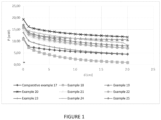
- Figure 1 shows the curve relating to the generated power value (P) expressed in mW (reported on the ordinate), as a function of the distance (d) from the edge on which the photovoltaic cell was fixed, expressed in cm (reported on the abscissa).
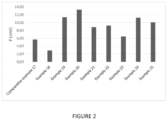
- Figure 2 shows the power value (P) generated expressed in mW (reported on the ordinate) obtained (the number of the example is reported on the abscissa).
- the main face of the polymer plate [the one coated with the thin film containing 4,7-dithienothienyl-5,6-diphenoxy-2,1,3-benzothiadiazole having formula (Ia 1 ) (DTTBOP),] was then lit up with a light source with a power equal to 1 sun (1000 W/m 2 ) and the electrical power generated by the effect of lighting was measured.
- the power measurements (P) were made by illuminating a portion of a plate with dimensions equal to 100 mm ⁇ 90 mm, at an increasing distance (d) from the edge on which the photovoltaic cell was fixed. These measurements at a variable distance from the photovoltaic cell allow the contribution of wave guide, edge, diffusion and self-absorption effects to be quantified.
- Figure 1 shows the curve relating to the generated power value (P) expressed in mW (reported on the ordinate), as a function of the distance (d) from the edge on which the photovoltaic cell was fixed, expressed in cm (reported on the abscissa).
- Figure 2 shows the power value (P) generated expressed in mW (reported on the ordinate) obtained (the number of the example is reported on the abscissa).
- the main face of the polymer plate [the one coated with the thin film containing 4,7-di- (2,6-dimethylphenyl)thienothienyl-5,6-diphenoxy-2,1,3-benzothiadiazole having formula (Ib) (MPDTTBOP)] was then lit up with a light source with a power equal to 1 sun (1000 W/m 2 ) and the electrical power generated by the effect of lighting was measured.
- the power measurements (P) were made by illuminating a portion of a plate with dimensions equal to 100 mm ⁇ 90 mm, at an increasing distance (d) from the edge on which the photovoltaic cell was fixed. These measurements at a variable distance from the photovoltaic cell allow the contribution of wave guide, edge, diffusion and self-absorption effects to be quantified.
- Figure 1 shows the curve relating to the generated power value (P) expressed in mW (reported on the ordinate), as a function of the distance (d) from the edge on which the photovoltaic cell was fixed, expressed in cm (reported on the abscissa).
- Figure 2 shows the power value (P) generated expressed in mW (reported on the ordinate) obtained (the number of the example is reported on the abscissa).
- the main face of the polymer plate [the one coated with the thin film containing 4,7-di-(2,6-dimethylphenyl)thienothienyl-5,6-diphenoxy-2,1,3-benzothiadiazole having formula (Ib) (MPDTTBOP)] was then lit up with a light source with a power equal to 1 sun (1000 W/m 2 ) and the electrical power generated by the effect of lighting was measured.
- the power measurements (P) were made by illuminating a portion of a plate with dimensions equal to 100 mm ⁇ 90 mm, at an increasing distance (d) from the edge on which the photovoltaic cell was fixed. These measurements at a variable distance from the photovoltaic cell allow the contribution of wave guide, edge, diffusion and self-absorption effects to be quantified.
- Figure 1 shows the curve relating to the generated power value (P) expressed in mW (reported on the ordinate), as a function of the distance (d) from the edge on which the photovoltaic cell was fixed, expressed in cm (reported on the abscissa).
- Figure 2 shows the power value (P) generated expressed in mW (reported on the ordinate) obtained (the number of the example is reported on the abscissa).
- the main face of the polymer plate [the one coated with the thin film containing 4,7-di-2-(2-phenoxyphenyl)thienothienyl-5,6-diphenoxy-2,1,3-benzothiadiazole having formula (Ic) (POPDTTBOP)] was then lit up with a light source with a power equal to 1 sun (1000 W/m 2 ) and the electrical power generated by the effect of lighting was measured.
- the power measurements (P) were made by illuminating a portion of a plate with dimensions equal to 100 mm ⁇ 90 mm, at an increasing distance (d) from the edge on which the photovoltaic cell was fixed. These measurements at a variable distance from the photovoltaic cell allow the contribution of wave guide, edge, diffusion and self-absorption effects to be quantified.
- Figure 1 shows the curve relating to the generated power value (P) expressed in mW (reported on the ordinate), as a function of the distance (d) from the edge on which the photovoltaic cell was fixed, expressed in cm (reported on the abscissa).
- Figure 2 shows the power value (P) generated expressed in mW (reported on the ordinate) obtained (the number of the example is reported on the abscissa).
- the main face of the polymer plate [the one coated with the thin film containing 4,7-di-2-(2-phenoxyphenyl)thienothienyl-5,6-diphenoxy-2,1,3-benzothiadiazole having formula (Ic) (POPDTTBOP)] was then lit up with a light source with a power equal to 1 sun (1000 W/m 2 ) and the electrical power generated by the effect of lighting was measured.
- the power measurements (P) were made by illuminating a portion of a plate with dimensions equal to 100 mm ⁇ 90 mm, at an increasing distance (d) from the edge on which the photovoltaic cell was fixed. These measurements at a variable distance from the photovoltaic cell allow the contribution of wave guide, edge, diffusion and self-absorption effects to be quantified.
- Figure 1 shows the curve relating to the generated power value (P) expressed in mW (reported on the ordinate), as a function of the distance (d) from the edge on which the photovoltaic cell was fixed, expressed in cm (reported on the abscissa).
- Figure 2 shows the power value (P) generated expressed in mW (reported on the ordinate) obtained (the number of the example is reported on the abscissa).
- the main face of the polymer plate [the one coated with the thin film containing 4,7-di-2-(2-phenoxyphenyl)thienothienyl-5,6-diphenoxy-2,1,3-benzothiadiazole having formula (Ic) (POPDTTBOP)] was then lit up with a light source with a power equal to 1 sun (1000 W/m 2 ) and the electrical power generated by the effect of lighting was measured.
- the power measurements (P) were made by illuminating a portion of a plate with dimensions equal to 100 mm ⁇ 90 mm, at an increasing distance (d) from the edge on which the photovoltaic cell was fixed. These measurements at a variable distance from the photovoltaic cell allow the contribution of wave guide, edge, diffusion and self-absorption effects to be quantified.
- Figure 1 shows the curve relating to the generated power value (P) expressed in mW (reported on the ordinate), as a function of the distance (d) from the edge on which the photovoltaic cell was fixed, expressed in cm (reported on the abscissa).
- Figure 2 shows the power value (P) generated expressed in mW (reported on the ordinate) obtained (the number of the example is reported on the abscissa).
- the main face of the polymer plate [the one coated with the thin film containing 4,7-di-2-(2,4,6-triphenoxyphenyl)thienothienyl-5,6-diphenoxy-2,1,3-benzothiadiazole having formula (Id) (2,4,6-(POP) 3 DTTBOP)] was then lit up with a light source with a power equal to 1 sun (1000 W/m 2 ) and the electrical power generated by the effect of lighting was measured.
- the power measurements (P) were made by illuminating a portion of a plate with dimensions equal to 100 mm ⁇ 90 mm, at an increasing distance (d) from the edge on which the photovoltaic cell was fixed. These measurements at a variable distance from the photovoltaic cell allow the contribution of wave guide, edge, diffusion and self-absorption effects to be quantified.
- Figure 1 shows the curve relating to the generated power value (P) expressed in mW (reported on the ordinate), as a function of the distance (d) from the edge on which the photovoltaic cell was fixed, expressed in cm (reported on the abscissa).
- Figure 2 shows the power value (P) generated expressed in mW (reported on the ordinate) obtained (the number of the example is reported on the abscissa).
- the main face of the polymer plate [the one coated with the thin film containing 4,7-di-2-(2,4,6-triphenoxyphenyl)thienothienyl-5,6-diphenoxy-2,1,3-benzothiadiazole having formula (Id) (2,4,6-(POP) 3 DTTBOP)] was then lit up with a light source with a power equal to 1 sun (1000 W/m 2 ) and the electrical power generated by the effect of lighting was measured.
- the power measurements (P) were made by illuminating a portion of a plate with dimensions equal to 100 mm ⁇ 90 mm, at an increasing distance (d) from the edge on which the photovoltaic cell was fixed. These measurements at a variable distance from the photovoltaic cell allow the contribution of wave guide, edge, diffusion and self-absorption effects to be quantified.
- Figure 1 shows the curve relating to the generated power value (P) expressed in mW (reported on the ordinate), as a function of the distance (d) from the edge on which the photovoltaic cell was fixed, expressed in cm (reported on the abscissa).
- Figure 2 shows the power value (P) generated expressed in mW (reported on the ordinate) obtained (the number of the example is reported on the abscissa).
Landscapes
- Chemical & Material Sciences (AREA)
- Physics & Mathematics (AREA)
- Spectroscopy & Molecular Physics (AREA)
- Engineering & Computer Science (AREA)
- Materials Engineering (AREA)
- Organic Chemistry (AREA)
- Electromagnetism (AREA)
- Heterocyclic Carbon Compounds Containing A Hetero Ring Having Oxygen Or Sulfur (AREA)
- Nitrogen And Oxygen Or Sulfur-Condensed Heterocyclic Ring Systems (AREA)
- Luminescent Compositions (AREA)
Claims (5)
- Mit Thienothiophengruppen disubstituierte Diaryloxybenzoheterodiazolverbindung der allgemeinen Formel (la):
 - Z ein Schwefelatom, ein Sauerstoffatom, ein Selenatom; oder eine NRs-Gruppe darstellt, wobei R5 aus C1-C20-Alkylgruppen, vorzugsweise C1-C8, linear oder verzweigt, oder aus gegebenenfalls substituierten Arylgruppen ausgewählt ist;- R1, R2 und R3, die gleich oder verschieden voneinander sind, ein Wasserstoffatom darstellen; oder aus C1-C20-Alkylgruppen, vorzugsweise C1-C8, linear oder verzweigt, gegebenenfalls enthaltend Heteroatome, gegebenenfalls substituierten Cycloalkylgruppen, gegebenenfalls substituierten Arylgruppen, C1-C20-Alkoxygruppen, vorzugsweise C1-C8, linear oder verzweigt, gegebenenfalls substituiert, -COOR6-Gruppen ausgewählt sind, wobei R6 aus C1-C20-Alkylgruppen, vorzugsweise C1-C8, linear oder verzweigt, ausgewählt ist, oder eine Cyanogruppe ist;- oder R1 und R2 gegebenenfalls so miteinander verbunden sein können, dass sie zusammen mit den Kohlenstoffatomen, an die sie gebunden sind, einen gesättigten, ungesättigten oder aromatischen Ring oder ein polycyclisches System, enthaltend von 3 bis 14 Kohlenstoffatome, vorzugsweise von 4 bis 6 Kohlenstoffatome, bilden, gegebenenfalls enthaltend ein oder mehrere Heteroatome wie Sauerstoff, Schwefel, Stickstoff, Silicium, Phosphor, Selen;- R4, die gleich oder verschieden voneinander sind, aus gegebenenfalls substituierten Arylgruppen ausgewählt sind.
 - Mit Thienothiophengruppen disubstituierte Diaryloxybenzoheterodiazolverbindung nach Anspruch 1, wobei in der allgemeinen Formel (la):- Z ein Schwefelatom darstellt;- R1, die einander gleich sind, ein Wasserstoffatom darstellen; oder aus gegebenenfalls substituierten Arylgruppen ausgewählt sind, vorzugsweise 2,6-Dimethylphenyl, 2-Phenoxyphenyl, 2,4,6-Triphenoxyphenyl sind;- R2 und R3, die einander gleich sind, ein Wasserstoffatom darstellen;- R4 aus gegebenenfalls substituierten Arylgruppen ausgewählt ist, vorzugsweise Phenyl ist.
- Lumineszierender Solarkonzentrator (LSC), enthaltend mindestens eine mit Thienothiophengruppen disubstituierte Diaryloxybenzoheterodiazolverbindung der allgemeinen Formel (la) nach Anspruch 1 oder 2.
- Photovoltaikvorrichtung oder Solarvorrichtung, umfassend mindestens eine Photovoltaikzelle (oder Solarzelle) und mindestens einen lumineszierender Solarkonzentrator (LSC) nach Anspruch 3.
- Verwendung einer Photovoltaikvorrichtung oder Solarvorrichtung nach Anspruch 4 bei der Errichtung von Gewächshäusern.
Applications Claiming Priority (2)
| Application Number | Priority Date | Filing Date | Title |
|---|---|---|---|
| IT102019000020970A IT201900020970A1 (it) | 2019-11-12 | 2019-11-12 | Composti diarilossibenzoeterodiazolici disostituiti con gruppi tienotiofenici |
| PCT/IB2020/060661 WO2021094976A1 (en) | 2019-11-12 | 2020-11-12 | Diaryloxybenzoheterodiazole compounds di-substituted with thienothiophenic groups |
Publications (2)
| Publication Number | Publication Date |
|---|---|
| EP4059068A1 EP4059068A1 (de) | 2022-09-21 |
| EP4059068B1 true EP4059068B1 (de) | 2024-08-21 |
Family
ID=69903845
Family Applications (1)
| Application Number | Title | Priority Date | Filing Date |
|---|---|---|---|
| EP20807520.0A Active EP4059068B1 (de) | 2019-11-12 | 2020-11-12 | Mit thienothiophengruppen di-substituierte diaryloxybenzoheterodiazolverbindungen |
Country Status (10)
| Country | Link |
|---|---|
| US (1) | US11930705B2 (de) |
| EP (1) | EP4059068B1 (de) |
| CN (1) | CN115210894A (de) |
| CA (1) | CA3157626A1 (de) |
| DK (1) | DK4059068T3 (de) |
| ES (1) | ES2989903T3 (de) |
| FI (1) | FI4059068T3 (de) |
| IT (1) | IT201900020970A1 (de) |
| PL (1) | PL4059068T3 (de) |
| WO (1) | WO2021094976A1 (de) |
Families Citing this family (1)
| Publication number | Priority date | Publication date | Assignee | Title |
|---|---|---|---|---|
| EP4444723A1 (de) * | 2021-12-10 | 2024-10-16 | ENI S.p.A. | Diaryloxybenzoheterodiazolverbindungen, die mit thienothiophengruppen disubstituierte sind |
Family Cites Families (13)
| Publication number | Priority date | Publication date | Assignee | Title |
|---|---|---|---|---|
| DE10229370A1 (de) * | 2002-06-29 | 2004-01-15 | Covion Organic Semiconductors Gmbh | 2,1,3-Benzothiadiazole |
| WO2007116750A1 (ja) * | 2006-03-30 | 2007-10-18 | Idemitsu Kosan Co., Ltd. | 有機エレクトロルミネッセンス素子用材料、及びこれを用いた有機エレクトロルミネッセンス素子 |
| IT1396026B1 (it) | 2009-10-19 | 2012-11-09 | Eni Spa | Composizioni fotoluminescenti per convertitori di spettro a migliorata efficienza |
| CN102276801B (zh) * | 2010-06-10 | 2014-03-12 | 海洋王照明科技股份有限公司 | 噻吩并噻吩醌型有机光电材料、其制备方法和应用 |
| IT1401129B1 (it) | 2010-07-16 | 2013-07-12 | Eni Spa | Processo per la sintesi di composti benzotiadiazolici |
| CN104098758A (zh) * | 2013-04-09 | 2014-10-15 | 河南师范大学 | 系列高效率有机太阳能电池材料合成方法 |
| ITMI20131620A1 (it) * | 2013-10-01 | 2015-04-02 | Eni Spa | Concentratore solare luminescente comprendente composti benzoeterodiazolici tetrasostituiti |
| US11133474B2 (en) | 2014-09-25 | 2021-09-28 | Eni S.P.A. | Disubstituted diaryloxybenzoheterodiazole compounds |
| WO2016092065A1 (en) * | 2014-12-12 | 2016-06-16 | Eni .P.A. | Bis-thienobenzothienothiophene compounds and process for their preparation |
| ITUB20155558A1 (it) * | 2015-11-13 | 2017-05-13 | Eni Spa | Composti diarilossibenzoeterodiazolici disostituiti |
| IT201800000667A1 (it) * | 2018-01-10 | 2019-07-10 | Eni Spa | Procedimento per la preparazione di composti diarilossibenzoeterodiazolici disostituiti |
| IT201800003610A1 (it) * | 2018-03-15 | 2019-09-15 | Eni Spa | Derivati antraditiofenici, procedimento per la loro preparazione e polimeri che li contengono |
| WO2020019132A1 (zh) | 2018-07-23 | 2020-01-30 | 太平洋未来科技(深圳)有限公司 | 基于光线信息渲染虚拟对象的方法、装置及电子设备 |
-
2019
- 2019-11-12 IT IT102019000020970A patent/IT201900020970A1/it unknown
-
2020
- 2020-11-12 ES ES20807520T patent/ES2989903T3/es active Active
- 2020-11-12 DK DK20807520.0T patent/DK4059068T3/da active
- 2020-11-12 EP EP20807520.0A patent/EP4059068B1/de active Active
- 2020-11-12 CN CN202080092766.0A patent/CN115210894A/zh active Pending
- 2020-11-12 US US17/775,900 patent/US11930705B2/en active Active
- 2020-11-12 WO PCT/IB2020/060661 patent/WO2021094976A1/en not_active Ceased
- 2020-11-12 CA CA3157626A patent/CA3157626A1/en active Pending
- 2020-11-12 FI FIEP20807520.0T patent/FI4059068T3/fi active
- 2020-11-12 PL PL20807520.0T patent/PL4059068T3/pl unknown
Also Published As
| Publication number | Publication date |
|---|---|
| EP4059068A1 (de) | 2022-09-21 |
| CA3157626A1 (en) | 2021-05-20 |
| PL4059068T3 (pl) | 2024-11-25 |
| US11930705B2 (en) | 2024-03-12 |
| CN115210894A (zh) | 2022-10-18 |
| WO2021094976A1 (en) | 2021-05-20 |
| US20220399509A1 (en) | 2022-12-15 |
| IT201900020970A1 (it) | 2021-05-12 |
| FI4059068T3 (fi) | 2024-09-23 |
| ES2989903T3 (es) | 2024-11-28 |
| DK4059068T3 (da) | 2024-09-02 |
Similar Documents
| Publication | Publication Date | Title |
|---|---|---|
| EP3197890B1 (de) | Disubstituierte diaryloxybenzoheterodiazolverbindungen | |
| EP3198658B1 (de) | Lumineszenter sonnenkonzentrator mit disubstituierten benzoheterodiazolverbindungen | |
| US20140371463A1 (en) | Benzodithiophene derivatives and their use as photoluminescent compounds | |
| EP3374357B1 (de) | Disubstituierte diaryloxybenzoheterodiazolverbindungen | |
| EP4059068B1 (de) | Mit thienothiophengruppen di-substituierte diaryloxybenzoheterodiazolverbindungen | |
| Barros et al. | Synthesis, photophysical and electrochemical properties of π-conjugated pyrene based down-shifting molecules with fluorinated aryl groups | |
| EP3898889B1 (de) | Lumineszenter solarkonzentrator mit dithienylpyridinthiadiazolverbindungen | |
| EP3867333B1 (de) | Disubstituierte diaryloxybenzoheterodiazolverbindungen | |
| EP3941995B1 (de) | Disubstituierte fluoraryloxybenzoheterodiazolverbindungen | |
| US11706979B2 (en) | Disubstituted diaryloxybenzoheterodiazole compounds | |
| WO2014128648A1 (en) | Luminescent solar concentrator comprising disubstituted naphthothiadiazole compounds | |
| US9353128B2 (en) | Disubstituted naphthoheterodiazole compounds |
Legal Events
| Date | Code | Title | Description |
|---|---|---|---|
| STAA | Information on the status of an ep patent application or granted ep patent |
Free format text: STATUS: UNKNOWN |
|
| STAA | Information on the status of an ep patent application or granted ep patent |
Free format text: STATUS: THE INTERNATIONAL PUBLICATION HAS BEEN MADE |
|
| PUAI | Public reference made under article 153(3) epc to a published international application that has entered the european phase |
Free format text: ORIGINAL CODE: 0009012 |
|
| STAA | Information on the status of an ep patent application or granted ep patent |
Free format text: STATUS: REQUEST FOR EXAMINATION WAS MADE |
|
| 17P | Request for examination filed |
Effective date: 20220527 |
|
| AK | Designated contracting states |
Kind code of ref document: A1 Designated state(s): AL AT BE BG CH CY CZ DE DK EE ES FI FR GB GR HR HU IE IS IT LI LT LU LV MC MK MT NL NO PL PT RO RS SE SI SK SM TR |
|
| DAV | Request for validation of the european patent (deleted) | ||
| DAX | Request for extension of the european patent (deleted) | ||
| REG | Reference to a national code |
Free format text: PREVIOUS MAIN CLASS: H01L0051440000 Ipc: H10K0085600000 Ref country code: DE Ref legal event code: R079 Ref document number: 602020036326 Country of ref document: DE Free format text: PREVIOUS MAIN CLASS: H01L0051440000 Ipc: H10K0085600000 |
|
| GRAP | Despatch of communication of intention to grant a patent |
Free format text: ORIGINAL CODE: EPIDOSNIGR1 |
|
| STAA | Information on the status of an ep patent application or granted ep patent |
Free format text: STATUS: GRANT OF PATENT IS INTENDED |
|
| RIC1 | Information provided on ipc code assigned before grant |
Ipc: H10K 30/87 20230101ALN20240228BHEP Ipc: H10K 85/60 20230101AFI20240228BHEP |
|
| INTG | Intention to grant announced |
Effective date: 20240318 |
|
| GRAS | Grant fee paid |
Free format text: ORIGINAL CODE: EPIDOSNIGR3 |
|
| GRAA | (expected) grant |
Free format text: ORIGINAL CODE: 0009210 |
|
| STAA | Information on the status of an ep patent application or granted ep patent |
Free format text: STATUS: THE PATENT HAS BEEN GRANTED |
|
| AK | Designated contracting states |
Kind code of ref document: B1 Designated state(s): AL AT BE BG CH CY CZ DE DK EE ES FI FR GB GR HR HU IE IS IT LI LT LU LV MC MK MT NL NO PL PT RO RS SE SI SK SM TR |
|
| P01 | Opt-out of the competence of the unified patent court (upc) registered |
Free format text: CASE NUMBER: APP_41210/2024 Effective date: 20240711 |
|
| REG | Reference to a national code |
Ref country code: GB Ref legal event code: FG4D |
|
| REG | Reference to a national code |
Ref country code: CH Ref legal event code: EP |
|
| REG | Reference to a national code |
Ref country code: DK Ref legal event code: T3 Effective date: 20240830 |
|
| REG | Reference to a national code |
Ref country code: DE Ref legal event code: R096 Ref document number: 602020036326 Country of ref document: DE |
|
| REG | Reference to a national code |
Ref country code: IE Ref legal event code: FG4D |
|
| REG | Reference to a national code |
Ref country code: NL Ref legal event code: FP |
|
| REG | Reference to a national code |
Ref country code: FI Ref legal event code: FGE |
|
| REG | Reference to a national code |
Ref country code: SE Ref legal event code: TRGR |
|
| REG | Reference to a national code |
Ref country code: ES Ref legal event code: FG2A Ref document number: 2989903 Country of ref document: ES Kind code of ref document: T3 Effective date: 20241128 |
|
| REG | Reference to a national code |
Ref country code: LT Ref legal event code: MG9D |
|
| REG | Reference to a national code |
Ref country code: AT Ref legal event code: UEP Ref document number: 1716888 Country of ref document: AT Kind code of ref document: T Effective date: 20240821 |
|
| PG25 | Lapsed in a contracting state [announced via postgrant information from national office to epo] |
Ref country code: PT Free format text: LAPSE BECAUSE OF FAILURE TO SUBMIT A TRANSLATION OF THE DESCRIPTION OR TO PAY THE FEE WITHIN THE PRESCRIBED TIME-LIMIT Effective date: 20241223 Ref country code: GR Free format text: LAPSE BECAUSE OF FAILURE TO SUBMIT A TRANSLATION OF THE DESCRIPTION OR TO PAY THE FEE WITHIN THE PRESCRIBED TIME-LIMIT Effective date: 20241122 |
|
| PG25 | Lapsed in a contracting state [announced via postgrant information from national office to epo] |
Ref country code: BG Free format text: LAPSE BECAUSE OF FAILURE TO SUBMIT A TRANSLATION OF THE DESCRIPTION OR TO PAY THE FEE WITHIN THE PRESCRIBED TIME-LIMIT Effective date: 20240821 |
|
| PG25 | Lapsed in a contracting state [announced via postgrant information from national office to epo] |
Ref country code: LV Free format text: LAPSE BECAUSE OF FAILURE TO SUBMIT A TRANSLATION OF THE DESCRIPTION OR TO PAY THE FEE WITHIN THE PRESCRIBED TIME-LIMIT Effective date: 20240821 |
|
| PG25 | Lapsed in a contracting state [announced via postgrant information from national office to epo] |
Ref country code: IS Free format text: LAPSE BECAUSE OF FAILURE TO SUBMIT A TRANSLATION OF THE DESCRIPTION OR TO PAY THE FEE WITHIN THE PRESCRIBED TIME-LIMIT Effective date: 20241221 |
|
| PG25 | Lapsed in a contracting state [announced via postgrant information from national office to epo] |
Ref country code: HR Free format text: LAPSE BECAUSE OF FAILURE TO SUBMIT A TRANSLATION OF THE DESCRIPTION OR TO PAY THE FEE WITHIN THE PRESCRIBED TIME-LIMIT Effective date: 20240821 |
|
| PG25 | Lapsed in a contracting state [announced via postgrant information from national office to epo] |
Ref country code: RS Free format text: LAPSE BECAUSE OF FAILURE TO SUBMIT A TRANSLATION OF THE DESCRIPTION OR TO PAY THE FEE WITHIN THE PRESCRIBED TIME-LIMIT Effective date: 20241121 |
|
| PG25 | Lapsed in a contracting state [announced via postgrant information from national office to epo] |
Ref country code: RS Free format text: LAPSE BECAUSE OF FAILURE TO SUBMIT A TRANSLATION OF THE DESCRIPTION OR TO PAY THE FEE WITHIN THE PRESCRIBED TIME-LIMIT Effective date: 20241121 Ref country code: PT Free format text: LAPSE BECAUSE OF FAILURE TO SUBMIT A TRANSLATION OF THE DESCRIPTION OR TO PAY THE FEE WITHIN THE PRESCRIBED TIME-LIMIT Effective date: 20241223 Ref country code: LV Free format text: LAPSE BECAUSE OF FAILURE TO SUBMIT A TRANSLATION OF THE DESCRIPTION OR TO PAY THE FEE WITHIN THE PRESCRIBED TIME-LIMIT Effective date: 20240821 Ref country code: IS Free format text: LAPSE BECAUSE OF FAILURE TO SUBMIT A TRANSLATION OF THE DESCRIPTION OR TO PAY THE FEE WITHIN THE PRESCRIBED TIME-LIMIT Effective date: 20241221 Ref country code: HR Free format text: LAPSE BECAUSE OF FAILURE TO SUBMIT A TRANSLATION OF THE DESCRIPTION OR TO PAY THE FEE WITHIN THE PRESCRIBED TIME-LIMIT Effective date: 20240821 Ref country code: GR Free format text: LAPSE BECAUSE OF FAILURE TO SUBMIT A TRANSLATION OF THE DESCRIPTION OR TO PAY THE FEE WITHIN THE PRESCRIBED TIME-LIMIT Effective date: 20241122 Ref country code: BG Free format text: LAPSE BECAUSE OF FAILURE TO SUBMIT A TRANSLATION OF THE DESCRIPTION OR TO PAY THE FEE WITHIN THE PRESCRIBED TIME-LIMIT Effective date: 20240821 |
|
| PG25 | Lapsed in a contracting state [announced via postgrant information from national office to epo] |
Ref country code: RO Free format text: LAPSE BECAUSE OF FAILURE TO SUBMIT A TRANSLATION OF THE DESCRIPTION OR TO PAY THE FEE WITHIN THE PRESCRIBED TIME-LIMIT Effective date: 20240821 Ref country code: SM Free format text: LAPSE BECAUSE OF FAILURE TO SUBMIT A TRANSLATION OF THE DESCRIPTION OR TO PAY THE FEE WITHIN THE PRESCRIBED TIME-LIMIT Effective date: 20240821 |
|
| PG25 | Lapsed in a contracting state [announced via postgrant information from national office to epo] |
Ref country code: EE Free format text: LAPSE BECAUSE OF FAILURE TO SUBMIT A TRANSLATION OF THE DESCRIPTION OR TO PAY THE FEE WITHIN THE PRESCRIBED TIME-LIMIT Effective date: 20240821 |
|
| PG25 | Lapsed in a contracting state [announced via postgrant information from national office to epo] |
Ref country code: SK Free format text: LAPSE BECAUSE OF FAILURE TO SUBMIT A TRANSLATION OF THE DESCRIPTION OR TO PAY THE FEE WITHIN THE PRESCRIBED TIME-LIMIT Effective date: 20240821 |
|
| REG | Reference to a national code |
Ref country code: DE Ref legal event code: R097 Ref document number: 602020036326 Country of ref document: DE |
|
| PLBE | No opposition filed within time limit |
Free format text: ORIGINAL CODE: 0009261 |
|
| STAA | Information on the status of an ep patent application or granted ep patent |
Free format text: STATUS: NO OPPOSITION FILED WITHIN TIME LIMIT |
|
| PG25 | Lapsed in a contracting state [announced via postgrant information from national office to epo] |
Ref country code: MC Free format text: LAPSE BECAUSE OF FAILURE TO SUBMIT A TRANSLATION OF THE DESCRIPTION OR TO PAY THE FEE WITHIN THE PRESCRIBED TIME-LIMIT Effective date: 20240821 |
|
| PG25 | Lapsed in a contracting state [announced via postgrant information from national office to epo] |
Ref country code: LU Free format text: LAPSE BECAUSE OF NON-PAYMENT OF DUE FEES Effective date: 20241112 |
|
| 26N | No opposition filed |
Effective date: 20250522 |
|
| PG25 | Lapsed in a contracting state [announced via postgrant information from national office to epo] |
Ref country code: IT Free format text: LAPSE BECAUSE OF NON-PAYMENT OF DUE FEES Effective date: 20241112 |
|
| PG25 | Lapsed in a contracting state [announced via postgrant information from national office to epo] |
Ref country code: IE Free format text: LAPSE BECAUSE OF NON-PAYMENT OF DUE FEES Effective date: 20241112 |
|
| REG | Reference to a national code |
Ref country code: CH Ref legal event code: U11 Free format text: ST27 STATUS EVENT CODE: U-0-0-U10-U11 (AS PROVIDED BY THE NATIONAL OFFICE) Effective date: 20251201 |
|
| PGFP | Annual fee paid to national office [announced via postgrant information from national office to epo] |
Ref country code: NL Payment date: 20251126 Year of fee payment: 6 |
|
| PGFP | Annual fee paid to national office [announced via postgrant information from national office to epo] |
Ref country code: DE Payment date: 20251128 Year of fee payment: 6 |
|
| PGFP | Annual fee paid to national office [announced via postgrant information from national office to epo] |
Ref country code: GB Payment date: 20251127 Year of fee payment: 6 |
|
| PGFP | Annual fee paid to national office [announced via postgrant information from national office to epo] |
Ref country code: NO Payment date: 20251128 Year of fee payment: 6 |
|
| PGFP | Annual fee paid to national office [announced via postgrant information from national office to epo] |
Ref country code: AT Payment date: 20251128 Year of fee payment: 6 |
|
| PGFP | Annual fee paid to national office [announced via postgrant information from national office to epo] |
Ref country code: FI Payment date: 20251125 Year of fee payment: 6 Ref country code: DK Payment date: 20251125 Year of fee payment: 6 |
|
| PGFP | Annual fee paid to national office [announced via postgrant information from national office to epo] |
Ref country code: FR Payment date: 20251125 Year of fee payment: 6 |
|
| PGFP | Annual fee paid to national office [announced via postgrant information from national office to epo] |
Ref country code: BE Payment date: 20251127 Year of fee payment: 6 |
|
| PGFP | Annual fee paid to national office [announced via postgrant information from national office to epo] |
Ref country code: SE Payment date: 20251127 Year of fee payment: 6 Ref country code: CH Payment date: 20251201 Year of fee payment: 6 |
|
| PGFP | Annual fee paid to national office [announced via postgrant information from national office to epo] |
Ref country code: CZ Payment date: 20251024 Year of fee payment: 6 |
|
| PGFP | Annual fee paid to national office [announced via postgrant information from national office to epo] |
Ref country code: PL Payment date: 20251021 Year of fee payment: 6 |
|
| PGFP | Annual fee paid to national office [announced via postgrant information from national office to epo] |
Ref country code: ES Payment date: 20251201 Year of fee payment: 6 |