EP4057782A1 - Method for increasing adhesion strength between copper and an organic material and reducing halo and wedge void formation by modifying the copper surface and/or by using heteroaromatic silane compounds - Google Patents
Method for increasing adhesion strength between copper and an organic material and reducing halo and wedge void formation by modifying the copper surface and/or by using heteroaromatic silane compounds Download PDFInfo
- Publication number
- EP4057782A1 EP4057782A1 EP21162439.0A EP21162439A EP4057782A1 EP 4057782 A1 EP4057782 A1 EP 4057782A1 EP 21162439 A EP21162439 A EP 21162439A EP 4057782 A1 EP4057782 A1 EP 4057782A1
- Authority
- EP
- European Patent Office
- Prior art keywords
- copper
- range
- present
- oxide
- preferred
- Prior art date
- Legal status (The legal status is an assumption and is not a legal conclusion. Google has not performed a legal analysis and makes no representation as to the accuracy of the status listed.)
- Pending
Links
- RYGMFSIKBFXOCR-UHFFFAOYSA-N Copper Chemical compound [Cu] RYGMFSIKBFXOCR-UHFFFAOYSA-N 0.000 title claims abstract description 144
- 239000010949 copper Substances 0.000 title claims abstract description 132
- 229910052802 copper Inorganic materials 0.000 title claims abstract description 126
- 238000000034 method Methods 0.000 title claims abstract description 105
- 239000011368 organic material Substances 0.000 title claims abstract description 38
- -1 heteroaromatic silane compounds Chemical class 0.000 title claims description 81
- 239000011800 void material Substances 0.000 title claims description 17
- 230000015572 biosynthetic process Effects 0.000 title description 21
- 125000001475 halogen functional group Chemical group 0.000 title 1
- QPLDLSVMHZLSFG-UHFFFAOYSA-N Copper oxide Chemical compound [Cu]=O QPLDLSVMHZLSFG-UHFFFAOYSA-N 0.000 claims abstract description 97
- 239000005751 Copper oxide Substances 0.000 claims abstract description 93
- 229910000431 copper oxide Inorganic materials 0.000 claims abstract description 93
- 229910000881 Cu alloy Inorganic materials 0.000 claims abstract description 73
- 239000000243 solution Substances 0.000 claims description 97
- 229910000077 silane Inorganic materials 0.000 claims description 67
- 239000000203 mixture Substances 0.000 claims description 60
- 239000000758 substrate Substances 0.000 claims description 56
- XLYOFNOQVPJJNP-UHFFFAOYSA-N water Substances O XLYOFNOQVPJJNP-UHFFFAOYSA-N 0.000 claims description 45
- 238000004140 cleaning Methods 0.000 claims description 32
- 239000012670 alkaline solution Substances 0.000 claims description 23
- QAOWNCQODCNURD-UHFFFAOYSA-N Sulfuric acid Chemical compound OS(O)(=O)=O QAOWNCQODCNURD-UHFFFAOYSA-N 0.000 claims description 20
- 125000000217 alkyl group Chemical group 0.000 claims description 20
- 239000008139 complexing agent Substances 0.000 claims description 19
- BERDEBHAJNAUOM-UHFFFAOYSA-N copper(i) oxide Chemical compound [Cu]O[Cu] BERDEBHAJNAUOM-UHFFFAOYSA-N 0.000 claims description 19
- JPVYNHNXODAKFH-UHFFFAOYSA-N Cu2+ Chemical compound [Cu+2] JPVYNHNXODAKFH-UHFFFAOYSA-N 0.000 claims description 13
- 125000000956 methoxy group Chemical group [H]C([H])([H])O* 0.000 claims description 13
- 239000007921 spray Substances 0.000 claims description 13
- 150000001413 amino acids Chemical class 0.000 claims description 9
- 229910052757 nitrogen Inorganic materials 0.000 claims description 9
- 239000007800 oxidant agent Substances 0.000 claims description 9
- VMQMZMRVKUZKQL-UHFFFAOYSA-N Cu+ Chemical compound [Cu+] VMQMZMRVKUZKQL-UHFFFAOYSA-N 0.000 claims description 7
- 150000007522 mineralic acids Chemical class 0.000 claims description 7
- 150000002978 peroxides Chemical class 0.000 claims description 6
- 239000002253 acid Substances 0.000 claims description 5
- 238000010030 laminating Methods 0.000 claims description 5
- 238000010438 heat treatment Methods 0.000 claims description 4
- 229920000620 organic polymer Polymers 0.000 claims description 4
- 238000001035 drying Methods 0.000 claims description 3
- 239000012224 working solution Substances 0.000 description 36
- 238000003860 storage Methods 0.000 description 34
- BLRPTPMANUNPDV-UHFFFAOYSA-N Silane Chemical compound [SiH4] BLRPTPMANUNPDV-UHFFFAOYSA-N 0.000 description 32
- 150000001875 compounds Chemical class 0.000 description 27
- 150000004756 silanes Chemical class 0.000 description 25
- 239000003960 organic solvent Substances 0.000 description 23
- 125000005843 halogen group Chemical group 0.000 description 22
- 239000002904 solvent Substances 0.000 description 17
- 239000011889 copper foil Substances 0.000 description 16
- 238000001308 synthesis method Methods 0.000 description 16
- LYCAIKOWRPUZTN-UHFFFAOYSA-N ethylene glycol Natural products OCCO LYCAIKOWRPUZTN-UHFFFAOYSA-N 0.000 description 15
- JCGNDDUYTRNOFT-UHFFFAOYSA-N oxolane-2,4-dione Chemical compound O=C1COC(=O)C1 JCGNDDUYTRNOFT-UHFFFAOYSA-N 0.000 description 13
- OKKJLVBELUTLKV-UHFFFAOYSA-N Methanol Chemical compound OC OKKJLVBELUTLKV-UHFFFAOYSA-N 0.000 description 12
- 229940028356 diethylene glycol monobutyl ether Drugs 0.000 description 12
- POAOYUHQDCAZBD-UHFFFAOYSA-N 2-butoxyethanol Chemical compound CCCCOCCO POAOYUHQDCAZBD-UHFFFAOYSA-N 0.000 description 10
- 238000005259 measurement Methods 0.000 description 10
- HEMHJVSKTPXQMS-UHFFFAOYSA-M Sodium hydroxide Chemical compound [OH-].[Na+] HEMHJVSKTPXQMS-UHFFFAOYSA-M 0.000 description 9
- 150000001298 alcohols Chemical class 0.000 description 9
- 238000000576 coating method Methods 0.000 description 9
- WGCNASOHLSPBMP-UHFFFAOYSA-N hydroxyacetaldehyde Natural products OCC=O WGCNASOHLSPBMP-UHFFFAOYSA-N 0.000 description 9
- 238000004381 surface treatment Methods 0.000 description 9
- 238000003786 synthesis reaction Methods 0.000 description 9
- WYURNTSHIVDZCO-UHFFFAOYSA-N Tetrahydrofuran Chemical compound C1CCOC1 WYURNTSHIVDZCO-UHFFFAOYSA-N 0.000 description 8
- 239000011248 coating agent Substances 0.000 description 8
- 239000000463 material Substances 0.000 description 8
- 229910001431 copper ion Inorganic materials 0.000 description 7
- 238000002149 energy-dispersive X-ray emission spectroscopy Methods 0.000 description 7
- 238000003475 lamination Methods 0.000 description 7
- 239000002245 particle Substances 0.000 description 7
- 238000012360 testing method Methods 0.000 description 7
- RTZKZFJDLAIYFH-UHFFFAOYSA-N Diethyl ether Chemical compound CCOCC RTZKZFJDLAIYFH-UHFFFAOYSA-N 0.000 description 6
- LFQSCWFLJHTTHZ-UHFFFAOYSA-N Ethanol Chemical compound CCO LFQSCWFLJHTTHZ-UHFFFAOYSA-N 0.000 description 6
- RGHNJXZEOKUKBD-SQOUGZDYSA-N Gluconic acid Natural products OC[C@@H](O)[C@@H](O)[C@H](O)[C@@H](O)C(O)=O RGHNJXZEOKUKBD-SQOUGZDYSA-N 0.000 description 6
- MHAJPDPJQMAIIY-UHFFFAOYSA-N Hydrogen peroxide Chemical compound OO MHAJPDPJQMAIIY-UHFFFAOYSA-N 0.000 description 6
- KFZMGEQAYNKOFK-UHFFFAOYSA-N Isopropanol Chemical compound CC(C)O KFZMGEQAYNKOFK-UHFFFAOYSA-N 0.000 description 6
- DNIAPMSPPWPWGF-UHFFFAOYSA-N Propylene glycol Chemical compound CC(O)CO DNIAPMSPPWPWGF-UHFFFAOYSA-N 0.000 description 6
- BDERNNFJNOPAEC-UHFFFAOYSA-N propan-1-ol Chemical compound CCCO BDERNNFJNOPAEC-UHFFFAOYSA-N 0.000 description 6
- 238000007788 roughening Methods 0.000 description 6
- 230000003746 surface roughness Effects 0.000 description 6
- 150000003852 triazoles Chemical class 0.000 description 6
- RYHBNJHYFVUHQT-UHFFFAOYSA-N 1,4-Dioxane Chemical compound C1COCCO1 RYHBNJHYFVUHQT-UHFFFAOYSA-N 0.000 description 5
- RGHNJXZEOKUKBD-UHFFFAOYSA-N D-gluconic acid Natural products OCC(O)C(O)C(O)C(O)C(O)=O RGHNJXZEOKUKBD-UHFFFAOYSA-N 0.000 description 5
- VTLYFUHAOXGGBS-UHFFFAOYSA-N Fe3+ Chemical class [Fe+3] VTLYFUHAOXGGBS-UHFFFAOYSA-N 0.000 description 5
- DUYKOAQJUCADEC-UHFFFAOYSA-N [SiH4].N1=NN=CC=C1 Chemical class [SiH4].N1=NN=CC=C1 DUYKOAQJUCADEC-UHFFFAOYSA-N 0.000 description 5
- 230000000536 complexating effect Effects 0.000 description 5
- KRFJLUBVMFXRPN-UHFFFAOYSA-N cuprous oxide Chemical group [O-2].[Cu+].[Cu+] KRFJLUBVMFXRPN-UHFFFAOYSA-N 0.000 description 5
- 238000005530 etching Methods 0.000 description 5
- 238000002474 experimental method Methods 0.000 description 5
- 239000000174 gluconic acid Substances 0.000 description 5
- 235000012208 gluconic acid Nutrition 0.000 description 5
- 229910000360 iron(III) sulfate Inorganic materials 0.000 description 5
- 238000002360 preparation method Methods 0.000 description 5
- 150000003839 salts Chemical class 0.000 description 5
- UGJPMSBRYUISGR-UHFFFAOYSA-N 1H-pyrrole silane Chemical class [SiH4].N1C=CC=C1 UGJPMSBRYUISGR-UHFFFAOYSA-N 0.000 description 4
- 238000005033 Fourier transform infrared spectroscopy Methods 0.000 description 4
- DKGAVHZHDRPRBM-UHFFFAOYSA-N Tert-Butanol Chemical compound CC(C)(C)O DKGAVHZHDRPRBM-UHFFFAOYSA-N 0.000 description 4
- 238000004630 atomic force microscopy Methods 0.000 description 4
- 239000003989 dielectric material Substances 0.000 description 4
- 238000011156 evaluation Methods 0.000 description 4
- XLYOFNOQVPJJNP-UHFFFAOYSA-M hydroxide Chemical compound [OH-] XLYOFNOQVPJJNP-UHFFFAOYSA-M 0.000 description 4
- 239000000725 suspension Substances 0.000 description 4
- YLQBMQCUIZJEEH-UHFFFAOYSA-N tetrahydrofuran Natural products C=1C=COC=1 YLQBMQCUIZJEEH-UHFFFAOYSA-N 0.000 description 4
- WEVYAHXRMPXWCK-UHFFFAOYSA-N Acetonitrile Chemical compound CC#N WEVYAHXRMPXWCK-UHFFFAOYSA-N 0.000 description 3
- VEXZGXHMUGYJMC-UHFFFAOYSA-M Chloride anion Chemical compound [Cl-] VEXZGXHMUGYJMC-UHFFFAOYSA-M 0.000 description 3
- PEDCQBHIVMGVHV-UHFFFAOYSA-N Glycerine Chemical compound OCC(O)CO PEDCQBHIVMGVHV-UHFFFAOYSA-N 0.000 description 3
- ZMXDDKWLCZADIW-UHFFFAOYSA-N N,N-Dimethylformamide Chemical compound CN(C)C=O ZMXDDKWLCZADIW-UHFFFAOYSA-N 0.000 description 3
- KWYUFKZDYYNOTN-UHFFFAOYSA-M Potassium hydroxide Chemical compound [OH-].[K+] KWYUFKZDYYNOTN-UHFFFAOYSA-M 0.000 description 3
- XUIMIQQOPSSXEZ-UHFFFAOYSA-N Silicon Chemical compound [Si] XUIMIQQOPSSXEZ-UHFFFAOYSA-N 0.000 description 3
- 229910021607 Silver chloride Inorganic materials 0.000 description 3
- 239000000908 ammonium hydroxide Substances 0.000 description 3
- 238000005260 corrosion Methods 0.000 description 3
- 230000007797 corrosion Effects 0.000 description 3
- 239000011929 di(propylene glycol) methyl ether Substances 0.000 description 3
- 238000007598 dipping method Methods 0.000 description 3
- 239000012634 fragment Substances 0.000 description 3
- 238000002173 high-resolution transmission electron microscopy Methods 0.000 description 3
- 230000010354 integration Effects 0.000 description 3
- 238000011835 investigation Methods 0.000 description 3
- RUTXIHLAWFEWGM-UHFFFAOYSA-H iron(3+) sulfate Chemical compound [Fe+3].[Fe+3].[O-]S([O-])(=O)=O.[O-]S([O-])(=O)=O.[O-]S([O-])(=O)=O RUTXIHLAWFEWGM-UHFFFAOYSA-H 0.000 description 3
- VCJMYUPGQJHHFU-UHFFFAOYSA-N iron(3+);trinitrate Chemical compound [Fe+3].[O-][N+]([O-])=O.[O-][N+]([O-])=O.[O-][N+]([O-])=O VCJMYUPGQJHHFU-UHFFFAOYSA-N 0.000 description 3
- 238000004519 manufacturing process Methods 0.000 description 3
- 229910052710 silicon Inorganic materials 0.000 description 3
- HKZLPVFGJNLROG-UHFFFAOYSA-M silver monochloride Chemical compound [Cl-].[Ag+] HKZLPVFGJNLROG-UHFFFAOYSA-M 0.000 description 3
- UKLNMMHNWFDKNT-UHFFFAOYSA-M sodium chlorite Chemical compound [Na+].[O-]Cl=O UKLNMMHNWFDKNT-UHFFFAOYSA-M 0.000 description 3
- 229960002218 sodium chlorite Drugs 0.000 description 3
- 239000000126 substance Substances 0.000 description 3
- SBASXUCJHJRPEV-UHFFFAOYSA-N 2-(2-methoxyethoxy)ethanol Chemical compound COCCOCCO SBASXUCJHJRPEV-UHFFFAOYSA-N 0.000 description 2
- YEJRWHAVMIAJKC-UHFFFAOYSA-N 4-Butyrolactone Chemical compound O=C1CCCO1 YEJRWHAVMIAJKC-UHFFFAOYSA-N 0.000 description 2
- CSCPPACGZOOCGX-UHFFFAOYSA-N Acetone Chemical compound CC(C)=O CSCPPACGZOOCGX-UHFFFAOYSA-N 0.000 description 2
- VHUUQVKOLVNVRT-UHFFFAOYSA-N Ammonium hydroxide Chemical compound [NH4+].[OH-] VHUUQVKOLVNVRT-UHFFFAOYSA-N 0.000 description 2
- IJGRMHOSHXDMSA-UHFFFAOYSA-N Atomic nitrogen Chemical compound N#N IJGRMHOSHXDMSA-UHFFFAOYSA-N 0.000 description 2
- VEXZGXHMUGYJMC-UHFFFAOYSA-N Hydrochloric acid Chemical compound Cl VEXZGXHMUGYJMC-UHFFFAOYSA-N 0.000 description 2
- 229910021578 Iron(III) chloride Inorganic materials 0.000 description 2
- SECXISVLQFMRJM-UHFFFAOYSA-N N-Methylpyrrolidone Chemical compound CN1CCCC1=O SECXISVLQFMRJM-UHFFFAOYSA-N 0.000 description 2
- 230000002378 acidificating effect Effects 0.000 description 2
- XXROGKLTLUQVRX-UHFFFAOYSA-N allyl alcohol Chemical compound OCC=C XXROGKLTLUQVRX-UHFFFAOYSA-N 0.000 description 2
- 230000015556 catabolic process Effects 0.000 description 2
- 238000012512 characterization method Methods 0.000 description 2
- 238000006243 chemical reaction Methods 0.000 description 2
- 230000000052 comparative effect Effects 0.000 description 2
- 150000004292 cyclic ethers Chemical class 0.000 description 2
- 125000004122 cyclic group Chemical group 0.000 description 2
- 238000006731 degradation reaction Methods 0.000 description 2
- SZXQTJUDPRGNJN-UHFFFAOYSA-N dipropylene glycol Chemical compound OCCCOCCCO SZXQTJUDPRGNJN-UHFFFAOYSA-N 0.000 description 2
- 238000005516 engineering process Methods 0.000 description 2
- 229920006336 epoxy molding compound Polymers 0.000 description 2
- LZCLXQDLBQLTDK-UHFFFAOYSA-N ethyl 2-hydroxypropanoate Chemical compound CCOC(=O)C(C)O LZCLXQDLBQLTDK-UHFFFAOYSA-N 0.000 description 2
- XLLIQLLCWZCATF-UHFFFAOYSA-N ethylene glycol monomethyl ether acetate Natural products COCCOC(C)=O XLLIQLLCWZCATF-UHFFFAOYSA-N 0.000 description 2
- 238000000445 field-emission scanning electron microscopy Methods 0.000 description 2
- 150000004820 halides Chemical class 0.000 description 2
- 125000002887 hydroxy group Chemical group [H]O* 0.000 description 2
- 229910001853 inorganic hydroxide Inorganic materials 0.000 description 2
- XEEYBQQBJWHFJM-UHFFFAOYSA-N iron Substances [Fe] XEEYBQQBJWHFJM-UHFFFAOYSA-N 0.000 description 2
- RBTARNINKXHZNM-UHFFFAOYSA-K iron trichloride Chemical compound Cl[Fe](Cl)Cl RBTARNINKXHZNM-UHFFFAOYSA-K 0.000 description 2
- 238000000329 molecular dynamics simulation Methods 0.000 description 2
- 230000001590 oxidative effect Effects 0.000 description 2
- 238000009304 pastoral farming Methods 0.000 description 2
- 238000005191 phase separation Methods 0.000 description 2
- 238000001556 precipitation Methods 0.000 description 2
- 239000000047 product Substances 0.000 description 2
- 238000001878 scanning electron micrograph Methods 0.000 description 2
- 238000004626 scanning electron microscopy Methods 0.000 description 2
- 238000000851 scanning transmission electron micrograph Methods 0.000 description 2
- 238000001350 scanning transmission electron microscopy Methods 0.000 description 2
- 238000004088 simulation Methods 0.000 description 2
- 241000894007 species Species 0.000 description 2
- WGTYBPLFGIVFAS-UHFFFAOYSA-M tetramethylammonium hydroxide Chemical compound [OH-].C[N+](C)(C)C WGTYBPLFGIVFAS-UHFFFAOYSA-M 0.000 description 2
- 150000003918 triazines Chemical class 0.000 description 2
- BPSIOYPQMFLKFR-UHFFFAOYSA-N trimethoxy-[3-(oxiran-2-ylmethoxy)propyl]silane Chemical compound CO[Si](OC)(OC)CCCOCC1CO1 BPSIOYPQMFLKFR-UHFFFAOYSA-N 0.000 description 2
- WNXJIVFYUVYPPR-UHFFFAOYSA-N 1,3-dioxolane Chemical compound C1COCO1 WNXJIVFYUVYPPR-UHFFFAOYSA-N 0.000 description 1
- OIWIYLWZIIJNHU-UHFFFAOYSA-N 1-sulfanylpyrazole Chemical compound SN1C=CC=N1 OIWIYLWZIIJNHU-UHFFFAOYSA-N 0.000 description 1
- VXQBJTKSVGFQOL-UHFFFAOYSA-N 2-(2-butoxyethoxy)ethyl acetate Chemical compound CCCCOCCOCCOC(C)=O VXQBJTKSVGFQOL-UHFFFAOYSA-N 0.000 description 1
- ULRPISSMEBPJLN-UHFFFAOYSA-N 2h-tetrazol-5-amine Chemical compound NC1=NN=NN1 ULRPISSMEBPJLN-UHFFFAOYSA-N 0.000 description 1
- WZUUZPAYWFIBDF-UHFFFAOYSA-N 5-amino-1,2-dihydro-1,2,4-triazole-3-thione Chemical compound NC1=NNC(S)=N1 WZUUZPAYWFIBDF-UHFFFAOYSA-N 0.000 description 1
- CPELXLSAUQHCOX-UHFFFAOYSA-M Bromide Chemical compound [Br-] CPELXLSAUQHCOX-UHFFFAOYSA-M 0.000 description 1
- JJLJMEJHUUYSSY-UHFFFAOYSA-L Copper hydroxide Chemical class [OH-].[OH-].[Cu+2] JJLJMEJHUUYSSY-UHFFFAOYSA-L 0.000 description 1
- 241000446313 Lamella Species 0.000 description 1
- NINIDFKCEFEMDL-UHFFFAOYSA-N Sulfur Chemical compound [S] NINIDFKCEFEMDL-UHFFFAOYSA-N 0.000 description 1
- 239000001089 [(2R)-oxolan-2-yl]methanol Substances 0.000 description 1
- 239000000654 additive Substances 0.000 description 1
- 230000000996 additive effect Effects 0.000 description 1
- 239000002318 adhesion promoter Substances 0.000 description 1
- 239000000853 adhesive Substances 0.000 description 1
- 230000001070 adhesive effect Effects 0.000 description 1
- 125000005210 alkyl ammonium group Chemical group 0.000 description 1
- 229910052782 aluminium Inorganic materials 0.000 description 1
- 238000004458 analytical method Methods 0.000 description 1
- 238000000137 annealing Methods 0.000 description 1
- 239000000227 bioadhesive Substances 0.000 description 1
- 239000007795 chemical reaction product Substances 0.000 description 1
- 239000003795 chemical substances by application Substances 0.000 description 1
- 239000004020 conductor Substances 0.000 description 1
- 150000001879 copper Chemical class 0.000 description 1
- 229910001956 copper hydroxide Inorganic materials 0.000 description 1
- MPTQRFCYZCXJFQ-UHFFFAOYSA-L copper(II) chloride dihydrate Chemical compound O.O.[Cl-].[Cl-].[Cu+2] MPTQRFCYZCXJFQ-UHFFFAOYSA-L 0.000 description 1
- KKCXRELNMOYFLS-UHFFFAOYSA-N copper(II) oxide Chemical compound [O-2].[Cu+2] KKCXRELNMOYFLS-UHFFFAOYSA-N 0.000 description 1
- 238000007766 curtain coating Methods 0.000 description 1
- 238000002484 cyclic voltammetry Methods 0.000 description 1
- 230000032798 delamination Effects 0.000 description 1
- 230000001419 dependent effect Effects 0.000 description 1
- 238000005553 drilling Methods 0.000 description 1
- 239000003792 electrolyte Substances 0.000 description 1
- 238000002330 electrospray ionisation mass spectrometry Methods 0.000 description 1
- 238000000921 elemental analysis Methods 0.000 description 1
- 239000003822 epoxy resin Substances 0.000 description 1
- 150000002170 ethers Chemical class 0.000 description 1
- 229940116333 ethyl lactate Drugs 0.000 description 1
- 230000001747 exhibiting effect Effects 0.000 description 1
- 230000002349 favourable effect Effects 0.000 description 1
- 229910001447 ferric ion Inorganic materials 0.000 description 1
- 239000012467 final product Substances 0.000 description 1
- 239000011888 foil Substances 0.000 description 1
- 229910052733 gallium Inorganic materials 0.000 description 1
- 230000014509 gene expression Effects 0.000 description 1
- LNEPOXFFQSENCJ-UHFFFAOYSA-N haloperidol Chemical compound C1CC(O)(C=2C=CC(Cl)=CC=2)CCN1CCCC(=O)C1=CC=C(F)C=C1 LNEPOXFFQSENCJ-UHFFFAOYSA-N 0.000 description 1
- 229910052739 hydrogen Inorganic materials 0.000 description 1
- 230000003301 hydrolyzing effect Effects 0.000 description 1
- 150000004679 hydroxides Chemical class 0.000 description 1
- 238000005286 illumination Methods 0.000 description 1
- 238000007654 immersion Methods 0.000 description 1
- 230000001771 impaired effect Effects 0.000 description 1
- 239000012535 impurity Substances 0.000 description 1
- 239000003112 inhibitor Substances 0.000 description 1
- 230000003993 interaction Effects 0.000 description 1
- 239000000543 intermediate Substances 0.000 description 1
- 238000010884 ion-beam technique Methods 0.000 description 1
- 229910052742 iron Inorganic materials 0.000 description 1
- PVFSDGKDKFSOTB-UHFFFAOYSA-K iron(3+);triacetate Chemical compound [Fe+3].CC([O-])=O.CC([O-])=O.CC([O-])=O PVFSDGKDKFSOTB-UHFFFAOYSA-K 0.000 description 1
- FLTRNWIFKITPIO-UHFFFAOYSA-N iron;trihydrate Chemical compound O.O.O.[Fe] FLTRNWIFKITPIO-UHFFFAOYSA-N 0.000 description 1
- 229910052745 lead Inorganic materials 0.000 description 1
- 239000007788 liquid Substances 0.000 description 1
- 229910052751 metal Inorganic materials 0.000 description 1
- 239000002184 metal Substances 0.000 description 1
- 229910001092 metal group alloy Inorganic materials 0.000 description 1
- 229910044991 metal oxide Inorganic materials 0.000 description 1
- 150000004706 metal oxides Chemical class 0.000 description 1
- 238000000386 microscopy Methods 0.000 description 1
- 238000012900 molecular simulation Methods 0.000 description 1
- 230000007935 neutral effect Effects 0.000 description 1
- 230000003287 optical effect Effects 0.000 description 1
- 238000007719 peel strength test Methods 0.000 description 1
- 238000007747 plating Methods 0.000 description 1
- 229910052697 platinum Inorganic materials 0.000 description 1
- 229920000647 polyepoxide Polymers 0.000 description 1
- 238000012545 processing Methods 0.000 description 1
- RUOJZAUFBMNUDX-UHFFFAOYSA-N propylene carbonate Chemical compound CC1COC(=O)O1 RUOJZAUFBMNUDX-UHFFFAOYSA-N 0.000 description 1
- 238000000746 purification Methods 0.000 description 1
- 238000011002 quantification Methods 0.000 description 1
- 239000011541 reaction mixture Substances 0.000 description 1
- 238000011160 research Methods 0.000 description 1
- 229920005989 resin Polymers 0.000 description 1
- 239000011347 resin Substances 0.000 description 1
- 230000035945 sensitivity Effects 0.000 description 1
- 239000010703 silicon Substances 0.000 description 1
- 229910000679 solder Inorganic materials 0.000 description 1
- 238000005476 soldering Methods 0.000 description 1
- 238000004528 spin coating Methods 0.000 description 1
- 238000005507 spraying Methods 0.000 description 1
- 230000006641 stabilisation Effects 0.000 description 1
- 238000011105 stabilization Methods 0.000 description 1
- HXJUTPCZVOIRIF-UHFFFAOYSA-N sulfolane Chemical compound O=S1(=O)CCCC1 HXJUTPCZVOIRIF-UHFFFAOYSA-N 0.000 description 1
- 229910052717 sulfur Inorganic materials 0.000 description 1
- 239000011593 sulfur Substances 0.000 description 1
- 239000012756 surface treatment agent Substances 0.000 description 1
- 230000002194 synthesizing effect Effects 0.000 description 1
- 150000005622 tetraalkylammonium hydroxides Chemical class 0.000 description 1
- BSYVTEYKTMYBMK-UHFFFAOYSA-N tetrahydrofurfuryl alcohol Chemical compound OCC1CCCO1 BSYVTEYKTMYBMK-UHFFFAOYSA-N 0.000 description 1
- ISXOBTBCNRIIQO-UHFFFAOYSA-N tetrahydrothiophene 1-oxide Chemical compound O=S1CCCC1 ISXOBTBCNRIIQO-UHFFFAOYSA-N 0.000 description 1
- 150000003536 tetrazoles Chemical class 0.000 description 1
- 238000007669 thermal treatment Methods 0.000 description 1
- 238000012546 transfer Methods 0.000 description 1
- 229910052726 zirconium Inorganic materials 0.000 description 1
- PAPBSGBWRJIAAV-UHFFFAOYSA-N ε-Caprolactone Chemical compound O=C1CCCCCO1 PAPBSGBWRJIAAV-UHFFFAOYSA-N 0.000 description 1
Images


Classifications
-
- H—ELECTRICITY
- H05—ELECTRIC TECHNIQUES NOT OTHERWISE PROVIDED FOR
- H05K—PRINTED CIRCUITS; CASINGS OR CONSTRUCTIONAL DETAILS OF ELECTRIC APPARATUS; MANUFACTURE OF ASSEMBLAGES OF ELECTRICAL COMPONENTS
- H05K3/00—Apparatus or processes for manufacturing printed circuits
- H05K3/38—Improvement of the adhesion between the insulating substrate and the metal
- H05K3/389—Improvement of the adhesion between the insulating substrate and the metal by the use of a coupling agent, e.g. silane
-
- H—ELECTRICITY
- H05—ELECTRIC TECHNIQUES NOT OTHERWISE PROVIDED FOR
- H05K—PRINTED CIRCUITS; CASINGS OR CONSTRUCTIONAL DETAILS OF ELECTRIC APPARATUS; MANUFACTURE OF ASSEMBLAGES OF ELECTRICAL COMPONENTS
- H05K3/00—Apparatus or processes for manufacturing printed circuits
- H05K3/0058—Laminating printed circuit boards onto other substrates, e.g. metallic substrates
- H05K3/0064—Laminating printed circuit boards onto other substrates, e.g. metallic substrates onto a polymeric substrate
-
- H—ELECTRICITY
- H05—ELECTRIC TECHNIQUES NOT OTHERWISE PROVIDED FOR
- H05K—PRINTED CIRCUITS; CASINGS OR CONSTRUCTIONAL DETAILS OF ELECTRIC APPARATUS; MANUFACTURE OF ASSEMBLAGES OF ELECTRICAL COMPONENTS
- H05K3/00—Apparatus or processes for manufacturing printed circuits
- H05K3/22—Secondary treatment of printed circuits
- H05K3/227—Drying of printed circuits
-
- H—ELECTRICITY
- H05—ELECTRIC TECHNIQUES NOT OTHERWISE PROVIDED FOR
- H05K—PRINTED CIRCUITS; CASINGS OR CONSTRUCTIONAL DETAILS OF ELECTRIC APPARATUS; MANUFACTURE OF ASSEMBLAGES OF ELECTRICAL COMPONENTS
- H05K3/00—Apparatus or processes for manufacturing printed circuits
- H05K3/22—Secondary treatment of printed circuits
- H05K3/26—Cleaning or polishing of the conductive pattern
-
- H—ELECTRICITY
- H05—ELECTRIC TECHNIQUES NOT OTHERWISE PROVIDED FOR
- H05K—PRINTED CIRCUITS; CASINGS OR CONSTRUCTIONAL DETAILS OF ELECTRIC APPARATUS; MANUFACTURE OF ASSEMBLAGES OF ELECTRICAL COMPONENTS
- H05K3/00—Apparatus or processes for manufacturing printed circuits
- H05K3/38—Improvement of the adhesion between the insulating substrate and the metal
- H05K3/382—Improvement of the adhesion between the insulating substrate and the metal by special treatment of the metal
- H05K3/385—Improvement of the adhesion between the insulating substrate and the metal by special treatment of the metal by conversion of the surface of the metal, e.g. by oxidation, whether or not followed by reaction or removal of the converted layer
-
- H—ELECTRICITY
- H05—ELECTRIC TECHNIQUES NOT OTHERWISE PROVIDED FOR
- H05K—PRINTED CIRCUITS; CASINGS OR CONSTRUCTIONAL DETAILS OF ELECTRIC APPARATUS; MANUFACTURE OF ASSEMBLAGES OF ELECTRICAL COMPONENTS
- H05K2203/00—Indexing scheme relating to apparatus or processes for manufacturing printed circuits covered by H05K3/00
- H05K2203/03—Metal processing
- H05K2203/0315—Oxidising metal
-
- H—ELECTRICITY
- H05—ELECTRIC TECHNIQUES NOT OTHERWISE PROVIDED FOR
- H05K—PRINTED CIRCUITS; CASINGS OR CONSTRUCTIONAL DETAILS OF ELECTRIC APPARATUS; MANUFACTURE OF ASSEMBLAGES OF ELECTRICAL COMPONENTS
- H05K2203/00—Indexing scheme relating to apparatus or processes for manufacturing printed circuits covered by H05K3/00
- H05K2203/03—Metal processing
- H05K2203/0392—Pretreatment of metal, e.g. before finish plating, etching
-
- H—ELECTRICITY
- H05—ELECTRIC TECHNIQUES NOT OTHERWISE PROVIDED FOR
- H05K—PRINTED CIRCUITS; CASINGS OR CONSTRUCTIONAL DETAILS OF ELECTRIC APPARATUS; MANUFACTURE OF ASSEMBLAGES OF ELECTRICAL COMPONENTS
- H05K2203/00—Indexing scheme relating to apparatus or processes for manufacturing printed circuits covered by H05K3/00
- H05K2203/07—Treatments involving liquids, e.g. plating, rinsing
- H05K2203/0756—Uses of liquids, e.g. rinsing, coating, dissolving
- H05K2203/0766—Rinsing, e.g. after cleaning or polishing a conductive pattern
-
- H—ELECTRICITY
- H05—ELECTRIC TECHNIQUES NOT OTHERWISE PROVIDED FOR
- H05K—PRINTED CIRCUITS; CASINGS OR CONSTRUCTIONAL DETAILS OF ELECTRIC APPARATUS; MANUFACTURE OF ASSEMBLAGES OF ELECTRICAL COMPONENTS
- H05K2203/00—Indexing scheme relating to apparatus or processes for manufacturing printed circuits covered by H05K3/00
- H05K2203/07—Treatments involving liquids, e.g. plating, rinsing
- H05K2203/0779—Treatments involving liquids, e.g. plating, rinsing characterised by the specific liquids involved
- H05K2203/0786—Using an aqueous solution, e.g. for cleaning or during drilling of holes
- H05K2203/0789—Aqueous acid solution, e.g. for cleaning or etching
-
- H—ELECTRICITY
- H05—ELECTRIC TECHNIQUES NOT OTHERWISE PROVIDED FOR
- H05K—PRINTED CIRCUITS; CASINGS OR CONSTRUCTIONAL DETAILS OF ELECTRIC APPARATUS; MANUFACTURE OF ASSEMBLAGES OF ELECTRICAL COMPONENTS
- H05K2203/00—Indexing scheme relating to apparatus or processes for manufacturing printed circuits covered by H05K3/00
- H05K2203/07—Treatments involving liquids, e.g. plating, rinsing
- H05K2203/0779—Treatments involving liquids, e.g. plating, rinsing characterised by the specific liquids involved
- H05K2203/0786—Using an aqueous solution, e.g. for cleaning or during drilling of holes
- H05K2203/0793—Aqueous alkaline solution, e.g. for cleaning or etching
-
- H—ELECTRICITY
- H05—ELECTRIC TECHNIQUES NOT OTHERWISE PROVIDED FOR
- H05K—PRINTED CIRCUITS; CASINGS OR CONSTRUCTIONAL DETAILS OF ELECTRIC APPARATUS; MANUFACTURE OF ASSEMBLAGES OF ELECTRICAL COMPONENTS
- H05K2203/00—Indexing scheme relating to apparatus or processes for manufacturing printed circuits covered by H05K3/00
- H05K2203/07—Treatments involving liquids, e.g. plating, rinsing
- H05K2203/0779—Treatments involving liquids, e.g. plating, rinsing characterised by the specific liquids involved
- H05K2203/0786—Using an aqueous solution, e.g. for cleaning or during drilling of holes
- H05K2203/0796—Oxidant in aqueous solution, e.g. permanganate
-
- H—ELECTRICITY
- H05—ELECTRIC TECHNIQUES NOT OTHERWISE PROVIDED FOR
- H05K—PRINTED CIRCUITS; CASINGS OR CONSTRUCTIONAL DETAILS OF ELECTRIC APPARATUS; MANUFACTURE OF ASSEMBLAGES OF ELECTRICAL COMPONENTS
- H05K2203/00—Indexing scheme relating to apparatus or processes for manufacturing printed circuits covered by H05K3/00
- H05K2203/12—Using specific substances
- H05K2203/122—Organic non-polymeric compounds, e.g. oil, wax or thiol
- H05K2203/124—Heterocyclic organic compounds, e.g. azole, furan
Definitions
- the present invention relates to a method for increasing adhesion strength between a surface of a copper, a copper alloy or a copper oxide and a surface of an organic material and reducing halo and wedge void formation.
- adhesion promotor systems provided a high degree of roughening of the copper surface; this roughened surface can then act as a key to form mechanical bonds with the dielectric materials (e.g. organic resin systems) and the copper traces.
- this type of system which is based upon a maximum increase in copper surface area for a minimum amount of copper removed is now no longer acceptable.
- conductor features become smaller and smaller it is ever more challenging to form reliable structures to the desired line and space tolerance, therefore it is totally undesirable to introduce an adhesion promotor step based upon a high degree of surface roughening.
- Heteroaromatic silane compounds are frequently utilized in the manufacturing of electronic components, in particular in surface treatment solutions, e.g. for the treatment of copper surfaces and surfaces of organic materials as a preparation for further processing steps.
- US 2016/0368935 A1 relates to an azole silane compound, and a surface treatment solution using the azole silane compound, a surface treatment method and use thereof.
- JP 2018016865 A discloses a triazole surface treatment agent containing a silane compound.
- JP 2014240522 A refers to a copper surface treatment liquid, a surface treatment method, and its utilization.
- JP H06279461 A refers to a surface-treating agent for copper foils used for copper-clad laminate boards for printed circuits.
- WO2019/243180 discloses azole silane compounds, the synthesis thereof as well as respective solution and the use in surface treatment.
- WO2020/178146 discloses the use of azole silane compounds in a method for increasing adhesion strength between a surface of a metal, a metal alloy or a metal oxide and a surface of an organic material.
- WO 2019/058773 A discloses tetrazole silanes, a method for synthesizing and use of the tetrazole silanes in surface treatment.
- JP2016169300A JP6436819B2 discloses 2,4-Diamine-substituted triazines which do not comprise silicon.
- 2,4,6-Triamine-substituted triazines are disclosed in Chem. Eur.J. 2009, 15, 6279-6288 and JP 2017002402 A ( JP6370836B2 ).
- the use thereof in epoxy resins is disclosed in JP6392273 .
- Adhesion strength is related to the physical and chemical strength by which the adhesion layer is bound to the surface of a copper, a copper alloy or a copper oxide.
- wedge void formation Another aspect related to adhesion strength is the avoidance of wedge void formation. This means that after the typical process steps of lamination, curing and, lasering, the wedge-like structures form after desmear and reducing steps at the interface between substrate and laminate. These so-called wedge voids are unwanted since they facilitate the peel off of the laminate. The wedge voids are often already seen as halo ring around the drilled hole (blind micro-via) indicating the chemical propagation to the substrate.
- the adhesion strength between the copper, copper alloy or copper oxide and an organic material can be increased without etching or a noticeable removal of copper, copper alloy or copper oxide. It can be shown that whereas the relative surface area (RSAI) of the copper, copper alloy or copper oxide is increased, the average surface roughness (Ra) is not increased. In other words, after step (i) the average surface roughness of the copper, copper alloy or copper oxide is substantially the same compared to the start of step (i). This differentiates the method of the present invention over a number of known methods, in particular etching methods, which have the goal to increase the total surface area by roughening. Therefore, the method of the present invention is preferably a non-etching method.
- the copper, copper alloy or copper oxide comprises a copper, copper alloy or copper oxide circuitry, preferably is a copper, copper alloy or copper oxide circuitry.
- the copper, copper alloy or copper oxide circuitry is structured. It preferably means that the organic material simultaneously exposes on the same side non-conductive (preferably organic) areas as well as conductive copper, copper alloy or copper oxide areas. This is most preferred in the context of the method of the present invention.
- step (i) the copper, copper alloy or copper oxide forms at least one layer on the substrate.
- this layer or these layers can be structured and can form or be a circuitry.
- step (i) and/or preferably after step (ii)
- the copper, copper alloy or copper oxide circuitry comprises lines with a line width of 100 ⁇ m or less, preferably 75 ⁇ m or less, more preferably 55 ⁇ m or less.
- a method of the present invention is preferred, wherein in step (i) (and/or preferably after step (ii)) the copper, copper alloy or copper oxide circuitry comprises lines with a line width of 30 ⁇ m or less, preferably of 20 ⁇ m or less, most preferably of 10 ⁇ m or less.
- step (i-c) is performed by means of contacting the at least one section of said copper, copper alloy or copper oxide with an aqueous alkaline solution comprising one or more than one complexing agent.
- step (i-c) comprises contacting at least one section of said copper, copper alloy or copper oxide with an aqueous alkaline solution comprising one or more than one complexing agent.
- the alkaline solution of the method of the present invention is an aqueous alkaline solution.
- aqueous denotes that the solution comprises water.
- Preferred is a solution utilized in the method of the present invention, wherein more than 50 vol% of the total volume of the oxidizing solution is water, preferably 70 vol% or more, more preferably 80 vol% or more, even more preferably 90 vol% or more, most preferably 95 vol% or more.
- the solution comprises water with the proviso that water is the only solvent.
- alkaline means that the solution has a pH of more than 7, preferably of 9 or more, even more preferably of 11 or more, most preferably of 12.5 or more.
- a solution in step (i-c) of the method of the present invention wherein the pH is in a range from 8 to 14, more preferably in a range from 9 to 14, even more preferably in a range from 10 to 14, yet even more preferably in a range from 11 to 14, most preferably in a range from 12 to 14.
- the solution comprises hydroxide ions, preferably in a concentration in a range from 0.1 mol/L to 2.0 mol/L, based on the total volume of the solution, preferably in a range from 0.2 mol/L to 1.8 mol/L, even more preferably in a range from 0.3 mol/L to 1.6 mol/L, yet even more preferably in a range from 0.4 mol/L to 1.5 mol/L, most preferably in a range from 0.5 mol/L to 1.2 mol/L.
- concentrations result in a preferably strong alkaline oxidizing solution, e.g. pH 13 or higher.
- Preferred is a solution comprising one or more than one source of hydroxide ions, preferably one source of hydroxide ions.
- a preferred source of hydroxide ions is an inorganic hydroxide, an organic hydroxide, or mixtures thereof.
- An inorganic hydroxide is preferably selected from the group consisting of ammonium hydroxide and alkaline hydroxides, is preferably selected from the group consisting of ammonium hydroxide, sodium hydroxide, and potassium hydroxide.
- a preferred organic hydroxide is an alkyl ammonium hydroxide, preferably tetra alkyl ammonium hydroxide, more preferably tetra methyl ammonium hydroxide.
- the aqueous alkaline solution comprises one or more than one copper complexing agent.
- the complexing agent typically serves to complex copper ions that are solubilized when applying the alkaline solution on the copper surface, which avoids formation of insoluble copper hydroxides.
- a complexing agent for copper ions prevents or at least significantly reduces such hydroxide formation.
- the alkaline solution additionally comprises one or more than one complexing agent for complexing copper ions, preferably one or more than one complexing agent comprising at least one carboxylic group and at least one hydroxyl group.
- the one or more than one complexing agent comprises a sugar, preferably a monomeric sugar.
- the one or more than one complexing agent for complexing copper ions comprises gluconic acid and/or salts thereof, most preferably the only complexing agent for complexing copper ions in the alkaline solution is gluconic acid and/or salts thereof.
- the one or more than one complexing agent has a total concentration in a range from 5 mmol/L to 400 mmol/L, based on the total volume of the alkaline solution, preferably in a range from 10 mmol/L to 300 mmol/L, more preferably in a range from 15 mmol/L to 200 mmol/L, even more preferably in a range from 20 mmol/L to 100 mmol/L, yet even more preferably in a range from 25 mmol/L to 80 mmol/L, most preferably in a range from 30 mmol/L to 60 mmol/L.
- the aforementioned concentrations are preferably applicable to aforementioned preferred complexing agents, most preferably to gluconic acid and salts thereof.
- step i-c the temperature of the aqueous alkaline solution is in a range from 20°C to 80°C, preferably in a range from 25°C to 75°C, more preferably in a range from 30°C to 70°C, even more preferably in a range from 35°C to 65°C, most preferably in a range from 40°C to 60°C.
- aqueous alkaline solution used in step (i) additionally contains sodium chlorite or oxidising agent.
- step (i-c) can be applied as dip application.
- Dip application means that the solution is provided in form of a bath into which the copper, copper alloy or copper oxide are dipped. It has been further found that contact times of 40 s or longer are preferred.
- the contact time in step (i-c) is of from 40s to 900 s, more preferably the contact time in step (i-c) is of from 60 s to 500 s, even more preferably the contact time in step (i-c) is of from 90 s to 450 s.
- step (i-c) can be applied as spray application.
- Spray application means that the solution is transferred into a spray dispenser and then sprayed onto the copper, copper alloy or copper oxide. It has been further found that contact times of 10 s already yields good results. Hence, contact times of 10 s or longer are preferred.
- the contact time in step (i-c) is of from 20s to 200 s, more preferably the contact time in step (i-c) is of from 30 s to 150 s.
- the contacting in step (ii) can be applied as dip application.
- Dip application means that the solution is provided in form of a bath into which the copper, copper alloy or copper oxide are dipped.
- step (ii) can be applied as spray application.
- Spray application means that the solution is transferred into a spray dispenser and then sprayed onto the copper, copper alloy or copper oxide.
- step (ii) can be applied as coating application such as bar coating, spin coating and curtain coating.
- the method according to the invention is preferably performed at temperatures of from 5°C to 60°C, more preferably from 10°C to 40°C, even more preferably from 20°C to 30°C.
- One embodiment of the inventive method refers to a specific triazine silane compound as defined above.
- a triazine silane compound of the present invention is preferred, wherein Y denotes NH and N(NH 2 ), preferably NH.
- a triazine silane compound of the present invention is preferred, wherein Y denotes S.
- a Y comprising a nitrogen is preferred compared to a Y being S.
- a triazine silane compound of the present invention is preferred, wherein X denotes NH 2 , NH(NH 2 ), NH(CH 2 ) o NH 2 , SH, SCH 3 , or OCH 3 , wherein o is an integer in the range from 2 to 12; preferably NH 2 , NH(NH 2 ), NH(CH 2 ) o NH 2 , SH, or SCH 3 , wherein o is an integer in the range from 2 to 12; more preferably NH 2 .
- triazine silane compound of the present invention being a compound of formula (II) wherein
- triazine silane compound of the present invention being a compound of formula (III) wherein
- the term "independently being” (or similar expressions) in combination with a certain variable denotes that a selected feature for such a variable in a first compound is independent from a selected feature of the same variable in a second compound and, if one compound contains the same variable at least twice, it is independently selected from each other, and thus can be different. This principle likewise applies to other "independently” terms.
- One embodiment of the inventive method refers to a specific tetrazole silane compound as defined above.
- a tetrazole silane compound of the present invention of formula (IV) is preferred.
- tetrazole silane compound of the present invention being a compound of formula (IVa)
- One embodiment of the inventive method refers to a specific triazole or a thiodiazole silane compound as defined above. In many cases a triazole or a thiodiazole silane compound of formula (V) is preferred, wherein
- X denotes NH 2 , NH(NH 2 ), NH(CH 2 ) o NH 2 , SH, SCH 3 , or OCH 3 , wherein o is an integer in the range from 2 to 12; preferably NH 2 , NH(NH 2 ), NH(CH 2 ) o NH 2 , SH, or SCH 3 , wherein o is an integer in the range from 2 to 12; more preferably NH 2 .
- thiodiazole or triazole silane compound of the present invention being a compound of formula (Va) or (Vb)
- the present invention also relates to a synthesis method for a tetrazole silane compound of formula (IV):
- tetrazole silane compound of the present invention preferably as described as being preferred
- synthesis method of the present invention e.g. regarding very preferred tetrazole silane compounds of the present invention.
- Step (iv) is optional and includes the presence of at least some water in order to hydrolyze the compound obtained in step (iii) of the method of the present invention.
- step (iii) the solvent comprises an organic solvent, more preferably is one or more than one organic solvent, most preferably is one or more than one water miscible organic solvent.
- step (iii) the solvent is one or more than one solvent selected from the group consisting of glycol ethers, and mixtures thereof, preferably selected from the group consisting of - HO-(CH 2 -CH 2 -O) p -T, wherein
- glycol ethers are more preferred than above defined alcohols (for reasons see text above).
- a respective synthesis method of the present invention is preferred.
- step (iii) is substantially free of, preferably does not comprise, water.
- the solvent in step (iii) is one or more than one organic solvent and after step (iii) of the method of the present invention a mixture according to the present invention is obtained (for the mixture see text above).
- a mixture according to the present invention is obtained (for the mixture see text above).
- the aforementioned regarding the mixture of the present invention applies likewise to the synthesis method of the present invention.
- step (iii) the temperature is in the range from 50°C to 100°C, preferably in the range from 60°C to 90°C.
- step (i) the tetrazole compound of formula (III) is provided as a suspension.
- the at least one solvent is one or more than one organic solvent, preferably is one or more than one water miscible organic solvent.
- the at least one solvent utilized to form said suspension is identical to the solvent utilized in step (iii).
- the tetrazole compound of formula (III) is suspended in one or more than one solvent selected from the group consisting of C1 to C4 alcohols, glycol ethers, and mixtures thereof, preferably selected from the group consisting of
- step (iii) is a synthesis method of the present invention, wherein in step (iii) the reacting is carried out for 1 hour to 48 hours, preferably for 3 hours to 30 hours, more preferably for 5 hours to 24 hours.
- the silane compound and, where applicable, the silane oligomer can be present as a mixture.
- more than one compound can be present as a mixture.
- an organic solvent facilitates solubility.
- the present invention also refers to a mixture comprising, preferably consisting of,
- the method according to the invention is preferred, wherein the mixture of the present invention is substantially free of, preferably does not comprise, halide ions.
- the term "substantially free" of a subject-matter denotes that said subject-matter is not present at all or is present only in (to) a very little and undisturbing amount (extent) without affecting the intended purpose of the invention.
- a subject-matter e.g. a compound, a material, etc.
- such a subject-matter might be added or utilized unintentionally, e.g. as unavoidable impurity.
- Substantially free preferably denotes 0 (zero) ppm to 50 ppm, based on the total weight of the mixture (if defined for said mixture), preferably 0 ppm to 25 ppm, more preferably 0 ppm to 10 ppm, even more preferably 0 ppm to 5 ppm, most preferably 0 ppm to 1 ppm.
- Zero ppm denotes that a respective subject-matter is not comprised at all, which is most preferred. This principle applies likewise to other aspects of the present invention, e.g. the storage solution of the present invention (see text below) and the working solution of the present invention (see also text below).
- the one or more than one organic solvent of the mixture comprises a solvent selected from the group consisting of acetone, 1,3-dioxolane, acetonitrile, 1,4-dioxane, methanol, ethanol, 1-propanol, 2-propanol, t-butanol, prop-2-en-1-ol, ethyl lactate, ethylene glycol monomethyl ether acetate, N,N-dimethylformamide, 2-butoxyethanol, di(propylene glycol) methyl ether, tetrahydrofurfuryl alcohol, N-methyl-2-pyrrolidone, 2-(2-methoxyethoxy)ethanol, gamma-butyrolactone, ethylene glycol, propylene glycol, dipropylene glycol, epsilon-caprolactone, diethylene glycol monobutyl ether, ethylene glycol monobutyl ether, tetrahydrothi
- the one or more than one organic solvent of the mixture comprises a solvent selected from the group consisting of methanol, ethanol, 1-propanol, 2-propanol, t -butanol, di(propylene glycol) methyl ether, ethylene glycol, propylene glycol, dipropylene glycol, diethylene glycol monobutyl ether, ethylene glycol monobutyl ether, and mixtures thereof.
- the one or more than one organic solvent of the mixture comprises a solvent selected from the group consisting of glycol ethers, preferably selected from the group consisting of di(propylene glycol) methyl ether, diethylene glycol monobutyl ether, ethylene glycol monobutyl ether, and mixtures thereof.
- the present invention also refers to a storage solution comprising
- the storage solution of the present invention is substantially free of, preferably does not comprise, halide ions. Only in a few cases it is preferred that halide ions are present by intentionally adding halide ions, preferably by intentionally adding chloride ions.
- Above described storage solution optionally contains water.
- a storage solution of the present invention wherein in the storage solution is alkaline and water is present in a total amount in the range from 10 wt.-% to 80 wt.-%, based on the total weight of the storage solution, preferably in the range from 15 wt.-% to 78 wt.-%, more preferably in the range from 20 wt.-% to 76 wt.-%, even more preferably in the range from 33 wt.-% to 74 wt.-%, most preferably in the range from 38.6 wt.-% to 70 wt.-%.
- the storage solution contains one or more than one water miscible organic solvent.
- Such an organic solvent facilitates the needed solubility of the respective silane compounds and its oligomers, particular if they are present at comparatively higher concentrations (e.g. up to and around 15 wt.-%, see text above).
- a storage solution of the present invention wherein in said solution the one or more than one water miscible organic solvent is present in a total amount in the range from 5 wt.-% to 89.5 wt.-%, based on the total weight of the storage solution, preferably in the range from 10 wt.-% to 84.2 wt.-%, more preferably in the range from 14 wt.-% to 79 wt.-%, even more preferably in the range from 18 wt.-% to 65.5 wt.-%, most preferably in the range from 24 wt.-% to 59 wt.-%.
- a storage solution of the present invention is preferred, wherein the total weight of water is lower than the total weight of all water miscible organic solvents.
- said storage solution is alkaline, if water is present.
- An acidic pH is not suitable for storage purposes because at such a pH precipitation has been observed in many cases with comparatively high concentrations of silane compounds of the present invention and its corresponding oligomers.
- the instant silanes solutions exhibit a good stability, i.e. no phase separation and no degradation, in a broad temperature window.
- those solutions are stable from -5°C to 50°C.
- the pH is referenced to a temperature of 25°C.
- the alkaline pH is obtained by preferably utilizing at least one alkaline hydroxide, most preferably by utilizing sodium hydroxide.
- An alkaline pH does not only allow comparatively high concentrations of said silane compounds and its oligomers, respectively, in the storage solution. It furthermore strongly maintains the silane compounds of the present invention in its monomeric state and significantly reduces the formation of silane oligomers of the present invention. However, if such an oligomer is formed in the alkaline storage solution of the present invention, it is typically quickly hydrolyzed to form its monomeric forms due to the alkaline pH. In the storage solution of the present invention this is desired.
- a storage solution of the present invention is preferred, wherein for at least 80 wt.-% of the total weight of all silane compounds according to the present invention Z is H and p is zero, preferably for at least 90 wt.-%, most preferably for at least 95 wt.-%. This means that in the storage solution the silane compound is mostly present in its hydrolyzed form comprising SiOH-groups.
- storage solution is in particular suitable in order to transport and/or storage the one or more than one silane compound of the present invention.
- a respective working solution is preferred.
- the present invention further relates to a working solution having a pH in the range from 2 to 14, the solution comprising
- a working solution of the present invention with the proviso that said working solution comprises at least one silane oligomer according to the present invention (as described throughout the present text, preferably as described as being preferred). This is in particular preferred for freshly prepared working solutions.
- 10 wt.-% or less does not include zero wt.-%. This means that said total amount is always > 0 wt.-%, preferably at least 0.1 wt.-%.
- a working solution of the present invention wherein in said working solution the total amount of all silane compounds according to the present invention (as described throughout the present text, preferably as described as being preferred) and all silane oligomers according to the present invention (as described throughout the present text, preferably as described as being preferred) together is in the range from 0.1 wt.-% to 6 wt.-%, based on the total weight of the working solution, preferably is in the range from 0.2 wt.-% to 5 wt.-%, more preferably is in the range from 0.3 wt.-% to 4 wt.-%, even more preferably in the range from 0.4 wt.-% to 3.7 wt.-%, most preferably is in the range from 0.5 wt.-% to 3.5 wt.-%.
- the working solution of the present invention comprises
- the working solution of the present invention has a pH in the range from 2 to 14.
- Preferred is a working solution of the present invention, wherein the pH is in the range from 3.5 to 14, more preferably in the range from 4.0 to 13.5.
- a working solution of the present invention wherein in said solution water is present in a total amount in the range from 5 wt.-% to 90 wt.-%, based on the total weight of the working solution, preferably in a total amount in the range from 10 wt.-% to 85 wt.-%, more preferably in a total amount in the range from 15 wt.-% to 80 wt.-%.
- one or more than one water miscible organic solvent is present.
- a working solution of the present invention wherein in said solution the one or more than one water miscible organic solvent is present in a total amount in the range from 5 wt.-% to 90 wt.-%, based on the total weight of the working solution, preferably in a total amount in the range from 10 wt.-% to 85 wt.-%, more preferably in a total amount in the range from 15 wt.-% to 80 wt.-%.
- silane compounds of the present invention as well as silane oligomers of the present invention are initially free of halides.
- said compounds and oligomers, respectively are in itself free of halide atoms because no educts containing halogen atoms are utilized, and on the other hand no halide ions are present in the immediate synthesis environment.
- the working solution of the present invention comprises a precisely defined amount of halide ions. Therefore, in some cases a working solution of the present invention is preferred further comprising (d)
- the working solution of the present invention is substantially free of, preferably does not comprise, chloride ions, more preferably is substantially free of, preferably does not comprise, halide ions.
- One or more than one water miscible organic solvent is present in both the storage solution of the present invention and the working solution of the present invention.
- Preferred is an storage solution according to the present invention (as described throughout the present text, preferably as described as being preferred), or a working solution according to the present invention (as described throughout the present text, preferably as described as being preferred), wherein the one or more than one water miscible organic solvent comprises a water-miscible organic solvent selected from the group consisting of C1 to C4 alcohols, ethers, glycol ethers, and mixtures thereof, preferably selected from the group consisting of
- glycol ethers are more preferred than alcohols.
- Glycol ethers typically provide an improved stabilization compared to said alcohols.
- alcohols in general exhibit a low flash point compared to glycol ethers, which makes alcohols potentially dangerous in terms of fire hazard. A comparatively high flash point is usually desired in order to prevent an ignition.
- glycol ethers typically provide the desired solubility, stability and security. This principle preferably applies likewise to the mixture of the present invention, the storage solution of the present invention, and the synthesis method of the present invention (see text below).
- a storage solution according to the present invention (as described throughout the present text, preferably as described as being preferred), or a working solution according to the present invention (as described throughout the present text, preferably as described as being preferred), wherein all silane compounds according to the present invention (as described throughout the present text, preferably as described as being preferred) and all silane oligomers according to the present invention (as described throughout the present text, preferably as described as being preferred) represent at least 70 wt.-% of the total weight of all silane compounds and oligomers in said storage solution and said working solution, respectively, preferably represent at least 80 wt.-%, more preferably represent at least 90 wt.-%, even more preferably represent at least 93 wt.-%, most preferably represent at least 95 wt.-%, even most preferably represent at least 98 wt.-%.
- silane compounds or oligomers are present, except those according to the present invention.
- the absolute total amounts of silane compounds and silane oligomers together very preferably apply with the proviso that no other silane compounds and silane oligomers are present in the storage solution of the present invention and working solution of the present invention, respectively.
- a storage solution according to the present invention (as described throughout the present text, preferably as described as being preferred), or a working solution according to the present invention (as described throughout the present text, preferably as described as being preferred), wherein all silane compounds according to the present invention (as described throughout the present text, preferably as described as being preferred) and all silane oligomers according to the present invention (as described throughout the present text, preferably as described as being preferred) represent at least 51 mol-% of all compounds comprising at least one silicon atom in said storage solution and said working solution, respectively, preferably represent at least 60 mol-%, more preferably represent at least 70 mol-%, most preferably represent at least 80 mol-%, even most preferably represent at least 90 mol-%.
- the adhesion strength (e.g. peel strength) between a copper and an organic material can be increased without using any etch-cleaning steps. But some cases - especially cases where a surface roughness of the copper surface does not affect the quality of the circuits - a further etch-cleaning step can be performed. In this case the adhesion strength between a copper and an organic material can be increased even further.
- the method according to the invention is preferred, additionally comprising the following step before conducting step (ii): (i-a) contacting the at least one section of said copper, copper alloy or copper oxide with an etch-cleaning solution, preferably an etch-cleaning solution containing one or more than one acid and/or one or more than one oxidizing agent, more preferably an etch-cleaning solution containing a mixture of an inorganic acid and a peroxide (preferably a mixture of sulfuric acid and hydrogen peroxide).
- an etch-cleaning solution preferably an etch-cleaning solution containing one or more than one acid and/or one or more than one oxidizing agent, more preferably an etch-cleaning solution containing a mixture of an inorganic acid and a peroxide (preferably a mixture of sulfuric acid and hydrogen peroxide).
- the oxidizing agent is a peroxide, more preferably when the peroxide is hydrogen peroxide.
- the etch-cleaning solution comprises in addition to the acid and/or to the one or more than one oxidizing agent a corrosion inhibitor.
- the method according to the invention is preferred, additionally comprising the following step before conducting step (ii): (i-b) contacting the at least one section of said copper, copper alloy or copper oxide with a (preferably second) etch-cleaning solution.
- step (i-b) is carried out after step (i-a) the used etch-cleaning solution is the second etch-cleaning solution.
- step i-b is carried out without a previous etch-cleaning step, the used etch-cleaning solution is the first etch-cleaning solution.
- the second etch-cleaning solution comprises an iron (III) salt or an iron (III) complex
- the second etch-cleaning solution comprises ferric sulfate (Fe 2 (SO 4 ) 3 ), ferric chloride (FeCl 3 ), bromide, ferric (FeBr 3 ), ferric nitrate (Fe(NO 3 ) 3 ), ferric acetate (Fe(OC(O)CH 3 ) 3 ), (Fe(OH) 3 ), or mixtures thereof
- the second etch-cleaning solution comprises ferric sulfate (Fe 2 (SO 4 ) 3 ).
- the Ferric ion is preferably contained at a concentration in the range of 1 to 100 g/l, preferably from 1 to 50 g/l, and more preferably from 1 to 30 g/l.
- the second etch-cleaning solution comprises an inorganic acid, more preferably the second etch-cleaning solution comprises sulfuric acid, hydrochloric acid or mixtures thereof, even more preferably the second etch-cleaning solution comprises sulfuric acid.
- a typical copper, copper alloy or copper oxide removal during step i-a is less than 2 ⁇ m, preferably, the removal is of from 0.1 ⁇ m to 1.5 ⁇ m, more preferably, the removal is of from 0.2 ⁇ m to 1.2 ⁇ m, even more preferably, the removal is of from 0.4 ⁇ m to 1.1 ⁇ m, most preferably, the removal is of from 0.5 ⁇ m to 1.0 ⁇ m; and resulting average surface roughness Ra is a maximum of 100 nm.
- a typical copper, copper alloy or copper oxide removal during step i-b is less than 20 nm and resulting average surface roughness Ra is a maximum of 10 nm, preferably, a maximum of 5 nm.
- the method according to the invention is preferred, additionally comprising the following step before conducting step (ii): (i-c) contacting the at least one section of said copper, copper alloy or copper oxide with a solution, preferably a sodium hydroxide solution. It is preferred if the solution contain copper complexing agents.
- the solution used in step i-c additionally contains sodium chlorite or oxidising agent.
- the use of sodium chlorite or oxidising agent in the solution used in step i-c is especially preferred if in step i-b no iron (III) salt or an iron (III) complex is used or if step i-b is not performed during the method according to the present invention.
- the order of the steps (i-a), (i-b), and (i-c) may vary.
- the method according to the invention can be carried out in the following order: (i-a), (i-b), (i-c), or (i-a), (i-c), (i-b), or (i-b), (i-a), (i-c), or (i-b), (i-c), (i-a), or (i-c), (i-a), (i-b), or (i-c), (i-b), (i-a).
- the order (i-a), (i-b), (i-c) is preferred. It is also possible that none, one or two of the steps (i-a), (i-b), (i-c) are performed in the method according to the invention.
- step (iii) by laminating the organic material onto at least the contacted section of the copper, copper alloy or copper oxide.
- the method according to the invention is preferred, comprising after step (iii) the additional step: (iv) subjecting the substrate and the organic material to a heat treatment with a temperature in the range from 142°C to 420°C, preferably in the range from 145°C to 300°C, more preferably in the range from 150°C to 220°C.
- the water that is used during rinsing after step (ii) has a pH-value in the range from 2 to 14, preferably 4 to 10, more preferably in the range from 5 to 9, even more preferably in the range from 6 to 8, most preferably in the range from 6.5 to 7.5.
- step (ii) no baking of the at least one section of copper, copper alloy or copper oxide is performed. It could be shown (Table 4 below) that samples that were yielded by avoiding of the baking step leads to improved halo formation when compared to samples that were subjected to baking.
- a method according to the present invention is especially preferred comprising the following steps in this order:
- a method according to the present invention is preferred, wherein the substrate is a non-conductive substrate and/or the organic material is a non-conductive organic material, preferably a non-conductive organic polymer.
- the method according to the invention is preferred, wherein the method comprises both steps (i-c) and (ii).
- the method comprises both steps (i-c) and (ii).
- a method for increasing adhesion strength and/or improved wedge void behavior between a surface of copper, a copper alloy or a copper oxide and a surface of an organic material comprising
- step (ii) the at least one section of the substrate is contacted with both (a) a silane of formula (I) and (b) at least one amino acid.
- ESI-MS confirms the formation of a compound comprising three methoxy groups connected to the silicon atom.
- compounds comprising one, two, or three DEGBE moieties instead of respective methoxy groups also have been identified.
- Samples (each comprising several identical specimens) were prepared as follows.
- Table 1 gives an overview on the reaction steps which are then described in more detail thereafter.
- Table 1 step process make up Temp Typical dwell time remarks (i) Providing copper substrate Annealing (optional) 160°C Air ventilated oven, 1h (i-a) Differential Etch 25ml/l Hyperflash 25 30°C Target etch depth is 0,5 ⁇ m & 1 ⁇ m 50ml/l H 2 SO 4 50% Depending on etch rate 65ml/l H 2 O 2 35% Triple cascade Rinse water Dry (optional) Up to dry (i-b) H 2 SO 4 5% 130ml/l H 2 SO 4 50% ambient 30 s Triple cascade Rinse water ambient 20 s (i-c) aqueous alkaline solution pH 14 50°C 30-600s Rinse Water ambient 20 s Dry (optional) Up to dry Hot air dryer, e.g.
- Copper foils having a copper surface were used. Under simplified laboratory conditions, copper foils without substrates are used for the examples.
- the preparation conditions are as follows:
- the copper surfaces of the copper foils were treated by 25ml/l Hyperflash 25, 50ml/l H 2 SO 4 50% and 65ml/l H 2 O 2 35% at 30°C to achieve 0.5 or 1 ⁇ m etch depth. After the etch-cleaning the etch-cleaned copper surfaces were rinsed with water for approximately 30 seconds and optionally dried. As a result, etch-cleaned and rinsed copper surfaces were obtained.
- the copper surfaces of the copper foils were cleaned at room temperature for 20-30 seconds by using a 5 vol% sulfuric acid.
- the copper surfaces of the substrates were treated with aqueous alkaline solution (50 ° C, dipping, 300 sec or 50°C, spraying, 30 sec). After the treatment the treated copper surfaces of all copper foils were rinsed with cold water for approximately 30 seconds.
- Copper surfaces of the substrates were immersed for 60 sec at 25°C into a coating solution containing a triazine silane compound and solvents. If water is present, the pH of the coating solution was 7 (triazole and tetrazole silanes) (adjusted with sulfuric acid, if needed) or up to 13.5 (triazine silanes). Details are given in Table 2.
- Copper foils were then annealed for 30 minutes at 130°C to remove remaining moisture from the surface. Note: this thermal treatment step is also known as baking. These substrates containing copper surfaces were subsequently subjected to laminating a build-up film (see text below).
- an insulating film (see Table 2) was vacuum laminated onto the copper foils of all samples in a clean room with a room temperature in the range from 20 to 25°C and with a relative humidity of 50 to 60% by using a vacuum laminator.
- the surface morphology was measured by means of Field Emission Scanning Electron Microscopy (FESEM).
- FEI NOVA Nanolab 600 and FEI Helios Nanolab 660 Microscopes were used to investigate surface as well as FIB prepared cross-sections.
- SEM images show the change in the surface structure after step (i-c) at different times ( Figure 1 ). At 30 s oxide particles formed on the surface (Sample 1). With longer treatment according to step (i-c) the Cu surface gets “flattened” caused by oxide particle growth.
- Atomic Force Microscopy was used to measure the surface roughness: for each sample, the surface was imaged on 5 measuring windows of 20 ⁇ m x 20 ⁇ m The average roughness R A , and the relative surface area increase RSAI were calculated.
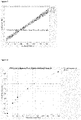
- Figure 2 depicts how the roughness increases by alkaline treatment and remains unchanged after application of silane.
- the characterization of copper oxide was performed by means of Double- Sweep- Cyclic-Voltammetry (DSCV). Applied method used for Cu oxide quantification. During the first scan, cupric and cuprous oxides are reduced to Cu providing corresponding cathodic currents. Background currents are measured during the third scan in the same cathodic directions as the first scan. They are subtracted from the cathodic currents of the first scan in order to calculate the quantity of electrical charge required for the reduction of corresponding Cu oxide species. Experiments were performed il LiCI (4 M) solution at RT, potential range: -0.5 to -1.6 V (vs Ag/AgCl (3M KCI), Scan rates 100 mV/s, # of scans 3.
- DSCV Double- Sweep- Cyclic-Voltammetry
- Elemental analysis of samples was carried out using Energy-dispersive X-ray spectroscopy (EDS).
- EDS Energy-dispersive X-ray spectroscopy
- STEM scanning transmission electron microscopy
- the ratio of Cu to O is 2 to 1, indicating that the oxide particles formed by alkaline solution are of Cu 2 O nature.
- NBD nano-beam diffraction
- peel strength was determined:
- the obtained copper surfaces with structurally enforced insulating films were then cured in an oven: copper surfaces with GL102 material at 200°C for 90 minutes and copper surfaces with GX-T31 material at 190 C for 90 min.
- each copper surfaces with structurally enforced insulating films was sliced into said strip-type fragments (10x100 mm, Bugard drilling/routing).
- the strip-type fragments were subjected to a peel force measuring machine (Roell Zwick Z010) to individually evaluate the peel strength (angle: 90°, speed: 50 mm/min) which is needed to delaminate the copper surface from its respective structurally enforced insulating films. Typically, the higher the peel strength needed to avoid delamination the better is the adhesion.
- the copper samples have been prepared by adhering the respective insulating films to copper panels. As a result, copper surfaces with structurally enforced insulating films were obtained.
- the obtained copper surfaces with structurally enforced insulating films were then semicured in two steps in the ovens: copper surfaces with GL102 material at 130°C for 30 minutes followed by 175°C for 30 minutes; and copper surfaces with GX-T31 material at 100°C for 30 minutes followed by 170°C for 30 minutes.
- the copper panels were lasered with UV-laser to drill the blind micro vias (BMV). Thereafter, the substrates were subjected to the desmear and reduction condition steps. In particular, these included a sweller treatment under alkaline conditions with Securiganth MV Sweller (Atotech); a permanganate treatment under alkaline conditions with Securiganth MV Etch P (Atotech) and a reduction conditioner treatment under acidic conditions with Securiganth MV Reduction Conditioner (Atotech). After each step the sample were rinsed with water.
- the lamination material exhibits a thickness of ca. 10 ⁇ m for wedge void and halo and 35 ⁇ m in case of adhesion investigations, respectively.
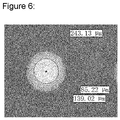
- the substrates were measured by light microscope (200x magnification; see Table 4). Pictures depicting the halo measurement can be found in Figure 6 .
- the investigated test Blind Micro Via's are manufactured as a test grid on surface treated and Ajinomoto Build up Film (ABF) laminated test vehicles by utilizing Laser Drilling technology.
- the halo data is obtainable after sending the prepared test vehicles through entire Desmear process (Sweller, Permanganate, Reduction Conditioner) as described above.
- Halo measurement is performed by camera (CCD) supported light microscopy.
- CCD camera
- DF Darkfield
- the fully processed test vehicles are firmly installed on the measurement table and the BMV capture pad must be set as optical focus.
- CCD exposure time must be adjusted to the maximum possible contrast of halo boundaries.
- the capture pad should appear as bright as possible.
- step (i-c) with step (ii) comprising T-E silane
- FIB Focused Ion Beam
- SEM Scanning Electron Microscopy
Landscapes
- Engineering & Computer Science (AREA)
- Manufacturing & Machinery (AREA)
- Microelectronics & Electronic Packaging (AREA)
- Chemical & Material Sciences (AREA)
- Chemical Kinetics & Catalysis (AREA)
- Manufacturing Of Printed Wiring (AREA)
- Chemical Treatment Of Metals (AREA)
- Other Surface Treatments For Metallic Materials (AREA)
Abstract
Description
- The present invention relates to a method for increasing adhesion strength between a surface of a copper, a copper alloy or a copper oxide and a surface of an organic material and reducing halo and wedge void formation.
- In the Semi Additive Process build up sequence used in production of Integrated Circuit (IC) Substrates one of the key tasks is to form a strong adhesive bond between adjacent layers where there is intrinsically no natural adhesive force. The fundamental challenge here is to form a strong bond between the copper traces and the dielectric materials used in either build up layers or final solder masks coatings, with no negative impact upon final product performance.
- In former times the most commonly used adhesion promotor systems provided a high degree of roughening of the copper surface; this roughened surface can then act as a key to form mechanical bonds with the dielectric materials (e.g. organic resin systems) and the copper traces. However, this type of system which is based upon a maximum increase in copper surface area for a minimum amount of copper removed is now no longer acceptable. As conductor features become smaller and smaller it is ever more challenging to form reliable structures to the desired line and space tolerance, therefore it is totally undesirable to introduce an adhesion promotor step based upon a high degree of surface roughening.
- In addition, a second challenge is now faced with the advent 5G systems where there is strong relationship between signal integrity and surface roughening. As the frequency and rate of data transfer of the electrical signal increase, the path of the electrical signal moves into the outer most skin of the copper trace. Obviously if this "skin" has been highly roughened to increase adhesion with buildup layers there is a much higher risk that some of the signal will be lost or slowed down. With any such loss then the ability to perform at the required high frequency range is also impaired.
- To overcome these challenges, it is desired to develop a method for a treatment of the copper surface and/or the dielectric materials in which the adhesion between both materials is increased without etching and/or roughening of the copper surface.
- Heteroaromatic silane compounds are frequently utilized in the manufacturing of electronic components, in particular in surface treatment solutions, e.g. for the treatment of copper surfaces and surfaces of organic materials as a preparation for further processing steps.
-
US 2016/0368935 A1 relates to an azole silane compound, and a surface treatment solution using the azole silane compound, a surface treatment method and use thereof. -
JP 2018016865 A -
JP 2014240522 A -
JP H06279461 A - The article "Corrosion protection of copper with 3-glycidoxypropyltrimethoxysilane-based sol-gel coating through 3-amino-5-mercapto-1,2,4-triazole doping", Journal of Research on Chemical Intermediates, Volume 42, , discloses a study about corrosion protection of copper in a neutral medium by the formation of a sol-gel coating over the copper surface. It discloses that a 3-amino-5-mercapto-1,2,4-triazole-doped 3-glydidoxypropyltrimethoxysilane-based sol-gel coating on copper forms a thiolate bond to copper.
-
WO2019/243180 discloses azole silane compounds, the synthesis thereof as well as respective solution and the use in surface treatment. -
WO2020/178146 discloses the use of azole silane compounds in a method for increasing adhesion strength between a surface of a metal, a metal alloy or a metal oxide and a surface of an organic material. -
WO 2019/058773 A discloses tetrazole silanes, a method for synthesizing and use of the tetrazole silanes in surface treatment. -
JP2016169300A JP6436819B2 - 2,4,6-Triamine-substituted triazines are disclosed in Chem. Eur.J. 2009, 15, 6279-6288 and
JP 2017002402 A JP6370836B2 JP6392273 - In "The role of oxide structure on copper wire to the rubber adhesion", Applied Surface Science Vol. 161, p. 355-364, 2000, the adhesion of millimeter-sized copper wires to rubber was investigated. The bonding is dependent on the reaction of copper oxide with sulfur.
- "Reliability prediction in electronic packages using molecular simulation", Electronic Components and Technology Conference, p. 1314-1317, 2005, discloses the molecular dynamics (MD) simulation of interactions between epoxy molding compound (EMC) and copper oxide.
- Adhesion strength is related to the physical and chemical strength by which the adhesion layer is bound to the surface of a copper, a copper alloy or a copper oxide.
- Another aspect related to adhesion strength is the avoidance of wedge void formation. This means that after the typical process steps of lamination, curing and, lasering, the wedge-like structures form after desmear and reducing steps at the interface between substrate and laminate. These so-called wedge voids are unwanted since they facilitate the peel off of the laminate. The wedge voids are often already seen as halo ring around the drilled hole (blind micro-via) indicating the chemical propagation to the substrate.
- It was therefore the objective of the present invention, based on the above-mentioned problems, to provide a method for a treatment of the copper surface and/or the dielectric materials in which the adhesion between both materials is increased, preferably without etching and/or roughening of the copper surface.
- It was an additional task to provide a method which does not exhibit the disadvantages regarding adhesion strength and wedge void formation as described above.
- Above mentioned objectives are solved by a method for increasing adhesion strength and/or improved wedge void behavior between a surface of copper, a copper alloy or a copper oxide and a surface of an organic material comprising
- (i) providing a substrate, comprising the copper, copper alloy or copper oxide on at least one side of the substrate,
followed by at least one of the steps of
(i-c) treating the substrate yielding a substrate comprising copper oxide on at least one side of the substrate, wherein the copper oxide comprises copper (I) and copper (II) in a ratio of 90:10 or higher (mol/mol), preferably in a ratio of 95:5 or higher (mol/mol), even more preferably in a ratio of 98:2 or higher (mol/mol), most preferably the copper oxide essentially consists of copper (I) oxide;
and/or - (ii) contacting at least one section of the substrate with
- (a) at least one silane compound of formula (I);

the ring structure

X and Y are independently selected from the group consisting of NH2, NH(NH2), NH(CH2)oNH2, SH, SCH3, and OCH3;
E is selected from the group consisting of-S- , -NH- and -NH-(CH2)m-NH-;
A is selected from the group consisting of NH, N(NH2) and S;
Z is selected from the group consisting of
n is an integer in the range from 1 to 12,
o is an integer in the range from 2 to 12,
R independently denotes (CH2-CH2-O)p-T, wherein independently
p is 0, 1, 2, 3, or 4, and
T denotes H or C1 to C5 alkyl; or - (b) at least one amino acid; or
a mixture of (a) and (b),
- (a) at least one silane compound of formula (I);
- (iii) applying the organic material,
with the proviso that, if the ring structure

- Own experiments have surprisingly shown that the adhesion strength between the copper, copper alloy or copper oxide and an organic material can be increased without etching or a noticeable removal of copper, copper alloy or copper oxide. It can be shown that whereas the relative surface area (RSAI) of the copper, copper alloy or copper oxide is increased, the average surface roughness (Ra) is not increased. In other words, after step (i) the average surface roughness of the copper, copper alloy or copper oxide is substantially the same compared to the start of step (i). This differentiates the method of the present invention over a number of known methods, in particular etching methods, which have the goal to increase the total surface area by roughening. Therefore, the method of the present invention is preferably a non-etching method.
- Preferred is a method of the present invention, wherein in step (i) the copper, copper alloy or copper oxide comprises a copper, copper alloy or copper oxide circuitry, preferably is a copper, copper alloy or copper oxide circuitry. In such a case the copper, copper alloy or copper oxide circuitry is structured. It preferably means that the organic material simultaneously exposes on the same side non-conductive (preferably organic) areas as well as conductive copper, copper alloy or copper oxide areas. This is most preferred in the context of the method of the present invention.
- Preferred is a method of the present invention, wherein in step (i) the copper, copper alloy or copper oxide forms at least one layer on the substrate. As described above this layer or these layers can be structured and can form or be a circuitry.
- Preferred is a method of the present invention, wherein in step (i) (and/or preferably after step (ii)) the copper, copper alloy or copper oxide circuitry comprises lines with a line width of 100 µm or less, preferably 75 µm or less, more preferably 55 µm or less. In some cases, a method of the present invention is preferred, wherein in step (i) (and/or preferably after step (ii)) the copper, copper alloy or copper oxide circuitry comprises lines with a line width of 30 µm or less, preferably of 20 µm or less, most preferably of 10 µm or less.
- It has surprisingly been found that copper oxide surfaces with a high copper (I) content compared to copper (II) exhibit both a good adhesion behavior while exhibiting at the same time a flat (or smooth) surface. This is surprising because the typical paradigm is "the rougher the surface is the better is the adhesion". For the reasons describes above rough surfaces are not wanted for highly demanding electronic applications.
- Hence, it was found that the underlying problems could be solved by providing a method for increasing adhesion strength and/or improved wedge void behavior between a surface of copper, a copper alloy or a copper oxide and a surface of an organic material comprising
- (i) providing a substrate, comprising the copper, copper alloy or copper oxide on at least one side of the substrate,
followed by the step of - (i-c) treating the substrate yielding a substrate comprising copper oxide on at least one side of the substrate, wherein the copper oxide comprises copper (I) and copper (II) in a ratio of 90:10 or higher (mol/mol), preferably in a ratio of 95:5 or higher (mol/mol), even more preferably in a ratio of 98:2 or higher (mol/mol), most preferably the copper oxide essentially consists of copper (I) oxide;
- (iii) applying the organic material.
- It has been found that the inventive copper (I) oxide surfaces can be obtained when step (i-c) is performed by means of contacting the at least one section of said copper, copper alloy or copper oxide with an aqueous alkaline solution comprising one or more than one complexing agent.
- Hence, preferably step (i-c) comprises contacting at least one section of said copper, copper alloy or copper oxide with an aqueous alkaline solution comprising one or more than one complexing agent.
- The alkaline solution of the method of the present invention is an aqueous alkaline solution. In the context of the present invention, "aqueous" denotes that the solution comprises water. Preferred is a solution utilized in the method of the present invention, wherein more than 50 vol% of the total volume of the oxidizing solution is water, preferably 70 vol% or more, more preferably 80 vol% or more, even more preferably 90 vol% or more, most preferably 95 vol% or more. Most preferably, the solution comprises water with the proviso that water is the only solvent.
- The term "alkaline" means that the solution has a pH of more than 7, preferably of 9 or more, even more preferably of 11 or more, most preferably of 12.5 or more. Preferred is a solution in step (i-c) of the method of the present invention, wherein the pH is in a range from 8 to 14, more preferably in a range from 9 to 14, even more preferably in a range from 10 to 14, yet even more preferably in a range from 11 to 14, most preferably in a range from 12 to 14.
- In order to obtain an alkaline pH, the solution comprises hydroxide ions, preferably in a concentration in a range from 0.1 mol/L to 2.0 mol/L, based on the total volume of the solution, preferably in a range from 0.2 mol/L to 1.8 mol/L, even more preferably in a range from 0.3 mol/L to 1.6 mol/L, yet even more preferably in a range from 0.4 mol/L to 1.5 mol/L, most preferably in a range from 0.5 mol/L to 1.2 mol/L. Such concentrations result in a preferably strong alkaline oxidizing solution, e.g.
pH 13 or higher. - Preferred is a solution comprising one or more than one source of hydroxide ions, preferably one source of hydroxide ions.
- A preferred source of hydroxide ions is an inorganic hydroxide, an organic hydroxide, or mixtures thereof. An inorganic hydroxide is preferably selected from the group consisting of ammonium hydroxide and alkaline hydroxides, is preferably selected from the group consisting of ammonium hydroxide, sodium hydroxide, and potassium hydroxide. A preferred organic hydroxide is an alkyl ammonium hydroxide, preferably tetra alkyl ammonium hydroxide, more preferably tetra methyl ammonium hydroxide.
- The aqueous alkaline solution comprises one or more than one copper complexing agent. The complexing agent typically serves to complex copper ions that are solubilized when applying the alkaline solution on the copper surface, which avoids formation of insoluble copper hydroxides. Typically, a complexing agent for copper ions prevents or at least significantly reduces such hydroxide formation. Thus, preferred is a method of the present invention, wherein the alkaline solution additionally comprises one or more than one complexing agent for complexing copper ions, preferably one or more than one complexing agent comprising at least one carboxylic group and at least one hydroxyl group.
- More preferred is a method of the present invention, wherein in the alkaline solution the one or more than one complexing agent comprises a sugar, preferably a monomeric sugar.
- Even more preferred is a method of the present invention, wherein the one or more than one complexing agent for complexing copper ions comprises gluconic acid and/or salts thereof, most preferably the only complexing agent for complexing copper ions in the alkaline solution is gluconic acid and/or salts thereof.
- Preferred is a method of the present invention, wherein in the alkaline solution the one or more than one complexing agent has a total concentration in a range from 5 mmol/L to 400 mmol/L, based on the total volume of the alkaline solution, preferably in a range from 10 mmol/L to 300 mmol/L, more preferably in a range from 15 mmol/L to 200 mmol/L, even more preferably in a range from 20 mmol/L to 100 mmol/L, yet even more preferably in a range from 25 mmol/L to 80 mmol/L, most preferably in a range from 30 mmol/L to 60 mmol/L. The aforementioned concentrations are preferably applicable to aforementioned preferred complexing agents, most preferably to gluconic acid and salts thereof.
- The method of any of the preceding claims, wherein in step i-c the temperature of the aqueous alkaline solution is in a range from 20°C to 80°C, preferably in a range from 25°C to 75°C, more preferably in a range from 30°C to 70°C, even more preferably in a range from 35°C to 65°C, most preferably in a range from 40°C to 60°C.
- In some embodiments of the present invention it is preferred if the aqueous alkaline solution used in step (i) additionally contains sodium chlorite or oxidising agent.
- It has been found that step (i-c) can be applied as dip application. Dip application means that the solution is provided in form of a bath into which the copper, copper alloy or copper oxide are dipped. It has been further found that contact times of 40 s or longer are preferred. Preferably the contact time in step (i-c) is of from 40s to 900 s, more preferably the contact time in step (i-c) is of from 60 s to 500 s, even more preferably the contact time in step (i-c) is of from 90 s to 450 s.
- In the alternative, i has been found that step (i-c) can be applied as spray application. Spray application means that the solution is transferred into a spray dispenser and then sprayed onto the copper, copper alloy or copper oxide. It has been further found that contact times of 10 s already yields good results. Hence, contact times of 10 s or longer are preferred. Preferably the contact time in step (i-c) is of from 20s to 200 s, more preferably the contact time in step (i-c) is of from 30 s to 150 s.
- According to another embodiment of the instant invention, above mentioned objective is solved by a method for increasing adhesion strength and/or improved wedge void behavior between a surface of copper, a copper alloy or a copper oxide and a surface of an organic material comprising
- (i) providing a substrate, comprising the copper, copper alloy or copper oxide on at least one side of the substrate,
followed by the step of - (ii) contacting at least one section of the substrate with
- (a) at least one silane compound of formula (I);

the ring structure

X and Y are independently selected from the group consisting of NH2, NH(NH2), NH(CH2)oNH2, SH, SCH3, and OCH3;
E is selected from the group consisting of-S- , -NH- and -NH-(CH2)m-NH-;
A is selected from the group consisting of NH, N(NH2) and S;
Z is selected from the group consisting of
n is an integer in the range from 1 to 12,
o is an integer in the range from 2 to 12,
R independently denotes (CH2-CH2-O) p-T, wherein independently
p is 0, 1, 2, 3, or 4, and
T denotes H or C1 to C5 alkyl; or - (b) at least one amino acid; or
a mixture of (a) and (b),
- (a) at least one silane compound of formula (I);
- (iii) applying the organic material.
- The contacting in step (ii) can be applied as dip application. Dip application means that the solution is provided in form of a bath into which the copper, copper alloy or copper oxide are dipped.
- In the alternative, step (ii) can be applied as spray application. Spray application means that the solution is transferred into a spray dispenser and then sprayed onto the copper, copper alloy or copper oxide.
- In the alternative, step (ii) can be applied as coating application such as bar coating, spin coating and curtain coating.
- The method according to the invention is preferably performed at temperatures of from 5°C to 60°C, more preferably from 10°C to 40°C, even more preferably from 20°C to 30°C.
- One embodiment of the inventive method refers to a specific triazine silane compound as defined above. In many cases a triazine silane compound of the present invention is preferred, wherein Y denotes NH and N(NH2), preferably NH. In other cases a triazine silane compound of the present invention is preferred, wherein Y denotes S. Among both, a Y comprising a nitrogen is preferred compared to a Y being S.
- A triazine silane compound of the present invention is preferred, wherein X denotes NH2, NH(NH2), NH(CH2)oNH2, SH, SCH3, or OCH3, wherein o is an integer in the range from 2 to 12; preferably NH2, NH(NH2), NH(CH2)oNH2, SH, or SCH3, wherein o is an integer in the range from 2 to 12; more preferably NH2.
- Very preferred is a triazine silane compound of the present invention, being a compound of formula (II)

- m is an integer in the range from 2 to 10,
- n is an integer in the range from 1 to 10,
- R independently denotes (CH2-CH2-O) p-T, wherein independently
- p is 0, 1, 2, 3, or 4, and
- T denotes H or C1 to C5 alkyl.
- Particularly preferred are compounds of formula (Ila) and (IIb).


- In the alternative, very preferred is a triazine silane compound of the present invention, being a compound of formula (III)

- m is an integer in the range from 2 to 10,
- n is an integer in the range from 1 to 10,
- R independently denotes (CH2-CH2-O) p-T, wherein independently
- p is 0, 1, 2, 3, or 4, and
- T denotes H or C1 to C5 alkyl.
- Particularly preferred is a compound of formula (IIIa).

- In the context of the present invention the term "independently being" (or similar expressions) in combination with a certain variable denotes that a selected feature for such a variable in a first compound is independent from a selected feature of the same variable in a second compound and, if one compound contains the same variable at least twice, it is independently selected from each other, and thus can be different. This principle likewise applies to other "independently" terms.
- One embodiment of the inventive method refers to a specific tetrazole silane compound as defined above. In many cases a tetrazole silane compound of the present invention of formula (IV) is preferred,
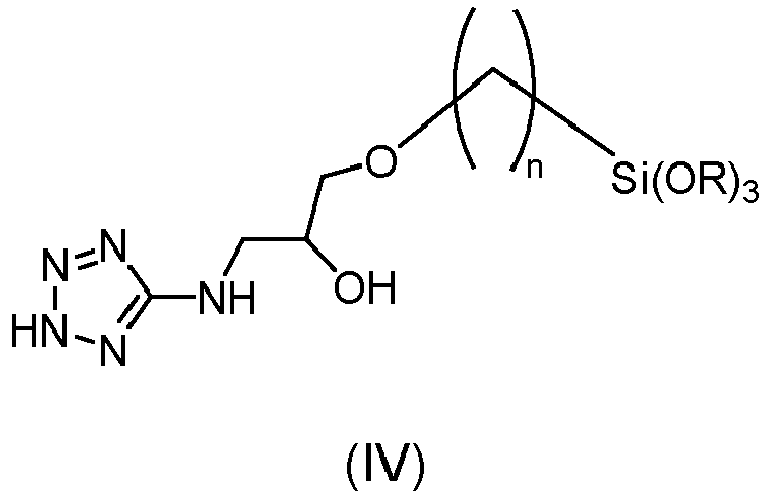
- wherein n is an integer in the range from 1 to 10,
- R independently denotes (CH2-CH2-O) p-T, wherein independently
- p is 0, 1, 2, 3, or 4, and
- T denotes H or C1 to C5 alkyl.
- Very preferred is a tetrazole silane compound of the present invention, being a compound of formula (IVa)

- One embodiment of the inventive method refers to a specific triazole or a thiodiazole silane compound as defined above. In many cases a triazole or a thiodiazole silane compound of formula (V) is preferred,

- X denotes NH2, NH(NH2), NH(NHU), NH(CH2)oNH2, SH, SCH3, OCH3, NHU, or SU,
- Y denotes NH, N(NH2), N(NHU), or S,
- U independently denotes CH2-CH(OH)-CH2-O-(CH2)n-Si(OR)3, with R independently being (CH2-CH2-O)p-Z, wherein independently
- n is an integer in the range from 1 to 10,
- o is an integer in the range from 2 to 12,
- p is 0, 1, 2, 3, or 4, and
- Z denotes H or C1 to C5 alkyl.
- Preferably, X denotes NH2, NH(NH2), NH(CH2)oNH2, SH, SCH3, or OCH3, wherein o is an integer in the range from 2 to 12; preferably NH2, NH(NH2), NH(CH2)oNH2, SH, or SCH3, wherein o is an integer in the range from 2 to 12; more preferably NH2.
- Very preferred is a thiodiazole or triazole silane compound of the present invention, being a compound of formula (Va) or (Vb)

- The synthesis of the triazine silane compounds is disclosed in co-pending application with the internal reference P21/002, which is incorporated by reference.
- The synthesis of the triazole silane / thiodiazol compounds is disclosed in
WO2019/243180 , which is incorporated by reference. - A synthesis of tetrazole silane compounds has been disclosed in
US 2020/0399290 - It was a further objective of the present invention to provide an alternative synthesis method of tetrazole silane compounds.
- The present invention also relates to a synthesis method for a tetrazole silane compound of formula (IV):
- A synthesis method for a tetrazole silane compound of formula (IV)


- wherein n is an integer in the range from 1 to 10,
- R independently denotes (CH2-CH2-O)p-T, wherein independently
- p is 0, 1, 2, 3, or 4, and
- T denotes H or C1 to C5 alkyl,
- the synthesis method comprising the steps of
- (i) providing a compound of formula (III)

- (ii) providing a silane compound of formula (VII)

- wherein n is an integer in the range from 1 to 10,
- R independently denotes (CH2-CH2-O) p-T, wherein independently
- p is 0, 1, 2, 3, or 4, and
- T denotes H or C1 to C5 alkyl,
- (iii) reacting in a solvent said compound of formula (VI) with said silane compound such that above defined compound of formula (IV) results, and
- (iv) optionally hydrolyzing the compound of formula (IV) obtained in step (iii) such that at least one of R is (CH2-CH2-O)m-Z with m = zero and Z = H.
- (i) providing a compound of formula (III)
- The above mentioned regarding the tetrazole silane compound of the present invention (preferably as described as being preferred) preferably applies likewise to the synthesis method of the present invention, e.g. regarding very preferred tetrazole silane compounds of the present invention.
- Step (iv) is optional and includes the presence of at least some water in order to hydrolyze the compound obtained in step (iii) of the method of the present invention. Preferably, such water is added after step (iii) in an additional step, e.g. step (iv). If such a compound is desired (m = zero and Z = H), step (iv) is not optional.
- Very preferred is a synthesis method of the present invention, wherein in step (iii) the solvent comprises an organic solvent, more preferably is one or more than one organic solvent, most preferably is one or more than one water miscible organic solvent.
- In many cases a synthesis method of the present invention is preferred, wherein in step (iii) the solvent is one or more than one solvent selected from the group consisting of glycol ethers, and mixtures thereof, preferably selected from the group consisting of
- HO-(CH2-CH2-O)p-T,
wherein - p is 1, 2, 3, or 4, preferably is 1 or 2, and
- T denotes C1 to C5 alkyl, preferably C3 to C5 alkyl,
- Generally, glycol ethers are more preferred than above defined alcohols (for reasons see text above). Thus, a respective synthesis method of the present invention is preferred.
- Preferred is a synthesis method of the present invention (in particular as described before), wherein the solvent in step (iii) is substantially free of, preferably does not comprise, water.
- Preferably, the solvent in step (iii) is one or more than one organic solvent and after step (iii) of the method of the present invention a mixture according to the present invention is obtained (for the mixture see text above). The aforementioned regarding the mixture of the present invention applies likewise to the synthesis method of the present invention.
- Preferred is a synthesis method of the present invention, wherein the total molar ratio of the compound of formula (VI) to the compound of formula (VII) is in the range from 1:0.7 to 1:1.3, preferably in the range from 1:0.80 to 1:1.2, more preferably in the range from 1:0.9 to 1:1.2, most preferably in the range from 1:0.95 to 1:1.05. If the total molar ratio is significantly lower than 1:0.7 too much unreacted educts are present in the synthesis product, which is not desired because the desired species is the tetrazole silane compound comprising the tetrazole and the silane moiety. This principle preferably applies likewise to the mixture of the present invention, the storage solution of the present invention, and the working solution of the present invention.
- Preferred is a synthesis method of the present invention, wherein in step (iii) the temperature is in the range from 50°C to 100°C, preferably in the range from 60°C to 90°C.
- Preferred is a synthesis method of the present invention, wherein in step (i) the tetrazole compound of formula (III) is provided as a suspension. This means that it is preferred to suspend the tetrazole compound of formula (III) in at least one solvent such that said tetrazole compound and said at least one solvent form said suspension. For that it is preferred that the at least one solvent is one or more than one organic solvent, preferably is one or more than one water miscible organic solvent. Very preferably the at least one solvent utilized to form said suspension is identical to the solvent utilized in step (iii). Most preferred, the tetrazole compound of formula (III) is suspended in one or more than one solvent selected from the group consisting of C1 to C4 alcohols, glycol ethers, and mixtures thereof, preferably selected from the group consisting of
- C1 to C3 alcohols,
- cyclic and non-cyclic ethers such as diethyl ether, tetrahydrofuran, 1,4-dioxane, and mixtures thereof, preferably 1,4-dioxane, tetrahydrofuran and mixtures thereof,
- HO-(CH2-CH2-O)p-T, wherein
- p is 1, 2, 3, or 4, preferably is 1 or 2, and
- T denotes C1 to C5 alkyl, preferably C3 to C5 alkyl,
selected from the group consisting of methanol, diethylene glycol monobutyl ether, ethylene glycol monobutyl ether, and mixtures thereof, most preferably
selected from the group consisting of diethylene glycol monobutyl ether, ethylene glycol monobutyl ether, and mixtures thereof. - Preferred is a synthesis method of the present invention, wherein in step (iii) the reacting is carried out for 1 hour to 48 hours, preferably for 3 hours to 30 hours, more preferably for 5 hours to 24 hours.
- The method according to the invention is preferred, wherein the silane compound and, where applicable, the silane oligomer can be present as a mixture. Alternatively, more than one compound can be present as a mixture. Typically, an organic solvent facilitates solubility. Thus, the present invention also refers to a mixture comprising, preferably consisting of,
- (a)
- one or more than one silane compound (as described throughout the present text, preferably as described as being preferred), and/or
- one or more than one silane oligomer (as described throughout the present text, preferably as described as being preferred),
- (b)
- one or more than one organic solvent.
- The method according to the invention is preferred, wherein the mixture of the present invention is substantially free of, preferably does not comprise, halide ions.
- In the context of the present invention, the term "substantially free" of a subject-matter (e.g. a compound, a material, etc.) denotes that said subject-matter is not present at all or is present only in (to) a very little and undisturbing amount (extent) without affecting the intended purpose of the invention. For example, such a subject-matter might be added or utilized unintentionally, e.g. as unavoidable impurity. "Substantially free" preferably denotes 0 (zero) ppm to 50 ppm, based on the total weight of the mixture (if defined for said mixture), preferably 0 ppm to 25 ppm, more preferably 0 ppm to 10 ppm, even more preferably 0 ppm to 5 ppm, most preferably 0 ppm to 1 ppm. Zero ppm denotes that a respective subject-matter is not comprised at all, which is most preferred. This principle applies likewise to other aspects of the present invention, e.g. the storage solution of the present invention (see text below) and the working solution of the present invention (see also text below).
- Preferred is a method of the present invention, wherein in said mixture the total amount of all silane compounds of the present invention and oligomers of the present invention together is in the range from 5 wt.-% to 30 wt.-%, based on the total weight of said mixture, preferably is in the range from 8 wt.-% to 26 wt.-%, more preferably is in the range from 12 wt.-% to 24 wt.-%, even more preferably is in the range from 15 wt.-% to 23 wt.-%, most preferably is in the range from 17 wt.-% to 21 wt.-%.
- Preferred is a method of the present invention, wherein the one or more than one organic solvent of the mixture comprises a solvent selected from the group consisting of acetone, 1,3-dioxolane, acetonitrile, 1,4-dioxane, methanol, ethanol, 1-propanol, 2-propanol, t-butanol, prop-2-en-1-ol, ethyl lactate, ethylene glycol monomethyl ether acetate, N,N-dimethylformamide, 2-butoxyethanol, di(propylene glycol) methyl ether, tetrahydrofurfuryl alcohol, N-methyl-2-pyrrolidone, 2-(2-methoxyethoxy)ethanol, gamma-butyrolactone, ethylene glycol, propylene glycol, dipropylene glycol, epsilon-caprolactone, diethylene glycol monobutyl ether, ethylene glycol monobutyl ether, tetrahydrothiophene-1-oxide, diethylene glycol monobutyl ether acetate, propylene carbonate, sulfolane, glycerol, and mixtures thereof.
- Very preferred is a method of the present invention, wherein the one or more than one organic solvent of the mixture comprises a solvent selected from the group consisting of methanol, ethanol, 1-propanol, 2-propanol, t-butanol, di(propylene glycol) methyl ether, ethylene glycol, propylene glycol, dipropylene glycol, diethylene glycol monobutyl ether, ethylene glycol monobutyl ether, and mixtures thereof.
- In a few cases very preferred is a method mixture of the present invention, wherein the one or more than one organic solvent of the mixture comprises a solvent selected from the group consisting of glycol ethers, preferably selected from the group consisting of di(propylene glycol) methyl ether, diethylene glycol monobutyl ether, ethylene glycol monobutyl ether, and mixtures thereof.
- The present invention also refers to a storage solution comprising
- (a)
- one or more than one silane compound according to the present invention (as described throughout the present text, preferably as described as being preferred), and
- optionally one or more than one silane oligomer according to the present invention (as described throughout the present text, preferably as described as being preferred),
- (b)
- optionally water,
- (c)
- one or more than one water miscible organic solvent,
- Preferably the storage solution of the present invention is substantially free of, preferably does not comprise, halide ions. Only in a few cases it is preferred that halide ions are present by intentionally adding halide ions, preferably by intentionally adding chloride ions.
- Preferred is a storage solution of the present invention, wherein in the solution the total amount of all silane compounds according to the present invention (as described throughout the present text, preferably as described as being preferred) and all silane oligomers according to the present invention (as described throughout the present text, preferably as described as being preferred) together is in the range from 0.2 wt.-% to 30 wt.-%, based on the total weight of the storage solution, preferably is in the range from 0.5 wt.-% to 28 wt.-%, more preferably is in the range from 0,7 wt.-% to 25 wt.-%, even more preferably is in the range from 0,8 wt.-% to 22 wt.-%, most preferably is in the range from 0.9 wt.-% to 20 wt.-%.
- Above described storage solution optionally contains water. Preferred is a storage solution of the present invention, wherein in the storage solution is alkaline and water is present in a total amount in the range from 10 wt.-% to 80 wt.-%, based on the total weight of the storage solution, preferably in the range from 15 wt.-% to 78 wt.-%, more preferably in the range from 20 wt.-% to 76 wt.-%, even more preferably in the range from 33 wt.-% to 74 wt.-%, most preferably in the range from 38.6 wt.-% to 70 wt.-%.
- The storage solution contains one or more than one water miscible organic solvent. Such an organic solvent facilitates the needed solubility of the respective silane compounds and its oligomers, particular if they are present at comparatively higher concentrations (e.g. up to and around 15 wt.-%, see text above). Thus, preferred is a storage solution of the present invention, wherein in said solution the one or more than one water miscible organic solvent is present in a total amount in the range from 5 wt.-% to 89.5 wt.-%, based on the total weight of the storage solution, preferably in the range from 10 wt.-% to 84.2 wt.-%, more preferably in the range from 14 wt.-% to 79 wt.-%, even more preferably in the range from 18 wt.-% to 65.5 wt.-%, most preferably in the range from 24 wt.-% to 59 wt.-%.
- In many cases a storage solution of the present invention is preferred, wherein the total weight of water is lower than the total weight of all water miscible organic solvents.
- As mentioned above, said storage solution is alkaline, if water is present. In the context of the present invention this means that the pH is 9 or higher. Preferred is a storage solution of the present invention, wherein the solution has a pH of 9.6 or more, preferably the pH is in the range from 10.5 to 14, more preferably the pH is in the range from 11 to 14, most preferably the pH is in the range from 12 to 14. If the pH is significantly below pH 9 the solubility of the silane compounds and its oligomers is reduced, even up to the point of undesired precipitation. An acidic pH is not suitable for storage purposes because at such a pH precipitation has been observed in many cases with comparatively high concentrations of silane compounds of the present invention and its corresponding oligomers. It is known from
WO2019/243180 that for azole silanes, if the pH is significantly above 13, an undesired phase separation and degradation of the azole silane compounds is frequently observed. In contrast, the instant triazine silanes solutions exhibit a good phase stability at high pH values. - In addition, the instant silanes solutions exhibit a good stability, i.e. no phase separation and no degradation, in a broad temperature window. In particular, those solutions are stable from -5°C to 50°C.
- In the context of the present invention, the pH is referenced to a temperature of 25°C.
- In an alkaline storage solution of the present invention, the alkaline pH is obtained by preferably utilizing at least one alkaline hydroxide, most preferably by utilizing sodium hydroxide.
- An alkaline pH does not only allow comparatively high concentrations of said silane compounds and its oligomers, respectively, in the storage solution. It furthermore strongly maintains the silane compounds of the present invention in its monomeric state and significantly reduces the formation of silane oligomers of the present invention. However, if such an oligomer is formed in the alkaline storage solution of the present invention, it is typically quickly hydrolyzed to form its monomeric forms due to the alkaline pH. In the storage solution of the present invention this is desired.
- Preferred is a storage solution of the present invention, wherein in said solution the total weight of all silane compounds according to the present invention is higher than the total weight of all silane oligomers according to the present invention.
- In some cases a storage solution of the present invention is preferred, wherein for at least 80 wt.-% of the total weight of all silane compounds according to the present invention Z is H and p is zero, preferably for at least 90 wt.-%, most preferably for at least 95 wt.-%. This means that in the storage solution the silane compound is mostly present in its hydrolyzed form comprising SiOH-groups.
- Above mentioned storage solution is in particular suitable in order to transport and/or storage the one or more than one silane compound of the present invention. However, in order to utilize said compounds, for example as a surface treatment solution in the production of electronic parts, a respective working solution is preferred. Thus, the present invention further relates to a working solution having a pH in the range from 2 to 14, the solution comprising
- (a)
- one or more than one silane compound according to the present invention (as described throughout the present text, preferably as described as being preferred), and/or
- one or more than one silane oligomer according to the present invention (as described throughout the present text, preferably as described as being preferred),
- (b)
- optionally, water,
- (c)
- one or more than one water miscible organic solvent,
- In particular preferred is a working solution of the present invention with the proviso that said working solution comprises at least one silane oligomer according to the present invention (as described throughout the present text, preferably as described as being preferred). This is in particular preferred for freshly prepared working solutions.
- Above term "10 wt.-% or less" does not include zero wt.-%. This means that said total amount is always > 0 wt.-%, preferably at least 0.1 wt.-%.
- Preferred is a working solution of the present invention, wherein in said working solution the total amount of all silane compounds according to the present invention (as described throughout the present text, preferably as described as being preferred) and all silane oligomers according to the present invention (as described throughout the present text, preferably as described as being preferred) together is in the range from 0.1 wt.-% to 6 wt.-%, based on the total weight of the working solution, preferably is in the range from 0.2 wt.-% to 5 wt.-%, more preferably is in the range from 0.3 wt.-% to 4 wt.-%, even more preferably in the range from 0.4 wt.-% to 3.7 wt.-%, most preferably is in the range from 0.5 wt.-% to 3.5 wt.-%.
- Own experiments have shown that the individual presence of the one or more than one silane compound according to the present invention and the one or more than one silane oligomer according to the present invention varies over time. In a freshly prepared working solution typically the total weight of silane compounds of the present invention is higher than the total weight of silane oligomers of the present invention. However, over time upon utilizing the working solution the total weight of said silane oligomers drastically increases, possibly even up to the point that the total weight of said silane oligomers is higher than the total weight of said silane compounds. Furthermore, the handling of the working solution of the present invention also affects the total weights of said compounds and oligomers, respectively. For example, a significant drag out during utilizing the working solution and a corresponding replenishment with fresh working solution typically leads to a steady state condition in terms of silane compound(s) vs. silane oligomer(s).
- Most preferably, the working solution of the present invention comprises
- one or more than one silane compound according to the present invention (as described throughout the present text, preferably as described as being preferred), and
- one or more than one silane oligomer according to the present invention (as described throughout the present text, preferably as described as being preferred). Thus, a respective working solution comprising at least one compound and at least one oligomer is most preferred.
- The working solution of the present invention has a pH in the range from 2 to 14. Preferred is a working solution of the present invention, wherein the pH is in the range from 3.5 to 14, more preferably in the range from 4.0 to 13.5.
- Preferred is a working solution of the present invention, wherein in said solution water is present in a total amount in the range from 5 wt.-% to 90 wt.-%, based on the total weight of the working solution, preferably in a total amount in the range from 10 wt.-% to 85 wt.-%, more preferably in a total amount in the range from 15 wt.-% to 80 wt.-%.
- In order to sufficiently solubilize the silane compounds of the present invention and the silane oligomers of the present invention in the working solution of the present invention, one or more than one water miscible organic solvent is present. Preferred is a working solution of the present invention, wherein in said solution the one or more than one water miscible organic solvent is present in a total amount in the range from 5 wt.-% to 90 wt.-%, based on the total weight of the working solution, preferably in a total amount in the range from 10 wt.-% to 85 wt.-%, more preferably in a total amount in the range from 15 wt.-% to 80 wt.-%.
- As mentioned above, in the context of the present invention silane compounds of the present invention as well as silane oligomers of the present invention are initially free of halides. This means on the one hand that said compounds and oligomers, respectively, are in itself free of halide atoms because no educts containing halogen atoms are utilized, and on the other hand no halide ions are present in the immediate synthesis environment. However, in a few cases it is preferred that the working solution of the present invention comprises a precisely defined amount of halide ions. Therefore, in some cases a working solution of the present invention is preferred further comprising
(d) - halide ions, preferably chloride ions.
- However, in other cases it is preferred that the working solution of the present invention is substantially free of, preferably does not comprise, chloride ions, more preferably is substantially free of, preferably does not comprise, halide ions.
- One or more than one water miscible organic solvent is present in both the storage solution of the present invention and the working solution of the present invention. Preferred is an storage solution according to the present invention (as described throughout the present text, preferably as described as being preferred), or a working solution according to the present invention (as described throughout the present text, preferably as described as being preferred), wherein the one or more than one water miscible organic solvent comprises a water-miscible organic solvent selected from the group consisting of C1 to C4 alcohols, ethers, glycol ethers, and mixtures thereof, preferably selected from the group consisting of
- C1 to C3 alcohols,
- cyclic and non-cyclic ethers such as diethyl ether, tetrahydrofuran, 1,4-dioxane, and mixtures thereof, preferably 1,4-dioxane, tetrahydrofuran and mixtures thereof,
- HO-(CH2-CH2-O)p-T, wherein
- p is 1, 2, 3, or 4, preferably 1 or 2, and
- T denotes C1 to C5 alkyl, preferably C3 to C5 alkyl,
selected from the group consisting of methanol, diethylene glycol monobutyl ether, ethylene glycol monobutyl ether, and mixtures thereof, even more preferably
selected from the group consisting of diethylene glycol monobutyl ether, ethylene glycol monobutyl ether, and mixtures thereof. - The above defined water-miscible organic solvents likewise apply to the synthesis method of the present invention (see text below).
- In each case, glycol ethers are more preferred than alcohols. Glycol ethers typically provide an improved stabilization compared to said alcohols. Furthermore, alcohols in general exhibit a low flash point compared to glycol ethers, which makes alcohols potentially dangerous in terms of fire hazard. A comparatively high flash point is usually desired in order to prevent an ignition. Thus, glycol ethers typically provide the desired solubility, stability and security. This principle preferably applies likewise to the mixture of the present invention, the storage solution of the present invention, and the synthesis method of the present invention (see text below).
- Preferred is a storage solution according to the present invention (as described throughout the present text, preferably as described as being preferred), or a working solution according to the present invention (as described throughout the present text, preferably as described as being preferred), wherein all silane compounds according to the present invention (as described throughout the present text, preferably as described as being preferred) and all silane oligomers according to the present invention (as described throughout the present text, preferably as described as being preferred) represent at least 70 wt.-% of the total weight of all silane compounds and oligomers in said storage solution and said working solution, respectively, preferably represent at least 80 wt.-%, more preferably represent at least 90 wt.-%, even more preferably represent at least 93 wt.-%, most preferably represent at least 95 wt.-%, even most preferably represent at least 98 wt.-%. It is most preferred that no other silane compounds or oligomers are present, except those according to the present invention. This also means that the absolute total amounts of silane compounds and silane oligomers together (as defined in the very text above) very preferably apply with the proviso that no other silane compounds and silane oligomers are present in the storage solution of the present invention and working solution of the present invention, respectively.
- Furthermore, preferred is a storage solution according to the present invention (as described throughout the present text, preferably as described as being preferred), or a working solution according to the present invention (as described throughout the present text, preferably as described as being preferred), wherein all silane compounds according to the present invention (as described throughout the present text, preferably as described as being preferred) and all silane oligomers according to the present invention (as described throughout the present text, preferably as described as being preferred) represent at least 51 mol-% of all compounds comprising at least one silicon atom in said storage solution and said working solution, respectively, preferably represent at least 60 mol-%, more preferably represent at least 70 mol-%, most preferably represent at least 80 mol-%, even most preferably represent at least 90 mol-%.
- Due to the method according to the invention the adhesion strength (e.g. peel strength) between a copper and an organic material can be increased without using any etch-cleaning steps. But some cases - especially cases where a surface roughness of the copper surface does not affect the quality of the circuits - a further etch-cleaning step can be performed. In this case the adhesion strength between a copper and an organic material can be increased even further.
- The method according to the invention is preferred, additionally comprising the following step before conducting step (ii): (i-a) contacting the at least one section of said copper, copper alloy or copper oxide with an etch-cleaning solution, preferably an etch-cleaning solution containing one or more than one acid and/or one or more than one oxidizing agent, more preferably an etch-cleaning solution containing a mixture of an inorganic acid and a peroxide (preferably a mixture of sulfuric acid and hydrogen peroxide).
- According to the present invention it is preferred, when the oxidizing agent is a peroxide, more preferably when the peroxide is hydrogen peroxide.
- According to the present invention it is preferred, when the etch-cleaning solution comprises in addition to the acid and/or to the one or more than one oxidizing agent a corrosion inhibitor.
- The method according to the invention is preferred, additionally comprising the following step before conducting step (ii): (i-b) contacting the at least one section of said copper, copper alloy or copper oxide with a (preferably second) etch-cleaning solution. In case step (i-b) is carried out after step (i-a) the used etch-cleaning solution is the second etch-cleaning solution. In case step i-b is carried out without a previous etch-cleaning step, the used etch-cleaning solution is the first etch-cleaning solution.
- According to the present invention the second etch-cleaning solution comprises an iron (III) salt or an iron (III) complex, more preferably the second etch-cleaning solution comprises ferric sulfate (Fe2(SO4)3), ferric chloride (FeCl3), bromide, ferric (FeBr3), ferric nitrate (Fe(NO3)3), ferric acetate (Fe(OC(O)CH3)3), (Fe(OH)3), or mixtures thereof, even more preferably the second etch-cleaning solution comprises ferric sulfate (Fe2(SO4)3). The Ferric ion is preferably contained at a concentration in the range of 1 to 100 g/l, preferably from 1 to 50 g/l, and more preferably from 1 to 30 g/l.
- In an alternative, according to the present invention the second etch-cleaning solution comprises an inorganic acid, more preferably the second etch-cleaning solution comprises sulfuric acid, hydrochloric acid or mixtures thereof, even more preferably the second etch-cleaning solution comprises sulfuric acid.
- According to the present invention, a typical copper, copper alloy or copper oxide removal during step i-a is less than 2 µm, preferably, the removal is of from 0.1 µm to 1.5 µm, more preferably, the removal is of from 0.2 µm to 1.2 µm, even more preferably, the removal is of from 0.4 µm to 1.1 µm, most preferably, the removal is of from 0.5 µm to 1.0 µm; and resulting average surface roughness Ra is a maximum of 100 nm.
- According to the present invention, a typical copper, copper alloy or copper oxide removal during step i-b is less than 20 nm and resulting average surface roughness Ra is a maximum of 10 nm, preferably, a maximum of 5 nm.
- The method according to the invention is preferred, additionally comprising the following step before conducting step (ii): (i-c) contacting the at least one section of said copper, copper alloy or copper oxide with a solution, preferably a sodium hydroxide solution. It is preferred if the solution contain copper complexing agents.
- In some embodiments of the present invention it is preferred if the solution used in step i-c additionally contains sodium chlorite or oxidising agent. The use of sodium chlorite or oxidising agent in the solution used in step i-c is especially preferred if in step i-b no iron (III) salt or an iron (III) complex is used or if step i-b is not performed during the method according to the present invention.
- The order of the steps (i-a), (i-b), and (i-c) may vary. The method according to the invention can be carried out in the following order: (i-a), (i-b), (i-c), or (i-a), (i-c), (i-b), or (i-b), (i-a), (i-c), or (i-b), (i-c), (i-a), or (i-c), (i-a), (i-b), or (i-c), (i-b), (i-a). The order (i-a), (i-b), (i-c) is preferred. It is also possible that none, one or two of the steps (i-a), (i-b), (i-c) are performed in the method according to the invention.
- The method according to the invention is preferred, wherein the organic material applied in step (iii) is an organic polymer.
- The method according to the invention is preferred, wherein the organic material is applied in step (iii) by laminating the organic material onto at least the contacted section of the copper, copper alloy or copper oxide.
- The method according to the invention is preferred, comprising after step (iii) the additional step: (iv) subjecting the substrate and the organic material to a heat treatment with a temperature in the range from 142°C to 420°C, preferably in the range from 145°C to 300°C, more preferably in the range from 150°C to 220°C.
- The method according to the invention is preferred, wherein after step (ii), after step (i-a), after step (i-b) and/or after step (i-c), a rinsing of the at least one section of the copper, copper alloy or copper oxide is performed, wherein the copper, copper alloy or copper oxide is preferably rinsed with water. It is preferred if the water that is used during rinsing after step (ii) has a pH-value in the range from 2 to 14, preferably 4 to 10, more preferably in the range from 5 to 9, even more preferably in the range from 6 to 8, most preferably in the range from 6.5 to 7.5.
- The method according to the invention is preferred, wherein after step (ii), after step (i-a), after step (i-b) and/or after step (i-c), a drying of the at least one section of the copper, copper alloy or copper oxide is performed.
- In the alternative, a method according to to the invention is preferred, wherein after step (ii), no baking of the at least one section of copper, copper alloy or copper oxide is performed. It could be shown (Table 4 below) that samples that were yielded by avoiding of the baking step leads to improved halo formation when compared to samples that were subjected to baking.
- A method according to the present invention is especially preferred comprising the following steps in this order:
- (i) providing a substrate, comprising the copper, copper alloy or copper oxide on at least one side of the substrate,
- (i-a) optionally contacting at least one section of said copper, copper alloy or copper oxide with an etch-cleaning solution, preferably an etch-cleaning solution containing one or more than one acid and/or one or more than one oxidizing agent, more preferably an etch-cleaning solution containing a mixture of an inorganic acid and a peroxide, and optionally followed by rinsing of the at least one section of the copper, copper alloy or copper oxide (preferably with water),
- (i-b) optionally contacting the at least one section of said copper, copper alloy or copper oxide with a second etch-cleaning solution, wherein the second etch-cleaning solution preferably comprises ferric sulfate and/or sulfuric acid, and optionally followed by rinsing of the at least one section of the copper, copper alloy or copper oxide (preferably with water),
- (i-c) optionally contacting the at least one section of said copper, copper alloy or copper oxide with an alkaline solution, and optionally followed by rinsing of the at least one section of the copper, copper alloy or copper oxide (preferably with water),
- (ii) contacting of the at least one section of said copper, copper alloy or copper oxide with
- (a) at least one silane compound of formula (I);

the ring structure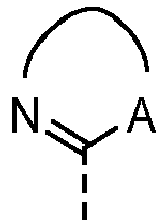

X and Y are independently selected from the group consisting of NH2, NH(NH2), NH(CH2)oNH2, SH, SCH3, and OCH3;
E is selected from the group consisting of-S- , -NH- and -NH-(CH2)m-NH-;
A is selected from the group consisting of NH, N(NH2) and S;
Z is selected from the group consisting of
n is an integer in the range from 1 to 12,
o is an integer in the range from 2 to 12,
R independently denotes (CH2-CH2-O) p-T, wherein independently
p is 0, 1, 2, 3, or 4, and
T denotes H or C1 to C5 alkyl; or - (b) at least one amino acid; or
a mixture of (a) and (b),
with the proviso that, if the ring structure

- (a) at least one silane compound of formula (I);
- (iii) applying the organic material such that the at least one section of the copper, copper alloy or copper oxide contacted with the triazine silane compound and/or the triazine silane oligomer during step (ii) is in contact with the applied organic material,
and - (iv) optionally subjecting the substrate and the organic material to a heat treatment with a temperature in the range from 142°C to 420°C, preferably in the range from 145°C to 300°C, more preferably in the range from 150°C to 220°C.
- A method according to the present invention is preferred, wherein the substrate is a non-conductive substrate and/or the organic material is a non-conductive organic material, preferably a non-conductive organic polymer.
- The method according to the invention is preferred, wherein the method comprises both steps (i-c) and (ii). Hence, preferred is a method for increasing adhesion strength and/or improved wedge void behavior between a surface of copper, a copper alloy or a copper oxide and a surface of an organic material comprising
- (i) providing a substrate, comprising the copper, copper alloy or copper oxide on at least one side of the substrate,
followed by
(i-c) treating the substrate yielding a substrate comprising copper oxide on at least one side of the substrate, wherein the copper oxide comprises copper (I) and copper (II) in a ratio of 90:10 or higher (mol/mol), preferably in a ratio of 95:5 or higher (mol/mol), even more preferably in a ratio of 98:2 or higher (mol/mol), most preferably the copper oxide essentially consists of copper (I) oxide;
and - (ii) contacting at least one section of the substrate with
- (a) at least one silane compound of formula (I);

the ring structure

X and Y are independently selected from the group consisting of NH2, NH(NH2), NH(CH2)oNH2, SH, SCH3, and OCH3;
E is selected from the group consisting of-S- , -NH- and -NH-(CH2)m-NH-;
A is selected from the group consisting of NH, N(NH2) and S;
Z is selected from the group consisting of
n is an integer in the range from 1 to 12,
o is an integer in the range from 2 to 12,
R independently denotes (CH2-CH2-O) p-T, wherein independently
p is 0, 1, 2, 3, or 4, and
T denotes H or C1 to C5 alkyl; or - (b) at least one amino acid; or
a mixture of (a) and (b),
- (a) at least one silane compound of formula (I);
- (iii) applying the organic material.
- Most preferred is a method wherein in step (ii) the at least one section of the substrate is contacted with both (a) a silane of formula (I) and (b) at least one amino acid.
-
- A. A method for increasing adhesion strength and/or improved wedge void behavior between a surface of copper, a copper alloy or a copper oxide and a surface of an organic material comprising
- (i) providing a substrate, comprising the copper, copper alloy or copper oxide on at least one side of the substrate,
followed by at least one of the steps of
(i-c) treating the substrate yielding a substrate comprising copper oxide on at least one side of the substrate, wherein the copper oxide comprises copper (I) and copper (II) in a ratio of 90:10 or higher (mol/mol), preferably in a ratio of 95:5 or higher (mol/mol), even more preferably in a ratio of 98:2 or higher (mol/mol), most preferably the copper oxide essentially consists of copper (I) oxide;
and/or - (ii) contacting at least one section of the substrate with
- (a) at least one silane compound of formula (I);

the ring structure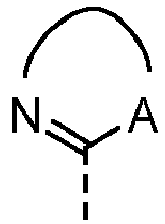

X and Y are independently selected from the group consisting of NH2, NH(NH2), NH(CH2)oNH2, SH, SCH3, and OCH3;
E is selected from the group consisting of-S- , -NH- and -NH-(CH2)m-NH-;
A is selected from the group consisting of NH, N(NH2) and S;
Z is selected from the group consisting of
n is an integer in the range from 1 to 12,
o is an integer in the range from 2 to 12,
R independently denotes (CH2-CH2-O) p-T, wherein independently
p is 0, 1, 2, 3, or 4, and
T denotes H or C1 to C5 alkyl; or - (b) at least one amino acid; or
a mixture of (a) and (b),
- (a) at least one silane compound of formula (I);
- (iii) applying the organic material,
with the proviso that, if the ring structure

- (i) providing a substrate, comprising the copper, copper alloy or copper oxide on at least one side of the substrate,
- B. The method according to embodiment A, wherein step (i-c) comprises contacting at least one section of said copper, copper alloy or copper oxide with an aqueous alkaline solution comprising one or more than one complexing agent; preferably the one or more than one complexing agent comprising at least one carboxylic group and at least one hydroxyl group; more preferred, the one or more than one complexing agent comprising a sugar, preferably a monomeric sugar; even more preferred the one or more than one complexing agent for complexing copper ions comprising gluconic acid and/or salts thereof; most preferably the only complexing agent for complexing copper ions in the alkaline solution is gluconic acid and/or salts thereof.
- C. The method according to embodiment B, wherein the aqueous alkaline solution in step (i-c) has a pH in the range of from 7.5 to 14.0, preferably in the range of from 10.0 to 14.0.
- D. The method according to embodiment B or C, wherein step (i-c) is applied as dip application and the contact time is 40 s or longer, preferably the contact time in step (i-c) is of from 40s to 900 s, more preferably the contact time in step (i-c) is of from 60 s to 500 s, even more preferably the contact time in step (i-c) is of from 90 s to 450 s.
- E. The method according to embodiment B or C, wherein step (i-c) is applied as spray application and the contact time is 10 s or longer, preferably the contact time in step (i-c) is of from 20s to 200 s, more preferably the contact time in step (i-c) is of from 30 s to 150 s.
- F. The method according to any of the preceding embodiments comprising the step of
- (ii) contacting at least one section of the substrate with
- (a) at least one silane compound of formula (I);

the ring structure

X and Y are independently selected from the group consisting of NH2, NH(NH2), NH(CH2)oNH2, SH, SCH3, and OCH3;
E is selected from the group consisting of-S- , -NH- and -NH-(CH2)m-NH-;
Z is selected from the group consisting of
n is an integer in the range from 1 to 12,
o is an integer in the range from 2 to 12,
R independently denotes (CH2-CH2-O) p-T, wherein independently
p is 0, 1, 2, 3, or 4, and
T denotes H or C1 to C5 alkyl; or - (b) at least one amino acid; or
a mixture of (a) and (b).
- (a) at least one silane compound of formula (I);
- (ii) contacting at least one section of the substrate with
- G. The method according to any of the preceding embodiments, wherein the organic material applied in step (iii) is an organic polymer.
- H. The method according to any of the preceding embodiments, wherein the organic material is applied in step (iii) by laminating the organic material onto at least the contacted section of the copper, copper alloy or copper oxide.
- I. The method according to any of the preceding embodiments, if a step (ii) is performed, additionally comprising the following step before conducting step (ii):
(i-a) contacting the at least one section of said copper, copper alloy or copper oxide with an etch-cleaning solution, preferably an etch-cleaning solution containing one or more than one acid and/or one or more than one oxidizing agent, more preferably an etch-cleaning solution containing a mixture of an inorganic acid and a peroxide. - J. The method according to any of the preceding embodiments, if a step (ii) is performed, additionally comprising the following step before conducting step (ii):
(i-b) contacting the at least one section of said copper, copper alloy or copper oxide with a (preferably second) etch-cleaning solution, preferably comprising an inorganic acid, preferably sulfuric acid. - K. The method according to any of the preceding embodiments, wherein after step (ii), after step (i-a), after step (i-b) and/or after step (i-c), a rinsing of the at least one section of the copper, copper alloy or copper oxide is performed, wherein the copper, copper alloy or copper oxide is preferably rinsed with water.
- L. The method according to any of the preceding embodiments A to K, wherein after step (ii), after step (i-a), after step (i-b) and/or after step (i-c), a drying of the at least one section of copper, copper alloy or copper oxide is performed.
- M. The method according to any of the preceding embodiments A to K, wherein after step (ii), no baking of the at least one section of copper, copper alloy or copper oxide is performed.
- N. The method according to any of the preceding embodiments, comprising after step (iii) the additional step:
(iv) subjecting the substrate and the organic material to a heat treatment with a temperature in the range from 142°C to 420°C, preferably in the range from 145°C to 300°C, more preferably in the range from 150°C to 220°C. - O. The method according to any of the preceding embodiments, wherein after step (ii), after step (i-a), after step (i-b) and/or after step (i-c), a rinsing of the at least one section of the copper, copper alloy or copper oxide is performed, wherein the copper, copper alloy or copper oxide is preferably rinsed with water.
- P. The method according to any of the preceding embodiments, wherein the contacting time in step (ii) is from 5 seconds to 30 minutes, preferably from 7 seconds to 20 minutes, more preferably from 10 seconds to 10 minutes, even more preferably from 12 seconds to 5 minutes, most preferably from 15 seconds to 120 seconds.
-
- Figure 1:
- Top view SEM images (at different magnifications 2500x and 5000x) of copper foils treated after different immersion time in the alkaline treatment solution.
- Figure 2:
- Ra and RSAI values obtained from AFM investigations of the copper foils after different process steps: initial, after Differential Etch DE, after alkaline treatment and after alkaline treatment +Silane coating.
- Figure 3:
- Determined copper oxide thickness in nm formed on copper foils after different alkaline treatment time by integration of respective potential ranges with DSCV.
- Figure 4:
- FTIR grazing incidence measurement-Peak integration of Cu2O signal by alkaline surface treatment time on copper foil. Integration performed over 683-616 cm-1.
- Figure 5:
- STEM image of Cu panel treated with an alkaline solution (300s dip) and coated with Silane. a) EDS analysis of oxide particles performed at three different areas. The small amounts of some elements are coming from the microscope: Mo→TEM-sample holder; Al, Zr→EDX detector, Pt, Ga→FIB Preparation, Fe, Co, Pb→TEM column.
b) STEM images at 200 mV, Nano-beam diffraction (NBD) line scan. - Figure 6:
- Example of halo measurement
- The invention is further explained by the following non-limiting examples.
- Synthesis of tetrazole silane compound of formula (IV):
Synthesis of tetrazole silane compound of formula (IV-a):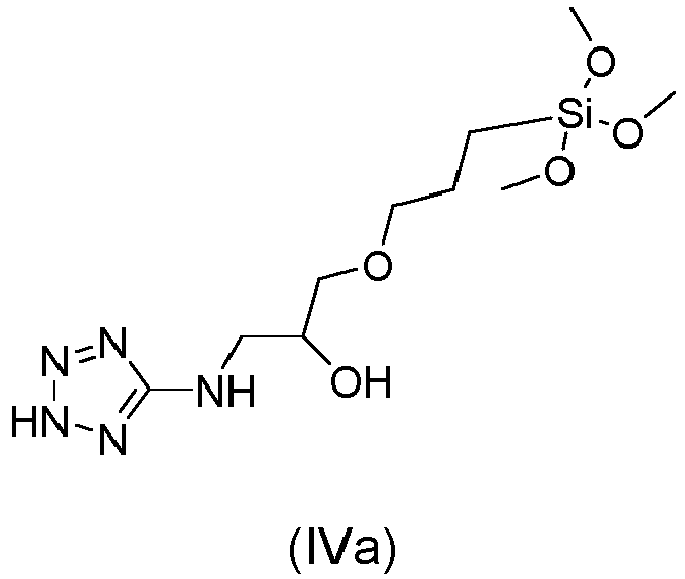
- 4,92 g (57,8 mmol) 2H-tetrazol-5-amine were suspended in 84,3 ml diethylene glycol monobutyl ether (DEGBE). This suspension was heated to 80°C. At that temperature 13.67 g (57,8 mmol) 3-glycidoxypropyltrimethoxysilane were added. The reaction mixture was kept at 80°C for 15hrs.
- Afterwards, a reaction product with a concentration of approximately 20 wt.-% in DEGBE was obtained. The thus obtained product was utilized without further purification.
- ESI-MS confirms the formation of a compound comprising three methoxy groups connected to the silicon atom. In addition, compounds comprising one, two, or three DEGBE moieties instead of respective methoxy groups also have been identified.
- Samples (each comprising several identical specimens) were prepared as follows.
- Table 1 gives an overview on the reaction steps which are then described in more detail thereafter.
Table 1 step process make up Temp Typical dwell time remarks (i) Providing copper substrate Annealing (optional) 160°C Air ventilated oven, 1h (i-a) Differential Etch 25ml/l Hyperflash 25 30°C Target etch depth is 0,5µm & 1µm 50ml/l H2SO4 50% Depending on etch rate 65ml/l H2O2 35% Triple cascade Rinse water Dry (optional) Up to dry (i-b) H2SO4 5% 130ml/l H2SO4 50% ambient 30 s Triple cascade Rinse water ambient 20 s (i-c) aqueous alkaline solution pH 14 50°C 30-600s Rinse Water ambient 20 s Dry (optional) Up to dry Hot air dryer, e.g. air gun, hair dryer (ii) Adhesion Promoter Diff. Silanes ambient 60 s See table with APs Triple cascade rinse water Ambient 30s each Dry Up to dry Hot air dryer, e.g. air gun, hair dryer (ii-a) Baking (optional) 130 30 min Air ventilated oven (iii) Lamination See Table 2 - Copper foils having a copper surface (150 mm x 75 mm x 35 µm, plated in house) were used. Under simplified laboratory conditions, copper foils without substrates are used for the examples.
- For wedge void and or halo investigation plated copper panels were used.
- The preparation conditions are as follows:
- Electrolytically plated Copper type:
- foil (adhesion test)
- panels (wedge void)
- Electrolyte:
Cupracid AC - Plating Parameters:
- 103min
- 1,5 A/dm2 = 35µm plated Copper thickness
- The copper surfaces of the copper foils were treated by 25ml/l Hyperflash 25, 50ml/l H2SO4 50% and 65ml/l H2O2 35% at 30°C to achieve 0.5 or 1µm etch depth. After the etch-cleaning the etch-cleaned copper surfaces were rinsed with water for approximately 30 seconds and optionally dried. As a result, etch-cleaned and rinsed copper surfaces were obtained.
- The copper surfaces of the copper foils were cleaned at room temperature for 20-30 seconds by using a 5 vol% sulfuric acid.
- The copper surfaces of the substrates were treated with aqueous alkaline solution (50 ° C, dipping, 300 sec or 50°C, spraying, 30 sec). After the treatment the treated copper surfaces of all copper foils were rinsed with cold water for approximately 30 seconds.
- Copper surfaces of the substrates were immersed for 60 sec at 25°C into a coating solution containing a triazine silane compound and solvents. If water is present, the pH of the coating solution was 7 (triazole and tetrazole silanes) (adjusted with sulfuric acid, if needed) or up to 13.5 (triazine silanes). Details are given in Table 2.
- Afterwards the resulting copper surfaces of all copper foils were rinsed with water for approximately 30 seconds and dried. As a result, silanized and dried copper surfaces of the copper foils were obtained.
- Copper foils were then annealed for 30 minutes at 130°C to remove remaining moisture from the surface. Note: this thermal treatment step is also known as baking. These substrates containing copper surfaces were subsequently subjected to laminating a build-up film (see text below).
- In a laminating step, an insulating film (see Table 2) was vacuum laminated onto the copper foils of all samples in a clean room with a room temperature in the range from 20 to 25°C and with a relative humidity of 50 to 60% by using a vacuum laminator.
- The conditions for vacuum lamination were as follows: 100°C, vacuum: 30 sec. at 3 hPa, pressure: 30 sec at 0,5 MPa.
- After lamination, laminated copper surfaces were obtained.
Table 2 - Overview Conditions Sample Step (i-c) Time Step (ii) silane Time [no/dip/spray] [s] [yes/no] [s] C1 (comparative) no n/a No n/a n/a 1a dip 30 No n/a n/a 1b Spray 30 No n/a n/a 2a dip 60 No n/a n/a 2b Spray 60 No n/a n/a 3a dip 120 No n/a n/a 3b Spray 120 No n/a n/a 4a dip 300 No n/a n/a 4b Spray 300 No n/a n/a 5 dip 30 Yes (IVa) 60 s 6 dip 60 Yes (IVa) 60 s 7 dip 120 Yes (IVa) 60 s 8 dip 300 yes (IVa) 60 s 9 dip 300 yes (Vb) 60 s 10 dip 300 yes (IIa) 60 s 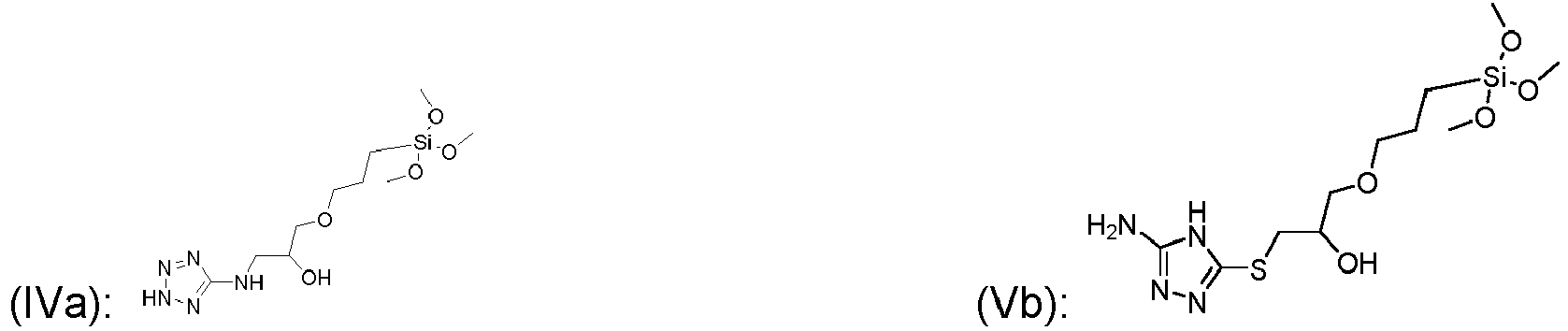

- The surface morphology was measured by means of Field Emission Scanning Electron Microscopy (FESEM). FEI NOVA Nanolab 600 and FEI Helios Nanolab 660 Microscopes were used to investigate surface as well as FIB prepared cross-sections.
- Scanning Electron Microscopy (SEM) images show the change in the surface structure after step (i-c) at different times (
Figure 1 ). At 30 s oxide particles formed on the surface (Sample 1). With longer treatment according to step (i-c) the Cu surface gets "flattened" caused by oxide particle growth. - Atomic Force Microscopy (AFM) was used to measure the surface roughness: for each sample, the surface was imaged on 5 measuring windows of 20 µm x 20 µm The average roughness RA, and the relative surface area increase RSAI were calculated.
Figure 2 depicts how the roughness increases by alkaline treatment and remains unchanged after application of silane. - The characterization of copper oxide was performed by means of Double- Sweep- Cyclic-Voltammetry (DSCV). Applied method used for Cu oxide quantification. During the first scan, cupric and cuprous oxides are reduced to Cu providing corresponding cathodic currents. Background currents are measured during the third scan in the same cathodic directions as the first scan. They are subtracted from the cathodic currents of the first scan in order to calculate the quantity of electrical charge required for the reduction of corresponding Cu oxide species. Experiments were performed il LiCI (4 M) solution at RT, potential range: -0.5 to -1.6 V (vs Ag/AgCl (3M KCI),
Scan rates 100 mV/s, # ofscans 3. - ∘ For
scan rate 100 mV/s:- ▪ CuO: -0.5 to -1.08 V(vs Ag/AgCl (3M KCI))
- ▪ Cu2O: -1.08 to -1.3 V (vs Ag/AgCl (3M KCI))
- ∘ Oxide layer thickness (d) nm was calculated using Faraday law:

- with A =0.95 cm2
- M(CuO) = 79.59 g/mol
- M(Cu2O)= 143.19 g/mol
- p(CuO) = 6.31 g/cm3
- ρ(Cu2O) = 6.00 g/cm3
- z =2
- F = 96485 C/mol
- The measurement shows that Cu(II) oxide remains at the 'zero' level for the whole time. In contrast; Cu(I) oxide increased (
Figure 3 ). - Fourier-transform infrared spectroscopy (FTIR) with Grazing Incidence unit was used to characterize the substrate surface. The surface oxide state change during the alkaline treatment was evaluated. (
Figure 4 ) - Elemental analysis of samples was carried out using Energy-dispersive X-ray spectroscopy (EDS). A lamella prepared for scanning transmission electron microscopy (STEM), and further used for the EDX measurements. Details are given in
Figures 5 a) to c) and respective description. - It has been found that, the ratio of Cu to O is 2 to 1, indicating that the oxide particles formed by alkaline solution are of Cu2O nature.
- The nano-beam diffraction (NBD) measurements from high resolution transmission electron microscopy (HRTEM) mode is a most favorable technique for routine strain analysis (simple experimental set-up, nano-meter spatial resolution and high measurement sensitivity (std. dev. ∼ 0.1%)).
- The line scan was performed along the oxide particle height at nine positions. All obtained patterns are nearly identical → same quality oxide along the particle height is expected
- For selected samples obtained after the lamination, peel strength was determined:
- (1) Initial,
- (2) after 96 hours HAST (HAST conditions: 130°C, 85 % rh, HAST chamber: EHS-221M).
- (3) after 12 cycles IR Reflow (thermal reliability, simulation of soldering process with temperature peak at 260 °C)
- In order to determine the peel strength, several stripe-type fragments have been prepared from each specimen by adhering the respective copper foils to a rigid board (identical size as the copper foils) in such a way that the rigid board faced the insulating film. As a result, copper surfaces with structurally enforced insulating films were obtained.
- The obtained copper surfaces with structurally enforced insulating films were then cured in an oven: copper surfaces with GL102 material at 200°C for 90 minutes and copper surfaces with GX-T31 material at 190 C for 90 min.
- Afterwards, each copper surfaces with structurally enforced insulating films was sliced into said strip-type fragments (10x100 mm, Bugard drilling/routing).
- The strip-type fragments were subjected to a peel force measuring machine (Roell Zwick Z010) to individually evaluate the peel strength (angle: 90°, speed: 50 mm/min) which is needed to delaminate the copper surface from its respective structurally enforced insulating films. Typically, the higher the peel strength needed to avoid delamination the better is the adhesion.
- The peel strength of
samples 1 to 15 are shown in Table 3 below.Table 3 Sample Step (i-c) dipping [time in s] Step (II) [silane] Peel strength GX-T31 (N/cm) Peel strength GL 102 (N/cm) Initial HAST Reflow Initial HAST Reflow C1 n/a n/a 6,6 2,1 2,1 6,4 1,6 4,7 1a 30 n/a 9.3 3.7 5.0 7,5 2,2 5,6 2a 60 n/a 9.5 4.8 4.3 7,2 2,5 4,8 3a 120 n/a 9.7 5.6 4.5 7,6 2,7 5,2 4a 300 n/a 10.2 5.8 4.8 7,9 3.3 5.6 C2 n/a (Vb) 7,5 4,4 5 n/a (IVa) 5.8 2.8 3.0 7.2 2.4 6.3 6 n/a (IIa) 8.4 4.0 5.0 6.8 3.6 5.7 7 30 (IVa) 8.6 2.9 4.0 6.1 2.9 5.8 8 60 (IVa) 8.8 4.7 4.5 6.8 4.3 6.2 9 120 (IVa) 10.2 5.6 5.6 6.9 4.9 6.5 10 300 (IVa) 9.8 8.3 7.5 7.3 4.8 6.3 11 300 (Vb) 7,3 4,6 12 30 (IIa) 8.7 6.5 6.2 6.3 3.8 5.8 13 60 (IIa) 8.9 7.4 7.2 6.5 4.2 5.8 14 120 (IIa) 9.5 7.8 7.4 6.7 4.7 6.2 15 300 (IIa) 9.4 8.5 7.8 7.5 5.0 6.5 
- The experiments show that the inventive examples exhibit a good adhesion strength, here expressed as peel strength.
- In order to evaluate the halo, the copper samples have been prepared by adhering the respective insulating films to copper panels. As a result, copper surfaces with structurally enforced insulating films were obtained.
- The obtained copper surfaces with structurally enforced insulating films were then semicured in two steps in the ovens: copper surfaces with GL102 material at 130°C for 30 minutes followed by 175°C for 30 minutes; and copper surfaces with GX-T31 material at 100°C for 30 minutes followed by 170°C for 30 minutes.
- After completing the lamination and semi-curing step, the copper panels were lasered with UV-laser to drill the blind micro vias (BMV). Thereafter, the substrates were subjected to the desmear and reduction condition steps. In particular, these included a sweller treatment under alkaline conditions with Securiganth MV Sweller (Atotech); a permanganate treatment under alkaline conditions with Securiganth MV Etch P (Atotech) and a reduction conditioner treatment under acidic conditions with Securiganth MV Reduction Conditioner (Atotech). After each step the sample were rinsed with water.
- The lamination material exhibits a thickness of ca. 10 µm for wedge void and halo and 35 µm in case of adhesion investigations, respectively.
- The substrates were measured by light microscope (200x magnification; see Table 4). Pictures depicting the halo measurement can be found in
Figure 6 . - The investigated test Blind Micro Via's (BMV) are manufactured as a test grid on surface treated and Ajinomoto Build up Film (ABF) laminated test vehicles by utilizing Laser Drilling technology. The halo data is obtainable after sending the prepared test vehicles through entire Desmear process (Sweller, Permanganate, Reduction Conditioner) as described above.
- Halo measurement is performed by camera (CCD) supported light microscopy. Hereby, the microscope must be operated in epi-illumination mode. All image generation must be carried out by using Darkfield (DF) filter setting. A magnification factor of approx. 200x is typically used.
- The fully processed test vehicles are firmly installed on the measurement table and the BMV capture pad must be set as optical focus. CCD exposure time must be adjusted to the maximum possible contrast of halo boundaries. Hereby, the capture pad should appear as bright as possible.
- The visible diameter of the via hole (or clean capture pad), the inner (innermost) and the outer (outermost) appearing halo like boundaries are measured and recorded according to
Figure 6 . The actual halo values can now be calculated by using following relations. - 1.

- 2.

- Typically, this process is iterated at least three times at random test vias to enable minimal statistical statements.
Table 4 Sample Step (i-c) dipping [time in s] Step (II) [silane] GL102 (µm halo size) With baking (130°C, 30 min) GL102 (µm halo size) Without baking Inner Outer Inner Outer C1 n/a n/a 79,9 143 49,6 91,8 2a 60 n/a 61,9 104 39,7 71,2 4a 300 n/a 19,2 61,7 17,9 38,6 C2 (comparative) n/a (Vb) 67.2 76.4 5 n/a (IVa) 65 85 15 41 6 n/a (IIa) 19,0 75 15 60 8 60 (IVa) 50 70 n/a n/a 10 300 (IVa) 23.1 68.7 19.5 42.0 11 300 (Vb) 22.5 74.8 12 300 (IIa) 20.0 25 


- The best result is obtained for the combination of step (i-c) with step (ii) comprising T-E silane
- The experiments show that the inventive examples exhibit a good behavior regarding avoidance of wedge void formation, here expressed as halo sizes.
- In addition, substrates were subjected to Focused Ion Beam (FIB) cuts and subsequent Scanning Electron Microscopy (SEM) measurement. This method allows to analyze the copper adhesion in the vicinity of a blind micro via (BMV), also known as wedge void.
selected from the group consisting of diethylene glycol monobutyl ether, ethylene glycol monobutyl ether, and mixtures thereof, even more preferably
selected from the group consisting of diethylene glycol monobutyl ether, ethylene glycol monobutyl ether, and mixtures thereof.
Claims (15)
- A method for increasing adhesion strength and/or improved wedge void behavior between a surface of copper, a copper alloy or a copper oxide and a surface of an organic material comprising(i) providing a substrate, comprising the copper, copper alloy or copper oxide on at least one side of the substrate,
followed by at least one of the steps of
(i-c) treating the substrate yielding a substrate comprising copper oxide on at least one side of the substrate, wherein the copper oxide comprises copper (I) and copper (II) in a ratio of 90:10 or higher (mol/mol), preferably in a ratio of 95:5 or higher (mol/mol), even more preferably in a ratio of 98:2 or higher (mol/mol), most preferably the copper oxide essentially consists of copper (I) oxide;
and/or(ii) contacting at least one section of the substrate with(a) at least one silane compound of formula (I);
the ring structure

X and Y are independently selected from the group consisting of NH2, NH(NH2), NH(CH2)oNH2, SH, SCH3, and OCH3;
E is selected from the group consisting of-S- , -NH- and -NH-(CH2)m-NH-;
A is selected from the group consisting of NH, N(NH2) and S;
Z is selected from the group consisting of
n is an integer in the range from 1 to 12,
o is an integer in the range from 2 to 12,
R independently denotes (CH2-CH2-O)p-T, wherein independently
p is 0, 1, 2, 3, or 4, and
T denotes H or C1 to C5 alkyl; or(b) at least one amino acid; orwherein, if both steps (i-c) and (ii) are performed, step (1-c-) is performed prior to step (ii);
a mixture of (a) and (b),(iii) applying the organic material, with the proviso that, if the ring structure
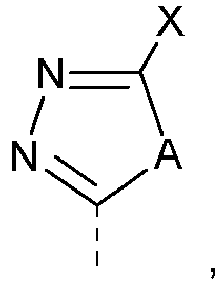
- The method according to claim 1, wherein step (i-c) comprises contacting at least one section of said copper, copperalloy or copper oxide with an aqueous alkaline solution comprising at least one complexing agent.
- The method according to claim 2, wherein the aqueous alkaline solution in step (i-c) has a pH in the range of from 7.5 to 14.0, preferably in the range of from 10.0 to 14.0.
- The method according to claim 2 or claim 3, wherein step (i-c) is applied as dip application and the contact time is 40 s or longer, preferably the contact time in step (i-c) is of from 40s to 900 s, more preferably the contact time in step (i-c) is of from 60 s to 500 s, even more preferably the contact time in step (i-c) is of from 90 s to 450 s.
- The method according to claim 2 or claim 3, wherein step (i-c) is applied as spray application and the contact time is 10 s or longer, preferably the contact time in step (i-c) is of from 20s to 200 s, more preferably the contact time in step (i-c) is of from 30 s to 150 s.
- The method according to any of the preceding claims comprising the step of(ii) contacting at least one section of the substrate with(a) at least one silane compound of formula (I);

the ring structure

X and Y are independently selected from the group consisting of NH2, NH(NH2), NH(CH2)oNH2, SH, SCH3, and OCH3;
E is selected from the group consisting of -S- , -NH- and -NH-(CH2)m-NH-;
Z is selected from the group consisting of
n is an integer in the range from 1 to 12,
o is an integer in the range from 2 to 12,
R independently denotes (CH2-CH2-O)p-T, wherein independently
p is 0, 1, 2, 3, or 4, and
T denotes H or C1 to C5 alkyl; or(b) at least one amino acid; or
a mixture of (a) and (b). - The method according to any of the preceding claims, wherein the organic material applied in step (iii) is an organic polymer.
- The method according to any of the preceding claims, wherein the organic material is applied in step (iii) by laminating the organic material onto at least the contacted section of the copper, copper alloy or copper oxide.
- The method according to any of the preceding claims, if a step (ii) is performed, additionally comprising the following step before conducting step (ii):
(i-a) contacting the at least one section of said copper, copper alloy or copper oxide with an etch-cleaning solution, preferably an etch-cleaning solution containing one or more than one acid and/or one or more than one oxidizing agent, more preferably an etch-cleaning solution containing a mixture of an inorganic acid and a peroxide. - The method according to any of the preceding claims, if a step (ii) is performed, additionally comprising the following step before conducting step (ii):
(i-b) contacting the at least one section of said copper, copper alloy or copper oxide with a (preferably second) etch-cleaning solution, preferably comprising an inorganic acid, preferably sulfuric acid. - The method according to any of the preceding claims, wherein after step (ii), after step (i-a), after step (i-b) and/or after step (i-c), a rinsing of the at least one section of the copper, copper alloy or copper oxide is performed, wherein the copper, copper alloy or copper oxide is preferably rinsed with water.
- The method according to any of the preceding claims 1-11, wherein after step (ii), after step (i-a), after step (i-b) and/or after step (i-c), a drying of the at least one section of copper, copper alloy or copper oxide is performed.
- The method according to any of the preceding claims 1-11, wherein after step (ii), no baking of the at least one section of copper, copper alloy or copper oxide is performed.
- The method according to any of the preceding claims, comprising after step (iii) the additional step:
(iv) subjecting the substrate and the organic material to a heat treatment with a temperature in the range from 142°C to 420°C, preferably in the range from 145°C to 300°C, more preferably in the range from 150°C to 220°C. - The method according to any of the preceding claims, wherein after step (ii), after step (i-a), after step (i-b) and/or after step (i-c), a rinsing of the at least one section of the copper, copper alloy or copper oxide is performed, wherein the copper, copper alloy or copper oxide is preferably rinsed with water.
Priority Applications (7)
| Application Number | Priority Date | Filing Date | Title |
|---|---|---|---|
| EP21162439.0A EP4057782A1 (en) | 2021-03-12 | 2021-03-12 | Method for increasing adhesion strength between copper and an organic material and reducing halo and wedge void formation by modifying the copper surface and/or by using heteroaromatic silane compounds |
| US18/550,145 US20240179851A1 (en) | 2021-03-12 | 2022-03-11 | Modified copper surface, heteroaromatic silane compounds and their usage for increasing adhesion strength between copper and an organic material and reducing halo and wedge void formation |
| KR1020237034633A KR20230156114A (en) | 2021-03-12 | 2022-03-11 | Method for increasing adhesion strength between copper and organic materials and reducing halo and wedge void formation by modifying the copper surface and/or using heteroaromatic silane compounds |
| PCT/EP2022/056360 WO2022189644A1 (en) | 2021-03-12 | 2022-03-11 | Method for increasing adhesion strength between copper and an organic material and reducing halo and wedge void formation by modifying the copper surface and/or by using heteroaromatic silane compounds |
| JP2023555629A JP2024510986A (en) | 2021-03-12 | 2022-03-11 | Method for increasing adhesive strength and reducing halo and wedge space formation between copper and organic materials by modifying copper surfaces and/or using heteroaromatic silane compounds |
| CN202280027311.XA CN117121645A (en) | 2021-03-12 | 2022-03-11 | Methods to improve the adhesion strength between copper and organic materials and reduce the formation of halos and wedge-shaped pores by modifying the copper surface and/or by using heteroaromatic silane compounds |
| TW111109117A TW202302614A (en) | 2021-03-12 | 2022-03-11 | Modified copper surface, heteroaromatic silane compounds and their usage for increasing adhesion strength between copper and an organic material and reducing halo and wedge void formation |
Applications Claiming Priority (1)
| Application Number | Priority Date | Filing Date | Title |
|---|---|---|---|
| EP21162439.0A EP4057782A1 (en) | 2021-03-12 | 2021-03-12 | Method for increasing adhesion strength between copper and an organic material and reducing halo and wedge void formation by modifying the copper surface and/or by using heteroaromatic silane compounds |
Publications (1)
| Publication Number | Publication Date |
|---|---|
| EP4057782A1 true EP4057782A1 (en) | 2022-09-14 |
Family
ID=74874642
Family Applications (1)
| Application Number | Title | Priority Date | Filing Date |
|---|---|---|---|
| EP21162439.0A Pending EP4057782A1 (en) | 2021-03-12 | 2021-03-12 | Method for increasing adhesion strength between copper and an organic material and reducing halo and wedge void formation by modifying the copper surface and/or by using heteroaromatic silane compounds |
Country Status (7)
| Country | Link |
|---|---|
| US (1) | US20240179851A1 (en) |
| EP (1) | EP4057782A1 (en) |
| JP (1) | JP2024510986A (en) |
| KR (1) | KR20230156114A (en) |
| CN (1) | CN117121645A (en) |
| TW (1) | TW202302614A (en) |
| WO (1) | WO2022189644A1 (en) |
Families Citing this family (1)
| Publication number | Priority date | Publication date | Assignee | Title |
|---|---|---|---|---|
| EP4056285A1 (en) * | 2021-03-12 | 2022-09-14 | Atotech Deutschland GmbH & Co. KG | Triazine silane compound and its usage as adhesion promotor |
Citations (17)
| Publication number | Priority date | Publication date | Assignee | Title |
|---|---|---|---|---|
| JPH0136819B2 (en) | 1982-12-27 | 1989-08-02 | Eisai Co Ltd | |
| JPH06279461A (en) | 1993-03-29 | 1994-10-04 | Japan Energy Corp | Novel azole silane compound, method for producing the same, and metal surface treating agent using the same |
| JP2007131556A (en) * | 2005-11-09 | 2007-05-31 | Iwate Univ | Functional triazine dithiol and method for producing the same |
| JP2014240522A (en) | 2013-05-17 | 2014-12-25 | 四国化成工業株式会社 | Copper surface treatment liquid, surface treatment method and use thereof |
| JP2015092020A (en) * | 2013-10-02 | 2015-05-14 | 四国化成工業株式会社 | Surface treatment liquid of metal, surface treatment method and its utilization |
| JP2016169300A (en) | 2015-03-12 | 2016-09-23 | 四国化成工業株式会社 | Surface treatment agent, resin composition and use thereof |
| US20160368935A1 (en) | 2013-07-02 | 2016-12-22 | Shikoku Chemicals Corporation | Azole silane compound, surface treatment solution, surface treatment method, and use thereof |
| JP2017002402A (en) | 2015-06-04 | 2017-01-05 | 四国化成工業株式会社 | Surface preparation agent, resin composition, and utilization of them |
| JP2017048467A (en) * | 2013-09-20 | 2017-03-09 | 三井金属鉱業株式会社 | Copper foil, copper foil with carrier foil and copper clad laminate |
| CN107190254A (en) * | 2017-05-22 | 2017-09-22 | 博敏电子股份有限公司 | A kind of new brown treatment fluid of printed circuit board |
| JP2018016865A (en) | 2016-07-29 | 2018-02-01 | 四国化成工業株式会社 | Surface treatment agent, resin composition, and utilization of them |
| WO2019058773A1 (en) | 2017-09-22 | 2019-03-28 | 四国化成工業株式会社 | Tetrazole silane compound, method for synthesizing said compound and use thereof |
| WO2019243180A1 (en) | 2018-06-18 | 2019-12-26 | Atotech Deutschland Gmbh | Azole silane compound |
| WO2020148308A1 (en) * | 2019-01-15 | 2020-07-23 | Atotech Deutschland Gmbh | Method of forming copper oxide on a copper surface |
| WO2020178146A1 (en) | 2019-03-01 | 2020-09-10 | Atotech Deutschland Gmbh | Method for increasing adhesion strength between a metal and an organic material |
| JP6779557B1 (en) * | 2020-07-20 | 2020-11-04 | メック株式会社 | A composition for forming a film, a method for producing a surface-treated metal member, and a method for producing a metal-resin composite. |
| US20200399290A1 (en) | 2019-06-21 | 2020-12-24 | Imam Abdulrahman Bin Faisal University | Nanocomposite containing hollow silica spheres functionalized with azole silanes |
-
2021
- 2021-03-12 EP EP21162439.0A patent/EP4057782A1/en active Pending
-
2022
- 2022-03-11 JP JP2023555629A patent/JP2024510986A/en active Pending
- 2022-03-11 CN CN202280027311.XA patent/CN117121645A/en active Pending
- 2022-03-11 KR KR1020237034633A patent/KR20230156114A/en active Pending
- 2022-03-11 TW TW111109117A patent/TW202302614A/en unknown
- 2022-03-11 WO PCT/EP2022/056360 patent/WO2022189644A1/en not_active Ceased
- 2022-03-11 US US18/550,145 patent/US20240179851A1/en active Pending
Patent Citations (19)
| Publication number | Priority date | Publication date | Assignee | Title |
|---|---|---|---|---|
| JPH0136819B2 (en) | 1982-12-27 | 1989-08-02 | Eisai Co Ltd | |
| JPH06279461A (en) | 1993-03-29 | 1994-10-04 | Japan Energy Corp | Novel azole silane compound, method for producing the same, and metal surface treating agent using the same |
| JP2007131556A (en) * | 2005-11-09 | 2007-05-31 | Iwate Univ | Functional triazine dithiol and method for producing the same |
| JP2014240522A (en) | 2013-05-17 | 2014-12-25 | 四国化成工業株式会社 | Copper surface treatment liquid, surface treatment method and use thereof |
| US20160368935A1 (en) | 2013-07-02 | 2016-12-22 | Shikoku Chemicals Corporation | Azole silane compound, surface treatment solution, surface treatment method, and use thereof |
| JP2017048467A (en) * | 2013-09-20 | 2017-03-09 | 三井金属鉱業株式会社 | Copper foil, copper foil with carrier foil and copper clad laminate |
| JP2015092020A (en) * | 2013-10-02 | 2015-05-14 | 四国化成工業株式会社 | Surface treatment liquid of metal, surface treatment method and its utilization |
| JP2016169300A (en) | 2015-03-12 | 2016-09-23 | 四国化成工業株式会社 | Surface treatment agent, resin composition and use thereof |
| JP2017002402A (en) | 2015-06-04 | 2017-01-05 | 四国化成工業株式会社 | Surface preparation agent, resin composition, and utilization of them |
| JP6370836B2 (en) | 2015-06-04 | 2018-08-08 | 四国化成工業株式会社 | Surface treatment agent, resin composition and use thereof |
| JP6392273B2 (en) | 2015-06-04 | 2018-09-19 | 四国化成工業株式会社 | Epoxy resin composition and use thereof |
| JP2018016865A (en) | 2016-07-29 | 2018-02-01 | 四国化成工業株式会社 | Surface treatment agent, resin composition, and utilization of them |
| CN107190254A (en) * | 2017-05-22 | 2017-09-22 | 博敏电子股份有限公司 | A kind of new brown treatment fluid of printed circuit board |
| WO2019058773A1 (en) | 2017-09-22 | 2019-03-28 | 四国化成工業株式会社 | Tetrazole silane compound, method for synthesizing said compound and use thereof |
| WO2019243180A1 (en) | 2018-06-18 | 2019-12-26 | Atotech Deutschland Gmbh | Azole silane compound |
| WO2020148308A1 (en) * | 2019-01-15 | 2020-07-23 | Atotech Deutschland Gmbh | Method of forming copper oxide on a copper surface |
| WO2020178146A1 (en) | 2019-03-01 | 2020-09-10 | Atotech Deutschland Gmbh | Method for increasing adhesion strength between a metal and an organic material |
| US20200399290A1 (en) | 2019-06-21 | 2020-12-24 | Imam Abdulrahman Bin Faisal University | Nanocomposite containing hollow silica spheres functionalized with azole silanes |
| JP6779557B1 (en) * | 2020-07-20 | 2020-11-04 | メック株式会社 | A composition for forming a film, a method for producing a surface-treated metal member, and a method for producing a metal-resin composite. |
Non-Patent Citations (4)
| Title |
|---|
| "Corrosion protection of copper with 3-glycidoxypropyltrimethoxysilane-based sol-gel coating through 3-amino-5-mercapto-1,2,4-triazole doping", JOURNAL OF RESEARCH ON CHEMICAL INTERMEDIATES, vol. 42, 2015, pages 1315 - 1328 |
| "Reliability prediction in electronic packages using molecular simulation", ELECTRONIC COMPONENTS AND TECHNOLOGY CONFERENCE, 2005, pages 1314 - 1317 |
| "The role of oxide structure on copper wire to the rubber adhesion", APPLIED SURFACE SCIENCE, vol. 161, 2000, pages 355 - 364 |
| CHEM. EUR.J., vol. 15, 2009, pages 6279 - 6288 |
Also Published As
| Publication number | Publication date |
|---|---|
| KR20230156114A (en) | 2023-11-13 |
| JP2024510986A (en) | 2024-03-12 |
| WO2022189644A1 (en) | 2022-09-15 |
| CN117121645A (en) | 2023-11-24 |
| TW202302614A (en) | 2023-01-16 |
| US20240179851A1 (en) | 2024-05-30 |
Similar Documents
| Publication | Publication Date | Title |
|---|---|---|
| EP2341167B1 (en) | Method for surface treatment of copper and copper material | |
| EP3300808B1 (en) | Silver plating in electronics manufacture | |
| DE60128364T2 (en) | IMPROVED LIABILITY OF POLYMER MATERIALS TO METAL SURFACES | |
| CN101137768B (en) | Surface treatment method for copper and copper | |
| CA2417071A1 (en) | Bath and method of electroless plating of silver on metal surfaces | |
| JPWO2009110364A1 (en) | Copper surface treatment agent and surface treatment method | |
| KR20180072725A (en) | Surface treatment agents for copper and copper alloy surfaces and methods for treating copper or copper alloy surfaces | |
| US20240179851A1 (en) | Modified copper surface, heteroaromatic silane compounds and their usage for increasing adhesion strength between copper and an organic material and reducing halo and wedge void formation | |
| KR20140002495A (en) | Liquid composition for etching and preparing method of multilayer printed wiring board by using the same | |
| EP3932154B1 (en) | Method for increasing adhesion strength between a metal and an organic material | |
| EP4459007A1 (en) | Organic coating and method for producing same | |
| EP4459006A1 (en) | Surface treatment liquid for metal | |
| JP6846952B2 (en) | Rust preventive liquid and its use | |
| JP2010150613A (en) | Surface treatment agent and surface treatment method for copper, and film for copper surface | |
| EP4056285A1 (en) | Triazine silane compound and its usage as adhesion promotor | |
| KR102955076B1 (en) | Wiring for multilayer substrates and method for manufacturing the same | |
| Vazquez et al. | Conformal Coating-Relative Performance Comparison Through Environmental Testing Using IPC B-52 Test Board |
Legal Events
| Date | Code | Title | Description |
|---|---|---|---|
| PUAI | Public reference made under article 153(3) epc to a published international application that has entered the european phase |
Free format text: ORIGINAL CODE: 0009012 |
|
| STAA | Information on the status of an ep patent application or granted ep patent |
Free format text: STATUS: THE APPLICATION HAS BEEN PUBLISHED |
|
| AK | Designated contracting states |
Kind code of ref document: A1 Designated state(s): AL AT BE BG CH CY CZ DE DK EE ES FI FR GB GR HR HU IE IS IT LI LT LU LV MC MK MT NL NO PL PT RO RS SE SI SK SM TR |
|
| STAA | Information on the status of an ep patent application or granted ep patent |
Free format text: STATUS: REQUEST FOR EXAMINATION WAS MADE |
|
| 17P | Request for examination filed |
Effective date: 20230314 |
|
| RBV | Designated contracting states (corrected) |
Designated state(s): AL AT BE BG CH CY CZ DE DK EE ES FI FR GB GR HR HU IE IS IT LI LT LU LV MC MK MT NL NO PL PT RO RS SE SI SK SM TR |
|
| RAP3 | Party data changed (applicant data changed or rights of an application transferred) |
Owner name: ATOTECH DEUTSCHLAND GMBH & CO. KG |