EP4057564B1 - Relaisvorrichtung und kommunikationssystem - Google Patents
Relaisvorrichtung und kommunikationssystem Download PDFInfo
- Publication number
- EP4057564B1 EP4057564B1 EP20899811.2A EP20899811A EP4057564B1 EP 4057564 B1 EP4057564 B1 EP 4057564B1 EP 20899811 A EP20899811 A EP 20899811A EP 4057564 B1 EP4057564 B1 EP 4057564B1
- Authority
- EP
- European Patent Office
- Prior art keywords
- clock
- time
- frame
- time synchronization
- processing unit
- Prior art date
- Legal status (The legal status is an assumption and is not a legal conclusion. Google has not performed a legal analysis and makes no representation as to the accuracy of the status listed.)
- Active
Links
Images




Classifications
-
- H—ELECTRICITY
- H04—ELECTRIC COMMUNICATION TECHNIQUE
- H04J—MULTIPLEX COMMUNICATION
- H04J3/00—Time-division multiplex systems
- H04J3/02—Details
- H04J3/06—Synchronising arrangements
- H04J3/0635—Clock or time synchronisation in a network
- H04J3/0638—Clock or time synchronisation among nodes; Internode synchronisation
- H04J3/0658—Clock or time synchronisation among packet nodes
-
- H—ELECTRICITY
- H04—ELECTRIC COMMUNICATION TECHNIQUE
- H04L—TRANSMISSION OF DIGITAL INFORMATION, e.g. TELEGRAPHIC COMMUNICATION
- H04L49/00—Packet switching elements
- H04L49/25—Routing or path finding in a switch fabric
-
- H—ELECTRICITY
- H04—ELECTRIC COMMUNICATION TECHNIQUE
- H04J—MULTIPLEX COMMUNICATION
- H04J3/00—Time-division multiplex systems
- H04J3/02—Details
- H04J3/06—Synchronising arrangements
- H04J3/0635—Clock or time synchronisation in a network
- H04J3/0638—Clock or time synchronisation among nodes; Internode synchronisation
- H04J3/0641—Change of the master or reference, e.g. take-over or failure of the master
-
- H—ELECTRICITY
- H04—ELECTRIC COMMUNICATION TECHNIQUE
- H04L—TRANSMISSION OF DIGITAL INFORMATION, e.g. TELEGRAPHIC COMMUNICATION
- H04L12/00—Data switching networks
- H04L12/28—Data switching networks characterised by path configuration, e.g. LAN [Local Area Networks] or WAN [Wide Area Networks]
-
- H—ELECTRICITY
- H04—ELECTRIC COMMUNICATION TECHNIQUE
- H04L—TRANSMISSION OF DIGITAL INFORMATION, e.g. TELEGRAPHIC COMMUNICATION
- H04L7/00—Arrangements for synchronising receiver with transmitter
- H04L7/04—Speed or phase control by synchronisation signals
- H04L7/041—Speed or phase control by synchronisation signals using special codes as synchronising signal
- H04L7/042—Detectors therefor, e.g. correlators, state machines
-
- H—ELECTRICITY
- H04—ELECTRIC COMMUNICATION TECHNIQUE
- H04L—TRANSMISSION OF DIGITAL INFORMATION, e.g. TELEGRAPHIC COMMUNICATION
- H04L7/00—Arrangements for synchronising receiver with transmitter
- H04L7/04—Speed or phase control by synchronisation signals
- H04L7/10—Arrangements for initial synchronisation
Definitions
- the present invention relates to a relay.
- GM which is a clock-time distribution server including a reference clock of a network, counts reference clock time and distributes clock-time information indicating the clock time in a clock-time synchronization frame, and a device that receives the clock-time information from the GM corrects the clock time. This enables synchronization of the clock time in the network.
- An industrial network or a network forming a social infrastructure is composed of a full-duplex system for a network to improve the fault tolerance and has a configuration in which multiple GMs are arranged on the network to achieve highly accurate clock-time synchronization.
- a network having a redundant configuration of GMs one GM is selected to distribute clock time by using the best master clock algorithm (BMCA) or the like to centralize the clock time to be synchronized, and a clock-time distribution tree is generated with the selected GM serving as a starting point.
- BMCA master clock algorithm
- Patent Literature 1 Japanese Patent No. 6045950
- a GM distributes clock-time information from a clock-time information distribution port, it is necessary to provide multiple clock-time information distribution ports on the GM when redundancy is established in accordance with the conventional technique.
- a GM adopts an expensive, high-precision reference clock using an atomic clock, a global positioning system (GPS), or the like to distribute high-precision clock-time information; thus, a GM is more expensive than a relay device, such as a layer-2 switch (L2SW).
- the price of a GM increases in proportion to an increase in the number of clock-time information distribution ports.
- GMs having many clock-time information distribution ports are arranged on a network to enhance fault tolerance, but the price of GMs causes deterioration in cost.
- a relay device includes a plurality of ports configured to receive frames; and a transfer processing unit configured to transfer a frame received at one of the ports to at least one of the ports, wherein the transfer processing unit has a filtering function for blocking frames other than a clock-time synchronization frame during transfer involving the port selected from the plurality of ports, the clock-time synchronization frame being used for synchronizing clock time.
- An example of a relay device provided of a filter unit is disclosed by the document US2011110369, FUJITSU LIMITED, published on 12 May 2011 .
- a communication system includes a first network including a first relay device; and a second network including a second relay device and constituting a segment different from the segment of the first network, wherein, the first relay device further includes: a plurality of first ports configured to receive frames; and a first transfer processing unit configured to transfer a frame received by one of the first ports from at least one of the first ports, a first clock-time-information relay port included in the plurality of first ports is connected to the second relay device, the first transfer processing unit has a first filtering function for blocking frames other than a clock-time synchronization frame during transfer involving the first clock-time-information relay port, the clock-time synchronization frame being used for synchronizing clock time, the second relay device further includes: a plurality of second ports configured to receive frames; and a second transfer processing unit configured to transfer a frame received by one of the second ports to at least one of the second ports, a second clock-time-information relay port included in the plurality of second ports is connected to the first relay
- One or more aspects of the present invention enable clock-time synchronization with high reliability at a low cost.
- FIG. 1 is a block diagram schematically illustrating a communication system 100 including relay devices 110A to 110D according to the first embodiment.
- the communication system 100 includes a network 101A and a network 101B.
- the network 101A includes the relay devices 110A and 110B and communication devices 103A and 103B.
- the network 101A is also referred to as a first network.
- Any one of the relay devices 110A and 110B is also referred to as a first relay device.
- the GM 104A is also referred to as a first clock-time distribution server, and the clock-time synchronization frame sent from the GM 104A is also referred to as a first clock-time synchronization frame.
- the network 101B includes the relay devices 110C and 110D and communication devices 103C and 103D.
- the relay device 110C is connected to a GM 104B, and a clock-time synchronization frame for synchronizing the clock time is sent from the GM 104B to the relay device 110C.
- the network 101B is also referred to as a second network. Any one of the relay devices 110C and 110D is also referred to as a second relay device.
- the GM 104B is also referred to as a second clock-time distribution server, and the clock-time synchronization frame sent from the GM 104B is also referred to as a second clock-time synchronization frame.
- devices illustrated at the same locations on the network 101A and the network 101B such as the communication device 103A and the communication device 103C, are disposed in the same area and are capable of providing the same service.
- the user can receive the service via both networks 101A and 101B.
- the network 101A and the network 101B constitute different segments.
- the network 101A and the network 101B constituting different segments are usually not connected.
- the relay devices 110B and 110D having a filter function for transmitting only clock-time synchronization frames are provided to connect the networks 101A and 101B without mixing of the communication frames.
- the two GMs 104A and 104B are present in the communication system 100; and the GM having high priority (for example, the GM 104A in FIG. 1 ) is selected by using the BMCA or the like, and relay devices 110A to 110D and the communication devices 103A to 103D connected to both networks 101A and 101B are synchronized with the clock time of the selected GM.
- the communication devices 103A and 103B may be any devices capable of communication via the network 101A.
- each of the GMs 104A and 104B should include one clock-time-information distribution port for sending clock-time synchronization frames indicating the clock time to be synchronized.
- the clock-time-information distribution port is a physical port that sends clock-time synchronization frames to a network. Note that the clock time indicated by a clock-time synchronization frame is the reference clock time.
- relay devices 110A to 110D have the same configuration, hereinafter, any one of the relay devices 110A to 110D will be referred to as a relay device 110 when there is no need to distinguish between them.
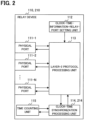
- FIG. 2 is a block diagram schematically illustrating the configuration of a relay device 110.
- the relay device 110 includes a plurality of physical ports 111-1 to 111-N (where N is an integer equal to or greater than two), a clock-time-information-relay-port setting unit 112, a layer-2 protocol processing unit 113, a clock-time synchronization processing unit 114, and a time counting unit 115.
- Each of the physical ports 111-1 to 111-N serves as a communication interface for connecting to a network.
- Each of the physical ports 111-1 to 111-N sends and receives frames.
- At least one of the physical ports 111-1 to 111-N is selected by the clock-time-information-relay-port setting unit 112 as a clock-time-information relay port to which a filter function for transmitting only clock-time synchronization frames is applied.
- the clock-time-information relay port is connected to a relay device 110 of a different segment.
- the physical ports 111-1 to 111-N provided in the first relay device are also referred to as first ports
- the physical ports 111-1 to 111-N provided in the second relay device are also referred to as second ports.
- the clock-time-information-relay-port setting unit 112 notifies the layer-2 protocol processing unit 113 of a clock-time-information relay port number or physicalport identification information for identifying the clock-time-information relay port to which the filter function for transmitting only clock-time synchronization frames is applied.
- the clock-time-information relay port is used to connect the two network systems described above and is a physical port to which the filter function for transmitting only clock-time synchronization frames is applied.
- the clock-time-information relay port may be predetermined or may be selected by a user.
- the clock-time-information-relay-port setting unit 112 receives a designation of a clock-time-information relay port number from a user terminal connected to any of the physical ports 111-1 to 111-N and selects the physical port identified by the designated clock-time-information relay port number to be the clock-time-information relay port.
- the clock-time-information relay port number may be input through such an input unit.
- the clock-time-information-relay-port setting unit 112 does not report the clock-time-information relay port number to the layer-2 protocol processing unit 113 or reports a predetermined number indicating that the clock-time-information relay port is not to be used to the layer-2 protocol processing unit 113.
- the relay device 110B and the relay device 110D use clock-time-information relay ports, but the relay device 110A and the relay device 110C do not use clock-time-information relay ports. Therefore, in the first embodiment, the relay devices 110A and 110C may be relay devices having a clock-time synchronization function.
- the layer-2 protocol processing unit 113 is a transfer processing unit that transfers a frame received by one physical port included in the physical ports 111-1 to 111-N from at least one of the physical ports 111-1 to 111-N.
- the layer-2 protocol processing unit 113 has a filtering function for blocking frames other than clock-time synchronization frames in the transfer involving the clock-time-information relay ports.
- the layer-2 protocol processing unit 113 applies a filtering function to the frames received by the clock-time-information relay port.
- the layer-2 protocol processing unit 113 deletes the frame.
- the layer-2 protocol processing unit 113 does not transfer the frame from any of the physical ports 111-1 to 111-N.
- the frame received by the clock-time-information relay port is also referred to as a first frame.
- the layer-2 protocol processing unit 113 checks whether or not the physical port that received the frame matches the physical port indicated by the clock-time-information relay port number reported by the clock-time-information-relay-port setting unit 112.
- the layer-2 protocol processing unit 113 When any of the physical ports 111-1 to 111-N receives a frame, the layer-2 protocol processing unit 113 also checks whether or not the frame is a clock-time synchronization frame.
- FIG. 3 is a schematic diagram illustrating the format of a clock-time synchronization frame defined by IEEE1588 PTP or IEEE802.1AS.
- a clock-time synchronization frame 120 includes a media access control destination address (MAC DA) area 121, a media access control source address (MAC SA) area 122, a virtual local area network (VLAN) field area 123, a TYPE area 124, a PTP message field area 125, and a frame check sequence (FCS) area 126.
- MAC DA media access control destination address
- MAC SA media access control source address
- VLAN virtual local area network
- TYPE TYPE
- PTP message field area 125 a PTP message field area 125
- FCS frame check sequence
- the layer-2 protocol processing unit 113 can determine whether or not the received frame is a clock-time synchronization frame by checking the MAC DA area 121 and the TYPE area 124 of the received frame.
- the clock-time synchronization frame received via the clock-time-information distribution path between the two networks is terminated at the relay device 110 and is discarded without being transferred.
- the layer-2 protocol processing unit 113 feeds the clock-time synchronization frame to the clock-time synchronization processing unit 114.
- the layer-2 protocol processing unit 113 discards the frame.
- the layer-2 protocol processing unit 113 refers to the values in the MAC DA area and the VLAN area of the frame and transfers the frame to any of the physical ports other than the physical port that received the frame and the clock-time-information relay port in the same segment as the physical port that received the frame.
- the frames processed by the clock-time-information relay port through the above-described processing can be limited to clock-time synchronization frames.
- the frame received by a physical port other than the clock-time-information relay port is also referred to as a second frame.
- the filtering function executed by the layer-2 protocol processing unit 113 of the first relay device is also referred to as a first filtering function
- the filtering function executed by the layer-2 protocol processing unit 113 of the second relay device is also referred to as a second filtering function.
- the clock-time synchronization processing unit 114 processes the clock-time synchronization frame received from the layer-2 protocol processing unit 113 on the basis of the specification of IEEE1588 PTP or IEEE802.1AS. For example, the clock-time synchronization processing unit 114 controls the time counting unit 115 to synchronize the clock time counted by the time counting unit 115 with the clock time indicated by the clock-time synchronization frame received from the layer-2 protocol processing unit 113.
- the clock-time synchronization processing unit 114 When the clock-time synchronization processing unit 114 receives the clock-time synchronization frame from the layer-2 protocol processing unit 113, the clock-time synchronization processing unit 114 generates a clock-time synchronization frame on the basis of the specification of IEEE1588 PTP or IEEE802.1AS. The clock-time synchronization processing unit 114 then determines the physical port to which the clock-time synchronization frame generated on the basis of the specification of the IEEE1588 PTP or IEEE802.1AS is to be output.
- the clock-time synchronization processing unit 114 sends the generated clock-time synchronization frame from all physical ports except the physical port that received the clock-time synchronization frame.
- the clock-time synchronization processing unit 114 sends the generated clock-time synchronization frame from a physical port in the same segment as the physical port that received the clock-time synchronization frame (excluding the port that received the clock-time synchronization frame) and the clock-time-information relay port.
- the time counting unit 115 counts clock time.
- the time counting unit 115 counts clock time on the basis of a signal from an oscillator or a vibrator transducer, which is a clock source not illustrated.
- the plurality of physical ports 111-1 to 111-N of the first relay device is also referred to as a plurality of first physical ports;
- the clock-time-information-relay-port setting unit 112 of the first relay device is also referred to as a first clock-time-information-relay-port setting unit;
- the layer-2 protocol processing unit 113 of the first relay device is also referred to as a first transfer processing unit;
- the clock-time synchronization processing unit 114 of the first relay device is also referred to as a first clock-time synchronization processing unit;
- the time counting unit 115 of the first relay device is also referred to as a first time counting unit.
- the clock-time-information relay port of the first relay device is also referred to as a first clock-time-information relay port.
- the plurality of physical ports 111-1 to 111-N of the second relay device is also referred to as a plurality of second physical ports;
- the clock-time-information-relay-port setting unit 112 of the second relay device is also referred to as a second clock-time-information-relay-port setting unit;
- the layer-2 protocol processing unit 113 of the second relay device is also referred to as a second transfer processing unit;
- the clock-time synchronization processing unit 114 of the second relay device is also referred to as a second clock-time synchronization processing unit;
- the time counting unit 115 of the second relay device is also referred to as a second time counting unit.
- the clock-time-information relay port of the second relay device is also referred to as a second clock-time-information relay port.
- a portion or the entirety of the clock-time-information-relay-port setting unit 112, the layer-2 protocol processing unit 113, the clock-time synchronization processing unit 114, and the time counting unit 115 described above can be implemented by, for example, a memory 10 and a processor 11, such as a central processing unit (CPU), that executes the programs stored in the memory 10, as illustrated in FIG. 4A .
- a processor 11 such as a central processing unit (CPU)
- Such programs may be provided via a network or may be recorded and provided on a recording medium. That is, such programs may be provided as, for example, program products.
- a portion or the entirety of the clock-time-information-relay-port setting unit 112, the layer-2 protocol processing unit 113, the clock-time synchronization processing unit 114, and the time counting unit 115 can be implemented by, for example, a processing circuit 12, such as a single circuit, a composite circuit, a programmed processor, a parallel programmed processor, an application-specific integrated circuit (ASIC), or a field-programmable gate array (FPGA), as illustrated in FIG. 4B .
- a processing circuit 12 such as a single circuit, a composite circuit, a programmed processor, a parallel programmed processor, an application-specific integrated circuit (ASIC), or a field-programmable gate array (FPGA), as illustrated in FIG. 4B .
- the clock-time-information-relay-port setting unit 112 the layer-2 protocol processing unit 113, the clock-time synchronization processing unit 114, and the time counting unit 115 can be implemented by processing circuity.
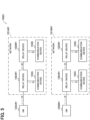
- FIG. 5 is a block diagram schematically illustrating the configuration of a communication system 100#1 according to a first comparative example for comparison with the communication system 100 according to the first embodiment.
- the communication system 100#1 includes a network 101A#1 and a network 101B#1.
- the network 101A#1 includes relay devices 102A#1 and 102B#1 and communication devices 103A and 103B.
- the relay device 102A#1 is connected to a GM 104A#1, and a clock-time synchronization frame for synchronizing clock time is sent from the GM 104A#1 to the relay device 102A#1.
- the network 101B#1 includes relay devices 102C#1 and 102D#1 and communication devices 103C and 103D.
- the relay device 102C#1 is connected to a GM 104B#1, and a clock-time synchronization frame for synchronizing clock time is sent from the GM 104B#1 to the relay device 102C#1.
- the communication system 100#1 according to the first comparative example is a simple full-duplex network configuration example consisting of three types of devices: GMs 104A#1 and 104B#1, relay devices 102A#1 to 102D#1, and communication devices 103A to 130D.
- each of the relay devices 102A#1 to 102D#1 can be implemented by, for example, a relay device having a clock-time synchronization function.
- the devices on the network 101A#1 are synchronized with the clock time delivered by the GM 104A#1, and the devices on the network 101B#1 are synchronized with the clock time delivered by the GM 104B#1.
- the network including the failed GM cannot provide normal service until the GM is replaced even if the devices other than the GM are operating normally because there is no means for synchronizing the clock time between the devices on the network.
- the service must be stopped in case of double failure, which is a state in which failure or malfunction occurs in an operating network including no failed GMs, before replacement of the failed GM.
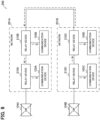
- FIG. 6 is a block diagram schematically illustrating the configuration of a communication system 100#2 according to a second comparative example for comparison with the communication system 100 according to the first embodiment.
- the communication system 100#2 includes a network 101A#2 and a network 101B#2.
- the network 101A#2 includes relay devices 102A#2 and 102B#2 and communication devices 103A and 103B.
- the relay device 102A#2 is connected to a GM 104A#2 and a GM 104B#2, and clock-time synchronization frames for synchronizing the clock time are sent from the GM 104A#2 and the GM104B#2 to the relay device 102A#2.
- the network 101B#2 includes relay devices 102C#2 and 102D#2 and communication devices 103C and 103D.
- the relay device 102C#2 is connected to the GM 104B#2 and the GM 104A#2, and clock-time synchronization frames for synchronizing the clock time are sent from the GM 104B#2 and the GM104A#2 to the relay device 102C#2.
- the GMs 104A#2 and 104B#2 each include two clock-time information distribution ports for sending clock-time synchronization frames.
- each of the relay devices 102A#2 to 102D#2 can be implemented by, for example, a relay device having a clock-time synchronization function.
- clock-time information can be distributed to both the networks 101A#2 and 101B#2.
- each of the communication devices 103A to 103D selects the GM having high priority (for example, 104A#2) by using the BMCA or the like and synchronizes the clock time with the clock time of the selected GM.
- the GM 104B#2 operating normally can distribute clock-time information to both the networks 101A#2 and 101B#2. Therefore, even in such a case, the service can be continuously provided on both networks 101A#2 and 101B#2.
- the service can be continuously provided even in case of double failure, which is a state in which failure or malfunction occurs in an operating network 101A#2, 101B#2, before replacement of the failed GM 104A#2, except for when (a) both GMs fail or (b) communication failure (for example, failure of a relay device or failure of the communication path between relay devices) occurs in both networks. Therefore, it can be said that the configuration illustrated in FIG. 6 has higher fault tolerance than that of the configuration illustrated in FIG. 5 .
- the price of a GM increases in proportion to an increase in the number of ports capable of distributing clock-time information.
- FIG. 8 is a block diagram for describing a clock-time information distribution path when one GM 104A fails in the communication system 100 according to the first embodiment.
- the service can be continuously provided in both networks 101A and 101B even if one GM 104A fails because the clock-time information distributed by the GM 104B operating normally is distributed to both networks 101A and 101B via the wiring between the relay devices 110B and 110D.
- the service can be continuously provided even in case of double failure, which is a state in which failure or malfunction occurs in the operating network 101A, 101B, before replacement of the failed GM 104A.
- the communication system 100 can achieve availability equivalent to that of the communication system 100#2 illustrated in FIG. 6 by using the relay devices 110B and 110D having a filter function for transmitting only clock-time synchronization frames by using the GMs 104A and 104B each having one clock-time information distribution port, as in the communication system 100#1 illustrated in FIG. 5 .
- both networks 101A and 101B are connected by one wire
- the first embodiment is not limited to such an example.
- both networks 101A and 101B can be connected by two wires by also connecting the relay devices 110A and 110C.
- the communication system 100 proposes a clock-time synchronization method in which the GMs 104A and 104B have a redundant configuration and at least one GM can be expected to operate normally.
- the second embodiment proposes a clock-time synchronization method for a case in which the GMs 104A and 104B distributing clock-time information are absent due to failure or the like, and the operation must be continued during the period until the GMs 104A and 104B are replaced.
- a communication system 200 includes a network 201A and a network 201B.
- the network 201A includes relay devices 210A and 210B and communication devices 103A and 103B.
- the relay device 210A is connected to a GM 104A, and clock-time synchronization frames for synchronizing the clock time are sent from the GM 104A to the relay device 210A.
- the network 201B includes relay devices 210C and 210D and communication devices 103C and 103D.
- the relay device 210C is connected to a GM 104B, and clock-time synchronization frames for synchronizing the clock time are sent from the GM 104B to the relay device 210C.
- the network 201A and the network 201B constitute different segments also in second embodiment.
- the communication devices 103A to 103D and the GMs 104A and 104B of the communication system 200 according to the second embodiment are the same as the communication devices 103A to 103D and the GMs 104A and 104B, respectively, in the communication system 100 according to the first embodiment.
- relay devices 210A to 210D have the same configuration, hereinafter, any one of the relay devices 210A to 210D will be referred to as a relay device 210 when there is no need to distinguish between them.
- the relay device 210 includes a plurality of physical ports 111-1 to 111-N, a clock-time-information-relay-port setting unit 112, a layer-2 protocol processing unit 113, and a clock-time synchronization processing unit 214.
- the plurality of physical ports 111-1 to 111-N, the clock-time-information-relay-port setting unit 112, and the layer-2 protocol processing unit 113 in the relay device 210 according to the second embodiment are the same as the plurality of physical ports 111-1 to 111-N, the clock-time-information relay port setting unit 112, and the layer-2 protocol processing unit 113, respectively, in the relay device110 according to the first embodiment.
- the clock-time synchronization processing unit 214 generates clock-time synchronization frames indicating the clock time counted by the time counting unit 115 when a GM connected to any of the physical ports 111-1 to 111-N becomes absent.
- the clock-time synchronization frames generated by the clock-time synchronization processing unit 214 are also referred to as alternative clock-time synchronization frames.
- the clock-time synchronization processing unit 214 performs the same processing as the clock-time synchronization processing unit 114 according to the first embodiment and generates a clock-time synchronization frame based on the specification of the IEEE1588 PTP or IEEE802.1AS by using the clock time counted by the time counting unit 115 in place of the GMs 104A and 104B when the GMs 104A and 104B become absent and when the clock-time synchronization processing unit 214 is located in the nearest neighbor of the last operating GM.
- the clock-time synchronization processing unit 214 checks the number of relay stages between the relay device 210 and the last operating GM by using the index value "stepsRemoved" stored in the Priority Vector area in the Announce message included in the clock-time synchronization packet defined by the BMCA.
- the GMs 104A and 104B send clock-time synchronization control frames known as Announce frames in a given cycle; thereby, the clock-time synchronization processing unit 214 can determine that the GMs 104A and 104B are absent when the physical ports 111-1 to 111-N connected to the GM 104A or the GM 104B do not receive an Announce frame in a predetermined period. In other words, the clock-time synchronization processing unit 214 can determine that the GMs 104A and 104B are absent when a predetermined frame is not received in a predetermined period.
- the clock-time synchronization processing unit 114 determines the physical port to which the clock-time synchronization frame generated on the basis of the specification of the IEEE1588 PTP or IEEE802.1AS is to be output.
- clock-time synchronization frames are sent from all physical ports via the layer-2 protocol processing unit 113.
- the service when one GM 104A fails and the service is continuously provided on both networks 201A and 201B by clock-time information distributed by the GM 104B operating normally, for example, as illustrated in FIG. 8 , the service can be continuously provided on both networks 201A and 201B even if the GM 104B fails, as illustrated in FIG. 9 , by distributing clock-time information from the relay device 210C adjacent to the GM 104B, which was distributing clock-time information until most recently.
- the oscillator or vibrator serving as the clock source of the relay device 210 has accuracy lower than the clock-time accuracy of the GMs 104A and 104B, and there is variation in the clock deviation of each device, it is desirable to select the relay device 210 located in the nearest neighbor of the last operating GM as the relay device 210 for synchronizing the clock time.
- first alternative clock-time synchronization frames are also referred to as first alternative clock-time synchronization frames
- second alternative clock-time synchronization frames are also referred to as second alternative clock-time synchronization frames
- 100, 200 communication system 101, 201 network; 103 communication device; 104 GM; 110, 210 relay device; 111-1 to 111-N physical port; 112 clock-time-information-relay-port setting unit; 113 layer-2 protocol processing unit; 114, 214 clock-time synchronization processing unit; 115 time counting unit.
Landscapes
- Engineering & Computer Science (AREA)
- Computer Networks & Wireless Communication (AREA)
- Signal Processing (AREA)
- Small-Scale Networks (AREA)
- Synchronisation In Digital Transmission Systems (AREA)
- Data Exchanges In Wide-Area Networks (AREA)
Claims (8)
- Relaisvorrichtung (110), umfassend:eine Vielzahl von Anschlüssen (111), die zum Empfangen von Frames eingerichtet sind; undeine Übertragungsverarbeitungseinheit (113), die eingerichtet ist, einen an einem der Anschlüsse (111) empfangenen Frame an mindestens einen der Anschlüsse (111) zu übertragen,die Relaisvorrichtung, dadurch gekennzeichnet, dassdie Übertragungsverarbeitungseinheit (113) eine Filterfunktion zum Blockieren von anderen Frames als einem Istzeit-Synchronisationsframe während der Übertragung unter Einbeziehung des aus den Anschlüssen (111) ausgewählten Anschlusses (111) aufweist, wobei der Istzeit-Synchronisationsframe zum Synchronisieren der Istzeit verwendet wird.
- Relaisvorrichtung (110) nach Anspruch 1, wobei die Übertragungsverarbeitungseinheit (113) die Filterfunktion auf den von dem ausgewählten Anschluss (111) empfangenen Frame anwendet.
- Relaisvorrichtung (110) nach Anspruch 2, wobei die Übertragungsverarbeitungseinheit (113) einen ersten Frame verwirft, wenn der erste Frame nicht der Istzeit-Synchronisationsframe ist, wobei der erste Frame ein Frame ist, der von dem ausgewählten Anschluss (111) empfangen wurde.
- Relaisvorrichtung (110) nach Anspruch 2, wobei die Übertragungsverarbeitungseinheit (113) einen ersten Frame von einem der Anschlüsse (111) nicht überträgt, wenn der erste Frame nicht der Istzeit-Synchronisationsframe ist, wobei der erste Frame ein Frame ist, der von dem ausgewählten Anschluss (111) empfangen wird.
- Relaisvorrichtung (110) nach Anspruch 1, wobei die Übertragungsverarbeitungseinheit (113) die Filterfunktion auf den Frame anwendet, der von einem anderen Anschluss (111) als dem ausgewählten Anschluss (111) empfangen wird.
- Relaisvorrichtung (110) nach Anspruch 5, wobei die Übertragungsverarbeitungseinheit (113) einen zweiten Frame nicht an den ausgewählten Anschluss (111) überträgt, wenn der zweite Frame nicht der Istzeit-Synchronisationsframe ist, wobei der zweite Frame ein Frame ist, der von einem anderen Anschluss (111) als dem ausgewählten Anschluss (111) empfangen wurde.
- Relaisvorrichtung (110) nach Anspruch 5, wobei die Übertragungsverarbeitungseinheit (113) einen zweiten Frame an den ausgewählten Anschluss (111) überträgt, wenn der zweite Frame der Istzeit-Synchronisationsframe ist, wobei der zweite Frame ein Frame ist, der von einem anderen Anschluss (111) als dem ausgewählten Anschluss (111) empfangen wurde.
- Relaisvorrichtung (210) nach einem der Ansprüche 2 bis 7, ferner umfassend:eine Zeitzähleinheit (115), die zum Zählen der Istzeit eingerichtet ist; undeine Istzeit-Synchronisations-Verarbeitungseinheit (214), die eingerichtet ist, einen alternativen Istzeit-Synchronisationsframe zu erzeugen, der die von der Zeitzähleinheit (115) gezählte Istzeit angibt, wenn ein Istzeit-Verteilungsserver(104) mit dem ausgewählten Anschluss (111) verbunden ist und der ausgewählte Anschluss (111) keinen vorbestimmten Frame in einem vorbestimmten Zeitraum empfängt, wobei der Istzeit-Verteilungsserver (104) die Referenz-Istzeit zählt und den Istzeit-Synchronisationsframe sendet,wobei die Übertragungsverarbeitungseinheit (113) den alternativen Istzeit-Synchronisationsframe als den Istzeit-Synchronisationsframe von den Anschlüssen (111) außer dem ausgewählten Anschluss (111) sendet.
Applications Claiming Priority (2)
| Application Number | Priority Date | Filing Date | Title |
|---|---|---|---|
| JP2019224503A JP7304801B2 (ja) | 2019-12-12 | 2019-12-12 | 中継装置及び通信システム |
| PCT/JP2020/022691 WO2021117270A1 (ja) | 2019-12-12 | 2020-06-09 | 中継装置及び通信システム |
Publications (3)
| Publication Number | Publication Date |
|---|---|
| EP4057564A1 EP4057564A1 (de) | 2022-09-14 |
| EP4057564A4 EP4057564A4 (de) | 2022-12-28 |
| EP4057564B1 true EP4057564B1 (de) | 2023-11-01 |
Family
ID=76310953
Family Applications (1)
| Application Number | Title | Priority Date | Filing Date |
|---|---|---|---|
| EP20899811.2A Active EP4057564B1 (de) | 2019-12-12 | 2020-06-09 | Relaisvorrichtung und kommunikationssystem |
Country Status (5)
| Country | Link |
|---|---|
| US (1) | US11990990B2 (de) |
| EP (1) | EP4057564B1 (de) |
| JP (1) | JP7304801B2 (de) |
| CN (1) | CN114762286B (de) |
| WO (1) | WO2021117270A1 (de) |
Families Citing this family (3)
| Publication number | Priority date | Publication date | Assignee | Title |
|---|---|---|---|---|
| JP7472968B2 (ja) * | 2020-03-31 | 2024-04-23 | 日本電信電話株式会社 | 通信システム及び通信方法 |
| WO2024004014A1 (ja) | 2022-06-28 | 2024-01-04 | 三菱電機株式会社 | 中継装置、中継方法、中継プログラム及び時刻同期システム |
| WO2025158543A1 (ja) * | 2024-01-23 | 2025-07-31 | Ntt株式会社 | 中継装置 |
Family Cites Families (17)
| Publication number | Priority date | Publication date | Assignee | Title |
|---|---|---|---|---|
| JPS6045950B2 (ja) | 1982-10-27 | 1985-10-12 | 日本コロムビア株式会社 | 回転塗布機 |
| EP1553713A1 (de) * | 2004-01-09 | 2005-07-13 | Thomson Multimedia Broadband Belgium | Vorrichtung und Verfahren zur Zeitsynchronisierung und zugehörige Produkte |
| JP4418302B2 (ja) * | 2004-05-31 | 2010-02-17 | 独立行政法人科学技術振興機構 | 中継装置、パケットフィルタリング方法及びパケットフィルタリングプログラム |
| JP2006148774A (ja) * | 2004-11-24 | 2006-06-08 | Nippon Telegr & Teleph Corp <Ntt> | 同期装置 |
| JP5041815B2 (ja) | 2007-01-12 | 2012-10-03 | 株式会社日立製作所 | 通信装置および基地局システム |
| JP5080202B2 (ja) * | 2007-10-30 | 2012-11-21 | 独立行政法人情報通信研究機構 | 時刻同期処理システム、時刻情報配信装置、時刻同期処理装置、時刻情報配信プログラム、および時刻同期処理プログラム |
| JP2009239449A (ja) * | 2008-03-26 | 2009-10-15 | Nec Electronics Corp | 高精度同期型ネットワーク装置、ネットワークシステム及びフレーム転送方法 |
| JP5387349B2 (ja) * | 2009-11-11 | 2014-01-15 | 富士通株式会社 | 中継装置 |
| JP6045950B2 (ja) | 2013-03-18 | 2016-12-14 | 株式会社日立製作所 | 通信制御装置及び通信システム |
| US20160072604A1 (en) * | 2013-03-19 | 2016-03-10 | Telefonaktiebolaget L M Ericsson (Publ) | Providing packet synchronization in a virtual private network |
| US9998247B1 (en) * | 2014-12-30 | 2018-06-12 | Juniper Networks, Inc. | Controller-based network device timing synchronization |
| JP2017216563A (ja) | 2016-05-31 | 2017-12-07 | 日本電気株式会社 | 中継装置、制御方法、及び、通信システム |
| KR20180052854A (ko) * | 2016-11-11 | 2018-05-21 | 주식회사 뉴라텍 | 그룹 패킷 제어 방법 |
| JP2018121123A (ja) | 2017-01-23 | 2018-08-02 | 日本電気株式会社 | 時刻同期装置、システム、方法およびプログラム |
| US10887037B2 (en) * | 2018-05-17 | 2021-01-05 | Juniper Networks, Inc. | Symmetric path/link over LAG interface using LLDP for time synchronization between two nodes using PTP |
| JP6942247B2 (ja) | 2018-05-18 | 2021-09-29 | 三菱電機株式会社 | 中継装置及び通信システム |
| JP6847334B2 (ja) * | 2018-12-20 | 2021-03-24 | 三菱電機株式会社 | ネットワーク装置、ネットワークシステム、ネットワーク方法、およびネットワークプログラム |
-
2019
- 2019-12-12 JP JP2019224503A patent/JP7304801B2/ja active Active
-
2020
- 2020-06-09 WO PCT/JP2020/022691 patent/WO2021117270A1/ja not_active Ceased
- 2020-06-09 CN CN202080082123.8A patent/CN114762286B/zh active Active
- 2020-06-09 EP EP20899811.2A patent/EP4057564B1/de active Active
-
2022
- 2022-03-31 US US17/710,070 patent/US11990990B2/en active Active
Also Published As
| Publication number | Publication date |
|---|---|
| JP2021093681A (ja) | 2021-06-17 |
| WO2021117270A1 (ja) | 2021-06-17 |
| CN114762286A (zh) | 2022-07-15 |
| US20220224430A1 (en) | 2022-07-14 |
| CN114762286B (zh) | 2023-12-01 |
| US11990990B2 (en) | 2024-05-21 |
| JP7304801B2 (ja) | 2023-07-07 |
| EP4057564A4 (de) | 2022-12-28 |
| EP4057564A1 (de) | 2022-09-14 |
Similar Documents
| Publication | Publication Date | Title |
|---|---|---|
| US11990990B2 (en) | Relay device and communication system | |
| US5694542A (en) | Time-triggered communication control unit and communication method | |
| US9106523B2 (en) | Communication device and method of controlling the same | |
| US7346052B2 (en) | Process for implementation of a redundant switched full-duplex ethernet type communication network | |
| EP2209241A2 (de) | Vorrichtung und Verfahren zur cross channel data link (CCDL) | |
| US7505470B2 (en) | Clique aggregation in TDMA networks | |
| CN108847961B (zh) | 一种大规模、高并发的确定性网络系统 | |
| CN109560959B (zh) | 异构时间触发多网冗余传输方法 | |
| CN113422664B (zh) | 一种多时钟源高可靠时间同步方法 | |
| US8064347B2 (en) | System and method for redundant switched communications | |
| US11652663B1 (en) | Controller area network braided ring | |
| US11063681B2 (en) | Method for operating a communication network in a ring topology | |
| JP5060057B2 (ja) | 通信回線監視システム、中継装置、及び通信回線監視方法 | |
| US10880043B2 (en) | Method and computer system for establishing an interactive consistency property | |
| US20190215386A1 (en) | Low cost, high bandwidth redundant communication network | |
| US11777628B2 (en) | Hitless protection for packet based digitized clock distribution | |
| Driscoll et al. | Maximizing fault tolerance in a low-s WaP data network | |
| CN121359427A (zh) | 流监视方式、中继装置、网络系统、流监视方法、流监视程序以及监视终端 | |
| JP2021136644A (ja) | 音声交換制御装置及び音声交換システム | |
| JPS61187443A (ja) | ステ−シヨンの動作同期方法 | |
| JPH02179143A (ja) | 競合制御回路 |
Legal Events
| Date | Code | Title | Description |
|---|---|---|---|
| STAA | Information on the status of an ep patent application or granted ep patent |
Free format text: STATUS: THE INTERNATIONAL PUBLICATION HAS BEEN MADE |
|
| PUAI | Public reference made under article 153(3) epc to a published international application that has entered the european phase |
Free format text: ORIGINAL CODE: 0009012 |
|
| STAA | Information on the status of an ep patent application or granted ep patent |
Free format text: STATUS: REQUEST FOR EXAMINATION WAS MADE |
|
| 17P | Request for examination filed |
Effective date: 20220607 |
|
| AK | Designated contracting states |
Kind code of ref document: A1 Designated state(s): AL AT BE BG CH CY CZ DE DK EE ES FI FR GB GR HR HU IE IS IT LI LT LU LV MC MK MT NL NO PL PT RO RS SE SI SK SM TR |
|
| A4 | Supplementary search report drawn up and despatched |
Effective date: 20221125 |
|
| RIC1 | Information provided on ipc code assigned before grant |
Ipc: H04L 49/10 20220101ALI20221121BHEP Ipc: H04L 47/10 20220101ALI20221121BHEP Ipc: H04L 12/28 20060101ALI20221121BHEP Ipc: H04L 7/00 20060101AFI20221121BHEP |
|
| DAV | Request for validation of the european patent (deleted) | ||
| DAX | Request for extension of the european patent (deleted) | ||
| GRAP | Despatch of communication of intention to grant a patent |
Free format text: ORIGINAL CODE: EPIDOSNIGR1 |
|
| STAA | Information on the status of an ep patent application or granted ep patent |
Free format text: STATUS: GRANT OF PATENT IS INTENDED |
|
| INTG | Intention to grant announced |
Effective date: 20230531 |
|
| GRAS | Grant fee paid |
Free format text: ORIGINAL CODE: EPIDOSNIGR3 |
|
| GRAA | (expected) grant |
Free format text: ORIGINAL CODE: 0009210 |
|
| STAA | Information on the status of an ep patent application or granted ep patent |
Free format text: STATUS: THE PATENT HAS BEEN GRANTED |
|
| AK | Designated contracting states |
Kind code of ref document: B1 Designated state(s): AL AT BE BG CH CY CZ DE DK EE ES FI FR GB GR HR HU IE IS IT LI LT LU LV MC MK MT NL NO PL PT RO RS SE SI SK SM TR |
|
| REG | Reference to a national code |
Ref country code: GB Ref legal event code: FG4D |
|
| REG | Reference to a national code |
Ref country code: CH Ref legal event code: EP |
|
| REG | Reference to a national code |
Ref country code: DE Ref legal event code: R096 Ref document number: 602020020504 Country of ref document: DE |
|
| P01 | Opt-out of the competence of the unified patent court (upc) registered |
Effective date: 20231018 |
|
| REG | Reference to a national code |
Ref country code: IE Ref legal event code: FG4D |
|
| REG | Reference to a national code |
Ref country code: LT Ref legal event code: MG9D |
|
| REG | Reference to a national code |
Ref country code: NL Ref legal event code: MP Effective date: 20231101 |
|
| PG25 | Lapsed in a contracting state [announced via postgrant information from national office to epo] |
Ref country code: GR Free format text: LAPSE BECAUSE OF FAILURE TO SUBMIT A TRANSLATION OF THE DESCRIPTION OR TO PAY THE FEE WITHIN THE PRESCRIBED TIME-LIMIT Effective date: 20240202 |
|
| PG25 | Lapsed in a contracting state [announced via postgrant information from national office to epo] |
Ref country code: IS Free format text: LAPSE BECAUSE OF FAILURE TO SUBMIT A TRANSLATION OF THE DESCRIPTION OR TO PAY THE FEE WITHIN THE PRESCRIBED TIME-LIMIT Effective date: 20240301 |
|
| PG25 | Lapsed in a contracting state [announced via postgrant information from national office to epo] |
Ref country code: LT Free format text: LAPSE BECAUSE OF FAILURE TO SUBMIT A TRANSLATION OF THE DESCRIPTION OR TO PAY THE FEE WITHIN THE PRESCRIBED TIME-LIMIT Effective date: 20231101 |
|
| REG | Reference to a national code |
Ref country code: AT Ref legal event code: MK05 Ref document number: 1628468 Country of ref document: AT Kind code of ref document: T Effective date: 20231101 |
|
| PG25 | Lapsed in a contracting state [announced via postgrant information from national office to epo] |
Ref country code: NL Free format text: LAPSE BECAUSE OF FAILURE TO SUBMIT A TRANSLATION OF THE DESCRIPTION OR TO PAY THE FEE WITHIN THE PRESCRIBED TIME-LIMIT Effective date: 20231101 |
|
| PG25 | Lapsed in a contracting state [announced via postgrant information from national office to epo] |
Ref country code: AT Free format text: LAPSE BECAUSE OF FAILURE TO SUBMIT A TRANSLATION OF THE DESCRIPTION OR TO PAY THE FEE WITHIN THE PRESCRIBED TIME-LIMIT Effective date: 20231101 |
|
| PG25 | Lapsed in a contracting state [announced via postgrant information from national office to epo] |
Ref country code: ES Free format text: LAPSE BECAUSE OF FAILURE TO SUBMIT A TRANSLATION OF THE DESCRIPTION OR TO PAY THE FEE WITHIN THE PRESCRIBED TIME-LIMIT Effective date: 20231101 |
|
| PG25 | Lapsed in a contracting state [announced via postgrant information from national office to epo] |
Ref country code: NL Free format text: LAPSE BECAUSE OF FAILURE TO SUBMIT A TRANSLATION OF THE DESCRIPTION OR TO PAY THE FEE WITHIN THE PRESCRIBED TIME-LIMIT Effective date: 20231101 Ref country code: LT Free format text: LAPSE BECAUSE OF FAILURE TO SUBMIT A TRANSLATION OF THE DESCRIPTION OR TO PAY THE FEE WITHIN THE PRESCRIBED TIME-LIMIT Effective date: 20231101 Ref country code: IS Free format text: LAPSE BECAUSE OF FAILURE TO SUBMIT A TRANSLATION OF THE DESCRIPTION OR TO PAY THE FEE WITHIN THE PRESCRIBED TIME-LIMIT Effective date: 20240301 Ref country code: GR Free format text: LAPSE BECAUSE OF FAILURE TO SUBMIT A TRANSLATION OF THE DESCRIPTION OR TO PAY THE FEE WITHIN THE PRESCRIBED TIME-LIMIT Effective date: 20240202 Ref country code: ES Free format text: LAPSE BECAUSE OF FAILURE TO SUBMIT A TRANSLATION OF THE DESCRIPTION OR TO PAY THE FEE WITHIN THE PRESCRIBED TIME-LIMIT Effective date: 20231101 Ref country code: BG Free format text: LAPSE BECAUSE OF FAILURE TO SUBMIT A TRANSLATION OF THE DESCRIPTION OR TO PAY THE FEE WITHIN THE PRESCRIBED TIME-LIMIT Effective date: 20240201 Ref country code: AT Free format text: LAPSE BECAUSE OF FAILURE TO SUBMIT A TRANSLATION OF THE DESCRIPTION OR TO PAY THE FEE WITHIN THE PRESCRIBED TIME-LIMIT Effective date: 20231101 Ref country code: PT Free format text: LAPSE BECAUSE OF FAILURE TO SUBMIT A TRANSLATION OF THE DESCRIPTION OR TO PAY THE FEE WITHIN THE PRESCRIBED TIME-LIMIT Effective date: 20240301 |
|
| PG25 | Lapsed in a contracting state [announced via postgrant information from national office to epo] |
Ref country code: SE Free format text: LAPSE BECAUSE OF FAILURE TO SUBMIT A TRANSLATION OF THE DESCRIPTION OR TO PAY THE FEE WITHIN THE PRESCRIBED TIME-LIMIT Effective date: 20231101 Ref country code: RS Free format text: LAPSE BECAUSE OF FAILURE TO SUBMIT A TRANSLATION OF THE DESCRIPTION OR TO PAY THE FEE WITHIN THE PRESCRIBED TIME-LIMIT Effective date: 20231101 Ref country code: PL Free format text: LAPSE BECAUSE OF FAILURE TO SUBMIT A TRANSLATION OF THE DESCRIPTION OR TO PAY THE FEE WITHIN THE PRESCRIBED TIME-LIMIT Effective date: 20231101 Ref country code: NO Free format text: LAPSE BECAUSE OF FAILURE TO SUBMIT A TRANSLATION OF THE DESCRIPTION OR TO PAY THE FEE WITHIN THE PRESCRIBED TIME-LIMIT Effective date: 20240201 Ref country code: LV Free format text: LAPSE BECAUSE OF FAILURE TO SUBMIT A TRANSLATION OF THE DESCRIPTION OR TO PAY THE FEE WITHIN THE PRESCRIBED TIME-LIMIT Effective date: 20231101 Ref country code: HR Free format text: LAPSE BECAUSE OF FAILURE TO SUBMIT A TRANSLATION OF THE DESCRIPTION OR TO PAY THE FEE WITHIN THE PRESCRIBED TIME-LIMIT Effective date: 20231101 |
|
| PG25 | Lapsed in a contracting state [announced via postgrant information from national office to epo] |
Ref country code: DK Free format text: LAPSE BECAUSE OF FAILURE TO SUBMIT A TRANSLATION OF THE DESCRIPTION OR TO PAY THE FEE WITHIN THE PRESCRIBED TIME-LIMIT Effective date: 20231101 |
|
| PG25 | Lapsed in a contracting state [announced via postgrant information from national office to epo] |
Ref country code: CZ Free format text: LAPSE BECAUSE OF FAILURE TO SUBMIT A TRANSLATION OF THE DESCRIPTION OR TO PAY THE FEE WITHIN THE PRESCRIBED TIME-LIMIT Effective date: 20231101 |
|
| PG25 | Lapsed in a contracting state [announced via postgrant information from national office to epo] |
Ref country code: SK Free format text: LAPSE BECAUSE OF FAILURE TO SUBMIT A TRANSLATION OF THE DESCRIPTION OR TO PAY THE FEE WITHIN THE PRESCRIBED TIME-LIMIT Effective date: 20231101 |
|
| PG25 | Lapsed in a contracting state [announced via postgrant information from national office to epo] |
Ref country code: SM Free format text: LAPSE BECAUSE OF FAILURE TO SUBMIT A TRANSLATION OF THE DESCRIPTION OR TO PAY THE FEE WITHIN THE PRESCRIBED TIME-LIMIT Effective date: 20231101 Ref country code: SK Free format text: LAPSE BECAUSE OF FAILURE TO SUBMIT A TRANSLATION OF THE DESCRIPTION OR TO PAY THE FEE WITHIN THE PRESCRIBED TIME-LIMIT Effective date: 20231101 Ref country code: IT Free format text: LAPSE BECAUSE OF FAILURE TO SUBMIT A TRANSLATION OF THE DESCRIPTION OR TO PAY THE FEE WITHIN THE PRESCRIBED TIME-LIMIT Effective date: 20231101 Ref country code: EE Free format text: LAPSE BECAUSE OF FAILURE TO SUBMIT A TRANSLATION OF THE DESCRIPTION OR TO PAY THE FEE WITHIN THE PRESCRIBED TIME-LIMIT Effective date: 20231101 Ref country code: DK Free format text: LAPSE BECAUSE OF FAILURE TO SUBMIT A TRANSLATION OF THE DESCRIPTION OR TO PAY THE FEE WITHIN THE PRESCRIBED TIME-LIMIT Effective date: 20231101 Ref country code: CZ Free format text: LAPSE BECAUSE OF FAILURE TO SUBMIT A TRANSLATION OF THE DESCRIPTION OR TO PAY THE FEE WITHIN THE PRESCRIBED TIME-LIMIT Effective date: 20231101 |
|
| REG | Reference to a national code |
Ref country code: DE Ref legal event code: R097 Ref document number: 602020020504 Country of ref document: DE |
|
| PLBE | No opposition filed within time limit |
Free format text: ORIGINAL CODE: 0009261 |
|
| STAA | Information on the status of an ep patent application or granted ep patent |
Free format text: STATUS: NO OPPOSITION FILED WITHIN TIME LIMIT |
|
| 26N | No opposition filed |
Effective date: 20240802 |
|
| PG25 | Lapsed in a contracting state [announced via postgrant information from national office to epo] |
Ref country code: SI Free format text: LAPSE BECAUSE OF FAILURE TO SUBMIT A TRANSLATION OF THE DESCRIPTION OR TO PAY THE FEE WITHIN THE PRESCRIBED TIME-LIMIT Effective date: 20231101 |
|
| PG25 | Lapsed in a contracting state [announced via postgrant information from national office to epo] |
Ref country code: SI Free format text: LAPSE BECAUSE OF FAILURE TO SUBMIT A TRANSLATION OF THE DESCRIPTION OR TO PAY THE FEE WITHIN THE PRESCRIBED TIME-LIMIT Effective date: 20231101 |
|
| PG25 | Lapsed in a contracting state [announced via postgrant information from national office to epo] |
Ref country code: MC Free format text: LAPSE BECAUSE OF FAILURE TO SUBMIT A TRANSLATION OF THE DESCRIPTION OR TO PAY THE FEE WITHIN THE PRESCRIBED TIME-LIMIT Effective date: 20231101 |
|
| REG | Reference to a national code |
Ref country code: CH Ref legal event code: PL |
|
| PG25 | Lapsed in a contracting state [announced via postgrant information from national office to epo] |
Ref country code: LU Free format text: LAPSE BECAUSE OF NON-PAYMENT OF DUE FEES Effective date: 20240609 |
|
| GBPC | Gb: european patent ceased through non-payment of renewal fee |
Effective date: 20240609 |
|
| PG25 | Lapsed in a contracting state [announced via postgrant information from national office to epo] |
Ref country code: IE Free format text: LAPSE BECAUSE OF NON-PAYMENT OF DUE FEES Effective date: 20240609 |
|
| PG25 | Lapsed in a contracting state [announced via postgrant information from national office to epo] |
Ref country code: BE Free format text: LAPSE BECAUSE OF NON-PAYMENT OF DUE FEES Effective date: 20240630 Ref country code: CH Free format text: LAPSE BECAUSE OF NON-PAYMENT OF DUE FEES Effective date: 20240630 |
|
| PG25 | Lapsed in a contracting state [announced via postgrant information from national office to epo] |
Ref country code: GB Free format text: LAPSE BECAUSE OF NON-PAYMENT OF DUE FEES Effective date: 20240609 |
|
| REG | Reference to a national code |
Ref country code: BE Ref legal event code: MM Effective date: 20240630 |
|
| PGFP | Annual fee paid to national office [announced via postgrant information from national office to epo] |
Ref country code: DE Payment date: 20250429 Year of fee payment: 6 |
|
| PGFP | Annual fee paid to national office [announced via postgrant information from national office to epo] |
Ref country code: FR Payment date: 20250508 Year of fee payment: 6 |
|
| PG25 | Lapsed in a contracting state [announced via postgrant information from national office to epo] |
Ref country code: FI Free format text: LAPSE BECAUSE OF FAILURE TO SUBMIT A TRANSLATION OF THE DESCRIPTION OR TO PAY THE FEE WITHIN THE PRESCRIBED TIME-LIMIT Effective date: 20231101 |
|
| PG25 | Lapsed in a contracting state [announced via postgrant information from national office to epo] |
Ref country code: RO Free format text: LAPSE BECAUSE OF FAILURE TO SUBMIT A TRANSLATION OF THE DESCRIPTION OR TO PAY THE FEE WITHIN THE PRESCRIBED TIME-LIMIT Effective date: 20231101 |
|
| PG25 | Lapsed in a contracting state [announced via postgrant information from national office to epo] |
Ref country code: CY Free format text: LAPSE BECAUSE OF FAILURE TO SUBMIT A TRANSLATION OF THE DESCRIPTION OR TO PAY THE FEE WITHIN THE PRESCRIBED TIME-LIMIT; INVALID AB INITIO Effective date: 20200609 |