EP4055562B1 - Bildregistrierung auf der grundlage von schlüsselpunktabgleich - Google Patents
Bildregistrierung auf der grundlage von schlüsselpunktabgleich Download PDFInfo
- Publication number
- EP4055562B1 EP4055562B1 EP19797725.9A EP19797725A EP4055562B1 EP 4055562 B1 EP4055562 B1 EP 4055562B1 EP 19797725 A EP19797725 A EP 19797725A EP 4055562 B1 EP4055562 B1 EP 4055562B1
- Authority
- EP
- European Patent Office
- Prior art keywords
- objects
- key
- image
- points
- matching
- Prior art date
- Legal status (The legal status is an assumption and is not a legal conclusion. Google has not performed a legal analysis and makes no representation as to the accuracy of the status listed.)
- Active
Links
Images
Classifications
-
- G—PHYSICS
- G06—COMPUTING OR CALCULATING; COUNTING
- G06T—IMAGE DATA PROCESSING OR GENERATION, IN GENERAL
- G06T7/00—Image analysis
- G06T7/30—Determination of transform parameters for the alignment of images, i.e. image registration
- G06T7/33—Determination of transform parameters for the alignment of images, i.e. image registration using feature-based methods
- G06T7/337—Determination of transform parameters for the alignment of images, i.e. image registration using feature-based methods involving reference images or patches
-
- G—PHYSICS
- G06—COMPUTING OR CALCULATING; COUNTING
- G06T—IMAGE DATA PROCESSING OR GENERATION, IN GENERAL
- G06T7/00—Image analysis
- G06T7/30—Determination of transform parameters for the alignment of images, i.e. image registration
- G06T7/33—Determination of transform parameters for the alignment of images, i.e. image registration using feature-based methods
-
- G—PHYSICS
- G06—COMPUTING OR CALCULATING; COUNTING
- G06V—IMAGE OR VIDEO RECOGNITION OR UNDERSTANDING
- G06V10/00—Arrangements for image or video recognition or understanding
- G06V10/40—Extraction of image or video features
- G06V10/44—Local feature extraction by analysis of parts of the pattern, e.g. by detecting edges, contours, loops, corners, strokes or intersections; Connectivity analysis, e.g. of connected components
- G06V10/443—Local feature extraction by analysis of parts of the pattern, e.g. by detecting edges, contours, loops, corners, strokes or intersections; Connectivity analysis, e.g. of connected components by matching or filtering
Definitions
- Embodiments presented herein relate to a method, an image registration entity, a computer program, and a computer readable storage medium for image registration.
- Image registration might generally involve transforming different sets of data into one coordinate system.
- the sets of data might comprise multiple images as captured from different sensors, at different times, depths, or viewpoints.
- Image registration might be used in application such as computer vision, medical imaging, military automatic target recognition, compiling and analyzing images and data from satellites, super resolution applications, creating a panoramic view of a scene, creating a three-dimensional (3D) model of the scene, etc.
- One example of a scheme used for image registration is based on matching key-points across the images.
- Sets of key-points and their descriptors are extracted from each image.
- the descriptors can used to establish correspondence between of key-points across pairs of images, and in turn be used to establish the geometric transform.
- these aspects provide efficient image registration.
- the embodiments disclosed herein relate to mechanisms for image registration.
- an image registration entity a method performed by the image registration entity and a computer program, that when run on an image registration entity, causes the image registration entity to perform the method.
- At least some of the herein disclosed embodiments are based on using the knowledge from having performed object detection when matching key-points between different images to enable more efficient image registration. As will be further disclosed below, this might be realized by splitting the total set of key-points of each image into subsets based on their correspondence to the image areas under detected objects.
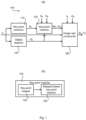
- Fig. 1(a) is a schematic diagram illustrating an image registration entity 100 where embodiments presented herein can be applied. Without loss of generality, the image registration entity 100 illustrates how a current image I c is processed. It is assumed that a previous image I p has been processed in the same manner.
- the image registration entity 100 comprises a key-point extractor 110 configured to extract key-points K c from the current image I c .
- the descriptor of a given key-point could describe statistics, in terms of gradients, texture, etc., in a surrounding of the given key-point.
- the image registration entity 100 comprises an image representation constructor 160 configured to, from the matching key-points ⁇ K p , K c ⁇ as found by the key-point matcher 130, the current image I p , the previous image I p , the objects O c from the current image I c , and the objects O p from the previous image I p , construct an image representation ⁇ I p , I c ⁇ of the current image I p and the previous image I p .
- Fig. 1(b) in more detail illustrates the key-point matcher 130.
- the key-point matcher 130 comprises a key-point mapper 140 configured to map key-points to objects (i.e., key-points K c are mapped to objects O c in image I c ).
- the key-point matcher 130 comprises a mapped based key-point matcher 150 configured to match key-points K c to key-points K p based on which key-points are mapped to which objects, for both images I c and I p .
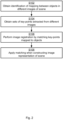
- Fig. 2 is a flowchart illustrating embodiments of methods for image registration. The methods are performed by the image registration entity 100. The methods are advantageously provided as computer programs 620.
- the image registration entity 100 obtains a matching between a first set of objects 320P, 330P, 340P, 350P in a first image 310P of a scene and a second set of objects 320C, 330C, 340C, 350C in a second image 310C of the scene.
- the first set of objects 320P, 330P, 340P, 350P and the second set of objects 320C, 330C, 340C, 350C are extracted using visual object detection in the first image 310P and in the second image 310C, respectively.
- Each of the first image and the second image comprises respective sets of key-points.
- the image registration entity 100 obtains a first set of key-points as extracted from the first image 310P and a second set of key-points as extracted from the second image 310C.
- the image registration entity 100 performs image registration. Image registration is performed by the image registration entity 100 matching the first set of key-points to the second set of key-points. Those of the first set of key-points that are mapped to objects in the first set of objects 320P, 330P, 340P, 350P and that have matching objects in the second set of objects 320C, 330C, 340C, 350C are restricted to only be matched to those of the second set of key-points that are mapped to any of the matching objects in the second set of objects 320C, 330C, 340C, 350C.
- the first set of key-points and the second set of key-points could each be regarded as being divided in subsets, where each subset of key-points corresponds to an individual object in one of the images.
- the matching in S106 then is performed individually for each subset in the first image, where the key-points in a subset corresponding to a given object in the first image are matched to the key-points in the subset corresponding to the object in the second image being mapped to the given object in the first image.
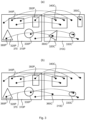
- Fig. 3(a) schematically illustrates a first image 310P having a first set of objects 320P, 330P, 340P, 350P.
- Fig. 3(a) further schematically illustrates a second image 310C having a second set of objects 320C, 330C, 340C, 350C.
- 3(b) further schematically illustrates key-points (one of which is identified at reference numeral 360P) in the first image 310P and key-points (one of which is identified at reference numeral 360C) in the second image, and matching (in terms of directed arrows, one of which is identified at reference numeral 370) between the key-points in the first image 310P and the key-points in the second image 310P.
- key-point 360P is mapped to object 320P
- that key-point 360C is mapped to object 320C
- object 320P is matched to object 320C
- key-point 360P is matched to key-point 360C, as indicated by arrow 370.
- the image registration entity 100 applies the matching between key-points resulting from the image registration when constructing an image representation of the scene.
- the matching is based on object class identifiers, or identities, denoted object class IDs. That is, each object might be associated with an object class ID. Then, in some embodiments, the first set of objects 320P, 330P, 340P, 350P are matched to the second set of objects 320C, 330C, 340C, 350C by object class ID matching.
- the matching between the first set of key-points and the second set of key-points might only be made between key-points mapped to objects of same object class ID.
- the matching is based on location of the objects in the first image and in the second image, respectively. Therefore, each object in the first set of objects 320P, 330P, 340P, 350P might be associated with a respective location in the first image 310P, and each object in the second set of objects 320C, 330C, 340C, 350C might be associated with a respective location in the second image 310C. Then, in some embodiments, the first set of objects 320P, 330P, 340P, 350P are matched to the second set of objects 320C, 330C, 340C, 350C by location matching.
- the location matching between an object in the first image and an object in the second image relates to the distance-wise difference between the location of the object in the first image and the location of the object in the second image; the lower the difference the higher the location matching is.
- the location matching is based on Jaccard index values computed between the objects in the first set of objects 320P, 330P, 340P, 350P and the objects in the second set of objects 320C, 330C, 340C, 350C. The higher the Jaccard index value is between an object in the first image and an object in the second image, the higher the chance is that these two objects are mapped to each other.
- the matching is based on descriptors of the key-points. That is, each key-point might have a descriptor, where each descriptor has a value. Then, in some embodiments, the matching between the first set of key-points and the second set of key-points only is made between key-points having as similar descriptor values as possible.
- the key-point descriptors are to characterize the image area in the vicinity of the key-points.
- the descriptor D of a key-point is typically provided as a scalar or a finite vector, which summarizes the properties of that key-point.
- the speeded up robust features (SURF) descriptor is a 64-dimensional vector of floating-point values based on the sum of the Haar wavelet response around the particular key-point.
- the scale-invariant feature transform (SIFT) descriptor is a 128-dimensional vector calculated by aggregation histograms of gradient magnitude around the key-point.
- the key-points that do not belong to any object in the first image are mapped to key-points belonging to the background (i.e., not to any object) in the second image.
- any of those of the first set of key-points that are not mapped to any object in the first set of objects 320P, 330P, 340P, 350P are restricted to only be matched to those of the second set of key-points that are not mapped to any of the matching objects in the second set of objects 320C, 330C, 340C, 350C.
- the key-points that belong to objects in the first image not having any matching objects in the second image are mapped to key-points belonging to the background (i.e., not to any object) in the second image.
- any of those of the first set of key-points that are mapped to objects in the first set of objects 320P, 330P, 340P, 350P that do not have any matching objects in the second set of objects 320C, 330C, 340C, 350C are restricted to only be matched to those of the second set of key-points that are not mapped to any of the matching objects in the second set of objects 320C, 330C, 340C, 350C.
- Fig. 3(b) schematically illustrates the same first image 310P and the same second image 310C as in Fig. 3(a) but with the difference that object 320C is no longer found in image 310C.
- Object 320P therefore does not have any matching object in image 310C, and key-point 360P of object 320P in image 310P is therefore matched to the background in image 310C.
- each object might be associated with a bounding box.
- each of the key-points is mapped to its object by being located within the bounding box of its object.
- each of the key-points mapped to that object in the first set of objects 320P, 330P, 340P, 350P is matched to a key-point mapped to either of these two or more objects in the second set of objects 320C, 330C, 340C, 350C. Additional conditions, such as descriptors, could then be applied to determine the matching.
- the image representation of the scene is a panoramic view comprising, or represented by, the first image 310P and the second image 310C.
- the image representation of the scene is a 3D model comprising, or represented by, the first image 310P and the second image 310C.
- image representation of the scene could be used in medical imaging (where multiple images of human organs or tumours have to be stitched, or in image super resolution applications, where a higher resolution two-dimensional (2D) scene from a set of low resolution 2D images is constructed.
- a method for image registration as performed by the image registration entity 100 comprises the following.
- Objects are matched, as in S102, between the images I P and I C for example using the class ID (type of the object), i.e., match C C and C P . If there are multiple objects of the same class, the Jaccard index based on B C and B P might be used to determine the matching.
- K C [ X C , D C ]
- K P [ X P , D P ]
- the herein disclosed embodiments are also applicable to images produced at the same time instant, but from different sources, e.g., from two different cameras. Further, the herein disclosed embodiments are also applicable beyond usage of single camera; stereo cameras, or additional sensors, could be also used, which includes depth cameras, thermal cameras, or equipment for active scanning, such as laser or lidar.
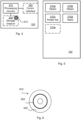
- Fig. 4 schematically illustrates, in terms of a number of functional units, the components of an image registration entity 100 according to an embodiment.
- Processing circuitry 210 is provided using any combination of one or more of a suitable central processing unit (CPU), multiprocessor, microcontroller, digital signal processor (DSP), etc., capable of executing software instructions stored in a computer program product 610 (as in Fig. 6 ), e.g. in the form of a storage medium 230.
- the processing circuitry 210 may further be provided as at least one application specific integrated circuit (ASIC), or field programmable gate array (FPGA).
- ASIC application specific integrated circuit
- FPGA field programmable gate array
- each functional module 210a-210e may in one embodiment be implemented only in hardware and in another embodiment with the help of software, i.e., the latter embodiment having computer program instructions stored on the storage medium 230 which when run on the processing circuitry makes the image registration entity 100 perform the corresponding steps mentioned above in conjunction with Fig 5 .
- the modules correspond to parts of a computer program, they do not need to be separate modules therein, but the way in which they are implemented in software is dependent on the programming language used.
- one or more or all functional modules 210a-210e may be implemented by the processing circuitry 210, possibly in cooperation with the communications interface 220 and/or the storage medium 230.
- the processing circuitry 210 may thus be configured to from the storage medium 230 fetch instructions as provided by a functional module 210a-210e and to execute these instructions, thereby performing any steps as disclosed herein.
- the image registration entity 100 might be integrated with, be part of, or collocated with, an image processing device, such as a graphics processing unit (GPU), a visual processing unit (VPU) or a tensor processing unit (TPU), and/or be provided in any of: a video card, a mother board, an embedded system, a mobile phone, a vehicle, a personal computer, a workstation, or a game console.
- an image processing device such as a graphics processing unit (GPU), a visual processing unit (VPU) or a tensor processing unit (TPU)
- a first portion of the instructions performed by the image registration entity 100 may be executed in a first device, and a second portion of the of the instructions performed by the image registration entity 100 may be executed in a second device; the herein disclosed embodiments are not limited to any particular number of devices on which the instructions performed by the image registration entity 100 may be executed.
- the methods according to the herein disclosed embodiments are suitable to be performed by an image registration entity 100 residing in a cloud computational environment. Therefore, although a single processing circuitry 210 is illustrated in Fig. 4 the processing circuitry 210 may be distributed among a plurality of devices, or nodes. The same applies to the functional modules 210a-210e of Fig. 5 and the computer program 620 of Fig. 6 .
- Fig. 6 shows one example of a computer program product 610 comprising computer readable storage medium 630.
- a computer program 620 can be stored, which computer program 620 can cause the processing circuitry 210 and thereto operatively coupled entities and devices, such as the communications interface 220 and the storage medium 230, to execute methods according to embodiments described herein.
- the computer program 620 and/or computer program product 610 may thus provide means for performing any steps as herein disclosed.
Landscapes
- Engineering & Computer Science (AREA)
- Computer Vision & Pattern Recognition (AREA)
- Physics & Mathematics (AREA)
- General Physics & Mathematics (AREA)
- Theoretical Computer Science (AREA)
- Multimedia (AREA)
- Image Analysis (AREA)
Claims (15)
- Computerimplementiertes Verfahren zur Bildregistrierung, wobei das Verfahren durch eine Bildregistrierungseinheit (100) durchgeführt wird, wobei das Verfahren Folgendes umfasst:Erhalten (S102) eines Abgleichs zwischen einem ersten Satz von Objekten (320P, 330P, 340P, 350P) in einem ersten Bild (310P) einer Szene und einem zweiten Satz von Objekten (320C, 330C, 340C, 350C) in einem zweiten Bild (310C) der Szene, wobei der erste Satz von Objekten (320P, 330P, 340P, 350P) und der zweite Satz von Objekten (320C, 330C, 340C, 350C) unter Verwendung visueller Objekterkennung in dem ersten Bild (310P) bzw. in dem zweiten Bild (310C) extrahiert werden;Erhalten (S104) eines ersten Satzes von Schlüsselpunkten, wie sie aus dem ersten Bild (310P) extrahiert wurden, und eines zweiten Satzes von Schlüsselpunkten, wie sie aus dem zweiten Bild (310C) extrahiert wurden;Durchführen (S106) einer Bildregistrierung durch den Abgleich des ersten Satzes von Schlüsselpunkten mit dem zweiten Satz von Schlüsselpunkten, wobei diejenigen des ersten Satzes von Schlüsselpunkten, die Objekten in dem ersten Satz von Objekten (320P, 330P, 340P, 350P) zugeordnet sind und die übereinstimmende Objekte in dem zweiten Satz von Objekten (320C, 330C, 340C, 350C) aufweisen, darauf beschränkt sind, nur mit denjenigen des zweiten Satzes von Schlüsselpunkten abgeglichen zu werden, die einem der übereinstimmenden Objekte in dem zweiten Satz von Objekten (320C, 330C, 340C, 350C) zugeordnet sind, und alle diejenigen des ersten Satzes von Schlüsselpunkten, die keinem Objekt in dem ersten Satz von Objekten (320P, 330P, 340P, 350P) zugeordnet sind, darauf beschränkt sind, nur mit denjenigen des zweiten Satzes von Schlüsselpunkten abgeglichen zu werden, die keinem der übereinstimmenden Objekte in dem zweiten Satz von Objekten (320C, 330C, 340C, 350C) zugeordnet sind; undAnwenden (S108) des Abgleichs zwischen Schlüsselpunkten, die sich aus der Bildregistrierung ergeben, wenn eine Bilddarstellung der Szene erstellt wird.
- Verfahren nach Anspruch 1, wobei jedes Objekt mit einer Objektklassen-ID assoziiert ist und wobei der erste Satz von Objekten (320P, 330P, 340P, 350P) mit dem zweiten Satz von Objekten (320C, 330C, 340C, 350C) durch einen Abgleich der Objektklassen-ID abgeglichen wird.
- Verfahren nach Anspruch 2, wobei ein Abgleich zwischen dem ersten Satz von Schlüsselpunkten und dem zweiten Satz von Schlüsselpunkten nur zwischen Schlüsselpunkten erfolgt, die Objekten der gleichen Objektklassen-ID zugeordnet sind.
- Verfahren nach einem der vorhergehenden Ansprüche, wobei jedes Objekt in dem ersten Satz von Objekten (320P, 330P, 340P, 350P) mit einem jeweiligen Ort in dem ersten Bild (310P) assoziiert ist, wobei jedes Objekt in dem zweiten Satz von Objekten (320C, 330C, 340C, 350C) mit einem jeweiligen Ort in dem zweiten Bild (310C) assoziiert ist und wobei der erste Satz von Objekten (320P, 330P, 340P, 350P) mit dem zweiten Satz von Objekten (320C, 330C, 340C, 350C) durch einen Ortsabgleich abgeglichen wird.
- Verfahren nach Anspruch 4, wobei der Ortsabgleich auf Jaccard-Indexwerten basiert, die zwischen den Objekten in dem ersten Satz von Objekten (320P, 330P, 340P, 350P) und den Objekten in dem zweiten Satz von Objekten (320C, 330C, 340C, 350C) berechnet werden.
- Verfahren nach einem der vorhergehenden Ansprüche, wobei jeder Schlüsselpunkt einen Deskriptor aufweist, wobei jeder Deskriptor einen Deskriptorwert aufweist und wobei ein Abgleich zwischen dem ersten Satz von Schlüsselpunkten und dem zweiten Satz von Schlüsselpunkten nur zwischen Schlüsselpunkten erfolgt, die möglichst ähnliche Deskriptorwerte aufweisen.
- Verfahren nach einem der vorhergehenden Ansprüche, wobei alle diejenigen des ersten Satzes von Schlüsselpunkten, die Objekten in dem ersten Satz von Objekten (320P, 330P, 340P, 350P) zugeordnet sind, die keine übereinstimmenden Objekte in dem zweiten Satz von Objekten (320C, 330C, 340C, 350C) aufweisen, darauf beschränkt sind, nur mit denjenigen des zweiten Satzes von Schlüsselpunkten abgeglichen zu werden, die keinem der übereinstimmenden Objekte in dem zweiten Satz von Objekten (320C, 330C, 340C, 350C) zugeordnet sind.
- Verfahren nach einem der vorhergehenden Ansprüche, wobei jedes Objekt mit einem Begrenzungsrahmen assoziiert ist und wobei jeder der Schlüsselpunkte seinem Objekt zugeordnet wird, indem er sich innerhalb des Begrenzungsrahmens seines Objekts befindet.
- Verfahren nach einem der vorhergehenden Ansprüche, wobei, wenn ein Objekt in dem ersten Satz von Objekten (320P, 330P, 340P, 350P) mit zwei oder mehr Objekten in dem zweiten Satz von Objekten (320C, 330C, 340C, 350C) abgeglichen wird, jeder der Schlüsselpunkte, die dem Objekt in dem ersten Satz von Objekten (320P, 330P, 340P, 350P) zugeordnet sind, mit einem Schlüsselpunkt abgeglichen wird, der einem der zwei oder mehr Objekte in dem zweiten Satz von Objekten (320C, 330C, 340C, 350C) zugeordnet ist.
- Verfahren nach einem der vorhergehenden Ansprüche, wobei es sich bei der Bilddarstellung der Szene um eine Panoramaansicht handelt, die das erste Bild (310P) und das zweite Bild (310C) umfasst oder durch diese dargestellt wird.
- Verfahren nach einem der vorhergehenden Ansprüche, wobei es sich bei der Bilddarstellung der Szene um ein 3D-Modell handelt, welches das erste Bild (310P) und das zweite Bild (310C) umfasst oder durch diese dargestellt wird.
- Bildregistrierungseinheit (100) zur Bildregistrierung, wobei die Bildregistrierungseinheit (100) eine Verarbeitungsschaltung (210) umfasst, wobei die Verarbeitungsschaltung dazu konfiguriert ist, die Bildregistrierungseinheit (100) zu Folgendem zu veranlassen:Erhalten eines Abgleichs zwischen einem ersten Satz von Objekten (320P, 330P, 340P, 350P) in einem ersten Bild (310P) einer Szene und einem zweiten Satz von Objekten (320C, 330C, 340C, 350C) in einem zweiten Bild (310C) der Szene, wobei der erste Satz von Objekten (320P, 330P, 340P, 350P) und der zweite Satz von Objekten (320C, 330C, 340C, 350C) unter Verwendung visueller Objekterkennung in dem ersten Bild (310P) bzw. in dem zweiten Bild (310C) extrahiert werden;Erhalten eines ersten Satzes von Schlüsselpunkten, wie sie aus dem ersten Bild (310P) extrahiert wurden, und eines zweiten Satzes von Schlüsselpunkten, wie sie aus dem zweiten Bild (310C) extrahiert wurden;Durchführen einer Bildregistrierung durch den Abgleich des ersten Satzes von Schlüsselpunkten mit dem zweiten Satz von Schlüsselpunkten, wobei diejenigen des ersten Satzes von Schlüsselpunkten, die Objekten in dem ersten Satz von Objekten (320P, 330P, 340P, 350P) zugeordnet sind und die übereinstimmende Objekte in dem zweiten Satz von Objekten (320C, 330C, 340C, 350C) aufweisen, darauf beschränkt sind, nur mit denjenigen des zweiten Satzes von Schlüsselpunkten abgeglichen zu werden, die einem der übereinstimmenden Objekte in dem zweiten Satz von Objekten (320C, 330C, 340C, 350C) zugeordnet sind, und alle diejenigen des ersten Satzes von Schlüsselpunkten, die keinem Objekt in dem ersten Satz von Objekten (320P, 330P, 340P, 350P) zugeordnet sind, darauf beschränkt sind, nur mit denjenigen des zweiten Satzes von Schlüsselpunkten abgeglichen zu werden, die keinem der übereinstimmenden Objekte in dem zweiten Satz von Objekten (320C, 330C, 340C, 350C) zugeordnet sind; undAnwenden des Abgleichs zwischen Schlüsselpunkten, die sich aus der Bildregistrierung ergeben, wenn eine Bilddarstellung der Szene erstellt wird.
- Bildregistrierungseinheit (100) nach Anspruch 12, wobei die Verarbeitungsschaltung ferner dazu konfiguriert ist, die Bildregistrierungseinheit (100) dazu zu veranlassen, das Verfahren nach einem der Ansprüche 2 bis 11 durchzuführen.
- Computerprogramm (620) zur Bildregistrierung, wobei das Computerprogramm einen Computercode umfasst, der, wenn er auf einer Verarbeitungsschaltung (210) einer Bildregistrierungseinheit (100) ausgeführt wird, die Bildregistrierungseinheit (100) zu Folgendem veranlasst:Erhalten (S102) eines Abgleichs zwischen einem ersten Satz von Objekten (320P, 330P, 340P, 350P) in einem ersten Bild (310P) einer Szene und einem zweiten Satz von Objekten (320C, 330C, 340C, 350C) in einem zweiten Bild (310C) der Szene, wobei der erste Satz von Objekten (320P, 330P, 340P, 350P) und der zweite Satz von Objekten (320C, 330C, 340C, 350C) unter Verwendung visueller Objekterkennung in dem ersten Bild (310P) bzw. in dem zweiten Bild (310C) extrahiert werden;Erhalten (S104) eines ersten Satzes von Schlüsselpunkten, wie sie aus dem ersten Bild (310P) extrahiert wurden, und eines zweiten Satzes von Schlüsselpunkten, wie sie aus dem zweiten Bild (310C) extrahiert wurden;Durchführen (S106) einer Bildregistrierung durch den Abgleich des ersten Satzes von Schlüsselpunkten mit dem zweiten Satz von Schlüsselpunkten, wobei diejenigen des ersten Satzes von Schlüsselpunkten, die Objekten in dem ersten Satz von Objekten (320P, 330P, 340P, 350P) zugeordnet sind und die übereinstimmende Objekte in dem zweiten Satz von Objekten (320C, 330C, 340C, 350C) aufweisen, darauf beschränkt sind, nur mit denjenigen des zweiten Satzes von Schlüsselpunkten abgeglichen zu werden, die einem der übereinstimmenden Objekte in dem zweiten Satz von Objekten (320C, 330C, 340C, 350C) zugeordnet sind, und alle diejenigen des ersten Satzes von Schlüsselpunkten, die keinem Objekt in dem ersten Satz von Objekten (320P, 330P, 340P, 350P) zugeordnet sind, darauf beschränkt sind, nur mit denjenigen des zweiten Satzes von Schlüsselpunkten abgeglichen zu werden, die keinem der übereinstimmenden Objekte in dem zweiten Satz von Objekten (320C, 330C, 340C, 350C) zugeordnet sind; undAnwenden (S108) des Abgleichs zwischen Schlüsselpunkten, die sich aus der Bildregistrierung ergeben, wenn eine Bilddarstellung der Szene erstellt wird.
- Computerlesbares Speichermedium (630), auf dem das Computerprogramm (620) nach Anspruch 14 gespeichert ist.
Applications Claiming Priority (1)
| Application Number | Priority Date | Filing Date | Title |
|---|---|---|---|
| PCT/EP2019/080028 WO2021089107A1 (en) | 2019-11-04 | 2019-11-04 | Image registration based on key-point matching |
Publications (2)
| Publication Number | Publication Date |
|---|---|
| EP4055562A1 EP4055562A1 (de) | 2022-09-14 |
| EP4055562B1 true EP4055562B1 (de) | 2025-03-19 |
Family
ID=68426514
Family Applications (1)
| Application Number | Title | Priority Date | Filing Date |
|---|---|---|---|
| EP19797725.9A Active EP4055562B1 (de) | 2019-11-04 | 2019-11-04 | Bildregistrierung auf der grundlage von schlüsselpunktabgleich |
Country Status (3)
| Country | Link |
|---|---|
| US (1) | US12450759B2 (de) |
| EP (1) | EP4055562B1 (de) |
| WO (1) | WO2021089107A1 (de) |
Families Citing this family (1)
| Publication number | Priority date | Publication date | Assignee | Title |
|---|---|---|---|---|
| CN116051873B (zh) * | 2023-02-03 | 2026-06-09 | 爱芯元智半导体股份有限公司 | 关键点匹配方法、装置及电子设备 |
Family Cites Families (5)
| Publication number | Priority date | Publication date | Assignee | Title |
|---|---|---|---|---|
| US20100092093A1 (en) * | 2007-02-13 | 2010-04-15 | Olympus Corporation | Feature matching method |
| CN101903885A (zh) * | 2007-12-18 | 2010-12-01 | 皇家飞利浦电子股份有限公司 | 基于一致性度量的图像配准 |
| WO2014178234A1 (ja) * | 2013-04-30 | 2014-11-06 | ソニー株式会社 | 画像処理装置、画像処理方法、及びプログラム |
| US9911213B2 (en) * | 2015-12-18 | 2018-03-06 | Ricoh Co., Ltd. | Panoramic image stitching using objects |
| CN106361366B (zh) * | 2016-11-02 | 2019-05-03 | 上海联影医疗科技有限公司 | 多模态图像配准方法及系统 |
-
2019
- 2019-11-04 EP EP19797725.9A patent/EP4055562B1/de active Active
- 2019-11-04 US US17/774,161 patent/US12450759B2/en active Active
- 2019-11-04 WO PCT/EP2019/080028 patent/WO2021089107A1/en not_active Ceased
Also Published As
| Publication number | Publication date |
|---|---|
| WO2021089107A1 (en) | 2021-05-14 |
| US20220366580A1 (en) | 2022-11-17 |
| US12450759B2 (en) | 2025-10-21 |
| EP4055562A1 (de) | 2022-09-14 |
Similar Documents
| Publication | Publication Date | Title |
|---|---|---|
| US8942418B2 (en) | Method of providing a descriptor for at least one feature of an image and method of matching features | |
| Wu et al. | Real-time human detection using contour cues | |
| US9875545B2 (en) | Camera pose estimation apparatus and method | |
| EP3296958B1 (de) | Detektion der veränderung in einer dreidimensionalen ansicht | |
| KR20230049969A (ko) | 글로벌 측위 장치 및 방법 | |
| US20120033873A1 (en) | Method and device for determining a shape match in three dimensions | |
| Zhang et al. | Data association between event streams and intensity frames under diverse baselines | |
| García et al. | Saliency-based object discovery on RGB-D data with a late-fusion approach | |
| US12450759B2 (en) | Image registration based on key-point matching | |
| US12322123B2 (en) | Visual object detection in a sequence of images | |
| Martínez et al. | Object recognition for manipulation tasks in real domestic settings: A comparative study | |
| Aragon-Camarasa et al. | Unsupervised clustering in Hough space for recognition of multiple instances of the same object in a cluttered scene | |
| Sallam Fatouh et al. | Image-based localization for augmented reality application: a review | |
| Matusiak et al. | Depth-based descriptor for matching keypoints in 3D scenes | |
| Karpushin et al. | TRISK: A local features extraction framework for texture-plus-depth content matching | |
| KR102269088B1 (ko) | 동공 추적 장치 및 방법 | |
| Palmer et al. | Intensity and range image based features for object detection in mobile mapping data | |
| Resch et al. | Local image feature matching improvements for omnidirectional camera systems | |
| KR20260041454A (ko) | 깊이 정보 추정 장치 및 방법 | |
| Przewodowski Filho et al. | Co-occurrence matrices for 3D shape classification | |
| Klimentjew et al. | Towards scene analysis based on multi-sensor fusion, active perception and mixed reality in mobile robotics | |
| Junior et al. | Linear-time computation of indexing based stereo correspondence for cameras with automatic gain control | |
| Strumiłło et al. | Depth-based Descriptor for Matching Keypoints in 3D Scenes | |
| CN117726691A (zh) | 双目相机标定方法、装置、飞行器以及存储介质 | |
| Alami et al. | Vanishing Point Detection Under Foggy Weather with Edge-Based Approach |
Legal Events
| Date | Code | Title | Description |
|---|---|---|---|
| STAA | Information on the status of an ep patent application or granted ep patent |
Free format text: STATUS: UNKNOWN |
|
| STAA | Information on the status of an ep patent application or granted ep patent |
Free format text: STATUS: THE INTERNATIONAL PUBLICATION HAS BEEN MADE |
|
| PUAI | Public reference made under article 153(3) epc to a published international application that has entered the european phase |
Free format text: ORIGINAL CODE: 0009012 |
|
| STAA | Information on the status of an ep patent application or granted ep patent |
Free format text: STATUS: REQUEST FOR EXAMINATION WAS MADE |
|
| 17P | Request for examination filed |
Effective date: 20220504 |
|
| AK | Designated contracting states |
Kind code of ref document: A1 Designated state(s): AL AT BE BG CH CY CZ DE DK EE ES FI FR GB GR HR HU IE IS IT LI LT LU LV MC MK MT NL NO PL PT RO RS SE SI SK SM TR |
|
| DAV | Request for validation of the european patent (deleted) | ||
| DAX | Request for extension of the european patent (deleted) | ||
| GRAP | Despatch of communication of intention to grant a patent |
Free format text: ORIGINAL CODE: EPIDOSNIGR1 |
|
| STAA | Information on the status of an ep patent application or granted ep patent |
Free format text: STATUS: GRANT OF PATENT IS INTENDED |
|
| GRAS | Grant fee paid |
Free format text: ORIGINAL CODE: EPIDOSNIGR3 |
|
| INTG | Intention to grant announced |
Effective date: 20250114 |
|
| RIN1 | Information on inventor provided before grant (corrected) |
Inventor name: SVERRISSON, SIGURDUR Inventor name: FANGHELLA, ALFREDO Inventor name: SONAL, MANISH Inventor name: GRANCHAROV, VOLODYA |
|
| GRAA | (expected) grant |
Free format text: ORIGINAL CODE: 0009210 |
|
| STAA | Information on the status of an ep patent application or granted ep patent |
Free format text: STATUS: THE PATENT HAS BEEN GRANTED |
|
| AK | Designated contracting states |
Kind code of ref document: B1 Designated state(s): AL AT BE BG CH CY CZ DE DK EE ES FI FR GB GR HR HU IE IS IT LI LT LU LV MC MK MT NL NO PL PT RO RS SE SI SK SM TR |
|
| REG | Reference to a national code |
Ref country code: GB Ref legal event code: FG4D |
|
| REG | Reference to a national code |
Ref country code: CH Ref legal event code: EP |
|
| REG | Reference to a national code |
Ref country code: IE Ref legal event code: FG4D |
|
| REG | Reference to a national code |
Ref country code: DE Ref legal event code: R096 Ref document number: 602019067524 Country of ref document: DE |
|
| PG25 | Lapsed in a contracting state [announced via postgrant information from national office to epo] |
Ref country code: RS Free format text: LAPSE BECAUSE OF FAILURE TO SUBMIT A TRANSLATION OF THE DESCRIPTION OR TO PAY THE FEE WITHIN THE PRESCRIBED TIME-LIMIT Effective date: 20250619 |
|
| PG25 | Lapsed in a contracting state [announced via postgrant information from national office to epo] |
Ref country code: FI Free format text: LAPSE BECAUSE OF FAILURE TO SUBMIT A TRANSLATION OF THE DESCRIPTION OR TO PAY THE FEE WITHIN THE PRESCRIBED TIME-LIMIT Effective date: 20250319 |
|
| REG | Reference to a national code |
Ref country code: LT Ref legal event code: MG9D |
|
| PG25 | Lapsed in a contracting state [announced via postgrant information from national office to epo] |
Ref country code: NO Free format text: LAPSE BECAUSE OF FAILURE TO SUBMIT A TRANSLATION OF THE DESCRIPTION OR TO PAY THE FEE WITHIN THE PRESCRIBED TIME-LIMIT Effective date: 20250619 |
|
| PG25 | Lapsed in a contracting state [announced via postgrant information from national office to epo] |
Ref country code: HR Free format text: LAPSE BECAUSE OF FAILURE TO SUBMIT A TRANSLATION OF THE DESCRIPTION OR TO PAY THE FEE WITHIN THE PRESCRIBED TIME-LIMIT Effective date: 20250319 |
|
| PG25 | Lapsed in a contracting state [announced via postgrant information from national office to epo] |
Ref country code: LV Free format text: LAPSE BECAUSE OF FAILURE TO SUBMIT A TRANSLATION OF THE DESCRIPTION OR TO PAY THE FEE WITHIN THE PRESCRIBED TIME-LIMIT Effective date: 20250319 |
|
| PG25 | Lapsed in a contracting state [announced via postgrant information from national office to epo] |
Ref country code: GR Free format text: LAPSE BECAUSE OF FAILURE TO SUBMIT A TRANSLATION OF THE DESCRIPTION OR TO PAY THE FEE WITHIN THE PRESCRIBED TIME-LIMIT Effective date: 20250620 Ref country code: BG Free format text: LAPSE BECAUSE OF FAILURE TO SUBMIT A TRANSLATION OF THE DESCRIPTION OR TO PAY THE FEE WITHIN THE PRESCRIBED TIME-LIMIT Effective date: 20250319 |
|
| REG | Reference to a national code |
Ref country code: NL Ref legal event code: MP Effective date: 20250319 |
|
| REG | Reference to a national code |
Ref country code: AT Ref legal event code: MK05 Ref document number: 1777601 Country of ref document: AT Kind code of ref document: T Effective date: 20250319 |
|
| PG25 | Lapsed in a contracting state [announced via postgrant information from national office to epo] |
Ref country code: NL Free format text: LAPSE BECAUSE OF FAILURE TO SUBMIT A TRANSLATION OF THE DESCRIPTION OR TO PAY THE FEE WITHIN THE PRESCRIBED TIME-LIMIT Effective date: 20250319 |
|
| PG25 | Lapsed in a contracting state [announced via postgrant information from national office to epo] |
Ref country code: SE Free format text: LAPSE BECAUSE OF FAILURE TO SUBMIT A TRANSLATION OF THE DESCRIPTION OR TO PAY THE FEE WITHIN THE PRESCRIBED TIME-LIMIT Effective date: 20250319 |
|
| PG25 | Lapsed in a contracting state [announced via postgrant information from national office to epo] |
Ref country code: SM Free format text: LAPSE BECAUSE OF FAILURE TO SUBMIT A TRANSLATION OF THE DESCRIPTION OR TO PAY THE FEE WITHIN THE PRESCRIBED TIME-LIMIT Effective date: 20250319 |
|
| PG25 | Lapsed in a contracting state [announced via postgrant information from national office to epo] |
Ref country code: ES Free format text: LAPSE BECAUSE OF FAILURE TO SUBMIT A TRANSLATION OF THE DESCRIPTION OR TO PAY THE FEE WITHIN THE PRESCRIBED TIME-LIMIT Effective date: 20250319 Ref country code: PT Free format text: LAPSE BECAUSE OF FAILURE TO SUBMIT A TRANSLATION OF THE DESCRIPTION OR TO PAY THE FEE WITHIN THE PRESCRIBED TIME-LIMIT Effective date: 20250721 |
|
| PG25 | Lapsed in a contracting state [announced via postgrant information from national office to epo] |
Ref country code: IT Free format text: LAPSE BECAUSE OF FAILURE TO SUBMIT A TRANSLATION OF THE DESCRIPTION OR TO PAY THE FEE WITHIN THE PRESCRIBED TIME-LIMIT Effective date: 20250319 Ref country code: PL Free format text: LAPSE BECAUSE OF FAILURE TO SUBMIT A TRANSLATION OF THE DESCRIPTION OR TO PAY THE FEE WITHIN THE PRESCRIBED TIME-LIMIT Effective date: 20250319 |
|
| PG25 | Lapsed in a contracting state [announced via postgrant information from national office to epo] |
Ref country code: AT Free format text: LAPSE BECAUSE OF FAILURE TO SUBMIT A TRANSLATION OF THE DESCRIPTION OR TO PAY THE FEE WITHIN THE PRESCRIBED TIME-LIMIT Effective date: 20250319 |
|
| PG25 | Lapsed in a contracting state [announced via postgrant information from national office to epo] |
Ref country code: CZ Free format text: LAPSE BECAUSE OF FAILURE TO SUBMIT A TRANSLATION OF THE DESCRIPTION OR TO PAY THE FEE WITHIN THE PRESCRIBED TIME-LIMIT Effective date: 20250319 Ref country code: EE Free format text: LAPSE BECAUSE OF FAILURE TO SUBMIT A TRANSLATION OF THE DESCRIPTION OR TO PAY THE FEE WITHIN THE PRESCRIBED TIME-LIMIT Effective date: 20250319 |
|
| PG25 | Lapsed in a contracting state [announced via postgrant information from national office to epo] |
Ref country code: RO Free format text: LAPSE BECAUSE OF FAILURE TO SUBMIT A TRANSLATION OF THE DESCRIPTION OR TO PAY THE FEE WITHIN THE PRESCRIBED TIME-LIMIT Effective date: 20250319 |
|
| PG25 | Lapsed in a contracting state [announced via postgrant information from national office to epo] |
Ref country code: SK Free format text: LAPSE BECAUSE OF FAILURE TO SUBMIT A TRANSLATION OF THE DESCRIPTION OR TO PAY THE FEE WITHIN THE PRESCRIBED TIME-LIMIT Effective date: 20250319 |
|
| PG25 | Lapsed in a contracting state [announced via postgrant information from national office to epo] |
Ref country code: IS Free format text: LAPSE BECAUSE OF FAILURE TO SUBMIT A TRANSLATION OF THE DESCRIPTION OR TO PAY THE FEE WITHIN THE PRESCRIBED TIME-LIMIT Effective date: 20250719 |
|
| REG | Reference to a national code |
Ref country code: DE Ref legal event code: R097 Ref document number: 602019067524 Country of ref document: DE |
|
| PGFP | Annual fee paid to national office [announced via postgrant information from national office to epo] |
Ref country code: DE Payment date: 20251128 Year of fee payment: 7 |
|
| PGFP | Annual fee paid to national office [announced via postgrant information from national office to epo] |
Ref country code: GB Payment date: 20251127 Year of fee payment: 7 |
|
| PG25 | Lapsed in a contracting state [announced via postgrant information from national office to epo] |
Ref country code: DK Free format text: LAPSE BECAUSE OF FAILURE TO SUBMIT A TRANSLATION OF THE DESCRIPTION OR TO PAY THE FEE WITHIN THE PRESCRIBED TIME-LIMIT Effective date: 20250319 |
|
| PLBE | No opposition filed within time limit |
Free format text: ORIGINAL CODE: 0009261 |
|
| STAA | Information on the status of an ep patent application or granted ep patent |
Free format text: STATUS: NO OPPOSITION FILED WITHIN TIME LIMIT |
|
| REG | Reference to a national code |
Ref country code: CH Ref legal event code: L10 Free format text: ST27 STATUS EVENT CODE: U-0-0-L10-L00 (AS PROVIDED BY THE NATIONAL OFFICE) Effective date: 20260128 |
|
| 26N | No opposition filed |
Effective date: 20251222 |
|
| REG | Reference to a national code |
Ref country code: CH Ref legal event code: H13 Free format text: ST27 STATUS EVENT CODE: U-0-0-H10-H13 (AS PROVIDED BY THE NATIONAL OFFICE) Effective date: 20260623 |
|
| PG25 | Lapsed in a contracting state [announced via postgrant information from national office to epo] |
Ref country code: LT Free format text: LAPSE BECAUSE OF FAILURE TO SUBMIT A TRANSLATION OF THE DESCRIPTION OR TO PAY THE FEE WITHIN THE PRESCRIBED TIME-LIMIT Effective date: 20250319 |
|
| PG25 | Lapsed in a contracting state [announced via postgrant information from national office to epo] |
Ref country code: MC Free format text: LAPSE BECAUSE OF FAILURE TO SUBMIT A TRANSLATION OF THE DESCRIPTION OR TO PAY THE FEE WITHIN THE PRESCRIBED TIME-LIMIT Effective date: 20250319 |
|
| PG25 | Lapsed in a contracting state [announced via postgrant information from national office to epo] |
Ref country code: LU Free format text: LAPSE BECAUSE OF NON-PAYMENT OF DUE FEES Effective date: 20251104 Ref country code: CH Free format text: LAPSE BECAUSE OF NON-PAYMENT OF DUE FEES Effective date: 20251130 |