EP4053952A1 - Optimierter kollektor eines elektrochemischen reaktors - Google Patents
Optimierter kollektor eines elektrochemischen reaktors Download PDFInfo
- Publication number
- EP4053952A1 EP4053952A1 EP22159726.3A EP22159726A EP4053952A1 EP 4053952 A1 EP4053952 A1 EP 4053952A1 EP 22159726 A EP22159726 A EP 22159726A EP 4053952 A1 EP4053952 A1 EP 4053952A1
- Authority
- EP
- European Patent Office
- Prior art keywords
- manifold
- insert
- face
- collector
- electrochemical
- Prior art date
- Legal status (The legal status is an assumption and is not a legal conclusion. Google has not performed a legal analysis and makes no representation as to the accuracy of the status listed.)
- Pending
Links
- 230000007423 decrease Effects 0.000 claims abstract description 12
- 230000000712 assembly Effects 0.000 claims description 14
- 238000000429 assembly Methods 0.000 claims description 14
- 239000000446 fuel Substances 0.000 claims description 7
- 239000012528 membrane Substances 0.000 claims description 5
- 239000012530 fluid Substances 0.000 description 53
- 238000004891 communication Methods 0.000 description 5
- 238000004519 manufacturing process Methods 0.000 description 5
- 239000003014 ion exchange membrane Substances 0.000 description 4
- 230000001590 oxidative effect Effects 0.000 description 3
- 238000011144 upstream manufacturing Methods 0.000 description 3
- MYMOFIZGZYHOMD-UHFFFAOYSA-N Dioxygen Chemical compound O=O MYMOFIZGZYHOMD-UHFFFAOYSA-N 0.000 description 2
- UFHFLCQGNIYNRP-UHFFFAOYSA-N Hydrogen Chemical compound [H][H] UFHFLCQGNIYNRP-UHFFFAOYSA-N 0.000 description 2
- 229910001882 dioxygen Inorganic materials 0.000 description 2
- 150000002500 ions Chemical class 0.000 description 2
- 238000010146 3D printing Methods 0.000 description 1
- 241001080024 Telles Species 0.000 description 1
- 239000000654 additive Substances 0.000 description 1
- 230000000996 additive effect Effects 0.000 description 1
- 230000002411 adverse Effects 0.000 description 1
- 230000005465 channeling Effects 0.000 description 1
- 239000013626 chemical specie Substances 0.000 description 1
- 238000000034 method Methods 0.000 description 1
- XLYOFNOQVPJJNP-UHFFFAOYSA-N water Substances O XLYOFNOQVPJJNP-UHFFFAOYSA-N 0.000 description 1
Images



Classifications
-
- H—ELECTRICITY
- H01—ELECTRIC ELEMENTS
- H01M—PROCESSES OR MEANS, e.g. BATTERIES, FOR THE DIRECT CONVERSION OF CHEMICAL ENERGY INTO ELECTRICAL ENERGY
- H01M8/00—Fuel cells; Manufacture thereof
- H01M8/02—Details
- H01M8/0202—Collectors; Separators, e.g. bipolar separators; Interconnectors
- H01M8/023—Porous and characterised by the material
- H01M8/0241—Composites
- H01M8/0245—Composites in the form of layered or coated products
-
- H—ELECTRICITY
- H01—ELECTRIC ELEMENTS
- H01M—PROCESSES OR MEANS, e.g. BATTERIES, FOR THE DIRECT CONVERSION OF CHEMICAL ENERGY INTO ELECTRICAL ENERGY
- H01M8/00—Fuel cells; Manufacture thereof
- H01M8/24—Grouping of fuel cells, e.g. stacking of fuel cells
- H01M8/2465—Details of groupings of fuel cells
-
- H—ELECTRICITY
- H01—ELECTRIC ELEMENTS
- H01M—PROCESSES OR MEANS, e.g. BATTERIES, FOR THE DIRECT CONVERSION OF CHEMICAL ENERGY INTO ELECTRICAL ENERGY
- H01M8/00—Fuel cells; Manufacture thereof
- H01M8/24—Grouping of fuel cells, e.g. stacking of fuel cells
- H01M8/2465—Details of groupings of fuel cells
- H01M8/2483—Details of groupings of fuel cells characterised by internal manifolds
-
- C—CHEMISTRY; METALLURGY
- C25—ELECTROLYTIC OR ELECTROPHORETIC PROCESSES; APPARATUS THEREFOR
- C25B—ELECTROLYTIC OR ELECTROPHORETIC PROCESSES FOR THE PRODUCTION OF COMPOUNDS OR NON-METALS; APPARATUS THEREFOR
- C25B1/00—Electrolytic production of inorganic compounds or non-metals
- C25B1/01—Products
- C25B1/02—Hydrogen or oxygen
- C25B1/04—Hydrogen or oxygen by electrolysis of water
-
- C—CHEMISTRY; METALLURGY
- C25—ELECTROLYTIC OR ELECTROPHORETIC PROCESSES; APPARATUS THEREFOR
- C25B—ELECTROLYTIC OR ELECTROPHORETIC PROCESSES FOR THE PRODUCTION OF COMPOUNDS OR NON-METALS; APPARATUS THEREFOR
- C25B15/00—Operating or servicing cells
- C25B15/08—Supplying or removing reactants or electrolytes; Regeneration of electrolytes
-
- C—CHEMISTRY; METALLURGY
- C25—ELECTROLYTIC OR ELECTROPHORETIC PROCESSES; APPARATUS THEREFOR
- C25B—ELECTROLYTIC OR ELECTROPHORETIC PROCESSES FOR THE PRODUCTION OF COMPOUNDS OR NON-METALS; APPARATUS THEREFOR
- C25B9/00—Cells or assemblies of cells; Constructional parts of cells; Assemblies of constructional parts, e.g. electrode-diaphragm assemblies; Process-related cell features
- C25B9/70—Assemblies comprising two or more cells
-
- C—CHEMISTRY; METALLURGY
- C25—ELECTROLYTIC OR ELECTROPHORETIC PROCESSES; APPARATUS THEREFOR
- C25B—ELECTROLYTIC OR ELECTROPHORETIC PROCESSES FOR THE PRODUCTION OF COMPOUNDS OR NON-METALS; APPARATUS THEREFOR
- C25B9/00—Cells or assemblies of cells; Constructional parts of cells; Assemblies of constructional parts, e.g. electrode-diaphragm assemblies; Process-related cell features
- C25B9/70—Assemblies comprising two or more cells
- C25B9/73—Assemblies comprising two or more cells of the filter-press type
- C25B9/75—Assemblies comprising two or more cells of the filter-press type having bipolar electrodes
-
- C—CHEMISTRY; METALLURGY
- C25—ELECTROLYTIC OR ELECTROPHORETIC PROCESSES; APPARATUS THEREFOR
- C25B—ELECTROLYTIC OR ELECTROPHORETIC PROCESSES FOR THE PRODUCTION OF COMPOUNDS OR NON-METALS; APPARATUS THEREFOR
- C25B9/00—Cells or assemblies of cells; Constructional parts of cells; Assemblies of constructional parts, e.g. electrode-diaphragm assemblies; Process-related cell features
- C25B9/70—Assemblies comprising two or more cells
- C25B9/73—Assemblies comprising two or more cells of the filter-press type
- C25B9/77—Assemblies comprising two or more cells of the filter-press type having diaphragms
-
- H—ELECTRICITY
- H01—ELECTRIC ELEMENTS
- H01M—PROCESSES OR MEANS, e.g. BATTERIES, FOR THE DIRECT CONVERSION OF CHEMICAL ENERGY INTO ELECTRICAL ENERGY
- H01M8/00—Fuel cells; Manufacture thereof
- H01M8/02—Details
- H01M8/0202—Collectors; Separators, e.g. bipolar separators; Interconnectors
- H01M8/0258—Collectors; Separators, e.g. bipolar separators; Interconnectors characterised by the configuration of channels, e.g. by the flow field of the reactant or coolant
-
- H—ELECTRICITY
- H01—ELECTRIC ELEMENTS
- H01M—PROCESSES OR MEANS, e.g. BATTERIES, FOR THE DIRECT CONVERSION OF CHEMICAL ENERGY INTO ELECTRICAL ENERGY
- H01M8/00—Fuel cells; Manufacture thereof
- H01M8/02—Details
- H01M8/0202—Collectors; Separators, e.g. bipolar separators; Interconnectors
- H01M8/0258—Collectors; Separators, e.g. bipolar separators; Interconnectors characterised by the configuration of channels, e.g. by the flow field of the reactant or coolant
- H01M8/0265—Collectors; Separators, e.g. bipolar separators; Interconnectors characterised by the configuration of channels, e.g. by the flow field of the reactant or coolant the reactant or coolant channels having varying cross sections
-
- H—ELECTRICITY
- H01—ELECTRIC ELEMENTS
- H01M—PROCESSES OR MEANS, e.g. BATTERIES, FOR THE DIRECT CONVERSION OF CHEMICAL ENERGY INTO ELECTRICAL ENERGY
- H01M8/00—Fuel cells; Manufacture thereof
- H01M8/04—Auxiliary arrangements, e.g. for control of pressure or for circulation of fluids
- H01M8/04082—Arrangements for control of reactant parameters, e.g. pressure or concentration
- H01M8/04201—Reactant storage and supply, e.g. means for feeding, pipes
-
- H—ELECTRICITY
- H01—ELECTRIC ELEMENTS
- H01M—PROCESSES OR MEANS, e.g. BATTERIES, FOR THE DIRECT CONVERSION OF CHEMICAL ENERGY INTO ELECTRICAL ENERGY
- H01M8/00—Fuel cells; Manufacture thereof
- H01M8/10—Fuel cells with solid electrolytes
- H01M8/1004—Fuel cells with solid electrolytes characterised by membrane-electrode assemblies [MEA]
-
- H—ELECTRICITY
- H01—ELECTRIC ELEMENTS
- H01M—PROCESSES OR MEANS, e.g. BATTERIES, FOR THE DIRECT CONVERSION OF CHEMICAL ENERGY INTO ELECTRICAL ENERGY
- H01M8/00—Fuel cells; Manufacture thereof
- H01M8/10—Fuel cells with solid electrolytes
- H01M2008/1095—Fuel cells with polymeric electrolytes
-
- Y—GENERAL TAGGING OF NEW TECHNOLOGICAL DEVELOPMENTS; GENERAL TAGGING OF CROSS-SECTIONAL TECHNOLOGIES SPANNING OVER SEVERAL SECTIONS OF THE IPC; TECHNICAL SUBJECTS COVERED BY FORMER USPC CROSS-REFERENCE ART COLLECTIONS [XRACs] AND DIGESTS
- Y02—TECHNOLOGIES OR APPLICATIONS FOR MITIGATION OR ADAPTATION AGAINST CLIMATE CHANGE
- Y02E—REDUCTION OF GREENHOUSE GAS [GHG] EMISSIONS, RELATED TO ENERGY GENERATION, TRANSMISSION OR DISTRIBUTION
- Y02E60/00—Enabling technologies; Technologies with a potential or indirect contribution to GHG emissions mitigation
- Y02E60/30—Hydrogen technology
- Y02E60/50—Fuel cells
Definitions
- the present invention relates to the field of electrochemical reactors, such as fuel cells or electrolyzers, and in particular to the management of the circulation of fluids in such electrochemical reactors.
- an electrochemical reactor such as a fuel cell or an electrolyser, comprising several superposed electrochemical cells formed by a stack of separator plates and membrane-electrode assemblies (or AME or even MEA in English “Membrane-Electrode Assembly”), each electrochemical cell being formed of a membrane-electrode assembly interposed between two separating plates.
- Each membrane-electrode assembly is a laminate formed of an ion exchange membrane, for example a proton exchange plate, sandwiched between two electrodes.
- Each separator plate of each electrochemical cell has the particular function of channeling a fluid for its circulation along one face of the membrane-electrode assembly of this electrochemical cell opposite which the separator plate in question is located.
- the separator plate defines with said face of the membrane-electrode assembly a fluidic chamber for the circulation of the fluid.
- the separator plate comprises for example a plurality of grooves delimiting the fluidic chamber.
- the separator plates are provided with openings which are aligned when the separator plates are stacked, to define manifolds, each manifold being in fluid communication with a fluid chamber of each of the electrochemical cells, via a connection port.
- Each manifold is an inlet manifold to supply the fluidic chambers connected to this manifold with a fluid, or an outlet manifold to recover fluid at the outlet of the fluidic chambers connected to this manifold.
- the manifold is an inlet manifold, the amount of fluid in the manifold decreases from its upstream end to its downstream end.
- an insert configured to define inside the collector a duct having a cross section whose area decreases from the upstream end of the collector towards the downstream end of the manifold, so as to maintain a substantially constant fluid flow velocity all along the duct.
- One of the aims of the invention is to propose a collector insert making it possible to improve the flow of a fluid in the various electrochemical cells of an electrochemical reactor.
- the invention proposes a collector insert configured to be inserted into a collector of an electrochemical reactor comprising a stack of separator plates and membrane-electrode assemblies which define electrochemical cells, the collector being formed by openings aligned separator plates and each of the electrochemical cells comprising a fluid chamber fluidly connected to the manifold by a connection port, the manifold insert extending along an extension axis and being configured to be inserted into the manifold defining at the inside the collector a main duct which has a cross-section whose area decreases from a first end towards a second end of the main duct, the collector insert comprising a connecting wall comprising a first face provided to delimit the main duct and a second face, and a plurality of channels each extending be a first orifice located on the first face and a second orifice located on the second face, the first orifices being distributed over the first face so as to be distributed along the main duct, and the second orifices being distributed over the second face of
- the invention also relates to an electrochemical reactor comprising a plurality of separator plates and membrane-electrode assemblies stacked in a stacking direction and delimiting superposed electrochemical cells, at least one collector being formed by aligned openings of the separator plates, each electrochemical cells comprising a fluidic chamber fluidly connected to said collector by a connection port, and a collector insert as defined above inserted into the collector.
- the electrochemical reactor is for example a fuel cell, in particular a proton exchange membrane fuel cell, or an electrolyser.
- the electrochemical reactor 2 comprises a stack of separator plates 4 and membrane-electrode assemblies 6 ( Figure 3 ) forming a plurality of electrochemical cells 8 ( Figure 3 ) superimposed.
- the separator plates 4 and the membrane-electrode assemblies 6 are stacked along a stacking direction A. Only the separator plates 4 are visible on the Figure 1 , and a membrane-electrode assembly 6 is visible on the Figure 3 .
- each electrochemical cell 8 is formed by a membrane-electrode assembly 6 sandwiched between two separating plates 4.
- Each membrane-electrode assembly 6 is a laminate comprising an ion exchange membrane 10, in particular a proton exchange membrane, sandwiched between two electrodes 12.
- each separator plate 4 is configured to channel a fluid along the face of the membrane-electrode assembly 6 facing said separator plate 4.
- Each separator plate 4 has its face turned towards the membrane-electrode assembly 6 configured to define with the membrane-electrode assembly 6 a fluidic chamber 14 for the circulation of a fluid along this face of the membrane-electrode assembly 6.
- Said face of the separator plate 4 has for example a plurality of grooves defining a flow field (or "flow field”) for the flow of the fluid along the membrane-electrode assembly 6.
- Each electrochemical cell 8 comprises two fluidic chambers 14 located on either side of the membrane-electrode assembly 6, each fluidic chamber 14 being formed between the membrane-electrode assembly 6 and a respective separator plate 4 of the electrochemical cell 8 .
- the separator plates 4 of the electrochemical reactor 2 include bipolar separator plates and/or monopolar separator plates.
- Each bipolar separator plate 4 is designed to be placed between two membrane-electrode assemblies 6, each of the two opposite faces of the bipolar separator plate 4 being configured to define a fluidic chamber 14 with a membrane-electrode assembly 6. Each bipolar separator plate 4 is common to two adjacent electrochemical cells 8.
- Each monopolar separator plate 4 has only one of its two faces configured to define a fluidic chamber 14 with a membrane-electrode assembly 6 applied against this face. Each monopolar separator plate 4 is located at one end of the stack or between a membrane-electrode assembly 6 of an electrochemical cell 8 and a monopolar separator plate 4 of another adjacent electrochemical cell 8.
- the electrochemical reactor comprises an alternating stack of bipolar separator plates 4 and membrane-electrode assemblies 6, with a monopolar separator plate 4 at each end of the stack.
- the electrochemical reactor 2 has a manifold 16A in fluid communication with a fluid chamber 14 of each electrochemical cell 8 via a connection port 18 ( Figure 3 ).
- Manifold 16A is an inlet manifold for supplying fluid to each fluid chamber 14 with which it is in fluid communication, or an outlet manifold for recovering fluid from the outlet of each fluid chamber 14 with which it is in fluid communication. .
- each electrochemical cell 8 is connected to the collector 16A.
- the other is for example connected to another manifold as will be described later.
- the collector 16A is formed by aligned openings 20A of the stacked separator plates 4 of the electrochemical reactor 2.
- the collector 16A extends along a collector axis M parallel to the stacking direction A.
- Apertures 20A are aligned and have the same cross section.
- Collector 16A has a constant cross section along its collector axis M.
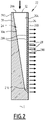
- the electrochemical reactor 2 comprises a manifold insert 22 configured to be inserted into the manifold 16A and to delimit inside the manifold 16A a main duct 24 having a cross section whose area decreases from a first end 24A of the main duct 24 towards a second end 24B of the main duct 24.
- the collector insert 22 extends along an extension axis E and is configured to be inserted into the collector 16A along its extension axis E, the latter being aligned with the collector axis M.
- the collector insert 22 has a connection wall 26 which has a first face 26A provided to delimit the main duct 24 and a second face 26B opposite the first face 26A.
- the manifold insert 22 comprises a plurality of channels 28. Each channel 28 extends through the connecting wall 26, between a first orifice 28A opening onto the first face 26A and a second orifice 28B opening onto the second face 26B .
- the first orifices 28A are distributed along the first face 26A in such a way that they are distributed along the main duct 24 between the first end 24A and the second end 24B.
- the second orifices 28B are distributed along the second face 26B in such a way that each second orifice 28B is located opposite a respective connection port 18 when the manifold insert 22 is inserted into the manifold 16A.
- each channel 28 connects the main conduit 24 to a respective connection port 18 for the circulation of a fluid between the main conduit 24 and the fluidic chamber 14 corresponding to this port. connection 18.
- connection ports 18 of the fluidic chambers 14 opening into the manifold 16A are located on the same internal connection surface of the manifold 16A.
- connection wall 26 When the manifold insert 22 is inserted into the manifold 16A, the second face 26B of the connection wall 26 is located facing the internal surface of connection, each second orifice 28B facing a respective connection port 18.
- Each channel 28 has a length taken between its first orifice 28A and its second orifice 28B.
- the channels 28 have equal lengths.
- the connecting wall 26 has a thickness taken between the first face 26A and the second face 26B, perpendicular to the extension axis E of the collector insert 22.
- the connecting wall 26 has a constant thickness from one end to the other of the main duct 24, in particular from the first end 24A of the main duct 24 towards the second end 24B of the main duct 24.
- first face 26A and the second face 26B of the connection wall 26 are substantially parallel to the axis of extension E of the collector insert 2.
- manifold insert 22 is hollow, with main conduit 24 defined within manifold insert 22.
- the collector insert 22 has for example a pipe wall 30, the main pipe 24 being delimited between the connection wall 26 and the pipe wall 30, more precisely between the first face 26A of the connection wall 26 and a face internal 30A of the pipe wall 30 facing the first face 26A of the connecting wall 26.
- the manifold insert 22 includes side walls 32 connecting the channel wall 30 to the connecting wall 26, giving the main conduit 24 a cross-section with a closed contour, for example a rectangular cross-section.
- the spacing between the connection wall 26 and the pipe wall 30 decreases from the first end 24A of the main conduit 24 towards the second end 24B of the main conduit 24.
- first face 26A of the connection wall 26 and the internal face 30A of the pipe wall 30 are flat and inclined with respect to each other in such a way that they approach the one from the other from the first end 24A of the main duct 24 to the second end 24B of the main duct 24.
- one of the first face 26A of the connecting wall 26 and the inner face 30 of the pipe wall 30 is parallel to the axis of extension E, the other being inclined with respect to the extension axis E so that the area of the cross section of the main duct 24 decreases from its first end 24A towards its second end 24B.
- the internal face 30A of the pipe wall 30 is inclined with respect to the axis of extension E, the first face 26A of the connecting wall 26 being parallel to the axis of extension E.
- first face 26A of the connection wall 26 and the inner face 30A of the pipe wall 30 are both flat and inclined with respect to the axis of extension E.
- the manifold insert 22 is configured to fit snugly into each of the openings 20A delimiting the manifold 16A, such that each separator plate 4 can be guided by the manifold insert 22 during stacking of the separator plates 4 along the manifold insert 22.
- the collector insert 22 in view along its axis of extension E, has a profiled and/or non-circular outer contour. This makes it possible to ensure the guiding of each separator plate 4 using the collector insert 22 during the production of the stack.
- the collector insert 22 has a generally parallelepipedic outer shape.
- the second face 26B of the connecting wall 26 defines an outer face of the collector insert 22.
- the second orifice 28B of each channel 28 has an elongated shape.
- the second orifices 28B are parallel to each other, and, more preferably, elongated perpendicular to the axis of extension E of the manifold insert 22.
- the manifold 16A is for example an inlet manifold provided for supplying the fluidic chambers 14 in fluid communication with the manifold 16A with a fluid.
- the first end 24A of the main conduit 24 receives the fluid which flows from the first end 24A towards the second end 28B of the main conduit 24.
- a fraction of the fluid enters the first orifice 28A of each channel 28 and flows to the second orifice 28B of this channel 28 and supplies the connection port 18 located opposite, to supply the corresponding fluid chamber 14.
- the quantity of fluid present in the main duct 24 decreases from the first end 24A towards the second end 24B because a fraction of reactive fluid is withdrawn through each channel 28.
- the gradual decrease in the area of the cross-section of the main conduit 24 from the first end 24A towards the second end 24B makes it possible to maintain a fluid flow velocity that is substantially constant all along the main conduit 24, which allows to obtain a uniform flow of the fluid towards the fluidic chambers 14 connected to the manifold 16A.
- channels 28 between the first face 26A and the second face 26B makes it possible to adapt each channel 28 individually to obtain an appropriate flow of the fluid between the collector 16A and the fluidic chambers 14 connected to this collector 16A.
- the channels 28 are substantially straight, parallel and of the same constant cross-section along each channel 28.
- each channel 28 for example its length, its shape and/or its constant or variable cross-section, so as to standardize the distribution of the fluid in the fluidic chambers 14 connected to the manifold 16A.
- the collector insert 22 is for example manufactured by a manufacturing process by additive manufacturing (also called “3D printing”). This makes it possible to give the main duct 24 and each channel 28 the desired shapes.
- each electrochemical cell 8 has two fluidic chambers 14 located on either side of the membrane-electrode assembly 6 of this electrochemical cell 8.
- collector 16A is an output collector.
- the collector insert 22 then also promotes a uniform flow of the fluid at the outlet of the fluidic chambers 14 which open into this collector 16A, and therefore a uniform flow of the fluid through these fluidic chambers 14, in the various electrochemical cells 8.
- a single manifold 16A receiving a manifold insert 22 has been shown in the Figure 1 and described for simplicity.
- the electrochemical reactor 2 can comprise several collectors, for example four collectors 16A, 16B, 16C, 16D, each formed by openings 20A, 20B, 20C, 20C aligned with the separating plates 4.
- Each collector 16A, 16B, 16C, 16D is fluidically connected to only one of the two fluidic chambers 14 of each electrochemical cell 8. Each collector 16A, 16B, 16C, 16D is an inlet collector or an outlet collector. Each fluidic chamber 14 is fluidically connected to two of the manifolds 16A, 16B, 16C, 16D, one being an inlet manifold and the other an outlet manifold.
- a single collector 16A can receive a collector insert 22.
- each of the collectors 16A, 16B, 16C, 16D receives a respective collector insert 22 similar to that of the Figures 1 to 3 .
- the electrochemical reactor 2 comprises for example a collector insert 22 inserted in a collector 16A supplying the fluidic chambers 14 located on a first side of the membrane-electrode assemblies 6, a collector insert 22 inserted in a collector 16B supplying the fluidic chambers 14 located on a second side of the membrane-electrode assemblies 8, a collector insert 22 inserted into a collector 16C recovering the fluid at the outlet of the fluidic chambers 14 located on the first side of the membrane-electrode assemblies 6 and/or a collector insert 22 inserted into a collector 16D collecting the fluid at the outlet of the fluidic chambers 14 located on the second side of the membrane-electrode assemblies 6.
- each collector insert 22 could be used for guiding the separator plates 4 during the production of the stack, in particular when the insert 22 has a profiled and/or non-circular outer contour, in particular a generally parallelepipedic outer shape.
- the separator plates 4 are threaded one after the other onto at least one collector insert 22 used as a guide for stacking the separator plates 4, by passing each collector insert 22 through the opening 20A, 20B, 20C, 20D corresponding intended to define the collector 16A, 16B, 16C, 16D receiving this collector insert 22.
- the electrochemical reactor 2 is for example a fuel cell configured to generate electrical energy from a combustible fluid and an oxidizing fluid, by exchange of ions, in particular protons , between the combustible fluid and the oxidizing fluid.
- the combustible fluid is for example dihydrogen and the oxidizing fluid is for example dioxygen or air.
- the ions exchanged through the ion exchange membrane 10 of each membrane-electrode assembly 6 are protons, the ion exchange membrane 10 being a proton exchange membrane (or PEM for “Proton Exchange Membrane ").
- Such an electrochemical reactor 2 generally comprises two inlet collectors and two outlet collectors. One or more of these manifolds may be provided with a manifold insert 22.
- the electrochemical reactor 2 is an electrolyser configured to use electrical energy to separate chemical species contained in a fluid, for example to generate dihydrogen and dioxygen from water.
- Such an electrochemical reactor 2 generally comprises an inlet manifold for the reactive fluid and two outlet manifolds. One or more of these manifolds may be provided with a manifold insert.
- the invention is not limited to the exemplary embodiments and to the variants discussed above, other exemplary embodiments and other variants being possible.
Landscapes
- Chemical & Material Sciences (AREA)
- Engineering & Computer Science (AREA)
- Chemical Kinetics & Catalysis (AREA)
- Electrochemistry (AREA)
- Sustainable Development (AREA)
- General Chemical & Material Sciences (AREA)
- Sustainable Energy (AREA)
- Life Sciences & Earth Sciences (AREA)
- Manufacturing & Machinery (AREA)
- Materials Engineering (AREA)
- Organic Chemistry (AREA)
- Metallurgy (AREA)
- Composite Materials (AREA)
- Inorganic Chemistry (AREA)
- Fuel Cell (AREA)
- Electrolytic Production Of Non-Metals, Compounds, Apparatuses Therefor (AREA)
Applications Claiming Priority (1)
| Application Number | Priority Date | Filing Date | Title |
|---|---|---|---|
| FR2102163A FR3120479A1 (fr) | 2021-03-05 | 2021-03-05 | Collecteur optimisé de reacteur électrochimique |
Publications (1)
| Publication Number | Publication Date |
|---|---|
| EP4053952A1 true EP4053952A1 (de) | 2022-09-07 |
Family
ID=75954010
Family Applications (1)
| Application Number | Title | Priority Date | Filing Date |
|---|---|---|---|
| EP22159726.3A Pending EP4053952A1 (de) | 2021-03-05 | 2022-03-02 | Optimierter kollektor eines elektrochemischen reaktors |
Country Status (6)
| Country | Link |
|---|---|
| US (1) | US20220285698A1 (de) |
| EP (1) | EP4053952A1 (de) |
| JP (1) | JP2022136047A (de) |
| CN (1) | CN115101784A (de) |
| CA (1) | CA3150846A1 (de) |
| FR (1) | FR3120479A1 (de) |
Families Citing this family (1)
| Publication number | Priority date | Publication date | Assignee | Title |
|---|---|---|---|---|
| JP7615186B2 (ja) * | 2023-01-27 | 2025-01-16 | 三菱重工業株式会社 | 電解装置 |
Citations (6)
| Publication number | Priority date | Publication date | Assignee | Title |
|---|---|---|---|---|
| KR20100072802A (ko) * | 2008-12-22 | 2010-07-01 | 한국에너지기술연구원 | 고체 산화물 연료 전지 스택 장치 |
| US20100248066A1 (en) * | 2007-01-04 | 2010-09-30 | Henning Frederiksen | Modified Fuel Cell Manifolds for Controlling Fuel Gas Flow to Different Sections of Fuel Cell Stacks |
| US20110223513A1 (en) * | 2010-03-10 | 2011-09-15 | Gm Global Technology Operations, Inc. | Pem fuel cell stack hydrogen distribution insert |
| US20110229799A1 (en) * | 2010-03-17 | 2011-09-22 | Gm Global Technology Operations, Inc. | Pem fuel cell stack hydrogen distribution insert |
| US20120122008A1 (en) * | 2010-11-17 | 2012-05-17 | Kia Motors Corporation | Manifold insert having distribution guides and fuel cell stack comprising the same |
| DE102017211755A1 (de) * | 2017-07-10 | 2019-01-10 | Audi Ag | Einsteckelement für einen Header eines Brennstoffzellenstapels |
Family Cites Families (9)
| Publication number | Priority date | Publication date | Assignee | Title |
|---|---|---|---|---|
| JPH0752652B2 (ja) * | 1986-04-07 | 1995-06-05 | 株式会社日立製作所 | 積層電池のマニホ−ルド構造 |
| JP4318771B2 (ja) * | 1998-11-06 | 2009-08-26 | 本田技研工業株式会社 | 燃料電池スタック |
| DE19912318A1 (de) * | 1999-03-19 | 2000-09-28 | Dbb Fuel Cell Engines Gmbh | Plattenreaktor |
| JP2006202524A (ja) * | 2005-01-18 | 2006-08-03 | Nissan Motor Co Ltd | 燃料電池スタックのマニホールド構造 |
| TWI369805B (en) * | 2008-11-04 | 2012-08-01 | Ind Tech Res Inst | Fuel cell fluid flow plate with shell passageway piece |
| US8541145B2 (en) * | 2010-09-22 | 2013-09-24 | GM Global Technology Operations LLC | Tapered anode header insert for startup hydrogen distribution |
| KR102570592B1 (ko) * | 2017-06-21 | 2023-08-24 | 에보쿠아 워터 테크놀로지스 엘엘씨 | 전기투석 디바이스 내 유체 매니폴드의 설계 |
| JP2019175595A (ja) * | 2018-03-27 | 2019-10-10 | 東邦瓦斯株式会社 | 固体酸化物形燃料電池および流量調節部材 |
| JP2019175596A (ja) * | 2018-03-27 | 2019-10-10 | 東邦瓦斯株式会社 | 固体酸化物形燃料電池および流量調節部材 |
-
2021
- 2021-03-05 FR FR2102163A patent/FR3120479A1/fr active Pending
-
2022
- 2022-03-02 US US17/685,154 patent/US20220285698A1/en active Pending
- 2022-03-02 EP EP22159726.3A patent/EP4053952A1/de active Pending
- 2022-03-03 CA CA3150846A patent/CA3150846A1/fr active Pending
- 2022-03-04 JP JP2022033475A patent/JP2022136047A/ja active Pending
- 2022-03-04 CN CN202210209981.5A patent/CN115101784A/zh active Pending
Patent Citations (6)
| Publication number | Priority date | Publication date | Assignee | Title |
|---|---|---|---|---|
| US20100248066A1 (en) * | 2007-01-04 | 2010-09-30 | Henning Frederiksen | Modified Fuel Cell Manifolds for Controlling Fuel Gas Flow to Different Sections of Fuel Cell Stacks |
| KR20100072802A (ko) * | 2008-12-22 | 2010-07-01 | 한국에너지기술연구원 | 고체 산화물 연료 전지 스택 장치 |
| US20110223513A1 (en) * | 2010-03-10 | 2011-09-15 | Gm Global Technology Operations, Inc. | Pem fuel cell stack hydrogen distribution insert |
| US20110229799A1 (en) * | 2010-03-17 | 2011-09-22 | Gm Global Technology Operations, Inc. | Pem fuel cell stack hydrogen distribution insert |
| US20120122008A1 (en) * | 2010-11-17 | 2012-05-17 | Kia Motors Corporation | Manifold insert having distribution guides and fuel cell stack comprising the same |
| DE102017211755A1 (de) * | 2017-07-10 | 2019-01-10 | Audi Ag | Einsteckelement für einen Header eines Brennstoffzellenstapels |
Also Published As
| Publication number | Publication date |
|---|---|
| JP2022136047A (ja) | 2022-09-15 |
| FR3120479A1 (fr) | 2022-09-09 |
| CN115101784A (zh) | 2022-09-23 |
| CA3150846A1 (fr) | 2022-09-05 |
| US20220285698A1 (en) | 2022-09-08 |
Similar Documents
| Publication | Publication Date | Title |
|---|---|---|
| EP3170220B1 (de) | Bipolare platte für elektrochemischen reaktor mit kompaktem homogenisierungsbereich und geringer druckdifferenz | |
| EP3136492B1 (de) | Stapel von elektrochemischen zellen, die in verschiedene gruppen aufgeteilt sind, die ein homogenisierungsfach umfassen | |
| US8835070B2 (en) | Fuel cell header wedge | |
| EP3092672B1 (de) | Flussleitende platte für eine brennstoffzelle | |
| EP4053952A1 (de) | Optimierter kollektor eines elektrochemischen reaktors | |
| EP3175502A1 (de) | Elektrochemischer reaktor mit ausgleich des lastverlusts der kathoden-/anodenhomogenisierungsbereiche | |
| EP3514875B1 (de) | Anordnung von zellen für die leistungsanpassung von elektrochemischen reaktoren | |
| EP4095955A1 (de) | Verbesserter bipolarer abscheider für einen elektrochemischen reaktor | |
| EP3662529A1 (de) | Bipolare platte zur verbesserung der effizienz einer protonenaustauschmembran-brennstoffzelle | |
| EP4630603A1 (de) | Abstandshalter für eine wasserelektrolysezelle | |
| EP3686976A1 (de) | Bipolarplatte zum homogenisieren der temperaturen von kühlflüssigkeit | |
| EP3235042A1 (de) | Zellstapel einer brennstoffzelle und brennstoffzelle mit solch einem stapel | |
| EP3092671B1 (de) | Flussleitende platte für eine brennstoffzelle | |
| FR3026232A1 (fr) | Plaque de guidage d’ecoulement d’un fluide pour reacteur electrochimique et ensemble comportant cette plaque | |
| EP2729980B1 (de) | Separatorenplatte mit intermediärer gaseinspeisung, brennstoffzelle und verfahren zur gasversorgung | |
| EP3686977A1 (de) | Bipolare platte zum homogenisieren der temperatur von kühlflüssigkeit | |
| EP2729983B1 (de) | Gasverteiler- und kompressionsstruktur für brennstoffzellenmodul und brennstoffzellensystem | |
| FR2891404A1 (fr) | Pile a combustible amimentee par un systeme de distribution de fluides | |
| WO2025141108A1 (fr) | Composant polaire pour une cellule électrochimique d'une pile à combustible, ainsi que cellule electrochimique, pile a combustible et vehicule electrique associes | |
| FR3108795A3 (fr) | Plaque de pile à combustible, cellule et pile correspondantes |
Legal Events
| Date | Code | Title | Description |
|---|---|---|---|
| PUAI | Public reference made under article 153(3) epc to a published international application that has entered the european phase |
Free format text: ORIGINAL CODE: 0009012 |
|
| STAA | Information on the status of an ep patent application or granted ep patent |
Free format text: STATUS: THE APPLICATION HAS BEEN PUBLISHED |
|
| STAA | Information on the status of an ep patent application or granted ep patent |
Free format text: STATUS: REQUEST FOR EXAMINATION WAS MADE |
|
| AK | Designated contracting states |
Kind code of ref document: A1 Designated state(s): AL AT BE BG CH CY CZ DE DK EE ES FI FR GB GR HR HU IE IS IT LI LT LU LV MC MK MT NL NO PL PT RO RS SE SI SK SM TR |
|
| 17P | Request for examination filed |
Effective date: 20220818 |
|
| RBV | Designated contracting states (corrected) |
Designated state(s): AL AT BE BG CH CY CZ DE DK EE ES FI FR GB GR HR HU IE IS IT LI LT LU LV MC MK MT NL NO PL PT RO RS SE SI SK SM TR |
|
| P01 | Opt-out of the competence of the unified patent court (upc) registered |
Effective date: 20231026 |