EP4053949A1 - Verfahren zur herstellung eines abscheiders für einen elektrochemischen reaktor und abscheider für elektrochemischen reaktor - Google Patents
Verfahren zur herstellung eines abscheiders für einen elektrochemischen reaktor und abscheider für elektrochemischen reaktor Download PDFInfo
- Publication number
- EP4053949A1 EP4053949A1 EP22159973.1A EP22159973A EP4053949A1 EP 4053949 A1 EP4053949 A1 EP 4053949A1 EP 22159973 A EP22159973 A EP 22159973A EP 4053949 A1 EP4053949 A1 EP 4053949A1
- Authority
- EP
- European Patent Office
- Prior art keywords
- separator
- separator plate
- face
- film
- sealing
- Prior art date
- Legal status (The legal status is an assumption and is not a legal conclusion. Google has not performed a legal analysis and makes no representation as to the accuracy of the status listed.)
- Pending
Links
- 238000004519 manufacturing process Methods 0.000 title claims abstract description 38
- 238000000034 method Methods 0.000 title claims description 11
- 238000007789 sealing Methods 0.000 claims abstract description 120
- 238000009826 distribution Methods 0.000 claims abstract description 39
- 239000012530 fluid Substances 0.000 claims abstract description 24
- 239000002313 adhesive film Substances 0.000 claims description 52
- 239000000853 adhesive Substances 0.000 claims description 28
- 230000001070 adhesive effect Effects 0.000 claims description 28
- 230000000712 assembly Effects 0.000 claims description 16
- 238000000429 assembly Methods 0.000 claims description 16
- 239000002390 adhesive tape Substances 0.000 claims description 7
- 238000004826 seaming Methods 0.000 claims 1
- 229920002943 EPDM rubber Polymers 0.000 description 8
- 238000005520 cutting process Methods 0.000 description 5
- 238000001816 cooling Methods 0.000 description 4
- -1 poly(ethylene terephthalate) Polymers 0.000 description 4
- 229920000139 polyethylene terephthalate Polymers 0.000 description 4
- 239000005020 polyethylene terephthalate Substances 0.000 description 4
- 239000000758 substrate Substances 0.000 description 4
- 239000012790 adhesive layer Substances 0.000 description 3
- 230000002950 deficient Effects 0.000 description 3
- 238000003487 electrochemical reaction Methods 0.000 description 3
- 239000003014 ion exchange membrane Substances 0.000 description 3
- 239000000463 material Substances 0.000 description 3
- 230000001681 protective effect Effects 0.000 description 3
- 230000005465 channeling Effects 0.000 description 2
- 230000005611 electricity Effects 0.000 description 2
- 239000000446 fuel Substances 0.000 description 2
- 150000002500 ions Chemical class 0.000 description 2
- 238000005304 joining Methods 0.000 description 2
- 239000012528 membrane Substances 0.000 description 2
- 229920001296 polysiloxane Polymers 0.000 description 2
- 239000004800 polyvinyl chloride Substances 0.000 description 2
- 238000005096 rolling process Methods 0.000 description 2
- 238000011144 upstream manufacturing Methods 0.000 description 2
- MYMOFIZGZYHOMD-UHFFFAOYSA-N Dioxygen Chemical compound O=O MYMOFIZGZYHOMD-UHFFFAOYSA-N 0.000 description 1
- UFHFLCQGNIYNRP-UHFFFAOYSA-N Hydrogen Chemical compound [H][H] UFHFLCQGNIYNRP-UHFFFAOYSA-N 0.000 description 1
- 239000003522 acrylic cement Substances 0.000 description 1
- 239000011324 bead Substances 0.000 description 1
- 229910052729 chemical element Inorganic materials 0.000 description 1
- 238000004891 communication Methods 0.000 description 1
- 239000012809 cooling fluid Substances 0.000 description 1
- 229910001882 dioxygen Inorganic materials 0.000 description 1
- 238000005342 ion exchange Methods 0.000 description 1
- 239000010410 layer Substances 0.000 description 1
- 238000012423 maintenance Methods 0.000 description 1
- 239000007800 oxidant agent Substances 0.000 description 1
- 230000001590 oxidative effect Effects 0.000 description 1
- 230000000717 retained effect Effects 0.000 description 1
- 238000000926 separation method Methods 0.000 description 1
- XLYOFNOQVPJJNP-UHFFFAOYSA-N water Substances O XLYOFNOQVPJJNP-UHFFFAOYSA-N 0.000 description 1
Images




Classifications
-
- H—ELECTRICITY
- H01—ELECTRIC ELEMENTS
- H01M—PROCESSES OR MEANS, e.g. BATTERIES, FOR THE DIRECT CONVERSION OF CHEMICAL ENERGY INTO ELECTRICAL ENERGY
- H01M8/00—Fuel cells; Manufacture thereof
- H01M8/02—Details
- H01M8/0202—Collectors; Separators, e.g. bipolar separators; Interconnectors
- H01M8/0204—Non-porous and characterised by the material
- H01M8/0223—Composites
- H01M8/0228—Composites in the form of layered or coated products
-
- H—ELECTRICITY
- H01—ELECTRIC ELEMENTS
- H01M—PROCESSES OR MEANS, e.g. BATTERIES, FOR THE DIRECT CONVERSION OF CHEMICAL ENERGY INTO ELECTRICAL ENERGY
- H01M8/00—Fuel cells; Manufacture thereof
- H01M8/02—Details
- H01M8/0202—Collectors; Separators, e.g. bipolar separators; Interconnectors
- H01M8/0247—Collectors; Separators, e.g. bipolar separators; Interconnectors characterised by the form
-
- H—ELECTRICITY
- H01—ELECTRIC ELEMENTS
- H01M—PROCESSES OR MEANS, e.g. BATTERIES, FOR THE DIRECT CONVERSION OF CHEMICAL ENERGY INTO ELECTRICAL ENERGY
- H01M8/00—Fuel cells; Manufacture thereof
- H01M8/02—Details
- H01M8/0271—Sealing or supporting means around electrodes, matrices or membranes
- H01M8/0286—Processes for forming seals
-
- H—ELECTRICITY
- H01—ELECTRIC ELEMENTS
- H01M—PROCESSES OR MEANS, e.g. BATTERIES, FOR THE DIRECT CONVERSION OF CHEMICAL ENERGY INTO ELECTRICAL ENERGY
- H01M8/00—Fuel cells; Manufacture thereof
- H01M8/02—Details
- H01M8/0202—Collectors; Separators, e.g. bipolar separators; Interconnectors
- H01M8/0204—Non-porous and characterised by the material
- H01M8/0221—Organic resins; Organic polymers
-
- H—ELECTRICITY
- H01—ELECTRIC ELEMENTS
- H01M—PROCESSES OR MEANS, e.g. BATTERIES, FOR THE DIRECT CONVERSION OF CHEMICAL ENERGY INTO ELECTRICAL ENERGY
- H01M8/00—Fuel cells; Manufacture thereof
- H01M8/02—Details
- H01M8/0202—Collectors; Separators, e.g. bipolar separators; Interconnectors
- H01M8/0258—Collectors; Separators, e.g. bipolar separators; Interconnectors characterised by the configuration of channels, e.g. by the flow field of the reactant or coolant
-
- H—ELECTRICITY
- H01—ELECTRIC ELEMENTS
- H01M—PROCESSES OR MEANS, e.g. BATTERIES, FOR THE DIRECT CONVERSION OF CHEMICAL ENERGY INTO ELECTRICAL ENERGY
- H01M8/00—Fuel cells; Manufacture thereof
- H01M8/02—Details
- H01M8/0202—Collectors; Separators, e.g. bipolar separators; Interconnectors
- H01M8/0267—Collectors; Separators, e.g. bipolar separators; Interconnectors having heating or cooling means, e.g. heaters or coolant flow channels
-
- H—ELECTRICITY
- H01—ELECTRIC ELEMENTS
- H01M—PROCESSES OR MEANS, e.g. BATTERIES, FOR THE DIRECT CONVERSION OF CHEMICAL ENERGY INTO ELECTRICAL ENERGY
- H01M8/00—Fuel cells; Manufacture thereof
- H01M8/02—Details
- H01M8/0271—Sealing or supporting means around electrodes, matrices or membranes
-
- H—ELECTRICITY
- H01—ELECTRIC ELEMENTS
- H01M—PROCESSES OR MEANS, e.g. BATTERIES, FOR THE DIRECT CONVERSION OF CHEMICAL ENERGY INTO ELECTRICAL ENERGY
- H01M8/00—Fuel cells; Manufacture thereof
- H01M8/02—Details
- H01M8/0271—Sealing or supporting means around electrodes, matrices or membranes
- H01M8/0276—Sealing means characterised by their form
-
- H—ELECTRICITY
- H01—ELECTRIC ELEMENTS
- H01M—PROCESSES OR MEANS, e.g. BATTERIES, FOR THE DIRECT CONVERSION OF CHEMICAL ENERGY INTO ELECTRICAL ENERGY
- H01M8/00—Fuel cells; Manufacture thereof
- H01M8/02—Details
- H01M8/0297—Arrangements for joining electrodes, reservoir layers, heat exchange units or bipolar separators to each other
-
- H—ELECTRICITY
- H01—ELECTRIC ELEMENTS
- H01M—PROCESSES OR MEANS, e.g. BATTERIES, FOR THE DIRECT CONVERSION OF CHEMICAL ENERGY INTO ELECTRICAL ENERGY
- H01M8/00—Fuel cells; Manufacture thereof
- H01M8/10—Fuel cells with solid electrolytes
- H01M2008/1095—Fuel cells with polymeric electrolytes
-
- H—ELECTRICITY
- H01—ELECTRIC ELEMENTS
- H01M—PROCESSES OR MEANS, e.g. BATTERIES, FOR THE DIRECT CONVERSION OF CHEMICAL ENERGY INTO ELECTRICAL ENERGY
- H01M8/00—Fuel cells; Manufacture thereof
- H01M8/02—Details
- H01M8/0271—Sealing or supporting means around electrodes, matrices or membranes
- H01M8/028—Sealing means characterised by their material
- H01M8/0284—Organic resins; Organic polymers
-
- Y—GENERAL TAGGING OF NEW TECHNOLOGICAL DEVELOPMENTS; GENERAL TAGGING OF CROSS-SECTIONAL TECHNOLOGIES SPANNING OVER SEVERAL SECTIONS OF THE IPC; TECHNICAL SUBJECTS COVERED BY FORMER USPC CROSS-REFERENCE ART COLLECTIONS [XRACs] AND DIGESTS
- Y02—TECHNOLOGIES OR APPLICATIONS FOR MITIGATION OR ADAPTATION AGAINST CLIMATE CHANGE
- Y02E—REDUCTION OF GREENHOUSE GAS [GHG] EMISSIONS, RELATED TO ENERGY GENERATION, TRANSMISSION OR DISTRIBUTION
- Y02E60/00—Enabling technologies; Technologies with a potential or indirect contribution to GHG emissions mitigation
- Y02E60/30—Hydrogen technology
- Y02E60/50—Fuel cells
-
- Y—GENERAL TAGGING OF NEW TECHNOLOGICAL DEVELOPMENTS; GENERAL TAGGING OF CROSS-SECTIONAL TECHNOLOGIES SPANNING OVER SEVERAL SECTIONS OF THE IPC; TECHNICAL SUBJECTS COVERED BY FORMER USPC CROSS-REFERENCE ART COLLECTIONS [XRACs] AND DIGESTS
- Y02—TECHNOLOGIES OR APPLICATIONS FOR MITIGATION OR ADAPTATION AGAINST CLIMATE CHANGE
- Y02P—CLIMATE CHANGE MITIGATION TECHNOLOGIES IN THE PRODUCTION OR PROCESSING OF GOODS
- Y02P70/00—Climate change mitigation technologies in the production process for final industrial or consumer products
- Y02P70/50—Manufacturing or production processes characterised by the final manufactured product
Definitions
- the present invention relates to the field of electrochemical reactors comprising a stack of separators and membrane-electrode assemblies defining electrochemical cells.
- Such an electrochemical reactor is for example a fuel cell for the production of electricity by electrochemical reaction between an oxidant and a fuel, or an electrolyser for the separation of chemical elements from a fluid using electricity, for example for the production of dihydrogen and dioxygen from water.
- each membrane-electrode assembly is in the form of a laminate comprising an ion-exchange membrane interposed between two electrodes.
- Each separator is in the form of a plate, at least one of the two faces of the separator being configured to be applied against a face of a membrane-electrode assembly to channel a fluid so that it flows along said face of the membrane-electrode assembly.
- Each electrochemical cell is defined by a membrane-electrode assembly interposed between two separators, each separator defining a fluidic chamber with the face of the membrane-electrode assembly against which it is applied, the electrochemical reaction being carried out by exchange of ions between the fluidic chambers, through the membrane-electrode assembly.
- Each separator has, for example, openings passing through the separator, provided to form in the stack at least one inlet manifold for supplying fluidic chambers of the electrochemical cells with fluids and at least one outlet manifold for recovering fluids at the outlet of the fluidic chambers.
- One of the aims of the invention is to propose a method of manufacturing an electrochemical reactor separator which is easy and economical to manufacture, while obtaining satisfactory sealing.
- the invention proposes a process for manufacturing a separator for an electrochemical reactor formed of a stack of separators and membrane-electrode assemblies defining superposed electrochemical cells, the manufacturing process comprising the supply of a separator plate comprising a distribution face configured to channel a fluid along one face of a membrane-electrode assembly applied against the separator plate, and the application of a sealing film on the distribution face of the plate separator to ensure sealing between the separator plate and the membrane-electrode assembly and/or another separator sandwiching the membrane-electrode assembly with the separator, the sealing film being glued on its first face facing the separator plate to adhere thereto and non-sticky on its second face opposite the separator plate.
- the application of a sealing film on the separator plate to form the separator makes it possible to apply the sealing film to the sealing zones of the separator plate intended to come into leaktight contact with a membrane-electrode assembly or with another separator, quickly and economically. Sealing is controlled, in particular because the thickness of the sealing film can be easily controlled.
- the non-sticky side of the sealing film allows the separator to be dismantled, for example during the manufacture of the stack or for maintenance operations carried out on the stack.
- the invention also relates to a method for producing an electrochemical reactor formed by a stack of separators and membrane-electrode assemblies defining superposed electrochemical cells, the stack being produced by using one or more separator(s) obtained( s) according to a manufacturing process as defined above.
- the invention further relates to an electrochemical reactor separator comprising a separator plate having a distribution face configured to channel a fluid along one face of a membrane-electrode assembly applied against this distribution face, and a film of sealing deposited on the distribution face of the separator plate to provide sealing with the membrane-electrode assembly and/or with another separator sandwiching the membrane-electrode assembly with the separator, the sealing film being glued on its first face facing the separator plate to adhere thereto and non-sticky on its second face opposite the separator plate.
- the invention also relates to an electrochemical reactor formed of a stack of separators and membrane-electrode assemblies defining superposed electrochemical cells, the stack including one or more separator(s) as defined below. above.
- the electrochemical reactor 2 illustrated on the Figure 1 comprises a stack of separators 4 and membrane-electrode assemblies 6, defining superimposed electrochemical cells 8.
- Each electrochemical cell 8 is formed by a membrane-electrode assembly 6 interposed between two separators 4.
- an electrochemical reactor 2 may comprise several tens or hundreds of superimposed electrochemical cells 8.
- Each membrane-electrode assembly 6 is in the form of a laminate formed of an ion exchange membrane 10 interposed between two electrodes 12.
- the ion exchange membrane 10 is for example a proton exchange membrane (or PEM of English “Proton Exchange Membrane”).
- Each separator 4 is configured to channel a fluid along said face of the membrane-electrode assembly 6 with a view to the electrochemical reaction with ion exchange between the fluids channeled by the separators 4 on either side of the membrane-electrode assembly 6, the ions passing through the membrane-electrode assembly 6.
- the separators 4 are similar and a single separator 4 will be described in more detail with reference to the Figure 2 .
- the separator 4 of the Figure 1 is a bipolar separator configured to be interposed between two membrane-electrode assemblies 6, by channeling a fluid along one face of each of these two membrane-electrode assemblies 6.
- the electrochemical reactor When the electrochemical reactor has bipolar separators 4, it is formed by an alternating stack of separators 4 and membrane-electrode assemblies 6.
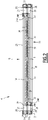
- the separator 4 of the Figure 2 is stratified. It is formed of two separator plates 14 superimposed and assembled together.
- Each separator plate 14 has a distribution face 16 facing away from the other separator plate 14 of the separator 4, and configured to channel fluid along one face of a membrane-electrode assembly 6 against which the separator plate 14 is applied (as shown by arrows on the Figure 1 ).
- Each distribution face 16 defines a fluidic chamber 18 for the flow of the fluid along the face of the membrane-electrode assembly 6 applied against said distribution face 16.
- Each distribution face 16 has, for example, channels for the flow of fluid along the membrane-electrode assembly 6.
- the channels form a flow field (or “flow field”) in English.
- the channels define the fluidic chamber 18.
- Each separator plate 14 is provided with openings 20 intended to form collectors passing through the stack.
- each manifold is in fluid communication with one of the two fluid chambers 18 of each electrochemical cell 8 to supply fluid to the fluid chambers 18 to which it is connected or to recover fluid from the outlet of these fluid chambers 18 to which it is connected. is connected, or with possible cooling channels 22 ( Figure 2 ) separators 4.
- Each separator plate 14 is provided, on its distribution face 16, with a sealing film 24 deposited on the ugly distribution face 16 of the separator plate 14.
- the sealing film 24 is configured to ensure the sealing of the fluidic chamber 18 delimited by the distribution face 16 with the membrane-electrode assembly 6 located opposite, and, if necessary, to ensure the sealing of the collectors .
- the sealing film 24 has openings to allow the circulation of fluids along the membrane-electrode assembly 6 in the fluidic chamber 18 and, if necessary, in the collectors.
- a main port 26 is for example provided in line with the fluidic chamber 18 and/or collector ports 28 are for example provided in line with the openings 20 delimiting the collectors.
- the sealing film 24 comprises for example a substrate provided on only one of its two faces with an adhesive layer.
- the substrate of the sealing film 24 is for example made of silicone, ethylene-propylene-diene monomer (or EPDM), poly(ethylene terephthalate) (PET) or polyvinyl chloride (PVC).
- EPDM ethylene-propylene-diene monomer
- PET poly(ethylene terephthalate)
- PVC polyvinyl chloride
- it is ethylene-propylene-diene monomer (or EPDM).
- the sealing film 24 has for example a thickness of between 0.50 mm and 0.75 mm, in particular a thickness substantially equal to 0.60 mm.
- the adhesive layer is for example a layer of acrylic adhesive.
- the sealing film 24 has a first face 24A in contact with the separator plate 14 and a second face 24B opposite the first face 24A, and intended to come into contact with a membrane-electrode assembly 6 and/or with another separator 4.
- the sealing film 24 is adhesive (or sticky) on its first face 24A facing the separator plate 14 on which it is applied, and non-adhesive (or non-sticky) on its second face 24B facing away from the separator plate 14 on which it is applied.
- the sealing film 24 adheres to the separator plate 14.
- the separator 4 provided with the sealing film 24 can be manipulated to produce the stack without the sealing film 24 separating from the separator 4.
- the sealing film 24 does not adhere to the membrane-electrode assembly 6 applied against the separator plate 14 or to another separator 4 sandwiching the membrane-electrode assembly 6.
- the stack is preferably kept compressed, so that the sealing film 24 carried by a separator 4 is applied under pressure against a membrane-electrode assembly 6 or/against another separator 4 taking the membrane-electrode assembly electrodes 6 sandwiched with the separator 4, with sufficient pressure to ensure sealing.
- Each separator plate 14 of separator 4 has an assembly face 34 facing the other separator plate 14 of separator 4.
- the separator 4 comprises an adhesive film 36 interposed between the two separator plates 14 to assemble the separator plates 14 together.
- the adhesive film 36 is adhesive on its two opposite faces.
- the separator plates 14 define between them said cooling channels 22, provided for the circulation of a cooling fluid, which is for example supplied and recovered via two of the manifolds.
- the adhesive film 36 is configured to ensure the sealing between the separator plates 14, in particular the sealing of the collectors and the cooling channels 22.
- the adhesive film 36 is cut so as to form windows allowing the circulation of the reactive fluids in the collectors, and, if necessary, in the cooling channels 22.
- the adhesive film 36 comprises for example collector windows 38, a window collector 38 being provided in line with each collector.
- the adhesive film 36 comprises for example a substrate provided on each of these two faces with an adhesive layer.
- the substrate of the adhesive film 36 is for example made of silicone, ethylene-propylene-diene monomer (or EPDM), poly(ethylene terephthalate) (PET) or polyvinyl chloride (PVC).
- EPDM ethylene-propylene-diene monomer
- PET poly(ethylene terephthalate)
- PVC polyvinyl chloride
- it is ethylene-propylene-diene monomer (or EPDM).
- the adhesive film 36 has for example a thickness of between 0.20 mm and 0.35 mm, in particular a thickness substantially equal to 0.25 mm.
- the sealing film 24 and the adhesive film 36 are made of the same material. Alternatively, they are made of different materials.
- the sealing film 24 has a different thickness from that of the adhesive film 36.
- the sealing film 24 has a thickness strictly greater than that of the adhesive film 36.
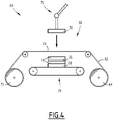
- the Figure 3 and 4 schematically illustrate steps of a method of manufacturing a separator 4 as shown in the Figure 2 .
- the process for manufacturing a separator 4 comprises a step of assembling two separator plates 14 using an adhesive film 36.
- the assembly step is carried out on an assembly station 40.
- the adhesive film 36 is packaged in the form of an adhesive strip 42, the adhesive strip 42 being for example rolled up in the form of an adhesive roll 44.
- the adhesive strip 42 is for example provided, on one of its two faces or each of its two faces, with a protective film (not shown) preventing the adhesive strip 42 from sticking to itself when it is is rolled up.
- the adhesive strip 42 is for example pre-cut to form adhesive films 36 in the adhesive strip 42 and to form in each adhesive film 36 of the adhesive strip 42 the necessary windows.
- the pre-cutting of the adhesive films 36 is carried out, for example, before rolling up the adhesive strip 42 to form the adhesive roll 44. Alternatively, it can be carried out after unrolling the adhesive roll, in a cutting station (not shown) located upstream of the assembly station 40 along the path of the adhesive tape 42.
- the adhesive strip 42 is unwound from the adhesive roller 44, a first separator plate 14 is positioned opposite an adhesive film 36 precut in the adhesive strip 42, then a second separator plate 14 is applied to the first separator plate 14 so as to sandwich the adhesive film 36 between the two separator plates 14, to form an assembly comprising the adhesive film 36 interposed between the two separator plates 14.
- Each protective film possibly placed on the adhesive strip 42 is removed from the latter before applying the adhesive film 36 to the separating plates 14, so that the adhesive film 36 can adhere to the separating plates 14 and ensure cohesion between them.
- the assembly station 40 comprises for example an assembly press 46 comprising assembly press parts 48, 50 configured to each support a respective separator plate 14, and press them against each other by taking the film adhesive 36 in sandwich.
- Assembly station 40 is configured to feed adhesive tape 42 through assembly station 40, particularly through assembly press 46.
- the assembly station 40 includes a winder 54 to recover the adhesive tape 42 downstream of the assembly press 46.
- the separator plates 14 are held on the assembly press parts 48, 50 for example by a vacuum device.
- the two assembly press parts 48, 50 are movable relative to each other between an open position allowing the sealing film 24 and the separator plate 14 to be positioned between the two assembly press parts 48 , 50 and a closed position allowing the sealing film 36 to be pressed against the separator plate 14.
- the assembly station 40 comprises a conveyor 55, for example a belt conveyor, one of the assembly press parts 48 being supported by the conveyor 55 so as to be able to move this press part by assembly 48 along assembly station 40.
- one of the press parts 50 is carried by an assembly robot 56, for example by an assembly robot 56 having an articulated arm, in particular an arm with six joints.
- the assembly robot 56 is for example configured to grab a separator plate 14, press it on another separator plate 14 by taking the adhesive film 36 sandwiched between the two separator plates 14, then, optionally, grab the assembly thus formed. to store it.
- the process for manufacturing a separator 4 comprises a jointing step comprising the application of a sealing film 24 on the or each distribution face 16 of each separating plate 14 of the separator 4.
- the application of a sealing film 24 on a distribution face 16 of a separator plate 14 is carried out in a jointing station 60.
- the sealing film 24 is packaged for example in the form of a sealing strip 62, the sealing strip 62 being for example wound up in the form of a roll 64.
- the sealing film 24 has an adhesive (or sticky) first face 24A and a non-adhesive (or non-adhesive) second face 24B.
- the sealing strip 62 is for example provided, on the adhesive face side, with a protective film (not shown) to allow the sealing strip 62 to be rolled up without it sticking to it. -same.
- the sealing strip 62 is for example pre-cut to form sealing films 24 in the sealing strip 62, each sealing film 24 having the required ports (for example the main port 26 and the manifold ports 28) .
- the pre-cutting of the sealing films 24 is carried out for example before rolling up the sealing strip 62 to form the roll 64.
- the pre-cut sealing strip 62 is unwound from the roll 64, the separator plate 14, one dispensing face 16 of which must receive a sealing film 24, is positioned facing a sealing film 24 precut in the sealing strip 62 and the sealing film 24 is applied to the distribution face 16 of the separator plate 14.
- the jointing station 60 comprises, for example, a jointing press 66 comprising jointing press parts 68, 70 configured to respectively support the separator plate 14 and the sealing film 24 and press them against each other so that the sealing film 24 adheres to the separator plate 14.
- the two jointing press parts 68, 70 are movable relative to each other between an open position making it possible to position the sealing film 24 and the separator plate 14 between the two jointing press parts 68, 70 and a closed position making it possible to press the sealing film 24 against the separator plate 14.
- the sealing station 60 is configured to feed the sealing strip 62 through the sealing station 60, in particular through the sealing press 66.
- the jointing station comprises a winder 72 to recover the sealing strip 62 downstream of the jointing press 66.
- the separator plate 14 is held on the corresponding jointing press part 68 for example by a vacuum device.
- the jointing station 60 comprises a conveyor 74, for example a belt conveyor, the jointing press part 68 intended to receive the separator plate 14 (alone or assembled beforehand with another separator plate 14) being supported by the conveyor 74 so as to be able to move this jointing press part 68 carrying the separator plate 14 along the jointing station 60.
- a conveyor 74 for example a belt conveyor
- the jointing press part 68 intended to receive the separator plate 14 (alone or assembled beforehand with another separator plate 14) being supported by the conveyor 74 so as to be able to move this jointing press part 68 carrying the separator plate 14 along the jointing station 60.
- the jointing press part 70 intended to apply the sealing film 24 against the separator plate 14 is carried by a jointing robot 76, for example a jointing robot 76 comprising an articulated arm, in particular an articulated arm with six joints.
- the jointing robot 76 is for example configured to apply the jointing press parts 68, 70 against each other.
- the manufacturing process comprises the application of a sealing film 24 on the distribution face 16 of each of the two separator plates 14.
- the separator plates 14 are assembled before applying a sealing film 24 to the distribution face 16 of each of the separator plates 14.
- each separator plate 14 is provided with a sealing film 24 before assembling the two separator plates 14 with the interposition of an adhesive film 36 to form the separator 4.
- a method of manufacturing an electrochemical reactor 2 comprises the supply of separator plates 14, the supply of membrane-electrode assemblies 6, the manufacture of a plurality of separators 4, by implementing the jointing step, and, optionally, the assembly step described above if the separators 4 are formed by assembling two separator plates 14, then the production of a stack of separators 4 and membrane-electrode assembly 6.
- the invention is not limited to the exemplary embodiments described above, other exemplary embodiments being possible.
- the adhesive films 36 may be provided as individual sheets.
- the Figure 5 illustrates the step of assembling two separator plates 14 using an adhesive film 36 supplied in the form of an individual sheet, using an assembly station 40 comprising an assembly press 48.
- the separator plates 14 are superimposed by sandwiching the adhesive film 36 and pressed using assembly press 48.
- the application of the adhesive film 36 can be carried out manually.
- the control of the closing of the assembly press 46 can be carried out manually.
- sealing films 24 can be provided in the form of individual sheets.
- the Figure 6 illustrates the step of joining a separator plate 14, which has here been assembled beforehand to another separator plate 14, with a sealing film 24 supplied in the form of an individual sheet, using a jointing station 60 comprising a jointing press 66.
- the sealing film 24 is pressed against the separator plate using the sealing press 68.
- the application of the sealing film 24 can be carried out manually.
- the control of the closing of the jointing press 66 can be carried out manually.
- separator plates 14 are assembled before applying a sealing film 24 to the distribution face 16 of each of the plates.
- separators 14 or each separator plate 14 is provided with a sealing film 24 before assembling the two separator plates 14 with the interposition of an adhesive film 36 to form the separator 4.
- the two separating plates 14 of the separator 14 are applied simultaneously on either side of the adhesive film 36.
- the adhesive film 36 packaged in adhesive tape 42 or in separate sheets, is pressed between two separator plates 14 as illustrated in the Figure 3 or the Figure 5 .
- the separator plates 14 are applied sequentially on either side of the adhesive film 36.
- the adhesive film 36 packaged in adhesive tape 42 or in separate sheets, is first applied to the assembly face 34 of a separator plate 14, for example in an application station, then another separator plate 14 is applied. on adhesive film 36 to form the assembly comprising the adhesive film 36 sandwiched between the two separating plates 14.
- the application station to apply the adhesive film 36 to one of the two separating plates 14
- the assembly station 40 to press the separating plates 14 sandwiching the adhesive film 36
- the application station to apply the adhesive film 36 to one of the two separating plates 14
- the assembly station 40 to press the separating plates 14 sandwiching the adhesive film 36
- a separator 4 comprises a single separator plate 14 made from a single piece of material and configured with two distribution faces 16, in which case, preferably, the manufacturing method comprises the application of a sealing film 24 on each of the two distribution faces 16 of the separator plate 14.
- the manufacturing process does not include a step of assembling two separator plates 14 to form a separator 4, and the separator does not include an adhesive film 36 to assemble two separator plates 14.
- separators 4 illustrated on the Figure 2 and 7 are bipolar separators 4, each of these separators 4 being intended to be interposed between two membrane-electrode assemblies 6 in an alternating stack of separators 4 and membrane-electrode assemblies 6, by channeling a fluid along each of the two assemblies membrane-electrodes 6 located on either side of the separator 4.
- a separator 4 is monopolar, and provided to ensure sealing with a single membrane-electrode assembly 6. It has a single distribution face 16.
Landscapes
- Chemical & Material Sciences (AREA)
- Life Sciences & Earth Sciences (AREA)
- Engineering & Computer Science (AREA)
- Manufacturing & Machinery (AREA)
- Sustainable Development (AREA)
- Sustainable Energy (AREA)
- Chemical Kinetics & Catalysis (AREA)
- Electrochemistry (AREA)
- General Chemical & Material Sciences (AREA)
- Composite Materials (AREA)
- Fuel Cell (AREA)
- Electrolytic Production Of Non-Metals, Compounds, Apparatuses Therefor (AREA)
Applications Claiming Priority (1)
| Application Number | Priority Date | Filing Date | Title |
|---|---|---|---|
| FR2102164A FR3120478B1 (fr) | 2021-03-05 | 2021-03-05 | Procédé de fabrication d’un séparateur pour réacteur électrochimique et séparateur pour réacteur électrochimique |
Publications (1)
| Publication Number | Publication Date |
|---|---|
| EP4053949A1 true EP4053949A1 (de) | 2022-09-07 |
Family
ID=76283847
Family Applications (1)
| Application Number | Title | Priority Date | Filing Date |
|---|---|---|---|
| EP22159973.1A Pending EP4053949A1 (de) | 2021-03-05 | 2022-03-03 | Verfahren zur herstellung eines abscheiders für einen elektrochemischen reaktor und abscheider für elektrochemischen reaktor |
Country Status (6)
| Country | Link |
|---|---|
| US (1) | US20220285699A1 (de) |
| EP (1) | EP4053949A1 (de) |
| JP (1) | JP2022136046A (de) |
| CN (1) | CN115101775A (de) |
| CA (1) | CA3150845A1 (de) |
| FR (1) | FR3120478B1 (de) |
Citations (4)
| Publication number | Priority date | Publication date | Assignee | Title |
|---|---|---|---|---|
| GB2323700A (en) * | 1997-03-29 | 1998-09-30 | Ballard Power Systems | Electrochemical cells |
| EP1006600A2 (de) * | 1998-11-17 | 2000-06-07 | Nichias Corporation | Separatorstruktur für eine Brennstoffzelle und Verfahren zu ihrer Herstellung |
| US20050100771A1 (en) * | 2003-11-07 | 2005-05-12 | Gayatri Vyas | Low contact resistance bonding method for bipolar plates in a pem fuel cell |
| DE102010028957A1 (de) * | 2010-05-12 | 2011-11-17 | Trumpf Werkzeugmaschinen Gmbh + Co. Kg | Brennstoffzellenstapel und Verfahren zum Herstellen eines Brennstoffzellenstapels |
Family Cites Families (4)
| Publication number | Priority date | Publication date | Assignee | Title |
|---|---|---|---|---|
| JP3724797B2 (ja) * | 2002-11-27 | 2005-12-07 | 本田技研工業株式会社 | シール付き燃料電池用セパレータおよびシール付き膜電極接合体 |
| JP5003989B2 (ja) * | 2004-09-24 | 2012-08-22 | トヨタ自動車株式会社 | 単電池、単電池の製造方法、燃料電池 |
| JP2008218200A (ja) * | 2007-03-05 | 2008-09-18 | Toyota Motor Corp | 燃料電池スタック、および、燃料電池スタックの製造方法 |
| JP2017183198A (ja) * | 2016-03-31 | 2017-10-05 | 住友理工株式会社 | 燃料電池シール体の製造方法およびそれに用いる燃料電池用ゴムガスケット |
-
2021
- 2021-03-05 FR FR2102164A patent/FR3120478B1/fr active Active
-
2022
- 2022-03-02 US US17/685,131 patent/US20220285699A1/en active Pending
- 2022-03-03 EP EP22159973.1A patent/EP4053949A1/de active Pending
- 2022-03-03 CA CA3150845A patent/CA3150845A1/fr active Pending
- 2022-03-04 CN CN202210210479.6A patent/CN115101775A/zh active Pending
- 2022-03-04 JP JP2022033474A patent/JP2022136046A/ja active Pending
Patent Citations (4)
| Publication number | Priority date | Publication date | Assignee | Title |
|---|---|---|---|---|
| GB2323700A (en) * | 1997-03-29 | 1998-09-30 | Ballard Power Systems | Electrochemical cells |
| EP1006600A2 (de) * | 1998-11-17 | 2000-06-07 | Nichias Corporation | Separatorstruktur für eine Brennstoffzelle und Verfahren zu ihrer Herstellung |
| US20050100771A1 (en) * | 2003-11-07 | 2005-05-12 | Gayatri Vyas | Low contact resistance bonding method for bipolar plates in a pem fuel cell |
| DE102010028957A1 (de) * | 2010-05-12 | 2011-11-17 | Trumpf Werkzeugmaschinen Gmbh + Co. Kg | Brennstoffzellenstapel und Verfahren zum Herstellen eines Brennstoffzellenstapels |
Also Published As
| Publication number | Publication date |
|---|---|
| CA3150845A1 (fr) | 2022-09-05 |
| US20220285699A1 (en) | 2022-09-08 |
| CN115101775A (zh) | 2022-09-23 |
| FR3120478A1 (fr) | 2022-09-09 |
| JP2022136046A (ja) | 2022-09-15 |
| FR3120478B1 (fr) | 2023-06-30 |
Similar Documents
| Publication | Publication Date | Title |
|---|---|---|
| US11616154B2 (en) | Planarization of photovoltaics | |
| EP4095955A1 (de) | Verbesserter bipolarer abscheider für einen elektrochemischen reaktor | |
| US20210020586A1 (en) | Photovoltaic protection | |
| WO2018115628A1 (fr) | Procédé de fabrication d'assemblage membrane-électrode pour pile à combustible et ligne de fabrication | |
| TWI484691B (zh) | 疊層式燃料電池裝配 | |
| EP4053949A1 (de) | Verfahren zur herstellung eines abscheiders für einen elektrochemischen reaktor und abscheider für elektrochemischen reaktor | |
| KR101747392B1 (ko) | 전극 접합체 제조장치 및 제조방법 | |
| EP2707920A1 (de) | Brennstoffzelle mit verteilern mit individuellen injektordichtungen | |
| US8669019B2 (en) | Water vapor transfer membrane attachment to gas diffusion separators | |
| EP4635010A1 (de) | Baugruppe für einen brennstoffzellenstapel, brennstoffzelle mit einer solchen baugruppe sowie verfahren zur herstellung einer solchen baugruppe | |
| KR102788462B1 (ko) | 막-가스켓 어셈블리의 제조방법 및 제조장치 | |
| CA3062030A1 (fr) | Procede d'assemblage pour pile a combustible | |
| US12456744B2 (en) | Insert for cell frame integrated with adhesive film and method of manufacturing cell frame using the same | |
| FR3033944A1 (fr) | Procede et machine de fabrication d'une pile a combustible enroulee | |
| WO2018109332A1 (fr) | Procédé de fabrication d'une cellule élémentaire pour pile à combustible | |
| EP3619764B1 (de) | Vormontage von elementen zur herstellung einer membran / elektrodenanordnung | |
| US20250167280A1 (en) | Methods and systems for laminating layers of solid-state batteries continuously or semi-continuously | |
| JP5675477B2 (ja) | 燃料電池用電解質膜・電極構造体の製造方法 | |
| SE2350137A1 (en) | Variable optical-property interlayer product and method for manufacturing a variable optical-property interlayer product | |
| CN119133508A (zh) | 基于单面涂胶的分隔板的燃料电池模块一体化胶合工艺 | |
| JPS6321879A (ja) | 接着封止方法 | |
| FR3167001A1 (fr) | Procédé de fabrication d’un ensemble de membranes recouvertes d’un catalyseur équipées sur chacune de leurs faces d’un sous-joint | |
| WO2025012346A1 (fr) | Arrangement d'empilement pour une pile a combustible | |
| CA3178183A1 (fr) | Plaque separatrice bipolaire pour pile a combustible, pile a combustible et procede de fabrication associes | |
| JPH0217919A (ja) | 気体分離膜モジュールおよび気体分離装置 |
Legal Events
| Date | Code | Title | Description |
|---|---|---|---|
| PUAI | Public reference made under article 153(3) epc to a published international application that has entered the european phase |
Free format text: ORIGINAL CODE: 0009012 |
|
| STAA | Information on the status of an ep patent application or granted ep patent |
Free format text: STATUS: THE APPLICATION HAS BEEN PUBLISHED |
|
| STAA | Information on the status of an ep patent application or granted ep patent |
Free format text: STATUS: REQUEST FOR EXAMINATION WAS MADE |
|
| AK | Designated contracting states |
Kind code of ref document: A1 Designated state(s): AL AT BE BG CH CY CZ DE DK EE ES FI FR GB GR HR HU IE IS IT LI LT LU LV MC MK MT NL NO PL PT RO RS SE SI SK SM TR |
|
| 17P | Request for examination filed |
Effective date: 20220819 |
|
| RBV | Designated contracting states (corrected) |
Designated state(s): AL AT BE BG CH CY CZ DE DK EE ES FI FR GB GR HR HU IE IS IT LI LT LU LV MC MK MT NL NO PL PT RO RS SE SI SK SM TR |
|
| P01 | Opt-out of the competence of the unified patent court (upc) registered |
Effective date: 20231026 |