EP4051229B1 - Wässrige conditioner-formulierung für thermisch gestyltes haar - Google Patents
Wässrige conditioner-formulierung für thermisch gestyltes haar Download PDFInfo
- Publication number
- EP4051229B1 EP4051229B1 EP20808244.6A EP20808244A EP4051229B1 EP 4051229 B1 EP4051229 B1 EP 4051229B1 EP 20808244 A EP20808244 A EP 20808244A EP 4051229 B1 EP4051229 B1 EP 4051229B1
- Authority
- EP
- European Patent Office
- Prior art keywords
- hair
- base material
- conditioner formulation
- modified carbohydrate
- carbohydrate polymer
- Prior art date
- Legal status (The legal status is an assumption and is not a legal conclusion. Google has not performed a legal analysis and makes no representation as to the accuracy of the status listed.)
- Active
Links
Classifications
-
- A—HUMAN NECESSITIES
- A61—MEDICAL OR VETERINARY SCIENCE; HYGIENE
- A61Q—SPECIFIC USE OF COSMETICS OR SIMILAR TOILETRY PREPARATIONS
- A61Q5/00—Preparations for care of the hair
- A61Q5/06—Preparations for styling the hair, e.g. by temporary shaping or colouring
-
- A—HUMAN NECESSITIES
- A61—MEDICAL OR VETERINARY SCIENCE; HYGIENE
- A61K—PREPARATIONS FOR MEDICAL, DENTAL OR TOILETRY PURPOSES
- A61K8/00—Cosmetics or similar toiletry preparations
- A61K8/18—Cosmetics or similar toiletry preparations characterised by the composition
- A61K8/30—Cosmetics or similar toiletry preparations characterised by the composition containing organic compounds
- A61K8/40—Cosmetics or similar toiletry preparations characterised by the composition containing organic compounds containing nitrogen
- A61K8/41—Amines
- A61K8/416—Quaternary ammonium compounds
-
- A—HUMAN NECESSITIES
- A61—MEDICAL OR VETERINARY SCIENCE; HYGIENE
- A61K—PREPARATIONS FOR MEDICAL, DENTAL OR TOILETRY PURPOSES
- A61K8/00—Cosmetics or similar toiletry preparations
- A61K8/18—Cosmetics or similar toiletry preparations characterised by the composition
- A61K8/72—Cosmetics or similar toiletry preparations characterised by the composition containing organic macromolecular compounds
- A61K8/73—Polysaccharides
- A61K8/731—Cellulose; Quaternized cellulose derivatives
-
- A—HUMAN NECESSITIES
- A61—MEDICAL OR VETERINARY SCIENCE; HYGIENE
- A61Q—SPECIFIC USE OF COSMETICS OR SIMILAR TOILETRY PREPARATIONS
- A61Q5/00—Preparations for care of the hair
-
- A—HUMAN NECESSITIES
- A61—MEDICAL OR VETERINARY SCIENCE; HYGIENE
- A61Q—SPECIFIC USE OF COSMETICS OR SIMILAR TOILETRY PREPARATIONS
- A61Q5/00—Preparations for care of the hair
- A61Q5/12—Preparations containing hair conditioners
-
- A—HUMAN NECESSITIES
- A61—MEDICAL OR VETERINARY SCIENCE; HYGIENE
- A61K—PREPARATIONS FOR MEDICAL, DENTAL OR TOILETRY PURPOSES
- A61K2800/00—Properties of cosmetic compositions or active ingredients thereof or formulation aids used therein and process related aspects
- A61K2800/40—Chemical, physico-chemical or functional or structural properties of particular ingredients
- A61K2800/54—Polymers characterized by specific structures/properties
- A61K2800/542—Polymers characterized by specific structures/properties characterized by the charge
- A61K2800/5426—Polymers characterized by specific structures/properties characterized by the charge cationic
Definitions
- the present invention relates to an aqueous conditioner formulation for thermally styled hair.
- an aqueous conditioner formulation for thermally styled hair comprising: a cosmetically acceptable aqueous carrier; and a modified carbohydrate polymer, comprising a cellulose ether base material functionalized with (i) trialkyl ammonium moieties of formula (I) wherein each R 1 is independently a C 1-7 alkyl group and wherein the modified carbohydrate polymer has a Kjeldahl nitrogen content, TKN, corrected for ash and volatiles, of 0.75 to 2.5 wt%; and (ii) hydrophobic substituents having 16 carbon atoms; wherein the modified carbohydrate polymer comprises 0.005 to 1.5 wt%, based on weight of the cellulose ether base material, of the hydrophobic substituents; wherein the hydrophobic substituents are randomly distributed across the backbone of the cellulose ether base material; wherein the cellulose ether base material has a weight
- One hair conditioning composition is described by Salvador et al. in U.S. Patent Publication No. 20040115155 .
- Salvador et al. disclose a hair conditioning composition comprising by weight (a) from about 0.001 % to about 5 % of a cellulose polymer having a molecular weight of about 10,000 to about 10,000,000; (b) from about 0.01 % to about 10 % of a cationic surfactant; (c) from about 0.01 % to about 15 % of a high melting point fatty compound having a melting point of 25 °C or higher; and (d) an aqueous carrier.
- WO-A-2008/002666 discloses functional compositions for use in personal care, household, institutional and pet care applications and which contain cationic hydrophobically modified polysaccharides.
- the compositions comprise a) at least about 0.01 wt % of a cationic hydrophobically modified polysaccharide wherein i) the cationic hydrophobic polysaccharide has a mean average molecular weight (Mw) from about 2000 to about 10,000,000 Dalton, ii) the cationic hydrophobically modified polysaccharide has a cationic degree of substitution greater than 0.001 to about 3.0, and iii) cationic hydrophobically modified polysaccharide has weight % hydrophobe greater than 0.001. b) less than 50.0 wt % total of a personal care, pet care, household or institutional care active ingredient material.
- US 2004/247550 discloses a hair or skin conditioning composition
- a hair or skin conditioning composition comprising by weight: (a) from about 0.01% to about 5% of a hydrophobically modified cationic thickening polymer; (b) from about 0.05% to about 10% of a surfactant selected from the group consisting of cationic surfactant, nonionic surfactant, and mixtures thereof; and (c) from about 0.1% to about 10% of a hydrophobically modified silicone; and (d) an aqueous carrier.
- the present invention provides an aqueous conditioner formulation for thermally styled hair, comprising: a cosmetically acceptable aqueous carrier; and a modified carbohydrate polymer, comprising a cellulose ether base material functionalized with (i) trialkyl ammonium moieties of formula (I) wherein each R 1 is independently selected from the group consisting of a C 1-7 alkyl group and wherein the modified carbohydrate polymer has a Kjeldahl nitrogen content, TKN, corrected for ash and volatiles, of 0.75 to 2.5 wt%; and (ii) hydrophobic substituents each having 16 carbon atoms; wherein the modified carbohydrate polymer comprises 0.005 to 1.5 wt%, based on weight of the cellulose ether base material, of the hydrophobic substituents; wherein the hydrophobic substituents are randomly distributed across the backbone of the cellulose ether base material; wherein the cellulose ether base material has a weight average molecular weight, M W , of > 1,000,000 Daltons
- the present invention provides a method of making an aqueous conditioner formulation for thermally styled hair, comprising: (a) providing a cosmetically acceptable aqueous carrier; (b) selecting a hair alignment enhancer for improving hair alignment, wherein the hair alignment enhancer is selected to be a modified carbohydrate polymer; wherein the modified carbohydrate polymer comprises a cellulose ether base material functionalized with (i) trialkyl ammonium moieties of formula (I), wherein each R 1 is independently selected from the group consisting of a C 1-7 alkyl group and wherein the modified carbohydrate polymer has a Kjeldahl nitrogen content, TKN, corrected for ash and volatiles, of 0.75 to 2.5 wt%; and (ii) hydrophobic substituents each having 16 carbon atoms; wherein the modified carbohydrate polymer comprises 0.005 to 1.5 wt%, based on weight of the cellulose ether base material, of the hydrophobic substituents; wherein the hydrophobic substituents are randomly distributed
- the present invention provides a method of maintaining thermally styled hair, comprising: providing an aqueous conditioner formulation according to the present invention, applying the aqueous conditioner formulation to hair of a mammal and thermally styling the hair.
- aqueous conditioner formulation specifically selected to include a modified carbohydrate polymer, comprising a cellulose ether base material functionalized with (i) trialkyl ammonium moieties of formula (I) wherein each R 1 is independently selected from the group consisting of a C 1-7 alkyl group and wherein the modified carbohydrate polymer has a Kjeldahl nitrogen content, TKN, corrected for ash and volatiles, of 0.75 to 2.5 wt%; and (ii) hydrophobic substituents each having 16 carbon atoms; wherein the modified carbohydrate polymer comprises 0.005 to 1.5 wt%, based on weight of the cellulose ether base material, of the hydrophobic substituents; wherein the hydrophobic substituents are randomly distributed across the backbone of the cellulose ether base material; wherein the cellulose ether base material has a weight average molecular weight, M W , of > 1,000,000 Daltons; and
- ratios, percentages, parts, and the like are by weight.
- M W refers to the weight average molecular weight as measured in a conventional manner with gel permeation chromatography (GPC) and conventional standards, such as polyethylene glycol standards.
- GPC techniques are discussed in detail in Modern Size Exclusion Chromatography, W. W. Yau, J. J. Kirkland, D. D. Bly; Wiley-Interscience, 1979 , and in A Guide to Materials Characterization and Chemical Analysis, J. P. Sibilia; VCH, 1988, p.81-84 .
- Molecular weights are reported herein in units of Daltons, or equivalently, g/mol.
- cosmetically acceptable refers to ingredients typically used in personal care compositions, and is intended to underscore that materials that are toxic when present in the amounts typically found in personal care compositions are not contemplated as part of the present invention.
- the aqueous conditioner formulation for thermally styled hair of the present invention is selected from the group consisting of a shampoo, a conditioning shampoo, a leave on hair conditioner, a rinse off hair conditioner, a hair coloring agent, a hair styling gel and a hair straightener. More preferably, the aqueous conditioner formulation for thermally styled hair of the present invention is selected from the group consisting of a shampoo, a conditioning shampoo, a leave on hair conditioner and a rinse off hair conditioner. Most preferably, the aqueous conditioner formulation for thermally styled hair of the present invention is a rinse off conditioner.
- the aqueous conditioner formulation for thermally styled hair of the present invention comprises: a cosmetically acceptable aqueous carrier (preferably, wherein the aqueous conditioner formulation comprises 25 to 99 wt% (preferably, 50 to 98.5 wt%; more preferably, 75 to 98 wt%; most preferably, 80 to 97 wt%), based on weight of the aqueous conditioner formulation, of the cosmetically acceptable aqueous carrier); a modified carbohydrate polymer (preferably, wherein the aqueous conditioner formulation comprises 0.1 to 5 wt% (preferably, 0.15 to 2 wt%; more preferably, 0.2 to 1 wt%; most preferably, 0.25 to 0.5 wt%), based on weight of the aqueous conditioner formulation, of the modified carbohydrate polymer), comprising a cellulose ether base material functionalized with (i) trialkyl ammonium moieties of formula (I) wherein each R 1 is independently selected from the group consisting of a C 1-7
- the aqueous conditioner formulation for thermally styled hair of the present invention compries, comprises a cosmetically acceptable aqueous carrier. More preferably, the aqueous conditioner formulation of the present invention, comprises: 25 to 99 wt% (preferably, 50 to 98.5 wt%; more preferably, 75 to 98 wt%; most preferably, 80 to 97 wt%), based on weight of the aqueous conditioner formulation, of the cosmetically acceptable aqueous carrier.
- the aqueous conditioner formulation of the present invention comprises: 25 to 99 wt% (preferably, 50 to 98.5 wt%; more preferably, 75 to 98 wt%; most preferably, 80 to 97 wt%), based on weight of the aqueous conditioner formulation, of the cosmetically acceptable aqueous carrier; wherein the cosmetically acceptable carrier comprises water.
- the water used in the aqueous conditioner formulation of the present invention is at least one of distilled water and deionized water. More preferably, the water used in the aqueous conditioiner formulation of the present invention is distilled and deionized.
- the aqueous conditioner formulation for thermally styled hair of the present invention comprises a modified carbohydrate polymer. More preferably, the aqueous conditioner formulation of the present invention comprises 0.1 to 5 wt% (preferably, 0.15 to 2 wt%; more preferably, 0.2 to 1 wt%; most preferably, 0.25 to 0.5 wt%), based on weight of the aqueous conditioner formulation, of a modified carbohydrate polymer.
- the aqueous conditioner formulation of the present invention comprises 0.1 to 5 wt% (preferably, 0.15 to 2 wt%; more preferably, 0.2 to 1 wt%; most preferably, 0.25 to 0.5 wt%), based on weight of the aqueous conditioner formulation, of a modified carbohydrate polymer; wherein the modified carbohydrate polymer comprises a cellulose ether base material functionalized with (i) trialkyl ammonium moieties of formula (I) wherein each R 1 is independently selected from the group consisting of a C 1-7 alkyl group (preferably, a C 1-4 alkyl group; more preferably, a methyl group and an ethyl group; most preferably, a methyl group) and wherein the modified carbohydrate polymer has a Kjeldahl nitrogen content, TKN, corrected for ash and volatiles, of 0.75 to 2.5 wt% (preferably, 0.8 to 2.2 wt%; more preferably, 1.5 to 2.1 wt
- the cellulose ether base material has a weight average molecular weight, M W , of > 1,000,000 Daltons (preferably, 1,100,000 to 4,000,000 Daltons; more preferably, 1,200,000 to 2,000,000 Daltons; most preferably, 1,300,000 to 1,800,000 Daltons).
- the cellulose ether base material has a weight average molecular weight, M W , of > 1,000,000 Daltons (preferably, 1,100,000 to 4,000,000 Daltons; more preferably, 1,200,000 to 2,000,000 Daltons; most preferably, 1,300,000 to 1,800,000 Daltons); wherein the cellulose ether base material is selected from the group consisting of hydroxyethyl cellulose, hydroxypropyl cellulose, ethyl hydroxyethyl cellulose, methyl cellulose, hydroxypropyl methyl cellulose, hydroxyethyl methyl cellulose and mixtures thereof.
- the cellulose ether base material has a weight average molecular weight, M W , of > 1,000,000 Daltons (preferably, 1,100,000 to 4,000,000 Daltons; more preferably, 1,200,000 to 2,000,000 Daltons; most preferably, 1,300,000 to 1,800,000 Daltons); wherein the cellulose ether base material is selected from the group consisting of hydroxyethyl cellulose, hydroxypropyl cellulose and mixtures thereof.
- the cellulose ether base material has a weight average molecular weight, M W , of > 1,000,000 Daltons (preferably, 1,100,000 to 4,000,000 Daltons; more preferably, 1,200,000 to 2,000,000 Daltons; most preferably, 1,300,000 to 1,800,000 Daltons); wherein the cellulose ether base material is hydroxyethyl cellulose.
- the aqueous conditioner formulation for thermally styled hair of the present invention comprises 0.1 to 5 wt% (preferably, 0.15 to 2 wt%; more preferably, 0.2 to 1 wt%; most preferably, 0.25 to 0.5 wt%), based on weight of the aqueous conditoner formulation, of a modified carbohydrate polymer; wherein the modified carbohydrate polymer comprises a cellulose ether base material functionalized with (i) trialkyl ammonium moieties of formula (I), wherein each R 1 is independently selected from the group consisting of a C 1-7 alkyl group (preferably, a C 1-4 alkyl group; more preferably, a methyl group and an ethyl group; most preferably, a methyl group) and wherein the modified carbohydrate polymer has a Kjeldahl nitrogen content corrected for ash and volatiles, TKN, of 0.75 to 2.5 wt% (preferably, 0.8 to 2.2 wt%; more
- the aqueous conditioner formulation for thermally styled hair of the present invention comprises 0.1 to 5 wt% (preferably, 0.15 to 2 wt%; more preferably, 0.2 to 1 wt%; most preferably, 0.25 to 0.5 wt%), based on weight of the aqueous conditoner formulation, of a modified carbohydrate polymer; wherein the modified carbohydrate polymer comprises a cellulose ether base material functionalized with (i) trialkyl ammonium moieties of formula (I), wherein each R 1 is independently selected from the group consisting of a C 1-7 alkyl group (preferably, a C 1-4 alkyl group; more preferably, a methyl group and an ethyl group; most preferably, a methyl group); wherein the modified carbohydrate polymer has a Kjeldahl nitrogen content corrected for ash and volatiles, TKN, of 0.75 to 2.5 wt% (preferably, 0.8 to 2.2 wt%; more preferably
- the aqueous conditioner formulation for thermally styled hair of the present invention comprises 0.1 to 5 wt% (preferably, 0.15 to 2 wt%; more preferably, 0.2 to 1 wt%; most preferably, 0.25 to 0.5 wt%), based on weight of the aqueous conditioner formulation, of a modified carbohydrate polymer; wherein the modified carbohydrate polymer comprises a cellulose ether base material functionalized with (ii) hydrophobic substituents, wherein the hydrophobic substituents comprise an alkyl group having 16 carbon atoms; wherein the modified carbohydrate polymer comprises 0.005 to 1.5 wt% (preferably, 0.1 to 1.1 wt%; more preferably, 0.3 to ⁇ 0.5 wt%; most preferably, 0.4 to 0.46 wt%), based on weight of the cellulose ether base material, of the hydrophobic substituents.
- the aqueous conditioner formulation of the present invention comprises 0.1 to 5 wt% (preferably, 0.15 to 2 wt%; more preferably, 0.2 to 1 wt%; most preferably, 0.25 to 0.5 wt%), based on weight of the aqueous conditioner formulation, of a modified carbohydrate polymer; wherein the modified carbohydrate polymer comprises a cellulose ether base material functionalized with (ii) hydrophobic substituents, wherein the hydrophobic substituents comprise an alkyl group having 16 carbon atoms bonded to the cellulose ether base material through at least one of an ether linkage (e.g., an ether linkage alone or an ether linkage and a 2-hydroxypropyl group) and an ester linkage; wherein the modified carbohydrate polymer comprises 0.005 to 1.5 wt% (preferably, 0.1 to 1.1 wt%; more preferably, 0.3 to ⁇ 0.5 wt%; most preferably, 0.4 to 0.46 wt
- the aqueous conditioner formulation of the present invention comprises 0.1 to 5 wt% (preferably, 0.15 to 2 wt%; more preferably, 0.2 to 1 wt%; most preferably, 0.25 to 0.5 wt%), based on weight of the aqueous conditioner formulation, of a modified carbohydrate polymer; wherein the modified carbohydrate polymer comprises a cellulose ether base material functionalized with (ii) hydrophobic substituents, wherein the hydrophobic substituents comprise an alkyl group having 16 carbon atoms bonded to the water-soluble cellulose ether base material through at least one of an ether linkage (e.g., an ether linkage alone or an ether linkage and a 2-hydroxypropyl group) and an ester linkage; wherein the modified carbohydrate polymer comprises 0.005 to 1.5 wt% (preferably, 0.1 to 1.1 wt%; more preferably, 0.3 to ⁇ 0.5 wt%; most preferably, 0.4 to 0.
- the personal care composition of the present invention comprises 0.1 to 5 wt% (preferably, 0.15 to 2 wt%; more preferably, 0.2 to 1 wt%; most preferably, 0.25 to 0.5 wt%), based on weight of the aqueous conditioner formulation, of a modified carbohydrate polymer; wherein the modified carbohydrate polymer comprises a cellulose ether base material functionalized with (ii) hydrophobic substituents, wherein the hydrophobic substituents comprise an alkyl group having 16 carbon atoms bonded to the water-soluble cellulose ether base material through at least one of an ether linkage or an ether linkage and a 2-hydroxypropyl group; wherein the modified carbohydrate polymer comprises comprises 0.005 to 1.5 wt% (preferably, 0.1 to 1.1 wt%; more preferably, 0.3 to ⁇ 0.5 wt%; most preferably, 0.4 to 0.46 wt%), based on weight of the cellulose ether base material, of the hydro
- the modified carbohydrate polymer is of formula (III) wherein n is determined based on the weight average molecular weight, M W , of the cellulose ether base material; wherein R 4 is selected from the group consisting of an alkyl group having 16 carbon atoms and the residue of a C 16 alkyl glycidyl ether; and wherein each R 5 is independently selected from the group consisting of a C 1-7 alkyl goup (preferably, a C 1-4 alkyl group; more preferably, a methyl group and an ethyl group; most preferably, a methyl group); and wherein the cellulose ether base material has a weight average molecular weight, M W , of > 1,000,000 Daltons (preferably, 1,100,000 to 4,000,000 Daltons; more preferably, 1,200,000 to 2,000,000 Daltons; most preferably, 1,300,000 to 1,800,000 Daltons); and wherein the modified carbohydrate polymer comprises ⁇ 0.001 wt% (preferably, ⁇ 0.0001
- the aqueous conditioner for thermally styled hair of the present invention optionally, further comprises at least one additional ingredient selected from the group consisting of a cosmetically acceptable cleansing surfactant; a thickener (e.g., polysaccharides, cellulosic polymers); a soap; a colorant; pH adjusting agent; an antioxidant (e.g., butylated hydroxytoluene); an emollient (polyoxyethylene glycol (C 7-20 ) fatty acid, esters of glycerol-e.g., PEG-7 glyceryl cocoate, PEG-30 glyceryl cocoate, PEG-12 glyceryl laureate, PEG-20 glyceryl oleate); a wax; a foaming agent; an emulsifying agent (e.g.
- PEG-100 stearate & glyceryl stearate mixture a colorant; a fragrance; a chelating agent (e.g., disodium EDTA, tetrasodium EDTA, citric acid, lactic acid); an antimicrobial agent/preservative (e.g., methylchloroisothiazolinone, phenoxyethanol, methylisothiazolinone, esters of parabenzoic acid, diazolidinyl urea and imidazolidinyl urea, benzoic acid, sorbic acid); a bleaching agent; a lubricating agent; a sensory modifier; a sunscreen additive; a vitamin; a protein/amino acid; a plant extract; a natural ingredient; a bioactive agent; an anti-aging agent; a pigment; an acid; a penetrant; an anti-static agent; an anti-frizz agent; an antidandruff agent; a hair waving/straightening
- the personal care composition of the present invention optionally, further comprises at least one additional ingredient selected from the group consisting of an emulsifying agent (e.g. PEG-100 stearate & glyceryl stearate mixture); an antimicrobial agent/preservative (e.g., methylchloroisothiazolinone, phenoxyethanol, methylisothiazolinone, esters of parabenzoic acid, diazolidinyl urea and imidazolidinyl urea, benzoic acid, sorbic acid); a thickener (e.g., polysaccharides, cellulosic polymers); and a chelating agent (e.g., disodium EDTA, tetrasodium EDTA, citric acid, lactic acid).
- an emulsifying agent e.g. PEG-100 stearate & glyceryl stearate mixture
- an antimicrobial agent/preservative e.g
- the personal care composition of the present invention optionally, further comprises at least one additional ingredient selected from the group consisting of an emulsifying agent mixture of PEG-100 stearate & glyceryl stearate mixture; a hydroxyethyl cellulose polymer thickener; cetearyl alcohol emollient; tetrasodium ethylene diamine tetraacetic acid chelating agent and a mixture of phenoxyethanol and methylisothiazolinone preservative.
- an emulsifying agent mixture of PEG-100 stearate & glyceryl stearate mixture a hydroxyethyl cellulose polymer thickener
- cetearyl alcohol emollient cetearyl alcohol emollient
- tetrasodium ethylene diamine tetraacetic acid chelating agent a mixture of phenoxyethanol and methylisothiazolinone preservative.
- the aqueous conditioner formulation for thermally styled hair of the present invention optionally further comprises an emulsigying agent. More preferably, the aqueous conditioner formulation for thermally styled hair of the present invention optionally further comprises 0.01 to 80 wt% (more preferably, 0.1 to 5 wt%; still more preferably, 0.5 to 2 wt%, most preferably, 0.75 to 1.25 wt%), based on weight of the aqueous conditioner formulation, of an emulsifying agent.
- the aqueous conditioner formulation of the present invention further comprises 0.01 to 80 wt% (more preferably, 0.1 to 5 wt%; still more preferably, 0.5 to 2 wt%, most preferably, 0.75 to 1.25 wt%), based on weight of the aqueous conditioner formulation, of an emulsifying agent; wherein the aqueous conditioner formulation is selected from the group consisting of a leave on hair conditioner and a rinse off hair conditioner; and wherein the emulsifying agent comprises a mixture of PET-100 stearate and glyceryl stearate.
- the aqueous conditioner formulation for thermally styled hair of the present invention optionally further comprises a thickener. More preferably, the aqueous conditioner formulation further comprises a thickener, wherein the thickener is selected to increase the viscosity of the aqueous conditioner formulation, preferably without substantially modifying the other properties of the personal care composition.
- the aqueous conditioner formulation of the present invention further comprises a thickener, wherein the thickener is selected to increase the viscosity of the personal care composition, preferably without substantially modifying the other properties of the personal care composition and wherein the thickener accounts for 0 to 5.0 wt% (preferably, 0.1 to 5.0 wt %; more preferably, 0.2 to 2.5 wt %; most preferably, 0.5 to 2.0 wt%), based on weight of the aqueous conditioner formulation.
- Preferred thickeners include polysaccharides and cellulosic polymers.
- the thickener is a hydroxyether cellulose polymer.
- the aqueous conditioner formulation for thermally styled hair of the present invention optionally further comprises a chelating agent. More preferably, the aqueous conditioner formulation further comprises 0.001 to 0.75 wt% (preferably, 0.03 to 0.25 wt%), based on weight of the aqueous conditioner formulation, of a chelating agent, wherein the chelating agent is selected from the group consisting of disodium ethylenediaminetetraacetic acid (EDTA), tetrasodium EDTA, citric acid, lactic acid and mixtures thereof.
- EDTA disodium ethylenediaminetetraacetic acid
- citric acid citric acid
- lactic acid lactic acid
- the aqueous conditioner formulation of the present invention further comprises 0.001 to 0.75 wt% (preferably, 0.03 to 0.25 wt%), based on weight of the aqueous conditioner formulation, of a chelating agent, wherein the chelating agent, wherein the chelating agent includes tetrasodium EDTA.
- the aqueous conditioner formulation for thermally styled hair of the present invention optionally further comprises an antimicrobial agent/preservative. More preferably, aqueous conditioner formulation for thermally styled hair of the present invention optionally further comprises 0.05 to 1.25 wt% (preferably, 0.1 to 1 wt%; more preferably, 0.25 to 0.75 wt%), based on weight of the aqueous conditioner formulation, of an antimicrobial agent/preservative; wherein the antimicrobial/preservative is selected from the group consisting of phenoxyethanol, benzoic acid, benzyl alcohol, sodium benzoate, DMDM hydantoin, 2-ethylhexyl glyceryl ether, isothiazolinone (e.g., methylchloroisothiazolinone, methylisothiazolinone) and mixtures thereof.
- an antimicrobial agent/preservative e.g., 0.05 to 1.25 wt% (preferably, 0.1 to 1
- the aqueous conditioner formulation for thermally styled hair of the present invention optionally further comprises 0.05 to 1.25 wt% (preferably, 0.1 to 1 wt%; more preferably, 0.25 to 0.75 wt%), based on weight of the aqueous conditioner formulation, of an antimicrobial agent/preservative; wherein the antimicrobial/preservative is a mixture of phenoxyethanol and an isothiazolinone (more preferably, wherein the antimicrobial/preservative is a mixture of phenoxyethanol and methylisothiazolinone).
- the method of making an aqueous conditioner formulation for thermally styled hair comprises: (a) providing a cosmetically acceptable aqueous carrier (preferably, water); (b) selecting a hair alignment enhancer for improving hair alignment, wherein the hair alignment enhancer is selected to be a modified carbohydrate polymer; wherein the modified carbohydrate polymer comprises a cellulose ether base material functionalized with (i) trialkyl ammonium moieties of formula (I), wherein each R 1 is independently selected from the group consisting of a C 1-7 alkyl group (preferably, a C 1-4 alkyl group; more preferably, a methyl group and an ethyl group; most preferably, a methyl group) and wherein the modified carbohydrate polymer has a Kjeldahl nitrogen content, TKN, corrected for ash and volatiles, of 0.75 to 2.5 wt% (preferably, 0.8 to 2.2 wt%; more preferably, 1.5 to 2.1 wt%; most preferably, 1.7
- the method of thermally styling hair of the present invention comprises: providing an aqueous conditioner formulation of the present invention; applying the aqueous conditioner formulation to hair of a mammal; optionally, rinsing the aqueous conditioner formulation from the hair; and thermally styling the hair (preferably, thermally styling the hair with at least one of a hot iron and a thermally heated comb).
- a 1,000 mL, four necked, round bottomed flask was charged with cellulose ether base material (69.83 g, CELLOSIZE TM QP-100MH hydroxyethyl cellulose available from The Dow Chemical Company), isopropyl alcohol (358.34 g) and deionized water (55.6 g).
- the flask was fitted with a nitrogen inlet connected to a 60 mL pressure equalizing addition funnel, rubber septum cap, a stirring paddle connected to an electric motor and a Claisen adaptor connected to a Friedrich condenser with a mineral oil bubbler outlet.
- the addition funnel was then charged with 1-bromododecane (8.01 g) in isopropyl alcohol (20 g).
- the stirring paddle was engaged and the head space in the flask was purged with a slow, steady flow of nitrogen (one bubble per second) for one hour to remove any entrained oxygen. Then a 50% aqueous sodium hydroxide solution (8.08 g) was added dropwise to the flask contents over two (2) minutes. The flask contents were left to stir for an hour following addition of the 50% sodium hydroxide solution.
- the 1-bromododecane in isopropyl alcohol solution in the addition funnel was then charged dropwise to the flask contents over three (3) minutes. The flask contents were left to stir for twenty (20) minutes following the addition of the 1-bromododecane in isopropyl alcohol.
- the recovered hydrophobically modified cellulose ether base material was then washed in the Buchner funnel by stirring in the funnel for five (5) minutes with the specified wash solvents followed by vacuum removal of the wash liquor: deionized water (108 g) in isopropyl alcohol (492 g); deionized water (60 g) in isopropyl alcohol (540 g); and then isopropyl alcohol (600 g) for desiccation.
- deionized water 108 g
- deionized water 60 g
- isopropyl alcohol 600 g
- a 40% aqueous glyoxal (1.44 g) and acetic acid (0.44 g) were added to the final desiccation wash.
- the washed product hydrophobically modified cellulose ether base material was then briefly air dried and then dried overnight in vacuo at 50 °C.
- the dried product hydrophobically modified cellulose ether base material was then sieved through a #30 mesh US standard sieve and obtained as an off-white solid with a volatiles content of 3.11%, an ash content (as sodium acetate) of 5.43%.
- the 1% solution viscosity (corrected for ash and volatiles) was measured at 6.31 sec -1 using a TA Instruments DHR-3 rheometer equipped with a 40 mm, 2.0° stainless steel cone & plate sensor at 25.0 °C and was found to be 11,095 mPa ⁇ s.
- a 1,000 mL, four necked, round bottomed flask was charged with hydrophobically modified cellulose ether base material prepared according to Comparative Example C1 (68.76), isopropyl alcohol (505.44 g) and deionized water (90.39 g).
- the flask was fitted with a nitrogen inlet connected to a 60 mL pressure equalizing addition funnel, rubber septum cap, a stirring paddle connected to an electric motor and a Claisen adaptor connected to a Friedrich condenser with a mineral oil bubbler outlet.
- the addition funnel was then charged with 70% aqueous glycidyl trimethylammonium chloride (48.6g, available from QUAB Chemicals under the trade name QUAB ® 151).
- the apparatus was slowly purged with nitrogen for one hour to remove any entrained oxygen.
- a 25% aqueous sodium hydroxide solution (7.72 g) was added to the flask contents with stirring under nitrogen through the serum cap using a plastic syringe over two minutes.
- the contents of the addition funnel were added dropwise into the flask contents over three minutes.
- the flask contents were stirred under nitrogen for 20 minutes.
- heat was applied to the flask contents using the J-KEM controller with a set point temperature of 55 °C.
- the flask contents were left to reflux for 1.5 hours with stirring under nitrogen.
- the flask contents were then cooled to room temperature while maintaining a positive nitrogen pressure in the flask.
- the flask contents were then neutralized by adding glacial acetic acid (7.5 g) by syringe.
- cationic hydrophobically modified hydroxyethyl cellulose polymer (cationic hmHEC polymer) was recovered from the flask contents by vacuum filtration through a metal fritted Buchner funnel.
- the recovered cationic hmHEC polymer was then washed in the Buchner funnel once each with the following: a mixture of isopropyl alcohol (492 g) and deionized water (108 g), a mixture of isopropyl alcohol (540 g) and deionized water (60 g) and a mixture of isopropyl alcohol (600 g), 40% glyoxal (1.32 g) and glacial acetic acid (0.46 g).
- the cationic hmHEC polymer was then briefly air dried and dried overnight in vacuo at 50 °C.
- the dried cationic hmHEC polymer was then manually group using a mortar & pestle and screened through a #30 mesh US standard sieve to give 89.67 g of product cationic hmHEC polymer.
- the product cationic hmHEC polymer had a volatiles content of 8.89 %, an ash content of 2.62 % (as sodium chloride) and a Kjeldahl nitrogen content of 1.92 %.
- the 1% solution viscosity (corrected for ash and volatiles) was measured at 6.31 sec -1 using a TA Instruments DHR-3 rheometer equipped with a 40 mm, 2.0° stainless steel cone & plate sensor at 25.0 °C and was found to be 3,150 mPa ⁇ s.
- the product cationic hydrophobically modified cellulose ether base material in each of Comparative Examples C3-C6 and Examples 1-6 was prepared using the same process as described above for Comparative Examples C1-C2, with appropriate changes in raw material charges to provide the product cationic hydrophobically modified cellulose ether base material with the (i) trimethyl ammonium moieties with Kjeldahl nitrogen, TKN; and (ii) the hydrophobic substituent with degree of substitution noted in TABLE 1. TABLE 1 Ex.
- a rinse off conditioner formulation was prepared in each of Comparative Examples CF1-CF9 and Examples F1-F6 using the rinse off conditioner formulation noted in TABLE 2.
- TABLE 2 Ingredient INCI name wt% Deionized water q.s. 100 Hydroxyethyl Cellulose 1 0.2 Polymer 0.3 Tetrasodium EDTA 2 0.2 Cetearyl Alcohol 3 1.0 PEG-100 Stearate & Glyceryl Stearate 4 1.0 Phenoxyethanol and Methylisothiazolinone 5 0.5 1 available from The Dow Chemical Company under the tradename CELLOSIZE TM PCG-10 Europe 2 available from The Dow Chemical Company under tradename Versene TM 220 3 available from Croda Inc. under tradename Crodacol CS-50 4 available from Croda Inc. under tradename Arlacel 165 5 preservative available from The Dow Chemical Company under tradename Neolone TM PE
- the shampoo formulation was prepared in each of Comparative Examples CF1-CF9 and Examples F1-F6 using the following process: Deionized water was added to a 250 mL beaker and heated to 70 °C with constant stirring. The hydroxyethyl cellulose thickener was then added to the beaker with continued stirring and heating until homogeneously thickened. Then the cetearyl alcohol and the PEG-stearate & glyceryl stearate and the Polymer noted in TABLE 3 were added to the beaker over three minutes.
- Example F6 Example 6 1 commercially available from The Dow Chemical Company under tradename UCARE TM Polymer JR-30M 2 commercially available from The Dow Chemical Company under tradename SoftCat TM SX1300X 3 commercially available from The Dow Chemical Company under tradename SoftCat TM SL5
- Dry/Wet combing was performance was measured using an Instron Model 4464 and BlueHill 2 software. Reference STP PC 045. The Dry/Wet combing performance was done using two different lots of hair with results for the different lots provided in a separate table. The results are provided in TABLES 4-5. TABLE 4 Rinse Off Conditioner Combing Load (kgf) Dry Wet Comp.
- Example CF4 0.129 0.086 Comp.
- Example CF9 0.0528 0.0408 Example F1 0.0550 0.0400
- Example F2 0.0480 0.0390 TABLE 5 Rinse Off Conditioner Combing Load (kgf) Dry Wet
- Example F1 0.0290 0.0317
- Example F3 0.0245 0.0393
- Example F4 0.0256 0.0367
- Example F5 0.0307 0.0454
- Example F6 0.0338 0.0357 Comp.
Landscapes
- Health & Medical Sciences (AREA)
- Life Sciences & Earth Sciences (AREA)
- Animal Behavior & Ethology (AREA)
- General Health & Medical Sciences (AREA)
- Public Health (AREA)
- Veterinary Medicine (AREA)
- Dermatology (AREA)
- Birds (AREA)
- Epidemiology (AREA)
- Cosmetics (AREA)
Claims (10)
- Wässrige Conditioner-Formulierung für thermisch gestyltes Haar, umfassend:einen kosmetisch verträglichen wässrigen Träger; undein modifiziertes Kohlenhydratpolymer, umfassend ein Celluloseether-Basismaterial, funktionalisiert mit (i) Trialkylammoniumeinheiten der Formel (I)
 wobei jedes R1 unabhängig ausgewählt ist aus der Gruppe bestehend aus einer C1-7-Alkylgruppe und wobei das modifizierte Kohlenhydratpolymer einen auf Asche und flüchtige Bestandteile korrigierten Kjeldahl-Stickstoffgehalt, TKN, von 0,75 bis 2,5 Gew.-% aufweist; und (ii) hydrophoben Substituenten, die jeweils 16 Kohlenstoffatome aufweisen; wobei das modifizierte Kohlenhydratpolymer zu 0,005 bis 1,5 Gew.-%, basierend auf dem Gewicht des Celluloseether-Basismaterials, die hydrophoben Substituenten umfasst; wobei die hydrophoben Substituenten regellos über die Hauptkette des Celluloseether-Basismaterials verteilt sind; wobei das Celluloseether-Basismaterial ein Gewichtsmittel des Molekulargewichts, Mw, von > 1.000.000 Dalton aufweist; und wobei das modifizierte Kohlenhydratpolymer zu < 0,001 Gew.-%, basierend auf dem Gewicht des modifizierten Kohlenhydratpolymers, Vernetzungseinheiten umfasst.
 - Wässrige Conditioner-Formulierung nach Anspruch 1, ferner umfassend ein Verdickungsmittel.
- Wässrige Conditioner-Formulierung nach Anspruch 2, wobei das Verdickungsmittel ein Polysaccharid ist.
- Wässrige Conditioner-Formulierung nach Anspruch 1, wobei der hydrophobe Substituent durch eine Etherbindung oder eine Etherbindung und eine 2-Hydroxypropylgruppe an das Celluloseether-Basismaterial gebunden ist.
- Wässrige Conditioner-Formulierung nach Anspruch 1, ferner umfassend einen Chelatbildner.
- Wässrige Conditioner-Formulierung nach Anspruch 1, ferner umfassend einen Konservierungsstoff.
- Wässrige Conditioner-Formulierung nach Anspruch 1, ferner umfassend einen Weichmacher.
- Wässrige Conditioner-Formulierung nach Anspruch 1, ferner umfassend ein kosmetisch verträgliches Reinigungstensid.
- Verfahren zum Herstellen einer wässrigen Conditioner-Formulierung für thermisch gestyltes Haar, umfassend:(a) Bereitstellen eines kosmetisch verträglichen wässrigen Trägers;(b) Auswählen eines Haarausrichtungsverstärkers zum Verbessern von Haarausrichtung, wobei der Haarausrichtungsverstärker als ein modifiziertes Kohlenhydratpolymer ausgewählt wird; wobei das modifizierte Kohlenhydratpolymer ein Celluloseether-Basismaterial umfasst, funktionalisiert mit(i) Trialkylammoniumeinheiten der Formel (I)
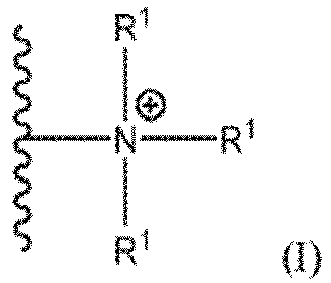 (ii) hydrophoben Substituenten, die jeweils 16 Kohlenstoffatome aufweisen; wobei das modifizierte Kohlenhydratpolymer zu 0,005 bis 1,5 Gew.-% des Celluloseether-Basismaterials die hydrophoben Substituenten umfasst; wobei die hydrophoben Substituenten regellos über die Hauptkette des Celluloseether-Basismaterials verteilt sind; wobei das Celluloseether-Basismaterial ein Gewichtsmittel des Molekulargewichts, Mw, von > 1.000.000 Dalton aufweist; und wobei das modifizierte Kohlenhydratpolymer zu < 0,001 Gew.-%, basierend auf dem Gewicht des modifizierten Kohlenhydratpolymers, Vernetzungseinheiten umfasst; und(c) Bereitstellen des ausgewählten Haarausrichtungsverstärkers; und(d) Kombinieren des kosmetisch verträglichen wässrigen Trägers und des Haarausrichtungsverstärkers;wobei die wässrige Conditioner-Formulierung zu 0,1 bis 5 Gew.-%, basierend auf dem Gewicht der wässrigen Conditioner-Formulierung, den Haarausrichtungsverstärker enthält.
 - Verfahren zum thermischen Stylen von Haar, umfassend:Bereitstellen einer wässrigen Conditioner-Formulierung nach Anspruch 1,Auftragen der wässrigen Conditioner-Formulierung auf das Haar eines Säugetiers undthermisches Stylen des Haars.
Applications Claiming Priority (2)
| Application Number | Priority Date | Filing Date | Title |
|---|---|---|---|
| US201962928378P | 2019-10-31 | 2019-10-31 | |
| PCT/US2020/057295 WO2021086773A1 (en) | 2019-10-31 | 2020-10-26 | Aqueous conditioner formulation for thermally styled hair |
Publications (2)
| Publication Number | Publication Date |
|---|---|
| EP4051229A1 EP4051229A1 (de) | 2022-09-07 |
| EP4051229B1 true EP4051229B1 (de) | 2025-03-26 |
Family
ID=73455805
Family Applications (1)
| Application Number | Title | Priority Date | Filing Date |
|---|---|---|---|
| EP20808244.6A Active EP4051229B1 (de) | 2019-10-31 | 2020-10-26 | Wässrige conditioner-formulierung für thermisch gestyltes haar |
Country Status (7)
| Country | Link |
|---|---|
| US (1) | US12350358B2 (de) |
| EP (1) | EP4051229B1 (de) |
| JP (1) | JP7679364B2 (de) |
| KR (1) | KR102842829B1 (de) |
| CN (1) | CN114746074A (de) |
| BR (1) | BR112022007265A2 (de) |
| WO (1) | WO2021086773A1 (de) |
Family Cites Families (16)
| Publication number | Priority date | Publication date | Assignee | Title |
|---|---|---|---|---|
| CN1259860A (zh) | 1997-07-09 | 2000-07-12 | 普罗克特和甘保尔公司 | 包括疏水改性的阳离子纤维素的护发组合物 |
| JP2000159642A (ja) | 1998-11-30 | 2000-06-13 | Lion Corp | 毛髪用洗浄剤組成物 |
| HK1046634A1 (zh) | 1999-07-29 | 2003-01-24 | The Procter & Gamble Company | 含有疏水性修饰的纤维素醚的头发护理组合物 |
| MXPA02004660A (es) | 1999-11-09 | 2002-09-02 | Procter & Gamble | Composicion acondicionadora que comprende celulosa cationica hidrofobicamente modificada. |
| US20040115155A1 (en) | 2001-06-08 | 2004-06-17 | The Procter & Gamble Company | Hair conditioning composition comprising cellulose polymer |
| WO2002100360A1 (en) | 2001-06-08 | 2002-12-19 | The Procter & Gamble Company | Hair conditioning composition comprising cellulose polymer |
| US20040247550A1 (en) | 2003-06-06 | 2004-12-09 | The Procter & Gamble Company | Hair or skin conditioning composition comprising hydrophobically modified cationic thickening polymer |
| US20080035167A1 (en) * | 2004-02-20 | 2008-02-14 | Dickson Industrial Co., Ltd. | Hair Styling Apparatus |
| WO2008002666A1 (en) * | 2006-06-29 | 2008-01-03 | Hercules Incorporated | Functional compositions containing cationic hydrophobically modified polysaccharides for personal care, household & institutional and pet care products |
| CA2664326C (en) | 2006-09-29 | 2016-01-19 | Union Carbide Chemicals & Plastics Technology Corporation | Quaternized cellulose ethers for personal care products |
| RU2589261C2 (ru) | 2010-06-24 | 2016-07-10 | Геркулес Инкорпорейтед | Добавка для композиций личной гигиены для нанесения на керативные субстраты, предназначенная для обеспечения продолжительного благоприятного действия |
| JP2015209380A (ja) * | 2014-04-24 | 2015-11-24 | ロレアル | 化粧用組成物 |
| JP6559994B2 (ja) * | 2015-03-27 | 2019-08-14 | 株式会社コーセー | 毛髪化粧料 |
| JP6807658B2 (ja) * | 2016-05-31 | 2021-01-06 | 花王株式会社 | 毛髪化粧料キット |
| US11246821B2 (en) * | 2016-08-30 | 2022-02-15 | Rohm And Haas Company | Personal care composition |
| WO2019025233A1 (en) | 2017-08-03 | 2019-02-07 | Basf Se | COSMETIC COMPOSITIONS COMPRISING A POLYMER OF BIOLOGICAL ORIGIN |
-
2020
- 2020-10-26 WO PCT/US2020/057295 patent/WO2021086773A1/en not_active Ceased
- 2020-10-26 US US17/639,932 patent/US12350358B2/en active Active
- 2020-10-26 KR KR1020227017825A patent/KR102842829B1/ko active Active
- 2020-10-26 EP EP20808244.6A patent/EP4051229B1/de active Active
- 2020-10-26 CN CN202080072280.0A patent/CN114746074A/zh active Pending
- 2020-10-26 JP JP2022522655A patent/JP7679364B2/ja active Active
- 2020-10-26 BR BR112022007265A patent/BR112022007265A2/pt unknown
Also Published As
| Publication number | Publication date |
|---|---|
| KR20220092549A (ko) | 2022-07-01 |
| US20220331216A1 (en) | 2022-10-20 |
| BR112022007265A2 (pt) | 2022-07-05 |
| WO2021086773A1 (en) | 2021-05-06 |
| CN114746074A (zh) | 2022-07-12 |
| EP4051229A1 (de) | 2022-09-07 |
| JP2023500593A (ja) | 2023-01-10 |
| US12350358B2 (en) | 2025-07-08 |
| KR102842829B1 (ko) | 2025-08-06 |
| JP7679364B2 (ja) | 2025-05-19 |
Similar Documents
| Publication | Publication Date | Title |
|---|---|---|
| EP4157212B1 (de) | Verfahren zur reduzierung von haarschäden veursacht durch hitze oder wärme | |
| EP2088994B2 (de) | Dispersible glyoxal behandelte kationische polygalactommananpolymere | |
| CN1200677C (zh) | 护发组合物 | |
| CN115315245B (zh) | 发油制剂 | |
| CN115427008B (zh) | 毛发护理制剂 | |
| CN112888423B (zh) | 个人护理组合物 | |
| US11246821B2 (en) | Personal care composition | |
| US20230108965A1 (en) | Hair cleansing formulation | |
| US10716745B2 (en) | Body wash composition | |
| EP4051229B1 (de) | Wässrige conditioner-formulierung für thermisch gestyltes haar | |
| US20240115482A1 (en) | Formulation for the care of damaged hair | |
| JP2019519555A (ja) | 濃縮物からの毛髪ケア処方物 | |
| EP4297719B1 (de) | Körperpflege-spülzusammensetzung mit vernetztem celluloseether | |
| US10206863B2 (en) | Cationic arabinoxylans, their hydrophobically modified products, and preparation method and application thereof | |
| EP4312970B1 (de) | Shampooformulierung mit verbesserter silikonabscheidung | |
| EP4346754A1 (de) | Shampooformulierung mit verbesserter silikonabscheidung | |
| BR112021007117B1 (pt) | Método para depositar silicone |
Legal Events
| Date | Code | Title | Description |
|---|---|---|---|
| STAA | Information on the status of an ep patent application or granted ep patent |
Free format text: STATUS: UNKNOWN |
|
| STAA | Information on the status of an ep patent application or granted ep patent |
Free format text: STATUS: THE INTERNATIONAL PUBLICATION HAS BEEN MADE |
|
| PUAI | Public reference made under article 153(3) epc to a published international application that has entered the european phase |
Free format text: ORIGINAL CODE: 0009012 |
|
| STAA | Information on the status of an ep patent application or granted ep patent |
Free format text: STATUS: REQUEST FOR EXAMINATION WAS MADE |
|
| 17P | Request for examination filed |
Effective date: 20220511 |
|
| AK | Designated contracting states |
Kind code of ref document: A1 Designated state(s): AL AT BE BG CH CY CZ DE DK EE ES FI FR GB GR HR HU IE IS IT LI LT LU LV MC MK MT NL NO PL PT RO RS SE SI SK SM TR |
|
| DAV | Request for validation of the european patent (deleted) | ||
| DAX | Request for extension of the european patent (deleted) | ||
| P01 | Opt-out of the competence of the unified patent court (upc) registered |
Effective date: 20230526 |
|
| GRAP | Despatch of communication of intention to grant a patent |
Free format text: ORIGINAL CODE: EPIDOSNIGR1 |
|
| STAA | Information on the status of an ep patent application or granted ep patent |
Free format text: STATUS: GRANT OF PATENT IS INTENDED |
|
| INTG | Intention to grant announced |
Effective date: 20241028 |
|
| GRAS | Grant fee paid |
Free format text: ORIGINAL CODE: EPIDOSNIGR3 |
|
| GRAA | (expected) grant |
Free format text: ORIGINAL CODE: 0009210 |
|
| STAA | Information on the status of an ep patent application or granted ep patent |
Free format text: STATUS: THE PATENT HAS BEEN GRANTED |
|
| AK | Designated contracting states |
Kind code of ref document: B1 Designated state(s): AL AT BE BG CH CY CZ DE DK EE ES FI FR GB GR HR HU IE IS IT LI LT LU LV MC MK MT NL NO PL PT RO RS SE SI SK SM TR |
|
| REG | Reference to a national code |
Ref country code: GB Ref legal event code: FG4D |
|
| REG | Reference to a national code |
Ref country code: CH Ref legal event code: EP |
|
| REG | Reference to a national code |
Ref country code: DE Ref legal event code: R096 Ref document number: 602020048414 Country of ref document: DE |
|
| REG | Reference to a national code |
Ref country code: IE Ref legal event code: FG4D |
|
| PG25 | Lapsed in a contracting state [announced via postgrant information from national office to epo] |
Ref country code: RS Free format text: LAPSE BECAUSE OF FAILURE TO SUBMIT A TRANSLATION OF THE DESCRIPTION OR TO PAY THE FEE WITHIN THE PRESCRIBED TIME-LIMIT Effective date: 20250626 |
|
| PG25 | Lapsed in a contracting state [announced via postgrant information from national office to epo] |
Ref country code: FI Free format text: LAPSE BECAUSE OF FAILURE TO SUBMIT A TRANSLATION OF THE DESCRIPTION OR TO PAY THE FEE WITHIN THE PRESCRIBED TIME-LIMIT Effective date: 20250326 |
|
| REG | Reference to a national code |
Ref country code: LT Ref legal event code: MG9D |
|
| PG25 | Lapsed in a contracting state [announced via postgrant information from national office to epo] |
Ref country code: NO Free format text: LAPSE BECAUSE OF FAILURE TO SUBMIT A TRANSLATION OF THE DESCRIPTION OR TO PAY THE FEE WITHIN THE PRESCRIBED TIME-LIMIT Effective date: 20250626 |
|
| PG25 | Lapsed in a contracting state [announced via postgrant information from national office to epo] |
Ref country code: HR Free format text: LAPSE BECAUSE OF FAILURE TO SUBMIT A TRANSLATION OF THE DESCRIPTION OR TO PAY THE FEE WITHIN THE PRESCRIBED TIME-LIMIT Effective date: 20250326 |
|
| PG25 | Lapsed in a contracting state [announced via postgrant information from national office to epo] |
Ref country code: LV Free format text: LAPSE BECAUSE OF FAILURE TO SUBMIT A TRANSLATION OF THE DESCRIPTION OR TO PAY THE FEE WITHIN THE PRESCRIBED TIME-LIMIT Effective date: 20250326 |
|
| PG25 | Lapsed in a contracting state [announced via postgrant information from national office to epo] |
Ref country code: GR Free format text: LAPSE BECAUSE OF FAILURE TO SUBMIT A TRANSLATION OF THE DESCRIPTION OR TO PAY THE FEE WITHIN THE PRESCRIBED TIME-LIMIT Effective date: 20250627 Ref country code: BG Free format text: LAPSE BECAUSE OF FAILURE TO SUBMIT A TRANSLATION OF THE DESCRIPTION OR TO PAY THE FEE WITHIN THE PRESCRIBED TIME-LIMIT Effective date: 20250326 |
|
| REG | Reference to a national code |
Ref country code: NL Ref legal event code: MP Effective date: 20250326 |
|
| PG25 | Lapsed in a contracting state [announced via postgrant information from national office to epo] |
Ref country code: NL Free format text: LAPSE BECAUSE OF FAILURE TO SUBMIT A TRANSLATION OF THE DESCRIPTION OR TO PAY THE FEE WITHIN THE PRESCRIBED TIME-LIMIT Effective date: 20250326 |
|
| PG25 | Lapsed in a contracting state [announced via postgrant information from national office to epo] |
Ref country code: SE Free format text: LAPSE BECAUSE OF FAILURE TO SUBMIT A TRANSLATION OF THE DESCRIPTION OR TO PAY THE FEE WITHIN THE PRESCRIBED TIME-LIMIT Effective date: 20250326 |
|
| REG | Reference to a national code |
Ref country code: AT Ref legal event code: MK05 Ref document number: 1778353 Country of ref document: AT Kind code of ref document: T Effective date: 20250326 |
|
| PG25 | Lapsed in a contracting state [announced via postgrant information from national office to epo] |
Ref country code: SM Free format text: LAPSE BECAUSE OF FAILURE TO SUBMIT A TRANSLATION OF THE DESCRIPTION OR TO PAY THE FEE WITHIN THE PRESCRIBED TIME-LIMIT Effective date: 20250326 |
|
| PG25 | Lapsed in a contracting state [announced via postgrant information from national office to epo] |
Ref country code: PT Free format text: LAPSE BECAUSE OF FAILURE TO SUBMIT A TRANSLATION OF THE DESCRIPTION OR TO PAY THE FEE WITHIN THE PRESCRIBED TIME-LIMIT Effective date: 20250728 Ref country code: ES Free format text: LAPSE BECAUSE OF FAILURE TO SUBMIT A TRANSLATION OF THE DESCRIPTION OR TO PAY THE FEE WITHIN THE PRESCRIBED TIME-LIMIT Effective date: 20250326 |
|
| PG25 | Lapsed in a contracting state [announced via postgrant information from national office to epo] |
Ref country code: PL Free format text: LAPSE BECAUSE OF FAILURE TO SUBMIT A TRANSLATION OF THE DESCRIPTION OR TO PAY THE FEE WITHIN THE PRESCRIBED TIME-LIMIT Effective date: 20250326 Ref country code: IT Free format text: LAPSE BECAUSE OF FAILURE TO SUBMIT A TRANSLATION OF THE DESCRIPTION OR TO PAY THE FEE WITHIN THE PRESCRIBED TIME-LIMIT Effective date: 20250326 |
|
| PGFP | Annual fee paid to national office [announced via postgrant information from national office to epo] |
Ref country code: GB Payment date: 20250904 Year of fee payment: 6 |
|
| PG25 | Lapsed in a contracting state [announced via postgrant information from national office to epo] |
Ref country code: AT Free format text: LAPSE BECAUSE OF FAILURE TO SUBMIT A TRANSLATION OF THE DESCRIPTION OR TO PAY THE FEE WITHIN THE PRESCRIBED TIME-LIMIT Effective date: 20250326 |
|
| PGFP | Annual fee paid to national office [announced via postgrant information from national office to epo] |
Ref country code: FR Payment date: 20250908 Year of fee payment: 6 |
|
| PG25 | Lapsed in a contracting state [announced via postgrant information from national office to epo] |
Ref country code: EE Free format text: LAPSE BECAUSE OF FAILURE TO SUBMIT A TRANSLATION OF THE DESCRIPTION OR TO PAY THE FEE WITHIN THE PRESCRIBED TIME-LIMIT Effective date: 20250326 |
|
| PG25 | Lapsed in a contracting state [announced via postgrant information from national office to epo] |
Ref country code: RO Free format text: LAPSE BECAUSE OF FAILURE TO SUBMIT A TRANSLATION OF THE DESCRIPTION OR TO PAY THE FEE WITHIN THE PRESCRIBED TIME-LIMIT Effective date: 20250326 |
|
| PG25 | Lapsed in a contracting state [announced via postgrant information from national office to epo] |
Ref country code: SK Free format text: LAPSE BECAUSE OF FAILURE TO SUBMIT A TRANSLATION OF THE DESCRIPTION OR TO PAY THE FEE WITHIN THE PRESCRIBED TIME-LIMIT Effective date: 20250326 |
|
| PG25 | Lapsed in a contracting state [announced via postgrant information from national office to epo] |
Ref country code: IS Free format text: LAPSE BECAUSE OF FAILURE TO SUBMIT A TRANSLATION OF THE DESCRIPTION OR TO PAY THE FEE WITHIN THE PRESCRIBED TIME-LIMIT Effective date: 20250726 |
|
| REG | Reference to a national code |
Ref country code: DE Ref legal event code: R097 Ref document number: 602020048414 Country of ref document: DE |
|
| PGFP | Annual fee paid to national office [announced via postgrant information from national office to epo] |
Ref country code: DE Payment date: 20250902 Year of fee payment: 6 |
|
| PG25 | Lapsed in a contracting state [announced via postgrant information from national office to epo] |
Ref country code: DK Free format text: LAPSE BECAUSE OF FAILURE TO SUBMIT A TRANSLATION OF THE DESCRIPTION OR TO PAY THE FEE WITHIN THE PRESCRIBED TIME-LIMIT Effective date: 20250326 |
|
| PG25 | Lapsed in a contracting state [announced via postgrant information from national office to epo] |
Ref country code: CZ Free format text: LAPSE BECAUSE OF FAILURE TO SUBMIT A TRANSLATION OF THE DESCRIPTION OR TO PAY THE FEE WITHIN THE PRESCRIBED TIME-LIMIT Effective date: 20250326 |
|
| PLBE | No opposition filed within time limit |
Free format text: ORIGINAL CODE: 0009261 |
|
| STAA | Information on the status of an ep patent application or granted ep patent |
Free format text: STATUS: NO OPPOSITION FILED WITHIN TIME LIMIT |
|
| REG | Reference to a national code |
Ref country code: CH Ref legal event code: L10 Free format text: ST27 STATUS EVENT CODE: U-0-0-L10-L00 (AS PROVIDED BY THE NATIONAL OFFICE) Effective date: 20260211 |
|
| 26N | No opposition filed |
Effective date: 20260105 |