EP4050283B1 - Boiler - Google Patents
Boiler Download PDFInfo
- Publication number
- EP4050283B1 EP4050283B1 EP19949548.2A EP19949548A EP4050283B1 EP 4050283 B1 EP4050283 B1 EP 4050283B1 EP 19949548 A EP19949548 A EP 19949548A EP 4050283 B1 EP4050283 B1 EP 4050283B1
- Authority
- EP
- European Patent Office
- Prior art keywords
- water
- hydrogen
- gas
- heat
- boiler
- Prior art date
- Legal status (The legal status is an assumption and is not a legal conclusion. Google has not performed a legal analysis and makes no representation as to the accuracy of the status listed.)
- Active
Links
Images





Classifications
-
- F—MECHANICAL ENGINEERING; LIGHTING; HEATING; WEAPONS; BLASTING
- F22—STEAM GENERATION
- F22B—METHODS OF STEAM GENERATION; STEAM BOILERS
- F22B1/00—Methods of steam generation characterised by form of heating method
- F22B1/02—Methods of steam generation characterised by form of heating method by exploitation of the heat content of hot heat carriers
- F22B1/18—Methods of steam generation characterised by form of heating method by exploitation of the heat content of hot heat carriers the heat carrier being a hot gas, e.g. waste gas such as exhaust gas of internal-combustion engines
- F22B1/1869—Hot gas water tube boilers not provided for in F22B1/1807 - F22B1/1861
-
- F—MECHANICAL ENGINEERING; LIGHTING; HEATING; WEAPONS; BLASTING
- F22—STEAM GENERATION
- F22B—METHODS OF STEAM GENERATION; STEAM BOILERS
- F22B1/00—Methods of steam generation characterised by form of heating method
- F22B1/02—Methods of steam generation characterised by form of heating method by exploitation of the heat content of hot heat carriers
-
- F—MECHANICAL ENGINEERING; LIGHTING; HEATING; WEAPONS; BLASTING
- F22—STEAM GENERATION
- F22B—METHODS OF STEAM GENERATION; STEAM BOILERS
- F22B1/00—Methods of steam generation characterised by form of heating method
- F22B1/02—Methods of steam generation characterised by form of heating method by exploitation of the heat content of hot heat carriers
- F22B1/18—Methods of steam generation characterised by form of heating method by exploitation of the heat content of hot heat carriers the heat carrier being a hot gas, e.g. waste gas such as exhaust gas of internal-combustion engines
-
- F—MECHANICAL ENGINEERING; LIGHTING; HEATING; WEAPONS; BLASTING
- F24—HEATING; RANGES; VENTILATING
- F24V—COLLECTION, PRODUCTION OR USE OF HEAT NOT OTHERWISE PROVIDED FOR
- F24V30/00—Apparatus or devices using heat produced by exothermal chemical reactions other than combustion
-
- H—ELECTRICITY
- H01—ELECTRIC ELEMENTS
- H01M—PROCESSES OR MEANS, e.g. BATTERIES, FOR THE DIRECT CONVERSION OF CHEMICAL ENERGY INTO ELECTRICAL ENERGY
- H01M8/00—Fuel cells; Manufacture thereof
- H01M8/04—Auxiliary arrangements, e.g. for control of pressure or for circulation of fluids
- H01M8/04007—Auxiliary arrangements, e.g. for control of pressure or for circulation of fluids related to heat exchange
- H01M8/04029—Heat exchange using liquids
-
- F—MECHANICAL ENGINEERING; LIGHTING; HEATING; WEAPONS; BLASTING
- F23—COMBUSTION APPARATUS; COMBUSTION PROCESSES
- F23C—METHODS OR APPARATUS FOR COMBUSTION USING FLUID FUEL OR SOLID FUEL SUSPENDED IN A CARRIER GAS OR AIR
- F23C2900/00—Special features of, or arrangements for combustion apparatus using fluid fuels or solid fuels suspended in air; Combustion processes therefor
- F23C2900/9901—Combustion process using hydrogen, hydrogen peroxide water or brown gas as fuel
-
- G—PHYSICS
- G21—NUCLEAR PHYSICS; NUCLEAR ENGINEERING
- G21B—FUSION REACTORS
- G21B3/00—Low temperature nuclear fusion reactors, e.g. alleged cold fusion reactors
-
- H—ELECTRICITY
- H01—ELECTRIC ELEMENTS
- H01M—PROCESSES OR MEANS, e.g. BATTERIES, FOR THE DIRECT CONVERSION OF CHEMICAL ENERGY INTO ELECTRICAL ENERGY
- H01M8/00—Fuel cells; Manufacture thereof
- H01M8/10—Fuel cells with solid electrolytes
- H01M8/12—Fuel cells with solid electrolytes operating at high temperature, e.g. with stabilised ZrO2 electrolyte
- H01M2008/1293—Fuel cells with solid oxide electrolytes
-
- Y—GENERAL TAGGING OF NEW TECHNOLOGICAL DEVELOPMENTS; GENERAL TAGGING OF CROSS-SECTIONAL TECHNOLOGIES SPANNING OVER SEVERAL SECTIONS OF THE IPC; TECHNICAL SUBJECTS COVERED BY FORMER USPC CROSS-REFERENCE ART COLLECTIONS [XRACs] AND DIGESTS
- Y02—TECHNOLOGIES OR APPLICATIONS FOR MITIGATION OR ADAPTATION AGAINST CLIMATE CHANGE
- Y02E—REDUCTION OF GREENHOUSE GAS [GHG] EMISSIONS, RELATED TO ENERGY GENERATION, TRANSMISSION OR DISTRIBUTION
- Y02E60/00—Enabling technologies; Technologies with a potential or indirect contribution to GHG emissions mitigation
- Y02E60/30—Hydrogen technology
- Y02E60/50—Fuel cells
-
- Y—GENERAL TAGGING OF NEW TECHNOLOGICAL DEVELOPMENTS; GENERAL TAGGING OF CROSS-SECTIONAL TECHNOLOGIES SPANNING OVER SEVERAL SECTIONS OF THE IPC; TECHNICAL SUBJECTS COVERED BY FORMER USPC CROSS-REFERENCE ART COLLECTIONS [XRACs] AND DIGESTS
- Y02—TECHNOLOGIES OR APPLICATIONS FOR MITIGATION OR ADAPTATION AGAINST CLIMATE CHANGE
- Y02P—CLIMATE CHANGE MITIGATION TECHNOLOGIES IN THE PRODUCTION OR PROCESSING OF GOODS
- Y02P80/00—Climate change mitigation technologies for sector-wide applications
- Y02P80/10—Efficient use of energy, e.g. using compressed air or pressurized fluid as energy carrier
Definitions
- the present invention relates to a boiler for heating supplied water.
- a boiler for heating supplied water has been broadly utilized for various purposes including industrial and commercial purposes.
- a heat generation unit configured to heat supplied water is provided, and as one form of the heat generation unit, there is one provided with a heat generation body in a container.
- Patent Literature 1 there are various specific forms of the above-described heat generation unit, and as one example thereof, one including, in a container, a heat generation body (a reactant) configured such that multiple metal nanoparticles made of hydrogen storing metal or hydrogen storing alloy are formed on a surface has been disclosed as a heat generation system in Patent Literature 1. According to Patent Literature 1, it has been described that in the heat generation system, hydrogen-based gas contributing to heat generation is supplied into the container to store hydrogen atoms in the metal nanoparticles and excess heat is generated.
- a heat generation body a reactant
- Patent Literature 1 it has been described that in the heat generation system, hydrogen-based gas contributing to heat generation is supplied into the container to store hydrogen atoms in the metal nanoparticles and excess heat is generated.
- JP H05-196201 A relates to a steam engine without use of combustion gas and without exhaustion of harmful gas and CO2 gas.
- JP 2013-257124 A relates to a next-generation carbon-free boiler using new global environment-friendly energy sources.
- KR 101683567 B1 relates to an enclosed heating element boiler using mixture gas of a steam and mixture gas of oxygen and hydrogen.
- the present invention has been made in view of the above-described object, and is intended to provide a boiler configured to heat water by a heat generation unit including a heat generation body in a container and configured so that heat generated by the heat generation body can be efficiently transmitted to the water.
- the boiler according to the present invention includes a water pipe, a heat generation body, a container in which the water pipe and the heat generation body are provided.
- the heat generation body is a reactant configured such that metal nanoparticles made of hydrogen storing metals are provided on a surface, and a hydrogen atom is stored in the metal nanoparticles to generate excess heat under a situation where hydrogen-based gas is supplied into the container.
- the boiler includes: as a path for circulating the hydrogen-based gas, a circulation path includes, as part thereof, the inside of the container; and a heater configured to heat the reactant, and the water pipe is configured to be heated by heat generated by the heat generation body under environment where the inside of the container is filled with the hydrogen-based gas, and the water pipe forms an entire periphery of a cylindrical side wall of the container.
- water is heated by a heat generation unit including the heat generation body in the container, and heat generated by the heat generation body can be efficiently transmitted to the water.
- the "water pipe” described herein means a pipe in which water targeted for heating flows.
- the above-described configuration further includes, as a path for circulating the gas, a circulation path including, as part thereof, the inside of the container.
- the gas is hydrogen-based gas.
- the hydrogen-based gas in the present application is heavy hydrogen gas, light hydrogen gas, or a mixture thereof.
- the heat generation body is a reactant configured such that metal nanoparticles made of hydrogen storing metals are provided on a surface and hydrogen atoms are stored in the metal nanoparticles to generate excess heat under a situation where the hydrogen-based gas is supplied into the container.
- water can be heated by excess heat generated by the heat generation body.
- hydrogen storing metals in the present application means hydrogen storing metal such as Pd, Ni, Pt, and Ti or hydrogen storing alloy containing one or more types of these metals.
- the above-described configuration includes a heater configured to heat the reactant.
- the water pipe may be arranged to spirally extend to surround the heat generation body. According to the present configuration, heat generated by the heat generation body can be efficiently transmitted to water targeted for heating, and the water pipe can be easily arranged to cover the substantially entire area of the periphery of the side wall.
- the water pipe may include multiple water pipes arranged to extend in the vertical direction to surround the heat generation body.
- heat generated by the heat generation body can be efficiently transmitted to water targeted for heating, and the water pipe can be easily arranged to cover the substantially entire area of the periphery of the side wall while being arranged to form a once-through boiler or one equivalent thereto.
- water is heated by the heat generation unit including the heat generation body in the container, and heat generated by the heat generation body can be efficiently transmitted to the water.
- Fig. 1 is a schematic configuration diagram of a boiler 1 according to the first embodiment.
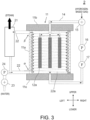
- the boiler 1 includes a container 11, reactants 12, heaters 13, a gas path 14, a gas receiving portion 15, a gas pump 16, a gas filter 17, a separator 21, a water path 22, a water receiving portion 23, and a water pump 24.
- Fig. 1 states of the container 11 and the inside thereof in Fig. 1 (the same also applies to Figs. 3 , 4 , 6 , and 7 as described later) are illustrated as schematic sectional views along a plane cutting the container 11 substantially in half, and upper, lower, right, and left directions (an upper-lower direction is coincident with the vertical direction) are illustrated as in this figure.
- chain lines illustrated in Fig. 1 schematically indicate arrangement of a water pipe 22a.
- the container 11 is, as a whole, formed in a cylindrical shape having bottoms at both upper and lower ends in the upper-lower direction as an axial direction, and is formed so that gas can be sealed inside. More specifically, the container 11 has a cylindrical side wall 11a formed by the later-described water pipe 22a, and the upper side of the side wall 11a is closed by an upper bottom portion 11b and the lower side of the side wall 11a is closed by a lower bottom portion 11c.
- the side wall 11a of the container 11 is in the cylindrical shape as one example, but may be formed in other tubular shapes.
- a can body cover may be placed at the outer periphery of the side wall 11a, and a heat insulating member may be provided between the side wall 11a and the can body cover.
- the reactant 12 is configured such that many metal nanoparticles are provided on a surface of a carrier formed in a fine mesh shape as a whole. Hydrogen storing alloys (hydrogen storing metal or hydrogen storing alloy) are applied as the material of this carrier, and the carrier is formed in a cylindrical shape having bottoms at both upper and lower ends in the upper-lower direction as the axial direction. An upper surface of the reactant 12 is connected to the gas path 14 so that gas having flowed into the reactant 12 through mesh-shaped clearances thereof can be delivered into the gas path 14. In the example of the present embodiment, three reactants 12 are provided next to each other in a right-left direction in the container 11.
- the heater 13 is spirally wound around a side surface of the reactant 12 formed in the bottomed cylindrical shape, and is formed to generate heat by means of external power (e.g., a ceramic heater).
- the heater 13 generates heat to heat the reactant 12 so that the temperature of the reactant 12 can be increased to a predetermined reaction temperature at which reaction for generating later-described excess heat is easily made.
- the temperature of the heater 13 can be adjusted to a desired temperature by power control.
- the gas path 14 is provided outside the container 11, and forms a gas circulation path including, as part thereof, the inside of the container 11.
- One end portion of the gas path 14 is connected to the upper surface of each reactant 12, and the other end portion is connected to the inside of the container 11. More specifically, portions of the gas path 14 connected to the upper surfaces of the reactants 12 are joined together in the container 11, and after having penetrated the upper bottom portion 11b as a single path, further penetrate the lower bottom portion 11c through the gas receiving portion 15, the gas pump 16, and the gas filter 17 and are connected to the inside of the container 11.
- the gas receiving portion 15 receives a supply of hydrogen-based gas (heavy hydrogen gas, light hydrogen gas, or a mixture thereof) from an external supply source, and causes the supplied hydrogen-based gas to flow into the gas path 14.
- a supply of hydrogen-based gas hereinavy hydrogen gas, light hydrogen gas, or a mixture thereof
- the hydrogen-based gas is supplied from a tank storing the hydrogen-based gas in advance to the gas receiving portion 15, such a tank is the hydrogen-based gas supply source.
- the amount of hydrogen-based gas to be supplied to the gas receiving portion 15 is controlled so that the internal pressure of the container 11 can be controlled.
- the gas pump 16 pushes gas in the gas path 14 from an upstream side to a downstream side (i.e., to a direction indicated by dashed arrows in Fig. 1 ) such that the gas flows in this direction. Note that the force of pushing gas by the gas pump 16 is controlled so that the amount of gas circulating in the circulation path including the gas path 14 can be controlled.
- the gas filter 17 removes an impurity (specifically, one as a cause for inhibition of the reaction for generating the excess heat in the reactant 12) contained in gas in the gas path 14.
- the separator 21 receives steam generated by heating of water through the water pipe 22a, and performs steam separation (separation of drain contained in such steam) for the steam.
- the steam separated in the separator 21 can be supplied to the outside of the boiler 1.
- the water path 22 is a water path connected from the water receiving portion 23 to the separator 21.
- Part of the water path 22 is the water pipe 22a forming the side wall 11a as described above.
- the water pump 24 is arranged at a position immediately on the downstream side of the water receiving portion 23. Note that liquid water supplied from the water receiving portion 23 flows in the upstream-side path of the water path 22 with respect to the water pipe 22a, and water (steam) evaporated by heating in the water pipe 22a flows in the downstream-side path (between the container 11 and the separator 21) with respect to the water pipe 22a.
- the water receiving portion 23 receives, as necessary, a supply of water as a steam source from the outside, and causes the supplied water to flow into the water path 22.
- the water pump 24 causes water in the water path 22 to flow from the upstream side to the downstream side (i.e., to a direction indicated by solid arrows in Fig. 1 ).
- the water pipe 22a spirally extends from the lower bottom portion 11c to the upper bottom portion 11b to form the tubular side wall 11a of the container 11. That is, the water pipe 22a spirally extends in the axial direction (the upper-lower direction) of the tubular side wall 11a such that no clearance is formed between adjacent portions of the water pipe 22a in the upper-lower direction.
- the sectional shape of an inner wall of the water pipe 22a is in a rectangular shape, but may be a circular shape or other shapes.
- the hydrogen-based gas is supplied from the external supply source to the gas receiving portion 15, and the gas circulation path including the inside of the container 11 and the gas path 14 is filled with the hydrogen-based gas. Due to action of the gas pump 16, the charged hydrogen-based gas circulates to the direction indicated by the dashed arrows in Fig. 1 in the gas circulation path.
- the hydrogen-based gas is delivered into the gas path 14 connected to upper portions of the reactants 12 after having flowed in the reactants 12 through the mesh-shaped clearances thereof.
- the reactants 12 are heated by action of the heaters 13.
- the reactants 12 are, as described above, heated by the heaters 13 in a state in which the hydrogen-based gas has been supplied into the container 11, hydrogen atoms are stored in the metal nanoparticles provided on the reactants 12, and the reactants 12 generate an excess heat of equal to or higher than the temperature of heating by the heater 13.
- the reactant 12 since the reactant 12 makes the reaction for generating the excess heat, the reactant 12 functions as a heat generation body.
- the principle of the reaction for generating the excess heat is, for example, similar to the principle of reaction for generating excess heat as disclosed in Patent Literature 1.
- the impurity is removed when the hydrogen-based gas passes through the gas filter 17.
- the high-purity hydrogen-based gas from which the impurity has been removed is continuously supplied into the container 11.
- water is supplied from the outside to the water receiving portion 23.
- the supplied water flows, due to action of the water pump 24, to the direction indicated by the solid arrows in Fig. 1 in the water path 22.
- the water flowing in the water path 22 is heated by heat generated by the reactants 12. That is, the heat generated by the reactants 12 is transmitted to the water pipe 22a by convection (heat transfer) by the hydrogen-based gas in the container 11, and the water pipe 22a of which the temperature has been increased by such transmission heats the water flowing in the water pipe 22a.
- Fig. 2 schematically illustrates the course of water passing through the water pipe 22a by a solid arrow.
- water having entered the water pipe 22a through an inlet ⁇ (the lowermost portion of the water pipe 22a) of the water pipe 22a flows along a spirally-extending path in the water pipe 22a, and is discharged as steam toward the separator 21 through an outlet ⁇ (the uppermost portion of the water pipe 22a) of the water pipe 22a.
- heat from the water pipe 22a (the side wall 11a of the container) heated by heat generated by the reactants 12 is transmitted to the water passing through the water pipe 22a, and the temperature of the water increases.
- the amount of steam supplied from the separator 21 to the outside can be, for example, adjusted according to the amount of steam required from the outside.
- water is sequentially supplied to the water receiving portion 23 by an amount corresponding to a steam supply to the outside, i.e., a water decrement, and steam can be continuously generated and supplied to the outside.
- the temperature of the reactant 12 or the periphery thereof may be monitored and at least one of the temperature of the heater 13, the internal pressure of the container 11, or the amount of hydrogen-based gas circulating in the circulation path may be controlled according to the detected temperature.
- tendency shows that the reaction for generating the excess heat at the reactant 12 is more promoted and water is more easily heated by heat generated from the reactant 12 as the temperature of the heater 13 increases.
- the same also applies to the case of increasing the internal pressure of the container 11 and the case of increasing the circulation amount of the hydrogen-based gas.
- the reactant 12 is employed as the heat generation body.
- a heat generation element 12a e.g., a halogen heater configured to generate heat by a supply of external power
- a general heater can be employed to form a boiler.
- a schematic configuration diagram of a boiler 2 configured as described above is illustrated as an example in Fig. 3 . Note that for the sake of convenience, the shape and dimensions of the heat generation element 12a are similar to those of the reactant 12. Moreover, since one equivalent to the heater 13 is not necessary for the heat generation element 12a, placement thereof is omitted.
- a water pipe 22a is heated by heat generated from the heat generation elements 12a instead of the reactants 12, and the heat from the water pipe 22a (a side wall 11a of a container) is transmitted to water passing through the water pipe 22a, and the temperature of the water increases.
- the above-described reaction for generating the excess heat is not necessary, and the temperature of the heat generation element 12a is directly controlled by, e.g., power control so that water can be moderately heated to generate steam.
- each boiler 1, 2 includes the heat generation bodies and the container 11 having the heat generation bodies inside, and is configured to heat supplied water to generate steam. Further, each boiler 1, 2 includes the water pipe 22a to be heated by heat generated by the heat generation bodies under environment where the inside of the container 11 is filled with gas (the hydrogen-based gas in the examples of the present embodiment) with higher specific heat capacity than that of air, and water (water as the steam source) passing through the water pipe 22a is heated.
- gas the hydrogen-based gas in the examples of the present embodiment
- water water as the steam source
- each boiler 1, 2 heat generated by the heat generation bodies can be efficiently transmitted to water while such water is heated by a heat generation unit including the heat generation bodies in the container 11 to generate steam. That is, for example, in a case a heat medium such as fluid other than water flows in a water pipe to exchange heat with water outside the container 11, a heat loss due to the presence of the heat medium or delivery thereof might be caused.
- the water pipe itself is arrange to surround the heat generation bodies, and therefore, the heat medium for collecting heat generated by the heat generation bodies is not necessary. As a result, the above-described heat loss can be reduced, and heat generated by the heat generation bodies can be efficiently transmitted to water as the steam source.
- the inside of the container 11 is filled with gas with higher specific heat capacity than that of air, and therefore, heat transfer can be favorably performed as compared to the case of charging general air, and heat generated by the heat generation bodies can be efficiently transmitted to water as the steam source. Moreover, due to high specific heat capacity, it is less likely to fluctuate the temperature of gas, and heat can be more stably transmitted to water.
- the water pipe 22a forms the entire periphery of the side wall 11a formed in the tubular shape, and therefore, heat generated by the heat generation bodies can be efficiently transmitted to water as the steam source.
- the water pipe 22a in the present embodiments is arranged to spirally extend to surround the heat generation bodies, and therefore, the substantially entire area of the periphery of the side wall 11a can be covered and heat generated by the heat generation bodies can be transmitted to water as the steam source with as least waste as possible.
- the side wall 11a for sealing gas in the container 11 is formed by the water pipe 22a.
- the side wall 11a may be provided separately from the water pipe 22a, and the water pipe 22a may be provided inside the side wall 11a (i.e., in the container 11).
- the water pipe 22a can be also heated by heat generated by the heat generation bodies.
- the water pipe 22a does not necessarily fulfill a function as the side wall 11a, but preferably fulfills such a function because the water pipe 22a more easily receives heat from the reactants 12 when there is a clearance between adjacent portions of the water pipe 22a in the upper-lower direction.
- each boiler 1, 2 the above-described gas circulates in the circulation path including, as part thereof, the inside of the container 11.
- a mechanism configured to circulate gas in the container 11 may be omitted, and instead, a mechanism configured to supply gas into the container 11 to fill the container 11 with the gas may be provided.
- gas other than the hydrogen-based gas may be employed as the above-described gas with higher specific heat capacity than that of air.
- the second embodiment is basically similar to the first embodiment, except for the form of a water pipe.
- description of contents different from those of the first embodiment will be focused, and description of contents common to the first embodiment might be omitted.
- Fig. 4 is a schematic configuration diagram of a boiler 1a according to the second embodiment.
- a water path 22 in the second embodiment includes a lower header 22b1 and an upper header 22b2 in addition to multiple water pipes 22a extending up and down in the vertical direction.
- the lower header 22b1 extends to form a circular shape on a lower side of a side wall 11a in a cylindrical shape, and at a lower left portion thereof, an inlet ⁇ of the lower header 22b1 is formed.
- the upper header 22b2 extends to form a circular shape on an upper side of the side wall 1 1a in the cylindrical shape, and at an upper left portion thereof, an outlet ⁇ of the upper header 22b2 is formed.
- the lower header 22b1 and the upper header 22b2 are set to the substantially same shape and dimensions, and are arranged to overlap with each other as viewed from above.
- a portion of the water path 22 extending from a water pump 24 is connected to the inlet ⁇ of the lower header 22b1, and a portion of the water path 22 extending from the outlet ⁇ of the upper header 22b2 is connected to a separator 21.
- the multiple water pipes 22a extend in an upper-lower direction between the lower header 22b 1 and the upper header 22b2, and are arranged next to each other in a circumferential direction of the cylindrical shape of the side wall 11a to form the side wall 11a in the cylindrical shape.
- Each of the multiple water pipes 22a is integrated such that there is no clearance between adjacent ones of the water pipes 22a in the circumferential direction.
- each of the multiple water pipes 22a is connected to an internal space of the lower header 22b1 on the lower side, and is connected to an internal space of the upper header 22b2 on the upper side. That is, the circular lower header 22b1 is connected to lower ends of all of the multiple water pipes 22a, and the circular upper header 22b2 is connected to upper ends of all of the multiple water pipes 22a. With this configuration, water having entered the lower header 22b1 through the inlet ⁇ can reach the outlet ⁇ through the water pipes 22a.
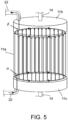
- Fig. 5 schematically illustrates the course of water passing through the water pipes 22a and the periphery thereof by a solid arrow.
- the water flows in the circumferential direction along the lower header 22b1, and further flows upward along each of the multiple water pipes 22a.
- the water heated in the water pipes 22a reaches, as steam, the upper header 22b2, flows in the circumferential direction along the upper header 22b2, and is delivered to the separator 21 through the outlet ⁇ .
- the water path 22 has the multiple water pipes 22a extending in an axial direction (the vertical direction) of the tubular side wall 11a.
- These water pipes 22a are arranged in the circumferential direction of the tubular shape to form the side wall 11a, and therefore, are arranged to surround heat generation bodies.
- the water pipes 22a are easily arranged to cover the substantially entire area of the periphery of the side wall 11a while the water pipes 22a are arranged to form a once-through boiler or one equivalent thereto. Heat generated by the heat generation bodies can be transmitted to water as a steam source with as least waste as possible.
- the first example is basically similar to the first embodiment, except that a hydrogen-powered burner is employed as a reactant heating unit instead of a heater.
- a hydrogen-powered burner is employed as a reactant heating unit instead of a heater.
- Fig. 6 is a schematic configuration diagram of a boiler 1b according to the first example. Note that considering visibility in Fig. 6 , the solid arrows and the chain lines illustrated in Fig. 1 are omitted. As illustrated in this figure, in the boiler 1b, a hydrogen-powered burner 18 is provided instead of omitting placement of the heaters 13 (see Fig. 1 ).
- the hydrogen-powered burner 18 is a burner using hydrogen-based gas as fuel, and in a container 11, is arranged so that not only reactants 12 but also a side wall 11a can be heated.
- the hydrogen-powered burner 18 is arranged to spurt combustion flame to among the reactants 12 and the side wall 11a to efficiently heat these components.
- the hydrogen-powered burner 18 may be arranged outside the container 11, and may directly heat the side wall 11a and heat the reactants 12 through the side wall 11a.
- the hydrogen-powered burner 18 fulfills a role in heating the reactants 12, and therefore, placement of the above-described heaters 13 can be omitted and other external heat sources for increasing the temperature of the reactant 12 are not necessary either.
- a supply source of the hydrogen-based gas supplied as the fuel of the hydrogen-powered burner 18 is common to that of hydrogen-based gas supplied to a gas receiving portion 15. With this configuration, the hydrogen-based gas supplied from such a supply source can be efficiently utilized, and it is also advantageous in, e.g., simplification of the configuration of the boiler.
- the hydrogen-powered burner 18 heats the side wall 11a so that water passing through water pipes 22a can be heated.
- water can be heated not only by heat generated from the reactants 12, but also by the hydrogen-powered burner 18.
- the reactant 12 has such properties that reaction starts after the temperature of the reactant 12 has increased to a predetermined reaction temperature and the reactant 12 gradually generates excess heat, and therefore, water is heated using the hydrogen-powered burner 18 upon the start-up so that time necessary until generation of steam can be significantly shortened.
- the second example is basically similar to the first embodiment, except that a fuel cell is provided.
- description of contents different from those of the first embodiment will be focused, and description of contents common to the first embodiment might be omitted.
- Fig. 7 is a schematic configuration diagram of a boiler 1c according to the second example. Note that considering visibility in Fig. 7 , the solid arrows and the chain lines illustrated in Fig. 1 are omitted. As illustrated in this figure, in the boiler 1c, a fuel cell 19 is provided.
- the fuel cell 19 is, for example, a solid oxide fuel cell (SOFC), and generates power by reaction between hydrogen-based gas supplied to a fuel electrode 19a and oxygen in air supplied to an air electrode 19b to supply, as drive power, the generated power to heaters 13. Accordingly, the heaters 13 can generate heat by the power supplied from the fuel cell 19, thereby heating heat generation bodies 12. Thus, in the present example, external power for driving the heaters 13 is not necessary. Note that the power generated by the fuel cell 19 may be also supplied to a load other than the heaters 13. General configuration, operating principle and the like of the fuel cell are well-known, and therefore, detailed description thereof will be omitted herein.
- SOFC solid oxide fuel cell
- a supply source of the hydrogen-based gas supplied to the fuel electrode 19a is common to that of hydrogen-based gas supplied to a gas receiving portion 15. With this configuration, the hydrogen-based gas supplied from such a supply source can be efficiently utilized, and it is also advantageous in, e.g., simplification of the configuration of the boiler.
- hydrogen-based gas discharged unreacted from the fuel electrode 19a is, in the present embodiment, supplied to the gas receiving portion 15, and is supplied into the container 11 by way of a gas path 14. More specifically, e.g., steam separation processing by a condenser (not shown) and foreign body removal processing by a membrane separator (not shown) are performed for exhaust gas (including the unreacted hydrogen-based gas) discharged from the fuel electrode 19a, and the hydrogen-based gas of which the purity has been increased through such processing is supplied to the gas receiving portion 15.
- steam separation processing by a condenser not shown
- foreign body removal processing by a membrane separator
- the hydrogen-based gas is supplied from the same supply source to the fuel electrode 19a and the gas receiving portion 15 in parallel, but the hydrogen-based gas may be supplied only to the fuel electrode 19a from the supply source and only the hydrogen-based gas discharged unreacted from the fuel electrode 19a may be supplied to the gas receiving portion 15. Conversely, the hydrogen-based gas may be supplied only to the gas receiving portion 15 from the supply source, and only the hydrogen-based gas circulating in the gas path 14 may be supplied to the fuel electrode 19a. Further, in this case, the hydrogen-based gas discharged unreacted from the fuel electrode 19a may be returned to the gas path 14 again.
- the embodiments of the present invention have been described above, but the configurations of the present invention are not limited to those of the above-described embodiments. Various changes can be made without departing from the scope of the invention as claimed. That is, the above-described embodiments are examples on all points, and should be considered as not being limited.
- the boiler according to the present invention is also applicable to a hot water boiler, a heat medium boiler, and the like in addition to the boiler generating steam as in the above-described embodiments.
- the technical scope of the present invention is not determined by description of the above-described embodiments, but is determined by the claims.
- the present invention relates to a boiler.
Landscapes
- Engineering & Computer Science (AREA)
- Chemical & Material Sciences (AREA)
- Physics & Mathematics (AREA)
- General Engineering & Computer Science (AREA)
- Mechanical Engineering (AREA)
- Thermal Sciences (AREA)
- Combustion & Propulsion (AREA)
- Sustainable Energy (AREA)
- Chemical Kinetics & Catalysis (AREA)
- Life Sciences & Earth Sciences (AREA)
- Sustainable Development (AREA)
- General Chemical & Material Sciences (AREA)
- Electrochemistry (AREA)
- Manufacturing & Machinery (AREA)
- Fuel Cell (AREA)
- Central Heating Systems (AREA)
- Thermotherapy And Cooling Therapy Devices (AREA)
- Cookers (AREA)
Description
- The present invention relates to a boiler for heating supplied water.
- Typically, a boiler for heating supplied water has been broadly utilized for various purposes including industrial and commercial purposes. In the boiler, a heat generation unit configured to heat supplied water is provided, and as one form of the heat generation unit, there is one provided with a heat generation body in a container.
- There are various specific forms of the above-described heat generation unit, and as one example thereof, one including, in a container, a heat generation body (a reactant) configured such that multiple metal nanoparticles made of hydrogen storing metal or hydrogen storing alloy are formed on a surface has been disclosed as a heat generation system in
Patent Literature 1. According toPatent Literature 1, it has been described that in the heat generation system, hydrogen-based gas contributing to heat generation is supplied into the container to store hydrogen atoms in the metal nanoparticles and excess heat is generated. - Note that as also described in
Patent Literature 1, an announcement that the heat generation body produced from palladium is provided in the container and heat generation reaction is made by heating the inside of the container while heavy hydrogen gas is being supplied into the container has been released. Moreover, regarding a heat generation phenomenon that the excess heat (an output enthalpy higher than an input enthalpy) is generated utilizing the hydrogen storing metal or the hydrogen storing alloy, details of the mechanism for generating the excess heat have been discussed among researchers of each country, and it has been reported that the heat generation phenomenon has occurred. -
JP H05-196201 A JP 2013-257124 A KR 101683567 B1 -
- Patent Literature 1:
Japanese Patent No. 6448074 - Patent Literature 2:
U.S. Patent No. 9,182,365 - It is important for the boiler configured to heat water by the heat generation unit including the heat generation body in the container to transmit heat generated by the heat generation body to water as efficiently as possible. The present invention has been made in view of the above-described object, and is intended to provide a boiler configured to heat water by a heat generation unit including a heat generation body in a container and configured so that heat generated by the heat generation body can be efficiently transmitted to the water.
- The invention is set out in the appended set of claims. The following disclosure serves a better understanding of the present invention. The boiler according to the present invention includes a water pipe, a heat generation body, a container in which the water pipe and the heat generation body are provided. The heat generation body is a reactant configured such that metal nanoparticles made of hydrogen storing metals are provided on a surface, and a hydrogen atom is stored in the metal nanoparticles to generate excess heat under a situation where hydrogen-based gas is supplied into the container. The boiler includes: as a path for circulating the hydrogen-based gas, a circulation path includes, as part thereof, the inside of the container; and a heater configured to heat the reactant, and the water pipe is configured to be heated by heat generated by the heat generation body under environment where the inside of the container is filled with the hydrogen-based gas, and the water pipe forms an entire periphery of a cylindrical side wall of the container.
- According to the present configuration, water is heated by a heat generation unit including the heat generation body in the container, and heat generated by the heat generation body can be efficiently transmitted to the water. Note that the "water pipe" described herein means a pipe in which water targeted for heating flows.
- More specifically, the above-described configuration further includes, as a path for circulating the gas, a circulation path including, as part thereof, the inside of the container. More specifically, as the above-described configuration, the gas is hydrogen-based gas. Note that the hydrogen-based gas in the present application is heavy hydrogen gas, light hydrogen gas, or a mixture thereof.
- More specifically, as the above-described configuration, the heat generation body is a reactant configured such that metal nanoparticles made of hydrogen storing metals are provided on a surface and hydrogen atoms are stored in the metal nanoparticles to generate excess heat under a situation where the hydrogen-based gas is supplied into the container. According to the present configuration, water can be heated by excess heat generated by the heat generation body. Note that the "hydrogen storing metals" in the present application means hydrogen storing metal such as Pd, Ni, Pt, and Ti or hydrogen storing alloy containing one or more types of these metals.
- More specifically, the above-described configuration includes a heater configured to heat the reactant.
- More specifically, as the above-described configuration, the water pipe may be arranged to spirally extend to surround the heat generation body. According to the present configuration, heat generated by the heat generation body can be efficiently transmitted to water targeted for heating, and the water pipe can be easily arranged to cover the substantially entire area of the periphery of the side wall.
- More specifically, as the above-described configuration, the water pipe may include multiple water pipes arranged to extend in the vertical direction to surround the heat generation body. According to the present configuration, heat generated by the heat generation body can be efficiently transmitted to water targeted for heating, and the water pipe can be easily arranged to cover the substantially entire area of the periphery of the side wall while being arranged to form a once-through boiler or one equivalent thereto.
- According to the boiler of the present invention, water is heated by the heat generation unit including the heat generation body in the container, and heat generated by the heat generation body can be efficiently transmitted to the water.
-
-
Fig. 1 is a schematic configuration diagram of aboiler 1 according to a first embodiment. -
Fig. 2 is a view for describing the course of water passing through a water pipe of theboiler 1. -
Fig. 3 is a schematic configuration diagram of aboiler 2 in the case of employing heat generation elements. -
Fig. 4 is a schematic configuration diagram of aboiler 1a according to a second embodiment. -
Fig. 5 is a view for describing the course of water passing through a water pipe of theboiler 1a. -
Fig. 6 is a schematic configuration diagram of aboiler 1b according to a first non-limiting example. -
Fig. 7 is a schematic configuration diagram of aboiler 1c according to a second non-limiting example. - Hereinafter, a boiler according to each embodiment of the present invention will be described with reference to each drawing.
- First, a first embodiment of the present invention will be described.
Fig. 1 is a schematic configuration diagram of aboiler 1 according to the first embodiment. As illustrated in this figure, theboiler 1 includes acontainer 11,reactants 12,heaters 13, agas path 14, agas receiving portion 15, agas pump 16, agas filter 17, aseparator 21, awater path 22, awater receiving portion 23, and awater pump 24. - Note that the states of the
container 11 and the inside thereof inFig. 1 (the same also applies toFigs. 3 ,4 ,6 , and7 as described later) are illustrated as schematic sectional views along a plane cutting thecontainer 11 substantially in half, and upper, lower, right, and left directions (an upper-lower direction is coincident with the vertical direction) are illustrated as in this figure. Moreover, chain lines illustrated inFig. 1 (the same also applies toFigs. 3 and4 ) schematically indicate arrangement of awater pipe 22a. - The
container 11 is, as a whole, formed in a cylindrical shape having bottoms at both upper and lower ends in the upper-lower direction as an axial direction, and is formed so that gas can be sealed inside. More specifically, thecontainer 11 has acylindrical side wall 11a formed by the later-describedwater pipe 22a, and the upper side of theside wall 11a is closed by anupper bottom portion 11b and the lower side of theside wall 11a is closed by alower bottom portion 11c. Note that in the present embodiment, theside wall 11a of thecontainer 11 is in the cylindrical shape as one example, but may be formed in other tubular shapes. Alternatively, a can body cover may be placed at the outer periphery of theside wall 11a, and a heat insulating member may be provided between theside wall 11a and the can body cover. - The
reactant 12 is configured such that many metal nanoparticles are provided on a surface of a carrier formed in a fine mesh shape as a whole. Hydrogen storing alloys (hydrogen storing metal or hydrogen storing alloy) are applied as the material of this carrier, and the carrier is formed in a cylindrical shape having bottoms at both upper and lower ends in the upper-lower direction as the axial direction. An upper surface of thereactant 12 is connected to thegas path 14 so that gas having flowed into thereactant 12 through mesh-shaped clearances thereof can be delivered into thegas path 14. In the example of the present embodiment, threereactants 12 are provided next to each other in a right-left direction in thecontainer 11. - The
heater 13 is spirally wound around a side surface of thereactant 12 formed in the bottomed cylindrical shape, and is formed to generate heat by means of external power (e.g., a ceramic heater). Theheater 13 generates heat to heat thereactant 12 so that the temperature of thereactant 12 can be increased to a predetermined reaction temperature at which reaction for generating later-described excess heat is easily made. The temperature of theheater 13 can be adjusted to a desired temperature by power control. - The
gas path 14 is provided outside thecontainer 11, and forms a gas circulation path including, as part thereof, the inside of thecontainer 11. One end portion of thegas path 14 is connected to the upper surface of eachreactant 12, and the other end portion is connected to the inside of thecontainer 11. More specifically, portions of thegas path 14 connected to the upper surfaces of thereactants 12 are joined together in thecontainer 11, and after having penetrated theupper bottom portion 11b as a single path, further penetrate thelower bottom portion 11c through thegas receiving portion 15, thegas pump 16, and thegas filter 17 and are connected to the inside of thecontainer 11. - The
gas receiving portion 15 receives a supply of hydrogen-based gas (heavy hydrogen gas, light hydrogen gas, or a mixture thereof) from an external supply source, and causes the supplied hydrogen-based gas to flow into thegas path 14. For example, in a case where the hydrogen-based gas is supplied from a tank storing the hydrogen-based gas in advance to thegas receiving portion 15, such a tank is the hydrogen-based gas supply source. Note that the amount of hydrogen-based gas to be supplied to thegas receiving portion 15 is controlled so that the internal pressure of thecontainer 11 can be controlled. - The
gas pump 16 pushes gas in thegas path 14 from an upstream side to a downstream side (i.e., to a direction indicated by dashed arrows inFig. 1 ) such that the gas flows in this direction. Note that the force of pushing gas by thegas pump 16 is controlled so that the amount of gas circulating in the circulation path including thegas path 14 can be controlled. Thegas filter 17 removes an impurity (specifically, one as a cause for inhibition of the reaction for generating the excess heat in the reactant 12) contained in gas in thegas path 14. - The
separator 21 receives steam generated by heating of water through thewater pipe 22a, and performs steam separation (separation of drain contained in such steam) for the steam. The steam separated in theseparator 21 can be supplied to the outside of theboiler 1. - The
water path 22 is a water path connected from thewater receiving portion 23 to theseparator 21. Part of thewater path 22 is thewater pipe 22a forming theside wall 11a as described above. Moreover, in the middle of thewater path 22, thewater pump 24 is arranged at a position immediately on the downstream side of thewater receiving portion 23. Note that liquid water supplied from thewater receiving portion 23 flows in the upstream-side path of thewater path 22 with respect to thewater pipe 22a, and water (steam) evaporated by heating in thewater pipe 22a flows in the downstream-side path (between thecontainer 11 and the separator 21) with respect to thewater pipe 22a. - The
water receiving portion 23 receives, as necessary, a supply of water as a steam source from the outside, and causes the supplied water to flow into thewater path 22. Thewater pump 24 causes water in thewater path 22 to flow from the upstream side to the downstream side (i.e., to a direction indicated by solid arrows inFig. 1 ). - The
water pipe 22a spirally extends from thelower bottom portion 11c to theupper bottom portion 11b to form thetubular side wall 11a of thecontainer 11. That is, thewater pipe 22a spirally extends in the axial direction (the upper-lower direction) of thetubular side wall 11a such that no clearance is formed between adjacent portions of thewater pipe 22a in the upper-lower direction. Note that in the example of the present embodiment, the sectional shape of an inner wall of thewater pipe 22a is in a rectangular shape, but may be a circular shape or other shapes. - Next, operation of the
boiler 1 will be described. In theboiler 1, the hydrogen-based gas is supplied from the external supply source to thegas receiving portion 15, and the gas circulation path including the inside of thecontainer 11 and thegas path 14 is filled with the hydrogen-based gas. Due to action of thegas pump 16, the charged hydrogen-based gas circulates to the direction indicated by the dashed arrows inFig. 1 in the gas circulation path. - At this point, in the
container 11, the hydrogen-based gas is delivered into thegas path 14 connected to upper portions of thereactants 12 after having flowed in thereactants 12 through the mesh-shaped clearances thereof. At the same time, thereactants 12 are heated by action of theheaters 13. When thereactants 12 are, as described above, heated by theheaters 13 in a state in which the hydrogen-based gas has been supplied into thecontainer 11, hydrogen atoms are stored in the metal nanoparticles provided on thereactants 12, and thereactants 12 generate an excess heat of equal to or higher than the temperature of heating by theheater 13. As described above, since thereactant 12 makes the reaction for generating the excess heat, thereactant 12 functions as a heat generation body. The principle of the reaction for generating the excess heat is, for example, similar to the principle of reaction for generating excess heat as disclosed inPatent Literature 1. - Note that from the hydrogen-based gas in the gas circulation path including the inside of the
container 11, the impurity is removed when the hydrogen-based gas passes through thegas filter 17. Thus, the high-purity hydrogen-based gas from which the impurity has been removed is continuously supplied into thecontainer 11. With this configuration, the high-purity hydrogen-based gas can be stably provided to thereactants 12, a state in which the output of the excess heat is easily induced can be maintained, and thereactants 12 can effectively generate heat. - In parallel with the operation of generating heat from the
reactants 12 as described above, water is supplied from the outside to thewater receiving portion 23. The supplied water flows, due to action of thewater pump 24, to the direction indicated by the solid arrows inFig. 1 in thewater path 22. - When passing through the
water pipe 22a forming theside wall 11a of thecontainer 11, the water flowing in thewater path 22 is heated by heat generated by thereactants 12. That is, the heat generated by thereactants 12 is transmitted to thewater pipe 22a by convection (heat transfer) by the hydrogen-based gas in thecontainer 11, and thewater pipe 22a of which the temperature has been increased by such transmission heats the water flowing in thewater pipe 22a. -
Fig. 2 schematically illustrates the course of water passing through thewater pipe 22a by a solid arrow. As illustrated in this figure, water having entered thewater pipe 22a through an inlet α (the lowermost portion of thewater pipe 22a) of thewater pipe 22a flows along a spirally-extending path in thewater pipe 22a, and is discharged as steam toward theseparator 21 through an outlet β (the uppermost portion of thewater pipe 22a) of thewater pipe 22a. At this point, heat from thewater pipe 22a (theside wall 11a of the container) heated by heat generated by thereactants 12 is transmitted to the water passing through thewater pipe 22a, and the temperature of the water increases. - In this manner, the water flowing in the
water path 22 is heated when passing through thewater pipe 22a, and the temperature thereof increases. Eventually, the water turns into steam. Such steam is delivered to theseparator 21, and after the dryness of the steam has been increased by steam separation, is supplied to the outside of theboiler 1. - The amount of steam supplied from the
separator 21 to the outside can be, for example, adjusted according to the amount of steam required from the outside. Moreover, in theboiler 1, water is sequentially supplied to thewater receiving portion 23 by an amount corresponding to a steam supply to the outside, i.e., a water decrement, and steam can be continuously generated and supplied to the outside. - Note that in the
boiler 1, the temperature of thereactant 12 or the periphery thereof may be monitored and at least one of the temperature of theheater 13, the internal pressure of thecontainer 11, or the amount of hydrogen-based gas circulating in the circulation path may be controlled according to the detected temperature. Normally, tendency shows that the reaction for generating the excess heat at thereactant 12 is more promoted and water is more easily heated by heat generated from thereactant 12 as the temperature of theheater 13 increases. The same also applies to the case of increasing the internal pressure of thecontainer 11 and the case of increasing the circulation amount of the hydrogen-based gas. Thus, it may only be required that, e.g., the temperature of theheater 13 is controlled such that water is moderately heated. - In the
boiler 1 of the present embodiment, thereactant 12 is employed as the heat generation body. Instead, aheat generation element 12a (e.g., a halogen heater configured to generate heat by a supply of external power) such as a general heater can be employed to form a boiler. A schematic configuration diagram of aboiler 2 configured as described above is illustrated as an example inFig. 3 . Note that for the sake of convenience, the shape and dimensions of theheat generation element 12a are similar to those of thereactant 12. Moreover, since one equivalent to theheater 13 is not necessary for theheat generation element 12a, placement thereof is omitted. - In the form of the
boiler 2 illustrated inFig. 3 , awater pipe 22a is heated by heat generated from theheat generation elements 12a instead of thereactants 12, and the heat from thewater pipe 22a (aside wall 11a of a container) is transmitted to water passing through thewater pipe 22a, and the temperature of the water increases. Moreover, in this form, the above-described reaction for generating the excess heat is not necessary, and the temperature of theheat generation element 12a is directly controlled by, e.g., power control so that water can be moderately heated to generate steam. - As described above, each
boiler container 11 having the heat generation bodies inside, and is configured to heat supplied water to generate steam. Further, eachboiler water pipe 22a to be heated by heat generated by the heat generation bodies under environment where the inside of thecontainer 11 is filled with gas (the hydrogen-based gas in the examples of the present embodiment) with higher specific heat capacity than that of air, and water (water as the steam source) passing through thewater pipe 22a is heated. Note that under, e.g., a condition of 1 atm at 200°C, the specific heat capacity of air is about 1,026 J/Kg°C, and on the other hand, the specific heat capacity of hydrogen is about 14,528 J/Kg°C and is extremely higher than the specific heat capacity of air. Moreover, as the heat generation body, thereactant 12 is employed in theboiler 1, and theheat generation element 12a is employed in theboiler 2. - According to each
boiler container 11 to generate steam. That is, for example, in a case a heat medium such as fluid other than water flows in a water pipe to exchange heat with water outside thecontainer 11, a heat loss due to the presence of the heat medium or delivery thereof might be caused. On this point, in eachboiler - Further, the inside of the
container 11 is filled with gas with higher specific heat capacity than that of air, and therefore, heat transfer can be favorably performed as compared to the case of charging general air, and heat generated by the heat generation bodies can be efficiently transmitted to water as the steam source. Moreover, due to high specific heat capacity, it is less likely to fluctuate the temperature of gas, and heat can be more stably transmitted to water. - Moreover, the
water pipe 22a forms the entire periphery of theside wall 11a formed in the tubular shape, and therefore, heat generated by the heat generation bodies can be efficiently transmitted to water as the steam source. Specifically, thewater pipe 22a in the present embodiments is arranged to spirally extend to surround the heat generation bodies, and therefore, the substantially entire area of the periphery of theside wall 11a can be covered and heat generated by the heat generation bodies can be transmitted to water as the steam source with as least waste as possible. - Note that in the present embodiment, the
side wall 11a for sealing gas in thecontainer 11 is formed by thewater pipe 22a. Instead, theside wall 11a may be provided separately from thewater pipe 22a, and thewater pipe 22a may be provided inside theside wall 11a (i.e., in the container 11). In this case, under environment where the inside of thecontainer 11 is filled with gas with higher specific heat capacity than that of air, thewater pipe 22a can be also heated by heat generated by the heat generation bodies. Moreover, in this case, thewater pipe 22a does not necessarily fulfill a function as theside wall 11a, but preferably fulfills such a function because thewater pipe 22a more easily receives heat from thereactants 12 when there is a clearance between adjacent portions of thewater pipe 22a in the upper-lower direction. - In each
boiler container 11. With this configuration, the effect of accelerating gas motion in thecontainer 11 and more effectively performing heat transfer from the gas to theside wall 11a is expected. Note that in theboiler 2 not requiring the reaction for generating the excess heat, a mechanism configured to circulate gas in thecontainer 11 may be omitted, and instead, a mechanism configured to supply gas into thecontainer 11 to fill thecontainer 11 with the gas may be provided. Moreover, the reaction for generating the excess heat is not necessary in theboiler 2, and therefore, gas other than the hydrogen-based gas may be employed as the above-described gas with higher specific heat capacity than that of air. - Next, a second embodiment of the present invention will be described. Note that the second embodiment is basically similar to the first embodiment, except for the form of a water pipe. In description below, description of contents different from those of the first embodiment will be focused, and description of contents common to the first embodiment might be omitted.
-
Fig. 4 is a schematic configuration diagram of aboiler 1a according to the second embodiment. As illustrated in this figure, awater path 22 in the second embodiment includes a lower header 22b1 and an upper header 22b2 in addition tomultiple water pipes 22a extending up and down in the vertical direction. - The lower header 22b1 extends to form a circular shape on a lower side of a
side wall 11a in a cylindrical shape, and at a lower left portion thereof, an inlet α of the lower header 22b1 is formed. The upper header 22b2 extends to form a circular shape on an upper side of theside wall 1 1a in the cylindrical shape, and at an upper left portion thereof, an outlet β of the upper header 22b2 is formed. The lower header 22b1 and the upper header 22b2 are set to the substantially same shape and dimensions, and are arranged to overlap with each other as viewed from above. A portion of thewater path 22 extending from awater pump 24 is connected to the inlet α of the lower header 22b1, and a portion of thewater path 22 extending from the outlet β of the upper header 22b2 is connected to aseparator 21. - The
multiple water pipes 22a extend in an upper-lower direction between thelower header 22b 1 and the upper header 22b2, and are arranged next to each other in a circumferential direction of the cylindrical shape of theside wall 11a to form theside wall 11a in the cylindrical shape. Each of themultiple water pipes 22a is integrated such that there is no clearance between adjacent ones of thewater pipes 22a in the circumferential direction. - An internal space of each of the
multiple water pipes 22a is connected to an internal space of the lower header 22b1 on the lower side, and is connected to an internal space of the upper header 22b2 on the upper side. That is, the circular lower header 22b1 is connected to lower ends of all of themultiple water pipes 22a, and the circular upper header 22b2 is connected to upper ends of all of themultiple water pipes 22a. With this configuration, water having entered the lower header 22b1 through the inlet α can reach the outlet β through thewater pipes 22a. -
Fig. 5 schematically illustrates the course of water passing through thewater pipes 22a and the periphery thereof by a solid arrow. When water enters the lower header 22b1 through the inlet α, the water flows in the circumferential direction along the lower header 22b1, and further flows upward along each of themultiple water pipes 22a. Moreover, the water heated in thewater pipes 22a reaches, as steam, the upper header 22b2, flows in the circumferential direction along the upper header 22b2, and is delivered to theseparator 21 through the outlet β. - As described above, in the present embodiment, the
water path 22 has themultiple water pipes 22a extending in an axial direction (the vertical direction) of thetubular side wall 11a. Thesewater pipes 22a are arranged in the circumferential direction of the tubular shape to form theside wall 11a, and therefore, are arranged to surround heat generation bodies. Thus, in the present embodiment, thewater pipes 22a are easily arranged to cover the substantially entire area of the periphery of theside wall 11a while thewater pipes 22a are arranged to form a once-through boiler or one equivalent thereto. Heat generated by the heat generation bodies can be transmitted to water as a steam source with as least waste as possible. - Next, a first example not forming part of the present invention will be described. Note that the first example is basically similar to the first embodiment, except that a hydrogen-powered burner is employed as a reactant heating unit instead of a heater. In description below, description of contents different from those of the first embodiment will be focused, and description of contents common to the first embodiment might be omitted.
-
Fig. 6 is a schematic configuration diagram of aboiler 1b according to the first example. Note that considering visibility inFig. 6 , the solid arrows and the chain lines illustrated inFig. 1 are omitted. As illustrated in this figure, in theboiler 1b, a hydrogen-poweredburner 18 is provided instead of omitting placement of the heaters 13 (seeFig. 1 ). - The hydrogen-powered
burner 18 is a burner using hydrogen-based gas as fuel, and in acontainer 11, is arranged so that not only reactants 12 but also aside wall 11a can be heated. In the example of the present embodiment, the hydrogen-poweredburner 18 is arranged to spurt combustion flame to among thereactants 12 and theside wall 11a to efficiently heat these components. Note that the hydrogen-poweredburner 18 may be arranged outside thecontainer 11, and may directly heat theside wall 11a and heat thereactants 12 through theside wall 11a. - In the present example, the hydrogen-powered
burner 18 fulfills a role in heating thereactants 12, and therefore, placement of the above-describedheaters 13 can be omitted and other external heat sources for increasing the temperature of thereactant 12 are not necessary either. Moreover, a supply source of the hydrogen-based gas supplied as the fuel of the hydrogen-poweredburner 18 is common to that of hydrogen-based gas supplied to agas receiving portion 15. With this configuration, the hydrogen-based gas supplied from such a supply source can be efficiently utilized, and it is also advantageous in, e.g., simplification of the configuration of the boiler. - Further, the hydrogen-powered
burner 18 heats theside wall 11a so that water passing throughwater pipes 22a can be heated. As described above, in the present example, water can be heated not only by heat generated from thereactants 12, but also by the hydrogen-poweredburner 18. Thus, e.g., upon the start-up of theboiler 1b, water is heated using the hydrogen-poweredburner 18 until sufficient heat is generated from thereactants 12, and therefore, steam can be more promptly generated. Specifically, thereactant 12 has such properties that reaction starts after the temperature of thereactant 12 has increased to a predetermined reaction temperature and thereactant 12 gradually generates excess heat, and therefore, water is heated using the hydrogen-poweredburner 18 upon the start-up so that time necessary until generation of steam can be significantly shortened. - Next, a second example not forming part of the present invention will be described. Note that the second example is basically similar to the first embodiment, except that a fuel cell is provided. In description below, description of contents different from those of the first embodiment will be focused, and description of contents common to the first embodiment might be omitted.
-
Fig. 7 is a schematic configuration diagram of aboiler 1c according to the second example. Note that considering visibility inFig. 7 , the solid arrows and the chain lines illustrated inFig. 1 are omitted. As illustrated in this figure, in theboiler 1c, afuel cell 19 is provided. - The
fuel cell 19 is, for example, a solid oxide fuel cell (SOFC), and generates power by reaction between hydrogen-based gas supplied to afuel electrode 19a and oxygen in air supplied to anair electrode 19b to supply, as drive power, the generated power toheaters 13. Accordingly, theheaters 13 can generate heat by the power supplied from thefuel cell 19, thereby heatingheat generation bodies 12. Thus, in the present example, external power for driving theheaters 13 is not necessary. Note that the power generated by thefuel cell 19 may be also supplied to a load other than theheaters 13. General configuration, operating principle and the like of the fuel cell are well-known, and therefore, detailed description thereof will be omitted herein. - A supply source of the hydrogen-based gas supplied to the
fuel electrode 19a is common to that of hydrogen-based gas supplied to agas receiving portion 15. With this configuration, the hydrogen-based gas supplied from such a supply source can be efficiently utilized, and it is also advantageous in, e.g., simplification of the configuration of the boiler. - Of the hydrogen-based gas supplied to the
fuel electrode 19a, hydrogen-based gas discharged unreacted from thefuel electrode 19a is, in the present embodiment, supplied to thegas receiving portion 15, and is supplied into thecontainer 11 by way of agas path 14. More specifically, e.g., steam separation processing by a condenser (not shown) and foreign body removal processing by a membrane separator (not shown) are performed for exhaust gas (including the unreacted hydrogen-based gas) discharged from thefuel electrode 19a, and the hydrogen-based gas of which the purity has been increased through such processing is supplied to thegas receiving portion 15. Thus, the hydrogen-based gas discharged from thefuel electrode 19a can be effectively utilized. - Note that in the present example, the hydrogen-based gas is supplied from the same supply source to the
fuel electrode 19a and thegas receiving portion 15 in parallel, but the hydrogen-based gas may be supplied only to thefuel electrode 19a from the supply source and only the hydrogen-based gas discharged unreacted from thefuel electrode 19a may be supplied to thegas receiving portion 15. Conversely, the hydrogen-based gas may be supplied only to thegas receiving portion 15 from the supply source, and only the hydrogen-based gas circulating in thegas path 14 may be supplied to thefuel electrode 19a. Further, in this case, the hydrogen-based gas discharged unreacted from thefuel electrode 19a may be returned to thegas path 14 again. - The embodiments of the present invention have been described above, but the configurations of the present invention are not limited to those of the above-described embodiments. Various changes can be made without departing from the scope of the invention as claimed. That is, the above-described embodiments are examples on all points, and should be considered as not being limited. For example, the boiler according to the present invention is also applicable to a hot water boiler, a heat medium boiler, and the like in addition to the boiler generating steam as in the above-described embodiments. The technical scope of the present invention is not determined by description of the above-described embodiments, but is determined by the claims.
- The present invention relates to a boiler.
-
- 1, 1a, 1b, 1c, 2
- Boiler
- 11
- Container
- 11a
- Side Wall
- 11b
- Upper Bottom Portion
- 11c
- Lower Bottom Portion
- 12
- Reactant
- 12a
- Heat Generation Element
- 13
- Heater
- 14
- Gas Path
- 15
- Gas Receiving Portion
- 16
- Gas Pump
- 17
- Gas Filter
- 18
- Hydrogen-Powered Burner
- 19
- Fuel Cell
- 19a
- Fuel Electrode
- 19b
- Air Electrode
- 21
- Separator
- 22
- Water Path
- 22a
- Water Pipe
-
22b 1 - Lower Header
- 22b2
- Upper Header
- 23
- Water Receiving Portion
- 24
- Water Pump
Claims (3)
- A boiler (1, 1a) comprising:a water pipe (22a);a heat generation body (12);a container (11) in which the water pipe (22a) and the heat generation body (12) are provided; whereinthe heat generation body (12) is a reactant (12) configured such that metal nanoparticles made of hydrogen storing metals are provided on a surface, and a hydrogen atom is stored in the metal nanoparticles to generate excess heat under a situation where hydrogen-based gas is supplied into the container (11),the boiler (1, 1a) further comprising:as a path for circulating the hydrogen-based gas, a circulation path including, as part thereof, the inside of the container (11); characterized in that the boiler (1, 1a) further comprisesa heater (13) configured to heat the reactant (12); whereinthe water pipe (22a) is configured to be heated by heat generated by the heat generation body (12) under environment where the inside of the container (11) is filled with the hydrogen-based gas, and the water pipe (22a) forms an entire periphery of a cylindrical side wall (11a) of the container (11).
- The boiler (1a) according to claim 1, wherein
the water pipe (22a) is arranged to spirally extend to surround the heat generation body (12). - The boiler (1a) according to claim 1, wherein
the water pipe (22a) includes multiple water pipes (22a) arranged to extend in a vertical direction to surround the heat generation body (12).
Applications Claiming Priority (1)
| Application Number | Priority Date | Filing Date | Title |
|---|---|---|---|
| PCT/JP2019/041898 WO2021079489A1 (en) | 2019-10-25 | 2019-10-25 | Boiler |
Publications (4)
| Publication Number | Publication Date |
|---|---|
| EP4050283A1 EP4050283A1 (en) | 2022-08-31 |
| EP4050283A4 EP4050283A4 (en) | 2023-07-19 |
| EP4050283B1 true EP4050283B1 (en) | 2024-11-27 |
| EP4050283C0 EP4050283C0 (en) | 2024-11-27 |
Family
ID=73544820
Family Applications (1)
| Application Number | Title | Priority Date | Filing Date |
|---|---|---|---|
| EP19949548.2A Active EP4050283B1 (en) | 2019-10-25 | 2019-10-25 | Boiler |
Country Status (8)
| Country | Link |
|---|---|
| US (1) | US12209747B2 (en) |
| EP (1) | EP4050283B1 (en) |
| JP (1) | JP6795129B1 (en) |
| KR (1) | KR102685388B1 (en) |
| CN (1) | CN114729764B (en) |
| AU (1) | AU2019471311A1 (en) |
| CA (1) | CA3155576A1 (en) |
| WO (1) | WO2021079489A1 (en) |
Families Citing this family (5)
| Publication number | Priority date | Publication date | Assignee | Title |
|---|---|---|---|---|
| JP7822590B2 (en) * | 2021-05-07 | 2026-03-03 | 株式会社クリーンプラネット | Heat generating device and heat utilization system |
| JP7822589B2 (en) * | 2021-05-07 | 2026-03-03 | 株式会社クリーンプラネット | Heat generating module and heat generating device |
| US12512495B2 (en) * | 2021-05-11 | 2025-12-30 | Mitsubishi Electric Corporation | Fuel cell system |
| JP7829904B2 (en) * | 2021-08-27 | 2026-03-16 | 株式会社クリーンプラネット | Heating devices and boilers |
| JP2025009557A (en) * | 2023-07-07 | 2025-01-20 | 株式会社クリーンプラネット | Heat generation system, thermal power generation system, and heat generation method |
Family Cites Families (34)
| Publication number | Priority date | Publication date | Assignee | Title |
|---|---|---|---|---|
| JPS5477342A (en) * | 1977-11-30 | 1979-06-20 | Miura Kogyo Kk | Structure of heating surface of tubulous boiler |
| JPS59178241A (en) | 1983-03-28 | 1984-10-09 | 積水化学工業株式会社 | Method of coating inner surface of pipe with flange |
| JPS62131101A (en) * | 1985-12-02 | 1987-06-13 | 工業技術院長 | Steam generator |
| DE3701604A1 (en) | 1987-01-21 | 1988-08-04 | Hochtemperatur Reaktorbau Gmbh | NUCLEAR POWER PLANT WITH A GAS-COOLED HIGH-TEMPERATURE REACTOR |
| JPS6448074U (en) | 1987-09-19 | 1989-03-24 | ||
| JPH05196201A (en) | 1992-01-16 | 1993-08-06 | Aisin Aw Co Ltd | Steam engine using p/f effect |
| JP2768264B2 (en) | 1994-02-28 | 1998-06-25 | 三浦工業株式会社 | boiler |
| JPH10319169A (en) | 1997-05-21 | 1998-12-04 | Japan Atom Energy Res Inst | Helium-cooled fast breeder reactor |
| JPH11108308A (en) * | 1997-09-30 | 1999-04-23 | Miura Co Ltd | Water tube boiler and burner |
| JP4148492B2 (en) | 2000-03-06 | 2008-09-10 | 株式会社サムソン | Boiler with heat storage |
| AU2001237721A1 (en) * | 2000-09-28 | 2002-04-08 | Sang-Nam Kim | The brown gas combustion apparatus and heating system using the same |
| KR20010070790A (en) * | 2001-06-07 | 2001-07-27 | 김일태 | Boiler using brown gas |
| KR100434686B1 (en) * | 2002-04-01 | 2004-06-07 | 김상남 | Industrial Brown Gas Boiler with Burner |
| DE10315255A1 (en) * | 2003-04-03 | 2004-10-21 | J. Eberspächer GmbH & Co. KG | Fuel cell system and burner arrangement for a fuel cell system |
| JP4982939B2 (en) | 2003-09-10 | 2012-07-25 | パナソニック株式会社 | Fuel cell system and operation method thereof |
| KR100827300B1 (en) * | 2007-01-26 | 2008-05-06 | 손복수 | Forced circulating boiler heating device by water gas |
| US20110114075A1 (en) * | 2008-07-30 | 2011-05-19 | Mills Randell L | Heterogeneous hydrogen-catalyst reactor |
| US8858900B2 (en) * | 2008-10-14 | 2014-10-14 | Intellergy, Inc. | Process and system for converting waste to energy without burning |
| US20110077145A1 (en) | 2009-09-29 | 2011-03-31 | Kidwell David A | Excess enthalpy upon pressurization of nanosized metals with deuterium |
| JP5562618B2 (en) * | 2009-11-30 | 2014-07-30 | 株式会社東芝 | Fuel cell system |
| JP5327686B1 (en) * | 2012-06-13 | 2013-10-30 | 武史 畑中 | Next-generation carbon-free boiler, operation method thereof, method for producing hydrogen-rich ammonia in next-generation carbon-free boiler, next-generation carbon-free boiler, operation method, and urea water used for production method of hydrogen-rich ammonia in next-generation carbon-free boiler |
| EP3023991B1 (en) * | 2013-07-18 | 2019-05-01 | Hydrogen Engineering Application& Development Company | Heating device, and heating method |
| CN203893144U (en) * | 2014-06-13 | 2014-10-22 | 温岭市蓝宝精灵锅炉有限公司 | Steam generator |
| KR101683567B1 (en) * | 2016-02-29 | 2016-12-08 | 양영삼 | Enclosed bodies invention boilers with dual fuel gas mixture of hydrogen and oxygen gas and steam |
| JP6707368B2 (en) * | 2016-03-02 | 2020-06-10 | 東京瓦斯株式会社 | By-product hydrogen utilization system |
| JP6642254B2 (en) * | 2016-05-09 | 2020-02-05 | 三浦工業株式会社 | Water heating system |
| AU2017333893B2 (en) * | 2016-09-28 | 2021-07-29 | Clean Planet Inc. | Heat generating system |
| JP6149996B2 (en) * | 2016-09-30 | 2017-06-21 | 株式会社クリーンプラネット | Fever system |
| JP6278543B1 (en) | 2017-02-17 | 2018-02-14 | 三菱日立パワーシステムズインダストリー株式会社 | Coordinated control operation device for fluidized bed boiler power generation system |
| WO2018216331A1 (en) * | 2017-05-26 | 2018-11-29 | 三浦工業株式会社 | Hydrogen combustion boiler |
| EP3640564A4 (en) * | 2017-06-15 | 2020-12-30 | Clean Planet Inc. | Heat generating device and method for generating heat |
| CN207298890U (en) * | 2017-09-27 | 2018-05-01 | 三浦工业株式会社 | Boiler plant |
| JP2021107744A (en) | 2018-12-11 | 2021-07-29 | 株式会社クリーンプラネット | Heat utilization system and heat generating device |
| US11326772B2 (en) * | 2020-03-16 | 2022-05-10 | Miura Co., Ltd. | Boiler with a heat generation body that stores hydrogen |
-
2019
- 2019-10-25 WO PCT/JP2019/041898 patent/WO2021079489A1/en not_active Ceased
- 2019-10-25 JP JP2020540657A patent/JP6795129B1/en active Active
- 2019-10-25 KR KR1020227016873A patent/KR102685388B1/en active Active
- 2019-10-25 AU AU2019471311A patent/AU2019471311A1/en active Pending
- 2019-10-25 EP EP19949548.2A patent/EP4050283B1/en active Active
- 2019-10-25 US US17/769,231 patent/US12209747B2/en active Active
- 2019-10-25 CA CA3155576A patent/CA3155576A1/en active Pending
- 2019-10-25 CN CN201980101719.5A patent/CN114729764B/en active Active
Also Published As
| Publication number | Publication date |
|---|---|
| CN114729764B (en) | 2024-08-16 |
| EP4050283A1 (en) | 2022-08-31 |
| KR20220084162A (en) | 2022-06-21 |
| KR102685388B1 (en) | 2024-07-17 |
| CN114729764A (en) | 2022-07-08 |
| EP4050283A4 (en) | 2023-07-19 |
| JP6795129B1 (en) | 2020-12-02 |
| US12209747B2 (en) | 2025-01-28 |
| CA3155576A1 (en) | 2021-04-29 |
| JPWO2021079489A1 (en) | 2021-11-18 |
| WO2021079489A1 (en) | 2021-04-29 |
| EP4050283C0 (en) | 2024-11-27 |
| US20240125466A1 (en) | 2024-04-18 |
| AU2019471311A1 (en) | 2022-05-19 |
Similar Documents
| Publication | Publication Date | Title |
|---|---|---|
| EP4050283B1 (en) | Boiler | |
| JP2015204172A (en) | fuel cell system | |
| US11326772B2 (en) | Boiler with a heat generation body that stores hydrogen | |
| US11371695B2 (en) | Boiler | |
| JP7337437B2 (en) | boiler | |
| JP7441084B2 (en) | boiler | |
| EP4060229A1 (en) | Boiler | |
| JP7702225B2 (en) | Boiler | |
| JP7423360B2 (en) | boiler | |
| EP2378598A2 (en) | Steam generator for fuel cell with dual use for heating fuel electrode gas | |
| KR102953877B1 (en) | boiler | |
| JP7826761B2 (en) | fuel cell module | |
| JP7790224B2 (en) | fuel cell module | |
| JP7390224B2 (en) | boiler | |
| JP7441083B2 (en) | boiler | |
| JP7423359B2 (en) | boiler | |
| JP7848515B2 (en) | Modification unit | |
| JP2026005462A (en) | fuel cell system | |
| JP2026002210A (en) | Heat generating module, heat generating device and gas introducing device |
Legal Events
| Date | Code | Title | Description |
|---|---|---|---|
| STAA | Information on the status of an ep patent application or granted ep patent |
Free format text: STATUS: UNKNOWN |
|
| STAA | Information on the status of an ep patent application or granted ep patent |
Free format text: STATUS: THE INTERNATIONAL PUBLICATION HAS BEEN MADE |
|
| PUAI | Public reference made under article 153(3) epc to a published international application that has entered the european phase |
Free format text: ORIGINAL CODE: 0009012 |
|
| STAA | Information on the status of an ep patent application or granted ep patent |
Free format text: STATUS: REQUEST FOR EXAMINATION WAS MADE |
|
| 17P | Request for examination filed |
Effective date: 20220421 |
|
| AK | Designated contracting states |
Kind code of ref document: A1 Designated state(s): AL AT BE BG CH CY CZ DE DK EE ES FI FR GB GR HR HU IE IS IT LI LT LU LV MC MK MT NL NO PL PT RO RS SE SI SK SM TR |
|
| DAV | Request for validation of the european patent (deleted) | ||
| DAX | Request for extension of the european patent (deleted) | ||
| A4 | Supplementary search report drawn up and despatched |
Effective date: 20230620 |
|
| RIC1 | Information provided on ipc code assigned before grant |
Ipc: F22B 1/18 20060101ALI20230614BHEP Ipc: F24V 30/00 20180101AFI20230614BHEP |
|
| GRAP | Despatch of communication of intention to grant a patent |
Free format text: ORIGINAL CODE: EPIDOSNIGR1 |
|
| STAA | Information on the status of an ep patent application or granted ep patent |
Free format text: STATUS: GRANT OF PATENT IS INTENDED |
|
| INTG | Intention to grant announced |
Effective date: 20240604 |
|
| GRAS | Grant fee paid |
Free format text: ORIGINAL CODE: EPIDOSNIGR3 |
|
| GRAA | (expected) grant |
Free format text: ORIGINAL CODE: 0009210 |
|
| STAA | Information on the status of an ep patent application or granted ep patent |
Free format text: STATUS: THE PATENT HAS BEEN GRANTED |
|
| AK | Designated contracting states |
Kind code of ref document: B1 Designated state(s): AL AT BE BG CH CY CZ DE DK EE ES FI FR GB GR HR HU IE IS IT LI LT LU LV MC MK MT NL NO PL PT RO RS SE SI SK SM TR |
|
| REG | Reference to a national code |
Ref country code: GB Ref legal event code: FG4D |
|
| REG | Reference to a national code |
Ref country code: CH Ref legal event code: EP |
|
| REG | Reference to a national code |
Ref country code: IE Ref legal event code: FG4D |
|
| REG | Reference to a national code |
Ref country code: DE Ref legal event code: R096 Ref document number: 602019062811 Country of ref document: DE |
|
| U01 | Request for unitary effect filed |
Effective date: 20241127 |
|
| U07 | Unitary effect registered |
Designated state(s): AT BE BG DE DK EE FI FR IT LT LU LV MT NL PT RO SE SI Effective date: 20241203 |
|
| PG25 | Lapsed in a contracting state [announced via postgrant information from national office to epo] |
Ref country code: HR Free format text: LAPSE BECAUSE OF FAILURE TO SUBMIT A TRANSLATION OF THE DESCRIPTION OR TO PAY THE FEE WITHIN THE PRESCRIBED TIME-LIMIT Effective date: 20241127 Ref country code: IS Free format text: LAPSE BECAUSE OF FAILURE TO SUBMIT A TRANSLATION OF THE DESCRIPTION OR TO PAY THE FEE WITHIN THE PRESCRIBED TIME-LIMIT Effective date: 20250327 |
|
| PG25 | Lapsed in a contracting state [announced via postgrant information from national office to epo] |
Ref country code: ES Free format text: LAPSE BECAUSE OF FAILURE TO SUBMIT A TRANSLATION OF THE DESCRIPTION OR TO PAY THE FEE WITHIN THE PRESCRIBED TIME-LIMIT Effective date: 20241127 |
|
| PG25 | Lapsed in a contracting state [announced via postgrant information from national office to epo] |
Ref country code: NO Free format text: LAPSE BECAUSE OF FAILURE TO SUBMIT A TRANSLATION OF THE DESCRIPTION OR TO PAY THE FEE WITHIN THE PRESCRIBED TIME-LIMIT Effective date: 20250227 |
|
| PG25 | Lapsed in a contracting state [announced via postgrant information from national office to epo] |
Ref country code: GR Free format text: LAPSE BECAUSE OF FAILURE TO SUBMIT A TRANSLATION OF THE DESCRIPTION OR TO PAY THE FEE WITHIN THE PRESCRIBED TIME-LIMIT Effective date: 20250228 |
|
| PG25 | Lapsed in a contracting state [announced via postgrant information from national office to epo] |
Ref country code: PL Free format text: LAPSE BECAUSE OF FAILURE TO SUBMIT A TRANSLATION OF THE DESCRIPTION OR TO PAY THE FEE WITHIN THE PRESCRIBED TIME-LIMIT Effective date: 20241127 |
|
| PG25 | Lapsed in a contracting state [announced via postgrant information from national office to epo] |
Ref country code: RS Free format text: LAPSE BECAUSE OF FAILURE TO SUBMIT A TRANSLATION OF THE DESCRIPTION OR TO PAY THE FEE WITHIN THE PRESCRIBED TIME-LIMIT Effective date: 20250227 |
|
| PG25 | Lapsed in a contracting state [announced via postgrant information from national office to epo] |
Ref country code: SM Free format text: LAPSE BECAUSE OF FAILURE TO SUBMIT A TRANSLATION OF THE DESCRIPTION OR TO PAY THE FEE WITHIN THE PRESCRIBED TIME-LIMIT Effective date: 20241127 |
|
| PG25 | Lapsed in a contracting state [announced via postgrant information from national office to epo] |
Ref country code: SK Free format text: LAPSE BECAUSE OF FAILURE TO SUBMIT A TRANSLATION OF THE DESCRIPTION OR TO PAY THE FEE WITHIN THE PRESCRIBED TIME-LIMIT Effective date: 20241127 |
|
| PG25 | Lapsed in a contracting state [announced via postgrant information from national office to epo] |
Ref country code: CZ Free format text: LAPSE BECAUSE OF FAILURE TO SUBMIT A TRANSLATION OF THE DESCRIPTION OR TO PAY THE FEE WITHIN THE PRESCRIBED TIME-LIMIT Effective date: 20241127 |
|
| PLBE | No opposition filed within time limit |
Free format text: ORIGINAL CODE: 0009261 |
|
| STAA | Information on the status of an ep patent application or granted ep patent |
Free format text: STATUS: NO OPPOSITION FILED WITHIN TIME LIMIT |
|
| 26N | No opposition filed |
Effective date: 20250828 |
|
| U20 | Renewal fee for the european patent with unitary effect paid |
Year of fee payment: 7 Effective date: 20251028 |