EP4047641A2 - Verfahren zur herstellung einer halbleitervorrichtung durch aufeinanderfolgendes sintervebinden mehrerer halbleiterchips mit einem substrat unter druck and wärme sowie entsprechende halbleitervorrichtung - Google Patents
Verfahren zur herstellung einer halbleitervorrichtung durch aufeinanderfolgendes sintervebinden mehrerer halbleiterchips mit einem substrat unter druck and wärme sowie entsprechende halbleitervorrichtung Download PDFInfo
- Publication number
- EP4047641A2 EP4047641A2 EP22151582.8A EP22151582A EP4047641A2 EP 4047641 A2 EP4047641 A2 EP 4047641A2 EP 22151582 A EP22151582 A EP 22151582A EP 4047641 A2 EP4047641 A2 EP 4047641A2
- Authority
- EP
- European Patent Office
- Prior art keywords
- semiconductor chips
- substrate
- adhesive sheet
- semiconductor
- metal particles
- Prior art date
- Legal status (The legal status is an assumption and is not a legal conclusion. Google has not performed a legal analysis and makes no representation as to the accuracy of the status listed.)
- Pending
Links
Images



Classifications
-
- H10W90/00—
-
- B—PERFORMING OPERATIONS; TRANSPORTING
- B22—CASTING; POWDER METALLURGY
- B22F—WORKING METALLIC POWDER; MANUFACTURE OF ARTICLES FROM METALLIC POWDER; MAKING METALLIC POWDER; APPARATUS OR DEVICES SPECIALLY ADAPTED FOR METALLIC POWDER
- B22F7/00—Manufacture of composite layers, workpieces, or articles, comprising metallic powder, by sintering the powder, with or without compacting wherein at least one part is obtained by sintering or compression
- B22F7/06—Manufacture of composite layers, workpieces, or articles, comprising metallic powder, by sintering the powder, with or without compacting wherein at least one part is obtained by sintering or compression of composite workpieces or articles from parts, e.g. to form tipped tools
- B22F7/08—Manufacture of composite layers, workpieces, or articles, comprising metallic powder, by sintering the powder, with or without compacting wherein at least one part is obtained by sintering or compression of composite workpieces or articles from parts, e.g. to form tipped tools with one or more parts not made from powder
-
- C—CHEMISTRY; METALLURGY
- C09—DYES; PAINTS; POLISHES; NATURAL RESINS; ADHESIVES; COMPOSITIONS NOT OTHERWISE PROVIDED FOR; APPLICATIONS OF MATERIALS NOT OTHERWISE PROVIDED FOR
- C09J—ADHESIVES; NON-MECHANICAL ASPECTS OF ADHESIVE PROCESSES IN GENERAL; ADHESIVE PROCESSES NOT PROVIDED FOR ELSEWHERE; USE OF MATERIALS AS ADHESIVES
- C09J11/00—Features of adhesives not provided for in group C09J9/00, e.g. additives
- C09J11/02—Non-macromolecular additives
- C09J11/04—Non-macromolecular additives inorganic
-
- C—CHEMISTRY; METALLURGY
- C09—DYES; PAINTS; POLISHES; NATURAL RESINS; ADHESIVES; COMPOSITIONS NOT OTHERWISE PROVIDED FOR; APPLICATIONS OF MATERIALS NOT OTHERWISE PROVIDED FOR
- C09J—ADHESIVES; NON-MECHANICAL ASPECTS OF ADHESIVE PROCESSES IN GENERAL; ADHESIVE PROCESSES NOT PROVIDED FOR ELSEWHERE; USE OF MATERIALS AS ADHESIVES
- C09J169/00—Adhesives based on polycarbonates; Adhesives based on derivatives of polycarbonates
-
- H10P72/0446—
-
- B—PERFORMING OPERATIONS; TRANSPORTING
- B22—CASTING; POWDER METALLURGY
- B22F—WORKING METALLIC POWDER; MANUFACTURE OF ARTICLES FROM METALLIC POWDER; MAKING METALLIC POWDER; APPARATUS OR DEVICES SPECIALLY ADAPTED FOR METALLIC POWDER
- B22F1/00—Metallic powder; Treatment of metallic powder, e.g. to facilitate working or to improve properties
- B22F1/10—Metallic powder containing lubricating or binding agents; Metallic powder containing organic material
-
- B—PERFORMING OPERATIONS; TRANSPORTING
- B22—CASTING; POWDER METALLURGY
- B22F—WORKING METALLIC POWDER; MANUFACTURE OF ARTICLES FROM METALLIC POWDER; MAKING METALLIC POWDER; APPARATUS OR DEVICES SPECIALLY ADAPTED FOR METALLIC POWDER
- B22F1/00—Metallic powder; Treatment of metallic powder, e.g. to facilitate working or to improve properties
- B22F1/17—Metallic particles coated with metal
-
- H10P72/74—
-
- H10W70/417—
-
- H10W70/456—
-
- H10W72/013—
-
- H10W72/01304—
-
- H10W72/01336—
-
- H10W72/01365—
-
- H10W72/0198—
-
- H10W72/0711—
-
- H10W72/07141—
-
- H10W72/073—
-
- H10W72/07304—
-
- H10W72/07311—
-
- H10W72/07331—
-
- H10W72/07332—
-
- H10W72/07334—
-
- H10W72/075—
-
- H10W72/325—
-
- H10W72/352—
-
- H10W72/353—
-
- H10W72/354—
-
- H10W72/355—
-
- H10W72/551—
-
- H10W72/59—
-
- H10W72/884—
-
- H10W72/951—
-
- H10W72/952—
-
- H10W90/736—
-
- H10W90/756—
-
- H10W90/811—
Definitions
- the present invention relates to a semiconductor device and a method for producing a semiconductor device.
- a semiconductor chip hereinafter also referred to as a die
- a substrate e.g., a lead frame substrate
- a film including sinterable particles interposed therebetween for example, JP 2014-503936 T
- JP 2014-503936 T describes that a dried film is formed using a pasty composition including sinterable particles (hereinafter also referred to as a sheet), and the die is bonded to the substrate through the film.
- JP 2014-503936 T also describes that at least one die is disposed on the substrate with the film interposed therebetween to form an assembly, followed by applying a temperature of 175 °C to 400 °C to the assembly, while applying a pressure of less than 40 MPa to the assembly, to mount the at least one die on the substrate.
- a method for producing a semiconductor device includes: a semiconductor chip-mounting step of subsequently pressing a plurality of semiconductor chips by a first pressing member to respectively bond the plurality of semiconductor chips to a plurality of mounting areas provided on a substrate, wherein the bonding is performed in a state where adhesive sheets are respectively interposed between the plurality of semiconductor chips and the plurality of mounting areas, each of the adhesive sheets includes sinterable metal particles that can be sintered by heating at a temperature of 400 °C or less, and the first pressing member is heated to a temperature, at which the sinterable metal particles can be sintered.
- the method for producing the semiconductor device preferably further includes: performing, after the semiconductor chip-mounting step, a secondary heating step of heating the substrate with the plurality of semiconductor chips mounted thereon to a temperature, at which the sinterable metal particles can be sintered, wherein in the secondary heating step, the aforementioned heating is performed while not pressing part or all of the plurality of semiconductor chips onto the substrate.
- the method for producing the semiconductor device is preferably configured such that in the secondary heating step, the aforementioned heating is performed while not pressing all of the plurality of semiconductor chips onto the substrate.
- the method for producing the semiconductor device preferably further includes: performing, after the semiconductor chip-mounting step, a secondary heating step of heating the substrate with the plurality of semiconductor chips mounted thereon to a temperature, at which the sinterable metal particles can be sintered, wherein in the secondary heating step, the aforementioned heating is performed while pressing part or all of the plurality of semiconductor chips onto the substrate.
- the method for producing the semiconductor device is preferably configured such that in the secondary heating step, the aforementioned heating is performed while pressing all of the plurality of semiconductor chips onto the substrate.
- the method for producing the semiconductor device is preferably configured such that in the semiconductor chip-mounting step, the first pressing member is heated to a temperature of 250 °C or more.
- a semiconductor produced by any one of the aforementioned methods for producing the semiconductor device, wherein a shear strength between one of the plurality of semiconductor chips and a corresponding one of the plurality of mounting areas at 25 °C is 2 MPa or more.
- the adhesive sheet has adhesion surfaces respectively on one side and the other side, to each of which an adherend is bonded.
- the adhesive sheet includes sinterable metal particles that can be sintered by heating at a temperature of 400 °C or less. Since the adhesive sheet thus includes the aforementioned sinterable metal particles, a sintered layer is formed when the adhesive sheet is heated to a temperature at which the sinterable metal particles can be sintered. Thus, the adhesiveness between the adherend on one side and its corresponding sintered layer and the adhesiveness between the adherend on the other side and its corresponding sintered layer are secured. Further, the sintered layer is formed to cause the adherend bonded to one side of the adhesive sheet and the adherend bonded to the other side of the adhesive sheet to be electrically connected to each other.
- the sinterable metal particles that can be sintered by heating at a temperature of 400 °C or less herein mean the sinterable metal particles in which necking is observed on the outer surfaces of adjacent particles when heated at a temperature of 400 °C or less.
- the sintering temperature of the sinterable metal particles can be measured using a thermal gravimetric differential thermal analyzer. Specifically, measurement is performed using a thermal gravimetric differential thermal analyzer (TG8120, a differential thermal balance manufactured by Rigaku Corporation) in the following conditions to obtain a Tg curve and a DTA curve, and determine a largest peak temperature of the DTA curve which appears around the start point of the downward slope of the Tg curve.
- TG8120 thermal gravimetric differential thermal analyzer
- Examples of the sinterable metal particles that can be sintered by heating at a temperature of 400 °C or less include particles of gold, silver, copper, palladium, tin, nickel, or an alloy of these metals.
- Examples of the sinterable metal particles also include metal oxide.
- Examples of the metal oxide include silver oxide, copper oxide, palladium oxide, and tin oxide.
- the sinterable metal particles can be particles having a core-shell structure. Examples of the particles having the core-shell structure include particles including a core composed of copper and a shell that covers the core and is composed of gold, silver, or the like.
- the sinterable metal particles preferably include at least one kind of particles selected from the group consisting of silver, copper, silver oxide, and copper oxide. Because the adhesive sheet can be excellent in electrical conductivity and heat conductivity after sintering, the sinterable metal particles preferably include at least one kind of particles selected from the group consisting of silver and copper. In terms of improving oxidation resistance, the sinterable metal particles preferably include silver particles. The sinterable metal particles including the silver particles can suppress the sinterable metal particles from being oxidized when the sinterable metal particles are sintered in the air atmosphere.
- the sinterable metal particles can include a combination of particles that include cores composed of copper and shells composed of silver covering the cores (hereinafter also referred to as silver-coated copper particles), and silver particles.
- the sinterable metal particles are included in the adhesive sheet as primary particles or secondary particles formed by aggregation of the primary particles.
- a volume-average particle size D 50 of the sinterable metal particles is preferably 0.01 ⁇ m or more, more preferably 0.1 ⁇ m or more.
- the volume-average particle size D 50 of the sinterable metal particles is preferably 10 ⁇ m or less, more preferably 5 ⁇ m or less, particularly preferably 1 ⁇ m or less.
- the volume-average particle size D 50 means the value measured in a state where two or more different particles are mixed.
- the volume-average particle sizes D 50 and D 90 of the sinterable metal particles can be measured using, for example, a laser diffraction and scattering type particle size distribution measuring apparatus (Microtrac MT3000II series manufactured by MicrotracBEL) on a volume basis.
- a laser diffraction and scattering type particle size distribution measuring apparatus Microtrac MT3000II series manufactured by MicrotracBEL
- the adhesive sheet includes a binder in addition to the sinterable metal particles that can be sintered by heating at a temperature of 400 °C or less.
- the adhesive sheet can include, for example, a plasticizer in addition to the sinterable metal particles and the binder.
- the binder includes a high molecular binder and binders other than the high molecular binder (hereinafter also referred to as a low molecular binder).
- the high molecular binder is preferably a thermally-degradable high molecular binder.
- the thermally-degradable high molecular binder is a binder thermally degraded at a temperature at which the sinterable metal particles can be sintered.
- the thermally-degradable high molecular binder maintains the shape of the adhesive sheet until the sinterable metal particles are sintered.
- the thermally-degradable high molecular binder is preferably in a solid form at normal temperature (23 °C ⁇ 2 °C) in terms of easiness of maintaining the shape of the adhesive sheet. Examples of such a thermally-degradable high molecular binder include a polycarbonate resin and an acrylic resin.
- Examples of the polycarbonate resin include an aliphatic polycarbonate and an aromatic polycarbonate.
- the aromatic polycarbonate has a benzene ring between the carbonate ester groups (-O-CO-O-) of the main chain.
- the aliphatic polycarbonate has an aliphatic chain with no benzene ring between the carbonate ester groups (-O-CO-O-) of the main chain.
- Examples of the aliphatic polycarbonate include polyethylene carbonate and polypropyrene carbonate.
- Examples of the aromatic polycarbonate include polycarbonate having a bisphenol-A structure in the main chain.
- the acrylic resin has a (meth)acrylic acid ester as a constituent unit.
- the (meth)acrylic acid ester include a linear or branched (meth)acrylic acid ester having a 4-18C alkyl group.
- the alkyl group include a methyl group, an ethyl group, a propyl group, an isopropyl group, an n-butyl group, a t-butyl group, an isobutyl group, an amyl group, an isoamyl group, a hexyl group, a heptyl group, a cyclohexyl group, a 2-ethylhexyl group, an octyl group, an isooctyl group, a nonyl group, an isononyl group, a decyl group, an isodecyl group, an undecyl group, a lauryl group, a tridecyl group
- the acrylic resin may have a monomer other than the (meth)acrylic acid ester as a constituent unit.
- the monomer other than the (meth)acrylic acid ester include a carboxy group-containing monomer, an acid anhydride monomer, a hydroxy group-containing monomer, a sulfonic acid group-containing monomer, and a phosphate group-containing monomer.
- carboxy group-containing monomer examples include acrylic acid, methacrylic acid, carboxyethyl (meth)acrylate, carboxypentyl (meth)acrylate, itaconic acid, maleic acid, fumaric acid, and crotonic acid.
- acid anhydride monomer examples include maleic anhydride and itaconic anhydride.
- hydroxy group-containing monomer examples include 2-hydroxyethyl (meth)acrylic acid, 2-hydroxypropyl (meth)acrylic acid, 4-hydroxybutyl (meth)acrylic acid, 6-hydroxyhexyl (meth)acrylic acid, 8-hydroxyoctyl (meth)acrylic acid, 10-hydroxydecyl (meth)acrylic acid, 12-hydroxylauryl (meth)acrylic acid, and 4-(hydroxymethyl) cyclohexylmethyl (meth)acrylic acid.
- Examples of the sulfonic acid group-containing monomer include styrenesulfonic acid, arylsulfonic acid, 2-(meth)acrylamide-2-methylpropanesulfonic acid, (meth)acrylamidepropanesulfonic acid, sulfopropyl (meth)acrylate, and (meth)acryloyloxynaphthalenesulfonic acid.
- Examples of the phosphate group-containing monomer include 2-hydroxyethyl acryloyl phosphate.
- (meth)acrylic herein means a concept including acrylic and methacrylic.
- (meth)acrylate herein means a concept including acrylate and methacrylate.
- a volume-average molecular weight of the high molecular binder is preferably 10,000 or more.
- the volume-average molecular weight herein means a value measured by a gel permeation chromatography (GPC) and converted in terms of polystyrene.
- the volume-average molecular weight can be obtained as a value converted in terms of polystyrene by calculation from the result of GPC measurement at a column temperature of 40 °C and a flow rate of 0.5 ml/min, using: as an apparatus, GPC "HLC-8320GPC” manufactured by Tosoh Corporation; as columns, three columns in total of "TSK guardcolumn HHR (S)” manufactured by Tosoh Corporation, “TSK GMHHR-H (S)” manufactured by Tosoh Corporation, and “TSK GMHHR-H (S)” manufactured by Tosoh Corporation, which are connected in series; as a reference column, “TSK gel Super H-RC "; and, as an eluent, tetrahydrofuran (THF).
- the low molecular binder preferably includes a low boiling point binder having a boiling point lower than the initial temperature of thermal decomposition of the thermally-degradable high molecular binder.
- the low molecular binder is preferably in a liquid form at 23 °C.
- the low molecular binder preferably has a viscosity of 1 ⁇ 10 5 Pa ⁇ s at 23 °C.
- the viscosity can be measured by a dynamic viscoelasticity measurement instrument (product name "HAAKE MARS III" manufactured by Thermo Fisher Scientific). The measurement herein is performed by using parallel plates having a diameter of 20 mm as a jig, setting a gap between the plates at 100 ⁇ m, and setting a shear rate in rotary shearing at 1s -1 .
- Examples of the low molecular binder include alcohols and ethers.
- Examples of the alcohols include terpene alcohols.
- Examples of the terpene alcohols include isobornyl cyclohexanol, citronellol, geraniol, nerol, carveol, and ⁇ -terpineol.
- Examples of the alcohols other than the terpene alcohols include pentanol, hexanol, heptanol, octanol, 1-decanol, ethylene glycol, diethylene glycol, propylene glycol, butylene glycol, and 2,4-diethyl-1,5-pentanediol.
- Examples of the ethers include alkylene glycol alkyl ethers.
- Examples of the alkylene glycol alkyl ethers include ethylene glycol butyl ether, diethylene glycol methyl ether, diethylene glycol ethyl ether, diethylene glycol butyl ether, diethylene glycol isobutyl ether, diethylene glycol hexyl ether, diethylene glycol dimethyl ether, diethylene glycol diethyl ether, diethylene glycol dibutyl ether, diethylene glycol butyl methyl ether, diethylene glycol isopropyl methyl ether, triethylene glycol methyl ether, triethylene glycol dimethyl ether, triethylene glycol butyl methyl ether, propylene glycol propyl ether, dipropylene glycol methyl ether, dipropylene glycol ethyl ether, dipropylene glycol propyl ether, dipropylene glycol butyl methyl ether, dipropylene
- ethers other than the alkylene glycol alkyl ethers include ethylene glycol ethyl ether acetate, ethylene glycol butyl ether acetate, diethylene glycol ethyl ether acetate, diethylene glycol butyl ether acetate, and dipropylene glycol methyl ether acetate.
- the low molecular binder is preferably terpene alcohols, more preferably isobornyl cyclohexanol.
- isobornyl cyclohexanol is an organic compound having a boiling point of 308 to 318 °C and an extremely high viscosity of 1000000 mPa ⁇ s at 25 °C, while having such characteristics that, in the case where the temperature is raised from room temperature to 600 °C in a nitrogen gas flow of 200 ML/min and heating conditions of 10 °C/min, its mass is greatly reduced when the temperature is 100 °C or more, and it volatilizes and vanishes at 245 °C (i.e., further mass reduction is not recognized).
- the sinterable metal particles included in the adhesive sheet are metal particles that can be sintered by heating at a temperature of 400 °C or less, and in general, such sinterable metal particles are sintered at a temperature of about 200 to 300 °C. That is, the temperature between 200 and 300 °C is adopted as a sintering temperature.
- isobornyl cyclohexanol volatilizes to the outside of the adhesive sheet during the sintering so that the sinterable metal particles are located close to each other in the adhesive sheet.
- the mass reduction herein means the value when the mass reduction rate at a measurement starting temperature (i.e., room temperature) is referred to as 0%.
- a content ratio (particle filling ratio) of the sinterable metal particles in the adhesive sheet is preferably 85 mass% or more and 97 mass% or less, more preferably 88 mass% or more and 96 mass% or less.
- the adhesive sheet includes the sinterable metal particles of 85 mass% or more so that electric conductivity after sintering can be easily and sufficiently exhibited.
- the adhesive sheet includes the sinterable metal particles of 97 mass% or less so that the shape of the adhesive sheet can be easily kept.
- the content ratio of the sinterable metal particles in the adhesive sheet herein means a content ratio before the sinterable metal particles are sintered.
- a content ratio of the high molecular binder in the adhesive sheet is preferably 0.1 mass% or more and 10 mass% or less, more preferably 0.5 mass% or more and 5 mass% or less.
- the adhesive sheet including the high molecular binder of 0.1 mass% or more enables to easily keep the shape of the adhesive sheet.
- the adhesive sheet including the high molecular binder of 10 mass% or less enables to reduce a residue component derived from the high molecular binder after sintering.
- a content ratio of the low molecular binder in the adhesive sheet is preferably 1 mass% or more and 20 mass% or less, more preferably 2 mass% or more and 15 mass% or less.
- the adhesive sheet including the low molecular binder of 1 mass% or more enables the adhesive sheet to be excellent in transferability to the adherend.
- the adhesive sheet including the low molecular binder of 20 mass% or less enables to reduce a residue component derived from the low molecular binder after sintering.
- a thickness of the adhesive sheet is preferably 5 ⁇ m or more, more preferably 10 ⁇ m or more.
- the thickness of the adhesive sheet is preferably 300 ⁇ m or less, more preferably 150 ⁇ m or less.
- the thickness of the adhesive sheet can be determined by, for example, measuring a thickness of each of any five points chosen at random using a dial gage (manufactured by PEACOCK, product type: R-205), followed by determining the arithmetic mean of these thicknesses.
- the adhesive sheet 2 configured as described above is used for production of a semiconductor device in the form of a laminate 10 in which the adhesive sheet is laminated on the substrate sheet 1.
- the adhesive sheet 2 is releasably laminated on the substrate sheet 1.
- the substrate sheet 1 is a resin layer including a resin.
- the resin included in the resin layer include a polyolefin resin, a polyester resin, a polyurethane resin, a polycarbonate resin, a polyetheretherketone resin, a polyimide resin, a polyetherimide resin, a polyamide resin, a polyvinyl chloride resin, a polyvinylidene chloride resin, a polyphenyl sulfide resin, a fluorine resin, a cellulose-based resin, and a silicone resin.
- a thickness of the substrate sheet 1 is preferably 10 ⁇ m or more and 5000 ⁇ m or less, more preferably 20 ⁇ m or more and 4000 ⁇ m or less, still more preferably 30 ⁇ m or more and 3000 ⁇ m or less.
- the thickness of the substrate sheet 1 can be determined by, for example, measuring a thickness of each of any five points chosen at random using a dial gage (manufactured by PEACOCK, product type: R-205), followed by determining the arithmetic mean of these thicknesses.
- a method for producing a semiconductor device is a method for producing a semiconductor device including: a semiconductor chip-mounting step of subsequently pressing a plurality of semiconductor chips by a first pressing member to respectively bond the plurality of semiconductor chips to a plurality of mounting areas provided on a substrate, wherein the bonding is performed in a state where adhesive sheets are respectively interposed between the plurality of semiconductor chips and the plurality of mounting areas, each of the adhesive sheets includes sinterable metal particles that can be sintered by heating at a temperature of 400 °C or less, and the first pressing member is heated to a temperature at which the sinterable metal particles can be sintered.
- each of the mounting area is a die pad
- the first pressing member is a collet.
- a semiconductor wafer is cut on a dicing tape to obtain a plurality of semiconductor chips.
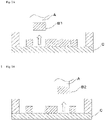
- one semiconductor chip B1 (hereinafter also referred to as the first semiconductor chip B1) of the plurality of semiconductor chips is picked up from a dicing tape C by a collet A.
- the semiconductor chip has a rectangular shape in plan view, more specifically, have a square shape in plan view.
- a thickness of the semiconductor chip is, for example, 10 ⁇ m or more and 500 ⁇ m or less, more specifically 20 ⁇ m or more and 400 ⁇ m or less.
- An area of the semiconductor chip in plan view is, for example, 0.01 mm 2 or more and 1000 mm 2 or less, more specifically 0.04 mm 2 or more and 500 mm 2 or less.
- a dimension of the collet A on the side in contact with the semiconductor chip corresponds to the chip size. That is, an area S1 (hereinafter also referred to as the collet area S1) of the collet A on the side in contact with the semiconductor chip in plan view corresponds to an area S2 (hereinafter also referred to as the chip area S2) of the semiconductor chip in plan view. More specifically, the collet area S1 is 0.9 times or more and 1.1 times or less as large as the chip area S2.
- the laminate 10 is mounted on a stage G with the adhesive sheet 2 placed on the upper side in the laminate 10.
- the first semiconductor chip B1 is pressed onto the adhesive sheet 2 of the laminate 10 by the collet A to transfer a part of the adhesive sheet 2 to the first semiconductor chip B1.
- the pressure for pressing the first semiconductor chip B1 onto the adhesive sheet 2 is preferably 0.01 MPa or more and 10 MPa or less, more preferably 0.1 MPa or more and 5 MPa or less.
- a temperature of the collet A or the stage G when the first semiconductor chip B1 is pressed onto the adhesive sheet 2 is preferably 40 °C or more and 150 °C or less, more preferably 50 °C or more and 120 °C or less.
- the first semiconductor chip B1 with the adhesive sheet 2 is picked up from the laminate 10 by the collet A.
- a lead frame substrate D is mounted on a stage H.
- the collet A that is kept at a temperature in the range between 25 °C and 100 °C is moved vertically downward to allow the first semiconductor chip B1 with the adhesive sheet 2 to come into contact with a die pad E1 (i.e., the first die pad E1) in the lead frame substrate D from the adhesive sheet 2 side.
- the first semiconductor chip B1 with the adhesive sheet 2 is applied with pressure or pressed by the collet A onto the first die pad E1 of the lead frame substrate D while being held in contact with the first die pad E1.
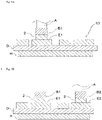
- the collet A is heated to a temperature at which the sinterable metal particles (i.e., the sinterable metal particles included in the adhesive sheet 2) can be sintered, thereby subjecting the sinterable metal particles in the adhesive sheet 2 to a primary sintering (see Fig. 5A ).
- the pressure for pressing the first semiconductor chip B1 with the adhesive sheet 2 onto the first die pad E1 of the lead frame substrate D from the adhesive sheet 2 side is preferably 0.01 MPa or more and 50 MPa or less, more preferably 0.1 MPa or more and 30 MPa or less. It is preferable that the collet A be heated to a temperature of 250 °C or higher.
- the sinterable metal particles can be sufficiently sintered by heating the collet A to a temperature of 250 °C or higher, the semiconductor chip can be further firmly mounted on the substrate with the adhesive sheet interposed therebetween. That is, the connection reliability of the semiconductor chips to the substrate can be improved. Further, it is preferable that the collet A be rapidly heated (in about 5 seconds) to a temperature at which the sinterable metal particles can be sintered. The collet A is heated to a temperature at which the sinterable metal particles can be sintered at a heating rate of preferably 30 °C/sec or more, more preferably 45 °C/sec or more.
- the primary sintering can be performed by heating the stage H, in addition to the collet A, to a temperature equal to or higher than the temperature at which the sinterable metal particles can be sintered. Thereby, the heating can be performed from both sides of the adhesive sheet 2 so that the sinterable metal particles can be further sufficiently sintered. As a result, the semiconductor chip can be further firmly mounted on the substrate with the adhesive sheet interposed therebetween. That is, the connection reliability of the semiconductor chips to the substrate can be further improved.
- the temperature for heating the stage H is preferably equal to or lower than the temperature at which the lead frame substrate D is suppressed from being oxidized.
- the temperature for heating the stage H is preferably 150 °C or less.
- the collet A After the primary sintering of the sinterable metal particles, the collet A is pulled upward to be separated from the first semiconductor chip B1 with the adhesive sheet 2, and the temperature of the collet A is lowered to a temperature at which the sinterable metal particles can be barely sintered (for example, 50 °C).
- FIG. 2B After the temperature of the collet A is lowered as described above, as shown in Fig. 2B , another semiconductor chip B2 (hereinafter also referred to as the second semiconductor chip B2) of the plurality of semiconductor chips is picked up from the dicing tape C by the collet A.
- the second semiconductor chip B2 is pressed onto the adhesive sheet 2 of the laminate 10 by the collet A to transfer a part of the adhesive sheet 2 to the second semiconductor chip B2. Thereby, the second semiconductor chip B2 with the adhesive sheet 2 can be obtained.
- the second semiconductor chip B2 with the adhesive sheet 2 is picked up from the dicing tape C by the collet A.
- the second semiconductor chip B2 with the adhesive sheet 2 is brought into contact with another die pad E2 (i.e., the second die pad E2) in the lead frame substrate D from the adhesive sheet 2 side, while the collet A is kept at a temperature in the range between 25 °C and 100 °C.
- the second semiconductor chip B2 is applied with pressure or pressed by the collet A onto the second die pad E2 of the lead frame substrate D while being adhesive sheet 2 held in contact with the second die pad E2.
- the sinterable metal particles included in the adhesive sheet 2 are subjected to a primary sintering (see Fig. 5B ).
- the heating temperature of the collet A and the pressure for pressing the first semiconductor chip B1 with the adhesive sheet 2 onto the die pad E2 of the lead frame substrate D from the adhesive sheet 2 side are selected from the aforementioned values.
- the collet A is pulled upward to be thereby separated from the second semiconductor chip B2 with the adhesive sheet 2, and the temperature of the collet A is lowered to a temperature at which the sinterable metal particles cannot be sintered (for example, 50 °C).
- the aforementioned steps are subsequently repeated until the semiconductor chips are respectively mounted on all of the die pads of the lead frame substrate D.
- the semiconductor chip-mounting step is performed in this manner.
- a bonding wire can be applied at a part required to be applied for bonding after the semiconductor chips are respectively mounted on all of the die pads of the lead frame substrate D, that is, after the semiconductor chip-mounting step.
- the semiconductor chips in addition to subsequently pressing the semiconductor chips (the first semiconductor chip B1, the second semiconductor chip B2) by the first pressing member (the collet A) to respectively bond the plurality of semiconductor chips to the plurality of mounting areas provided on the substrate (the lead frame substrate D), the semiconductor chips (the first semiconductor chip B1, the second semiconductor chip B2) are pressed using the first pressing member (the collet A) that has been heated to a temperature at which the sinterable metal particles included in the adhesive sheet 2 can be sintered.
- the plurality of semiconductor chips (the first semiconductor chip B1, the second semiconductor chip B2) can be relatively uniformly mounted one by one on the mounting areas (the first die pad E1, the second die pad E2) of the substrate (the lead frame substrate D) with the adhesive sheet 2 interposed therebetween.
- uneven adhesion can be relatively suppressed when the plurality of semiconductor chips (the first semiconductor chip B1, the second semiconductor chip B2) are mounted on the substrate (the lead frame substrate D) with the adhesive sheet 2 interposed therebetween.
- the method for producing the semiconductor device further include: performing, after the semiconductor chip-mounting step, a secondary heating step of heating the substrate with the plurality of semiconductor chips mounted thereon to a temperature, at which the sinterable metal particles can be sintered, wherein in the secondary heating step, the aforementioned heating is performed while not pressing part or all of the plurality of semiconductor chips onto the substrate. Further, in the secondary heating step of the method for producing a semiconductor device according to this embodiment, it is preferable that the aforementioned heating be performed while not pressing all of the plurality of semiconductor chips onto the substrate.
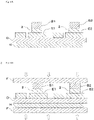
- the stage H can be heated to the temperature at which the sinterable metal particles included in the adhesive sheet 2 can be sintered, in the state where, as shown in Fig. 6A , part or all of the plurality of semiconductor chips mounted on all of the die pads of the lead frame substrate D are not being pressed after the semiconductor chips are respectively mounted on all of the die pads of the lead frame substrate D (i.e., after the semiconductor chip-mounting step). That is, the secondary heating step can be performed.
- the temperature at which the sinterable metal particles are sintered include any temperature in the range between 200 °C to 400 °C. Fig.
- FIG. 6A shows an example of heating performed in the state where all of the semiconductor chips mounted on all of the die pads (the first die pad E1 and the second die pad E2) of the lead frame substrate D are not being pressed. It is possible to further sinter the sinterable metal particles by performing the secondary heating step. That is, since the secondary sintering can be performed, it is possible to more firmly mount the semiconductor chips on the substrate (the lead frame substrate D) with the adhesive sheet interposed therebetween. That is, the connection reliability of the semiconductor chips to the substrate can be improved. Further, a facility for use in the secondary heating step can have a simplified configuration that does not include a pressing member for pressing part or all of the plurality of semiconductor chips. Even in the case where the secondary heating step as aforementioned is performed, a bonding wire can be applied at a part required to be applied after the secondary heating step.
- the method for producing a semiconductor device may be configured such that after the semiconductor chip-mounting step, a secondary heating step of heating the substrate with the plurality of semiconductor chips mounted thereon to a temperature at which the sinterable metal particles can be sintered is performed, wherein in the secondary heating step, the aforementioned heating is performed while pressing part or all of the plurality of semiconductor chips onto the substrate. Further, in the method for producing a semiconductor device according to this embodiment, the secondary heating step may be configured such that the aforementioned heating is performed while pressing all of the plurality of semiconductor chips onto the substrate.
- the semiconductor chips can be heated at the temperature at which the sinterable metal particles can be sintered, in the state where, as shown in Fig. 6B , while part or all of the semiconductor chips mounted on all of the die pads of the lead frame substrate D are applied with pressure, that is, pressed, using a heating and pressing device F that includes two flat plates (parallel flat plates) that are configured to be able to apply heat and are located to sandwich, from above and below, part or all of the semiconductor chips mounted on all of the die pads of the lead frame substrate D, after the semiconductor chips are respectively mounted on all of the die pads of the lead frame substrate D, that is, after the semiconductor chip-mounting step is performed.
- a heating and pressing device F that includes two flat plates (parallel flat plates) that are configured to be able to apply heat and are located to sandwich, from above and below, part or all of the semiconductor chips mounted on all of the die pads of the lead frame substrate D, after the semiconductor chips are respectively mounted on all of the die pads of the lead frame substrate D, that is, after the
- the secondary heating step can be performed.
- Fig. 6B shows an example of heating all of the semiconductor chips mounted on all of the die pads (the first die pad E1 and the second die pad E2) of the lead frame substrate D while pressing them.
- the secondary heating step performed in this way, part or all of the plurality of semiconductor chips can be heated while pressing them onto the substrate (the lead frame substrate D).
- the part or all of the plurality of semiconductor chips can be further firmly mounted on the substrate (the lead frame substrate D) with the adhesive sheet interposed therebetween. That is, the connection reliability of the semiconductor chips to the substrate can be further improved.
- a bonding wire can be applied at a part required to be applied after the secondary heating step.
- lead frame substrate D Various types of known lead frame substrates can be adopted as the lead frame substrate D.
- the various types of known lead frame substrates include a lead frame substrate formed of a Cu lead frame substrate subjected to Ag plating, and a lead frame substrate (e.g., Palladium Pre Plated Lead Frame. Pd-PPF) formed by plating a Cu lead frame substrate with Ni, Pd, and Au in this order.
- a lead frame substrate formed of a Cu lead frame substrate subjected to Ag plating
- Pd-PPF Palladium Pre Plated Lead Frame.
- a semiconductor device is a semiconductor device is a semiconductor device produced by the method for producing the semiconductor device according to this embodiment.
- the semiconductor device according to this embodiment has a shear strength between each one of the plurality of semiconductor chips and the substrate at 25 °C is 2 MPa or more.
- the shear strength at 25 °C being 2 MPa or more enables the semiconductor device according to this embodiment to have an improved connection reliability of the semiconductor chips to the substrate.
- the shear strength at 25 °C can be 200 MPa or less.
- the shear strength at 25 °C can be measured in the following manner. Specifically, a bare chip with an adhesive sheet is mounted on a die pad of a lead frame substrate to obtain a test sample, and measurement of a shear strength at 25 °C of the test sample is performed under the conditions described below, using a universal bond tester series 4000 manufactured by Nordson Advanced Technology (Japan) K.K.
- the semiconductor chip-mounting step having the above configuration, in addition to subsequently pressing the plurality of semiconductor chips by the first pressing member to the plurality of mounting areas of the substrate to respectively bond the semiconductor chips, the semiconductor chips are pressed using the first pressing member that has been heated to a temperature at which the sinterable metal particles included in the adhesive sheet 2 can be sintered.
- the plurality of semiconductor chips can be relatively uniformly mounted one by one on the mounting areas with the adhesive sheet interposed therebetween. Thereby, it is possible to relatively suppress uneven adhesion when the plurality of semiconductor chips are mounted on the substrate with the adhesive sheet interposed therebetween.
- the method for producing a semiconductor device further includes: performing, after the semiconductor chip-mounting step, a secondary heating step of heating the substrate with the plurality of semiconductor chips mounted thereon to a temperature, at which the sinterable metal particles can be sintered, wherein in the secondary heating step, the aforementioned heating is performed while not pressing part or all of the plurality of semiconductor chips onto the substrate.
- a facility for use in the secondary step can have a simplified configuration that does not include a pressing member for pressing part or all of the plurality of semiconductor chips.
- the secondary heating step is configured such that the aforementioned heating is performed while not pressing all of the plurality of semiconductor chips onto the substrate.
- the method for producing the semiconductor device according to (1) above further includes: performing, after the semiconductor chip-mounting step, a secondary heating step of heating the substrate with the plurality of semiconductor chips mounted thereon to a temperature at which the sinterable metal particles can be sintered, wherein in the secondary heating step, the aforementioned heating is performed while pressing part or all of the plurality of semiconductor chips onto the substrate.
- the heating is performed in the secondary heating step, while pressing part or all of the plurality of semiconductor chips onto the substrate.
- it is possible to further firmly mount part or all of the plurality of semiconductor chips on the substrate with the adhesive sheet interposed therebetween. That is, the connection reliability of all of the semiconductor chips to the substrate can be further improved.
- the secondary heating step is configured such that the aforementioned heating is performed while pressing all of the plurality of semiconductor chips onto the substrate.
- the semiconductor chip-mounting step is configured such that the first pressing member is heated to a temperature of 250 °C or more.
- the semiconductor device can be improved in terms of the connection reliability of each of the plurality of the semiconductor chips to the substrate.
- the semiconductor device and the method for producing the semiconductor device according to the present invention are not limited to the aforementioned embodiment.
- the semiconductor device and the method for producing the semiconductor device according to the present invention are not limited by the aforementioned operational advantages, either.
- Various modifications can be made for the semiconductor device and the method for producing the semiconductor device according to the present invention without departing from the gist of the present invention.
- the method for producing the semiconductor device according to the aforementioned embodiment was described by taking, for example, the case where the plurality of semiconductor chips are subsequently mounted on the die pads of the lead frame substrate with the adhesive sheet interposed therebetween, while a single collet is heated and cooled, but examples of mounting the plurality of semiconductor chips on the lead frame substrate are not limited to this example.
- the plurality of semiconductor chips can be subsequently mounted on the die pads of the lead frame substrate with the adhesive sheet interposed therebetween, while two or more of collets are alternately heated and cooled.
- the method for producing the semiconductor device according to the aforementioned embodiment was described by taking, for example, the case where a collet is used as the first pressing member, but the first pressing member is not limited to the collet.
- Any member or part can be used as long as it can subsequently press, while heating, the plurality of semiconductor chips on the plurality of die pads of the lead frame substrate.
- Examples of the member or part that can subsequently press, while heating, as aforementioned include a member or part having an area of a pressing surface in plan view 0.9 times or more and 1.1 times or less as large as the area of the semiconductor chip in plan view.
- the sinterable metal particles are mixed particles of primary silver particles (product name "DF-SNI-003" manufactured by DOWA Electronics Materials Co., Ltd.; and a volume average particle size D 50 of 60 ⁇ m) and secondary silver particles (SPQ05S manufactured by Mitsui Mining & Smelting Co., Ltd.; and a volume average particle size D 50 of 1.1 ⁇ m), in which a mass ratio of the primary silver particles is 83.9 mass% and a mass ratio of the secondary silver particles is 9.3 mass%.
- the high molecular binder is a polycarbonate resin (product name "QPAC40"; Empower Materials, Inc.; a mass-average molecular weight of 150000; and a solid form at a room temperature) that is a thermal decomposable binder.
- the low molecular binder is isobornyl cyclohexanol (product name "Terusolve MTPH” manufactured by NIPPON TERPENE CHEMICALS, INC.; and a liquid form at a room temperature) that is a low-boiling binder.
- Methyl ethyl ketone is used for adjusting the viscosity of the varnish.
- the varnish prepared as aforementioned is applied to a porous polyethylene sheet (porous PE sheet) (thickness: 300 ⁇ m) as a substrate sheet, followed by drying to form an adhesive layer (i.e., adhesive sheet) having a thickness of 30 ⁇ m to obtain a laminate.
- a drying temperature was 110 °C and a drying time was 3 minutes.
- a content ratio of the sinterable metal particles (particle filling ratio) in the adhesive layer (i.e., the adhesive sheet) was 93.2 mass%.
- a semiconductor chip with an adhesive sheet was produced using FC3000W manufactured by Toray Engineering Co., Ltd.
- a collet of FC3000W was heated, followed by allowing the collet to press one side of an Si mirror chip (having a plane dimension of 5 mm ⁇ 5 mm and a thickness of 200 ⁇ m), the one side being entirely coated with silver, to the adhesive layer (i.e., the adhesive sheet) of the laminate. That is, the adhesive layer of the laminate was pressed by the one side of the Si mirror chip.
- the pressing applying a pressure
- the collet was separated from the laminate at a speed of 0.3 mm/sec to obtain a semiconductor chip with the adhesive sheet in the state of being mounted on the collet.
- Three semiconductor chips with adhesive sheets were respectively mounted on three die pads of a Cu lead frame substrate subjected to plating with Ag (hereinafter also referred to the Ag-plated Cu lead frame substrate; a thickness of 3 mm) to obtain a substrate with semiconductor chips.
- the semiconductor chips with the adhesive sheets were mounted on the die pads of the Ag-plated Cu lead frame substrate using, mainly, FC3000W manufactured by Toray Engineering Co., Ltd. Specifically, the mounting was performed in the following manner.
- the Ag-plated Cu lead frame substrate was placed on a stage of FC3000W and heated to 150 °C.
- Measurement of the shear strength at 25 °C was performed on the Ag-plated Cu lead frame substrate with semiconductor chips according to Example 1 obtained as described above. Specifically, the measurement of the shear strength at 25 °C was performed by adopting the conditions described below, using a universal bond tester series 4000 manufactured by Nordson Advanced Technology (Japan) K.K.
- the shear strength at 25 °C was determined by measuring each of the first to third semiconductor chips respectively with the adhesive sheets and determining the arithmetic mean of these measurement values.
- the measurement result of the shear strength at 25 °C is shown in Table 2 below.
- An Ag-plated Cu lead frame substrate with semiconductor chips according to Example 2 was obtained in the same manner as in Example 1 except that the Ag-plated Cu lead frame substrate with the first semiconductor chip to the third semiconductor chip mounted thereon was taken out from a stage of FC3000W, then placed in a dehydrator heated at 250 °C and then heated for 10 min to thereby cause the sinterable metal particles included in the adhesive sheet to be further sintered (i.e., subjected to the secondary sintering).
- the shear strength at 25 °C was measured in the same manner as in Example 1.
- the measurement result of the shear strength at 25 °C is shown in Table 2 below.
- An Ag-plated Cu lead frame substrate with semiconductor chips according to Example 3 in which three semiconductor chips are mounted on the Ag-plated Cu lead frame substrate with the adhesive sheet interposed therebetween was obtained by mounting the semiconductor chips on the Ag-plated Cu lead frame substrate in the same manner as in Example 2 except that the pressing and heating time was 10 sec.
- the shear strength at 25 °C was measured in the same manner as in Example 1.
- the measurement result of the shear strength at 25 °C is shown in Table 2 below.
- An Ag-plated Cu lead frame substrate with semiconductor chips according to Example 4 in which three semiconductor chips are mounted on the Ag-plated Cu lead frame substrate with the adhesive sheet interposed therebetween was obtained by mounting the semiconductor chips on the Ag-plated Cu lead frame substrate in the same manner as in Example 2 except that the pressing (applying a pressure) by the collet was performed at 20 MPa.
- the shear strength at 25 °C was measured in the same manner as in Example 1.
- the measurement result of the shear strength at 25 °C is shown in Table 2 below.
- An Ag-plated Cu lead frame substrate with semiconductor chips according to Example 5 in which three semiconductor chips are mounted on the Ag-plated Cu lead frame substrate with the adhesive sheet interposed therebetween was obtained by mounting the semiconductor chips on the Ag-plated Cu lead frame substrate in the same manner as in Example 1 except that the primary sintering was performed by heating the collet to 300 °C.
- the shear strength at 25 °C was measured in the same manner as in Example 1.
- the measurement result of the shear strength at 25 °C is shown in Table 2 below.
- An Ag-plated Cu lead frame substrate with semiconductor chips according to Example 6 in which three semiconductor chips were mounted on the Ag-plated Cu lead frame substrate with the adhesive sheet interposed therebetween was obtained by mounting the semiconductor chips on the Ag-plated Cu lead frame substrate in the same manner as in Example 1 except that the primary sintering was performed by heating the collet to 450 °C and the pressing and heating time was 5 sec.
- the shear strength at 25 °C was measured in the same manner as in Example 1.
- the measurement result of the shear strength at 25 °C is shown in Table 2 below.
- Three semiconductor chips with adhesive sheet configured in the same manner as in Example 1 were mounted on three die pads of a Pd-PPF (Palladium Pre Plated Lead Frame that is a Cu lead frame plated with Ni, Pd, and Au in this order. Thickness: 0.2 mm) to obtain a substrate with the semiconductor chips.
- the semiconductor chips with the adhesive sheet was mounted on the die pads of the Pd-PPF using, mainly, FC3000W manufactured by Toray Engineering Co., Ltd. Specifically, the mounting was performed in the following manner. The Pd-PPF was placed on a stage of FC3000W and not heated. That is, the temperature of the stage was 25 °C.
- Example 7 the Pd-PPF with the adhesive sheet according to Example 1 in which three semiconductor chips are mounted on the Pd-PPF with the adhesive sheet interposed therebetween was obtained.
- the secondary sintering was not performed in Example 7.
- the shear strength at 25 °C was measured in the same manner as in Example 1.
- the measurement result of the shear strength at 25 °C is shown in Table 2 below.
- Example 8 APd-PPF with semiconductor chips according to Example 8 in which three semiconductor chips are mounted on the Pd-PPF with the adhesive sheet interposed therebetween was obtained by mounting the semiconductor chips on the Pd-PPF in the same manner as in Example 7 except that the pressing (applying a pressure ) by the collet was performed at 5 MPa and the Pd-PPF (i.e., the Pd-PPF after the step (8) in Example 7 above) in which the first to third semiconductor chips are mounted thereon was taken out from a stage of FC3000W, then placed in a dehydrator heated at 300 °C, and then heated for 60 min to thereby cause the sinterable metal particles included in the adhesive sheet to be further sintered (i.e., subjected to the secondary sintering).
- the shear strength at 25 °C was measured in the same manner as in Example 1.
- the measurement result of the shear strength at 25 °C is shown in Table 2 below.
- Example 9 APd-PPF with semiconductor chips according to Example 9 in which three semiconductor chips are mounted on the Pd-PPF with the adhesive sheet interposed therebetween was obtained by mounting the semiconductor chips on the Pd-PPF in the same manner as in Example 7 except that the stage of FC3000W was heated to 150 °C.
- the shear strength at 25 °C was measured in the same manner as in Example 1.
- the measurement result of the shear strength at 25 °C is shown in Table 2 below.
- Example 10 APd-PPF with semiconductor chips according to Example 10 in which three semiconductor chips are mounted on the Pd-PPF with the adhesive sheet interposed therebetween was obtained by mounting the semiconductor chips on the Pd-PPF in the same manner as in Example 7 except that the primary sintering was performed by heating the collet to 400 °C.
- the shear strength at 25 °C was measured in the same manner as in Example 1.
- the measurement result of the shear strength at 25 °C is shown in Table 2 below.
- Example 11 APd-PPF with semiconductor chips according to Example 11 in which three semiconductor chips are mounted on the Pd-PPF with the adhesive sheet interposed therebetween was obtained by mounting the semiconductor chips on the Pd-PPF in the same manner as in Example 10 except that the Pd-PPF (i.e., the Pd-PPF after the step (8) in Example 7 above) with the first to third semiconductor chips mounted thereon was taken out from a stage of FC3000W, then placed in a dehydrator heated at 300 °C and heated for 60 min to thereby cause the sinterable metal particles included in the adhesive sheet to be further sintered (i.e., subjected to the secondary sintering).
- the Pd-PPF i.e., the Pd-PPF after the step (8) in Example 7 above
- the shear strength at 25 °C was measured in the same manner as in Example 1.
- the measurement result of the shear strength at 25 °C is shown in Table 2 below.
- a primary mixture including thermosetting resins and a thermoplastic resin that is a high molecular binder was stirred and mixed for three minutes (i.e., primary stirring), then a secondary mixture obtained by adding conductive particles and a volatile agent that is a low molecular binder to the primary mixture was stirred and mixed for 6 minutes (i.e., secondary stirring), and then a tertiary mixture obtained by adding a catalyst and a solvent to the secondary mixture was further stirred and mixed for 3minutes (i.e., tertiary stirring).
- the varnish was applied to one side of a release treatment film (product name: "MRA38", with a thickness of 38 ⁇ m, manufactured by Mitsubishi Chemical Corporation), followed by drying at 100 °C for 2 minutes to form an adhesive layer (i.e., adhesive sheet) having a thickness of 30 ⁇ m to obtain a laminate.
- a release treatment film product name: "MRA38”
- an adhesive layer i.e., adhesive sheet
- Table 1 The materials shown in Table 1 below are as follows:
- a semiconductor chip with an adhesive sheet was produced in the same manner as in Example 1 except that the adhesive sheet configured as described above was used.
- Example 12 APd-PPF with semiconductor chips according to Example 12 in which three semiconductor chips are mounted on the Pd-PPF with the adhesive sheet interposed therebetween was obtained by mounting the semiconductor chips on the Pd-PPF in the same manner as in Example 10 except that the pressing (applying a pressure) by the collet was performed at 3 MPa.
- the shear strength at 25 °C was measured in the same manner as in Example 1.
- the measurement result of the shear strength at 25 °C is shown in Table 2 below.
- a laminate including an adhesive layer (i.e., adhesive sheet) having a thickness of 30 ⁇ m formed on one side of a release treatment film (product name: "MRA38", with a thickness of 38 ⁇ m, manufactured by Mitsubishi Chemical Corporation) was obtained in the same manner as in Example 12.
- a semiconductor chip with an adhesive sheet was produced in the same manner as in Example 1 except that the adhesive sheet configured as described above was used.
- Example 13 APd-PPF with semiconductor chips according to Example 13 in which three semiconductor chips are mounted on the Pd-PPF with the adhesive sheet interposed therebetween was obtained by mounting the three semiconductor chips on the Pd-PPF in the same manner as in Example 8 except that the primary sintering was performed by, using the adhesive sheet configured as described above, heating the collet to 400 °C, and the pressing (applying a pressure) by the collet was performed at 3 MPa.
- the shear strength at 25 °C was measured in the same manner as in Example 1.
- the measurement result of the shear strength at 25 °C is shown in Table 2 below.
- a laminate including an adhesive layer (i.e., adhesive sheet) having a thickness of 30 ⁇ m formed on one side of a release treatment film (product name: "MRA38", with a thickness of 38 ⁇ m, manufactured by Mitsubishi Chemical Corporation) was obtained in the same manner as in Example 12.
- a semiconductor chip with an adhesive sheet was produced in the same manner as in Example 1 except that the adhesive sheet configured as described above was used.
- Example 14 APd-PPF with semiconductor chips according to Example 14 in which three semiconductor chips are mounted on the Pd-PPF with the adhesive sheet interposed therebetween was obtained by mounting the three semiconductor chips on the Pd-PPF in the same manner as in Example 12 except that the temperature of the stage of FC3000W was heated to 150 °C.
- the shear strength at 25 °C was measured in the same manner as in Example 1.
- the measurement result of the shear strength at 25 °C is shown in Table 2 below.
- a substrate with semiconductor chips was produced in the following manner. First, three semiconductor chips with adhesive sheet were temporarily fixed respectively to three die pads of an Ag-plated Cu lead frame substrate. The adhesive sheet described in the section of Example 1 was used. The semiconductor chips with the adhesive sheet were temporarily fixed to the die pads of the Ag-plated Cu lead frame substrate using FC3000W manufactured by Toray Engineering Co., Ltd. Specifically, the temporal fixing was performed in the following manner. The Ag-plated Cu lead frame substrate was placed on the stage of FC3000W.
- the semiconductor chips with the adhesive sheet were temporarily fixed to the Ag-plated Cu lead frame substrate.
- the semiconductor chips with the adhesive sheet were mounted on the Ag-plated Cu lead frame substrate. That is, the semiconductor chips with the adhesive sheet were fixed to the Ag-plated Cu lead frame substrate.
- the semiconductor chips with the adhesive sheet were mounted on (fixed to) the Ag-plated Cu lead frame substrate using the HTM-3000 manufactured by Hakuto. Specifically, the mounting was performed in the following manner. The Ag-plated Cu lead frame substrate to which the semiconductor chips with the adhesive sheet was temporarily fixed was placed on a stage of HTM-3000.
- the temperature of the stage is raised to 200 °C, while pressing parallel plates the first to third semiconductor chips with the adhesive sheets from above and below of the stage, that is, while pressing them by the parallel plates, to thereby cause the sinterable metal particles in the adhesive sheet to be sintered, that is, to thereby subject the sinterable metal particles in the adhesive sheet to the primary sintering.
- the first to third semiconductor chips with the adhesive sheets are mounted on the Ag-plated Cu lead frame. That is, the first to third semiconductor chips with the adhesive sheets are fixed to the Ag-plated Cu lead frame.
- the pressing (applying a pressure) by the parallel plates is performed at 10 MPa.
- the pressing and heating time is 50 sec.
- the shear strength at 25 °C was measured in the same manner as in Example 1.
- the measurement result of the shear strength at 25 °C is shown in Table 2 below.
- a substrate with semiconductor chips of Comparative Example 2 was produced in the same manner as in Comparative Example 1 except that the Ag-plated Cu lead frame substrate with the first to third semiconductor chips mounted thereon (fixed thereto) was taken out from the stage of HTM-3000 by, after the step (1') above was performed, releasing the Ag-plated Cu lead frame substrate from the pressed state by the parallel plates, that is, bringing it into non-pressed state, then placing it in a dehydrator heated at 250 °C and heated for 10 min to thereby cause the sinterable metal particles included in the adhesive sheet to be further sintered (i.e., subjected to the secondary sintering).
- a dehydrator heated at 250 °C and heated for 10 min to thereby cause the sinterable metal particles included in the adhesive sheet to be further sintered (i.e., subjected to the secondary sintering).
- the shear strength at 25 °C was measured in the same manner as in Example 1.
- the measurement result of the shear strength at 25 °C is shown in Table 2 below.
- a substrate with semiconductor chips of Comparative Example 3 was produced in the same manner as in Comparative Example 1 except that the temperature of the stage of HTM-3000 was changed to 300 °C when the semiconductor chips with the adhesive sheets were mounted on (fixed to) the Ag-plated Cu lead frame substrate.
- the Ag-plated Cu lead frame substrate according to Comparative Example 3 in which the three semiconductor chips are mounted on the Ag-plated Cu lead frame substrate with the adhesive sheet interposed therebetween.
- the shear strength at 25 °C was measured in the same manner as in Example 1.
- the measurement result of the shear strength at 25 °C is shown in Table 2 below.
Landscapes
- Chemical & Material Sciences (AREA)
- Organic Chemistry (AREA)
- Engineering & Computer Science (AREA)
- Materials Engineering (AREA)
- Composite Materials (AREA)
- Manufacturing & Machinery (AREA)
- Inorganic Chemistry (AREA)
- Mechanical Engineering (AREA)
- Die Bonding (AREA)
- Computer Hardware Design (AREA)
- Microelectronics & Electronic Packaging (AREA)
- Power Engineering (AREA)
- Physics & Mathematics (AREA)
- Condensed Matter Physics & Semiconductors (AREA)
- General Physics & Mathematics (AREA)
Applications Claiming Priority (2)
| Application Number | Priority Date | Filing Date | Title |
|---|---|---|---|
| JP2021005659 | 2021-01-18 | ||
| JP2021166838A JP2022111042A (ja) | 2021-01-18 | 2021-10-11 | 半導体装置、及び、半導体装置の製造方法。 |
Publications (2)
| Publication Number | Publication Date |
|---|---|
| EP4047641A2 true EP4047641A2 (de) | 2022-08-24 |
| EP4047641A3 EP4047641A3 (de) | 2023-10-11 |
Family
ID=80112422
Family Applications (1)
| Application Number | Title | Priority Date | Filing Date |
|---|---|---|---|
| EP22151582.8A Pending EP4047641A3 (de) | 2021-01-18 | 2022-01-14 | Verfahren zur herstellung einer halbleitervorrichtung durch aufeinanderfolgendes sintervebinden mehrerer halbleiterchips mit einem substrat unter druck and wärme sowie entsprechende halbleitervorrichtung |
Country Status (4)
| Country | Link |
|---|---|
| US (1) | US20220230989A1 (de) |
| EP (1) | EP4047641A3 (de) |
| CN (1) | CN114823596A (de) |
| TW (1) | TW202236311A (de) |
Families Citing this family (2)
| Publication number | Priority date | Publication date | Assignee | Title |
|---|---|---|---|---|
| JP2024176376A (ja) * | 2023-06-08 | 2024-12-19 | 日東電工株式会社 | 焼結接合用シート |
| CN119446938A (zh) * | 2024-10-31 | 2025-02-14 | 中国电子科技集团公司第十四研究所 | 一种纳米银烧结的压力辅助工装及烧结方法 |
Citations (3)
| Publication number | Priority date | Publication date | Assignee | Title |
|---|---|---|---|---|
| JP2014503936A (ja) | 2010-11-03 | 2014-02-13 | フライズ・メタルズ・インコーポレイテッド | 焼結材料およびこれを用いた取付方法 |
| JP2021005659A (ja) | 2019-06-27 | 2021-01-14 | 三星ダイヤモンド工業株式会社 | ファイバレーザ発振器及びファイバレーザ発振器用筐体 |
| JP2021166838A (ja) | 2017-05-23 | 2021-10-21 | 株式会社藤商事 | 遊技機 |
Family Cites Families (4)
| Publication number | Priority date | Publication date | Assignee | Title |
|---|---|---|---|---|
| IN168174B (de) * | 1986-04-22 | 1991-02-16 | Siemens Ag | |
| EP3154729A4 (de) * | 2014-06-12 | 2018-02-28 | Alpha Metals, Inc. | Sintermaterialien und befestigungsverfahren damit |
| JP6704322B2 (ja) * | 2015-09-30 | 2020-06-03 | 日東電工株式会社 | シートおよび複合シート |
| JP7143156B2 (ja) * | 2018-04-27 | 2022-09-28 | 日東電工株式会社 | 半導体装置製造方法 |
-
2022
- 2022-01-14 CN CN202210041911.3A patent/CN114823596A/zh active Pending
- 2022-01-14 EP EP22151582.8A patent/EP4047641A3/de active Pending
- 2022-01-14 US US17/576,084 patent/US20220230989A1/en not_active Abandoned
- 2022-01-17 TW TW111101829A patent/TW202236311A/zh unknown
Patent Citations (3)
| Publication number | Priority date | Publication date | Assignee | Title |
|---|---|---|---|---|
| JP2014503936A (ja) | 2010-11-03 | 2014-02-13 | フライズ・メタルズ・インコーポレイテッド | 焼結材料およびこれを用いた取付方法 |
| JP2021166838A (ja) | 2017-05-23 | 2021-10-21 | 株式会社藤商事 | 遊技機 |
| JP2021005659A (ja) | 2019-06-27 | 2021-01-14 | 三星ダイヤモンド工業株式会社 | ファイバレーザ発振器及びファイバレーザ発振器用筐体 |
Also Published As
| Publication number | Publication date |
|---|---|
| TW202236311A (zh) | 2022-09-16 |
| US20220230989A1 (en) | 2022-07-21 |
| CN114823596A (zh) | 2022-07-29 |
| EP4047641A3 (de) | 2023-10-11 |
Similar Documents
| Publication | Publication Date | Title |
|---|---|---|
| JP7041669B2 (ja) | 加熱接合用シートおよび加熱接合用シート付きダイシングテープ | |
| EP3379588B1 (de) | Halbleiterbauelementherstellungsverfahren | |
| JP7503383B2 (ja) | 焼結接合用組成物、焼結接合用シート、および焼結接合用シート付きダイシングテープ | |
| JP7350653B2 (ja) | 焼結接合用組成物、焼結接合用シート、および焼結接合用シート付きダイシングテープ | |
| EP3709347A1 (de) | Sinterverbindungsfolie mit trägermaterial und halbleiterchip mit daraus entstandener sinterverbindungsschicht | |
| US11594513B2 (en) | Manufacturing method for semiconductor device | |
| EP4047641A2 (de) | Verfahren zur herstellung einer halbleitervorrichtung durch aufeinanderfolgendes sintervebinden mehrerer halbleiterchips mit einem substrat unter druck and wärme sowie entsprechende halbleitervorrichtung | |
| EP3709348A1 (de) | Wickelkörper von sinterverbindungsfolie mit trägermaterial | |
| US11839936B2 (en) | Sheet for sintering bonding and sheet for sintering bonding with base material | |
| EP3932658B1 (de) | Laminat | |
| EP3709350A1 (de) | Sinterverbindungsfolie mit trägermaterial | |
| JP2023071703A (ja) | 焼結接合用シートおよび基材付き焼結接合用シート | |
| EP4443489A1 (de) | Sinterverbindungsfolie | |
| JP2022111042A (ja) | 半導体装置、及び、半導体装置の製造方法。 | |
| EP4625486A1 (de) | Thermische verbindungsfolie und mit sägeband ausgestattete thermische verbindungsfolie | |
| EP4481804A1 (de) | Sinterverbindungsfolie | |
| CN118782567A (zh) | 烧结接合用片 | |
| JP2024149387A (ja) | 焼結接合用シート |
Legal Events
| Date | Code | Title | Description |
|---|---|---|---|
| PUAI | Public reference made under article 153(3) epc to a published international application that has entered the european phase |
Free format text: ORIGINAL CODE: 0009012 |
|
| STAA | Information on the status of an ep patent application or granted ep patent |
Free format text: STATUS: THE APPLICATION HAS BEEN PUBLISHED |
|
| AK | Designated contracting states |
Kind code of ref document: A2 Designated state(s): AL AT BE BG CH CY CZ DE DK EE ES FI FR GB GR HR HU IE IS IT LI LT LU LV MC MK MT NL NO PL PT RO RS SE SI SK SM TR |
|
| RIC1 | Information provided on ipc code assigned before grant |
Ipc: H01L 23/495 20060101ALN20230519BHEP Ipc: H01L 23/488 20060101ALI20230519BHEP Ipc: H01L 21/98 20060101ALI20230519BHEP Ipc: H01L 21/603 20060101AFI20230519BHEP |
|
| PUAL | Search report despatched |
Free format text: ORIGINAL CODE: 0009013 |
|
| AK | Designated contracting states |
Kind code of ref document: A3 Designated state(s): AL AT BE BG CH CY CZ DE DK EE ES FI FR GB GR HR HU IE IS IT LI LT LU LV MC MK MT NL NO PL PT RO RS SE SI SK SM TR |
|
| RIC1 | Information provided on ipc code assigned before grant |
Ipc: H01L 25/065 20060101ALN20230907BHEP Ipc: H01L 21/683 20060101ALN20230907BHEP Ipc: H01L 23/495 20060101ALN20230907BHEP Ipc: H01L 25/00 20060101ALI20230907BHEP Ipc: H01L 23/00 20060101ALI20230907BHEP Ipc: H01L 23/488 20060101ALI20230907BHEP Ipc: H01L 21/98 20060101ALI20230907BHEP Ipc: H01L 21/603 20060101AFI20230907BHEP |
|
| STAA | Information on the status of an ep patent application or granted ep patent |
Free format text: STATUS: REQUEST FOR EXAMINATION WAS MADE |
|
| 17P | Request for examination filed |
Effective date: 20240409 |
|
| RBV | Designated contracting states (corrected) |
Designated state(s): AL AT BE BG CH CY CZ DE DK EE ES FI FR GB GR HR HU IE IS IT LI LT LU LV MC MK MT NL NO PL PT RO RS SE SI SK SM TR |