EP4046513B1 - Container for gas generator - Google Patents
Container for gas generator Download PDFInfo
- Publication number
- EP4046513B1 EP4046513B1 EP22156568.2A EP22156568A EP4046513B1 EP 4046513 B1 EP4046513 B1 EP 4046513B1 EP 22156568 A EP22156568 A EP 22156568A EP 4046513 B1 EP4046513 B1 EP 4046513B1
- Authority
- EP
- European Patent Office
- Prior art keywords
- container
- gas generator
- channel
- canister
- casing body
- Prior art date
- Legal status (The legal status is an assumption and is not a legal conclusion. Google has not performed a legal analysis and makes no representation as to the accuracy of the status listed.)
- Active
Links
Images



Classifications
-
- A—HUMAN NECESSITIES
- A41—WEARING APPAREL
- A41D—OUTERWEAR; PROTECTIVE GARMENTS; ACCESSORIES
- A41D13/00—Professional, industrial or sporting protective garments, e.g. surgeons' gowns or garments protecting against blows or punches
- A41D13/015—Professional, industrial or sporting protective garments, e.g. surgeons' gowns or garments protecting against blows or punches with shock-absorbing means
- A41D13/018—Professional, industrial or sporting protective garments, e.g. surgeons' gowns or garments protecting against blows or punches with shock-absorbing means inflatable automatically
Definitions
- the present disclosure relates generally to the sector of providing protection by means of an airbag, so as to protect a user from impacts due to falling or sliding, when travelling on a means of transport, such as a vehicle, preferably a two-wheeled vehicle, or any other means of transport, such as a horse or other animal, sports equipment, such as a pair of skis or a bobsleigh, or similar means of transport, or to protect a user when performing any activity also without transport means.
- a means of transport such as a vehicle, preferably a two-wheeled vehicle, or any other means of transport, such as a horse or other animal, sports equipment, such as a pair of skis or a bobsleigh, or similar means of transport, or to protect a user when performing any activity also without transport means.
- the present disclosure relates to a container for a gas generator, for example a container designed to be placed on the back or flank of a user, namely in a zone of a user's body.
- the present disclosure also relates to an inflation device, including the aforementioned container or gas generator for inflating an inflatable element for protecting a user in the event of falls and/or impacts of various types.
- an inflation device including the aforementioned container or gas generator for inflating an inflatable element for protecting a user in the event of falls and/or impacts of various types.
- protection devices including an inflatable element, namely airbag, which are inflated, in the event of an impact, by an inflation device in fluid communication with the airbag itself.
- this inflation device consists of a fluid source, such as a cylindrical compressed-gas canister, which is fixed to the back portion of a protection device or a garment or arranged inside a back protector.
- a fluid source such as a cylindrical compressed-gas canister
- the known inflation devices comprise a support structure which is formed by plates or other rigid mechanical components generally arranged in the region of the user's spinal column.
- This support structure is designed to support the gas generator(s) and is generally connected to a protection garment comprising an inflatable element.
- WO01/54523A1 discloses a container for a cylindrical compressed gas canister.
- the present disclosure is based on a recognition by the inventor of the present disclosure that the inflation devices such as those made available hitherto by the prior art, while being advantageous from many points of view, have not always been sufficient to ensure satisfactory mobility and comfort during use by a user.
- the inflation devices have been hitherto designed and arranged on protective garments so as to prevent them from being dangerous for the user in the event of falls, but without paying too much attention to the question of ensuring the freedom of movement of the user and the comfort during use in general.
- the known inflation devices may not be easily removed from a protection garment by a user. This means that the user may not, autonomously, separate the inflation device from the protective garment in order to perform, for example, washing of the garment or replacement of the compressed-gas canister.
- the starting point of the present disclosure is that of providing a wearable inflation device for an inflatable element, which is able to satisfy all the aforementioned requirements with reference to the prior art and/or achieve further advantages.
- the present disclosure in order to improve the comfort, it is proposed to improve the ergonomic form of the inflation device overall and to make it more suitable for the shape of the body.
- a container which includes a curved casing body.
- the curved casing body may be easily adapted to the curved shape of the body and may be placed so as to fit perfectly against the flank of a user or the user's back.
- the casing body includes a seat or channel having a form suitable for receiving the canister-shaped gas generator.
- the seat may be cylindrical or have another shape suitable for receiving the canister-shaped gas generator.
- the generator in order to adapt the canister-shaped gas generator to the shape of the body, the generator is inserted inside a casing which is curved and more suitable for the anatomy of the human body.
- the casing body is a body made of a soft material which may be removed from the canister-shaped gas generator.
- the casing body is preferably a body able to ensure the cushioning of knocks or impacts.
- the casing body and the canister-shaped gas generator may be handled together as a single body and removed form a personal protection device or a garment with which they are associated, for example for replacement of the gas generator.
- each embodiment of the subject of the present disclosure may have one or more of the advantages listed above; in any case it is not required that each embodiment should have simultaneously all the advantages listed.
- an embodiment of a container for a gas generator is denoted overall by the reference number 1.
- a gas generator is indicated by the reference number 2.
- the canister-shaped gas generator 2 may be a canister containing compressed cold gas, such as helium.
- the canister may be provided with a respective shut-off valve (not shown).
- the inflation fluid source may comprise gas generators preferably of the pyrotechnic or other hybrid type or other types known according to the state of the art.
- the assembly including the gas generator 2 and the container 1 for the gas generator 1 is called an inflation device, denoted generally by the reference number 3.
- the inflation device 3 is connected by means of cables to a control unit (not shown in the drawings) which allows activation of the inflation to be controlled.
- the present disclosure also relates to an inflation device 3 comprising the container 1 and a canister-shaped gas generator 2.
- a further subject of the present disclosure consists of a personal protection device 4 for the personal protection of a user.
- This personal protection device 4 is a device including, in addition to the inflation device 3, an inflatable element 5 or airbag, in fluid communication with this inflation device 3 and intended to protect at least partly the torso of a user.
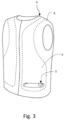
- the inflation device 3 is intended to be positioned in a flank region or lumbar region of the user's torso, inside the inflatable element 5, as can be seen in Figure 3 .
- the present disclosure also relates to a wearable article or protective garment, generally indicated by the number 6 in Figure 3 and comprising a personal protection device 4 as defined above.
- the personal protection devices 4 together with the airbags and the protective garments which include said airbags are personal protection devices which are known to the person skilled in the art and therefore are not further described in the present patent application.
- the inflation device 3 is in fluid communication with the inflatable element 5 so as to convey, once activated, inflation fluid into the inflatable element 5 and allow inflation thereof.
- the inflation device 3 is, as mentioned, connected to the control unit by means of which inflation may be activated.
- the protection device 4 is adapted to cooperate with special activation means (normally consisting of the aforementioned control unit and sensors) which are for example operationally connected to the canister-shaped gas generator 2.
- the container 1 for a canister-shaped gas generator 2 comprises a casing body 10 having a curved profile.
- the casing body is curved, namely the casing body has an external surface 101 having a substantially tubular form which defines a curved profile thereof.
- the external surface 101 follows an at least partially curvilinear trajectory.
- the external surface 101 has a progression which is partly arched, curvilinear or curved.
- the external profile of the casing body 10 is especially shaped so as to adapt to the anatomy of a user's torso, in particular the anatomy of a flank region or a lumbar region of a user's torso.
- the casing body 10 therefore follows a curved trajectory, according to a given radius of curvature R.
- the radius of curvature R is chosen so as to correspond to the anatomical curved shape of the flank of a user's body or the lumbar region of a user's back.
- the container 1 may be rested and especially made so as to "fit” or “match” the anatomical curvature of a user's torso.
- the entire casing body is therefore curved.
- the casing body 10 is a hollow body, namely it has a cavity for receiving the gas generator.
- the casing body 10 is provided with a cavity or channel 103 configured to house a conventional canister-shaped gas generator 2.
- the channel 103 therefore has a form and dimensions such as to be able to receive inside it a conventional canister-shaped gas generator 2.
- the known gas generators 2, which are used in the context of personal protection devices generally comprise canisters which have an at least partially cylindrical form. Therefore, the channel 103 acts as a seat for housing a canister-shaped gas generator 2, which preferably has a cylindrical form.
- the channel 103 is formed at least partially inside the casing body 10.
- the channel 102 is an internal cavity of the casing body.
- the casing body 10 surrounds, at least partly, the canister-shaped gas generator 2 and acts as protective covering for the canister-shaped gas generator 2.
- the container 1 is configured so as to protect the canister-shaped gas generator 2 and allow positioning of the latter in a region, such as the flank or the lumbar region, occupying a minimum amount of space and hindering as little as possible the movements of the user, while at the same time housing the canister-shaped gas generator 2.
- the container 1 therefore allows the gas generator to be positioned so as to occupy an anatomical hollow zone of a user's torso.
- the canister-shaped gas generator 2 may be positioned so as to minimize the overall volume presented to the user.
- the casing body 10 has a longitudinal cross-section, along the main direction S, which has a substantially C-shaped form, with a first convex flank or side 10' on one side of the channel 103, and a second concave side or flank 10" on the other side of the channel 103.
- the casing body 10 extends principally along a main direction S parallel to or coinciding with the development axis A of the channel 103.
- the channel 103 is oriented in the main direction S along which the casing body 10 extends.
- the casing body 10 and the channel 103 extend mainly on the same direction. Consequently, the housing body 10 is a substantially tubular body.
- the casing body 10 has, furthermore, an internal surface 102 opposite to the aforementioned external surface 101.
- the internal surface 102 delimits or surrounds the channel 103.
- the channel 103 extends mainly along its own development axis A.
- the channel 103 therefore has a substantially elongated or oblong form, along this development axis A.
- a conventional cannister-shaped gas generator 2 which has an elongated cylindrical form, may be received completely, or at least partly, over most of its length inside the channel 103.
- the internal surface 102 is intended to be completely in contact with a canister-shaped gas generator 2.
- the internal surface 102 rests or lies on the canister-shaped gas generator 2.
- the internal surface 102 adheres to the canister-shaped gas generator 2. In this way no empty spaces, or play, is present between the internal surface 102 and the canister-shaped gas generator 2.
- the casing body 10 is therefore configured to surround tightly the canister-shaped gas generator 2. In this way relative movements of the canister-shaped gas generator 2 with respect to the casing body 10 surrounding it are prevented. Consequently, therefore, during use, the canister-shaped gas generator 2 is firmly retained inside the channel 103.
- the casing body 10 is a single body, i.e. a monolithic body.
- the casing body 10 is made of soft material, such as silicone or other material.
- the container 1 is made of a flexible and/or elastically yielding material.
- the container 1 is made of an elastomeric material; for example, the container 1 may be made of silicone, rubber or latex. In this way, the container 1 is made so as to be particularly flexible and able to cushion both the impacts which could affect the gas generator and the bruising which, in the event of a fall, the inflation device 3 may cause for the user.
- the soft and flexible material also allows easy unsheathing of the casing body 10, as can be seen in Figure 4 .
- the casing body 10 extends between a first end 103 and a second end 105.
- the first end 104 and the second end 105 are opposite to each other.
- At least one of the first end 104 and the second end 105 has or is provided with an opening 106.
- the opening 106 communicates with the channel 103 so as to allow access to the canister-shaped gas generator 2.
- the through-opening 106 may be in the form of a slot or through-hole.
- the channel 103 is therefore open towards the outside.
- the canister-shaped gas generator 2 may be inserted into or extracted from the channel 103 through the opening 106 during use.
- the canister-shaped gas generator 2 may be connected to the control unit through the opening 106.
- the other end 104 of the casing body 10 is dome or cap-shaped and defines a cavity opening out on one side with the channel 103 and communicating with an environment outside the channel 103.
- the gas output nozzle of the canister-shaped gas generator 2 is directed towards the cavity 111.
- said cavity 111 is configured to direct, orient or steer a gas flow exiting the canister-shaped gas generator 2 towards the airbag 5.
- the casing body 10 may also include a central opening 112 which facilitates unsheathing, as shown in Figure 4 .
Landscapes
- Health & Medical Sciences (AREA)
- General Health & Medical Sciences (AREA)
- Physical Education & Sports Medicine (AREA)
- Engineering & Computer Science (AREA)
- Textile Engineering (AREA)
- Respiratory Apparatuses And Protective Means (AREA)
- Professional, Industrial, Or Sporting Protective Garments (AREA)
- Sampling And Sample Adjustment (AREA)
- Feeding, Discharge, Calcimining, Fusing, And Gas-Generation Devices (AREA)
Description
- The present disclosure relates generally to the sector of providing protection by means of an airbag, so as to protect a user from impacts due to falling or sliding, when travelling on a means of transport, such as a vehicle, preferably a two-wheeled vehicle, or any other means of transport, such as a horse or other animal, sports equipment, such as a pair of skis or a bobsleigh, or similar means of transport, or to protect a user when performing any activity also without transport means.
- More particularly, the present disclosure relates to a container for a gas generator, for example a container designed to be placed on the back or flank of a user, namely in a zone of a user's body.
- The present disclosure also relates to an inflation device, including the aforementioned container or gas generator for inflating an inflatable element for protecting a user in the event of falls and/or impacts of various types. A personal protection device, a protective garment or a wearable article, each comprising the aforementioned inflation device, also form the subject of the present disclosure.
- In the sector of user protection it is known to use protection devices including an inflatable element, namely airbag, which are inflated, in the event of an impact, by an inflation device in fluid communication with the airbag itself. Generally, this inflation device consists of a fluid source, such as a cylindrical compressed-gas canister, which is fixed to the back portion of a protection device or a garment or arranged inside a back protector. The positioning of an inflation device in the back zone of a user makes the protection device comprising the inflation device safer, preventing the gas canister from being able to interfere, in the event of a fall, with the vital organs which are situated in the front or side part of the user. More precisely, the known inflation devices comprise a support structure which is formed by plates or other rigid mechanical components generally arranged in the region of the user's spinal column. This support structure is designed to support the gas generator(s) and is generally connected to a protection garment comprising an inflatable element.
- The document
WO01/54523A1 - The present disclosure is based on a recognition by the inventor of the present disclosure that the inflation devices such as those made available hitherto by the prior art, while being advantageous from many points of view, have not always been sufficient to ensure satisfactory mobility and comfort during use by a user.
- More specifically, the inflation devices have been hitherto designed and arranged on protective garments so as to prevent them from being dangerous for the user in the event of falls, but without paying too much attention to the question of ensuring the freedom of movement of the user and the comfort during use in general.
- In addition, a further recognition on the part of the inventor of the present disclosure is that the known inflation devices may not be easily removed from a protection garment by a user. This means that the user may not, autonomously, separate the inflation device from the protective garment in order to perform, for example, washing of the garment or replacement of the compressed-gas canister.
- The starting point of the present disclosure is that of providing a wearable inflation device for an inflatable element, which is able to satisfy all the aforementioned requirements with reference to the prior art and/or achieve further advantages.
- This is obtained by means of a wearable inflation device, a protection device and a wearable article or a protective garment according to the respective independent claims. Secondary characteristic features forming the subject of the present disclosure are defined in the corresponding dependent claims.
- In particular, according to the present disclosure, in order to improve the comfort, it is proposed to improve the ergonomic form of the inflation device overall and to make it more suitable for the shape of the body.
- For this purpose it is proposed to provide a container which includes a curved casing body. The curved casing body may be easily adapted to the curved shape of the body and may be placed so as to fit perfectly against the flank of a user or the user's back. The casing body includes a seat or channel having a form suitable for receiving the canister-shaped gas generator. The seat may be cylindrical or have another shape suitable for receiving the canister-shaped gas generator.
- Basically, in order to adapt the canister-shaped gas generator to the shape of the body, the generator is inserted inside a casing which is curved and more suitable for the anatomy of the human body. Preferably, the casing body is a body made of a soft material which may be removed from the canister-shaped gas generator. The casing body is preferably a body able to ensure the cushioning of knocks or impacts.
- Furthermore, the casing body and the canister-shaped gas generator may be handled together as a single body and removed form a personal protection device or a garment with which they are associated, for example for replacement of the gas generator.
- Further characteristic features and modes of use forming the subject of the present disclosure will become clear from the following detailed description of embodiments thereof, provided by way of a non-limiting example.
- It is any case evident that each embodiment of the subject of the present disclosure may have one or more of the advantages listed above; in any case it is not required that each embodiment should have simultaneously all the advantages listed.
- Reference will be made to the figures of the attached drawings in which:
-
Figure 1 shows a view of an inflation device according to the present disclosure; -
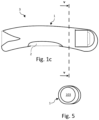
Figure 1a -1c show a corresponding number of views of the inflation device according toFigure 1 ; -
Figure 2 shows a view of a container according to the present disclosure; -
Figure 3 shows a view of a garment including an inflation device according to the present disclosure; -
Figure 4 shows a view of an inflation device according to the present disclosure, during removal of the container from the canister-shaped gas generator; -
Figure 5 shows a cross-sectional view along the line V-V of Figure 1c. - With reference to the attached figures, an embodiment of a container for a gas generator is denoted overall by the
reference number 1. A gas generator is indicated by thereference number 2. The canister-shaped gas generator 2 may be a canister containing compressed cold gas, such as helium. The canister may be provided with a respective shut-off valve (not shown). Alternatively, the inflation fluid source may comprise gas generators preferably of the pyrotechnic or other hybrid type or other types known according to the state of the art. - The assembly including the
gas generator 2 and thecontainer 1 for thegas generator 1 is called an inflation device, denoted generally by thereference number 3. Theinflation device 3 is connected by means of cables to a control unit (not shown in the drawings) which allows activation of the inflation to be controlled. The present disclosure also relates to aninflation device 3 comprising thecontainer 1 and a canister-shaped gas generator 2. - A further subject of the present disclosure consists of a
personal protection device 4 for the personal protection of a user. Thispersonal protection device 4 is a device including, in addition to theinflation device 3, aninflatable element 5 or airbag, in fluid communication with thisinflation device 3 and intended to protect at least partly the torso of a user. Preferably, theinflation device 3 is intended to be positioned in a flank region or lumbar region of the user's torso, inside theinflatable element 5, as can be seen inFigure 3 . - Finally, the present disclosure also relates to a wearable article or protective garment, generally indicated by the
number 6 inFigure 3 and comprising apersonal protection device 4 as defined above. Thepersonal protection devices 4 together with the airbags and the protective garments which include said airbags are personal protection devices which are known to the person skilled in the art and therefore are not further described in the present patent application. In particular, theinflation device 3 is in fluid communication with theinflatable element 5 so as to convey, once activated, inflation fluid into theinflatable element 5 and allow inflation thereof. Theinflation device 3 is, as mentioned, connected to the control unit by means of which inflation may be activated. With regard to inflation, in order to perform inflation of theinflatable element 5, in the event of a fall and/or sliding and/or a sudden impact involving a user or a vehicle being ridden/driven, theprotection device 4 is adapted to cooperate with special activation means (normally consisting of the aforementioned control unit and sensors) which are for example operationally connected to the canister-shaped gas generator 2. - It should also be noted that the activation modes, although being an aspect of particular importance for effective operation of the device, will not be further described in greater detail since they are methods which are essentially already known to a person skilled in the art of protection of an individual from sudden impacts.
- According to the present disclosure, the
container 1 for a canister-shaped gas generator 2 comprises acasing body 10 having a curved profile. In other words, the casing body is curved, namely the casing body has anexternal surface 101 having a substantially tubular form which defines a curved profile thereof. In other words, theexternal surface 101 follows an at least partially curvilinear trajectory. Expressed yet differently again, theexternal surface 101 has a progression which is partly arched, curvilinear or curved. As a result, as already mentioned, the external profile of thecasing body 10 is especially shaped so as to adapt to the anatomy of a user's torso, in particular the anatomy of a flank region or a lumbar region of a user's torso. - The
casing body 10 therefore follows a curved trajectory, according to a given radius of curvature R. Preferably the radius of curvature R is chosen so as to correspond to the anatomical curved shape of the flank of a user's body or the lumbar region of a user's back. In this way, thecontainer 1 may be rested and especially made so as to "fit" or "match" the anatomical curvature of a user's torso. Preferably, the entire casing body is therefore curved. - According to the present disclosure, the
casing body 10 is a hollow body, namely it has a cavity for receiving the gas generator. In particular, thecasing body 10 is provided with a cavity orchannel 103 configured to house a conventional canister-shaped gas generator 2. Thechannel 103 therefore has a form and dimensions such as to be able to receive inside it a conventional canister-shaped gas generator 2. In fact, as described above, the knowngas generators 2, which are used in the context of personal protection devices, generally comprise canisters which have an at least partially cylindrical form. Therefore, thechannel 103 acts as a seat for housing a canister-shaped gas generator 2, which preferably has a cylindrical form. - Preferably, the
channel 103 is formed at least partially inside thecasing body 10. In other words, thechannel 102 is an internal cavity of the casing body. In this way, thecasing body 10 surrounds, at least partly, the canister-shapedgas generator 2 and acts as protective covering for the canister-shapedgas generator 2. - Consequently, as mentioned above, the
container 1 is configured so as to protect the canister-shapedgas generator 2 and allow positioning of the latter in a region, such as the flank or the lumbar region, occupying a minimum amount of space and hindering as little as possible the movements of the user, while at the same time housing the canister-shapedgas generator 2. - The
container 1 therefore allows the gas generator to be positioned so as to occupy an anatomical hollow zone of a user's torso. As a result, the canister-shapedgas generator 2 may be positioned so as to minimize the overall volume presented to the user. - It can be understood that the
casing body 10 has a longitudinal cross-section, along the main direction S, which has a substantially C-shaped form, with a first convex flank or side 10' on one side of thechannel 103, and a second concave side orflank 10" on the other side of thechannel 103. - It is to be understood therefore that the
casing body 10 extends principally along a main direction S parallel to or coinciding with the development axis A of thechannel 103. Namely thechannel 103 is oriented in the main direction S along which thecasing body 10 extends. Expressed in yet other words, thecasing body 10 and thechannel 103 extend mainly on the same direction. Consequently, thehousing body 10 is a substantially tubular body. - In order to achieve the geometrical form defined above, the
casing body 10 has, furthermore, aninternal surface 102 opposite to the aforementionedexternal surface 101. Theinternal surface 102 delimits or surrounds thechannel 103. According to a preferred aspect of the present disclosure, thechannel 103 extends mainly along its own development axis A. Thechannel 103 therefore has a substantially elongated or oblong form, along this development axis A. In this way, a conventional cannister-shapedgas generator 2, which has an elongated cylindrical form, may be received completely, or at least partly, over most of its length inside thechannel 103. - According to a preferred aspect of the present disclosure, during use, the
internal surface 102 is intended to be completely in contact with a canister-shapedgas generator 2. Expressed differently, theinternal surface 102, during use, rests or lies on the canister-shapedgas generator 2. During use, that is, theinternal surface 102 adheres to the canister-shapedgas generator 2. In this way no empty spaces, or play, is present between theinternal surface 102 and the canister-shapedgas generator 2. - The
casing body 10 is therefore configured to surround tightly the canister-shapedgas generator 2. In this way relative movements of the canister-shapedgas generator 2 with respect to thecasing body 10 surrounding it are prevented. Consequently, therefore, during use, the canister-shapedgas generator 2 is firmly retained inside thechannel 103. - According to a preferred aspect of the present disclosure, the
casing body 10 is a single body, i.e. a monolithic body. - Even more preferably, in order to ensure the aforementioned adherence, the
casing body 10 is made of soft material, such as silicone or other material. In other words thecontainer 1 is made of a flexible and/or elastically yielding material. Preferably, thecontainer 1 is made of an elastomeric material; for example, thecontainer 1 may be made of silicone, rubber or latex. In this way, thecontainer 1 is made so as to be particularly flexible and able to cushion both the impacts which could affect the gas generator and the bruising which, in the event of a fall, theinflation device 3 may cause for the user. - The soft and flexible material also allows easy unsheathing of the
casing body 10, as can be seen inFigure 4 . - According to a preferred aspect of the present disclosure, the
casing body 10 extends between afirst end 103 and asecond end 105. Thefirst end 104 and thesecond end 105 are opposite to each other. - According to this preferred aspect, at least one of the
first end 104 and thesecond end 105, for example theend 105 has or is provided with anopening 106. Theopening 106 communicates with thechannel 103 so as to allow access to the canister-shapedgas generator 2. The through-opening 106 may be in the form of a slot or through-hole. Thechannel 103 is therefore open towards the outside. In this way, the canister-shapedgas generator 2 may be inserted into or extracted from thechannel 103 through theopening 106 during use. In addition, the canister-shapedgas generator 2 may be connected to the control unit through theopening 106. - According to a preferred aspect of the present disclosure, the
other end 104 of thecasing body 10 is dome or cap-shaped and defines a cavity opening out on one side with thechannel 103 and communicating with an environment outside thechannel 103. The gas output nozzle of the canister-shapedgas generator 2 is directed towards thecavity 111. In this way, saidcavity 111 is configured to direct, orient or steer a gas flow exiting the canister-shapedgas generator 2 towards theairbag 5. - The
casing body 10 may also include acentral opening 112 which facilitates unsheathing, as shown inFigure 4 . - The subject-matter of the present disclosure has been described hitherto with reference to embodiments thereof. It is to be understood that other embodiments relating to the same inventive idea may exist, all of these falling within the scope of protection of the claims which solely define the scope of the invention.
Claims (14)
- Container (1) for canister-shaped gas generator (2), wherein the container (1) comprises a casing body (10) which is curved or shaped according to a curved trajectory, and wherein the casing body (10) has a channel (103) configured to house the canister-shaped gas generator (2); the container being characterized in that the casing body has a concave outer side (10") and a convex outer side (10').
- Container (1) according to claim 1, wherein said channel (103) extends mainly along a straight or rectilinear development axis (A).
- Container (1) according to claim 2, wherein, during use, said channel (103) is delimited by an inner surface (102) and said inner surface (102) is intended to be completely in contact with the canister-shaped gas generator (2).
- Container (1) according to either one of claims 2 or 3, wherein said casing body (10) extends along a main direction (S) parallel to, or coinciding with, the development axis (A) of said channel (103).
- Container (1) according to any one of the preceding claims 2 to 4, wherein the curved trajectory has a curvature radius (R) and said curvature radius (R) is substantially perpendicular to said development axis (A).
- Container (1) according to any one of the preceding claims, wherein said channel (103) has a tubular or cylindrical shape.
- Container (1) according to any one of the preceding claims, wherein said casing body (10) develops between a first end (104) and a second end (105), opposite to said first end (104), and wherein at least one of the first end (104) and the second end (105) is provided with an opening (106) communicating with said channel (103) to allow the insertion and extraction of the canister-shaped gas generator (2) into/from said channel (103) and to allow fluid communication of the canister-shaped gas generator (2) with an environment external to said inner channel (103).
- Container (1) according to claim 7, wherein the other end (104) has a cavity (111) communicating with said inner channel (103) and open towards an environment external to said channel (103) and configured to direct a gas flow exiting the canister-shaped gas generator (2) towards said external environment.
- Container (1) according to claim 8, wherein said other end (104) has a hemispherical or semi-dome shape.
- Container (1) according to any one of the preceding claims, wherein the casing body (10) is made of soft material, preferably an elastomeric material.
- Inflation device (3) comprising a container (1) according to any one of the preceding claims and said canister-shaped gas generator (2).
- Personal protection device (4) for the personal protection of a user comprising an inflation device (3) according to claim 11, an inflatable element (5) in fluid communication with said inflation device (3) and intended to protect at least one part of a user's body.
- Personal protection device (4) according to claim 12, wherein said inflation device (3) is intended to be positioned in a region of the torso of said user.
- A wearable article or garment (6) comprising a personal protection device (4) according to claim 12 or 13.
Applications Claiming Priority (1)
| Application Number | Priority Date | Filing Date | Title |
|---|---|---|---|
| IT102021000003800A IT202100003800A1 (en) | 2021-02-18 | 2021-02-18 | CONTAINER FOR A GAS GENERATOR |
Publications (3)
| Publication Number | Publication Date |
|---|---|
| EP4046513A1 EP4046513A1 (en) | 2022-08-24 |
| EP4046513B1 true EP4046513B1 (en) | 2024-01-03 |
| EP4046513C0 EP4046513C0 (en) | 2024-01-03 |
Family
ID=75660273
Family Applications (1)
| Application Number | Title | Priority Date | Filing Date |
|---|---|---|---|
| EP22156568.2A Active EP4046513B1 (en) | 2021-02-18 | 2022-02-14 | Container for gas generator |
Country Status (3)
| Country | Link |
|---|---|
| EP (1) | EP4046513B1 (en) |
| ES (1) | ES2976167T3 (en) |
| IT (1) | IT202100003800A1 (en) |
Citations (6)
| Publication number | Priority date | Publication date | Assignee | Title |
|---|---|---|---|---|
| GB546082A (en) | 1942-01-30 | 1942-06-26 | Charles Godfrey Edwards | Improvements in wearing apparel |
| WO1994026136A1 (en) | 1993-05-14 | 1994-11-24 | Entropy Racing, Inc. | Cervical protection system |
| WO2005048754A1 (en) | 2003-11-20 | 2005-06-02 | Alpinestars Research Srl | Garment associated to protective inflatable devices |
| WO2011148351A1 (en) | 2010-05-28 | 2011-12-01 | Helite S.A.R.L. | Device for inflating airbag |
| EP3248491A1 (en) | 2016-05-25 | 2017-11-29 | Helite | Deployable system and device including such a deployable system |
| US10709180B2 (en) | 2016-01-04 | 2020-07-14 | Boe Technology Group Co., Ltd. | Protection system and method |
Family Cites Families (2)
| Publication number | Priority date | Publication date | Assignee | Title |
|---|---|---|---|---|
| JP3070441U (en) * | 2000-01-21 | 2000-08-04 | 宗平 高島 | Automatic gas inflatable head shock absorber. |
| IT201800005175A1 (en) * | 2018-05-08 | 2019-11-08 | WEARABLE INFLATION DEVICE |
-
2021
- 2021-02-18 IT IT102021000003800A patent/IT202100003800A1/en unknown
-
2022
- 2022-02-14 ES ES22156568T patent/ES2976167T3/en active Active
- 2022-02-14 EP EP22156568.2A patent/EP4046513B1/en active Active
Patent Citations (6)
| Publication number | Priority date | Publication date | Assignee | Title |
|---|---|---|---|---|
| GB546082A (en) | 1942-01-30 | 1942-06-26 | Charles Godfrey Edwards | Improvements in wearing apparel |
| WO1994026136A1 (en) | 1993-05-14 | 1994-11-24 | Entropy Racing, Inc. | Cervical protection system |
| WO2005048754A1 (en) | 2003-11-20 | 2005-06-02 | Alpinestars Research Srl | Garment associated to protective inflatable devices |
| WO2011148351A1 (en) | 2010-05-28 | 2011-12-01 | Helite S.A.R.L. | Device for inflating airbag |
| US10709180B2 (en) | 2016-01-04 | 2020-07-14 | Boe Technology Group Co., Ltd. | Protection system and method |
| EP3248491A1 (en) | 2016-05-25 | 2017-11-29 | Helite | Deployable system and device including such a deployable system |
Non-Patent Citations (3)
| Title |
|---|
| ANONYMOUS: "Dainese Launches Smart Jacket", CYCLE NEWS, 19 June 2019 (2019-06-19), pages 1 - 12, XP093232272, Retrieved from the Internet <URL:https://www.cyclenews.com/2019/06/article/dainese-launches-smart-jacket/> |
| D1A - D-AIR SMART JACKET MANUFACTURED BY DAINESE S.P.A. |
| D1D - REGISTRATION EMAIL FOR THE PURCHASING OF THE SMART JACKET |
Also Published As
| Publication number | Publication date |
|---|---|
| EP4046513A1 (en) | 2022-08-24 |
| IT202100003800A1 (en) | 2022-08-18 |
| ES2976167T3 (en) | 2024-07-24 |
| EP4046513C0 (en) | 2024-01-03 |
Similar Documents
| Publication | Publication Date | Title |
|---|---|---|
| US5287562A (en) | Helmet to protect cervical spine against axial impact forces | |
| US5390367A (en) | Helmet and shoulder pads having inflatable protective means to protect cervical spine | |
| US5546609A (en) | Helmet | |
| ES2230845T3 (en) | PROTECTIVE SUIT. | |
| EP2802228B1 (en) | Personal protection device and garment including such a device | |
| ES3056389T3 (en) | Wearable protection device | |
| US11064753B2 (en) | Dual functioning head protection device | |
| EP2994002B1 (en) | Personal protection device | |
| US4872215A (en) | Chest protector | |
| EP4046514B1 (en) | Inflation device and personal protection device including said inflation device | |
| EP4046513A1 (en) | Container for gas generator | |
| US8276217B1 (en) | Personal roll bar | |
| WO1995026651A1 (en) | Helmet removal device and method | |
| US7299507B1 (en) | Protective harness for a motorcycle rider | |
| GB2099687A (en) | Inflatable protective garment | |
| EP2745720A1 (en) | Protection device | |
| EP4029396B1 (en) | Head protection device | |
| WO2011047283A1 (en) | System and method for removing a helmet with head covering | |
| EP4620338A1 (en) | Gas generator | |
| IT202100013706A1 (en) | PERSONAL PROTECTIVE EQUIPMENT | |
| EP0931567A3 (en) | Safety device against avalanches | |
| CN201291828Y (en) | Safe guard air sac of safety band | |
| EP4327685A1 (en) | Wearable protection device | |
| JP2017036523A (en) | Fingertip protection for gloves and gloves | |
| EP4434382B1 (en) | Inflation device |
Legal Events
| Date | Code | Title | Description |
|---|---|---|---|
| PUAI | Public reference made under article 153(3) epc to a published international application that has entered the european phase |
Free format text: ORIGINAL CODE: 0009012 |
|
| STAA | Information on the status of an ep patent application or granted ep patent |
Free format text: STATUS: THE APPLICATION HAS BEEN PUBLISHED |
|
| AK | Designated contracting states |
Kind code of ref document: A1 Designated state(s): AL AT BE BG CH CY CZ DE DK EE ES FI FR GB GR HR HU IE IS IT LI LT LU LV MC MK MT NL NO PL PT RO RS SE SI SK SM TR |
|
| STAA | Information on the status of an ep patent application or granted ep patent |
Free format text: STATUS: REQUEST FOR EXAMINATION WAS MADE |
|
| 17P | Request for examination filed |
Effective date: 20230222 |
|
| RBV | Designated contracting states (corrected) |
Designated state(s): AL AT BE BG CH CY CZ DE DK EE ES FI FR GB GR HR HU IE IS IT LI LT LU LV MC MK MT NL NO PL PT RO RS SE SI SK SM TR |
|
| RIC1 | Information provided on ipc code assigned before grant |
Ipc: A41D 13/018 20060101AFI20230614BHEP |
|
| GRAP | Despatch of communication of intention to grant a patent |
Free format text: ORIGINAL CODE: EPIDOSNIGR1 |
|
| STAA | Information on the status of an ep patent application or granted ep patent |
Free format text: STATUS: GRANT OF PATENT IS INTENDED |
|
| INTG | Intention to grant announced |
Effective date: 20230721 |
|
| GRAS | Grant fee paid |
Free format text: ORIGINAL CODE: EPIDOSNIGR3 |
|
| GRAA | (expected) grant |
Free format text: ORIGINAL CODE: 0009210 |
|
| STAA | Information on the status of an ep patent application or granted ep patent |
Free format text: STATUS: THE PATENT HAS BEEN GRANTED |
|
| AK | Designated contracting states |
Kind code of ref document: B1 Designated state(s): AL AT BE BG CH CY CZ DE DK EE ES FI FR GB GR HR HU IE IS IT LI LT LU LV MC MK MT NL NO PL PT RO RS SE SI SK SM TR |
|
| REG | Reference to a national code |
Ref country code: GB Ref legal event code: FG4D |
|
| REG | Reference to a national code |
Ref country code: CH Ref legal event code: EP |
|
| REG | Reference to a national code |
Ref country code: DE Ref legal event code: R096 Ref document number: 602022001498 Country of ref document: DE |
|
| REG | Reference to a national code |
Ref country code: IE Ref legal event code: FG4D |
|
| U01 | Request for unitary effect filed |
Effective date: 20240131 |
|
| U07 | Unitary effect registered |
Designated state(s): AT BE BG DE DK EE FI FR IT LT LU LV MT NL PT SE SI Effective date: 20240213 |
|
| U20 | Renewal fee for the european patent with unitary effect paid |
Year of fee payment: 3 Effective date: 20240220 |
|
| PG25 | Lapsed in a contracting state [announced via postgrant information from national office to epo] |
Ref country code: IS Free format text: LAPSE BECAUSE OF FAILURE TO SUBMIT A TRANSLATION OF THE DESCRIPTION OR TO PAY THE FEE WITHIN THE PRESCRIBED TIME-LIMIT Effective date: 20240503 |
|
| PG25 | Lapsed in a contracting state [announced via postgrant information from national office to epo] |
Ref country code: GR Free format text: LAPSE BECAUSE OF FAILURE TO SUBMIT A TRANSLATION OF THE DESCRIPTION OR TO PAY THE FEE WITHIN THE PRESCRIBED TIME-LIMIT Effective date: 20240404 |
|
| PG25 | Lapsed in a contracting state [announced via postgrant information from national office to epo] |
Ref country code: HR Free format text: LAPSE BECAUSE OF FAILURE TO SUBMIT A TRANSLATION OF THE DESCRIPTION OR TO PAY THE FEE WITHIN THE PRESCRIBED TIME-LIMIT Effective date: 20240103 Ref country code: RS Free format text: LAPSE BECAUSE OF FAILURE TO SUBMIT A TRANSLATION OF THE DESCRIPTION OR TO PAY THE FEE WITHIN THE PRESCRIBED TIME-LIMIT Effective date: 20240403 |
|
| PG25 | Lapsed in a contracting state [announced via postgrant information from national office to epo] |
Ref country code: CZ Free format text: LAPSE BECAUSE OF FAILURE TO SUBMIT A TRANSLATION OF THE DESCRIPTION OR TO PAY THE FEE WITHIN THE PRESCRIBED TIME-LIMIT Effective date: 20240103 |
|
| REG | Reference to a national code |
Ref country code: ES Ref legal event code: FG2A Ref document number: 2976167 Country of ref document: ES Kind code of ref document: T3 Effective date: 20240724 |
|
| PG25 | Lapsed in a contracting state [announced via postgrant information from national office to epo] |
Ref country code: RS Free format text: LAPSE BECAUSE OF FAILURE TO SUBMIT A TRANSLATION OF THE DESCRIPTION OR TO PAY THE FEE WITHIN THE PRESCRIBED TIME-LIMIT Effective date: 20240403 Ref country code: NO Free format text: LAPSE BECAUSE OF FAILURE TO SUBMIT A TRANSLATION OF THE DESCRIPTION OR TO PAY THE FEE WITHIN THE PRESCRIBED TIME-LIMIT Effective date: 20240403 Ref country code: IS Free format text: LAPSE BECAUSE OF FAILURE TO SUBMIT A TRANSLATION OF THE DESCRIPTION OR TO PAY THE FEE WITHIN THE PRESCRIBED TIME-LIMIT Effective date: 20240503 Ref country code: HR Free format text: LAPSE BECAUSE OF FAILURE TO SUBMIT A TRANSLATION OF THE DESCRIPTION OR TO PAY THE FEE WITHIN THE PRESCRIBED TIME-LIMIT Effective date: 20240103 Ref country code: GR Free format text: LAPSE BECAUSE OF FAILURE TO SUBMIT A TRANSLATION OF THE DESCRIPTION OR TO PAY THE FEE WITHIN THE PRESCRIBED TIME-LIMIT Effective date: 20240404 Ref country code: CZ Free format text: LAPSE BECAUSE OF FAILURE TO SUBMIT A TRANSLATION OF THE DESCRIPTION OR TO PAY THE FEE WITHIN THE PRESCRIBED TIME-LIMIT Effective date: 20240103 |
|
| PG25 | Lapsed in a contracting state [announced via postgrant information from national office to epo] |
Ref country code: PL Free format text: LAPSE BECAUSE OF FAILURE TO SUBMIT A TRANSLATION OF THE DESCRIPTION OR TO PAY THE FEE WITHIN THE PRESCRIBED TIME-LIMIT Effective date: 20240103 |
|
| PG25 | Lapsed in a contracting state [announced via postgrant information from national office to epo] |
Ref country code: PL Free format text: LAPSE BECAUSE OF FAILURE TO SUBMIT A TRANSLATION OF THE DESCRIPTION OR TO PAY THE FEE WITHIN THE PRESCRIBED TIME-LIMIT Effective date: 20240103 |
|
| REG | Reference to a national code |
Ref country code: DE Ref legal event code: R026 Ref document number: 602022001498 Country of ref document: DE |
|
| PLBI | Opposition filed |
Free format text: ORIGINAL CODE: 0009260 |
|
| PG25 | Lapsed in a contracting state [announced via postgrant information from national office to epo] |
Ref country code: SM Free format text: LAPSE BECAUSE OF FAILURE TO SUBMIT A TRANSLATION OF THE DESCRIPTION OR TO PAY THE FEE WITHIN THE PRESCRIBED TIME-LIMIT Effective date: 20240103 |
|
| PLAX | Notice of opposition and request to file observation + time limit sent |
Free format text: ORIGINAL CODE: EPIDOSNOBS2 |
|
| PG25 | Lapsed in a contracting state [announced via postgrant information from national office to epo] |
Ref country code: SK Free format text: LAPSE BECAUSE OF FAILURE TO SUBMIT A TRANSLATION OF THE DESCRIPTION OR TO PAY THE FEE WITHIN THE PRESCRIBED TIME-LIMIT Effective date: 20240103 |
|
| PG25 | Lapsed in a contracting state [announced via postgrant information from national office to epo] |
Ref country code: SM Free format text: LAPSE BECAUSE OF FAILURE TO SUBMIT A TRANSLATION OF THE DESCRIPTION OR TO PAY THE FEE WITHIN THE PRESCRIBED TIME-LIMIT Effective date: 20240103 Ref country code: SK Free format text: LAPSE BECAUSE OF FAILURE TO SUBMIT A TRANSLATION OF THE DESCRIPTION OR TO PAY THE FEE WITHIN THE PRESCRIBED TIME-LIMIT Effective date: 20240103 Ref country code: RO Free format text: LAPSE BECAUSE OF FAILURE TO SUBMIT A TRANSLATION OF THE DESCRIPTION OR TO PAY THE FEE WITHIN THE PRESCRIBED TIME-LIMIT Effective date: 20240103 |
|
| PG25 | Lapsed in a contracting state [announced via postgrant information from national office to epo] |
Ref country code: MC Free format text: LAPSE BECAUSE OF FAILURE TO SUBMIT A TRANSLATION OF THE DESCRIPTION OR TO PAY THE FEE WITHIN THE PRESCRIBED TIME-LIMIT Effective date: 20240103 |
|
| 26 | Opposition filed |
Opponent name: ALPINESTARS S.P.A. Effective date: 20241004 |
|
| PG25 | Lapsed in a contracting state [announced via postgrant information from national office to epo] |
Ref country code: MC Free format text: LAPSE BECAUSE OF FAILURE TO SUBMIT A TRANSLATION OF THE DESCRIPTION OR TO PAY THE FEE WITHIN THE PRESCRIBED TIME-LIMIT Effective date: 20240103 |
|
| PG25 | Lapsed in a contracting state [announced via postgrant information from national office to epo] |
Ref country code: IE Free format text: LAPSE BECAUSE OF NON-PAYMENT OF DUE FEES Effective date: 20240214 |
|
| PG25 | Lapsed in a contracting state [announced via postgrant information from national office to epo] |
Ref country code: IE Free format text: LAPSE BECAUSE OF NON-PAYMENT OF DUE FEES Effective date: 20240214 |
|
| PLBB | Reply of patent proprietor to notice(s) of opposition received |
Free format text: ORIGINAL CODE: EPIDOSNOBS3 |
|
| U20 | Renewal fee for the european patent with unitary effect paid |
Year of fee payment: 4 Effective date: 20250224 |
|
| PG25 | Lapsed in a contracting state [announced via postgrant information from national office to epo] |
Ref country code: CY Free format text: LAPSE BECAUSE OF FAILURE TO SUBMIT A TRANSLATION OF THE DESCRIPTION OR TO PAY THE FEE WITHIN THE PRESCRIBED TIME-LIMIT; INVALID AB INITIO Effective date: 20220214 |
|
| REG | Reference to a national code |
Ref country code: CH Ref legal event code: PL |
|
| PG25 | Lapsed in a contracting state [announced via postgrant information from national office to epo] |
Ref country code: CH Free format text: LAPSE BECAUSE OF NON-PAYMENT OF DUE FEES Effective date: 20250228 |
|
| PG25 | Lapsed in a contracting state [announced via postgrant information from national office to epo] |
Ref country code: TR Free format text: LAPSE BECAUSE OF FAILURE TO SUBMIT A TRANSLATION OF THE DESCRIPTION OR TO PAY THE FEE WITHIN THE PRESCRIBED TIME-LIMIT Effective date: 20240103 |
|
| U1N | Appointed representative for the unitary patent procedure changed after the registration of the unitary effect |
Representative=s name: DE SANDRE, EMANUELE; IT |
|
| U20 | Renewal fee for the european patent with unitary effect paid |
Year of fee payment: 5 Effective date: 20260129 |
|
| PGFP | Annual fee paid to national office [announced via postgrant information from national office to epo] |
Ref country code: GB Payment date: 20260220 Year of fee payment: 5 |
|
| PG25 | Lapsed in a contracting state [announced via postgrant information from national office to epo] |
Ref country code: CH Free format text: THE PATENT HAS BEEN ANNULLED BY A DECISION OF A NATIONAL AUTHORITY Effective date: 20250228 |
|
| PG25 | Lapsed in a contracting state [announced via postgrant information from national office to epo] |
Ref country code: HU Free format text: LAPSE BECAUSE OF FAILURE TO SUBMIT A TRANSLATION OF THE DESCRIPTION OR TO PAY THE FEE WITHIN THE PRESCRIBED TIME-LIMIT; INVALID AB INITIO Effective date: 20220214 |
|
| APAW | Appeal reference deleted |
Free format text: ORIGINAL CODE: EPIDOSDREFNO |
|
| APBP | Date of receipt of notice of appeal recorded |
Free format text: ORIGINAL CODE: EPIDOSNNOA2O |
|
| APAH | Appeal reference modified |
Free format text: ORIGINAL CODE: EPIDOSCREFNO |
|
| PGFP | Annual fee paid to national office [announced via postgrant information from national office to epo] |
Ref country code: ES Payment date: 20260409 Year of fee payment: 5 |
|
| APBU | Appeal procedure closed |
Free format text: ORIGINAL CODE: EPIDOSNNOA9O |