EP4046294B1 - Vorrichtung zur kompensation von imperfektionen an einem kohärenten optischen empfänger - Google Patents
Vorrichtung zur kompensation von imperfektionen an einem kohärenten optischen empfänger Download PDFInfo
- Publication number
- EP4046294B1 EP4046294B1 EP19805234.2A EP19805234A EP4046294B1 EP 4046294 B1 EP4046294 B1 EP 4046294B1 EP 19805234 A EP19805234 A EP 19805234A EP 4046294 B1 EP4046294 B1 EP 4046294B1
- Authority
- EP
- European Patent Office
- Prior art keywords
- equalizer
- receiver
- receive signal
- transfer function
- link
- Prior art date
- Legal status (The legal status is an assumption and is not a legal conclusion. Google has not performed a legal analysis and makes no representation as to the accuracy of the status listed.)
- Active
Links
Images



Classifications
-
- H—ELECTRICITY
- H04—ELECTRIC COMMUNICATION TECHNIQUE
- H04B—TRANSMISSION
- H04B10/00—Transmission systems employing electromagnetic waves other than radio-waves, e.g. infrared, visible or ultraviolet light, or employing corpuscular radiation, e.g. quantum communication
- H04B10/25—Arrangements specific to fibre transmission
- H04B10/2507—Arrangements specific to fibre transmission for the reduction or elimination of distortion or dispersion
-
- H—ELECTRICITY
- H04—ELECTRIC COMMUNICATION TECHNIQUE
- H04B—TRANSMISSION
- H04B10/00—Transmission systems employing electromagnetic waves other than radio-waves, e.g. infrared, visible or ultraviolet light, or employing corpuscular radiation, e.g. quantum communication
- H04B10/60—Receivers
- H04B10/61—Coherent receivers
- H04B10/616—Details of the electronic signal processing in coherent optical receivers
Definitions
- the present invention relates to optical communications, in particular between an optical transmitter and a coherent optical receiver over an optical link.
- the invention provides a device for compensating imperfections at the coherent optical receiver, wherein the imperfections may be caused by the receiver and by the link, respectively.
- the device is configured to equalize a receive signal obtained from the receiver with two separate equalizers, based on a calculated transfer function of the link.
- Fiber-optic communications evolve continuously towards higher line rates and higher spectral efficiency.
- Coherent optics emerged as the technology of choice for long-haul and metro applications, and is gradually penetrating also the market of short-reach transmission.
- coherent optics supports up to 600 Gb/s per carrier, whereas the next generation will enable line rates in excess of 800 Gb/s using 64-point Quadrature Amplitude Modulation (QAM) and even larger symbol constellations.
- QAM Quadrature Amplitude Modulation
- Coherent optical technology is currently discussed for 40 km ER and 80 km ZR 400Gb/s Ethernet (400 GbE) applications. Beyond 400 GbE, coherent optical transceivers are regarded as the primary candidates for 10 km LR dark fiber interconnects.
- the differential group delay between the I and Q components is not constant over frequency, as it is assumed for the sake of simplicity by G. Khanna et al., but varies as a function of the frequency and, therefore, cannot be expressed by a one-dimensional parameter. In practice, this function exhibits a slope and ripple, especially at high frequencies, which makes its accurate estimation and compensation a difficult task.
- the signal power is a scarce resource and, to make the most out of it, it is essential to operate the electrical driver and the modulator at the transmitter at high-power levels, and the electrical amplifiers at the receiver in the high-gain region, which exacerbates the impact of nonlinear distortion and also asks for nonlinear compensation.
- IQ skew and nonlinearities are two prominent examples, but many more effects impair the performance of coherent optical transceivers, i.e. lead to imperfections.
- the most important imperfections, which occur both at the transmitter and at the receiver, include frequency-dependent IQ skew, frequency-dependent IQ imbalance, bandwidth limitations and nonideal amplitude and phase response, nonlinear distortion (typically with memory), and cross-talk among the four tributaries XI, XQ, YI, YQ, which are mapped to the I and Q components of two orthogonal polarization planes X and Y.
- DSP Digital Signal Processing
- DPD Digital Pre-Distortion
- the adaptation can rely upon a local feedback at the transmitter, as it is described in " G. Khanna et al., 'A Robust Adaptive Pre-Distortion Method for Optical Communication Transmitters', IEEE Photonics Technology Letters, Vol. 28, No. 7 (2016 )".
- DPD can be adapted using a feedback from the far-end Rx, as described in " G. Khanna et al., 'Adaptive Transmitter Pre-Distortion using Feedback from the Far-End Receiver', IEEE Photonics Technology Letters, Vol. 30, No. 3 (2018 ).
- FIG. 7 A first exemplary architecture to address the problem is shown in FIG. 7 , which is based on " A. Matsushita et al. '10-WDM 64-GBaud PDM-64QAM Transmission over all-Raman Amplified 840 km SSMF using Digital Back Propagation', Proceedings of the European Conference on Optical Communication ECOC (2017 ), and " A. Matsushita et al. 'High-Spectral-Efficiency 600-Gbps/Carrier Transmission Using PDM-256QAM Format', IEEE Journal of Lightwave Technology, Vol. 37, No. 2 (2019 ), respectively.
- optical signals are represented by arrows with two-line compound type
- electrical signals corresponding to the four tributaries XI, XQ, YI, YQ are represented by arrows with single-line compound type.
- the transmitter (Tx) converts four electrical tributaries to an optical signal
- its receiver (Rx) counterpart implements the mapping of the optical signal to four electrical tributaries.
- FIG. 7 link and Rx components are equalized at the receiver in the reverse reorder, as required by the laws of function composition.
- FIG. 7 shows in particular that the imperfections of the receiver are mitigated by a receiver equalizer (RxEQ), whereas the compensation of the link comprises a Bulk Chromatic Dispersion Equalizer (BCD EQ) and a Multiple-Input Multiple-Output (MIMO) equalizer, in order to cope with rotations of the State of Polarization (SOP) and Polarization Mode Dispersion (PMD).
- BCD EQ Bulk Chromatic Dispersion Equalizer
- MIMO Multiple-Input Multiple-Output
- SOP State of Polarization
- PMD Polarization Mode Dispersion
- the main problem of the architecture shown in FIG. 7 is the derivation of a suitable adaptation criterion for the RxEQ.
- Matsushita et al. describe the following procedure to adapt the RxEQ.
- a pre-equalized signal consisting of a known Pseudo-Random Binary Sequence (PRBS) and a preamble is transmitted in a back-to-back optical configuration, i.e., in the absence of significant Chromatic Dispersion (CD), high-order PMD, and other link effects.
- PRBS Pseudo-Random Binary Sequence
- CD Chromatic Dispersion
- the amount of carrier frequency offset, laser phase noise, first order PMD, and polarization rotation is estimated from the received data, and is used to obtain the target output for the RxEQ.
- the inverse function that compensates for the receiver frequency response for each lane is computed.
- FIG. 8 A second exemplary architecture is shown in FIG. 8 , which is based on “ R. Rios-Müller et al., 'Blind Receiver Skew Compensation for Long-Haul Non-Dispersion Managed Systems', Proceedings of the European Conference on Optical Communication ECOC (2014 )", and on ⁇ R. Rios-Müller et al. "Blind Receiver Skew Compensation and Estimation for Long-Haul Non-Dispersion Managed Systems Using Adaptive Equalizer", IEEE Journal of Lightwave Technology, Vol. 33, No. 7 (2015 )", respectively.
- the compensation of receiver imperfections occurs in the MIMO EQ after the BCD EQ.
- the BCD EQ processes, separately, each real tributary XI, XQ, YI, YQ, generating 4 complex tributaries.
- per-lane BCD EQs with real inputs and complex outputs are used to keep the I and Q components separate.
- An 8 ⁇ 4 MIMO equalizer compensates adaptively amplitude and phase response of the receiver. Equalization of linear receiver effects can be applied in the MIMO EQ after the BCD EQ, because scalar linear filters commute.
- a significant drawback of the architecture shown in FIG. 8 is the use of an 8 ⁇ 4 instead of a 4 ⁇ 4 MIMO EQ, with an effective increase of the complexity of the MIMO EQ by a factor of two. Further, this architecture cannot compensate nonlinear receiver impairments, because the huge memory of the BCD EQ stretches enormous the effect of nonlinearities, making a compensation via the MIMO EQ unfeasible.
- US 9,077,455 B2 discloses an optical receiver having a MIMO equalizer.
- WO 2013/102898 A1 discloses symbol spaced adaptive MIMO equalization for ultra high bit rate optical communication systems.
- embodiments of the present invention aim to improve the compensation of imperfections at a coherent optical receiver.
- An objective is to provide a device for compensating such imperfections without the conventional limitations.
- the device should be usable during receiver operation.
- the device should further not require any transmission of known data sequences and training sequences.
- the device should be able to cope with nonlinear impairments.
- the device should be able to cope with high-order PMD, PDL and CD.
- the device should also be of only low or at most moderate complexity.
- embodiments of the invention base on some considerations made by the inventors with respect to FIG. 7 .
- the exact implementation of Tx and Rx dictates the nature and the amount of the transceiver imperfections, and in particular the implementation of the receiver affects the design of the compensation unit.
- embodiments of the invention should be based on an agnostic adaptation algorithm that can be applied to any equalizer structure.
- adaptation of an equalizer requires knowledge of the input signal and of the target output.
- the architecture of FIG. 7 only the target signal after the whole demodulator is known, rather than directly after the RxEQ.
- a possibility would be to resort to a gradient descent algorithm based on gradient backpropagation via the chain rule. This type of algorithm is customarily used to train deep neural networks.
- the computational burden of gradient backpropagation would be impractically high.
- a first aspect of the invention provides a device for compensating imperfections at a coherent optical receiver, the device being configured to: obtain a receive signal from the receiver; adapt a first equalizer based on a target output for the first equalizer; compensate the receive signal with the first equalizer in order to compensate imperfections caused by the receiver; and compensate the receive signal further with a second equalizer, in order to compensate imperfections caused by a link between a transmitter and the receiver; wherein the device is further configured to: estimate a channel response based on a configuration of the second equalizer; extract a transfer function of the link from the channel response; and calculate the target output for the first equalizer based on the transfer function and based on bit decisions obtained from the receive signal.
- the main advantage of the device of the first aspect, with respect to the architecture shown in FIG. 8 is that a 4 ⁇ 4 instead of 8 ⁇ 4 MIMO EQ can be used as the second equalizer. Another advantage is the possibility to compensate, besides linear effects, also nonlinear distortions.
- the device of the first aspect does not require the use of special training sequences, and also no knowledge of the transmit data. Further, the device of the first aspect can estimate all-order PMD and PDL, and can be used to adapt the first equalizer (e.g., the RxEQ) during normal operation, rather than only during factory calibration in back-to-back configuration.
- the first equalizer e.g., the RxEQ
- the device of the first aspect thus offers several advantages over conventional approaches. Since it does not require factory calibration, time and money can be saved. Notwithstanding, if desired, it can also be used for factory calibration. Further, the device supports estimation and compensation of all kinds of per-tributary and cross-tributary receiver impairments, including both linear and nonlinear effects. The device can track temperature-dependent effects and aging during normal operation and, thus, can guarantee an accurate impairment compensation from the beginning to the end of the product life cycle. Since no special sequences or preambles are needed, the proposed device is further compatible with any DSP frame format, and current or future standard.
- the adaptation algorithm performed by the device is advantageously agnostic to the implementation of the first equalizer.
- the implementation of the first equalizer can be scaled, and can be adapted in accordance to the needs dictated by the electro-optical components and the available computational resources.
- the adaptation algorithm performed by the device can be implemented in software, e.g. on a microcontroller, rather than in ASIC gates, and therefore has potentially a lower impact on chip complexity and power consumption.
- the configuration of the second equalizer comprises a set of tap coefficients.
- the device is configured to: calculate the target output for the first equalizer by simulating the transmission of the bit decisions over a model of the link determined based on the transfer function.
- the device is configured to: calculate the target output for the first equalizer based on the bit decisions obtained by a threshold device or by a Forward Error Correction (FEC) decoder.
- FEC Forward Error Correction
- the device is configured to: estimate the channel response in the frequency domain, as a product of the inverse matrix response of the second equalizer and a frequency response fulfilling the Nyquist criterion for an Inter Symbol Interference (ISI) free transmission.
- ISI Inter Symbol Interference
- the extraction of the transfer function comprises preserving effects of polarization-dependent loss (PDL), while removing effects of bandwidth limitations, or comprises removing the effects of the PDL.
- PDL polarization-dependent loss
- the device is configured to: extract the transfer function by estimating a receiver response in the channel response and removing the receiver response from the channel response.
- the device is configured to: extract the transfer function in the frequency domain, by manipulating a diagonal matrix of singular value decomposition of the channel response.
- the manipulating of the diagonal matrix of singular value decomposition comprises dividing the matrix by its largest element, or comprises replacing the matrix by an identity matrix of same size as the matrix.
- the first equalizer is configured to independently process each of four real tributaries of the receive signal; or the first equalizer is configured to jointly process four real tributaries of the receive signal.
- the first equalizer is configured to separately process two X real tributaries of the receive signal and, respectively, two Y real tributaries of the receive signal, wherein X and Y are two orthogonal states of polarization.
- the first equalizer comprises a receiver equalizer
- the second equalizer comprises a Multiple Input Multiple Output (MIMO) equalizer, and a Bulk Chromatic Dispersion (BCD) equalizer.
- MIMO Multiple Input Multiple Output
- BCD Bulk Chromatic Dispersion
- the device of the first aspect is compatible with various types of equalizers.
- a second aspect of the invention provides a method for compensating imperfections at a coherent optical receiver, the method comprising: obtaining receive signal from the receiver; adapting a first equalizer based on a target output for the first equalizer; compensating the receive signal with the first equalizer, in order to compensate imperfections caused by the receiver; and compensating the receive signal further with a second equalizer, in order to compensate imperfections caused by a link between a transmitter and the receiver; wherein the method further comprises: estimating a channel response based on a configuration of the second equalizer; extracting a transfer function of the link from the channel response; and calculating the target output for the first equalizer based on the transfer function and based on bit decisions obtained from the receive signal.
- the configuration of the second equalizer comprises a set of tap coefficients.
- the method comprises: calculating the target output for the first equalizer by simulating the transmission of the bit decisions over a model of the link determined based on the transfer function.
- the method comprises: calculating the target output for the first equalizer based on the bit decisions obtained by a threshold device or by a Forward Error Correction (FEC) decoder.
- FEC Forward Error Correction
- the method comprises: estimating the channel response in the frequency domain, as a product of the inverse matrix response of the second equalizer and a frequency response fulfilling the Nyquist criterion for an ISI free transmission.
- the extraction of the transfer function comprises preserving effects of PDL, while removing effects of bandwidth limitations, or comprises removing the effects of the PDL.
- the method comprises: extracting the transfer function by estimating a receiver response in the channel response and removing the receiver response from the channel response.
- the method comprises: extracting the transfer function in the frequency domain, by manipulating a diagonal matrix of singular value decomposition of the channel response.
- the manipulating of the diagonal matrix of singular value decomposition comprises dividing the matrix by its largest element, or comprises replacing the matrix by an identity matrix of same size as the matrix.
- the method comprises: independently processing, with the first equalizer, each of four real tributaries of the receive signal; or jointly processing, with the first equalizer, four real tributaries of the receive signal.
- the method comprises: separately processing, with the first equalizer, two X real tributaries of the receive signal and, respectively, two Y real tributaries of the receive signal, wherein X and Y are two orthogonal states of polarization.
- the first equalizer comprises a receiver equalizer
- the second equalizer comprises a MIMO equalizer, and a BCD equalizer.
- a third aspect of the invention provides a computer program comprising a program code for performing the method of the second aspect and its implementation forms, when executed on a computer.
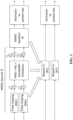
- FIG. 1 shows a device 100 according to an embodiment of the invention.
- the device 100 is configured to compensate imperfections at a coherent optical receiver 110.
- the device 100 may be included in the receiver 110, e.g. as an Rx DSP, or may be associated with or connected to the receiver 110.
- the imperfections that can be compensated by the device 100 include imperfections caused by the receiver 110, and include imperfections caused by a link 130 between the receiver 110 and a transmitter 120.
- the device 100 may comprise processing circuitry (not shown) configured to perform, conduct or initiate various operations of the device 100 described in the following.
- the processing circuitry may comprise hardware and software.
- the hardware may comprise analog circuitry or digital circuitry, or both analog and digital circuitry.
- the digital circuitry may comprise components such as application-specific integrated circuits (ASICs), fieldprogrammable arrays (FPGAs), digital signal processors (DSPs), or multi-purpose processors.
- the processing circuitry comprises one or more processors and a non-transitory memory connected to the one or more processors.
- the non-transitory memory may carry executable program code which, when executed by the one or more processors, causes the device 100 to perform, conduct or initiate the operations or methods described below.
- the device 100 is configured to obtain a receive signal 101 from the receiver 110.
- the receiver 110 may send the receive signal 101 to the device 100, or the device 100 may be included in the receiver 100, e.g. as an Rx DSP, in order to process the receive signal 101.
- the device 100 is further configure to adapt a first equalizer 102 based on a target output 103 for the first equalizer 102, wherein the first target output 103 is obtained by the device 100 as described below.
- the device 100 is configured to compensate the receive signal 101 with the (adapted) first equalizer 102, in order to compensate the imperfections caused by the receiver 110.
- the device is further configured to compensate the receive signal 101 further with a second equalizer 104, i.e. is configured to compensate the receive signal 101 that was compensated before with the first equalizer 102 with the second equalizer 104, in order to compensate the imperfections caused by the link 130 between the transmitter 120 and the receiver 110.
- the first equalizer 102 applies corrections to the receive signal 101, thus generating at its output a modified receive signal 101, which is subsequently further processed by the second equalizer 104.
- the device 100 is further configured to calculate or estimate the target output 103 for the first equalizer 102, based on which the first equalizer is adapted.
- the device 100 is, to this end, configured to calculate or estimate a channel response 105 based on a configuration of the second equalizer 104, wherein the configuration may comprise a set of tap coefficients (for the second equalizer 104).
- the device 100 is configured to calculate or extract a transfer function 106 of the link 130 from the channel response 105, and finally to calculate or estimate the target output 103 for the first equalizer 102 based on the transfer function 105, and further based on bit decisions 107 obtained from the receive signal 101.
- bit decisions 107 may be obtained by a threshold device 201 of the device 100 or may be obtained by a FEC decoder 202 of the device 100. These bit decisions 107 are obtained from the receive signal 101 after the second equalizer 104, i.e. from the receive signal that was processed or modified by both the first equalizer 102 and the second equalizer 104. In particular, the device 100 may calculate the target output 103 by simulating (e.g., using a simulation block 200) the transmission of the bit decisions 107 over a model of the link 130, wherein the model is determined based on the transfer function 106 (see FIG. 2 for detailed information).
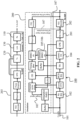
- FIG. 2 shows a device 100 according to an embodiment of the invention, which bases on the embodiment shown in FIG. 1 .
- the device 100 of FIG. 2 comprises further, optional features, wherein same features in FIG. 1 and FIG. 2 are provided with the same reference signs, and function likewise.
- FIG. 2 illustrates the device 100 by means of an exemplary block diagram (of device components, and "external" components of the transmitter 120 and receiver 110, respectively).
- a Tx DSP 203 of the transmitter 120 may comprise a FEC encoder, which encodes incoming payload bits in FEC code words. Further, the Tx DSP 203 may comprise a mapping block, which subsequently maps the encoded bits to constellation symbols that are projected onto the four tributaries XI, XQ, YI, YQ.
- a pulse shaping block of the Tx DSP 203 may further up-sample the symbol stream, and may realize spectral shaping, e.g. according to a Root Raised Cosine (RRC) profile with a desired roll-off factor.
- RRC Root Raised Cosine
- a DPD of the Tx DSP 203 e.g. implemented according to any conventional method, may further compensate the imperfections of the transmitter 120.
- the transmitter 120 may generally convert four electrical tributaries to an optical signal, and the receiver 110 may map the optical signal back to four electrical tributaries.
- the transmitter 120 includes, to this end, a digital-to-analog converter (DAC), one or more driver amplifiers, a laser source, and a modulator, e.g. a dual-polarization IQ Mach-Zehnder modulator.
- DAC digital-to-analog converter
- a typical coherent receiver 110 includes a local laser oscillator, one or more 90°-hybrid couplers, one or more photodetectors, and an analog-to-digital converter (ADC).
- ADC analog-to-digital converter
- the link 130 between the transmitter 120 and the receiver 110 may include several spans of optical fiber, one or more optical fiber amplifiers, one or more optical filters, and one or more multiplexers and/or de-multiplexers.
- a channel may include the transmitter 120, the link 130, and the receiver 110.
- the device 100 (here in FIG. 2 exemplarily implemented as Rx DSP 100) comprises the first equalizer 102 (here exemplarily implemented as "RxEQ"), which is used to compensate the imperfections of the receiver components.
- RxEQ the first equalizer 102
- the subsequent blocks may include: a module for the coarse compensation of the carrier frequency offset ("Coarse CFO”); a third equalizer (here exemplarily implemented as “BCD EQ”, which may be part of the second equalizer 104); a timing recovery ("TR") block; the second equalizer 104 (here exemplarily implemented including a "MIMO EQ”), which also implements down-sampling to symbol rate; a carrier phase estimator (“CPE”); a de-mapper (“De-map”), which de-maps the noisy demodulated symbols to hard decided pre-FEC bits or soft-decision metrics; and finally a "FEC decoder", which provides post-FEC decided bits.
- the order of the equalization and timing recovery modules can vary, and additional modules can be included without affecting the essence of the device 100.
- the aim of the first equalizer 102 is the compensation of the receiver imperfections, its target output 103 should coincide with the input of the receiver 110 or, equivalently, with the output of the link 130.
- This target output 103 which is not directly observable, can be calculated or estimated in the device 100 by means of an emulation or simulation block 200 of the device 100 (enclosed in the dashed box of FIG. 2 ).
- the input of this block 200 is, preferably, the post-FEC decided bits (as the decision bits 107) or, alternatively, the pre-FEC decided bits (as the decision bits 107).
- an equivalent implementation may include taking pre-FEC decided symbols instead of pre-FEC decided bits, and skipping both the FEC encoder and the mapping module in the block 200. It can be observed that the input to the block 200 does not need to be completely errorfree, because the adaptation algorithm performed by the device 100 can tolerate a small percentage of wrong decisions.
- the decided bits 107 may be processed by a "Mapping” module, which may mimic the functionality of the Mapping module within the Tx DSP 203.
- the resulting symbols may enter an emulated "MIMO channel", which may implement up-sampling, spectral shaping, all-order PMD and, optionally, PDL.
- the parameters of the MIMO channel can be configured by the "extract MIMO channel block", whose functionality is to calculate or estimate the channel response 105 and to calculate or extract the transfer function 106 of the link 130 from the channel response, and will be detailed below.
- the subsequent "Timing Jitter” module of the block 200 may re-introduce timing jitter, which was removed in the device 100 by the TR.
- the "CD” block may re-apply the CD that was removed by the BCD EQ.
- the "Channel carrier phase” module may apply the carrier frequency offset and the carrier phase estimated and corrected by the "Coarse CFO” block and the "CPE” block of the device 100, respectively.
- the resulting signal is used as the target output 103 for the adaptation of the first equalizer 102, which may be carried out within a dedicated adaptation module.
- the first equalizer 102 can be set according to any customary criterion, e.g. according to the Least Mean Square (LMS) criterion between the actual output and the target output 103.
- LMS Least Mean Square
- the adaption of the first equalizer 102 can further be performed by solving the least squares problem via the normal equation, or via a gradient descent method.
- the first equalizer 102 can further be adapted continuously, or only during one or more dedicated time windows, e.g. it can be adapted in a periodic fashion.
- the input of the first equalizer 102 may be buffered, before entering the module that adapts the first equalizer 102.
- the corrected carrier phase and timing jitter may be buffered, before being re-applied in the corresponding modules of the block 200.
- Other parameters like CD and CFO, usually do not require any buffering, because they are quasi-static by nature and, therefore, do not vary significantly during the processing latency.
- a main part of the adaption algorithm performed by the device 100 is the estimation of the link transfer function 106, which is performed in two steps:
- the two steps a) and b) can respectively be implemented within the "extract MIMO channel block" module provided in the block 200 shown in FIG. 2 .
- Step a) consist in the estimation or calculation of the overall channel response 105.
- CD, carrier frequency and phase, and timing jitter may be available from the corresponding compensation blocks in the device 100.
- the MIMO channel including PMD, PDL and filtering effects, may not available in a direct form.
- CAZAC constant-amplitude zero-autocorrelation
- the MIMO channel is determined or calculated based on the channel response 105 extracted from the configuration, e.g. from the tap coefficients, of the second equalizer 104.
- This step is not trivial, because the response of a down-sampling filter, like the MIMO EQ (as implementation of the second equalizer 104), is aliased in frequency, and cannot be unambiguously inverted.
- a down-sampling filter like the MIMO EQ (as implementation of the second equalizer 104)
- additional knowledge about the properties of full-response equalizers may advantageously be exploited. The result is quite exact, if noise is injected before PDL and bandwidth limitation.
- a full-response equalizer attempts to cancel ISI may be advantageously exploited.
- ZF zero-forcing
- MMSE minimum mean squared error
- the cascade of the MIMO channel with frequency response H (including spectral shaping, link 130 and, at least partially, receiver 110) and the MIMO equalizer with frequency response W fulfils the Nyquist condition for ISI-free transmission.
- this is formulated as W ⁇ H ⁇ h n ⁇ I , where h n is a scalar Nyquist spectrum, e.g. a Raised Cosine (RC) spectrum and I is the identity matrix. Consequently, the frequency response of the MIMO channel can be estimated as H ⁇ h n ⁇ W ⁇ 1 .
- FIG. 3 visualizes an implementation of step a).
- the cascade of the MIMO channel comprising pulse shaping, e.g. realizing a RRC profile, PMD, PDL and bandwidth limitations, and the MIMO equalizer is approximately equivalent to a Nyquist, e.g. a RC, response.
- a Nyquist e.g. a RC
- Step b) consists in the extraction of the transfer function 106 of the link 130 from the overall channel response 105, which is calculated or estimated in step a).
- the block 200 in FIG. 2 aims at computing the output of the link 130 before the receiver 110. Therefore, the receiver response should be removed from the overall channel response H, in order to obtain the desired configuration of the MIMO channel in the block 200.
- the contributions of link 130 (PMD and PDL) and receiver 110 (bandwidth limitation) may be identified and separated, and the part corresponding to the link 130 only may be extracted.
- the first equalizer 102 may be adapted to compensate purely receiver effects. Alternatively, if the MIMO channel implements H PMD , the first equalizer 102 may attempt to correct PDL as well. In practice, both solutions are acceptable and lead to equivalent good performances.
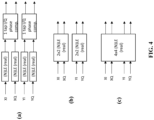
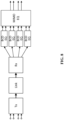
- the proposed adaptation algorithm performed by the device 100 is agnostic with respect to the structure of the first equalizer 102. Nevertheless, in the following some design options are described for the first equalizer 102, with respect to (a), (b) and (c) in FIG. 4 .
- FIG. 4 illustrates a first design option (a). Since the transponder imperfections arise mostly in the electrical domain, where the four tributaries are independently processed, the first equalizer 102 can operate on the four real tributaries rather than on the complex baseband signals. Compensation of quadrature error, which asks for joint IQ processing, may be delegated to a single-tap I/Q phase compensator after four separate real linear or nonlinear equalizers (LEs or NLEs).
- Ls or NLEs real linear or nonlinear equalizers
- FIG. 4 illustrates a second design option (b), which uses two 2 ⁇ 2 LEs or NLEs operating separately on the X and Y tributaries.
- the main equalizers compensate for quadrature error and IQ-cross talk along with the remaining per-tributary effects.
- FIG. 4 illustrates a third design option (c), which implements the first equalizer 102 as a 4 ⁇ 4 LE or NLE, and is able to compensate for per-tributary effects, quadrature error and any type of cross-talk among the four tributaries XI, XQ, YI, YQ, which might arise for instance due to electromagnetic interference among the respective lanes in the receiver 110.
- c a third design option
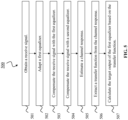
- FIG. 5 shows a method 500 according to an embodiment of the invention.
- the method 500 is suitable for compensating imperfections at a coherent optical receiver 110.
- the method 100 may be performed in the receiver 110, for instance, by an Rx DSP.
- the method 500 may be performed by the device 100 shown in FIG. 1 and 2 , which may be or be included in the Rx DSP.
- the method 500 comprises: a step 501 of obtaining a receive signal 101 from the receiver 110; a step 502 of adapting a first equalizer 102 based on a target output 103 for the first equalizer 102; a step 503 of compensating the receive signal 101 with the first equalizer 102, in order to compensate imperfections caused by the receiver 110; and a step 504 of compensating the receive signal 101 further with a second equalizer 104, in order to compensate imperfections caused by a link 130 between a transmitter 120 and the receiver 110.
- the method 500 further comprises: a step 505 of estimating a channel response 105 based on a configuration of the second equalizer 104; a step 506 of extracting a transfer function 106 of the link 130 from the channel response 105; and a step 507 of calculating the target output 103 for the first equalizer 102 based on the transfer function 106 and based on bit decisions 107 obtained from the receive signal 101.
Landscapes
- Physics & Mathematics (AREA)
- Electromagnetism (AREA)
- Engineering & Computer Science (AREA)
- Computer Networks & Wireless Communication (AREA)
- Signal Processing (AREA)
- Cable Transmission Systems, Equalization Of Radio And Reduction Of Echo (AREA)
- Optical Communication System (AREA)
Claims (15)
- Vorrichtung (100) zur Kompensation von Imperfektionen an einem kohärenten optischen Empfänger (110), wobei die Vorrichtung (100) ausgelegt ist zum:Erhalten eines Empfangssignals (101) vom Empfänger (110);Anpassen eines ersten Entzerrers (102) basierend auf einem Zielausgang (103) für den ersten Entzerrer (102);Kompensieren des Empfangssignals (101) mit dem ersten Entzerrer (102), um durch den Empfänger (110) verursachte Imperfektionen zu kompensieren; undweiteres Kompensieren des Empfangssignals (101) mit einem zweiten Entzerrer (104), um durch eine Verbindung (130) zwischen einem Sender (120) und dem Empfänger (110) verursachte Imperfektionen zu kompensieren;wobei die Vorrichtung (100) dadurch gekennzeichnet ist, dass sie ausgelegt ist zum:Schätzen einer Kanalantwort (105) basierend auf einer Konfiguration des zweiten Entzerrers (104);Extrahieren einer Übertragungsfunktion (106) der Verbindung (130) aus der Kanalantwort (105); undBerechnen des Zielausgangs (103) für den ersten Entzerrer (102) basierend auf der Übertragungsfunktion (106) und basierend auf aus dem Empfangssignal (101) erhaltenen Bitentscheidungen (107).
- Vorrichtung (100) nach Anspruch 1, wobei:
die Konfiguration des zweiten Entzerrers (104) eine Menge von Tap-Koeffizienten umfasst. - Vorrichtung (100) nach Anspruch 1 oder 2, ausgelegt zum:
Berechnen des Zielausgangs (103) für den ersten Entzerrer (102) durch Simulieren (200) der Übertragung der Bitentscheidungen (107) über einem Modell der Verbindung (130), bestimmt basierend auf der Übertragungsfunktion (106). - Vorrichtung (100) nach einem der Ansprüche 1 bis 3, ausgelegt zum:
Berechnen des Zielausgangs (103) für den ersten Entzerrer (103) basierend auf den Bitentscheidungen (107), erhalten durch eine Schwellenvorrichtung (201) oder durch einen Vorwärtsfehlerkorrektur- bzw. FEC-Decodierer (202). - Vorrichtung (100) nach einem der Ansprüche 1 bis 4, ausgelegt zum:
Schätzen der Kanalantwort (105) in der Frequenzdomäne, als ein Produkt der inversen Matrixantwort des zweiten Entzerrers (104) und einer Frequenzantwort, die das Nyquist-Kriterium für eine Intersymbolinterferenz- bzw. ISI-freie Übertragung erfüllt. - Vorrichtung (100) nach einem der Ansprüche 1 bis 5, wobei:
die Extraktion der Übertragungsfunktion (106) Erhalten von Effekten von polarisationsabhängigem Verlust, PDL, bei gleichzeitigem Entfernen von Effekten von Bandbreitenbeschränkungen umfasst oder Entfernen der Effekte von PDL umfasst. - Vorrichtung (100) nach einem der Ansprüche 1 bis 6, ausgelegt zum:
Extrahieren der Übertragungsfunktion (106) durch Schätzen einer Empfängerantwort in der Kanalantwort (105) und Entfernen der Empfängerantwort aus der Kanalantwort (105). - Vorrichtung (100) nach einem der Ansprüche 1 bis 7, ausgelegt zum:
Extrahieren der Übertragungsfunktion (106) in der Frequenzdomäne durch Manipulieren einer Diagonalmatrix von Singulärwertzerlegung der Kanalantwort (105). - Vorrichtung (100) nach Anspruch 8, wobei:
das Manipulieren der Diagonalmatrix von Singulärwertzerlegung Teilen der Matrix durch ihr größtes Element umfasst oder Ersetzen der Matrix durch eine Einheitsmatrix derselben Größe wie die Matrix umfasst. - Vorrichtung (100) nach einem der Ansprüche 1 bis 9, wobei:der erste Entzerrer (102) ausgelegt ist zum unabhängigen Verarbeiten jedes von vier reellen Beiträgen des Empfangssignals (101); oderder erste Entzerrer (102) ausgelegt ist zum gemeinsamen Verarbeiten vier reeller Beiträge des Empfangssignals (101).
- Vorrichtung (100) nach einem der Ansprüche 1 bis 9, wobei:
der erste Entzerrer (102) ausgelegt ist zum separaten Verarbeiten von zwei reellen X-Beiträgen des Empfangssignals (101) bzw. zwei reellen Y-Beiträgen des Empfangssignals, wobei X und Y zwei orthogonale Zustände von Polarisierung sind. - Vorrichtung (100) nach einem der Ansprüche 1 bis 11, wobei:der erste Entzerrer (102) einen Empfängerentzerrer umfasst, undder zweite Entzerrer (104) einen Mehrfacheingang-Mehrfachausgang- bzw. MIMO-Entzerrer und einen BCD-Entzerrer (Bulk Chromatic Dispersion) umfasst.
- Verfahren (500) zur Kompensation von Imperfektionen an einem kohärenten optischen Empfänger (110), wobei das Verfahren (500) Folgendes umfasst:
Erhalten (501) eines Empfangssignals (101) vom Empfänger (110):Anpassen (502) eines ersten Entzerrers (102) basierend auf einem Zielausgang (103) für den ersten Entzerrer (102);Kompensieren (503) des Empfangssignals (101) mit dem ersten Entzerrer (102), um durch den Empfänger (110) verursachte Imperfektionen zu kompensieren; undweiteres Kompensieren (504) des Empfangssignals (101) mit einem zweiten Entzerrer (104), um durch eine Verbindung (130) zwischen einem Sender (120) und dem Empfänger (110) verursachte Imperfektionen zu kompensieren;wobei das Verfahren (500) dadurch gekennzeichnet ist, dass es Folgendes umfasst:Schätzen (505) einer Kanalantwort (105) basierend auf einer Konfiguration des zweiten Entzerrers (104);Extrahieren (506) einer Übertragungsfunktion (106) der Verbindung (130) aus der Kanalantwort (105); undBerechnen (507) des Zielausgangs (103) für den ersten Entzerrer (102) basierend auf der Übertragungsfunktion (106) und basierend auf aus dem Empfangssignal (101) erhaltenen Bitentscheidungen (107). - Verfahren (500) nach Anspruch 13, wobei das Verfahren (500) Folgendes umfasst:
Berechnen des Zielausgangs (103) für den ersten Entzerrer (102) durch Simulieren (200) der Übertragung der Bitentscheidungen (107) über einem Modell der Verbindung (130), bestimmt basierend auf der Übertragungsfunktion (106). - Computerprogramm, umfassend einen Programmcode zum Durchführen des Verfahrens (500) nach Anspruch 13 oder 14, wenn auf einem Computer ausgeführt.
Applications Claiming Priority (1)
| Application Number | Priority Date | Filing Date | Title |
|---|---|---|---|
| PCT/EP2019/081273 WO2021093952A1 (en) | 2019-11-14 | 2019-11-14 | Device for compensating imperfections at a coherent optical receiver |
Publications (2)
| Publication Number | Publication Date |
|---|---|
| EP4046294A1 EP4046294A1 (de) | 2022-08-24 |
| EP4046294B1 true EP4046294B1 (de) | 2023-08-30 |
Family
ID=68583397
Family Applications (1)
| Application Number | Title | Priority Date | Filing Date |
|---|---|---|---|
| EP19805234.2A Active EP4046294B1 (de) | 2019-11-14 | 2019-11-14 | Vorrichtung zur kompensation von imperfektionen an einem kohärenten optischen empfänger |
Country Status (3)
| Country | Link |
|---|---|
| EP (1) | EP4046294B1 (de) |
| CN (1) | CN114641949B (de) |
| WO (1) | WO2021093952A1 (de) |
Families Citing this family (4)
| Publication number | Priority date | Publication date | Assignee | Title |
|---|---|---|---|---|
| CN118074816A (zh) * | 2022-11-22 | 2024-05-24 | 中兴通讯股份有限公司 | 一种相干光模块的优化方法、装置及设备 |
| CN115776336A (zh) * | 2022-12-21 | 2023-03-10 | 复旦大学 | 基于mzi-mvm的相干光通信的光子色散均衡系统 |
| CN121283851A (zh) * | 2024-07-04 | 2026-01-06 | 中兴通讯股份有限公司 | 参数调整方法、通信设备及存储介质 |
| CN119544426B (zh) * | 2024-12-02 | 2025-11-18 | 重庆邮电大学 | 一种用于双偏振相干光通信的载波频率偏移估计方法 |
Family Cites Families (3)
| Publication number | Priority date | Publication date | Assignee | Title |
|---|---|---|---|---|
| WO2013102898A1 (en) * | 2012-01-06 | 2013-07-11 | Multiphy Ltd. | Symbol spaced adaptive mimo equalization for ultra high bit rate optical communication systems |
| US9077455B2 (en) * | 2012-12-28 | 2015-07-07 | Alcatel Lucent | Optical receiver having a MIMO equalizer |
| JP6319487B1 (ja) * | 2017-03-14 | 2018-05-09 | Nttエレクトロニクス株式会社 | 光伝送特性推定方法、光伝送特性補償方法、光伝送特性推定システム及び光伝送特性補償システム |
-
2019
- 2019-11-14 WO PCT/EP2019/081273 patent/WO2021093952A1/en not_active Ceased
- 2019-11-14 EP EP19805234.2A patent/EP4046294B1/de active Active
- 2019-11-14 CN CN201980101883.6A patent/CN114641949B/zh active Active
Also Published As
| Publication number | Publication date |
|---|---|
| CN114641949B (zh) | 2024-03-26 |
| WO2021093952A1 (en) | 2021-05-20 |
| EP4046294A1 (de) | 2022-08-24 |
| CN114641949A (zh) | 2022-06-17 |
Similar Documents
| Publication | Publication Date | Title |
|---|---|---|
| US7315575B2 (en) | Equalization strategy for dual-polarization optical transport system | |
| Faruk et al. | Digital signal processing for coherent transceivers employing multilevel formats | |
| Spinnler | Equalizer design and complexity for digital coherent receivers | |
| EP4046294B1 (de) | Vorrichtung zur kompensation von imperfektionen an einem kohärenten optischen empfänger | |
| Tao et al. | 40 Gb/s CAP32 system with DD-LMS equalizer for short reach optical transmissions | |
| Soriano et al. | Chromatic dispersion estimation in digital coherent receivers | |
| US10148363B2 (en) | Iterative nonlinear compensation | |
| Wan et al. | 64-Gb/s SSB-PAM4 transmission over 120-km dispersion-uncompensated SSMF with blind nonlinear equalization, adaptive noise-whitening postfilter and MLSD | |
| US20150093119A1 (en) | Symbol spaced adaptive mimo equalization for ultra high bit rate optical communication systems | |
| Cheng et al. | A low-complexity adaptive equalizer for digital coherent short-reach optical transmission systems | |
| US8666251B2 (en) | Electronic dispersion compensation system and method | |
| Cheng et al. | Hardware efficient adaptive equalizer for coherent short-reach optical interconnects | |
| da Silva et al. | Widely linear blind adaptive equalization for transmitter IQ-imbalance/skew compensation in multicarrier systems | |
| McGhan et al. | Electronic dispersion compensation | |
| Zhu et al. | Nyquist-WDM with low-complexity joint matched filtering and adaptive equalization | |
| Huang et al. | 240 GBd PDM-16QAM Single-carrier coherent transmission beyond 130 km SSMF for a bandwidth limited system with low power consumption DSP | |
| CN107105354A (zh) | 一种无源光网络设备以及用于无源光网络设备的方法 | |
| Reza et al. | Blind nonlinearity mitigation of 10G DMLs using sparse Volterra equalizer in IM/DD PAM-4 transmission systems | |
| Taniguchi et al. | 255-Gbps PAM-8 O-band transmission through 10-km SMF under 14-GHz bandwidth limitation using MLSE based on nonlinear channel estimation with cutdown Volterra kernels | |
| Frunză et al. | A parametric network for the global compensation of physical layer linear impairments in coherent optical communications | |
| Skvortcov et al. | Transmitter frequency-dependent IQ imbalance characterization and pre-emphasis | |
| Savory | Digital signal processing for multilevel modulation formats | |
| Lee et al. | Demonstration of 200 Gbps PAM-4 transmission in a limited-bandwidth system using a two-tap THP with nonlinearity compensator | |
| EP3704798B1 (de) | Digitale auflösungsverbesserung für digital-analog-wandler mit hoher geschwindigkeit | |
| Bilal et al. | Pilot tones based polarization rotation, frequency offset and phase estimation for polarization multiplexed offset-QAM multi-subcarrier coherent optical systems |
Legal Events
| Date | Code | Title | Description |
|---|---|---|---|
| STAA | Information on the status of an ep patent application or granted ep patent |
Free format text: STATUS: UNKNOWN |
|
| STAA | Information on the status of an ep patent application or granted ep patent |
Free format text: STATUS: THE INTERNATIONAL PUBLICATION HAS BEEN MADE |
|
| PUAI | Public reference made under article 153(3) epc to a published international application that has entered the european phase |
Free format text: ORIGINAL CODE: 0009012 |
|
| STAA | Information on the status of an ep patent application or granted ep patent |
Free format text: STATUS: REQUEST FOR EXAMINATION WAS MADE |
|
| 17P | Request for examination filed |
Effective date: 20220518 |
|
| AK | Designated contracting states |
Kind code of ref document: A1 Designated state(s): AL AT BE BG CH CY CZ DE DK EE ES FI FR GB GR HR HU IE IS IT LI LT LU LV MC MK MT NL NO PL PT RO RS SE SI SK SM TR |
|
| DAV | Request for validation of the european patent (deleted) | ||
| DAX | Request for extension of the european patent (deleted) | ||
| GRAP | Despatch of communication of intention to grant a patent |
Free format text: ORIGINAL CODE: EPIDOSNIGR1 |
|
| STAA | Information on the status of an ep patent application or granted ep patent |
Free format text: STATUS: GRANT OF PATENT IS INTENDED |
|
| INTG | Intention to grant announced |
Effective date: 20230412 |
|
| GRAS | Grant fee paid |
Free format text: ORIGINAL CODE: EPIDOSNIGR3 |
|
| GRAA | (expected) grant |
Free format text: ORIGINAL CODE: 0009210 |
|
| STAA | Information on the status of an ep patent application or granted ep patent |
Free format text: STATUS: THE PATENT HAS BEEN GRANTED |
|
| AK | Designated contracting states |
Kind code of ref document: B1 Designated state(s): AL AT BE BG CH CY CZ DE DK EE ES FI FR GB GR HR HU IE IS IT LI LT LU LV MC MK MT NL NO PL PT RO RS SE SI SK SM TR |
|
| REG | Reference to a national code |
Ref country code: GB Ref legal event code: FG4D |
|
| REG | Reference to a national code |
Ref country code: CH Ref legal event code: EP |
|
| REG | Reference to a national code |
Ref country code: DE Ref legal event code: R096 Ref document number: 602019036298 Country of ref document: DE |
|
| REG | Reference to a national code |
Ref country code: IE Ref legal event code: FG4D |
|
| REG | Reference to a national code |
Ref country code: LT Ref legal event code: MG9D |
|
| REG | Reference to a national code |
Ref country code: NL Ref legal event code: MP Effective date: 20230830 |
|
| REG | Reference to a national code |
Ref country code: AT Ref legal event code: MK05 Ref document number: 1606760 Country of ref document: AT Kind code of ref document: T Effective date: 20230830 |
|
| PG25 | Lapsed in a contracting state [announced via postgrant information from national office to epo] |
Ref country code: GR Free format text: LAPSE BECAUSE OF FAILURE TO SUBMIT A TRANSLATION OF THE DESCRIPTION OR TO PAY THE FEE WITHIN THE PRESCRIBED TIME-LIMIT Effective date: 20231201 |
|
| PG25 | Lapsed in a contracting state [announced via postgrant information from national office to epo] |
Ref country code: IS Free format text: LAPSE BECAUSE OF FAILURE TO SUBMIT A TRANSLATION OF THE DESCRIPTION OR TO PAY THE FEE WITHIN THE PRESCRIBED TIME-LIMIT Effective date: 20231230 |
|
| PG25 | Lapsed in a contracting state [announced via postgrant information from national office to epo] |
Ref country code: SE Free format text: LAPSE BECAUSE OF FAILURE TO SUBMIT A TRANSLATION OF THE DESCRIPTION OR TO PAY THE FEE WITHIN THE PRESCRIBED TIME-LIMIT Effective date: 20230830 Ref country code: RS Free format text: LAPSE BECAUSE OF FAILURE TO SUBMIT A TRANSLATION OF THE DESCRIPTION OR TO PAY THE FEE WITHIN THE PRESCRIBED TIME-LIMIT Effective date: 20230830 Ref country code: NO Free format text: LAPSE BECAUSE OF FAILURE TO SUBMIT A TRANSLATION OF THE DESCRIPTION OR TO PAY THE FEE WITHIN THE PRESCRIBED TIME-LIMIT Effective date: 20231130 Ref country code: LV Free format text: LAPSE BECAUSE OF FAILURE TO SUBMIT A TRANSLATION OF THE DESCRIPTION OR TO PAY THE FEE WITHIN THE PRESCRIBED TIME-LIMIT Effective date: 20230830 Ref country code: LT Free format text: LAPSE BECAUSE OF FAILURE TO SUBMIT A TRANSLATION OF THE DESCRIPTION OR TO PAY THE FEE WITHIN THE PRESCRIBED TIME-LIMIT Effective date: 20230830 Ref country code: IS Free format text: LAPSE BECAUSE OF FAILURE TO SUBMIT A TRANSLATION OF THE DESCRIPTION OR TO PAY THE FEE WITHIN THE PRESCRIBED TIME-LIMIT Effective date: 20231230 Ref country code: HR Free format text: LAPSE BECAUSE OF FAILURE TO SUBMIT A TRANSLATION OF THE DESCRIPTION OR TO PAY THE FEE WITHIN THE PRESCRIBED TIME-LIMIT Effective date: 20230830 Ref country code: GR Free format text: LAPSE BECAUSE OF FAILURE TO SUBMIT A TRANSLATION OF THE DESCRIPTION OR TO PAY THE FEE WITHIN THE PRESCRIBED TIME-LIMIT Effective date: 20231201 Ref country code: FI Free format text: LAPSE BECAUSE OF FAILURE TO SUBMIT A TRANSLATION OF THE DESCRIPTION OR TO PAY THE FEE WITHIN THE PRESCRIBED TIME-LIMIT Effective date: 20230830 Ref country code: AT Free format text: LAPSE BECAUSE OF FAILURE TO SUBMIT A TRANSLATION OF THE DESCRIPTION OR TO PAY THE FEE WITHIN THE PRESCRIBED TIME-LIMIT Effective date: 20230830 |
|
| PG25 | Lapsed in a contracting state [announced via postgrant information from national office to epo] |
Ref country code: PL Free format text: LAPSE BECAUSE OF FAILURE TO SUBMIT A TRANSLATION OF THE DESCRIPTION OR TO PAY THE FEE WITHIN THE PRESCRIBED TIME-LIMIT Effective date: 20230830 Ref country code: NL Free format text: LAPSE BECAUSE OF FAILURE TO SUBMIT A TRANSLATION OF THE DESCRIPTION OR TO PAY THE FEE WITHIN THE PRESCRIBED TIME-LIMIT Effective date: 20230830 |
|
| PG25 | Lapsed in a contracting state [announced via postgrant information from national office to epo] |
Ref country code: ES Free format text: LAPSE BECAUSE OF FAILURE TO SUBMIT A TRANSLATION OF THE DESCRIPTION OR TO PAY THE FEE WITHIN THE PRESCRIBED TIME-LIMIT Effective date: 20230830 |
|
| PG25 | Lapsed in a contracting state [announced via postgrant information from national office to epo] |
Ref country code: SM Free format text: LAPSE BECAUSE OF FAILURE TO SUBMIT A TRANSLATION OF THE DESCRIPTION OR TO PAY THE FEE WITHIN THE PRESCRIBED TIME-LIMIT Effective date: 20230830 Ref country code: RO Free format text: LAPSE BECAUSE OF FAILURE TO SUBMIT A TRANSLATION OF THE DESCRIPTION OR TO PAY THE FEE WITHIN THE PRESCRIBED TIME-LIMIT Effective date: 20230830 Ref country code: ES Free format text: LAPSE BECAUSE OF FAILURE TO SUBMIT A TRANSLATION OF THE DESCRIPTION OR TO PAY THE FEE WITHIN THE PRESCRIBED TIME-LIMIT Effective date: 20230830 Ref country code: EE Free format text: LAPSE BECAUSE OF FAILURE TO SUBMIT A TRANSLATION OF THE DESCRIPTION OR TO PAY THE FEE WITHIN THE PRESCRIBED TIME-LIMIT Effective date: 20230830 Ref country code: DK Free format text: LAPSE BECAUSE OF FAILURE TO SUBMIT A TRANSLATION OF THE DESCRIPTION OR TO PAY THE FEE WITHIN THE PRESCRIBED TIME-LIMIT Effective date: 20230830 Ref country code: CZ Free format text: LAPSE BECAUSE OF FAILURE TO SUBMIT A TRANSLATION OF THE DESCRIPTION OR TO PAY THE FEE WITHIN THE PRESCRIBED TIME-LIMIT Effective date: 20230830 Ref country code: PT Free format text: LAPSE BECAUSE OF FAILURE TO SUBMIT A TRANSLATION OF THE DESCRIPTION OR TO PAY THE FEE WITHIN THE PRESCRIBED TIME-LIMIT Effective date: 20240102 Ref country code: SK Free format text: LAPSE BECAUSE OF FAILURE TO SUBMIT A TRANSLATION OF THE DESCRIPTION OR TO PAY THE FEE WITHIN THE PRESCRIBED TIME-LIMIT Effective date: 20230830 |
|
| PG25 | Lapsed in a contracting state [announced via postgrant information from national office to epo] |
Ref country code: IT Free format text: LAPSE BECAUSE OF FAILURE TO SUBMIT A TRANSLATION OF THE DESCRIPTION OR TO PAY THE FEE WITHIN THE PRESCRIBED TIME-LIMIT Effective date: 20230830 |
|
| REG | Reference to a national code |
Ref country code: DE Ref legal event code: R097 Ref document number: 602019036298 Country of ref document: DE |
|
| REG | Reference to a national code |
Ref country code: CH Ref legal event code: PL |
|
| PG25 | Lapsed in a contracting state [announced via postgrant information from national office to epo] |
Ref country code: MC Free format text: LAPSE BECAUSE OF FAILURE TO SUBMIT A TRANSLATION OF THE DESCRIPTION OR TO PAY THE FEE WITHIN THE PRESCRIBED TIME-LIMIT Effective date: 20230830 |
|
| PLBE | No opposition filed within time limit |
Free format text: ORIGINAL CODE: 0009261 |
|
| STAA | Information on the status of an ep patent application or granted ep patent |
Free format text: STATUS: NO OPPOSITION FILED WITHIN TIME LIMIT |
|
| PG25 | Lapsed in a contracting state [announced via postgrant information from national office to epo] |
Ref country code: LU Free format text: LAPSE BECAUSE OF NON-PAYMENT OF DUE FEES Effective date: 20231114 |
|
| PG25 | Lapsed in a contracting state [announced via postgrant information from national office to epo] |
Ref country code: CH Free format text: LAPSE BECAUSE OF NON-PAYMENT OF DUE FEES Effective date: 20231130 |
|
| GBPC | Gb: european patent ceased through non-payment of renewal fee |
Effective date: 20231130 |
|
| PG25 | Lapsed in a contracting state [announced via postgrant information from national office to epo] |
Ref country code: MC Free format text: LAPSE BECAUSE OF FAILURE TO SUBMIT A TRANSLATION OF THE DESCRIPTION OR TO PAY THE FEE WITHIN THE PRESCRIBED TIME-LIMIT Effective date: 20230830 Ref country code: LU Free format text: LAPSE BECAUSE OF NON-PAYMENT OF DUE FEES Effective date: 20231114 Ref country code: CH Free format text: LAPSE BECAUSE OF NON-PAYMENT OF DUE FEES Effective date: 20231130 Ref country code: SI Free format text: LAPSE BECAUSE OF FAILURE TO SUBMIT A TRANSLATION OF THE DESCRIPTION OR TO PAY THE FEE WITHIN THE PRESCRIBED TIME-LIMIT Effective date: 20230830 |
|
| REG | Reference to a national code |
Ref country code: BE Ref legal event code: MM Effective date: 20231130 |
|
| 26N | No opposition filed |
Effective date: 20240603 |
|
| REG | Reference to a national code |
Ref country code: IE Ref legal event code: MM4A |
|
| PG25 | Lapsed in a contracting state [announced via postgrant information from national office to epo] |
Ref country code: IE Free format text: LAPSE BECAUSE OF NON-PAYMENT OF DUE FEES Effective date: 20231114 |
|
| PG25 | Lapsed in a contracting state [announced via postgrant information from national office to epo] |
Ref country code: GB Free format text: LAPSE BECAUSE OF NON-PAYMENT OF DUE FEES Effective date: 20231130 |
|
| PG25 | Lapsed in a contracting state [announced via postgrant information from national office to epo] |
Ref country code: BE Free format text: LAPSE BECAUSE OF NON-PAYMENT OF DUE FEES Effective date: 20231130 |
|
| PG25 | Lapsed in a contracting state [announced via postgrant information from national office to epo] |
Ref country code: FR Free format text: LAPSE BECAUSE OF NON-PAYMENT OF DUE FEES Effective date: 20231130 |
|
| PG25 | Lapsed in a contracting state [announced via postgrant information from national office to epo] |
Ref country code: IE Free format text: LAPSE BECAUSE OF NON-PAYMENT OF DUE FEES Effective date: 20231114 Ref country code: GB Free format text: LAPSE BECAUSE OF NON-PAYMENT OF DUE FEES Effective date: 20231130 Ref country code: FR Free format text: LAPSE BECAUSE OF NON-PAYMENT OF DUE FEES Effective date: 20231130 Ref country code: BE Free format text: LAPSE BECAUSE OF NON-PAYMENT OF DUE FEES Effective date: 20231130 |
|
| PG25 | Lapsed in a contracting state [announced via postgrant information from national office to epo] |
Ref country code: BG Free format text: LAPSE BECAUSE OF FAILURE TO SUBMIT A TRANSLATION OF THE DESCRIPTION OR TO PAY THE FEE WITHIN THE PRESCRIBED TIME-LIMIT Effective date: 20230830 |
|
| PG25 | Lapsed in a contracting state [announced via postgrant information from national office to epo] |
Ref country code: BG Free format text: LAPSE BECAUSE OF FAILURE TO SUBMIT A TRANSLATION OF THE DESCRIPTION OR TO PAY THE FEE WITHIN THE PRESCRIBED TIME-LIMIT Effective date: 20230830 |
|
| PG25 | Lapsed in a contracting state [announced via postgrant information from national office to epo] |
Ref country code: CY Free format text: LAPSE BECAUSE OF FAILURE TO SUBMIT A TRANSLATION OF THE DESCRIPTION OR TO PAY THE FEE WITHIN THE PRESCRIBED TIME-LIMIT; INVALID AB INITIO Effective date: 20191114 |
|
| PG25 | Lapsed in a contracting state [announced via postgrant information from national office to epo] |
Ref country code: HU Free format text: LAPSE BECAUSE OF FAILURE TO SUBMIT A TRANSLATION OF THE DESCRIPTION OR TO PAY THE FEE WITHIN THE PRESCRIBED TIME-LIMIT; INVALID AB INITIO Effective date: 20191114 |
|
| PG25 | Lapsed in a contracting state [announced via postgrant information from national office to epo] |
Ref country code: TR Free format text: LAPSE BECAUSE OF FAILURE TO SUBMIT A TRANSLATION OF THE DESCRIPTION OR TO PAY THE FEE WITHIN THE PRESCRIBED TIME-LIMIT Effective date: 20230830 |
|
| PGFP | Annual fee paid to national office [announced via postgrant information from national office to epo] |
Ref country code: DE Payment date: 20250930 Year of fee payment: 7 |