EP4044729B1 - Verfahren zur bestimmung eines uplink-steuerungsinformations (uci)-feldes und zugehörige vorrichtungen - Google Patents
Verfahren zur bestimmung eines uplink-steuerungsinformations (uci)-feldes und zugehörige vorrichtungen Download PDFInfo
- Publication number
- EP4044729B1 EP4044729B1 EP20884914.1A EP20884914A EP4044729B1 EP 4044729 B1 EP4044729 B1 EP 4044729B1 EP 20884914 A EP20884914 A EP 20884914A EP 4044729 B1 EP4044729 B1 EP 4044729B1
- Authority
- EP
- European Patent Office
- Prior art keywords
- field
- harq
- information
- dci
- ack
- Prior art date
- Legal status (The legal status is an assumption and is not a legal conclusion. Google has not performed a legal analysis and makes no representation as to the accuracy of the status listed.)
- Active
Links
Images



Classifications
-
- H—ELECTRICITY
- H04—ELECTRIC COMMUNICATION TECHNIQUE
- H04W—WIRELESS COMMUNICATION NETWORKS
- H04W72/00—Local resource management
- H04W72/20—Control channels or signalling for resource management
- H04W72/21—Control channels or signalling for resource management in the uplink direction of a wireless link, i.e. towards the network
-
- H—ELECTRICITY
- H04—ELECTRIC COMMUNICATION TECHNIQUE
- H04L—TRANSMISSION OF DIGITAL INFORMATION, e.g. TELEGRAPHIC COMMUNICATION
- H04L1/00—Arrangements for detecting or preventing errors in the information received
- H04L1/12—Arrangements for detecting or preventing errors in the information received by using return channel
- H04L1/16—Arrangements for detecting or preventing errors in the information received by using return channel in which the return channel carries supervisory signals, e.g. repetition request signals
- H04L1/18—Automatic repetition systems, e.g. Van Duuren systems
- H04L1/1829—Arrangements specially adapted for the receiver end
- H04L1/1861—Physical mapping arrangements
-
- H—ELECTRICITY
- H04—ELECTRIC COMMUNICATION TECHNIQUE
- H04L—TRANSMISSION OF DIGITAL INFORMATION, e.g. TELEGRAPHIC COMMUNICATION
- H04L1/00—Arrangements for detecting or preventing errors in the information received
- H04L1/12—Arrangements for detecting or preventing errors in the information received by using return channel
- H04L1/16—Arrangements for detecting or preventing errors in the information received by using return channel in which the return channel carries supervisory signals, e.g. repetition request signals
- H04L1/18—Automatic repetition systems, e.g. Van Duuren systems
- H04L1/1867—Arrangements specially adapted for the transmitter end
- H04L1/1896—ARQ related signaling
-
- H—ELECTRICITY
- H04—ELECTRIC COMMUNICATION TECHNIQUE
- H04L—TRANSMISSION OF DIGITAL INFORMATION, e.g. TELEGRAPHIC COMMUNICATION
- H04L1/00—Arrangements for detecting or preventing errors in the information received
- H04L1/12—Arrangements for detecting or preventing errors in the information received by using return channel
- H04L1/16—Arrangements for detecting or preventing errors in the information received by using return channel in which the return channel carries supervisory signals, e.g. repetition request signals
- H04L1/18—Automatic repetition systems, e.g. Van Duuren systems
- H04L1/1812—Hybrid protocols; Hybrid automatic repeat request [HARQ]
-
- H—ELECTRICITY
- H04—ELECTRIC COMMUNICATION TECHNIQUE
- H04L—TRANSMISSION OF DIGITAL INFORMATION, e.g. TELEGRAPHIC COMMUNICATION
- H04L1/00—Arrangements for detecting or preventing errors in the information received
- H04L1/12—Arrangements for detecting or preventing errors in the information received by using return channel
- H04L1/16—Arrangements for detecting or preventing errors in the information received by using return channel in which the return channel carries supervisory signals, e.g. repetition request signals
- H04L1/18—Automatic repetition systems, e.g. Van Duuren systems
- H04L1/1829—Arrangements specially adapted for the receiver end
- H04L1/1854—Scheduling and prioritising arrangements
-
- H—ELECTRICITY
- H04—ELECTRIC COMMUNICATION TECHNIQUE
- H04L—TRANSMISSION OF DIGITAL INFORMATION, e.g. TELEGRAPHIC COMMUNICATION
- H04L1/00—Arrangements for detecting or preventing errors in the information received
- H04L1/12—Arrangements for detecting or preventing errors in the information received by using return channel
- H04L1/16—Arrangements for detecting or preventing errors in the information received by using return channel in which the return channel carries supervisory signals, e.g. repetition request signals
- H04L1/18—Automatic repetition systems, e.g. Van Duuren systems
- H04L1/1829—Arrangements specially adapted for the receiver end
- H04L1/1864—ARQ related signaling
-
- H—ELECTRICITY
- H04—ELECTRIC COMMUNICATION TECHNIQUE
- H04L—TRANSMISSION OF DIGITAL INFORMATION, e.g. TELEGRAPHIC COMMUNICATION
- H04L5/00—Arrangements affording multiple use of the transmission path
- H04L5/003—Arrangements for allocating sub-channels of the transmission path
- H04L5/0053—Allocation of signalling, i.e. of overhead other than pilot signals
-
- H—ELECTRICITY
- H04—ELECTRIC COMMUNICATION TECHNIQUE
- H04L—TRANSMISSION OF DIGITAL INFORMATION, e.g. TELEGRAPHIC COMMUNICATION
- H04L5/00—Arrangements affording multiple use of the transmission path
- H04L5/003—Arrangements for allocating sub-channels of the transmission path
- H04L5/0053—Allocation of signalling, i.e. of overhead other than pilot signals
- H04L5/0055—Physical resource allocation for ACK/NACK
-
- H—ELECTRICITY
- H04—ELECTRIC COMMUNICATION TECHNIQUE
- H04L—TRANSMISSION OF DIGITAL INFORMATION, e.g. TELEGRAPHIC COMMUNICATION
- H04L5/00—Arrangements affording multiple use of the transmission path
- H04L5/003—Arrangements for allocating sub-channels of the transmission path
- H04L5/0078—Timing of allocation
-
- H—ELECTRICITY
- H04—ELECTRIC COMMUNICATION TECHNIQUE
- H04L—TRANSMISSION OF DIGITAL INFORMATION, e.g. TELEGRAPHIC COMMUNICATION
- H04L5/00—Arrangements affording multiple use of the transmission path
- H04L5/0091—Signalling for the administration of the divided path, e.g. signalling of configuration information
- H04L5/0094—Indication of how sub-channels of the path are allocated
-
- H—ELECTRICITY
- H04—ELECTRIC COMMUNICATION TECHNIQUE
- H04W—WIRELESS COMMUNICATION NETWORKS
- H04W72/00—Local resource management
- H04W72/04—Wireless resource allocation
- H04W72/044—Wireless resource allocation based on the type of the allocated resource
- H04W72/0446—Resources in time domain, e.g. slots or frames
-
- H—ELECTRICITY
- H04—ELECTRIC COMMUNICATION TECHNIQUE
- H04W—WIRELESS COMMUNICATION NETWORKS
- H04W72/00—Local resource management
- H04W72/20—Control channels or signalling for resource management
- H04W72/23—Control channels or signalling for resource management in the downlink direction of a wireless link, i.e. towards a terminal
-
- H—ELECTRICITY
- H04—ELECTRIC COMMUNICATION TECHNIQUE
- H04W—WIRELESS COMMUNICATION NETWORKS
- H04W72/00—Local resource management
- H04W72/20—Control channels or signalling for resource management
- H04W72/23—Control channels or signalling for resource management in the downlink direction of a wireless link, i.e. towards a terminal
- H04W72/232—Control channels or signalling for resource management in the downlink direction of a wireless link, i.e. towards a terminal the control data signalling from the physical layer, e.g. DCI signalling
Definitions
- This application relates to the technical field of communication, and in particular to methods for determining an uplink control information (UCI) field and related apparatuses.
- UCI uplink control information
- a terminal needs to feedback a variety of uplink control information (UCI) to a base station through a physical uplink control channel (PUCCH) and a physical uplink share channel (PUSCH).
- UCI uplink control information
- the UCI may be a channel quality indicator, a coding matrix indicator, acknowledgement information for HARQ, etc.
- the UCI fed back through the PUSCH includes channel quality information (CQI), a rank indication (RI), and a HARQ-acknowledgment (HARQ-ACK).
- CQI channel quality information
- RI rank indication
- HARQ-ACK HARQ-acknowledgment
- a UCI field is related to uplink control feedback.
- the UCI field should be suitable for a corresponding HARQ-ACK codebook configuration. That is, the UCI field should be designed to enable the UCI field to support a corresponding HARQ-ACK codebook.
- US2019103943A1 discloses a method for an uplink transmission of a user equipment (UE) in a wireless communication system and the UE.
- the method includes receiving, from a base station (BS), control signaling; grouping physical downlink shared channels (PDSCHs) based on the control signaling; determining a hybrid automatic repeat request acknowledgement/negative acknowledgement (HARQ-ACK/NACK) codebook for each grouping of the PDSCHs; and transmitting HARQ-ACK/NACK information corresponding to the HARQ-ACK/NACK codebook.
- BS base station
- PDSCHs physical downlink shared channels
- HARQ-ACK/NACK hybrid automatic repeat request acknowledgement/negative acknowledgement
- the UE includes a transceiver configured to receive control signaling from a BS; and a processor configured to: group PDSCHs based on the control signaling; and determine an HARQ-ACK/NACK codebook for each group of PDSCHs, wherein the transceiver is further configured to transmit HARQ-ACK/NACK information corresponding to the HARQ-ACK/NACK codebook.
- HARQ-ACK codebook for CBG-based transmission R1-1720498, discussed HARQ-ACK codebook for CBG-based transmission. Based on the discussion, the following proposals are proposed.
- Proposal 1 For semi-static HARQ-ACK codebook design, Option 3 (Semi-static configuration of DL association set and codebook size without DAI) should be supported.
- Proposal 2 For dynamic codebook, Alt.I (Extend counter DAI and total DAI by log2(max_number_of_CBGs_per_TB) bits) should be supported.
- Alt.I Extend counter DAI and total DAI by log2(max_number_of_CBGs_per_TB) bits
- Proposal 3 If DCI payload size increased by DAI is an issue, further optimizations like Alt.la should be applied.
- UCI enhancements for URLLC discusses detailed design on two enhancements, i.e., more than one PUCCH for HARQ-ACK transmission within one slot and at least two HARQ-ACK codebooks simultaneously constructed, as well as the solution for enhanced power control.
- Implementations of the present application provide methods for determining uplink control information (UCI) field and related apparatuses, to dynamically switch Hybrid Automatic Repeat reQuest-acknowledgement (HARQ-ACK) feedback configurations through one downlink control information (DCI), so that multiple HARQ-ACK feedback configurations share one field related to uplink control feedback, thus reducing signaling overhead.
- UCI uplink control information
- DCI downlink control information
- the terminal first receives at least two HARQ-ACK feedback configurations transmitted by the network device, and then receives the first DCI transmitted by the network device, where the first information-field in the first DCI, which is uplink control feedback related, has the length determined by the at least two HARQ-ACK feedback configurations. Since the length of the first information-field in the first DCI is determined by multiple HARQ-ACK feedback configurations received by the terminal, the first information-field can support any of the multiple HARQ-ACK feedback configurations. In this way, HARQ-ACK feedback configurations may be dynamically switched through one DCI, such that multiple HARQ-ACK feedback configurations share the uplink control feedback related field, which facilitates to reduce signaling overhead.
- GSM global system for mobile communications
- CDMA code division multiple access
- WCDMA wideband code division multiple access
- GPRS general packet radio service
- LTE long term evolution
- FDD frequency division duplex
- TDD time division duplex
- UMTS universal mobile telecommunication system
- WiMAX worldwide interoperability for microwave access
- 5G future 5th generation
- NR new radio
- a terminal in the implementations of the present application may refer to user equipment, an access terminal, a user unit, a user station, a mobile station, a mobile station, a remote station, a remote terminal, a mobile device, a user terminal, a terminal, a wireless communication device, a user agent, or a user device.
- the terminal can also be a cellular phone, a cordless phone, a session initiation protocol (SIP) phone, a wireless local loop (WLL) station, a personal digital assistant (PDA), and a handheld device with wireless communication function, a computing device or other processing devices connected to wireless modems, a relay device, an in-vehicle device, a wearable device, a terminal in the future 5G network, or a terminal in future evolved public land mobile network (PLMN), etc., which is not limited in the implementations of the present application.
- SIP session initiation protocol
- WLL wireless local loop
- PDA personal digital assistant
- PLMN public land mobile network
- the network device in the implementations of the present application may be a device used to communicate with a terminal.
- the network device may be a base transceiver station (BTS) in a GSM or CDMA system, or a NodeB (NB) in a WCDMA system, or an evolved NodeB (eNB or eNodeB) in an LTE system, or a wireless controller in a cloud radio access network (CRAN) scenario.
- BTS base transceiver station
- NB NodeB
- eNB or eNodeB evolved NodeB
- LTE long term evolution
- CRAN cloud radio access network
- the network device may be a relay device, an access point, an in-vehicle device, a wearable device, a network device in the future 5G network or a network device in the future evolved PLMN network, one or a group of (including multiple antenna panels) antenna panels of the base station in the 5G system, or a network node that constitutes a gNB or transmission point, such as a baseband unit (BBU), or a distributed unit (DU), etc., which is not limited in the implementations of the present application.
- BBU baseband unit
- DU distributed unit
- the gNB may include a centralized unit (CU) and a DU.
- the gNB may also include an active antenna unit (AAU).
- the CU realizes part of functions of the gNB, and the DU realizes part of the functions of the gNB.
- the CU is responsible for processing non-real-time protocols and services, and implements functions of radio resource control (RRC) and packet data convergence protocol (PDCP) layers.
- RRC radio resource control
- PDCP packet data convergence protocol
- the DU is responsible for processing physical layer protocols and real-time services, and realizes functions of the radio link control (RLC) layer, media access control (MAC) layer, and physical (PHY) layer.
- the AAU realizes some physical layer processing functions, related functions of radio frequency processing and active antennas.
- the network device may be a device including one or more of a CU node, a DU node, and an AAU node.
- the CU can be classified as network equipment in a radio access network (RAN), and the CU can also be classified as network equipment in a core network (CN), which is not limited in the present application.
- RAN radio access network
- CN core network
- the terminal or network device includes a hardware layer, an operating system layer running on the hardware layer, and an application layer running on the operating system layer.
- the hardware layer includes hardware such as a central processing unit (CPU), a memory management unit (MMU), and a memory (also referred to as main memory).
- An operating system may be any one or more computer operating systems that implement service processing through processes, for example, a Linux operating system, a Unix operating system, an Android operating system, an iOS operating system, or a windows operating system.
- the application layer includes applications such as a browser, an address book, word processing software, and instant messaging software.
- the implementations of the present application do not specifically limit a specific structure of an execution body of a method provided in the implementations of the present application, as long as the execution body can perform communication according to the method provided in the implementations of the present application by running a program recording codes of the method provided in the implementations of the present application.
- the execution body of the method provided in the implementations of the present application may be a terminal, or a functional module in the terminal that can invoke and execute the program.
- the term “products” used in the present application encompasses a computer program accessible from any computer-readable device, carrier, or medium.
- the computer-readable medium may include, but is not limited to, a magnetic storage device (for example, hard disk, floppy disk or tape, etc.), an optical disk (for example, compact disc (CD), digital versatile disc (DVD) etc.), a smart card and a flash memory device (for example, erasable programmable read-only memory (EPROM), card, stick or key drive, etc.).
- various storage media described herein may represent one or more devices and/or other machine-readable media for storing information.
- the term "machine-readable medium” may include, but is not limited to, a wireless channel and various other media capable of storing, containing, and/or carrying instructions and/or data.
- FIG. 1 is a schematic diagram of a communication system in the present application.
- the communication system in FIG. 1 may include at least one terminal (such as terminal 1, terminal 2) and a network device.
- the network device is configured to provide a communication service for the terminal and access a core network.
- the terminal can access the network by searching for a synchronization signal, a broadcast signal, etc. transmitted by the network device, so as to communicate with the network.
- Terminal 1 in FIG. 1 establishes a link 1 with the network device, and terminal 1 can perform uplink and downlink transmissions with the network device.
- the network device may transmit a downlink signal to terminal 1, and may also receive an uplink signal transmitted by terminal 1.
- the communication system in FIG. 1 may also include a relay device.
- the network device can provide a communication service for the relay device and access the core network.
- the relay device can access the network by searching for a synchronization signal, a broadcast signal, etc. transmitted by the network device, so as to realize network communication.
- the relay device in FIG. 1 establishes link 2 with the network device, and the relay device may transmit a downlink signal to a relay device, and may also receive an uplink signal transmitted by a relay device.
- the relay device can be regarded as a kind of terminal with respect to the network device.
- the terminal and the relay device can also be regarded as a communication system.
- the relay device in FIG. 1 establishes a link 3 with terminal 2.
- the relay device may transmit a downlink signal to terminal 2 and may also receive an uplink signal transmitted by terminal 2.
- the relay device can be regarded as a kind of network device with respect to the terminal.
- the communication system may include one or more network devices.
- One network device can transmit data or control signaling to one or more terminals.
- Multiple network devices can also transmit data or control signaling to one or more terminals at the same time.
- the physical layer may indicate a Hybrid Automatic Repeat reQuest-acknowledgement (HARQ-ACK) feedback configuration codebook in the following manners.
- DCI Downlink control information
- services are differentiated through different DCI formats. For example, when scheduling signaling adopts DCI format 0_0/0_1/1_1/1_0 (where 0_0/0_1/1_1/1_0 are DCI format IDs), it indicates that a service type of scheduled data is enhanced mobile broadband (eMBB). When the scheduling signaling adopts DCI format 0_2/1_2, it indicates that the service type of the scheduled data is ultra-reliable low latency communication (URLLC).
- eMBB enhanced mobile broadband
- URLLC ultra-reliable low latency communication
- Radio network temporary identifier services are differentiated through scrambling codes for DCI CRC scrambling. For example, when DCI CRC is scrambled by C-RNTI, it indicates that a service type of DCI scheduled data is eMBB. When DCI CRC is scrambled by MCS-C-RNTI, it indicates that the service type of the DCI scheduled data is URLLC. 3.
- New field/existing field in DCI a field is added in DCI payload to indicate the service type. For example, one bit is added in DCI payload. When the bit is 0, it indicates that the service type of scheduled data is eMBB. When the bit is 1, it indicates that the service type of the scheduled data is URLLC. 4.
- CORESET/search space the service type is determined by a resource set (CORESET)/search space (Searchspace) where detected DCI is located. For example, when the DCI is detected in a CORESET1/Searchspace1 region, it indicates that a service type of DCI scheduled data is eMBB. When the DCI is detected in a CORESET2/Searchspace2 region, it indicates that the service type of the DCI scheduled data is URLLC.
- a field(s) related to uplink control information is as follows.
- the field related to UCI in DCI format 1_1 is only suitable for one HARQ-ACK feedback configuration.
- Two HARQ-ACK feedback configurations are introduced in Release 16 (Rel-16).
- the HARQ-ACK feedback configurations are differentiated by the RNTI, DCI field, and CORESET/Search space, the current design of UCI field in DCI format 1_1 (which has only one UCI field and the UCI field is determined based on one HARQ-ACK feedback configuration) cannot support two HARQ-ACK feedback configurations.
- the HARQ-ACK feedback configuration may include at least one of a HARQ-ACK codebook configuration or a PUCCH configuration.
- an adaptive method may be adding two UCI fields in DCI format 1_1, with each UCI field corresponding to one of the two HARQ-ACK feedback configurations.
- an overhead of DCI format 1_1 may be significantly increased.
- implementations of the present application provide methods for determining a UCI field and related apparatuses.
- the implementations of the present application will be described in detail below in conjunction with the drawings.
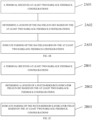
- FIG. 2A is a schematic flowchart of a method for determining a UCI field in implementations of the present application. As illustrated in FIG. 2A , the method for determining a UCI field includes the following.
- a network device transmits at least two HARQ-ACK feedback configurations to a terminal.
- the terminal receives the at least two HARQ-ACK feedback configurations.
- the network device transmits first DCI to the terminal.
- the terminal receives the first DCI.
- a first information-field in the first DCI has a length determined by the at least two HARQ-ACK feedback configurations.
- the first information-field is a field related to uplink control feedback in the first DCI.
- the length of the first information-field may be measured and represented by the number of bits.
- the terminal will receive the at least two HARQ-ACK feedback configurations and the first DCI transmitted by the network device.
- the length of the first information-field related to uplink control feedback is determined by the multiple HARQ-ACK feedback configurations received by the terminal.
- the information field related to uplink control feedback and determined in such manner is able to support any of multiple HARQ-ACK feedback configurations.
- the network device first transmits at least two HARQ-ACK feedback configurations to the terminal, and the terminal receives the at least two HARQ-ACK feedback configurations. Then the network device transmits the first DCI to the terminal, and the terminal receives the first DCI.
- the length of the first information-field related to uplink control feedback in the first DCI is determined by the at least two HARQ-ACK feedback configurations. Since the length of the first information-field in the first DCI is determined by the multiple HARQ-ACK feedback configurations received by the terminal, the first information-field is able to support any of the multiple HARQ-ACK feedback configurations. In this way, HARQ-ACK feedback configurations can be dynamically switched by one DCI, such that multiple HARQ-ACK feedback configurations can share one field related to uplink control feedback, which facilitates to reduce signaling overhead.
- the first information-field in the first DCI includes any of: a downlink assignment index (DAI) field, a physical uplink control channel resource indicator (PUCCH-resource-indicator) field, and a physical downlink share channel to HARQ feedback timing indicator (PDSCH-to-HARQ_feedback timing indicator) field.
- DCI downlink assignment index
- PUCCH-resource-indicator physical uplink control channel resource indicator
- PDSCH-to-HARQ_feedback timing indicator a physical downlink share channel to HARQ feedback timing indicator
- the DAI field refers to the downlink assignment index field.
- the field related to uplink control feedback in the first DCI may be any of the DAI field, the PUCCH-resource-indicator field, and the PDSCH-to-HARQ feedback timing indicator field.
- the terminal can determine the length of the field related to uplink control feedback in the first DCI according to the received at least two HARQ-ACK feedback configurations transmitted by the network device, such that these three kinds of fields related to uplink control feedback can support any of the multiple HARQ-ACK feedback configurations, which facilitates to reduce signaling overhead.
- the length of the first information-field in the first DCI is a maximum value of lengths of at least two reference first information-fields, where the at least two reference first information-fields are in one-to-one correspondence with the at least two HARQ-ACK feedback configurations.
- the terminal receives two different HARQ-ACK feedback configurations. Assuming that a reference first information-field corresponding to a first HARQ-ACK feedback configuration received by the terminal has a length of 2, and a reference first information-field corresponding to a second HARQ-ACK feedback configuration has a length of 3, then the length of the first information-field related to uplink control feedback in the DCI is determined as 3.
- the length of the first information-field related to uplink control feedback in the first DCI is a maximum value of lengths of at least two reference first information-fields, where the at least two reference first information-fields are in one-to-one correspondence with the at least two HARQ-ACK feedback configurations
- the first information-field related to uplink control feedback in the first DCI can support the at least two HARQ-ACK feedback configurations.
- HARQ-ACK feedback configurations can be dynamically switched by one DCI, such that multiple HARQ-ACK feedback configurations can share one field related to uplink control feedback, which facilitates to reduce signaling overhead.
- first information of the terminal is used for indicating a target HARQ-ACK feedback configuration corresponding to the first DCI, where the target HARQ-ACK feedback configuration is one of the at least two HARQ-ACK feedback configurations.
- the first information of the terminal indicates the HARQ-ACK feedback configuration corresponding to the first DCI received by the terminal.
- the HARQ-ACK feedback configuration corresponding to the first information of the terminal may be determined according to correspondence between different first information and different HARQ-ACK feedback configurations.
- the HARQ-ACK feedback configuration is any of the at least two HARQ-ACK feedback configurations received by the terminal.
- the first information of the terminal indicates the target HARQ-ACK feedback configuration corresponding to the first DCI received by the terminal and transmitted by the network device.
- the target HARQ-ACK feedback configuration is one of the at least two HARQ-ACK feedback configurations received by the terminal. Since different first information indicates different corresponding HARQ-ACK feedback configurations, the corresponding target HARQ-ACK feedback configuration may be indicated by the first information received by the terminal, so that the length of the first information-field related to uplink control feedback in the first DCI may be determined according to multiple HARQ-ACK feedback configurations indicated.
- the first information includes any of: a radio network temporary identifier (RNTI), a DCI field, and a resource set (CORESET)/search space.
- RNTI radio network temporary identifier
- DCI Downlink Control
- CORESET resource set
- different HARQ-ACK feedback configurations should be differentiated. Different first information corresponds to different HARQ-ACK feedback configurations. Specifically, the multiple different HARQ-ACK feedback configurations may be differentiated by any of the RNTI, the DCI field, and the CORESET/search space.
- the at least two HARQ-ACK feedback configurations can be indicated by any of the RNTI, the DCI field, and the CORESET/search space, which facilitates to differentiate multiple different HARQ-ACK feedback configurations, so that it is more convenient to indicate a certain HARQ-ACK feedback configuration when needed.
- the first information-field includes a DAI field. If a PDSCH-HARQ-ACK-Codebook corresponding to the target HARQ-ACK feedback configuration is semi-static, information in the DAI field will not be parsed, or the information in the DAI field will be parsed into a meaning other than physical downlink share channel (PDSCH) allocation. If the PDSCH-HARQ-ACK-Codebook corresponding to the target HARQ-ACK feedback configuration is dynamic, the information in the DAI field will be parsed, and the information parsed is at least used for determining a HARQ-ACK mapping order in HARQ-ACK feedbacks.
- PDSCH physical downlink share channel
- the first information-field may be the DAI field.
- Some DAI includes two parts, where one part is used for determining the HARQ-ACK mapping order in HARQ-ACK feedback configurations, and the other part is used for determining a total number of HARQ-ACK-acks.
- the terminal After the terminal receives the at least two HARQ-ACK feedback configurations and determines the length of the DAI related to uplink control feedback in the first DCI according to the at least two HARQ-ACK feedback configurations, the terminal indicates the target HARQ-ACK feedback configuration corresponding to the DCI according to the first information.
- the terminal will not parse the DAI field, or parse information in the DAI field into the meaning other than PDSCH allocation, such as the number of PSSCH receptions, which will not affect the HARQ-ACK mapping order in HARQ-ACK feedbacks. If the PDSCH-HARQ-ACK-Codebook corresponding to the target HARQ-ACK feedback configuration is dynamic, the terminal will parse the DAI field, and the information parsed is at least used for determining the HARQ-ACK mapping order in HARQ-ACK feedback configurations.
- the terminal after the terminal receives the at least two HARQ-ACK feedback configurations and determines the length of the DAI field related to uplink control feedback in the first DCI according to the at least two HARQ-ACK feedback configurations, the terminal indicates the target HARQ-ACK feedback configuration corresponding to the DCI according to the first information.
- parsing of the DAI field can be indicated according to the PDSCH-HARQ-ACK-Codebook configurations corresponding to different target HARQ-ACK feedback configurations, which is beneficial to improve flexibility of information indicating.
- the first information-field includes a PUCCH-resource-indicator field or a PDSCH-to-HARQ_feedback timing indicator field. If a target first information-field corresponding to the target HARQ-ACK feedback configuration has a length equal to the first information-field in the first DCI, all bits in the first information-field in the first DCI are parsed. If the target first information-field corresponding to the target HARQ-ACK feedback configuration has a length less than the first information-field in the first DCI, x_A most significant bits or x_A least significant bits in the first information-field in the first DCI are parsed, where x_A is the length of the target first information-field corresponding to the target HARQ-ACK feedback configuration.
- the first information-field may be the PUCCH-resource-indicator field or the PDSCH-to-HARQ_feedback timing indicator field.
- the terminal After the terminal receives the at least two HARQ-ACK feedback configurations and determines the length of the PUCCH-resource-indicator field or the PDSCH-to-HARQ_feedback timing indicator field related to uplink control feedback in the first DCI according to the at least two HARQ-ACK feedback configurations, the terminal indicates the target HARQ-ACK feedback configuration corresponding to the DCI according to the first information.
- the length of the target PUCCH-resource-indicator field or the PDSCH-to-HARQ_feedback timing indicator field is 1, and the length of the PUCCH-resource-indicator field or the PDSCH-to-HARQ_feedback timing indicator field in the first DCI is 2, one most significant bit or one least significant bit in the PUCCH-resource-indicator field or the PDSCH-to-HARQ_feedback timing indicator field in the first DCI are parsed.
- the terminal after the terminal receives the at least two HARQ-ACK feedback configurations and determines the length of the PUCCH-resource-indicator field or the PDSCH-to-HARQ_feedback timing indicator field related to uplink control feedback in the first DCI according to the at least two HARQ-ACK feedback configurations, the terminal indicates the target HARQ-ACK feedback configuration corresponding to the DCI according to the first information.
- parsing of the PUCCH-resource-indicator field or the PDSCH-to-HARQ_feedback timing indicator field can be indicated according to a relationship between the length of the target PUCCH-resource-indicator field or the target PDSCH-to-HARQ_feedback timing indicator field corresponding to the target HARQ-ACK feedback configuration and the length of the PUCCH-resource-indicator field or the PDSCH-to-HARQ_feedback timing indicator field related to uplink control feedback in the first DCI, which is beneficial to improve an accuracy of information indicating.
- FIG. 2B is a schematic flowchart of another method for determining a UCI field provided in implementations of the present application.
- the method includes the following.
- a terminal receives at least two HARQ-ACK feedback configurations.
- the terminal receives a first pdsch-HARQ-ACK-Codebook configuration corresponding to a first HARQ-ACK codebook, and the terminal receives a second pdsch-HARQ-ACK-Codebook configuration corresponding to a second HARQ-ACK codebook.
- a length of the DAI field in DCI is determined based on the at least two HARQ-ACK feedback configurations. Specifically:
- a first DAI field has 0 bit.
- a second DAI field has 4 bits.
- the first DAI field and the second DAI field are used as reference DAI fields.
- parsing of the DAI field is indicated based on the at least two HARQ-ACK feedback configurations.
- the terminal receives a physical downlink control channel (PDCCH), and is indicated to parse or not parse the DAI field based on the HARQ-ACK feedback configurations.
- the HARQ-ACK feedback configurations can be differentiated by at least one of an RNTI, a DCI field, or a CORESET/Search space.
- the terminal determines a first HARQ-ACK feedback configuration corresponding to current DCI by at least one of RNTI/DCI field/CORESET/Search space.
- the terminal will not parse the DAI field, or parse the DAI field into other meanings, such as the number of PDSCH receptions, which will not affect a HARQ-ACK mapping order in the HARQ-ACK feedback configurations.
- the terminal determines a second HARQ-ACK feedback configuration corresponding to the current DCI by the RNTI/DCI field/CORESET/Search space. If the second PDSCH-HARQ-ACK-Codebook corresponding to the second HARQ-ACK feedback configuration is dynamic, the terminal will parse the DAI field for determining the HARQ-ACK mapping order in the HARQ-ACK feedback configurations.
- the terminal receives at least two HARQ-ACK feedback configurations and determines the length of the DAI field in the first DCI according to the at least two HARQ-ACK feedback configurations. Since two reference DAI fields and the at least two HARQ-ACK feedback configurations received by the terminal are in one-to-one correspondence, the length of the DAI field in the first DCI is determined by the at least two HARQ-ACK feedback configurations. In this way, HARQ-ACK feedback configurations can be dynamically switched by one DCI, so that multiple HARQ-ACK feedback configurations can share one DAI field, which is beneficial to reduce signaling overhead and improve flexibility of information indicating.
- FIG. 2C is a schematic flowchart of another method for determining a UCI field provided in implementations of the present application.
- the method includes the following.
- a terminal receives at least two HARQ-ACK feedback configurations.
- the terminal receives a first physical uplink control channel (PUCCH) configuration corresponding to a first HARQ-ACK feedback configuration, where the first PUCCH configuration includes length information of a first PUCCH-resource-indicator field (directly configured or indirectly configured by the number of PUCCH resources).
- the terminal receives a second PUCCH configuration corresponding to a second HARQ-ACK feedback configuration, where the second PUCCH configuration includes length information of a second PUCCH-resource-indicator field (directly configured or indirectly configured by the number of PUCCH resources).
- the first PUCCH-resource-indicator field corresponding to the first HARQ-ACK feedback configuration received by the terminal has a length of 3
- the second PUCCH-resource-indicator field corresponding to the second HARQ-ACK feedback configuration received by the terminal has a length of 4.
- a length of a PUCCH-resource-indicator field in DCI is determined based on the at least two HARQ-ACK feedback configurations. Specifically:
- the length of the first PUCCH-resource-indicator field corresponding to the first HARQ-ACK feedback configuration received by the terminal is 3, and the length of the second PUCCH-resource-indicator field corresponding to the second HARQ-ACK feedback configuration received by the terminal is 4.
- parsing of the PUCCH-resource-indicator field is indicated based on the at least two HARQ-ACK feedback configurations.
- the terminal receives a PDCCH, and is indicated to parse the PUCCH-resource-indicator field based on the HARQ-ACK feedback configurations.
- the HARQ-ACK feedback configurations may be differentiated by at least one of an RNTI, a DCI field, or a CORESET/Search space.
- the terminal determines the first HARQ-ACK feedback configuration corresponding to current DCI by the RNTI/DCI field/CORESET/Search space, and parses the PUCCH-resource-indicator field according to the length of the first PUCCH-resource-indicator field corresponding to the first HARQ-ACK feedback configuration.
- the second HARQ-ACK feedback configuration may be parsed in a same manner as above.
- the terminal determines previously that the length of the PUCCH-resource-indicator field is 4.
- the terminal determines the first HARQ-ACK feedback configuration corresponding to the current DCI by the RNTI/DCI field/CORESET/Search space, and determines the length of the corresponding first PUCCH-resource-indicator field as 3 according to the first HARQ-ACK feedback configuration, so the terminal parses 3 least significant bits in the PUCCH-resource-indicator field to determine a PUCCH resource.
- the terminal receives the at least two HARQ-ACK feedback configurations, and determines the length of the PUCCH-resource-indicator field in the first DCI according to the at least two HARQ-ACK feedback configurations. Since two reference PUCCH-resource-indicator fields and the at least two HARQ-ACK feedback configurations received by the terminal are in one-to-one correspondence, the length of the PUCCH-resource-indicator field in the first DCI is determined by the at least two HARQ-ACK feedback configurations.
- HARQ-ACK feedback configurations can be dynamically switched by one DCI, so that multiple HARQ-ACK feedback configurations can share one PUCCH-resource-indicator field, which is beneficial to reduce signaling overhead and improve an accuracy of information indicating.
- FIG. 2D is a schematic flowchart of another method for determining a UCI field provided in implementations of the present application.
- the method includes the following.
- a terminal receives at least two HARQ-ACK feedback configurations.
- the terminal receives a first PUCCH configuration corresponding to a first HARQ-ACK feedback configuration, where the first PUCCH configuration includes length information of a first PDSCH-to-HARQ_feedback timing indicator field (directly configured or indirectly configured by the number of dl-DataToUL-ACKs).
- the terminal receives a second PUCCH configuration corresponding to a second HARQ-ACK feedback configuration, where the second PUCCH configuration includes length information of a second PDSCH-to-HARQ_feedback timing indicator field (directly configured or indirectly configured by the number of dl-DataToUL-ACKs).
- the first PDSCH-to-HARQ_feedback timing indicator field corresponding to the first HARQ-ACK feedback configuration received by the terminal has a length of 3
- the second PDSCH-to-HARQ_feedback timing indicator field corresponding to the second HARQ-ACK feedback configuration received by the terminal has a length of 4.
- a length of a PDSCH-to-HARQ_feedback timing indicator field in DCI is determined based on the at least two HARQ-ACK feedback configurations.
- parsing of the PDSCH-to-HARQ_feedback timing indicator field is indicated based on the at least two HARQ-ACK feedback configurations.
- the terminal receives a PDCCH, and is indicated to parse the PDSCH-to-HARQ feedback timing indicator field according to the HARQ-ACK feedback configurations.
- the specific description for this step is consistent with the corresponding part in the above example 2, except that the PUCCH-resource-indicator field differs from the PDSCH-to-HARQ_feedback timing indicator field, which will not be repeated herein.
- the terminal receives the at least two HARQ-ACK feedback configurations, and determines the length of the PDSCH-to-HARQ _feedback timing indicator field in the first DCI according to the at least two HARQ-ACK feedback configurations. Since two reference fields and the at least two HARQ-ACK feedback configurations received by the terminal are in one-to-one correspondence, the length of the PDSCH-to-HARQ_feedback timing indicator field in the first DCI is determined by the at least two HARQ-ACK feedback configurations.
- HARQ-ACK feedback configurations can be dynamically switched by one DCI, so that multiple HARQ-ACK feedback configurations can share one PDSCH-to-HARQ_feedback timing indicator field, which is beneficial to reduce signaling overhead and improve an accuracy of information indicating.
- FIG. 3 is a schematic structural diagram of a terminal 300 provided in implementations of the present application.
- the terminal 300 includes a processor 310, a memory 320, a communication interface 330, and one or more programs 321.
- the one or more programs 321 are stored in the memory 320 and configured to be executed by the processor 310.
- the one or more programs 321 include instructions for carrying out the following operations.
- a terminal receives at least two HARQ-ACK feedback configurations.
- the terminal receives first DCI, where a first information-field in the first DCI has a length determined by the at least two HARQ-ACK feedback configurations, and the first information-field is a field related to uplink control feedback in the first DCI.
- the terminal first receives at least two HARQ-ACK feedback configurations transmitted by a network device, and then receives the first DCI transmitted by the network device.
- the length of the first information-field related to uplink control feedback in the first DCI is determined by the at least two HARQ-ACK feedback configurations. Since the length of the first information-field in the first DCI is determined by the multiple HARQ-ACK feedback configurations received by the terminal, the first information-field is able to support any of the multiple HARQ-ACK feedback configurations. In this way, HARQ-ACK feedback configurations can be dynamically switched by one DCI, such that multiple HARQ-ACK feedback configurations can share one field related to uplink control feedback, which facilitates to reduce signaling overhead.
- the first information-field in the first DCI includes any of: a DAI field, a PUCCH-resource-indicator field, and a PDSCH-to-HARQ_feedback timing indicator field.
- the length of the first information-field in the first DCI is a maximum value of lengths of at least two reference first information-fields, where the at least two reference first information-fields are in one-to-one correspondence with the at least two HARQ-ACK feedback configurations.
- first information of the terminal is used for indicating a target HARQ-ACK feedback configuration corresponding to the first DCI, where the target HARQ-ACK feedback configuration is one of the at least two HARQ-ACK feedback configurations.
- the first information includes any of: an RNTI, a DCI field, and a CORESET/search space.
- the first information-field includes a DAI field. If a PDSCH-HARQ-ACK-Codebook corresponding to the target HARQ-ACK feedback configuration is semi-static, parsing of information in the DAI field is skipped, or the information in the DAI field will be parsed into a meaning other than PDSCH allocation. If the PDSCH-HARQ-ACK-Codebook corresponding to the target HARQ-ACK feedback configuration is dynamic, the information in the DAI field will be parsed, and the information parsed is at least used for determining a HARQ-ACK mapping order in HARQ-ACK feedbacks.
- the first information-field includes a PUCCH-resource-indicator field or a PDSCH-to-HARQ_feedback timing indicator field. If a target first information-field corresponding to the target HARQ-ACK feedback configuration has a length equal to the first information-field in the first DCI, all bits in the first information-field in the first DCI are parsed. If the target first information-field corresponding to the target HARQ-ACK feedback configuration has a length less than the first information-field in the first DCI, x_A most significant bits or x_A least significant bits in the first information-field in the first DCI are parsed, where x_A is the length of the target first information-field corresponding to the target HARQ-ACK feedback configuration.
- FIG. 4 is schematic structural diagram of a network device 400 provided in implementations of the present application.
- the network device 400 includes a processor 410, a memory 420, a communication interface 430, and one or more programs 421.
- the one or more programs 421 are stored in the memory 420 and configured to be executed by the processor 410.
- the one or more programs 421 include instructions for carrying out the following operations.
- a network device transmits at least two HARQ-ACK feedback configurations to a terminal.
- the network device transmits first DCI to the terminal, where a first information-field in the first DCI has a length determined by the at least two HARQ-ACK feedback configurations, and the first information-field is a field related to uplink control feedback in the first DCI.
- the network device first transmits at least two HARQ-ACK feedback configurations to the terminal, and then transmits the first DCI to the terminal.
- the length of the first information-field related to uplink control feedback in the first DCI is determined by the at least two HARQ-ACK feedback configurations. Since the length of the first information-field in the first DCI is determined by the multiple HARQ-ACK feedback configurations received by the terminal, the first information-field is able to support any of the multiple HARQ-ACK feedback configurations. In this way, HARQ-ACK feedback configurations can be switched dynamically by one DCI, such that multiple HARQ-ACK feedback configurations can share one field related to uplink control feedback, which facilitates to reduce signaling overhead.
- the first information-field in the first DCI includes any of: a DAI field, a PUCCH-resource-indicator field, and a PDSCH-to-HARQ_feedback timing indicator field.
- the length of the first information-field in the first DCI is a maximum value of lengths of at least two reference first information-fields, where the at least two reference first information-fields are in one-to-one correspondence with the at least two HARQ-ACK feedback configurations.
- first information of the terminal is used for indicating a target HARQ-ACK feedback configuration corresponding to the first DCI, where the target HARQ-ACK feedback configuration is one of the at least two HARQ-ACK feedback configurations.
- the first information includes any of: an RNTI, a DCI field, and a CORESET/search space.
- the first information-field includes a DAI field. If a PDSCH-HARQ-ACK-Codebook corresponding to the target HARQ-ACK feedback configuration is semi-static, information in the DAI field will not be parsed, or the information in the DAI field will be parsed into a meaning other than PDSCH allocation. If the PDSCH-HARQ-ACK-Codebook corresponding to the target HARQ-ACK feedback configuration is dynamic, the information in the DAI field will be parsed, and the information parsed is at least used for determining a HARQ-ACK mapping order in HARQ-ACK feedbacks.
- the first information-field includes a PUCCH-resource-indicator field or a PDSCH-to-HARQ_feedback timing indicator field. If a target first information-field corresponding to the target HARQ-ACK feedback configuration has a length equal to the first information-field in the first DCI, all bits in the first information-field in the first DCI are parsed. If the target first information-field corresponding to the target HARQ-ACK feedback configuration has a length less than the first information-field in the first DCI, x_A most significant bits or x_A least significant bits in the first information-field in the first DCI are parsed, where x_A is the length of the target first information-field corresponding to the target HARQ-ACK feedback configuration.
- the terminal includes corresponding hardware structures and/or software modules for performing respective functions.
- the present application can be implemented by hardware or a combination of hardware and computer software. Whether a certain function is executed by hardware or computer software-driven hardware depends on the specific application and design constraint conditions of the technical solution. Professionals and technicians can use different methods for each specific application to implement the described functions, but such implementation should not be considered beyond the scope of this application.
- each functional unit may be divided corresponding to each function, or two or more functions may be integrated into one processing unit.
- the above-mentioned integrated unit can be realized in the form of hardware or software program module. It should be noted that the division of units in the implementations of the present application is illustrative, and is only a logical functional division, and there may be other division methods in actual implementation.
- FIG. 5 is a block diagram of functional units of an apparatus for determining a UCI field provided in implementations of the present application.
- the apparatus 500 for determining a UCI field is applied to a terminal and includes specifically a processing unit 502 and a communication unit 503.
- the processing unit 502 is configured to control and manage actions of the terminal.
- the processing unit 502 is configured to support the terminal to perform steps 202 and 204 in FIG. 2A and/or other processes used in the technology described herein.
- the communication unit 503 is configured to support communication between the terminal and other devices.
- the apparatus for determining a UCI field may further includes a storage unit 501 configured to store program codes and data of the terminal.
- the processing unit 502 may be a processor or a controller, for example, a central processing unit (CPU), a general-purpose processor, a digital signal processor (DSP), an application-specific integrated circuit (ASIC), a field programmable gate array (FPGA) or other programmable logic devices, transistor logic devices, hardware components or any combination thereof.
- the processing unit 502 may implement or execute various exemplary logical blocks, modules, and circuits described in conjunction with the disclosure of this application.
- the processor may also be a combination for realizing computing functions, for example, including a combination of one or more microprocessors, a combination of a DSP and a microprocessor, etc.
- the communication unit 503 may be a communication interface, a transceiver, a transceiver circuit, etc., and the storage unit 501 may be a memory.
- the processing unit 502 is a processor
- the communication unit 503 is a communication interface
- the storage unit 501 is a memory
- the terminal involved in the implementations of the present application may be the terminal illustrated in FIG. 3 .
- the processing unit 502 is configured to perform any step performed by the terminal in the foregoing method implementations, and when performing data transmission such as transmitting, the communication unit 503 can be optionally invoked to complete the corresponding operation.
- the processing unit 502 is configured to perform any step performed by the terminal in the foregoing method implementations, and when performing data transmission such as transmitting, the communication unit 503 can be optionally invoked to complete the corresponding operation.
- the detailed description is given below.
- the processing unit 502 is configured to receive at least two HARQ-ACK feedback configurations by the communication unit 503, and receive first DCI by the communication unit, where a first information-field in the first DCI has a length determined by the at least two HARQ-ACK feedback configurations, and the first information-field is a field related to uplink control feedback in the first DCI.
- the terminal first receives at least two HARQ-ACK feedback configurations transmitted by a network device, and then receives the first DCI transmitted by the network device.
- the length of the first information-field in the first DCI is determined by the at least two HARQ-ACK feedback configurations, where the first information-field is related to uplink control feedback. Since the length of the first information-field in the first DCI is determined by the multiple HARQ-ACK feedback configurations received by the terminal, the first information-field is able to support any of the multiple HARQ-ACK feedback configurations. In this way, HARQ-ACK feedback configurations can be dynamically switched by one DCI, such that multiple HARQ-ACK feedback configurations can share one field related to uplink control feedback, which facilitates to reduce signaling overhead.
- the first information-field in the first DCI includes any of: a DAI field, a PUCCH-resource-indicator field, and a PDSCH-to-HARQ_feedback timing indicator field.
- the length of the first information-field in the first DCI is a maximum value of lengths of at least two reference first information-fields, where the at least two reference first information-fields are in one-to-one correspondence with the at least two HARQ-ACK feedback configurations.
- first information of the terminal is used for indicating a target HARQ-ACK feedback configuration corresponding to the first DCI, where the target HARQ-ACK feedback configuration is one of the at least two HARQ-ACK feedback configurations.
- the first information includes any of: an RNTI, a DCI field, and a CORESET/search space.
- the first information-field includes a DAI field. If a PDSCH-HARQ-ACK-Codebook corresponding to the target HARQ-ACK feedback configuration is semi-static, information in the DAI field will not be parsed, or the information in the DAI field will be parsed into a meaning other than PDSCH allocation. If the PDSCH-HARQ-ACK-Codebook corresponding to the target HARQ-ACK feedback configuration is dynamic, the information in the DAI field will be parsed, and the information parsed is at least used for determining a HARQ-ACK mapping order in HARQ-ACK feedbacks.
- the first information-field includes a PUCCH-resource-indicator field or a PDSCH-to-HARQ_feedback timing indicator field. If a target first information-field corresponding to the target HARQ-ACK feedback configuration has a length equal to the first information-field in the first DCI, all bits in the first information-field in the first DCI are parsed. If the target first information-field corresponding to the target HARQ-ACK feedback configuration has a length less than the first information-field in the first DCI, x_A most significant bits or x_A least significant bits in the first information-field in the first DCI are parsed, where x_A is the length of the target first information-field corresponding to the target HARQ-ACK feedback configuration.
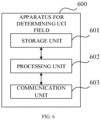
- FIG. 6 is a block diagram of functional units of an apparatus for determining a UCI field provided in implementations of the present application.
- the apparatus 600 for determining a UCI field is applied to a network device, and the network device includes a processing unit 602 and a communication unit 603.
- the processing unit 602 is configured to control and manage actions of the network device.
- the processing unit 602 is configured to support the network device to perform steps 201 and 203 in FIG. 2A and/or other processes used in the technology described herein.
- the communication unit 603 is configured to support communication between the network device and other devices.
- the network device may further includes a storage unit 601 configured to store program codes and data of the terminal.
- the processing unit 602 may be a processor or a controller, for example, a CPU, a general-purpose processor, a DSP, an ASIC, an FPGA or other programmable logic devices, transistor logic devices, hardware components or any combination thereof.
- the processing unit 602 may implement or execute various exemplary logical blocks, modules, and circuits described in conjunction with the disclosure of this application.
- the processor may also be a combination for realizing computing functions, for example, including a combination of one or more microprocessors, a combination of a DSP and a microprocessor, and so on.
- the communication unit 603 may be a communication interface, a transceiver, a transceiver circuit, etc.
- the storage unit 601 may be a memory.
- the network device involved in the implementations of the present application may be the network device illustrated in FIG. 4 .
- the processing unit 602 is configured to perform any step performed by the network device in the foregoing method implementations, and when performing data transmission such as transmitting, the communication unit 603 can be optionally invoked to complete the corresponding operation.
- the detailed description is given below.
- the processing unit 602 is configured to transmit at least two HARQ-ACK feedback configurations to a terminal by the communication unit 603, and transmit first DCI to the terminal by the communication unit 603, where a first information-field in the first DCI has a length determined by the at least two HARQ-ACK feedback configurations, and the first information-field is a field related to uplink control feedback in the first DCI.
- the network device first transmits at least two HARQ-ACK feedback configurations to the terminal, and then transmits the first DCI to the terminal.
- the length of the first information-field in the first DCI is determined by the at least two HARQ-ACK feedback configurations, where the first information-field is related to uplink control feedback. Since the length of the first information-field in the first DCI is determined by the multiple HARQ-ACK feedback configurations received by the terminal, the first information-field is able to support any of the multiple HARQ-ACK feedback configurations.
- HARQ-ACK feedback configurations can be switched dynamically by one DCI, such that multiple HARQ-ACK feedback configurations can share one field related to uplink control feedback, which facilitates to reduce signaling overhead.
- the first information-field in the first DCI includes any of: a DAI field, a PUCCH-resource-indicator field, and a PDSCH-to-HARQ_feedback timing indicator field.
- the length of the first information-field in the first DCI is a maximum value of lengths of at least two reference first information-fields, where the at least two reference first information-fields are in one-to-one correspondence with the at least two HARQ-ACK feedback configurations.
- first information of the terminal is used for indicating a target HARQ-ACK feedback configuration corresponding to the first DCI, where the target HARQ-ACK feedback configuration is one of the at least two HARQ-ACK feedback configurations.
- the first information includes any of: an RNTI, a DCI field, and a CORESET/search space.
- the first information-field includes a DAI field. If a PDSCH-HARQ-ACK-Codebook corresponding to the target HARQ-ACK feedback configuration is semi-static, information in the DAI field will not be parsed, or the information in the DAI field will be parsed into a meaning other than PDSCH allocation. If the PDSCH-HARQ-ACK-Codebook corresponding to the target HARQ-ACK feedback configuration is dynamic, the information in the DAI field will be parsed, and the information parsed is at least used for determining a HARQ-ACK mapping order in HARQ-ACK feedbacks.
- the first information-field includes a PUCCH-resource-indicator field or a PDSCH-to-HARQ_feedback timing indicator field. If a target first information-field corresponding to the target HARQ-ACK feedback configuration has a length equal to the first information-field in the first DCI, all bits in the first information-field in the first DCI are parsed. If the target first information-field corresponding to the target HARQ-ACK feedback configuration has a length less than the first information-field in the first DCI, x_A most significant bits or x_A least significant bits in the first information-field in the first DCI are parsed, where x_A is the length of the target first information-field corresponding to the target HARQ-ACK feedback configuration.
- the implementations of the present application further provides a chip.
- the chip includes a processor configured to invoke a computer program from a memory and run the computer program to cause a device equipped with the chip to carry out part of or all steps described for the terminal in the above method implementations.
- the implementations of the present application further provides a computer-readable storage medium.
- the computer-readable storage medium stores a computer program for electronic data exchange.
- the computer program causes a computer to carry out part of or all steps described for the terminal in the above method implementations.
- the implementations of the present application further provides a computer-readable storage medium.
- the computer-readable storage medium stores a computer program for electronic data exchange.
- the computer program causes a computer to carry out part of or all steps described for the network device in the above method implementations.
- the implementations of the present application further provides a computer program product.
- the computer program product includes a computer program which is operable to cause a computer to carry out part of or all steps described for the terminal in the above method implementations.
- the computer program product may be a software installation package.
- the steps of the method or algorithm described in the implementations of the present application may be implemented in hardware, or may be implemented in a manner in which a processor executes software instructions.
- Software instructions can be composed of corresponding software modules, which can be stored in random access memory (RAM), flash memory, read only memory (ROM), erasable programmable read-only memory (EPROM), electrically EPROM (EEPROM), register, hard disk, portable hard disk, CD-ROM, or any other form of storage medium known in the art.
- An exemplary storage medium is coupled to the processor, so that the processor can read information from the storage medium and can write information to the storage medium.
- the storage medium may also be a component of the processor.
- the processor and the storage medium may be located in the ASIC.
- the ASIC may be located in an access network device, a target network device, or a core network device.
- the processor and the storage medium may also present as discrete components in the access network device, the target network device, or the core network device.
- the functions described in the implementations of the present application may be implemented in whole or in part by software, hardware, firmware, or any combination thereof.
- software it can be implemented in the form of a computer program product in whole or in part.
- the computer program product includes one or more computer instructions.
- the computer may be a general-purpose computer, a special-purpose computer, a computer network, or other programmable devices.
- the computer instructions may be stored in a computer-readable storage medium, or transmitted from one computer-readable storage medium to another computer-readable storage medium.
- the computer instructions may be transmitted from a website, computer, server, or data center to another website, computer, server or data center via wired (such as coaxial cable, optical fiber, digital subscriber line (DSL)) or wireless (such as infrared, wireless, microwave, etc.) communication.
- the computer-readable storage medium may be any available medium that can be accessed by the computer or a data storage device such as a server or a data center integrated with one or more available media.
- the usable medium may be a magnetic medium (for example, a floppy disk, a hard disk, a magnetic tape), an optical medium (for example, a digital video disc (DVD)), or a semiconductor medium (for example, a solid state disk (SSD)), etc.
Landscapes
- Engineering & Computer Science (AREA)
- Signal Processing (AREA)
- Computer Networks & Wireless Communication (AREA)
- Mobile Radio Communication Systems (AREA)
Claims (14)
- Verfahren zur Bestimmung eines Uplink-Steuerungsinformations-, UCI-, Feldes, umfassend:Empfangen (202) von mindestens zwei hybriden automatischen Wiederholungsanforderungsbestätigungs-, HARQ-ACK-, Rückmeldungskonfigurationen durch ein Endgerät (300); undEmpfangen (204) von ersten Downlink-Steuerungsinformationen, DCI, durch das Endgerät (300), wobei eine Länge eines ersten Informationsfeldes in den ersten DCI durch die mindestens zwei HARQ-ACK-Rückmeldungskonfigurationen bestimmt wird und das erste Informationsfeld in den ersten DCI ein Feld ist, das sich auf Uplink-Steuerungsrückmeldungen bezieht;wobei eine erste durch das Endgerät (300) empfangene Information zum Anzeigen einer Ziel-HARQ-ACK-Rückmeldungskonfiguration entsprechend den ersten DCI verwendet wird, wobei die Ziel-HARQ-ACK-Rückmeldungskonfiguration eine der mindestens zwei HARQ-ACK-Rückmeldungskonfigurationen ist; unddadurch gekennzeichnet, dass:das erste Informationsfeld ein Downlink-Zuweisungsindex-, DAI, Feld umfasst,wenn ein PDSCH-HARQ-ACK-Codebook, das der Ziel-HARQ-ACK-Rückmeldungskonfiguration entspricht, halbstatisch ist, die Informationen im DAI-Feld nicht geparst werden, oder die Informationen im DAI-Feld in eine andere Bedeutung als PDSCH-Zuweisung geparst werden; undwenn das PDSCH-HARQ-ACK-Codebook, das der Ziel-HARQ-ACK-Rückmeldungskonfiguration entspricht, dynamisch ist, die Informationen im DAI-Feld geparst werden und die geparsten Informationen zumindest zur Bestimmung einer HARQ-ACK-Abbildungsreihenfolge in HARQ-ACK-Rückmeldungen verwendet werden.
- Verfahren nach Anspruch 1, wobei die Länge des ersten Informationsfeldes in den ersten DCI ein Maximalwert der Längen von mindestens zwei Referenzinformationsfeldern ist, wobei die mindestens zwei Referenzinformationsfelder in Eins-zu-Eins-Entsprechung mit den mindestens zwei HARQ-ACK-Rückmeldungskonfigurationen stehen.
- Verfahren nach Anspruch 1, wobei die erste Information eines von einer temporären Funknetzkennung, RNTI, eines DCI-Feldes und eines Ressourcensatz-, CORESET/Suchraums, umfasst.
- Verfahren zur Bestimmung eines Uplink-Steuerungsinformations-, UCI, Feldes, umfassend:Empfangen (202) von mindestens zwei hybriden automatischen Wiederholungsanforderungsbestätigungs-, HARQ-ACK-, Rückmeldungskonfigurationen durch ein Endgerät (300); undEmpfangen (204) von ersten Downlink-Steuerungsinformationen, DCI, durch das Endgerät (300), wobei eine Länge eines ersten Informationsfeldes in den ersten DCI durch die mindestens zwei HARQ-ACK-Rückmeldungskonfigurationen bestimmt wird und das erste Informationsfeld in den ersten DCI ein Feld ist, das sich auf Uplink-Steuerungsrückmeldungen bezieht;wobei eine erste durch das Endgerät (300) empfangene Information zum Anzeigen einer Ziel-HARQ-ACK-Rückmeldungskonfiguration entsprechend den ersten DCI verwendet wird, wobei die Ziel-HARQ-ACK-Rückmeldungskonfiguration eine der mindestens zwei HARQ-ACK-Rückmeldungskonfigurationen ist; unddadurch gekennzeichnet, dass:das erste Informationsfeld ein PDSCH-zu-HARQ-Rückmeldungs-Zeitindikatorfeld umfasst,wenn ein erstes Ziel-Informationsfeld, das der Ziel-HARQ-ACK-Rückmeldungskonfiguration entspricht, eine Länge gleich dem ersten Informationsfeld in den ersten DCI aufweist, alle Bits in dem ersten Informationsfeld in den ersten DCI geparst werden; undwenn das erste Ziel-Informationsfeld, das der Ziel-HARQ-ACK-Rückmeldungskonfiguration entspricht, eine geringere Länge als das erste Informationsfeld in den ersten DCI aufweist, x_A höchstwertige Bits oder x_A niedrigstwertige Bits in dem ersten Informationsfeld in den ersten DCI geparst werden, wobei x_A die Länge des ersten Ziel-Informationsfeldes ist, das der Ziel-HARQ-ACK-Rückmeldungskonfiguration entspricht.
- Verfahren nach Anspruch 4, wobei die Länge des ersten Informationsfeldes in den ersten DCI ein Maximalwert der Längen von mindestens zwei Referenzinformationsfeldern ist, wobei die mindestens zwei Referenzinformationsfelder in Eins-zu-Eins-Entsprechung mit den mindestens zwei HARQ-ACK-Rückmeldungskonfigurationen stehen.
- Verfahren nach Anspruch 4, wobei die erste Information eines von einer temporären Funknetzkennung, RNTI, eines DCI-Feldes und eines Ressourcensatz-, CORESET/Suchraums, umfasst.
- Verfahren zur Bestimmung eines Uplink-Steuerungsinformations-, UCI, Feldes, umfassend:Übertragen (201) von mindestens zwei hybriden automatischen Wiederholungsanforderungsbestätigungs-, HARQ-ACK, Rückmeldungskonfigurationen durch eine Netzwerkvorrichtung (400) an ein Endgerät (300); undÜbertragen (203) von ersten Downlink-Steuerungsinformationen, DCI, durch die Netzwerkvorrichtung (400) an das Endgerät (300), wobei eine Länge eines ersten Informationsfeldes in den ersten DCI durch die mindestens zwei HARQ-ACK-Rückmeldungskonfigurationen bestimmt wird und das erste Informationsfeld in den ersten DCI ein Feld ist, das sich auf die Uplink-Steuerungsrückmeldung bezieht;wobei eine erste durch das Endgerät (300) empfangene Information zum Anzeigen einer Ziel-HARQ-ACK-Rückmeldungskonfiguration entsprechend den ersten DCI verwendet wird, wobei die Ziel-HARQ-ACK-Rückmeldungskonfiguration eine der mindestens zwei HARQ-ACK-Rückmeldungskonfigurationen ist; unddadurch gekennzeichnet, dass:das erste Informationsfeld ein Downlink-Zuweisungsindex-, DAI, Feld umfasst,wenn ein PDSCH-HARQ-ACK-Codebook, das der Ziel-HARQ-ACK-Rückmeldungskonfiguration entspricht, halbstatisch ist, die Informationen im DAI-Feld nicht geparst werden, oder die Informationen im DAI-Feld in eine andere Bedeutung als PDSCH-Zuweisung geparst werden; undwenn das PDSCH-HARQ-ACK-Codebook, das der Ziel-HARQ-ACK-Rückmeldungskonfiguration entspricht, dynamisch ist, die Informationen im DAI-Feld geparst werden und die geparsten Informationen zumindest zur Bestimmung einer HARQ-ACK-Abbildungsreihenfolge in HARQ-ACK-Rückmeldungen verwendet werden.
- Verfahren nach Anspruch 7, wobei die Länge des ersten Informationsfeldes in den ersten DCI ein Maximalwert der Längen von mindestens zwei Referenzinformationsfeldern ist, wobei die mindestens zwei Referenzinformationsfelder in Eins-zu-Eins-Entsprechung mit den mindestens zwei HARQ-ACK-Rückmeldungskonfigurationen stehen.
- Verfahren nach Anspruch 7, wobei die erste Information eines von einer temporären Funknetzkennung, RNTI, eines DCI-Feldes und eines Ressourcensatz-, CORESET/Suchraums, umfasst.
- Verfahren zur Bestimmung eines Uplink-Steuerungsinformations-, UCI-, Feldes, umfassend:Übertragen (201) von mindestens zwei hybriden automatischen Wiederholungsanforderungsbestätigungs-, HARQ-ACK, Rückmeldungskonfigurationen durch eine Netzwerkvorrichtung (400) an ein Endgerät (300); undÜbertragen (203) von ersten Downlink-Steuerungsinformationen, DCI, durch die Netzwerkvorrichtung (400) an das Endgerät (300), wobei eine Länge eines ersten Informationsfeldes in den ersten DCI durch die mindestens zwei HARQ-ACK-Rückmeldungskonfigurationen bestimmt wird und das erste Informationsfeld in den ersten DCI ein Feld ist, das sich auf die Uplink-Steuerungsrückmeldung bezieht;wobei eine erste durch das Endgerät (300) empfangene Information zum Anzeigen einer Ziel-HARQ-ACK-Rückmeldungskonfiguration entsprechend den ersten DCI verwendet wird, wobei die Ziel-HARQ-ACK-Rückmeldungskonfiguration eine der mindestens zwei HARQ-ACK-Rückmeldungskonfigurationen ist; unddadurch gekennzeichnet, dass:das erste Informationsfeld ein PDSCH-zu-HARQ-Rückmeldungs-Zeitindikatorfeld umfasst,wenn ein erstes Ziel-Informationsfeld, das der Ziel-HARQ-ACK-Rückmeldungskonfiguration entspricht, eine Länge gleich dem ersten Informationsfeld in den ersten DCI aufweist, alle Bits in dem ersten Informationsfeld in den ersten DCI geparst werden; undwenn das erste Ziel-Informationsfeld, das der Ziel-HARQ-ACK-Rückmeldungskonfiguration entspricht, eine geringere Länge als das erste Informationsfeld in den ersten DCI aufweist, x_A höchstwertige Bits oder x_A niedrigstwertige Bits in dem ersten Informationsfeld in den ersten DCI geparst werden, wobei x_A die Länge des ersten Ziel-Informationsfeldes ist, das der Ziel-HARQ-ACK-Rückmeldungskonfiguration entspricht.
- Verfahren nach Anspruch 10, wobei die Länge des ersten Informationsfeldes in den ersten DCI ein Maximalwert der Längen von mindestens zwei Referenzinformationsfeldern ist, wobei die mindestens zwei Referenzinformationsfelder in Eins-zu-Eins-Entsprechung mit den mindestens zwei HARQ-ACK-Rückmeldungskonfigurationen stehen.
- Verfahren nach Anspruch 10, wobei die erste Information eines von einer temporären Funknetzkennung, RNTI, eines DCI-Feldes und eines Ressourcensatz-, CORESET/Suchraums, umfasst.
- Vorrichtung zur Bestimmung eines Uplink-Steuerungsinformations-, UCI-, Feldes, umfassend:eine Kommunikationseinheit; undeine Verarbeitungseinheit, die dazu ausgelegt ist, die Kommunikationseinheit zum Durchführen des Verfahrens nach einem der Ansprüche 1-6 zu veranlassen.
- Vorrichtung zur Bestimmung eines Uplink-Steuerungsinformations-, UCI-, Feldes, umfassend:eine Kommunikationseinheit; undeine Verarbeitungseinheit, die dazu ausgelegt ist, die Kommunikationseinheit zum Durchführen des Verfahrens nach einem der Ansprüche 7-12 zu veranlassen.
Applications Claiming Priority (2)
| Application Number | Priority Date | Filing Date | Title |
|---|---|---|---|
| CN201911083760.2A CN112788755A (zh) | 2019-11-07 | 2019-11-07 | 上行控制信息uci域确定方法及相关装置 |
| PCT/CN2020/094401 WO2021088361A1 (zh) | 2019-11-07 | 2020-06-04 | 上行控制信息uci域确定方法及相关装置 |
Publications (3)
| Publication Number | Publication Date |
|---|---|
| EP4044729A1 EP4044729A1 (de) | 2022-08-17 |
| EP4044729A4 EP4044729A4 (de) | 2022-12-14 |
| EP4044729B1 true EP4044729B1 (de) | 2024-10-09 |
Family
ID=75748091
Family Applications (1)
| Application Number | Title | Priority Date | Filing Date |
|---|---|---|---|
| EP20884914.1A Active EP4044729B1 (de) | 2019-11-07 | 2020-06-04 | Verfahren zur bestimmung eines uplink-steuerungsinformations (uci)-feldes und zugehörige vorrichtungen |
Country Status (6)
| Country | Link |
|---|---|
| US (1) | US12185323B2 (de) |
| EP (1) | EP4044729B1 (de) |
| JP (1) | JP7607042B2 (de) |
| KR (1) | KR20220090535A (de) |
| CN (2) | CN112788755A (de) |
| WO (1) | WO2021088361A1 (de) |
Families Citing this family (2)
| Publication number | Priority date | Publication date | Assignee | Title |
|---|---|---|---|---|
| EP4140215A4 (de) * | 2020-04-22 | 2023-05-31 | NEC Corporation | Verfahren zur kommunikation, endgerätevorrichtung, netzwerkvorrichtung und computerlesbare medien |
| WO2024216986A1 (en) * | 2023-11-30 | 2024-10-24 | Zte Corporation | Methods for feeding back signals, apparatus, and computer-readable storage medium |
Family Cites Families (12)
| Publication number | Priority date | Publication date | Assignee | Title |
|---|---|---|---|---|
| JP5216058B2 (ja) | 2010-02-15 | 2013-06-19 | 株式会社エヌ・ティ・ティ・ドコモ | 移動端末装置および上り制御情報信号の送信方法 |
| JP6592448B2 (ja) * | 2014-10-17 | 2019-10-16 | シャープ株式会社 | 端末装置、通信方法、および、集積回路 |
| WO2016117929A1 (en) * | 2015-01-20 | 2016-07-28 | Lg Electronics Inc. | Method for transmitting uplink control information and apparatus therefor |
| US10342005B2 (en) * | 2015-08-14 | 2019-07-02 | Telefonaktiebolaget Lm Ericsson (Publ) | Methods for determining a HARQ-ACK codebook size for a user equipment and base station |
| WO2017049463A1 (zh) * | 2015-09-22 | 2017-03-30 | 华为技术有限公司 | 载波聚合下的上行控制信息传输方法及装置 |
| WO2017050265A1 (en) * | 2015-09-25 | 2017-03-30 | Telefonaktiebolaget Lm Ericsson (Publ) | Information bits packaging |
| CN110235396B (zh) * | 2017-02-05 | 2024-01-23 | Lg 电子株式会社 | 无线通信系统中终端发送上行链路控制信息的方法和支持该方法的设备 |
| CN109392169B (zh) | 2017-08-04 | 2021-05-07 | 维沃移动通信有限公司 | 一种数据传输方法、终端及基站 |
| CN117318905A (zh) * | 2017-09-29 | 2023-12-29 | 北京三星通信技术研究有限公司 | 上行传输方法和相应设备 |
| WO2019066630A1 (en) * | 2017-09-29 | 2019-04-04 | Samsung Electronics Co., Ltd. | UPLINK TRANSMISSION METHOD AND CORRESPONDING EQUIPMENT |
| US20210184801A1 (en) | 2017-11-15 | 2021-06-17 | Idac Holdings, Inc. | Method and apparatus for harq-ack codebook size determination and resource selection in nr |
| CN110035550B (zh) | 2018-01-12 | 2021-08-13 | 华为技术有限公司 | 上行控制信息传输方法和通信装置 |
-
2019
- 2019-11-07 CN CN201911083760.2A patent/CN112788755A/zh active Pending
- 2019-11-07 CN CN202210518646.3A patent/CN114900894B/zh active Active
-
2020
- 2020-06-04 KR KR1020227016763A patent/KR20220090535A/ko active Pending
- 2020-06-04 WO PCT/CN2020/094401 patent/WO2021088361A1/zh not_active Ceased
- 2020-06-04 EP EP20884914.1A patent/EP4044729B1/de active Active
- 2020-06-04 JP JP2022526207A patent/JP7607042B2/ja active Active
-
2022
- 2022-05-04 US US17/736,685 patent/US12185323B2/en active Active
Also Published As
| Publication number | Publication date |
|---|---|
| JP7607042B2 (ja) | 2024-12-26 |
| CN114900894B (zh) | 2023-12-05 |
| JP2023501405A (ja) | 2023-01-18 |
| KR20220090535A (ko) | 2022-06-29 |
| WO2021088361A1 (zh) | 2021-05-14 |
| US20220264560A1 (en) | 2022-08-18 |
| CN114900894A (zh) | 2022-08-12 |
| EP4044729A4 (de) | 2022-12-14 |
| US12185323B2 (en) | 2024-12-31 |
| EP4044729A1 (de) | 2022-08-17 |
| CN112788755A (zh) | 2021-05-11 |
Similar Documents
| Publication | Publication Date | Title |
|---|---|---|
| US11910382B2 (en) | Method of transmitting physical uplink control channel and related device | |
| CN113677014B (zh) | 一种确定反馈信息传输位置的方法及设备 | |
| US12543184B2 (en) | Wireless communication method, terminal device, and network device | |
| WO2019233339A1 (zh) | 传输信息的方法和通信设备 | |
| US11863493B2 (en) | Method for transmitting feedback information, terminal device, and network device | |
| CN102820960A (zh) | 实现混合自动重传请求的方法、用户设备和基站 | |
| US20200296746A1 (en) | Method for transmitting information, method for receiving information, terminal device, and network device | |
| US12185323B2 (en) | Methods for determining uplink control information (UCI) field and related apparatus | |
| US20240260042A1 (en) | Communication method and apparatus | |
| EP4519996B1 (de) | Verbesserte zuordnung von uplink-steuerinformationen zu uplink-kanalzuweisungen | |
| US11855726B2 (en) | Method and apparatus for determining transmit power | |
| CN113498205B (zh) | 一种传输反馈信息的方法及相关装置 | |
| EP4598198B1 (de) | Verfahren und vorrichtung zur bestimmung von rückkopplungsinformationen, vorrichtung und speichermedium | |
| CN115189812B (zh) | Harq反馈、波束指示方法、网络侧设备及终端 | |
| HK40121509A (en) | Enhanced uplink control information mapping to uplink channel allocations | |
| HK40121509B (en) | Enhanced uplink control information mapping to uplink channel allocations | |
| CN115915445A (zh) | 通信方法、网络设备、用户设备、电子设备及存储介质 |
Legal Events
| Date | Code | Title | Description |
|---|---|---|---|
| STAA | Information on the status of an ep patent application or granted ep patent |
Free format text: STATUS: THE INTERNATIONAL PUBLICATION HAS BEEN MADE |
|
| PUAI | Public reference made under article 153(3) epc to a published international application that has entered the european phase |
Free format text: ORIGINAL CODE: 0009012 |
|
| STAA | Information on the status of an ep patent application or granted ep patent |
Free format text: STATUS: REQUEST FOR EXAMINATION WAS MADE |
|
| 17P | Request for examination filed |
Effective date: 20220510 |
|
| AK | Designated contracting states |
Kind code of ref document: A1 Designated state(s): AL AT BE BG CH CY CZ DE DK EE ES FI FR GB GR HR HU IE IS IT LI LT LU LV MC MK MT NL NO PL PT RO RS SE SI SK SM TR |
|
| REG | Reference to a national code |
Ref country code: DE Ref legal event code: R079 Free format text: PREVIOUS MAIN CLASS: H04W0072040000 Ipc: H04L0001180000 Ref country code: DE Ref legal event code: R079 Ref document number: 602020039328 Country of ref document: DE Free format text: PREVIOUS MAIN CLASS: H04W0072040000 Ipc: H04L0001180000 |
|
| A4 | Supplementary search report drawn up and despatched |
Effective date: 20221111 |
|
| RIC1 | Information provided on ipc code assigned before grant |
Ipc: H04W 72/04 20090101ALI20221107BHEP Ipc: H04L 1/18 20060101AFI20221107BHEP |
|
| DAV | Request for validation of the european patent (deleted) | ||
| DAX | Request for extension of the european patent (deleted) | ||
| STAA | Information on the status of an ep patent application or granted ep patent |
Free format text: STATUS: EXAMINATION IS IN PROGRESS |
|
| 17Q | First examination report despatched |
Effective date: 20230622 |
|
| GRAP | Despatch of communication of intention to grant a patent |
Free format text: ORIGINAL CODE: EPIDOSNIGR1 |
|
| STAA | Information on the status of an ep patent application or granted ep patent |
Free format text: STATUS: GRANT OF PATENT IS INTENDED |
|
| INTG | Intention to grant announced |
Effective date: 20240611 |
|
| GRAS | Grant fee paid |
Free format text: ORIGINAL CODE: EPIDOSNIGR3 |
|
| GRAA | (expected) grant |
Free format text: ORIGINAL CODE: 0009210 |
|
| STAA | Information on the status of an ep patent application or granted ep patent |
Free format text: STATUS: THE PATENT HAS BEEN GRANTED |
|
| AK | Designated contracting states |
Kind code of ref document: B1 Designated state(s): AL AT BE BG CH CY CZ DE DK EE ES FI FR GB GR HR HU IE IS IT LI LT LU LV MC MK MT NL NO PL PT RO RS SE SI SK SM TR |
|
| REG | Reference to a national code |
Ref country code: CH Ref legal event code: EP |
|
| REG | Reference to a national code |
Ref country code: DE Ref legal event code: R096 Ref document number: 602020039328 Country of ref document: DE |
|
| REG | Reference to a national code |
Ref country code: IE Ref legal event code: FG4D |
|
| REG | Reference to a national code |
Ref country code: LT Ref legal event code: MG9D |
|
| REG | Reference to a national code |
Ref country code: NL Ref legal event code: MP Effective date: 20241009 |
|
| REG | Reference to a national code |
Ref country code: AT Ref legal event code: MK05 Ref document number: 1731752 Country of ref document: AT Kind code of ref document: T Effective date: 20241009 |
|
| PG25 | Lapsed in a contracting state [announced via postgrant information from national office to epo] |
Ref country code: NL Free format text: LAPSE BECAUSE OF FAILURE TO SUBMIT A TRANSLATION OF THE DESCRIPTION OR TO PAY THE FEE WITHIN THE PRESCRIBED TIME-LIMIT Effective date: 20241009 |
|
| PG25 | Lapsed in a contracting state [announced via postgrant information from national office to epo] |
Ref country code: NL Free format text: LAPSE BECAUSE OF FAILURE TO SUBMIT A TRANSLATION OF THE DESCRIPTION OR TO PAY THE FEE WITHIN THE PRESCRIBED TIME-LIMIT Effective date: 20241009 |
|
| P01 | Opt-out of the competence of the unified patent court (upc) registered |
Free format text: CASE NUMBER: APP_9740/2025 Effective date: 20250226 |
|
| PG25 | Lapsed in a contracting state [announced via postgrant information from national office to epo] |
Ref country code: PT Free format text: LAPSE BECAUSE OF FAILURE TO SUBMIT A TRANSLATION OF THE DESCRIPTION OR TO PAY THE FEE WITHIN THE PRESCRIBED TIME-LIMIT Effective date: 20250210 Ref country code: IS Free format text: LAPSE BECAUSE OF FAILURE TO SUBMIT A TRANSLATION OF THE DESCRIPTION OR TO PAY THE FEE WITHIN THE PRESCRIBED TIME-LIMIT Effective date: 20250209 Ref country code: HR Free format text: LAPSE BECAUSE OF FAILURE TO SUBMIT A TRANSLATION OF THE DESCRIPTION OR TO PAY THE FEE WITHIN THE PRESCRIBED TIME-LIMIT Effective date: 20241009 |
|
| PG25 | Lapsed in a contracting state [announced via postgrant information from national office to epo] |
Ref country code: FI Free format text: LAPSE BECAUSE OF FAILURE TO SUBMIT A TRANSLATION OF THE DESCRIPTION OR TO PAY THE FEE WITHIN THE PRESCRIBED TIME-LIMIT Effective date: 20241009 |
|
| PG25 | Lapsed in a contracting state [announced via postgrant information from national office to epo] |
Ref country code: BG Free format text: LAPSE BECAUSE OF FAILURE TO SUBMIT A TRANSLATION OF THE DESCRIPTION OR TO PAY THE FEE WITHIN THE PRESCRIBED TIME-LIMIT Effective date: 20241009 |
|
| PG25 | Lapsed in a contracting state [announced via postgrant information from national office to epo] |
Ref country code: ES Free format text: LAPSE BECAUSE OF FAILURE TO SUBMIT A TRANSLATION OF THE DESCRIPTION OR TO PAY THE FEE WITHIN THE PRESCRIBED TIME-LIMIT Effective date: 20241009 |
|
| PG25 | Lapsed in a contracting state [announced via postgrant information from national office to epo] |
Ref country code: NO Free format text: LAPSE BECAUSE OF FAILURE TO SUBMIT A TRANSLATION OF THE DESCRIPTION OR TO PAY THE FEE WITHIN THE PRESCRIBED TIME-LIMIT Effective date: 20250109 |
|
| PG25 | Lapsed in a contracting state [announced via postgrant information from national office to epo] |
Ref country code: LV Free format text: LAPSE BECAUSE OF FAILURE TO SUBMIT A TRANSLATION OF THE DESCRIPTION OR TO PAY THE FEE WITHIN THE PRESCRIBED TIME-LIMIT Effective date: 20241009 Ref country code: AT Free format text: LAPSE BECAUSE OF FAILURE TO SUBMIT A TRANSLATION OF THE DESCRIPTION OR TO PAY THE FEE WITHIN THE PRESCRIBED TIME-LIMIT Effective date: 20241009 Ref country code: GR Free format text: LAPSE BECAUSE OF FAILURE TO SUBMIT A TRANSLATION OF THE DESCRIPTION OR TO PAY THE FEE WITHIN THE PRESCRIBED TIME-LIMIT Effective date: 20250110 |
|
| PG25 | Lapsed in a contracting state [announced via postgrant information from national office to epo] |
Ref country code: PL Free format text: LAPSE BECAUSE OF FAILURE TO SUBMIT A TRANSLATION OF THE DESCRIPTION OR TO PAY THE FEE WITHIN THE PRESCRIBED TIME-LIMIT Effective date: 20241009 |
|
| PG25 | Lapsed in a contracting state [announced via postgrant information from national office to epo] |
Ref country code: RS Free format text: LAPSE BECAUSE OF FAILURE TO SUBMIT A TRANSLATION OF THE DESCRIPTION OR TO PAY THE FEE WITHIN THE PRESCRIBED TIME-LIMIT Effective date: 20250109 |
|
| PG25 | Lapsed in a contracting state [announced via postgrant information from national office to epo] |
Ref country code: SM Free format text: LAPSE BECAUSE OF FAILURE TO SUBMIT A TRANSLATION OF THE DESCRIPTION OR TO PAY THE FEE WITHIN THE PRESCRIBED TIME-LIMIT Effective date: 20241009 |
|
| PGFP | Annual fee paid to national office [announced via postgrant information from national office to epo] |
Ref country code: DE Payment date: 20250625 Year of fee payment: 6 |
|
| PG25 | Lapsed in a contracting state [announced via postgrant information from national office to epo] |
Ref country code: DK Free format text: LAPSE BECAUSE OF FAILURE TO SUBMIT A TRANSLATION OF THE DESCRIPTION OR TO PAY THE FEE WITHIN THE PRESCRIBED TIME-LIMIT Effective date: 20241009 |
|
| PGFP | Annual fee paid to national office [announced via postgrant information from national office to epo] |
Ref country code: GB Payment date: 20250620 Year of fee payment: 6 |
|
| REG | Reference to a national code |
Ref country code: DE Ref legal event code: R097 Ref document number: 602020039328 Country of ref document: DE |
|
| PG25 | Lapsed in a contracting state [announced via postgrant information from national office to epo] |
Ref country code: EE Free format text: LAPSE BECAUSE OF FAILURE TO SUBMIT A TRANSLATION OF THE DESCRIPTION OR TO PAY THE FEE WITHIN THE PRESCRIBED TIME-LIMIT Effective date: 20241009 |
|
| PGFP | Annual fee paid to national office [announced via postgrant information from national office to epo] |
Ref country code: FR Payment date: 20250620 Year of fee payment: 6 |
|
| PG25 | Lapsed in a contracting state [announced via postgrant information from national office to epo] |
Ref country code: RO Free format text: LAPSE BECAUSE OF FAILURE TO SUBMIT A TRANSLATION OF THE DESCRIPTION OR TO PAY THE FEE WITHIN THE PRESCRIBED TIME-LIMIT Effective date: 20241009 |
|
| PG25 | Lapsed in a contracting state [announced via postgrant information from national office to epo] |
Ref country code: SK Free format text: LAPSE BECAUSE OF FAILURE TO SUBMIT A TRANSLATION OF THE DESCRIPTION OR TO PAY THE FEE WITHIN THE PRESCRIBED TIME-LIMIT Effective date: 20241009 |
|
| PG25 | Lapsed in a contracting state [announced via postgrant information from national office to epo] |
Ref country code: CZ Free format text: LAPSE BECAUSE OF FAILURE TO SUBMIT A TRANSLATION OF THE DESCRIPTION OR TO PAY THE FEE WITHIN THE PRESCRIBED TIME-LIMIT Effective date: 20241009 |
|
| PG25 | Lapsed in a contracting state [announced via postgrant information from national office to epo] |
Ref country code: IT Free format text: LAPSE BECAUSE OF FAILURE TO SUBMIT A TRANSLATION OF THE DESCRIPTION OR TO PAY THE FEE WITHIN THE PRESCRIBED TIME-LIMIT Effective date: 20241009 |
|
| PLBE | No opposition filed within time limit |
Free format text: ORIGINAL CODE: 0009261 |
|
| STAA | Information on the status of an ep patent application or granted ep patent |
Free format text: STATUS: NO OPPOSITION FILED WITHIN TIME LIMIT |
|
| PG25 | Lapsed in a contracting state [announced via postgrant information from national office to epo] |
Ref country code: SE Free format text: LAPSE BECAUSE OF FAILURE TO SUBMIT A TRANSLATION OF THE DESCRIPTION OR TO PAY THE FEE WITHIN THE PRESCRIBED TIME-LIMIT Effective date: 20241009 |
|
| 26N | No opposition filed |
Effective date: 20250710 |
|
| REG | Reference to a national code |
Ref country code: CH Ref legal event code: H13 Free format text: ST27 STATUS EVENT CODE: U-0-0-H10-H13 (AS PROVIDED BY THE NATIONAL OFFICE) Effective date: 20260127 |
|
| PG25 | Lapsed in a contracting state [announced via postgrant information from national office to epo] |
Ref country code: MC Free format text: LAPSE BECAUSE OF FAILURE TO SUBMIT A TRANSLATION OF THE DESCRIPTION OR TO PAY THE FEE WITHIN THE PRESCRIBED TIME-LIMIT Effective date: 20241009 |
|
| PG25 | Lapsed in a contracting state [announced via postgrant information from national office to epo] |
Ref country code: LU Free format text: LAPSE BECAUSE OF NON-PAYMENT OF DUE FEES Effective date: 20250604 |
|
| REG | Reference to a national code |
Ref country code: BE Ref legal event code: MM Effective date: 20250630 |
|
| PG25 | Lapsed in a contracting state [announced via postgrant information from national office to epo] |
Ref country code: IE Free format text: LAPSE BECAUSE OF NON-PAYMENT OF DUE FEES Effective date: 20250604 |
|
| PG25 | Lapsed in a contracting state [announced via postgrant information from national office to epo] |
Ref country code: BE Free format text: LAPSE BECAUSE OF NON-PAYMENT OF DUE FEES Effective date: 20250630 |
|
| PG25 | Lapsed in a contracting state [announced via postgrant information from national office to epo] |
Ref country code: CH Free format text: LAPSE BECAUSE OF NON-PAYMENT OF DUE FEES Effective date: 20250630 |