EP4044486A1 - Ressourcenbestimmungsverfahren und kommunikationsvorrichtung - Google Patents
Ressourcenbestimmungsverfahren und kommunikationsvorrichtung Download PDFInfo
- Publication number
- EP4044486A1 EP4044486A1 EP20869970.2A EP20869970A EP4044486A1 EP 4044486 A1 EP4044486 A1 EP 4044486A1 EP 20869970 A EP20869970 A EP 20869970A EP 4044486 A1 EP4044486 A1 EP 4044486A1
- Authority
- EP
- European Patent Office
- Prior art keywords
- resource
- information
- rule
- target
- determining
- Prior art date
- Legal status (The legal status is an assumption and is not a legal conclusion. Google has not performed a legal analysis and makes no representation as to the accuracy of the status listed.)
- Pending
Links
Images
Classifications
-
- H—ELECTRICITY
- H04—ELECTRIC COMMUNICATION TECHNIQUE
- H04L—TRANSMISSION OF DIGITAL INFORMATION, e.g. TELEGRAPHIC COMMUNICATION
- H04L1/00—Arrangements for detecting or preventing errors in the information received
- H04L1/12—Arrangements for detecting or preventing errors in the information received by using return channel
- H04L1/16—Arrangements for detecting or preventing errors in the information received by using return channel in which the return channel carries supervisory signals, e.g. repetition request signals
- H04L1/18—Automatic repetition systems, e.g. Van Duuren systems
- H04L1/1812—Hybrid protocols; Hybrid automatic repeat request [HARQ]
-
- H—ELECTRICITY
- H04—ELECTRIC COMMUNICATION TECHNIQUE
- H04L—TRANSMISSION OF DIGITAL INFORMATION, e.g. TELEGRAPHIC COMMUNICATION
- H04L1/00—Arrangements for detecting or preventing errors in the information received
- H04L1/12—Arrangements for detecting or preventing errors in the information received by using return channel
- H04L1/16—Arrangements for detecting or preventing errors in the information received by using return channel in which the return channel carries supervisory signals, e.g. repetition request signals
- H04L1/18—Automatic repetition systems, e.g. Van Duuren systems
- H04L1/1829—Arrangements specially adapted for the receiver end
- H04L1/1861—Physical mapping arrangements
-
- H—ELECTRICITY
- H04—ELECTRIC COMMUNICATION TECHNIQUE
- H04L—TRANSMISSION OF DIGITAL INFORMATION, e.g. TELEGRAPHIC COMMUNICATION
- H04L1/00—Arrangements for detecting or preventing errors in the information received
- H04L1/12—Arrangements for detecting or preventing errors in the information received by using return channel
- H04L1/16—Arrangements for detecting or preventing errors in the information received by using return channel in which the return channel carries supervisory signals, e.g. repetition request signals
- H04L1/18—Automatic repetition systems, e.g. Van Duuren systems
- H04L1/1829—Arrangements specially adapted for the receiver end
- H04L1/1854—Scheduling and prioritising arrangements
-
- H—ELECTRICITY
- H04—ELECTRIC COMMUNICATION TECHNIQUE
- H04L—TRANSMISSION OF DIGITAL INFORMATION, e.g. TELEGRAPHIC COMMUNICATION
- H04L1/00—Arrangements for detecting or preventing errors in the information received
- H04L1/12—Arrangements for detecting or preventing errors in the information received by using return channel
- H04L1/16—Arrangements for detecting or preventing errors in the information received by using return channel in which the return channel carries supervisory signals, e.g. repetition request signals
- H04L1/18—Automatic repetition systems, e.g. Van Duuren systems
- H04L1/1829—Arrangements specially adapted for the receiver end
- H04L1/1864—ARQ related signaling
-
- H—ELECTRICITY
- H04—ELECTRIC COMMUNICATION TECHNIQUE
- H04L—TRANSMISSION OF DIGITAL INFORMATION, e.g. TELEGRAPHIC COMMUNICATION
- H04L1/00—Arrangements for detecting or preventing errors in the information received
- H04L1/12—Arrangements for detecting or preventing errors in the information received by using return channel
- H04L1/16—Arrangements for detecting or preventing errors in the information received by using return channel in which the return channel carries supervisory signals, e.g. repetition request signals
- H04L1/18—Automatic repetition systems, e.g. Van Duuren systems
- H04L1/1867—Arrangements specially adapted for the transmitter end
- H04L1/1896—ARQ related signaling
-
- H—ELECTRICITY
- H04—ELECTRIC COMMUNICATION TECHNIQUE
- H04L—TRANSMISSION OF DIGITAL INFORMATION, e.g. TELEGRAPHIC COMMUNICATION
- H04L27/00—Modulated-carrier systems
- H04L27/26—Systems using multi-frequency codes
- H04L27/2601—Multicarrier modulation systems
- H04L27/2602—Signal structure
- H04L27/26025—Numerology, i.e. varying one or more of symbol duration, subcarrier spacing, Fourier transform size, sampling rate or down-clocking
-
- H—ELECTRICITY
- H04—ELECTRIC COMMUNICATION TECHNIQUE
- H04L—TRANSMISSION OF DIGITAL INFORMATION, e.g. TELEGRAPHIC COMMUNICATION
- H04L5/00—Arrangements affording multiple use of the transmission path
-
- H—ELECTRICITY
- H04—ELECTRIC COMMUNICATION TECHNIQUE
- H04L—TRANSMISSION OF DIGITAL INFORMATION, e.g. TELEGRAPHIC COMMUNICATION
- H04L5/00—Arrangements affording multiple use of the transmission path
- H04L5/003—Arrangements for allocating sub-channels of the transmission path
- H04L5/0053—Allocation of signalling, i.e. of overhead other than pilot signals
-
- H—ELECTRICITY
- H04—ELECTRIC COMMUNICATION TECHNIQUE
- H04L—TRANSMISSION OF DIGITAL INFORMATION, e.g. TELEGRAPHIC COMMUNICATION
- H04L5/00—Arrangements affording multiple use of the transmission path
- H04L5/003—Arrangements for allocating sub-channels of the transmission path
- H04L5/0053—Allocation of signalling, i.e. of overhead other than pilot signals
- H04L5/0055—Physical resource allocation for ACK/NACK
-
- H—ELECTRICITY
- H04—ELECTRIC COMMUNICATION TECHNIQUE
- H04L—TRANSMISSION OF DIGITAL INFORMATION, e.g. TELEGRAPHIC COMMUNICATION
- H04L5/00—Arrangements affording multiple use of the transmission path
- H04L5/0091—Signalling for the administration of the divided path, e.g. signalling of configuration information
- H04L5/0094—Indication of how sub-channels of the path are allocated
-
- H—ELECTRICITY
- H04—ELECTRIC COMMUNICATION TECHNIQUE
- H04W—WIRELESS COMMUNICATION NETWORKS
- H04W72/00—Local resource management
- H04W72/04—Wireless resource allocation
- H04W72/044—Wireless resource allocation based on the type of the allocated resource
- H04W72/0453—Resources in frequency domain, e.g. a carrier in FDMA
-
- H—ELECTRICITY
- H04—ELECTRIC COMMUNICATION TECHNIQUE
- H04W—WIRELESS COMMUNICATION NETWORKS
- H04W72/00—Local resource management
- H04W72/20—Control channels or signalling for resource management
- H04W72/23—Control channels or signalling for resource management in the downlink direction of a wireless link, i.e. towards a terminal
- H04W72/231—Control channels or signalling for resource management in the downlink direction of a wireless link, i.e. towards a terminal the control data signalling from the layers above the physical layer, e.g. RRC or MAC-CE signalling
-
- H—ELECTRICITY
- H04—ELECTRIC COMMUNICATION TECHNIQUE
- H04W—WIRELESS COMMUNICATION NETWORKS
- H04W72/00—Local resource management
- H04W72/20—Control channels or signalling for resource management
- H04W72/23—Control channels or signalling for resource management in the downlink direction of a wireless link, i.e. towards a terminal
- H04W72/232—Control channels or signalling for resource management in the downlink direction of a wireless link, i.e. towards a terminal the control data signalling from the physical layer, e.g. DCI signalling
-
- H—ELECTRICITY
- H04—ELECTRIC COMMUNICATION TECHNIQUE
- H04W—WIRELESS COMMUNICATION NETWORKS
- H04W72/00—Local resource management
- H04W72/20—Control channels or signalling for resource management
- H04W72/23—Control channels or signalling for resource management in the downlink direction of a wireless link, i.e. towards a terminal
Definitions
- Embodiments of this disclosure relate to the field of communications technologies, and in particular, to a resource determining method and a communications device.
- a downlink transmission is scheduled by using downlink control information (Downlink Control Information, DCI).
- RRC Radio Resource Control
- DCI Downlink Control Information
- a time location of a physical uplink control channel (Physical Uplink Control Channel, PUCCH) resource in which a hybrid automatic repeat request acknowledgement (Hybrid Automatic Repeat reQuest Acknowledgement, HARQ-ACK) feedback corresponding to the downlink transmission is located is also indicated by the DCI.
- PUCCH Physical Uplink Control Channel
- HARQ-ACK Hybrid Automatic Repeat reQuest Acknowledgement
- an actual time location is selected from a set of HARQ-ACK timings (timing).
- the foregoing HARQ-ACK timings are default or predefined, such that time locations selectable from the foregoing HARQ-ACK timings are limited. Therefore, in the related art, flexibility in determining a resource for a HARQ-ACK feedback is relatively low.
- Embodiments of this disclosure provide a resource determining method and a communications device, to resolve a related-art problem of low flexibility in determining a resource for a HARQ-ACK feedback.
- an embodiment of this disclosure provides a resource determining method, applied to a communications device, where the method includes:
- an embodiment of this disclosure further provides a communications device, including:
- an embodiment of this disclosure further provides a communications device.
- the communications device includes a processor, a memory, and a computer program stored in the memory and capable of running on the processor, where when the computer program is executed by the processor, the steps of the foregoing resource determining method are implemented.
- an embodiment of this disclosure further provides a computer-readable storage medium, where the computer-readable storage medium stores a computer program, and when the computer program is executed by a processor, the steps of the foregoing resource determining method are implemented.
- the communications device can determine, based on first resource information and second resource information, a resource for a hybrid automatic repeat request HARQ feedback for downlink transmission; where the first resource information is any one of the following: a first target resource and a first resource set, where the first resource set includes at least two resources, so that flexibility in determining a resource for a HARQ feedback can be improved.
- first”, “second”, and the like in this application are used to distinguish between similar resources instead of describing a specific order or sequence.
- the terms “include”, “have”, and any other variant thereof are intended to cover a non-exclusive inclusion.
- a process, method, system, product, or device that includes a list of steps or units is not necessarily limited to those steps or units that are expressly listed, but may include other steps or units that are not expressly listed or are inherent to the process, method, product, or device.
- the use of "and/or” in this application represents presence of at least one of the connected resources.
- a and/or B and/or C represents the following seven cases: A alone, B alone, C alone, both A and B, both B and C, both A and C, and all of A, B, and C.
- a terminal which may be also referred to as user equipment (User Equipment, UE)
- User Equipment User Equipment
- TA uplink timing advance
- the UE may send the uplink data through dynamic scheduling or semi-static scheduling.
- the manner of sending the uplink data after the uplink synchronization is obtained through the random access procedure may cause consumption of resources and electric power. Therefore, in a massive machine type of communication (massive Machine Type of Communication, mMTC) scenario, the UE may send uplink data in an unsynchronized state.
- massive machine type of communication massive Machine Type of Communication, mMTC
- the UE is also in the unsynchronized state when sending a preamble. Therefore, a cyclic prefix (Cyclic Prefix, CP) needs to be added to the preamble to offset an impact of transmission delay.
- the preamble may include a CP and a sequence (Sequence).
- the UE first sends Msg1 to the network-side device, including a preamble; after detecting the preamble, the network-side device sends Msg2, including a random access response (Random Access Response, RAR) message corresponding to the preamble; after receiving the Msg2, the UE sends Msg3 according to an indication in the RAR; after receiving the Msg3, the network-side device sends Msg4, including a contention resolution ID (Contention Resolution ID); and when the UE receives the Msg4, the 4-step random access procedure is completed.
- RAR Random Access Response
- the terminal may send a random access message MsgA to the network-side device.
- the MsgA includes a physical random access channel (Physical Random Access Channel, PRACH) and a physical uplink data shared channel (Physical Uplink Shared channel, PUSCH), where the PRACH carries a preamble, and the PUSCH carries a terminal identifier (UE-ID) and other information.
- PRACH Physical Random Access Channel
- PUSCH Physical Uplink Shared channel
- the network-side device After receiving the MsgA, the network-side device sends MsgB to the terminal, where the MsgB carries an RAR, a Contention Resolution ID, and other information. After the terminal receives the MsgB carrying a Contention Resolution ID corresponding to the terminal, the 2-step random access procedure is completed.
- RAR Physical Random Access Channel
- PUSCH Physical Uplink Shared channel
- Main application scenarios of the 2-step RACH procedure are scenarios such as small cells (Small Cell), unlicensed bands, or low-complexity terminals.
- the 2-step RACH procedure may reduce time delay of the random access procedure, signaling overheads required by the random access procedure, power consumption of the terminal in performing the random access procedure, and the like.
- uplink data may be sent at the same time during the random access procedure, for example, uplink data is transmitted in an inactive (Inactive) state or an idle (Idle) state. For low-power terminals, power consumption can be further reduced.
- Hybrid automatic repeat request acknowledgement timing (Hybrid Automatic Repeat reQuest Acknowledgement timing, HARQ-ACK timing)
- the HARQ-ACK timing is defined as an interval from an occasion when reception of downlink data ends to an occasion when a corresponding positive acknowledgment (Acknowledgement, ACK)/negative acknowledgment (Negative Acknowledgement, NACK) is fed back.
- NR supports flexible HARQ-ACK timing configurations to adapt to different services and network deployments.
- Each UE can configure a UE-dedicated HARQ-ACK timing table by using RRC.
- the table contains a plurality of HARQ-ACK timing values (which are referred to as K1 values), and K1 can be in a unit of slot (Slot).
- a base station may indicate one K1 value in the form of an index in downlink control information (Downlink Control Information, DCI).
- DCI Downlink Control Information
- the K1 value is a value selected from the UE-dedicated HARQ-ACK timing table for notifying the UE of an occasion for feeding back the HARQ-ACK.
- the UE can determine an interval from downlink data to the HARQ-ACK feedback by using a fixed value.
- the fixed value may be indicated by using radio resource control (Radio Resource Control, RRC).
- SPS semi-persistent scheduling
- the base station can configure one or more (up to 4) PUCCH resource sets (Resource Set, RESET) for each UE by using RRC signaling.
- a maximum number of bits of uplink control information (Uplink Control Information, UCI) payload (Payload) that each RESET can carry is configured or predefined by using RRC.
- a first RESET can carry a maximum of 2 bits (bit)
- a second RESET and a third RESET can carry N1 and N2 bits, respectively
- a fourth RESET can carry a maximum of 1706 bits, where N1 and N2 are configured by using RRC.
- Each RESET may include a plurality of PUCCH resources (Resource).
- the first RESET may include up to 32 PUCCH resources, and other RESETs each include up to 8 PUCCH resources.
- the UE On UE side, after receiving the PDSCH, the UE needs to feed back a HARQ-ACK.
- the UE In order to determine a PUCCH resource in which the HARQ-ACK is to be fed back, the UE needs to first determine, based on K1 in the PDCCH of the scheduled PDSCH, a slot in which the PUCCH is located, and then determine, based on the number of bits of the HARQ-ACK that needs to be fed back, a RESET in which the PUCCH is located.
- the UE determines a specific PUCCH resource in the RESET (when the RESET includes more than 8 resources).
- PUCCH resource indicator PUCCH resource indicator, PRI
- CCE Control Channel Element
- the UE determines the PUCCH resource based on the PRI and the CCE index in the last DCI (Last DCI) that schedules these PDSCHs.
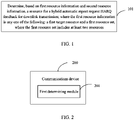
- FIG. 1 is a flowchart of a resource determining method according to an embodiment of this disclosure.
- the resource determining method in this embodiment of this disclosure may be applied to a communications device.
- the communications device may be a terminal or a network-side device.
- the terminal may be a mobile phone, a tablet personal computer (Tablet Personal Computer), a laptop computer (Laptop Computer), a personal digital assistant (Personal Digital Assistant, PDA), a mobile internet device (Mobile Internet Device, MID), a wearable device (Wearable Device), or an in-vehicle device.
- the network-side device may be a base station, a relay, or an access point.
- the resource determining method may include the following steps.
- Step 101 Determine, based on first resource information and second resource information, a resource for a hybrid automatic repeat request HARQ feedback for downlink transmission; where the first resource information is any one of the following: a first target resource and a first resource set, where the first resource set includes at least two resources.
- the first target resource may include the following representations.
- the first target resource may be a resource in the first resource set, which means that the first target resource may come from the first resource set, where the first resource set is determined based on a target rule.
- the first target resource may be a resource in a second resource set, which means that the first target resource may come from the second resource set, where the second resource set may be a default or predefined resource set.
- the first target resource may be a standalone resource, independent of a resource set.
- a resource set may not be obtained by the communications device.
- the first target resource may be determined and indicated to a terminal by a network-side device.
- the method before the determining, based on first resource information and second resource information, a resource for a hybrid automatic repeat request HARQ feedback for downlink transmission, the method further includes: transmitting third information, where the third information indicates the first target resource.
- the third information may be medium access control (Medium Access Control, MAC) information, DCI, or radio resource control RRC information.
- Medium Access Control Medium Access Control, MAC
- DCI Downlink Control
- RRC Radio Resource Control
- the communications device may transmit, on the resource for feedback, a HARQ for the downlink transmission. Specifically, for the terminal, a HARQ for the downlink transmission is fed back on the resource for feedback; and for the network-side device, the HARQ for the downlink transmission is received on the resource for feedback.
- the resource for feedback may include at least one of the following: a time-domain resource for feedback; a frequency-domain resource for feedback; and a PUCCH resource for carrying the HARQ for the downlink transmission.
- the time-domain resource for feedback may be a slot, sub-slot, sub-frame or symbol in which the HARQ for the downlink transmission is located.
- the downlink transmission may be a PDSCH transmission, but is not limited thereto.
- the communications device can determine, based on first resource information and second resource information, a resource for a hybrid automatic repeat request HARQ feedback for downlink transmission; where the first resource information is any one of the following: a first target resource and a first resource set, where the first resource set includes at least two resources, so that flexibility in determining a resource for a HARQ feedback can be improved.
- the second resource information may have the following representations.
- the second resource information is a resource offset with respect to the first target resource.
- the determining, based on first resource information and second resource information, a resource for a hybrid automatic repeat request HARQ feedback for downlink transmission includes:
- the target value for determining a time-domain resource for feedback may be represented as a value of K1.
- the target value for determining a frequency-domain resource for feedback the target value may be represented as a value of F1.
- the target value for determining a PUCCH resource within one time unit may be represented as PRI1, and PRI is used to indicate the PUCCH resource within one time unit.
- the time unit may be a slot, sub-slot, sub-frame or symbol.
- the following describes determining of a time-domain resource for feedback, a frequency-domain resource for feedback, and a PUCCH resource, respectively.
- the first target resource is denoted as k2, and the resource offset is denoted as ⁇ k.
- the communications device may determine a time-domain resource for a HARQ feedback for downlink transmission in combination with a time location in which the terminal received the downlink transmission.
- a unit of K1, k2, and ⁇ k may be the same as a unit for the time location in which the terminal received the downlink transmission.
- the unit for the time location in which the terminal received the downlink transmission is slot
- the unit of K1, k2, and ⁇ k also is slot.
- the time unit may be another representation such as a symbol or a sub-frame, which may be determined based on an actual requirement. This is not limited in the embodiments of this disclosure.
- T The time location in which the terminal received the downlink transmission
- T the time-domain resource for the HARQ feedback for the downlink transmission
- the unit for the time location in which the terminal received the downlink transmission is slot. If the terminal received the downlink transmission in slot m, a location for the HARQ feedback for the downlink transmission is slot (m+k2+ ⁇ k).
- the first target resource is denoted as f2, and the resource offset is denoted as ⁇ f.
- a unit of f2 and ⁇ f may be the same as a unit of F1.
- the communications device may determine a frequency-domain resource for a HARQ feedback for downlink transmission in combination with a frequency-domain resource for receiving the downlink transmission by the terminal.
- the first target resource is denoted as PRI2, and the resource offset is denoted as ⁇ PRI.
- the communications device may first determine, based on the number of bits of a HARQ, a target RESET. Then, a target resource within the target RESET is determined based on PRI1, and the target resource is a frequency-domain resource for a HARQ feedback.
- the second resource information may be determined at least by using the following two manners.
- the method further includes:
- the terminal and the network-side device may separately determine, based on an arrangement location of first information of a terminal in a downlink message, the resource offset. It should be noted that, to ensure that the resource offsets determined by the terminal and the network-side device are the same, the terminal and the network-side device determine, based on the arrangement location, the resource offset in a same manner.
- the communications device may use a preset rule to determine, based on the arrangement position of the first information of the terminal in the downlink message, the resource offset.
- resource offset of the j-th terminal group resource offset of the (j-1)-th terminal group+b.
- the N terminals are divided in units of P terminals to obtain Q terminal groups, where Q is a rounding-up value of N/P; the resource offset for the first terminal group is 0; and j is an integer greater than 1 and less than or equal to Q. It should be understood that a resource offset is the same for each terminal in a same terminal group.
- the N terminals include terminal 1, terminal 2, terminal 3, terminal 4 and terminal 5, and an arrangement order of first information of the N terminals in the downlink message is: first information of terminal 1, first information of terminal 2, first information of terminal 3, first information of terminal 4, and first information of terminal 5; and that P is 2.
- the N terminals can be divided into 3 terminal groups, where the first terminal group includes terminal 1 and terminal 2, the second terminal group includes terminal 3 and terminal 4, and the third terminal group includes terminal 5.
- a resource offset for the first terminal group is 0, so that the offsets for terminal 1 and terminal 2 are both 0; a resource offset for the second terminal group is b, and the offset for terminal 3 and terminal 4 are both b; and a resource offset for the third terminal group is 2b, so that the resource offset for terminal 5 is 2b.
- a value of P in the process of determining a time-domain resource for feedback by using the preset rule may be different from or the same as a value of P in the process of determining a frequency-domain resource for feedback by using the preset rule.
- a value of b in the process of determining a time-domain resource for feedback by using the preset rule may be different from or the same as a value of b in the process of determining a frequency-domain resource for feedback by using the preset rule.
- P can be configured by a network-side device or predetermined by a protocol; and b may also be configured by the network-side device or predetermined by the protocol.
- the preset rule is configured by a network-side device or is specified by a protocol.
- the preset rule may have many representations.
- the foregoing floor function is a rounding-down function
- the foregoing mod function is a remainder function
- the preset rule may alternatively be expressed by another calculation equation, which may be determined based on an actual requirement. This is not limited in the embodiments of this disclosure.
- the downlink message may be a random access response message in a random access procedure.
- the downlink message may be the MsgB in a 2-step random access procedure.
- the first information may be a random access response RAR included in a random access response message, and specifically, may be the random access response (for example, success RAR) included in the MsgB.
- the method further includes: performing transmission of second information, where the second information is used to indicate the resource offset.
- the resource offset may be determined and indicated to a terminal by a network-side device.
- the transmitting second information may specifically be: sending the second information; and for the terminal, the transmitting second information may specifically be: receiving the second information.
- the second information may carry the resource offsets for M terminals, and M is a positive integer. Further, in a case that M is greater than 1, the resource offsets for different terminals may be different. Certainly, the resource offsets for some terminals may alternatively be the same, which may be specifically determined based on an actual situation. This is not limited in the embodiments of this disclosure.
- a first terminal may determine, based on a resource offset corresponding to the first terminal in the second information, a resource for the HARQ feedback for the downlink transmission.
- the resource offset may be a value or a range.
- a resource for feedback determined based on the resource offset is also a range.
- the communications device may directly retransmit a HARQ on the resource for feedback, without need to determine the resource for feedback, so that HARQ transmission efficiency can be improved; and in a case that the resource for feedback includes unlicensed resources, the communications device can choose to transmit a HARQ on a licensed resource included in the resource for feedback, so that a success rate of the HARQ transmission can be improved.
- the second information may be MAC information.
- the second information may be carried in a random access response message corresponding to the random access procedure.
- the second information may be information carried in the MsgB in a 2-step random access procedure.
- the second information may be an RAR included in a random access response message, specifically may be a Success RAR included in the MsgB, or may be one piece of information contained in the random access response message, for indicating a resource offset.
- the second resource information is a second target resource in the first resource set.
- the determining, based on first resource information and second resource information, a resource for a hybrid automatic repeat request HARQ feedback for downlink transmission includes:
- the determining, based on a second target resource in the first resource set, a target value may include the following two implementations.
- the determining, based on a second target resource in the first resource set, a target value includes: determining the second target resource as the target value.
- the determining, based on a second target resource in the first resource set, a target value includes: determining, based on the second target resource and the resource offset, a target value.
- the second target resource is denoted as k3, and the resource offset is denoted as ⁇ k.
- the second target resource is denoted as f3, and the resource offset is denoted as ⁇ f.
- the second target resource is denoted as PRI3, and the resource offset is denoted as ⁇ PRI.
- PRI1 PRI3+ ⁇ PRI.
- the second target resource and the first target resource may be the same or different.
- This embodiment provides a new method to determine a resource set.
- the method further includes:
- the target rule includes the first rule.
- a correspondence between a subcarrier spacing (Subcarrier Spacing, SCS) and a resource set may be predefined. Further, in the correspondence, different SCSs may correspond to different resource sets.
- the determining, based on a target rule, the first resource set includes: determining a resource set corresponding to the SCS of the terminal as the first resource set.
- the SCS of the terminal may be an SCS used for uplink transmission or HARQ-ACK feedback performed by the terminal.
- the target rule includes the second rule.
- a correspondence between a frequency range (Frequency Range, FR) and a resource set may be predefined. Further, in the correspondence, different FRs may correspond to different resource sets.
- the determining, based on a target rule, the first resource set includes: determining a resource set corresponding to the FR of the terminal as the first resource set.
- the FR of the terminal may be an FR used for uplink transmission or HARQ-ACK feedback performed by the terminal.
- the target rule includes the third rule.
- the determining, based on a target rule, the first resource set includes at least one of the following:
- the target rule includes the fourth rule.
- a correspondence between a random access type and a resource set may be predefined. Further, different random access types correspond to different resource sets.
- the determining, based on a target rule, the first resource set includes at least one of the following:
- both the first target resource set and the second target resource set may be resource sets determined based on a target rule; and in another implementation, the first target resource set may be a default or predefined resource set, and the second target resource set may be a resource set determined based on a target rule.
- the second target resource in this embodiment may be the same as or different from the first target resource in this embodiment.
- the second resource information is void, which means that the second resource information makes no contribution to the determining of a resource for a HARQ feedback. This case is applicable to a case in which the first target resource is a standalone resource, independent of a resource set.
- This embodiment of this disclosure may include the following two major types of implementations.
- the first type of implementations includes the following implementations:
- the second type of implementations includes the following implementations:
- This embodiment of this disclosure may include the following two methods.
- a determined K1 that is the determined time unit in which the PUCCH is located, optionally:
- a set corresponding to resources for the HARQ-ACK feedback is determined based on at least one of the following:
- K1 set 1 may be a default K1 set for the related art.
- a network-side device sends DCI format 1_0 to schedule a PDSCH, and the PDSCH carries MsgB.
- the MsgB includes Success RAR messages of 4 UEs, which are arranged in the order of UE1, UE2, UE3, and UE4.
- the UE detects the DCI in slot n.
- the DCI indicates that a HARQ-ACK feedback time (that is K1) is k, so that a feedback time of corresponding HARQ-ACK information needs to be determined by using slot n+k as a reference point.
- a predefined rule is that K1 increases by 1 every other UE according to the arrangement order of the Success RARs in the MsgB.
- UE1 is the UE corresponding to the first Success RAR included in the MsgB. After receiving and decoding the MsgB, UE1 determines that UE1 is the UE corresponding to the first Success RAR included in the MsgB, and then determines, based on the rule, that a time at which the HARQ-ACK is fed back is slot n+k+0.
- UE2 is the UE corresponding to the second Success RAR included in the MsgB.
- UE1 determines that UE2 is the UE corresponding to the second Success RAR included in the MsgB, and then determines, based on the rule, that a time at which the HARQ-ACK is fed back is slot n+k+1.
- UE4 is the UE corresponding to the fourth Success RAR included in the MsgB.
- UE1 determines that UE4 is the UE corresponding to the fourth Success RAR included in the MsgB, and then determines, based on the rule, that a time at which the HARQ-ACK is fed back is slot n+k+3.
- different frequency-domain PUCCH resources are used as examples.
- the UE detects the DCI in slot n.
- the DCI indicates that a resource for a HARQ-ACK feedback is PUCCH resource 1 (that is, a serial number is k), so that a resource for corresponding HARQ-ACK information feedback needs to be determined by using PUCCH resource 1 as a reference point at slot n+k.
- a predefined rule is that k increases by 1 every other UE according to the arrangement order of the Success RARs in the MsgB.
- UE1 is the UE corresponding to the first Success RAR included in the MsgB. After receiving and decoding the MsgB, UE1 determines that UE1 is the UE corresponding to the first Success RAR included in the MsgB, and then determines, based on the rule, that a resource for the fed-back HARQ-ACK is PUCCH resource k+0.
- UE2 is the UE corresponding to the second Success RAR included in the MsgB.
- UE1 determines that UE2 is the UE corresponding to the second Success RAR included in the MsgB, and then determines, based on the rule, that a resource for the fed-back HARQ-ACK is PUCCH resource k+1.
- UE4 is the UE corresponding to the fourth Success RAR included in the MsgB.
- UE1 determines that UE4 is the UE corresponding to the fourth Success RAR included in the MsgB, and then determines, based on the rule, that a resource for the fed-back HARQ-ACK is PUCCH resource k+3.
- Table 1 Correspondence between an SCS and a HARQ-ACK feedback time set Subcarrier spacing HARQ-ACK feedback time set 15 kHz ⁇ A1, A2, A3, A4, A5, A6, A7, A8 ⁇ 30 kHz ⁇ B1, B2, B3, B4, B5, B6, B7, B8 ⁇ 60 kHz ⁇ C1, C2, C3, C4, C5, C6, C7, C8 ⁇ 120 kHz ⁇ D1, D2, D3, D4, D5, D6, D7, D8 ⁇
- the UE selects a corresponding HARQ-ACK feedback time set according to an SCS for an uplink feedback.
- an index in a HARQ-ACK feedback time set indicated in the DCI is 3, and a subcarrier spacing of a PUCCH fed back by the UE is 30 kilohertz (kHz).
- the HARQ feedback time set corresponding to 30 kHz the HARQ feedback time is determined as B3, which means that the HARQ-ACK is fed back at slot n+B3.
- a network-side device sends DCI format 1_0 to schedule a PDSCH, and the PDSCH carries MsgB.
- the MsgB includes Success RAR messages of 4 UEs, which are arranged in the order of UE1, UE2, UE3, and UE4.
- the UE detects the DCI in slot n.
- the DCI indicates that a HARQ-ACK feedback time (that is K1) is k, so that a feedback time of corresponding HARQ-ACK information needs to be determined by using slot n+k as a reference point.
- respective HARQ-ACK feedback time K1' of UE1 to UE4 is included.
- the embodiment of this disclosure can more flexibly indicate the resource for the HARQ-ACK feedback of the PDSCH before the RRC connection is established.
- FIG. 2 is a first structural diagram of a communications device according to an embodiment of this disclosure. As shown in FIG. 2 , the communications device 200 includes:
- the second resource information is a resource offset with respect to the first target resource.
- the communications device 200 further includes a second determining module, configured to: before the first determining module 201 determines, based on the first resource information and the second resource information, the resource for a hybrid automatic repeat request HARQ feedback for downlink transmission, determine, based on an arrangement location of first information of a terminal in a downlink message, the resource offset; where the downlink message includes first information of N terminals, where N is an integer greater than 1.
- the communications device 200 further includes a first transmission module, configured to: before the first determining module 201 determines, based on first resource information and second resource information, a resource for a hybrid automatic repeat request HARQ feedback for downlink transmission, perform transmission of second information, where the second information is used to indicate the resource offset.
- a first transmission module configured to: before the first determining module 201 determines, based on first resource information and second resource information, a resource for a hybrid automatic repeat request HARQ feedback for downlink transmission, perform transmission of second information, where the second information is used to indicate the resource offset.
- the second information is medium access control MAC information.
- the first target resource is a resource in the first resource set.
- the second resource information is a second target resource in the first resource set.
- the communications device 200 further includes:
- the communications device 200 further includes a second transmission module, configured to: before the first determining module 201 determines, based on first resource information and second resource information, a resource for a hybrid automatic repeat request HARQ feedback for downlink transmission, transmit third information, where the third information is used to indicate the first target resource.
- a second transmission module configured to: before the first determining module 201 determines, based on first resource information and second resource information, a resource for a hybrid automatic repeat request HARQ feedback for downlink transmission, transmit third information, where the third information is used to indicate the first target resource.
- the third information is MAC information, DCI, or radio resource control RRC information.
- the communications device 200 is capable of implementing the processes implemented by the communications device 200 in the method embodiment of this disclosure, with the same beneficial effects achieved. To avoid repetition, details are not described herein again.
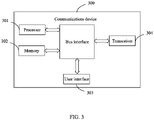
- FIG. 3 is a second structural diagram of a communications device according to an embodiment of this disclosure.
- the communications device 300 includes a processor 301, a memory 302, a user interface 303, a transceiver 304, and a bus interface.
- the communications device 300 further includes a computer program stored in the memory 302 and capable of running on the processor 301.
- the computer program is executed by the processor 301, the following steps are implemented:
- a bus architecture may include any quantity of interconnected buses and bridges, and specifically connects together circuits that are of one or more processors represented by the processor 301 and of a memory represented by the memory 302.
- the bus architecture may further interconnect various other circuits such as a peripheral device, a voltage regulator, and a power management circuit. These are all well known in the art, and therefore are not further described in this specification.
- the bus interface provides interfaces.
- the transceiver 304 may be a plurality of components, including a transmitter and a receiver, and provides units for communicating with various other apparatuses on a transmission medium.
- the user interface 303 may also be an interface that can be externally or internally connected to a required device, and the connected device includes but is not limited to a keypad, a display, a speaker, a microphone, a joystick, and the like.
- the processor 301 is responsible for bus architecture management and general processing.
- the memory 302 may store data used when the processor 301 performs an operation.
- the second resource information is a resource offset with respect to the first target resource.
- the following steps may be further implemented: performing transmission of second information by using the transceiver 304, where the second information is used to indicate the resource offset.
- the second information is medium access control MAC information.
- the first target resource is a resource in the first resource set.
- the second resource information is a second target resource in the first resource set.
- the following steps may be further implemented: transmitting third information by using the transceiver 304, where the third information indicates the first target resource.
- the third information is MAC information, DCI, or radio resource control RRC information.
- the communications device 300 can implement the processes implemented by the communications device in the foregoing method embodiments. To avoid repetition, details are not described herein again.
- An embodiment of this disclosure further provides a computer-readable storage medium, where a computer program is stored in the computer readable storage medium.
- a computer program is stored in the computer readable storage medium.
- the computer program is executed by a processor, the processes of the foregoing embodiments of the resource determining method are implemented, with the same technical effects achieved. To avoid repetition, details are not described herein again.
- the computer-readable storage medium is a read-only memory (Read-Only Memory, ROM), a random access memory (Random Access Memory, RAM), a magnetic disk, or an optical disc.
- the method in the foregoing embodiments may be implemented by software in addition to a necessary universal hardware platform or by hardware only. In most cases, the former is a preferred implementation.
- the technical solutions of this disclosure essentially or the part thereof that contributes to related technologies may be embodied in a form of a software product.
- the computer software product is stored in a storage medium (for example, a ROM/RAM, a magnetic disk, or an optical disc), and includes several instructions for instructing a communications device (which may be a mobile phone, a computer, a server, an air conditioner, a network device, or the like) to perform the method described in the embodiments of this disclosure.
- the disclosed apparatus and method may be implemented in other manners.
- the described apparatus embodiment is merely an example.
- the unit division is merely logical function division and may be other division in actual implementation.
- a plurality of units or components may be combined or integrated into another system, or some features may be ignored or may not be performed.
- the displayed or discussed mutual couplings or direct couplings or communication connections may be indirect couplings or communication connections through some interfaces, apparatuses or units, and may be implemented in electrical, mechanical, or other forms.
- the functions When the functions are implemented in a form of a software functional unit and sold or used as an independent product, the functions may be stored in a computer-readable medium. Based on such an understanding, the technical solutions of this disclosure essentially, or the part contributing to the related art may be implemented in a form of a software product.
- the software product is stored in a storage medium, and includes several instructions for instructing a computer device (which may be a personal computer, a server, a network device, or the like) to perform all or some of the steps of the methods described in the embodiments of this disclosure.
- the foregoing storage medium includes: any medium that can store program code, such as a USB flash drive, a removable hard disk, a ROM, a RAM, a magnetic disk, or an optical disc.
Landscapes
- Engineering & Computer Science (AREA)
- Signal Processing (AREA)
- Computer Networks & Wireless Communication (AREA)
- Physics & Mathematics (AREA)
- Mathematical Physics (AREA)
- Mobile Radio Communication Systems (AREA)
- Data Exchanges In Wide-Area Networks (AREA)
Applications Claiming Priority (2)
| Application Number | Priority Date | Filing Date | Title |
|---|---|---|---|
| CN201910927105.4A CN112583543B (zh) | 2019-09-27 | 2019-09-27 | 资源确定方法及通信设备 |
| PCT/CN2020/118066 WO2021057964A1 (zh) | 2019-09-27 | 2020-09-27 | 资源确定方法及通信设备 |
Publications (2)
| Publication Number | Publication Date |
|---|---|
| EP4044486A1 true EP4044486A1 (de) | 2022-08-17 |
| EP4044486A4 EP4044486A4 (de) | 2022-12-28 |
Family
ID=75110062
Family Applications (1)
| Application Number | Title | Priority Date | Filing Date |
|---|---|---|---|
| EP20869970.2A Pending EP4044486A4 (de) | 2019-09-27 | 2020-09-27 | Ressourcenbestimmungsverfahren und kommunikationsvorrichtung |
Country Status (7)
| Country | Link |
|---|---|
| US (1) | US12328191B2 (de) |
| EP (1) | EP4044486A4 (de) |
| JP (1) | JP7443503B2 (de) |
| KR (1) | KR102795898B1 (de) |
| CN (1) | CN112583543B (de) |
| BR (1) | BR112022005644A2 (de) |
| WO (1) | WO2021057964A1 (de) |
Families Citing this family (2)
| Publication number | Priority date | Publication date | Assignee | Title |
|---|---|---|---|---|
| CN113518458B (zh) * | 2020-04-09 | 2024-11-19 | 北京三星通信技术研究有限公司 | 上行数据和控制信息的传输方法及其设备 |
| CN115996441A (zh) * | 2021-10-18 | 2023-04-21 | 上海朗帛通信技术有限公司 | 一种被用于无线通信的节点中的方法和装置 |
Family Cites Families (16)
| Publication number | Priority date | Publication date | Assignee | Title |
|---|---|---|---|---|
| CN102271032B (zh) | 2011-08-09 | 2014-11-19 | 电信科学技术研究院 | 一种实现上行反馈的方法、系统及装置 |
| DK2901793T3 (en) * | 2012-09-27 | 2017-02-13 | ERICSSON TELEFON AB L M (publ) | METHODS AND SYSTEMS FOR TDD-PUCCH-HARQ RESOURCE ALLOCATION FOR ENHANCED PHYSICAL DOWNLINK CONTROL CHANNEL (EPDCCH) |
| US11245507B2 (en) * | 2012-11-02 | 2022-02-08 | Texas Instruments Incorporated | Efficient allocation of uplink HARQ-ACK resources for LTE enhanced control channel |
| JP6006881B2 (ja) * | 2013-01-31 | 2016-10-12 | エルジー エレクトロニクス インコーポレイティド | 無線通信システムにおいて受信確認応答送信方法及び装置 |
| CN107332646B (zh) * | 2016-04-29 | 2021-05-11 | 中兴通讯股份有限公司 | Harq-ack的发送方法及装置 |
| CN108075864B (zh) * | 2016-11-15 | 2021-02-05 | 中国电信股份有限公司 | Ack/nack的反馈方法、系统以及终端 |
| CN115208540B (zh) * | 2017-01-08 | 2024-10-15 | Lg电子株式会社 | 在无线通信系统中发送或接收上行链路信号的方法和设备 |
| WO2018169937A1 (en) * | 2017-03-15 | 2018-09-20 | Intel IP Corporation | Determination of new radio (nr) physical uplink control channel(pucch) resource for hybrid automatic repeat request acknowledgement (harq-ack) feedback |
| CN109121205B (zh) * | 2017-06-22 | 2021-08-24 | 维沃移动通信有限公司 | 一种资源指示方法、移动终端及基站 |
| CN109586857B (zh) * | 2017-09-29 | 2021-07-13 | 中国移动通信有限公司研究院 | 一种harq反馈方法、传输方法、终端及网络侧设备 |
| US20210184801A1 (en) * | 2017-11-15 | 2021-06-17 | Idac Holdings, Inc. | Method and apparatus for harq-ack codebook size determination and resource selection in nr |
| CN109802763B (zh) * | 2017-11-16 | 2020-07-07 | 展讯通信(上海)有限公司 | 一种反馈的方法以及设备 |
| US20200280400A1 (en) * | 2017-11-24 | 2020-09-03 | Nokia Technologies Oy | Transmission of Extra Information |
| CN110034866B (zh) * | 2018-01-12 | 2020-08-07 | 华为技术有限公司 | 一种用于反馈的方法、装置及计算机存储介质 |
| WO2019138555A1 (ja) | 2018-01-12 | 2019-07-18 | 株式会社Nttドコモ | ユーザ端末及び無線通信方法 |
| WO2021060915A1 (ko) * | 2019-09-25 | 2021-04-01 | 엘지전자 주식회사 | 비면허 대역에서 임의 접속 과정에 기반하여 하향링크 신호를 수신하는 방법 및 이를 위한 장치 |
-
2019
- 2019-09-27 CN CN201910927105.4A patent/CN112583543B/zh active Active
-
2020
- 2020-09-27 JP JP2022519359A patent/JP7443503B2/ja active Active
- 2020-09-27 KR KR1020227013574A patent/KR102795898B1/ko active Active
- 2020-09-27 WO PCT/CN2020/118066 patent/WO2021057964A1/zh not_active Ceased
- 2020-09-27 BR BR112022005644A patent/BR112022005644A2/pt unknown
- 2020-09-27 EP EP20869970.2A patent/EP4044486A4/de active Pending
-
2022
- 2022-03-24 US US17/703,409 patent/US12328191B2/en active Active
Also Published As
| Publication number | Publication date |
|---|---|
| WO2021057964A1 (zh) | 2021-04-01 |
| KR20220069066A (ko) | 2022-05-26 |
| JP7443503B2 (ja) | 2024-03-05 |
| CN112583543A (zh) | 2021-03-30 |
| JP2022549902A (ja) | 2022-11-29 |
| BR112022005644A2 (pt) | 2022-07-19 |
| US12328191B2 (en) | 2025-06-10 |
| CN112583543B (zh) | 2022-08-02 |
| KR102795898B1 (ko) | 2025-04-16 |
| EP4044486A4 (de) | 2022-12-28 |
| US20220216951A1 (en) | 2022-07-07 |
Similar Documents
| Publication | Publication Date | Title |
|---|---|---|
| EP3847846B1 (de) | Verfahren und vorrichtungen für kleine datenübertragungen | |
| EP3198973B1 (de) | Wiederholte übertragung einer einplanungszuweisung für zufallszugriffsantwort | |
| US10581578B2 (en) | Feedback information transmission method, base station, and user equipment | |
| US10721759B2 (en) | Method for transmitting uplink data, user equipment, and base station | |
| US10285136B2 (en) | Power allocation method and apparatus | |
| CN102843732B (zh) | 一种时分双工tdd通信方法、基站和用户设备 | |
| WO2014101233A1 (zh) | 信息传输方法和装置 | |
| EP3364583A1 (de) | Informationsübertragungsverfahren, endgerät und basisstation | |
| EP3349498B1 (de) | Datenübertragungsverfahren eines systems, benutzergerät und basisstation | |
| CN113439467B (zh) | 在终端和无线网络节点之间的通信 | |
| US12328191B2 (en) | Resource determining method and communications device | |
| KR102197444B1 (ko) | 다운 링크 데이터에 대한 피드백을 위한 방법 및 장치 | |
| WO2018010497A1 (zh) | 一种混合自动重传请求进程处理方法、设备及通信系统 | |
| CN111867124B (zh) | 一种随机接入的方法和设备 | |
| WO2015062477A1 (zh) | 一种数据传输方法及设备 | |
| EP4096129B1 (de) | Kommunikationsverfahren und -vorrichtung | |
| US10624123B2 (en) | PRACH access control method, and access method and device | |
| WO2023179743A1 (zh) | 随机接入方法及装置、计算机可读存储介质 | |
| EP3383084B1 (de) | Verfahren, vorrichtung und system zum senden und empfangen von informationen | |
| EP3185608A1 (de) | Multimedia-datenübertragungsverfahren und netzwerkvorrichtung | |
| KR20190034036A (ko) | 복합 재전송 동작을 수행하는 전자 장치 및 방법 |
Legal Events
| Date | Code | Title | Description |
|---|---|---|---|
| STAA | Information on the status of an ep patent application or granted ep patent |
Free format text: STATUS: THE INTERNATIONAL PUBLICATION HAS BEEN MADE |
|
| PUAI | Public reference made under article 153(3) epc to a published international application that has entered the european phase |
Free format text: ORIGINAL CODE: 0009012 |
|
| STAA | Information on the status of an ep patent application or granted ep patent |
Free format text: STATUS: REQUEST FOR EXAMINATION WAS MADE |
|
| 17P | Request for examination filed |
Effective date: 20220426 |
|
| AK | Designated contracting states |
Kind code of ref document: A1 Designated state(s): AL AT BE BG CH CY CZ DE DK EE ES FI FR GB GR HR HU IE IS IT LI LT LU LV MC MK MT NL NO PL PT RO RS SE SI SK SM TR |
|
| A4 | Supplementary search report drawn up and despatched |
Effective date: 20221129 |
|
| RIC1 | Information provided on ipc code assigned before grant |
Ipc: H04W 72/04 20090101ALI20221123BHEP Ipc: H04L 1/18 20060101ALI20221123BHEP Ipc: H04L 5/00 20060101AFI20221123BHEP |
|
| DAV | Request for validation of the european patent (deleted) | ||
| DAX | Request for extension of the european patent (deleted) | ||
| STAA | Information on the status of an ep patent application or granted ep patent |
Free format text: STATUS: EXAMINATION IS IN PROGRESS |
|
| 17Q | First examination report despatched |
Effective date: 20250904 |