EP4043897A1 - Simulation system and data distribution method - Google Patents
Simulation system and data distribution method Download PDFInfo
- Publication number
- EP4043897A1 EP4043897A1 EP20911771.2A EP20911771A EP4043897A1 EP 4043897 A1 EP4043897 A1 EP 4043897A1 EP 20911771 A EP20911771 A EP 20911771A EP 4043897 A1 EP4043897 A1 EP 4043897A1
- Authority
- EP
- European Patent Office
- Prior art keywords
- data
- capacity degradation
- model module
- value
- defect rate
- Prior art date
- Legal status (The legal status is an assumption and is not a legal conclusion. Google has not performed a legal analysis and makes no representation as to the accuracy of the status listed.)
- Granted
Links
Images



Classifications
-
- G—PHYSICS
- G01—MEASURING; TESTING
- G01R—MEASURING ELECTRIC VARIABLES; MEASURING MAGNETIC VARIABLES
- G01R31/00—Arrangements for testing electric properties; Arrangements for locating electric faults; Arrangements for electrical testing characterised by what is being tested not provided for elsewhere
- G01R31/36—Arrangements for testing, measuring or monitoring the electrical condition of accumulators or electric batteries, e.g. capacity or state of charge [SoC]
- G01R31/392—Determining battery ageing or deterioration, e.g. state of health
-
- B—PERFORMING OPERATIONS; TRANSPORTING
- B60—VEHICLES IN GENERAL
- B60L—PROPULSION OF ELECTRICALLY-PROPELLED VEHICLES; SUPPLYING ELECTRIC POWER FOR AUXILIARY EQUIPMENT OF ELECTRICALLY-PROPELLED VEHICLES; ELECTRODYNAMIC BRAKE SYSTEMS FOR VEHICLES IN GENERAL; MAGNETIC SUSPENSION OR LEVITATION FOR VEHICLES; MONITORING OPERATING VARIABLES OF ELECTRICALLY-PROPELLED VEHICLES; ELECTRIC SAFETY DEVICES FOR ELECTRICALLY-PROPELLED VEHICLES
- B60L58/00—Methods or circuit arrangements for monitoring or controlling batteries or fuel cells, specially adapted for electric vehicles
- B60L58/10—Methods or circuit arrangements for monitoring or controlling batteries or fuel cells, specially adapted for electric vehicles for monitoring or controlling batteries
- B60L58/16—Methods or circuit arrangements for monitoring or controlling batteries or fuel cells, specially adapted for electric vehicles for monitoring or controlling batteries responding to battery ageing, e.g. to the number of charging cycles or the state of health [SoH]
-
- B—PERFORMING OPERATIONS; TRANSPORTING
- B60—VEHICLES IN GENERAL
- B60L—PROPULSION OF ELECTRICALLY-PROPELLED VEHICLES; SUPPLYING ELECTRIC POWER FOR AUXILIARY EQUIPMENT OF ELECTRICALLY-PROPELLED VEHICLES; ELECTRODYNAMIC BRAKE SYSTEMS FOR VEHICLES IN GENERAL; MAGNETIC SUSPENSION OR LEVITATION FOR VEHICLES; MONITORING OPERATING VARIABLES OF ELECTRICALLY-PROPELLED VEHICLES; ELECTRIC SAFETY DEVICES FOR ELECTRICALLY-PROPELLED VEHICLES
- B60L53/00—Methods of charging batteries, specially adapted for electric vehicles; Charging stations or on-board charging equipment therefor; Exchange of energy storage elements in electric vehicles
- B60L53/50—Charging stations characterised by energy-storage or power-generation means
- B60L53/53—Batteries
-
- B—PERFORMING OPERATIONS; TRANSPORTING
- B60—VEHICLES IN GENERAL
- B60L—PROPULSION OF ELECTRICALLY-PROPELLED VEHICLES; SUPPLYING ELECTRIC POWER FOR AUXILIARY EQUIPMENT OF ELECTRICALLY-PROPELLED VEHICLES; ELECTRODYNAMIC BRAKE SYSTEMS FOR VEHICLES IN GENERAL; MAGNETIC SUSPENSION OR LEVITATION FOR VEHICLES; MONITORING OPERATING VARIABLES OF ELECTRICALLY-PROPELLED VEHICLES; ELECTRIC SAFETY DEVICES FOR ELECTRICALLY-PROPELLED VEHICLES
- B60L58/00—Methods or circuit arrangements for monitoring or controlling batteries or fuel cells, specially adapted for electric vehicles
- B60L58/10—Methods or circuit arrangements for monitoring or controlling batteries or fuel cells, specially adapted for electric vehicles for monitoring or controlling batteries
- B60L58/24—Methods or circuit arrangements for monitoring or controlling batteries or fuel cells, specially adapted for electric vehicles for monitoring or controlling batteries for controlling the temperature of batteries
- B60L58/26—Methods or circuit arrangements for monitoring or controlling batteries or fuel cells, specially adapted for electric vehicles for monitoring or controlling batteries for controlling the temperature of batteries by cooling
-
- G—PHYSICS
- G01—MEASURING; TESTING
- G01R—MEASURING ELECTRIC VARIABLES; MEASURING MAGNETIC VARIABLES
- G01R31/00—Arrangements for testing electric properties; Arrangements for locating electric faults; Arrangements for electrical testing characterised by what is being tested not provided for elsewhere
- G01R31/36—Arrangements for testing, measuring or monitoring the electrical condition of accumulators or electric batteries, e.g. capacity or state of charge [SoC]
- G01R31/3644—Constructional arrangements
- G01R31/3648—Constructional arrangements comprising digital calculation means, e.g. for performing an algorithm
-
- G—PHYSICS
- G01—MEASURING; TESTING
- G01R—MEASURING ELECTRIC VARIABLES; MEASURING MAGNETIC VARIABLES
- G01R31/00—Arrangements for testing electric properties; Arrangements for locating electric faults; Arrangements for electrical testing characterised by what is being tested not provided for elsewhere
- G01R31/36—Arrangements for testing, measuring or monitoring the electrical condition of accumulators or electric batteries, e.g. capacity or state of charge [SoC]
- G01R31/367—Software therefor, e.g. for battery testing using modelling or look-up tables
-
- Y—GENERAL TAGGING OF NEW TECHNOLOGICAL DEVELOPMENTS; GENERAL TAGGING OF CROSS-SECTIONAL TECHNOLOGIES SPANNING OVER SEVERAL SECTIONS OF THE IPC; TECHNICAL SUBJECTS COVERED BY FORMER USPC CROSS-REFERENCE ART COLLECTIONS [XRACs] AND DIGESTS
- Y02—TECHNOLOGIES OR APPLICATIONS FOR MITIGATION OR ADAPTATION AGAINST CLIMATE CHANGE
- Y02E—REDUCTION OF GREENHOUSE GAS [GHG] EMISSIONS, RELATED TO ENERGY GENERATION, TRANSMISSION OR DISTRIBUTION
- Y02E60/00—Enabling technologies; Technologies with a potential or indirect contribution to GHG emissions mitigation
- Y02E60/10—Energy storage using batteries
Definitions
- the present disclosure relates to a simulation system and a data distribution method.
- the degeneration prediction through the software simulation method may be performed by calculating a scenario in advance and by configuring layers considering a current, an ECM (Equivalent Circuit Model), heat, and aging by fixing the virtual input value.
- ECM Equivalent Circuit Model
- the software simulation method is preferred, and the predicted battery degradation is used to determine the battery warranty period.
- a hybrid, an electric vehicle, etc. are in a development stage, and there is not enough data on the input value, so power / temperature /a driving mode etc. are converted into input values to and used based on a driving data of gasoline vehicles.
- the present disclosure is to provide a simulation system and a data distribution method that may improve accuracy and efficiency in a battery cycle-life prediction.
- a simulation system of the present invention for performing an experiment on a battery pack including a plurality of battery cells by using at least one experimental device includes an loT device that receives input and output of at least one experimental device, and pre-processes the input and the output to generate an input data and output data; an edge computing device predicting information for predicting a capacity degradation value of a plurality of battery cells by using an equivalent circuit model module and a thermal model module based on a data received among the input data and the output data; and a server that receives the predicted information from the edge computing device, predicts a capacity degradation value of a plurality of battery cells by using an aging model module, and predicts a defect rate based on the predicted capacity degradation values.
- the equivalent circuit model module may receive at least one among a battery pack voltage, an initial SOC, a current flowing to the battery pack, a temperature of the battery cell, a number of the battery cells configuring the battery pack, and a resistance battery pack from the loT device, and predict at least one among the SOC of each of the battery cell, the pack voltage, the current flowing to the battery pack, a calorific value of the battery cell, and a current rate (C-Rate).
- the thermal model module may receive the calorific value from the equivalent circuit model module, and receive the cooling performance input to predict the temperature of the battery cell.
- the aging model module may receive at least one among the data about the SOC of each of the battery cells, the pack voltage, the current flowing into the battery pack, the current rate (C-Rate), and the temperature of the battery cell to predict the capacity retention and internal resistance of each of a plurality of battery cells.
- the server may further include a capacity degradation value calculation unit that receives the capacity retention and internal resistance of each of the battery cells to predict a capacity degradation value indicating the degree of the capacity degradation of each battery cell; and a defect rate predicting unit that stores information about the capacity degradation value of each of the plurality of battery cells for each time unit, and predicts a defect rate by using the capacity degradation values.
- the defect rate predicting unit for each of n driving profiles, may multiply the corresponding weight value over time by the corresponding capacity degradation values to selects a plurality of capacity degradation weight values as a population, generate m probability distributions by using a bootstrap technique for the population, generate a cumulative distribution function for each of m probability distributions, and calculate a defect rate with the number of the capacity degradation weight value that deviates from a normal range in a normal distribution for each of m cumulative distribution functions.
- the defect rate predicting unit may detect weight values corresponding to j probabilities in the order of highest probability from the cumulative distribution function corresponding to the normal distribution with the highest probability among the normal distributions for each of the m cumulative distribution functions.
- the defect rate predicting unit may determine validity of the corresponding cumulative distribution function according to whether the probability distribution function corresponding to each of the m cumulative distribution functions can be specified.
- the defect rate predicting unit may control the server to stop the prediction operation of the edge computing device when the defect rate exceeds a predetermined threshold value.
- the edge computing device may stop the prediction operation by the control of the server, during the stop period, stores the input data and output data received from the loT device, and when a restart instruction is received from the server, and resume the prediction operation reflecting the stored input data and the output data.
- the defect rate predicting unit may notify that the defect rate exceeds the threshold value to the aging model module, and the aging model module may include a plurality of sets consisting of a plurality of formulas, and selects one of a plurality of sets to change the aging model.
- a data distribution method of the present invention for performing an experiment on a battery pack including a plurality of battery cells using at least one experimental device includes starting a distribution processing operation for an experimental result by an edge computing device; receiving an input and output from the at least one experimental device by an loT device, and booting up the loT device into a ready state for distribution processing; generating input data and output data by the loT device by receiving and pre-processing the input and output from at least one experimental device; receiving the initial value for the input data, and the input data and output data to predict the information necessary to predict the capacity degradation value by using an equivalent circuit model module and a thermal model module by the edge computing device; and receiving the predicted information from the edge computing device, and estimating the capacity retention and the internal resistance of each of a plurality of battery cells based on the predicted information by the server.
- the data distribution method may further include predicting a capacity degradation value based on the capacity retention and internal resistance, and predicting a defect rate based on the predicted capacity degradation values by the server.
- the simulation system and the data distribution method that can improve accuracy and efficiency in the battery cycle-life prediction are provided.
- An embodiment executes a battery cycle-life degeneration simulation by distributing and processing edge computing functions by utilizing loT (Internet of Things) devices.
- the simulation system includes an loT device, an edge computing device, and a server as a distributed layer.
- FIG. 1 is a view showing a simulation system according to an embodiment.
- the simulation system 1 includes experimental devices 300 and 400, an loT device 200, an edge computing device 100, and a server 10.
- a cell cycler 300 and a battery pack simulator 400 are shown as two experimental devices 300 and 400, but the invention is not limited thereto.
- the cell cycler 300 is connected to the battery pack, which is an experimental object, to charge and discharge the battery pack, and to measure battery information such as a battery cell voltage, a battery pack current, and a battery cell temperature during charging and discharging.
- the charge and discharge pattern may be determined according to a driving profile.
- the battery pack simulator 400 may set a virtual battery pack that has the same electrical and chemical characteristics as the battery pack that is an experimental target, charge and discharge the virtual battery pack, and predict the battery information such as the battery cell voltage, the battery pack current, and the battery cell temperature during the charging and discharging.
- the charge and discharge pattern can be determined according to the operating profile.
- the loT device 200 receives an input and an output from the experimental device, pre-processes the data related to the received input and output, and transmits it to the edge computing device 100 or the server 10 according to the size of the pre-processed data.
- the loT device 200 converts the received input and output into the data that may be processed by the edge computing device 100 and the server 10, which is called pre-processing. If the size of the pre-processed data is greater than or equal to a predetermined size, the loT device 200 transmits the corresponding data to the server 10, and if the size is less than or equal to the predetermined size, the data is transmitted to the edge computing device 100.
- the predetermined size which is a criterion for classifying the size of the data, may be determined in consideration of the size of the data that may be processed by the edge computing device 100, the processing speed, and the like.
- the edge computing device 100 may analyze the data received from the loT device 200 to generate the data necessary to predict the capacity deterioration value of the battery cell.
- the loT device 200 may transmit the battery pack voltage, an initial SOC, the current flowing through the battery pack, the battery cell temperature, the number of the battery cells constituting the battery pack, the battery pack resistance, and a cooling performance to the edge computing device 100.
- FIG. 2 is a view showing a configuration of an edge computing device according to an embodiment.
- the edge computing device 100 includes an equivalent circuit model (ECM) module 110 and a thermal model (ThM) module 120.
- ECM equivalent circuit model
- ThM thermal model
- the equivalent circuit model module 110 receives the battery pack voltage, the initial SOC, the current flowing to the battery pack, the temperature of the battery cell, the number of the battery cells configuring the battery pack, the resistance of the battery pack, etc. to predict the SOC of each battery cell current, the pack voltage, the current flowing to the battery pack, a calorific value of the battery cell, a current rate (C-Rate), and the like.
- C-Rate current rate
- the equivalent circuit model (ECM) of the equivalent circuit model module 110 is an equivalent circuit constructed by simply simulating the complex interior caused by the chemical properties of the battery with electrical elements such as resistors and capacitors, and the equivalent circuit model module 110 may predict the output for any input using the ECM.
- the equivalent circuit model module 110 may update the SOC of the battery by performing current integration with respect to the current input of the ECM, and calculate the OCV according to the updated SOC.
- the equivalent circuit model module 110 may calculate the voltage drop according to each parameter of the resistor and the capacitor according to the SOC and the temperature.
- the current rate refers to the size of the charging current supplied to the battery pack or the discharge current supplied from the battery pack per unit time.
- 1 C-Rate may mean the size of the current that the battery pack is fully charged in 1 hour, or the size of the current that the battery pack fully discharges in 1 hour.
- the thermal model module 120 receives the calorific value and the cooling performance as the input and predicts the temperature of the battery cell.
- the calorific value is the data transmitted from the equivalent circuit model module 110, and the cooling performance may vary depending on the battery pack.
- various known methods may be applied as a specific method for predicting the temperature of each battery cell for the thermal model module 120 by receiving the calorific value and the cooling performance.
- the calorific value of the cell input by the equivalent circuit model module 110 may be calculated as in Equation 1 below.
- Calorific value of cell a correlation coefficient related to a battery cell voltage drop * a current flowing through a battery cell * an OCV according to SOC change ⁇ a battery cell voltage
- the value derived from the calorific value of the cell by using the relational equation of the battery cell temperature, the cooling water temperature, and the thermal resistance value converges to (the battery cell mass)*(a specific thermal capacity)*(a change rate of the battery cell temperature (a differential value)) to calculate an average temperature value for the derived battery cell temperature, and the average temperature value may be used as the input value for the aging model 11.
- the number of the battery cells constituting the battery pack, the initial SOC, the cooling performance, etc. may be predetermined values according to experimental conditions.
- the edge computing device 100 may transmit the predicted SOC of each battery cell, the pack voltage, the current flowing in the battery pack, the C-Rate, and the battery cell temperature to the server 10.
- the edge computing device 100 includes the equivalent circuit model module 110 and the thermal model module 120, however one of the equivalent circuit model module 110 and the thermal model module 120 may be provided in the server 10.
- the edge computing device 100 may further include a module necessary for predicting a capacity degradation value in addition to the equivalent circuit model module 110 and the thermal model module 120.
- the server 10 may receive the output data of the edge computing device 100 to predict the capacity degradation value.
- the output data of the edge computing device 100 may include the data on the SOC of each battery cell, the pack voltage, the current flowing through the battery pack, the current rate (C-Rate), and the temperature of the battery cell. If necessary, the server 10 may receive more data required for predicting the capacity degradation value from the loT device 200 as well as the edge computing device 100.
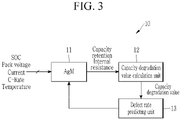
- FIG. 3 is a view showing a partial configuration of a server according to an embodiment.
- a server 10 includes an aging model (AgM) 11, a capacity degradation value calculation unit 12, and a defect rate calculation unit 12.
- AgM aging model
- capacity degradation value calculation unit 12 a capacity degradation value calculation unit
- defect rate calculation unit 12 a defect rate calculation unit
- the aging model 11 may predict capacity retention and internal resistance of each battery cell by using the SOC of each battery cell, the pack voltage, the current flowing through the battery pack, the current rate (C-Rate), and the battery cell temperature.
- the aging model 11 predicts an increase in the capacity retention and the internal resistance of each battery cell by using the SOC of each battery cell, the pack voltage, the current flowing through the battery pack, the current rate (C-Rate), and the battery cell temperature., various known methods may be applied.
- the aging model 11 may define the driving condition as a cycle, the stop condition as a calendar, and calculate the capacity degradation value using the cycle and the calendar, and each duty value thereof, and calculate a resistance increase value by correlating a resistance increase curved line derived from the degeneration experiment of the battery cell using a capacity loss value derived in this process.
- the calculated capacity degradation value and resistance increase value are applied to the capacity retention and internal resistance to be predicted.
- the capacity retention is a result of measuring the ability of the battery cell to retain the stored energy during an extended open-circuit period
- the internal resistance is a result of measuring resistance components inside the battery cell.
- the capacity degradation value calculation unit 12 may receive the capacity retention and the internal resistance of each battery cell, and predict the capacity degradation value indicating the degree of the capacity degradation of each battery cell. As a specific method for the capacity degradation value calculation unit 12 to predict the capacity degradation value using the increase amount of the capacity and the internal resistance of each battery cell, a method using a formula, a table, etc. for mapping the capacity degradation value corresponding to the capacity retention and the internal resistance based on the experimental may be applied.
- the defect rate predicting unit 13 may store information on the capacity degradation value of each of a plurality of battery cells for each time unit, and predict the defect rate by using the capacity degradation values.
- the unit of the defect rate may be parts per million (PPM).
- the defect rate predicting unit 13 multiplies the corresponding capacity degradation values by a corresponding weight value depending on the lapse of time for each of the n driving profiles.
- the weight value corresponding to the lapse of time may be discretely set in a predetermined time unit, and the predetermined time may change with the lapse of time or may be a constant time.
- the capacity degradation value multiplied by the weight value is referred to as a capacity degradation weight value.
- the defect rate predicting unit 13 selects a population by collecting all a plurality of capacity degradation weight values for each of the n driving profiles, and generates m probability distributions for the population by using a bootstrap technique.
- the defect rate predicting unit 13 may select k values by m times by allowing an iteration for the population according to the bootstrap technique.
- the defect rate predicting unit 13 constructs a probability distribution for the k capacity degradation weight values, and this operation is performed m times.
- the defect rate predicting unit 13 generates a cumulative distribution function for each of the m probability distributions.
- the defect rate predicting unit 13 may detect the weight values corresponding to j probabilities in the order of highest probability in the cumulative distribution functions corresponding to the normal distribution with the highest probability among the normal distributions for each of the m cumulative distribution functions. That is, the weight values of the capacity degradation weight values corresponding to each of the j probabilities may be detected.
- the defect rate predicting unit 13 may determine validity of the corresponding cumulative distribution function according to whether a probability distribution function corresponding to each of the m cumulative distribution functions may be specified. If there is a probability distribution function that matches the cumulative distribution function, it is determined that the corresponding cumulative distribution function is valid.
- types of the probability distribution functions may include 'beta', 'Birnbaum Saunders', 'exponential', 'extreme value', 'gamma', 'generalized extreme value', 'generalized pareto', 'inverse gaussian', 'logistic' ', 'log logistic', 'lognormal', 'Nakagami', 'normal', 'Rayleigh', 'Rician', 't location scale', 'Weibull', 'piecewise Pareto tail', etc.
- the defect rate predicting unit 13 may calculate the defect rate with the number of the capacity degradation weight values that are out of the normal range in the normal distribution for each of the m cumulative distribution functions. For example, if the capacity degradation weight value is 30 % or more, it may be determined that it is out of the normal range.
- the server 10 may be controlled so that the prediction operation of the edge computing device 100 is stopped.
- the server 10 may instruct the edge computing device 100 to stop the prediction operation, and the edge computing device 100 may stop the prediction operation.
- the edge computing device 100 may store the input data and the output data of the experimental devices 300 and 400 received from the loT device 200. Later, when a restart instruction is received from the server 10 to the edge computing device 100, the edge computing device 100 may resume the prediction operation reflecting the stored input data and output data.
- the defect rate predicting unit 13 informs the aging model 11 when the defect rate exceeds the threshold value, and the aging model 11 changes the aging model for predicting the capacity retention and internal resistance so that the defect rate does not exceed the threshold value.
- a plurality of sets composed of various formulas applied to the aging model are provided, and the aging model 11 changes the aging model by selecting one of a plurality of sets.
- the aging model 11 may consider the tendency of the capacity degradation value when selecting one of a plurality of sets. For example, the aging model 11 may select the corresponding set from a plurality of sets according to the change in the capacity degradation value over time.
- FIG. 4 is a flowchart showing a data distribution processing operation of a simulation system according to an embodiment.
- the edge computing device 100 starts the distribution processing operation for the experimental result (S1).
- An experimenter's instruction for the distribution processing operation is input to the edge computing device 100, and then the edge computing device 100 may transmit the instruction for starting the distribution processing operation to the loT device 200.
- the loT device 200 receives the input and the output from the experimental devices 300 and 400, and is booted up in a ready state for the distribution processing (S2).
- the loT device 200 may set conditions based on the driving profile (S3).
- the driving profile may include the conditions such as a power (Watt/Hour), a driving mode (Idle/Plug-In/Driving), and a temperature (°C).
- the loT device 200 receives the input and the output from the experimental devices 300 and 400 (S4). As the input and the output received from the experimental devices 300 and 400, it may include a battery operation mode (Rest/Charging/Discharging), a pack voltage, a current flowing through the battery pack, a temperature, and the like. The loT device 200 pre-processes the received input and output to generate input data and output data.
- S4 the input and the output received from the experimental devices 300 and 400
- the loT device 200 pre-processes the received input and output to generate input data and output data.
- the edge computing device 100 receives an initial value for the input data and the preprocessed input data and output data from the loT device 200 (S5).
- the input data and output data received by the edge computing device 100 may be data that is classified into a size suitable for the edge computing device 100 by the loT device 200.
- the edge computing device 100 may predict the information required to predict the capacity degradation value by using the equivalent circuit model module 110 and the thermal model module 120 based on the input data (S6).
- the necessary information may include the pack voltage, the SOC, the current flowing through the battery pack, the C-rate, the calorific value, and the like.
- the information predicted by the edge computing device 100 is transmitted to the server 10 (S7).
- the server 10 predicts the capacity retention and internal resistance based on the transmitted prediction information (S8).
- the server 10 predicts the capacity degradation value based on capacity retention and internal resistance (S9).
- the server 10 predicts the defect rate based on the predicted capacity degradation values (S10).
Landscapes
- Engineering & Computer Science (AREA)
- Physics & Mathematics (AREA)
- General Physics & Mathematics (AREA)
- Power Engineering (AREA)
- Transportation (AREA)
- Mechanical Engineering (AREA)
- Life Sciences & Earth Sciences (AREA)
- Sustainable Development (AREA)
- Sustainable Energy (AREA)
- Secondary Cells (AREA)
- Charge And Discharge Circuits For Batteries Or The Like (AREA)
- Tests Of Electric Status Of Batteries (AREA)
Abstract
Description
- This application claims priority to and the benefit of
Korean Patent Application No. 10-2020-0002216 filed in the Korean Intellectual Property Office on January 07, 2020 - The present disclosure relates to a simulation system and a data distribution method.
- For battery cycle-life analysis, a method that confirms the degree of degradation through actual charge and discharge experiments of battery cells or predicts the degree of degradation through a software simulation composed of MBD (Model Based Design) is used.
- Particularly, the degeneration prediction through the software simulation method may be performed by calculating a scenario in advance and by configuring layers considering a current, an ECM (Equivalent Circuit Model), heat, and aging by fixing the virtual input value. Because the actual battery degradation requires long-term experimental or actually-measured data, the software simulation method is preferred, and the predicted battery degradation is used to determine the battery warranty period. However, currently, a hybrid, an electric vehicle, etc., are in a development stage, and there is not enough data on the input value, so power / temperature /a driving mode etc. are converted into input values to and used based on a driving data of gasoline vehicles.
- The present disclosure is to provide a simulation system and a data distribution method that may improve accuracy and efficiency in a battery cycle-life prediction.
- A simulation system of the present invention for performing an experiment on a battery pack including a plurality of battery cells by using at least one experimental device includes an loT device that receives input and output of at least one experimental device, and pre-processes the input and the output to generate an input data and output data; an edge computing device predicting information for predicting a capacity degradation value of a plurality of battery cells by using an equivalent circuit model module and a thermal model module based on a data received among the input data and the output data; and a server that receives the predicted information from the edge computing device, predicts a capacity degradation value of a plurality of battery cells by using an aging model module, and predicts a defect rate based on the predicted capacity degradation values.
- The equivalent circuit model module may receive at least one among a battery pack voltage, an initial SOC, a current flowing to the battery pack, a temperature of the battery cell, a number of the battery cells configuring the battery pack, and a resistance battery pack from the loT device, and predict at least one among the SOC of each of the battery cell, the pack voltage, the current flowing to the battery pack, a calorific value of the battery cell, and a current rate (C-Rate).
- The thermal model module may receive the calorific value from the equivalent circuit model module, and receive the cooling performance input to predict the temperature of the battery cell.
- The aging model module may receive at least one among the data about the SOC of each of the battery cells, the pack voltage, the current flowing into the battery pack, the current rate (C-Rate), and the temperature of the battery cell to predict the capacity retention and internal resistance of each of a plurality of battery cells.
- The server may further include a capacity degradation value calculation unit that receives the capacity retention and internal resistance of each of the battery cells to predict a capacity degradation value indicating the degree of the capacity degradation of each battery cell; and a defect rate predicting unit that stores information about the capacity degradation value of each of the plurality of battery cells for each time unit, and predicts a defect rate by using the capacity degradation values.
- The defect rate predicting unit, for each of n driving profiles, may multiply the corresponding weight value over time by the corresponding capacity degradation values to selects a plurality of capacity degradation weight values as a population, generate m probability distributions by using a bootstrap technique for the population, generate a cumulative distribution function for each of m probability distributions, and calculate a defect rate with the number of the capacity degradation weight value that deviates from a normal range in a normal distribution for each of m cumulative distribution functions.
- The defect rate predicting unit may detect weight values corresponding to j probabilities in the order of highest probability from the cumulative distribution function corresponding to the normal distribution with the highest probability among the normal distributions for each of the m cumulative distribution functions.
- The defect rate predicting unit may determine validity of the corresponding cumulative distribution function according to whether the probability distribution function corresponding to each of the m cumulative distribution functions can be specified.
- The defect rate predicting unit may control the server to stop the prediction operation of the edge computing device when the defect rate exceeds a predetermined threshold value.
- The edge computing device may stop the prediction operation by the control of the server, during the stop period, stores the input data and output data received from the loT device, and when a restart instruction is received from the server, and resume the prediction operation reflecting the stored input data and the output data.
- The defect rate predicting unit may notify that the defect rate exceeds the threshold value to the aging model module, and the aging model module may include a plurality of sets consisting of a plurality of formulas, and selects one of a plurality of sets to change the aging model.
- A data distribution method of the present invention for performing an experiment on a battery pack including a plurality of battery cells using at least one experimental device includes starting a distribution processing operation for an experimental result by an edge computing device; receiving an input and output from the at least one experimental device by an loT device, and booting up the loT device into a ready state for distribution processing; generating input data and output data by the loT device by receiving and pre-processing the input and output from at least one experimental device; receiving the initial value for the input data, and the input data and output data to predict the information necessary to predict the capacity degradation value by using an equivalent circuit model module and a thermal model module by the edge computing device; and receiving the predicted information from the edge computing device, and estimating the capacity retention and the internal resistance of each of a plurality of battery cells based on the predicted information by the server.
- The data distribution method may further include predicting a capacity degradation value based on the capacity retention and internal resistance, and predicting a defect rate based on the predicted capacity degradation values by the server.
- The simulation system and the data distribution method that can improve accuracy and efficiency in the battery cycle-life prediction are provided.
-
-
FIG. 1 is a view showing a simulation system according to an embodiment. -
FIG. 2 is a view showing a configuration of an edge computing device according to an embodiment. -
FIG. 3 is a view showing a partial configuration of a server according to an embodiment. -
FIG. 4 is a flowchart showing a data distribution processing operation of a simulation system according to an embodiment. - Hereinafter, embodiments disclosed in the present specification will be described in detail with reference to the accompanying drawings. In the present specification, the same or similar components will be denoted by the same or similar reference numerals, and an overlapped description thereof will be omitted. The terms "module" and "unit" for components used in the following description are used only in order to easily make a specification. Therefore, these terms do not have meanings or roles that distinguish them from each other in themselves. Further, in describing embodiments of the present specification, when it is determined that a detailed description of the well-known art associated with the present invention may obscure the gist of the present invention, it will be omitted. In addition, the accompanying drawings are provided only in order to allow embodiments disclosed in the present specification to be easily understood and are not to be interpreted as limiting the spirit disclosed in the present specification, and it is to be understood that the present invention includes all modifications, equivalents, and substitutions without departing from the scope and spirit of the present invention.
- Terms including ordinal numbers such as first, second, and the like will be used only to describe various components, and are not interpreted as limiting these components. The terms are only used to differentiate one component from other components.
- It is to be understood that when one component is referred to as being "connected" or "coupled" to another component, it may be connected or coupled directly to another component or be connected or coupled to another component with the other component intervening therebetween. On the other hand, it is to be understood that when one component is referred to as being "connected or coupled directly" to another component, it may be connected to or coupled to another component without another component intervening therebetween.
- It will be further understood that terms "comprise" or "have" used in the present specification specify the presence of stated features, numerals, steps, operations, components, parts, or a combination thereof, but do not preclude the presence or addition of one or more other features, numerals, steps, operations, components, parts, or a combination thereof.
- An embodiment executes a battery cycle-life degeneration simulation by distributing and processing edge computing functions by utilizing loT (Internet of Things) devices.
- For example, in the simulation to predict the cycle-life degeneration of a battery pack for an electric vehicle, by combining real-time input data/output data with loT edge computing, it is possible to create a cycle-life degeneration prediction model with high accuracy at low cost.
- The simulation system according to an embodiment includes an loT device, an edge computing device, and a server as a distributed layer.
- Hereinafter, an embodiment is described with reference to accompanying drawings.
-
FIG. 1 is a view showing a simulation system according to an embodiment. - As shown in
FIG. 1 , thesimulation system 1 includesexperimental devices loT device 200, anedge computing device 100, and aserver 10. - In
FIG. 1 , acell cycler 300 and abattery pack simulator 400 are shown as twoexperimental devices - The
cell cycler 300 is connected to the battery pack, which is an experimental object, to charge and discharge the battery pack, and to measure battery information such as a battery cell voltage, a battery pack current, and a battery cell temperature during charging and discharging. The charge and discharge pattern may be determined according to a driving profile. - The
battery pack simulator 400 may set a virtual battery pack that has the same electrical and chemical characteristics as the battery pack that is an experimental target, charge and discharge the virtual battery pack, and predict the battery information such as the battery cell voltage, the battery pack current, and the battery cell temperature during the charging and discharging. The charge and discharge pattern can be determined according to the operating profile. - The
loT device 200 receives an input and an output from the experimental device, pre-processes the data related to the received input and output, and transmits it to theedge computing device 100 or theserver 10 according to the size of the pre-processed data. TheloT device 200 converts the received input and output into the data that may be processed by theedge computing device 100 and theserver 10, which is called pre-processing. If the size of the pre-processed data is greater than or equal to a predetermined size, theloT device 200 transmits the corresponding data to theserver 10, and if the size is less than or equal to the predetermined size, the data is transmitted to theedge computing device 100. In this case, the predetermined size, which is a criterion for classifying the size of the data, may be determined in consideration of the size of the data that may be processed by theedge computing device 100, the processing speed, and the like. - The
edge computing device 100 may analyze the data received from theloT device 200 to generate the data necessary to predict the capacity deterioration value of the battery cell. For example, theloT device 200 may transmit the battery pack voltage, an initial SOC, the current flowing through the battery pack, the battery cell temperature, the number of the battery cells constituting the battery pack, the battery pack resistance, and a cooling performance to theedge computing device 100. -
FIG. 2 is a view showing a configuration of an edge computing device according to an embodiment. - The
edge computing device 100 includes an equivalent circuit model (ECM)module 110 and a thermal model (ThM)module 120. - The equivalent
circuit model module 110 receives the battery pack voltage, the initial SOC, the current flowing to the battery pack, the temperature of the battery cell, the number of the battery cells configuring the battery pack, the resistance of the battery pack, etc. to predict the SOC of each battery cell current, the pack voltage, the current flowing to the battery pack, a calorific value of the battery cell, a current rate (C-Rate), and the like. As a specific method for predicting the output data by applying the input data to the circuit model equivalent to the equivalentcircuit model module 110 of the battery pack, various known methods may be applied. - For example, the equivalent circuit model (ECM) of the equivalent
circuit model module 110 is an equivalent circuit constructed by simply simulating the complex interior caused by the chemical properties of the battery with electrical elements such as resistors and capacitors, and the equivalentcircuit model module 110 may predict the output for any input using the ECM. Specifically, the equivalentcircuit model module 110 may update the SOC of the battery by performing current integration with respect to the current input of the ECM, and calculate the OCV according to the updated SOC. In addition, the equivalentcircuit model module 110 may calculate the voltage drop according to each parameter of the resistor and the capacitor according to the SOC and the temperature. - The current rate refers to the size of the charging current supplied to the battery pack or the discharge current supplied from the battery pack per unit time. For example, 1 C-Rate may mean the size of the current that the battery pack is fully charged in 1 hour, or the size of the current that the battery pack fully discharges in 1 hour.
- The
thermal model module 120 receives the calorific value and the cooling performance as the input and predicts the temperature of the battery cell. The calorific value is the data transmitted from the equivalentcircuit model module 110, and the cooling performance may vary depending on the battery pack. As a specific method for predicting the temperature of each battery cell for thethermal model module 120 by receiving the calorific value and the cooling performance, various known methods may be applied. - For example, the calorific value of the cell input by the equivalent
circuit model module 110 may be calculated as inEquation 1 below.
- The value derived from the calorific value of the cell by using the relational equation of the battery cell temperature, the cooling water temperature, and the thermal resistance value converges to (the battery cell mass)*(a specific thermal capacity)*(a change rate of the battery cell temperature (a differential value)) to calculate an average temperature value for the derived battery cell temperature, and the average temperature value may be used as the input value for the aging
model 11. Among the input data required for theedge computing device 100, the number of the battery cells constituting the battery pack, the initial SOC, the cooling performance, etc. may be predetermined values according to experimental conditions. - The
edge computing device 100 may transmit the predicted SOC of each battery cell, the pack voltage, the current flowing in the battery pack, the C-Rate, and the battery cell temperature to theserver 10. - In
FIG. 2 , it is shown that theedge computing device 100 includes the equivalentcircuit model module 110 and thethermal model module 120, however one of the equivalentcircuit model module 110 and thethermal model module 120 may be provided in theserver 10. In addition, theedge computing device 100 may further include a module necessary for predicting a capacity degradation value in addition to the equivalentcircuit model module 110 and thethermal model module 120. - The
server 10 may receive the output data of theedge computing device 100 to predict the capacity degradation value. The output data of theedge computing device 100 may include the data on the SOC of each battery cell, the pack voltage, the current flowing through the battery pack, the current rate (C-Rate), and the temperature of the battery cell. If necessary, theserver 10 may receive more data required for predicting the capacity degradation value from theloT device 200 as well as theedge computing device 100. -
FIG. 3 is a view showing a partial configuration of a server according to an embodiment. - As shown in
FIG. 3 , aserver 10 includes an aging model (AgM) 11, a capacity degradationvalue calculation unit 12, and a defectrate calculation unit 12. - The aging
model 11 may predict capacity retention and internal resistance of each battery cell by using the SOC of each battery cell, the pack voltage, the current flowing through the battery pack, the current rate (C-Rate), and the battery cell temperature. As a specific method in which the agingmodel 11 predicts an increase in the capacity retention and the internal resistance of each battery cell by using the SOC of each battery cell, the pack voltage, the current flowing through the battery pack, the current rate (C-Rate), and the battery cell temperature., various known methods may be applied. - For example, based on a theory (e.g., Miner's rule) that explains a process leading to a fracture by accumulating invisible fatigue damage to a structural material when an irregular load is repeatedly applied to the structure material, the aging
model 11 may define the driving condition as a cycle, the stop condition as a calendar, and calculate the capacity degradation value using the cycle and the calendar, and each duty value thereof, and calculate a resistance increase value by correlating a resistance increase curved line derived from the degeneration experiment of the battery cell using a capacity loss value derived in this process. The calculated capacity degradation value and resistance increase value are applied to the capacity retention and internal resistance to be predicted. The capacity retention is a result of measuring the ability of the battery cell to retain the stored energy during an extended open-circuit period, and the internal resistance is a result of measuring resistance components inside the battery cell. Although the agingmodel 11 has been described as predicting the internal resistance, the invention is not limited thereto, and an increase amount in the internal resistance and/or the internal resistance may be predicted. - The capacity degradation
value calculation unit 12 may receive the capacity retention and the internal resistance of each battery cell, and predict the capacity degradation value indicating the degree of the capacity degradation of each battery cell. As a specific method for the capacity degradationvalue calculation unit 12 to predict the capacity degradation value using the increase amount of the capacity and the internal resistance of each battery cell, a method using a formula, a table, etc. for mapping the capacity degradation value corresponding to the capacity retention and the internal resistance based on the experimental may be applied. The defectrate predicting unit 13 may store information on the capacity degradation value of each of a plurality of battery cells for each time unit, and predict the defect rate by using the capacity degradation values. The unit of the defect rate may be parts per million (PPM). - The defect
rate predicting unit 13 multiplies the corresponding capacity degradation values by a corresponding weight value depending on the lapse of time for each of the n driving profiles. The weight value corresponding to the lapse of time may be discretely set in a predetermined time unit, and the predetermined time may change with the lapse of time or may be a constant time. Hereinafter, the capacity degradation value multiplied by the weight value is referred to as a capacity degradation weight value. - The defect
rate predicting unit 13 selects a population by collecting all a plurality of capacity degradation weight values for each of the n driving profiles, and generates m probability distributions for the population by using a bootstrap technique. The defectrate predicting unit 13 may select k values by m times by allowing an iteration for the population according to the bootstrap technique. The defectrate predicting unit 13 constructs a probability distribution for the k capacity degradation weight values, and this operation is performed m times. - The defect
rate predicting unit 13 generates a cumulative distribution function for each of the m probability distributions. The defectrate predicting unit 13 may detect the weight values corresponding to j probabilities in the order of highest probability in the cumulative distribution functions corresponding to the normal distribution with the highest probability among the normal distributions for each of the m cumulative distribution functions. That is, the weight values of the capacity degradation weight values corresponding to each of the j probabilities may be detected. - Also, the defect
rate predicting unit 13 may determine validity of the corresponding cumulative distribution function according to whether a probability distribution function corresponding to each of the m cumulative distribution functions may be specified. If there is a probability distribution function that matches the cumulative distribution function, it is determined that the corresponding cumulative distribution function is valid. In this case, types of the probability distribution functions may include 'beta', 'Birnbaum Saunders', 'exponential', 'extreme value', 'gamma', 'generalized extreme value', 'generalized pareto', 'inverse gaussian', 'logistic' ', 'log logistic', 'lognormal', 'Nakagami', 'normal', 'Rayleigh', 'Rician', 't location scale', 'Weibull', 'piecewise Pareto tail', etc. - The defect
rate predicting unit 13 may calculate the defect rate with the number of the capacity degradation weight values that are out of the normal range in the normal distribution for each of the m cumulative distribution functions. For example, if the capacity degradation weight value is 30 % or more, it may be determined that it is out of the normal range. When the defect rate exceeds a predetermined threshold value, theserver 10 may be controlled so that the prediction operation of theedge computing device 100 is stopped. Theserver 10 may instruct theedge computing device 100 to stop the prediction operation, and theedge computing device 100 may stop the prediction operation. During this stop period, theedge computing device 100 may store the input data and the output data of theexperimental devices loT device 200. Later, when a restart instruction is received from theserver 10 to theedge computing device 100, theedge computing device 100 may resume the prediction operation reflecting the stored input data and output data. - The defect
rate predicting unit 13 informs the agingmodel 11 when the defect rate exceeds the threshold value, and the agingmodel 11 changes the aging model for predicting the capacity retention and internal resistance so that the defect rate does not exceed the threshold value. A plurality of sets composed of various formulas applied to the aging model are provided, and the agingmodel 11 changes the aging model by selecting one of a plurality of sets. The agingmodel 11 may consider the tendency of the capacity degradation value when selecting one of a plurality of sets. For example, the agingmodel 11 may select the corresponding set from a plurality of sets according to the change in the capacity degradation value over time. -
FIG. 4 is a flowchart showing a data distribution processing operation of a simulation system according to an embodiment. - The
edge computing device 100 starts the distribution processing operation for the experimental result (S1). - An experimenter's instruction for the distribution processing operation is input to the
edge computing device 100, and then theedge computing device 100 may transmit the instruction for starting the distribution processing operation to theloT device 200. - The
loT device 200 receives the input and the output from theexperimental devices - The
loT device 200 may set conditions based on the driving profile (S3). The driving profile may include the conditions such as a power (Watt/Hour), a driving mode (Idle/Plug-In/Driving), and a temperature (°C). - The
loT device 200 receives the input and the output from theexperimental devices 300 and 400 (S4). As the input and the output received from theexperimental devices loT device 200 pre-processes the received input and output to generate input data and output data. - The
edge computing device 100 receives an initial value for the input data and the preprocessed input data and output data from the loT device 200 (S5). In this case, the input data and output data received by theedge computing device 100 may be data that is classified into a size suitable for theedge computing device 100 by theloT device 200. - The
edge computing device 100 may predict the information required to predict the capacity degradation value by using the equivalentcircuit model module 110 and thethermal model module 120 based on the input data (S6). The necessary information may include the pack voltage, the SOC, the current flowing through the battery pack, the C-rate, the calorific value, and the like. - The information predicted by the
edge computing device 100 is transmitted to the server 10 (S7). - The
server 10 predicts the capacity retention and internal resistance based on the transmitted prediction information (S8). - The
server 10 predicts the capacity degradation value based on capacity retention and internal resistance (S9). - The
server 10 predicts the defect rate based on the predicted capacity degradation values (S10). - While this invention has been described in connection with what is presently considered to be practical embodiments, it is to be understood that the invention is not limited to the disclosed embodiments. On the contrary, it is intended to cover various modifications and equivalent arrangements included within the spirit and scope of the appended claims.
Claims (13)
- A simulation system for performing an experiment on a battery pack including a plurality of battery cells by using at least one experimental device comprising:an loT device that receives input and output of at least one experimental device and pre-processes the input and the output to generate input data and output data;an edge computing device for predicting information for predicting a capacity degradation value of a plurality of battery cells by using an equivalent circuit model module and a thermal model module based on data received among the input data and the output data; anda server that receives the predicted information from the edge computing device, predicts a capacity degradation value of a plurality of battery cells by using an aging model module, and predicts a defect rate based on the predicted capacity degradation values.
- The simulation system of claim 1, wherein
the equivalent circuit model module receives at least one among a battery pack voltage, an initial SOC, a current flowing to the battery pack, a temperature of the battery cell, a number of battery cells configuring the battery pack, and a resistance of the battery pack from the loT device, and predicts at least one among the SOC of each of the battery cell, the pack voltage, the current flowing to the battery pack, a calorific value of the battery cell, and a current rate (C-Rate). - The simulation system of claim 2, wherein
the thermal model module receives the calorific value from the equivalent circuit model module and receives the cooling performance input to predict the temperature of the battery cell. - The simulation system of claim 3, wherein
the aging model module receives at least one among the data about the SOC of each of the battery cells, the pack voltage, the current flowing into the battery pack, the current rate (C-Rate), and the temperature of the battery cell to predict the capacity retention and internal resistance of each of a plurality of battery cells. - The simulation system of claim 1, wherein
the server further includes:a capacity degradation value calculation unit that receives the capacity retention and internal resistance of each of the battery cells to predict a capacity degradation value indicating the degree of the capacity degradation of each battery cell; anda defect rate predicting unit that stores information about the capacity degradation value of each of the plurality of battery cells for each time unit and predicts a defect rate by using the capacity degradation values. - The simulation system of claim 5, wherein
the defect rate predicting unit, for each of n driving profiles, multiplies the corresponding weight value over time by the corresponding capacity degradation values to selects a plurality of capacity degradation weight values as a population, generate m probability distributions by using a bootstrap technique for the population, generates a cumulative distribution function for each of the m probability distributions, and calculates a defect rate with the number of the capacity degradation weight value that deviates from a normal range in a normal distribution for each of the m cumulative distribution functions. - The simulation system of claim 6, wherein
the defect rate predicting unit detects weight values corresponding to j probabilities in the order of highest probability from the cumulative distribution function corresponding to the normal distribution with the highest probability among the normal distributions for each of the m cumulative distribution functions. - The simulation system of claim 6, wherein
the defect rate predicting unit determines validity of the corresponding cumulative distribution function according to whether the probability distribution function corresponding to each of the m cumulative distribution functions can be specified. - The simulation system of claim 6, wherein
the defect rate predicting unit controls the server to stop the prediction operation of the edge computing device when the defect rate exceeds a predetermined threshold value. - The simulation system of claim 9, wherein
the edge computing device stops the prediction operation by the control of the server, during the stop period, stores the input data and output data received from the loT device, and when a restart instruction is received from the server, and resumes the prediction operation reflecting the stored input data and the output data. - The simulation system of claim 9, whereinthe defect rate predicting unit notifies that the defect rate exceeds the threshold value to the aging model module, andthe aging model module includes a plurality of sets consisting of a plurality of formulas and selects one of a plurality of sets to change the aging model.
- A data distribution method for performing an experiment on a battery pack including a plurality of battery cells using at least one experimental device comprising:starting a distribution processing operation for an experimental result by an edge computing device;receiving input and output from the at least one experimental device by an loT device, and booting up the loT device into a ready state for a distribution processing;generating input data and output data by the loT device by receiving and pre-processing the input and output from at least one experimental device;receiving the initial value for the input data, and the input data and output data to predict the information necessary to predict the capacity degradation value by using an equivalent circuit model module and a thermal model module by the edge computing device; andreceiving the predicted information from the edge computing device and estimating the capacity retention and the internal resistance of each of a plurality of battery cells based on the predicted information by the server.
- The data distribution method of claim 12, further comprising
predicting a capacity degradation value based on the capacity retention and internal resistance and predicting a defect rate based on the predicted capacity degradation values by the server.
Applications Claiming Priority (2)
| Application Number | Priority Date | Filing Date | Title |
|---|---|---|---|
| KR1020200002216A KR102837600B1 (en) | 2020-01-07 | 2020-01-07 | Simulation system and data distribution method |
| PCT/KR2020/018094 WO2021141255A1 (en) | 2020-01-07 | 2020-12-10 | Simulation system and data distribution method |
Publications (3)
| Publication Number | Publication Date |
|---|---|
| EP4043897A1 true EP4043897A1 (en) | 2022-08-17 |
| EP4043897A4 EP4043897A4 (en) | 2022-11-30 |
| EP4043897B1 EP4043897B1 (en) | 2025-01-29 |
Family
ID=76788744
Family Applications (1)
| Application Number | Title | Priority Date | Filing Date |
|---|---|---|---|
| EP20911771.2A Active EP4043897B1 (en) | 2020-01-07 | 2020-12-10 | Simulation system and data distribution method |
Country Status (8)
| Country | Link |
|---|---|
| US (1) | US12427890B2 (en) |
| EP (1) | EP4043897B1 (en) |
| JP (1) | JP7376189B2 (en) |
| KR (1) | KR102837600B1 (en) |
| CN (1) | CN114729971B (en) |
| ES (1) | ES3013297T3 (en) |
| HU (1) | HUE070448T2 (en) |
| WO (1) | WO2021141255A1 (en) |
Cited By (1)
| Publication number | Priority date | Publication date | Assignee | Title |
|---|---|---|---|---|
| CN115296423A (en) * | 2022-10-08 | 2022-11-04 | 南方电网数字电网研究院有限公司 | Comprehensive debugging terminal based on edge computing platform |
Families Citing this family (12)
| Publication number | Priority date | Publication date | Assignee | Title |
|---|---|---|---|---|
| CA3180748A1 (en) | 2020-06-04 | 2021-12-09 | William Dale Tischer | Accurate estimation of battery charge remaining in a mobile cart |
| EP3923094A1 (en) * | 2020-06-09 | 2021-12-15 | Siemens Aktiengesellschaft | Inspection rate adaptation |
| JP7250366B2 (en) * | 2021-05-14 | 2023-04-03 | Mirai-Labo株式会社 | Power supply and battery deterioration determination system |
| US11577625B1 (en) * | 2021-11-11 | 2023-02-14 | Beta Air, Llc | Systems and methods for predicting degradation of a battery for use in an electric vehicle |
| KR20230145799A (en) * | 2022-04-11 | 2023-10-18 | 주식회사 엘지에너지솔루션 | Device and method for predicting defective rate of battery |
| KR20230161073A (en) * | 2022-05-18 | 2023-11-27 | 주식회사 엘지에너지솔루션 | Apparatus and method for estimating state of health of battery |
| KR102740839B1 (en) * | 2022-10-31 | 2024-12-12 | 주식회사 에스앤에스 | Method of labeling data optimally considering driving environment in electric vehicle and predicting remaining useful life of electric vehicle battery using the same |
| KR20240093027A (en) * | 2022-12-15 | 2024-06-24 | 주식회사 엘지에너지솔루션 | Apparatus and method for testing battery by estimating state of health |
| KR20240103456A (en) * | 2022-12-27 | 2024-07-04 | 삼성에스디아이 주식회사 | Secondary battery accelerated idle life evaluation device and method thereof |
| KR20240103457A (en) * | 2022-12-27 | 2024-07-04 | 삼성에스디아이 주식회사 | Secondary battery life evaluation device and method thereof |
| US12119700B2 (en) * | 2023-01-20 | 2024-10-15 | Element Energy, Inc. | Systems and methods for adaptive electrochemical cell management |
| KR102892976B1 (en) * | 2023-11-10 | 2025-11-28 | ㈜브레이크 더 룰스 | Battery diagnostic program using battery internal resistance stored in recording media |
Family Cites Families (24)
| Publication number | Priority date | Publication date | Assignee | Title |
|---|---|---|---|---|
| JP2008076295A (en) | 2006-09-22 | 2008-04-03 | Omron Corp | Battery life prediction system, battery life prediction method, communication terminal device, battery life prediction device, data transmission program, battery life prediction program, and computer-readable recording medium storing the program |
| US20110082621A1 (en) * | 2009-10-02 | 2011-04-07 | Eric Berkobin | Method and system for predicting battery life based on vehicle battery, usage, and environmental data |
| KR101671998B1 (en) | 2010-04-02 | 2016-11-04 | 에스케이이노베이션 주식회사 | Apparatus and Method for estimating battery life |
| JP2012150086A (en) * | 2011-01-21 | 2012-08-09 | Nec Corp | Assembled battery system designing method and apparatus for the same |
| JP5849208B2 (en) * | 2011-03-29 | 2016-01-27 | パナソニックIpマネジメント株式会社 | In-vehicle charger |
| US9236748B2 (en) | 2012-08-30 | 2016-01-12 | Texas Instruments Incorporated | Method and apparatus of charging the battery with globally minimized integral degradation possible for predefined charging duration |
| KR20140075393A (en) | 2012-12-11 | 2014-06-19 | 한국전자통신연구원 | Apparatus and method for forensic document filter of smart device |
| JP2015059933A (en) | 2013-09-20 | 2015-03-30 | 株式会社東芝 | Secondary battery abnormality diagnostic device and secondary battery abnormality diagnostic method |
| DE102013220243B4 (en) | 2013-10-08 | 2025-12-11 | Robert Bosch Gmbh | Method for minimizing cell aging of a battery or battery with a device for minimizing cell aging of the battery |
| US9864016B2 (en) | 2014-10-31 | 2018-01-09 | GM Global Technology Operations LLC | Battery system pack life estimation systems and methods |
| EP3237920A4 (en) | 2014-12-23 | 2018-09-19 | Intel Corporation | Battery life estimation based on multiple locations |
| US10401433B2 (en) | 2015-01-21 | 2019-09-03 | Samsung Electronics Co., Ltd. | Method and apparatus for estimating battery life |
| KR101668288B1 (en) | 2015-03-19 | 2016-10-24 | 세방전지(주) | Battery monitoring system for vehicle using internet of thing and method of thereof |
| KR102032229B1 (en) | 2015-11-18 | 2019-10-16 | 현대일렉트릭앤에너지시스템(주) | System and method for estimating state of health for battery |
| DK3214723T3 (en) * | 2016-01-05 | 2019-03-04 | Guangdong Oppo Mobile Telecommunications Corp Ltd | Procedure for lightning charge, mobile terminal and adapter |
| KR102553031B1 (en) | 2016-01-14 | 2023-07-06 | 삼성전자주식회사 | Method and apparatus for estimating state of battery |
| JP6634333B2 (en) | 2016-04-15 | 2020-01-22 | 鹿島建設株式会社 | Analysis apparatus, analysis method, and program |
| DE102016211898A1 (en) | 2016-06-30 | 2018-01-04 | Robert Bosch Gmbh | Method for monitoring a battery |
| US10209314B2 (en) * | 2016-11-21 | 2019-02-19 | Battelle Energy Alliance, Llc | Systems and methods for estimation and prediction of battery health and performance |
| EP3336956B1 (en) | 2016-12-14 | 2023-08-30 | Robert Bosch GmbH | Method for monitoring a discharge device of a battery |
| JP2019060773A (en) | 2017-09-27 | 2019-04-18 | 日立化成株式会社 | Storage cell state monitoring system and storage cell state monitoring method |
| JP7035606B2 (en) | 2018-02-21 | 2022-03-15 | 日本電気株式会社 | Edge computing systems, edge servers, system control methods, and programs |
| KR102090476B1 (en) | 2018-05-02 | 2020-03-19 | 주식회사 에스.제이테크 | a BMS optimizing system using a cloud system and big data |
| CN110442941B (en) * | 2019-07-25 | 2022-04-29 | 桂林电子科技大学 | Battery state and RUL prediction method based on particle filter and process noise fusion |
-
2020
- 2020-01-07 KR KR1020200002216A patent/KR102837600B1/en active Active
- 2020-12-10 EP EP20911771.2A patent/EP4043897B1/en active Active
- 2020-12-10 US US17/780,069 patent/US12427890B2/en active Active
- 2020-12-10 JP JP2022527867A patent/JP7376189B2/en active Active
- 2020-12-10 WO PCT/KR2020/018094 patent/WO2021141255A1/en not_active Ceased
- 2020-12-10 HU HUE20911771A patent/HUE070448T2/en unknown
- 2020-12-10 CN CN202080081701.6A patent/CN114729971B/en active Active
- 2020-12-10 ES ES20911771T patent/ES3013297T3/en active Active
Cited By (2)
| Publication number | Priority date | Publication date | Assignee | Title |
|---|---|---|---|---|
| CN115296423A (en) * | 2022-10-08 | 2022-11-04 | 南方电网数字电网研究院有限公司 | Comprehensive debugging terminal based on edge computing platform |
| CN115296423B (en) * | 2022-10-08 | 2023-04-11 | 南方电网数字电网研究院有限公司 | Comprehensive debugging terminal based on edge computing platform |
Also Published As
| Publication number | Publication date |
|---|---|
| KR102837600B1 (en) | 2025-07-22 |
| US12427890B2 (en) | 2025-09-30 |
| KR20210089021A (en) | 2021-07-15 |
| HUE070448T2 (en) | 2025-06-28 |
| JP2023502622A (en) | 2023-01-25 |
| ES3013297T3 (en) | 2025-04-11 |
| JP7376189B2 (en) | 2023-11-08 |
| EP4043897A4 (en) | 2022-11-30 |
| US20230022353A1 (en) | 2023-01-26 |
| WO2021141255A1 (en) | 2021-07-15 |
| EP4043897B1 (en) | 2025-01-29 |
| CN114729971A (en) | 2022-07-08 |
| CN114729971B (en) | 2026-01-20 |
Similar Documents
| Publication | Publication Date | Title |
|---|---|---|
| EP4043897A1 (en) | Simulation system and data distribution method | |
| CN114072684B (en) | Characterizing rechargeable batteries on the server side | |
| US12222400B2 (en) | State value for rechargeable batteries | |
| CN107677962B (en) | System and method for managing battery based on time required for charging | |
| KR101498761B1 (en) | Apparatus and method of estimating state of health for battery, and battery management system using the same | |
| EP4270033A1 (en) | Method and apparatus for estimating state of health of battery | |
| US11374425B2 (en) | Battery energy storage system, battery management system, and control method for controlling battery temperature | |
| JP6801101B2 (en) | Battery level estimation device, battery level estimation method, and program | |
| US20160161567A1 (en) | Method and apparatus for estimating state of battery | |
| CA2987166A1 (en) | Efficient battery tester | |
| JPWO2014119328A1 (en) | Battery state estimation device | |
| US12533986B2 (en) | Apparatus and application for predicting discharge of battery | |
| KR20180058085A (en) | Method and apparatus for estimating battery state | |
| US20230417840A1 (en) | Battery management system | |
| KR20210016134A (en) | Apparatus and method for predicting state of battery | |
| EP4498103A1 (en) | Battery management device and method | |
| KR101486629B1 (en) | Apparatus and method of estimating state of health for battery | |
| US20230160972A1 (en) | Computer-Assisted Method for Determining a Loss Of Capacity of a Battery Store, Computer Program Product and Battery Store | |
| Cordoba-Arenas et al. | Aging Propagation in Advanced Battery Systems: Preliminary Results. | |
| Samad et al. | Influence of battery downsizing and SOC operating window on battery pack performance in a hybrid electric vehicle | |
| Tong et al. | Comprehensive battery equivalent circuit based model for battery management application | |
| US20240230767A1 (en) | Method and control device for determining an energy quantity in a battery or battery cell | |
| EP4734324A1 (en) | Charging management device and operation method thereof | |
| WO2025173451A1 (en) | Estimation method, estimation apparatus, and computer program | |
| CN117538769A (en) | Method and device for predicting peak power of battery |
Legal Events
| Date | Code | Title | Description |
|---|---|---|---|
| STAA | Information on the status of an ep patent application or granted ep patent |
Free format text: STATUS: THE INTERNATIONAL PUBLICATION HAS BEEN MADE |
|
| PUAI | Public reference made under article 153(3) epc to a published international application that has entered the european phase |
Free format text: ORIGINAL CODE: 0009012 |
|
| STAA | Information on the status of an ep patent application or granted ep patent |
Free format text: STATUS: REQUEST FOR EXAMINATION WAS MADE |
|
| 17P | Request for examination filed |
Effective date: 20220510 |
|
| AK | Designated contracting states |
Kind code of ref document: A1 Designated state(s): AL AT BE BG CH CY CZ DE DK EE ES FI FR GB GR HR HU IE IS IT LI LT LU LV MC MK MT NL NO PL PT RO RS SE SI SK SM TR |
|
| A4 | Supplementary search report drawn up and despatched |
Effective date: 20221031 |
|
| RIC1 | Information provided on ipc code assigned before grant |
Ipc: G01R 31/382 20190101ALI20221025BHEP Ipc: G01R 31/36 20200101ALI20221025BHEP Ipc: G01R 31/367 20190101ALI20221025BHEP Ipc: G01R 31/392 20190101AFI20221025BHEP |
|
| DAV | Request for validation of the european patent (deleted) | ||
| DAX | Request for extension of the european patent (deleted) | ||
| GRAP | Despatch of communication of intention to grant a patent |
Free format text: ORIGINAL CODE: EPIDOSNIGR1 |
|
| STAA | Information on the status of an ep patent application or granted ep patent |
Free format text: STATUS: GRANT OF PATENT IS INTENDED |
|
| INTG | Intention to grant announced |
Effective date: 20240813 |
|
| P01 | Opt-out of the competence of the unified patent court (upc) registered |
Free format text: CASE NUMBER: APP_49818/2024 Effective date: 20240903 |
|
| GRAS | Grant fee paid |
Free format text: ORIGINAL CODE: EPIDOSNIGR3 |
|
| GRAA | (expected) grant |
Free format text: ORIGINAL CODE: 0009210 |
|
| STAA | Information on the status of an ep patent application or granted ep patent |
Free format text: STATUS: THE PATENT HAS BEEN GRANTED |
|
| AK | Designated contracting states |
Kind code of ref document: B1 Designated state(s): AL AT BE BG CH CY CZ DE DK EE ES FI FR GB GR HR HU IE IS IT LI LT LU LV MC MK MT NL NO PL PT RO RS SE SI SK SM TR |
|
| REG | Reference to a national code |
Ref country code: GB Ref legal event code: FG4D |
|
| REG | Reference to a national code |
Ref country code: CH Ref legal event code: EP |
|
| REG | Reference to a national code |
Ref country code: DE Ref legal event code: R096 Ref document number: 602020045673 Country of ref document: DE |
|
| REG | Reference to a national code |
Ref country code: IE Ref legal event code: FG4D |
|
| REG | Reference to a national code |
Ref country code: ES Ref legal event code: FG2A Ref document number: 3013297 Country of ref document: ES Kind code of ref document: T3 Effective date: 20250411 |
|
| REG | Reference to a national code |
Ref country code: NL Ref legal event code: MP Effective date: 20250129 |
|
| PG25 | Lapsed in a contracting state [announced via postgrant information from national office to epo] |
Ref country code: NL Free format text: LAPSE BECAUSE OF FAILURE TO SUBMIT A TRANSLATION OF THE DESCRIPTION OR TO PAY THE FEE WITHIN THE PRESCRIBED TIME-LIMIT Effective date: 20250129 |
|
| REG | Reference to a national code |
Ref country code: HU Ref legal event code: AG4A Ref document number: E070448 Country of ref document: HU |
|
| PG25 | Lapsed in a contracting state [announced via postgrant information from national office to epo] |
Ref country code: RS Free format text: LAPSE BECAUSE OF FAILURE TO SUBMIT A TRANSLATION OF THE DESCRIPTION OR TO PAY THE FEE WITHIN THE PRESCRIBED TIME-LIMIT Effective date: 20250429 |
|
| PG25 | Lapsed in a contracting state [announced via postgrant information from national office to epo] |
Ref country code: FI Free format text: LAPSE BECAUSE OF FAILURE TO SUBMIT A TRANSLATION OF THE DESCRIPTION OR TO PAY THE FEE WITHIN THE PRESCRIBED TIME-LIMIT Effective date: 20250129 |
|
| PG25 | Lapsed in a contracting state [announced via postgrant information from national office to epo] |
Ref country code: PL Free format text: LAPSE BECAUSE OF FAILURE TO SUBMIT A TRANSLATION OF THE DESCRIPTION OR TO PAY THE FEE WITHIN THE PRESCRIBED TIME-LIMIT Effective date: 20250129 |
|
| REG | Reference to a national code |
Ref country code: LT Ref legal event code: MG9D |
|
| PG25 | Lapsed in a contracting state [announced via postgrant information from national office to epo] |
Ref country code: IS Free format text: LAPSE BECAUSE OF FAILURE TO SUBMIT A TRANSLATION OF THE DESCRIPTION OR TO PAY THE FEE WITHIN THE PRESCRIBED TIME-LIMIT Effective date: 20250529 Ref country code: NO Free format text: LAPSE BECAUSE OF FAILURE TO SUBMIT A TRANSLATION OF THE DESCRIPTION OR TO PAY THE FEE WITHIN THE PRESCRIBED TIME-LIMIT Effective date: 20250429 |
|
| REG | Reference to a national code |
Ref country code: AT Ref legal event code: MK05 Ref document number: 1763963 Country of ref document: AT Kind code of ref document: T Effective date: 20250129 |
|
| PG25 | Lapsed in a contracting state [announced via postgrant information from national office to epo] |
Ref country code: HR Free format text: LAPSE BECAUSE OF FAILURE TO SUBMIT A TRANSLATION OF THE DESCRIPTION OR TO PAY THE FEE WITHIN THE PRESCRIBED TIME-LIMIT Effective date: 20250129 |
|
| PG25 | Lapsed in a contracting state [announced via postgrant information from national office to epo] |
Ref country code: PT Free format text: LAPSE BECAUSE OF FAILURE TO SUBMIT A TRANSLATION OF THE DESCRIPTION OR TO PAY THE FEE WITHIN THE PRESCRIBED TIME-LIMIT Effective date: 20250529 Ref country code: LV Free format text: LAPSE BECAUSE OF FAILURE TO SUBMIT A TRANSLATION OF THE DESCRIPTION OR TO PAY THE FEE WITHIN THE PRESCRIBED TIME-LIMIT Effective date: 20250129 |
|
| PG25 | Lapsed in a contracting state [announced via postgrant information from national office to epo] |
Ref country code: BG Free format text: LAPSE BECAUSE OF FAILURE TO SUBMIT A TRANSLATION OF THE DESCRIPTION OR TO PAY THE FEE WITHIN THE PRESCRIBED TIME-LIMIT Effective date: 20250129 Ref country code: GR Free format text: LAPSE BECAUSE OF FAILURE TO SUBMIT A TRANSLATION OF THE DESCRIPTION OR TO PAY THE FEE WITHIN THE PRESCRIBED TIME-LIMIT Effective date: 20250430 |
|
| PG25 | Lapsed in a contracting state [announced via postgrant information from national office to epo] |
Ref country code: AT Free format text: LAPSE BECAUSE OF FAILURE TO SUBMIT A TRANSLATION OF THE DESCRIPTION OR TO PAY THE FEE WITHIN THE PRESCRIBED TIME-LIMIT Effective date: 20250129 |
|
| PG25 | Lapsed in a contracting state [announced via postgrant information from national office to epo] |
Ref country code: SE Free format text: LAPSE BECAUSE OF FAILURE TO SUBMIT A TRANSLATION OF THE DESCRIPTION OR TO PAY THE FEE WITHIN THE PRESCRIBED TIME-LIMIT Effective date: 20250129 |
|
| PG25 | Lapsed in a contracting state [announced via postgrant information from national office to epo] |
Ref country code: SM Free format text: LAPSE BECAUSE OF FAILURE TO SUBMIT A TRANSLATION OF THE DESCRIPTION OR TO PAY THE FEE WITHIN THE PRESCRIBED TIME-LIMIT Effective date: 20250129 |
|
| PG25 | Lapsed in a contracting state [announced via postgrant information from national office to epo] |
Ref country code: DK Free format text: LAPSE BECAUSE OF FAILURE TO SUBMIT A TRANSLATION OF THE DESCRIPTION OR TO PAY THE FEE WITHIN THE PRESCRIBED TIME-LIMIT Effective date: 20250129 |
|
| PG25 | Lapsed in a contracting state [announced via postgrant information from national office to epo] |
Ref country code: IT Free format text: LAPSE BECAUSE OF FAILURE TO SUBMIT A TRANSLATION OF THE DESCRIPTION OR TO PAY THE FEE WITHIN THE PRESCRIBED TIME-LIMIT Effective date: 20250129 |
|
| PG25 | Lapsed in a contracting state [announced via postgrant information from national office to epo] |
Ref country code: EE Free format text: LAPSE BECAUSE OF FAILURE TO SUBMIT A TRANSLATION OF THE DESCRIPTION OR TO PAY THE FEE WITHIN THE PRESCRIBED TIME-LIMIT Effective date: 20250129 Ref country code: CZ Free format text: LAPSE BECAUSE OF FAILURE TO SUBMIT A TRANSLATION OF THE DESCRIPTION OR TO PAY THE FEE WITHIN THE PRESCRIBED TIME-LIMIT Effective date: 20250129 |
|
| PG25 | Lapsed in a contracting state [announced via postgrant information from national office to epo] |
Ref country code: RO Free format text: LAPSE BECAUSE OF FAILURE TO SUBMIT A TRANSLATION OF THE DESCRIPTION OR TO PAY THE FEE WITHIN THE PRESCRIBED TIME-LIMIT Effective date: 20250129 |
|
| PG25 | Lapsed in a contracting state [announced via postgrant information from national office to epo] |
Ref country code: SK Free format text: LAPSE BECAUSE OF FAILURE TO SUBMIT A TRANSLATION OF THE DESCRIPTION OR TO PAY THE FEE WITHIN THE PRESCRIBED TIME-LIMIT Effective date: 20250129 |
|
| REG | Reference to a national code |
Ref country code: DE Ref legal event code: R097 Ref document number: 602020045673 Country of ref document: DE |
|
| PLBE | No opposition filed within time limit |
Free format text: ORIGINAL CODE: 0009261 |
|
| STAA | Information on the status of an ep patent application or granted ep patent |
Free format text: STATUS: NO OPPOSITION FILED WITHIN TIME LIMIT |
|
| 26N | No opposition filed |
Effective date: 20251030 |
|
| PGFP | Annual fee paid to national office [announced via postgrant information from national office to epo] |
Ref country code: DE Payment date: 20251120 Year of fee payment: 6 |
|
| PGFP | Annual fee paid to national office [announced via postgrant information from national office to epo] |
Ref country code: GB Payment date: 20251120 Year of fee payment: 6 |
|
| PGFP | Annual fee paid to national office [announced via postgrant information from national office to epo] |
Ref country code: HU Payment date: 20251216 Year of fee payment: 6 Ref country code: FR Payment date: 20251125 Year of fee payment: 6 |
|
| PGFP | Annual fee paid to national office [announced via postgrant information from national office to epo] |
Ref country code: ES Payment date: 20260122 Year of fee payment: 6 |