EP4042888B1 - Non-combustion heating type flavor inhaler - Google Patents
Non-combustion heating type flavor inhaler Download PDFInfo
- Publication number
- EP4042888B1 EP4042888B1 EP19948515.2A EP19948515A EP4042888B1 EP 4042888 B1 EP4042888 B1 EP 4042888B1 EP 19948515 A EP19948515 A EP 19948515A EP 4042888 B1 EP4042888 B1 EP 4042888B1
- Authority
- EP
- European Patent Office
- Prior art keywords
- flavor inhaler
- center hole
- filter
- hole filter
- heating type
- Prior art date
- Legal status (The legal status is an assumption and is not a legal conclusion. Google has not performed a legal analysis and makes no representation as to the accuracy of the status listed.)
- Active
Links
Images
Classifications
-
- A—HUMAN NECESSITIES
- A24—TOBACCO; CIGARS; CIGARETTES; SIMULATED SMOKING DEVICES; SMOKERS' REQUISITES
- A24D—CIGARS; CIGARETTES; TOBACCO SMOKE FILTERS; MOUTHPIECES OF CIGARS OR CIGARETTES; MANUFACTURE OF TOBACCO SMOKE FILTERS OR MOUTHPIECES
- A24D3/00—Tobacco smoke filters, e.g. filter tips or filtering inserts; Filters specially adapted for simulated smoking devices; Mouthpieces of cigars or cigarettes
- A24D3/04—Tobacco smoke filters characterised by their shape or structure
-
- A—HUMAN NECESSITIES
- A24—TOBACCO; CIGARS; CIGARETTES; SIMULATED SMOKING DEVICES; SMOKERS' REQUISITES
- A24D—CIGARS; CIGARETTES; TOBACCO SMOKE FILTERS; MOUTHPIECES OF CIGARS OR CIGARETTES; MANUFACTURE OF TOBACCO SMOKE FILTERS OR MOUTHPIECES
- A24D1/00—Cigars; Cigarettes
- A24D1/20—Cigarettes specially adapted for simulated smoking devices
Definitions
- the present invention relates to a non-combustion heating type flavor inhaler including a tobacco rod, a cooling segment, and a mouthpiece.
- Non-combustion heating type flavor inhaler desirably has a certain diameter or more in view of smooth insertion into a device and sufficient delivery of smoking flavor. Meanwhile, when the diameter of a non-combustion heating type flavor inhaler becomes larger, the amount of heat provided to the inhaler as well as the contact area with lips increases. Consequently, the temperature near the mouth end rises, and a user may feel uncomfortable about the temperature near the mouth end during use.
- EP 3 075 266 A1 discloses a non-combustion heating type flavor inhaler provided with a tobacco rod, a cooling segment, and a mouthpiece constituting a filter.
- JP S59 196082 A discloses a cigarette, wherein a mouthpiece is provided with a filter and a center hole filter in this order towards the mouth end.
- An object of the present invention is to provide a non-combustion heating type flavor inhaler that prevents a user from feeling uncomfortable about the temperature near the mouth end during use.
- the flavor inhaler described in PTL 1 has a mouthpiece including a filter and a paper tube in this order towards the mouth end.
- the present inventors considered that the flavor inhaler described in PTL 1 has room for improvement and thus have completed the present invention. That is, the above-mentioned object is attained by the present invention below.
- a non-combustion heating type flavor inhaler of the present invention includes a tobacco rod, a cooling segment, and a mouthpiece, where the mouthpiece includes a filter and a center hole filter in this order towards the mouth end.
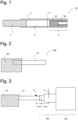
- Fig. 1 illustrates an embodiment of the non-combustion heating type flavor inhaler of the present invention.
- 10 is a non-combustion heating type flavor inhaler
- 1 is a tobacco rod
- 3 is a cooling segment
- 5 is a mouthpiece
- 52 is a filter
- 54 is a center hole filter
- 7 is a tipping paper
- V represents ventilation holes.
- the flavor inhaler has a dimeter of preferably 6 to 8 mm. The diameter is defined as an average diameter of members that constitute the flavor inhaler.
- a tobacco rod is an almost cylindrical member for generating smoking flavor components contained in tobacco raw materials and includes a tobacco filler and a wrapper wrapped therearound.
- the tobacco filler is not limited, and tobacco shreds or tobacco sheets, for example, may be used therefor.
- tobacco shreds prepared by cutting dry tobacco leaves into a width of 0.8 to 1.2 mm may be packed inside a wrapper.
- those prepared by uniformly pulverizing dry tobacco leaves into an average particle size of about 20 to 200 ⁇ m, forming into sheets, and cutting the sheets into a width of 0.8 to 1.2 mm may be packed inside a wrapper.
- such sheets may be crimped, folded, or spirally rolled without cutting and packed inside a wrapper.
- such sheets may be cut into strips and packed inside a wrapper concentrically or with the longitudinal direction of the strips aligned parallel to the longitudinal direction of a tobacco rod.
- Various tobacco leaves may be used, and examples include flue-cured, burley, oriental, domestic, regardless of Nicotiana tabacum varieties or Nicotiana rustica varieties, and mixtures thereof. For such mixtures, the above-mentioned varieties may be used by blending as appropriate for an intended taste.
- the details of the varieties of tobacco are disclosed in " Tobacco no Jiten (Encyclopedia of Tobacco), Tobacco Academic Studies Center, March 31, 2009 .”
- the production of the above-mentioned uniform sheets in other words, the processing of pulverized tobacco leaves into uniform sheets can be performed by a publicly known method.
- a method of making a sheet by a paper making process a method of making a cast sheet by uniformly mixing pulverized tobacco leaves with a suitable solvent, such as water, thinly casting the resulting uniform mixture on a metal sheet or a metal sheet belt, and then drying; and a method of making a rolled sheet by uniformly mixing pulverized tobacco leaves with a suitable solvent, such as water, and extruding the resulting uniform mixture into a sheet shape.
- a suitable solvent such as water
- the tobacco filler may contain moisture, and the content may be 10 to 15 weight% and is preferably 11 to 13 weight% relative to the total amount of the tobacco filler.
- the use of a tobacco filler having such a moisture content suppresses the formation of stains and makes wrapping during production of tobacco rods satisfactorily feasible.
- the tobacco rod 1 may generate vapor upon heating.
- a polyol such as glycerol, propylene glycol, or 1,3-butanediol
- the amount of an aerosol source to be added is preferably 5 to 50 weight% and more preferably 10 to 30 weight% relative to the dry weight of a tobacco filler.
- the length of the tobacco rod 1 is not limited but is preferably 15 to 25 mm.
- the diameter is also not limited but is preferably 6 to 8 mm.
- the tobacco rod 1 may contain a flavor.
- flavors are not particularly limited, and from a viewpoint of imparting satisfactory smoking flavor, examples include the following: acetanisole, acetophenone, acetylpyrazine, 2-acetylthiazole, alfalfa extract, amyl alcohol, amyl butyrate, trans-anethole, star anise oil, apple juice, Peru balsam oil, beeswax absolute, benzaldehyde, benzoin resinoid, benzyl alcohol, benzyl benzoate, benzyl phenylacetate, benzyl propionate, 2,3-butanedione, 2-butanol, butyl butyrate, butyric acid, caramel, cardamom oil, carob absolute, ⁇ -carotene, carrot juice, L-carvone, ⁇ -caryophyllene, cassia bark oil, cedarwood oil, celery seed oil, chamomile oil, c
- the filling density of a tobacco filler is not particularly limited but is typically 250 mg/cm 3 or more and preferably 320 mg/cm 3 or more from a viewpoint of ensuring the characteristics of a non-combustion heating type flavor inhaler and imparting satisfactory smoking flavor. Meanwhile, the upper limit is typically 800 mg/cm 3 or less and preferably 600 mg/cm 3 or less.
- a cooling segment is a member for promoting aerosol generation, for example, by cooling vapor and/or smoking flavor components generated in the tobacco rod 1.
- the cooling segment 3 may be a hollow paper tube.
- a paper tube is preferably made of cardboard having stiffness higher than a wrapper and a tipping paper.
- the paper tube may be provided with ventilation holes V.
- a plurality of ventilation holes are preferably formed along the circumference of the paper tube. The farthest position, from the mouth side end towards the heating end of the cooling segment, at which ventilation holes are formed is preferably within the range of 4 mm or less and further preferably within the range of 2 mm or less from the mouth side end of the cooling segment in view of cooling and promoted aerosol generation.
- the nearest position at which ventilation holes are formed is preferably 0.5 mm or more and further preferably 1.0 mm or more from the mouth side end of the cooling segment in view of durability of the entire product.
- ventilation holes are formed in the range of 0.5 to 4 mm from the mouth side end towards the upstream side of the cooling segment in one embodiment and in the range of 1.0 to 2 mm in another embodiment.
- such ventilation holes are preferably formed by laser processing of a finished non-combustion heating type flavor inhaler.
- crimped sheets may be packed inside the cooling segment 3.
- the dimensions of the cooling segment 3 are not limited, the length is preferably 15 to 25 mm and the diameter is preferably 5.5 to 7.5 mm.
- ventilation holes are preferably placed in the circumferential direction on the outer surface of the cooling segment.
- the number to be placed in the circumferential direction is not limited and may be two or more.
- the hole diameter is preferably 100 to 1000 ⁇ m and more preferably 300 to 800 ⁇ m.
- the hole shape is preferably almost circular or almost elliptic. When a hole is almost elliptic, the major axis corresponds to a hole diameter.
- the cooling segment 3 often has stiffness lower than the tobacco rod 1.
- defects are less likely to occur by making the diameter of a high-stiffness part smaller than the diameter of a low-stiffness part.
- the cooling segment 3 has stiffness higher than the tobacco rod 1, it is preferable to make the diameter smaller than the diameter of the tobacco rod 1.
- a cooling segment and a mouthpiece preferably have a diameter of 6.9 mm.
- a mouthpiece is a member that forms the mouth end.
- the mouthpiece 5 includes a filter 52 and a center hole filter 54 in this order towards the mouth end.
- a publicly known solid filter member such as an acetate filter or a paper filter
- a paper filter is a paper-filled filter prepared by creasing paper through processing with a crepe roller or the like and by rolling the paper using a plug wrapper.
- An acetate filter is a filter filled with cellulose acetate fibers.
- the monofilament fineness of fibers that constitute an acetate filter is preferably 5 to 12 (denier/filament) and more preferably 5 to 8 (denier/filament).
- the total fineness of the fibers is preferably 12,000 to 35,000 (denier/total) and more preferably 20,000 to 30,000 (denier/total).
- the cross-sectional shape of such fibers is not limited but is preferably R-shape or Y-shape and more preferably Y-shape in view of costs.
- triacetin may be used as a plasticizer. The amount of triacetin to be added is preferably 5 to 10 weight% relative to the tow weight.
- the hole diameter is preferably 20 to 70% and further preferably 20 to 40% of the filter diameter.
- the hole diameter is preferably 1.0 to 5.0 mm.
- the preferable lower limit is 1.2 mm or more or 1.5 mm or more, and the preferable upper limit is 4.5 mm or less, 3.0 mm or less, or 2.5 mm or less.
- the thickness (wall thickness) of the filter is preferably 1 to 3 mm and more preferably 2 to 3 mm. It is difficult to form a hole of the lower limit or less in hole diameter, and the resulting fluff on the inner wall traps an aerosol, thereby lowering delivery efficiency in some cases.
- a mandrel for forming such a hole of the lower limit or less in hole diameter faces problems with durability and vibrates during production, thereby making the hole shape inconsistent, such as a winding hole.
- the hole diameter exceeds the set values, there are the risk of impairing holding sensation in the mouth since the filter hardness cannot be ensured and further the risk of lowering durability when getting wet with saliva or the like due to the small thickness.
- Exemplary embodiments include a center hole filter of 7 mm in diameter provided with a hole of 4.5 mm in diameter.
- the hole cross-sectional area is preferably 0.7 to 20 mm 2 and more preferably 1.6 to 16 mm 2 .
- a center hole filter having a plurality of holes may be used as another embodiment.
- a plurality of holes may be placed equidistantly in the circumferential direction, for example.
- the total cross-sectional area of a plurality of holes is preferably 0.7 to 20 mm 2 and more preferably 1.6 to 16 mm 2 .
- the filter 52 and the center hole filter 54 preferably have a length of about 9 to 16% relative to the entire length of the non-combustion heating type flavor inhaler 10, respectively. In one embodiment, the filter 52 and the center hole filter 54 each have a length of about 5 to 9 mm.
- the filter 52 and the center hole filter 54 each wrapped in a filter wrapper may be joined with a filter paper (filter outer wrapper).
- the diameter of the mouthpiece 5 is not limited but is preferably the same as the diameter of the cooling segment 3.
- the center hole filter 54 preferably has a certain hardness. This is because the center hole filter 54 is not readily deform and hence reduces the contact area with the lips of a user, thereby making the user feel less the uncomfortable temperature.
- a hardness in the present invention indicates the resistance of a member to deform as disclosed in paragraphs [0010] to [0014] of Japanese Unexamined Patent Application Publication (Translation of PCT Application) No. 2016-523565 .
- the hardness can be obtained from a change in diameter before and after applying a load on the side surface of a tobacco rod. Specifically, the hardness is measured as follows.
- the hardness of the center hole filter 54 is preferably 90% or more, more preferably 93% or more, and further preferably 95% or more.
- the upper limit is not limited but is about 99% or less or 98% or less.
- the monofilament fineness of fibers that constitute the center hole filter is preferably 5 to 12 (denier/filament) and more preferably 5 to 8 (denier/filament). Moreover, the total fineness of the fibers is preferably 30,000 to 60,000 (denier/total) and more preferably 35,000 to 45,000 (denier/total).
- Such fibers have a cross-sectional shape of preferably R-shape or Y-shape and more preferably Y-shape in view of costs. Since the amount of an aerosol to be generated is less in a non-combustion heating type flavor inhaler than in a common combustion-type flavor inhaler, it is preferable to reduce the loss of the aerosol in the center hole filter.
- the center hole filter preferably has a relatively high filling density of tow in the wall portion as long as high-speed production is possible.
- the monofilament fineness and the total fineness within the above-mentioned numerical ranges, it is possible to obtain a center hole filter that has a low filtration ratio and that is suitable for use.
- triacetin may be used as a plasticizer. The amount of triacetin to be added is preferably 10 to 20 weight% relative to the tow weight.
- a tipping paper 7 refers to a paper used for joining two or more of the tobacco rod 1, the cooling segment 3, and the mouthpiece 5. Meanwhile, a wrapper refers to a paper for wrapping around individual members that constitute the tobacco rod 1, the cooling segment 3, or the mouthpiece 5.
- Exemplary base paper for tipping papers and wrappers includes, but is not limited to, paper formed using cellulose fibers.
- cellulose fibers may be either derived from plants or chemically synthesized, or may be a mixture thereof.
- Exemplary plant-derived fibers include pulp of flax fibers, wood fibers, or seed fibers, for example. Such pulp may be colored unbleached pulp.
- bleached pulp which is prepared using a bleaching agent, such as an oxidant or a reductant.
- a citric acid alkali metal salt or the like is used as a common burning chemical (combustion aid, for example) that can affect the spontaneous combustion rate of the paper wrapper. Since the present invention is directed to a heating type flavor inhaler, a wrapper need not contain a burning chemical. Moreover, different from common cigarettes, a tobacco filler of the present invention may contain an aerosol source as in the foregoing. In this case, it is preferable to use an oil- and water-resistant paper wrapper as a tipping paper.
- the lower limit of the basis weight of a wrapper is preferably 30 g/m 2 or more, more preferably 35 g/m 2 or more, and further preferably 40 g/m 2 or more.
- the upper limit is preferably 65 g/m 2 or less and more preferably 50 g/m 2 or less.
- the lower limit of the basis weight of a tipping paper is preferably 20 g/m 2 or more, more preferably 25 g/m 2 or more, and further preferably 30 g/m 2 or more.
- the upper limit is preferably 50 g/m 2 or less, more preferably 45 g/m 2 or less, and further preferably 40 g/m 2 or less.
- the basis weight can be measured by the method specified in JIS P 8124.
- a non-combustion heating type flavor inhaler of the present invention may include members excluding those described above unless the effects of the invention diminish. Exemplary such members include a supporting member. These members may be disposed at any position but are preferably not disposed in the mouth end. Moreover, a non-combustion heating type flavor inhaler of the present invention may include a carbon heat source on the upstream side of the tobacco rod, in other words, at the tip of the flavor inhaler. In this embodiment, the tobacco rod is heated by the carbon heat source. However, a non-combustion heating type flavor inhaler of the present invention is particularly useful for a system in an electric heating mode in which a heating temperature is higher than in a heating mode with a carbon heat source.
- the non-combustion heating type flavor inhaler of the present invention prevents a user from feeling uncomfortable about the temperature near the mouth end during use (during inhalation). The reason is not limited but is presumably as follows.
- the non-combustion heating type flavor inhaler of the present invention includes, as a mouthpiece, a filter 52 and a center hole filter 54 in this order in the mouth end direction. An aerosol is first introduced into the filter 52. When the aerosol is introduced into the center hole filter 54 from the filter 52, the draw resistance decreases and the flow channel narrows abruptly. On this occasion, the flow rate of the aerosol increases to shorten the time to remain in the center hole filter 54. For this reason, it is presumed that a user feels less the uncomfortable high temperature.
- a non-combustion heating type flavor inhaler of the present invention can be manufactured by: preparing a tobacco rod 1 and a mouthpiece 5; and wrapping a tipping paper 7 therearound such that a cooling segment 3 is formed between the tobacco rod 1 and the mouthpiece 5.
- a non-combustion heating type flavor inhaler of the present invention can also be manufactured by: preparing a tobacco rod 1, a paper tube as a cooling segment 3, and a mouthpiece 5; and wrapping a tipping paper 7 around these three members.
- a non-combustion heating type flavor inhaler system of the present invention includes a non-combustion heating type flavor inhaler 10 and a heater 30. Such a heater preferably heats a tobacco rod 1 electrically.
- the heater preferably includes a heating unit equipped with a power source and so forth.
- Fig. 2 illustrates an embodiment of the non-combustion heating type flavor inhaler system of the present invention.
- 100 is a non-combustion heating type flavor inhaler system
- 10 is a non-combustion heating type flavor inhaler
- 30 is a heating unit equipped with a heater.
- a heater may be disposed around the tobacco rod 1 or may be inserted into the tobacco rod 1.
- a heater may be a sheet heater, a plate heater, a tubular heater, or a needle heater, for example.
- a sheet heater is a flexible sheet-shape heater, and examples include a heater containing a film (thickness of about 20 to 225 ⁇ m) of a heat-resistant polymer, such as a polyimide.
- a plate heater is a rigid plate-shape heater (thickness of about 200 to 500 ⁇ m), and examples include a heater having a resistance circuit as a heat generator on a plate substrate.
- a tubular heater is a hollow or solid tubular heater, and examples include a heater having a resistance circuit as a heat generator on the outer surface.
- the cross-sectional shape of a tubular heater may be circular, elliptic, polygonal, rounded polygonal, or the like.
- a tubular heater and a needle heater are suitable for a heating mode from the inside after being inserted into the tobacco rod 1.
- a heating device for heating the non-combustion heating type flavor inhaler prepared was a heating unit including: a cylindrical heater of 22.5 mm in length and 7.2mm in diameter; a battery for heating the heater; a control circuit for controlling the heater and the battery, and a housing for holding these members.
- a non-combustion heating type flavor inhaler system was obtained by inserting the non-combustion heating type flavor inhaler into the heater.
- a smoking test was performed using an automatic smoking machine (RM 26 from Borgwaldt KC GmbH). Specifically, the test was performed using an apparatus as illustrated in Fig. 3 .
- 10 is a non-combustion heating type flavor inhaler
- 30 is a heating unit
- 200 is an adaptor
- 300 is an automatic smoking machine.
- the adaptor 200 holds the non-combustion heating type flavor inhaler 10 and is connected to the automatic smoking machine 300.
- Ki is a thin film thermocouple fixed, by using a polyimide tape, to the surface of the non-combustion heating type flavor inhaler 10 at a position 5 mm from the mouth end.
- K 2 is a wire thermocouple fixed to the adaptor 200. The surface temperature of the mouthpiece was measured by Ki, and a smoke temperature was measured by K 2 . The suction volume was set to 35 mL/2 sec. The results are shown in Table 1.
Landscapes
- Cigarettes, Filters, And Manufacturing Of Filters (AREA)
Description
- The present invention relates to a non-combustion heating type flavor inhaler including a tobacco rod, a cooling segment, and a mouthpiece.
- Products used by inserting a non-combustion heating type flavor inhaler into a device have been marketed in recent years (Patent Literature (PTL) 1, for example). Such a non-combustion heating type flavor inhaler desirably has a certain diameter or more in view of smooth insertion into a device and sufficient delivery of smoking flavor. Meanwhile, when the diameter of a non-combustion heating type flavor inhaler becomes larger, the amount of heat provided to the inhaler as well as the contact area with lips increases. Consequently, the temperature near the mouth end rises, and a user may feel uncomfortable about the temperature near the mouth end during use.
EP 3 075 266 A1JP S59 196082 A - PTL 1:
WO 2017/198837 - An object of the present invention is to provide a non-combustion heating type flavor inhaler that prevents a user from feeling uncomfortable about the temperature near the mouth end during use.
- The flavor inhaler described in
PTL 1 has a mouthpiece including a filter and a paper tube in this order towards the mouth end. However, the present inventors considered that the flavor inhaler described inPTL 1 has room for improvement and thus have completed the present invention. That is, the above-mentioned object is attained by the present invention below. - [1] A non-combustion heating type flavor inhaler including a tobacco rod, a cooling segment, and a mouthpiece, where the mouthpiece includes a filter and a center hole filter in this order towards the mouth end.
- [2] The flavor inhaler according to [1], where a hole diameter of the center hole filter is 20 to 40% of a diameter of the center hole filter.
- [3] The flavor inhaler according to [1] or [2], where the center hole filter has a hardness of 90% or more as measured by the following method.
Measurement Method- 1) A center hole filter is mounted with its longitudinal direction horizontal on a substrate, and the height Ds is measured.
- 2) The center hole filter is compressed by pressing the side surface using a pressing jig. pressure: 300 g, pressing time: 10 seconds, head diameter of pressing jig: ø12 mm
- 3) The height Dd of the center hole filter after pressing is measured.
- 4) A hardness H (%) is calculated by the following formula.

- [4] The flavor inhaler according to [3], where the hardness is 95% or more.
- [5] The flavor inhaler according to any of [1] to [4], where the center hole filter has a thickness of 1 to 3 mm.
- [6] The flavor inhaler according to any of [1] to [5], where the center hole filter has a hole cross-sectional area of 0.7 to 20 mm2.
- [7] The flavor inhaler according to any of [1] to [6], where the center hole filter has a monofilament fineness of 5 to 12 (denier/filament).
- [8] The flavor inhaler according to [7], where the center hole filter has a monofilament fineness of 5 to 8 (denier/filament).
- [9] The flavor inhaler according to any of [1] to [8], where the center hole filter has a total fineness of 30,000 to 60,000 (denier/total).
- [10] The flavor inhaler according to [9], where the center hole filter has a total fineness of 35,000 to 45,000 (denier/total).
- [11] The flavor inhaler according to any of [1] to [10], having a diameter of 6 to 8 mm.
- According to the present invention, it is possible to provide a non-combustion heating type flavor inhaler that prevents a user from feeling uncomfortable about the temperature near the mouth end during use.
-
-
Fig. 1 illustrates a non-combustion heating type flavor inhaler of the present invention. -
Fig. 2 illustrates a non-combustion heating type flavor inhaler system of the present invention. -
Fig. 3 illustrates an apparatus for a smoking test. - Hereinafter, the present invention will be described in detail. In the present invention, the expression of "X to Y" includes the lower and the upper limits of X and Y.
- A non-combustion heating type flavor inhaler of the present invention includes a tobacco rod, a cooling segment, and a mouthpiece, where the mouthpiece includes a filter and a center hole filter in this order towards the mouth end.
Fig. 1 illustrates an embodiment of the non-combustion heating type flavor inhaler of the present invention. In the figure, 10 is a non-combustion heating type flavor inhaler, 1 is a tobacco rod, 3 is a cooling segment, 5 is a mouthpiece, 52 is a filter, 54 is a center hole filter, 7 is a tipping paper, and V represents ventilation holes. The flavor inhaler has a dimeter of preferably 6 to 8 mm. The diameter is defined as an average diameter of members that constitute the flavor inhaler. - A tobacco rod is an almost cylindrical member for generating smoking flavor components contained in tobacco raw materials and includes a tobacco filler and a wrapper wrapped therearound. The tobacco filler is not limited, and tobacco shreds or tobacco sheets, for example, may be used therefor. Specifically, tobacco shreds prepared by cutting dry tobacco leaves into a width of 0.8 to 1.2 mm may be packed inside a wrapper. Alternatively, those prepared by uniformly pulverizing dry tobacco leaves into an average particle size of about 20 to 200 µm, forming into sheets, and cutting the sheets into a width of 0.8 to 1.2 mm may be packed inside a wrapper. Moreover, such sheets may be crimped, folded, or spirally rolled without cutting and packed inside a wrapper. Further, such sheets may be cut into strips and packed inside a wrapper concentrically or with the longitudinal direction of the strips aligned parallel to the longitudinal direction of a tobacco rod.
- Various tobacco leaves may be used, and examples include flue-cured, burley, oriental, domestic, regardless of Nicotiana tabacum varieties or Nicotiana rustica varieties, and mixtures thereof. For such mixtures, the above-mentioned varieties may be used by blending as appropriate for an intended taste. The details of the varieties of tobacco are disclosed in "Tobacco no Jiten (Encyclopedia of Tobacco), Tobacco Academic Studies Center, March 31, 2009."
- The production of the above-mentioned uniform sheets, in other words, the processing of pulverized tobacco leaves into uniform sheets can be performed by a publicly known method. For example, it is possible to select the following methods: a method of making a sheet by a paper making process; a method of making a cast sheet by uniformly mixing pulverized tobacco leaves with a suitable solvent, such as water, thinly casting the resulting uniform mixture on a metal sheet or a metal sheet belt, and then drying; and a method of making a rolled sheet by uniformly mixing pulverized tobacco leaves with a suitable solvent, such as water, and extruding the resulting uniform mixture into a sheet shape. The details of the types of such uniform sheets are disclosed in "Tobacco no Jiten (Encyclopedia of Tobacco), Tobacco Academic Studies Center, March 31, 2009."
- The tobacco filler may contain moisture, and the content may be 10 to 15 weight% and is preferably 11 to 13 weight% relative to the total amount of the tobacco filler. The use of a tobacco filler having such a moisture content suppresses the formation of stains and makes wrapping during production of tobacco rods satisfactorily feasible.
- The
tobacco rod 1 may generate vapor upon heating. To promote aerosol generation, it is preferable to add a polyol, such as glycerol, propylene glycol, or 1,3-butanediol, or another aerosol source to a tobacco filler. The amount of an aerosol source to be added is preferably 5 to 50 weight% and more preferably 10 to 30 weight% relative to the dry weight of a tobacco filler. The length of thetobacco rod 1 is not limited but is preferably 15 to 25 mm. The diameter is also not limited but is preferably 6 to 8 mm. - The
tobacco rod 1 may contain a flavor. Such flavors are not particularly limited, and from a viewpoint of imparting satisfactory smoking flavor, examples include the following: acetanisole, acetophenone, acetylpyrazine, 2-acetylthiazole, alfalfa extract, amyl alcohol, amyl butyrate, trans-anethole, star anise oil, apple juice, Peru balsam oil, beeswax absolute, benzaldehyde, benzoin resinoid, benzyl alcohol, benzyl benzoate, benzyl phenylacetate, benzyl propionate, 2,3-butanedione, 2-butanol, butyl butyrate, butyric acid, caramel, cardamom oil, carob absolute, β-carotene, carrot juice, L-carvone, β-caryophyllene, cassia bark oil, cedarwood oil, celery seed oil, chamomile oil, cinnamaldehyde, cinnamic acid, cinnamyl alcohol, cinnamyl cinnamate, citronella oil, DL-citronellol, clary sage extract, cocoa, coffee, cognac oil, coriander oil, cuminaldehyde, davana oil, δ-decalactone, γ-decalactone, decanoic acid, dill oil, 3,4-dimethyl-1,2-cyclopentanedione, 4,5-dimethyl-3-hydroxy-2,5-dihydrofuran-2-one, 3,7-dimethyl-6-octenoic acid, 2,3-dimethylpyrazine, 2,5-dimethylpyrazine, 2,6-dimethylpyrazine, ethyl 2-methylbutyrate, ethyl acetate, ethyl butyrate, ethyl hexanoate, ethyl isovalerate, ethyl lactate, ethyl laurate, ethyl levulinate, ethyl maltol, ethyl octanoate, ethyl oleate, ethyl palmitate, ethyl phenylacetate, ethyl propionate, ethyl stearate, ethyl valerate, ethyl vanillin, ethyl vanillin glucoside, 2-ethyl-3,(5 or 6)-dimethylpyrazine, 5-ethyl-3-hydroxy-4-methyl-2(5H)-furanone, 2-ethyl-3-methylpyrazine, eucalyptol, fenugreek absolute, genet absolute, gentian root infusion, geraniol, geranyl acetate, grape juice, guaiacol, guava extract, γ-heptalactone, γ-hexalactone, hexanoic acid, cis-3-hexen-1-ol, hexyl acetate, hexyl alcohol, hexyl phenylacetate, honey, 4-hydroxy-3-pentenoic acid γ-lactone, 4-hydroxy-4-(3-hydroxy-1-butenyl)-3,5,5-trimethyl-2-cyclohexen-1-one, 4-(p-hydroxyphenyl)-2-butanone, 4-hydroxyundecanoic acid sodium salt, immortelle absolute, β-ionone, isoamyl acetate, isoamyl butyrate, isoamyl phenylacetate, isobutyl acetate, isobutyl phenylacetate, jasmine absolute, kola nut tincture, labdanum oil, terpeneless lemon oil, licorice extract, linalool, linalyl acetate, lovage root oil, maltol, maple syrup, menthol, menthone, L-menthyl acetate, p-methoxybenzaldehyde, methyl 2-pyrrolyl ketone, methyl anthranilate, methyl phenylacetate, methyl salicylate, 4'-methylacetophenone, methyl cyclopentenolone, 3-methylvaleric acid, mimosa absolute, molasses, myristic acid, nerol, nerolidol, γ-nonalactone, nutmeg oil, δ-octalactone, octanal, octanoic acid, orange flower oil, orange oil, oris root oil, palmitic acid, ω-pentadecalactone, peppermint oil, petitgrain Paraguay oil, phenethyl alcohol, phenethyl phenylacetate, phenylacetic acid, piperonal, plum extract, propenylguaethol, propyl acetate, 3-propylidenephthalide, prune juice, pyruvic acid, raisin extract, rose oil, rum, sage oil, sandalwood oil, spearmint oil, styrax absolute, marigold oil, tea distillate, α-terpineol, terpinyl acetate, 5,6,7,8-tetrahydroquinoxaline, 1,5,5,9-tetramethyl-13-oxatricyclo[8.3.0.0.(4.9)]tridecane, 2,3,5,6-tetramethylpyrazine, thyme oil, tomato extract, 2-tridecanone, triethyl citrate, 4-(2,6,6-trimethylcyclohex-1-enyl)but-2-en-4-one, 2,6,6-trimethylcyclohex-2-ene-1,4-dione, 4-(2,6,6-trimethylcyclohexa-1,3-dienyl)but-2-en-4-one, 2,3,5-trimethylpyrazine, γ-undecalactone, γ-valerolactone, vanilla extract, vanillin, veratraldehyde, violet leaf absolute, N-ethyl-p-menthane-3-carboxamide (WS-3), and ethyl 2-(p-menthane-3-carboxamido)acetate (WS-5). Among these flavors, menthol is preferable. Moreover, these flavors may be used alone or in combination. - The filling density of a tobacco filler is not particularly limited but is typically 250 mg/cm3 or more and preferably 320 mg/cm3 or more from a viewpoint of ensuring the characteristics of a non-combustion heating type flavor inhaler and imparting satisfactory smoking flavor. Meanwhile, the upper limit is typically 800 mg/cm3 or less and preferably 600 mg/cm3or less.
- A cooling segment is a member for promoting aerosol generation, for example, by cooling vapor and/or smoking flavor components generated in the
tobacco rod 1. Thecooling segment 3 may be a hollow paper tube. Such a paper tube is preferably made of cardboard having stiffness higher than a wrapper and a tipping paper. The paper tube may be provided with ventilation holes V. A plurality of ventilation holes are preferably formed along the circumference of the paper tube. The farthest position, from the mouth side end towards the heating end of the cooling segment, at which ventilation holes are formed is preferably within the range of 4 mm or less and further preferably within the range of 2 mm or less from the mouth side end of the cooling segment in view of cooling and promoted aerosol generation. Meanwhile, the nearest position at which ventilation holes are formed is preferably 0.5 mm or more and further preferably 1.0 mm or more from the mouth side end of the cooling segment in view of durability of the entire product. In other words, ventilation holes are formed in the range of 0.5 to 4 mm from the mouth side end towards the upstream side of the cooling segment in one embodiment and in the range of 1.0 to 2 mm in another embodiment. In view of working efficiency, such ventilation holes are preferably formed by laser processing of a finished non-combustion heating type flavor inhaler. Moreover, to enhance heat exchange efficiency, crimped sheets may be packed inside thecooling segment 3. Although the dimensions of thecooling segment 3 are not limited, the length is preferably 15 to 25 mm and the diameter is preferably 5.5 to 7.5 mm. - As in the foregoing, ventilation holes are preferably placed in the circumferential direction on the outer surface of the cooling segment. The number to be placed in the circumferential direction is not limited and may be two or more. The hole diameter is preferably 100 to 1000 µm and more preferably 300 to 800 µm. The hole shape is preferably almost circular or almost elliptic. When a hole is almost elliptic, the major axis corresponds to a hole diameter.
- The
cooling segment 3 often has stiffness lower than thetobacco rod 1. When joining such parts different in stiffness by using a tipping paper, defects are less likely to occur by making the diameter of a high-stiffness part smaller than the diameter of a low-stiffness part. Accordingly, when thecooling segment 3 has stiffness higher than thetobacco rod 1, it is preferable to make the diameter smaller than the diameter of thetobacco rod 1. For example, when a tobacco rod has a diameter of 7 mm, a cooling segment and a mouthpiece preferably have a diameter of 6.9 mm. - A mouthpiece is a member that forms the mouth end. In the present invention, the
mouthpiece 5 includes afilter 52 and acenter hole filter 54 in this order towards the mouth end. - As the
filter 52, a publicly known solid filter member, such as an acetate filter or a paper filter, may be used. A paper filter is a paper-filled filter prepared by creasing paper through processing with a crepe roller or the like and by rolling the paper using a plug wrapper. An acetate filter is a filter filled with cellulose acetate fibers. The monofilament fineness of fibers that constitute an acetate filter is preferably 5 to 12 (denier/filament) and more preferably 5 to 8 (denier/filament). Moreover, the total fineness of the fibers is preferably 12,000 to 35,000 (denier/total) and more preferably 20,000 to 30,000 (denier/total). Since the amount of an aerosol to be generated is less in a non-combustion heating type flavor inhaler than in a common combustion-type flavor inhaler, it is preferable to reduce filtration through the filter. A large monofilament fineness results in lowering in filtration ratio but makes the production of an acetate filter difficult. Meanwhile, a small total fineness results in lowering in filtration ratio, but an extremely small total fineness results in excessive lowering in filling density of fibers, thereby lowering the hardness of an acetate filter. In view of these, it is possible, by setting the monofilament fineness and the total fineness within the above-mentioned numerical ranges, to obtain an acetate filter that has a low filtration ratio and that is suitable for use. The cross-sectional shape of such fibers is not limited but is preferably R-shape or Y-shape and more preferably Y-shape in view of costs. Moreover, to enhance the filter hardness, triacetin may be used as a plasticizer. The amount of triacetin to be added is preferably 5 to 10 weight% relative to the tow weight. - As the
center hole filter 54, for example, a filter having a void in its central part may be used. In this case, the hole diameter is preferably 20 to 70% and further preferably 20 to 40% of the filter diameter. Specifically, the hole diameter is preferably 1.0 to 5.0 mm. The preferable lower limit is 1.2 mm or more or 1.5 mm or more, and the preferable upper limit is 4.5 mm or less, 3.0 mm or less, or 2.5 mm or less. The thickness (wall thickness) of the filter is preferably 1 to 3 mm and more preferably 2 to 3 mm. It is difficult to form a hole of the lower limit or less in hole diameter, and the resulting fluff on the inner wall traps an aerosol, thereby lowering delivery efficiency in some cases. Moreover, a mandrel for forming such a hole of the lower limit or less in hole diameter faces problems with durability and vibrates during production, thereby making the hole shape inconsistent, such as a winding hole. Meanwhile, when the hole diameter exceeds the set values, there are the risk of impairing holding sensation in the mouth since the filter hardness cannot be ensured and further the risk of lowering durability when getting wet with saliva or the like due to the small thickness. Exemplary embodiments include a center hole filter of 7 mm in diameter provided with a hole of 4.5 mm in diameter. Here, the hole cross-sectional area is preferably 0.7 to 20 mm2 and more preferably 1.6 to 16 mm2. Further, a center hole filter having a plurality of holes may be used as another embodiment. In this case, a plurality of holes may be placed equidistantly in the circumferential direction, for example. The total cross-sectional area of a plurality of holes is preferably 0.7 to 20 mm2 and more preferably 1.6 to 16 mm2. - The
filter 52 and thecenter hole filter 54 preferably have a length of about 9 to 16% relative to the entire length of the non-combustion heatingtype flavor inhaler 10, respectively. In one embodiment, thefilter 52 and thecenter hole filter 54 each have a length of about 5 to 9 mm. - The
filter 52 and thecenter hole filter 54 each wrapped in a filter wrapper (filter inner wrapper) may be joined with a filter paper (filter outer wrapper). The diameter of themouthpiece 5 is not limited but is preferably the same as the diameter of thecooling segment 3. - The
center hole filter 54 preferably has a certain hardness. This is because thecenter hole filter 54 is not readily deform and hence reduces the contact area with the lips of a user, thereby making the user feel less the uncomfortable temperature. A hardness in the present invention indicates the resistance of a member to deform as disclosed in paragraphs [0010] to [0014] ofJapanese Unexamined Patent Application Publication (Translation of PCT Application) No. 2016-523565 - 1) A center hole filter is mounted with its longitudinal direction horizontal on a substrate, and the height Ds is measured.
- 2) The center hole filter is compressed by pressing the side surface using a pressing jig.
pressure: 300 g, pressing time: 10 seconds, head diameter of pressing jig: ø12 mm - 3) The height Dd of the center hole filter after pressing is measured.
- 4) A hardness H (%) is calculated by the following formula.

- The hardness of the
center hole filter 54 is preferably 90% or more, more preferably 93% or more, and further preferably 95% or more. The upper limit is not limited but is about 99% or less or 98% or less. - The monofilament fineness of fibers that constitute the center hole filter is preferably 5 to 12 (denier/filament) and more preferably 5 to 8 (denier/filament). Moreover, the total fineness of the fibers is preferably 30,000 to 60,000 (denier/total) and more preferably 35,000 to 45,000 (denier/total). Such fibers have a cross-sectional shape of preferably R-shape or Y-shape and more preferably Y-shape in view of costs. Since the amount of an aerosol to be generated is less in a non-combustion heating type flavor inhaler than in a common combustion-type flavor inhaler, it is preferable to reduce the loss of the aerosol in the center hole filter. When the filling density of fibers is excessively low in the wall portion (thickness portion) of the center hole filter, an aerosol is filtered in such a portion. For this reason, the center hole filter preferably has a relatively high filling density of tow in the wall portion as long as high-speed production is possible. By setting the monofilament fineness and the total fineness within the above-mentioned numerical ranges, it is possible to obtain a center hole filter that has a low filtration ratio and that is suitable for use. Moreover, to enhance the filter hardness, triacetin may be used as a plasticizer. The amount of triacetin to be added is preferably 10 to 20 weight% relative to the tow weight.
- A tipping
paper 7 refers to a paper used for joining two or more of thetobacco rod 1, thecooling segment 3, and themouthpiece 5. Meanwhile, a wrapper refers to a paper for wrapping around individual members that constitute thetobacco rod 1, thecooling segment 3, or themouthpiece 5. - Exemplary base paper for tipping papers and wrappers includes, but is not limited to, paper formed using cellulose fibers. Such cellulose fibers may be either derived from plants or chemically synthesized, or may be a mixture thereof. Exemplary plant-derived fibers include pulp of flax fibers, wood fibers, or seed fibers, for example. Such pulp may be colored unbleached pulp. However, from a viewpoint of obtaining white clean appearance, it is preferable to use bleached pulp, which is prepared using a bleaching agent, such as an oxidant or a reductant.
- For a typical paper wrapper for cigarettes, a citric acid alkali metal salt or the like is used as a common burning chemical (combustion aid, for example) that can affect the spontaneous combustion rate of the paper wrapper. Since the present invention is directed to a heating type flavor inhaler, a wrapper need not contain a burning chemical. Moreover, different from common cigarettes, a tobacco filler of the present invention may contain an aerosol source as in the foregoing. In this case, it is preferable to use an oil- and water-resistant paper wrapper as a tipping paper.
- The lower limit of the basis weight of a wrapper is preferably 30 g/m2 or more, more preferably 35 g/m2 or more, and further preferably 40 g/m2 or more. The upper limit is preferably 65 g/m2 or less and more preferably 50 g/m2 or less. Meanwhile, the lower limit of the basis weight of a tipping paper is preferably 20 g/m2 or more, more preferably 25 g/m2 or more, and further preferably 30 g/m2 or more. The upper limit is preferably 50 g/m2 or less, more preferably 45 g/m2 or less, and further preferably 40 g/m2 or less. The basis weight can be measured by the method specified in JIS P 8124.
- A non-combustion heating type flavor inhaler of the present invention may include members excluding those described above unless the effects of the invention diminish. Exemplary such members include a supporting member. These members may be disposed at any position but are preferably not disposed in the mouth end. Moreover, a non-combustion heating type flavor inhaler of the present invention may include a carbon heat source on the upstream side of the tobacco rod, in other words, at the tip of the flavor inhaler. In this embodiment, the tobacco rod is heated by the carbon heat source. However, a non-combustion heating type flavor inhaler of the present invention is particularly useful for a system in an electric heating mode in which a heating temperature is higher than in a heating mode with a carbon heat source.
- The non-combustion heating type flavor inhaler of the present invention prevents a user from feeling uncomfortable about the temperature near the mouth end during use (during inhalation). The reason is not limited but is presumably as follows. The non-combustion heating type flavor inhaler of the present invention includes, as a mouthpiece, a
filter 52 and acenter hole filter 54 in this order in the mouth end direction. An aerosol is first introduced into thefilter 52. When the aerosol is introduced into thecenter hole filter 54 from thefilter 52, the draw resistance decreases and the flow channel narrows abruptly. On this occasion, the flow rate of the aerosol increases to shorten the time to remain in thecenter hole filter 54. For this reason, it is presumed that a user feels less the uncomfortable high temperature. - Although the manufacturing method is not limited, a non-combustion heating type flavor inhaler of the present invention can be manufactured by: preparing a
tobacco rod 1 and amouthpiece 5; and wrapping atipping paper 7 therearound such that acooling segment 3 is formed between thetobacco rod 1 and themouthpiece 5. Alternatively, a non-combustion heating type flavor inhaler of the present invention can also be manufactured by: preparing atobacco rod 1, a paper tube as acooling segment 3, and amouthpiece 5; and wrapping atipping paper 7 around these three members. - A non-combustion heating type flavor inhaler system of the present invention includes a non-combustion heating
type flavor inhaler 10 and aheater 30. Such a heater preferably heats atobacco rod 1 electrically. The heater preferably includes a heating unit equipped with a power source and so forth.Fig. 2 illustrates an embodiment of the non-combustion heating type flavor inhaler system of the present invention. In the figure, 100 is a non-combustion heating type flavor inhaler system, 10 is a non-combustion heating type flavor inhaler, and 30 is a heating unit equipped with a heater. - The shape of a heater is not limited, and a heater may be disposed around the
tobacco rod 1 or may be inserted into thetobacco rod 1. Such a heater may be a sheet heater, a plate heater, a tubular heater, or a needle heater, for example. A sheet heater is a flexible sheet-shape heater, and examples include a heater containing a film (thickness of about 20 to 225 µm) of a heat-resistant polymer, such as a polyimide. A plate heater is a rigid plate-shape heater (thickness of about 200 to 500 µm), and examples include a heater having a resistance circuit as a heat generator on a plate substrate. A tubular heater is a hollow or solid tubular heater, and examples include a heater having a resistance circuit as a heat generator on the outer surface. The cross-sectional shape of a tubular heater may be circular, elliptic, polygonal, rounded polygonal, or the like. A tubular heater and a needle heater are suitable for a heating mode from the inside after being inserted into thetobacco rod 1. - The following members were prepared.
- Tobacco rod of 7.1 mm in diameter and 20 mm in length (from Japan Tobacco Inc.)
- Center hole filter of 6.9 mm in diameter, 4.5 mm in hole diameter, and 8 mm in length (8Y-40000)
- Acetate filter of 6.9 mm in diameter and 7 mm in length (5Y-30000)
- A non-combustion heating type flavor inhaler was manufactured by disposing these members as illustrated in
Fig. 1 and wrapping a tipping paper of 24 mm × 40 mm therearound. - As a heating device for heating the non-combustion heating type flavor inhaler, prepared was a heating unit including: a cylindrical heater of 22.5 mm in length and 7.2mm in diameter; a battery for heating the heater; a control circuit for controlling the heater and the battery, and a housing for holding these members. A non-combustion heating type flavor inhaler system was obtained by inserting the non-combustion heating type flavor inhaler into the heater.
- The temperature of the heater was raised to 230°C within 17 seconds, and the temperature was maintained for 23 seconds. Subsequently, a smoking test was performed using an automatic smoking machine (RM 26 from Borgwaldt KC GmbH). Specifically, the test was performed using an apparatus as illustrated in
Fig. 3 . InFig. 3 , 10 is a non-combustion heating type flavor inhaler, 30 is a heating unit, 200 is an adaptor, and 300 is an automatic smoking machine. Theadaptor 200 holds the non-combustion heatingtype flavor inhaler 10 and is connected to theautomatic smoking machine 300. Ki is a thin film thermocouple fixed, by using a polyimide tape, to the surface of the non-combustion heatingtype flavor inhaler 10 at aposition 5 mm from the mouth end. K2 is a wire thermocouple fixed to theadaptor 200. The surface temperature of the mouthpiece was measured by Ki, and a smoke temperature was measured by K2. The suction volume was set to 35 mL/2 sec. The results are shown in Table 1. - A non-combustion heating type flavor inhaler system was prepared and evaluated in the same manner as Example 1 except for switching the positions of the acetate filter and the center hole filter. The results are shown in Table 1.
[Table 1] Mouthpiece temperature (°C) Smoke temperature (°C) Ex. 1 43.2 65.9 Comp. Ex. 1 46.1 65.2 -
- 1
- Tobacco rod
- 3
- Cooling segment
- 5
- Mouthpiece
- 52
- Filter
- 54
- Center hole filter
- 7
- Tipping paper
- V
- Ventilation holes
- 10
- Non-combustion heating type flavor inhaler
- 30
- Heating unit equipped with heater
- 100
- Non-combustion heating type flavor inhaler system
- 200
- Adaptor
- 300
- Automatic smoking machine
- K1
- Thin film thermocouple
- K2
- Wire thermocouple
Claims (11)
- A non-combustion heating type flavor inhaler comprising a tobacco rod, a cooling segment, and a mouthpiece, wherein the mouthpiece includes a filter and a center hole filter in this order towards the mouth end.
- The flavor inhaler according to Claim 1, wherein a hole diameter of the center hole filter is 20 to 40% of a diameter of the center hole filter.
- The flavor inhaler according to Claim 1 or 2, wherein the center hole filter has a hardness of 90% or more as measured by the following method.
Measurement Method1) A center hole filter is mounted with its longitudinal direction horizontal on a substrate, and the height Ds is measured.2) The center hole filter is compressed by pressing the side surface using a pressing jig.
pressure: 300 g, pressing time: 10 seconds, head diameter of pressing jig: ø12 mm3) The height Dd of the center hole filter after pressing is measured.4) A hardness H (%) is calculated by the following formula.
- The flavor inhaler according to Claim 3, wherein the hardness is 95% or more.
- The flavor inhaler according to any of Claims 1 to 4, wherein the center hole filter has a thickness of 1 to 3 mm.
- The flavor inhaler according to any of Claims 1 to 5, wherein the center hole filter has a hole cross-sectional area of 0.7 to 20 mm2.
- The flavor inhaler according to any of Claims 1 to 6, wherein the center hole filter has a monofilament fineness of 5 to 12 (denier/filament).
- The flavor inhaler according to Claim 7, wherein the center hole filter has a monofilament fineness of 5 to 8 (denier/filament).
- The flavor inhaler according to any of Claims 1 to 8, wherein the center hole filter has a total fineness of 30,000 to 60,000 (denier/total).
- The flavor inhaler according to Claim 9, wherein the center hole filter has a total fineness of 35,000 to 45,000 (denier/total).
- The flavor inhaler according to any of Claims 1 to 10, having a diameter of 6 to 8 mm.
Priority Applications (1)
| Application Number | Priority Date | Filing Date | Title |
|---|---|---|---|
| EP24216136.2A EP4491041B1 (en) | 2019-10-10 | 2019-10-10 | Non-combustion heating type flavor inhaler |
Applications Claiming Priority (1)
| Application Number | Priority Date | Filing Date | Title |
|---|---|---|---|
| PCT/JP2019/040038 WO2021070330A1 (en) | 2019-10-10 | 2019-10-10 | Non-combustion heating type flavor inhaler |
Related Child Applications (2)
| Application Number | Title | Priority Date | Filing Date |
|---|---|---|---|
| EP24216136.2A Division EP4491041B1 (en) | 2019-10-10 | 2019-10-10 | Non-combustion heating type flavor inhaler |
| EP24216136.2A Division-Into EP4491041B1 (en) | 2019-10-10 | 2019-10-10 | Non-combustion heating type flavor inhaler |
Publications (4)
| Publication Number | Publication Date |
|---|---|
| EP4042888A1 EP4042888A1 (en) | 2022-08-17 |
| EP4042888A4 EP4042888A4 (en) | 2023-06-28 |
| EP4042888C0 EP4042888C0 (en) | 2025-02-19 |
| EP4042888B1 true EP4042888B1 (en) | 2025-02-19 |
Family
ID=75438151
Family Applications (2)
| Application Number | Title | Priority Date | Filing Date |
|---|---|---|---|
| EP19948515.2A Active EP4042888B1 (en) | 2019-10-10 | 2019-10-10 | Non-combustion heating type flavor inhaler |
| EP24216136.2A Active EP4491041B1 (en) | 2019-10-10 | 2019-10-10 | Non-combustion heating type flavor inhaler |
Family Applications After (1)
| Application Number | Title | Priority Date | Filing Date |
|---|---|---|---|
| EP24216136.2A Active EP4491041B1 (en) | 2019-10-10 | 2019-10-10 | Non-combustion heating type flavor inhaler |
Country Status (5)
| Country | Link |
|---|---|
| EP (2) | EP4042888B1 (en) |
| JP (2) | JP7350870B2 (en) |
| PL (2) | PL4491041T3 (en) |
| TW (1) | TW202114547A (en) |
| WO (1) | WO2021070330A1 (en) |
Families Citing this family (4)
| Publication number | Priority date | Publication date | Assignee | Title |
|---|---|---|---|---|
| JP7350870B2 (en) * | 2019-10-10 | 2023-09-26 | 日本たばこ産業株式会社 | Non-combustion heated flavor suction device |
| WO2022230866A1 (en) * | 2021-04-27 | 2022-11-03 | 日本たばこ産業株式会社 | Tobacco sheet for non-combustion heating type flavor inhalers and method for producing same, non-combustion heating type flavor inhaler, and non-combustion heating type flavor inhalation system |
| KR102713416B1 (en) | 2021-05-14 | 2024-10-02 | 주식회사 케이티앤지 | Aerosol generating article and aerosol generating device having the same |
| KR102860486B1 (en) * | 2021-11-22 | 2025-09-16 | 주식회사 케이티앤지 | Tip paper comprising flavor sheet and smoking article comprising same |
Citations (14)
| Publication number | Priority date | Publication date | Assignee | Title |
|---|---|---|---|---|
| WO2007039794A2 (en) | 2005-09-30 | 2007-04-12 | Philip Morris Products S.A. | Smokeless cigarette system |
| EP2520186A1 (en) | 2009-12-04 | 2012-11-07 | Kazuhiko Shimizu | Smokeless smoking jig |
| WO2014068295A1 (en) | 2012-10-31 | 2014-05-08 | British American Tobacco (Investments) Limited | A filter for a smoking article |
| WO2015007400A1 (en) | 2013-07-16 | 2015-01-22 | Philip Morris Products S.A. | Radially firm smoking article filter |
| WO2015022320A2 (en) | 2013-08-13 | 2015-02-19 | Philip Morris Products S.A. | Smoking article with dual heat-conducting elements and improved airflow |
| CN104921296A (en) | 2015-06-25 | 2015-09-23 | 云南中烟工业有限责任公司 | Composite filter tip for heating type non-combustion cigarette |
| WO2016156223A1 (en) | 2015-03-27 | 2016-10-06 | Philip Morris Products S.A. | Smoking article with a mouth end cavity and ventilation |
| WO2016207192A1 (en) | 2015-06-23 | 2016-12-29 | Philip Morris Products S.A. | Aerosol-generating article and method for manufacturing aerosol-generating articles |
| US9554594B2 (en) | 2003-09-30 | 2017-01-31 | R.J. Reynolds Tobacco Company | Filtered cigarette incorporating an adsorbent material |
| WO2017148773A1 (en) | 2016-02-29 | 2017-09-08 | Philip Morris Products S.A. | Smoking article having filter with hollow tube segment |
| WO2017198838A1 (en) | 2016-05-20 | 2017-11-23 | British American Tobacco (Investments) Limited | Article for use in apparatus for heating smokable material |
| WO2017198837A1 (en) | 2016-05-20 | 2017-11-23 | British American Tobacco (Investments) Limited | Article for use in apparatus for heating smokable material |
| WO2020089105A1 (en) | 2018-10-29 | 2020-05-07 | Nerudia Limited | Smoking substitute consumable |
| WO2020183161A1 (en) | 2019-03-11 | 2020-09-17 | Nicoventures Trading Limited | An article for use in a non-combustible aerosol provision system |
Family Cites Families (12)
| Publication number | Priority date | Publication date | Assignee | Title |
|---|---|---|---|---|
| JPS59196082A (en) * | 1983-04-19 | 1984-11-07 | ダイセル化学工業株式会社 | Cigarette filter |
| WO2010110226A1 (en) * | 2009-03-23 | 2010-09-30 | 日本たばこ産業株式会社 | Non-combustion article for flavor inhalation |
| EP3831220B1 (en) * | 2010-07-30 | 2022-09-07 | Japan Tobacco Inc. | Smokeless flavor inhalator |
| TWI603682B (en) * | 2012-05-31 | 2017-11-01 | 菲利浦莫里斯製品股份有限公司 | Functional rods for use in aerosol-generating articles |
| US20150157052A1 (en) * | 2013-12-05 | 2015-06-11 | R. J. Reynolds Tobacco Company | Smoking article and associated manufacturing method |
| JP2017135984A (en) * | 2014-06-10 | 2017-08-10 | 日本たばこ産業株式会社 | Filter for tobacco product and tobacco product |
| RU2663381C1 (en) * | 2014-08-07 | 2018-08-03 | Джапан Тобакко Инк. | Cigarette with filter |
| EP3075266A1 (en) * | 2015-04-02 | 2016-10-05 | PT. Gudang Garam Tbk. | Method of producing an aerosol-generating article containing reconstituted tobacco material, an aerosol-generating article containing reconstituted tobacco material and use of an aerosol-generating article containing reconstituted tobacco material |
| JP6419322B2 (en) * | 2015-05-13 | 2018-11-07 | 日本たばこ産業株式会社 | Smoking article with filter, and filter for smoking article |
| KR102840146B1 (en) * | 2018-03-26 | 2025-08-01 | 필립모리스 프로덕츠 에스.에이. | Inhaler with perforated porous support element |
| CN109892707A (en) * | 2019-04-22 | 2019-06-18 | 博颉(上海)管理咨询有限公司 | One tobacco articles and preparation method thereof |
| JP7350870B2 (en) * | 2019-10-10 | 2023-09-26 | 日本たばこ産業株式会社 | Non-combustion heated flavor suction device |
-
2019
- 2019-10-10 JP JP2021551044A patent/JP7350870B2/en active Active
- 2019-10-10 EP EP19948515.2A patent/EP4042888B1/en active Active
- 2019-10-10 EP EP24216136.2A patent/EP4491041B1/en active Active
- 2019-10-10 PL PL24216136.2T patent/PL4491041T3/en unknown
- 2019-10-10 PL PL19948515.2T patent/PL4042888T3/en unknown
- 2019-10-10 WO PCT/JP2019/040038 patent/WO2021070330A1/en not_active Ceased
-
2020
- 2020-02-25 TW TW109106043A patent/TW202114547A/en unknown
-
2023
- 2023-07-04 JP JP2023109979A patent/JP7615231B2/en active Active
Patent Citations (15)
| Publication number | Priority date | Publication date | Assignee | Title |
|---|---|---|---|---|
| US9554594B2 (en) | 2003-09-30 | 2017-01-31 | R.J. Reynolds Tobacco Company | Filtered cigarette incorporating an adsorbent material |
| WO2007039794A2 (en) | 2005-09-30 | 2007-04-12 | Philip Morris Products S.A. | Smokeless cigarette system |
| EP2520186A1 (en) | 2009-12-04 | 2012-11-07 | Kazuhiko Shimizu | Smokeless smoking jig |
| WO2014068295A1 (en) | 2012-10-31 | 2014-05-08 | British American Tobacco (Investments) Limited | A filter for a smoking article |
| WO2015007400A1 (en) | 2013-07-16 | 2015-01-22 | Philip Morris Products S.A. | Radially firm smoking article filter |
| JP2016523565A (en) | 2013-07-16 | 2016-08-12 | フィリップ・モーリス・プロダクツ・ソシエテ・アノニム | Radially stiff smoking article filter |
| WO2015022320A2 (en) | 2013-08-13 | 2015-02-19 | Philip Morris Products S.A. | Smoking article with dual heat-conducting elements and improved airflow |
| WO2016156223A1 (en) | 2015-03-27 | 2016-10-06 | Philip Morris Products S.A. | Smoking article with a mouth end cavity and ventilation |
| WO2016207192A1 (en) | 2015-06-23 | 2016-12-29 | Philip Morris Products S.A. | Aerosol-generating article and method for manufacturing aerosol-generating articles |
| CN104921296A (en) | 2015-06-25 | 2015-09-23 | 云南中烟工业有限责任公司 | Composite filter tip for heating type non-combustion cigarette |
| WO2017148773A1 (en) | 2016-02-29 | 2017-09-08 | Philip Morris Products S.A. | Smoking article having filter with hollow tube segment |
| WO2017198838A1 (en) | 2016-05-20 | 2017-11-23 | British American Tobacco (Investments) Limited | Article for use in apparatus for heating smokable material |
| WO2017198837A1 (en) | 2016-05-20 | 2017-11-23 | British American Tobacco (Investments) Limited | Article for use in apparatus for heating smokable material |
| WO2020089105A1 (en) | 2018-10-29 | 2020-05-07 | Nerudia Limited | Smoking substitute consumable |
| WO2020183161A1 (en) | 2019-03-11 | 2020-09-17 | Nicoventures Trading Limited | An article for use in a non-combustible aerosol provision system |
Also Published As
| Publication number | Publication date |
|---|---|
| EP4042888C0 (en) | 2025-02-19 |
| EP4491041A2 (en) | 2025-01-15 |
| PL4042888T3 (en) | 2025-06-23 |
| EP4491041A3 (en) | 2025-04-09 |
| TW202114547A (en) | 2021-04-16 |
| PL4491041T3 (en) | 2026-08-03 |
| EP4491041B1 (en) | 2026-04-22 |
| EP4042888A4 (en) | 2023-06-28 |
| JP7350870B2 (en) | 2023-09-26 |
| EP4491041C0 (en) | 2026-04-22 |
| WO2021070330A1 (en) | 2021-04-15 |
| JP2023123799A (en) | 2023-09-05 |
| EP4042888A1 (en) | 2022-08-17 |
| JPWO2021070330A1 (en) | 2021-04-15 |
| JP7615231B2 (en) | 2025-01-16 |
Similar Documents
| Publication | Publication Date | Title |
|---|---|---|
| EP3881699B1 (en) | Non-combustion heated smoking article and non-combustion heated smoking system | |
| JP7506681B2 (en) | Tobacco fillers for non-combustion heated tobacco products, non-combustion heated tobacco products and electrically heated tobacco products | |
| JP7259146B2 (en) | Filter segments, non-combustion heating smoking articles and non-combustion heating smoking systems | |
| EP3949771B1 (en) | Heat-not-burn smoking article, method for using same, and heat-not-burn smoking system | |
| EP3881686A1 (en) | Tobacco-containing segment and method for producing same, noncombustible heating-smoking article and noncombustible heating-smoking system | |
| EP3881698B1 (en) | Non-combustion-heated smoking product and non-combustion-heated smoking system | |
| JP7615231B2 (en) | Non-combustion heating type flavor inhalation device | |
| EP4005405A1 (en) | Heat-not-burn tobacco product and heated tobacco product | |
| WO2020115898A1 (en) | Non-combustible heating-type smoking article and electric heating-type smoking system | |
| EP3949772A1 (en) | Cooling segment, non-combustion heating type flavor inhalation article, method for using non-combustion heating type flavor inhalation article, and non-combustion heating type flavor inhalation system | |
| EP4091462A1 (en) | Filter segment for non-combustion heating type flavor inhaler, non-combustion heating type flavor inhaler, and non-combustion heating type flavor inhalation system | |
| JP7673127B2 (en) | Non-combustion heating type flavor inhalation device | |
| WO2020100876A1 (en) | Non-combustion-heated smoking product and non-combustion-heated smoking system | |
| WO2020100877A1 (en) | Non-combustion heated smoking article and non-combustion heated smoking system | |
| RU2798251C1 (en) | Aroma inhaler heated without burning | |
| RU2789024C1 (en) | Tobacco product heated without burning and tobacco product with heating | |
| EP4691280A1 (en) | Non-combustion type flavor inhalation article and non-combustion type flavor inhalation system | |
| RU2772361C1 (en) | Filter segment, smoking product with heating and no burning and smoking system with heating and without burning | |
| RU2774107C1 (en) | Tobacco product with heating without combustion and electrically heated tobacco | |
| EP4268632A1 (en) | Non-combustion heated tobacco and electrically-heated tobacco product | |
| EP4268629A1 (en) | Heat-not-burn cigarette and electrically heated tobacco product | |
| EP4268631A1 (en) | Non-combustion heating-type cigarette and electric heating-type cigarette product | |
| WO2025163780A1 (en) | Flavor material, method for producing same, and smoking article | |
| WO2025186949A1 (en) | Heated tobacco and electrically-heated tobacco inhalation system | |
| TW202510762A (en) | Flavor generating article and flavor generating system |
Legal Events
| Date | Code | Title | Description |
|---|---|---|---|
| STAA | Information on the status of an ep patent application or granted ep patent |
Free format text: STATUS: THE INTERNATIONAL PUBLICATION HAS BEEN MADE |
|
| PUAI | Public reference made under article 153(3) epc to a published international application that has entered the european phase |
Free format text: ORIGINAL CODE: 0009012 |
|
| STAA | Information on the status of an ep patent application or granted ep patent |
Free format text: STATUS: REQUEST FOR EXAMINATION WAS MADE |
|
| 17P | Request for examination filed |
Effective date: 20220426 |
|
| AK | Designated contracting states |
Kind code of ref document: A1 Designated state(s): AL AT BE BG CH CY CZ DE DK EE ES FI FR GB GR HR HU IE IS IT LI LT LU LV MC MK MT NL NO PL PT RO RS SE SI SK SM TR |
|
| DAV | Request for validation of the european patent (deleted) | ||
| DAX | Request for extension of the european patent (deleted) | ||
| A4 | Supplementary search report drawn up and despatched |
Effective date: 20230601 |
|
| RIC1 | Information provided on ipc code assigned before grant |
Ipc: A24D 3/04 20060101ALI20230525BHEP Ipc: A24F 47/00 20200101AFI20230525BHEP |
|
| GRAP | Despatch of communication of intention to grant a patent |
Free format text: ORIGINAL CODE: EPIDOSNIGR1 |
|
| STAA | Information on the status of an ep patent application or granted ep patent |
Free format text: STATUS: GRANT OF PATENT IS INTENDED |
|
| INTG | Intention to grant announced |
Effective date: 20240909 |
|
| GRAS | Grant fee paid |
Free format text: ORIGINAL CODE: EPIDOSNIGR3 |
|
| GRAA | (expected) grant |
Free format text: ORIGINAL CODE: 0009210 |
|
| STAA | Information on the status of an ep patent application or granted ep patent |
Free format text: STATUS: THE PATENT HAS BEEN GRANTED |
|
| AK | Designated contracting states |
Kind code of ref document: B1 Designated state(s): AL AT BE BG CH CY CZ DE DK EE ES FI FR GB GR HR HU IE IS IT LI LT LU LV MC MK MT NL NO PL PT RO RS SE SI SK SM TR |
|
| REG | Reference to a national code |
Ref country code: GB Ref legal event code: FG4D |
|
| REG | Reference to a national code |
Ref country code: CH Ref legal event code: EP |
|
| REG | Reference to a national code |
Ref country code: DE Ref legal event code: R096 Ref document number: 602019066360 Country of ref document: DE |
|
| REG | Reference to a national code |
Ref country code: IE Ref legal event code: FG4D |
|
| U01 | Request for unitary effect filed |
Effective date: 20250314 |
|
| U07 | Unitary effect registered |
Designated state(s): AT BE BG DE DK EE FI FR IT LT LU LV MT NL PT RO SE SI Effective date: 20250321 |
|
| PG25 | Lapsed in a contracting state [announced via postgrant information from national office to epo] |
Ref country code: RS Free format text: LAPSE BECAUSE OF FAILURE TO SUBMIT A TRANSLATION OF THE DESCRIPTION OR TO PAY THE FEE WITHIN THE PRESCRIBED TIME-LIMIT Effective date: 20250519 |
|
| PG25 | Lapsed in a contracting state [announced via postgrant information from national office to epo] |
Ref country code: ES Free format text: LAPSE BECAUSE OF FAILURE TO SUBMIT A TRANSLATION OF THE DESCRIPTION OR TO PAY THE FEE WITHIN THE PRESCRIBED TIME-LIMIT Effective date: 20250219 |
|
| PG25 | Lapsed in a contracting state [announced via postgrant information from national office to epo] |
Ref country code: IS Free format text: LAPSE BECAUSE OF FAILURE TO SUBMIT A TRANSLATION OF THE DESCRIPTION OR TO PAY THE FEE WITHIN THE PRESCRIBED TIME-LIMIT Effective date: 20250619 Ref country code: NO Free format text: LAPSE BECAUSE OF FAILURE TO SUBMIT A TRANSLATION OF THE DESCRIPTION OR TO PAY THE FEE WITHIN THE PRESCRIBED TIME-LIMIT Effective date: 20250519 |
|
| PG25 | Lapsed in a contracting state [announced via postgrant information from national office to epo] |
Ref country code: HR Free format text: LAPSE BECAUSE OF FAILURE TO SUBMIT A TRANSLATION OF THE DESCRIPTION OR TO PAY THE FEE WITHIN THE PRESCRIBED TIME-LIMIT Effective date: 20250219 |
|
| PG25 | Lapsed in a contracting state [announced via postgrant information from national office to epo] |
Ref country code: GR Free format text: LAPSE BECAUSE OF FAILURE TO SUBMIT A TRANSLATION OF THE DESCRIPTION OR TO PAY THE FEE WITHIN THE PRESCRIBED TIME-LIMIT Effective date: 20250520 |
|
| PG25 | Lapsed in a contracting state [announced via postgrant information from national office to epo] |
Ref country code: SM Free format text: LAPSE BECAUSE OF FAILURE TO SUBMIT A TRANSLATION OF THE DESCRIPTION OR TO PAY THE FEE WITHIN THE PRESCRIBED TIME-LIMIT Effective date: 20250219 |
|
| PG25 | Lapsed in a contracting state [announced via postgrant information from national office to epo] |
Ref country code: CZ Free format text: LAPSE BECAUSE OF FAILURE TO SUBMIT A TRANSLATION OF THE DESCRIPTION OR TO PAY THE FEE WITHIN THE PRESCRIBED TIME-LIMIT Effective date: 20250219 |
|
| PG25 | Lapsed in a contracting state [announced via postgrant information from national office to epo] |
Ref country code: SK Free format text: LAPSE BECAUSE OF FAILURE TO SUBMIT A TRANSLATION OF THE DESCRIPTION OR TO PAY THE FEE WITHIN THE PRESCRIBED TIME-LIMIT Effective date: 20250219 |
|
| REG | Reference to a national code |
Ref country code: CH Ref legal event code: U11 Free format text: ST27 STATUS EVENT CODE: U-0-0-U10-U11 (AS PROVIDED BY THE NATIONAL OFFICE) Effective date: 20251101 |
|
| PLBI | Opposition filed |
Free format text: ORIGINAL CODE: 0009260 |
|
| REG | Reference to a national code |
Ref country code: CH Ref legal event code: L10 Free format text: ST27 STATUS EVENT CODE: U-0-0-L10-L00 (AS PROVIDED BY THE NATIONAL OFFICE) Effective date: 20251126 |
|
| U20 | Renewal fee for the european patent with unitary effect paid |
Year of fee payment: 7 Effective date: 20251028 |
|
| 26 | Opposition filed |
Opponent name: NICOVENTURES TRADING LIMITED Effective date: 20251119 Opponent name: PHILIP MORRIS PRODUCTS S.A. Effective date: 20251119 |
|
| PGFP | Annual fee paid to national office [announced via postgrant information from national office to epo] |
Ref country code: GB Payment date: 20251022 Year of fee payment: 7 |
|
| PGFP | Annual fee paid to national office [announced via postgrant information from national office to epo] |
Ref country code: CH Payment date: 20251101 Year of fee payment: 7 |
|
| PGFP | Annual fee paid to national office [announced via postgrant information from national office to epo] |
Ref country code: PL Payment date: 20251003 Year of fee payment: 7 |
|
| PLAX | Notice of opposition and request to file observation + time limit sent |
Free format text: ORIGINAL CODE: EPIDOSNOBS2 |
|
| PLAB | Opposition data, opponent's data or that of the opponent's representative modified |
Free format text: ORIGINAL CODE: 0009299OPPO |
|
| REG | Reference to a national code |
Ref country code: CH Ref legal event code: L10 Free format text: ST27 STATUS EVENT CODE: U-0-0-L10-L00 (AS PROVIDED BY THE NATIONAL OFFICE) Effective date: 20260211 |
|
| U1N | Appointed representative for the unitary patent procedure changed after the registration of the unitary effect |
Representative=s name: KILBURN & STRODE LLP; GB |
|
| R26 | Opposition filed (corrected) |
Opponent name: PHILIP MORRIS PRODUCTS S.A. Effective date: 20251119 |
|
| PLBB | Reply of patent proprietor to notice(s) of opposition received |
Free format text: ORIGINAL CODE: EPIDOSNOBS3 |
|
| PG25 | Lapsed in a contracting state [announced via postgrant information from national office to epo] |
Ref country code: MC Free format text: LAPSE BECAUSE OF FAILURE TO SUBMIT A TRANSLATION OF THE DESCRIPTION OR TO PAY THE FEE WITHIN THE PRESCRIBED TIME-LIMIT Effective date: 20250219 |