EP4040734B1 - Optimierte nutzung von ressourcen zwischen verbundenen iot-objekten, die ein lokales netzwerk bilden - Google Patents
Optimierte nutzung von ressourcen zwischen verbundenen iot-objekten, die ein lokales netzwerk bilden Download PDFInfo
- Publication number
- EP4040734B1 EP4040734B1 EP21305174.1A EP21305174A EP4040734B1 EP 4040734 B1 EP4040734 B1 EP 4040734B1 EP 21305174 A EP21305174 A EP 21305174A EP 4040734 B1 EP4040734 B1 EP 4040734B1
- Authority
- EP
- European Patent Office
- Prior art keywords
- resource
- connected object
- shared
- local network
- sharing
- Prior art date
- Legal status (The legal status is an assumption and is not a legal conclusion. Google has not performed a legal analysis and makes no representation as to the accuracy of the status listed.)
- Active
Links
Images
Classifications
-
- H—ELECTRICITY
- H04—ELECTRIC COMMUNICATION TECHNIQUE
- H04L—TRANSMISSION OF DIGITAL INFORMATION, e.g. TELEGRAPHIC COMMUNICATION
- H04L67/00—Network arrangements or protocols for supporting network services or applications
- H04L67/01—Protocols
- H04L67/12—Protocols specially adapted for proprietary or special-purpose networking environments, e.g. medical networks, sensor networks, networks in vehicles or remote metering networks
- H04L67/125—Protocols specially adapted for proprietary or special-purpose networking environments, e.g. medical networks, sensor networks, networks in vehicles or remote metering networks involving control of end-device applications over a network
-
- H—ELECTRICITY
- H04—ELECTRIC COMMUNICATION TECHNIQUE
- H04L—TRANSMISSION OF DIGITAL INFORMATION, e.g. TELEGRAPHIC COMMUNICATION
- H04L43/00—Arrangements for monitoring or testing data switching networks
- H04L43/08—Monitoring or testing based on specific metrics, e.g. QoS, energy consumption or environmental parameters
- H04L43/0805—Monitoring or testing based on specific metrics, e.g. QoS, energy consumption or environmental parameters by checking availability
- H04L43/0811—Monitoring or testing based on specific metrics, e.g. QoS, energy consumption or environmental parameters by checking availability by checking connectivity
-
- H—ELECTRICITY
- H04—ELECTRIC COMMUNICATION TECHNIQUE
- H04L—TRANSMISSION OF DIGITAL INFORMATION, e.g. TELEGRAPHIC COMMUNICATION
- H04L67/00—Network arrangements or protocols for supporting network services or applications
- H04L67/50—Network services
- H04L67/51—Discovery or management thereof, e.g. service location protocol [SLP] or web services
-
- H—ELECTRICITY
- H04—ELECTRIC COMMUNICATION TECHNIQUE
- H04L—TRANSMISSION OF DIGITAL INFORMATION, e.g. TELEGRAPHIC COMMUNICATION
- H04L43/00—Arrangements for monitoring or testing data switching networks
- H04L43/10—Active monitoring, e.g. heartbeat, ping or trace-route
- H04L43/103—Active monitoring, e.g. heartbeat, ping or trace-route with adaptive polling, i.e. dynamically adapting the polling rate
Definitions
- the present invention relates to a method for efficient sharing of resources between connected objects forming a local network. It also relates to a system implementing such a method.
- the field of the invention is the field of the Internet of Things (IoT), and in particular that of the management of resources and functionalities in the field of IoT.
- IoT Internet of Things
- the Internet of Things is defined as the local network formed by a plurality of objects, called connected objects, which are interconnected with each other within a local network, without going through the Internet.
- IoT is a rapidly expanding field and its areas of application are increasingly varied: smart city, intelligent home management, monitoring of installations, autonomous cars, etc.
- Connected objects can communicate through local subnetworks, the latter being able to be interconnected with each other thanks, for example, to the Internet.
- connected objects can communicate with each other in the local network, and the local network can communicate with other local networks of connected objects, through the Internet.
- the connected objects located within a local network can be very varied and can be designed to implement very different functions.
- the connected objects within a local network can for example include smoke detectors, household appliances, locks, shutters, tablets, etc. Each of these objects is dedicated to the realization of at least one function for which it is designed. These examples are, of course, not limiting.
- EP3709185 A1 describes a system for managing shared storage resources distributed among gateways providing connectivity to objects providing and/or using said shared resources.
- An aim of the present invention is to remedy this drawback.
- Another aim of the present invention is to propose a solution for sharing resources, hardware or software, between connected objects making it possible to reduce the manufacturing cost and the complexity of a connected object.
- Another aim of the present invention is to propose a solution for optimized sharing of hardware or software resources between connected objects.
- the invention proposes to achieve at least one of the aforementioned aims by a method according to claim 1.
- the invention proposes to implement a management unit to control the sharing of resources, hardware or software, within a network of connected objects within the local network.
- This management unit makes it possible to plan and manage the access of each connected object to the resources equipping other connected objects which are shared within said local network: these resources being listed in the list of shared resources.
- the method according to the invention proposes to monitor the connection status, to the management unit, of the connected object(s) within the local network and having shared at least one of its resources.
- the invention makes it possible to detect the failure, or disconnection, of one of the connected objects, which makes it possible to effectively adjust the sharing of resources.
- the invention makes it possible to cancel a resource sharing, previously planned, when the connected object having shared said resource is no longer reachable.
- the invention makes it possible to replace a resource previously shared by an unreachable connected object, by a resource shared by another connected object.
- the invention makes it possible to release a resource previously made available to an unreachable connected object, and possibly to allocate it to another connected object which would request such a resource.
- the invention makes it possible to achieve more efficient resource sharing between connected objects, and more adapted to the situation of each connected object within the network at a given time.
- the invention thus makes it possible to better exploit the resources shared within the local network and to adjust the resource sharing more finely according to the connection status to the management unit of each connected object of the local network.
- the resources are shared within the local network formed by the connected objects which are interconnected with each other, without leaving said local network.
- the sharing of resources between the connected objects of the local network does not require a connection to the Internet but only a connection to the management unit located within the local network. In other words, the sharing of resources is done locally.
- the management unit makes it possible to establish a link between the connected objects of the local network for the shared use of resources available within said local network, at the level of each connected object, so that the resources of one connected object can be used for the needs of another connected object.
- resource or “computing resource” may be used to refer to a hardware or software resource shared within the network, without loss of generality.
- a resource is said to be “shared” by a first object with a second object, when a data processing operation, called a target operation, is carried out by said first object on behalf of said second object using this resource.
- the data processing operation can be performed immediately at the moment the second object issues a request to that effect, when the resource to perform this data processing operation is immediately available.
- the data processing operation is scheduled for later performance depending on the availability of the resource needed to perform said operation.
- the scheduled operation is stored in a scheduled operation list which may be the shared resource list, or another list.
- the step of monitoring the connection status of each connected object is carried out by the management unit.
- the management unit can immediately and directly determine whether the connected object is reachable or not, and is not dependent on another device to which this function would be entrusted. In addition, such a determination is more robust because it is not impacted by a failure of an external device that would be in charge of monitoring the connection status of the connected objects.
- the step of monitoring the connection status of at least one, in particular each, connected object can be performed each time a request for access to a resource shared within the local network is received. For example, when a connected object requests access to a computer resource shared by another connected object, the connection status of this other connected object is determined.
- monitoring of the connection status of at least one, in particular each, connected object may be performed at a given frequency, set for example by a local network administrator.
- the monitoring step can be performed every hour.
- monitoring the connection status of at least one, in particular each, connected object may be performed in real time as a continuously running background task.
- the connection status of each connected object will be known in real time and the list of shared resource(s) may be updated in real time.
- resource sharing within the local network is optimized and adapted in real time to the connection status, at the management unit, of the connected objects forming the network.
- connection status of a connected object can be monitored by any technique known to those skilled in the art.
- the presence signal emitted by the connected object can be emitted continuously, or at a determined frequency, such that, when said signal is no longer detected by the management unit, then said connected object is no longer accessible, and vice versa.
- monitoring the connection status of one, or each, connected object can be carried out through a wired or wireless communication channel.
- the update step may comprise a modification, in the list, of availability data, or of sharing data, of at least one resource shared by said object, or of at least one resource shared with said connected object.
- the availability data, or the sharing data can be deleted, or modified, to indicate that said resource shared by said object is no longer available, or is no longer shared, since the object is no longer reachable by the management unit.
- the availability data, or the sharing data can be modified to indicate that said resource is again available for another connected object in the local network.
- the availability data can be modified again to indicate that the resource is available again, or shared.
- the resource sharing of the first object with the second object may be ongoing.
- the resource sharing of the first object with the second object may be a future share, that is, a share scheduled to occur at a future date.
- the modification of the sharing may include a cancellation of said sharing.
- the modification may be a holding of said sharing for a duration or until a later date, which may for example be determined relative to said future date. At the end of said duration, or at said later date, if the first object is still not reachable, then the sharing may be canceled. Otherwise, the sharing is maintained.
- the resource sharing of the second object with the first object may be ongoing.
- the resource sharing of the second object with the first object may be a future share, that is, a share scheduled to occur at a future date.
- the modification of the sharing may include a cancellation of said sharing.
- the modification may be a holding of said sharing for a duration or until a later date, which may for example be determined relative to said future date. At the end of said duration, or at said later date, if the first object is still not reachable, then the sharing may be canceled. Otherwise, the sharing is maintained.
- the shared resource may be removed from the list, at least while it is being used on behalf of the second connected object, or for a period of time during which it is assigned to said second connected object.
- the list of shared resources only mentions the resources available at a given time.
- an availability data associated with said resource in the list of shared resources is modified to modify any of the parameters listed above, namely, the duration, the schedule or the availability rate.
- the list of shared resources mentions all the shared resources, indicating for each resource their availability at a given time.
- the availability of a resource, hardware or software, equipping a connected object can be determined in several ways.
- a software package installed within said connected object can provide data concerning the use of each resource of said connected object. This data can be used to deduce the availability or not of each resource at a given time, in said connected object or by the management unit. From this data, it is therefore possible to establish, for each resource of a connected object, an availability schedule to share said resource with the other connected objects of the local network.
- the connected object it is possible to deploy within the connected object one or more software probes allowing system measurements to be carried out, for example from the operating system of said connected object.
- monitoring software applications allowing this type of probe to be deployed, such as for example the applications known as nmon, perfmon, System Monitoring Lite, iKeyMonitor.
- the use of this or that monitoring solution may depend on the operating system of the connected object. From the measurements carried out by these probes it is possible to determine the rate, or the level, of use of this or that resource within said connected object and therefore to establish a schedule of availability of said resource to be shared with the other connected objects of the network.
- the level of utilization of a resource can be a simple or complex indicator.
- a simple indicator indicating whether or not it is being queried.
- a resource such as the CPU
- it is a complex indicator indicating both its level of utilization, but also its level of waiting ("Wait") or the number of processes waiting to be processed.
- Wait level of waiting
- a resource such as disk I/O
- it is again a complex indicator (number of read I/Os, number of write I/Os, Idle Time, Current Disk queue Length, etc.).
- An availability schedule can be a daily schedule or a weekly schedule, etc.
- the management unit can be configured to implement the steps of the method according to the invention.
- the management unit may be installed in, or may be formed by, a dedicated device located within the local network.
- this device is not intended to perform another function or task, as opposed to connected objects located in the network.
- the management unit may be installed in a connected object located in the local network, and intended and designed to perform at least one other task, in a manner similar to the connected objects located in the local network.
- the management unit can be installed in another object, such as for example a gateway or an access point, located in the local network, and connected to each of the objects of said local network.
- At least one connected object may include a software module, called a client, to determine at least one item of availability data for at least one resource of said connected object and which may be shared within the local network.
- a software module called a client
- Such a client module may be configured to monitor the nature and/or quantity of resources used within said connected object for the performance of the tasks for which said connected object is intended. Thus, it is possible to determine the periods during which a resource of said connected object is not used, or is little used, by said connected object and is therefore available to perform operations on behalf of other connected objects.
- such a software module can be native.
- such a module may be deployed in said connected object subsequently, for example by the management unit.
- a connected object within the meaning of the present invention may be any connected object.
- connected objects can be connected objects present in a home such as an alarm, a roller shutter control unit, a household appliance, etc. forming a local network within said home.
- the connected objects can be connected objects present in a professional place, in a public place, etc.
- the preferred embodiments are according to the dependent claims.
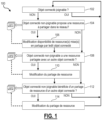
- FIGURE 1 is a schematic representation of a non-limiting exemplary embodiment of a method according to the invention.
- Process 100 shown in the FIGURE 1 , can be used to share resources in a local network comprising at least two connected objects.
- the method 100 comprises a step 102 during which a management unit, connected to each of the connected objects of said local network, interrogates a first connected object to determine whether this first connected object can be reached or not.
- the method 100 can stop.
- the management unit determines during a step 104 whether this first connected object has shared a hardware or software resource. To do this, the management unit consults one or more lists of shared resources LRP1. For example, this list LRP1 may mention that the resource R of the first connected object is proposed for sharing with any connected object within the network requiring said resource.
- This list of shared resources LRP1 may be held by the management unit itself, based on data received from each of the connected objects forming the local network. Preferably, this list LRP1 is stored at the management unit level so that it is immediately accessible to it, at any time.
- the method 100 continues with a step 108 described below.
- the method 100 determines whether a resource shared by the first connected object is the subject of a current sharing, or of a future sharing, for the benefit of a second connected object, by consulting a list LRP2 in which this sharing is listed.
- this list LRP2 can mention that the resource R1 of the first connected object is made available to the second connected object, for a duration D1, at time H1.
- This list LRP2 can be held by the management unit itself, and can be stored at the management unit level.
- step 108 the method continues with a step 112, described later.
- the method 100 comprises a step 110 of modifying this sharing.
- the modification may comprise a cancellation of said sharing, by updating the list LRP2, either by deleting said resource from said list LRP2, or by modifying a sharing data item which is stored in association with said resource in said list LRP2.
- the modification may be a holding of said sharing for a duration or until a later date, which may for example be determined in relation to said future date, by modifying a data item stored in the LRP2 list. At the end of said duration, or at said later date, if the first object is still not reachable, then the sharing may be canceled. Otherwise, the sharing is maintained.
- the method 100 determines whether a resource of a second connected object has been shared with the first object as part of a current share, or a future share, by consulting the list LRP2.
- this list LRP2 may mention that the resource R2 of the second connected object is made available to the first connected object, for a duration D2, at time H2.
- method 100 may terminate following step 112.
- the method 100 comprises a step 114 of modifying this sharing.
- the modification may comprise a cancellation of said sharing, by updating the list LRP2, either by deleting the resource concerned from said list LRP2, or by modifying a sharing data item which is stored in association with said resource in said list LRP2.
- the modification when the share is a future share, the modification may be a holding of said share for a duration or until a future date, which may for example be determined relative to said future date. At the end of said duration, or at said future date, if the first object is still not reachable, then the share may be canceled. Otherwise, the share is maintained.
- step 114 method 100 may terminate.
- the method 100 can preferably be carried out for all the connected objects of the local network of connected objects, in turn or at the same time.
- the process 100 can be repeated at a given frequency, on request or, as a background task, for each connected object.
- the method 100 implements an optimized sharing of resource(s) within a local network of connected objects.
- the method 100 uses two different lists LRP1 and LRP2.
- the method according to the invention can use a single list LRP bringing together the data stored in the lists LRP1 and LRP2.
- the method of the invention may comprise only steps 104-106 and/or 108-110 and/or 112-114.
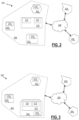
- FIGURE 2 is a schematic representation of a non-limiting exemplary embodiment of a system according to the invention.
- the 200 system shown in the FIGURE 2 , can be used for implementing a method of sharing resources within a local network of connected objects, in particular the method 100 of the FIGURE 1 or its variants as described above.
- the system 200 comprises a total of three connected objects 202 1 , 202 2 , 202 3 , also designated by the reference 202 i or 202 in the following.
- the number of connected objects is not limited to 3 and may be greater than or equal to 2.
- the connected objects 202 form a local network 204 and are interconnected with each other.
- each connected object 202 i is in communication with each of the other connected objects 202 i .
- Each connected object 202 i performs one or more tasks for which it is designed and comprises at least one hardware resource and/or at least one software resource.
- the connected objects 202 i may be connected objects located within a home, such as an alarm, a household appliance, etc. forming a local network 204 within said home.
- the local network 204 can be connected to one or more other networks 206 1 -206 n , local or not, for example through a communication network 208 such as the Internet network.
- the system 200 further comprises a management unit 210, in communication with each of the connected objects 202 1 -202 3 .
- This management unit is configured to implement all the steps of the method according to the invention and in particular of the method 100 of the FIGURE 1 .
- the management unit 210 may further be configured to establish an availability schedule for at least one resource, software or hardware, of one or more connected objects 202 i to be shared with at least one other connected object 202 i of the local network 204, i.e. to perform operations on behalf of another connected object 202 i within said local network 204.
- the management unit 210 may comprise a central scheduling software module 212, in particular software, and deploy in each connected object 202 1 -202 3 a client software module, respectively 214 1 -214 3 .
- Each client module 214 i equipping a connected object 202 i has the function of monitoring the use of the resources with which said connected object 202 i is equipped and informing the central module 212 so that said central module 212 can establish an availability schedule for each resource within each connected object.
- the client module 214 i can be a native module present in said connected object 202 i so that it is not deployed by the management unit.
- the management unit 210 may further be configured to allocate a resource shared by one of the connected objects within the local network to another connected object of said local network, within the framework of an immediate sharing, or of a future sharing, in particular for a given duration. This sharing may be stored in a list of shared resources. To do this, the management unit may comprise a sharing planning module 216, in particular software.
- the management unit 210 comprises a module 218 for monitoring the connection status, to said management unit, of each connected object 202 i .
- Such a module 218 can for example be configured to emit, on request or at a predetermined frequency, a “Ping” type command to each connected object 202 i to determine whether said connected object 202 i can be reached or not, by the management unit 210.
- the monitoring module 218 can be configured to monitor, for each connected object 202 i , a presence signal that said connected object 202 i sends to it, continuously or at a given frequency, to determine whether or not said connected object 202 i can be reached by the management unit 210.
- the management unit 210 is integrated into a dedicated device, independent of the connected objects, and performing no other task.
- FIGURE 3 is a schematic representation of another non-limiting example of a system for pooling resources between connected objects forming a local network.
- the 300 system shown in the FIGURE 3 , can be used for implementing a resource sharing method within a local network of connected objects, in particular the method 100 of the FIGURE 1 or any of the alternatives described above.
- the 300 system includes all the elements of the 200 system of the FIGURE 2 , except as otherwise noted below.
- the management unit 210 is integrated into the connected object 202 3 .
- the management unit can be integrated into another device such as an Internet access point, a switch, etc.
Landscapes
- Engineering & Computer Science (AREA)
- Computer Networks & Wireless Communication (AREA)
- Signal Processing (AREA)
- Environmental & Geological Engineering (AREA)
- Health & Medical Sciences (AREA)
- Computing Systems (AREA)
- General Health & Medical Sciences (AREA)
- Medical Informatics (AREA)
- Computer And Data Communications (AREA)
Claims (10)
- Computerimplementiertes Verfahren (100) zum Teilen von Ressourcen zwischen verbundenen Objekten (2021-2023), die ein lokales Netzwerk (204) ausbilden, wobei das Verfahren (100) eine Verwaltungseinheit (210) ausführt, die mit den verbundenen Objekten (2021-2023) in dem lokalen Netzwerk (204) verbunden ist und die Teilung von Ressourcen unter Verwendung einer Liste von (einer) geteilten Ressource(n) (LRP1, LRP2) durch jedes der verbundenen Objekte (2021-2023) in dem lokalen Netzwerk (204) steuert, wobei das Verfahren (100) mindestens eine Iteration der folgenden Schritte für mindestens eines der verbundenen Objekte (202i) umfasst, wobei die Schritte durch die Verwaltungseinheit ausgeführt werden- Überwachen (102) des Status der Verbindung, zu der Verwaltungseinheit (210), jedes verbundenen Objekts (202i), um zu bestimmen, ob das verbundene Objekt (202i) erreichbar ist oder nicht und- im Falle einer Änderung des Status der Verbindung jedes verbundenen Objekts (202i), Aktualisieren (106,110,114) der Liste (LRP1,LRP2), wenn in der Liste (LRP1,LRP2) eine geteilte Ressource in Bezug auf das verbundene Objekt (202i) erwähnt wird.
- Verfahren (100) nach einem der vorstehenden Ansprüche,
dadurch gekennzeichnet, dass der Schritt des Überwachens (102) des Status der Verbindung mindestens eines verbundenen Objekts (202i) durchgeführt wird:- bei jedem Empfangen einer Anfrage nach Zugriff auf eine geteilte Ressource in dem lokalen Netzwerk (204),- mit einer gegebenen Frequenz und/oder- in Echtzeit in Form einer kontinuierlich ausgeführten Hintergrundaufgabe. - Verfahren (100) nach einem der vorstehenden Ansprüche,
dadurch gekennzeichnet, dass das Überwachen des Status (102) der Verbindung eines verbundenen Objekts (202i) umfasst:- einen Test der Zugänglichkeit des verbundenen Objekts (202i), beispielsweise durch einen Computerbefehl einer Ping-Art; oder- Überwachen eines Signals, das als Präsenzsignal bezeichnet wird, das von dem verbundenen Objekt (202i) gesendet wird. - Verfahren (100) nach einem der vorstehenden Ansprüche,
dadurch gekennzeichnet, dass, wenn der Überwachungsschritt (102) bestimmt, dass ein verbundenes Objekt (202i) nicht erreichbar ist, der Aktualisierungsschritt eine Modifikation (106), in der Liste, einer Angabe über die Verfügbarkeit mindestens einer von dem Objekt (202i) geteilten Ressource oder einer mit dem Objekt geteilten Ressource umfasst. - Verfahren (100) nach einem der vorstehenden Ansprüche,
dadurch gekennzeichnet, dass, wenn:- der Überwachungsschritt (102) bestimmt, dass ein erstes verbundenes Objekt nicht erreichbar ist, und dass- eine Ressource des ersten Objekts mit einem zweiten verbundenen Objekt geteilt ist;der Aktualisierungsschritt eine Modifikation (108) der Teilung umfassen kann. - Verfahren (100) nach einem der vorstehenden Ansprüche,
dadurch gekennzeichnet, dass, wenn:- der Überwachungsschritt (102) bestimmt, dass ein erstes verbundenes Objekt nicht erreichbar ist, und dass- eine Ressource eines zweiten Objekts mit dem ersten verbundenen Objekt geteilt ist;der Aktualisierungsschritt eine Modifikation (112) der Teilung umfassen kann. - Verfahren (100) nach einem der vorstehenden Ansprüche,
dadurch gekennzeichnet, dass die Liste der geteilte(n) Ressource(n) (LRP1, LRP2) für mindestens eine von einem verbundenen Objekt (202i) geteilte Ressource mindestens eine Angabe umfasst, die relativ ist zu:- einer Dauer der Verfügbarkeit;- einem Verfügbarkeitszeitplan;- einer Verfügbarkeitsrate;der Ressource. - System (200;300) zur Teilung von Ressourcen zwischen verbundenen Objekten, umfassend:- mehrere verbundene Objekte (2021-2023), die untereinander verbunden sind und ein lokales Netzwerk (204) ausbilden, und- eine Verwaltungseinheit (210), die mit jedem der innerhalb des lokalen Netzwerks (204) verbundenen Objekte (2021-2023) verbunden ist;das konfiguriert ist, um sämtliche der Verfahrensschritte (100) nach einem der vorstehenden Ansprüche auszuführen.
- System (200;300) nach dem vorstehenden Anspruch,
dadurch gekennzeichnet, dass die Verwaltungseinheit (210) Folgendes ist:- durch eine dedizierte Einrichtung (210) ausgebildet, die sich in dem lokalen Netzwerk (204) befindet, oder- in einem verbundenen Objekt (202s) eingerichtet, das sich in dem lokalen Netzwerk (204) befindet und mindestens eine weitere Aufgabe durchführt. - System (200;300) nach einem der Ansprüche 8 oder 9,
dadurch gekennzeichnet, dass mindestens ein verbundenes Objekt (202i) ein Softwaremodul (214i) aufweist, das als Client bezeichnet wird, zum Bestimmen mindestens einer Angabe über die Verfügbarkeit mindestens einer Ressource des verbundenen Objekts (202i) und die in dem lokalen Netzwerk (204) geteilt werden kann.
Priority Applications (1)
| Application Number | Priority Date | Filing Date | Title |
|---|---|---|---|
| EP21305174.1A EP4040734B1 (de) | 2021-02-09 | 2021-02-09 | Optimierte nutzung von ressourcen zwischen verbundenen iot-objekten, die ein lokales netzwerk bilden |
Applications Claiming Priority (1)
| Application Number | Priority Date | Filing Date | Title |
|---|---|---|---|
| EP21305174.1A EP4040734B1 (de) | 2021-02-09 | 2021-02-09 | Optimierte nutzung von ressourcen zwischen verbundenen iot-objekten, die ein lokales netzwerk bilden |
Publications (2)
| Publication Number | Publication Date |
|---|---|
| EP4040734A1 EP4040734A1 (de) | 2022-08-10 |
| EP4040734B1 true EP4040734B1 (de) | 2024-08-14 |
Family
ID=75625511
Family Applications (1)
| Application Number | Title | Priority Date | Filing Date |
|---|---|---|---|
| EP21305174.1A Active EP4040734B1 (de) | 2021-02-09 | 2021-02-09 | Optimierte nutzung von ressourcen zwischen verbundenen iot-objekten, die ein lokales netzwerk bilden |
Country Status (1)
| Country | Link |
|---|---|
| EP (1) | EP4040734B1 (de) |
Family Cites Families (2)
| Publication number | Priority date | Publication date | Assignee | Title |
|---|---|---|---|---|
| EP2617176B1 (de) * | 2010-09-16 | 2019-12-18 | Samsung Electronics Co., Ltd | Vorrichtung und verfahren zur verwaltung einer steuervorrichtung in einem universellen plug-and-play-heimnetzwerk |
| FR3093833B1 (fr) * | 2019-03-15 | 2021-04-09 | Bull Sas | Procédé d’optimisation d’échanges de données dans une infrastructure d’objets connectés |
-
2021
- 2021-02-09 EP EP21305174.1A patent/EP4040734B1/de active Active
Also Published As
| Publication number | Publication date |
|---|---|
| EP4040734A1 (de) | 2022-08-10 |
Similar Documents
| Publication | Publication Date | Title |
|---|---|---|
| CN102449567B (zh) | 作为用于装备健康状况监视服务的基础的云计算 | |
| EP2559196B1 (de) | Werkzeug zur verwaltung von computerressourcen und infrastrukturen und netzwerken | |
| JP4495410B2 (ja) | コンピューティングシステムおよびその方法 | |
| EP3824389B1 (de) | Verfahren zur koordination mehrerer vorrichtungsverwaltungsserver | |
| EP2705644B1 (de) | Verfahren und vorrichtung zur erkennung von eindringungen bei einer reihe virtueller ressourcen | |
| WO2011128595A1 (fr) | Outil pour la gestion de ressources et d'infrastructures informatiques et de reseaux | |
| FR3115177A1 (fr) | Système et procédé de génération et de collecte de données vibratoires en vue de la surveillance d’une structure | |
| EP1289226B1 (de) | Mit einem TCP/IP Netzwerk verbundene Automatisierungsvorrichtung | |
| EP4220206B1 (de) | Vorrichtung zum laden von daten in datenverarbeitungseinheiten von einer datenquelle | |
| EP4040734A1 (de) | Optimierte nutzung von ressourcen zwischen verbundenen iot-objekten, die ein lokales netzwerk bilden | |
| EP0755001A1 (de) | Architektur zur Verkleidung von Anwendungen eines Datenverarbeitungssystems | |
| EP3051416B1 (de) | Steuerverfahren zum betreiben eines programms, das in einem maschinenpark ausgeführt werden soll | |
| EP2176759A2 (de) | Verfahren zur messung der leistung eines zielservers mit einem dynamischen ortungs-tool | |
| EP4040733B1 (de) | Leistungsstarke geteilte nutzung von ressourcen zwischen verbundenen iot-objekten, die ein lokales netzwerk bilden | |
| FR3006526A1 (fr) | Chargement dynamique de composants applicatifs | |
| US20250063022A1 (en) | Reverse proxy inspection for encrypted traffic in an edge-based network | |
| EP3893470B1 (de) | Verfahren zur optimierung der aktualisierung von verbundenen objekten und anwendungsmodul | |
| EP3926927B1 (de) | Kommunikationsverfahren und damit verbundene objekte | |
| EP4040755A1 (de) | Gemeinsame nutzung von ressourcen zwischen verbundenen iot-objekten, die ein lokales netzwerk bilden | |
| EP3929749A1 (de) | Verfahren und vorrichtung zur fernausführung von programmen eines in einem lokalen netz verbundenen objekts | |
| EP3846416A1 (de) | Verfahren zur terminierten geteilten nutzung von iot-funktionen, und vorrichtung zur terminierten geteilten nutzung | |
| FR2793982A1 (fr) | Procede d'optimisation, dans un systeme informatique, du transfert de donnees entre une application cliente et un serveur | |
| US20260056772A1 (en) | Deploying workloads on computing devices for mobile vehicles | |
| EP3900386A1 (de) | Verfahren zur verwaltung einer datenkommunikationsvorrichtung und vorrichtung zur durchführung des verfahrens | |
| EP3817294A1 (de) | Verfahren und module zur konnektivitätsteuerung von verbundenen objekten |
Legal Events
| Date | Code | Title | Description |
|---|---|---|---|
| PUAI | Public reference made under article 153(3) epc to a published international application that has entered the european phase |
Free format text: ORIGINAL CODE: 0009012 |
|
| STAA | Information on the status of an ep patent application or granted ep patent |
Free format text: STATUS: THE APPLICATION HAS BEEN PUBLISHED |
|
| AK | Designated contracting states |
Kind code of ref document: A1 Designated state(s): AL AT BE BG CH CY CZ DE DK EE ES FI FR GB GR HR HU IE IS IT LI LT LU LV MC MK MT NL NO PL PT RO RS SE SI SK SM TR |
|
| STAA | Information on the status of an ep patent application or granted ep patent |
Free format text: STATUS: REQUEST FOR EXAMINATION WAS MADE |
|
| 17P | Request for examination filed |
Effective date: 20230125 |
|
| RBV | Designated contracting states (corrected) |
Designated state(s): AL AT BE BG CH CY CZ DE DK EE ES FI FR GB GR HR HU IE IS IT LI LT LU LV MC MK MT NL NO PL PT RO RS SE SI SK SM TR |
|
| P01 | Opt-out of the competence of the unified patent court (upc) registered |
Effective date: 20230330 |
|
| REG | Reference to a national code |
Ref country code: DE Ref legal event code: R079 Free format text: PREVIOUS MAIN CLASS: H04L0012260000 Ipc: H04L0067510000 Ref document number: 602021017175 Country of ref document: DE |
|
| GRAP | Despatch of communication of intention to grant a patent |
Free format text: ORIGINAL CODE: EPIDOSNIGR1 |
|
| STAA | Information on the status of an ep patent application or granted ep patent |
Free format text: STATUS: GRANT OF PATENT IS INTENDED |
|
| RIC1 | Information provided on ipc code assigned before grant |
Ipc: H04L 43/103 20220101ALN20240207BHEP Ipc: H04L 43/0811 20220101ALI20240207BHEP Ipc: H04L 67/125 20220101ALI20240207BHEP Ipc: H04L 67/51 20220101AFI20240207BHEP |
|
| RIC1 | Information provided on ipc code assigned before grant |
Ipc: H04L 43/103 20220101ALN20240222BHEP Ipc: H04L 43/0811 20220101ALI20240222BHEP Ipc: H04L 67/125 20220101ALI20240222BHEP Ipc: H04L 67/51 20220101AFI20240222BHEP |
|
| GRAS | Grant fee paid |
Free format text: ORIGINAL CODE: EPIDOSNIGR3 |
|
| INTG | Intention to grant announced |
Effective date: 20240307 |
|
| GRAA | (expected) grant |
Free format text: ORIGINAL CODE: 0009210 |
|
| STAA | Information on the status of an ep patent application or granted ep patent |
Free format text: STATUS: THE PATENT HAS BEEN GRANTED |
|
| AK | Designated contracting states |
Kind code of ref document: B1 Designated state(s): AL AT BE BG CH CY CZ DE DK EE ES FI FR GB GR HR HU IE IS IT LI LT LU LV MC MK MT NL NO PL PT RO RS SE SI SK SM TR |
|
| REG | Reference to a national code |
Ref country code: GB Ref legal event code: FG4D Free format text: NOT ENGLISH |
|
| REG | Reference to a national code |
Ref country code: CH Ref legal event code: EP |
|
| REG | Reference to a national code |
Ref country code: DE Ref legal event code: R096 Ref document number: 602021017175 Country of ref document: DE |
|
| REG | Reference to a national code |
Ref country code: IE Ref legal event code: FG4D Free format text: LANGUAGE OF EP DOCUMENT: FRENCH |
|
| REG | Reference to a national code |
Ref country code: LT Ref legal event code: MG9D |
|
| REG | Reference to a national code |
Ref country code: NL Ref legal event code: MP Effective date: 20240814 |
|
| PG25 | Lapsed in a contracting state [announced via postgrant information from national office to epo] |
Ref country code: NO Free format text: LAPSE BECAUSE OF FAILURE TO SUBMIT A TRANSLATION OF THE DESCRIPTION OR TO PAY THE FEE WITHIN THE PRESCRIBED TIME-LIMIT Effective date: 20241114 |
|
| REG | Reference to a national code |
Ref country code: AT Ref legal event code: MK05 Ref document number: 1714325 Country of ref document: AT Kind code of ref document: T Effective date: 20240814 |
|
| PG25 | Lapsed in a contracting state [announced via postgrant information from national office to epo] |
Ref country code: NL Free format text: LAPSE BECAUSE OF FAILURE TO SUBMIT A TRANSLATION OF THE DESCRIPTION OR TO PAY THE FEE WITHIN THE PRESCRIBED TIME-LIMIT Effective date: 20240814 Ref country code: PL Free format text: LAPSE BECAUSE OF FAILURE TO SUBMIT A TRANSLATION OF THE DESCRIPTION OR TO PAY THE FEE WITHIN THE PRESCRIBED TIME-LIMIT Effective date: 20240814 Ref country code: PT Free format text: LAPSE BECAUSE OF FAILURE TO SUBMIT A TRANSLATION OF THE DESCRIPTION OR TO PAY THE FEE WITHIN THE PRESCRIBED TIME-LIMIT Effective date: 20241216 Ref country code: GR Free format text: LAPSE BECAUSE OF FAILURE TO SUBMIT A TRANSLATION OF THE DESCRIPTION OR TO PAY THE FEE WITHIN THE PRESCRIBED TIME-LIMIT Effective date: 20241115 Ref country code: FI Free format text: LAPSE BECAUSE OF FAILURE TO SUBMIT A TRANSLATION OF THE DESCRIPTION OR TO PAY THE FEE WITHIN THE PRESCRIBED TIME-LIMIT Effective date: 20240814 |
|
| PG25 | Lapsed in a contracting state [announced via postgrant information from national office to epo] |
Ref country code: BG Free format text: LAPSE BECAUSE OF FAILURE TO SUBMIT A TRANSLATION OF THE DESCRIPTION OR TO PAY THE FEE WITHIN THE PRESCRIBED TIME-LIMIT Effective date: 20240814 |
|
| PG25 | Lapsed in a contracting state [announced via postgrant information from national office to epo] |
Ref country code: LV Free format text: LAPSE BECAUSE OF FAILURE TO SUBMIT A TRANSLATION OF THE DESCRIPTION OR TO PAY THE FEE WITHIN THE PRESCRIBED TIME-LIMIT Effective date: 20240814 |
|
| PG25 | Lapsed in a contracting state [announced via postgrant information from national office to epo] |
Ref country code: AT Free format text: LAPSE BECAUSE OF FAILURE TO SUBMIT A TRANSLATION OF THE DESCRIPTION OR TO PAY THE FEE WITHIN THE PRESCRIBED TIME-LIMIT Effective date: 20240814 Ref country code: IS Free format text: LAPSE BECAUSE OF FAILURE TO SUBMIT A TRANSLATION OF THE DESCRIPTION OR TO PAY THE FEE WITHIN THE PRESCRIBED TIME-LIMIT Effective date: 20241214 |
|
| PG25 | Lapsed in a contracting state [announced via postgrant information from national office to epo] |
Ref country code: HR Free format text: LAPSE BECAUSE OF FAILURE TO SUBMIT A TRANSLATION OF THE DESCRIPTION OR TO PAY THE FEE WITHIN THE PRESCRIBED TIME-LIMIT Effective date: 20240814 |
|
| PG25 | Lapsed in a contracting state [announced via postgrant information from national office to epo] |
Ref country code: RS Free format text: LAPSE BECAUSE OF FAILURE TO SUBMIT A TRANSLATION OF THE DESCRIPTION OR TO PAY THE FEE WITHIN THE PRESCRIBED TIME-LIMIT Effective date: 20241114 Ref country code: ES Free format text: LAPSE BECAUSE OF FAILURE TO SUBMIT A TRANSLATION OF THE DESCRIPTION OR TO PAY THE FEE WITHIN THE PRESCRIBED TIME-LIMIT Effective date: 20240814 |
|
| PG25 | Lapsed in a contracting state [announced via postgrant information from national office to epo] |
Ref country code: RS Free format text: LAPSE BECAUSE OF FAILURE TO SUBMIT A TRANSLATION OF THE DESCRIPTION OR TO PAY THE FEE WITHIN THE PRESCRIBED TIME-LIMIT Effective date: 20241114 Ref country code: PT Free format text: LAPSE BECAUSE OF FAILURE TO SUBMIT A TRANSLATION OF THE DESCRIPTION OR TO PAY THE FEE WITHIN THE PRESCRIBED TIME-LIMIT Effective date: 20241216 Ref country code: PL Free format text: LAPSE BECAUSE OF FAILURE TO SUBMIT A TRANSLATION OF THE DESCRIPTION OR TO PAY THE FEE WITHIN THE PRESCRIBED TIME-LIMIT Effective date: 20240814 Ref country code: NO Free format text: LAPSE BECAUSE OF FAILURE TO SUBMIT A TRANSLATION OF THE DESCRIPTION OR TO PAY THE FEE WITHIN THE PRESCRIBED TIME-LIMIT Effective date: 20241114 Ref country code: NL Free format text: LAPSE BECAUSE OF FAILURE TO SUBMIT A TRANSLATION OF THE DESCRIPTION OR TO PAY THE FEE WITHIN THE PRESCRIBED TIME-LIMIT Effective date: 20240814 Ref country code: LV Free format text: LAPSE BECAUSE OF FAILURE TO SUBMIT A TRANSLATION OF THE DESCRIPTION OR TO PAY THE FEE WITHIN THE PRESCRIBED TIME-LIMIT Effective date: 20240814 Ref country code: IS Free format text: LAPSE BECAUSE OF FAILURE TO SUBMIT A TRANSLATION OF THE DESCRIPTION OR TO PAY THE FEE WITHIN THE PRESCRIBED TIME-LIMIT Effective date: 20241214 Ref country code: HR Free format text: LAPSE BECAUSE OF FAILURE TO SUBMIT A TRANSLATION OF THE DESCRIPTION OR TO PAY THE FEE WITHIN THE PRESCRIBED TIME-LIMIT Effective date: 20240814 Ref country code: GR Free format text: LAPSE BECAUSE OF FAILURE TO SUBMIT A TRANSLATION OF THE DESCRIPTION OR TO PAY THE FEE WITHIN THE PRESCRIBED TIME-LIMIT Effective date: 20241115 Ref country code: FI Free format text: LAPSE BECAUSE OF FAILURE TO SUBMIT A TRANSLATION OF THE DESCRIPTION OR TO PAY THE FEE WITHIN THE PRESCRIBED TIME-LIMIT Effective date: 20240814 Ref country code: ES Free format text: LAPSE BECAUSE OF FAILURE TO SUBMIT A TRANSLATION OF THE DESCRIPTION OR TO PAY THE FEE WITHIN THE PRESCRIBED TIME-LIMIT Effective date: 20240814 Ref country code: BG Free format text: LAPSE BECAUSE OF FAILURE TO SUBMIT A TRANSLATION OF THE DESCRIPTION OR TO PAY THE FEE WITHIN THE PRESCRIBED TIME-LIMIT Effective date: 20240814 Ref country code: AT Free format text: LAPSE BECAUSE OF FAILURE TO SUBMIT A TRANSLATION OF THE DESCRIPTION OR TO PAY THE FEE WITHIN THE PRESCRIBED TIME-LIMIT Effective date: 20240814 |
|
| PG25 | Lapsed in a contracting state [announced via postgrant information from national office to epo] |
Ref country code: RO Free format text: LAPSE BECAUSE OF FAILURE TO SUBMIT A TRANSLATION OF THE DESCRIPTION OR TO PAY THE FEE WITHIN THE PRESCRIBED TIME-LIMIT Effective date: 20240814 Ref country code: SM Free format text: LAPSE BECAUSE OF FAILURE TO SUBMIT A TRANSLATION OF THE DESCRIPTION OR TO PAY THE FEE WITHIN THE PRESCRIBED TIME-LIMIT Effective date: 20240814 Ref country code: DK Free format text: LAPSE BECAUSE OF FAILURE TO SUBMIT A TRANSLATION OF THE DESCRIPTION OR TO PAY THE FEE WITHIN THE PRESCRIBED TIME-LIMIT Effective date: 20240814 |
|
| PG25 | Lapsed in a contracting state [announced via postgrant information from national office to epo] |
Ref country code: EE Free format text: LAPSE BECAUSE OF FAILURE TO SUBMIT A TRANSLATION OF THE DESCRIPTION OR TO PAY THE FEE WITHIN THE PRESCRIBED TIME-LIMIT Effective date: 20240814 |
|
| PG25 | Lapsed in a contracting state [announced via postgrant information from national office to epo] |
Ref country code: CZ Free format text: LAPSE BECAUSE OF FAILURE TO SUBMIT A TRANSLATION OF THE DESCRIPTION OR TO PAY THE FEE WITHIN THE PRESCRIBED TIME-LIMIT Effective date: 20240814 |
|
| PG25 | Lapsed in a contracting state [announced via postgrant information from national office to epo] |
Ref country code: SK Free format text: LAPSE BECAUSE OF FAILURE TO SUBMIT A TRANSLATION OF THE DESCRIPTION OR TO PAY THE FEE WITHIN THE PRESCRIBED TIME-LIMIT Effective date: 20240814 Ref country code: IT Free format text: LAPSE BECAUSE OF FAILURE TO SUBMIT A TRANSLATION OF THE DESCRIPTION OR TO PAY THE FEE WITHIN THE PRESCRIBED TIME-LIMIT Effective date: 20240814 |
|
| REG | Reference to a national code |
Ref country code: DE Ref legal event code: R097 Ref document number: 602021017175 Country of ref document: DE |
|
| PLBE | No opposition filed within time limit |
Free format text: ORIGINAL CODE: 0009261 |
|
| STAA | Information on the status of an ep patent application or granted ep patent |
Free format text: STATUS: NO OPPOSITION FILED WITHIN TIME LIMIT |
|
| 26N | No opposition filed |
Effective date: 20250515 |
|
| PG25 | Lapsed in a contracting state [announced via postgrant information from national office to epo] |
Ref country code: SE Free format text: LAPSE BECAUSE OF FAILURE TO SUBMIT A TRANSLATION OF THE DESCRIPTION OR TO PAY THE FEE WITHIN THE PRESCRIBED TIME-LIMIT Effective date: 20240814 |
|
| PG25 | Lapsed in a contracting state [announced via postgrant information from national office to epo] |
Ref country code: MC Free format text: LAPSE BECAUSE OF FAILURE TO SUBMIT A TRANSLATION OF THE DESCRIPTION OR TO PAY THE FEE WITHIN THE PRESCRIBED TIME-LIMIT Effective date: 20240814 |
|
| REG | Reference to a national code |
Ref country code: CH Ref legal event code: PL |
|
| PG25 | Lapsed in a contracting state [announced via postgrant information from national office to epo] |
Ref country code: LU Free format text: LAPSE BECAUSE OF NON-PAYMENT OF DUE FEES Effective date: 20250209 |
|
| PG25 | Lapsed in a contracting state [announced via postgrant information from national office to epo] |
Ref country code: CH Free format text: LAPSE BECAUSE OF NON-PAYMENT OF DUE FEES Effective date: 20250228 |
|
| REG | Reference to a national code |
Ref country code: BE Ref legal event code: MM Effective date: 20250228 |
|
| PG25 | Lapsed in a contracting state [announced via postgrant information from national office to epo] |
Ref country code: BE Free format text: LAPSE BECAUSE OF NON-PAYMENT OF DUE FEES Effective date: 20250228 |
|
| PG25 | Lapsed in a contracting state [announced via postgrant information from national office to epo] |
Ref country code: IE Free format text: LAPSE BECAUSE OF NON-PAYMENT OF DUE FEES Effective date: 20250209 |
|
| PGFP | Annual fee paid to national office [announced via postgrant information from national office to epo] |
Ref country code: GB Payment date: 20260219 Year of fee payment: 6 |
|
| PGFP | Annual fee paid to national office [announced via postgrant information from national office to epo] |
Ref country code: DE Payment date: 20260217 Year of fee payment: 6 |
|
| PGFP | Annual fee paid to national office [announced via postgrant information from national office to epo] |
Ref country code: FR Payment date: 20260223 Year of fee payment: 6 |