EP4040721B1 - Method for providing a data link to the internet at a telecommunications terminal and server system - Google Patents
Method for providing a data link to the internet at a telecommunications terminal and server system Download PDFInfo
- Publication number
- EP4040721B1 EP4040721B1 EP22153660.0A EP22153660A EP4040721B1 EP 4040721 B1 EP4040721 B1 EP 4040721B1 EP 22153660 A EP22153660 A EP 22153660A EP 4040721 B1 EP4040721 B1 EP 4040721B1
- Authority
- EP
- European Patent Office
- Prior art keywords
- server
- mobile radio
- data connection
- secure data
- sim card
- Prior art date
- Legal status (The legal status is an assumption and is not a legal conclusion. Google has not performed a legal analysis and makes no representation as to the accuracy of the status listed.)
- Active
Links
Images


Classifications
-
- H—ELECTRICITY
- H04—ELECTRIC COMMUNICATION TECHNIQUE
- H04L—TRANSMISSION OF DIGITAL INFORMATION, e.g. TELEGRAPHIC COMMUNICATION
- H04L63/00—Network architectures or network communication protocols for network security
- H04L63/02—Network architectures or network communication protocols for network security for separating internal from external traffic, e.g. firewalls
- H04L63/0272—Virtual private networks
-
- H—ELECTRICITY
- H04—ELECTRIC COMMUNICATION TECHNIQUE
- H04W—WIRELESS COMMUNICATION NETWORKS
- H04W12/00—Security arrangements; Authentication; Protecting privacy or anonymity
- H04W12/40—Security arrangements using identity modules
- H04W12/45—Security arrangements using identity modules using multiple identity modules
-
- H—ELECTRICITY
- H04—ELECTRIC COMMUNICATION TECHNIQUE
- H04W—WIRELESS COMMUNICATION NETWORKS
- H04W76/00—Connection management
- H04W76/10—Connection setup
- H04W76/12—Setup of transport tunnels
-
- H—ELECTRICITY
- H04—ELECTRIC COMMUNICATION TECHNIQUE
- H04W—WIRELESS COMMUNICATION NETWORKS
- H04W8/00—Network data management
- H04W8/18—Processing of user or subscriber data, e.g. subscribed services, user preferences or user profiles; Transfer of user or subscriber data
- H04W8/20—Transfer of user or subscriber data
-
- H—ELECTRICITY
- H04—ELECTRIC COMMUNICATION TECHNIQUE
- H04W—WIRELESS COMMUNICATION NETWORKS
- H04W88/00—Devices specially adapted for wireless communication networks, e.g. terminals, base stations or access point devices
- H04W88/16—Gateway arrangements
-
- H—ELECTRICITY
- H04—ELECTRIC COMMUNICATION TECHNIQUE
- H04W—WIRELESS COMMUNICATION NETWORKS
- H04W92/00—Interfaces specially adapted for wireless communication networks
- H04W92/02—Inter-networking arrangements
Definitions
- a mobile phone device accesses the Internet via its "own" mobile phone network or home mobile phone network, to which the SIM card of the mobile phone device is assigned. This can be done using different technologies such as 3G, 4G and 5G.
- 3G, 4G and 5G technologies such as 3G, 4G and 5G.
- a mobile phone device is not within the reception area of the home mobile phone network, for example because the mobile phone device is abroad, it is not possible to dial into the home mobile phone network directly.
- This has the disadvantage of reducing the services available to the mobile phone device, as some services are nationally bound and cannot be used from abroad, even when roaming.
- Such nationally bound services that cannot be used from abroad include, for example, logging into a bank or using certain accounts such as a national Twitter account.
- a telecommunications terminal that is not a mobile phone terminal may also face the problem of being able to effectively dial into the Internet and use services in another country.
- a method for routing telecommunications connections to a mobile radio terminal that is not in the reception area of its home network is known. It is provided that SIM information data from a SIM card of the mobile radio terminal is transmitted via data transmission to a mobile radio gateway, which then logs into the mobile radio home network of the mobile radio terminal at the location of the mobile radio gateway using this SIM information data. A telecommunications connection directed to the phone number of the mobile radio terminal is forwarded from the mobile radio gateway to the mobile radio terminal.
- the DE 10 2011 007 814 A1 discloses a method for routing telecommunication connections to a mobile radio terminal that is not in the reception area of its home network, wherein the mobile radio terminal has a SIM card associated with the home network with SIM information data and the SIM card is associated with a first telephone number. Triggered by an event, a A message is generated which contains at least the SIM information data of the SIM card or information which identifies the SIM card. The message is sent directly or indirectly to a mobile radio gateway from the mobile radio terminal or the device connected to the mobile radio terminal. Assignment information which identifies the sender of the message is provided at the mobile radio gateway.
- a module of the mobile radio gateway at the location of the mobile radio gateway logs into the home network using the received SIM information data or using a partner SIM card, so that every telecommunications connection directed to the first telephone number is routed to the mobile radio gateway.
- Such a telecommunications connection is forwarded by the mobile radio gateway to the sender using the assignment information.
- a terminal device establishes a data connection via a router when it is outside its home network.
- the router establishes a first secure data connection between a home agent assigned to the terminal device and the router and a second secure data connection.
- the present invention is based on the object of providing an effective method for providing a data connection to the Internet on a telecommunications terminal and a server system which enable a telecommunications terminal to provide a connection to the Internet via a specific mobile radio network.
- the present invention then considers, in a first aspect of the invention, a method for providing a data connection to the Internet at a telecommunications terminal using a mobile radio network.
- the mobile radio network can be the mobile radio network to which a SIM card considered below is assigned (in which case the mobile radio network is referred to as the home mobile radio network) or alternatively any other mobile radio network. In the latter case, it is in particular a mobile radio network of another country that is different from the country in which the home mobile radio network of the SIM card is implemented.
- the method provides for a SIM card to be assigned to a telecommunications device under consideration.
- a SIM card can be made, for example, by the user of the telecommunications device or by a server.
- the assignment can be triggered manually or automatically. In any case, the assignment is recorded on the server so that the server knows that a SIM card under consideration is assigned to the telecommunications device under consideration.
- the SIM card assigned to the telecommunications terminal is provided to a mobile radio gateway. This is done by providing the SIM card to the mobile radio gateway from the server or a separate SIM server communicating with the server, as will be explained below.
- a SIM card in the sense of the present invention can be a physical SIM card or an eSIM (electronic SIM).
- Providing a SIM card in the sense of the present invention means that SIM information data is provided that enables the SIM card to be registered in the mobile radio network. If the SIM card is thus provided to the mobile radio gateway, this does not mean physically providing a SIM card, but rather providing electronic SIM information data that enables registration in the mobile radio network.
- IMSI International Mobile Subscriber Identity
- PIN Personal Identity Number
- a SIM card personalizes a mobile terminal with regard to the user and the network operator and enables the network operator to bill call charges.
- a SIM card is also referred to as a universal integrated circuit card (UICC).
- the invention therefore refers to the "provision of a SIM card” as the data associated with and identifying a physical SIM card or an eSIM.
- a radio module of the mobile radio gateway is registered in the mobile radio network using the SIM card provided.
- the radio module registering with the SIM card is identified and authenticated.
- Two cases must be distinguished here. If the mobile radio network is the home mobile radio network of the SIM card, registration takes place in the home mobile radio network. If the mobile radio network is a different mobile radio network that is not the home mobile radio network of the SIM card, registration in the mobile radio network takes place via a Roaming, ie the radio module with the SIM card logs into the mobile network via roaming. In both cases, the device logs into the mobile network.
- a mobile data connection is established from the radio module via the mobile network to the Internet.
- APN Access Point Name
- the mobile data connection can be established, for example, to a dial-in point or gateway of the mobile network to the Internet, so that access to the Internet is available via the mobile network, in particular to the "local" Internet, which is connected to the network transition.
- a gateway represents the interface between the switching network of the mobile network and the Internet or data network (Packet Data Network).
- the connection established is referred to as a "mobile data connection" because it is established via the mobile network.
- the method according to the invention further provides for the establishment of a first secure data connection between the mobile radio gateway and the server, whereby data can be transmitted transparently between the Internet and the server via the mobile radio data connection and the first secure data connection.
- VPN Virtual Private Network
- a secure data connection is thus provided between the server and the mobile radio gateway (more precisely: the radio module of the mobile radio gateway under consideration), which enables the secure transmission of data.
- the data is transmitted transparently in the sense that the payload data of the transmitted data packets is passed through and not changed.
- a second secure data connection is established between the telecommunications terminal and the server.
- the second secure data connection can be established before or after the first secure data connection in different embodiments of the present invention.
- the first secure data connection and the second secure data connection are realized via a packet-switched network such as the Internet.
- first secure data connection and the second secure data connection are connected or assigned to each other by the server so that a The telecommunications terminal's data connection to the Internet is provided via the second secure data connection, the first secure data connection and the mobile data connection.
- the method according to the invention is based on the idea of providing two secured data connections that are linked to one another between the telecommunications terminal and the mobile radio gateway with the server interposed, which provide the telecommunications terminal with secure data access to the mobile radio network, whereby the telecommunications terminal can dial into the remote mobile radio network directly via the linked, secure data connections via the mobile radio gateway using the SIM card assigned to it. If, for example, the telecommunications terminal is located in country A and the mobile radio gateway and the mobile radio network are in country B, a data connection is provided from the telecommunications terminal in country A to the mobile radio gateway in country B, and the telecommunications terminal logs into the mobile radio network in country B via the mobile radio gateway using the SIM card.
- the method according to the invention provides direct access to the mobile radio network, even though the telecommunications terminal is located in a different area or in a different country than the country in which the mobile radio network is implemented.
- the telecommunications terminal has direct data access to the mobile radio network via the interconnected, secure data connections.
- the telecommunications terminal can use all services of the home mobile network without national restrictions with regard to the available services.
- a direct log-in to the home mobile network takes place. Aspects of the invention thus avoid a restriction of the services available from abroad.
- the radio module of the mobile gateway logs into the mobile network via roaming.
- SIM cards can be assigned to the mobile gateway for test scenarios in order to check the usability of individual services in the event of such roaming.
- a German mobile provider can check which services its own customers can use if they log into a local network in the USA. US mobile network without having to be present in the USA.
- it can be tested whether the owner of a SIM card from a German mobile network can still access email messages (probably yes) or can still access their bank account (probably no) after roaming into a US mobile network.
- any two different countries and national mobile networks can be involved.
- quality parameters such as the bandwidth and different tariffs of the mobile phone connections established in the other country with a local mobile phone network via roaming can also be tested.
- Such test scenarios can be carried out automatically using different SIM cards from different providers in different foreign networks.
- the data connections considered according to the present invention provide the connectivity on the basis of which the telecommunications terminal can then implement applications and services.
- the solution according to the invention allows different operating systems (for example Android, iOS, Windows, Linux, etc.) and applications (for example streaming services, Twitter, Facebook, etc.) to communicate directly with the target mobile network via the data connections and thus to use and test operating systems/applications as if they were directly connected to the mobile network.
- a mobile gateway provides an interface between one or more telecommunications mobile networks and any other network, such as a telecommunications fixed network or an IP network.
- a mobile gateway is called by a user of another network or receives calls from this network. Data messages and forwards the desired connection/data packets via a mobile radio channel to the mobile radio network in which the recipient is located.
- the mobile radio gateway implements the functionality of a mobile phone and, as a mobile phone, establishes a connection to the recipient.
- Mobile radio gateways therefore have the same mobile radio modules as are used in mobile radio devices (mobile phones).
- Such mobile radio gateways are known, for example, from the DE 103 14 144 A1 It is intended that a mobile radio gateway contains a large number of SIM cards for the managed mobile radio channels. Any SIM cards from different network operators can be used.
- the invention further provides, as a variant, that the SIM card is provided to the mobile radio gateway by the server.
- the server in addition to its functionality as a data router between the two secure data connections, is a SIM server that manages a large number of SIM cards.
- the essential role that the server plays for the method according to the invention by being involved in secure data connections to both the mobile radio gateway and the telecommunications terminal and connecting them to one another is further reinforced in that the server also manages the SIM cards and one of the SIM cards managed by the server is assigned to the telecommunications terminal and provided to the mobile radio gateway.
- a SIM server is a server that manages and provides SIM cards for mobile communications.
- a SIM card is requested from the SIM server by a mobile communications gateway and provided to the mobile communications gateway by the SIM server.
- the SIM cards can be available electronically as an eSIM and managed via cloud-based management.
- the provision of a SIM card to the mobile communications gateway does not take place physically, neither if the SIM card is a physical SIM card nor if the SIM card is an eSIM. Only the SIM information data that identify a SIM card and reflect its functionality is transmitted to the mobile communications gateway.
- the SIM card is thus virtually located on the SIM server or is managed by it and its functionality is emulated on the mobile communications gateway if required based on specific information and data transmitted by the SIM server. This enables the use of a central SIM card pool for one or more mobile communications gateways.
- Such SIM servers are used, for example, in the DE 103 11 980 A1 described.
- the invention provides that the SIM card is provided to the mobile radio gateway by a separate SIM server, which is different from the server that establishes the first secure data connection to the mobile radio gateway and the second secure data connection to the telecommunications terminal.
- the SIM server and the server communicate with each other.
- the server issues the command to the SIM server or forwards it to the SIM server to provide the mobile radio gateway with a specific SIM card.
- the command or trigger that the SIM server provides the mobile radio gateway with a specific SIM card is provided by manual information, for example triggered by a user, or by automatic information, for example time-controlled information.
- the SIM server can receive a corresponding command from the server, directly from a user or in another way.
- the SIM server informs the server of the SIM card's provision at the mobile communications gateway after this provision, so that the server is aware that a specific SIM card has been provided to the mobile communications gateway (namely the SIM card that has been assigned to the telecommunications terminal).
- a further embodiment provides that the SIM card is assigned to the telecommunications terminal by the SIM server.
- a further embodiment of the invention provides that the second secure data connection between the telecommunications terminal and the server is established before the first secure data connection between the mobile radio gateway and the server, whereby the establishment of the second secure data connection triggers the provision of the SIM card at the mobile radio gateway.
- a secure data connection - the second secure data connection - is first established between the telecommunications terminal and the server.
- a SIM card is assigned to the telecommunications terminal.
- the establishment of this second secure data connection automatically triggers the provision of the SIM card at the mobile radio gateway (directly by the server or an assigned SIM server). If the first secure data connection between the mobile radio gateway and the server is established at a later point in time according to the method according to the invention, the server must The secured data connection can only be connected to the second secured data connection previously established between the PBX and the server.
- the first secure data connection between the mobile radio gateway and the server is established before the second secure data connection between the telecommunications terminal and the server.
- a separate connection is established between the server and the telecommunications terminal to assign the SIM card to the telecommunications terminal, but this is then abandoned again and does not need to be a secure connection.
- the telecommunications terminal sends a command to the server that triggers the provision of the SIM card at the mobile radio gateway, again without such a command necessarily being transmitted to the server via a secure connection.
- the telecommunications terminal sends a command to provide the SIM card at the mobile radio gateway directly to the mobile radio gateway.
- the server connects the first secure data connection and the second secure data connection by assigning the two connections to each other so that data from one connection can be forwarded to the other connection and vice versa. Such an assignment can be made, for example, via IP addresses of the two secure data connections.
- the second secure data connection which is designed as a VPN tunnel, for example, is assigned its own IP address that identifies the VPN tunnel.
- the first secure data connection which is also designed as a VPN tunnel, for example, is assigned its own IP address that identifies this VPN tunnel.
- the server as a participant in both secure data connections, knows both IP addresses and that both secure data connections are assigned to the same SIM card, and can assign them to each other and forward incoming and outgoing data packets to the other secure data connection, with the server carrying out IP routing.
- the telecommunications terminal implements an application or a service after the provision of a data connection of the telecommunications terminal to the Internet and for this purpose establishes a telecommunications connection (telecommunications connection) to an Internet server and/or to another telecommunications terminal.
- a telecommunications connection serves to implement the application or the service, whereby the previously provided connectivity or the provided data connections are established.
- an SMS/MMS message is transmitted to and/or received from an Internet server and/or another telecommunications terminal via the telecommunications connection.
- a corresponding service can be provided on the user side or on the server side (for example via a web server).
- a voice call can be made available between the Internet and the telecommunications terminal, for example via VoIP.
- the server serves as a switching system to implement messages and calls between the mobile gateway and the telecommunications terminal.
- the mobile network can be a mobile network in a different geographical region than the region in which the home mobile network of the SIM card is present.
- the mobile network can be a mobile network in a different country than the country in which the home mobile network of the SIM card is implemented.
- a radio module of the mobile gateway is registered in the mobile network using the provided SIM card through roaming.
- the mobile network is the home mobile network of the SIM card, i.e. the mobile network to which the SIM card is assigned.
- first secure data connection and/or the second secure data connection are additionally encrypted.
- encryption methods guarantees a secure and tamper-proof data path to the remote mobile network.
- design variants can be provided in which algorithms determine the logical connection between a telecommunications terminal and the SIM card used and/or the provision of the SIM card at the mobile gateway.
- the use of the SIM card in the mobile gateway can be controlled over time, whereby the use of the SIM card can be controlled by parameters such as network quality, data throughput, prepaid credit, number of SMS, MMS, calls, call minutes, data volume used, etc.
- Such automatic control can be used, for example, to implement test scenarios.
- the means mentioned comprise, for example, a processor for executing instructions and a memory which is coupled to the processor and in which instructions are stored which, when executed by the processor, cause the processor to carry out the steps mentioned.
- the means are implemented by software in combination with a processor which executes the software.
- the means mentioned can each be implemented by a separate processor with associated software or the means mentioned can be provided jointly by one or more processors.
- the server system is divided into at least two different physical or virtual servers.
- a division is provided such that the server system has a separate SIM server, wherein the means which are provided and designed to provide the SIM card assigned to the telecommunications terminal to a mobile radio gateway are provided by the SIM server.
- the other means are implemented, for example, in another server.
- the SIM server makes the SIM card available to the mobile gateway and thus initiates the registration of the mobile gateway.
- the command or trigger for the SIM server to make the SIM card available to the mobile gateway can be provided in a variety of ways, for example through manual information, for example triggered by a user, or through automatic information, for example time-controlled.
- the means intended and designed to cause the mobile radio gateway to log into the mobile radio network using the received SIM card and to establish a mobile radio data connection to the Internet via the mobile radio network are also integrated into the said SIM server.
- a division of the server system into at least two different physical or virtual servers is not necessarily the case.
- all means of the server system are implemented in one server.
- such a server also has means that are intended and designed to manage a plurality of SIM cards, whereby, as already mentioned, the term "SIM card” includes physical SIM cards and/or eSIMs.
- SIM card includes physical SIM cards and/or eSIMs.
- the server thus also has the functionality of a SIM server.
- the means intended and designed to cause the mobile radio gateway to register in the mobile radio network using the received SIM card and to establish a mobile radio data connection in the mobile radio network are provided, for example, by means that generate a message that is sent to the mobile radio gateway, wherein the message contains the SIM information data, and wherein the receipt of the message at the mobile radio gateway triggers the registration of the SIM card and the establishment of the mobile radio data connection.
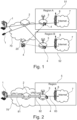
- the Figure 1 shows a telecommunications arrangement which comprises networks and telecommunications components with which a method according to the invention for establishing a data connection to the Internet can be implemented.
- the telecommunications arrangement comprises as essential components a telecommunications terminal 1, a server 2, a mobile radio gateway 3, a SIM card 4, mobile radio networks 51, 52 and the Internet 7.
- the telecommunications terminal 1 can be a mobile radio terminal or a non-mobile terminal, for example a PC or a tablet computer.
- the telecommunications terminal 1 can communicate with the server 2 via a packet switching network, for example the Internet 70 or an intranet.
- the server 2 can also communicate with the mobile radio gateway 3 via the packet switching network.
- the server 2 is used to provide a secure data connection between the telecommunications terminal 1 and the mobile radio gateway 3, as will be explained below. It can be provided that the server 2 also has the functionality of a SIM server and manages a pool of SIM cards 4.
- the SIM cards 4 can be physically located in the server 2 or can be present in the server as eSIMs.
- a separate SIM server 20 is provided, which is designed, for example, as a cloud-based SIM management system, wherein the server 2 communicates with the SIM server 20 and, for example, sends commands to the SIM server to provide certain SIM cards 4 to the mobile radio gateway 3.
- the server 2 and the SIM server 20 form a server system in the sense of the present invention.
- SIM server 20 is assigned to the server 2, whereby the SIM server 20 carries out the actual management of the SIM cards, although, as explained, this functionality can alternatively be integrated into the server 2.
- the server 2 can, for example on the basis of a corresponding command from the server 2 or the telecommunications terminal 1, logically assign a specific SIM card to the telecommunications terminal 1.
- the server 2 can also cause the SIM server 20 to provide the SIM card 4 logically assigned to the telecommunications terminal 1 to the mobile radio gateway 3, for example on the basis of a command from the telecommunications terminal 1 or automatically on its own initiative, whereby the provision of such a SIM card 9 does not take place physically, but rather only the SIM information data that identify a SIM card and reflect its functionality are transmitted to the mobile radio gateway 4 by data transmission via the network 70.
- the mobile radio gateway 3 has a plurality of radio modules for mobile radio communication (not shown separately).
- a plurality of SIM cards 4 are assigned and can be assigned to the mobile radio gateway 3, each of which enables the use of a radio module for mobile radio communication.
- a radio module sends data to a mobile radio channel and receives data via the mobile radio channel.
- One or more SIM cards can be assigned to each radio module, whereby only one SIM card is activated at any given time.
- the mobile radio gateway 3 is located in the reception area of a mobile radio network, whereby in the embodiment the Figure 1 two mobile radio gateways 3, each located in a different mobile radio network 51, 52, are shown.
- the different mobile radio networks 51, 52 are located in different regions A, B, which are, for example, different countries.
- Each mobile radio network 51, 52 usually has a plurality of mobile radio transmission stations 6, as in the Figure 1 shown schematically.
- each mobile radio network 51, 52 has a transition to the local Internet 7, ie the mobile radio network 51, 52 has, in a manner known per se, dial-in points or local transitions or gateways to the Internet 7 (not shown in detail).
- the telecommunications order of the Figure 1 The initial situation is that the telecommunications terminal 1 is located in a different country or region than the country or region in which the mobile network 51, 52 (hereinafter generally referred to as the mobile network 5) is implemented.
- a connection between the telecommunications terminal 1 and the server 2 is provided as a secure data connection in the form of a VPN tunnel via the network 70.
- a secure data connection in the form of a VPN tunnel is provided via the network 70 between the server 2 and the respective mobile gateway 3.
- the mobile network 5, in whose reception area the mobile gateway 3 is located, can be the home mobile network of the respective SIM card 4, via which a connection to the mobile network 5 is established. However, this does not necessarily have to be the case.
- the mobile network 5 in whose reception area the mobile gateway 3 is located can be a mobile network to which the SIM card 4 is not assigned, in which case a dial-in to the mobile network is carried out by the mobile gateway 3 or a radio module of the mobile gateway 3 via roaming.
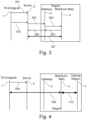
- the Figure 2 shows a schematic of the data connections that have been established.
- a secure data connection 81 in the form of a VPN tunnel is established between the telecommunications terminal 1 and the server 2, which is referred to as the second secure data connection.
- a further secure data connection 82 in the form of a VPN tunnel is established between the server 2 and the mobile radio gateway 3, which is referred to as the first secure data connection.
- a mobile radio data connection 83 to the mobile radio network 5 exists between the mobile radio gateway 3 and its radio module registered in the mobile radio network 5. This data connection 83 can be extended by a transition to the Internet 7.
- Typical scenarios are the following:
- Scenario 1 The telecommunications terminal 1 is located in Germany, for example.
- the mobile network 5 and the mobile gateway 3 are located abroad, for example the USA.
- the mobile network 5 is not the home mobile network of the SIM card 4, which is used to dial into the mobile network 5.
- Scenario 2 The telecommunications terminal 1 is located abroad, for example in France.
- the mobile network 5 and the mobile gateway 3 are located in the country, for example in Germany.
- the mobile network 5 is the home mobile network of the SIM card 4, which is used to dial into the mobile network 5.
- a SIM card 4 is assigned to the telecommunications terminal and this assignment is recorded on the server 2.
- a logical assignment of the SIM card 4 to the telecommunications terminal 1 takes place, without the SIM card 4 or SIM information data being transmitted to the telecommunications terminal 1. Accordingly, it is not relevant for the present method whether the telecommunications terminal 1 is a mobile radio terminal or another telecommunications terminal.
- the logical assignment can take place automatically or by manual command.
- the SIM card 4 is assigned to the telecommunications terminal 1 by the server 2, which communicates with the SIM server 20 for this purpose.
- the SIM card 4 is provided to the mobile radio gateway 3.
- the SIM information data is transmitted from the SIM server 20 (or alternatively from the server 2) to the mobile radio gateway 3.
- a radio module of the mobile radio gateway 3 logs into the mobile radio network 5 using the provided SIM card 4.
- the mobile radio network 5 can be the home mobile radio network of the SIM card 4, in which case a direct log-in takes place, or it can be another mobile radio network, in which case a log-in takes place via roaming.
- step 904 a mobile data connection is established to the Internet via the mobile network 5 through the registered radio module. Then, in step 905, the first secure data connection 82 is established via a VPN tunnel between the mobile gateway 3 and the server 2. A second secure data connection 83 is established via a VPN tunnel between the telecommunications terminal 1 and the server 2 in step 106. This secure data connection 83 can have already been established previously or is established after the secure data connection 82.
- the first secure data connection 82 is connected to the second secure data connection 81 by the server 2.
- This provides a data connection of the telecommunications terminal 1 to the Internet via the second secure data connection 81, the first secure data connection 82 and the mobile radio data connection 83, see also Figure 2
- the server 2 ensures that the two secure data connections 81, 82 are assigned to each other and data is passed on to the other data connection, so that the two secure data connections 81, 82 together create a VPN tunnel from the telecommunications terminal 1 to the mobile radio gateway 3.
- the method provided allows the implementation of various test scenarios, whereby it can be tested which services with which quality characteristics are available to a user who dials into a mobile network in the USA via roaming using his SIM card, which is assigned to a German mobile network.
- These test scenarios can be implemented without it being necessary to dial in with a telecommunications terminal on site in the USA.
- the two secure data connections 81, 82 form a data access via data transmission via the Internet (and not via mobile or telecommunications networks) to the mobile gateway 3 in the other country.
- the method provided allows the use of all services available in the home network, even if the telecommunications terminal 1 is located abroad.
- the telecommunications terminal 1 located abroad can dial into the mobile radio gateway 3 of the home mobile radio network via the data access formed by the two secure data connections 81, 82, so that there are no restrictions with regard to the available services.
- FIGS. 3 and 4 show the signaling process between telecommunications terminal 1, server 2, mobile radio gateway 3 and mobile radio network 5 according to a first embodiment variant.
- a SIM card is assigned to the telecommunications terminal 1 at some point in time.
- the assignment can be made by the user of the telecommunications terminal 1, an administrator or the server 2.
- the assignment can be made by manual command or automatically.
- a data connection between the telecommunications terminal 1 and the server 2 required for step 301 can then be terminated. In any case, the server 2 must be informed of the assignment unless it is made by itself.
- a command for registering the SIM card in the mobile radio gateway is sent from the TK terminal 1 to the server 2.
- the command can be generated manually or automatically.
- the SIM card is then assigned by the server 2 to the mobile radio gateway 3 according to step 303 (either directly or via the SIM server 20 according to the Figure 1 ).
- Command 302 can also be sent to server 2 without maintaining a data connection.
- step 304 the SIM card is registered in the mobile network 5 using a radio module of the mobile gateway 3.
- a data connection is then established in the mobile network 5 according to step 305. This is done via a local IP address of the mobile gateway 3 and a local access of the mobile gateway 3 to the mobile network 5.
- a secure data connection (the data connection 82 of the Figure 2 ) is established between the mobile radio gateway 3 and the server 2 according to step 306.
- the secure data connection is assigned a first IP tunnel address.
- the data of this data channel is then exchanged transparently between server 2 and mobile radio network 5, with the data being routed in the mobile radio gateway between the secure data connection to server 2 and the mobile radio data connection to the mobile radio network 5, with the data or data packets being assigned via the local IP address on the one hand and the first IP tunnel address on the other.
- step 307 the data is passed transparently between the server 2 and the mobile network 5.
- the Figure 4 shows the continuation of the signaling of the Figure 3 .
- a second secure data connection is established by the user or the TK terminal 1 (or alternatively by the server 2) between the TK terminal 1 and the server 2 (the data connection 81 of the Figure 2 )
- the server 2 connects this secure data connection of the user or TK terminal 1 (which has a second IP tunnel address assigned) with the secure data connection to the telecommunications terminal 3 or the SIM card 4.
- the server 2 routes the data between the first secure data connection and the second secure data connection, whereby the data or data packets are assigned via the first IP tunnel address on the one hand and the second IP tunnel address on the other.
- a transparent data tunnel is thus created between the telecommunications terminal 1 and the mobile network 5 of the region in question.
- the server 2 can assign the secure data connection with the mobile radio gateway 3, which is based on the mobile radio communication of the registered SIM card 4, to the secure data connection with the telecommunications terminal 1, since it is informed about the assignment of the SIM card 4 to the telecommunications terminal 1.
- the data tunnel can provide access to the data network connected behind it, generally the regional Internet.
- the telecommunications terminal 1 behaves as if it were located locally in the region covered by the mobile network 5.
- data connections considered are connections on levels 1 to 4 and possibly also level 5 of the OSI reference model, which serve to provide connectivity. This connectivity is the prerequisite for the implementation of applications and services that are located on level 7 of the OSI reference model.
- FIGS. 5 and 6 show the signaling process between telecommunications terminal 1, server 2, mobile gateway 3 and mobile network 5 according to a second embodiment variant.
- a SIM card is assigned to the telecommunications terminal 1 at some point in time according to step 501.
- the assignment can be made by the user of the telecommunications terminal 1, an administrator or the server 2.
- the assignment can be made by manual command or automatically.
- a data connection between the telecommunications terminal 1 and the server 2 required for step 301 can then be abandoned. In any case, the server 2 must be informed of the assignment unless it is made by itself.
- step 502 the user or the telecommunications terminal 1 establishes a secure data connection (for example, a VPN connection) to the server 2, then the SIM card assigned to the telecommunications terminal 1 or the SIM information data is provided to the mobile radio gateway 3 according to step 503 (by the server 2 or a SIM server 20) and the mobile radio gateway 3 is logged into the mobile radio network 5 using the assigned SIM card according to step 504.
- a secure data connection is thus first established between the telecommunications terminal and the server 2 (the data connection 81 of the Figure 2 ).
- a (second) IP tunnel address is assigned to this secure data connection.
- a further secure data connection for example a VPN connection, is established between the mobile gateway and the server 2 in accordance with step 506.
- a (first) IP tunnel address is assigned to this secure data connection.
- the data of this data channel is then exchanged transparently between server 2 and mobile network 5 in accordance with step 507, with the data being routed in the mobile gateway between the secure data connection to server 2 and the mobile data connection to the mobile network 5, with the data or data packets being assigned via the local IP address on the one hand and the first IP tunnel address on the other.
- the server 2 connects the secure data connection between server 2 and mobile radio gateway 3 with the secure data connection established in step 502 between the telecommunications terminal 1 and the server 2.
- the server 2 routes the data between the two secure data connections, whereby the data or data packets are assigned via the first IP tunnel address on the one hand and the second IP tunnel address on the other.
- a transparent data tunnel is created between the telecommunications terminal 1 and the mobile radio network 5 of the region in question.
- this data tunnel can provide access to the data network connected behind it, generally the - regional - Internet 7.
- the telecommunications terminal 1 behaves as if it were located locally in the region covered by the mobile radio network 5.
- a connectivity of the telecommunications terminal 1 to the Internet 7 is provided, on the basis of which telecommunications connections (TK connections) can be established between the telecommunications terminal 1 and a communication partner, for example an Internet server or another telecommunications terminal, in order to implement an application or a service on level 7 of the OSI reference model.
- TK connections telecommunications connections
- the Figures 7 and 8 show the implementation of a service by which an SMS/MMS message is sent or received from the telecommunications terminal 1.
- the telecommunications terminal 1 Based on the situation that a SIM card is assigned to the telecommunications terminal 1, it is provided that the user or the telecommunications terminal sends an SMS/MMS message to a regional subscriber or service provider.
- the telecommunications terminal 1 sends the SMS/MMS message to the server 2 by entering a recipient in accordance with step 701. If the telecommunications terminal 1 is not a mobile radio terminal, the SMS/MMS message is made available, for example, via a user interface on the server 2 (for example an HTML interface) or via another interface.
- the server 2 forwards the message to the mobile radio gateway 3 in accordance with step 702.
- a transmission path 705 is thus provided from the telecommunications terminal to the service/subscriber 9.
- a user or their telecommunications terminal 1 receives an SMS/MMS message from a regional subscriber or service provider 9, for example in the case of a two-way authorization in conjunction with a data application.
- the message is sent by the service/subscriber 9 over the Internet to the mobile network 5 and received by the mobile gateway 3 (steps 801, 802).
- the mobile gateway 3 forwards the received SMS/MMS message to the server 2.
- the server 2 forwards the received SMS/MMS message to the telecommunications terminal 1 in accordance with step 804.
- a transmission path 805 is thus provided from the service/subscriber 9 to the telecommunications terminal 1.
Landscapes
- Engineering & Computer Science (AREA)
- Computer Networks & Wireless Communication (AREA)
- Signal Processing (AREA)
- Computer Security & Cryptography (AREA)
- Databases & Information Systems (AREA)
- Computer Hardware Design (AREA)
- Computing Systems (AREA)
- General Engineering & Computer Science (AREA)
- Mobile Radio Communication Systems (AREA)
Description
Es ist bekannt, dass ein Mobilfunk-Endgerät einen Zugang zum Internet über das "eigene" Mobilfunknetz bzw. Heimat-Mobilfunknetz herstellt, dem die SIM-Karte des Mobilfunk-Endgeräts zugeordnet ist. Dies kann unter Verwendung unterschiedlicher Technologien wie 3G, 4G und 5G erfolgen. Wenn sich ein Mobilfunk-Endgerät nicht im Empfangsbereich des Heimat-Mobilfunknetzes befindet, beispielsweise weil sich das Mobilfunk-Endgerät im Ausland befindet, ist das direkte Einwählen in das Heimat-Mobilfunknetz jedoch nicht möglich. Dies ist mit dem Nachteil einer Reduzierung der dem Mobilfunk-Endgerät zur Verfügung stehenden Dienste verbunden, da einige Dienste national gebunden sind und auch bei einem Roaming nicht vom Ausland aus in Anspruch genommen werden können. Solche national gebundenen Dienste, die aus dem Ausland nicht in Anspruch genommen werden können, betreffen beispielsweise das Einbuchen bei einer Bank oder das Nutzen bestimmter Accounts wie zum Beispiel eines nationalen Twitter-Kontos.It is known that a mobile phone device accesses the Internet via its "own" mobile phone network or home mobile phone network, to which the SIM card of the mobile phone device is assigned. This can be done using different technologies such as 3G, 4G and 5G. However, if a mobile phone device is not within the reception area of the home mobile phone network, for example because the mobile phone device is abroad, it is not possible to dial into the home mobile phone network directly. This has the disadvantage of reducing the services available to the mobile phone device, as some services are nationally bound and cannot be used from abroad, even when roaming. Such nationally bound services that cannot be used from abroad include, for example, logging into a bank or using certain accounts such as a national Twitter account.
In ähnlicher Weise kann sich auch für ein TK-Endgerät, dass kein Mobilfunk-Endgerät ist, das Problem stellen, sich in einem anderen Land in effektiver Weise in das Internet einwählen und Dienste in Anspruch nehmen zu können.Similarly, a telecommunications terminal that is not a mobile phone terminal may also face the problem of being able to effectively dial into the Internet and use services in another country.
Aus der
Die
Aus der
Der vorliegenden Erfindung liegt die Aufgabe zu Grunde, ein effektives Verfahren zum Bereitstellen einer Datenverbindung zum Internet an einem TK-Endgerät sowie ein Serversystem zur Verfügung zu stellen, die es einem TK-Endgerät ermöglichen, eine Verbindung zum Internet über ein bestimmtes Mobilfunknetz bereitzustellen.The present invention is based on the object of providing an effective method for providing a data connection to the Internet on a telecommunications terminal and a server system which enable a telecommunications terminal to provide a connection to the Internet via a specific mobile radio network.
Diese Aufgabe wird erfindungsgemäß durch ein Verfahren mit den Merkmalen des Anspruchs 1 und ein Serversystem mit den Merkmalen des Anspruchs 11 gelöst. Ausgestaltungen der Erfindung sind in den abhängigen Ansprüchen angegeben.This object is achieved according to the invention by a method having the features of
Danach betrachtet die vorliegende Erfindung in einem ersten Erfindungsaspekt ein Verfahren zum Bereitstellen einer Datenverbindung zum Internet an einem TK-Endgerät unter Verwendung eines Mobilfunknetzes. Das Mobilfunknetz kann das Mobilfunknetz sein, dem eine nachfolgend betrachtete SIM-Karte zugeordnet ist (für welchen Fall das Mobilfunknetz als Heimat-Mobilfunknetz bezeichnet wird) oder alternativ irgendein anderes Mobilfunknetz sein. In letzterem Fall handelt es sich insbesondere um ein Mobilfunknetz eines anderen Landes, das sich von dem Land unterscheidet, in dem das Heimat-Mobilfunknetz der SIM-Karte realisiert ist.The present invention then considers, in a first aspect of the invention, a method for providing a data connection to the Internet at a telecommunications terminal using a mobile radio network. The mobile radio network can be the mobile radio network to which a SIM card considered below is assigned (in which case the mobile radio network is referred to as the home mobile radio network) or alternatively any other mobile radio network. In the latter case, it is in particular a mobile radio network of another country that is different from the country in which the home mobile radio network of the SIM card is implemented.
Das Verfahren sieht vor, dass einem betrachteten TK-Endgerät eine SIM-Karte zugeordnet wird. Eine solche Zuordnung einer SIM-Karte kann beispielsweise durch den Nutzer des TK-Endgeräts oder durch einen Server erfolgen. Die Zuordnung kann manuell oder automatisch ausgelöst werden. In jedem Fall wird die Zuordnung an dem Server erfasst, so dass der Server Kenntnis davon hat, dass eine betrachtete SIM-Karte dem TK betrachteten Endgerät zugeordnet ist.The method provides for a SIM card to be assigned to a telecommunications device under consideration. Such an assignment of a SIM card can be made, for example, by the user of the telecommunications device or by a server. The assignment can be triggered manually or automatically. In any case, the assignment is recorded on the server so that the server knows that a SIM card under consideration is assigned to the telecommunications device under consideration.
In einem nachfolgenden Schritt wird die dem TK-Endgerät zugeordnete SIM-Karte einem Mobilfunk-Gateway bereitgestellt. Dies erfolgt, indem die SIM-Karte dem Mobilfunk-Gateway von dem Server oder einem mit dem Server kommunizierenden gesonderten SIM-Server bereitgestellt wird, wie noch ausgeführt wird. In diesem Zusammenhang wird darauf hingewiesen, dass eine SIM-Karte im Sinne der vorliegenden Erfindung eine physische SIM-Karte oder eine eSIM (elektronische SIM) sein kann. Das Bereitstellen einer SIM-Karte im Sinne der vorliegenden Erfindung bedeutet, dass SIM-Informationsdaten bereitgestellt werden, die ein Einbuchen der SIM-Karte im Mobilfunknetz ermöglichen. Wenn somit dem Mobilfunk-Gateway die SIM-Karte bereitgestellt wird, so bedeutet dies nicht ein physisches Bereitstellen einer SIM-Karte, sondern die Bereitstellung von elektronischen SIM-Informationsdaten, die ein Einbuchen im Mobilfunknetz ermöglichen. Eine SIM-Karte umfasst als SIM-Informationsdaten in der Regel eine IMSI (IMSI = "International Mobile Subscriber Identity"), eine PIN (PIN = "Personal Identity Number"), Sicherheitsalgorithmen und nutzerspezifische Daten. Eine SIM-Karte personalisiert ein Mobilfunk-Endgerät hinsichtlich des Nutzers und hinsichtlich des Netzbetreibers und ermöglicht die Abrechnung von Gesprächsgebühren von dem Netzbetreiber. Eine SIM-Karte wird auch als universelle Karte mit integrierter Schaltung (UICC - "Universal Integrated Circuit Card") bezeichnet. Die Erfindung bezeichnet somit als "Bereitstellung einer SIM-Karte" die einer physischen SIM-Karte oder einer eSIM zugeordneten und diese identifizierenden Daten.In a subsequent step, the SIM card assigned to the telecommunications terminal is provided to a mobile radio gateway. This is done by providing the SIM card to the mobile radio gateway from the server or a separate SIM server communicating with the server, as will be explained below. In this context, it should be noted that a SIM card in the sense of the present invention can be a physical SIM card or an eSIM (electronic SIM). Providing a SIM card in the sense of the present invention means that SIM information data is provided that enables the SIM card to be registered in the mobile radio network. If the SIM card is thus provided to the mobile radio gateway, this does not mean physically providing a SIM card, but rather providing electronic SIM information data that enables registration in the mobile radio network. A SIM card usually includes an IMSI (IMSI = "International Mobile Subscriber Identity"), a PIN (PIN = "Personal Identity Number"), security algorithms and user-specific data as SIM information data. A SIM card personalizes a mobile terminal with regard to the user and the network operator and enables the network operator to bill call charges. A SIM card is also referred to as a universal integrated circuit card (UICC). The invention therefore refers to the "provision of a SIM card" as the data associated with and identifying a physical SIM card or an eSIM.
Nach Bereitstellen der SIM-Karte am Mobilfunk-Gateway erfolgt ein Einbuchen eines Funkmoduls des Mobilfunk-Gateways im Mobilfunknetz unter Verwendung der bereitgestellten SIM-Karte. Insbesondere erfolgt eine Identifizierung und Authentifizierung des sich mit der SIM-Karte einbuchenden Funkmoduls. Dabei sind zwei Fälle zu unterscheiden. Wenn es sich bei dem Mobilfunknetz um das Heimat-Mobilfunknetz der SIM-Karte handelt, so erfolgt ein Einbuchen im Heimat-Mobilfunknetz. Sofern es sich bei dem Mobilfunknetz um ein anderes Mobilfunknetz handelt, das nicht das Heimat-Mobilfunknetz der SIM-Karte ist, so erfolgt ein Einbuchen im dem Mobilfunknetz über ein Roaming, d. h. das Funkmodul mit der SIM-Karte bucht sich mittels Roaming in dem Mobilfunknetz ein. In beiden Fällen erfolgt ein Einbuchen im Mobilfunknetz.After the SIM card has been provided to the mobile radio gateway, a radio module of the mobile radio gateway is registered in the mobile radio network using the SIM card provided. In particular, the radio module registering with the SIM card is identified and authenticated. Two cases must be distinguished here. If the mobile radio network is the home mobile radio network of the SIM card, registration takes place in the home mobile radio network. If the mobile radio network is a different mobile radio network that is not the home mobile radio network of the SIM card, registration in the mobile radio network takes place via a Roaming, ie the radio module with the SIM card logs into the mobile network via roaming. In both cases, the device logs into the mobile network.
Nach Einbuchen des Funkmoduls erfolgt der Aufbau einer Mobilfunk-Datenverbindung vom Funkmodul über das Mobilfunknetz zum Internet. Der Aufbau der Mobilfunk-Datenverbindung kann unter Verwendung eines APN (APN = "Access Point Name") des Funkmoduls in an sich bekannter Weise erfolgen. Die Mobilfunk-Datenverbindung kann beispielsweise zu einem Einwahlpunkt bzw. Gateway des Mobilfunknetzes in das Internet aufgebaut werden, so dass über das Mobilfunknetz Zugang zum Internet besteht, insbesondere zum "lokalen" Internet, das sich an den Netzübergang anschließt. Ein solches Gateway stellt dabei die Schnittstelle zwischen dem Vermittlungsnetz des Mobilfunknetzes und dem Internet bzw. Datennetz (Packet Data Network) dar. Die aufgebaute Verbindung wird als "Mobilfunk-Datenverbindung" bezeichnet, da sie über das Mobilfunknetz erfolgt.After the radio module has been registered, a mobile data connection is established from the radio module via the mobile network to the Internet. The mobile data connection can be established in a conventional manner using an APN (APN = "Access Point Name") of the radio module. The mobile data connection can be established, for example, to a dial-in point or gateway of the mobile network to the Internet, so that access to the Internet is available via the mobile network, in particular to the "local" Internet, which is connected to the network transition. Such a gateway represents the interface between the switching network of the mobile network and the Internet or data network (Packet Data Network). The connection established is referred to as a "mobile data connection" because it is established via the mobile network.
Das erfindungsgemäße Verfahren sieht des Weiteren den Aufbau einer ersten gesicherten Datenverbindung zwischen dem Mobilfunk-Gateway und dem Server vor, wobei Daten zwischen dem Internet und dem Server über die Mobilfunk-Datenverbindung und die erste gesicherte Datenverbindung transparent übertragbar sind. Bei der gesicherten Datenverbindung handelt es sich beispielsweise um einen VPN-Tunnel (VPN = "Virtual Private Network") oder anderen Tunnel. Zwischen dem Server und dem Mobilfunk-Gateway (genauer: dem betrachteten Funkmodul des Mobilfunk-Gateways) wird somit eine gesicherte Datenverbindung bereitgestellt, die das gesicherte Übertragen von Daten ermöglicht. Die Daten werden dabei transparent in dem Sinne übertragen, dass die Nutzdaten der übertragenen Datenpakete durchgereicht und nicht geändert werden.The method according to the invention further provides for the establishment of a first secure data connection between the mobile radio gateway and the server, whereby data can be transmitted transparently between the Internet and the server via the mobile radio data connection and the first secure data connection. The secure data connection is, for example, a VPN tunnel (VPN = "Virtual Private Network") or other tunnel. A secure data connection is thus provided between the server and the mobile radio gateway (more precisely: the radio module of the mobile radio gateway under consideration), which enables the secure transmission of data. The data is transmitted transparently in the sense that the payload data of the transmitted data packets is passed through and not changed.
Des Weiteren wird eine zweite gesicherte Datenverbindung zwischen dem TK-Endgerät und dem Server aufgebaut. Wie noch erläutert wird, kann die zweite gesicherte Datenverbindung in unterschiedlichen Ausführungsvarianten der vorliegenden Erfindung zeitlich vor oder nach der ersten gesicherten Datenverbindung aufgebaut werden.Furthermore, a second secure data connection is established between the telecommunications terminal and the server. As will be explained below, the second secure data connection can be established before or after the first secure data connection in different embodiments of the present invention.
Die erste gesicherte Datenverbindung und die zweite gesicherte Datenverbindung werden über ein paketvermitteltes Netz wie das Internet realisiert.The first secure data connection and the second secure data connection are realized via a packet-switched network such as the Internet.
Schließlich werden die erste gesicherte Datenverbindung und die zweite gesicherte Datenverbindung durch den Server verbunden bzw. einander zugeordnet, so dass eine Datenverbindung des TK-Endgeräts zum Internet über die zweite gesicherte Datenverbindung, die erste gesicherte Datenverbindung und die Mobilfunk-Datenverbindung bereitgestellt wird.Finally, the first secure data connection and the second secure data connection are connected or assigned to each other by the server so that a The telecommunications terminal's data connection to the Internet is provided via the second secure data connection, the first secure data connection and the mobile data connection.
Das erfindungsgemäße Verfahren beruht auf dem Gedanken, zwischen dem TK-Endgerät und dem Mobilfunk-Gateway unter Zwischenschaltung des Servers zwei miteinander gekoppelte gesicherte Datenverbindungen bereitzustellen, die dem TK-Endgerät einen gesicherten Datenzugang zum Mobilfunknetz bereitstellen, wobei sich das TK-Endgerät über die gekoppelten, gesicherten Datenverbindungen über den Mobilfunk-Gateway unter Verwendung der ihm zugeordneten SIM-Karte direkt im entfernt angeordneten Mobilfunknetz einwählen kann. Wenn sich beispielsweise das TK-Endgerät im Land A und der Mobilfunk-Gateway sowie das Mobilfunknetz im Land B befinden, so wird eine Datenverbindung vom TK-Endgerät im Land A zum Mobilfunk-Gateway im Land B bereitgestellt und bucht sich das TK-Endgerät über das Mobilfunk-Gateway mittels der SIM-Karte im Land B in das Mobilfunknetz ein.The method according to the invention is based on the idea of providing two secured data connections that are linked to one another between the telecommunications terminal and the mobile radio gateway with the server interposed, which provide the telecommunications terminal with secure data access to the mobile radio network, whereby the telecommunications terminal can dial into the remote mobile radio network directly via the linked, secure data connections via the mobile radio gateway using the SIM card assigned to it. If, for example, the telecommunications terminal is located in country A and the mobile radio gateway and the mobile radio network are in country B, a data connection is provided from the telecommunications terminal in country A to the mobile radio gateway in country B, and the telecommunications terminal logs into the mobile radio network in country B via the mobile radio gateway using the SIM card.
Es wird durch das erfindungsgemäße Verfahren ein direkter Zugang zum Mobilfunknetz bereitgestellt, obwohl sich das TK-Endgerät in einem anderen Gebiet bzw. in einem anderen Land als dem Land, in dem das Mobilfunknetz realisiert ist, befindet. Das TK-Endgerät besitzt über die miteinander gekoppelten, gesicherten Datenverbindungen einen unmittelbaren Datenzugang zum Mobilfunknetz.The method according to the invention provides direct access to the mobile radio network, even though the telecommunications terminal is located in a different area or in a different country than the country in which the mobile radio network is implemented. The telecommunications terminal has direct data access to the mobile radio network via the interconnected, secure data connections.
Sofern es sich bei dem Mobilfunknetz um das Heimat-Mobilfunknetz der betrachteten SIM-Karte handelt, kann das TK-Endgerät sämtliche Dienste des Heimat-Mobilfunknetzes ohne nationale Einschränkungen im Hinblick auf die verfügbaren Dienste nutzen. Für das Heimat-Mobilfunknetz erfolgt ein direktes Einbuchen im Heimat-Mobilfunknetz. Aspekte der Erfindung vermeiden somit eine Beschränkung der aus dem Ausland verfügbaren Dienste.If the mobile network is the home mobile network of the SIM card in question, the telecommunications terminal can use all services of the home mobile network without national restrictions with regard to the available services. For the home mobile network, a direct log-in to the home mobile network takes place. Aspects of the invention thus avoid a restriction of the services available from abroad.
Sofern es sich bei dem Mobilfunknetz um ein anderes Mobilfunknetz handelt, das nicht das Heimat-Mobilfunknetz der betrachteten SIM-Karte ist, so eröffnen Aspekte der erfindungsgemäßen Lösung in effektiver Weise die Realisierung von Testszenarien. In diesem Fall bucht sich das Funkmodul des Mobilfunk-Gateways via Roaming im Mobilfunknetz ein. Dabei können zu Testszenarien dem Mobilfunk-Gateway SIM-Karten zugeordnet werden, um die Nutzbarkeit einzelner Dienste im Falle eines solchen Roaming zu prüfen. Beispielsweise kann ein deutscher Mobilfunkanbieter prüfen, welche Dienste die eigenen Kunden nutzen können, wenn sie sich in den USA in ein dortiges US-Mobilfunknetz einwählen, ohne dass hierfür eine Präsenz in den USA erforderlich ist. Beispielsweise kann getestet werden, ob der Inhaber einer SIM-Karte eines deutschen Mobilfunknetzes nach Einwahl via Roaming in ein US-Mobilfunknetz weiterhin E-Mail Nachrichten abrufen kann (vermutlich ja) oder sich weiterhin in seiner Bank einwählen kann (vermutlich nein). Dabei können natürlich beliebige unterschiedliche zwei Länder und nationalen Mobilfunknetze involviert sein.If the mobile network is a different mobile network that is not the home mobile network of the SIM card in question, aspects of the solution according to the invention effectively open up the implementation of test scenarios. In this case, the radio module of the mobile gateway logs into the mobile network via roaming. SIM cards can be assigned to the mobile gateway for test scenarios in order to check the usability of individual services in the event of such roaming. For example, a German mobile provider can check which services its own customers can use if they log into a local network in the USA. US mobile network without having to be present in the USA. For example, it can be tested whether the owner of a SIM card from a German mobile network can still access email messages (probably yes) or can still access their bank account (probably no) after roaming into a US mobile network. Of course, any two different countries and national mobile networks can be involved.
Neben der Verfügbarkeit von Diensten in dem anderen Land können auch Qualitätsparameter wie zum Beispiel die Bandbreite und unterschiedliche Tarife der in dem anderen Land mit einem dortigen Mobilfunknetz per Roaming aufgebauten Mobilfunkverbindungen getestet werden. Solche Testszenarien können automatisiert unter Verwendung unterschiedlicher SIM-Karten unterschiedlicher Anbieter in unterschiedlichen ausländischen Netzen durchgeführt werden.In addition to the availability of services in the other country, quality parameters such as the bandwidth and different tariffs of the mobile phone connections established in the other country with a local mobile phone network via roaming can also be tested. Such test scenarios can be carried out automatically using different SIM cards from different providers in different foreign networks.
Bei dem TK-Endgerät kann es sich beispielsweise um ein Mobilfunk-Endgerät, einen PC (PC = "Personal Computer") oder einem Tablet-Computer handeln. Grundsätzlich können beliebige TK-Endgeräte verwendet werden.The telecommunications device can be, for example, a mobile phone device, a PC (PC = "personal computer") or a tablet computer. In principle, any telecommunications device can be used.
Es wird darauf hingewiesen, dass die gemäß der vorliegenden Erfindung betrachteten "Datenverbindungen" auf den Schichten 1 bis 4 oder 1 bis 5 des OSI-Referenzmodells (OSI = "Open Systems Interconnection") entsprechend Dokument ITU-T X.200 (07/1994) realisiert sind, also nicht notwendigerweise konkrete Anwendungen oder Dienste betreffen. Die gemäß der vorliegenden Erfindung betrachteten Datenverbindungen stellen die Konnektivität zur Verfügung, auf deren Basis dann das TK-Endgerät Anwendungen und Dienste realisieren kann. Beispielsweise erlaubt es die erfindungsgemäße Lösung, dass unterschiedliche Betriebssysteme (zum Beispiel Android, iOS, Windows, Linux, etc.) und Applikationen (zum Beispiel Streaming-Dienste, Twitter, Facebook, etc.) durch die Datenverbindungen direkt mit dem Ziel-Mobilfunknetz kommunizieren und so Betriebssysteme/Applikationen verwenden und testen können, als ob sie direkt in das Mobilfunknetz eingewählt wären.It should be noted that the "data connections" considered according to the present invention are implemented on
Zur verwendeten Terminologie wird des Weiteren auf folgendes hingewiesen.With regard to the terminology used, please note the following.
Ein Mobilfunk-Gateway stellt eine Schnittstelle zwischen einem oder mehreren Telekommunikations-Mobilfunknetzen und beliebigen anderen Netzen, beispielsweise einem Telekommunikations-Festnetz oder einem IP-Netz bereit. Ein Mobilfunk-Gateway wird von einem Nutzer eines anderen Netzes angerufen oder erhält von diesem Datennachrichten und leitet die gewünschte Verbindung / Datenpakete über einen Mobilfunkkanal in das Mobilfunknetz weiter, in dem sich der Empfänger befindet. Hierzu implementiert das Mobilfunk-Gateway die Funktionalität eines Mobilfunktelefons und baut gewissermaßen als Mobilfunktelefon eine Verbindung zu dem Empfänger auf. Mobilfunk-Gateways verfügen somit über die gleichen Mobilfunkmodule, wie sie in Mobilfunk-Endgeräten (Handys) zum Einsatz kommen. Derartige Mobilfunk-Gateways sind beispielsweise aus der
Die Erfindung sieht weiter als eine Variante vor, dass die SIM-Karte dem Mobilfunk-Gateway durch den Server bereitgestellt wird. Für diesen Fall handelt es sich bei dem Server zusätzlich zu seiner Funktionalität als Datenrouter zwischen den beiden gesicherten Datenverbindungen um einen SIM-Server, der eine Vielzahl von SIM-Karten verwaltet. Die wesentliche Rolle, die der Server für das erfindungsgemäße Verfahren spielt, indem er an gesicherten Datenverbindungen sowohl zum Mobilfunk-Gateway als auch zum TK-Endgerät beteiligt ist und diese miteinander verbindet, wird dabei weiter insofern verstärkt, als der Server auch die SIM-Karten verwaltet und eine der vom Server verwalteten SIM-Karten dem TK-Endgerät zugeordnet und dem Mobilfunk-Gateway bereitgestellt wird.The invention further provides, as a variant, that the SIM card is provided to the mobile radio gateway by the server. In this case, in addition to its functionality as a data router between the two secure data connections, the server is a SIM server that manages a large number of SIM cards. The essential role that the server plays for the method according to the invention by being involved in secure data connections to both the mobile radio gateway and the telecommunications terminal and connecting them to one another is further reinforced in that the server also manages the SIM cards and one of the SIM cards managed by the server is assigned to the telecommunications terminal and provided to the mobile radio gateway.
Ein SIM-Server ist ein Server, der SIM-Karten für die Mobilfunkkommunikation verwaltet und bereitstellt. Je nach Anforderung und Bedarf wird eine SIM-Karte seitens eines Mobilfunk-Gateways vom SIM-Server angefordert und von diesem dem Mobilfunk-Gateway bereitgestellt. Die SIM-Karten können dabei als eSIM elektronisch vorliegen und über ein Cloud-basiertes Management verwaltet werden. Das Bereitstellen einer SIM-Karte am Mobilfunk-Gateway erfolgt nicht physisch, weder wenn es sich bei der SIM-Karte um eine physische SIM-Karte handelt noch wenn es sich bei der SIM-Karte um eine eSIM handelt. Es werden lediglich die SIM-Informationsdaten, die eine SIM-Karte identifizieren und deren Funktionalität widerspiegeln, an das Mobilfunk-Gateway übertragen. Die SIM-Karte befindet sich somit gewissermaßen virtuell auf dem SIM-Server bzw. wird von diesem verwaltet und ihre Funktionalität wird bei Bedarf auf dem Mobilfunk-Gateway auf der Grundlage spezifischer Informationen und Daten, die vom SIM-Server übertragen werden, emuliert. Dies ermöglicht die Verwendung eines zentralen SIM-Karten-Pools für ein oder mehrere Mobilfunk-Gateways. Derartige SIM-Server sind beispielsweise in der
Die Erfindung sieht in einer anderen Variante vor, dass die SIM-Karte dem Mobilfunk-Gateway durch einen gesonderten SIM-Server bereitgestellt wird, der ungleich dem Server ist, der die erste gesicherte Datenverbindung zum Mobilfunk-Gateway und die zweite gesicherte Datenverbindung zum TK-Endgerät aufbaut. In einem solchen Fall kommunizieren jedoch der SIM-Server und der Server miteinander. Insbesondere kann vorgesehen sein, dass der Server dem SIM-Server den Befehl erteilt oder an den SIM-Server weiterleitet, dem Mobilfunk-Gateway eine bestimmte SIM-Karte bereitzustellen. Allgemein kann vorgesehen sein, dass der Befehl bzw. Trigger, dass der SIM-Server dem Mobilfunk-Gateway eine bestimmte SIM-Karte bereitstellt, durch eine manuelle, zum Beispiel durch einen Nutzer ausgelöste Information oder durch eine automatische, zum Beispiel zeitgesteuerte Information bereitgestellt wird. Der SIM-Server kann einen entsprechenden Befehl durch den Server, direkt durch einen Nutzer oder in anderer Weise erhalten.In another variant, the invention provides that the SIM card is provided to the mobile radio gateway by a separate SIM server, which is different from the server that establishes the first secure data connection to the mobile radio gateway and the second secure data connection to the telecommunications terminal. In such a case, however, the SIM server and the server communicate with each other. In particular, it can be provided that the server issues the command to the SIM server or forwards it to the SIM server to provide the mobile radio gateway with a specific SIM card. In general, it can be provided that the command or trigger that the SIM server provides the mobile radio gateway with a specific SIM card is provided by manual information, for example triggered by a user, or by automatic information, for example time-controlled information. The SIM server can receive a corresponding command from the server, directly from a user or in another way.
Weiter kann vorgesehen sein, dass der SIM-Server den Server nach Bereitstellung der SIM-Karte beim Mobilfunk-Gateway über diese Bereitstellung informiert, so dass der Server Kenntnis darüber hat, dass dem Mobilfunk-Gateway eine bestimmte SIM-Karte bereitgestellt worden ist (nämlich die SIM-Karte, die dem TK-Endgerät zugeordnet wurde).Furthermore, it can be provided that the SIM server informs the server of the SIM card's provision at the mobile communications gateway after this provision, so that the server is aware that a specific SIM card has been provided to the mobile communications gateway (namely the SIM card that has been assigned to the telecommunications terminal).
Eine weitere Ausgestaltung sieht vor, dass die SIM-Karte dem TK-Endgerät durch den SIM-Server zugeordnet wird.A further embodiment provides that the SIM card is assigned to the telecommunications terminal by the SIM server.
Eine weitere Ausgestaltung der Erfindung sieht vor, dass die zweite gesicherte Datenverbindung zwischen dem TK-Endgerät und dem Server zeitlich vor der ersten gesicherten Datenverbindung zwischen dem Mobilfunk-Gateway und dem Server aufgebaut wird, wobei der Aufbau der zweiten gesicherten Datenverbindung das Bereitstellen der SIM-Karte beim Mobilfunk-Gateway auslöst. Gemäß dieser Ausführungsvariante wird als erstes eine gesicherte Datenverbindung - die zweite gesicherte Datenverbindung - zwischen dem TK-Endgerät und dem Server aufgebaut. Im Rahmen dieser Datenverbindung wird dem TK-Endgerät eine SIM-Karte zugeordnet. Gleichzeitig triggert der Aufbau dieser zweiten gesicherten Datenverbindung automatisch die Bereitstellung der SIM-Karte beim Mobilfunk-Gateway (direkt durch den Server oder einen zugeordnete SIM-Server). Wenn gemäß dem erfindungsgemäßen Verfahren zu einem späteren Zeitpunkt die erste gesicherte Datenverbindung zwischen dem Mobilfunk-Gateway und dem Server aufgebaut wird, so muss der Server diese erste gesicherte Datenverbindung nur noch mit der zuvor aufgebauten zweiten gesicherten Datenverbindung zwischen dem TK-Endgerät und dem Server verbinden.A further embodiment of the invention provides that the second secure data connection between the telecommunications terminal and the server is established before the first secure data connection between the mobile radio gateway and the server, whereby the establishment of the second secure data connection triggers the provision of the SIM card at the mobile radio gateway. According to this embodiment variant, a secure data connection - the second secure data connection - is first established between the telecommunications terminal and the server. As part of this data connection, a SIM card is assigned to the telecommunications terminal. At the same time, the establishment of this second secure data connection automatically triggers the provision of the SIM card at the mobile radio gateway (directly by the server or an assigned SIM server). If the first secure data connection between the mobile radio gateway and the server is established at a later point in time according to the method according to the invention, the server must The secured data connection can only be connected to the second secured data connection previously established between the PBX and the server.
Alternativ ist vorgesehen, dass die erste gesicherte Datenverbindung zwischen dem Mobilfunk-Gateway und dem Server zeitlich vor der zweiten gesicherten Datenverbindung zwischen dem TK-Endgerät und dem Server aufgebaut wird. In einem solchen Fall kann vorgesehen sein, dass zur Zuordnung der SIM-Karte zum TK-Endgerät eine gesonderte Verbindung zwischen dem Server und dem TK-Endgerät aufgebaut wird, die dann aber wieder aufgegeben wird und die auch keine gesicherte Verbindung sein braucht. In einem solchen Fall kann dabei vorgesehen sein, dass das TK-Endgerät einen Befehl an dem Server aussendet, der ein Bereitstellen der SIM-Karte beim Mobilfunk-Gateway auslöst, auch dies, ohne dass ein solcher Befehl notwendigerweise über eine gesicherte Verbindung zum Server übertragen wird. Alternativ kann vorgesehen sein, dass das TK-Endgerät einen Befehl zum Bereitstellen der SIM-Karte beim Mobilfunk-Gateway direkt an das Mobilfunkgateway sendet.Alternatively, it is provided that the first secure data connection between the mobile radio gateway and the server is established before the second secure data connection between the telecommunications terminal and the server. In such a case, it can be provided that a separate connection is established between the server and the telecommunications terminal to assign the SIM card to the telecommunications terminal, but this is then abandoned again and does not need to be a secure connection. In such a case, it can be provided that the telecommunications terminal sends a command to the server that triggers the provision of the SIM card at the mobile radio gateway, again without such a command necessarily being transmitted to the server via a secure connection. Alternatively, it can be provided that the telecommunications terminal sends a command to provide the SIM card at the mobile radio gateway directly to the mobile radio gateway.
Eine Ausgestaltung der Erfindung sieht vor, dass der Server die erste gesicherte Datenverbindung und die zweite gesicherte Datenverbindung verbindet, indem er die beiden Verbindungen einander zuordnet, so dass Daten der einen Verbindung auf die andere Verbindung weitergeleitet werden können und umgekehrt. Eine solche Zuordnung kann beispielsweise über IP-Adressen der beiden gesicherten Datenverbindungen erfolgen. So ist der zweiten gesicherten Datenverbindung, die beispielsweise als VPN-Tunnel ausgebildet ist, eine eigene IP-Adresse zugeordnet, die den VPN-Tunnel identifiziert. In entsprechender Weise ist der ersten gesicherten Datenverbindung, die ebenfalls beispielsweise als VPN-Tunnel ausgebildet ist, eine eigene IP-Adresse zugeordnet, die diesen VPN-Tunnel identifiziert. Der Server als Beteiligter beider gesicherter Datenverbindungen kennt beide IP-Adressen sowie, dass beide gesicherten Datenverbindungen derselben SIM-Karte zugeordnet ist, und kann diese einander zuordnen sowie eingehende und ausgehende Datenpakete auf die jeweils andere gesicherte Datenverbindung weiterleiten, wobei der Server ein IP-Routing vornimmt.One embodiment of the invention provides that the server connects the first secure data connection and the second secure data connection by assigning the two connections to each other so that data from one connection can be forwarded to the other connection and vice versa. Such an assignment can be made, for example, via IP addresses of the two secure data connections. The second secure data connection, which is designed as a VPN tunnel, for example, is assigned its own IP address that identifies the VPN tunnel. In a corresponding manner, the first secure data connection, which is also designed as a VPN tunnel, for example, is assigned its own IP address that identifies this VPN tunnel. The server, as a participant in both secure data connections, knows both IP addresses and that both secure data connections are assigned to the same SIM card, and can assign them to each other and forward incoming and outgoing data packets to the other secure data connection, with the server carrying out IP routing.
Eine Ausgestaltung der Erfindung sieht vor, dass das TK-Endgerät nach der Bereitstellung einer Datenverbindung des TK-Endgeräts zum Internet eine Anwendung oder einen Dienst realisiert und hierzu eine Telekommunikationsverbindung (TK-Verbindung) zu einem Server des Internet und/oder zu einem weiteren TK-Endgerät aufbaut. Eine solche TK-Verbindung dient der Realisierung der Anwendung bzw. des Dienstes, wobei zum Aufbau der TK-Verbindung und zur Übertragung von Nutzdaten über die TK-Verbindung auf die zuvor bereitgestellte Konnektivität bzw. die bereitgestellten Datenverbindungen aufgebaut wird. Beispielsweise wird über die TK-Verbindung eine SMS/MMS-Nachricht zu einem Server des Internet und/oder einem weiteren TK-Endgerät übertragen und/oder von diesem empfangen. Ein entsprechender Dienst kann auf der Nutzerseite oder auf der Server-Seite (zum Beispiel via Web-Server) zur Verfügung gestellt werden.One embodiment of the invention provides that the telecommunications terminal implements an application or a service after the provision of a data connection of the telecommunications terminal to the Internet and for this purpose establishes a telecommunications connection (telecommunications connection) to an Internet server and/or to another telecommunications terminal. Such a telecommunications connection serves to implement the application or the service, whereby the previously provided connectivity or the provided data connections are established. For example, an SMS/MMS message is transmitted to and/or received from an Internet server and/or another telecommunications terminal via the telecommunications connection. A corresponding service can be provided on the user side or on the server side (for example via a web server).
Als weitere zusätzliche Option kann ein Sprachanruf zwischen dem Internet und dem TK-Endgerät, etwa via VolP, zur Verfügung gestellt werden. Dabei dient der Server als Vermittlungssystem, um Nachrichten und Rufe zwischen dem Mobilfunk-Gateway und dem TK-Endgerät zu realisieren.As a further additional option, a voice call can be made available between the Internet and the telecommunications terminal, for example via VoIP. The server serves as a switching system to implement messages and calls between the mobile gateway and the telecommunications terminal.
Wie bereits erläutert, kann das Mobilfunknetz ein Mobilfunknetz einer anderen geographischen Region als der Region sein, in dem das Heimat-Mobilfunknetz der SIM-Karte präsent ist. Insbesondere kann das Mobilfunknetz ein Mobilfunknetz eines anderen Landes sein als des Landes, in dem das Heimat-Mobilfunknetz der SIM-Karte realisiert ist. Dabei erfolgt das Einbuchen eines Funkmoduls des Mobilfunk-Gateways im Mobilfunknetz unter Verwendung der bereitgestellten SIM-Karte durch Roaming.As already explained, the mobile network can be a mobile network in a different geographical region than the region in which the home mobile network of the SIM card is present. In particular, the mobile network can be a mobile network in a different country than the country in which the home mobile network of the SIM card is implemented. In this case, a radio module of the mobile gateway is registered in the mobile network using the provided SIM card through roaming.
Alternativ kann vorgesehen sein, dass das Mobilfunknetz das Heimat-Mobilfunknetz der SIM-Karte ist, d. h. dasjenige Mobilfunknetz, dem die SIM-Karte zugeordnet ist.Alternatively, it can be provided that the mobile network is the home mobile network of the SIM card, i.e. the mobile network to which the SIM card is assigned.
Weitere Ausgestaltungen sehen vor, dass die erste gesicherte Datenverbindung und/oder die zweite gesicherte Datenverbindung zusätzlich verschlüsselt sind. Durch den Einsatz von Verschlüsselungsmethoden wird eine nicht verfälschbare und absichere Datenstrecke bis hin zum entfernten Mobilfunknetz garantiert.Further embodiments provide that the first secure data connection and/or the second secure data connection are additionally encrypted. The use of encryption methods guarantees a secure and tamper-proof data path to the remote mobile network.
Des Weiteren können Ausführungsvarianten vorgesehen sein, bei denen Algorithmen die logische Verbindung zwischen einem TK-Endgerät und der verwendeten SIM-Karte und/oder die Bereitstellung der SIM-Karte beim Mobilfunk-Gateway festlegen. Dabei kann insbesondere eine zeitliche Steuerung der Verwendung der SIM-Karte im Mobilfunk-Gateway erfolgen, wobei die Steuerung der Verwendung der SIM-Karte durch Parameter wie z.B. Netzqualität, Datendurchsatz, Prepaid-Guthaben, Anzahl von SMS, MMS, Rufen, Gesprächsminuten, verwendetem Datenvolumen, etc. erfolgen kann. Eine solche automatische Steuerung kann beispielsweise zur Realisierung von Testszenarien eingesetzt werden.Furthermore, design variants can be provided in which algorithms determine the logical connection between a telecommunications terminal and the SIM card used and/or the provision of the SIM card at the mobile gateway. In particular, the use of the SIM card in the mobile gateway can be controlled over time, whereby the use of the SIM card can be controlled by parameters such as network quality, data throughput, prepaid credit, number of SMS, MMS, calls, call minutes, data volume used, etc. Such automatic control can be used, for example, to implement test scenarios.
In einem weiteren Erfindungsaspekt betrifft die vorliegende Erfindung ein Serversystem, das aufweist:
- Mittel, die dazu vorgesehen und ausgebildet sind, eine SIM-Karte einem TK-Endgerät zuzuordnen;
- Mittel, die dazu vorgesehen und ausgebildet sind, die dem TK-Endgerät zugeordnete SIM-Karte einem Mobilfunk-Gateway bereitzustellen;
- Mittel, die dazu vorgesehen und ausgebildet sind, das Mobilfunk-Gateway zu veranlassen, sich im Mobilfunknetz unter Verwendung der erhaltenen SIM-Karte einzubuchen und eine Mobilfunk-Datenverbindung über das Mobilfunknetz zum Internet aufzubauen;
- Mittel, die dazu vorgesehen und ausgebildet sind, eine erste gesicherte Datenverbindung zwischen dem Server und einem Mobilfunk-Gateway aufzubauen, wobei Daten zwischen dem Mobilfunknetz und dem Server über die Mobilfunk-Datenverbindung und die erste gesicherte Datenverbindung transparent übertragbar sind;
- Mittel, die dazu vorgesehen und ausgebildet sind, eine zweite gesicherte Datenverbindung zwischen dem Server und dem TK-Endgerät aufzubauen; und
- Mittel, die dazu vorgesehen und ausgebildet sind, die erste gesicherten Datenverbindung und die zweite gesicherte Datenverbindung zur Bereitstellung einer Datenverbindung des TK-Endgeräts zum Internet über die zweite gesicherte Datenverbindung, die erste gesicherte Datenverbindung und die Mobilfunk-Datenverbindung zu verbinden.
- Means intended and designed to assign a SIM card to a telecommunications terminal;
- Means which are intended and designed to provide the SIM card assigned to the telecommunications terminal to a mobile radio gateway;
- Means intended and designed to cause the mobile radio gateway to log into the mobile radio network using the received SIM card and to establish a mobile radio data connection to the Internet via the mobile radio network;
- Means which are provided and designed to establish a first secure data connection between the server and a mobile radio gateway, wherein data can be transparently transmitted between the mobile radio network and the server via the mobile radio data connection and the first secure data connection;
- Means designed and constructed to establish a second secure data connection between the server and the telecommunications terminal; and
- Means which are provided and designed to connect the first secure data connection and the second secure data connection to provide a data connection of the telecommunications terminal to the Internet via the second secure data connection, the first secure data connection and the mobile radio data connection.
Die genannten Mittel umfassen beispielsweise einen Prozessor zur Ausführung von Anweisungen und einen Speicher, der mit dem Prozessor gekoppelt ist und in dem Anweisungen gespeichert sind, die bei Ausführung durch den Prozessor den Prozessor veranlassen, die genannten Schritte durchzuführen. Die Mittel werden mit anderen Worten durch eine Software in Kombination mit einem Prozessor, der die Software ausführt, realisiert. Die genannten Mittel können jeweils durch einen eigenen Prozessor mit zugeordneter Software realisiert sein oder die genannten Mittel können gemeinsam durch einen oder mehrere Prozessoren bereitgestellt werden.The means mentioned comprise, for example, a processor for executing instructions and a memory which is coupled to the processor and in which instructions are stored which, when executed by the processor, cause the processor to carry out the steps mentioned. In other words, the means are implemented by software in combination with a processor which executes the software. The means mentioned can each be implemented by a separate processor with associated software or the means mentioned can be provided jointly by one or more processors.
Das Serversystem ist in einer Erfindungsvariante in mindestens zwei verschiedene physikalische oder virtuelle Server aufgeteilt. Insbesondere ist eine Aufteilung derart vorgesehen, dass das Serversystem einen gesonderten SIM-Server aufweist, wobei die Mittel, die dazu vorgesehen und ausgebildet sind, die dem TK-Endgerät zugeordnete SIM-Karte einem Mobilfunk-Gateway bereitzustellen, durch den SIM-Server bereitgestellt werden. Die anderen Mittel sind beispielsweise in einem anderen Server realisiert.In one variant of the invention, the server system is divided into at least two different physical or virtual servers. In particular, a division is provided such that the server system has a separate SIM server, wherein the means which are provided and designed to provide the SIM card assigned to the telecommunications terminal to a mobile radio gateway are provided by the SIM server. The other means are implemented, for example, in another server.
Der SIM-Server stellt dabei die SIM-Karte dem Mobilfunk-Gateway zur Verfügung und initiiert somit das Einbuchen des Mobilfunk-Gateways. Der Befehl bzw. Trigger dazu, dass der SIM-Server die SIM-Karte dem Mobilfunk-Gateway zur Verfügung stellt, kann auf vielfältige Weise bereitgestellt werden, beispielsweise durch eine manuelle, zum Beispiel einen Nutzer ausgelöste oder durch eine automatische, zum Beispiel zeitgesteuerte Information.The SIM server makes the SIM card available to the mobile gateway and thus initiates the registration of the mobile gateway. The command or trigger for the SIM server to make the SIM card available to the mobile gateway can be provided in a variety of ways, for example through manual information, for example triggered by a user, or through automatic information, for example time-controlled.
In einer Ausgestaltung sind auch die Mittel, die dazu vorgesehen und ausgebildet sind, das Mobilfunk-Gateway zu veranlassen, sich im Mobilfunknetz unter Verwendung der erhaltenen SIM-Karte einzubuchen und eine Mobilfunk-Datenverbindung über das Mobilfunknetz zum Internet aufzubauen, in den genannten SIM-Server integriert.In one embodiment, the means intended and designed to cause the mobile radio gateway to log into the mobile radio network using the received SIM card and to establish a mobile radio data connection to the Internet via the mobile radio network are also integrated into the said SIM server.
Es wird jedoch darauf hingewiesen, dass eine Aufteilung des Serversystems in mindestens zwei verschiedene physikalische oder virtuelle Server nicht notwendigerweise der Fall ist. In einer zweiten Erfindungsvariante sind sämtliche Mittel des Serversystems in einem Server realisiert. Für diesen Fall ist vorgesehen, dass ein solcher Server des weiteren Mittel aufweist, die dazu vorgesehen und ausgebildet sind, eine Mehrzahl von SIM-Karten zur verwalten, wobei wie bereits erwähnt der Begriff "SIM-Karte" physische SIM-Karten und/oder eSIMs umfasst. Der Server weist somit zusätzlich die Funktionalität eines SIM-Servers auf.However, it should be noted that a division of the server system into at least two different physical or virtual servers is not necessarily the case. In a second variant of the invention, all means of the server system are implemented in one server. In this case, it is provided that such a server also has means that are intended and designed to manage a plurality of SIM cards, whereby, as already mentioned, the term "SIM card" includes physical SIM cards and/or eSIMs. The server thus also has the functionality of a SIM server.
Weiter wird darauf hingewiesen, dass die Mittel, die dazu vorgesehen und ausgebildet sind, das Mobilfunk-Gateway zu veranlassen, sich im Mobilfunknetz unter Verwendung der erhaltenen SIM-Karte einzubuchen und eine Mobilfunk-Datenverbindung in das Mobilfunknetz aufzubauen, beispielsweise durch Mittel bereitgestellt werden, die eine Nachricht erzeugen, die an das Mobilfunk-Gateway gesandt wird, wobei die Nachricht die SIM-Informationsdaten enthält, und wobei der Empfang der Nachricht beim Mobilfunk-Gateway das Einbuchen der SIM-Karte und den Aufbau der Mobilfunk-Datenverbindung triggert.It is further pointed out that the means intended and designed to cause the mobile radio gateway to register in the mobile radio network using the received SIM card and to establish a mobile radio data connection in the mobile radio network are provided, for example, by means that generate a message that is sent to the mobile radio gateway, wherein the message contains the SIM information data, and wherein the receipt of the message at the mobile radio gateway triggers the registration of the SIM card and the establishment of the mobile radio data connection.
Die Erfindung wird nachfolgend unter Bezugnahme auf die Figuren der Zeichnung anhand mehrerer Ausführungsbeispiele näher erläutert. Es zeigen:
Figur 1- ein Ausführungsbeispiel einer Telekommunikationsanordnung, die zur Durchführung eines Verfahrens zum Bereitstellen einer Datenverbindung zum Internet an einem TK-Endgerät geeignet und ausgebildet ist;
Figur 2- in einer Telekommunikationsanordnung gemäß der
Figur 1 eine Darstellung der Datenverbindungen zwischen dem TK-Endgerät und dem Internet, wobei die Datenverbindungen gesicherte Datenverbindungen zwischen dem TK-Endgerät und einem Server und zwischen dem Server und einem Mobilfunk-Gateway umfassen; Figur 3- ein Flussdiagramm, welches den Signalisierungsablauf zwischen TK-Endgerät, Server, Mobilfunk-Gateway und Mobilfunknetz zum Aufbau einer Datenverbindung zum Internet gemäß einer Ausführungsform des erfindungsgemäßen Verfahrens wiedergibt;
Figur 4- die Fortsetzung des Flussdiagramms der
Figur 3 ; Figur 5- ein weiteres Flussdiagramm, welches den Signalisierungsablauf zwischen TK-Endgerät, Server, Mobilfunk-Gateway und Mobilfunknetz zum Aufbau einer Datenverbindung zum Internet gemäß einer Ausführungsform des erfindungsgemäßen Verfahrens wiedergibt;
Figur 6- die Fortsetzung des Flussdiagramms der
Figur 5 ; Figur 7- ein Flussdiagramm, welches den Signalisierungsablauf zwischen TK-Endgerät, Server, Mobilfunk-Gateway und Mobilfunknetz zum Versenden einer SMS/MMS-Nachricht zu einem regionalen Teilnehmer oder Dienstanbieter wiedergibt;
- Figur 8
- ein Flussdiagramm, welches den Signalisierungsablauf zwischen TK-Endgerät, Server, Mobilfunk-Gateway und Mobilfunknetz zum Empfangen einer SMS/MMS-Nachricht von einem regionalen Teilnehmer oder Dienstanbieter wiedergibt; und
Figur 9- ein Ablaufdiagramm, das Schritte eines Verfahrens zum Bereitstellen einer Datenverbindung zum Internet an einem TK-Endgerät darstellt.
- Figure 1
- an embodiment of a telecommunications arrangement which is suitable and designed for carrying out a method for providing a data connection to the Internet on a telecommunications terminal;
- Figure 2
- in a telecommunications arrangement pursuant to the
Figure 1 a representation of the data connections between the telecommunications terminal and the Internet, wherein the data connections comprise secure data connections between the telecommunications terminal and a server and between the server and a mobile radio gateway; - Figure 3
- a flow chart which shows the signaling sequence between the telecommunications terminal, server, mobile radio gateway and mobile radio network for establishing a data connection to the Internet according to an embodiment of the method according to the invention;
- Figure 4
- the continuation of the flow chart of
Figure 3 ; - Figure 5
- a further flow chart which shows the signaling sequence between the telecommunications terminal, server, mobile radio gateway and mobile radio network for establishing a data connection to the Internet according to an embodiment of the method according to the invention;
- Figure 6
- the continuation of the flow chart of
Figure 5 ; - Figure 7
- a flow chart showing the signaling sequence between the telecommunications terminal, server, mobile gateway and mobile network for sending an SMS/MMS message to a regional subscriber or service provider;
- Figure 8
- a flow chart showing the signaling process between the telecommunications terminal, server, mobile gateway and mobile network for receiving an SMS/MMS message from a regional subscriber or service provider; and
- Figure 9
- a flow chart illustrating steps of a method for providing a data connection to the Internet at a telecommunications terminal.
Die
Die Telekommunikationsanordnung umfasst als wesentliche Komponenten ein TK-Endgerät 1, einen Server 2, ein Mobilfunk-Gateway 3, eine SIM-Karte 4, Mobilfunknetze 51, 52 und das Internet 7.The telecommunications arrangement comprises as essential components a
Das TK-Endgerät 1 kann ein Mobilfunk-Endgerät oder ein nicht mobiles Endgerät, beispielsweise ein PC oder ein Tablet-Computer, sein. Das TK-Endgerät 1 kann über ein Paketvermittlungsnetz, beispielsweise das Internet 70 oder ein Intranet, mit dem Server 2 kommunizieren. Ebenso kann der Server 2 über das Paketvermittlungsnetz mit dem Mobilfunk-Gateway 3 kommunizieren.The
Der Server 2 dient der Bereitstellung einer gesicherten Datenverbindung zwischen dem TK-Endgerät 1 und den Mobilfunk-Gateway 3, wie noch erläutert wird. Dabei kann vorgesehen sein, dass der Server 2 zusätzlich die Funktionalität eines SIM-Servers aufweist und einen Pool von SIM-Karten 4 verwaltet. Die SIM-Karten 4 können physisch im Server 2 angeordnet sein oder als eSIMs im Server vorliegen. Alternativ ist, wie der
Nachfolgend wird davon ausgegangen, dass dem Server 2 ein SIM-Server 20 zugeordnet ist, wobei der SIM-Server 20 das eigentliche Management der SIM-Karten vornimmt, wobei wie erläutert diese Funktionalität alternativ in den Server 2 integriert sein kann.In the following, it is assumed that a
Der Server 2 kann, beispielsweise auf entsprechenden Befehl des Servers 2 oder des TK-Endgeräts 1, eine bestimmte SIM-Karte dem TK-Endgerät 1 logisch zuordnen. Weiter kann der Server 2 veranlassen, beispielsweise auf Befehl des TK-Endgerät 1 oder automatisiert auf eigene Veranlassung, dass der SIM-Server 20 die dem TK-Endgerät 1 logisch zugeordnete SIM-Karte 4 dem Mobilfunk-Gateway 3 bereitstellt, wobei das Bereitstellen einer solchen SIM-Karte 9 nicht physisch erfolgt, sondern lediglich die SIM-Informationsdaten, die eine SIM-Karte identifizieren und deren Funktionalität widerspiegeln, per Datenübertragung über das Netz 70 an das Mobilfunk-Gateway 4 übertragen werden.The
Das Mobilfunk-Gateway 3 weist eine Mehrzahl von Funkmodulen für die Mobilfunkkommunikation auf (nicht gesondert dargestellt). Dem Mobilfunk-Gateway 3 sind eine Mehrzahl von SIM-Karten 4 zugeordnet und zuordenbar, die jeweils eine Nutzung eines Funkmoduls für die Mobilfunkkommunikation ermöglichen. Ein Funkmodul gibt Daten auf einen Mobilfunkkanal und empfängt über den Mobilfunkkanal Daten. Jedem Funkmodul sind ein oder mehrere SIM-Karten zuordbar, wobei zu einem bestimmten Zeitpunkt immer nur eine SIM-Karte aktiviert ist.The
Das Mobilfunk-Gateway 3 befindet sich im Empfangsbereich eines Mobilfunknetzes, wobei in dem Ausführungsbeispiel der
Der Telekommunikationsanordnung der
Die
Szenario 1: Das TK-Endgerät 1 befindet sich im Inland, zum Beispiel in Deutschland. Das Mobilfunknetz 5 und der Mobilfunk-Gateway 3 befinden sich im Ausland, beispielsweise den USA. Das Mobilfunknetz 5 ist nicht das Heimat-Mobilfunknetz der SIM-Karte 4, die zur Einwahl in das Mobilfunknetz 5 verwendet wird.Scenario 1: The
Szenario 2: Das TK-Endgerät 1 befindet sich im Ausland, zum Beispiel in Frankreich. Das Mobilfunknetz 5 und der Mobilfunk-Gateway 3 befinden sich im Inland, beispielsweise in Deutschland. Das Mobilfunknetz 5 ist das Heimat-Mobilfunknetz der SIM-Karte 4, die zur Einwahl in das Mobilfunknetz 5 verwendet wird.Scenario 2: The
Das mit der Telekommunikationsanordnung gemäß der
Gemäß Schritt 902 wird die SIM-Karte 4 dem Mobilfunk-Gateway 3 bereitgestellt. Hierzu werden die SIM-Informationsdaten vom SIM-Server 20 (oder alternativ vom Server 2) an das Mobilfunk-Gateway 3 übertragen. In Schritt 903 bucht sich ein Funkmodul des Mobilfunk-Gateways 3 im Mobilfunknetz 5 unter Verwendung der bereitgestellten SIM-Karte 4 ein. Wie bereits erwähnt, kann es sich bei dem Mobilfunknetz 5 um das Heimat-Mobilfunknetz der SIM-Karte 4 handeln, für welchen Fall ein direktes Einbuchen erfolgt, oder kann es sich um ein anderes Mobilfunknetz handeln, für welchen Fall ein Einbuchen via Roaming erfolgt.According to step 902, the
In Schritt 904 wird eine Mobilfunk-Datenverbindung durch das eingebuchte Funkmodul über das Mobilfunknetz 5 ins Internet aufgebaut. Anschließend wird gemäß Schritt 905 die erste gesicherte Datenverbindung 82 per VPN-Tunnel zwischen dem Mobilfunk-Gateway 3 und dem Server 2 aufgebaut. Eine zweite gesicherte Datenverbindung 83 per VPN-Tunnel zwischen dem TK-Endgerät 1 und dem Server 2 wird gemäß Schritt 106 aufgebaut. Diese gesicherte Datenverbindung 83 kann bereits zuvor aufgebaut worden sein oder wird nach der gesicherte Datenverbindung 82 aufgebaut.In
Gemäß Schritt 907 wird die erste gesicherte Datenverbindung 82 mit der zweiten gesicherten Datenverbindung 81 durch den Server 2 verbunden. Hierdurch wird eine Datenverbindung des TK-Endgeräts 1 zum Internet über die zweite gesicherte Datenverbindung 81, die erste gesicherte Datenverbindung 82 und die Mobilfunk-Datenverbindung 83 bereitgestellt, siehe auch
Gemäß dem obigen Szenario 1 erlaubt das bereitgestellte Verfahren die Realisierung verschiedener Testszenarien, wobei getestet werden kann, welche Dienste mit welchen Qualitätsmerkmalen einem Nutzer bereitstehen, der sich mit seiner SIM-Karte, die einem deutschen Mobilfunknetz zugeordnet ist, in einem Mobilfunknetz in den USA per Roaming einwählt. Diese Testszenarien können realisiert werden, ohne dass es erforderlich ist, sich mit einem TK-Endgerät vor Ort in den USA einzuwählen. Die beiden gesicherten Datenverbindungen 81, 82 bilden dabei einen Datenzugang per Datenübertragung über das Internet (und nicht über Mobilfunk- bzw. Telekommunikationsnetze) zum Mobilfunk-Gateway 3 in dem anderen Land.According to the
Gemäß dem obigen Szenario 2 erlaubt das bereitgestellte Verfahren die Nutzung sämtlicher Dienste, die im Heimatnetz verfügbar sind, auch wenn sich das TK-Endgerät 1 im Ausland befindet. Das im Ausland befindliche TK-Endgerät 1 kann sich über den durch die beiden gesicherten Datenverbindungen 81, 82 gebildeten Datenzugang beim Mobilfunk-Gateway 3 des Heimat-Mobilfunknetzes einwählen, so dass keine Beschränkungen im Hinblick auf die verfügbaren Dienste bestehen.According to the
Im Folgenden werden in den
Die
Gemäß Schritt 301 wird zu irgendeinem Zeitpunkt dem TK-Endgerät 1 eine SIM-Karte zugeordnet. Die Zuordnung kann über den Nutzer des TK-Endgerätes 1, einen Administrator oder den Server 2 erfolgen. Die Zuordnung kann durch manuellen Befehl oder automatisiert erfolgen. Eine für den Schritt 301 erforderliche Datenverbindung zwischen dem TK-Endgerät 1 und dem Server 2 kann anschließend wieder aufgegeben werden. In jedem Fall ist der Server 2 über die Zuordnung zu informieren, sofern sie nicht durch ihn selbst erfolgt.According to step 301, a SIM card is assigned to the
Gemäß Schritt 302 wird ein Befehl zum Einbuchen der SIM-Karte in das Mobilfunk-gateway vom TK-Endgerät 1 an den Server 2 übersandt. Der Befehl kann manuell oder automatisch erzeugt sein. Daraufhin wird die SIM-Karte vom Server 2 gemäß Schritt 303 dem Mobilfunk-Gateway 3 zugewiesen (entweder direkt oder über den SIM-Server 20 gemäß der
Gemäß Schritt 304 wird die SIM-Karte mittels eines Funkmoduls des Mobilfunk-Gateways 3 im Mobilfunknetz 5 eingebucht. Es wird anschließend gemäß Schritt 305 eine Datenverbindung im Mobilfunknetz 5 aufgebaut. Dies erfolgt über eine lokale IP-Adresse des Mobilfunk-Gateways 3 und einen lokalen Zugang des Mobilfunk-Gateways 3 zum Mobilfunknetz 5. Sobald dies erfolgt ist, wird eine gesicherte Datenverbindung (die Datenverbindung 82 der
Gemäß Schritt 307 werden somit die Daten zwischen dem Server 2 und dem Mobilfunknetz 5 transparent durchgereicht.According to step 307, the data is passed transparently between the
Die
Der Server 2 kann die gesicherte Datenverbindung mit dem Mobilfunk-Gateway 3, die auf der Grundlage der Mobilfunk-Kommunikation der eingebuchten SIM-Karte 4 erfolgt, der gesicherten Datenverbindung mit dem TK-Endgerät 1 zuordnen, da es über die Zuordnung der SIM-Karte 4 zum TK-Endgerät 1 informiert ist.The
Gemäß Schritt 310 kann der Datentunnel einen Zugang in das dahinter geschaltete Datennetz, im Allgemeinen das - regionale - Internet bereitstellen. Für das Mobilfunknetz 5 und das dahinter geschaltete Datennetz 7 verhält sich das TK-Endgerät 1 dabei so, als ob es sich lokal in der Region befindet, die durch das Mobilfunknetz 5 abgedeckt wird.According to step 310, the data tunnel can provide access to the data network connected behind it, generally the regional Internet. For the
Es wird darauf hingewiesen, dass es sich bei den betrachteten Datenverbindungen um Verbindungen auf den Ebenen 1 bis 4 und gegebenenfalls auch noch der Ebene 5 des OSI-Referenzmodells handelt, die der Bereitstellung einer Konnektivität dienen. Diese Konnektivität ist die Voraussetzung für die Realisierung von Anwendungen und Diensten, die auf der Ebene 7 des OSI-Referenzmodells angesiedelt sind.It should be noted that the data connections considered are connections on
Die
Wie bei der ersten Auslegungsvariante wird gemäß Schritt 501 zu irgendeinem Zeitpunkt dem TK-Endgerät 1 eine SIM-Karte zugeordnet. Die Zuordnung kann über den Nutzer des TK-Endgerätes 1, einen Administrator oder den Server 2 erfolgen. Die Zuordnung kann durch manuellen Befehl oder automatisiert erfolgen. Eine für den Schritt 301 erforderliche Datenverbindung zwischen dem TK-Endgerät 1 und dem Server 2 kann anschließend wieder aufgegeben werden. In jedem Fall ist der Server 2 über die Zuordnung zu informieren, sofern sie nicht durch ihn selbst erfolgt.As with the first design variant, a SIM card is assigned to the
Wenn gemäß Schritt 502 der Nutzer bzw. das TK-Endgerät 1 eine gesicherte Datenverbindung (zum Beispiel VPN-Verbindung) zum Server 2 aufbaut, dann wird die dem TK-Endgerät 1 zugeordnete SIM-Karte bzw. werden die SIM-Informationsdaten gemäß Schritt 503 dem Mobilfunk-Gateway 3 bereitgestellt (durch den Server 2 oder einen SIM-Server 20) und es wird gemäß Schritt 504 das Mobilfunk-Gateway 3 unter Verwendung der zugewiesenen SIM-Karte im Mobilfunknetz 5 eingebucht. Bei dieser Ausführungsvariante wird somit zuerst eine gesicherte Datenverbindung zwischen dem TK-Endgerät und den Server 2 aufgebaut (die Datenverbindung 81 der
Das weitere Verfahren verläuft entsprechend den
Weiter ist vorgesehen, dass der Server 2 die gesicherte Datenverbindung zwischen Server 2 und Mobilfunk-Gateway 3 mit der in Schritt 502 aufgebauten gesicherten Datenverbindung zwischen dem TK-Endgerät 1 und den Server 2 verbindet. Hierzu nimmt der Server 2 ein Routen der Daten zwischen den beiden gesicherten Datenverbindungen vor, wobei hierzu die Daten bzw. Datenpakete über die erste IP-Tunnel-Adresse einerseits und die zweite IP-Tunnel-Adresse andererseits zugeordnet werden. Somit entsteht gemäß Schritt 508 ein transparenter Datentunnel zwischen dem TK-Endgerät 1 und dem Mobilfunknetz 5 der betrachteten Region. Gemäß Schritt 509 kann dieser Datentunnel einen Zugang in das dahinter geschaltete Datennetz, im Allgemeinen das - regionale - Internet 7 bereitstellen. Für das Mobilfunknetz 5 und das dahinter geschaltete Datennetz 7 verhält sich das TK-Endgerät 1 dabei so, als ob es sich lokal in der Region befindet, die durch das Mobilfunknetz 5 abgedeckt wird.It is further provided that the
Nach der Bereitstellung einer Datenverbindung des TK-Endgerätes 1 zum Internet 7 gemäß dem Verfahren der
Die
Gemäß der
Es versteht sich, dass die Erfindung nicht auf die oben beschriebenen Ausführungsformen beschränkt ist und verschiedene Modifikationen und Verbesserungen im Rahmen des Schutzumfangs der beiliegenden Ansprüche vorgenommen werden können, ohne von den hier beschriebenen Konzepten abzuweichen. Weiter wird darauf hingewiesen, dass beliebige der beschriebenen Merkmale separat oder in Kombination mit beliebigen anderen Merkmalen eingesetzt werden können, sofern sie sich nicht gegenseitig ausschließen. Die Offenbarung dehnt sich auf alle Kombinationen und Unterkombinationen eines oder mehrerer Merkmale aus, die hier beschrieben werden und umfasst diese. Sofern Bereiche definiert sind, so umfassen diese sämtliche Werte innerhalb dieser Bereiche sowie sämtliche Teilbereiche, die in einen Bereich fallen.It is to be understood that the invention is not limited to the embodiments described above and various modifications and improvements can be made within the scope of the appended claims without departing from the concepts described here. It is further noted that any of the described features may be used separately or in combination with any other features, provided they are not mutually exclusive. The disclosure extends to and includes all combinations and sub-combinations of one or more features described herein. Where ranges are defined, these include all values within these ranges as well as all sub-ranges that fall within a range.
Claims (13)
- Method for providing a data connection to the Internet on a telecommunication terminal, TC terminal, by using a mobile radio network (5, 51, 52), the method comprising:- associating a SIM card (4) with the TC terminal (1) and recording this association on a server (2);- delivering the SIM card (4) to a mobile radio gateway (3);- registering a radio module of the mobile radio gateway (3) in the mobile radio network (5, 51, 52) by using the delivered SIM card (4);- setting up a mobile radio data connection (83) by way of the registered radio module of the mobile radio gateway (3) via the mobile radio network (5, 51, 52) to the Internet (7);- setting up a first secure data connection (82) between the mobile radio gateway (3) and the server (2), data being transparently transmissible between the Internet (7) and the server (2) via the mobile radio data connection (83) and the first secure data connection (82);- setting up a second secure data connection (81) between the TC terminal (1) and the server (2); and- connecting the first secure data connection (82) and the second secure data connection (81) by way of the server (2) to provide a data connection from the TC terminal (1) to the Internet via the second secure data connection (81), the first secure data connection (82) and the mobile radio data connection (83),- the SIM card (4) being delivered to the mobile radio gateway (3) by way of the server (2), the server (2) being a SIM server, or the SIM card (4) being delivered to the mobile radio gateway (3) by way of a separate SIM server (20) that communicates with the server (2).
- Method according to Claim 1, characterized in that the second secure data connection (81) between the TC terminal (1) and the server (2) is set up before the first secure data connection (82) between the mobile radio gateway (3) and the server (2), the setup of the second secure data connection (81) triggering the delivery of the SIM card (4) to the mobile radio gateway (3) .
- Method according to Claim 1, characterized in that the first secure data connection (82) between the mobile radio gateway (3) and the server (2) is set up before the second secure data connection (81) between the TC terminal (1) and the server (2).
- Method according to one of the preceding claims, characterized in that the server (2) connects the first secure data connection (82) and the second secure data connection (81) by associating the two connections (81, 82) with one another, with the result that data of one connection can be forwarded to the other connection, and vice versa.
- Method according to Claim 4, characterized in that the server (2) associates the two connections (81, 82) with one another by associating IP addresses that are respectively associated with the first secure data connection (82) and the second secure data connection (81) with one another.
- Method according to one of the preceding claims, characterized in that each of the first secure data connection (82) and the second secure data connection (81) is a VPN connection or another tunnel.
- Method according to one of the preceding claims, characterized in that, after the provision of a data connection from the TC terminal (1) to the Internet, the TC terminal (1) implements an application or a service and accomplishes this by setting up a telecommunication connection, TC connection, to a server of the Internet (7) and/or to another TC terminal.
- Method according to Claim 7, characterized in that the TC connection is used to transmit and/or receive an SMS/MMS/voice message to and/or from the server of the Internet (7) and/or the other TC terminal.
- Method according to one of the preceding claims, characterized in that the mobile radio network (5, 51, 52) is a mobile radio network of a different country from the country in which the home mobile radio network of the SIM card is implemented, a radio module of the mobile radio gateway (3) being registered in the mobile radio network (5, 51, 52) by using the delivered SIM card (4) by way of roaming.
- Method according to one of Claims 1 to 8, characterized in that the mobile radio network (5, 51, 52) is the home mobile radio network of the SIM card (4).
- Server system comprising:- means that are intended and designed to associate a SIM card (4) with a TC terminal (1);- a SIM server that is intended and designed to deliver the SIM card (4) associated with the TC terminal (1) to a mobile radio gateway (3);- means that are intended and designed to cause the mobile radio gateway (3) to register in the mobile radio network (5, 51, 52) by using the received SIM card (4) and to set up a mobile radio data connection (83) via the mobile radio network (5, 51, 52) to the Internet (7);- means that are intended and designed to set up a first secure data connection (82) between a server (2) and the mobile radio gateway (3), data being transparently transmissible between the mobile radio network (5, 51, 52) and the server (2) via the mobile radio data connection (83) and the first secure data connection (82);- means that are intended and designed to set up a second secure data connection (81) between the server (2) and the TC terminal (1);- means that are intended and designed to connect the first secure data connection (82) and the second secure data connection (81) to provide a data connection from the TC terminal (1) to the Internet via the second secure data connection (81), the first secure data connection (82) and the mobile radio data connection (83),- either all means of the server system being implemented in the server (2), the server (2) comprising the SIM server, or- the server system being split into at least two different physical or virtual servers, the server system comprising the server (2) and the SIM server (20), and the SIM server (20) communicating with the server (2).
- Server system according to Claim 11, characterized in that the server (2) is intended and designed to connect the first secure data connection (82) and the second secure data connection (81) by associating the two connections (81, 82) with one another, with the result that data of one connection can be forwarded to the other connection, and vice versa.
- Server system according to Claim 12, characterized in that the server (2) is intended and designed to associate the two connections (81, 82) with one another by being intended and designed to associate IP addresses that are respectively associated with the first secure data connection (82) and the second secure data connection (81) with one another.
Applications Claiming Priority (1)
| Application Number | Priority Date | Filing Date | Title |
|---|---|---|---|
| DE102021102446.3A DE102021102446A1 (en) | 2021-02-03 | 2021-02-03 | Method for providing a data connection to the Internet on a telecommunications terminal and server system and mobile radio gateway |
Publications (3)
| Publication Number | Publication Date |
|---|---|
| EP4040721A1 EP4040721A1 (en) | 2022-08-10 |
| EP4040721B1 true EP4040721B1 (en) | 2025-02-19 |
| EP4040721C0 EP4040721C0 (en) | 2025-02-19 |
Family
ID=80682628
Family Applications (1)
| Application Number | Title | Priority Date | Filing Date |
|---|---|---|---|
| EP22153660.0A Active EP4040721B1 (en) | 2021-02-03 | 2022-01-27 | Method for providing a data link to the internet at a telecommunications terminal and server system |
Country Status (3)
| Country | Link |
|---|---|
| US (1) | US12101636B2 (en) |
| EP (1) | EP4040721B1 (en) |
| DE (1) | DE102021102446A1 (en) |
Families Citing this family (1)
| Publication number | Priority date | Publication date | Assignee | Title |
|---|---|---|---|---|
| US12647520B2 (en) * | 2023-04-28 | 2026-06-02 | Perfecta Federal, Llc | Virtual telephony platform for secure communication |
Family Cites Families (14)
| Publication number | Priority date | Publication date | Assignee | Title |
|---|---|---|---|---|
| DE10311980B4 (en) | 2003-03-12 | 2007-09-20 | Teles Ag Informationstechnologien | Method for providing plug-in cards provided with an identification in a mobile radio terminal |
| DE10314144B4 (en) | 2003-03-25 | 2005-06-09 | Teles Ag Informationstechnologien | Method and telecommunication device for providing plug-in cards provided with an identification |
| US7792072B2 (en) * | 2004-12-13 | 2010-09-07 | Nokia Inc. | Methods and systems for connecting mobile nodes to private networks |
| WO2009115132A1 (en) | 2008-03-20 | 2009-09-24 | Telefonaktiebolaget Lm Ericsson (Publ) | Method and apparatus for use in a communications network |
| DE102011007814A1 (en) * | 2011-04-20 | 2012-10-25 | Teles Ag Informationstechnologien | Method for routing telecommunications connections (TK connections) to a mobile radio terminal and mobile radio gateway |
| US9491686B2 (en) * | 2011-07-28 | 2016-11-08 | Pulse Secure, Llc | Virtual private networking with mobile communication continuity |
| CN104768155B (en) * | 2015-04-07 | 2021-01-15 | 北京隆普智能科技有限公司 | LTE cellular mobile network access system and corresponding communication method |
| ES2828575T3 (en) * | 2016-10-14 | 2021-05-26 | Telefonica Digital Espana Slu | Access through a second mobile telecommunications network to the services offered by a first mobile telecommunications network |
| US11483764B2 (en) * | 2018-05-28 | 2022-10-25 | Sony Corporation | Wireless communication device and wireless communication system |
| EP3592015A1 (en) * | 2018-07-02 | 2020-01-08 | Soracom International, Pte. Ltd | Updating a subscriber identity module |
| CN108668333B (en) * | 2018-07-09 | 2021-05-28 | 深圳市优克联新技术有限公司 | A kind of mobile network handover method and system |
| US10652728B1 (en) * | 2018-11-13 | 2020-05-12 | Microsoft Technology Licensing, Llc | eSIM profile discovery |
| US11057827B1 (en) * | 2020-06-19 | 2021-07-06 | T-Mobile Innovations Llc | Provisioning an embedded universal integrated circuit card (eUICC) of a mobile communication device |
| US11483724B2 (en) * | 2021-01-05 | 2022-10-25 | At&T Intellectual Property I, L.P. | Methods, systems, and devices for provisioning a subscriber identity module (SIM) to conduct testing of a communication device |
-
2021
- 2021-02-03 DE DE102021102446.3A patent/DE102021102446A1/en not_active Withdrawn
-
2022
- 2022-01-27 EP EP22153660.0A patent/EP4040721B1/en active Active
- 2022-02-02 US US17/649,770 patent/US12101636B2/en active Active
Also Published As
| Publication number | Publication date |
|---|---|
| US20220248231A1 (en) | 2022-08-04 |
| US12101636B2 (en) | 2024-09-24 |
| EP4040721A1 (en) | 2022-08-10 |
| EP4040721C0 (en) | 2025-02-19 |
| DE102021102446A1 (en) | 2022-08-04 |
Similar Documents
| Publication | Publication Date | Title |
|---|---|---|
| EP0990364B1 (en) | Roaming method | |
| DE69934734T2 (en) | Multipoint point-to-point protocol | |
| DE69924679T2 (en) | REDUCTION OF THE SIGNALING LOAD IN A RADIO PACKET NETWORK | |
| DE69922492T2 (en) | METHOD FOR CONNECTING A BASE STATION TO A CELLULAR SYSTEM | |
| EP1074154B1 (en) | Implementing services of an intelligent network by using a data network | |
| DE10120772A1 (en) | Heterogeneous mobile radio system | |
| EP2104394B1 (en) | Method and telecommunications assembly for providing a telecommunications connection (TC connection) to a called mobile terminal | |
| DE112015001967T5 (en) | Select communication system with service selection by | |
| DE69925028T2 (en) | MULTIPLE IN A COMMUNICATION SYSTEM | |
| DE60032070T2 (en) | Architecture for providing wireless call features in a wireless telecommunications system | |
| EP4040721A1 (en) | Method for providing a data link to the internet at a telecommunications terminal and server system and mobile wireless gateway | |
| EP1378108B1 (en) | Method for carrying out monitoring measures and information searches in telecommunication and data networks with, for instance, internet protocol (ip) | |
| EP2700281B1 (en) | Method for routing telecommunications connections to a mobile radio terminal and mobile radio gateway | |
| DE60128129T2 (en) | PHYSICAL PRIVATE MOBIL COMMUNICATION NETWORK | |
| EP2689596B1 (en) | Method and apparatuses for routing telecommunication connections (tc connections) to a mobile radio terminal | |
| EP1522202B1 (en) | Generation of service agreement for the use of network internal functions in telecommunication networks | |
| DE19943144A1 (en) | Procedure for changing service data | |
| EP1437011B1 (en) | Method for carrying out instant messaging with packet switched data | |
| DE60201621T2 (en) | System for receiving, storing and forwarding short messages (SMS) | |
| DE60037674T2 (en) | METHOD AND DEVICE FOR IMPLEMENTING SAFETY PROCEDURES INCLUDING MOBILE STATIONS IN HYBRID CELLULAR TELECOMMUNICATIONS SYSTEMS | |
| EP4064747B1 (en) | Method and data communication system for selectively synchronizing data link information between firewalls of an ip-based core network of a mobile radio network | |
| EP1335573B1 (en) | Method for improving the reachability of subscribers | |
| DE102008010426B4 (en) | IP-based communication method for mobile devices | |
| WO2004045222A2 (en) | Method and device for providing a connecting path to a mobile radio network and telecommunications terminal suitable therefor | |
| DE10034687A1 (en) | Method and transmission device for a communication system for transmitting data using a point-to-point protocol (SCTP) |
Legal Events
| Date | Code | Title | Description |
|---|---|---|---|
| PUAI | Public reference made under article 153(3) epc to a published international application that has entered the european phase |
Free format text: ORIGINAL CODE: 0009012 |
|
| STAA | Information on the status of an ep patent application or granted ep patent |
Free format text: STATUS: THE APPLICATION HAS BEEN PUBLISHED |
|
| AK | Designated contracting states |
Kind code of ref document: A1 Designated state(s): AL AT BE BG CH CY CZ DE DK EE ES FI FR GB GR HR HU IE IS IT LI LT LU LV MC MK MT NL NO PL PT RO RS SE SI SK SM TR |
|
| STAA | Information on the status of an ep patent application or granted ep patent |
Free format text: STATUS: REQUEST FOR EXAMINATION WAS MADE |
|
| 17P | Request for examination filed |
Effective date: 20230207 |
|
| RBV | Designated contracting states (corrected) |
Designated state(s): AL AT BE BG CH CY CZ DE DK EE ES FI FR GB GR HR HU IE IS IT LI LT LU LV MC MK MT NL NO PL PT RO RS SE SI SK SM TR |
|
| RIC1 | Information provided on ipc code assigned before grant |
Ipc: H04W 92/02 20090101ALN20240718BHEP Ipc: H04W 88/16 20090101ALN20240718BHEP Ipc: H04W 76/12 20180101ALI20240718BHEP Ipc: H04L 9/40 20220101AFI20240718BHEP |
|
| GRAP | Despatch of communication of intention to grant a patent |
Free format text: ORIGINAL CODE: EPIDOSNIGR1 |
|
| STAA | Information on the status of an ep patent application or granted ep patent |
Free format text: STATUS: GRANT OF PATENT IS INTENDED |
|
| RIC1 | Information provided on ipc code assigned before grant |
Ipc: H04W 92/02 20090101ALN20240909BHEP Ipc: H04W 88/16 20090101ALN20240909BHEP Ipc: H04W 76/12 20180101ALI20240909BHEP Ipc: H04L 9/40 20220101AFI20240909BHEP |
|
| INTG | Intention to grant announced |
Effective date: 20240924 |
|
| GRAS | Grant fee paid |
Free format text: ORIGINAL CODE: EPIDOSNIGR3 |
|
| GRAA | (expected) grant |
Free format text: ORIGINAL CODE: 0009210 |
|
| STAA | Information on the status of an ep patent application or granted ep patent |
Free format text: STATUS: THE PATENT HAS BEEN GRANTED |
|
| AK | Designated contracting states |
Kind code of ref document: B1 Designated state(s): AL AT BE BG CH CY CZ DE DK EE ES FI FR GB GR HR HU IE IS IT LI LT LU LV MC MK MT NL NO PL PT RO RS SE SI SK SM TR |
|
| REG | Reference to a national code |
Ref country code: GB Ref legal event code: FG4D Free format text: NOT ENGLISH |
|
| REG | Reference to a national code |
Ref country code: CH Ref legal event code: EP |
|
| REG | Reference to a national code |
Ref country code: IE Ref legal event code: FG4D Free format text: LANGUAGE OF EP DOCUMENT: GERMAN |
|
| REG | Reference to a national code |
Ref country code: DE Ref legal event code: R096 Ref document number: 502022002902 Country of ref document: DE |
|
| U01 | Request for unitary effect filed |
Effective date: 20250311 |
|
| U07 | Unitary effect registered |
Designated state(s): AT BE BG DE DK EE FI FR IT LT LU LV MT NL PT RO SE SI Effective date: 20250319 |
|
| PG25 | Lapsed in a contracting state [announced via postgrant information from national office to epo] |
Ref country code: RS Free format text: LAPSE BECAUSE OF FAILURE TO SUBMIT A TRANSLATION OF THE DESCRIPTION OR TO PAY THE FEE WITHIN THE PRESCRIBED TIME-LIMIT Effective date: 20250519 |
|
| PG25 | Lapsed in a contracting state [announced via postgrant information from national office to epo] |
Ref country code: PL Free format text: LAPSE BECAUSE OF FAILURE TO SUBMIT A TRANSLATION OF THE DESCRIPTION OR TO PAY THE FEE WITHIN THE PRESCRIBED TIME-LIMIT Effective date: 20250219 |
|
| PG25 | Lapsed in a contracting state [announced via postgrant information from national office to epo] |
Ref country code: ES Free format text: LAPSE BECAUSE OF FAILURE TO SUBMIT A TRANSLATION OF THE DESCRIPTION OR TO PAY THE FEE WITHIN THE PRESCRIBED TIME-LIMIT Effective date: 20250219 |
|
| PG25 | Lapsed in a contracting state [announced via postgrant information from national office to epo] |
Ref country code: NO Free format text: LAPSE BECAUSE OF FAILURE TO SUBMIT A TRANSLATION OF THE DESCRIPTION OR TO PAY THE FEE WITHIN THE PRESCRIBED TIME-LIMIT Effective date: 20250519 Ref country code: IS Free format text: LAPSE BECAUSE OF FAILURE TO SUBMIT A TRANSLATION OF THE DESCRIPTION OR TO PAY THE FEE WITHIN THE PRESCRIBED TIME-LIMIT Effective date: 20250619 |
|
| PG25 | Lapsed in a contracting state [announced via postgrant information from national office to epo] |
Ref country code: HR Free format text: LAPSE BECAUSE OF FAILURE TO SUBMIT A TRANSLATION OF THE DESCRIPTION OR TO PAY THE FEE WITHIN THE PRESCRIBED TIME-LIMIT Effective date: 20250219 |
|
| PG25 | Lapsed in a contracting state [announced via postgrant information from national office to epo] |
Ref country code: GR Free format text: LAPSE BECAUSE OF FAILURE TO SUBMIT A TRANSLATION OF THE DESCRIPTION OR TO PAY THE FEE WITHIN THE PRESCRIBED TIME-LIMIT Effective date: 20250520 |
|
| PG25 | Lapsed in a contracting state [announced via postgrant information from national office to epo] |
Ref country code: SM Free format text: LAPSE BECAUSE OF FAILURE TO SUBMIT A TRANSLATION OF THE DESCRIPTION OR TO PAY THE FEE WITHIN THE PRESCRIBED TIME-LIMIT Effective date: 20250219 |
|
| PG25 | Lapsed in a contracting state [announced via postgrant information from national office to epo] |
Ref country code: CZ Free format text: LAPSE BECAUSE OF FAILURE TO SUBMIT A TRANSLATION OF THE DESCRIPTION OR TO PAY THE FEE WITHIN THE PRESCRIBED TIME-LIMIT Effective date: 20250219 |
|
| PG25 | Lapsed in a contracting state [announced via postgrant information from national office to epo] |
Ref country code: SK Free format text: LAPSE BECAUSE OF FAILURE TO SUBMIT A TRANSLATION OF THE DESCRIPTION OR TO PAY THE FEE WITHIN THE PRESCRIBED TIME-LIMIT Effective date: 20250219 |
|
| PLBE | No opposition filed within time limit |
Free format text: ORIGINAL CODE: 0009261 |
|
| STAA | Information on the status of an ep patent application or granted ep patent |
Free format text: STATUS: NO OPPOSITION FILED WITHIN TIME LIMIT |
|
| 26N | No opposition filed |
Effective date: 20251120 |
|
| U20 | Renewal fee for the european patent with unitary effect paid |
Year of fee payment: 5 Effective date: 20260115 |