EP4037040B1 - Roller embossing method for flexible graphite polar plates of fuel cells - Google Patents
Roller embossing method for flexible graphite polar plates of fuel cells Download PDFInfo
- Publication number
- EP4037040B1 EP4037040B1 EP21190267.1A EP21190267A EP4037040B1 EP 4037040 B1 EP4037040 B1 EP 4037040B1 EP 21190267 A EP21190267 A EP 21190267A EP 4037040 B1 EP4037040 B1 EP 4037040B1
- Authority
- EP
- European Patent Office
- Prior art keywords
- roller
- embossing
- rolling
- fuel cells
- flexible graphite
- Prior art date
- Legal status (The legal status is an assumption and is not a legal conclusion. Google has not performed a legal analysis and makes no representation as to the accuracy of the status listed.)
- Active
Links
Images


Classifications
-
- B—PERFORMING OPERATIONS; TRANSPORTING
- B30—PRESSES
- B30B—PRESSES IN GENERAL
- B30B11/00—Presses specially adapted for forming shaped articles from material in particulate or plastic state, e.g. briquetting presses, tabletting presses
- B30B11/18—Presses specially adapted for forming shaped articles from material in particulate or plastic state, e.g. briquetting presses, tabletting presses using profiled rollers
-
- B—PERFORMING OPERATIONS; TRANSPORTING
- B29—WORKING OF PLASTICS; WORKING OF SUBSTANCES IN A PLASTIC STATE IN GENERAL
- B29C—SHAPING OR JOINING OF PLASTICS; SHAPING OF MATERIAL IN A PLASTIC STATE, NOT OTHERWISE PROVIDED FOR; AFTER-TREATMENT OF THE SHAPED PRODUCTS, e.g. REPAIRING
- B29C59/00—Surface shaping of articles, e.g. embossing; Apparatus therefor
- B29C59/02—Surface shaping of articles, e.g. embossing; Apparatus therefor by mechanical means, e.g. pressing
- B29C59/04—Surface shaping of articles, e.g. embossing; Apparatus therefor by mechanical means, e.g. pressing using rollers or endless belts
-
- B—PERFORMING OPERATIONS; TRANSPORTING
- B29—WORKING OF PLASTICS; WORKING OF SUBSTANCES IN A PLASTIC STATE IN GENERAL
- B29C—SHAPING OR JOINING OF PLASTICS; SHAPING OF MATERIAL IN A PLASTIC STATE, NOT OTHERWISE PROVIDED FOR; AFTER-TREATMENT OF THE SHAPED PRODUCTS, e.g. REPAIRING
- B29C59/00—Surface shaping of articles, e.g. embossing; Apparatus therefor
- B29C59/002—Component parts, details or accessories; Auxiliary operations
-
- H—ELECTRICITY
- H01—ELECTRIC ELEMENTS
- H01M—PROCESSES OR MEANS, e.g. BATTERIES, FOR THE DIRECT CONVERSION OF CHEMICAL ENERGY INTO ELECTRICAL ENERGY
- H01M8/00—Fuel cells; Manufacture thereof
- H01M8/02—Details
- H01M8/0202—Collectors; Separators, e.g. bipolar separators; Interconnectors
- H01M8/0204—Non-porous and characterised by the material
- H01M8/0213—Gas-impermeable carbon-containing materials
-
- H—ELECTRICITY
- H01—ELECTRIC ELEMENTS
- H01M—PROCESSES OR MEANS, e.g. BATTERIES, FOR THE DIRECT CONVERSION OF CHEMICAL ENERGY INTO ELECTRICAL ENERGY
- H01M8/00—Fuel cells; Manufacture thereof
- H01M8/02—Details
- H01M8/0202—Collectors; Separators, e.g. bipolar separators; Interconnectors
- H01M8/0247—Collectors; Separators, e.g. bipolar separators; Interconnectors characterised by the form
-
- H—ELECTRICITY
- H01—ELECTRIC ELEMENTS
- H01M—PROCESSES OR MEANS, e.g. BATTERIES, FOR THE DIRECT CONVERSION OF CHEMICAL ENERGY INTO ELECTRICAL ENERGY
- H01M8/00—Fuel cells; Manufacture thereof
- H01M8/02—Details
- H01M8/0202—Collectors; Separators, e.g. bipolar separators; Interconnectors
- H01M8/0267—Collectors; Separators, e.g. bipolar separators; Interconnectors having heating or cooling means, e.g. heaters or coolant flow channels
-
- H—ELECTRICITY
- H01—ELECTRIC ELEMENTS
- H01M—PROCESSES OR MEANS, e.g. BATTERIES, FOR THE DIRECT CONVERSION OF CHEMICAL ENERGY INTO ELECTRICAL ENERGY
- H01M8/00—Fuel cells; Manufacture thereof
- H01M8/24—Grouping of fuel cells, e.g. stacking of fuel cells
- H01M8/2465—Details of groupings of fuel cells
- H01M8/2483—Details of groupings of fuel cells characterised by internal manifolds
-
- B—PERFORMING OPERATIONS; TRANSPORTING
- B29—WORKING OF PLASTICS; WORKING OF SUBSTANCES IN A PLASTIC STATE IN GENERAL
- B29L—INDEXING SCHEME ASSOCIATED WITH SUBCLASS B29C, RELATING TO PARTICULAR ARTICLES
- B29L2031/00—Other particular articles
- B29L2031/34—Electrical apparatus, e.g. sparking plugs or parts thereof
- B29L2031/3468—Batteries, accumulators or fuel cells
-
- Y—GENERAL TAGGING OF NEW TECHNOLOGICAL DEVELOPMENTS; GENERAL TAGGING OF CROSS-SECTIONAL TECHNOLOGIES SPANNING OVER SEVERAL SECTIONS OF THE IPC; TECHNICAL SUBJECTS COVERED BY FORMER USPC CROSS-REFERENCE ART COLLECTIONS [XRACs] AND DIGESTS
- Y02—TECHNOLOGIES OR APPLICATIONS FOR MITIGATION OR ADAPTATION AGAINST CLIMATE CHANGE
- Y02E—REDUCTION OF GREENHOUSE GAS [GHG] EMISSIONS, RELATED TO ENERGY GENERATION, TRANSMISSION OR DISTRIBUTION
- Y02E60/00—Enabling technologies; Technologies with a potential or indirect contribution to GHG emissions mitigation
- Y02E60/30—Hydrogen technology
- Y02E60/50—Fuel cells
Definitions
- the invention relates to fuel cells, in particular to a roller embossing method for flexible graphite polar plates of fuel cells.
- Bipolar plates of fuel cells are typically made of metal and graphite at present, wherein graphite bipolar plates occupy a large market share because of their excellent corrosion resistance.
- the graphite bipolar plates are generally machined by the following three techniques: flow fields are carved on artificial graphite plates by CNC to machine polar plates, thermoplastic resin mixed with carbon powder is hot-pressed to form hot-molded polar plates, and flexible graphite is compression-molded and is then impregnated with resin to form flexible graphite polar plates.
- the flexible graphite polar plates are lowest in price and have molding efficiency much higher than that of the other two types of polar plates. With the gradual increase of the turnover in the fuel cell industry, the production efficiency of the polar plates needs to be greatly improved, so the flexible graphite polar plates have become a major development trend of the polar plates of fuel cells in the future.
- US Patent US6797091B2 introduces a vacuum flat-embossing method for flexible graphite plates, which was applied for by Ballard POWER SYSTEMS in 2000 and put forward, for the first time, the vacuum flat-embossing process for preparing flexible graphite polar plates, which has been successfully used for production.
- flexible graphite bipolar plates prepared by existing production methods have the problems of high manual participation in the processes of manual plate placement, manual demolding, and the like, thus leading to low efficiency and inconsistency in the production process of the polar plates.
- the vacuum process needed during the compression molding process leads to a long molding time and manual demolding, so that continuous and automatic formation cannot be realized in the true sense.
- Ballard POWER SYSTEMS submitted US Patent US6818165B2 in 2002 , which introduces a method for machining polar plates with flexible graphite directly by roller embossing.
- this method is merely put forward as a concept and is not applied to actual production.
- the vehicle fuel cells require a higher volume power density, which means that thinner bipolar plates need to be prepared.
- the thickness of flexible graphite bipolar plates fabricated by leading enterprises through the flat-pressing process is generally smaller than 2mm, and the thickness of flexible graphite bipolar plates fabricated by part of the enterprises is smaller than 1.6mm.
- the vehicle fuel cells are hydride-air fuel cells rather than hydride-oxygen fuel cells, so the polar plates applied to the vehicle fuel cells should be designed with a narrow landing, a small center distance, a large channel depth and a small draft angle, which drastically increases the filling difficulty in the forming process of the polar plates. How to realize continuous and highly-automatic production of ultra-thin flexible graphite polar plates by the rolling process is an international problem that is still not be solved in 20 years up to now since its proposal as a concept.
- the objective of the invention is to overcome the defects of the prior art by providing a roller embossing method for flexible graphite polar plates of fuel cells to realize continuous, automatic and efficient production of ultra-thin inductile flexible graphite polar plates with a narrow landing, a short center distance, a large channel depth and a small draft angle.
- the objective of the invention may be fulfilled through the following technical solution: according to a roller embossing method for flexible graphite polar plates of fuel cells, an embossing roller pair in mirror symmetry is manufactured according to structural features of patterns of a polar plate to be formed and is assembled on a roller press to be applied to a continuous production line to produce the polar plate, and the method comprises the following steps:
- the target thickness value of the monopolar plate is 0.4-1.2mm.
- the embossing roller pair comprises the upper embossing roller and the lower embossing roller that are arranged in a mirror symmetry manner, the diameter of the embossing rollers is 200-600mm, the upper embossing roller and the lower embossing roller of the roller press are driven by two servo motors, respectively, so that high synchronization of embossing is guaranteed.
- Step (1) the roller press is adjusted to accurately align the embossing roller pair in a front-back direction and a left-right direction to avoid deviations of flow fields of the rolled flexible graphite polar plate.
- Step (2) the feed speed of the feed device is 5-75 s/piece.
- Step (3) during each time of reciprocal rolling, a reverse rolling distance is 5-10 mm smaller than a forward rolling distance to ensure that the flexible graphite slab is able to move forwards after each time of reciprocal rolling.
- Step (4) the forward rotation speed of the embossing rollers is 3-30 cm/s, and the reverse rotation speed is equal to the forward rotation speed.
- a clearance between the upper embossing roller and the lower embossing roller is equal to the thickness of the plate to be prepared and remains unchanged in the rolling process, and the rolling pressure is 3-25 ton.
- the roller press When the polar plate is produced by a set distance (set according to the actual production condition, such as 3000-6000m) by multiple times of reciprocal rolling, the roller press returns to an original point.
- Step (5) the subsequent treatment includes cutting, impregnating, and the like.
- the invention has the following beneficial effects:
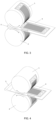
- 1 upper embossing roller; 11, polar plate pattern corresponding to upper embossing roller; 2, lower embossing roller; 21, polar plate pattern corresponding to lower embossing roller; 3, non-rolled flexible graphite slab; 4, rolled flexible graphite slab; 5, upper embossing roller; 51, polar plate pattern corresponding to upper embossing roller; 6, lower embossing roller; 61, polar plate pattern corresponding to lower embossing roller.
- a rolled flexible graphite monopolar plate with a thickness of 0.75mm and a length of 300mm was prepared by means of an embossing roller pair, shown in FIG. 1 , which comprised an upper embossing roller 1 and a lower embossing roller 2, wherein the upper embossing roller 1 was provided with a corresponding polar plate pattern 11, the lower embossing roller 2 was provided with a corresponding polar plate pattern 21, and a lengthwise direction, corresponding to the embossing patterns, the polar plate was parallel to the direction of roller surfaces.
- a non-rolled flexible graphite slab 3 was placed in front of the embossing roller pair and was formed through the following method:
- a rolled flexible graphite monopolar plate with a thickness of 1.0mm and width of 180mm was prepared by means of embossing rollers shown in FIG. 5 , wherein the embossing rollers comprised an upper embossing roller 5 provided with a corresponding polar plate pattern 51, as well as a lower embossing roller 6 provided with a corresponding polar plate pattern 61, and a lengthwise direction, corresponding to the embossing rollers, of the polar plate was perpendicular to the direction of roller surfaces.
- Step 1 a clearance of a roller press provided with a pair of embossing rollers with patterns of a polar plate to be formed was adjusted to a target thickness value 0.4mm of a monopolar plate, wherein the diameter of the embossing rollers was 200mm; a flexible graphite slab was roller-embossed multiple times and was then rolled forward for 10mm; and the slab was reversely rolled for 5mm.
- Step 1 a clearance of a roller press provided with a pair of embossing rollers with patterns of a polar plate to be formed was adjusted to a target thickness value 1.2mm of a monopolar plate, wherein the diameter of the embossing rollers was 600mm; a flexible graphite slab was roller-embossed multiple times and was then rolled forward for 100mm; and the slab was reversely rolled for 90mm.
- Embodiment 1 Embodiment 2 Embodiment 3 Embodiment 4 Detection method Landing 0.6mm 0.6mm 0.5mm 0.5mm 3D profilome ter Center distance 1.3mm 1.3mm 1.2mm 1.2mm 3D profilome ter Channel depth 0.4mm 0.4mm 0.42mm 0.42mm 3D profilome ter Draft angle 20° 20° 10° 10° 3D profilome ter Forming time 34s 15s 63s 8s Stop watch Electrical conductivity ⁇ 5m ⁇ cm 2 ⁇ 5m ⁇ cm 2 ⁇ 5m ⁇ cm 2 ⁇ 5m ⁇ cm 2 DC voltage and current source Air-tightness ⁇ 0.01sccm ⁇ 0.01sccm ⁇ 0.01sccm ⁇ 0.01sccm Leakage detector Mechanical performance Bending resistance > 25MPa Bending resistance> 25MPa Bending resistance> 25MPa Bending resistance> 25MPa Bending resistance> 25MPa Universal tensile tester Compression resistance
Landscapes
- Engineering & Computer Science (AREA)
- Life Sciences & Earth Sciences (AREA)
- Manufacturing & Machinery (AREA)
- Sustainable Development (AREA)
- Sustainable Energy (AREA)
- Chemical & Material Sciences (AREA)
- Chemical Kinetics & Catalysis (AREA)
- Electrochemistry (AREA)
- General Chemical & Material Sciences (AREA)
- Mechanical Engineering (AREA)
- Fuel Cell (AREA)
- Inert Electrodes (AREA)
Description
- The invention relates to fuel cells, in particular to a roller embossing method for flexible graphite polar plates of fuel cells.
- Bipolar plates of fuel cells are typically made of metal and graphite at present, wherein graphite bipolar plates occupy a large market share because of their excellent corrosion resistance. The graphite bipolar plates are generally machined by the following three techniques: flow fields are carved on artificial graphite plates by CNC to machine polar plates, thermoplastic resin mixed with carbon powder is hot-pressed to form hot-molded polar plates, and flexible graphite is compression-molded and is then impregnated with resin to form flexible graphite polar plates. Wherein, the flexible graphite polar plates are lowest in price and have molding efficiency much higher than that of the other two types of polar plates. With the gradual increase of the turnover in the fuel cell industry, the production efficiency of the polar plates needs to be greatly improved, so the flexible graphite polar plates have become a major development trend of the polar plates of fuel cells in the future.
- US Patent
US6797091B2 introduces a vacuum flat-embossing method for flexible graphite plates, which was applied for by Ballard POWER SYSTEMS in 2000 and put forward, for the first time, the vacuum flat-embossing process for preparing flexible graphite polar plates, which has been successfully used for production. However, flexible graphite bipolar plates prepared by existing production methods have the problems of high manual participation in the processes of manual plate placement, manual demolding, and the like, thus leading to low efficiency and inconsistency in the production process of the polar plates. In addition, the vacuum process needed during the compression molding process leads to a long molding time and manual demolding, so that continuous and automatic formation cannot be realized in the true sense. To realize continuous and automatic production to improve the output efficiency of polar plates and reduce manual participation, it is a crucial breakthrough to introduce the rolling process into the production of flexible graphite polar plates. On the basis of this idea, Ballard POWER SYSTEMS submitted US PatentUS6818165B2 in 2002 , which introduces a method for machining polar plates with flexible graphite directly by roller embossing. However, due to many technical and cost problems, this method is merely put forward as a concept and is not applied to actual production. - The outstanding advantages of the rolling process have attracted a large number of researchers, and related enterprises and academic institutions participate in the development of the rolling process of polar plates of fuel cells one after another. Although the rolling process can greatly improve the production efficiency and the automation degree compared with the flat-pressing process, public data and research results show that existing rolling processes under study have the following problems: 1, the forming quality is poor, the deviation of an actual value of the channel depth and a design value is too large (the deviation ratio is greater than 25%), and polar plates have serious defects such as blisters; 2, the thickness of the polar plates is too large (the thickness of monopolar plates is over 7mm); 3, the landing width is too large (>0.8mm), the channel depth is too small (<0.3mm), the center distance of the landing is too large (>1.5mm), and the draft angle is too large (>30°). Because of these problems, the existing rolling processes cannot product flexible graphite polar plates applied to vehicle fuel cells.
- As is known to all, the vehicle fuel cells require a higher volume power density, which means that thinner bipolar plates need to be prepared. The thickness of flexible graphite bipolar plates fabricated by leading enterprises through the flat-pressing process is generally smaller than 2mm, and the thickness of flexible graphite bipolar plates fabricated by part of the enterprises is smaller than 1.6mm. In addition, the vehicle fuel cells are hydride-air fuel cells rather than hydride-oxygen fuel cells, so the polar plates applied to the vehicle fuel cells should be designed with a narrow landing, a small center distance, a large channel depth and a small draft angle, which drastically increases the filling difficulty in the forming process of the polar plates. How to realize continuous and highly-automatic production of ultra-thin flexible graphite polar plates by the rolling process is an international problem that is still not be solved in 20 years up to now since its proposal as a concept.
- The objective of the invention is to overcome the defects of the prior art by providing a roller embossing method for flexible graphite polar plates of fuel cells to realize continuous, automatic and efficient production of ultra-thin inductile flexible graphite polar plates with a narrow landing, a short center distance, a large channel depth and a small draft angle. The objective of the invention may be fulfilled through the following technical solution: according to a roller embossing method for flexible graphite polar plates of fuel cells, an embossing roller pair in mirror symmetry is manufactured according to structural features of patterns of a polar plate to be formed and is assembled on a roller press to be applied to a continuous production line to produce the polar plate, and the method comprises the following steps:
- (1) Adjusting a clearance of the embossing roller pair of the roller press to a target thickness value of a plate;
- (2) Feeding, by a feed device, a flexible graphite slab in front of the embossing roller pair, and entangling the flexible graphite slab by means of opposite rotation of the embossing roller pair;
- (3) after the flexible graphite slab is entangled, continuing to forward roll the slab for 10-100mm, and then reversely rolling the flexible graphite slab for 5-90mm by means of synchronous and opposite rotation of an upper embossing and a lower embossing roller, wherein one time of forward rolling and one time of reverse rolling are referred to as one time of reciprocal rolling;
- (4) forming a polar plate after several times of reciprocal rolling, and separating the polar plate from the embossing rollers; and
- (5) performing subsequent treatment on the rolled flexible graphite polar plate.
- Wherein, the target thickness value of the monopolar plate is 0.4-1.2mm.
- The embossing roller pair comprises the upper embossing roller and the lower embossing roller that are arranged in a mirror symmetry manner, the diameter of the embossing rollers is 200-600mm, the upper embossing roller and the lower embossing roller of the roller press are driven by two servo motors, respectively, so that high synchronization of embossing is guaranteed.
- In Step (1), the roller press is adjusted to accurately align the embossing roller pair in a front-back direction and a left-right direction to avoid deviations of flow fields of the rolled flexible graphite polar plate.
- In Step (2), the feed speed of the feed device is 5-75 s/piece.
- In Step (3), during each time of reciprocal rolling, a reverse rolling distance is 5-10 mm smaller than a forward rolling distance to ensure that the flexible graphite slab is able to move forwards after each time of reciprocal rolling.
- In Step (4), the forward rotation speed of the embossing rollers is 3-30 cm/s, and the reverse rotation speed is equal to the forward rotation speed.
- During multiple times of reciprocal rolling, a clearance between the upper embossing roller and the lower embossing roller is equal to the thickness of the plate to be prepared and remains unchanged in the rolling process, and the rolling pressure is 3-25 ton.
- When the polar plate is produced by a set distance (set according to the actual production condition, such as 3000-6000m) by multiple times of reciprocal rolling, the roller press returns to an original point.
- In Step (5), the subsequent treatment includes cutting, impregnating, and the like.
- Compared with the prior art, the invention has the following beneficial effects:
- 1. A reversible roller press is used, is driven by two servo motors, and returns to the original position when reaching calibration requirements after continuous operation, and a pair of embossing rollers with patterns of a to-be-formed polar plate is used for reciprocal rolling of the flexible graphite slab, so that polar plates with high surface quality and free of quality flaws such as blisters can be continuously produced by roller embossing.
- 2. The primary machining degree of the flexible graphite slab is in a negative correlation with the secondary forming capacity and is in a positive correlation with air exhaust during secondary forming. The invention effectively solves this contradiction and realizes roll formation of inductile flexible graphite polar plates with a narrow landing, a short center distance, a large channel depth and a small draft angle, the forming condition completely covers the flat-pressing process, and the surface forming quality is better than that of the flat-pressing process for the same plates.
- 3. The rolling process is used to produce ultra-thin flexible graphite polar plates (the thickness of monopolar plates is 0.4-1.2mm), so that continuous and highly-automatic production is realized, and the production efficiency is greatly improved.
- 4. The invention has no limitation to the type of plates or the structure of flow fields, and all plate designs implemented by the flat-pressing process can be realized by the rolling process of the invention.
-
-
FIG. 1 is a schematic diagram of primary forward rolling of a reciprocal roller embossing process of the invention; -
FIG. 2 is a schematic diagram of primary reverse rolling of the reciprocal roller embossing process of the invention; -
FIG. 3 is a schematic diagram of secondary forward rolling of the reciprocal roller embossing process of the invention; -
FIG. 4 is a schematic diagram of secondary reverse rolling of the reciprocal roller embossing process of the invention; -
FIG. 5 is a schematic diagram of another type of rolling by embossing rollers of the reciprocal roller embossing process of the invention; - In the
figures: 1 , upper embossing roller; 11, polar plate pattern corresponding to upper embossing roller; 2, lower embossing roller; 21, polar plate pattern corresponding to lower embossing roller; 3, non-rolled flexible graphite slab; 4, rolled flexible graphite slab; 5, upper embossing roller; 51, polar plate pattern corresponding to upper embossing roller; 6, lower embossing roller; 61, polar plate pattern corresponding to lower embossing roller. - The embodiments of the invention will be described in detail below and are implemented on the basis of the technical solution of the invention. Detailed implementations and specific operation processes are given below. But, the protection scope of the invention is not limited to the following embodiments.
- A rolled flexible graphite monopolar plate with a thickness of 0.75mm and a length of 300mm was prepared by means of an embossing roller pair, shown in
FIG. 1 , which comprised anupper embossing roller 1 and alower embossing roller 2, wherein theupper embossing roller 1 was provided with a correspondingpolar plate pattern 11, thelower embossing roller 2 was provided with a correspondingpolar plate pattern 21, and a lengthwise direction, corresponding to the embossing patterns, the polar plate was parallel to the direction of roller surfaces. A non-rolledflexible graphite slab 3 was placed in front of the embossing roller pair and was formed through the following method: - Step 1: a clearance between the
upper embossing roller 1 and thelower embossing roller 1 was adjusted to 0.75mm; - Step 2: the non-rolled
flexible graphite slab 3 was fed between theupper embossing roller 1 and thelower embossing roller 2 by a feed device and was entangled by means of theupper embossing roller 1 and thelower embossing roller 2, that rotate oppositely, to be rolled forward for 30mm, wherein a rolledflexible graphite slab 4 was shown inFIG. 1 ; - Step 3: as shown in
FIG. 2 , theupper embossing roller 1 and thelower embossing roller 2 rotated reversely and drove theflexible graphite slab 3 to be reversely rolled for 20mm, and at this moment, the embossing patterns of theupper embossing roller 1 and thelower embossing roller 2 partially overlapped with the rolledflexible graphite slab 4; - Step 4: as shown in
FIG. 3 , theupper embossing roller 1 and the lower embossing roller continued to forward roll theflexible graphite slab 3 for 30mm; - Step 5: as shown in
FIG. 4 , theupper embossing roller 1 and thelower embossing roller 2 continued to reversely roll theflexible graphite slab 3 for 20mm, and reciprocal rolling was performed 27 times; and - Step 6: after 27 times of reciprocal rolling, the
flexible graphite slab 4 was further rolled forward, and a rolled polar plate was conveyed out forwards to be separated from the embossing rollers, so that rolling of the polar plate was completed. - A rolled flexible graphite monopolar plate with a thickness of 1.0mm and width of 180mm was prepared by means of embossing rollers shown in
FIG. 5 , wherein the embossing rollers comprised an upper embossing roller 5 provided with a correspondingpolar plate pattern 51, as well as alower embossing roller 6 provided with a correspondingpolar plate pattern 61, and a lengthwise direction, corresponding to the embossing rollers, of the polar plate was perpendicular to the direction of roller surfaces. - Step 1: a clearance between the upper embossing roller 5 and the
lower embossing roller 6 inFIG. 5 was adjusted to 1.0mm; - Step 2: a flexible graphite slab was fed between the upper embossing roller 5 and the
lower embossing roller 6 by a feed device and was entangled by the upper embossing roller 5 and thelower embossing roller 6, that rotate oppositely, to be forward rolled for 50mm; - Step 3: the upper embossing roller 5 and the
lower embossing roller 6 rotated reversely to drive the flexible graphite slab to be reversely rolled for 30mm, wherein the embossing patterns of the upper embossing roller 5 and thelower embossing roller 6 partially overlapped with polar plate patterns rolled inStep 2; - Step 4: the upper embossing roller 5 and the
lower embossing roller 6 continued to forward roll the flexible graphite slab for 50mm; - Step 5: the upper embossing roller 5 and the
lower embossing roller 6 continued to reversely roll the flexible graphite slab for 30mm, and reciprocal rolling was performed 8 times; and - Step 6: after 8 times of reciprocal rolling, the flexible graphite slab was further forward rolled, and a rolled polar plate was conveyed out forwards to be separated from the embossing rollers, so that rolling of the polar plate was completed.
- According to a roller embossing method for flexible graphite polar plates of fuel cells in this embodiment, in
Step 1, a clearance of a roller press provided with a pair of embossing rollers with patterns of a polar plate to be formed was adjusted to a target thickness value 0.4mm of a monopolar plate, wherein the diameter of the embossing rollers was 200mm; a flexible graphite slab was roller-embossed multiple times and was then rolled forward for 10mm; and the slab was reversely rolled for 5mm. - This embodiment was identical with
Embodiment 1 in other aspects. - According to a roller embossing method for flexible graphite polar plates of fuel cells in this embodiment, in
Step 1, a clearance of a roller press provided with a pair of embossing rollers with patterns of a polar plate to be formed was adjusted to a target thickness value 1.2mm of a monopolar plate, wherein the diameter of the embossing rollers was 600mm; a flexible graphite slab was roller-embossed multiple times and was then rolled forward for 100mm; and the slab was reversely rolled for 90mm. - This embodiment was identical with
Embodiment 1 in other aspects. - The properties of the polar plates prepared through the methods in the above embodiments are as follows:
Embodiment 1Embodiment 2Embodiment 3Embodiment 4Detection method Landing 0.6mm 0.6mm 0.5mm 0.5mm 3D profilome ter Center distance 1.3mm 1.3mm 1.2mm 1.2mm 3D profilome ter Channel depth 0.4mm 0.4mm 0.42mm 0.42mm 3D profilome ter Draft angle 20° 20° 10° 10° 3D profilome ter Forming time 34s 15s 63s 8s Stop watch Electrical conductivity <5mΩ·cm2 <5mΩ·cm2 <5mΩ·cm2 <5mΩ·cm2 DC voltage and current source Air-tightness <0.01sccm <0.01sccm <0.01sccm <0.01sccm Leakage detector Mechanical performance Bending resistance > 25MPa Bending resistance> 25MPa Bending resistance> 25MPa Bending resistance> 25MPa Universal tensile tester Compression resistance> 6MPa Compression resistance> 6MPa Compression resistance> 6MPa Compression resistance> 6MPa Corrosion resistance < 1µA/cm2 < 1 µA/cm2 < 1 µA/cm2 < 1 µA/cm2 Electrochemical workstati on
Claims (10)
- A roller embossing method for flexible graphite polar plates of fuel cells, an embossing roller pair (1, 2, 5, 6) comprising an upper embossing roller (1, 5) and a lower embossing roller (2, 6) disposed in mirror symmetry and manufactured according to structural features of patterns (11, 21, 51, 61) of a polar plate to be formed, the embossing roller pair being mounted on a roller press to be applied to a continuous production line to produce the polar plate, and the method comprising:(1) adjusting a clearance of the embossing roller pair of the roller press to a target thickness value of the polar plate to be produced;(2) feeding, by a feed device, a flexible graphite slab (3) in front of the embossing roller pair, and entangling the flexible graphite slab by means of opposite rotation of the embossing roller pair;(3) after the flexible graphite slab is entangled, continuing to forward roll the slab (4) for between 10 mm and 100 mm, and then reversely rolling the slab for between 5 mm and 90 mm by means of synchronous and opposite rotation of the embossing roller pair, wherein one time of forward rolling and one time of reverse rolling are referred to as reciprocal rolling;(4) forming the polar plate after several times of reciprocal rolling, and separating the polar plate from the embossing rollers; and(5) performing subsequent treatment on the rolled polar plate.
- The roller embossing method for polar plates of fuel cells according to Claim 1, wherein the target thickness value of the polar plate is between 0.4 mm and 1.2 mm.
- The roller embossing method for polar plates of fuel cells according to Claim 1, wherein a diameter of the upper embossing roller and the lower embossing roller is between 200 mm and 600 mm, and two motors are used to drive the upper embossing roller and the lower embossing roller, respectively.
- The roller embossing method for polar plates of fuel cells according to Claim 3, wherein the two motors are servo motors and synchronously drive the upper embossing roller and the lower embossing roller.
- The roller embossing method for polar plates of fuel cells according to Claim 1, wherein in Step (1), the roller press is adjusted to accurately align the embossing roller pair in a front-back direction and a left-right direction to avoid deviations of flow fields of the polar plate.
- The roller embossing method for polar plates of fuel cells according to Claim 1, wherein in Step (2), a feed speed of the feed device is between 5 s/piece and 75 s/piece.
- The roller embossing method for polar plates of fuel cells according to Claim 1, wherein in Step (3), during each time of reciprocal rolling, a reverse rolling distance is between 5 mm and 10 mm smaller than a forward rolling distance to ensure that the flexible graphite slab is able to move forwards after each time of reciprocal rolling.
- The roller embossing method for polar plates of fuel cells according to Claim 1, wherein in Step (3), a forward rotation speed of the embossing rollers is between 3 cm/s and 30 cm/s, and a reverse rotation speed is equal to the forward rotation speed.
- The roller embossing method for polar plates of fuel cells according to Claim 1, wherein during multiple times of reciprocal rolling, a clearance between the upper embossing roller and the lower embossing roller is equal to a thickness of the plate to be prepared and remains unchanged in the rolling process, and a rolling pressure is between 3 tons and 25 tons.
- The roller embossing method for polar plates of fuel cells according to Claim 1, wherein when the polar plate is produced by a set distance by multiple times of reciprocal rolling, the roller press returns to an original point.
Applications Claiming Priority (1)
| Application Number | Priority Date | Filing Date | Title |
|---|---|---|---|
| CN202110148623.3A CN112959725B (en) | 2021-02-02 | 2021-02-02 | Roll forming method of flexible graphite polar plate of fuel cell |
Publications (3)
| Publication Number | Publication Date |
|---|---|
| EP4037040A1 EP4037040A1 (en) | 2022-08-03 |
| EP4037040B1 true EP4037040B1 (en) | 2025-05-14 |
| EP4037040C0 EP4037040C0 (en) | 2025-05-14 |
Family
ID=76274068
Family Applications (1)
| Application Number | Title | Priority Date | Filing Date |
|---|---|---|---|
| EP21190267.1A Active EP4037040B1 (en) | 2021-02-02 | 2021-08-09 | Roller embossing method for flexible graphite polar plates of fuel cells |
Country Status (3)
| Country | Link |
|---|---|
| US (1) | US12251871B2 (en) |
| EP (1) | EP4037040B1 (en) |
| CN (1) | CN112959725B (en) |
Families Citing this family (7)
| Publication number | Priority date | Publication date | Assignee | Title |
|---|---|---|---|---|
| JP1753527S (en) | 2021-06-01 | 2023-09-20 | press machine jaws | |
| CN114171755B (en) * | 2021-10-20 | 2023-08-18 | 海卓动力(上海)能源科技有限公司 | Fuel cell bipolar plate and preparation method thereof |
| CN115556401B (en) * | 2022-09-30 | 2025-09-19 | 上海神力科技有限公司 | Flexible graphite polar plate continuous rolling forming device and application thereof |
| KR20250149688A (en) * | 2023-02-10 | 2025-10-16 | 매튜 인터내셔널 코포레이션 | Method and roller arrangement for producing a single bipolar plate |
| WO2024256688A1 (en) * | 2023-06-15 | 2024-12-19 | Matthews International GmbH | Systems and methods for the compressing of graphite |
| WO2024256236A1 (en) | 2023-06-16 | 2024-12-19 | Matthews International GmbH | Method for producing graphite-based monopolar plates for bipolar plates, graphite-based monopolar plate and bipolar plate as well as an apparatus for producing graphite-based monopolar plates |
| CN118403944B (en) * | 2024-06-28 | 2024-09-06 | 西南石油大学 | Metal bipolar plate roll forming device and manufacturing method |
Family Cites Families (25)
| Publication number | Priority date | Publication date | Assignee | Title |
|---|---|---|---|---|
| JP3644549B2 (en) * | 1994-10-28 | 2005-04-27 | 石川島播磨重工業株式会社 | Rolling method |
| CA2357928A1 (en) * | 1998-12-30 | 2000-07-13 | Ballard Power Systems Inc. | Fuel cell fluid flow field plate and methods of making fuel cell flow field plates |
| US20040072055A1 (en) * | 2000-04-14 | 2004-04-15 | Getz Matthew George | Graphite article useful as a fuel cell component substrate |
| US6797091B2 (en) * | 2000-05-10 | 2004-09-28 | Ballard Power Systems Inc. | Method for embossing expanded graphite sheet material under reduced pressure |
| US7334446B1 (en) * | 2000-05-11 | 2008-02-26 | Bauder Hans-Joerg | Method for producing a striplike pre-material made of metal, especially a pre-material which has been profiled into regularly reoccurring sections, and device therefor |
| US6604457B2 (en) * | 2001-05-11 | 2003-08-12 | Graftech Inc. | Process and apparatus for embossing graphite articles |
| US6818165B2 (en) | 2002-02-25 | 2004-11-16 | Ballard Power Systems Inc. | Method of fabricating fluid flow field plates |
| US20070117001A1 (en) * | 2005-11-18 | 2007-05-24 | Simon Farrington | Method of fabricating flow field plates and related products and methods |
| JP2010080272A (en) * | 2008-09-26 | 2010-04-08 | Panasonic Corp | Method of manufacturing electrode plate for battery |
| WO2013031854A1 (en) * | 2011-08-31 | 2013-03-07 | 日本ゼオン株式会社 | Powder molding device and production method for powder molded product |
| CN103230994B (en) * | 2013-04-23 | 2015-03-25 | 杭州电子科技大学 | Device and method for forming imprint of micro groove on shaft through stepping rolling |
| US9700968B2 (en) * | 2013-12-26 | 2017-07-11 | Terrella Energy Systems Ltd. | Apparatus and methods for processing exfoliated graphite materials |
| CN104707871B (en) * | 2015-03-16 | 2016-08-24 | 浙江大学 | Sheet metal thickness on-line checking based on laser-ultrasound and the system of adjustment |
| CN105312324A (en) * | 2015-10-30 | 2016-02-10 | 中色科技股份有限公司 | Production method for niobium or tantalum band foil |
| CN106807758A (en) * | 2015-11-30 | 2017-06-09 | 北京有色金属研究总院 | A kind of aluminum alloy ultra-thick plate board-shape control method |
| CN205282569U (en) * | 2015-12-10 | 2016-06-01 | 上海神力科技有限公司 | Continuous production assembly line of flexible graphite sheet monocell for fuel cell |
| CN105514460B (en) * | 2015-12-29 | 2017-12-08 | 北京科技大学 | A kind of efficient rolling forming technology of high conductivity metal bipolar plates |
| US10933616B2 (en) * | 2016-08-01 | 2021-03-02 | Sintokogio, Ltd. | Roll press method and roll press system |
| DE102017209031A1 (en) * | 2017-05-30 | 2018-12-06 | Robert Bosch Gmbh | Method for producing a fuel cell and fuel cell |
| CN208118505U (en) * | 2018-03-30 | 2018-11-20 | 平顶山市天宝特种材料有限公司 | A kind of low-density and high-strength graphite production green compact pressure setting |
| CN109514904A (en) * | 2018-09-30 | 2019-03-26 | 武汉喜玛拉雅光电科技股份有限公司 | A kind of rolling process of fuel battery double plates |
| KR102750532B1 (en) * | 2018-11-09 | 2025-01-06 | 현대자동차 주식회사 | Device and method for manufacturing membrane-electrode assembly of fuel cell |
| CN211480184U (en) * | 2020-01-21 | 2020-09-11 | 合肥国轩高科动力能源有限公司 | A lithium ion battery pole piece indentation device |
| CN212113895U (en) * | 2020-05-20 | 2020-12-08 | 山东魔方新能源科技有限公司 | Fuel cell graphite bipolar plate rolling equipment |
| CN112126821B (en) * | 2020-08-28 | 2022-07-12 | 广东安德力新材料有限公司 | Processing method for aluminum plastic film aluminum foil of power battery |
-
2021
- 2021-02-02 CN CN202110148623.3A patent/CN112959725B/en active Active
- 2021-08-09 EP EP21190267.1A patent/EP4037040B1/en active Active
- 2021-08-10 US US17/397,999 patent/US12251871B2/en active Active
Also Published As
| Publication number | Publication date |
|---|---|
| US12251871B2 (en) | 2025-03-18 |
| EP4037040A1 (en) | 2022-08-03 |
| CN112959725A (en) | 2021-06-15 |
| US20220242034A1 (en) | 2022-08-04 |
| CN112959725B (en) | 2022-09-06 |
| EP4037040C0 (en) | 2025-05-14 |
Similar Documents
| Publication | Publication Date | Title |
|---|---|---|
| EP4037040B1 (en) | Roller embossing method for flexible graphite polar plates of fuel cells | |
| CN110313092B (en) | Apparatus and method for manufacturing bipolar plate | |
| US20010008719A1 (en) | Plate with regular projections, and device and method for forming the plate | |
| CN103191983B (en) | Continuous stamping forming die for large-area metal bipolar plate of fuel battery | |
| DE102016000974B4 (en) | Method and device for producing a membrane electrode assembly for a fuel cell | |
| KR101737790B1 (en) | A Press Mold Device of manufacturing cell ploeplate for hybrid electric vehicle | |
| US6818165B2 (en) | Method of fabricating fluid flow field plates | |
| CN1327563C (en) | Lamination apparatus and methods | |
| KR101013872B1 (en) | Metal separator for fuel cell manufacturing apparatus and method | |
| JP6996408B2 (en) | How to transport separator material for fuel cells | |
| CN109585782B (en) | Method for simultaneously producing multiple types of lithium ion battery pole pieces and extrusion coating device | |
| US12230779B2 (en) | Cathode for secondary battery and method for manufacturing same | |
| TW201143195A (en) | Laminated fuel cell assembly | |
| KR100882648B1 (en) | Manufacturing method of large area metal separator plate using progressive rubber molding | |
| DE102004054503A1 (en) | Method and device for producing membrane-electrode assemblies | |
| CN220413524U (en) | Cell screen plate laser cladding forming equipment | |
| KR102019612B1 (en) | Channel Forming System of Fuel Cell Saperator | |
| KR102690830B1 (en) | Extrusion mold and leveling apparatus | |
| CN103022512A (en) | Fuel cell bipolar plate for proton exchange membrane and rolling method | |
| CN222546407U (en) | A high-speed lamination machine | |
| CN210026408U (en) | High-speed production system of flexible graphite polar plate of vertical lamellar structure | |
| CN222199266U (en) | Diaphragm cutting device and film-making system | |
| CN220745736U (en) | Target blank and die | |
| CN222462939U (en) | Electrode film preparation device and electrode sheet preparation equipment | |
| CN217677747U (en) | Multistation formula continuous type vacuum coating equipment |
Legal Events
| Date | Code | Title | Description |
|---|---|---|---|
| PUAI | Public reference made under article 153(3) epc to a published international application that has entered the european phase |
Free format text: ORIGINAL CODE: 0009012 |
|
| STAA | Information on the status of an ep patent application or granted ep patent |
Free format text: STATUS: REQUEST FOR EXAMINATION WAS MADE |
|
| 17P | Request for examination filed |
Effective date: 20220328 |
|
| AK | Designated contracting states |
Kind code of ref document: A1 Designated state(s): AL AT BE BG CH CY CZ DE DK EE ES FI FR GB GR HR HU IE IS IT LI LT LU LV MC MK MT NL NO PL PT RO RS SE SI SK SM TR |
|
| GRAP | Despatch of communication of intention to grant a patent |
Free format text: ORIGINAL CODE: EPIDOSNIGR1 |
|
| STAA | Information on the status of an ep patent application or granted ep patent |
Free format text: STATUS: GRANT OF PATENT IS INTENDED |
|
| RIC1 | Information provided on ipc code assigned before grant |
Ipc: H01M 8/2483 20160101ALI20250107BHEP Ipc: H01M 8/0267 20160101ALI20250107BHEP Ipc: H01M 8/0213 20160101AFI20250107BHEP |
|
| INTG | Intention to grant announced |
Effective date: 20250120 |
|
| GRAS | Grant fee paid |
Free format text: ORIGINAL CODE: EPIDOSNIGR3 |
|
| GRAA | (expected) grant |
Free format text: ORIGINAL CODE: 0009210 |
|
| STAA | Information on the status of an ep patent application or granted ep patent |
Free format text: STATUS: THE PATENT HAS BEEN GRANTED |
|
| AK | Designated contracting states |
Kind code of ref document: B1 Designated state(s): AL AT BE BG CH CY CZ DE DK EE ES FI FR GB GR HR HU IE IS IT LI LT LU LV MC MK MT NL NO PL PT RO RS SE SI SK SM TR |
|
| REG | Reference to a national code |
Ref country code: GB Ref legal event code: FG4D |
|
| REG | Reference to a national code |
Ref country code: CH Ref legal event code: EP |
|
| REG | Reference to a national code |
Ref country code: IE Ref legal event code: FG4D |
|
| REG | Reference to a national code |
Ref country code: DE Ref legal event code: R096 Ref document number: 602021030705 Country of ref document: DE |
|
| U01 | Request for unitary effect filed |
Effective date: 20250528 |
|
| U07 | Unitary effect registered |
Designated state(s): AT BE BG DE DK EE FI FR IT LT LU LV MT NL PT RO SE SI Effective date: 20250605 |
|
| U20 | Renewal fee for the european patent with unitary effect paid |
Year of fee payment: 5 Effective date: 20250606 |
|
| PG25 | Lapsed in a contracting state [announced via postgrant information from national office to epo] |
Ref country code: ES Free format text: LAPSE BECAUSE OF FAILURE TO SUBMIT A TRANSLATION OF THE DESCRIPTION OR TO PAY THE FEE WITHIN THE PRESCRIBED TIME-LIMIT Effective date: 20250514 |
|
| PG25 | Lapsed in a contracting state [announced via postgrant information from national office to epo] |
Ref country code: GR Free format text: LAPSE BECAUSE OF FAILURE TO SUBMIT A TRANSLATION OF THE DESCRIPTION OR TO PAY THE FEE WITHIN THE PRESCRIBED TIME-LIMIT Effective date: 20250815 Ref country code: NO Free format text: LAPSE BECAUSE OF FAILURE TO SUBMIT A TRANSLATION OF THE DESCRIPTION OR TO PAY THE FEE WITHIN THE PRESCRIBED TIME-LIMIT Effective date: 20250814 |
|
| PG25 | Lapsed in a contracting state [announced via postgrant information from national office to epo] |
Ref country code: PL Free format text: LAPSE BECAUSE OF FAILURE TO SUBMIT A TRANSLATION OF THE DESCRIPTION OR TO PAY THE FEE WITHIN THE PRESCRIBED TIME-LIMIT Effective date: 20250514 |
|
| PG25 | Lapsed in a contracting state [announced via postgrant information from national office to epo] |
Ref country code: HR Free format text: LAPSE BECAUSE OF FAILURE TO SUBMIT A TRANSLATION OF THE DESCRIPTION OR TO PAY THE FEE WITHIN THE PRESCRIBED TIME-LIMIT Effective date: 20250514 |
|
| PG25 | Lapsed in a contracting state [announced via postgrant information from national office to epo] |
Ref country code: RS Free format text: LAPSE BECAUSE OF FAILURE TO SUBMIT A TRANSLATION OF THE DESCRIPTION OR TO PAY THE FEE WITHIN THE PRESCRIBED TIME-LIMIT Effective date: 20250814 |
|
| PG25 | Lapsed in a contracting state [announced via postgrant information from national office to epo] |
Ref country code: IS Free format text: LAPSE BECAUSE OF FAILURE TO SUBMIT A TRANSLATION OF THE DESCRIPTION OR TO PAY THE FEE WITHIN THE PRESCRIBED TIME-LIMIT Effective date: 20250914 |
|
| PG25 | Lapsed in a contracting state [announced via postgrant information from national office to epo] |
Ref country code: SM Free format text: LAPSE BECAUSE OF FAILURE TO SUBMIT A TRANSLATION OF THE DESCRIPTION OR TO PAY THE FEE WITHIN THE PRESCRIBED TIME-LIMIT Effective date: 20250514 |
|
| PG25 | Lapsed in a contracting state [announced via postgrant information from national office to epo] |
Ref country code: CZ Free format text: LAPSE BECAUSE OF FAILURE TO SUBMIT A TRANSLATION OF THE DESCRIPTION OR TO PAY THE FEE WITHIN THE PRESCRIBED TIME-LIMIT Effective date: 20250514 |
|
| PG25 | Lapsed in a contracting state [announced via postgrant information from national office to epo] |
Ref country code: SK Free format text: LAPSE BECAUSE OF FAILURE TO SUBMIT A TRANSLATION OF THE DESCRIPTION OR TO PAY THE FEE WITHIN THE PRESCRIBED TIME-LIMIT Effective date: 20250514 |
|
| PLBE | No opposition filed within time limit |
Free format text: ORIGINAL CODE: 0009261 |
|
| STAA | Information on the status of an ep patent application or granted ep patent |
Free format text: STATUS: NO OPPOSITION FILED WITHIN TIME LIMIT |
|
| REG | Reference to a national code |
Ref country code: CH Ref legal event code: H13 Free format text: ST27 STATUS EVENT CODE: U-0-0-H10-H13 (AS PROVIDED BY THE NATIONAL OFFICE) Effective date: 20260324 |
|
| REG | Reference to a national code |
Ref country code: CH Ref legal event code: L10 Free format text: ST27 STATUS EVENT CODE: U-0-0-L10-L00 (AS PROVIDED BY THE NATIONAL OFFICE) Effective date: 20260325 |
|
| PG25 | Lapsed in a contracting state [announced via postgrant information from national office to epo] |
Ref country code: MC Free format text: LAPSE BECAUSE OF FAILURE TO SUBMIT A TRANSLATION OF THE DESCRIPTION OR TO PAY THE FEE WITHIN THE PRESCRIBED TIME-LIMIT Effective date: 20250514 |
|
| 26N | No opposition filed |
Effective date: 20260217 |
|
| PG25 | Lapsed in a contracting state [announced via postgrant information from national office to epo] |
Ref country code: CH Free format text: LAPSE BECAUSE OF NON-PAYMENT OF DUE FEES Effective date: 20250831 |