EP4035893A1 - Peelable coating film, coating-material set, and coating-material for forming hydrophilic coating film - Google Patents
Peelable coating film, coating-material set, and coating-material for forming hydrophilic coating film Download PDFInfo
- Publication number
- EP4035893A1 EP4035893A1 EP20869095.8A EP20869095A EP4035893A1 EP 4035893 A1 EP4035893 A1 EP 4035893A1 EP 20869095 A EP20869095 A EP 20869095A EP 4035893 A1 EP4035893 A1 EP 4035893A1
- Authority
- EP
- European Patent Office
- Prior art keywords
- coating
- coating film
- film
- peelable
- hydrophilic
- Prior art date
- Legal status (The legal status is an assumption and is not a legal conclusion. Google has not performed a legal analysis and makes no representation as to the accuracy of the status listed.)
- Withdrawn
Links
- 239000011248 coating agent Substances 0.000 title claims abstract description 251
- 238000000576 coating method Methods 0.000 title claims abstract description 251
- 239000000463 material Substances 0.000 title claims abstract description 86
- VYPSYNLAJGMNEJ-UHFFFAOYSA-N Silicium dioxide Chemical compound O=[Si]=O VYPSYNLAJGMNEJ-UHFFFAOYSA-N 0.000 claims abstract description 66
- 230000015572 biosynthetic process Effects 0.000 claims abstract description 61
- 239000006185 dispersion Substances 0.000 claims abstract description 56
- 239000011342 resin composition Substances 0.000 claims abstract description 52
- 239000008119 colloidal silica Substances 0.000 claims abstract description 34
- 239000012736 aqueous medium Substances 0.000 claims abstract description 23
- 229910052910 alkali metal silicate Inorganic materials 0.000 claims abstract description 10
- -1 alkali metal salts Chemical class 0.000 claims description 70
- 239000011230 binding agent Substances 0.000 claims description 44
- 230000000844 anti-bacterial effect Effects 0.000 claims description 43
- 239000000080 wetting agent Substances 0.000 claims description 13
- 239000007787 solid Substances 0.000 claims description 8
- KGBXLFKZBHKPEV-UHFFFAOYSA-N boric acid Chemical compound OB(O)O KGBXLFKZBHKPEV-UHFFFAOYSA-N 0.000 claims description 6
- 239000004327 boric acid Substances 0.000 claims description 6
- 229910052783 alkali metal Inorganic materials 0.000 claims description 5
- 229910000323 aluminium silicate Inorganic materials 0.000 claims description 5
- 229920005989 resin Polymers 0.000 description 45
- 239000011347 resin Substances 0.000 description 45
- XLYOFNOQVPJJNP-UHFFFAOYSA-N water Substances O XLYOFNOQVPJJNP-UHFFFAOYSA-N 0.000 description 37
- NIXOWILDQLNWCW-UHFFFAOYSA-M Acrylate Chemical compound [O-]C(=O)C=C NIXOWILDQLNWCW-UHFFFAOYSA-M 0.000 description 32
- 238000001035 drying Methods 0.000 description 24
- 238000000034 method Methods 0.000 description 22
- 239000004615 ingredient Substances 0.000 description 21
- 229940088710 antibiotic agent Drugs 0.000 description 17
- 239000000178 monomer Substances 0.000 description 17
- NLYAJNPCOHFWQQ-UHFFFAOYSA-N kaolin Chemical compound O.O.O=[Al]O[Si](=O)O[Si](=O)O[Al]=O NLYAJNPCOHFWQQ-UHFFFAOYSA-N 0.000 description 16
- 239000000853 adhesive Substances 0.000 description 15
- 230000001070 adhesive effect Effects 0.000 description 15
- 230000003373 anti-fouling effect Effects 0.000 description 15
- 239000003795 chemical substances by application Substances 0.000 description 14
- 239000000839 emulsion Substances 0.000 description 14
- 239000002245 particle Substances 0.000 description 14
- 239000000126 substance Substances 0.000 description 14
- 230000000052 comparative effect Effects 0.000 description 13
- 239000001993 wax Substances 0.000 description 13
- 239000004925 Acrylic resin Substances 0.000 description 12
- 229920000178 Acrylic resin Polymers 0.000 description 12
- LFQSCWFLJHTTHZ-UHFFFAOYSA-N Ethanol Chemical compound CCO LFQSCWFLJHTTHZ-UHFFFAOYSA-N 0.000 description 12
- PEDCQBHIVMGVHV-UHFFFAOYSA-N Glycerine Chemical compound OCC(O)CO PEDCQBHIVMGVHV-UHFFFAOYSA-N 0.000 description 12
- 125000000217 alkyl group Chemical group 0.000 description 12
- 239000003995 emulsifying agent Substances 0.000 description 12
- 239000004094 surface-active agent Substances 0.000 description 12
- 229920003171 Poly (ethylene oxide) Polymers 0.000 description 11
- 230000001105 regulatory effect Effects 0.000 description 10
- LYCAIKOWRPUZTN-UHFFFAOYSA-N Ethylene glycol Chemical compound OCCO LYCAIKOWRPUZTN-UHFFFAOYSA-N 0.000 description 9
- DNIAPMSPPWPWGF-UHFFFAOYSA-N Propylene glycol Chemical compound CC(O)CO DNIAPMSPPWPWGF-UHFFFAOYSA-N 0.000 description 9
- PPBRXRYQALVLMV-UHFFFAOYSA-N Styrene Chemical compound C=CC1=CC=CC=C1 PPBRXRYQALVLMV-UHFFFAOYSA-N 0.000 description 8
- NIXOWILDQLNWCW-UHFFFAOYSA-N acrylic acid group Chemical group C(C=C)(=O)O NIXOWILDQLNWCW-UHFFFAOYSA-N 0.000 description 8
- 239000002280 amphoteric surfactant Substances 0.000 description 8
- 239000003945 anionic surfactant Substances 0.000 description 8
- 238000007654 immersion Methods 0.000 description 8
- 239000002736 nonionic surfactant Substances 0.000 description 8
- 229920005862 polyol Polymers 0.000 description 8
- 150000003077 polyols Chemical class 0.000 description 8
- 239000002253 acid Substances 0.000 description 7
- 239000000654 additive Substances 0.000 description 7
- 235000014113 dietary fatty acids Nutrition 0.000 description 7
- 239000000194 fatty acid Substances 0.000 description 7
- 229930195729 fatty acid Natural products 0.000 description 7
- 239000003505 polymerization initiator Substances 0.000 description 7
- 239000000243 solution Substances 0.000 description 7
- 239000003093 cationic surfactant Substances 0.000 description 6
- 150000001875 compounds Chemical class 0.000 description 6
- 239000003431 cross linking reagent Substances 0.000 description 6
- 235000011187 glycerol Nutrition 0.000 description 6
- 239000000203 mixture Substances 0.000 description 6
- 229920000139 polyethylene terephthalate Polymers 0.000 description 6
- 238000006116 polymerization reaction Methods 0.000 description 6
- 229920002799 BoPET Polymers 0.000 description 5
- WYURNTSHIVDZCO-UHFFFAOYSA-N Tetrahydrofuran Chemical compound C1CCOC1 WYURNTSHIVDZCO-UHFFFAOYSA-N 0.000 description 5
- 125000000129 anionic group Chemical group 0.000 description 5
- 125000005442 diisocyanate group Chemical group 0.000 description 5
- 230000000694 effects Effects 0.000 description 5
- RTZKZFJDLAIYFH-UHFFFAOYSA-N ether Substances CCOCC RTZKZFJDLAIYFH-UHFFFAOYSA-N 0.000 description 5
- 150000004665 fatty acids Chemical class 0.000 description 5
- 238000005259 measurement Methods 0.000 description 5
- 239000003921 oil Substances 0.000 description 5
- 239000000047 product Substances 0.000 description 5
- 150000003839 salts Chemical class 0.000 description 5
- 239000000758 substrate Substances 0.000 description 5
- 150000005846 sugar alcohols Polymers 0.000 description 5
- JOYRKODLDBILNP-UHFFFAOYSA-N Ethyl urethane Chemical compound CCOC(N)=O JOYRKODLDBILNP-UHFFFAOYSA-N 0.000 description 4
- BQCADISMDOOEFD-UHFFFAOYSA-N Silver Chemical compound [Ag] BQCADISMDOOEFD-UHFFFAOYSA-N 0.000 description 4
- 239000004115 Sodium Silicate Substances 0.000 description 4
- 230000001464 adherent effect Effects 0.000 description 4
- 239000012986 chain transfer agent Substances 0.000 description 4
- 230000008859 change Effects 0.000 description 4
- MTHSVFCYNBDYFN-UHFFFAOYSA-N diethylene glycol Chemical compound OCCOCCO MTHSVFCYNBDYFN-UHFFFAOYSA-N 0.000 description 4
- 229920001971 elastomer Polymers 0.000 description 4
- 238000007720 emulsion polymerization reaction Methods 0.000 description 4
- 239000000945 filler Substances 0.000 description 4
- 239000003960 organic solvent Substances 0.000 description 4
- 229920002857 polybutadiene Polymers 0.000 description 4
- 229920002635 polyurethane Polymers 0.000 description 4
- 239000004814 polyurethane Substances 0.000 description 4
- 239000005060 rubber Substances 0.000 description 4
- 229910052709 silver Inorganic materials 0.000 description 4
- 239000004332 silver Substances 0.000 description 4
- NTHWMYGWWRZVTN-UHFFFAOYSA-N sodium silicate Chemical compound [Na+].[Na+].[O-][Si]([O-])=O NTHWMYGWWRZVTN-UHFFFAOYSA-N 0.000 description 4
- 229910052911 sodium silicate Inorganic materials 0.000 description 4
- 239000002904 solvent Substances 0.000 description 4
- 239000007858 starting material Substances 0.000 description 4
- DAFHKNAQFPVRKR-UHFFFAOYSA-N (3-hydroxy-2,2,4-trimethylpentyl) 2-methylpropanoate Chemical compound CC(C)C(O)C(C)(C)COC(=O)C(C)C DAFHKNAQFPVRKR-UHFFFAOYSA-N 0.000 description 3
- WVDDGKGOMKODPV-UHFFFAOYSA-N Benzyl alcohol Chemical compound OCC1=CC=CC=C1 WVDDGKGOMKODPV-UHFFFAOYSA-N 0.000 description 3
- DGAQECJNVWCQMB-PUAWFVPOSA-M Ilexoside XXIX Chemical compound C[C@@H]1CC[C@@]2(CC[C@@]3(C(=CC[C@H]4[C@]3(CC[C@@H]5[C@@]4(CC[C@@H](C5(C)C)OS(=O)(=O)[O-])C)C)[C@@H]2[C@]1(C)O)C)C(=O)O[C@H]6[C@@H]([C@H]([C@@H]([C@H](O6)CO)O)O)O.[Na+] DGAQECJNVWCQMB-PUAWFVPOSA-M 0.000 description 3
- KFZMGEQAYNKOFK-UHFFFAOYSA-N Isopropanol Chemical compound CC(C)O KFZMGEQAYNKOFK-UHFFFAOYSA-N 0.000 description 3
- WMFOQBRAJBCJND-UHFFFAOYSA-M Lithium hydroxide Chemical compound [Li+].[OH-] WMFOQBRAJBCJND-UHFFFAOYSA-M 0.000 description 3
- OFOBLEOULBTSOW-UHFFFAOYSA-N Malonic acid Chemical compound OC(=O)CC(O)=O OFOBLEOULBTSOW-UHFFFAOYSA-N 0.000 description 3
- CERQOIWHTDAKMF-UHFFFAOYSA-N Methacrylic acid Chemical compound CC(=C)C(O)=O CERQOIWHTDAKMF-UHFFFAOYSA-N 0.000 description 3
- OKKJLVBELUTLKV-UHFFFAOYSA-N Methanol Chemical compound OC OKKJLVBELUTLKV-UHFFFAOYSA-N 0.000 description 3
- MUBZPKHOEPUJKR-UHFFFAOYSA-N Oxalic acid Chemical compound OC(=O)C(O)=O MUBZPKHOEPUJKR-UHFFFAOYSA-N 0.000 description 3
- 239000004793 Polystyrene Substances 0.000 description 3
- KWYUFKZDYYNOTN-UHFFFAOYSA-M Potassium hydroxide Chemical compound [OH-].[K+] KWYUFKZDYYNOTN-UHFFFAOYSA-M 0.000 description 3
- HEMHJVSKTPXQMS-UHFFFAOYSA-M Sodium hydroxide Chemical compound [OH-].[Na+] HEMHJVSKTPXQMS-UHFFFAOYSA-M 0.000 description 3
- 229920006311 Urethane elastomer Polymers 0.000 description 3
- 230000000996 additive effect Effects 0.000 description 3
- 125000005907 alkyl ester group Chemical group 0.000 description 3
- 125000002947 alkylene group Chemical group 0.000 description 3
- MTAZNLWOLGHBHU-UHFFFAOYSA-N butadiene-styrene rubber Chemical compound C=CC=C.C=CC1=CC=CC=C1 MTAZNLWOLGHBHU-UHFFFAOYSA-N 0.000 description 3
- 239000000470 constituent Substances 0.000 description 3
- 150000001993 dienes Chemical class 0.000 description 3
- HQQADJVZYDDRJT-UHFFFAOYSA-N ethene;prop-1-ene Chemical group C=C.CC=C HQQADJVZYDDRJT-UHFFFAOYSA-N 0.000 description 3
- 238000011156 evaluation Methods 0.000 description 3
- 239000000417 fungicide Substances 0.000 description 3
- 230000001771 impaired effect Effects 0.000 description 3
- 239000003999 initiator Substances 0.000 description 3
- 239000007788 liquid Substances 0.000 description 3
- PAZHGORSDKKUPI-UHFFFAOYSA-N lithium metasilicate Chemical compound [Li+].[Li+].[O-][Si]([O-])=O PAZHGORSDKKUPI-UHFFFAOYSA-N 0.000 description 3
- 229910052912 lithium silicate Inorganic materials 0.000 description 3
- 239000002609 medium Substances 0.000 description 3
- 150000003014 phosphoric acid esters Chemical class 0.000 description 3
- 229920000642 polymer Polymers 0.000 description 3
- 230000000379 polymerizing effect Effects 0.000 description 3
- 229920002223 polystyrene Polymers 0.000 description 3
- CXMXRPHRNRROMY-UHFFFAOYSA-N sebacic acid Chemical compound OC(=O)CCCCCCCCC(O)=O CXMXRPHRNRROMY-UHFFFAOYSA-N 0.000 description 3
- 229910052708 sodium Inorganic materials 0.000 description 3
- 239000011734 sodium Substances 0.000 description 3
- 239000002689 soil Substances 0.000 description 3
- 229920006132 styrene block copolymer Polymers 0.000 description 3
- 238000012546 transfer Methods 0.000 description 3
- 239000003981 vehicle Substances 0.000 description 3
- FKTHNVSLHLHISI-UHFFFAOYSA-N 1,2-bis(isocyanatomethyl)benzene Chemical class O=C=NCC1=CC=CC=C1CN=C=O FKTHNVSLHLHISI-UHFFFAOYSA-N 0.000 description 2
- OVBFMUAFNIIQAL-UHFFFAOYSA-N 1,4-diisocyanatobutane Chemical compound O=C=NCCCCN=C=O OVBFMUAFNIIQAL-UHFFFAOYSA-N 0.000 description 2
- ULQISTXYYBZJSJ-UHFFFAOYSA-N 12-hydroxyoctadecanoic acid Chemical compound CCCCCCC(O)CCCCCCCCCCC(O)=O ULQISTXYYBZJSJ-UHFFFAOYSA-N 0.000 description 2
- YAJYJWXEWKRTPO-UHFFFAOYSA-N 2,3,3,4,4,5-hexamethylhexane-2-thiol Chemical compound CC(C)C(C)(C)C(C)(C)C(C)(C)S YAJYJWXEWKRTPO-UHFFFAOYSA-N 0.000 description 2
- OZAIFHULBGXAKX-UHFFFAOYSA-N 2-(2-cyanopropan-2-yldiazenyl)-2-methylpropanenitrile Chemical compound N#CC(C)(C)N=NC(C)(C)C#N OZAIFHULBGXAKX-UHFFFAOYSA-N 0.000 description 2
- GOXQRTZXKQZDDN-UHFFFAOYSA-N 2-Ethylhexyl acrylate Chemical compound CCCCC(CC)COC(=O)C=C GOXQRTZXKQZDDN-UHFFFAOYSA-N 0.000 description 2
- WNZQDUSMALZDQF-UHFFFAOYSA-N 2-benzofuran-1(3H)-one Chemical compound C1=CC=C2C(=O)OCC2=C1 WNZQDUSMALZDQF-UHFFFAOYSA-N 0.000 description 2
- PFEOZHBOMNWTJB-UHFFFAOYSA-N 3-methylpentane Chemical compound CCC(C)CC PFEOZHBOMNWTJB-UHFFFAOYSA-N 0.000 description 2
- QGZKDVFQNNGYKY-UHFFFAOYSA-N Ammonia Chemical compound N QGZKDVFQNNGYKY-UHFFFAOYSA-N 0.000 description 2
- VTYYLEPIZMXCLO-UHFFFAOYSA-L Calcium carbonate Chemical class [Ca+2].[O-]C([O-])=O VTYYLEPIZMXCLO-UHFFFAOYSA-L 0.000 description 2
- VGGSQFUCUMXWEO-UHFFFAOYSA-N Ethene Chemical compound C=C VGGSQFUCUMXWEO-UHFFFAOYSA-N 0.000 description 2
- 239000005977 Ethylene Substances 0.000 description 2
- IAYPIBMASNFSPL-UHFFFAOYSA-N Ethylene oxide Chemical compound C1CO1 IAYPIBMASNFSPL-UHFFFAOYSA-N 0.000 description 2
- VZCYOOQTPOCHFL-OWOJBTEDSA-N Fumaric acid Chemical compound OC(=O)\C=C\C(O)=O VZCYOOQTPOCHFL-OWOJBTEDSA-N 0.000 description 2
- MHAJPDPJQMAIIY-UHFFFAOYSA-N Hydrogen peroxide Chemical compound OO MHAJPDPJQMAIIY-UHFFFAOYSA-N 0.000 description 2
- RRHGJUQNOFWUDK-UHFFFAOYSA-N Isoprene Chemical compound CC(=C)C=C RRHGJUQNOFWUDK-UHFFFAOYSA-N 0.000 description 2
- 229920000459 Nitrile rubber Polymers 0.000 description 2
- 239000002202 Polyethylene glycol Substances 0.000 description 2
- 239000004721 Polyphenylene oxide Substances 0.000 description 2
- 239000006087 Silane Coupling Agent Substances 0.000 description 2
- DBMJMQXJHONAFJ-UHFFFAOYSA-M Sodium laurylsulphate Chemical compound [Na+].CCCCCCCCCCCCOS([O-])(=O)=O DBMJMQXJHONAFJ-UHFFFAOYSA-M 0.000 description 2
- KKEYFWRCBNTPAC-UHFFFAOYSA-N Terephthalic acid Chemical compound OC(=O)C1=CC=C(C(O)=O)C=C1 KKEYFWRCBNTPAC-UHFFFAOYSA-N 0.000 description 2
- ZJCCRDAZUWHFQH-UHFFFAOYSA-N Trimethylolpropane Chemical compound CCC(CO)(CO)CO ZJCCRDAZUWHFQH-UHFFFAOYSA-N 0.000 description 2
- 235000010724 Wisteria floribunda Nutrition 0.000 description 2
- XLOMVQKBTHCTTD-UHFFFAOYSA-N Zinc monoxide Chemical compound [Zn]=O XLOMVQKBTHCTTD-UHFFFAOYSA-N 0.000 description 2
- 239000006096 absorbing agent Substances 0.000 description 2
- 150000007513 acids Chemical class 0.000 description 2
- 150000001252 acrylic acid derivatives Chemical class 0.000 description 2
- 229920000800 acrylic rubber Polymers 0.000 description 2
- WNLRTRBMVRJNCN-UHFFFAOYSA-N adipic acid Chemical compound OC(=O)CCCCC(O)=O WNLRTRBMVRJNCN-UHFFFAOYSA-N 0.000 description 2
- 150000001298 alcohols Chemical class 0.000 description 2
- 150000005215 alkyl ethers Chemical class 0.000 description 2
- FPIPGXGPPPQFEQ-OVSJKPMPSA-N all-trans-retinol Chemical compound OC\C=C(/C)\C=C\C=C(/C)\C=C\C1=C(C)CCCC1(C)C FPIPGXGPPPQFEQ-OVSJKPMPSA-N 0.000 description 2
- 150000001408 amides Chemical class 0.000 description 2
- DMSMPAJRVJJAGA-UHFFFAOYSA-N benzo[d]isothiazol-3-one Chemical compound C1=CC=C2C(=O)NSC2=C1 DMSMPAJRVJJAGA-UHFFFAOYSA-N 0.000 description 2
- FUWUEFKEXZQKKA-UHFFFAOYSA-N beta-thujaplicin Chemical compound CC(C)C=1C=CC=C(O)C(=O)C=1 FUWUEFKEXZQKKA-UHFFFAOYSA-N 0.000 description 2
- 229920001400 block copolymer Polymers 0.000 description 2
- CQEYYJKEWSMYFG-UHFFFAOYSA-N butyl acrylate Chemical compound CCCCOC(=O)C=C CQEYYJKEWSMYFG-UHFFFAOYSA-N 0.000 description 2
- 125000003178 carboxy group Chemical group [H]OC(*)=O 0.000 description 2
- 239000004359 castor oil Substances 0.000 description 2
- 235000019438 castor oil Nutrition 0.000 description 2
- YCIMNLLNPGFGHC-UHFFFAOYSA-N catechol Chemical compound OC1=CC=CC=C1O YCIMNLLNPGFGHC-UHFFFAOYSA-N 0.000 description 2
- 239000001913 cellulose Substances 0.000 description 2
- 229920002678 cellulose Polymers 0.000 description 2
- 238000006243 chemical reaction Methods 0.000 description 2
- 239000000084 colloidal system Substances 0.000 description 2
- IFDVQVHZEKPUSC-UHFFFAOYSA-N cyclohex-3-ene-1,2-dicarboxylic acid Chemical compound OC(=O)C1CCC=CC1C(O)=O IFDVQVHZEKPUSC-UHFFFAOYSA-N 0.000 description 2
- HNPSIPDUKPIQMN-UHFFFAOYSA-N dioxosilane;oxo(oxoalumanyloxy)alumane Chemical class O=[Si]=O.O=[Al]O[Al]=O HNPSIPDUKPIQMN-UHFFFAOYSA-N 0.000 description 2
- WNAHIZMDSQCWRP-UHFFFAOYSA-N dodecane-1-thiol Chemical compound CCCCCCCCCCCCS WNAHIZMDSQCWRP-UHFFFAOYSA-N 0.000 description 2
- GVGUFUZHNYFZLC-UHFFFAOYSA-N dodecyl benzenesulfonate;sodium Chemical compound [Na].CCCCCCCCCCCCOS(=O)(=O)C1=CC=CC=C1 GVGUFUZHNYFZLC-UHFFFAOYSA-N 0.000 description 2
- 235000013305 food Nutrition 0.000 description 2
- 239000011521 glass Substances 0.000 description 2
- ZEMPKEQAKRGZGQ-XOQCFJPHSA-N glycerol triricinoleate Natural products CCCCCC[C@@H](O)CC=CCCCCCCCC(=O)OC[C@@H](COC(=O)CCCCCCCC=CC[C@@H](O)CCCCCC)OC(=O)CCCCCCCC=CC[C@H](O)CCCCCC ZEMPKEQAKRGZGQ-XOQCFJPHSA-N 0.000 description 2
- KWIUHFFTVRNATP-UHFFFAOYSA-N glycine betaine Chemical compound C[N+](C)(C)CC([O-])=O KWIUHFFTVRNATP-UHFFFAOYSA-N 0.000 description 2
- 229930195733 hydrocarbon Natural products 0.000 description 2
- 150000002430 hydrocarbons Chemical class 0.000 description 2
- 125000002887 hydroxy group Chemical group [H]O* 0.000 description 2
- 239000003112 inhibitor Substances 0.000 description 2
- QQVIHTHCMHWDBS-UHFFFAOYSA-N isophthalic acid Chemical compound OC(=O)C1=CC=CC(C(O)=O)=C1 QQVIHTHCMHWDBS-UHFFFAOYSA-N 0.000 description 2
- 239000004611 light stabiliser Substances 0.000 description 2
- 125000002496 methyl group Chemical group [H]C([H])([H])* 0.000 description 2
- 239000010445 mica Substances 0.000 description 2
- 229910052618 mica group Inorganic materials 0.000 description 2
- 239000004200 microcrystalline wax Substances 0.000 description 2
- 235000019808 microcrystalline wax Nutrition 0.000 description 2
- 239000012170 montan wax Substances 0.000 description 2
- 239000002121 nanofiber Substances 0.000 description 2
- BDJRBEYXGGNYIS-UHFFFAOYSA-N nonanedioic acid Chemical compound OC(=O)CCCCCCCC(O)=O BDJRBEYXGGNYIS-UHFFFAOYSA-N 0.000 description 2
- LYRFLYHAGKPMFH-UHFFFAOYSA-N octadecanamide Chemical compound CCCCCCCCCCCCCCCCCC(N)=O LYRFLYHAGKPMFH-UHFFFAOYSA-N 0.000 description 2
- 150000007530 organic bases Chemical class 0.000 description 2
- 239000012188 paraffin wax Substances 0.000 description 2
- 150000002978 peroxides Chemical class 0.000 description 2
- XNGIFLGASWRNHJ-UHFFFAOYSA-N phthalic acid Chemical compound OC(=O)C1=CC=CC=C1C(O)=O XNGIFLGASWRNHJ-UHFFFAOYSA-N 0.000 description 2
- WLJVNTCWHIRURA-UHFFFAOYSA-N pimelic acid Chemical compound OC(=O)CCCCCC(O)=O WLJVNTCWHIRURA-UHFFFAOYSA-N 0.000 description 2
- 229920001084 poly(chloroprene) Polymers 0.000 description 2
- 229920000058 polyacrylate Polymers 0.000 description 2
- 229920005906 polyester polyol Polymers 0.000 description 2
- 229920000570 polyether Polymers 0.000 description 2
- 229920001223 polyethylene glycol Polymers 0.000 description 2
- 229920001228 polyisocyanate Polymers 0.000 description 2
- 239000005056 polyisocyanate Substances 0.000 description 2
- 150000007519 polyprotic acids Polymers 0.000 description 2
- 229920001296 polysiloxane Polymers 0.000 description 2
- BDERNNFJNOPAEC-UHFFFAOYSA-N propan-1-ol Chemical compound CCCO BDERNNFJNOPAEC-UHFFFAOYSA-N 0.000 description 2
- 238000007761 roller coating Methods 0.000 description 2
- 239000000377 silicon dioxide Substances 0.000 description 2
- 229920002545 silicone oil Polymers 0.000 description 2
- 229940080264 sodium dodecylbenzenesulfonate Drugs 0.000 description 2
- 235000019333 sodium laurylsulphate Nutrition 0.000 description 2
- 238000003980 solgel method Methods 0.000 description 2
- 238000005507 spraying Methods 0.000 description 2
- 238000003860 storage Methods 0.000 description 2
- TYFQFVWCELRYAO-UHFFFAOYSA-N suberic acid Chemical compound OC(=O)CCCCCCC(O)=O TYFQFVWCELRYAO-UHFFFAOYSA-N 0.000 description 2
- QAOWNCQODCNURD-UHFFFAOYSA-N sulfuric acid Substances OS(O)(=O)=O QAOWNCQODCNURD-UHFFFAOYSA-N 0.000 description 2
- 239000003760 tallow Substances 0.000 description 2
- YLQBMQCUIZJEEH-UHFFFAOYSA-N tetrahydrofuran Natural products C=1C=COC=1 YLQBMQCUIZJEEH-UHFFFAOYSA-N 0.000 description 2
- UFDHBDMSHIXOKF-UHFFFAOYSA-N tetrahydrophthalic acid Natural products OC(=O)C1=C(C(O)=O)CCCC1 UFDHBDMSHIXOKF-UHFFFAOYSA-N 0.000 description 2
- VZCYOOQTPOCHFL-UHFFFAOYSA-N trans-butenedioic acid Natural products OC(=O)C=CC(O)=O VZCYOOQTPOCHFL-UHFFFAOYSA-N 0.000 description 2
- DGVVWUTYPXICAM-UHFFFAOYSA-N β‐Mercaptoethanol Chemical compound OCCS DGVVWUTYPXICAM-UHFFFAOYSA-N 0.000 description 2
- NHOWDZOIZKMVAI-UHFFFAOYSA-N (2-chlorophenyl)(4-chlorophenyl)pyrimidin-5-ylmethanol Chemical compound C=1N=CN=CC=1C(C=1C(=CC=CC=1)Cl)(O)C1=CC=C(Cl)C=C1 NHOWDZOIZKMVAI-UHFFFAOYSA-N 0.000 description 1
- SAPGTCDSBGMXCD-UHFFFAOYSA-N (2-chlorophenyl)-(4-fluorophenyl)-pyrimidin-5-ylmethanol Chemical compound C=1N=CN=CC=1C(C=1C(=CC=CC=1)Cl)(O)C1=CC=C(F)C=C1 SAPGTCDSBGMXCD-UHFFFAOYSA-N 0.000 description 1
- ZMYFCFLJBGAQRS-IRXDYDNUSA-N (2R,3S)-epoxiconazole Chemical compound C1=CC(F)=CC=C1[C@@]1(CN2N=CN=C2)[C@H](C=2C(=CC=CC=2)Cl)O1 ZMYFCFLJBGAQRS-IRXDYDNUSA-N 0.000 description 1
- JNYAEWCLZODPBN-JGWLITMVSA-N (2r,3r,4s)-2-[(1r)-1,2-dihydroxyethyl]oxolane-3,4-diol Chemical class OC[C@@H](O)[C@H]1OC[C@H](O)[C@H]1O JNYAEWCLZODPBN-JGWLITMVSA-N 0.000 description 1
- DSEKYWAQQVUQTP-XEWMWGOFSA-N (2r,4r,4as,6as,6as,6br,8ar,12ar,14as,14bs)-2-hydroxy-4,4a,6a,6b,8a,11,11,14a-octamethyl-2,4,5,6,6a,7,8,9,10,12,12a,13,14,14b-tetradecahydro-1h-picen-3-one Chemical compound C([C@H]1[C@]2(C)CC[C@@]34C)C(C)(C)CC[C@]1(C)CC[C@]2(C)[C@H]4CC[C@@]1(C)[C@H]3C[C@@H](O)C(=O)[C@@H]1C DSEKYWAQQVUQTP-XEWMWGOFSA-N 0.000 description 1
- LDVVMCZRFWMZSG-OLQVQODUSA-N (3ar,7as)-2-(trichloromethylsulfanyl)-3a,4,7,7a-tetrahydroisoindole-1,3-dione Chemical compound C1C=CC[C@H]2C(=O)N(SC(Cl)(Cl)Cl)C(=O)[C@H]21 LDVVMCZRFWMZSG-OLQVQODUSA-N 0.000 description 1
- PPDBOQMNKNNODG-NTEUORMPSA-N (5E)-5-(4-chlorobenzylidene)-2,2-dimethyl-1-(1,2,4-triazol-1-ylmethyl)cyclopentanol Chemical compound C1=NC=NN1CC1(O)C(C)(C)CC\C1=C/C1=CC=C(Cl)C=C1 PPDBOQMNKNNODG-NTEUORMPSA-N 0.000 description 1
- OYHQOLUKZRVURQ-NTGFUMLPSA-N (9Z,12Z)-9,10,12,13-tetratritiooctadeca-9,12-dienoic acid Chemical compound C(CCCCCCC\C(=C(/C\C(=C(/CCCCC)\[3H])\[3H])\[3H])\[3H])(=O)O OYHQOLUKZRVURQ-NTGFUMLPSA-N 0.000 description 1
- QNBTYORWCCMPQP-JXAWBTAJSA-N (Z)-dimethomorph Chemical compound C1=C(OC)C(OC)=CC=C1C(\C=1C=CC(Cl)=CC=1)=C/C(=O)N1CCOCC1 QNBTYORWCCMPQP-JXAWBTAJSA-N 0.000 description 1
- PSBDWGZCVUAZQS-UHFFFAOYSA-N (dimethylsulfonio)acetate Chemical compound C[S+](C)CC([O-])=O PSBDWGZCVUAZQS-UHFFFAOYSA-N 0.000 description 1
- FFJCNSLCJOQHKM-CLFAGFIQSA-N (z)-1-[(z)-octadec-9-enoxy]octadec-9-ene Chemical compound CCCCCCCC\C=C/CCCCCCCCOCCCCCCCC\C=C/CCCCCCCC FFJCNSLCJOQHKM-CLFAGFIQSA-N 0.000 description 1
- POILWHVDKZOXJZ-ARJAWSKDSA-M (z)-4-oxopent-2-en-2-olate Chemical compound C\C([O-])=C\C(C)=O POILWHVDKZOXJZ-ARJAWSKDSA-M 0.000 description 1
- GFNDFCFPJQPVQL-UHFFFAOYSA-N 1,12-diisocyanatododecane Chemical compound O=C=NCCCCCCCCCCCCN=C=O GFNDFCFPJQPVQL-UHFFFAOYSA-N 0.000 description 1
- CSNIZNHTOVFARY-UHFFFAOYSA-N 1,2-benzothiazole Chemical compound C1=CC=C2C=NSC2=C1 CSNIZNHTOVFARY-UHFFFAOYSA-N 0.000 description 1
- XSCLFFBWRKTMTE-UHFFFAOYSA-N 1,3-bis(isocyanatomethyl)cyclohexane Chemical compound O=C=NCC1CCCC(CN=C=O)C1 XSCLFFBWRKTMTE-UHFFFAOYSA-N 0.000 description 1
- VGHSXKTVMPXHNG-UHFFFAOYSA-N 1,3-diisocyanatobenzene Chemical compound O=C=NC1=CC=CC(N=C=O)=C1 VGHSXKTVMPXHNG-UHFFFAOYSA-N 0.000 description 1
- PXGZQGDTEZPERC-UHFFFAOYSA-N 1,4-cyclohexanedicarboxylic acid Chemical compound OC(=O)C1CCC(C(O)=O)CC1 PXGZQGDTEZPERC-UHFFFAOYSA-N 0.000 description 1
- ALQLPWJFHRMHIU-UHFFFAOYSA-N 1,4-diisocyanatobenzene Chemical compound O=C=NC1=CC=C(N=C=O)C=C1 ALQLPWJFHRMHIU-UHFFFAOYSA-N 0.000 description 1
- CDMDQYCEEKCBGR-UHFFFAOYSA-N 1,4-diisocyanatocyclohexane Chemical compound O=C=NC1CCC(N=C=O)CC1 CDMDQYCEEKCBGR-UHFFFAOYSA-N 0.000 description 1
- SBJCUZQNHOLYMD-UHFFFAOYSA-N 1,5-Naphthalene diisocyanate Chemical compound C1=CC=C2C(N=C=O)=CC=CC2=C1N=C=O SBJCUZQNHOLYMD-UHFFFAOYSA-N 0.000 description 1
- AHBNSOZREBSAMG-UHFFFAOYSA-N 1,5-diisocyanato-2-methylpentane Chemical compound O=C=NCC(C)CCCN=C=O AHBNSOZREBSAMG-UHFFFAOYSA-N 0.000 description 1
- ATOUXIOKEJWULN-UHFFFAOYSA-N 1,6-diisocyanato-2,2,4-trimethylhexane Chemical compound O=C=NCCC(C)CC(C)(C)CN=C=O ATOUXIOKEJWULN-UHFFFAOYSA-N 0.000 description 1
- QGLRLXLDMZCFBP-UHFFFAOYSA-N 1,6-diisocyanato-2,4,4-trimethylhexane Chemical compound O=C=NCC(C)CC(C)(C)CCN=C=O QGLRLXLDMZCFBP-UHFFFAOYSA-N 0.000 description 1
- WURBVZBTWMNKQT-UHFFFAOYSA-N 1-(4-chlorophenoxy)-3,3-dimethyl-1-(1,2,4-triazol-1-yl)butan-2-one Chemical compound C1=NC=NN1C(C(=O)C(C)(C)C)OC1=CC=C(Cl)C=C1 WURBVZBTWMNKQT-UHFFFAOYSA-N 0.000 description 1
- PXMNMQRDXWABCY-UHFFFAOYSA-N 1-(4-chlorophenyl)-4,4-dimethyl-3-(1H-1,2,4-triazol-1-ylmethyl)pentan-3-ol Chemical compound C1=NC=NN1CC(O)(C(C)(C)C)CCC1=CC=C(Cl)C=C1 PXMNMQRDXWABCY-UHFFFAOYSA-N 0.000 description 1
- VGPIBGGRCVEHQZ-UHFFFAOYSA-N 1-(biphenyl-4-yloxy)-3,3-dimethyl-1-(1,2,4-triazol-1-yl)butan-2-ol Chemical compound C1=NC=NN1C(C(O)C(C)(C)C)OC(C=C1)=CC=C1C1=CC=CC=C1 VGPIBGGRCVEHQZ-UHFFFAOYSA-N 0.000 description 1
- KZVBBTZJMSWGTK-UHFFFAOYSA-N 1-[2-(2-butoxyethoxy)ethoxy]butane Chemical compound CCCCOCCOCCOCCCC KZVBBTZJMSWGTK-UHFFFAOYSA-N 0.000 description 1
- RWNUSVWFHDHRCJ-UHFFFAOYSA-N 1-butoxypropan-2-ol Chemical compound CCCCOCC(C)O RWNUSVWFHDHRCJ-UHFFFAOYSA-N 0.000 description 1
- RRQYJINTUHWNHW-UHFFFAOYSA-N 1-ethoxy-2-(2-ethoxyethoxy)ethane Chemical compound CCOCCOCCOCC RRQYJINTUHWNHW-UHFFFAOYSA-N 0.000 description 1
- DLNPJWYSCKUGHI-UHFFFAOYSA-N 1-hydroxypyridine-2-thione;sodium Chemical compound [Na].ON1C=CC=CC1=S DLNPJWYSCKUGHI-UHFFFAOYSA-N 0.000 description 1
- LFSYUSUFCBOHGU-UHFFFAOYSA-N 1-isocyanato-2-[(4-isocyanatophenyl)methyl]benzene Chemical compound C1=CC(N=C=O)=CC=C1CC1=CC=CC=C1N=C=O LFSYUSUFCBOHGU-UHFFFAOYSA-N 0.000 description 1
- RTBFRGCFXZNCOE-UHFFFAOYSA-N 1-methylsulfonylpiperidin-4-one Chemical compound CS(=O)(=O)N1CCC(=O)CC1 RTBFRGCFXZNCOE-UHFFFAOYSA-N 0.000 description 1
- 229940114072 12-hydroxystearic acid Drugs 0.000 description 1
- STMIIPIFODONDC-UHFFFAOYSA-N 2-(2,4-dichlorophenyl)-1-(1H-1,2,4-triazol-1-yl)hexan-2-ol Chemical compound C=1C=C(Cl)C=C(Cl)C=1C(O)(CCCC)CN1C=NC=N1 STMIIPIFODONDC-UHFFFAOYSA-N 0.000 description 1
- OAYXUHPQHDHDDZ-UHFFFAOYSA-N 2-(2-butoxyethoxy)ethanol Chemical compound CCCCOCCOCCO OAYXUHPQHDHDDZ-UHFFFAOYSA-N 0.000 description 1
- SMZOUWXMTYCWNB-UHFFFAOYSA-N 2-(2-methoxy-5-methylphenyl)ethanamine Chemical compound COC1=CC=C(C)C=C1CCN SMZOUWXMTYCWNB-UHFFFAOYSA-N 0.000 description 1
- XYVAYAJYLWYJJN-UHFFFAOYSA-N 2-(2-propoxypropoxy)propan-1-ol Chemical compound CCCOC(C)COC(C)CO XYVAYAJYLWYJJN-UHFFFAOYSA-N 0.000 description 1
- JAHNSTQSQJOJLO-UHFFFAOYSA-N 2-(3-fluorophenyl)-1h-imidazole Chemical compound FC1=CC=CC(C=2NC=CN=2)=C1 JAHNSTQSQJOJLO-UHFFFAOYSA-N 0.000 description 1
- XNWFRZJHXBZDAG-UHFFFAOYSA-N 2-METHOXYETHANOL Chemical compound COCCO XNWFRZJHXBZDAG-UHFFFAOYSA-N 0.000 description 1
- HVYJSOSGTDINLW-UHFFFAOYSA-N 2-[dimethyl(octadecyl)azaniumyl]acetate Chemical compound CCCCCCCCCCCCCCCCCC[N+](C)(C)CC([O-])=O HVYJSOSGTDINLW-UHFFFAOYSA-N 0.000 description 1
- POAOYUHQDCAZBD-UHFFFAOYSA-N 2-butoxyethanol Chemical compound CCCCOCCO POAOYUHQDCAZBD-UHFFFAOYSA-N 0.000 description 1
- ZNQVEEAIQZEUHB-UHFFFAOYSA-N 2-ethoxyethanol Chemical compound CCOCCO ZNQVEEAIQZEUHB-UHFFFAOYSA-N 0.000 description 1
- BTBJCTWMARHHQD-UHFFFAOYSA-N 2-heptadecylpropanedioic acid Chemical compound CCCCCCCCCCCCCCCCCC(C(O)=O)C(O)=O BTBJCTWMARHHQD-UHFFFAOYSA-N 0.000 description 1
- 125000000954 2-hydroxyethyl group Chemical group [H]C([*])([H])C([H])([H])O[H] 0.000 description 1
- WMRCTEPOPAZMMN-UHFFFAOYSA-N 2-undecylpropanedioic acid Chemical compound CCCCCCCCCCCC(C(O)=O)C(O)=O WMRCTEPOPAZMMN-UHFFFAOYSA-N 0.000 description 1
- FSCWZHGZWWDELK-UHFFFAOYSA-N 3-(3,5-dichlorophenyl)-5-ethenyl-5-methyl-2,4-oxazolidinedione Chemical compound O=C1C(C)(C=C)OC(=O)N1C1=CC(Cl)=CC(Cl)=C1 FSCWZHGZWWDELK-UHFFFAOYSA-N 0.000 description 1
- CDOUZKKFHVEKRI-UHFFFAOYSA-N 3-bromo-n-[(prop-2-enoylamino)methyl]propanamide Chemical compound BrCCC(=O)NCNC(=O)C=C CDOUZKKFHVEKRI-UHFFFAOYSA-N 0.000 description 1
- QOXOZONBQWIKDA-UHFFFAOYSA-N 3-hydroxypropyl Chemical group [CH2]CCO QOXOZONBQWIKDA-UHFFFAOYSA-N 0.000 description 1
- HSSYVKMJJLDTKZ-UHFFFAOYSA-N 3-phenylphthalic acid Chemical compound OC(=O)C1=CC=CC(C=2C=CC=CC=2)=C1C(O)=O HSSYVKMJJLDTKZ-UHFFFAOYSA-N 0.000 description 1
- UPMLOUAZCHDJJD-UHFFFAOYSA-N 4,4'-Diphenylmethane Diisocyanate Chemical compound C1=CC(N=C=O)=CC=C1CC1=CC=C(N=C=O)C=C1 UPMLOUAZCHDJJD-UHFFFAOYSA-N 0.000 description 1
- RQDJADAKIFFEKQ-UHFFFAOYSA-N 4-(4-chlorophenyl)-2-phenyl-2-(1,2,4-triazol-1-ylmethyl)butanenitrile Chemical compound C1=CC(Cl)=CC=C1CCC(C=1C=CC=CC=1)(C#N)CN1N=CN=C1 RQDJADAKIFFEKQ-UHFFFAOYSA-N 0.000 description 1
- QKNNWDFHKRIYJH-UHFFFAOYSA-N 4-bromo-3-fluorobenzoyl chloride Chemical compound FC1=CC(C(Cl)=O)=CC=C1Br QKNNWDFHKRIYJH-UHFFFAOYSA-N 0.000 description 1
- CFKMVGJGLGKFKI-UHFFFAOYSA-N 4-chloro-m-cresol Chemical compound CC1=CC(O)=CC=C1Cl CFKMVGJGLGKFKI-UHFFFAOYSA-N 0.000 description 1
- SXIFAEWFOJETOA-UHFFFAOYSA-N 4-hydroxy-butyl Chemical group [CH2]CCCO SXIFAEWFOJETOA-UHFFFAOYSA-N 0.000 description 1
- 229940100484 5-chloro-2-methyl-4-isothiazolin-3-one Drugs 0.000 description 1
- PCCSBWNGDMYFCW-UHFFFAOYSA-N 5-methyl-5-(4-phenoxyphenyl)-3-(phenylamino)-1,3-oxazolidine-2,4-dione Chemical compound O=C1C(C)(C=2C=CC(OC=3C=CC=CC=3)=CC=2)OC(=O)N1NC1=CC=CC=C1 PCCSBWNGDMYFCW-UHFFFAOYSA-N 0.000 description 1
- XZIIFPSPUDAGJM-UHFFFAOYSA-N 6-chloro-2-n,2-n-diethylpyrimidine-2,4-diamine Chemical compound CCN(CC)C1=NC(N)=CC(Cl)=N1 XZIIFPSPUDAGJM-UHFFFAOYSA-N 0.000 description 1
- RSWGJHLUYNHPMX-UHFFFAOYSA-N Abietic-Saeure Natural products C12CCC(C(C)C)=CC2=CCC2C1(C)CCCC2(C)C(O)=O RSWGJHLUYNHPMX-UHFFFAOYSA-N 0.000 description 1
- HRPVXLWXLXDGHG-UHFFFAOYSA-N Acrylamide Chemical compound NC(=O)C=C HRPVXLWXLXDGHG-UHFFFAOYSA-N 0.000 description 1
- NLHHRLWOUZZQLW-UHFFFAOYSA-N Acrylonitrile Chemical compound C=CC#N NLHHRLWOUZZQLW-UHFFFAOYSA-N 0.000 description 1
- 229910002012 Aerosil® Inorganic materials 0.000 description 1
- 229930188104 Alkylresorcinol Natural products 0.000 description 1
- 239000005995 Aluminium silicate Substances 0.000 description 1
- QGZKDVFQNNGYKY-UHFFFAOYSA-O Ammonium Chemical compound [NH4+] QGZKDVFQNNGYKY-UHFFFAOYSA-O 0.000 description 1
- 239000005730 Azoxystrobin Substances 0.000 description 1
- 239000005734 Benalaxyl Substances 0.000 description 1
- 239000004342 Benzoyl peroxide Substances 0.000 description 1
- OMPJBNCRMGITSC-UHFFFAOYSA-N Benzoylperoxide Chemical compound C=1C=CC=CC=1C(=O)OOC(=O)C1=CC=CC=C1 OMPJBNCRMGITSC-UHFFFAOYSA-N 0.000 description 1
- 239000005741 Bromuconazole Substances 0.000 description 1
- 239000005745 Captan Substances 0.000 description 1
- TWFZGCMQGLPBSX-UHFFFAOYSA-N Carbendazim Natural products C1=CC=C2NC(NC(=O)OC)=NC2=C1 TWFZGCMQGLPBSX-UHFFFAOYSA-N 0.000 description 1
- 239000004215 Carbon black (E152) Substances 0.000 description 1
- 239000005747 Chlorothalonil Substances 0.000 description 1
- RYGMFSIKBFXOCR-UHFFFAOYSA-N Copper Chemical compound [Cu] RYGMFSIKBFXOCR-UHFFFAOYSA-N 0.000 description 1
- 239000005758 Cyprodinil Substances 0.000 description 1
- FEWJPZIEWOKRBE-JCYAYHJZSA-N Dextrotartaric acid Chemical compound OC(=O)[C@H](O)[C@@H](O)C(O)=O FEWJPZIEWOKRBE-JCYAYHJZSA-N 0.000 description 1
- 239000005759 Diethofencarb Substances 0.000 description 1
- RWSOTUBLDIXVET-UHFFFAOYSA-N Dihydrogen sulfide Chemical class S RWSOTUBLDIXVET-UHFFFAOYSA-N 0.000 description 1
- 239000005761 Dimethomorph Substances 0.000 description 1
- 239000005764 Dithianon Substances 0.000 description 1
- 241000196324 Embryophyta Species 0.000 description 1
- 239000005767 Epoxiconazole Substances 0.000 description 1
- 239000004386 Erythritol Substances 0.000 description 1
- UNXHWFMMPAWVPI-UHFFFAOYSA-N Erythritol Natural products OCC(O)C(O)CO UNXHWFMMPAWVPI-UHFFFAOYSA-N 0.000 description 1
- 239000005772 Famoxadone Substances 0.000 description 1
- 239000005775 Fenbuconazole Substances 0.000 description 1
- 239000005780 Fluazinam Substances 0.000 description 1
- 239000005781 Fludioxonil Substances 0.000 description 1
- 239000005785 Fluquinconazole Substances 0.000 description 1
- 239000005786 Flutolanil Substances 0.000 description 1
- 239000005789 Folpet Substances 0.000 description 1
- 239000006000 Garlic extract Substances 0.000 description 1
- 240000004670 Glycyrrhiza echinata Species 0.000 description 1
- 235000001453 Glycyrrhiza echinata Nutrition 0.000 description 1
- 235000006200 Glycyrrhiza glabra Nutrition 0.000 description 1
- 235000017382 Glycyrrhiza lepidota Nutrition 0.000 description 1
- 244000043261 Hevea brasiliensis Species 0.000 description 1
- 239000005057 Hexamethylene diisocyanate Substances 0.000 description 1
- VEXZGXHMUGYJMC-UHFFFAOYSA-N Hydrochloric acid Chemical compound Cl VEXZGXHMUGYJMC-UHFFFAOYSA-N 0.000 description 1
- 239000005796 Ipconazole Substances 0.000 description 1
- 239000005867 Iprodione Substances 0.000 description 1
- 239000005058 Isophorone diisocyanate Substances 0.000 description 1
- 239000005909 Kieselgur Substances 0.000 description 1
- 239000005800 Kresoxim-methyl Substances 0.000 description 1
- 239000005805 Mepanipyrim Substances 0.000 description 1
- 239000005868 Metconazole Substances 0.000 description 1
- PGBFYLVIMDQYMS-UHFFFAOYSA-N Methyl thiophene-2-carboxylate Chemical group COC(=O)C1=CC=CS1 PGBFYLVIMDQYMS-UHFFFAOYSA-N 0.000 description 1
- 239000005809 Metiram Substances 0.000 description 1
- 240000007594 Oryza sativa Species 0.000 description 1
- 235000007164 Oryza sativa Nutrition 0.000 description 1
- YXLXNENXOJSQEI-UHFFFAOYSA-L Oxine-copper Chemical compound [Cu+2].C1=CN=C2C([O-])=CC=CC2=C1.C1=CN=C2C([O-])=CC=CC2=C1 YXLXNENXOJSQEI-UHFFFAOYSA-L 0.000 description 1
- KYGZCKSPAKDVKC-UHFFFAOYSA-N Oxolinic acid Chemical compound C1=C2N(CC)C=C(C(O)=O)C(=O)C2=CC2=C1OCO2 KYGZCKSPAKDVKC-UHFFFAOYSA-N 0.000 description 1
- 229910019142 PO4 Inorganic materials 0.000 description 1
- 239000005814 Pencycuron Substances 0.000 description 1
- 244000302661 Phyllostachys pubescens Species 0.000 description 1
- 235000003570 Phyllostachys pubescens Nutrition 0.000 description 1
- 239000005062 Polybutadiene Substances 0.000 description 1
- 239000004698 Polyethylene Substances 0.000 description 1
- 239000004743 Polypropylene Substances 0.000 description 1
- 229920001213 Polysorbate 20 Polymers 0.000 description 1
- 229920001214 Polysorbate 60 Polymers 0.000 description 1
- 239000004111 Potassium silicate Substances 0.000 description 1
- 239000004820 Pressure-sensitive adhesive Substances 0.000 description 1
- 239000005823 Propineb Substances 0.000 description 1
- GOOHAUXETOMSMM-UHFFFAOYSA-N Propylene oxide Chemical compound CC1CO1 GOOHAUXETOMSMM-UHFFFAOYSA-N 0.000 description 1
- KHPCPRHQVVSZAH-HUOMCSJISA-N Rosin Natural products O(C/C=C/c1ccccc1)[C@H]1[C@H](O)[C@@H](O)[C@@H](O)[C@@H](CO)O1 KHPCPRHQVVSZAH-HUOMCSJISA-N 0.000 description 1
- FOIXSVOLVBLSDH-UHFFFAOYSA-N Silver ion Chemical compound [Ag+] FOIXSVOLVBLSDH-UHFFFAOYSA-N 0.000 description 1
- 239000004288 Sodium dehydroacetate Substances 0.000 description 1
- BCKXLBQYZLBQEK-KVVVOXFISA-M Sodium oleate Chemical compound [Na+].CCCCCCCC\C=C/CCCCCCCC([O-])=O BCKXLBQYZLBQEK-KVVVOXFISA-M 0.000 description 1
- HVUMOYIDDBPOLL-XWVZOOPGSA-N Sorbitan monostearate Chemical compound CCCCCCCCCCCCCCCCCC(=O)OC[C@@H](O)[C@H]1OC[C@H](O)[C@H]1O HVUMOYIDDBPOLL-XWVZOOPGSA-N 0.000 description 1
- AWMVMTVKBNGEAK-UHFFFAOYSA-N Styrene oxide Chemical compound C1OC1C1=CC=CC=C1 AWMVMTVKBNGEAK-UHFFFAOYSA-N 0.000 description 1
- KDYFGRWQOYBRFD-UHFFFAOYSA-N Succinic acid Natural products OC(=O)CCC(O)=O KDYFGRWQOYBRFD-UHFFFAOYSA-N 0.000 description 1
- 229930006000 Sucrose Natural products 0.000 description 1
- ULUAUXLGCMPNKK-UHFFFAOYSA-N Sulfobutanedioic acid Chemical class OC(=O)CC(C(O)=O)S(O)(=O)=O ULUAUXLGCMPNKK-UHFFFAOYSA-N 0.000 description 1
- NINIDFKCEFEMDL-UHFFFAOYSA-N Sulfur Chemical compound [S] NINIDFKCEFEMDL-UHFFFAOYSA-N 0.000 description 1
- FEWJPZIEWOKRBE-UHFFFAOYSA-N Tartaric acid Natural products [H+].[H+].[O-]C(=O)C(O)C(O)C([O-])=O FEWJPZIEWOKRBE-UHFFFAOYSA-N 0.000 description 1
- 239000005839 Tebuconazole Substances 0.000 description 1
- 239000005843 Thiram Substances 0.000 description 1
- ATJFFYVFTNAWJD-UHFFFAOYSA-N Tin Chemical compound [Sn] ATJFFYVFTNAWJD-UHFFFAOYSA-N 0.000 description 1
- 239000005845 Tolclofos-methyl Substances 0.000 description 1
- 239000005846 Triadimenol Substances 0.000 description 1
- 239000005847 Triazoxide Substances 0.000 description 1
- 239000005859 Triticonazole Substances 0.000 description 1
- 229910021536 Zeolite Inorganic materials 0.000 description 1
- HCHKCACWOHOZIP-UHFFFAOYSA-N Zinc Chemical compound [Zn] HCHKCACWOHOZIP-UHFFFAOYSA-N 0.000 description 1
- 239000005870 Ziram Substances 0.000 description 1
- 238000005299 abrasion Methods 0.000 description 1
- 150000008065 acid anhydrides Chemical class 0.000 description 1
- 229920006243 acrylic copolymer Polymers 0.000 description 1
- 230000009471 action Effects 0.000 description 1
- 230000004913 activation Effects 0.000 description 1
- 239000001361 adipic acid Substances 0.000 description 1
- 235000011037 adipic acid Nutrition 0.000 description 1
- 239000003905 agrochemical Substances 0.000 description 1
- 150000003973 alkyl amines Chemical class 0.000 description 1
- 239000011717 all-trans-retinol Substances 0.000 description 1
- 235000019169 all-trans-retinol Nutrition 0.000 description 1
- TUFYVOCKVJOUIR-UHFFFAOYSA-N alpha-Thujaplicin Natural products CC(C)C=1C=CC=CC(=O)C=1O TUFYVOCKVJOUIR-UHFFFAOYSA-N 0.000 description 1
- PNEYBMLMFCGWSK-UHFFFAOYSA-N aluminium oxide Inorganic materials [O-2].[O-2].[O-2].[Al+3].[Al+3] PNEYBMLMFCGWSK-UHFFFAOYSA-N 0.000 description 1
- 235000012211 aluminium silicate Nutrition 0.000 description 1
- REDXJYDRNCIFBQ-UHFFFAOYSA-N aluminium(3+) Chemical compound [Al+3] REDXJYDRNCIFBQ-UHFFFAOYSA-N 0.000 description 1
- ANBBXQWFNXMHLD-UHFFFAOYSA-N aluminum;sodium;oxygen(2-) Chemical compound [O-2].[O-2].[Na+].[Al+3] ANBBXQWFNXMHLD-UHFFFAOYSA-N 0.000 description 1
- 150000001413 amino acids Chemical class 0.000 description 1
- 229910021529 ammonia Inorganic materials 0.000 description 1
- BTBJBAZGXNKLQC-UHFFFAOYSA-N ammonium lauryl sulfate Chemical compound [NH4+].CCCCCCCCCCCCOS([O-])(=O)=O BTBJBAZGXNKLQC-UHFFFAOYSA-N 0.000 description 1
- 229940063953 ammonium lauryl sulfate Drugs 0.000 description 1
- JFCQEDHGNNZCLN-UHFFFAOYSA-N anhydrous glutaric acid Natural products OC(=O)CCCC(O)=O JFCQEDHGNNZCLN-UHFFFAOYSA-N 0.000 description 1
- 239000012874 anionic emulsifier Substances 0.000 description 1
- 150000001450 anions Chemical class 0.000 description 1
- 239000002518 antifoaming agent Substances 0.000 description 1
- 239000002519 antifouling agent Substances 0.000 description 1
- 239000003963 antioxidant agent Substances 0.000 description 1
- 235000006708 antioxidants Nutrition 0.000 description 1
- QVGXLLKOCUKJST-UHFFFAOYSA-N atomic oxygen Chemical compound [O] QVGXLLKOCUKJST-UHFFFAOYSA-N 0.000 description 1
- WFDXOXNFNRHQEC-GHRIWEEISA-N azoxystrobin Chemical compound CO\C=C(\C(=O)OC)C1=CC=CC=C1OC1=CC(OC=2C(=CC=CC=2)C#N)=NC=N1 WFDXOXNFNRHQEC-GHRIWEEISA-N 0.000 description 1
- 239000002585 base Substances 0.000 description 1
- 235000013871 bee wax Nutrition 0.000 description 1
- 235000015278 beef Nutrition 0.000 description 1
- 239000012166 beeswax Substances 0.000 description 1
- RIOXQFHNBCKOKP-UHFFFAOYSA-N benomyl Chemical compound C1=CC=C2N(C(=O)NCCCC)C(NC(=O)OC)=NC2=C1 RIOXQFHNBCKOKP-UHFFFAOYSA-N 0.000 description 1
- UREZNYTWGJKWBI-UHFFFAOYSA-M benzethonium chloride Chemical compound [Cl-].C1=CC(C(C)(C)CC(C)(C)C)=CC=C1OCCOCC[N+](C)(C)CC1=CC=CC=C1 UREZNYTWGJKWBI-UHFFFAOYSA-M 0.000 description 1
- 229960001950 benzethonium chloride Drugs 0.000 description 1
- MITFXPHMIHQXPI-UHFFFAOYSA-N benzoxaprofen Natural products N=1C2=CC(C(C(O)=O)C)=CC=C2OC=1C1=CC=C(Cl)C=C1 MITFXPHMIHQXPI-UHFFFAOYSA-N 0.000 description 1
- 235000019400 benzoyl peroxide Nutrition 0.000 description 1
- 235000019445 benzyl alcohol Nutrition 0.000 description 1
- 229960003237 betaine Drugs 0.000 description 1
- 238000009835 boiling Methods 0.000 description 1
- HJJVPARKXDDIQD-UHFFFAOYSA-N bromuconazole Chemical compound ClC1=CC(Cl)=CC=C1C1(CN2N=CN=C2)OCC(Br)C1 HJJVPARKXDDIQD-UHFFFAOYSA-N 0.000 description 1
- CDQSJQSWAWPGKG-UHFFFAOYSA-N butane-1,1-diol Chemical compound CCCC(O)O CDQSJQSWAWPGKG-UHFFFAOYSA-N 0.000 description 1
- KDYFGRWQOYBRFD-NUQCWPJISA-N butanedioic acid Chemical compound O[14C](=O)CC[14C](O)=O KDYFGRWQOYBRFD-NUQCWPJISA-N 0.000 description 1
- 125000000484 butyl group Chemical group [H]C([*])([H])C([H])([H])C([H])([H])C([H])([H])[H] 0.000 description 1
- 229920005549 butyl rubber Polymers 0.000 description 1
- 229910000019 calcium carbonate Inorganic materials 0.000 description 1
- 239000004204 candelilla wax Substances 0.000 description 1
- 235000013868 candelilla wax Nutrition 0.000 description 1
- 229940073532 candelilla wax Drugs 0.000 description 1
- JHRWWRDRBPCWTF-OLQVQODUSA-N captafol Chemical compound C1C=CC[C@H]2C(=O)N(SC(Cl)(Cl)C(Cl)Cl)C(=O)[C@H]21 JHRWWRDRBPCWTF-OLQVQODUSA-N 0.000 description 1
- 229940117949 captan Drugs 0.000 description 1
- 239000006013 carbendazim Substances 0.000 description 1
- JNPZQRQPIHJYNM-UHFFFAOYSA-N carbendazim Chemical compound C1=C[CH]C2=NC(NC(=O)OC)=NC2=C1 JNPZQRQPIHJYNM-UHFFFAOYSA-N 0.000 description 1
- 150000007942 carboxylates Chemical class 0.000 description 1
- 239000004203 carnauba wax Substances 0.000 description 1
- 235000013869 carnauba wax Nutrition 0.000 description 1
- 125000002091 cationic group Chemical group 0.000 description 1
- 150000001768 cations Chemical class 0.000 description 1
- 238000004113 cell culture Methods 0.000 description 1
- 239000003638 chemical reducing agent Substances 0.000 description 1
- DHNRXBZYEKSXIM-UHFFFAOYSA-N chloromethylisothiazolinone Chemical compound CN1SC(Cl)=CC1=O DHNRXBZYEKSXIM-UHFFFAOYSA-N 0.000 description 1
- CRQQGFGUEAVUIL-UHFFFAOYSA-N chlorothalonil Chemical compound ClC1=C(Cl)C(C#N)=C(Cl)C(C#N)=C1Cl CRQQGFGUEAVUIL-UHFFFAOYSA-N 0.000 description 1
- HNEGQIOMVPPMNR-IHWYPQMZSA-N citraconic acid Chemical compound OC(=O)C(/C)=C\C(O)=O HNEGQIOMVPPMNR-IHWYPQMZSA-N 0.000 description 1
- 229940018557 citraconic acid Drugs 0.000 description 1
- 239000008199 coating composition Substances 0.000 description 1
- 239000003086 colorant Substances 0.000 description 1
- 239000013065 commercial product Substances 0.000 description 1
- 229910052802 copper Inorganic materials 0.000 description 1
- 239000010949 copper Substances 0.000 description 1
- 238000004132 cross linking Methods 0.000 description 1
- QSAWQNUELGIYBC-UHFFFAOYSA-N cyclohexane-1,2-dicarboxylic acid Chemical compound OC(=O)C1CCCCC1C(O)=O QSAWQNUELGIYBC-UHFFFAOYSA-N 0.000 description 1
- XBZSBBLNHFMTEB-UHFFFAOYSA-N cyclohexane-1,3-dicarboxylic acid Chemical compound OC(=O)C1CCCC(C(O)=O)C1 XBZSBBLNHFMTEB-UHFFFAOYSA-N 0.000 description 1
- 125000000113 cyclohexyl group Chemical group [H]C1([H])C([H])([H])C([H])([H])C([H])(*)C([H])([H])C1([H])[H] 0.000 description 1
- HAORKNGNJCEJBX-UHFFFAOYSA-N cyprodinil Chemical compound N=1C(C)=CC(C2CC2)=NC=1NC1=CC=CC=C1 HAORKNGNJCEJBX-UHFFFAOYSA-N 0.000 description 1
- 125000002704 decyl group Chemical group [H]C([H])([H])C([H])([H])C([H])([H])C([H])([H])C([H])([H])C([H])([H])C([H])([H])C([H])([H])C([H])([H])C([H])([H])* 0.000 description 1
- IQDXNHZDRQHKEF-UHFFFAOYSA-N dialuminum;dicalcium;dioxido(oxo)silane Chemical class [Al+3].[Al+3].[Ca+2].[Ca+2].[O-][Si]([O-])=O.[O-][Si]([O-])=O.[O-][Si]([O-])=O.[O-][Si]([O-])=O.[O-][Si]([O-])=O IQDXNHZDRQHKEF-UHFFFAOYSA-N 0.000 description 1
- WURGXGVFSMYFCG-UHFFFAOYSA-N dichlofluanid Chemical compound CN(C)S(=O)(=O)N(SC(F)(Cl)Cl)C1=CC=CC=C1 WURGXGVFSMYFCG-UHFFFAOYSA-N 0.000 description 1
- BIXZHMJUSMUDOQ-UHFFFAOYSA-N dichloran Chemical compound NC1=C(Cl)C=C([N+]([O-])=O)C=C1Cl BIXZHMJUSMUDOQ-UHFFFAOYSA-N 0.000 description 1
- 229960005215 dichloroacetic acid Drugs 0.000 description 1
- UWQMKVBQKFHLCE-UHFFFAOYSA-N diclomezine Chemical compound C1=C(Cl)C(C)=C(Cl)C=C1C1=NNC(=O)C=C1 UWQMKVBQKFHLCE-UHFFFAOYSA-N 0.000 description 1
- 229940004812 dicloran Drugs 0.000 description 1
- 229940019778 diethylene glycol diethyl ether Drugs 0.000 description 1
- 235000019329 dioctyl sodium sulphosuccinate Nutrition 0.000 description 1
- 238000003618 dip coating Methods 0.000 description 1
- 238000007598 dipping method Methods 0.000 description 1
- SZXQTJUDPRGNJN-UHFFFAOYSA-N dipropylene glycol Chemical compound OCCCOCCCO SZXQTJUDPRGNJN-UHFFFAOYSA-N 0.000 description 1
- ZHDBTKPXEJDTTQ-UHFFFAOYSA-N dipyrithione Chemical compound [O-][N+]1=CC=CC=C1SSC1=CC=CC=[N+]1[O-] ZHDBTKPXEJDTTQ-UHFFFAOYSA-N 0.000 description 1
- 235000021186 dishes Nutrition 0.000 description 1
- PYZSVQVRHDXQSL-UHFFFAOYSA-N dithianon Chemical compound S1C(C#N)=C(C#N)SC2=C1C(=O)C1=CC=CC=C1C2=O PYZSVQVRHDXQSL-UHFFFAOYSA-N 0.000 description 1
- 125000003438 dodecyl group Chemical group [H]C([H])([H])C([H])([H])C([H])([H])C([H])([H])C([H])([H])C([H])([H])C([H])([H])C([H])([H])C([H])([H])C([H])([H])C([H])([H])C([H])([H])* 0.000 description 1
- 229940079593 drug Drugs 0.000 description 1
- 239000003814 drug Substances 0.000 description 1
- 238000010556 emulsion polymerization method Methods 0.000 description 1
- 229920005558 epichlorohydrin rubber Polymers 0.000 description 1
- 125000003700 epoxy group Chemical group 0.000 description 1
- UNXHWFMMPAWVPI-ZXZARUISSA-N erythritol Chemical compound OC[C@H](O)[C@H](O)CO UNXHWFMMPAWVPI-ZXZARUISSA-N 0.000 description 1
- 229940009714 erythritol Drugs 0.000 description 1
- 235000019414 erythritol Nutrition 0.000 description 1
- 150000002148 esters Chemical class 0.000 description 1
- 125000005670 ethenylalkyl group Chemical group 0.000 description 1
- IGUYEXXAGBDLLX-UHFFFAOYSA-N ethyl 3-(3,5-dichlorophenyl)-5-methyl-2,4-dioxo-1,3-oxazolidine-5-carboxylate Chemical compound O=C1C(C(=O)OCC)(C)OC(=O)N1C1=CC(Cl)=CC(Cl)=C1 IGUYEXXAGBDLLX-UHFFFAOYSA-N 0.000 description 1
- 125000001495 ethyl group Chemical group [H]C([H])([H])C([H])([H])* 0.000 description 1
- 239000004403 ethyl p-hydroxybenzoate Substances 0.000 description 1
- 235000010228 ethyl p-hydroxybenzoate Nutrition 0.000 description 1
- 229940043351 ethyl-p-hydroxybenzoate Drugs 0.000 description 1
- 229920001038 ethylene copolymer Polymers 0.000 description 1
- NUVBSKCKDOMJSU-UHFFFAOYSA-N ethylparaben Chemical compound CCOC(=O)C1=CC=C(O)C=C1 NUVBSKCKDOMJSU-UHFFFAOYSA-N 0.000 description 1
- 239000000284 extract Substances 0.000 description 1
- 239000003925 fat Substances 0.000 description 1
- 235000019197 fats Nutrition 0.000 description 1
- JFSPBVWPKOEZCB-UHFFFAOYSA-N fenfuram Chemical compound O1C=CC(C(=O)NC=2C=CC=CC=2)=C1C JFSPBVWPKOEZCB-UHFFFAOYSA-N 0.000 description 1
- FKLFBQCQQYDUAM-UHFFFAOYSA-N fenpiclonil Chemical compound ClC1=CC=CC(C=2C(=CNC=2)C#N)=C1Cl FKLFBQCQQYDUAM-UHFFFAOYSA-N 0.000 description 1
- BFWMWWXRWVJXSE-UHFFFAOYSA-M fentin hydroxide Chemical compound C=1C=CC=CC=1[Sn](C=1C=CC=CC=1)(O)C1=CC=CC=C1 BFWMWWXRWVJXSE-UHFFFAOYSA-M 0.000 description 1
- 239000010419 fine particle Substances 0.000 description 1
- UZCGKGPEKUCDTF-UHFFFAOYSA-N fluazinam Chemical compound [O-][N+](=O)C1=CC(C(F)(F)F)=C(Cl)C([N+]([O-])=O)=C1NC1=NC=C(C(F)(F)F)C=C1Cl UZCGKGPEKUCDTF-UHFFFAOYSA-N 0.000 description 1
- MUJOIMFVNIBMKC-UHFFFAOYSA-N fludioxonil Chemical compound C=12OC(F)(F)OC2=CC=CC=1C1=CNC=C1C#N MUJOIMFVNIBMKC-UHFFFAOYSA-N 0.000 description 1
- 229920001973 fluoroelastomer Polymers 0.000 description 1
- IPENDKRRWFURRE-UHFFFAOYSA-N fluoroimide Chemical compound C1=CC(F)=CC=C1N1C(=O)C(Cl)=C(Cl)C1=O IPENDKRRWFURRE-UHFFFAOYSA-N 0.000 description 1
- IJJVMEJXYNJXOJ-UHFFFAOYSA-N fluquinconazole Chemical compound C=1C=C(Cl)C=C(Cl)C=1N1C(=O)C2=CC(F)=CC=C2N=C1N1C=NC=N1 IJJVMEJXYNJXOJ-UHFFFAOYSA-N 0.000 description 1
- GNVDAZSPJWCIQZ-UHFFFAOYSA-N flusulfamide Chemical compound ClC1=CC([N+](=O)[O-])=CC=C1NS(=O)(=O)C1=CC=C(Cl)C(C(F)(F)F)=C1 GNVDAZSPJWCIQZ-UHFFFAOYSA-N 0.000 description 1
- PTCGDEVVHUXTMP-UHFFFAOYSA-N flutolanil Chemical compound CC(C)OC1=CC=CC(NC(=O)C=2C(=CC=CC=2)C(F)(F)F)=C1 PTCGDEVVHUXTMP-UHFFFAOYSA-N 0.000 description 1
- HKIOYBQGHSTUDB-UHFFFAOYSA-N folpet Chemical compound C1=CC=C2C(=O)N(SC(Cl)(Cl)Cl)C(=O)C2=C1 HKIOYBQGHSTUDB-UHFFFAOYSA-N 0.000 description 1
- NVVZQXQBYZPMLJ-UHFFFAOYSA-N formaldehyde;naphthalene-1-sulfonic acid Chemical compound O=C.C1=CC=C2C(S(=O)(=O)O)=CC=CC2=C1 NVVZQXQBYZPMLJ-UHFFFAOYSA-N 0.000 description 1
- 239000001530 fumaric acid Substances 0.000 description 1
- 230000004927 fusion Effects 0.000 description 1
- 235000020706 garlic extract Nutrition 0.000 description 1
- 238000001879 gelation Methods 0.000 description 1
- 150000002314 glycerols Chemical class 0.000 description 1
- 150000002333 glycines Chemical class 0.000 description 1
- PCHJSUWPFVWCPO-UHFFFAOYSA-N gold Chemical compound [Au] PCHJSUWPFVWCPO-UHFFFAOYSA-N 0.000 description 1
- 229910052737 gold Inorganic materials 0.000 description 1
- 239000010931 gold Substances 0.000 description 1
- 150000004820 halides Chemical class 0.000 description 1
- IUJAMGNYPWYUPM-UHFFFAOYSA-N hentriacontane Chemical compound CCCCCCCCCCCCCCCCCCCCCCCCCCCCCCC IUJAMGNYPWYUPM-UHFFFAOYSA-N 0.000 description 1
- 125000003187 heptyl group Chemical group [H]C([*])([H])C([H])([H])C([H])([H])C([H])([H])C([H])([H])C([H])([H])C([H])([H])[H] 0.000 description 1
- 241000411851 herbal medicine Species 0.000 description 1
- CKAPSXZOOQJIBF-UHFFFAOYSA-N hexachlorobenzene Chemical compound ClC1=C(Cl)C(Cl)=C(Cl)C(Cl)=C1Cl CKAPSXZOOQJIBF-UHFFFAOYSA-N 0.000 description 1
- RRAMGCGOFNQTLD-UHFFFAOYSA-N hexamethylene diisocyanate Chemical compound O=C=NCCCCCCN=C=O RRAMGCGOFNQTLD-UHFFFAOYSA-N 0.000 description 1
- 125000004051 hexyl group Chemical group [H]C([H])([H])C([H])([H])C([H])([H])C([H])([H])C([H])([H])C([H])([H])* 0.000 description 1
- 125000002768 hydroxyalkyl group Chemical group 0.000 description 1
- 229910052588 hydroxylapatite Inorganic materials 0.000 description 1
- AGKSTYPVMZODRV-UHFFFAOYSA-N imibenconazole Chemical compound C1=CC(Cl)=CC=C1CSC(CN1N=CN=C1)=NC1=CC=C(Cl)C=C1Cl AGKSTYPVMZODRV-UHFFFAOYSA-N 0.000 description 1
- 238000010348 incorporation Methods 0.000 description 1
- 150000007529 inorganic bases Chemical class 0.000 description 1
- 238000011835 investigation Methods 0.000 description 1
- 229920000554 ionomer Polymers 0.000 description 1
- 150000002500 ions Chemical class 0.000 description 1
- QTYCMDBMOLSEAM-UHFFFAOYSA-N ipconazole Chemical compound C1=NC=NN1CC1(O)C(C(C)C)CCC1CC1=CC=C(Cl)C=C1 QTYCMDBMOLSEAM-UHFFFAOYSA-N 0.000 description 1
- ONUFESLQCSAYKA-UHFFFAOYSA-N iprodione Chemical compound O=C1N(C(=O)NC(C)C)CC(=O)N1C1=CC(Cl)=CC(Cl)=C1 ONUFESLQCSAYKA-UHFFFAOYSA-N 0.000 description 1
- NIMLQBUJDJZYEJ-UHFFFAOYSA-N isophorone diisocyanate Chemical compound CC1(C)CC(N=C=O)CC(C)(CN=C=O)C1 NIMLQBUJDJZYEJ-UHFFFAOYSA-N 0.000 description 1
- 229920003049 isoprene rubber Polymers 0.000 description 1
- 125000001449 isopropyl group Chemical group [H]C([H])([H])C([H])(*)C([H])([H])[H] 0.000 description 1
- 229940119170 jojoba wax Drugs 0.000 description 1
- ZOTBXTZVPHCKPN-HTXNQAPBSA-N kresoxim-methyl Chemical compound CO\N=C(\C(=O)OC)C1=CC=CC=C1COC1=CC=CC=C1C ZOTBXTZVPHCKPN-HTXNQAPBSA-N 0.000 description 1
- 229940094506 lauryl betaine Drugs 0.000 description 1
- 239000011133 lead Substances 0.000 description 1
- 229940010454 licorice Drugs 0.000 description 1
- VZCYOOQTPOCHFL-UPHRSURJSA-N maleic acid Chemical compound OC(=O)\C=C/C(O)=O VZCYOOQTPOCHFL-UPHRSURJSA-N 0.000 description 1
- 239000011976 maleic acid Substances 0.000 description 1
- 229920000940 maneb Polymers 0.000 description 1
- YKSNLCVSTHTHJA-UHFFFAOYSA-L maneb Chemical compound [Mn+2].[S-]C(=S)NCCNC([S-])=S YKSNLCVSTHTHJA-UHFFFAOYSA-L 0.000 description 1
- 238000004519 manufacturing process Methods 0.000 description 1
- HRLIOXLXPOHXTA-UHFFFAOYSA-N medetomidine Chemical compound C=1C=CC(C)=C(C)C=1C(C)C1=CN=C[N]1 HRLIOXLXPOHXTA-UHFFFAOYSA-N 0.000 description 1
- 229960002140 medetomidine Drugs 0.000 description 1
- CIFWZNRJIBNXRE-UHFFFAOYSA-N mepanipyrim Chemical compound CC#CC1=CC(C)=NC(NC=2C=CC=CC=2)=N1 CIFWZNRJIBNXRE-UHFFFAOYSA-N 0.000 description 1
- BCTQJXQXJVLSIG-UHFFFAOYSA-N mepronil Chemical compound CC(C)OC1=CC=CC(NC(=O)C=2C(=CC=CC=2)C)=C1 BCTQJXQXJVLSIG-UHFFFAOYSA-N 0.000 description 1
- HNEGQIOMVPPMNR-NSCUHMNNSA-N mesaconic acid Chemical compound OC(=O)C(/C)=C/C(O)=O HNEGQIOMVPPMNR-NSCUHMNNSA-N 0.000 description 1
- XWPZUHJBOLQNMN-UHFFFAOYSA-N metconazole Chemical compound C1=NC=NN1CC1(O)C(C)(C)CCC1CC1=CC=C(Cl)C=C1 XWPZUHJBOLQNMN-UHFFFAOYSA-N 0.000 description 1
- 125000005395 methacrylic acid group Chemical group 0.000 description 1
- AYLRODJJLADBOB-QMMMGPOBSA-N methyl (2s)-2,6-diisocyanatohexanoate Chemical compound COC(=O)[C@@H](N=C=O)CCCCN=C=O AYLRODJJLADBOB-QMMMGPOBSA-N 0.000 description 1
- CJPQIRJHIZUAQP-UHFFFAOYSA-N methyl N-(2,6-dimethylphenyl)-N-(phenylacetyl)alaninate Chemical compound CC=1C=CC=C(C)C=1N(C(C)C(=O)OC)C(=O)CC1=CC=CC=C1 CJPQIRJHIZUAQP-UHFFFAOYSA-N 0.000 description 1
- LVHBHZANLOWSRM-UHFFFAOYSA-N methylenebutanedioic acid Natural products OC(=O)CC(=C)C(O)=O LVHBHZANLOWSRM-UHFFFAOYSA-N 0.000 description 1
- HNEGQIOMVPPMNR-UHFFFAOYSA-N methylfumaric acid Natural products OC(=O)C(C)=CC(O)=O HNEGQIOMVPPMNR-UHFFFAOYSA-N 0.000 description 1
- 229920000257 metiram Polymers 0.000 description 1
- 239000012184 mineral wax Substances 0.000 description 1
- 239000011259 mixed solution Substances 0.000 description 1
- 238000012986 modification Methods 0.000 description 1
- 230000004048 modification Effects 0.000 description 1
- 125000001421 myristyl group Chemical group [H]C([*])([H])C([H])([H])C([H])([H])C([H])([H])C([H])([H])C([H])([H])C([H])([H])C([H])([H])C([H])([H])C([H])([H])C([H])([H])C([H])([H])C([H])([H])C([H])([H])[H] 0.000 description 1
- 125000004108 n-butyl group Chemical group [H]C([H])([H])C([H])([H])C([H])([H])C([H])([H])* 0.000 description 1
- DVEKCXOJTLDBFE-UHFFFAOYSA-N n-dodecyl-n,n-dimethylglycinate Chemical compound CCCCCCCCCCCC[N+](C)(C)CC([O-])=O DVEKCXOJTLDBFE-UHFFFAOYSA-N 0.000 description 1
- 239000002086 nanomaterial Substances 0.000 description 1
- ABMFBCRYHDZLRD-UHFFFAOYSA-N naphthalene-1,4-dicarboxylic acid Chemical compound C1=CC=C2C(C(=O)O)=CC=C(C(O)=O)C2=C1 ABMFBCRYHDZLRD-UHFFFAOYSA-N 0.000 description 1
- VAWFFNJAPKXVPH-UHFFFAOYSA-N naphthalene-1,6-dicarboxylic acid Chemical compound OC(=O)C1=CC=CC2=CC(C(=O)O)=CC=C21 VAWFFNJAPKXVPH-UHFFFAOYSA-N 0.000 description 1
- RXOHFPCZGPKIRD-UHFFFAOYSA-N naphthalene-2,6-dicarboxylic acid Chemical compound C1=C(C(O)=O)C=CC2=CC(C(=O)O)=CC=C21 RXOHFPCZGPKIRD-UHFFFAOYSA-N 0.000 description 1
- 229920003052 natural elastomer Polymers 0.000 description 1
- 229920001194 natural rubber Polymers 0.000 description 1
- 239000012875 nonionic emulsifier Substances 0.000 description 1
- 125000001400 nonyl group Chemical group [H]C([*])([H])C([H])([H])C([H])([H])C([H])([H])C([H])([H])C([H])([H])C([H])([H])C([H])([H])C([H])([H])[H] 0.000 description 1
- 229920002114 octoxynol-9 Polymers 0.000 description 1
- 125000002347 octyl group Chemical group [H]C([*])([H])C([H])([H])C([H])([H])C([H])([H])C([H])([H])C([H])([H])C([H])([H])C([H])([H])[H] 0.000 description 1
- 235000019198 oils Nutrition 0.000 description 1
- 235000006408 oxalic acid Nutrition 0.000 description 1
- 239000004209 oxidized polyethylene wax Substances 0.000 description 1
- 235000013873 oxidized polyethylene wax Nutrition 0.000 description 1
- REJKHFKLPFJGAQ-UHFFFAOYSA-N oxiran-2-ylmethanethiol Chemical compound SCC1CO1 REJKHFKLPFJGAQ-UHFFFAOYSA-N 0.000 description 1
- 229960000321 oxolinic acid Drugs 0.000 description 1
- 239000001301 oxygen Substances 0.000 description 1
- 229910052760 oxygen Inorganic materials 0.000 description 1
- 229940070805 p-chloro-m-cresol Drugs 0.000 description 1
- OGYFATSSENRIKG-UHFFFAOYSA-N pencycuron Chemical compound C1=CC(Cl)=CC=C1CN(C(=O)NC=1C=CC=CC=1)C1CCCC1 OGYFATSSENRIKG-UHFFFAOYSA-N 0.000 description 1
- XYJRXVWERLGGKC-UHFFFAOYSA-D pentacalcium;hydroxide;triphosphate Chemical class [OH-].[Ca+2].[Ca+2].[Ca+2].[Ca+2].[Ca+2].[O-]P([O-])([O-])=O.[O-]P([O-])([O-])=O.[O-]P([O-])([O-])=O XYJRXVWERLGGKC-UHFFFAOYSA-D 0.000 description 1
- LKPLKUMXSAEKID-UHFFFAOYSA-N pentachloronitrobenzene Chemical compound [O-][N+](=O)C1=C(Cl)C(Cl)=C(Cl)C(Cl)=C1Cl LKPLKUMXSAEKID-UHFFFAOYSA-N 0.000 description 1
- UWJJYHHHVWZFEP-UHFFFAOYSA-N pentane-1,1-diol Chemical compound CCCCC(O)O UWJJYHHHVWZFEP-UHFFFAOYSA-N 0.000 description 1
- 125000001147 pentyl group Chemical group C(CCCC)* 0.000 description 1
- JRKICGRDRMAZLK-UHFFFAOYSA-L persulfate group Chemical group S(=O)(=O)([O-])OOS(=O)(=O)[O-] JRKICGRDRMAZLK-UHFFFAOYSA-L 0.000 description 1
- 239000012169 petroleum derived wax Substances 0.000 description 1
- 235000019381 petroleum wax Nutrition 0.000 description 1
- 235000021317 phosphate Nutrition 0.000 description 1
- XKJCHHZQLQNZHY-UHFFFAOYSA-N phthalimide Chemical compound C1=CC=C2C(=O)NC(=O)C2=C1 XKJCHHZQLQNZHY-UHFFFAOYSA-N 0.000 description 1
- 229910052615 phyllosilicate Inorganic materials 0.000 description 1
- 229920003023 plastic Polymers 0.000 description 1
- 239000004033 plastic Substances 0.000 description 1
- 239000004014 plasticizer Substances 0.000 description 1
- 229920003229 poly(methyl methacrylate) Polymers 0.000 description 1
- 229920002401 polyacrylamide Polymers 0.000 description 1
- 239000004417 polycarbonate Substances 0.000 description 1
- 229920000515 polycarbonate Polymers 0.000 description 1
- 229920001225 polyester resin Polymers 0.000 description 1
- 229920000573 polyethylene Polymers 0.000 description 1
- 239000004926 polymethyl methacrylate Substances 0.000 description 1
- 229920000259 polyoxyethylene lauryl ether Polymers 0.000 description 1
- 239000000256 polyoxyethylene sorbitan monolaurate Substances 0.000 description 1
- 235000010486 polyoxyethylene sorbitan monolaurate Nutrition 0.000 description 1
- 229920001155 polypropylene Polymers 0.000 description 1
- 229920001451 polypropylene glycol Polymers 0.000 description 1
- 229920002451 polyvinyl alcohol Polymers 0.000 description 1
- 229920000036 polyvinylpyrrolidone Polymers 0.000 description 1
- 239000001267 polyvinylpyrrolidone Substances 0.000 description 1
- 235000013855 polyvinylpyrrolidone Nutrition 0.000 description 1
- 229940096992 potassium oleate Drugs 0.000 description 1
- USHAGKDGDHPEEY-UHFFFAOYSA-L potassium persulfate Chemical compound [K+].[K+].[O-]S(=O)(=O)OOS([O-])(=O)=O USHAGKDGDHPEEY-UHFFFAOYSA-L 0.000 description 1
- 229910052913 potassium silicate Inorganic materials 0.000 description 1
- NNHHDJVEYQHLHG-UHFFFAOYSA-N potassium silicate Chemical compound [K+].[K+].[O-][Si]([O-])=O NNHHDJVEYQHLHG-UHFFFAOYSA-N 0.000 description 1
- 235000019353 potassium silicate Nutrition 0.000 description 1
- MLICVSDCCDDWMD-KVVVOXFISA-M potassium;(z)-octadec-9-enoate Chemical compound [K+].CCCCCCCC\C=C/CCCCCCCC([O-])=O MLICVSDCCDDWMD-KVVVOXFISA-M 0.000 description 1
- 239000000843 powder Substances 0.000 description 1
- QXJKBPAVAHBARF-BETUJISGSA-N procymidone Chemical compound O=C([C@]1(C)C[C@@]1(C1=O)C)N1C1=CC(Cl)=CC(Cl)=C1 QXJKBPAVAHBARF-BETUJISGSA-N 0.000 description 1
- WHMZYGMQWIBNOC-UHFFFAOYSA-N propan-2-yl n-(3,4-dimethoxyphenyl)carbamate Chemical compound COC1=CC=C(NC(=O)OC(C)C)C=C1OC WHMZYGMQWIBNOC-UHFFFAOYSA-N 0.000 description 1
- 125000004368 propenyl group Chemical group C(=CC)* 0.000 description 1
- KKMLIVYBGSAJPM-UHFFFAOYSA-L propineb Chemical compound [Zn+2].[S-]C(=S)NC(C)CNC([S-])=S KKMLIVYBGSAJPM-UHFFFAOYSA-L 0.000 description 1
- 125000001436 propyl group Chemical group [H]C([*])([H])C([H])([H])C([H])([H])[H] 0.000 description 1
- 101150108487 pst2 gene Proteins 0.000 description 1
- YBBJKCMMCRQZMA-UHFFFAOYSA-N pyrithione Chemical compound ON1C=CC=CC1=S YBBJKCMMCRQZMA-UHFFFAOYSA-N 0.000 description 1
- 125000001453 quaternary ammonium group Chemical group 0.000 description 1
- 150000003242 quaternary ammonium salts Chemical class 0.000 description 1
- FBQQHUGEACOBDN-UHFFFAOYSA-N quinomethionate Chemical compound N1=C2SC(=O)SC2=NC2=CC(C)=CC=C21 FBQQHUGEACOBDN-UHFFFAOYSA-N 0.000 description 1
- 239000007870 radical polymerization initiator Substances 0.000 description 1
- 239000012966 redox initiator Substances 0.000 description 1
- 239000005871 repellent Substances 0.000 description 1
- 230000002940 repellent Effects 0.000 description 1
- 235000009566 rice Nutrition 0.000 description 1
- 238000007151 ring opening polymerisation reaction Methods 0.000 description 1
- 229920006395 saturated elastomer Polymers 0.000 description 1
- 150000004671 saturated fatty acids Chemical class 0.000 description 1
- 125000005372 silanol group Chemical group 0.000 description 1
- RMAQACBXLXPBSY-UHFFFAOYSA-N silicic acid Chemical compound O[Si](O)(O)O RMAQACBXLXPBSY-UHFFFAOYSA-N 0.000 description 1
- 235000012239 silicon dioxide Nutrition 0.000 description 1
- 229910052814 silicon oxide Inorganic materials 0.000 description 1
- 229920002050 silicone resin Polymers 0.000 description 1
- 229920002379 silicone rubber Polymers 0.000 description 1
- 239000000344 soap Substances 0.000 description 1
- 229940083542 sodium Drugs 0.000 description 1
- 229910001388 sodium aluminate Inorganic materials 0.000 description 1
- WXMKPNITSTVMEF-UHFFFAOYSA-M sodium benzoate Chemical compound [Na+].[O-]C(=O)C1=CC=CC=C1 WXMKPNITSTVMEF-UHFFFAOYSA-M 0.000 description 1
- 239000004299 sodium benzoate Substances 0.000 description 1
- 235000010234 sodium benzoate Nutrition 0.000 description 1
- 229940079839 sodium dehydroacetate Drugs 0.000 description 1
- 235000019259 sodium dehydroacetate Nutrition 0.000 description 1
- 159000000000 sodium salts Chemical class 0.000 description 1
- DSOWAKKSGYUMTF-GZOLSCHFSA-M sodium;(1e)-1-(6-methyl-2,4-dioxopyran-3-ylidene)ethanolate Chemical compound [Na+].C\C([O-])=C1/C(=O)OC(C)=CC1=O DSOWAKKSGYUMTF-GZOLSCHFSA-M 0.000 description 1
- LUPNKHXLFSSUGS-UHFFFAOYSA-M sodium;2,2-dichloroacetate Chemical compound [Na+].[O-]C(=O)C(Cl)Cl LUPNKHXLFSSUGS-UHFFFAOYSA-M 0.000 description 1
- 229940035044 sorbitan monolaurate Drugs 0.000 description 1
- 239000001587 sorbitan monostearate Substances 0.000 description 1
- 235000011076 sorbitan monostearate Nutrition 0.000 description 1
- 229940035048 sorbitan monostearate Drugs 0.000 description 1
- 239000012177 spermaceti Substances 0.000 description 1
- 229940084106 spermaceti Drugs 0.000 description 1
- 238000004528 spin coating Methods 0.000 description 1
- 239000003381 stabilizer Substances 0.000 description 1
- 229940037312 stearamide Drugs 0.000 description 1
- 239000005720 sucrose Substances 0.000 description 1
- 229940117986 sulfobetaine Drugs 0.000 description 1
- 125000001174 sulfone group Chemical group 0.000 description 1
- 239000011593 sulfur Substances 0.000 description 1
- 229910052717 sulfur Inorganic materials 0.000 description 1
- 230000008961 swelling Effects 0.000 description 1
- 238000003786 synthesis reaction Methods 0.000 description 1
- 230000002194 synthesizing effect Effects 0.000 description 1
- 229920001059 synthetic polymer Polymers 0.000 description 1
- 239000000454 talc Substances 0.000 description 1
- 229910052623 talc Inorganic materials 0.000 description 1
- 239000011975 tartaric acid Substances 0.000 description 1
- 235000002906 tartaric acid Nutrition 0.000 description 1
- ROZUQUDEWZIBHV-UHFFFAOYSA-N tecloftalam Chemical compound OC(=O)C1=C(Cl)C(Cl)=C(Cl)C(Cl)=C1C(=O)NC1=CC=CC(Cl)=C1Cl ROZUQUDEWZIBHV-UHFFFAOYSA-N 0.000 description 1
- XQTLDIFVVHJORV-UHFFFAOYSA-N tecnazene Chemical compound [O-][N+](=O)C1=C(Cl)C(Cl)=CC(Cl)=C1Cl XQTLDIFVVHJORV-UHFFFAOYSA-N 0.000 description 1
- 238000009864 tensile test Methods 0.000 description 1
- 238000012360 testing method Methods 0.000 description 1
- LFQCEHFDDXELDD-UHFFFAOYSA-N tetramethyl orthosilicate Chemical compound CO[Si](OC)(OC)OC LFQCEHFDDXELDD-UHFFFAOYSA-N 0.000 description 1
- QEMXHQIAXOOASZ-UHFFFAOYSA-N tetramethylammonium Chemical compound C[N+](C)(C)C QEMXHQIAXOOASZ-UHFFFAOYSA-N 0.000 description 1
- 125000000383 tetramethylene group Chemical group [H]C([H])([*:1])C([H])([H])C([H])([H])C([H])([H])[*:2] 0.000 description 1
- 239000002562 thickening agent Substances 0.000 description 1
- WOSNCVAPUOFXEH-UHFFFAOYSA-N thifluzamide Chemical compound S1C(C)=NC(C(F)(F)F)=C1C(=O)NC1=C(Br)C=C(OC(F)(F)F)C=C1Br WOSNCVAPUOFXEH-UHFFFAOYSA-N 0.000 description 1
- KUAZQDVKQLNFPE-UHFFFAOYSA-N thiram Chemical compound CN(C)C(=S)SSC(=S)N(C)C KUAZQDVKQLNFPE-UHFFFAOYSA-N 0.000 description 1
- 229960002447 thiram Drugs 0.000 description 1
- 229910052718 tin Inorganic materials 0.000 description 1
- 239000011135 tin Substances 0.000 description 1
- OBZIQQJJIKNWNO-UHFFFAOYSA-N tolclofos-methyl Chemical compound COP(=S)(OC)OC1=C(Cl)C=C(C)C=C1Cl OBZIQQJJIKNWNO-UHFFFAOYSA-N 0.000 description 1
- DVKJHBMWWAPEIU-UHFFFAOYSA-N toluene 2,4-diisocyanate Chemical compound CC1=CC=C(N=C=O)C=C1N=C=O DVKJHBMWWAPEIU-UHFFFAOYSA-N 0.000 description 1
- HYVWIQDYBVKITD-UHFFFAOYSA-N tolylfluanid Chemical compound CN(C)S(=O)(=O)N(SC(F)(Cl)Cl)C1=CC=C(C)C=C1 HYVWIQDYBVKITD-UHFFFAOYSA-N 0.000 description 1
- KHPCPRHQVVSZAH-UHFFFAOYSA-N trans-cinnamyl beta-D-glucopyranoside Natural products OC1C(O)C(O)C(CO)OC1OCC=CC1=CC=CC=C1 KHPCPRHQVVSZAH-UHFFFAOYSA-N 0.000 description 1
- BAZVSMNPJJMILC-UHFFFAOYSA-N triadimenol Chemical compound C1=NC=NN1C(C(O)C(C)(C)C)OC1=CC=C(Cl)C=C1 BAZVSMNPJJMILC-UHFFFAOYSA-N 0.000 description 1
- IQGKIPDJXCAMSM-UHFFFAOYSA-N triazoxide Chemical compound N=1C2=CC=C(Cl)C=C2[N+]([O-])=NC=1N1C=CN=C1 IQGKIPDJXCAMSM-UHFFFAOYSA-N 0.000 description 1
- RROQIUMZODEXOR-UHFFFAOYSA-N triforine Chemical compound O=CNC(C(Cl)(Cl)Cl)N1CCN(C(NC=O)C(Cl)(Cl)Cl)CC1 RROQIUMZODEXOR-UHFFFAOYSA-N 0.000 description 1
- 235000021122 unsaturated fatty acids Nutrition 0.000 description 1
- 239000010457 zeolite Substances 0.000 description 1
- 229910052725 zinc Inorganic materials 0.000 description 1
- 239000011701 zinc Substances 0.000 description 1
- 239000011787 zinc oxide Substances 0.000 description 1
- DUBNHZYBDBBJHD-UHFFFAOYSA-L ziram Chemical compound [Zn+2].CN(C)C([S-])=S.CN(C)C([S-])=S DUBNHZYBDBBJHD-UHFFFAOYSA-L 0.000 description 1
- 229910000166 zirconium phosphate Inorganic materials 0.000 description 1
- ZXAUZSQITFJWPS-UHFFFAOYSA-J zirconium(4+);disulfate Chemical compound [Zr+4].[O-]S([O-])(=O)=O.[O-]S([O-])(=O)=O ZXAUZSQITFJWPS-UHFFFAOYSA-J 0.000 description 1
- LEHFSLREWWMLPU-UHFFFAOYSA-B zirconium(4+);tetraphosphate Chemical compound [Zr+4].[Zr+4].[Zr+4].[O-]P([O-])([O-])=O.[O-]P([O-])([O-])=O.[O-]P([O-])([O-])=O.[O-]P([O-])([O-])=O LEHFSLREWWMLPU-UHFFFAOYSA-B 0.000 description 1
- 229930007845 β-thujaplicin Natural products 0.000 description 1
Images

Classifications
-
- C—CHEMISTRY; METALLURGY
- C09—DYES; PAINTS; POLISHES; NATURAL RESINS; ADHESIVES; COMPOSITIONS NOT OTHERWISE PROVIDED FOR; APPLICATIONS OF MATERIALS NOT OTHERWISE PROVIDED FOR
- C09D—COATING COMPOSITIONS, e.g. PAINTS, VARNISHES OR LACQUERS; FILLING PASTES; CHEMICAL PAINT OR INK REMOVERS; INKS; CORRECTING FLUIDS; WOODSTAINS; PASTES OR SOLIDS FOR COLOURING OR PRINTING; USE OF MATERIALS THEREFOR
- C09D5/00—Coating compositions, e.g. paints, varnishes or lacquers, characterised by their physical nature or the effects produced; Filling pastes
- C09D5/20—Coating compositions, e.g. paints, varnishes or lacquers, characterised by their physical nature or the effects produced; Filling pastes for coatings strippable as coherent films, e.g. temporary coatings strippable as coherent films
-
- C—CHEMISTRY; METALLURGY
- C09—DYES; PAINTS; POLISHES; NATURAL RESINS; ADHESIVES; COMPOSITIONS NOT OTHERWISE PROVIDED FOR; APPLICATIONS OF MATERIALS NOT OTHERWISE PROVIDED FOR
- C09D—COATING COMPOSITIONS, e.g. PAINTS, VARNISHES OR LACQUERS; FILLING PASTES; CHEMICAL PAINT OR INK REMOVERS; INKS; CORRECTING FLUIDS; WOODSTAINS; PASTES OR SOLIDS FOR COLOURING OR PRINTING; USE OF MATERIALS THEREFOR
- C09D133/00—Coating compositions based on homopolymers or copolymers of compounds having one or more unsaturated aliphatic radicals, each having only one carbon-to-carbon double bond, and at least one being terminated by only one carboxyl radical, or of salts, anhydrides, esters, amides, imides, or nitriles thereof; Coating compositions based on derivatives of such polymers
-
- B—PERFORMING OPERATIONS; TRANSPORTING
- B05—SPRAYING OR ATOMISING IN GENERAL; APPLYING FLUENT MATERIALS TO SURFACES, IN GENERAL
- B05D—PROCESSES FOR APPLYING FLUENT MATERIALS TO SURFACES, IN GENERAL
- B05D5/00—Processes for applying liquids or other fluent materials to surfaces to obtain special surface effects, finishes or structures
-
- B—PERFORMING OPERATIONS; TRANSPORTING
- B05—SPRAYING OR ATOMISING IN GENERAL; APPLYING FLUENT MATERIALS TO SURFACES, IN GENERAL
- B05D—PROCESSES FOR APPLYING FLUENT MATERIALS TO SURFACES, IN GENERAL
- B05D7/00—Processes, other than flocking, specially adapted for applying liquids or other fluent materials to particular surfaces or for applying particular liquids or other fluent materials
- B05D7/50—Multilayers
- B05D7/52—Two layers
- B05D7/54—No clear coat specified
- B05D7/544—No clear coat specified the first layer is let to dry at least partially before applying the second layer
-
- C—CHEMISTRY; METALLURGY
- C08—ORGANIC MACROMOLECULAR COMPOUNDS; THEIR PREPARATION OR CHEMICAL WORKING-UP; COMPOSITIONS BASED THEREON
- C08J—WORKING-UP; GENERAL PROCESSES OF COMPOUNDING; AFTER-TREATMENT NOT COVERED BY SUBCLASSES C08B, C08C, C08F, C08G or C08H
- C08J7/00—Chemical treatment or coating of shaped articles made of macromolecular substances
- C08J7/04—Coating
- C08J7/042—Coating with two or more layers, where at least one layer of a composition contains a polymer binder
- C08J7/0423—Coating with two or more layers, where at least one layer of a composition contains a polymer binder with at least one layer of inorganic material and at least one layer of a composition containing a polymer binder
-
- C—CHEMISTRY; METALLURGY
- C08—ORGANIC MACROMOLECULAR COMPOUNDS; THEIR PREPARATION OR CHEMICAL WORKING-UP; COMPOSITIONS BASED THEREON
- C08J—WORKING-UP; GENERAL PROCESSES OF COMPOUNDING; AFTER-TREATMENT NOT COVERED BY SUBCLASSES C08B, C08C, C08F, C08G or C08H
- C08J7/00—Chemical treatment or coating of shaped articles made of macromolecular substances
- C08J7/04—Coating
- C08J7/056—Forming hydrophilic coatings
-
- C—CHEMISTRY; METALLURGY
- C09—DYES; PAINTS; POLISHES; NATURAL RESINS; ADHESIVES; COMPOSITIONS NOT OTHERWISE PROVIDED FOR; APPLICATIONS OF MATERIALS NOT OTHERWISE PROVIDED FOR
- C09D—COATING COMPOSITIONS, e.g. PAINTS, VARNISHES OR LACQUERS; FILLING PASTES; CHEMICAL PAINT OR INK REMOVERS; INKS; CORRECTING FLUIDS; WOODSTAINS; PASTES OR SOLIDS FOR COLOURING OR PRINTING; USE OF MATERIALS THEREFOR
- C09D1/00—Coating compositions, e.g. paints, varnishes or lacquers, based on inorganic substances
- C09D1/02—Coating compositions, e.g. paints, varnishes or lacquers, based on inorganic substances alkali metal silicates
-
- C—CHEMISTRY; METALLURGY
- C09—DYES; PAINTS; POLISHES; NATURAL RESINS; ADHESIVES; COMPOSITIONS NOT OTHERWISE PROVIDED FOR; APPLICATIONS OF MATERIALS NOT OTHERWISE PROVIDED FOR
- C09D—COATING COMPOSITIONS, e.g. PAINTS, VARNISHES OR LACQUERS; FILLING PASTES; CHEMICAL PAINT OR INK REMOVERS; INKS; CORRECTING FLUIDS; WOODSTAINS; PASTES OR SOLIDS FOR COLOURING OR PRINTING; USE OF MATERIALS THEREFOR
- C09D1/00—Coating compositions, e.g. paints, varnishes or lacquers, based on inorganic substances
- C09D1/02—Coating compositions, e.g. paints, varnishes or lacquers, based on inorganic substances alkali metal silicates
- C09D1/04—Coating compositions, e.g. paints, varnishes or lacquers, based on inorganic substances alkali metal silicates with organic additives
-
- C—CHEMISTRY; METALLURGY
- C09—DYES; PAINTS; POLISHES; NATURAL RESINS; ADHESIVES; COMPOSITIONS NOT OTHERWISE PROVIDED FOR; APPLICATIONS OF MATERIALS NOT OTHERWISE PROVIDED FOR
- C09D—COATING COMPOSITIONS, e.g. PAINTS, VARNISHES OR LACQUERS; FILLING PASTES; CHEMICAL PAINT OR INK REMOVERS; INKS; CORRECTING FLUIDS; WOODSTAINS; PASTES OR SOLIDS FOR COLOURING OR PRINTING; USE OF MATERIALS THEREFOR
- C09D133/00—Coating compositions based on homopolymers or copolymers of compounds having one or more unsaturated aliphatic radicals, each having only one carbon-to-carbon double bond, and at least one being terminated by only one carboxyl radical, or of salts, anhydrides, esters, amides, imides, or nitriles thereof; Coating compositions based on derivatives of such polymers
- C09D133/04—Homopolymers or copolymers of esters
- C09D133/06—Homopolymers or copolymers of esters of esters containing only carbon, hydrogen and oxygen, the oxygen atom being present only as part of the carboxyl radical
- C09D133/08—Homopolymers or copolymers of acrylic acid esters
-
- C—CHEMISTRY; METALLURGY
- C09—DYES; PAINTS; POLISHES; NATURAL RESINS; ADHESIVES; COMPOSITIONS NOT OTHERWISE PROVIDED FOR; APPLICATIONS OF MATERIALS NOT OTHERWISE PROVIDED FOR
- C09D—COATING COMPOSITIONS, e.g. PAINTS, VARNISHES OR LACQUERS; FILLING PASTES; CHEMICAL PAINT OR INK REMOVERS; INKS; CORRECTING FLUIDS; WOODSTAINS; PASTES OR SOLIDS FOR COLOURING OR PRINTING; USE OF MATERIALS THEREFOR
- C09D175/00—Coating compositions based on polyureas or polyurethanes; Coating compositions based on derivatives of such polymers
- C09D175/04—Polyurethanes
-
- C—CHEMISTRY; METALLURGY
- C09—DYES; PAINTS; POLISHES; NATURAL RESINS; ADHESIVES; COMPOSITIONS NOT OTHERWISE PROVIDED FOR; APPLICATIONS OF MATERIALS NOT OTHERWISE PROVIDED FOR
- C09D—COATING COMPOSITIONS, e.g. PAINTS, VARNISHES OR LACQUERS; FILLING PASTES; CHEMICAL PAINT OR INK REMOVERS; INKS; CORRECTING FLUIDS; WOODSTAINS; PASTES OR SOLIDS FOR COLOURING OR PRINTING; USE OF MATERIALS THEREFOR
- C09D5/00—Coating compositions, e.g. paints, varnishes or lacquers, characterised by their physical nature or the effects produced; Filling pastes
- C09D5/02—Emulsion paints including aerosols
- C09D5/024—Emulsion paints including aerosols characterised by the additives
-
- C—CHEMISTRY; METALLURGY
- C09—DYES; PAINTS; POLISHES; NATURAL RESINS; ADHESIVES; COMPOSITIONS NOT OTHERWISE PROVIDED FOR; APPLICATIONS OF MATERIALS NOT OTHERWISE PROVIDED FOR
- C09D—COATING COMPOSITIONS, e.g. PAINTS, VARNISHES OR LACQUERS; FILLING PASTES; CHEMICAL PAINT OR INK REMOVERS; INKS; CORRECTING FLUIDS; WOODSTAINS; PASTES OR SOLIDS FOR COLOURING OR PRINTING; USE OF MATERIALS THEREFOR
- C09D5/00—Coating compositions, e.g. paints, varnishes or lacquers, characterised by their physical nature or the effects produced; Filling pastes
- C09D5/14—Paints containing biocides, e.g. fungicides, insecticides or pesticides
-
- C—CHEMISTRY; METALLURGY
- C09—DYES; PAINTS; POLISHES; NATURAL RESINS; ADHESIVES; COMPOSITIONS NOT OTHERWISE PROVIDED FOR; APPLICATIONS OF MATERIALS NOT OTHERWISE PROVIDED FOR
- C09D—COATING COMPOSITIONS, e.g. PAINTS, VARNISHES OR LACQUERS; FILLING PASTES; CHEMICAL PAINT OR INK REMOVERS; INKS; CORRECTING FLUIDS; WOODSTAINS; PASTES OR SOLIDS FOR COLOURING OR PRINTING; USE OF MATERIALS THEREFOR
- C09D5/00—Coating compositions, e.g. paints, varnishes or lacquers, characterised by their physical nature or the effects produced; Filling pastes
- C09D5/16—Antifouling paints; Underwater paints
- C09D5/1693—Antifouling paints; Underwater paints as part of a multilayer system
-
- C—CHEMISTRY; METALLURGY
- C09—DYES; PAINTS; POLISHES; NATURAL RESINS; ADHESIVES; COMPOSITIONS NOT OTHERWISE PROVIDED FOR; APPLICATIONS OF MATERIALS NOT OTHERWISE PROVIDED FOR
- C09D—COATING COMPOSITIONS, e.g. PAINTS, VARNISHES OR LACQUERS; FILLING PASTES; CHEMICAL PAINT OR INK REMOVERS; INKS; CORRECTING FLUIDS; WOODSTAINS; PASTES OR SOLIDS FOR COLOURING OR PRINTING; USE OF MATERIALS THEREFOR
- C09D7/00—Features of coating compositions, not provided for in group C09D5/00; Processes for incorporating ingredients in coating compositions
- C09D7/40—Additives
- C09D7/60—Additives non-macromolecular
- C09D7/61—Additives non-macromolecular inorganic
-
- C—CHEMISTRY; METALLURGY
- C09—DYES; PAINTS; POLISHES; NATURAL RESINS; ADHESIVES; COMPOSITIONS NOT OTHERWISE PROVIDED FOR; APPLICATIONS OF MATERIALS NOT OTHERWISE PROVIDED FOR
- C09D—COATING COMPOSITIONS, e.g. PAINTS, VARNISHES OR LACQUERS; FILLING PASTES; CHEMICAL PAINT OR INK REMOVERS; INKS; CORRECTING FLUIDS; WOODSTAINS; PASTES OR SOLIDS FOR COLOURING OR PRINTING; USE OF MATERIALS THEREFOR
- C09D7/00—Features of coating compositions, not provided for in group C09D5/00; Processes for incorporating ingredients in coating compositions
- C09D7/40—Additives
- C09D7/60—Additives non-macromolecular
- C09D7/63—Additives non-macromolecular organic
-
- C—CHEMISTRY; METALLURGY
- C09—DYES; PAINTS; POLISHES; NATURAL RESINS; ADHESIVES; COMPOSITIONS NOT OTHERWISE PROVIDED FOR; APPLICATIONS OF MATERIALS NOT OTHERWISE PROVIDED FOR
- C09D—COATING COMPOSITIONS, e.g. PAINTS, VARNISHES OR LACQUERS; FILLING PASTES; CHEMICAL PAINT OR INK REMOVERS; INKS; CORRECTING FLUIDS; WOODSTAINS; PASTES OR SOLIDS FOR COLOURING OR PRINTING; USE OF MATERIALS THEREFOR
- C09D7/00—Features of coating compositions, not provided for in group C09D5/00; Processes for incorporating ingredients in coating compositions
- C09D7/40—Additives
- C09D7/66—Additives characterised by particle size
- C09D7/67—Particle size smaller than 100 nm
-
- B—PERFORMING OPERATIONS; TRANSPORTING
- B05—SPRAYING OR ATOMISING IN GENERAL; APPLYING FLUENT MATERIALS TO SURFACES, IN GENERAL
- B05D—PROCESSES FOR APPLYING FLUENT MATERIALS TO SURFACES, IN GENERAL
- B05D1/00—Processes for applying liquids or other fluent materials
- B05D1/18—Processes for applying liquids or other fluent materials performed by dipping
-
- B—PERFORMING OPERATIONS; TRANSPORTING
- B05—SPRAYING OR ATOMISING IN GENERAL; APPLYING FLUENT MATERIALS TO SURFACES, IN GENERAL
- B05D—PROCESSES FOR APPLYING FLUENT MATERIALS TO SURFACES, IN GENERAL
- B05D1/00—Processes for applying liquids or other fluent materials
- B05D1/26—Processes for applying liquids or other fluent materials performed by applying the liquid or other fluent material from an outlet device in contact with, or almost in contact with, the surface
-
- B—PERFORMING OPERATIONS; TRANSPORTING
- B05—SPRAYING OR ATOMISING IN GENERAL; APPLYING FLUENT MATERIALS TO SURFACES, IN GENERAL
- B05D—PROCESSES FOR APPLYING FLUENT MATERIALS TO SURFACES, IN GENERAL
- B05D2202/00—Metallic substrate
- B05D2202/10—Metallic substrate based on Fe
-
- B—PERFORMING OPERATIONS; TRANSPORTING
- B05—SPRAYING OR ATOMISING IN GENERAL; APPLYING FLUENT MATERIALS TO SURFACES, IN GENERAL
- B05D—PROCESSES FOR APPLYING FLUENT MATERIALS TO SURFACES, IN GENERAL
- B05D2401/00—Form of the coating product, e.g. solution, water dispersion, powders or the like
- B05D2401/20—Aqueous dispersion or solution
-
- B—PERFORMING OPERATIONS; TRANSPORTING
- B05—SPRAYING OR ATOMISING IN GENERAL; APPLYING FLUENT MATERIALS TO SURFACES, IN GENERAL
- B05D—PROCESSES FOR APPLYING FLUENT MATERIALS TO SURFACES, IN GENERAL
- B05D2601/00—Inorganic fillers
- B05D2601/20—Inorganic fillers used for non-pigmentation effect
- B05D2601/22—Silica
-
- B—PERFORMING OPERATIONS; TRANSPORTING
- B05—SPRAYING OR ATOMISING IN GENERAL; APPLYING FLUENT MATERIALS TO SURFACES, IN GENERAL
- B05D—PROCESSES FOR APPLYING FLUENT MATERIALS TO SURFACES, IN GENERAL
- B05D7/00—Processes, other than flocking, specially adapted for applying liquids or other fluent materials to particular surfaces or for applying particular liquids or other fluent materials
- B05D7/02—Processes, other than flocking, specially adapted for applying liquids or other fluent materials to particular surfaces or for applying particular liquids or other fluent materials to macromolecular substances, e.g. rubber
-
- B—PERFORMING OPERATIONS; TRANSPORTING
- B05—SPRAYING OR ATOMISING IN GENERAL; APPLYING FLUENT MATERIALS TO SURFACES, IN GENERAL
- B05D—PROCESSES FOR APPLYING FLUENT MATERIALS TO SURFACES, IN GENERAL
- B05D7/00—Processes, other than flocking, specially adapted for applying liquids or other fluent materials to particular surfaces or for applying particular liquids or other fluent materials
- B05D7/14—Processes, other than flocking, specially adapted for applying liquids or other fluent materials to particular surfaces or for applying particular liquids or other fluent materials to metal, e.g. car bodies
-
- C—CHEMISTRY; METALLURGY
- C08—ORGANIC MACROMOLECULAR COMPOUNDS; THEIR PREPARATION OR CHEMICAL WORKING-UP; COMPOSITIONS BASED THEREON
- C08J—WORKING-UP; GENERAL PROCESSES OF COMPOUNDING; AFTER-TREATMENT NOT COVERED BY SUBCLASSES C08B, C08C, C08F, C08G or C08H
- C08J2367/00—Characterised by the use of polyesters obtained by reactions forming a carboxylic ester link in the main chain; Derivatives of such polymers
- C08J2367/02—Polyesters derived from dicarboxylic acids and dihydroxy compounds
-
- C—CHEMISTRY; METALLURGY
- C08—ORGANIC MACROMOLECULAR COMPOUNDS; THEIR PREPARATION OR CHEMICAL WORKING-UP; COMPOSITIONS BASED THEREON
- C08J—WORKING-UP; GENERAL PROCESSES OF COMPOUNDING; AFTER-TREATMENT NOT COVERED BY SUBCLASSES C08B, C08C, C08F, C08G or C08H
- C08J2433/00—Characterised by the use of homopolymers or copolymers of compounds having one or more unsaturated aliphatic radicals, each having only one carbon-to-carbon double bond, and only one being terminated by only one carboxyl radical, or of salts, anhydrides, esters, amides, imides, or nitriles thereof; Derivatives of such polymers
-
- C—CHEMISTRY; METALLURGY
- C08—ORGANIC MACROMOLECULAR COMPOUNDS; THEIR PREPARATION OR CHEMICAL WORKING-UP; COMPOSITIONS BASED THEREON
- C08J—WORKING-UP; GENERAL PROCESSES OF COMPOUNDING; AFTER-TREATMENT NOT COVERED BY SUBCLASSES C08B, C08C, C08F, C08G or C08H
- C08J2475/00—Characterised by the use of polyureas or polyurethanes; Derivatives of such polymers
- C08J2475/04—Polyurethanes
-
- C—CHEMISTRY; METALLURGY
- C08—ORGANIC MACROMOLECULAR COMPOUNDS; THEIR PREPARATION OR CHEMICAL WORKING-UP; COMPOSITIONS BASED THEREON
- C08K—Use of inorganic or non-macromolecular organic substances as compounding ingredients
- C08K3/00—Use of inorganic substances as compounding ingredients
- C08K3/02—Elements
- C08K3/08—Metals
- C08K2003/0806—Silver
-
- C—CHEMISTRY; METALLURGY
- C08—ORGANIC MACROMOLECULAR COMPOUNDS; THEIR PREPARATION OR CHEMICAL WORKING-UP; COMPOSITIONS BASED THEREON
- C08K—Use of inorganic or non-macromolecular organic substances as compounding ingredients
- C08K3/00—Use of inorganic substances as compounding ingredients
- C08K3/34—Silicon-containing compounds
- C08K3/36—Silica
Definitions
- the present invention relates to a peelable coating film, a coating-material set, and a coating material for hydrophilic-coating-film formation.
- a method for preventing a structure from suffering the adhesion of soils thereto or from suffering abrasion or scratches has conventionally been used in which a surface of the structure is protected with a coating film.
- a technique is known in which the surface of such a coating film is hydrophilized in order to enhance the antifouling effect.
- Patent Document 1 discloses a feature wherein an inorganic cured coating film which is high in hydrophilicity, hardness, strength of adhesion to organic bases, and water resistance and which has excellent antifouling/antifogging performance can be formed by applying, to a surface of an acrylic or polycarbonate base or the like, an antifogging/antifouling agent including: methanol and/or ethanol; isopropyl alcohol, n-propyl alcohol, or a glycol ether; an organosilica sol; tetrahydrofuran; and boric acid.
- an antifogging/antifouling agent including: methanol and/or ethanol; isopropyl alcohol, n-propyl alcohol, or a glycol ether; an organosilica sol; tetrahydrofuran; and boric acid.
- Patent document 2 discloses a feature wherein a hydrophilic coating film excellent in terms of antifouling property, weatherability, and warm-water resistance can be formed by using a composition containing a swelling phyllosilicate, colloidal silica, and a crosslinking agent.
- an antifouling coating film is desired to remain adherent to the structure to protect the surface thereof until a given time and to be easily peelable at an appropriate time.
- examples of such a coating film that can be peeled include coating films formed from aqueous dispersion type resin compositions.
- the present inventors attempted to hydrophilize the surface of such a peelable coating film.
- a solvent-based coating material containing an organic solvent as the medium was used to hydrophilize the surface of a coating film as in Patent Document 1
- the peelable coating film was unable to withstand the solvent and deformed, resulting in an impaired appearance.
- This method hence was found to be unsuitable for hydrophilizing peelable coating films.
- a solvent-based coating material that the volatilized organic solvent might affect the human body. It is hence desirable to hydrophilize the surface of a coating film without using a solvent-based coating material.
- the present inventors diligently made investigations on methods for hydrophilizing the surface of a peelable coating film. As a result, the present inventors have discovered that by using a coating material including colloidal silica, a binder, and an aqueous medium, silica particles are fixed to the surface of a peelable coating film by the binder and the surface of the coating film can be hydrophilized without being deteriorated in appearance. The present invention has been thus completed.
- the present invention is as shown under [1] to [14] below.
- the present invention can provide a peelable coating film having a surface which has high hydrophilicity and a satisfactory appearance.
- the present invention can further provide a coating-material set capable of forming a peelable coating film having a surface which has high hydrophilicity and a satisfactory appearance.
- a peelable coating film according to this embodiment has silica particles fixed to a surface of the coating film. This configuration enables the surface of the peelable coating film to show excellent hydrophilicity.
- silica particles can be fixed to a coating-film surface by applying a coating material (the coating material for hydrophilic-coating-film formation which will be described later) including colloidal silica, a binder, and an aqueous medium to a surface of a peelable coating film 31 to form a hydrophilic coating film 21 on the coating-film surface as shown in Fig. 1 .
- a coating material including colloidal silica, a binder, and an aqueous medium to a surface of a peelable coating film 31 to form a hydrophilic coating film 21 on the coating-film surface as shown in Fig. 1 .
- silica particles are fixed to the surface of the peelable coating film by the binder.
- peelable coating film in this embodiment means a coating film which can be peeled off in a sheet form without breaking.
- the peelable coating film can be formed by applying a coating material for peelable-coating-film formation which includes an aqueous dispersion type resin composition and drying the applied coating material. Since this peelable coating film can be easily peeled in a sheet form, a removal operation can be easily performed.
- the ratio between a breaking strength (tensile breaking strength) of a film measured by a tensile test and a force of adhesion between a coating film and an SUS plate (SUS304) on which the coating film has been formed can be used as an index to the peelability of the coating film.
- the tensile breaking strength is a strength indicating how the coating film is unsusceptible to breakage when stretched.
- the coating film In case where the tensile breaking strength is too low, the coating film, when peeled from the adherend, breaks to make the peeling difficult. Meanwhile, in case where the adhesive force is too high, higher force is necessary for peeling the coating film from the adherend, making the coating film prone to break. Consequently, for enabling the coating film to be easily peeled without breaking, the ratio of the tensile breaking strength to the adhesive force needs to be high.
- the peelable coating film according to this embodiment may be one which satisfies the following index: the proportion (peelability index) of the following tensile breaking strength (N/20 mm) to the following adhesive force (N/20 mm) is 1.5 or larger. From the standpoint of ease of peeling operation, the peelability index is preferably 2.5 or larger, more preferably 3.0 or larger, still more preferably 5.0 or larger.
- tensile breaking strength means a value determined by the following method.
- a coating material for peelable-coating-film formation including an aqueous dispersion type resin composition is applied to a surface of a PET film (trade name "Lumirror (registered trademark) S10", manufactured by Toray Industries Inc.; thickness, 75 ⁇ m) with an applicator and dried at 25°C for 12 hours to produce a sample having a thickness (tensile film thickness) of 100 ⁇ m.
- the obtained film is further dried at 35°C for 4 hours, subsequently cut into a size of 20 mm ⁇ 80 mm, and examined for tensile breaking strength using a tensile tester under the conditions of an initial length of 60 mm and a pulling speed of 300 mm/min.
- the measured strength is converted to a value corresponding to a sample width of 20 mm, and this value is taken as the tensile breaking strength (N/20 mm).
- a coating material for peelable-coating-film formation including an aqueous dispersion type resin composition is applied to a surface of an SUS plate (SUS304) with an applicator and dried at 25°C for 12 hours and then further dried at 35°C for 4 hours to produce a sample having a thickness (peel film thickness) of 100 ⁇ m. Next, some of the coating film is removed so as to leave a portion of the coating film which has a size of 20 mm ⁇ 100 mm.
- this coating film is peeled from the SUS substrate under the conditions of a peel angle of 180° and a peeling speed of 300 mm/min, during which the required force is measured as an adhesive force.
- the measured force is converted to a value corresponding to a sample width of 20 mm, and this value is taken as the adhesive force (N/20 mm).
- the tensile breaking strength is preferably 2.0 N/20 mm or higher, more preferably 2.5 N/20 mm or higher, still more preferably 3.0 N/20 mm or higher.
- this coating film has a sufficiently high strength and can be a peelable coating film. In addition, this coating film is prevented from being deformed by external force.
- the adhesive force is preferably 0.5 N/20 mm or higher, more preferably 1.0 N/20 mm or higher, from the standpoint of adhesion. Meanwhile, from the standpoint of peeling operation efficiency, the adhesive force is preferably 15 N/20 mm or less, more preferably 10 N/20 mm or less, still more preferably 5 N/20 mm or less.
- the peelable coating film according to this embodiment is formed by applying a coating material for peelable-coating-film formation which includes an aqueous dispersion type resin composition and drying the applied coating material.
- Aqueous dispersion type resin compositions have excellent handleability because films can be formed therefrom at ordinary temperature (25°C). Furthermore, since this coating film, which has been formed from an aqueous dispersion type resin composition, swells to a certain degree, silica particles can be fixed by a binder to the coating-film surface as will be described later. In addition, since the coating film does not swell excessively, any soils which have adhered thereto are prevented from infiltrating into inner portions of the coating film. This coating film thus exhibits an excellent antifouling effect. Moreover, the surface of the coating film can be washed with water, etc.
- the water content of the peelable coating film can be used as an index to swellability. There is a correlation between the swellability of a coating film and the antifouling effect.
- the water content of the coating film is preferably 200% or less, more preferably 120% or less.
- the water content is preferably 120% or less, more preferably 110% or less.
- the water content is preferably 200% or less, more preferably 120% or less.
- the water content is preferably 103% or higher, more preferably 105% or higher. Incidentally, the closer the water content to 100%, the lower the swellability.
- water content herein means a degree of change in mass from an initial value, which is taken as 100%.
- the water content of the peelable coating film can be determined by immersing the coating film in 25°C 5% aqueous ethanol solution for 2 hours, measuring the mass of the coating film before and after the immersion, and calculating the water content using the following equation (1).
- Water content % 100 + mass after immersion ⁇ mass before immersion / mass before immersion ⁇ 100
- the peelability and swellability of the peelable coating film according to this embodiment can be regulated by regulating the makeup of the coating material for hydrophilic-coating-film formation including an aqueous dispersion type resin composition.
- those properties can be regulated by selecting or regulating the kind and amount of a resin to be contained, the kind and amount of a release agent or film formation aid to be used in combination with the resin, etc.
- the aqueous dispersion type resin composition is an aqueous dispersion in which at least a resin is dispersedly contained in water.
- aqueous dispersion is one in which a resin is dispersed in the presence of a surfactant.
- any dispersion in which a resin is dispersedly contained in water including an aqueous dispersion formed by the self-dispersing action of a self-dispersing resin.
- various resins can be used.
- examples thereof include acrylic resins, polyurethane-based resins, polystyrene-based resins, rubbery resins, silicone-based resins, resins based on vinyl alkyl ethers, poly(vinyl alcohol)-based resins, polyvinylpyrrolidone-based resins, polyacrylamide-based resins, cellulosic resins, polyester-based resins, and fluororesins.
- Preferred is at least one resin selected from among acrylic resins, polyurethane-based resins, polystyrene-based resins, and rubbery resins. More preferred is at least one resin selected from among acrylic resins and polyurethane-based resins.
- the acrylic resins are, for example, preferably ones obtained by emulsion-polymerizing a monomer ingredient including an alkyl (meth)acrylate.
- alkyl (meth)acrylate examples include methyl (meth)acrylate, ethyl (meth)acrylate, propyl (meth)acrylate, isopropyl (meth)acrylate, n-butyl (meth)acrylate, pentyl (meth)acrylate, hexyl (meth)acrylate, heptyl (meth)acrylate, 2-ethylhexyl (meth)acrylate, octyl (meth)acrylate, isooctyl (meth)acrylate, nonyl (meth)acrylate, isononyl (meth)acrylate, decyl (meth)acrylate, isodecyl (meth)acrylate, lauryl (meth)acrylate.
- alkyl (meth)acrylates can be used alone, or two or more thereof can be used in combination.
- Preferred alkyl (meth)acrylates among these include n-butyl acrylate (BA) and 2-ethylhexyl acrylate (2EHA).
- (meth)acrylic means acrylic and/or methacrylic.
- acrylic resin means a conception including both a resin obtained using acrylic acid or a derivative thereof as a constituent monomer ingredient and a resin obtained using methacrylic acid or a derivative thereof as a constituent monomer ingredient.
- the proportion of an alkyl (meth)acrylate in all the monomer ingredient(s) used for synthesizing the acrylic resin is preferably 70 mass% or higher, more preferably 85 mass% or higher, still more preferably 90 mass% or higher. Although there is no particular upper limit on the proportion of the alkyl (meth)acrylate, the proportion thereof is usually preferably 99.5 mass% or less (e.g., 99 mass% or less).
- the acrylic resin may also be one obtained by polymerizing an alkyl (meth)acrylate substantially as the only monomer.
- the polyurethane-based resins typically are products of reaction between a polyol and a polyisocyanate.
- a polyol ingredient is a high-molecular-weight polyol such as a polyacrylic polyol, a polyester polyol, or a polyether polyol.
- the polyacrylic polyol is typically obtained by polymerizing a (meth)acrylic ester with a hydroxyl-group-containing monomer.
- Examples of the (meth)acrylic ester include methyl (meth)acrylate, butyl (meth)acrylate, 2-ethylhexyl (meth)acrylate, and cyclohexyl (meth)acrylate.
- hydroxyl-group-containing monomer examples include: hydroxyalkyl esters of (meth)acrylic acid, such as 2-hydroxyethyl (meth)acrylate, 2-hydroxypropyl (meth)acrylate, 3-hydroxypropyl (meth)acrylate, 2-hydroxybutyl (meth)acrylate, 4-hydroxybutyl (meth)acrylate, and 2-hydroxypentyl (meth)acrylate; (meth)acrylic acid monoesters of polyhydric alcohols such as glycerin and trimethylolpropane; and N-methylol(meth)acrylamide.
- hydroxyalkyl esters of (meth)acrylic acid such as 2-hydroxyethyl (meth)acrylate, 2-hydroxypropyl (meth)acrylate, 3-hydroxypropyl (meth)acrylate, 2-hydroxybutyl (meth)acrylate, 4-hydroxybutyl (meth)acrylate, and 2-hydroxypentyl (meth)acrylate
- the polyester polyol is typically obtained by reacting a polybasic acid with a polyol.
- polybasic acid examples include: aromatic dicarboxylic acids such as o-phthalic acid, isophthalic acid, terephthalic acid, 1,4-naphthalenedicarboxylic acid, 2,5-naphthalenedicarboxylic acid, 2,6-naphthalenedicarboxylic acid, biphenyldicarboxylic acid, and tetrahydrophthalic acid; aliphatic dicarboxylic acids such as oxalic acid, succinic acid, malonic acid, glutaric acid, adipic acid, pimelic acid, suberic acid, azelaic acid, sebacic acid, decanedicarboxylic acid, dodecanedicarboxylic acid, octadecanedicarboxylic acid, tartaric acid, alkylsuccinic acids, linoleic acid, maleic acid, fumaric acid, mesaconic acid, citraconic acid, and itaconic acid; alicyclic dicarbox
- the polyether polyol is typically obtained by causing an alkylene oxide to undergo ring-opening polymerization and addition to a polyhydric alcohol.
- examples of the polyhydric alcohol include ethylene glycol, diethylene glycol, propylene glycol, dipropylene glycol, glycerin, and trimethylolpropane.
- examples of the alkylene oxide include ethylene oxide, propylene oxide, butylene oxide, styrene oxide, and tetrahydrofuran.
- polyisocyanate examples include: aliphatic diisocyanates such as tetramethylene diisocyanate, dodecamethylene diisocyanate, 1,4-butane diisocyanate, hexamethylene diisocyanate, 2,2,4-trimethylhexamethylene diisocyanate, 2,4,4-trimethylhexamethylene diisocyanate, lysine diisocyanate, 2-methylpentane 1,5-diisocyanate, and 3-methylpentane 1,5-diisocyanate; alicyclic diisocyanates such as isophorone diisocyanate, hydrogenated xylylene diisocyanate, 4,4'-cyclohexylmethane diisocyanate, 1,4-cyclohexane diisocyanate, methylcyclohexylene diisocyanate, and 1,3-bis(isocyanatomethyl)cyclohexane; aromatic diisocyanates such as tolylene diiso
- polystyrene-based resins are, for example, SBS (styrene/butadiene block copolymers), SIS (styrene/isoprene block copolymers), SEBS (styrene/ethylene/butylene/styrene block copolymers), SEPS (styrene/ethylene/propylene/styrene block copolymers), and SEEPS (styrene/ethylene/ethylene/propylene/styrene block copolymers).
- SBS styrene/butadiene block copolymers
- SIS styrene/isoprene block copolymers
- SEBS styrene/ethylene/butylene/styrene block copolymers
- SEPS styrene/ethylene/propylene/styrene block copolymers
- SEEPS styrene/ethylene/propylene/styrene block cop
- the rubbery resins are, for example, acrylic rubbers, diene-based rubbers, butyl rubbers, nitrile rubbers, hydrogenated nitrile rubbers, fluororubbers, silicone rubbers, ethylene/propylene rubbers, chloroprene rubbers, urethane rubbers, and epichlorohydrin rubbers. It is especially preferred to use any of acrylic rubbers, diene-based rubbers, and urethane rubbers.
- the diene-based rubbers are natural rubber, isoprene rubbers, butadiene rubbers, styrene/butadiene rubbers, chloroprene rubbers, and acrylonitrile/butadiene rubbers. It is preferred to use a styrene/butadiene rubber.
- the aqueous dispersion type resin composition may contain a compound having a polar group.
- a compound having a polar group examples include the polar-group-containing resins mentioned above, silane coupling agents, crosslinking agents, and silicone oils.
- the resins containing polar groups include ionomers, rosin resins, and silicone resins.
- the content of the compound is preferably 0.1-95 mass%, more preferably 0.5-60 mass%, based on the mass of the whole resin ingredient.
- the content thereof is still more preferably 0.5-40 mass%, especially preferably 0.5-20 mass%, most preferably 1-20 mass%.
- the content of the resin ingredient in the aqueous dispersion type resin composition is preferably 5-95 mass%, more preferably 10-90 mass%, still more preferably 15-80 mass%, especially preferably 20-70 mass%, most preferably 25-60 mass%.
- the aqueous dispersion type resin composition may be an emulsion, and is preferably an emulsion type resin composition including a polymer emulsion obtained by emulsion polymerization.
- emulsion type resin composition examples include emulsions containing any of the resin ingredients shown above, and preferred is an acrylic emulsion containing an acrylic resin or a urethane emulsion containing a urethane rubber.
- the emulsion polymerization may be conducted by an ordinary method in which a monomer ingredient is emulsified in water and then emulsion-polymerized. Thus, an aqueous dispersion (polymer emulsion) is produced.
- a surfactant emulsifier
- a radical polymerization initiator emulsifier
- a chain transfer agent emulsion transfer agent
- use can be made of a known emulsion polymerization method such as, for example, an en bloc monomer introduction method (en bloc polymerization method), a monomer dropping method, or a monomer emulsion dropping method.
- either continuous dropping or portion-wise dropping is suitably selected. These methods can be suitably combined. Reaction conditions and the like are suitably selected, but a preferred polymerization temperature is about 40-95°C and a preferred polymerization time is about from 30 minutes to 24 hours.
- the initiator to be used in the emulsion polymerization can be suitably selected from conventionally known polymerization initiators.
- azo-compound polymerization initiators such as 2,2'-azobisisobutyronitrile can be advantageously used.
- Other examples of the polymerization initiator include: persulfates such as potassium persulfate; peroxide initiators such as benzoyl peroxide and hydrogen peroxide; substituted-ethane initiators such as a phenyl-substituted ethane; and aromatic carbonyl compounds.
- polymerization initiator examples include redox initiators based on a combination of a peroxide and a reducing agent.
- One of such polymerization initiators can be used alone, or two or more thereof can be used in combination.
- the amount of the polymerization initiator to be used may be an ordinary one, and can be selected from the range of about 0.005-1 part by mass (typically 0.01-1 part by mass) per 100 parts by mass of the starting-material monomer(s).
- any of anionic, nonionic, and cationic emulsifiers can be used. One of these can be used alone, or two or more thereof can be used in combination. Usually, it is preferred to use an anionic or nonionic emulsifier.
- anionic emulsifiers examples include sodium lauryl sulfate, ammonium lauryl sulfate, sodium dodecylbenzenesulfonate, sodium polyoxyethylene alkyl ether sulfates, ammonium polyoxyethylene alkylphenyl ether sulfates, and sodium polyoxyethylene alkylphenyl ether sulfates.
- nonionic emulsifiers examples include polyoxyethylene alkyl ethers and polyoxyethylene alkylphenyl ethers.
- Use may be made of a radical-polymerizable emulsifier (reactive emulsifier) having a structure formed by introducing a radical-polymerizable group, e.g., a propenyl group, into any of the anionic or nonionic emulsifiers mentioned above.
- a radical-polymerizable emulsifier reactive emulsifier
- the emulsifier to be used is not particularly limited, a mode in which an emulsifier having no radical-polymerizable group is used as the only emulsifier can be advantageously employed from the standpoints of polymerization stability in resin synthesis, the storage stability of the pressure-sensitive adhesive composition, etc.
- chain transfer agents which can be regarded as molecular-weight regulators or polymerization-degree regulators
- chain transfer agents can be one or more compounds selected from among mercaptans such as n-lauryl mercaptan, tert-lauryl mercaptan, glycidyl mercaptan, and 2-mercaptoethanol.
- mercaptans such as n-lauryl mercaptan, tert-lauryl mercaptan, glycidyl mercaptan, and 2-mercaptoethanol.
- Preferred chain transfer agents among these include n-lauryl mercaptan and tert-lauryl mercaptan.
- the amount of the chain transfer agent to be used is not particularly limited.
- the amount thereof can be, for example, about 0.001-0.5 parts by mass per 100 parts by mass of the starting-material monomer(s), and is usually preferably 0.01-0.1 part by mass.
- the resin thus obtained has an Mw which is typically 10 ⁇ 10 4 or higher and is usually appropriately 20 ⁇ 10 4 or higher. From the standpoint of suitably attaining both adhesive force and cohesive force, the Mw thereof is preferably 30 ⁇ 10 4 or higher, more preferably 40 ⁇ 10 4 or higher, still more preferably 50 ⁇ 10 4 or higher.
- the Mw of the resin to be obtained can be, for example, 500 ⁇ 10 4 or less, typically 200 ⁇ 10 4 or less, preferably 150 ⁇ 10 4 or less.
- the Mw thereof can be regulated, for example, by selecting or regulating the kind and amount of a polymerization initiator to be used, polymerization temperature, the kind and amount of an emulsifier to be used, whether a chain transfer agent is used or not and the kind and amount thereof in the case of using it, a composition of starting-material monomer(s), the kind and degree (gel content) of crosslinks, etc.
- the aqueous dispersion type resin composition may contain a release agent or a film formation aid.
- the release agent is an additive which serves to regulate the adhesive force of coating films to be formed and thereby help the coating films in being peeled from the adherends.
- the inclusion of a release agent in the aqueous dispersion type resin composition enables the resin composition to form coating films which have moderate adhesion to the adherends to be protected and which are apt to retain, over a long period, a function whereby the coating films, when peeled away, can be completely peeled without being damaged.
- release agent at least one compound selected from among surfactants, polyhydric alcohols, waxes, and the like can be advantageously used.
- These release agents to be used can be in the form of a solution or dispersion in water or in a powder form.
- anionic surfactants include fatty acid salts such as sodium oleate, a semi-hardened beef tallow sodium salt, and potassium oleate, higher-alcohol sulfuric acid ester salts such as sodium lauryl sulfate, higher-alcohol sulfuric acid ester sodium salts, lauryl-alcohol sulfuric acid ester triethanolamine salt, and lauryl-alcohol sulfuric acid ester ammonium salt, alkylbenzenesulfonic acid salts such as sodium dodecylbenzenesulfonate, alkylnaphthalenesulfonic acid salts such as sodium alkylnaphthalenesulfonates, naphthalenesulfonic acid formalin condensates, dialkyl sulfosuccinate salts such as dioctyl sodium sulfosuccinate, alkyl phosphate salts, and ethylene oxide adducts of these anionic surfactants.
- phosphoric acid ester type surfactants e.g., Phosphanol RS-410 (manufactured by Toho Chemical Industry Co., Ltd.).
- the amount of such a surfactant to be used is 0.001-5 mass%, preferably 0.005-3 mass%, more preferably 0.005-1 mass%, based on the aqueous dispersion type resin composition of the present invention.
- the anionic surfactants may be used in combination with a nonionic surfactant such as, for example, a polyoxyethylene alkyl ether, e.g., polyoxyethylene oleyl ether or polyoxyethylene lauryl ether, a polyoxyethylene alkylphenyl ether, e.g., polyoxyethylene nonylphenyl ether or polyoxyethylene octylphenyl ether, a polyoxyethylene alkyl ester, e.g., polyoxyethylene monolaurate or polyoxyethylene monostearate, a sorbitan ester, e.g., sorbitan monolaurate or sorbitan monostearate, a polyoxyethylene sorbitan alkyl ester, e.g., polyoxyethylene sorbitan monolaurate, or a polyoxyethylene/polypropylene block polymer.
- a nonionic surfactant such as, for example, a polyoxyethylene alkyl ether, e.
- amphoteric surfactant such as a betaine type amphoteric surfactant, e.g., a dimethylalkylbetaine, laurylbetaine, or stearylbetaine, or a small amount of a cationic surfactant, etc.
- polyhydric alcohols examples include ethylene glycol, propylene glycol, glycerin, catechol, butanediol, pentanediol, erythritol, glycerin monoalkyl esters, polyethylene glycol, and polypropylene glycol.
- Preferred examples include ethylene glycol, propylene glycol, and glycerin.
- waxes include: plant-derived waxes such as candelilla wax, carnauba wax, rice wax, Japan tallow, and jojoba oil; animal-derived waxes such as beeswax, lanoline, and spermaceti; mineral waxes such as montan wax, ozokerite, and ceresine; petroleum waxes such as paraffin wax, microcrystalline wax, and petrolactam; synthetic hydrocarbon waxes such as Fischer-Tropsch wax, oxidized polyethylene wax, polyethylene wax, and acrylic/ethylene copolymer waxes; modified waxes such as montan wax derivatives, paraffin wax derivatives, and microcrystalline wax derivatives; hydrogenated waxes such as hardened castor oil and derivatives of hardened castor oil; and other waxes including 12-hydroxystearic acid, stearamide, anhydrous phthalimide, bisamides, amides, glycerin esters, sorbitan esters, higher alcohols (C12 or higher,
- the film formation aid is an additive which serves to help the resin composition in forming coating films.
- the film formation aid functions as a temporary plasticizer which, after coating-film formation, vaporizes relatively speedily to improve the strength of the coating film.
- Organic solvents having boiling points of 110-200°C are advantageously used.
- the aqueous dispersion type resin composition is an emulsion containing a resin ingredient
- incorporation of a film formation aid thereinto enables the resin composition to form films in room-temperature environments even when the resin ingredient has an MFT of room temperature (15-35°C) or higher.
- MFT room temperature
- Texanol propylene glycol monobutyl ether, ethylene glycol methyl ether, ethylene glycol ethyl ether, ethylene glycol monobutyl ether, diethylene glycol diethyl ether, dipropylene glycol monopropyl ether, Carbitol, butyl Carbitol, dibutyl Carbitol, and benzyl alcohol.
- Texanol propylene glycol monobutyl ether, ethylene glycol methyl ether, ethylene glycol ethyl ether, ethylene glycol monobutyl ether, diethylene glycol diethyl ether, dipropylene glycol monopropyl ether, Carbitol, butyl Carbitol, dibutyl Carbitol, and benzyl alcohol.
- Texanol is Especially preferred of these, because it is highly effective as a film formation aid even when used in a small amount.
- film formation aids are preferably contained in the aqueous dispersion type resin composition in an amount of 0.5-15 mass%.
- the aqueous dispersion type resin composition contains, for example, an acrylic resin as the resin (resin ingredient), this resin composition preferably contains Texanol as a film formation aid or a phosphoric acid ester type surfactant as a release agent.
- the aqueous dispersion type resin composition preferably contains an acrylic resin as the resin and further contains a release agent.
- the aqueous dispersion type resin composition may contain any appropriate oils unless the inclusion thereof lessens the effects of the present invention.
- oils include silicone oils, liquid paraffins, surfactants, liquid hydrocarbons, fluorinated oils, waxes, petrolactam, animal fats or oils, and fatty acids. Only one of these may be used, or two or more thereof may be used.
- aqueous dispersion type resin composition containing such an oil gives coating films which can more sufficiently exhibit its antifouling effect.
- the coating films can more effectively prevent the adhesion of soils thereto over a long period.
- the coating films can more sufficiently exhibit its appearance properties and mechanical properties.
- surfactants examples include anionic surfactants, nonionic surfactants, amphoteric surfactants, and cationic surfactants.
- anionic surfactants examples include alkylbenzenesulfonates, alkyl or alkenyl ether sulfates, alkyl or alkenyl sulfates, ⁇ -olefinsulfonates, ⁇ -sulfofatty acids or ester salts, alkanesulfonates, saturated or unsaturated fatty acid salts, (alkyl or alkenyl ether)carboxylates, amino acid type surfactants, N-acylamino acid type surfactants, and alkyl or alkenyl phosphates or salts thereof. Only one of such anionic surfactants may be used, or two or more thereof may be used.
- nonionic surfactants examples include polyoxyalkylene alkyl or alkenyl ethers, polyoxyethylene alkylphenyl ethers, higher fatty acid alkanol amides or alkylene oxide adducts thereof, sucrose fatty acid esters, alkylglycosides, fatty acid glycerin monoesters, and alkylamine oxides. Only one of such nonionic surfactants may be used, or two or more thereof may be used.
- amphoteric surfactants examples include carboxyl type or sulfobetaine type amphoteric surfactants. Only one of such amphoteric surfactants may be used, or two or more thereof may be used.
- cationic surfactants examples include quaternary ammonium salts. Only one of such cationic surfactants may be used, or two or more thereof may be used.
- the aqueous dispersion type resin composition may contain any other appropriate additives unless the inclusion thereof does not lessen the effects of the present invention.
- the other additives include thickeners (e.g., association type, synthetic polymer type, alkali-thickening type, etc.), colorants, weathering agents such as ultraviolet absorbers and light stabilizers, antibacterials, antioxidants, antifoaming agents, diatom adhesion inhibitors, agricultural chemicals, medicines (e.g., medetomidine), oxygen activation inhibitors (e.g., alkylphenols and alkylresorcinols), repellents against organisms, and fillers.
- thickeners e.g., association type, synthetic polymer type, alkali-thickening type, etc.
- colorants e.g., colorants
- weathering agents such as ultraviolet absorbers and light stabilizers, antibacterials, antioxidants, antifoaming agents, diatom adhesion inhibitors, agricultural chemicals, medicines (e.g., me
- any appropriate antibacterials can be employed unless the effects of the present invention are lessened thereby.
- examples of such antibacterials include the so-called antibacterials and fungicides.
- antibacterials examples include Azoxystrobin, Benalaxyl, Benomyl, Bitertanol, Bromuconazole, Captafol, Captan, Carbendazim, Chinomethionate, Chlorothalonil, Chlozolinate, Cyprodinil, Dichlofluanid, Diclofen, Diclomezine, Dicloran, Diethofencarb, Dimethomorph, Diniconazol, Dithianon, Epoxiconazole, Famoxadone, Fenarimol, Fenbuconazole, Fenfuram, Fenpiclonil, Fentin, Fluazinam, Fludioxonil, Fluoroimide, Fluquinconazole, Flusulfamide, Flutolanil, Folpet, hexachlorobenzene, Hexaconazole, Imibenconazole, Ipconazole, Iprodione, Kresoxim-methyl,
- Examples of natural antibacterials include moso bamboo extract, hinokitiol, garlic extract, and herbal-medicine ingredients such as licorice.
- Examples of the antibacterials further include inorganic antibacterials such as silver, copper, zinc, tin, lead, and gold. According to need, any of the following can be used as a support for these inorganic antibacterials: zeolite, hydroxyapatite, calcium carbonate, calcium aluminum silicate, polysiloxane compounds, zirconium phosphate, zirconium sulfate, ion exchangers, zinc oxide, and the like.
- Examples of synthetic antibacterials include 2-pyridinethiol-1-oxide, p-chloro-m-cresol, polyhexamethylenehiguanide, hydrochloride, benzethonium chloride, alkylpolyaminoethyl glycines, benzisothiazoline, 5-chloro-2-methyl-4-isothiazolin-3-one, 1,2-benzisothiazolin-3-one, and 2,2'-dithiobis(pyridine-1-oxide).
- fungicides examples include sodium dehydroacetate, sodium benzoate, sodium pyridinethione 1-oxide, ethyl p-hydroxybenzoate, and 1,2-benzisothiazolin-3-one and salts thereof.
- a filler or the like can be added to the aqueous dispersion type resin composition in order to improve the strength.
- the filler include silica particles, mica, kaolin, talc, and diatomaceous earth.
- the particles preferably have an average particle diameter of 5-300 nm.
- the size of the particles By regulating the size of the particles to a value within that range, not only sufficient strength can be imparted to the coating film but also the particles can be evenly dispersed in the coating film to render the coating film less apt to crack upon reception of an impact.
- the regulated particle size can improve the adhesion between the coating film and the adherend.
- the amount of the particles to be added is preferably 0.1-10 mass% based on the mass of the whole resin ingredient.
- the peelable coating film according to this embodiment has silica particles fixed to a surface of the coating film.
- Silica particles can be fixed to a surface of a coating film by applying a coating material (coating material for hydrophilic-coating-film formation) including colloidal silica, a binder, and an aqueous medium to the surface of a coating film and drying the applied coating material to form a hydrophilic coating film on the coating-film surface.
- a coating material coating material for hydrophilic-coating-film formation
- silica particles are fixed to the surface of the peelable coating film by the binder.
- the colloidal silica can impart hydrophilicity to the coating film and improve the antifouling properties.
- Examples of the colloidal silica include a colloid of fine particles of silicon oxide (silicic acid anhydride), as described in, for example, JP-A-Sho-53-112732 , JP-B-Sho-57-9051 , and JP-B-Sho-57-51653 .
- the colloidal silica can contain, for example, alumina, sodium aluminate, or the like according to need.
- the colloidal silica can further contain a stabilizer such as an inorganic base (e.g., sodium hydroxide, potassium hydroxide, lithium hydroxide, or ammonia) or an organic base (e.g., a tetramethylammonium) according to need.
- a stabilizer such as an inorganic base (e.g., sodium hydroxide, potassium hydroxide, lithium hydroxide, or ammonia) or an organic base (e.g., a tetramethylammonium) according to need.
- colloidal silica is not particularly limited, and can be produced, for example, by a known sol-gel method, specifically, any of the sol-gel methods described in Werner Stober et al., J. Colloid and Interface Sci., 26, 62-69 (1968 ); Rickey D. Badley et al., Langmuir, 6, 792-801 (1990 ); and Journal of the Japan Society of Colour Material, 61 [9] 488-493 (1988 ).
- colloidal silica it is preferred, from the standpoint of antifouling property, to use colloidal silica of an aqueous dispersion type in which spherical silica particles are dispersed in water.
- the spherical silica particles dispersed in the colloidal silica preferably have an average particle diameter of 5-100 nm. In case where the average particle diameter thereof is less than 5 nm, the hydrophilic coating film has insufficient adhesion to the underlying peelable coating film and is prone to peel off. Meanwhile, in case where the average particle diameter thereof exceeds 100 nm, the film tends to have impaired transparency.
- the colloidal silica preferably has a viscosity of 1-25 mPa ⁇ s.
- the colloidal silica has a pH of preferably 7-12, more preferably 8-10.
- colloidal silica a commercial product can be used.
- Specific examples thereof include trade names “Snowtex (registered trademark)-XL", “Snowtex (registered trademark)-YL", “Snowtex (registered trademark)-ZL", "PST-2", "Snowtex (registered trademark)-20", “Snowtex (registered trademark)-30", “Snowtex (registered trademark)-30L", “Snowtex (registered trademark)-C", “Snowtex (registered trademark)-O", "Snowtex (registered trademark)-OS”, “Snowtex (registered trademark)-OL", and “Snowtex (registered trademark)-50” (all manufactured by Nissan Chemical Industries, Ltd.) and trade names "Adelite (registered trademark) AT-30", “Adelite (registered trademark) AT-40", and “Adelite (registered trademark) AT-50” (all manufactured by Nippon Aerosil Co., Ltd.).
- the binder is not particularly limited so long as it has the function of fixing silica particles, etc. to the surface of the peelable coating film.
- Preferred of such binders is an inorganic binder having a silanol group, from the standpoint of fixing silica particles to the peelable coating film.
- examples of the inorganic binder include alkali metal silicates, aluminosilicates, borosilicates, alkali metal salts, and boric acid. Of these, alkali metal silicates are preferred from the standpoint of fixing silica particles to the peelable coating film.
- alkali metal silicates include sodium silicate, potassium silicate, and lithium silicate.
- Cellulose nanofibers may also be used as the binder.
- a solution including water can be used as the aqueous medium.
- the solution including water may be pure water or may be a mixed solution or mixed medium which is a mixture of water and other substance(s).
- Examples of the substance(s) other than water include alcohols, e.g., ethanol.
- the peelable coating film can have any desired appropriate thickness depending on intended applications, use environments, etc.
- the thickness of the peelable coating film is preferably 10-1,000 ⁇ m. In cases when the thickness of the peelable coating film is within that range, the antifouling effect is effectively exhibited over a sufficiently long period. In cases when the thickness of the peelable coating film is 10 ⁇ m or larger, the antifouling effect is effectively exhibited and this peelable coating film is practical. In cases when the thickness of the coating film is 1,000 ⁇ m or less, excellent operation efficiency is obtained.
- the hydrophilic coating film has a thickness of preferably 0.01-1 ⁇ m, from the standpoints of durability and adhesion to the peelable coating film. In cases when the thickness thereof is 0.01 ⁇ m or larger, the surface of the coating film has sufficient durability. In cases when the thickness thereof is 1 ⁇ m or less, excellent adhesion to the peelable coating film is obtained.
- the film thicknesses of the coating films can be measured, for example, with RI-205, manufactured by PEAKOCK Co., Ltd.
- the surface of the coating film preferably has a contact angle, as measured at 5 minutes after dropping 2 ⁇ m of water onto the coating-film surface, by the sessile drop method according to JIS R 3257:1999, of 40° or less.
- the contact angle thereof is more preferably 20° or less, still more preferably 10° or less.
- the coating-material set according to this embodiment includes: a coating material for peelable-coating-film formation which includes an aqueous dispersion type resin composition and is for forming a peelable coating film; and a coating material for hydrophilic-coating-film formation which includes colloidal silica, a binder, and an aqueous medium and is for forming a hydrophilic coating film on the peelable coating film.
- the coating material for peelable-coating-film formation includes the aqueous dispersion type resin composition, and the resin composition described above can be used.
- the coating material for peelable-coating-film formation is applied to an adherend 41 and dried.
- a peelable coating film 31 can be formed as shown in Fig. 2 . Even through drying at room temperature (25°C), a highly even coating film can be obtained.
- a known application method such as spraying, application with a brush, roller coating, curtain flow coating, roll coating, dipping, or coater coating, can be used to directly apply the coating material to any adherend.
- a drying temperature of, for example, from 0°C to 250°C, preferably from room temperature (25°C) to 180°C, more preferably from room temperature (25°C) to 160°C, and a drying time of, for example, from 2 minutes to 12 hours (first drying).
- the drying temperature is regulated to a temperature of, for example, from 0°C to 250°C, preferably from room temperature (25°C) to 180°C, more preferably from room temperature (25°C) to 160°C.
- the drying time is, for example, from 2 minutes to 12 hours (second drying).
- the second drying is preferably conducted at a temperature higher by 0-20°C than the temperature in the first drying for a shorter time than in the first drying.
- adherend examples include various structures including metallic products, woodwork products, plastic products, glass products, medical members (e.g., catheters, stents, gloves, pincettes, vessels, guides, and trays), buildings (internal and external wall surfaces, floor surfaces, and ceiling surfaces), electronic appliances, and transportation vehicles (e.g., vehicles such as motor vehicles, two wheelers, and railroad cars and ships).
- medical members e.g., catheters, stents, gloves, pincettes, vessels, guides, and trays
- buildings internal and external wall surfaces, floor surfaces, and ceiling surfaces
- electronic appliances e.g., vehicles such as motor vehicles, two wheelers, and railroad cars and ships.
- the aqueous dispersion type resin composition has an exceedingly low organic-solvent content and is hence usable in applications such as petri dishes for cell culture, plates such as microwells, trays for conveyance, vessels, tanks, guides, food production devices, walls and tables of hospitals, old-age homes, or kindergartens, and coating performed in places where foods are handled.
- the aqueous dispersion type resin composition can be used for forming medical antifouling coating films for medical instruments or the like.
- the coating material for hydrophilic-coating-film formation includes colloidal silica, a binder, and an aqueous medium, and these ingredients can be the ingredients described above.
- the content of the colloidal silica (solid amount) in the coating material for hydrophilic-coating-film formation, per 100 parts by weight of the aqueous medium, is preferably 0.1 part by weight or higher, more preferably 0.5 parts by weight or higher, still more preferably 1 part by weight or higher. In cases when the content thereof is 0.1 part by weight or higher, a highly even silica-containing layer can be formed regardless of application methods.
- the content of the colloidal silica (solid amount) per 100 parts by weight of the aqueous medium is preferably 30 parts by weight or less, more preferably 20 parts by weight or less, still more preferably 15 parts by weight or less. In cases when the content thereof is 30 parts by weight or less, the coating film can be prevented from having an impaired appearance.
- the content of the binder in the coating material for hydrophilic-coating-film formation, per 100 parts by weight of the aqueous medium, is preferably 0.01 part by weight or higher, more preferably 0.05 parts by weight or higher, still more preferably 0.1 part by weight or higher. In cases when the content thereof is 0.01 part by weight or higher, the adhesion of the silica particles is enhanced.
- the content of the binder per 100 parts by weight of the aqueous medium is preferably 10 parts by weight or less, more preferably 5 parts by weight or less, still more preferably 1 part by weight or less.
- the coating composition can be prevented from becoming unstable to suffer, for example, gelation.
- the coating material for hydrophilic-coating-film formation may contain a wetting agent.
- this coating material when applied to the surface of the peelable coating film, can improve the wettability of the surface and can hence be evenly applied.
- the wetting agent is not particularly limited, and use can be made, for example, of various surfactants including anionic, nonionic, amphoteric, and cationic surfactants.
- anionic surfactants having a carboxyl group or sulfone group as the hydrophilic group such as fatty-acid soaps and alkylbenzenesulfonic acid salts.
- examples thereof further include cationic surfactants having a quaternary ammonium group, amphoteric surfactants having both a cation and an anion in the same molecule, such as long-chain-alkylamino acids, and nonionic surfactants having a nonionic polar group, such as polyoxyethylene nonylphenyl ether.
- the content of the wetting agent in the coating material for hydrophilic-coating-film formation, per 100 parts by weight of the aqueous medium, is preferably 0.01 part by weight or higher, more preferably 0.1 part by weight or higher, still more preferably 1 part by weight or higher. In cases when the content thereof is 0.01 part by weight or higher, the wettability of the surface of the peelable coating film can be sufficiently improved.
- the content of the wetting agent per 100 parts by weight of the aqueous medium is preferably 10 parts by weight or less, more preferably 5 parts by weight of less, still more preferably 2.5 parts by weight or less. In cases when the content thereof is 10 parts by weight or less, the stability of the colloidal silica can be maintained.
- the coating material for hydrophilic-coating-film formation may contain an antibacterial.
- the antibacterial can be fixed to the surface of the peelable coating film by the binder, etc. in forming a hydrophilic coating film on the peelable coating film.
- the coating-film surface can exhibit antibacterial activity.
- the antibacterial properties due to the antibacterial can be evaluated, for example, in accordance with JIS Z 2801:2010.
- any appropriate antibacterial can be employed unless the effects of the present invention are lessened thereby.
- antibacterials include the so-called antibacterials and fungicides.
- use can be made of the same antibacterials as those which the aqueous dispersion type resin composition can contain.
- the content of the antibacterial in the coating material for hydrophilic-coating-film formation, per 100 parts by weight of the aqueous medium, is preferably 0.001 part by weight or higher, more preferably 0.01 part by weight or higher, still more preferably 0.1 part by weight or higher. In cases when the content thereof is 0.001 part by weight or higher, a satisfactory antibacterial effect is obtained.
- the content of the antibacterial per 100 parts by weight of the aqueous medium is preferably 20 parts by weight or less, more preferably 10 parts by weight or less, still more preferably 5 parts by weight or less.
- the coating material for hydrophilic-coating-film formation, in the liquid state has enhanced storage stability and the antibacterial exerts a reduced influence on the appearance of the applied coating material.
- the coating material for hydrophilic-coating-film formation may contain any other appropriate additives.
- the other additives include ultraviolet absorbers, light stabilizers, and fillers.
- Methods for applying the coating material, which includes colloidal silica, a binder, and an aqueous medium, to the surface of the peelable coating film are not particularly limited.
- the coating material can be directly applied to the surface of the peelable coating film by a known application method such as, for example, spray coating, dip coating, spin coating, application with a brush, application with a sponge, roller coating, curtain flow coating, roll coating, or coater coating.
- a hydrophilic coating film 21 can be formed on the peelable coating film 31.
- a drying temperature of, for example, from 0°C to 250°C, preferably from room temperature (25°C) to 180°C, more preferably from room temperature (25°C) to 160°C, and a drying time of, for example, from 2 minutes to 12 hours (first drying).
- the drying temperature is regulated to a temperature of, for example, from 0°C to 250°C, preferably from room temperature (25°C) to 180°C, more preferably from room temperature (25°C) to 160°C.
- the drying time is, for example, from 2 minutes to 12 hours (second drying).
- the second drying is preferably conducted at a temperature higher by 0-20°C than the temperature in the first drying for a shorter time than in the first drying.
- a hundred parts by weight of an acrylic resin (acrylic resin; trade name “AP-609LN”, manufactured by Showa Denko K.K.) was mixed with 0.01 part by weight of a release agent (phosphoric acid ester type surfactant; trade name “Phosphanol RS-410", manufactured by Toho Chemical Industry Co., Ltd.) as an additive.
- This mixture was stirred with Disper at a rotational speed of 3,000 rpm for 3 minutes or longer and then defoamed under vacuum with Thinky Mixer (manufactured by Thinky Corp.) at 2,200 rpm for 5 minutes to produce an aqueous dispersion type resin composition (coating material for peelable-coating-film formation) of Example 1.
- the aqueous dispersion type resin composition produced above was applied to a surface of a PET film having a thickness of 75 ⁇ m (trade name "Lumirror (registered trademark) S10", manufactured by Toray Industries, Inc.) in a wet thickness of 250 ⁇ m with an applicator.
- the applied resin composition was dried at room temperature (25°C) for 12 hours and the formed coating film was further dried at 35°C for 4 hours, thereby forming an undercoat layer on the PET film.
- This coated PET film was used as a multilayer sample.
- colloidal silica (trade name "Snowtex (registered trademark) 30", manufactured by Nissan Chemical Industries, Ltd.), 0.3 parts by weight of sodium silicate (manufactured by Fuji Chemical Co., Ltd.) as a binder, 0.2 parts by weight of a nonionic surfactant (trade name "SN-WET 366", manufactured by San Nopco Ltd.) as a wetting agent, and 100 parts by weight of water as an aqueous medium were mixed together to produce a coating material for hydrophilic-coating-film formation.
- colloidal silica trade name "Snowtex (registered trademark) 30" manufactured by Nissan Chemical Industries, Ltd.
- sodium silicate manufactured by Fuji Chemical Co., Ltd.
- nonionic surfactant trade name "SN-WET 366” manufactured by San Nopco Ltd.
- the multilayer sample produced above was immersed in the coating material for hydrophilic-coating-film formation for about 5 seconds and then pulled out. This sample was obliquely held at an angle of 45° to allow it to dry at 25°C for 10 minutes and was then held upward to allow it to stand still and dry at 25°C for 24 hours. Thus, the sample was hydrophilized. Thereafter, the sample was subjected three times to an operation in which water was dropped onto the surface of the peelable coating film and the surface was wiped with a paper wiper. Thus, the wetting agent present on the coating-film surface and any ingredient not adherent to the sample were removed.
- Multilayer samples of Examples 2 to 10 were produced and hydrophilized in the same manner as in Example 1, except that the kinds and amounts of the ingredients were changed as shown in Table 1.
- Multilayer samples of Examples 11 to 16 were produced and hydrophilized in the same manner as in Example 1, except that antibacterials were added as shown in Table 1 and that the kinds and amounts of the other ingredients were changed as shown in Table 1.
- Multilayer samples of Comparative Examples 1 to 6 were produced and hydrophilized in the same manner as in Example 1, except that the kinds and amounts of the ingredients were changed as shown in Table 1.
- the coating films produced in Examples 1, 3 to 9, 11, 13, and 15 and Comparative Examples 1 to 6 using “AP-609LN”, the coating film produced in Example 2 using “WLS210”, and the coating films produced in Examples 10, 12, 14, and 16 using “WS-6021” were examined for tensile breaking strength and adhesive force to determine the proportion (peelability index) of the tensile breaking strength (N/20 mm) to the adhesive force (N/20 mm) in order to evaluate the peelability.
- aqueous dispersion type resin compositions produced in Examples 1 to 16 and Comparative Examples 1 to 6 was applied to a surface of a PET film (trade name "Lumirror (registered trademark) S10", manufactured by Toray Industries Inc.; thickness, 75 ⁇ m) with an applicator and dried at 25°C for 12 hours to produce a sample having a thickness (tensile film thickness) of 100 ⁇ m.
- a PET film trade name "Lumirror (registered trademark) S10", manufactured by Toray Industries Inc.; thickness, 75 ⁇ m
- the obtained film was further dried at 35°C for 4 hours, subsequently cut into a size of 20 mm ⁇ 80 mm, and examined for tensile breaking strength using a tensile tester (device name "AUTOGRAPH AGS-X", manufactured by Shimadzu Corp.) under the conditions of an initial length of 60 mm and a pulling speed of 300 mm/min.
- the measured strength was converted to a value corresponding to a sample width of 20 mm, and this value was taken as the tensile breaking strength (N/20 mm).
- a coating film was formed and examined for adhesive force by the following method.
- Each of the aqueous dispersion type resin compositions produced in Examples 1 to 16 and Comparative Examples 1 to 6 was applied to a surface of an SUS plate (SUS304) with an applicator and dried at 25°C for 12 hours and then further dried at 35°C for 4 hours to produce a sample having a thickness (peel film thickness) of 100 ⁇ m.
- SUS304 SUS plate
- peel film thickness 100 ⁇ m.
- some of the coating film was removed so as to leave a portion of the coating film which had a size of 20 mm ⁇ 100 mm.
- this coating film was peeled from the SUS substrate under the conditions of a peel angle of 180° and a peeling speed of 300 mm/min, during which the required force was measured as an adhesive force.
- the measured force was converted to a value corresponding to a sample width of 20 mm, and this value was taken as the tensile breaking strength (N/20 mm).
- aqueous dispersion type resin composition used in Examples 1, 3 to 9, 11, 13, and 15 and Comparative Examples 1 to 6, which included "AP-609LN", the aqueous dispersion type resin composition used in Example 2, which included resin "WLS210”, and the aqueous dispersion type resin composition used in Examples 10, 12, 14, and 16, which included “WS-6021”, were each applied to a surface of a PET substrate film having a thickness of 75 ⁇ m (trade name "Lumirror (registered trademark) S10", manufactured by Toray Industries, Inc.) with an applicator and dried at 25°C for 12 hours to obtain a sample having a thickness (tensile film thickness) of 100 ⁇ m. This sample was further dried at 35°C for 4 hours.
- the obtained coating film was cut into a size of 20 mm ⁇ 20 mm, and the mass of the cut sample in which the coating film was adherent to the PET substrate was measured.
- This sample was introduced into a glass bottle containing a solution (5% aqueous ethanol solution) and allowed to stand still (immersed) at 25°C for 2 hours. After the two hours, the sample was taken out and water drops adherent to the surfaces thereof were rapidly wiped off. The mass of the sample was then measured. Thus, the mass was measured before and after the immersion. Meanwhile, the PET substrate was separately cut into a size of 20 mm ⁇ 20 mm and the mass (W PET ) of the cut piece was measured.
- the hydrophilized samples obtained in the Examples and Comparative Examples were each examined by dropping 2 ⁇ L of water onto the coating-film surface and measuring, after the lapse of 5 minutes, the contact angle on the coating-film surface by the sessile drop method according to JIS R 3257 using a contact angle meter (DropMaster, manufactured by Kyowa Interface Science Co., Ltd.). The results thereof are shown in Table 1.
- hydrophilized samples obtained in the Examples 9 to 16 and Comparative Examples were each examined for antibacterial activity in accordance with JIS Z 2801:2010. Values of antibacterial activity of 2.0 or higher were rated as good ( ⁇ ) and values of antibacterial activity less than 2.0 were rated as poor ( ⁇ ). The results thereof are shown in Table 1.
- the surfaces of the peelable coating films were able to be hydrophilized without being deteriorated in appearance, by using the water-based coating materials each including colloidal silica and a binder.
- the fixation of silica was not ascertained.
- the coating materials for hydrophilic-coating-film formation used in Examples 11 to 16 were able to impart antibacterial properties to the surfaces of peelable coating films, because these coating materials contained antibacterials.
Landscapes
- Chemical & Material Sciences (AREA)
- Life Sciences & Earth Sciences (AREA)
- Organic Chemistry (AREA)
- Engineering & Computer Science (AREA)
- Wood Science & Technology (AREA)
- Materials Engineering (AREA)
- Inorganic Chemistry (AREA)
- Health & Medical Sciences (AREA)
- Chemical Kinetics & Catalysis (AREA)
- Medicinal Chemistry (AREA)
- Polymers & Plastics (AREA)
- Plant Pathology (AREA)
- Dispersion Chemistry (AREA)
- Nanotechnology (AREA)
- Paints Or Removers (AREA)
Abstract
Description
- The present invention relates to a peelable coating film, a coating-material set, and a coating material for hydrophilic-coating-film formation.
- A method for preventing a structure from suffering the adhesion of soils thereto or from suffering abrasion or scratches has conventionally been used in which a surface of the structure is protected with a coating film. A technique is known in which the surface of such a coating film is hydrophilized in order to enhance the antifouling effect.
- Patent Document 1 discloses a feature wherein an inorganic cured coating film which is high in hydrophilicity, hardness, strength of adhesion to organic bases, and water resistance and which has excellent antifouling/antifogging performance can be formed by applying, to a surface of an acrylic or polycarbonate base or the like, an antifogging/antifouling agent including: methanol and/or ethanol; isopropyl alcohol, n-propyl alcohol, or a glycol ether; an organosilica sol; tetrahydrofuran; and boric acid.
- Patent document 2 discloses a feature wherein a hydrophilic coating film excellent in terms of antifouling property, weatherability, and warm-water resistance can be formed by using a composition containing a swelling phyllosilicate, colloidal silica, and a crosslinking agent.
-
- Patent Document 1:
JP-A-2013-203774 - Patent Document 2:
JP-A-2014-070138 - From the standpoints of antifouling property and replaceability, such an antifouling coating film is desired to remain adherent to the structure to protect the surface thereof until a given time and to be easily peelable at an appropriate time. Examples of such a coating film that can be peeled (hereinafter referred to also as "peelable coating film") include coating films formed from aqueous dispersion type resin compositions.
- The present inventors attempted to hydrophilize the surface of such a peelable coating film. However, in cases when a solvent-based coating material containing an organic solvent as the medium was used to hydrophilize the surface of a coating film as in Patent Document 1, then the peelable coating film was unable to withstand the solvent and deformed, resulting in an impaired appearance. This method hence was found to be unsuitable for hydrophilizing peelable coating films. Besides, in the first place, there is a possibility in the use of a solvent-based coating material that the volatilized organic solvent might affect the human body. It is hence desirable to hydrophilize the surface of a coating film without using a solvent-based coating material.
- Meanwhile, even in the case of using a water-based coating material employing water or the like as the medium as in Patent Document 2, it has been found that in cases when the surface of a coating film is hydrophilized by crosslinking silica particles on the coating-film surface using a crosslinking agent, a crosslinked structure cannot be formed between the coating film which is a peelable coating film and the silica particles and the surface of the peelable coating film cannot be hydrophilized.
- The present inventors diligently made investigations on methods for hydrophilizing the surface of a peelable coating film. As a result, the present inventors have discovered that by using a coating material including colloidal silica, a binder, and an aqueous medium, silica particles are fixed to the surface of a peelable coating film by the binder and the surface of the coating film can be hydrophilized without being deteriorated in appearance. The present invention has been thus completed.
- The present invention is as shown under [1] to [14] below.
- [1] A peelable coating film formed from an aqueous dispersion type resin composition, the peelable coating film having silica particles fixed to a surface of the coating film.
- [2] The peelable coating film according to [1] wherein the silica particles have been fixed to the surface of the coating film by a binder.
- [3] The peelable coating film according to [2] wherein the binder is an inorganic binder.
- [4] The peelable coating film according to [3] wherein the inorganic binder includes at least one binder selected from the group consisting of alkali metal silicates, aluminosilicates, borosilicates, alkali metal salts, and boric acid.
- [5] The peelable coating film according to any one of [1] to [4] which has an antibacterial fixed to the surface of the coating film.
- [6] A coating-material set including
- a coating material for peelable-coating-film formation which includes an aqueous dispersion type resin composition and is for forming a peelable coating film and
- a coating material for hydrophilic-coating-film formation which includes colloidal silica, a binder, and an aqueous medium and is for forming a hydrophilic coating film on the peelable coating film.
- [7] The coating-material set according to [6] wherein the binder is an inorganic binder.
- [8] The coating-material set according to [7] wherein the inorganic binder includes at least one binder selected from the group consisting of alkali metal silicates, aluminosilicates, borosilicates, alkali metal salts, and boric acid.
- [9] The coating-material set according to any one of [6] to [8] wherein the coating material for hydrophilic-coating-film formation further contains an antibacterial.
- [10] The coating-material set according to any one of [6] to [9] wherein the coating material for hydrophilic-coating-film formation further contains a wetting agent.
- [11] The coating-material set according to any one of [6] to [10] wherein the coating material for hydrophilic-coating-film formation contains 0.1-30 parts by weight (on solid basis) of the colloidal silica and 0.01-10 parts by weight of the binder per 100 parts by weight of the aqueous medium.
- [12] A coating material for hydrophilic-coating-film formation which includes colloidal silica, an alkali metal silicate, and an aqueous medium.
- [13] The coating material for hydrophilic-coating-film formation according to [12] which further contains an antibacterial.
- [14] The coating material for hydrophilic-coating-film formation according to [12] or [13] which further contains a wetting agent.
- The present invention can provide a peelable coating film having a surface which has high hydrophilicity and a satisfactory appearance.
- The present invention can further provide a coating-material set capable of forming a peelable coating film having a surface which has high hydrophilicity and a satisfactory appearance.
-
- [
Fig. 1] Fig. 1 is a schematic view showing a state in which a hydrophilic coating film has been formed on a peelable coating film according to an embodiment. - [
Fig. 2] Fig. 2 is a schematic view showing a state in which a hydrophilized peelable coating film has been formed on an adherend. - Embodiments of the present invention are explained in detail below. In this description, percent and other amounts given on a mass basis have the same meaning as percent and other amounts given on a weight basis.
- A peelable coating film according to this embodiment has silica particles fixed to a surface of the coating film. This configuration enables the surface of the peelable coating film to show excellent hydrophilicity.
- In producing the peelable coating film according to this embodiment, silica particles can be fixed to a coating-film surface by applying a coating material (the coating material for hydrophilic-coating-film formation which will be described later) including colloidal silica, a binder, and an aqueous medium to a surface of a
peelable coating film 31 to form ahydrophilic coating film 21 on the coating-film surface as shown inFig. 1 . Thus, silica particles are fixed to the surface of the peelable coating film by the binder. - The term "peelable coating film" in this embodiment means a coating film which can be peeled off in a sheet form without breaking. The peelable coating film can be formed by applying a coating material for peelable-coating-film formation which includes an aqueous dispersion type resin composition and drying the applied coating material. Since this peelable coating film can be easily peeled in a sheet form, a removal operation can be easily performed.
- In the peelable coating film according to this embodiment, the ratio between a breaking strength (tensile breaking strength) of a film measured by a tensile test and a force of adhesion between a coating film and an SUS plate (SUS304) on which the coating film has been formed can be used as an index to the peelability of the coating film. The tensile breaking strength is a strength indicating how the coating film is unsusceptible to breakage when stretched.
- In case where the tensile breaking strength is too low, the coating film, when peeled from the adherend, breaks to make the peeling difficult. Meanwhile, in case where the adhesive force is too high, higher force is necessary for peeling the coating film from the adherend, making the coating film prone to break. Consequently, for enabling the coating film to be easily peeled without breaking, the ratio of the tensile breaking strength to the adhesive force needs to be high.
- The peelable coating film according to this embodiment may be one which satisfies the following index: the proportion (peelability index) of the following tensile breaking strength (N/20 mm) to the following adhesive force (N/20 mm) is 1.5 or larger. From the standpoint of ease of peeling operation, the peelability index is preferably 2.5 or larger, more preferably 3.0 or larger, still more preferably 5.0 or larger.
- The term "tensile breaking strength" means a value determined by the following method. A coating material for peelable-coating-film formation including an aqueous dispersion type resin composition is applied to a surface of a PET film (trade name "Lumirror (registered trademark) S10", manufactured by Toray Industries Inc.; thickness, 75 µm) with an applicator and dried at 25°C for 12 hours to produce a sample having a thickness (tensile film thickness) of 100 µm. The obtained film is further dried at 35°C for 4 hours, subsequently cut into a size of 20 mm × 80 mm, and examined for tensile breaking strength using a tensile tester under the conditions of an initial length of 60 mm and a pulling speed of 300 mm/min. The measured strength is converted to a value corresponding to a sample width of 20 mm, and this value is taken as the tensile breaking strength (N/20 mm).
- The term "adhesive force" means a value determined by the following method. A coating material for peelable-coating-film formation including an aqueous dispersion type resin composition is applied to a surface of an SUS plate (SUS304) with an applicator and dried at 25°C for 12 hours and then further dried at 35°C for 4 hours to produce a sample having a thickness (peel film thickness) of 100 µm. Next, some of the coating film is removed so as to leave a portion of the coating film which has a size of 20 mm × 100 mm. Using a tensile tester, this coating film is peeled from the SUS substrate under the conditions of a peel angle of 180° and a peeling speed of 300 mm/min, during which the required force is measured as an adhesive force. The measured force is converted to a value corresponding to a sample width of 20 mm, and this value is taken as the adhesive force (N/20 mm).
- The tensile breaking strength is preferably 2.0 N/20 mm or higher, more preferably 2.5 N/20 mm or higher, still more preferably 3.0 N/20 mm or higher. In cases when the tensile breaking strength of a coating film is 2.0 N/20 mm or higher, this coating film has a sufficiently high strength and can be a peelable coating film. In addition, this coating film is prevented from being deformed by external force.
- The adhesive force is preferably 0.5 N/20 mm or higher, more preferably 1.0 N/20 mm or higher, from the standpoint of adhesion. Meanwhile, from the standpoint of peeling operation efficiency, the adhesive force is preferably 15 N/20 mm or less, more preferably 10 N/20 mm or less, still more preferably 5 N/20 mm or less.
- The peelable coating film according to this embodiment is formed by applying a coating material for peelable-coating-film formation which includes an aqueous dispersion type resin composition and drying the applied coating material. Aqueous dispersion type resin compositions have excellent handleability because films can be formed therefrom at ordinary temperature (25°C). Furthermore, since this coating film, which has been formed from an aqueous dispersion type resin composition, swells to a certain degree, silica particles can be fixed by a binder to the coating-film surface as will be described later. In addition, since the coating film does not swell excessively, any soils which have adhered thereto are prevented from infiltrating into inner portions of the coating film. This coating film thus exhibits an excellent antifouling effect. Moreover, the surface of the coating film can be washed with water, etc.
- In this embodiment, the water content of the peelable coating film can be used as an index to swellability. There is a correlation between the swellability of a coating film and the antifouling effect.
- In order for the peelable coating film to exhibit an excellent antifouling effect, the water content of the coating film is preferably 200% or less, more preferably 120% or less. In cases when an acrylic emulsion was used as the aqueous dispersion type resin composition, the water content is preferably 120% or less, more preferably 110% or less. Meanwhile, in cases when a urethane emulsion was used as the aqueous dispersion type resin composition, the water content is preferably 200% or less, more preferably 120% or less.
- From the standpoint of fixing silica particles to the surface of the coating film by a binder, the water content is preferably 103% or higher, more preferably 105% or higher. Incidentally, the closer the water content to 100%, the lower the swellability. The term "water content" herein means a degree of change in mass from an initial value, which is taken as 100%.
- In this embodiment, the water content of the peelable coating film can be determined by immersing the coating film in 25°C 5% aqueous ethanol solution for 2 hours, measuring the mass of the coating film before and after the immersion, and calculating the water content using the following equation (1).

- The peelability and swellability of the peelable coating film according to this embodiment can be regulated by regulating the makeup of the coating material for hydrophilic-coating-film formation including an aqueous dispersion type resin composition. For example, those properties can be regulated by selecting or regulating the kind and amount of a resin to be contained, the kind and amount of a release agent or film formation aid to be used in combination with the resin, etc.
- The aqueous dispersion type resin composition is an aqueous dispersion in which at least a resin is dispersedly contained in water. Usually employed as the aqueous dispersion is one in which a resin is dispersed in the presence of a surfactant. However, use can be made of any dispersion in which a resin is dispersedly contained in water, including an aqueous dispersion formed by the self-dispersing action of a self-dispersing resin.
- In the aqueous dispersion type resin composition, various resins can be used. Examples thereof include acrylic resins, polyurethane-based resins, polystyrene-based resins, rubbery resins, silicone-based resins, resins based on vinyl alkyl ethers, poly(vinyl alcohol)-based resins, polyvinylpyrrolidone-based resins, polyacrylamide-based resins, cellulosic resins, polyester-based resins, and fluororesins. Preferred is at least one resin selected from among acrylic resins, polyurethane-based resins, polystyrene-based resins, and rubbery resins. More preferred is at least one resin selected from among acrylic resins and polyurethane-based resins.
- The acrylic resins are, for example, preferably ones obtained by emulsion-polymerizing a monomer ingredient including an alkyl (meth)acrylate.
- Examples of the alkyl (meth)acrylate include methyl (meth)acrylate, ethyl (meth)acrylate, propyl (meth)acrylate, isopropyl (meth)acrylate, n-butyl (meth)acrylate, pentyl (meth)acrylate, hexyl (meth)acrylate, heptyl (meth)acrylate, 2-ethylhexyl (meth)acrylate, octyl (meth)acrylate, isooctyl (meth)acrylate, nonyl (meth)acrylate, isononyl (meth)acrylate, decyl (meth)acrylate, isodecyl (meth)acrylate, lauryl (meth)acrylate. and tetradecyl (meth)acrylate. One of such alkyl (meth)acrylates can be used alone, or two or more thereof can be used in combination. Preferred alkyl (meth)acrylates among these include n-butyl acrylate (BA) and 2-ethylhexyl acrylate (2EHA).
- In this description, the term "(meth)acrylic" means acrylic and/or methacrylic. The term "acrylic resin" means a conception including both a resin obtained using acrylic acid or a derivative thereof as a constituent monomer ingredient and a resin obtained using methacrylic acid or a derivative thereof as a constituent monomer ingredient.
- The proportion of an alkyl (meth)acrylate in all the monomer ingredient(s) used for synthesizing the acrylic resin is preferably 70 mass% or higher, more preferably 85 mass% or higher, still more preferably 90 mass% or higher. Although there is no particular upper limit on the proportion of the alkyl (meth)acrylate, the proportion thereof is usually preferably 99.5 mass% or less (e.g., 99 mass% or less). The acrylic resin may also be one obtained by polymerizing an alkyl (meth)acrylate substantially as the only monomer.
- The polyurethane-based resins typically are products of reaction between a polyol and a polyisocyanate. Preferably used as a polyol ingredient is a high-molecular-weight polyol such as a polyacrylic polyol, a polyester polyol, or a polyether polyol.
- The polyacrylic polyol is typically obtained by polymerizing a (meth)acrylic ester with a hydroxyl-group-containing monomer.
- Examples of the (meth)acrylic ester include methyl (meth)acrylate, butyl (meth)acrylate, 2-ethylhexyl (meth)acrylate, and cyclohexyl (meth)acrylate.
- Examples of the hydroxyl-group-containing monomer include: hydroxyalkyl esters of (meth)acrylic acid, such as 2-hydroxyethyl (meth)acrylate, 2-hydroxypropyl (meth)acrylate, 3-hydroxypropyl (meth)acrylate, 2-hydroxybutyl (meth)acrylate, 4-hydroxybutyl (meth)acrylate, and 2-hydroxypentyl (meth)acrylate; (meth)acrylic acid monoesters of polyhydric alcohols such as glycerin and trimethylolpropane; and N-methylol(meth)acrylamide.
- The polyester polyol is typically obtained by reacting a polybasic acid with a polyol.
- Examples of the polybasic acid include: aromatic dicarboxylic acids such as o-phthalic acid, isophthalic acid, terephthalic acid, 1,4-naphthalenedicarboxylic acid, 2,5-naphthalenedicarboxylic acid, 2,6-naphthalenedicarboxylic acid, biphenyldicarboxylic acid, and tetrahydrophthalic acid; aliphatic dicarboxylic acids such as oxalic acid, succinic acid, malonic acid, glutaric acid, adipic acid, pimelic acid, suberic acid, azelaic acid, sebacic acid, decanedicarboxylic acid, dodecanedicarboxylic acid, octadecanedicarboxylic acid, tartaric acid, alkylsuccinic acids, linoleic acid, maleic acid, fumaric acid, mesaconic acid, citraconic acid, and itaconic acid; alicyclic dicarboxylic acids such as hexahydrophthalic acid, tetrahydrophthalic acid, 1,3-cyclohexanedicarboxylic acid, and 1,4-cyclohexanedicarboxylic acid; and reactive derivatives of these, such as acid anhydrides, alkyl esters, and acid halides.
- The polyether polyol is typically obtained by causing an alkylene oxide to undergo ring-opening polymerization and addition to a polyhydric alcohol. Examples of the polyhydric alcohol include ethylene glycol, diethylene glycol, propylene glycol, dipropylene glycol, glycerin, and trimethylolpropane. Examples of the alkylene oxide include ethylene oxide, propylene oxide, butylene oxide, styrene oxide, and tetrahydrofuran.
- Examples of the polyisocyanate include: aliphatic diisocyanates such as tetramethylene diisocyanate, dodecamethylene diisocyanate, 1,4-butane diisocyanate, hexamethylene diisocyanate, 2,2,4-trimethylhexamethylene diisocyanate, 2,4,4-trimethylhexamethylene diisocyanate, lysine diisocyanate, 2-methylpentane 1,5-diisocyanate, and 3-methylpentane 1,5-diisocyanate; alicyclic diisocyanates such as isophorone diisocyanate, hydrogenated xylylene diisocyanate, 4,4'-cyclohexylmethane diisocyanate, 1,4-cyclohexane diisocyanate, methylcyclohexylene diisocyanate, and 1,3-bis(isocyanatomethyl)cyclohexane; aromatic diisocyanates such as tolylene diisocyanate, 2,2'-diphenylmethane diisocyanate, 2,4'-diphenylmethane diisocyanate, 4,4'-diphenylmethane diisocyanate, 4,4'-diphenyldimethylmethane diisocyanate, 4,4'-dibenzyl diisocyanate, 1,5-naphthylene diisocyanate, xylylene diisocyanate, 1,3-phenylene diisocyanate, and 1,4-phenylene diisocyanate; and araliphatic diisocyanates such as dialkyldiphenylmethane diisocyanates, tetraalkyldiphenylmethane diisocyanates, and α,α,α,α-tetramethylxylylene diisocyanate.
- Usable as the polystyrene-based resins are, for example, SBS (styrene/butadiene block copolymers), SIS (styrene/isoprene block copolymers), SEBS (styrene/ethylene/butylene/styrene block copolymers), SEPS (styrene/ethylene/propylene/styrene block copolymers), and SEEPS (styrene/ethylene/ethylene/propylene/styrene block copolymers).
- Usable as the rubbery resins are, for example, acrylic rubbers, diene-based rubbers, butyl rubbers, nitrile rubbers, hydrogenated nitrile rubbers, fluororubbers, silicone rubbers, ethylene/propylene rubbers, chloroprene rubbers, urethane rubbers, and epichlorohydrin rubbers. It is especially preferred to use any of acrylic rubbers, diene-based rubbers, and urethane rubbers. Usable as the diene-based rubbers are natural rubber, isoprene rubbers, butadiene rubbers, styrene/butadiene rubbers, chloroprene rubbers, and acrylonitrile/butadiene rubbers. It is preferred to use a styrene/butadiene rubber.
- The aqueous dispersion type resin composition may contain a compound having a polar group. Examples of such compounds include the polar-group-containing resins mentioned above, silane coupling agents, crosslinking agents, and silicone oils. Examples of the resins containing polar groups include ionomers, rosin resins, and silicone resins.
- In the aqueous dispersion type resin composition, the content of the compound is preferably 0.1-95 mass%, more preferably 0.5-60 mass%, based on the mass of the whole resin ingredient. The content thereof is still more preferably 0.5-40 mass%, especially preferably 0.5-20 mass%, most preferably 1-20 mass%.
- The content of the resin ingredient in the aqueous dispersion type resin composition is preferably 5-95 mass%, more preferably 10-90 mass%, still more preferably 15-80 mass%, especially preferably 20-70 mass%, most preferably 25-60 mass%.
- The aqueous dispersion type resin composition may be an emulsion, and is preferably an emulsion type resin composition including a polymer emulsion obtained by emulsion polymerization.
- Examples of the emulsion type resin composition include emulsions containing any of the resin ingredients shown above, and preferred is an acrylic emulsion containing an acrylic resin or a urethane emulsion containing a urethane rubber.
- The emulsion polymerization may be conducted by an ordinary method in which a monomer ingredient is emulsified in water and then emulsion-polymerized. Thus, an aqueous dispersion (polymer emulsion) is produced. In the emulsion polymerization, a surfactant (emulsifier), a radical polymerization initiator, a chain transfer agent as an optional ingredient, etc. are suitably incorporated. More specifically, use can be made of a known emulsion polymerization method such as, for example, an en bloc monomer introduction method (en bloc polymerization method), a monomer dropping method, or a monomer emulsion dropping method.
- In the monomer dropping method and the monomer emulsion dropping method, either continuous dropping or portion-wise dropping is suitably selected. These methods can be suitably combined. Reaction conditions and the like are suitably selected, but a preferred polymerization temperature is about 40-95°C and a preferred polymerization time is about from 30 minutes to 24 hours.
- The initiator to be used in the emulsion polymerization can be suitably selected from conventionally known polymerization initiators. For example, azo-compound polymerization initiators such as 2,2'-azobisisobutyronitrile can be advantageously used. Other examples of the polymerization initiator include: persulfates such as potassium persulfate; peroxide initiators such as benzoyl peroxide and hydrogen peroxide; substituted-ethane initiators such as a phenyl-substituted ethane; and aromatic carbonyl compounds.
- Still other examples of the polymerization initiator include redox initiators based on a combination of a peroxide and a reducing agent. One of such polymerization initiators can be used alone, or two or more thereof can be used in combination. The amount of the polymerization initiator to be used may be an ordinary one, and can be selected from the range of about 0.005-1 part by mass (typically 0.01-1 part by mass) per 100 parts by mass of the starting-material monomer(s).
- As the emulsifier, any of anionic, nonionic, and cationic emulsifiers can be used. One of these can be used alone, or two or more thereof can be used in combination. Usually, it is preferred to use an anionic or nonionic emulsifier.
- Examples of the anionic emulsifiers include sodium lauryl sulfate, ammonium lauryl sulfate, sodium dodecylbenzenesulfonate, sodium polyoxyethylene alkyl ether sulfates, ammonium polyoxyethylene alkylphenyl ether sulfates, and sodium polyoxyethylene alkylphenyl ether sulfates.
- Examples of the nonionic emulsifiers include polyoxyethylene alkyl ethers and polyoxyethylene alkylphenyl ethers.
- Use may be made of a radical-polymerizable emulsifier (reactive emulsifier) having a structure formed by introducing a radical-polymerizable group, e.g., a propenyl group, into any of the anionic or nonionic emulsifiers mentioned above. Although the emulsifier to be used is not particularly limited, a mode in which an emulsifier having no radical-polymerizable group is used as the only emulsifier can be advantageously employed from the standpoints of polymerization stability in resin synthesis, the storage stability of the pressure-sensitive adhesive composition, etc.
- Conventionally known various chain transfer agents (which can be regarded as molecular-weight regulators or polymerization-degree regulators) can be used in the polymerization according to need. Such chain transfer agents can be one or more compounds selected from among mercaptans such as n-lauryl mercaptan, tert-lauryl mercaptan, glycidyl mercaptan, and 2-mercaptoethanol. Preferred chain transfer agents among these include n-lauryl mercaptan and tert-lauryl mercaptan.
- In the case of using a chain transfer agent in polymerizing the starting-material monomer(s), the amount of the chain transfer agent to be used is not particularly limited. The amount thereof can be, for example, about 0.001-0.5 parts by mass per 100 parts by mass of the starting-material monomer(s), and is usually preferably 0.01-0.1 part by mass.
- The resin thus obtained has an Mw which is typically 10×104 or higher and is usually appropriately 20×104 or higher. From the standpoint of suitably attaining both adhesive force and cohesive force, the Mw thereof is preferably 30×104 or higher, more preferably 40×104 or higher, still more preferably 50×104 or higher.
- There is no particular upper limit on the Mw of the resin to be obtained. The Mw thereof can be, for example, 500×104 or less, typically 200×104 or less, preferably 150×104 or less.
- The Mw thereof can be regulated, for example, by selecting or regulating the kind and amount of a polymerization initiator to be used, polymerization temperature, the kind and amount of an emulsifier to be used, whether a chain transfer agent is used or not and the kind and amount thereof in the case of using it, a composition of starting-material monomer(s), the kind and degree (gel content) of crosslinks, etc.
- The aqueous dispersion type resin composition may contain a release agent or a film formation aid.
- The release agent is an additive which serves to regulate the adhesive force of coating films to be formed and thereby help the coating films in being peeled from the adherends. The inclusion of a release agent in the aqueous dispersion type resin composition enables the resin composition to form coating films which have moderate adhesion to the adherends to be protected and which are apt to retain, over a long period, a function whereby the coating films, when peeled away, can be completely peeled without being damaged.
- As the release agent, at least one compound selected from among surfactants, polyhydric alcohols, waxes, and the like can be advantageously used. These release agents to be used can be in the form of a solution or dispersion in water or in a powder form.
- Examples of anionic surfactants include fatty acid salts such as sodium oleate, a semi-hardened beef tallow sodium salt, and potassium oleate, higher-alcohol sulfuric acid ester salts such as sodium lauryl sulfate, higher-alcohol sulfuric acid ester sodium salts, lauryl-alcohol sulfuric acid ester triethanolamine salt, and lauryl-alcohol sulfuric acid ester ammonium salt, alkylbenzenesulfonic acid salts such as sodium dodecylbenzenesulfonate, alkylnaphthalenesulfonic acid salts such as sodium alkylnaphthalenesulfonates, naphthalenesulfonic acid formalin condensates, dialkyl sulfosuccinate salts such as dioctyl sodium sulfosuccinate, alkyl phosphate salts, and ethylene oxide adducts of these anionic surfactants. One of these may be used alone, or two or more thereof may be used in combination.
- Especially preferred are phosphoric acid ester type surfactants (e.g., Phosphanol RS-410 (manufactured by Toho Chemical Industry Co., Ltd.). The amount of such a surfactant to be used is 0.001-5 mass%, preferably 0.005-3 mass%, more preferably 0.005-1 mass%, based on the aqueous dispersion type resin composition of the present invention.
- The anionic surfactants may be used in combination with a nonionic surfactant such as, for example, a polyoxyethylene alkyl ether, e.g., polyoxyethylene oleyl ether or polyoxyethylene lauryl ether, a polyoxyethylene alkylphenyl ether, e.g., polyoxyethylene nonylphenyl ether or polyoxyethylene octylphenyl ether, a polyoxyethylene alkyl ester, e.g., polyoxyethylene monolaurate or polyoxyethylene monostearate, a sorbitan ester, e.g., sorbitan monolaurate or sorbitan monostearate, a polyoxyethylene sorbitan alkyl ester, e.g., polyoxyethylene sorbitan monolaurate, or a polyoxyethylene/polypropylene block polymer.
- Also usable in combination with these is an amphoteric surfactant such, for example, a betaine type amphoteric surfactant, e.g., a dimethylalkylbetaine, laurylbetaine, or stearylbetaine, or a small amount of a cationic surfactant, etc.
- Examples of the polyhydric alcohols include ethylene glycol, propylene glycol, glycerin, catechol, butanediol, pentanediol, erythritol, glycerin monoalkyl esters, polyethylene glycol, and polypropylene glycol. Preferred examples include ethylene glycol, propylene glycol, and glycerin.
- Specific examples of the waxes include: plant-derived waxes such as candelilla wax, carnauba wax, rice wax, Japan tallow, and jojoba oil; animal-derived waxes such as beeswax, lanoline, and spermaceti; mineral waxes such as montan wax, ozokerite, and ceresine; petroleum waxes such as paraffin wax, microcrystalline wax, and petrolactam; synthetic hydrocarbon waxes such as Fischer-Tropsch wax, oxidized polyethylene wax, polyethylene wax, and acrylic/ethylene copolymer waxes; modified waxes such as montan wax derivatives, paraffin wax derivatives, and microcrystalline wax derivatives; hydrogenated waxes such as hardened castor oil and derivatives of hardened castor oil; and other waxes including 12-hydroxystearic acid, stearamide, anhydrous phthalimide, bisamides, amides, glycerin esters, sorbitan esters, higher alcohols (C12 or higher, preferably C16 or higher), and higher fatty acids (C12 or higher, preferably C16 or higher).
- The film formation aid is an additive which serves to help the resin composition in forming coating films. The film formation aid functions as a temporary plasticizer which, after coating-film formation, vaporizes relatively speedily to improve the strength of the coating film. Organic solvents having boiling points of 110-200°C are advantageously used.
- For example, in the case where the aqueous dispersion type resin composition is an emulsion containing a resin ingredient, incorporation of a film formation aid thereinto enables the resin composition to form films in room-temperature environments even when the resin ingredient has an MFT of room temperature (15-35°C) or higher. Thus, highly even coating films are obtained.
- Specific examples thereof include Texanol, propylene glycol monobutyl ether, ethylene glycol methyl ether, ethylene glycol ethyl ether, ethylene glycol monobutyl ether, diethylene glycol diethyl ether, dipropylene glycol monopropyl ether, Carbitol, butyl Carbitol, dibutyl Carbitol, and benzyl alcohol. Especially preferred of these is Texanol, because it is highly effective as a film formation aid even when used in a small amount.
- These film formation aids are preferably contained in the aqueous dispersion type resin composition in an amount of 0.5-15 mass%.
- In the case where the aqueous dispersion type resin composition contains, for example, an acrylic resin as the resin (resin ingredient), this resin composition preferably contains Texanol as a film formation aid or a phosphoric acid ester type surfactant as a release agent.
- The aqueous dispersion type resin composition preferably contains an acrylic resin as the resin and further contains a release agent.
- The aqueous dispersion type resin composition may contain any appropriate oils unless the inclusion thereof lessens the effects of the present invention. Examples of such oils include silicone oils, liquid paraffins, surfactants, liquid hydrocarbons, fluorinated oils, waxes, petrolactam, animal fats or oils, and fatty acids. Only one of these may be used, or two or more thereof may be used.
- There are cases where the aqueous dispersion type resin composition containing such an oil gives coating films which can more sufficiently exhibit its antifouling effect. There are cases where the coating films can more effectively prevent the adhesion of soils thereto over a long period. There are hence cases where the coating films can more sufficiently exhibit its appearance properties and mechanical properties.
- Examples of the surfactants include anionic surfactants, nonionic surfactants, amphoteric surfactants, and cationic surfactants.
- Examples of the anionic surfactants include alkylbenzenesulfonates, alkyl or alkenyl ether sulfates, alkyl or alkenyl sulfates, α-olefinsulfonates, α-sulfofatty acids or ester salts, alkanesulfonates, saturated or unsaturated fatty acid salts, (alkyl or alkenyl ether)carboxylates, amino acid type surfactants, N-acylamino acid type surfactants, and alkyl or alkenyl phosphates or salts thereof. Only one of such anionic surfactants may be used, or two or more thereof may be used.
- Examples of the nonionic surfactants include polyoxyalkylene alkyl or alkenyl ethers, polyoxyethylene alkylphenyl ethers, higher fatty acid alkanol amides or alkylene oxide adducts thereof, sucrose fatty acid esters, alkylglycosides, fatty acid glycerin monoesters, and alkylamine oxides. Only one of such nonionic surfactants may be used, or two or more thereof may be used.
- Examples of the amphoteric surfactants include carboxyl type or sulfobetaine type amphoteric surfactants. Only one of such amphoteric surfactants may be used, or two or more thereof may be used.
- Examples of the cationic surfactants include quaternary ammonium salts. Only one of such cationic surfactants may be used, or two or more thereof may be used.
- The aqueous dispersion type resin composition may contain any other appropriate additives unless the inclusion thereof does not lessen the effects of the present invention. Examples of the other additives include thickeners (e.g., association type, synthetic polymer type, alkali-thickening type, etc.), colorants, weathering agents such as ultraviolet absorbers and light stabilizers, antibacterials, antioxidants, antifoaming agents, diatom adhesion inhibitors, agricultural chemicals, medicines (e.g., medetomidine), oxygen activation inhibitors (e.g., alkylphenols and alkylresorcinols), repellents against organisms, and fillers.
- As the antibacterials, any appropriate antibacterials can be employed unless the effects of the present invention are lessened thereby. Examples of such antibacterials include the so-called antibacterials and fungicides.
- Examples of the so-called antibacterials include Azoxystrobin, Benalaxyl, Benomyl, Bitertanol, Bromuconazole, Captafol, Captan, Carbendazim, Chinomethionate, Chlorothalonil, Chlozolinate, Cyprodinil, Dichlofluanid, Diclofen, Diclomezine, Dicloran, Diethofencarb, Dimethomorph, Diniconazol, Dithianon, Epoxiconazole, Famoxadone, Fenarimol, Fenbuconazole, Fenfuram, Fenpiclonil, Fentin, Fluazinam, Fludioxonil, Fluoroimide, Fluquinconazole, Flusulfamide, Flutolanil, Folpet, hexachlorobenzene, Hexaconazole, Imibenconazole, Ipconazole, Iprodione, Kresoxim-methyl, Manzeb, Maneb, Mepanipyrim, Mepronil, Metconazole, Metiram, nickel bis(dimethyl dithiocarbamate), Nuarimol, Oxine-copper, oxolinic acid, Pencycuron, Phthalide, Procymidone, Propineb, quintozene, sulfur, Tebuconazole, Tecloftalam, Tecnazene, thifluzamide, Thiophenate-methyl, Thiram, Tolclofos-methyl, Tolylfluanid, Triadimefon, Triadimenol, Triazoxide, Triforine, Triticonazole, Vinclozolin, Zineb, and Ziram.
- Examples of natural antibacterials include moso bamboo extract, hinokitiol, garlic extract, and herbal-medicine ingredients such as licorice. Examples of the antibacterials further include inorganic antibacterials such as silver, copper, zinc, tin, lead, and gold. According to need, any of the following can be used as a support for these inorganic antibacterials: zeolite, hydroxyapatite, calcium carbonate, calcium aluminum silicate, polysiloxane compounds, zirconium phosphate, zirconium sulfate, ion exchangers, zinc oxide, and the like.
- Examples of synthetic antibacterials include 2-pyridinethiol-1-oxide, p-chloro-m-cresol, polyhexamethylenehiguanide, hydrochloride, benzethonium chloride, alkylpolyaminoethyl glycines, benzisothiazoline, 5-chloro-2-methyl-4-isothiazolin-3-one, 1,2-benzisothiazolin-3-one, and 2,2'-dithiobis(pyridine-1-oxide).
- Examples of the fungicides include sodium dehydroacetate, sodium benzoate, sodium pyridinethione 1-oxide, ethyl p-hydroxybenzoate, and 1,2-benzisothiazolin-3-one and salts thereof.
- A filler or the like can be added to the aqueous dispersion type resin composition in order to improve the strength. Examples of the filler include silica particles, mica, kaolin, talc, and diatomaceous earth.
- With respect to the size of such particles, the particles preferably have an average particle diameter of 5-300 nm. By regulating the size of the particles to a value within that range, not only sufficient strength can be imparted to the coating film but also the particles can be evenly dispersed in the coating film to render the coating film less apt to crack upon reception of an impact. In addition, the regulated particle size can improve the adhesion between the coating film and the adherend. The amount of the particles to be added is preferably 0.1-10 mass% based on the mass of the whole resin ingredient.
- The peelable coating film according to this embodiment has silica particles fixed to a surface of the coating film. Silica particles can be fixed to a surface of a coating film by applying a coating material (coating material for hydrophilic-coating-film formation) including colloidal silica, a binder, and an aqueous medium to the surface of a coating film and drying the applied coating material to form a hydrophilic coating film on the coating-film surface. Thus, silica particles are fixed to the surface of the peelable coating film by the binder.
- The colloidal silica can impart hydrophilicity to the coating film and improve the antifouling properties. Examples of the colloidal silica include a colloid of fine particles of silicon oxide (silicic acid anhydride), as described in, for example,
JP-A-Sho-53-112732 JP-B-Sho-57-9051 JP-B-Sho-57-51653 - The colloidal silica can contain, for example, alumina, sodium aluminate, or the like according to need. The colloidal silica can further contain a stabilizer such as an inorganic base (e.g., sodium hydroxide, potassium hydroxide, lithium hydroxide, or ammonia) or an organic base (e.g., a tetramethylammonium) according to need.
- Such colloidal silica is not particularly limited, and can be produced, for example, by a known sol-gel method, specifically, any of the sol-gel methods described in Werner Stober et al., J. Colloid and Interface Sci., 26, 62-69 (1968); Rickey D. Badley et al., Langmuir, 6, 792-801 (1990); and Journal of the Japan Society of Colour Material, 61 [9] 488-493 (1988).
- As the colloidal silica, it is preferred, from the standpoint of antifouling property, to use colloidal silica of an aqueous dispersion type in which spherical silica particles are dispersed in water. The spherical silica particles dispersed in the colloidal silica preferably have an average particle diameter of 5-100 nm. In case where the average particle diameter thereof is less than 5 nm, the hydrophilic coating film has insufficient adhesion to the underlying peelable coating film and is prone to peel off. Meanwhile, in case where the average particle diameter thereof exceeds 100 nm, the film tends to have impaired transparency.
- The colloidal silica preferably has a viscosity of 1-25 mPa·s.
- The colloidal silica has a pH of preferably 7-12, more preferably 8-10.
- As such colloidal silica, a commercial product can be used. Specific examples thereof include trade names "Snowtex (registered trademark)-XL", "Snowtex (registered trademark)-YL", "Snowtex (registered trademark)-ZL", "PST-2", "Snowtex (registered trademark)-20", "Snowtex (registered trademark)-30", "Snowtex (registered trademark)-30L", "Snowtex (registered trademark)-C", "Snowtex (registered trademark)-O", "Snowtex (registered trademark)-OS", "Snowtex (registered trademark)-OL", and "Snowtex (registered trademark)-50" (all manufactured by Nissan Chemical Industries, Ltd.) and trade names "Adelite (registered trademark) AT-30", "Adelite (registered trademark) AT-40", and "Adelite (registered trademark) AT-50" (all manufactured by Nippon Aerosil Co., Ltd.).
- The binder is not particularly limited so long as it has the function of fixing silica particles, etc. to the surface of the peelable coating film. Preferred of such binders is an inorganic binder having a silanol group, from the standpoint of fixing silica particles to the peelable coating film.
- Examples of the inorganic binder include alkali metal silicates, aluminosilicates, borosilicates, alkali metal salts, and boric acid. Of these, alkali metal silicates are preferred from the standpoint of fixing silica particles to the peelable coating film. Examples of the alkali metal silicates include sodium silicate, potassium silicate, and lithium silicate.
- Cellulose nanofibers may also be used as the binder.
- As the aqueous medium, a solution including water can be used. The solution including water may be pure water or may be a mixed solution or mixed medium which is a mixture of water and other substance(s). Examples of the substance(s) other than water include alcohols, e.g., ethanol.
- The peelable coating film can have any desired appropriate thickness depending on intended applications, use environments, etc. The thickness of the peelable coating film is preferably 10-1,000 µm. In cases when the thickness of the peelable coating film is within that range, the antifouling effect is effectively exhibited over a sufficiently long period. In cases when the thickness of the peelable coating film is 10 µm or larger, the antifouling effect is effectively exhibited and this peelable coating film is practical. In cases when the thickness of the coating film is 1,000 µm or less, excellent operation efficiency is obtained.
- The hydrophilic coating film has a thickness of preferably 0.01-1 µm, from the standpoints of durability and adhesion to the peelable coating film. In cases when the thickness thereof is 0.01 µm or larger, the surface of the coating film has sufficient durability. In cases when the thickness thereof is 1 µm or less, excellent adhesion to the peelable coating film is obtained.
- The film thicknesses of the coating films can be measured, for example, with RI-205, manufactured by PEAKOCK Co., Ltd.
- In the peelable coating film according to this embodiment which has silica particles fixed thereto, the surface of the coating film preferably has a contact angle, as measured at 5 minutes after dropping 2 µm of water onto the coating-film surface, by the sessile drop method according to JIS R 3257:1999, of 40° or less. The contact angle thereof is more preferably 20° or less, still more preferably 10° or less.
- The coating-material set according to this embodiment includes: a coating material for peelable-coating-film formation which includes an aqueous dispersion type resin composition and is for forming a peelable coating film; and a coating material for hydrophilic-coating-film formation which includes colloidal silica, a binder, and an aqueous medium and is for forming a hydrophilic coating film on the peelable coating film.
- The coating material for peelable-coating-film formation includes the aqueous dispersion type resin composition, and the resin composition described above can be used.
- The coating material for peelable-coating-film formation is applied to an
adherend 41 and dried. Thus, apeelable coating film 31 can be formed as shown inFig. 2 . Even through drying at room temperature (25°C), a highly even coating film can be obtained. - A known application method, such as spraying, application with a brush, roller coating, curtain flow coating, roll coating, dipping, or coater coating, can be used to directly apply the coating material to any adherend.
- In a drying method, use is made of a drying temperature of, for example, from 0°C to 250°C, preferably from room temperature (25°C) to 180°C, more preferably from room temperature (25°C) to 160°C, and a drying time of, for example, from 2 minutes to 12 hours (first drying).
- According to need, the drying temperature is regulated to a temperature of, for example, from 0°C to 250°C, preferably from room temperature (25°C) to 180°C, more preferably from room temperature (25°C) to 160°C. The drying time is, for example, from 2 minutes to 12 hours (second drying). As a result, fusion bonding at the particle boundaries proceeds and enhanced coating-film evenness is attained. Thus, a coating film which is less apt to swell and has excellent antifouling effect can be formed.
- The second drying is preferably conducted at a temperature higher by 0-20°C than the temperature in the first drying for a shorter time than in the first drying.
- Specific examples of the adherend include various structures including metallic products, woodwork products, plastic products, glass products, medical members (e.g., catheters, stents, gloves, pincettes, vessels, guides, and trays), buildings (internal and external wall surfaces, floor surfaces, and ceiling surfaces), electronic appliances, and transportation vehicles (e.g., vehicles such as motor vehicles, two wheelers, and railroad cars and ships).
- The aqueous dispersion type resin composition has an exceedingly low organic-solvent content and is hence usable in applications such as petri dishes for cell culture, plates such as microwells, trays for conveyance, vessels, tanks, guides, food production devices, walls and tables of hospitals, old-age homes, or kindergartens, and coating performed in places where foods are handled. The aqueous dispersion type resin composition can be used for forming medical antifouling coating films for medical instruments or the like.
- The coating material for hydrophilic-coating-film formation includes colloidal silica, a binder, and an aqueous medium, and these ingredients can be the ingredients described above.
- The content of the colloidal silica (solid amount) in the coating material for hydrophilic-coating-film formation, per 100 parts by weight of the aqueous medium, is preferably 0.1 part by weight or higher, more preferably 0.5 parts by weight or higher, still more preferably 1 part by weight or higher. In cases when the content thereof is 0.1 part by weight or higher, a highly even silica-containing layer can be formed regardless of application methods.
- Meanwhile, the content of the colloidal silica (solid amount) per 100 parts by weight of the aqueous medium is preferably 30 parts by weight or less, more preferably 20 parts by weight or less, still more preferably 15 parts by weight or less. In cases when the content thereof is 30 parts by weight or less, the coating film can be prevented from having an impaired appearance.
- The content of the binder in the coating material for hydrophilic-coating-film formation, per 100 parts by weight of the aqueous medium, is preferably 0.01 part by weight or higher, more preferably 0.05 parts by weight or higher, still more preferably 0.1 part by weight or higher. In cases when the content thereof is 0.01 part by weight or higher, the adhesion of the silica particles is enhanced.
- Meanwhile, the content of the binder per 100 parts by weight of the aqueous medium is preferably 10 parts by weight or less, more preferably 5 parts by weight or less, still more preferably 1 part by weight or less. In cases when the content thereof is 10 parts by weight or less, the coating composition can be prevented from becoming unstable to suffer, for example, gelation.
- The coating material for hydrophilic-coating-film formation may contain a wetting agent. In cases when the coating material for hydrophilic-coating-film formation contains a wetting agent, this coating material, when applied to the surface of the peelable coating film, can improve the wettability of the surface and can hence be evenly applied.
- The wetting agent is not particularly limited, and use can be made, for example, of various surfactants including anionic, nonionic, amphoteric, and cationic surfactants. Specific examples thereof include anionic surfactants having a carboxyl group or sulfone group as the hydrophilic group, such as fatty-acid soaps and alkylbenzenesulfonic acid salts. Examples thereof further include cationic surfactants having a quaternary ammonium group, amphoteric surfactants having both a cation and an anion in the same molecule, such as long-chain-alkylamino acids, and nonionic surfactants having a nonionic polar group, such as polyoxyethylene nonylphenyl ether.
- The content of the wetting agent in the coating material for hydrophilic-coating-film formation, per 100 parts by weight of the aqueous medium, is preferably 0.01 part by weight or higher, more preferably 0.1 part by weight or higher, still more preferably 1 part by weight or higher. In cases when the content thereof is 0.01 part by weight or higher, the wettability of the surface of the peelable coating film can be sufficiently improved.
- Meanwhile, the content of the wetting agent per 100 parts by weight of the aqueous medium is preferably 10 parts by weight or less, more preferably 5 parts by weight of less, still more preferably 2.5 parts by weight or less. In cases when the content thereof is 10 parts by weight or less, the stability of the colloidal silica can be maintained.
- The coating material for hydrophilic-coating-film formation may contain an antibacterial. In cases when the coating material for hydrophilic-coating-film formation contains an antibacterial, the antibacterial can be fixed to the surface of the peelable coating film by the binder, etc. in forming a hydrophilic coating film on the peelable coating film. As a result, the coating-film surface can exhibit antibacterial activity. The antibacterial properties due to the antibacterial can be evaluated, for example, in accordance with JIS Z 2801:2010.
- As the antibacterial, any appropriate antibacterial can be employed unless the effects of the present invention are lessened thereby. Examples of such antibacterials include the so-called antibacterials and fungicides. Specifically, use can be made of the same antibacterials as those which the aqueous dispersion type resin composition can contain.
- The content of the antibacterial in the coating material for hydrophilic-coating-film formation, per 100 parts by weight of the aqueous medium, is preferably 0.001 part by weight or higher, more preferably 0.01 part by weight or higher, still more preferably 0.1 part by weight or higher. In cases when the content thereof is 0.001 part by weight or higher, a satisfactory antibacterial effect is obtained.
- Meanwhile, the content of the antibacterial per 100 parts by weight of the aqueous medium is preferably 20 parts by weight or less, more preferably 10 parts by weight or less, still more preferably 5 parts by weight or less. In cases when the content thereof is 20 parts by weight or less, the coating material for hydrophilic-coating-film formation, in the liquid state, has enhanced storage stability and the antibacterial exerts a reduced influence on the appearance of the applied coating material.
- The coating material for hydrophilic-coating-film formation may contain any other appropriate additives. Examples of the other additives include ultraviolet absorbers, light stabilizers, and fillers.
- Methods for applying the coating material, which includes colloidal silica, a binder, and an aqueous medium, to the surface of the peelable coating film are not particularly limited. The coating material can be directly applied to the surface of the peelable coating film by a known application method such as, for example, spray coating, dip coating, spin coating, application with a brush, application with a sponge, roller coating, curtain flow coating, roll coating, or coater coating. Thus, a
hydrophilic coating film 21 can be formed on thepeelable coating film 31. - In a drying method, use is made of a drying temperature of, for example, from 0°C to 250°C, preferably from room temperature (25°C) to 180°C, more preferably from room temperature (25°C) to 160°C, and a drying time of, for example, from 2 minutes to 12 hours (first drying).
- According to need, the drying temperature is regulated to a temperature of, for example, from 0°C to 250°C, preferably from room temperature (25°C) to 180°C, more preferably from room temperature (25°C) to 160°C. The drying time is, for example, from 2 minutes to 12 hours (second drying).
- The second drying is preferably conducted at a temperature higher by 0-20°C than the temperature in the first drying for a shorter time than in the first drying.
- The present invention is explained below in more detail by reference to Examples, but the present invention is not limited to the following Examples in any way.
- A hundred parts by weight of an acrylic resin (acrylic resin; trade name "AP-609LN", manufactured by Showa Denko K.K.) was mixed with 0.01 part by weight of a release agent (phosphoric acid ester type surfactant; trade name "Phosphanol RS-410", manufactured by Toho Chemical Industry Co., Ltd.) as an additive. This mixture was stirred with Disper at a rotational speed of 3,000 rpm for 3 minutes or longer and then defoamed under vacuum with Thinky Mixer (manufactured by Thinky Corp.) at 2,200 rpm for 5 minutes to produce an aqueous dispersion type resin composition (coating material for peelable-coating-film formation) of Example 1.
- The aqueous dispersion type resin composition produced above was applied to a surface of a PET film having a thickness of 75 µm (trade name "Lumirror (registered trademark) S10", manufactured by Toray Industries, Inc.) in a wet thickness of 250 µm with an applicator. The applied resin composition was dried at room temperature (25°C) for 12 hours and the formed coating film was further dried at 35°C for 4 hours, thereby forming an undercoat layer on the PET film. This coated PET film was used as a multilayer sample.
- Three parts by weight (solid amount) of colloidal silica (trade name "Snowtex (registered trademark) 30", manufactured by Nissan Chemical Industries, Ltd.), 0.3 parts by weight of sodium silicate (manufactured by Fuji Chemical Co., Ltd.) as a binder, 0.2 parts by weight of a nonionic surfactant (trade name "SN-WET 366", manufactured by San Nopco Ltd.) as a wetting agent, and 100 parts by weight of water as an aqueous medium were mixed together to produce a coating material for hydrophilic-coating-film formation.
- The multilayer sample produced above was immersed in the coating material for hydrophilic-coating-film formation for about 5 seconds and then pulled out. This sample was obliquely held at an angle of 45° to allow it to dry at 25°C for 10 minutes and was then held upward to allow it to stand still and dry at 25°C for 24 hours. Thus, the sample was hydrophilized. Thereafter, the sample was subjected three times to an operation in which water was dropped onto the surface of the peelable coating film and the surface was wiped with a paper wiper. Thus, the wetting agent present on the coating-film surface and any ingredient not adherent to the sample were removed.
- Multilayer samples of Examples 2 to 10 were produced and hydrophilized in the same manner as in Example 1, except that the kinds and amounts of the ingredients were changed as shown in Table 1.
- Multilayer samples of Examples 11 to 16 were produced and hydrophilized in the same manner as in Example 1, except that antibacterials were added as shown in Table 1 and that the kinds and amounts of the other ingredients were changed as shown in Table 1.
- Multilayer samples of Comparative Examples 1 to 6 were produced and hydrophilized in the same manner as in Example 1, except that the kinds and amounts of the ingredients were changed as shown in Table 1.
- The plates shown in Table 1 were used, in place of producing a peelable coating film, and hydrophilized in the same manner as in Example 1.
- The coating films produced in Examples 1, 3 to 9, 11, 13, and 15 and Comparative Examples 1 to 6 using "AP-609LN", the coating film produced in Example 2 using "WLS210", and the coating films produced in Examples 10, 12, 14, and 16 using "WS-6021" were examined for tensile breaking strength and adhesive force to determine the proportion (peelability index) of the tensile breaking strength (N/20 mm) to the adhesive force (N/20 mm) in order to evaluate the peelability.
- Each of the aqueous dispersion type resin compositions produced in Examples 1 to 16 and Comparative Examples 1 to 6 was applied to a surface of a PET film (trade name "Lumirror (registered trademark) S10", manufactured by Toray Industries Inc.; thickness, 75 µm) with an applicator and dried at 25°C for 12 hours to produce a sample having a thickness (tensile film thickness) of 100 µm. The obtained film was further dried at 35°C for 4 hours, subsequently cut into a size of 20 mm × 80 mm, and examined for tensile breaking strength using a tensile tester (device name "AUTOGRAPH AGS-X", manufactured by Shimadzu Corp.) under the conditions of an initial length of 60 mm and a pulling speed of 300 mm/min. The measured strength was converted to a value corresponding to a sample width of 20 mm, and this value was taken as the tensile breaking strength (N/20 mm).
- A coating film was formed and examined for adhesive force by the following method. Each of the aqueous dispersion type resin compositions produced in Examples 1 to 16 and Comparative Examples 1 to 6 was applied to a surface of an SUS plate (SUS304) with an applicator and dried at 25°C for 12 hours and then further dried at 35°C for 4 hours to produce a sample having a thickness (peel film thickness) of 100 µm. Next, some of the coating film was removed so as to leave a portion of the coating film which had a size of 20 mm × 100 mm. Using a tensile tester (AUTOGRAPH AGS-X, manufactured by Shimadzu Corp.), this coating film was peeled from the SUS substrate under the conditions of a peel angle of 180° and a peeling speed of 300 mm/min, during which the required force was measured as an adhesive force. The measured force was converted to a value corresponding to a sample width of 20 mm, and this value was taken as the tensile breaking strength (N/20 mm).
- The results of the measurements showed that the coating films produced using "AP-609LN" in Examples 1, 3 to 9, 11, 13, and 15 and Comparative Examples 1 to 6 had a peelability index of 2.4, the coating film produced using "WLS210" in Example 2 had a peelability index of 77, and the coating films produced using "WS-6021" in Examples 10, 12, 14, and 16 had a peelability index of 11.4. That is, the coating films each had a peelability index of 1.5 or larger and had peelability.
- The aqueous dispersion type resin composition used in Examples 1, 3 to 9, 11, 13, and 15 and Comparative Examples 1 to 6, which included "AP-609LN", the aqueous dispersion type resin composition used in Example 2, which included resin "WLS210", and the aqueous dispersion type resin composition used in Examples 10, 12, 14, and 16, which included "WS-6021", were each applied to a surface of a PET substrate film having a thickness of 75 µm (trade name "Lumirror (registered trademark) S10", manufactured by Toray Industries, Inc.) with an applicator and dried at 25°C for 12 hours to obtain a sample having a thickness (tensile film thickness) of 100 µm. This sample was further dried at 35°C for 4 hours. Thereafter, the obtained coating film was cut into a size of 20 mm × 20 mm, and the mass of the cut sample in which the coating film was adherent to the PET substrate was measured. This sample was introduced into a glass bottle containing a solution (5% aqueous ethanol solution) and allowed to stand still (immersed) at 25°C for 2 hours. After the two hours, the sample was taken out and water drops adherent to the surfaces thereof were rapidly wiped off. The mass of the sample was then measured. Thus, the mass was measured before and after the immersion. Meanwhile, the PET substrate was separately cut into a size of 20 mm × 20 mm and the mass (WPET) of the cut piece was measured. The water content was calculated using the following equation (1).

- The results of the measurements showed that the coating films produced using "AP-609LN" in Examples 1, 3 to 9, 11, 13, and 15 and Comparative Examples 1 to 6 had a water content of 107%, the coating film produced using "WLS210" in Example 2 had a water content of 184%, and the coating films produced using "WS-6021" in Examples 10, 12, 14, and 16 had a water content of 103%.
- The hydrophilized samples obtained in the Examples and Comparative Examples were each examined by dropping 2 µL of water onto the coating-film surface and measuring, after the lapse of 5 minutes, the contact angle on the coating-film surface by the sessile drop method according to JIS R 3257 using a contact angle meter (DropMaster, manufactured by Kyowa Interface Science Co., Ltd.). The results thereof are shown in Table 1.
- Each sample was evaluated for appearance change through the hydrophilization treatment. Samples which had undergone no change are indicated by ∘, and samples which had undergone a change are indicated by ×.
- The hydrophilized samples obtained in the Examples 9 to 16 and Comparative Examples were each examined for antibacterial activity in accordance with JIS Z 2801:2010. Values of antibacterial activity of 2.0 or higher were rated as good (∘) and values of antibacterial activity less than 2.0 were rated as poor (×). The results thereof are shown in Table 1.
- With respect to each of the Examples and Comparative Examples, the makeups of the compositions and the results of the measurements/tests are summarized in Table 1.
-

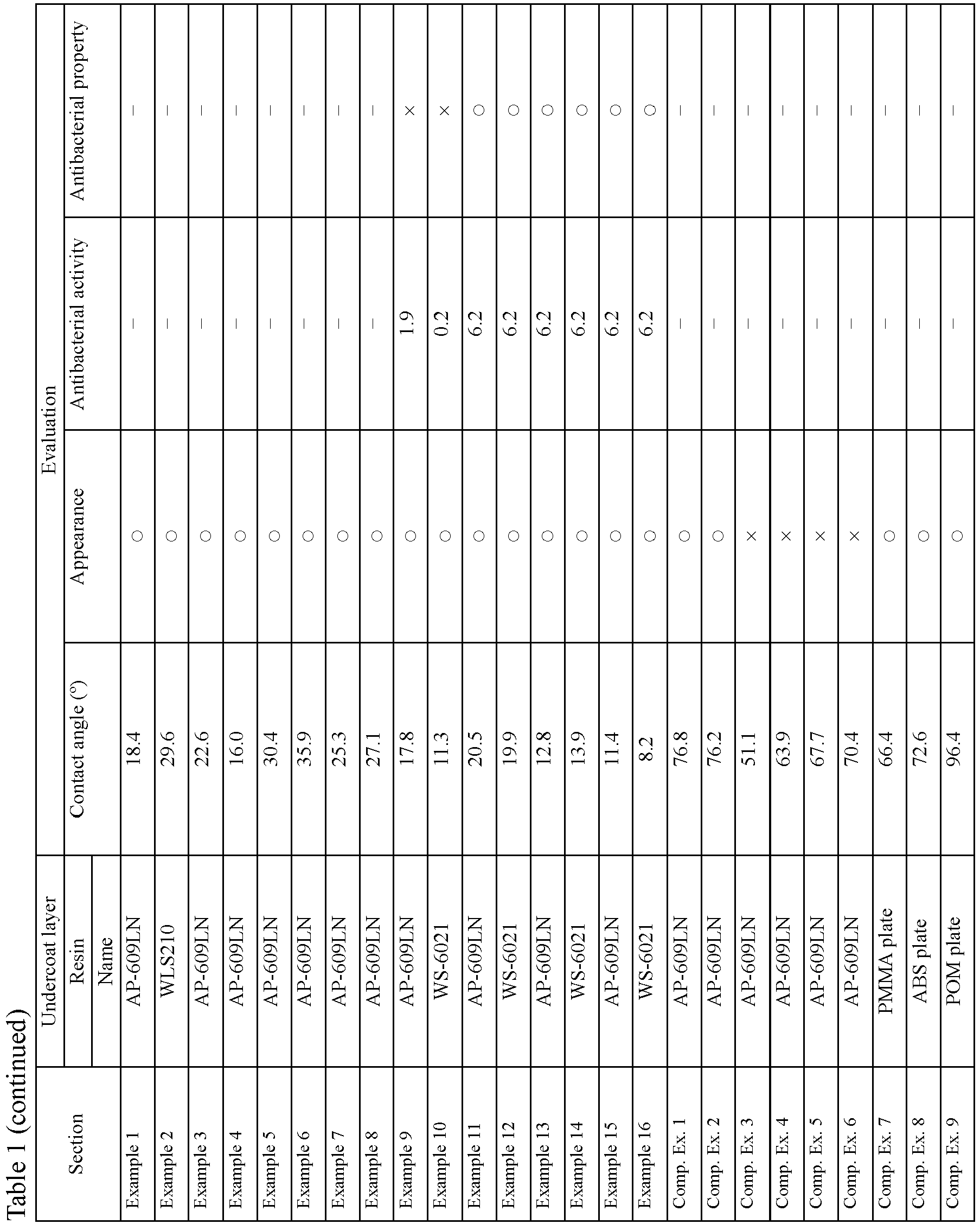
- Details of the names given in Table 1 are as follows.
-
- AP-609LN (acrylic emulsion manufactured by Showa Denko K.K.)
- WLS210 (urethane dispersion manufactured by DIC Inc.)
- WS-6021 (urethane dispersion manufactured by Mitsui Chemicals, Inc.)
-
- PMMA plate (manufactured by Nippon Testpanel Co., Ltd.)
- ABS plate (manufactured by Nippon Testpanel Co., Ltd.)
- POM plate (manufactured by Nippon Testpanel Co., Ltd.)
-
- Snowtex (registered trademark)-30 (aqueous-dispersion colloidal silica manufactured by Nissan Chemical Industries, Ltd.; solid content (SiO2), 30 mass%; particle diameter, 10-15 nm; pH, 9.5-10.5; viscosity, 1.0-6.0 mPa·s)
- Snowtex (registered trademark)-30L (aqueous-dispersion colloidal silica manufactured by Nissan Chemical Industries, Ltd.; solid content (SiO2), 30 mass%; particle diameter, 40-50 nm; pH, 9.5-10.5; viscosity, 1.0-6.0 mPa·s)
- Snowtex (registered trademark)-C (aqueous-dispersion colloidal silica manufactured by Nissan Chemical Industries, Ltd.; solid content (SiO2), 20 mass%; particle diameter, 10-15 nm; pH, 8.5-9.0; viscosity, 1.0-10.0 mPa·s)
-
- Sodium silicate (sodium silicate manufactured by Fuji Chemical Co., Ltd.)
- Lithium silicate (lithium silicate manufactured by Nissan Chemical Industries, Ltd.)
- MS51 (methyl silicate manufactured by Mitsubishi Chemical Corp.)
- K-2010E (oxazoline-compound crosslinking agent manufactured by Mitsubishi Chemical Corp.)
- V-02 (carbodiimide-compound crosslinking agent manufactured by Nisshinbo Chemical Inc.)
- KBM402 (epoxy-group-containing silane coupling agent manufactured by Shin-Etsu Chemical Co., Ltd.)
- cellenpia (registered trademark) (cellulose nanofibers manufactured by Nippon Pater Industries Co., Ltd.)
- Aluminum(III) acetylacetonate (crosslinking agent manufactured by TCI Co., Ltd.)
- A-21S (mica manufactured by Yamaguchi Mica Co., Ltd.)
-
- Silver nanoparticles (silver-based inorganic antibacterial manufactured by Skyspring Nanomaterials Inc.)
- IONPURE (silver-based inorganic antibacterial manufactured by Ishizuka Glass Co., Ltd.)
- Zeomic (silver-based inorganic antibacterial manufactured by Sinanen Zeomic Co., Ltd.)
-
- SN-WET 366 (nonionic surfactant manufactured by San Nopco Ltd.)
- Polyethylene glycol monolaurate (wetting agent manufactured by TCI Co., Ltd.)
- As can be seen from the results given in Table 1, the surfaces of the peelable coating films were able to be hydrophilized without being deteriorated in appearance, by using the water-based coating materials each including colloidal silica and a binder. In Comparative Examples 1 and 3 to 6, the fixation of silica was not ascertained.
- In addition, the coating materials for hydrophilic-coating-film formation used in Examples 11 to 16 were able to impart antibacterial properties to the surfaces of peelable coating films, because these coating materials contained antibacterials.
- While preferred embodiments of the present invention have been explained above, the present invention is not limited to those embodiments and various modifications and replacements can be made in the embodiments without departing from the scope of the invention.
- While various embodiments have been explained above with reference to the drawings, it is a matter of course that the present invention is not limited to these embodiments. A person skilled in the art can clearly conceive of variously changed or modified modes within the scope of the claims, and these modes are, as a matter of course, deemed to be within the technical range of the present invention. Furthermore, constituent elements in the embodiments described above may be combined at will within the gist of the present invention.
- The present application is based on a
Japanese patent application filed on September 27, 2019 (Application No. 2019-177849 Japanese patent application filed on March 19, 2020 (Application No. 2020-049418 -
- 1 Peelable coating film having hydrophilized surface
- 21 Hydrophilic coating film
- 31 Peelable coating film
- 41 Adherend
Claims (14)
- A peelable coating film formed from an aqueous dispersion type resin composition, the peelable coating film having silica particles fixed to a surface of the coating film.
- The peelable coating film according to claim 1, wherein the silica particles have been fixed to the surface of the coating film by a binder.
- The peelable coating film according to claim 2, wherein the binder is an inorganic binder.
- The peelable coating film according to claim 3, wherein the inorganic binder comprises at least one binder selected from the group consisting of alkali metal silicates, aluminosilicates, borosilicates, alkali metal salts, and boric acid.
- The peelable coating film according to any one of claims 1 to 4, which has an antibacterial fixed to the surface of the coating film.
- A coating-material set comprisinga coating material for peelable-coating-film formation which comprises an aqueous dispersion type resin composition and is for forming a peelable coating film anda coating material for hydrophilic-coating-film formation which comprises colloidal silica, a binder, and an aqueous medium and is for forming a hydrophilic coating film on the peelable coating film.
- The coating-material set according to claim 6, wherein the binder is an inorganic binder.
- The coating-material set according to claim 7, wherein the inorganic binder comprises at least one binder selected from the group consisting of alkali metal silicates, aluminosilicates, borosilicates, alkali metal salts, and boric acid.
- The coating-material set according to any one of claims 6 to 8, wherein the coating material for hydrophilic-coating-film formation further contains an antibacterial.
- The coating-material set according to any one of claims 6 to 9, wherein the coating material for hydrophilic-coating-film formation further contains a wetting agent.
- The coating-material set according to any one of claims 6 to 10, wherein the coating material for hydrophilic-coating-film formation contains 0.1-30 parts by weight (on solid basis) of the colloidal silica and 0.01-10 parts by weight of the binder per 100 parts by weight of the aqueous medium.
- A coating material for hydrophilic-coating-film formation which comprises colloidal silica, an alkali metal silicate, and an aqueous medium.
- The coating material for hydrophilic-coating-film formation according to claim 12, which further contains an antibacterial.
- The coating material for hydrophilic-coating-film formation according to claim 12 or 13, which further contains a wetting agent.
Applications Claiming Priority (3)
| Application Number | Priority Date | Filing Date | Title |
|---|---|---|---|
| JP2019177849 | 2019-09-27 | ||
| JP2020049418A JP7582787B2 (en) | 2019-09-27 | 2020-03-19 | Peelable coating film and paint set |
| PCT/JP2020/035594 WO2021060211A1 (en) | 2019-09-27 | 2020-09-18 | Peelable coating film, coating-material set, and coating-material for forming hydrophilic coating film |
Publications (2)
| Publication Number | Publication Date |
|---|---|
| EP4035893A1 true EP4035893A1 (en) | 2022-08-03 |
| EP4035893A4 EP4035893A4 (en) | 2023-10-25 |
Family
ID=75165809
Family Applications (1)
| Application Number | Title | Priority Date | Filing Date |
|---|---|---|---|
| EP20869095.8A Withdrawn EP4035893A4 (en) | 2019-09-27 | 2020-09-18 | REMOVABLE COATING FILM, COATING MATERIAL SET AND COATING MATERIAL FOR PRODUCING A HYDROPHILIC COATING FILM |
Country Status (4)
| Country | Link |
|---|---|
| US (1) | US20220389238A1 (en) |
| EP (1) | EP4035893A4 (en) |
| CN (1) | CN114450359B (en) |
| WO (1) | WO2021060211A1 (en) |
Families Citing this family (7)
| Publication number | Priority date | Publication date | Assignee | Title |
|---|---|---|---|---|
| JP7689903B2 (en) * | 2021-11-02 | 2025-06-09 | 株式会社日立製作所 | Vehicles protected with a peelable protective film |
| CN118302493A (en) * | 2021-11-29 | 2024-07-05 | 佳能株式会社 | Coating compositions and articles |
| DE112022005217T5 (en) * | 2021-11-29 | 2024-08-14 | Canon Kabushiki Kaisha | Coating composition and object |
| CN115368768B (en) * | 2022-05-09 | 2023-08-22 | 首牵科技(广州)有限公司 | Water-based environment-friendly strippable protective coating and preparation method thereof |
| CN115976468A (en) * | 2022-12-22 | 2023-04-18 | 深圳怡诚新材料有限公司 | Super-hydrophilic film layer and preparation method thereof |
| CN119307137B (en) * | 2023-07-14 | 2025-11-11 | 立邦涂料(中国)有限公司 | Household multifunctional water-based strippable antiviral coating composition, preparation method and application thereof |
| WO2026014101A1 (en) * | 2024-07-09 | 2026-01-15 | ハドラスホールディングス株式会社 | Hydrophilic coating film, hydrophilic coating liquid, and method for forming hydrophilic coating film |
Family Cites Families (24)
| Publication number | Priority date | Publication date | Assignee | Title |
|---|---|---|---|---|
| JPS53100226A (en) | 1977-02-14 | 1978-09-01 | Fuji Photo Film Co Ltd | Photosensitive material with film physical property improved |
| JPS53112732A (en) | 1977-03-14 | 1978-10-02 | Fuji Photo Film Co Ltd | Photosensitive material with improved physical properties of film |
| JPS53123916A (en) | 1977-04-05 | 1978-10-28 | Fuji Photo Film Co Ltd | Improving method for adhesion resistance of photographic material |
| JPH06116527A (en) * | 1992-10-07 | 1994-04-26 | Nippon Light Metal Co Ltd | Surface treatment that imparts hydrophilicity to the surface of aluminum materials |
| JPH06264003A (en) * | 1993-03-11 | 1994-09-20 | Nippon Light Metal Co Ltd | Surface treatment that imparts antifungal and hydrophilic properties to the surface of aluminum materials |
| JPH0911424A (en) * | 1995-06-28 | 1997-01-14 | Diafoil Co Ltd | Releasing film for manufacturing ceramic sheet |
| JPH0995631A (en) * | 1995-07-24 | 1997-04-08 | Nippon Parkerizing Co Ltd | Peelable coating composition |
| DE19714396A1 (en) * | 1997-04-08 | 1998-10-15 | Zeiss Carl Fa | Photogrammetric camera used in aircraft or satellite |
| JP2000109722A (en) * | 1998-10-05 | 2000-04-18 | Nippon Paint Co Ltd | Inorganic aqueous coating composition and method for forming inorganic coating film using the same |
| US20020028288A1 (en) * | 2000-06-14 | 2002-03-07 | The Procter & Gamble Company | Long lasting coatings for modifying hard surfaces and processes for applying the same |
| JP2002011821A (en) * | 2000-06-27 | 2002-01-15 | Nitto Denko Corp | Composite sheet and method for producing plastic molded article using the same |
| DE10060673A1 (en) * | 2000-12-05 | 2002-06-06 | Hemmelrath Lackfabrik Gmbh | Aqueous preparation for strippable protective coatings, e.g. on new cars, contains dispersion of polyurethane with polydiene-based components, polydimethylsiloxane and optionally pigments and additives |
| JP3820160B2 (en) * | 2002-01-23 | 2006-09-13 | 富士写真フイルム株式会社 | Photosensitive transfer material and color filter |
| WO2003082592A1 (en) * | 2002-03-29 | 2003-10-09 | Nippon Paper Industries Co., Ltd. | Process for producing cast coated paper for ink jet recording |
| JP3942481B2 (en) * | 2002-05-07 | 2007-07-11 | 帝人デュポンフィルム株式会社 | Separate film for aqueous gel sheet |
| CN102316718B (en) * | 2009-02-13 | 2014-02-19 | 旭硝子株式会社 | Agricultural film |
| AT509672B1 (en) * | 2010-03-25 | 2016-03-15 | Lengheim Hubert | FILM-COATING COATING |
| EP2450411A1 (en) * | 2010-11-03 | 2012-05-09 | Akzo Nobel Coatings International B.V. | Absorbent multilayer coating system |
| KR101174372B1 (en) * | 2010-11-10 | 2012-08-16 | 주식회사 에스아이켐 | Preparation of waterproof inorganic silicate binder with fine structure of polymeric beads after curing and its manufacturing method |
| JP5908701B2 (en) * | 2011-11-10 | 2016-04-26 | 昭和電工パッケージング株式会社 | Contents adhesion prevention lid material and manufacturing method thereof |
| JP5804996B2 (en) | 2012-03-27 | 2015-11-04 | 中央自動車工業株式会社 | Anti-fogging and antifouling agent for organic substrate and method for coating organic substrate with said anti-fogging and antifouling agent |
| JP6127322B2 (en) * | 2012-09-28 | 2017-05-17 | 大日本塗料株式会社 | Composition for forming hydrophilic coating film and hydrophilic coating film |
| JP6930477B2 (en) | 2018-03-30 | 2021-09-01 | トヨタ車体株式会社 | Vehicle frame structure |
| JP2020049418A (en) | 2018-09-26 | 2020-04-02 | 東レ株式会社 | Method for preparing and supplying water for water treatment |
-
2020
- 2020-09-18 CN CN202080067725.6A patent/CN114450359B/en active Active
- 2020-09-18 EP EP20869095.8A patent/EP4035893A4/en not_active Withdrawn
- 2020-09-18 WO PCT/JP2020/035594 patent/WO2021060211A1/en not_active Ceased
- 2020-09-18 US US17/764,051 patent/US20220389238A1/en not_active Abandoned
Also Published As
| Publication number | Publication date |
|---|---|
| CN114450359A (en) | 2022-05-06 |
| WO2021060211A1 (en) | 2021-04-01 |
| EP4035893A4 (en) | 2023-10-25 |
| US20220389238A1 (en) | 2022-12-08 |
| CN114450359B (en) | 2023-08-29 |
Similar Documents
| Publication | Publication Date | Title |
|---|---|---|
| EP4035893A1 (en) | Peelable coating film, coating-material set, and coating-material for forming hydrophilic coating film | |
| JP7582787B2 (en) | Peelable coating film and paint set | |
| US7943714B2 (en) | Label adhesive and activation method for polymeric label | |
| JP2020094225A (en) | Surface protection sheet and water dispersion type adhesive composition for surface protection sheet | |
| JP5638891B2 (en) | Removable adhesive sheet | |
| JP2010209261A (en) | Acrylic self-adhesive sheet | |
| JP5498870B2 (en) | Adhesive composition excellent in heat resistance, adhesive layer, and adhesive sheet | |
| JP6528066B2 (en) | Cold-crosslinkable coating composition | |
| US20090169817A1 (en) | Polymer articles with Polymer layer containing incompatible material unevenly distributed and surface-roughened tape or sheet comprising the polymer articles | |
| JP2009203351A (en) | Adhesive sheet | |
| JP4707982B2 (en) | Re-peelable water-based adhesive composition | |
| WO2020196433A1 (en) | Aqueous dispersion-type resin composition and coating film | |
| WO2020137955A1 (en) | Adhesive sheet | |
| JP6185303B2 (en) | Emulsion-type pressure-sensitive adhesive composition, emulsion-type pressure-sensitive adhesive, emulsion-type peelable pressure-sensitive adhesive, and pressure-sensitive adhesive sheet using the same | |
| WO2007102544A1 (en) | Resin-coated metal plate and surface treatment composition for producing same | |
| JP4441847B2 (en) | Aqueous pressure-sensitive adhesive composition, method for producing the same, and pressure-sensitive adhesive product | |
| JP4661048B2 (en) | Water-based paint composition and article to be coated | |
| JP2023024345A (en) | Water-dispersed pressure-sensitive adhesive composition | |
| EP4130170A1 (en) | Composition for coating-film formation, and coating film | |
| JP6631231B2 (en) | Water-based adhesive and adhesive sheet | |
| EP4502090A1 (en) | Composition for forming coating film, coating film, and article with coating film | |
| TW202138496A (en) | Resin composition for polyolefin base material coating | |
| JP7453523B2 (en) | water-based paint | |
| JP4963562B2 (en) | Damping adhesive composition | |
| JP7070182B2 (en) | Aqueous re-peelable adhesive and adhesive sheet |
Legal Events
| Date | Code | Title | Description |
|---|---|---|---|
| STAA | Information on the status of an ep patent application or granted ep patent |
Free format text: STATUS: THE INTERNATIONAL PUBLICATION HAS BEEN MADE |
|
| PUAI | Public reference made under article 153(3) epc to a published international application that has entered the european phase |
Free format text: ORIGINAL CODE: 0009012 |
|
| STAA | Information on the status of an ep patent application or granted ep patent |
Free format text: STATUS: REQUEST FOR EXAMINATION WAS MADE |
|
| 17P | Request for examination filed |
Effective date: 20220325 |
|
| AK | Designated contracting states |
Kind code of ref document: A1 Designated state(s): AL AT BE BG CH CY CZ DE DK EE ES FI FR GB GR HR HU IE IS IT LI LT LU LV MC MK MT NL NO PL PT RO RS SE SI SK SM TR |
|
| DAV | Request for validation of the european patent (deleted) | ||
| DAX | Request for extension of the european patent (deleted) | ||
| A4 | Supplementary search report drawn up and despatched |
Effective date: 20230922 |
|
| RIC1 | Information provided on ipc code assigned before grant |
Ipc: C09D 5/16 20060101ALI20230918BHEP Ipc: C09D 1/02 20060101ALI20230918BHEP Ipc: C09D 1/00 20060101ALI20230918BHEP Ipc: C09D 7/63 20180101ALI20230918BHEP Ipc: C09D 7/61 20180101ALI20230918BHEP Ipc: C09D 201/00 20060101ALI20230918BHEP Ipc: C09D 5/20 20060101ALI20230918BHEP Ipc: C09D 5/02 20060101ALI20230918BHEP Ipc: C09D 5/00 20060101ALI20230918BHEP Ipc: B32B 27/00 20060101AFI20230918BHEP |
|
| STAA | Information on the status of an ep patent application or granted ep patent |
Free format text: STATUS: THE APPLICATION HAS BEEN WITHDRAWN |
|
| 18W | Application withdrawn |
Effective date: 20250115 |