EP4033715A1 - Re-assembly middleware in fpga for processing tcp segments into application layer messages - Google Patents
Re-assembly middleware in fpga for processing tcp segments into application layer messages Download PDFInfo
- Publication number
- EP4033715A1 EP4033715A1 EP21163181.7A EP21163181A EP4033715A1 EP 4033715 A1 EP4033715 A1 EP 4033715A1 EP 21163181 A EP21163181 A EP 21163181A EP 4033715 A1 EP4033715 A1 EP 4033715A1
- Authority
- EP
- European Patent Office
- Prior art keywords
- message
- application layer
- memory
- tcp
- fpga
- Prior art date
- Legal status (The legal status is an assumption and is not a legal conclusion. Google has not performed a legal analysis and makes no representation as to the accuracy of the status listed.)
- Granted
Links
Images






Classifications
-
- H—ELECTRICITY
- H04—ELECTRIC COMMUNICATION TECHNIQUE
- H04L—TRANSMISSION OF DIGITAL INFORMATION, e.g. TELEGRAPHIC COMMUNICATION
- H04L69/00—Network arrangements, protocols or services independent of the application payload and not provided for in the other groups of this subclass
- H04L69/12—Protocol engines
-
- H—ELECTRICITY
- H04—ELECTRIC COMMUNICATION TECHNIQUE
- H04L—TRANSMISSION OF DIGITAL INFORMATION, e.g. TELEGRAPHIC COMMUNICATION
- H04L49/00—Packet switching elements
- H04L49/90—Buffering arrangements
- H04L49/9057—Arrangements for supporting packet reassembly or resequencing
-
- H—ELECTRICITY
- H04—ELECTRIC COMMUNICATION TECHNIQUE
- H04L—TRANSMISSION OF DIGITAL INFORMATION, e.g. TELEGRAPHIC COMMUNICATION
- H04L69/00—Network arrangements, protocols or services independent of the application payload and not provided for in the other groups of this subclass
- H04L69/16—Implementation or adaptation of Internet protocol [IP], of transmission control protocol [TCP] or of user datagram protocol [UDP]
- H04L69/166—IP fragmentation; TCP segmentation
Definitions
- the disclosure herein generally relates to processing Transmission Control Protocol (TCP) segments into application layer messages in Field Programmable Gate Array (FPGA), and, more particularly, to a re-assembly middleware in FPGA for processing TCP segments into application layer messages.
- TCP Transmission Control Protocol
- FPGA Field Programmable Gate Array
- a field-programmable gate array is an integrated circuit designed such that it may be configured by a designer or developer after manufacturing. FPGAs have established themselves as one of the preferred digital implementation platforms in current industrial applications/enterprise applications features. Application of FPGA is reported in several domains including computational domain, financial domain, IoT domain, data center applications, high frequency trading algorithm for the high performance.
- a method for processing TCP segment into application layer message in a FPGA using a re-assembly middleware includes receiving a plurality of TCP segments via TCP from the client, wherein a channel-ID is assigned to a TCP segment from the plurality of TCP segments based on a channel from the plurality of channels that receives the TCP segment.
- the method further includes processing each of the TCP segment to an application layer message, wherein the step of processing each of the TCP segment from the plurality of TCP segments to an application layer message in a re-assembly middleware configured for implementation at a pre-defined frequency includes receiving the TCP segment at the message writer, processing the TCP segment to an application layer message at the message writer based on the pre-defined message offset length, the application layer message comprises of the application layer data, a set of control signals and a set of attributes.
- the step of processing TCP segment to an application layer message in a re-assembly middleware further includes receiving and saving the application layer data along with the set of control signals in the FIFO from the message writer.
- the step of processing TCP segment to an application layer message in a re-assembly middleware further includes assembling the application layer data to obtain a complete application layer message in the FIFO the based on the set of attributes from the connection_id_queue and the set of control signals.
- the step of processing TCP segment to an application layer message in a re-assembly middleware further includes saving the set of attributes in the connection id_queue, wherein the set of attributes comprises of the channel-ID of the TCP segment, a message length, and a start of message.
- the step of processing TCP segment to an application layer message in a re-assembly middleware further includes re-assembling the complete application layer message in the message reader in a pre-defined acceptable format based on the application layer message and the set of attributes from the connection_id_queue.
- the method includes analyzing the complete application layer message in the application layer for providing a service to the client.
- a system for processing TCP segment into application layer message in a FPGA using a re-assembly middleware is provided.
- the system is configured for receiving a TCP Offload Engine (TOE) connected to at least one client via a Transmission Control Protocol (TCP) and configured to receive a plurality of TCP segments from the client via a plurality of channels.
- TCP Transmission Control Protocol
- the system further comprises an application layer configured to provide the service to the client based on processing of the plurality of TCP segments, wherein the application layer (204) further comprises a functionality layer (206).
- the system further comprises a re-assembly middleware connecting the TOE and the application layer, wherein the re-assembly middleware is an independent middleware within the FPGA modular architecture configured for implementation at a pre-defined frequency based on a memory optimization to process each of the TCP segment from the plurality of TCP segments to obtain an application layer message.
- the re-assembly middleware comprises a message writer (msg_writer) designed for implementation at the pre-defined frequency, wherein the message writer is configured to process the TCP segments to the application layer message based on a pre-defined message offset length, wherein the application layer message comprises of the application layer data, a set of control signals and a set of attributes.
- the reassembly middleware further comprises a connection id queue configured to save the set of attributes, wherein the set of attributes comprises of the channel-ID of the TCP segment, a message length, and a start of message.
- the re-assembly middleware further comprises a re-assembly First-In-First-Out (FIFO) designed for implementation at the pre-defined frequency, wherein the FIFO is configured to receive and save the application layer data along with the set of control signals and assembling the application layer data to obtain a complete application layer message based on the set of attributes from the connection_id_queue and the set of control signals.
- FIFO First-In-First-Out
- the reassembly middleware further comprises message reader designed for implementation at the pre-defined frequency, wherein the message reader is configured to read the complete application layer message from the FIFO in a pre-defined format based on the set of attributes from the connection_id_queue.
- the re-assembly middleware further comprises an Advanced eXtensible Interface (AXI) configuration block configured for monitoring and configuring the re-assembly middleware for implementation at the pre-defined frequency.
- AXI Advanced eXtensible Interface
- TCP/IP Transmission Control Protocol/Internet Protocol
- the clients themselves may not be real users but high frequency trading engines, which place orders to utilize a sub second trading opportunity.
- the FPGA must continually respond to the client's request with low latencies.
- the clients typically have a standard Transmission Control Protocol (TCP) interface. It is thus essential that the FPGA respond fast for each request from the client, in the order of microseconds for large burst of incoming requests of the order of million orders per second.
- TCP Transmission Control Protocol
- FIG. 1 through FIG. 12 where similar reference characters denote corresponding features consistently throughout the figures, there are shown preferred embodiments and these embodiments are described in the context of the following exemplary system and/or method.
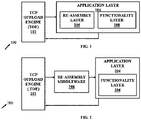
- FIG. 1 illustrates a system for processing TCP segment into application layer message in a FPGA as known in art according to some embodiments of the present disclosure.
- a TOE 102 receives an input from a plurality of TCP segments from a client/network layer, and an output of the TOE 102 is connected to the input of the application layer 104.
- the application layer 104 is configured to extract the application layer message from the TCP segments in the re-assembly layer 106 and further application logic layer performs the specific functionality/task using a functionality layer 108 .
- the application layer104 must perform a common functionality of extracting the application layer message as well as perform the application layer specific task.
- the clients typically have a standard Transmission Control Protocol (TCP) interface. It is thus essential that the FPGA respond fast, in the order of microseconds for large burst of incoming requests (TCP segments) of the order of million orders per second. Hence it is essential that the FPGA performs efficiently for high frequency with low latency.
- TCP Transmission Control Protocol
- FIG. 2 illustrates an exemplary FPGA system 200 for processing TCP segment into application layer message in a FPGA using a re-assembly middleware 208 according to some embodiments of the present disclosure.
- the re-assembly middleware 208 is an independent middleware.
- the re-assembly middleware 208 is a modular and a plug-play independent middleware extrinsic to the application layer but within the FPGA modular architecture.
- the re-assembly middleware 208 is operationally connecting the TOE 202 and the application layer 206, and wherein the re-assembly middleware 208 receives input from the TOE 202 and the output of the re-assembly middleware 208 is sent to the application layer 204, wherein a functionality layer 206 performs the application layer specific task.
- the re-assembly middleware 208 or the re-assembly layer 208 is configured to perform the common functionality of the application layer, wherein the common functionality includes processing TCP segment into application layer message 206.
- This disclosed extrinsic re-assembly middleware architecture has following advantage, i) modular approach for the application layer, ii) reusability across the application and iii) plug and play, which will be enable high performance of a high performance and a low latency logic.
- the terms/modules/components of re-assembly middleware and the re-assembly layer have been used inter-changeably.
- the FPGA system 200 for processing TCP segment into application layer message in a FPGA comprises of a TCP Offload Engine (TOE) 202 connected to atleast one client via a Transmission Control Protocol (TCP) being configured to receive a plurality of TCP segments from the client via a plurality of channels.
- TOE TCP Offload Engine
- TCP Transmission Control Protocol
- the plurality of channels includes a channel-ID is assigned to a TCP segment from the plurality of TCP segments based on a channel from the plurality of channels that receives the TCP segment.
- the TOE 202 can support upto 64K channels from which TCP segments are received into the FPGA via the TOE 202 from the client.
- the plurality of TCP segments is associated with a service, where the service is a specific task to be performed for the client by the FPGA.
- the service request is associated with a web application for a) booking tickets in cinema or b) grocery purchase from an online store or c) data center application or d) servicing a request for stock exchange.
- the system 200 further comprises of an application layer 204 configured to provide the service to the client based on processing the plurality of TCP segments.
- the functionality layer 206 within the application layer 204 is configured to perform an application specific task for several domains/applications.
- the application specific task includes converting a TCP segment to an application layer message for a web application for a) booking tickets in cinema or b) grocery purchase from an online store , wherein the TCP segment is will book tickets for a customer or buy grocery for the customer/user.
- the system 200 further comprises of the re-assembly middleware 208 operationally connecting the TOE 202 and the application layer 204.
- the re-assembly middleware 208 is an independent block within the FPGA modular architecture configured for implementation at the pre-defined frequency based on a memory optimization to process each of the TCP segment from the plurality of TCP segments to obtain an application layer message 204.
- the re-assembly middleware 208 within the FPGA system 200 is an independent middleware that is a modular and a plug-play middleware extrinsic to the application layer 204 but within the FPGA modular architecture of system 200, wherein the re-assembly middleware 204 is operationally connecting the TOE and the application layer, and wherein the re-assembly middleware receives input from the TOE 202 and the output of the re-assembly middleware 208 is sent to the application layer 204.
- the re-assembly middleware 208 is configured for implementation at a pre-defined frequency based on a memory optimization to process each of the TCP segment from the plurality of TCP segments to obtain an application layer message
- the pre-defined frequency is a high frequency performance feature, where in in an embodiment the high frequency performance feature includes the FPGA implementation frequency of at atleast 300 MHz based on the memory optimization.
- the memory optimization is implemented for a memory, wherein the memory includes a message writer memory, a data segment memory and a descriptor memory.
- the memory optimization includes the following configurations/features in the FPGA architecture of system 200:
- a register and an input controller is placed at the output of the memory.
- the registering an output for the memory enables implementation at the pre-defined frequency by a) holding a data for one clock to synchronize the data for one clock cycle. b) Further by the process of registering the output of memory for two clock cycles.
- the FPGA system can be synthesized/ implemented at the pre-defined frequency / higher frequency.
- the pre-defined slicing threshold is defined as slicing the memory optimally to enable implementation at the pre-defined frequency / higher frequency.
- the slicing includes a horizonal slicing and a vertical slicing and the type of slicing to be implemented on the memory is decided based on the pre-defined slicing threshold.
- the pre-defined slicing threshold is dynamically decided based on the pre-defined frequency, wherein if the memory under consideration is not meeting the frequency expectation as defined by the pre-defined frequency, then the pre-defined slicing threshold is violated and this particular memory is sliced.
- the horizontal slicing comprises of n memories each of 1/nth address space, wherein each of the sliced horizontal memory is expressed as shown below : reg [(n-1):0] mem [x-1:0] to m instances of reg [floor(n/m)- 1:0] mem [x-1:0].
- the vertical slicing comprises separate memory for each bit of memory, wherein each of the sliced vertical memory is de-fined memory was change is expressed as shown below: reg [(n-1):0] mem [x-1:0] to m instances of reg [n- 1:0] mem [floor(x/m)-1:0]
- the state of art FPGA systems uses 18k bits and 38k bit internal memory units to implement a large memory.
- a larger memory is constructed using combination of this memories. If large memory is created using small blocks, it can cause the combinational delay there by decreasing the clock frequency. So, in this slicing we avoid generating the large memories while using the smaller blocks of memory which improves the performance without affecting the functionality. Further the vertical slicing should be implemented first followed by the horizontal slicing only if it does not meet the pre-defined frequency implementation as there is addition of small combinational circuit overhead in the horizontal slicing.
- the memory needs slicing as the FPGA does not support required pre-defined frequency implementation, wherein the pre-defined frequency implementation is considered as 400MHz.
- the memory is optimally sliced, wherein the memory is first sliced vertically and if the FPGA does not still work as required at the pre-defined frequency , then horizonal slicing is performed.
- An example scenario is shared below, considering the pre-defined frequency as 400 MHz :
- FIG.3 is a functional block diagram 300 of the re-assembly middleware of the system 200 of FIG.2 , in accordance with some embodiments of the present disclosure.
- the FIG.3 illustrates the functions of the components of the system 200 for processing TCP segment into application layer message in a FPGA using a re-assembly layer 208.
- the functional block diagram 300 of the re-assembly middleware of the system 200 is explained in the below section.
- the exemplary architecture of the functional block diagram represents a certain number of components, it may be understood that the number is only representative and may be configured as desired. For ease of description, the description hereinafter may be limited to the number of components illustrated in the accompanying drawings.
- Each of the plurality of components within the re-assembly middleware 208 within the FPGA system 200 as various functional units as described hereinafter.
- the FPGA system 200 includes a message writer (msg_writer) 302 designed for implementation at the pre-defined frequency, wherein the message writer 302 is configured to process the TCP segments to the application layer message based on a pre-defined message offset length.
- the application layer message comprises of the application layer data, a set of control signals and a set of attributes.
- the TCP segments are processed in the reassembly middleware 208 to obtain the application layer message based on a pre-defined message offset length.
- the message writer (msg_writer) 302 within the re-assembly middleware 208 is configured to process the TCP segments to the application layer message based on a pre-defined message offset length.
- plurality of TCP segments comprises a plurality of information associated with the TCP segment that includes a TCP Offload Engine (TOE)_FIFO not empty (toe_fnempty), a TOE data (toe_data) , a TOE end of TCP segment (toe_eos), a TOE start of TCP segment (toe_sos), a TOE byte valid parameter (toe_byte_vld), a a TOE_connection ID (toe_conn_id) , and a TOE error (toe_error).
- TOE TCP Offload Engine
- the plurality of application layer messages are assembled in the FIFO 304 based on the message length and a plurality of application layer message includes a re-assembly valid (reasm_vld), a re-assembly start of message (reasm_som) , a reassembly end of message (reasm_eom), a re-assembly byte valid (reasm_bvld) )and a re-assembly data (reasm_data).
- the pre-defined message offset length is indicative of length of a message length of the application layer message.
- the FIG.4 illustrates a top level architecture of the re-assembly middleware with the input (a plurality of TCP segments) and the output (application layer message).
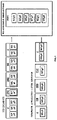
- FIG.5 illustrates an example scenario is illustrated in the FIG.5 , wherein an example of a plurality of TCP segments processed to obtain the application layer message by the re-assembly middleware 208 is shown.
- the input which is the plurality of TCP segments is shown as a combination of partial and/or complete message.
- the complete application layer message is displayed.
- FIG.6 illustrates an exemplary block diagram of a message writer 302 within the exemplary system for processing TCP segment into application layer message in a FPGA using the re-assembly middleware.
- the message writer designed for implementation at a pre-defined frequency based on the memory optimization comprises:
- connection_id_queue configured to save the set of attributes.
- the set of attributes comprises of the channel-ID of the TCP segment, a message length, and a start of message.
- connection id queue 306 is standard first in first out, with commit discard facilities.
- the connection id queue 306 receives its input from the message writer 302.
- the connection id queue 306 is configured to discard error segments and saving error free messages.
- the output of connection id queue 306 is read by the message reader 308.
- the FPGA system 200 includes a re-assembly First-In-First-Out (FIFO) 304 designed for implementation at the pre-defined frequency, wherein the FIFO 304 is configured:
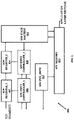
- FIG. 7 illustrates an exemplary block diagram of a FIFO 304 within the exemplary system for processing TCP segment into application layer message in a FPGA using the re-assembly middleware.
- the FIFO 304 designed for implementation at a pre-defined frequency based on the memory optimization comprises:
- the FPGA system 200 includes a message reader 308 designed for implementation at the pre-defined frequency, wherein the message reader is configured to read the complete application layer message from the FIFO in a pre-defined format based on the set of attributes from the connection id queue 306.
- the pre-defined format is defined by the reasm_byte_bld or reasm_bvld, indicates a byte valid during end of message from the complete application layer message from the FIFO.
- FIG. 8 illustrates an exemplary block diagram of a message reader 308 within the exemplary system for processing TCP segment into application layer message in a FPGA using the re-assembly middleware.
- the message reader 308 designed for implementation at a pre-defined frequency based on the memory optimization comprises:
- the FPGA system 200 includes an Advanced eXtensible Interface (AXI) 310 configuration block configured for monitoring and configuring the re-assembly middleware for implementation at the pre-defined frequency.
- AXI Advanced eXtensible Interface
- the AXI interface 310 is used by a plurality of clients of the FPGA system 200 to read the internal state of reassembly logic. Further the AXI interface 310 reads a set of statistic values like total number of input segments, total number of output message read etc., along with status registers.
- the various modules of the system 200 for processing TCP segment into application layer message in a FPGA using a re-assembly layer are implemented as at least one of a logically self-contained part of a software program, a self-contained hardware component, and/or, a self-contained hardware component with a logically self-contained part of a software program embedded into each of the hardware component that when executed perform the above method described herein.
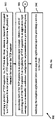
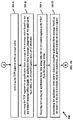
- FIG.9A , FIG.9B and FIG.9C are an exemplary flow diagram illustrating a method 900 for using the system 200 of FIG.2 according to an embodiment of the present disclosure.
- the method includes receiving a plurality of TCP segments via TCP from the client by the TOE 202. Further a channel-ID is assigned to a TCP segment from the plurality of TCP segments based on a channel from the plurality of channels that receives the TCP segment.
- the channel ID indicates different stocks such as SBI, TCS, BPCL etc.
- the channel ID indicates a particular item of grocery such as a specific brand of rice or a specific brand of wheat.
- each of the TCP segment is processed to an application layer message in the re-assembly middleware 208.
- the step of processing each of the TCP segment to an application layer message in the re-assembly middleware 208 is depicted using the flow diagram in FIG.9B and FIG.9C and comprises of the following sub-steps :
- the TCP segment is received at the message writer 302.
- the TCP segment is processed to an application layer message at the message writer 302 based on the pre-defined message offset length, the application layer message comprises of the application layer data, a set of control signals and a set of attributes.
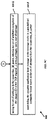
- the step of processing the TCP segment to the application layer message at the message writer 302 is depicted as an exemplary sequence of operations using the flow diagram 1000 in FIG. 10 .
- the method 1000 in FIG. 10 includes the following sub-steps:
- the message writer memory 610 is initialized to a pre-defined default state post a reset using the message writer init_done 614;
- the plurality of TCP segments are received, held and passed in the plurality of message writer register (602 and 604)for atleast one cycle as controlled by a plurality of message writer input controllers (606 and 608) ;
- the plurality of TCP segments are processed to the application layer message in the message writer state machine 612 based on the pre-defined set of states.
- step 904C of the method (900) application layer data along with the set of control signals is received from the message writer 302 and saved the in the FIFO 304.
- the application layer data is assembled to obtain a complete application layer message in the message writer 302 .
- the application layer data is assembled to obtain a complete application layer message is based on the set of attributes from the connection id queue 306 and the set of control signals.
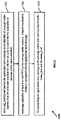
- the step of assembling the application layer data to obtain a complete application layer message is depicted as an exemplary sequence of operations using the flow diagram 1100 in FIG.11 .
- the method 1100 in FIG.11 includes the following sub-steps:
- the free pool pointer memory is initialized to a pre-defined default state post a reset using the FIFO init done.
- the application layer data is received, held and passed in the plurality of FIFO registers from the message writer state machine for atleast one cycle as controlled by a plurality of FIFO input controllers.
- the application layer message is assembled and written in the descriptor memory and the data segment memory to obtain a complete application layer message based on the set of control signals by the write state-machine using the free pool pointer memory and the channel memory
- the application layer message is read from the descriptor memory and the data segment memory based on a set of control signals by the message reader using the read state-machine.
- the set of attributes is saved in the connection id queue 306.
- the set of attributes comprises of the channel-ID of the TCP segment, a message length, and a start of message.
- the complete application layer message is assembled in the message reader 308 from the application layer message.
- the assembly of the complete application layer message is implemented in the pre-defined acceptable format based on the set of attributes from the connection id queue 306.
- the step of re-assembling the complete application layer message in the message reader 308 is depicted as an exemplary sequence of operations using the flow diagram 1200 in FIG.12 .
- the method 1200 in FIG.12 includes the following sub-steps:
- the application layer message is received, held and passed the in the plurality of message reader registers from the read state-machine for atleast one cycle as controlled by a plurality of message reader input controllers;
- a plurality of data is received from the FIFO 304 in the message reader memory 806, wherein the plurality of data is associated with the application layer message;
- the complete application layer message is re-assembling in the message reader state machine 810 based on the reasm eom and the reasm_bvld from the application layer message
- the complete application layer message is analyzed in the application layer 204 for providing a service to the client.
- the functionality layer 206 in the application layer 204 is configured to perform the application specific task.
- the Design 1 comprises memories having output delay of 1 clock instead of output delay of 1 clock and also comprises of descriptor memory, data segment memory, channel memory from FIFO and memory from message writer.
- the Design 1 gives synthesize frequency at 150 MHz and implementation frequency was 116MHz. Analysis showed memory is bottleneck, especially the memories of message writer and FIFO.
- the reassembly logic (Design 2) has been designed based on the disclosed memory optimization technique, wherein With this memory optimization and the reassembly logic (Design 2), the FPGA system works at implementation frequency above 400 MHz, although the synthesize frequency was around 367 MHz. Hence based on the re-assemly middleware and the memory optimization, the design 2 improves the frequency which increases from 116 MHz to 400 MHz post implementation as observed in Table 1. It was observed in Table 2, that power consumption had been optimized for Design 2, specifically dynamic power.
- Table 1 Timing comparison post implementation Timing constraint w.r.t clock to clock constraint of 2.5 ns Design 1 (worst negative slack) Design 2 (worst negative slack) Setup -6.131ns + 0.024ns %endpoint failing 4.88% 0 Hold + 0.010ns + 0.016ns PW + 0.500ns +0.500ns Table 2: Power consumption comparison post implementation Power parameters Design 1 Design 2 Total On-Chip Power (W) 4.360 3.747 FPGA Power (W) 4.119 3.506 HBM Power (W) 0.242 0.241 Dynamic (W) 1.206 0.605 Device Static (W) 3.144 3.143
- the hardware device can be any kind of device which can be programmed including e.g. any kind of computer like a server or a personal computer, or the like, or any combination thereof.
- the device may also include means which could be e.g. hardware means like e.g. an application-specific integrated circuit (ASIC), a field-programmable gate array (FPGA), or a combination of hardware and software means, e.g.
- ASIC application-specific integrated circuit
- FPGA field-programmable gate array
- the means can include both hardware means and software means.
- the method embodiments described herein could be implemented in hardware and software.
- the device may also include software means.
- the embodiments may be implemented on different hardware devices, e.g. using a plurality of CPUs.
- the embodiments herein can comprise hardware and software elements.
- the embodiments that are implemented in software include but are not limited to, firmware, resident software, microcode, etc.
- the functions performed by various components described herein may be implemented in other components or combinations of other components.
- a computer-usable or computer readable medium can be any apparatus that can comprise, store, communicate, propagate, or transport the program for use by or in connection with the instruction execution system, apparatus, or device.
- a computer-readable storage medium refers to any type of physical memory on which information or data readable by a processor may be stored.
- a computer-readable storage medium may store instructions for execution by one or more processors, including instructions for causing the processor(s) to perform steps or stages consistent with the embodiments described herein.
- the term "computer-readable medium” should be understood to include tangible items and exclude carrier waves and transient signals, i.e., be non-transitory. Examples include random access memory (RAM), read-only memory (ROM), volatile memory, nonvolatile memory, hard drives, CD ROMs, DVDs, flash drives, disks, and any other known physical storage media.
Landscapes
- Engineering & Computer Science (AREA)
- Computer Networks & Wireless Communication (AREA)
- Signal Processing (AREA)
- Computer Security & Cryptography (AREA)
- Software Systems (AREA)
- Theoretical Computer Science (AREA)
- Mobile Radio Communication Systems (AREA)
- Physics & Mathematics (AREA)
- General Engineering & Computer Science (AREA)
- General Physics & Mathematics (AREA)
Abstract
Description
- The present application claims priority from Indian provisional application no.
202121003213, filed on January 22, 2021 - The disclosure herein generally relates to processing Transmission Control Protocol (TCP) segments into application layer messages in Field Programmable Gate Array (FPGA), and, more particularly, to a re-assembly middleware in FPGA for processing TCP segments into application layer messages.
- A field-programmable gate array (FPGA) is an integrated circuit designed such that it may be configured by a designer or developer after manufacturing. FPGAs have established themselves as one of the preferred digital implementation platforms in current industrial applications/enterprise applications features. Application of FPGA is reported in several domains including computational domain, financial domain, IoT domain, data center applications, high frequency trading algorithm for the high performance.
- In recent years, the communication speed in digital systems has increased drastically. The increase in communication speed has brought in a growing need to ensure a good/high performance from FPGA services, wherein the high/good performance includes a high throughput, a low latency, and a low resource utilization. In the state of art, different types of the accelerators are used to achieve the high performance, wherein accelerators can be defined as special purpose processors designed to speed up certain compute-intensive parts of applications. Further a lot of research is performed to get TCP Offload Engine (TOE) implemented in FPGA to enable good performance i.e. high throughput, low latency, and low memory utilization, wherein on the top of TOE, sits application layer, processing the received message. With the accelerators providing high performing, there is a need for FPGAs to adopt itself for performance at higher frequency.
- Embodiments of the present disclosure present technological improvements as solutions to one or more of the above-mentioned technical problems recognized by the inventors in conventional systems. For example, in one embodiment, a method for processing TCP segment into application layer message in a FPGA using a re-assembly middleware is provided. The method includes receiving a plurality of TCP segments via TCP from the client, wherein a channel-ID is assigned to a TCP segment from the plurality of TCP segments based on a channel from the plurality of channels that receives the TCP segment. The method further includes processing each of the TCP segment to an application layer message, wherein the step of processing each of the TCP segment from the plurality of TCP segments to an application layer message in a re-assembly middleware configured for implementation at a pre-defined frequency includes receiving the TCP segment at the message writer, processing the TCP segment to an application layer message at the message writer based on the pre-defined message offset length, the application layer message comprises of the application layer data, a set of control signals and a set of attributes. The step of processing TCP segment to an application layer message in a re-assembly middleware further includes receiving and saving the application layer data along with the set of control signals in the FIFO from the message writer. The step of processing TCP segment to an application layer message in a re-assembly middleware further includes assembling the application layer data to obtain a complete application layer message in the FIFO the based on the set of attributes from the connection_id_queue and the set of control signals. The step of processing TCP segment to an application layer message in a re-assembly middleware further includes saving the set of attributes in the connection id_queue, wherein the set of attributes comprises of the channel-ID of the TCP segment, a message length, and a start of message. The step of processing TCP segment to an application layer message in a re-assembly middleware further includes re-assembling the complete application layer message in the message reader in a pre-defined acceptable format based on the application layer message and the set of attributes from the connection_id_queue. Finally, the method includes analyzing the complete application layer message in the application layer for providing a service to the client.
- In another aspect, a system for processing TCP segment into application layer message in a FPGA using a re-assembly middleware is provided. The system is configured for receiving a TCP Offload Engine (TOE) connected to at least one client via a Transmission Control Protocol (TCP) and configured to receive a plurality of TCP segments from the client via a plurality of channels. The system further comprises an application layer configured to provide the service to the client based on processing of the plurality of TCP segments, wherein the application layer (204) further comprises a functionality layer (206). The system further comprises a re-assembly middleware connecting the TOE and the application layer, wherein the re-assembly middleware is an independent middleware within the FPGA modular architecture configured for implementation at a pre-defined frequency based on a memory optimization to process each of the TCP segment from the plurality of TCP segments to obtain an application layer message. The re-assembly middleware comprises a message writer (msg_writer) designed for implementation at the pre-defined frequency, wherein the message writer is configured to process the TCP segments to the application layer message based on a pre-defined message offset length, wherein the application layer message comprises of the application layer data, a set of control signals and a set of attributes. The reassembly middleware further comprises a connection id queue configured to save the set of attributes, wherein the set of attributes comprises of the channel-ID of the TCP segment, a message length, and a start of message. The re-assembly middleware further comprises a re-assembly First-In-First-Out (FIFO) designed for implementation at the pre-defined frequency, wherein the FIFO is configured to receive and save the application layer data along with the set of control signals and assembling the application layer data to obtain a complete application layer message based on the set of attributes from the connection_id_queue and the set of control signals. The reassembly middleware further comprises message reader designed for implementation at the pre-defined frequency, wherein the message reader is configured to read the complete application layer message from the FIFO in a pre-defined format based on the set of attributes from the connection_id_queue. The re-assembly middleware further comprises an Advanced eXtensible Interface (AXI) configuration block configured for monitoring and configuring the re-assembly middleware for implementation at the pre-defined frequency.
- It is to be understood that both the foregoing general description and the following detailed description are exemplary and explanatory only and are not restrictive of the invention, as claimed.
- The accompanying drawings, which are incorporated in and constitute a part of this disclosure, illustrate exemplary embodiments and, together with the description, serve to explain the disclosed principles:
-
FIG. 1 illustrates a system for processing TCP segment into application layer message in an FPGA as known in art, according to some embodiments of the present disclosure. -
FIG.2 illustrates an exemplary block diagram of an FPGA for processing TCP segment into application layer message using a re-assembly middleware in the FPGA according to some embodiments of the present disclosure. -
FIG.3 illustrates a functional diagram of the re-assembly middleware in the FPGA for processing TCP segment into application layer message using a reassembly middleware according to some embodiments of the present disclosure. -
FIG.4 illustrates a top level architecture of the re-assembly middleware for processing TCP segment into application layer message along with an input (a plurality of TCP segments) and an output (application layer message) according to some embodiments of the present disclosure. -
FIG.5 illustrates an example scenario for processing TCP segment into application layer message along with an input (a plurality of TCP segments) and an output (application layer message) in the re-assembly middleware according to some embodiments of the present disclosure. -
FIG.6 illustrates an exemplary block diagram of a message writer within the exemplary system for processing TCP segment into application layer message in a FPGA using a re-assembly middleware according to some embodiments of the present disclosure. -
FIG.7 illustrates an exemplary block diagram of a FIFO within the exemplary system for processing TCP segment into application layer message in a FPGA using a re-assembly middleware according to some embodiments of the present disclosure. -
FIG.8 illustrates an exemplary block diagram of a message reader within the exemplary system for processing TCP segment into application layer message in a FPGA using a re-assembly middleware according to some embodiments of the present disclosure. -
FIG.9A ,FIG.9B andFIG.9C is an exemplary sequence of operations (900) in the message writer while processing TCP segment into application layer message in a FPGA using a re-assembly middleware according to some embodiments of the present disclosure. -
FIG. 10 is exemplary sequence of operations (1000) in the re-assembly First-In-First-Out (FIFO) while processing TCP segment into application layer message in a FPGA using a re-assembly middleware according to some embodiments of the present disclosure. -
FIG. 11 is an exemplary sequence of operations (1100) in the message reader while processing TCP segment into application layer message in a FPGA using a re-assembly middleware according to some embodiments of the present disclosure. -
FIG. 12 is a flow diagram (1200) illustrating a method for processing TCP segment into application layer message in a FPGA using a re-assembly middleware according to some embodiments of the present disclosure. - Exemplary embodiments are described with reference to the accompanying drawings. In the figures, the left-most digit(s) of a reference number identifies the figure in which the reference number first appears. Wherever convenient, the same reference numbers are used throughout the drawings to refer to the same or like parts. While examples and features of disclosed principles are described herein, modifications, adaptations, and other implementations are possible without departing from the scope of the disclosed embodiments.
- Clients usually connect over Transmission Control Protocol/Internet Protocol (TCP/IP) with the FPGA systems to service a request. The clients themselves may not be real users but high frequency trading engines, which place orders to utilize a sub second trading opportunity. Hence the FPGA must continually respond to the client's request with low latencies. At the same time there may be thousands of such co-located clients connected placing orders - in other words they must support high throughput of transactions implemented at a high frequency. Hence it is important is that there should be efficient response to the client's request by a FPGA, ideally in a high frequency with low latency as this can translate to millions of dollars of lost business. The clients typically have a standard Transmission Control Protocol (TCP) interface. It is thus essential that the FPGA respond fast for each request from the client, in the order of microseconds for large burst of incoming requests of the order of million orders per second.
- Referring now to the drawings, and more particularly to
FIG. 1 through FIG. 12 where similar reference characters denote corresponding features consistently throughout the figures, there are shown preferred embodiments and these embodiments are described in the context of the following exemplary system and/or method. -
FIG. 1 illustrates a system for processing TCP segment into application layer message in a FPGA as known in art according to some embodiments of the present disclosure. - As depicted in the
FIG.1 aTOE 102 receives an input from a plurality of TCP segments from a client/network layer, and an output of theTOE 102 is connected to the input of theapplication layer 104. In the state of art, theapplication layer 104 is configured to extract the application layer message from the TCP segments in there-assembly layer 106 and further application logic layer performs the specific functionality/task using afunctionality layer 108 . Hence the application layer104 must perform a common functionality of extracting the application layer message as well as perform the application layer specific task. The clients typically have a standard Transmission Control Protocol (TCP) interface. It is thus essential that the FPGA respond fast, in the order of microseconds for large burst of incoming requests (TCP segments) of the order of million orders per second. Hence it is essential that the FPGA performs efficiently for high frequency with low latency. -
FIG. 2 illustrates anexemplary FPGA system 200 for processing TCP segment into application layer message in a FPGA using are-assembly middleware 208 according to some embodiments of the present disclosure. - As depicted in the
FIG.2 , there-assembly middleware 208 is an independent middleware. There-assembly middleware 208 is a modular and a plug-play independent middleware extrinsic to the application layer but within the FPGA modular architecture. There-assembly middleware 208 is operationally connecting theTOE 202 and theapplication layer 206, and wherein there-assembly middleware 208 receives input from theTOE 202 and the output of there-assembly middleware 208 is sent to theapplication layer 204, wherein afunctionality layer 206 performs the application layer specific task. There-assembly middleware 208 or there-assembly layer 208 is configured to perform the common functionality of the application layer, wherein the common functionality includes processing TCP segment intoapplication layer message 206. This disclosed extrinsic re-assembly middleware architecture has following advantage, i) modular approach for the application layer, ii) reusability across the application and iii) plug and play, which will be enable high performance of a high performance and a low latency logic. In the specification the terms/modules/components of re-assembly middleware and the re-assembly layer, have been used inter-changeably. - The
FPGA system 200 for processing TCP segment into application layer message in a FPGA comprises of a TCP Offload Engine (TOE) 202 connected to atleast one client via a Transmission Control Protocol (TCP) being configured to receive a plurality of TCP segments from the client via a plurality of channels. - In an embodiment, the plurality of channels includes a channel-ID is assigned to a TCP segment from the plurality of TCP segments based on a channel from the plurality of channels that receives the TCP segment. In an example scenario the
TOE 202 can support upto 64K channels from which TCP segments are received into the FPGA via theTOE 202 from the client. Further the plurality of TCP segments is associated with a service, where the service is a specific task to be performed for the client by the FPGA. In an example scenario, the service request is associated with a web application for a) booking tickets in cinema or b) grocery purchase from an online store or c) data center application or d) servicing a request for stock exchange. - The
system 200 further comprises of anapplication layer 204 configured to provide the service to the client based on processing the plurality of TCP segments. Thefunctionality layer 206 within theapplication layer 204 is configured to perform an application specific task for several domains/applications. In an embodiment, the application specific task includes converting a TCP segment to an application layer message for a web application for a) booking tickets in cinema or b) grocery purchase from an online store , wherein the TCP segment is will book tickets for a customer or buy grocery for the customer/user. - The
system 200 further comprises of there-assembly middleware 208 operationally connecting theTOE 202 and theapplication layer 204. There-assembly middleware 208 is an independent block within the FPGA modular architecture configured for implementation at the pre-defined frequency based on a memory optimization to process each of the TCP segment from the plurality of TCP segments to obtain anapplication layer message 204. - The
re-assembly middleware 208 within theFPGA system 200 is an independent middleware that is a modular and a plug-play middleware extrinsic to theapplication layer 204 but within the FPGA modular architecture ofsystem 200, wherein there-assembly middleware 204 is operationally connecting the TOE and the application layer, and wherein the re-assembly middleware receives input from theTOE 202 and the output of there-assembly middleware 208 is sent to theapplication layer 204. There-assembly middleware 208 is configured for implementation at a pre-defined frequency based on a memory optimization to process each of the TCP segment from the plurality of TCP segments to obtain an application layer message - In accordance with the present disclosure, the pre-defined frequency is a high frequency performance feature, where in in an embodiment the high frequency performance feature includes the FPGA implementation frequency of at atleast 300 MHz based on the memory optimization. The memory optimization is implemented for a memory, wherein the memory includes a message writer memory, a data segment memory and a descriptor memory. The memory optimization includes the following configurations/features in the FPGA architecture of system 200:
- i) Registering an output for the memory, wherein registering is implemented by utilizing a register and an input controller at the output of the memory.
- ii) Slicing the memory based on a pre-defined slicing threshold to enable the FPGA implementation at the pre-defined frequency, wherein the slicing includes a horizonal slicing and a vertical slicing.
- In an embodiment, for the step of registering an output for the memory, a register and an input controller is placed at the output of the memory. The registering an output for the memory enables implementation at the pre-defined frequency by a) holding a data for one clock to synchronize the data for one clock cycle. b) Further by the process of registering the output of memory for two clock cycles. The FPGA system can be synthesized/ implemented at the pre-defined frequency / higher frequency.
- In an embodiment, the pre-defined slicing threshold is defined as slicing the memory optimally to enable implementation at the pre-defined frequency / higher frequency. The slicing includes a horizonal slicing and a vertical slicing and the type of slicing to be implemented on the memory is decided based on the pre-defined slicing threshold. The pre-defined slicing threshold is dynamically decided based on the pre-defined frequency, wherein if the memory under consideration is not meeting the frequency expectation as defined by the pre-defined frequency, then the pre-defined slicing threshold is violated and this particular memory is sliced.
- The horizontal slicing comprises of n memories each of 1/nth address space, wherein each of the sliced horizontal memory is expressed as shown below :
reg [(n-1):0] mem [x-1:0] to m instances of reg [floor(n/m)- 1:0] mem [x-1:0]. - The vertical slicing comprises separate memory for each bit of memory, wherein each of the sliced vertical memory is de-fined memory was change is expressed as shown below:
reg [(n-1):0] mem [x-1:0] to m instances of reg [n- 1:0] mem [floor(x/m)-1:0] - The state of art FPGA systems uses 18k bits and 38k bit internal memory units to implement a large memory. A larger memory is constructed using combination of this memories. If large memory is created using small blocks, it can cause the combinational delay there by decreasing the clock frequency. So, in this slicing we avoid generating the large memories while using the smaller blocks of memory which improves the performance without affecting the functionality. Further the vertical slicing should be implemented first followed by the horizontal slicing only if it does not meet the pre-defined frequency implementation as there is addition of small combinational circuit overhead in the horizontal slicing.
- In an example scenario, consider an FPGA system that needs to be implemented at a pre-defined frequency of 400 MHz . Hence to enable implementation at 400MHz based on the memory optimization, the memory needs slicing as the FPGA does not support required pre-defined frequency implementation, wherein the pre-defined frequency implementation is considered as 400MHz. As described in the above section the memory is optimally sliced, wherein the memory is first sliced vertically and if the FPGA does not still work as required at the pre-defined frequency , then horizonal slicing is performed. An example scenario is shared below, considering the pre-defined frequency as 400 MHz :
- Original memory
Reg [63:0] mem [1023:0] -
Equivalent 2 Vertical sliced memory
Reg [63:0] mem1 [511:0]
Reg [63:0] mem2 [511:0] -
Equivalent 4 Vertical sliced memory
Reg [63:0] mem1 [255:0]
Reg [63:0] mem2 [255:0]
Reg [63:0] mem3 [255:0]
Reg [63:0] mem4 [255:0] -
Equivalent 2 horizontal sliced memory
Reg [31:0] mem1 [1023:0]
Reg [31:0] mem2 [1023:0] -
FIG.3 is a functional block diagram 300 of the re-assembly middleware of thesystem 200 ofFIG.2 , in accordance with some embodiments of the present disclosure. As depicted in the architecture, theFIG.3 illustrates the functions of the components of thesystem 200 for processing TCP segment into application layer message in a FPGA using are-assembly layer 208. The functional block diagram 300 of the re-assembly middleware of thesystem 200 is explained in the below section. Although the exemplary architecture of the functional block diagram represents a certain number of components, it may be understood that the number is only representative and may be configured as desired. For ease of description, the description hereinafter may be limited to the number of components illustrated in the accompanying drawings. Each of the plurality of components within there-assembly middleware 208 within theFPGA system 200 as various functional units as described hereinafter. - In accordance with the present disclosure, the
FPGA system 200 includes a message writer (msg_writer) 302 designed for implementation at the pre-defined frequency, wherein themessage writer 302 is configured to process the TCP segments to the application layer message based on a pre-defined message offset length. The application layer message comprises of the application layer data, a set of control signals and a set of attributes. The TCP segments are processed in thereassembly middleware 208 to obtain the application layer message based on a pre-defined message offset length. - The message writer (msg_writer) 302 within the
re-assembly middleware 208 is configured to process the TCP segments to the application layer message based on a pre-defined message offset length. - In an embodiment, plurality of TCP segments comprises a plurality of information associated with the TCP segment that includes a TCP Offload Engine (TOE)_FIFO not empty (toe_fnempty), a TOE data (toe_data) , a TOE end of TCP segment (toe_eos), a TOE start of TCP segment (toe_sos), a TOE byte valid parameter (toe_byte_vld), a a TOE_connection ID (toe_conn_id) , and a TOE error (toe_error).
- The plurality of application layer messages are assembled in the
FIFO 304 based on the message length and a plurality of application layer message includes a re-assembly valid (reasm_vld), a re-assembly start of message (reasm_som) , a reassembly end of message (reasm_eom), a re-assembly byte valid (reasm_bvld) )and a re-assembly data (reasm_data). The pre-defined message offset length is indicative of length of a message length of the application layer message. - The
FIG.4 illustrates a top level architecture of the re-assembly middleware with the input (a plurality of TCP segments) and the output (application layer message). Further an example scenario is illustrated in theFIG.5 , wherein an example of a plurality of TCP segments processed to obtain the application layer message by there-assembly middleware 208 is shown. In theFIG.5 , the input which is the plurality of TCP segments is shown as a combination of partial and/or complete message. At output, the complete application layer message is displayed. - In an embodiment, the
FIG.6 illustrates an exemplary block diagram of amessage writer 302 within the exemplary system for processing TCP segment into application layer message in a FPGA using the re-assembly middleware. The message writer designed for implementation at a pre-defined frequency based on the memory optimization comprises: - i) a plurality of message writer registers configured for receiving, holding and passing the TCP segment for at least one cycle as controlled by a plurality of message writer input controllers. As depicted in
FIG.5 , in an embodiment themessage writer 302 includes two message writer registers represented as amw register_1 602 and amw register_2 604 and two message writer input controllers represented as amw_input controller_1 606 and amw input controller_2 608. - ii) The message writer memory configured based on the memory optimization for storing a set of channel information for a channel associated with the plurality of application layer message. The set of channel information includes a state, a message length, a value for bytes remaining for each of a application layer message from the plurality of application layer messages to a complete and a start of a set of message pointers for the channel. As depicted in
FIG.5 , in an embodiment themessage writer 302 includes a memory represented as amw memory 610. - iii) a message writer state machine configured for operating in a pre-defined set of states for processing the plurality of TCP segments to the plurality of application layer messages. The pre-defined set of states includes a down-counting for message length, a boundary condition for the down-counting message length, an actual message down counting state and a boundary condition message down counting state. As depicted in
FIG.5 , in an embodiment themessage writer 302 includes a state machine represented as a mw state memory 612. In an embodiment, the state-machine contains four state, wherein a start of message, an end of message, and a data corresponding to end of segment gives valid bvld (words which may valid bytes other than 8).Further a hot encoding may also be utilized to improve frequency of implementation. In an example scenario, the four states include state 1,state 2, state 3 andstate 4. The State 1, reads message until the message length, may contain start of message. Further thestate 2 is optional and occurs in case, if only byte of message length was read in state 1. It is fixed for the 1 clock. Further the state 3 is for down-counting the message length till 0 and also reads out end of message. In case of end message the state 3 writes in the conn_id_queue, wherein a start of message, a connection id and a message length is written. Further thestate 4 is optional and occurs if the TCP segment has more bytes than message to be completed, thestate 4 always contain start of message and is fixed for one clock cycle. - iv) a message writer init_done logic configured for initializing the message writer memory to a pre-defined default state post a reset. As depicted in
FIG.5 , in an embodiment themessage writer 302 includes an init_done logic represented as a mw init donelogic 614. - In accordance with the present disclosure, the
FPGA system 200 includes a connection Id queue (connection_id_queue) 306 configured to save the set of attributes. The set of attributes comprises of the channel-ID of the TCP segment, a message length, and a start of message. - In an embodiment,
connection id queue 306 is standard first in first out, with commit discard facilities. Theconnection id queue 306 receives its input from themessage writer 302. Theconnection id queue 306 is configured to discard error segments and saving error free messages. The output ofconnection id queue 306 is read by themessage reader 308. - In accordance with the present disclosure, the
FPGA system 200 includes a re-assembly First-In-First-Out (FIFO) 304 designed for implementation at the pre-defined frequency, wherein theFIFO 304 is configured: - i) To receive and save the application layer data along with the set of control signals; and
- ii) For assembling the application layer data to obtain a complete application layer message based on the set of attributes from the
connection id queue 306 and the set of control signals. - In an embodiment, the
FIG. 7 illustrates an exemplary block diagram of aFIFO 304 within the exemplary system for processing TCP segment into application layer message in a FPGA using the re-assembly middleware. TheFIFO 304 designed for implementation at a pre-defined frequency based on the memory optimization comprises: - i) A plurality of FIFO registers configured for receiving, holding and passing the application layer message for at least one cycle as controlled by a plurality of FIFO input controllers. As depicted in
FIG.7 , in an embodiment theFIFO 304 includes the FIFO register represented as aFIFO register 702 and the FIFO input controller represented as aFIFO input controller 704. - ii) The data segment memory configured based on the memory optimization for storing the reasm_data of the application layer data. As depicted in
FIG.6 , in an embodiment theFIFO 304 includes the data segment memory represented as a FIFOdata segment memory 706. - iii) The descriptor memory configured based on the memory optimization for storing a descriptor for the data segment memory, where the descriptor includes a next descriptor, a next descriptor valid, the reasm_som, the reasm_eom, the reasm_bvld and the reasm_data. As depicted in
FIG.7 , in an embodiment theFIFO 304 includes a descriptor memory represented as aFIFO descriptor memory 708. - iv) A free pool pointer memory configured for pointing to a set of free pools available. As depicted in
FIG.7 , in an embodiment theFIFO 304 includes the free pool pointer memory represented as a freepool pointer memory 710. - v) A FIFO init_done configured for initiating the free pool memory and the descriptor memory. As depicted in
FIG.7 , in an embodiment theFIFO 304 includes the FIFO init_done represented as aFIFO descriptor memory 712. - vi) A channel memory configured for indicating a current state of the channel-ID associated with the TCP segment. As depicted in
FIG.7 , in an embodiment theFIFO 304 includes the channel memory represented as achannel memory 714. - vii) A read state-machine configured for reading from the descriptor memory and the data segment memory based on a set of control signals from the message reader. As depicted in
FIG.7 , in an embodiment theFIFO 304 includes the read state-machine represented as a read state-machine 716. - viii) A write state-machine configured for writing to the descriptor memory and the data segment memory based on the set of control signals in the channel memory and the free pool pointer memory. As depicted in
FIG.7 , in an embodiment theFIFO 304 includes the write state-machine represented as a write state-machine 718. - In accordance with the present disclosure, the
FPGA system 200 includes amessage reader 308 designed for implementation at the pre-defined frequency, wherein the message reader is configured to read the complete application layer message from the FIFO in a pre-defined format based on the set of attributes from theconnection id queue 306. The pre-defined format is defined by the reasm_byte_bld or reasm_bvld, indicates a byte valid during end of message from the complete application layer message from the FIFO. - In an embodiment, the
FIG. 8 illustrates an exemplary block diagram of amessage reader 308 within the exemplary system for processing TCP segment into application layer message in a FPGA using the re-assembly middleware. Themessage reader 308 designed for implementation at a pre-defined frequency based on the memory optimization comprises: - i) A plurality of message reader registers configured for receiving, holding and passing the application layer message for at least one cycle as controlled by a plurality of message reader input controllers. As depicted in
FIG.8 , in an embodiment themessage reader 308 includes the message reader register represented as a mr register 802 and the message reader input controller represented as amr input controller 804. - ii) A message reader memory configured for receiving a plurality of data from the FIFO, wherein the plurality of data is associated with the application layer message. As depicted in
FIG.8 , in an embodiment themessage reader 308 includes the message reader memory represented as a mr memory _1 806. - iii) A message reader state machine configured for assembling the application layer message based on the reasm_eom and the reasm_bvld. As depicted in
FIG.8 , in an embodiment the message reader includes the state machine memory represented as mr_state machine 810. - In accordance with the present disclosure, the
FPGA system 200 includes an Advanced eXtensible Interface (AXI) 310 configuration block configured for monitoring and configuring the re-assembly middleware for implementation at the pre-defined frequency. - In an embodiment, the AXI interface 310 is used by a plurality of clients of the
FPGA system 200 to read the internal state of reassembly logic. Further the AXI interface 310 reads a set of statistic values like total number of input segments, total number of output message read etc., along with status registers. - The functioning of the modules introduced in this section is further explained in detail using the flowchart illustrated in the
FIG.9A ,FIG.9B andFIG.9C . - The various modules of the
system 200 for processing TCP segment into application layer message in a FPGA using a re-assembly layer are implemented as at least one of a logically self-contained part of a software program, a self-contained hardware component, and/or, a self-contained hardware component with a logically self-contained part of a software program embedded into each of the hardware component that when executed perform the above method described herein. - Functions of the components of the
system 200 are explained in conjunction with functional modules of thesystem 200 as depicted inFIG.2 andFIG. 3 and further explained in conjunction with flow diagram ofFIG.9A ,FIG.9B andFIG.9C . TheFIG.9A ,FIG.9B andFIG.9C , with reference toFIG.2 andFIG.3 , is an exemplary flow diagram illustrating amethod 900 for using thesystem 200 ofFIG.2 according to an embodiment of the present disclosure. - The steps of the method of the present disclosure will now be explained with reference to the components of for processing TCP segment into application layer message in a FPGA using a re-assembly layer (200) as depicted in
FIG.2 and the modules (302-310) of the components of there-assembly middleware 208 ofFIG.2 as depicted inFIG.3 and the flow diagrams as depicted inFIG.9A ,FIG.9B andFIG.9C . Although process steps, method steps, techniques or the like may be described in a sequential order, such processes, methods and techniques may be configured to work in alternate orders. In other words, any sequence or order of steps that may be described does not necessarily indicate a requirement that the steps to be performed in that order. The steps of processes described herein may be performed in any order practical. Further, some steps may be performed simultaneously. - At
step 902 of the method (900), the method includes receiving a plurality of TCP segments via TCP from the client by theTOE 202. Further a channel-ID is assigned to a TCP segment from the plurality of TCP segments based on a channel from the plurality of channels that receives the TCP segment.In an example scenario, considering a TCP segment received from a stock exchange, the channel ID indicates different stocks such as SBI, TCS, BPCL etc. Further considering an example of ordering grocery online, the channel ID indicates a particular item of grocery such as a specific brand of rice or a specific brand of wheat. - At the
next step 904 of the method (900), each of the TCP segment is processed to an application layer message in there-assembly middleware 208. The step of processing each of the TCP segment from the plurality of TCP segments to an application layer message in are-assembly middleware 208 configured for implementation at a pre-defined frequency. - The step of processing each of the TCP segment to an application layer message in the
re-assembly middleware 208 is depicted using the flow diagram inFIG.9B andFIG.9C and comprises of the following sub-steps : - At step 904A of the method (900), the TCP segment is received at the
message writer 302. - At step 904B of the method (900), the TCP segment is processed to an application layer message at the
message writer 302 based on the pre-defined message offset length, the application layer message comprises of the application layer data, a set of control signals and a set of attributes. - In an embodiment, the step of processing the TCP segment to the application layer message at the
message writer 302 is depicted as an exemplary sequence of operations using the flow diagram 1000 inFIG. 10 . Themethod 1000 inFIG. 10 includes the following sub-steps: - At
step 1002 of the method (1000), themessage writer memory 610 is initialized to a pre-defined default state post a reset using themessage writer init_done 614; - At the
next step 1004 of the method (1000), the plurality of TCP segments are received, held and passed in the plurality of message writer register (602 and 604)for atleast one cycle as controlled by a plurality of message writer input controllers (606 and 608) ; and - At the
next step 1006 of the method (1000), the plurality of TCP segments are processed to the application layer message in the message writer state machine 612 based on the pre-defined set of states. - Referring to the
FIG.9 , at the step 904C of the method (900), application layer data along with the set of control signals is received from themessage writer 302 and saved the in theFIFO 304. - At step 904D of the method (900), the application layer data is assembled to obtain a complete application layer message in the
message writer 302 . The application layer data is assembled to obtain a complete application layer message is based on the set of attributes from theconnection id queue 306 and the set of control signals. - In an embodiment, the step of assembling the application layer data to obtain a complete application layer message is depicted as an exemplary sequence of operations using the flow diagram 1100 in
FIG.11 . Themethod 1100 inFIG.11 includes the following sub-steps: - At
step 1102 of the method (1100), the free pool pointer memory is initialized to a pre-defined default state post a reset using the FIFO init done. - At
step 1104 of the method (1100), the application layer data is received, held and passed in the plurality of FIFO registers from the message writer state machine for atleast one cycle as controlled by a plurality of FIFO input controllers. - At
step 1106 of the method (1100), the application layer message is assembled and written in the descriptor memory and the data segment memory to obtain a complete application layer message based on the set of control signals by the write state-machine using the free pool pointer memory and the channel memory - At
step 1108 of the method (1100), the application layer message is read from the descriptor memory and the data segment memory based on a set of control signals by the message reader using the read state-machine. - Referring to the
FIG.9 , at the step 904E of the method (900), the set of attributes is saved in theconnection id queue 306. The set of attributes comprises of the channel-ID of the TCP segment, a message length, and a start of message. - At step 904F of the method (900), the complete application layer message is assembled in the
message reader 308 from the application layer message. The assembly of the complete application layer message is implemented in the pre-defined acceptable format based on the set of attributes from theconnection id queue 306. - In an embodiment, the step of re-assembling the complete application layer message in the
message reader 308 is depicted as an exemplary sequence of operations using the flow diagram 1200 inFIG.12 . Themethod 1200 inFIG.12 includes the following sub-steps: - At
step 1202 of the method (1200), the application layer message is received, held and passed the in the plurality of message reader registers from the read state-machine for atleast one cycle as controlled by a plurality of message reader input controllers; - At the
next step 1204 of the method (1200), a plurality of data is received from theFIFO 304 in themessage reader memory 806, wherein the plurality of data is associated with the application layer message; and - At the
next step 1206 of the method (1200), the complete application layer message is re-assembling in the message reader state machine 810 based on the reasm eom and the reasm_bvld from the application layer message - Referring to the
FIG.9 , at thenext step 906 of the method (900), the complete application layer message is analyzed in theapplication layer 204 for providing a service to the client. As depicted inFIG.2 , thefunctionality layer 206 in theapplication layer 204 is configured to perform the application specific task. - The written description describes the subject matter herein to enable any person skilled in the art to make and use the embodiments. The scope of the subject matter embodiments is defined by the claims and may include other modifications that occur to those skilled in the art. Such other modifications are intended to be within the scope of the claims if they have similar elements that do not differ from the literal language of the claims or if they include equivalent elements with insubstantial differences from the literal language of the claims.
- An experiment has been conducted using two close designs, Design 1 operating at lower frequency and
Design 2 operating at higher frequency based on the method of the present disclosure. - The Design 1 comprises memories having output delay of 1 clock instead of output delay of 1 clock and also comprises of descriptor memory, data segment memory, channel memory from FIFO and memory from message writer. The Design 1 gives synthesize frequency at 150 MHz and implementation frequency was 116MHz. Analysis showed memory is bottleneck, especially the memories of message writer and FIFO.
- Hence the reassembly logic (Design 2) has been designed based on the disclosed memory optimization technique, wherein With this memory optimization and the reassembly logic (Design 2), the FPGA system works at implementation frequency above 400 MHz, although the synthesize frequency was around 367 MHz. Hence based on the re-assemly middleware and the memory optimization, the
design 2 improves the frequency which increases from 116 MHz to 400 MHz post implementation as observed in Table 1. It was observed in Table 2, that power consumption had been optimized forDesign 2, specifically dynamic power.Table 1: Timing comparison post implementation Timing constraint w.r.t clock to clock constraint of 2.5 ns Design 1 (worst negative slack) Design 2 (worst negative slack) Setup -6.131ns + 0.024ns %endpoint failing 4.88% 0 Hold + 0.010ns + 0.016ns PW + 0.500ns +0.500ns Table 2: Power consumption comparison post implementation Power parameters Design 1 Design 2Total On-Chip Power (W) 4.360 3.747 FPGA Power (W) 4.119 3.506 HBM Power (W) 0.242 0.241 Dynamic (W) 1.206 0.605 Device Static (W) 3.144 3.143 - It is to be understood that the scope of the protection is extended to such a program and in addition to a computer-readable means having a message therein; such computer-readable storage means contain program-code means for implementation of one or more steps of the method, when the program runs on a server or mobile device or any suitable programmable device. The hardware device can be any kind of device which can be programmed including e.g. any kind of computer like a server or a personal computer, or the like, or any combination thereof. The device may also include means which could be e.g. hardware means like e.g. an application-specific integrated circuit (ASIC), a field-programmable gate array (FPGA), or a combination of hardware and software means, e.g. an ASIC and an FPGA, or at least one microprocessor and at least one memory with software processing components located therein. Thus, the means can include both hardware means and software means. The method embodiments described herein could be implemented in hardware and software. The device may also include software means. Alternatively, the embodiments may be implemented on different hardware devices, e.g. using a plurality of CPUs.
- The embodiments herein can comprise hardware and software elements. The embodiments that are implemented in software include but are not limited to, firmware, resident software, microcode, etc. The functions performed by various components described herein may be implemented in other components or combinations of other components. For the purposes of this description, a computer-usable or computer readable medium can be any apparatus that can comprise, store, communicate, propagate, or transport the program for use by or in connection with the instruction execution system, apparatus, or device.
- The illustrated steps are set out to explain the exemplary embodiments shown, and it should be anticipated that ongoing technological development will change the manner in which particular functions are performed. These examples are presented herein for purposes of illustration, and not limitation. Further, the boundaries of the functional building blocks have been arbitrarily defined herein for the convenience of the description. Alternative boundaries can be defined so long as the specified functions and relationships thereof are appropriately performed. Alternatives (including equivalents, extensions, variations, deviations, etc., of those described herein) will be apparent to persons skilled in the relevant art(s) based on the teachings contained herein. Such alternatives fall within the scope of the disclosed embodiments. Also, the words "comprising," "having," "containing," and "including," and other similar forms are intended to be equivalent in meaning and be open ended in that an item or items following any one of these words is not meant to be an exhaustive listing of such item or items, or meant to be limited to only the listed item or items. It must also be noted that as used herein and in the appended claims, the singular forms "a," "an," and "the" include plural references unless the context clearly dictates otherwise.
- Furthermore, one or more computer-readable storage media may be utilized in implementing embodiments consistent with the present disclosure. A computer-readable storage medium refers to any type of physical memory on which information or data readable by a processor may be stored. Thus, a computer-readable storage medium may store instructions for execution by one or more processors, including instructions for causing the processor(s) to perform steps or stages consistent with the embodiments described herein. The term "computer-readable medium" should be understood to include tangible items and exclude carrier waves and transient signals, i.e., be non-transitory. Examples include random access memory (RAM), read-only memory (ROM), volatile memory, nonvolatile memory, hard drives, CD ROMs, DVDs, flash drives, disks, and any other known physical storage media.
- It is intended that the disclosure and examples be considered as exemplary only, with a true scope of disclosed embodiments being indicated by the following claims.
Claims (13)
- A Field Programmable Gate Array (FPGA) (100) for processing Transmission Control Protocol (TCP) segments into application layer messages, where the FPGA is a modular architecture, comprising:a TCP Offload Engine (TOE) (202) connected to at least one client via a Transmission Control Protocol (TCP) and configured to receive a plurality of TCP segments from the client via a plurality of channels, wherein a channel-ID is assigned to a TCP segment from the plurality of TCP segments based on a channel from the plurality of channels that receives the TCP segment and the plurality of TCP segments is associated with a service, wherein the service comprises a specific task to be performed for the client by the FPGA;an application layer (204) configured to provide the service to the client based on processing of the plurality of TCP segments, wherein the application layer (204) further comprises a functionality layer (206); anda re-assembly middleware (208) connecting the TOE and the application layer, wherein the re-assembly middleware is an independent middleware within the FPGA modular architecture configured for implementation at a pre-defined frequency based on a memory optimization to process each of the TCP segment from the plurality of TCP segments to obtain an application layer message, wherein the re-assembly middleware comprises:a message writer (msg_writer) (302) designed for implementation at the pre-defined frequency, wherein the message writer is configured to process the TCP segments to the application layer message based on a pre-defined message offset length, wherein the application layer message comprises of the application layer data, a set of control signals and a set of attributes;a connection id queue (306) configured to save the set of attributes, wherein the set of attributes comprises of the channel-ID of the TCP segment, a message length, and a start of message;a re-assembly First-In-First-Out (FIFO) (304) designed for implementation at the pre-defined frequency, wherein the FIFO is configured to receive and save the application layer data along with the set of control signals and assembling the application layer data to obtain a complete application layer message based on the set of attributes from the connection_id_queue and the set of control signals;a message reader (Msg_reader) (308) designed for implementation at the pre-defined frequency, wherein the message reader is configured to read the complete application layer message from the FIFO in a pre-defined format based on the set of attributes from the connection_id _queue; andan Advanced eXtensible Interface (AXI) (310) configuration block configured for monitoring and configuring the re-assembly middleware for implementation at the pre-defined frequency.
- The FPGA according to claim 1, the pre-defined frequency is a high frequency performance feature comprises of an FPGA implementation frequency of at atleast 300 MHz based on the memory optimization wherein the memory optimization is implemented for a memory, wherein the memory includes a message writer memory, a data segment memory and a descriptor memory, and whereinregistering an output for the memory, wherein registering is implemented by utilizing a register and an input controller at the output of the memory; andslicing the memory based on a pre-defined slicing threshold to enable the FPGA implementation at the pre-defined frequency, wherein the slicing includes a horizonal slicing and a vertical slicing.
- The FPGA according to claim 1, the re-assembly middleware is an independent middleware that is a modular and a plug-play independent middleware extrinsic to the application layer but within the FPGA modular architecture, wherein the re-assembly middleware is operationally connecting the TOE and the application layer, and wherein the re-assembly middleware receives input from the TOE and the output of the re-assembly middleware is sent to the application layer.
- The FPGA according to claim 1, wherein the plurality of TCP segments comprises a plurality of information associated with the TCP segment that includes a TCP Offload Engine (TOE)_FIFO not empty (toe_fnempty), a TOE data (toe_data) , a TOE end of TCP segment (toe_eos), a TOE start of TCP segment (toe_sos), a TOE byte valid parameter (toe_byte_vld) , a TOE_connection ID (toe_conn_id) , and a TOE error (toe_error)
- The FPGA according to claim 1, wherein the plurality of application layer messages are assembled in the FIFO based on the message length and a plurality of application layer message includes a re-assembly valid (reasm_vld), a re-assembly start of message (reasm_som), a re-assembly end of message (reasm_eom) , a re-assembly byte valid (reasm_bvld) and a reassembly data (reasm_data).
- The FPGA according to claim 1, wherein the pre-defined message offset length is indicative of length of the TCP segment as pre-defined by the client and the pre-defined format is indicative of an end of a TCP segment for the application layer message based on the TOE end of TCP segment (toe_eos) and the TOE byte valid parameter (toe_byte_vld).
- The FPGA according to claim 1, wherein the message writer designed for implementation at a pre-defined frequency based on the memory optimization comprises:a plurality of message writer registers (602 and 604) configured for receiving, holding and passing the TCP segment for at least one cycle as controlled by a plurality of message writer input controllers (606 and 608);the message writer memory (610) configured based on the memory optimization for storing a set of channel information for a channel associated with the plurality of application layer message, wherein the set of channel information includes a state, a message length, a value for bytes remaining for each of a application layer message from the plurality of application layer messages to a complete and a start of a set of message pointers for the channel;a message writer state machine (612) configured for operating in a pre-defined set of states for processing the plurality of TCP segments to the plurality of application layer messages, wherein the pre-defined set of states includes a down-counting for message length, a boundary condition for the down-counting message length, an actual message down counting state and a boundary condition message down counting state; anda message writer init_done (614) configured for initializing the message writer memory to a pre-defined default state post a reset.
- The FPGA according to claim 1, wherein the FIFO designed for implementation at a pre-defined frequency based on the memory optimization comprises:a plurality of FIFO registers (702) configured for receiving, holding and passing the application layer message for at least one cycle as controlled by a plurality of FIFO input controllers (704);the data segment memory (706) configured based on the memory optimization for storing the reasm_data of the application layer data;the descriptor memory (708) configured based on the memory optimization for storing a descriptor for the data segment memory, where the descriptor includes a next descriptor, a next descriptor valid, the reasm_som, the reasm_eom, the reasm_bvld and the reasm data;a free pool pointer memory (710) configured for pointing to a set of free pools available;a FIFO init_done (712) configured for initiating the free pool memory and the descriptor memory;a channel memory(714) configured for indicating a current state of the channel-ID associated with the TCP segment;a read state-machine(716) configured for reading from the descriptor memory and the data segment memory based on a set of control signals from the message reader; anda write state-machine(718) configured for writing to the descriptor memory and the data segment memory based on the set of control signals in the channel memory and the free pool pointer memory.
- The FPGA according to claim 1, wherein the message reader designed for implementation at a pre-defined frequency comprises:a plurality of message reader registers(802) configured for receiving, holding and passing the application layer message for at least one cycle as controlled by a plurality of message reader input controllers(804);a message reader memory (806) configured for receiving a plurality of data from the FIFO, wherein the plurality of data is associated with the application layer message; anda message reader state machine(808) configured for assembling the application layer message based on the reasm_eom and the reasm_bvld.
- A FPGA implemented method (900) for processing TCP segments into application layer messages in a FPGA comprising:receiving a plurality of TCP segments via TCP from the client, wherein a channel-ID is assigned to a TCP segment from the plurality of TCP segments based on a channel from the plurality of channels that receives the TCP segment (902);processing each of the TCP segment to an application layer message (904), wherein the step of processing each of the TCP segment from the plurality of TCP segments to an application layer message in a re-assembly middleware configured for implementation at a pre-defined frequency comprises of:receiving the TCP segment at the message writer (904A);processing the TCP segment to an application layer message at the message writer based on the pre-defined message offset length, the application layer message comprises of the application layer data, a set of control signals and a set of attributes (904B);receiving and saving the application layer data along with the set of control signals in the FIFO from the message writer (904C);assembling the application layer data to obtain a complete application layer message in the FIFO the based on the set of attributes from the connection_id_queue and the set of control signals (904D);saving the set of attributes in the connection_id _queue, wherein the set of attributes comprises of the channel-ID of the TCP segment, a message length, and a start of message (904E); andre-assembling the complete application layer message in the message reader (Msg_reader) in a pre-defined acceptable format based on the application layer message and the set of attributes from the connection_id_queue (904F); andanalyzing the complete application layer message in the application layer for providing a service to the client (906).
- The method according to claim 10, wherein the step of processing the TCP segment to the application layer message(1000) in the message writer memory comprises:initializing the message writer memory to a pre-defined default state post a reset using the message writer init_done (1002);receiving, holding and passing the plurality of TCP segments in the plurality of message writer registers for atleast one cycle as controlled by a plurality of message writer input controllers (1004); andprocessing the plurality of TCP segments to the application layer message in the message writer state machine based on the pre-defined set of states (1006).
- The method according to claim 10, wherein the step of assembling the application layer data to obtain a complete application layer message in the FIFO comprises:initializing the free pool pointer memory to a pre-defined default state post a reset using the FIFO init_done (1102);receiving, holding and passing the application layer data in the plurality of FIFO registers from the message writer state machine for atleast one cycle as controlled by a plurality of FIFO input controllers (1104);assembling and writing the application layer message to obtain a complete application layer message based on the set of control signals in the descriptor memory and the data segment memory by the write state-machine using the free pool pointer memory and the channel memory (1106);andreading the complete application layer message from the descriptor memory and the data segment memory based on a set of control signals by the message reader using the read state-machine (1108).
- The method according to claim 10, wherein the step of re-assembling the complete application layer message (1200) in the message reader comprises :receiving, holding and passing the application layer message in the plurality of message reader registers from the read state-machine for atleast one cycle as controlled by a plurality of message reader input controllers (1202);receiving a plurality of data from the FIFO in the message reader memory, wherein the plurality of data is associated with the application layer message (1204); andre-assembling the complete application layer message in the message reader state machine based on the reasm_eom and the reasm_bvld from the application layer message (1206).
Applications Claiming Priority (1)
| Application Number | Priority Date | Filing Date | Title |
|---|---|---|---|
| IN202121003213 | 2021-01-22 |
Publications (3)
| Publication Number | Publication Date |
|---|---|
| EP4033715A1 true EP4033715A1 (en) | 2022-07-27 |
| EP4033715C0 EP4033715C0 (en) | 2025-07-16 |
| EP4033715B1 EP4033715B1 (en) | 2025-07-16 |
Family
ID=74947196
Family Applications (1)
| Application Number | Title | Priority Date | Filing Date |
|---|---|---|---|
| EP21163181.7A Active EP4033715B1 (en) | 2021-01-22 | 2021-03-17 | Re-assembly middleware in fpga for processing tcp segments into application layer messages |
Country Status (2)
| Country | Link |
|---|---|
| US (1) | US11611638B2 (en) |
| EP (1) | EP4033715B1 (en) |
Families Citing this family (1)
| Publication number | Priority date | Publication date | Assignee | Title |
|---|---|---|---|---|
| CN116032846A (en) * | 2022-11-17 | 2023-04-28 | 中国第一汽车股份有限公司 | MAC IP core device supporting frame preemption, data frame transmitting method and receiving method supporting frame preemption |
Citations (3)
| Publication number | Priority date | Publication date | Assignee | Title |
|---|---|---|---|---|
| EP3609108A1 (en) * | 2018-08-09 | 2020-02-12 | Tata Consultancy Services Limited | Method and system for message based communication and failure recovery for fpga middleware framework |
| CN111290979A (en) * | 2020-03-23 | 2020-06-16 | 优刻得科技股份有限公司 | Data transmission method, device and system |
| CN111371782A (en) * | 2020-03-03 | 2020-07-03 | 深信服科技股份有限公司 | Message transmission method and device and storage medium |
Family Cites Families (6)
| Publication number | Priority date | Publication date | Assignee | Title |
|---|---|---|---|---|
| US6963921B1 (en) | 2001-02-16 | 2005-11-08 | 3Com Corporation | Method and apparatus for hardware assisted TCP packet re-assembly |
| US7403542B1 (en) * | 2002-07-19 | 2008-07-22 | Qlogic, Corporation | Method and system for processing network data packets |
| EP2574000B1 (en) * | 2011-09-22 | 2020-04-08 | Xilinx, Inc. | Message acceleration |
| EP3301842A1 (en) | 2016-09-30 | 2018-04-04 | Panasonic Intellectual Property Corporation of America | Efficient user plane architecture for new rat |
| US10673785B2 (en) | 2017-02-16 | 2020-06-02 | Netscout Systems, Inc. | Flow and time based reassembly of fragmented packets by IP protocol analyzers |
| US10757166B2 (en) | 2018-11-20 | 2020-08-25 | International Business Machines Corporation | Passive re-assembly of HTTP2 fragmented segments |
-
2021
- 2021-03-17 EP EP21163181.7A patent/EP4033715B1/en active Active
- 2021-03-22 US US17/207,786 patent/US11611638B2/en active Active
Patent Citations (3)
| Publication number | Priority date | Publication date | Assignee | Title |
|---|---|---|---|---|
| EP3609108A1 (en) * | 2018-08-09 | 2020-02-12 | Tata Consultancy Services Limited | Method and system for message based communication and failure recovery for fpga middleware framework |
| CN111371782A (en) * | 2020-03-03 | 2020-07-03 | 深信服科技股份有限公司 | Message transmission method and device and storage medium |
| CN111290979A (en) * | 2020-03-23 | 2020-06-16 | 优刻得科技股份有限公司 | Data transmission method, device and system |
Also Published As
| Publication number | Publication date |
|---|---|
| EP4033715C0 (en) | 2025-07-16 |
| US20220272178A1 (en) | 2022-08-25 |
| US11611638B2 (en) | 2023-03-21 |
| EP4033715B1 (en) | 2025-07-16 |
Similar Documents
| Publication | Publication Date | Title |
|---|---|---|
| WO2017016402A1 (en) | Method and device for event record inquiry | |
| CN113286174B (en) | Video frame extraction method and device, electronic equipment and computer readable storage medium | |
| US12532011B2 (en) | Method and apparatus for processing video compression, and medium | |
| US9690713B1 (en) | Systems and methods for effectively interacting with a flash memory | |
| EP4033715B1 (en) | Re-assembly middleware in fpga for processing tcp segments into application layer messages | |
| US20170357570A1 (en) | Storing Arrays of Data in Data Processing Systems | |
| CN110392100A (en) | Processing method and processing device, storage medium, the computer equipment of high concurrent event | |
| US9378125B2 (en) | Semiconductor chip and method of controlling memory | |
| CN116795442B (en) | Register configuration method, DMA controller and graphics processing system | |
| US11736594B2 (en) | Low-latency FPGA framework based on reliable UDP and TCP re-assembly middleware | |
| US9733988B1 (en) | Systems and methods to achieve load balancing among a plurality of compute elements accessing a shared memory pool | |
| US20040107308A1 (en) | Memory that allows simultaneous read requests | |
| CN111858006B (en) | Excel Batch Data Processing Methods and Related Equipment | |
| CN103914413A (en) | External-storage access interface for coarseness reconfigurable system and access method of external-storage access interface | |
| US9838561B2 (en) | Serial data transfer using transfer type information to select a storage unit | |
| EP4293991A1 (en) | Method and system for time sensitive processing of tcp segments into application layer messages | |
| Yokono et al. | Fpga-based accelerators system with low latency autonomous dma engine | |
| US6952216B2 (en) | High performance graphics controller | |
| US12353324B2 (en) | Sparse data storage method for deep learning, computer device and storage medium | |
| CN119182509B (en) | Field Programmable Gate Array FPGA Configuration Method and Device | |
| CN103401812B (en) | Message processing method and device based on 2 groups of Message processing engines | |
| US20100161740A1 (en) | Batch Size Opitmization | |
| US9781027B1 (en) | Systems and methods to communicate with external destinations via a memory network | |
| US8874676B2 (en) | Rolling view virtualization | |
| KR101727407B1 (en) | Lens distortion correction apparatus and operating method of the same |
Legal Events
| Date | Code | Title | Description |
|---|---|---|---|
| PUAI | Public reference made under article 153(3) epc to a published international application that has entered the european phase |
Free format text: ORIGINAL CODE: 0009012 |
|
| STAA | Information on the status of an ep patent application or granted ep patent |
Free format text: STATUS: THE APPLICATION HAS BEEN PUBLISHED |
|
| AK | Designated contracting states |
Kind code of ref document: A1 Designated state(s): AL AT BE BG CH CY CZ DE DK EE ES FI FR GB GR HR HU IE IS IT LI LT LU LV MC MK MT NL NO PL PT RO RS SE SI SK SM TR |
|
| STAA | Information on the status of an ep patent application or granted ep patent |
Free format text: STATUS: REQUEST FOR EXAMINATION WAS MADE |
|
| 17P | Request for examination filed |
Effective date: 20220920 |
|
| RBV | Designated contracting states (corrected) |
Designated state(s): AL AT BE BG CH CY CZ DE DK EE ES FI FR GB GR HR HU IE IS IT LI LT LU LV MC MK MT NL NO PL PT RO RS SE SI SK SM TR |
|
| STAA | Information on the status of an ep patent application or granted ep patent |
Free format text: STATUS: EXAMINATION IS IN PROGRESS |
|
| 17Q | First examination report despatched |
Effective date: 20230831 |
|
| REG | Reference to a national code |
Free format text: PREVIOUS MAIN CLASS: H04L0029060000 Ref country code: DE Ref legal event code: R079 Ref document number: 602021034056 Country of ref document: DE Free format text: PREVIOUS MAIN CLASS: H04L0029060000 Ipc: H04L0069120000 |
|
| GRAP | Despatch of communication of intention to grant a patent |
Free format text: ORIGINAL CODE: EPIDOSNIGR1 |
|
| STAA | Information on the status of an ep patent application or granted ep patent |
Free format text: STATUS: GRANT OF PATENT IS INTENDED |
|
| RIC1 | Information provided on ipc code assigned before grant |
Ipc: H04L 69/12 20220101AFI20250409BHEP |
|
| INTG | Intention to grant announced |
Effective date: 20250423 |
|
| GRAS | Grant fee paid |
Free format text: ORIGINAL CODE: EPIDOSNIGR3 |
|
| GRAA | (expected) grant |
Free format text: ORIGINAL CODE: 0009210 |
|
| STAA | Information on the status of an ep patent application or granted ep patent |
Free format text: STATUS: THE PATENT HAS BEEN GRANTED |
|
| AK | Designated contracting states |
Kind code of ref document: B1 Designated state(s): AL AT BE BG CH CY CZ DE DK EE ES FI FR GB GR HR HU IE IS IT LI LT LU LV MC MK MT NL NO PL PT RO RS SE SI SK SM TR |
|
| REG | Reference to a national code |
Ref country code: GB Ref legal event code: FG4D |
|
| REG | Reference to a national code |
Ref country code: CH Ref legal event code: EP |
|
| REG | Reference to a national code |
Ref country code: IE Ref legal event code: FG4D |
|
| U01 | Request for unitary effect filed |
Effective date: 20250716 |
|
| U07 | Unitary effect registered |
Designated state(s): AT BE BG DE DK EE FI FR IT LT LU LV MT NL PT RO SE SI Effective date: 20250722 |
|
| PG25 | Lapsed in a contracting state [announced via postgrant information from national office to epo] |
Ref country code: IS Free format text: LAPSE BECAUSE OF FAILURE TO SUBMIT A TRANSLATION OF THE DESCRIPTION OR TO PAY THE FEE WITHIN THE PRESCRIBED TIME-LIMIT Effective date: 20251116 |
|
| PG25 | Lapsed in a contracting state [announced via postgrant information from national office to epo] |
Ref country code: NO Free format text: LAPSE BECAUSE OF FAILURE TO SUBMIT A TRANSLATION OF THE DESCRIPTION OR TO PAY THE FEE WITHIN THE PRESCRIBED TIME-LIMIT Effective date: 20251016 |
|
| PG25 | Lapsed in a contracting state [announced via postgrant information from national office to epo] |
Ref country code: HR Free format text: LAPSE BECAUSE OF FAILURE TO SUBMIT A TRANSLATION OF THE DESCRIPTION OR TO PAY THE FEE WITHIN THE PRESCRIBED TIME-LIMIT Effective date: 20250716 |
|
| PG25 | Lapsed in a contracting state [announced via postgrant information from national office to epo] |
Ref country code: GR Free format text: LAPSE BECAUSE OF FAILURE TO SUBMIT A TRANSLATION OF THE DESCRIPTION OR TO PAY THE FEE WITHIN THE PRESCRIBED TIME-LIMIT Effective date: 20251017 |
|
| PG25 | Lapsed in a contracting state [announced via postgrant information from national office to epo] |
Ref country code: PL Free format text: LAPSE BECAUSE OF FAILURE TO SUBMIT A TRANSLATION OF THE DESCRIPTION OR TO PAY THE FEE WITHIN THE PRESCRIBED TIME-LIMIT Effective date: 20250716 |
|
| PG25 | Lapsed in a contracting state [announced via postgrant information from national office to epo] |
Ref country code: RS Free format text: LAPSE BECAUSE OF FAILURE TO SUBMIT A TRANSLATION OF THE DESCRIPTION OR TO PAY THE FEE WITHIN THE PRESCRIBED TIME-LIMIT Effective date: 20251016 |
|
| PG25 | Lapsed in a contracting state [announced via postgrant information from national office to epo] |
Ref country code: ES Free format text: LAPSE BECAUSE OF FAILURE TO SUBMIT A TRANSLATION OF THE DESCRIPTION OR TO PAY THE FEE WITHIN THE PRESCRIBED TIME-LIMIT Effective date: 20250716 |
|
| REG | Reference to a national code |
Ref country code: CH Ref legal event code: U11 Free format text: ST27 STATUS EVENT CODE: U-0-0-U10-U11 (AS PROVIDED BY THE NATIONAL OFFICE) Effective date: 20260401 |
|
| PG25 | Lapsed in a contracting state [announced via postgrant information from national office to epo] |
Ref country code: SM Free format text: LAPSE BECAUSE OF FAILURE TO SUBMIT A TRANSLATION OF THE DESCRIPTION OR TO PAY THE FEE WITHIN THE PRESCRIBED TIME-LIMIT Effective date: 20250716 |
|
| PGFP | Annual fee paid to national office [announced via postgrant information from national office to epo] |
Ref country code: GB Payment date: 20260304 Year of fee payment: 6 |
|
| PG25 | Lapsed in a contracting state [announced via postgrant information from national office to epo] |
Ref country code: CZ Free format text: LAPSE BECAUSE OF FAILURE TO SUBMIT A TRANSLATION OF THE DESCRIPTION OR TO PAY THE FEE WITHIN THE PRESCRIBED TIME-LIMIT Effective date: 20250716 |
|
| PG25 | Lapsed in a contracting state [announced via postgrant information from national office to epo] |
Ref country code: SK Free format text: LAPSE BECAUSE OF FAILURE TO SUBMIT A TRANSLATION OF THE DESCRIPTION OR TO PAY THE FEE WITHIN THE PRESCRIBED TIME-LIMIT Effective date: 20250716 |
|
| U20 | Renewal fee for the european patent with unitary effect paid |
Year of fee payment: 6 Effective date: 20260323 |