EP4031230B1 - Implantierbare zugangsvorrichtung zum zugriff auf das gefässsystem eines menschlichen oder tierischen körpers, insbesondere ein subkutan implantierbarer zugangsanschluss - Google Patents
Implantierbare zugangsvorrichtung zum zugriff auf das gefässsystem eines menschlichen oder tierischen körpers, insbesondere ein subkutan implantierbarer zugangsanschluss Download PDFInfo
- Publication number
- EP4031230B1 EP4031230B1 EP20780724.9A EP20780724A EP4031230B1 EP 4031230 B1 EP4031230 B1 EP 4031230B1 EP 20780724 A EP20780724 A EP 20780724A EP 4031230 B1 EP4031230 B1 EP 4031230B1
- Authority
- EP
- European Patent Office
- Prior art keywords
- operating condition
- needle
- access device
- implantable access
- port body
- Prior art date
- Legal status (The legal status is an assumption and is not a legal conclusion. Google has not performed a legal analysis and makes no representation as to the accuracy of the status listed.)
- Active
Links
Images


Classifications
-
- A—HUMAN NECESSITIES
- A61—MEDICAL OR VETERINARY SCIENCE; HYGIENE
- A61M—DEVICES FOR INTRODUCING MEDIA INTO, OR ONTO, THE BODY; DEVICES FOR TRANSDUCING BODY MEDIA OR FOR TAKING MEDIA FROM THE BODY; DEVICES FOR PRODUCING OR ENDING SLEEP OR STUPOR
- A61M39/00—Tubes, tube connectors, tube couplings, valves, access sites or the like, specially adapted for medical use
- A61M39/02—Access sites
- A61M39/0208—Subcutaneous access sites for injecting or removing fluids
-
- A—HUMAN NECESSITIES
- A61—MEDICAL OR VETERINARY SCIENCE; HYGIENE
- A61M—DEVICES FOR INTRODUCING MEDIA INTO, OR ONTO, THE BODY; DEVICES FOR TRANSDUCING BODY MEDIA OR FOR TAKING MEDIA FROM THE BODY; DEVICES FOR PRODUCING OR ENDING SLEEP OR STUPOR
- A61M39/00—Tubes, tube connectors, tube couplings, valves, access sites or the like, specially adapted for medical use
- A61M39/22—Valves or arrangement of valves
- A61M39/28—Clamping means for squeezing flexible tubes, e.g. roller clamps
-
- A—HUMAN NECESSITIES
- A61—MEDICAL OR VETERINARY SCIENCE; HYGIENE
- A61M—DEVICES FOR INTRODUCING MEDIA INTO, OR ONTO, THE BODY; DEVICES FOR TRANSDUCING BODY MEDIA OR FOR TAKING MEDIA FROM THE BODY; DEVICES FOR PRODUCING OR ENDING SLEEP OR STUPOR
- A61M39/00—Tubes, tube connectors, tube couplings, valves, access sites or the like, specially adapted for medical use
- A61M39/22—Valves or arrangement of valves
- A61M39/28—Clamping means for squeezing flexible tubes, e.g. roller clamps
- A61M39/281—Automatic tube cut-off devices, e.g. squeezing tube on detection of air
Definitions
- the invention relates to an implantable access port for accessing the vascular system of a human or animal body, particularly subcutaneously implantable access port.
- vascular system of a human or animal body for example for infusing therapeutic agents, drugs or such the like, removing body fluids, treating body fluids, injecting contrast agents and/or insertion of medical devices such as cameras, ultra-sound probes, brushes, catheters, catching devices or similar devices.
- medical devices such as cameras, ultra-sound probes, brushes, catheters, catching devices or similar devices.
- fluid exchange therapies like for example hemodialysis, hemofiltration, hemodiafiltration, plasmapheresis, ultrafiltration, aquafiltration, n lipid pheresis, hemoperfusion, peritoneal dialysis or the like, devices for accessing the vascular system of a human or animal body which allow a high-volume fluid flow are preferred.
- a temporary access to the vascular system of the human or animal body can be simply provided by a direct percutaneous introduction of a needle through the skin of the human or animal body into a vessel of the vascular system of the human or animal body.
- Such an approach is the least expensive and simplest form of accessing the vascular system of the human or animal body and is particularly suitable for short term applications like for example intravenous drug delivery, removal of blood or the like.
- repeated introduction of a needle through the skin of the human or animal body into a vessel of the vascular system of the human or animal body can result in vessel thrombosis, stenosis and formation of pseudo-aneurisms, as well as infections.
- Transcutaneous devices like short and long-term catheters, are used to address the problems of repeated direct percutaneous introduction of a needle through the skin of the human or animal body into a vessel of the vascular system of the human or animal body.
- Such transcutaneous devices can be flexible cannulae, which are inserted percutaneously into the region of interest such as a blood vessel or cavity in the human or animal body.
- transcutaneous devices deal with the problems of a direct percutaneous introduction of a needle through the skin of the human or animal body into a vessel of the vascular system of the human or animal body they often cause complications due to infections. The infection usually infects the point where the device passes through the skin of the human or animal body or even the vascular system of the human or animal body itself.
- transcutaneous devices can cause local or even systemic infections.
- a direct percutaneous introduction of a needle through the skin of the human or animal body into a vessel of the vascular system of the human or animal body or use of a transcutaneous catheter are not well suited for long term applications or for extracorporeal procedures that must be repeated periodically, like for example hemodialysis, hemofiltration, hemodiafiltration, plasmapheresis, ultrafiltration, aquafiltration, n lipid pheresis, hemoperfusion, peritoneal dialysis or the like.
- a typical subcutaneously implanted port has an access region for receiving a needle or access catheter, a fluid flow path through the port and a subcutaneously catheter attached to a vessel of the vascular system of the human or animal body.
- a fluid flow path is provided from the access catheter through the subcutaneously implanted port and the subcutaneously catheter to the vascular system of the human or animal body.
- subcutaneously implanted ports like for example disclosed in US 6,056,717 , comprises a housing with a port chamber for receiving an introduced needle.
- the surface of the port chamber next to the skin of the human or animal body is enclosed by a high-density self-sealing septum, typically made of silicone rubber.
- a subcutaneously implanted catheter which communicates with a vein or other site within the human or animal body, is connected and in fluid connection to the port chamber. Implantation of such devices generally proceeds by making a small subcutaneous pocket in an appropriate area of the human or animal body under local anaesthesia.
- the subcutaneously implanted catheter is tunnelled to the desired infusion site.
- the septum faces towards the skin of the human or animal body and the subcutaneously implanted catheter runs substantially parallel to the skin of the human or animal body, there exists a 90° bend in the flow path from the introduced needle, which is perpendicular to the skin of the human or animal body, to the subcutaneously implanted catheter. Especially for high flowrates this can result in damages to the blood, so-called hemolysis.
- a special needle like so-called port or Huber needle, is introduced through the skin of the human or animal body and the septum into the port chamber. Damaging or coring of the septum is avoided by a special cut of the needle. After the medical treatment has been finished the needle is withdrawn from the port chamber.
- the length of the catheter housing can be enhanced without causing more stress to the skin in the area of the implantation site.
- the length of the port chamber can be enhanced and the needle can be introduced further into the port chamber and thereby significantly reducing the risk of an accidental retraction of the needle out of the port chamber.
- This vascular access assembly is designed to close the second access port in the absence of an access tube in the first access port.
- blood withdrawal will be automatically terminated upon cessation of blood returned to due to loss of the return access tube in the first access port.
- the needles are introduced perpendicular to the skin of the human or animal body and thus, they still suffer from the above-mentioned problems associated with the perpendicular introduction of the needle into the port chamber.
- US 5,350,360 , EP 1 016431 A1 , US 5,741,228 , US 5,356,381 and US 5,352,204 each disclose a subcutaneously implantable access port with a housing having a funnel shaped inlet orifice leading to a reduced diameter guide passageway.
- An articulating valve which may take various forms including leaflet type valves or self-collapsing tubular valves, are placed in line with the access port housing.
- An external filament such as a needle, guide wire, optical fibre, or external catheter can be introduced into the access device and fed through the housing to penetrate the articulating valve.
- US 5,911,706 and US 6,506,182 82 each disclose an implantable single or dual-lumen device for repeated accessing vessels within a human or animal body.
- the device uses a resilient material to form a seal and has a smooth streamlined flowpath with no flow discontinuity.
- the device is joined to a subcutaneously implanted catheter, such that fluids can be extracted from or injected into the vessel to be accessed.
- the device is designed for the high flowrates, on the order of 150 and greater millilitres per minute, associated with fluid exchange therapies.
- a smooth flow streaming is important to minimize damage to the blood.
- a corresponding straight-needle apparatus is designed to mate and lock with the access device, where alignment and open flowpath is ensured.
- a valve seal incorporates opposing very hard surfaced guide elements that are retained and in intimate contact with the seal itself. The needle assembly pushes open these guide elements which open the seal before the needle point reaches the seal material.
- WO 01/32141 A1 discloses a valved port for accessing blood vessels and other body lumens including a lock mechanism which locks the valve fully open when a needle or other access tube is placed into the port.
- the lock mechanism includes a latch typically comprising one or more laterally deflectable elements, such as a pair of balls. The deflected elements are ushed outwardly by the needle to engage a recess in the port, which locks the valve open until the needle is removed.
- fluid exchange therapies like for example hemodialysis, hemofiltration, hemodiafiltration, plasmapheresis, ultrafiltration, aquafiltration, n lipid pheresis, hemoperfusion, peritoneal dialysis or the like, which require a high-volume fluid flow there is a need of devices for accessing the vascular system of a human or animal body which guarantee that the maximum fluid flow rate is achieved.
- fluid exchange therapies usually need more than one hour the device for accessing the vascular system together with the inserted needle should be as comfortable as possible for the patient, i.e. have a low profile and be as close as possible to the skin of the patient.
- an implantable access device for accessing the vascular system of a human or animal body, particularly subcutaneously implantable access port, comprising:
- the passageway through the implantable access device i.e. from the inserted needle, through the needle entrance and the catheter attached to the outlet opening of the needle entrance, is completely closed in the first, unactuated operating condition and completely opened in the second, actuated operating condition.
- the implantable access device comprises clamping means, which are actuated, i.e. opened and closed, by the relative movement of the needle entrance to the port body.
- the passageway through the implantable access device is completely closed respectively completely opened by the clamping means.
- the clamping means are designed and arranged such that the clamping means clamp a flexible portion of the catheter in the first, unactuated operating condition, so that the passageway through the catheter is closed. In the second, actuated operating condition the clamping means do not clamp the flexible portion of the catheter and the passageway through the catheter is completely open.
- the implantable access device is actuated by moving the needle entrance relative to the port body, which can be performed by inserting the needle into the needle entrance.
- the implantable access device further comprises guiding means for guiding the movement between the port body and the needle entrance.
- the guiding means define the possible relative movement between the needle entrance and the port. Thus, the needle entrance cannot move freely with respect to the port body but only in a defined range.
- the guiding means define the movement necessary to actuated/unactuated the implantable access device.
- the guiding means are for example protrusions like cams and corresponding recesses or surfaces arranged on the needle entrance respectively port body. The recesses or surfaces define the path of movement and the protrusions are locked in the recesses or follow the surfaces to the define the path of movement.
- the guiding means are implemented by a separate component arranged between the port body and the needle entrance.
- the separate guiding means are connected to the movable needle entrance and fixed relative thereto, e.g. by snap fit connections.
- the needle entrance and the attached guiding means are inserted into the port body.
- the separate guiding means provide the recesses or guiding surfaces for protrusions arranged on the port body.
- the movable needle entrance is inserted into the separate guiding means.
- the separate guiding means are easier to manufacture than a port body with recesses or guiding surfaces. Furthermore, such an implantable access port is easier to assemble.
- the guiding means are designed to lock the needle entrance in the first, unactuated operating condition and in the second, actuated operating condition.
- This is for example achieve by providing pockets or similar cut-outs in the recesses or surface path, so that the protrusions are arranged in these pockets in the first, unactuated operating condition respectively in the second, actuated operating condition and a special movement is necessary to move the protrusions out of the pocket to either actuate or unactuated the implantable access device by a movement of the needle entrance relative to the port body. Since the locking means of the guiding means are locked in the first, unactuated operating condition respectively the second, actuated operating condition it is guaranteed that the passageway through the inventive implantable access device is either completely closed or completely opened. Thus, the locking means provide two stable operating conditions, a so-called bi-stable mechanism.
- the clamping means further comprise a spring arranged between the port body and the clamping means, particularly for locking the clamping means in the first, unactuated operating condition and/or in the second, actuated operating condition.
- the clamping means are spring biased relative to the port body, thereby for example locking the clamping means in the first, unactuated operating condition and/or in the second, actuated operating condition. Due to the spring a certain operating force is necessary, so that an accidental operation of the implantable access device is further avoided.
- the implantable access device 1 comprises a port body 2 and a needle entrance 3, wherein the needle entrance 3 is connected to the port body 2 and movable relative to the port body 2 between a first, unactuated operating condition and a second, actuated operating condition.
- the implantable access device 1 further comprises clamping means 4 for clamping the at least partially flexible catheter 6 in the first, unactuated operating condition and unclamping the at least partially flexible catheter 6 in the second, actuated operating condition, so that in the first, unactuated operating condition the clamping means 4 prevent a fluid flow through the at least partially flexible catheter 6 and in the second, actuated operating condition allow a fluid flow through the at least partially flexible catheter 6.
- the clamping means 4 further comprise a spring 10 arranged between the port body 2 and the clamping means 4, particularly for locking the clamping means 4 in the first, unactuated operating condition and/or in the second, actuated operating condition.
- the movement of the needle entrance 3 relative to the port body 2 from the first, unactuated operating condition to the second, actuated operating condition comprises first a translational movement in the direction of the insertion of the needle into the needle entrance 3 and afterwards a pivoting movement with respect to the translational movement, particularly an upward or downward pivotable movement.
- a flexible socket 8 is arranged between the port body 2 and the movable needle entrance 3 .
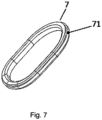
- the flexible socket 8 is attached to the port body 2 by means of a fixation ring 7 and to the movable needle entrance 3 by arranging a part of the flexible socket 8 in a recesslgroove 35 of the movable needle entrance 3.
- the implantable access device 1 further comprises a strain relief 5 for the at least partially flexible catheter 6, which is attached to the port body 2 opposite to the movable needle entrance 3.
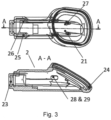
- Fig. 3 shows a top view and a side view of a port body 2 for an implantable access device 1 according to the invention.
- the port body 2 comprises cam teeth 21, 27 for cooperating with separate guiding means 9 to define the relative movement between the movable needle entrance 3 and the port body 2. Particularly, the cam teeth 21, 27 will operate together will guiding surfaces 93, 97 of the separate guiding means 9.
- the port body 2 further comprises cam slopes 25, 26 to cooperate with cam follower 45, 46 of the clamping means 4 to operate the clamping means 4 in the first, unactuated operating condition and the second, actuated operating condition.
- the port body 2 further has a slot for receiving a part of strain relief 5 for connecting the strain relief 5 to the port body 2.
- a further slot 24 is provided for receiving the fixation ring 7 used to fix the flexible socket 8 to the port body 2.
- Port body 2 further has snap fit pockets 28, 29 for receiving snap fits 91 of the separate guiding means 9.
- the snap fit connection between the port body 2 and the separate guiding means 9 allows a relative movement between the port body 2 and the separate guiding means 9, e.g. by providing longitudinal snap fit pockets 28, 29.
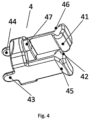
- Fig. 4 shows a perspective view of clamping means 4 for an implantable access device 1 according to the invention.
- the clamping means 4 of Fig. 4 comprise two jaws 41, 42, which can clamp the at least partially flexible catheter 6 from opposing sides.
- the flexible part of the catheter 6 is deformed by pushing the two jaws 41, 42 together, thereby clamping the flexible catheter 6.
- the two jaws 41, 42 are pushed towards each other by cam follower 45, 46 which cooperate with cam slopes 25, 26 of the port body 2.
- the clamping means 4 further comprise connecting protrusion 47 for connecting the spring 10 to the clamping means 4.
- the clamping means 4 further comprises rotational drivers 43, 44.
- the guiding surfaces 93, 97 define the necessary relative movement of the needle entrance 3 to the port body 2 to transfer the implantable access device 1 from the first, unactuated operating condition to the second, actuated operating condition.
- the movement of the needle entrance 3 relative to the port body 2 from the first, unactuated operating condition to the second, actuated operating condition first requires a translational movement in the direction of the insertion of the needle into the needle entrance 3 and afterwards a pivoting movement with respect to the translational movement.
- Fig. 8 shows cross-sectional views of an unactuated and an actuated implantable access device 1 according to the invention.
- the left part of Fig. 8 shows the implanted access device 1 in a first, unactuated operating condition.
- the clamping means 4 are forced by spring 10 into the left direction of Fig. 8 and held there due to the guiding means 9. Due to this spring force the jaws 41 and 42 of the clamping device 4 deform the flexible catheter 6 and thereby fluidly close the catheter 6.
- the jaws 41, 42 deform the catheter 6 because the cam followers 45, 46 of the clamping means 4 cooperate with cam slopes 25, 26 of the port body 2.
- the implantable access device is shown in the second, actuated operating condition.
- the camping device 4 has been pushed against the spring force to the right of Fig. 8 by relative movement of the needle entrance 3 to the port body 2.
- the implantable access device 1 is stable in this shown second, actuated operating condition due to the configuration of the guiding means 9.
- this second, actuated operating condition the cam followers 41, 42 are no longer pushed towards the catheter 6 by cam slopes 25, 26 and the catheter 6 is not deformed, i.e. fluidly open.
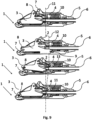
- Fig. 9 shows cross-sectionals views of an implantable access device 1 according to the invention showing the movement of the movable needle entrance 3 relative to the port body 2.
- the implantable access device shown in Fig. 9 corresponds to the implantable access device 1 shown in Fig. 1 , so we refer to above detailed description of the implantable access device 1.
- the implantable access device 1 is in the first, unactuated operating condition, also corresponding to the left figure of Fig. 8 .
- To transfer the implantable access device 1 from the first, unactuated operating condition to the second, actuated operating condition first a translational movement of the needle entrance 3 relative to the port body 2 in the direction of the needle insertion is performed.
Landscapes
- Health & Medical Sciences (AREA)
- Heart & Thoracic Surgery (AREA)
- Pulmonology (AREA)
- Engineering & Computer Science (AREA)
- Anesthesiology (AREA)
- Biomedical Technology (AREA)
- Hematology (AREA)
- Life Sciences & Earth Sciences (AREA)
- Animal Behavior & Ethology (AREA)
- General Health & Medical Sciences (AREA)
- Public Health (AREA)
- Veterinary Medicine (AREA)
- Infusion, Injection, And Reservoir Apparatuses (AREA)
- Media Introduction/Drainage Providing Device (AREA)
Claims (11)
- Implantierbare Zugangsvorrichtung (1) für den Zugang zum Gefäßsystem eines menschlichen oder tierischen Körpers, insbesondere subkutan implantierbarer Zugangsport, umfassend:einen Portkörper (2),einen Nadeleingang (3) mit mindestens einer Einlassöffnung (34) zur Aufnahme einer Nadel und einer Auslassöffnung (33),einen zumindest teilweise flexiblen Katheter (6) für den Zugang zum Gefäßsystem des menschlichen oder tierischen Körpers, der mit der Auslassöffnung (33) des Nadeleingangs (3) verbunden ist,wobei der Nadeleingang (3) mit dem Portkörper (2) verbunden und relativ zum Portkörper (2) zwischen einem ersten, unbetätigten Betriebszustand und einem zweiten, betätigten Betriebszustand bewegbar ist, undferner umfassend Klemmmittel (4) zum Klemmen des zumindest teilweise flexiblen Katheters (6) im ersten, unbetätigten Betriebszustand und zum Lösen des zumindest teilweise flexiblen Katheters (6) im zweiten, betätigten Betriebszustand, so dass die Klemmmittel (4) im ersten, unbetätigten Betriebszustand einen Fluidstrom durch den zumindest teilweise flexiblen Katheter (6) verhindern und im zweiten, betätigten Betriebszustand einen Fluidstrom durch den zumindest teilweise flexiblen Katheter (6) ermöglichendadurch gekennzeichnet, dassdie Bewegung des Nadeleingangs (3) relativ zum Portkörper (2) aus dem ersten, unbetätigten Betriebszustand in den zweiten, betätigten Betriebszustand zunächst eine Translationsbewegung in Richtung des Einführens der Nadel in den Nadeleingang (3) und anschließend eine Schwenkbewegung in Bezug auf die Translationsbewegung umfasst.
- Implantierbare Zugangsvorrichtung (1) nach Anspruch 1,
ferner umfassend Führungsmittel (9) zur Führung der Bewegung zwischen dem Portkörper (2) und dem Nadeleingang (3). - Implantierbare Zugangsvorrichtung (1) nach Anspruch 2,
wobei die Führungsmittel (9) durch ein separates Bauteil realisiert sind, das zwischen dem Portkörper (2) und dem Nadeleingang (3) angeordnet ist. - Implantierbare Zugangsvorrichtung (1) nach Anspruch 2 oder Anspruch 3,
wobei die Führungsmittel (9) so ausgebildet sind, dass sie den Nadeleingang (3) im ersten, unbetätigten Betriebszustand und im zweiten, betätigten Betriebszustand verriegeln. - Implantierbare Zugangsvorrichtung (1) nach Anspruch 4,
wobei die Klemmmittel (4) ferner eine zwischen dem Portkörper (2) und den Klemmmitteln (4) angeordnete Feder (10) umfassen, insbesondere zum Verriegeln der Klemmmittel (4) im ersten, unbetätigten Betriebszustand und/oder im zweiten, betätigten Betriebszustand. - Implantierbare Zugangsvorrichtung (1) nach einem der Ansprüche 1 bis 5,
wobei die Klemmmittel (4) ferner ein Rotationsmittel (43, 44) zur drehbaren Verbindung der Klemmmittel (4) mit dem Nadeleingang (3) oder separaten Führungsmitteln (9) umfassen. - Implantierbare Zugangsvorrichtung (1) nach einem der Ansprüche 1 bis 6,
wobei die Einlassöffnung (34) des Nadeleingangs (3) einen Trichter zur Führung der Nadel in den Nadeleingang (3) umfasst. - Implantierbare Zugangsvorrichtung (1) nach einem der Ansprüche 1 bis 7,
weiterhin umfassend eine flexible Hülle (8) zwischen dem Portkörper (2) und dem beweglichen Nadeleingang (3). - Implantierbare Zugangsvorrichtung (1) nach einem der Ansprüche 1 bis 8,
weiterhin umfassend eine Zugentlastung (5) für den zumindest teilweise flexiblen Katheter (6), die vorzugsweise am Portkörper (2) angebracht ist. - Implantierbare Zugangsvorrichtung (1) nach einem der Ansprüche 1 bis 9,
wobei die Klemmmittel (4) mindestens zwei Klemmbacken (41, 42) zum Klemmen des zumindest teilweise flexiblen Katheters (6) umfassen, wobei die Klemmbacken vorzugsweise auf gegenüberliegenden Seiten des Katheters (6) angeordnet sind. - Implantierbare Zugangsvorrichtung (1) nach Anspruch 10,
wobei die Klemmmittel (4) ferner Nockenstößel (45, 46) umfassen, die so gestaltet sind, dass sie mit dem Portkörper (2), insbesondere mit Nockenschrägen (25, 26) des Portkörpers (2), zusammenwirken, um die Klemmbacken (41, 42) im ersten, unbetätigten Betriebszustand in Richtung des zumindest teilweise flexiblen Katheters (6) zu schieben und die Klemmbacken (41, 42) im zweiten, betätigten Betriebszustand von dem zumindest teilweise flexiblen Katheter (6) zu lösen.
Applications Claiming Priority (2)
| Application Number | Priority Date | Filing Date | Title |
|---|---|---|---|
| IT201900019761 | 2019-10-24 | ||
| PCT/EP2020/077511 WO2021078488A1 (en) | 2019-10-24 | 2020-10-01 | Implantable access device for accessing the vascular system of a human or animal body, particularly subcutaneously implantable access port |
Publications (4)
| Publication Number | Publication Date |
|---|---|
| EP4031230A1 EP4031230A1 (de) | 2022-07-27 |
| EP4031230B1 true EP4031230B1 (de) | 2024-12-04 |
| EP4031230C0 EP4031230C0 (de) | 2024-12-04 |
| EP4031230B8 EP4031230B8 (de) | 2025-01-08 |
Family
ID=69570781
Family Applications (1)
| Application Number | Title | Priority Date | Filing Date |
|---|---|---|---|
| EP20780724.9A Active EP4031230B8 (de) | 2019-10-24 | 2020-10-01 | Implantierbare zugangsvorrichtung zum zugriff auf das gefässsystem eines menschlichen oder tierischen körpers, insbesondere ein subkutan implantierbarer zugangsanschluss |
Country Status (5)
| Country | Link |
|---|---|
| US (1) | US12472339B2 (de) |
| EP (1) | EP4031230B8 (de) |
| JP (1) | JP7373655B2 (de) |
| CN (1) | CN114599422B (de) |
| WO (1) | WO2021078488A1 (de) |
Families Citing this family (3)
| Publication number | Priority date | Publication date | Assignee | Title |
|---|---|---|---|---|
| AU2021444487B2 (en) * | 2021-05-07 | 2025-12-18 | Bard Peripheral Vascular, Inc. | Low profile, injectable subcutaneous vascular access system and method |
| JP2023178775A (ja) * | 2022-06-06 | 2023-12-18 | ニプロ株式会社 | 皮下埋込型注入ポート用のコネクタおよび皮下埋込型注入ポートセット |
| CN118217480B (zh) * | 2024-05-22 | 2024-07-16 | 南方医科大学珠江医院 | 一种b超引导联合腔内3cg定位手臂式输液港 |
Family Cites Families (35)
| Publication number | Priority date | Publication date | Assignee | Title |
|---|---|---|---|---|
| DE3808687A1 (de) | 1988-03-16 | 1989-10-05 | Braun Melsungen Ag | Implantierbare kathetervorrichtung |
| US4861341A (en) | 1988-07-18 | 1989-08-29 | Woodburn Robert T | Subcutaneous venous access device and needle system |
| US5281199A (en) | 1990-03-01 | 1994-01-25 | Michigan Transtech Corporation | Implantable access devices |
| US5350360A (en) | 1990-03-01 | 1994-09-27 | Michigan Transtech Corporation | Implantable access devices |
| US5356381A (en) | 1990-03-01 | 1994-10-18 | Ensminger William D | Implantable access devices |
| US5352204A (en) | 1990-03-01 | 1994-10-04 | Ensminger William D | Implantable access devices |
| US5562617A (en) | 1994-01-18 | 1996-10-08 | Finch, Jr.; Charles D. | Implantable vascular device |
| US5741228A (en) | 1995-02-17 | 1998-04-21 | Strato/Infusaid | Implantable access device |
| US6506182B2 (en) | 1996-06-12 | 2003-01-14 | Biolink Corporation | Method for subcutaneous access to the vascular system of a patient |
| US6013058A (en) | 1996-06-12 | 2000-01-11 | Biolink Corporation | Device for subcutaneous accessibility |
| DE19624320C1 (de) | 1996-06-14 | 1997-10-16 | Florian Dr Krug | Subkutan implantierbares Portsystem |
| US7056316B1 (en) | 1997-01-21 | 2006-06-06 | Vasca, Inc. | Valve port and method for vascular access |
| US6193684B1 (en) | 1997-01-21 | 2001-02-27 | Vasca, Inc. | Device for percutaneous peritoneal dialysis |
| US6007516A (en) | 1997-01-21 | 1999-12-28 | Vasca, Inc. | Valve port and method for vascular access |
| US5931801A (en) | 1997-01-21 | 1999-08-03 | Vasca, Inc. | Valve port assembly with interlock |
| US5848989A (en) | 1997-06-05 | 1998-12-15 | Davinci Biomedical Research Products, Inc. | Implantable port with low profile housing for delivery/collection of fluids and implantation method |
| JP2001524330A (ja) | 1997-07-18 | 2001-12-04 | バスカ, インコーポレイテッド | 移植ポートに経皮的に接近するための方法および装置 |
| AUPP676898A0 (en) * | 1998-10-26 | 1998-11-19 | Noble House Group Pty Ltd | Sampling first in blood collection |
| WO2001032141A1 (en) | 1999-11-01 | 2001-05-10 | Vasca, Inc. | Valve port and method for vascular access |
| EP1245247A1 (de) | 2001-03-28 | 2002-10-02 | Biolink Corporation | Biozidschleuse |
| US20050131325A1 (en) | 2003-12-16 | 2005-06-16 | How-Lun Chen | Flexible injection port |
| US7699821B2 (en) | 2004-03-12 | 2010-04-20 | Covance Laboratories Gmbh | Multi-functional port |
| DE202004021447U1 (de) | 2004-08-31 | 2008-02-28 | Steco-System-Technik Gmbh & Co.Kg | Subcutan implantierbarer Infusionsport |
| US10307581B2 (en) | 2005-04-27 | 2019-06-04 | C. R. Bard, Inc. | Reinforced septum for an implantable medical device |
| JP2010531692A (ja) | 2007-07-03 | 2010-09-30 | ウノメディカル アクティーゼルスカブ | 双安定均衡状態を持つ挿入器 |
| US20090306606A1 (en) | 2008-06-10 | 2009-12-10 | Angiodynamics, Inc | Catheter hub assembly with vascular access port |
| WO2011056619A1 (en) * | 2009-10-27 | 2011-05-12 | Medical Components, Inc. | Implantable port with a pivotably coupled stem |
| WO2011157638A1 (en) * | 2010-06-18 | 2011-12-22 | F. Hoffmann-La Roche Ag | Infusion site interfaces and insertion devices for infusion site interfaces |
| AU2011326519A1 (en) | 2010-11-09 | 2013-05-30 | Hans-Dietrich Polaschegg | Hemodialysis access system |
| US11464960B2 (en) | 2013-01-23 | 2022-10-11 | C. R. Bard, Inc. | Low-profile single and dual vascular access device |
| EP2948121B1 (de) * | 2013-01-23 | 2017-11-29 | C.R. Bard Inc. | Niedrigprofil-zugangsport |
| JP2017510426A (ja) | 2014-04-11 | 2017-04-13 | ヘモテック メディカル インコーポレーテッド | 針抜けによるフローの自動停止のためのシステムおよび方法 |
| BR112019008984B1 (pt) * | 2016-11-11 | 2023-04-25 | C.R. Bard, Inc | Porta de acesso de baixo perfil para colocação subcutânea em um paciente |
| EP3381501B1 (de) | 2017-03-30 | 2024-05-29 | PFM Medical AG | Implantierbare zugangsvorrichtung für den zugriff auf das gefässsystem eines menschlichen oder tierischen körpers |
| US10746035B2 (en) | 2017-08-30 | 2020-08-18 | General Electric Company | Flow path assemblies for gas turbine engines and assembly methods therefore |
-
2020
- 2020-10-01 EP EP20780724.9A patent/EP4031230B8/de active Active
- 2020-10-01 CN CN202080070263.3A patent/CN114599422B/zh active Active
- 2020-10-01 JP JP2022521389A patent/JP7373655B2/ja active Active
- 2020-10-01 WO PCT/EP2020/077511 patent/WO2021078488A1/en not_active Ceased
- 2020-10-01 US US17/754,564 patent/US12472339B2/en active Active
Also Published As
| Publication number | Publication date |
|---|---|
| EP4031230A1 (de) | 2022-07-27 |
| US12472339B2 (en) | 2025-11-18 |
| CN114599422B (zh) | 2024-02-06 |
| US20240058589A1 (en) | 2024-02-22 |
| WO2021078488A1 (en) | 2021-04-29 |
| CN114599422A (zh) | 2022-06-07 |
| EP4031230B8 (de) | 2025-01-08 |
| JP7373655B2 (ja) | 2023-11-02 |
| EP4031230C0 (de) | 2024-12-04 |
| JP2022553154A (ja) | 2022-12-22 |
Similar Documents
| Publication | Publication Date | Title |
|---|---|---|
| US6743218B2 (en) | Retractable catheter systems and associated methods | |
| US6156016A (en) | Catheter systems and associated methods utilizing removable inner catheter or catheters | |
| AU2019340409B2 (en) | Systems of facilitating instrument delivery to a catheter assembly | |
| EP0968026B1 (de) | Ventilöffnung für vaskularen zugang | |
| EP4031230B1 (de) | Implantierbare zugangsvorrichtung zum zugriff auf das gefässsystem eines menschlichen oder tierischen körpers, insbesondere ein subkutan implantierbarer zugangsanschluss | |
| US20050059925A1 (en) | Catheter systems and associated methods | |
| US20050096609A1 (en) | Methods of performing medical procedures with catheter systems having movable member | |
| JP2024518847A (ja) | 調節可能なサイドポート角度を有するカテーテルアセンブリおよび関連する方法 | |
| KR102861981B1 (ko) | 카테터 어셈블리에 기구 전달을 용이하게 하는 니들리스 액세스 커넥터 | |
| EP3773861B1 (de) | Implantierbare zugangsvorrichtung zum zugriff auf das gefässsystem eines menschlichen oder tierischen körpers, insbesondere ein subkutan implantierbarer zugangsanschluss | |
| US10940302B2 (en) | Implantable access device for accessing the vascular system of a human or animal body | |
| CN112752588A (zh) | 用于外围静脉内导管组件的具有闭合顶端和狭缝的导管 | |
| JP2024525064A (ja) | プローブの座屈を低減するための血管アクセスデバイス | |
| EP3773860B1 (de) | Implantierbare zugangsvorrichtung zum zugriff auf das gefässsystem eines menschlichen oder tierischen körpers, insbesondere ein subkutan implantierbarer zugangsanschluss |
Legal Events
| Date | Code | Title | Description |
|---|---|---|---|
| STAA | Information on the status of an ep patent application or granted ep patent |
Free format text: STATUS: UNKNOWN |
|
| STAA | Information on the status of an ep patent application or granted ep patent |
Free format text: STATUS: THE INTERNATIONAL PUBLICATION HAS BEEN MADE |
|
| PUAI | Public reference made under article 153(3) epc to a published international application that has entered the european phase |
Free format text: ORIGINAL CODE: 0009012 |
|
| STAA | Information on the status of an ep patent application or granted ep patent |
Free format text: STATUS: REQUEST FOR EXAMINATION WAS MADE |
|
| 17P | Request for examination filed |
Effective date: 20220420 |
|
| AK | Designated contracting states |
Kind code of ref document: A1 Designated state(s): AL AT BE BG CH CY CZ DE DK EE ES FI FR GB GR HR HU IE IS IT LI LT LU LV MC MK MT NL NO PL PT RO RS SE SI SK SM TR |
|
| DAV | Request for validation of the european patent (deleted) | ||
| DAX | Request for extension of the european patent (deleted) | ||
| GRAP | Despatch of communication of intention to grant a patent |
Free format text: ORIGINAL CODE: EPIDOSNIGR1 |
|
| STAA | Information on the status of an ep patent application or granted ep patent |
Free format text: STATUS: GRANT OF PATENT IS INTENDED |
|
| INTG | Intention to grant announced |
Effective date: 20240603 |
|
| GRAS | Grant fee paid |
Free format text: ORIGINAL CODE: EPIDOSNIGR3 |
|
| GRAA | (expected) grant |
Free format text: ORIGINAL CODE: 0009210 |
|
| STAA | Information on the status of an ep patent application or granted ep patent |
Free format text: STATUS: THE PATENT HAS BEEN GRANTED |
|
| REG | Reference to a national code |
Ref country code: DE Ref legal event code: R081 Ref document number: 602020042567 Country of ref document: DE Owner name: PFM MEDICAL GMBH, DE Free format text: FORMER OWNER: ANMELDERANGABEN UNKLAR / UNVOLLSTAENDIG, 80297 MUENCHEN, DE |
|
| AK | Designated contracting states |
Kind code of ref document: B1 Designated state(s): AL AT BE BG CH CY CZ DE DK EE ES FI FR GB GR HR HU IE IS IT LI LT LU LV MC MK MT NL NO PL PT RO RS SE SI SK SM TR |
|
| REG | Reference to a national code |
Ref country code: CH Ref legal event code: PK Free format text: BERICHTIGUNG B8 Ref country code: CH Ref legal event code: EP |
|
| REG | Reference to a national code |
Ref country code: DE Ref legal event code: R096 Ref document number: 602020042567 Country of ref document: DE |
|
| RAP4 | Party data changed (patent owner data changed or rights of a patent transferred) |
Owner name: PFM MEDICAL GMBH |
|
| REG | Reference to a national code |
Ref country code: IE Ref legal event code: FG4D |
|
| U01 | Request for unitary effect filed |
Effective date: 20241209 |
|
| U07 | Unitary effect registered |
Designated state(s): AT BE BG DE DK EE FI FR IT LT LU LV MT NL PT RO SE SI Effective date: 20241219 |
|
| PG25 | Lapsed in a contracting state [announced via postgrant information from national office to epo] |
Ref country code: HR Free format text: LAPSE BECAUSE OF FAILURE TO SUBMIT A TRANSLATION OF THE DESCRIPTION OR TO PAY THE FEE WITHIN THE PRESCRIBED TIME-LIMIT Effective date: 20241204 |
|
| PG25 | Lapsed in a contracting state [announced via postgrant information from national office to epo] |
Ref country code: ES Free format text: LAPSE BECAUSE OF FAILURE TO SUBMIT A TRANSLATION OF THE DESCRIPTION OR TO PAY THE FEE WITHIN THE PRESCRIBED TIME-LIMIT Effective date: 20241204 |
|
| PG25 | Lapsed in a contracting state [announced via postgrant information from national office to epo] |
Ref country code: NO Free format text: LAPSE BECAUSE OF FAILURE TO SUBMIT A TRANSLATION OF THE DESCRIPTION OR TO PAY THE FEE WITHIN THE PRESCRIBED TIME-LIMIT Effective date: 20250304 |
|
| PG25 | Lapsed in a contracting state [announced via postgrant information from national office to epo] |
Ref country code: GR Free format text: LAPSE BECAUSE OF FAILURE TO SUBMIT A TRANSLATION OF THE DESCRIPTION OR TO PAY THE FEE WITHIN THE PRESCRIBED TIME-LIMIT Effective date: 20250305 |
|
| PG25 | Lapsed in a contracting state [announced via postgrant information from national office to epo] |
Ref country code: RS Free format text: LAPSE BECAUSE OF FAILURE TO SUBMIT A TRANSLATION OF THE DESCRIPTION OR TO PAY THE FEE WITHIN THE PRESCRIBED TIME-LIMIT Effective date: 20250304 |
|
| PG25 | Lapsed in a contracting state [announced via postgrant information from national office to epo] |
Ref country code: SM Free format text: LAPSE BECAUSE OF FAILURE TO SUBMIT A TRANSLATION OF THE DESCRIPTION OR TO PAY THE FEE WITHIN THE PRESCRIBED TIME-LIMIT Effective date: 20241204 |
|
| PG25 | Lapsed in a contracting state [announced via postgrant information from national office to epo] |
Ref country code: PL Free format text: LAPSE BECAUSE OF FAILURE TO SUBMIT A TRANSLATION OF THE DESCRIPTION OR TO PAY THE FEE WITHIN THE PRESCRIBED TIME-LIMIT Effective date: 20241204 |
|
| PG25 | Lapsed in a contracting state [announced via postgrant information from national office to epo] |
Ref country code: IS Free format text: LAPSE BECAUSE OF FAILURE TO SUBMIT A TRANSLATION OF THE DESCRIPTION OR TO PAY THE FEE WITHIN THE PRESCRIBED TIME-LIMIT Effective date: 20250404 |
|
| PG25 | Lapsed in a contracting state [announced via postgrant information from national office to epo] |
Ref country code: SK Free format text: LAPSE BECAUSE OF FAILURE TO SUBMIT A TRANSLATION OF THE DESCRIPTION OR TO PAY THE FEE WITHIN THE PRESCRIBED TIME-LIMIT Effective date: 20241204 |
|
| PG25 | Lapsed in a contracting state [announced via postgrant information from national office to epo] |
Ref country code: CZ Free format text: LAPSE BECAUSE OF FAILURE TO SUBMIT A TRANSLATION OF THE DESCRIPTION OR TO PAY THE FEE WITHIN THE PRESCRIBED TIME-LIMIT Effective date: 20241204 |
|
| PLBE | No opposition filed within time limit |
Free format text: ORIGINAL CODE: 0009261 |
|
| STAA | Information on the status of an ep patent application or granted ep patent |
Free format text: STATUS: NO OPPOSITION FILED WITHIN TIME LIMIT |
|
| 26N | No opposition filed |
Effective date: 20250905 |
|
| U20 | Renewal fee for the european patent with unitary effect paid |
Year of fee payment: 6 Effective date: 20251028 |