EP4030331A1 - System zur gesicherten übertragung von digitalen luftfahrzeugdaten, datenerzeugungssystem, datennutzungssystem und entsprechendes übertragungsverfahren - Google Patents
System zur gesicherten übertragung von digitalen luftfahrzeugdaten, datenerzeugungssystem, datennutzungssystem und entsprechendes übertragungsverfahren Download PDFInfo
- Publication number
- EP4030331A1 EP4030331A1 EP22151375.7A EP22151375A EP4030331A1 EP 4030331 A1 EP4030331 A1 EP 4030331A1 EP 22151375 A EP22151375 A EP 22151375A EP 4030331 A1 EP4030331 A1 EP 4030331A1
- Authority
- EP
- European Patent Office
- Prior art keywords
- data
- capsule
- refresh
- integrity check
- identifier
- Prior art date
- Legal status (The legal status is an assumption and is not a legal conclusion. Google has not performed a legal analysis and makes no representation as to the accuracy of the status listed.)
- Pending
Links
Images



Classifications
-
- G—PHYSICS
- G06—COMPUTING OR CALCULATING; COUNTING
- G06F—ELECTRIC DIGITAL DATA PROCESSING
- G06F21/00—Security arrangements for protecting computers, components thereof, programs or data against unauthorised activity
- G06F21/60—Protecting data
- G06F21/64—Protecting data integrity, e.g. using checksums, certificates or signatures
-
- G—PHYSICS
- G08—SIGNALLING
- G08G—TRAFFIC CONTROL SYSTEMS
- G08G5/00—Traffic control systems for aircraft
- G08G5/20—Arrangements for acquiring, generating, sharing or displaying traffic information
-
- B—PERFORMING OPERATIONS; TRANSPORTING
- B64—AIRCRAFT; AVIATION; COSMONAUTICS
- B64D—EQUIPMENT FOR FITTING IN OR TO AIRCRAFT; FLIGHT SUITS; PARACHUTES; ARRANGEMENT OR MOUNTING OF POWER PLANTS OR PROPULSION TRANSMISSIONS IN AIRCRAFT
- B64D45/00—Aircraft indicators or protectors not otherwise provided for
-
- H—ELECTRICITY
- H04—ELECTRIC COMMUNICATION TECHNIQUE
- H04L—TRANSMISSION OF DIGITAL INFORMATION, e.g. TELEGRAPHIC COMMUNICATION
- H04L63/00—Network architectures or network communication protocols for network security
- H04L63/04—Network architectures or network communication protocols for network security for providing a confidential data exchange among entities communicating through data packet networks
- H04L63/0428—Network architectures or network communication protocols for network security for providing a confidential data exchange among entities communicating through data packet networks wherein the data content is protected, e.g. by encrypting or encapsulating the payload
-
- H—ELECTRICITY
- H04—ELECTRIC COMMUNICATION TECHNIQUE
- H04W—WIRELESS COMMUNICATION NETWORKS
- H04W12/00—Security arrangements; Authentication; Protecting privacy or anonymity
- H04W12/06—Authentication
-
- H—ELECTRICITY
- H04—ELECTRIC COMMUNICATION TECHNIQUE
- H04W—WIRELESS COMMUNICATION NETWORKS
- H04W74/00—Wireless channel access
- H04W74/002—Transmission of channel access control information
-
- H—ELECTRICITY
- H04—ELECTRIC COMMUNICATION TECHNIQUE
- H04W—WIRELESS COMMUNICATION NETWORKS
- H04W76/00—Connection management
- H04W76/10—Connection setup
- H04W76/11—Allocation or use of connection identifiers
Definitions
- the data transfer system is intended to ensure secure transfer of digital data within an aircraft, from the aircraft to at least one data consumer system external to the aircraft (such as at least one other aircraft, a ground control station in the case of a drone, etc.), or/and from a data producing system external to the aircraft (for example another aircraft, a mission preparation system, a downloading system data, etc.) to the aircraft.
- a data consumer system external to the aircraft such as at least one other aircraft, a ground control station in the case of a drone, etc.
- a data producing system external to the aircraft for example another aircraft, a mission preparation system, a downloading system data, etc.
- the data transfer system can also be used within the same aircraft system, in particular between different computers of the same aircraft system, between an application producing equipment such as a sensor and one or more computers, between several application layers of the same computer, or even between different cores of the same processor.
- the transfer system is intended to be implemented independently of the number of digital data transfer links between each data producer system and each data consumer system and independently of the nature of the latter at the level of the overall architecture of data transmission.
- many aircraft systems are capable of generating functional data. This is the case, for example, of sensor systems for measuring parameters, the parameters being internal or external to the aircraft, or systems avionics, in particular aircraft piloting, command or guidance systems.
- the functional data are for example measurements of aircraft parameters, aircraft system control commands, or aircraft system monitoring data.
- the functional data are often used by other aircraft systems, or by other application layers of the same aircraft system. They are therefore transferred between a data producer system and at least one data consumer system which can be located remotely, even outside the aircraft or in other application layers.
- Some "low level" protocols transmit digital data in the form of data words in each of which protocol management information and functional information are encoded. This is the case for example of the ARINC 429 protocol.
- More advanced protocols such as the GAM-T-101 protocol (Digibus), the MIL-STD-1553B protocol, or the Ethernet protocol and its so-called deterministic derivatives (ARINC664 Part 7 or SAE AS6802 or TSN), implement messages which allow the atomic transmission of several data words, some containing exclusively protocol management information and the others exclusively functional information.
- GAM-T-101 protocol Digibus
- MIL-STD-1553B protocol MIL-STD-1553B protocol
- Ethernet protocol and its so-called deterministic derivatives ARINC664 Part 7 or SAE AS6802 or TSN
- the functional data is transmitted in the form of a series of bits via ARINC429 words, the size of which is limited to 32 bits.
- Each ARINC 429 word includes a data identifier (ID) called label, an identifier of the source that sent the data (SDI), the functional data (D), and a validity identifier for the data sent by the producer system (SSM) .
- ID data identifier
- SDI data identifier of the source that sent the data
- D functional data
- SSM validity identifier for the data sent by the producer system
- the ARINC 429 protocol allows the transmission of so-called functional data in the form of “label-data” patterns and in what follows, as commonly used, “label” may designate the complete ARINC 429 word.
- each ARINC 429 word also includes a parity check bit (P), resulting from the sum functional data bits in binary.
- P parity check bit
- the consumer system When retrieving the data contained within an ARINC 429 word, the consumer system is able to recalculate the parity of the functional data it receives and to verify that it is identical to that of the parity bit contained in the word ARINC 429.
- Such a protocol can therefore be used when the data transmitted is of lesser importance, or is not critical for the safety and operation of the aircraft.
- the data is important or critical, it is necessary to use redundant producer systems, which process data in parallel and transmit it in parallel to one or more consumer systems.
- the consumer system or systems receive the data from the various producer systems and apply selection or voting strategies to ensure that the data is intact.
- Such a solution is safe, but increases the weight, the cost and the complexity of the aircraft.
- An object of the invention is to provide a system for transferring aircraft data between a system producing functional data and at least one system consuming these data, which is simple and easily adaptable to an existing data transfer protocol, and which is sufficiently sure in the event that the error of these data can have catastrophic consequences.
- a first data transfer system 10 according to the aircraft invention 12 is schematically illustrated by the figure 1 .
- the aircraft 12 is for example a business plane, a military plane, a passenger or goods transport plane, or the aerial vehicle of a drone.
- the data transferred by the system 10 are functional data produced or received in the aircraft, for example the results of physical measurements of sensors of the aircraft, data from commands to control systems of the aircraft, data from tracking of aircraft system states, avionics data.
- This functional data is transported and encoded in binary in the form of strings of bits.
- the transfer system 10 comprises a data producer system 14, at least one data consumer system 16 and a data transfer link 18 between the producer system 14 and the or each consumer system 16.
- the data producer system 14 and the data consumer system 16 are for example two separate aircraft systems of the aircraft 12.
- the data transfer link 18 is then a transmission link present in the aircraft 12, such as a physical data transmission link through a network of cables.
- At least one data consumer system 16 is external to the aircraft 12. It is for example located in another aircraft, a ground control station in the case of a drone, etc.
- the data producer system 14 is external to the aircraft 12. It is for example located in another aircraft, in a mission preparation system, in a data download system.
- the data transfer link 18 includes at least one wireless data transmission link from the aircraft 12 and/or to the aircraft 12.
- the data producer system 14 and the data consumer system 16 then each comprise at least one calculation resource comprising at least one processor and at least one memory containing software modules specific to being executed by the processor.
- the systems 14, 16 are made at least partially in the form of programmable logic components, or even in the form of dedicated integrated circuits.
- the data producer system 14 and the data consumer system 16 are located within the same aircraft system, or even in the same calculation resource of the aircraft system, for example at the level of two distinct application layers of the same aircraft computing resource or in two different cores of the same processor.
- the data producer system 14 is capable of producing functional data at successive times, by generating them itself or by receiving them from a source of functional data.
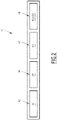
- the data producer system 14 is capable of transmitting the processed data to the data consumer system 16 via the transfer link 18, by encapsulating the functional data processed at successive instants in successive capsules 40, of which the content and the structure are illustrated respectively by the figure 2 and 3 .
- each capsule 40 includes a capsule identifier 42, a refresh indicator 44, updated by the data producer system 14 each time functional data is generated, independently of the data transmission frequency in the transfer link 18, a packet 46 of functional data elaborated by the data producer system 14 during a functional elaboration of data, and an integrity check result 48, calculated from the identifier 42, the refresh indicator 44 and the data packet 46 from capsule 40.
- the capsule identifier 42 is for example a string of bits making it possible to identify the system producing the data 14 and/or an entity having produced the functional data within the data producing system 14.
- the capsule identifier 42 makes it possible in particular to the or each data consumer system 16, from a predefined semantics and/or a correspondence table, to identify the producer of the data and the functional content of the data packet and thus to implement a control authentication to ensure that the data has been produced by the data producer system 14 expected.
- the capsule identifier 42 makes it possible to associate the capsule 40 in a bijective manner with a transfer system 10 considered (implemented in an aircraft 12, several aircraft, one or more aircraft and means external to the aircraft 12), independently of the number of transfer links 18 and of the nature of the latter at the level of the overall transmission architecture.
- the capsule identifier 42 associated with the capsule 40 it is possible, from a predefined semantics and/or a correspondence table, to assign the capsule 40 to a transfer system 10 data including a data producer system 14 and at least one data consumer system 16.
- the data consumer system 16 is able to identify the position of the data packet.
- the refresh indicator 44 is a string of bits encoding a functional data generation order number each time functional data is generated.
- the refresh indicator 44 is for example a counter or a down counter generally updated unitarily each time functional data is generated. It makes it possible to associate, with each capsule 40 transmitted, a data refresh measurement. This measurement makes it possible to ensure that the functional data retrieved by the data consumer system 16 has indeed been refreshed by the data producer system 14, constituting a refresh check.
- the data packet 46 is a string of bits encoding the functional data generated during the development of functional data associated with the refresh indicator 44.
- the integrity check result 48 is a string of bits encoding a check number calculated by mathematical processing, from a functional representation integrating the identifier 42 of the capsule 40, the refresh indicator 44 of the capsule 40, and the functional data 46 of the capsule 40.
- the integrity check result 48 is the result of a checksum, or a cyclic redundancy code (CRC).
- the mathematical processing is for example an algorithm chosen according to the security objectives to be achieved, the minimum/maximum length of the data packet 46, the identifier 42, the refresh indicator 44, and the reliability of the data link, in terms of bit error rate (BER). Examples of algorithms used are described in the document DOT/FA/TC-14/49 of the Federal Aviation Administration of the United States of America, March 2015, available at the following address: https:// www.faa.gov/aircraft/air_cert/design_approvals/air_software/media/TC-14-49.pdf.
- the data transfer link 18 is a link implementing a data transfer protocol using words 50 containing transmission protocol management information and functional information, views of this protocol.
- the data transfer link 18 is a link implementing a data transfer protocol using messages which allow the atomic transmission of several words 50, some containing exclusively management information. of the transmission protocol and the others exclusively functional information, seen from this protocol.
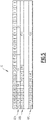
- FIG. 4 An example of a data transfer protocol using 50 words is shown in figure 4 . This protocol is advantageously implemented in an ARINC 429 link.
- Each word 50 is defined by a sequence of bits, having a predefined number of bits.
- Word 50 for ARINC 429 has thirty-two bits. As explained above, it is commonly referred to by the term “ARINC 429 word”, or even “label”.
- Word 50 is split into separate fields.
- the word 50 comprises a field 52 for identifying the word (ID), and advantageously, a field 54 for identifying the receiver and/or the subsystem having sent the data (optional SDI field in the ARINC 429 standard).
- Word 50 further comprises a field 56 containing the data (D) transported by the word, a field 58 for data validity (SSM) or sign/direction (eg: +/- or North/South, East/West) , and a field (P) of parity 60.
- SSM data validity
- P field of parity 60.
- Field 52 contains an identification of the word, with standardized semantics defined during the development of the word.
- Field 54 (optional) is generally intended to define for which receiver of the data the word is intended, or which subsystem of the sender transmitted the data.
- Field 56 contains the data to be transmitted by word 50. In this example it comprises nineteen bits.
- Field 58 contains a data validity identifier, generated by the data producer system 14, which can make it possible to identify whether the data producer system 14 considers that the data are valid or if, on the contrary, it considers that they are no longer valid.
- Parity field 60 is a binary sum calculation of all bits in fields 52, 54, 56 and 58 to determine the parity of the sum.
- the size of the capsule 40 is generally greater than the size of the field 56 of the data transported by a word 50.
- the capsule 40 is thus transmitted over a plurality of distinct words 50A to 50F by distributing the identifier 42, the refresh indicator 44, the functional data 46 and the integrity check result 48 in the fields 56 of several words 50A to 50F.
- At least a first identification word 50A contains the identifier 42 of the capsule 40 and possibly the refresh indicator 44.
- the word 50A contains both the identifier 42 of the capsule 40, and refresh indicator 44.
- the identifier 42 of the capsule 40 is formed by the identification field 52 of the word 50A, and by the identification field 54 of the receiver or/and of the subsystem having transmitted the data. This is possible by establishing a correspondence table between each capsule 40 and the successive identifiers of words 50A to 50F used to transmit capsule 40.
- each capsule 40 corresponding to a processing of functional data is transmitted over N words 50
- the N successive identifiers of the N words 50 are associated with capsule 40.
- Refresh indicator 40 is coded in binary form in field 56 of word 50A, for example by using 16 of the 19 bits available in field 56.
- the word 50A contains the identifier 42 of the capsule 40, for example in the field 56 and another identification word (not shown) distinct from the word 50A contains the refresh indicator 44 in field 56.
- the functional data packet 46 is transmitted over at least one word of functional data 50B to 50D, generally over several words of functional data 50B to 50D.
- the data of the functional data packet 46 is distributed over the fields 56 of the word or words 50B to 50D which contain only functional data.
- Words 50B to 50D of functional data do not contain the refresh indicator 44 or the result of the integrity test 48.
- the identifier of each word 50B to 50D makes it possible to identify to which capsule 40 the functional data contained in field 56 of word 50B to 50D.
- the integrity check result 48 of each capsule 40 is transmitted over at least one integrity check word 50E, 50F, advantageously over two integrity check words 50E, 50F, when it comprises thirty-two bits, whereas field 56 of each word 50E, 50F contains only 19 bits.
- the capsule 40 thus created is then transferred via the transfer link 18 by distributing it over several words 50A to 50F, to adapt to the transfer protocol present in the aircraft 12.
- the data producer system 14 comprises a module 70 for developing functional data 46 and association with an identifier 42 of capsule 40 and with a refresh indicator 44, a module 72 for calculating a control result of integrity 48, established on the identifier 42, the refresh indicator 44, and the data packet 46, each time functional data is produced, and a formatting module 74 for the transfer of data via the transfer link 18.
- the data generation module 70 is capable of generating functional data as defined above, or of recovering application functional data from other airplane systems, via an application layer.
- the functional data are generated at successive instants, on request or at a predefined functional data generation frequency.
- the functional data is distinct from the transport data (for example word identifier) necessary to implement the transfer link 18.
- the data generation module 70 is thus capable of creating a functional data packet 46 each time the data is processed, of generally identical size for each data processing. It is suitable for associating with each functional data packet 46 drawn up, an identifier 42, making it possible to identify the content function of the functional data packet 46, its producer, and the membership of the functional data packet 46 to a capsule 40, using a correspondence table.
- the identifier 42 also advantageously defines the size of the capsule 40, the size of the data packet 46 and the position of the integrity checksum 48, using the correspondence table.
- the data processing module 70 is also capable of associating, with each functional processing of data, independently of the frequency of transmission via the link 18, a refresh indicator 44.
- the refresh indicator 44 guarantees that the data transmitted via the transfer link 18 are indeed valid data having been refreshed.
- the refresh indicator 44 is coded on a determined number of bits, for example between 8 and 32.
- the refresh indicator 44 is capable of being reset to zero, when the maximum of the refresh indicator has been reached.
- the module for calculating an integrity check result 72 is capable of producing a memory representation 80 of the identifier 42, of the refresh indicator 44 and of the data packet 46 at the level of the application layer, independently of the transportation layers.
- An example of memory representation 80 is shown in the figure 5 . This memory representation corresponds to a transport in the form of 50 words.
- the bits intended for the word 50A of identifier and/or refresh indicator and for the data words 50B to 50D on which the capsule 40 is transmitted are distributed in the form of lines, each line corresponding to a word (word ARINC 429 for example in the case of an ARINC 429 link) in a table having a number of columns corresponding to the number of bits of each word.
- bits specific to the transmission protocol in each word 50A to 50D are deliberately forced in the memory representation 80 to a chosen bit, for example to a zero bit.
- the memory representation 80 makes it possible to test the integrity of the identifier 42, and of the refresh indicator 44, thanks to the first line 82A of the representation, and also the integrity of the functional data packet 46 distributed over lines 82B to 82D, integrating the data validity fields 58.
- the integrity result calculation module 72 is able to implement a checksum calculation, and/or cyclic redundancy code calculation as defined above.
- the integrity calculation result 48 is obtained by a MIL-STD-1760 checksum.
- the control result is coded in this example on thirty-two bits.
- the formatting module 74 is then capable of transmitting each capsule 40 corresponding to an elaboration of functional data, in the form of a plurality of words 50A to 50F, as described above, and in accordance with the data transmission protocol chosen. .
- the identifiers of the words 50A to 50F corresponding to a given capsule 40 are advantageously generated according to a predefined semantics, so that if the words 50A to 50F are sent out of order, or that other words 50G not belonging to capsule 40 are intercalated between words 50A to 50F of capsule 40 in a discontinuous manner, capsule 40 can be reconstituted by the data consumer system 16 based on the predefined semantics .
- the data consumer system 16 comprises a module 90 for receiving and processing each capsule 40, a module 92 for verifying the integrity of the capsule 40 and a module 94 for verifying the validity of the data for the capsule 40.
- the capsule reception module 90 is able to reconstitute each capsule 40, in particular by identifying the different words 50A to 50F of the capsule 40 received via the transfer link 18 via their identification field 52.
- the capsule 40 Once the capsule 40 has been reconstituted, it is able to extract the identifier 42, the refresh indicator 44 and the data packet 46 corresponding to the capsule 40.
- the capsule reception module 90 is able to carry out an authentication check of the data producer system 14 by checking, from the identifier 42, whether the data received does indeed come from the data producer system 14 expected.
- the capsule reception module 90 is able, using the same table of correspondence than that of the data producer system 14, to know the size of the capsule 40, the position of the refresh indicator 44, of the functional data packet 46 and of the integrity checksum 48 within the capsule 40.
- the integrity verification module 92 is able to reconstitute the same memory representation 80 as that produced by the data producer system 14, from the data retrieved from the capsule 40 which have been transferred by the transfer link 18.
- the integrity verification module 92 is able to determine that the capsule 40 comprising the identifier 42, the refresh indicator 44 and the data packet 46 is in an intact state, if the new integrity check result qu he calculated from the received data is identical to the integrity check result 48 calculated by the data producer system 14, extracted from the capsule 40.
- the validity verification module 94 is able to evaluate the refresh of the data contained in the capsule 40 by carrying out a refresh check on the basis of the refresh indicator 44 .
- the validity verification module 94 is suitable for example for calculating the refresh increment between the refresh indicator 44 of the capsule 40 received, and the refresh indicator 44 of the capsule 40 received just before.
- the validity checking module 94 is able to determine that the functional data present in the capsule 40 are indeed refreshed data and to place the capsule 40 in an expected refresh state.
- the verification module of validity 94 is suitable for authorizing a zero refresh increment over a determined number of capsules 40, calculated for example according to the frequencies of production, transmission or acquisition of capsules 40.
- the refresh indicator 44 is capable of placing the capsule 40 in an inadequate refresh state, because its data has not been refreshed.
- the validity verification module 94 is capable of authorizing a refresh increment that is greater than one.
- the validity check module 94 is able to memorize the refresh indicator of each capsule 40 that has just been received, to allow an increment calculation when the next capsule 40 is received.
- the validity verification module 94 is able to determine whether the functional data present in the capsule 40 are indeed refreshed data that can be used by the system. consumer 16, and to pass the capsule 40 in an expected refresh state. If, on the contrary, the data is not refreshed or if intermediate data that has not been received is missing, the capsule 40 can pass into an inadequate refresh state.
- the functional data that it contains are considered valid and are then specific to be used by the consumer system 16, or to be transmitted to another aircraft system for use.
- the validity verification module 94 is able to exclude the data coming from capsule 40, which are considered invalid.
- the validity verification module 94 is advantageously capable of implementing a resetting phase, for a given resetting duration corresponding for example to the resetting of a computer or to the stopping of a transient failure.
- the validity verification module 94 is able to memorize the new value of the indicator refresh 44 of this capsule 40. Then, it is able to recover the refresh indicator 40 of each new capsule 40 arriving, to determine a refresh increment. If the refresh increment reflects an expected refresh state, the validity verification module 94 is capable, after the predefined resetting time, of passing the capsules 40 again into the valid state.
- the validity verification module 94 is capable of definitively stopping the rearming and declaring the data transfer system 10 faulty.
- the functional data thus encapsulated are therefore very secure, independently of the transmission protocol(s) used. This prevents the loss or error of this data from producing critical consequences.
- Such capsules 40 can be transferred via a data transfer link 18 which uses 50 words, without affecting the syntax of the 50 words, and by distributing the content of the capsule 40 over different words 50A to 50F.
- Updating the refresh flag 44 each time functional data is generated ensures that a refresh of the data has occurred, and not simply that a new data transmission has occurred.
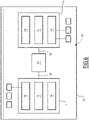
- the capsules 40 containing the data pass through an intermediate system 100 between the data producer system 14 and the consumer system 16.
- a first data transfer link 18A extends between the producer system 14 and the intermediate system 100, and a second data transfer link 18B extends between the intermediate system 100 and the consumer system 16.
- the capsules 40 are transferred according to a first transfer protocol through the first link 18A, and according to a second transfer protocol, through the second link 18B.
- the identifier 42, the refresh indicator 44, the functional data packet 46 and the integrity result 48 remain transmitted from the producer system 14 up to the consumer system 16, making it possible to ensure the control of the integrity and the refreshing of the data by the consumer system 16.
- the capsule 40 is transmitted via a transmission protocol using messages consisting of several consecutive words 50, generally transmitted in atomic form, one after the other.
- each message just contains transmission protocol management information.
- the capsule 40 is then distributed over several words 50 of the same message containing no transmission protocol management information, unlike the protocol described above in which each word 50 contains transmission protocol management information.
- One or more words of the same message then contain the capsule identifier 42 and the refresh indicator 44, one or more words of the same message contain the functional data 46 and one or more words of the same message contain the result 48 of control of integrity, calculated from the identifier 42, the refresh indicator 44 and the data packet 46 of the capsule 40.
- each capsule 40 is distributed over a plurality of messages by distributing the capsule identifier 42, the refresh indicator 44, the functional data 46 and the integrity check result 48 over words from the plurality of messages.
- the capsule 40 is devoid of functional data 46.
- the capsule 40 as such then comprises the capsule identifier 42, the refresh indicator 44, and the result 48 of control of integrity bearing on the identifier 42 and on the refresh indicator 44 is then the equivalent of a signal to trigger or validate an action.
- the data transmitted by the capsule 40 is then the presence or not of the capsule 40.
Landscapes
- Engineering & Computer Science (AREA)
- Computer Security & Cryptography (AREA)
- Computer Networks & Wireless Communication (AREA)
- Signal Processing (AREA)
- Aviation & Aerospace Engineering (AREA)
- Physics & Mathematics (AREA)
- General Physics & Mathematics (AREA)
- Computer Hardware Design (AREA)
- Theoretical Computer Science (AREA)
- General Engineering & Computer Science (AREA)
- Health & Medical Sciences (AREA)
- Bioethics (AREA)
- General Health & Medical Sciences (AREA)
- Software Systems (AREA)
- Computing Systems (AREA)
- Detection And Prevention Of Errors In Transmission (AREA)
- Arrangements For Transmission Of Measured Signals (AREA)
- Financial Or Insurance-Related Operations Such As Payment And Settlement (AREA)
- Management, Administration, Business Operations System, And Electronic Commerce (AREA)
- Data Exchanges In Wide-Area Networks (AREA)
Applications Claiming Priority (1)
| Application Number | Priority Date | Filing Date | Title |
|---|---|---|---|
| FR2100285A FR3118844B1 (fr) | 2021-01-13 | 2021-01-13 | Systeme de transfert securise de donnees numeriques d'aeronef, systeme producteur de donnees, systeme consommateur de donnees, et procede de transfert assoscie |
Publications (1)
| Publication Number | Publication Date |
|---|---|
| EP4030331A1 true EP4030331A1 (de) | 2022-07-20 |
Family
ID=76283787
Family Applications (1)
| Application Number | Title | Priority Date | Filing Date |
|---|---|---|---|
| EP22151375.7A Pending EP4030331A1 (de) | 2021-01-13 | 2022-01-13 | System zur gesicherten übertragung von digitalen luftfahrzeugdaten, datenerzeugungssystem, datennutzungssystem und entsprechendes übertragungsverfahren |
Country Status (5)
| Country | Link |
|---|---|
| US (1) | US12361833B2 (de) |
| EP (1) | EP4030331A1 (de) |
| BR (1) | BR102022000582A2 (de) |
| CA (1) | CA3145021A1 (de) |
| FR (1) | FR3118844B1 (de) |
Families Citing this family (1)
| Publication number | Priority date | Publication date | Assignee | Title |
|---|---|---|---|---|
| US12459639B2 (en) | 2023-06-23 | 2025-11-04 | David J. File | Twin fan, redundantly configured vertical lift vehicle |
Citations (6)
| Publication number | Priority date | Publication date | Assignee | Title |
|---|---|---|---|---|
| US20110055564A1 (en) * | 2008-04-09 | 2011-03-03 | Siemens Aktiengesellschaft | Method and device for transmitting messages in real time |
| US20130208630A1 (en) * | 2012-02-15 | 2013-08-15 | Ge Aviation Systems Llc | Avionics full-duplex switched ethernet network |
| CN102124680B (zh) * | 2008-07-02 | 2015-08-12 | 空中客车运营公司 | 网络上传输的数据的完整性保护的方法和设备 |
| CN106850377A (zh) * | 2017-03-29 | 2017-06-13 | 北京润科通用技术有限公司 | 一种afdx总线消息的校验系统及方法 |
| CN110198202A (zh) * | 2019-06-03 | 2019-09-03 | 北京润科通用技术有限公司 | 一种afdx总线消息数据源的校验方法及装置 |
| US10791125B2 (en) * | 2018-01-03 | 2020-09-29 | Ford Global Technologies, Llc | End-to-end controller protection and message authentication |
Family Cites Families (1)
| Publication number | Priority date | Publication date | Assignee | Title |
|---|---|---|---|---|
| US11233707B2 (en) * | 2020-03-27 | 2022-01-25 | Raytheon Bbn Technologies Corp. | Metadata-based information provenance |
-
2021
- 2021-01-13 FR FR2100285A patent/FR3118844B1/fr active Active
-
2022
- 2022-01-07 CA CA3145021A patent/CA3145021A1/fr active Pending
- 2022-01-12 BR BR102022000582-6A patent/BR102022000582A2/pt unknown
- 2022-01-13 EP EP22151375.7A patent/EP4030331A1/de active Pending
- 2022-01-13 US US17/574,659 patent/US12361833B2/en active Active
Patent Citations (6)
| Publication number | Priority date | Publication date | Assignee | Title |
|---|---|---|---|---|
| US20110055564A1 (en) * | 2008-04-09 | 2011-03-03 | Siemens Aktiengesellschaft | Method and device for transmitting messages in real time |
| CN102124680B (zh) * | 2008-07-02 | 2015-08-12 | 空中客车运营公司 | 网络上传输的数据的完整性保护的方法和设备 |
| US20130208630A1 (en) * | 2012-02-15 | 2013-08-15 | Ge Aviation Systems Llc | Avionics full-duplex switched ethernet network |
| CN106850377A (zh) * | 2017-03-29 | 2017-06-13 | 北京润科通用技术有限公司 | 一种afdx总线消息的校验系统及方法 |
| US10791125B2 (en) * | 2018-01-03 | 2020-09-29 | Ford Global Technologies, Llc | End-to-end controller protection and message authentication |
| CN110198202A (zh) * | 2019-06-03 | 2019-09-03 | 北京润科通用技术有限公司 | 一种afdx总线消息数据源的校验方法及装置 |
Non-Patent Citations (1)
| Title |
|---|
| ABACO SYSTEMS: "AFDX/ARINC 664 Protocol - White paper", WHITE PAPERS OF ABACO SYSTEMS, 1 January 2016 (2016-01-01), pages 1 - 22, XP055472976, Retrieved from the Internet <URL:https://www.abaco.com/system/files/files/afdx-arinc_664_protocol_a-wp-604a.pdf> [retrieved on 20180507] * |
Also Published As
| Publication number | Publication date |
|---|---|
| US20220223051A1 (en) | 2022-07-14 |
| FR3118844B1 (fr) | 2024-12-13 |
| FR3118844A1 (fr) | 2022-07-15 |
| BR102022000582A2 (pt) | 2022-07-26 |
| CA3145021A1 (fr) | 2022-07-13 |
| US12361833B2 (en) | 2025-07-15 |
Similar Documents
| Publication | Publication Date | Title |
|---|---|---|
| US10055397B2 (en) | Mechanism for synchronising devices, system and method | |
| EP4027244B1 (de) | Verfahren zum überwachen der ausführung einer grafischen berechnungs- und anzeigekette, die einem anzeigebildschirm eines flugzeugcockpits zugeordnet ist | |
| EP4030330A1 (de) | System zur sicheren übertragung von digitalen luftfahrzeugdaten, das systeme zur erzeugung redundanter daten umfasst, entsprechende anordnung und entsprechendes verfahren | |
| EP2209009B1 (de) | Flugzeugsteuersystem mit Wahlalgorithmus | |
| WO2016083494A1 (fr) | Procédé de vérification d'intégrité de transmission de données entre une unité amont principale et une unité aval principale | |
| CA3145021A1 (fr) | Systeme de transfert securise de donnees numeriques d'aeronef, systeme producteur de donnees, systeme consommateur de donnees, et procede de transfert associe | |
| FR3014622A1 (fr) | Architecture de transmission de donnees critiques dans des systemes avioniques | |
| EP4029784A1 (de) | Vorrichtung zum steuern eines luftfahrzeugs, entsprechendes luftfahrzeug und verfahren | |
| EP3123330A1 (de) | Elektronisches bauteil mit deterministischer reaktion | |
| FR3093831A1 (fr) | Dispositif pour et procédé de transmission de données | |
| FR3065083A1 (fr) | Procede de determination de niveaux de protection de solutions de navigation, produit programme d'ordinateur et recepteur associes | |
| EP0190060B1 (de) | Verfahren und Vorrichtung zur sicheren Nachrichtenrundsendung in einem Ringnetz | |
| WO2020099795A1 (fr) | Procédé pour vérifier la présence d'équipements à bord d'un aéronef et dispositif associé | |
| FR2927181A1 (fr) | Procede et dispositif de commande securises pour terminal de maintenance deporte. | |
| EP3748935B1 (de) | Verfahren zum speichern von digitalen dateien, das von einem deterministischen avioniknetz angewandt wird und über ein vorbestimmtes routing funktioniert, und entsprechendes avionik-kommunikationssystem | |
| EP0512882A1 (de) | Erkennungsverfahren und Steuerungsanordnung einer zu einem Empfänger gesendeten digitalen Nachrichtenform | |
| CN116070306B (zh) | 一种航天器遥测数据处理方法 | |
| CN116545506B (zh) | 一种卫星地面应用系统业务数据处理方法 | |
| CN108734226A (zh) | 决策融合方法、装置及系统 | |
| EP4575795A1 (de) | System zur verwaltung von ein-/ausgabe mindestens einer avionikanwendung und verfahren zur verifizierung des betriebs solch eines systems | |
| EP4575794A1 (de) | System zur verwaltung von ein-/ausgabe mindestens einer avionikanwendung und verfahren zur verifizierung des betriebs solch eines systems | |
| EP4468656A1 (de) | Kommunikationsgateway mit verbesserter filterung, flugzeug, filterungsverfahren und computerprogramm dafür | |
| FR3161964A1 (fr) | Procédé de calcul haute intégrité sur calculateur mono-composant | |
| CN120582861A (zh) | 一种面向低空飞行器的安全数据存储方法及系统 | |
| WO2020089558A1 (fr) | Système de transmission de données |
Legal Events
| Date | Code | Title | Description |
|---|---|---|---|
| PUAI | Public reference made under article 153(3) epc to a published international application that has entered the european phase |
Free format text: ORIGINAL CODE: 0009012 |
|
| STAA | Information on the status of an ep patent application or granted ep patent |
Free format text: STATUS: THE APPLICATION HAS BEEN PUBLISHED |
|
| AK | Designated contracting states |
Kind code of ref document: A1 Designated state(s): AL AT BE BG CH CY CZ DE DK EE ES FI FR GB GR HR HU IE IS IT LI LT LU LV MC MK MT NL NO PL PT RO RS SE SI SK SM TR |
|
| STAA | Information on the status of an ep patent application or granted ep patent |
Free format text: STATUS: REQUEST FOR EXAMINATION WAS MADE |
|
| 17P | Request for examination filed |
Effective date: 20221227 |
|
| RBV | Designated contracting states (corrected) |
Designated state(s): AL AT BE BG CH CY CZ DE DK EE ES FI FR GB GR HR HU IE IS IT LI LT LU LV MC MK MT NL NO PL PT RO RS SE SI SK SM TR |
|
| STAA | Information on the status of an ep patent application or granted ep patent |
Free format text: STATUS: EXAMINATION IS IN PROGRESS |
|
| 17Q | First examination report despatched |
Effective date: 20250924 |
|
| RAP3 | Party data changed (applicant data changed or rights of an application transferred) |
Owner name: DASSAULT AVIATION |