EP4026739B1 - Batteriewechselverfahren und batteriewechselvorrichtung für agv - Google Patents
Batteriewechselverfahren und batteriewechselvorrichtung für agv Download PDFInfo
- Publication number
- EP4026739B1 EP4026739B1 EP20861896.7A EP20861896A EP4026739B1 EP 4026739 B1 EP4026739 B1 EP 4026739B1 EP 20861896 A EP20861896 A EP 20861896A EP 4026739 B1 EP4026739 B1 EP 4026739B1
- Authority
- EP
- European Patent Office
- Prior art keywords
- agv
- battery module
- positioning
- battery
- module
- Prior art date
- Legal status (The legal status is an assumption and is not a legal conclusion. Google has not performed a legal analysis and makes no representation as to the accuracy of the status listed.)
- Active
Links
Images





Classifications
-
- B—PERFORMING OPERATIONS; TRANSPORTING
- B60—VEHICLES IN GENERAL
- B60L—PROPULSION OF ELECTRICALLY-PROPELLED VEHICLES; SUPPLYING ELECTRIC POWER FOR AUXILIARY EQUIPMENT OF ELECTRICALLY-PROPELLED VEHICLES; ELECTRODYNAMIC BRAKE SYSTEMS FOR VEHICLES IN GENERAL; MAGNETIC SUSPENSION OR LEVITATION FOR VEHICLES; MONITORING OPERATING VARIABLES OF ELECTRICALLY-PROPELLED VEHICLES; ELECTRIC SAFETY DEVICES FOR ELECTRICALLY-PROPELLED VEHICLES
- B60L53/00—Methods of charging batteries, specially adapted for electric vehicles; Charging stations or on-board charging equipment therefor; Exchange of energy storage elements in electric vehicles
- B60L53/30—Constructional details of charging stations
- B60L53/35—Means for automatic or assisted adjustment of the relative position of charging devices and vehicles
-
- B—PERFORMING OPERATIONS; TRANSPORTING
- B60—VEHICLES IN GENERAL
- B60S—SERVICING, CLEANING, REPAIRING, SUPPORTING, LIFTING, OR MANOEUVRING OF VEHICLES, NOT OTHERWISE PROVIDED FOR
- B60S5/00—Servicing, maintaining, repairing, or refitting of vehicles
- B60S5/06—Supplying batteries to, or removing batteries from, vehicles
-
- B—PERFORMING OPERATIONS; TRANSPORTING
- B60—VEHICLES IN GENERAL
- B60K—ARRANGEMENT OR MOUNTING OF PROPULSION UNITS OR OF TRANSMISSIONS IN VEHICLES; ARRANGEMENT OR MOUNTING OF PLURAL DIVERSE PRIME-MOVERS IN VEHICLES; AUXILIARY DRIVES FOR VEHICLES; INSTRUMENTATION OR DASHBOARDS FOR VEHICLES; ARRANGEMENTS IN CONNECTION WITH COOLING, AIR INTAKE, GAS EXHAUST OR FUEL SUPPLY OF PROPULSION UNITS IN VEHICLES
- B60K1/00—Arrangement or mounting of electrical propulsion units
- B60K1/04—Arrangement or mounting of electrical propulsion units of the electric storage means for propulsion
-
- B—PERFORMING OPERATIONS; TRANSPORTING
- B60—VEHICLES IN GENERAL
- B60L—PROPULSION OF ELECTRICALLY-PROPELLED VEHICLES; SUPPLYING ELECTRIC POWER FOR AUXILIARY EQUIPMENT OF ELECTRICALLY-PROPELLED VEHICLES; ELECTRODYNAMIC BRAKE SYSTEMS FOR VEHICLES IN GENERAL; MAGNETIC SUSPENSION OR LEVITATION FOR VEHICLES; MONITORING OPERATING VARIABLES OF ELECTRICALLY-PROPELLED VEHICLES; ELECTRIC SAFETY DEVICES FOR ELECTRICALLY-PROPELLED VEHICLES
- B60L50/00—Electric propulsion with power supplied within the vehicle
- B60L50/50—Electric propulsion with power supplied within the vehicle using propulsion power supplied by batteries or fuel cells
- B60L50/60—Electric propulsion with power supplied within the vehicle using propulsion power supplied by batteries or fuel cells using power supplied by batteries
- B60L50/66—Arrangements of batteries
-
- B—PERFORMING OPERATIONS; TRANSPORTING
- B60—VEHICLES IN GENERAL
- B60L—PROPULSION OF ELECTRICALLY-PROPELLED VEHICLES; SUPPLYING ELECTRIC POWER FOR AUXILIARY EQUIPMENT OF ELECTRICALLY-PROPELLED VEHICLES; ELECTRODYNAMIC BRAKE SYSTEMS FOR VEHICLES IN GENERAL; MAGNETIC SUSPENSION OR LEVITATION FOR VEHICLES; MONITORING OPERATING VARIABLES OF ELECTRICALLY-PROPELLED VEHICLES; ELECTRIC SAFETY DEVICES FOR ELECTRICALLY-PROPELLED VEHICLES
- B60L53/00—Methods of charging batteries, specially adapted for electric vehicles; Charging stations or on-board charging equipment therefor; Exchange of energy storage elements in electric vehicles
- B60L53/10—Methods of charging batteries, specially adapted for electric vehicles; Charging stations or on-board charging equipment therefor; Exchange of energy storage elements in electric vehicles characterised by the energy transfer between the charging station and the vehicle
- B60L53/12—Inductive energy transfer
-
- B—PERFORMING OPERATIONS; TRANSPORTING
- B60—VEHICLES IN GENERAL
- B60L—PROPULSION OF ELECTRICALLY-PROPELLED VEHICLES; SUPPLYING ELECTRIC POWER FOR AUXILIARY EQUIPMENT OF ELECTRICALLY-PROPELLED VEHICLES; ELECTRODYNAMIC BRAKE SYSTEMS FOR VEHICLES IN GENERAL; MAGNETIC SUSPENSION OR LEVITATION FOR VEHICLES; MONITORING OPERATING VARIABLES OF ELECTRICALLY-PROPELLED VEHICLES; ELECTRIC SAFETY DEVICES FOR ELECTRICALLY-PROPELLED VEHICLES
- B60L53/00—Methods of charging batteries, specially adapted for electric vehicles; Charging stations or on-board charging equipment therefor; Exchange of energy storage elements in electric vehicles
- B60L53/10—Methods of charging batteries, specially adapted for electric vehicles; Charging stations or on-board charging equipment therefor; Exchange of energy storage elements in electric vehicles characterised by the energy transfer between the charging station and the vehicle
- B60L53/14—Conductive energy transfer
-
- B—PERFORMING OPERATIONS; TRANSPORTING
- B60—VEHICLES IN GENERAL
- B60L—PROPULSION OF ELECTRICALLY-PROPELLED VEHICLES; SUPPLYING ELECTRIC POWER FOR AUXILIARY EQUIPMENT OF ELECTRICALLY-PROPELLED VEHICLES; ELECTRODYNAMIC BRAKE SYSTEMS FOR VEHICLES IN GENERAL; MAGNETIC SUSPENSION OR LEVITATION FOR VEHICLES; MONITORING OPERATING VARIABLES OF ELECTRICALLY-PROPELLED VEHICLES; ELECTRIC SAFETY DEVICES FOR ELECTRICALLY-PROPELLED VEHICLES
- B60L53/00—Methods of charging batteries, specially adapted for electric vehicles; Charging stations or on-board charging equipment therefor; Exchange of energy storage elements in electric vehicles
- B60L53/30—Constructional details of charging stations
-
- B—PERFORMING OPERATIONS; TRANSPORTING
- B60—VEHICLES IN GENERAL
- B60L—PROPULSION OF ELECTRICALLY-PROPELLED VEHICLES; SUPPLYING ELECTRIC POWER FOR AUXILIARY EQUIPMENT OF ELECTRICALLY-PROPELLED VEHICLES; ELECTRODYNAMIC BRAKE SYSTEMS FOR VEHICLES IN GENERAL; MAGNETIC SUSPENSION OR LEVITATION FOR VEHICLES; MONITORING OPERATING VARIABLES OF ELECTRICALLY-PROPELLED VEHICLES; ELECTRIC SAFETY DEVICES FOR ELECTRICALLY-PROPELLED VEHICLES
- B60L53/00—Methods of charging batteries, specially adapted for electric vehicles; Charging stations or on-board charging equipment therefor; Exchange of energy storage elements in electric vehicles
- B60L53/30—Constructional details of charging stations
- B60L53/35—Means for automatic or assisted adjustment of the relative position of charging devices and vehicles
- B60L53/36—Means for automatic or assisted adjustment of the relative position of charging devices and vehicles by positioning the vehicle
-
- B—PERFORMING OPERATIONS; TRANSPORTING
- B60—VEHICLES IN GENERAL
- B60L—PROPULSION OF ELECTRICALLY-PROPELLED VEHICLES; SUPPLYING ELECTRIC POWER FOR AUXILIARY EQUIPMENT OF ELECTRICALLY-PROPELLED VEHICLES; ELECTRODYNAMIC BRAKE SYSTEMS FOR VEHICLES IN GENERAL; MAGNETIC SUSPENSION OR LEVITATION FOR VEHICLES; MONITORING OPERATING VARIABLES OF ELECTRICALLY-PROPELLED VEHICLES; ELECTRIC SAFETY DEVICES FOR ELECTRICALLY-PROPELLED VEHICLES
- B60L53/00—Methods of charging batteries, specially adapted for electric vehicles; Charging stations or on-board charging equipment therefor; Exchange of energy storage elements in electric vehicles
- B60L53/30—Constructional details of charging stations
- B60L53/35—Means for automatic or assisted adjustment of the relative position of charging devices and vehicles
- B60L53/37—Means for automatic or assisted adjustment of the relative position of charging devices and vehicles using optical position determination, e.g. using cameras
-
- B—PERFORMING OPERATIONS; TRANSPORTING
- B60—VEHICLES IN GENERAL
- B60L—PROPULSION OF ELECTRICALLY-PROPELLED VEHICLES; SUPPLYING ELECTRIC POWER FOR AUXILIARY EQUIPMENT OF ELECTRICALLY-PROPELLED VEHICLES; ELECTRODYNAMIC BRAKE SYSTEMS FOR VEHICLES IN GENERAL; MAGNETIC SUSPENSION OR LEVITATION FOR VEHICLES; MONITORING OPERATING VARIABLES OF ELECTRICALLY-PROPELLED VEHICLES; ELECTRIC SAFETY DEVICES FOR ELECTRICALLY-PROPELLED VEHICLES
- B60L53/00—Methods of charging batteries, specially adapted for electric vehicles; Charging stations or on-board charging equipment therefor; Exchange of energy storage elements in electric vehicles
- B60L53/80—Exchanging energy storage elements, e.g. removable batteries
-
- B—PERFORMING OPERATIONS; TRANSPORTING
- B60—VEHICLES IN GENERAL
- B60K—ARRANGEMENT OR MOUNTING OF PROPULSION UNITS OR OF TRANSMISSIONS IN VEHICLES; ARRANGEMENT OR MOUNTING OF PLURAL DIVERSE PRIME-MOVERS IN VEHICLES; AUXILIARY DRIVES FOR VEHICLES; INSTRUMENTATION OR DASHBOARDS FOR VEHICLES; ARRANGEMENTS IN CONNECTION WITH COOLING, AIR INTAKE, GAS EXHAUST OR FUEL SUPPLY OF PROPULSION UNITS IN VEHICLES
- B60K1/00—Arrangement or mounting of electrical propulsion units
- B60K1/04—Arrangement or mounting of electrical propulsion units of the electric storage means for propulsion
- B60K2001/0455—Removal or replacement of the energy storages
-
- B—PERFORMING OPERATIONS; TRANSPORTING
- B60—VEHICLES IN GENERAL
- B60K—ARRANGEMENT OR MOUNTING OF PROPULSION UNITS OR OF TRANSMISSIONS IN VEHICLES; ARRANGEMENT OR MOUNTING OF PLURAL DIVERSE PRIME-MOVERS IN VEHICLES; AUXILIARY DRIVES FOR VEHICLES; INSTRUMENTATION OR DASHBOARDS FOR VEHICLES; ARRANGEMENTS IN CONNECTION WITH COOLING, AIR INTAKE, GAS EXHAUST OR FUEL SUPPLY OF PROPULSION UNITS IN VEHICLES
- B60K1/00—Arrangement or mounting of electrical propulsion units
- B60K1/04—Arrangement or mounting of electrical propulsion units of the electric storage means for propulsion
- B60K2001/0455—Removal or replacement of the energy storages
- B60K2001/0472—Removal or replacement of the energy storages from below
-
- B—PERFORMING OPERATIONS; TRANSPORTING
- B60—VEHICLES IN GENERAL
- B60L—PROPULSION OF ELECTRICALLY-PROPELLED VEHICLES; SUPPLYING ELECTRIC POWER FOR AUXILIARY EQUIPMENT OF ELECTRICALLY-PROPELLED VEHICLES; ELECTRODYNAMIC BRAKE SYSTEMS FOR VEHICLES IN GENERAL; MAGNETIC SUSPENSION OR LEVITATION FOR VEHICLES; MONITORING OPERATING VARIABLES OF ELECTRICALLY-PROPELLED VEHICLES; ELECTRIC SAFETY DEVICES FOR ELECTRICALLY-PROPELLED VEHICLES
- B60L2200/00—Type of vehicles
- B60L2200/40—Working vehicles
-
- B—PERFORMING OPERATIONS; TRANSPORTING
- B60—VEHICLES IN GENERAL
- B60L—PROPULSION OF ELECTRICALLY-PROPELLED VEHICLES; SUPPLYING ELECTRIC POWER FOR AUXILIARY EQUIPMENT OF ELECTRICALLY-PROPELLED VEHICLES; ELECTRODYNAMIC BRAKE SYSTEMS FOR VEHICLES IN GENERAL; MAGNETIC SUSPENSION OR LEVITATION FOR VEHICLES; MONITORING OPERATING VARIABLES OF ELECTRICALLY-PROPELLED VEHICLES; ELECTRIC SAFETY DEVICES FOR ELECTRICALLY-PROPELLED VEHICLES
- B60L2260/00—Operating Modes
- B60L2260/20—Drive modes; Transition between modes
- B60L2260/32—Auto pilot mode
-
- B—PERFORMING OPERATIONS; TRANSPORTING
- B60—VEHICLES IN GENERAL
- B60Y—INDEXING SCHEME RELATING TO ASPECTS CROSS-CUTTING VEHICLE TECHNOLOGY
- B60Y2200/00—Type of vehicle
- B60Y2200/60—Industrial applications, e.g. pipe inspection vehicles
- B60Y2200/62—Conveyors, floor conveyors
-
- Y—GENERAL TAGGING OF NEW TECHNOLOGICAL DEVELOPMENTS; GENERAL TAGGING OF CROSS-SECTIONAL TECHNOLOGIES SPANNING OVER SEVERAL SECTIONS OF THE IPC; TECHNICAL SUBJECTS COVERED BY FORMER USPC CROSS-REFERENCE ART COLLECTIONS [XRACs] AND DIGESTS
- Y02—TECHNOLOGIES OR APPLICATIONS FOR MITIGATION OR ADAPTATION AGAINST CLIMATE CHANGE
- Y02T—CLIMATE CHANGE MITIGATION TECHNOLOGIES RELATED TO TRANSPORTATION
- Y02T10/00—Road transport of goods or passengers
- Y02T10/60—Other road transportation technologies with climate change mitigation effect
- Y02T10/70—Energy storage systems for electromobility, e.g. batteries
-
- Y—GENERAL TAGGING OF NEW TECHNOLOGICAL DEVELOPMENTS; GENERAL TAGGING OF CROSS-SECTIONAL TECHNOLOGIES SPANNING OVER SEVERAL SECTIONS OF THE IPC; TECHNICAL SUBJECTS COVERED BY FORMER USPC CROSS-REFERENCE ART COLLECTIONS [XRACs] AND DIGESTS
- Y02—TECHNOLOGIES OR APPLICATIONS FOR MITIGATION OR ADAPTATION AGAINST CLIMATE CHANGE
- Y02T—CLIMATE CHANGE MITIGATION TECHNOLOGIES RELATED TO TRANSPORTATION
- Y02T10/00—Road transport of goods or passengers
- Y02T10/60—Other road transportation technologies with climate change mitigation effect
- Y02T10/7072—Electromobility specific charging systems or methods for batteries, ultracapacitors, supercapacitors or double-layer capacitors
Definitions
- AGV Automatic Guided Vehicle
- AGV usually uses its own battery to provide power, and the battery needs to be replenished in time when its power is about to be exhausted, so the system needs to be equipped with equipment to automatically supply power to the AGV.
- an automatic charging device is generally used to charge the battery of the AGV.
- this automatic charging device needs to keep the AGV as a whole within the charging equipment when charging the AGV until the battery is fully charged.
- the AGV can't work during charging, so that a lot of time will be wasted.
- EP3725606A1 discloses a battery charging and swap station, comprising a battery charging and storage module and a battery swap platform module, wherein the battery charging and storage module is configured to dock with the battery swap platform module with respect to a battery, and the battery swap platform module is configured to exchange the battery with the battery charging and storage module, and to swap a battery of the vehicle.
- CN102431527A discloses an application method of a vehicle battery pack replacement device, in particular a device and a method for replacing and positioning a battery pack of a chassis of an electric passenger vehicle during replacement of the battery pack of the chassis of the electric passenger vehicle.
- the device comprises a trapezoid high platform, wherein a guide groove is formed on a slope of the trapezoid high platform; a pair of V-shaped sliding grooves for carrying vehicle front wheels and a pair of horizontal sliding grooves for carrying vehicle rear wheels are formed at the top of the trapezoid high platform; each sliding groove is provided with a corresponding positioning servo device; a vehicle detection device is arranged on the positioning servo device; and the positioning servo device and the vehicle detection device are respectively connected with a control device.
- At least one above-mentioned technical scheme adopted by the embodiment of the present disclosure can achieve the following beneficial effects.
- the battery replacement method and device suitable for an AGV disclosed in the embodiment of the present disclosure can quickly replace the battery module of the AGV, and reduce the time waste of the AGV due to power supply.
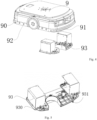
- the mainframe 90 and the subframe 91 are arranged at the front and back sides along the traveling direction of the AGV 9, alternatively, the subframe 91 may be set as a structure that is fixedly connected with the mainframe 90 of the AGV 9 in the vertical direction and can be connected with the outside, and the posture of the main body of the AGV 9 can be changed by applying external forces to the mainframe 90 and the subframe 91.
- the battery module 93 described in the present disclosure which is installed in the subframe 91, may be a nickel-hydrogen rechargeable battery, a lithium battery or a non-rechargeable battery. Further, it is not limited to the shape shown in Fig. 4 as long as it can be unloaded and loaded from the bottom of the subframe 91 of the AGV 9 in cooperation with the battery replacement station described in the present disclosure. Of course, in some other embodiments, it is not excluded that the battery module 93 is installed to the mainframe 90. The relevant structure of the battery replacement station is introduced in this embodiment by taking the installation in the subframe 91 only as an example. In other embodiments of the present disclosure, the battery module 93 may also be installed in the mainframe 90 or even other positions.
- the battery replacement station in this embodiment includes a battery replacement device 1 and a battery compartment system 2.
- the battery replacement device 1 and the battery compartment system 2 are used together.
- the battery replacement device 1 and the battery compartment system 2 may be used independently.
- the battery replacement device 1 will be described in detail below.
- the battery replacement device 1 of this embodiment is configured to remove the battery module 93 from the AGV 9 and install the battery module 93 onto the AGV 9.
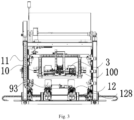
- the battery replacement device 1 includes a lifting rack 10, a lifting-rack lifting mechanism 11, and a battery removal/installation mechanism 12.
- the lifting rack 10 and the lifting-rack lifting mechanism 11 may be connected with each other as shown in Fig. 3 .
- the lifting-rack lifting mechanism 11 may be set in the type of a frame, so that the lifting rack 10 can be raised and lowered inside.
- the lifting rack 10 includes a supporting table 100. After the AGV 9 travels onto the supporting table 100, the lifting-rack lifting mechanism 11 can raise the lifting rack 10 and then the AGV 9.
- the battery removal/installation mechanism 12 can be located below the lifting rack 10 after it is raised, so that the lifting-rack lifting mechanism 11 can adjust the vertical distance between the bottom of the AGV 9 and the battery removal/installation mechanism 12 to remove and install the battery module 93 from the bottom.
- the lifting-rack lifting mechanism 11 may also be configured as a structure such as a jack supporting the lifting rack 10, which can be raised and lowered as required. Normally, the supporting table 100 of the lifting rack 10 cannot be tightly contacted with the ground, so a slope 13 can be provided in front of the lifting rack 10 to facilitate the AGV 9 to drive on the supporting table 100.
- the lifting rack 10 includes a first positioning module 1010, a second positioning module 1011, a subframe press-down mechanism 102, a subframe lifting mechanism 103 and a mainframe press-down mechanism 104, etc.
- each part of the lifting rack 10 can be used independently or in any combination according to different process requirements, which is not limited to using all or part of the above technical solutions shown in this embodiment, as long as the battery module 93 can be removed from the AGV 9 smoothly.
- Each part of the lifting rack 10 has different functions, and some parts may have other additional functions after being used in combination.
- Each part of the lifting rack 10 will be described separately below.
- the matching accuracy of various devices is extremely important, if the matching accuracy is too low, the relative positions of the devices will be greatly deviated, resulting in the devices being unable to complete the setting action.
- the lifting rack 10 includes a positioning mechanism 101.
- the positioning mechanism 101 can determine the relative posture and the relative position between the AGV 9 and the lifting rack 10, mainly between the AGV 9 and the supporting table 100. Specifically, since the AGV 9 can be parked directly on the supporting table 100, the vertical positions of the AGV 9 and the supporting table 100 can be ignored. As shown in Fig. 9 , the positioning mechanism 101 usually only needs to consider the parking position of the AGV 9 in the horizontal plane.
- the positioning mechanism 101 may realize the positioning of the AGV 9 by positioning the AGV 9 in a first horizontal direction a perpendicular to the wheel axis and in a second horizontal direction b along the wheel axis.
- the positioning mechanism 101 includes a first positioning module 1010 for positioning the AGV 9 in the first horizontal direction a perpendicular to the wheel axis by positioning the wheels of the AGV 9. Further, in order to position the AGV 9 in the second horizontal direction b along the wheel axis, the positioning mechanism 101 includes a second positioning module 1011 for positioning the AGV 9 in the second horizontal direction b along the wheel axis. In this way, by the positioning function of the first positioning module 1010 and the second positioning module 1011, the position of the AGV 9 in the horizontal direction can be fixed, which facilitates the battery removal/installation mechanism 12 to position, remove and install the battery module 93.
- the first positioning module 1010 includes a positioning slider 1010a and a guiding rail 1010b.
- the positioning slider 1010a is provided with a positioning groove 1010c extending along the second horizontal direction b, and the positioning groove 1010c can be set in a V shape as shown in Fig. 11 , in this way, the wheels of the AGV 9 can be automatically stuck in the V-shaped positioning groove 1010c.
- the positioning groove 1010c may also be considered to set the positioning groove 1010c to be a rectangular, an inverted trapezoidal, a semi-circular or other shapes that just accommodate the wheels of the AGV 9, as long as the wheels of the AGV 9 can sink down into the positioning groove 1010c and be fixed by it when passing through the positioning groove 1010c. In this way, by positioning the wheels of the AGV 9, the positioning of the AGV 9 in the first horizontal direction a can be realized.
- a supporting surface 1000 is provided on the upper surface of the supporting table 100, the supporting surface 1000 can be provided as a complete planar surface as shown in Fig. 10 , or as a grid-like surface, as long as it can support the AGV 9 and allow the AGV 9 to run on it.
- a supporting surface 1000 is provided with a receiving cavity 1000a which is formed by recessing downward from the supporting surface 1000, and the receiving cavity 1000a can receive the first positioning module 1010, so that most structure of the first positioning module 1010 can be located below the supporting surface 1000, so that the positioning groove 1010c and the supporting surface 1000 can be substantially flush with each other, and the wheels of the AGV 9 can easily travel from the supporting surface 1000 to the positioning groove 1010c of the positioning slider 1010a.
- the positioning slider 1010a is also provided with a guiding slope 1010d, as shown in Fig. 11 , one side of the guiding slope 1010d is flush with the supporting surface 1000, and the other side of the guiding slope 1010d is flush with one side of the positioning groove 1010c, that is, adjacent to one side of the positioning groove 1010c, so that the wheels of the AGV 9 can be easily guided from the supporting surface 1000 into the positioning groove 1010c by the guiding slope 1010d.
- the positioning mechanism 101 needs to position the AGV 9 in both the first horizontal direction a and the second horizontal direction b, so after the AGV 9 is positioned in the first horizontal direction a by the first positioning module 1010, it is necessary to adjust the position of the AGV 9 in the second horizontal direction when the AGV 9 is positioned in the second horizontal direction b by the second positioning module 1011, and the wheels will also move in this direction when adjusting the position of the AGV 9.
- the positioning groove 1010c and the guiding rail 1010b both extend along the second horizontal direction b, and the positioning slider 1010a is slidably matched with the guiding rail at the same time, so that the positioning slider 1010a can slide along the second horizontal direction b.
- the positioning slider 1010a can move along the second horizontal direction b along with the AGV 9 under the guidance of the guiding rail 1010b, which not only enables the AGV 9 to move along the second horizontal direction b more conveniently, but also ensures that the position of the AGV 9 in the first horizontal direction a does not change.
- the first positioning module 1010 may further include a reset elastic member 1010e, which is connected with the positioning slider 1010a.
- the reset elastic member 1010e is adjusted so that the positioning slider 1010a can be stably maintained in a reset position.
- the reset elastic member 1010e is in a state of force balance.
- the reset elastic member 1010e will be compressed, extended or otherwise elastically deformed and store the elastic potential energy.
- the elastic potential energy of the reset elastic member 1010e will release and enable the positioning slider 1010a to automatically return to the reset position along the second horizontal direction b.
- the reset elastic member 1010e can be a spring, an elastic piece, a rubber band with high elasticity, etc., which has elasticity and can elastically push the positioning slider 1010a to the reset position.
- the reset position is usually designed in the middle of the receiving cavity 1000a, leaving a certain gap between the positioning slider 1010a and both sides of the receiving cavity 1000a for movement.
- One reset elastic member 1010e can be respectively arranged on both sides of the positioning slider 1010a to make the movement of the positioning slider 1010a more stable.
- ball units 1201 are provided which protrude from the surface of the abutting surface 1200.
- the battery module 93 can be in a rolling engagement with the ball unit 1201 to avoid excessive friction and reduce wear.
- each walking module 128 can be equipped with a base body 129, on which the abutting table 120, the coarse positioning module 121, the fine positioning module 122, the unlocking module 123 and the elastic jacking module 126 that the walking module 128 needs to drive can be uniformly arranged, so that the walking module 128 can drive a corresponding part of modules to move by driving the base body 129 matched with it.
- the battery module 93 When installing the battery module 93, it only needs to be positioned to a position where it can be installed by the positioning function of the coarse positioning module 121, and the AGV 9 approaches the battery module 93 as the lifting rack 10 descends, so that the locking module 930 is moved to extend into the opening of the lock catch 910 provided in the subframe 91 and rotates the opening, automatically locking, and completing the installation of the battery module 93.
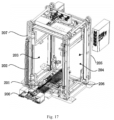
- the transfer mechanism 201 is connected with the bearing table 200, which can be directly and fixedly connected with each other as shown in Fig. 17 , or can be connected with each other through connectors, as long as the transfer mechanism 201 can drive the bearing table 200 to move the battery module 93 to the battery removal/installation mechanism 12 or the storage device 21.
- the transfer mechanism 201 can move in a horizontal plane or may be a more complicated way.
- the position and posture of the battery module 93 placed on the bearing table 200 can be changed through rotation and telescopic movement, so as to realize the matching with the battery removal/installation mechanism 12 or the charging base 211 and realize the purpose of transfer.
- the battery lifting mechanism 202 is used to connect with the transfer mechanism 201, the battery lifting mechanism 202 can be configured as a lifting chain as shown in Fig. 17 , with which the transfer mechanism 201 is fixedly connected to realize lifting.
- the battery lifting mechanism 202 can also be provided as a hydraulic rod extending in the vertical direction or other structure with a lifting function.
- the bearing table 200 is moved to a position lower than the battery module 93 by the battery lifting mechanism 202, and is then controlled by the transfer mechanism 201 to move horizontally to a position below the battery module 93, at this time, the bearing table 200 can be slightly lower than the abutting table 120 and aligned with the abutting table 120 in different areas of the battery module 93 respectively. Then, the battery lifting mechanism 202 lifts the bearing table 200 upward, and the bearing table 200 holds the battery module 93 from below until the battery module 93 is completely separated from the battery removal/installation mechanism 12, thus completing the transfer of the battery module 93 from the battery removal/installation mechanism 12 to the bearing table 200.
- the bearing table 200 carrying the battery module 93 is moved to a position higher than the battery removal/installation mechanism 12, and the abutting table 120 is aligned with the battery module 93, then the battery lifting mechanism 202 is controlled to move downward until the battery module 93 is supported by the abutting table 120 of the battery removal/installation mechanism 12 and completely separated from the bearing table 200, thus completing the transfer process of the battery module 93 from the bearing table 200 to the battery removal/installation mechanism 12.
- the transfer mechanism 201 can be arranged on the fixing rack 206, and then the battery lifting mechanism 202 can be connected with the fixing rack 206.
- a battery module fixing element 2000 can be arranged on the bearing table 200, as shown in Figs. 15 , 5 and 6 , the battery module fixing element 2000 can be arranged as an upward fixing pin which can be inserted into some positioning holes 931 of the battery module 93, or can be a clamping plate, a claw or other structure for clamping the battery module 93.
- the positioning holes 931 corresponding to the coarse positioning column 1210 and fine positioning column 1220 will always be occupied before the battery module 93 is removed from the battery removal/installation mechanism 12, the positioning holes 931 corresponding to the fixing pins of the bearing table 200 should be different from those corresponding to the coarse positioning column 1210 and fine positioning column 1220 on the battery removal/installation mechanism 12.
- a limiting mechanism 2001 can also be provided on the bearing table 200, as shown in Fig. 18 , the limiting mechanism 2001 includes a limiting element 2001a that limits the upward movement and separation of the battery module 93 and a limiting power unit 2001b that drives the limiting element 2001a. As shown in Fig.
- the limiting element 2001a can be configured as a limiting rod, a limiting plate, etc., which can be driven by the limiting power unit 2001b to move to a position above the battery module 93 and restrict the battery module 93, and can prevent the battery module 93 from being vertically separated from the bearing table 200, which will not be repeated here.
- the movement mode of the limiting element 2001a can be various modes such as telescopic movement, rotation, translation and the like.
- the battery pick-and-place device 20 in order to allow the battery module 93 to reach the battery replacement device 1 and the storage compartment or storage device 21 from the battery pick-and-place device 20, the battery pick-and-place device 20 needs to be provided with a battery replacement port 203 and at least one battery storage port 204, both of which can be horizontally passed by the bearing table 200, the battery replacement device 1 faces the battery replacement port 203 and the storage device 21 faces the battery storage port 2004.
- the battery pick-and-place device 20 can include a main supporting rack 207, on which both the battery replacement port 203 and the battery storage port 204 are arranged.
- the main supporting rack 207 also has a lifting channel 2070, that is, a space area formed by four columns of the main supporting rack 207, the battery lifting mechanism 202 is arranged on the main supporting rack 207, and the bearing table 200 and the transfer mechanism 201 are both arranged in the lifting channel 2070, and can be driven by the battery lifting mechanism 202 to move vertically along the lifting channel 2070.
- the battery storage port 204 and the battery replacement port 203 can be disposed adjacent to each other, as shown in Fig. 17 , the main supporting rack 207 of the battery pick-and-place device 20 may be a cuboid frame structure, and one battery storage port 204 is arranged at each side adjacent to the battery replacement port 203, which can reduce the moving distance of the battery module 93 and save the travel time.
- the battery storage port 204 can also be arranged at the side opposite to the battery replacement port 203.
- the battery storage port 204 is far away from the battery replacement port 203, the space around the battery pick-and-place device 20 can be fully utilized.
- the main supporting rack 207 of the battery pick-and-place device 20 adopts another structure, such as a hexagonal prism structure, the number of battery storage ports 204 and even battery replacement ports 203 may be larger.
- each battery storage port 204 can be provided with a plurality of charging bases 211 distributed in the vertical direction, so as to save the footprint.
- the structure of the charging base bracket 210 can be designed according to the position of the battery replacement port 203, the number of charging bases 211 and the arrangement number in the vertical direction, and the charging base bracket 210 can be an integrated structure or may be divided into several independent structures, and a part of the charging bases 211 can be fixed respectively.
- the charging base 211 may include a charging table 2110, a charging base coarse positioning module 2111, a charging base fine positioning module 2112 and a connector module 2113.
- the charging base coarse positioning module 2111 and the charging base fine positioning module 2112 are both arranged on the charging table 2110.
- the charging table 2110 has a receiving surface 2110a
- the charging base coarse positioning module 2111 includes charging base coarse positioning columns 2111a, which protrude from the receiving surface 2110a and correspond to the positions of some positioning holes 931 on the battery module 93.
- these positioning holes 931 corresponding to the charging base coarse positioning columns 2111a can be called charging base coarse positioning holes.
- the charging base fine positioning module 2112 in this embodiment includes a charging base fine positioning column 2112a and a charging base fine positioning power unit. These charging base fine positioning columns 2112a correspond to other positioning holes 931 on the battery module 93.
- these positioning holes 931 corresponding to the charging base fine positioning columns 2112a can be called charging base fine positioning holes.
- the charging base fine positioning columns 2112a can be driven by the charging base fine positioning power unit to extend into these positioning holes 931.
- the charging base fine positioning power unit can be set as a hydraulic ejector rod or an electric telescopic rod or the like.
- the positioning holes 931 corresponding to the fixing pins of the bearing table 200 will always be occupied before the battery module 93 is removed from the bearing table 200, the positioning holes 931 corresponding to the charging base coarse positioning column 2111a and the charging base fine positioning columns 2112a should be different from the positioning holes 931 corresponding to the fixing pins of the bearing table 200. Furthermore, the positioning holes 931 corresponding to the charging base coarse positioning column 2111a and the charging base fine positioning column 2112a may be completely identical to, partially identical to or completely different from the positioning holes 931 corresponding to the coarse positioning column 1210 and the fine positioning column 1220.
- the charging base coarse positioning column 2111a can move to extend into the corresponding positioning hole 931, thus realizing the coarse positioning of the charging base 211 and the battery module 93.
- the charging base coarse positioning column 2111a is much thinner, so the annular gap formed between the charging base coarse positioning column 2111a and the positioning hole 931 is wider. The purpose is to enable the charging base coarse positioning column 2111a to move to smoothly extend into the positioning hole 931 to complete coarse positioning even when the position difference between these two sides is large.
- the charging base fine positioning power unit is turned on to move the charging base fine positioning column 2112a to extend into the corresponding positioning hole 931.
- the annular gap formed between the charging base fine positioning column 2112a and the positioning hole 931 is much smaller in width, and the positioning hole 931 can be substantially filled. Therefore, the charging base fine positioning column 2112a and the positioning hole 931 can be mated very well, when the charging base fine positioning column 2112a is successfully moved to extend into the positioning hole 931, the fine positioning of the battery module 93 and the charging base 211 can be realized.
- the heads of the charging base coarse positioning column 2111a and the charging base fine positioning column 2112a can be provided with guide surfaces, and the guide surfaces may be an inclined surface or an arc surface.
- the battery module 93 will move. At this time, if there is a relatively large friction force between the charging table 2110 and the battery module 93, the moving effect of the battery module 93 will be affected or even it may be worn out.
- charging base ball unit 2114 is provided which protrude from the surface of the receiving surface 2110a.
- the battery module 93 can be in a rolling engagement with the charging base ball unit 2114 to avoid excessive friction and reduce wear.
- the charging base 211 of the embodiment of the present disclosure may include a plurality of charging base coarse positioning modules 2111, which are preferably distributed along a diagonal line of the battery module 93, and the farther the distance, the higher the positioning accuracy.
- the charging base 211 of the embodiment of the present disclosure may also include a plurality of fine positioning modules 122, and a plurality of charging base coarse positioning modules 2111 are distributed along the other diagonal line of the battery module 93, the above two settings can be used independently or cooperatively.
- the connector module 2113 can be provided with a connector 2113a and a connector power unit.
- the connector power unit can be set as a telescopic rod or other power mechanism such as a mechanical arm, as long as it can drive the connector 2113a to complete the electrical conduction operation with the corresponding electrical socket on the battery module 93.
- the shape of the connector 2113a corresponds to the electrical socket on the battery module 93, such as one is a socket and the other a plug, which will not be described here.
- the charging table 2110 is also provided with a charging base battery module detection sensor 2115, which is configured to detect whether the battery module 93 has been placed on the charging table 2110.
- the charging base battery module detection sensor 2115 used in this embodiment can be a microswitch, when the battery module 93 is placed on the charging table 2110, the microswitch can be activated to start the fine positioning and electrical conduction operation.
- the charging base battery module detection sensor 2115 can also be set as other inductive switches such as photoelectric sensors, which can determine whether the battery module 93 has been placed on the charging table.
- the charging table 2110 can be arranged in a U-shaped structure as shown in Fig. 19 , and the charging base fine positioning column 2112a and the connector 2113a are both located above the charging table 2110 and face the hollow area of the U-shaped structure.
- the protruding direction of the charging base fine positioning column 2112a is opposite to that of the charging base coarse positioning column 2111a, that is, protruding downward.
- the charging base fine positioning power unit drives the charging base fine positioning column 2112a to move in the vertical direction.
- the bearing table 200 can be driven by the transfer mechanism 201 to extend the battery module 93 through the above gap and place the battery module 93 between the charging table 2110, the charging base fine positioning column 2112a and the connector 2113a, then, the height is reduced by the battery lifting mechanism 202, so that the battery module 93 is supported by the charging table 2110, and the bearing table 200 can pass through the hollow area of the U-shaped structure to complete the transfer between the battery module 93 and the charging base 211.
- the charging table 2110 in this embodiment can also adopt other structures that can allow the bearing table 200 to pass through from below, which will not be described in detail here.
- the integrated power unit 2118 is fixedly arranged on the supporting rack 2116, and the mounting table 2117 can move vertically under the drive of the integrated power unit 2118, so that the charging base fine positioning column 2112a and the connector 2113a can move together, and the fine positioning and electrical conduction operations can be completed synchronously.
- the discharge valve 33 is opened, so that the firefighting materials stored in the firefighting material containing box 32 can enter the firefighting box 31, thereby realizing firefighting protection.
- the firefighting box 31 can be arranged below the battery module receiving mechanism 30, and at this time, the battery module receiving mechanism 30 can transport the battery module 93 to the firefighting box 31 by dropping. As shown in Fig. 20 , when the battery module 93 is placed on the battery module receiving mechanism 30, the battery module receiving mechanism 30 can remove the receiving force according to preset steps, so that the battery module 93 is dropped.
- the battery module 93 can be transferred to the battery module receiving mechanism 30 through the battery pick-and-place device 20, the principle of the transfer is the same as the transfer of the battery module 93 from the bearing table 200 to the charging base 211, which are both realized by moving in the vertical direction, and will not be repeated here.
- the battery module receiving mechanism 30 may have two telescopic supporting modules 300 arranged opposite to each other.
- the telescopic supporting module 300 can hold the battery module 93 only when it is in a extended posture, and the battery module 93 will fall when it is in a retracted posture.
- the above scheme can be realized when the extension directions of the two telescopic supporting modules 300 are opposite. For some battery modules with a large hollowed-out area in the middle, it is possible that the extension directions of the telescopic supporting modules 300 deviate from each other to achieve the above solution.
- the telescopic supporting module 300 can include a fixing part 3000, a supporting part 3001 and a telescopic power unit 3002, and the telescopic supporting module 300 can be fixed on the firefighting bracket 34 or other components through the fixing part 3000. Meanwhile, the telescopic power unit 3002 is fixed on the fixing part 3000.
- the telescopic power unit 3002 is configured to drive the supporting part 3001 to complete the telescopic action, the telescopic power unit 3002 can be set as a telescopic arm or a telescopic rod, as long as it can achieve two states of an extended state and a retracted state along the horizontal direction.
- the battery module receiving mechanism 30 can also be provided in the form of fire-resistant conveyor belt, etc., as long as it can receive the battery module 93 and transport it to the firefighting box 31.
- the firefighting material containing box 32, the discharge valve 33, the battery module receiving mechanism 30 and the firefighting box 31 can be arranged in sequence from top to bottom. In this way, both the transfer of the battery module 93 to the firefighting box 31 and the transfer of the firefighting materials to the firefighting box 31 can be realized by gravity without any need of setting other power.
- the detector 35 When the detector 35 detects that the battery module receiving mechanism 30 receives the battery module 93, it can send a detection signal to the central processor. After receiving the signal, the central processor can send an instruction to the battery module receiving mechanism 30 to control the battery module receiving mechanism 30 to transfer the battery module 93 into the firefighting box 31. After that, the discharge valve 33 is controlled to open to release the firefighting materials in the firefighting material containing box 32, and the danger of the battery module 93 in the firefighting box 31 is eliminated, so that the firefighting operation is completed.
- the battery replacement station suitable for an AGV provided by the embodiment of the present disclosure has many advantages such as saving battery exchange time, improving the working efficiency of the AGV, high battery exchange speed, high precision, high degree of automation and so on.
- Another embodiment of the present disclosure also provides a battery replacement method for an AGV, which can be implemented by the battery replacement station of the above-mentioned AGV or other equipment.
- the battery replacement method for an AGV includes the following steps:
- the battery module assembly area can be understood as an area of AGV where battery modules are installed, for example, the battery module assembly area is the inner area of the subframe 91.
- the original battery module with power shortage on the AGV can be removed, and the new battery module fully charged can be replaced into AGV, thus completing the whole replacement process of battery module.
- This battery replacement method can save a lot of time compared with the method involving waiting for charging. It should be noted that in the above steps S10 to S50, except for the case where the implementation of a certain step depends on the result of another step, a strict sequence might not exist between other steps (for example, step S10 and step S20), depending on the structure of the adopted equipment and the control program.
- any two or more of these steps may be executed at the same time, or when one step reaches a certain stage, another step starts to be executed, and the later executed step may also end prior to the earlier executed step, as long as all five steps are finally executed so that the battery module of the AGV can be updated.
- Step S10 is a preparation step for replacing the battery module on the AGV, wherein the battery removal/installation mechanism can be the battery removal/installation mechanism 12 in the above-mentioned battery replacement station, or other mechanisms for removing and installing batteries.
- the battery removal/installation mechanism is already located under the bearing equipment of the AGV (such as the lifting rack 10 in the above-mentioned battery replacement station) initially, then this step can be realized naturally only by moving the AGV onto the bearing equipment by moving it on its own or assisted by other equipment.
- the battery removal/installation mechanism is not located under the bearing equipment of the AGV initially, but on the side of it, then after moving the AGV to the bearing equipment, the AGV is just located in the initial position, and then it is necessary to lift the AGV upward from the initial position by a certain height to enable the battery removal/installation mechanism to move horizontally to a position below the AGV. After the AGV is raised, the battery removal/installation mechanism should be moved horizontally to a position below the AGV.
- the lifting process of the AGV can be realized by driving the lifting rack 10 by means of the lifting-rack lifting mechanism 11, and the battery removal/installation mechanism 12 itself is also provided with a corresponding walking module 128 for horizontal movement.
- the process of horizontal movement of the battery removal/installation mechanism can start after the AGV stops lifting, after the AGV starts to lift for a period of time, or at the same time as the lifting process of the AGV. Furthermore, the process of horizontal movement of the battery removal/installation mechanism can end before or after the AGV stops, or both processes can end at the same time.
- the AGV usually needs to be moved from other positions to a position above the battery removal/installation mechanism, and for the above-mentioned battery replacement station or other similar equipment, the AGV also needs to be driven by the lifting rack 10 to move up and down, therefore, the overall horizontal position of the AGV also has a certain influence on the smooth progress of step S20. Improving the overall position certainty of the AGV is also helpful to improve the success rate of step S20, so in the process of step S10, the AGV can be horizontally positioned synchronously.
- horizontally positioning the AGV is divided into two stages.
- the AGV In the first stage, the AGV is positioned in the first horizontal direction a perpendicular to the wheel axis by positioning the wheels of the AGV.
- the AGV In the second stage, the AGV is positioned in the second horizontal direction b along the wheel axis, and in order to avoid a failure in the positioning of the first stage, it is necessary to keep the position of the AGV in the first horizontal direction a unchanged during the positioning process of the AGV in the second horizontal direction b.
- the whole AGV is horizontally positioned through the above two stages.
- the positioning groove can be configured to position the AGV, and the specific process can be as follows: rolling the wheels of the AGV into a positioning groove extending along the second horizontal direction b, and clamping the wheels in the positioning groove under the action of gravity to position the AGV in the first horizontal direction a.
- the related structure of the positioning groove can refer to the battery replacement station in the above embodiment.
- the AGV can always keep the wheels in the positioning groove during the movement along the second horizontal direction b, so as to keep the position of the AGV in the first horizontal direction. Since the positioning groove extends along the second horizontal direction b, even if the AGV moves relative to the positioning groove in the process of moving along the second horizontal direction b, it can be ensured that the positioning groove can always restrain the position of the wheels and the whole AGV in the first horizontal direction.
- AGV can make the wheels drive the positioning groove to move together along the second horizontal direction b through friction in the process of moving along the second horizontal direction b. In this way, when the second stage is executed, the positioning groove and the wheels can be kept relatively stationary, so that higher positioning accuracy can be obtained.
- the above scheme can be implemented by the battery replacement station in the above embodiment, or can also be implemented by other structures or equipment different from the corresponding structures described in the battery replacement station.
- the state of AGV can be detected synchronously during the first stage, and the positioning of AGV in the second horizontal direction b along the wheel axis is started after it is detected that the positioning of the AGV in the first horizontal direction a has completed.
- There are many ways to determine whether the positioning of the AGV in the first horizontal direction a has completed such as detecting whether the position of a certain marker on the AGV is within a limited range, if yes, it is considered that the positioning in the first horizontal direction has completed, or detecting whether the time when the AGV is in a stationary state exceeds a limited threshold, and if yes, it is considered that the positioning in the first horizontal direction has completed, and so on.
- a relatively simple determination mode is provided, that is, detecting whether there are AGV wheels in the positioning groove.
- detecting whether there are wheels in the positioning groove it can be considered that the positioning in the first horizontal direction has completed.
- the related implementation structure has been clarified in the battery replacement station in the above embodiment, and a wheel detection sensor 1010f may be arranged in the first positioning module 1010 of the positioning mechanism 101, which will not be described in detail here.
- the AGV is positioned in the second horizontal direction b along the wheel axis according to the obtained position difference between the AGV and the reference mark in the second direction.
- the reference mark may be in various forms, such as a score, a two-dimensional code, outline of a specified structure, etc., which is not limited in this embodiment.
- the above-mentioned functions can be realized by the horizontal pushing assembly 1011a of the second positioning module 1011, and the related structures and principles have been described in detail in this embodiment, and will not be repeated here.
- step S20 The purpose of step S20 is to release a connection between the old battery module on the AGV and the main body of the AGV.
- step S10 there is usually no direct contact between the whole AGV and the battery removal/installation mechanism 12, but there is a certain distance between them. Therefore, in this step, if the battery removal/installation mechanism is to operate the old battery module, it is necessary to dock the old battery module with the battery removal/installation mechanism.
- One of the ways to dock the old battery module with the battery removal/installation mechanism is to move the battery removal/installation mechanism upward to make it close to AGV, and finally realize the docking of the two.
- the other way is to move the AGV as a whole downward to a position where it is docked with the battery removal/installation mechanism.
- they both can move in the same direction at the same time, or even move in the same direction and approach at different rates, and finally realize docking.
- the second mode is adopted, that is, the lifting rack 10 and the AGV are moved downward as a whole by the lifting-rack lifting mechanism 11 in the battery exchange device 1 and docked with the battery removal/installation mechanism 12.
- the old battery module can also be horizontally positioned.
- the positioning process can be started before, during or even after docking, and can be completed before, when or after docking is completed.
- the positioning process can usually be arranged to start during the docking process and end after the docking is completed.
- the process of horizontally positioning the battery module can be divided into two stages, the first stage is the rough positioning of the battery module of the AGV in the horizontal direction, that is, the positioning with lower accuracy and larger error.
- the second stage is the fine positioning of the battery module of the AGV in the horizontal direction, that is, the positioning with higher accuracy and smaller error.
- the battery module of the AGV can be roughly positioned in the horizontal direction by moving the coarse positioning column to extend into the coarse positioning hole of the battery module from below.
- the battery module of AGV can be accurately positioned in the horizontal direction by moving the fine positioning column to extend into the fine positioning hole of the battery module from below.
- the width of the annular gap formed by the fine positioning column and the fine positioning hole is smaller than that formed by the coarse positioning column and the coarse positioning hole. That is, using the size of the annular gap as the basis of accuracy, the larger the annular gap, the lower the accuracy, otherwise, the smaller the annular gap, the higher the accuracy.
- the process of moving the coarse positioning column 1210 to extend into the coarse positioning hole of the battery module from below can be completed synchronously during the process of the battery module 93 moving to the abutting surface 1200 of the abutting table 120 of the battery removal/installation mechanism 12 located below it, and the battery module 93 is in an abutting state with the abutting surface 1200 when the coarse positioning in the horizontal direction is completed.
- the process of moving the fine positioning column 1220 to extend into the fine positioning hole of the battery module 93 from below can specifically adopt the method of moving the fine positioning column 1220 from below the abutting surface 1200 to protrude from the abutting surface 1200 and extend into the fine positioning hole of the battery module 93, so as to accurately position the battery module of the AGV in the horizontal direction.
- the specific positioning component structure and related positioning principle have been explained in the above-mentioned battery replacement station embodiment, and will not be repeated here.
- the battery removal/installation mechanism can begin to release the connection between the battery module and the AGV.
- a locking module 930 such as that described in the embodiment of the above-mentioned battery replacement station, will be arranged to form a connection with the lock catch 910 of the subframe 91 of the AGV. Therefore, releasing the connection between battery module and AGV is actually releasing the connection between locking module 930 and lock catch 910 to unlock the locking module 930.
- the battery module of the AGV can be unlocked by the unlocking module
- the unlocking module 123 has an unlocking ejector rod 1230
- the locking module 930 can be unlocked during the process that the unlocking ejector rod 1230 of the unlocking module 123 moves in a direction from below the abutting surface 1200 to protrude from the abutting surface 1200.
- the related unlocking structure and principle have been explained in detail in the embodiment of the above-mentioned battery replacement station, and will not be repeated here.
- the battery module 93 it may be necessary to arrange multiple locking modules 930 in different orientations. Due to the large area of the bottom surface of the battery module 93, if it is made of non-durable materials such as plastics, which is easy to deform during use, and the deformed bottom surface may cause the relative position between the locking module 930 and the unlocking ejector rod 1230 to change, so that the locking module 930 cannot be unlocked even if part of the unlocking ejector rod 1230 is extended.
- the battery module 93 when the battery module 93 moves relative to and approaches the abutting surface 1200 of the abutting table 120 located below it in the vertical direction, the battery module 93 will press the abutting table 120 downward and deform the elastic jacking module 126 connected with the abutting table 120 elastically. This process will stop after detecting that the abutting table 120 is pressed to a predetermined position, that is, the relative movement between the battery module 93 and the abutting table 120 will stop. Through this elastic pressing, the abutting surface 1200 can be in close contact with the bottom surface of the battery module 93, thus ensuring the relative position accuracy between the locking module 930 and the unlocking ejector rod 1230.
- step S20 Although the connection between the old battery module and the AGV was released in step S20, the old battery module is still in the battery module assembly area of the AGV (for example, the inner area of the subframe 91), so it is difficult to transfer the old battery module directly due to the limitation of the spatial position of both sides. Therefore, it is necessary to perform step S30 to separate the old battery module from the battery module assembly area of the AGV.
- step S30 since the old battery module has been docked with the battery removal/installation mechanism below in step S20, the battery removal/installation mechanism is usually vertically away from the bearing equipment of the main body of AGV. Since the old battery module is docked with the battery removal/installation mechanism, both can remain relatively stationary, while the AGV is supported by the bearing equipment, and both remain relatively stationary, so the separation between the old battery module and the battery module assembly area of the AGV can be realized. Similarly, the separation of the AGV from the old battery module can be that one of them does not move, the other moves away in the vertical direction, or both of them move away from each other at the same time, or even both of them move in the same direction at different rates and thus away from each other. For the above-mentioned battery replacement station, it usually uses the cooperation of the lifting-rack lifting mechanism 11 and the lifting rack 10 to move the AGV upward until the old battery module is separated from the battery module assembly area of the AGV.
- step S30 moving the abutting table and the AGV away from each other in the vertical direction, and detecting whether there is a battery module on the abutting table; when it is detected that a battery module already exists on the abutting table, finishing step S30; when it is detected that there is no battery module on the abutting table, perform the following steps:
- the process of detecting whether a battery module 93 exists on the abutting table 120 can be realized by the battery module detection sensor 124.
- the pulling hook 1250 is provided in the battery removal/installation mechanism 12, but in other devices, the pulling hook may also be provided on other structures or devices that do not move with the AGV.
- the unlocking module 123 can be used as both unlocking and locking mechanism.
- the first extension of the unlocking ejector rod 1230 unlocks the locking module, and the connection between the battery module and the AGV is released, the second extension of the unlocking ejector rod 1230 relocks the locking module, and the connection between the battery module and the AGV is established.
- the locking action can be implemented by setting a mechanism opposite to the control action of the unlocking module 123.
- this embodiment can always keep the AGV in the pre-charging state during the execution of the above four steps S20 to S50.
- the pre-charging state is to temporarily supply power to AGV through an external temporary connection.
- the pre-charging line may have completed the communication with the AGV before step S20 is performed. Specifically, the pre-charging line can complete the communication with AGV before step S10 is executed, and then step S10 is executed. Alternatively, the pre-charging line can complete the communication with the AGV during the execution of step S10.
- the pre-charging line can be performed synchronously in the process of horizontally positioning the AGV.
- the pre-charging line may be used before the positioning of the AGV is started or after the positioning of the AGV is completed. Meanwhile, in this embodiment, the AGV can be disconnected from the pre-charging line after the completion of step S50.
- connection structure between the pre-charging line and AGV can refer to the related structure of the pre-charging mechanism 106 of the above-mentioned battery replacement station, and will not be described here again.
- the pre-charging line can also complete the connection with the AGV after the end of step S10 and before the start of step S20.
- step S50 the new battery module can be further separated from the battery removal/installation mechanism, then the battery removal/installation mechanism can be horizontally moved out of the position below the AGV and the AGV can be lowered down to the initial position, so that the equipment can return to the original state. It is not only beneficial for the AGV to leave from the initial position, but also beneficial for the next AGV to enter. This process can also be implemented by the above-mentioned battery replacement station, and the related embodiments have been explained in the above-mentioned embodiments.
- the battery removal method for an AGV includes the following steps S60- S80:
- the positioning method for an AGV includes the following steps S90 and S100:
- the battery replacement method for an AGV provided by the embodiment of the present disclosure has many advantages, such as saving battery exchange time, improving the working efficiency of the AGV, high battery exchange speed, high precision, high degree of automation and so on.
Landscapes
- Engineering & Computer Science (AREA)
- Mechanical Engineering (AREA)
- Transportation (AREA)
- Power Engineering (AREA)
- Life Sciences & Earth Sciences (AREA)
- Sustainable Development (AREA)
- Sustainable Energy (AREA)
- Chemical & Material Sciences (AREA)
- Combustion & Propulsion (AREA)
- Battery Mounting, Suspending (AREA)
- Arrangement Or Mounting Of Propulsion Units For Vehicles (AREA)
- Electric Propulsion And Braking For Vehicles (AREA)
Claims (15)
- Batteriewechselverfahren für ein AGV (9), folgende Schritte umfassend:Platzieren eines Batterieentnahme-/Einsetzmechanismus (12) unter dem AGV (S10);Ergreifen eines alten Batteriemoduls an dem AGV (9) mit dem Batterieentnahme-/Einsetzmechanismus (12) und Lösen einer Verbindung zwischen dem alten Batteriemodul und dem AGV (S20);Trennen des alten Batteriemoduls von einem Batteriemodul-Anordnungsbereich des AGV (S30);Entnehmen des alten Batteriemoduls aus dem Batterieentnahme-/Einsetzmechanismus (12) und Ergreifen eines neuen Batteriemoduls mit dem Batterieentnahme-/Einsetzmechanismus (S40);Bewegen des neuen Batteriemoduls relativ zum AGV (9), um das neue Batteriemodul in dem Batteriemodul-Anordnungsbereich zu platzieren, und Herstellen einer Verbindung zwischen dem neuen Batteriemodul und dem AGV (S50);wobei der Schritt des Platzierens des Batterieentnahme-/Einsetzmechanismus (12) unter dem AGV (9) aufweist: horizontales Positionieren des AGV (9); und der Schritt des horizontalen Positionierens des AGV (9) umfasst:Positionieren des AGV (9) in einer ersten horizontalen Richtung senkrecht zu einer Radachse durch Positionieren von Rädern des AGV (S90);Positionieren des AGV (9) in einer zweiten horizontalen Richtung entlang der Radachse, wobei eine Position des AGV (9) in der ersten horizontalen Richtung während des Positionierungsvorgangs am AGV (9) in der zweiten horizontalen Richtung unverändert bleibt (S100);wobei der Schritt des Positionierens des AGV (9) in der ersten horizontalen Richtung senkrecht zur Radachse durch Positionieren der Räder des AGV (S90) umfasst:Rollen der Räder des AGV (9) in eine Positionierungsnut (1010c), die sich entlang der zweiten horizontalen Richtung erstreckt, so dass die Räder unter Einwirkung der Schwerkraft in der Positionierungsnut (1010c) festsitzen, um das AGV (9) in der ersten horizontalen Richtung zu positionieren;bei dem Schritt des Positionierens des AGV (9) in der zweiten horizontalen Richtung entlang der Radachse, wobei die Position des AGV (9) während des Positionierungsvorgangs am AGV (9) in der zweiten horizontalen Richtung in der ersten horizontalen Richtung unverändert bleibt (S100):wenn erfasst wird, dass das Positionieren des AGV (9) in der ersten horizontalen Richtung abgeschlossen ist, wird das Positionieren des AGV (9) in der zweiten horizontalen Richtung entlang der Radachse gestartet;bei dem Schritt des Erfassens, dass das Positionieren des AGV (9) in der ersten horizontalen Richtung abgeschlossen ist, umfasst ein Feststellen, dass das Positionieren des AGV (9) in der ersten horizontalen Richtung abgeschlossen ist, Folgendes:Feststellen, dass das Positionieren des AGV (9) in der ersten horizontalen Richtung abgeschlossen ist, wenn erfasst wird, dass sich die Räder des AGV (9) in der Positionierungsnut (1010c) befinden;bei dem Vorgang des Positionierens des AGV (9) in der zweiten horizontalen Richtung entlang der Radachse wird das AGV (9) in der zweiten horizontalen Richtung entlang der Radachse gemäß einem erhaltenen Positionsunterschied zwischen dem AGV (9) und einer Bezugsmarkierung in der zweiten horizontalen Richtung positioniert;bei dem Vorgang des Positionierens des AGV (9) in der zweiten horizontalen Richtung entlang der Radachse werden Kräfte auf beiden Seiten des AGV (9) entlang der zweiten horizontalen Richtung gleichzeitig aufgebracht, so dass das AGV (9) in einem eingespannten Zustand zu einer Positionierungsposition geschoben wird.
- Batteriewechselverfahren für ein AGV (9) nach Anspruch 1, wobeibei dem Schritt des Ergreifens des alten Batteriemoduls an dem AGV (9) mit dem Batterieentnahme-/Einsetzmechanismus (S20) das AGV (9) als Ganzes nach unten bewegt wird, um an den Batterieentnahme-/Einsetzmechanismus (12) anzudocken;
und/oderbei dem Schritt des Trennens des alten Batteriemoduls von dem Batteriemodul-Anordnungsbereich des AGV (S30) wird das AGV (9) nach oben bewegt, bis das alte Batteriemodul vom Batteriemodul-Anordnungsbereich des AGV (9) getrennt wird;
und/oderbei dem Schritt des Bewegens des neuen Batteriemoduls relativ zum AGV (9), um das neue Batteriemodul in dem Batteriemodul-Anordnungsbereich (S50) zu platzieren, wird das AGV (9) als Ganzes nach unten bewegt, bis das neue Batteriemodul im Batteriemodul-Anordnungsbereich des AGV sitzt. - Batteriewechselverfahren für ein AGV (9) nach Anspruch 1 oder 2, wobeibei dem Schritt des Platzierens des Batterieentnahme-/Einsetzmechanismus (12) unter dem AGV (S10) das AGV (9) aus einer Ausgangsposition nach oben angehoben und der Batterieentnahme-/Einsetzmechanismus (12) zu einer Position unter dem AGV horizontal bewegt wird;
und/odernach dem Schritt des Bewegens des neuen Batteriemoduls relativ zum AGV (9), um das neue Batteriemodul in dem Batteriemodul-Anordnungsbereich zu platzieren, und dem Herstellen einer Verbindung zwischen dem neuen Batteriemodul und dem AGV (S50) das Verfahren darüber hinaus umfasst:Trennen des neuen Batteriemoduls vom Batterieentnahme-/Einsetzmechanismus (12);Herausbewegen des Batterieentnahme-/Einsetzmechanismus (12) horizontal aus der Position unter dem AGV (9) und Absenken des AGV (9) zur Ausgangsposition. - Batteriewechselverfahren für ein AGV (9) nach Anspruch 1 oder 2, wobei sich während der Ausführung der Schritte des Ergreifens des alten Batteriemoduls an dem AGV (9) mit dem Batterieentnahme-/Einsetzmechanismus (12) und des Lösens der Verbindung zwischen dem alten Batteriemodul und dem AGV (S20), des Trennens des alten Batteriemoduls vom Batteriemodul-Anordnungsbereich des AGV (S30), des Entnehmens des alten Batteriemoduls aus dem Batterieentnahme-/Einsetzmechanismus (12) und des Ergreifens des neuen Batteriemoduls mit dem Batterieentnahme-/Einsetzmechanismus (S40) und des Bewegens des neuen Batteriemoduls relativ zum AGV (9), um das neue Batteriemodul in dem Batteriemodul-Anordnungsbereich zu platzieren, und des Herstellens einer Verbindung zwischen dem neuen Batteriemodul und dem AGV (S50), das AGV (9) stets in einem vorgeladenen Zustand befindet.
- Batteriewechselverfahren für ein AGV (9) nach Anspruch 4, darüber hinaus aufweisend:vor dem Schritt des Ergreifens des alten Batteriemoduls an dem AGV (9) mit dem Batterieentnahme-/Einsetzmechanismus (12) und des Lösens der Verbindung zwischen dem alten Batteriemodul und dem AGV (S20), Verbinden des AGV (9) mit einer Vorladungsleitung;nach dem Schritt des Bewegens des neuen Batteriemoduls relativ zum AGV (9), um das neue Batteriemodul in dem Batteriemodul-Anordnungsbereich zu platzieren, und des Herstellens einer Verbindung zwischen dem neuen Batteriemodul und dem AGV (S50), Abklemmen des AGV (9) von der Vorladungsleitung.
- Batteriewechselverfahren für ein AGV (9) nach einem der Ansprüche 1 bis 2, wobei der Schritt des Entnehmens des alten Batteriemoduls aus dem Batterieentnahme-/Einsetzmechanismus (12) und des Ergreifens des neuen Batteriemoduls mit dem Batterieentnahme-/Einsetzmechanismus (S40) umfasst:
Erfassen, ob noch ein weiteres Batteriemodul vorhanden ist, das sich auf einem Abstütztisch befindet, und wenn erfasst wird, dass noch ein weiteres Batteriemodul vorhanden ist, das sich auf dem Abstütztisch befindet, Ausführen des Schritts des Bewegens des neuen Batteriemoduls relativ zum AGV (9), um das neue Batteriemodul in dem Batteriemodul-Anordnungsbereich zu platzieren, und des Herstellens einer Verbindung zwischen dem neuen Batteriemodul und dem AGV (9). - Batteriewechselverfahren für ein AGV (9) nach Anspruch 1 oder 2, wobei der Schritt des Ergreifens des alten Batteriemoduls an dem AGV mit dem Batterieentnahme-/Einsetzmechanismus (S20) darüber hinaus umfasst: horizontales Positionieren des alten Batteriemoduls; wobei der Schritt des horizontalen Positionierens des alten Batteriemoduls umfasst:grobes Positionieren des Batteriemoduls des AGV (9) in einer horizontalen Richtung;präzises Positionieren des Batteriemoduls des AGV (9) in der horizontalen Richtung;wobei der Schritt des groben Positionierens des Batteriemoduls des AGV (9) in der horizontalen Richtung umfasst: in einem Vorgang, bei dem sich das Batteriemodul relativ zu einer Abstützfläche eines Abstütztischs des Batterieentnahme-/Einsetzmechanismus (12) bewegt und sich dieser nähert, der sich in Vertikalrichtung unter diesem befindet, Bewegen einer Grobpositionierungssäule von unten her, und zwar so, dass sie sich in eine Grobpositionierungsöffnung des Batteriemoduls erstreckt, grobes Positionieren des Batteriemoduls des AGV (9) in der horizontalen Richtung, wobei das Batteriemodul an der Abstützfläche anliegt, wenn das grobe Positionieren in der horizontalen Richtung abgeschlossen ist;wobei der Schritt des präzisen Positionierens des Batteriemoduls des AGV (9) in der horizontalen Richtung umfasst: Bewegen einer Feinpositionierungssäule von unterhalb der Abstützfläche her, und zwar so, dass sie von der Abstützfläche vorsteht und sich in eine Feinpositionierungsöffnung des Batteriemoduls erstreckt, um das Batteriemodul des AGV (9) in der horizontalen Richtung genau zu positionieren;wobei eine Breite eines Ringspalts, der durch die Feinpositionierungssäule und die Feinpositionierungsöffnung gebildet ist, kleiner ist als der, welcher durch die Grobpositionierungssäule und die Grobpositionierungsöffnung gebildet ist;wobei bei dem Vorgang, bei dem sich das Batteriemodul relativ zur Abstützfläche des Abstütztischs des Batterieentnahme-/Einsetzmechanismus (12) bewegt und sich dieser nähert, der sich in Vertikalrichtung unter ihm befindet, das Batteriemodul den Abstütztisch nach unten drückt und ein mit dem Abstütztisch verbundenes elastisches Hebemodul elastisch verformt, und nach dem Erfassen, dass der Abstütztisch in eine vorbestimmte Position gedrückt ist, eine Relativbewegung zwischen dem Batteriemodul und dem Abstütztisch stoppt.
- Batteriewechselvorrichtung (1) für ein AGV (9), mit eine Hebegestell (10), einem Hebegestell-Hebemechanismus (11) und einem Batterieentnahme-/Einsetzmechanismus (12);wobei das Hebegestell (10) dafür ausgelegt ist, das AGV (9) zu tragen;der Hebegestell-Hebemechanismus (11) ist dafür ausgelegt, das Hebegestell (10) anzuheben und abzusenken;der Batterieentnahme-/Einsetzmechanismus (12) ist dafür ausgelegt, wenn er sich unter dem AGV (9) befindet, an ein Batteriemodul (93) anzudocken und eine Verbindung zwischen dem Batteriemodul (93) und dem AGV (9) zu lösen oder herzustellen;wobei das Hebegestell (10) darüber hinaus einen Positionierungsmechanismus (101) zum Positionieren des AGV (9) aufweist und der Positionierungsmechanismus (101) ein erstes Positionierungsmodul (1010) und ein zweites Positionierungsmodul (1011) aufweist; wobei das erste Positionierungsmodul (1010) dafür ausgelegt ist, das AGV (9) in einer ersten horizontalen Richtung (a) senkrecht zu einer Radachse durch Positionieren von Rädern des AGV (9) zu positionieren; und das zweite Positionierungsmodul (1011) dafür ausgelegt ist, das AGV (9) in einer zweiten horizontalen Richtung (b) entlang der Radachse zu positionieren;das erste Positionierungsmodul (1010) weist einen Positionierungsschlitten (1010a) und eine Führungsschiene (1010b) auf, wobei der Positionierungsschlitten (1010a) mit einer Positionierungsnut (1010c) versehen ist, die sich entlang der zweiten horizontalen Richtung (b) erstreckt;das erste Positionierungsmodul (1010) weist darüber hinaus einen Raderfassungssensor (1010f) auf, der an dem Positionierungsschlitten (1010a) angeordnet ist, um zu erfassen, ob sich ein AGV-Rad in der Positionierungsnut (1010c) befindet;das Hebegestell (10) weist einen Tragtisch (100a) auf, an dem eine Bezugsmarkierung (1012) eingerichtet ist; in einem Vorgang des Positionierens des AGV (9) in der zweiten horizontalen Richtung (b) entlang der Radachse wird das AGV in der zweiten horizontalen Richtung (b) entlang der Radachse gemäß einem erhaltenen Positionsunterschied zwischen dem AGV (9) und der Bezugsmarkierung (1012) in der zweiten horizontalen Richtung (b) positioniert;das zweite Positionierungsmodul (1011) weist horizontale Schiebebaugruppen (1011a) auf, die auf beiden Seiten des Tragtischs (100) entlang der zweiten horizontalen Richtung (b) symmetrisch angeordnet sind und in der zweiten horizontalen Richtung (b) positioniert werden, indem das AGV (9) entlang der zweiten horizontalen Richtung (b) verschoben wird; in einem Vorgang des Positionierens des AGV (9) in der zweiten horizontalen Richtung (b) entlang der Radachse werden Kräfte auf beiden Seiten des AGV (9) entlang der zweiten horizontalen Richtung (b) gleichzeitig aufgebracht, so dass das AGV (9) in einem eingespannten Zustand zu einer Positionierungsposition geschoben wird.
- Batteriewechselvorrichtung (1) für ein AGV (9) nach Anspruch 8, wobei der Batterieentnahme-/Einsetzmechanismus (12) ein Entriegelungsmodul (123) aufweist;
das Entriegelungsmodul (123) weist eine Entriegelungs-Leistungseinheit (1231) und einen Entriegelungs-Auswurfstab (9100) entsprechend einer Position des Verriegelungsmoduls (930) an dem Batteriemodul (93) des AGV (9) auf, wobei der Entriegelungs-Auswurfstab (9100) dafür ausgelegt ist, unter dem Antrieb der Entriegelungs-Leistungseinheit (1231) ausgefahren und eingezogen zu werden, und das Verriegelungsmodul (930) ist dafür ausgelegt, entriegelt zu werden, wenn der Entriegelungs-Auswurfstab (9100) hervorsteht. - Batteriewechselvorrichtung (1) für ein AGV (9) nach Anspruch 8, wobei der Batterieentnahme-/Einsetzmechanismus (12) ein Wandermodul (128) aufweist, das dafür ausgelegt ist, den Batterieentnahme-/Einsetzmechanismus (12) anzutreiben, um sich horizontal zu einer Position unter dem Batteriemodul (93) des AGV (9) zu bewegen.
- Batteriewechselvorrichtung (1) für ein AGV (9) nach Anspruch 8, wobei der Batterieentnahme-/Einsetzmechanismus (12) zwei Wandermodule (128) aufweist, die sich relativ zueinander bewegen und jeweils einen Teil des Batterieentnahme-/Einsetzmechanismus (12) für eine horizontale Bewegung antreiben.
- Batteriewechselvorrichtung (1) für ein AGV (9) nach Anspruch 8, wobei das Hebegestell (10) einen Tragtisch (100) zum Tragen des AGV (9) aufweist und der Tragtisch (100) mit einem Ausweichbereich (1001) für das Batteriemodul (93) des AGV (9) versehen ist, um sich in einer Vertikalrichtung hindurch zu erstrecken; wobei der Ausweichbereich (1001) sich zu einer Seite des Tragtischs (100) erstreckt und eine Öffnung (1002) bildet;
vorzugsweise weist das Hebegestell (10) darüber hinaus einen Teilrahmen-Hebemechanismus (103) und einen Tragrahmen (105) auf, wobei der Tragrahmen (105) ein Hauptkörperteil (1050) und ein Erstreckungsteil (1051) aufweist, wobei der Hauptkörperteil (1050) mit dem Tragtisch (100) fest verbunden ist und der Erstreckungsteil (1051) sich vom Hauptkörperteil (1050) zu einer Seite des Tragtischs (100) erstreckt; wobei der Teilrahmen-Hebemechanismus (103) am Erstreckungsteil (1051) gegenüberliegend zur Öffnung (1002) fixiert ist; und der Teilrahmen-Hebemechanismus (103) zur Öffnung (1002) hin ausfahren und das AGV (9) anheben kann. - Batteriewechselvorrichtung (1) für ein AGV (9) nach einem der Ansprüche 8 bis 11, wobei das Hebegestell (10) darüber hinaus einen Vorlademechanismus (106) aufweist, um dem an dem Hebegestell (10) positionierten AGV (9) Energie zuzuführen.
- Batteriewechselvorrichtung (1) für ein AGV (9) nach einem der Ansprüche 8 bis 11, wobei die Batteriewechselvorrichtung (1) darüber hinaus einen Rahmen aufweist, an dem der Hebegestell-Hebemechanismus (11) und der Batterieentnahme-/Einsetzmechanismus (12) jeweils integriert sind, und das Hebegestell (10) sich in einem vom Rahmen umgebenen Raum befindet.
- Batteriewechselvorrichtung (1) für ein AGV (9) nach Anspruch 14, wobei die Vorrichtung darüber hinaus eine Führungsschräge (1010d) aufweist, die vor dem Rahmen angeordnet ist, um das AGV (9) auf das Hebegestell (10) zu führen.
Applications Claiming Priority (2)
| Application Number | Priority Date | Filing Date | Title |
|---|---|---|---|
| CN201910844634.8A CN112455276B (zh) | 2019-09-06 | 2019-09-06 | Agv的电池更换方法及电池更换装置 |
| PCT/CN2020/111724 WO2021043056A1 (zh) | 2019-09-06 | 2020-08-27 | Agv的电池更换方法及电池更换装置 |
Publications (3)
| Publication Number | Publication Date |
|---|---|
| EP4026739A1 EP4026739A1 (de) | 2022-07-13 |
| EP4026739A4 EP4026739A4 (de) | 2023-01-11 |
| EP4026739B1 true EP4026739B1 (de) | 2025-03-05 |
Family
ID=74807812
Family Applications (1)
| Application Number | Title | Priority Date | Filing Date |
|---|---|---|---|
| EP20861896.7A Active EP4026739B1 (de) | 2019-09-06 | 2020-08-27 | Batteriewechselverfahren und batteriewechselvorrichtung für agv |
Country Status (4)
| Country | Link |
|---|---|
| EP (1) | EP4026739B1 (de) |
| JP (1) | JP7474322B2 (de) |
| CN (1) | CN112455276B (de) |
| WO (1) | WO2021043056A1 (de) |
Families Citing this family (15)
| Publication number | Priority date | Publication date | Assignee | Title |
|---|---|---|---|---|
| CN113459872B (zh) * | 2021-06-15 | 2025-04-11 | 浙江吉利控股集团有限公司 | 一种电池中转传输装置及换电站 |
| CN113815478A (zh) * | 2021-06-18 | 2021-12-21 | 上海融青新能源科技有限公司 | 一种整体升降式换电装置及电池交换车 |
| CN113400998B (zh) * | 2021-07-06 | 2023-07-07 | 国网新疆电力有限公司哈密供电公司 | 一种新能源电池更换用车辆抬升设备 |
| CN114205707A (zh) * | 2021-12-16 | 2022-03-18 | 博众精工科技股份有限公司 | 一种耳机盒电池固定装置及检测设备 |
| CN114735260B (zh) * | 2022-03-23 | 2023-09-29 | 青岛梵荣达科技有限公司 | 基于agv的自动打包系统及其控制方法 |
| CN115112686A (zh) * | 2022-06-22 | 2022-09-27 | 深圳市日联科技有限公司 | 一种电池检测装置 |
| CN115162456B (zh) * | 2022-06-23 | 2024-02-20 | 厦门宇龙机械有限公司 | 一种纯电动微型挖掘机的三电联动布置系统 |
| CN115402270A (zh) * | 2022-07-15 | 2022-11-29 | 北京有信智汇科技有限公司 | 换电装置、机器人换电站及其换电方法 |
| CN115158241B (zh) * | 2022-07-29 | 2025-06-24 | 杭州海康机器人股份有限公司 | 一种电池更换的控制方法、控制装置、电池更换系统 |
| CN115924797B (zh) * | 2022-12-10 | 2024-10-29 | 大连四达高技术发展有限公司 | 用于机器人钻铆的多自由度agv车与自动充电平台系统 |
| CN115946515A (zh) * | 2023-02-22 | 2023-04-11 | 拨云见日(福建)智能科技有限公司 | 一种具有快速装卸电池功能的agv |
| CN116039784B (zh) * | 2023-03-15 | 2023-06-20 | 沈阳新松机器人自动化股份有限公司 | 一种牵引agv系统 |
| JP7632539B1 (ja) | 2023-08-22 | 2025-02-19 | いすゞ自動車株式会社 | バッテリー交換システム及びバッテリー交換装置 |
| CN116872893B (zh) * | 2023-09-05 | 2023-11-28 | 捷螺智能设备(苏州)有限公司 | 一种电池自动交换装置 |
| CN121039036A (zh) * | 2023-11-24 | 2025-11-28 | 宁德时代新能源科技股份有限公司 | 工件切换系统、切换工件的切换方法和电池生产线 |
Family Cites Families (37)
| Publication number | Priority date | Publication date | Assignee | Title |
|---|---|---|---|---|
| JPS6253101A (ja) * | 1985-08-29 | 1987-03-07 | Fanuc Ltd | 無人車のバツテリ交換装置 |
| JP2011031813A (ja) * | 2009-08-04 | 2011-02-17 | Nissan Motor Co Ltd | 車両位置決め装置 |
| FR2977219B1 (fr) * | 2011-07-01 | 2015-06-26 | Renault Sa | Positionnement d'un vehicule automobile, et echange de batterie d'alimentation du vehicule |
| CN102431527B (zh) * | 2011-10-21 | 2014-04-09 | 国家电网公司 | 一种汽车电池组更换装置的使用方法 |
| FR2982223B1 (fr) | 2011-11-07 | 2013-11-01 | Renault Sa | Station semi-automatique d'echange de batterie de traction pour vehicule electrique ou hybride |
| JP2013112166A (ja) * | 2011-11-29 | 2013-06-10 | Daihatsu Motor Co Ltd | 電池パックの取付構造 |
| FR2988040B1 (fr) | 2012-03-15 | 2014-04-25 | Renault Sa | Systeme de verrouillage/deverrouillage d'un objet sur une structure a elements d'appui et d'alignement integres aux outils |
| CN202743216U (zh) * | 2012-08-16 | 2013-02-20 | 王俊 | 电动汽车底盘充换电站 |
| CN102795204B (zh) * | 2012-08-16 | 2015-02-11 | 王俊 | 电动汽车底盘充换电站及使用该电动汽车底盘换电站进行更换电池的方法 |
| CN202910756U (zh) * | 2012-10-08 | 2013-05-01 | 林州市豫林机械制造有限责任公司 | 小车定位组装工具 |
| CN104590218A (zh) * | 2013-10-09 | 2015-05-06 | 黄金富知识产权咨询(深圳)有限公司 | 一种电动车能源补给系统 |
| CN203793303U (zh) * | 2013-11-12 | 2014-08-27 | 西安博昱新能源有限公司 | 一种自动电车充电站 |
| CN104828028B (zh) * | 2014-02-12 | 2019-02-26 | 韩磊 | 计算机互联网多个机器人组成的电动汽车电池组更换系统 |
| US9688252B2 (en) * | 2014-04-23 | 2017-06-27 | Tesla, Inc. | Battery swapping system and techniques |
| CN103921769A (zh) * | 2014-04-30 | 2014-07-16 | 北京洁天电动汽车加电科技有限公司 | 一种用于多型号车辆定位平台的车轮限位设备 |
| CN104244608B (zh) * | 2014-09-15 | 2016-01-20 | 竞陆电子(昆山)有限公司 | 一种具有钢质镀金插针组的电路板插接系统 |
| JP6332057B2 (ja) | 2015-01-26 | 2018-05-30 | 株式会社豊田自動織機 | バッテリ着脱装置 |
| CN105083236B (zh) * | 2015-05-29 | 2017-08-29 | 谢子聪 | 一种电动乘用车动力电池更换的控制系统 |
| WO2018121746A1 (zh) | 2016-12-30 | 2018-07-05 | 上海电巴新能源科技有限公司 | 换电移动平台和快换系统 |
| CN106693234B (zh) * | 2017-02-07 | 2022-04-19 | 上海蔚来汽车有限公司 | 电池隔离装置、具有该装置的充换电站和电池隔离方法 |
| CN107959144B (zh) * | 2017-11-22 | 2019-09-06 | 蔚来汽车有限公司 | 浮动对接装置、换电机器人以及加锁、解锁和加解锁方法 |
| CN109501753B (zh) | 2017-11-22 | 2021-11-23 | 蔚来控股有限公司 | 电动汽车的自动换电平台和换电站 |
| CN108238018A (zh) | 2017-12-15 | 2018-07-03 | 蔚来汽车有限公司 | 定位机构和具有该定位机构的换电机器人 |
| CN108177634A (zh) * | 2017-12-15 | 2018-06-19 | 蔚来汽车有限公司 | 充换电站 |
| CN108216151A (zh) * | 2018-02-28 | 2018-06-29 | 蔚来汽车有限公司 | 电池仓、新能源汽车换电站及电池存储转运方法 |
| CN208256884U (zh) * | 2018-03-08 | 2018-12-18 | 广东通宇通讯股份有限公司 | 一种用于设备与设备之间盲插连接的组合定位结构 |
| CN109591777A (zh) * | 2019-01-17 | 2019-04-09 | 杭州德创能源设备有限公司 | 一种agv换电站 |
| CN109849701A (zh) | 2019-03-12 | 2019-06-07 | 合肥旺和电子科技有限公司 | 一种便于快速更换电池的agv小车及充电装置 |
| CN210822189U (zh) * | 2019-09-06 | 2020-06-23 | 杭州海康机器人技术有限公司 | Agv的提升架 |
| CN210821898U (zh) * | 2019-09-06 | 2020-06-23 | 杭州海康机器人技术有限公司 | 适用于agv的电池仓系统 |
| CN210542985U (zh) * | 2019-09-06 | 2020-05-19 | 杭州海康机器人技术有限公司 | 适用于agv的电池模块的消防装置 |
| CN210792870U (zh) * | 2019-09-06 | 2020-06-19 | 杭州海康机器人技术有限公司 | 适用于agv的电池更换装置 |
| CN210416264U (zh) * | 2019-09-06 | 2020-04-28 | 杭州海康机器人技术有限公司 | 适用于agv的充电座 |
| CN210652754U (zh) * | 2019-09-06 | 2020-06-02 | 杭州海康机器人技术有限公司 | 适用于agv的电池取放装置 |
| CN210760329U (zh) * | 2019-09-06 | 2020-06-16 | 杭州海康机器人技术有限公司 | Agv的副车架固定总成 |
| CN111267668A (zh) | 2020-03-19 | 2020-06-12 | 英业达科技有限公司 | 电池更换系统及搬运车 |
| CN112705972A (zh) | 2020-12-17 | 2021-04-27 | 北京航星机器制造有限公司 | 一种生产线产品自动装夹二次定位的装置及方法 |
-
2019
- 2019-09-06 CN CN201910844634.8A patent/CN112455276B/zh active Active
-
2020
- 2020-08-27 JP JP2022514859A patent/JP7474322B2/ja active Active
- 2020-08-27 WO PCT/CN2020/111724 patent/WO2021043056A1/zh not_active Ceased
- 2020-08-27 EP EP20861896.7A patent/EP4026739B1/de active Active
Also Published As
| Publication number | Publication date |
|---|---|
| WO2021043056A1 (zh) | 2021-03-11 |
| JP2022547117A (ja) | 2022-11-10 |
| JP7474322B2 (ja) | 2024-04-24 |
| CN112455276A (zh) | 2021-03-09 |
| EP4026739A4 (de) | 2023-01-11 |
| CN112455276B (zh) | 2023-11-03 |
| EP4026739A1 (de) | 2022-07-13 |
Similar Documents
| Publication | Publication Date | Title |
|---|---|---|
| EP4026739B1 (de) | Batteriewechselverfahren und batteriewechselvorrichtung für agv | |
| EP4026738A1 (de) | Batteriedemontagevorrichtung und batteriedemontageverfahren für agv | |
| CN210821898U (zh) | 适用于agv的电池仓系统 | |
| CN112455275B (zh) | Agv的定位机构及定位方法 | |
| CN210652754U (zh) | 适用于agv的电池取放装置 | |
| CN210822189U (zh) | Agv的提升架 | |
| CN210416264U (zh) | 适用于agv的充电座 | |
| CN112519627B (zh) | Agv的电池更换方法及换电站 | |
| CN110329216B (zh) | 一种双车道式换电站 | |
| US12077062B2 (en) | Method and system for automatically connecting and disconnecting batteries for electric vehicles | |
| CN210760329U (zh) | Agv的副车架固定总成 | |
| CN210792870U (zh) | 适用于agv的电池更换装置 | |
| CN210542985U (zh) | 适用于agv的电池模块的消防装置 | |
| JP2025536876A (ja) | 電池交換ステーション | |
| CN110962674B (zh) | 一种agv换电池装置及agv换电池方法 | |
| CN218112407U (zh) | 定位机构、承载装置和换电站 | |
| JP7826920B2 (ja) | 電池交換装置及び電池交換方法 | |
| JP7845162B2 (ja) | 電池交換装置 | |
| KR102942900B1 (ko) | 이송 시스템 및 이송 방법 | |
| CN110023156A (zh) | 电控锁扣装置、运输车及其自动换电池系统和方法 | |
| CN114227758A (zh) | 一种机器人及机器人智能仓体 | |
| CN113576338A (zh) | 一种机器人自动更换电池系统和方法 | |
| CN220282840U (zh) | 工件定位装置及电池生产线 | |
| CN218367736U (zh) | 换电系统 | |
| TWM674810U (zh) | 用於二輪載具之無線充電裝置 |
Legal Events
| Date | Code | Title | Description |
|---|---|---|---|
| STAA | Information on the status of an ep patent application or granted ep patent |
Free format text: STATUS: THE INTERNATIONAL PUBLICATION HAS BEEN MADE |
|
| PUAI | Public reference made under article 153(3) epc to a published international application that has entered the european phase |
Free format text: ORIGINAL CODE: 0009012 |
|
| STAA | Information on the status of an ep patent application or granted ep patent |
Free format text: STATUS: REQUEST FOR EXAMINATION WAS MADE |
|
| 17P | Request for examination filed |
Effective date: 20220405 |
|
| AK | Designated contracting states |
Kind code of ref document: A1 Designated state(s): AL AT BE BG CH CY CZ DE DK EE ES FI FR GB GR HR HU IE IS IT LI LT LU LV MC MK MT NL NO PL PT RO RS SE SI SK SM TR |
|
| RIC1 | Information provided on ipc code assigned before grant |
Ipc: B60K 1/04 20190101ALN20220901BHEP Ipc: B60L 53/14 20190101ALI20220901BHEP Ipc: B60L 53/12 20190101ALI20220901BHEP Ipc: B65G 54/02 20060101ALI20220901BHEP Ipc: B60L 53/36 20190101ALI20220901BHEP Ipc: B60L 53/35 20190101ALI20220901BHEP Ipc: B60L 53/80 20190101ALI20220901BHEP Ipc: B60S 5/06 20190101AFI20220901BHEP |
|
| DAV | Request for validation of the european patent (deleted) | ||
| DAX | Request for extension of the european patent (deleted) | ||
| RAP3 | Party data changed (applicant data changed or rights of an application transferred) |
Owner name: HANGZHOU HIKROBOT CO., LTD. |
|
| A4 | Supplementary search report drawn up and despatched |
Effective date: 20221209 |
|
| RIC1 | Information provided on ipc code assigned before grant |
Ipc: B60K 1/04 20190101ALN20221205BHEP Ipc: B60L 53/14 20190101ALI20221205BHEP Ipc: B60L 53/12 20190101ALI20221205BHEP Ipc: B65G 54/02 20060101ALI20221205BHEP Ipc: B60L 53/36 20190101ALI20221205BHEP Ipc: B60L 53/35 20190101ALI20221205BHEP Ipc: B60L 53/80 20190101ALI20221205BHEP Ipc: B60S 5/06 20190101AFI20221205BHEP |
|
| STAA | Information on the status of an ep patent application or granted ep patent |
Free format text: STATUS: EXAMINATION IS IN PROGRESS |
|
| 17Q | First examination report despatched |
Effective date: 20240307 |
|
| RIC1 | Information provided on ipc code assigned before grant |
Ipc: B60K 1/04 20190101ALN20240905BHEP Ipc: B60L 53/14 20190101ALI20240905BHEP Ipc: B60L 53/12 20190101ALI20240905BHEP Ipc: B65G 54/02 20060101ALI20240905BHEP Ipc: B60L 53/36 20190101ALI20240905BHEP Ipc: B60L 53/35 20190101ALI20240905BHEP Ipc: B60L 53/80 20190101ALI20240905BHEP Ipc: B60S 5/06 20190101AFI20240905BHEP |
|
| GRAP | Despatch of communication of intention to grant a patent |
Free format text: ORIGINAL CODE: EPIDOSNIGR1 |
|
| STAA | Information on the status of an ep patent application or granted ep patent |
Free format text: STATUS: GRANT OF PATENT IS INTENDED |
|
| RIC1 | Information provided on ipc code assigned before grant |
Ipc: B60K 1/04 20190101ALN20241003BHEP Ipc: B60L 53/14 20190101ALI20241003BHEP Ipc: B60L 53/12 20190101ALI20241003BHEP Ipc: B65G 54/02 20060101ALI20241003BHEP Ipc: B60L 53/36 20190101ALI20241003BHEP Ipc: B60L 53/35 20190101ALI20241003BHEP Ipc: B60L 53/80 20190101ALI20241003BHEP Ipc: B60S 5/06 20190101AFI20241003BHEP |
|
| INTG | Intention to grant announced |
Effective date: 20241011 |
|
| GRAS | Grant fee paid |
Free format text: ORIGINAL CODE: EPIDOSNIGR3 |
|
| GRAA | (expected) grant |
Free format text: ORIGINAL CODE: 0009210 |
|
| STAA | Information on the status of an ep patent application or granted ep patent |
Free format text: STATUS: THE PATENT HAS BEEN GRANTED |
|
| AK | Designated contracting states |
Kind code of ref document: B1 Designated state(s): AL AT BE BG CH CY CZ DE DK EE ES FI FR GB GR HR HU IE IS IT LI LT LU LV MC MK MT NL NO PL PT RO RS SE SI SK SM TR |
|
| REG | Reference to a national code |
Ref country code: GB Ref legal event code: FG4D |
|
| REG | Reference to a national code |
Ref country code: CH Ref legal event code: EP |
|
| REG | Reference to a national code |
Ref country code: IE Ref legal event code: FG4D |
|
| REG | Reference to a national code |
Ref country code: DE Ref legal event code: R096 Ref document number: 602020047387 Country of ref document: DE |
|
| P01 | Opt-out of the competence of the unified patent court (upc) registered |
Free format text: CASE NUMBER: APP_11822/2025 Effective date: 20250311 |
|
| PG25 | Lapsed in a contracting state [announced via postgrant information from national office to epo] |
Ref country code: RS Free format text: LAPSE BECAUSE OF FAILURE TO SUBMIT A TRANSLATION OF THE DESCRIPTION OR TO PAY THE FEE WITHIN THE PRESCRIBED TIME-LIMIT Effective date: 20250605 |
|
| PG25 | Lapsed in a contracting state [announced via postgrant information from national office to epo] |
Ref country code: FI Free format text: LAPSE BECAUSE OF FAILURE TO SUBMIT A TRANSLATION OF THE DESCRIPTION OR TO PAY THE FEE WITHIN THE PRESCRIBED TIME-LIMIT Effective date: 20250305 |
|
| REG | Reference to a national code |
Ref country code: NL Ref legal event code: MP Effective date: 20250305 |
|
| PG25 | Lapsed in a contracting state [announced via postgrant information from national office to epo] |
Ref country code: ES Free format text: LAPSE BECAUSE OF FAILURE TO SUBMIT A TRANSLATION OF THE DESCRIPTION OR TO PAY THE FEE WITHIN THE PRESCRIBED TIME-LIMIT Effective date: 20250305 |
|
| REG | Reference to a national code |
Ref country code: LT Ref legal event code: MG9D |
|
| PG25 | Lapsed in a contracting state [announced via postgrant information from national office to epo] |
Ref country code: NO Free format text: LAPSE BECAUSE OF FAILURE TO SUBMIT A TRANSLATION OF THE DESCRIPTION OR TO PAY THE FEE WITHIN THE PRESCRIBED TIME-LIMIT Effective date: 20250605 |
|
| PG25 | Lapsed in a contracting state [announced via postgrant information from national office to epo] |
Ref country code: HR Free format text: LAPSE BECAUSE OF FAILURE TO SUBMIT A TRANSLATION OF THE DESCRIPTION OR TO PAY THE FEE WITHIN THE PRESCRIBED TIME-LIMIT Effective date: 20250305 |
|
| PG25 | Lapsed in a contracting state [announced via postgrant information from national office to epo] |
Ref country code: LV Free format text: LAPSE BECAUSE OF FAILURE TO SUBMIT A TRANSLATION OF THE DESCRIPTION OR TO PAY THE FEE WITHIN THE PRESCRIBED TIME-LIMIT Effective date: 20250305 |
|
| PG25 | Lapsed in a contracting state [announced via postgrant information from national office to epo] |
Ref country code: BG Free format text: LAPSE BECAUSE OF FAILURE TO SUBMIT A TRANSLATION OF THE DESCRIPTION OR TO PAY THE FEE WITHIN THE PRESCRIBED TIME-LIMIT Effective date: 20250305 Ref country code: GR Free format text: LAPSE BECAUSE OF FAILURE TO SUBMIT A TRANSLATION OF THE DESCRIPTION OR TO PAY THE FEE WITHIN THE PRESCRIBED TIME-LIMIT Effective date: 20250606 |
|
| REG | Reference to a national code |
Ref country code: AT Ref legal event code: MK05 Ref document number: 1772677 Country of ref document: AT Kind code of ref document: T Effective date: 20250305 |
|
| PG25 | Lapsed in a contracting state [announced via postgrant information from national office to epo] |
Ref country code: NL Free format text: LAPSE BECAUSE OF FAILURE TO SUBMIT A TRANSLATION OF THE DESCRIPTION OR TO PAY THE FEE WITHIN THE PRESCRIBED TIME-LIMIT Effective date: 20250305 |
|
| PG25 | Lapsed in a contracting state [announced via postgrant information from national office to epo] |
Ref country code: SE Free format text: LAPSE BECAUSE OF FAILURE TO SUBMIT A TRANSLATION OF THE DESCRIPTION OR TO PAY THE FEE WITHIN THE PRESCRIBED TIME-LIMIT Effective date: 20250305 |
|
| PG25 | Lapsed in a contracting state [announced via postgrant information from national office to epo] |
Ref country code: SM Free format text: LAPSE BECAUSE OF FAILURE TO SUBMIT A TRANSLATION OF THE DESCRIPTION OR TO PAY THE FEE WITHIN THE PRESCRIBED TIME-LIMIT Effective date: 20250305 |
|
| PG25 | Lapsed in a contracting state [announced via postgrant information from national office to epo] |
Ref country code: PT Free format text: LAPSE BECAUSE OF FAILURE TO SUBMIT A TRANSLATION OF THE DESCRIPTION OR TO PAY THE FEE WITHIN THE PRESCRIBED TIME-LIMIT Effective date: 20250707 |
|
| PGFP | Annual fee paid to national office [announced via postgrant information from national office to epo] |
Ref country code: DE Payment date: 20250812 Year of fee payment: 6 |
|
| PG25 | Lapsed in a contracting state [announced via postgrant information from national office to epo] |
Ref country code: IT Free format text: LAPSE BECAUSE OF FAILURE TO SUBMIT A TRANSLATION OF THE DESCRIPTION OR TO PAY THE FEE WITHIN THE PRESCRIBED TIME-LIMIT Effective date: 20250305 Ref country code: PL Free format text: LAPSE BECAUSE OF FAILURE TO SUBMIT A TRANSLATION OF THE DESCRIPTION OR TO PAY THE FEE WITHIN THE PRESCRIBED TIME-LIMIT Effective date: 20250305 |
|
| PGFP | Annual fee paid to national office [announced via postgrant information from national office to epo] |
Ref country code: GB Payment date: 20250826 Year of fee payment: 6 |
|
| PG25 | Lapsed in a contracting state [announced via postgrant information from national office to epo] |
Ref country code: AT Free format text: LAPSE BECAUSE OF FAILURE TO SUBMIT A TRANSLATION OF THE DESCRIPTION OR TO PAY THE FEE WITHIN THE PRESCRIBED TIME-LIMIT Effective date: 20250305 |
|
| PGFP | Annual fee paid to national office [announced via postgrant information from national office to epo] |
Ref country code: FR Payment date: 20250828 Year of fee payment: 6 |
|
| PG25 | Lapsed in a contracting state [announced via postgrant information from national office to epo] |
Ref country code: CZ Free format text: LAPSE BECAUSE OF FAILURE TO SUBMIT A TRANSLATION OF THE DESCRIPTION OR TO PAY THE FEE WITHIN THE PRESCRIBED TIME-LIMIT Effective date: 20250305 Ref country code: EE Free format text: LAPSE BECAUSE OF FAILURE TO SUBMIT A TRANSLATION OF THE DESCRIPTION OR TO PAY THE FEE WITHIN THE PRESCRIBED TIME-LIMIT Effective date: 20250305 |
|
| PG25 | Lapsed in a contracting state [announced via postgrant information from national office to epo] |
Ref country code: RO Free format text: LAPSE BECAUSE OF FAILURE TO SUBMIT A TRANSLATION OF THE DESCRIPTION OR TO PAY THE FEE WITHIN THE PRESCRIBED TIME-LIMIT Effective date: 20250305 |
|
| PG25 | Lapsed in a contracting state [announced via postgrant information from national office to epo] |
Ref country code: SK Free format text: LAPSE BECAUSE OF FAILURE TO SUBMIT A TRANSLATION OF THE DESCRIPTION OR TO PAY THE FEE WITHIN THE PRESCRIBED TIME-LIMIT Effective date: 20250305 |
|
| PG25 | Lapsed in a contracting state [announced via postgrant information from national office to epo] |
Ref country code: IS Free format text: LAPSE BECAUSE OF FAILURE TO SUBMIT A TRANSLATION OF THE DESCRIPTION OR TO PAY THE FEE WITHIN THE PRESCRIBED TIME-LIMIT Effective date: 20250705 |
|
| REG | Reference to a national code |
Ref country code: DE Ref legal event code: R097 Ref document number: 602020047387 Country of ref document: DE |
|
| PLBE | No opposition filed within time limit |
Free format text: ORIGINAL CODE: 0009261 |
|
| STAA | Information on the status of an ep patent application or granted ep patent |
Free format text: STATUS: NO OPPOSITION FILED WITHIN TIME LIMIT |
|
| PG25 | Lapsed in a contracting state [announced via postgrant information from national office to epo] |
Ref country code: DK Free format text: LAPSE BECAUSE OF FAILURE TO SUBMIT A TRANSLATION OF THE DESCRIPTION OR TO PAY THE FEE WITHIN THE PRESCRIBED TIME-LIMIT Effective date: 20250305 |
|
| REG | Reference to a national code |
Ref country code: CH Ref legal event code: L10 Free format text: ST27 STATUS EVENT CODE: U-0-0-L10-L00 (AS PROVIDED BY THE NATIONAL OFFICE) Effective date: 20260114 |
|
| 26N | No opposition filed |
Effective date: 20251208 |
|
| REG | Reference to a national code |
Ref country code: CH Ref legal event code: H13 Free format text: ST27 STATUS EVENT CODE: U-0-0-H10-H13 (AS PROVIDED BY THE NATIONAL OFFICE) Effective date: 20260324 |
|
| PG25 | Lapsed in a contracting state [announced via postgrant information from national office to epo] |
Ref country code: MC Free format text: LAPSE BECAUSE OF FAILURE TO SUBMIT A TRANSLATION OF THE DESCRIPTION OR TO PAY THE FEE WITHIN THE PRESCRIBED TIME-LIMIT Effective date: 20250305 |
|
| PG25 | Lapsed in a contracting state [announced via postgrant information from national office to epo] |
Ref country code: LU Free format text: LAPSE BECAUSE OF NON-PAYMENT OF DUE FEES Effective date: 20250827 |
|
| PG25 | Lapsed in a contracting state [announced via postgrant information from national office to epo] |
Ref country code: CH Free format text: LAPSE BECAUSE OF NON-PAYMENT OF DUE FEES Effective date: 20250831 |