EP4026611A1 - Matériau composite adsorbant destiné à des dispositifs de contrôle de l humidité, des dispositifs d échange et de stockage thermique - Google Patents
Matériau composite adsorbant destiné à des dispositifs de contrôle de l humidité, des dispositifs d échange et de stockage thermique Download PDFInfo
- Publication number
- EP4026611A1 EP4026611A1 EP22150593.6A EP22150593A EP4026611A1 EP 4026611 A1 EP4026611 A1 EP 4026611A1 EP 22150593 A EP22150593 A EP 22150593A EP 4026611 A1 EP4026611 A1 EP 4026611A1
- Authority
- EP
- European Patent Office
- Prior art keywords
- adsorbent
- composite material
- receiving surface
- heat exchange
- polymer
- Prior art date
- Legal status (The legal status is an assumption and is not a legal conclusion. Google has not performed a legal analysis and makes no representation as to the accuracy of the status listed.)
- Pending
Links
- 239000002131 composite material Substances 0.000 title claims abstract description 65
- 239000000463 material Substances 0.000 title claims description 9
- 238000003860 storage Methods 0.000 title description 6
- 239000002250 absorbent Substances 0.000 title description 2
- 230000002745 absorbent Effects 0.000 title description 2
- 239000003463 adsorbent Substances 0.000 claims abstract description 94
- 229920000642 polymer Polymers 0.000 claims abstract description 48
- 239000011159 matrix material Substances 0.000 claims abstract description 34
- HNPSIPDUKPIQMN-UHFFFAOYSA-N dioxosilane;oxo(oxoalumanyloxy)alumane Chemical compound O=[Si]=O.O=[Al]O[Al]=O HNPSIPDUKPIQMN-UHFFFAOYSA-N 0.000 claims abstract description 33
- 229910021536 Zeolite Inorganic materials 0.000 claims abstract description 30
- 239000010457 zeolite Substances 0.000 claims abstract description 30
- 229920001971 elastomer Polymers 0.000 claims abstract description 27
- 239000000806 elastomer Substances 0.000 claims abstract description 27
- KPUWHANPEXNPJT-UHFFFAOYSA-N disiloxane Chemical class [SiH3]O[SiH3] KPUWHANPEXNPJT-UHFFFAOYSA-N 0.000 claims abstract description 18
- XLYOFNOQVPJJNP-UHFFFAOYSA-N water Chemical compound O XLYOFNOQVPJJNP-UHFFFAOYSA-N 0.000 claims abstract description 17
- BLRPTPMANUNPDV-UHFFFAOYSA-N Silane Chemical compound [SiH4] BLRPTPMANUNPDV-UHFFFAOYSA-N 0.000 claims abstract description 16
- 229910000077 silane Inorganic materials 0.000 claims abstract description 16
- 229920002301 cellulose acetate Polymers 0.000 claims abstract description 13
- 238000005338 heat storage Methods 0.000 claims abstract description 12
- OKTJSMMVPCPJKN-UHFFFAOYSA-N Carbon Chemical compound [C] OKTJSMMVPCPJKN-UHFFFAOYSA-N 0.000 claims abstract description 8
- 230000035699 permeability Effects 0.000 claims abstract description 8
- PNEYBMLMFCGWSK-UHFFFAOYSA-N aluminium oxide Inorganic materials [O-2].[O-2].[O-2].[Al+3].[Al+3] PNEYBMLMFCGWSK-UHFFFAOYSA-N 0.000 claims abstract description 7
- VYPSYNLAJGMNEJ-UHFFFAOYSA-N Silicium dioxide Chemical compound O=[Si]=O VYPSYNLAJGMNEJ-UHFFFAOYSA-N 0.000 claims abstract description 6
- 239000000741 silica gel Substances 0.000 claims abstract description 6
- 229910002027 silica gel Inorganic materials 0.000 claims abstract description 6
- 239000000203 mixture Substances 0.000 claims description 66
- 238000009472 formulation Methods 0.000 claims description 56
- 239000002243 precursor Substances 0.000 claims description 50
- 239000000758 substrate Substances 0.000 claims description 40
- 238000004132 cross linking Methods 0.000 claims description 15
- 239000004205 dimethyl polysiloxane Substances 0.000 claims description 15
- 235000013870 dimethyl polysiloxane Nutrition 0.000 claims description 15
- 229920000435 poly(dimethylsiloxane) Polymers 0.000 claims description 15
- CXQXSVUQTKDNFP-UHFFFAOYSA-N octamethyltrisiloxane Chemical compound C[Si](C)(C)O[Si](C)(C)O[Si](C)(C)C CXQXSVUQTKDNFP-UHFFFAOYSA-N 0.000 claims description 14
- 238000004987 plasma desorption mass spectroscopy Methods 0.000 claims description 14
- 238000010438 heat treatment Methods 0.000 claims description 13
- 238000011068 loading method Methods 0.000 claims description 13
- 125000002887 hydroxy group Chemical group [H]O* 0.000 claims description 10
- 238000000151 deposition Methods 0.000 claims description 9
- 238000004519 manufacturing process Methods 0.000 claims description 8
- 229910019142 PO4 Inorganic materials 0.000 claims description 7
- 229910052751 metal Inorganic materials 0.000 claims description 7
- 239000002184 metal Substances 0.000 claims description 7
- 239000010452 phosphate Substances 0.000 claims description 7
- 239000000919 ceramic Substances 0.000 claims description 6
- 238000007493 shaping process Methods 0.000 claims description 6
- 239000011521 glass Substances 0.000 claims description 5
- PXHVJJICTQNCMI-UHFFFAOYSA-N Nickel Chemical compound [Ni] PXHVJJICTQNCMI-UHFFFAOYSA-N 0.000 claims description 4
- RYGMFSIKBFXOCR-UHFFFAOYSA-N Copper Chemical compound [Cu] RYGMFSIKBFXOCR-UHFFFAOYSA-N 0.000 claims description 3
- ATJFFYVFTNAWJD-UHFFFAOYSA-N Tin Chemical compound [Sn] ATJFFYVFTNAWJD-UHFFFAOYSA-N 0.000 claims description 3
- RTAQQCXQSZGOHL-UHFFFAOYSA-N Titanium Chemical compound [Ti] RTAQQCXQSZGOHL-UHFFFAOYSA-N 0.000 claims description 3
- HCHKCACWOHOZIP-UHFFFAOYSA-N Zinc Chemical compound [Zn] HCHKCACWOHOZIP-UHFFFAOYSA-N 0.000 claims description 3
- 229910045601 alloy Inorganic materials 0.000 claims description 3
- 239000000956 alloy Substances 0.000 claims description 3
- 229910052782 aluminium Inorganic materials 0.000 claims description 3
- XAGFODPZIPBFFR-UHFFFAOYSA-N aluminium Chemical compound [Al] XAGFODPZIPBFFR-UHFFFAOYSA-N 0.000 claims description 3
- 229910000323 aluminium silicate Inorganic materials 0.000 claims description 3
- 229910052802 copper Inorganic materials 0.000 claims description 3
- 239000010949 copper Substances 0.000 claims description 3
- 239000004033 plastic Substances 0.000 claims description 3
- 229920003023 plastic Polymers 0.000 claims description 3
- 229910001220 stainless steel Inorganic materials 0.000 claims description 3
- 229910052718 tin Inorganic materials 0.000 claims description 3
- 239000011135 tin Substances 0.000 claims description 3
- 229910052719 titanium Inorganic materials 0.000 claims description 3
- 239000010936 titanium Substances 0.000 claims description 3
- 229910052725 zinc Inorganic materials 0.000 claims description 3
- 239000011701 zinc Substances 0.000 claims description 3
- 238000002156 mixing Methods 0.000 claims description 2
- 229910052759 nickel Inorganic materials 0.000 claims description 2
- 238000002360 preparation method Methods 0.000 claims description 2
- 239000010410 layer Substances 0.000 description 18
- 238000003795 desorption Methods 0.000 description 10
- -1 PolyDiMethylSiloxane Polymers 0.000 description 6
- 239000011247 coating layer Substances 0.000 description 6
- 230000008021 deposition Effects 0.000 description 6
- 238000001179 sorption measurement Methods 0.000 description 6
- 238000005266 casting Methods 0.000 description 5
- 239000003431 cross linking reagent Substances 0.000 description 5
- 238000000034 method Methods 0.000 description 5
- 239000007789 gas Substances 0.000 description 4
- 238000007654 immersion Methods 0.000 description 4
- 239000002594 sorbent Substances 0.000 description 4
- 229920001169 thermoplastic Polymers 0.000 description 4
- QTBSBXVTEAMEQO-UHFFFAOYSA-M Acetate Chemical compound CC([O-])=O QTBSBXVTEAMEQO-UHFFFAOYSA-M 0.000 description 3
- 229920002678 cellulose Polymers 0.000 description 3
- 239000001913 cellulose Substances 0.000 description 3
- 150000001875 compounds Chemical class 0.000 description 3
- 230000003247 decreasing effect Effects 0.000 description 3
- 125000002496 methyl group Chemical group [H]C([H])([H])* 0.000 description 3
- 230000008569 process Effects 0.000 description 3
- 238000005382 thermal cycling Methods 0.000 description 3
- LCGLNKUTAGEVQW-UHFFFAOYSA-N Dimethyl ether Chemical compound COC LCGLNKUTAGEVQW-UHFFFAOYSA-N 0.000 description 2
- 239000004593 Epoxy Substances 0.000 description 2
- 125000003342 alkenyl group Chemical group 0.000 description 2
- 125000003545 alkoxy group Chemical group 0.000 description 2
- 125000000217 alkyl group Chemical group 0.000 description 2
- 125000003118 aryl group Chemical group 0.000 description 2
- 239000011324 bead Substances 0.000 description 2
- 238000006243 chemical reaction Methods 0.000 description 2
- 230000008878 coupling Effects 0.000 description 2
- 238000010168 coupling process Methods 0.000 description 2
- 238000005859 coupling reaction Methods 0.000 description 2
- 238000001035 drying Methods 0.000 description 2
- 238000002474 experimental method Methods 0.000 description 2
- 239000001257 hydrogen Substances 0.000 description 2
- 229910052739 hydrogen Inorganic materials 0.000 description 2
- 230000003993 interaction Effects 0.000 description 2
- 239000003973 paint Substances 0.000 description 2
- 125000000951 phenoxy group Chemical group [H]C1=C([H])C([H])=C(O*)C([H])=C1[H] 0.000 description 2
- 239000004014 plasticizer Substances 0.000 description 2
- 238000006116 polymerization reaction Methods 0.000 description 2
- 239000000843 powder Substances 0.000 description 2
- 230000035939 shock Effects 0.000 description 2
- 230000003068 static effect Effects 0.000 description 2
- WYTZZXDRDKSJID-UHFFFAOYSA-N (3-aminopropyl)triethoxysilane Chemical compound CCO[Si](OCC)(OCC)CCCN WYTZZXDRDKSJID-UHFFFAOYSA-N 0.000 description 1
- GLISOBUNKGBQCL-UHFFFAOYSA-N 3-[ethoxy(dimethyl)silyl]propan-1-amine Chemical compound CCO[Si](C)(C)CCCN GLISOBUNKGBQCL-UHFFFAOYSA-N 0.000 description 1
- 229930185605 Bisphenol Natural products 0.000 description 1
- 241000264877 Hippospongia communis Species 0.000 description 1
- UFHFLCQGNIYNRP-UHFFFAOYSA-N Hydrogen Chemical compound [H][H] UFHFLCQGNIYNRP-UHFFFAOYSA-N 0.000 description 1
- 238000010521 absorption reaction Methods 0.000 description 1
- 239000002253 acid Substances 0.000 description 1
- 230000009471 action Effects 0.000 description 1
- 230000004913 activation Effects 0.000 description 1
- 239000000654 additive Substances 0.000 description 1
- 230000000996 additive effect Effects 0.000 description 1
- HIGRAKVNKLCVCA-UHFFFAOYSA-N alumine Chemical compound C1=CC=[Al]C=C1 HIGRAKVNKLCVCA-UHFFFAOYSA-N 0.000 description 1
- 230000008901 benefit Effects 0.000 description 1
- IISBACLAFKSPIT-UHFFFAOYSA-N bisphenol A Chemical compound C=1C=C(O)C=CC=1C(C)(C)C1=CC=C(O)C=C1 IISBACLAFKSPIT-UHFFFAOYSA-N 0.000 description 1
- QXJJQWWVWRCVQT-UHFFFAOYSA-K calcium;sodium;phosphate Chemical compound [Na+].[Ca+2].[O-]P([O-])([O-])=O QXJJQWWVWRCVQT-UHFFFAOYSA-K 0.000 description 1
- 230000015556 catabolic process Effects 0.000 description 1
- 238000004140 cleaning Methods 0.000 description 1
- 239000000470 constituent Substances 0.000 description 1
- 229920006037 cross link polymer Polymers 0.000 description 1
- 238000000354 decomposition reaction Methods 0.000 description 1
- 238000006731 degradation reaction Methods 0.000 description 1
- 230000000694 effects Effects 0.000 description 1
- 239000000945 filler Substances 0.000 description 1
- 239000012530 fluid Substances 0.000 description 1
- 239000000499 gel Substances 0.000 description 1
- 230000005923 long-lasting effect Effects 0.000 description 1
- 230000007246 mechanism Effects 0.000 description 1
- 238000002844 melting Methods 0.000 description 1
- 230000008018 melting Effects 0.000 description 1
- 150000002739 metals Chemical class 0.000 description 1
- 230000004048 modification Effects 0.000 description 1
- 238000012986 modification Methods 0.000 description 1
- 230000000149 penetrating effect Effects 0.000 description 1
- 230000002093 peripheral effect Effects 0.000 description 1
- 238000009832 plasma treatment Methods 0.000 description 1
- 230000037452 priming Effects 0.000 description 1
- 230000005855 radiation Effects 0.000 description 1
- 150000004756 silanes Chemical class 0.000 description 1
- SCPYDCQAZCOKTP-UHFFFAOYSA-N silanol Chemical compound [SiH3]O SCPYDCQAZCOKTP-UHFFFAOYSA-N 0.000 description 1
- RMAQACBXLXPBSY-UHFFFAOYSA-N silicic acid Chemical compound O[Si](O)(O)O RMAQACBXLXPBSY-UHFFFAOYSA-N 0.000 description 1
- 239000002904 solvent Substances 0.000 description 1
- 238000005507 spraying Methods 0.000 description 1
- 239000004416 thermosoftening plastic Substances 0.000 description 1
- 231100000331 toxic Toxicity 0.000 description 1
- 230000002588 toxic effect Effects 0.000 description 1
- 238000002604 ultrasonography Methods 0.000 description 1
- 239000001993 wax Substances 0.000 description 1
- 238000005303 weighing Methods 0.000 description 1
Images

Classifications
-
- B—PERFORMING OPERATIONS; TRANSPORTING
- B01—PHYSICAL OR CHEMICAL PROCESSES OR APPARATUS IN GENERAL
- B01J—CHEMICAL OR PHYSICAL PROCESSES, e.g. CATALYSIS OR COLLOID CHEMISTRY; THEIR RELEVANT APPARATUS
- B01J20/00—Solid sorbent compositions or filter aid compositions; Sorbents for chromatography; Processes for preparing, regenerating or reactivating thereof
- B01J20/22—Solid sorbent compositions or filter aid compositions; Sorbents for chromatography; Processes for preparing, regenerating or reactivating thereof comprising organic material
- B01J20/26—Synthetic macromolecular compounds
- B01J20/262—Synthetic macromolecular compounds obtained otherwise than by reactions only involving carbon to carbon unsaturated bonds, e.g. obtained by polycondensation
-
- B—PERFORMING OPERATIONS; TRANSPORTING
- B01—PHYSICAL OR CHEMICAL PROCESSES OR APPARATUS IN GENERAL
- B01D—SEPARATION
- B01D53/00—Separation of gases or vapours; Recovering vapours of volatile solvents from gases; Chemical or biological purification of waste gases, e.g. engine exhaust gases, smoke, fumes, flue gases, aerosols
- B01D53/26—Drying gases or vapours
- B01D53/261—Drying gases or vapours by adsorption
-
- B—PERFORMING OPERATIONS; TRANSPORTING
- B01—PHYSICAL OR CHEMICAL PROCESSES OR APPARATUS IN GENERAL
- B01D—SEPARATION
- B01D53/00—Separation of gases or vapours; Recovering vapours of volatile solvents from gases; Chemical or biological purification of waste gases, e.g. engine exhaust gases, smoke, fumes, flue gases, aerosols
- B01D53/26—Drying gases or vapours
- B01D53/28—Selection of materials for use as drying agents
-
- B—PERFORMING OPERATIONS; TRANSPORTING
- B01—PHYSICAL OR CHEMICAL PROCESSES OR APPARATUS IN GENERAL
- B01J—CHEMICAL OR PHYSICAL PROCESSES, e.g. CATALYSIS OR COLLOID CHEMISTRY; THEIR RELEVANT APPARATUS
- B01J20/00—Solid sorbent compositions or filter aid compositions; Sorbents for chromatography; Processes for preparing, regenerating or reactivating thereof
- B01J20/02—Solid sorbent compositions or filter aid compositions; Sorbents for chromatography; Processes for preparing, regenerating or reactivating thereof comprising inorganic material
- B01J20/06—Solid sorbent compositions or filter aid compositions; Sorbents for chromatography; Processes for preparing, regenerating or reactivating thereof comprising inorganic material comprising oxides or hydroxides of metals not provided for in group B01J20/04
- B01J20/08—Solid sorbent compositions or filter aid compositions; Sorbents for chromatography; Processes for preparing, regenerating or reactivating thereof comprising inorganic material comprising oxides or hydroxides of metals not provided for in group B01J20/04 comprising aluminium oxide or hydroxide; comprising bauxite
-
- B—PERFORMING OPERATIONS; TRANSPORTING
- B01—PHYSICAL OR CHEMICAL PROCESSES OR APPARATUS IN GENERAL
- B01J—CHEMICAL OR PHYSICAL PROCESSES, e.g. CATALYSIS OR COLLOID CHEMISTRY; THEIR RELEVANT APPARATUS
- B01J20/00—Solid sorbent compositions or filter aid compositions; Sorbents for chromatography; Processes for preparing, regenerating or reactivating thereof
- B01J20/02—Solid sorbent compositions or filter aid compositions; Sorbents for chromatography; Processes for preparing, regenerating or reactivating thereof comprising inorganic material
- B01J20/10—Solid sorbent compositions or filter aid compositions; Sorbents for chromatography; Processes for preparing, regenerating or reactivating thereof comprising inorganic material comprising silica or silicate
- B01J20/103—Solid sorbent compositions or filter aid compositions; Sorbents for chromatography; Processes for preparing, regenerating or reactivating thereof comprising inorganic material comprising silica or silicate comprising silica
-
- B—PERFORMING OPERATIONS; TRANSPORTING
- B01—PHYSICAL OR CHEMICAL PROCESSES OR APPARATUS IN GENERAL
- B01J—CHEMICAL OR PHYSICAL PROCESSES, e.g. CATALYSIS OR COLLOID CHEMISTRY; THEIR RELEVANT APPARATUS
- B01J20/00—Solid sorbent compositions or filter aid compositions; Sorbents for chromatography; Processes for preparing, regenerating or reactivating thereof
- B01J20/02—Solid sorbent compositions or filter aid compositions; Sorbents for chromatography; Processes for preparing, regenerating or reactivating thereof comprising inorganic material
- B01J20/10—Solid sorbent compositions or filter aid compositions; Sorbents for chromatography; Processes for preparing, regenerating or reactivating thereof comprising inorganic material comprising silica or silicate
- B01J20/16—Alumino-silicates
- B01J20/18—Synthetic zeolitic molecular sieves
-
- B—PERFORMING OPERATIONS; TRANSPORTING
- B01—PHYSICAL OR CHEMICAL PROCESSES OR APPARATUS IN GENERAL
- B01J—CHEMICAL OR PHYSICAL PROCESSES, e.g. CATALYSIS OR COLLOID CHEMISTRY; THEIR RELEVANT APPARATUS
- B01J20/00—Solid sorbent compositions or filter aid compositions; Sorbents for chromatography; Processes for preparing, regenerating or reactivating thereof
- B01J20/02—Solid sorbent compositions or filter aid compositions; Sorbents for chromatography; Processes for preparing, regenerating or reactivating thereof comprising inorganic material
- B01J20/20—Solid sorbent compositions or filter aid compositions; Sorbents for chromatography; Processes for preparing, regenerating or reactivating thereof comprising inorganic material comprising free carbon; comprising carbon obtained by carbonising processes
-
- B—PERFORMING OPERATIONS; TRANSPORTING
- B01—PHYSICAL OR CHEMICAL PROCESSES OR APPARATUS IN GENERAL
- B01J—CHEMICAL OR PHYSICAL PROCESSES, e.g. CATALYSIS OR COLLOID CHEMISTRY; THEIR RELEVANT APPARATUS
- B01J20/00—Solid sorbent compositions or filter aid compositions; Sorbents for chromatography; Processes for preparing, regenerating or reactivating thereof
- B01J20/22—Solid sorbent compositions or filter aid compositions; Sorbents for chromatography; Processes for preparing, regenerating or reactivating thereof comprising organic material
- B01J20/26—Synthetic macromolecular compounds
- B01J20/265—Synthetic macromolecular compounds modified or post-treated polymers
- B01J20/267—Cross-linked polymers
-
- B—PERFORMING OPERATIONS; TRANSPORTING
- B01—PHYSICAL OR CHEMICAL PROCESSES OR APPARATUS IN GENERAL
- B01J—CHEMICAL OR PHYSICAL PROCESSES, e.g. CATALYSIS OR COLLOID CHEMISTRY; THEIR RELEVANT APPARATUS
- B01J20/00—Solid sorbent compositions or filter aid compositions; Sorbents for chromatography; Processes for preparing, regenerating or reactivating thereof
- B01J20/28—Solid sorbent compositions or filter aid compositions; Sorbents for chromatography; Processes for preparing, regenerating or reactivating thereof characterised by their form or physical properties
- B01J20/28002—Solid sorbent compositions or filter aid compositions; Sorbents for chromatography; Processes for preparing, regenerating or reactivating thereof characterised by their form or physical properties characterised by their physical properties
- B01J20/28011—Other properties, e.g. density, crush strength
-
- B—PERFORMING OPERATIONS; TRANSPORTING
- B01—PHYSICAL OR CHEMICAL PROCESSES OR APPARATUS IN GENERAL
- B01J—CHEMICAL OR PHYSICAL PROCESSES, e.g. CATALYSIS OR COLLOID CHEMISTRY; THEIR RELEVANT APPARATUS
- B01J20/00—Solid sorbent compositions or filter aid compositions; Sorbents for chromatography; Processes for preparing, regenerating or reactivating thereof
- B01J20/28—Solid sorbent compositions or filter aid compositions; Sorbents for chromatography; Processes for preparing, regenerating or reactivating thereof characterised by their form or physical properties
- B01J20/28014—Solid sorbent compositions or filter aid compositions; Sorbents for chromatography; Processes for preparing, regenerating or reactivating thereof characterised by their form or physical properties characterised by their form
- B01J20/28026—Particles within, immobilised, dispersed, entrapped in or on a matrix, e.g. a resin
-
- B—PERFORMING OPERATIONS; TRANSPORTING
- B01—PHYSICAL OR CHEMICAL PROCESSES OR APPARATUS IN GENERAL
- B01J—CHEMICAL OR PHYSICAL PROCESSES, e.g. CATALYSIS OR COLLOID CHEMISTRY; THEIR RELEVANT APPARATUS
- B01J20/00—Solid sorbent compositions or filter aid compositions; Sorbents for chromatography; Processes for preparing, regenerating or reactivating thereof
- B01J20/30—Processes for preparing, regenerating, or reactivating
- B01J20/32—Impregnating or coating ; Solid sorbent compositions obtained from processes involving impregnating or coating
- B01J20/3231—Impregnating or coating ; Solid sorbent compositions obtained from processes involving impregnating or coating characterised by the coating or impregnating layer
- B01J20/3234—Inorganic material layers
-
- B—PERFORMING OPERATIONS; TRANSPORTING
- B01—PHYSICAL OR CHEMICAL PROCESSES OR APPARATUS IN GENERAL
- B01J—CHEMICAL OR PHYSICAL PROCESSES, e.g. CATALYSIS OR COLLOID CHEMISTRY; THEIR RELEVANT APPARATUS
- B01J20/00—Solid sorbent compositions or filter aid compositions; Sorbents for chromatography; Processes for preparing, regenerating or reactivating thereof
- B01J20/30—Processes for preparing, regenerating, or reactivating
- B01J20/32—Impregnating or coating ; Solid sorbent compositions obtained from processes involving impregnating or coating
- B01J20/3231—Impregnating or coating ; Solid sorbent compositions obtained from processes involving impregnating or coating characterised by the coating or impregnating layer
- B01J20/3234—Inorganic material layers
- B01J20/3238—Inorganic material layers containing any type of zeolite
-
- B—PERFORMING OPERATIONS; TRANSPORTING
- B01—PHYSICAL OR CHEMICAL PROCESSES OR APPARATUS IN GENERAL
- B01J—CHEMICAL OR PHYSICAL PROCESSES, e.g. CATALYSIS OR COLLOID CHEMISTRY; THEIR RELEVANT APPARATUS
- B01J20/00—Solid sorbent compositions or filter aid compositions; Sorbents for chromatography; Processes for preparing, regenerating or reactivating thereof
- B01J20/30—Processes for preparing, regenerating, or reactivating
- B01J20/32—Impregnating or coating ; Solid sorbent compositions obtained from processes involving impregnating or coating
- B01J20/3231—Impregnating or coating ; Solid sorbent compositions obtained from processes involving impregnating or coating characterised by the coating or impregnating layer
- B01J20/3234—Inorganic material layers
- B01J20/324—Inorganic material layers containing free carbon, e.g. activated carbon
-
- B—PERFORMING OPERATIONS; TRANSPORTING
- B01—PHYSICAL OR CHEMICAL PROCESSES OR APPARATUS IN GENERAL
- B01J—CHEMICAL OR PHYSICAL PROCESSES, e.g. CATALYSIS OR COLLOID CHEMISTRY; THEIR RELEVANT APPARATUS
- B01J20/00—Solid sorbent compositions or filter aid compositions; Sorbents for chromatography; Processes for preparing, regenerating or reactivating thereof
- B01J20/30—Processes for preparing, regenerating, or reactivating
- B01J20/32—Impregnating or coating ; Solid sorbent compositions obtained from processes involving impregnating or coating
- B01J20/3231—Impregnating or coating ; Solid sorbent compositions obtained from processes involving impregnating or coating characterised by the coating or impregnating layer
- B01J20/3242—Layers with a functional group, e.g. an affinity material, a ligand, a reactant or a complexing group
- B01J20/3268—Macromolecular compounds
- B01J20/3272—Polymers obtained by reactions otherwise than involving only carbon to carbon unsaturated bonds
-
- B—PERFORMING OPERATIONS; TRANSPORTING
- B01—PHYSICAL OR CHEMICAL PROCESSES OR APPARATUS IN GENERAL
- B01J—CHEMICAL OR PHYSICAL PROCESSES, e.g. CATALYSIS OR COLLOID CHEMISTRY; THEIR RELEVANT APPARATUS
- B01J20/00—Solid sorbent compositions or filter aid compositions; Sorbents for chromatography; Processes for preparing, regenerating or reactivating thereof
- B01J20/30—Processes for preparing, regenerating, or reactivating
- B01J20/32—Impregnating or coating ; Solid sorbent compositions obtained from processes involving impregnating or coating
- B01J20/3231—Impregnating or coating ; Solid sorbent compositions obtained from processes involving impregnating or coating characterised by the coating or impregnating layer
- B01J20/3242—Layers with a functional group, e.g. an affinity material, a ligand, a reactant or a complexing group
- B01J20/3268—Macromolecular compounds
- B01J20/328—Polymers on the carrier being further modified
- B01J20/3282—Crosslinked polymers
-
- B—PERFORMING OPERATIONS; TRANSPORTING
- B01—PHYSICAL OR CHEMICAL PROCESSES OR APPARATUS IN GENERAL
- B01D—SEPARATION
- B01D2253/00—Adsorbents used in seperation treatment of gases and vapours
- B01D2253/10—Inorganic adsorbents
- B01D2253/102—Carbon
-
- B—PERFORMING OPERATIONS; TRANSPORTING
- B01—PHYSICAL OR CHEMICAL PROCESSES OR APPARATUS IN GENERAL
- B01D—SEPARATION
- B01D2253/00—Adsorbents used in seperation treatment of gases and vapours
- B01D2253/10—Inorganic adsorbents
- B01D2253/104—Alumina
-
- B—PERFORMING OPERATIONS; TRANSPORTING
- B01—PHYSICAL OR CHEMICAL PROCESSES OR APPARATUS IN GENERAL
- B01D—SEPARATION
- B01D2253/00—Adsorbents used in seperation treatment of gases and vapours
- B01D2253/10—Inorganic adsorbents
- B01D2253/106—Silica or silicates
- B01D2253/108—Zeolites
-
- B—PERFORMING OPERATIONS; TRANSPORTING
- B01—PHYSICAL OR CHEMICAL PROCESSES OR APPARATUS IN GENERAL
- B01D—SEPARATION
- B01D2253/00—Adsorbents used in seperation treatment of gases and vapours
- B01D2253/10—Inorganic adsorbents
- B01D2253/106—Silica or silicates
- B01D2253/108—Zeolites
- B01D2253/1085—Zeolites characterized by a silicon-aluminium ratio
-
- B—PERFORMING OPERATIONS; TRANSPORTING
- B01—PHYSICAL OR CHEMICAL PROCESSES OR APPARATUS IN GENERAL
- B01D—SEPARATION
- B01D2253/00—Adsorbents used in seperation treatment of gases and vapours
- B01D2253/25—Coated, impregnated or composite adsorbents
-
- B—PERFORMING OPERATIONS; TRANSPORTING
- B01—PHYSICAL OR CHEMICAL PROCESSES OR APPARATUS IN GENERAL
- B01J—CHEMICAL OR PHYSICAL PROCESSES, e.g. CATALYSIS OR COLLOID CHEMISTRY; THEIR RELEVANT APPARATUS
- B01J2220/00—Aspects relating to sorbent materials
- B01J2220/40—Aspects relating to the composition of sorbent or filter aid materials
- B01J2220/46—Materials comprising a mixture of inorganic and organic materials
Definitions
- the present invention relates to the field of adsorbent materials for application in the field of humidity control, heat exchange and storage.
- the present invention relates to an adsorbent composite material used in such devices as well as the process for manufacturing said devices.
- Moisture adsorbent/desorbent materials are very interesting for many industrial applications, for example for gas drying, humidity control and thermal storage. Indeed, depending on the temperature and relative humidity conditions in which it is placed, the adsorbent material adsorbs humidity by an exothermic phenomenon which releases heat or else the sorbent material desorbs the humidity it contains by an endothermic reaction that consumes heat.
- sorbent materials are difficult to use as such because their intrinsic properties do not meet all the requirements of industry. They are for example difficult to shape, have low mechanical strength so that they are damaged during their use or when they are shaped for use. They need to be associated with other components for easy shaping and durable and reliable use.
- Composite materials comprising an adsorbent material have been developed in the past.
- thermoplastic polymer enriched with useful plasticizers to improve the rheological properties with a view to shaping and limiting tangential forces and with a wax to provide permeability to gas and water vapor in the matrix but the presence of thermoplastic polymer limits the use temperature of the composite material to 100°C.
- Another proposed solution consists of using an epoxy-based polymer. However, the epoxy is formed from bisphenol which is potentially toxic and the polymer obtained is a brittle thermoplastic and unlikely to withstand a large number of thermal cycles.
- the adsorbent composite material according to the invention makes it possible to combine a humidity adsorbent with a matrix made of a polymer permeable to water vapor so as to retain the sorbent properties of the humidity adsorbent placed within even polymer (see below for desorption test results).
- the adsorbent composite material thus composed offers great resistance to thermal cycling, which guarantees a long-lasting industrial solution.
- the matrix in a permeable polymer thus configured has a shear modulus G of between 0.3 and 3 MPa which makes it possible to obtain a high mechanical resistance to shocks, to static and repeated mechanical stresses, even when it is subjected to significant temperature changes.
- tests of 5 consecutive cycles were carried out respectively at 120°C and 200°C with a zeolite-based adsorbent and a matrix made of a permeable polymer in PDMS (acronym of PolyDiMethylSiloxane) and no modification of the properties nor any degradation. were not observed.
- PDMS acronym of PolyDiMethylSiloxane
- the siloxanes are chosen according to the following formula: with R 1 selected independently of R 2 from substituted or unsubstituted alkyl, aryl, alkenyl, alcinyl, alkoxy, phenoxy groups and R 2 from substituted or unsubstituted alkyl, aryl, alkenyl, alcinyl, alkoxy, phenoxy groups , and preferably R 1 and R 2 are methyl groups.
- Substituted groups can include fluorinated groups.
- the non-crosslinked elastomer chosen to form the matrix has hydrogen terminations.
- the non-crosslinked elastomer chosen to form the matrix is a hydrogen-terminated siloxane, for example hydrogen-terminated PDMS, or a mixture of hydrogen-terminated siloxane and of a hydrogen-terminated silane.
- the uncrosslinked elastomer chosen to form the matrix is devoid of hydroxyl-terminated siloxane, of silanol-terminated siloxane, for example of silanol-terminated PDMS, of siloxane hydride, of trifunctional silane, and of silane with at least three hydrolyzable groups.
- the non-crosslinked elastomer chosen to form the matrix comprises a hydrogen-terminated siloxane and silane.
- the non-crosslinked elastomer chosen to form the matrix is devoid of silane alone.
- the molecular weight range varies from 10 4 to 10 6 g/mol for polymers that can be crosslinked at room temperature.
- the molecular weight is greater than or equal to 3.10 5 g/mol for the polymers which are crosslinkable under the action of heat.
- the adsorbent composite material is obtained by crosslinking a precursor formulation comprising an uncrosslinked elastomer and a moisture absorbent.
- the precursor formulation used to obtain the adsorbent composite material comprises a moisture adsorbent and a permeable polymer such as cellulose acetate or a non-crosslinked elastomer, such as a siloxane and/or or a silane elastomer, the permeable polymer will constitute the matrix after crosslinking.
- a permeable polymer such as cellulose acetate or a non-crosslinked elastomer, such as a siloxane and/or or a silane elastomer
- the precursor formulation used to obtain the adsorbent composite material consists of the moisture adsorbent and a permeable polymer such as cellulose acetate or an elastomer, such as a siloxane and/or a silane elastomer, the permeable polymer will constitute the matrix after crosslinking.
- a permeable polymer such as cellulose acetate or an elastomer, such as a siloxane and/or a silane elastomer
- the precursor formulation can additionally include a crosslinking agent (in a range ranging from 0.5% by weight to 20% by weight), a solvent and/or a primer.
- a crosslinking agent in a range ranging from 0.5% by weight to 20% by weight
- a solvent and/or a primer in a range ranging from 0.5% by weight to 20% by weight
- the adsorbent composite material is devoid of any plasticizer, additive, wax or the like.
- This composition limits the risks of decomposition of the adsorbent composite material during thermal cycling thanks to strong cohesion between the moisture adsorbent and said matrix in a permeable polymer and facilitates shaping operations. Indeed, any additional element to this composition, apart from a crosslinking agent, would inevitably lead to disintegration of the adsorbent composite material over time.
- the precursor formulation is devoid of water.
- the matrix made of a permeable polymer can comprise a mixture of several polymers.
- the matrix made of a permeable polymer is obtained by crosslinking a siloxane, and preferably by crosslinking PDMS.
- the permeability of such a PDMS matrix is in fact close to 40,000 barrers.
- Crosslinking increases the degree of polymerization of the polymer(s) present in the matrix into a permeable polymer.
- Crosslinking is obtained in air and at room temperature in the presence of a crosslinking agent or by heat treatment at a temperature below 100°C.
- the matrix made of a permeable polymer is configured to have a water vapor permeability greater than 10,000 barrers.
- Permeable polymers belonging to the family of siloxanes are stable at temperatures up to 250°C which allows use with a wide range of moisture adsorbents, including those active at high temperatures . It is therefore possible to use them in a wide range of industrial applications.
- thermoplastic polymer composed of cellulose acetate
- the moisture adsorbent is a zeolite chosen from a silico-alumino-phosphate, in particular a zeolite Mitsubishi Plastics AQSOA-Z01 ® , AQSOA-Z02 ® , AQSOA-Z05 ® , an alumino-silicate XAY and a ferro -alumino-phosphate.
- Zeolite is indeed a microporous crystalline structure allowing to adsorb a large quantity of water molecules. It is preferably chosen to have a desorption/adsorption mechanism at a temperature below 200°C between 0%Hr and 80%Hr (Hr for relative humidity), and preferably between 10°C and 100°C.
- silico-alumino-phosphate works between 20°C and 100°C and between 0%Hr and 70%Hr
- the moisture adsorbent is a zeolite of the AQSOA® family or a silica gel.
- silica gel is meant in the present document a polymer of silicon hydroxide Si(OH) 4 .
- the loading rate of the humidity adsorbent is within a range from about 10% by volume to about 70% by volume with respect to the volume of a precursor formulation of the adsorbent composite material.
- the precursor formulation being constituted by the mixture of a previously dried moisture adsorbent, with a polymer such as cellulose acetate or a non-crosslinked elastomer, such as a siloxane and/or a silane elastomer. It is then crosslinked or shaped, depending on the nature of the polymer used, to produce the adsorbent composite material.
- the viscosity of the precursor formulation is approximately 100,000 Pa.s. It is possible to deposit it by immersion.
- the loading rate is in a range ranging from 28 to 85% by weight of the total weight of the precursor formulation.
- the filler content is between 28 and 65% by weight of the total weight of the precursor formulation.
- the loading rate of the humidity adsorbent is in a range from 40% to 70% by volume relative to the volume of the precursor formulation.
- the adsorbent composite material is used in aggregate form, and does not necessarily require the use of a support substrate.
- the present invention proposes a humidity control, heat exchange or heat storage device, comprising a support substrate comprising a receiving surface and a layer of an adsorbent composite material as described above, deposited on the receiving surface.
- the layer of adsorbent composite material has a thickness greater than 5 micrometers.
- the thickness of the layer of composite material is preferably between 400 and 800 micrometers.
- the heat exchange or heat storage humidity control device is obtained from a precursor formulation having a moisture adsorbent loading rate ranging from 15% to 45% by volume relative to the volume of the precursor formulation.
- a moisture adsorbent loading rate ranging from 15% to 45% by volume relative to the volume of the precursor formulation.
- This proportion guarantees the obtaining of a precursor formulation that is simple to apply to the support substrate thanks to an appropriate fluidity and the layer of adsorbent composite material which results therefrom is homogeneous and effective.
- the receiving surface consists of an exposed face of the support substrate, in particular when the substrate has an overall parallelepipedal shape, without excluding other shapes.
- the reception surface consists of the entire surface of the support substrate, in particular when the substrate has an overall spherical shape or an overall grid shape without excluding other shapes.
- the receiving surface also consists of a surface internal to the overall peripheral volume of the support substrate, in particular when the support substrate has cells, honeycombs or other complex geometries.
- the layer of adsorbent composite material deposited is sometimes called a “covering layer” because it covers the receiving surface of the support substrate.
- said layer of adsorbent composite material can be called “coating layer” because it coats the support substrate.
- the receiving surface of the support substrate is configured to present hydroxyl groups.
- the hydroxyl groups in fact make it possible to obtain an effect of adhesion between the adsorbent composite material comprising silanes, and the receiving surface thanks to an interaction such as a coupling with the matrix during crosslinking.
- the coupling is either obtained by a chemical reaction leading to a strong bond of the ionic type or of the covalent type between the support substrate and the adsorbent composite material or to an interaction of the hydrogen bond type.
- the layer of adsorbent composite material will preferably be a coating layer for the entire support substrate so as to reinforce the bond and the hold of the adsorbent composite material to the support substrate.
- the receiving surface is activated by UV treatment or by plasma.
- the receiving surface comprises a metal capable of forming a native oxide layer in air, such as aluminum, stainless steels, zinc, tin, copper, titanium, nickel and their alloys.
- the support substrate consists entirely of said metal having a native oxide layer.
- the adsorbent composite material thus designed, with or without support, is particularly useful for humidity control in which the temperature applied to the metal and the relative humidity content will induce the adsorption or desorption of moisture from the adsorbent composite material.
- the receiving surface comprises a ceramic, such as glass or alumina.
- the support substrate consists entirely of said ceramic.
- the device obtained is advantageously used in a heat exchanger. Indeed, the adsorption or desorption of moisture from the adsorbent composite material, According to the relative humidity content and the temperature of the considered environment, will lead to increase or decrease the temperature of the ceramic.
- the receiving surface of the support substrate comprises an attachment primer configured to present hydroxyl functions.
- attachment primer configured to present hydroxyl functions.
- a film of material whose exposed surface has hydroxyl groups or which is capable of energetic activation of the surface by a plasma treatment, laser or acid cleaning.
- the primer used is a silane and in particular a ⁇ -amino propyltriethoxysilane or a 3-amino propyldimethylethoxysilane.
- the composite mixture is homogenized by a mechanical mixer or by ultrasound so as to obtain a homogeneous precursor formulation.
- the mixer used can be any device making it possible to homogenize a mixture of powder with a fluid phase, such as a paint mixer, a mechanical arm mixer, a concrete mixer.
- the drying of the humidity adsorbent is carried out by a heat treatment carried out under conditions of temperature, relative humidity and time allowing the total desorption of the humidity adsorbent.
- the precursor formulation comprises a humidity adsorbent charge rate ranging from 10 to 20% by volume relative to the volume of the precursor formulation so as to obtain a viscosity of the precursor formulation suitable for deposition by spraying of the precursor formulation on the receiving surface of the support substrate.
- the precursor formulation is deposited by casting the precursor formulation onto the receiving surface of the support substrate.
- the precursor formulation is deposited by immersing the support substrate in a bath of said precursor formulation.
- the moisture adsorbent loading rate varies from 20 to 40% by volume relative to the volume of the precursor formulation so as to obtain a suitable viscosity of the precursor formulation.
- step c) of crosslinking is carried out at ambient temperature, in particular when the precursor formulation comprises a crosslinking agent.
- step c) of crosslinking comprises the application of a heat treatment at a temperature below 100°C and preferably below or equal to 80°C.
- step c) of shaping the precursor formulation comprising cellulose acetate is carried out by applying a heat treatment at a temperature greater than or equal to 260°C.
- the heat treatment is advantageously obtained by conduction (heating plate) by convection (flow of hot air) or by radiation (infrared, radiant panel).
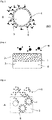
- FIG. 1 Illustrated is a method of manufacturing a device 200 for humidity control, heat exchange or storage comprising a layer of adsorbent composite material 4 on a receiving face 5 of a support 6.
- an adsorbent composite material 4 is first formed by preparing a precursor formulation 100 comprising a moisture adsorbent 1, such as a zeolite, and a polymer 2 such as the non-crosslinked PDMS elastomer. After obtaining a homogeneous formulation 100, it is sprayed, deposited by casting or deposited by immersion on a surface receiving the support substrate 6. Then a heat treatment is applied at 80° C. in order to crosslink the PDMS and form a layer of adsorbent composite material 4.
- a precursor formulation 100 comprising a moisture adsorbent 1, such as a zeolite, and a polymer 2 such as the non-crosslinked PDMS elastomer. After obtaining a homogeneous formulation 100, it is sprayed, deposited by casting or deposited by immersion on a surface receiving the support substrate 6. Then a heat treatment is applied at 80° C. in order to crosslink the PDMS and form a layer of adsorbent composite material
- the zeolite is desorbed by applying a heat treatment at 80° C. for 1 hour (the water adsorbed in the open air is removed). Then 39.57 g of the dried zeolite are taken and then mixed with 60.3 g of non-crosslinked PDMS.
- a mixture of the precursor formulation 100 obtained is carried out by a paint mixer for at least 5 min so as to eliminate the zeolite aggregates.
- the precursor formulation 100 comprising a loading rate of 22% by volume of moisture adsorbent 1 is then deposited by casting onto a receiving surface 5 of a support substrate 6, composed of glass spheres or beads (for the storage of heat) according to step b) of the process, as illustrated in figure 1 .
- the glass beads in fact have hydroxyl groups on the receiving surface 5, which are essential for obtaining the grip and the adhesion of the adsorbent composite material 4.
- the receiving surface 5 corresponds to the whole of the surface of the support substrate 6 and the adsorbent composite material 4 will take the form of a coating layer of the support substrate 6.
- the PDMS is then crosslinked by applying a heat treatment to the support substrate 6 covered with said precursor formulation 100 at a temperature of between 80 and 100° C. for a period of approximately 10 min.
- the coating layer of adsorbent composite material 4 has a thickness of about 450 micrometers.
- the support substrate 6 is immersed via a grid 7 in a bath of precursor formulation 100 as illustrated in figure 2 .
- glass balls 6 capable of storing heat are coated with a coating layer of adsorbent composite material 4, as illustrated in picture 3 .
- An enlargement of the interface visible at the figure 4 shows the surface 5 of glass 6 covered by an adsorbent composite material 4 consisting of a matrix 3 containing the zeolite is in the form of 'crystalline grains'. Since the matrix 3 is permeable to water vapour, the water molecules 8 pass through the matrix 3 and are adsorbed or desorbed by the zeolite depending on the temperature and the relative humidity of the environment ( figure 5 ).
- the polymer 2 intended to form the matrix 3 is chosen so that the matrix 3 has a gas permeability greater than 6000 barrers and preferably 10000 barrers.
- examples of polymer 2 are cellulose acetate (which will be shaped after deposition at 260° C.), elastomers of the siloxane family, or silane elastomers which will be crosslinked at ambient temperature or by heat treatment depending on whether the precursor formulation 100 contains or is free of a cross-linking agent.
- the support substrate 6 is chosen from a ceramic such as alumina, which makes it possible to obtain another device 200 for heat exchange.
- the support substrate 6 is a metal having a native oxide on the surface, such as aluminum, stainless steels, zinc, tin, copper, titanium and their alloys, so as to present groups hydroxyl at the receiving surface 5.
- the device 200 obtained based on metal is advantageously used for humidity control.
- the support substrate 6 does not have a surface hydroxyl function. It is then covered with a primer having OH bonds on the surface.
- the precursor formulation 100 comprises the adhesion primer so that it is not necessary to carry out an additional step of deposition on the receiving surface 5.
- the surface of reception 5 is planar, for example in the case of a support substrate 6 having the overall shape of a plate, and the layer of adsorbent composite material 4 is then a covering layer, the layer covering only one face of said plate.
- the moisture adsorbent 1 is chosen from zeolite of the silico-alumino-phosphate type, in particular a zeolite Mitsubishi Plastics AQSOA-Z01 ® , AQSOA-Z02 ® , AQSOA-Z05 ® , an alumino-silicate XAY and a ferro-alumino-phosphate, or else silica gel and derivatives, activated carbon, or activated alumina.
- zeolite of the silico-alumino-phosphate type in particular a zeolite Mitsubishi Plastics AQSOA-Z01 ® , AQSOA-Z02 ® , AQSOA-Z05 ® , an alumino-silicate XAY and a ferro-alumino-phosphate, or else silica gel and derivatives, activated carbon, or activated alumina.
- the rate of loading of the moisture adsorbent 1 is variable within a larger range, ranging from 10% to 70% by volume.
- the inventors of the present invention have carried out tests comparing the adsorption and desorption capacity of an adsorbent composite material 4, of the matrix 3 in a permeable polymer used alone (crosslinked PDMS), and of the adsorbent of only 1 humidity (zeolite).
- adsorbent composite materials 4 comprising respectively 14% by volume and 23% by volume of zeolite in the precursor formulation were tested.
- the weight of the crosslinked PDMS has changed little, which shows that this crosslinked polymer had not adsorbed water, it is therefore a candidate of choice to serve as matrix 3 for a humidity adsorbent 1 because it has a low capacity. to absorb water molecules.
- the weight of the zeolite alone decreased for 40 min showing a desorption of approximately 18% in water.
- the weight of the adsorbent composite material 4 comprising 14% v of zeolite decreased with slower kinetics but showing desorption according to a percentage of water equivalent to that of the zeolite alone.
- the weight of the adsorbent composite 4 comprising 23% v of zeolite decreased in the same proportions with equivalent kinetics.
- the present invention proposes an adsorbent composite material 4 that is as effective in terms of absorption/desorption as the humidity adsorbent 1 alone, while having very good mechanical resistance to shocks and to static or repeated mechanical stresses, thanks to the composition of the matrix 3 into a permeable polymer.
- This adsorbent composite material 4 is also thermally stable and can withstand temperatures up to 250° C. so that it resists thermal cycling.
- the viscosity of the precursor formulation 100 can be easily varied so as to allow various modes of implementation and in particular on different types of support substrates, such as ceramics, metals, etc... provided that their receiving surface 5 has hydroxyl groups.
- the devices 200 thus obtained find an application in humidity control or heat exchange operating in a temperature range which can vary between 50° C. and 250° C. depending on the choice of the constituent humidity adsorbent 1 .
Landscapes
- Chemical & Material Sciences (AREA)
- Analytical Chemistry (AREA)
- Chemical Kinetics & Catalysis (AREA)
- Organic Chemistry (AREA)
- Inorganic Chemistry (AREA)
- Engineering & Computer Science (AREA)
- General Chemical & Material Sciences (AREA)
- Oil, Petroleum & Natural Gas (AREA)
- Materials Engineering (AREA)
- Dispersion Chemistry (AREA)
- Drying Of Gases (AREA)
- Solid-Sorbent Or Filter-Aiding Compositions (AREA)
Abstract
Matériau composite adsorbant (4) destiné à des dispositifs de contrôle de l'humidité, des dispositifs d'échange thermique ou de stockage thermique, le matériau composite adsorbant (4) comprenant :
- un adsorbant d'humidité (1), choisi dans le groupe comprenant une zéolite, un gel de silice, un charbon actif, une alumine activée et/ou leur combinaison, et
- une matrice (3) en un polymère perméable, ledit polymère perméable étant obtenu à partir d'un polymère (2) choisi parmi l'acétate de cellulose ou un élastomère non réticulé, tel qu'un siloxane et/ou un élastomère silané, de sorte que la matrice (3) en un polymère perméable est stable jusqu'à 240°C et présente une perméabilité à la vapeur d'eau supérieure à 6000 barrers.
- un adsorbant d'humidité (1), choisi dans le groupe comprenant une zéolite, un gel de silice, un charbon actif, une alumine activée et/ou leur combinaison, et
- une matrice (3) en un polymère perméable, ledit polymère perméable étant obtenu à partir d'un polymère (2) choisi parmi l'acétate de cellulose ou un élastomère non réticulé, tel qu'un siloxane et/ou un élastomère silané, de sorte que la matrice (3) en un polymère perméable est stable jusqu'à 240°C et présente une perméabilité à la vapeur d'eau supérieure à 6000 barrers.
Description
- La présente invention se rapporte au domaine des matériaux adsorbants en vue d'application dans le domaine du contrôle de l'humidité, de l'échange et du stockage thermique. En particulier, la présente invention concerne un matériau composite adsorbant utilisé dans de tels dispositifs ainsi que le procédé de fabrication desdits dispositifs.
- Les matériaux adsorbants/ désorbants l'humidité sont très intéréssants pour de nombreuses applications industrielles, par exemple pour le séchage des gaz, le contrôle de l'humidité et le stockage thermique. En effet, selon les conditions de température et d'humidité relative dans lequel il est placé, le matériau adsorbant adsorbe l'humidité par un phénomène exothermique qui dégage de la chaleur ou bien le matériau sorbant désorbe l'humidité qu'il contient par une réaction endothermique qui consomme de la chaleur. Toutefois, les matériaux sorbants sont difficilement utilisables en tant que tels car leurs propriétés intrinsèques ne répondent pas à toutes les exigences de l'industrie. Ils sont par exemple difficiles à mettre en forme, présentent une faible résistance mécanique de sorte qu'ils sont déteriorés lors de leur utilisation ou de leur mise en forme d'usage. Il ont besoin d'être associés à d'autres composants pour une mise en forme facilitée et une utilisation durable et fiable. Des matériaux composites comprenant un matériau adsorbant ont été élaborés par le passé. L'un d'entre eux utilise un mélange de polymère thermoplastique enrichi par des plastifiants utiles pour améliorer les propriétés rhéologiques en vue de la mise en forme et la limitation des efforts tangentiels et par une cire pour apporter de la perméabilité au gaz et à la vapeur d'eau à la matrice mais la présence de polymère thermoplastique limite à 100°C la température d'utilisation du matériau composite. Une autre solution proposée consiste à utiliser un polymère à base d'époxy. Toutefois l'epoxy est formé à partir de bisphenol qui est potentiellement toxique et le polymère obtenu est un thermoplastique cassant et peu susceptible de supporter un grand nombre de cyclage thermiques.
- Un des buts de la présente invention est de pallier un ou plusieurs de ces inconvénients. A cet effet, et selon un premier aspect, l'invention propose un matériau composite adsorbant destiné à des dispositifs de contrôle de l'humidité, dispositifs d'échange thermique ou de stockage thermique, le matériau composite adsorbant comprenant :
- un adsorbant d'humidité, choisi dans le groupe comprenant une zéolite, un gel de silice, un charbon actif, une alumine activée et/ou leur combinaison, et
- une matrice en un polymère perméable, ledit polymère perméable étant obtenu à partir d'un polymère choisi parmi l'acétate de cellulose ou un élastomère non réticulé, tel qu'un siloxane et/ou un élastomère silané, de sorte que la matrice en un polymère perméable est stable jusqu'à 240°C et présente une perméabilité à la vapeur d'eau supérieure à 6000 barrers.
- Ainsi composé, le matériau composite adsorbant selon l'invention permet d'associer un adsorbant d'humidité à une matrice en un polymère perméable à la vapeur d'eau de sorte à conserver les propriétés sorbantes de l'adsorbant d'humidité placé au sein même du polymère (se reporter ci-dessous aux résultats de test de désorption). De plus, le matériau composite adsorbant ainsi composé offre une grande résistance au cyclage thermique ce qui garantit une solution industrielle pérenne. En effet, la matrice en un polymère perméable ainsi configurée présente un module de cisaillement G compris entre 0.3 et 3MPa ce qui permet de d'obtenir une grande résistance mécanique aux chocs, aux contraintes mécaniques statiques et répétées, même lorsqu'elle est soumise à des changements de température importants. Par exemple, des tests de 5 cyclages consécutifs ont été réalisés respectivement à 120°C et 200°C avec un adsorbant à base de zéolite et une matrice en un polymère perméable en PDMS (acronyme de PolyDiMethylSiloxane) et aucune modification des propriétés ni aucune dégradation n'ont été observées.
- Selon une disposition, les siloxanes sont choisis selon la formule suivante :

- Les polymères à base de silane sont choisis par exemple parmi ceux de formule :
- [(CH3)2Si(CH2)nR]DP avec DP = degré de polymérisation, R = Si(CH3)2O ou CH2 et n compris entre 2 et 20, ou bien
- [(CH3)2Si x-C6H4Si(CH3)2O]DP avec x signifiant la position para- ou meta-.
- Selon une possibilité, l'élastomère non réticulé choisi pour former la matrice présente des terminaisons hydrogène.
- Selon un exemple de réalisation l'élastomère non réticulé choisi pour former la matrice est un siloxane à terminaison hydrogène, par exemple du PDMS à terminaison hydrogène, ou un mélange de siloxane à terminaison hydrogène et d'un silane à terminaison hydrogène.
- Selon une disposition, l'élastomère non réticulé choisi pour former la matrice est dépourvu de siloxane à terminaison hydroxyle, de siloxane à terminaison silanol, par exemple de PDMS à terminaison silanol, d'hydrure de siloxane, de silane trifonctionnel, et de silane avec au moins trois groupes hydrolysables.
- Selon une variante de réalisation, l'élastomère non réticulé choisi pour former la matrice comprend un siloxane à terminaison hydrogène et du silane.
- Selon une autre variante de réalisation, l'élastomère non réticulé choisi pour former la matrice est dépourvu de silane seul.
- La plage de poids moléculaire varie de 104 à 106 g/mol pour les polymères réticulables à température ambiante.
- Le poids moléculaire est supérieur ou égal à 3.105 g/mol pour les polymères réticulables sous l'action de la chaleur.
- Selon une possibilité, le matériau composite adsorbant est obtenu par réticulation d'une formulation précurseur comprenant un élastomère non réticulé et un absorbant d'humidité.
- Selon une disposition, la formulation précurseur utilisée pour l'obtention du matériau composite adsorbant comprend de l'adsorbant d'humidité et d'un polymère perméable tel que l'acétate de cellulose ou un élastomère non réticulé, tel qu'un siloxane et/ou un élastomère silané, le polymère perméable constituera la matrice après réticulation.
- De préférence, la formulation précurseur utilisée pour l'obtention du matériau composite adsorbant est constituée de l'adsorbant d'humidité et d'un polymère perméable tel que l'acétate de cellulose ou un élastomère, tel qu'un siloxane et/ou un élastomère silané, le polymère perméable constituera la matrice après réticulation.
- Selon une variante la formulation précurseur peut inclure en complément un agent de réticulation (dans une plage allant de 0,5% poids à 20% poids), un solvant et/ou un primaire d'accroche.
- Autrement dit, le matériau composite adsorbant est dépourvu du tout plastifiant, additif, cire ou autres. Cette composition limite les risques de décomposition du matériau composite adsorbant au cours des cyclages thermiques grâce à une forte cohésion entre l'adsorbant d'humidité et ladite matrice en un polymère perméable et facilite les opérations de mise en forme. En effet, tout élément additionnel à cette composition, hormis un agent de réticulation, conduirait inévitablement à une désagrégation du matériau composite adsorbant au cours du temps.
- Selon une disposition, la formulation précurseur est dépourvue d'eau.
- La matrice en un polymère perméable peut comprendre un mélange de plusieurs polymères.
- Avantageusement, la matrice en un polymère perméable est obtenue par réticulation d'un siloxane, et de préférence par réticulation de PDMS. La perméabilité d'un telle matrice de PDMS avoisine en effet 40000 barrers.
- La réticulation augmente le degré de polymérisation du/des polymère(s) présent(s) dans la matrice en un polymère perméable. La réticulation est obtenue à l'air et à température ambiante en présence d'un agent de réticulation ou par traitement thermique à une température inférieure à 100°C.
- Avantageusement, la matrice en un polymère perméable est configurée pour présenter une perméabilité à la vapeur d'eau supérieure à 10000 barrers.
- En unité SI, le Barrer, généralement utilisé par l'homme de l'art peut être exprimé selon l'unité de perméabilité CGS, en utilisant les éléments suivants:

- Les polymères perméables appartenant à la famille des siloxanes, tel que le PDMS, sont stables à des températures allant jusqu'à 250°C ce qui permet une utilisation avec une large gamme d'adsorbants d'humidité, dont ceux actifs à des températures élevées. Il est donc possible de les utiliser dans un grande palette d'applications industrielles.
- En ce qui concerne le matériau composite adsorbant composé d'acétate de cellulose, celui-ci sera mis en forme par un traitement thermique à 260°C permettant la fusion du polymère thermoplastique.
- Selon une disposition, l'adsorbant d'humidité est une zéolite choisie parmi un silico-alumino-phosphate, notamment une zéolite Mitsubishi Plastics AQSOA-Z01®, AQSOA-Z02®, AQSOA-Z05®, un alumino-silicate XAY et un ferro-alumino-phosphate. La zéolite est en effet une structure cristalline microporeuse permettant d'adsorber une grande quantité de molécules d'eau. Elle est choisie de préférence pour présenter un mécanisme de désorption/adsorption à une température inférieure à 200° C entre 0%Hr et 80%Hr (Hr pour Humidité relative), et de préférence entre 10°C et 100°C. Par exemple, le silico-alumino-phosphate fonctionne entre 20°C et 100°C et entre 0%Hr et 70%Hr
- De préférence l'adsorbant d'humidité est une zéolite de la famille AQSOA® ou un gel de silice. Par gel de silice, on entend dans le présent document un polymère d'hydroxyde de silicium Si(OH)4.
- De manière concrète, le taux de charge de l'adsorbant d'humidité est compris dans une plage allant d'environ 10% en volume à environ 70% en volume par rapport au volume d'une formulation précurseur du matériau composite adsorbant. La formulation précurseur étant constituée par le mélange d'un adsorbant d'humidité asséché au préalable, avec un polymère tel de l'acétate de cellulose ou un élastomère non réticulé, tel qu'un siloxane et/ou un élastomère silané. Elle est ensuite réticulée ou mise en forme, selon la nature du polymère utilisé, pour conduire au matériau composite adsorbant.
- Par exemple, lorsque le taux de charge de zéolite est plus de 50% en volume par rapport au volume de la formulation précurseur, la viscosité de la formulation précurseur est d'environ 100 000Pa.s. Il est possible d'effectuer son dépôt par immersion.
- Pour la zéolite AQSOA-Z05®, le taux de charge se situe dans une plage allant de 28 à 85% poids du poids total de la formulation précurseur. De préférence, le taux de charge est compris entre 28 et 65% poids du poids total de la formulation précurseur.
- Lorsqu'on souhaite utiliser le matériau composite adsorbant seul, dans des dispositifs de contrôle d'humidité, des dispositifs d'échange et /ou de stockage thermique, le taux de charge de l'adsorbant d'humidité se situe dans une plage allant de 40 % à 70% en volume par rapport au volume de la formulation précurseur. Dans ce cas, le matériau composite adsorbant est utilisé sous forme d'agrégat, et ne nécessite pas nécessairement l'utilisation d'un substrat support.
- Selon un autre aspect, la présente invention propose un dispositif de contrôle d'humidité, d'échange thermique ou de stockage thermique, comprenant un substrat support comportant une surface de réception et une couche d'un matériau composite adsorbant tel que précédemment décrit, déposée sur la surface de réception.
- La couche en matériau composite adsorbant présente une épaisseur supérieure à 5 micromètres.
- Lorsque l'adsorbant d'humidité est une zéolite se présentant sous la forme d'une poudre d'un diamètre moyen de 5 micromètres, l'épaisseur de la couche en matériau composite est préférentiellement comprise entre 400 et 800 micromètres.
- De préférence, le dispositif de contrôle d'humidité d'échange thermique ou de stockage thermique est obtenu à partir d'une formulation précurseur présentant un taux de charge en adsorbant d'humidité allant de 15 % à 45 % en volume par rapport au volume de la formulation précurseur. Cette proportion garantit l'obtention d'une formulation précurseur simple à appliquer sur le substrat support grâce à une fluidité adaptée et la couche en matériau composite adsorbant qui en résulte est homogène et efficace.
- Selon une disposition, la surface de réception consiste en une face exposée du substrat support, notamment lorsque le substrat présente une forme globale parallélépipédique, sans exclure d'autres formes.
- Selon une autre disposition, la surface de réception consiste en la totalité de la surface du substrat support, notamment lorsque le substrat présente une forme globale sphérique ou une forme globale de grille sans exclure d'autres formes.
- Selon encore une autre variante, la surface de réception consiste également en une surface interne au volume périphérique global du substrat support, notamment lorsque le substrat support présente des alvéoles, des nids d'abeilles ou autres géométries complexes.
- La couche en matériau composite adsorbant déposée est parfois appelée 'couche de recouvrement' car elle recouvre la surface de réception du substrat support. Lorsque la surface de réception consiste en la totalité de la surface dudit substrat support, ladite couche en matériau composite adsorbant peut être appelée 'couche d'enrobage' car elle enrobe le substrat support.
- De manière avantageuse, la surface de réception du substrat support est configurée pour présenter des groupements hydroxyles. Les groupements hydroxyles permettent en effet d'obtenir un effet d'adhérence entre le matériau composite adsorbant comprenant des silanes, et la surface de réception grâce à une interaction telle qu'un couplage avec la matrice lors de la réticulation.
- Le couplage est soit obtenu par une réaction chimique conduisant à une liaison forte de type ionique ou de type covalente entre le substrat support et le matériau composite adsorbant ou à une interaction de type liaison hydrogène.
- Dans ce dernier cas, la couche de matériau composite adsorbant sera de préférence une couche d'enrobage de la totalité du substrat support de sorte à renforcer le lien et la tenue du matériau composite adsorbant au substrat support.
- Selon une possibilité et la nature du substrat support, la surface de réception est activée par traitement UV ou par plasma.
- Selon une disposition, la surface de réception comprend un métal capable de former une couche d'oxyde natif à l'air, tel que l'aluminium, les aciers inoxydables, le zinc, l'étain, le cuivre, le titane, le nickel et leurs alliages.
- Avantageusement, le substrat support est entièrement constitué dudit métal présentant une couche d'oxyde natif.
- Le matériau composite adsorbant ainsi conçu, avec ou sans support, est particulièrement utile pour un contrôle d'humidité dans lequel la température appliquée au métal et la teneur en humidité relative induira l'adsorption ou la désorption d'humidité du matériau composite adsorbant.
- Selon une autre possibilité, la surface de réception comprend une céramique, telle que du verre ou de l'alumine. Avantageusement, le substrat support est entièrement constitué de ladite céramique. Le dispositif obtenu est avantageusement utilisé dans un échangeur thermique. En effet, l'adsorption ou la désorption d'humidité du matériau composite adsorbant, selon la teneur en humidité relative et la température de l'environnement considéré, conduira à augmenter ou diminuer la température de la céramique.
- Selon une variante, la surface de réception du substrat support comprend un primaire d'accroche configuré pour présenter des fonctions hydroxyles. Par l'expression 'primaire d'accroche' on entend dans le présent document un film de matériau dont la surface exposée présente des groupements hydroxyles ou qui est capable d'une activation énergétique de la surface par un traitement plasma, laser ou un nettoyage acide.
- De préférence, le primaire d'accroche utilisé est un silane et notamment un γ-amino propyl triéthoxysilane ou un 3-amino propyldiméthyléthoxysilane.
- Selon encore un autre aspect, la présente invention propose un procédé de fabrication d'un dispositif de contrôle d'humidité, d'un dispositif d'échange thermique ou de stockage thermique tel que précédemment décrit, comprenant :
- a) préparation d'une formulation précurseur en mélangeant un adsorbant d'humidité asséché au préalable, avec un polymère tel que de l'acétate de cellulose ou un élastomère non réticulé, tel qu'un siloxane et/ou un élastomère silané, comme précédemment décrit,
- b) dépôt d'une couche de la formulation précurseur sur la surface de réception du substrat support,
- c) réticulation de la couche de la formulation précurseur lorsque le polymère comprend un élastomère non réticulé ou application d'un traitement thermique de mise en forme lorsque le polymère comprend de l'acétate de cellulose, de sorte à obtenir un matériau composite adsorbant déposé sur la surface de réception.
- Le mélange composite est homogénéisé par un mélangeur mécanique ou par ultrason de sorte à obtenir une formulation précurseur homogène. Le mélangeur utilisé peut être tout dispositif permettant d'homogénéiser un mélange de poudre avec une phase fluide tel qu'un mélangeur à peinture, un mélangeur bras mécanique, une bétonnière.
- L'assèchement de l'adsorbant d'humidité est réalisé par un traitement thermique réalisé dans des conditions de température, d' humidité relative et de durée permettant la désorption totale de l'adsorbant d'humidité.
- Selon un mode de réalisation, la formulation précurseur comprend un taux charge adsorbant d'humidité allant de 10 à 20% en volume par rapport au volume de la formulation précurseur de sorte à obtenir une viscosité de la formulation précurseur adaptée à un dépôt par pulvérisation de la formulation précurseur sur la surface de réception du substrat support.
- Selon une variante de réalisation, la formulation précurseur est déposée par coulée de la formulation précurseur sur la surface de réception du substrat support.
- Selon une autre possibilité, la formulation précurseur est déposée par immersion du substrat support dans un bain de ladite formulation précurseur.
- Dans ces deux modes de réalisation, le taux charge en adsorbant d'humidité varie de 20 à 40% en volume par rapport au volume de la formulation précurseur de sorte à obtenir une viscosité de la formulation précurseur adaptée.
- Selon une disposition, l'étape c) de réticulation est réalisée à température ambiante, notamment lorsque la formulation précurseur comprend un agent de réticulation.
- Selon une variante, l'étape c) de réticulation comprend l'application d'un traitement thermique à une température inférieure à 100°C et de préférence inférieure ou égale à 80°C.
- Selon une variante, l'étape c) de mise en forme de la formulation précurseur comprenant de l'acétate de cellulose est réalisée par application d'un traitement thermique à une température supérieure ou égale à 260°C.
- Le traitement thermique est avantageusement obtenu par conduction (plaque chauffante) par convection (flux d'air chaud) ou par radiation (infrarouges, panneau radiants).
- D'autres aspects, buts et avantages de la présente invention apparaîtront mieux à la lecture de la description suivante d'un mode de réalisation de celle-ci, donnée à titre d'exemple non limitatif et faite en référence aux figures annexées. Les figures ne respectent pas nécessairement l'échelle de tous les éléments représentés de sorte à améliorer leur lisibilité.
- La
figure 1 est une vue schématique illustrant un dépôt par coulée d'une formulation précurseur sur un substrat support selon un mode de réalisation de l'invention, - La
figure 2 est une vue schématique illustrant un dépôt par immersion d'une formulation précurseur sur un substrat support selon un mode de réalisation de l'invention, - La
figure 3 est une vue schématique illustrant un dispositif d'échange de chaleur selon un mode de réalisation de l'invention, - La
figure 4 est une vue schématique illustrant un agrandissement de la surface de réception d'un subtrat support du dispositif d'échange de chaleur illustré à lafigure 3 . - La
figure 5 est une vue schématique illustrant un agrandissement du matériau composite adsorbant du dispositif d'échange de chaleur illustré auxfigures 3 et 4 . - Aux
figures 1 à 3 est illustré un procédé de fabrication d'un dispositif 200 de contrôle d'humidité, d'échange ou de stockage thermique comprenant une couche de matériau composite adsorbant 4 sur une face de réception 5 d'un support 6. - Pour ce faire, un matériau composite adsorbant 4 est tout d'abord formé par préparation d'une formulation précurseur 100 comprenant un adsorbant d'humidité 1, telle qu'une zéolite, et un polymère 2 tel que l'élastomère PDMS non réticulé. Après obtention d'une formulation 100 homogène, elle est pulvérisée, déposée par coulée ou déposée par immersion sur une surface de réception du substrat support 6. Puis un traitement thermique est appliqué à 80°C afin de réticuler le PDMS et former une couche de matériau composite adsorbant 4.
- Un exemple de réalisation de l'invention pour la fabrication d'un dispositif d'échange de chaleur est maintenant décrit en détail.
- Selon l'étape a) du procédé de fabrication, la zéolite est désorbée par application d'un traitement thermique à 80°C pendant 1h (l'eau adsorbée à l'air libre est retirée). Puis 39,57g de la zéolite asséchée sont prélevés puis mélangés à 60,3 g de PDMS non réticulé. Un mélange de la formulation précurseur 100 obtenue est effectué par un mélangeur à peinture pendant au moins 5 min de sorte à éliminer les agrégats de zéolite. La formulation précurseur 100 comprenant un taux de charge de 22% en volume en adsorbant d'humidité 1 est ensuite déposée par coulée sur une surface de réception 5 d'un substrat support 6, composé de sphères ou billes de verre (pour le stockage de chaleur) selon l'étape b) du procédé, tel qu'illustré à la
figure 1 . Les billes de verre présentent en effet des groupements hydroxyles à la surface de réception 5, indispensables pour obtenir l'accroche et l'adhérence du matériau composite adsorbant 4. Dans cet exemple de réalisation, la surface de réception 5 correspond à la totalité de la surface du substrat support 6 et le matériau composite adsorbant 4 prendra la forme d'une couche d'enrobage du substrat support 6. - Selon l'étape c) du procédé, le PDMS est ensuite réticulé par application d'un traitement thermique au substrat support 6 recouvert de ladite formulation précurseur 100 à une température comprise entre 80 et 100°C pendant une durée d'environ 10 min. En fin de réticulation, la couche d'enrobage en matériau composite adsorbant 4 présente une épaisseur d'environ 450 micromètres.
- D'autres expériences de fabrication de dispositif 200 ont été réalisées en faisant varier la concentration de zéolite dans la formulation précurseur 100. Un taux de charge compris entre 20 et 25% en volume permet d'obtenir une couche d'enrobage de qualité. Lorsque le taux de charge est plus élevé, la formulation précurseur 100 devient très visqueuse pour l'étape b) de dépôt par coulée. Un taux de charge plus faible conduit à une formulation précurseur 100 est susceptible de conduire à un matériau composite dont la cinétique d'adsorption n'est plus aussi satisfaisante.
- Selon une autre possibilité de dépôt de la formulation précurseur 100 destinée à former la couche de matériau composite adsorbant 4, le substrat support 6 est immergé via une grille 7 dans un bain de formulation précurseur 100 comme illustré à la
figure 2 . - A l'issue du procédé de fabrication du dispositif 200 d'échange de chaleur, des billes de verre 6 capables de stocker la chaleur sont enrobées d'une couche d'enrobage en matériau composite adsorbant 4, tel qu'illustré à la
figure 3 . Un agrandissement de l'interface visible à lafigure 4 montre la surface 5 en verre 6 couverte par une matériau composite adsorbant 4 constitué d'une matrice 3 contentant la zéolite se présente sous forme de 'grains cristallins'. La matrice 3 étant perméable à la vapeur d'eau, les molécules d'eau 8 traversent la matrice 3 et sont adsorbées ou désorbées par la zéolite selon la température et l'humidité relative de l'environnement (figure 5 ). - Selon une variante non illustrée, le polymère 2 destiné à former la matrice 3 est choisi de sorte que la matrice 3 présente une perméabilité au gaz supérieur à 6000 barrers et de préférence 10000 barrers. Des exemples de polymère 2 sont l'acétate de cellulose (qui sera mis en forme après dépôt à 260°C) des élastomères de la famille des siloxanes, ou des élastomères silanés qui seront réticulés à l'ambiante ou par traitement thermique selon que la formulation précurseur 100 contient un agent de réticulation ou en est exempte.
- Selon une autre mode de réalisation, le substrat support 6 est choisi parmi une céramique telle que de l'alumine ce qui permet d'obtenir un autre dispositif 200 d'échange de chaleur.
- Selon une variante, le substrat support 6 est un métal présentant un oxyde natif en surface, tel que l'aluminium, les aciers inoxydables, le zinc, l'étain, le cuivre, le titane et leurs alliages, de sorte à présenter des groupements hydroxyle à la surface de réception 5. Le dispositif 200 obtenu à base de métal est avantageusement utilisé pour le contrôle d'humidité. Selon une autre possibilité, le substrat support 6 n'est pas doté de fonction hydroxyle en surface. Il est alors recouvert d'un primaire d'accroche présentant des liaisons OH en surface. Selon une autre option, la formulation précurseur 100 comprend le primaire d'accroche de sorte qu'il n'est pas nécessaire de procéder à une étape supplémentaire de dépôt sur la surface de réception 5. Selon une autre variante non illustrée, la surface de réception 5 est planaire, par exemple dans le cas d'un substrat support 6 présentant une forme globale de plaque, et la couche de matériau composite adsorbant 4 est alors une couche de recouvrement, la couche ne couvrant qu'une face de ladite plaque.
- Selon d'autres modes de réalisation non détaillés ici, l'adsorbant d'humidité 1 est choisi parmi la zéolite du type silico-alumino-phosphate, notamment une zéolite Mitsubishi Plastics AQSOA-Z01®, AQSOA-Z02®, AQSOA-Z05®, un alumino-silicate XAY et un ferro-alumino-phosphate, ou bien du gel de silice et dérives, du charbon actif, ou de l'alumine activée.
- Selon une variante de réalisation, le taux de charge de l'adsorbant d'humidité 1 est variable dans une plage plus importante, allant de 10% à 70% en volume.
- Enfin, les inventeurs de la présente invention ont réalisé des tests comparant la capacité d'adsorption et de désorption d'un matériau composite adsorbant 4, de la matrice 3 en un polymère perméable utilisée seule (PDMS réticulé), et de l'adsorbant d'humidité 1 seul (zéolite).
- Deux exemples de matériaux composites adsorbants 4 comprenant respectivement 14% en volume et 23% en volume de zéolite dans la formulation précurseur ont été testés.
- Ces quatre composés ont été au préalable placés dans des conditions de température et d'humidité relative permettant de saturer la totalité de leur capacité d'adsorption en vapeur d'eau. Les composés ont été ensuite pesés puis placés à une température de 60°C. Une pesée des composés a été réalisée toutes les 10 min jusqu'à 150 min pour suivre l'évolution de la désorption.
- Le poids du PDMS réticulé a peu évolué, ce qui montre que ce polymère réticulé n'avait pas adsorbé d'eau, il est donc un candidat de choix pour servir de matrice 3 à un adsorbant d'humidité 1 car elle présente une faible capacité à absorber les molécules d'eau.
- Le poids de la zéolite seule a diminué pendant 40 min en montrant une désorption d'environ 18% en eau.
- Le poids du matériau composite adsorbant 4 comprenant 14%v de zéolite a diminué avec une cinétique plus lente mais en montrant une désorption selon un pourcentage d'eau équivalent à celui de la zéolite seule.
- Le poids du composite adsorbant 4 comprenant 23%v de zéolite a diminué dans les mêmes proportions avec une cinétique équivalente.
- Cette expérience montre ainsi que la zéolite du matériau composite adsorbant 4 conserve ses propriétés sorbantes dans la matrice 3 de PDMS réticulé et ce, quelle que soit la concentration ou taux de charge en zéolite, même si la cinétique est un peu plus lente.
- Ainsi, la présente invention propose un matériau composite adsorbant 4 aussi efficace en terme d'absorption/désorption que l'adsorbant d'humidité 1 seul, tout en présentant une très bonne résistance mécanique aux chocs et aux contraintes mécaniques statiques ou répétées, grâce à la composition de la matrice 3 en un polymère perméable. Ce matériau composite adsorbant 4 est également stable thermiquement et peut résister à des températures allant jusqu'à 250°C de sorte qu'il résiste au cyclage thermique. La viscosité de la formulation précurseur 100 peut être facilement variée de sorte à permettre diverses modes de mise en œuvre et notamment sur différents types de substrats supports, telles que les céramiques, métaux, etc... pour peu que leur surface de réception 5 présente des groupements hydroxyles. Les dispositifs 200 ainsi obtenus trouvent une application dans le contrôle de l'humidité ou l'échange de chaleur fonctionnant dans une plage de température pouvant varier entre 50°C et 250°C en fonction du choix de l'adsorbant d'humidité 1 constitutif.
- Il va de soi que l'invention n'est pas limitée aux variantes de réalisation décrites ci-dessus à titre d'exemple mais qu'elle comprend tous les équivalents techniques et les variantes des moyens décrits ainsi que leurs combinaisons.
Claims (10)
- Matériau composite adsorbant (4) destiné à des dispositifs de contrôle de l'humidité, des dispositifs d'échange thermique ou de stockage thermique, le matériau composite adsorbant (4) comprenant :- un adsorbant d'humidité (1), choisi dans le groupe comprenant une zéolite, un gel de silice, un charbon actif, une alumine activée et/ou leur combinaison, et- une matrice (3) en un polymère perméable, ledit polymère perméable étant obtenu à partir d'un polymère (2) choisi parmi l'acétate de cellulose ou un élastomère non réticulé, tel qu'un siloxane et/ou un élastomère silané, de sorte que la matrice (3) en un polymère perméable est stable jusqu'à 240°C et présente une perméabilité à la vapeur d'eau supérieure à 6000 barrers.
- Matériau composite adsorbant (4) selon la revendication 1, dans lequel la matrice (3) en un polymère perméable est obtenue par réticulation d'un siloxane, et de préférence par réticulation de PDMS.
- Matériau composite adsorbant (4) selon l'une des revendications 1 à 2, dans lequel l'adsorbant d'humidité (1) est une zéolite choisie parmi un silico-alumino-phosphate, notamment une zéolite Mitsubishi Plastics AQSOA-Z01®, AQSOA-Z02®, AQSOA-Z05®, un alumino-silicate XAY et un ferro-alumino-phosphate.
- Matériau composite adsorbant (4) selon l'une des revendications 1 à 3, dans lequel le taux de charge de l'adsorbant d'humidité (1) est compris dans une plage allant d'environ 10% en volume à environ 70% en volume par rapport au volume d'une formulation précurseur (100) du matériau composite adsorbant.
- Dispositif (200) de contrôle d'humidité, dispositif d'échange thermique ou de stockage thermique, comprenant un substrat support (6) comportant une surface de réception (5) et une couche d'un matériau composite adsorbant (4) selon l'une des revendications 1 à 4, déposée sur la surface de réception (5).
- Dispositif (200) de contrôle d'humidité, dispositif d'échange thermique ou de stockage thermique selon la revendication 5, dans lequel la surface de réception (5) est configurée pour présenter des groupements hydroxyles.
- Dispositif (200) de contrôle d'humidité, d'échange thermique ou de stockage thermique selon l'une des revendication 5 à 6, dans lequel la surface de réception (5) comprend un métal capable de former une couche d'oxyde natif à l'air, tel que l'aluminium, les aciers inoxydables, le zinc, l'étain, le cuivre, le titane, le nickel et leurs alliages.
- Dispositif (200) de contrôle d'humidité, d'échange thermique ou de stockage thermique selon la revendication 5 à 6, dans lequel la surface de réception (5) comprend une céramique, telle que du verre ou de l'alumine.
- Dispositif (200) de contrôle d'humidité, d'échange thermique ou de stockage thermique selon l'une des revendications 5 à 8, dans lequel la surface de réception (5) comprend un primaire d'accroche configuré pour présenter des fonctions hydroxyles.
- Procédé de fabrication d'un dispositif (200) de contrôle de l'humidité, d'un dispositif d'échange thermique ou de stockage thermique selon l'une des revendications 5 à 9 comprenant :- a) préparation d'une formulation précurseur (100) en mélangeant un adsorbant d'humidité (1) asséché au préalable, avec un polymère (2) tel que de l'acétate de cellulose ou un élastomère non réticulé, tel qu'un siloxane et/ou un élastomère silané, tel que précédemment décrit,- b) dépôt d'une couche de la formulation précurseur (100) sur la surface de réception (5) du substrat support (6),- c) réticulation de la couche de la formulation précurseur (100) lorsque le polymère (2) comprend un élastomère non réticulé ou application d'un traitement thermique de mise en forme lorsque le polymère (2) comprend de l'acétate de cellulose, de sorte à obtenir un matériau composite adsorbant (4) déposé sur la surface de réception (5).
Applications Claiming Priority (1)
| Application Number | Priority Date | Filing Date | Title |
|---|---|---|---|
| FR2100127A FR3118588B1 (fr) | 2021-01-07 | 2021-01-07 | Matériau composite adsorbant destiné à des dispositifs de contrôle de l’humidité, des dispositifs d’échange et de stockage thermique |
Publications (1)
| Publication Number | Publication Date |
|---|---|
| EP4026611A1 true EP4026611A1 (fr) | 2022-07-13 |
Family
ID=74759097
Family Applications (1)
| Application Number | Title | Priority Date | Filing Date |
|---|---|---|---|
| EP22150593.6A Pending EP4026611A1 (fr) | 2021-01-07 | 2022-01-07 | Matériau composite adsorbant destiné à des dispositifs de contrôle de l humidité, des dispositifs d échange et de stockage thermique |
Country Status (2)
| Country | Link |
|---|---|
| EP (1) | EP4026611A1 (fr) |
| FR (1) | FR3118588B1 (fr) |
Citations (1)
| Publication number | Priority date | Publication date | Assignee | Title |
|---|---|---|---|---|
| WO2020120142A1 (fr) * | 2018-12-14 | 2020-06-18 | Sorption Technologies GmbH | Matériau de revêtement destiné à produire un revêtement souple, poreux, adsorbant pour un échangeur de chaleur et son procédé de production |
-
2021
- 2021-01-07 FR FR2100127A patent/FR3118588B1/fr active Active
-
2022
- 2022-01-07 EP EP22150593.6A patent/EP4026611A1/fr active Pending
Patent Citations (1)
| Publication number | Priority date | Publication date | Assignee | Title |
|---|---|---|---|---|
| WO2020120142A1 (fr) * | 2018-12-14 | 2020-06-18 | Sorption Technologies GmbH | Matériau de revêtement destiné à produire un revêtement souple, poreux, adsorbant pour un échangeur de chaleur et son procédé de production |
Non-Patent Citations (1)
| Title |
|---|
| ANGELO FRENI ET AL: "SAPO-34 coated adsorbent heat exchanger for adsorption chillers", APPLIED THERMAL ENGINEERING, vol. 82, 3 March 2015 (2015-03-03), GB, pages 1 - 7, XP055273476, ISSN: 1359-4311, DOI: 10.1016/j.applthermaleng.2015.02.052 * |
Also Published As
| Publication number | Publication date |
|---|---|
| FR3118588B1 (fr) | 2023-12-29 |
| FR3118588A1 (fr) | 2022-07-08 |
Similar Documents
| Publication | Publication Date | Title |
|---|---|---|
| JP4121164B2 (ja) | フルオロシリコーンコーティング | |
| CN114316636B (zh) | 一种消杂光-分子吸附-热控三功能涂料及其制备方法和应用 | |
| EP3339392B1 (fr) | Composition adhesive et son utilisation dans l'electronique | |
| TWI334387B (en) | Device package and method of making a device package | |
| FR2856072A1 (fr) | Composition silicone reticulable en gel adhesif. | |
| CN112675822B (zh) | 一种高吸收高发射率超黑分子吸附涂层的制备方法 | |
| CN103073371B (zh) | 自粘型激光微推进透射靶烧蚀材料、其制备方法和用其制备的靶带 | |
| US8120155B2 (en) | Reduced stiction and mechanical memory in MEMS devices | |
| EP4026611A1 (fr) | Matériau composite adsorbant destiné à des dispositifs de contrôle de l humidité, des dispositifs d échange et de stockage thermique | |
| JP4064490B2 (ja) | 酸化保護膜 | |
| CN103073370B (zh) | 叠氮类高分子敏化型高能烧蚀材料及其制备方法和用其制备的靶带 | |
| CN111662617A (zh) | 具有自主和非自主修复功能的铝合金表面涂层 | |
| EP3892691A1 (fr) | Suspension homogène pour peintures zéolithiques | |
| CN109642125A (zh) | 用于封装电子结构体的胶带 | |
| CN102264820A (zh) | 基于在聚合物基体内分散的表面官能化的纳米沸石的用于h2o敏感性器件保护的复合材料 | |
| CN114588793B (zh) | 用于甲烷/氮气分离的混合基质膜及其制备方法 | |
| Jourshabani et al. | Solar‐Active Carbon Nitride Film Integrated by Free Radical Copolymerization for Photocatalytic Indoor Air Purification | |
| FR3114979A1 (fr) | Matériau poreux à base d’un verre borosilicate, utile pour l’absorption et la capture d’iode gazeux, son procédé de préparation et ses utilisations | |
| JP2023059405A (ja) | 紫外線反射用組成物及びその製造方法 | |
| EP0555952B1 (fr) | Revêtements en PVC pour électrodes | |
| Sangermano et al. | UV‐Cured PDMS for Oil Removal from Wastewater | |
| JP4502310B2 (ja) | コーティング剤、薄膜形成方法及び耐熱樹脂薄膜 | |
| CN116731520B (zh) | 一种低挥发无油膜导热凝胶及其制备方法 | |
| CN118652409B (zh) | 一种异氰酸酯固化剂的制备方法及其应用 | |
| Farmazyan et al. | Development of methods for the production of silicone membranes |
Legal Events
| Date | Code | Title | Description |
|---|---|---|---|
| PUAI | Public reference made under article 153(3) epc to a published international application that has entered the european phase |
Free format text: ORIGINAL CODE: 0009012 |
|
| STAA | Information on the status of an ep patent application or granted ep patent |
Free format text: STATUS: REQUEST FOR EXAMINATION WAS MADE |
|
| 17P | Request for examination filed |
Effective date: 20220107 |
|
| AK | Designated contracting states |
Kind code of ref document: A1 Designated state(s): AL AT BE BG CH CY CZ DE DK EE ES FI FR GB GR HR HU IE IS IT LI LT LU LV MC MK MT NL NO PL PT RO RS SE SI SK SM TR |
|
| RAP3 | Party data changed (applicant data changed or rights of an application transferred) |
Owner name: COMMISSARIAT A L'ENERGIE ATOMIQUE ET AUX ENERGIESALTERNATIVES |