EP4024207B1 - Verfahren zur implementierung eines plug-in und system zur implementierung eines plug-in - Google Patents
Verfahren zur implementierung eines plug-in und system zur implementierung eines plug-in Download PDFInfo
- Publication number
- EP4024207B1 EP4024207B1 EP20864942.6A EP20864942A EP4024207B1 EP 4024207 B1 EP4024207 B1 EP 4024207B1 EP 20864942 A EP20864942 A EP 20864942A EP 4024207 B1 EP4024207 B1 EP 4024207B1
- Authority
- EP
- European Patent Office
- Prior art keywords
- plug
- interface
- module
- software module
- implementation
- Prior art date
- Legal status (The legal status is an assumption and is not a legal conclusion. Google has not performed a legal analysis and makes no representation as to the accuracy of the status listed.)
- Active
Links
Images






Classifications
-
- G—PHYSICS
- G06—COMPUTING OR CALCULATING; COUNTING
- G06F—ELECTRIC DIGITAL DATA PROCESSING
- G06F9/00—Arrangements for program control, e.g. control units
- G06F9/06—Arrangements for program control, e.g. control units using stored programs, i.e. using an internal store of processing equipment to receive or retain programs
- G06F9/44—Arrangements for executing specific programs
- G06F9/445—Program loading or initiating
- G06F9/44521—Dynamic linking or loading; Link editing at or after load time, e.g. Java class loading
- G06F9/44526—Plug-ins; Add-ons
-
- G—PHYSICS
- G06—COMPUTING OR CALCULATING; COUNTING
- G06F—ELECTRIC DIGITAL DATA PROCESSING
- G06F8/00—Arrangements for software engineering
- G06F8/70—Software maintenance or management
- G06F8/71—Version control; Configuration management
-
- G—PHYSICS
- G06—COMPUTING OR CALCULATING; COUNTING
- G06F—ELECTRIC DIGITAL DATA PROCESSING
- G06F9/00—Arrangements for program control, e.g. control units
- G06F9/06—Arrangements for program control, e.g. control units using stored programs, i.e. using an internal store of processing equipment to receive or retain programs
- G06F9/44—Arrangements for executing specific programs
- G06F9/445—Program loading or initiating
- G06F9/44536—Selecting among different versions
Definitions
- This application relates to the field of electronic devices, and more specifically, to a plug-in implementation method and a plug-in implementation system in an electronic device.
- an open-source operating system for example, an Android (Android) operating system and a Linux operating system.
- the other type of operating system is a closed-source operating system, for example, an iPhone operating system (iPhone operation system, iOS).
- an iPhone operating system iPhone operation system, iOS.
- each terminal vendor performs in-depth development based on the open-source operating system, adds plug-ins, and customizes terminal software including various plug-ins to extend service functions of terminals.
- the open-source operating system is denoted as open-source software.
- the plug-in When a plug-in of the terminal software is customized, the plug-in is compiled and developed based on code of the open-source software.
- the code of the open-source software needs to be changed accordingly. Consequently, the open-source software and the terminal software are mutually dependent, and cannot be decoupled from each other.
- US 2010/138547 A1 concerns a device including an operating system that receives a broadband card, dynamically loads a non-generic plug-in to detect the broadband card, determines whether the loaded non-generic plug-in detects the broadband card, dynamically loads a generic plug-in when the loaded non-generic plug-in does not detect the broadband card, and uses the generic plug-in to certify the broadband card.
- Systems and methods for installation of hardware devices are provided in US 2005/132352 A1 .
- Hardware devices provided in US 2005/132352 A1 include a mass storage medium which stores device drivers for one or more operating systems. The device driver stored on the mass storage medium can be used for installing the hardware device.
- Java Deep published on 30 March 2019, pages 1-8,Retrieved from the Internet:URL:https://web.archive.org/web/20190330122137/https://javax0. WordPress.com/2018/01/10/java-3-module-services/ [retrieved on 2024-01-17 ] teaches how Java 9's module system utilizes "services" to achieve loose coupling between modules.
- a module can declare its need for a service without specifying the implementation. Other modules can then provide implementations of this interface.
- the system includes a plug-in module and a terminal software module extended by a terminal vendor for open-source software.
- the plug-in module may load a default implementation of the first plug-in interface to invoke the first plug-in interface.
- a plug-in may be extended to extend a service function of a terminal.
- a plug-in interface is inconsistent with a plug-in function
- a default implementation of the plug-in interface is implemented by using the plug-in module, so that an open-source software module can run normally, to ensure normal running of an electronic device as much as possible. Therefore, the open-source software module no longer depends on the terminal software module, and the terminal software module can be decoupled from the open-source software module.
- a plug-in implementation system including a plug-in module and a terminal software module.
- the plug-in module includes a plug-in default implementation module a comprising plug-in default implementation that is in a one-to-one correspondence with a first plug-in interface, and the terminal software module does not include a service implementation of the first plug-in interface.
- the plug-in module is configured to: obtain a first instruction sent an open-source software; and load the default implementation of the first plug-in interface based on the first instruction.
- the terminal software module includes a service implementation of a second plug-in interface, and the plug-in module is further configured to: obtain a fifth instruction, where the fifth instruction is used to load the service implementation of the second plug-in interface; and invoke the second plug-in interface based on the fifth instruction, to load the service implementation of the second plug-in interface.
- the plug-in module is added to the plug-in implementation system provided in this application.
- the plug-in module may load the default implementation of the first plug-in interface to invoke the first plug-in interface.
- a plug-in may be extended to extend a service function of a terminal.
- the default implementation of the plug-in interface is implemented by using the plug-in module, so that an open-source software module can run normally, to ensure normal running of an electronic device as much as possible. Therefore, the open-source software module no longer depends on the terminal software module, and the terminal software module can be decoupled from the open-source software module.
- the plug-in module is specifically configured to: send, to the terminal software module based on the first instruction, a second instruction used to invoke the first plug-in interface; and load the default implementation of the first plug-in interface based on a first feedback instruction that is fed back by the system for the second instruction, where the first feedback instruction is used to indicate that the terminal software module does not include the service implementation of the first plug-in interface.
- the plug-in module may determine, by using the feedback instruction fed back by the system, that the terminal software module does not include the service implementation of the first plug-in interface, and flexibly selects to load the default implementation of the first plug-in interface, so that the open-source software module can run normally, to ensure the normal running of the electronic device as much as possible. In this way, the open-source software module no longer depends on the terminal software module, and the terminal software module can be decoupled from the open-source software module.
- the terminal software module includes a plug-in service factory, the plug-in module includes a plug-in default factory, and the plug-in default factory includes the first plug-in interface.
- the plug-in service factory inherits the first plug-in interface, and the terminal software module inherits the default implementation of the first plug-in interface.
- the system is configured to query, based on the first instruction, whether the plug-in service factory exists.
- the plug-in module is specifically configured to send, to the terminal software module based on the first instruction, a second instruction used to invoke the first plug-in interface.
- the terminal software module is configured to load the default implementation of the first plug-in interface based on the second instruction.
- the terminal software module may inherit the default implementation of the first plug-in interface in the plug-in module by adding the plug-in service factory to the terminal software module and adding the default plug-in factory to the plug-in module by using a factory mode.
- the system may query only once and needs to query once whether the plug-in service factory exists.
- the plug-in module invokes the plug-in interface for a plurality of times, a delay caused by querying can be reduced, and system performance is greatly improved.
- the plug-in module is specifically configured to: receive a third instruction sent by the terminal software module, where the third instruction is used to load a first service implementation; and send a fourth instruction to the open-source software module based on a current version of the open-source software module, where the fourth instruction is used to load the first service implementation in the open-source software module of the current version.
- an adaptation module is added to the plug-in implementation system provided in this application.
- the adaptation module may send an instruction to the open-source software module based on the current version of the open-source software module, to instruct loading of the service implementation in the open-source software module of the current version. It can be learned that, the adaptation module serves as a bridge between the open-source software module and the terminal software module, and shields a change of the open-source software module. Therefore, when the open-source software module changes, the terminal software module does not change, so that the terminal software module does not depend on the open-source software module.
- a version number of the terminal software module is a first version
- a version number of the open-source software module is a second version
- the first version is different from the second version
- the open-source software module is configured to uninstall the terminal software module.
- the plug-in module is configured to: obtain a sixth instruction, where the sixth instruction is used to load the service implementation of the first plug-in interface; determine, based on the sixth instruction, that the terminal software module is not installed in the system; and load the default implementation of the first plug-in interface.
- a plug-in loading module determines, based on an instruction that is sent by the open-source software module and used to load a service implementation of a plug-in interface, whether a terminal software module is installed in the system. This effectively avoids abnormal running of the open-source software module caused by uninstallation of the terminal software module.
- the plug-in loading module loads a default implementation of the plug-in interface, so that the open-source software module can run normally, to implement the normal running of the electronic device. In this way, the open-source software module no longer depends on the terminal software module.
- a plug-in implementation method for use in a system including a plug-in module and a terminal software module, where the plug-in module a plug-in default implementation module that includes a plug-in default implementation that is in a one-to-one correspondence with a first plug-in interface, the terminal software module does not include a service implementation of the first plug-in interface, and the method includes:
- the first plug-in interface is used to implement communication between an open-source software module and the terminal software module.
- the plug-in module obtains a first instruction sent by the open-source software module, where the first instruction is used to load the service implementation of the first plug-in interface, and determines based on the first instruction whether the terminal software module includes the service implementation of the first plug-in interface; if the terminal software module includes the service implementation of the first plug-in interface, the plug-in module loads the service implementation of the first plug-in interface, and if the terminal software module does not include the service implementation of the first plug-in interface, the plug-in module loads the default implementation of the first plug-in interface based on the first instruction.
- That the plug-in module loads the default implementation of the first plug-in interface based on the first instruction includes: The plug-in module sends, to the terminal software module based on the first instruction, a second instruction used to invoke the first plug-in interface; and the terminal software module loads the default implementation of the first plug-in interface based on the second instruction.
- the method further includes: The plug-in module receives a third instruction sent by the terminal software module, where the third instruction is used to load a first service implementation; and the plug-in module sends a fourth instruction to the open-source software module based on a current version of the open-source software module, where the fourth instruction is used to load the first service implementation in the open-source software module of the current version.
- the method further includes: changing the terminal software module, where a version number of a changed terminal software module is a third version, and the third version is different from the first version.
- the method further includes: uninstalling the terminal software module; the plug-in module obtains a sixth instruction, where the sixth instruction is used to load the service implementation of the first plug-in interface; the plug-in module determines, based on the sixth instruction, that the terminal software module is not installed in the system; and the plug-in module loads the default implementation of the first plug-in interface.
- the first plug-in interface is any one of the following: a dual-card management interface, a full-frequency interface, a hot plug interface, a SkyTone interface, and a 5G call interface.
- a chip including a processor, configured to invoke and run instructions, from a memory, so that an electronic device on which the chip is installed is enabled to perform the method according to the second aspect.
- an electronic device including a display and the system according to the first aspect.
- open-source software and terminal software are mutually dependent, and cannot be decoupled from each other.
- a typical example is that versions of the open-source software and the terminal software need to be consistent.
- the open-source software may be Android (Android) software
- the terminal software may be emotion user interface (emotion user interface, EMUI) software developed by Huawei based on the Android software.
- EMUI emotion user interface
- Both the Android software and the EMUI software are versions 9.0.
- a terminal vendor extends three plug-ins and defines three plug-in interfaces, which are used to implement communication between the open-source software and the terminal software.
- Three plug-in service implementations corresponding to the three plug-in interfaces also need to be installed in the terminal software, to implement plug-in functions of the three plug-ins, so as to ensure consistency between the plug-in interfaces and the plug-in functions and ensure normal running of the open-source software.
- a plug-in interface is a 5G call interface
- a corresponding plug-in function is a 5G call function.
- the terminal vendor determines, based on various actual situations, that a defined plug-in interface is inconsistent with an implementable plug-in function, and this affects the normal running of the open-source software, and seriously deteriorates user experience.
- the terminal vendor wants to extend a plurality of types of differentiated terminal software for the open-source software, to adapt to different scenario requirements.
- a version of the open-source software is version 3, and five plug-in interfaces are defined.
- the terminal software can be deeply developed based on the open-source software of version 3, to generate a plurality of versions of terminal software.
- Terminal software of version 1 can implement three plug-in functions
- terminal software of version 2 can implement four plug-in functions
- terminal software of version 3 can implement five plug-in functions.
- the terminal vendor wants to define a plurality of plug-in interfaces at a time to meet a potential user requirement.
- the current terminal software does not need to have a plug-in function corresponding to each plug-in interface. That is, the plug-in function of the terminal software is inconsistent with the plug-in interface.
- implementable plug-in functions may be gradually added to the terminal software based on an actual user requirement.
- a plug-in of the terminal software is faulty
- a service implementation of the plug-in needs to be uninstalled to remove a plug-in function of the plug-in.
- code of the terminal software changes. If code of the open-source software does not adaptively change, a terminal cannot be powered on, or a function of the open-source software is abnormal, and the terminal cannot be normally used.
- the code of the open-source software needs to accordingly change. For example, if a version of the terminal software is rolled back, a version of the open-source software also needs to be rolled back. If the version of the terminal software is upgraded, the version of the open-source software also needs to be upgraded, to ensure that the plug-in interface is consistent with the plug-in function of the terminal software, so as to ensure the normal running of the open-source software.
- the open-source software depends on the terminal software.
- a plug-in function of the terminal software is inconsistent with a plug-in interface defined by the terminal vendor, the normal running of the open-source software is seriously affected, and normal running of an electronic device is affected.
- this application provides a plug-in implementation system and method.
- the system includes a plug-in module extended by a terminal vendor for open-source software.
- the plug-in module defines one or more plug-in interfaces, and may provide a default capability of a function of the plug-in interface.
- the open-source software may implement a plug-in function of terminal software by using the plug-in module.
- the plug-in module includes a plug-in loading module and a plug-in default implementation module.
- the plug-in default implementation module includes a plug-in default implementation that is in a one-to-one correspondence with the at least one plug-in interface.
- the plug-in loading module may determine, based on an instruction that is sent by the open-source software and used to load a service implementation of a plug-in interface, whether the terminal software includes the service implementation of the plug-in interface.
- the plug-in loading module loads the service implementation of the plug-in interface. If the terminal software does not include the service implementation of the plug-in interface, the plug-in loading module loads a default implementation of the plug-in interface. In this way, a plug-in may be extended to extend a service function of a terminal. In addition, when the plug-in interface is inconsistent with the plug-in function, the default implementation or the service implementation of the plug-in interface may be implemented by using the plug-in module, and this implements the normal running of the open-source software, and implements normal running of an electronic device.
- the open-source software sends a command related to a plug-in interface.
- the command being completed is presented, or a function of the plug-in interface being completed is presented (although the function that is implemented through the default implementation is not a plug-in function of the plug-in interface). Therefore, the normal running of the open-source software and the normal running of the electronic device can be implemented.
- a plurality of versions of differentiated terminal software may be extended for a same open-source software, to implement a requirement of a scenario in which the plug-in interface is inconsistent with the plug-in function.
- a plurality of plug-in interfaces may be defined at a time, and plug-in functions are accordingly added for a plurality of times based on a user requirement, to meet a potential user requirement.
- only the terminal software needs to change, and the open-source software does not need to change. For example, only the terminal software is upgraded, and the Android software is not upgraded.
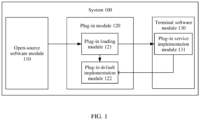
- FIG. 1 is a schematic diagram of a plug-in implementation system according to this application.
- a system 100 includes an open-source software module 110, a plug-in module 120, and a terminal software module 130.
- the open-source software module 110 includes source code of an open-source system.
- the open-source system may be an Android operating system or a Linux operating system.
- the plug-in module 120 is configured to provide a default capability of a plug-in interface extended by a terminal vendor. When an actual function of the plug-in interface cannot be implemented in the terminal software module 130, the default capability of the plug-in interface is implemented to ensure normal running of the system as much as possible.
- the terminal software module 130 is terminal software that is defined by the terminal vendor and developed based on open-source software and that has a terminal personalized style, to implement the actual function of the plug-in interface extended by the terminal vendor. The following describes in detail content of the plug-in module 120 and the terminal software module 120.
- Plug-in interfaces of M plug-ins are defined in the plug-in module 120, and are configured to implement communication between the Android software 110 and the terminal software 130.
- the plug-in module 120 includes a plug-in loading module 121 and a plug-in default implementation module 122.
- the plug-in default implementation module 122 includes default implementations of the M plug-in interfaces.
- a default implementation of the plug-in interface corresponds to a service implementation of the plug-in interface.
- the service implementation of the plug-in interface may be understood as a real implementation of the plug-in interface and can implement an actual function of the plug-in interface.
- the default implementation of the plug-in interface may be understood as a false implementation of the plug-in interface.
- the service implementation of the plug-in interface cannot be implemented, the default implementation of the plug-in interface is implemented.
- the service implementation of the plug-in interface is an enhanced function of the default implementation of the plug-in interface.
- the M plug-in interfaces may include at least one of the following: a dual-card management interface, a full-frequency interface, a hot plug interface, a SkyTone interface, and a 5G call interface.
- a service implementation of the 5G call interface is a 5G call function
- a default implementation of the 5G call interface may be any one of a 4G call function, a 3G call function, or a 2G call function.
- a service implementation of the dual- card management interface is a dual-card management function
- a default implementation of the dual-card management interface may be a single-card management function
- a service implementation of the hot plug interface is a hot plug function.
- the hot plug function is that when a peripheral device is connected to the electronic device, the electronic device may sense the peripheral device and transmit a signal to the peripheral device without restarting.
- a default implementation of the hot plug interface is that when a peripheral device is connected to the electronic device, the electronic device needs to be restarted and scan to sense the peripheral device.
- a service implementation of the full-frequency interface is a full-frequency function.
- the full-frequency function is that the electronic device can support various operators, and when a user switches from one operator to another operator, the electronic device can be connected to a network provided by each operator.
- a default implementation of the full-frequency interface may be that the electronic device supports one operator, and the user may connect the electronic device to a network provided by the operator, but cannot connect the electronic device to a network provided by another operator.
- the default implementation of the plug-in interface may be an inherent service implementation in the open-source software module, or may be a blank implementation, or may be a service implementation extended by the terminal vendor. This is not limited in this application. The following separately describes the three cases.
- a 4G call function is inherent in the open-source software module 110
- the terminal vendor wants to upgrade the 4G call function to extend a 5G call function
- the plug-in interface is a 5G call interface.
- the 4G call function inherent in the open-source software module 110 may be used as the default implementation of the 5G plug-in interface.
- a 3G call function is inherent in the open-source software module 110, and the terminal vendor upgrades the 3G call function twice to implement a 4G call function and a 5G call function respectively.
- the 4G call function extended by the terminal vendor may be used as the default implementation of the 5G call interface.
- the terminal vendor needs to extend a plug-in function of a plug-in interface, and the open-source software module 110 does not include a low configuration of the plug-in function, for example, a SkyTone function.
- a blank implementation may be used as a default implementation of the plug-in interface.
- the plug-in loading module 121 may determine, based on an instruction that is sent by the open-source software module 110 and used to invoke a service implementation of a plug-in interface, whether the terminal software module 130 includes the service implementation of the plug-in interface. If the terminal software module 130 includes the service implementation of the plug-in interface, the plug-in loading module 121 loads the service implementation of the plug-in interface. If the terminal software module 130 does not include the service implementation of the plug-in interface, the plug-in loading module 121 loads a default implementation of the plug-in interface.
- the terminal software module 130 includes a plug-in service implementation module 131, where the plug-in service implementation module 131 includes service implementations of N plug-in interfaces.
- the plug-in service implementation module 131 includes service implementations of N plug-in interfaces.
- a relationship between the N plug-in interfaces and the M plug-in interfaces is explained by using an example in which the M plug-in interfaces defined in the plug-in module 120 include a full-frequency interface, a hot plug interface, and a dual-card management interface, and the plug-in module 120 includes default implementations of three plug-in interfaces.
- the N plug-in interfaces may be the M plug-in interfaces defined by the terminal vendor in the plug-in module 120.
- the terminal software module 130 has plug-in functions of the M plug-in interfaces.
- the terminal software module 130 has a full-frequency function, a hot plug function, and a dual-card management function.
- the plug-in interface is consistent with the plug-in function.
- the N plug-in interfaces may include some of the M plug-in interfaces.
- the terminal vendor defines the M plug-in interfaces in the plug-in module 120
- the terminal software module 130 has plug-in functions of only some of the M plug-in interfaces.
- the terminal software module 130 has any plug-in function of a full-frequency function, a hot plug function, and a dual-card management function, or the terminal software module 130 has any two plug-in functions of a full-frequency function, a hot plug function, and a dual-card management function.
- the N plug-in interfaces may include some of the M plug-in interfaces and another plug-in interface, and the another plug-in interface does not belong to the M plug-in interfaces.
- the terminal software module 130 can implement plug-in functions of only some of the M plug-in interfaces, and cannot implement a function of the another plug-in interface temporarily.
- the terminal software module 130 has a full-frequency function and a 5G call function, where a 5G call interface corresponding to the 5G call function is not a plug-in interface defined in the plug-in module 120.
- the N plug-in interfaces may include the M plug-in interfaces and another plug-in interface.
- the terminal software module 130 can implement only plug-in functions of the M plug-in interfaces, and cannot implement a function of the another plug-in interface temporarily.
- the terminal software module 130 not only has a full-frequency function, a hot plug function, a dual-card management function, and a 5G call function, where a 5G call interface corresponding to the 5G call function is not a plug-in interface defined in the plug-in module 120.
- the plug-in service implementation module 131 points to the plug-in default implementation module 122 by using an arrow. This indicates that the service implementation and the corresponding default implementation of the plug-in interface are implemented in an inheritance manner, where the default implementation is a parent class, and the service implementation is a subclass. This design can ensure external uniformity of the plug-in interface. That is, regardless of the default implementation or the service implementation of the plug-in interface is implemented by using the plug-in module, for the open-source software module, the M plug-in interfaces defined by the terminal vendor are always presented.
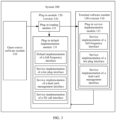
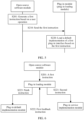
- FIG. 2 to FIG. 4 are other schematic diagrams of the plug-in implementation system according to this application. It should be understood that the system shown in FIG. 2 to FIG. 4 is merely an example for description, and shall not constitute a limitation on this application.
- FIG. 2 may correspond to a case in which a plug-in interface is consistent with a plug-in function.
- four plug-in interfaces are defined in the plug-in module 120.
- the plug-in loading module 121 may invoke the four plug-in interfaces
- the plug-in default implementation module 121 includes default implementations of the four plug-in interfaces.
- the terminal software module 130 may implement plug-in functions of the four plug-in interfaces
- the plug-in service implementation module 131 includes service implementations of the four plug-in interfaces.
- a version of the plug-in module 120 is consistent with a version of the terminal software module 130, for example, both are versions 3.0.
- FIG. 3 may correspond to a case in which a plug-in interface is inconsistent with a plug-in function.
- four plug-in interfaces are defined in the plug-in module 120.
- the plug-in loading module 121 may invoke the four plug-in interfaces
- the plug-in default implementation module 121 includes default implementations of the four plug-in interfaces.
- the terminal software module 130 may implement plug-in functions of only three of the four plug-in interfaces, and the plug-in service implementation module 131 includes service implementations of the three plug-in interfaces. Subsequently, the terminal vendor may install a service implementation of the remaining plug-in interface in the terminal software module 130 based on an actual requirement.
- a version number of the plug-in module 120 is different from a version number of the terminal software module 130.
- a version of the plug-in module 120 is 3.0
- a version of the terminal software module 130 is 2.0.
- the terminal software module may be upgraded to version 3.0 based on an actual requirement, and the service implementation of the remaining plug-in interface is added to the plug-in module 120, so that the plug-in interface is consistent with a plug-in function.
- the plug-in interface is inconsistent with the plug-in function. Otherwise, the open-source software module cannot run, and the electronic device cannot be powered on, or a system function is severely abnormal, and the electronic device is unavailable.
- the plug-in interface is inconsistent with the plug-in function, which indicates that the version numbers of the plug-in module 120 and the terminal software module 130 are inconsistent.
- the inconsistency does not affect normal running of the open-source software module and the electronic device.
- the plug-in module intelligently determines and loads a service implementation in the terminal software module.
- the case in which the plug-in interface is inconsistent with the plug-in function may also include the following case.
- the terminal vendor defines three plug-in interfaces in the plug-in module 120
- the plug-in service implementation module 131 of the terminal software module 130 may include service implementations of the three plug-in interfaces and a service implementation of another plug-in interface.
- the electronic device can implement only plug-in functions of the three plug-in interfaces, and cannot implement a plug-in function of the another plug-in interface.
- the another plug-in interface may be added to the plug-in module, to implement the plug-in function of the another plug-in interface.
- a version of the plug-in module 120 is different from a version of the terminal software module 130.
- the version of the plug-in module is 2.0, and the version of the terminal software module 130 is 3.0.
- the version of the plug-in module 120 is upgraded to 3.0 to be consistent with the plug-in function.
- the terminal software module 130 may be uninstalled.
- the system 100 includes the open-source software module 110 and the plug-in module 120.
- a default implementation in the plug-in module 120 may be loaded to implement a requirement of the open-source software module 110 for a function of a plug-in interface.
- the plug-in implementation system provided in this application is described in detail above with reference to FIG. 1 to FIG. 4 .
- FIG. 5 to FIG. 7 a plug-in implementation method provided in this application is described in detail.
- Modules in the embodiments corresponding to FIG. 5 to FIG. 7 may correspond to the modules in FIG. 1 .
- This case may correspond to the embodiments shown in FIG. 5 and FIG. 6 .
- this application is described by using a first plug-in interface in M plug-in interfaces defined by a terminal vendor as an example, that is, using an example in which the plug-in module includes a default implementation of the first plug-in interface, and a terminal software module does not include a service implementation of the first plug-in interface.
- the plug-in module may further include default implementations of other M - 1 plug-in interfaces.
- the terminal software module does not include the service implementation of the first plug-in interface, and may include a service implementation of another plug-in interface.
- the another plug-in interface may be the M - 1 plug-in interfaces, may be some of the M - 1 plug-in interfaces, may be some of the M - 1 plug-in interfaces and a plug-in interface that does not exist in the plug-in module, or may be a plug-in interface that does not exist in the M plug-in interfaces and the plug-in module.
- the first plug-in interface may be a 5G plug-in interface
- the another plug-in interface may be at least one of a full-frequency interface, a hot plug interface, and a dual-card management interface.
- an open-source software module generates a first instruction based on a user operation, where the first instruction is used to load the service implementation of the first plug-in interface.
- the user operation may be an operation in various forms. This is not limited in this application.
- the user operation may be a tap operation, a swipe operation, or the like performed by a user on a display of an electronic device, or may be a voice input by the user.
- the open-source software module Based on the user operation, the open-source software module generates the first instruction corresponding to the user operation, where the first instruction is used to load the service implementation of the first plug-in interface. It may be understood that, the user wants a system to implement a plug-in function of the first plug-in interface through the user operation, so as to meet a requirement.
- Call making is used as an example.
- the user enters a user operation by dialing a number and tapping a call button.
- the open-source software module learns, based on the user operation, that the user wants to make a call.
- the open-source software module preferentially makes a call through a 5G network. Therefore, the first instruction related to a 5G call function may be generated.
- the first plug-in interface is a 5G plug-in interface.
- the first instruction may be a 5G call instruction used to implement the 5G call function, or may be a call instruction used to implement a call function. If the first instruction is a call instruction, the plug-in loading module preferentially invokes the 5G call interface based on the call instruction.
- the open-source software module sends the first instruction. Accordingly, the plug-in loading module receives the first instruction.
- the plug-in loading module loads the default implementation of the first plug-in interface based on the first instruction.
- the plug-in loading module can load the default implementation of the first plug-in interface in the plug-in default implementation module.
- the plug-in module when the terminal software module does not include the service implementation of the first plug-in interface, the plug-in module loads the default implementation of the first plug-in interface to invoke the first plug-in interface. In this way, a plug-in may be extended to extend a service function of a terminal.
- a default implementation or a service implementation of the plug-in interface may be implemented by using the plug-in module, so that the open-source software module can run normally, to ensure normal running of the electronic device as much as possible. In this way, the open-source software module no longer depends on the terminal software module, and the terminal software module can be decoupled from the open-source software module.
- the plug-in loading module may determine, based on the first instruction, that the plug-in service implementation module does not include the service implementation of the first plug-in interface, and further load the service implementation of the first plug-in interface.
- step S220 is described by using steps S221, S222, and S223 in the following.
- the plug-in loading module sends, to the plug-in service implementation module based on the first instruction, a second instruction used to invoke the first plug-in interface.
- the plug-in loading module may determine, based on the first instruction, that the open-source software module wants to invoke the first plug-in interface to implement the plug-in function of the first plug-in interface. Therefore, the plug-in loading module may invoke the first plug-in interface by using the second instruction, to load the service implementation of the first plug-in interface and implement the plug-in function of the first plug-in interface.
- the plug-in loading module may send an instruction to the system, to determine whether the terminal software module is installed in the system. In this way, when the terminal software module shown in FIG. 4 is uninstalled, abnormal running of the open-source software module caused by the terminal software module being uninstalled can be effectively avoided through this step.
- the system may determine, based on the instruction sent by the plug-in loading module, whether a terminal software module is installed in the system. If no terminal software module is installed in the system, the system sends a feedback instruction to the plug-in loading module to indicate that no terminal software module is installed in the system. If the terminal software module is installed in the system, the plug-in loading module sends, to the plug-in service implementation module without receiving the feedback instruction sent by the system, the second instruction used to invoke the first plug-in interface.
- the system may determine whether the plug-in service implementation module includes the service implementation of the first plug-in interface. If the plug-in service implementation module does not include the service implementation of the first plug-in interface, the system sends the first feedback instruction to the plug-in loading module, so that the plug-in loading module may determine that the plug-in service implementation module does not include the service implementation of the first plug-in interface. In this way, the plug-in loading module may load the default implementation of the first plug-in interface.
- the plug-in loading module sends a ninth instruction to the plug-in default implementation module based on the first feedback instruction, to load the default implementation of the first plug-in interface.
- the first plug-in interface is a 5G call interface in the following.
- the embodiment of this application is further described with reference to Case 1.
- the plug-in default implementation module includes a default implementation of the 5G call interface
- the default implementation is a 4G call function
- the plug-in service implementation module in the terminal software module does not include a service implementation of the 5G plug-in interface, that is, does not include a 5G call function.
- the plug-in loading module may notify, in a possible manner, the user that the 4G call function is currently implemented, so that the user can independently select whether to use the current 4G call function.
- the possible manner may be popping up an interface window, outputting a voice prompt, or the like.
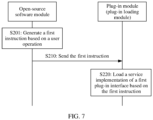
- This case may correspond to the embodiment shown in FIG. 7 .
- this application is described by using a first plug-in interface in M plug-in interfaces defined by a terminal vendor as an example, that is, using an example in which the plug-in module includes a default implementation of the first plug-in interface, and a terminal software module includes a service implementation of the first plug-in interface. It should be understood that the plug-in module may alternatively include a default implementation of another plug-in interface, and the terminal software module may alternatively include a service implementation of the another plug-in interface. This is not limited in this application.
- an open-source software module generates a first instruction based on a user operation, where the first instruction is used to load the service implementation of the first plug-in interface.
- step S201 For descriptions of this step, refer to related descriptions of step S201 in Case 1. Details are not described herein again.
- the open-source software module sends the first instruction. Accordingly, a plug-in loading module receives the first instruction.
- the plug-in loading module loads the service implementation of the first plug-in interface based on the first instruction.
- a plug-in service implementation module includes the service implementation of the first plug-in interface
- a plug-in function of the first plug-in interface may be implemented. That is, the plug-in loading module may load the service implementation of the first plug-in interface.
- the plug-in service implementation module includes the service implementation of the first plug-in interface
- that the plug-in loading module loads the service implementation of the first plug-in interface based on the first instruction includes:
- the plug-in loading module may send, to the plug-in service implementation module based on the first instruction, a second instruction used to invoke the first plug-in interface.
- the plug-in service implementation module may load the service implementation of the first plug-in interface based on the second instruction.
- the plug-in loading module may load the service implementation of the first plug-in interface by using the plug-in service implementation module.
- step S221 For descriptions about sending the second instruction by the plug-in loading module, refer to related descriptions of step S221 in case 1. Details are not described herein again.
- the plug-in service implementation module sends a second feedback instruction to the plug-in loading module, where the second feedback instruction is used to indicate that the plug-in loading module successfully invokes the service implementation of the first plug-in interface.
- the second feedback instruction may be used to indicate that the plug-in service implementation module includes the service implementation of the first plug-in interface.
- the first plug-in interface is a 5G call interface in the following.
- the embodiment of this application is further described with reference to Case 2.
- the plug-in default implementation module includes a default implementation of the 5G call interface
- the default implementation is a 4G call function
- the plug-in service implementation module in the terminal software module includes a service implementation of the 5G plug-in interface, that is, includes a 5G call function.
- whether a service implementation of a plug-in interface exists may be queried by using a reflection mechanism, and the query process is time-consuming and requires high performance overheads.
- the plug-in loading module invokes a plurality of plug-in interfaces by using a plurality of instructions, one instruction invokes one plug-in interface.
- the system of the comparative example needs to perform query several times to determine whether the service implementation of the plug-in interface exists. It is assumed that the plug-in loading module invokes an instruction of a plug-in interface, and a process in which the system queries whether a service implementation of the plug-in interface exists takes 0.1 ms. If there are 10 instructions used to invoke the plug-in interface, the query process takes 1 ms. This causes a long delay and affects system performance of the comparative example.
- a factory mode is proposed. That is, a plug-in service factory is added. A quantity of query times of the system can be reduced by using the plug-in service factory, to improve system performance.
- the foregoing 10 instructions are still used as an example.
- the system needs to perform query for 10 times, and the process takes 1 ms.
- the system performs query only once by using the plug-in service factory.
- the system queries, based on the first instruction, whether the plug-in service factory exists. Because it has been determined whether the plug-in service factory exists, the system does not need to perform query based on a subsequent instruction. This greatly reduces a delay and improves system performance.
- the following describes a plug-in implementation system provided in this application with reference to FIG. 8 . Further, the system shown in FIG. 8 is used as an example to describe a plug-in implementation method provided in this application with reference to FIG. 9 .
- FIG. 8 is another schematic diagram of a plug-in implementation system according to this application.
- a plug-in default factory 123 is added to a plug-in module 120
- a plug-in service factory 132 is added to a terminal software module 130.
- the plug-in service factory 132 and the plug-in default factory 123 are also implemented in an inheritance manner.
- the plug-in default factory 123 is a parent class
- the plug-in service factory 132 is a subclass. This design can ensure external uniformity of a plug-in interface.
- the plug-in module 120 defines M plug-in interfaces, the plug-in default factory 123 includes the M plug-in interfaces, and a plug-in default implementation module includes default implementations of the M plug-in interfaces.
- a plug-in service implementation module 131 of the terminal software module 130 may include service implementations of N plug-in interfaces.
- the plug-in service factory also includes the M plug-in interfaces, and can implement a plug-in function of each plug-in interface.
- the plug-in service implementation module 131 includes service implementations of M1 of the M plug-in interfaces, and M1 is less than or equal to N, the plug-in service implementation module 131 inherits default implementations of M - M1 of the M plug-in interfaces.
- the plug-in service factory 132 inherits the M - M1 plug-in interfaces. That is, it can be seen from a final result that, the plug-in service factory 132 includes the M plug-in interfaces, and the plug-in service implementation module 131 includes the service implementations of the M1 plug-in interfaces and the default implementations of the M - M1 plug-in interfaces. From a perspective of a plug-in loading module, the plug-in service factory 132 provides the M plug-in interfaces, and can implement the M functions. The plug-in loading module does not consider whether the M functions are implemented by using the default implementations or the service implementations.
- the plug-in loading module 121 can successfully invoke a service implementation or a default implementation of a plug-in interface by using the plug-in service factory 132, regardless of whether the plug-in service implementation module 131 includes the service implementation of the plug-in interface. However, when the plug-in service implementation module 131 does not include the service implementation of the plug-in interface, the default implementation of the plug-in interface is implemented. When the plug-in service implementation module 131 includes the service implementation of the plug-in interface, and the plug-in interface belongs to the M plug-in interfaces, the service implementation of the plug-in interface is implemented.
- the system may include a plurality of plug-in service factories.
- Each plug-in service factory corresponds to one service type.
- the plug-in interfaces are classified to different plug-in service factories based on the service types. Accordingly, a type of a plug-in default factory corresponds to a type of a plug-in service factory. It is assumed that the system includes three plug-in service factories and three plug-in default factories, respectively corresponding to a multimedia service, a short-range communications service, and a communications service.
- the M plug-in interfaces may be classified into three types.
- the plug-in interfaces can be classified by using a factory mode, and the plug-in interfaces of the same class make the code logic clearer. For example, all the plug-in interfaces of the multimedia type are placed in the plug-in service factory of the multimedia type.
- this application is described by using a first plug-in interface in M plug-in interfaces defined by a terminal vendor as an example, that is, using an example in which the plug-in module includes a default implementation of the first plug-in interface, and a terminal software module does not include a service implementation of the first plug-in interface. It should be understood that the plug-in module may alternatively include a default implementation of another plug-in interface, and the terminal software module may alternatively include a service implementation of the another plug-in interface. This is not limited in this application.
- the system that includes the plug-in service factory and the plug-in default factory does not need to determine whether the terminal software module includes the service implementation of the first plug-in interface, and does not need to send a feedback instruction when the terminal software module does not include the service implementation of the first plug-in interface.
- the system determines to load the default implementation or the service implementation of the first plug-in interface by using the plug-in service factory. No matter the plug-in service factory loads the default implementation or the service implementation of the first plug-in interface, it may be understood that the function of the first plug-in interface is implemented.
- the plug-in service implementation module does not include the service implementation of the first plug-in interface, but inherits the default implementation of the first plug-in interface in the plug-in default implementation module, and the plug-in service implementation module includes the default implementation of the first plug-in interface. Therefore, the plug-in service factory loads the default implementation of the first plug-in interface based on the second instruction.
- the terminal software module may inherit the default implementation of the first plug-in interface in the plug-in module by adding the plug-in service factory to the terminal software module and the plug-in default factory to the plug-in module by using a factory mode.
- the system may query only once and needs to query once whether the plug-in service factory exists.
- the plug-in module invokes the plug-in interface for a plurality of times, a delay caused by querying can be reduced, and system performance is greatly improved.
- the following describes, by using version numbers of the open-source software module, the plug-in module, and the terminal software module, that the open-source software module can be decoupled from the terminal software module in the solution provided in this application, so that the open-source software module does not depend on the terminal software module.
- the version number of the terminal software module is a first version
- the version number of the open-source software module is a second version
- the first version is different from the second version
- the first version is version 2.0
- the second version is version 3.0.
- the method further includes: changing the terminal software module, where a version number of a changed terminal software module is a third version, and the third version is different from the first version.
- changing the terminal software module may be upgrading or rolling back the terminal software module, or may be uninstalling one terminal software module and then reinstalling another terminal software module by a user. This is not limited in this application, provided that the terminal software module is changed.
- a plug-in function and a plug-in interface of the unchanged terminal software module are inconsistent, and the version number of the terminal software module is inconsistent with that of the open-source software module.
- the change of the terminal software module does not affect the open-source software module. Therefore, only the terminal software module changes, and the open-source software module does not change.
- the version number of the changed terminal software module is the third version.
- the version number of the terminal software module is the same as the version number of the plug-in module.
- the version number of the changed terminal software module and the version number of the plug-in module are both version 3.0.
- the plug-in function of the terminal software module is consistent with the defined plug-in interface
- the version number of the terminal software module is the same as the version number of the plug-in module
- the version numbers of the open-source software module, the plug-in module, and the terminal software module are all the same.
- the method further includes: uninstalling the terminal software module; the open-source software module sends a sixth instruction to the plug-in loading module, where the sixth instruction is used to load the service implementation of the first plug-in interface; the plug-in loading module determines, based on the sixth instruction, that the terminal software module is not installed in the system; and the plug-in loading module loads the default implementation of the first plug-in interface.
- the plug-in loading module may determine, based on the sixth instruction that is sent by the open-source software module and used to load the service implementation of the first plug-in interface, whether a terminal software module is installed in the system. If no terminal software module is installed in the system, the plug-in loading module loads the default implementation of the first plug-in interface. If the terminal software module is installed in the system, the plug-in loading module sends an instruction used to invoke the first plug-in interface.
- the plug-in loading module may send an instruction to the system, and the system may determine, based on the instruction sent by the plug-in loading module, whether a terminal software module is installed in the system. If no terminal software module is installed in the system, the system sends a feedback instruction to the plug-in loading module to indicate that no terminal software module is installed in the system. If the terminal software module is installed in the system, the plug-in loading module sends, to the plug-in service implementation module without receiving a feedback instruction sent by the system, the instruction used to invoke the first plug-in interface.
- the plug-in loading module determines, based on an instruction that is sent by the open-source software module and used to load a service implementation of a plug-in interface, whether a terminal software module is installed in the system. This effectively avoids abnormal running of the open-source software module caused by uninstallation of the terminal software module.
- the plug-in loading module loads a default implementation of the plug-in interface, so that the open-source software module can run normally, to implement normal running of an electronic device. In this way, the open-source software module no longer depends on the terminal software module.
- the plug-in loading module may determine, by using the provided plug-in loading module and the plug-in default implementation module of the plug-in module, whether a service implementation of a plug-in interface exists in the terminal software module. If the service implementation of the plug-in interface exists in the terminal software module, the plug-in loading module loads the service implementation of the plug-in interface. If the service implementation of the plug-in interface does not exist in the terminal software module, the plug-in loading module loads a default implementation of the plug-in interface. In this way, a plug-in may be extended to extend a service function of a terminal.
- the default implementation or the service implementation of the plug-in interface may be implemented by using the plug-in module. This implements normal running of the open-source software, and implements normal running of the electronic device. In this way, the open-source software module no longer depends on the terminal software module.
- the terminal software module is deeply developed and customized based on the open-source software module, if code of the open-source software module changes, code of the terminal software module also needs to change. For example, if a version of the open-source software module is upgraded, a version of the terminal software module also needs to be upgraded. If the version of the open-source software module is rolled back, the version of the terminal software module also needs to be rolled back. That is, the terminal software module depends on the open-source software module.
- an adaptation module serves as a bridge between the open-source software module and the terminal software module, to shield the change of the open-source software module. Therefore, when the open-source software module changes, the terminal software module does not change, so that the terminal software module does not depend on the open-source software module.
- the adaptation module that serves as the bridge between the open-source software module and the terminal software module needs to match functions related to a plug-in function of terminal software in the open-source software module during software design.
- a function that is in the open-source software module and related to the plug-in function of the terminal software is denoted as a related function, and the related function does not change.
- the terminal software module learns only that the open-source software module provides the related functions, and the terminal software module is unaware of whether code for implementing the related functions changes. In this way, the adaptation module shields the change of the open-source software module to the terminal software module.
- the adaptation module may load a service implementation (or a function module) of the open-source software module based on a current version of the open-source software module.
- the adaptation module may also be referred to as an Android open-source project (android open-source project, AOSP) adaptation module.
- Android open-source project android open-source project, AOSP
- FIG. 12 is still another schematic diagram of a plug-in implementation system according to this application.
- a system 200 shown in FIG. 12 does not include a plug-in loading module and a default plug-in implementation module, and includes an open-source software module 210, an adaptation module 220, and a terminal software module 230.
- the terminal software module 230 includes a plug-in service implementation module that includes service implementations of a plurality of plug-in interfaces.
- the terminal software module 230 needs to load a service implementation of the open-source software module 210
- the terminal software module 230 loads the service implementation of the open-source software module 210 by using the adaptation module 220.
- the adaptation module 220 is added to the system 200 shown in FIG. 12 .
- the open-source software module 210 changes, the terminal software module 230 does not change, so that the terminal software module 230 does not depend on the open-source software module 210.
- the terminal software module loads the service implementation of the open-source software module by using the adaptation module.
- the terminal software module, the adaptation module, and the open-source software module in the following embodiment may be modules corresponding to FIG. 10 to FIG. 12 .
- the plug-in service implementation module of the terminal software module may specifically send the fourth instruction to load the first service implementation in the open-source software module.
- the adaptation module may determine a version number of the open-source software module of the current version. After determining the version number of the open-source software module of the current version, the adaptation module instructs, by using the fourth instruction, to load the first service implementation in the open-source software module of the current version.
- a 5G call is still used as an example in the following.
- the plug-in loading module and the adaptation module a process in which the open-source software module and the terminal software module load a service implementation of each other is described.
- sequence numbers of the foregoing processes do not mean execution sequences.
- the execution sequences of the processes should be determined based on functions and internal logic of the processes, and should not be construed as any limitation on the implementation processes of the embodiments of this application.
- an embodiment of this application further provides a corresponding electronic device.
- the electronic device includes a corresponding module configured to perform the foregoing embodiments.
- the module may be software, hardware, or a combination of software and hardware.
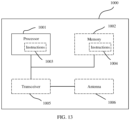
- FIG. 13 is a schematic diagram of a structure of an electronic device.
- An electronic device 1000 may be any possible electronic device including the systems provided in this application.
- the electronic device may be a portable electronic device that further includes another function such as a personal digital assistant and/or a music player function, such as a mobile phone, a tablet computer, or a wearable electronic device (such as a smartwatch) having a wireless communications function.
- the portable electronic device may also be another portable electronic device, such as a laptop computer (Laptop). It should be further understood that, in some other embodiments, the foregoing electronic device may not be the portable electronic device but a desktop computer.
- the electronic device 1000 may include one or more processors 1001, and the processor 1001 may also be referred to as a processing unit, and can implement a specific control function.
- the processor 1001 may be a general-purpose processor, a dedicated processor, or the like.
- the processor 1001 may be a baseband processor or a central processing unit.
- the baseband processor may be configured to process a communications protocol and communications data
- the central processing unit may be configured to control the electronic device, execute a software program, and process data of the software program.
- the processor 1001 may also store instructions and/or data 1003, and the instructions and/or data 1003 may be run by the processor, so that the electronic device 1000 is enabled to perform the method described in the foregoing method embodiments.
- the processor 1001 may include a transceiver unit configured to implement a sending function and a receiving function.
- the transceiver unit may be a transceiver circuit, an interface, or an interface circuit.
- a transceiver circuit, an interface, or an interface circuit configured to implement the sending function and a transceiver circuit, an interface, or an interface circuit configured to implement the receiving function may be separated, or may be integrated.
- the transceiver circuit, the interface, or the interface circuit may be configured to read and write code or data.
- the transceiver circuit, the interface, or the interface circuit may be configured to transmit or transfer a signal.
- the electronic device 1000 may include one or more memories 1002, and the memory 1002 may store instructions 1004, and the instructions may be run on the processor, so that the electronic device 1000 is enabled to perform the method described in the foregoing method embodiments.
- the memory may further store data.
- the processor may also store instructions and/or data.
- the processor and the memory may be separately disposed, or may be integrated together. For example, the correspondences described in the foregoing method embodiments may be stored in the memory or stored in the processor.
- the electronic device 1000 may further include a transceiver 1005 and/or an antenna 1006.
- the processor 1001 may be referred to as a processing unit, and controls the electronic device 1000.
- the transceiver 1005 may be referred to as a transceiver unit, a transceiver device, a transceiver circuit, a transceiver, or the like, and is configured to implement the sending and receiving functions.
- an electronic device 1000 may include a processor 1001.
- the electronic device 1000 is configured to perform the procedures and steps corresponding to the modules in the foregoing method 200.
- the electronic device 1000 is configured to perform the procedures and steps corresponding to the modules in the foregoing method 200.
- the electronic device 1000 is configured to perform the procedures and steps corresponding to the modules in the foregoing method 200.
- the electronic device 1000 is configured to perform the procedures and steps corresponding to the modules in the foregoing method 200.
- the electronic device 1000 is configured to perform the procedures and steps corresponding to the modules in the foregoing method 200.
- FIG. 14 is a schematic diagram of a structure of an electronic device.
- the electronic device 1100 includes a processor, a memory, a control circuit, an antenna, and an input/output apparatus.
- the processor is mainly configured to process a communications protocol and communications data, control an entire terminal, execute a software program, and process data of the software program.
- the memory is configured to store the software program and the data.
- a radio frequency circuit is mainly configured to perform conversion between a baseband signal and a radio frequency signal, and process a radio frequency signal.
- the antenna is mainly configured to receive and send a radio frequency signal in a form of an electromagnetic wave.
- the input/output apparatus for example, a touchscreen, a display, or a keyboard, is mainly configured to receive data entered by a user, and output data to the user.
- the processor may read the software program in the storage unit, parse and execute instructions of the software program, and process the data of the software program.
- the processor performs baseband processing on the to-be-sent data, and outputs a baseband signal to the radio frequency circuit.
- the radio frequency circuit processes the baseband signal to obtain a radio frequency signal, and sends the radio frequency signal in an electromagnetic wave form through the antenna.
- the radio frequency circuit receives a radio frequency signal through the antenna, further converts the radio frequency signal into a baseband signal, and outputs the baseband signal to the processor.
- the processor converts the baseband signal into data, and processes the data.
- the processor may include a baseband processor and a central processing unit.
- the baseband processor is mainly configured to process the communications protocol and the communications data.
- the central processing unit is mainly configured to control the entire electronic device, execute the software program, and process the data of the software program.
- the processor in FIG. 14 integrates functions of the baseband processor and the central processing unit.
- the baseband processor and the central processing unit may be processors independent of each other, and are interconnected by using technologies such as a bus.
- the electronic device may include a plurality of baseband processors to adapt to different network standards, the electronic device may include a plurality of central processing units to enhance a processing capability of the electronic device, and components of the electronic device may be connected by using various buses.
- the baseband processor may also be expressed as a baseband processing circuit or a baseband processing chip.
- the central processing unit may also be expressed as a central processing circuit or a central processing chip.
- a function of processing the communications protocol and the communications data may be built in the processor, or may be stored in the storage unit in a form of a software program.
- the processor executes the software program to implement a baseband processing function.
- FIG. 15 is another schematic diagram of a structure of an electronic device according to this application.
- the electronic device includes a middle frame 1210, a function button 1220, a display 1230, an interface 1240, a processor, and a system provided in this application.
- the system is stored in a memory.
- the function button 1220 and the interface 1240 are disposed on the middle frame 1210, and the display is disposed on one side of the middle frame 1210.
- the electronic device 1200 may be a mobile phone.
- first and second are merely intended for a purpose of descriptions, and shall not be understood as an indication or implication of relative importance or implicit indication of a quantity of indicated technical features.
- a feature limited by “first” or “second” may explicitly or implicitly include one or more features.
- the units described as separate parts may or may not be physically separate, and parts displayed as units may or may not be physical units, may be located at one position, or may be distributed on a plurality of network units. Some or all of the units may be selected based on actual requirements to achieve the objectives of the solutions of the embodiments.
- the functions When the functions are implemented in the form of a software functional unit and sold or used as an independent product, the functions may be stored in a computer-readable storage medium. Based on such an understanding, the technical solutions of this application essentially, or the part contributing to the conventional technology, or some of the technical solutions may be implemented in a form of a software product.
- the computer software product is stored in a storage medium, and includes several instructions for instructing a computer device (which may be a personal computer, a server, a network device, or the like) to perform all or some of the steps of the methods described in the embodiments of this application.
- the storage medium includes any medium that can store program code, such as a USB flash drive, a removable hard disk, a read-only memory (Read-Only Memory, ROM), a random access memory (Random Access Memory, RAM), a magnetic disk, or an optical disc.
- program code such as a USB flash drive, a removable hard disk, a read-only memory (Read-Only Memory, ROM), a random access memory (Random Access Memory, RAM), a magnetic disk, or an optical disc.
Landscapes
- Engineering & Computer Science (AREA)
- Software Systems (AREA)
- Theoretical Computer Science (AREA)
- General Engineering & Computer Science (AREA)
- Physics & Mathematics (AREA)
- General Physics & Mathematics (AREA)
- Computer Security & Cryptography (AREA)
- Stored Programmes (AREA)
- Computer Networks & Wireless Communication (AREA)
- Signal Processing (AREA)
Claims (9)
- System (100) zur Implementierung eines Plug-in, wobei das System ein Plug-in-Modul (120) und ein Endgeräte-Softwaremodul (130) umfasst, wobei das Plug-in-Modul (120) ein Plug-in-Lademodul (121) umfasst,
wobei das Endgeräte-Softwaremodul (130) eine Dienstimplementierung einer zweiten Plug-in-Schnittstelle umfasst und das Plug-in-Modul ferner zu Folgendem konfiguriert ist:Erlangen einer fünften Anweisung, wobei die fünfte Anweisung verwendet wird, um die Dienstimplementierung der zweiten Plug-in-Schnittstelle zu laden; undAufrufen der zweiten Plug-in-Schnittstelle basierend auf der fünften Anweisung, um die Dienstimplementierung der zweiten Plug-in-Schnittstelle zu laden;dadurch gekennzeichnet, dassdas Plug-in-Modul (120) ferner ein Plug-in-Standardimplementierungsmodul (122) umfasst, wobei das Plug-in-Standardimplementierungsmodul (122) eine Plug-in-Standardimplementierung beinhaltet, die in einer Eins-zu-eins-Entsprechung mit einer ersten Plug-in-Schnittstelle steht, wobei das Endgeräte-Softwaremodul (130) nicht die Dienstimplementierung der ersten Plug-in-Schnittstelle umfasst; wobei das Plug-in-Modul (120) ferner zu Folgendem konfiguriert ist:Erlangen einer ersten Anweisung, die durch eine Open-Source-Software gesendet wird, wobei die erste Anweisung verwendet wird, um die Dienstimplementierung der ersten Plug-in-Schnittstelle zu laden; und Laden der Standardimplementierung der ersten Plug-in-Schnittstelle basierend auf der ersten Anweisung,wobei das Endgeräte-Softwaremodul (130) eine Plug-in-Dienst-Factory umfasst, das Plug-in-Modul eine Plug-in-Standard-Factory umfasst, die Plug-in-Standard-Factory die erste Plug-in-Schnittstelle umfasst, die Plug-in-Dienst-Factory die erste Plug-in-Schnittstelle erbt und das Endgeräte-Softwaremodul die Standardimplementierung der ersten Plug-in-Schnittstelle erbt; das Plug-in-Modul (120) insbesondere dazu konfiguriert ist, basierend auf der ersten Anweisung eine zweite Anweisung an das Endgeräte-Softwaremodul (130) zu senden, die verwendet wird, um die erste Plug-in-Schnittstelle aufzurufen; unddas Endgeräte-Softwaremodul (130) dazu konfiguriert ist, die Standardimplementierung der ersten Plug-in-Schnittstelle basierend auf der zweiten Anweisung zu laden;wobei das System dazu konfiguriert ist, basierend auf der ersten Anweisung abzufragen, ob die Plug-in-Dienst-Factory existiert. - System nach Anspruch 1, wobei das Plug-in-Modul (120) insbesondere zu Folgendem konfiguriert ist:Empfangen einer dritten Anweisung, die durch das Endgeräte-Softwaremodul (130) gesendet wird, wobei die dritte Anweisung verwendet wird, um eine erste Dienstimplementierung zu laden; undSenden einer vierten Anweisung an das Open-Source-Softwaremodul (110) basierend auf einer aktuellen Version des Open-Source-Softwaremoduls (110), wobei die vierte Anweisung verwendet wird, um die erste Dienstimplementierung in das Open-Source-Softwaremodul (110) der aktuellen Version zu laden.
- System nach Anspruch 1 oder 2, wobei eine Versionsnummer des Endgeräte-Softwaremoduls eine erste Version ist, eine Versionsnummer des Open-Source-Softwaremoduls eine zweite Version ist und die erste Version sich von der zweiten Version unterscheidet.
- System nach Anspruch 3, wobei das Open-Source-Softwaremodul (110) zu Folgendem konfiguriert ist:
Ändern des Endgeräte-Softwaremoduls (130), wobei eine Versionsnummer eines geänderten Endgeräte-Softwaremoduls (130) eine dritte Version ist und die dritte Version sich von der ersten Version unterscheidet. - System nach einem der Ansprüche 1 bis 4, wobeidas Open-Source-Softwaremodul (110) dazu konfiguriert ist, das Endgeräte-Softwaremodul (130) zu deinstallieren; unddas Plug-in-Modul (120) zu Folgendem konfiguriert ist:Erlangen einer sechsten Anweisung, wobei die sechste Anweisung verwendet wird, um die Dienstimplementierung der ersten Plug-in-Schnittstelle zu laden;Bestimmen, basierend auf der sechsten Anweisung, dass das Endgeräte-Softwaremodul (130) nicht in dem System (100) installiert ist; undLaden der Standardimplementierung der ersten Plug-in-Schnittstelle.
- System nach einem der Ansprüche 1 bis 5, wobei die erste Plug-in-Schnittstelle eine der folgenden ist: eine Dual-Card-Management-Schnittstelle, eine Vollfrequenzschnittstelle, eine Hot-Plug-Schnittstelle, eine SkyTone-Schnittstelle und eine 5G-Anrufschnittstelle.
- Verfahren zur Implementierung eines Plug-in zur Verwendung in einem System (100), das ein Plug-in-Modul (120) und ein Endgeräte-Softwaremodul (130) umfasst, wobei das Plug-in-Modul ein Plug-in-Lademodul (121) umfasst,
wobei das Endgeräte-Softwaremodul (130) eine Dienstimplementierung einer zweiten Plug-in-Schnittstelle umfasst und das Verfahren ferner Folgendes umfasst:Erlangen einer fünften Anweisung durch das Plug-in-Modul, wobei die fünfte Anweisung verwendet wird, um die Dienstimplementierung der zweiten Plug-in-Schnittstelle zu laden; undAufrufen der zweiten Plug-in-Schnittstelle durch das Plug-in-Modul basierend auf der fünften Anweisung, um die Dienstimplementierung der zweiten Plug-in-Schnittstelle zu laden;dadurch gekennzeichnet, dassdas Plug-in-Modul ferner ein Plug-in-Standardimplementierungsmodul (122) umfasst, das eine Plug-in-Standardimplementierung beinhaltet, die in einer Eins-zu-eins-Entsprechung mit einer ersten Plug-in-Schnittstelle steht, wobei das Endgeräte-Softwaremodul /130) keine Dienstimplementierung der ersten Plug-in-Schnittstelle umfasst, wobei das Verfahren ferner Folgendes umfasst:Abfragen durch das Plug-in-Modul (120) basierend auf der ersten Anweisung, ob die Plug-in-Dienst-Factory existiert;Erlangen (S210) einer ersten Anweisung durch das Plug-in-Modul (120), die durch die Open-Source-Software gesendet wird, wobei die erste Anweisung verwendet wird, um die Dienstimplementierung der ersten Plug-in-Schnittstelle zu laden; undLaden (S220) der Standardimplementierung der ersten Plug-in-Schnittstelle basierend auf der ersten Anweisung durch das Plug-in-Lademodul (121); undLaden der Standardimplementierung der ersten Plug-in-Schnittstelle basierend auf der ersten Anweisung,wobei das Endgeräte-Softwaremodul (130) eine Plug-in-Dienst-Factory umfasst, das Plug-in-Modul eine Plug-in-Standard-Factory umfasst, die Plug-in-Standard-Factory die erste Plug-in-Schnittstelle umfasst, die Plug-in-Dienst-Factory die erste Plug-in-Schnittstelle erbt und das Endgeräte-Softwaremodul die Standardimplementierung der ersten Plug-in-Schnittstelle erbt; unddas Laden der Standardimplementierung der ersten Plug-in-Schnittstelle basierend auf der ersten Anweisung durch das Plug-in-Modul (120) Folgendes umfasst:Senden (S221), durch das Plug-in-Modul (120) an das Endgeräte-Softwaremodul (130) basierend auf der ersten Anweisung, einer zweiten Anweisung, die verwendet wird, um die erste Plug-in-Schnittstelle aufzurufen; undLaden (S220), durch das Endgeräte-Softwaremodul, der Standardimplementierung der ersten Plug-in-Schnittstelle basierend auf der zweiten Anweisung;wobei das Verfahren Abfragen, durch das System basierend auf der ersten Anweisung, ob die Plug-in-Dienst-Factory existiert, umfasst. - Elektronische Vorrichtung (1000), wobei die elektronische Vorrichtung (1000) eine Anzeige (1230) und das System (100) nach einem der Ansprüche 1 bis 6 umfasst.
- Chip, einen Prozessor umfassend, der dazu konfiguriert ist, in einem Speicher gespeicherte Anweisungen aufzurufen und auszuführen, sodass eine elektronische Vorrichtung, auf der der Chip installiert ist, befähigt wird, das Verfahren nach Anspruch 7 durchzuführen.
Applications Claiming Priority (2)
| Application Number | Priority Date | Filing Date | Title |
|---|---|---|---|
| CN201910883745.XA CN110764836B (zh) | 2019-09-18 | 2019-09-18 | 插件实现的方法和插件实现的系统 |
| PCT/CN2020/107681 WO2021052054A1 (zh) | 2019-09-18 | 2020-08-07 | 插件实现的方法和插件实现的系统 |
Publications (3)
| Publication Number | Publication Date |
|---|---|
| EP4024207A1 EP4024207A1 (de) | 2022-07-06 |
| EP4024207A4 EP4024207A4 (de) | 2022-10-26 |
| EP4024207B1 true EP4024207B1 (de) | 2025-06-25 |
Family
ID=69330121
Family Applications (1)
| Application Number | Title | Priority Date | Filing Date |
|---|---|---|---|
| EP20864942.6A Active EP4024207B1 (de) | 2019-09-18 | 2020-08-07 | Verfahren zur implementierung eines plug-in und system zur implementierung eines plug-in |
Country Status (4)
| Country | Link |
|---|---|
| US (1) | US11880695B2 (de) |
| EP (1) | EP4024207B1 (de) |
| CN (2) | CN112181514B (de) |
| WO (1) | WO2021052054A1 (de) |
Families Citing this family (5)
| Publication number | Priority date | Publication date | Assignee | Title |
|---|---|---|---|---|
| CN112181514B (zh) * | 2019-09-18 | 2021-08-20 | 华为技术有限公司 | 插件实现的方法和插件实现的系统 |
| CN111475227B (zh) * | 2020-04-02 | 2022-02-01 | 深圳创维-Rgb电子有限公司 | 业务插件加载实现方法、装置和终端设备 |
| CN112052051B (zh) * | 2020-08-31 | 2024-11-19 | 北京嘀嘀无限科技发展有限公司 | 插件处理方法、装置、设备及存储介质 |
| CN113590527B (zh) * | 2021-10-08 | 2022-02-22 | 苏州浪潮智能科技有限公司 | 通信总线的挂死修复方法、装置、电子设备及存储介质 |
| CN117707614B (zh) * | 2024-02-01 | 2024-07-12 | 浙商银行股份有限公司 | 基于Maven插件的工程依赖组件监测方法及装置 |
Family Cites Families (39)
| Publication number | Priority date | Publication date | Assignee | Title |
|---|---|---|---|---|
| US7240323B1 (en) * | 2001-07-26 | 2007-07-03 | Emc Corporation | Plug and play interface for user actions |
| US20050132352A1 (en) * | 2003-12-11 | 2005-06-16 | Konica Minolta Business Technologies, Inc. | Installation of hardware devices |
| US20060041665A1 (en) * | 2004-05-27 | 2006-02-23 | Karnik Neeran M | Network services applications |
| US8661420B2 (en) * | 2004-08-03 | 2014-02-25 | Oracle International Corporation | System and method for runtime interface versioning |
| US8010636B2 (en) * | 2008-12-02 | 2011-08-30 | Verizon Patent And Licensing Inc. | Generic broadband application and plug-ins |
| TWI374637B (en) * | 2008-12-31 | 2012-10-11 | Ind Tech Res Inst | Information transmission and service integration system and method thereof |
| US8863074B2 (en) * | 2010-01-27 | 2014-10-14 | Oracle International Corporation | Software modeling framework |
| CN101937353B (zh) * | 2010-09-20 | 2014-11-05 | 中兴通讯股份有限公司 | 一种插件部署和加载的方法及装置 |
| US20130198606A1 (en) * | 2012-01-30 | 2013-08-01 | Microsoft Corporation | Software application distribution in documents |
| CN103365644B (zh) * | 2012-04-10 | 2016-05-11 | 腾讯科技(深圳)有限公司 | 一种扩展软件功能的方法及装置 |
| CN103425517B (zh) * | 2012-05-14 | 2017-03-29 | 中兴通讯股份有限公司 | 扩展软件功能的方法、上层软件客户端及拉远功能服务器 |
| CN103309674B (zh) * | 2013-06-25 | 2016-08-10 | 深圳中兴网信科技有限公司 | 一种软件架构系统 |
| CN104601651A (zh) * | 2014-11-18 | 2015-05-06 | 浪潮(北京)电子信息产业有限公司 | NaaS的多级插件系统 |
| CN105373396B (zh) * | 2015-08-14 | 2018-01-05 | 腾讯科技(深圳)有限公司 | 插件平台中的插件更新加载方法和装置 |
| US20170168807A1 (en) * | 2015-12-14 | 2017-06-15 | Le Holdings (Beijing) Co., Ltd. | Method and electronic device for updating application program |
| CN105389222B (zh) * | 2015-12-15 | 2018-12-21 | 中国科学院声学研究所 | 一种动态调用原生接口的方法、装置和系统 |
| CN106909408B (zh) * | 2015-12-23 | 2020-09-11 | 北京奇虎科技有限公司 | 一种调用应用程序的apk插件的方法及装置 |
| FI20165019A (fi) * | 2016-01-13 | 2017-07-14 | Valmet Automation Oy | Toiminnon suorittaminen palveluun teollisessa automaatiojärjestelmässä |
| CN105912366B (zh) * | 2016-04-14 | 2019-07-05 | 广州久邦世纪科技有限公司 | 一种桌面应用程序插件化的实现方法 |
| CN105955787B (zh) * | 2016-05-18 | 2019-11-22 | 深圳市掌玩网络技术有限公司 | 一种用于Android系统的插件加载方法及装置 |
| CN106126299B (zh) * | 2016-06-30 | 2020-03-03 | 百度在线网络技术(北京)有限公司 | 业务插件的处理方法及装置 |
| CN106569794B (zh) * | 2016-09-23 | 2020-03-24 | 北京五八信息技术有限公司 | 应用程序开发装置 |
| CN107870787B (zh) * | 2016-09-26 | 2021-04-27 | 平安科技(深圳)有限公司 | 应用程序插件化加载方法及系统 |
| CN106874047B (zh) * | 2017-01-25 | 2020-08-04 | 广东神马搜索科技有限公司 | 分布式系统调度方法、装置及分布式系统 |
| CN108874554B (zh) * | 2017-05-09 | 2020-11-10 | 腾讯科技(深圳)有限公司 | 信息通信方法及装置 |
| CN107203683B (zh) * | 2017-07-24 | 2018-04-06 | 中国人民解放军国防科学技术大学 | 卫星导航系统级开源仿真系统的建立方法 |
| CN107911401B (zh) * | 2017-08-04 | 2021-11-26 | 深圳壹账通智能科技有限公司 | 应用插件扩展功能方法及应用服务器 |
| CN109614158B (zh) * | 2017-09-30 | 2021-11-26 | 北京国双科技有限公司 | 一种插件的调用方法、系统、存储介质和处理器 |
| CN107908397A (zh) * | 2017-10-09 | 2018-04-13 | 上海壹账通金融科技有限公司 | 基于ios系统的软件框架的建立方法及应用服务器 |
| CN109901817A (zh) * | 2017-12-11 | 2019-06-18 | 镇江共远软件开发有限公司 | 一种软件架构系统 |
| CN108563472B (zh) * | 2018-04-03 | 2021-07-09 | 北京奇虎科技有限公司 | 基于多开应用的服务插件加载方法及装置 |
| CN110413259B (zh) * | 2018-04-28 | 2022-07-29 | 中兴通讯股份有限公司 | Android服务框架、实现扩展服务的方法及装置 |
| CN108984224A (zh) * | 2018-06-13 | 2018-12-11 | 中国平安人寿保险股份有限公司 | 一种插件管理方法、计算机可读存储介质及终端设备 |
| CN108959605A (zh) * | 2018-07-13 | 2018-12-07 | 彩讯科技股份有限公司 | 用于网页的截图方法、装置、计算机设备和存储介质 |
| CN109582400B (zh) * | 2018-11-30 | 2023-02-21 | 北京小米移动软件有限公司 | 程序调用方法及装置 |
| CN109840079B (zh) * | 2019-01-02 | 2022-02-18 | 郑州云海信息技术有限公司 | 一种智能开源云开发平台及方法 |
| CN110162345B (zh) * | 2019-05-05 | 2022-02-18 | 网宿科技股份有限公司 | 一种应用程序访问方法、装置和存储介质 |
| CN112181514B (zh) * | 2019-09-18 | 2021-08-20 | 华为技术有限公司 | 插件实现的方法和插件实现的系统 |
| CN111596967A (zh) * | 2020-04-27 | 2020-08-28 | 中国银联股份有限公司 | 应用功能配置方法、终端设备、服务器及存储介质 |
-
2019
- 2019-09-18 CN CN202010963633.8A patent/CN112181514B/zh active Active
- 2019-09-18 CN CN201910883745.XA patent/CN110764836B/zh active Active
-
2020
- 2020-08-07 WO PCT/CN2020/107681 patent/WO2021052054A1/zh not_active Ceased
- 2020-08-07 EP EP20864942.6A patent/EP4024207B1/de active Active
-
2022
- 2022-03-17 US US17/697,498 patent/US11880695B2/en active Active
Non-Patent Citations (1)
| Title |
|---|
| ANONYMOUS: "Java 9 Module Services | Java Deep", 30 March 2019 (2019-03-30), pages 1 - 8, XP093120407, Retrieved from the Internet <URL:https://web.archive.org/web/20190330122137/https://javax0.wordpress.com/2018/01/10/java-9-module-services/> [retrieved on 20240117] * |
Also Published As
| Publication number | Publication date |
|---|---|
| US11880695B2 (en) | 2024-01-23 |
| US20220222090A1 (en) | 2022-07-14 |
| CN110764836B (zh) | 2024-02-09 |
| CN112181514A (zh) | 2021-01-05 |
| CN112181514B (zh) | 2021-08-20 |
| WO2021052054A1 (zh) | 2021-03-25 |
| EP4024207A1 (de) | 2022-07-06 |
| EP4024207A4 (de) | 2022-10-26 |
| CN110764836A (zh) | 2020-02-07 |
Similar Documents
| Publication | Publication Date | Title |
|---|---|---|
| US11880695B2 (en) | Plug-in implementation method and plug-in implementation system | |
| US8330861B2 (en) | Display apparatus, image processing apparatus and method for upgrading control program thereof | |
| EP3637251B1 (de) | Verfahren, vorrichtung und endgerät zur ausführung eines hotpatch | |
| CN112491948B (zh) | 非侵入式的单体应用微服务化方法、装置及计算机设备 | |
| JP5710680B2 (ja) | 無線デバイスのための、工場でのプログラム時間を低減するシステムおよび方法 | |
| EP1571527A1 (de) | System und Verfahren um ein Anti-Virus programm unter Verwendung einer drahtlosen Datenstation zur Verführung zu stellen | |
| CN114253890B (zh) | 通信模组及其外部接口配置方法、配置装置和存储介质 | |
| CN105138365A (zh) | 接口转换器的升级方法和装置 | |
| CN110908706B (zh) | 一种多版本软件的管理方法 | |
| CN119045928A (zh) | 数据问答系统及其调用方法 | |
| CN112948007B (zh) | 一种蓝牙音箱的初始化方法、装置及蓝牙音箱 | |
| EP1843556A1 (de) | Mobiles endgerät und startverfahren dafür | |
| CN115904405A (zh) | 应用安装方法、装置、存储介质以及汽车 | |
| CN116204210B (zh) | 固件更新方法、处理单元、电子设备及存储介质 | |
| CN115291951A (zh) | Uefi启动方法、装置、电子设备以及存储介质 | |
| CN114035820A (zh) | 软件分类升级方法、装置、终端设备及可读存储介质 | |
| CN113721959A (zh) | 一种信息处理方法、装置及电子设备 | |
| CN115857878A (zh) | 一种开发框架生成方法及应用方法 | |
| CN107015830B (zh) | 音频播放系统的升级方法、装置及音频播放设备 | |
| CN113986284B (zh) | 系统应用的升级方法、装置、存储介质及电子设备 | |
| CN115033139B (zh) | 启动应用程序界面的方法及相关装置 | |
| KR20040110648A (ko) | 무선통신단말기의 소프트웨어 부분 업그레이드 방법 | |
| CN113760577B (zh) | 一种动态连接答题装置及处理方法、控制装置、存储介质 | |
| CN114125902B (zh) | Wwan设备及其配置方法、装置、存储介质 | |
| US20250004739A1 (en) | Program installation method and device thereof, storage medium, and computer device |
Legal Events
| Date | Code | Title | Description |
|---|---|---|---|
| STAA | Information on the status of an ep patent application or granted ep patent |
Free format text: STATUS: THE INTERNATIONAL PUBLICATION HAS BEEN MADE |
|
| PUAI | Public reference made under article 153(3) epc to a published international application that has entered the european phase |
Free format text: ORIGINAL CODE: 0009012 |
|
| STAA | Information on the status of an ep patent application or granted ep patent |
Free format text: STATUS: REQUEST FOR EXAMINATION WAS MADE |
|
| 17P | Request for examination filed |
Effective date: 20220329 |
|
| AK | Designated contracting states |
Kind code of ref document: A1 Designated state(s): AL AT BE BG CH CY CZ DE DK EE ES FI FR GB GR HR HU IE IS IT LI LT LU LV MC MK MT NL NO PL PT RO RS SE SI SK SM TR |
|
| A4 | Supplementary search report drawn up and despatched |
Effective date: 20220923 |
|
| RIC1 | Information provided on ipc code assigned before grant |
Ipc: G06F 8/71 20180101ALI20220919BHEP Ipc: G06F 9/445 20180101AFI20220919BHEP |
|
| DAV | Request for validation of the european patent (deleted) | ||
| DAX | Request for extension of the european patent (deleted) | ||
| STAA | Information on the status of an ep patent application or granted ep patent |
Free format text: STATUS: EXAMINATION IS IN PROGRESS |
|
| 17Q | First examination report despatched |
Effective date: 20240123 |
|
| GRAP | Despatch of communication of intention to grant a patent |
Free format text: ORIGINAL CODE: EPIDOSNIGR1 |
|
| STAA | Information on the status of an ep patent application or granted ep patent |
Free format text: STATUS: GRANT OF PATENT IS INTENDED |
|
| INTG | Intention to grant announced |
Effective date: 20250217 |
|
| GRAS | Grant fee paid |
Free format text: ORIGINAL CODE: EPIDOSNIGR3 |
|
| GRAA | (expected) grant |
Free format text: ORIGINAL CODE: 0009210 |
|
| STAA | Information on the status of an ep patent application or granted ep patent |
Free format text: STATUS: THE PATENT HAS BEEN GRANTED |
|
| AK | Designated contracting states |
Kind code of ref document: B1 Designated state(s): AL AT BE BG CH CY CZ DE DK EE ES FI FR GB GR HR HU IE IS IT LI LT LU LV MC MK MT NL NO PL PT RO RS SE SI SK SM TR |
|
| REG | Reference to a national code |
Ref country code: GB Ref legal event code: FG4D |
|
| REG | Reference to a national code |
Ref country code: CH Ref legal event code: EP |
|
| REG | Reference to a national code |
Ref country code: CH Ref legal event code: EP |
|
| REG | Reference to a national code |
Ref country code: IE Ref legal event code: FG4D |
|
| REG | Reference to a national code |
Ref country code: DE Ref legal event code: R096 Ref document number: 602020053491 Country of ref document: DE |
|
| PG25 | Lapsed in a contracting state [announced via postgrant information from national office to epo] |
Ref country code: FI Free format text: LAPSE BECAUSE OF FAILURE TO SUBMIT A TRANSLATION OF THE DESCRIPTION OR TO PAY THE FEE WITHIN THE PRESCRIBED TIME-LIMIT Effective date: 20250625 |
|
| PGFP | Annual fee paid to national office [announced via postgrant information from national office to epo] |
Ref country code: DE Payment date: 20250708 Year of fee payment: 6 |
|
| REG | Reference to a national code |
Ref country code: LT Ref legal event code: MG9D |
|
| PG25 | Lapsed in a contracting state [announced via postgrant information from national office to epo] |
Ref country code: NO Free format text: LAPSE BECAUSE OF FAILURE TO SUBMIT A TRANSLATION OF THE DESCRIPTION OR TO PAY THE FEE WITHIN THE PRESCRIBED TIME-LIMIT Effective date: 20250925 Ref country code: GR Free format text: LAPSE BECAUSE OF FAILURE TO SUBMIT A TRANSLATION OF THE DESCRIPTION OR TO PAY THE FEE WITHIN THE PRESCRIBED TIME-LIMIT Effective date: 20250926 |
|
| PG25 | Lapsed in a contracting state [announced via postgrant information from national office to epo] |
Ref country code: BG Free format text: LAPSE BECAUSE OF FAILURE TO SUBMIT A TRANSLATION OF THE DESCRIPTION OR TO PAY THE FEE WITHIN THE PRESCRIBED TIME-LIMIT Effective date: 20250625 |
|
| PGFP | Annual fee paid to national office [announced via postgrant information from national office to epo] |
Ref country code: GB Payment date: 20250710 Year of fee payment: 6 |
|
| PG25 | Lapsed in a contracting state [announced via postgrant information from national office to epo] |
Ref country code: HR Free format text: LAPSE BECAUSE OF FAILURE TO SUBMIT A TRANSLATION OF THE DESCRIPTION OR TO PAY THE FEE WITHIN THE PRESCRIBED TIME-LIMIT Effective date: 20250625 |
|
| PG25 | Lapsed in a contracting state [announced via postgrant information from national office to epo] |
Ref country code: RS Free format text: LAPSE BECAUSE OF FAILURE TO SUBMIT A TRANSLATION OF THE DESCRIPTION OR TO PAY THE FEE WITHIN THE PRESCRIBED TIME-LIMIT Effective date: 20250925 |
|
| PG25 | Lapsed in a contracting state [announced via postgrant information from national office to epo] |
Ref country code: LV Free format text: LAPSE BECAUSE OF FAILURE TO SUBMIT A TRANSLATION OF THE DESCRIPTION OR TO PAY THE FEE WITHIN THE PRESCRIBED TIME-LIMIT Effective date: 20250625 |
|
| REG | Reference to a national code |
Ref country code: NL Ref legal event code: MP Effective date: 20250625 |
|
| PG25 | Lapsed in a contracting state [announced via postgrant information from national office to epo] |
Ref country code: NL Free format text: LAPSE BECAUSE OF FAILURE TO SUBMIT A TRANSLATION OF THE DESCRIPTION OR TO PAY THE FEE WITHIN THE PRESCRIBED TIME-LIMIT Effective date: 20250625 |
|
| PG25 | Lapsed in a contracting state [announced via postgrant information from national office to epo] |
Ref country code: PT Free format text: LAPSE BECAUSE OF FAILURE TO SUBMIT A TRANSLATION OF THE DESCRIPTION OR TO PAY THE FEE WITHIN THE PRESCRIBED TIME-LIMIT Effective date: 20251027 |
|
| REG | Reference to a national code |
Ref country code: AT Ref legal event code: MK05 Ref document number: 1807181 Country of ref document: AT Kind code of ref document: T Effective date: 20250625 |
|
| PG25 | Lapsed in a contracting state [announced via postgrant information from national office to epo] |
Ref country code: IS Free format text: LAPSE BECAUSE OF FAILURE TO SUBMIT A TRANSLATION OF THE DESCRIPTION OR TO PAY THE FEE WITHIN THE PRESCRIBED TIME-LIMIT Effective date: 20251025 |
|
| PG25 | Lapsed in a contracting state [announced via postgrant information from national office to epo] |
Ref country code: AT Free format text: LAPSE BECAUSE OF FAILURE TO SUBMIT A TRANSLATION OF THE DESCRIPTION OR TO PAY THE FEE WITHIN THE PRESCRIBED TIME-LIMIT Effective date: 20250625 Ref country code: SM Free format text: LAPSE BECAUSE OF FAILURE TO SUBMIT A TRANSLATION OF THE DESCRIPTION OR TO PAY THE FEE WITHIN THE PRESCRIBED TIME-LIMIT Effective date: 20250625 |
|
| PG25 | Lapsed in a contracting state [announced via postgrant information from national office to epo] |
Ref country code: CZ Free format text: LAPSE BECAUSE OF FAILURE TO SUBMIT A TRANSLATION OF THE DESCRIPTION OR TO PAY THE FEE WITHIN THE PRESCRIBED TIME-LIMIT Effective date: 20250625 |
|
| PG25 | Lapsed in a contracting state [announced via postgrant information from national office to epo] |
Ref country code: PL Free format text: LAPSE BECAUSE OF FAILURE TO SUBMIT A TRANSLATION OF THE DESCRIPTION OR TO PAY THE FEE WITHIN THE PRESCRIBED TIME-LIMIT Effective date: 20250625 |
|
| PG25 | Lapsed in a contracting state [announced via postgrant information from national office to epo] |
Ref country code: EE Free format text: LAPSE BECAUSE OF FAILURE TO SUBMIT A TRANSLATION OF THE DESCRIPTION OR TO PAY THE FEE WITHIN THE PRESCRIBED TIME-LIMIT Effective date: 20250625 |
|
| PG25 | Lapsed in a contracting state [announced via postgrant information from national office to epo] |
Ref country code: SK Free format text: LAPSE BECAUSE OF FAILURE TO SUBMIT A TRANSLATION OF THE DESCRIPTION OR TO PAY THE FEE WITHIN THE PRESCRIBED TIME-LIMIT Effective date: 20250625 |
|
| PG25 | Lapsed in a contracting state [announced via postgrant information from national office to epo] |
Ref country code: ES Free format text: LAPSE BECAUSE OF FAILURE TO SUBMIT A TRANSLATION OF THE DESCRIPTION OR TO PAY THE FEE WITHIN THE PRESCRIBED TIME-LIMIT Effective date: 20250625 |
|
| PG25 | Lapsed in a contracting state [announced via postgrant information from national office to epo] |
Ref country code: RO Free format text: LAPSE BECAUSE OF FAILURE TO SUBMIT A TRANSLATION OF THE DESCRIPTION OR TO PAY THE FEE WITHIN THE PRESCRIBED TIME-LIMIT Effective date: 20250625 |
|
| REG | Reference to a national code |
Ref country code: CH Ref legal event code: H13 Free format text: ST27 STATUS EVENT CODE: U-0-0-H10-H13 (AS PROVIDED BY THE NATIONAL OFFICE) Effective date: 20260324 |
|
| REG | Reference to a national code |
Ref country code: DE Ref legal event code: R097 Ref document number: 602020053491 Country of ref document: DE |
|
| PG25 | Lapsed in a contracting state [announced via postgrant information from national office to epo] |
Ref country code: MC Free format text: LAPSE BECAUSE OF FAILURE TO SUBMIT A TRANSLATION OF THE DESCRIPTION OR TO PAY THE FEE WITHIN THE PRESCRIBED TIME-LIMIT Effective date: 20250625 |
|
| PG25 | Lapsed in a contracting state [announced via postgrant information from national office to epo] |
Ref country code: DK Free format text: LAPSE BECAUSE OF FAILURE TO SUBMIT A TRANSLATION OF THE DESCRIPTION OR TO PAY THE FEE WITHIN THE PRESCRIBED TIME-LIMIT Effective date: 20250625 |
|
| PG25 | Lapsed in a contracting state [announced via postgrant information from national office to epo] |
Ref country code: LU Free format text: LAPSE BECAUSE OF NON-PAYMENT OF DUE FEES Effective date: 20250807 Ref country code: IT Free format text: LAPSE BECAUSE OF FAILURE TO SUBMIT A TRANSLATION OF THE DESCRIPTION OR TO PAY THE FEE WITHIN THE PRESCRIBED TIME-LIMIT Effective date: 20250625 |
|
| PG25 | Lapsed in a contracting state [announced via postgrant information from national office to epo] |
Ref country code: CH Free format text: LAPSE BECAUSE OF NON-PAYMENT OF DUE FEES Effective date: 20250831 |
|
| PLBE | No opposition filed within time limit |
Free format text: ORIGINAL CODE: 0009261 |
|
| STAA | Information on the status of an ep patent application or granted ep patent |
Free format text: STATUS: NO OPPOSITION FILED WITHIN TIME LIMIT |
|
| REG | Reference to a national code |
Ref country code: CH Ref legal event code: L10 Free format text: ST27 STATUS EVENT CODE: U-0-0-L10-L00 (AS PROVIDED BY THE NATIONAL OFFICE) Effective date: 20260507 |